EP0826743B1 - Farbstoffmischungen, Verfahren zu deren Herstellung und deren Verwendung - Google Patents
Farbstoffmischungen, Verfahren zu deren Herstellung und deren Verwendung Download PDFInfo
- Publication number
- EP0826743B1 EP0826743B1 EP97810580A EP97810580A EP0826743B1 EP 0826743 B1 EP0826743 B1 EP 0826743B1 EP 97810580 A EP97810580 A EP 97810580A EP 97810580 A EP97810580 A EP 97810580A EP 0826743 B1 EP0826743 B1 EP 0826743B1
- Authority
- EP
- European Patent Office
- Prior art keywords
- alkyl
- formula
- hydrogen
- parts
- alkoxy
- Prior art date
- Legal status (The legal status is an assumption and is not a legal conclusion. Google has not performed a legal analysis and makes no representation as to the accuracy of the status listed.)
- Expired - Lifetime
Links
- 0 Cc1c(C(c(cccc2)c2C2=O)O)c2c(*)c(N=O)c1 Chemical compound Cc1c(C(c(cccc2)c2C2=O)O)c2c(*)c(N=O)c1 0.000 description 3
Classifications
-
- C—CHEMISTRY; METALLURGY
- C09—DYES; PAINTS; POLISHES; NATURAL RESINS; ADHESIVES; COMPOSITIONS NOT OTHERWISE PROVIDED FOR; APPLICATIONS OF MATERIALS NOT OTHERWISE PROVIDED FOR
- C09B—ORGANIC DYES OR CLOSELY-RELATED COMPOUNDS FOR PRODUCING DYES, e.g. PIGMENTS; MORDANTS; LAKES
- C09B67/00—Influencing the physical, e.g. the dyeing or printing properties of dyestuffs without chemical reactions, e.g. by treating with solvents grinding or grinding assistants, coating of pigments or dyes; Process features in the making of dyestuff preparations; Dyestuff preparations of a special physical nature, e.g. tablets, films
- C09B67/0033—Blends of pigments; Mixtured crystals; Solid solutions
- C09B67/0041—Blends of pigments; Mixtured crystals; Solid solutions mixtures containing one azo dye
-
- C—CHEMISTRY; METALLURGY
- C09—DYES; PAINTS; POLISHES; NATURAL RESINS; ADHESIVES; COMPOSITIONS NOT OTHERWISE PROVIDED FOR; APPLICATIONS OF MATERIALS NOT OTHERWISE PROVIDED FOR
- C09B—ORGANIC DYES OR CLOSELY-RELATED COMPOUNDS FOR PRODUCING DYES, e.g. PIGMENTS; MORDANTS; LAKES
- C09B67/00—Influencing the physical, e.g. the dyeing or printing properties of dyestuffs without chemical reactions, e.g. by treating with solvents grinding or grinding assistants, coating of pigments or dyes; Process features in the making of dyestuff preparations; Dyestuff preparations of a special physical nature, e.g. tablets, films
- C09B67/0033—Blends of pigments; Mixtured crystals; Solid solutions
- C09B67/004—Mixtures of two or more reactive dyes
-
- C—CHEMISTRY; METALLURGY
- C09—DYES; PAINTS; POLISHES; NATURAL RESINS; ADHESIVES; COMPOSITIONS NOT OTHERWISE PROVIDED FOR; APPLICATIONS OF MATERIALS NOT OTHERWISE PROVIDED FOR
- C09B—ORGANIC DYES OR CLOSELY-RELATED COMPOUNDS FOR PRODUCING DYES, e.g. PIGMENTS; MORDANTS; LAKES
- C09B67/00—Influencing the physical, e.g. the dyeing or printing properties of dyestuffs without chemical reactions, e.g. by treating with solvents grinding or grinding assistants, coating of pigments or dyes; Process features in the making of dyestuff preparations; Dyestuff preparations of a special physical nature, e.g. tablets, films
- C09B67/0033—Blends of pigments; Mixtured crystals; Solid solutions
- C09B67/0041—Blends of pigments; Mixtured crystals; Solid solutions mixtures containing one azo dye
- C09B67/0042—Mixtures containing two reactive dyes one of them being an azo dye
-
- C—CHEMISTRY; METALLURGY
- C09—DYES; PAINTS; POLISHES; NATURAL RESINS; ADHESIVES; COMPOSITIONS NOT OTHERWISE PROVIDED FOR; APPLICATIONS OF MATERIALS NOT OTHERWISE PROVIDED FOR
- C09B—ORGANIC DYES OR CLOSELY-RELATED COMPOUNDS FOR PRODUCING DYES, e.g. PIGMENTS; MORDANTS; LAKES
- C09B67/00—Influencing the physical, e.g. the dyeing or printing properties of dyestuffs without chemical reactions, e.g. by treating with solvents grinding or grinding assistants, coating of pigments or dyes; Process features in the making of dyestuff preparations; Dyestuff preparations of a special physical nature, e.g. tablets, films
- C09B67/0033—Blends of pigments; Mixtured crystals; Solid solutions
- C09B67/0046—Mixtures of two or more azo dyes
-
- D—TEXTILES; PAPER
- D06—TREATMENT OF TEXTILES OR THE LIKE; LAUNDERING; FLEXIBLE MATERIALS NOT OTHERWISE PROVIDED FOR
- D06P—DYEING OR PRINTING TEXTILES; DYEING LEATHER, FURS OR SOLID MACROMOLECULAR SUBSTANCES IN ANY FORM
- D06P1/00—General processes of dyeing or printing textiles, or general processes of dyeing leather, furs, or solid macromolecular substances in any form, classified according to the dyes, pigments, or auxiliary substances employed
- D06P1/38—General processes of dyeing or printing textiles, or general processes of dyeing leather, furs, or solid macromolecular substances in any form, classified according to the dyes, pigments, or auxiliary substances employed using reactive dyes
-
- D—TEXTILES; PAPER
- D06—TREATMENT OF TEXTILES OR THE LIKE; LAUNDERING; FLEXIBLE MATERIALS NOT OTHERWISE PROVIDED FOR
- D06P—DYEING OR PRINTING TEXTILES; DYEING LEATHER, FURS OR SOLID MACROMOLECULAR SUBSTANCES IN ANY FORM
- D06P1/00—General processes of dyeing or printing textiles, or general processes of dyeing leather, furs, or solid macromolecular substances in any form, classified according to the dyes, pigments, or auxiliary substances employed
- D06P1/38—General processes of dyeing or printing textiles, or general processes of dyeing leather, furs, or solid macromolecular substances in any form, classified according to the dyes, pigments, or auxiliary substances employed using reactive dyes
- D06P1/382—General processes of dyeing or printing textiles, or general processes of dyeing leather, furs, or solid macromolecular substances in any form, classified according to the dyes, pigments, or auxiliary substances employed using reactive dyes reactive group directly attached to heterocyclic group
-
- D—TEXTILES; PAPER
- D06—TREATMENT OF TEXTILES OR THE LIKE; LAUNDERING; FLEXIBLE MATERIALS NOT OTHERWISE PROVIDED FOR
- D06P—DYEING OR PRINTING TEXTILES; DYEING LEATHER, FURS OR SOLID MACROMOLECULAR SUBSTANCES IN ANY FORM
- D06P3/00—Special processes of dyeing or printing textiles, or dyeing leather, furs, or solid macromolecular substances in any form, classified according to the material treated
- D06P3/02—Material containing basic nitrogen
- D06P3/04—Material containing basic nitrogen containing amide groups
- D06P3/10—Material containing basic nitrogen containing amide groups using reactive dyes
-
- D—TEXTILES; PAPER
- D06—TREATMENT OF TEXTILES OR THE LIKE; LAUNDERING; FLEXIBLE MATERIALS NOT OTHERWISE PROVIDED FOR
- D06P—DYEING OR PRINTING TEXTILES; DYEING LEATHER, FURS OR SOLID MACROMOLECULAR SUBSTANCES IN ANY FORM
- D06P3/00—Special processes of dyeing or printing textiles, or dyeing leather, furs, or solid macromolecular substances in any form, classified according to the material treated
- D06P3/02—Material containing basic nitrogen
- D06P3/04—Material containing basic nitrogen containing amide groups
- D06P3/14—Wool
- D06P3/148—Wool using reactive dyes
-
- D—TEXTILES; PAPER
- D06—TREATMENT OF TEXTILES OR THE LIKE; LAUNDERING; FLEXIBLE MATERIALS NOT OTHERWISE PROVIDED FOR
- D06P—DYEING OR PRINTING TEXTILES; DYEING LEATHER, FURS OR SOLID MACROMOLECULAR SUBSTANCES IN ANY FORM
- D06P3/00—Special processes of dyeing or printing textiles, or dyeing leather, furs, or solid macromolecular substances in any form, classified according to the material treated
- D06P3/02—Material containing basic nitrogen
- D06P3/04—Material containing basic nitrogen containing amide groups
- D06P3/24—Polyamides; Polyurethanes
- D06P3/248—Polyamides; Polyurethanes using reactive dyes
-
- D—TEXTILES; PAPER
- D06—TREATMENT OF TEXTILES OR THE LIKE; LAUNDERING; FLEXIBLE MATERIALS NOT OTHERWISE PROVIDED FOR
- D06P—DYEING OR PRINTING TEXTILES; DYEING LEATHER, FURS OR SOLID MACROMOLECULAR SUBSTANCES IN ANY FORM
- D06P3/00—Special processes of dyeing or printing textiles, or dyeing leather, furs, or solid macromolecular substances in any form, classified according to the material treated
- D06P3/02—Material containing basic nitrogen
- D06P3/021—Material containing basic nitrogen using acid dyes
-
- D—TEXTILES; PAPER
- D06—TREATMENT OF TEXTILES OR THE LIKE; LAUNDERING; FLEXIBLE MATERIALS NOT OTHERWISE PROVIDED FOR
- D06P—DYEING OR PRINTING TEXTILES; DYEING LEATHER, FURS OR SOLID MACROMOLECULAR SUBSTANCES IN ANY FORM
- D06P3/00—Special processes of dyeing or printing textiles, or dyeing leather, furs, or solid macromolecular substances in any form, classified according to the material treated
- D06P3/02—Material containing basic nitrogen
- D06P3/04—Material containing basic nitrogen containing amide groups
- D06P3/14—Wool
- D06P3/16—Wool using acid dyes
-
- D—TEXTILES; PAPER
- D06—TREATMENT OF TEXTILES OR THE LIKE; LAUNDERING; FLEXIBLE MATERIALS NOT OTHERWISE PROVIDED FOR
- D06P—DYEING OR PRINTING TEXTILES; DYEING LEATHER, FURS OR SOLID MACROMOLECULAR SUBSTANCES IN ANY FORM
- D06P3/00—Special processes of dyeing or printing textiles, or dyeing leather, furs, or solid macromolecular substances in any form, classified according to the material treated
- D06P3/02—Material containing basic nitrogen
- D06P3/04—Material containing basic nitrogen containing amide groups
- D06P3/24—Polyamides; Polyurethanes
- D06P3/241—Polyamides; Polyurethanes using acid dyes
-
- D—TEXTILES; PAPER
- D06—TREATMENT OF TEXTILES OR THE LIKE; LAUNDERING; FLEXIBLE MATERIALS NOT OTHERWISE PROVIDED FOR
- D06P—DYEING OR PRINTING TEXTILES; DYEING LEATHER, FURS OR SOLID MACROMOLECULAR SUBSTANCES IN ANY FORM
- D06P3/00—Special processes of dyeing or printing textiles, or dyeing leather, furs, or solid macromolecular substances in any form, classified according to the material treated
- D06P3/58—Material containing hydroxyl groups
- D06P3/60—Natural or regenerated cellulose
- D06P3/6008—Natural or regenerated cellulose using acid dyes
-
- D—TEXTILES; PAPER
- D06—TREATMENT OF TEXTILES OR THE LIKE; LAUNDERING; FLEXIBLE MATERIALS NOT OTHERWISE PROVIDED FOR
- D06P—DYEING OR PRINTING TEXTILES; DYEING LEATHER, FURS OR SOLID MACROMOLECULAR SUBSTANCES IN ANY FORM
- D06P3/00—Special processes of dyeing or printing textiles, or dyeing leather, furs, or solid macromolecular substances in any form, classified according to the material treated
- D06P3/58—Material containing hydroxyl groups
- D06P3/60—Natural or regenerated cellulose
- D06P3/66—Natural or regenerated cellulose using reactive dyes
-
- Y—GENERAL TAGGING OF NEW TECHNOLOGICAL DEVELOPMENTS; GENERAL TAGGING OF CROSS-SECTIONAL TECHNOLOGIES SPANNING OVER SEVERAL SECTIONS OF THE IPC; TECHNICAL SUBJECTS COVERED BY FORMER USPC CROSS-REFERENCE ART COLLECTIONS [XRACs] AND DIGESTS
- Y10—TECHNICAL SUBJECTS COVERED BY FORMER USPC
- Y10S—TECHNICAL SUBJECTS COVERED BY FORMER USPC CROSS-REFERENCE ART COLLECTIONS [XRACs] AND DIGESTS
- Y10S8/00—Bleaching and dyeing; fluid treatment and chemical modification of textiles and fibers
- Y10S8/916—Natural fiber dyeing
- Y10S8/917—Wool or silk
-
- Y—GENERAL TAGGING OF NEW TECHNOLOGICAL DEVELOPMENTS; GENERAL TAGGING OF CROSS-SECTIONAL TECHNOLOGIES SPANNING OVER SEVERAL SECTIONS OF THE IPC; TECHNICAL SUBJECTS COVERED BY FORMER USPC CROSS-REFERENCE ART COLLECTIONS [XRACs] AND DIGESTS
- Y10—TECHNICAL SUBJECTS COVERED BY FORMER USPC
- Y10S—TECHNICAL SUBJECTS COVERED BY FORMER USPC CROSS-REFERENCE ART COLLECTIONS [XRACs] AND DIGESTS
- Y10S8/00—Bleaching and dyeing; fluid treatment and chemical modification of textiles and fibers
- Y10S8/92—Synthetic fiber dyeing
- Y10S8/924—Polyamide fiber
Definitions
- the present invention relates to new dye mixtures, processes for their preparation and use of these dye mixtures for dyeing and printing fiber materials, especially textile fiber materials.
- EP-A-0 478 503 discloses mixtures of mono- with di-s-triazine dyes and their use for dyeing and printing cellulosic fiber materials.
- EP-A-0 681 007 discloses mixtures of specific fiber-reactive dyes containing an s-triazine residue which is substituted by -NH- with at least one substituted by hydroxy Naphthylrest is connected.
- EP-A-0 681 055 discloses a process for dyeing or printing hydroxyl-containing ones Fiber materials with dye mixtures, the main component of which is a blue dye Dioxazine dye included.
- R 21 is hydrogen, C 1 -C 4 alkyl, C 1 -C 4 alkoxy, C 2 -C 4 alkanoylamino, ureido, halogen and sulfo , and preferably for 0 to 2 identical or different substituents selected from the group C 1 -C 4 alkyl and C 1 -C 4 alkoxy, and R 22 is hydrogen or C 1 -C 4 alkyl; or a radical of the formula (20) is wherein R 23 is hydrogen, C 1 -C 4 alkyl, C 1 -C 4 alkoxy, C 2 -C 4 alkanoylamino or halogen and preferably hydrogen, C 1 -C 4 alkyl or C 1 -C 4 alkoxy .
- R 24 is hydrogen or C 1 -C 4 alkyl; or residues of formulas (21) or (2
- Suitable C 1 -C 4 alkyl for R 1 , R 2 , R 3 and R 4 independently of one another are, for example, methyl, ethyl, propyl, isopropyl, butyl, sec-butyl, tert-butyl or isobutyl.
- the alkyl radicals mentioned can be unsubstituted or substituted, for example, by hydroxy, sulfo, sulfato, cyano or carboxyl. The corresponding unsubstituted alkyl radicals are preferred.
- R 5 as a phenyl radical can be unsubstituted or substituted by C 1 -C 4 alkyl, such as, for example, methyl, ethyl, propyl, isopropyl, butyl, sec-butyl, tert-butyl or isobutyl, in particular methyl or ethyl; C 1 -C 4 alkoxy, such as methoxy, ethoxy, propoxy, isopropoxy, butoxy, sec-butoxy, isobutoxy or tert-butoxy, especially methoxy or ethoxy; C 2 -C 4 alkanoylamino, such as, for example, acetylamino, propionylamino or butyrylamino, in particular acetylamino; carboxyl; sulfo; carbamoyl; ureido; Halogen, such as fluorine, chlorine or bromine; or by a radical of the formula -SO 2 -Z
- Piperidin-1-yl, piperazin-1-yl and, in particular, morpholino are suitable as the ring which optionally contains further heteroatoms for the rest of the formula -N (R 4 ) -R 5 .
- Z in particular is -CH 2 -CH 2 -Y.
- Y means, for example -Cl, -OSO 3 H, -SSO 3 H, -OCO-CH 3 , -OCO-C 6 H 5 or -OPO 3 H 2 , in particular a group of the formula -Cl or -OSO 3 H and preferably a group of the formula -OSO 3 H.
- X 1 and X 2 as halogen mean, for example, fluorine, chlorine or bromine, in particular chlorine.
- X 1 and X 2 as N-mono- or N, N-di-C 1 -C 4 -alkylamino mean, for example, N-methylamino, N-ethylamino, N-propylamino, N, N-di-methylamino or N, N- di-ethylamino.
- the radicals mentioned can be unsubstituted or substituted by hydroxy in the alkyl part. Examples of the radicals substituted in the alkyl part are N- ⁇ -hydroxyethylamino and N, N, -Di- ⁇ -hydroxyaethylamino.
- R 1 , R 2 and R 3 are particularly preferably hydrogen, methyl or ethyl, in particular hydrogen.
- R 4 is particularly preferably C 1 -C 4 alkyl, in particular methyl or ethyl and preferably ethyl.
- R 5 particularly preferably denotes optionally by C 1 -C 4 alkyl, C 1 -C 4 alkoxy, C 2 -C 4 alkanoylamino, carboxyl, sulfo, carbamoyl, ureido, halogen or by a radical of the formula --SO 2 - Z substituted phenyl, especially unsubstituted or substituted by sulfo or carboxyl phenyl.
- X 1 and X 2 are preferably halogen, amino, optionally in the alkyl part substituted by hydroxyl, sulfo, carboxyl, C 2 -C 4 alkanoylamino or C 1 -C 4 alkoxy N-mono- or N, N-di-C 1 -C 4 alkylamino, or optionally in the cycloalkyl ring by C 1 -C 4 alkyl-substituted C 5 -C 7 cycloalkylamino, or optionally in the phenyl ring by C 1 -C 4 alkyl, C 1 -C 4 alkoxy, carboxyl, Sulfo or halogen substituted phenylamino or NC 1 -C 4 alkyl-N-phenylamino, morpholino or piperidin-1-yl.
- X 1 and X 2 very particularly preferably mean morpholino, piperidin-1-yl or halogen.
- Halogen and especially chlorine are particularly important for X 1 and X 2 .
- radicals A 1 , A 2 and A 3 may contain the substituents customary in organic dyes bound to their backbone.
- Dye mixtures which are characterized in that they contain at least one dye of the formula (1) and at least one dye of the formula (2), in which R 1 , R 2 , R 3 and R 4 independently of one another are hydrogen or C 1 -C 4 -alkyl, R 5 optionally substituted by C 1 -C 4 alkyl, C 1 -C 4 alkoxy, C 2 -C 4 alkanoylamino, carboxyl, sulfo, carbamoyl, ureido, halogen or phenyl substituted by a radical of the formula -SO 2 -Z is X 1 and X 2 independently of one another are halogen, optionally in the alkyl part substituted by hydroxyl-substituted N-mono- or N, N-di-C 1 -C 4 -alkylamino, cyclohexylamino, phenylamino, morpholino or piperidin-1-yl, in particular halogen , and for
- the dyes of the formula (1) can be obtained, for example, by cyanuric halide, in particular cyanuric fluoride or preferably cyanuric chloride, with a compound of the formula (24) A 1 -NHR 1 a compound of formula (25) A 2 -NHR 2 and a compound of formula (26) X 1 -H is implemented, wherein A 1 , A 2 , X 1 , R 1 and R 2 have the meanings given under formula (1).
- Cyanuric halide is preferably first reacted with approximately stoichiometric amounts of a compound of the formula (24) at a temperature of -5 to 20 ° C., preferably 0 to 5 ° C., the pH being adjusted by adding suitable bases, for example alkali metal bases such as lithium -, Sodium or potassium hydroxide or carbonate, neutral to acidic, preferably kept at 2 to 7.
- suitable bases for example alkali metal bases such as lithium -, Sodium or potassium hydroxide or carbonate
- Approximately stoichiometric amounts of a compound of the formula (25) are expediently added to the reaction mixture obtained and these are added at a slightly elevated temperature, preferably at 10 to 60 ° C. and a neutral to slightly acidic pH, which is preferably 6 to 7 the triazine derivative reacted.
- Another possibility is to first react cyanuric halide with a precursor of the compound of formula (24), such as a diazo component in the case of azo dye residues, and then, for example by diazotization and coupling, to convert it to the corresponding dye residue A 1 .
- This conversion to the dye residue can, for example, preferably take place directly after the reaction of cyanuric halide with the preliminary product, or else in the further course of the synthesis of the dye of the formula (1).
- the triazinyl compounds obtainable according to the processes described above also contain a halogen atom, which by reaction with a compound of formula (26) at elevated temperature, preferably 20 to 70 ° C, and a neutral to slightly alkaline pH, depending on the compound used of the formula (26) is, for example, 7 to 9, can be converted into a group X 1 .
- a halogen atom which by reaction with a compound of formula (26) at elevated temperature, preferably 20 to 70 ° C, and a neutral to slightly alkaline pH, depending on the compound used of the formula (26) is, for example, 7 to 9, can be converted into a group X 1 .
- An excess of the compound of formula (26) is advantageously used.
- the dyes of the formula (2) can be obtained in a procedure analogous to the preparation of the dyes of the formula (1) by, for example, cyanuric halide, in particular cyanuric fluoride or preferably cyanuric chloride, with a compound of the formula (27) A 3 -NHR 3 a compound of formula (28) R 5 -NHR 4 and a compound of formula (29) X 2 -H is implemented, wherein A 3 , R 3 , R 4 , R 5 and X 2 have the meanings given under formula (2).
- the dye mixtures of the dyes of formulas (1) and (2) can e.g. by mixing of the individual dyes are produced. This mixing process takes place, for example in suitable mills, e.g. Ball and pin mills, as well as in kneaders or mixers.
- the dye mixtures can e.g. by spray drying the aqueous Dye mixtures are made.
- the dye mixtures preferably contain 5 to 95% by weight, in particular 10 to 90 % By weight and preferably 20 to 80% by weight of a dye of the formula (1), based on the total amount of dyes of formulas (1) and (2). Contain particularly preferably the dye mixtures 30 to 70 wt .-%, in particular 35 to 65 wt .-% of a dye of the formula (1), based on the total amount of the dyes of the formulas (1) and (2).
- the dyes of the formulas (1) and (2) are either in the form of their free acid or preferably as their salts.
- the salts include, for example, the alkali, alkaline earth or ammonium salts or the salts an organic amine.
- Examples include sodium, lithium, potassium or Ammonium salts or the salt of mono-, di- or triethanolamine called.
- sulfo generally includes the free acid form (-SO 3 H) as well as the salt form.
- the dyes of the formulas (1) and (2) are anionic acid dyes.
- the number of anionic groups is particularly high the number of sulfo groups, greater than or equal to the number of cationic groups.
- the number of anionic groups is preferably greater than the number of cationic groups Groups.
- Cationic groups are to be understood as those which are among the usual groups Carry a cationic charge with the dyeing conditions. Examples include aliphatic ones Amino residues called. Those present in the triazine ring and those bound to the triazine residue Nitrogen atoms have no cationic charge.
- the dye mixtures according to the invention are suitable according to methods known per se for dyeing and printing, in particular those containing nitrogen or hydroxyl groups Fiber materials, paper or leather, e.g. textile fiber materials made of cellulose, Silk and especially wool and synthetic polyamides. Coloring is preferred or printing on natural or synthetic polyamide fiber materials.
- the inventive Dye mixtures can be in a more conventional manner, if necessary beforehand processed form can be used for dyeing or printing. Level dyeings are obtained with good general fastness properties, especially good friction, wet, wet friction and Lightfastness. Furthermore, the dye mixtures according to the invention are readily water-soluble and can be combined well with other dyes.
- the above-mentioned textile material can be used in various processing forms, such as as fiber, yarn, fabric or Knitted fabric.
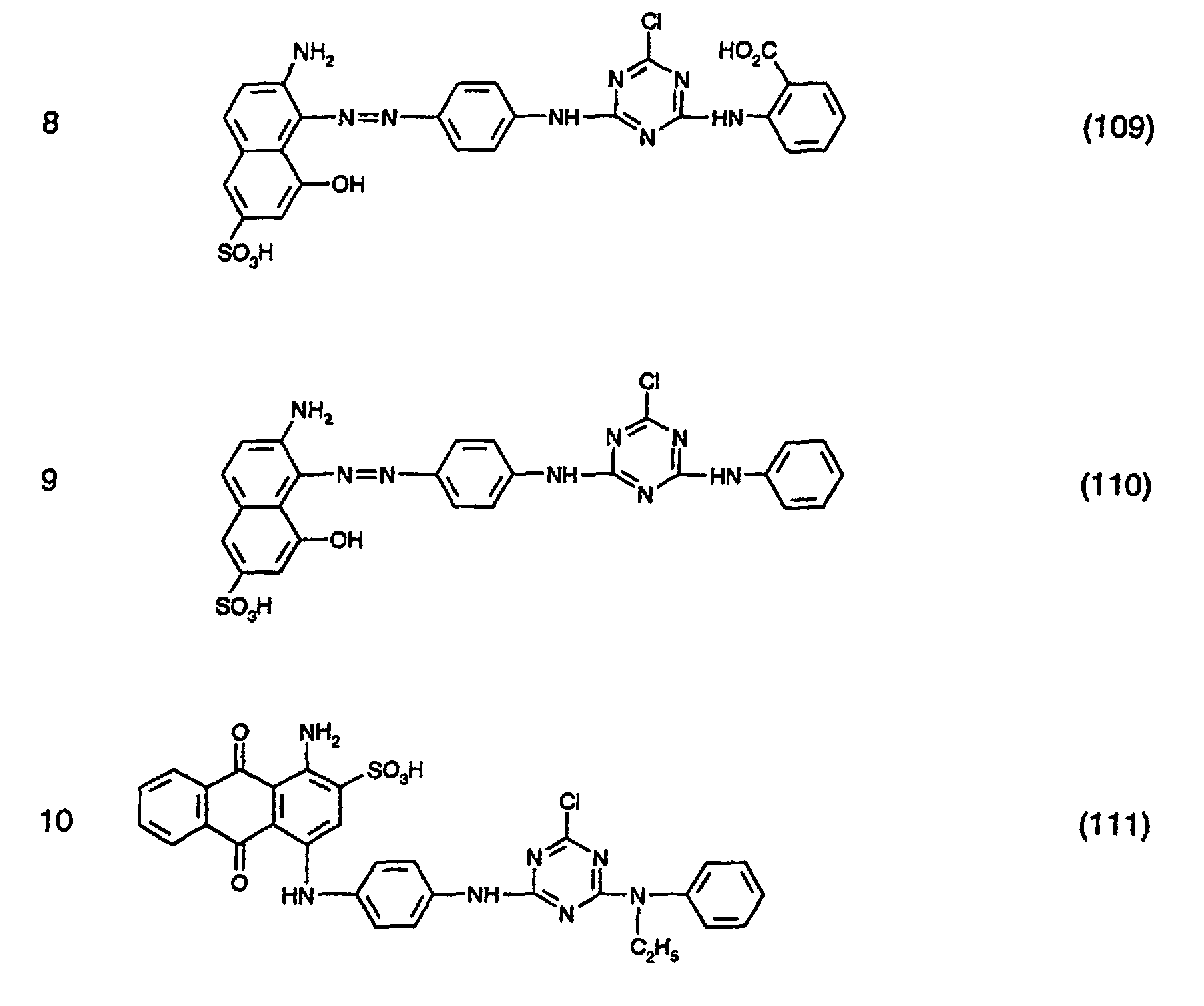
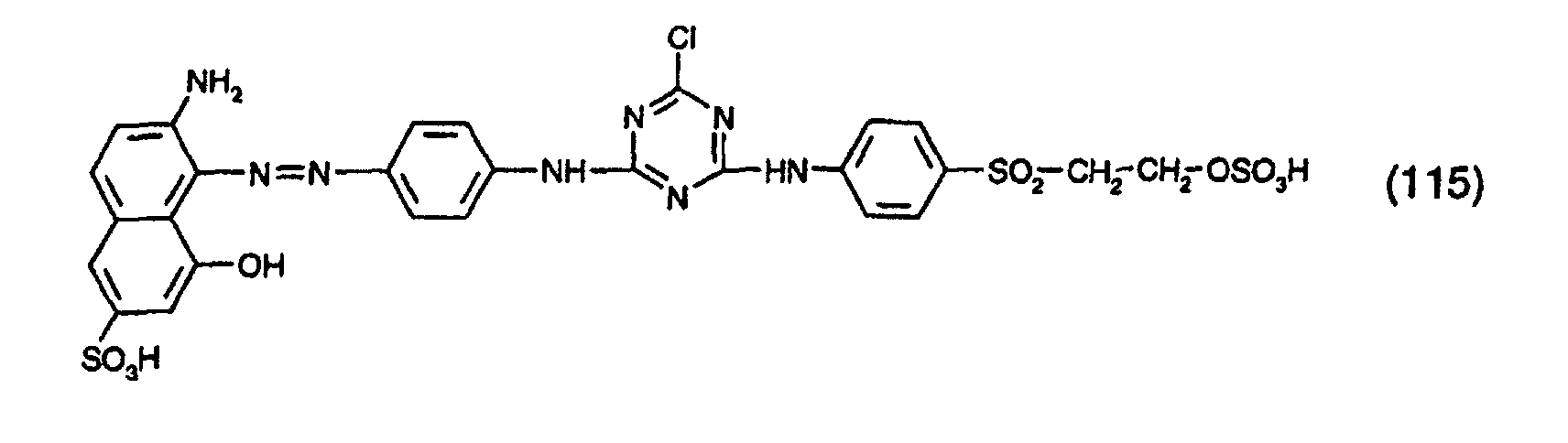
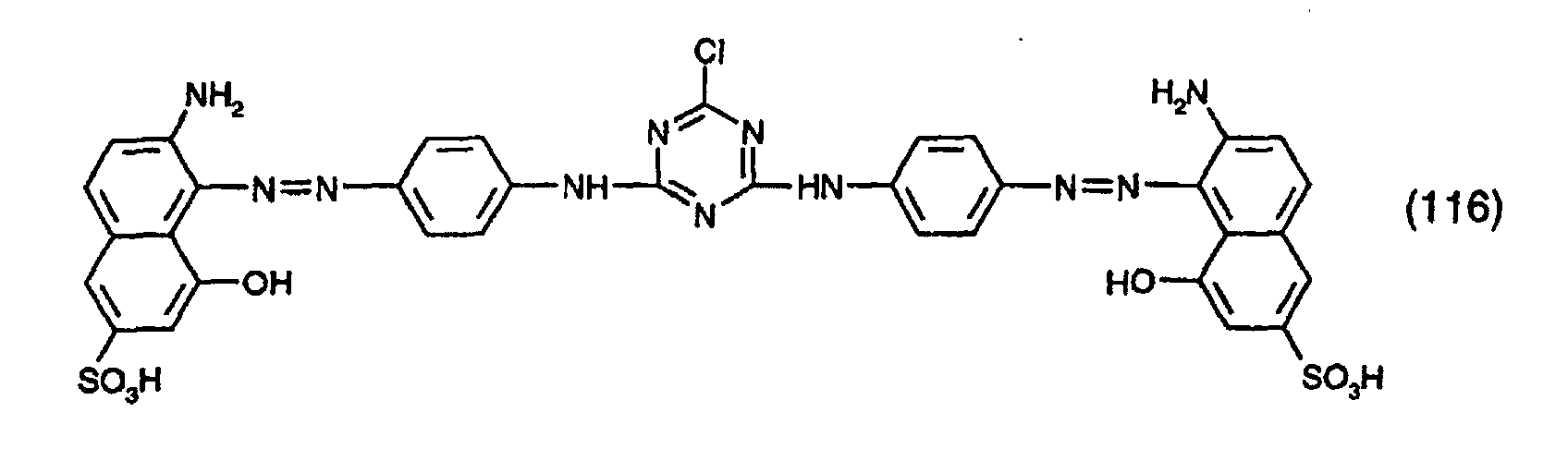
- the dyes specified in the following Table 1 in the form of the free acids can be obtained analogously to the information in Preparation Example 1.
- the anthraquinone dye of the formula (111) is obtained by first of all the compound of the formula (112) condensed with cyanuric chloride and then reacting the condensate obtained with N-ethylaniline, analogously to the procedure described in Preparation Example 1.
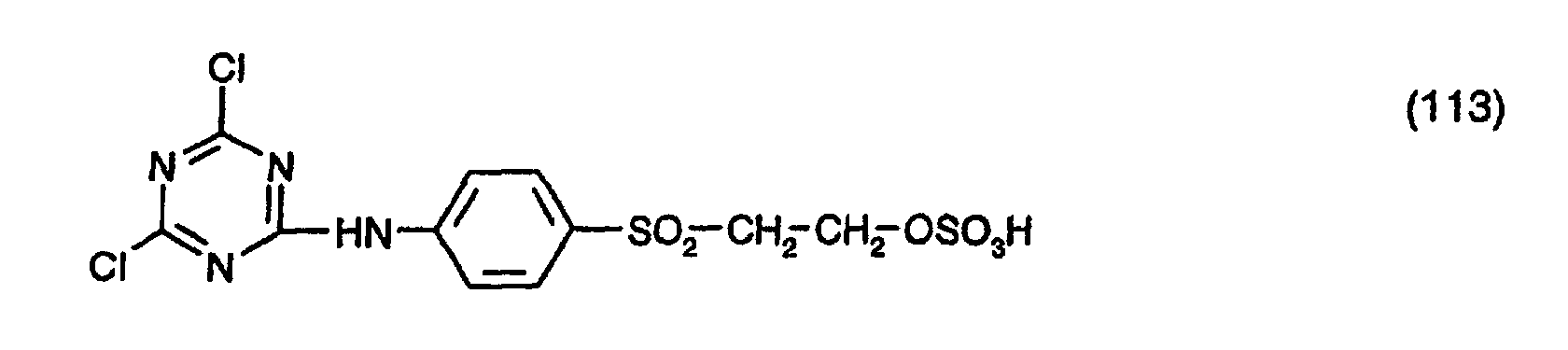
- Production Example 11 70 parts of cyanuric chloride are stirred in 950 parts of ice and 200 parts of water, with the addition of 3.6 parts of disodium dihydrogen phosphate x 12 H 2 O, for 30 minutes. A solution of 116.4 parts of 4- ( ⁇ -sulfatoethylsulfonyl) aniline (92%) in 900 parts of water, adjusted to a pH of 5.5, is then added within 10 minutes. The pH is kept at a value of 4.5 to 5 by adding 2 normal sodium hydroxide solution. Then 500 parts of acetone are added and the mixture is stirred at a temperature of from 0 to 5 ° C. until the lye uptake has ended. Then the precipitate is filtered off and washed first with water and then with acetone. The precipitate obtained is dried at room temperature under vacuum. A compound is obtained which corresponds in the form of the free acid to the formula (113).
- Production Example 12 1.85 parts of cyanuric chloride are ground in 25 parts of ice, 5 parts of water and 0.1 part of disodium hydrogenphosphate with ice cooling for 30 minutes.
- the anthraquinone dye is obtained of formula (123), by reacting the compound of formula (112) with cyanuric chloride, condensed analogously to the procedure described in Preparation Example 13.
- Dye 10 parts of polyamide 6.6 fiber material (Helikanatrikot) in 500 parts of an aqueous Broth containing 2 g / l ammonium acetate and adjusted to pH 5 with acetic acid. The amount the dye mixture according to Example 20 is 0.8% based on the fiber weight. The dyeing time at a temperature of 98 ° C is 30 to 90 minutes. The dyed fiber material is then removed and washed and dried as usual. A red-colored piece of fabric is obtained which has good overall fastness properties.
- 100 parts of clothing suede are at 50 ° C in a solution of 1000 parts of water and 2 parts of 24% ammonia rolled on for 2 hours and then at 60 ° C in a solution of 1000 parts of water, 2 parts of 24% ammonia and 2 parts a dye mixture dyed according to Example 19 for one hour. Thereupon a solution of 40 parts of water and 4 parts of 85% formic acid is added and colored another 30 minutes. Then the leather is rinsed well and if necessary with 2 Share a dicyandiamide-formaldehyde condensation product for 30 minutes Treated at 50 ° C. A red color is obtained with good overall fastness properties.
Landscapes
- Chemical & Material Sciences (AREA)
- Engineering & Computer Science (AREA)
- Textile Engineering (AREA)
- Chemical Kinetics & Catalysis (AREA)
- Organic Chemistry (AREA)
- Coloring (AREA)
Description

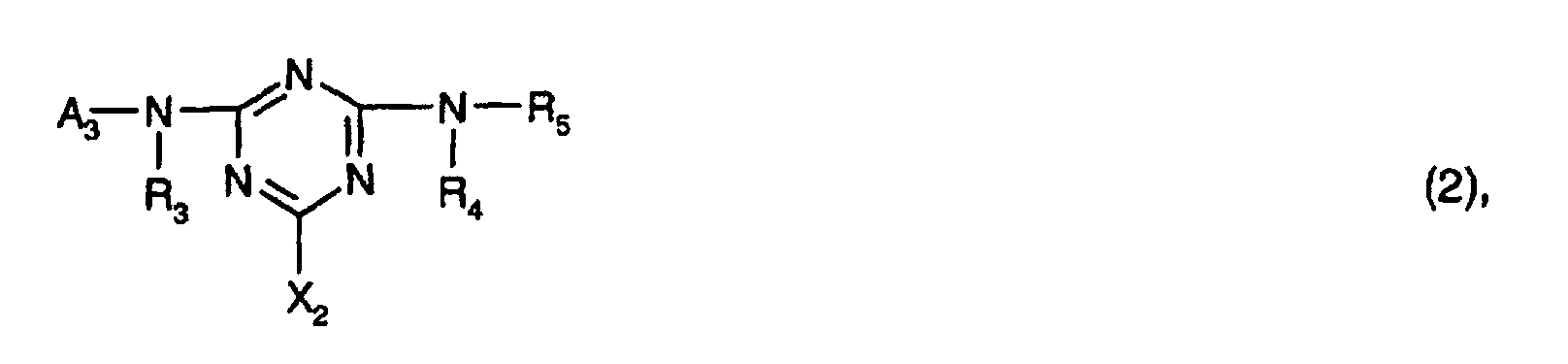
R1, R2, R3 und R4 unabhängig voneinander Wasserstoff oder C1-C4-Alkyl sind,
R5 gegebenenfalls durch C1-C4-Alkyl, C1-C4-Alkoxy, C2-C4-Alkanoylamino, Carboxyl, Sulfo, Carbamoyl, Ureido, Halogen oder durch einen Rest der Formel -SO2-Z substituiertes Phenyl ist, oder der Rest der Formel -N(R4)-R5 ein gegebenenfalls weitere Heteroatome enthaltender Ring ist, wobei
Z eine Gruppe der Formel -CH=CH2 oder -CH2-CH2-Y und Y eine Abgangsgruppe ist,
X1 und X2 identisch sind und Halogen, gegebenenfalls im Alkylteil durch Hydroxy substituiertes N-Mono- oder N,N-Di-C1-C4-Alkylamino, Cyclohexylamino, Phenylamino, Morpholino oder Piperidin-1-yl ist, und
A1, A2 und A3 identisch und Reste der Formel (16)
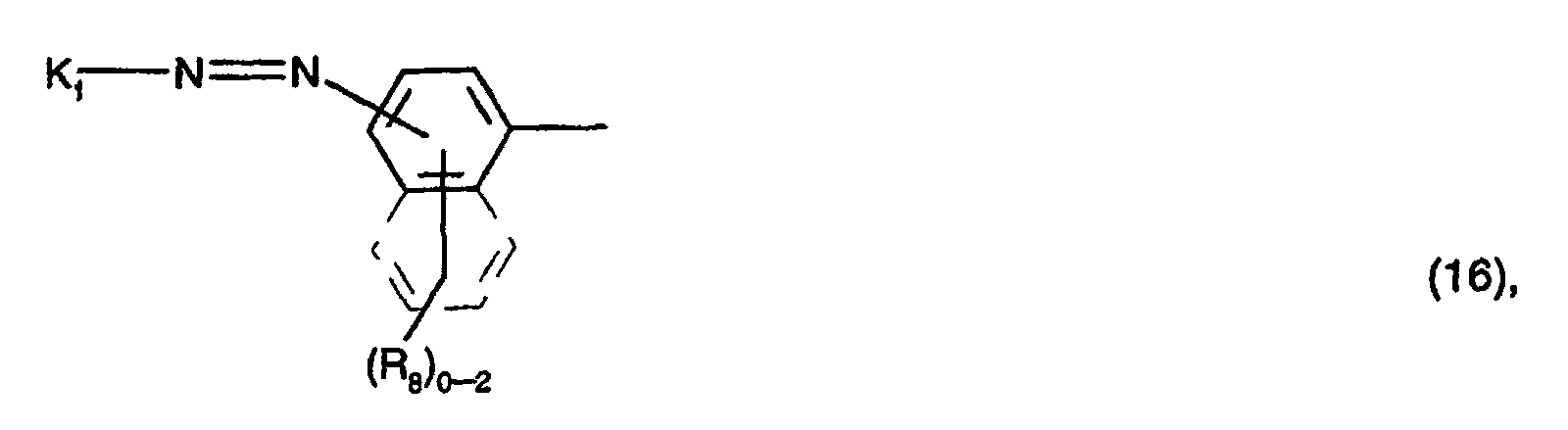
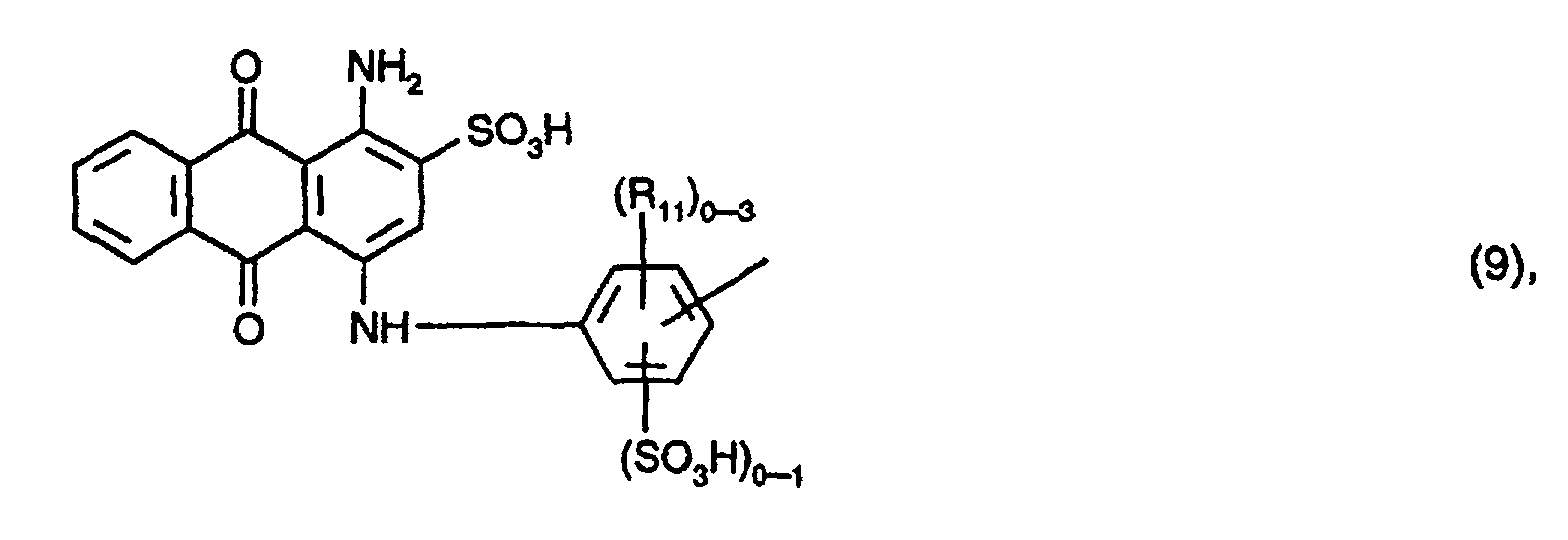
(R8)0-2 für 0 bis 2 gleiche oder voneinander verschiedene Substituenten ausgewählt aus der Gruppe C1-C4-Alkyl, C1-C4-Alkoxy, C2-C4-Alkanoylamino, Ureido und Sulfo steht,
(R11)0-3 für 0 bis 3 gleiche oder voneinander verschiedene Substituenten ausgewählt aus der Gruppe C1-C4-Alkyl, C1-C4-Alkoxy und Halogen, vorzugsweise für 0 bis 3 gleiche oder voneinander verschiedene C1-C4-Alkyl-Substituenten und insbesondere Methyl steht, und
K1 einen Rest der Formel (17)

R13 Amino oder Hydroxyl bedeutet, und
(R14)0-2 für 0 bis 2 gleiche oder voneinander verschiedene Substituenten ausgewählt aus der Gruppe C1-C4-Alkyl, C1-C4-Alkoxy, C2-C4-Alkanoylamino, Ureido, Halogen und Sulfo und bevorzugt für 0 bis 2 gleiche oder voneinander verschiedene Halogenatome, insbesondere Chlor, steht;
oder ein Rest der Formel (18)

oder einen Rest der Formel (12)

worin R18 Wasserstoff oder C1-C4-Alkyl, insbesondere Wasserstoff oder Methyl,
R19 Wasserstoff, und
R20 Wasserstoff, C1-C4-Alkyl oder gegebenenfalls durch C1-C4-Alkyl, C1-C4-Alkoxy, C2-C4-Alkanoylamino, Ureido, Halogen oder Sulfo substituiertes Phenyl und bevorzugt Wasserstoff oder C1-C4-Alkyl sind;
oder einen Rest der Formel (19)
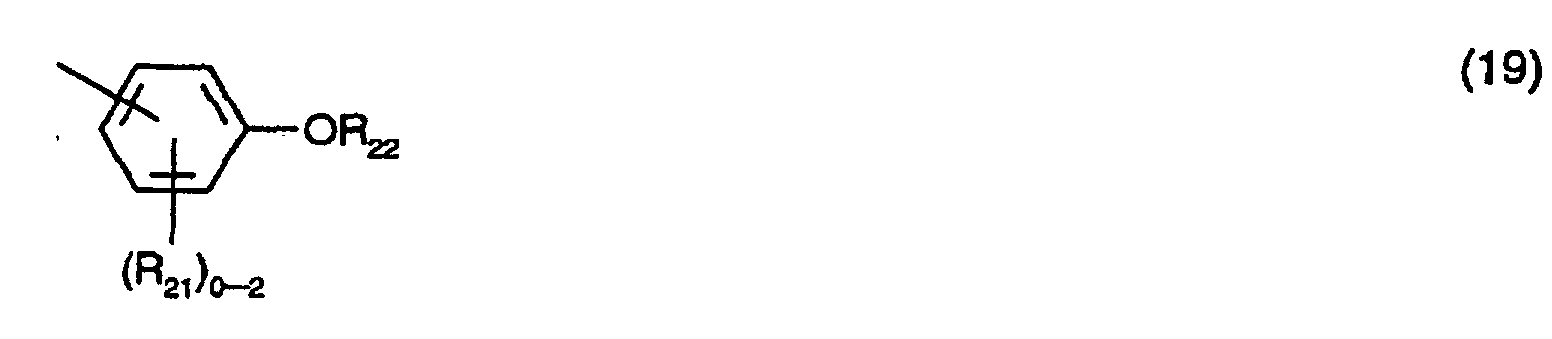
worin (R21)0-2 für 0 bis 2 gleiche oder voneinander verschiedene Substituenten ausgewählt aus der Gruppe C1-C4-Alkyl, C1-C4-Alkoxy, C2-C4-Alkanoylamino, Ureido, Halogen und Sulfo, und bevorzugt für 0 bis 2 gleiche oder voneinander verschiedene Substituenten ausgewählt aus der Gruppe C1-C4-Alkyl und C1-C4-Alkoxy steht, und
R22 Wasserstoff oder C1-C4-Alkyl ist;
oder ein Rest der Formel (20)
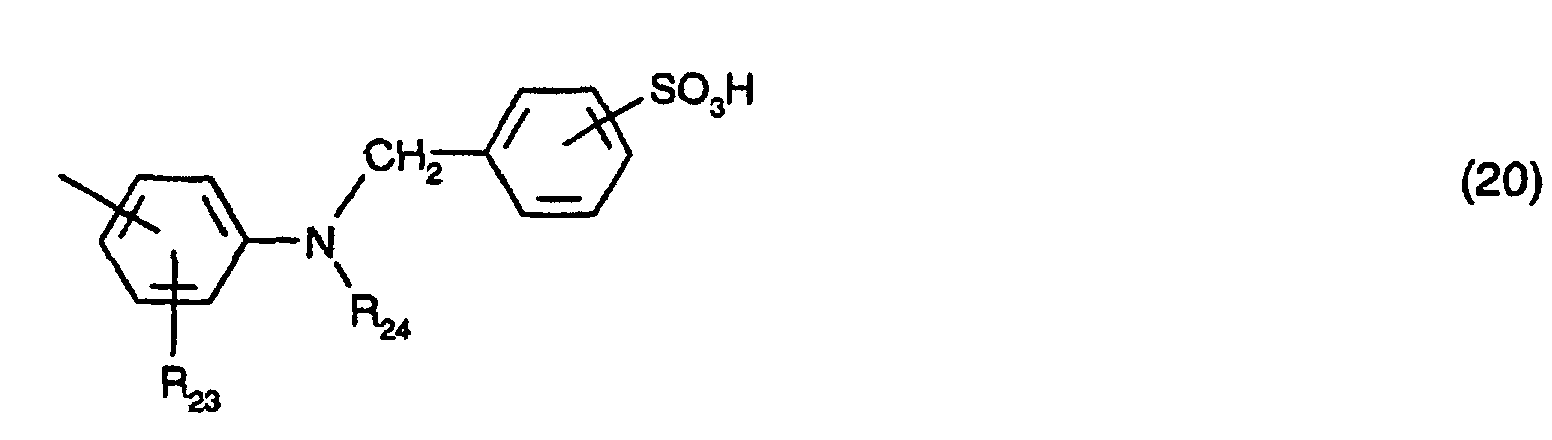
worin R23 Wasserstoff, C1-C4-Alkyl, C1-C4-Alkoxy, C2-C4-Alkanoylamino oder Halogen und bevorzugt Wasserstoff, C1-C4-Alkyl oder C1-C4-Alkoxy bedeutet,
R24 Wasserstoff oder C1-C4-Alkyl ist;
oder Reste der Formeln (21) oder (22)
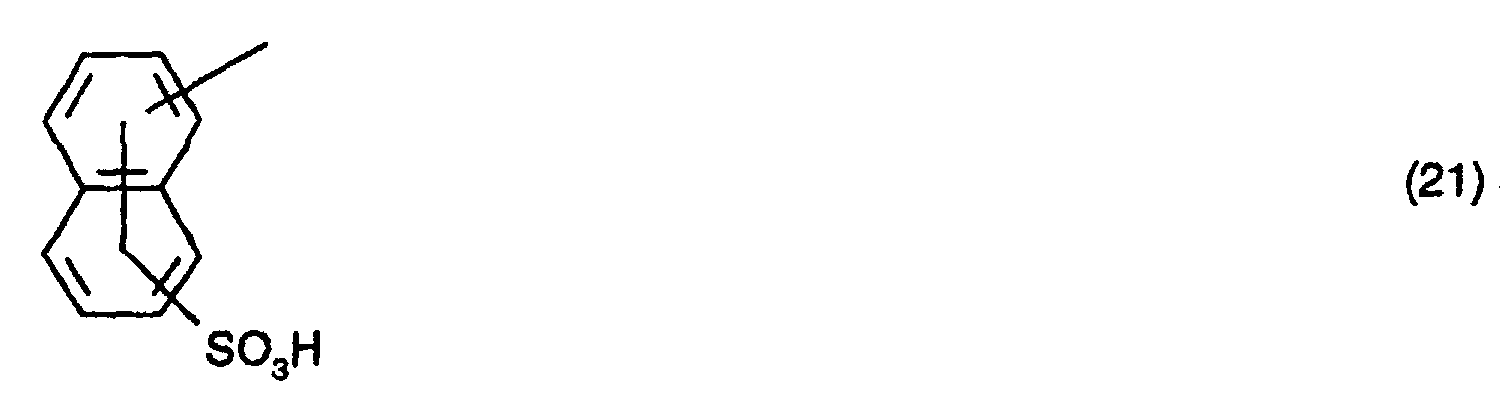

worin R29 Wasserstoff oder Hydroxyl ist.
R1, R2, R3 und R4 unabhängig voneinander Wasserstoff oder C1-C4-Alkyl,
R5 gegebenenfalls durch C1-C4-Alkyl, C1-C4-Alkoxy, C2-C4-Alkanoylamino, Carboxyl, Sulfo, Carbamoyl, Ureido, Halogen oder durch einen Rest der Formel -SO2-Z substituiertes Phenyl ist,
X1 und X2 unabhängig voneinander Halogen, gegebenenfalls im Alkylteil durch Hydroxyl substituiertes N-Mono- oder N,N-Di-C1-C4-Alkylamino, Cyclohexylamino, Phenylamino, Morpholino oder Piperidin-1-yl, insbesondere Halogen, bedeuten, und
für die Reste A1, A2, A3 und Z hierbei die oben angegebenen Bedeutungen und Bevorzugungen gelten.

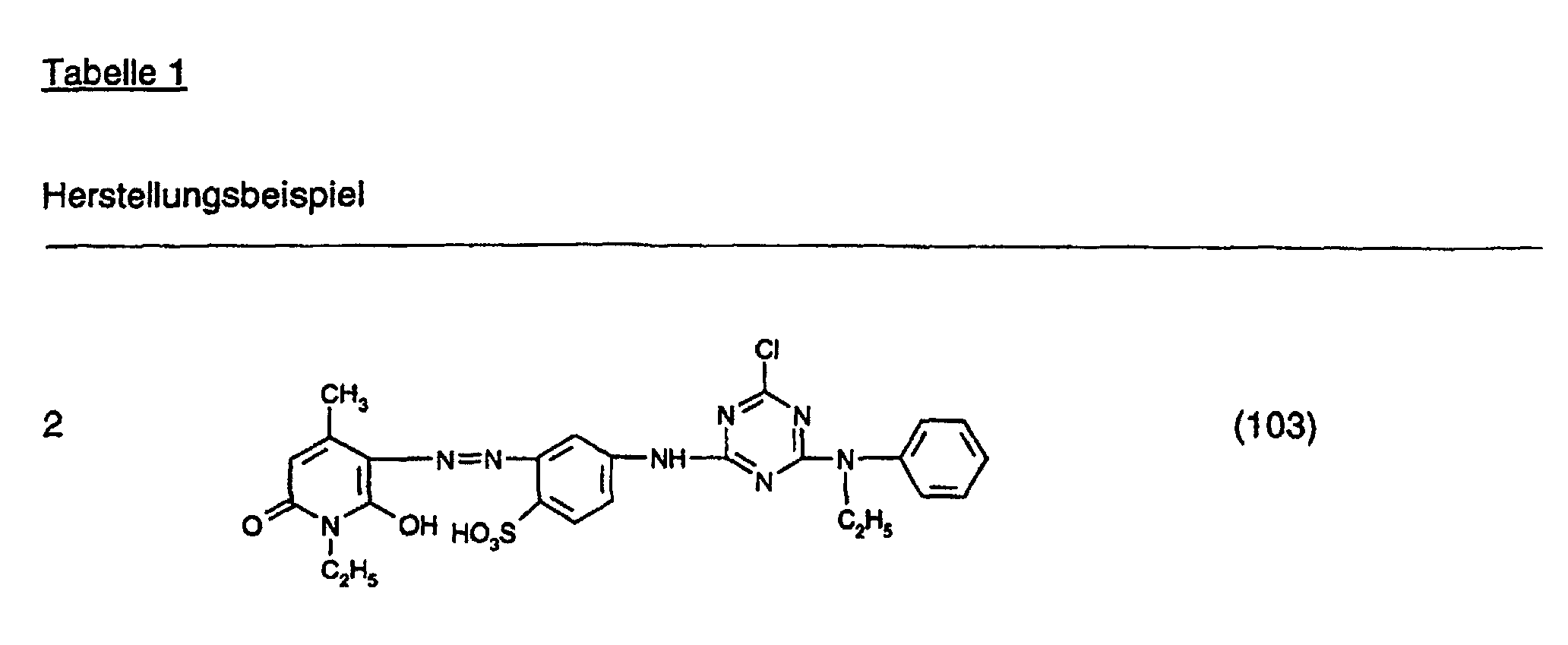
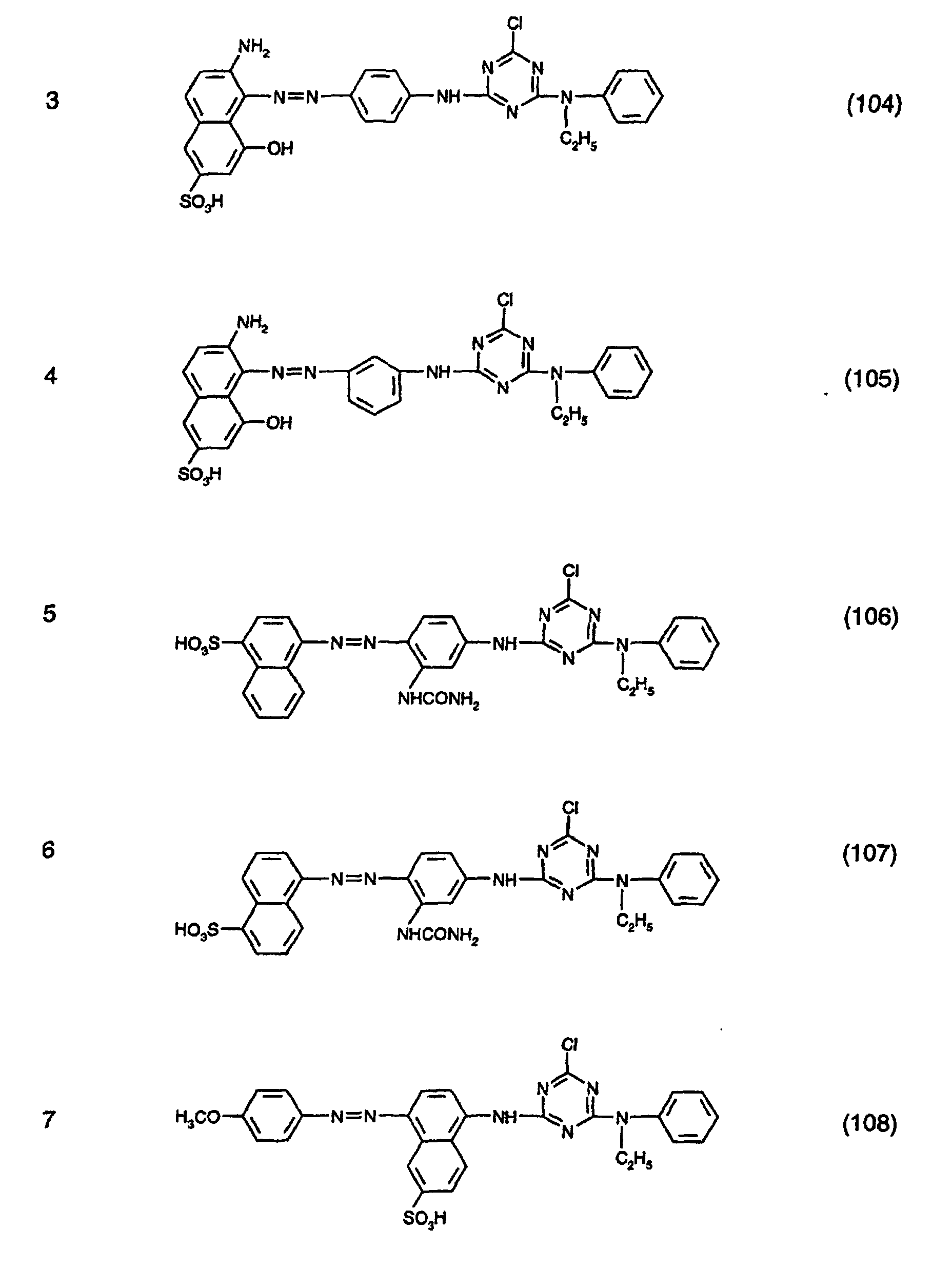



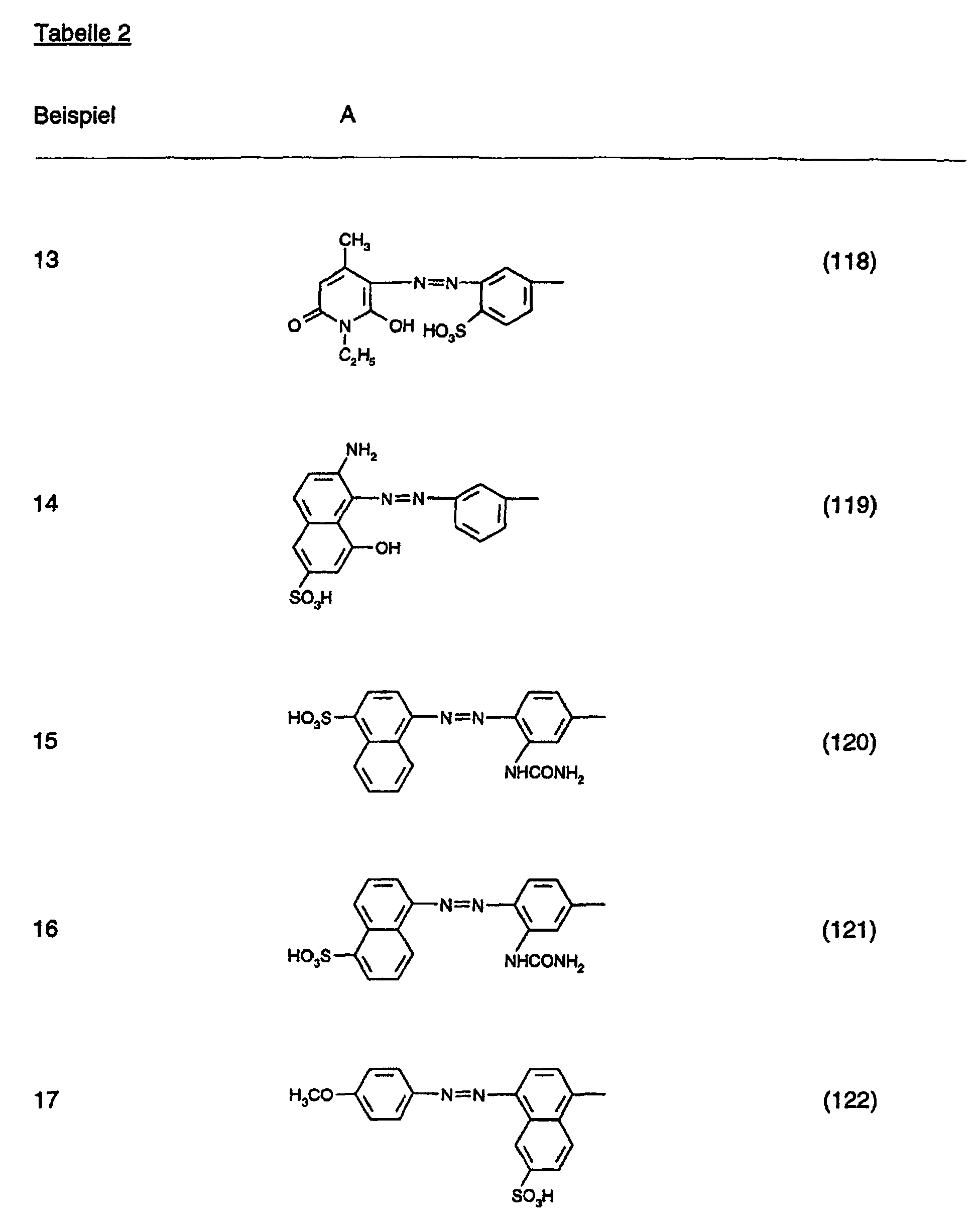
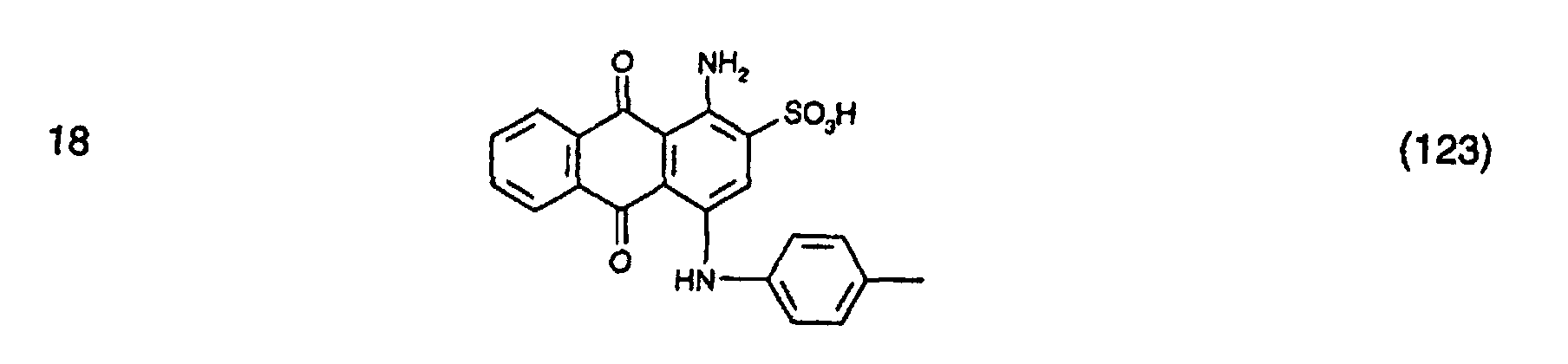
| Bsp. | Farbstoffmischung | Farbton auf Wolle |
| 19 | Mischung aus | |
| 65 Teilen des Farbstoffs gemäss Herstellungsbeispiel 3 | rot | |
| 35 Teilen des Farbstoffs gemäss Beispiel 12 | ||
| 20 | Mischung aus | |
| 50 Teilen des Farbstoffs gemäss Herstellungsbeispiel 3 | rot | |
| 50 Teilen des Farbstoffs gemäss Beispiel 12 | ||
| 21 | Mischung aus | |
| 50 Teilen des Farbstoffs gemäss Herstellungsbeispiel 7 | gelb | |
| 50 Teilen des Farbstoffs gemäss Beispiel 17 | ||
| 22 | Mischung aus | |
| 50 Teilen des Farbstoffs gemäss Herstellungsbeispiel 5 | orange | |
| 50 Teilen des Farbstoffs gemäss Beispiel 15 | ||
| 23 | Mischung aus | |
| 50 Teilen des Farbstoffs gemäss Herstellungsbeispiel 4 | rot | |
| 50 Teilen des Farbstoffs gemäss Beispiel 14 | ||
| 24 | Mischung aus | |
| 50 Teilen des Farbstoffs gemäss Herstellungsbeispiel 2 | gelb | |
| 50 Teilen des Farbstoffs gemäss Beispiel 13 | ||
| 25 | Mischung aus | |
| 50 Teilen des Farbstoffs gemäss Herstellungsbeispiel 10 | blau | |
| 50 Teilen des Farbstoffs gemäss Beispiel 18 | ||
| 26 | Mischung aus | |
| 50 Teilen des Farbstoffs gemäss Herstellungsbeispiel 8 | rot | |
| 50 Teilen des Farbstoffs gemäss Beispiel 12 | ||
| 27 | Mischung aus | |
| 50 Teilen des Farbstoffs gemäss Herstellungsbeispiel 9 | rot | |
| 50 Teilen des Farbstoffs gemäss Beispiel 12 | ||
| 28 | Mischung aus | |
| 50 Teilen des Farbstoffs gemäss Herstellungsbeispiel 6 | orange | |
| 50 Teilen des Farbstoffs gemäss Beispiel 16 | ||
| 29 | Mischung aus | |
| 50 Teilen des Farbstoffs gemäss Herstellungsbeispiel 11 | rot | |
| 50 Teilen des Farbstoffs gemäss Beispiel 12 |
Claims (7)
- Farbstoffmischungen, dadurch gekennzeichnet, dass sie mindestens einen anionischen Farbstoff der Formel (1)und mindestens einen anionischen Farbstoff der Formel (2)
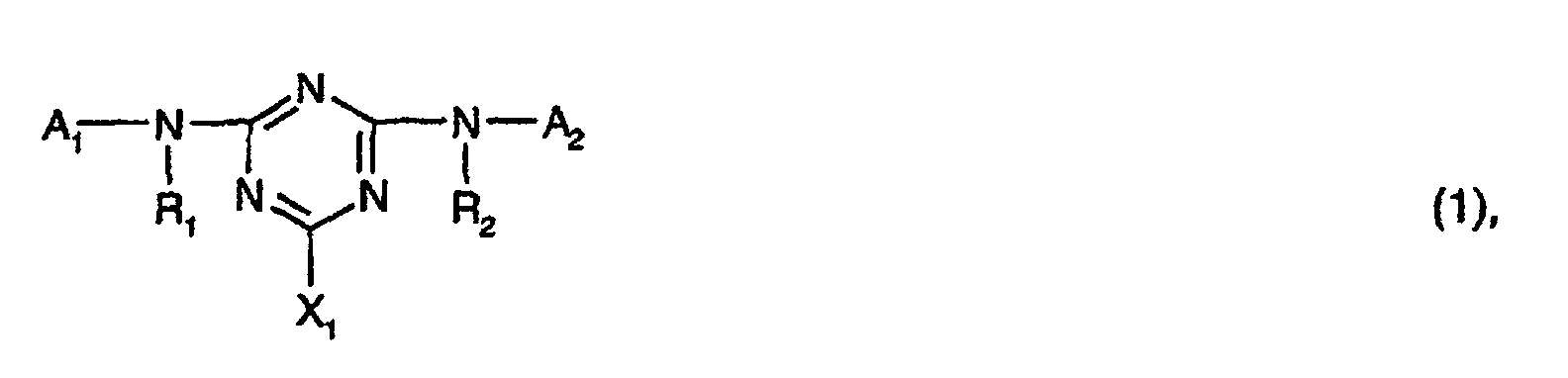 enthalten, worin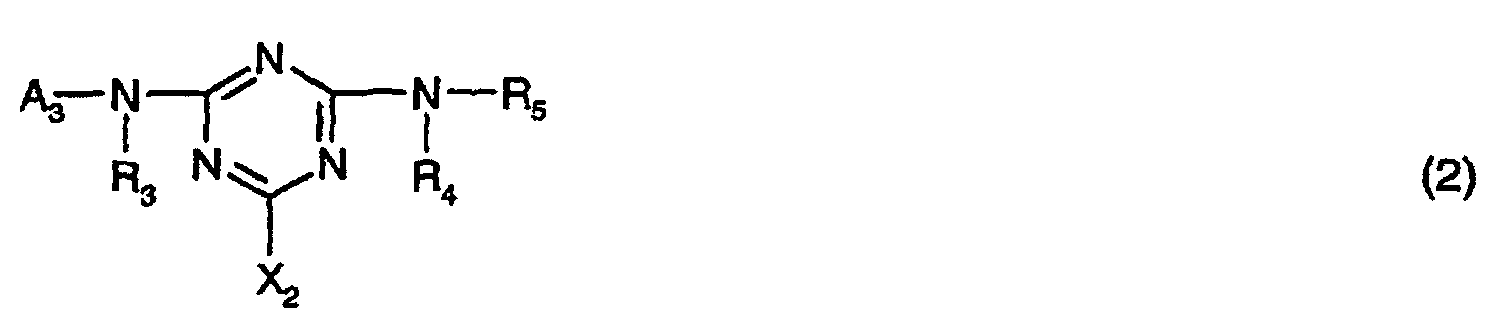
R1, R2, R3, und R4 unabhängig voneinander Wasserstoff oder C1-C4-Alkyl sind,
R5 gegebenenfalls durch C1-C4-Alkyl, C1-C4-Alkoxy, C2-C4-Alkanoylamino, Carboxyl, Sulfo, Carbamoyl, Ureido, Halogen oder durch einen Rest der Formel -SO2-Z substituiertes Phenyl ist oder der Rest der Formel -N(R4)-R5 ein gegebenenfalls weitere Heteroatome enthaltender Ring ist, wobei Z eine Gruppe der Formel -CH=CH2 oder -CH2-CH2-Y und Y eine Abgangsgruppe ist,
X1 und X2 identisch sind und Halogen, gegebenenfalls im Alkylteil durch Hydroxyl substituiertes N-Mono- oder N,N-Di-C1-C4-Alkylamino, Cyclohexylamino, Phenylamino, Morpholino oder Piperidin-1-yl, bedeuten, und
A1, A2 und A3 identisch, und Reste der Formel (16)oder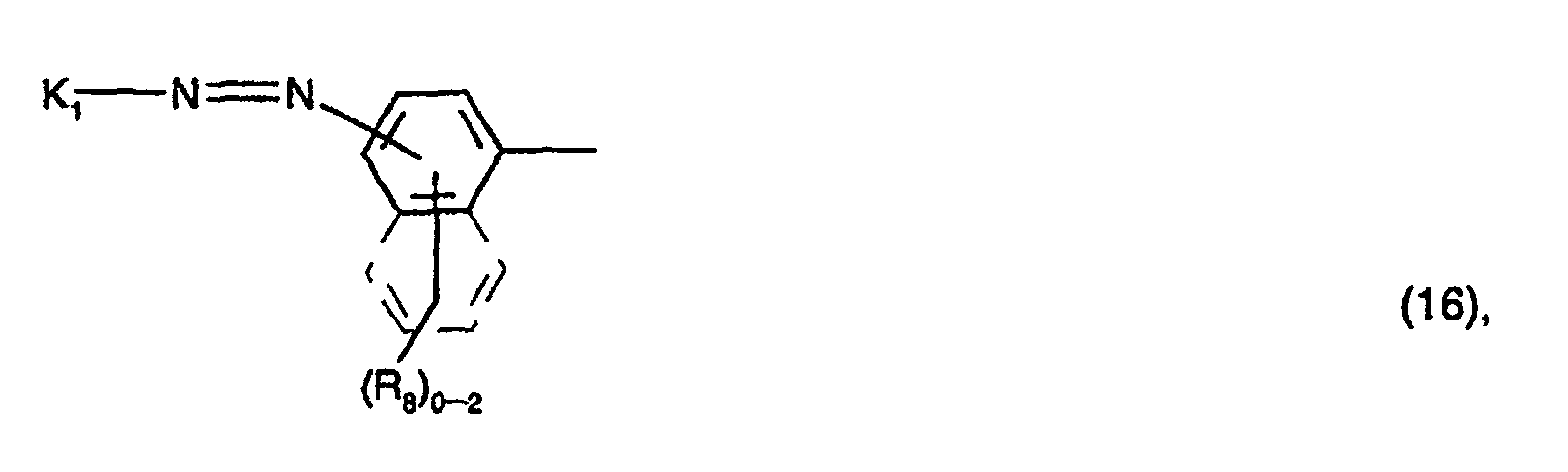 sind,
sind,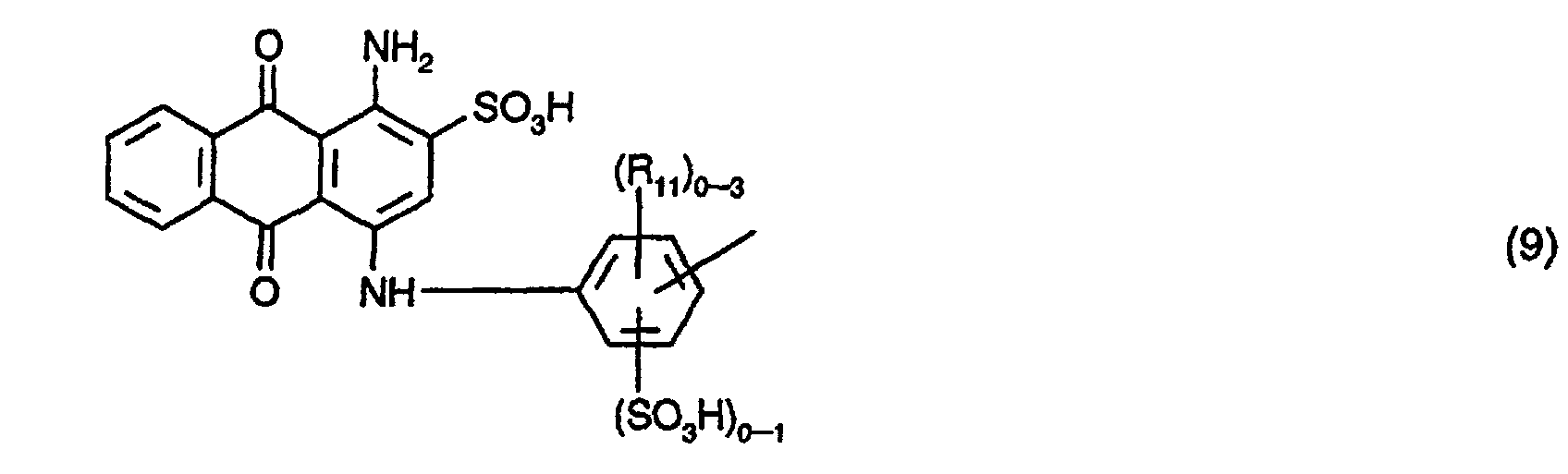
worin
(R8)0-2 für 0 bis 2 gleiche oder voneinander verschiedene Substituenten ausgewählt aus der Gruppe C1-C4-Alkyl, C1-C4-Alkoxy, C2-C4-Alkanoylamino, Ureido und Sulfo steht,
(R11)0-3 für 0 bis 3 gleiche oder voneinander verschiedene Substituenten ausgewählt aus der Gruppe C1-C4-Alkyl, C1-C4-Alkoxy und Halogen steht, und
K1 einen Rest der Formel (17)bedeutet,
worin
R12 Methyl oder Carboxyl ist,
R13 Amino oder Hydroxyl bedeutet, und
(R14)0-2 für 0 bis 2 gleiche oder voneinander verschiedene Substituenten ausgewählt aus der Gruppe C1-C4-Alkyl, C1-C4-Alkoxy, C2-C4-Alkanoylamino, Ureido, Halogen und Sulfo steht; oder ein Rest der Formel (18)ist,
worin
R16 Wasserstoff, C1-C4-Alkyl und R28 Wasserstoff, C1-C4-Alkyl, C1-C4-Alkoxy, C2-C4-Alkanoylamino oder Halogen bedeuten;
oder einen Rest der Formelworin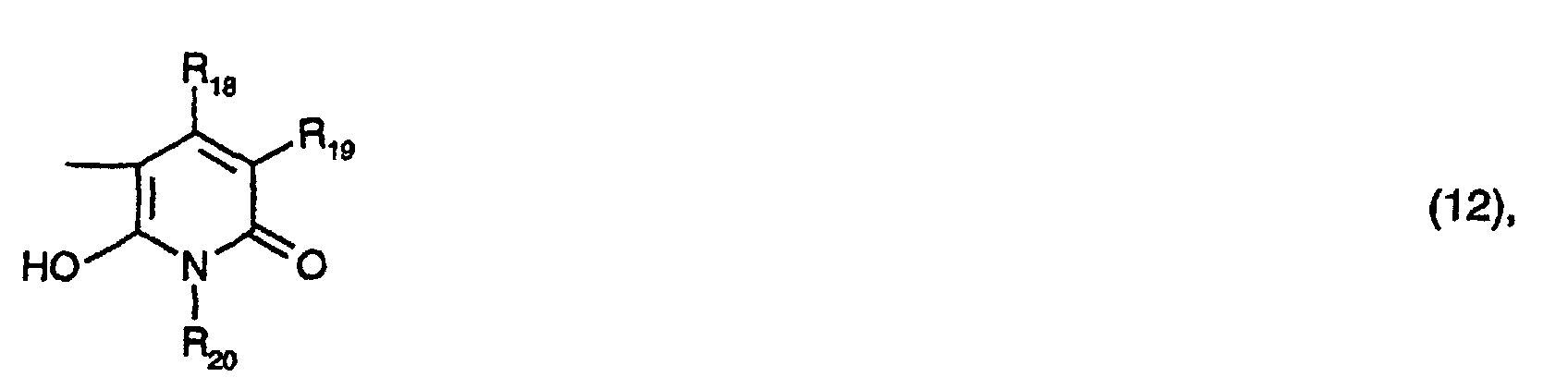
R18 Wasserstoff oder C1-C4-Alkyl,
R19 Wasserstoff und
R20 Wasserstoff, C1-C4-Alkyl oder gegebenenfalls durch C1-C4-Alkyl, C1-C4-Alkoxy, C2-C4-Alkanoylamino, Ureido, Halogen oder Sulfo substituiertes Phenyl sind;
oder einen Rest der Formel (19)bedeutet,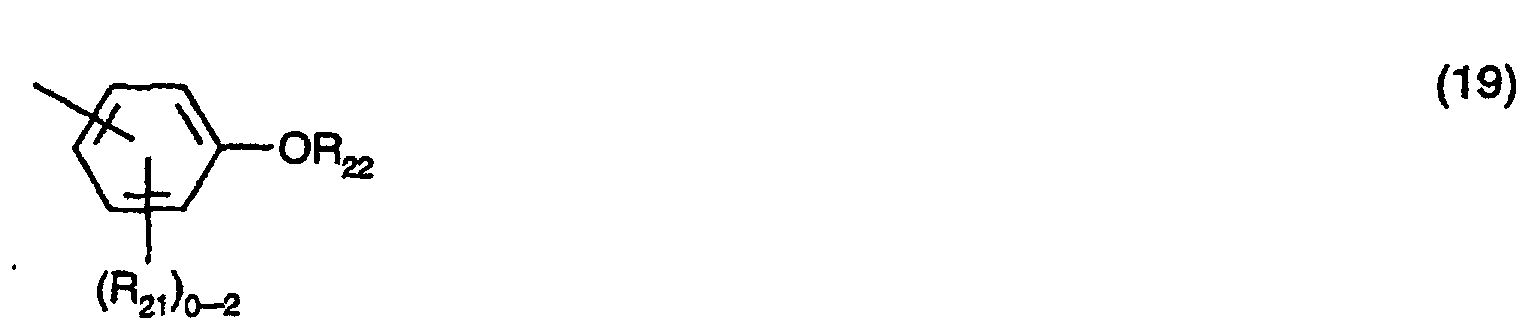
worin
(R21)0-2 für 0 bis 2 gleiche oder voneinander verschiedene Substituenten ausgewählt aus der Gruppe C1-C4-Alkyl, C1-C4-Alkoxy, C2-C4-Alkanoylamino, Ureido, Halogen und Sulfo steht, und
R22 Wasserstoff oder C1-C4-Alkyl ist;
oder ein Rest der Formel (20)ist,
worin
R23 Wasserstoff, C1-C4-Alkyl, C1-C4-Alkoxy, C2-C4-Alkanoylamino oder Halogen und
R24 Wasserstoff oder C1-C4-Alkyl sind;
oder Reste der Formel (21) oder (22)oder bedeutet,
worin
R29 Wasserstoff oder Hydroxyl ist. - Farbstoffmischungen gemäss Anspruch 1, worin Y eine Gruppe der Formel -OSO3H ist.
- Farbstoffmischungen gemäss einem der Ansprüche 1 und 2, worin R5 gegebenenfalls durch Sulfo oder Carboxyl substituiertes Phenyl ist.
- Farbstoffmischungen gemäss einem der Ansprüche 1 bis 3, worin X1 und X2 Chlor bedeuten.
- Farbstoffmischungen gemäss Anspruch 1, worin R12 Methyl, (R14)0-2 für 0 bis 2 gleiche oder voneinander verschiedene Halogenatome, insbesondere Chlor, steht, R16 und R28 Wasserstoff, R18 Wasserstoff oder Methyl und R20 Wasserstoff oder C1-C4-Alkyl bedeutet, (R21)0-2 für 0 bis 2 gleiche oder voneinander verschiedene Substituenten ausgewählt aus der Gruppe C1-C4-Alkyl und C1-C4-Alkoxy bedeuten, und R23 Wasserstoff, C1-C4-Alkyl oder C1-C4-Alkoxy bedeutet.
- Verwendung der Farbstoffmischungen gemäss einem der Ansprüche 1 bis 5 zum Färben oder Bedrucken von hydroxylgruppenhaltigen oder stickstoffhaltigen Fasermaterialien.
- Verwendung gemäss Anspruch 6 zum Färben oder Bedrucken von natürlichem oder synthetischem Polyamidfasermaterial.
Applications Claiming Priority (3)
| Application Number | Priority Date | Filing Date | Title |
|---|---|---|---|
| CH2087/96 | 1996-08-26 | ||
| CH208796 | 1996-08-26 | ||
| CH208796 | 1996-08-26 |
Publications (3)
| Publication Number | Publication Date |
|---|---|
| EP0826743A2 EP0826743A2 (de) | 1998-03-04 |
| EP0826743A3 EP0826743A3 (de) | 1998-12-09 |
| EP0826743B1 true EP0826743B1 (de) | 2002-09-18 |
Family
ID=4225596
Family Applications (1)
| Application Number | Title | Priority Date | Filing Date |
|---|---|---|---|
| EP97810580A Expired - Lifetime EP0826743B1 (de) | 1996-08-26 | 1997-08-19 | Farbstoffmischungen, Verfahren zu deren Herstellung und deren Verwendung |
Country Status (4)
| Country | Link |
|---|---|
| US (1) | US5958086A (de) |
| EP (1) | EP0826743B1 (de) |
| JP (1) | JP4056593B2 (de) |
| DE (1) | DE59708248D1 (de) |
Families Citing this family (13)
| Publication number | Priority date | Publication date | Assignee | Title |
|---|---|---|---|---|
| US6398822B1 (en) * | 1998-04-02 | 2002-06-04 | The Proctor & Gamble Company | Packaged hair coloring composition |
| US6447554B1 (en) * | 1998-04-02 | 2002-09-10 | The Procter & Gamble Company | Reactive dye compounds |
| DE19821573A1 (de) * | 1998-05-14 | 2000-02-10 | Dystar Textilfarben Gmbh & Co | Farbstoffmischung von wasserlöslichen faserreaktiven Azofarbstoffen, Verfahren zu ihrer Herstellung und ihre Verwendung |
| US6090163A (en) * | 1998-12-21 | 2000-07-18 | Dystar Textilfarben Gmbh & Co. Deutschland Kg | Red-dyeing dye mixtures of water-soluble fiber-reactive azo dyes and their use |
| KR20010108133A (ko) | 1999-02-05 | 2001-12-07 | 에프. 아. 프라저, 에른스트 알테르 (에. 알테르), 한스 페터 비틀린 (하. 페. 비틀린), 피. 랍 보프, 브이. 스펜글러, 페. 아에글러 | 흑색 염색용 잉크 및 이의 용도 |
| PL354835A1 (en) * | 2001-07-12 | 2003-01-13 | Ciba Sc Holding Ag | Method of trichromatic dyeing and printing of synthetic material from polyamide fibres |
| DE10344127A1 (de) * | 2003-09-24 | 2005-04-21 | Dystar Textilfarben Gmbh & Co | Verfahren zum Mono, Di- oder Trichromie-Färben oder -Bedrucken von natürlichen oder synthetischen Polyamidfasermaterialien |
| US7772271B2 (en) | 2004-07-14 | 2010-08-10 | Ptc Therapeutics, Inc. | Methods for treating hepatitis C |
| US7781478B2 (en) | 2004-07-14 | 2010-08-24 | Ptc Therapeutics, Inc. | Methods for treating hepatitis C |
| US7868037B2 (en) | 2004-07-14 | 2011-01-11 | Ptc Therapeutics, Inc. | Methods for treating hepatitis C |
| EA200700243A1 (ru) * | 2004-07-14 | 2007-08-31 | ПиТиСи ТЕРАПЬЮТИКС, ИНК. | Способы лечения гепатита с |
| EP1781289A1 (de) | 2004-07-22 | 2007-05-09 | PTC Therapeutics, Inc. | Thienopyridine zur behandlung von hepatitis c |
| GB0506496D0 (en) * | 2005-03-31 | 2005-05-04 | Avecia Ltd | Compound, composition and use |
Family Cites Families (13)
| Publication number | Priority date | Publication date | Assignee | Title |
|---|---|---|---|---|
| US3488343A (en) * | 1966-02-08 | 1970-01-06 | Ciba Ltd | Monoazo dyestuffs containing an acrylyl or benzoyl fiber-reactive substituent |
| JPS593594B2 (ja) * | 1975-12-29 | 1984-01-25 | 住友化学工業株式会社 | ブンサンセンリヨウニヨルソスイセイセンイザイリヨウノ キンイツセンシヨクホウ |
| US4652269A (en) * | 1984-11-08 | 1987-03-24 | Ciba-Geigy Corporation | Process for the continuous trichromatic dyeing of synthetic polyamide materials: including a blue anthraquinone reactive dye |
| FR2640988B1 (de) * | 1988-12-22 | 1993-02-19 | Sandoz Sa | |
| ES2106070T3 (es) * | 1990-09-25 | 1997-11-01 | Ciba Geigy Ag | Colorantes y mezclas de colorantes reactivos con las fibras y utilizacion de los mismos. |
| DE4332048A1 (de) * | 1993-09-21 | 1995-03-23 | Hoechst Ag | Mischungen von Farbstoffen mit faserreaktiven Gruppen und deren Verwendung zum Färben von Fasermaterialien |
| ES2152298T3 (es) * | 1993-12-13 | 2001-02-01 | Ciba Sc Holding Ag | Colorantes reactivos, procedimiento para su fabricacion y su utilizacion. |
| DE4415313A1 (de) * | 1994-05-02 | 1995-11-09 | Hoechst Ag | Mischungen von faserreaktiven Farbstoffen und deren Verwendung zum Färben von Fasermaterialien |
| DE4415779A1 (de) * | 1994-05-05 | 1995-11-09 | Bayer Ag | Verfahren zum Färben oder Bedrucken von hydroxylgruppenhaltigen Fasermaterialien |
| US5456727A (en) * | 1994-05-24 | 1995-10-10 | Hoechst Celanese Corporation | Dye compositions for polyamides |
| US5644040A (en) * | 1994-12-02 | 1997-07-01 | Ciba-Geigy Corporation | Azo dyes having two monoazo-chromophores bound to a halotriazinyl radical processes for their preparation and their use |
| US5693103A (en) * | 1994-12-13 | 1997-12-02 | Dystar, L.P. | Process for dyeing polyester/cotton blends |
| EP0775776B1 (de) * | 1995-11-23 | 2003-01-02 | Ciba SC Holding AG | Verfahren zum Di- oder Trichromie-Färben oder -Bedrucken |
-
1997
- 1997-08-18 JP JP22139597A patent/JP4056593B2/ja not_active Expired - Fee Related
- 1997-08-19 EP EP97810580A patent/EP0826743B1/de not_active Expired - Lifetime
- 1997-08-19 DE DE59708248T patent/DE59708248D1/de not_active Expired - Fee Related
- 1997-08-26 US US08/918,884 patent/US5958086A/en not_active Expired - Fee Related
Also Published As
| Publication number | Publication date |
|---|---|
| JPH1088021A (ja) | 1998-04-07 |
| JP4056593B2 (ja) | 2008-03-05 |
| EP0826743A2 (de) | 1998-03-04 |
| US5958086A (en) | 1999-09-28 |
| EP0826743A3 (de) | 1998-12-09 |
| DE59708248D1 (de) | 2002-10-24 |
Similar Documents
| Publication | Publication Date | Title |
|---|---|---|
| EP0465420B1 (de) | Azofarbstoffe | |
| EP0693538B1 (de) | Azofarbstoffe, Verfahren zu deren Herstellung und deren Verwendung | |
| EP0775776A2 (de) | Verfahren zum Di- oder Trichromie-Färben oder -Bedrucken | |
| EP0826743B1 (de) | Farbstoffmischungen, Verfahren zu deren Herstellung und deren Verwendung | |
| EP1247841B1 (de) | Reaktivfarbstoffe, Verfahren zu deren Herstellung und deren Verwendung | |
| EP0657508B1 (de) | Reaktivfarbstoffe, Verfahren zu deren Herstellung und deren Verwendung | |
| EP0719841A1 (de) | Farbstoffmischung von wasserlöslichen faserreaktiven Azofarbstoffen, Verfahren zu ihrer Herstellung und ihre Verwendung | |
| EP0775730B1 (de) | Reaktivfarbstoffe, Verfahren zu deren Herstellung und deren Verwendung | |
| EP0714955B1 (de) | Azofarbstoffe, Verfahren zu deren Herstellung und deren Verwendung | |
| EP0755985B1 (de) | Farbstoffmischungen, Verfahren zu ihrer Herstellung und ihre Verwendung | |
| EP0794234B1 (de) | Farbstoffmischungen, Verfahren zu deren Herstellung und deren Verwendung | |
| EP0675171B1 (de) | Reaktivfarbstoffe, Verfahren zu deren Herstellung und deren Verwendung | |
| EP0775732A1 (de) | Faserreaktive Farbstoffe, ihre Herstellung und Verwendung | |
| EP0775731B1 (de) | Reaktivfarbstoffe, Verfahren zu deren Herstellung und deren Verwendung | |
| EP0794233B1 (de) | Anionische Säurefarbstoffe, Verfahren zu deren Herstellung und deren Verwendung | |
| EP0889098A2 (de) | Azofarbstoffe, Verfahren zu deren Herstellung und deren Verwendung | |
| EP1041121B1 (de) | Farbstoffe, Verfahren zu deren Herstellung und deren Verwendung | |
| EP0690103B1 (de) | Azofarbstoffe, Verfahren zu deren Herstellung und deren Verwendung | |
| EP1088858B1 (de) | Reaktivfarbstoffe, enthaltend einen Formazan- und einen Monoazofarbstoffrest, Verfahren zu deren Herstellung und deren Verwendung | |
| EP0524147B1 (de) | Azofarbstoffe, Verfahren zu deren Herstellung und deren Verwendung | |
| EP0230909B1 (de) | Wasserlösliche Azoverbindungen, Verfahren zu ihrer Herstellung und ihre Verwendung als Farbstoffe | |
| EP0624629B1 (de) | Faserreaktive Farbstoffe, ihre Herstellung und Verwendung | |
| EP0739952B1 (de) | Azofarbstoffmischungen und deren Verwendung | |
| EP0969051A1 (de) | Mischungen von Reaktivfarbstoffen und deren Verwendung | |
| EP0798413A1 (de) | Verfahren zum Färben von natürlichen oder synthetischen Polyamidfasermaterialien |
Legal Events
| Date | Code | Title | Description |
|---|---|---|---|
| PUAI | Public reference made under article 153(3) epc to a published international application that has entered the european phase |
Free format text: ORIGINAL CODE: 0009012 |
|
| AK | Designated contracting states |
Kind code of ref document: A2 Designated state(s): BE CH DE ES FR GB IT LI |
|
| AX | Request for extension of the european patent |
Free format text: AL;LT;LV;RO;SI |
|
| 17P | Request for examination filed |
Effective date: 19980724 |
|
| PUAL | Search report despatched |
Free format text: ORIGINAL CODE: 0009013 |
|
| AK | Designated contracting states |
Kind code of ref document: A3 Designated state(s): AT BE CH DE DK ES FI FR GB GR IE IT LI LU MC NL PT SE |
|
| AX | Request for extension of the european patent |
Free format text: AL;LT;LV;RO;SI |
|
| AKX | Designation fees paid |
Free format text: BE CH DE ES FR GB IT LI |
|
| 17Q | First examination report despatched |
Effective date: 20000428 |
|
| GRAG | Despatch of communication of intention to grant |
Free format text: ORIGINAL CODE: EPIDOS AGRA |
|
| GRAG | Despatch of communication of intention to grant |
Free format text: ORIGINAL CODE: EPIDOS AGRA |
|
| GRAH | Despatch of communication of intention to grant a patent |
Free format text: ORIGINAL CODE: EPIDOS IGRA |
|
| GRAH | Despatch of communication of intention to grant a patent |
Free format text: ORIGINAL CODE: EPIDOS IGRA |
|
| GRAA | (expected) grant |
Free format text: ORIGINAL CODE: 0009210 |
|
| AK | Designated contracting states |
Kind code of ref document: B1 Designated state(s): BE CH DE ES FR GB IT LI |
|
| PG25 | Lapsed in a contracting state [announced via postgrant information from national office to epo] |
Ref country code: IT Free format text: LAPSE BECAUSE OF FAILURE TO SUBMIT A TRANSLATION OF THE DESCRIPTION OR TO PAY THE FEE WITHIN THE PRE;WARNING: LAPSES OF ITALIAN PATENTS WITH EFFECTIVE DATE BEFORE 2007 MAY HAVE OCCURRED AT ANY TIME BEFORE 2007. THE CORRECT EFFECTIVE DATE MAY BE DIFFERENT FROM THE ONE RECORDED.SCRIBED TIME-LIMIT Effective date: 20020918 |
|
| REG | Reference to a national code |
Ref country code: GB Ref legal event code: FG4D Free format text: NOT ENGLISH |
|
| REG | Reference to a national code |
Ref country code: CH Ref legal event code: EP |
|
| REF | Corresponds to: |
Ref document number: 59708248 Country of ref document: DE Date of ref document: 20021024 |
|
| GBT | Gb: translation of ep patent filed (gb section 77(6)(a)/1977) |
Effective date: 20021030 |
|
| ET | Fr: translation filed | ||
| PG25 | Lapsed in a contracting state [announced via postgrant information from national office to epo] |
Ref country code: ES Free format text: LAPSE BECAUSE OF FAILURE TO SUBMIT A TRANSLATION OF THE DESCRIPTION OR TO PAY THE FEE WITHIN THE PRESCRIBED TIME-LIMIT Effective date: 20030328 |
|
| PLBE | No opposition filed within time limit |
Free format text: ORIGINAL CODE: 0009261 |
|
| STAA | Information on the status of an ep patent application or granted ep patent |
Free format text: STATUS: NO OPPOSITION FILED WITHIN TIME LIMIT |
|
| PG25 | Lapsed in a contracting state [announced via postgrant information from national office to epo] |
Ref country code: LI Free format text: LAPSE BECAUSE OF NON-PAYMENT OF DUE FEES Effective date: 20030831 Ref country code: CH Free format text: LAPSE BECAUSE OF NON-PAYMENT OF DUE FEES Effective date: 20030831 |
|
| 26N | No opposition filed |
Effective date: 20030619 |
|
| REG | Reference to a national code |
Ref country code: CH Ref legal event code: PL |
|
| PGFP | Annual fee paid to national office [announced via postgrant information from national office to epo] |
Ref country code: DE Payment date: 20080829 Year of fee payment: 12 |
|
| PGFP | Annual fee paid to national office [announced via postgrant information from national office to epo] |
Ref country code: FR Payment date: 20080807 Year of fee payment: 12 |
|
| PGFP | Annual fee paid to national office [announced via postgrant information from national office to epo] |
Ref country code: GB Payment date: 20080708 Year of fee payment: 12 |
|
| PGFP | Annual fee paid to national office [announced via postgrant information from national office to epo] |
Ref country code: BE Payment date: 20080828 Year of fee payment: 12 |
|
| BERE | Be: lapsed |
Owner name: *CIBA SPECIALTY CHEMICALS HOLDING INC. Effective date: 20090831 |
|
| GBPC | Gb: european patent ceased through non-payment of renewal fee |
Effective date: 20090819 |
|
| REG | Reference to a national code |
Ref country code: FR Ref legal event code: ST Effective date: 20100430 |
|
| PG25 | Lapsed in a contracting state [announced via postgrant information from national office to epo] |
Ref country code: BE Free format text: LAPSE BECAUSE OF NON-PAYMENT OF DUE FEES Effective date: 20090831 |
|
| PG25 | Lapsed in a contracting state [announced via postgrant information from national office to epo] |
Ref country code: FR Free format text: LAPSE BECAUSE OF NON-PAYMENT OF DUE FEES Effective date: 20090831 Ref country code: DE Free format text: LAPSE BECAUSE OF NON-PAYMENT OF DUE FEES Effective date: 20100302 |
|
| PG25 | Lapsed in a contracting state [announced via postgrant information from national office to epo] |
Ref country code: GB Free format text: LAPSE BECAUSE OF NON-PAYMENT OF DUE FEES Effective date: 20090819 |