EP0825804A2 - Blue organic electroluminescent devices - Google Patents
Blue organic electroluminescent devices Download PDFInfo
- Publication number
- EP0825804A2 EP0825804A2 EP97202458A EP97202458A EP0825804A2 EP 0825804 A2 EP0825804 A2 EP 0825804A2 EP 97202458 A EP97202458 A EP 97202458A EP 97202458 A EP97202458 A EP 97202458A EP 0825804 A2 EP0825804 A2 EP 0825804A2
- Authority
- EP
- European Patent Office
- Prior art keywords
- organic
- aryl
- layer
- carbon atoms
- linkage unit
- Prior art date
- Legal status (The legal status is an assumption and is not a legal conclusion. Google has not performed a legal analysis and makes no representation as to the accuracy of the status listed.)
- Granted
Links
Images

Classifications
-
- C—CHEMISTRY; METALLURGY
- C09—DYES; PAINTS; POLISHES; NATURAL RESINS; ADHESIVES; COMPOSITIONS NOT OTHERWISE PROVIDED FOR; APPLICATIONS OF MATERIALS NOT OTHERWISE PROVIDED FOR
- C09K—MATERIALS FOR MISCELLANEOUS APPLICATIONS, NOT PROVIDED FOR ELSEWHERE
- C09K11/00—Luminescent materials, e.g. electroluminescent or chemiluminescent
- C09K11/06—Luminescent materials, e.g. electroluminescent or chemiluminescent containing organic luminescent materials
-
- H—ELECTRICITY
- H05—ELECTRIC TECHNIQUES NOT OTHERWISE PROVIDED FOR
- H05B—ELECTRIC HEATING; ELECTRIC LIGHT SOURCES NOT OTHERWISE PROVIDED FOR; CIRCUIT ARRANGEMENTS FOR ELECTRIC LIGHT SOURCES, IN GENERAL
- H05B33/00—Electroluminescent light sources
- H05B33/12—Light sources with substantially two-dimensional [2D] radiating surfaces
- H05B33/14—Light sources with substantially two-dimensional [2D] radiating surfaces characterised by the chemical or physical composition or the arrangement of the electroluminescent material, or by the simultaneous addition of the electroluminescent material in or onto the light source
-
- Y—GENERAL TAGGING OF NEW TECHNOLOGICAL DEVELOPMENTS; GENERAL TAGGING OF CROSS-SECTIONAL TECHNOLOGIES SPANNING OVER SEVERAL SECTIONS OF THE IPC; TECHNICAL SUBJECTS COVERED BY FORMER USPC CROSS-REFERENCE ART COLLECTIONS [XRACs] AND DIGESTS
- Y10—TECHNICAL SUBJECTS COVERED BY FORMER USPC
- Y10S—TECHNICAL SUBJECTS COVERED BY FORMER USPC CROSS-REFERENCE ART COLLECTIONS [XRACs] AND DIGESTS
- Y10S428/00—Stock material or miscellaneous articles
- Y10S428/917—Electroluminescent
Definitions
- This invention relates to organic electroluminescent (EL) devices. More specifically, this invention relates to the use of a novel class of organic materials for producing efficient blue EL devices.
- Organic EL devices are known to be highly efficient and are capable of producing a wide range of colors. Useful applications such as flat-panel displays have been contemplated. Representative of earlier organic EL devices are US-A-3,172,862, US-A-3,173,050; Dresner, "Double Injection Electroluminescence in Anthracene," RCA Review, Vol. 30, pp. 322-334, 1969; and US-A-3,710,167. Typical organic emitting materials were formed of a conjugated organic host material and a conjugated organic activating agent having condensed benzene rings.
- Naphthalene, anthracene, phenanthrene, pyrene, benzopyrene, chrysene, picene, carbazole, fluorene, biphenyl, terphenyls, quarterphenyls, triphenylene oxide, dihalobiphenyl, trans-stilbene, and 1,4-diphenylbutadiene were offered as examples of organic host materials.
- Anthracene, tetracene, and pentacene were named as examples of activating agents.
- the organic emitting material was present as a single layer medium having a thickness much above 1 micrometer. Thus, this organic EL medium was highly resistive and the EL device required a relatively high voltage (>100 volts) to operate.
- the organic EL medium consisting of extremely thin layers ( ⁇ 1.0 micrometer in combined thickness) separating the anode and cathode.
- the organic EL medium is defined as the organic composition between the anode and cathode electrodes.
- one organic layer is specifically chosen to inject and transport holes and the other organic layer is specifically chosen to inject and transport electrons.
- the interface between the two layers provides an efficient site for the recombination of the injected hole-electron pair and resultant electroluminescence.
- the extremely thin organic EL medium offers reduced resistance, permitting higher current densities for a given level of electrical bias voltage.
- the thin layers coupled with increased charge injection and transport efficiencies have allowed acceptable light emission levels (e.g. brightness levels capable of being visually detected in ambient light) to be achieved with low applied voltages in ranges compatible with integrated circuit drivers, such as field effect transistors.
- red, green and blue (RGB) EL materials For the production of full-color EL display panel, it is necessary to have efficient red, green and blue (RGB) EL materials. With these primary materials, an appropriate combination of their emissions will generate any desirable EL hues or colors, including white. Especially important is the production of blue EL materials, because, given an efficient blue EL material, it is possible to produce other EL colors by a downhill energy transfer process. For instance, a green EL emission can be obtained by doping into a host blue EL material with a small amount of a green fluorescent sensitizing dye. This host-guest energy transfer scheme has been discussed in detail by Tang et al [U.S. Patent No. 4,769,292].
- a red EL color can be produced by doping the blue EL host material with a red fluorescent dye.
- the fluorescent sensitizing dye may be placed outside the blue EL emitter to effect a shift in the EL emission wavelengths, as discussed in US-A-5,015,999. In this scheme, the sensitizing medium absorbs the blue photon generated by the blue EL emitter, which then emits at longer wavelengths.
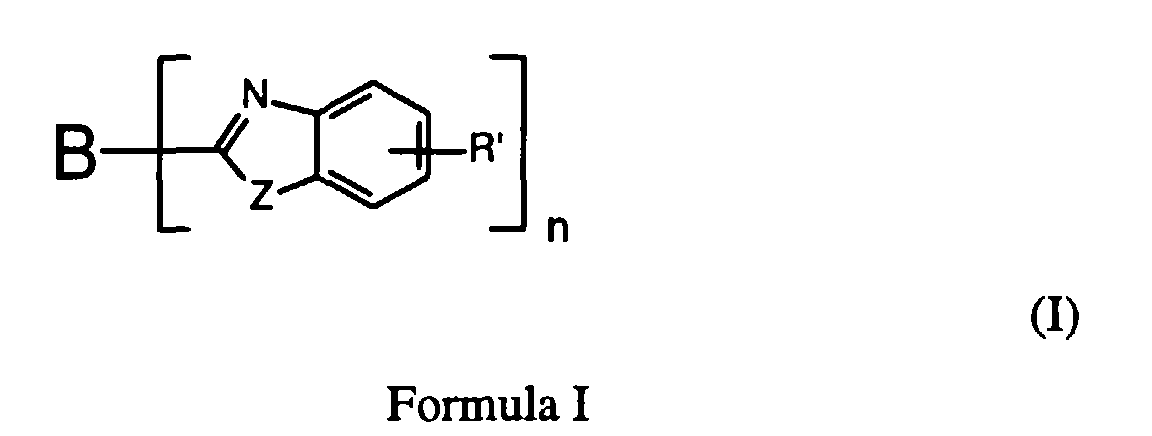
- the present invention provides an efficient blue organic EL device, comprising an anode, a cathode, and an organic luminescent medium between the anode and the cathode; the luminescent medium contains a material or a mixture of materials belonging to the benzazoles of the formula I: wherein:
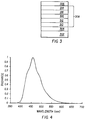
- An EL device 100 is schematically illustrated in Fig. 1.
- the support is layer 102 which is an electrically insulating and optically transparent material such as glass or plastic.
- Anode 104 is separated from cathode 106 by an organic EL medium 108, which, as shown, consists of two superimposed layers of organic thin films.
- Layer 110 located on the anode forms a hole-transport layer of the organic EL medium.
- layer 112 Located above the hole-transport layer is layer 112, which forms an electron-transport layer of the organic EL medium.
- the anode and the cathode are connected to an external AC or DC power source 114 by conductors 116 and 118, respectively.
- the power source can be pulsed, periodic, or continuous.
- the EL device can be viewed as a diode which is forward biased when the anode is at a higher potential then the cathode.
- holes positive charge carriers
- electrons are injected into the electron-transport layer.
- the injected holes and electrons each migrate toward the oppositely charged electrode, as shown by the arrows 120 and 122, respectively. This results in hole-electron recombination and a release of energy in part as light, thus producing electroluminescence.
- the region where the hole and electron recombine is known as the recombination zone.
- the two-layer device structure is designed specifically to confine the recombination at the vicinity near the interface between the hole-transport and the electron-transport layer where the probability for producing electroluminescence is the highest.
- This recombination confinement scheme has been disclosed by Tang and Van Slyke [Applied Physics Letters, Volume 51, Page 913, 1987] and is done by choosing carrier injecting electrodes of suitable work-functions and transport materials of a proper carrier mobility. Away from this interface between the organic layers and in particular at or near the injecting electrodes, the recombination of hole and electron would generally be much less radiative due to the effect of radiative quenching by a conducting surface.
- Organic EL device 200 shown in Fig. 2 is illustrative of another preferred embodiment of the invention.
- the insulating and transparent support is layer 202.
- the anode 204 is separated from the cathode 206 by an EL medium 208, which, as shown, consists of three superimposed layers of organic thin films.
- Layer 210 adjacent to anode 204 is the hole-transport layer.
- Layer 214 adjacent to cathode 206 is the electron-transport layer.
- Layer 212 which is in between the hole-transport layer and the electron transport layer is the luminescent layer. This luminescent layer also serves as the recombination layer where the hole and electron recombines.
- the configurations of devices 100 and 200 are similar, except that an additional luminescent layer is introduced in device 200 to function primarily as the site for hole-electron recombination and thus electroluminescence.
- the functions of the individual organic layers are distinct and can therefore be optimized independently.
- the luminescent or recombination layer can be chosen to have a desirable EL color as well as a high luminance efficiency.
- the electron and hole transport layers can be optimized primarily for the carrier transport property.
- Organic device 300 is illustrative of yet another preferred embodiment of the present invention.
- the insulating and transparent support is layer 302.
- the anode 304 is separated from the cathode 306 by an EL medium, 308, which, as shown, consists of five superimposed layers of organic thin films.
- Located on top of the anode layer 304 are, in sequence, the hole-injection layer 310, the hole-transport layer 312, the luminescent layer 314, the electron-transport layer 316, and the electron-injection layer 318.
- the structure of device 300 is similar to device 200, except that a hole-injection layer and an electron injection layers are added to improve the injection efficiency of the respective anode and cathode. It is understood that an EL device may be constructed having either the hole or electron injection layer present in the organic EL medium without unduly compromising the device performance.
- the substrate for the EL devices 100, 200, and 300 is electrically insulating and light transparent.
- the light transparent property is desirable for viewing the EL emission through the substrate.
- the transmissive characteristic of the support is immaterial, and therefore any appropriate substrate such as opaque semiconductor and ceramic wafers can be used. Of course, it is necessary to provide in these device configurations a light transparent top electrode.
- composition of the organic EL medium is described as follows, with particular reference to device structure 300.
- a layer containing a porphyrinic compound forms the hole injecting layer of the organic EL device.
- a porphyrinic compound is any compound, natural or synthetic, which is derived from or includes a porphyrin structure, including porphine itself. Any of the prophyrinic compounds disclosed in US-A-3,935,031 or US-A-4,356,429, the disclosures of which are here incorporated by reference, can be employed.
- Preferred porphyrinic compounds are those of structural formula (II): wherein
- porphyrinic compounds differ from those of structural formula (I) by substitution of two hydrogens for the metal atom, as indicated by formula (III):
- porphyrinic compounds are metal free phthalocyanines and metal containing phthalocyanines. While the porphyrinic compounds in general and the phthalocyanines in particular can contain any meal, the metal preferably has a positive valence of two or higher. Exemplary preferred metals are cobalt, magnesium, zinc, palladium, nickel, and, particularly, copper, lead, and platinum.
- the hole transporting layer of the organic EL device contains at least one hole transporting aromatic tertiary amine, where the latter is understood to be a compound containing at least one trivalent nitrogen atom that is bonded only to carbon atoms, at least one of which is a member of an aromatic ring.
- the aromatic tertiary amine can be an arylamine, such as a monarylamine, diarylamine, triarylamine, or a polymeric arylamine. Exemplary monomeric triarylamines are illustrated in US-A-3,180,730. Other suitable triarylamines substituted with vinyl or vinyl radicals and/or containing at least one active hydrogen containing group are disclosed in US-A-3,567,450 and US-A-3,658,520.
- aromatic tertiary amines are those which include at least two aromatic tertiary amine moieties.
- Such compounds include those represented by structural formula (IV). wherein
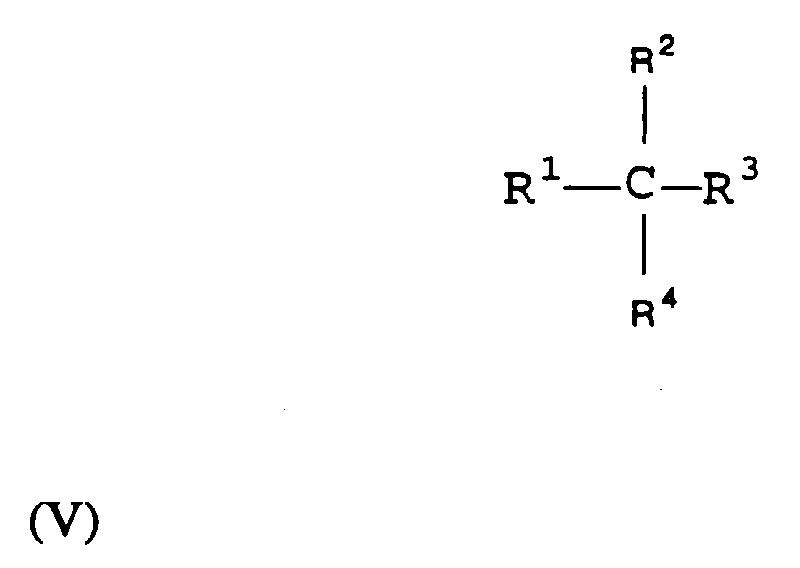
- a preferred class of triarylamines satisfying structural formula (IV) and containing two triarylamine moieties are those satisfying structural formula (V): where
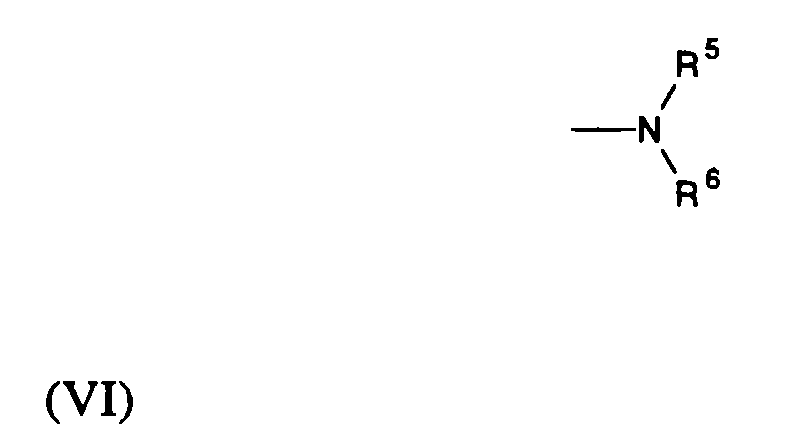
- tetraaryldiamines include two diarylamino groups, such as indicated by formula (VII), linked through an arylene group: wherein
- the various alkyl, alkylene, aryl, and arylene moieties of the foregoing structural formulae (IV), (V), (VII), can each in turn be substituted.
- Typical substituents including alkyl groups, alkoxy groups, aryl groups, aryloxy groups, and halogen such as fluoride, chloride, and bromide.
- the various alkyl and alkylene moieties typically contain from about 1 to 6 carbon atoms.
- the cycloalkyl moieties can contain from 3 to about 10 carbon atoms, but typically contain five, six, or seven ring carbon atoms-e.g., cyclopentyl, cyclohexyl, and cycloheptyl ring structures.
- the aryl and arylene moieties are preferably phenyl and phenylene moieties.
- Illustrative of useful hole transport compounds are the following:
- the luminescent layer of the organic EL medium comprises of a luminescent or fluorescent material where electroluminescence is produced as a result of electron-hole pair recombination in this region.
- the luminescent layer comprises of a single component, that is a pure material with a high fluorescent efficiency.
- a well known material is tris (8-quinolinato) Aluminum, (Alq), which produces excellent green electroluminescence.
- a preferred embodiment of the luminescent layer comprises a multi-component material consisting of a host material doped with one or more components of fluorescent dyes. Using this method, highly efficient EL devices can be constructed. Simultaneously, the color of the EL devices can be tuned by using fluorescent dyes of different emission wavelengths in a common host material. This dopant scheme has been described in considerable details for EL devices using Alq as the host material by Tang et al, J. Applied Physics, Vol. 65, Pages 3610-3616,1989; US-A-4,769,292.
- a fluorescent dye capable of modifying the hue of light emission when present in a host material is a comparison of their bandgap potential which is defined as the energy difference between the highest occupied molecular orbital and the lowest unoccupied molecular orbital of the molecule.
- bandgap potential which is defined as the energy difference between the highest occupied molecular orbital and the lowest unoccupied molecular orbital of the molecule.
- a necessary condition is that the bandgap of the dopant is smaller than that of the host material.
- An advantage of using a blue host such as benzazole is that its bandgap is sufficiently large to effect energy transfer to a range of commonly available fluorescent dyes emitting in the blue.
- These blue dopants includes coumarins, stilbenes, distyrylstilbenes, derivatives of anthracene, tetracene, perylene, and other conjugated benzenoids.
- Other dopants for EL emissions at longer wavelengths include coumarins, rhodamines and other green or red emitting fluorescent dyes.
- the host material forming the EL luminescent layer where light is emitted in response to electron-hole recombination comprises of a benzazole derivative or a mixture of these derivatives represented by formula I.
- the dopants for the benzazoles may include fluorescent dyes as described above. Efficient blue electroluminescence can be readily obtained when this material is used in layer 112 of Fig. 1, layer 212 of Fig. 2 or layer 314 of Fig. 3. wherein:
- Preferred materials for use in forming the electron transporting layer of the organic EL devices of this invention are metal chelated oxinoid compounds, including chelates of oxine itself (also commonly referred to as 8-quinolinol or 8-hydroxyquinoline). Such compounds exhibit both high levels of performance and are readily fabricated in the form of thin Films.
- Exemplary of contemplated oxinoid compounds are those satisfying the following structural formula: wherein
- the metal can be monovalent, divalent, or trivalent metal.
- the metal can, for example, be an alkali metal, such as lithium, sodium, or potassium; an alkaline earth metal, such as magnesium or calcium; or an earth metal, such as boron or aluminum.
- any monovalent, divalent, or trivalent metal known to be a useful chelating metal can be employed.
- Z completes a heterocyclic nucleus containing at least two fused aromatic rings, at least one of which is an azole or azine ring. Additional rings, including both aliphatic and aromatic rings, can be fused with the two required rings, if required. To avoid adding molecular bulk without improving on function the number of ring atoms is preferably maintained at 18 or less.
- Illustrative of useful chelated oxinoid compounds are the following:
- the preferred materials for the multi-layers of the organic EL medium are each capable of film-forming-that is, capable of being fabricated as a continuous layer having a thickness of less than 5000 ⁇ .
- a preferred method for forming the organic EL medium is by vacuum vapor deposition. Extremely thin defect-free continuous layers can be formed by this method. Specifically, the individual layer thickness as low as about 50 ⁇ can be constructed while still realizing satisfactory EL device performance. It is generally preferred that the overall thickness of the organic EL medium be at least about 1000 ⁇ .
- the anode and cathode of the organic EL device can each take any convenient conventional form. Where it is intended to transmit light from the organic EL device through the anode, this can be conveniently achieved by coating a thin conductive layer onto a light transparent substrate ⁇ e.g., a transparent or substantially transparent glass plate or plastic film.
- a light transparent substrate e.g., a transparent or substantially transparent glass plate or plastic film.
- the organic EL devices of this invention can follow the historical practice of including a light transparent anode formed of tin oxide or indium tin oxide coated on a glass plate, as disclosed in US-A-3,172,862, US-A- 3,173,050, Dresner "Double Injection Electroluminescence in Anthracene", RCA Review , Volume 30, pages 322-334,1969; and US-A- 3,710,167 cited above.
- the organic EL devices of this invention can employ a cathode constructed of any metal, including any high or low work function metal, heretofore taught to be useful for this purpose.
- a cathode constructed of any metal, including any high or low work function metal, heretofore taught to be useful for this purpose.
- Unexpected fabrication, performance, and stability advantages have been realized by forming the cathode of a combination of a low work function metal and at least one other metal.
- US-A-4,885,211 the disclosure of which is incorporated by reference herein.
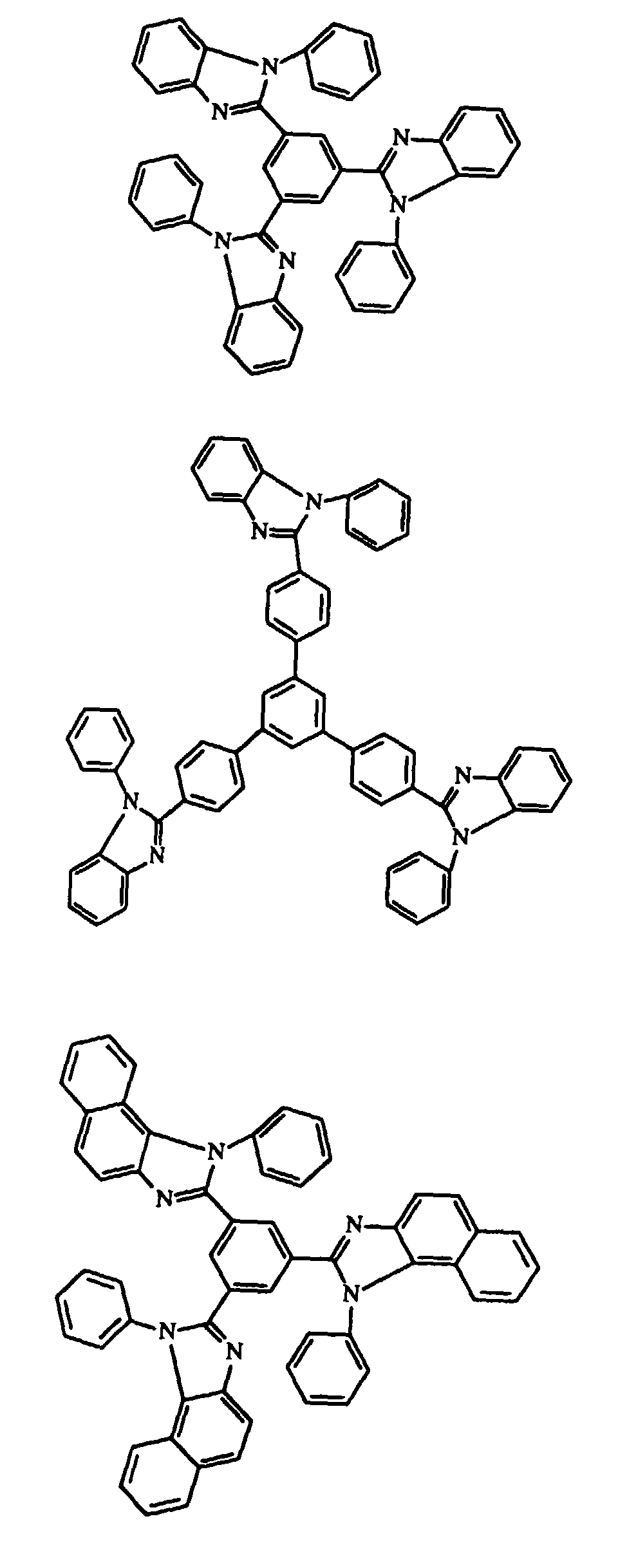
- TPBI was prepared by healing 1,3,5-tris(N-phenyl-N-phenylamino)benzamide in 0.3 atm. nitrogen pressure at 280 ⁇ 295 °C for about one hour.
- the pure TPBI (which can be used directly for cell fabrication) was obtained by sublimation twice at 315 °C at 2 Torr pressure.
- the organic EL medium has four organic layers, namely, a hole-injection layer, a hole transport layer, a luminescent layer, and an electron-transport layer
- the above sequence completed the deposition of the EL device.
- the device was then hermetically packaged in a dry glove box for protection against ambient environment.
- the light output from this EL device was 200 cd/m 2 when it was driven by a current source of 20 mA/c m 2 and a bias voltage of 9.5 volts.
- the EL spectrum shown in Fig. 4 has a peak emission at 460 nm. This EL spectrum indicates that EL emission originates from the luminescent TPBI layer.
- This example illustrates an organic EL device where the EL medium contains a doped luminescent layer.
- the organic EL medium has four organic layers, namely, a hole-injection layer, a hole transport layer, a doped luminescent layer, and an electron-transport layer.
- the above sequence completed the deposition of the EL device.
- the device was then hermetically packaged in a dry glove box for protection against ambient environment.
- the light output from this EL device was 310 cd/ m 2 when it was driven by a current source of 20 mA/c m 2 and a bias voltage of 9.8 volts.
- the EL spectrum has a peak emission at 456 nm. This EL spectrum indicates that EL emission originates from the perylene doped TPBI layer and is predominantly characteristic of the perylene dopant.
- organic luminescent medium for use in an electronic device such as, for example, an organic EL device, wherein the improvement comprises the organic luminescent medium containing a compound of benzazoles of the formula: wherein:
Landscapes
- Chemical & Material Sciences (AREA)
- Engineering & Computer Science (AREA)
- Materials Engineering (AREA)
- Organic Chemistry (AREA)
- Electroluminescent Light Sources (AREA)
- Luminescent Compositions (AREA)
- Plural Heterocyclic Compounds (AREA)
Abstract
Description
the luminescent medium contains a material or a mixture of materials belonging to the benzazoles of the formula I:




- Group 1:


- Group 2:
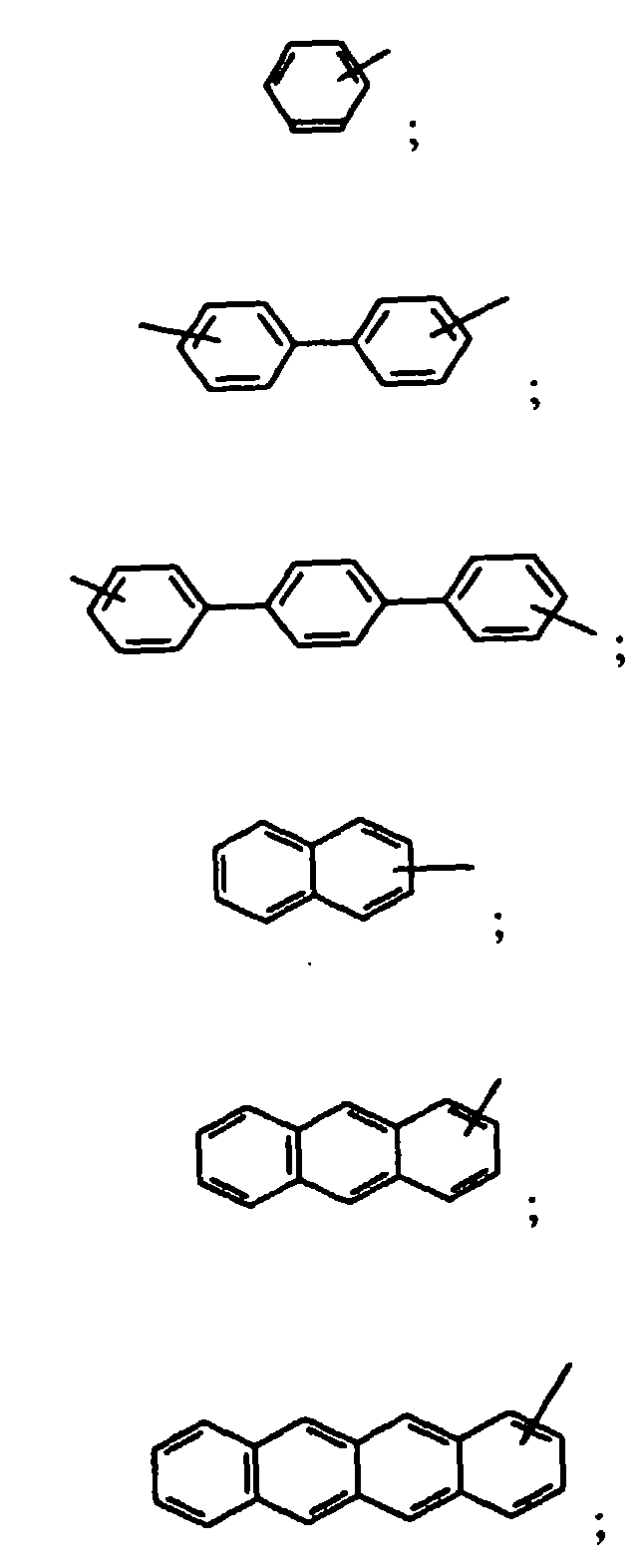
- Group 3:
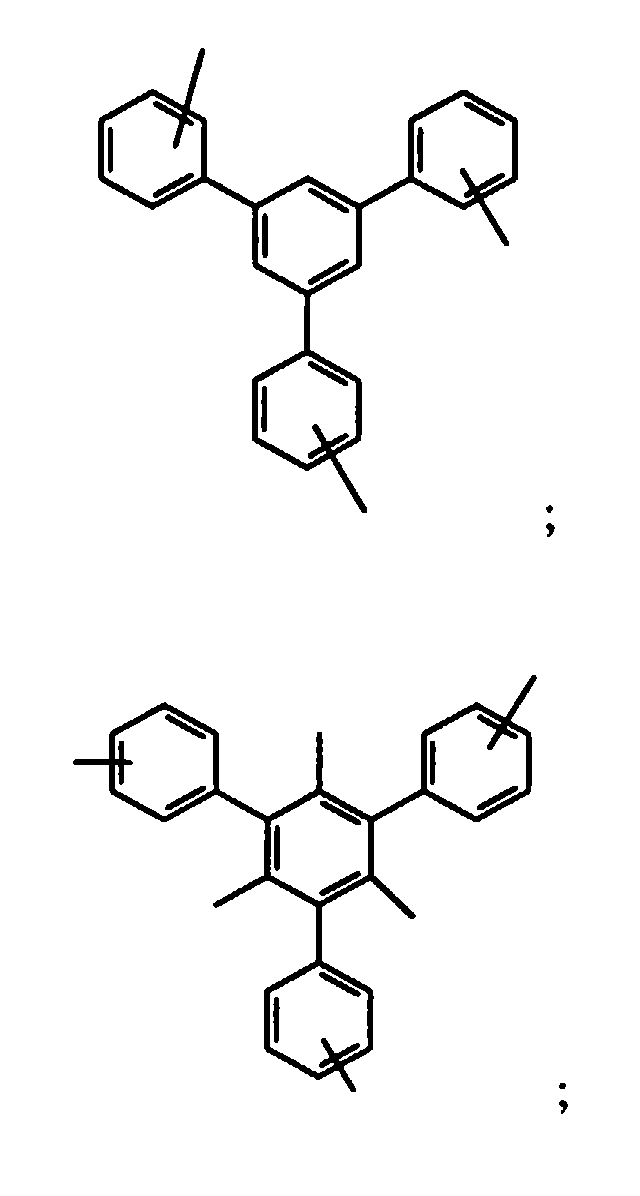
- Group 4:
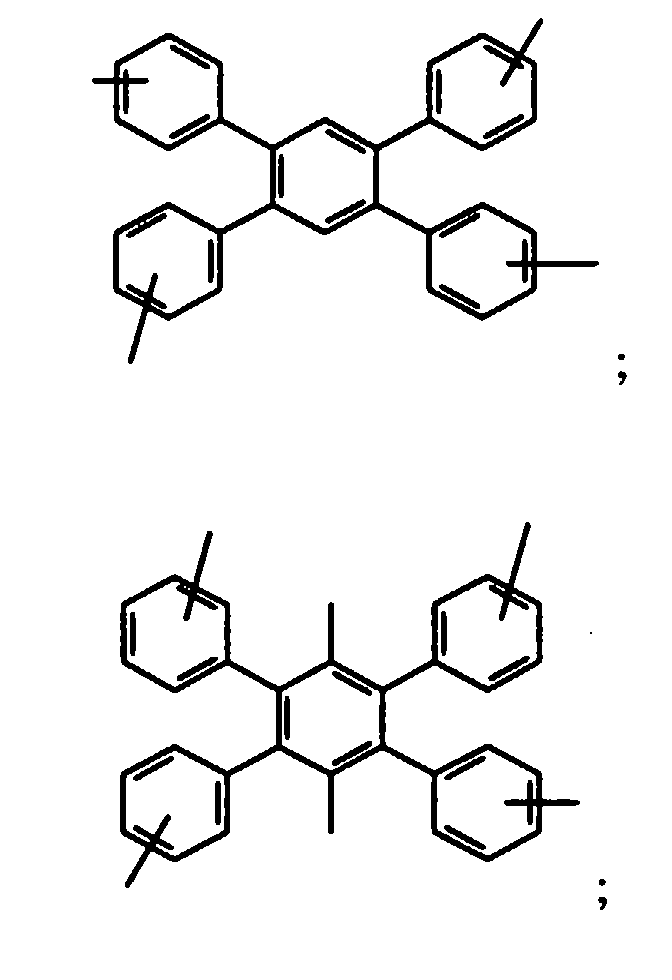
- Group 5:

- Group 6:
in which Z is O or C(CN)2;

- Group 7:
in which X is O, S, SO2, CH2, CHR, CRR

- Group 8:
in which Z is O or C(CN)2; and
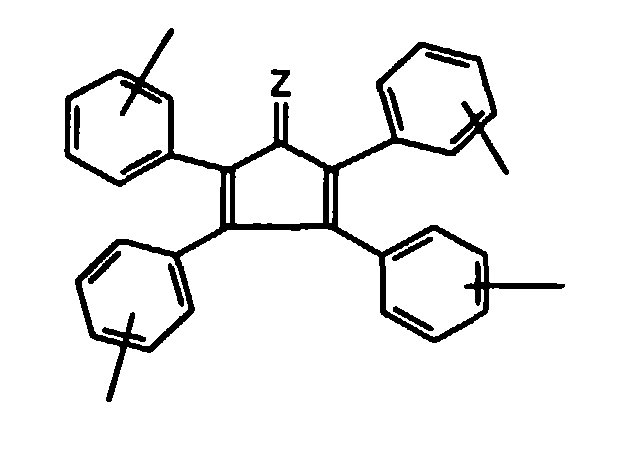 in which X and Y are individually O, S, SO2, CH2, CHR, CRR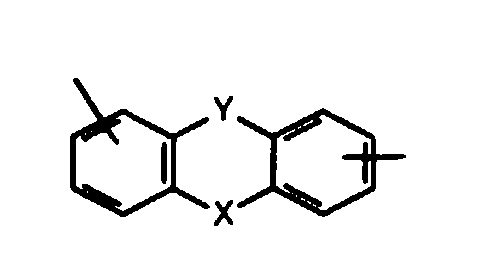
- Group 9:
 in which Z is O or C(CN)2; X is O, S, SO2, CH2, CHR, CRR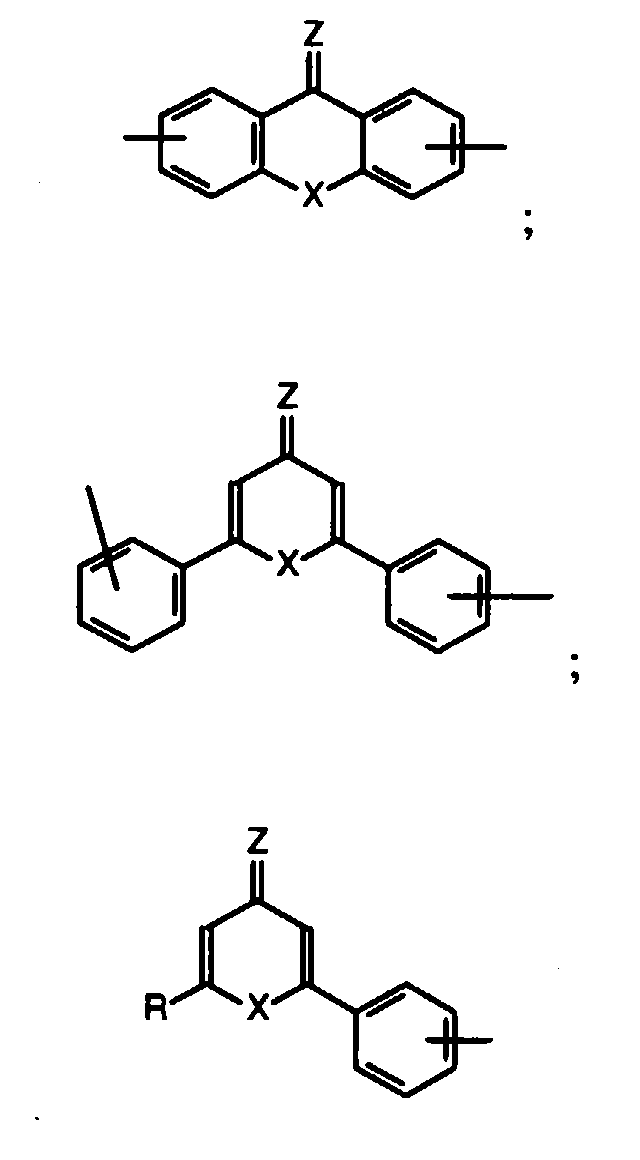
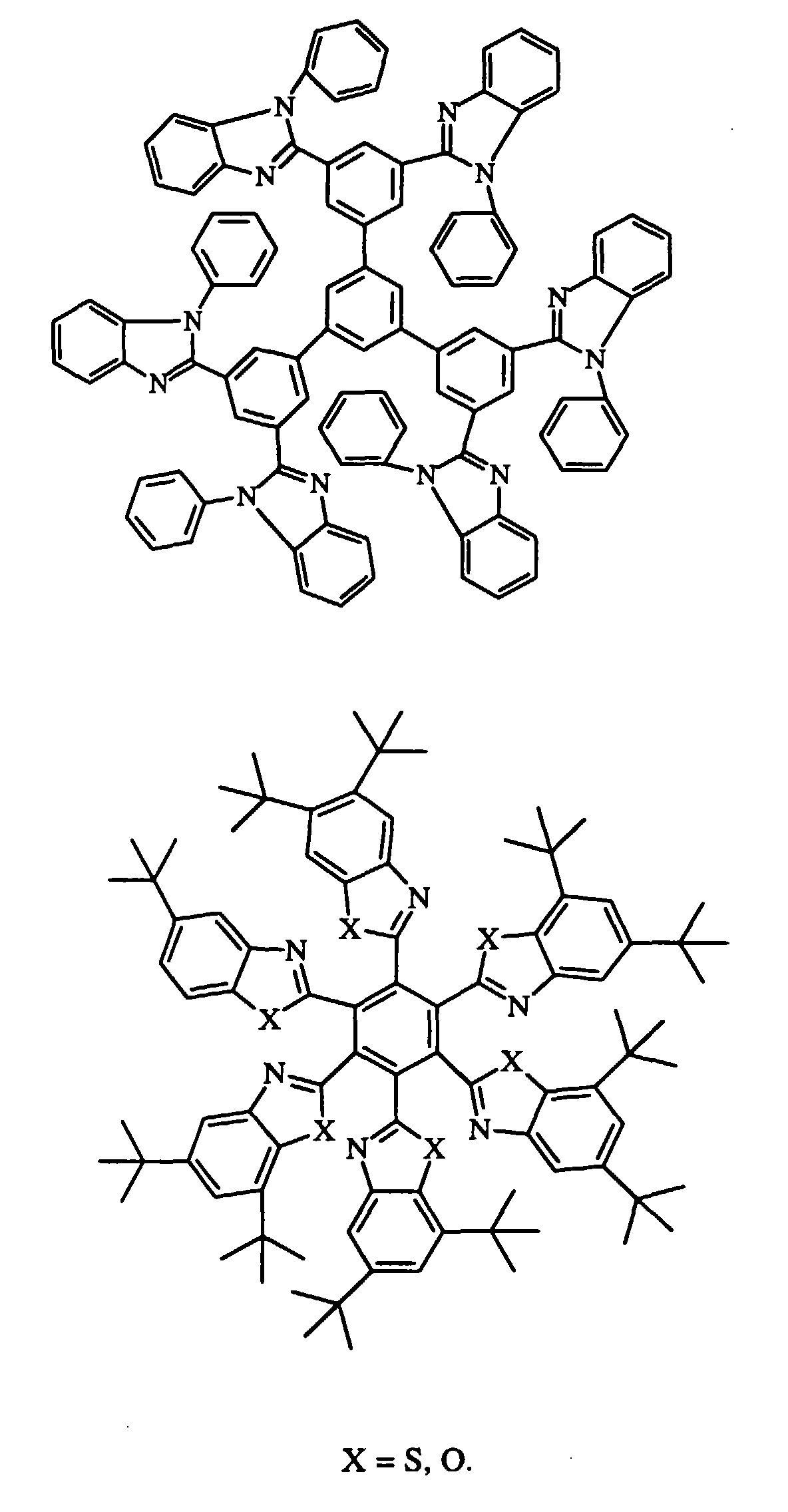


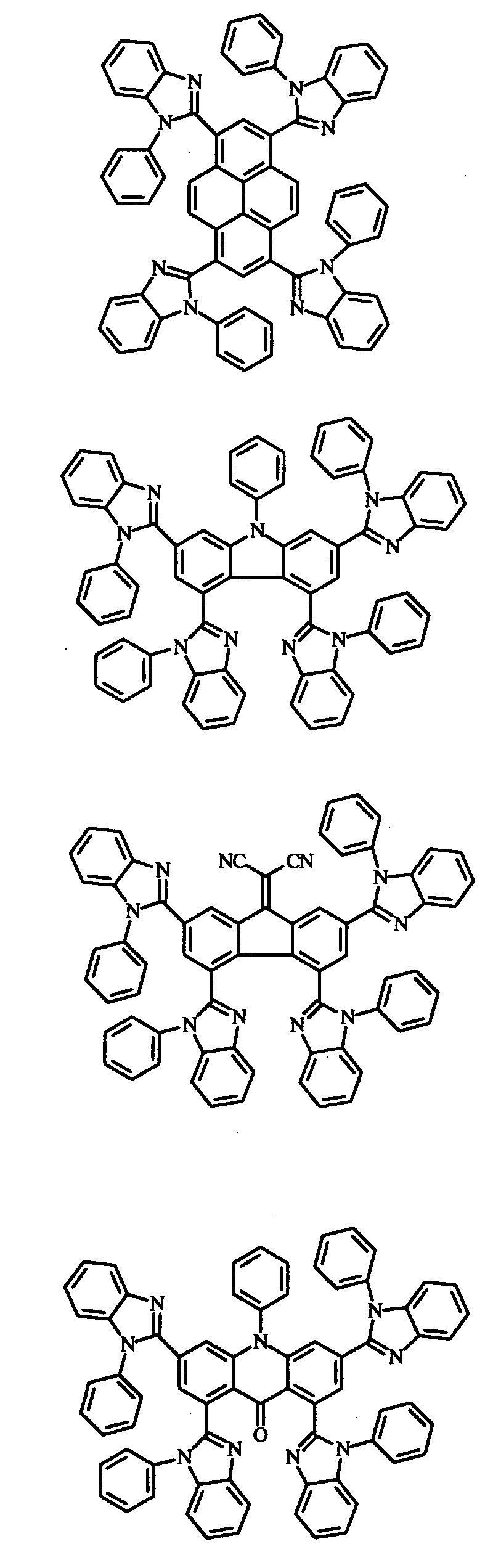


- Group 1:
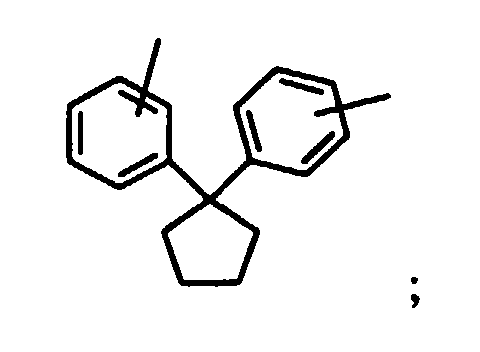 or
or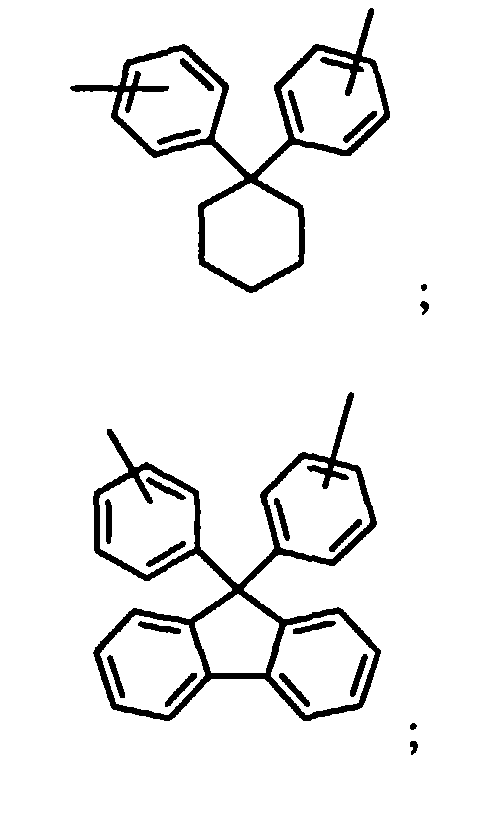
- Group 2:
or

- Group 3:
or
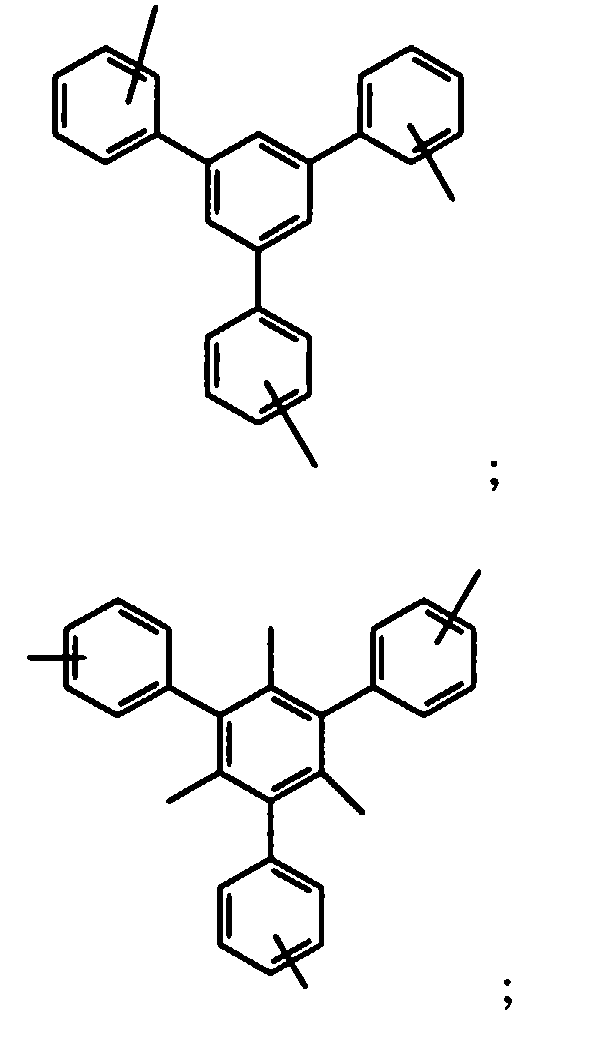
- Group 4:
or
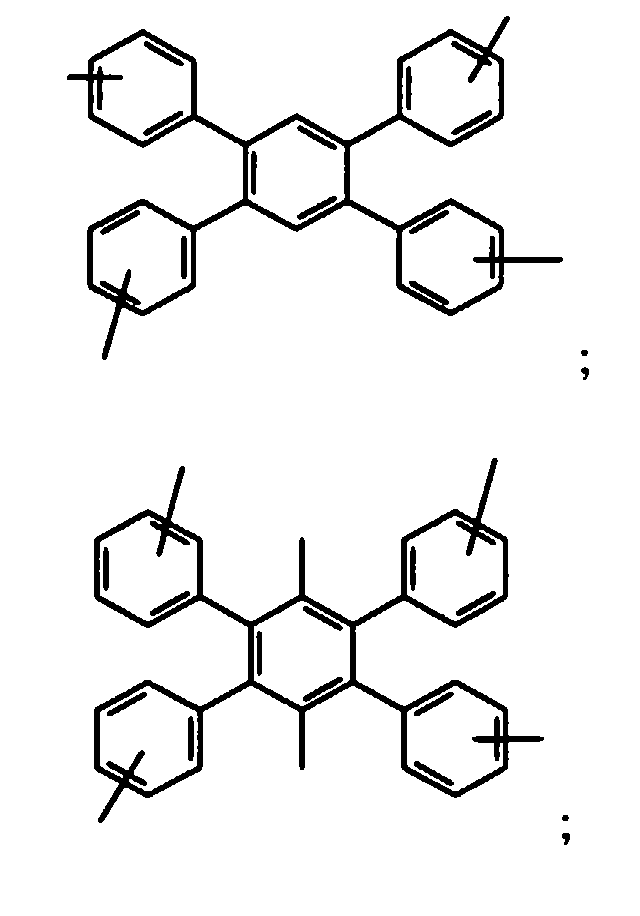
- Group 5:
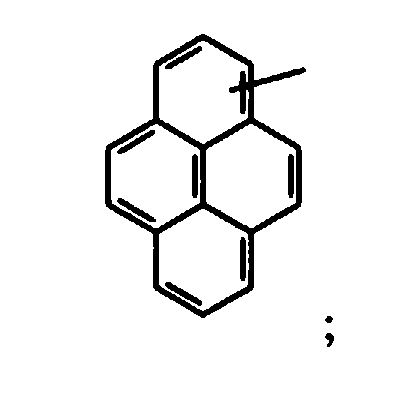 or
or
- Group 6:
in which Z is O or C(CN)2;
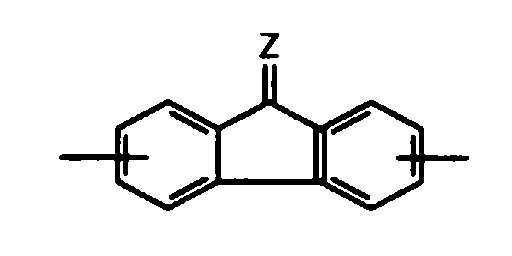
or - Group 7:
in which X is O, S, SO2, CH2, CHR, CRR
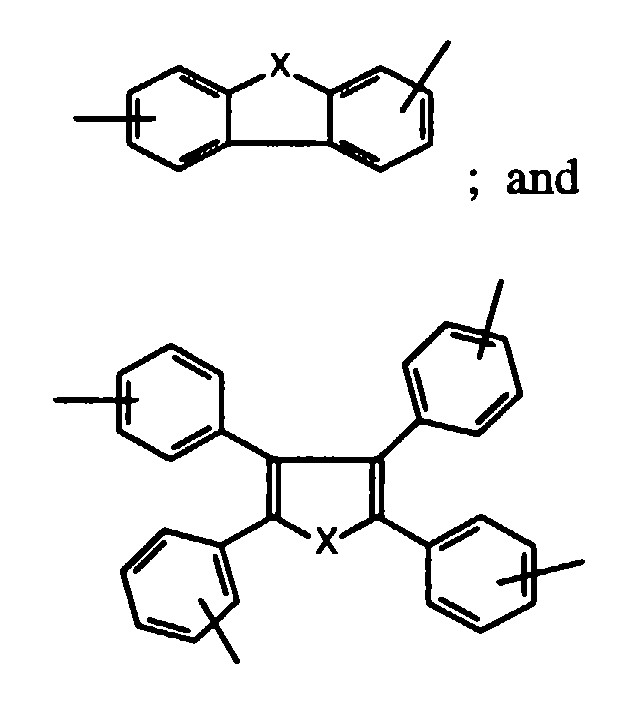
or - Group 8:
in which Z is O or C(CN)2; and
 in which X and Y are individually O, S, SO2, CH2, CHR, CRR
or - Group 9:
 in which Z is O or C(CN)2; X is O, S, SO2, CH2, CHR, CRR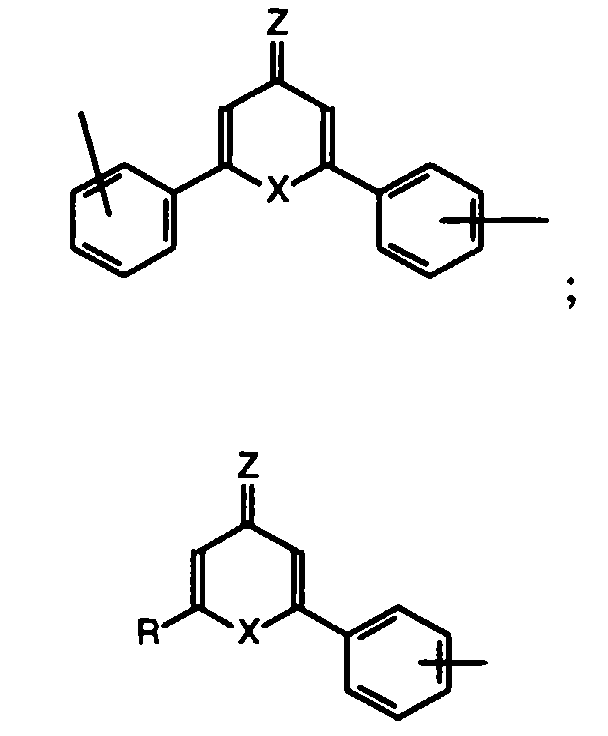
- 100
- EL Device
- 102
- Substrate
- 104
- Anode
- 106
- Cathode
- 108
- Organic EL medium
- 110
- Hole-transport layer
- 112
- Electron-transport layer
- 114
- External power source
- 116
- Conductor
- 118
- Conductor
- 120
- Holes
- 122
- Electrons
- 200
- EL device
- 202
- Substrate
- 204
- Anode
- 206
- Cathode
- 208
- Organic EL medium
- 210
- Hole-transport layer
- 212
- Luminescent layer
- 214
- Electron-transport layer
- 300
- EL device
- 302
- Substrate
- 304
- Anode
- 306
- Cathode
- 308
- Organic EL medium
- 310
- Hole-injection layer
- 312
- Hole-transport layer
- 314
- Luminescent layer

- 316
- Electron-transport layer
- 318
- Electron-injection layer
Claims (10)
- An organic EL device, comprising an anode and a cathode, and at least one organic luminescent medium containing a compound of benzazoles of the formula:wherein:
 n is an integer of from 3 to 8;Z is O, NR or S; andR and Rare individually hydrogen; alkyl of from 1 to 24 carbon atoms, for example, propyl, t-butyl, heptyl, and the like; aryl or hetero-atom substituted aryl of from 5 to 20 carbon atoms for example, phenyl and naphthyl, furyl, thienyl, pyridyl, quinolinyl and other heterocyclic systems; or halo such as chloro, fluoro; or atoms necessary to complete a fused aromatic ring;
 B is a linkage unit consisting of alkyl, aryl, substituted alkyl, or subsituted aryl which conjugately or unconjugately connects the multiple benzazoles together.
 - An organic EL device according to Claim 1, wherein the linkage unit B consists of:
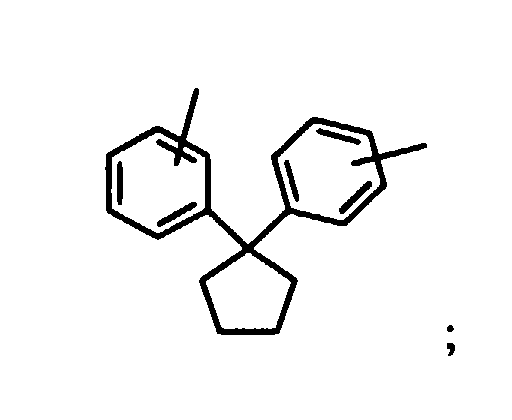

- An organic EL device according to Claim 1 wherein the linkage unit B consists of

- An organic EL device according to Claim 1 wherein the linkage unit B consists of:

- An organic EL device according to Claim 1 wherein the linkage unit B consists of:
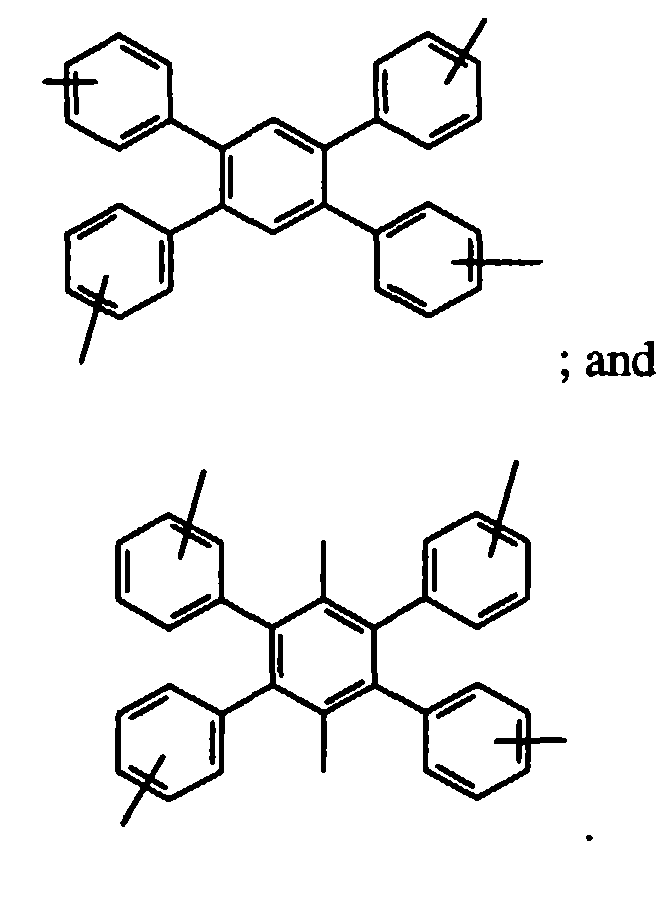
- An organic EL device according to Claim 1 wherein the linkage unit B consists of:

- An organic EL device according to Claim 1 wherein the linkage unit B consists of:
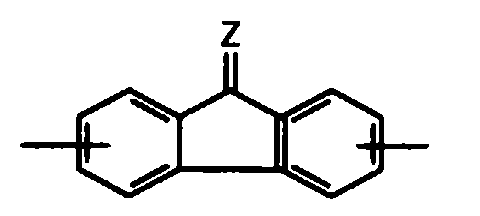 in which Z is O or C(CN)2.
 - An organic EL device according to Claim 1 wherein the linkage unit B consists of:in which X is O, S, SO2, CH2, CHR, CRR
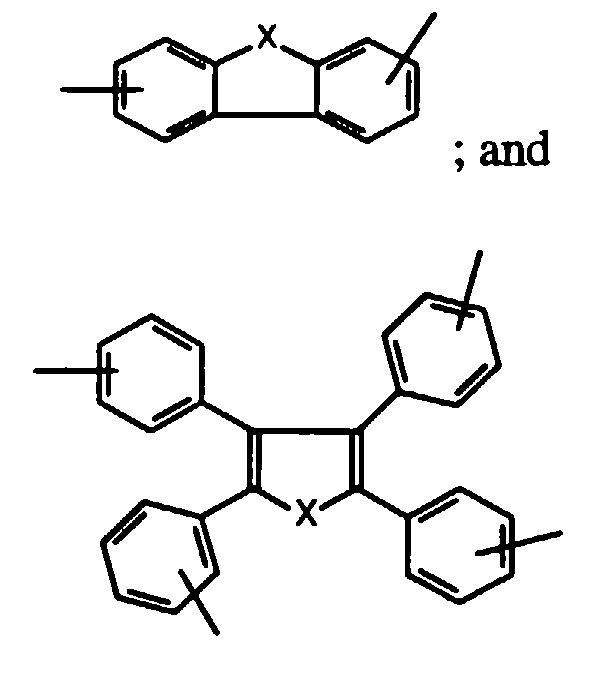
- An organic EL device according to Claim 1 wherein the linkage unit B consists of:in which Z is O or C(CN)2; and
 in which X and Y are individually O, S, SO2, CH2, CHR, CRR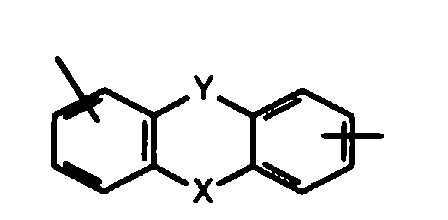
- An organic EL device according to Claim 1 wherein the linkage unit B consists of:
 in which Z is O or C(CN)2; X is O, S, SO2, CH2, CHR, CRR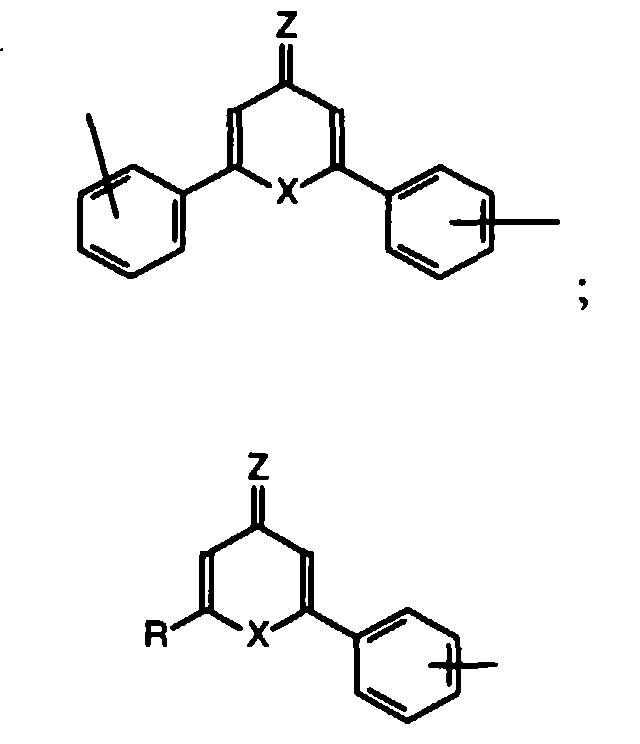
Applications Claiming Priority (2)
| Application Number | Priority Date | Filing Date | Title |
|---|---|---|---|
| US08/700,252 US5645948A (en) | 1996-08-20 | 1996-08-20 | Blue organic electroluminescent devices |
| US700252 | 1996-08-20 |
Publications (3)
| Publication Number | Publication Date |
|---|---|
| EP0825804A2 true EP0825804A2 (en) | 1998-02-25 |
| EP0825804A3 EP0825804A3 (en) | 1998-07-08 |
| EP0825804B1 EP0825804B1 (en) | 2002-01-30 |
Family
ID=24812790
Family Applications (1)
| Application Number | Title | Priority Date | Filing Date |
|---|---|---|---|
| EP97202458A Expired - Lifetime EP0825804B1 (en) | 1996-08-20 | 1997-08-08 | Blue organic electroluminescent devices |
Country Status (4)
| Country | Link |
|---|---|
| US (1) | US5645948A (en) |
| EP (1) | EP0825804B1 (en) |
| JP (1) | JP3992794B2 (en) |
| DE (1) | DE69710135T2 (en) |
Cited By (5)
| Publication number | Priority date | Publication date | Assignee | Title |
|---|---|---|---|---|
| EP1191821A1 (en) * | 2000-09-25 | 2002-03-27 | Konica Corporation | Organic electroluminescent element and organic electroluminescent material used therefor |
| EP1175128A3 (en) * | 2000-07-17 | 2002-07-31 | Fuji Photo Film Co., Ltd. | Light emitting element and azole compound |
| US7306856B2 (en) | 2000-07-17 | 2007-12-11 | Fujifilm Corporation | Light-emitting element and iridium complex |
| US7737437B2 (en) | 2001-11-27 | 2010-06-15 | Semiconductor Energy Laboratory Co., Ltd | Light emitting device |
| US9000421B2 (en) | 2012-03-01 | 2015-04-07 | Udc Ireland Limited | Organic electroluminescent element, materials for organic electroluminescent element, and light emitting device, display device, or illumination device, each using the element, and compounds used in the element |
Families Citing this family (319)
| Publication number | Priority date | Publication date | Assignee | Title |
|---|---|---|---|---|
| US5766779A (en) * | 1996-08-20 | 1998-06-16 | Eastman Kodak Company | Electron transporting materials for organic electroluminescent devices |
| US5885498A (en) * | 1996-12-11 | 1999-03-23 | Matsushita Electric Industrial Co., Ltd. | Organic light emitting device and method for producing the same |
| US5817431A (en) * | 1996-12-23 | 1998-10-06 | Motorola, Inc. | Electron injecting materials for organic electroluminescent devices and devices using same |
| GB9805476D0 (en) * | 1998-03-13 | 1998-05-13 | Cambridge Display Tech Ltd | Electroluminescent devices |
| KR100697861B1 (en) * | 1998-03-13 | 2007-03-22 | 캠브리지 디스플레이 테크놀로지 리미티드 | Electric field light emitting devices |
| JP3370011B2 (en) * | 1998-05-19 | 2003-01-27 | 三洋電機株式会社 | Organic electroluminescence device |
| US6436558B1 (en) * | 1998-08-07 | 2002-08-20 | Fuji Photo Film Co., Ltd. | Organic electroluminescence element |
| US6384529B2 (en) | 1998-11-18 | 2002-05-07 | Eastman Kodak Company | Full color active matrix organic electroluminescent display panel having an integrated shadow mask |
| US7871713B2 (en) * | 1998-12-25 | 2011-01-18 | Konica Corporation | Electroluminescent material, electroluminescent element and color conversion filter |
| US6656608B1 (en) * | 1998-12-25 | 2003-12-02 | Konica Corporation | Electroluminescent material, electroluminescent element and color conversion filter |
| KR100373203B1 (en) | 1999-03-31 | 2003-02-25 | 주식회사 엘지화학 | New organometallic complexes for use in light emitting devices |
| US6620529B1 (en) | 1999-10-27 | 2003-09-16 | Fuji Photo Film Co., Ltd. | Materials for light emitting devices and light emitting devices using the same |
| KR100377321B1 (en) * | 1999-12-31 | 2003-03-26 | 주식회사 엘지화학 | Electronic device comprising organic compound having p-type semiconducting characteristics |
| US7560175B2 (en) * | 1999-12-31 | 2009-07-14 | Lg Chem, Ltd. | Electroluminescent devices with low work function anode |
| KR100721656B1 (en) * | 2005-11-01 | 2007-05-23 | 주식회사 엘지화학 | Organic electrical devices |
| JP3687953B2 (en) * | 2000-02-22 | 2005-08-24 | 東北パイオニア株式会社 | Organic electroluminescence display panel and manufacturing method thereof |
| US6579629B1 (en) | 2000-08-11 | 2003-06-17 | Eastman Kodak Company | Cathode layer in organic light-emitting diode devices |
| JP3870102B2 (en) * | 2001-02-22 | 2007-01-17 | キヤノン株式会社 | Organic light emitting device |
| US6551725B2 (en) | 2001-02-28 | 2003-04-22 | Eastman Kodak Company | Inorganic buffer structure for organic light-emitting diode devices |
| JP4718025B2 (en) * | 2001-03-16 | 2011-07-06 | 保土谷化学工業株式会社 | Benzimidazole derivatives and organic electroluminescent devices |
| JP4686895B2 (en) * | 2001-04-27 | 2011-05-25 | コニカミノルタホールディングス株式会社 | Organic electroluminescence element and display device |
| US6558820B2 (en) | 2001-05-10 | 2003-05-06 | Eastman Kodak Company | High contrast light-emitting diode devices |
| US6565996B2 (en) | 2001-06-06 | 2003-05-20 | Eastman Kodak Company | Organic light-emitting device having a color-neutral dopant in a hole-transport layer and/or in an electron-transport layer |
| US6727644B2 (en) | 2001-08-06 | 2004-04-27 | Eastman Kodak Company | Organic light-emitting device having a color-neutral dopant in an emission layer and in a hole and/or electron transport sublayer |
| US6627333B2 (en) | 2001-08-15 | 2003-09-30 | Eastman Kodak Company | White organic light-emitting devices with improved efficiency |
| US20030129447A1 (en) * | 2001-09-19 | 2003-07-10 | Eastman Kodak Company | Sputtered cathode having a heavy alkaline metal halide-in an organic light-emitting device structure |
| US10211268B1 (en) | 2012-09-28 | 2019-02-19 | Imaging Systems Technology, Inc. | Large area OLED display |
| KR100596028B1 (en) * | 2001-11-12 | 2006-07-03 | 네오뷰코오롱 주식회사 | High Efficiency Organic Electroluminescent Devices |
| SG114514A1 (en) * | 2001-11-28 | 2005-09-28 | Univ Singapore | Organic light emitting diode (oled) |
| KR100691543B1 (en) | 2002-01-18 | 2007-03-09 | 주식회사 엘지화학 | New material for electron transport and organic light emitting device using the same |
| US6610455B1 (en) | 2002-01-30 | 2003-08-26 | Eastman Kodak Company | Making electroluminscent display devices |
| US6872472B2 (en) | 2002-02-15 | 2005-03-29 | Eastman Kodak Company | Providing an organic electroluminescent device having stacked electroluminescent units |
| US6770502B2 (en) * | 2002-04-04 | 2004-08-03 | Eastman Kodak Company | Method of manufacturing a top-emitting OLED display device with desiccant structures |
| US6797129B2 (en) | 2002-06-03 | 2004-09-28 | Eastman Kodak Company | Organic light-emitting device structure using metal cathode sputtering |
| US6692846B2 (en) | 2002-06-20 | 2004-02-17 | Eastman Kodak Company | Organic electroluminescent device having a stabilizing dopant in a hole-transport layer or in an electron-transport layer distant from the emission layer |
| US6706226B2 (en) | 2002-07-16 | 2004-03-16 | Eastman Kodak Company | Compacting moisture-sensitive organic materials in making an organic light-emitting device |
| TW200402012A (en) * | 2002-07-23 | 2004-02-01 | Eastman Kodak Co | OLED displays with fiber-optic faceplates |
| US6939660B2 (en) * | 2002-08-02 | 2005-09-06 | Eastman Kodak Company | Laser thermal transfer donor including a separate dopant layer |
| US6890627B2 (en) | 2002-08-02 | 2005-05-10 | Eastman Kodak Company | Laser thermal transfer from a donor element containing a hole-transporting layer |
| US6747618B2 (en) | 2002-08-20 | 2004-06-08 | Eastman Kodak Company | Color organic light emitting diode display with improved lifetime |
| US20040043138A1 (en) * | 2002-08-21 | 2004-03-04 | Ramesh Jagannathan | Solid state lighting using compressed fluid coatings |
| US20040043140A1 (en) * | 2002-08-21 | 2004-03-04 | Ramesh Jagannathan | Solid state lighting using compressed fluid coatings |
| TW556447B (en) * | 2002-09-05 | 2003-10-01 | Au Optronics Corp | An organic light emitting diode |
| US6765349B2 (en) * | 2002-09-30 | 2004-07-20 | Eastman Kodak Company | High work function metal alloy cathode used in organic electroluminescent devices |
| WO2004046767A2 (en) * | 2002-11-19 | 2004-06-03 | John Daniels | Organic and inorganic light active devices |
| US6713781B1 (en) | 2002-12-04 | 2004-03-30 | Canon Kabushiki Kaisha | Organic light-emitting device having phenanthroline-fused phenazine |
| US7230594B2 (en) | 2002-12-16 | 2007-06-12 | Eastman Kodak Company | Color OLED display with improved power efficiency |
| GB2396573B (en) * | 2002-12-27 | 2005-03-02 | Wing Wo Plastic Manufactory Lt | Condiment grinder with associated grinding mechamism |
| KR101020350B1 (en) * | 2003-03-13 | 2011-03-08 | 이데미쓰 고산 가부시키가이샤 | Novel nitrogen-containing heterocyclic derivatives and organic electroluminescent devices using the same |
| JP4401665B2 (en) * | 2003-03-20 | 2010-01-20 | 株式会社半導体エネルギー研究所 | Electroluminescent device |
| FR2852896B1 (en) * | 2003-03-24 | 2006-05-05 | Faurecia Sieges Automobile | SLIDER FOR SEAT OF MOTOR VEHICLE |
| US7179542B2 (en) | 2003-05-20 | 2007-02-20 | Canon Kabushiki Kaisha | Thiazole- and imidazole-fused phenanthroline molecules in organic light-emitting devices |
| US7211823B2 (en) * | 2003-07-10 | 2007-05-01 | Universal Display Corporation | Organic light emitting device structure for obtaining chromaticity stability |
| KR100994083B1 (en) | 2003-07-31 | 2010-11-12 | 미쓰비시 가가꾸 가부시키가이샤 | Compound, charge transport material and organic electroluminescent device |
| US7221332B2 (en) * | 2003-12-19 | 2007-05-22 | Eastman Kodak Company | 3D stereo OLED display |
| KR100577262B1 (en) * | 2004-01-06 | 2006-05-10 | 엘지전자 주식회사 | Organic light emitting diode |
| US7749037B2 (en) * | 2004-02-19 | 2010-07-06 | E. I. Du Pont De Nemours And Company | Process for fabricating an organic electronic device using liquid deposition and devices made by the process |
| US8198801B2 (en) * | 2004-03-19 | 2012-06-12 | Lg Chem, Ltd. | Materials for injecting or transporting holes and organic electroluminescence devices using the same |
| US7157156B2 (en) | 2004-03-19 | 2007-01-02 | Eastman Kodak Company | Organic light emitting device having improved stability |
| CN101002506B (en) * | 2004-03-31 | 2014-06-25 | E.I.内穆尔杜邦公司 | Triarylamine compounds used as charge-transporting substances |
| US8129906B1 (en) | 2004-04-26 | 2012-03-06 | Imaging Systems Technology, Inc. | Lumino-shells |
| US20060017055A1 (en) * | 2004-07-23 | 2006-01-26 | Eastman Kodak Company | Method for manufacturing a display device with low temperature diamond coatings |
| US7316756B2 (en) | 2004-07-27 | 2008-01-08 | Eastman Kodak Company | Desiccant for top-emitting OLED |
| WO2006019270A1 (en) * | 2004-08-19 | 2006-02-23 | Lg Chem. Ltd. | Organic light-emitting device comprising buffer layer and method for fabricating the same |
| KR100679213B1 (en) | 2004-09-08 | 2007-02-06 | 주식회사 엘지화학 | Novel organic compound and organic light emitting device using same |
| US9040170B2 (en) * | 2004-09-20 | 2015-05-26 | Global Oled Technology Llc | Electroluminescent device with quinazoline complex emitter |
| US7501152B2 (en) | 2004-09-21 | 2009-03-10 | Eastman Kodak Company | Delivering particulate material to a vaporization zone |
| GB0422913D0 (en) * | 2004-10-15 | 2004-11-17 | Elam T Ltd | Electroluminescent devices |
| GB0424294D0 (en) * | 2004-11-03 | 2004-12-01 | Elam T Ltd | Buffer layer |
| KR101388472B1 (en) | 2004-12-10 | 2014-04-23 | 미쓰비시 가가꾸 가부시키가이샤 | Organic compound, charge-transporting material, and organic electroluminescent element |
| US7273939B1 (en) | 2004-12-22 | 2007-09-25 | E. I. Du Pont De Nemours And Company | Methods of making tris(N-aryl benzimidazoles)benzenes and their use in electronic devices |
| US8063230B1 (en) | 2004-12-22 | 2011-11-22 | E. I. Du Pont De Nemours And Company | Tris(N-aryl benzimidazole)benzenes and their use in electronic devices |
| US7524923B1 (en) | 2004-12-30 | 2009-04-28 | Dupont Displays, Inc. | Suzuki polycondensation for preparing aryl polymers from dihalide monomers |
| US7309956B2 (en) * | 2005-01-14 | 2007-12-18 | Eastman Kodak Company | Top-emitting OLED device with improved-off axis viewing performance |
| US8057916B2 (en) * | 2005-04-20 | 2011-11-15 | Global Oled Technology, Llc. | OLED device with improved performance |
| US20060240281A1 (en) * | 2005-04-21 | 2006-10-26 | Eastman Kodak Company | Contaminant-scavenging layer on OLED anodes |
| JP5261887B2 (en) | 2005-05-17 | 2013-08-14 | 三菱化学株式会社 | Monoamine compound, charge transport material, and organic electroluminescence device |
| WO2007007464A1 (en) * | 2005-07-11 | 2007-01-18 | Idemitsu Kosan Co., Ltd. | Nitrogen-containing heterocyclic derivative and organic electroluminescence element using the same |
| WO2007007463A1 (en) * | 2005-07-11 | 2007-01-18 | Idemitsu Kosan Co., Ltd. | Nitrogen-containing heterocyclic derivative having electron-attracting substituent and organic electroluminescence element using the same |
| US20090015150A1 (en) * | 2005-07-15 | 2009-01-15 | Lg Chem, Ltd. | Organic light emitting device and method for manufacturing the same |
| TWI321968B (en) * | 2005-07-15 | 2010-03-11 | Lg Chemical Ltd | Organic light meitting device and method for manufacturing the same |
| JP2007039406A (en) * | 2005-08-05 | 2007-02-15 | Idemitsu Kosan Co Ltd | Nitrogen-containing heterocyclic derivative and organic electroluminescence device using the same |
| KR101193179B1 (en) * | 2005-08-26 | 2012-10-19 | 삼성디스플레이 주식회사 | Organosiloxane compound and organic electroluminescence device comprsing the same |
| US20070048545A1 (en) * | 2005-08-31 | 2007-03-01 | Eastman Kodak Company | Electron-transporting layer for white OLED device |
| US8956738B2 (en) * | 2005-10-26 | 2015-02-17 | Global Oled Technology Llc | Organic element for low voltage electroluminescent devices |
| KR100890862B1 (en) * | 2005-11-07 | 2009-03-27 | 주식회사 엘지화학 | Organic electroluminescent device and method for preparing the same |
| KR101193180B1 (en) * | 2005-11-14 | 2012-10-19 | 삼성디스플레이 주식회사 | A conducting polymer composition and an electronic device employing the layer obtained from the conducting polymer composition |
| JP2007149941A (en) * | 2005-11-28 | 2007-06-14 | Idemitsu Kosan Co Ltd | Organic electroluminescence device |
| US9666826B2 (en) * | 2005-11-30 | 2017-05-30 | Global Oled Technology Llc | Electroluminescent device including an anthracene derivative |
| US20070122657A1 (en) * | 2005-11-30 | 2007-05-31 | Eastman Kodak Company | Electroluminescent device containing a phenanthroline derivative |
| JP2007153778A (en) | 2005-12-02 | 2007-06-21 | Idemitsu Kosan Co Ltd | Nitrogen-containing heterocyclic derivative and organic electroluminescence device using the same |
| KR101243917B1 (en) * | 2005-12-19 | 2013-03-14 | 삼성디스플레이 주식회사 | A conducting polymer composition and an electrical device employing the layer obtained from the conducting polymer composition |
| TWI371987B (en) * | 2006-01-18 | 2012-09-01 | Lg Chemical Ltd | Oled having stacked organic light-emitting units |
| US8518980B2 (en) | 2006-02-10 | 2013-08-27 | Summit Corporation Plc | Treatment of Duchenne muscular dystrophy |
| US20070207345A1 (en) * | 2006-03-01 | 2007-09-06 | Eastman Kodak Company | Electroluminescent device including gallium complexes |
| EP2000464A4 (en) | 2006-03-27 | 2010-06-30 | Idemitsu Kosan Co | HETEROCYCLIC NITROGEN DERIVATIVE AND ORGANIC ELECTROLUMINESCENT DEVICE USING THE SAME |
| CN101410380A (en) | 2006-03-27 | 2009-04-15 | 出光兴产株式会社 | Nitrogen-containing heterocyclic derivative and organic electroluminescent element using same |
| US9118020B2 (en) * | 2006-04-27 | 2015-08-25 | Global Oled Technology Llc | Electroluminescent devices including organic eil layer |
| EP2355198B1 (en) | 2006-05-08 | 2015-09-09 | Global OLED Technology LLC | OLED electron-injecting layer |
| US7667391B2 (en) * | 2006-08-04 | 2010-02-23 | Eastman Kodak Company | Electrically excited organic light-emitting diodes with spatial and spectral coherence |
| KR20080047209A (en) * | 2006-11-24 | 2008-05-28 | 삼성전자주식회사 | Organic light emitting compound and organic light emitting device having the same |
| US20080176099A1 (en) * | 2007-01-18 | 2008-07-24 | Hatwar Tukaram K | White oled device with improved functions |
| JP4946923B2 (en) | 2007-03-07 | 2012-06-06 | 三菱化学株式会社 | Organic electroluminescence device |
| US20080278072A1 (en) * | 2007-04-30 | 2008-11-13 | Lg Chem, Ltd. | Organic light emitting device and method of producing the same |
| US7911133B2 (en) * | 2007-05-10 | 2011-03-22 | Global Oled Technology Llc | Electroluminescent device having improved light output |
| US20080284317A1 (en) * | 2007-05-17 | 2008-11-20 | Liang-Sheng Liao | Hybrid oled having improved efficiency |
| US20080284318A1 (en) * | 2007-05-17 | 2008-11-20 | Deaton Joseph C | Hybrid fluorescent/phosphorescent oleds |
| US8034465B2 (en) * | 2007-06-20 | 2011-10-11 | Global Oled Technology Llc | Phosphorescent oled having double exciton-blocking layers |
| US20090004485A1 (en) * | 2007-06-27 | 2009-01-01 | Shiying Zheng | 6-member ring structure used in electroluminescent devices |
| US7812531B2 (en) | 2007-07-25 | 2010-10-12 | Global Oled Technology Llc | Preventing stress transfer in OLED display components |
| TW200911237A (en) * | 2007-08-03 | 2009-03-16 | Summit Corp Plc | Drug combinations for the treatment of duchenne muscular dystrophy |
| GB0715937D0 (en) * | 2007-08-15 | 2007-09-26 | Vastox Plc | Method of treatment og duchenne muscular dystrophy |
| CN101848882B (en) * | 2007-09-20 | 2015-04-29 | 巴斯夫欧洲公司 | Electroluminescent device |
| US20090091242A1 (en) * | 2007-10-05 | 2009-04-09 | Liang-Sheng Liao | Hole-injecting layer in oleds |
| TW200932872A (en) * | 2007-10-17 | 2009-08-01 | Cheil Ind Inc | Novel compound for organic photoelectric device and organic photoelectric device including the same |
| KR101117621B1 (en) | 2007-10-17 | 2012-03-07 | 제일모직주식회사 | Novel compound and organic photoelectric device including the same |
| US8431242B2 (en) * | 2007-10-26 | 2013-04-30 | Global Oled Technology, Llc. | OLED device with certain fluoranthene host |
| US8129039B2 (en) | 2007-10-26 | 2012-03-06 | Global Oled Technology, Llc | Phosphorescent OLED device with certain fluoranthene host |
| US8076009B2 (en) * | 2007-10-26 | 2011-12-13 | Global Oled Technology, Llc. | OLED device with fluoranthene electron transport materials |
| US8420229B2 (en) * | 2007-10-26 | 2013-04-16 | Global OLED Technologies LLC | OLED device with certain fluoranthene light-emitting dopants |
| US20090110956A1 (en) * | 2007-10-26 | 2009-04-30 | Begley William J | Oled device with electron transport material combination |
| US8016631B2 (en) * | 2007-11-16 | 2011-09-13 | Global Oled Technology Llc | Desiccant sealing arrangement for OLED devices |
| US8900722B2 (en) | 2007-11-29 | 2014-12-02 | Global Oled Technology Llc | OLED device employing alkali metal cluster compounds |
| US8877350B2 (en) * | 2007-12-11 | 2014-11-04 | Global Oled Technology Llc | White OLED with two blue light-emitting layers |
| US20090162612A1 (en) * | 2007-12-19 | 2009-06-25 | Hatwar Tukaram K | Oled device having two electron-transport layers |
| CN101959867A (en) * | 2007-12-27 | 2011-01-26 | 出光兴产株式会社 | Nitrogen-containing heterocyclic derivative and organic electroluminescent device using the same |
| JP2011510450A (en) | 2008-01-18 | 2011-03-31 | エルジー・ケム・リミテッド | ORGANIC LIGHT EMITTING ELEMENT AND MANUFACTURING METHOD THEREOF |
| US20090191427A1 (en) * | 2008-01-30 | 2009-07-30 | Liang-Sheng Liao | Phosphorescent oled having double hole-blocking layers |
| KR101323557B1 (en) | 2008-02-15 | 2013-10-29 | 미쓰비시 가가꾸 가부시키가이샤 | Conjugated polymer, insolubilized polymer, organic electroluminescent device material, composition for organic electroluminescent device, method for producing polymer, organic electroluminescent device, organic el display, and organic el illuminator |
| US8115399B2 (en) * | 2008-02-19 | 2012-02-14 | General Electric Company | OLED light source |
| TWI472074B (en) | 2008-03-17 | 2015-02-01 | Nippon Steel & Sumikin Chem Co | Organic electroluminescent elements |
| US7534635B1 (en) | 2008-03-24 | 2009-05-19 | General Electric Company | Getter precursors for hermetically sealed packaging |
| US7947974B2 (en) * | 2008-03-25 | 2011-05-24 | Global Oled Technology Llc | OLED device with hole-transport and electron-transport materials |
| CN102067730A (en) | 2008-05-16 | 2011-05-18 | Lg化学株式会社 | Stacked Organic Light Emitting Diodes |
| KR101011857B1 (en) * | 2008-06-04 | 2011-02-01 | 주식회사 두산 | Benzofluoranthene derivatives and organic light emitting device using the same |
| US8324800B2 (en) * | 2008-06-12 | 2012-12-04 | Global Oled Technology Llc | Phosphorescent OLED device with mixed hosts |
| KR20110036098A (en) | 2008-07-31 | 2011-04-06 | 미쓰비시 가가꾸 가부시키가이샤 | Composition for organic electroluminescent device, organic thin film, organic electroluminescent device, organic EL display device and organic EL illumination |
| WO2010016555A1 (en) | 2008-08-07 | 2010-02-11 | 三菱化学株式会社 | Polymer, material for luminescent layer, material for organic electroluminescent element, composition for organic electroluminescent element, and organic electroluminescent element, solar cell element, organic el display device, and organic el lighting utilizing same |
| JP5491796B2 (en) | 2008-08-11 | 2014-05-14 | 三菱化学株式会社 | Charge transporting polymer, composition for organic electroluminescent device, organic electroluminescent device, organic EL display and organic EL lighting |
| KR101708064B1 (en) | 2008-08-13 | 2017-02-17 | 미쓰비시 가가꾸 가부시키가이샤 | Organic electroluminescent element, organic el display device and organic el illuminating device |
| US8247088B2 (en) * | 2008-08-28 | 2012-08-21 | Global Oled Technology Llc | Emitting complex for electroluminescent devices |
| EP2161272A1 (en) | 2008-09-05 | 2010-03-10 | Basf Se | Phenanthrolines |
| KR101069520B1 (en) | 2008-10-01 | 2011-09-30 | 주식회사 엘지화학 | Organic light emitting device and its manufacturing method |
| US8785002B1 (en) * | 2008-10-07 | 2014-07-22 | Bowling Green State University | High-energy triplet host materials, luminescent layer comprising the same, and organic electroluminescent device comprising the luminescent layer |
| US7931975B2 (en) * | 2008-11-07 | 2011-04-26 | Global Oled Technology Llc | Electroluminescent device containing a flouranthene compound |
| US8088500B2 (en) * | 2008-11-12 | 2012-01-03 | Global Oled Technology Llc | OLED device with fluoranthene electron injection materials |
| US7968215B2 (en) * | 2008-12-09 | 2011-06-28 | Global Oled Technology Llc | OLED device with cyclobutene electron injection materials |
| CN102272262B (en) | 2008-12-30 | 2014-09-10 | 第一毛织株式会社 | Novel compound for organic photoelectric device and organic photoelectric device comprising same |
| US8216697B2 (en) * | 2009-02-13 | 2012-07-10 | Global Oled Technology Llc | OLED with fluoranthene-macrocyclic materials |
| US8147989B2 (en) * | 2009-02-27 | 2012-04-03 | Global Oled Technology Llc | OLED device with stabilized green light-emitting layer |
| KR20110134399A (en) | 2009-03-13 | 2011-12-14 | 미쓰비시 가가꾸 가부시키가이샤 | Manufacturing method of organic electroluminescent element, organic electroluminescent element, organic EL display and organic EL illumination |
| US20100244677A1 (en) * | 2009-03-31 | 2010-09-30 | Begley William J | Oled device containing a silyl-fluoranthene derivative |
| US8283054B2 (en) | 2009-04-03 | 2012-10-09 | Global Oled Technology Llc | Tandem white OLED with efficient electron transfer |
| US8206842B2 (en) * | 2009-04-06 | 2012-06-26 | Global Oled Technology Llc | Organic element for electroluminescent devices |
| WO2010145991A1 (en) | 2009-06-18 | 2010-12-23 | Basf Se | Phenanthroazole compounds as hole transporting materials for electro luminescent devices |
| KR101182438B1 (en) * | 2009-08-14 | 2012-09-12 | 삼성디스플레이 주식회사 | Organic light emitting device |
| JP5672858B2 (en) | 2009-08-27 | 2015-02-18 | 三菱化学株式会社 | Charge transport material, composition for charge transport film, organic electroluminescence device, organic EL display and organic EL lighting |
| KR101117724B1 (en) * | 2009-09-04 | 2012-03-07 | 삼성모바일디스플레이주식회사 | Organic light emitting device |
| KR101117723B1 (en) * | 2009-09-04 | 2012-03-07 | 삼성모바일디스플레이주식회사 | Organic light emitting device |
| WO2011052698A1 (en) | 2009-10-30 | 2011-05-05 | 三菱化学株式会社 | Low-molecular compound, polymer, material for electronic devices, composition for electronic devices, organic electroluminescent element, organic solar cell element, display and lighting equipment |
| KR101231931B1 (en) | 2009-11-13 | 2013-02-08 | 주식회사 엘지화학 | New fused cyclic compound and organic electronic device |
| WO2011074550A1 (en) | 2009-12-15 | 2011-06-23 | 三菱化学株式会社 | Method for manufacturing organic electroluminescent element, organic electroluminescent element, display device and illuminating device |
| EP2362460A4 (en) | 2010-01-08 | 2012-10-31 | Mitsubishi Chem Corp | ORGANIC ELECTROLUMINESCENT ELEMENT AND ORGANIC ELECTROLUMINESCENCE DEVICE |
| JP5620125B2 (en) * | 2010-01-28 | 2014-11-05 | ユー・ディー・シー アイルランド リミテッド | Organic electroluminescence device |
| TW201132631A (en) * | 2010-02-05 | 2011-10-01 | Nitto Denko Corp | Tris (arylbenzoxazole) benzene and tris (arylbenzothiazole) benzene and derivatives thereof as organic electron-transport materials |
| JP5793878B2 (en) | 2010-02-10 | 2015-10-14 | 三菱化学株式会社 | Polymer, organic electroluminescent element material, composition for organic electroluminescent element, organic electroluminescent element, display device and lighting device |
| JP5423706B2 (en) | 2010-03-15 | 2014-02-19 | 三菱化学株式会社 | Organic electroluminescent device manufacturing method, organic electroluminescent device, organic EL lighting, and organic EL display device |
| KR101758328B1 (en) | 2010-04-06 | 2017-07-17 | 삼성디스플레이 주식회사 | Heterocyclic compound and organic light emitting device comprising the same |
| KR101736987B1 (en) | 2010-04-06 | 2017-05-18 | 삼성디스플레이 주식회사 | Heterocyclic compound and organic light emitting device comprising the same |
| JP6035706B2 (en) | 2010-04-09 | 2016-11-30 | 三菱化学株式会社 | Manufacturing method of composition for organic electric field element, composition for organic electric field element, manufacturing method of organic electroluminescent element, organic electroluminescent element, organic EL display device and organic EL lighting |
| KR101213495B1 (en) | 2010-06-03 | 2013-01-14 | 삼성디스플레이 주식회사 | Organic light emitting device |
| KR101199229B1 (en) | 2010-06-18 | 2012-11-08 | 주식회사 알파켐 | Fluoranthene derivatives and organic electroluminescent device using the same |
| KR101202349B1 (en) | 2010-06-21 | 2012-11-16 | 삼성디스플레이 주식회사 | Organic light emitting device |
| JP2012033918A (en) | 2010-07-08 | 2012-02-16 | Mitsubishi Chemicals Corp | Organic electroluminescent element, organic electroluminescent device, organic el display device, and organic el lighting |
| CN102329271B (en) * | 2010-07-12 | 2014-04-02 | 广东阿格蕾雅光电材料有限公司 | Method for efficient synthesis of 1, 3, 5-tri(N-phenyl benzimidazole)benzene |
| WO2012024132A2 (en) | 2010-08-16 | 2012-02-23 | University Of Washington Through Its Center For Commercialization | Solution-processable electron-transport materials and related organic optoelectronic devices |
| KR101810045B1 (en) | 2010-10-25 | 2017-12-19 | 삼성디스플레이 주식회사 | Heterocyclic compound and Organic light emitting device containing same |
| US8455867B2 (en) | 2010-10-26 | 2013-06-04 | Samsung Display Co., Ltd. | Organic light-emitting device |
| CN103314463B (en) | 2011-01-14 | 2017-04-05 | 三菱化学株式会社 | Organic electroluminescent element, composition and organic electroluminescent device |
| KR20140015319A (en) | 2011-02-02 | 2014-02-06 | 이데미쓰 고산 가부시키가이샤 | Nitrogenated heterocyclic derivative, electron-transporting material for organic electroluminescent elements, and organic electroluminescent element using same |
| KR101813865B1 (en) | 2011-04-07 | 2018-01-02 | 미쯔비시 케미컬 주식회사 | Organic compound, charge transport material, composition containing said compound, organic electroluminescent element, display device, and lighting device |
| KR101894024B1 (en) | 2011-04-22 | 2018-09-03 | 삼성디스플레이 주식회사 | Heterocyclic compound and Organic light emitting device comprising the same |
| KR101885696B1 (en) | 2011-05-09 | 2018-09-11 | 삼성디스플레이 주식회사 | Heterocyclic compound, organic light-emitting diode comprising the same and flat display device |
| KR101857250B1 (en) | 2011-05-13 | 2018-05-14 | 삼성디스플레이 주식회사 | Condensed-cyclic compound, organic light-emitting diode comprising the same and flat display device |
| KR101910996B1 (en) | 2011-05-13 | 2018-10-24 | 삼성디스플레이 주식회사 | Condensed-cyclic compound, organic light-emitting diode comprising the same and flat display device |
| KR20120139073A (en) | 2011-06-16 | 2012-12-27 | 삼성디스플레이 주식회사 | Novel heterocyclic compound and organic light emitting device containing same |
| KR101511168B1 (en) | 2011-06-16 | 2015-04-10 | 삼성디스플레이 주식회사 | A condensed-cyclic compound and an organic light emitting diode comprising the same |
| KR101881081B1 (en) | 2011-06-22 | 2018-08-20 | 삼성디스플레이 주식회사 | Heterocyclic compound, organic light-emitting diode comprising the same and flat display device |
| KR101872407B1 (en) | 2011-06-22 | 2018-08-01 | 삼성디스플레이 주식회사 | Heterocyclic compound, organic light-emitting diode comprising the same and flat display device |
| KR101885697B1 (en) | 2011-06-28 | 2018-08-07 | 삼성디스플레이 주식회사 | Heterocyclic compound, organic light-emitting diode comprising the same and flat display device |
| KR20130007162A (en) | 2011-06-29 | 2013-01-18 | 삼성디스플레이 주식회사 | Novel heterocyclic compound and organic light emitting device containing same |
| KR101940103B1 (en) | 2011-06-29 | 2019-01-21 | 삼성디스플레이 주식회사 | Novel heterocyclic compound and organic light emitting device containing same |
| KR101885699B1 (en) | 2011-06-29 | 2018-08-07 | 삼성디스플레이 주식회사 | Novel heterocyclic compound and Organic light emitting device containing same |
| KR20130015400A (en) | 2011-08-03 | 2013-02-14 | 삼성디스플레이 주식회사 | Heterocyclic compound and organic light-emitting diode comprising the same |
| US9403795B2 (en) | 2011-08-05 | 2016-08-02 | Samsung Display Co., Ltd. | Carbazole-based compound and organic light-emitting diode comprising the same |
| KR101937257B1 (en) | 2011-08-22 | 2019-01-11 | 삼성디스플레이 주식회사 | Novel heterocyclic compound and organic light emitting device containing same |
| KR101891773B1 (en) | 2011-10-18 | 2018-08-27 | 삼성디스플레이 주식회사 | Novel heterocyclic compound and organic light emitting device containing same |
| KR101971198B1 (en) | 2011-10-19 | 2019-04-23 | 삼성디스플레이 주식회사 | Heterocyclic compound, organic light-emitting diode comprising the same, and flat display device comprising the organic light-emitting diode |
| KR20130049075A (en) | 2011-11-03 | 2013-05-13 | 삼성디스플레이 주식회사 | Novel heterocyclic compound and organic light emitting device containing same |
| EP2779263B1 (en) | 2011-11-11 | 2020-12-09 | Mitsubishi Chemical Corporation | Organic electroluminescent element and organic electroluminescent device |
| KR101952707B1 (en) | 2012-01-03 | 2019-06-03 | 삼성디스플레이 주식회사 | Novel compound and organic light emitting device containing same |
| JPWO2013105556A1 (en) | 2012-01-10 | 2015-05-11 | 三菱化学株式会社 | Coating composition, porous film, light scattering film, and organic electroluminescent device |
| JP5459447B2 (en) | 2012-01-13 | 2014-04-02 | 三菱化学株式会社 | Iridium complex compound and solution composition containing the compound, organic electroluminescent element, display device and lighting device |
| JP5321700B2 (en) | 2012-01-17 | 2013-10-23 | 三菱化学株式会社 | Organic electroluminescence device, organic EL lighting, and organic EL display device |
| US9181474B2 (en) | 2012-02-07 | 2015-11-10 | Samsung Display Co., Ltd. | Amine-based compound and organic light-emitting diode including the same |
| US9882143B2 (en) | 2012-02-07 | 2018-01-30 | Samsung Display Co., Ltd. | Amine-based compound and organic light-emitting diode including the same |
| KR102076078B1 (en) | 2012-02-23 | 2020-02-11 | 미쯔비시 케미컬 주식회사 | Polymer, and organic electroluminescent element |
| KR102610365B1 (en) | 2012-04-09 | 2023-12-05 | 미쯔비시 케미컬 주식회사 | Composition for organic electroluminescent elements, and organic electroluminescent element |
| KR101722027B1 (en) | 2012-05-03 | 2017-04-03 | 삼성디스플레이 주식회사 | A condensed-cyclic compound and an organic light emitting diode comprising the same |
| CN104303594A (en) | 2012-05-09 | 2015-01-21 | 三菱化学株式会社 | Organic el light emitting device |
| KR101474713B1 (en) | 2012-05-30 | 2014-12-23 | 주식회사 알파켐 | New material for transporting electron and organic electroluminescent device using the same |
| JP5182441B1 (en) | 2012-05-24 | 2013-04-17 | 三菱化学株式会社 | Organic electroluminescent device, organic electroluminescent lighting device and organic electroluminescent display device |
| KR101657057B1 (en) * | 2012-05-31 | 2016-09-13 | 엘지디스플레이 주식회사 | Organoluminescent device |
| JP6134786B2 (en) | 2012-05-31 | 2017-05-24 | エルジー ディスプレイ カンパニー リミテッド | Organic electroluminescence device |
| EP2752904B1 (en) | 2012-05-31 | 2020-07-01 | LG Display Co., Ltd. | Organic light emitting diode |
| WO2013180539A1 (en) | 2012-05-31 | 2013-12-05 | 주식회사 엘지화학 | Organic light emitting diode |
| TWI495708B (en) | 2012-05-31 | 2015-08-11 | Lg Chemical Ltd | Stacked organic light-emitting device |
| US9024526B1 (en) | 2012-06-11 | 2015-05-05 | Imaging Systems Technology, Inc. | Detector element with antenna |
| KR102115141B1 (en) | 2012-06-18 | 2020-05-26 | 미쯔비시 케미컬 주식회사 | Polymer compound, charge transporting polymer, composition for organic electroluminescent elements, organic electroluminescent element, organic el display device, and organic el lighting |
| KR101740486B1 (en) | 2012-07-25 | 2017-05-29 | 삼성디스플레이 주식회사 | Heteroring compound and organic light-emitting device including the same |
| KR101994837B1 (en) | 2012-07-26 | 2019-07-02 | 삼성디스플레이 주식회사 | Novel heterocycle compound and organic light emitting device comprising the same |
| KR101695350B1 (en) | 2012-08-01 | 2017-01-13 | 삼성디스플레이 주식회사 | Heteroring compound and organic light-emitting device including the same |
| KR102075523B1 (en) | 2012-08-03 | 2020-02-11 | 삼성디스플레이 주식회사 | Novel condensation compound and organic light emitting device comprising the same |
| JPWO2014024889A1 (en) | 2012-08-08 | 2016-07-25 | 三菱化学株式会社 | Iridium complex compound, composition containing the compound, organic electroluminescent element, display device and lighting device |
| CN104604332B (en) | 2012-09-04 | 2017-03-29 | 三菱化学株式会社 | Organic electroluminescence element and its manufacturing method |
| JP6167105B2 (en) | 2012-09-12 | 2017-07-19 | 出光興産株式会社 | Novel compounds, materials for organic electroluminescence elements, organic electroluminescence elements and electronic devices |
| WO2014054596A1 (en) | 2012-10-02 | 2014-04-10 | 三菱化学株式会社 | Organic electroluminescent element, organic el lighting and organic el display device |
| KR101848885B1 (en) | 2012-10-29 | 2018-04-16 | 삼성디스플레이 주식회사 | Amine-based compound and organic light emitting diode comprising the same |
| KR102098737B1 (en) | 2012-10-30 | 2020-04-09 | 삼성디스플레이 주식회사 | Heterocyclic compound and organic light emitting device comprising the same |
| KR102120890B1 (en) | 2012-11-01 | 2020-06-10 | 삼성디스플레이 주식회사 | Heterocyclic compound and organic light emitting diode comprising the same |
| US10361378B2 (en) | 2012-12-17 | 2019-07-23 | Nippon Steel Chemical & Material Co., Ltd. | Organic electroluminescent device |
| KR102055685B1 (en) | 2012-12-27 | 2019-12-16 | 삼성디스플레이 주식회사 | Organic light emitting diode comprising the same |
| KR102055684B1 (en) | 2012-12-27 | 2020-01-23 | 삼성디스플레이 주식회사 | Organic light emitting diode comprising the same |
| KR102090702B1 (en) | 2013-01-28 | 2020-05-28 | 삼성디스플레이 주식회사 | Organic light emitting device |
| KR102232690B1 (en) | 2013-01-30 | 2021-03-29 | 삼성디스플레이 주식회사 | Novel heterocyclic compound and organic light emitting device comprising the same |
| KR102131961B1 (en) | 2013-02-08 | 2020-07-09 | 삼성디스플레이 주식회사 | Organic light emitting diode comprising the same |
| KR102137472B1 (en) | 2013-02-08 | 2020-07-27 | 삼성디스플레이 주식회사 | Organic light emitting diode comprising the same |
| KR102086547B1 (en) | 2013-02-13 | 2020-05-28 | 삼성디스플레이 주식회사 | Organic light emitting diode comprising the same |
| KR102059939B1 (en) | 2013-02-14 | 2019-12-30 | 삼성디스플레이 주식회사 | Compound and organic light emitting device comprising the same |
| KR102059941B1 (en) | 2013-06-07 | 2019-12-30 | 삼성디스플레이 주식회사 | Heterocyclic compound and organic light emitting device comprising same |
| EP2996169B1 (en) | 2013-06-07 | 2020-02-12 | LG Display Co., Ltd. | Organic light emitting diode |
| KR102159148B1 (en) | 2013-08-09 | 2020-09-24 | 삼성디스플레이 주식회사 | Heterocyclic compound and organic light emitting device comprising same |
| KR102184674B1 (en) | 2013-08-09 | 2020-12-01 | 삼성디스플레이 주식회사 | Anthracene-based compounds and Organic light emitting device comprising the same |
| KR102173042B1 (en) | 2013-08-22 | 2020-11-03 | 삼성디스플레이 주식회사 | Heterocycle compound and organic light emitting device comprising same |
| US10593886B2 (en) | 2013-08-25 | 2020-03-17 | Molecular Glasses, Inc. | OLED devices with improved lifetime using non-crystallizable molecular glass mixture hosts |
| KR102181234B1 (en) | 2013-08-28 | 2020-11-23 | 삼성디스플레이 주식회사 | Compound and organic light emitting device comprising the same |
| KR102191991B1 (en) | 2013-09-06 | 2020-12-17 | 삼성디스플레이 주식회사 | Condensed compound and organic light emitting diode comprising the same |
| KR102167042B1 (en) | 2013-09-06 | 2020-10-19 | 삼성디스플레이 주식회사 | Condensed compound and organic light emitting diode comprising the same |
| KR102162791B1 (en) | 2013-09-17 | 2020-10-08 | 삼성디스플레이 주식회사 | Organic light emitting diode comprising the same |
| KR102191996B1 (en) | 2013-09-27 | 2020-12-17 | 삼성디스플레이 주식회사 | Herocyclic compound and organic light emitting device comprising same |
| KR102167043B1 (en) | 2013-10-01 | 2020-10-19 | 삼성디스플레이 주식회사 | Pyrene-based compounds and organic light emitting device comprising the same |
| KR102191994B1 (en) | 2013-10-02 | 2020-12-17 | 삼성디스플레이 주식회사 | Compound and organic light emitting device comprising same |
| KR102167044B1 (en) | 2013-10-31 | 2020-10-19 | 삼성디스플레이 주식회사 | Chrysene-based compounds and organic light emitting device comprising the same |
| KR102078106B1 (en) | 2013-11-07 | 2020-02-17 | 에스에프씨주식회사 | Pyrene derivatives comprising heteroaryl amine group and organic light-emitting diode including the same |
| CN105814069A (en) | 2013-12-12 | 2016-07-27 | 三菱化学株式会社 | Iridium complex compound and its production method, composition containing it, organic electroluminescence element, display device and lighting device |
| KR102145888B1 (en) | 2013-12-13 | 2020-08-20 | 삼성디스플레이 주식회사 | Triazine-based compounds and organic light-emitting devices comprising the same |
| US9871208B2 (en) | 2014-02-26 | 2018-01-16 | Samsung Display Co., Ltd. | Condensed cyclic compound and organic light-emitting device including the same |
| KR102184675B1 (en) | 2014-03-19 | 2020-12-01 | 삼성디스플레이 주식회사 | Condensed-cyclic compound and organic light emitting diode comprising the same |
| KR102316391B1 (en) | 2014-05-19 | 2021-10-22 | 에스에프씨주식회사 | Pyrene derivatives comprising heteroaryl amine groupand organic light-emitting diode including the same |
| KR101808677B1 (en) | 2014-06-02 | 2017-12-14 | 삼성디스플레이 주식회사 | Condensed compounds and organic light-emitting devices including the same |
| KR102278853B1 (en) | 2014-06-17 | 2021-07-19 | 에스에프씨주식회사 | Noble amine compound comprising aromatic amine group and organic light-emitting diode including the same |
| KR102270082B1 (en) | 2014-09-05 | 2021-06-29 | 삼성디스플레이 주식회사 | Condensed-cyclic compound and organic light emitting diode comprising the same |
| KR102308118B1 (en) | 2014-10-22 | 2021-10-01 | 삼성전자주식회사 | Condensed cyclic compound and organic light emitting device including the same |
| KR102285381B1 (en) | 2014-10-22 | 2021-08-04 | 삼성디스플레이 주식회사 | Compound and organic light emitting device comprising same |
| KR102332593B1 (en) | 2015-02-05 | 2021-11-30 | 삼성디스플레이 주식회사 | Compound and Organic light emitting device comprising same |
| KR102321381B1 (en) | 2015-02-23 | 2021-11-04 | 삼성디스플레이 주식회사 | Organic light emitting device |
| KR102373435B1 (en) | 2015-03-16 | 2022-03-14 | 삼성디스플레이 주식회사 | Condensed-cyclic compound and organic light emitting device comprising the same |
| KR102364221B1 (en) | 2015-03-23 | 2022-02-18 | 삼성디스플레이 주식회사 | Condensed-cyclic compound and organic light emitting device comprising the same |
| JP6600495B2 (en) | 2015-06-17 | 2019-10-30 | 三星ディスプレイ株式會社 | Material for organic electroluminescence device and organic electroluminescence device using the same |
| KR102560940B1 (en) | 2015-06-17 | 2023-08-01 | 삼성디스플레이 주식회사 | Mono amine derivatives and organic electroluminescent device including the same |
| EP3109915B1 (en) | 2015-06-23 | 2021-07-21 | Novaled GmbH | Organic light emitting device comprising polar matrix and metal dopant |
| US20180182960A1 (en) | 2015-06-23 | 2018-06-28 | Novaled Gmbh | Organic Light Emitting Device Comprising Polar Matrix and Metal Dopant |
| EP3109916B1 (en) | 2015-06-23 | 2021-08-25 | Novaled GmbH | Organic light emitting device comprising polar matrix, metal dopant and silver cathode |
| EP3109919B1 (en) | 2015-06-23 | 2021-06-23 | Novaled GmbH | N-doped semiconducting material comprising polar matrix and metal dopant |
| KR101965928B1 (en) | 2015-06-29 | 2019-04-04 | 주식회사 두산 | Organic light-emitting compound and organic electroluminescent device using the same |
| KR102491872B1 (en) | 2015-07-31 | 2023-01-27 | 삼성디스플레이 주식회사 | Condensed-cyclic compound and organic light-emitting device comprising the same |
| KR102399573B1 (en) | 2015-08-04 | 2022-05-19 | 삼성디스플레이 주식회사 | Compound and Organic light emitting device comprising same |
| KR102421581B1 (en) | 2015-09-08 | 2022-07-18 | 삼성디스플레이 주식회사 | Compound and Organic light emitting device comprising same |
| KR102500272B1 (en) | 2015-09-16 | 2023-02-16 | 삼성디스플레이 주식회사 | Compound and Organic light emitting device comprising same |
| KR102552274B1 (en) | 2015-10-08 | 2023-07-07 | 삼성디스플레이 주식회사 | Condensed-cyclic compound and organic light emitting device comprising the same |
| KR102458684B1 (en) | 2015-10-08 | 2022-10-26 | 삼성디스플레이 주식회사 | Organic light emitting device |
| KR102456075B1 (en) | 2015-10-15 | 2022-10-19 | 삼성디스플레이 주식회사 | Compound and Organic light emitting device comprising same |
| KR102541452B1 (en) | 2015-11-04 | 2023-06-09 | 삼성디스플레이 주식회사 | Compound and Organic light emitting device comprising same |
| US12082500B2 (en) | 2015-12-21 | 2024-09-03 | Samsung Display Co., Ltd. | Condensed cyclic compound and organic light-emitting device including the same |
| US10461262B2 (en) | 2015-12-22 | 2019-10-29 | Samsung Display Co., Ltd. | Condensed cyclic compound and an organic light-emitting device including the same |
| US10720585B2 (en) | 2015-12-29 | 2020-07-21 | Samsung Display Co., Ltd. | Compound and organic light-emitting device including the same |
| KR102572721B1 (en) | 2016-05-19 | 2023-09-01 | 삼성디스플레이 주식회사 | Heterocyclic compound and organic light emitting device comprising the same |
| KR102639569B1 (en) | 2016-06-20 | 2024-02-23 | 삼성디스플레이 주식회사 | Condensed compound and organic light emitting device comprising the same |
| KR102603868B1 (en) | 2016-06-20 | 2023-11-21 | 삼성디스플레이 주식회사 | Condensed compound and organic light emitting diode comprising the same |
| US10897014B2 (en) | 2016-07-13 | 2021-01-19 | Samsung Display Co., Ltd. | Heterocyclic compound and organic light-emitting device including the same |
| KR102597025B1 (en) | 2016-07-18 | 2023-11-02 | 삼성디스플레이 주식회사 | Heterocyclic compound and organic light emitting device comprising the same |
| KR102616577B1 (en) | 2016-09-30 | 2023-12-22 | 삼성디스플레이 주식회사 | Condensed-cyclic compound and organic light emitting-device comprising the same |
| KR102658368B1 (en) | 2016-12-09 | 2024-04-18 | 삼성디스플레이 주식회사 | Condensed compound and organic light emitting device comprising the same |
| KR102676889B1 (en) | 2016-12-13 | 2024-06-21 | 삼성디스플레이 주식회사 | Condensed cyclic compound and organic electroluminescence device including the same |
| KR102738038B1 (en) | 2017-01-06 | 2024-12-06 | 삼성디스플레이 주식회사 | Heterocyclic compound and organic light-emitting device comprising the same |
| KR102504130B1 (en) | 2017-05-23 | 2023-02-28 | 삼성디스플레이 주식회사 | Condensed compound and organic light emitting device comprising the same |
| KR102536248B1 (en) | 2017-06-21 | 2023-05-25 | 삼성디스플레이 주식회사 | Heterocyclic compound and organic light emitting device comprising the same |
| KR102415376B1 (en) | 2017-08-04 | 2022-07-01 | 삼성디스플레이 주식회사 | Condensed-cyclic compound and organic light emitting device comprising the same |
| KR102414108B1 (en) | 2017-08-08 | 2022-06-29 | 삼성디스플레이 주식회사 | Heterocyclic compound and organic light-emitting device comprising the same |
| KR102552271B1 (en) | 2017-10-27 | 2023-07-07 | 삼성디스플레이 주식회사 | Condensed compound and organic light emitting device comprising the same |
| KR20190049958A (en) | 2017-10-30 | 2019-05-10 | 삼성디스플레이 주식회사 | Condensed-cyclic compound and organic light emitting device comprising the same |
| KR102571084B1 (en) | 2017-10-31 | 2023-08-28 | 삼성디스플레이 주식회사 | Heterocyclic compound and organic light-emitting device comprising the same |
| EP3708571A4 (en) | 2017-11-07 | 2020-11-18 | Mitsubishi Chemical Corporation | IRIDIUM COMPLEX COMPLEX, COMPOSITION WITH SAY COMPOUND AND SOLVENT, ORGANIC ELECTROLUMINESCENT ELEMENT WITH SAY CONNECTION, DISPLAY DEVICE AND LIGHTING DEVICE |
| KR102882776B1 (en) | 2017-11-29 | 2025-11-06 | 미쯔비시 케미컬 주식회사 | Iridium complex compound, composition containing said compound and solvent, organic electroluminescent element containing said compound, display device and illumination device |
| KR102630642B1 (en) | 2018-02-09 | 2024-01-30 | 삼성디스플레이 주식회사 | Heterocyclic compound and organic light emitting device comprising the same |
| TWI834645B (en) | 2018-03-16 | 2024-03-11 | 日商三菱化學股份有限公司 | Polymer, composition for organic electroluminescent element, organic electroluminescent element, organic EL display device, organic EL lighting and method for manufacturing organic electroluminescent element |
| KR102536246B1 (en) | 2018-03-23 | 2023-05-25 | 삼성디스플레이 주식회사 | Heterocyclic compound and organic light emitting device comprising the same |
| KR102701149B1 (en) | 2018-09-07 | 2024-09-03 | 삼성디스플레이 주식회사 | Organic electroluminescence device and fused polycyclic compound for organic electroluminescence device |
| KR102745916B1 (en) | 2018-12-10 | 2024-12-26 | 삼성디스플레이 주식회사 | Organic electroluminescence device and polycyclic compound for organic electroluminescence device |
| JP7400734B2 (en) | 2018-12-20 | 2023-12-19 | 三菱ケミカル株式会社 | Organic photodiode and infrared CMOS sensor |
| JP7494737B2 (en) | 2019-01-10 | 2024-06-04 | 三菱ケミカル株式会社 | Iridium Complex Compounds |
| JP7544040B2 (en) | 2019-05-15 | 2024-09-03 | 三菱ケミカル株式会社 | Iridium complex compound, composition containing said compound and solvent, organic electroluminescent device, display device and lighting device containing said compound |
| KR20200139287A (en) | 2019-06-03 | 2020-12-14 | 삼성디스플레이 주식회사 | Organic electroluminescence device and fused polycyclic compound for organic electroluminescence device |
| JP7673737B2 (en) | 2020-02-12 | 2025-05-09 | 三菱ケミカル株式会社 | Iridium complex compound, iridium complex compound-containing composition, organic electroluminescent device and method for producing the same, organic EL display device, and organic EL lighting device |
| KR102837761B1 (en) | 2020-02-19 | 2025-07-24 | 삼성디스플레이 주식회사 | Organic electroluminescence device and polycyclic compound for organic electroluminescence device |
| KR102864637B1 (en) | 2020-07-15 | 2025-09-25 | 삼성디스플레이 주식회사 | light emitting device including condensed cyclic compound and electronic device including the light emitting device |
| US12284905B2 (en) | 2020-10-06 | 2025-04-22 | Samsung Display Co., Ltd. | Light emitting device |
| KR20240011686A (en) | 2021-05-25 | 2024-01-26 | 미쯔비시 케미컬 주식회사 | Iridium complex compound, composition containing iridium complex compound, organic electroluminescent device, and method for producing the same |
| JPWO2023136252A1 (en) | 2022-01-13 | 2023-07-20 |
Family Cites Families (7)
| Publication number | Priority date | Publication date | Assignee | Title |
|---|---|---|---|---|
| US3673202A (en) * | 1970-01-07 | 1972-06-27 | Gen Electric | 2,5-bis(2-benzazolyl)hydroquinones and their derivatives |
| DE2750947A1 (en) * | 1977-11-15 | 1979-05-17 | Hoechst Ag | NEW FLUOROUS BENZ-AZOLE DERIVATIVES, THE PROCESS FOR THEIR PRODUCTION AND THEIR USE AS OPTICAL BRIGHTENERS |
| US4539507A (en) * | 1983-03-25 | 1985-09-03 | Eastman Kodak Company | Organic electroluminescent devices having improved power conversion efficiencies |
| US5298189A (en) * | 1992-04-24 | 1994-03-29 | Nanoptics Incorporated | Proton transfer bis-benzazole fluors and their use in scintillator detectors |
| JPH06122277A (en) * | 1992-08-27 | 1994-05-06 | Toshiba Corp | Amorphous organic thin film device and amorphous organic polymer composition |
| JPH07157473A (en) * | 1993-12-06 | 1995-06-20 | Chisso Corp | Triazine derivative, its production and electric field luminescent element using the same |
| JPH07310071A (en) * | 1994-05-16 | 1995-11-28 | Konica Corp | Electroluminescent element |
-
1996
- 1996-08-20 US US08/700,252 patent/US5645948A/en not_active Expired - Lifetime
-
1997
- 1997-08-07 JP JP21301797A patent/JP3992794B2/en not_active Expired - Lifetime
- 1997-08-08 EP EP97202458A patent/EP0825804B1/en not_active Expired - Lifetime
- 1997-08-08 DE DE69710135T patent/DE69710135T2/en not_active Expired - Lifetime
Cited By (15)
| Publication number | Priority date | Publication date | Assignee | Title |
|---|---|---|---|---|
| US8022212B2 (en) | 2000-07-17 | 2011-09-20 | Fujifilm Corporation | Light-emitting element and iridium complex |
| EP2224790A1 (en) * | 2000-07-17 | 2010-09-01 | Fujifilm Corporation | Light emitting element and azole compound |
| US8664394B2 (en) | 2000-07-17 | 2014-03-04 | Udc Ireland Limited | Light-emitting element and iridium complex |
| US6962755B2 (en) | 2000-07-17 | 2005-11-08 | Fuji Photo Film Co., Ltd. | Light emitting element and azole compound |
| US7306856B2 (en) | 2000-07-17 | 2007-12-11 | Fujifilm Corporation | Light-emitting element and iridium complex |
| US7632579B2 (en) | 2000-07-17 | 2009-12-15 | Fujifilm Corporation | Light emitting element and azole compound |
| EP1175128A3 (en) * | 2000-07-17 | 2002-07-31 | Fuji Photo Film Co., Ltd. | Light emitting element and azole compound |
| US7838131B2 (en) | 2000-07-17 | 2010-11-23 | Fujifilm Corporation | Light emitting element and azole compound |
| EP1191821A1 (en) * | 2000-09-25 | 2002-03-27 | Konica Corporation | Organic electroluminescent element and organic electroluminescent material used therefor |
| US6723455B2 (en) | 2000-09-25 | 2004-04-20 | Konica Corporation | Organic electro-luminescent element and material of organic electro-luminescent element |
| US7737437B2 (en) | 2001-11-27 | 2010-06-15 | Semiconductor Energy Laboratory Co., Ltd | Light emitting device |
| US8610109B2 (en) | 2001-11-27 | 2013-12-17 | Semiconductor Energy Laboratory Co., Ltd. | Light emitting device |
| US8994017B2 (en) | 2001-11-27 | 2015-03-31 | Semiconductor Energy Laboratory Co., Ltd. | Light emitting device containing iridium complex |
| US9263691B2 (en) | 2001-11-27 | 2016-02-16 | Semiconductor Energy Laboratory Co., Ltd. | Light emitting device containing iridium complex |
| US9000421B2 (en) | 2012-03-01 | 2015-04-07 | Udc Ireland Limited | Organic electroluminescent element, materials for organic electroluminescent element, and light emitting device, display device, or illumination device, each using the element, and compounds used in the element |
Also Published As
| Publication number | Publication date |
|---|---|
| EP0825804A3 (en) | 1998-07-08 |
| DE69710135D1 (en) | 2002-03-14 |
| EP0825804B1 (en) | 2002-01-30 |
| JP3992794B2 (en) | 2007-10-17 |
| JPH1092578A (en) | 1998-04-10 |
| DE69710135T2 (en) | 2002-09-26 |
| US5645948A (en) | 1997-07-08 |
Similar Documents
| Publication | Publication Date | Title |
|---|---|---|
| EP0825804B1 (en) | Blue organic electroluminescent devices | |
| EP0825803B1 (en) | Electron transporting materials for organic electroluminescent devices | |
| US6020078A (en) | Green organic electroluminescent devices | |
| US5928802A (en) | Efficient blue organic electroluminescent devices | |
| US5935720A (en) | Red organic electroluminescent devices | |
| US5908581A (en) | Red organic electroluminescent materials | |
| EP0786925B1 (en) | White light-emitting electroluminescent devices | |
| US5755999A (en) | Blue luminescent materials for organic electroluminescent devices | |
| EP0952200B1 (en) | Organic electroluminescent elements for stable blue electroluminescent devices | |
| US5593788A (en) | Organic electroluminescent devices with high operational stability | |
| US6150043A (en) | OLEDs containing thermally stable glassy organic hole transporting materials | |
| US5935721A (en) | Organic electroluminescent elements for stable electroluminescent | |
| EP1221473B1 (en) | Organic light emitting diode device with three component emitting layer | |
| CN100482021C (en) | Organic electroluminescent device and organic luminescent medium | |
| EP0903964A1 (en) | Organic electroluminescent device with inorganic electron transporting layer | |
| EP1205527A1 (en) | Organic electroluminescence device | |
| JPH11329734A (en) | Organic electroluminescent device | |
| WO2004016575A1 (en) | Oligoarylene derivatives and organic electroluminescent devices made by using the same | |
| JPH11242996A (en) | Organic electroluminescent device | |
| JP2003151773A (en) | Light emitting element | |
| JPH10284252A (en) | Organic EL device | |
| US20030113579A1 (en) | Dinaphthopyrene compound, and organic EL element and organic EL display using the same | |
| EP0766498B1 (en) | Organic electroluminescent devices with high operational stability | |
| EP1009042A2 (en) | Electroliuminescent device with arylethylene derivatives in hole transport layer | |
| JPH11302639A (en) | Organic electroluminescent device |
Legal Events
| Date | Code | Title | Description |
|---|---|---|---|
| PUAI | Public reference made under article 153(3) epc to a published international application that has entered the european phase |
Free format text: ORIGINAL CODE: 0009012 |
|
| AK | Designated contracting states |
Kind code of ref document: A2 Designated state(s): DE FR GB |
|
| PUAL | Search report despatched |
Free format text: ORIGINAL CODE: 0009013 |
|
| AK | Designated contracting states |
Kind code of ref document: A3 Designated state(s): AT BE CH DE DK ES FI FR GB GR IE IT LI LU MC NL PT SE |
|
| 17P | Request for examination filed |
Effective date: 19990107 |
|
| AKX | Designation fees paid |
Free format text: DE FR GB |
|
| RBV | Designated contracting states (corrected) |
Designated state(s): DE FR GB |
|
| 17Q | First examination report despatched |
Effective date: 19991011 |
|
| GRAG | Despatch of communication of intention to grant |
Free format text: ORIGINAL CODE: EPIDOS AGRA |
|
| GRAG | Despatch of communication of intention to grant |
Free format text: ORIGINAL CODE: EPIDOS AGRA |
|
| GRAH | Despatch of communication of intention to grant a patent |
Free format text: ORIGINAL CODE: EPIDOS IGRA |
|
| GRAH | Despatch of communication of intention to grant a patent |
Free format text: ORIGINAL CODE: EPIDOS IGRA |
|
| GRAA | (expected) grant |
Free format text: ORIGINAL CODE: 0009210 |
|
| REG | Reference to a national code |
Ref country code: GB Ref legal event code: IF02 |
|
| AK | Designated contracting states |
Kind code of ref document: B1 Designated state(s): DE FR GB |
|
| REF | Corresponds to: |
Ref document number: 69710135 Country of ref document: DE Date of ref document: 20020314 |
|
| ET | Fr: translation filed | ||
| PLBE | No opposition filed within time limit |
Free format text: ORIGINAL CODE: 0009261 |
|
| STAA | Information on the status of an ep patent application or granted ep patent |
Free format text: STATUS: NO OPPOSITION FILED WITHIN TIME LIMIT |
|
| 26N | No opposition filed | ||
| REG | Reference to a national code |
Ref country code: FR Ref legal event code: TP |
|
| REG | Reference to a national code |
Ref country code: GB Ref legal event code: 732E Free format text: REGISTERED BETWEEN 20110224 AND 20110302 |
|
| REG | Reference to a national code |
Ref country code: FR Ref legal event code: PLFP Year of fee payment: 20 |
|
| PGFP | Annual fee paid to national office [announced via postgrant information from national office to epo] |
Ref country code: GB Payment date: 20160803 Year of fee payment: 20 Ref country code: DE Payment date: 20160802 Year of fee payment: 20 |
|
| PGFP | Annual fee paid to national office [announced via postgrant information from national office to epo] |
Ref country code: FR Payment date: 20160712 Year of fee payment: 20 |
|
| REG | Reference to a national code |
Ref country code: DE Ref legal event code: R071 Ref document number: 69710135 Country of ref document: DE |
|
| REG | Reference to a national code |
Ref country code: GB Ref legal event code: PE20 Expiry date: 20170807 |
|
| PG25 | Lapsed in a contracting state [announced via postgrant information from national office to epo] |
Ref country code: GB Free format text: LAPSE BECAUSE OF EXPIRATION OF PROTECTION Effective date: 20170807 |