EP0824763B1 - Polymer electrolyte composition based upon thiol-ene chemistry - Google Patents
Polymer electrolyte composition based upon thiol-ene chemistry Download PDFInfo
- Publication number
- EP0824763B1 EP0824763B1 EP96913116A EP96913116A EP0824763B1 EP 0824763 B1 EP0824763 B1 EP 0824763B1 EP 96913116 A EP96913116 A EP 96913116A EP 96913116 A EP96913116 A EP 96913116A EP 0824763 B1 EP0824763 B1 EP 0824763B1
- Authority
- EP
- European Patent Office
- Prior art keywords
- functional
- thiol
- electrolyte composition
- composition
- alkylene oxide
- Prior art date
- Legal status (The legal status is an assumption and is not a legal conclusion. Google has not performed a legal analysis and makes no representation as to the accuracy of the status listed.)
- Expired - Lifetime
Links
- 239000000203 mixture Substances 0.000 title claims description 62
- 239000005518 polymer electrolyte Substances 0.000 title description 25
- OXBLVCZKDOZZOJ-UHFFFAOYSA-N 2,3-Dihydrothiophene Chemical compound C1CC=CS1 OXBLVCZKDOZZOJ-UHFFFAOYSA-N 0.000 title description 5
- 239000003792 electrolyte Substances 0.000 claims description 55
- 239000000376 reactant Substances 0.000 claims description 44
- 150000003573 thiols Chemical class 0.000 claims description 39
- -1 mercapto-siloxane Chemical class 0.000 claims description 30
- 125000002947 alkylene group Chemical group 0.000 claims description 29
- 150000003839 salts Chemical class 0.000 claims description 26
- 238000000034 method Methods 0.000 claims description 19
- 239000006188 syrup Substances 0.000 claims description 16
- 235000020357 syrup Nutrition 0.000 claims description 16
- 239000011159 matrix material Substances 0.000 claims description 15
- 239000002904 solvent Substances 0.000 claims description 14
- 229920001223 polyethylene glycol Polymers 0.000 claims description 10
- PEDCQBHIVMGVHV-UHFFFAOYSA-N Glycerine Chemical compound OCC(O)CO PEDCQBHIVMGVHV-UHFFFAOYSA-N 0.000 claims description 9
- 230000005855 radiation Effects 0.000 claims description 8
- 239000007795 chemical reaction product Substances 0.000 claims description 7
- 239000000758 substrate Substances 0.000 claims description 6
- 229920000233 poly(alkylene oxides) Polymers 0.000 claims description 5
- UWHCKJMYHZGTIT-UHFFFAOYSA-N tetraethylene glycol Chemical compound OCCOCCOCCOCCO UWHCKJMYHZGTIT-UHFFFAOYSA-N 0.000 claims description 5
- ZYJWMQAABJXBHW-UHFFFAOYSA-N 1,8-bis(sulfanyl)octane-3,6-dione Chemical compound SCCC(=O)CCC(=O)CCS ZYJWMQAABJXBHW-UHFFFAOYSA-N 0.000 claims description 4
- NIXOWILDQLNWCW-UHFFFAOYSA-M Acrylate Chemical compound [O-]C(=O)C=C NIXOWILDQLNWCW-UHFFFAOYSA-M 0.000 claims description 4
- KAKZBPTYRLMSJV-UHFFFAOYSA-N Butadiene Chemical group C=CC=C KAKZBPTYRLMSJV-UHFFFAOYSA-N 0.000 claims description 4
- ATVJXMYDOSMEPO-UHFFFAOYSA-N 3-prop-2-enoxyprop-1-ene Chemical compound C=CCOCC=C ATVJXMYDOSMEPO-UHFFFAOYSA-N 0.000 claims description 3
- LFQSCWFLJHTTHZ-UHFFFAOYSA-N Ethanol Chemical compound CCO LFQSCWFLJHTTHZ-UHFFFAOYSA-N 0.000 claims description 3
- 239000011248 coating agent Substances 0.000 claims description 3
- 238000000576 coating method Methods 0.000 claims description 3
- WXZMFSXDPGVJKK-UHFFFAOYSA-N pentaerythritol Chemical compound OCC(CO)(CO)CO WXZMFSXDPGVJKK-UHFFFAOYSA-N 0.000 claims description 3
- 229920000642 polymer Polymers 0.000 description 14
- 229910052744 lithium Inorganic materials 0.000 description 11
- 239000011541 reaction mixture Substances 0.000 description 11
- 239000000126 substance Substances 0.000 description 11
- RTZKZFJDLAIYFH-UHFFFAOYSA-N Diethyl ether Chemical compound CCOCC RTZKZFJDLAIYFH-UHFFFAOYSA-N 0.000 description 9
- KWVGIHKZDCUPEU-UHFFFAOYSA-N 2,2-dimethoxy-2-phenylacetophenone Chemical compound C=1C=CC=CC=1C(OC)(OC)C(=O)C1=CC=CC=C1 KWVGIHKZDCUPEU-UHFFFAOYSA-N 0.000 description 8
- 230000008901 benefit Effects 0.000 description 8
- 238000006116 polymerization reaction Methods 0.000 description 8
- WJKWZEQHHHGYTH-UHFFFAOYSA-N 1-(2,3-dimethoxyphenyl)-2-phenylethane-1,2-dione Chemical compound COC1=CC=CC(C(=O)C(=O)C=2C=CC=CC=2)=C1OC WJKWZEQHHHGYTH-UHFFFAOYSA-N 0.000 description 7
- CYIGRWUIQAVBFG-UHFFFAOYSA-N 1,2-bis(2-ethenoxyethoxy)ethane Chemical compound C=COCCOCCOCCOC=C CYIGRWUIQAVBFG-UHFFFAOYSA-N 0.000 description 6
- 229920003171 Poly (ethylene oxide) Polymers 0.000 description 6
- 229940052303 ethers for general anesthesia Drugs 0.000 description 6
- ZEWNANDAGSVPKE-UHFFFAOYSA-N 3-[2-[2-(2-prop-2-enoxyethoxy)ethoxy]ethoxy]prop-1-ene Chemical compound C=CCOCCOCCOCCOCC=C ZEWNANDAGSVPKE-UHFFFAOYSA-N 0.000 description 5
- 239000002202 Polyethylene glycol Substances 0.000 description 5
- QYKIQEUNHZKYBP-UHFFFAOYSA-N Vinyl ether Chemical class C=COC=C QYKIQEUNHZKYBP-UHFFFAOYSA-N 0.000 description 5
- 150000001252 acrylic acid derivatives Chemical class 0.000 description 5
- 125000004432 carbon atom Chemical group C* 0.000 description 5
- 239000003999 initiator Substances 0.000 description 5
- 229920000128 polypyrrole Polymers 0.000 description 5
- ZQVHUPCHXFDCQW-UHFFFAOYSA-N 1,8-bis(sulfanyl)octane-3,5-dione Chemical compound SCCCC(=O)CC(=O)CCS ZQVHUPCHXFDCQW-UHFFFAOYSA-N 0.000 description 4
- BJELTSYBAHKXRW-UHFFFAOYSA-N 2,4,6-triallyloxy-1,3,5-triazine Chemical compound C=CCOC1=NC(OCC=C)=NC(OCC=C)=N1 BJELTSYBAHKXRW-UHFFFAOYSA-N 0.000 description 4
- YXNNPVNGGPEONZ-UHFFFAOYSA-N 3-[methyl-(3-sulfanylpropyl)-trimethylsilyloxysilyl]propane-1-thiol Chemical compound SCCC[Si](C)(O[Si](C)(C)C)CCCS YXNNPVNGGPEONZ-UHFFFAOYSA-N 0.000 description 4
- 239000004971 Cross linker Substances 0.000 description 4
- RWCCWEUUXYIKHB-UHFFFAOYSA-N benzophenone Chemical compound C=1C=CC=CC=1C(=O)C1=CC=CC=C1 RWCCWEUUXYIKHB-UHFFFAOYSA-N 0.000 description 4
- 239000012965 benzophenone Substances 0.000 description 4
- 238000005516 engineering process Methods 0.000 description 4
- 239000007788 liquid Substances 0.000 description 4
- MHCFAGZWMAWTNR-UHFFFAOYSA-M lithium perchlorate Chemical compound [Li+].[O-]Cl(=O)(=O)=O MHCFAGZWMAWTNR-UHFFFAOYSA-M 0.000 description 4
- 229910001486 lithium perchlorate Inorganic materials 0.000 description 4
- 125000005010 perfluoroalkyl group Chemical group 0.000 description 4
- TYMYJUHDFROXOO-UHFFFAOYSA-N 1,3-bis(prop-2-enoxy)-2,2-bis(prop-2-enoxymethyl)propane Chemical compound C=CCOCC(COCC=C)(COCC=C)COCC=C TYMYJUHDFROXOO-UHFFFAOYSA-N 0.000 description 3
- 125000003903 2-propenyl group Chemical group [H]C([*])([H])C([H])=C([H])[H] 0.000 description 3
- WEVYAHXRMPXWCK-UHFFFAOYSA-N Acetonitrile Chemical compound CC#N WEVYAHXRMPXWCK-UHFFFAOYSA-N 0.000 description 3
- 229910013406 LiN(SO2CF3)2 Inorganic materials 0.000 description 3
- WHXSMMKQMYFTQS-UHFFFAOYSA-N Lithium Chemical compound [Li] WHXSMMKQMYFTQS-UHFFFAOYSA-N 0.000 description 3
- ZMXDDKWLCZADIW-UHFFFAOYSA-N N,N-Dimethylformamide Chemical compound CN(C)C=O ZMXDDKWLCZADIW-UHFFFAOYSA-N 0.000 description 3
- HEMHJVSKTPXQMS-UHFFFAOYSA-M Sodium hydroxide Chemical compound [OH-].[Na+] HEMHJVSKTPXQMS-UHFFFAOYSA-M 0.000 description 3
- JFDZBHWFFUWGJE-UHFFFAOYSA-N benzonitrile Chemical compound N#CC1=CC=CC=C1 JFDZBHWFFUWGJE-UHFFFAOYSA-N 0.000 description 3
- 238000010894 electron beam technology Methods 0.000 description 3
- 125000000524 functional group Chemical group 0.000 description 3
- 230000037427 ion transport Effects 0.000 description 3
- 238000010030 laminating Methods 0.000 description 3
- QSZMZKBZAYQGRS-UHFFFAOYSA-N lithium;bis(trifluoromethylsulfonyl)azanide Chemical compound [Li+].FC(F)(F)S(=O)(=O)[N-]S(=O)(=O)C(F)(F)F QSZMZKBZAYQGRS-UHFFFAOYSA-N 0.000 description 3
- 239000007787 solid Substances 0.000 description 3
- ZIBGPFATKBEMQZ-UHFFFAOYSA-N triethylene glycol Chemical compound OCCOCCOCCO ZIBGPFATKBEMQZ-UHFFFAOYSA-N 0.000 description 3
- IMQFZQVZKBIPCQ-UHFFFAOYSA-N 2,2-bis(3-sulfanylpropanoyloxymethyl)butyl 3-sulfanylpropanoate Chemical compound SCCC(=O)OCC(CC)(COC(=O)CCS)COC(=O)CCS IMQFZQVZKBIPCQ-UHFFFAOYSA-N 0.000 description 2
- HCLJOFJIQIJXHS-UHFFFAOYSA-N 2-[2-[2-(2-prop-2-enoyloxyethoxy)ethoxy]ethoxy]ethyl prop-2-enoate Chemical compound C=CC(=O)OCCOCCOCCOCCOC(=O)C=C HCLJOFJIQIJXHS-UHFFFAOYSA-N 0.000 description 2
- LOTZOIWSPWSBCZ-UHFFFAOYSA-N 3-[2-[2-[2-(2-prop-2-enoxyethoxy)ethoxy]ethoxy]ethoxy]prop-1-ene Chemical compound C=CCOCCOCCOCCOCCOCC=C LOTZOIWSPWSBCZ-UHFFFAOYSA-N 0.000 description 2
- XTHFKEDIFFGKHM-UHFFFAOYSA-N Dimethoxyethane Chemical compound COCCOC XTHFKEDIFFGKHM-UHFFFAOYSA-N 0.000 description 2
- IAZDPXIOMUYVGZ-UHFFFAOYSA-N Dimethylsulphoxide Chemical compound CS(C)=O IAZDPXIOMUYVGZ-UHFFFAOYSA-N 0.000 description 2
- LYCAIKOWRPUZTN-UHFFFAOYSA-N Ethylene glycol Chemical compound OCCO LYCAIKOWRPUZTN-UHFFFAOYSA-N 0.000 description 2
- XBDQKXXYIPTUBI-UHFFFAOYSA-M Propionate Chemical compound CCC([O-])=O XBDQKXXYIPTUBI-UHFFFAOYSA-M 0.000 description 2
- KAESVJOAVNADME-UHFFFAOYSA-N Pyrrole Chemical compound C=1C=CNC=1 KAESVJOAVNADME-UHFFFAOYSA-N 0.000 description 2
- 229910006145 SO3Li Inorganic materials 0.000 description 2
- PMZURENOXWZQFD-UHFFFAOYSA-L Sodium Sulfate Chemical compound [Na+].[Na+].[O-]S([O-])(=O)=O PMZURENOXWZQFD-UHFFFAOYSA-L 0.000 description 2
- 244000028419 Styrax benzoin Species 0.000 description 2
- 235000000126 Styrax benzoin Nutrition 0.000 description 2
- 235000008411 Sumatra benzointree Nutrition 0.000 description 2
- WYURNTSHIVDZCO-UHFFFAOYSA-N Tetrahydrofuran Chemical compound C1CCOC1 WYURNTSHIVDZCO-UHFFFAOYSA-N 0.000 description 2
- JOBBTVPTPXRUBP-UHFFFAOYSA-N [3-(3-sulfanylpropanoyloxy)-2,2-bis(3-sulfanylpropanoyloxymethyl)propyl] 3-sulfanylpropanoate Chemical compound SCCC(=O)OCC(COC(=O)CCS)(COC(=O)CCS)COC(=O)CCS JOBBTVPTPXRUBP-UHFFFAOYSA-N 0.000 description 2
- 125000000217 alkyl group Chemical group 0.000 description 2
- 229910052782 aluminium Inorganic materials 0.000 description 2
- XAGFODPZIPBFFR-UHFFFAOYSA-N aluminium Chemical compound [Al] XAGFODPZIPBFFR-UHFFFAOYSA-N 0.000 description 2
- 150000001450 anions Chemical class 0.000 description 2
- QVGXLLKOCUKJST-UHFFFAOYSA-N atomic oxygen Chemical compound [O] QVGXLLKOCUKJST-UHFFFAOYSA-N 0.000 description 2
- 229960002130 benzoin Drugs 0.000 description 2
- 239000011203 carbon fibre reinforced carbon Substances 0.000 description 2
- 229920001577 copolymer Polymers 0.000 description 2
- ISAOCJYIOMOJEB-UHFFFAOYSA-N desyl alcohol Natural products C=1C=CC=CC=1C(O)C(=O)C1=CC=CC=C1 ISAOCJYIOMOJEB-UHFFFAOYSA-N 0.000 description 2
- MTZQAGJQAFMTAQ-UHFFFAOYSA-N ethyl benzoate Chemical compound CCOC(=O)C1=CC=CC=C1 MTZQAGJQAFMTAQ-UHFFFAOYSA-N 0.000 description 2
- 238000001914 filtration Methods 0.000 description 2
- 235000019382 gum benzoic Nutrition 0.000 description 2
- 239000000463 material Substances 0.000 description 2
- 229910052751 metal Inorganic materials 0.000 description 2
- 239000002184 metal Substances 0.000 description 2
- TZIHFWKZFHZASV-UHFFFAOYSA-N methyl formate Chemical compound COC=O TZIHFWKZFHZASV-UHFFFAOYSA-N 0.000 description 2
- LQNUZADURLCDLV-UHFFFAOYSA-N nitrobenzene Chemical compound [O-][N+](=O)C1=CC=CC=C1 LQNUZADURLCDLV-UHFFFAOYSA-N 0.000 description 2
- 150000002923 oximes Chemical class 0.000 description 2
- 229910052760 oxygen Inorganic materials 0.000 description 2
- 239000001301 oxygen Substances 0.000 description 2
- YNPNZTXNASCQKK-UHFFFAOYSA-N phenanthrene Chemical compound C1=CC=C2C3=CC=CC=C3C=CC2=C1 YNPNZTXNASCQKK-UHFFFAOYSA-N 0.000 description 2
- BASFCYQUMIYNBI-UHFFFAOYSA-N platinum Chemical compound [Pt] BASFCYQUMIYNBI-UHFFFAOYSA-N 0.000 description 2
- 229940068918 polyethylene glycol 400 Drugs 0.000 description 2
- 229920001296 polysiloxane Polymers 0.000 description 2
- 238000002360 preparation method Methods 0.000 description 2
- RUOJZAUFBMNUDX-UHFFFAOYSA-N propylene carbonate Chemical compound CC1COC(=O)O1 RUOJZAUFBMNUDX-UHFFFAOYSA-N 0.000 description 2
- 238000007789 sealing Methods 0.000 description 2
- HXJUTPCZVOIRIF-UHFFFAOYSA-N sulfolane Chemical compound O=S1(=O)CCCC1 HXJUTPCZVOIRIF-UHFFFAOYSA-N 0.000 description 2
- 229940124530 sulfonamide Drugs 0.000 description 2
- HHVIBTZHLRERCL-UHFFFAOYSA-N sulfonyldimethane Chemical compound CS(C)(=O)=O HHVIBTZHLRERCL-UHFFFAOYSA-N 0.000 description 2
- 125000006273 (C1-C3) alkyl group Chemical group 0.000 description 1
- DHBXNPKRAUYBTH-UHFFFAOYSA-N 1,1-ethanedithiol Chemical compound CC(S)S DHBXNPKRAUYBTH-UHFFFAOYSA-N 0.000 description 1
- MYWOJODOMFBVCB-UHFFFAOYSA-N 1,2,6-trimethylphenanthrene Chemical compound CC1=CC=C2C3=CC(C)=CC=C3C=CC2=C1C MYWOJODOMFBVCB-UHFFFAOYSA-N 0.000 description 1
- MSAHTMIQULFMRG-UHFFFAOYSA-N 1,2-diphenyl-2-propan-2-yloxyethanone Chemical compound C=1C=CC=CC=1C(OC(C)C)C(=O)C1=CC=CC=C1 MSAHTMIQULFMRG-UHFFFAOYSA-N 0.000 description 1
- PCGDBWLKAYKBTN-UHFFFAOYSA-N 1,2-dithiole Chemical class C1SSC=C1 PCGDBWLKAYKBTN-UHFFFAOYSA-N 0.000 description 1
- KOMNUTZXSVSERR-UHFFFAOYSA-N 1,3,5-tris(prop-2-enyl)-1,3,5-triazinane-2,4,6-trione Chemical compound C=CCN1C(=O)N(CC=C)C(=O)N(CC=C)C1=O KOMNUTZXSVSERR-UHFFFAOYSA-N 0.000 description 1
- WNXJIVFYUVYPPR-UHFFFAOYSA-N 1,3-dioxolane Chemical compound C1COCO1 WNXJIVFYUVYPPR-UHFFFAOYSA-N 0.000 description 1
- RYHBNJHYFVUHQT-UHFFFAOYSA-N 1,4-Dioxane Chemical compound C1COCCO1 RYHBNJHYFVUHQT-UHFFFAOYSA-N 0.000 description 1
- PIZHFBODNLEQBL-UHFFFAOYSA-N 2,2-diethoxy-1-phenylethanone Chemical compound CCOC(OCC)C(=O)C1=CC=CC=C1 PIZHFBODNLEQBL-UHFFFAOYSA-N 0.000 description 1
- OYKPJMYWPYIXGG-UHFFFAOYSA-N 2,2-dimethylbutane;prop-2-enoic acid Chemical compound OC(=O)C=C.OC(=O)C=C.OC(=O)C=C.CCC(C)(C)C OYKPJMYWPYIXGG-UHFFFAOYSA-N 0.000 description 1
- PSYGHMBJXWRQFD-UHFFFAOYSA-N 2-(2-sulfanylacetyl)oxyethyl 2-sulfanylacetate Chemical compound SCC(=O)OCCOC(=O)CS PSYGHMBJXWRQFD-UHFFFAOYSA-N 0.000 description 1
- CNDCQWGRLNGNNO-UHFFFAOYSA-N 2-(2-sulfanylethoxy)ethanethiol Chemical compound SCCOCCS CNDCQWGRLNGNNO-UHFFFAOYSA-N 0.000 description 1
- KSJBMDCFYZKAFH-UHFFFAOYSA-N 2-(2-sulfanylethylsulfanyl)ethanethiol Chemical compound SCCSCCS KSJBMDCFYZKAFH-UHFFFAOYSA-N 0.000 description 1
- HAQZWTGSNCDKTK-UHFFFAOYSA-N 2-(3-sulfanylpropanoyloxy)ethyl 3-sulfanylpropanoate Chemical compound SCCC(=O)OCCOC(=O)CCS HAQZWTGSNCDKTK-UHFFFAOYSA-N 0.000 description 1
- XMLYCEVDHLAQEL-UHFFFAOYSA-N 2-hydroxy-2-methyl-1-phenylpropan-1-one Chemical compound CC(C)(O)C(=O)C1=CC=CC=C1 XMLYCEVDHLAQEL-UHFFFAOYSA-N 0.000 description 1
- BQZJOQXSCSZQPS-UHFFFAOYSA-N 2-methoxy-1,2-diphenylethanone Chemical compound C=1C=CC=CC=1C(OC)C(=O)C1=CC=CC=C1 BQZJOQXSCSZQPS-UHFFFAOYSA-N 0.000 description 1
- JWUJQDFVADABEY-UHFFFAOYSA-N 2-methyltetrahydrofuran Chemical compound CC1CCCO1 JWUJQDFVADABEY-UHFFFAOYSA-N 0.000 description 1
- WDGCBNTXZHJTHJ-UHFFFAOYSA-N 2h-1,3-oxazol-2-id-4-one Chemical class O=C1CO[C-]=N1 WDGCBNTXZHJTHJ-UHFFFAOYSA-N 0.000 description 1
- VWIIJDNADIEEDB-UHFFFAOYSA-N 3-methyl-1,3-oxazolidin-2-one Chemical compound CN1CCOC1=O VWIIJDNADIEEDB-UHFFFAOYSA-N 0.000 description 1
- YEJRWHAVMIAJKC-UHFFFAOYSA-N 4-Butyrolactone Chemical class O=C1CCCO1 YEJRWHAVMIAJKC-UHFFFAOYSA-N 0.000 description 1
- LBKMJZAKWQTTHC-UHFFFAOYSA-N 4-methyldioxolane Chemical compound CC1COOC1 LBKMJZAKWQTTHC-UHFFFAOYSA-N 0.000 description 1
- 229910017048 AsF6 Inorganic materials 0.000 description 1
- 229910001558 CF3SO3Li Inorganic materials 0.000 description 1
- OIFBSDVPJOWBCH-UHFFFAOYSA-N Diethyl carbonate Chemical compound CCOC(=O)OCC OIFBSDVPJOWBCH-UHFFFAOYSA-N 0.000 description 1
- JOYRKODLDBILNP-UHFFFAOYSA-N Ethyl urethane Chemical compound CCOC(N)=O JOYRKODLDBILNP-UHFFFAOYSA-N 0.000 description 1
- KMTRUDSVKNLOMY-UHFFFAOYSA-N Ethylene carbonate Chemical compound O=C1OCCO1 KMTRUDSVKNLOMY-UHFFFAOYSA-N 0.000 description 1
- 229910001290 LiPF6 Inorganic materials 0.000 description 1
- SUAKHGWARZSWIH-UHFFFAOYSA-N N,N‐diethylformamide Chemical compound CCN(CC)C=O SUAKHGWARZSWIH-UHFFFAOYSA-N 0.000 description 1
- SECXISVLQFMRJM-UHFFFAOYSA-N N-Methylpyrrolidone Chemical compound CN1CCCC1=O SECXISVLQFMRJM-UHFFFAOYSA-N 0.000 description 1
- 238000005481 NMR spectroscopy Methods 0.000 description 1
- UIIMBOGNXHQVGW-UHFFFAOYSA-M Sodium bicarbonate Chemical class [Na+].OC([O-])=O UIIMBOGNXHQVGW-UHFFFAOYSA-M 0.000 description 1
- NINIDFKCEFEMDL-UHFFFAOYSA-N Sulfur Chemical compound [S] NINIDFKCEFEMDL-UHFFFAOYSA-N 0.000 description 1
- 241000364021 Tulsa Species 0.000 description 1
- HCHKCACWOHOZIP-UHFFFAOYSA-N Zinc Chemical compound [Zn] HCHKCACWOHOZIP-UHFFFAOYSA-N 0.000 description 1
- 238000010521 absorption reaction Methods 0.000 description 1
- KXKVLQRXCPHEJC-UHFFFAOYSA-N acetic acid trimethyl ester Natural products COC(C)=O KXKVLQRXCPHEJC-UHFFFAOYSA-N 0.000 description 1
- 150000008062 acetophenones Chemical class 0.000 description 1
- 239000002253 acid Substances 0.000 description 1
- 150000007513 acids Chemical class 0.000 description 1
- 150000003926 acrylamides Chemical class 0.000 description 1
- 229910052783 alkali metal Inorganic materials 0.000 description 1
- 150000001340 alkali metals Chemical class 0.000 description 1
- 229910052784 alkaline earth metal Inorganic materials 0.000 description 1
- 150000001342 alkaline earth metals Chemical class 0.000 description 1
- 125000002877 alkyl aryl group Chemical group 0.000 description 1
- IYABWNGZIDDRAK-UHFFFAOYSA-N allene Chemical compound C=C=C IYABWNGZIDDRAK-UHFFFAOYSA-N 0.000 description 1
- BHELZAPQIKSEDF-UHFFFAOYSA-N allyl bromide Chemical compound BrCC=C BHELZAPQIKSEDF-UHFFFAOYSA-N 0.000 description 1
- AZDRQVAHHNSJOQ-UHFFFAOYSA-N alumane Chemical class [AlH3] AZDRQVAHHNSJOQ-UHFFFAOYSA-N 0.000 description 1
- 150000001408 amides Chemical class 0.000 description 1
- 150000001412 amines Chemical class 0.000 description 1
- 125000003118 aryl group Chemical group 0.000 description 1
- 238000012662 bulk polymerization Methods 0.000 description 1
- 229930188620 butyrolactone Natural products 0.000 description 1
- 239000003990 capacitor Substances 0.000 description 1
- CREMABGTGYGIQB-UHFFFAOYSA-N carbon carbon Chemical compound C.C CREMABGTGYGIQB-UHFFFAOYSA-N 0.000 description 1
- 229910001914 chlorine tetroxide Inorganic materials 0.000 description 1
- 238000004132 cross linking Methods 0.000 description 1
- 239000012043 crude product Substances 0.000 description 1
- 150000004292 cyclic ethers Chemical class 0.000 description 1
- 125000004122 cyclic group Chemical group 0.000 description 1
- 230000001351 cycling effect Effects 0.000 description 1
- 150000004662 dithiols Chemical class 0.000 description 1
- 230000000694 effects Effects 0.000 description 1
- 230000007613 environmental effect Effects 0.000 description 1
- 150000002148 esters Chemical class 0.000 description 1
- 150000002170 ethers Chemical class 0.000 description 1
- 239000000706 filtrate Substances 0.000 description 1
- 239000011888 foil Substances 0.000 description 1
- WBJINCZRORDGAQ-UHFFFAOYSA-N formic acid ethyl ester Natural products CCOC=O WBJINCZRORDGAQ-UHFFFAOYSA-N 0.000 description 1
- 238000009472 formulation Methods 0.000 description 1
- VZCYOOQTPOCHFL-OWOJBTEDSA-L fumarate(2-) Chemical class [O-]C(=O)\C=C\C([O-])=O VZCYOOQTPOCHFL-OWOJBTEDSA-L 0.000 description 1
- 239000011521 glass Substances 0.000 description 1
- WGCNASOHLSPBMP-UHFFFAOYSA-N hydroxyacetaldehyde Natural products OCC=O WGCNASOHLSPBMP-UHFFFAOYSA-N 0.000 description 1
- 238000010348 incorporation Methods 0.000 description 1
- 229910001540 lithium hexafluoroarsenate(V) Inorganic materials 0.000 description 1
- 229910003002 lithium salt Inorganic materials 0.000 description 1
- 159000000002 lithium salts Chemical class 0.000 description 1
- 229910001496 lithium tetrafluoroborate Inorganic materials 0.000 description 1
- MCVFFRWZNYZUIJ-UHFFFAOYSA-M lithium;trifluoromethanesulfonate Chemical compound [Li+].[O-]S(=O)(=O)C(F)(F)F MCVFFRWZNYZUIJ-UHFFFAOYSA-M 0.000 description 1
- 150000002688 maleic acid derivatives Chemical class 0.000 description 1
- 150000002734 metacrylic acid derivatives Chemical class 0.000 description 1
- OPECTNGATDYLSS-UHFFFAOYSA-N naphthalene-2-sulfonyl chloride Chemical compound C1=CC=CC2=CC(S(=O)(=O)Cl)=CC=C21 OPECTNGATDYLSS-UHFFFAOYSA-N 0.000 description 1
- 150000002826 nitrites Chemical class 0.000 description 1
- 150000002828 nitro derivatives Chemical class 0.000 description 1
- LYGJENNIWJXYER-UHFFFAOYSA-N nitromethane Chemical compound C[N+]([O-])=O LYGJENNIWJXYER-UHFFFAOYSA-N 0.000 description 1
- 125000003518 norbornenyl group Chemical group C12(C=CC(CC1)C2)* 0.000 description 1
- 230000003287 optical effect Effects 0.000 description 1
- VLTRZXGMWDSKGL-UHFFFAOYSA-M perchlorate Chemical compound [O-]Cl(=O)(=O)=O VLTRZXGMWDSKGL-UHFFFAOYSA-M 0.000 description 1
- 229920000728 polyester Polymers 0.000 description 1
- 239000003505 polymerization initiator Substances 0.000 description 1
- 229920001021 polysulfide Polymers 0.000 description 1
- 239000002244 precipitate Substances 0.000 description 1
- 239000000047 product Substances 0.000 description 1
- 238000010992 reflux Methods 0.000 description 1
- 229910052938 sodium sulfate Inorganic materials 0.000 description 1
- 235000011152 sodium sulphate Nutrition 0.000 description 1
- 239000000243 solution Substances 0.000 description 1
- 230000003595 spectral effect Effects 0.000 description 1
- 229910001220 stainless steel Inorganic materials 0.000 description 1
- 239000010935 stainless steel Substances 0.000 description 1
- 125000005504 styryl group Chemical group 0.000 description 1
- 150000003457 sulfones Chemical class 0.000 description 1
- 150000003462 sulfoxides Chemical class 0.000 description 1
- 229910052717 sulfur Inorganic materials 0.000 description 1
- 239000011593 sulfur Substances 0.000 description 1
- 125000004434 sulfur atom Chemical group 0.000 description 1
- YLQBMQCUIZJEEH-UHFFFAOYSA-N tetrahydrofuran Natural products C=1C=COC=1 YLQBMQCUIZJEEH-UHFFFAOYSA-N 0.000 description 1
- CWERGRDVMFNCDR-UHFFFAOYSA-N thioglycolic acid Chemical compound OC(=O)CS CWERGRDVMFNCDR-UHFFFAOYSA-N 0.000 description 1
- 229960000834 vinyl ether Drugs 0.000 description 1
- UKRDPEFKFJNXQM-UHFFFAOYSA-N vinylsilane Chemical class [SiH3]C=C UKRDPEFKFJNXQM-UHFFFAOYSA-N 0.000 description 1
- XLYOFNOQVPJJNP-UHFFFAOYSA-N water Substances O XLYOFNOQVPJJNP-UHFFFAOYSA-N 0.000 description 1
Images


Classifications
-
- H—ELECTRICITY
- H01—ELECTRIC ELEMENTS
- H01M—PROCESSES OR MEANS, e.g. BATTERIES, FOR THE DIRECT CONVERSION OF CHEMICAL ENERGY INTO ELECTRICAL ENERGY
- H01M10/00—Secondary cells; Manufacture thereof
- H01M10/05—Accumulators with non-aqueous electrolyte
- H01M10/056—Accumulators with non-aqueous electrolyte characterised by the materials used as electrolytes, e.g. mixed inorganic/organic electrolytes
- H01M10/0564—Accumulators with non-aqueous electrolyte characterised by the materials used as electrolytes, e.g. mixed inorganic/organic electrolytes the electrolyte being constituted of organic materials only
- H01M10/0565—Polymeric materials, e.g. gel-type or solid-type
-
- C—CHEMISTRY; METALLURGY
- C08—ORGANIC MACROMOLECULAR COMPOUNDS; THEIR PREPARATION OR CHEMICAL WORKING-UP; COMPOSITIONS BASED THEREON
- C08G—MACROMOLECULAR COMPOUNDS OBTAINED OTHERWISE THAN BY REACTIONS ONLY INVOLVING UNSATURATED CARBON-TO-CARBON BONDS
- C08G65/00—Macromolecular compounds obtained by reactions forming an ether link in the main chain of the macromolecule
- C08G65/02—Macromolecular compounds obtained by reactions forming an ether link in the main chain of the macromolecule from cyclic ethers by opening of the heterocyclic ring
- C08G65/32—Polymers modified by chemical after-treatment
- C08G65/329—Polymers modified by chemical after-treatment with organic compounds
- C08G65/334—Polymers modified by chemical after-treatment with organic compounds containing sulfur
- C08G65/3342—Polymers modified by chemical after-treatment with organic compounds containing sulfur having sulfur bound to carbon and hydrogen
-
- H—ELECTRICITY
- H01—ELECTRIC ELEMENTS
- H01B—CABLES; CONDUCTORS; INSULATORS; SELECTION OF MATERIALS FOR THEIR CONDUCTIVE, INSULATING OR DIELECTRIC PROPERTIES
- H01B1/00—Conductors or conductive bodies characterised by the conductive materials; Selection of materials as conductors
- H01B1/06—Conductors or conductive bodies characterised by the conductive materials; Selection of materials as conductors mainly consisting of other non-metallic substances
- H01B1/12—Conductors or conductive bodies characterised by the conductive materials; Selection of materials as conductors mainly consisting of other non-metallic substances organic substances
- H01B1/122—Ionic conductors
-
- H—ELECTRICITY
- H01—ELECTRIC ELEMENTS
- H01M—PROCESSES OR MEANS, e.g. BATTERIES, FOR THE DIRECT CONVERSION OF CHEMICAL ENERGY INTO ELECTRICAL ENERGY
- H01M6/00—Primary cells; Manufacture thereof
- H01M6/14—Cells with non-aqueous electrolyte
- H01M6/18—Cells with non-aqueous electrolyte with solid electrolyte
- H01M6/181—Cells with non-aqueous electrolyte with solid electrolyte with polymeric electrolytes
-
- Y—GENERAL TAGGING OF NEW TECHNOLOGICAL DEVELOPMENTS; GENERAL TAGGING OF CROSS-SECTIONAL TECHNOLOGIES SPANNING OVER SEVERAL SECTIONS OF THE IPC; TECHNICAL SUBJECTS COVERED BY FORMER USPC CROSS-REFERENCE ART COLLECTIONS [XRACs] AND DIGESTS
- Y02—TECHNOLOGIES OR APPLICATIONS FOR MITIGATION OR ADAPTATION AGAINST CLIMATE CHANGE
- Y02E—REDUCTION OF GREENHOUSE GAS [GHG] EMISSIONS, RELATED TO ENERGY GENERATION, TRANSMISSION OR DISTRIBUTION
- Y02E60/00—Enabling technologies; Technologies with a potential or indirect contribution to GHG emissions mitigation
- Y02E60/10—Energy storage using batteries
Definitions
- This invention relates to electrolyte compositions.
- PEO Polyethylene oxide
- the invention features an electrolyte composition that includes a salt disposed in a matrix.
- the matrix in turn, includes the reaction product of (a) a diene-functional alkylene oxide, (b) a di-functional thiol, and (c) a multi-functional reactant having a functionality greater than two comprising a multi-ene-functional reactant, a multi-functional thiol, or combination thereof; in which the relative amounts of alkylene oxide, thiol, and multi-functional reactant having a functionality greater than two are selected such that (a) the composition, when formed into a shape, has sufficient mechanical integrity to retain that shape under operating conditions and (b) the composition exhibits an ionic conductivity of at least 1 x 10 -6 S/cm ,when measured in the absence of solvent at 25°C.
- the electrolyte composition has an ionic conductivity of at least 5 x 10 -6 S/cm, and more preferably at least 1 x 10 -5 S/cm, when measured in the absence of solvent at 25°C.
- Preferred di-functional thiols include 1,8-dimercapto-3,6-dioxooctane. Also preferred are mercapto-siloxanes having a functionality equal to two (e.g., tetramethylbis(3-mercaptopropyl)disiloxane).
- Preferred diene-functional alkylene oxides include polyalkylene oxide divinyl or diallyl ethers such as triethylene glycol divinyl ether, triethylene glycol diallyl ether, tetraethylene glycol diallyl ether, polyethylene glycol diallyl ether, and combinations thereof. Also preferred are polyalkylene oxide di(meth)acrylates such as tetraethylene glycol di(meth)acrylate.
- the amount of multi-functional reactant having a functionality greater than two preferably ranges from about 0.1 to about 20 equivalent percent, more preferably from about 0.1 to about 10 equivalent percent, and even more preferably from about 0.1 to about 5 equivalent percent.
- a preferred multi-ene-functional reactant having a functionality greater than two is triallyl cyanurate.
- preferred multi-functional thiol reactants having a functionality greater than two include reactants having the formula Z[OCO(CH 2 ) n SH] m where Z is a polyvalent organic moiety which is a CH 0-3 group-containing nucleus of a tri- or tetravalent alcohol of the type of glycerol or pentaerythritol, m is 3 or 4, and n is an integer between 1 and 5, inclusive.
- Thiol reactants having this formula include trimethylolpropane tris(3-mercaptopropionate), pentaerythritol tetra(3-mercaptopropionate), and combinations thereof. Also preferred are reactants that are mercapto-siloxanes having a functionality greater than two (e.g., poly(3-mercaptopropylmethylsiloxane)).
- the composition may further include an electrolyte solvent.
- the invention features an electrolyte composition that includes a salt disposed in a matrix comprising the crosslinked reaction product of a multi-ene-functional alkylene oxide and a multi-functional thiol.
- the relative amounts of the alkylene oxide and the thiol are selected such that (a) the composition, when formed into a shape, has sufficient mechanical integrity to retain that shape under operating conditions and (b) the composition exhibits an ionic conductivity of at least 1 x 10 -6 S/cm when measured in the absence of solvent at 25°C.
- the invention features a method of preparing the above-described electrolyte compositions in the form of a film.
- the method includes the steps of: (a) providing a solvent-free polymerizable monomeric or prepolymeric syrup that includes a multi-ene-functional alkylene oxide, a multi-functional thiol, and an electrolyte salt; (b) coating a substrate with the syrup; and (c) exposing the syrup to radiation to polymerize the syrup to yield the electrolyte composition.
- a preferred reaction mixture includes (a) a diene-functional alkylene oxide, (b) a di-functional thiol, and (c) a multi-functional reactant, having a functionality greater than two comprising a multi-ene-functional reactant, a multi-functional thiol, or combination thereof.
- the syrup is exposed to ultraviolet, thermal, or electron beam radiation to polymerize the syrup.
- the syrup is preferably coated onto an electrode.
- the invention further features an electrochemical cell having an anode, a cathode, and the above-described electrolyte compositions.
- polyalkylene oxide is a polymer or oligomer containing two or more alkylene oxide units.
- an “ene” is a reactant having a polymerizable carbon-carbon double bond.
- a “multi-ene-functional reactant” is a reactant having two or more polymerizable carbon-carbon double bonds.
- a "multi-ene-functional alkylene oxide” is an alkylene oxide reactant provided with two or more ene-functional groups.
- a diene-functional alkylene oxide contains two ene-functional groups.
- the ene-functional groups may be in the form of end-terminal groups, pendant groups, or a combination thereof so long as the groups are available to participate in the polymerization reaction.
- a "multi-functional thiol” is a reactant provided with two or more thiol-functional groups.
- a di-functional thiol has two thiol-functional groups.
- the thiol-functional groups may be in the form of end-terminal groups, pendant groups, or a combination thereof so long as the groups are available to participate in the polymerization reaction.
- Microx refers to a solid or gel medium in which one or more electrolyte salts may be dissolved or dispersed to form an ionically conductive electrolyte composition.
- “Equivalent percent” in the case of multi-ene-functional reactants having a functionality greater than two is equal to the number of equivalents of said ene reactants divided by the total number of equivalents of thiol reactants. In the case of multi-functional thiol reactants having a functionality greater than two, “equivalent percent” is equal to the number of equivalents of said thiol reactants divided by the total number of equivalents of ene reactants.
- equivalent percent refers to the sum of said ene and thiol reactants divided by the total equivalents of all ene and thiol reactants in the reaction mixture.
- the invention provides a lightweight electrolyte composition having sufficient mechanical integrity to allow the composition to retain its shape when applied to a substrate, coupled with relatively high ionic conductivity (even in the absence of solvent).
- the composition thus provides the benefits of PEO-based electrolyte compositions, but with the advantage of higher conductivity owing to the reduced crystallinity of the thiol-ene polymer relative to PEO.
- the thiol-ene matrix polymers are also relatively insensitive to the particular type of electrolyte salt incorporated therein, thus expanding the class of suitable electrolyte salts that can be used.
- a further advantage is that the electrolyte compositions are readily prepared using a solvent-free polymerization process that may be conducted either in air or in an inert atmosphere. Because the process is solvent-free, the invention offers advantages from an environmental standpoint. Moreover, polymerization and electrolyte salt incorporation are accomplished in a single step.
- Fig. 1 is an Arrhenius plot showing conductivity of various electrolyte compositions as a function of lithium to (oxygen plus sulfur) ratio.
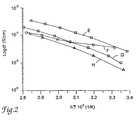
- Fig. 2 is an Arrhenius plot showing conductivity of various electrolyte compositions as a function of type of lithium salt.
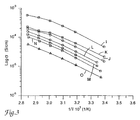
- Fig. 3 is an Arrhenius plot showing conductivity of various electrolyte compositions as a function of crosslinking level.
- Fig. 4 is a charge/discharge curve for the first and fifth cycles of a lithium-polypyrrole battery according to the invention.
- Electrolyte compositions according to the invention include a polymer matrix in which is disposed one or more electrolyte salts.
- the polymer matrix is preferably the reaction product of one or more di-functional thiols, one or more diene-functional alkylene oxides, and one or more multi-ene-functional reactants, multi-functional thiols, or combination thereof, each having a functionality greater than two.
- the polymer matrix may also be the reaction product of (a) a multi-functional thiol having a functionality greater than two and a diene-functional alkylene oxide, (b) a di-functional thiol and a multi-ene-functional alkylene oxide having a functionality greater than two, or (c) a multi-functional thiol having a functionality greater than two and a multi-ene-functional alkylene oxide having a functionality greater than two if the multi-functional reactants have a relatively high molecular weight between functional groups.
- the reactants are chosen such that the electrolyte composition has sufficient mechanical integrity to retain its shape (e.g., when prepared in the form of a film), but does not substantially impede ion transport through the electrolyte (as measured by the ionic conductivity of the electrolyte composition).
- the ionic conductivity of the electrolyte composition is at least 1 x 10 -6 S/cm, more preferably at least 5 x 10 -6 S/cm, and most preferably at least 1 x 10 -5 S/cm.
- the reactants may be adjusted to achieve a particular tack level to provide sufficient adhesion between the electrolyte and a substrate such as an electrode to which the electrolyte is applied.
- mercapto-siloxanes having a functionality equal to two (e.g., tetramethylbis(3-mercaptopropyl)disiloxane and higher analogs thereof).
- the thiol may also be provided with a variety of functional groups, including or combination thereof.
- Suitable diene-functional alkylene oxides include alkylene oxides having the formula [(CHR 1 ) n (CHR 2 O) m ] x , (where R 1 and R 2 , independently, are H or a C 1 -C 3 alkyl group, and m and n, independently, are 1-4) provided with two ene-functional groups, or copolymers thereof.
- suitable ene-functional groups include allyls, (meth)acrylates, (meth)acrylamides, vinyl silanes, vinyl ethers, fumarates, maleates, styryls, norbornenyls, and combinations thereof.
- alkylene oxide may further be provided with a variety of functional groups, including or combination thereof.
- the amount of multi-functional reactant having a functionality greater than two ranges from about 0.1 to about 20 equivalent percent, preferably from about 0.1 to about 10 equivalent percent, and more preferably from about 0.1 to about 5 equivalent percent, with reactants having higher functionalities falling at the lower end of the range.
- Suitable multi-functional thiols having a functionality greater than two include those having the general formula Z[OCO(CH 2 ) n ,SH] m where Z is a polyvalent organic moiety which is a CH 0-3 group-containing nucleus of a tri- or tetravalent alcohol of the type of glycerol or pentaerythritol, m is 3 or 4, and n is an integer between 1 and 5, inclusive.
- Z is a polyvalent organic moiety which is a CH 0-3 group-containing nucleus of a tri- or tetravalent alcohol of the type of glycerol or pentaerythritol
- m is 3 or 4
- n is an integer between 1 and 5, inclusive.
- Specific examples include trimethylolpropane tris(3-mercaptopropionate), pentaerythritol tetra(3-mercaptopropionate), and combinations thereof.
- mercapto-functional siloxanes e.g., poly(3-mercaptopropylmethylsiloxane), or oligomers or copolymers thereof, siloxanes such as those commercially available from United Chemical Technologies, Inc. under the trade designation "PS405"; and combinations thereof.
- tri-functional thiols such as those commercially available from Henkel Corp. under the designation “CopureTM 3-800” and from Morton International as the "Liquid Polysulfide Polymer Series" can be used.
- Suitable enes having functionalities greater than two include allyl ethers, vinyl ethers, and (meth)acrylates.
- allyls include triallyl isocyanurate, allyl-functional urethane oligomers, and allyl-functional siloxanes.
- acrylates and methacrylates include trimethylpropane triacrylate and pentaerythritol tetraacrylate.
- vinyl ethers include trimethanolpropane trivinyl ether.
- electrolyte salts can be used in electrolyte compositions according to the invention.
- Such salts are well-known and include alkali metal, alkaline earth metal,, and Group IIIB metal (e.g., aluminum) salts of anions such as BF 4 - ; PF 6 - ; AsF 6 - ; ClO 4 - ; SbF 6 - ; R f SO 3 - (in which R f is a perfluoroalkyl group having between 1 and 12 carbon atoms, inclusive); a bis-sulfonamide anion (R f -SO 2 -N - -SO 2 -R f ' ;) in which R f and R f ' , independently, are perfluoroalkyl groups having between 1 and 12 carbon atoms, inclusive; a bis-sulfonamide anion (R f -SO 2 -C -
- Such salts also include cyclic perfluoroaliphatic disulfonimide salts, such as those described in U.S. Pat. No. 4,387,222 (Koshar), and metal salts of acids, such as those described by DesMarteau et al. in J. Fluor. Chem. 45 , 24 (1989).
- Suitable salts include LiBF 4 , LiAsF 6 , LiClO 4 , LiPF 6 , CF 3 SO 3 Li, C 2 F 5 SO 3 Li, C 10 F 21 SO 3 Li, (CF 3 SO 2 ) 2 NLi, (CF 3 SO 2 ) 2 NN a, [(CF 3 SO 2 ) 2 N] 3 Al, (CF 3 SO 2 ) 2 C(H)Li, cyclo-(CF 2 SO 2 ) 2 NLi, cyclo-(CF 2 SO 2 ) 2 C(H)Li, (CF 3 SO 2 ) 3 CLi, and mixtures thereof.
- the ratio of the total number of oxygen and sulfur atoms in the thiol-ene polymer to the number of salt cations ranges from about 5 to about 40, with ratios of between 10 and 20 being most preferred.
- the electrolyte compositions according to the invention are preferably prepared by photoinitiated bulk polymerization according to the technique described in Martens et al., U.S. Patent No. 4,181,752.
- the reactants, electrolyte salt, and a photoinitiator are mixed together in the absence of solvent and preferably partially polymerized to a viscosity in the range of from about 10 cps to about 50,000 cps to achieve a coatable syrup.
- the resulting composition is coated onto a substrate such as an electrode, e.g., according to the technique described in W095/29811.
- Low intensity ultraviolet lamps with different spectral outputs are commercially available and preferably used, although high intensity lamps may be used as well.
- the lamp should be selected such that the maximum output of the lamp is near the maximum absorption of the initiator.
- Fluorescent lamps e.g., F40TI2-350BL lamps commercially available from Osram Sylvania, Danvers, MA
- the intensity of each lamp bank is in the range of about 0.25 to 10 mW/cm 2 (more preferably in the range of about 0.5 to 5 mW/cm 2 ) are suitable for this application.
- the total radiation to which the reactants are exposed preferably is in the range of about 100 to 1500 mJ/ cm 2 . The particular radiation intensity and total energy exposure requirements will vary depending on the initiator and reactants.
- the amount of photoinitiator generally ranges from about 0.01 to about 10 parts per 100 parts of reactants.
- suitable polymerization initiators include benzoin ethers, substituted benzoin ethers such as benzoin methyl ether or benzoin isopropyl ether, substituted acetophenones such as 2,2-diethoxyacetophenone, and 2,2-dimethoxy-2-phenyl-acetophenone, substituted alpha-ketols such as 2-methyl-2-hydroxypropiophenone, aromatic sulphonyl chlorides such as 2-naphthalene sulphonyl chloride, and photoactive oximes such as 1-phenyl-1,1-propanedione-2-(O-ethoxycarbonyl) oximes.
- initiators include 2,4-bistrichloro-methyl-6-substituted-s-triazines, and benzophenone with an amine (for example, benzophenone and p-N,N-diethylamino) ethyl benzoate).
- Sensitizers such as phenanthrene may be used in conjunction with the photoinitiators as well.
- Polymerization may also be carried out by exposure to thermal radiation (in which case a thermal initiator is included) or electron beam radiation (which does not require the use of an initiator).
- Electron beam radiation has the advantage that it can be used in conjunction with non-ultraviolet/visible transparent substrates such as filled electrodes.
- the same material can be used for both the electrolyte composition and one (or both) of the electrodes, thereby eliminating interfaces between electrolyte and electrode that can impede ion transport.
- the electrolyte compositions may be swollen (if desired) with solvent.
- Aprotic liquids are preferred. Such liquids are generally dry (e.g., have a water content less than about 100 ppm, preferably less than about 50 ppm).
- Suitable aprotic liquids include linear ethers such as diethyl ether and 1,2-dimethoxyethane; cyclic ethers such as tetrahydrofuran, 2-methyltetrahydrofuran, dioxane, dioxolane, and 4-methyldioxolane; esters such as methyl formate, ethyl formate, methyl acetate, diethyl carbonate, propylene carbonate, ethylene carbonate, and butyrolactones; nitrites such as acetonitrile and benzonitrile; nitro compounds such as nitromethane or nitrobenzene; amides such as N,N-dimethylformamide, N,N-diethylformamide, and N-methylpyrrolidone; sulfoxides such as dimethyl sulfoxide; sulfones such as dimethylsulfone, tetramethylene sulfone, and other sulfolanes
- the electrolyte compositions according to the invention generally have conductivities of at least about 1 x 10 -6 S/cm at 25°C (measured in the absence of solvent).
- the compositions thus find application in a wide variety of areas, including primary and secondary batteries (e.g., lithium batteries), sensor, capacitors, and electrochromic devices (e.g., for use as optical shutters or displays).
- the UV light profile was 330 mJ, 1.5 mW and 300 mJ, 1.3 mW for the top and bottom lights, respectively, as measured with a UVIMAP Model #UMD365H-S photometer (available from EIT Electronic Instrumentation Technology, Inc., Sterling, VA).
- the resulting polymer electrolyte film was a clear, slightly tacky film which was readily removed from the release liners.
- the conductivity of the electrolyte film which was measured by laminating a sample of the film between two pieces of zinc foil (approximately 22 cm x 25 cm) and measuring its ac impedance using a Schlumberger FRA 1260 Impedance/Gain Phase Analyzer linked to a computer-controlled PARC 273A potentiostat, was 3.3x10 -5 S/cm.
- a polymer electrolyte film was prepared according to the procedure of Example 1 except that the reaction mixture consisted of triethylene glycol divinyl ether (4.045 gm, 20 mmol), tetramethylbis(3-mercaptopropyl)disiloxane (5.066 gm, 19 mmol), poly(3-mercaptopropyl)methyldisiloxane (0.320 gm, 2 mmol, available from United Chemicals Technologies, Inc.), dimethoxybenzil (KB-1, 20 mg, available from Sartomer Chemical, Exton, PA), and lithium trifluoromethanesulfonyl imide (1.435 gm, 5 mmol).
- the molar equivalent weight of poly(3-mercaptopropyl)methyldisiloxane was based on a repeat unit of OSi(Me)CH 2 CH 2 CH 2 SH).
- the resulting polymer electrolyte film had a conductivity of 2.0x10 -5 S/cm.
- a polymer electrolyte film was prepared according to the procedure of Example 1 except that the reaction mixture consisted of triethylene glycol divinyl ether (2.022 gm, 10 mmol), 1,8-dimercapto-4,6-dioxooctane (1.732 gm, 9.5 mmol, available from Nisso Maruzen Chemical, Tokyo, Japan), poly(3-mercaptopropyl)methyldisiloxane (0.090 gm, 0.56 mmol), dimethoxybenzil (KB-1, 12 mg), and lithium trifluoromethanesulfonyl imide (2.296 gm, 8 mmol).
- the resulting polymer electrolyte film had a conductivity of 1.7x10 -5 S/cm.
- a polymer electrolyte film was prepared according to the procedure of Example 1 except that the reaction mixture consisted of triethylene glycol divinyl ether (2.188 gm, 9.5 mmol), 1,8-dimercapto-4,6-dioxooctane (1.732 gm, 9.5 mmol), triallyl cyanurate (0.025 gm, 0.1 mmol, available from Aldrich Chemicals, Milwaukee, WI), benzophenone (BP, 20 mg), and lithium trifluoromethanesulfonyl imide (2.296 gm, 8 mmol).
- the resulting polymer electrolyte film had a conductivity of 2.1x10 -5 S/cm
- a polymer electrolyte film was prepared according to the procedure of Example 1 except that the reaction mixture consisted of triethylene glycol diallyl ether (2.188 gm, 9.5 mmol, prepared as described below), 1,8-dimercapto-4,6-dioxooctane (1.823 gm, 10 mmol), pentaerythritol tetra-allyl ether (0.148 gm, 0.5 mmol, available from Monomer-Polymer & Dajac Labs, Feasterville, PA), dimethoxybenzil (KB-1, 8 mg), and lithium trifluoromethanesulfonyl imide (2.296 gm, 8 mmol).
- the triethylene glycol diallyl ether was prepared by adding allyl bromide (48.0 gm, 0.4 mol) dropwise, to a mixture of triethylene glycol (30.34 gm, 0.2 mol) and sodium hydroxide (10.0 gm, 0.25 mol) and refluxing the resulting mixture for 4 hours.
- the reaction mixture was cooled to room temperature, diluted with ether (100mL), and the precipitate removed by filtration.
- the filtrate was washed with 5% HCI (100 mL), saturated sodium bicarbonate (100 mL), and dried over anhydrous sodium sulfate.
- the sodium sulfate was removed by filtration, the ether stripped on a rotary evaporator, and the crude product distilled under vacuum.
- the structure of the distilled product was confirmed by NMR analysis.
- the resulting polymer electrolyte film had a conductivity of 2.9x10 -5 S/cm.
- a polymer electrolyte film was prepared according to the procedure of Example 1 except that the reaction mixture consisted of tetraethylene glycol diallyether (2.605 gm, 4 9.5 mmol, (prepared according to the procedure used to prepare triethylene glycol diallyl ether described in Example 5, but substituting the appropriate molar quantity of tetraethylene glycol for the triethylene glycol)), 1,8-dimercapto-4,6-dioxooctane (1.823 gm, 10 mmol), pentaerythritol tetra-allyl ether (0.148 gm, 0.5 mmol), dimethoxybenzil (KB-1, 8 mg), and lithium trifluoromethanesulfonyl imide (2.583 gm 9 mmol).
- the resulting polymer electrolyte film had a conductivity of 5.1x10 -5 S/cm.
- a polymer electrolyte film was prepared according to the procedure of Example 1 except that the reaction mixture consisted of polyethylene glycol 400 diallyether (4.598 gm, 9.5 mmol (prepared by substituting the appropriate molar quantity of polyethylene glycol 400 for the triethylene glycol)), 1,8-mercapto-4,6-dioxooctane (1.823 gm, 10 mmol), pentaerythritol tetra-allyl ether (0.148 gm, 0.5 mmol), dimethoxybenzil (KB-1, 8 mg), and lithium trifluoromethanesulfonyl imide (4.020 gm, 14 mmol).
- the resulting polymer electrolyte film had a conductivity of 3,9x10 -5 S/cm.
- a polymer electrolyte film was prepared according to the procedure of Example 1 except that the reaction mixture consisted of tetraethylene glycol diacrylate (3.023 gm, 10 mmol, available from Aldrich Chemicals, Milwaukee, WI), 1,8-dimercapto-3,6-dioxooctane (1.732 gm, 9.5 mmol, available from Nisso Maruzen Chemical), poly(3-mercaptopropyl)methyldisiloxane (0.067 gm, 0.50 mmol), dimethoxybenzil (KB-1, 15 mg), and lithium trifluoromethanesulfonyl imide (2.583 gm, 9 mmol).
- the resulting polymer electrolyte film had a conductivity of 2.8x10 -5 S/cm.
- a series of four polymer electrolyte films were prepared according to the procedure of Example 1 except that the polymer matrix for all four samples was based on a reaction mixture consisting of triethylene glycol divinyl ether (DVE-3, 1.980 gm, 9.85 mmol), 1,8-dimercapto-3,6-dioxooctane (1.823 gm, 10.0 mmol), triallyl cyanuarate (0.025 gm, 0.1 mmol), and dimethoxybenzil (KB-1, 4 mg).
- DVE-3 triethylene glycol divinyl ether
- 1,8-dimercapto-3,6-dioxooctane 1.823 gm, 10.0 mmol
- triallyl cyanuarate 0.025 gm, 0.1 mmol
- dimethoxybenzil KB-1, 4 mg.
- the concentration of lithium trifluoromethanesulfonate available from 3M, St.
- a series of polymer electrolyte films were prepared according to the procedure of Example 9 except that the Li/(O+S) ratio was held constant at 1/20 and four different Li salts were incorporated into the polymer electrolyte formulations as indicated in Table 2.
- Conductivity as a Function of Type of Li Salt Sample Li Salt Gm Salt Mmol Salt 10a LiN(SO 2 CF 3 ) 2 1.148 4 10b LiO 3 SCF 3 0.624 4 10c LiO 3 SC 4 F 9 1.224 4 10d LiClO 4 0.425 4
- a series of polymer electrolyte films were prepared according to the procedure of Example 9 except that the Li/(O+S) ratio was held constant at 1/20 and the crosslinker level was systematically varied from 0.6% to 6.0%, where the crosslinker level was defined as (meq triallyl cyanuarate/meq dithiol) X 100%. These preparations were carried out at an X level of the preparations described in Example 9. Actual weights and molar equivalents of the triallyl cyanuarate used in the various samples are indicated in Table 3.
- a 5.9 cm 2 Li/polypyrrole battery cell was assembled by laminating a 127 ⁇ m thick film of sample 10d between a lithium foil (152 ⁇ m thick) and a polypyrrole film deposited on a platinum foil, which was prepared according to the procedure described by Osaka et. al. in J. Electrochem. Soc., 141, (1994), pp 1994 -1998.
- the polypyrrole film was formed on the platinum foil by an electro-oxidative polymerization at 42 volts vs. Li/Li + in propylene carbonate containing 0.2 M LiClO 4 and 0.2 M pyrrole. Polymerization was terminated after passing a charge of 0.5 C/cm 2 .
- the polypyrrole film was washed twice with 0.2 M LiClO 4 and dried overnight under vacuum at 80°C.
- the cell was placed in an aluminum can as described in Example 9 and subjected to charge-discharge cycling at 78°C on a Maccor 2000 battery test system (available from Maccor, Inc., Tulsa, OK).
- the charge-discharge curve for the first and fifth cycles of this cell, which were obtained at a current density of 0.017 mA/cm 2 are shown in Figure 4.
Landscapes
- Chemical & Material Sciences (AREA)
- General Chemical & Material Sciences (AREA)
- Chemical Kinetics & Catalysis (AREA)
- Health & Medical Sciences (AREA)
- Medicinal Chemistry (AREA)
- Polymers & Plastics (AREA)
- Organic Chemistry (AREA)
- Manufacturing & Machinery (AREA)
- Engineering & Computer Science (AREA)
- Physics & Mathematics (AREA)
- Electrochemistry (AREA)
- Spectroscopy & Molecular Physics (AREA)
- General Physics & Mathematics (AREA)
- Dispersion Chemistry (AREA)
- Condensed Matter Physics & Semiconductors (AREA)
- Inorganic Chemistry (AREA)
- Secondary Cells (AREA)
- Conductive Materials (AREA)
- Polyethers (AREA)
- Polymers With Sulfur, Phosphorus Or Metals In The Main Chain (AREA)
- Primary Cells (AREA)
- Compositions Of Macromolecular Compounds (AREA)
Applications Claiming Priority (3)
| Application Number | Priority Date | Filing Date | Title |
|---|---|---|---|
| US08/435,110 US5593795A (en) | 1995-05-01 | 1995-05-01 | Polymer electrolyte composition based upon thiol-ene chemistry |
| US435110 | 1995-05-01 | ||
| PCT/US1996/005723 WO1996035238A1 (en) | 1995-05-01 | 1996-04-24 | Polymer electrolyte composition based upon thiol-ene chemistry |
Publications (2)
| Publication Number | Publication Date |
|---|---|
| EP0824763A1 EP0824763A1 (en) | 1998-02-25 |
| EP0824763B1 true EP0824763B1 (en) | 2000-06-14 |
Family
ID=23727028
Family Applications (1)
| Application Number | Title | Priority Date | Filing Date |
|---|---|---|---|
| EP96913116A Expired - Lifetime EP0824763B1 (en) | 1995-05-01 | 1996-04-24 | Polymer electrolyte composition based upon thiol-ene chemistry |
Country Status (8)
| Country | Link |
|---|---|
| US (1) | US5593795A (enExample) |
| EP (1) | EP0824763B1 (enExample) |
| JP (1) | JP3928027B2 (enExample) |
| KR (1) | KR19990008210A (enExample) |
| AU (1) | AU5572696A (enExample) |
| DE (1) | DE69608893T2 (enExample) |
| ES (1) | ES2147376T3 (enExample) |
| WO (1) | WO1996035238A1 (enExample) |
Families Citing this family (32)
| Publication number | Priority date | Publication date | Assignee | Title |
|---|---|---|---|---|
| EP0988657A1 (en) * | 1998-03-23 | 2000-03-29 | Koninklijke Philips Electronics N.V. | Polymeric gel electrolyte |
| US6669873B1 (en) * | 1999-04-22 | 2003-12-30 | Ppc Industries Ohio, Inc. | Optical resin composition comprising thiol-ene prepolymer |
| JP4529274B2 (ja) * | 2000-04-18 | 2010-08-25 | ソニー株式会社 | 非水電解質電池 |
| TW527745B (en) * | 2000-11-21 | 2003-04-11 | Dainichiseika Color Chem | Solidifying material for cell electrolyte solution, and cell comprising the solidifying material |
| US6727343B2 (en) * | 2001-04-17 | 2004-04-27 | Phoenix Innovation, Inc. | Heteroatomic polymer for more efficient solid polymer electrolytes for lithium batteries |
| US20030104282A1 (en) * | 2001-11-15 | 2003-06-05 | Weibing Xing | In situ thermal polymerization method for making gel polymer lithium ion rechargeable electrochemical cells |
| KR100467451B1 (ko) * | 2002-09-04 | 2005-01-24 | 삼성에스디아이 주식회사 | 리튬 전지용 전해질 및 이를 포함하는 리튬 전지 |
| US20070065728A1 (en) * | 2003-03-20 | 2007-03-22 | Zhengcheng Zhang | Battery having electrolyte with mixed solvent |
| US8349951B2 (en) * | 2005-05-31 | 2013-01-08 | Prc Desoto International, Inc. | Polythioether polymers and curable compositions containing them |
| US20100113692A1 (en) * | 2008-11-04 | 2010-05-06 | Mcguire Jr James E | Apparatus for Continuous Production of Partially Polymerized Compositions |
| US8765217B2 (en) | 2008-11-04 | 2014-07-01 | Entrotech, Inc. | Method for continuous production of (meth)acrylate syrup and adhesives therefrom |
| KR101669218B1 (ko) * | 2008-11-10 | 2016-11-10 | 삼성전자주식회사 | 겔 고분자 전해질, 이를 포함하는 리튬전지, 겔 고분자 전해질의 제조방법, 및 리튬전지의 제조방법 |
| US8329079B2 (en) * | 2009-04-20 | 2012-12-11 | Entrochem, Inc. | Method and apparatus for continuous production of partially polymerized compositions and polymers therefrom |
| US20140039081A1 (en) | 2011-04-14 | 2014-02-06 | Universiteit Gent | Sulphur-containing thermoplastic polymers |
| JP5647069B2 (ja) * | 2011-05-18 | 2014-12-24 | 日立マクセル株式会社 | 非水二次電池 |
| JP6245524B2 (ja) * | 2013-09-25 | 2017-12-13 | 富士フイルム株式会社 | 重合硬化膜の製造方法、電池用電極シートの製造方法および全固体二次電池の製造方法 |
| EP3149798B1 (en) * | 2014-05-30 | 2018-04-11 | Basf Se | Polymer for use as protective layers and other components in electrochemical cells |
| US20160172710A1 (en) * | 2014-12-10 | 2016-06-16 | The Regents Of The University Of California | Electrolyte and negative electrode structure |
| CA2976436A1 (en) | 2015-02-13 | 2016-08-18 | 3M Innovative Properties Company | Cold-tolerant sealants and components thereof |
| KR20170132890A (ko) | 2015-04-16 | 2017-12-04 | 쓰리엠 이노베이티브 프로퍼티즈 캄파니 | 티올-알켄-에폭시 매트릭스를 갖는 양자점 물품 |
| US10519366B2 (en) | 2015-04-16 | 2019-12-31 | 3M Innovative Properties Company | Quantum dot article with thiol-epoxy matrix |
| KR20180091933A (ko) | 2015-12-31 | 2018-08-16 | 쓰리엠 이노베이티브 프로퍼티즈 컴파니 | 양자점을 갖는 입자를 포함하는 물품 |
| WO2017116820A1 (en) | 2015-12-31 | 2017-07-06 | 3M Innovative Properties Company | Curable quantum dot compositions and articles |
| JP6723461B2 (ja) * | 2017-07-21 | 2020-07-15 | 富士フイルム株式会社 | 固体電解質組成物、固体電解質含有シート及び全固体二次電池、並びに、固体電解質含有シート及び全固体二次電池の製造方法 |
| US11387488B2 (en) * | 2018-01-26 | 2022-07-12 | The Johns Hopkins University | Gel polymer electrolyte compositions and electrochemical cells including the same |
| US11894515B2 (en) * | 2019-06-28 | 2024-02-06 | The Johns Hopkins University | Electrochemical cells and electrolytes contained therein |
| CN113097564B (zh) * | 2021-03-29 | 2022-06-14 | 中山大学 | 一种基于多孔聚酰亚胺的超薄聚合物电解质膜及其制备方法 |
| CN119522210A (zh) * | 2022-06-28 | 2025-02-25 | 加拿大蓝色解决方案有限公司 | 硫醇官能化导体化合物及其制备方法 |
| CN117406508A (zh) * | 2022-07-07 | 2024-01-16 | 中国科学院上海硅酸盐研究所 | 一种超快响应电致变色器件及其制备方法 |
| JP2026518175A (ja) * | 2023-05-31 | 2026-06-04 | エルジー エナジー ソリューション リミテッド | 硫化物含有固体電解質材料用有機コーティング、固体電解質及びこれを含む固体電池 |
| US12125974B1 (en) * | 2023-10-12 | 2024-10-22 | Lg Energy Solution, Ltd. | Method for densification of sulfide solid electrolytes |
| FR3162753A1 (fr) | 2024-05-29 | 2025-12-05 | IFP Energies Nouvelles | Electrolyte solide à conduction anionique |
Family Cites Families (20)
| Publication number | Priority date | Publication date | Assignee | Title |
|---|---|---|---|---|
| US4181752A (en) * | 1974-09-03 | 1980-01-01 | Minnesota Mining And Manufacturing Company | Acrylic-type pressure sensitive adhesives by means of ultraviolet radiation curing |
| GB1590472A (en) * | 1976-08-31 | 1981-06-03 | Nat Res Dev | Polymeric materials |
| FR2442512A1 (fr) * | 1978-11-22 | 1980-06-20 | Anvar | Nouveaux materiaux elastomeres a conduction ionique |
| JPS5662229A (en) * | 1979-10-25 | 1981-05-28 | Asahi Glass Co Ltd | Electro-optical dimming panel |
| FR2485274A1 (fr) * | 1980-03-31 | 1981-12-24 | France Etat | Electrolyte solide a base de materiau macromoleculaire a conduction ionique |
| DE3164989D1 (en) * | 1980-04-15 | 1984-08-30 | Asahi Glass Co Ltd | Electro-optical device and electro-optical light controlling device |
| JPS57108831A (en) * | 1980-12-26 | 1982-07-07 | Hitachi Maxell Ltd | Manufacture of solid electrolytic thin plate |
| US4387222A (en) * | 1981-01-30 | 1983-06-07 | Minnesota Mining And Manufacturing Company | Cyclic perfluoroaliphaticdisulfonimides |
| EP0078505B1 (fr) * | 1981-11-03 | 1987-12-09 | COMPAGNIE GENERALE D'ELECTRICITE Société anonyme dite: | Procédé de fabrication d'un électrolyte solide à base de polymères pour générateur électrochimique |
| CA1211547A (en) * | 1982-06-29 | 1986-09-16 | Masataka Miyamura | Electrochromic display element |
| US4618630A (en) * | 1984-08-27 | 1986-10-21 | The Dow Chemical Co. | Organic polymer composition containing an antistatic agent comprising a nonvolatile ionizable metal salt and a salt or ester of a carboxylic acid |
| US4908283A (en) * | 1986-10-09 | 1990-03-13 | Ube Industries, Ltd. | Preparation of ion conductive solid electrolyte |
| US4888257A (en) * | 1989-03-28 | 1989-12-19 | Fuji Photo Film Co., Ltd. | Solid electrolyte |
| US5162175A (en) * | 1989-10-13 | 1992-11-10 | Visco Steven J | Cell for making secondary batteries |
| US5061581A (en) * | 1990-02-07 | 1991-10-29 | Sri International | Novel solid polymer electrolytes |
| WO1991014294A1 (fr) * | 1990-03-16 | 1991-09-19 | Ricoh Co., Ltd. | Electrolyte solide, element electrochimique comprenant cette substance et procede de production |
| IT1254461B (it) * | 1992-02-17 | 1995-09-25 | Enichem Polimeri | Polimeri conduttori a conducibilita' ionica |
| US5453335A (en) * | 1992-12-23 | 1995-09-26 | Arthur D Little, Inc. | Ion-conductive polymer and electrolyte additives |
| US5294501A (en) * | 1993-04-19 | 1994-03-15 | Valence Technology, Inc. | Silane acrylate monomer and solid electrolyte derived by the polymerization thereof |
| US5501921A (en) * | 1994-04-25 | 1996-03-26 | Olsen; Ib I. | Fabrication of alkane polymer electrolyte |
-
1995
- 1995-05-01 US US08/435,110 patent/US5593795A/en not_active Expired - Fee Related
-
1996
- 1996-04-24 WO PCT/US1996/005723 patent/WO1996035238A1/en not_active Ceased
- 1996-04-24 JP JP53336696A patent/JP3928027B2/ja not_active Expired - Fee Related
- 1996-04-24 EP EP96913116A patent/EP0824763B1/en not_active Expired - Lifetime
- 1996-04-24 KR KR1019970707735A patent/KR19990008210A/ko not_active Withdrawn
- 1996-04-24 ES ES96913116T patent/ES2147376T3/es not_active Expired - Lifetime
- 1996-04-24 DE DE69608893T patent/DE69608893T2/de not_active Expired - Lifetime
- 1996-04-24 AU AU55726/96A patent/AU5572696A/en not_active Abandoned
Also Published As
| Publication number | Publication date |
|---|---|
| KR19990008210A (ko) | 1999-01-25 |
| JP3928027B2 (ja) | 2007-06-13 |
| DE69608893T2 (de) | 2001-02-01 |
| JPH11506561A (ja) | 1999-06-08 |
| WO1996035238A1 (en) | 1996-11-07 |
| US5593795A (en) | 1997-01-14 |
| ES2147376T3 (es) | 2000-09-01 |
| DE69608893D1 (de) | 2000-07-20 |
| EP0824763A1 (en) | 1998-02-25 |
| AU5572696A (en) | 1996-11-21 |
Similar Documents
| Publication | Publication Date | Title |
|---|---|---|
| US5593795A (en) | Polymer electrolyte composition based upon thiol-ene chemistry | |
| KR100419864B1 (ko) | 신규 가교제와 이를 함유하는 가교형 고체 고분자 전해질 | |
| US4822701A (en) | Solid electrolytes | |
| US11387488B2 (en) | Gel polymer electrolyte compositions and electrochemical cells including the same | |
| US4908283A (en) | Preparation of ion conductive solid electrolyte | |
| AU603730B2 (en) | Solid electrolyte devices | |
| KR100298802B1 (ko) | 고체 고분자 전해질용 가교제 및 이를 이용하여 제조된 가교형 고체 고분자 전해질 | |
| US6537468B1 (en) | Composition for ionically conductive solid polymer, ionically conductive solid polyelectrolyte, binder resin, and secondary battery | |
| US6727024B2 (en) | Polyalkylene oxide polymer composition for solid polymer electrolytes | |
| EP0492858A2 (en) | Solid electrolytes | |
| JPH0373081B2 (enExample) | ||
| JP2002100404A (ja) | ゲル状高分子固体電解質用樹脂組成物、ゲル状高分子固体電解質用組成物、および、これを用いたゲル状高分子固体電解質、複合電極、電気化学的デバイス | |
| AU606661B2 (en) | Electrochromic device | |
| KR102950987B1 (ko) | 중합체 전해질 및 이의 제조 방법 | |
| KR102951578B1 (ko) | 중합체 전해질 및 이를 제조하는 방법들 | |
| CA2218379C (en) | Polymer electrolyte composition based upon thiol-ene chemistry | |
| JP3546085B2 (ja) | 湿式太陽電池およびその製造方法 | |
| EP0638950B1 (en) | Process for preparing a solid, polymeric electrolyte based on polyvinyl ethers | |
| US5489491A (en) | Curable polymer precursors for solid electrolytes | |
| KR100365392B1 (ko) | 이온 전도성 고분자 전해질 및 이를 이용한 전기화학소자 | |
| EP0638949B1 (en) | Solid, polymeric, polyether based electrolyte | |
| KR100246993B1 (ko) | 고무탄성 공중합체의 제조방법 | |
| WO2019101698A1 (en) | A multilayer assembly for electrochemical cells | |
| NZ223884A (en) | Electrochromic device for electrically darkenable windows |
Legal Events
| Date | Code | Title | Description |
|---|---|---|---|
| PUAI | Public reference made under article 153(3) epc to a published international application that has entered the european phase |
Free format text: ORIGINAL CODE: 0009012 |
|
| 17P | Request for examination filed |
Effective date: 19971124 |
|
| AK | Designated contracting states |
Kind code of ref document: A1 Designated state(s): CH DE ES FR GB IT LI NL |
|
| 17Q | First examination report despatched |
Effective date: 19980421 |
|
| GRAG | Despatch of communication of intention to grant |
Free format text: ORIGINAL CODE: EPIDOS AGRA |
|
| GRAG | Despatch of communication of intention to grant |
Free format text: ORIGINAL CODE: EPIDOS AGRA |
|
| GRAH | Despatch of communication of intention to grant a patent |
Free format text: ORIGINAL CODE: EPIDOS IGRA |
|
| GRAH | Despatch of communication of intention to grant a patent |
Free format text: ORIGINAL CODE: EPIDOS IGRA |
|
| GRAA | (expected) grant |
Free format text: ORIGINAL CODE: 0009210 |
|
| AK | Designated contracting states |
Kind code of ref document: B1 Designated state(s): CH DE ES FR GB IT LI NL |
|
| REG | Reference to a national code |
Ref country code: CH Ref legal event code: EP |
|
| REF | Corresponds to: |
Ref document number: 69608893 Country of ref document: DE Date of ref document: 20000720 |
|
| REG | Reference to a national code |
Ref country code: CH Ref legal event code: NV Representative=s name: E. BLUM & CO. PATENTANWAELTE |
|
| ET | Fr: translation filed | ||
| ITF | It: translation for a ep patent filed | ||
| REG | Reference to a national code |
Ref country code: ES Ref legal event code: FG2A Ref document number: 2147376 Country of ref document: ES Kind code of ref document: T3 |
|
| PLBE | No opposition filed within time limit |
Free format text: ORIGINAL CODE: 0009261 |
|
| STAA | Information on the status of an ep patent application or granted ep patent |
Free format text: STATUS: NO OPPOSITION FILED WITHIN TIME LIMIT |
|
| PG25 | Lapsed in a contracting state [announced via postgrant information from national office to epo] |
Ref country code: ES Free format text: LAPSE BECAUSE OF NON-PAYMENT OF DUE FEES Effective date: 20010425 |
|
| PG25 | Lapsed in a contracting state [announced via postgrant information from national office to epo] |
Ref country code: LI Free format text: LAPSE BECAUSE OF NON-PAYMENT OF DUE FEES Effective date: 20010523 Ref country code: CH Free format text: LAPSE BECAUSE OF NON-PAYMENT OF DUE FEES Effective date: 20010523 |
|
| 26N | No opposition filed | ||
| PG25 | Lapsed in a contracting state [announced via postgrant information from national office to epo] |
Ref country code: NL Free format text: LAPSE BECAUSE OF NON-PAYMENT OF DUE FEES Effective date: 20011101 |
|
| REG | Reference to a national code |
Ref country code: CH Ref legal event code: PL |
|
| REG | Reference to a national code |
Ref country code: GB Ref legal event code: IF02 |
|
| NLV4 | Nl: lapsed or anulled due to non-payment of the annual fee |
Effective date: 20011101 |
|
| REG | Reference to a national code |
Ref country code: ES Ref legal event code: FD2A Effective date: 20030303 |
|
| PGFP | Annual fee paid to national office [announced via postgrant information from national office to epo] |
Ref country code: FR Payment date: 20070417 Year of fee payment: 12 |
|
| REG | Reference to a national code |
Ref country code: FR Ref legal event code: ST Effective date: 20081231 |
|
| PG25 | Lapsed in a contracting state [announced via postgrant information from national office to epo] |
Ref country code: FR Free format text: LAPSE BECAUSE OF NON-PAYMENT OF DUE FEES Effective date: 20080430 |
|
| PGFP | Annual fee paid to national office [announced via postgrant information from national office to epo] |
Ref country code: IT Payment date: 20100428 Year of fee payment: 15 |
|
| PGFP | Annual fee paid to national office [announced via postgrant information from national office to epo] |
Ref country code: GB Payment date: 20100426 Year of fee payment: 15 |
|
| GBPC | Gb: european patent ceased through non-payment of renewal fee |
Effective date: 20110424 |
|
| PG25 | Lapsed in a contracting state [announced via postgrant information from national office to epo] |
Ref country code: GB Free format text: LAPSE BECAUSE OF NON-PAYMENT OF DUE FEES Effective date: 20110424 Ref country code: IT Free format text: LAPSE BECAUSE OF NON-PAYMENT OF DUE FEES Effective date: 20110424 |
|
| PGFP | Annual fee paid to national office [announced via postgrant information from national office to epo] |
Ref country code: DE Payment date: 20150422 Year of fee payment: 20 |
|
| REG | Reference to a national code |
Ref country code: DE Ref legal event code: R071 Ref document number: 69608893 Country of ref document: DE |