EP0823402A2 - Use of biodegradable polymers in preventing corrosion and scale build-up - Google Patents
Use of biodegradable polymers in preventing corrosion and scale build-up Download PDFInfo
- Publication number
- EP0823402A2 EP0823402A2 EP97305414A EP97305414A EP0823402A2 EP 0823402 A2 EP0823402 A2 EP 0823402A2 EP 97305414 A EP97305414 A EP 97305414A EP 97305414 A EP97305414 A EP 97305414A EP 0823402 A2 EP0823402 A2 EP 0823402A2
- Authority
- EP
- European Patent Office
- Prior art keywords
- ranges
- group
- metal ion
- alkenyl
- metal
- Prior art date
- Legal status (The legal status is an assumption and is not a legal conclusion. Google has not performed a legal analysis and makes no representation as to the accuracy of the status listed.)
- Withdrawn
Links
- 0 CC(C(C)(C)C)C(N*)=O Chemical compound CC(C(C)(C)C)C(N*)=O 0.000 description 2
- PDUSWJORWQPNRP-UHFFFAOYSA-N CC(C)NC(C)=O Chemical compound CC(C)NC(C)=O PDUSWJORWQPNRP-UHFFFAOYSA-N 0.000 description 1
- KQDHUOFCRWSHIA-UHFFFAOYSA-N CCC(C)NC(C(C)C(C)(C)NC)=O Chemical compound CCC(C)NC(C(C)C(C)(C)NC)=O KQDHUOFCRWSHIA-UHFFFAOYSA-N 0.000 description 1
Classifications
-
- C—CHEMISTRY; METALLURGY
- C23—COATING METALLIC MATERIAL; COATING MATERIAL WITH METALLIC MATERIAL; CHEMICAL SURFACE TREATMENT; DIFFUSION TREATMENT OF METALLIC MATERIAL; COATING BY VACUUM EVAPORATION, BY SPUTTERING, BY ION IMPLANTATION OR BY CHEMICAL VAPOUR DEPOSITION, IN GENERAL; INHIBITING CORROSION OF METALLIC MATERIAL OR INCRUSTATION IN GENERAL
- C23F—NON-MECHANICAL REMOVAL OF METALLIC MATERIAL FROM SURFACE; INHIBITING CORROSION OF METALLIC MATERIAL OR INCRUSTATION IN GENERAL; MULTI-STEP PROCESSES FOR SURFACE TREATMENT OF METALLIC MATERIAL INVOLVING AT LEAST ONE PROCESS PROVIDED FOR IN CLASS C23 AND AT LEAST ONE PROCESS COVERED BY SUBCLASS C21D OR C22F OR CLASS C25
- C23F11/00—Inhibiting corrosion of metallic material by applying inhibitors to the surface in danger of corrosion or adding them to the corrosive agent
- C23F11/08—Inhibiting corrosion of metallic material by applying inhibitors to the surface in danger of corrosion or adding them to the corrosive agent in other liquids
- C23F11/10—Inhibiting corrosion of metallic material by applying inhibitors to the surface in danger of corrosion or adding them to the corrosive agent in other liquids using organic inhibitors
- C23F11/173—Macromolecular compounds
-
- C—CHEMISTRY; METALLURGY
- C02—TREATMENT OF WATER, WASTE WATER, SEWAGE, OR SLUDGE
- C02F—TREATMENT OF WATER, WASTE WATER, SEWAGE, OR SLUDGE
- C02F5/00—Softening water; Preventing scale; Adding scale preventatives or scale removers to water, e.g. adding sequestering agents
- C02F5/08—Treatment of water with complexing chemicals or other solubilising agents for softening, scale prevention or scale removal, e.g. adding sequestering agents
- C02F5/10—Treatment of water with complexing chemicals or other solubilising agents for softening, scale prevention or scale removal, e.g. adding sequestering agents using organic substances
- C02F5/12—Treatment of water with complexing chemicals or other solubilising agents for softening, scale prevention or scale removal, e.g. adding sequestering agents using organic substances containing nitrogen
-
- C—CHEMISTRY; METALLURGY
- C08—ORGANIC MACROMOLECULAR COMPOUNDS; THEIR PREPARATION OR CHEMICAL WORKING-UP; COMPOSITIONS BASED THEREON
- C08G—MACROMOLECULAR COMPOUNDS OBTAINED OTHERWISE THAN BY REACTIONS ONLY INVOLVING UNSATURATED CARBON-TO-CARBON BONDS
- C08G73/00—Macromolecular compounds obtained by reactions forming a linkage containing nitrogen with or without oxygen or carbon in the main chain of the macromolecule, not provided for in groups C08G12/00 - C08G71/00
- C08G73/02—Polyamines
- C08G73/0233—Polyamines derived from (poly)oxazolines, (poly)oxazines or having pendant acyl groups
Definitions
- the present invention relates generally to the protection of metallic surfaces from corrosion, scaling and the accumulation of other deposits. More specifically, the present invention relates to corrosion and scale inhibiting compositions, dispersants and methods of using the same.
- Corrosion occurs when metals are oxidized to their respective ions and/or insoluble salts.
- corrosion of metallic iron can involve conversion to soluble iron in a +2 or a +3 oxidation state or insoluble iron oxides and hydroxides.
- corrosion has a dual nature in that (1) a portion of the metal surface is removed and (2) the formation of insoluble salts contributes to the build up of scales and deposits.
- the build up of deposits interferes with heat transfer.
- a metal surface such as the inside surface of heat exchanger tube, to any liquid medium such as water, or vice versa
- the surface of the metal should be clean and free of scales and deposits as possible.
- Scaled metal surfaces will reduce the rate of heat transfer between the metal surface and the water or other fluid medium and therefore, scaling reduces the efficiency of the system.
- scaling and deposits can lead to corrosion underneath the deposits on the metallic surface and reduce the useful life of the equipment.
- Such scales and deposits include calcium carbonate, hydroxyaptite, calcium hydroxide, magnesium hydroxide, iron oxide or iron hydroxide and clay particulates, etc.
- gluconic acid such as gluconic acid, sucharic acid, citric acid, tartaric acid and lactobionic acid might be biodegradable, but their corrosion inhibition activities are low and therefore they are often formulated together with other inorganic corrosion inhibitors such as phosphate or zinc in order to provide effective corrosion inhibition.
- Underivatized polyaspartic acid is also known to be biodegradable and to have some scale inhibition activity but little or no corrosion inhibition activity. In fact, underivatized polyaspartic acid accelerates corrosion in common industrial water conditions.
- the present invention provides a family of compositions that reduce or inhibit development and build-up of corrosion, scales and deposits on metallic surfaces and a method of reducing development and build-up of corrosion, scales and deposits on metallic surfaces.
- the family of compositions provided by the present invention includes polymers comprising hydroxamic acid-containing poly (amino acids).
- the present invention provides a composition for reducing corrosion on metallic surfaces, the composition characterized by a poly(amino acid) polymer including hydroxamic acid-containing sidechains.
- the present invention further provides an industrial process water characterized by hardness and corrosive elements; and a poly(amino acid) polymer including hydroxamic acid-containing sidechains.
- the present invention also provides a method of reducing corrosion on metallic surfaces caused by a water, characterized by comprising adding a corrosion inhibiting composition to the solution, the composition comprising a poly(amino acid) polymer including hydroxamic acid-containing sidechains.
- the present invention also provides a method of reducing scale build-up on metallic surfaces caused by a water, characterized by comprising adding a scale inhibiting composition to the solution, the composition comprising a poly(amino acid) polymer including hydroxamic acid-containing sidechains.
- the present invention provides a method of dispensing solid particulate in a solution or slurry containing solid particulates such as clays, characterized by comprising adding a dispersant composition to the solution or slurry containing solid particulates such as clays, the composition comprising a poly(amino acid) polymer including hydroxamic acid-containing sidechain.
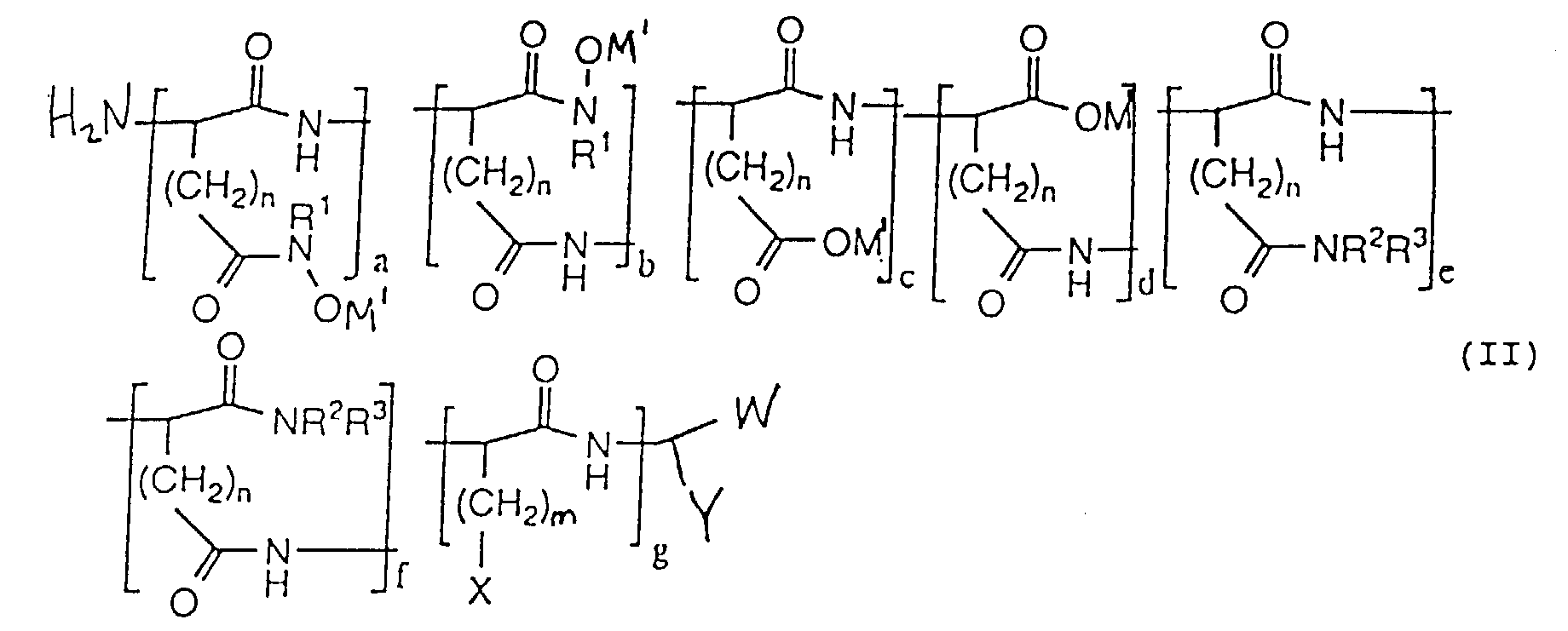
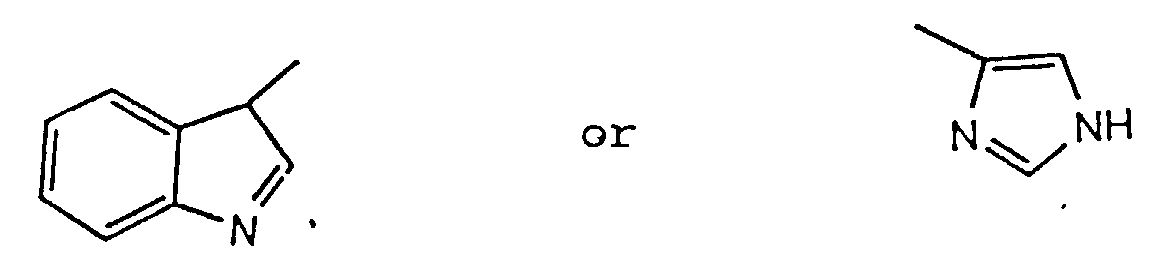
- hydroxamic acid-containing poly(amino acids) of the general formula (II) as shown below are within the scope of the present invention: wherein n 1 and 2; m ranges from O to 4; M 1 is selected from the group consisting of an alkaline metal, an alkaline earth metal, and ammonium; X is selected from the group consisting of H, CH 3 , CH(CH 3 ) 2 , CH(CH 3 )CH 2 CH 3 , OH, p-HOC 6 H 4 , SH, CH 2 SCH 3 , CH 2 OH, CH(OH)CH 3 , NH 2 , HNC(:NH)NH 2 , C(O)NH 2 , OPO 3 M 2 , OSO 3 M, p-M 2 O 3 POC 6 H 4 , p-MO 3 SOC 6 H 4 , SPO 2 M 2 , CH 2 OPO 3 M 2 , CH 2 OSO 3 M, CH(OPO 3 M 2 )CH 3 , CH(OSO 3 M
Landscapes
- Chemical & Material Sciences (AREA)
- Organic Chemistry (AREA)
- Engineering & Computer Science (AREA)
- Chemical Kinetics & Catalysis (AREA)
- Environmental & Geological Engineering (AREA)
- Water Supply & Treatment (AREA)
- Mechanical Engineering (AREA)
- General Chemical & Material Sciences (AREA)
- Life Sciences & Earth Sciences (AREA)
- Hydrology & Water Resources (AREA)
- Materials Engineering (AREA)
- Metallurgy (AREA)
- Health & Medical Sciences (AREA)
- Medicinal Chemistry (AREA)
- Polymers & Plastics (AREA)
- Compositions Of Macromolecular Compounds (AREA)
- Preventing Corrosion Or Incrustation Of Metals (AREA)
- Emulsifying, Dispersing, Foam-Producing Or Wetting Agents (AREA)
- Paints Or Removers (AREA)
- Biological Depolymerization Polymers (AREA)
Abstract
Description

Claims (27)
- A composition for reducing corrosion on metallic surfaces, the composition characterized by a poly(amino acid) polymer including hydroxamic acid-containing sidechains.
- The composition of claim 1, characterized in that the composition also reduces scale accumulation on metallic surfaces.
- The composition of claim 1, characterized in that the composition effectively disperses particulates in a solution or slurry.
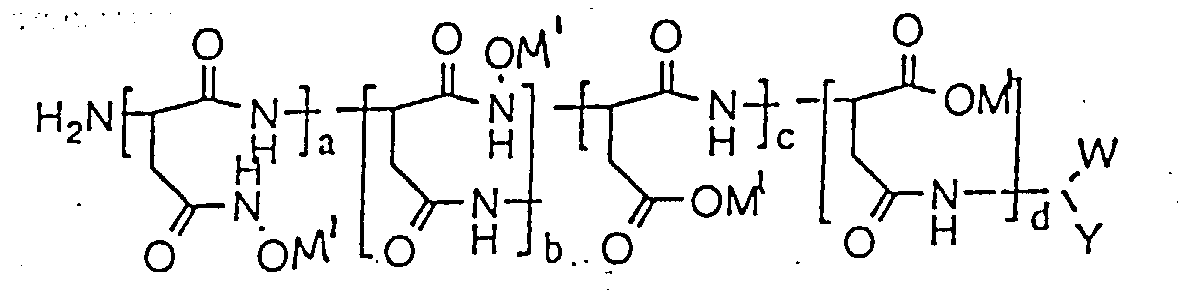
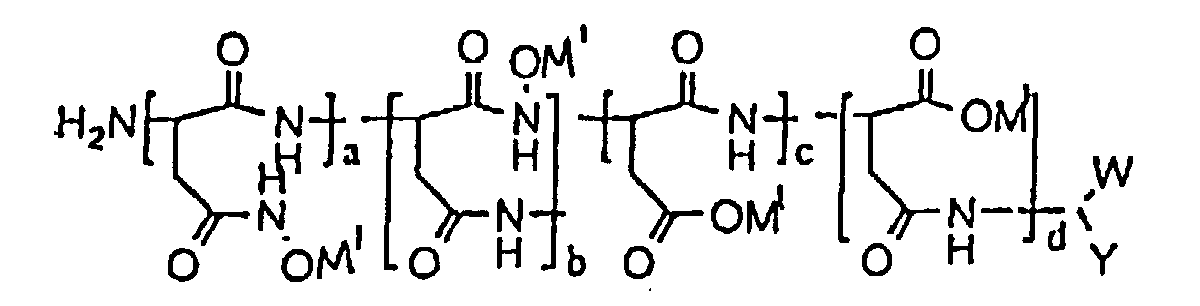
- The composition of claim 1, characterized in that the polymer has the formulawherein W is selected from the group consisting of CO2M and CONHOH wherein M is a metal ion; Y is selected from the group consisting of CH2CONHOH and CH2CO2M wherein M is a metal ion; M1 is selected from the group consisting of an alkaline metal, an alkaline earth metal and ammonium; (a + b)/(a + b + c + d) x 100% + (c + d)/(a + b + c + d) x 100% = 100%; (a + b)/(a + b + c + d) x 100% ranges from about 0.1% to about 100%; (c + d)/(a + b + c + d) x 100% ranges from 0% to 99.9%; a/(a + b) x 100% ranges from 0% to 100%; b/(a + b) x 100% ranges from 0% to 100%; c/(c + d) x 100% ranges from 0% to 100%; d/(c + d) x 100% ranges from 0% to 100%; and c/(c + d) x 100% + d/(c + d) x 100% = 100%.
- The composition of claim 4, characterized in that the molecular weight of the polymer ranges from about 300 to about 200,000.
- The composition of claim 1, characterized in that the polymer has the formulawherein n is selected from the group consisting of 1 and 2; m ranges from O to 4; M1 is selected from the group consisting of an alkaline metal, an alkaline earth metal, and ammonium; X is selected from the group consisting of H, CH3, CH(CH3)2, CH(CH3)CH2CH3, OH, p-HOC6H4, SH, CH2SCH3, CH2OH, CH(OH)CH3, NH2, HNC(:NH)NH2, C(O)NH2,
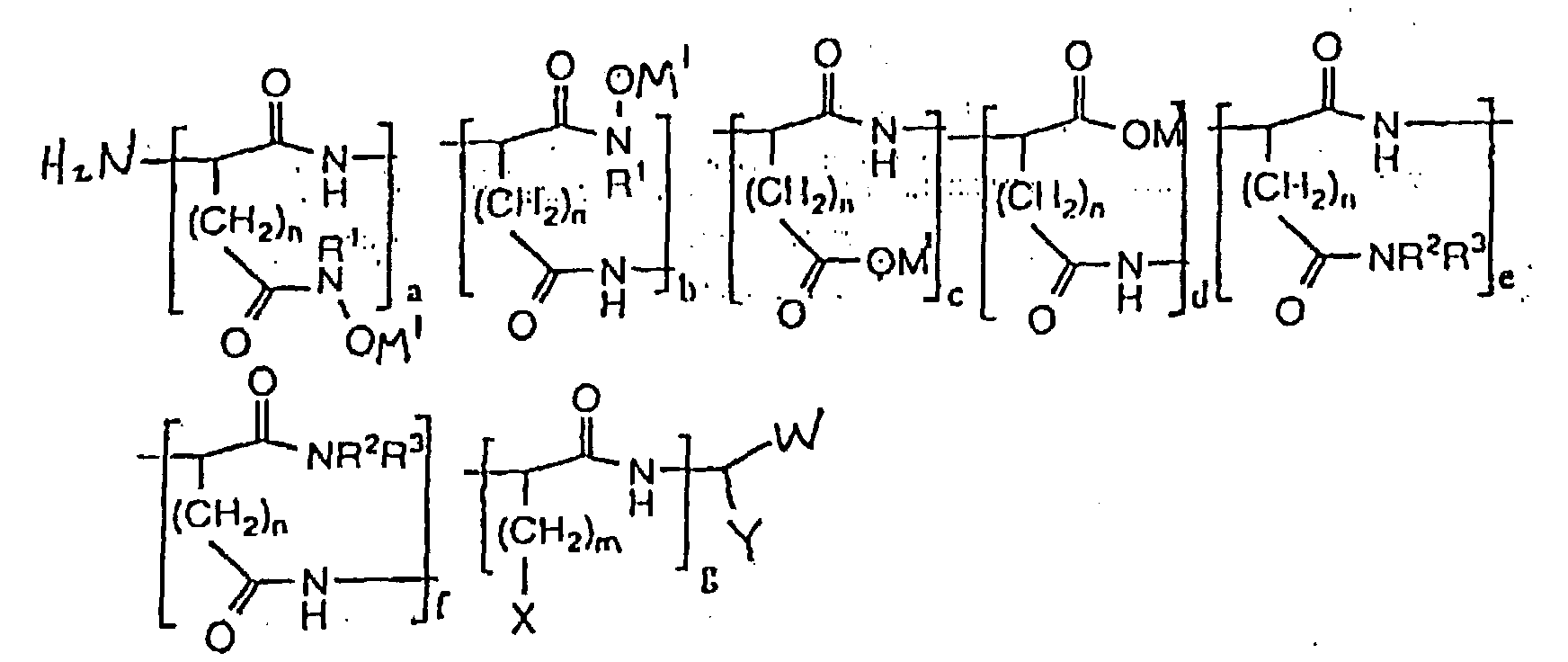 OPO3M2, OSO3M, p-M2O3POC6H4, p-MO3SOC6H4, SPO2M2, CH2OPO3M2, CH2OSO3M, CH(OPO3M2)CH3, CH(OSO3M)CH3, wherein M is a metal ion; W is selected from the group consisting of CO2M and C(O)NR1OH wherein M is a metal ion; Y is selected from the group consisting of (CH2)oC(O)NR1OH, (CH2)oCO2M, (CH2)oC(O)NR2R3 and (CH2)mX wherein M is a metal ion; o ranges from 1 to 2; R1 is selected from the group consisting of H, alkyl, alkenyl, aryl, carboxyl, sulfonyl, OH and halide substituted alkyl, alkenyl and aryl groups, and OR1 wherein R1 is selected from the group consisting of alkyl and aryl; R2 and R3 are selected from the group consisting of H, alkyl, alkenyl, aryl, carboxyl, sulfonyl, OH and halide substituted alkyl, alkenyl and aryl groups; (a + b)/(a + b + c + d) x 100% ranges from about 0.15 to about 100%; (c + d)/(a + b + c + d) x 100% ranges from 0% to 99.9%; (a + b)/(a + b + c + d) x 100% + (c + d)/(a + b + c + d) x 100% = 100%; (e + f)/(a + b + c + d + e + f + g) x 100% ranges from about 0% to about 50%; g/(a + b + c + d + e + f + g) x 100% ranges from about 0% to about 50%; (a + b + c + d)/(a + b + c + d + e + f + g) x 100% ranges from about 50% to about 100%; (a + b + c + d)/(a + b + c +d + e + f + g) x 100% + (e + f)/(a + b + c + d + e + f + g) x 100% + g/(a + b + c + d + e + f + g) x 100% = 100%; a/(a + b) x 100% ranges from 0% to 100%; b/(a + b) x 100% ranges from 0% to 100%; a/(a + b) x 100% + b/(a + b) x 100% = 100%; c/(c + d) x 100% ranges from 0% to 100%; d/(c + d) x 100% ranges from 0% to 100%; c/(c + d) x 100% + d/(c + d) x 100% = 100%; and e/(e + f) x 100% + f/(e + f) x 100% = 100%.
- The composition of claim 6, characterized in that the molecular weight ranges from about 300 to about 200,000.
- An industrial process water characterized by hardness and corrosive elements; and a poly(amino acid) polymer including hydroxamic acid-containing sidechains.
- The water of claim 8, characterized in that the polymer is present in a concentration of ranging from about 0.1ppm to about 1000ppm.
- The water of claim 8, characterized in that the polymer has the formulawherein W is selected from the group consisting of CO2M and CONHOH wherein M is a metal ion; Y is selected from the group consisting of CH2CONHOH and CH2CO2M wherein M is a metal ion; M1 is selected from the group consisting of an alkaline metal, an alkaline earth metal and ammonium; (a + b) /(a + b + c + d) x 100% + (c + d)/(a + b + c + d) x 100% = 100%; (a + b)/(a + b + c + d) x 100% ranges from about O.1% to about 100%; (c + d)/(a + b + c + d) x 100% ranges from 0% to 99.9%; a/(a + b) x 100% ranges from 0% to 100%; b/(a + b) x 100% ranges from 0% to 100%; c/(c + d) x 100% ranges from 0% to 100%; d/(c + d) x 100% ranges from 0% to 100%; and c/(c + d) x 100% + d/(c + d) x 100% = 100%.

- The water of claim 10, characterized in that the molecular weight of the polymer ranges from about 300 to about 200,000.
- The water of claim 8, characterized in that the polymer has the formulawherein n is selected from the group consisting of 1 and 2; m ranges from O to 4; M1 is selected from the group consisting of an alkaline metal, an alkaline earth metal, and ammonium; X is selected from the group consisting of H, CH3, CH(CH3)2, CH(CH3)CHzCH3, OH, p-HOC6H4, SH, CH2SCH3, CH2OH, CH(OH)CH3, NH2, HNC(:NH)NH2, C(O)NH2,
 OPO3M2, OSO3M, p-M2O3POC6H4, p-MO3SOC6H4, SPO2M2, CH2OPO3M2, CH2OSO3M, CH(OPO3M2)CH3, CH(OSO3M)CH3, wherein M is a metal ion; W is selected from the group consisting of CO2M and C(O)NR1OH wherein M is a metal ion; Y is selected from the group consisting of (CH2)oC(O)NR1OH, (CH2)oCO2M, (CH2)oC(O)NR2 R3 and (CH2)mX wherein M is a metal ion, o ranges from 1 to 2; R1 is selected from the group consisting of H, alkyl, alkenyl, aryl, carboxyl, sulfonyl, OH and halide substituted alkyl, alkenyl and aryl groups, and OR1 wherein R1 is selected from the group consisting of alkyl and aryl; R2 and R3 are selected from the group consisting of H, alkyl, alkenyl, aryl, carboxyl, sulfonyl, OH and halide substituted alkyl, alkenyl and aryl groups; (a + b) /(a + b + c + d) x 100% ranges from about 0.15 to about 100%; (c + d)/(a + b + c + d) x 100% ranges from 0% to 99.9%; (a + b)/(a + b + c + d) x 100% + (c + d)/(a + b + c + d) x 100% = 100%; (e + f)/(a + b + c + d + e + f + g) x 100% ranges from about 0% to about 50%; g/(a + b + c + d + e + f + g) x 100% ranges from about 0% to about 50%; (a + b + c + d)/(a + b + c + d + e + f + g) x 100% ranges from about 50% to about 100%; (a + b + c + d)/(a + b + c + d + e + f + g) x 100% + (e + f) /(a + b + c + d + e + f + g) x100% + g/(a + b + c + d + e + f + g) x 100% = 100%; a/(a + b) x 100% ranges from 0% to 100%; b/(a + b) x 100% ranges from 0% to 100%; a/(a + b) x 100% + b/(a + b) x 100% = 100%; c/(c + d) x 100% ranges from 0% to 100%; d/(c + d) x 100% ranges from 0% to 100%; c/(c + d) x 100% + d/(c + d) x 100% = 100%; and e/(e + f) x 100% + f/(e + f) x 100% = 100%.
- The water of claim 12, characterized in that the molecular weight ranges from about 300 to about 200,000.
- The water of claim 8 characterized by further comprising minerals selected from the group consisting of alkaline earth metal phosphates, alkaline earth metal sulfates, alkaline earth metal carbonates, iron (hydro)oxides, zinc hydroxides, maganese oxides, aluminum (hydro)oxides, clays and silicates.
- The water of claim 8 characterized by further comprising at least one scale inhibitor chosen from the group consisting of polyacrylate, polymethylacrylate, a copolymer of acrylic acid and methacrylic acid, a copolymer of acrylic acid and acrylamide, polymaleic anhydride, a copolymer of acrylic acid and maleic acid copolymer, polyol esters, 1-hydroxyethylidene-1,1-diphosphonic acid, 2-phosphono-butane-1,2,4-tricarboxylic acid (PBTC), amino tri(methylene phosphonic acid), an acrylic acid/acrylamide/amino methane sulfonate terpolymer, polyaspartic acid and mixtures thereof.
- The water of claim 8 characterized by further comprising at least one;yellow metal corrosion inhibitor chosen from the group consisting of benzotriazole, tolyltriazole, mercaptobenzothiazole and other azole compounds.
- The water of claim 8 characterized by further comprising at least one additive selected from the group consisting of phosphorous containing inorganic chemicals such as phosphates, pyrophosphates, polyphosphates, hydroxycarboxylic acids or their salts such as gluconic acid, glucaric acid; Zn2+, Ce2+, MoO4 2-, VO3 2-, WO4 2-.
- The water of claim 8 characterized by further comprising at least one biocide selected from the group consisting of Cl2, NaOCl, NaOBr, glutaldehyde, isothiazolinones, Kathon WT, sulfamic acid-stabilized bleach and sulfamic acid-stabilized bromine.
- A method of reducing corrosion on metallic surfaces caused by a water, characterized by comprising adding a corrosion inhibiting composition to the solution, the composition comprising a poly(amino acid) polymer including hydroxamic acid-containing sidechains.
- The method of claim 19, characterized in that the polymer has the formulawherein W is selected from the group consisting of CO2M and CONHOH wherein M is a metal ion; Y is selected from the group consisting of CH2CONHOH and CH2CO2M wherein M is a metal ion; M1 is selected from the group consisting of an alkaline metal, an alkaline earth metal and ammonium; (a + b)/(a + b + c + d) x 100% + (c + d)f(a + b + c + d) x 100% = 100%; (a + b)/(a + b + c + d) x 100% ranges from about O.1% to about 100%; (c + d)/(a + b + c + d ) x 100% ranges from 0%, to 99.9%; a/(a + b) x 100% ranges from 0% to 100%; b/(a + b) x 100% ranges from 0% to 100%; c/(c + d) x 100% ranges from 0% to 100%; d/(c + d) x 100% ranges from 0% to 100%; and c/(c + d) x 100% + d/(c + d) x 100% = 100%.
- The method of claim 19, characterized in that the polymer has the formulawherein n is selected from the group consisting of 1 and 2; m ranges from O to 4; M1 is selected from the group consisting of an alkaline metal, an alkaline earth metal, and ammonium; X is selected from the group consisting of H, CH3, CH(CH3)2, CH(CH3)CH2CH3, OH, p-HOC6H4, SH, CH2SCH3, CH2OH, CH(OH)CH3, NH2, HNC(:NH)NH2 , C(O)NH2,
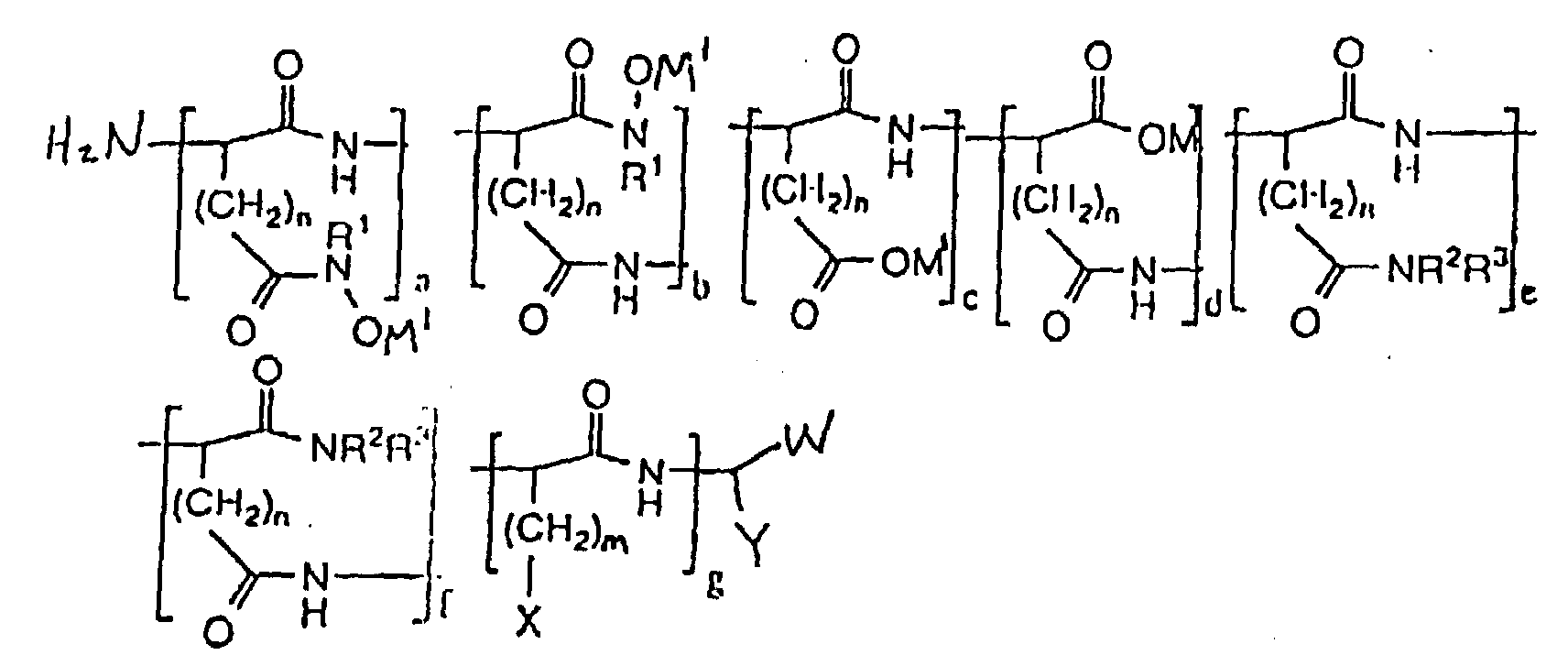 OPO3M2, OSO3M, p-M2O3POC6H4, p-MO3SOC6H4, SPO2M2 CH2OPO3M2, CH2OSO3M, CH(OPO3M2)CH3, CH(OSO3M)CH3, wherein M is a metal ion; W is selected from the group consisting of CO2M and C(O)NR1OH wherein M is a metal ion; Y is selected from the group consisting of (CH2)oC(O)NR1OH, (CH2)oCO2M, (CH2)oC(O)NR2R3 and (CH2)mX wherein M is a metal ion, o ranges from 1 to 2; R1 is selected from the group consisting of H, alkyl, alkenyl, aryl, carboxyl, sulfonyl, OH and halide substituted alkyl, alkenyl and aryl groups, and OR1 wherein R1 is selected from the group consisting of alkyl and aryl; R2 and R3 are selected from the group consisting of H, alkyl, alkenyl, aryl, carboxyl, sulfonyl, OH and halide substituted alkyl, alkenyl and aryl groups; (a + b)/(a + b + c + d) x lO0% ranges from about O.15 to about 100%; (c + d)/(a + b + c + d) x 100% ranges from 0% to 99.9%; (a + b)/(a + b + c + d) x lO0% + (c + d)/(a + b + c + d) x 100% = 100%; (e + f)/(a + b + c + d + e + f + g) x 100% ranges from about 0% to about 50%; g/(a + b + c + d + e + f + g) x 100% ranges from about 0% to about 50%; (a + b + c + d)/(a + b + c + d + e + f + g) x 100% ranges from about 50% to about 100%; (a + b + c + d)/(a + b + c + d + e + f + g) x 100% + (e + f)/(a + b + c + d + e + f + g) x 100% + g/(a + b + c + d + e + f + g) x 100% = 100%; a/(a + b) x 100% ranges from 0% to 100%; b/(a + b) x 100% ranges from 0% to 100%; a/(a + b) x 100% + b/(a + b) x 100% = 100%; c/(c + d) x 100% ranges from 0% to 100%; d/(c + d) x 100% ranges from 0% to 100%; c/(c + d) x 100% + d/(c + d) x 100% = 100%; and e/(e + f) x 100% + f/(e + f) x 100% = 100%.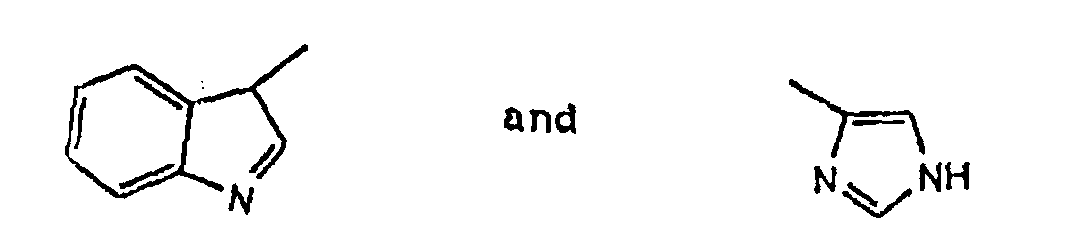
- A method of reducing scale build-up on metallic surfaces caused by a water, characterized by comprising adding a scale inhibiting composition to the solution, the composition comprising a poly(amino acid) polymer including hydroxamic acid-containing sidechains.
- The method of claim 22, characterized in that the polymer has the formulawherein W is selected from the group consisting of CO2M and CONHOH wherein M is a metal ion; Y is selected from the group consisting of CH2CONHOH and CH2CO2M wherein M is a metal ion; M1 is selected from the group consisting of an alkaline metal, an alkaline earth metal and ammonium; (a + b)/(a + b + c + d) x 100% + (c + d)/(a +b + c + d) x 100% = 100%; (a + b)/(a + b + c + d) x 100% ranges from about O.1% to about 100%; (c + d)/(a + b + c + d ) x 100% ranges from 0% to 99.9%; a/(a + b) x 100% ranges from 0% to 100%; b/(a + b) x 100% ranges from 0% to 100%; c/(c + d) x 100% ranges from 0% to 100%; d/(c + d) x 100% ranges from 0% to 100%; and c/(c + d) x 100% + d/(c + d) x 100% = 100%.

- The method of claim 22, characterized in that the polymer has the formulawherein n is selected from the group consisting of 1 and 2; m ranges from O to 4; M1 is selected from the group consisting of an alkaline metal, an alkaline earth metal, and ammonium; x is selected from the group consisting of H, CH3, CH(CH3)2, CH(CH3)CH2CH3, OH, p-HOC6H4, SH, CH2SCH3, CH2OH, CH(OH)CH3, NH2, HNC(:NH)NH2, C(O)NH2,
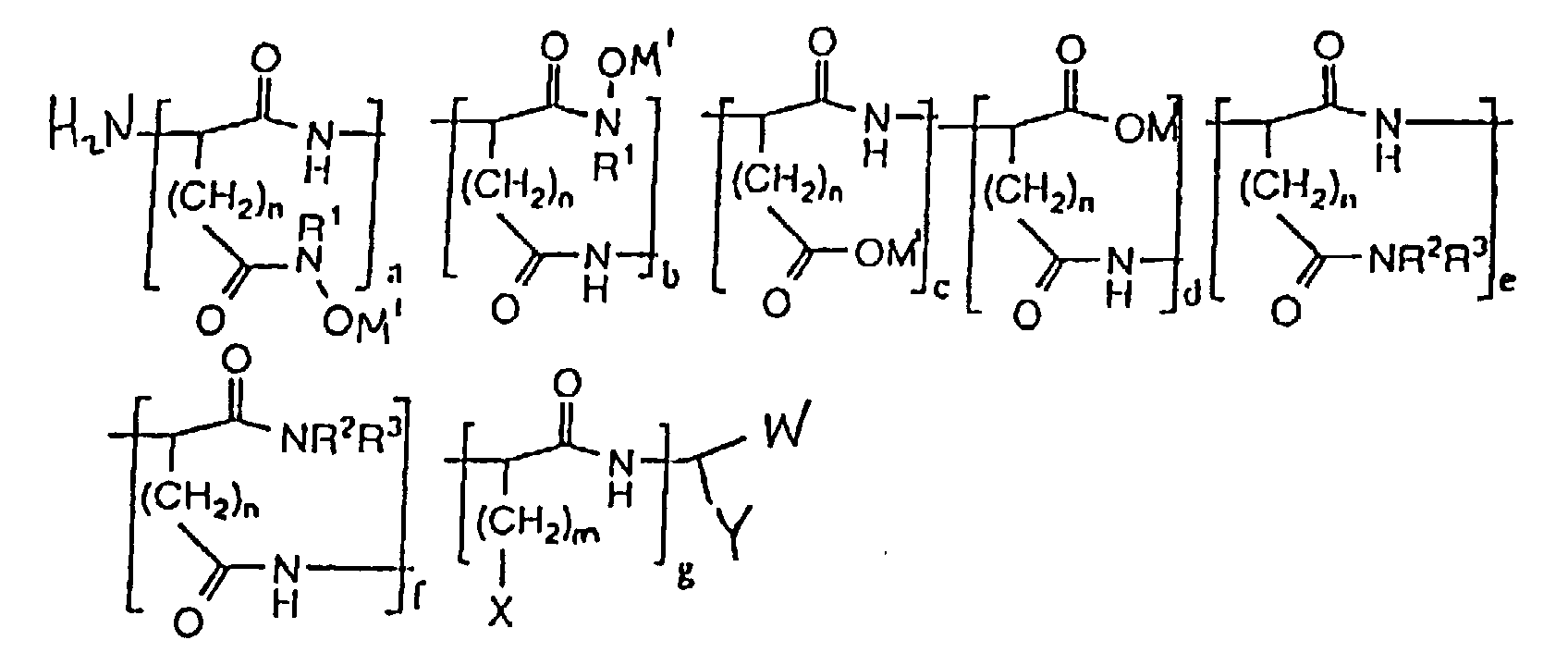 OPO3M2, OSO3M, p-M2O3POC6H4, p-MO3SOC6H4, SPO2M2, CH2OPO3M2, CH2OSO3M, CH(OPO3M2)CH3, CH(OSO3M)CH3, wherein M is a metal ion; W is selected from the group consisting of CO2M and C(O)NR1OH wherein M is a metal ion; Y is selected from the group consisting of (CH2)oC(O)NR1OH, (CH2)oCO2M, (CH2)oC(O)NR2R3 and (CH2)mX wherein M is a metal ion, o ranges from 1 to 2; R1 is selected from the group consisting of H, alkyl, alkenyl, aryl, carboxyl, sulfonyl, OH and halide substituted alkyl, alkenyl and aryl groups, and OR1 wherein R1 is selected from the group consisting of alkyl and aryl; R2 and R3 are selected from the group consisting of H, alkyl, alkenyl, aryl, carboxyl, sulfonyl, OH and halide substituted alkyl, alkenyl and aryl groups; (a + b)/(a + b + c + d) x 100% ranges from about O.15 to about 100%; (c + d)/(a + b + c + d) x 100% ranges from 0% to 99.9%; (a + b)/(a + b + c + d) x 100% + (c + d)/(a + b + c + d) x 100% = 100%; (e + f)/(a + b + c + d + e + f + g) x 100% ranges from about 0% to about 50%; g/(a + b + c + d + e + f + g) x 100% ranges from about 0% to about 50%; (a + b + c + d)/(a + b + c + d + e + f + g) x 100% ranges from about 50% to about 100%; (a + b + c + d)/(a + b + c + d + e + f + g) x 100% + (e + f)/(a + b + c + d + e + f + g) x 100% + g/(a + b + c + d + e + f + g) x 100% = 100%; a/(a + b) x 100% ranges from 0% to 100%; b/(a + b) x 100% ranges from 0% to 100%; a/(a + b) x 100% + b/(a + b) x 100% = 100%; c/(c + d) x 100% ranges from 0% to 100%; d/(c + d) x 100% ranges from 0% to 100%; c/(c + d) x 100% + d/(c + d) x 100% = 100%; and e/(e + f) x 100% + f/(e + f) x 100% = 100%.
- A method of dispensing solid particulate in a solution or slurry containing solid particulates such as clays, characterized by comprising adding a dispersant composition to the solution or slurry containing solid particulates such as clays, the composition comprising a poly(amino acid) polymer including hydroxamic acid-containing sidechain.
- The method of claim 25, characterized in that the polymer has the formulawherein W is selected from the group consisting of CO2M and CONHOH wherein M is a metal ion; Y is selected from the group consisting of CH2CONHOH and CH2CO2M wherein M is a metal ion; M1 is selected from the group consisting of an alkaline metal, an alkaline earth metal and ammonium; (a + b)/(a + b + c + d) x 100% + (c + d)/(a + b + c + d) x 100% = 100%; (a + b)/(a + b + c + d) x 100% ranges from about 0.1% to about 100%; (c + d)/(a + b + c + d ) x 100% ranges from 0% to 99.9%; a/(a + b) x 100% ranges from 0% to 100%; b/(a + b) x 100% ranges from 0% to 100%; c/(c + d) x 100% ranges from 0% to 100%; d/(c + d) x 100% ranges from 0% to 100%; and c/(c + d) x 100% + d/(c + d) x 100% = 100%.

- The method of claim 25, characterized in that the polymer has the formulawherein n is selected from the group consisting of 1 and 2; m ranges from O to 4; M1 is selected from the group consisting of an alkaline metal, an alkaline earth metal, and ammonium; X is selected from the group consisting of H, CH3, CH(CH3)2, CH(CH3)CH2CH3, OH, p-HOC6H4, SH, CH2SCH3, CH2OH, CH(OH)CH3, NH2, HNC(:NH)NH2, C(O)NH2,
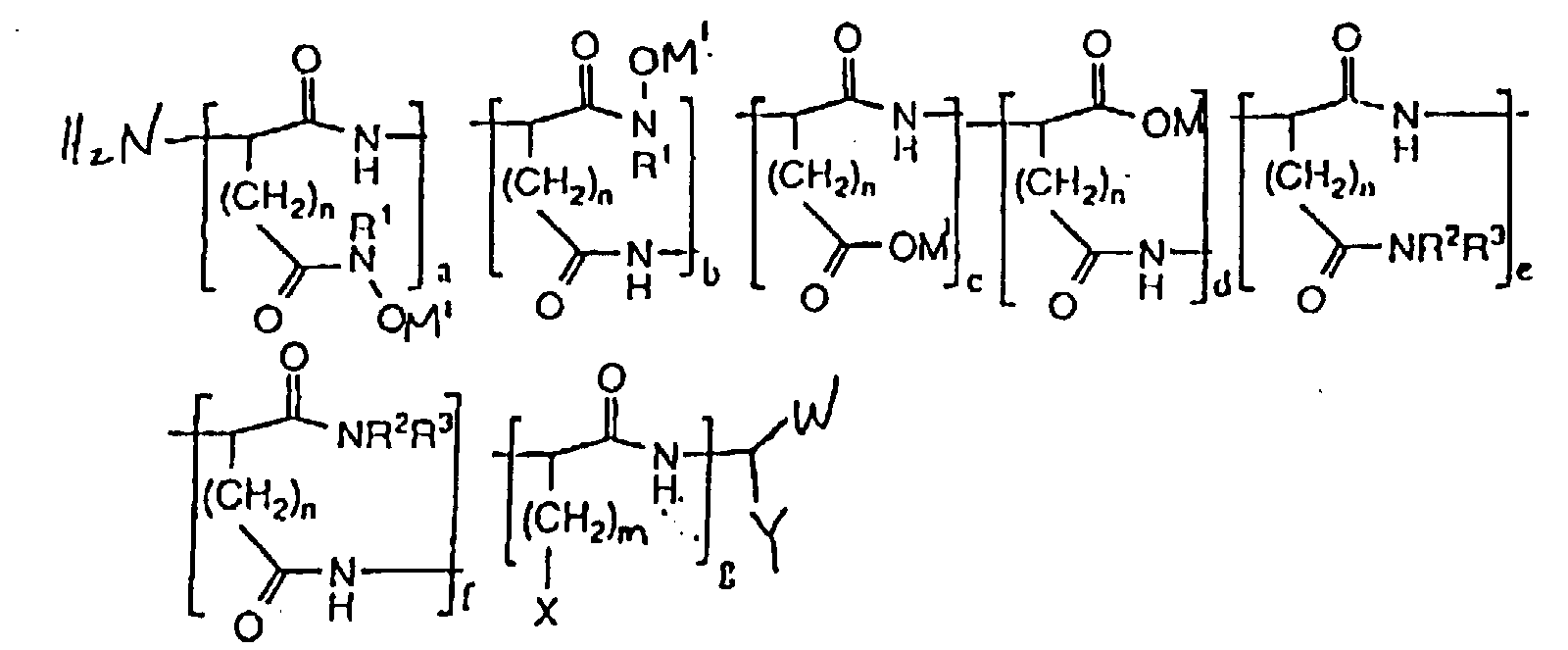 OPO3M2, OSO3M, p-M2O3POC6H4, p-MO3SOC6H4, SPO2M2, CH2OPO2M2, CH2OSO3M, CH(OPO3M2)CH3, CH(OSO3M)CH3, wherein M is a metal ion; W is selected from the group consisting of CO2M and C(O)NR1OH wherein M is a metal ion; Y is selected from the group consisting of (CH2)oC(O)NR1OH, (CH2)oCO2M, (CH2)oC(O)NR2R3 and (CH2)mX wherein m is a metal ion, o ranges from 1 to 2; R1 is selected from the group consisting of H, alkyl, alkenyl, aryl, carboxyl, sulfonyl, OH and halide substituted alkyl, alkenyl and aryl groups, and OR1 wherein R1 is selected from the group consisting of alkyl and aryl; R2 and R3 are selected from the group consisting of H, alkyl, alkenyl, aryl, carboxyl, sulfonyl, OH and halide substituted alkyl, alkenyl and aryl groups; (a + b)/(a + b + c + d) x 100% ranges from about 0.15 to about 100%; (c + d)/(a + b + c + d) x 100% ranges from 0% to 99.9%; (a + b)/(a + b + c + d) x 100% + (c + d)/(a + b + c + d) x 100% = 100%; (e + f)/(a + b + c + d + e + f + g) x 100% ranges from about 0% to about 50%; g/(a + b + c + d + e + f + g) x 100% ranges from about 0% to about 50%; (a + b + c + d)/(a + b + c + d + e + f + g) x 100% ranges from about 50% to about 100%; (a + b + c + d)/(a + b + c + d + e + f + g) x 100% + (e + f)/(a + b + c + d + e + f + g) x 100% + g/(a + b + c + d + e + f + g) x 100% = 100%; a/(a + b) x 100% ranges from 0% to 100%; b/(a + b) x 100% ranges from 0% to 100%; a/(a + b) x 100% + b/(a + b) x 100% = 100%; c/(c + d) x 100% ranges from 0% to 100%; d/(c + d) x 100% ranges from 0% to 100%; c/(c + d) x 100% + d/(c + d) x 100% = 100%; and e/(e + f) x 100% + f/(e + f) x 100% = 100%.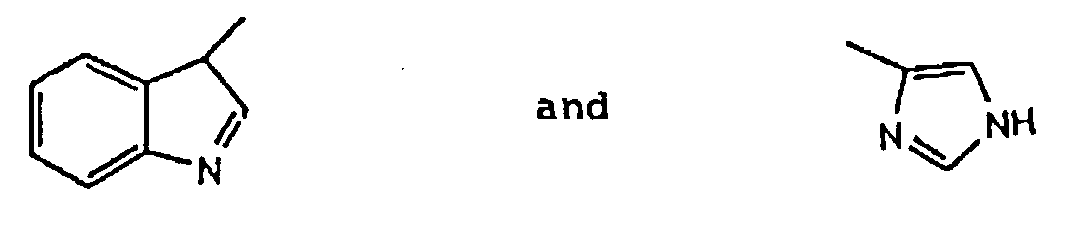
Applications Claiming Priority (2)
| Application Number | Priority Date | Filing Date | Title |
|---|---|---|---|
| US686616 | 1996-07-19 | ||
| US08/686,616 US5750070A (en) | 1996-07-19 | 1996-07-19 | Use of biodegradable polymers in preventing corrosion and scale build-up |
Publications (2)
| Publication Number | Publication Date |
|---|---|
| EP0823402A2 true EP0823402A2 (en) | 1998-02-11 |
| EP0823402A3 EP0823402A3 (en) | 1998-03-11 |
Family
ID=24757047
Family Applications (1)
| Application Number | Title | Priority Date | Filing Date |
|---|---|---|---|
| EP97305414A Withdrawn EP0823402A3 (en) | 1996-07-19 | 1997-07-18 | Use of biodegradable polymers in preventing corrosion and scale build-up |
Country Status (5)
| Country | Link |
|---|---|
| US (1) | US5750070A (en) |
| EP (1) | EP0823402A3 (en) |
| JP (1) | JPH1077445A (en) |
| AU (1) | AU717914B2 (en) |
| CA (1) | CA2210073A1 (en) |
Cited By (2)
| Publication number | Priority date | Publication date | Assignee | Title |
|---|---|---|---|---|
| EP0832851A1 (en) * | 1996-09-30 | 1998-04-01 | Nalco Chemical Company | Biodegradable poly (amino acids), derivatized amino acid polymers and methods for making the same |
| DE10202316B4 (en) * | 2002-01-23 | 2007-07-19 | Goldschmidt Gmbh | Process for the preparation of polyaspartic acid derivatives |
Families Citing this family (36)
| Publication number | Priority date | Publication date | Assignee | Title |
|---|---|---|---|---|
| CA2205717C (en) * | 1996-07-16 | 2007-02-27 | Nalco Chemical Company | Biodegradable poly(amino acid)s derivatized amino acid polymers and methods for making same |
| US6585933B1 (en) | 1999-05-03 | 2003-07-01 | Betzdearborn, Inc. | Method and composition for inhibiting corrosion in aqueous systems |
| DE19937300A1 (en) * | 1999-08-06 | 2001-02-22 | Henkel Ecolab Gmbh & Co Ohg | Biofilm avoidance |
| US6365706B1 (en) | 2000-06-21 | 2002-04-02 | Mississippi Chemical Corporation | Process for production of polyasparagine and the high nitrogen content polymer formed thereby |
| US7427361B2 (en) * | 2003-10-10 | 2008-09-23 | Dupont Air Products Nanomaterials Llc | Particulate or particle-bound chelating agents |
| US7138342B2 (en) * | 2003-10-31 | 2006-11-21 | The Boeing Company | Process of maintaining hybrid etch |
| US8771542B2 (en) | 2008-07-11 | 2014-07-08 | Prestone Products Corporation | Heat transfer fluid, additive package, system and method |
| US20110168567A1 (en) * | 2010-01-11 | 2011-07-14 | Ecolab Usa Inc. | Control of hard water scaling in electrochemical cells |
| US8114344B1 (en) | 2010-12-21 | 2012-02-14 | Ecolab Usa Inc. | Corrosion inhibition of hypochlorite solutions using sugar acids and Ca |
| US8105531B1 (en) | 2010-12-21 | 2012-01-31 | Ecolab Usa Inc. | Corrosion inhibition of hypochlorite solutions using polyacrylate and Ca |
| US8557178B2 (en) | 2010-12-21 | 2013-10-15 | Ecolab Usa Inc. | Corrosion inhibition of hypochlorite solutions in saturated wipes |
| US8603392B2 (en) | 2010-12-21 | 2013-12-10 | Ecolab Usa Inc. | Electrolyzed water system |
| CA2933177C (en) | 2013-12-10 | 2022-03-15 | The Lubrizol Corporation | Organic salts of glyceride-cyclic carboxylic acid anhydride adducts as corrosion inhibitors |
| CN103820785B (en) * | 2014-01-28 | 2016-04-06 | 西安理工大学 | For the quaternary built vapour-phase inhibitor and preparation method thereof of carbon steel |
| US10118844B2 (en) | 2014-12-31 | 2018-11-06 | Ecolab Usa Inc. | Multifunctional method for membrane protection and biofouling control |
| US10669433B2 (en) | 2015-11-09 | 2020-06-02 | The Lubrizol Corporation | Using quaternary amine additives to improve water separation |
| US10081758B2 (en) | 2015-12-04 | 2018-09-25 | Ecolab Usa Inc. | Controlled release solid scale inhibitors |
| EP3458543A1 (en) | 2016-05-16 | 2019-03-27 | Ecolab USA Inc. | Slow-release scale inhibiting compositions |
| EP3488222A1 (en) | 2016-07-19 | 2019-05-29 | Ecolab USA Inc. | Control of industrial water treatment via digital imaging |
| MX2019000847A (en) | 2016-07-19 | 2019-06-24 | Ecolab Usa Inc | Control of industrial water treatment via digital imaging. |
| US11168278B2 (en) | 2016-07-20 | 2021-11-09 | The Lubrizol Corporation | Alkyl phosphate amine salts for use in lubricants |
| JP7008685B2 (en) | 2016-07-20 | 2022-02-10 | ザ ルブリゾル コーポレイション | Alkyl phosphate amine salt for use in lubricants |
| JP2019529687A (en) | 2016-09-21 | 2019-10-17 | ザ ルブリゾル コーポレイションThe Lubrizol Corporation | Fluorinated polyacrylate antifoam components for lubricating compositions |
| BR112019005332A2 (en) | 2016-09-21 | 2019-06-11 | Lubrizol Corp | polyacrylate defoaming components for use in diesel fuels |
| US11142680B2 (en) | 2016-12-23 | 2021-10-12 | Championx Usa Inc. | Controlled release solid scale inhibitors |
| EP3631156A1 (en) | 2017-05-23 | 2020-04-08 | Ecolab USA, Inc. | Injection system for controlled delivery of solid oil field chemicals |
| EP3630341A1 (en) | 2017-05-23 | 2020-04-08 | Ecolab USA, Inc. | Dilution skid and injection system for solid/high viscosity liquid chemicals |
| US20190226094A1 (en) * | 2018-01-19 | 2019-07-25 | Baker Hughes, A Ge Company, Llc | Phosphorous-free, and iron activating agent-free rust removal, inhibition, and passivation |
| WO2019183365A1 (en) | 2018-03-21 | 2019-09-26 | The Lubrizol Corporation | NOVEL FLUORINATED POLYACRYLATES ANTIFOAMS IN ULTRA-LOW VISCOSITY (<5 CST) finished fluids |
| JP6750705B2 (en) * | 2018-05-30 | 2020-09-02 | 栗田工業株式会社 | Initial treatment agent for circulating cooling water and method for preventing corrosion of circulating cooling water system |
| WO2019230757A1 (en) * | 2018-05-30 | 2019-12-05 | 栗田工業株式会社 | Initial treatment agent for circulating cooling water and method for preventing corrosion in circulating cooling water system |
| JP6635173B1 (en) * | 2018-11-01 | 2020-01-22 | 栗田工業株式会社 | Corrosion protection method for metal members of cooling water system |
| EP4118169B1 (en) | 2020-03-12 | 2025-06-25 | The Lubrizol Corporation | Oil-based corrosion inhibitors |
| CN113087903B (en) * | 2021-03-17 | 2022-05-20 | 西安交通大学 | High-temperature-resistant modified polyaspartic acid scale inhibitor and preparation method and use method thereof |
| CN113583745B (en) * | 2021-07-09 | 2022-08-26 | 煤炭科学技术研究院有限公司 | Compatible concentrated solution for hydraulic support and preparation method thereof |
| CN119053560A (en) | 2022-06-23 | 2024-11-29 | 埃科莱布美国股份有限公司 | Method for inhibiting metal corrosion in industrial water systems |
Family Cites Families (15)
| Publication number | Priority date | Publication date | Assignee | Title |
|---|---|---|---|---|
| US2402604A (en) * | 1942-11-03 | 1946-06-25 | Du Pont | Polymeric hydroxamic acids |
| US3859337A (en) * | 1969-06-11 | 1975-01-07 | Stauffer Chemical Co | Ethylenediaminetetraacetic acid anhydride derivatives |
| GB2070108B (en) * | 1980-02-14 | 1984-02-08 | Elf Aquitaine | Drilling and/or completion muds |
| FR2536383A1 (en) * | 1982-11-24 | 1984-05-25 | Elf Aquitaine | PROCESS AND PRODUCT FOR PREVENTING CALCULATION BY WATER |
| US4534881A (en) * | 1983-12-19 | 1985-08-13 | University Of South Alabama | Inhibition of inorganic or biological CaCO3 deposition by poly amino acid derivatives |
| DE3700128A1 (en) * | 1987-01-03 | 1988-07-14 | Hoechst Ag | BIODEGRADABLE POLY- (HYDROXYALKYL) - AMINODICARBONIC ACID DERIVATIVES, METHOD FOR THE PRODUCTION AND USE THEREOF FOR DEPOT PREPARATIONS WITH CONTROLLED ACTIVE SUBSTANCE DELIVERY |
| US5128420A (en) * | 1987-02-26 | 1992-07-07 | Massachusetts Institute Of Technology | Method of making hydroxamic acid polymers from primary amide polymers |
| US4902751A (en) * | 1988-05-24 | 1990-02-20 | American Cyanamid Company | Preparation of modified acrylamide polymers |
| US4971724A (en) * | 1990-02-06 | 1990-11-20 | Monsanto Company | Process for corrosion inhibition of ferrous metals |
| AU643899B2 (en) * | 1991-07-24 | 1993-11-25 | Nalco Chemical Company | Hydroxamic acid containing polymers used as corrosion inhibitors |
| DE4427630A1 (en) * | 1994-08-04 | 1996-02-08 | Basf Ag | Process for the preparation of polymers containing hydroxamic acid, hydroxamic acid ether and / or hydrazide groups in the side chain and their use |
| US5531934A (en) * | 1994-09-12 | 1996-07-02 | Rohm & Haas Company | Method of inhibiting corrosion in aqueous systems using poly(amino acids) |
| US5733459A (en) * | 1996-04-29 | 1998-03-31 | Cytec Technology Corp. | Use of hydroxamated polymers to alter bayer process scale |
| US5733460A (en) * | 1996-04-29 | 1998-03-31 | Cytec Technology Corp. | Use of hydroxamated polymers to alter Bayer Process scale |
| US5886872A (en) * | 1997-04-23 | 1999-03-23 | Compaq Computer Corporation | Pivotable support and heat sink apparatus removably connectable without tools to a computer processor |
-
1996
- 1996-07-19 US US08/686,616 patent/US5750070A/en not_active Expired - Fee Related
-
1997
- 1997-05-01 AU AU19985/97A patent/AU717914B2/en not_active Ceased
- 1997-07-02 JP JP9176804A patent/JPH1077445A/en active Pending
- 1997-07-09 CA CA002210073A patent/CA2210073A1/en not_active Abandoned
- 1997-07-18 EP EP97305414A patent/EP0823402A3/en not_active Withdrawn
Cited By (2)
| Publication number | Priority date | Publication date | Assignee | Title |
|---|---|---|---|---|
| EP0832851A1 (en) * | 1996-09-30 | 1998-04-01 | Nalco Chemical Company | Biodegradable poly (amino acids), derivatized amino acid polymers and methods for making the same |
| DE10202316B4 (en) * | 2002-01-23 | 2007-07-19 | Goldschmidt Gmbh | Process for the preparation of polyaspartic acid derivatives |
Also Published As
| Publication number | Publication date |
|---|---|
| AU1998597A (en) | 1998-01-29 |
| US5750070A (en) | 1998-05-12 |
| JPH1077445A (en) | 1998-03-24 |
| CA2210073A1 (en) | 1998-01-19 |
| EP0823402A3 (en) | 1998-03-11 |
| AU717914B2 (en) | 2000-04-06 |
Similar Documents
| Publication | Publication Date | Title |
|---|---|---|
| US5750070A (en) | Use of biodegradable polymers in preventing corrosion and scale build-up | |
| US6207079B1 (en) | Scale and/or corrosion inhibiting composition | |
| US5382367A (en) | Method of treating cooling water systems | |
| US6083403A (en) | Stabilized substituted aminomethane-1, 1-diphosphonic acid n-oxides and use thereof in preventing scale and corrosion | |
| EP0122013B1 (en) | Polymeric additives for water | |
| CA2537808C (en) | Use of cerium salts to inhibit manganese deposition in water systems | |
| CA2083453A1 (en) | Methods of controlling scale formation in aqueous systems | |
| US5124046A (en) | Method for controlling calcium carbonate scaling in high pH aqueous systems | |
| EP0077187B1 (en) | Method of inhibiting corrosion and controlling deposition in an aqueous medium | |
| KR19980033098A (en) | Hydroxyminoalkylene Phosphonic Acid for Corrosion and Scale Suppression in Aqueous Systems | |
| Chirkunov et al. | Corrosion inhibitors in cooling water systems | |
| US5320779A (en) | Use of molybdate as corrosion inhibitor in a zinc/phosphonate cooling water treatment | |
| JPS5944119B2 (en) | water treatment agent | |
| EP0375385B1 (en) | Scale control | |
| KR970001009B1 (en) | Corrosion protection methods and compositions for global and point corrosion in cooling tower water | |
| EP0609590A1 (en) | Method for inhibiting corrosion of metals using polytartaric acids | |
| JP4859158B2 (en) | Water treatment composition | |
| JP2025517879A (en) | Corrosion control for aqueous systems using passivators and hydroxycarboxylic acids. | |
| NZ225541A (en) | Inhibition of caco 3 scaling using a polymer/phosphonate mixture | |
| AU617791B2 (en) | Method and compositions for controlling corrosion in low and high hardness water | |
| JP4718823B2 (en) | Boiler water treatment agent and boiler water treatment method using the same | |
| CA2116597A1 (en) | Method for inhibiting corrosion in aqueous systems | |
| CS259294B1 (en) | Composition for alkaline treatment of circulating cooling water | |
| MXPA98005251A (en) | Method to prevent the formation of incrustation in metal surfaces in contact with water industr | |
| CA2070622A1 (en) | Use of molybdate as corrosion inhibitor in a zinc/phosphonate cooling water treatment |
Legal Events
| Date | Code | Title | Description |
|---|---|---|---|
| PUAI | Public reference made under article 153(3) epc to a published international application that has entered the european phase |
Free format text: ORIGINAL CODE: 0009012 |
|
| PUAL | Search report despatched |
Free format text: ORIGINAL CODE: 0009013 |
|
| AK | Designated contracting states |
Kind code of ref document: A2 Designated state(s): DE GB IT NL |
|
| AK | Designated contracting states |
Kind code of ref document: A3 Designated state(s): AT BE CH DE DK ES FI FR GB GR IE IT LI LU MC NL PT SE |
|
| 17P | Request for examination filed |
Effective date: 19980731 |
|
| AKX | Designation fees paid |
Free format text: DE GB IT NL |
|
| RBV | Designated contracting states (corrected) |
Designated state(s): DE GB IT NL |
|
| 17Q | First examination report despatched |
Effective date: 19991130 |
|
| STAA | Information on the status of an ep patent application or granted ep patent |
Free format text: STATUS: THE APPLICATION IS DEEMED TO BE WITHDRAWN |
|
| 18D | Application deemed to be withdrawn |
Effective date: 20010626 |