EP0816335B1 - Cumene oxidation process - Google Patents
Cumene oxidation process Download PDFInfo
- Publication number
- EP0816335B1 EP0816335B1 EP97304341A EP97304341A EP0816335B1 EP 0816335 B1 EP0816335 B1 EP 0816335B1 EP 97304341 A EP97304341 A EP 97304341A EP 97304341 A EP97304341 A EP 97304341A EP 0816335 B1 EP0816335 B1 EP 0816335B1
- Authority
- EP
- European Patent Office
- Prior art keywords
- cumene
- stage
- oxidation
- reactors
- water
- Prior art date
- Legal status (The legal status is an assumption and is not a legal conclusion. Google has not performed a legal analysis and makes no representation as to the accuracy of the status listed.)
- Expired - Lifetime
Links
Images


Classifications
-
- C—CHEMISTRY; METALLURGY
- C07—ORGANIC CHEMISTRY
- C07C—ACYCLIC OR CARBOCYCLIC COMPOUNDS
- C07C409/00—Peroxy compounds
- C07C409/02—Peroxy compounds the —O—O— group being bound between a carbon atom, not further substituted by oxygen atoms, and hydrogen, i.e. hydroperoxides
- C07C409/04—Peroxy compounds the —O—O— group being bound between a carbon atom, not further substituted by oxygen atoms, and hydrogen, i.e. hydroperoxides the carbon atom being acyclic
- C07C409/08—Compounds containing six-membered aromatic rings
- C07C409/10—Cumene hydroperoxide
-
- C—CHEMISTRY; METALLURGY
- C07—ORGANIC CHEMISTRY
- C07C—ACYCLIC OR CARBOCYCLIC COMPOUNDS
- C07C407/00—Preparation of peroxy compounds
Definitions
- This invention relates to a method for commercial production of cumene hydroperoxide (CHP) obtained by a cumene oxidation method in water-alkaline emulsion (wet oxidation process) via oxygen-containing gases, for example air or air enriched with oxygen.
- Oxidation is conducted in a cascade of reactors (not less than two) with a variable temperature profile.
- An aqueous solution of NH 4 NaCO 3 is used as an alkaline agent at a cumene oxidation level of up to 18% as well as an aqueous solution of Na 2 CO 3 at a cumene oxidation level of above 18%.
- U.S. patents 2,632,773, 2663,740, 3,171,865, 3,523,977 and 3,907,901 teach that phenol gives a negative effect on the selectivity and productivity of this oxidation process. To prevent this situation several alkaline agents such as NaOH or Na 2 CO 3 are taught in U.S. patent 3,187,055 as useful. U.S. patents 3,523,977 and 3,907,901 teach that bicarbonates of alkaline metals - NaHCO 3 and KHCO 3 can also be used as alkaline agents to remove phenol.
- JP-A-55151554 discloses a process for preparing diisopropylbenzene dihydroperoxide by oxidation of diisopropylbenzene with air or an oxygen containing gas in the presence of water and one or more ingredients selected from sodium hydroxide, potassium hydroxide, sodium carbonate and potassium carbonate and in which ammonium hydroxide, ammonium carbonate or ammonia is introduced into the reaction system.
- Oxidizer feed comprising cumene is fed through 3 to the lower part of the first reactor (A).
- Fresh aqueous Na 2 CO 3 solution through 4 and aqueous solution of recycle "carbonate" contaminated with impurities containing phenol, organic acids, sodium salt of organic acids and NaHCO 3 through 5 are fed to the upper part of each reactor (A, B, C and D).
- Fresh cumene through 1, recycle cumene from the alpha-methylstyrene (AMS) hydrogenation stage of a phenol plant through 2 and recycle cumene from the CHP concentrator II through 12 are treated with alkali (NaOH) from 13 to remove phenol, and then directed through a settler VI and to secondary settler IV, where cumene is contacted with an aqueous Na 2 CO 3 /NaHCO 3 mixture and the aqueous stream containing formed phenate goes to biotreatment through secondary settler IV.
- alkali NaOH
- reactor (oxidizer) feed to remove phenol is accomplished in secondary settler IV with fresh water through 6 and off-gas condensate through 7 from condenser V.
- Treated mixture through 3 from secondary settler IV is added into the first reactor (A) in cascade and a stream comprising cumene and cumene hydroperoxide passes through reactor A and then into the other reactors (B, C and D) through 14, 15 and 16, respectively in a series flow operation.
- the level of cumene hydroperoxide introduced into each subsequent reactor is greater than the level in the preceding reactor.
- Oxidation in the cascade reactors is carried out at a temperature which in each successive reactor is lower than the temperature in the previous reactor.
- CHP concentration from one reactor to the next goes up, thus obtaining 1540 wt% at the outlet of the last reactor.
- At the higher CHP concentrations yields drop precipitously.
- a part of the treated aqueous sodium carbonate solution through 8 from reactors A and B is removed from the process through treater IV and sent through 9 to biotreatment and another part flows through decanter III and 10 as recycle to treater IV and then to reactors A, B, C and D.
- a stream of off gas from the reactors is added through 11 into condenser V to condense cumene and water entrained with air.
- Cumene selectivity in the prior art wet process is about 92.5-93 % mol under optimum conditions at a cumene conversion 20-22%.
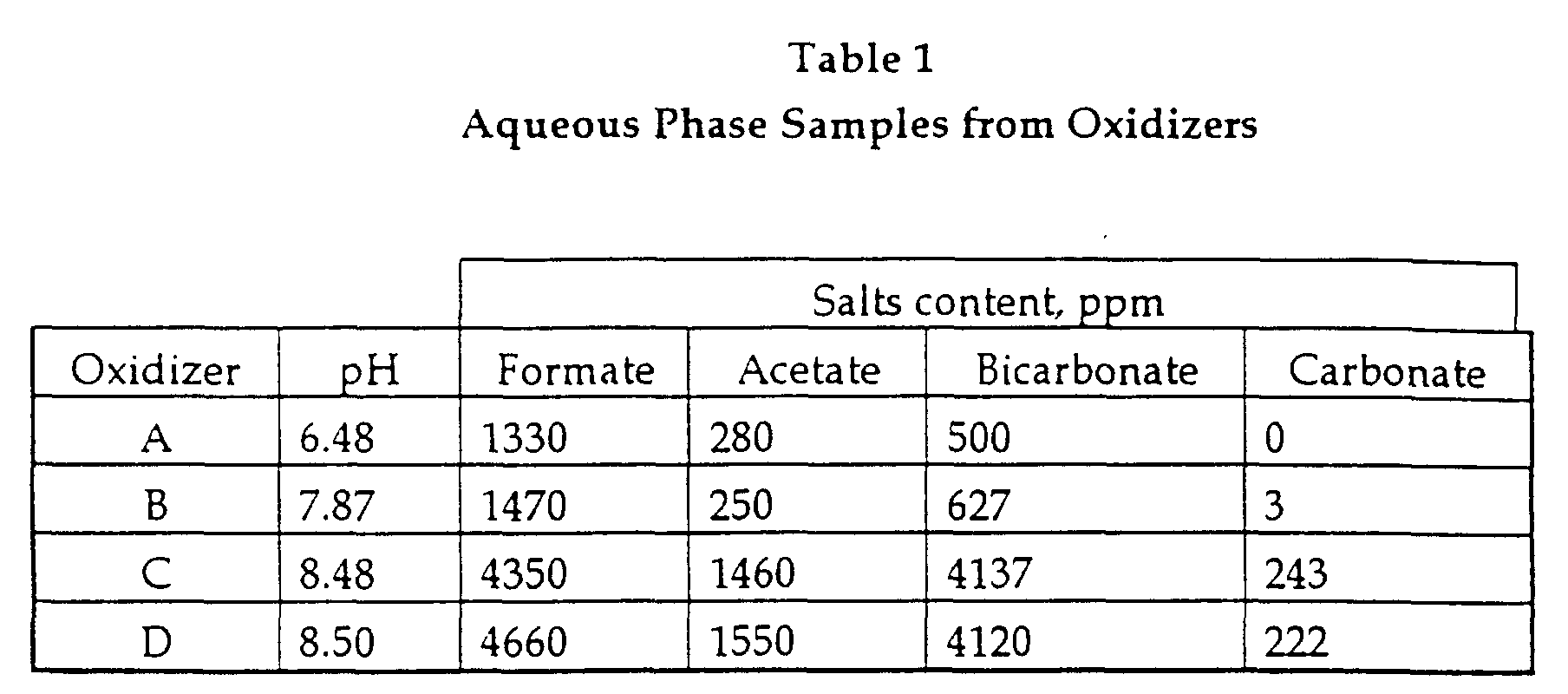
- the sodium carbonate in the recycle water-salt stream of the prior art process is typically converted to 80-100% sodium bicarbonate by neutralization of organic acids (Table 1). These measurements are made by ion exclusion chromatography. To analyze samples for formate, acetate, bicarbonate and carbonate salts content in the aqueous from the oxidizer, the following equipment is required:
- a simple isocratic pump/detector instrument such as DX100 Ion Chromatograph supplied by Dionex Corporation, Sunnyvale, California, U.S.A..
- An ion exclusion column such as Ion Pac ICE AS1 supplied by Dionex.
- a micromembrane installation kit such as supplied by Dionex.
- An autosampler accepting septum sealed vials which at no time are open to the atmosphere such as a Gilson Model 234 Autoinjector, Alltech Model 570 Autosampler or a Dionex Model AS 3500 Autosampler.
- Tetrabutylammonium hydroxide available from Aldrich Chemical Co.
- the tetrabutylammonium hydroxide is diluted to 40% by volume in water or 1 molar in methanol and stored free of atmospheric CO 2 .
- a helium sparge has been found to keep the diluted tetrabutylammonium hydroxide free of air and atmospheric CO 2 .
- curve X is based on data points from water-emulsion cumene oxidation with Na 2 CO 3 and curve Y is based on data points from water-emulsion cumene oxidation with NaHCO 3 .
- the substantially equivalent mol % selectivity shown in figure 2 is unexpected as NaHCO 3 is a salt of a strong base and a weak acid, has a pH value > 7 ( ⁇ 8.6), and thus should not favor the reaction of acidic CHP cleavage to phenol and acetone. Phenol in the composition of oxidation products from the above reaction inhibits oxidation with reduction of both reaction rate and selectivity.
- the presence of the oxidation products of phenol which is a key process inhibitor results from incomplete neutralization of organic acids, i.e., formic and benzoic acids.
- This incomplete neutralization is caused by the fact that the formic and benzoic acids are organic acids which are primarily found in the organic phase and Na 2 CO 3 and NaHCO 3 being salts are primarily in the water phase.
- neutralization proceeds slowly because (i) of low Na 2 CO 3 and NaHCO 3 solubility in the oxidation products; and (ii) the poor neutralization reaction of organic acids with NaHCO3 if it proceeds at all.
- An embodiment of the present invention shown in Fig. 3 consists of cumene oxidation which is conducted in a cascade of reactors (more than 2) in two stages, Stage I and Stage II, as shown within the dashed lines, wherein the oxidation at the first stage (Stage I) is carried out in reactors A and B to a cumene conversion by weight of less than 18% preferably from 10 to 18% more preferably from 10 to 15% with the use of mixed salt NH 4 NaCO 3 .
- This mixed salt is preferably formed in situ by injection of NH 3 through line 28 into line 10 which carries the aqueous sodium carbonate solution from decanter III to secondary settler IV.
- the NH 4 NaCO 3 forms almost immediately.
- the amount of NH 3 is at least stoichiometric to the organic acids in the stream.
- the cumene conversion attains the value of over 18%, preferably from 18% to 30%, more preferably from 18% to 25% and only fresh aqueous Na 2 CO 3 solution is fed into reactors C and D (Stage II) through line 4.
- various alkaline agents are used i.e. NH 4 NaCO 3 in reactors A and B (Stage I) and only fresh Na 2 CO 3 in reactors C and D (Stage II), without recycle of aqueous streams.
- fresh water water condensate, stream 26
- NaHCO 3 formed in the reactors of the second stage is removed from the lower part of the reactors along with water stream, separated from oxidation products in the settler III and is treated in line 10 with ammonia in an equimole ratio or in mole ratio 2:1 to the sodium bicarbonate formed in these reactors.
- the formed mixed salt NH 4 NaCO 3 in the form of a water-salt solution with pH> 10.5 is added through the settler IV to the first oxidation stage.
- Water/organic mixture through line 7 from off-gas condensate stage (V) is treated with NH 3 through line 27.
- the amount of added ammonia is stoichoimetric to the amount of the formic and benzoic acids determined by chemical analysis.
- the pH is maintained within the range 8-10.
- Such an ammonia treatment eliminates any penetration into the oxidizers of strong organic acids along with recycle streams or losses of CHP in the form of CHP salts since the ammonium CHP salts are not formed which is in contrast with the formation of the sodium salt at the treatment of CHP with NaOH.
- the present invention improves the yields of cumene from the wet oxidation process, improves process selectivity, reduces the level of phenol in the process streams and more effectively neutralizes the undesirable formic and benzoic acids.
- Figure 1 is a process flow diagram of a prior art wet oxidation (water-emulsion cumene oxidation) process to make cumene hydroperoxide.
- Figure 2 is a graph comparing selectivity of a water-emulsion cumene oxidation process employing Na 2 CO 3 and NaHCO 3 .
- Figure 3 is a process flow diagram of the wet oxidation (water-emulsion cumene oxidation) process of the present invention to make cumene hydroperoxide.
- Figure 1 is a process flow diagram of the major process streams and pieces of equipment usually employed in a cumene wet-oxidation process of the prior art. Compressors, pumps and other minor equipment items are omitted.
- reactors A, B, C and D are the oxidizers in which cumene is oxidized to cumene hydroperoxide.
- the CHP content increases from 7-8 weight percent in the first reactor to 15-36 weight percent in the last reactor.
- four reactors are shown the number of reactors will vary from 2 to 6 or more. Since only a small percent of cumene is oxidized to CHP in each reactor the process is replete with recycle streams. Accordingly, the description of the drawing will first identify the key pieces of equipment shown as follows:
- Fresh carbonate solution (Na 2 CO 3 in water) is added to the top of each of the reactors A, B, C and D through line 4.
- Oxygen preferably as air encircled with oxygen enters the bottom of each reactor A, B, C and D through lines 29, 30, 31 and 32, respectively.
- the oxidizer feed comprising cumene and other products of oxidation enters reactor A in the lower portion.
- Recycle carbonate which is the aqueous layer in treater IV and which includes the impurities previously described enters the top of the reactors A, B, C and D through line 5.
- the wet organic layer containing CHP, cumene and impurities cascades from reactor A through line 14 to B, then from B through line 15 to C and then from C through line 16 to D.
- the wet organic layer then leaves D through line 17 to go to decanter III.
- the aqueous layer from reactors A and B recycles to recycle loop 18 of treater IV through line 8.
- the aqueous layer from reactors C & D recycles to decanter III through line 19.
- the decanted organic layer of decanter III containing 15-36% by weight CHP goes to CHP concentrator II through line 20.
- Product CHP with an assay of 82% CHP by weight goes to the phenol plant cleavage operation through line 21.
- CHP concentrator II recycles to settler VI through line 12.
- An alpha-methyl styrene stream containing cumene from another part of the phenol process is also added to line 12 through line 2.
- Fresh cumene is similarly added to line 12 through line 1 along with aqueous sodium hydroxide through line 13.
- From settler VI the aqueous layer is recycled to the recycle loop 18 of treater IV through line 22.
- the organic layer is recycled directly to treater IV through line 23 along with the aqueous layer from decanter III through line 10.
- Spent aqueous carbonate is removed from recycle loop 18 of treater IV through line 9.
- the overhead spent air from each of the reactors A, B, C and D is collected in line 11 and recycled to condenser V. Non-condensables are vented through line 25.
- Recycle carbonate containing NH 4 NaCO 3 which is the aqueous layer in treater IV enters the top of only reactors A and B (Stage I) through line 5.
- Fresh carbonate solution in line 4 and water through line 26 enter only the top of reactors C and D (Stage II) through line 4.
- the countercurrent flow of water through reactors C&D scrubs the gases and improves the efficiency of water-soluble impurity removal. This prevents the organic impurities from entering reactors C and D (Stage II). Water is not added to treater IV.
- Ammonia (NH 3 ) is added to line 7 through line 27 and to line 10 through line 28.
- the ammonia immediately and efficiently neutralizes the organic acids in the condensate from the off gases from reactors A, B, C and D. By forming water-soluble ammonium salts of these organic acids in the organic stream, these unwanted impurities are readily removed for disposal in the spent carbonate layer of treater IV through line 9 after passing through reactors A and B (Stage I).
- the ammonia rapidly forms NaNH 4 CO 3 which further enhances neutralization of organic acids in the aqueous layer of treater IV.
- the laboratory unit for studying the oxidation process employed a reactor made of stainless steel, of 300 mm height and of 30 mm inner diameter, and a continuous feed supply unit.
- a thermocouple temperature sensor was installed along the height of the reactor.
- the reactqr temperature was controlled and stabilized by the temperature controller PROTERM-100.
- An air sparger, Shott filter, was installed in the lower part of the reactor.
- the pressure was controlled by the manometer installed at the reactor outlet.
- the air fed to the reactor was measured by a flow meter.
- the unit providing a continuous feed supply of the hydrocarbon phase includes feed vessels which are joined in series and a glass burette for measuring the feed consumption as well as a microdosing pump.
- the aqueous water/salt stream was continuously fed via a separate small dosing pump.
- the weight ratio of aqueous to organic phase is given in Table 2.
- This example provides the comparative data of the laboratory test of prior art water-emulsion cumene oxidation in a cascade of 6 reactors.
- the oxidizer feed for studying the oxidation process in the first reactor was prepared by mixing pure cumene and the recycle cumene produced from the CHP concentration stage in a ratio of 1:3.
- the oxidizer feed which was produced was treated with 3% aqueous sodium hydroxide solution and 3% aqueous solution of sodium carbonate and sodium bicarbonate, and then washed with water and separated from the water.
- the present invention provides a method of water-emulsion cumene oxidation in a cascade of reactors employing air as the source of oxygen and a neutralization agent for acidic by-products of the oxidation comprising oxidizing a cumene feed stream in a first and second stage wherein in the first stage aqueous NH 4 NaCO 3 is the neutralizing agent for acidic by-products from the oxidation of cumene to cumene hydroperoxide at a cumene conversion of less than about 18 percent by weight and in the second stage Na 2 CO 3 is the neutralization agent for acidic by-products from the oxidation of cumene to cumene hydroperoxide at a cumene conversion more than about 18 percent by weight.
- Preferred features of the present invention are: water is added countercurrent to the cumene feed stream in the second stage; the aqueous NH 4 NaCO 3 is formed by adding NH 3 to the neutralized acid by-products of the second stage; the oxidation produces an off-gas which is concentrated in an off-gas concentration unit which recycles off-gas condensate to the reactors after neutralization by NH 3 ; a water-salt feed into the first stage reactors has a pH within the range of about 10.0-11.5; the first stage reactors are maintained at a temperature of from 95 to 105°C and the second stage reactors are maintained at a temperature of from 90 to 100°C; the method includes an oxidation products concentration unit and fresh cumene treated with alkali metal hydroxide and recycle cumene from the oxidation products concentration unit is added to the first stage reactors; the method includes an oxidation products concentration unit and an alpha-methyl styrene hydrogenation unit and fresh cumene treated with alkali metal hydroxide and recycle cum
Landscapes
- Chemical & Material Sciences (AREA)
- Organic Chemistry (AREA)
- Organic Low-Molecular-Weight Compounds And Preparation Thereof (AREA)
Description
- This invention relates to a method for commercial production of cumene hydroperoxide (CHP) obtained by a cumene oxidation method in water-alkaline emulsion (wet oxidation process) via oxygen-containing gases, for example air or air enriched with oxygen. Oxidation is conducted in a cascade of reactors (not less than two) with a variable temperature profile. An aqueous solution of NH4NaCO3 is used as an alkaline agent at a cumene oxidation level of up to 18% as well as an aqueous solution of Na2CO3 at a cumene oxidation level of above 18%.
- U.S. patents 2,632,773, 2663,740, 3,171,865, 3,523,977 and 3,907,901 teach that phenol gives a negative effect on the selectivity and productivity of this oxidation process. To prevent this situation several alkaline agents such as NaOH or Na2CO3 are taught in U.S. patent 3,187,055 as useful. U.S. patents 3,523,977 and 3,907,901 teach that bicarbonates of alkaline metals - NaHCO3 and KHCO3 can also be used as alkaline agents to remove phenol.
- In U.S.S.R. Authors Certificates 858313 (application 2843504 priority dated November 27, 1979) and 567723 (Application 2134382 priority dated May 16, 1975), a dry oxidation (non water-emulsion) process using neutral ammonium salts of organic acids such as ethyleneiaminetriacetic acid, napthenic acids, a fraction of C10-C16 fatty acids as well as (NH4)2CO3 to speed-up the rate of CHP accumulation and yield is taught. Judging by the examples, said ammonium salts are used to obtain high levels of cumene conversion (above 20%).
- The Abstract of JP-A-55151554 discloses a process for preparing diisopropylbenzene dihydroperoxide by oxidation of diisopropylbenzene with air or an oxygen containing gas in the presence of water and one or more ingredients selected from sodium hydroxide, potassium hydroxide, sodium carbonate and potassium carbonate and in which ammonium hydroxide, ammonium carbonate or ammonia is introduced into the reaction system. There is no mention in this document of carrying out the reaction in a cascade of reactors wherein oxidation takes place in a first and second stage in which in the first stage aqueous ammonium sodium carbonate is the neutralizing agent for the acidic byproducts and in the second stage sodium carbonate is the neutralizing agent for the acidic byproducts. Substituting cumene for diisopropylbenzene in the process disclosed in this document does not result in the present invention.
- In the conventional scheme of water-emulsion cumene.oxidation, aqueous Na2CO3 solution is added to each cascade reactor according to US patent 3,687,055. To reduce the rate of consumption of soda, a recycle water-salt stream which contains Na2CO3 and NaHCO3 is added into these reactors. This recycle is consistent with the teachings of the patent which notes that NaHCO3 can be also used for neutralization of organic acids. In fact, cumene oxidation occurs in the presence of Na2CO3-NaHCO3. A simplified scheme of the prior art wet oxidation process is shown on Fig. 1. The description of this process is given below for a better understanding of the improvements of the present process and the process of the prior art.
- In the prior art process the oxidation is carried out in a cascade of reactors (2 and more) as shown in Figure 1..
- Oxidizer feed comprising cumene is fed through 3 to the lower part of the first reactor (A). Fresh aqueous Na2CO3 solution through 4 and aqueous solution of recycle "carbonate" contaminated with impurities containing phenol, organic acids, sodium salt of organic acids and NaHCO3 through 5 are fed to the upper part of each reactor (A, B, C and D).
- Fresh cumene through 1, recycle cumene from the alpha-methylstyrene (AMS) hydrogenation stage of a phenol plant through 2 and recycle cumene from the CHP concentrator II through 12 are treated with alkali (NaOH) from 13 to remove phenol, and then directed through a settler VI and to secondary settler IV, where cumene is contacted with an aqueous Na2CO3/NaHCO3 mixture and the aqueous stream containing formed phenate goes to biotreatment through secondary settler IV.
- Treatment of reactor (oxidizer) feed to remove phenol is accomplished in secondary settler IV with fresh water through 6 and off-gas condensate through 7 from condenser V. Treated mixture through 3 from secondary settler IV is added into the first reactor (A) in cascade and a stream comprising cumene and cumene hydroperoxide passes through reactor A and then into the other reactors (B, C and D) through 14, 15 and 16, respectively in a series flow operation. The level of cumene hydroperoxide introduced into each subsequent reactor is greater than the level in the preceding reactor.
- Oxidation in the cascade reactors (A, B, C and D) is carried out at a temperature which in each successive reactor is lower than the temperature in the previous reactor. CHP concentration from one reactor to the next goes up, thus obtaining 1540 wt% at the outlet of the last reactor. At the higher CHP concentrations yields drop precipitously.
- A part of the treated aqueous sodium carbonate solution through 8 from reactors A and B is removed from the process through treater IV and sent through 9 to biotreatment and another part flows through decanter III and 10 as recycle to treater IV and then to reactors A, B, C and D.
- A stream of off gas from the reactors is added through 11 into condenser V to condense cumene and water entrained with air.
- Cumene selectivity in the prior art wet process is about 92.5-93 % mol under optimum conditions at a cumene conversion 20-22%.
- As far as chemistry and technology are concerned, the prior art process of water-emulsion cumene oxidation is characterized by the following parameters:
- 1. Uses Na2CO3 as an "alkaline protection".
- 2. Recycles water-salt streams to all reactors.
- 3. Washes the reactor feed to the first reactor with fresh water (water condensate) and recycles the water-organic stream from oxidation off-gas condensation unit.
-
- The sodium carbonate in the recycle water-salt stream of the prior art process is typically converted to 80-100% sodium bicarbonate by neutralization of organic acids (Table 1). These measurements are made by ion exclusion chromatography. To analyze samples for formate, acetate, bicarbonate and carbonate salts content in the aqueous from the oxidizer, the following equipment is required:
- A simple isocratic pump/detector instrument such as DX100 Ion Chromatograph supplied by Dionex Corporation, Sunnyvale, California, U.S.A..
- An ion exclusion column such as Ion Pac ICE AS1 supplied by Dionex.
- An anion micromembrane suppresser.
- A micromembrane installation kit such as supplied by Dionex.
- An autosampler accepting septum sealed vials which at no time are open to the atmosphere such as a Gilson Model 234 Autoinjector, Alltech Model 570 Autosampler or a Dionex Model AS 3500 Autosampler.
- A peristaltic pump (4 to 10 ml/min range) for the suppresser with tubing and connectors such as Model 77120-10 from Cole-Parmer.
- A chromatographic data system and integrator.
- The following materials are needed.
- Tetrabutylammonium hydroxide available from Aldrich Chemical Co.
- Heptaflorobutyric acid available from Aldrich Chemical Co.
- The tetrabutylammonium hydroxide is diluted to 40% by volume in water or 1 molar in methanol and stored free of atmospheric CO2. A helium sparge has been found to keep the diluted tetrabutylammonium hydroxide free of air and atmospheric CO2.
- Experiments with cumene oxidation in the presence of NaHCO3 and a comparative experiment with Na2CO3 gave a surprising reduction of process selectivitv by 0.5% abs. in case of using NaHCO3 (Fig. 2).
- In Figure 2, curve X is based on data points from water-emulsion cumene oxidation with Na2CO3 and curve Y is based on data points from water-emulsion cumene oxidation with NaHCO3. The substantially equivalent mol % selectivity shown in figure 2 is unexpected as NaHCO3 is a salt of a strong base and a weak acid, has a pH value > 7 (∼8.6), and thus should not favor the reaction of acidic CHP cleavage to phenol and acetone. Phenol in the composition of oxidation products from the above reaction inhibits oxidation with reduction of both reaction rate and selectivity.
- In addition, the presence of the oxidation products of phenol which is a key process inhibitor results from incomplete neutralization of organic acids, i.e., formic and benzoic acids. This incomplete neutralization is caused by the fact that the formic and benzoic acids are organic acids which are primarily found in the organic phase and Na2CO3 and NaHCO3 being salts are primarily in the water phase. With the acids in the organic phase along with the oxidation products, neutralization proceeds slowly because (i) of low Na2CO3 and NaHCO3 solubility in the oxidation products; and (ii) the poor neutralization reaction of organic acids with NaHCO3 if it proceeds at all.
- An embodiment of the present invention shown in Fig. 3 consists of cumene oxidation which is conducted in a cascade of reactors (more than 2) in two stages, Stage I and Stage II, as shown within the dashed lines, wherein the oxidation at the first stage (Stage I) is carried out in reactors A and B to a cumene conversion by weight of less than 18% preferably from 10 to 18% more preferably from 10 to 15% with the use of mixed salt NH4NaCO3. This mixed salt is preferably formed in situ by injection of NH3 through
line 28 intoline 10 which carries the aqueous sodium carbonate solution from decanter III to secondary settler IV. The NH4NaCO3 forms almost immediately. The amount of NH3 is at least stoichiometric to the organic acids in the stream. At the second oxidation stage, (Stage II) the cumene conversion attains the value of over 18%, preferably from 18% to 30%, more preferably from 18% to 25% and only fresh aqueous Na2CO3 solution is fed into reactors C and D (Stage II) throughline 4. Thus, at different stages of cumene conversion, various alkaline agents are used i.e. NH4NaCO3 in reactors A and B (Stage I) and only fresh Na2CO3 in reactors C and D (Stage II), without recycle of aqueous streams. Preferably, in reactors C and D (Stage II), fresh water (water condensate, stream 26) is added as a counter-current to the reaction oxidate. - NaHCO3 formed in the reactors of the second stage is removed from the lower part of the reactors along with water stream, separated from oxidation products in the settler III and is treated in
line 10 with ammonia in an equimole ratio or in mole ratio 2:1 to the sodium bicarbonate formed in these reactors. - The formed mixed salt NH4NaCO3 in the form of a water-salt solution with pH> 10.5 is added through the settler IV to the first oxidation stage.
- Water/organic mixture through
line 7 from off-gas condensate stage (V) is treated with NH3 throughline 27. The amount of added ammonia is stoichoimetric to the amount of the formic and benzoic acids determined by chemical analysis. To monitor the completeness of neutralization of this mixture after mixing with NH3 (stream 33), the pH is maintained within the range 8-10. Such an ammonia treatment eliminates any penetration into the oxidizers of strong organic acids along with recycle streams or losses of CHP in the form of CHP salts since the ammonium CHP salts are not formed which is in contrast with the formation of the sodium salt at the treatment of CHP with NaOH. - The results obtained are demonstrated by examples 2-3. For comparison we show as example 1 a prototype which is representative of the prior art process with the use of Na2CO3 and recycle water-carbonate solutions.
- The present invention improves the yields of cumene from the wet oxidation process, improves process selectivity, reduces the level of phenol in the process streams and more effectively neutralizes the undesirable formic and benzoic acids. These surprising improvements result from replacing the neutralizing agent in the treater with NH4NaCO3, neutralizing the organic acids in the condensate from the reactors overheads, changing the reactor feeds to a two stage cascade system from the single stage cascade system of the prior art and controlling pH of the recycle water-salt streams within a narrow range.
- Figure 1 is a process flow diagram of a prior art wet oxidation (water-emulsion cumene oxidation) process to make cumene hydroperoxide.
- Figure 2 is a graph comparing selectivity of a water-emulsion cumene oxidation process employing Na2CO3 and NaHCO3.
- Figure 3 is a process flow diagram of the wet oxidation (water-emulsion cumene oxidation) process of the present invention to make cumene hydroperoxide.
- Inventive aspects of the improved wet oxidation process of the present invention are:
- (1) the in situ formation of NH4NaCO3 from the NaHCO3 by NH3 addition which neutralizes the organic acids, such as formic and benzoic acids, inhibits their formation and increases the cumene hydroperoxide yield
- (2) the cascade of reactors are configured in two stages, the first with a lower cumene conversion is fed with a recycle carbonate stream and the second with a higher cumene conversion is fed with a fresh carbonate stream and no recycle feed in one embodiment.
- (3) in a preferred embodiment, the fresh carbonate and water stream is added to the reactors in the second stage with a higher cumene conversion as a counter-current flow to the oxidate feed stream into the reactors
- (4) NaNH4CO3, formed in situ from NaHCO3 when ammonia is added to the recycle, more effectively neutralizes formic and benzoic acids in the recycle than does either Na2CO3 or Na HCO3 alone or together as practiced in the prior art process of Figure 1;
- (5) in a preferred embodiment ammonia is injected into the process before treater IV at two different points in the process, into the gas condensate from the condenser V and into the aqueous sodium carbonate solution from the decanter III;
- (6) in yet another embodiment the pH of the recycle water-salt streams is maintained preferably between 10 and 12, and more preferably between 10.5 and 11.2; and
- (7) measurement of levels of carbonate and bicarbonate are determined by ion exclusion chromatography analytical techniques.
-
- To be certain there is a clear understanding of Figures 1 and 3 of the drawing, the following is a detailed description of these figures.
- Figure 1 is a process flow diagram of the major process streams and pieces of equipment usually employed in a cumene wet-oxidation process of the prior art. Compressors, pumps and other minor equipment items are omitted.
- In this prior art process, reactors A, B, C and D are the oxidizers in which cumene is oxidized to cumene hydroperoxide. In each successive reactor, the CHP content increases from 7-8 weight percent in the first reactor to 15-36 weight percent in the last reactor. Although four reactors are shown the number of reactors will vary from 2 to 6 or more. Since only a small percent of cumene is oxidized to CHP in each reactor the process is replete with recycle streams. Accordingly, the description of the drawing will first identify the key pieces of equipment shown as follows:
- A, B, C and D
- reactors or oxidizers which oxidize cumene to cumene hydroperoxide
- II
- CHP concentrator which raises the level of cumene hydroperoxide in the outlet for reactor D to the minimum level required for feed to the cleavage section of the phenol plant.
- III
- decanter which removes the aqueous phase containing carbonates and salts from the organic product stream
- IV
- secondary settler (treater) which prepares the feed for reactor A
- V
- condenser which condenses the offgases from the reactors A, B, C & D and recovers cumene and water
- VI
- settler which separates the aqueous and organic phases for recycle to the treater IV
- Since the wet oxidation process is well-known to the skilled artisan, the prior art process of Figure 1 will only be described as appropriate to teach the improvements of the present invention
- Fresh carbonate solution (Na2CO3 in water) is added to the top of each of the reactors A, B, C and D through
line 4. Oxygen, preferably as air encircled with oxygen enters the bottom of each reactor A, B, C and D throughlines line 3, the oxidizer feed comprising cumene and other products of oxidation enters reactor A in the lower portion. Recycle carbonate which is the aqueous layer in treater IV and which includes the impurities previously described enters the top of the reactors A, B, C and D throughline 5. The wet organic layer containing CHP, cumene and impurities cascades from reactor A throughline 14 to B, then from B throughline 15 to C and then from C throughline 16 to D. The wet organic layer then leaves D throughline 17 to go to decanter III. The aqueous layer from reactors A and B recycles to recycleloop 18 of treater IV throughline 8. The aqueous layer from reactors C & D recycles to decanter III throughline 19. The decanted organic layer of decanter III containing 15-36% by weight CHP goes to CHP concentrator II throughline 20. Product CHP with an assay of 82% CHP by weight goes to the phenol plant cleavage operation throughline 21. The remaining organic portion in CHP concentrator II recycles to settler VI throughline 12. An alpha-methyl styrene stream containing cumene from another part of the phenol process is also added toline 12 throughline 2. Fresh cumene is similarly added toline 12 through line 1 along with aqueous sodium hydroxide throughline 13. From settler VI the aqueous layer is recycled to therecycle loop 18 of treater IV throughline 22. The organic layer is recycled directly to treater IV throughline 23 along with the aqueous layer from decanter III throughline 10. Spent aqueous carbonate is removed fromrecycle loop 18 of treater IV throughline 9. The overhead spent air from each of the reactors A, B, C and D is collected inline 11 and recycled to condenser V. Non-condensables are vented throughline 25. Condensate recycles to treater IV throughline 7. Water is added to treater IV throughline 6. - In Figure 3, these same key pieces of equipment with the same identifying designators are shown. Lines having the same numbers as in Figurel are unchanged. However, the new lines needed or old lines rerouted in order to practice the improvements of the present invention will now be described in detail.
- Recycle carbonate containing NH4NaCO3 which is the aqueous layer in treater IV enters the top of only reactors A and B (Stage I) through
line 5. Fresh carbonate solution inline 4 and water throughline 26 enter only the top of reactors C and D (Stage II) throughline 4. The countercurrent flow of water through reactors C&D scrubs the gases and improves the efficiency of water-soluble impurity removal. This prevents the organic impurities from entering reactors C and D (Stage II). Water is not added to treater IV. Ammonia (NH3) is added toline 7 throughline 27 and to line 10 throughline 28. Inline 7 the ammonia immediately and efficiently neutralizes the organic acids in the condensate from the off gases from reactors A, B, C and D. By forming water-soluble ammonium salts of these organic acids in the organic stream, these unwanted impurities are readily removed for disposal in the spent carbonate layer of treater IV throughline 9 after passing through reactors A and B (Stage I). Inline 10 the ammonia rapidly forms NaNH4CO3 which further enhances neutralization of organic acids in the aqueous layer of treater IV. - Since Figure 2 is merely a graphical representation of data points, the previous discussion of Figure 2 is a sufficiently detailed description.
- The temperature ranges in the reactors given in the examples and the number of reactors do not limit the scope of this invention. Temperature ranges and the number of reactors are not critical to the practice of the invention since the improvements are applicable to any prior art wet oxidation CHP.
- Simulation under laboratory conditions was carried out with cumene of 99.9% purity.
- The laboratory unit for studying the oxidation process employed a reactor made of stainless steel, of 300 mm height and of 30 mm inner diameter, and a continuous feed supply unit. In order to measure the temperature, a thermocouple temperature sensor was installed along the height of the reactor. The reactqr temperature was controlled and stabilized by the temperature controller PROTERM-100. An air sparger, Shott filter, was installed in the lower part of the reactor. The pressure was controlled by the manometer installed at the reactor outlet. The air fed to the reactor was measured by a flow meter. The unit providing a continuous feed supply of the hydrocarbon phase includes feed vessels which are joined in series and a glass burette for measuring the feed consumption as well as a microdosing pump. The aqueous water/salt stream was continuously fed via a separate small dosing pump. The weight ratio of aqueous to organic phase is given in Table 2.
- When studying the prior art oxidation process in the reactor cascade each reactor of the cascade was studied subsequently. For studying each subsequent reactor the oxidate produced while studying the preceding one was used as a feed.
- This example provides the comparative data of the laboratory test of prior art water-emulsion cumene oxidation in a cascade of 6 reactors.
- The oxidizer feed for studying the oxidation process in the first reactor was prepared by mixing pure cumene and the recycle cumene produced from the CHP concentration stage in a ratio of 1:3. The oxidizer feed which was produced was treated with 3% aqueous sodium hydroxide solution and 3% aqueous solution of sodium carbonate and sodium bicarbonate, and then washed with water and separated from the water. The oxidizer feed prepared in such a way had pH=7 and the following composition, wt%: cumene - 99.06, acetophenone (AP)- 0.043 dimethyl benzyl alcohol, (DMBA)- 0.17, cumene hydroperoxide (CHP)- 0.72.
- When studying the prior art water-emulsion oxidation process in the laboratory the process parameters corresponding to those of a commercial unit were maintained. The mixture of fresh 10% aqueous sodium carbonate solution and water recycle carbonate were mixed and used as a water-salt feed stream.
ONE STAGE Process parameters 1st reactor 2nd reactor 3rd reactor 4th reactor 5th reactor 6th reactor Temperature °C 107.2 102.7 99 95.5 93 92 Pressure above atm. 5 5 5 5 5 5 Selectivity, mole% 91.8 92.9 92.8 92.7 92.6 92.5 Cumene conversion. mole % 5.4 9.0 13.2 16.4 19.1 21.9 CHP concentration wt% 6.3 10.7 15.7 19.4 22.6 25.9 Weight ratio of water- salt phase to organic phase. 3.5 3.3 3.1 0.5 0.4 0.3 Material balance: Inputs to the process Outputs from the process fresh cumene 215 gr cumene 621.58 gr recycle cumene 645 gr DMBA 13.40 AP 2.32 gr CHP 222.7 gr - The study of the oxidation process of the present invention was carried out in the same way as the prior art process described in Example 1. But in this second example the first stage of the process (the first two reactors of the cascade) used treated recycle carbonate solution. This solution contained 0.7 wt% of sodium bicarbonate and was treated with the aqueous ammonia solution (5wt% of ammonia) in an equimolar (1:1) ratio to sodium bicarbonate (water-salt solution A). A mixture of 0.7% aqueous sodium carbonate and water-salt solution A in a ratio of 1:1 was fed to the third reactor of the reactor system (1st stage) as a water-salt solution. At the second stage of the process (the last three reactors of the cascade) 0.7% aqueous sodium carbonate solution and fresh water were fed to the oxidation reactors. The ratio of the water-salt solution and organic phase is shown in Table 3.
Stage I Stage II Process parameters 1st reactor 2ndreactor 3rd reactor 4th reactor 5th reactor 6th reactor Temperature °C 107.2 102.7 99 95.5 93 92 Pressure above atm. 5 5 5 5 5 5 Selectivity, mole% 93.3 94.0 94.2 93.9 93.8 93.7 Cumene conversion.mole % 5.3 9.0 13.2 16.3 19.0 21.8 CHP concentration 6.3 10.7 15.7 19.4 22.6 25.9 Weight ratio of water- salt phase to organic phase. 3.0 2.8 2.6 0.7 0.6 0.4 Material balance: Inputs to the process Outputs from the process fresh cumene 215 gr cumene 625.2 recycle cumene 645 gr DMBA 10.4 AP 1.7 gr CHP 222.7 gr - The study of the oxidation process was carried out in the same way as the process described in Example 2. But in this third example the recycle aqueous carbonate solution containing 0.7 wt% bicarbonate was treated with an aqueous ammonia solution in the mole ratio 1:2. The data obtained are shown in Table 4.
Stage I Stage II Process parameters 1st reactor 2nd reactor 3rd reactor 4th reactor 5th reactor 6th reactor Temperature °C 107.2 102.7 99 95.5 93 92 Pressure, above atm. 5 5 5 5 5 5 Selectivity, mole % 93.7 94.4 94.7 94.29 94.1 94 Cumene conversion, mole % 5.3 9.0 13.2 16.3 19.0 21.8 CHP concentration wt % 6.3 10.7 15.7 19.4 22.6 25.9 Weight ratio of water-salt phase to organic phase. 3.0 2.8 2.6 0.7 0.6 0.4 Material balance: Inputs to the process Outputs from the process fresh cumene 215 gr cumene 621.1 recycle cumene 645 gr DMBA 9.65 AP 1.55 gr CHP 222.7 gr - Thus the present invention provides a method of water-emulsion cumene oxidation in a cascade of reactors employing air as the source of oxygen and a neutralization agent for acidic by-products of the oxidation comprising oxidizing a cumene feed stream in a first and second stage wherein in the first stage aqueous NH4NaCO3 is the neutralizing agent for acidic by-products from the oxidation of cumene to cumene hydroperoxide at a cumene conversion of less than about 18 percent by weight and in the second stage Na2CO3 is the neutralization agent for acidic by-products from the oxidation of cumene to cumene hydroperoxide at a cumene conversion more than about 18 percent by weight.
- Preferred features of the present invention are: water is added countercurrent to the cumene feed stream in the second stage; the aqueous NH4NaCO3 is formed by adding NH3 to the neutralized acid by-products of the second stage; the oxidation produces an off-gas which is concentrated in an off-gas concentration unit which recycles off-gas condensate to the reactors after neutralization by NH3; a water-salt feed into the first stage reactors has a pH within the range of about 10.0-11.5; the first stage reactors are maintained at a temperature of from 95 to 105°C and the second stage reactors are maintained at a temperature of from 90 to 100°C; the method includes an oxidation products concentration unit and fresh cumene treated with alkali metal hydroxide and recycle cumene from the oxidation products concentration unit is added to the first stage reactors; the method includes an oxidation products concentration unit and an alpha-methyl styrene hydrogenation unit and fresh cumene treated with alkali metal hydroxide and recycle cumene from said units is added to the first stage reactors; the aqueous NH4NaCO3 is obtained by adding ammonium hydroxide to the neutralised acid by-products of the second stage; the oxidation produces an off-gas which is concentrated in an off-gas concentration unit which recycles off-gas condensate to the reactors after neutralization by ammonium hydroxide; ion-chromatograph monitors and controls the oxidation; and the oxidation is conducted in oxidizer vessels and the NH3 is injected directly into the oxidizer vessels.
Claims (10)
- A method of water-emulsion cumene oxidation in a cascade of reactors employing air as the source of oxygen and a neutralization agent for acidic by-products of the oxidation comprising oxidizing a cumene feed stream in a first and second stage wherein in the first stage aqueous NH4NaCO3 is the neutralizing agent for acidic by-products from the oxidation of cumene to cumene hydroperoxide at a cumene conversion of less than 18 percent by weight and in the second stage Na2CO3 is the neutralization agent for acidic by-products from the oxidation of cumene to cumene hydroperoxide at a cumene conversion more than 18 percent by weight.
- The method of Claim 1 wherein water is added countercurrent to the cumene feed stream in the second stage.
- The method of Claim 1 wherein the aqueous NH4NaCO3 is formed by adding NH3 to the neutralized acid by-products of the second stage.
- The method of Claim 1 wherein the oxidation produces an off-gas which is concentrated in an off-gas concentration unit which recycles off-gas condensate to the reactors after neutralization by NH3.
- The method of Claim 1 wherein a water-salt feed into the first stage reactors has a pH within the range of 10.0-11.5.
- The method of Claim 1 wherein the first stage reactors are maintained at a temperature of from 95 to 105°C and the second stage reactors are maintained at a temperature of from 90 to 100°C.
- The method of Claim 1 wherein the method includes an oxidation products concentration unit and fresh cumene treated with alkali metal hydroxide and recycle cumene from the oxidation products concentration unit is added to the first stage reactors.
- The method of Claim 1 wherein the method includes an oxidation products concentration unit and an alpha-methyl styrene hydrogenation unit and fresh cumene treated with alkali metal hydroxide and recycle cumene from said units is added to the first stage reactors.
- The method of Claim 1 wherein the aqueous NH4NaCO3 is obtained by adding ammonium hydroxide to the neutralized acid by-products of the second stage.
- The method of Claim 1 wherein the oxidation produces an off-gas which is concentrated in an off-gas concentration unit which recycles off-gas condensate to the reactors after neutralization by ammonium hydroxide.
Applications Claiming Priority (2)
| Application Number | Priority Date | Filing Date | Title |
|---|---|---|---|
| US08/670,304 US5767322A (en) | 1996-06-27 | 1996-06-27 | Cumene oxidation process |
| US670304 | 1996-06-27 |
Publications (2)
| Publication Number | Publication Date |
|---|---|
| EP0816335A1 EP0816335A1 (en) | 1998-01-07 |
| EP0816335B1 true EP0816335B1 (en) | 2001-10-31 |
Family
ID=24689868
Family Applications (1)
| Application Number | Title | Priority Date | Filing Date |
|---|---|---|---|
| EP97304341A Expired - Lifetime EP0816335B1 (en) | 1996-06-27 | 1997-06-20 | Cumene oxidation process |
Country Status (7)
| Country | Link |
|---|---|
| US (2) | US5767322A (en) |
| EP (1) | EP0816335B1 (en) |
| JP (1) | JP4083839B2 (en) |
| CN (1) | CN1088059C (en) |
| DE (1) | DE69707764T2 (en) |
| ES (1) | ES2163102T3 (en) |
| RU (1) | RU2183623C2 (en) |
Families Citing this family (27)
| Publication number | Priority date | Publication date | Assignee | Title |
|---|---|---|---|---|
| US5767322A (en) * | 1996-06-27 | 1998-06-16 | General Electric Company | Cumene oxidation process |
| CA2253215A1 (en) * | 1997-11-13 | 1999-05-13 | Shell Internationale Research Maatschappij B.V. | Process for preparing organic hydroperoxides |
| US6077977A (en) * | 1998-06-01 | 2000-06-20 | General Electric Company | Method for preparing hydroperoxides by oxygenation |
| US6965056B1 (en) | 1999-05-03 | 2005-11-15 | Shell Oil Company | Removal of salts in the manufacture of phenolic compound |
| CN1207085C (en) * | 1999-11-24 | 2005-06-22 | 通用电气公司 | Method of cleaning industrial waste gases |
| US6372021B1 (en) * | 2000-09-12 | 2002-04-16 | General Electric Company | Extractive removal of methanol from cumene-to-phenol process vent gas |
| US6465695B1 (en) | 2001-07-27 | 2002-10-15 | General Electric Company | Method and system for manufacturing cumene hydroperoxide |
| JP2003183248A (en) * | 2001-12-19 | 2003-07-03 | Sumitomo Chem Co Ltd | Purification method of oxidation reaction solution |
| JP2003238529A (en) * | 2002-02-15 | 2003-08-27 | Sumitomo Chem Co Ltd | Oxidation reaction method |
| RU2222527C1 (en) * | 2002-04-24 | 2004-01-27 | Петров Анатолий Николаевич | Method for preparing cumene hydroperoxide and/or secondary butylbenzene hydroperoxide |
| RU2219169C1 (en) * | 2002-07-29 | 2003-12-20 | Общество с ограниченной ответственностью "Петрофенол" | Method for preparing cumene hydroperoxide |
| US7282613B2 (en) * | 2003-02-14 | 2007-10-16 | Shell Oil Company | Process for producing phenol and methyl ethyl ketone |
| US7312365B2 (en) * | 2003-02-14 | 2007-12-25 | Shell Oil Company | Process for low temperature cleavage of an oxidation mixture comprising hydroperoxides |
| US7141703B2 (en) * | 2003-02-14 | 2006-11-28 | Shell Oil Company | Process for producing phenol and ketone using neutralizing base |
| JP4770200B2 (en) * | 2004-03-04 | 2011-09-14 | 三菱化学株式会社 | Method for producing cumene hydroperoxide |
| CN1926101B (en) * | 2004-03-04 | 2010-11-24 | 三菱化学株式会社 | Process for producing cumene hydroperoxide |
| US7205376B2 (en) * | 2004-05-04 | 2007-04-17 | General Electric Company | Processes for the production of cumene, polyetherimides, and polycarbonates |
| US7393984B1 (en) | 2007-11-01 | 2008-07-01 | Illa International, Llc | Method for production of cumene hydroperoxide |
| US8674145B2 (en) * | 2007-11-01 | 2014-03-18 | Illa International, L.L.C. | Method for acceleration of cumene oxidation |
| ES2406364T3 (en) | 2008-12-17 | 2013-06-06 | Borealis Ag | Cumene multistage oxidation |
| US8975444B2 (en) | 2008-12-17 | 2015-03-10 | Borealis Ag | Cumene oxidation |
| US8680345B2 (en) * | 2011-01-07 | 2014-03-25 | Honeywell International Inc. | Low temperature production of 2-chloro-3,3,3-trifluoropropene |
| CN102357310A (en) * | 2011-10-20 | 2012-02-22 | 太仓塑料助剂厂有限公司 | Waste gas processing method |
| US8609916B2 (en) | 2012-03-12 | 2013-12-17 | Uop Llc | Processes for preparing alkylated aromatic compounds |
| US8609915B2 (en) | 2012-03-12 | 2013-12-17 | Uop Llc | Processes for preparing alkylated aromatic compounds |
| EP2657192B1 (en) * | 2012-04-26 | 2019-03-20 | Borealis AG | Reducing organic impurities in waste water |
| CN103242211A (en) * | 2013-04-24 | 2013-08-14 | 北京化工大学 | Method for preparing hydrogen peroxide alkylbenzene by mixing and oxidizing isopropyl benzene/sec-butylbenzene |
Family Cites Families (11)
| Publication number | Priority date | Publication date | Assignee | Title |
|---|---|---|---|---|
| US2632773A (en) * | 1947-04-01 | 1953-03-24 | Hercules Powder Co Ltd | Manufacture of peroxidic compounds |
| US3187055A (en) * | 1948-03-19 | 1965-06-01 | Hercules Powder Co Ltd | Manufacture of peroxidic compounds |
| US2632026A (en) * | 1950-02-18 | 1953-03-17 | Hercules Powder Co Ltd | Oxidation of aromatic hydrocarbons |
| US2663790A (en) * | 1951-06-25 | 1953-12-22 | Arnstrong Cork Company | Mold structure for dielectric heating |
| US2663740A (en) * | 1952-03-05 | 1953-12-22 | Hercules Powder Co Ltd | Oxidation of aromatic hydrocarbons |
| US3171865A (en) * | 1961-08-22 | 1965-03-02 | Phillips Petroleum Co | Method for the purification of a used liquid acid alkylation catalyst |
| NL136649C (en) * | 1966-11-03 | |||
| US3907901A (en) * | 1969-07-14 | 1975-09-23 | Allied Chem | Continuous process for preparing cumene hydroperoxide |
| JPS55151554A (en) * | 1979-05-16 | 1980-11-26 | Sumitomo Chem Co Ltd | Production of dihydroperoxide |
| FR2708609B1 (en) * | 1993-07-29 | 1995-10-20 | Sanofi Elf | Methylguanidine derivatives, processes for their preparation and compositions containing them. |
| US5767322A (en) * | 1996-06-27 | 1998-06-16 | General Electric Company | Cumene oxidation process |
-
1996
- 1996-06-27 US US08/670,304 patent/US5767322A/en not_active Expired - Lifetime
-
1997
- 1997-06-20 ES ES97304341T patent/ES2163102T3/en not_active Expired - Lifetime
- 1997-06-20 EP EP97304341A patent/EP0816335B1/en not_active Expired - Lifetime
- 1997-06-20 DE DE69707764T patent/DE69707764T2/en not_active Expired - Lifetime
- 1997-06-24 CN CN97114047A patent/CN1088059C/en not_active Expired - Fee Related
- 1997-06-25 JP JP16781697A patent/JP4083839B2/en not_active Expired - Fee Related
- 1997-06-26 RU RU97111312/04A patent/RU2183623C2/en not_active IP Right Cessation
-
1998
- 1998-02-09 US US09/020,395 patent/US5908962A/en not_active Expired - Lifetime
Also Published As
| Publication number | Publication date |
|---|---|
| DE69707764T2 (en) | 2002-08-01 |
| CN1173491A (en) | 1998-02-18 |
| JPH1087609A (en) | 1998-04-07 |
| JP4083839B2 (en) | 2008-04-30 |
| ES2163102T3 (en) | 2002-01-16 |
| RU2183623C2 (en) | 2002-06-20 |
| US5908962A (en) | 1999-06-01 |
| EP0816335A1 (en) | 1998-01-07 |
| CN1088059C (en) | 2002-07-24 |
| DE69707764D1 (en) | 2001-12-06 |
| US5767322A (en) | 1998-06-16 |
Similar Documents
| Publication | Publication Date | Title |
|---|---|---|
| US5767322A (en) | Cumene oxidation process | |
| US3957876A (en) | Process for the oxidation of cyclohexane | |
| EP2376446B1 (en) | Multistage cumene oxidation | |
| CA2282492A1 (en) | Method for extracting (meth)acrylic acid | |
| KR100891230B1 (en) | Method and system for preparing cumene hydroperoxide | |
| US7335798B2 (en) | Method of producing cumene hydroperoxide | |
| RU1837963C (en) | Process for rhodium extraction | |
| EP2379495B1 (en) | Improving cumene oxidation | |
| US4584413A (en) | Purification of tertiary butyl hydroperoxide containing primary and secondary alkyl hydroperoxide contaminants | |
| CN1134391C (en) | Improved process for making cyclohexanol and cyclohexanone | |
| US5220103A (en) | Process for the preparation of a cumene feed for cumene oxidation | |
| US5120902A (en) | Process for the preparation of a cumene feed for cumene oxidation | |
| JP2022508281A (en) | Purification of formaldehyde-containing aqueous solutions and use of purified aqueous solutions in the manufacture of acrylic acid products | |
| EP0076533A1 (en) | A process for the preparation of tertiary-butyl hydroperoxide | |
| RU2117005C1 (en) | Method of preparing ethyl benzene hydroperoxide | |
| WO2003045882A1 (en) | Method and system for purifying cumene hydroperoxide cleavage products | |
| US5562887A (en) | Purification of alkyl nitrite-containing exhaust gases | |
| RU2222527C1 (en) | Method for preparing cumene hydroperoxide and/or secondary butylbenzene hydroperoxide | |
| RU2042660C1 (en) | Method of synthesis of formylbutyric acid methyl ester | |
| US2823767A (en) | Production of chemicals | |
| SU271406A1 (en) | METHOD FOR HYDROXIDATION OF CYCLOALKYL HYDROXIDES | |
| JPS5890544A (en) | Urea synthesis | |
| TH21054B (en) | Method for producing phenol and acetone from cumene | |
| TH32744A (en) | Method for producing phenol and acetone from cumene |
Legal Events
| Date | Code | Title | Description |
|---|---|---|---|
| PUAI | Public reference made under article 153(3) epc to a published international application that has entered the european phase |
Free format text: ORIGINAL CODE: 0009012 |
|
| AK | Designated contracting states |
Kind code of ref document: A1 Designated state(s): BE DE ES FR GB IT NL |
|
| 17P | Request for examination filed |
Effective date: 19980707 |
|
| AKX | Designation fees paid |
Free format text: BE DE ES FR GB IT NL |
|
| RBV | Designated contracting states (corrected) |
Designated state(s): BE DE ES FR GB IT NL |
|
| 17Q | First examination report despatched |
Effective date: 19990802 |
|
| GRAG | Despatch of communication of intention to grant |
Free format text: ORIGINAL CODE: EPIDOS AGRA |
|
| GRAG | Despatch of communication of intention to grant |
Free format text: ORIGINAL CODE: EPIDOS AGRA |
|
| GRAH | Despatch of communication of intention to grant a patent |
Free format text: ORIGINAL CODE: EPIDOS IGRA |
|
| GRAH | Despatch of communication of intention to grant a patent |
Free format text: ORIGINAL CODE: EPIDOS IGRA |
|
| GRAA | (expected) grant |
Free format text: ORIGINAL CODE: 0009210 |
|
| AK | Designated contracting states |
Kind code of ref document: B1 Designated state(s): BE DE ES FR GB IT NL |
|
| REF | Corresponds to: |
Ref document number: 69707764 Country of ref document: DE Date of ref document: 20011206 |
|
| REG | Reference to a national code |
Ref country code: GB Ref legal event code: IF02 |
|
| ET | Fr: translation filed | ||
| REG | Reference to a national code |
Ref country code: ES Ref legal event code: FG2A Ref document number: 2163102 Country of ref document: ES Kind code of ref document: T3 |
|
| PLBE | No opposition filed within time limit |
Free format text: ORIGINAL CODE: 0009261 |
|
| STAA | Information on the status of an ep patent application or granted ep patent |
Free format text: STATUS: NO OPPOSITION FILED WITHIN TIME LIMIT |
|
| 26N | No opposition filed | ||
| PGFP | Annual fee paid to national office [announced via postgrant information from national office to epo] |
Ref country code: ES Payment date: 20030708 Year of fee payment: 7 |
|
| PG25 | Lapsed in a contracting state [announced via postgrant information from national office to epo] |
Ref country code: ES Free format text: LAPSE BECAUSE OF NON-PAYMENT OF DUE FEES Effective date: 20040621 |
|
| PG25 | Lapsed in a contracting state [announced via postgrant information from national office to epo] |
Ref country code: IT Free format text: LAPSE BECAUSE OF NON-PAYMENT OF DUE FEES Effective date: 20050620 |
|
| REG | Reference to a national code |
Ref country code: ES Ref legal event code: FD2A Effective date: 20040621 |
|
| REG | Reference to a national code |
Ref country code: GB Ref legal event code: 732E |
|
| REG | Reference to a national code |
Ref country code: FR Ref legal event code: TP |
|
| NLS | Nl: assignments of ep-patents |
Owner name: SABIC INNOVATIVE PLASTICS IP B.V. Effective date: 20081023 |
|
| PGFP | Annual fee paid to national office [announced via postgrant information from national office to epo] |
Ref country code: DE Payment date: 20130612 Year of fee payment: 17 Ref country code: GB Payment date: 20130619 Year of fee payment: 17 |
|
| PGFP | Annual fee paid to national office [announced via postgrant information from national office to epo] |
Ref country code: FR Payment date: 20130624 Year of fee payment: 17 Ref country code: NL Payment date: 20130608 Year of fee payment: 17 |
|
| PGFP | Annual fee paid to national office [announced via postgrant information from national office to epo] |
Ref country code: BE Payment date: 20140611 Year of fee payment: 18 |
|
| REG | Reference to a national code |
Ref country code: DE Ref legal event code: R119 Ref document number: 69707764 Country of ref document: DE |
|
| REG | Reference to a national code |
Ref country code: NL Ref legal event code: V1 Effective date: 20150101 |
|
| GBPC | Gb: european patent ceased through non-payment of renewal fee |
Effective date: 20140620 |
|
| REG | Reference to a national code |
Ref country code: FR Ref legal event code: ST Effective date: 20150227 |
|
| PG25 | Lapsed in a contracting state [announced via postgrant information from national office to epo] |
Ref country code: NL Free format text: LAPSE BECAUSE OF NON-PAYMENT OF DUE FEES Effective date: 20150101 |
|
| REG | Reference to a national code |
Ref country code: DE Ref legal event code: R119 Ref document number: 69707764 Country of ref document: DE Effective date: 20150101 |
|
| PG25 | Lapsed in a contracting state [announced via postgrant information from national office to epo] |
Ref country code: DE Free format text: LAPSE BECAUSE OF NON-PAYMENT OF DUE FEES Effective date: 20150101 |
|
| PG25 | Lapsed in a contracting state [announced via postgrant information from national office to epo] |
Ref country code: FR Free format text: LAPSE BECAUSE OF NON-PAYMENT OF DUE FEES Effective date: 20140630 Ref country code: GB Free format text: LAPSE BECAUSE OF NON-PAYMENT OF DUE FEES Effective date: 20140620 |
|
| PG25 | Lapsed in a contracting state [announced via postgrant information from national office to epo] |
Ref country code: BE Free format text: LAPSE BECAUSE OF NON-PAYMENT OF DUE FEES Effective date: 20150630 |