EP0813744B1 - Im temperaturbereich von weniger als -50 c bis grösser als 160 c elektrisch leitfähige flüssigkeit - Google Patents
Im temperaturbereich von weniger als -50 c bis grösser als 160 c elektrisch leitfähige flüssigkeit Download PDFInfo
- Publication number
- EP0813744B1 EP0813744B1 EP96904084A EP96904084A EP0813744B1 EP 0813744 B1 EP0813744 B1 EP 0813744B1 EP 96904084 A EP96904084 A EP 96904084A EP 96904084 A EP96904084 A EP 96904084A EP 0813744 B1 EP0813744 B1 EP 0813744B1
- Authority
- EP
- European Patent Office
- Prior art keywords
- process according
- liquid
- salt
- low
- conductivity
- Prior art date
- Legal status (The legal status is an assumption and is not a legal conclusion. Google has not performed a legal analysis and makes no representation as to the accuracy of the status listed.)
- Expired - Lifetime
Links
- 239000007788 liquid Substances 0.000 title claims description 56
- 150000003839 salts Chemical class 0.000 claims description 35
- LYCAIKOWRPUZTN-UHFFFAOYSA-N Ethylene glycol Chemical group OCCO LYCAIKOWRPUZTN-UHFFFAOYSA-N 0.000 claims description 33
- 239000000203 mixture Substances 0.000 claims description 32
- LFQSCWFLJHTTHZ-UHFFFAOYSA-N Ethanol Chemical compound CCO LFQSCWFLJHTTHZ-UHFFFAOYSA-N 0.000 claims description 27
- 239000000126 substance Substances 0.000 claims description 21
- PEDCQBHIVMGVHV-UHFFFAOYSA-N Glycerine Chemical compound OCC(O)CO PEDCQBHIVMGVHV-UHFFFAOYSA-N 0.000 claims description 19
- 238000000034 method Methods 0.000 claims description 13
- 229920000570 polyether Polymers 0.000 claims description 11
- YMBCJWGVCUEGHA-UHFFFAOYSA-M tetraethylammonium chloride Chemical compound [Cl-].CC[N+](CC)(CC)CC YMBCJWGVCUEGHA-UHFFFAOYSA-M 0.000 claims description 10
- 235000011187 glycerol Nutrition 0.000 claims description 8
- -1 aliphatic alcohols Chemical class 0.000 claims description 7
- 150000001298 alcohols Chemical class 0.000 claims description 5
- 150000003242 quaternary ammonium salts Chemical group 0.000 claims description 4
- 230000001133 acceleration Effects 0.000 claims description 3
- 229910052783 alkali metal Inorganic materials 0.000 claims description 3
- 238000011156 evaluation Methods 0.000 claims description 3
- 125000002887 hydroxy group Chemical group [H]O* 0.000 claims description 3
- 238000000354 decomposition reaction Methods 0.000 claims description 2
- 229920000867 polyelectrolyte Polymers 0.000 claims description 2
- 229920000642 polymer Polymers 0.000 claims description 2
- 239000003381 stabilizer Substances 0.000 claims description 2
- 150000005846 sugar alcohols Polymers 0.000 claims description 2
- 150000003863 ammonium salts Chemical class 0.000 claims 1
- 238000002844 melting Methods 0.000 description 22
- 230000008018 melting Effects 0.000 description 22
- 239000000243 solution Substances 0.000 description 21
- 238000009835 boiling Methods 0.000 description 19
- OKKJLVBELUTLKV-UHFFFAOYSA-N Methanol Chemical compound OC OKKJLVBELUTLKV-UHFFFAOYSA-N 0.000 description 18
- 239000002904 solvent Substances 0.000 description 16
- YFNKIDBQEZZDLK-UHFFFAOYSA-N triglyme Chemical compound COCCOCCOCCOC YFNKIDBQEZZDLK-UHFFFAOYSA-N 0.000 description 14
- 239000003792 electrolyte Substances 0.000 description 13
- XLYOFNOQVPJJNP-UHFFFAOYSA-N water Substances O XLYOFNOQVPJJNP-UHFFFAOYSA-N 0.000 description 12
- RTZKZFJDLAIYFH-UHFFFAOYSA-N Diethyl ether Chemical compound CCOCC RTZKZFJDLAIYFH-UHFFFAOYSA-N 0.000 description 10
- 238000010494 dissociation reaction Methods 0.000 description 10
- 230000005593 dissociations Effects 0.000 description 10
- NHGXDBSUJJNIRV-UHFFFAOYSA-M tetrabutylammonium chloride Chemical compound [Cl-].CCCC[N+](CCCC)(CCCC)CCCC NHGXDBSUJJNIRV-UHFFFAOYSA-M 0.000 description 8
- SBZXBUIDTXKZTM-UHFFFAOYSA-N diglyme Chemical compound COCCOCCOC SBZXBUIDTXKZTM-UHFFFAOYSA-N 0.000 description 7
- QSHDDOUJBYECFT-UHFFFAOYSA-N mercury Chemical compound [Hg] QSHDDOUJBYECFT-UHFFFAOYSA-N 0.000 description 7
- QMMFVYPAHWMCMS-UHFFFAOYSA-N Dimethyl sulfide Chemical compound CSC QMMFVYPAHWMCMS-UHFFFAOYSA-N 0.000 description 6
- QAOWNCQODCNURD-UHFFFAOYSA-N Sulfuric acid Chemical compound OS(O)(=O)=O QAOWNCQODCNURD-UHFFFAOYSA-N 0.000 description 6
- 150000002170 ethers Chemical class 0.000 description 6
- 229910052753 mercury Inorganic materials 0.000 description 6
- 239000012453 solvate Substances 0.000 description 6
- 238000007614 solvation Methods 0.000 description 6
- 239000000010 aprotic solvent Substances 0.000 description 5
- 150000002500 ions Chemical class 0.000 description 5
- VLKZOEOYAKHREP-UHFFFAOYSA-N n-Hexane Chemical compound CCCCCC VLKZOEOYAKHREP-UHFFFAOYSA-N 0.000 description 5
- 239000012266 salt solution Substances 0.000 description 5
- YEJRWHAVMIAJKC-UHFFFAOYSA-N 4-Butyrolactone Chemical compound O=C1CCCO1 YEJRWHAVMIAJKC-UHFFFAOYSA-N 0.000 description 4
- XTHFKEDIFFGKHM-UHFFFAOYSA-N Dimethoxyethane Chemical compound COCCOC XTHFKEDIFFGKHM-UHFFFAOYSA-N 0.000 description 4
- 150000001875 compounds Chemical class 0.000 description 4
- WGCNASOHLSPBMP-UHFFFAOYSA-N hydroxyacetaldehyde Natural products OCC=O WGCNASOHLSPBMP-UHFFFAOYSA-N 0.000 description 4
- 238000005259 measurement Methods 0.000 description 4
- 231100000331 toxic Toxicity 0.000 description 4
- 230000002588 toxic effect Effects 0.000 description 4
- DURPTKYDGMDSBL-UHFFFAOYSA-N 1-butoxybutane Chemical compound CCCCOCCCC DURPTKYDGMDSBL-UHFFFAOYSA-N 0.000 description 3
- RRQYJINTUHWNHW-UHFFFAOYSA-N 1-ethoxy-2-(2-ethoxyethoxy)ethane Chemical compound CCOCCOCCOCC RRQYJINTUHWNHW-UHFFFAOYSA-N 0.000 description 3
- CRWNQZTZTZWPOF-UHFFFAOYSA-N 2-methyl-4-phenylpyridine Chemical compound C1=NC(C)=CC(C=2C=CC=CC=2)=C1 CRWNQZTZTZWPOF-UHFFFAOYSA-N 0.000 description 3
- UHOVQNZJYSORNB-UHFFFAOYSA-N Benzene Chemical compound C1=CC=CC=C1 UHOVQNZJYSORNB-UHFFFAOYSA-N 0.000 description 3
- ZMXDDKWLCZADIW-UHFFFAOYSA-N N,N-dimethylformamide Substances CN(C)C=O ZMXDDKWLCZADIW-UHFFFAOYSA-N 0.000 description 3
- 229940019778 diethylene glycol diethyl ether Drugs 0.000 description 3
- 230000000694 effects Effects 0.000 description 3
- 230000007774 longterm Effects 0.000 description 3
- 238000004519 manufacturing process Methods 0.000 description 3
- 239000000463 material Substances 0.000 description 3
- 231100000252 nontoxic Toxicity 0.000 description 3
- 230000003000 nontoxic effect Effects 0.000 description 3
- 239000003960 organic solvent Substances 0.000 description 3
- 239000003586 protic polar solvent Substances 0.000 description 3
- 229920002545 silicone oil Polymers 0.000 description 3
- FVAUCKIRQBBSSJ-UHFFFAOYSA-M sodium iodide Chemical compound [Na+].[I-] FVAUCKIRQBBSSJ-UHFFFAOYSA-M 0.000 description 3
- SBASXUCJHJRPEV-UHFFFAOYSA-N 2-(2-methoxyethoxy)ethanol Chemical compound COCCOCCO SBASXUCJHJRPEV-UHFFFAOYSA-N 0.000 description 2
- XNWFRZJHXBZDAG-UHFFFAOYSA-N 2-METHOXYETHANOL Chemical compound COCCO XNWFRZJHXBZDAG-UHFFFAOYSA-N 0.000 description 2
- LCGLNKUTAGEVQW-UHFFFAOYSA-N Dimethyl ether Chemical compound COC LCGLNKUTAGEVQW-UHFFFAOYSA-N 0.000 description 2
- IAZDPXIOMUYVGZ-UHFFFAOYSA-N Dimethylsulphoxide Chemical compound CS(C)=O IAZDPXIOMUYVGZ-UHFFFAOYSA-N 0.000 description 2
- ZHNUHDYFZUAESO-UHFFFAOYSA-N Formamide Chemical compound NC=O ZHNUHDYFZUAESO-UHFFFAOYSA-N 0.000 description 2
- OKIZCWYLBDKLSU-UHFFFAOYSA-M N,N,N-Trimethylmethanaminium chloride Chemical compound [Cl-].C[N+](C)(C)C OKIZCWYLBDKLSU-UHFFFAOYSA-M 0.000 description 2
- SECXISVLQFMRJM-UHFFFAOYSA-N N-Methylpyrrolidone Chemical compound CN1CCCC1=O SECXISVLQFMRJM-UHFFFAOYSA-N 0.000 description 2
- ATHHXGZTWNVVOU-UHFFFAOYSA-N N-methylformamide Chemical compound CNC=O ATHHXGZTWNVVOU-UHFFFAOYSA-N 0.000 description 2
- 239000004721 Polyphenylene oxide Substances 0.000 description 2
- WYURNTSHIVDZCO-UHFFFAOYSA-N Tetrahydrofuran Chemical compound C1CCOC1 WYURNTSHIVDZCO-UHFFFAOYSA-N 0.000 description 2
- 239000002253 acid Substances 0.000 description 2
- 150000007513 acids Chemical class 0.000 description 2
- 150000001346 alkyl aryl ethers Chemical class 0.000 description 2
- XXROGKLTLUQVRX-UHFFFAOYSA-N allyl alcohol Chemical compound OCC=C XXROGKLTLUQVRX-UHFFFAOYSA-N 0.000 description 2
- 238000004364 calculation method Methods 0.000 description 2
- 239000002800 charge carrier Substances 0.000 description 2
- 230000007423 decrease Effects 0.000 description 2
- 238000005516 engineering process Methods 0.000 description 2
- 239000011521 glass Substances 0.000 description 2
- IKDUDTNKRLTJSI-UHFFFAOYSA-N hydrazine hydrate Chemical compound O.NN IKDUDTNKRLTJSI-UHFFFAOYSA-N 0.000 description 2
- 230000003647 oxidation Effects 0.000 description 2
- 238000007254 oxidation reaction Methods 0.000 description 2
- 230000035515 penetration Effects 0.000 description 2
- 238000003408 phase transfer catalysis Methods 0.000 description 2
- BDERNNFJNOPAEC-UHFFFAOYSA-N propan-1-ol Chemical compound CCCO BDERNNFJNOPAEC-UHFFFAOYSA-N 0.000 description 2
- RUOJZAUFBMNUDX-UHFFFAOYSA-N propylene carbonate Chemical compound CC1COC(=O)O1 RUOJZAUFBMNUDX-UHFFFAOYSA-N 0.000 description 2
- 238000005204 segregation Methods 0.000 description 2
- 238000000926 separation method Methods 0.000 description 2
- 238000012546 transfer Methods 0.000 description 2
- JLGLQAWTXXGVEM-UHFFFAOYSA-N triethylene glycol monomethyl ether Chemical compound COCCOCCOCCO JLGLQAWTXXGVEM-UHFFFAOYSA-N 0.000 description 2
- GETQZCLCWQTVFV-UHFFFAOYSA-N trimethylamine Chemical compound CN(C)C GETQZCLCWQTVFV-UHFFFAOYSA-N 0.000 description 2
- RYHBNJHYFVUHQT-UHFFFAOYSA-N 1,4-Dioxane Chemical compound C1COCCO1 RYHBNJHYFVUHQT-UHFFFAOYSA-N 0.000 description 1
- ARXJGSRGQADJSQ-UHFFFAOYSA-N 1-methoxypropan-2-ol Chemical compound COCC(C)O ARXJGSRGQADJSQ-UHFFFAOYSA-N 0.000 description 1
- COBPKKZHLDDMTB-UHFFFAOYSA-N 2-[2-(2-butoxyethoxy)ethoxy]ethanol Chemical compound CCCCOCCOCCOCCO COBPKKZHLDDMTB-UHFFFAOYSA-N 0.000 description 1
- WFSMVVDJSNMRAR-UHFFFAOYSA-N 2-[2-(2-ethoxyethoxy)ethoxy]ethanol Chemical compound CCOCCOCCOCCO WFSMVVDJSNMRAR-UHFFFAOYSA-N 0.000 description 1
- FBPFZTCFMRRESA-KVTDHHQDSA-N D-Mannitol Chemical compound OC[C@@H](O)[C@@H](O)[C@H](O)[C@H](O)CO FBPFZTCFMRRESA-KVTDHHQDSA-N 0.000 description 1
- GSNUFIFRDBKVIE-UHFFFAOYSA-N DMF Natural products CC1=CC=C(C)O1 GSNUFIFRDBKVIE-UHFFFAOYSA-N 0.000 description 1
- ZAFNJMIOTHYJRJ-UHFFFAOYSA-N Diisopropyl ether Chemical compound CC(C)OC(C)C ZAFNJMIOTHYJRJ-UHFFFAOYSA-N 0.000 description 1
- 241001295925 Gegenes Species 0.000 description 1
- 206010022528 Interactions Diseases 0.000 description 1
- 229930195725 Mannitol Natural products 0.000 description 1
- FXHOOIRPVKKKFG-UHFFFAOYSA-N N,N-Dimethylacetamide Chemical compound CN(C)C(C)=O FXHOOIRPVKKKFG-UHFFFAOYSA-N 0.000 description 1
- 229920002873 Polyethylenimine Polymers 0.000 description 1
- 239000004372 Polyvinyl alcohol Substances 0.000 description 1
- DHXVGJBLRPWPCS-UHFFFAOYSA-N Tetrahydropyran Chemical compound C1CCOCC1 DHXVGJBLRPWPCS-UHFFFAOYSA-N 0.000 description 1
- 230000006978 adaptation Effects 0.000 description 1
- 239000003513 alkali Substances 0.000 description 1
- 229910001508 alkali metal halide Inorganic materials 0.000 description 1
- 150000008045 alkali metal halides Chemical class 0.000 description 1
- 229910001516 alkali metal iodide Inorganic materials 0.000 description 1
- 229920013820 alkyl cellulose Polymers 0.000 description 1
- 125000000217 alkyl group Chemical group 0.000 description 1
- QGZKDVFQNNGYKY-UHFFFAOYSA-O ammonium group Chemical group [NH4+] QGZKDVFQNNGYKY-UHFFFAOYSA-O 0.000 description 1
- 150000001450 anions Chemical class 0.000 description 1
- 230000002528 anti-freeze Effects 0.000 description 1
- 239000011260 aqueous acid Substances 0.000 description 1
- TZCXTZWJZNENPQ-UHFFFAOYSA-L barium sulfate Chemical compound [Ba+2].[O-]S([O-])(=O)=O TZCXTZWJZNENPQ-UHFFFAOYSA-L 0.000 description 1
- 150000003842 bromide salts Chemical class 0.000 description 1
- 229930188620 butyrolactone Natural products 0.000 description 1
- 150000001768 cations Chemical class 0.000 description 1
- 239000013522 chelant Substances 0.000 description 1
- 239000007795 chemical reaction product Substances 0.000 description 1
- 239000003795 chemical substances by application Substances 0.000 description 1
- 230000009918 complex formation Effects 0.000 description 1
- 239000000470 constituent Substances 0.000 description 1
- 238000001816 cooling Methods 0.000 description 1
- 230000002596 correlated effect Effects 0.000 description 1
- 150000003983 crown ethers Chemical class 0.000 description 1
- 150000004292 cyclic ethers Chemical class 0.000 description 1
- 230000001419 dependent effect Effects 0.000 description 1
- 238000013461 design Methods 0.000 description 1
- 229940028356 diethylene glycol monobutyl ether Drugs 0.000 description 1
- XXJWXESWEXIICW-UHFFFAOYSA-N diethylene glycol monoethyl ether Chemical compound CCOCCOCCO XXJWXESWEXIICW-UHFFFAOYSA-N 0.000 description 1
- 229940075557 diethylene glycol monoethyl ether Drugs 0.000 description 1
- 238000010790 dilution Methods 0.000 description 1
- 239000012895 dilution Substances 0.000 description 1
- 150000002009 diols Chemical class 0.000 description 1
- POLCUAVZOMRGSN-UHFFFAOYSA-N dipropyl ether Chemical compound CCCOCCC POLCUAVZOMRGSN-UHFFFAOYSA-N 0.000 description 1
- 238000004090 dissolution Methods 0.000 description 1
- 230000005518 electrochemistry Effects 0.000 description 1
- 239000007772 electrode material Substances 0.000 description 1
- 230000007613 environmental effect Effects 0.000 description 1
- 238000013213 extrapolation Methods 0.000 description 1
- 239000012530 fluid Substances 0.000 description 1
- 150000004673 fluoride salts Chemical class 0.000 description 1
- 238000007710 freezing Methods 0.000 description 1
- 230000008014 freezing Effects 0.000 description 1
- 230000005484 gravity Effects 0.000 description 1
- 238000010438 heat treatment Methods 0.000 description 1
- 229910052739 hydrogen Inorganic materials 0.000 description 1
- 239000001257 hydrogen Substances 0.000 description 1
- XMBWDFGMSWQBCA-UHFFFAOYSA-N hydrogen iodide Chemical compound I XMBWDFGMSWQBCA-UHFFFAOYSA-N 0.000 description 1
- 238000001746 injection moulding Methods 0.000 description 1
- 238000009434 installation Methods 0.000 description 1
- 230000003993 interaction Effects 0.000 description 1
- 231100000053 low toxicity Toxicity 0.000 description 1
- 239000000594 mannitol Substances 0.000 description 1
- 235000010355 mannitol Nutrition 0.000 description 1
- 229910052751 metal Inorganic materials 0.000 description 1
- 239000002184 metal Substances 0.000 description 1
- 239000012454 non-polar solvent Substances 0.000 description 1
- 238000005457 optimization Methods 0.000 description 1
- 150000007524 organic acids Chemical class 0.000 description 1
- 239000002245 particle Substances 0.000 description 1
- 239000003444 phase transfer catalyst Substances 0.000 description 1
- XYFCBTPGUUZFHI-UHFFFAOYSA-O phosphonium Chemical compound [PH4+] XYFCBTPGUUZFHI-UHFFFAOYSA-O 0.000 description 1
- 229920003023 plastic Polymers 0.000 description 1
- 239000004033 plastic Substances 0.000 description 1
- 239000002798 polar solvent Substances 0.000 description 1
- 229920002755 poly(epichlorohydrin) Polymers 0.000 description 1
- 229920000172 poly(styrenesulfonic acid) Polymers 0.000 description 1
- 229920002401 polyacrylamide Polymers 0.000 description 1
- 229920005862 polyol Polymers 0.000 description 1
- 150000003077 polyols Chemical class 0.000 description 1
- 229920001296 polysiloxane Polymers 0.000 description 1
- 229940005642 polystyrene sulfonic acid Drugs 0.000 description 1
- 229920002451 polyvinyl alcohol Polymers 0.000 description 1
- 229920000036 polyvinylpyrrolidone Polymers 0.000 description 1
- 239000001267 polyvinylpyrrolidone Substances 0.000 description 1
- 235000013855 polyvinylpyrrolidone Nutrition 0.000 description 1
- 231100000683 possible toxicity Toxicity 0.000 description 1
- 239000000047 product Substances 0.000 description 1
- 125000001453 quaternary ammonium group Chemical group 0.000 description 1
- SBYHFKPVCBCYGV-UHFFFAOYSA-N quinuclidine Chemical compound C1CC2CCN1CC2 SBYHFKPVCBCYGV-UHFFFAOYSA-N 0.000 description 1
- 239000003507 refrigerant Substances 0.000 description 1
- 150000003384 small molecules Chemical class 0.000 description 1
- 235000009518 sodium iodide Nutrition 0.000 description 1
- 239000007787 solid Substances 0.000 description 1
- 150000003460 sulfonic acids Chemical class 0.000 description 1
- 239000004094 surface-active agent Substances 0.000 description 1
- 231100000419 toxicity Toxicity 0.000 description 1
- 230000001988 toxicity Effects 0.000 description 1
- ZIBGPFATKBEMQZ-UHFFFAOYSA-N triethylene glycol Chemical compound OCCOCCOCCO ZIBGPFATKBEMQZ-UHFFFAOYSA-N 0.000 description 1
- 230000004304 visual acuity Effects 0.000 description 1
- 238000009736 wetting Methods 0.000 description 1
Images

Classifications
-
- H—ELECTRICITY
- H01—ELECTRIC ELEMENTS
- H01H—ELECTRIC SWITCHES; RELAYS; SELECTORS; EMERGENCY PROTECTIVE DEVICES
- H01H29/00—Switches having at least one liquid contact
- H01H29/02—Details
- H01H29/04—Contacts; Containers for liquid contacts
- H01H29/06—Liquid contacts characterised by the material thereof
-
- G—PHYSICS
- G01—MEASURING; TESTING
- G01C—MEASURING DISTANCES, LEVELS OR BEARINGS; SURVEYING; NAVIGATION; GYROSCOPIC INSTRUMENTS; PHOTOGRAMMETRY OR VIDEOGRAMMETRY
- G01C9/00—Measuring inclination, e.g. by clinometers, by levels
- G01C9/18—Measuring inclination, e.g. by clinometers, by levels by using liquids
-
- G—PHYSICS
- G01—MEASURING; TESTING
- G01C—MEASURING DISTANCES, LEVELS OR BEARINGS; SURVEYING; NAVIGATION; GYROSCOPIC INSTRUMENTS; PHOTOGRAMMETRY OR VIDEOGRAMMETRY
- G01C9/00—Measuring inclination, e.g. by clinometers, by levels
- G01C9/18—Measuring inclination, e.g. by clinometers, by levels by using liquids
- G01C2009/182—Measuring inclination, e.g. by clinometers, by levels by using liquids conductive
Definitions
- Measured variables can be detected with the help of electrical current if the used ones Sensors also change their resistance or their capacity when the measured variable changes change.
- a prerequisite for this is that the sensor materials used have a entire application area in the case of a resistive sensor a finite ohmic Have resistance, or in the case of a capacitive sensor, a non-zero Capacity.
- a simple temperature sensor can be made from a metal wire. Known for a certain temperature range of its ohmic resistance can be determined using the Temperature-resistance curve by measuring the ohmic resistance Determine temperature.
- Liquid can be used.
- sensors that are designed as partially filled hollow bodies a liquid in it starts e.g. when the position of the object changes to which the sensor is attached, due to gravity, to flow and accumulate the deepest part of the hollow body.
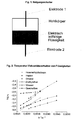
- a simple variant for a tilt sensor is a 1, which when tilted by about 90 ° between electrodes 1 and 2 becomes conductive.
- the requirements also increase to the electrically conductive liquid.
- the electrically conductive liquid must be used over the entire temperature range a necessary profile of requirements regarding conductivity, vapor pressure, Meet viscosity and surface tension.
- some Requirements such as low Corrosiveness, low toxicity and low cost.
- Such sensors are the electrically conductive liquids used.
- mercury is a metallic line
- the charge transport works in other cases by solvated ions.
- the application of mercury as an electrically conductive liquid is associated with significant disadvantages. mercury is toxic and accumulates in the human body. The manufacture, use and Disposing of components containing mercury places high demands on work and Environmental Protection. Mercury is also expensive and because of its melting point of -38 ° C can no longer be used at this temperature at the latest.
- the use of acids and lyes as electrically conductive liquids are also only possible to a limited extent. Firstly, they are corrosive and corrosive, and secondly, the temperature range is suitable for use limited downwards due to relatively high melting points. Pure sulfuric acid solidifies at -15 ° C. Dilute aqueous acids also generally have for the application melting points too high.
- aqueous salt solutions are also limited: because of the boiling point of the solvent Water of 100 ° C is generally an upper limit for applications or but the measuring device would have to be designed as a pressure vessel. That also changes the Boiling point increase little by adding salts.
- US 4975806 describes electrolytes based on their liquid constituents more than 90% from aprotic solvents such as formamide (melting point 2 ° C), DMF (Flash point 59 ° C, boiling point 153 ° C), N-methylformamide (melting point -3 ° C), dimethylacetamide (Melting point -20 ° C, flame point 70 ° C), N-methyl-2-pyrrolidone (melting point -24 ° C), Nethyl-2-pyrrolidone, diethylene glycol monomethyl ether (flash point 87 ° C), diethylene glycol dimethyl ether (Flash point 58 ° C), ethylene glycol monomethyl ether (bp 124 ° C, flash point 46 ° C), ethylene glycol dimethyl ether (flash point 1 ° C, boiling point 84 ° C), dimethyl sulfoxide (Melting point 18 ° C), propylene carbonate (melting point 48 ° C), 4-butyrolactone (
- US 4048118 describes electrically conductive liquids composed of mixtures of an alkali metal salt of an organic acid, organic solvents and polyalkyleneimine salts as antistatic mixtures of organic solvents.
- the conductivities that can be achieved are generally too low for use in sensors.
- hexane has a flash point of -22 ° C and thus carries a high risk of ignition in the case of sensor leaks when used in electrical circuits, in particular relay circuits.
- US 2387313 describes inclination sensors and electrolytes therefor.
- the liquids consist of mixtures of ethanol (approx. 80-95%) and water and contain as Conductive salt alkali metal iodides. These mixtures are in the temperature range from -65 to + 80 ° C applicable. Pressure-resistant hollow bodies are required for higher operating temperatures. As well the mixtures have low flash points.
- ethers which act as solvents for inorganic salts can be used in Battede electrolytes.
- ethers which act as solvents for inorganic salts can be used in Battede electrolytes.
- the electrolyte is a solvent, especially DMF, butyrolactone, dimethyl sulfide, a Contain a glycol-based liquid, a mixture of these, or dilute sulfuric acid.
- Dimethyl sulfide has a flash point of - 37 ° C
- dilute sulfuric acid is corrosive and has a melting point that is too high for sensors suitable for low temperatures.
- liquids for inclination sensors are based on hydrazine monohydrate (Boiling point 118-122 ° C). Because of the boiling point, the measuring range is here limited upwards or a pressure-tight measuring arrangement is required.
- the aim of the present invention is therefore to tailor a liquid to all of these Meets requirements.
- this requirement profile will limit the scope of the invention wanting to do so by dissolving a salt in triethylene glycol dimethyl ether (a linearly built organic aprotic solvents), to which alcohols in a Amount is added that is suitable for solvating the ions of the salt.
- a salt in triethylene glycol dimethyl ether (a linearly built organic aprotic solvents), to which alcohols in a Amount is added that is suitable for solvating the ions of the salt.
- Water and ethanol (generally OH-functional compounds, protic solvents) have large ⁇ / T coefficients, the coefficients are lower for silicones.
- the temperature-viscosity changes are smallest for unbranched molecules (rod-shaped molecular structure), such as n-alkanes or linear ethers.
- Suitable candidates are therefore unbranched molecules without as solvent component OH functionality such as n-alkanes, unbranched ethers and linear silicone oils. These substances are inherently not electrically conductive (but would be good candidates for capacitive applications).
- n-alkanes and silicone oils are also in n-alkanes and silicone oils because of the extremely low solvent polarity. only slightly soluble. n-Alkanes and silicone oils are also only very low Concentrations of polar solvents (e.g. water or ethanol) can be added. When cooling at low temperatures segregation occurs, the solubility of polar substances is affected then towards 0 and with it the electrical conductivity of these mixtures.
- polar solvents e.g. water or ethanol
- the usual technically available monoethers such as diethyl ether (bp. 34 ° C, flash point -40 ° C), dipropyl ether (bp. 90 ° C, flash point. -28 ° C) and dibutyl ether (bp. 141 ° C, flash point 25 ° C) have too low flash and boiling points for use in sensor liquids with the requirement profile described above.
- Example 1 shows that a solution of a quaternary ammonium salt in a polyether is electrically conductive.
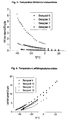
- a mixture according to Example 1 is not an electrically conductive liquid in one Sensor can be used. If a mixture according to Example 1 is cooled isobarically within 20 min - from 40 ° C and determines the conductivity as a function of temperature, increases at approx. 30 ° C the conductivity suddenly drops (discontinuity).
- Failed conductive salt can be observed in the conductivity measuring cell.
- the salt When slow When heated, the salt is completely in solution again at approx. -20 ° C.
- the discontinuity in the LF / T function is therefore also dependent on the heating rate, since it is coupled with the kinetics of the dissolution of the conductive salt.
- This problem was made advantageous in the present invention by adding an or solved several components that serve to solvate the conductive salt.
- the object of the present invention was therefore a solvation aid to find, which ensures a complete dissociation, thus high conductivities with low concentrations of conductive salt and due to the good dissociation good solubility (solubility alone is not enough, since it alone does not make it electrical Conductivity).
- the energy expenditure is decisive for the degree of dissociation in anions and cations. The smaller this is, the more completely a dissociation can be brought about by Brownian molecular motion.
- Example 2 The temperature conductivity of such a mixture is given in Example 2. Such a solution is from about -45 (melting point) to about 200 ° C (boiling point) as electrical conductive liquid can be used.
- the effect of the solvation aid can then be described as follows: the polar Molecules rearrange their hydroxyl groups in the direction of the conducting salt as a solvate shell the lead salt molecules.
- the apolar ends of the solvating agent point in the direction of the relatively apolar solvent.
- Water as a double protic substance is as shown in Examples 3 and 4, here as a solvation aid unsuitable, as the resulting solvate shells are also polar to the outside are. This means that it occurs especially when it is not completely miscible with protic solvents Polyethers (e.g. butyl ether) on solubility problems.
- Polyethers e.g. butyl ether
- polyalcohols cf. Example 3 ff.
- Such as glycol, glycerin, Mannitol etc. due to the higher complex formation constants due to the chelate effect and thus better solubilities and conductivities.
- mixtures of polyethers can also be used advantageously for the purposes of the invention Use electrolyte.
- OH-functional compounds according to the invention to improve the Solubility properties can also be extended to solvents other than the polyethers.
- solvents other than the polyethers e.g. propylene carbonate and 4-butyrolactone Lowering of melting point and good solvency possible at low temperatures.
- these solutions have comparatively high changes in conductivity Temperature up.
- the Leitsalz offers another possibility for optimization.
- quaternary ammonium salts include tetra-n-butylammonium chloride, Tetraethylammonium chloride, tetramethylammonium chloride, general Tetraalkylammonium halides.
- conductive salts such as from the Known in the field of phase transfer catalysis (but the function of these compounds is there another; Literature: E.V. Dehmlow, Phase Transfer Catalysis, 3rd edition, VCH 1993).
- Variations using alkali metal halides are also conceivable their largely low solubility at low temperatures in triethylene glycol ethers).
- a high conductivity with low use of materials is a as little dependence of the conductivity on the electrolyte viscosity as possible, low costs (no "exotic chemicals") and the lowest possible toxicity.
- Optimal in the sense of The invention would therefore be a non-toxic conductive salt with a low molecular weight and good solubility in the wide temperature range.
- bromides are therefore excreted and fluorides and the like out.
- Even tetramethylammonium chloride with the lowest possible molecular weight is toxic.
- the homologous tetraethylammonium chloride is non-toxic. It is therefore advantageous to use it according to the invention.
- the small molecule size in comparison e.g. against tetra-n-butylammonium chloride also makes the charge carriers more mobile in the electrolyte, thus achieving higher molar conductivities.
- the curves are flatter for smaller residues and the conductivity is otherwise for same composition of the mixtures higher. It is also conceivable to add Monoalkyl ethers (see Tab. 1) as listed in Example 10-12. Probably is problematic here that because of the OH functionality of the monoalkyl ethers, solvation occurs can. These are possible causes for the measured discontinuities in the T / LF curves (cf. Fig. 6, in particular Example 11). Furthermore, deteriorates (increases) in generally the change in conductivity with temperature.
- Triethylene glycol is double OH-functional and due to the resulting considerable Viscosity increase (liquid stagnates at approx. -25 ° C) even when adding the components cannot be used according to Example 9.
- Example 9 The best way to carry out the invention and the application according to claim 1 is in Mixture listed in Example 9.
- a linear aprotic substance according to claim 1 triethylene glycol dimethyl ether used as a dissociable salt according to claim 1 and 3 tetraethylammonium chloride and as alcohols according to claim 1, 2 and 3 ethylene glycol and glycerin.
- This mixture is electrically conductive from -52 (see Fig. 6, extrapolation from LF to 0) to 210 ° C (boiling point).
- the conductivity is broad due to the addition of conductive salt variable.
- the system is stable in the long term; segregation does not occur.
- Triethylene glycol dimethyl ether is relatively inert against electrochemical decomposition.
- the Liquid is non-toxic and contains no chlorinated solvents.
- the flash point of the liquid is 111 ° C and is therefore extremely high.
- the liquid Despite its high boiling point, it is relatively low-viscosity even at low temperatures and has a low surface tension without the need to add surfactants. All other points that are listed in the problem are marked with a mixture according to the invention fulfilled.
- the melting point of the mixture is advantageous about 7 degrees lower than that of pure triethylene glycol dimethyl ether.
- a special embodiment is the use of in the electrically conductive liquid soluble polymers for setting a desired viscosity according to claim 11. This is advantageous if the liquid is used in a sensor according to claim 1 is damped, mechanical natural vibrations of the sensor.
- liquids described in the invention can e.g. advantageous in the field of Use sensor technology wherever there are significant temperature fluctuations are possible, e.g. for inclination sensors in the mobile area (anti-theft alarm systems, display the slope of off-road vehicles).
Landscapes
- Physics & Mathematics (AREA)
- Engineering & Computer Science (AREA)
- General Physics & Mathematics (AREA)
- Radar, Positioning & Navigation (AREA)
- Remote Sensing (AREA)
- Compositions Of Macromolecular Compounds (AREA)
Description
- Quecksilber
- Wäßrige Salzlösungen, auch Säuren und Laugen
- Sonstige Lösemittel, in denen dissoziierte Teilchen vorliegen
- elektrische Leitfähigkeit im Temperaturbereich von <-50 und >160 °C
- Schmelzpunkte < -50 °C und Siedpunkte > 160 °C
- Leitfähigkeit im weitem Bereich variierbar (Anpassung an Elektronik)
- langfristig stabiles System mit gleichbleibenden Eigenschaften
- Flüssigkeit sollte möglichst wenig toxisch und ökologisch unproblematisch sein, einfache Entsorgung
- Flüssigkeit sollte hohen Flammpunkt ( >110°C) besitzen (Einbau in Relaisschaltungen)
- geringe Viskosität auch bei tiefen Temperaturen, da diese das Auflösungsvermögen eines Neigungssensors sehr stark bestimmt
- geringe Oberfächenspannung (sollte möglichst glatte Oberfäche ausbilden), um immer definierte Volumen abhängig von der Füllhöhe zu haben und um die Benetzung eines Hohlkörpers nach Abb.1 mit Kondensat im nicht mit Flüssigkeit gefüllten Bereich möglichst niedrig zu halten und desweiteren eine Bauteileminiaturisierung zu ermöglichen
- nicht korrosiv
- wenig flüchtig (geringer Dampfdruck), hoher Siedepunkt um Anforderungen an Konstruktion des Sensorgehäuses und Dichtung der Elektrodendurchführung zu minimieren
- geringe Penetration durch Kunststoffe, um Glasgefäße als Hohlkörper verzichtbar zu machen und Fertigung mit billigen Massenverfahren (Spritzguß) zu ermöglichen (vgl. hoher Siepunkt)
- die Änderung der spezifischen Leitfähigkeit im Einsatztemperaturberiech sollte möglichst gering sein (Reduzierung des Aufwandes bei der Sensorelektronik)
- es sollten keine Unstetigkeiten im Temperatur-Leiffähigkeitsverhalten auftreten
- Flüssigkeit soll kostengünstig und technisch verfügbar sein
- möglichst geringe Wechselwirkungen mit üblichen Elektrodenmaterialien
- Flüssigkeiten müssen elektrochemisch stabil sein (gegen anodische Oxidation und kathodische Reduktion, da auch bei Wechselstrommessungen ein gewisser Gleichstromanteil immer vorhanden ist)
| Stoffeigenschaften ausgewählter Beispiele von Polyethern | |||||
| Substanzname | Schmelzpunkt /°C | Siedepunkt /°C | Flammpunkt /°C | Viskosität /mPas bei 20°C | Dampdruck /hPa 20°C |
| Diethylenglykoldimethylether | -68 | 162 | 58 | 1,88 | 7 |
| Diethylenglycoldiethylether | -44 | 188 | 82 | - | 0,5 |
| Diethylenglycoldibutylether | -60 | 254 | - | - | 0,01 |
| Triethylenglycoldimethylether | -46 | 216 | 111 | 3,7 | 1,2 |
| Triethylenglykolmonomethylether | -44 | 249 | 118 | - | - |
| Diethylenglycolmonobutylether | -68 | 230 | 100 | 6,16 | 0,03 |
| Diethylenglykolmonoethylether | -80 | 202 | 90 | 4,95 | 0,13 |
| Diethylenglykolmonomethylether | -65 | 194 | 87 | 3,9 | 0,24 |
Claims (12)
- Verfahren zur Messung von Neigungen, Schwingungen, Winkeln, Beschleunigungen und Füllständen durch Eintauchen von Elektroden, die mit einer geeigneten Auswerteelektronik verbunden sind, in eine elektrisch leitfähige Flüssigkeit, dadurch gekennzeichnet, daß die Flüssigkeit aus in einer Phase vorliegenden Mischungen besteht, die mindestens Triethylenglykoldimethylether als Hauptkomponente, eine ein- oder mehrfach OH-funktionelle Verbindung und ein in der Mischung dissoziiertes Salz enthalten.
- Verfahren nach Anspruch 1, dadurch gekennzeichnet, daß es sich bei der OH- funktionellen Verbindung um Ethylenglykol handelt.
- Verfahren nach Anspruch 1, dadurch gekennzeichnet, daß die Flüssigkeit Glyzerin enthält.
- Verfahren nach Anspruch 1, dadurch gekennzeichnet, daß es sich bei dem verwendetem Salz um ein quartäres Ammoniumsalz, insbesondere um Tetraethylammoniumchlorid handelt.
- Verfahren nach Anspruch 1, dadurch gekennzeichnet, daß die Flüssigkeit weitere lineare Polyether, insbesondere Diethylenglykoldialkylether enthält.
- Verfahren nach Anspruch 1 dadurch gekennzeichnet, daß statt Triethylenglykoldimethylether andere Triethylenglykoldialkylether eingesetzt werden.
- Verfahren nach Anspruch 1 dadurch gekennzeichnet, daß statt Triethylenglykoldialkylether Triethylenglykolmonoalkylether oder Mischungen vorgenannter Mono- und Diether eingesetzt werden.
- Verfahren nach Anspruch 1, dadurch gekennzeichnet, daß sie aliphatische Alkohole, insbesondere Ethanol enthält.
- Verfahren nach Anspruch 1, dadurch gekennzeichnet, daß sie mehrere Alkohole oder Polyalkohole enthält.
- Verfahren nach Anspruch 1, dadurch gekennzeichnet, daß als Salze Alkalimetallhalogenide oder Mischungen davon mit quartären Ammoniumsalzen eingesetzt werden.
- Verafhren nach Anspruch 1, dadurch gekennzeichnet, daß sie zur Einstellung der Viskosität ein in der Flüssigkeit lösliches Polymer, insbesondere einen Polyelektrolyten enthält.
- Verfahren nach Anspruch 1 dadurch gekennzeichnet, daß der Flüssigkeit Stabilisatoren zur Verhinderung der chemischen oder der elektrochemischen Zersetzung zugefügt sind.
Applications Claiming Priority (3)
| Application Number | Priority Date | Filing Date | Title |
|---|---|---|---|
| DE19507610 | 1995-03-04 | ||
| DE19507610A DE19507610A1 (de) | 1995-03-04 | 1995-03-04 | Im Temperaturbereich von <-40 DEG C bis> 100 DEG C elektrisch leitfähige Flüssigkeit |
| PCT/EP1996/000824 WO1996027892A1 (de) | 1995-03-04 | 1996-02-29 | Im temperaturbereich von ∫ -50 °c bis ⊃ 160 °c elektrisch leitfähige flüssigkeit |
Publications (2)
| Publication Number | Publication Date |
|---|---|
| EP0813744A1 EP0813744A1 (de) | 1997-12-29 |
| EP0813744B1 true EP0813744B1 (de) | 1999-07-21 |
Family
ID=7755645
Family Applications (1)
| Application Number | Title | Priority Date | Filing Date |
|---|---|---|---|
| EP96904084A Expired - Lifetime EP0813744B1 (de) | 1995-03-04 | 1996-02-29 | Im temperaturbereich von weniger als -50 c bis grösser als 160 c elektrisch leitfähige flüssigkeit |
Country Status (3)
| Country | Link |
|---|---|
| EP (1) | EP0813744B1 (de) |
| DE (2) | DE19507610A1 (de) |
| WO (1) | WO1996027892A1 (de) |
Families Citing this family (6)
| Publication number | Priority date | Publication date | Assignee | Title |
|---|---|---|---|---|
| DE19650977A1 (de) * | 1996-12-09 | 1998-06-10 | Patrick Altmeier | Resistiver Neigungssensor |
| US6488826B2 (en) | 1996-12-09 | 2002-12-03 | Patrick Altmeier | Fluid electrode system for resistive slope sensors |
| DE10149439A1 (de) * | 2001-10-07 | 2003-04-17 | Markus Braun | Verfahren zum Betätigen eines elektrischen Schalters und Schalter zur Durchführung des Verfahrens |
| DE10251640B3 (de) * | 2002-11-06 | 2004-04-22 | Epcos Ag | Elektrolyt und Elektrolytkondensator |
| DE102005008406B4 (de) * | 2004-09-30 | 2013-10-02 | IoLiTec Ionic Liquids Technologies GmbH | Leitfähige Flüssigkeiten für Neigungs- und Beschleunigungssensoren |
| DE102014225346A1 (de) | 2014-12-10 | 2016-06-16 | Zf Friedrichshafen Ag | Vorrichtung zum Wechselwirken mit einem elektrisch leitfähigen Fluid, Fluidschwingungsdämpfersystem und Verfahren zum Herstellen einer solchen Vorrichtung |
Family Cites Families (14)
| Publication number | Priority date | Publication date | Assignee | Title |
|---|---|---|---|---|
| US2387313A (en) * | 1944-02-07 | 1945-10-23 | Sperry Gyroscope Co Inc | Switch electrolyte |
| US2852646A (en) * | 1956-06-11 | 1958-09-16 | Gen Electric | Liquid level switch and electrolyte |
| US2927987A (en) * | 1959-02-12 | 1960-03-08 | Uhl Herbert Bennett | Level switches |
| DE1698090C3 (de) * | 1968-01-22 | 1975-11-20 | Nijo, Kiyoichi, Osaka (Japan) | Temperaturregeleinrichtung fur eine Kühleinrichtung |
| DE2058946B2 (de) * | 1970-12-01 | 1972-12-21 | Franke, Hubert, 8901 Königsbrunn | Quecksilberkontakt mit elastischem kontaktgehaeuse fuer relais |
| CH586388A5 (de) * | 1974-01-17 | 1977-03-31 | Contraves Ag | |
| JPS5125484A (en) * | 1974-08-27 | 1976-03-02 | Showa Denko Kk | Taidenboshiseijukiekitaisoseibutsu |
| DE3611123A1 (de) * | 1986-04-03 | 1987-10-08 | Varta Batterie | Wasserfreier organischer elektrolyt |
| US4975806A (en) * | 1989-05-17 | 1990-12-04 | Aerovox M | Electrolytic capacitor and electrolyte therefore |
| DE4036262A1 (de) * | 1990-03-07 | 1991-09-12 | Hl Planartechnik Gmbh | Elektrische messanordnung zur messung bzw. berechnung des fuellstandes oder anderer mechanischer daten einer elektrisch leitenden fluessigkeit |
| DE9017431U1 (de) * | 1990-08-09 | 1991-03-21 | VDO Adolf Schindling AG, 60326 Frankfurt | Sensor zur Erfassung der Beschleunigung bzw. Neigung |
| DE4244724C2 (de) * | 1992-06-05 | 1994-10-20 | Gustav Hahn | Quecksilberfreier Flüssigkeits-Neigungsschalter |
| DE4218560C2 (de) * | 1992-06-05 | 1994-04-21 | Gustav Hahn | Schalteinrichtung |
| DE4240870A1 (de) | 1992-06-05 | 1994-06-09 | Gustav Hahn | Quecksilberfreier Flüssigkeits-Neigungsschalter |
-
1995
- 1995-03-04 DE DE19507610A patent/DE19507610A1/de not_active Withdrawn
-
1996
- 1996-02-29 DE DE59602484T patent/DE59602484D1/de not_active Expired - Fee Related
- 1996-02-29 EP EP96904084A patent/EP0813744B1/de not_active Expired - Lifetime
- 1996-02-29 WO PCT/EP1996/000824 patent/WO1996027892A1/de not_active Ceased
Also Published As
| Publication number | Publication date |
|---|---|
| EP0813744A1 (de) | 1997-12-29 |
| WO1996027892A1 (de) | 1996-09-12 |
| DE19507610A1 (de) | 1996-09-05 |
| DE59602484D1 (de) | 1999-08-26 |
Similar Documents
| Publication | Publication Date | Title |
|---|---|---|
| EP2023434B1 (de) | Elektrolytzubereitungen für Energiespeicher auf Basis ionischer Flüssigkeiten | |
| DE69618692T2 (de) | Elektrischer Doppelschichtkondensator | |
| DE68926984T2 (de) | Festelektrolytkondensator und Verfahren zu seiner Herstellung | |
| DE10359901A1 (de) | Flüssigkeitspegelsensor | |
| DE19507610A1 (de) | Im Temperaturbereich von <-40 DEG C bis> 100 DEG C elektrisch leitfähige Flüssigkeit | |
| DE69315914T2 (de) | Ionenleitender Polymerelektrolyt | |
| DE112020002426T5 (de) | Festelektrolytkondensator | |
| DE2950383A1 (de) | Elektrochemische elektrode sowie verfahren zur ausbildung einer auf ionen ansprechenden membran fuer eine elektrochemische elektrode sowie verfahren zur herstellung einer elektrochemischen elektrode | |
| DE69315941T2 (de) | Elektrolyt zur Verwendung in Elektrolytkondensatoren und Elektrolytkondensator | |
| DE2118435C2 (de) | Elektrolyt für Elektrolytkondensatoren | |
| EP0684466B1 (de) | Ionenempfindliche Elektrode und Verfahren zur Herstellung von Ionenempfindlichen Elektroden | |
| DE1598896B1 (de) | Elektrochemische elektrodenanordnung | |
| EP1936365A2 (de) | Set mit ionenselektiven Festkontakt-Elektroden | |
| US8120893B2 (en) | Tether-containing conducting polymers | |
| DE102005008406B4 (de) | Leitfähige Flüssigkeiten für Neigungs- und Beschleunigungssensoren | |
| DE69515368T2 (de) | Ionenleitender Polymerelektrolyt und seine Anwendung in einem Elektrolytkondensator | |
| DE112023003122T5 (de) | Leitfähige polymerlösung und ihre anwendung | |
| DE10296747B4 (de) | Verfahren zur Herstellung eines Polyanilinsalzes, gelöst in organischen Lösungsmitteln | |
| EP1090270B1 (de) | Flüssigkeits-elektrodensystem für resistive neigungssensoren | |
| DE69623060T2 (de) | Elektrolyt für elektrolytkondensator | |
| DE102011085174A1 (de) | Elektrochemischer Gassensor mit einer ionischen Flüssigkeitals Elektrolyt zum Nachweis von Ammoniak und Aminen | |
| JPS6123946B2 (de) | ||
| DE3018483A1 (de) | Verfahren und vorrichtung zur druckmessung | |
| DE2458115C3 (de) | Flüssigkeit für ein Fühlelement zur elektrischen Messung von Neigungen | |
| DE1614980C3 (de) | Elektrochemische Steuerzelle |
Legal Events
| Date | Code | Title | Description |
|---|---|---|---|
| PUAI | Public reference made under article 153(3) epc to a published international application that has entered the european phase |
Free format text: ORIGINAL CODE: 0009012 |
|
| 17P | Request for examination filed |
Effective date: 19971001 |
|
| AK | Designated contracting states |
Kind code of ref document: A1 Designated state(s): BE DE ES FR GB IT PT SE |
|
| GRAG | Despatch of communication of intention to grant |
Free format text: ORIGINAL CODE: EPIDOS AGRA |
|
| 17Q | First examination report despatched |
Effective date: 19980220 |
|
| GRAG | Despatch of communication of intention to grant |
Free format text: ORIGINAL CODE: EPIDOS AGRA |
|
| GRAH | Despatch of communication of intention to grant a patent |
Free format text: ORIGINAL CODE: EPIDOS IGRA |
|
| GRAH | Despatch of communication of intention to grant a patent |
Free format text: ORIGINAL CODE: EPIDOS IGRA |
|
| GRAA | (expected) grant |
Free format text: ORIGINAL CODE: 0009210 |
|
| AK | Designated contracting states |
Kind code of ref document: B1 Designated state(s): BE DE ES FR GB IT PT SE |
|
| PG25 | Lapsed in a contracting state [announced via postgrant information from national office to epo] |
Ref country code: SE Free format text: THE PATENT HAS BEEN ANNULLED BY A DECISION OF A NATIONAL AUTHORITY Effective date: 19990721 Ref country code: IT Free format text: LAPSE BECAUSE OF FAILURE TO SUBMIT A TRANSLATION OF THE DESCRIPTION OR TO PAY THE FEE WITHIN THE PRE;WARNING: LAPSES OF ITALIAN PATENTS WITH EFFECTIVE DATE BEFORE 2007 MAY HAVE OCCURRED AT ANY TIME BEFORE 2007. THE CORRECT EFFECTIVE DATE MAY BE DIFFERENT FROM THE ONE RECORDED.SCRIBED TIME-LIMIT Effective date: 19990721 Ref country code: GB Free format text: LAPSE BECAUSE OF FAILURE TO SUBMIT A TRANSLATION OF THE DESCRIPTION OR TO PAY THE FEE WITHIN THE PRESCRIBED TIME-LIMIT Effective date: 19990721 Ref country code: FR Free format text: LAPSE BECAUSE OF FAILURE TO SUBMIT A TRANSLATION OF THE DESCRIPTION OR TO PAY THE FEE WITHIN THE PRESCRIBED TIME-LIMIT Effective date: 19990721 Ref country code: ES Free format text: THE PATENT HAS BEEN ANNULLED BY A DECISION OF A NATIONAL AUTHORITY Effective date: 19990721 |
|
| REF | Corresponds to: |
Ref document number: 59602484 Country of ref document: DE Date of ref document: 19990826 |
|
| PG25 | Lapsed in a contracting state [announced via postgrant information from national office to epo] |
Ref country code: PT Free format text: LAPSE BECAUSE OF FAILURE TO SUBMIT A TRANSLATION OF THE DESCRIPTION OR TO PAY THE FEE WITHIN THE PRESCRIBED TIME-LIMIT Effective date: 19991021 |
|
| EN | Fr: translation not filed | ||
| GBV | Gb: ep patent (uk) treated as always having been void in accordance with gb section 77(7)/1977 [no translation filed] |
Effective date: 19990721 |
|
| PG25 | Lapsed in a contracting state [announced via postgrant information from national office to epo] |
Ref country code: BE Free format text: LAPSE BECAUSE OF NON-PAYMENT OF DUE FEES Effective date: 20000228 |
|
| PLBE | No opposition filed within time limit |
Free format text: ORIGINAL CODE: 0009261 |
|
| STAA | Information on the status of an ep patent application or granted ep patent |
Free format text: STATUS: NO OPPOSITION FILED WITHIN TIME LIMIT |
|
| 26N | No opposition filed | ||
| BERE | Be: lapsed |
Owner name: KONRAD ANDREAS Effective date: 20000228 Owner name: ALTMEIER PATRICK Effective date: 20000228 |
|
| PGFP | Annual fee paid to national office [announced via postgrant information from national office to epo] |
Ref country code: DE Payment date: 20010731 Year of fee payment: 6 |
|
| PG25 | Lapsed in a contracting state [announced via postgrant information from national office to epo] |
Ref country code: DE Free format text: LAPSE BECAUSE OF NON-PAYMENT OF DUE FEES Effective date: 20020903 |