EP0813327B1 - Access control system and method - Google Patents
Access control system and method Download PDFInfo
- Publication number
- EP0813327B1 EP0813327B1 EP97304133A EP97304133A EP0813327B1 EP 0813327 B1 EP0813327 B1 EP 0813327B1 EP 97304133 A EP97304133 A EP 97304133A EP 97304133 A EP97304133 A EP 97304133A EP 0813327 B1 EP0813327 B1 EP 0813327B1
- Authority
- EP
- European Patent Office
- Prior art keywords
- terminal
- service
- service request
- identifier
- server
- Prior art date
- Legal status (The legal status is an assumption and is not a legal conclusion. Google has not performed a legal analysis and makes no representation as to the accuracy of the status listed.)
- Expired - Lifetime
Links
- 238000000034 method Methods 0.000 title claims description 41
- 230000004044 response Effects 0.000 claims description 4
- 230000005540 biological transmission Effects 0.000 claims description 3
- 238000012545 processing Methods 0.000 description 19
- 230000006870 function Effects 0.000 description 9
- 230000007246 mechanism Effects 0.000 description 9
- 230000008569 process Effects 0.000 description 9
- 230000005856 abnormality Effects 0.000 description 4
- 238000010586 diagram Methods 0.000 description 4
- 238000004891 communication Methods 0.000 description 3
- 241000224489 Amoeba Species 0.000 description 1
- 238000013475 authorization Methods 0.000 description 1
- 230000000694 effects Effects 0.000 description 1
- 231100001261 hazardous Toxicity 0.000 description 1
- 238000012986 modification Methods 0.000 description 1
- 230000004048 modification Effects 0.000 description 1
- 230000003287 optical effect Effects 0.000 description 1
- 239000004065 semiconductor Substances 0.000 description 1
- 238000012546 transfer Methods 0.000 description 1
- 238000012795 verification Methods 0.000 description 1
Images

Classifications
-
- H—ELECTRICITY
- H04—ELECTRIC COMMUNICATION TECHNIQUE
- H04L—TRANSMISSION OF DIGITAL INFORMATION, e.g. TELEGRAPHIC COMMUNICATION
- H04L63/00—Network architectures or network communication protocols for network security
- H04L63/10—Network architectures or network communication protocols for network security for controlling access to devices or network resources
- H04L63/102—Entity profiles
Definitions
- This invention relates to an access control system and method, particular access control of a distributed system in which the resources of remote sites are shared using a computer network, by way of example.
- Access control in a distributed system generally is achieved by combining an authentication mechanism in the distributed system with a resource protection mechanism at each site.
- a distributed file system which is a means of sharing files via a network
- LAN local area network
- user authentication means at the site level is appropriated in the network environment as well by unifying modes of user management, and resource protection is achieved based upon the authority granted to authenticated users.
- the file access control means for implementing this generally is provided by the operating system (OS).
- a comparatively large-scale network such as a wide-area network (WAN)
- WAN wide-area network
- use is made of authentication by an authentication system because unifying modes of user management is difficult.
- opportunities to share resources per se are fewer than in a small-scale network.
- the situation is the same as in the case of the small-scale network environment.
- the first problem is that satisfactory reliability cannot be assured merely by applying the site-level user authentication mechanism to a distributed system. Even if modes of user management are unified between sites, no legal force is involved and a certain site is capable of individually altering some of the management information. In cases such as these, it is possible for a site administrator to impersonate a user and it is difficult for the resource provider to detect this.
- the second problem is that in a scenario in which the resource protection mechanism provided by the operating system (OS) is applied to distributed resources, ordinarily this is effective only at the site at which the resource protection mechanism is operating. Consequently, if there is an externally applied request for operation of a resource, the request must be dealt with based upon the rightful authority given to the site. However, as long as users once authenticated possess the same authority, it is not possible to cope with a situation in which reliability or level of authorization differ depending upon the site, even for the same user.
- OS operating system
- a concern of the present invention is to provide an access control system and method in which, when shared resources in a distributed system are accessed, the shared resources can be protected safely and flexibly.
- United States Patent Specification No US-A-4672572 discloses an access control method for controlling access to a distributed system in which resources of remote sites are shared using a computer network.
- United States Patent Specification No US-A-5261070 discloses the concept of generating new identification data at each cycle.
- An article by Tanenbaum et al, entitled "The amoeba distributed operating system - A status report computer communications, NL, Elsevier science publishers BV, Amsterdam, vol. 14 no.6, page 324-335 discloses an access control method similar to the first mentioned US Patent.
- the embodiments described below relate to a distributed system having a plurality of users, particularly a distributed system in which the authorities of individual users are managed uniformly even in a distributed environment in which the modes of user management differ from one site to another.
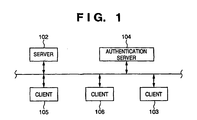
- Fig. 1 is a diagram illustrating an example of the configuration of a network environment according to an embodiment of the present invention.
- a group of terminals are connected to a network terminal 101 to construct a computer network.
- the computer network described here includes an Ethernet, a LAN using an FDDI, a WAN constructed by interconnecting networks by a public telephone line or leased line, etc.
- a server terminal 102 is a computer system such as a work station or personal computer run by an application provided in a distributed system.
- Client terminals 103, 105, 106 are computer systems, which are similar to the server terminal 102, run by applications utilizing resources in the distributed system.
- An authentication server terminal 104 is a computer system, which is similar to the server terminal 102, run by an authentication server which provides an authentication mechanism in the network environment.
- the authentication server terminal 104 is provided by a Kerberos system, by way of example.
- server application client applications and authentication server are items of software stored on an external storage medium such as a floppy disk, a hard disk, a magneto-optic drive (MO), a CD-ROM, a CD-R or a magnetic tape, or in any non-volatile semiconductor memory device such as a ROM or flash memory.
- an external storage medium such as a floppy disk, a hard disk, a magneto-optic drive (MO), a CD-ROM, a CD-R or a magnetic tape, or in any non-volatile semiconductor memory device such as a ROM or flash memory.
- server or "client” is a generic term that relates to the role of the application concerning a prescribed service and does not necessarily have a fixed meaning in terms of an application.
- a certain application may be a server with regard to a certain service or a client with regard to a different service.
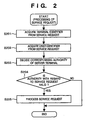
- Fig. 2 is a flowchart showing an example of a procedure through which a server processes a request from a client.
- the flowchart has a first step S201, at which a terminal identifier is acquired from a service request sent from a client.
- the user identifier is then acquired from the service request at step S202.
- the processing for acquiring the user identifier employs authentication means supplied by the authentication server.
- an arrangement may be adopted in which the identifier is acquired using means supplied in dependence upon the network environment, e.g. identity inquiry means in conformity with RFC1413 in the TCP/IP (Transmission Control/Internet Protocol) network environment.
- the corresponding authority of the server terminal is decided based upon the terminal identifier and user identifier acquired. If the requested service is to gain access to resources (e.g. files, devices, etc.) protected by the OS, the authority of the server terminal is an authority defined by the OS. If the requested service is a resource (e.g. shared data in a database management system) protected by the server, then the authority of the server terminal is an authority defined independently by the server.
- resources e.g. files, devices, etc.
- the authority of the server terminal is an authority defined by the OS.
- the authority of the server terminal is an authority defined independently by the server.
- step S204 it is determined whether the authority regarding the service request is valid (whether the service request is within the limits of authority). If the authority is valid, then the service request is processed at step S205. Of course, if the authority regarding the service request is invalid (the service request is outside the limits of authority), then the service request is not processed.
- step S203 a equivalence class with regard to the terminal identifier and user identifier is decided. It is then determined at step S204 whether there is an ordered relation between this equivalence class and a series of maximal elements.
- Abnormalities due to a variety of faults can occur at steps S201 and S202.
- the element of the quotient lattice corresponding to the least upper bound of the direct product lattice relating to the terminal identifier is substituted as the equivalence class at step S203 in response to an abnormality at step S201.
- the element of the quotient lattice corresponding to the least upper bound of the direct product lattice relating to the user identifier is substituted in response to an abnormality at step S202.
- the least upper bound of the quotient lattice is substituted in response to abnormalities at both steps S201 and S202.
- a service provided to a user group composed of prescribed users is restricted at a terminal connected to a prescribed network
- the following is given as an equivalence relation: "whether or not the terminal is included in a sublattice of a direct product lattice decided by a set of identifiers of terminals connected to a specified network and a set of identifiers of users belonging to a specified user group".
- the pair "whether or not the terminal is connected to a specified network” and "whether or not the terminal belongs to a specified user group” is given as the equivalence relation.
- the set of terminal identifiers and the set of user identifiers are each split into two sublattices that do not overlap each other, whereupon there is obtained a quotient lattice of a direct product set comprising 16 elements.
- This quotient lattice clearly is isomorphic to the direct product lattice of the quotient lattice relating to respective ones of the terminal identifier and user identifier. Accordingly, only one equivalence class corresponding to all pairs of terminal identifiers and user identifiers which will accept a service request is decided in the above-mentioned quotient lattice.
- This equivalence class is made to correspond to the authority over a service by deciding a set of maximal elements in which this equivalence class is adopted as one element.
- the equivalence relation and the set of maximal elements regarding a service, as well as the corresponding relationship to the authority are specified.
- the pair of terminal identifiers and user identifiers obtained from the service request of the client corresponds to some equivalence class of the quotient lattice.
- acceptance of the request is limited to a case corresponding to an equivalence class employed as a maximal element.
- an equivalence relation in a set naturally corresponds to an equivalence relation in a set lattice
- performing grouping with regard to terminals or users is nothing more than shrinking a large set lattice of elements to a small quotient lattice.
- a quotient lattice possessing universality with respect to all quotient lattices used by a server exists, and any quotient lattice becomes a quotient lattice obtained by deciding a separate equivalence relation with respect to the quotient lattice possessing universality.
- the maximal elements decided by the above-mentioned example in which there is a limitation upon services provided to a specified user group at a terminal connected to a specified network correspond to a sublattice of the universal quotient lattice. Accordingly, this is equivalent to effects obtained in a case where, instead of making the setting in the above-mentioned example, use is made of an equivalence relation which determines a quotient lattice having universality and a set of maximal elements comprising the least upper bounds of the sublattice of the quotient lattice.
- objects which determine whether authority is given or not can be aggregated in arbitrary units. This makes it possible to establish access control in highly flexible fashion.
- the present invention is effective also in regard to supporting a distributed environment in which user management modes are different. More specifically, if all pairs of terminal identifiers and user identifiers regarding one and the same user are regarded as being one equivalent, and if this is performed with respect to all users, then one equivalence relation will be obtained.
- the element of the quotient lattice obtained by this equivalence relation is decided, with regard to individual users, without relation to differences in the user management modes. Accordingly, the set of maximal elements may be decided regarding the quotient lattice as being a universal quotient lattice, and a simpler quotient lattice may be decided using a separate equivalence relation.
- the procedure shown in Fig. 2 makes it possible, even for one and the same user, to arbitrarily set the level of authority in dependence upon the terminal utilized by this user.
- the above-mentioned procedure is such that authentication processing regarding a user is executed with regard to all service requests, and problems in terms of efficiency arise in a case where a service request is issued repeatedly. Accordingly, in the second embodiment, from the standpoint that it will suffice to assure security below a so-called transport level, authentication processing is executed when the connection of a transport level is set.
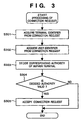
- Fig. 3 is a flowchart showing an example of a processing procedure executed when establishing the connection of a transport level.
- a terminal identifier and a user identifier are acquired from a connection request and the corresponding authority in terms of the server terminal is decided. This is similar to the processing of steps S201 and S203 shown in Fig. 2. It is determined at step S304 whether the decided authority is valid at the server. If the authority is valid, then the connection request is accepted at step S305. Of course, if the authority that has been decided is not valid at the server, then the connection request is not accepted.
- the processing procedure for a service request in a case where a connection request is processed in accordance with the procedure shown in Fig. 3 is modified to exclude the steps from S201 to S203 from the procedure of Fig. 2 and, in their place, retrieve the authority decided at step S303 from the service request.
- This modification of the procedure is easy to perform. Specifically, it will suffice to record a pair consisting of a connection identifier and the authority and retrieve the authority from the connection identifier at step S305 when the service request is processed. It should be noted that the pair consisting of the connection identifier and the authority is destroyed autonomously at the server when the connection is broken.
- steps S303 and S304 are similar to the processing of steps S203 and S204 shown in Fig. 2.
- settings relating to services rather than using settings relating to services, use is made of settings relating to a connection, namely an equivalence relation, a set of maximal elements and a unique corresponding relationship from the maximal elements to the authority of the server terminal.
- settings relating to a connection and the settings relating to a series of services usually whatever satisfies the criteria in the former is selected so as to satisfy the criteria in the latter, although in general the two may be independent of each other.
- a certain type of server (referred to below as a "relay server") is provided. Specifically, service requests issued by a plurality of clients simultaneously at client stations are sent to a server collectively by the relay server and messages sent from a server are distributed to the clients by the relay server.
- a server collectively by the relay server and messages sent from a server are distributed to the clients by the relay server.
- Such a configuration is very effective in a case where replicas of shared resources are held at the client terminals and in a case where messages from the server are sent to a series of clients in the manner of a broadcast.
- processing for confirming authority is performed between a server and a relay server in accordance with the procedure shown in Fig. 2 or Fig. 3.
- a service which a server provides directly to a relay server differs from that provided to a client; the relay server provides a mechanism for intercepting a request from the client.
- steps S203 and S204 shown in Fig. 2 are executed based upon setting relating to the service.
- Step S205 rather than being a step for processing a service request, is a step for processing a service intercept request.
- the service intercept request processing per se is executed in accordance with the procedure from step S203 onward in the first embodiment using a user identifier and terminal identifier of the relay server obtained through the procedure described below.
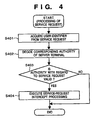
- Fig. 4 is a flowchart illustrating an example of a procedure, which corresponds to Fig. 2, which a relay server executes with respect to each client in a distributed system of the kind set forth above.
- the flowchart has a first step S401, at which a user identifier is acquired from a service request. Since a relay server and a client are operating one and the same terminal, the processing for acquiring the user identifier is capable of being executed securely and efficiently without using an authentication server or the like.
- Step S402 in a case where various settings relating to a series of services have been provided by a server, authority is decided at step S402 and the validity thereof with respect to the service request is discriminated at step S403.
- Steps S402 and S403 are for suppressing needless relaying of service requests. Though it is preferred that this actually be carried out, it is possible for this to be omitted.
- service-request intercept processing is executed at step S404.
- This processing involves transferring, to the server, a message obtained by adding the user identifier acquired at step S401 onto the request message of the client.
- the user identifier added on is nothing more than a user identifier necessary in service-request intercept processing at the relay server.
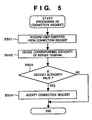
- Fig. 5 is a flowchart illustrating an example of a procedure, which corresponds to Fig. 3, which a relay server executes with respect to each client.
- Step S501 in Fig. 5 is for acquiring a user identifier from a connection request in the same manner as at step S401 in Fig. 4.
- Step S502 in a case where various settings relating to a connection request have been provided by a server, authority is decided at step S502 and the validity of the decided authority is discriminated at step S503.
- Steps S502 and S503 are for suppressing needless relaying of connection requests. Though it is preferred that this actually be carried out, it is possible for this to be omitted.
- connection request is accepted and the pair consisting of the connection identifier and user identifier received is recorded.
- the relay server subjects the accepted connection to processing for intercepting a service request from a client.
- This intercept processing involves transferring, to the server, a message obtained by adding the user identifier recorded at step S504 onto the request message of the client. It should be noted that the pair consisting of the recorded connection identifier and user identifier is destroyed autonomously at the relay server when the connection is broken.
- authentication of the relay server by a third party such as an authentication server may be omitted in a case where the security of the terminal being operated by the relay server is assured and the relay server is a privileged process in the OS at this terminal.
- the relay server is a privileged process in the OS at this terminal. For example, in a TCP/IP network environment, privilege is necessary in an address setting based upon a port number of No. 1023 or less, depending upon the OS of the terminal.
- the relay server performs the address setting based upon a privileged port number, and the server verifies whether this address is one that has been set by the relay server, thereby making possible identity inquiry of the relay server without relying upon third-party authentication means.
- simple verification means will suffice, such as means for performing regression transfer of any bit pattern selected randomly by communication using the above-mentioned privileged port. The reason for this is that as long as the security of the terminal is assured, an unlawful privileged process which sends back the bit pattern cannot exist.
- such means are hazardous in a WAN environment because the reliability of intervening signal paths cannot in general be assured but they are practical in many LAN environments used in offices or the like.
- the present invention can be applied to a system constituted by a plurality of devices (e.g., a host computer, interface, reader, printer, etc.) or to an apparatus comprising a single device (e.g., a copier or facsimile machine, etc.).
- a host computer e.g., a host computer, interface, reader, printer, etc.
- an apparatus e.g., a copier or facsimile machine, etc.
- the object of the present invention can also be achieved by providing a storage medium storing program codes for performing the aforesaid functions of the foregoing embodiments to a system or an apparatus, reading the program codes with a computer (e.g., a CPU or MPU) of the system or apparatus from the storage medium, and then executing the program.
- a computer e.g., a CPU or MPU
- the program codes read from the storage medium implement the functions according to the embodiments
- the storage medium storing the program codes constitutes the invention.
- the storage medium such as a floppy disk, hard disk, optical disk, magneto-optical disk, CD-ROM, CD-R, magnetic tape, non-volatile type memory card or ROM can be used to provide the program codes.
- the present invention covers a case where an operating system (OS) or the like working on the computer performs a part of or the entire process in accordance with the designation of program codes and implements the functions according to the embodiment.
- OS operating system
- the present invention further covers a case where, after the program codes read from the storage medium are written to a function extension board inserted into the computer or to a memory provided in a function extension unit connected to the computer, a CPU or the like contained in the function extension board or function extension unit performs a part of or the entire process in accordance with the designation of program codes and implements the function of the above embodiments.
- program codes corresponding to the flowchart described earlier are stored on this storage medium. More specifically, modules illustrated in the example of the memory map of Fig. 6 or Fig. 7 are stored on the storage medium.
Landscapes
- Engineering & Computer Science (AREA)
- Computer Hardware Design (AREA)
- Computer Security & Cryptography (AREA)
- Computing Systems (AREA)
- General Engineering & Computer Science (AREA)
- Computer Networks & Wireless Communication (AREA)
- Signal Processing (AREA)
- Storage Device Security (AREA)
- Computer And Data Communications (AREA)
- Information Retrieval, Db Structures And Fs Structures Therefor (AREA)
- Information Transfer Between Computers (AREA)
Applications Claiming Priority (3)
| Application Number | Priority Date | Filing Date | Title |
|---|---|---|---|
| JP15411896A JP3937475B2 (ja) | 1996-06-14 | 1996-06-14 | アクセス制御システムおよびその方法 |
| JP154118/96 | 1996-06-14 | ||
| JP15411896 | 1996-06-14 |
Publications (3)
| Publication Number | Publication Date |
|---|---|
| EP0813327A2 EP0813327A2 (en) | 1997-12-17 |
| EP0813327A3 EP0813327A3 (en) | 2001-05-09 |
| EP0813327B1 true EP0813327B1 (en) | 2005-11-30 |
Family
ID=15577324
Family Applications (1)
| Application Number | Title | Priority Date | Filing Date |
|---|---|---|---|
| EP97304133A Expired - Lifetime EP0813327B1 (en) | 1996-06-14 | 1997-06-12 | Access control system and method |
Country Status (4)
| Country | Link |
|---|---|
| US (1) | US6237023B1 (enExample) |
| EP (1) | EP0813327B1 (enExample) |
| JP (1) | JP3937475B2 (enExample) |
| DE (1) | DE69734748D1 (enExample) |
Families Citing this family (62)
| Publication number | Priority date | Publication date | Assignee | Title |
|---|---|---|---|---|
| JPH1139260A (ja) | 1997-07-17 | 1999-02-12 | Canon Inc | ユーザ認証方式、ホストコンピュータ、端末装置、認証コード生成方法、記憶媒体 |
| JP4353552B2 (ja) * | 1998-06-18 | 2009-10-28 | 富士通株式会社 | コンテンツサーバ,端末装置及びコンテンツ送信システム |
| US6470453B1 (en) * | 1998-09-17 | 2002-10-22 | Cisco Technology, Inc. | Validating connections to a network system |
| EP1061639A2 (en) * | 1999-06-17 | 2000-12-20 | Applied Materials, Inc. | Chucking system amd method |
| US8706630B2 (en) | 1999-08-19 | 2014-04-22 | E2Interactive, Inc. | System and method for securely authorizing and distributing stored-value card data |
| US7333955B2 (en) * | 2001-09-24 | 2008-02-19 | E2Interactive, Inc. | System and method for securing communication service |
| FI108184B (fi) * | 1999-10-12 | 2001-11-30 | Sonera Oyj | Palvelun pääsynvalvonta |
| US6556995B1 (en) * | 1999-11-18 | 2003-04-29 | International Business Machines Corporation | Method to provide global sign-on for ODBC-based database applications |
| US7263523B1 (en) * | 1999-11-24 | 2007-08-28 | Unisys Corporation | Method and apparatus for a web application server to provide for web user validation |
| US7336790B1 (en) | 1999-12-10 | 2008-02-26 | Sun Microsystems Inc. | Decoupling access control from key management in a network |
| US6977929B1 (en) | 1999-12-10 | 2005-12-20 | Sun Microsystems, Inc. | Method and system for facilitating relocation of devices on a network |
| US7765581B1 (en) | 1999-12-10 | 2010-07-27 | Oracle America, Inc. | System and method for enabling scalable security in a virtual private network |
| US6970941B1 (en) | 1999-12-10 | 2005-11-29 | Sun Microsystems, Inc. | System and method for separating addresses from the delivery scheme in a virtual private network |
| US6870842B1 (en) | 1999-12-10 | 2005-03-22 | Sun Microsystems, Inc. | Using multicasting to provide ethernet-like communication behavior to selected peers on a network |
| US6798782B1 (en) | 1999-12-10 | 2004-09-28 | Sun Microsystems, Inc. | Truly anonymous communications using supernets, with the provision of topology hiding |
| US6938169B1 (en) * | 1999-12-10 | 2005-08-30 | Sun Microsystems, Inc. | Channel-specific file system views in a private network using a public-network infrastructure |
| AU2001239746A1 (en) * | 2000-02-07 | 2001-08-14 | Matthew Eichner | Group-browsing system |
| EP1176760A1 (en) * | 2000-07-27 | 2002-01-30 | Telefonaktiebolaget Lm Ericsson | Method of establishing access from a terminal to a server |
| US20020066038A1 (en) * | 2000-11-29 | 2002-05-30 | Ulf Mattsson | Method and a system for preventing impersonation of a database user |
| US20020095506A1 (en) * | 2001-01-15 | 2002-07-18 | Murata Kikai Kabushiki Kaisha | Relay server, communication system and facsimile system |
| US7206088B2 (en) * | 2001-01-15 | 2007-04-17 | Murata Kikai Kabushiki Kaisha | Relay server, communication system and facsimile system |
| US7506045B1 (en) * | 2001-03-30 | 2009-03-17 | Unisys Corporation | Method and mechanism for the development and implementation of a web-based user interface |
| US20020143922A1 (en) * | 2001-04-03 | 2002-10-03 | Murata Kikai Kabushiki Kaisha | Relay server and relay system |
| US20020143956A1 (en) * | 2001-04-03 | 2002-10-03 | Murata Kikai Kabushiki Kaisha | Relay server |
| US7096362B2 (en) * | 2001-06-01 | 2006-08-22 | International Business Machines Corporation | Internet authentication with multiple independent certificate authorities |
| JP2003091503A (ja) * | 2001-09-14 | 2003-03-28 | Toshiba Corp | ポートアクセスを利用した認証方法及び同方法を適用するサーバ機器 |
| USRE43383E1 (en) | 2001-12-12 | 2012-05-15 | Samsung Electronics Co., Ltd. | Method for sharing hybrid resources in a wireless independent network, a station for the method, and a data format for the method and the station |
| KR100450795B1 (ko) | 2001-12-12 | 2004-10-01 | 삼성전자주식회사 | 무선 독립망에서 혼합형 자원 공유 방법과 이를 위한 단말및 데이타 포맷 |
| JP3610341B2 (ja) | 2002-02-19 | 2005-01-12 | キヤノン株式会社 | ネットワーク機器及び遠隔制御中継サーバ |
| JP4054637B2 (ja) * | 2002-08-28 | 2008-02-27 | キヤノン株式会社 | 画像処理システム及びその認証方法 |
| JP3907568B2 (ja) * | 2002-10-02 | 2007-04-18 | キヤノン株式会社 | 認証装置 |
| KR100512936B1 (ko) * | 2002-11-18 | 2005-09-07 | 삼성전자주식회사 | 반도체 메모리 장치 및 이 장치의 배치방법 |
| US8364747B2 (en) * | 2002-12-17 | 2013-01-29 | International Business Machines Corporation | Client/server request handling |
| DE10344764B4 (de) * | 2003-09-26 | 2006-04-13 | Siemens Ag | Verfahren zum Übermitteln von Informationen |
| US8655309B2 (en) | 2003-11-14 | 2014-02-18 | E2Interactive, Inc. | Systems and methods for electronic device point-of-sale activation |
| US7500108B2 (en) | 2004-03-01 | 2009-03-03 | Microsoft Corporation | Metered execution of code |
| JPWO2005083941A1 (ja) * | 2004-03-02 | 2007-11-29 | 松下電器産業株式会社 | 通信システムおよび通信方法 |
| JP4491269B2 (ja) * | 2004-04-22 | 2010-06-30 | 株式会社日立製作所 | ストレージシステム及びファイル管理装置 |
| KR100573700B1 (ko) | 2004-05-15 | 2006-04-25 | 주식회사 니츠 | 분산환경을 지원하는 안전한 멀티에이전트 시스템 및보안서비스 제공방법 |
| US7437447B2 (en) * | 2004-11-12 | 2008-10-14 | International Business Machines Corporation | Method and system for authenticating a requestor without providing a key |
| US8474694B2 (en) * | 2005-03-23 | 2013-07-02 | E2Interactive, Inc. | Radio frequency identification purchase transactions |
| US7472822B2 (en) * | 2005-03-23 | 2009-01-06 | E2Interactive, Inc. | Delivery of value identifiers using short message service (SMS) |
| US20060217996A1 (en) * | 2005-03-23 | 2006-09-28 | E2Interactive, Inc. D/B/A E2Interactive, Inc. | Point-of-sale activation of media device account |
| US20070233844A1 (en) * | 2006-03-29 | 2007-10-04 | Murata Kikai Kabushiki Kaisha | Relay device and communication system |
| JP4222397B2 (ja) * | 2006-09-12 | 2009-02-12 | 村田機械株式会社 | 中継サーバ |
| US7698220B2 (en) | 2006-09-14 | 2010-04-13 | E2Interactive, Inc. | Virtual terminal for payment processing |
| CN1929482B (zh) * | 2006-09-20 | 2010-08-04 | 华为技术有限公司 | 一种网络业务认证方法及装置 |
| EP2112805B1 (en) * | 2006-10-11 | 2011-02-09 | Murata Machinery, Ltd. | Relay server |
| EP1912404B1 (en) * | 2006-10-11 | 2011-06-01 | Murata Machinery, Ltd. | File transfer server |
| EP1942634B1 (en) * | 2006-11-24 | 2012-08-29 | Murata Machinery, Ltd. | Relay server, relay communication system, and communication device |
| US8010647B2 (en) * | 2006-12-11 | 2011-08-30 | Murata Machinery, Ltd. | Relay server and relay communication system arranged to share resources between networks |
| JP4333736B2 (ja) * | 2006-12-19 | 2009-09-16 | 村田機械株式会社 | 中継サーバおよびクライアント端末 |
| US8566240B2 (en) * | 2007-01-16 | 2013-10-22 | E2Interactive, Inc. | Systems and methods for the payment of customer bills utilizing payment platform of biller |
| US20080172331A1 (en) * | 2007-01-16 | 2008-07-17 | Graves Phillip C | Bill Payment Card Method and System |
| US20100031321A1 (en) * | 2007-06-11 | 2010-02-04 | Protegrity Corporation | Method and system for preventing impersonation of computer system user |
| JP5197179B2 (ja) * | 2008-06-24 | 2013-05-15 | 三菱電機株式会社 | データ管理装置 |
| JP5217829B2 (ja) * | 2008-09-17 | 2013-06-19 | 株式会社リコー | 情報処理装置、配信システム、処理制御方法およびプログラム |
| US20110137740A1 (en) | 2009-12-04 | 2011-06-09 | Ashmit Bhattacharya | Processing value-ascertainable items |
| US20110153441A1 (en) * | 2009-12-23 | 2011-06-23 | Merrill Brooks Smith | Systems and Methods for Authorizing Use of Validly Sold Merchandise |
| JP5707214B2 (ja) * | 2011-04-21 | 2015-04-22 | みずほ情報総研株式会社 | ファイル管理システム及びファイル管理方法 |
| US9503558B1 (en) | 2015-06-02 | 2016-11-22 | Motorola Solutions, Inc. | Battery module for communication devices having an accessory interface |
| CN107682397B (zh) * | 2017-08-28 | 2019-02-26 | 平安科技(深圳)有限公司 | 客户资源获取方法、装置、终端设备及存储介质 |
Family Cites Families (13)
| Publication number | Priority date | Publication date | Assignee | Title |
|---|---|---|---|---|
| US4672572A (en) | 1984-05-21 | 1987-06-09 | Gould Inc. | Protector system for computer access and use |
| US4891838A (en) | 1985-11-04 | 1990-01-02 | Dental Data Service, Inc. | Computer accessing system |
| US5261070A (en) | 1986-07-24 | 1993-11-09 | Meiji Milk Product Co., Ltd. | Method and apparatus for forming unique user identification data at remote terminal for secure transmission of data from host terminal |
| US4916738A (en) | 1986-11-05 | 1990-04-10 | International Business Machines Corp. | Remote access terminal security |
| US4896319A (en) * | 1988-03-31 | 1990-01-23 | American Telephone And Telegraph Company, At&T Bell Laboratories | Identification and authentication of end user systems for packet communications network services |
| US5278904A (en) * | 1992-10-09 | 1994-01-11 | Gte Laboratories Incorporated | Method of verifying identification |
| US5390252A (en) | 1992-12-28 | 1995-02-14 | Nippon Telegraph And Telephone Corporation | Authentication method and communication terminal and communication processing unit using the method |
| US5343529A (en) * | 1993-09-28 | 1994-08-30 | Milton Goldfine | Transaction authentication using a centrally generated transaction identifier |
| US5590199A (en) * | 1993-10-12 | 1996-12-31 | The Mitre Corporation | Electronic information network user authentication and authorization system |
| US5758257A (en) * | 1994-11-29 | 1998-05-26 | Herz; Frederick | System and method for scheduling broadcast of and access to video programs and other data using customer profiles |
| JP4008049B2 (ja) * | 1995-03-20 | 2007-11-14 | 富士通株式会社 | アドレス送信装置、アドレス送信方法およびアドレス送信システム |
| JPH0981519A (ja) * | 1995-09-08 | 1997-03-28 | Kiyadeitsukusu:Kk | ネットワーク上の認証方法 |
| JP3361661B2 (ja) * | 1995-09-08 | 2003-01-07 | 株式会社キャディックス | ネットワーク上の認証方法 |
-
1996
- 1996-06-14 JP JP15411896A patent/JP3937475B2/ja not_active Expired - Fee Related
-
1997
- 1997-06-11 US US08/873,104 patent/US6237023B1/en not_active Expired - Lifetime
- 1997-06-12 DE DE69734748T patent/DE69734748D1/de not_active Expired - Lifetime
- 1997-06-12 EP EP97304133A patent/EP0813327B1/en not_active Expired - Lifetime
Also Published As
| Publication number | Publication date |
|---|---|
| DE69734748D1 (de) | 2006-01-05 |
| JPH103420A (ja) | 1998-01-06 |
| EP0813327A2 (en) | 1997-12-17 |
| US6237023B1 (en) | 2001-05-22 |
| JP3937475B2 (ja) | 2007-06-27 |
| EP0813327A3 (en) | 2001-05-09 |
Similar Documents
| Publication | Publication Date | Title |
|---|---|---|
| US6237023B1 (en) | System for controlling the authority of a terminal capable of simultaneously operating a plurality of client softwares which transmit service requests | |
| EP1024630B1 (en) | A secure electronic mail system | |
| US6792474B1 (en) | Apparatus and methods for allocating addresses in a network | |
| US8255573B2 (en) | Communication network system, gateway, data communication method and program providing medium | |
| US7853983B2 (en) | Communicating data from a data producer to a data receiver | |
| US5638448A (en) | Network with secure communications sessions | |
| Birrell | Secure communication using remote procedure calls | |
| EP0947925A2 (en) | Apparatus and method for remotely executing commands using distributed computing environment remote procedure calls | |
| CA2228687A1 (en) | Secured virtual private networks | |
| CN102769529A (zh) | Dnssec签名服务器 | |
| US7356833B2 (en) | Systems and methods for authenticating a user to a web server | |
| GB2359969A (en) | Automated authentication of communication devices with certificates bound to the device identifier | |
| CN101232375A (zh) | 单点登录系统、信息终端设备、单点登记服务器及方法 | |
| CN102970135B (zh) | 用于发现共享秘密而不泄漏非共享秘密的方法和设备 | |
| CN102209046A (zh) | 网络资源整合系统及方法 | |
| US20070066280A1 (en) | Connection management system, method and program | |
| JP4133215B2 (ja) | データ分割方法及びデータ復元方法並びにプログラム | |
| US7827309B2 (en) | Information processing apparatus for concealing the identity of internet protocol addresses | |
| JPH11331270A (ja) | ネットワークシステム | |
| US11882114B2 (en) | Authentication method and authentication system in IP communication | |
| JP5347263B2 (ja) | クライアント装置および通信方法 | |
| CN121771189A (zh) | 强健式的服务器分派方法与系统 | |
| Anderson | A Basis for Secure Communication | |
| Rangan | David P. Anderson | |
| JP4246472B2 (ja) | データ処理方法及びプログラム |
Legal Events
| Date | Code | Title | Description |
|---|---|---|---|
| PUAI | Public reference made under article 153(3) epc to a published international application that has entered the european phase |
Free format text: ORIGINAL CODE: 0009012 |
|
| AK | Designated contracting states |
Kind code of ref document: A2 Designated state(s): DE FR GB |
|
| AX | Request for extension of the european patent |
Free format text: AL;LT;LV;RO;SI |
|
| PUAL | Search report despatched |
Free format text: ORIGINAL CODE: 0009013 |
|
| AK | Designated contracting states |
Kind code of ref document: A3 Designated state(s): AT BE CH DE DK ES FI FR GB GR IE IT LI LU MC NL PT SE |
|
| AX | Request for extension of the european patent |
Free format text: AL;LT;LV;RO;SI |
|
| 17P | Request for examination filed |
Effective date: 20010924 |
|
| AKX | Designation fees paid |
Free format text: AT BE CH LI |
|
| RBV | Designated contracting states (corrected) |
Designated state(s): DE FR GB |
|
| REG | Reference to a national code |
Ref country code: DE Ref legal event code: 8566 |
|
| 17Q | First examination report despatched |
Effective date: 20031112 |
|
| GRAP | Despatch of communication of intention to grant a patent |
Free format text: ORIGINAL CODE: EPIDOSNIGR1 |
|
| GRAS | Grant fee paid |
Free format text: ORIGINAL CODE: EPIDOSNIGR3 |
|
| GRAA | (expected) grant |
Free format text: ORIGINAL CODE: 0009210 |
|
| AK | Designated contracting states |
Kind code of ref document: B1 Designated state(s): DE FR GB |
|
| REG | Reference to a national code |
Ref country code: GB Ref legal event code: FG4D |
|
| REF | Corresponds to: |
Ref document number: 69734748 Country of ref document: DE Date of ref document: 20060105 Kind code of ref document: P |
|
| PG25 | Lapsed in a contracting state [announced via postgrant information from national office to epo] |
Ref country code: DE Free format text: LAPSE BECAUSE OF FAILURE TO SUBMIT A TRANSLATION OF THE DESCRIPTION OR TO PAY THE FEE WITHIN THE PRESCRIBED TIME-LIMIT Effective date: 20060301 |
|
| PLBE | No opposition filed within time limit |
Free format text: ORIGINAL CODE: 0009261 |
|
| STAA | Information on the status of an ep patent application or granted ep patent |
Free format text: STATUS: NO OPPOSITION FILED WITHIN TIME LIMIT |
|
| 26N | No opposition filed |
Effective date: 20060831 |
|
| EN | Fr: translation not filed | ||
| PG25 | Lapsed in a contracting state [announced via postgrant information from national office to epo] |
Ref country code: FR Free format text: LAPSE BECAUSE OF FAILURE TO SUBMIT A TRANSLATION OF THE DESCRIPTION OR TO PAY THE FEE WITHIN THE PRESCRIBED TIME-LIMIT Effective date: 20070119 |
|
| PG25 | Lapsed in a contracting state [announced via postgrant information from national office to epo] |
Ref country code: FR Free format text: LAPSE BECAUSE OF FAILURE TO SUBMIT A TRANSLATION OF THE DESCRIPTION OR TO PAY THE FEE WITHIN THE PRESCRIBED TIME-LIMIT Effective date: 20051130 |
|
| PGFP | Annual fee paid to national office [announced via postgrant information from national office to epo] |
Ref country code: GB Payment date: 20140610 Year of fee payment: 18 |
|
| GBPC | Gb: european patent ceased through non-payment of renewal fee |
Effective date: 20150612 |
|
| PG25 | Lapsed in a contracting state [announced via postgrant information from national office to epo] |
Ref country code: GB Free format text: LAPSE BECAUSE OF NON-PAYMENT OF DUE FEES Effective date: 20150612 |