EP0809799B1 - Verfahren und anordnung zur bestimmung der reinheit und/oder des drucks von gasen für elektrische lampen - Google Patents
Verfahren und anordnung zur bestimmung der reinheit und/oder des drucks von gasen für elektrische lampen Download PDFInfo
- Publication number
- EP0809799B1 EP0809799B1 EP96902233A EP96902233A EP0809799B1 EP 0809799 B1 EP0809799 B1 EP 0809799B1 EP 96902233 A EP96902233 A EP 96902233A EP 96902233 A EP96902233 A EP 96902233A EP 0809799 B1 EP0809799 B1 EP 0809799B1
- Authority
- EP
- European Patent Office
- Prior art keywords
- gas
- discharge
- spectral
- intensity
- lamp
- Prior art date
- Legal status (The legal status is an assumption and is not a legal conclusion. Google has not performed a legal analysis and makes no representation as to the accuracy of the status listed.)
- Expired - Lifetime
Links
- 239000007789 gas Substances 0.000 title claims description 116
- 238000000034 method Methods 0.000 title claims description 82
- 230000003595 spectral effect Effects 0.000 claims description 87
- XKRFYHLGVUSROY-UHFFFAOYSA-N Argon Chemical compound [Ar] XKRFYHLGVUSROY-UHFFFAOYSA-N 0.000 claims description 78
- 239000012535 impurity Substances 0.000 claims description 50
- 229910052786 argon Inorganic materials 0.000 claims description 39
- 238000005259 measurement Methods 0.000 claims description 32
- 238000011109 contamination Methods 0.000 claims description 24
- 238000004519 manufacturing process Methods 0.000 claims description 22
- 239000000203 mixture Substances 0.000 claims description 21
- 230000005855 radiation Effects 0.000 claims description 19
- 230000005284 excitation Effects 0.000 claims description 11
- 230000008569 process Effects 0.000 claims description 10
- 229910052756 noble gas Inorganic materials 0.000 claims description 7
- 150000002835 noble gases Chemical class 0.000 claims description 7
- 230000008878 coupling Effects 0.000 claims description 6
- 238000010168 coupling process Methods 0.000 claims description 6
- 238000005859 coupling reaction Methods 0.000 claims description 6
- 230000001419 dependent effect Effects 0.000 claims description 6
- 230000036961 partial effect Effects 0.000 claims description 6
- 238000011156 evaluation Methods 0.000 claims description 5
- 238000012360 testing method Methods 0.000 claims description 4
- 238000010891 electric arc Methods 0.000 claims description 3
- 230000005670 electromagnetic radiation Effects 0.000 claims description 3
- 238000004804 winding Methods 0.000 claims description 3
- 238000004611 spectroscopical analysis Methods 0.000 claims description 2
- FGUUSXIOTUKUDN-IBGZPJMESA-N C1(=CC=CC=C1)N1C2=C(NC([C@H](C1)NC=1OC(=NN=1)C1=CC=CC=C1)=O)C=CC=C2 Chemical compound C1(=CC=CC=C1)N1C2=C(NC([C@H](C1)NC=1OC(=NN=1)C1=CC=CC=C1)=O)C=CC=C2 FGUUSXIOTUKUDN-IBGZPJMESA-N 0.000 claims 1
- 230000000875 corresponding effect Effects 0.000 description 14
- 238000001514 detection method Methods 0.000 description 14
- 230000003287 optical effect Effects 0.000 description 12
- 239000012071 phase Substances 0.000 description 8
- 239000000356 contaminant Substances 0.000 description 7
- 229910001507 metal halide Inorganic materials 0.000 description 5
- 150000005309 metal halides Chemical class 0.000 description 5
- 238000003908 quality control method Methods 0.000 description 5
- IJGRMHOSHXDMSA-UHFFFAOYSA-N Atomic nitrogen Chemical compound N#N IJGRMHOSHXDMSA-UHFFFAOYSA-N 0.000 description 4
- 230000008901 benefit Effects 0.000 description 4
- 230000007423 decrease Effects 0.000 description 4
- 229910052736 halogen Inorganic materials 0.000 description 4
- 150000002367 halogens Chemical class 0.000 description 4
- 150000002430 hydrocarbons Chemical class 0.000 description 4
- 238000000691 measurement method Methods 0.000 description 4
- 239000007787 solid Substances 0.000 description 4
- XUIMIQQOPSSXEZ-UHFFFAOYSA-N Silicon Chemical compound [Si] XUIMIQQOPSSXEZ-UHFFFAOYSA-N 0.000 description 3
- 229910052739 hydrogen Inorganic materials 0.000 description 3
- 229910052760 oxygen Inorganic materials 0.000 description 3
- 229910052710 silicon Inorganic materials 0.000 description 3
- 239000010703 silicon Substances 0.000 description 3
- 238000001228 spectrum Methods 0.000 description 3
- OKTJSMMVPCPJKN-UHFFFAOYSA-N Carbon Chemical compound [C] OKTJSMMVPCPJKN-UHFFFAOYSA-N 0.000 description 2
- UFHFLCQGNIYNRP-UHFFFAOYSA-N Hydrogen Chemical compound [H][H] UFHFLCQGNIYNRP-UHFFFAOYSA-N 0.000 description 2
- QVGXLLKOCUKJST-UHFFFAOYSA-N atomic oxygen Chemical compound [O] QVGXLLKOCUKJST-UHFFFAOYSA-N 0.000 description 2
- 230000015572 biosynthetic process Effects 0.000 description 2
- 229910052799 carbon Inorganic materials 0.000 description 2
- 230000000052 comparative effect Effects 0.000 description 2
- 230000000694 effects Effects 0.000 description 2
- 238000005516 engineering process Methods 0.000 description 2
- 230000005281 excited state Effects 0.000 description 2
- 238000002189 fluorescence spectrum Methods 0.000 description 2
- 229930195733 hydrocarbon Natural products 0.000 description 2
- 239000001257 hydrogen Substances 0.000 description 2
- 230000001965 increasing effect Effects 0.000 description 2
- 239000007788 liquid Substances 0.000 description 2
- 238000012544 monitoring process Methods 0.000 description 2
- 229910052757 nitrogen Inorganic materials 0.000 description 2
- 239000003921 oil Substances 0.000 description 2
- 239000001301 oxygen Substances 0.000 description 2
- 238000005086 pumping Methods 0.000 description 2
- 238000010791 quenching Methods 0.000 description 2
- 238000012546 transfer Methods 0.000 description 2
- 230000007704 transition Effects 0.000 description 2
- XLYOFNOQVPJJNP-UHFFFAOYSA-N water Substances O XLYOFNOQVPJJNP-UHFFFAOYSA-N 0.000 description 2
- 238000012935 Averaging Methods 0.000 description 1
- 239000004809 Teflon Substances 0.000 description 1
- 229920006362 Teflon® Polymers 0.000 description 1
- 230000008859 change Effects 0.000 description 1
- 239000011248 coating agent Substances 0.000 description 1
- 238000000576 coating method Methods 0.000 description 1
- 150000001875 compounds Chemical class 0.000 description 1
- 230000002596 correlated effect Effects 0.000 description 1
- 230000001186 cumulative effect Effects 0.000 description 1
- 230000007547 defect Effects 0.000 description 1
- 230000002950 deficient Effects 0.000 description 1
- 238000009826 distribution Methods 0.000 description 1
- 230000003628 erosive effect Effects 0.000 description 1
- 238000005429 filling process Methods 0.000 description 1
- 239000011521 glass Substances 0.000 description 1
- 238000007496 glass forming Methods 0.000 description 1
- 239000001307 helium Substances 0.000 description 1
- 229910052734 helium Inorganic materials 0.000 description 1
- SWQJXJOGLNCZEY-UHFFFAOYSA-N helium atom Chemical compound [He] SWQJXJOGLNCZEY-UHFFFAOYSA-N 0.000 description 1
- 230000001939 inductive effect Effects 0.000 description 1
- 238000003780 insertion Methods 0.000 description 1
- 230000037431 insertion Effects 0.000 description 1
- 230000010354 integration Effects 0.000 description 1
- 229910052743 krypton Inorganic materials 0.000 description 1
- DNNSSWSSYDEUBZ-UHFFFAOYSA-N krypton atom Chemical compound [Kr] DNNSSWSSYDEUBZ-UHFFFAOYSA-N 0.000 description 1
- 238000012423 maintenance Methods 0.000 description 1
- 239000000463 material Substances 0.000 description 1
- QSHDDOUJBYECFT-UHFFFAOYSA-N mercury Chemical compound [Hg] QSHDDOUJBYECFT-UHFFFAOYSA-N 0.000 description 1
- 229910052751 metal Inorganic materials 0.000 description 1
- 239000002184 metal Substances 0.000 description 1
- 239000013307 optical fiber Substances 0.000 description 1
- 238000012545 processing Methods 0.000 description 1
- 238000010926 purge Methods 0.000 description 1
- 238000013094 purity test Methods 0.000 description 1
- 239000010453 quartz Substances 0.000 description 1
- 230000035945 sensitivity Effects 0.000 description 1
- 238000000926 separation method Methods 0.000 description 1
- VYPSYNLAJGMNEJ-UHFFFAOYSA-N silicon dioxide Inorganic materials O=[Si]=O VYPSYNLAJGMNEJ-UHFFFAOYSA-N 0.000 description 1
- 230000000638 stimulation Effects 0.000 description 1
- 239000000126 substance Substances 0.000 description 1
- 230000036962 time dependent Effects 0.000 description 1
- 239000012808 vapor phase Substances 0.000 description 1
- 230000003313 weakening effect Effects 0.000 description 1
- 229910052724 xenon Inorganic materials 0.000 description 1
- FHNFHKCVQCLJFQ-UHFFFAOYSA-N xenon atom Chemical compound [Xe] FHNFHKCVQCLJFQ-UHFFFAOYSA-N 0.000 description 1
Images


Classifications
-
- G—PHYSICS
- G01—MEASURING; TESTING
- G01N—INVESTIGATING OR ANALYSING MATERIALS BY DETERMINING THEIR CHEMICAL OR PHYSICAL PROPERTIES
- G01N21/00—Investigating or analysing materials by the use of optical means, i.e. using sub-millimetre waves, infrared, visible or ultraviolet light
- G01N21/62—Systems in which the material investigated is excited whereby it emits light or causes a change in wavelength of the incident light
- G01N21/66—Systems in which the material investigated is excited whereby it emits light or causes a change in wavelength of the incident light electrically excited, e.g. electroluminescence
- G01N21/69—Systems in which the material investigated is excited whereby it emits light or causes a change in wavelength of the incident light electrically excited, e.g. electroluminescence specially adapted for fluids, e.g. molten metal
Definitions
- the invention relates to a method for the detection of impurities in gases, in particular noble gases, or gas mixtures for electric lamps or radiator according to the preamble of claim 1 and a method for measuring the pressure of gases, in particular noble gases, or the gas components of gas mixtures for electric lamps or Radiator according to the preamble of claim 18. Also relates to Invention an arrangement for performing this method.
- electric lamps includes both incandescent and discharge lamps. Electric discharges are gas discharges to understand the mainly electromagnetic radiation outside the visible range, especially in the UV or IR range, emit.
- the processes use the influence of gas pressure or impurities on the fluorescence spectrum of a gas discharge, in particular a glow discharge.
- gaseous or vaporous, as well as solid substances whose Presence in gases or gas mixtures for electric lamps or Spotlights - for brevity referred to below as the gas system - undesirable is.
- these contaminants get out of control Way into the gas system, e.g. already during lamp manufacture through contaminated purging or filling gases or through leaking pump and Filling systems.
- contamination can occur reach the gas system of the lamp, for example due to leakages on Lamp bulb itself or during lamp operation, e.g. by contaminated electrodes or increased electrode erosion due to insufficient Filling pressure.
- the consequence of impurities - no matter what The cause is ultimately inoperable lamps or lamps with restricted Lifetime or maintenance.
- a method for determining gas purity is through the contribution "Gas Purity Test on Halogen Bulbs Using a Spectral Line Comparison" by M. Gaugel in the book series ,, Technisch-Wissenschaftliche Treatises of the OSRAM Society ", Volume 12, pp. 546-549, Springer-Verlag, Berlin 1986, known.
- There the light from halogen bulbs divided into three light beams by three beam splitters and three spectrally differently sensitive photomultipliers.
- the maximal spectral sensitivity of the individual photomultipliers are at Wavelength around 410 nm, 523 nm or 616 nm, i.e. in blue, green and red area of the electromagnetic spectrum.
- a disadvantage of this solution is that the halogen incandescent lamp to be tested, including the optical structure and photomultiplier, must be in an opaque housing during the measurement. Otherwise, in-phase interference signals, for example ambient light, lead to incorrect measurements, since these interference signals are spectrally weighted completely differently by the three photomultipliers and are therefore not eliminated when forming the quotient.
- An arrangement for determining the quality of incandescent lamps is known in US Pat. No. 4,759,630. It contains a device for generating a discharge between the incandescent filament and an electrode applied to the outer wall of the lamp bulb and a device for analyzing the radiation emitted by the discharge in the wavelength range between 550 nm and 570 nm. The lamp quality is assessed by the behavior over time of this radiation , which is optionally compared with the radiation in the wavelength range between 660 nm and 680 nm.
- US 5 168 323 proposes an arrangement and a method for determination of contaminants in a gas.
- the arrangement comprises two opposing electrodes, between which the gas passes flows, a low-frequency AC voltage source connected to the electrodes and an optical measuring device.
- a low-frequency AC voltage source connected to the electrodes and an optical measuring device.
- an arc discharge is generated, its emission lines be detected by means of the measuring device. More characteristic from the intensities Spectral lines of the different impurities are their concentrations are determined using a linear system of equations.
- a first object of the invention is to eliminate the disadvantages mentioned and a relatively easy to implement, and especially in lamp manufacture integrable method for the detection of impurities in gases or gas mixtures for electric lamps or spotlights specify.
- the method is also intended in particular for the functional and / or quality control of electric lamps.
- Another object of the invention is to determine the pressure of Gases, in particular noble gases, or the gas components of gas mixtures for electric lamps or spotlights.
- the procedure should also especially for function and / or quality control of electric lamps or spotlights.
- Another object of the invention is an arrangement to indicate with which the proposed procedures are carried out can. This object is achieved by an arrangement according to claim 32 solved. Further advantageous features of the arrangement are in the claims 33 to 38 explained.
- the basic idea of the invention is the gas or the gas components of the gas mixture and any impurities it contains by means of a gas discharge for the emission of electromagnetic To stimulate radiation.
- the detection of any gas and / or vaporous impurities or the determination of the pressure of the Gases or the gas component takes place by means of the measured intensity one or more suitable spectral lines of this radiation.
- a very An essential aspect for both methods is the selective measurement of the Spectral lines. Preliminary tests had shown that reliable Results under manufacturing conditions only if adhered to of the measurement conditions explained below can be achieved.
- spectral lines are made taking into account any gas components, e.g. the filling components of metal halide high-pressure discharge lamps. In doing so only selected spectral lines that do not match other lines of the Fluorescence spectrum overlap or collapse.
- the allowable distance the selected lines to neighboring lines should advantageously be larger, than the spectral resolution of the measurement. This prevents the Measured the intensity of unwanted lines and thus falsified the result becomes.
- the intensity of at least one spectral line depending on the pressure is.
- a pressure range dependent on the excitation conditions typically from the pre-vacuum range to atmospheric pressure, in particular in the range between approx. 0.1 kPa and approx. 40 kPa
- the intensity decreases suitable spectral lines with the pressure.
- a quotient is created in each case the intensities of two spectral lines are formed, the intensity at least a line is pressure independent.
- the two spectral lines are preferred so close together that noise signals and in-phase interference signals, especially ambient or scattered light, spectrally almost the same be rated.
- the distance between the two spectral lines is typically less than approx. 100 nm, preferably less than approx. 50 nm Interference signals within this distance have a nearly constant spectral Have intensity distribution, i.e. relatively broadband compared to the selected spectral lines, they become largely in the formation of the quotient eliminated. In-phase signal attenuations, for example in the case of electric lamps caused by bulb blackening, eliminated.
- the ratio measurement described is (ratiometric measurement method) of a possible absolute measurement preferable to the intensity of a single spectral line, at which interference effects strongly falsify the measurement result, which is usually not retrospectively can be corrected.
- spectral lines for the ratio measurement are aimed depending on the specific gas or gas components.
- Argon has suitable spectral lines in the wavelength range between 650 nm and 800 nm or between 800 nm and 1000 nm.
- the wavelength (s) of a higher excitation energy corresponds (correspond) to that of the spectral lines of the determining impurities.
- existing impurities are therefore preferably stimulated.
- part of the electrical output of gas discharge increasingly into this "Loss channels” instead of in the occupation of the selected spectral lines corresponding excited states of the gas or the gas components.
- the intensities of the selected spectral lines decrease (the corresponding optical transitions are caused by the impurities increasingly "quenched", i.e. the occupation density of the associated excited states decreases) and the more the higher the Concentration of impurities ("quench partner").
- the weakening of the intensities of the selected spectral lines an indirect proof for those inside the lamp vessel Impurities.
- the detectable impurities include the elements oxygen (O), hydrogen (H), nitrogen (N), carbon (C), silicon (Si) or also compounds of these elements, for example water (H 2 O) or hydrocarbons (CH) and others .
- This contamination can be caused by leaks or defects in the pump system (e.g. O, H 2 O, oil vapors) or individual contaminated components (e.g. O from oxidized electrode surfaces, H 2 O embedded in electrode surfaces or hygroscopic metal halides). Silicon can appear as a coating on the electrodes, caused, for example, by incorrect pinching of the lamp bulb.
- those spectral lines may be selected that are not covered by the lines of other filling components and their connections.
- excitation energies for argon and for the impurities hydrogen (H), nitrogen (N), oxygen (O), carbon (C) and silicon (Si) as well as the wavelengths of the associated spectral lines are given in Table 1 below . It can be seen from this that the excitation energies of the impurities are in some cases considerably below those for argon. Excitation energies and corresponding wavelengths of the corresponding optical transitions for argon and some possible impurities ("quench partner").
- the loss channels of the rotation and vibration excitation occur in addition to the electronic excitations.
- the energies required for this are in the meV range or a few eV (less than approx. 3 eV) and are therefore in any case significantly smaller than the required excitation energies for argon.
- the Intensity of one or more spectral lines of the respective contamination measured.
- the advantage is that with the help of this direct procedure the respective Contamination specifically detected, i.e. identified and by means of a calibration measurement, its concentration can be determined. This makes it easier to find the cause of the respective contamination, e.g. a defective pump system when hydrocarbon compounds occur (Oil vapors).
- This is a direct process is relatively expensive, since for each possible contamination Intensity of at least one line (or band) measured and evaluated must become.
- the intensities of the associated molecular bands at the wavelengths 357.7 nm, 388.34 nm, 388.9 nm or 468.48 nm and 516 are suitable for determining the concentration of the molecules N 2 , CN, CH or C 2 , 5 nm.
- these measured values are related to the intensity of a suitable pressure-independent spectral line.
- the spectral line with the wavelength 738.4 nm is suitable.
- Table 2 shows a list of some impurities typical of discharge lamps. The wavelengths suitable for their direct detection are also listed. Contamination typical for discharge lamps and suitable wavelengths for their direct detection.
- An expanded two-step process combines the direct and the indirect Measurement method.
- the indirect measurement method checks whether there is any contamination at all is present. Only if this is the case will the second stage of the procedure a qualitative and / or quantitative using the direct measurement method Determination of the individual components of the contamination made.
- Another variant of the method is used to assess the quality of Discharge lamps, in particular high pressure metal halide discharge lamps.
- the time-dependent change in intensity is optional of the spectral lines during the start-up phase of the lamps used for the assessment of the electrode quality.
- a glow discharge within the lamp electrodes Discharge vessel of the lamp generated.
- the electrode-e.g. Surface, geometry material - this burns Glow discharge, for example, first on the electrode shaft and migrates then to the electrode tip.
- the length of time required for this depends on the quality of the electrode and typically fluctuates between some tenths of a second and a few seconds. It extends with oxidized and / or electrode contaminated by quartz or other deposits as well as with unsuitable electrode geometry.
- the glow discharge advantageously only with low power and / or only briefly, e.g. operated intermittently. This prevents that a significant proportion of these filling components are in the vapor phase transforms. Otherwise spectral lines of the steam could be excited the spectral lines of any impurities that may be present and cause incorrect measurements.
- the intensity of the spectral line with the wavelength of ⁇ 763.5nm determined.
- the intensity of this spectral line decreases with the pressure too.
- the intensity becomes by means of calibration measurements the pressure is determined directly.
- this is Intensity on the measured pressure-independent intensity of a second Spectral line related.
- the spectral line of the is suitable, for example Argon with a wavelength of 738.4 nm.
- a suitable arrangement for carrying out the method according to the invention consists of a vessel in which the gas or gas mixture and any impurities contained therein, an energy supply unit, which is connected to the vessel via a coupling device and the gas discharge, in particular a glow discharge, a spectroscopic measuring device which measures the intensity (s) of the spectral line (s) and an evaluation device, which from the Measured values, if applicable, prove contamination or specific contamination identified and indicates their concentrations and / or the (Partial) pressure of the gas or the gas components of the gas mixture determined.
- the vessel can be, for example, a lamp bulb or one with the Pump or gas mixing system connected to a lamp production line Sample vessel.
- a suitable energy supply unit is e.g. a high frequency generator.
- the coupling device can either from within the Discharge vessel arranged electrodes, for example the lamp electrodes a discharge lamp, or consist of external electrodes. In the latter case, are connected to the high frequency generator Electrodes attached to the outer wall of the vessel.
- This Variant is also used as a capacitive high-frequency discharge with dielectric Called electrodes. It is particularly suitable for Use on electric incandescent lamps, alternatively also the Filament itself can serve as an internal electrode. In this case only one external (dielectric) electrode is required.
- the vessel inside is powered by the high frequency generator Coil be arranged so that there is an inductive high-frequency discharge.
- the spectral separation device consists of one narrow-band optical (interference) filter-typical resolutions between approx. 5 nm and 10 nm - per spectral line to be measured.
- a spectrometer is suitable which measures the radiation by means of dispersive Elements - for example prisms or gratings - in their spectral components disassembled, i.e. creates an optical spectrum.
- dispersive Elements for example prisms or gratings - in their spectral components disassembled, i.e. creates an optical spectrum.
- Another advantage is the higher one Resolution of a spectrometer - typically 1 nm and less.
- optical Elements e.g. Lenses or mirrors between the vessel and the spectral Attach separating device, which the guidance and bundling of Fluorescence radiation serve to the spectral separator.
- the evaluation device has one or more detector elements on, for example photodiodes or a diode row or a Diode array.
- the detector elements convert the spectral components of the Radiation in voltage signals corresponding to their respective intensity.
- a display unit makes the voltage signals in analog or digital Representation visible.
- the voltage signals can also be supplied to an electronic computer, for example the Ratiometric variants are formed. With the result and the calibration values can then be used to determine the concentration of individual Contamination and gas pressure are calculated and output become.
- limit values for parameters are determined which as a measure of the functionality and performance of a lamp type, serve, for example, metal halide high-pressure discharge lamps.
- Suitable lamp parameters are e.g. the ignition voltage - that's the one for Ignite the required voltage - the discharge Peak voltage - this is the value of the maximum that the Voltage after turning on the lamp while building a stable Arc discharge goes through -, the re-ignition peak voltage - that's the Peak value of the AC voltage applied to the lamp electrodes - as well as the sheet transfer time - this is the time between switching on the lamp and formation of the bow.
- the values of the above electric lamp parameters take off with increasing pollution inside the lamp too.
- corresponding comparative measurements are carried out the values of the electrical lamp parameters with the spectroscopic Measured values correlated.
- lamps are defined with Contaminants manufactured, measured spectroscopically and the same assigned corresponding lamp parameters determined in each case. On this way can be used for each lamp type and different Degrees of contamination a set of value ranges for the spectral intensities or create intensity ratios.
- This sentence is then used for one current determination of the contamination of a lamp or a Lamp fill for reference. Are the current measured values or the ratios calculated from this - within the respective Contamination is low, otherwise unacceptable and the lamp in question is sorted out or the production is interrupted to eliminate the cause of the contamination.
- a major advantage of spectroscopic quality control is that Speed of the underlying measurements. Typical inside the result is available within a few seconds. In contrast, it lasts in Calibration of the spectroscopic method described Determination of the electrical lamp parameters up to several minutes (For example, are typical as a limit for the sheet transfer time tolerated up to 6 minutes, i.e. if necessary, the lamp in question must wait for this period of time.).
- the speed predestines the inventive method for the Use in high-speed lamp production lines.
- a variant sees that Integration of the spectroscopic measurement process in the Lamp manufacturing process as follows. The basic idea is quick spectroscopic online controls in the essentials Introduce manufacturing steps. This means that any contamination recorded in an early phase of the production process and not how previously common, only on the finished product. So you can just high-speed production lines - significantly reduce rejects.
- Spectroscopic measurements on the following three are preferred Production stages carried out: 1. before filling the discharge vessel the lamp and before mounting the electrodes, by means of discharge in one with the test ring connected to the vacuum ring line, for checking the gas system the production line for impurities, 2. after insertion of the electrodes in the discharge vessel, by means of sample discharge inside of the discharge vessel, in particular by means of sample discharge between the Lamp electrodes, for checking the electrode system and the inner wall of the discharge vessel for contamination and 3. after the Filling and closing the discharge vessel by means of sample discharge inside the discharge vessel, in particular by means of sample discharge between the lamp electrodes, to check whether the impurities inside the finished lamp within a specified tolerance range lie. If the measured values are within the tolerance range lie, the discharge vessel in question or the corresponding complete lamp approved for its intended use, otherwise it will be sorted out.
- Figure 1 shows a schematic representation of an arrangement for implementation the procedure for the detection and determination of the concentration of impurities and for determining the gas pressure in a sample vessel.
- the arrangement consists of a tubular sample vessel 1 (shown in cross section) made of glass, a solid rectangular Teflon block 2, which partially surrounds the sample vessel 1, two metallic pin-like electrodes 3, 4, which partially protrude into the block 2 and there diametrically opposite on the outer wall of the Sample vessel 1 are arranged, a high-voltage transformer 5, the Primary winding 6 with a high-frequency transmitter 7 and its secondary side 8 are connected to the electrodes 3, 4, a trigger pulse generator 9, which is connected to the radio frequency transmitter 7, one Optical waveguide 10, the first end of which protrudes into a part of the block 2 and arranged in the vicinity of the outer wall of the sample vessel 1 is, one immediately in front of the end face of the first end of the optical waveguide 10 arranged order filter 11, an optical spectrometer 12, its input with the second end of the optical waveguide 10 and its Out
- the diameter of the tubular sample vessel 1 is approximately 20 mm. On it has a metal flange on each of its two faces (in the schematic Cross-sectional view of the sample vessel 1 not shown).
- the previously evacuated sample vessel 1 is in the Lamp production typically with a gas filling and pumping system or one gas-filled manufacturing cell - also referred to as a "glovebox" and filled with the working or filling gas or gas mixture.
- the gas or Gas mixture inside the sample vessel 1 is with the help of the electrodes 3, 4, the high-voltage transmitter 5 and the high-frequency transmitter 7 ionized.
- the high-frequency transmitter 7 supplies an AC voltage with a frequency of approx.
- the high-frequency transmitter is controlled 7 by the trigger pulse generator 9.
- the gas discharge is through the order filter 11, which is only radiation transmitted above about 300 nm, fed into the optical waveguide 10.
- This radiation is fed to the spectrometer 12, which has a focal length of 0.5 m and a grid (not shown) with 100 lines per mm having.
- the spectrum generated by the grid is placed on a diode array (not shown).
- the individual diodes of the array convert the Radiation intensities in narrow wavelength ranges of 0.5 nm in corresponding Voltage signals.
- the voltage signals are used for further processing to the computer 13 according to the inventive method headed.
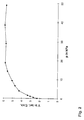
- Figure 2 shows an example of those achieved with the arrangement of Figure 1 Measurement results of various argon fill pressures.
- V the intensities of two spectral lines of argon with the wavelengths 763.5 nm and 738.4 nm in arbitrary units as a function of the argon filling pressure p in kPa in the sample vessel 1 from FIG. 1.
- the ratio initially increases steadily with the pressure. From the pressure remains at a pressure of approx. 20 kPa over a wide pressure range essentially constant. The reason for this is the limited to 49 kV Electrode voltage.
- the pressure can be with the arrangement Figure 1 and the process described up to an argon filling pressure of Determine approx. 20 kPa with an accuracy of 5%.
- FIG. 3 shows a schematic representation of an arrangement for Implementation of the procedure for the detection of impurities within the discharge vessel of a lamp.
- the arrangement consists of a Metal halide high-pressure discharge lamp 15, a high-frequency transmitter 16, which is connected to the electrodes of the lamp 15 and from a trigger pulse generator 17 is driven, a semi-transparent Mirror 18, two interference filters 19, 20 with subsequent ones Photodiode 21, 22 - the first interference filter 19 including the associated one Photo diode 21 of the transmitting and second interference filters 20 including the associated photodiode 22 of the reflecting side of the mirror 18 are facing -, a two-channel voltmeter connected to the photodiodes 21, 22 23 and a computer 24, which with the two channels of Voltmeters 23 is connected.
- a glow discharge low power typically a few tenths of a watt to a few watts, ignited.
- the ignition gas argon and any impurities that may be present stimulated to fluorescence within the lamp 15, on the other hand but a significant stimulation of the rest of the filling components of the Lamp prevented.
- the interference filters 19 and 20 are only for radiation in a range of ⁇ 2nm around the wavelength of approx. 738.5 nm or 772.4 nm transparent.
- the photodiodes 21, 22 each generate the intensity of the spectral radiation components corresponding voltage signals from the two channels of the voltmeter 23 are measured.
- the calculator 24 reads out the two channels, calculates the ratio of the corresponding channels Voltage values and uses them to determine a calibration value Dimension number. If the dimension figure lies within a tolerance range, the Lamp 15 the quality requirements. Otherwise, it becomes more unacceptable Contaminants sorted out as faulty.
Landscapes
- Health & Medical Sciences (AREA)
- Nuclear Medicine, Radiotherapy & Molecular Imaging (AREA)
- Physics & Mathematics (AREA)
- Life Sciences & Earth Sciences (AREA)
- Chemical & Material Sciences (AREA)
- Analytical Chemistry (AREA)
- Biochemistry (AREA)
- General Health & Medical Sciences (AREA)
- General Physics & Mathematics (AREA)
- Immunology (AREA)
- Pathology (AREA)
- Investigating Or Analysing Materials By Optical Means (AREA)
- Investigating, Analyzing Materials By Fluorescence Or Luminescence (AREA)
- Spectrometry And Color Measurement (AREA)
Description
In der US 4 759 630 ist eine Anordnung zur Bestimmung der Qualität von Glühlampen bekannt. Sie enthält ein Gerät zur Erzeugung einer Entladung zwischen der Glühwendel und einer auf der Außenwandung des Lampenkolbens aufgebrachten Elektrode sowie eine Vorrichtung zur Analyse der von der Entladung emittierten Strahlung im Wellenlängenbereich zwischen 550 nm und 570 nm. Die Lampenqualität wird durch das zeitliche Verhalten dieser Strahlung beurteilt, die optional mit der Strahlung im Wellenlängenbereich zwischen 660 nm und 680 nm verglichen wird.
| Anregungsenergien und entsprechende Wellenlängen der korrespondierenden optischen Übergänge für Argon und einige mögliche Verunreinigungen ("Quenchpartner"). | ||
| Komponente | Anregungsenergie in eV | Wellenlänge in nm |
| Ar | 13,07 | 811,5 |
| 13,30 | 738,4 | |
| H | 12,09 | 656,3 |
| N | 11,76 | 868,3 |
| 11,75 | 870,3 | |
| O | 10,74 | 777,2 |
| C | 9,17 | 833,5 |
| 8,85 | 909,4 | |
| 8,77 | 965,8 | |
| Si | 7,60 | 623,7 |
| 7,32 | 725,1 |
| Für Entladungslampen typische Verunreinigungen und für deren direkten Nachweis geeignete Wellenlängen. | |
| Verunreinigung | Wellenlänge in nm |
| H | 656,3 |
| HgH | 421,9 |
| O | 777,2 |
| N2 | 380,5; 357,7; 337,1 |
| CN | 388,4; 419,2 |
| CH | 388,9; 432,4; 431,4 |
| C2 | 516,5; 473,7; 468,48 |
| Si | 302,0; 300,7 |
| Re | 346,0 |
| W | 400,9 |
- Fig. 1
- eine schematische Darstellung einer Anordnung für den spektroskopischen Nachweis von Verunreinigungen sowie die Bestimmung des Gasdrucks in einem Probengefäß,
- Fig. 2
- das mit der Anordnung aus Figur 1 ermittelte Verhältnis der Intensitäten zweier Spektrallinien von Argon mit den Wellenlängen 763,5 nm und 738,4 nm als Funktion des Argonfülldrucks im Probengefäß 1,
- Fig.3
- eine schematische Darstellung einer Anordnung für den spektroskopischen Nachweis von Verunreinigungen innerhalb des Entladungsgefäßes einer Lampe.
Claims (38)
- Verfahren zum Nachweis von Verunreinigungen in Gasen, insbesondere Edelgasen, oder Gasgemischen für elektrische Lampen oder Strahler, wobei das Gas bzw. die Gaskomponenten des Gasgemisches und die darin ggf. enthaltenen Verunreinigungen mittels einer Gasentladung zur Aussendung elektromagnetischer Strahlung angeregt und zum Nachweis der Verunreinigungen die Intensität eines spektralen Anteils dieser Strahlung gemessen wird, dadurch gekennzeichnet, daß als spektraler Anteil gezielt mindestens eine Spektrallinie mit im relevanten Bereich weitgehend druckunabhängiger Intensität selektiert wird.
- Verfahren nach Anspruch 1, dadurch gekennzeichnet, daß gezielt diejenige(n) Spektrallinie(n) des Gases bzw. der Gaskomponente selektiert wird (werden), deren Wellenlänge(n) einer höheren Anregungsenergie entspricht (entsprechen) als jene der nachzuweisenden Verunreinigungen.
- Verfahren nach Anspruch 2, dadurch gekennzeichnet, daß, falls das Gas aus Argon besteht bzw. das Gasgemisch Argon enthält, eine oder mehrere der Spektrallinien von Argon mit den folgenden Wellenlängen selektiert wird bzw. werden: 738,4 nm, 772,4 nm, 811,5 nm.
- Verfahren nach Anspruch 1, dadurch gekennzeichnet, daß gezielt eine Spektrallinie der jeweiligen Verunreinigung selektiert wird, wobei die Intensität dieser Spektrallinie ein direktes Maß für die Konzentration der entsprechenden Verunreinigung ist.
- Verfahren nach Anspruch 1, dadurch gekennzeichnet, daß die Verunreinigungen eines oder eine Kombination der Moleküle N2, CN, CH oder C2 umfassen.
- Verfahren nach Anspruch 4 und 5, dadurch gekennzeichnet, daß die Spektrallinie eine Wellenlänge von 357,7 nm, 388,34 nm, 388,9 nm oder 468,48 nm bzw. 516,5 nm aufweist und jeweils ein spektraler Ausschnitt aus einer Molekularbande des zugehörigen Moleküls ist.
- Verfahren nach Anspruch 4 bis 6, dadurch gekennzeichnet, daß, falls das Gas aus Argon besteht bzw. das Gasgemisch Argon enthält, die spektrale Intensität der Verunreinigung auf die Intensität einer weitgehend druckunabhängigen Argonlinie normiert wird.
- Verfahren nach Anspruch 7, dadurch gekennzeichnet, daß die Wellenlänge der Argonlinie 738,4 nm beträgt.
- Verfahren nach einem oder mehreren der vorstehenden Ansprüche, dadurch gekennzeichnet, daß der Quotient der Intensitäten zweier Spektrallinien gebildet wird, wobei die beiden Spektrallinien eng benachbart sind, so daß Rauschsignale und gleichphasige Störsignale bei der Quotientenbildung weitgehend eliminiert werden.
- Verfahren nach Anspruch 9, dadurch gekennzeichnet, daß die Differenz der Wellenlänge beider Spektrallinien weniger als ca. 100 nm beträgt.
- Verfahren nach Anspruch 10, dadurch gekennzeichnet, daß die Differenz bevorzugt weniger als 50 nm beträgt.
- Verfahren nach Anspruch 9, dadurch gekennzeichnet, daß für die Quotientenbildung Spektrallinien mit Wellenlängen im Bereich zwischen 650 nm und 1000 nm selektiert werden.
- Verfahren nach Anspruch 11, dadurch gekennzeichnet, daß, falls das Gas aus Argon besteht bzw. das Gasgemisch Argon enthält, der Quotient aus den Intensitäten der Spektrallinien des Argons mit den Wellenlängen λ1 = 772,4nm und λ2 = 738,4nm gebildet wird.
- Verfahren nach Anspruch 1, dadurch gekennzeichnet, daß die Gasentladung im Glimmbereich betrieben wird.
- Verfahren nach Anspruch 1, dadurch gekennzeichnet, daß die Gasentladung mittels Hochfrequenz erzeugt wird.
- Verfahren nach einem oder mehreren der vorstehenden Ansprüche, dadurch gekennzeichnet, daß die Gasentladung im Innern einer Hochdruck-Entladungslampe erzeugt wird und daß außer der Höhe der Intensität mindestens einer Spektrallinie optional zusätzlich die Zeitdauer, bis die Intensität nach der Anlaufphase der Lampe ihren quasi stationären Wert erreicht hat gemessen wird, wobei aus der Höhe der Intensität und aus der Zeitdauer die Verunreinigung der Lampenfüllung sowie die Elektrodenqualität ermittelt werden.
- Verfahren nach einem oder mehreren der vorstehenden Ansprüche, dadurch gekennzeichnet, daß die Gasentladung im Innern einer Entladungslampe erzeugt wird und daß folgende zusätzliche Verfahrensschritte ausgeführt werden:um dadurch einen Referenzsatz kalibrierter Werte spektraler Intensitäten bzw. Intensitätsverhältnisse zu erstellen, für die spektroskopische Bewertung der Qualität derartiger Lampen.a) Ermitteln von elektrischen Parametern der Lampe, welche Parameter charakteristierend sind für die Funktionsfähigkeit und Performance der Lampe,b) Messen der Intensität mindestens einer Spektrallinie,c) Wiederholen der Schritte a) und b) für einige unterschiedlich verunreinigte Lampen, bevorzugt einschließlich Lampen, die aufgrund von Verunreinigungen schlecht bzw. nicht zünden sowie ggf. verzögert eine bzw. keine stabile Bogenentladung ausbilden und Zuordnung der elektrischen zu den entsprechenden spektroskopischen Werten,
- Verfahren zur Bestimmung des Drucks von Gasen, insbesondere Edelgasen, oder der Gaskomponenten von Gasgemischen für elektrische Lampen oder Strahler, wobei das Gas bzw. die Gaskomponenten mittels einer Gasentladung zur Aussendung elektromagnetischer Strahlung angeregt und aus der Intensität eines spektralen Anteils dieser Strahlung die Höhe des (Partial)Drucks ermittelt wird, dadurch gekennzeichnet, daß als spektraler Anteil der Strahlung gezielt mindestens eine Spektrallinie des Gases bzw. der Gaskomponente mit druckabhängiger Intensität selektiert wird, wobei aus der Intensität bzw. aus den Intensitäten der (Partial)Druck des Gases bzw. der entsprechenden Gaskomponente bestimmt wird.
- Verfahren nach Anspruch 18, dadurch gekennzeichnet, daß, falls das Gas aus Argon besteht bzw. das Gasgemisch Argon enthält, der (Partial)Druck des Argon aus der Intensität der Spektrallinie mit der Wellenlänge λ ≈ 763,5 nm bestimmt wird.
- Verfahren nach Anspruch 18, dadurch gekennzeichnet, daß der Druck aus dem Quotient der Intensitäten zweier Spektrallinie ermittelt wird, wobei die Intensität der zweiten Spektrallinie druckunabhängig ist und wobei die beiden Spektrallinien so eng benachbart sind, daß Rauschsignale und gleichphasige Störsignale bei der Quotientenbildung weitgehend eliminiert werden.
- Verfahren nach Anspruch 20, dadurch gekennzeichnet, daß die Differenz der Wellenlänge beider Spektrallinien weniger als ca. 100 nm beträgt.
- Verfahren nach Anspruch 21, dadurch gekennzeichnet, daß die Differenz bevorzugt weniger als 50 nm beträgt.
- Verfahren nach Anspruch 20, dadurch gekennzeichnet, daß, falls das Gas aus Argon besteht bzw. das Gasgemisch Argon enthält, zur Quotientenbildung insbesondere die Intensität der Spektrallinie des Argon mit der Wellenlänge 738,4 nm verwendet wird.
- Verfahren nach Anspruch 18, dadurch gekennzeichnet, daß die Entladung im Glimmbereich betrieben wird.
- Verfahren nach Anspruch 18, dadurch gekennzeichnet, daß die Gasentladung mittels Hochfrequenz erzeugt wird.
- Verfahren nach einem oder mehreren der vorstehenden Ansprüche, dadurch gekennzeichnet, daß das spektroskopische Verfahren zum Nachweis von Verunreinigungen in Gasen durch folgende zusätzliche Verfahrensschritte in das Fertigungsverfahren für Entladungslampen integriert wird:a) spektroskopische Messung mittels Probeentladung innerhalb des Gassystems der Lampenfertigungslinie, vor dem Füllen des Entladungsgefäßes der Lampe, zur Kontrolle des Gassystems auf Verunreinigungen,b)spektroskopische Messung mittels Probeentladung innerhalb des Entladungsgefäßes, nach dem Einsetzen der Elektroden in das Entladungsgefäß, zur Kontrolle des Elektrodensystems und der Wandung des Entladungsgefäßes auf Verunreinigungen,c) spektroskopische Messung mittels Probeentladung innerhalb des Entladungsgefäßes, nach dem Füllen und Verschließen des Entladungsgefäßes, zur Überprüfung, ob die Verunreinigungen im Innern der fertigen Lampe innerhalb eines vorgegebenen Toleranzbereichs liegen.
- Verfahren nach Anspruch 26, gekennzeichnet durch den folgenden zusätzlichen Verfahrensschritt d): spektroskopische Messung mittels Probeentladung innerhalb des Entladungsgefäßes, nach dem Füllen und Verschließen des Entladungsgefäßes, zur Überprüfung, ob der Kaltfülldruck im Innern der fertigen Lampe innerhalb eines vorgegebenen Toleranzbereichs liegt.
- Verfahren nach Anspruch 26, gekennzeichnet durch den folgenden zusätzlichen Verfahrensschritt e): Unterbrechen der Fertigung, vor dem Füllen und Verschließen des Entladungsgefäßes, falls die Meßwerte bei den Verfahrensschritten a) und/oder b) außerhalb eines vorgebbaren Toleranzbereichs liegen.
- Verfahren nach Anspruch 26 oder 27, gekennzeichnet durch den folgenden zusätzlichen Verfahrensschritt f): Aussortieren des betreffenden Entladungsgefäßes, falls die Meßwerte beim Verfahrensschritt c) und oder d) außerhalb eines vorgebbaren Toleranzbereichs liegen.
- Verfahren nach Anspruch 26, dadurch gekennzeichnet, daß die Probeentladung des Verfahrensschritts a) in einem mit der Vakuumringleitung verbundenen Probegefäß durchgeführt wird.
- Verfahren nach Anspruch 26 oder 27, dadurch gekennzeichnet, daß die Probeentladungen der Verfahrensschritte b) und c) und ggf. d) zwischen den Elektroden des Entladungsgefäßes durchgeführt werden.
- Anordnung zur Durchführung eines Verfahrens mit Merkmalen, die in den Ansprüchen 1 bis 17, 18 bis 25 oder 26 bis 31 beschrieben sind, gekennzeichnet durch ein Gefäß (1; 15), in dem sich das Gas bzw. Gasgemisch und die darin ggf. enthaltenen Verunreinigungen befinden, eine Energieversorgungseinheit (7; 16), welche über eine Einkoppelvorrichtung (3, 4, 5) mit dem Gefäß (1) verbunden ist und die Gasentladung erzeugt, eine spektroskopische Meßvorrichtung (12; 18-22), welche die Intensität(en) der Spektrallinie(n) mißt sowie eine Auswertevorrichtung (13; 23, 24), welche aus den Meßwerten die Konzentration der Verunreinigungen bzw. den (Partial)Druck des Gases oder der Gaskomponente ermittelt.
- Anordnung nach Anspruch 32, dadurch gekennzeichnet, daß die Energieversorgungseinheit aus einem Hochfrequenzsender (7; 16) besteht und daß die Einkoppelvorrichtung aus einem Hochspannungsübertrager (5) und zwei HF-Elektroden (3, 4) besteht, wobei die HF-Elektroden mit der Sekundärwicklung (8) und der Hochfrequenzsender (7) mit der Primärwicklung (6) des Hochspannungsübertrager (5) verbunden sind.
- Anordnung nach Anspruch 32, dadurch gekennzeichnet, daß das Gefäß aus einem Entladungsgefäß einer Entladungslampe (15) besteht, wobei im Innern des Entladungsgefäßes zwei Lampenelektroden angeordnet sind, die jeweils mit gasdicht nach außen führenden Stromzuführungen verbunden sind, die ihrerseits mit der Energieversorgungseinheit (16) verbunden sind, so daß die Lampenelektroden Bestandteil der Einkoppelvorrichtung sind.
- Anordnung nach Anspruch 33, dadurch gekennzeichnet, daß mindestens eine der HF-Elektroden (3, 4) auf der Außenwandung des Gefäßes angeordnet ist.
- Anordnung nach Anspruch 35, dadurch gekennzeichnet, daß das Gefäß aus dem Lampenkolben einer Glühlampe besteht, auf dessen Außenwandung eine erste HF-Elektrode angebracht ist, wobei im Innern des Kolbens eine Glühwendel angeordnet ist, die mit einer gasdicht nach außen führenden Stromzuführung verbunden ist, die ihrerseits mit dem Hochfrequenzsender verbunden ist, so daß die Glühwendel als zweite HF-Elektrode dient.
- Anordnung nach Anspruch 32, dadurch gekennzeichnet, daß die spektrale Meßvorrichtung aus einem Spektrometer mit Detektoren besteht, wobei mittels des Spektrometers die Strahlung in ihre spektralen Anteile zerlegt, diese den Detektoren zugeführt und von letzteren in ihrer Intensität entsprechende elektrische Signale gewandelt werden.
- Anordnung nach Anspruch 37, dadurch gekennzeichnet, daß die Auswertevorrichtung aus einem Rechner besteht, der die elektrische Signale einliest, weiterverarbeitet und als Ergebnis den Wert des Gasdrucks und oder die Konzentration der Verunreinigung(en) ausgibt.
Applications Claiming Priority (3)
| Application Number | Priority Date | Filing Date | Title |
|---|---|---|---|
| DE19505104 | 1995-02-15 | ||
| DE19505104A DE19505104A1 (de) | 1995-02-15 | 1995-02-15 | Verfahren und Anordnung zur Bestimmung der Reinheit und/oder des Drucks von Gasen für elektrische Lampen |
| PCT/DE1996/000232 WO1996025658A1 (de) | 1995-02-15 | 1996-02-14 | Verfahren und anordnung zur bestimmung der reinheit und/oder des drucks von gasen für elektrische lampen |
Publications (2)
| Publication Number | Publication Date |
|---|---|
| EP0809799A1 EP0809799A1 (de) | 1997-12-03 |
| EP0809799B1 true EP0809799B1 (de) | 1999-04-28 |
Family
ID=7754057
Family Applications (1)
| Application Number | Title | Priority Date | Filing Date |
|---|---|---|---|
| EP96902233A Expired - Lifetime EP0809799B1 (de) | 1995-02-15 | 1996-02-14 | Verfahren und anordnung zur bestimmung der reinheit und/oder des drucks von gasen für elektrische lampen |
Country Status (5)
| Country | Link |
|---|---|
| US (1) | US5920400A (de) |
| EP (1) | EP0809799B1 (de) |
| JP (1) | JPH10513566A (de) |
| DE (2) | DE19505104A1 (de) |
| WO (1) | WO1996025658A1 (de) |
Families Citing this family (16)
| Publication number | Priority date | Publication date | Assignee | Title |
|---|---|---|---|---|
| DE19651208C2 (de) * | 1996-12-10 | 1999-05-27 | Boehringer Ingelheim Kg | Verfahren und Vorrichtung zur zerstörungsfreien Dichtigkeitsprüfung von mit Flüssigkeit gefüllten Behältnissen |
| FI113805B (fi) * | 1998-04-03 | 2004-06-15 | Licentia Oy | Menetelmä ja laite kaasuseosten analysoimiseksi |
| FR2788854B1 (fr) | 1999-01-22 | 2001-05-04 | Cit Alcatel | Systeme et procede d'identification d'effluents gazeux, equipement pourvu d'un tel systeme |
| JP4024494B2 (ja) * | 2001-03-29 | 2007-12-19 | 大陽日酸株式会社 | ガス中の窒素測定方法及び装置 |
| US6594010B2 (en) * | 2001-07-06 | 2003-07-15 | Praxair Technology, Inc. | Emission spectrometer having a charge coupled device detector |
| US7184146B2 (en) | 2003-06-24 | 2007-02-27 | Cardinal Ig Company | Methods and apparatus for evaluating insulating glass units |
| US20040266013A1 (en) * | 2003-06-30 | 2004-12-30 | Erickson Gene P. | Standard insulating glass units having known concentrations of a gas and methods for calibrating a measuring device using the standard insulating glass units |
| US20070103686A1 (en) * | 2005-11-08 | 2007-05-10 | Niklas Tornkvist | Apparatus for non-invasive analysis of gas compositions in insulated glass panes |
| US7508521B2 (en) * | 2007-03-14 | 2009-03-24 | Spectrasensors, Inc. | Pressure-invariant trace gas detection |
| DE102010004083A1 (de) * | 2009-06-03 | 2010-12-09 | Global Navigation Systems Gns - Gmbh | Vorrichtung zum zerstörungsfreien Bestimmen von Gaseigenschaften in einem geschlossenen Gefäß, zugehöriges Verfahren und Gefäß, welches mit dem Verfahren bearbeitet wurde |
| DE102009057130A1 (de) * | 2009-12-08 | 2011-06-09 | Heinrich-Heine-Universität Düsseldorf | Verfahren zur Analyse der Zusammensetzung von Gasgemischen |
| DE102011050171A1 (de) | 2011-05-06 | 2012-11-08 | Heinrich-Heine-Universität Düsseldorf | Verfahren und Anordnung zum Detektieren eines ersten Gases in einem wenigstens ein weiteres Gas umfassenden Gasgemisch |
| KR101417944B1 (ko) | 2013-03-13 | 2014-07-10 | 지투산업 주식회사 | 복층유리의 가스농도 측정 장치 |
| JP6613402B2 (ja) * | 2015-03-13 | 2019-12-04 | Vista株式会社 | 真空排気監視装置 |
| CN105181676A (zh) * | 2015-09-29 | 2015-12-23 | 内蒙古包钢钢联股份有限公司 | 一种辉光光谱仪测定镀锌板镀层深度和镀层质量的方法 |
| RU2687179C1 (ru) * | 2018-07-20 | 2019-05-07 | Александр Валентинович Озаренко | Способ определения давления в кольцевых лазерных гироскопах |
Family Cites Families (15)
| Publication number | Priority date | Publication date | Assignee | Title |
|---|---|---|---|---|
| US3292988A (en) * | 1966-12-20 | Apparatus for surveillance of arc discharge lamps | ||
| US2509649A (en) * | 1947-06-17 | 1950-05-30 | New England Spectrochemical La | Spectrographic treatment of organic materials |
| US3902808A (en) * | 1974-07-12 | 1975-09-02 | Robert A Young | Device for spectroscopic measurements of gas composition after addition of helium |
| US3996010A (en) * | 1974-11-29 | 1976-12-07 | Searle Cardio-Pulmonary Systems Inc. | Breathing gas analyzer |
| DD149959A1 (de) * | 1980-04-01 | 1981-08-05 | Kurt Mauersberger | Verfahren zur spektrophotometrischen bestimmung kleiner gasfoermiger stoffmengen |
| DE3131210A1 (de) * | 1981-08-06 | 1983-02-24 | Siemens AG, 1000 Berlin und 8000 München | Lampenpruefung auf lufteinbrueche in den glaskolben |
| NL8601954A (nl) * | 1985-07-31 | 1987-02-16 | Toshiba Kk | Apparaat en werkwijze voor het beoordelen van de kwaliteit van een elektrische lamp. |
| US4801209A (en) * | 1986-01-17 | 1989-01-31 | The Boc Group, Inc. | Process and apparatus for analyzing a gaseous mixture and a visible emission spectrum generator therefor |
| ZA8792B (en) * | 1986-01-17 | 1987-10-28 | Boc Group Inc | Process and apparatus for analyzing a gaseous mixture and a visible emission spectra generator therefor |
| CH675773A5 (de) * | 1988-03-31 | 1990-10-31 | Sulzer Ag | |
| US4898465A (en) * | 1989-01-30 | 1990-02-06 | Medical Graphics Corporation | Gas analyzer apparatus |
| DE3911965A1 (de) * | 1989-04-12 | 1990-10-18 | Krupp Gmbh | Verfahren zur bestimmung des konzentrationsverhaeltnisses zweier elemente eines stoffs aus dem intensitaetsverhaeltnis zweier spektrallinien dieser elemente in einem plasma dieses stoffs |
| US5383019A (en) * | 1990-03-23 | 1995-01-17 | Fisons Plc | Inductively coupled plasma spectrometers and radio-frequency power supply therefor |
| DE4034962C1 (en) * | 1990-11-02 | 1992-06-04 | Rainer 8027 Neuried De Pippig | Quality control testing procedure for incandescent lamps - subjecting bulb to acceleration and measuring resultant change in resistance of filament |
| US5412467A (en) * | 1993-03-24 | 1995-05-02 | Praxair Technology, Inc. | Gas emission spectrometer and method |
-
1995
- 1995-02-15 DE DE19505104A patent/DE19505104A1/de not_active Withdrawn
-
1996
- 1996-02-14 WO PCT/DE1996/000232 patent/WO1996025658A1/de not_active Ceased
- 1996-02-14 US US08/860,805 patent/US5920400A/en not_active Expired - Fee Related
- 1996-02-14 EP EP96902233A patent/EP0809799B1/de not_active Expired - Lifetime
- 1996-02-14 JP JP8524578A patent/JPH10513566A/ja not_active Ceased
- 1996-02-14 DE DE59601776T patent/DE59601776D1/de not_active Expired - Fee Related
Also Published As
| Publication number | Publication date |
|---|---|
| JPH10513566A (ja) | 1998-12-22 |
| US5920400A (en) | 1999-07-06 |
| EP0809799A1 (de) | 1997-12-03 |
| DE59601776D1 (de) | 1999-06-02 |
| DE19505104A1 (de) | 1996-08-22 |
| WO1996025658A1 (de) | 1996-08-22 |
Similar Documents
| Publication | Publication Date | Title |
|---|---|---|
| EP0809799A1 (de) | Verfahren und anordnung zur bestimmung der reinheit und/oder des drucks von gasen für elektrische lampen | |
| US7381973B2 (en) | Analyzer system and method incorporating excimer UV fluorescence detection | |
| EP3553499B1 (de) | Gasanalysator und verfahren zur messung von stickoxiden in einem abgas | |
| CH702387A2 (de) | Brennersystem mit einem Verunreinigungsdetektionssystem. | |
| DE19853049C2 (de) | Vorrichtung und Verfahren zum Feststellen eines Lecks sowie Verwendung einer solchen Vorrichtung für die Lecksuche | |
| EP2082221A1 (de) | Verfahren und vorrichtung zur erzeugung von positiv und/oder negativ ionisierten gasanalyten für die gasanalyse | |
| DE4341462C2 (de) | Verfahren zur Bestimmung der Materialzusammensetzung von Proben und Vorrichtung zur Durchführung des Verfahrens | |
| DE102009057130A1 (de) | Verfahren zur Analyse der Zusammensetzung von Gasgemischen | |
| DE102009004398A1 (de) | Gasanalyse-Verfahren sowie Gasanalyse-Vorrichtung | |
| DE19651208C2 (de) | Verfahren und Vorrichtung zur zerstörungsfreien Dichtigkeitsprüfung von mit Flüssigkeit gefüllten Behältnissen | |
| Chen et al. | Excitation of the B Π g 3 states of N 2 by electron impact | |
| DE102011002080A1 (de) | Vorrichtung und Verfahren zur Bestimmung der Konzentration von Fluorophoren in einer Probe | |
| EP1068515A1 (de) | Verfahren und vorrichtung zur analyse von gaszusammenstellungen | |
| JP3309491B2 (ja) | 蛍光ランプの検査方法 | |
| RU2222002C2 (ru) | Способ оценки степени термического старения изоляционной бумаги | |
| DE102015210123B4 (de) | Messsystem zur Gasanalyse sowie Verfahren zur Gasanalyse | |
| JPS6332213B2 (de) | ||
| DE3131210A1 (de) | Lampenpruefung auf lufteinbrueche in den glaskolben | |
| DE19602145A1 (de) | Meßverfahren für lumineszierende Proben | |
| WO2012152621A1 (de) | Verfahren und anordnung zum detektieren eines ersten gases in einem wenigstens ein weiteres gas umfassenden gasgemisch | |
| DE102006027968A1 (de) | Vorrichtung zum Prüfen eines Gases, Verwendung einer solchen Vorrichtung und Verfahren zum Umrüsten einer Produktionsanlage | |
| JPH0778564A (ja) | 蛍光ランプ検査方法 | |
| WO2022207396A1 (de) | Vorrichtung und verfahren zur plasmaerzeugung in einem grossen druckbereich sowie system und verfahren zur optischen gasanalyse/-detektion mittels einer solchen vorrichtung | |
| DD298709A5 (de) | Verfahren zum nachweis von sauerstoff in gluehlampen | |
| DE1648893C3 (de) | Vorrichtung zur Bestimmung der spezifischen atomaren Absorption |
Legal Events
| Date | Code | Title | Description |
|---|---|---|---|
| PUAI | Public reference made under article 153(3) epc to a published international application that has entered the european phase |
Free format text: ORIGINAL CODE: 0009012 |
|
| 17P | Request for examination filed |
Effective date: 19970806 |
|
| AK | Designated contracting states |
Kind code of ref document: A1 Designated state(s): BE DE GB |
|
| GRAG | Despatch of communication of intention to grant |
Free format text: ORIGINAL CODE: EPIDOS AGRA |
|
| 17Q | First examination report despatched |
Effective date: 19980522 |
|
| GRAG | Despatch of communication of intention to grant |
Free format text: ORIGINAL CODE: EPIDOS AGRA |
|
| GRAH | Despatch of communication of intention to grant a patent |
Free format text: ORIGINAL CODE: EPIDOS IGRA |
|
| GRAH | Despatch of communication of intention to grant a patent |
Free format text: ORIGINAL CODE: EPIDOS IGRA |
|
| GRAA | (expected) grant |
Free format text: ORIGINAL CODE: 0009210 |
|
| AK | Designated contracting states |
Kind code of ref document: B1 Designated state(s): BE DE GB |
|
| REF | Corresponds to: |
Ref document number: 59601776 Country of ref document: DE Date of ref document: 19990602 |
|
| GBT | Gb: translation of ep patent filed (gb section 77(6)(a)/1977) |
Effective date: 19990625 |
|
| PLBE | No opposition filed within time limit |
Free format text: ORIGINAL CODE: 0009261 |
|
| STAA | Information on the status of an ep patent application or granted ep patent |
Free format text: STATUS: NO OPPOSITION FILED WITHIN TIME LIMIT |
|
| 26N | No opposition filed | ||
| REG | Reference to a national code |
Ref country code: GB Ref legal event code: IF02 |
|
| PGFP | Annual fee paid to national office [announced via postgrant information from national office to epo] |
Ref country code: GB Payment date: 20030206 Year of fee payment: 8 |
|
| PGFP | Annual fee paid to national office [announced via postgrant information from national office to epo] |
Ref country code: BE Payment date: 20030211 Year of fee payment: 8 |
|
| PGFP | Annual fee paid to national office [announced via postgrant information from national office to epo] |
Ref country code: DE Payment date: 20030417 Year of fee payment: 8 |
|
| PG25 | Lapsed in a contracting state [announced via postgrant information from national office to epo] |
Ref country code: GB Free format text: LAPSE BECAUSE OF NON-PAYMENT OF DUE FEES Effective date: 20040214 |
|
| PG25 | Lapsed in a contracting state [announced via postgrant information from national office to epo] |
Ref country code: BE Free format text: LAPSE BECAUSE OF NON-PAYMENT OF DUE FEES Effective date: 20040228 |
|
| BERE | Be: lapsed |
Owner name: *PATENT-TREUHAND-G.- FUR ELEKTRISCHE GLUHLAMPEN M. Effective date: 20040228 |
|
| PG25 | Lapsed in a contracting state [announced via postgrant information from national office to epo] |
Ref country code: DE Free format text: LAPSE BECAUSE OF NON-PAYMENT OF DUE FEES Effective date: 20040901 |
|
| GBPC | Gb: european patent ceased through non-payment of renewal fee |
Effective date: 20040214 |