EP0809734B2 - Procede pour ameliorer la douceur de parties de papier soie a haute densite de volume - Google Patents
Procede pour ameliorer la douceur de parties de papier soie a haute densite de volume Download PDFInfo
- Publication number
- EP0809734B2 EP0809734B2 EP96905295A EP96905295A EP0809734B2 EP 0809734 B2 EP0809734 B2 EP 0809734B2 EP 96905295 A EP96905295 A EP 96905295A EP 96905295 A EP96905295 A EP 96905295A EP 0809734 B2 EP0809734 B2 EP 0809734B2
- Authority
- EP
- European Patent Office
- Prior art keywords
- web
- paper
- tissue paper
- tissue
- wet
- Prior art date
- Legal status (The legal status is an assumption and is not a legal conclusion. Google has not performed a legal analysis and makes no representation as to the accuracy of the status listed.)
- Expired - Lifetime
Links
Images

Classifications
-
- D—TEXTILES; PAPER
- D21—PAPER-MAKING; PRODUCTION OF CELLULOSE
- D21H—PULP COMPOSITIONS; PREPARATION THEREOF NOT COVERED BY SUBCLASSES D21C OR D21D; IMPREGNATING OR COATING OF PAPER; TREATMENT OF FINISHED PAPER NOT COVERED BY CLASS B31 OR SUBCLASS D21G; PAPER NOT OTHERWISE PROVIDED FOR
- D21H23/00—Processes or apparatus for adding material to the pulp or to the paper
- D21H23/02—Processes or apparatus for adding material to the pulp or to the paper characterised by the manner in which substances are added
- D21H23/22—Addition to the formed paper
- D21H23/24—Addition to the formed paper during paper manufacture
- D21H23/26—Addition to the formed paper during paper manufacture by selecting point of addition or moisture content of the paper
-
- D—TEXTILES; PAPER
- D21—PAPER-MAKING; PRODUCTION OF CELLULOSE
- D21H—PULP COMPOSITIONS; PREPARATION THEREOF NOT COVERED BY SUBCLASSES D21C OR D21D; IMPREGNATING OR COATING OF PAPER; TREATMENT OF FINISHED PAPER NOT COVERED BY CLASS B31 OR SUBCLASS D21G; PAPER NOT OTHERWISE PROVIDED FOR
- D21H17/00—Non-fibrous material added to the pulp, characterised by its constitution; Paper-impregnating material characterised by its constitution
- D21H17/03—Non-macromolecular organic compounds
- D21H17/05—Non-macromolecular organic compounds containing elements other than carbon and hydrogen only
- D21H17/06—Alcohols; Phenols; Ethers; Aldehydes; Ketones; Acetals; Ketals
-
- D—TEXTILES; PAPER
- D21—PAPER-MAKING; PRODUCTION OF CELLULOSE
- D21H—PULP COMPOSITIONS; PREPARATION THEREOF NOT COVERED BY SUBCLASSES D21C OR D21D; IMPREGNATING OR COATING OF PAPER; TREATMENT OF FINISHED PAPER NOT COVERED BY CLASS B31 OR SUBCLASS D21G; PAPER NOT OTHERWISE PROVIDED FOR
- D21H17/00—Non-fibrous material added to the pulp, characterised by its constitution; Paper-impregnating material characterised by its constitution
- D21H17/20—Macromolecular organic compounds
- D21H17/33—Synthetic macromolecular compounds
- D21H17/46—Synthetic macromolecular compounds obtained otherwise than by reactions only involving carbon-to-carbon unsaturated bonds
- D21H17/53—Polyethers; Polyesters
-
- D—TEXTILES; PAPER
- D21—PAPER-MAKING; PRODUCTION OF CELLULOSE
- D21H—PULP COMPOSITIONS; PREPARATION THEREOF NOT COVERED BY SUBCLASSES D21C OR D21D; IMPREGNATING OR COATING OF PAPER; TREATMENT OF FINISHED PAPER NOT COVERED BY CLASS B31 OR SUBCLASS D21G; PAPER NOT OTHERWISE PROVIDED FOR
- D21H21/00—Non-fibrous material added to the pulp, characterised by its function, form or properties; Paper-impregnating or coating material, characterised by its function, form or properties
- D21H21/06—Paper forming aids
- D21H21/10—Retention agents or drainage improvers
-
- D—TEXTILES; PAPER
- D21—PAPER-MAKING; PRODUCTION OF CELLULOSE
- D21H—PULP COMPOSITIONS; PREPARATION THEREOF NOT COVERED BY SUBCLASSES D21C OR D21D; IMPREGNATING OR COATING OF PAPER; TREATMENT OF FINISHED PAPER NOT COVERED BY CLASS B31 OR SUBCLASS D21G; PAPER NOT OTHERWISE PROVIDED FOR
- D21H21/00—Non-fibrous material added to the pulp, characterised by its function, form or properties; Paper-impregnating or coating material, characterised by its function, form or properties
- D21H21/14—Non-fibrous material added to the pulp, characterised by its function, form or properties; Paper-impregnating or coating material, characterised by its function, form or properties characterised by function or properties in or on the paper
- D21H21/18—Reinforcing agents
Definitions
- the present invention relates to a process for making soft tissue papers, in particular pattern densified tissue papers, having an enhanced tactile sense of softness. This process particularly relates to tissue papers treated with water-soluble polyhydroxy compounds.
- Paper webs or sheets sometimes called tissue or paper tissue webs or sheets, find extensive use in modern society. These include such staple items as paper towels, facial tissues and sanitary (or toilet) tissues. These paper products can have various desirable properties, including wet and dry tensile strength, absorbency for aqueous fluids (e.g., wettability), low lint properties, desirable bulk, and softness. The particular challenge in papermaking has been to appropriately balance these various properties to provide superior tissue paper.
- Softness is the tactile sensation perceived by the consumer who holds a particular paper product, rubs it across the skin, and crumples It within the hand.
- Such tactile perceivable softness can be characterized by, but is not limited to, friction, flexibility, and smoothness, as well as subjective descriptors, such as a feeling like velvet, silk or flannel.
- This tactile sensation is a combination of several physical properties, including the flexibility or stiffness of the sheet of paper, the frictional properties of the web, as well as the texture of the surface of the paper.
- Stiffness of paper is typically affected by efforts to increase the dry and/or wet tensile strength of the web.
- Increases in dry tensile strength can be achieved either by mechanical processes to insure adequate formation of hydrogen bonding between the hydroxyl groups of adjacent papermaking fibers, or by the inclusion of certain dry strength additives.
- Wet strength is typically enhanced by the inclusion of certain wet strength resins, that, being typically cationic, are easily deposited on and retained by the anionic carboxyl groups of the papermaking fibers.
- the use of both mechanical and chemical means to improve dry and wet tensile strength can also result in stiffer, harsher feeling, less soft tissue papers.
- debonding agents Certain chemical additives, commonly referred to as debonding agents, can be added to papermaking fibers to interfere with the natural fiber-to-fiber bonding that occurs during sheet formation and drying, and thus lead to softer papers.
- debonding agents are typically cationic and have certain disadvantages associated with their use in softening tissue papers.
- Some low molecular weight cationic debonding agents can cause excessive irritation upon contact with human skin.
- Higher molecular weight cationic debonding agents can be more difficult to apply at low levels to tissue paper, and also tend to have undesirable hydrophobic effects on the tissue paper, e.g., result in decreased absorbency and particularly wettability.
- these cationic debonding agents operate by disrupting interfiber bonding, they can also decrease tensile strength to such an extent that resins, latex, or other dry strength additives can be required to provide acceptable levels of tensile strength. These dry strength additives not only increase the cost of the tissue paper but can also have other, deleterious effects on tissue softness. In addition, many cationic debonding agents are not biodegradable, and therefore can adversely impact on environmental quality.
- cationic debonding agents include conventional quaternary ammonium compounds such as the well known dialkyl dimethyl ammonium salts (e.g. ditallow dimethyl ammonium chloride, ditallow dimethyl ammonium methyl sulfate, di(hydrogenated) tallow dimethyl ammonium chloride etc).
- dialkyl dimethyl ammonium salts e.g. ditallow dimethyl ammonium chloride, ditallow dimethyl ammonium methyl sulfate, di(hydrogenated) tallow dimethyl ammonium chloride etc.
- these cationic quaternary ammonium compounds soften the paper by interfering with the natural fiber-to-fiber bonding that occurs during sheet formation and drying.
- these quaternary ammonium compounds also tend to have undesirable hydrophobic effects on the tissue paper, e.g., resulting in decreased absorbency and wettability.
- Mechanical pressing operations are typically applied to tissue paper webs to dewater them and/or increase their tensile strength. Mechanical pressing can occur over the entire area of the paper web, such as in the case of conventional felt-pressed paper. More preferably, dewatering is carried out in such a way that the paper is pattern densified. Pattern densified paper has certain densified areas of relatively high fiber density, as well as relatively low fiber density, high bulk areas. Such high bulk pattern densified papers are typically formed from a partially dried paper web that has densified areas imparted to it by a foraminous fabric having a patterned displacement of knuckles.
- patterned densification processes Besides tensile strength and bulk, another advantage of such patterned densification processes is that ornamental patterns can be imprinted on the tissue paper.
- an inherent problem of patterned densification processes is that the fabric side of the tissue paper, i.e. the paper surface in contact with the foraminous fabric during papermaking, is sensed as rougher than the side not in contact with the fabric. This is due to the high bulk fields that form, in essence, protrusions outward from the surface of the paper. It is these protrusions that can impart a tactile sensation of roughness.
- silicone oils are hydrophobic and can adversely affect the surface wettabllity of the treated tissue paper, i.e. the treated tissue paper can float, thus causing disposal problems in sewer systems when flushed.
- silicone softened papers can require treatment with other surfactants to offset this reduction in wettability caused by the silicone. See US-A-5,059,282 (Ampulski et al), issued October 22, 1991.
- Tissue paper has also been treated with softeners by "dry web” addition methods.
- One such method involves moving the dry paper across one face of a shaped block of wax-like softener that is then deposited on the paper surface by a rubbing action.
- softeners include stearate soaps such as zinc stearate, stearic acid esters, stearyl alcohol, polyethylene glycols such as Carbowax, and polyethylene glycol esters of stearic and lauric acids).
- Another such method involves dipping the dry paper in a solution or emulsion containing the softening agent.
- softeners e.g., the pyromellitate esters of the '065 patent
- co-additives e.g., dimethyl distearyl ammonium chloride of the '532 patent
- tissue paper webs comprising papermaking fibres, biodegradable quatemized amine-ester softening compound, wetting agent and permanent wet strength agent.
- US-A-4 795 530 discloses the selective treatment of a face surface of a cellulosic fibrous web with a dilute aqueous solution of a chemical debonding agent.
- US-A-4 853 086 issued on 1 st August, 1989, relates to a process of treating a wet or partially dried cellulosic fibre web with an aqueous solution of a glycol and an aldehyde. It Is claimed that the products made by this process have an increased absorbency rate and higher water holding capacity.
- tissue paper in particular high bulk, pattern densified tissue papers
- a process that: (1) uses a "wet web” method for adding the softening agent; (2) can be carried out in a commercial papermaking system without significantly impacting on machine operability; (3) uses softeners that are nontoxic and biodegradable; and (4) can be carried out in a manner so as to maintain desirable tensile strength, absorbency and low lint properties of the tissue paper.
- the present invention relates to a process for making softened tissue papers as described in claim 1.
- these nonionic polyhydroxy compounds have high rates of retention even in the absence of cationic retention aids or debonding agents when applied to wet tissue paper webs in accordance with the process disclosed herein This is especially unexpected because the polyhydroxy compounds are applied to the wet webs under conditions wherein they are not ionically substantive to the cellulose fibers. Importantly, the wet web process allows the polyhydroxy compounds to migrate to the interior of the paper web where they act to enhance the tissue paper absorbency and softness.
- tissue softening benefits can be achieved by much lower levels of these polyhydroxy compounds when applied to a wet web, as compared to a dry web (e.g., during the converting operation).
- an important feature of the process disclosed herein is that the polyhydroxy compound level is low enough to be economical.
- Tissue paper softened according to the present invention has good flexibility It is especially useful in softening high bulk, pattern densified tissue papers, Including tissue papers having patterned designs. Surprisingly, even when the softener is applied only to the smoother (i.e., wire) side of such pattern densified papers, the treated paper is still perceived as soft.
- the present invention can be carried out in a commercial papermaking system without significantly impacting on machine operability, including speed.
- the improved softness benefits of the present invention can also be achieved while maintaining the desirable tensile strength, absorbency (e.g., wettabllity), and low lint properties of the paper. All percentages, ratios and proportions herein are by weight unless otherwise specified.
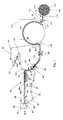
- Figure 1 is a schematic representation of a papermaking machine useful for making pattern densified tissue paper in accordance with the present invention
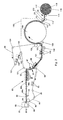
- FIG 2 is a schematic representation of a papermaking machine useful for making pattern densified tissue paper in accordance with the present invention, wherein the treatment chemicals contemplated for use herein are applied by an alternate method to that shown in Figure 1.
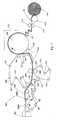
- Figure 3 is a schematic representation of a papermaking machine useful for making conventionally pressed tissue paper in accordance with the present invention.
- Figure 4 is a schematic representation of a papermaking machine useful for making conventionally pressed tissue paper in accordance with the present invention, wherein the treatment chemicals contemplated for use herein are applied by an alternate method to that shown in Figure 3.
- the term “comprising” means that the various components, ingredients, or steps, can be conjointly employed in practicing the present invention. Accordingly, the term “comprising” encompasses the more restrictive terms “consisting essentially of” and “consisting of.
- tissue paper web, paper web, web, paper sheet and paper product all refer to sheets of paper made by a process comprising the steps of forming an aqueous papermaking furnish, depositing this furnish on a foraminous surface, such as a Fourdrinier wire, and removing the water from the furnish as by gravity or vacuum-assisted drainage, with or without pressing, and by evaporation.
- an aqueous papermaking furnish is an aqueous slurry of papermaking fibers and the chemicals described hereinafter.
- the term “consistency” refers to the weight percentage of the cellulosic paper making fibers (i.e., pulp) in the wet tissue web. It is expressed as a weight percentage of this fibrous material, in the wet web, in terms of air dry fiber weight divided by the weight of the wet web.
- the first step in the process of this invention is the forming of an aqueous papermaking furnish.
- the furnish comprises papermaking fibers (hereinafter sometimes referred to as wood pulp). It is anticipated that wood pulp in all its varieties will normally comprise the papermaking fibers used in this invention. However, other cellulose fibrous pulps, such as cotton liners, bagasse, rayon, etc., can be used and none are disclaimed.
- Wood pulps useful herein include chemical pulps such as Kraft, sulfite and sulfate pulps as well as mechanical pulps including for example, ground wood, thermomechanical pulps and chemically modified thermomechanical pulp (CTMP). Pulps derived from both deciduous and coniferous trees can be used.
- CMP chemically modified thermomechanical pulp
- fibers derived from recycled paper which may contain any or all of the above categories as well as other non-fibrous materials such as fillers and adhesives used to facilitate the original papermaking.
- the papermaking fibers used in this invention comprise Kraft pulp derived from northern softwoods and/or tropical hardwoods.
- the aqueous papermaking furnish is formed into a wet web on a foraminous forming carrier, such as a Fourdrinier wire, as will be discussed hereinafter.
- the tissue paper made by the process of the present invention contains from 0.1% to 2.0%, more preferably from about 0.1% to about 1.0%, of awater soluble polyhydroxy compound, based on the dry fiber weight of the tissue paper.
- Water soluble polyhydroxy compounds suitable for use in the present invention are glycerol, polyglycerols having a weight average molecular weight of from about 150 to about 800 and polyoxyethylene and polyoxypropylene having a weight-average molecular weight of from about 200 to about 4000, preferably from about 200 to about 1000, most preferably from about 200 to about 600. Polyoxyethylene having an weight average molecular weight of from about 200 to about 600 are especially preferred. Mixtures of the above-described polyhydroxy compounds may also be used. For example, mixtures of glycerol and polyglycerols, mixtures of glycerol and polyoxyethylenes, mixtures of polyglycerols and polyoxyethylenes, etc... are useful in the present invention.
- a particularly preferred polyhydroxy compound is polyoxyethylene having an weight average molecular weight of about 400. This material is available commercially from the Union Carbide Company of Danbury, Connecticut under the trade name "PEG-400".
- the present invention is applicable to tissue paper in general, including but not limited to conventionally felt-pressed tissue paper; pattern densified tissue paper such as exemplified in the aforementioned U.S. Patent by Sanford-Sisson and its progeny; and high bulk, uncompacted tissue paper such as exemplified by US -A-3,812,000, Salvucci, Jr., issued May 21, 1974.
- the tissue paper may be of a homogenous or multi-layered construction; and tissue paper products made therefrom may be of a single-ply or multi-ply construction. Tissue structures formed from layered paper webs are described In US-A-3,994,771, Morgan, Jr. et al.
- a wet-laid composite, soft, bulky and absorbent paper structure is prepared from two or more layers of furnish which are preferably comprised of different fiber types
- the layers are preferably formed from the deposition of separate streams of dilute fiber slurries, the fibers typically being relatively long softwood and relatively short hardwood fibers as used in tissue papermaking, upon one or more endless foraminous screens.
- the layers are subsequently combined to form a layered composite web.
- the layered web is subsequently caused to conform to the surface of an open mesh drying/imprinting fabric by the application of a fluid force to the web and thereafter thermally predried on said fabric as part of a low density papermaking process.
- the layered web may be stratified with respect to fiber type or the fiber content of the respective layers may be essentially the same.
- the tissue paper has a basis weight of between 10 g/m 2 and 65 g/m 2 , and density of 0.60 g/cc or less.
- basis weight will be below about 35 g/m 2 or less; and density will be about 0.30 g/cc or less.
- density will be between 0.04 g/cc and about 0.20 g/cc.
- Such paper is typically made by depositing papermaking furnish on a foraminous forming wire.
- This forming wire is often referred to in the art as a Fourdrinier wire.
- the web is dewatered by pressing the web and drying at elevated temperature.
- the particular techniques and typical equipment for making webs according to the process just described are well known to those skilled in the art.
- a low consistency pulp furnish is provided in a pressurized headbox.
- the headbox has an opening for delivering a thin deposit of pulp furnish onto the Fourdrinier wire to form a wet web.
- the web is then typically dewatered to a fiber consistency of between about 7% and about 25% (total web weight basis) by vacuum dewatering and further dried by pressing operations wherein the web is subjected to pressure developed by opposing mechanical members, for example, cylindrical rolls.
- the dewatered web is then further pressed and dried by a steam heated drum apparatus known in the art as a Yankee dryer. Pressure can be developed at the Yankee dryer by mechanical means such as an opposing cylindrical drum pressing against the web. Vacuum may also be applied to the web as It is pressed against the Yankee surface. Multiple Yankee dryer drums may be employed, whereby additional pressing is optionally incurred between the drums.
- the tissue paper structures which are formed are referred to hereinafter as conventional, pressed, tissue paper structures. Such sheets are considered to be compacted since the web is subjected to substantial overall mechanical compressional forces while the fibers are moist and are then dried (and optionally creped) while in a compressed state.
- Pattern densified tissue paper is characterized by having a relatively high bulk field of relatively low fiber density and an array of densifled zones of relatively high fiber density.
- the high bulk field is alternatively characterized as a field of pillow regions.
- the densified zones are alternatively referred to as knuckle regions.
- the densified zones may be discretely spaced within the high bulk field or may be interconnected, either fully or partially, within the high bulk field.
- Preferred processes for making pattern densified tissue webs are disclosed in US-A-3,301,746, issued to Sanford and Sisson on January 31, 1967, US-A-3,974,025, issued to Peter G. Ayers on August 10, 1976, and US-A-4,191,609, issued to Paul D.
- pattern densified webs are preferably prepared by depositing a papermaking furnish on a foraminous forming wire such as a Fourdrinier wire to form a wet web and then juxtaposing the web against an array of supports. The web is pressed against the array of supports, thereby resulting in densified zones in the web at the locations geographically corresponding to the points of contact between the array of supports and the wet web. The remainder of the web not compressed during this operation is referred to as the high bulk field.
- This high bulk field can be further dedensified by application of fluid pressure, such as with a vacuum type device or a blow-through dryer.
- the web is dewatered, and optionally predried, in such a manner so as to substantially avoid compression of the high bulk field This is preferably accomplished by fluid pressure, such as with a vacuum type device or blow-through dryer, or alternately by mechanically pressing the web against an array of supports wherein the high bulk field is not compressed.
- fluid pressure such as with a vacuum type device or blow-through dryer
- the operations of dewatering, optional predrying and formation of the densified zones may be integrated or partially integrated to reduce the total number of processing steps performed. Subsequent to formation of the densified zones, dewatering, and optional predrying, the web is dried to completion, preferably still avoiding mechanical pressing.
- the tissue paper surface comprises densified knuckles having a relative density of at least 125% of the density of the high bulk field.
- the array of supports is preferably an imprinting carrier fabric having a patterned displacement of knuckles which operate as the array of supports which facilitate the formation of the densified zones upon application of pressure.
- the pattern of knuckles constitutes the array of supports previously referred to. Imprinting carrier fabrics are disclosed in US-A-3,301,746, Sanford and Sisson, issued January 31, 1967, US-A-3,821,068, Salvucci, Jr.
- the furnish is first formed into a wet web on a foraminous forming carrier, such as a Fourdrinierwire.
- the web is dewatered and transferred to an imprinting fabric.
- the furnish may alternately be initially deposited on a foraminous supporting carrier which also operates as an imprinting fabric.
- the wet web is dewatered and, preferably, thermally predried to a selected fiber consistency of between about 40% and about 80%.
- Dewatering can be performed with suction boxes or other vacuum devices or with blow-through dryers.
- the knuckle imprint of the imprinting fabric is impressed in the web as discussed above, prior to drying the web to completion.
- One method for accomplishing this is through application of mechanical pressure. This can be done, for example, by pressing a nip roll which supports the imprinting fabric against the face of a drying drum, such as a Yankee dryer, wherein the web is disposed between the nip roll and drying drum.
- the web is molded against the imprinting fabric prior to completion of drying by application of fluid pressure with a vacuum device such as a suction box, or with a blow-through dryer. Fluid pressure may be applied to induce impression of densified zones during initial dewatering, in a separate, subsequent process stage, or a combination thereof.
- a vacuum device such as a suction box
- Fluid pressure may be applied to induce impression of densified zones during initial dewatering, in a separate, subsequent process stage, or a combination thereof.
- Uncompacted, nonpattern-densified tissue paper structures are described in US-A-3,812,000 issued to Joseph L. Salvucci, Jr. and Peter N. Yiannos on May 21, 1974 and US-A-4,208,459, issued to Henry E. Becker, Albert L. McConnell, and Richard Schutte on June 17, 1980.
- uncompacted, non pattern densified tissue paper structures are prepared by depositing a papermaking furnish containing a debonding agent on a foraminous forming wire such as a Fourdrinier wire to form a wet web, draining the web and removing additional water without mechanical compression until the web has a fiber consistency of at least 80%, and creping the web. Water is removed from the web by vacuum dewatering and thermal drying. The resulting structure is a soft but weak high bulk sheet of relatively uncompacted fibers. Bonding material is preferably applied to portions of the web prior to creping.
- Compacted non-pattern-densified tissue structures are commonly known in the art as conventional tissue structures.
- tissue paper structures are prepared by depositing a papermaking furnish on a foraminous wire such as a Fourdrinier wire to form a wet web, draining the web and removing additional water with the aid of a uniform mechanical compaction (pressing) until the web has a consistency of 25-50%, transferring the web to a thermal dryer such as a Yankee and creping the web. Overall, water is removed from the web by vacuum, mechanical pressing and thermal means.
- the resulting structure is strong and generally of singular density, but very low in bulk, absorbency and in softness.
- the tissue paper web of this invention can be used in any application where soft, absorbent tissue paper webs are required.
- tissue paper web of this invention is in paper towel, toilet tissue and facial tissue products.
- two tissue paper webs of this invention can be embossed and adhesively secured together in face to face relation as taught by US-A-3,414,459, which issued to Wells on December 3, 1968 to form 2-ply paper towels.
- FIG. 1 is side elevational view of a preferred papermaking machine 80 for manufacturing paper according to the present invention.
- papermaking machine 80 comprises a layered headbox 81 having a top chamber 82 a center chamber 82.5, and a bottom chamber 83, a slice roof 84, and a Fourdrinier wire 85 which is looped over and about breast roll 86, deflector 90, vacuum suction boxes 91, couch roll 92, and a plurality of turning rolls 94.
- one papermaking furnish is pumped through top chamber 82 a second papermaking furnish is pumped through center chamber 82.5, while a third furnish is pumped through bottom chamber 83 and thence out of the slice roof 84 in over and under relation onto Fourdrinier wire 85 to form thereon an embryonic web 88 comprising layers 88a, and 88b, and 88c.
- Dewatering occurs through the Fourdrinier wire 85 and is assisted by deflector 90 and vacuum boxes 91.
- showers 95 clean it prior to its commencing another pass over breast roll 86.
- the embryonic web 88 is transferred to a foraminous carrier fabric 96 by the action of vacuum transfer box 97.
- Carrier fabric 96 carries the web from the transfer zone 93 past vacuum dewatering box 98, through blow-through predryers 100 and past two turning rolls 101 after which the web is transferred to a Yankee dryer 108 by the action of pressure roll 102.
- the carrier fabric 96 is then cleaned and dewatered as it completes its loop by passing over and around additional turning rolls 101, showers 103, and vacuum dewatering box 105.
- the predried paper web is adhesively secured to the cylindrical surface of Yankee dryer 108 by adhesive applied by spray applicator 109. Drying is completed on the steam heated Yankee dryer 108 and by hot air which is heated and circulated through drying hood 110 by means not shown.
- the web is then dry creped from the Yankee dryer 108 by doctor blade 111 after which it is designated paper sheet 70 comprising a Yankee-side layer 71 a center layer 73, and an off-Yankee-side layer 75.
- Paper sheet 70 then passes between calendar rolls 112 and 113, about a circumferential portion of reel 115, and thence is wound into a roll 116 on a core 117 disposed on shaft 118.
- the genesis of Yankee-side layer 71 of paper sheet 70 is the furnish pumped through bottom chamber 83 of headbox 81, and which furnish is applied directly to the Fourdrinier wire 85 whereupon it becomes layer 88c of embryonic web 88.
- the genesis of the center layer 73 of paper sheet 70 is the furnish delivered through under chamber 82.5 of headbox 81, and which furnish forms layer 88b on top of layer 88c.
- the genesis of the off-Yankee-side layer 75 of paper sheet 70 is the furnish delivered through top chamber 82 of headbox 81, and which furnish forms layer 88a on top of layer 88b of embryonic web 88.
- Figure 1 shows papermachine 80 having headbox 81 adapted to make a three-layer web
- headbox 81 may alternatively be adapted to make unlayered, two layer or other multi-layer webs.
- the forming section and headbox can be any system suitable for making tissue such as a twin wire former.
- the Fourdrinier wire 85 must be of a fine mesh having relatively small spans with respect to the average lengths of the fibers constituting the short fiber furnish so that good formation will occur; and the foraminous carrier fabric 96 should have a fine mesh having relatively small opening spans with respect to the average lengths of the fibers constituting the long fiber furnish to substantially obviate bulking the fabric side of the embryonic web into the inter-filamentary spaces of the fabric 96.
- the paper web is preferably dried to about 80% fiber consistency, and more preferably to about 95% fiber consistency prior to creping.
- spray nozzle 120 is provided opposite vacuum dewatering box 98 for application of polyhydroxy compound.
- Figure 2 shows an alternate papermaking machine which is substantially the same as that shown in Figure 1, except that the rotogravure printer 122 is provided between the predryers 100 and the Yankee dryer 108 in place of spray nozzle 120.
- Figure 3 is a side elevational view of an alternate preferred papermaking machine for making tissue sheets by conventional papermaking techniques which were predominate prior to the invention of processes such as those shown in Figures 1-2 and described in US-A-3,301,746, each of which utilizes blow through drying and minimizes compression of the tissue sheet.
- the components which have counterparts in papermaking machine 80, Figure 1 are identically designated; and the alternate papermaking machine 280 of Figure 3 is described with respect to differences therebetween.
- Papermaking machine 280 of Figure 3 is essentially different from papermaking machine 80 of Figure 1, by virtue of having a duplex headbox 281 comprising a top chamber 282 and a bottom chamber 283 in place of a triple headbox 81, by having a felt loop 296 in place of foraminous carrier fabric 96; by having two pressure rolls 102 rather than one; and by not having blow through dryers 100.
- Papermaking machine 280, Figure 3 further comprises a lower felt loop 297 and wet pressing rolls 298 and 299 and means not shown for controllably biasing rolls 298 and 299 together.
- the lower felt loop 297 is looped about additional turning rolls 101 as illustrated.
- Papermaking machine 280 is considered a dual felt machine by virtue of having felt loops 296 and 297.
- Felt loop 297 can be eliminated, in which case papermachine 280 would be considered a single felt machine (not shown). Typically If run as a single felt machine at least one of the pressure roll (102) applies a vacuum to the wet web at the point of transfer to the Yankee dryer (108),
- Figure 3 further shows a two layered embryonic web 288 having layers 288a and 288b which becomes paper sheet 270 subsequent to drying at the Yankee dryer 108.
- Paper sheet 270 comprises Yankee side layer 271 and off-Yankee side layer 275.
- spray nozzle 220 can be alternately located after felt loop 297 and before Yankee dryer 108.
- nozzle 220 can spray into a vacuum box 106 located on the opposite side of felt 296.
- Figure 4 is substantially the same a Figure 3, except that spray nozzle 220 is replaced by rotogravure printer 222.
- the level of polyhydroxy compound to be retained by the tissue paper is at least an effective level for imparting a bulk softness to the paper.
- the minimum effective level may vary depending upon the particular type of sheet, the method of application, the particular type of polyhydroxy compound, surfactant, or other additives or treatments. From 0.1% to 2.0% of the polyhydroxy compound is retained by the tissue paper.
- the level of the polyhydroxy compound retained by the tissue paper can be determined by solvent extraction of the polyhydroxy compound with a solvent.
- additional procedures may be necessary to remove interfering compounds from the polyhydroxy species of interest.
- the Weibull solvent extraction method employs a brine solution to isolate polyethylene glycols from nonionic surfactants (Longman, G.F., The Analysis of Detergents and Deter
- the polyhydroxy species could then be analyzed by spectroscopic or chromatographic techniques.
- compounds with at least six ethylene oxide units can typically be analyzed spectroscopically by the Ammonium cobaltothiocyanate method (Longman, G. F., The Analysis of Detergents and Detergent Products. Wiley Interscience, New York, 1975, p. 346).
- Gas chromatography techniques can also be used to separate and analyze polyhydroxy type compounds.
- Graphitized poly(2,6-diphenyl-p-phenylene oxide) gas chromatography columns have been used to separate polyethylene glycols with the number of ethylene oxide units ranging from 3 to 9 (Alltech chromatography catalog, number 300, p. 158).
- the level of nonionic surfactants can be determined by chromatographic techniques.
- Bruns reported a High Performance Liquid chromatography method with light scattering detection for the analysis of alkyl glycosides (Bruns, A., Waldhoff, H., Winkle, W., Chromatographia, vol. 27, 1989, p. 340).
- a Supercritical Fluid Chromatography (SFC) technique was also described in the analysis of alkyl glycosides and related species (Lafosse, M., Rollin, P., Elfakir, c., Morin-Allory, L., Martens, M., Dreux, M., Journal of chromatography, vol. 505, 1990, p. 191).
- the level of anionic surfactants can be determined by water extraction followed by titration of the anionic surfactant in the extract. In some cases, isolation of the linear alkyl sulfonate from interferences may be necessary before the two phase titration analysis (Cross, J., Anionic Surfactants - Chemical Analysis, Dekker, New York, 1977, p. 18, p. 222).
- the level of starch can be determined by amylase digestion of the starch to glucose followed by colorimetry analysis to determine glucose level. For this starch analysis, background analyses of the paper not containing the starch must be run to subtract out possible contributions made by interfering background species. These methods are exemplary, and are not meant to exclude other methods which may be useful for determining levels of particular components retained by the tissue paper.
- the paper samples to be tested should be conditioned according to Tappi Method #T4020M-88.
- samples are preconditioned for 24 hours at a relative humidity level of 10 to 35% and within a temperature range of 22 to 40 °C.
- samples should be conditioned for 24 hours at a relative humidity of 48 to 52% and within a temperature range of 22 to 24 °C.
- the softness panel testing should take place within the confines of a constant temperature and humidity room. If this is not feasible, all samples, including the controls, should experience identical environmental exposure conditions.
- Softness testing is performed as a paired comparison in a form similar to that described in "Manual on Sensory Testing Methods", ASTM Special Technical Publication 434, published by the American Society For Testing and Materials 1968 and is incorporated herein by reference. Softness is evaluated by subjective testing using what is referred to as a Paired Difference Test. The method employs a standard external to the test material itself. For tactile perceived softness two samples are presented such that the subject cannot see the samples, and the subject is required to choose one of them on the basis of tactile softness. The result of the test is reported in what is referred to as Panel Score Unit (PSU) With respect to softness testing to obtain the softness data reported herein in PSU, a number of softness panel tests are performed.
- PSU Panel Score Unit
- each test ten practiced softness judges are asked to rate the relative softness of three sets of paired samples.
- the pairs of samples are judged one pair at a time by each judge: one sample of each pair being designated X and the other Y Briefly, each X sample is graded against Its paired Y sample as follows:
- the grades are averaged and the resultant value is in units of PSU
- the resulting data are considered the results of one panel test. If more than one sample pair is evaluated then all sample pairs are rank ordered according to their grades by paired statistical analysis. Then. the rank is shifted up or down in value as required to give a zero PSU value to which ever sample is chosen to be the zero-base standard. The other samples then have plus or minus values as determined by their relative grades with respect to the zero base standard.
- the number of panel tests performed and averaged is such that about 0.2 PSU represents a significant difference in subjectively perceived softness.
- Hydrophilicity of tissue paper refers, in general, to the propensity of the tissue paper to be wetted with water. Hydrophilicity of tissue paper may be somewhat quantified by determining the period of time required for dry tissue paper to become completely wetted with water. This period of time is referred to as "wetting time". In order to provide a consistent and repeatable test for wetting time, the following procedure may be used for wetting time determinations: first, a conditioned sample unit sheet (the environmental conditions for testing of paper samples are 22 to 24 °C and 48 to 52% R.H.
- the sheet is folded into four (4) juxtaposed quarters, and then crumpled by hand (either covered with clean plastic gloves or copiously washed with a grease removing detergent such as Dawn®) into a ball approximately 0.75 inch (about 1.9 cm) to about 1 inch (about 2.5 cm) in diameter;
- the balled sheet is placed on the surface of a body of about 3 liters of distilled water at 22 to 24 °C contained in a 3 liter pyrex glass beaker.
- the final reported result should be the calculated average and standard deviation taken for the 5 sets of data.
- the units of the measurement are seconds.
- Another technique to measure the water absorption rate is through pad sink measurements After conditioning the tissue paper of interest and all controls for a minimum of 24 hours at 22 to 24 °C and 48 to 52% relative humidity (Tappi method #T402OM-88), a stack of 5 to 20 sheets of tissue paper is cut to dimensions of 63.5 mm to 76.2 mm (2.5" to 3.0"). The cutting can take place through the use of dye cutting presses, a conventional paper cutter, or laser cutting techniques. Manual scissors cutting is not preferred due to both the irreproducibility in handling of the samples, and the potential for paper contamination
- This holder is circular in shape and has a diameter of approximately 107 mm (4.2"). It has five straight and evenly spaced metal wires running parallel to one another and across to spot welded points on the wire's circumference. The spacing between the wires is approximately 17.8 mm (0.7"). This wire mesh screen should be clean and dry prior to placing the paper on its surface.
- a 3 liter beaker is filled with about 3 liters of distilled water stabilized at a temperature of 22 to 24 °C.
- the screen containing the paper is carefully placed on top of the water surface.
- the screen sample holder is allowed to continue downward after the sample floats on the surface so the sample holder screen handle catches on the side of the beaker. In this way, the screen does not interfere with the water absorption of the paper sample.
- a timer is started. The timer is stopped after the paper stack is completely wetted out. This is easily visually observed by noting a transition in the paper color from its dry white color to a darker grayish coloration upon complete wetting. At the instant of complete wetting, the timer is stopped and the total time recorded. This total time is the time required for the paper pad to completely wet out.
- tissue paper embodiments of the present invention may, of course, be determined immediately after manufacture However, substantial increases in hydrophobicity may occur during the first two weeks after the tissue paper is made- i. e., after the paper has aged two (2) weeks following its manufacture Thus, the wetting times are preferably measured at the end of such two week period Accordingly, wetting times measured at the end of a two week aging period at room temperature are referred to as "two week wetting times" Also, optional aging conditions of the paper samples may be required to try and mimic both long term storage conditions and/or possible severe temperature and humidity exposures of the paper products of interest.
- the density of tissue paper is the average density calculated as the basis weight of that paper divided by the caliper, with the appropriate unit conversions incorporated therein to convert to g/cc.
- Caliper of the tissue paper is the thickness of the paper when subjected to a compressive load of 95 g/in 2 (15.5 g/cm 2 ).
- the caliper is measured with a Thwing-Albert model 89-II thickness tester (Thwing-Albert Co. of Philadelphia, PA).
- the basis weight of the paper is typically determined on a 102 mm x 102 mm (4"X4") pad which is 8 plies thick.
- This pad is preconditioned according to Tappi Method #T4020M-88 and then the weight is measured in units of grams to the nearest ten-thousanths of a gram. Appropriate conversions are made to report the basis weight in units of pounds per 3000 square feet, or grams per square meter.
- the present invention may contain as an optional ingredient from about 0.005% to about 3.0%, more preferably from about 0.03% to 1.0% by weight, on a dry fiber basis of a wetting agent.
- Nonionic Surfactant Alkoxylated Materials
- Suitable nonionic surfactants can be used as wetting agents
- Suitable nonionic surfactants include addition products of ethylene oxide and, optionally, propylene oxide, with fatty alcohols, fatty acids, fatty amines, etc.
- Suitable compounds are substantially water-soluble surfactants of the general formula: R 2 - Y - (C 2 H 4 O) z - C 2 H 4 OH wherein R 2 for both solid and liquid compositions is selected from the group consisting of primary, secondary and branched chain alkyl and/or acyl hydrocarbyl groups; primary, secondary and branched chain alkenyl hydrocarbyl groups; and primary, secondary and branched chain alkyl- and alkenyl-substituted phenolic hydrocarbyl groups; said hydrocarbyl groups having a hydrocarbyl chain length of from about 8 to about 20, preferably from about 10 to about 18 carbon atoms.
- the hydrocarbyl chain length for liquid compositions is from about 16 to about 18 carbon atoms and for solid compositions from about 10 to about 14 carbon atoms.
- Y is typically -O-, -C(O)O-, -C(O)N(R)-, or -C(O)N(R)R-, in which R 2 , and R, when present, have the meanings given herein before, and/or R can be hydrogen, and z is at least about 8, preferably at least about 10-11. Performance and, usually, stability of the softener composition decrease when fewer ethoxylate groups are present
- the nonionic surfactants herein are characterized by an HLB (hydrophiliclipophilic balance) of from about 7 to about 20, preferably from about 8 to about 15.
- HLB hydrophiliclipophilic balance
- R 2 and the number of ethoxylate groups the HLB of the surfactant is, in general, determined.
- the nonionic ethoxylated surfactants useful herein, for concentrated liquid compositions contain relatively long chain R 2 groups and are relatively highly ethoxylated. While shorter alkyl chain surfactants having short ethoxylated groups may possess the requisite HLB, they are not as effective herein.
- nonionic surfactants follow.
- the nonionic surfactants of this invention are not limited to these examples.
- the integer defines the number of ethoxyl (EO) groups in the molecule.
- deca-, undeca-, dodeca-, tetradeca-, and pentadeca-ethoxylates of n-hexadecanol, and n-octadecanol having an HLB within the range recited herein are useful wetting agents in the context of this invention.
- Exemplary ethoxylated primary alcohols useful herein as the viscosity/dispersibility modifiers of the compositions are n-C 18 EO(10); and n-C 10 EO(11).
- the ethoxylates of mixed natural or synthetic alcohols in the "oleyl" chain length range are also useful herein. Specific examples of such materials include oleylalcohol-EO(11), oleylalcohol-EO(18), and oleylalcoholEO(25).
- deca-, undeca-, dodeca-, tetradeca-, pentadeca-, octadeca-, and nonadeca-ethoxylates of 3-hexadecanol, 2-octadecanol, 4-eicosanol, and 5-eicosanol having and HLB within the range recited herein can be used as wetting agents in the present invention.
- Exemplary ethoxylated secondary alcohols can be used as wetting agents in the present invention are: 2-C 16 EO(11); 2-C 20 EO(11); and 2-C 16 EO(14).
- the hexa- through octadeca-ethoxylates of alkylated phenols, particularly monohydric alkylphenols, having an HLB within the range recited herein are useful as the viscosity/dispersibility modifiers of the instant compositions.
- the hexa- through octadeca-ethoxylates of p-tridecylphenol, m-pentadecylphenol, and the like, are useful herein.
- Exemplary ethoxylated alkylphenols useful as the wetting agents of the mixtures herein are: p-tridecylphenol EO(11) and p-pentadecylphenol EO(18).
- a phenylene group in the nonionic formula is the equivalent of an alkylene group containing from 2 to 4 carbon atoms.
- nonionics containing a phenylene group are considered to contain an equivalent number of carbon atoms calculated as the sum of the carbon atoms in the alkyl group plus about 3.3 carbon atoms for each phenylene group.
- alkenyl alcohols both primary and secondary, and alkenyl phenols corresponding to those disclosed immediately herein above can be ethoxylated to an HLB within the range recited herein can be used as wetting agents in the present invention
- Branched chain primary and secondary alcohols which are available from the well-known "OXO" process can be ethoxylated and can be used as wetting agents in the present invention.
- nonionic surfactant encompasses mixed nonionic surface active agents.
- the level of surfactant, if used, is preferably from about 0.01% to about 2.0% by weight, based on the dry fiber weight of the tissue paper.
- the surfactants preferably have alkyl chains with eight or more carbon atoms.
- Exemplary anionic surfactants are linear alkyl sulfonates, and alkylbenzene sulfonates.
- Exemplary nonionic surfactants are alkylglycosides Including alkylglycoside esters such as Crodesta SL-40 which is available from Croda, Inc.
- the present invention may contain as an optional component an effective amount, preferably from about 0.01% to about 3.0%, more preferably from about 0.2% to about 2.0% by weight, on a dry fiber weight basis, of a water-soluble strength additive resin.
- strength additive resins are preferably selected from the group consisting of dry strength resins, permanent wet strength resins, temporary wet strength resins, and mixtures thereof.
- the dry strength additives are preferably selected from the group consisting of carboxymethyl cellulose resins, starch based resins and mixtures thereof.
- preferred dry strength additives include carboxymethyl cellulose, and cationic polymers from the ACCO chemical family such as AC-CO711 and ACCO 514, with ACCO chemical family being most preferred. These materials are available commercially from the American Cyanamid Company of Wayne, New Jersey
- Permanent wet strength resins useful herein can be of several types. Generally, those resins which have previously found and which will hereafter find utility in the papermaking art are useful herein. Numerous examples are shown in the aforementioned paper by Westfelt, incorporated herein by reference.
- the wet strength resins are water-soluble, cationic materials. That is to say, the resins are water-soluble at the time they are added to the papermaking furnish. It is quite possible, and even to be expected, that subsequent events such as cross-linking will render the resins insoluble in water. Further, some resins are soluble only under specific conditions, such as over a limited pH range.
- wet strength resins are generally believed to undergo a cross-linking or other curing reactions after they have been deposited on, within, or among the papermaking fibers. Cross-linking or curing does not normally occur so long as substantial amounts of water are present.
- the permanent wet strength resin binder materials are selected from the group consisting of polyamide-epichlorohydrin resins, polyacrylamide resins, and mixtures thereof. Of particular utility are the various polyamide-epichlorohydrin resins. These materials are low molecular weight polymers provided with reactive functional groups such as amino, epoxy, and azetidinium groups. The patent literature is replete with descriptions of processes for making such materials.
- water-soluble resins useful in the present invention include acrylic emulsions and anionic styrene-butadiene latexes. Numerous examples of these types of resins are provided in US-A-3,844,880, Melsel, Jr. et al, issued October 29, 1974. Still other water-soluble cationic resins finding utility in this invention are the urea formaldehyde and melamine formaldehyde resins. These polyfunctional, reactive polymers have molecular weights on the order of a few thousand. The more common functional groups include nitrogen containing groups such as amino groups and methylol groups attached to nitrogen. Although less preferred, polyethylenimine type resins find utility in the present invention.
- water-soluble resins include their manufacture, and their manufacture.
- permanent wet strength resin refers to a resin which allows the paper sheet, when placed in an aqueous medium, to keep a majority of its initial wet strength for a period of time greater than at least two minutes.
- wet strength additives typically result in paper products with permanent wet strength, i.e., paper which when placed in an aqueous medium retains a substantial portion of its initial wet strength over time.
- permanent wet strength in some types of paper products can be an unnecessary and undesirable property.
- Paper products such as toilet tissues, etc., are generally disposed of after brief periods of use into septic systems and the like. Clogging of these systems can result if the paper product permanently retains its hydrolysis-resistant strength properties.
- manufacturers have added temporary wet strength additives to paper products for which wet strength is sufficient for the intended use, but which then decays upon soaking in water. Decay of the wet strength facilitates flow of the paper product through septic systems.
- suitable temporary wet strength resins include modified starch temporary wet strength agents, such as National Starch 78-0080, marketed by the National Starch and Chemical Corporation (New York, New York). This type of wet strength agent can be made by reacting dimethoxyethyl-N-methyl-chloroacetamide with cationic starch polymers. Modified starch temporary wet strength agents are also described in US-A-4,675,394, Solarek, et al., issued June 23, 1987. Preferred temporary wet strength resins include those described in US-A-4,981,557, Bjorkquist, issued January 1, 1991.
- tissue paper made by a papermaking machine of the type shown in Figure 1 wherein the wet tissue is treated with an aqueous solution of PEG-400.
- a pilot scale Fourdrinier papermaking machine is used in the practice of the present invention.
- a 3% by weight aqueous slurry of NSK is made up in a conventional re-pulper.
- the NSK slurry is refined gently and a 2% solution of a permanent wet strength resin (i.e., Kymene 557H marketed by Hercules Incorporated of Wilmington, DE) is added to the NSK stock pipe at a rate of 1% by weight of the dry fibers.
- Kymene 557H marketed by Hercules Incorporated of Wilmington, DE
- the adsorption of Kymene 557H to NSK is enhanced by an in-line mixer.
- a 1% solution of Carboxy Methyl Cellulose (CMC) is added after the in-line mixer at a rate of 0.2% by weight of the dry fibers to enhance the dry strength of the fibrous substrate.
- the NSK slurry is diluted to 0.2% by the fan pump.
- a 3% by weight aqueous slurry of CTMP is made up in a conventional re-pulper.
- a non-ionic surfactant (Pegosperse) is added to the re-pulper at a rate of 0.2% by weight of dry fibers.
- the CTMP slurry is diluted to 0.2% by the fan pump.
- the treated furnish mixture (NSK / CTMP) is blended in the head box and deposited onto a Foudrinier wire to form a homogenous embryonic web.
- the Fourdrinier wire is of a 5-shed, satin weave configuration having 3-3 machine-direction and 3 cross machine-direction monofilaments per millimetre (84 machine-direction and 76 cross-machine-direction monofilaments per inch), respectively.
- the embryonic wet web is transferred from the Fourdrinier wire, at a fiber consistency of about 22% at the point of transfer, to a photo-polymer belt having 0.37 Linear Idaho cells per square millimetre (240 Linear Idaho cells per square inch), 34 percent knuckle areas and 0-36 mm (14 mils) of photo-polymer depth.
- the patterned web is pre-dried by air blow-through to a fiber consistency of about 65% by weight.
- the web is then adhered to the surface of a Yankee dryer with a sprayed creping adhesive comprising 0.25% aqueous solution of Polyvinyl Alcohol (PVA).
- PVA Polyvinyl Alcohol
- the fiber consistency is increased to an estimated 96% before the dry creping the web with a doctor blade.
- the doctor blade has a bevel angle of about 25 degrees and is positioned with respect to the Yankee dryer to provide an impact angle of about 81 degrees; the Yankee dryer is operated at about 800 fpm (feet per minute) (about 244 meters per minute).
- the dry web is formed into roll at a speed of 700 fpm ( 214 meters per minutes).
- An aqueous solution is sprayed onto the wet tissue paper through spray nozzle 220 which contained an aqueous solution comprising about 50% by weight of a polyhydroxy compound.
- the polyhydroxy compound used is PEG-400 available commercially from Union Carbide of Danbury, Connecticut.
- the wet web has a fiber consistency of about 25%, total web basis weight basis when sprayed by the aqueous solution containing the polyhydroxy compound.
- Two plies of the web are formed into paper towel products by embossing and laminating them together using PVA adhesive.
- the paper towel has about 42 g/m 2 (26 #/3M Sq. Ft) basis weight, contains about 1% of the PEG-400 and about 0.5% of the permanent wet strength resin.
- the resulting paper towel is soft, absorbent, and very strong when wetted.
Landscapes
- Chemical & Material Sciences (AREA)
- Chemical Kinetics & Catalysis (AREA)
- Paper (AREA)
- Sanitary Thin Papers (AREA)
- Treatments For Attaching Organic Compounds To Fibrous Goods (AREA)
Claims (4)
- Procédé de fabrication de papier tissu doux (10), ledit procédé comprenant les étapes consistant à:dans lequel ledit papier tissu a un grammage sur une base sèche de 10 à 65 g/m2 et une masse volumique inférieure à 0,60 g/cm3, dans lequel le composé polyhydroxylé est appliqué au papier tissu humide en l'absence d'auxiliaires de rétention ou d'agents de déliaison cationiques, et dans lequel le composé hydroxylé est sélectionné dans le groupe constitué par le glycérol, des polyglycérols ayant une masse moléculaire moyenne en poids d'environ 150 à environ 800 et le polyoxyéthylène et le polyoxypropylène ayant une masse moléculaire moyenne en poids d'environ 200 à environ 4 000.a) déposer à l'état humide une dispersion aqueuse contenant des fibres de cellulose pour former une nappe (88);b) appliquer (120) à ladite nappe (88) à une consistance de fibres de 10% à 80%, sur une base en poids total de nappe, pour conférer une douceur en masse à ladite structure, une quantité suffisante d'une solution aqueuse constituée par l'eau et un composé polyhydroxylé soluble dans l'eau, dans lequel 0,1 % à 2,0 %, sur une base en poids sec de fibres, dudit composé polyhydroxylé sont retenus par ledit papier tissu ; ete) sécher (100, 108) et crêper (111) ladite nappe ;
- Procédé selon la revendication 1 comprenant, en outre, l'étape consistant à appliquer à ladite nappe (88) une quantité suffisante d'une résine de résistance à l'humidité permanente polyamide-épichlorhydrine de manière qu'entre 0,2% et 2,0%, sur une base en poids sec de fibres, de ladite résine polyamide-épichlorhydrine soient retenus par ladite nappe.
- Procédé selon la revendication 1 ou 2 comprenant, en outre, l'étape consistant à appliquer à ladite nappe (88) une quantité suffisante d'une résine de résistance à sec de carboxyméthylcellulose de manière qu'entre 0,1% et 1,0%, sur une base en poids sec de fibres, de ladite résine de carboxyméthylcellulose soit retenu par ladite nappe.
- Procédé selon l'une quelconque des revendications 1 à 3 comprenant, en outre, l'étape consistant à appliquer à ladite nappe (88) une quantité suffisante d'une résine de résistance à l'humidité temporaire à base d'amidon de manière qu'entre 0,1% et 1,0%, sur une base en poids sec de fibres, de ladite résine à base d'amidon soit retenu par ladite nappe.
Applications Claiming Priority (3)
| Application Number | Priority Date | Filing Date | Title |
|---|---|---|---|
| US08/388,970 US5624532A (en) | 1995-02-15 | 1995-02-15 | Method for enhancing the bulk softness of tissue paper and product therefrom |
| US388970 | 1995-02-15 | ||
| PCT/US1996/001256 WO1996025557A1 (fr) | 1995-02-15 | 1996-01-26 | Procede pour ameliorer la douceur de parties de papier soie a haute densite de volume et produit tire de celui-ci |
Publications (3)
| Publication Number | Publication Date |
|---|---|
| EP0809734A1 EP0809734A1 (fr) | 1997-12-03 |
| EP0809734B1 EP0809734B1 (fr) | 2000-03-08 |
| EP0809734B2 true EP0809734B2 (fr) | 2003-03-19 |
Family
ID=23536300
Family Applications (1)
| Application Number | Title | Priority Date | Filing Date |
|---|---|---|---|
| EP96905295A Expired - Lifetime EP0809734B2 (fr) | 1995-02-15 | 1996-01-26 | Procede pour ameliorer la douceur de parties de papier soie a haute densite de volume |
Country Status (14)
| Country | Link |
|---|---|
| US (1) | US5624532A (fr) |
| EP (1) | EP0809734B2 (fr) |
| JP (1) | JPH11500496A (fr) |
| KR (1) | KR100253965B1 (fr) |
| AT (1) | ATE190370T1 (fr) |
| AU (1) | AU710918B2 (fr) |
| BR (1) | BR9607610A (fr) |
| CA (1) | CA2211734A1 (fr) |
| DE (1) | DE69606980T3 (fr) |
| ES (1) | ES2145438T5 (fr) |
| MX (1) | MX9706211A (fr) |
| TW (1) | TW333573B (fr) |
| WO (1) | WO1996025557A1 (fr) |
| ZA (1) | ZA961157B (fr) |
Cited By (1)
| Publication number | Priority date | Publication date | Assignee | Title |
|---|---|---|---|---|
| US7744722B1 (en) | 2006-06-15 | 2010-06-29 | Clearwater Specialties, LLC | Methods for creping paper |
Families Citing this family (41)
| Publication number | Priority date | Publication date | Assignee | Title |
|---|---|---|---|---|
| US6436234B1 (en) | 1994-09-21 | 2002-08-20 | Kimberly-Clark Worldwide, Inc. | Wet-resilient webs and disposable articles made therewith |
| US6136422A (en) | 1996-04-05 | 2000-10-24 | Eatern Pulp & Paper Corporation | Spray bonded multi-ply tissue |
| US6420013B1 (en) * | 1996-06-14 | 2002-07-16 | The Procter & Gamble Company | Multiply tissue paper |
| US6344109B1 (en) | 1998-12-18 | 2002-02-05 | Bki Holding Corporation | Softened comminution pulp |
| US6596126B1 (en) | 1999-01-25 | 2003-07-22 | Kimberly-Clark Worldwide, Inc. | Modified polysaccharides containing aliphatic hydrocarbon moieties |
| US6896769B2 (en) | 1999-01-25 | 2005-05-24 | Kimberly-Clark Worldwide, Inc. | Modified condensation polymers containing azetidinium groups in conjunction with amphiphilic hydrocarbon moieties |
| US6517678B1 (en) | 2000-01-20 | 2003-02-11 | Kimberly-Clark Worldwide, Inc. | Modified polysaccharides containing amphiphillic hydrocarbon moieties |
| US6398911B1 (en) | 2000-01-21 | 2002-06-04 | Kimberly-Clark Worldwide, Inc. | Modified polysaccharides containing polysiloxane moieties |
| US6241850B1 (en) | 1999-06-16 | 2001-06-05 | The Procter & Gamble Company | Soft tissue product exhibiting improved lint resistance and process for making |
| US6465602B2 (en) | 2000-01-20 | 2002-10-15 | Kimberly-Clark Worldwide, Inc. | Modified condensation polymers having azetidinium groups and containing polysiloxane moieties |
| US6379498B1 (en) * | 2000-02-28 | 2002-04-30 | Kimberly-Clark Worldwide, Inc. | Method for adding an adsorbable chemical additive to pulp during the pulp processing and products made by said method |
| US6749721B2 (en) | 2000-12-22 | 2004-06-15 | Kimberly-Clark Worldwide, Inc. | Process for incorporating poorly substantive paper modifying agents into a paper sheet via wet end addition |
| US6860967B2 (en) | 2001-01-19 | 2005-03-01 | Sca Hygiene Products Gmbh | Tissue paper penetrated with softening lotion |
| US6905697B2 (en) | 2001-01-19 | 2005-06-14 | Sca Hygiene Products Gmbh | Lotioned fibrous web having a short water absorption time |
| US7749356B2 (en) | 2001-03-07 | 2010-07-06 | Kimberly-Clark Worldwide, Inc. | Method for using water insoluble chemical additives with pulp and products made by said method |
| US6582560B2 (en) | 2001-03-07 | 2003-06-24 | Kimberly-Clark Worldwide, Inc. | Method for using water insoluble chemical additives with pulp and products made by said method |
| US6673205B2 (en) | 2001-05-10 | 2004-01-06 | Fort James Corporation | Use of hydrophobically modified polyaminamides with polyethylene glycol esters in paper products |
| ATE264942T1 (de) * | 2001-08-01 | 2004-05-15 | Real Zanders Gmbh M | Gemustertes papier |
| US7229530B2 (en) * | 2001-12-31 | 2007-06-12 | Kimberly-Clark Worldwide, Inc. | Method for reducing undesirable odors generated by paper hand towels |
| US7297228B2 (en) * | 2001-12-31 | 2007-11-20 | Kimberly-Clark Worldwide, Inc. | Process for manufacturing a cellulosic paper product exhibiting reduced malodor |
| US7377997B2 (en) * | 2003-07-09 | 2008-05-27 | The Procter & Gamble Company | Fibrous structure comprising a fiber flexibilizing agent system |
| US6887348B2 (en) * | 2002-11-27 | 2005-05-03 | Kimberly-Clark Worldwide, Inc. | Rolled single ply tissue product having high bulk, softness, and firmness |
| TWI268972B (en) * | 2002-11-27 | 2006-12-21 | Kimberly Clark Co | Rolled tissue products having high bulk, softness, and firmness |
| US6916402B2 (en) * | 2002-12-23 | 2005-07-12 | Kimberly-Clark Worldwide, Inc. | Process for bonding chemical additives on to substrates containing cellulosic materials and products thereof |
| EP1439263B1 (fr) * | 2003-01-15 | 2005-12-07 | M-real Oyj | Papier à motifs avec des caractéristiques d'impression et de légende améliorées |
| JP3860815B2 (ja) * | 2004-01-30 | 2006-12-20 | 大王製紙株式会社 | クレープ紙の製造方法およびクレープ紙 |
| US20050241791A1 (en) * | 2004-04-30 | 2005-11-03 | Kimberly-Clark Worldwide, Inc. | Method to debond paper on a paper machine |
| JP4928943B2 (ja) * | 2004-08-31 | 2012-05-09 | 大王製紙株式会社 | 家庭用衛生薄葉紙 |
| US7670459B2 (en) * | 2004-12-29 | 2010-03-02 | Kimberly-Clark Worldwide, Inc. | Soft and durable tissue products containing a softening agent |
| US7868071B2 (en) * | 2007-07-30 | 2011-01-11 | Georgia-Pacific Chemicals Llc | Method of stabilizing aqueous cationic polymers |
| ES2436104T3 (es) | 2007-11-02 | 2013-12-27 | Omya International Ag | Uso de un carbonato cálcico tratado en superficie en el papel de seda, proceso para preparar un producto de papel de seda de suavidad mejorada y productos de papel de seda de suavidad mejorada resultantes |
| US7867361B2 (en) | 2008-01-28 | 2011-01-11 | The Procter & Gamble Company | Soft tissue paper having a polyhydroxy compound applied onto a surface thereof |
| US7972475B2 (en) | 2008-01-28 | 2011-07-05 | The Procter & Gamble Company | Soft tissue paper having a polyhydroxy compound and lotion applied onto a surface thereof |
| DE102008041951A1 (de) * | 2008-09-10 | 2010-03-11 | Voith Patent Gmbh | Verfahren zur Vorhersage der Oberflächentopographie von Tissuepapier |
| US8652610B2 (en) * | 2008-12-19 | 2014-02-18 | Kimberly-Clark Worldwide, Inc. | Water-dispersible creping materials |
| US20100155004A1 (en) * | 2008-12-19 | 2010-06-24 | Soerens Dave A | Water-Soluble Creping Materials |
| US8506978B2 (en) | 2010-12-28 | 2013-08-13 | Kimberly-Clark Worldwide, Inc. | Bacteriostatic tissue product |
| US8834679B2 (en) * | 2012-12-26 | 2014-09-16 | Kimberly-Clark Worldwide, Inc. | Soft tissue having reduced hydrogen bonding |
| JP7133943B2 (ja) * | 2018-02-28 | 2022-09-09 | 大王製紙株式会社 | ティシュペーパー |
| JP7116556B2 (ja) * | 2018-02-28 | 2022-08-10 | 大王製紙株式会社 | ティシュペーパー |
| CA3131707A1 (fr) | 2020-09-24 | 2022-03-24 | First Quality Tissue, Llc | Systemes et methodes pour l'application de la chimie de surface a une lingette de bain, a un papier-mouchoir et a un essuie-tout |
Family Cites Families (45)
| Publication number | Priority date | Publication date | Assignee | Title |
|---|---|---|---|---|
| US2018244A (en) * | 1931-10-07 | 1935-10-22 | Dennison Mfg Co | Paper product and method of making |
| US3301746A (en) * | 1964-04-13 | 1967-01-31 | Procter & Gamble | Process for forming absorbent paper by imprinting a fabric knuckle pattern thereon prior to drying and paper thereof |
| US3305392A (en) * | 1965-05-27 | 1967-02-21 | Scott Paper Co | Modified fibrous web and process of manufacture |
| CA978465A (en) * | 1970-04-13 | 1975-11-25 | Scott Paper Company | Fibrous sheet material and method and apparatus for forming same |
| US3817827A (en) * | 1972-03-30 | 1974-06-18 | Scott Paper Co | Soft absorbent fibrous webs containing elastomeric bonding material and formed by creping and embossing |
| US3974025A (en) * | 1974-04-01 | 1976-08-10 | The Procter & Gamble Company | Absorbent paper having imprinted thereon a semi-twill, fabric knuckle pattern prior to final drying |
| CA1052157A (fr) * | 1975-05-05 | 1979-04-10 | Thomas J. Flautt (Jr.) | Papier tissu a deux pli |
| US3994771A (en) * | 1975-05-30 | 1976-11-30 | The Procter & Gamble Company | Process for forming a layered paper web having improved bulk, tactile impression and absorbency and paper thereof |
| SE425512B (sv) * | 1978-07-21 | 1982-10-04 | Berol Kemi Ab | Settt for framstellning av absorberande cellulosamassa med anvendning av nonjoniska emnen och katjoniskt retentionsmedel samt medel for genomforande av settet |
| US4191609A (en) * | 1979-03-09 | 1980-03-04 | The Procter & Gamble Company | Soft absorbent imprinted paper sheet and method of manufacture thereof |
| US4300981A (en) * | 1979-11-13 | 1981-11-17 | The Procter & Gamble Company | Layered paper having a soft and smooth velutinous surface, and method of making such paper |
| DE3015733C2 (de) * | 1980-04-24 | 1982-07-01 | Beiersdorf Ag, 2000 Hamburg | Verfahren zur Herstellung imprägnierter glatter oder gekreppter Papiere in einem Arbeitsgang auf der Papiermaschine und deren Verwendung als Trägermaterial für druckempfindliche Klebstoffschichten |
| US4432833A (en) * | 1980-05-19 | 1984-02-21 | Kimberly-Clark Corporation | Pulp containing hydrophilic debonder and process for its application |
| US4351699A (en) * | 1980-10-15 | 1982-09-28 | The Procter & Gamble Company | Soft, absorbent tissue paper |
| US4441962A (en) * | 1980-10-15 | 1984-04-10 | The Procter & Gamble Company | Soft, absorbent tissue paper |
| US4425186A (en) * | 1981-03-24 | 1984-01-10 | Buckman Laboratories, Inc. | Dimethylamide and cationic surfactant debonding compositions and the use thereof in the production of fluff pulp |
| IT1144435B (it) * | 1981-07-24 | 1986-10-29 | Componenti Grafici Srl | Dispositivo di avanzamento di strisce di materiale in foglio particolarmente di strisce di carta in macchine da stampa rotative |
| US4377543A (en) * | 1981-10-13 | 1983-03-22 | Kimberly-Clark Corporation | Strength and softness control of dry formed sheets |
| US4447294A (en) * | 1981-12-30 | 1984-05-08 | The Procter & Gamble Company | Process for making absorbent tissue paper with high wet strength and low dry strength |
| US4529480A (en) * | 1983-08-23 | 1985-07-16 | The Procter & Gamble Company | Tissue paper |
| US4637859A (en) * | 1983-08-23 | 1987-01-20 | The Procter & Gamble Company | Tissue paper |
| FR2576333B1 (fr) * | 1985-01-18 | 1987-09-25 | Arjomari Prioux | Traitement d'une feuille fibreuse obtenue par voie papetiere en vue d'ameliorer sa stabilite dimensionnelle et application notamment dans le domaine des revetements de sol ou muraux |
| US4795530A (en) * | 1985-11-05 | 1989-01-03 | Kimberly-Clark Corporation | Process for making soft, strong cellulosic sheet and products made thereby |
| US4764418A (en) * | 1986-02-28 | 1988-08-16 | Kimberly-Clark Corporation | Virucidal tissue products containing water-soluble humectants |
| US4853086A (en) * | 1986-12-15 | 1989-08-01 | Weyerhaeuser Company | Hydrophilic cellulose product and method of its manufacture |
| US4940513A (en) * | 1988-12-05 | 1990-07-10 | The Procter & Gamble Company | Process for preparing soft tissue paper treated with noncationic surfactant |
| EP0347176B2 (fr) * | 1988-06-14 | 1997-07-02 | The Procter & Gamble Company | Papier tissu doux contenant un surfactant non cationique |
| ATE120820T1 (de) * | 1988-06-14 | 1995-04-15 | Procter & Gamble | Verfahren zur herstellung von mit einem polysiloxan behandeltem sanftem tissuepapier. |
| US4959125A (en) * | 1988-12-05 | 1990-09-25 | The Procter & Gamble Company | Soft tissue paper containing noncationic surfactant |
| US4981557A (en) * | 1988-07-05 | 1991-01-01 | The Procter & Gamble Company | Temporary wet strength resins with nitrogen heterocyclic nonnucleophilic functionalities and paper products containing same |
| US5066414A (en) * | 1989-03-06 | 1991-11-19 | The Procter & Gamble Co. | Stable biodegradable fabric softening compositions containing linear alkoxylated alcohols |
| JPH04100995A (ja) * | 1990-08-10 | 1992-04-02 | Nippon Oil & Fats Co Ltd | 紙用柔軟剤組成物 |
| US5217576A (en) * | 1991-11-01 | 1993-06-08 | Dean Van Phan | Soft absorbent tissue paper with high temporary wet strength |
| US5223096A (en) * | 1991-11-01 | 1993-06-29 | Procter & Gamble Company | Soft absorbent tissue paper with high permanent wet strength |
| JP2996319B2 (ja) * | 1991-12-03 | 1999-12-27 | 河野製紙株式会社 | 高水分含有性を有するティッシュペーパー |
| US5264082A (en) * | 1992-04-09 | 1993-11-23 | Procter & Gamble Company | Soft absorbent tissue paper containing a biodegradable quaternized amine-ester softening compound and a permanent wet strength resin |
| US5262007A (en) * | 1992-04-09 | 1993-11-16 | Procter & Gamble Company | Soft absorbent tissue paper containing a biodegradable quaternized amine-ester softening compound and a temporary wet strength resin |
| US5279767A (en) * | 1992-10-27 | 1994-01-18 | The Procter & Gamble Company | Chemical softening composition useful in fibrous cellulosic materials |
| US5240562A (en) * | 1992-10-27 | 1993-08-31 | Procter & Gamble Company | Paper products containing a chemical softening composition |
| US5326434A (en) * | 1993-05-07 | 1994-07-05 | Scott Paper Company | Creping adhesive formulation |
| US5405501A (en) * | 1993-06-30 | 1995-04-11 | The Procter & Gamble Company | Multi-layered tissue paper web comprising chemical softening compositions and binder materials and process for making the same |
| US5385643A (en) * | 1994-03-10 | 1995-01-31 | The Procter & Gamble Company | Process for applying a thin film containing low levels of a functional-polysiloxane and a nonfunctional-polysiloxane to tissue paper |
| US5389204A (en) * | 1994-03-10 | 1995-02-14 | The Procter & Gamble Company | Process for applying a thin film containing low levels of a functional-polysiloxane and a mineral oil to tissue paper |
| WO1996008601A1 (fr) * | 1994-09-16 | 1996-03-21 | Sca Hygiene-Paper Gmbh | Agent de traitement de papier mousseline, procede de fabrication de papier mousseline au moyen de cet agent de traitement et son utilisation |
| US5575891A (en) * | 1995-01-31 | 1996-11-19 | The Procter & Gamble Company | Soft tissue paper containing an oil and a polyhydroxy compound |
-
1995
- 1995-02-15 US US08/388,970 patent/US5624532A/en not_active Expired - Lifetime
-
1996
- 1996-01-26 CA CA002211734A patent/CA2211734A1/fr not_active Abandoned
- 1996-01-26 WO PCT/US1996/001256 patent/WO1996025557A1/fr not_active Ceased
- 1996-01-26 AU AU49101/96A patent/AU710918B2/en not_active Ceased
- 1996-01-26 ES ES96905295T patent/ES2145438T5/es not_active Expired - Lifetime
- 1996-01-26 MX MX9706211A patent/MX9706211A/es unknown
- 1996-01-26 KR KR1019970705630A patent/KR100253965B1/ko not_active Expired - Fee Related
- 1996-01-26 BR BR9607610A patent/BR9607610A/pt not_active Application Discontinuation
- 1996-01-26 AT AT96905295T patent/ATE190370T1/de not_active IP Right Cessation
- 1996-01-26 JP JP8524976A patent/JPH11500496A/ja not_active Withdrawn
- 1996-01-26 EP EP96905295A patent/EP0809734B2/fr not_active Expired - Lifetime
- 1996-01-26 DE DE69606980T patent/DE69606980T3/de not_active Expired - Lifetime
- 1996-02-13 ZA ZA961157A patent/ZA961157B/xx unknown
- 1996-02-29 TW TW085102381A patent/TW333573B/zh active
Cited By (1)
| Publication number | Priority date | Publication date | Assignee | Title |
|---|---|---|---|---|
| US7744722B1 (en) | 2006-06-15 | 2010-06-29 | Clearwater Specialties, LLC | Methods for creping paper |
Also Published As
| Publication number | Publication date |
|---|---|
| ES2145438T5 (es) | 2003-09-01 |
| ATE190370T1 (de) | 2000-03-15 |
| KR100253965B1 (ko) | 2000-04-15 |
| TW333573B (en) | 1998-06-11 |
| MX9706211A (es) | 1998-02-28 |
| US5624532A (en) | 1997-04-29 |
| AU710918B2 (en) | 1999-09-30 |
| EP0809734A1 (fr) | 1997-12-03 |
| DE69606980D1 (de) | 2000-04-13 |
| DE69606980T2 (de) | 2000-10-05 |
| CA2211734A1 (fr) | 1996-08-22 |
| DE69606980T3 (de) | 2003-12-11 |
| EP0809734B1 (fr) | 2000-03-08 |
| ES2145438T3 (es) | 2000-07-01 |
| HK1005518A1 (en) | 1999-01-15 |
| JPH11500496A (ja) | 1999-01-12 |
| KR19980702233A (ko) | 1998-07-15 |
| ZA961157B (en) | 1996-08-13 |
| WO1996025557A1 (fr) | 1996-08-22 |
| BR9607610A (pt) | 1998-06-09 |
| AU4910196A (en) | 1996-09-04 |
Similar Documents
| Publication | Publication Date | Title |
|---|---|---|
| EP0809734B1 (fr) | Procede pour ameliorer la douceur de parties de papier soie a haute densite de volume et produit tire de celui-ci | |
| EP0807194B2 (fr) | Mouchoirs de demaquillage a adjonction d'huile et d'un compose polyhydroxy | |
| EP0799350B1 (fr) | Papier tissu comprenant un compose d'ammonium quaternaire, un compose de polysiloxane et des materiaux liants | |
| EP0826089B1 (fr) | Produits de papier de soie adoucis chimiquement contenant un polysiloxane et un compose d'ammonium-ester fonctionnel | |
| MXPA97006211A (en) | Method to increase the global softness of the hygienic paper and product from my | |
| US5334286A (en) | Tissue paper treated with tri-component biodegradable softener composition | |
| NZ266093A (en) | Treating tissue paper with a tri-component biodegradable softener composition of softeners, surfactant compatabilizers and polyhydroxy compounds | |
| EP0656971B1 (fr) | Procede de transfert d'additifs chimiques utilises dans l'industrie du papier a partir d'un film mince sur des papiers de tissu | |
| HK1005518B (en) | Method for enhancing the bulk softness of tissue paper and product therefrom | |
| HK1004681B (en) | Soft tissue paper containing an oil and a polyhydroxy compound | |
| MXPA97004574A (en) | Paper product tisu that comprises a composite of quaternary ammonium, a composite of polysiloxane and materials aglutinan | |
| MXPA97008829A (en) | Products of hygienic paper smoothly smoothed, which contains a polyisyloxane and a composite functional deester amo | |
| MXPA00003843A (en) | Tissue paper with enhanced lotion transfer | |
| MXPA97005778A (en) | Soft hygienic paper containing an oil and a polyhidrox compound |
Legal Events
| Date | Code | Title | Description |
|---|---|---|---|
| PUAI | Public reference made under article 153(3) epc to a published international application that has entered the european phase |
Free format text: ORIGINAL CODE: 0009012 |
|
| 17P | Request for examination filed |
Effective date: 19970809 |
|
| AK | Designated contracting states |
Kind code of ref document: A1 Designated state(s): AT BE CH DE ES FR GB IT LI LU NL SE |
|
| AX | Request for extension of the european patent |
Free format text: LT;LV;SI |
|
| RBV | Designated contracting states (corrected) |
Designated state(s): AT BE CH DE DK ES FR GB GR IE IT LI LU NL PT SE |
|
| 17Q | First examination report despatched |
Effective date: 19971216 |
|
| GRAG | Despatch of communication of intention to grant |
Free format text: ORIGINAL CODE: EPIDOS AGRA |
|
| GRAG | Despatch of communication of intention to grant |
Free format text: ORIGINAL CODE: EPIDOS AGRA |
|
| GRAH | Despatch of communication of intention to grant a patent |
Free format text: ORIGINAL CODE: EPIDOS IGRA |
|
| RBV | Designated contracting states (corrected) |
Designated state(s): AT BE CH DE ES FR GB IT LI LU NL SE |
|
| GRAH | Despatch of communication of intention to grant a patent |
Free format text: ORIGINAL CODE: EPIDOS IGRA |
|
| GRAA | (expected) grant |
Free format text: ORIGINAL CODE: 0009210 |
|
| AK | Designated contracting states |
Kind code of ref document: B1 Designated state(s): AT BE CH DE ES FR GB IT LI LU NL SE |
|
| REF | Corresponds to: |
Ref document number: 190370 Country of ref document: AT Date of ref document: 20000315 Kind code of ref document: T |
|
| REG | Reference to a national code |
Ref country code: CH Ref legal event code: NV Representative=s name: RITSCHER & SEIFERT Ref country code: CH Ref legal event code: EP |
|
| ET | Fr: translation filed | ||
| REF | Corresponds to: |
Ref document number: 69606980 Country of ref document: DE Date of ref document: 20000413 |
|
| ITF | It: translation for a ep patent filed | ||
| REG | Reference to a national code |
Ref country code: ES Ref legal event code: FG2A Ref document number: 2145438 Country of ref document: ES Kind code of ref document: T3 |
|
| PLBQ | Unpublished change to opponent data |
Free format text: ORIGINAL CODE: EPIDOS OPPO |
|
| PLBI | Opposition filed |
Free format text: ORIGINAL CODE: 0009260 |
|
| PLBF | Reply of patent proprietor to notice(s) of opposition |
Free format text: ORIGINAL CODE: EPIDOS OBSO |
|
| PG25 | Lapsed in a contracting state [announced via postgrant information from national office to epo] |
Ref country code: LU Free format text: LAPSE BECAUSE OF NON-PAYMENT OF DUE FEES Effective date: 20010126 Ref country code: AT Free format text: LAPSE BECAUSE OF NON-PAYMENT OF DUE FEES Effective date: 20010126 |
|
| 26 | Opposition filed |
Opponent name: SCA HYGIENE PRODUCTS AB Effective date: 20001207 |
|
| PG25 | Lapsed in a contracting state [announced via postgrant information from national office to epo] |
Ref country code: BE Free format text: LAPSE BECAUSE OF NON-PAYMENT OF DUE FEES Effective date: 20010131 |
|
| NLR1 | Nl: opposition has been filed with the epo |
Opponent name: SCA HYGIENE PRODUCTS AB |
|
| PLBF | Reply of patent proprietor to notice(s) of opposition |
Free format text: ORIGINAL CODE: EPIDOS OBSO |
|
| PLBF | Reply of patent proprietor to notice(s) of opposition |
Free format text: ORIGINAL CODE: EPIDOS OBSO |
|
| BERE | Be: lapsed |
Owner name: THE PROCTER & GAMBLE CY Effective date: 20010131 |
|
| PLBF | Reply of patent proprietor to notice(s) of opposition |
Free format text: ORIGINAL CODE: EPIDOS OBSO |
|
| REG | Reference to a national code |
Ref country code: GB Ref legal event code: IF02 |
|
| PLAW | Interlocutory decision in opposition |
Free format text: ORIGINAL CODE: EPIDOS IDOP |
|
| PLAW | Interlocutory decision in opposition |
Free format text: ORIGINAL CODE: EPIDOS IDOP |
|
| RTI2 | Title (correction) |
Free format text: PROCESS FOR ENHANCING THE BULK SOFTNESS OF TISSUE PAPER |
|
| PGFP | Annual fee paid to national office [announced via postgrant information from national office to epo] |
Ref country code: NL Payment date: 20021216 Year of fee payment: 8 |
|
| PGFP | Annual fee paid to national office [announced via postgrant information from national office to epo] |
Ref country code: SE Payment date: 20030107 Year of fee payment: 8 |
|
| PGFP | Annual fee paid to national office [announced via postgrant information from national office to epo] |
Ref country code: ES Payment date: 20030128 Year of fee payment: 8 |
|
| PUAH | Patent maintained in amended form |
Free format text: ORIGINAL CODE: 0009272 |
|
| STAA | Information on the status of an ep patent application or granted ep patent |
Free format text: STATUS: PATENT MAINTAINED AS AMENDED |
|
| 27A | Patent maintained in amended form |
Effective date: 20030319 |
|
| AK | Designated contracting states |
Designated state(s): AT BE CH DE ES FR GB IT LI LU NL SE |
|
| PGFP | Annual fee paid to national office [announced via postgrant information from national office to epo] |
Ref country code: CH Payment date: 20030319 Year of fee payment: 8 |
|
| REG | Reference to a national code |
Ref country code: CH Ref legal event code: AEN Free format text: AUFRECHTERHALTUNG DES PATENTES IN GEAENDERTER FORM |
|
| NLR2 | Nl: decision of opposition |
Effective date: 20030319 |
|
| REG | Reference to a national code |
Ref country code: SE Ref legal event code: RPEO |
|
| NLR3 | Nl: receipt of modified translations in the netherlands language after an opposition procedure | ||
| REG | Reference to a national code |
Ref country code: ES Ref legal event code: DC2A Date of ref document: 20030416 Kind code of ref document: T5 |
|
| ET3 | Fr: translation filed ** decision concerning opposition | ||
| PG25 | Lapsed in a contracting state [announced via postgrant information from national office to epo] |
Ref country code: SE Free format text: LAPSE BECAUSE OF NON-PAYMENT OF DUE FEES Effective date: 20040127 Ref country code: ES Free format text: LAPSE BECAUSE OF NON-PAYMENT OF DUE FEES Effective date: 20040127 |
|
| PG25 | Lapsed in a contracting state [announced via postgrant information from national office to epo] |
Ref country code: LI Free format text: LAPSE BECAUSE OF NON-PAYMENT OF DUE FEES Effective date: 20040131 Ref country code: CH Free format text: LAPSE BECAUSE OF NON-PAYMENT OF DUE FEES Effective date: 20040131 |
|
| PG25 | Lapsed in a contracting state [announced via postgrant information from national office to epo] |
Ref country code: NL Free format text: LAPSE BECAUSE OF NON-PAYMENT OF DUE FEES Effective date: 20040801 |
|
| EUG | Se: european patent has lapsed | ||
| REG | Reference to a national code |
Ref country code: CH Ref legal event code: PL |
|
| NLV4 | Nl: lapsed or anulled due to non-payment of the annual fee |
Effective date: 20040801 |
|
| PG25 | Lapsed in a contracting state [announced via postgrant information from national office to epo] |
Ref country code: IT Free format text: LAPSE BECAUSE OF NON-PAYMENT OF DUE FEES;WARNING: LAPSES OF ITALIAN PATENTS WITH EFFECTIVE DATE BEFORE 2007 MAY HAVE OCCURRED AT ANY TIME BEFORE 2007. THE CORRECT EFFECTIVE DATE MAY BE DIFFERENT FROM THE ONE RECORDED. Effective date: 20050126 |
|
| REG | Reference to a national code |
Ref country code: ES Ref legal event code: FD2A Effective date: 20040127 |
|
| PGFP | Annual fee paid to national office [announced via postgrant information from national office to epo] |
Ref country code: GB Payment date: 20101215 Year of fee payment: 16 |
|
| PGFP | Annual fee paid to national office [announced via postgrant information from national office to epo] |
Ref country code: FR Payment date: 20120111 Year of fee payment: 17 |
|
| PGFP | Annual fee paid to national office [announced via postgrant information from national office to epo] |
Ref country code: DE Payment date: 20120131 Year of fee payment: 17 |
|
| GBPC | Gb: european patent ceased through non-payment of renewal fee |
Effective date: 20130126 |
|
| REG | Reference to a national code |
Ref country code: FR Ref legal event code: ST Effective date: 20130930 |
|
| PG25 | Lapsed in a contracting state [announced via postgrant information from national office to epo] |
Ref country code: DE Free format text: LAPSE BECAUSE OF NON-PAYMENT OF DUE FEES Effective date: 20130801 |
|
| REG | Reference to a national code |
Ref country code: DE Ref legal event code: R119 Ref document number: 69606980 Country of ref document: DE Effective date: 20130801 |
|
| PG25 | Lapsed in a contracting state [announced via postgrant information from national office to epo] |
Ref country code: GB Free format text: LAPSE BECAUSE OF NON-PAYMENT OF DUE FEES Effective date: 20130126 Ref country code: FR Free format text: LAPSE BECAUSE OF NON-PAYMENT OF DUE FEES Effective date: 20130131 |