EP0809280A2 - Method of making an InP-based device comprising semiconductor growth on a non-planar surface - Google Patents
Method of making an InP-based device comprising semiconductor growth on a non-planar surface Download PDFInfo
- Publication number
- EP0809280A2 EP0809280A2 EP97303256A EP97303256A EP0809280A2 EP 0809280 A2 EP0809280 A2 EP 0809280A2 EP 97303256 A EP97303256 A EP 97303256A EP 97303256 A EP97303256 A EP 97303256A EP 0809280 A2 EP0809280 A2 EP 0809280A2
- Authority
- EP
- European Patent Office
- Prior art keywords
- phosphorus
- growth
- inp
- mass
- semiconductor
- Prior art date
- Legal status (The legal status is an assumption and is not a legal conclusion. Google has not performed a legal analysis and makes no representation as to the accuracy of the status listed.)
- Withdrawn
Links
Images


Classifications
-
- H—ELECTRICITY
- H10—SEMICONDUCTOR DEVICES; ELECTRIC SOLID-STATE DEVICES NOT OTHERWISE PROVIDED FOR
- H10P—GENERIC PROCESSES OR APPARATUS FOR THE MANUFACTURE OR TREATMENT OF DEVICES COVERED BY CLASS H10
- H10P14/00—Formation of materials, e.g. in the shape of layers or pillars
- H10P14/20—Formation of materials, e.g. in the shape of layers or pillars of semiconductor materials
- H10P14/29—Formation of materials, e.g. in the shape of layers or pillars of semiconductor materials characterised by the substrates
- H10P14/2901—Materials
- H10P14/2907—Materials being Group IIIA-VA materials
- H10P14/2909—Phosphides
-
- H—ELECTRICITY
- H10—SEMICONDUCTOR DEVICES; ELECTRIC SOLID-STATE DEVICES NOT OTHERWISE PROVIDED FOR
- H10P—GENERIC PROCESSES OR APPARATUS FOR THE MANUFACTURE OR TREATMENT OF DEVICES COVERED BY CLASS H10
- H10P14/00—Formation of materials, e.g. in the shape of layers or pillars
- H10P14/20—Formation of materials, e.g. in the shape of layers or pillars of semiconductor materials
- H10P14/29—Formation of materials, e.g. in the shape of layers or pillars of semiconductor materials characterised by the substrates
- H10P14/2924—Structures
- H10P14/2925—Surface structures
-
- H—ELECTRICITY
- H10—SEMICONDUCTOR DEVICES; ELECTRIC SOLID-STATE DEVICES NOT OTHERWISE PROVIDED FOR
- H10P—GENERIC PROCESSES OR APPARATUS FOR THE MANUFACTURE OR TREATMENT OF DEVICES COVERED BY CLASS H10
- H10P14/00—Formation of materials, e.g. in the shape of layers or pillars
- H10P14/20—Formation of materials, e.g. in the shape of layers or pillars of semiconductor materials
- H10P14/32—Formation of materials, e.g. in the shape of layers or pillars of semiconductor materials characterised by intermediate layers between substrates and deposited layers
- H10P14/3202—Materials thereof
- H10P14/3214—Materials thereof being Group IIIA-VA semiconductors
- H10P14/3218—Phosphides
-
- H—ELECTRICITY
- H10—SEMICONDUCTOR DEVICES; ELECTRIC SOLID-STATE DEVICES NOT OTHERWISE PROVIDED FOR
- H10P—GENERIC PROCESSES OR APPARATUS FOR THE MANUFACTURE OR TREATMENT OF DEVICES COVERED BY CLASS H10
- H10P14/00—Formation of materials, e.g. in the shape of layers or pillars
- H10P14/20—Formation of materials, e.g. in the shape of layers or pillars of semiconductor materials
- H10P14/32—Formation of materials, e.g. in the shape of layers or pillars of semiconductor materials characterised by intermediate layers between substrates and deposited layers
- H10P14/3202—Materials thereof
- H10P14/3214—Materials thereof being Group IIIA-VA semiconductors
- H10P14/3221—Arsenides
-
- H—ELECTRICITY
- H10—SEMICONDUCTOR DEVICES; ELECTRIC SOLID-STATE DEVICES NOT OTHERWISE PROVIDED FOR
- H10P—GENERIC PROCESSES OR APPARATUS FOR THE MANUFACTURE OR TREATMENT OF DEVICES COVERED BY CLASS H10
- H10P14/00—Formation of materials, e.g. in the shape of layers or pillars
- H10P14/20—Formation of materials, e.g. in the shape of layers or pillars of semiconductor materials
- H10P14/32—Formation of materials, e.g. in the shape of layers or pillars of semiconductor materials characterised by intermediate layers between substrates and deposited layers
- H10P14/3242—Structure
- H10P14/3244—Layer structure
- H10P14/3251—Layer structure consisting of three or more layers
-
- H—ELECTRICITY
- H10—SEMICONDUCTOR DEVICES; ELECTRIC SOLID-STATE DEVICES NOT OTHERWISE PROVIDED FOR
- H10P—GENERIC PROCESSES OR APPARATUS FOR THE MANUFACTURE OR TREATMENT OF DEVICES COVERED BY CLASS H10
- H10P14/00—Formation of materials, e.g. in the shape of layers or pillars
- H10P14/20—Formation of materials, e.g. in the shape of layers or pillars of semiconductor materials
- H10P14/34—Deposited materials, e.g. layers
- H10P14/3402—Deposited materials, e.g. layers characterised by the chemical composition
- H10P14/3414—Deposited materials, e.g. layers characterised by the chemical composition being group IIIA-VIA materials
- H10P14/3418—Phosphides
-
- H—ELECTRICITY
- H10—SEMICONDUCTOR DEVICES; ELECTRIC SOLID-STATE DEVICES NOT OTHERWISE PROVIDED FOR
- H10P—GENERIC PROCESSES OR APPARATUS FOR THE MANUFACTURE OR TREATMENT OF DEVICES COVERED BY CLASS H10
- H10P14/00—Formation of materials, e.g. in the shape of layers or pillars
- H10P14/20—Formation of materials, e.g. in the shape of layers or pillars of semiconductor materials
- H10P14/34—Deposited materials, e.g. layers
- H10P14/3402—Deposited materials, e.g. layers characterised by the chemical composition
- H10P14/3414—Deposited materials, e.g. layers characterised by the chemical composition being group IIIA-VIA materials
- H10P14/3421—Arsenides
Definitions
- This invention pertains to making InP-based distributed feedback (DFB) lasers and other InP-based semiconductor devices.
- DFB distributed feedback
- DFB lasers typically comprise a "grating" that serves to determine and stabilize the laser wavelength.
- the grating exemplarily is formed by a process that involves deposition of a conventional resist layer on the surface of a III/V semiconductor wafer, patterning of the resist layer, and etching of the exposed portions of the semiconductor surface. After removal of the resist, III/V semiconductor material of desired composition and thickness is deposited on the thus created "corrugated" semiconductor surface, and laser manufacture is completed.
- the grating can be disposed below or above the active layer of the laser.
- any significant wafer-to-wafer (or chip-to-chip) variation in the grating profile and/or spacing results in undesirable variations in coupling coefficiency, frequently negatively impacting device yield.
- the growth of semiconductor material on a corrugated semiconductor surface is an example of a wider processing task, namely, the growth of compound semiconductor material on a non-planar semiconductor surface.
- the need for such growth arises, for instance, in the manufacture of some photonic and electronic devices or integrated circuits, e.g., in the manufacture of lasers integrated with modulators.
- the method that is disclosed herein can advantageously be used in the manufacture of a variety of InP-based semiconductor devices involving growth of compound semiconductor material on a non-planar substrate, the method will be described below in terms of a specific and important embodiment, namely, the manufacture of InP-based DFB lasers involving the growth of ternary or quaternary III/V semiconductor material such as GaInAsP on a corrugated InP surface, or the growth of InP on a corrugated ternary or quaternary III/V semiconductor (e.g., GaInAsP) surface.
- ternary or quaternary III/V semiconductor material such as GaInAsP on a corrugated InP surface
- GaInAsP ternary or quaternary III/V semiconductor
- an “InP-based” device we mean a III/V semiconductor device formed by epitaxial growth on an InP substrate, or containing one or more layers of InP.
- the invention is defined by the claims. In a broad aspect it is embodied in a method of making an InP-based semiconductor device that involves heteroepitaxial growth of III/V semiconductor material on a non-planar III/V semiconductor surface.
- the method comprises providing an InP-based semiconductor body having a major surface, patterning the surface such that a surface with non-planar surface features results, and growing a phosphorus (P)-containing semiconductor material (e.g., GaInAsP or InP) on the patterned major surface. Subsequently one or more further steps (e.g., growth of one or more further layers of semiconductor material, metal deposition, heat treatment, cleaving, packaging, etc.) towards completion of the semiconductor device are carried out.
- P phosphorus
- the method comprises heating, in a substantially evacuated (background pressure typically ⁇ 10 -8 Torr) chamber, the semiconductor body with the non-planar surface features to a mass-transport temperature, and exposing, in the substantially evacuated chamber, the patterned major surface to a flux of at least phosphorus from a solid phosphorus flux source for a time effective for providing a shape change of the non-planar surface features by mass-transport; and furthermore comprises carrying out at least an initial portion of the growth step without exposing the semiconductor body to an ambient atmosphere, with the semiconductor body preferably being at a growth temperature that does not exceed said mass-transport temperature at least during said initial portion.
- a substantially evacuated background pressure typically ⁇ 10 -8 Torr
- a significant feature of the method is the use of solid sources of P and, optionally, As, rather than the commonly used H-containing compounds of P and As (e.g., phosphene and arsine). This facilitates use of lower process temperatures, which in turn can result in less dopant diffusion and a more reproducible process, and thus in higher device yield.
- solid sources of P and, optionally, As rather than the commonly used H-containing compounds of P and As (e.g., phosphene and arsine).
- Exposure of the surface to As during the mass transport step generally decreases the rate of mass transport (and thus of shape change), as compared to the rate when the surface is exposed to P only.
- the ratio of As flux to P flux thus will generally be selected to result in a desired rate of mass transport. Since this rate also depends on the temperature of the body, no general rule can be given. However, a minor amount of experimentation will generally suffice to determine a satisfactory ratio at any given temperature.
- Exemplary and technologically important devices that are advantageously made by the inventive method are InP-based 1.3 ⁇ m and 1.55 ⁇ m DFB lasers.
- Such lasers find widespread use in, for instance, optical fiber communication systems.
- Manufacture of such lasers exemplarily requires growth of GaInAsP on a corrugated crystal (exemplarily InP) surface.
- a corrugated crystal exemplarily InP
- GaInAsP we mean Ga 1-x In x As 1-y P y , with both x and y between 0 and 1.
- x and y are selected in known manner such that the GaInAsP is substantially lattice matched to InP, but use of non-lattice-matched GaInAsP is not precluded.
- the lasers can be produced in conventional fashion, except that the inventive method of making the grating and growing semiconductor material thereon is substituted for any of the prior art methods. Since the conventional manufacturing steps are well known to those skilled in the art they do not require detailed recitation.
- the inventive method can be practiced in known equipment, provided that the evacuable growth chamber comprises means for producing a phosphorus (P) flux (and typically also an arsenic (As) flux) from a solid source.
- P phosphorus
- As arsenic
- grating modification and semiconductor growth in a commercially available (Riber 2300) MBE system that comprises a Riber model KPC 40 valved phosphorus cell (having three separately controllable temperature zones) and a third generation EPI model RB500VAs valved arsenic cell (having two temperature zones).
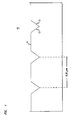
- FIG. 1 substantially reproduces relevant features of a cross-sectional TEM micrograph of an exemplary grating 10 etched into a (100) surface 11 of an InP wafer.
- the grating periodicity was 0.20 ⁇ m, the grooves were oriented parallel to the [011] direction, had (111)A side walls 12 and were about 60nm deep.
- the grating was produced in conventional fashion, using holographic photolithography to pattern a conventional resist layer, followed by conventional wet chemical etching.
- the as-etched grating exhibits steep sidewalls and sharp corners. It is known that such features frequently cause strong localized composition shifts, which, in turn, can introduce large lattice strains.
- the grating profile desirably is smoothed, typically by thermally activated atom migration, prior to the initiation of overgrowth. This smoothing of the sharp grating features is referred to as mass transport, and we will herein use this terminology, regardless of the actual mechanism involved.
- FIG. 2 is a cross-sectional scanning electron micrograph of an InP grating 20 after heating of a grating as shown in Fig. 1 at 480°C for 5 minutes under a phosphorus flux (from a solid source) of 4x10 -6 Torr.
- the rounding of the sharp features is obvious.
- Grating depth was reduced to about 30 nm. Heating for periods longer than 5 minutes did not result in any significant further reduction of grating depth, but heating at 510°C for 20 minutes substantially removed the grating.
- the mass transport rate is also a function of the phosphorus flux, in addition to being a function of temperature. Higher phosphorus flux can reduce the mass transport rate.
- appropriate mass transport temperatures may be somewhat different. Suitable mass transport temperatures are readily determined by minor experimentation.
- mass transport according to the invention typically occurs at substantially lower temperatures than does mass transport in the conventional (MOCVD) method.
- the latter typically occurs at temperatures above about 600°C. This difference of mass transport temperatures has implications for reproducibility and thus manufacturability, with lower temperatures generally providing better reproducibility.
- the mass transport treatment according to the invention results in thermal oxide desorption, and generally in generation of a substantially atomically clean surface.
- This is an important aspect of the inventive method which facilitates deposition of high quality overlayer material, provided the pristine surface condition is maintained up to coverage of the surface with overlayer material. This will be the case if the vacuum is maintained in the growth chamber, and if the time between completion of mass transport and commencement is suitably short, exemplarily less than 10 minutes.
- FIG. 3 is a representation of a cross-sectional TEM micrograph of a InP grating as shown in FIG. 2, with GaInAsP material grown on corrugated surface 31 of InP body 30.
- 0.8 nm InP marker layers (321, 322, 323, 324) were provided between 17 nm GaInAsP layers 331-335. Such markers typically would not be present in DFB lasers or other devices.
- Deposition was commenced immediately (within about one minute) after completion of the mass-transport heat treatment (480°C, P-flux 4 x 10 -6 Torr, 5 minutes). The fluxes were selected to yield quaternary material with emission wavelength in the range 1.17-1.20 ⁇ m.
- Ga and In were provided by elemental sources in known manner. Initial growth was carried out at 480°C, followed by a ramp-up to the final growth temperature of 530°C. The final temperature was reached before deposition of the second marker layer. Growth rates were 1.33 ⁇ m/h for the GaInAsP, and 0.57 ⁇ m/h for InP. Layer 33 is an InP layer provided to facilitate the TEM measurements.
- the second marker layer is extremely smooth and already essentially planar, indicative of the ability of the inventive method to provide high quality planar overgrowth on a non-planar surface.
- a further InP grating with GaInAsP overgrowth was produced as described above, except that the final growth temperature was 500°C.
- the lower growth temperature resulted in overgrowth of somewhat lower quality, with the third marker layer not being completely planar.
- the final growth temperature is in the range 480-600°C, with temperatures above 500°C being preferred.
- Samples grown according to the invention were generally free of growth-related dislocations, with samples grown at 530°C generally exhibiting lower lattice strain than samples grown at 500°C.
- Photoluminescence (PL) measurements of GaInAsP grown on InP gratings and planar InP indicate that the quality of the former is comparable to that of the latter.
Landscapes
- Semiconductor Lasers (AREA)
- Chemical Vapour Deposition (AREA)
- Led Devices (AREA)
- Physical Deposition Of Substances That Are Components Of Semiconductor Devices (AREA)
Abstract
Description
- This invention pertains to making InP-based distributed feedback (DFB) lasers and other InP-based semiconductor devices.
- DFB lasers typically comprise a "grating" that serves to determine and stabilize the laser wavelength. The grating exemplarily is formed by a process that involves deposition of a conventional resist layer on the surface of a III/V semiconductor wafer, patterning of the resist layer, and etching of the exposed portions of the semiconductor surface. After removal of the resist, III/V semiconductor material of desired composition and thickness is deposited on the thus created "corrugated" semiconductor surface, and laser manufacture is completed. The grating can be disposed below or above the active layer of the laser.
- Much effort has gone into devising manufacturing processes that can reproducibly provide high quality overgrowth on gratings of predetermined shape and depth, with the growth surface being smooth and plane after growth of only a few tens of nanometers. However, the results have to date not been completely satisfactory. This is especially true of ternary and quaternary III/V semiconductor materials which typically have different growth rates and compositions associated with surfaces of different crystalline orientation.
- Because laser characteristics are strongly dependent on the details of the grating profile and the spacing between grating and active region, any significant wafer-to-wafer (or chip-to-chip) variation in the grating profile and/or spacing results in undesirable variations in coupling coefficiency, frequently negatively impacting device yield.
- In view of the obvious advantage of being able to produce DFB lasers with high yield, it would be highly desirable to have available a manufacturing method that can repeatably provide a desired laser structure, including the grating and the layers grown thereon. This application discloses such a method.
- The growth of semiconductor material on a corrugated semiconductor surface is an example of a wider processing task, namely, the growth of compound semiconductor material on a non-planar semiconductor surface. The need for such growth arises, for instance, in the manufacture of some photonic and electronic devices or integrated circuits, e.g., in the manufacture of lasers integrated with modulators.
- Although the method that is disclosed herein can advantageously be used in the manufacture of a variety of InP-based semiconductor devices involving growth of compound semiconductor material on a non-planar substrate, the method will be described below in terms of a specific and important embodiment, namely, the manufacture of InP-based DFB lasers involving the growth of ternary or quaternary III/V semiconductor material such as GaInAsP on a corrugated InP surface, or the growth of InP on a corrugated ternary or quaternary III/V semiconductor (e.g., GaInAsP) surface.
- By an "InP-based" device we mean a III/V semiconductor device formed by epitaxial growth on an InP substrate, or containing one or more layers of InP.
- The invention is defined by the claims. In a broad aspect it is embodied in a method of making an InP-based semiconductor device that involves heteroepitaxial growth of III/V semiconductor material on a non-planar III/V semiconductor surface.
- More specifically, the method comprises providing an InP-based semiconductor body having a major surface, patterning the surface such that a surface with non-planar surface features results, and growing a phosphorus (P)-containing semiconductor material (e.g., GaInAsP or InP) on the patterned major surface. Subsequently one or more further steps (e.g., growth of one or more further layers of semiconductor material, metal deposition, heat treatment, cleaving, packaging, etc.) towards completion of the semiconductor device are carried out.
- Significantly, the method comprises heating, in a substantially evacuated (background pressure typically ≲ 10-8 Torr) chamber, the semiconductor body with the non-planar surface features to a mass-transport temperature, and exposing, in the substantially evacuated chamber, the patterned major surface to a flux of at least phosphorus from a solid phosphorus flux source for a time effective for providing a shape change of the non-planar surface features by mass-transport; and furthermore comprises carrying out at least an initial portion of the growth step without exposing the semiconductor body to an ambient atmosphere, with the semiconductor body preferably being at a growth temperature that does not exceed said mass-transport temperature at least during said initial portion.
- A significant feature of the method is the use of solid sources of P and, optionally, As, rather than the commonly used H-containing compounds of P and As (e.g., phosphene and arsine). This facilitates use of lower process temperatures, which in turn can result in less dopant diffusion and a more reproducible process, and thus in higher device yield.
- Exposure of the surface to As during the mass transport step generally decreases the rate of mass transport (and thus of shape change), as compared to the rate when the surface is exposed to P only. The ratio of As flux to P flux thus will generally be selected to result in a desired rate of mass transport. Since this rate also depends on the temperature of the body, no general rule can be given. However, a minor amount of experimentation will generally suffice to determine a satisfactory ratio at any given temperature.
-
- FIG. 1 is the representation of a cross-sectional transmission electron microscopy (TEM) micrograph of a DFB laser grating profile prior to mass transport and growth;
- FIG. 2 is a representation of a cross-sectional micrograph of a grating profile after mass transport; and
- FIG. 3 is a representation of a cross-sectional micrograph of a sample with GaInAsP grown according to the invention on an InP grating surface.
- Exemplary and technologically important devices that are advantageously made by the inventive method are InP-based 1.3µm and 1.55µm DFB lasers. Such lasers find widespread use in, for instance, optical fiber communication systems. Manufacture of such lasers exemplarily requires growth of GaInAsP on a corrugated crystal (exemplarily InP) surface. See, for instance, G. P. Agrawal et al., "Semiconductor Lasers", 2nd ed., Van Nostrand Reinhold, New York 1993. By "GaInAsP" we mean Ga1-xInxAs1-yPy, with both x and y between 0 and 1. Frequently x and y are selected in known manner such that the GaInAsP is substantially lattice matched to InP, but use of non-lattice-matched GaInAsP is not precluded.
- The lasers can be produced in conventional fashion, except that the inventive method of making the grating and growing semiconductor material thereon is substituted for any of the prior art methods. Since the conventional manufacturing steps are well known to those skilled in the art they do not require detailed recitation.
- Furthermore, the inventive method can be practiced in known equipment, provided that the evacuable growth chamber comprises means for producing a phosphorus (P) flux (and typically also an arsenic (As) flux) from a solid source. Techniques for producing such fluxes from solid sources are known. See, for instance, J. N. Baillargeon et al., Journal of Vacuum Science and Technology, Vol. B 13(1), p. 64 (Jan./Feb. 1995). By "P flux" and "As flux" we do not imply any particular atomic or molecular species of the respective elements. Exemplarily, the fluxes frequently contain P2 and As 2, respectively, as major components.
- By way of example, we performed the grating modification and semiconductor growth in a commercially available (Riber 2300) MBE system that comprises a Riber model KPC 40 valved phosphorus cell (having three separately controllable temperature zones) and a third generation EPI model RB500VAs valved arsenic cell (having two temperature zones).
- FIG. 1 substantially reproduces relevant features of a cross-sectional TEM micrograph of an
exemplary grating 10 etched into a (100)surface 11 of an InP wafer. The grating periodicity was 0.20µm, the grooves were oriented parallel to the [011] direction, had (111)Aside walls 12 and were about 60nm deep. The grating was produced in conventional fashion, using holographic photolithography to pattern a conventional resist layer, followed by conventional wet chemical etching. - As can be seen from FIG. 1, the as-etched grating exhibits steep sidewalls and sharp corners. It is known that such features frequently cause strong localized composition shifts, which, in turn, can introduce large lattice strains. Thus, in order to reduce lattice strain and avoid the generation of dislocations, the grating profile desirably is smoothed, typically by thermally activated atom migration, prior to the initiation of overgrowth. This smoothing of the sharp grating features is referred to as mass transport, and we will herein use this terminology, regardless of the actual mechanism involved.
- FIG. 2 is a cross-sectional scanning electron micrograph of an InP grating 20 after heating of a grating as shown in Fig. 1 at 480°C for 5 minutes under a phosphorus flux (from a solid source) of 4x10⁻⁶ Torr. The rounding of the sharp features is obvious. Grating depth was reduced to about 30 nm. Heating for periods longer than 5 minutes did not result in any significant further reduction of grating depth, but heating at 510°C for 20 minutes substantially removed the grating. However, the mass transport rate is also a function of the phosphorus flux, in addition to being a function of temperature. Higher phosphorus flux can reduce the mass transport rate. For gratings in other III/V phosphorus-containing semiconductor materials (e.g., GaInAsP) appropriate mass transport temperatures may be somewhat different. Suitable mass transport temperatures are readily determined by minor experimentation.
- We have discovered that heating of the grating in the presence of P and As fluxes from solid sources results in a reduced rate of mass transport, as opposed to heating in the presence of only P flux. Indeed, heating a InP grating of the type shown in FIG. 1 at 480°C under an As flux, without P flux, did not result in significant smoothing of the grating. Thus, by appropriate choice of P and As fluxes, a desired rate of mass transport can be attained. Under combined phosphorus and arsenic fluxes mass transport exemplarily is carried out at a temperature in the range 460-550°C for 2-40 minutes. The fluxes exemplarily are in the range 1 x 10⁻⁷ - 1
x 10-4 Torr. For example, a grating depth of about 40 nm can be preserved by heating the sample at 520°C under 4 x 10⁻⁶ Torr phosphorus flux and 0.7 x 10 -6 Torr arsenic flux. - It should be noted that mass transport according to the invention typically occurs at substantially lower temperatures than does mass transport in the conventional (MOCVD) method. The latter typically occurs at temperatures above about 600°C. This difference of mass transport temperatures has implications for reproducibility and thus manufacturability, with lower temperatures generally providing better reproducibility.
- It should also be noted that the mass transport treatment according to the invention results in thermal oxide desorption, and generally in generation of a substantially atomically clean surface. This is an important aspect of the inventive method which facilitates deposition of high quality overlayer material, provided the pristine surface condition is maintained up to coverage of the surface with overlayer material. This will be the case if the vacuum is maintained in the growth chamber, and if the time between completion of mass transport and commencement is suitably short, exemplarily less than 10 minutes.
- FIG. 3 is a representation of a cross-sectional TEM micrograph of a InP grating as shown in FIG. 2, with GaInAsP material grown on corrugated
surface 31 of InP body 30. In order to show the progress towards planarity, 0.8 nm InP marker layers (321, 322, 323, 324) were provided between 17 nm GaInAsP layers 331-335. Such markers typically would not be present in DFB lasers or other devices. Deposition was commenced immediately (within about one minute) after completion of the mass-transport heat treatment (480°C, P-flux 4 x 10⁻⁶ Torr, 5 minutes). The fluxes were selected to yield quaternary material with emission wavelength in the range 1.17-1.20µm. Ga and In were provided by elemental sources in known manner. Initial growth was carried out at 480°C, followed by a ramp-up to the final growth temperature of 530°C. The final temperature was reached before deposition of the second marker layer. Growth rates were 1.33µm/h for the GaInAsP, and 0.57µm/h for InP.Layer 33 is an InP layer provided to facilitate the TEM measurements. - As can be seen from FIG. 3, the second marker layer is extremely smooth and already essentially planar, indicative of the ability of the inventive method to provide high quality planar overgrowth on a non-planar surface.
- A further InP grating with GaInAsP overgrowth was produced as described above, except that the final growth temperature was 500°C. The lower growth temperature resulted in overgrowth of somewhat lower quality, with the third marker layer not being completely planar.
- Exemplarily, the final growth temperature is in the range 480-600°C, with temperatures above 500°C being preferred. Samples grown according to the invention were generally free of growth-related dislocations, with samples grown at 530°C generally exhibiting lower lattice strain than samples grown at 500°C. Photoluminescence (PL) measurements of GaInAsP grown on InP gratings and planar InP indicate that the quality of the former is comparable to that of the latter.
- As those skilled in the art will recognize, the above-described method can be readily incorporated into a conventional process of manufacturing InP-based DFB lasers, with process steps that precede the mass-transport treatment, as well as process steps that follow deposition of the overgrowth material, being conventional. In view of the conventional nature of these steps, they do not require description.
Claims (9)
- Method of making an indium phosphide-based III/V semiconductor device comprisinga) providing a III/V semiconductor body having a major surface (11);b) patterning the major surface such that non-planar surface features (12) are formed;c) growing a phosphorus-containing III/V semiconductor material (331) on the patterned major surface; andd) carrying out one or more further steps towards completion of the device;CHARACTERIZED IN THAT the method further comprisese) heating, in a substantially evacuated chamber, the semiconductor body to a mass-transport temperature and exposing, in the substantially evacuated chamber, the patterned major surface to a flux of at least phosphorus from a solid phosphorus flux source for a time effective for providing a shape change of the non-planar surface features by mass-transport; andf) carrying out step c) without exposing the semiconductor body to an ambient atmosphere, with the semiconductor body being at a first growth temperature not larger than said mass-transport temperature during at least an initial portion of step c).
- Method of claim 1, wherein the phosphorus-containing III/V semiconductor material is selected from the group consisting of InP and the ternary and quaternary indium- and phosphorus-containing III/V semiconductor materials.
- Method of claim 2, wherein the non-planar surface features are formed in InP and the phosphorus-containing III/V semiconductor material is InGaAsP.
- Method of claim 1, wherein during step e) the patterned major surface is furthermore exposed to a flux of arsenic from a solid arsenic flux source, the fluxes of phosphorus and arsenic selected such that a desired rate of mass transport results.
- Method of claim 1, wherein after said initial portion of step c) the temperature of the semiconductor body is raised to a second growth temperature above the first growth temperature.
- Method of claim 5, wherein the second growth temperature is in the range 480-600°C.
- Method of claim 1, wherein the mass-transport temperature is in the range 460-550°C.
- Method of claim 1, wherein the indium phosphide-based III/V semiconductor device is a semiconductor laser, and the non-planar surface features are selected to form a Bragg grating.
- Method of claim 1, wherein a background pressure in the substantially evacuated chamber is less than or equal to 10-8 Torr.
Applications Claiming Priority (2)
| Application Number | Priority Date | Filing Date | Title |
|---|---|---|---|
| US08/652,285 US5633193A (en) | 1996-05-22 | 1996-05-22 | Method of making an InP-based device comprising semiconductor growth on a non-planar surface |
| US652285 | 1996-05-22 |
Publications (2)
| Publication Number | Publication Date |
|---|---|
| EP0809280A2 true EP0809280A2 (en) | 1997-11-26 |
| EP0809280A3 EP0809280A3 (en) | 2001-08-29 |
Family
ID=24616262
Family Applications (1)
| Application Number | Title | Priority Date | Filing Date |
|---|---|---|---|
| EP97303256A Withdrawn EP0809280A3 (en) | 1996-05-22 | 1997-05-13 | Method of making an InP-based device comprising semiconductor growth on a non-planar surface |
Country Status (4)
| Country | Link |
|---|---|
| US (1) | US5633193A (en) |
| EP (1) | EP0809280A3 (en) |
| JP (1) | JPH1065276A (en) |
| CA (1) | CA2200124C (en) |
Families Citing this family (7)
| Publication number | Priority date | Publication date | Assignee | Title |
|---|---|---|---|---|
| FR2765031B1 (en) * | 1997-06-19 | 1999-09-24 | Alsthom Cge Alcatel | CONTROL OF THE ENGRAVING DEPTH IN THE MANUFACTURE OF SEMICONDUCTOR COMPONENTS |
| US7058246B2 (en) * | 2001-10-09 | 2006-06-06 | Infinera Corporation | Transmitter photonic integrated circuit (TxPIC) chip with enhanced power and yield without on-chip amplification |
| TWI248691B (en) * | 2005-06-03 | 2006-02-01 | Formosa Epitaxy Inc | Light emitting diode and method of fabricating thereof |
| CN100423303C (en) * | 2005-06-09 | 2008-10-01 | 璨圆光电股份有限公司 | Light emitting diode and method for manufacturing the same |
| JP4951267B2 (en) * | 2006-04-27 | 2012-06-13 | 日本オプネクスト株式会社 | Manufacturing method of semiconductor laser device |
| US7645624B2 (en) * | 2007-10-31 | 2010-01-12 | Tekcore Co., Ltd. | Method for self bonding epitaxy |
| JP5409170B2 (en) * | 2009-07-30 | 2014-02-05 | キヤノン株式会社 | Semiconductor device manufacturing method and semiconductor device |
Family Cites Families (8)
| Publication number | Priority date | Publication date | Assignee | Title |
|---|---|---|---|---|
| JPS6079788A (en) * | 1983-10-06 | 1985-05-07 | Nec Corp | Optical bistable element |
| US4885262A (en) * | 1989-03-08 | 1989-12-05 | Intel Corporation | Chemical modification of spin-on glass for improved performance in IC fabrication |
| JPH02264491A (en) * | 1989-04-04 | 1990-10-29 | Mitsubishi Electric Corp | Manufacturing method of distributed feedback semiconductor laser |
| US5126281A (en) * | 1990-09-11 | 1992-06-30 | Hewlett-Packard Company | Diffusion using a solid state source |
| US5387546A (en) * | 1992-06-22 | 1995-02-07 | Canon Sales Co., Inc. | Method for manufacturing a semiconductor device |
| EP0582986B1 (en) * | 1992-08-10 | 1999-01-20 | Canon Kabushiki Kaisha | Semiconductor device and method of manufacturing the same |
| US5360763A (en) * | 1992-09-07 | 1994-11-01 | Nec Corporation | Method for fabricating an optical semiconductor device |
| US5399521A (en) * | 1993-10-08 | 1995-03-21 | Texas Instruments Incorporated | Method of semiconductor layer growth by MBE |
-
1996
- 1996-05-22 US US08/652,285 patent/US5633193A/en not_active Expired - Lifetime
-
1997
- 1997-03-17 CA CA002200124A patent/CA2200124C/en not_active Expired - Fee Related
- 1997-04-08 JP JP8901497A patent/JPH1065276A/en active Pending
- 1997-05-13 EP EP97303256A patent/EP0809280A3/en not_active Withdrawn
Also Published As
| Publication number | Publication date |
|---|---|
| JPH1065276A (en) | 1998-03-06 |
| CA2200124A1 (en) | 1997-11-22 |
| CA2200124C (en) | 2000-04-18 |
| US5633193A (en) | 1997-05-27 |
| EP0809280A3 (en) | 2001-08-29 |
Similar Documents
| Publication | Publication Date | Title |
|---|---|---|
| EP0665578B1 (en) | Semiconductor structure and method of fabricating the same | |
| EP0506453B1 (en) | A quantum wire structure and a method for producing the same | |
| US5633193A (en) | Method of making an InP-based device comprising semiconductor growth on a non-planar surface | |
| KR19990042070A (en) | How to grow high quality GS quantum dots | |
| US7704861B2 (en) | Electron beam microprocessing method | |
| Lee et al. | In 0.5 Ga 0.5 As quantum dot intermixing and evaporation in GaAs capping layer growth | |
| JP4651759B2 (en) | Device with quantum dots | |
| EP0618610A2 (en) | Method of making a compound semiconductor device | |
| Sakata et al. | Selective MOVPE growth of InGaAsP and InGaAs using TBA and TBP | |
| Heinecke et al. | Selective-area growth of III/V semiconductors in chemical beam epitaxy | |
| JP7287495B2 (en) | Method for forming semiconductor layer | |
| Araki et al. | Fabrication of InGaAs quantum wires and dots by selective molecular beam epitaxial growth on various mesa-patterned (001) InP substrates | |
| KR100359739B1 (en) | Method of fusion for heteroepitaxial layers and overgrowth thereon | |
| Panepucci et al. | Fabrication of InP/InGaAs quantum wires by free Cl2 | |
| JP2794506B2 (en) | Compound semiconductor heteroepitaxial growth method | |
| EP0590870A2 (en) | Method of making a buried heterostructure laser | |
| GB2411520A (en) | Method of forming laser mesa by reactive ion etching followed by in situ etching in regrowth reactor | |
| JP3314794B2 (en) | Semiconductor laser and method of manufacturing the same | |
| JP3529475B2 (en) | Manufacturing method of semiconductor micro dots | |
| WO2005022640A1 (en) | Semiconductor quantum dot device and its production method | |
| Temmyo et al. | Self-organization phenomenon of strained InGaAs on InP (311) substrates grown by metalorganic vapor phase epitaxy | |
| Kim et al. | Realization of Vertically Stacked InGaAs/GaAs Quantum Wires on V‐grooves with (322) Facet Sidewalls by Chemical Beam Epitaxy | |
| JPH10289997A (en) | Semiconductor quantum structure and manufacturing method thereof | |
| JPH0444414B2 (en) | ||
| Hwang et al. | The Growth of High Quality GaAs Epilayers on Stripe Patterned InP Substrates With a Transferred GaAs Fused Layer |
Legal Events
| Date | Code | Title | Description |
|---|---|---|---|
| PUAI | Public reference made under article 153(3) epc to a published international application that has entered the european phase |
Free format text: ORIGINAL CODE: 0009012 |
|
| AK | Designated contracting states |
Kind code of ref document: A2 Designated state(s): DE FR GB |
|
| PUAL | Search report despatched |
Free format text: ORIGINAL CODE: 0009013 |
|
| RAP1 | Party data changed (applicant data changed or rights of an application transferred) |
Owner name: AGERE SYSTEMS OPTOELECTRONICS GUARDIAN CORPORATION |
|
| AK | Designated contracting states |
Kind code of ref document: A3 Designated state(s): DE FR GB |
|
| RIC1 | Information provided on ipc code assigned before grant |
Free format text: 7H 01L 21/20 A, 7H 01L 33/00 B, 7H 01S 3/19 B |
|
| STAA | Information on the status of an ep patent application or granted ep patent |
Free format text: STATUS: THE APPLICATION IS DEEMED TO BE WITHDRAWN |
|
| 18D | Application deemed to be withdrawn |
Effective date: 20020301 |