EP0808840B1 - Verfahren zur Herstellung von Tribromoneopentyl-Chloroalkyl-Phosphaten - Google Patents
Verfahren zur Herstellung von Tribromoneopentyl-Chloroalkyl-Phosphaten Download PDFInfo
- Publication number
- EP0808840B1 EP0808840B1 EP97108211A EP97108211A EP0808840B1 EP 0808840 B1 EP0808840 B1 EP 0808840B1 EP 97108211 A EP97108211 A EP 97108211A EP 97108211 A EP97108211 A EP 97108211A EP 0808840 B1 EP0808840 B1 EP 0808840B1
- Authority
- EP
- European Patent Office
- Prior art keywords
- process according
- chloroalkyl
- tribromoneopentyl
- alkylene oxide
- phosphate
- Prior art date
- Legal status (The legal status is an assumption and is not a legal conclusion. Google has not performed a legal analysis and makes no representation as to the accuracy of the status listed.)
- Expired - Lifetime
Links
- -1 tribromoneopentyl chloroalkyl phosphates Chemical class 0.000 title claims description 74
- 229910019142 PO4 Inorganic materials 0.000 title claims description 50
- 235000021317 phosphate Nutrition 0.000 title description 49
- 238000004519 manufacturing process Methods 0.000 title description 10
- 125000004965 chloroalkyl group Chemical group 0.000 claims description 48
- 239000010452 phosphate Substances 0.000 claims description 38
- 238000000034 method Methods 0.000 claims description 33
- 125000002947 alkylene group Chemical group 0.000 claims description 25
- NBIIXXVUZAFLBC-UHFFFAOYSA-K phosphate Chemical compound [O-]P([O-])([O-])=O NBIIXXVUZAFLBC-UHFFFAOYSA-K 0.000 claims description 24
- 239000007983 Tris buffer Substances 0.000 claims description 16
- QEJPOEGPNIVDMK-UHFFFAOYSA-N 3-bromo-2,2-bis(bromomethyl)propan-1-ol Chemical compound OCC(CBr)(CBr)CBr QEJPOEGPNIVDMK-UHFFFAOYSA-N 0.000 claims description 15
- OJMIONKXNSYLSR-UHFFFAOYSA-N phosphorous acid Chemical compound OP(O)O OJMIONKXNSYLSR-UHFFFAOYSA-N 0.000 claims description 15
- ZAMOUSCENKQFHK-UHFFFAOYSA-N Chlorine atom Chemical compound [Cl] ZAMOUSCENKQFHK-UHFFFAOYSA-N 0.000 claims description 14
- 239000000460 chlorine Substances 0.000 claims description 14
- 229910052801 chlorine Inorganic materials 0.000 claims description 14
- FAIAAWCVCHQXDN-UHFFFAOYSA-N phosphorus trichloride Chemical compound ClP(Cl)Cl FAIAAWCVCHQXDN-UHFFFAOYSA-N 0.000 claims description 13
- ITVPBBDAZKBMRP-UHFFFAOYSA-N chloro-dioxido-oxo-$l^{5}-phosphane;hydron Chemical compound OP(O)(Cl)=O ITVPBBDAZKBMRP-UHFFFAOYSA-N 0.000 claims description 12
- 239000000126 substance Substances 0.000 claims description 12
- IAYPIBMASNFSPL-UHFFFAOYSA-N Ethylene oxide Chemical group C1CO1 IAYPIBMASNFSPL-UHFFFAOYSA-N 0.000 claims description 11
- VSCWAEJMTAWNJL-UHFFFAOYSA-K aluminium trichloride Chemical compound Cl[Al](Cl)Cl VSCWAEJMTAWNJL-UHFFFAOYSA-K 0.000 claims description 10
- GOOHAUXETOMSMM-UHFFFAOYSA-N Propylene oxide Chemical compound CC1CO1 GOOHAUXETOMSMM-UHFFFAOYSA-N 0.000 claims description 9
- ZMANZCXQSJIPKH-UHFFFAOYSA-N Triethylamine Chemical compound CCN(CC)CC ZMANZCXQSJIPKH-UHFFFAOYSA-N 0.000 claims description 9
- 125000004435 hydrogen atom Chemical group [H]* 0.000 claims description 7
- TWRXJAOTZQYOKJ-UHFFFAOYSA-L Magnesium chloride Chemical compound [Mg+2].[Cl-].[Cl-] TWRXJAOTZQYOKJ-UHFFFAOYSA-L 0.000 claims description 6
- 125000000217 alkyl group Chemical group 0.000 claims description 6
- 125000004432 carbon atom Chemical group C* 0.000 claims description 5
- 238000001704 evaporation Methods 0.000 claims description 4
- 230000008020 evaporation Effects 0.000 claims description 4
- 239000011968 lewis acid catalyst Substances 0.000 claims description 4
- 125000002496 methyl group Chemical group [H]C([H])([H])* 0.000 claims description 4
- XJDNKRIXUMDJCW-UHFFFAOYSA-J titanium tetrachloride Chemical compound Cl[Ti](Cl)(Cl)Cl XJDNKRIXUMDJCW-UHFFFAOYSA-J 0.000 claims description 4
- SZIFAVKTNFCBPC-UHFFFAOYSA-N 2-chloroethanol Chemical compound OCCCl SZIFAVKTNFCBPC-UHFFFAOYSA-N 0.000 claims description 3
- 229910001629 magnesium chloride Inorganic materials 0.000 claims description 3
- RBACIKXCRWGCBB-UHFFFAOYSA-N 1,2-Epoxybutane Chemical compound CCC1CO1 RBACIKXCRWGCBB-UHFFFAOYSA-N 0.000 claims description 2
- VZIQXGLTRZLBEX-UHFFFAOYSA-N 2-chloro-1-propanol Chemical compound CC(Cl)CO VZIQXGLTRZLBEX-UHFFFAOYSA-N 0.000 claims description 2
- ITMIRWIISVVMAK-UHFFFAOYSA-N 2-chloro-3-ethyloxirane Chemical compound CCC1OC1Cl ITMIRWIISVVMAK-UHFFFAOYSA-N 0.000 claims description 2
- AAMHBRRZYSORSH-UHFFFAOYSA-N 2-octyloxirane Chemical compound CCCCCCCCC1CO1 AAMHBRRZYSORSH-UHFFFAOYSA-N 0.000 claims description 2
- BRLQWZUYTZBJKN-UHFFFAOYSA-N Epichlorohydrin Chemical compound ClCC1CO1 BRLQWZUYTZBJKN-UHFFFAOYSA-N 0.000 claims description 2
- 239000003381 stabilizer Substances 0.000 claims description 2
- 125000001424 substituent group Chemical group 0.000 claims 2
- IMFACGCPASFAPR-UHFFFAOYSA-N tributylamine Chemical compound CCCCN(CCCC)CCCC IMFACGCPASFAPR-UHFFFAOYSA-N 0.000 claims 1
- 238000006243 chemical reaction Methods 0.000 description 20
- 239000000203 mixture Substances 0.000 description 18
- 229920005830 Polyurethane Foam Polymers 0.000 description 16
- 239000011496 polyurethane foam Substances 0.000 description 16
- 229920005862 polyol Polymers 0.000 description 15
- 150000003077 polyols Chemical class 0.000 description 15
- 239000003063 flame retardant Substances 0.000 description 12
- XHXFXVLFKHQFAL-UHFFFAOYSA-N phosphoryl trichloride Chemical compound ClP(Cl)(Cl)=O XHXFXVLFKHQFAL-UHFFFAOYSA-N 0.000 description 12
- VEXZGXHMUGYJMC-UHFFFAOYSA-N Hydrochloric acid Chemical compound Cl VEXZGXHMUGYJMC-UHFFFAOYSA-N 0.000 description 11
- RNFJDJUURJAICM-UHFFFAOYSA-N 2,2,4,4,6,6-hexaphenoxy-1,3,5-triaza-2$l^{5},4$l^{5},6$l^{5}-triphosphacyclohexa-1,3,5-triene Chemical compound N=1P(OC=2C=CC=CC=2)(OC=2C=CC=CC=2)=NP(OC=2C=CC=CC=2)(OC=2C=CC=CC=2)=NP=1(OC=1C=CC=CC=1)OC1=CC=CC=C1 RNFJDJUURJAICM-UHFFFAOYSA-N 0.000 description 10
- 239000000047 product Substances 0.000 description 9
- 239000003054 catalyst Substances 0.000 description 8
- XLYOFNOQVPJJNP-UHFFFAOYSA-N water Substances O XLYOFNOQVPJJNP-UHFFFAOYSA-N 0.000 description 8
- 230000000052 comparative effect Effects 0.000 description 7
- YMWUJEATGCHHMB-UHFFFAOYSA-N Dichloromethane Chemical compound ClCCl YMWUJEATGCHHMB-UHFFFAOYSA-N 0.000 description 6
- CDBYLPFSWZWCQE-UHFFFAOYSA-L Sodium Carbonate Chemical compound [Na+].[Na+].[O-]C([O-])=O CDBYLPFSWZWCQE-UHFFFAOYSA-L 0.000 description 6
- 239000002253 acid Substances 0.000 description 6
- 150000001875 compounds Chemical class 0.000 description 6
- 238000005227 gel permeation chromatography Methods 0.000 description 6
- 150000003013 phosphoric acid derivatives Chemical class 0.000 description 6
- LYCAIKOWRPUZTN-UHFFFAOYSA-N Ethylene glycol Chemical compound OCCO LYCAIKOWRPUZTN-UHFFFAOYSA-N 0.000 description 5
- 150000002148 esters Chemical class 0.000 description 5
- 229910052736 halogen Inorganic materials 0.000 description 5
- 150000002367 halogens Chemical class 0.000 description 5
- 238000002360 preparation method Methods 0.000 description 5
- WSLDOOZREJYCGB-UHFFFAOYSA-N 1,2-Dichloroethane Chemical compound ClCCCl WSLDOOZREJYCGB-UHFFFAOYSA-N 0.000 description 4
- KZBUYRJDOAKODT-UHFFFAOYSA-N Chlorine Chemical compound ClCl KZBUYRJDOAKODT-UHFFFAOYSA-N 0.000 description 4
- 238000009835 boiling Methods 0.000 description 4
- 125000002603 chloroethyl group Chemical group [H]C([*])([H])C([H])([H])Cl 0.000 description 4
- 238000002845 discoloration Methods 0.000 description 4
- 229920001451 polypropylene glycol Polymers 0.000 description 4
- 239000011541 reaction mixture Substances 0.000 description 4
- DVKJHBMWWAPEIU-UHFFFAOYSA-N toluene 2,4-diisocyanate Chemical compound CC1=CC=C(N=C=O)C=C1N=C=O DVKJHBMWWAPEIU-UHFFFAOYSA-N 0.000 description 4
- BHYQWBKCXBXPKM-UHFFFAOYSA-N tris[3-bromo-2,2-bis(bromomethyl)propyl] phosphate Chemical compound BrCC(CBr)(CBr)COP(=O)(OCC(CBr)(CBr)CBr)OCC(CBr)(CBr)CBr BHYQWBKCXBXPKM-UHFFFAOYSA-N 0.000 description 4
- 150000005208 1,4-dihydroxybenzenes Chemical class 0.000 description 3
- FBPFZTCFMRRESA-FSIIMWSLSA-N D-Glucitol Natural products OC[C@H](O)[C@H](O)[C@@H](O)[C@H](O)CO FBPFZTCFMRRESA-FSIIMWSLSA-N 0.000 description 3
- FBPFZTCFMRRESA-JGWLITMVSA-N D-glucitol Chemical compound OC[C@H](O)[C@@H](O)[C@H](O)[C@H](O)CO FBPFZTCFMRRESA-JGWLITMVSA-N 0.000 description 3
- PEDCQBHIVMGVHV-UHFFFAOYSA-N Glycerine Chemical compound OCC(O)CO PEDCQBHIVMGVHV-UHFFFAOYSA-N 0.000 description 3
- 229920003171 Poly (ethylene oxide) Polymers 0.000 description 3
- 239000004721 Polyphenylene oxide Substances 0.000 description 3
- HEMHJVSKTPXQMS-UHFFFAOYSA-M Sodium hydroxide Chemical compound [OH-].[Na+] HEMHJVSKTPXQMS-UHFFFAOYSA-M 0.000 description 3
- CZMRCDWAGMRECN-UGDNZRGBSA-N Sucrose Chemical compound O[C@H]1[C@H](O)[C@@H](CO)O[C@@]1(CO)O[C@@H]1[C@H](O)[C@@H](O)[C@H](O)[C@@H](CO)O1 CZMRCDWAGMRECN-UGDNZRGBSA-N 0.000 description 3
- 229930006000 Sucrose Natural products 0.000 description 3
- 150000001412 amines Chemical class 0.000 description 3
- 239000007864 aqueous solution Substances 0.000 description 3
- 230000015572 biosynthetic process Effects 0.000 description 3
- 239000001177 diphosphate Substances 0.000 description 3
- 239000006260 foam Substances 0.000 description 3
- 230000007062 hydrolysis Effects 0.000 description 3
- 238000006460 hydrolysis reaction Methods 0.000 description 3
- 150000002903 organophosphorus compounds Chemical class 0.000 description 3
- 229910052698 phosphorus Inorganic materials 0.000 description 3
- 239000011574 phosphorus Substances 0.000 description 3
- 239000004014 plasticizer Substances 0.000 description 3
- 229920000570 polyether Polymers 0.000 description 3
- 229920000056 polyoxyethylene ether Polymers 0.000 description 3
- 229920002635 polyurethane Polymers 0.000 description 3
- 239000004814 polyurethane Substances 0.000 description 3
- 229910000029 sodium carbonate Inorganic materials 0.000 description 3
- 235000017550 sodium carbonate Nutrition 0.000 description 3
- 239000000600 sorbitol Substances 0.000 description 3
- 238000003756 stirring Methods 0.000 description 3
- 239000005720 sucrose Substances 0.000 description 3
- 238000003786 synthesis reaction Methods 0.000 description 3
- 150000004072 triols Chemical class 0.000 description 3
- LUVCTYHBTXSAMX-UHFFFAOYSA-N tris(2-chloroethyl) phosphite Chemical compound ClCCOP(OCCCl)OCCCl LUVCTYHBTXSAMX-UHFFFAOYSA-N 0.000 description 3
- CZNRFEXEPBITDS-UHFFFAOYSA-N 2,5-bis(2-methylbutan-2-yl)benzene-1,4-diol Chemical compound CCC(C)(C)C1=CC(O)=C(C(C)(C)CC)C=C1O CZNRFEXEPBITDS-UHFFFAOYSA-N 0.000 description 2
- CJWBPEYRTPGWPF-UHFFFAOYSA-N 2-[bis(2-chloroethoxy)phosphoryloxy]ethyl bis(2-chloroethyl) phosphate Chemical compound ClCCOP(=O)(OCCCl)OCCOP(=O)(OCCCl)OCCCl CJWBPEYRTPGWPF-UHFFFAOYSA-N 0.000 description 2
- IJGRMHOSHXDMSA-UHFFFAOYSA-N Atomic nitrogen Chemical compound N#N IJGRMHOSHXDMSA-UHFFFAOYSA-N 0.000 description 2
- 239000004604 Blowing Agent Substances 0.000 description 2
- LFQSCWFLJHTTHZ-UHFFFAOYSA-N Ethanol Chemical compound CCO LFQSCWFLJHTTHZ-UHFFFAOYSA-N 0.000 description 2
- JOYRKODLDBILNP-UHFFFAOYSA-N Ethyl urethane Chemical compound CCOC(N)=O JOYRKODLDBILNP-UHFFFAOYSA-N 0.000 description 2
- PIICEJLVQHRZGT-UHFFFAOYSA-N Ethylenediamine Chemical compound NCCN PIICEJLVQHRZGT-UHFFFAOYSA-N 0.000 description 2
- QIGBRXMKCJKVMJ-UHFFFAOYSA-N Hydroquinone Chemical compound OC1=CC=C(O)C=C1 QIGBRXMKCJKVMJ-UHFFFAOYSA-N 0.000 description 2
- QAOWNCQODCNURD-UHFFFAOYSA-N Sulfuric acid Chemical compound OS(O)(=O)=O QAOWNCQODCNURD-UHFFFAOYSA-N 0.000 description 2
- WOURXYYHORRGQO-UHFFFAOYSA-N Tri(3-chloropropyl) phosphate Chemical compound ClCCCOP(=O)(OCCCCl)OCCCCl WOURXYYHORRGQO-UHFFFAOYSA-N 0.000 description 2
- DYWDBYKKVUDMLB-UHFFFAOYSA-N [4,4,6-tribromo-3-chloro-5,5-dimethyl-3-(1,1,3-tribromo-2,2-dimethylpropyl)hexyl] dihydrogen phosphate Chemical compound BrCC(C)(C)C(Br)(Br)C(Cl)(C(Br)(Br)C(C)(C)CBr)CCOP(O)(O)=O DYWDBYKKVUDMLB-UHFFFAOYSA-N 0.000 description 2
- 230000002411 adverse Effects 0.000 description 2
- 239000003513 alkali Substances 0.000 description 2
- 239000003963 antioxidant agent Substances 0.000 description 2
- 229940058344 antitrematodals organophosphorous compound Drugs 0.000 description 2
- 239000008346 aqueous phase Substances 0.000 description 2
- 239000002585 base Substances 0.000 description 2
- IHLMMMKZZYBHJJ-UHFFFAOYSA-N bis(3-chloropropyl) (1,1,3-tribromo-2,2-dimethylpropyl) phosphate Chemical compound BrCC(C)(C)C(Br)(Br)OP(=O)(OCCCCl)OCCCCl IHLMMMKZZYBHJJ-UHFFFAOYSA-N 0.000 description 2
- 239000006227 byproduct Substances 0.000 description 2
- 238000004140 cleaning Methods 0.000 description 2
- 230000018044 dehydration Effects 0.000 description 2
- 238000006297 dehydration reaction Methods 0.000 description 2
- 235000014113 dietary fatty acids Nutrition 0.000 description 2
- 229910001873 dinitrogen Inorganic materials 0.000 description 2
- 150000002009 diols Chemical class 0.000 description 2
- ZUOUZKKEUPVFJK-UHFFFAOYSA-N diphenyl Chemical compound C1=CC=CC=C1C1=CC=CC=C1 ZUOUZKKEUPVFJK-UHFFFAOYSA-N 0.000 description 2
- 235000011180 diphosphates Nutrition 0.000 description 2
- 239000002270 dispersing agent Substances 0.000 description 2
- 238000004821 distillation Methods 0.000 description 2
- 230000000694 effects Effects 0.000 description 2
- 125000001495 ethyl group Chemical group [H]C([H])([H])C([H])([H])* 0.000 description 2
- 239000000194 fatty acid Substances 0.000 description 2
- 229930195729 fatty acid Natural products 0.000 description 2
- 229910052500 inorganic mineral Inorganic materials 0.000 description 2
- 239000012948 isocyanate Substances 0.000 description 2
- 150000002513 isocyanates Chemical class 0.000 description 2
- 239000000463 material Substances 0.000 description 2
- 239000011707 mineral Substances 0.000 description 2
- 235000010755 mineral Nutrition 0.000 description 2
- SLCVBVWXLSEKPL-UHFFFAOYSA-N neopentyl glycol Chemical compound OCC(C)(C)CO SLCVBVWXLSEKPL-UHFFFAOYSA-N 0.000 description 2
- WXZMFSXDPGVJKK-UHFFFAOYSA-N pentaerythritol Chemical compound OCC(CO)(CO)CO WXZMFSXDPGVJKK-UHFFFAOYSA-N 0.000 description 2
- 229920002545 silicone oil Polymers 0.000 description 2
- 239000000243 solution Substances 0.000 description 2
- IMNIMPAHZVJRPE-UHFFFAOYSA-N triethylenediamine Chemical compound C1CN2CCN1CC2 IMNIMPAHZVJRPE-UHFFFAOYSA-N 0.000 description 2
- HVLLSGMXQDNUAL-UHFFFAOYSA-N triphenyl phosphite Chemical compound C=1C=CC=CC=1OP(OC=1C=CC=CC=1)OC1=CC=CC=C1 HVLLSGMXQDNUAL-UHFFFAOYSA-N 0.000 description 2
- 238000005406 washing Methods 0.000 description 2
- JNYAEWCLZODPBN-JGWLITMVSA-N (2r,3r,4s)-2-[(1r)-1,2-dihydroxyethyl]oxolane-3,4-diol Chemical class OC[C@@H](O)[C@H]1OC[C@H](O)[C@H]1O JNYAEWCLZODPBN-JGWLITMVSA-N 0.000 description 1
- ZWVMLYRJXORSEP-UHFFFAOYSA-N 1,2,6-Hexanetriol Chemical compound OCCCCC(O)CO ZWVMLYRJXORSEP-UHFFFAOYSA-N 0.000 description 1
- KNKRKFALVUDBJE-UHFFFAOYSA-N 1,2-dichloropropane Chemical compound CC(Cl)CCl KNKRKFALVUDBJE-UHFFFAOYSA-N 0.000 description 1
- YAOMHRRYSRRRKP-UHFFFAOYSA-N 1,2-dichloropropyl 2,3-dichloropropyl 3,3-dichloropropyl phosphate Chemical compound ClC(Cl)CCOP(=O)(OC(Cl)C(Cl)C)OCC(Cl)CCl YAOMHRRYSRRRKP-UHFFFAOYSA-N 0.000 description 1
- XETKNKZXWYEULP-UHFFFAOYSA-N 1-chloro-2-[chloro(2-chloroethoxy)phosphoryl]oxyethane Chemical compound ClCCOP(Cl)(=O)OCCCl XETKNKZXWYEULP-UHFFFAOYSA-N 0.000 description 1
- CHUGKEQJSLOLHL-UHFFFAOYSA-N 2,2-Bis(bromomethyl)propane-1,3-diol Chemical compound OCC(CO)(CBr)CBr CHUGKEQJSLOLHL-UHFFFAOYSA-N 0.000 description 1
- HGUFODBRKLSHSI-UHFFFAOYSA-N 2,3,7,8-tetrachloro-dibenzo-p-dioxin Chemical compound O1C2=CC(Cl)=C(Cl)C=C2OC2=C1C=C(Cl)C(Cl)=C2 HGUFODBRKLSHSI-UHFFFAOYSA-N 0.000 description 1
- JZODKRWQWUWGCD-UHFFFAOYSA-N 2,5-di-tert-butylbenzene-1,4-diol Chemical compound CC(C)(C)C1=CC(O)=C(C(C)(C)C)C=C1O JZODKRWQWUWGCD-UHFFFAOYSA-N 0.000 description 1
- QVLXDGDLLZYJAM-UHFFFAOYSA-N 2,5-dioctylbenzene-1,4-diol Chemical compound CCCCCCCCC1=CC(O)=C(CCCCCCCC)C=C1O QVLXDGDLLZYJAM-UHFFFAOYSA-N 0.000 description 1
- FKWOGPPGVRDIRZ-UHFFFAOYSA-N 2-(2-methylbutan-2-yl)benzene-1,4-diol Chemical compound CCC(C)(C)C1=CC(O)=CC=C1O FKWOGPPGVRDIRZ-UHFFFAOYSA-N 0.000 description 1
- LIAWCKFOFPPVGF-UHFFFAOYSA-N 2-ethyladamantane Chemical compound C1C(C2)CC3CC1C(CC)C2C3 LIAWCKFOFPPVGF-UHFFFAOYSA-N 0.000 description 1
- ZZXILYOBAFPJNS-UHFFFAOYSA-N 2-octylbenzene-1,4-diol Chemical compound CCCCCCCCC1=CC(O)=CC=C1O ZZXILYOBAFPJNS-UHFFFAOYSA-N 0.000 description 1
- HVCNXQOWACZAFN-UHFFFAOYSA-N 4-ethylmorpholine Chemical compound CCN1CCOCC1 HVCNXQOWACZAFN-UHFFFAOYSA-N 0.000 description 1
- ADRNSOYXKABLGT-UHFFFAOYSA-N 8-methylnonyl diphenyl phosphite Chemical compound C=1C=CC=CC=1OP(OCCCCCCCC(C)C)OC1=CC=CC=C1 ADRNSOYXKABLGT-UHFFFAOYSA-N 0.000 description 1
- 231100000716 Acceptable daily intake Toxicity 0.000 description 1
- PMGHIGLOERPWGC-UHFFFAOYSA-N Bis-(2-chloroethyl) phosphate Chemical compound ClCCOP(=O)(O)OCCCl PMGHIGLOERPWGC-UHFFFAOYSA-N 0.000 description 1
- WKBOTKDWSSQWDR-UHFFFAOYSA-N Bromine atom Chemical compound [Br] WKBOTKDWSSQWDR-UHFFFAOYSA-N 0.000 description 1
- SNRUBQQJIBEYMU-UHFFFAOYSA-N Dodecane Natural products CCCCCCCCCCCC SNRUBQQJIBEYMU-UHFFFAOYSA-N 0.000 description 1
- 229920000877 Melamine resin Polymers 0.000 description 1
- UEEJHVSXFDXPFK-UHFFFAOYSA-N N-dimethylaminoethanol Chemical compound CN(C)CCO UEEJHVSXFDXPFK-UHFFFAOYSA-N 0.000 description 1
- MDBVZFGSKMWJFD-UHFFFAOYSA-N OP(O)=O.OP(O)(O)=O Chemical compound OP(O)=O.OP(O)(O)=O MDBVZFGSKMWJFD-UHFFFAOYSA-N 0.000 description 1
- NAQHBCFOOJMTDX-UHFFFAOYSA-N OP(O)OP(O)O.C(C)(C)(C)C1=C(C=CC(=C1)C(C)(C)C)C(C(C(O)(C1=C(C=C(C=C1)C(C)(C)C)C(C)(C)C)C1=C(C=C(C=C1)C(C)(C)C)C(C)(C)C)(CO)CO)O Chemical compound OP(O)OP(O)O.C(C)(C)(C)C1=C(C=CC(=C1)C(C)(C)C)C(C(C(O)(C1=C(C=C(C=C1)C(C)(C)C)C(C)(C)C)C1=C(C=C(C=C1)C(C)(C)C)C(C)(C)C)(CO)CO)O NAQHBCFOOJMTDX-UHFFFAOYSA-N 0.000 description 1
- OAICVXFJPJFONN-UHFFFAOYSA-N Phosphorus Chemical compound [P] OAICVXFJPJFONN-UHFFFAOYSA-N 0.000 description 1
- 239000002202 Polyethylene glycol Substances 0.000 description 1
- DNIAPMSPPWPWGF-UHFFFAOYSA-N Propylene glycol Chemical class CC(O)CO DNIAPMSPPWPWGF-UHFFFAOYSA-N 0.000 description 1
- YSMRWXYRXBRSND-UHFFFAOYSA-N TOTP Chemical compound CC1=CC=CC=C1OP(=O)(OC=1C(=CC=CC=1)C)OC1=CC=CC=C1C YSMRWXYRXBRSND-UHFFFAOYSA-N 0.000 description 1
- BGNXCDMCOKJUMV-UHFFFAOYSA-N Tert-Butylhydroquinone Chemical compound CC(C)(C)C1=CC(O)=CC=C1O BGNXCDMCOKJUMV-UHFFFAOYSA-N 0.000 description 1
- ZGHUDSLVQAGWEY-UHFFFAOYSA-N [2-[bis(2-chloroethoxy)phosphoryloxymethyl]-3-chloro-2-(chloromethyl)propyl] bis(2-chloroethyl) phosphate Chemical compound ClCCOP(=O)(OCCCl)OCC(CCl)(CCl)COP(=O)(OCCCl)OCCCl ZGHUDSLVQAGWEY-UHFFFAOYSA-N 0.000 description 1
- 125000002877 alkyl aryl group Chemical group 0.000 description 1
- 229910052782 aluminium Inorganic materials 0.000 description 1
- 230000003078 antioxidant effect Effects 0.000 description 1
- 125000003118 aryl group Chemical group 0.000 description 1
- 235000010290 biphenyl Nutrition 0.000 description 1
- 239000004305 biphenyl Substances 0.000 description 1
- JOEVUEPXCNTMPU-UHFFFAOYSA-N bis(2-chloroethyl) (1,1,3-tribromo-2,2-dimethylpropyl) phosphate Chemical compound BrCC(C)(C)C(Br)(Br)OP(=O)(OCCCl)OCCCl JOEVUEPXCNTMPU-UHFFFAOYSA-N 0.000 description 1
- YVIREDXEFYERAF-UHFFFAOYSA-N bis(3-chloropropyl) hydrogen phosphate Chemical compound ClCCCOP(=O)(O)OCCCCl YVIREDXEFYERAF-UHFFFAOYSA-N 0.000 description 1
- GDTBXPJZTBHREO-UHFFFAOYSA-N bromine Substances BrBr GDTBXPJZTBHREO-UHFFFAOYSA-N 0.000 description 1
- 229910052794 bromium Inorganic materials 0.000 description 1
- 125000000484 butyl group Chemical group [H]C([*])([H])C([H])([H])C([H])([H])C([H])([H])[H] 0.000 description 1
- 230000003197 catalytic effect Effects 0.000 description 1
- 210000003850 cellular structure Anatomy 0.000 description 1
- 239000007795 chemical reaction product Substances 0.000 description 1
- KYKAJFCTULSVSH-UHFFFAOYSA-N chloro(fluoro)methane Chemical compound F[C]Cl KYKAJFCTULSVSH-UHFFFAOYSA-N 0.000 description 1
- 125000004218 chloromethyl group Chemical group [H]C([H])(Cl)* 0.000 description 1
- 238000003776 cleavage reaction Methods 0.000 description 1
- 238000002485 combustion reaction Methods 0.000 description 1
- 238000011437 continuous method Methods 0.000 description 1
- 238000007796 conventional method Methods 0.000 description 1
- 229960002887 deanol Drugs 0.000 description 1
- 230000007423 decrease Effects 0.000 description 1
- 125000002704 decyl group Chemical group [H]C([H])([H])C([H])([H])C([H])([H])C([H])([H])C([H])([H])C([H])([H])C([H])([H])C([H])([H])C([H])([H])C([H])([H])* 0.000 description 1
- RCJVRSBWZCNNQT-UHFFFAOYSA-N dichloridooxygen Chemical compound ClOCl RCJVRSBWZCNNQT-UHFFFAOYSA-N 0.000 description 1
- 239000012972 dimethylethanolamine Substances 0.000 description 1
- XPPKVPWEQAFLFU-UHFFFAOYSA-J diphosphate(4-) Chemical compound [O-]P([O-])(=O)OP([O-])([O-])=O XPPKVPWEQAFLFU-UHFFFAOYSA-J 0.000 description 1
- 125000003438 dodecyl group Chemical group [H]C([H])([H])C([H])([H])C([H])([H])C([H])([H])C([H])([H])C([H])([H])C([H])([H])C([H])([H])C([H])([H])C([H])([H])C([H])([H])C([H])([H])* 0.000 description 1
- 230000007613 environmental effect Effects 0.000 description 1
- GKIPXFAANLTWBM-UHFFFAOYSA-N epibromohydrin Chemical class BrCC1CO1 GKIPXFAANLTWBM-UHFFFAOYSA-N 0.000 description 1
- 230000001747 exhibiting effect Effects 0.000 description 1
- 235000011187 glycerol Nutrition 0.000 description 1
- 150000002314 glycerols Chemical class 0.000 description 1
- 238000010438 heat treatment Methods 0.000 description 1
- 125000003187 heptyl group Chemical group [H]C([*])([H])C([H])([H])C([H])([H])C([H])([H])C([H])([H])C([H])([H])C([H])([H])[H] 0.000 description 1
- 150000004000 hexols Chemical class 0.000 description 1
- 125000002887 hydroxy group Chemical group [H]O* 0.000 description 1
- WGCNASOHLSPBMP-UHFFFAOYSA-N hydroxyacetaldehyde Natural products OCC=O WGCNASOHLSPBMP-UHFFFAOYSA-N 0.000 description 1
- 239000004615 ingredient Substances 0.000 description 1
- 239000003999 initiator Substances 0.000 description 1
- 125000001972 isopentyl group Chemical group [H]C([H])([H])C([H])(C([H])([H])[H])C([H])([H])C([H])([H])* 0.000 description 1
- 125000001449 isopropyl group Chemical group [H]C([H])([H])C([H])(*)C([H])([H])[H] 0.000 description 1
- 239000000395 magnesium oxide Substances 0.000 description 1
- CPLXHLVBOLITMK-UHFFFAOYSA-N magnesium oxide Inorganic materials [Mg]=O CPLXHLVBOLITMK-UHFFFAOYSA-N 0.000 description 1
- AXZKOIWUVFPNLO-UHFFFAOYSA-N magnesium;oxygen(2-) Chemical compound [O-2].[Mg+2] AXZKOIWUVFPNLO-UHFFFAOYSA-N 0.000 description 1
- JDSHMPZPIAZGSV-UHFFFAOYSA-N melamine Chemical compound NC1=NC(N)=NC(N)=N1 JDSHMPZPIAZGSV-UHFFFAOYSA-N 0.000 description 1
- 230000008018 melting Effects 0.000 description 1
- 238000002844 melting Methods 0.000 description 1
- 125000004108 n-butyl group Chemical group [H]C([H])([H])C([H])([H])C([H])([H])C([H])([H])* 0.000 description 1
- 125000001280 n-hexyl group Chemical group C(CCCCC)* 0.000 description 1
- 125000000740 n-pentyl group Chemical group [H]C([H])([H])C([H])([H])C([H])([H])C([H])([H])C([H])([H])* 0.000 description 1
- 125000004123 n-propyl group Chemical group [H]C([H])([H])C([H])([H])C([H])([H])* 0.000 description 1
- 125000001624 naphthyl group Chemical group 0.000 description 1
- 239000002736 nonionic surfactant Substances 0.000 description 1
- 125000001400 nonyl group Chemical group [H]C([*])([H])C([H])([H])C([H])([H])C([H])([H])C([H])([H])C([H])([H])C([H])([H])C([H])([H])C([H])([H])[H] 0.000 description 1
- 125000002347 octyl group Chemical group [H]C([*])([H])C([H])([H])C([H])([H])C([H])([H])C([H])([H])C([H])([H])C([H])([H])C([H])([H])[H] 0.000 description 1
- 239000012074 organic phase Substances 0.000 description 1
- 125000006353 oxyethylene group Chemical group 0.000 description 1
- NFHFRUOZVGFOOS-UHFFFAOYSA-N palladium;triphenylphosphane Chemical compound [Pd].C1=CC=CC=C1P(C=1C=CC=CC=1)C1=CC=CC=C1.C1=CC=CC=C1P(C=1C=CC=CC=1)C1=CC=CC=C1.C1=CC=CC=C1P(C=1C=CC=CC=1)C1=CC=CC=C1.C1=CC=CC=C1P(C=1C=CC=CC=1)C1=CC=CC=C1 NFHFRUOZVGFOOS-UHFFFAOYSA-N 0.000 description 1
- 125000001997 phenyl group Chemical group [H]C1=C([H])C([H])=C(*)C([H])=C1[H] 0.000 description 1
- 150000003014 phosphoric acid esters Chemical class 0.000 description 1
- 229920005906 polyester polyol Polymers 0.000 description 1
- 229920001223 polyethylene glycol Polymers 0.000 description 1
- 238000006116 polymerization reaction Methods 0.000 description 1
- 238000003918 potentiometric titration Methods 0.000 description 1
- 238000004321 preservation Methods 0.000 description 1
- 125000001436 propyl group Chemical group [H]C([*])([H])C([H])([H])C([H])([H])[H] 0.000 description 1
- 239000002994 raw material Substances 0.000 description 1
- 230000035484 reaction time Effects 0.000 description 1
- 230000011514 reflex Effects 0.000 description 1
- 229920005989 resin Polymers 0.000 description 1
- 239000011347 resin Substances 0.000 description 1
- 239000012262 resinous product Substances 0.000 description 1
- 230000007017 scission Effects 0.000 description 1
- 239000007787 solid Substances 0.000 description 1
- 238000007711 solidification Methods 0.000 description 1
- 230000008023 solidification Effects 0.000 description 1
- 239000007858 starting material Substances 0.000 description 1
- 150000003512 tertiary amines Chemical class 0.000 description 1
- 229920001187 thermosetting polymer Polymers 0.000 description 1
- 239000010409 thin film Substances 0.000 description 1
- 125000003944 tolyl group Chemical group 0.000 description 1
- HQUQLFOMPYWACS-UHFFFAOYSA-N tris(2-chloroethyl) phosphate Chemical compound ClCCOP(=O)(OCCCl)OCCCl HQUQLFOMPYWACS-UHFFFAOYSA-N 0.000 description 1
- WGKLOLBTFWFKOD-UHFFFAOYSA-N tris(2-nonylphenyl) phosphite Chemical compound CCCCCCCCCC1=CC=CC=C1OP(OC=1C(=CC=CC=1)CCCCCCCCC)OC1=CC=CC=C1CCCCCCCCC WGKLOLBTFWFKOD-UHFFFAOYSA-N 0.000 description 1
- MNYMCNKOMVREHV-UHFFFAOYSA-N tris(3-chloropropyl) phosphite Chemical compound ClCCCOP(OCCCCl)OCCCCl MNYMCNKOMVREHV-UHFFFAOYSA-N 0.000 description 1
- 125000005023 xylyl group Chemical group 0.000 description 1
Classifications
-
- C—CHEMISTRY; METALLURGY
- C07—ORGANIC CHEMISTRY
- C07F—ACYCLIC, CARBOCYCLIC OR HETEROCYCLIC COMPOUNDS CONTAINING ELEMENTS OTHER THAN CARBON, HYDROGEN, HALOGEN, OXYGEN, NITROGEN, SULFUR, SELENIUM OR TELLURIUM
- C07F9/00—Compounds containing elements of Groups 5 or 15 of the Periodic Table
- C07F9/02—Phosphorus compounds
- C07F9/06—Phosphorus compounds without P—C bonds
- C07F9/08—Esters of oxyacids of phosphorus
- C07F9/09—Esters of phosphoric acids
- C07F9/091—Esters of phosphoric acids with hydroxyalkyl compounds with further substituents on alkyl
Definitions
- the present invention relates to a process for preparing tribromo-neopentyl chloroalkyl phosphates. Particularly, it relates to a process for preparing tribromoneopentyl chloroalkyl phosphates which can be used as flame-retardant for polyurethane foams to provide flame retardancy, low fogging characteristic, resistance to scorching and resistance to discoloration at high temperatures and can show resistance to hydrolysis so that they hardly release free halogen.
- Polyurethanes which are typical thermosetting resins, and their foams are widely used in manufacture of various kinds of daily products including automobile parts because they can be obtained at relatively low costs and have remarkable characteristics such as good moldability.
- polyurethane foams are combustible and tend to cause uncontrollable combustion once they catch fire.
- Various of efforts have been made in this industry for flame-retarding polyurethane foams.
- tribromoneopentyl chloroalkyl phosphates provided by US-A-4,046,719, US-A-4,083,825 and GB-A-1583404 are conventionally added.
- the tribromoneopentyl chloroalkyl phosphates obtained by the methods disclosed in the above-mentioned patents contain, in addition to the desired flame-retardant tribromoneopentyl bis(chloroalkyl) phosphates, about 10wt% tris(chloroalkyl) phosphates which are monomeric components, about 20wt% bis(tribromoneopentyl)chloroalkyl phosphates and about 5wt% tris(tribromoneopentyl) phosphate which are crystalline components.
- the tribromoneopentyl chloroalkyl phosphate When used as flame-retardant, it is desirable that the content of the monomeric components is as low as possible since the monomeric components easily volatilize by heat and thus adversely affect low fogging characteristic.
- the crystalline bis(tribromoneopentyl)chloroalkyl phosphate and tris(tribromoneopentyl) phosphate affect the viscosity of a resinous product, producing bad effects on its workability due to high viscosity and solidification.
- US-A-3,707,586 and US-A-3,803,272 disclose processes for preparing a tetrakis(2-haloalkyl)alkylene diphosphate.
- phosphorus trichloride is reacted with ethylene oxide to produce tris(2-chloroethyl) phosphite, which is then reacted with chlorine gas to produce bis(2-chloroethyl) phosphorochloridate and ethylene dichloride.
- the reaction product is reacted with ethylene glycol to produce the object phosphoric ester.
- US-A-4696963 discloses a process for preparing a halogenated alkyl phosphate from phosphorus trichloride and neopentyl glycol. According to this process, phosphorus trichloride is reacted with neopentyl glycol to produce a cyclic phosphorus compound, which is then reacted with bromine to produce a halogenated phosphate by cleavage of the cyclic phosphorus compound. The halogenated phosphate is then reacted with ethylene oxide to produce the desired halogenated alkyl phosphate.
- the present inventors previously found a process for preparing a tribromoneopentyl chloroalkyl phosphate with high purity wherein phosphorus oxychloride is reacted with tribromoneopentyl alcohol in first reaction and then the ester obtained in the first reaction is reacted with an alkylene oxide in second reaction.
- the present inventors aim to provide a tribromoneopentyl chloroalkyl phosphate which is less contaminated with monomeric and/or crystalline components, thereby showing good flame retardancy and low fogging characteristic for polyurethane foams.
- the present invention provides a process for preparing a tribromoneopentyl chloroalkyl phosphate of the formula (3): wherein R is hydrogen atom, an alkyl or chloroalkyl group, comprising;
- R in the formulas(1) to (3) are hydrogen atom, a straight-chain and branched-chain alkyl group having 1 to 10 carbon atoms such as methyl, ethyl, n-propyl, isopropyl, n-butyl, isopentyl, n-hexyl, ethylhexyl, n-octyl and isooctyl, and a straight-chain chloroalkyl group having 1 to 3 carbon atoms such as chloromethyl and chloroethyl, among which hydrogen atom and methyl group are preferred.
- the alkylene oxide may preferably be used in 3.0 to 3.6 moles, more preferably 3.0 to 3.3 moles, to 1.0 mole of phosphorus trichloride.
- the alkylene oxide may be used in such an excess amount for reducing the acid value of the product.
- the alkylene oxide is used at a ratio smaller than 3.0 moles to 1.0 mole of phosphorus trichloride, undesired crystalline tris(tribromoneopentyl)alcohol and bis(tribromo-neopentyl)chloroalkyl phosphate will be generated in the last step.
- the alkylene oxide is used at a ratio larger than 3.6 moles, the production efficiency will be decline disadvantageously.
- Examples of usable alkylene oxides are those having 2 to 11 carbon atoms, such as epoxyethane, epoxypropane, epoxybutane, epoxymethylbutane, epoxypentane, epoxyhexane, epoxymethylhexane, epoxyheptane, epoxyethyloctane, epoxydecane, epoxymethyldecane, epichlorohydrin and chloroepoxybutane, among which epoxyethane and epoxypropane are preferred.
- an excess alkylene oxide if any may preferably be removed by evaporation in vacuo.
- the temperature for the removal may be within the range in which the phosphite does not decompose, preferably from 0 to 150°C, more preferably from 20 to 80°C.
- the pressure for the removal may preferably be 13.3 to 6650 Pa (0.1 to 500mmHg).
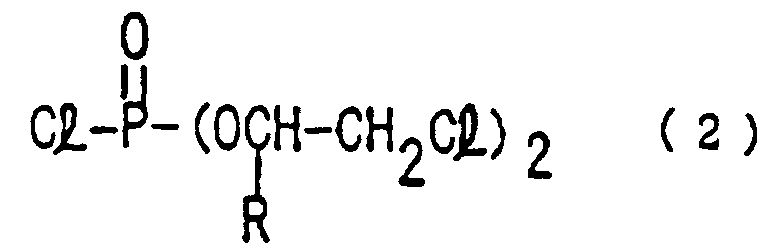
- reaction scheme (b) represents an alkylene dichloride. wherein R is the same as defined above.
- chlorine practically as chlorine gas may preferably be used in 1.0 to 1.5 moles, more preferably 1.0 to 1.2 moles, to 1.0 mole of the tris(chloroalkyl) phosphite.
- the reaction temperature in the second step may preferably be 0 to 150°C, more preferably 20 to 80°C.
- the reaction temperature lower than 0°C is not preferable because sufficient reaction does not take place.
- the reaction temperature higher than 150°C is not preferable because the tris(chloroalkyl) phosphite decomposes.
- an amine compound such as triethylamine or tributhylamine, or a hydrin compound such as ethylene chlorohydrin or propylene chlorohydrin may be added as a stabilizer for the tris(chloroalkyl) phosphite.
- the second step will proceed in substantially quantitative.
- the alkylene dichloride is generated in an equimolecular amount to the tris(chloroalkyl) phosphite, this compound can be removed by evaporation in vacuo.
- the alkylene dichloride may be removed at any stage after the second step, the third step or post-treatment.
- the temperature for the removal may preferably be 30 to 100°C, and the pressure may preferably be 13.3 to 6650 Pa (0.1 to 500mmHg). Since most alkylene dichlorides have relatively low boiling points, they can be removed at a temperature lower than 100°C under a high vacuum pressure of 1333 Pa (10mmHg) or less.
- tribromoneopentyl alcohol may preferably be used in 1.0 to 1.5 moles, more preferably 1.0 to 1.2 moles, to 1.0 mole of the bis(chloroalkyl) phosphorochloridate.
- the reaction temperature in the third step is preferable 40 to 150°C, more preferably 60 to 110°C.
- the reaction temperature lower than 40°C is not preferable because sufficient reaction does not take place.
- the reaction temperature higher than 150°C is not preferable because the intermediate bis(chloroalkyl) phosphorochloridate decomposes.
- the third step may preferably be carried out in the presence of a Lewis acid catalyst.
- the Lewis acid catalysts are magnesium chloride, aluminum chloride and titanium tetrachloride.
- the use amount, for example, of aluminum chloride may preferably be 2.5 to 60.0 millimoles, more preferably 5.0 to 50.0 millimoles, to 1.0 mole of tribromoneopenthyl alcohol.
- the tribromoneopentyl chloroalkyl phosphate obtained in the third step contains little of the monomeric component, substantially having the purity of 100%.
- the obtained tribromoneopentyl chloroalkyl phosphate does not contain any remaining amine which otherwise would adversely affect fogging charactcterristic when the product is used with polyurethanes.
- the time period necessary for completing each of the reactions in the preparation process of the present invention is from 2 to 5 hours in industrial scale provided that the raw materials are economically used.
- the reaction time for 2 to 4 hours is required for obtaining a tribromoneopentyl chloroalkyl phosphate with good quality.
- the reaction mixture is discharged from a reactor and made into a finished product through washing and dehydration steps.
- the washing may be done by a conventional method, and both batch and continuous method may be used.
- the reaction mixture is washed with an aqueous solution of mineral acid such as sulfuric acid and hydrochloric acid, followed by an alkali or water cleaning and dehydration under reduced pressure.
- the reaction mixture may be subjected to the alkali cleaning instead of being washed with the aqueous mineral acid solution, and, after removing by filtrating or centrifuging a water-insoluble aluminum compound (catalytic component), the reaction mixture may be washed with water and dehydrated under reduced pressure.
- the tribromoneopentyl chloroalkyl phosphate obtained by the preparation process of the present invention can be suitably used as a flame-retardant for polyurethane foams.
- 0.1 to 60 parts by weight of the tribromoneopentyl chloroalkyl phosphate of the formula (3) may be used together with, if necessary, 0 to 40 parts by weight of a nonreactive organophosphorous compound acting as a flame-retardant plasticizer, 0 to 50 parts by weight of a bromohydrin compound of pentaerythritol and 0 to 5 parts by weight of an antioxidant, with respect to 100 parts by weight of a polyol which is a material of a polyurethane foam.
- Any polyol can be used provided that it is generally used as a material of polyurethanes, but aptly used are polyols such as polyester polyol and polyether polyoi which have about 2 to 8 hydroxyl groups per molecule and a molecular weight of about 250 to about 6500. Polyols with a molecular weight of less than 250 are not suitable for forming polyurethane foams because of their great activity, and polyols with a molecular weight of more than 6500 damage workability because of their high viscosity.
- polyols such as polyester polyol and polyether polyoi which have about 2 to 8 hydroxyl groups per molecule and a molecular weight of about 250 to about 6500.
- Polyols with a molecular weight of less than 250 are not suitable for forming polyurethane foams because of their great activity, and polyols with a molecular weight of more than 6500 damage workability because of their high viscosity.
- polyols examples include diols; triols; and polyols such as sorbitol, sucrose, or polyols obtained by polymerization of ethylene oxide and/or propylene oxide with an amine such as ethylenediamine as an initiator.
- diols such as polyoxyethylene glycol and polyoxypropylene glycol
- triols such as polyoxyethylene glycerol, polyoxypropylene glycerol, poly(oxyethylene)poly(oxypropylene)glycerol, polyoxyethyleneneohexanetriol, polyoxypropylenepentaneohexanetriol,poly(oxyethylene)poly(oxypropylene)neohexanetriol , poly(oxypropylene)1,2,6-hexanetriol and polyoxypropylene alkanol; poly(oxyethylene)poly(oxypropylene)ethylenediamine; hexols such as polyoxyethylene sorbitol and polyoxypropylene sorbitol; octols such as polyoxyethylene sucrose and polyoxypropylene sucrose; and a mixture thereof.
- polyols phosphorus-containing polyols or the like, commercially available as special grades, in which melamine or poly(ammonium phosphate) is dispersed.
- polyether polyols such as poly(oxyethylene/oxypropylene)triols having an average molecular weight of about 250 to about 6500.
- the flame-retardant plasticizer may preferably have an average molecular weight of 350 or more because a plasticizer having a small molecular weight tends to volatilize by heat.
- examples thereof are tris(dichloropropyl) phosphate, Antiblaze 78 (chlorinated polyphosphonate manufactured by Albright & Wilson), Thermolin 101 [tetrakis(2-chloroethyl)- ethylene diphosphate manufactured by Olin Urethane Chemicals], Phosgard 2XC20 [2,2 bis-(chloromethyl)-1,3-propanebis(chloroethyl)-diphosphate manufactured by Monsanto Chemical Company], CR-530, CR-570 and CR-509 (halogen-containing phosphate phosphonate oligomer esters manufactured by Daihachi Chemical Industry Co., Ltd., CR-504 and CR-505 (halogen-containing diphosphate oligomer esters manufactured by Daihachi Chemical Industry Co.,
- the bromohydrin compounds of pentaerythritol are solid with a melting point.
- Examples thereof include dibromoneopentyl glycol and tribromoneopentyl alcohol.
- antioxidants examples include hydroquinone compounds of the formula (8): wherein each of R1, R2, R3 and R4 represents hydrogen atom or a C 1-14 alkyl group, and/or trivalent organophosphorous compounds.
- hydroquinone compounds include hydroquinone, 2,5-di-t-amylhydroquinone, 2,5-dioctylhydroquinone, t-amylhydroquinone; t-butyl-hydroquinone and octylhydroquinone.
- hydroquinone compounds having excellent heat-resistance are 2,5-di-t-amylhydroquinone and 2,5-di-t-butylhydroquinone.
- trivalent organophosphorous compounds examples include triphenyl phosphite, tris(nonylphenyl) phosphite, diphenylisodecyl phosphite, tris(2,4-di-t-butylphenyl)pentaerythritol diphosphite, and tetrakis-(2,4-di-t-butylphenyl)-4,4-diphenylene phosphonite.
- polyurethane foam may be produced by adding the tribromoneopentyl chloroalkyl phosphate to the reaction of the polyol with toluenediisocyanate (TDI) in the presence of a catalyst, water or a blowing agent, a dispersant and the like, and then heating with stirring.
- TDI toluenediisocyanate
- TDIs include isomers of 2,4- and 2,6-toluenediisocyanates and the concentration of these isomers preferably has an index of about 80 to about 120 for the 80/20 TDI, but not limited thereto.
- tertiary amine catalysts e.g., tri-ethylenediamine, dimethylethanolamine and N-ethylmorpholine
- compounds having a low-boiling point such as water, flurocarbon and methylene chloride may be used.
- nonionic surfactants such as ether-type, etherester-type and ester-type ones may be used.
- examples are alkyl(methyl, ethyl, propyl, butyl, amyl, heptyl, octyl, nonyl, decyl, dodecyl, tridecyl)- and aryl(phenyl, tolyl, xylyl, biphenyl, naphthyl)polyoxyethylene ethers, alkyl aryl forrnaldehyde-condensed polyoxyethylene ethers, polyoxyethylene ethers of glycerin esters, polyethylene glycol fatty acid esters, propylene glycol esters, polyglycerins, sorbitan esters, fatty acid monoglycerides and mixtures thereof.
- the invention is constituted of the three steps of reacting an alkylene oxide with phosphorus trichloride in a chemical equivalent or less amount to the alkylene oxide to obtain a tris(chloroalkyl) phosphite, then reacting the tris(chloroalkyl) phosphite with chlorine to obtain a bis(chloroalkyl) phosphorochloridate, and reacting the bis(chloroalkyl) phosphoro-chloridate with tribromoneopentyl alcohol to prepare a tribromoneopentyl chloroalkyl phosphate.
- the present invention also provides a process for preparing flame-retardants for polyurethane foam which are capable of providing flame-retardancy, low fogging characteristic, good thermal stability and resistance to scorching.
- the tribromoneopentyl chloroalkyl phosphate prepared according to the present invention is excellent in flame-retardancy, low fogging characteristic, thermal stability and resistance to scorching, the tribromoneopentyl chloroalkyl phosphate can be used as a flame-retardant useful for providing articles having desirable properties for the automobile and furniture industries.
- % means wt% and chlorine % means a quantitative value of chlorine in P-Cl bond determined by potentiometric titration unless otherwise indicated.
- the resulting mixture was washed with an aqueous solution of soda ash (sodium carbonate) and the organic phase was separated from an aqueous phase. Then low-boiling point components and 1,2-dichloroethane were recovered by distillation in vacuo.
- soda ash sodium carbonate
- low-boiling point components and 1,2-dichloroethane were recovered by distillation in vacuo.
- the object phosphate ester, 503g was obtained in a 95% yield.
- the resulting phosphate ester was found to be 100% tribromoneophentyl bis(chloroethyl) phosphate from area-ratio by gel permeation chromatography (GPC).
- the second step was carried out in the same way as in Example 1.
- the percentage of chlorine was 9.2%.
- the third step was carried out in the same way as in Example 1.
- the object phosphate ester, 535g, was obtained in a 96% yield.
- the resulting phosphate ester was found to be 100% tribromoneophentyl bis(chloropropyl) phosphate from the area-ratio by GPC.
- the generated compounds were found to be 95% tribromo-neopentyl bis(chloroethyl) phosphate, 4% bis(tribromoneopentyl)chloroethylphosphate and 1% tris(chloroethyl) phosphate from the area-ratio by GPC.
- the intermediate phosphate ester, 440g was obtained in the same way as in Comparative Example 1 except that the removal of hydrochloric acid and phosphorus oxychloride was carried out by thin film distillation. The percentage of chlorine was 16.1%.
- the product was found to be 65% tribromoneopentyl bis(chloropropyl) phosphate, 20% bis(tribromoneopentyl)chloropropyl phosphate, 5% tris(tribromoneopentyl) phosphate and 10% tris(chloropropyl) phosphate from the area-ratio by GPC.
- Table 1 shows the obtained compounds and the properties thereof in the above Examples 1 and 2, and Comparative Examples 1 to 3.
- Table 1 clearly shows that the tribromoneopentyl chloroalkyl phosphate can be obtained in a high purity by the method of the present invention.
- the polyol, silicone oil, catalyst, water and flame-retardant were blended in the amount as described in the above recipe and homogeneously mixed by stirring at 3000 r.p.m. for 1 minute. Then isocyanate was added and, after further stirring at 3000 r.p.m. for 5 to 7 seconds, the mixture was quickly poured into a cubic carton. Expansion was immediately observed and reached the maximum volume in several minutes. This substance was allowed to cure in an oven at 80°C for 30 minutes. The obtained foams had a flexible white cellular structure.
- the tribromoneopentyl chloroalkyl phosphate of an extremely high purity can be produced, volatile by-products such as free halogen are generated in much smaller amount and the resistance to hydrolysis of the product is more excellent, compared with the prior processes.
- the product is capable of providing flame retardancy, low fogging characteristic, scorch resistance and heat-discoloration resistance to polyurethane foam when used with the polyurethane foam.
- the amount of crystalline components i.e., bis(tribromoneopentyl)chloroalkyl phosphate and tris(tribromoneopentyl) phosphate, is very small in the product, it is possible to obtain a flame-retardant of low viscosity and of good workability.
Landscapes
- Chemical & Material Sciences (AREA)
- Organic Chemistry (AREA)
- Health & Medical Sciences (AREA)
- Life Sciences & Earth Sciences (AREA)
- Biochemistry (AREA)
- General Health & Medical Sciences (AREA)
- Molecular Biology (AREA)
- Compositions Of Macromolecular Compounds (AREA)
- Fireproofing Substances (AREA)
Claims (20)
- Ein Verfahren zur Herstellung eines Tribromneopentylchloralkylphosphates gemäß der Formel (3):worin R ein Wasserstoffatom, eine Alkyl- oder Chloralkylgruppe ist, das folgendes umfaßt:
 einen ersten Schritt, in welchem ein Alkylenoxid mit Phosphortrichlorid in einer chemisch äquivalenten oder geringeren Menge gegenüber dem Alkylenoxid reagiert wird, um ein Tris(chloralkyl)phosphit gemäß Formel (1) zu ergeben:worin R wie oben definiert ist;
 einen zweiten Schritt, in welchem das Tris(chloralkyl)phosphit mit Chlor reagiert wird, um ein Bis(chloralkyl)phosphorchloridat gemäß Formel (2) zu ergeben:worin R wie oben definiert ist; und
 einen dritten Schritt, in welchem das Bis(chloralkyl)phosphorchloridat mit Tribromneopentyl reagiert wird.
 - Das Verfahren gemäß Anspruch 1, wobei der Substituent R ein Wasserstoffatom ist, eine gerade oder verzweigtkettige Alkylgruppe mit 1 bis 10 Kohlenstoffatomen, oder eine geradekettige Chloralkylgruppe mit 1 bis 3 Kohlenstoffatomen.
- Das Verfahren gemäß Anspruch 2, worin der Substituent R ein Wasserstoffatom oder eine Methylgruppe ist.
- Das Verfahren gemäß Anspruch 1, worin das Alkylenoxid Epoxyethan, Epoxypropan, Epoxybutan, Epoxymethylbutan, Epoxypentan, Epoxyhexan, Epoxyheptan, Epoxyethyloctan, Epoxydecan, Epoxymethyldecan, Epichlorhydrin oder Chlorepoxybutan ist.
- Das Verfahren gemäß Anspruch 4, worin das Alkylenoxid Epoxyethan oder Epoxypropan ist.
- Das Verfahren gemäß Anspruch 1, worin das molekulare Verhältnis von Phosphortrichlorid zu dem Alkylenoxid 1,0:3,0 bis 3,6 beträgt.
- Das Verfahren gemäß Anspruch 1, worin das molekulare Verhältnis von Phosphortrichlorid zu dem Alkylenoxid 1,0:3,0 bis 3,3 beträgt.
- Das Verfahren gemäß Anspruch 1, worin nach dem ersten Schritt ein Überschuß an Alkylenoxid durch Verdampfen bei einer Temperatur von 20 bis 80 °C unter reduziertem Druck von 13,3 bis 6650 Pa (0,1 bis 500mm Hg) entfernt wird.
- Das Verfahren gemäß Anspruch 1, worin das molekulare Verhältnis des Tris(chloralkyl)phosphits zu Chlor 1,0:1,0 bis 1,5 beträgt.
- Das Verfahren gemäß Anspruch 9, worin das molekulare Verhältnis des Tris(chloralkyl)phosphits zu Chlor 1,0:1,0 bis 1,2 beträgt.
- Das Verfahren gemäß Anspruch 1, worin der zweite Schritt bei einer Temperatur von 0 bis 150 °C durchgeführt wird.
- Das Verfahren gemäß Anspruch 11, worin der zweite Schritt bei einer Temperatur von 20 bis 80 °C durchgeführt wird.
- Das Verfahren gemäß Anspruch 11, worin der zweite Schritt in Anwesenheit eines Stabilisators, der gewählt ist aus Triethylamin, Tributylamin, Ethylenchlorhydrin und Propylenchlorhydrin, durchgeführt wird.
- Das Verfahren gemäß Anspruch 1, worin nach dem zweiten oder dritten Schritt ein Alkylendichlorid, das im zweiten Schritt gebildet wird, durch Verdampfen bei einer Temperatur innerhalb des Bereiches von 30 bis 100°C unter einem Druck innerhalb des Bereiches von 13,3 bis 6650 Pa (0,1 bis 500mm Hg) entfernt wird.
- Das Verfahren gemäß Anspruch 1, worin das molekulare Verhältnis des Bis(chloralkyl)phosphorchloridates zu Tribromneopentylalkohol 1,0:1,0 bis 1,5 beträgt.
- Das Verfahren gemäß Anspruch 15, worin das molekulare Verhältnis des Bis(chloralkyl)phosphorchloridates zu Tribromneopentylalkohol 1,0:1,0 bis 1,2 beträgt.
- Das Verfahren gemäß Anspruch 1, worin der dritte Schritt bei einer Temperatur von 40 bis 150 °C ausgeführt wird.
- Das Verfahren gemäß Anspruch 17, worin der dritte Schritt bei einer Temperatur von 60 bis 110 °C ausgeführt wird.
- Das Verfahren gemäß Anspruch 1, worin der dritte Schritt in Anwesenheit eines Lewissäure-Katalysators, gewählt aus Magnesiumchlorid, Aluminiumchlorid und Titantetrachlorid, durchgeführt wird.
- Das Verfahren gemäß Anspruch 1, worin der dritte Schritt in Anwesenheit von 5,0 bis 50,0 Millimol Aluminiumchlorid als Lewissärekatalysator zu 1,0 Mol Tribromneopentylalkohol durchgeführt wird.
Applications Claiming Priority (3)
| Application Number | Priority Date | Filing Date | Title |
|---|---|---|---|
| JP12705996 | 1996-05-22 | ||
| JP127059/96 | 1996-05-22 | ||
| JP8127059A JP2865617B2 (ja) | 1996-05-22 | 1996-05-22 | トリブロモネオペンチルリン酸クロロアルキルエステルの製造方法 |
Publications (2)
| Publication Number | Publication Date |
|---|---|
| EP0808840A1 EP0808840A1 (de) | 1997-11-26 |
| EP0808840B1 true EP0808840B1 (de) | 2002-02-06 |
Family
ID=14950581
Family Applications (1)
| Application Number | Title | Priority Date | Filing Date |
|---|---|---|---|
| EP97108211A Expired - Lifetime EP0808840B1 (de) | 1996-05-22 | 1997-05-21 | Verfahren zur Herstellung von Tribromoneopentyl-Chloroalkyl-Phosphaten |
Country Status (9)
| Country | Link |
|---|---|
| US (1) | US5756797A (de) |
| EP (1) | EP0808840B1 (de) |
| JP (1) | JP2865617B2 (de) |
| KR (1) | KR970074783A (de) |
| CN (1) | CN1166493A (de) |
| DE (1) | DE69710251T2 (de) |
| ID (1) | ID16951A (de) |
| IL (1) | IL120838A (de) |
| TW (1) | TW461894B (de) |
Families Citing this family (3)
| Publication number | Priority date | Publication date | Assignee | Title |
|---|---|---|---|---|
| CA2564219A1 (en) * | 2004-04-27 | 2005-12-15 | Supresta Llc | Low scorching flame retardants for colored polyurethane foams |
| CN115109086B (zh) * | 2021-03-23 | 2024-08-16 | 利尔化学股份有限公司 | 制备烷基膦酸酯的方法 |
| CN118702721A (zh) * | 2024-06-13 | 2024-09-27 | 淮安晨化新材料有限公司 | 一种制备四氯代烷基二磷酸酯的方法 |
Family Cites Families (7)
| Publication number | Priority date | Publication date | Assignee | Title |
|---|---|---|---|---|
| BE790849Q (fr) * | 1970-02-02 | 1973-04-30 | Olin Corp | Nouveaux polyesters phosphoriques halogenes retardateurs d'inflammationet mousse de polyurethanne contenant ces polyesters |
| US3803272A (en) * | 1972-08-25 | 1974-04-09 | Olin Corp | Process for preparing tetrakis(2-haloalkyl)alkylene diphosphates |
| US4046719A (en) * | 1975-04-17 | 1977-09-06 | Tenneco Chemicals, Inc. | Flame-retardant resinous compositions containing trihaloneopentyl haloalkyl phosphates |
| US4083825A (en) * | 1976-07-23 | 1978-04-11 | Velsicol Chemical Corporation | Novel phosphate esters and non-scorching flame retardant polyurethane compositions containing them |
| JPH0725230B2 (ja) * | 1984-06-18 | 1995-03-22 | 株式会社リコー | 直描型平版印刷用原板 |
| JPH0721086A (ja) * | 1993-07-07 | 1995-01-24 | Hitachi Ltd | 計算機システム |
| JPH08325280A (ja) * | 1995-03-29 | 1996-12-10 | Daihachi Chem Ind Co Ltd | トリブロモネオペンチルリン酸クロロアルキルエステルの製造方法 |
-
1996
- 1996-05-22 JP JP8127059A patent/JP2865617B2/ja not_active Expired - Fee Related
-
1997
- 1997-05-15 IL IL12083897A patent/IL120838A/xx not_active IP Right Cessation
- 1997-05-20 US US08/859,263 patent/US5756797A/en not_active Expired - Fee Related
- 1997-05-20 TW TW086106713A patent/TW461894B/zh not_active IP Right Cessation
- 1997-05-20 KR KR1019970019569A patent/KR970074783A/ko not_active Withdrawn
- 1997-05-21 CN CN97111594A patent/CN1166493A/zh active Pending
- 1997-05-21 ID IDP971697A patent/ID16951A/id unknown
- 1997-05-21 EP EP97108211A patent/EP0808840B1/de not_active Expired - Lifetime
- 1997-05-21 DE DE69710251T patent/DE69710251T2/de not_active Expired - Fee Related
Also Published As
| Publication number | Publication date |
|---|---|
| JP2865617B2 (ja) | 1999-03-08 |
| ID16951A (id) | 1997-11-27 |
| KR970074783A (ko) | 1997-12-10 |
| DE69710251D1 (de) | 2002-03-21 |
| TW461894B (en) | 2001-11-01 |
| JPH09309890A (ja) | 1997-12-02 |
| DE69710251T2 (de) | 2004-06-09 |
| EP0808840A1 (de) | 1997-11-26 |
| IL120838A0 (en) | 1997-09-30 |
| IL120838A (en) | 2000-11-21 |
| US5756797A (en) | 1998-05-26 |
| CN1166493A (zh) | 1997-12-03 |
Similar Documents
| Publication | Publication Date | Title |
|---|---|---|
| US5728746A (en) | Process for the preparation of mixtures of oligomeric phosphoric acid esters and their use as flame-proofing agents for polyurethane foams | |
| US5457221A (en) | Process for the manufacture of poly (hydrocarbylene aryl phosphate) compositions | |
| EP0789703B1 (de) | Verfahren zur darstellung von hydrocarbyl-bis-(hydrocarbylphosphat) | |
| EP0735039B1 (de) | Ein Verfahren zur Herstellung von Tribromoneopentylchloroalkylphosphaten | |
| US6043305A (en) | Alkylene-bridged alkyl phosphonates | |
| US5756797A (en) | Process for preparing tribromoneopentyl chloroalkyl phosphates | |
| JP3113228B2 (ja) | 難燃性ポリウレタンフォーム組成物 | |
| US3830890A (en) | Method of making esters of 1,4-diphosphonyl butene | |
| US3422453A (en) | Di-o-biphenylyl diphenyl bisphenol a bis phosphate and process | |
| US3201437A (en) | Neoalkyl phosphites | |
| US3515776A (en) | Mixed esters of phosphonic acid and preparation | |
| US5151539A (en) | Formation of tetraarylpyrophosphate | |
| US4365026A (en) | (Halo)(hydroxy)-substituted phosphites and phosphorates as flame retardants in polyurethane foams | |
| JP2862490B2 (ja) | 含ハロゲン系縮合リン酸エステルの製造方法 | |
| WO2001000636A1 (en) | Process for the preparation of condensed phosphoric esters | |
| US3939227A (en) | Bis(hydroxy and halo alkyl) alkyl or aryl phosphonates | |
| US4067931A (en) | Flame retardant polyoxymethylene diphosphonates | |
| JPH06157567A (ja) | ペンタエリトリットに基づくリンヘテロ環を形成する方法 | |
| EP0971935A1 (de) | Verfahren zur herstellung und verwendung von bisaryldiphosphaten | |
| EP0406934B1 (de) | Bildung von Glykol-Bisphosphat-Verbindungen | |
| CN105820586A (zh) | 含羟基聚(亚烷基磷酸酯) | |
| US3819750A (en) | Polyalkylene glycol vinyl phosphates | |
| JP2882763B2 (ja) | ポリウレタンフォーム用難燃性組成物 | |
| IL45925A (en) | Copolycondensation products of beta-haloalkyl phosphates and dialkyl phosphonates | |
| US3372209A (en) | Diphosphorus ester hydrocarbon diols |
Legal Events
| Date | Code | Title | Description |
|---|---|---|---|
| PUAI | Public reference made under article 153(3) epc to a published international application that has entered the european phase |
Free format text: ORIGINAL CODE: 0009012 |
|
| AK | Designated contracting states |
Kind code of ref document: A1 Designated state(s): DE GB NL |
|
| 17P | Request for examination filed |
Effective date: 19980202 |
|
| 17Q | First examination report despatched |
Effective date: 20000825 |
|
| GRAG | Despatch of communication of intention to grant |
Free format text: ORIGINAL CODE: EPIDOS AGRA |
|
| GRAG | Despatch of communication of intention to grant |
Free format text: ORIGINAL CODE: EPIDOS AGRA |
|
| GRAH | Despatch of communication of intention to grant a patent |
Free format text: ORIGINAL CODE: EPIDOS IGRA |
|
| GRAH | Despatch of communication of intention to grant a patent |
Free format text: ORIGINAL CODE: EPIDOS IGRA |
|
| GRAA | (expected) grant |
Free format text: ORIGINAL CODE: 0009210 |
|
| REG | Reference to a national code |
Ref country code: GB Ref legal event code: IF02 |
|
| AK | Designated contracting states |
Kind code of ref document: B1 Designated state(s): DE GB NL |
|
| REF | Corresponds to: |
Ref document number: 69710251 Country of ref document: DE Date of ref document: 20020321 |
|
| PLBE | No opposition filed within time limit |
Free format text: ORIGINAL CODE: 0009261 |
|
| STAA | Information on the status of an ep patent application or granted ep patent |
Free format text: STATUS: NO OPPOSITION FILED WITHIN TIME LIMIT |
|
| 26N | No opposition filed |
Effective date: 20021107 |
|
| PGFP | Annual fee paid to national office [announced via postgrant information from national office to epo] |
Ref country code: NL Payment date: 20090527 Year of fee payment: 13 |
|
| PGFP | Annual fee paid to national office [announced via postgrant information from national office to epo] |
Ref country code: DE Payment date: 20090525 Year of fee payment: 13 |
|
| PGFP | Annual fee paid to national office [announced via postgrant information from national office to epo] |
Ref country code: GB Payment date: 20090507 Year of fee payment: 13 |
|
| REG | Reference to a national code |
Ref country code: NL Ref legal event code: V1 Effective date: 20101201 |
|
| GBPC | Gb: european patent ceased through non-payment of renewal fee |
Effective date: 20100521 |
|
| PG25 | Lapsed in a contracting state [announced via postgrant information from national office to epo] |
Ref country code: NL Free format text: LAPSE BECAUSE OF NON-PAYMENT OF DUE FEES Effective date: 20101201 |
|
| PG25 | Lapsed in a contracting state [announced via postgrant information from national office to epo] |
Ref country code: DE Free format text: LAPSE BECAUSE OF NON-PAYMENT OF DUE FEES Effective date: 20101201 |
|
| PG25 | Lapsed in a contracting state [announced via postgrant information from national office to epo] |
Ref country code: GB Free format text: LAPSE BECAUSE OF NON-PAYMENT OF DUE FEES Effective date: 20100521 |