EP0808550B1 - Systeme de telecommunications - Google Patents
Systeme de telecommunications Download PDFInfo
- Publication number
- EP0808550B1 EP0808550B1 EP96902342A EP96902342A EP0808550B1 EP 0808550 B1 EP0808550 B1 EP 0808550B1 EP 96902342 A EP96902342 A EP 96902342A EP 96902342 A EP96902342 A EP 96902342A EP 0808550 B1 EP0808550 B1 EP 0808550B1
- Authority
- EP
- European Patent Office
- Prior art keywords
- virtual
- narrow band
- junctor
- channel
- backplane
- Prior art date
- Legal status (The legal status is an assumption and is not a legal conclusion. Google has not performed a legal analysis and makes no representation as to the accuracy of the status listed.)
- Expired - Lifetime
Links
Images



Classifications
-
- H—ELECTRICITY
- H04—ELECTRIC COMMUNICATION TECHNIQUE
- H04L—TRANSMISSION OF DIGITAL INFORMATION, e.g. TELEGRAPHIC COMMUNICATION
- H04L49/00—Packet switching elements
- H04L49/30—Peripheral units, e.g. input or output ports
- H04L49/3081—ATM peripheral units, e.g. policing, insertion or extraction
-
- H—ELECTRICITY
- H04—ELECTRIC COMMUNICATION TECHNIQUE
- H04Q—SELECTING
- H04Q11/00—Selecting arrangements for multiplex systems
- H04Q11/04—Selecting arrangements for multiplex systems for time-division multiplexing
- H04Q11/0428—Integrated services digital network, i.e. systems for transmission of different types of digitised signals, e.g. speech, data, telecentral, television signals
- H04Q11/0478—Provisions for broadband connections
-
- H—ELECTRICITY
- H04—ELECTRIC COMMUNICATION TECHNIQUE
- H04L—TRANSMISSION OF DIGITAL INFORMATION, e.g. TELEGRAPHIC COMMUNICATION
- H04L12/00—Data switching networks
- H04L12/54—Store-and-forward switching systems
- H04L12/56—Packet switching systems
- H04L12/5601—Transfer mode dependent, e.g. ATM
- H04L2012/5638—Services, e.g. multimedia, GOS, QOS
- H04L2012/5646—Cell characteristics, e.g. loss, delay, jitter, sequence integrity
- H04L2012/5652—Cell construction, e.g. including header, packetisation, depacketisation, assembly, reassembly
Definitions
- This invention relates to digital communications systems and in particular to systems embodying asynchronous transfer mode (ATM) technology.
- ATM asynchronous transfer mode
- the invention further relates to an apparatus and method of switching narrow band traffic in such a system.
- the asynchronous transfer mode (ATM) technology is a flexible form of transmission which allows any type of service traffic, voice, video or data, to be multiplexed together on to a common means of transmission.
- the service traffic must first be adapted typically into 53 byte cells comprising 5 byte headers and 48 byte payloads such that the original traffic can be reconstituted at the far end of an ATM network.
- This form of adaptation is performed in the ATM adaptation layer (AAL).
- AAL ATM adaptation layer
- Five types of adaptation layer have been defined.
- adaptation layer 1 is used to adapt constant bit rate traffic to the ATM standard.
- Kurano et al. describe a switch adapated for switching channels of narrower bandwidth in an ATM network by allocating the channels to time slots in a plurality of broadband channels thereby providing a mapping between channel addresses and virtual circuit payloads.
- ATM switches provide point-multipoint capability as a basic function.
- a combination of an ATM switch and a narrow band to broad band service interworking capability can therefore achieve point-multipoint in the narrow band network.
- This solution however has the problem that each narrow band to ATM adaptation incurs a 6 millisecond cell assembly delay which means that voice connections through the existing narrow band network will suffer from delay problems which require the use of additional equipment to effect for cancellation.
- the object of the invention is to minimise or to overcome this disadvantage.
- a narrow band ATM switch for a communications network and adapted to work into a backplane bus (12) associated with a backplane having ingress and egress facilities so as to separate switching from circuit adaptation and including a number of ports
- the switch having means for disassembly and re-assembly of ATM narrow band channel payloads by providing a mapping between channel addresses and virtual circuit payloads, means for allocating any channel on the backplane to any time slot in a plurality of virtual circuits whereby to provide a multicast facility, characterised in that each said port is coupled to a respective adaptive virtual junctor (13), , and that each said adaptive virtual junctor has a junctor virtual circuit with each of the other said adaptive virtual junctors,
- a method of switching narrow band channels in a narrow band ATM switch the switch being adapted to work into a backplane bus (12) associated with a backplane having ingress and egress facilities so as to separate switching from circuit adaptation and including a number of ports, the switch having means for disassembly and re-assembly of ATM narrow band channel payloads by providing a mapping between channel addresses and virtual circuit payloads, means for allocating any channel on the backplane to any time slot in a plurality of virtual circuits whereby to provide a multicast facility, wherein each said port is coupled to a respective adaptive virtual junctor (13), and wherein each said adaptive virtual junctor has a junctor virtual circuit with each of the other said adaptive virtual junctors, the method being characterised by dynamically adjusting the capacity of said junctor virtual circuits on a call by call basis.
- the invention provides a narrow band ATM switch for a communications network which provides point to multipoint capability on a narrow band channel basis in combination with bulk adaptation to ATM.
- the switch may be adapted whereby to perform a cell relay function into a narrow band switching fabric and may incorporate means for frame boundary rate adaptation.
- the arrangement facilitates inter-working between narrow band and broad band traffic in the public network.
- the most basic form of inter-working is for voice applications in which a POTS line or an ISDN B-Channel must be adapted to a Virtual Circuit using ATM Adaptation Layer 1 providing 64 kb/s connectivity between the two networks; this is required to work with voice services on an ATM workstation.
- the cell assembly delay for such a connection is 6 milliseconds which causes potential voice echo problems in many applications; echo cancellation to overcome such problems is well understood but is undesirable to implement.
- the AAL1 can be used for unstructured data transfer in which a synchronous bit stream is passed transparently through an ATM network and reconstituted at the far end.
- the structured data transfer mode in which phase information identifying the start of an n x 64 kb/s sub-frame is preferred as it allows 64 kb/s channels to be identified and manipulated.
- Multimedia networks can be provided using broad band technology based on ATM or on narrow band technology using 64 kb/s ISDN services and compression technology for voice and video.
- Switched multimedia is greatly enhanced by switches which provide a point-multipoint or multicast capability as this allows implicit conferencing.
- Multiple application of the point-multipoint function can be arranged to achieve a multipoint-multipoint service capability.
- the invention relates to a narrow band switch which provides point-multipoint capability in which the delay for each path conforms to the normal delay of 450 microseconds average (ITU-T Q551) thus allowing the switch to be deployed within the current network without delay problems.
- ITU-T Q551 microseconds average
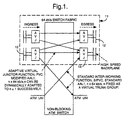
- FIG. 1 a bulk implementation of an inter-working function is illustrated in Figure 1.
- a 64 kb/s switching fabric 11 is typically implemented to work into a high capacity backplane bus 12. Lines and trunks work into same bus so as to separate the concerns of switching from circuit adaptation.
- the inter-working device provides adaptation for e.g. 2048 channels of backplane bus capacity into as many virtual containers (VCs) as are required in order to fill a 155 Mb/s interface to an ATM switch. This requires a number of Virtual Circuits depending on the number of 64 kb/s channels in each virtual circuit.
- VCs virtual containers
- the arrangement allows any channel on the backplane to be allocated to any time slot in a multiplicity of the virtual circuits to provide a multicast facility at a granularity of a single or multiple 64kb/s circuit.
- the particular application of this technique is for example to the provision of multimedia services via a broad band ATM network.
- the ATM network may provide multicast of cells, this is useful to the provision of narrow band services only when single channel adaptation is used, incurring the aforementioned disadvantages of delay, echo cancellation, and the need to provide switched virtual circuits and signalling in the ATM domain.
- the ability to multicast in the narrow band domain enables advantages of bulk adaptation to be employed, namely the low delay, N-ISUP signalling, with the ability to locally switch or to trunk the traffic.
- the broad band network management need not be aware of the narrow band services used in this mode which separates the management aspects of the narrow band from the broad band network yet provides full interworking between the narrow band and the broad band network.
- FIG. 2 A typical application of the switch of Figure 1 is illustrated in Figure 2. It is assumed that an existing network has been upgraded to intelligent networking in which each switch in the network provides a point-to-point services switching point (SSP), each SSP receives instructions from a services control point at each significant trigger point in the call process.
- SSP point-to-point services switching point
- a point-to-multipoint services switching point is introduced into the network to provide switched multimedia services to the installed base of switches.
- the point-to multipoint SSP is a form of switch which allows call control to be exercised from an external server, which is a multimedia call control server in the example shown.
- Point-to-multipoint calls initiated in the point-to-muitipoint SSP can be extended on a point-to-point basis into the existing network using the trunks with SS7 capability which link the point-to-multipoint SSP with the existing network.
- This network architecture allows narrow band multimedia services to be delivered with all of the features planned for the broad band network.
- the device used to adapt an ATM switch into a 64 kb/s fabric is termed an adaptive virtual junctor (AVJ).
- An AVJ 13 is attached to each port of the ATM switch which is to be used as part of the 64 kb/s fabric, illustrated in Figure 1.
- Each AVJ has a junctor virtual circuit with each other AVJ.
- Each junctor VC comprises an n x 64 kb/s connection in which n is an integer allowed to vary e.g. between 6 and 2048.
- 6 is set as a minimum of n so that the cell assembly delay of the fabric is never more than one millisecond so as to avoid echo problems.
- a control element 14 is associated with each AVJ and all control elements use the ATM fabric to communicate control signals.
- the ATM switch is non-blocking, so that if a channel is available at an ingress AVJ and an egress AVJ it is also by definition available through the fabric.
- an ingress AVJ intends to change a VC from n x 64 kb/s to (n ⁇ 1) x 64 kb/s; it first signals ahead to the control element of the egress AVJ to identify the channel and the connection requirements to the backplane. The change is then implemented in the ingress function and the change is signalled within the junctor VC, preserving frequency and phase across the junctor VC.
- the act of changing the capacity of the network of junctor VCs on a call-by-call basis is equivalent to the operation of a 64 kb/s switching fabric from the perspective of attached lines and trunks.
- the mechanism is the extension of the standard inter-working function, it is still possible to use part of the ATM switch for broad band purposes and to provide narrow band and broad band inter-working.
- a virtual trunk group may provide a semipermanent pool of capacity between two switches which can be used as required to establish calls between the two switches.
- the respective roles are illustrated in Figure 1.
- the physical trunks between switches are implemented purely in the ATM domain.
- the capacity of these trunks is utilised to provide logical routes between destinations.
- a logical route comprises a number of VCs providing n x 64 kb/s, where for example, 6 ⁇ n ⁇ 30, and in addition an associated N-ISUP signalling channel.
- the lower limit of 6 is preferred as discussed above to avoid echo problems due to cell assembly delay.
- VTGs are connected through the synchronous backplane to the AVJ and have the ability to connect any backplane channel to any 64 kb/s time slot within any of the set of n x 64 kb/s VCs forming a logical route.
- the VTGs are depicted as incorporated with the AVJs.
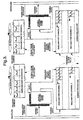
- FIG. 3 The principle of the adaptive virtual junctor is illustrated schematically in Figure 3.
- the diagram shows the process of assembly and disassembly of ATM payloads, the process cycling every 125 microseconds, although those skilled in the art will appreciate that any frame duration may be supported.
- Both the ingress and egress processes use an octet address to PVC map.
- This map relates a 64kb/s channel octet to the payload of a virtual circuit.
- the ingress side uses a frame store whose order of loading and unloading may therefore differ.
- the address of the octet in the frame from the backplane is used to access the map to provide a simple means to access all valid locations in the map once per 125 microsecond cycle.
- This map identifies a virtual circuit and an octet address in the frame, together with any supplementary information that may be needed for cell assembly.
- the ingress map contains an address in the frame store such that the order in which the channel octets are concatenated into the payloads of virtual circuits may be freely chosen to match their time sequence ordering on the backplane of the egress process or any other desired order.
- payloads are built into ATM cells using AAL1 structured data transfer for transmission across the network.
- the payloads are buffered to provide an elastic buffer to compensate for jitter and cell delay variation and for the payload disassembly process, under action of a similar map to that of the ingress process.
- the egress process accepts an octet address in the frame directly from the backplane and applies it to the PVC map, which stores an associated PVC identifier, octet address and any supplementary information as described for the ingress process.
- Octets are removed form the payload of cells for any given PVC and are transferred to a location in a frame store. At the end of the cycle, the frame store is offered to the backplane and is emptied in the time slot sequence order of the frame.
- Figure 4 shows a preferred embodiment of the present invention wherein the adaptive virtual junctor is applied to multicast narrow band n x 64kb/s channels, to a multiplicity of narrow band destinations via the same ATM adaptation means.
- the multicast facility is enabled by repeating in the PVC map an octet address in the frame store of the channel to be multicast, and using it as frequently in the map as the required number of narrow band destinations.
- These destinations may be served by the same or a different ATM PVC or junctor, which may employ all the aforementioned and referenced means for creating a single switch fabric employing the same narrow band signalling means and the same rate adaptation means, and which may multicast narrow band channels not exceeding the bandwidth of the switch port to which an adaptive virtual junctor may be connected.
- Figure 5 shows a further embodiment which requires only one means of time slot resequencing.
- This resequencing is provided by the double buffered frame store of the ingress process, which may therefore order the time slots in the payloads of the cells of the junctor PVCs in their time slot sequence order of the respective egress backplane, thus providing the same aforementioned multicast facility.
- the egress double buffered frame store is no longer required.
- the advantage of this embodiment is a reduction in the path delay across the 64kb/s switching fabric. This will allow the single fabric switch to comply for example with ITU Standard Q551.
- VTG Virtual Trunk Group Device
- the VTG requires the ability to re-sequence time slots at both ends of the trunk such that the VTG channels may be "nailed-up" in the connection tables or PVC maps. Since the VTG application always requires back to back working of the two back planes, the ingress and egress re-sequencing may be provided by one pair frame stores in common with the AVJs with which the VTG communicates. This is more readily understood with regard to figure 2, where back to back working between the egress and ingress backplane would render one pair of frame stores redundant.
- Figure 6 illustrates this process by combining the AVJ and VTG functions in one device. Cells arriving in the egress process are offered to the backplane if they represent narrow band channels of local traffic from another AVJ.
- Narrow band channels of a VTG are written into a local frame store along with local traffic that is to be transmitted to another AVJ, possibly for onward trunking or as local traffic at that AVJ destination.
- the egress process may also receive cells from another AVJ and directly write their payload contents to the frame store for those narrow band channels that are to form an ingress VTG.
- the position in the frame store of AVJ to VTG, VTG to AVJ and local to AVJ channels may be freely chosen and form orthogonal sets of channels, with orthogonal access times to the frame store.
Landscapes
- Engineering & Computer Science (AREA)
- Computer Networks & Wireless Communication (AREA)
- Signal Processing (AREA)
- Data Exchanges In Wide-Area Networks (AREA)
Claims (7)
- Commutateur de mode de transfert asynchrone (ATM) à bande étroite pour un réseau de communications et adapté pour fonctionner dans un bus de plaque arrière (12) associé à une plaque arrière ayant des moyens d'entrée et de sortie de manière à séparer la commutation de l'adaptation de circuit et incluant de nombreux ports, le commutateur ayant des moyens pour désassembler et réassembler des charges utiles de canal à bande étroite ATM en fournissant un mappage entre des adresses de canal et des charges utiles de circuit virtuel, des moyens pour allouer un canal quelconque de la plaque arrière à une tranche temporelle quelconque d'une pluralité de circuits virtuels de manière à fournir un moyen de multi-diffusion, caractérisé en ce que chaque port est couplé à un joncteur virtuel adaptatif (13) respectif, et en ce que chaque joncteur virtuel adaptatif a un circuit virtuel de jonction avec chacun desdits autres joncteurs virtuels adaptatifs.
- Commutateur ATM à bande étroite selon la revendication 1, caractérisé en ce qu'il comporte des moyens destinés à répéter une adresse de canal dans une carte de circuit virtuel de manière à fournir une multi-diffusion de ce canal.
- Commutateur ATM à bande étroite selon la revendication 1, caractérisé en ce que ledit circuit virtuel de jonction comporte une connexion de n × 64 kilobits/seconde où n a une valeur entière.
- Commutateur ATM à bande étroite selon la revendication 3, caractérisé en ce que n a une valeur comprise entre 6 et 2048.
- Commutateur ATM à bande étroite selon l'une quelconque des revendications 1 à 6, et caractérisé en ce qu'il comporte des moyens de reséquencement des tranches temporelles destinés à ordonner des tranches temporelles dans les charges utiles de cellules des canaux virtuels permanents de jonction dans l'ordre de séquence des tranches temporelles de la plaque arrière de sortie.
- Procédé de commutation de canaux à bande étroite dans un commutateur ATM à bande étroite, le commutateur étant adapté pour fonctionner dans un bus de plaque arrière (12) associé à une plaque arrière ayant des moyens d'entrée et de sortie de manière à séparer la commutation de l'adaptation de circuit et incluant de nombreux ports, le commutateur ayant des moyens pour désas sembler et réassembler des charges utiles de canal à bande étroite ATM en fournissant un mappage entre des adresses de canal et des charges utiles de circuit virtuel, des moyens pour allouer un quelconque canal de la plaque arrière à une tranche temporelle quelconque d'une pluralité de circuits virtuels de manière à fournir un moyen de multi-diffusion, dans lequel chaque port est couplé à un joncteur virtuel adaptatif (13) respectif, et dans lequel chaque joncteur virtuel adaptatif a un circuit virtuel de jonction avec chacun desdits autres joncteurs virtuels adaptatifs, le procédé étant caractérisé par l'ajustement d'une manière dynamique de la capacité desdits circuits virtuels de jonction sur une base appel par appel.
- Procédé selon la revendication 6, caractérisé par un mappage des adresses d'octet de canal à bande étroite en charges utiles de circuit virtuel respectif.
Applications Claiming Priority (3)
| Application Number | Priority Date | Filing Date | Title |
|---|---|---|---|
| GB9502552 | 1995-02-09 | ||
| GB9502552A GB2297881B (en) | 1995-02-09 | 1995-02-09 | Communications system |
| PCT/GB1996/000302 WO1996025017A1 (fr) | 1995-02-09 | 1996-02-09 | Systeme de telecommunications |
Publications (2)
| Publication Number | Publication Date |
|---|---|
| EP0808550A1 EP0808550A1 (fr) | 1997-11-26 |
| EP0808550B1 true EP0808550B1 (fr) | 2002-04-10 |
Family
ID=10769347
Family Applications (1)
| Application Number | Title | Priority Date | Filing Date |
|---|---|---|---|
| EP96902342A Expired - Lifetime EP0808550B1 (fr) | 1995-02-09 | 1996-02-09 | Systeme de telecommunications |
Country Status (5)
| Country | Link |
|---|---|
| US (1) | US5930253A (fr) |
| EP (1) | EP0808550B1 (fr) |
| DE (1) | DE69620588T2 (fr) |
| GB (1) | GB2297881B (fr) |
| WO (1) | WO1996025017A1 (fr) |
Families Citing this family (36)
| Publication number | Priority date | Publication date | Assignee | Title |
|---|---|---|---|---|
| GB2305812B (en) * | 1995-09-29 | 1999-09-29 | Northern Telecom Ltd | Providing services in a telecommunications network |
| GB2310106B (en) * | 1996-02-12 | 2000-07-05 | Northern Telecom Ltd | Communications in a distribution network |
| JP2869034B2 (ja) * | 1996-03-26 | 1999-03-10 | 三菱電機株式会社 | 音声多段中継装置 |
| SE511581C2 (sv) | 1996-12-20 | 1999-10-25 | Ericsson Telefon Ab L M | System och förfarande för ATM-koppling av en telefonförbindelse |
| US6724751B1 (en) * | 1996-12-21 | 2004-04-20 | International Business Machines Corporation | Distributed voice processing system |
| GB2320642A (en) * | 1996-12-21 | 1998-06-24 | Ibm | Distributed voice processing system |
| GB9700930D0 (en) * | 1997-01-17 | 1997-03-05 | Northern Telecom Ltd | Distribution network |
| DE19732676C2 (de) * | 1997-07-29 | 2002-01-31 | Siemens Ag | Verfahren und Anpassungseinrichtung zum Vermitteln von Wählverbindungen zwischen zeitmultiplexorientierten Komponenten eines Kommunikationsnetzes über ein ATM-Kommunikationsnetz |
| GB2328111A (en) * | 1997-08-08 | 1999-02-10 | Northern Telecom Ltd | ATM/narrowband interworking |
| US6697353B2 (en) | 1997-12-31 | 2004-02-24 | At&T Corp. | Voice-over-ATM switch architecture allowing congestion-dependent transport of silence cells |
| US6324174B2 (en) * | 1997-12-31 | 2001-11-27 | At&T Corporation | Telecommunications network architecture for transporting fax, voice and data via an ATM switch including a STM to ATM terminal adapter |
| GB2333204A (en) * | 1998-01-12 | 1999-07-14 | Northern Telecom Ltd | Communications system |
| US6195346B1 (en) * | 1998-06-16 | 2001-02-27 | Mci Communications Corporation | Method and system for processing an HDLC message |
| US6633566B1 (en) * | 1998-06-16 | 2003-10-14 | Mci Communications Corporation | Method, apparatus and computer program product for interfacing a TDM link with a cell-switched network |
| US6252870B1 (en) | 1998-07-22 | 2001-06-26 | Siemens Aktiengesellschaft | Method and adapter device for switching switched connections between time-division-multiplex-oriented components of a communications network via an ATM communications network |
| EP1141849A1 (fr) * | 1998-11-19 | 2001-10-10 | Teraglobal Communications Corp. | Architecture de calcul et de communication unifiee |
| US6535513B1 (en) * | 1999-03-11 | 2003-03-18 | Cisco Technology, Inc. | Multimedia and multirate switching method and apparatus |
| US7133417B1 (en) | 1999-07-02 | 2006-11-07 | Cisco Technology, Inc. | Multipath voice switching method and apparatus |
| US6980544B2 (en) * | 1999-07-14 | 2005-12-27 | Telefonaktiebolaget Lm Ericsson (Publ) | Combining narrowband applications with broadband transport |
| US6775266B1 (en) | 1999-07-14 | 2004-08-10 | Telefonaktiebolaget Lm Ericsson | Narrowband applications using ATM switching and transport |
| ES2246996T3 (es) | 2000-07-05 | 2006-03-01 | Roke Manor Research Limited | Mejoras aportadas a los dispositivos de conmutacion. |
| GB0016476D0 (en) * | 2000-07-05 | 2000-08-23 | Roke Manor Research | Transmitting control information across a routing device |
| US20030048808A1 (en) * | 2001-09-12 | 2003-03-13 | Stahl Thomas Anthony | Method and apparatus for changing received streaming content channels |
| US20030084219A1 (en) * | 2001-10-26 | 2003-05-01 | Maxxan Systems, Inc. | System, apparatus and method for address forwarding for a computer network |
| US7085846B2 (en) * | 2001-12-31 | 2006-08-01 | Maxxan Systems, Incorporated | Buffer to buffer credit flow control for computer network |
| US7145914B2 (en) | 2001-12-31 | 2006-12-05 | Maxxan Systems, Incorporated | System and method for controlling data paths of a network processor subsystem |
| CA2371654A1 (fr) * | 2002-02-13 | 2003-08-13 | Alcatel Canada Inc. | Systeme et methode pour selectionner la connexion en parallele dans un reseau de communication |
| US7307995B1 (en) | 2002-04-05 | 2007-12-11 | Ciphermax, Inc. | System and method for linking a plurality of network switches |
| US7379970B1 (en) | 2002-04-05 | 2008-05-27 | Ciphermax, Inc. | Method and system for reduced distributed event handling in a network environment |
| US7295561B1 (en) | 2002-04-05 | 2007-11-13 | Ciphermax, Inc. | Fibre channel implementation using network processors |
| US7406038B1 (en) | 2002-04-05 | 2008-07-29 | Ciphermax, Incorporated | System and method for expansion of computer network switching system without disruption thereof |
| US20030195956A1 (en) * | 2002-04-15 | 2003-10-16 | Maxxan Systems, Inc. | System and method for allocating unique zone membership |
| US20030200330A1 (en) * | 2002-04-22 | 2003-10-23 | Maxxan Systems, Inc. | System and method for load-sharing computer network switch |
| US20030202510A1 (en) * | 2002-04-26 | 2003-10-30 | Maxxan Systems, Inc. | System and method for scalable switch fabric for computer network |
| US20040030766A1 (en) * | 2002-08-12 | 2004-02-12 | Michael Witkowski | Method and apparatus for switch fabric configuration |
| US7583707B2 (en) * | 2005-03-25 | 2009-09-01 | Cisco Technology, Inc. | System, method and apparatus for controlling a network post-demultiplexing function |
Family Cites Families (11)
| Publication number | Priority date | Publication date | Assignee | Title |
|---|---|---|---|---|
| JPH0498943A (ja) * | 1990-08-17 | 1992-03-31 | Hitachi Ltd | 非同期転送モードを用いたバーチャルコンテナの伝送方法及び回路 |
| FR2670974A1 (fr) * | 1990-12-20 | 1992-06-26 | Lmt Radio Professionelle | Dispositif pour la transmission par un reseau asynchrone, notamment un reseau de type atm, de donnees de signalisation voie par voie regroupees dans une multitrame emise de maniere synchrone en mode hors bande. |
| EP0531599B1 (fr) * | 1991-09-13 | 1998-07-22 | International Business Machines Corporation | Adaptateur configurable de commutateur gigabit/s |
| AU671449B2 (en) * | 1992-11-06 | 1996-08-29 | At & T Corporation | Establishing telecommunications call paths in broadband communication networks |
| US5412655A (en) * | 1993-01-29 | 1995-05-02 | Nec Corporation | Multiprocessing system for assembly/disassembly of asynchronous transfer mode cells |
| GB9306367D0 (en) * | 1993-03-26 | 1993-05-19 | Plessey Telecomm | Statistical gain using atm signalling |
| US5402415A (en) * | 1993-04-22 | 1995-03-28 | Washington University | Multicast virtual circuit switch using cell recycling |
| US5526344A (en) * | 1994-04-15 | 1996-06-11 | Dsc Communications Corporation | Multi-service switch for a telecommunications network |
| US5555244A (en) * | 1994-05-19 | 1996-09-10 | Integrated Network Corporation | Scalable multimedia network |
| EP0706297A1 (fr) * | 1994-10-07 | 1996-04-10 | International Business Machines Corporation | Procédé pour contrÔler la congestion de trafic dans un réseau de communication et système pour la mise en application de ce procédé |
| EP0719065A1 (fr) * | 1994-12-20 | 1996-06-26 | International Business Machines Corporation | Noeud de communication de paquets polycalent pour un réseau de communication de données |
-
1995
- 1995-02-09 GB GB9502552A patent/GB2297881B/en not_active Revoked
-
1996
- 1996-02-09 WO PCT/GB1996/000302 patent/WO1996025017A1/fr not_active Ceased
- 1996-02-09 EP EP96902342A patent/EP0808550B1/fr not_active Expired - Lifetime
- 1996-02-09 US US08/894,719 patent/US5930253A/en not_active Expired - Lifetime
- 1996-02-09 DE DE69620588T patent/DE69620588T2/de not_active Expired - Lifetime
Also Published As
| Publication number | Publication date |
|---|---|
| EP0808550A1 (fr) | 1997-11-26 |
| WO1996025017A1 (fr) | 1996-08-15 |
| US5930253A (en) | 1999-07-27 |
| DE69620588T2 (de) | 2003-01-09 |
| GB2297881B (en) | 1999-02-17 |
| DE69620588D1 (de) | 2002-05-16 |
| GB2297881A (en) | 1996-08-14 |
| GB9502552D0 (en) | 1995-03-29 |
Similar Documents
| Publication | Publication Date | Title |
|---|---|---|
| EP0808550B1 (fr) | Systeme de telecommunications | |
| US5428607A (en) | Intra-switch communications in narrow band ATM networks | |
| US5452297A (en) | Access switches for large ATM networks | |
| US5426636A (en) | ATM distribution networks for narrow band communications | |
| US5422882A (en) | ATM networks for narrow band communications | |
| US5390175A (en) | Inter-cell switching unit for narrow band ATM networks | |
| EP0669067B1 (fr) | Etablissement de trajets d'appels telephoniques dans des reseaux de telecommunications a large bande | |
| US6519261B1 (en) | Asynchronous transfer mode adaptation arrangements | |
| US5917824A (en) | Communications system | |
| EP0736239B1 (fr) | Resaux de transfert en mode asynchrone pour des communications en bande etroite | |
| US6151325A (en) | Method and apparatus for high-capacity circuit switching with an ATM second stage switch | |
| WO1998020701A1 (fr) | Architecture de distribution vocale sur des reseaux a mode de transfert asynchrone | |
| EP0770315B1 (fr) | Systeme de communications | |
| US7020144B2 (en) | High capacity Multi-AAL system for VTOA Gateway | |
| US6785280B1 (en) | Mechanism and method dynamically allocating ATM connections between exchanges | |
| CA2130865A1 (fr) | Systeme de commutation | |
| Deloddere | Evolution of a narrowband exchange toward broadband | |
| Rathgeb | Architecture of a multigigabit ATM core switch for the B-ISDN | |
| Rathgeb | The EWSXpress Core Node-A versatile ATM switch and its application to narrowband trunking | |
| Fischer et al. | An ATM system and network architecture in field trial | |
| Batubara et al. | An Introduction To B-ISDN And ATM | |
| Fischer et al. | A flexible ATM system architecture for world-wide field trials | |
| Hariri et al. | ATM-Based Parallel and Distributed Computing | |
| Van Landegem et al. | The evolution of connectionless service support in B-ISDN | |
| Hillyard | Asynchronous Transfer Mode |
Legal Events
| Date | Code | Title | Description |
|---|---|---|---|
| PUAI | Public reference made under article 153(3) epc to a published international application that has entered the european phase |
Free format text: ORIGINAL CODE: 0009012 |
|
| 17P | Request for examination filed |
Effective date: 19970909 |
|
| AK | Designated contracting states |
Kind code of ref document: A1 Designated state(s): DE FR GB SE |
|
| RAP3 | Party data changed (applicant data changed or rights of an application transferred) |
Owner name: NORTEL NETWORKS CORPORATION |
|
| 17Q | First examination report despatched |
Effective date: 19991215 |
|
| RAP1 | Party data changed (applicant data changed or rights of an application transferred) |
Owner name: NORTEL NETWORKS LIMITED |
|
| GRAG | Despatch of communication of intention to grant |
Free format text: ORIGINAL CODE: EPIDOS AGRA |
|
| GRAG | Despatch of communication of intention to grant |
Free format text: ORIGINAL CODE: EPIDOS AGRA |
|
| GRAH | Despatch of communication of intention to grant a patent |
Free format text: ORIGINAL CODE: EPIDOS IGRA |
|
| REG | Reference to a national code |
Ref country code: GB Ref legal event code: IF02 |
|
| GRAH | Despatch of communication of intention to grant a patent |
Free format text: ORIGINAL CODE: EPIDOS IGRA |
|
| GRAA | (expected) grant |
Free format text: ORIGINAL CODE: 0009210 |
|
| AK | Designated contracting states |
Kind code of ref document: B1 Designated state(s): DE FR GB SE |
|
| REF | Corresponds to: |
Ref document number: 69620588 Country of ref document: DE Date of ref document: 20020516 |
|
| PG25 | Lapsed in a contracting state [announced via postgrant information from national office to epo] |
Ref country code: SE Free format text: LAPSE BECAUSE OF FAILURE TO SUBMIT A TRANSLATION OF THE DESCRIPTION OR TO PAY THE FEE WITHIN THE PRESCRIBED TIME-LIMIT Effective date: 20020710 |
|
| ET | Fr: translation filed | ||
| PLBE | No opposition filed within time limit |
Free format text: ORIGINAL CODE: 0009261 |
|
| STAA | Information on the status of an ep patent application or granted ep patent |
Free format text: STATUS: NO OPPOSITION FILED WITHIN TIME LIMIT |
|
| 26N | No opposition filed |
Effective date: 20030113 |
|
| REG | Reference to a national code |
Ref country code: GB Ref legal event code: 732E Free format text: REGISTERED BETWEEN 20110728 AND 20110803 |
|
| REG | Reference to a national code |
Ref country code: FR Ref legal event code: TP Owner name: ERICSSON AB, SE Effective date: 20111010 |
|
| REG | Reference to a national code |
Ref country code: DE Ref legal event code: R082 Ref document number: 69620588 Country of ref document: DE Representative=s name: BURCHARDI, THOMAS, DIPL.-ING. UNIV., DE |
|
| REG | Reference to a national code |
Ref country code: DE Ref legal event code: R082 Ref document number: 69620588 Country of ref document: DE Representative=s name: BURCHARDI, THOMAS, DIPL.-ING. UNIV., DE Effective date: 20140704 Ref country code: DE Ref legal event code: R081 Ref document number: 69620588 Country of ref document: DE Owner name: ERICSSON AB, SE Free format text: FORMER OWNER: NORTEL NETWORKS LTD., ST. LAURENT, QUEBEC, CA Effective date: 20140704 |
|
| REG | Reference to a national code |
Ref country code: FR Ref legal event code: PLFP Year of fee payment: 20 |
|
| PGFP | Annual fee paid to national office [announced via postgrant information from national office to epo] |
Ref country code: DE Payment date: 20150226 Year of fee payment: 20 |
|
| PGFP | Annual fee paid to national office [announced via postgrant information from national office to epo] |
Ref country code: FR Payment date: 20150217 Year of fee payment: 20 Ref country code: GB Payment date: 20150226 Year of fee payment: 20 |
|
| REG | Reference to a national code |
Ref country code: DE Ref legal event code: R071 Ref document number: 69620588 Country of ref document: DE |
|
| REG | Reference to a national code |
Ref country code: GB Ref legal event code: PE20 Expiry date: 20160208 |
|
| PG25 | Lapsed in a contracting state [announced via postgrant information from national office to epo] |
Ref country code: GB Free format text: LAPSE BECAUSE OF EXPIRATION OF PROTECTION Effective date: 20160208 |