EP0807774B1 - Seal structure between a rotatable member and a stationary member - Google Patents
Seal structure between a rotatable member and a stationary member Download PDFInfo
- Publication number
- EP0807774B1 EP0807774B1 EP97401088A EP97401088A EP0807774B1 EP 0807774 B1 EP0807774 B1 EP 0807774B1 EP 97401088 A EP97401088 A EP 97401088A EP 97401088 A EP97401088 A EP 97401088A EP 0807774 B1 EP0807774 B1 EP 0807774B1
- Authority
- EP
- European Patent Office
- Prior art keywords
- seal
- chamber
- contact portion
- seal member
- stationary
- Prior art date
- Legal status (The legal status is an assumption and is not a legal conclusion. Google has not performed a legal analysis and makes no representation as to the accuracy of the status listed.)
- Expired - Lifetime
Links
Images

Classifications
-
- F—MECHANICAL ENGINEERING; LIGHTING; HEATING; WEAPONS; BLASTING
- F23—COMBUSTION APPARATUS; COMBUSTION PROCESSES
- F23L—SUPPLYING AIR OR NON-COMBUSTIBLE LIQUIDS OR GASES TO COMBUSTION APPARATUS IN GENERAL ; VALVES OR DAMPERS SPECIALLY ADAPTED FOR CONTROLLING AIR SUPPLY OR DRAUGHT IN COMBUSTION APPARATUS; INDUCING DRAUGHT IN COMBUSTION APPARATUS; TOPS FOR CHIMNEYS OR VENTILATING SHAFTS; TERMINALS FOR FLUES
- F23L15/00—Heating of air supplied for combustion
- F23L15/02—Arrangements of regenerators
-
- F—MECHANICAL ENGINEERING; LIGHTING; HEATING; WEAPONS; BLASTING
- F16—ENGINEERING ELEMENTS AND UNITS; GENERAL MEASURES FOR PRODUCING AND MAINTAINING EFFECTIVE FUNCTIONING OF MACHINES OR INSTALLATIONS; THERMAL INSULATION IN GENERAL
- F16J—PISTONS; CYLINDERS; SEALINGS
- F16J15/00—Sealings
- F16J15/16—Sealings between relatively-moving surfaces
-
- F—MECHANICAL ENGINEERING; LIGHTING; HEATING; WEAPONS; BLASTING
- F16—ENGINEERING ELEMENTS AND UNITS; GENERAL MEASURES FOR PRODUCING AND MAINTAINING EFFECTIVE FUNCTIONING OF MACHINES OR INSTALLATIONS; THERMAL INSULATION IN GENERAL
- F16J—PISTONS; CYLINDERS; SEALINGS
- F16J15/00—Sealings
- F16J15/16—Sealings between relatively-moving surfaces
- F16J15/164—Sealings between relatively-moving surfaces the sealing action depending on movements; pressure difference, temperature or presence of leaking fluid
-
- F—MECHANICAL ENGINEERING; LIGHTING; HEATING; WEAPONS; BLASTING
- F28—HEAT EXCHANGE IN GENERAL
- F28D—HEAT-EXCHANGE APPARATUS, NOT PROVIDED FOR IN ANOTHER SUBCLASS, IN WHICH THE HEAT-EXCHANGE MEDIA DO NOT COME INTO DIRECT CONTACT
- F28D17/00—Regenerative heat-exchange apparatus in which a stationary intermediate heat-transfer medium or body is contacted successively by each heat-exchange medium, e.g. using granular particles
- F28D17/02—Regenerative heat-exchange apparatus in which a stationary intermediate heat-transfer medium or body is contacted successively by each heat-exchange medium, e.g. using granular particles using rigid bodies, e.g. of porous material
- F28D17/023—Sealing means
-
- Y—GENERAL TAGGING OF NEW TECHNOLOGICAL DEVELOPMENTS; GENERAL TAGGING OF CROSS-SECTIONAL TECHNOLOGIES SPANNING OVER SEVERAL SECTIONS OF THE IPC; TECHNICAL SUBJECTS COVERED BY FORMER USPC CROSS-REFERENCE ART COLLECTIONS [XRACs] AND DIGESTS
- Y02—TECHNOLOGIES OR APPLICATIONS FOR MITIGATION OR ADAPTATION AGAINST CLIMATE CHANGE
- Y02E—REDUCTION OF GREENHOUSE GAS [GHG] EMISSIONS, RELATED TO ENERGY GENERATION, TRANSMISSION OR DISTRIBUTION
- Y02E20/00—Combustion technologies with mitigation potential
- Y02E20/34—Indirect CO2mitigation, i.e. by acting on non CO2directly related matters of the process, e.g. pre-heating or heat recovery
Definitions
- the present invention relates to a seal structure between a rotatable member and a stationary member.
- a mechanical seal is used as a seal between a rotatable member and a stationary member.
- the mechanical seal structure is selected from various types of seals taking into consideration conditions of use, for example, pressure, temperature, rotational speed, and whether a small amount of leakage is permitted or not, etc.
- an O-ring is not usually used. This is because an O-ring is used only as a seal between stationary members or as a seal between a reciprocally movable member and a stationary member, because a high pressure is needed for a portion of the O-ring to be deformed and to enter a clearance between two members, and because a metallic O-ring, which is usually used at high temperatures above about 200 °C, has a poor sealing characteristic as compared with a rubber O-ring.
- An object of the present invention is to provide a seal structure between a rotatable member and a stationary member, having a simple structure and capable of being used under relatively low pressure and relatively low rotational speed conditions.
- a seal structure between a rotatable member and a stationary member includes (a) a stationary member having an interior therein, (b) a rotatable member rotatably disposed within the stationary member and dividing the interior of the stationary member into a first chamber and a second chamber which has a higher pressure than the first chamber, (c) a seal member for a seal between the first chamber and the second chamber and made from an elastic ring, the seal member being pressed to the rotatable member and the stationary member at a first contact portion and a second contact portion, respectively, which are located on one radial side of the seal member due to a radial force generated by a hoop stress in the seal member; and (d) a recess for collecting grease formed in at least one of the rotatable member and the stationary member, the recess being located on the second chamber side of the seal member.
- the rotatable member and the stationary member define a gap between the first contact portion and the second contact portion.
- the rotatable member includes a first seal surface at which the rotatable member contacts the seal member and the stationary member includes a second seal surface at which the stationary member contacts the seal member.
- the first seal surface and the second seal surface have tapers spreading in a direction away from the gap toward the seal member.
- the rotatable member and the stationary member are a rotatable member and a stationary member, respectively, of a supply air and exhaust gas switching mechanism of a regenerative combustion burner.
- the first chamber and the second chamber are a chamber permitting exhaust gas to flow therethrough and a chamber permitting supply air to flow therethrough, respectively, of the regenerative combustion burner.
- the first contact portion and the second contact portion are located radially inside of the seal member.
- the first contact portion and the second contact portion may be located radially outside of the seal member.
- the above-described seal structure according to the present invention can be used under a relatively low rotational speed condition (for example, below 10 rpm) and a relatively low pressure condition (for example, below 800 mmH 2 O (7,840 Pa)).
- the seal member Since the seal member is pressed to the first seal surface and the second seal surface due to the radial force generated by the hoop stress itself, the pressing force is mild so that the seal member is not deformed so as to cause sticking. Further, since the recess for collecting grease is provided and the grease is supplied to the seal member, deformation of the seal member is effectively prevented. Since the recess for collecting grease is located on the second chamber side of the seal member, even if the seal member leaks, the grease flows toward the seal member due to an air flow generated due to the air leakage and will stop the leakage at the seal member. Since the seal structure is no more than disposing the seal member at the portion to be sealed, the seal structure is very simple.
- the seal member Since the first and second seal surfaces are tapered, the seal member is prevented from moving away from the gap so that the seal is reliable.
- the seal structure can be used as a seal between the rotational member and the stationary member of the air supply and gas exhaust switching mechanism of the regenerative combustion burner.
- the first contact portion and the second contact portion are located radially inside of the seal member so that the seal is maintained.
- the first contact portion and the second contact portion may be located radially outside of the seal member so that the pressure difference can be used for pressing the seal member to the first seal surface and the second seal surface as well as the hoop stress of the seal member itself.
- FIGS. 1 and 3 illustrate a seal structure according to a first embodiment of the present invention
- FIG. 2 illustrates a seal structure according to a second embodiment of the present invention. Portions common or similar to all of the embodiments of the present invention are denoted with the same reference numerals throughout all of the embodiments of the present invention.
- a seal structure between a rotatable member and a stationary member includes a stationary member 2 having an interior therein, a rotatable member 3 rotatably disposed within the stationary member 2 and dividing said interior of the stationary member 2 into a first chamber 5 and a second chamber 4 having a higher pressure than the first chamber 5, a seal member 1 as a seal between the first chamber 5 and the second chamber 4, and a recess 7 for collecting grease formed in at least one of the rotatable member 3 and the stationary member 1.
- the seal member 1 is a solid or hollow ring made from elastic material (for example, rubber, synthetic resin, and metal).
- the seal member 1 is continuous in the circumferential direction thereof.
- the seal member 1 is pressed to the rotatable member 3 and the stationary member 2 at a first contact portion 11 and a second contact portion 12, respectively.
- the first contact portion 11 and the second contact portion 12 are located on one radial side of the seal member 1.
- the seal member 1 is pressed to the rotatable member 3 and the stationary member 2 at the first contact portion 11 and the second contact portion 12 due to a radial force generated by a hoop stress acting in the seal member 1.
- the first contact portion 11 and the second contact portion 12 constitute a seal between the first chamber 5 and the second chamber 4.
- the rotational member 3 and the stationary member 2 define a gap 6 extending in a direction perpendicular to an axis of the seal member 1 between the first contact portion 11 and the second contact portion 12.
- the rotatable member 3 includes a first seal surface 14 at which the seal member 1 contacts the rotatable member 3, and the stationary member 2 includes a second seal surface 15 at which the seal member 1 contacts the stationary member 2.
- the first seal surface 14 and the second seal surface are tapered so as to spread in a direction away from the gap 6 toward the seal member 1.
- the recess 7 for collecting grease (lubricant) is formed in at least one of the rotatable member 3 and the stationary member 2.
- the recess 7 is located on a second chamber side of the seal member 1.
- the recess 7 is filled with grease, although other lubricants may be used.
- the grease decreases a sliding resistance between the seal member 1 and the rotatable member 3 and helps to improve the sealing characteristic of the seal member by filling a very small gap between the seal member and the rotatable and stationary members.
- a grease supply hole 8 is formed in the stationary member 2. When the amount of grease decreases, grease is supplied to the recess 7 through the hole 8.
- the rotational speed of the rotatable member 1 is relatively low, for example, equal to or lower than 100 rpm, and more particularly, equal to or lower than 10 rpm.
- the pressure difference between the pressures in the first and second chambers 4 and 5 is also relatively low, for example, equal to or lower than 2,000 mmH 2 O (19,600 Pa), but higher than 0 mmH 2 O (0 Pa). More particularly, the pressure of the second chamber (where supply air flows) is about 1,200 mmH 2 O (11,760 Pa), and the pressure of the first chamber (where exhaust gas flows) is about 400 mmH 2 O (3,920 Pa). The pressure difference is about 800 mmH 2 O (7,840 Pa).
- the above-described seal structure can be used as a seal mechanism of the air supply and gas exhaust switching mechanism 40 of the single-type regenerative combustion burner 13.
- the single-type regenerative combustion burner 13 includes a casing 34, a heat storage member 30 (made from, for example, ceramics) which is a gas passable member and is housed in each cylinder 31 disposed within the casing 34, a burner tile 62 disposed on one axial side of the heat storage member 30, the air supply and gas exhaust switching mechanism 40 disposed on the other axial side of the heat storage member 30, and a fuel supply nozzle (fuel expelling nozzle) 60 extending through the air supply and gas exhaust switching mechanism 40 and the heat storage member 30 to the burner tile 62.
- a heat storage member 30 made from, for example, ceramics
- the heat storage member 30 retrieves a portion of heat of the exhaust gas (having a temperature above about 1,000°C) to store the heat therein and to reduce the temperature of the exhaust gas to about 250 °C when the exhaust gas flows through the heat storage member 30, and releases the heat to the supply air for combustion (having a temperature substantially equal to the ambient temperature) to preheat the supply air to about 900 °C when flow in the heat storage member is switched from the exhaust gas flow to a supply air flow.
- the transverse cross-section of the heat storage member 30 is divided into a plurality of sections. When the exhaust gas flows through some part of the sections, the supply air flows through the remaining sections. Air supply and gas exhaust is alternately switched by the air supply and gas exhaust switching mechanism 40.
- the burner tile 62 is made from ceramics or heat-resistant metals.
- the burner tile 62 includes an air supply and gas exhaust surface 63 and a protrusion 64 protruding ahead from the air supply and gas exhaust surface 63.
- a fuel release surface 65 is formed from an inside surface of the protrusion 64 to a front end surface of the protrusion 64.
- a plurality of air supply and gas exhaust holes 66 are formed in the burner tile and are open to the air supply and gas exhaust surface 63.
- the air supply and gas exhaust holes 66 and the plurality of sections of heat storage member 30 are in a one-to-one correspondence with each other. Therefore, when the exhaust gas flows through a part of the air supply and gas exhaust holes 66, the supply air flows through the remaining part of the air supply and gas exhaust holes 66.
- the air supply and gas exhaust switching mechanism 40 includes the rotatable member 3, the stationary member 2 and a dividing wall 41.
- the stationary member 2 includes a plurality of penetration holes 47 in a one-to-one correspondence with the sections of the heat storage member 30.
- the rotatable member 3 includes an aperture 42 formed on one side of the dividing wall 41 and another aperture 43 formed on the other side of the dividing wall 41.
- the aperture 42 communicates with a supply air inlet 51 and the aperture 43 communicates with an exhaust gas exit 52.
- the rotatable member 3 is rotated in one direction, or in opposite directions, by a drive device 45 (a motor or a cylinder).
- the seal structure is applied to the seal mechanism between the rotatable member 3 and the stationary member 2.
- An interior of the stationary member 2 of the air supply and gas exhaust switching mechanism 40 is divided into the first chamber 5 and the second chamber 4 by the rotatable member 3.
- Supply air flows through the second chamber 4 and exhaust gas flows through the first chamber 5.
- a pressure of the supply air is, for example, 1,200 mmH 2 O (11,760 Pa) and is higher than a pressure of the exhaust gas (for example, 400 mmH 2 O (3,920 Pa)). Therefore, there is a pressure difference between the two chambers 4 and 5.
- the temperature of the supply air is room temperature
- the temperature of the exhaust gas at a downstream end of the heat storage member in the exhaust gas flow direction is about 250°C.
- the recess 7 for collecting grease is formed on the second chamber side of the seal member 1.
- the grease supply hole 8 is formed in the stationary member 8.
- the rotatable member 3 has a portion 17 which is exposed to an exhaust gas flow.
- a groove 9 is formed in the rotatable member 3 between the portion 17 and the first contact portion 11.
- the groove 9 is open to the second chamber 4.
- the air takes away heat which is conducted from the wall of the portion 17 toward the first contact portion 11 to cool the portion where the seal member 1 is disposed.
- a fin structure having at least one fin 10 exposed to the atmosphere is formed in a portion of the stationary member 2 which is located radially outside of the seal member 1 so that the portion where the seal member 1 is disposed can be cooled due to heat convection at the fin structure.
- the seal member 1 is permitted to be made from rubber. More particularly, an O-ring made from rubber (heat-resistant rubber) having a solid or hollow cross-section is used as the seal member 1.
- seal member 1 Since the seal member 1 is mildly pressed to the rotatable member 3 and the stationary member 2 due to the radial force generated by the hoop stress of the seal member 1, a resistance between the rotatable member 3 and the seal member 1 is small. As a result, deformation and abrasion of the seal member 1 are prevented, resulting in increasing the life of the seal member 1.
- the seal member 1 Since the first seal surface 14 and the second seal surface 15 spread in the direction away from the gap 6, the seal member 1 is prevented from being dislocated from the gap so that the reliability of the seal structure is high.
- the seal structure is obtained by merely disposing the seal member 1 so that the seal member 1 is pressed to the rotatable member 3 and the stationary member 2 at the first contact portion 11 and the second contact portion 12, respectively, the structure is very simple. As a result, great cost reduction is achieved, and maintenance is easy.
- the grease can easily flow toward the seal member 1 driven by a very small amount of leaking air which inevitably occurs at the seal member 1, thereby ensuring that grease is supplied to the seal member 1. Due to the supply of grease to the seal member 1, the seal member 1 is lubricated and abrasion of the seal member 1 is minimized. As a result, the life of the seal member 1 is increased, which reduces the number of times the seal member 1 has to be replaced.
- the seal structure By applying the seal structure to the seal mechanism of the air supply and gas exhaust switching mechanism 40 of the regenerative combustion burner, the operational reliability of the burner is improved and cost reductions of the burner are achieved. If air leakage occurs from supply air to exhaust gas in the switching mechanism 40, a ratio of the supply air to fuel deviates from that of the objective, so that imperfect combustion may occur and the combustion efficiency may be lowered due to a loss of supply air energy. However, in the present invention, those undesirable effects are reduced.
- the temperature of the portion where the seal member 1 is disposed is further prevented from rising.
- the first contact portion 11 and the second contact portion 12 are located radially inside of the seal member 1. Also, the gap 6 is located radially inside of the seal member 1.
- the hoop stress generated in the seal member 1 is a tensile stress which generates a radial force directed radially inwardly. Due to the radial force, the seal member 1 is pressed to the first seal surface 14 at the first contact portion 11 and to the second seal surface 15 at the second contact portion 12.
- the seal structure of the first embodiment of the present invention is used in the case where the temperature of the portion where the seal member 1 is disposed is relatively high, more particularly, equal to or higher than 150 °C.
- the seal member 1 which is made from rubber shrinks due to the heat, the contact pressure between the seal member 1 at the first contact portion 11 and the second contact portion 12 increases so that the seal is enhanced.
- the pressure difference between the second chamber 4 and the first chamber 5 acts in a way to increase the diameter of the seal member 1, by designing the hoop force of the seal member 1 to be greater than a force acting on the seal member due to the pressure difference (proportional to the size of the gap 6), a net retaining force can acts at any time on the first contact portion 11 and the second contact portion 12.
- the first contact portion 11 and the second contact portion 12 are located radially outside of the seal member 1.
- the gap 6 is located radially outside of the seal member 1.
- the hoop stress generated in the seal member 1 is a compressive stress which generates a radial force directed radially outwardly. Due to the radial force, the seal member 1 is pressed to the first seal surface 14 at the first contact portion 11 and to the second seal surface 15 at the second contact portion 12.
- the seal structure of the second embodiment of the present invention is used in the case where the temperature of the portion where the seal member 1 is disposed is relatively low, for example, lower than 150°C.
- the thermal shrinkage of the seal member 1 is small.
- the contact pressure between the seal member 1 at the first contact portion 11 and the second contact portion 12 is little affected by the temperature of the seal member 1, so that the initial good seal is maintained.
- the pressure difference between the second chamber 4 and the first chamber 5 acts in a way to increase the diameter of the seal member 1, the seal is enhanced and a pressing force acts at any time on the first contact portion 11 and the second contact portion 12.
- the seal member 1 Since the seal member 1 is pressed to the first seal surface and the second seal surface due to the radial force generated by the hoop stress itself, the pressing force is mild so that the seal member is not deformed and does not cause sticking. Further, since the recess 7 for collecting grease is provided and the grease is supplied to the seal member, deformation and abrasion of the seal member 1 are effectively prevented. Since the seal structure is no more than disposing the seal member 1 at the portion to be sealed, the seal structure is very simple.
- the seal member Since the first and second seal surfaces are tapered, the seal member is prevented from being dislocated from the gap so that the seal is reliable.
- the seal structure can be used as a seal between the rotational member and the stationary member of the air supply and gas exhaust switching mechanism of the regenerative combustion burner.
- first contact portion 11 and the second contact portion 12 are located radially inside of the seal member 1, a good seal is maintained even if the portion where the seal member 1 is disposed is heated to a temperature above about 150 °C.
- first contact portion 11 and the second contact portion 12 are located radially outside of the seal member 1
- a good seal is maintained when the portion where the seal member 1 is disposed is heated to a temperature below about 150 °C, utilizing the radial force generated by the hoop stress and the pressure difference between the first chamber and the second chamber.
Landscapes
- Engineering & Computer Science (AREA)
- General Engineering & Computer Science (AREA)
- Mechanical Engineering (AREA)
- Chemical & Material Sciences (AREA)
- Combustion & Propulsion (AREA)
- Dispersion Chemistry (AREA)
- Physics & Mathematics (AREA)
- Thermal Sciences (AREA)
- Air Supply (AREA)
- Sealing Devices (AREA)
- Gas Burners (AREA)
Description
- The present invention relates to a seal structure between a rotatable member and a stationary member.
- Usually, a mechanical seal is used as a seal between a rotatable member and a stationary member. The mechanical seal structure is selected from various types of seals taking into consideration conditions of use, for example, pressure, temperature, rotational speed, and whether a small amount of leakage is permitted or not, etc.
- In the case where the seal is disposed at a slidably contacted portion and is exposed to a relatively high temperature above 200 °C and a relatively low pressure, an O-ring is not usually used. This is because an O-ring is used only as a seal between stationary members or as a seal between a reciprocally movable member and a stationary member, because a high pressure is needed for a portion of the O-ring to be deformed and to enter a clearance between two members, and because a metallic O-ring, which is usually used at high temperatures above about 200 °C, has a poor sealing characteristic as compared with a rubber O-ring.
- However, because the mechanical seals are designed so as to endure high pressure, high temperature and high rotational speed conditions, they are usually complicated in structure and high in cost.
- An object of the present invention is to provide a seal structure between a rotatable member and a stationary member, having a simple structure and capable of being used under relatively low pressure and relatively low rotational speed conditions.
- A seal structure between a rotatable member and a stationary member according to the present invention includes (a) a stationary member having an interior therein, (b) a rotatable member rotatably disposed within the stationary member and dividing the interior of the stationary member into a first chamber and a second chamber which has a higher pressure than the first chamber, (c) a seal member for a seal between the first chamber and the second chamber and made from an elastic ring, the seal member being pressed to the rotatable member and the stationary member at a first contact portion and a second contact portion, respectively, which are located on one radial side of the seal member due to a radial force generated by a hoop stress in the seal member; and (d) a recess for collecting grease formed in at least one of the rotatable member and the stationary member, the recess being located on the second chamber side of the seal member.
- Preferably, the rotatable member and the stationary member define a gap between the first contact portion and the second contact portion. The rotatable member includes a first seal surface at which the rotatable member contacts the seal member and the stationary member includes a second seal surface at which the stationary member contacts the seal member. The first seal surface and the second seal surface have tapers spreading in a direction away from the gap toward the seal member.
- In a case where the seal structure is applied to a regenerative combustion burner, the rotatable member and the stationary member are a rotatable member and a stationary member, respectively, of a supply air and exhaust gas switching mechanism of a regenerative combustion burner. The first chamber and the second chamber are a chamber permitting exhaust gas to flow therethrough and a chamber permitting supply air to flow therethrough, respectively, of the regenerative combustion burner.
- In a case where the seal member is exposed to a relatively high temperature, above about 150 °C, it is preferable that the first contact portion and the second contact portion are located radially inside of the seal member.
- In a case where the seal member is exposed to a relative low temperature below about 150 °C, the first contact portion and the second contact portion may be located radially outside of the seal member.
- The above-described seal structure according to the present invention can be used under a relatively low rotational speed condition (for example, below 10 rpm) and a relatively low pressure condition (for example, below 800 mmH2O (7,840 Pa)).
- Since the seal member is pressed to the first seal surface and the second seal surface due to the radial force generated by the hoop stress itself, the pressing force is mild so that the seal member is not deformed so as to cause sticking. Further, since the recess for collecting grease is provided and the grease is supplied to the seal member, deformation of the seal member is effectively prevented. Since the recess for collecting grease is located on the second chamber side of the seal member, even if the seal member leaks, the grease flows toward the seal member due to an air flow generated due to the air leakage and will stop the leakage at the seal member. Since the seal structure is no more than disposing the seal member at the portion to be sealed, the seal structure is very simple.
- Since the first and second seal surfaces are tapered, the seal member is prevented from moving away from the gap so that the seal is reliable.
- Since the rotational speed of the rotational member of the air supply and gas exhaust switching mechanism of the regenerative combustion burner is lower than about 10 rpm and the pressure difference between the supply air and exhaust gas is about 800 mmH2O (7,840 Pa), the seal structure can be used as a seal between the rotational member and the stationary member of the air supply and gas exhaust switching mechanism of the regenerative combustion burner.
- In this instance, in a case where the seal member is heated to a temperature above about 150 °C by the exhaust gas flowing through the air supply and gas exhaust switching mechanism, since the rubber thermally shrinks, it is preferable that the first contact portion and the second contact portion are located radially inside of the seal member so that the seal is maintained. In a case where the seal member is heated to a temperature below 150°C at maximum, the first contact portion and the second contact portion may be located radially outside of the seal member so that the pressure difference can be used for pressing the seal member to the first seal surface and the second seal surface as well as the hoop stress of the seal member itself.
- The above and other objects, features, and advantages of the present invention will become more apparent and will be more readily appreciated from the following detailed description of the preferred embodiments of the present invention in conjunction with the accompanying drawings, in which:
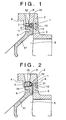
- FIG. 1 is a cross-sectional view of a seal structure between a rotatable member and a stationary member according to a first embodiment of the present invention;
- FIG. 2 is a cross-sectional view of a seal structure between a rotatable member and a stationary member according to a second embodiment of the present invention;
- FIG. 3 is a cross-sectional view of a regenerative combustion burner to which the seal structure according to the first embodiment of the present invention is applied.
-
- FIGS. 1 and 3 illustrate a seal structure according to a first embodiment of the present invention, and FIG. 2 illustrates a seal structure according to a second embodiment of the present invention. Portions common or similar to all of the embodiments of the present invention are denoted with the same reference numerals throughout all of the embodiments of the present invention.
- First, portions common or similar to all of the embodiments of the present invention will be explained with reference to, for example, FIGS. 1 and 3.
- As illustrated in FIG. 1, a seal structure between a rotatable member and a stationary member according to any embodiment of the present invention includes a
stationary member 2 having an interior therein, arotatable member 3 rotatably disposed within thestationary member 2 and dividing said interior of thestationary member 2 into afirst chamber 5 and asecond chamber 4 having a higher pressure than thefirst chamber 5, aseal member 1 as a seal between thefirst chamber 5 and thesecond chamber 4, and arecess 7 for collecting grease formed in at least one of therotatable member 3 and thestationary member 1. - The
seal member 1 is a solid or hollow ring made from elastic material (for example, rubber, synthetic resin, and metal). Theseal member 1 is continuous in the circumferential direction thereof. Theseal member 1 is pressed to therotatable member 3 and thestationary member 2 at afirst contact portion 11 and asecond contact portion 12, respectively. Thefirst contact portion 11 and thesecond contact portion 12 are located on one radial side of theseal member 1. Theseal member 1 is pressed to therotatable member 3 and thestationary member 2 at thefirst contact portion 11 and thesecond contact portion 12 due to a radial force generated by a hoop stress acting in theseal member 1. Thefirst contact portion 11 and thesecond contact portion 12 constitute a seal between thefirst chamber 5 and thesecond chamber 4. - The
rotational member 3 and thestationary member 2 define agap 6 extending in a direction perpendicular to an axis of theseal member 1 between thefirst contact portion 11 and thesecond contact portion 12. Therotatable member 3 includes afirst seal surface 14 at which theseal member 1 contacts therotatable member 3, and thestationary member 2 includes asecond seal surface 15 at which theseal member 1 contacts thestationary member 2. Thefirst seal surface 14 and the second seal surface are tapered so as to spread in a direction away from thegap 6 toward theseal member 1. - The
recess 7 for collecting grease (lubricant) is formed in at least one of therotatable member 3 and thestationary member 2. Therecess 7 is located on a second chamber side of theseal member 1. For a preferred embodiment, therecess 7 is filled with grease, although other lubricants may be used. The grease decreases a sliding resistance between theseal member 1 and therotatable member 3 and helps to improve the sealing characteristic of the seal member by filling a very small gap between the seal member and the rotatable and stationary members. - The reason why the
recess 7 is located on a second chamber (a higher pressure chamber) side of theseal member 1 is that when the seal portion leaks, the air will flow from the higher pressure chamber to the lower pressure chamber and the grease will flow in the same direction as the leaking air flow, so that the grease flows toward the seal portion to fill the leaking gap. - In the vicinity of the
recess 7 for collecting grease, agrease supply hole 8 is formed in thestationary member 2. When the amount of grease decreases, grease is supplied to therecess 7 through thehole 8. - In the case of a seal structure for an air supply and gas exhaust switching mechanism of a
regenerative combustion burner 13, the rotational speed of therotatable member 1 is relatively low, for example, equal to or lower than 100 rpm, and more particularly, equal to or lower than 10 rpm. - In the case of the seal structure for the air supply and gas exhaust switching mechanism of the
regenerative combustion burner 13, the pressure difference between the pressures in the first andsecond chambers - In the case of the seal structure for the air supply and gas exhaust switching mechanism of the
regenerative combustion burner 13, since the portion where theseal member 1 is disposed is exposed to a temperature between a room temperature to 300 °C, more particularly, a temperature of 100 to 250 °C, a heat resistant rubber including a silicone rubber is used as rubber for theseal member 1. - The above-described seal structure can be used as a seal mechanism of the air supply and gas
exhaust switching mechanism 40 of the single-typeregenerative combustion burner 13. - As illustrated in FIG. 3, the single-type
regenerative combustion burner 13 includes acasing 34, a heat storage member 30 (made from, for example, ceramics) which is a gas passable member and is housed in eachcylinder 31 disposed within thecasing 34, aburner tile 62 disposed on one axial side of theheat storage member 30, the air supply and gasexhaust switching mechanism 40 disposed on the other axial side of theheat storage member 30, and a fuel supply nozzle (fuel expelling nozzle) 60 extending through the air supply and gasexhaust switching mechanism 40 and theheat storage member 30 to theburner tile 62. - The
heat storage member 30 retrieves a portion of heat of the exhaust gas (having a temperature above about 1,000°C) to store the heat therein and to reduce the temperature of the exhaust gas to about 250 °C when the exhaust gas flows through theheat storage member 30, and releases the heat to the supply air for combustion (having a temperature substantially equal to the ambient temperature) to preheat the supply air to about 900 °C when flow in the heat storage member is switched from the exhaust gas flow to a supply air flow. The transverse cross-section of theheat storage member 30 is divided into a plurality of sections. When the exhaust gas flows through some part of the sections, the supply air flows through the remaining sections. Air supply and gas exhaust is alternately switched by the air supply and gasexhaust switching mechanism 40. - The
burner tile 62 is made from ceramics or heat-resistant metals. Theburner tile 62 includes an air supply andgas exhaust surface 63 and aprotrusion 64 protruding ahead from the air supply andgas exhaust surface 63. Afuel release surface 65 is formed from an inside surface of theprotrusion 64 to a front end surface of theprotrusion 64. A plurality of air supply andgas exhaust holes 66 are formed in the burner tile and are open to the air supply andgas exhaust surface 63. The air supply andgas exhaust holes 66 and the plurality of sections ofheat storage member 30 are in a one-to-one correspondence with each other. Therefore, when the exhaust gas flows through a part of the air supply andgas exhaust holes 66, the supply air flows through the remaining part of the air supply andgas exhaust holes 66. - As illustrated in FIGS. 1 and 3, the air supply and gas
exhaust switching mechanism 40 includes therotatable member 3, thestationary member 2 and a dividingwall 41. Thestationary member 2 includes a plurality of penetration holes 47 in a one-to-one correspondence with the sections of theheat storage member 30. Therotatable member 3 includes an aperture 42 formed on one side of the dividingwall 41 and anotheraperture 43 formed on the other side of the dividingwall 41. The aperture 42 communicates with asupply air inlet 51 and theaperture 43 communicates with anexhaust gas exit 52. Therotatable member 3 is rotated in one direction, or in opposite directions, by a drive device 45 (a motor or a cylinder). By rotating therotatable member 3 such that thepenetration hole 47, which had been coincident with the aperture 42, comes into coincidence with theaperture 43 and thepenetration hole 47, which had been coincident with theaperture 43, comes into coincidence with the aperture 42, air supply and gas exhaust through theheat storage member 30 and the air supply and gas exhaust holes 66 are switched. - The seal structure is applied to the seal mechanism between the
rotatable member 3 and thestationary member 2. An interior of thestationary member 2 of the air supply and gasexhaust switching mechanism 40 is divided into thefirst chamber 5 and thesecond chamber 4 by therotatable member 3. Supply air flows through thesecond chamber 4 and exhaust gas flows through thefirst chamber 5. A pressure of the supply air is, for example, 1,200 mmH2O (11,760 Pa) and is higher than a pressure of the exhaust gas (for example, 400 mmH2O (3,920 Pa)). Therefore, there is a pressure difference between the twochambers downstream end 68 of theheat storage member 30 in the supply air flow direction) is about 250°C. Therecess 7 for collecting grease is formed on the second chamber side of theseal member 1. Thegrease supply hole 8 is formed in thestationary member 8. - As illustrated in FIG. 1, the
rotatable member 3 has aportion 17 which is exposed to an exhaust gas flow. Agroove 9 is formed in therotatable member 3 between theportion 17 and thefirst contact portion 11. Thegroove 9 is open to thesecond chamber 4. When the supply air at room temperature flows in thegroove 9, the air takes away heat which is conducted from the wall of theportion 17 toward thefirst contact portion 11 to cool the portion where theseal member 1 is disposed. To cool the portion where theseal member 1 is disposed more strongly, a fin structure having at least onefin 10 exposed to the atmosphere is formed in a portion of thestationary member 2 which is located radially outside of theseal member 1 so that the portion where theseal member 1 is disposed can be cooled due to heat convection at the fin structure. - Due to this structure, though the exhaust gas temperature is about 250 °C, the temperature at the portion where the
seal member 1 is disposed is suppressed to a temperature lower than 200 °C. As a result, theseal member 1 is permitted to be made from rubber. More particularly, an O-ring made from rubber (heat-resistant rubber) having a solid or hollow cross-section is used as theseal member 1. - The operation of the seal structure will now be explained.
- Since the
seal member 1 is mildly pressed to therotatable member 3 and thestationary member 2 due to the radial force generated by the hoop stress of theseal member 1, a resistance between therotatable member 3 and theseal member 1 is small. As a result, deformation and abrasion of theseal member 1 are prevented, resulting in increasing the life of theseal member 1. - Since the
first seal surface 14 and thesecond seal surface 15 spread in the direction away from thegap 6, theseal member 1 is prevented from being dislocated from the gap so that the reliability of the seal structure is high. - Further, since the seal structure is obtained by merely disposing the
seal member 1 so that theseal member 1 is pressed to therotatable member 3 and thestationary member 2 at thefirst contact portion 11 and thesecond contact portion 12, respectively, the structure is very simple. As a result, great cost reduction is achieved, and maintenance is easy. - Since the
recess 7 for collecting grease is located on the second chamber side of theseal member 1, the grease can easily flow toward theseal member 1 driven by a very small amount of leaking air which inevitably occurs at theseal member 1, thereby ensuring that grease is supplied to theseal member 1. Due to the supply of grease to theseal member 1, theseal member 1 is lubricated and abrasion of theseal member 1 is minimized. As a result, the life of theseal member 1 is increased, which reduces the number of times theseal member 1 has to be replaced. - By applying the seal structure to the seal mechanism of the air supply and gas
exhaust switching mechanism 40 of the regenerative combustion burner, the operational reliability of the burner is improved and cost reductions of the burner are achieved. If air leakage occurs from supply air to exhaust gas in theswitching mechanism 40, a ratio of the supply air to fuel deviates from that of the objective, so that imperfect combustion may occur and the combustion efficiency may be lowered due to a loss of supply air energy. However, in the present invention, those undesirable effects are reduced. - In the case where the
groove 9 is provided in therotatable member 3, a portion of supply air flows through thegroove 9 to prevent the portion where theseal member 1 is disposed from rising in temperature. As a result, theseal member 1 is prevented from being thermally degraded, so that the life and the reliability of the seal structure are improved. - Further, in the case where the
fin structure 10 is formed in thestationary member 2, the temperature of the portion where theseal member 1 is disposed is further prevented from rising. - Next, portions unique to each embodiment of the present invention will be explained.
- With a first embodiment of the present invention, as may best be viewed in FIG. 1, the
first contact portion 11 and thesecond contact portion 12 are located radially inside of theseal member 1. Also, thegap 6 is located radially inside of theseal member 1. In this instance, the hoop stress generated in theseal member 1 is a tensile stress which generates a radial force directed radially inwardly. Due to the radial force, theseal member 1 is pressed to thefirst seal surface 14 at thefirst contact portion 11 and to thesecond seal surface 15 at thesecond contact portion 12. The seal structure of the first embodiment of the present invention is used in the case where the temperature of the portion where theseal member 1 is disposed is relatively high, more particularly, equal to or higher than 150 °C. - With an operation of the first embodiment of the present invention, when the portion where the
seal member 1 is disposed is heated to a temperature above 150°C, theseal member 1 which is made from rubber shrinks due to the heat, the contact pressure between theseal member 1 at thefirst contact portion 11 and thesecond contact portion 12 increases so that the seal is enhanced. Though the pressure difference between thesecond chamber 4 and thefirst chamber 5 acts in a way to increase the diameter of theseal member 1, by designing the hoop force of theseal member 1 to be greater than a force acting on the seal member due to the pressure difference (proportional to the size of the gap 6), a net retaining force can acts at any time on thefirst contact portion 11 and thesecond contact portion 12. - With a second embodiment of the present invention, as may best be viewed in FIG. 2, the
first contact portion 11 and thesecond contact portion 12 are located radially outside of theseal member 1. Also, thegap 6 is located radially outside of theseal member 1. In this instance, the hoop stress generated in theseal member 1 is a compressive stress which generates a radial force directed radially outwardly. Due to the radial force, theseal member 1 is pressed to thefirst seal surface 14 at thefirst contact portion 11 and to thesecond seal surface 15 at thesecond contact portion 12. The seal structure of the second embodiment of the present invention is used in the case where the temperature of the portion where theseal member 1 is disposed is relatively low, for example, lower than 150°C. - With an operation of the second embodiment of the present invention, since the temperature of the portion where the
seal member 1 is disposed is relatively low, the thermal shrinkage of theseal member 1 is small. As a result, the contact pressure between theseal member 1 at thefirst contact portion 11 and thesecond contact portion 12 is little affected by the temperature of theseal member 1, so that the initial good seal is maintained. Further, since the pressure difference between thesecond chamber 4 and thefirst chamber 5 acts in a way to increase the diameter of theseal member 1, the seal is enhanced and a pressing force acts at any time on thefirst contact portion 11 and thesecond contact portion 12. - According to the present invention, the following technical advantages are obtained:
- Since the
seal member 1 is pressed to the first seal surface and the second seal surface due to the radial force generated by the hoop stress itself, the pressing force is mild so that the seal member is not deformed and does not cause sticking. Further, since therecess 7 for collecting grease is provided and the grease is supplied to the seal member, deformation and abrasion of theseal member 1 are effectively prevented. Since the seal structure is no more than disposing theseal member 1 at the portion to be sealed, the seal structure is very simple. - Since the first and second seal surfaces are tapered, the seal member is prevented from being dislocated from the gap so that the seal is reliable.
- Since the rotational speed of the rotational member of the air supply and gas exhaust switching mechanism of the regenerative combustion burner is lower than about 10 rpm and the pressure difference between the supply air and exhaust gas is about 800 mmH2O (7,840 Pa), the seal structure can be used as a seal between the rotational member and the stationary member of the air supply and gas exhaust switching mechanism of the regenerative combustion burner.
- In the case where the
groove 9 is provided, temperature rise of the portion where theseal member 1 is disposed is suppressed. - In the case where the
fin structure 10 is provided, temperature rise of the portion where theseal member 1 is disposed is suppressed. - In the case where the
first contact portion 11 and thesecond contact portion 12 are located radially inside of theseal member 1, a good seal is maintained even if the portion where theseal member 1 is disposed is heated to a temperature above about 150 °C. - In the case where the
first contact portion 11 and thesecond contact portion 12 are located radially outside of theseal member 1, a good seal is maintained when the portion where theseal member 1 is disposed is heated to a temperature below about 150 °C, utilizing the radial force generated by the hoop stress and the pressure difference between the first chamber and the second chamber.
Claims (11)
- A seal structure between a rotatable member (3) and a stationary member (2) comprising:a stationary member (2) having an interior therein;a rotatable member (3) rotatably disposed within said stationary member (2) and dividing said interior of said stationary member (2) into a first chamber (5) and a second chamber (4) such that said second chamber has a higher pressure than said first chamber (5);a seal member (1) that forms a seal between said first chamber (5) and said second chamber (4) made from an elastic ring, said seal member (1) being pressed to said rotatable member (3) and said stationary member (2) at a first contact portion (11) and a second contact portion (12), respectively, due to a radial force generated by a hoop stress in said seal member (1), wherein said first contact portion (11) and said second contact portion (12) are located on one radial side of said seal member (1); anda recess (7) for collecting grease, formed in at least one of said rotatable member (3) and said stationary member (2), said recess (7) being located on a said second chamber side of said seal member (1).
- A seal structure according to claim 1, wherein said seal member (1) is made from rubber.
- A seal structure according to claim 1, wherein said rotatable member (3) and said stationary member (2) define a gap (6) between said first contact portion (11) and said second contact portion (12), said rotatable member (3) includes a first seal surface (14) at which said rotatable member (3) contacts said seal member (1) and said stationary member (2) includes a second seal surface (15) at which said stationary member (2) contacts said seal member (1), said first seal surface (14) and said second seal surface (15) having tapers spreading in a direction away from said gap (6) toward said seal member (1).
- A seal structure according to claim 1, wherein a rotational speed of said rotational member (3) is lower than 100 rpm.
- A seal structure according to claim 1, wherein a pressure difference between said first chamber (5) and said second chamber (4) is higher than 0 mmH2O(OPa) but lower than or equal to 2,000 mmH2O (19,600 Pa).
- A seal structure according to claim 1, wherein said seal member (1) is exposed to a temperature of a room temperature to 300 °C.
- A seal structure according to claim 1, wherein said rotatable member (3) and said stationary member (2) are a rotatable member and a stationary member, respectively, of an air supply and gas exhaust switching mechanism (40) of a regenerative combustion burner (13), and said first chamber (5) and said second chamber (4) are a chamber permitting exhaust gas to flow therethrough and a chamber permitting supply air to flow therethrough, respectively.
- A seal structure according to claim 7, wherein said rotatable member (3) includes a portion (17) exposed to an exhaust gas flow, a groove (9) communicating with said second chamber (4) is formed at a portion of said rotatable member (3) between said first contact portion (11) and said portion (17) exposed to an exhaust gas flow.
- A seal structure according to claim 7, wherein stationary member (2) includes a fin structure (10) formed at a portion of said stationary member (2) located radially outside of said seal member (1).
- A seal structure according to claim 1, wherein said first contact portion (11) and said second contact portion (12) are located radially inside of a center of a cross-section of said seal member (1).
- A seal structure according to claim 1, wherein said first contact portion (11) and said second contact portion (12) are located radially outside of a center of a cross-section of said seal member (1).
Applications Claiming Priority (6)
| Application Number | Priority Date | Filing Date | Title |
|---|---|---|---|
| JP122926/96 | 1996-05-17 | ||
| JP12292696 | 1996-05-17 | ||
| JP12292696 | 1996-05-17 | ||
| JP9092605A JP3006537B2 (en) | 1996-05-17 | 1997-04-10 | Seal structure between rotating member and fixed member |
| JP9260597 | 1997-04-10 | ||
| JP92605/97 | 1997-04-10 |
Publications (2)
| Publication Number | Publication Date |
|---|---|
| EP0807774A1 EP0807774A1 (en) | 1997-11-19 |
| EP0807774B1 true EP0807774B1 (en) | 2002-06-05 |
Family
ID=26434003
Family Applications (1)
| Application Number | Title | Priority Date | Filing Date |
|---|---|---|---|
| EP97401088A Expired - Lifetime EP0807774B1 (en) | 1996-05-17 | 1997-05-15 | Seal structure between a rotatable member and a stationary member |
Country Status (5)
| Country | Link |
|---|---|
| US (1) | US5957462A (en) |
| EP (1) | EP0807774B1 (en) |
| JP (1) | JP3006537B2 (en) |
| KR (1) | KR100214043B1 (en) |
| DE (1) | DE69712980T2 (en) |
Families Citing this family (16)
| Publication number | Priority date | Publication date | Assignee | Title |
|---|---|---|---|---|
| US7052014B1 (en) * | 1999-02-04 | 2006-05-30 | Orlowski David C | Snap together bearing isolator |
| WO2004072517A1 (en) * | 2003-02-12 | 2004-08-26 | Koganei Corporation | Vacuum-feeding joint |
| JP2005308019A (en) * | 2004-04-19 | 2005-11-04 | Shikoku Kakoki Co Ltd | Sealing device |
| BRPI0512716B1 (en) * | 2004-07-12 | 2020-01-07 | Aes Engineering Limited | SEAL |
| US7096740B2 (en) * | 2004-11-17 | 2006-08-29 | The Boeing Company | Reusable preload indicating washer assembly |
| CA2969705C (en) * | 2014-12-08 | 2020-06-23 | Flowserve Management Company | Bearing isolator seal with tapered static shutoff o-ring interface |
| MX375605B (en) | 2014-12-18 | 2025-03-06 | Flowserve Pte Ltd | BEARING ISOLATING SEAL WITH IMPROVED ROTOR UNIT COUPLING |
| CA2983160A1 (en) | 2015-04-21 | 2016-10-27 | Inpro/Seal Llc | Shaft seal assembly |
| US10927961B2 (en) | 2015-04-21 | 2021-02-23 | Inpro/Seal Llc | Shaft seal assembly |
| CN104791492B (en) * | 2015-05-07 | 2017-03-08 | 四川东能节能技术有限公司 | Air preheater and its cold end sealing device axially or radially |
| EP4467849A3 (en) | 2015-06-18 | 2025-05-21 | Inpro/Seal LLC | Shaft seal assembly |
| CN106090987B (en) * | 2016-07-01 | 2017-05-10 | 四川东方能源科技股份有限公司 | Seal assembly used for achieving radial sealing of air pre-heater |
| CN106051813B (en) * | 2016-07-01 | 2017-03-22 | 四川东方能源科技股份有限公司 | Assembly used for mounting radial sealing pad of air preheater |
| CN106287790B (en) * | 2016-08-31 | 2018-11-30 | 戴春喜 | Rotary regenerative air preheater and its sealing structure |
| US10330204B2 (en) * | 2017-11-10 | 2019-06-25 | Rolls-Royce Deutschland Ltd & Co Kg | Burner seal of a gas turbine and method for manufacturing the same |
| CN112610708B (en) * | 2020-12-09 | 2021-11-02 | 浙江大学 | A double-seat regulating valve and its sealing structure and method |
Family Cites Families (15)
| Publication number | Priority date | Publication date | Assignee | Title |
|---|---|---|---|---|
| US429440A (en) * | 1890-06-03 | gordon | ||
| US2480229A (en) * | 1945-11-23 | 1949-08-30 | United Aircraft Corp | Piston rod packing lubricator |
| DE1084990B (en) * | 1958-02-24 | 1960-07-07 | Skf Svenska Kullagerfab Ab | Centrifugal seal |
| US3262484A (en) * | 1964-10-09 | 1966-07-26 | Selas Corp Of America | Industrial burner with recuperative means |
| US3212558A (en) * | 1964-10-09 | 1965-10-19 | Selas Corp Of America | Industrial burner |
| DE1600523C3 (en) * | 1967-06-03 | 1974-08-01 | Sealol Inc., Warwick, R.I. (V.St.A.) | Mechanical seal with a sealing liquid supplied to the radial sealing gap |
| JPS536746A (en) * | 1976-07-07 | 1978-01-21 | Fuji Electric Co Ltd | Pelton wheel water discharge regulator |
| US4073548A (en) * | 1976-11-01 | 1978-02-14 | Dresser Industries, Inc. | Sealing system for a rotary rock bit |
| US4500098A (en) * | 1983-12-22 | 1985-02-19 | United Technologies Corporation | Gas seal for rotating components |
| US4604051A (en) * | 1984-08-16 | 1986-08-05 | Gas Research Institute | Regenerative burner |
| JP3005110B2 (en) * | 1991-07-29 | 2000-01-31 | 靖夫 広瀬 | Heat recovery type combustion device |
| US5378000A (en) * | 1992-10-19 | 1995-01-03 | Inpro Companies, Inc. | Shaft seal assembly |
| US5562294A (en) * | 1994-01-28 | 1996-10-08 | Bw/Ip International, Inc. | Backup seal for axial face seal |
| US5562442A (en) * | 1994-12-27 | 1996-10-08 | Eisenmann Corporation | Regenerative thermal oxidizer |
| US5704461A (en) * | 1995-07-17 | 1998-01-06 | Horton, Inc. | Rotational control apparatus |
-
1997
- 1997-04-10 JP JP9092605A patent/JP3006537B2/en not_active Expired - Lifetime
- 1997-05-15 DE DE69712980T patent/DE69712980T2/en not_active Expired - Lifetime
- 1997-05-15 US US08/856,579 patent/US5957462A/en not_active Expired - Lifetime
- 1997-05-15 EP EP97401088A patent/EP0807774B1/en not_active Expired - Lifetime
- 1997-05-16 KR KR1019970018842A patent/KR100214043B1/en not_active Expired - Fee Related
Also Published As
| Publication number | Publication date |
|---|---|
| KR100214043B1 (en) | 1999-08-02 |
| EP0807774A1 (en) | 1997-11-19 |
| KR19980079237A (en) | 1998-11-25 |
| US5957462A (en) | 1999-09-28 |
| DE69712980D1 (en) | 2002-07-11 |
| JPH1038092A (en) | 1998-02-13 |
| DE69712980T2 (en) | 2003-01-23 |
| JP3006537B2 (en) | 2000-02-07 |
Similar Documents
| Publication | Publication Date | Title |
|---|---|---|
| EP0807774B1 (en) | Seal structure between a rotatable member and a stationary member | |
| EP0818607B1 (en) | Gas turbine with carbon seal containment barrier system | |
| US4222575A (en) | Shaft seal device | |
| JP3555683B2 (en) | Seal assembly for rotating machine | |
| JP3594600B2 (en) | Back pressure resistant sealing means | |
| US20030025274A1 (en) | Laminated finger seal with stress reduction | |
| JP5974163B2 (en) | Pipe-integrated pulley pulley metal seal half | |
| CA1081190A (en) | Rotary fluid pump or compressor | |
| US9303721B2 (en) | High speed flywheel | |
| US4328860A (en) | Recuperator for heat exchange between flow media of dissimilar temperatures | |
| US5544896A (en) | Composite face seal | |
| JPH0495665A (en) | Sealing device for stirring engine | |
| US4474106A (en) | Fluidic self adjusting seal assembly | |
| US10767565B2 (en) | System and method for sealing a fluid system in a safety condition | |
| US3999894A (en) | Compressor assembly | |
| CN116480780A (en) | Combined sealing device | |
| JPH07224948A (en) | Mechanical seal | |
| EP0266664A2 (en) | Structure of gland packing box | |
| US6338491B1 (en) | Rotary shaft seal | |
| JP2005527736A (en) | Rotating valve seal | |
| FI62712B (en) | KUGGHJULSPUMP OCH / ELLER -MOTOR | |
| JP3801742B2 (en) | Temperature-sensitive fan drive | |
| KR102376470B1 (en) | Multiway valve apparatus | |
| US4222720A (en) | Corner seal means for rotary piston engines | |
| US7305937B2 (en) | Rotary toroidal machine with piston connecting mechanism |
Legal Events
| Date | Code | Title | Description |
|---|---|---|---|
| PUAI | Public reference made under article 153(3) epc to a published international application that has entered the european phase |
Free format text: ORIGINAL CODE: 0009012 |
|
| 17P | Request for examination filed |
Effective date: 19970523 |
|
| AK | Designated contracting states |
Kind code of ref document: A1 Designated state(s): DE FR GB |
|
| GRAG | Despatch of communication of intention to grant |
Free format text: ORIGINAL CODE: EPIDOS AGRA |
|
| 17Q | First examination report despatched |
Effective date: 20010918 |
|
| GRAG | Despatch of communication of intention to grant |
Free format text: ORIGINAL CODE: EPIDOS AGRA |
|
| GRAH | Despatch of communication of intention to grant a patent |
Free format text: ORIGINAL CODE: EPIDOS IGRA |
|
| GRAH | Despatch of communication of intention to grant a patent |
Free format text: ORIGINAL CODE: EPIDOS IGRA |
|
| GRAA | (expected) grant |
Free format text: ORIGINAL CODE: 0009210 |
|
| AK | Designated contracting states |
Kind code of ref document: B1 Designated state(s): DE FR GB |
|
| REG | Reference to a national code |
Ref country code: GB Ref legal event code: FG4D |
|
| REF | Corresponds to: |
Ref document number: 69712980 Country of ref document: DE Date of ref document: 20020711 |
|
| GRAH | Despatch of communication of intention to grant a patent |
Free format text: ORIGINAL CODE: EPIDOS IGRA |
|
| ET | Fr: translation filed | ||
| PLBE | No opposition filed within time limit |
Free format text: ORIGINAL CODE: 0009261 |
|
| STAA | Information on the status of an ep patent application or granted ep patent |
Free format text: STATUS: NO OPPOSITION FILED WITHIN TIME LIMIT |
|
| 26N | No opposition filed |
Effective date: 20030306 |
|
| REG | Reference to a national code |
Ref country code: GB Ref legal event code: 746 Effective date: 20130215 |
|
| REG | Reference to a national code |
Ref country code: DE Ref legal event code: R084 Ref document number: 69712980 Country of ref document: DE Effective date: 20130312 |
|
| PGFP | Annual fee paid to national office [announced via postgrant information from national office to epo] |
Ref country code: DE Payment date: 20130515 Year of fee payment: 17 Ref country code: GB Payment date: 20130515 Year of fee payment: 17 |
|
| PGFP | Annual fee paid to national office [announced via postgrant information from national office to epo] |
Ref country code: FR Payment date: 20130531 Year of fee payment: 17 |
|
| REG | Reference to a national code |
Ref country code: DE Ref legal event code: R119 Ref document number: 69712980 Country of ref document: DE |
|
| GBPC | Gb: european patent ceased through non-payment of renewal fee |
Effective date: 20140515 |
|
| REG | Reference to a national code |
Ref country code: DE Ref legal event code: R119 Ref document number: 69712980 Country of ref document: DE Effective date: 20141202 |
|
| REG | Reference to a national code |
Ref country code: FR Ref legal event code: ST Effective date: 20150130 |
|
| PG25 | Lapsed in a contracting state [announced via postgrant information from national office to epo] |
Ref country code: DE Free format text: LAPSE BECAUSE OF NON-PAYMENT OF DUE FEES Effective date: 20141202 |
|
| PG25 | Lapsed in a contracting state [announced via postgrant information from national office to epo] |
Ref country code: GB Free format text: LAPSE BECAUSE OF NON-PAYMENT OF DUE FEES Effective date: 20140515 Ref country code: FR Free format text: LAPSE BECAUSE OF NON-PAYMENT OF DUE FEES Effective date: 20140602 |