EP0807653A2 - Absorbierbare Polyalkylendiglykolate - Google Patents
Absorbierbare Polyalkylendiglykolate Download PDFInfo
- Publication number
- EP0807653A2 EP0807653A2 EP97303296A EP97303296A EP0807653A2 EP 0807653 A2 EP0807653 A2 EP 0807653A2 EP 97303296 A EP97303296 A EP 97303296A EP 97303296 A EP97303296 A EP 97303296A EP 0807653 A2 EP0807653 A2 EP 0807653A2
- Authority
- EP
- European Patent Office
- Prior art keywords
- poly
- diglycolate
- alkylene diglycolate
- alkylene
- polymers
- Prior art date
- Legal status (The legal status is an assumption and is not a legal conclusion. Google has not performed a legal analysis and makes no representation as to the accuracy of the status listed.)
- Withdrawn
Links
- 229920001281 polyalkylene Polymers 0.000 title 1
- -1 poly(alkylene diglycolate Chemical compound 0.000 claims abstract description 138
- 229920000642 polymer Polymers 0.000 claims abstract description 59
- PEDCQBHIVMGVHV-UHFFFAOYSA-N Glycerine Chemical compound OCC(O)CO PEDCQBHIVMGVHV-UHFFFAOYSA-N 0.000 claims description 51
- LYCAIKOWRPUZTN-UHFFFAOYSA-N Ethylene glycol Chemical compound OCCO LYCAIKOWRPUZTN-UHFFFAOYSA-N 0.000 claims description 20
- 229920006395 saturated elastomer Polymers 0.000 claims description 20
- 125000002887 hydroxy group Chemical group [H]O* 0.000 claims description 19
- 229920001223 polyethylene glycol Polymers 0.000 claims description 19
- 125000001931 aliphatic group Chemical group 0.000 claims description 16
- QEVGZEDELICMKH-UHFFFAOYSA-N Diglycolic acid Chemical compound OC(=O)COCC(O)=O QEVGZEDELICMKH-UHFFFAOYSA-N 0.000 claims description 13
- BYEAHWXPCBROCE-UHFFFAOYSA-N 1,1,1,3,3,3-hexafluoropropan-2-ol Chemical compound FC(F)(F)C(O)C(F)(F)F BYEAHWXPCBROCE-UHFFFAOYSA-N 0.000 claims description 12
- YPFDHNVEDLHUCE-UHFFFAOYSA-N 1,3-propanediol Substances OCCCO YPFDHNVEDLHUCE-UHFFFAOYSA-N 0.000 claims description 12
- LFQSCWFLJHTTHZ-UHFFFAOYSA-N Ethanol Chemical compound CCO LFQSCWFLJHTTHZ-UHFFFAOYSA-N 0.000 claims description 12
- 229920000166 polytrimethylene carbonate Polymers 0.000 claims description 12
- 150000001298 alcohols Chemical class 0.000 claims description 11
- DNIAPMSPPWPWGF-VKHMYHEASA-N (+)-propylene glycol Chemical compound C[C@H](O)CO DNIAPMSPPWPWGF-VKHMYHEASA-N 0.000 claims description 10
- DNIAPMSPPWPWGF-UHFFFAOYSA-N monopropylene glycol Natural products CC(O)CO DNIAPMSPPWPWGF-UHFFFAOYSA-N 0.000 claims description 6
- DNIAPMSPPWPWGF-GSVOUGTGSA-N (R)-(-)-Propylene glycol Chemical compound C[C@@H](O)CO DNIAPMSPPWPWGF-GSVOUGTGSA-N 0.000 claims description 5
- ALQSHHUCVQOPAS-UHFFFAOYSA-N Pentane-1,5-diol Chemical compound OCCCCCO ALQSHHUCVQOPAS-UHFFFAOYSA-N 0.000 claims description 4
- ZJCCRDAZUWHFQH-UHFFFAOYSA-N Trimethylolpropane Chemical compound CCC(CO)(CO)CO ZJCCRDAZUWHFQH-UHFFFAOYSA-N 0.000 claims description 4
- 239000002253 acid Substances 0.000 claims description 4
- WERYXYBDKMZEQL-UHFFFAOYSA-N butane-1,4-diol Chemical compound OCCCCO WERYXYBDKMZEQL-UHFFFAOYSA-N 0.000 claims description 4
- SZXQTJUDPRGNJN-UHFFFAOYSA-N dipropylene glycol Chemical compound OCCCOCCCO SZXQTJUDPRGNJN-UHFFFAOYSA-N 0.000 claims description 4
- SXCBDZAEHILGLM-UHFFFAOYSA-N heptane-1,7-diol Chemical compound OCCCCCCCO SXCBDZAEHILGLM-UHFFFAOYSA-N 0.000 claims description 4
- XXMIOPMDWAUFGU-UHFFFAOYSA-N hexane-1,6-diol Chemical compound OCCCCCCO XXMIOPMDWAUFGU-UHFFFAOYSA-N 0.000 claims description 4
- OEIJHBUUFURJLI-UHFFFAOYSA-N octane-1,8-diol Chemical compound OCCCCCCCCO OEIJHBUUFURJLI-UHFFFAOYSA-N 0.000 claims description 4
- 235000013772 propylene glycol Nutrition 0.000 claims description 4
- 150000002148 esters Chemical class 0.000 claims description 3
- 239000007795 chemical reaction product Substances 0.000 claims 2
- 239000000203 mixture Substances 0.000 abstract description 30
- 239000000178 monomer Substances 0.000 abstract description 25
- 229920003232 aliphatic polyester Polymers 0.000 abstract description 20
- VPVXHAANQNHFSF-UHFFFAOYSA-N 1,4-dioxan-2-one Chemical compound O=C1COCCO1 VPVXHAANQNHFSF-UHFFFAOYSA-N 0.000 abstract description 7
- RKDVKSZUMVYZHH-UHFFFAOYSA-N 1,4-dioxane-2,5-dione Chemical compound O=C1COC(=O)CO1 RKDVKSZUMVYZHH-UHFFFAOYSA-N 0.000 abstract description 6
- PAPBSGBWRJIAAV-UHFFFAOYSA-N ε-Caprolactone Chemical compound O=C1CCCCCO1 PAPBSGBWRJIAAV-UHFFFAOYSA-N 0.000 abstract description 6
- JJTUDXZGHPGLLC-UHFFFAOYSA-N lactide Chemical compound CC1OC(=O)C(C)OC1=O JJTUDXZGHPGLLC-UHFFFAOYSA-N 0.000 abstract description 5
- 150000002596 lactones Chemical class 0.000 abstract description 5
- YFHICDDUDORKJB-UHFFFAOYSA-N trimethylene carbonate Chemical compound O=C1OCCCO1 YFHICDDUDORKJB-UHFFFAOYSA-N 0.000 abstract description 5
- 229920001577 copolymer Polymers 0.000 description 69
- IJGRMHOSHXDMSA-UHFFFAOYSA-N Atomic nitrogen Chemical compound N#N IJGRMHOSHXDMSA-UHFFFAOYSA-N 0.000 description 40
- 238000000034 method Methods 0.000 description 20
- 229910052757 nitrogen Inorganic materials 0.000 description 20
- 239000003054 catalyst Substances 0.000 description 19
- XLYOFNOQVPJJNP-UHFFFAOYSA-N water Substances O XLYOFNOQVPJJNP-UHFFFAOYSA-N 0.000 description 17
- HEDRZPFGACZZDS-UHFFFAOYSA-N Chloroform Chemical compound ClC(Cl)Cl HEDRZPFGACZZDS-UHFFFAOYSA-N 0.000 description 16
- 239000000243 solution Substances 0.000 description 16
- 239000000945 filler Substances 0.000 description 13
- KSBAEPSJVUENNK-UHFFFAOYSA-L tin(ii) 2-ethylhexanoate Chemical compound [Sn+2].CCCCC(CC)C([O-])=O.CCCCC(CC)C([O-])=O KSBAEPSJVUENNK-UHFFFAOYSA-L 0.000 description 12
- 230000015572 biosynthetic process Effects 0.000 description 11
- 238000003786 synthesis reaction Methods 0.000 description 11
- NIXOWILDQLNWCW-UHFFFAOYSA-M acrylate group Chemical group C(C=C)(=O)[O-] NIXOWILDQLNWCW-UHFFFAOYSA-M 0.000 description 10
- 230000007547 defect Effects 0.000 description 10
- 239000000463 material Substances 0.000 description 10
- 230000008569 process Effects 0.000 description 10
- 230000035484 reaction time Effects 0.000 description 10
- 239000003106 tissue adhesive Substances 0.000 description 10
- 229940075469 tissue adhesives Drugs 0.000 description 10
- 210000000845 cartilage Anatomy 0.000 description 9
- 238000006243 chemical reaction Methods 0.000 description 9
- 210000000988 bone and bone Anatomy 0.000 description 8
- 239000003999 initiator Substances 0.000 description 8
- 229920002959 polymer blend Polymers 0.000 description 8
- 230000002265 prevention Effects 0.000 description 8
- 239000000565 sealant Substances 0.000 description 8
- 239000001993 wax Substances 0.000 description 8
- 229920001519 homopolymer Polymers 0.000 description 7
- 239000000017 hydrogel Substances 0.000 description 7
- 238000003756 stirring Methods 0.000 description 7
- 238000000576 coating method Methods 0.000 description 6
- 238000004132 cross linking Methods 0.000 description 6
- 238000012377 drug delivery Methods 0.000 description 6
- 239000007788 liquid Substances 0.000 description 6
- 238000002844 melting Methods 0.000 description 6
- 230000008018 melting Effects 0.000 description 6
- 239000002904 solvent Substances 0.000 description 6
- 210000001519 tissue Anatomy 0.000 description 6
- 230000004888 barrier function Effects 0.000 description 5
- 239000010408 film Substances 0.000 description 5
- 239000000155 melt Substances 0.000 description 5
- 238000002156 mixing Methods 0.000 description 5
- 239000012299 nitrogen atmosphere Substances 0.000 description 5
- 125000002524 organometallic group Chemical group 0.000 description 5
- 210000004872 soft tissue Anatomy 0.000 description 5
- AEMRFAOFKBGASW-UHFFFAOYSA-N Glycolic acid Chemical compound OCC(O)=O AEMRFAOFKBGASW-UHFFFAOYSA-N 0.000 description 4
- 239000012298 atmosphere Substances 0.000 description 4
- 239000000975 dye Substances 0.000 description 4
- 238000010348 incorporation Methods 0.000 description 4
- 238000006116 polymerization reaction Methods 0.000 description 4
- 238000002360 preparation method Methods 0.000 description 4
- 230000008961 swelling Effects 0.000 description 4
- 238000005033 Fourier transform infrared spectroscopy Methods 0.000 description 3
- OFOBLEOULBTSOW-UHFFFAOYSA-N Malonic acid Chemical compound OC(=O)CC(O)=O OFOBLEOULBTSOW-UHFFFAOYSA-N 0.000 description 3
- OKKJLVBELUTLKV-UHFFFAOYSA-N Methanol Chemical compound OC OKKJLVBELUTLKV-UHFFFAOYSA-N 0.000 description 3
- ATJFFYVFTNAWJD-UHFFFAOYSA-N Tin Chemical group [Sn] ATJFFYVFTNAWJD-UHFFFAOYSA-N 0.000 description 3
- 230000003416 augmentation Effects 0.000 description 3
- 238000007796 conventional method Methods 0.000 description 3
- MTHSVFCYNBDYFN-UHFFFAOYSA-N diethylene glycol Chemical compound OCCOCCO MTHSVFCYNBDYFN-UHFFFAOYSA-N 0.000 description 3
- 230000032050 esterification Effects 0.000 description 3
- 238000005886 esterification reaction Methods 0.000 description 3
- 229920000578 graft copolymer Polymers 0.000 description 3
- 238000004519 manufacturing process Methods 0.000 description 3
- VHRYZQNGTZXDNX-UHFFFAOYSA-N methacryloyl chloride Chemical compound CC(=C)C(Cl)=O VHRYZQNGTZXDNX-UHFFFAOYSA-N 0.000 description 3
- 229920005615 natural polymer Polymers 0.000 description 3
- 229920001606 poly(lactic acid-co-glycolic acid) Polymers 0.000 description 3
- 238000012643 polycondensation polymerization Methods 0.000 description 3
- BDUBTLFQHNYXPC-UHFFFAOYSA-N 3-methylbut-2-enoyl chloride Chemical compound CC(C)=CC(Cl)=O BDUBTLFQHNYXPC-UHFFFAOYSA-N 0.000 description 2
- YEJRWHAVMIAJKC-UHFFFAOYSA-N 4-Butyrolactone Chemical compound O=C1CCCO1 YEJRWHAVMIAJKC-UHFFFAOYSA-N 0.000 description 2
- OZJPLYNZGCXSJM-UHFFFAOYSA-N 5-valerolactone Chemical compound O=C1CCCCO1 OZJPLYNZGCXSJM-UHFFFAOYSA-N 0.000 description 2
- LRFVTYWOQMYALW-UHFFFAOYSA-N 9H-xanthine Chemical compound O=C1NC(=O)NC2=C1NC=N2 LRFVTYWOQMYALW-UHFFFAOYSA-N 0.000 description 2
- VEXZGXHMUGYJMC-UHFFFAOYSA-M Chloride anion Chemical compound [Cl-] VEXZGXHMUGYJMC-UHFFFAOYSA-M 0.000 description 2
- VEXZGXHMUGYJMC-UHFFFAOYSA-N Hydrochloric acid Chemical compound Cl VEXZGXHMUGYJMC-UHFFFAOYSA-N 0.000 description 2
- UFHFLCQGNIYNRP-UHFFFAOYSA-N Hydrogen Chemical compound [H][H] UFHFLCQGNIYNRP-UHFFFAOYSA-N 0.000 description 2
- 238000005481 NMR spectroscopy Methods 0.000 description 2
- HEDRZPFGACZZDS-MICDWDOJSA-N Trichloro(2H)methane Chemical compound [2H]C(Cl)(Cl)Cl HEDRZPFGACZZDS-MICDWDOJSA-N 0.000 description 2
- 238000005299 abrasion Methods 0.000 description 2
- 238000010521 absorption reaction Methods 0.000 description 2
- HFBMWMNUJJDEQZ-UHFFFAOYSA-N acryloyl chloride Chemical compound ClC(=O)C=C HFBMWMNUJJDEQZ-UHFFFAOYSA-N 0.000 description 2
- 150000001412 amines Chemical class 0.000 description 2
- 239000007864 aqueous solution Substances 0.000 description 2
- 229920000249 biocompatible polymer Polymers 0.000 description 2
- 229920001400 block copolymer Polymers 0.000 description 2
- 239000011203 carbon fibre reinforced carbon Substances 0.000 description 2
- 150000001875 compounds Chemical class 0.000 description 2
- 229920006037 cross link polymer Polymers 0.000 description 2
- 238000001035 drying Methods 0.000 description 2
- 239000006260 foam Substances 0.000 description 2
- 239000000499 gel Substances 0.000 description 2
- 150000004820 halides Chemical class 0.000 description 2
- 229910052739 hydrogen Inorganic materials 0.000 description 2
- 239000001257 hydrogen Substances 0.000 description 2
- 239000007943 implant Substances 0.000 description 2
- 239000007924 injection Substances 0.000 description 2
- 229920002463 poly(p-dioxanone) polymer Polymers 0.000 description 2
- 229920001610 polycaprolactone Polymers 0.000 description 2
- 150000003254 radicals Chemical class 0.000 description 2
- 238000007151 ring opening polymerisation reaction Methods 0.000 description 2
- 239000000126 substance Substances 0.000 description 2
- 229920001059 synthetic polymer Polymers 0.000 description 2
- 229920001897 terpolymer Polymers 0.000 description 2
- 238000002076 thermal analysis method Methods 0.000 description 2
- 238000005809 transesterification reaction Methods 0.000 description 2
- ZNLAHAOCFKBYRH-UHFFFAOYSA-N 1,4-dioxane-2,3-dione Chemical compound O=C1OCCOC1=O ZNLAHAOCFKBYRH-UHFFFAOYSA-N 0.000 description 1
- SJDLIJNQXLJBBE-UHFFFAOYSA-N 1,4-dioxepan-2-one Chemical compound O=C1COCCCO1 SJDLIJNQXLJBBE-UHFFFAOYSA-N 0.000 description 1
- AOLNDUQWRUPYGE-UHFFFAOYSA-N 1,4-dioxepan-5-one Chemical compound O=C1CCOCCO1 AOLNDUQWRUPYGE-UHFFFAOYSA-N 0.000 description 1
- VNQXSTWCDUXYEZ-UHFFFAOYSA-N 1,7,7-trimethylbicyclo[2.2.1]heptane-2,3-dione Chemical compound C1CC2(C)C(=O)C(=O)C1C2(C)C VNQXSTWCDUXYEZ-UHFFFAOYSA-N 0.000 description 1
- 238000005160 1H NMR spectroscopy Methods 0.000 description 1
- KWVGIHKZDCUPEU-UHFFFAOYSA-N 2,2-dimethoxy-2-phenylacetophenone Chemical compound C=1C=CC=CC=1C(OC)(OC)C(=O)C1=CC=CC=C1 KWVGIHKZDCUPEU-UHFFFAOYSA-N 0.000 description 1
- VEPOHXYIFQMVHW-XOZOLZJESA-N 2,3-dihydroxybutanedioic acid (2S,3S)-3,4-dimethyl-2-phenylmorpholine Chemical compound OC(C(O)C(O)=O)C(O)=O.C[C@H]1[C@@H](OCCN1C)c1ccccc1 VEPOHXYIFQMVHW-XOZOLZJESA-N 0.000 description 1
- QEVGZEDELICMKH-UHFFFAOYSA-L 2-(carboxylatomethoxy)acetate Chemical compound [O-]C(=O)COCC([O-])=O QEVGZEDELICMKH-UHFFFAOYSA-L 0.000 description 1
- BQZJOQXSCSZQPS-UHFFFAOYSA-N 2-methoxy-1,2-diphenylethanone Chemical compound C=1C=CC=CC=1C(OC)C(=O)C1=CC=CC=C1 BQZJOQXSCSZQPS-UHFFFAOYSA-N 0.000 description 1
- QMDUQRDPJXKZAO-UHFFFAOYSA-N 3,3-diethyl-1,4-dioxane-2,5-dione Chemical compound CCC1(CC)OC(=O)COC1=O QMDUQRDPJXKZAO-UHFFFAOYSA-N 0.000 description 1
- FQFQWTFNRFUWKM-UHFFFAOYSA-N 3,3-diethyloxetan-2-one Chemical compound CCC1(CC)COC1=O FQFQWTFNRFUWKM-UHFFFAOYSA-N 0.000 description 1
- ULKFLOVGORAZDI-UHFFFAOYSA-N 3,3-dimethyloxetan-2-one Chemical compound CC1(C)COC1=O ULKFLOVGORAZDI-UHFFFAOYSA-N 0.000 description 1
- RBTBFTRPCNLSDE-UHFFFAOYSA-N 3,7-bis(dimethylamino)phenothiazin-5-ium Chemical compound C1=CC(N(C)C)=CC2=[S+]C3=CC(N(C)C)=CC=C3N=C21 RBTBFTRPCNLSDE-UHFFFAOYSA-N 0.000 description 1
- MVXNGTMKSZHHCO-UHFFFAOYSA-N 3-methyl-1,4-dioxane-2,5-dione Chemical compound CC1OC(=O)COC1=O MVXNGTMKSZHHCO-UHFFFAOYSA-N 0.000 description 1
- IICCLYANAQEHCI-UHFFFAOYSA-N 4,5,6,7-tetrachloro-3',6'-dihydroxy-2',4',5',7'-tetraiodospiro[2-benzofuran-3,9'-xanthene]-1-one Chemical compound O1C(=O)C(C(=C(Cl)C(Cl)=C2Cl)Cl)=C2C21C1=CC(I)=C(O)C(I)=C1OC1=C(I)C(O)=C(I)C=C21 IICCLYANAQEHCI-UHFFFAOYSA-N 0.000 description 1
- JJTUDXZGHPGLLC-IMJSIDKUSA-N 4511-42-6 Chemical compound C[C@@H]1OC(=O)[C@H](C)OC1=O JJTUDXZGHPGLLC-IMJSIDKUSA-N 0.000 description 1
- YKVIWISPFDZYOW-UHFFFAOYSA-N 6-Decanolide Chemical compound CCCCC1CCCCC(=O)O1 YKVIWISPFDZYOW-UHFFFAOYSA-N 0.000 description 1
- 239000004342 Benzoyl peroxide Substances 0.000 description 1
- OMPJBNCRMGITSC-UHFFFAOYSA-N Benzoylperoxide Chemical compound C=1C=CC=CC=1C(=O)OOC(=O)C1=CC=CC=C1 OMPJBNCRMGITSC-UHFFFAOYSA-N 0.000 description 1
- 102000008186 Collagen Human genes 0.000 description 1
- 108010035532 Collagen Proteins 0.000 description 1
- KMTRUDSVKNLOMY-UHFFFAOYSA-N Ethylene carbonate Chemical compound O=C1OCCO1 KMTRUDSVKNLOMY-UHFFFAOYSA-N 0.000 description 1
- 206010019909 Hernia Diseases 0.000 description 1
- 241001465754 Metazoa Species 0.000 description 1
- PCNDJXKNXGMECE-UHFFFAOYSA-N Phenazine Natural products C1=CC=CC2=NC3=CC=CC=C3N=C21 PCNDJXKNXGMECE-UHFFFAOYSA-N 0.000 description 1
- 229920003171 Poly (ethylene oxide) Polymers 0.000 description 1
- 229920002732 Polyanhydride Polymers 0.000 description 1
- 229920001710 Polyorthoester Polymers 0.000 description 1
- DWAQJAXMDSEUJJ-UHFFFAOYSA-M Sodium bisulfite Chemical compound [Na+].OS([O-])=O DWAQJAXMDSEUJJ-UHFFFAOYSA-M 0.000 description 1
- IUHFWCGCSVTMPG-UHFFFAOYSA-N [C].[C] Chemical group [C].[C] IUHFWCGCSVTMPG-UHFFFAOYSA-N 0.000 description 1
- 150000008062 acetophenones Chemical class 0.000 description 1
- 239000000999 acridine dye Substances 0.000 description 1
- 150000001252 acrylic acid derivatives Chemical class 0.000 description 1
- ROOXNKNUYICQNP-UHFFFAOYSA-N ammonium peroxydisulfate Substances [NH4+].[NH4+].[O-]S(=O)(=O)OOS([O-])(=O)=O ROOXNKNUYICQNP-UHFFFAOYSA-N 0.000 description 1
- VAZSKTXWXKYQJF-UHFFFAOYSA-N ammonium persulfate Chemical compound [NH4+].[NH4+].[O-]S(=O)OOS([O-])=O VAZSKTXWXKYQJF-UHFFFAOYSA-N 0.000 description 1
- 229910001870 ammonium persulfate Inorganic materials 0.000 description 1
- 210000001367 artery Anatomy 0.000 description 1
- 229960003328 benzoyl peroxide Drugs 0.000 description 1
- 235000019400 benzoyl peroxide Nutrition 0.000 description 1
- GSCLMSFRWBPUSK-UHFFFAOYSA-N beta-Butyrolactone Chemical compound CC1CC(=O)O1 GSCLMSFRWBPUSK-UHFFFAOYSA-N 0.000 description 1
- 210000004204 blood vessel Anatomy 0.000 description 1
- 239000000316 bone substitute Substances 0.000 description 1
- 229930006711 bornane-2,3-dione Natural products 0.000 description 1
- 239000008366 buffered solution Substances 0.000 description 1
- 239000002729 catgut Substances 0.000 description 1
- 239000001913 cellulose Substances 0.000 description 1
- 229920002678 cellulose Polymers 0.000 description 1
- 238000012512 characterization method Methods 0.000 description 1
- 239000011248 coating agent Substances 0.000 description 1
- 229920001436 collagen Polymers 0.000 description 1
- 230000006835 compression Effects 0.000 description 1
- 238000007906 compression Methods 0.000 description 1
- 238000001816 cooling Methods 0.000 description 1
- 125000004122 cyclic group Chemical group 0.000 description 1
- 238000006731 degradation reaction Methods 0.000 description 1
- 125000004386 diacrylate group Chemical group 0.000 description 1
- 238000010790 dilution Methods 0.000 description 1
- 239000012895 dilution Substances 0.000 description 1
- 230000007515 enzymatic degradation Effects 0.000 description 1
- UKZQEOHHLOYJLY-UHFFFAOYSA-M ethyl eosin Chemical compound [K+].CCOC(=O)C1=CC=CC=C1C1=C2C=C(Br)C(=O)C(Br)=C2OC2=C(Br)C([O-])=C(Br)C=C21 UKZQEOHHLOYJLY-UHFFFAOYSA-M 0.000 description 1
- 125000001495 ethyl group Chemical group [H]C([H])([H])C([H])([H])* 0.000 description 1
- 238000001125 extrusion Methods 0.000 description 1
- 239000004744 fabric Substances 0.000 description 1
- 239000000835 fiber Substances 0.000 description 1
- 238000001914 filtration Methods 0.000 description 1
- 125000000524 functional group Chemical group 0.000 description 1
- 150000002334 glycols Chemical class 0.000 description 1
- 238000000227 grinding Methods 0.000 description 1
- 238000010438 heat treatment Methods 0.000 description 1
- 230000023597 hemostasis Effects 0.000 description 1
- 230000003301 hydrolyzing effect Effects 0.000 description 1
- 150000001261 hydroxy acids Chemical class 0.000 description 1
- WGCNASOHLSPBMP-UHFFFAOYSA-N hydroxyacetaldehyde Natural products OCC=O WGCNASOHLSPBMP-UHFFFAOYSA-N 0.000 description 1
- 150000002460 imidazoles Chemical class 0.000 description 1
- 238000000338 in vitro Methods 0.000 description 1
- 238000001727 in vivo Methods 0.000 description 1
- 238000011065 in-situ storage Methods 0.000 description 1
- 230000000977 initiatory effect Effects 0.000 description 1
- 238000002347 injection Methods 0.000 description 1
- 238000001746 injection moulding Methods 0.000 description 1
- 230000000968 intestinal effect Effects 0.000 description 1
- 210000003734 kidney Anatomy 0.000 description 1
- 210000004185 liver Anatomy 0.000 description 1
- 239000011159 matrix material Substances 0.000 description 1
- 230000007246 mechanism Effects 0.000 description 1
- 150000002734 metacrylic acid derivatives Chemical class 0.000 description 1
- 125000002496 methyl group Chemical group [H]C([H])([H])* 0.000 description 1
- 229960000907 methylthioninium chloride Drugs 0.000 description 1
- JMRZMIFDYMSZCB-UHFFFAOYSA-N morpholine-2,5-dione Chemical compound O=C1COC(=O)CN1 JMRZMIFDYMSZCB-UHFFFAOYSA-N 0.000 description 1
- 210000005036 nerve Anatomy 0.000 description 1
- 230000000399 orthopedic effect Effects 0.000 description 1
- 239000008188 pellet Substances 0.000 description 1
- 230000000704 physical effect Effects 0.000 description 1
- 229920000747 poly(lactic acid) Polymers 0.000 description 1
- 229940065514 poly(lactide) Drugs 0.000 description 1
- 239000002745 poly(ortho ester) Substances 0.000 description 1
- 238000006068 polycondensation reaction Methods 0.000 description 1
- 229920000728 polyester Polymers 0.000 description 1
- 239000003505 polymerization initiator Substances 0.000 description 1
- USHAGKDGDHPEEY-UHFFFAOYSA-L potassium persulfate Chemical compound [K+].[K+].[O-]S(=O)(=O)OOS([O-])(=O)=O USHAGKDGDHPEEY-UHFFFAOYSA-L 0.000 description 1
- 230000001376 precipitating effect Effects 0.000 description 1
- 238000012545 processing Methods 0.000 description 1
- 125000001436 propyl group Chemical group [H]C([*])([H])C([H])([H])C([H])([H])[H] 0.000 description 1
- 230000005855 radiation Effects 0.000 description 1
- 229920005604 random copolymer Polymers 0.000 description 1
- 230000008439 repair process Effects 0.000 description 1
- 208000037803 restenosis Diseases 0.000 description 1
- 238000000518 rheometry Methods 0.000 description 1
- 229930187593 rose bengal Natural products 0.000 description 1
- 229940081623 rose bengal Drugs 0.000 description 1
- STRXNPAVPKGJQR-UHFFFAOYSA-N rose bengal A Natural products O1C(=O)C(C(=CC=C2Cl)Cl)=C2C21C1=CC(I)=C(O)C(I)=C1OC1=C(I)C(O)=C(I)C=C21 STRXNPAVPKGJQR-UHFFFAOYSA-N 0.000 description 1
- 235000010267 sodium hydrogen sulphite Nutrition 0.000 description 1
- 238000007711 solidification Methods 0.000 description 1
- 230000008023 solidification Effects 0.000 description 1
- 238000000807 solvent casting Methods 0.000 description 1
- 150000003464 sulfur compounds Chemical class 0.000 description 1
- 210000002435 tendon Anatomy 0.000 description 1
- 238000012360 testing method Methods 0.000 description 1
- 238000012719 thermal polymerization Methods 0.000 description 1
- 238000002411 thermogravimetry Methods 0.000 description 1
- 239000001016 thiazine dye Substances 0.000 description 1
- 239000010409 thin film Substances 0.000 description 1
- ANRHNWWPFJCPAZ-UHFFFAOYSA-M thionine Chemical compound [Cl-].C1=CC(N)=CC2=[S+]C3=CC(N)=CC=C3N=C21 ANRHNWWPFJCPAZ-UHFFFAOYSA-M 0.000 description 1
- 230000002792 vascular Effects 0.000 description 1
- 210000003462 vein Anatomy 0.000 description 1
- 229940075420 xanthine Drugs 0.000 description 1
Images


Classifications
-
- C—CHEMISTRY; METALLURGY
- C08—ORGANIC MACROMOLECULAR COMPOUNDS; THEIR PREPARATION OR CHEMICAL WORKING-UP; COMPOSITIONS BASED THEREON
- C08G—MACROMOLECULAR COMPOUNDS OBTAINED OTHERWISE THAN BY REACTIONS ONLY INVOLVING UNSATURATED CARBON-TO-CARBON BONDS
- C08G63/00—Macromolecular compounds obtained by reactions forming a carboxylic ester link in the main chain of the macromolecule
- C08G63/91—Polymers modified by chemical after-treatment
- C08G63/914—Polymers modified by chemical after-treatment derived from polycarboxylic acids and polyhydroxy compounds
-
- A—HUMAN NECESSITIES
- A61—MEDICAL OR VETERINARY SCIENCE; HYGIENE
- A61L—METHODS OR APPARATUS FOR STERILISING MATERIALS OR OBJECTS IN GENERAL; DISINFECTION, STERILISATION OR DEODORISATION OF AIR; CHEMICAL ASPECTS OF BANDAGES, DRESSINGS, ABSORBENT PADS OR SURGICAL ARTICLES; MATERIALS FOR BANDAGES, DRESSINGS, ABSORBENT PADS OR SURGICAL ARTICLES
- A61L15/00—Chemical aspects of, or use of materials for, bandages, dressings or absorbent pads
- A61L15/16—Bandages, dressings or absorbent pads for physiological fluids such as urine or blood, e.g. sanitary towels, tampons
- A61L15/22—Bandages, dressings or absorbent pads for physiological fluids such as urine or blood, e.g. sanitary towels, tampons containing macromolecular materials
- A61L15/225—Mixtures of macromolecular compounds
-
- A—HUMAN NECESSITIES
- A61—MEDICAL OR VETERINARY SCIENCE; HYGIENE
- A61L—METHODS OR APPARATUS FOR STERILISING MATERIALS OR OBJECTS IN GENERAL; DISINFECTION, STERILISATION OR DEODORISATION OF AIR; CHEMICAL ASPECTS OF BANDAGES, DRESSINGS, ABSORBENT PADS OR SURGICAL ARTICLES; MATERIALS FOR BANDAGES, DRESSINGS, ABSORBENT PADS OR SURGICAL ARTICLES
- A61L15/00—Chemical aspects of, or use of materials for, bandages, dressings or absorbent pads
- A61L15/16—Bandages, dressings or absorbent pads for physiological fluids such as urine or blood, e.g. sanitary towels, tampons
- A61L15/22—Bandages, dressings or absorbent pads for physiological fluids such as urine or blood, e.g. sanitary towels, tampons containing macromolecular materials
- A61L15/26—Macromolecular compounds obtained otherwise than by reactions only involving carbon-to-carbon unsaturated bonds; Derivatives thereof
-
- A—HUMAN NECESSITIES
- A61—MEDICAL OR VETERINARY SCIENCE; HYGIENE
- A61L—METHODS OR APPARATUS FOR STERILISING MATERIALS OR OBJECTS IN GENERAL; DISINFECTION, STERILISATION OR DEODORISATION OF AIR; CHEMICAL ASPECTS OF BANDAGES, DRESSINGS, ABSORBENT PADS OR SURGICAL ARTICLES; MATERIALS FOR BANDAGES, DRESSINGS, ABSORBENT PADS OR SURGICAL ARTICLES
- A61L24/00—Surgical adhesives or cements; Adhesives for colostomy devices
- A61L24/04—Surgical adhesives or cements; Adhesives for colostomy devices containing macromolecular materials
- A61L24/043—Mixtures of macromolecular materials
-
- A—HUMAN NECESSITIES
- A61—MEDICAL OR VETERINARY SCIENCE; HYGIENE
- A61L—METHODS OR APPARATUS FOR STERILISING MATERIALS OR OBJECTS IN GENERAL; DISINFECTION, STERILISATION OR DEODORISATION OF AIR; CHEMICAL ASPECTS OF BANDAGES, DRESSINGS, ABSORBENT PADS OR SURGICAL ARTICLES; MATERIALS FOR BANDAGES, DRESSINGS, ABSORBENT PADS OR SURGICAL ARTICLES
- A61L24/00—Surgical adhesives or cements; Adhesives for colostomy devices
- A61L24/04—Surgical adhesives or cements; Adhesives for colostomy devices containing macromolecular materials
- A61L24/046—Surgical adhesives or cements; Adhesives for colostomy devices containing macromolecular materials obtained otherwise than by reactions only involving carbon-to-carbon unsaturated bonds
-
- A—HUMAN NECESSITIES
- A61—MEDICAL OR VETERINARY SCIENCE; HYGIENE
- A61L—METHODS OR APPARATUS FOR STERILISING MATERIALS OR OBJECTS IN GENERAL; DISINFECTION, STERILISATION OR DEODORISATION OF AIR; CHEMICAL ASPECTS OF BANDAGES, DRESSINGS, ABSORBENT PADS OR SURGICAL ARTICLES; MATERIALS FOR BANDAGES, DRESSINGS, ABSORBENT PADS OR SURGICAL ARTICLES
- A61L26/00—Chemical aspects of, or use of materials for, wound dressings or bandages in liquid, gel or powder form
- A61L26/0009—Chemical aspects of, or use of materials for, wound dressings or bandages in liquid, gel or powder form containing macromolecular materials
- A61L26/0019—Chemical aspects of, or use of materials for, wound dressings or bandages in liquid, gel or powder form containing macromolecular materials obtained otherwise than by reactions only involving carbon-to-carbon unsaturated bonds
-
- A—HUMAN NECESSITIES
- A61—MEDICAL OR VETERINARY SCIENCE; HYGIENE
- A61L—METHODS OR APPARATUS FOR STERILISING MATERIALS OR OBJECTS IN GENERAL; DISINFECTION, STERILISATION OR DEODORISATION OF AIR; CHEMICAL ASPECTS OF BANDAGES, DRESSINGS, ABSORBENT PADS OR SURGICAL ARTICLES; MATERIALS FOR BANDAGES, DRESSINGS, ABSORBENT PADS OR SURGICAL ARTICLES
- A61L26/00—Chemical aspects of, or use of materials for, wound dressings or bandages in liquid, gel or powder form
- A61L26/0009—Chemical aspects of, or use of materials for, wound dressings or bandages in liquid, gel or powder form containing macromolecular materials
- A61L26/0052—Mixtures of macromolecular compounds
-
- A—HUMAN NECESSITIES
- A61—MEDICAL OR VETERINARY SCIENCE; HYGIENE
- A61L—METHODS OR APPARATUS FOR STERILISING MATERIALS OR OBJECTS IN GENERAL; DISINFECTION, STERILISATION OR DEODORISATION OF AIR; CHEMICAL ASPECTS OF BANDAGES, DRESSINGS, ABSORBENT PADS OR SURGICAL ARTICLES; MATERIALS FOR BANDAGES, DRESSINGS, ABSORBENT PADS OR SURGICAL ARTICLES
- A61L27/00—Materials for grafts or prostheses or for coating grafts or prostheses
- A61L27/14—Macromolecular materials
- A61L27/18—Macromolecular materials obtained otherwise than by reactions only involving carbon-to-carbon unsaturated bonds
-
- A—HUMAN NECESSITIES
- A61—MEDICAL OR VETERINARY SCIENCE; HYGIENE
- A61L—METHODS OR APPARATUS FOR STERILISING MATERIALS OR OBJECTS IN GENERAL; DISINFECTION, STERILISATION OR DEODORISATION OF AIR; CHEMICAL ASPECTS OF BANDAGES, DRESSINGS, ABSORBENT PADS OR SURGICAL ARTICLES; MATERIALS FOR BANDAGES, DRESSINGS, ABSORBENT PADS OR SURGICAL ARTICLES
- A61L27/00—Materials for grafts or prostheses or for coating grafts or prostheses
- A61L27/14—Macromolecular materials
- A61L27/26—Mixtures of macromolecular compounds
-
- A—HUMAN NECESSITIES
- A61—MEDICAL OR VETERINARY SCIENCE; HYGIENE
- A61L—METHODS OR APPARATUS FOR STERILISING MATERIALS OR OBJECTS IN GENERAL; DISINFECTION, STERILISATION OR DEODORISATION OF AIR; CHEMICAL ASPECTS OF BANDAGES, DRESSINGS, ABSORBENT PADS OR SURGICAL ARTICLES; MATERIALS FOR BANDAGES, DRESSINGS, ABSORBENT PADS OR SURGICAL ARTICLES
- A61L31/00—Materials for other surgical articles, e.g. stents, stent-grafts, shunts, surgical drapes, guide wires, materials for adhesion prevention, occluding devices, surgical gloves, tissue fixation devices
- A61L31/04—Macromolecular materials
- A61L31/041—Mixtures of macromolecular compounds
-
- A—HUMAN NECESSITIES
- A61—MEDICAL OR VETERINARY SCIENCE; HYGIENE
- A61L—METHODS OR APPARATUS FOR STERILISING MATERIALS OR OBJECTS IN GENERAL; DISINFECTION, STERILISATION OR DEODORISATION OF AIR; CHEMICAL ASPECTS OF BANDAGES, DRESSINGS, ABSORBENT PADS OR SURGICAL ARTICLES; MATERIALS FOR BANDAGES, DRESSINGS, ABSORBENT PADS OR SURGICAL ARTICLES
- A61L31/00—Materials for other surgical articles, e.g. stents, stent-grafts, shunts, surgical drapes, guide wires, materials for adhesion prevention, occluding devices, surgical gloves, tissue fixation devices
- A61L31/04—Macromolecular materials
- A61L31/06—Macromolecular materials obtained otherwise than by reactions only involving carbon-to-carbon unsaturated bonds
-
- C—CHEMISTRY; METALLURGY
- C08—ORGANIC MACROMOLECULAR COMPOUNDS; THEIR PREPARATION OR CHEMICAL WORKING-UP; COMPOSITIONS BASED THEREON
- C08G—MACROMOLECULAR COMPOUNDS OBTAINED OTHERWISE THAN BY REACTIONS ONLY INVOLVING UNSATURATED CARBON-TO-CARBON BONDS
- C08G63/00—Macromolecular compounds obtained by reactions forming a carboxylic ester link in the main chain of the macromolecule
- C08G63/66—Polyesters containing oxygen in the form of ether groups
-
- C—CHEMISTRY; METALLURGY
- C08—ORGANIC MACROMOLECULAR COMPOUNDS; THEIR PREPARATION OR CHEMICAL WORKING-UP; COMPOSITIONS BASED THEREON
- C08G—MACROMOLECULAR COMPOUNDS OBTAINED OTHERWISE THAN BY REACTIONS ONLY INVOLVING UNSATURATED CARBON-TO-CARBON BONDS
- C08G63/00—Macromolecular compounds obtained by reactions forming a carboxylic ester link in the main chain of the macromolecule
- C08G63/66—Polyesters containing oxygen in the form of ether groups
- C08G63/668—Polyesters containing oxygen in the form of ether groups derived from polycarboxylic acids and polyhydroxy compounds
-
- C—CHEMISTRY; METALLURGY
- C08—ORGANIC MACROMOLECULAR COMPOUNDS; THEIR PREPARATION OR CHEMICAL WORKING-UP; COMPOSITIONS BASED THEREON
- C08G—MACROMOLECULAR COMPOUNDS OBTAINED OTHERWISE THAN BY REACTIONS ONLY INVOLVING UNSATURATED CARBON-TO-CARBON BONDS
- C08G63/00—Macromolecular compounds obtained by reactions forming a carboxylic ester link in the main chain of the macromolecule
- C08G63/66—Polyesters containing oxygen in the form of ether groups
- C08G63/668—Polyesters containing oxygen in the form of ether groups derived from polycarboxylic acids and polyhydroxy compounds
- C08G63/672—Dicarboxylic acids and dihydroxy compounds
-
- C—CHEMISTRY; METALLURGY
- C08—ORGANIC MACROMOLECULAR COMPOUNDS; THEIR PREPARATION OR CHEMICAL WORKING-UP; COMPOSITIONS BASED THEREON
- C08L—COMPOSITIONS OF MACROMOLECULAR COMPOUNDS
- C08L67/00—Compositions of polyesters obtained by reactions forming a carboxylic ester link in the main chain; Compositions of derivatives of such polymers
- C08L67/02—Polyesters derived from dicarboxylic acids and dihydroxy compounds
- C08L67/025—Polyesters derived from dicarboxylic acids and dihydroxy compounds containing polyether sequences
-
- C—CHEMISTRY; METALLURGY
- C08—ORGANIC MACROMOLECULAR COMPOUNDS; THEIR PREPARATION OR CHEMICAL WORKING-UP; COMPOSITIONS BASED THEREON
- C08L—COMPOSITIONS OF MACROMOLECULAR COMPOUNDS
- C08L67/00—Compositions of polyesters obtained by reactions forming a carboxylic ester link in the main chain; Compositions of derivatives of such polymers
- C08L67/04—Polyesters derived from hydroxycarboxylic acids, e.g. lactones
-
- C—CHEMISTRY; METALLURGY
- C08—ORGANIC MACROMOLECULAR COMPOUNDS; THEIR PREPARATION OR CHEMICAL WORKING-UP; COMPOSITIONS BASED THEREON
- C08L—COMPOSITIONS OF MACROMOLECULAR COMPOUNDS
- C08L67/00—Compositions of polyesters obtained by reactions forming a carboxylic ester link in the main chain; Compositions of derivatives of such polymers
- C08L67/06—Unsaturated polyesters
- C08L67/07—Unsaturated polyesters having terminal carbon-to-carbon unsaturated bonds
Definitions
- the field of art to which this invention relates is polymers, more specifically, biocompatible, absorbable homopolymer and copolymers as well as blends. Especially, homo- and co-polymers and blends of poly(alkylene diglycolate)s and aliphatic polyesters of lactide, glycolide, ⁇ -caprolactone, p-dioxanone, and trimethylene carbonate.
- Polymers including homopolymers and copolymers, which are both biocompatible and absorbable in vivo are well known in the art. Such polymers are typically used to manufacture medical devices which are implanted in body tissue and absorb over time. Examples of such medical devices manufactured from these absorbable biocompatible polymers include suture anchor devices, sutures, staples, surgical tacks, clips, plates and screws, drug delivery devices, adhesion prevention films and foams, and tissue adhesives, etc.
- Absorbable, biocompatible polymers useful for manufacturing medical devices include both natural and synthetic polymers.
- Natural polymers include cat gut, cellulose derivatives, collagen, etc.
- Synthetic polymers may consist of various aliphatic polyesters, polyanhydrides, poly(orthoester)s, and the like. Natural polymers typically absorb by an enzymatic degradation process in the body, while synthetic absorbable polymers typically degrade by a hydrolytic mechanism.
- Synthetic absorbable polymers which are typically used to manufacture medical devices include homopolymers such as poly(glycolide), poly(lactide), poly ( ⁇ -caprolactone), poly(trimethylene carbonate) and poly(p-dioxanone) and copolymers such as poly(lactide-co-glycolide), poly( ⁇ -caprolactone-co-glycolide), and poly(glycolide-co-trimethylene carbonate).
- the polymers may be statistically random copolymers, segmented copolymers, block copolymers, or graft copolymers. It is also known that both homopolymers and copolymers can be used to prepare blends.
- U.S. Patents 3,997,512, 4,048,256, 4,076,798, 4,095,600, 4,118,470, and 4,122,129 describe several biocompatible, absorbable, low Tg, aliphatic polyesters known as poly(alkylene diglycolate)s. These polymers are prepared from the polycondensation of diglycolic acid and glycols such as ethylene glycol, diethylene glycol, 1,2-propylene glycol, 1,3-propylene glycol, and the like. These film forming, non-branched, non-crosslinked, linear polymers have found use in drug delivery.
- materials used for biomedical applications such as defect fillers, and tissue adhesives and sealants require characteristics such as hydrophilicity, ease of application (i.e., low viscosity liquid) and quick setting times (i.e., water or light curing).
- novel, absorbable, biocompatible, poly(alkylene diglycolate) homo- and co-polymers and copolymers or blends with aliphatic polyesters are disclosed. Additionally, poly(alkylene diglycolate)s or poly(alkylene diglycolate) copolymers with pendant acrylate groups are disclosed.
- the poly(alkylene diglycolate) homopolymer and copolymers of the present invention are prepared by a condensation polymerization using a dicarboxylic acid and saturated, aliphatic alcohol monomers. That is, the dicarboxylic acid or ester of diglycolic acid in conjunction with saturated, aliphatic di-, tri-, and tetra-functional alcohols as well as hydroxyl terminated poly(ethylene glycol)s (i.e., PEG's).
- poly(alkylene diglycolate)-co-(aliphatic polyester) polymers which will typically consist of about 5 mole percent to about 95 mole percent of the poly(alkylene diglycolate) repeating units, more preferably about 10 mole percent to about 90 mole percent of poly(alkylene diglycolate) repeating units.
- blends of poly(alkylene diglycolate) and aliphatic polyesters which will typically consist of about 5 weight percent to about 95 weight percent of the poly(alkylene diglycolate)s, more preferably about 10 weight percent to about 90 weight percent poly(alkylene diglycolate)s.
- Still yet another aspect of the present invention are poly(alkylene diglycolate)s of the above described polymers, copolymers and blends which are post-polymerized to form pendant acrylate groups.
- biomedical device especially implantable devices such as tissue adhesives and sealants, bone wax, cartilage replacement, adhesion prevention barriers, and soft tissue augmentation fillers made from the above-described polymers and blends.
- implantable devices such as tissue adhesives and sealants, bone wax, cartilage replacement, adhesion prevention barriers, and soft tissue augmentation fillers made from the above-described polymers and blends.
- biomedical devices comprising the crosslinked hydrogels of the present invention are useful for such devices.
- a hydrogel for the purposes of this invention, is defined as a crosslinked or highly grafted polymer, copolymer or polymer blend, which when placed in an aqueous or buffered physiological solution at a concentration of 1g/100 ml at a temperature of 37°C is swollen by the solution, but not dissolved, for a time frame as to make it useful for biomedical applications such as drug delivery or soft tissue defect fillers.
- FIG. 1 illustrates a synthetic process for the preparation of poly(alkylene diglycolate) branched and crosslinked polymers.
- FIG. 2 illustrates a synthetic process for the preparation of poly(alkylene diglycolate) polymers with pendant acrylate groups.
- FIG. 3 illustrates a synthetic process for the preparation of copolymers of poly(alkylene diglycolate)s and aliphatic polyesters.
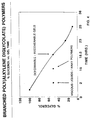
- FIG. 4 illustrates the physical characteristics of branched and crosslinked poly(alkylene diglycolate) polymers as a function of reaction time and mole percent of trifunctional alcohol (i.e., glycerol) used.
- trifunctional alcohol i.e., glycerol
- the aliphatic poly(alkylene diglycolate)s useful in the practice of the present invention will typically be synthesized by conventional techniques using conventional processes.
- a dicarboxylic acid diglycolic acid
- an alcohol i.e., glycerol
- the catalyst is preferably tin based, although any conventional catalyst may be used, e.g., stannous octoate, and is present in the monomer mixture at a sufficiently effective molar ratio of monomer to catalyst, e.g., ranging from about 10,000/1 to about 100,000/1, or other conventional molar ratios.
- the reaction is typically carried out at a temperature range from about 80°C to about 220°C, preferably from about 160°C to about 200°C, under an inert atmosphere until esterification of diglycolic acid is complete, followed by polymerization under reduced pressure until the desired molecular weight and viscosity are achieved.
- Suitable saturated, aliphatic alcohols for the preparation of poly(alkylene diglycolate) polymers include, but are not limited to, glycerol, pentaerythitol, trimethylolpropane, slightly to substantially water soluble hydroxyl terminated poly(ethylene glycol)s of weight average molecular weight of about 100 grams per mole to about 40,000 grams per mole, ethylene glycol, 1,2-propanediol, 1,3-propanediol, 1,4-butylene glycol, dipropylene glycol, 1,5-pentanediol, 1,6-hexanediol, 1,7-heptanediol, 1,8-octanediol, and the like.
- substantially water soluble as used herein is defined as meaning that the solubility of the poly(ethylene glycol) in an aqueous solution is greater than 1 gram per 100 mL of water, whereas the term slightly water soluble is defined as meaning that the solubility of the poly(ethylene glycol) in an aqueous solution is less than 1 gram per 100 mL of water.
- An aliphatic saturated alcohol is defined as an alcohol in which all carbon-carbon bonds are single in nature and no carbon-carbon ring structures are present. That is, no double or triple carbon-carbon bonds or cyclic rings are found in the chemical structure.
- the structure of the aliphatic saturated alcohols of the present invention is: R 4 -(CHR 1 -CHR 2 ) n -R 3 where R 1 , R 2 are hydrogen or methyl, ethyl or propyl or hydroxyl and combinations thereof, and R 3 and R 4 are hydrogen or hydroxyl and combinations thereof, and where n is an integer from about 1 to about 25.
- the aliphatic polyesters useful in the practice of the present invention will typically be synthesized by conventional techniques using conventional processes.
- the aliphatic lactone monomers are polymerized in the presence of a conventional organometallic catalyst and an initiator at elevated temperatures.
- the organometallic catalyst is preferably tin based, e.g., stannous octoate, and is present in a sufficiently effective amount in the monomer mixture, preferably at a molar ratio of monomer to catalyst ranging from about 10,000/1 to about 100,000/1.
- the initiator is typically an alkanol, a glycol, a hydroxyacid, or an amine, or any conventional initiator and is present in the monomer mixture in a sufficiently effective amount, preferably at a molar ratio of monomer to initiator ranging from about 100/1 to about 5000/1.
- the polymerization is typically carried out at a temperature range from about 80°C to about 220°C, preferably from about 160°C to about 200°C, until the desired molecular weight and viscosity are achieved.
- Suitable lactone monomers include, but are not limited to, glycolide, lactide ( l, d, dl, meso), p-dioxanone, trimethylene carbonate, ⁇ -caprolactone, delta-valerolactone, beta-butyrolactone, epsilon-decalactone, 2,5-diketomorpholine, pivalolactone, alpha, alpha-diethylpropiolactone, ethylene carbonate, ethylene oxalate, 3-methyl-1,4-dioxane-2,5-dione, 3,3-diethyl-1,4-dioxan-2, 5-dione, gamma-butyrolactone, 1, 4-dioxepan-2-one, 1,5-dioxepan-2-one, 1,4-dioxan-2-one, 6,8-dioxabicycloctane-7-one and combinations of two or more thereof.
- Preferred lactone monomers
- the copolymers of poly(alkylene diglycolate)s and aliphatic polyesters useful in the practice of the present invention will typically be synthesized by conventional techniques using conventional processes.
- a preformed poly(alkylene diglycolate) of weight average molecular weight of about 100 to about 100,000 grams per mole and a preformed aliphatic polyester of weight average molecular weight of about 100 to about 100,000 grams per mole are transesterified in the presence of a conventional organometallic catalyst at elevated temperatures.
- the organometallic catalyst is preferably tin based, e.g., stannous octoate, and is present in a sufficiently effective amount in the mixture at a molar ratio of polymer to catalyst ranging from about 10,000/1 to about 100,000/1.
- the transesterification is typically carried out at a temperature range from about 80°C to about 220°C, preferably from about 160°C to about 200°C, until the desired molecular weight and viscosity are achieved.
- the homopolymers and copolymers of poly(alkylene diglycolate)s and aliphatic polyesters will typically have a weight average molecular weight of about 2,000 grams per mole to about 200,000 grams per mole, more typically about 5,000 grams per mole to about 100,000 grams per mole, and preferably about 10,000 grams per mole to about 70,000 grams per mole.
- molecular weights are sufficient to provide an effective inherent viscosity, typically between about 0.05 to about 3.0 deciliters per gram (dL/g), more typically 0.1 to about 2.5 dL/g, and most preferably 0.2 to about 2.0 dL/g as measured in a 0.1 g/dL solution of hexafluoroisopropanol (HFIP) at 25°C.
- dL/g deciliters per gram
- HFIP hexafluoroisopropanol
- the poly(alkylene diglycolate) homo- and co-polymers will typically consist of about 25 mole percent to about 95 mole percent, and more preferably about 40 mole percent to about 90 mole percent of repeating units with saturated, aliphatic tri- and/or tetra-functional alcohols and/or hydroxyl terminated poly(ethylene glycol)s, with the remaining portions consisting of repeating units with saturated, aliphatic diols.
- the lower limit of multi-functional saturated, aliphatic alcohols and poly(ethylene glycol)s in the homo- and co-polymers is desirable because the addition of 25 mole percent leads to polymers which have fewer branches or crosslinks, but which, surprisingly and unexpectedly, still form hydrogels, and provides for materials which are useful in applications such as injectable defect fillers and tissue adhesives and sealants due to their low viscosities.
- the upper limit of saturated, aliphatic multi-functional alcohols and poly(ethylene glycol)s in the homo- and co-polymers is desirable because the addition of 95 mole percent leads to polymers which are highly branched or crosslinked and provides for materials which are useful in applications such as preformed defect fillers, bone waxes, and cartilage replacements due to their elastic properties.
- the incorporation of hydroxyl terminated poly(ethylene glycol)s in the poly(alkylene diglycolate)s is desirable because it leads to polymers which are useful, for example, as coatings for use as adhesion prevention barriers due to their hydrophilic, partially water soluble, gel-like properties.
- copolymers of poly(alkylene diglycolate)s and aliphatic polyesters will typically consist of about 5 mole percent to about 95 mole percent, more preferably 10 mole percent to 90 mole percent of poly(alkylene diglycolate)s.
- the lower and upper limits of poly(alkylene diglycolate) provides for copolymers with a desirable range of strength, stiffness and absorption profiles.
- the above described polymers, copolymers and blends can be post-polymerized to form pendant acrylate groups by a method consisting of reacting hydroxyl pendant side groups on poly(alkylene diglycolate) homo- and co-polymers with acryloyl chloride, or other unsaturated acid halide containing compounds such as methacryloyl chloride, trans-crontonyl chloride, dimethyl acryloyl chloride, and other acrylates, diacrylates, oligoacrylates, methacrylates, dimethacrylates, oligomethacrylates, and the like, via esterification at temperatures of 25°C to 75°C for 1 to 12 hours under an inert atmosphere. Additionally, other biologically acceptable photopolymerizable groups can be used.
- these acrylate groups can be polymerized quickly, forming water or partially water soluble crosslinked gels, within a few seconds to a few minutes, via free radical initiation, preferably photopolymerization, utilizing visible or long wavelength ultraviolet radiation and free radical, photosensitive initiators including certain dyes such as ethyl eosin, 2-methoxy-2-phenyl acetophenone, 2,2-dimethoxy-2-phenyl acetophenone, other acetophenone derivatives, camphorquinone, and the like.
- free radical initiation preferably photopolymerization, utilizing visible or long wavelength ultraviolet radiation and free radical, photosensitive initiators including certain dyes such as ethyl eosin, 2-methoxy-2-phenyl acetophenone, 2,2-dimethoxy-2-phenyl acetophenone, other acetophenone derivatives, camphorquinone, and the like.
- these polymers can be polymerized by irradiation with light at a wavelength of about 150 to about 750 nm by long wavelength or ultraviolet light, or laser light at about 514 nm.
- Photooxidizable and photoreducible dyes may also be used to initiate polymerization. These include acridine dyes such as acriblarine; thiazine dyes such as thionine; xanthine dyes such as rose bengal; and phenazine dyes such as methylene blue. These can be used in conjunction with cocatalysts such as amines, sulfur compounds, imidazoles enolates, and organometallics.
- Thermal polymerization initiators can also be used. These include, for example, potassium persulfate, benzoylperoxide, and ammonium persulfate with sodium bisulfite.
- the polymer blends of the present invention are manufactured in the following manner.
- the homopolymers and copolymers are individually charged into a conventional mixing vessel having a conventional mixing device mounted therein such as an impeller.
- the polymers and copolymers are mixed at a sufficient temperature, typically about 150°C to about 220°C, and preferably 160°C to 200°C, for a sufficient amount of time about 5 to about 90 minutes, more preferably for about 10 to about 45 minutes, to effectively produce a uniformly dispersed polymer blend.
- the polymer blend is further processed in a conventional manner using conventional process equipment by removing it from the mixing device, cooling to room temperature, grinding, and drying under pressures below atmospheric at elevated temperatures for a period of time.
- the polymer blends of the present invention will have sufficient amounts of poly(alkylene diglycolate)s to effectively impart a broad range of absorption profiles, and other physical properties.
- the blends will typically contain about 5 weight percent to about 95 weight percent, and more preferably about 10 weight percent to about 90 weight percent of poly(alkylene diglycolate) polymers.
- Articles such as medical devices are molded from the polymers, copolymers and blends of the present invention by use of various conventional injection and extrusion molding processes and equipment equipped with dry nitrogen atmospheric chamber(s) at temperatures ranging from about 160°C to about 230°C, more preferably 170°C to about 220°C, with residence times of about 1 to about 10 minutes, more preferably about 2 to about 5 minutes.
- the polymers and blends of the present invention can be melt processed by numerous methods to prepare a vast array of useful devices. These materials can be injection or compression molded to make implantable medical and surgical devices, including wound closure devices.
- the preferred devices are hydrogels useful as injectable defect fillers, tissue adhesives and sealants, preformed defect fillers, bone waxes, and cartilage replacements.
- biomedical devices comprising the crosslinked hydrogels of the present invention are useful for such devices.
- a hydrogel for the purposes of this invention, is defined as a crosslinked or highly grafted polymer, copolymer or polymer blend, which when placed in an aqueous or buffered physiological solution at a concentration of 1g/100 ml at a temperature of 37°C is swollen by the solution, but not dissolved, for a time frame as to make it useful for biomedical applications such as drug delivery or soft tissue defect fillers.
- the polymers and blends can be extruded to prepare fibers.
- the filaments thus produced may be fabricated into sutures or ligatures, attached to surgical needles, packaged, and sterilized by known techniques.
- the materials of the present invention may be spun as multifilament yarn and woven or knitted to form sponges or gauze, (or non-woven sheets may be prepared) or used in conjunction with other molded compressive structures as prosthetic devices within the body of a human or animal where it is desirable that the structure have high tensile strength and desirable levels of compliance and/or ductility.
- Useful embodiments include tubes, including branched tubes, for artery, vein or intestinal repair, nerve splicing, tendon splicing, sheets for tying up and supporting damaged surface abrasions, particularly major abrasions, or areas where the skin and underlying tissues are damaged or surgically removed.
- polymers and blends can be molded to form films which, when sterilized, are useful as adhesion prevention barriers.
- Another alternative processing technique for the polymers and blends of the present invention includes solvent casting, particularly for those applications where a drug delivery matrix is desired.
- ultrathin coatings of about 1 to about 1000 microns can be applied to tissue surfaces, including the lumen of tissue such as a blood vessel. Once applied, the coating can be cured to secure it to the tissue, making such coatings useful in the treatment or prevention of restenosis or the prevention of adhesions.
- the surgical and medical uses of the filaments, films, foams, coatings and molded articles of the present invention include, but are not necessarily limited to knitted products, woven or non-woven, and molded products including:
- unsaturated groups can comprise the polymers of the present invention, but only unsaturated groups found in pendant acrylate groups.
- the poly(alkylene diglycolate) homo- and co-polymers are prepared by a method consisting of reacting a diacid (i.e., diglycolic acid) and various saturated, aliphatic multi-functional alcohols via a condensation polymerization at temperatures of 150°C to 220°C for 1 to 12 hours under an inert atmosphere, followed by reaction under reduced pressures for 1 to 24 hours, until the desired molecular weight and viscosity are achieved.
- a diacid i.e., diglycolic acid
- various saturated, aliphatic multi-functional alcohols via a condensation polymerization at temperatures of 150°C to 220°C for 1 to 12 hours under an inert atmosphere, followed by reaction under reduced pressures for 1 to 24 hours, until the desired molecular weight and viscosity are achieved.
- the aliphatic polyesters are prepared by a method consisting of reacting lactone monomers via a ring opening polymerization at temperatures of 80°C to 220°C for 1 to 24 hours under an inert nitrogen atmosphere until the desired molecular weight and viscosity are achieved.
- the copolymers of poly(alkylene diglycolate)s and aliphatic polyesters are prepared by a method consisting of reacting preformed poly(alkylene diglycolate)s with aliphatic polyesters via a transesterification at temperatures of 150°C to 220°C for 1 to 24 hours under an inert nitrogen atmosphere until the desired molecular weight and viscosity are achieved.
- post-polymerization reactions to form pendant acrylate groups are performed by a method consisting of reacting hydroxyl pendant side groups on poly(alkylene diglycolate) homo- and co-polymers with acryloyl chloride, or other unsaturated acid halide containing compounds such as methacryloyl chloride, trans-crontonyl chloride, dimethyl acryloyl chloride, and the like, via esterification at temperatures of 25°C to 75°C for 1 to 12 hours under an inert atmosphere.
- the polymer blends of the present invention are prepared by individually charging the synthesized aliphatic homo- and co-polyesters and poly(alkylene diglycolate)s into a conventional mixing vessel.
- the polymers and copolymers are mixed at a temperature of 150°C to 220°C, for 5 to 90 minutes until a uniformly dispersed polymer blend is obtained.
- aliphatic polyesters and poly(alkylene diglycolate)s are prepared and based upon lactone monomers such as glycolide, lactide, p-dioxanone, trimethylene carbonate and ⁇ -caprolactone, and alkylene diglycolate monomers, including; diglycolic acid, and saturated, aliphatic alcohols such as glycerol, pentaerythitol, trimethylolpropane, slightly to substantially water soluble hydroxyl terminated poly(ethylene glycol)s of weight average molecular weight of about 100 grams per mole to about 40,000 grams per mole, ethylene glycol, 1,2-propanediol, 1,3-propanediol, 1,4-butylene glycol, dipropylene glycol, 1,5-pentanediol, 1,6-hexanediol, 1,7-heptanediol, and 1,8-octanediol.
- lactone monomers such as glyco
- the blends, polymers and monomers were characterized for chemical composition and purity (NMR, FT-IR), thermal analysis (DSC), melt rheology (melt stability and viscosity), and molecular weight (inherent viscosity).
- FT-IR was performed on a Nicolet FT-IR. Polymer samples were melt pressed into thin films. Monomers were pressed into KBr pellets. 1 H NMR was performed on a 300 MHz NMR using CDCl 3 or HFAD as a reference.
- Thermal analysis of blends, polymers and monomers was performed on a Dupont 912 Differential Scanning Calorimeter (DSC) at a heating rate of 10°C/min. A Fisher-Johns melting point apparatus was also utilized to determine melting points of monomers. Thermal gravimetric analysis was performed on a Dupont 951 TGA at a rate of 10°C/min. under a nitrogen atmosphere. Isothermal melt stability of the polymers was also determined by a Rheometrics Dynamic Analyzer RDA II for a period of 1 hour at temperatures ranging from 160°C to 230°C under a nitrogen atmosphere.
- Inherent viscosities (I.V., dL/g) of the blends and polymers were measured using a 50 bore Cannon-Ubbelhode dilution viscometer immersed in a thermostatically controlled water bath at 25°C utilizing chloroform or HFIP as the solvent at a concentration of 0.1 g/dL.
- Melt viscosity was determined utilizing a Rheometrics Dynamic Analyzer RDA II at temperatures ranging from 160°C to 230°C at rate of 1°C/min. to 10°C/min. at frequencies of 1s -1 to 100s -1 under a nitrogen atmosphere.
- the assembly was then placed in a high temperature oil bath at 175°C under a stream of nitrogen.
- the stirred monomers quickly began to melt.
- the low viscosity melt increased in viscosity. Stirring of the high viscosity melt was continued for 5 hours.
- the 25:75 (mol/mol) rubbery, crosslinked (mol/mol) poly(propylene diglycolate -co- 2-hydroxy-1,3-propylene diglycolate) copolymer was removed from the bath, cooled to room temperature under a stream of nitrogen, and isolated.
- the polymer was insoluble in chloroform and hexafluroisopropanol, indicating a high degree of crosslinking or branching.
- the assembly was then placed in a high temperature oil bath at 175°C under a stream of nitrogen.
- the stirred monomers quickly began to melt.
- the low viscosity melt increased in viscosity. Stirring of the high viscosity melt was continued for 5 hours.
- the 60:40 (mol/mol) rubbery, crosslinked (mol/mol) poly(propylene diglycolate -co- 2-hydroxy-1,3-propylene diglycolate) copolymer was removed from the bath, cooled to room temperature under a stream of nitrogen, and isolated.
- the polymer was insoluble in chloroform and hexafluroisopropanol, indicating a high degree of crosslinking or branching.
- the assembly was then placed in a high temperature oil bath at 175°C under a stream of nitrogen.
- the stirred monomers quickly began to melt.
- the low viscosity melt increased in viscosity. Stirring of the high viscosity melt was continued for 5 hours.
- the 75:25 (mol/mol) rubbery, crosslinked (mol/mol) poly(propylene diglycolate -co- 2-hydroxy-1,3-propylene diglycolate) copolymer was removed from the bath, cooled to room temperature under a stream of nitrogen, and isolated.
- the polymer was insoluble in chloroform and hexafluroisopropanol, indicating a high degree of crosslinking or branching.
- the assembly was then placed in a high temperature oil bath at 175°C under a stream of nitrogen.
- the stirred monomers quickly began to melt.
- the low viscosity melt increased in viscosity. Stirring of the high viscosity melt was continued for 5 hours.
- the 90:10 (mol/mol) rubbery, partially crosslinked poly(propylene diglycolate -co- 2-hydroxy-1,3-propylene diglycolate) copolymer was removed from the bath, cooled to room temperature under a stream of nitrogen, and isolated. Inherent viscosity using HFIP as a solvent was 0.96 dL/g.
- the assembly was then placed in a high temperature oil bath at 175°C under a stream of nitrogen.
- the stirred monomers quickly began to melt.
- the low viscosity melt increased in viscosity. Stirring of the high viscosity melt was continued for 5 hours.
- the 50:40:10 (mol/mol/mol) poly(1,3-propylene diglycolate-2-hydroxy-1,3-propylene diglycolate-ethylene oxide) terpolymer was removed from the bath, cooled to room temperature under a stream of nitrogen, and isolated.
- the polymer was insoluble in chloroform and hexafluroisopropanol, indicating a high degree of crosslinking or branching.
- the assembly was then placed in a high temperature oil bath at 185°C.
- the stirred monomers quickly began to melt.
- the low viscosity melt quickly increased in viscosity. Stirring of the high viscosity melt was continued for a total reaction time of 4 hours.
- the 5:95 (mol/mol) poly(glycolide-co-lactide) copolymer was removed from the bath, cooled to room temperature under a stream of nitrogen, isolated and ground. The polymer was then dried under vacuum at 110°C for 24 hours. Inherent viscosity using HFIP as a solvent was 1.95 dL/g.
- the assembly was then placed in a high temperature oil bath at 190°C.
- the stirred monomers quickly began to melt.
- the low viscosity melt quickly increased in viscosity. Stirring of the high viscosity melt was continued for a total reaction time of 24 hours.
- the 90:10 (mol/mol) poly( ⁇ -caprolactone-co-p-dioxanone) copolymer was removed from the bath, cooled to room temperature under a stream of nitrogen, isolated and ground. The polymer was then dried under vacuum at 40°C for 24 hours. Inherent viscosity using HFIP as a solvent was 1.17 dL/g.
- the assembly was then placed in a high temperature oil bath at 190°C.
- the stirred polymers quickly began to melt.
- the reaction mass was stirred for a total reaction time of 4 hours.
- the 75:25 (weight/weight) blocky copolymer was removed from the bath, cooled to room temperature under a stream of nitrogen, isolated and ground. The polymer was then dried under vacuum at 40°C for 24 hours. Inherent viscosity using HFIP as a solvent was 1.01 dL/g.
- the assembly was then placed in a high temperature oil bath at 190°C.
- the stirred polymers quickly began to melt.
- the reaction mass was stirred for a total reaction time of 4 hours.
- the 25:75 (weight/weight) blocky copolymer was removed from the bath, cooled to room temperature under a stream of nitrogen, isolated and ground. The polymer was then dried under vacuum at 40°C for 24 hours. Inherent viscosity using HFIP as a solvent was 1.36 dL/g.
- the assembly was then placed in an oil bath at 50°C under a stream of nitrogen.
- the solution was stirred for 24 hours to allow complete evolution of hydrochloric acid.
- the pendant acrylated terminated poly(alkylene diglycolate) polymer was then isolated by precipitating the chloroform solution in methanol, filtering, and drying under vacuum at 40°C for 24 hours.
- the polymers of the present invention have many advantages over the polymers of the prior art. For example as shown in FIG. 4, by incorporation of a trifunctional alcohol (i.e., glycerol) into the repeating units of a poly(alkylene diglycolate) (FIG. 1), it is possible to obtain polymers with a wide variety of physical characteristics.
- a trifunctional alcohol i.e., glycerol
- poly(alkylene diglycolate)s which are liquid or low melting, with only a few branch points, can be prepared by the incorporation of a small proportion of a multi-functional alcohol (i.e., glycerol) into the repeating units of the polymer chain.
- a multi-functional alcohol i.e., glycerol
- highly branched or crosslinked poly(alkylene diglycolate)s can be synthesized by use of larger proportions of multi-functional alcohols.
- materials can be formed which, when placed in a buffered solution at 37°C, swell without dissolving for a period of 1 week or more, while polymers with less than 10 mole percent glycerol are too lightly crosslinked and immediately dissolve as seen in the Table.
- biomedical applications such as defect fillers, and tissue adhesives and sealants require characteristics such as hydrophilicity, ease of application (i.e., low viscosity liquid) and quick setting times (i.e., water or light curing).
- liquid or low melting, slightly branched poly(alkylene diglycolate)s could be utilized for such applications when post-reacted to form pendant acrylate groups which can be cured by UV light (FIG. 2) to form tough, crosslinked, elastic films.
- linear, low Tg, poly(alkylene diglycolate)s do not have the characteristics of elasticity or toughness, due to a lack of crosslinks or branching, required for biomedical devices such as preformed implants (i.e., cartilage replacements).
- linear poly(alkylene diglycolate)s do not have pendant functional groups (i.e., alcohol substitutients) which can be post-polymerized to form crosslinks.
- pendant functional groups i.e., alcohol substitutients
- This, as described above, is useful for applications, such as tissue adhesives, which require ease of application (i.e., low viscosity), but solidification (i.e., in-situ crosslinking) after being applied.
- the branched or crosslinked poly(alkylene diglycolate)s of the present invention yield a broad range of properties such as elasticity and toughness, which can not be found with linear poly(alkylene diglycolate)s.
Landscapes
- Health & Medical Sciences (AREA)
- Chemical & Material Sciences (AREA)
- Chemical Kinetics & Catalysis (AREA)
- Public Health (AREA)
- Veterinary Medicine (AREA)
- Epidemiology (AREA)
- Life Sciences & Earth Sciences (AREA)
- Animal Behavior & Ethology (AREA)
- General Health & Medical Sciences (AREA)
- Medicinal Chemistry (AREA)
- Organic Chemistry (AREA)
- Polymers & Plastics (AREA)
- Engineering & Computer Science (AREA)
- Surgery (AREA)
- Materials Engineering (AREA)
- Oral & Maxillofacial Surgery (AREA)
- Transplantation (AREA)
- Dermatology (AREA)
- Heart & Thoracic Surgery (AREA)
- Hematology (AREA)
- Vascular Medicine (AREA)
- General Chemical & Material Sciences (AREA)
- Polyesters Or Polycarbonates (AREA)
- Materials For Medical Uses (AREA)
- Compositions Of Macromolecular Compounds (AREA)
Applications Claiming Priority (2)
| Application Number | Priority Date | Filing Date | Title |
|---|---|---|---|
| US648902 | 1996-05-16 | ||
| US08/648,902 US5688900A (en) | 1995-01-19 | 1996-05-16 | Absorbable polyalkylene diglycolates |
Publications (2)
| Publication Number | Publication Date |
|---|---|
| EP0807653A2 true EP0807653A2 (de) | 1997-11-19 |
| EP0807653A3 EP0807653A3 (de) | 1997-12-29 |
Family
ID=24602686
Family Applications (1)
| Application Number | Title | Priority Date | Filing Date |
|---|---|---|---|
| EP97303296A Withdrawn EP0807653A3 (de) | 1996-05-16 | 1997-05-15 | Absorbierbare Polyalkylendiglykolate |
Country Status (6)
| Country | Link |
|---|---|
| US (1) | US5688900A (de) |
| EP (1) | EP0807653A3 (de) |
| JP (1) | JPH1045885A (de) |
| BR (1) | BR9703145A (de) |
| CA (1) | CA2205422C (de) |
| ZA (1) | ZA974232B (de) |
Cited By (7)
| Publication number | Priority date | Publication date | Assignee | Title |
|---|---|---|---|---|
| WO2003064496A3 (en) * | 2001-10-22 | 2004-02-12 | Massachusetts Inst Technology | Biodegradable polymer |
| WO2009132021A1 (en) | 2008-04-22 | 2009-10-29 | Ethicon, Inc. | Absorbable copolyesters of poly(ethoxyethylene diglycolate) and glycolide |
| US7722894B2 (en) | 2001-10-22 | 2010-05-25 | Massachusetts Institute Of Technology | Biodegradable polymer |
| US8143042B2 (en) | 2006-01-12 | 2012-03-27 | Massachusetts Institute Of Technology | Biodegradable elastomers |
| US8912304B2 (en) | 2007-05-17 | 2014-12-16 | Massachusetts Institute Of Technology | Polyol-based polymers |
| US9044524B2 (en) | 2009-10-30 | 2015-06-02 | Ethicon, Inc. | Absorbable polyethylene diglycolate copolymers to reduce microbial adhesion to medical devices and implants |
| US9200112B2 (en) | 2009-08-10 | 2015-12-01 | Ethicon, Inc. | Semi-crystalline, fast absorbing polymer formulation |
Families Citing this family (20)
| Publication number | Priority date | Publication date | Assignee | Title |
|---|---|---|---|---|
| EP0981381B1 (de) * | 1997-05-12 | 2007-02-21 | Metabolix, Inc. | Polyhydroxyalkanoate für in vivo anwendungen |
| GB9715603D0 (en) * | 1997-07-25 | 1997-10-01 | Solvay Interox Ltd | Thermoplastic polymers |
| PT1019111E (pt) | 1998-04-27 | 2002-10-31 | Surmodics Inc | Revestimento que liberta um agente bioactivo |
| US6172180B1 (en) * | 1998-08-25 | 2001-01-09 | Circe Biomedical, Inc. | Highly branched block copolymers |
| DE19858891A1 (de) * | 1998-12-19 | 2000-06-21 | Merck Patent Gmbh | Verbesserte Knochensiegel |
| AU4343500A (en) * | 1999-04-16 | 2000-11-02 | Schering Corporation | Use of azetidinone compounds |
| US6423818B1 (en) | 1999-07-30 | 2002-07-23 | Takehisa Matsuda | Coumarin endcapped absorbable polymers |
| JP4934911B2 (ja) * | 2001-03-19 | 2012-05-23 | 東洋紡績株式会社 | 生分解性ポリエステルおよび塗膜 |
| JP2002348366A (ja) * | 2001-03-19 | 2002-12-04 | Toyobo Co Ltd | 生分解性ポリエステルの製造方法 |
| US7097850B2 (en) | 2002-06-18 | 2006-08-29 | Surmodics, Inc. | Bioactive agent release coating and controlled humidity method |
| CN1964749A (zh) | 2004-04-06 | 2007-05-16 | 苏莫迪克斯公司 | 用于生物活性剂的涂料组合物 |
| CN101035574B (zh) | 2004-04-20 | 2011-05-11 | 根茨美公司 | 外科用丝网状植入物 |
| US8440215B2 (en) * | 2004-09-03 | 2013-05-14 | Ethicon, Inc. | Absorbable polymer formulations |
| US7754233B2 (en) * | 2004-09-03 | 2010-07-13 | Ethicon, Inc. | Method of preventing post-operative surgical adhesion |
| WO2007123777A2 (en) * | 2006-03-30 | 2007-11-01 | Duke University | Inhibition of hif-1 activation for anti-tumor and anti-inflammatory responses |
| US8580192B2 (en) | 2006-10-31 | 2013-11-12 | Ethicon, Inc. | Sterilization of polymeric materials |
| US9259514B2 (en) * | 2013-12-18 | 2016-02-16 | Ethicon, Inc. | Absorbable polymeric blend compositions based on copolymers prepared from mono- and di-functional polymerization initiators, processing methods, and medical devices therefrom |
| JP6291363B2 (ja) * | 2014-06-20 | 2018-03-14 | グンゼ株式会社 | 生分解性分岐状ポリマー |
| US10172617B2 (en) * | 2015-03-25 | 2019-01-08 | Ethicon Llc | Malleable bioabsorbable polymer adhesive for releasably attaching a staple buttress to a surgical stapler |
| US12594692B2 (en) * | 2023-07-25 | 2026-04-07 | Ethicon, Inc. | Absorbable poly(p-dioxanone) pellets made from slow-to-crystallize ground resin and its fines |
Family Cites Families (6)
| Publication number | Priority date | Publication date | Assignee | Title |
|---|---|---|---|---|
| GB787760A (en) * | 1954-07-07 | 1957-12-18 | Hudson Foam Plastics Corp | Improvements in the manufacture of polyester resins |
| US3280077A (en) * | 1962-12-10 | 1966-10-18 | Leslie C Case | Resinous compositions comprising epoxy resins and polyester-ether copolymers having acidic end groups |
| US4048256A (en) * | 1976-06-01 | 1977-09-13 | American Cyanamid Company | Normally-solid, bioabsorbable, hydrolyzable, polymeric reaction product |
| CH653558A5 (fr) * | 1979-11-23 | 1986-01-15 | Battelle Memorial Institute | Fil de suture muni d'un manchon protecteur. |
| US4502976A (en) * | 1982-10-25 | 1985-03-05 | Bend Research, Inc. | Water soluble polyesters |
| CA2167455A1 (en) * | 1995-01-19 | 1996-07-20 | Kevin Cooper | Absorbable polyalkylene diglycolates |
-
1996
- 1996-05-16 US US08/648,902 patent/US5688900A/en not_active Expired - Lifetime
-
1997
- 1997-05-09 JP JP9134483A patent/JPH1045885A/ja active Pending
- 1997-05-13 BR BR9703145A patent/BR9703145A/pt not_active Application Discontinuation
- 1997-05-14 CA CA002205422A patent/CA2205422C/en not_active Expired - Fee Related
- 1997-05-15 EP EP97303296A patent/EP0807653A3/de not_active Withdrawn
- 1997-05-15 ZA ZA974232A patent/ZA974232B/xx unknown
Cited By (12)
| Publication number | Priority date | Publication date | Assignee | Title |
|---|---|---|---|---|
| WO2003064496A3 (en) * | 2001-10-22 | 2004-02-12 | Massachusetts Inst Technology | Biodegradable polymer |
| US7722894B2 (en) | 2001-10-22 | 2010-05-25 | Massachusetts Institute Of Technology | Biodegradable polymer |
| US8143042B2 (en) | 2006-01-12 | 2012-03-27 | Massachusetts Institute Of Technology | Biodegradable elastomers |
| US8691203B2 (en) | 2006-01-12 | 2014-04-08 | Massachusetts Institute Of Technology | Method comprising contacting tissue with a cross-linkable polyester prepolymer |
| US10179195B2 (en) | 2006-01-12 | 2019-01-15 | Massachusetts Institue Of Technology | Method comprising contacting tissue with a cross-linkable polyester prepolymer |
| US10864303B2 (en) | 2006-01-12 | 2020-12-15 | Massachusetts Institute Of Technology | Method comprising contacting tissue with a cross-linkable polyester prepolymer |
| US11458230B2 (en) | 2006-01-12 | 2022-10-04 | Massachusetts Institute Of Technology | Method comprising contacting tissue with a cross-linkable polyester prepolymer |
| US7968656B2 (en) | 2006-10-31 | 2011-06-28 | Ethicon, Inc. | Absorbable copolyesters of poly(ethoxyethylene diglycolate) and glycolide |
| US8912304B2 (en) | 2007-05-17 | 2014-12-16 | Massachusetts Institute Of Technology | Polyol-based polymers |
| WO2009132021A1 (en) | 2008-04-22 | 2009-10-29 | Ethicon, Inc. | Absorbable copolyesters of poly(ethoxyethylene diglycolate) and glycolide |
| US9200112B2 (en) | 2009-08-10 | 2015-12-01 | Ethicon, Inc. | Semi-crystalline, fast absorbing polymer formulation |
| US9044524B2 (en) | 2009-10-30 | 2015-06-02 | Ethicon, Inc. | Absorbable polyethylene diglycolate copolymers to reduce microbial adhesion to medical devices and implants |
Also Published As
| Publication number | Publication date |
|---|---|
| US5688900A (en) | 1997-11-18 |
| ZA974232B (en) | 1998-11-16 |
| EP0807653A3 (de) | 1997-12-29 |
| BR9703145A (pt) | 1998-09-08 |
| MX9703652A (es) | 1998-06-28 |
| CA2205422A1 (en) | 1997-11-16 |
| CA2205422C (en) | 2006-04-11 |
| JPH1045885A (ja) | 1998-02-17 |
Similar Documents
| Publication | Publication Date | Title |
|---|---|---|
| US5736589A (en) | Absorbable polyalkylene diglycolates | |
| US5688900A (en) | Absorbable polyalkylene diglycolates | |
| EP0768329B1 (de) | Hochfeste, aus der Schmelze verarbeitbare lactidreiche Lactid-p-Dioxanon-Copolymere | |
| EP0636639B1 (de) | Copolymere aus aromatischen Anhydriden und aliphatischen Estern | |
| EP0795573B1 (de) | Resorbierbare Copolymere und Mischungen von 6,6-Dialkyl-1,4-dioxepan-2-on und seinem cyclischen Dimeren | |
| EP0707044B1 (de) | Absorbierbare Polymer-Mischungen | |
| US5633343A (en) | High strength, fast absorbing, melt processable, gycolide-rich, poly(glycolide-co-p-dioxanone) copolymers | |
| US20010021377A1 (en) | Hydrogels containing absorbable polyoxaamides | |
| JPH10158375A (ja) | 吸収性ポリオキサエステルのヒドロゲル | |
| JPH10158377A (ja) | アミンおよび/またはアミド基を含有する吸収性ポリオキサエステルのヒドロゲル | |
| JP3483753B2 (ja) | 生体内分解吸収性可塑性粘着物 | |
| AU738400B2 (en) | Absorbable polyalkylene diglycolates | |
| MXPA97003652A (en) | Absalbib polyalykylene diglycollates | |
| CN1169440A (zh) | 可吸收聚(二甘醇酸亚烷基酯) | |
| MXPA97001991A (en) | Copolymer and absorbable mixes of 6,6-dialquil-1,4-dioxepan-2-ona and its dimero cicl |
Legal Events
| Date | Code | Title | Description |
|---|---|---|---|
| PUAI | Public reference made under article 153(3) epc to a published international application that has entered the european phase |
Free format text: ORIGINAL CODE: 0009012 |
|
| PUAL | Search report despatched |
Free format text: ORIGINAL CODE: 0009013 |
|
| AK | Designated contracting states |
Kind code of ref document: A2 Designated state(s): DE FR GB IT |
|
| AK | Designated contracting states |
Kind code of ref document: A3 Designated state(s): DE FR GB IT |
|
| 17P | Request for examination filed |
Effective date: 19980604 |
|
| 17Q | First examination report despatched |
Effective date: 19990125 |
|
| STAA | Information on the status of an ep patent application or granted ep patent |
Free format text: STATUS: THE APPLICATION IS DEEMED TO BE WITHDRAWN |
|
| 18D | Application deemed to be withdrawn |
Effective date: 19990805 |