EP0807599A1 - Verfahren zur Entfernung von Verunreinigungen aus gasförmingen Zusammenstellungen - Google Patents
Verfahren zur Entfernung von Verunreinigungen aus gasförmingen Zusammenstellungen Download PDFInfo
- Publication number
- EP0807599A1 EP0807599A1 EP96401038A EP96401038A EP0807599A1 EP 0807599 A1 EP0807599 A1 EP 0807599A1 EP 96401038 A EP96401038 A EP 96401038A EP 96401038 A EP96401038 A EP 96401038A EP 0807599 A1 EP0807599 A1 EP 0807599A1
- Authority
- EP
- European Patent Office
- Prior art keywords
- catalyst
- air
- particles
- gold
- silver
- Prior art date
- Legal status (The legal status is an assumption and is not a legal conclusion. Google has not performed a legal analysis and makes no representation as to the accuracy of the status listed.)
- Granted
Links
- 238000000034 method Methods 0.000 title claims abstract description 38
- 239000012535 impurity Substances 0.000 title claims abstract description 34
- 239000000203 mixture Substances 0.000 title claims description 7
- 239000003054 catalyst Substances 0.000 claims abstract description 84
- 239000002245 particle Substances 0.000 claims abstract description 30
- 229910052737 gold Inorganic materials 0.000 claims abstract description 24
- KDLHZDBZIXYQEI-UHFFFAOYSA-N Palladium Chemical compound [Pd] KDLHZDBZIXYQEI-UHFFFAOYSA-N 0.000 claims description 56
- 229910052739 hydrogen Inorganic materials 0.000 claims description 41
- 239000001257 hydrogen Substances 0.000 claims description 41
- IJGRMHOSHXDMSA-UHFFFAOYSA-N Atomic nitrogen Chemical compound N#N IJGRMHOSHXDMSA-UHFFFAOYSA-N 0.000 claims description 40
- UFHFLCQGNIYNRP-UHFFFAOYSA-N Hydrogen Chemical compound [H][H] UFHFLCQGNIYNRP-UHFFFAOYSA-N 0.000 claims description 38
- UGFAIRIUMAVXCW-UHFFFAOYSA-N Carbon monoxide Chemical compound [O+]#[C-] UGFAIRIUMAVXCW-UHFFFAOYSA-N 0.000 claims description 32
- 229910002091 carbon monoxide Inorganic materials 0.000 claims description 31
- CURLTUGMZLYLDI-UHFFFAOYSA-N Carbon dioxide Chemical compound O=C=O CURLTUGMZLYLDI-UHFFFAOYSA-N 0.000 claims description 28
- 150000001875 compounds Chemical class 0.000 claims description 28
- 229910052763 palladium Inorganic materials 0.000 claims description 28
- 239000010931 gold Substances 0.000 claims description 25
- PCHJSUWPFVWCPO-UHFFFAOYSA-N gold Chemical compound [Au] PCHJSUWPFVWCPO-UHFFFAOYSA-N 0.000 claims description 23
- BASFCYQUMIYNBI-UHFFFAOYSA-N platinum Chemical compound [Pt] BASFCYQUMIYNBI-UHFFFAOYSA-N 0.000 claims description 23
- QVGXLLKOCUKJST-UHFFFAOYSA-N atomic oxygen Chemical compound [O] QVGXLLKOCUKJST-UHFFFAOYSA-N 0.000 claims description 22
- 239000001301 oxygen Substances 0.000 claims description 22
- 229910052760 oxygen Inorganic materials 0.000 claims description 22
- BQCADISMDOOEFD-UHFFFAOYSA-N Silver Chemical compound [Ag] BQCADISMDOOEFD-UHFFFAOYSA-N 0.000 claims description 21
- 229910052757 nitrogen Inorganic materials 0.000 claims description 19
- 229910052709 silver Inorganic materials 0.000 claims description 19
- XLYOFNOQVPJJNP-UHFFFAOYSA-N water Substances O XLYOFNOQVPJJNP-UHFFFAOYSA-N 0.000 claims description 17
- 239000004332 silver Substances 0.000 claims description 16
- GWEVSGVZZGPLCZ-UHFFFAOYSA-N Titan oxide Chemical compound O=[Ti]=O GWEVSGVZZGPLCZ-UHFFFAOYSA-N 0.000 claims description 14
- 229910002092 carbon dioxide Inorganic materials 0.000 claims description 12
- 239000001569 carbon dioxide Substances 0.000 claims description 12
- 229910052697 platinum Inorganic materials 0.000 claims description 11
- VUZPPFZMUPKLLV-UHFFFAOYSA-N methane;hydrate Chemical compound C.O VUZPPFZMUPKLLV-UHFFFAOYSA-N 0.000 claims description 10
- 229910052751 metal Inorganic materials 0.000 claims description 9
- 239000002184 metal Substances 0.000 claims description 8
- 239000011261 inert gas Substances 0.000 claims description 7
- 230000008030 elimination Effects 0.000 claims description 6
- 238000003379 elimination reaction Methods 0.000 claims description 6
- 238000004821 distillation Methods 0.000 claims description 5
- 239000004408 titanium dioxide Substances 0.000 claims description 5
- 239000007789 gas Substances 0.000 claims description 4
- 229910000420 cerium oxide Inorganic materials 0.000 claims description 3
- BMMGVYCKOGBVEV-UHFFFAOYSA-N oxo(oxoceriooxy)cerium Chemical compound [Ce]=O.O=[Ce]=O BMMGVYCKOGBVEV-UHFFFAOYSA-N 0.000 claims description 3
- 238000002360 preparation method Methods 0.000 claims description 2
- 239000002923 metal particle Substances 0.000 abstract description 3
- 238000012360 testing method Methods 0.000 description 30
- 229910010413 TiO 2 Inorganic materials 0.000 description 17
- XKRFYHLGVUSROY-UHFFFAOYSA-N Argon Chemical compound [Ar] XKRFYHLGVUSROY-UHFFFAOYSA-N 0.000 description 10
- 239000010457 zeolite Substances 0.000 description 9
- PNEYBMLMFCGWSK-UHFFFAOYSA-N aluminium oxide Inorganic materials [O-2].[O-2].[O-2].[Al+3].[Al+3] PNEYBMLMFCGWSK-UHFFFAOYSA-N 0.000 description 8
- 239000010970 precious metal Substances 0.000 description 8
- 238000011144 upstream manufacturing Methods 0.000 description 7
- 229910052786 argon Inorganic materials 0.000 description 5
- 239000011248 coating agent Substances 0.000 description 5
- 238000000576 coating method Methods 0.000 description 5
- 238000000746 purification Methods 0.000 description 5
- 229910018072 Al 2 O 3 Inorganic materials 0.000 description 4
- VYPSYNLAJGMNEJ-UHFFFAOYSA-N Silicium dioxide Chemical compound O=[Si]=O VYPSYNLAJGMNEJ-UHFFFAOYSA-N 0.000 description 4
- 238000006243 chemical reaction Methods 0.000 description 4
- 238000000926 separation method Methods 0.000 description 4
- 230000000052 comparative effect Effects 0.000 description 3
- 150000002431 hydrogen Chemical class 0.000 description 3
- 238000005470 impregnation Methods 0.000 description 3
- 239000013528 metallic particle Substances 0.000 description 3
- 239000011324 bead Substances 0.000 description 2
- 238000001354 calcination Methods 0.000 description 2
- 239000000470 constituent Substances 0.000 description 2
- 238000010438 heat treatment Methods 0.000 description 2
- 238000004519 manufacturing process Methods 0.000 description 2
- 150000002739 metals Chemical class 0.000 description 2
- 239000002808 molecular sieve Substances 0.000 description 2
- 239000011148 porous material Substances 0.000 description 2
- 150000003839 salts Chemical class 0.000 description 2
- 239000004065 semiconductor Substances 0.000 description 2
- 239000000377 silicon dioxide Substances 0.000 description 2
- URGAHOPLAPQHLN-UHFFFAOYSA-N sodium aluminosilicate Chemical compound [Na+].[Al+3].[O-][Si]([O-])=O.[O-][Si]([O-])=O URGAHOPLAPQHLN-UHFFFAOYSA-N 0.000 description 2
- GGCZERPQGJTIQP-UHFFFAOYSA-N sodium;9,10-dioxoanthracene-2-sulfonic acid Chemical compound [Na+].C1=CC=C2C(=O)C3=CC(S(=O)(=O)O)=CC=C3C(=O)C2=C1 GGCZERPQGJTIQP-UHFFFAOYSA-N 0.000 description 2
- 238000001179 sorption measurement Methods 0.000 description 2
- OKTJSMMVPCPJKN-UHFFFAOYSA-N Carbon Chemical compound [C] OKTJSMMVPCPJKN-UHFFFAOYSA-N 0.000 description 1
- VEXZGXHMUGYJMC-UHFFFAOYSA-M Chloride anion Chemical compound [Cl-] VEXZGXHMUGYJMC-UHFFFAOYSA-M 0.000 description 1
- RYGMFSIKBFXOCR-UHFFFAOYSA-N Copper Chemical compound [Cu] RYGMFSIKBFXOCR-UHFFFAOYSA-N 0.000 description 1
- 241000264877 Hippospongia communis Species 0.000 description 1
- 229910002651 NO3 Inorganic materials 0.000 description 1
- NHNBFGGVMKEFGY-UHFFFAOYSA-N Nitrate Chemical compound [O-][N+]([O-])=O NHNBFGGVMKEFGY-UHFFFAOYSA-N 0.000 description 1
- KJTLSVCANCCWHF-UHFFFAOYSA-N Ruthenium Chemical compound [Ru] KJTLSVCANCCWHF-UHFFFAOYSA-N 0.000 description 1
- 229910021536 Zeolite Inorganic materials 0.000 description 1
- 239000003463 adsorbent Substances 0.000 description 1
- 229910052799 carbon Inorganic materials 0.000 description 1
- 238000000975 co-precipitation Methods 0.000 description 1
- 229910052802 copper Inorganic materials 0.000 description 1
- 239000010949 copper Substances 0.000 description 1
- 238000001514 detection method Methods 0.000 description 1
- HNPSIPDUKPIQMN-UHFFFAOYSA-N dioxosilane;oxo(oxoalumanyloxy)alumane Chemical compound O=[Si]=O.O=[Al]O[Al]=O HNPSIPDUKPIQMN-UHFFFAOYSA-N 0.000 description 1
- 150000004820 halides Chemical class 0.000 description 1
- 229910052500 inorganic mineral Inorganic materials 0.000 description 1
- 238000009434 installation Methods 0.000 description 1
- 229910052741 iridium Inorganic materials 0.000 description 1
- GKOZUEZYRPOHIO-UHFFFAOYSA-N iridium atom Chemical compound [Ir] GKOZUEZYRPOHIO-UHFFFAOYSA-N 0.000 description 1
- -1 l air Chemical compound 0.000 description 1
- 239000012528 membrane Substances 0.000 description 1
- 239000011707 mineral Substances 0.000 description 1
- 229910052762 osmium Inorganic materials 0.000 description 1
- SYQBFIAQOQZEGI-UHFFFAOYSA-N osmium atom Chemical compound [Os] SYQBFIAQOQZEGI-UHFFFAOYSA-N 0.000 description 1
- 230000008929 regeneration Effects 0.000 description 1
- 238000011069 regeneration method Methods 0.000 description 1
- 101150022811 rga3 gene Proteins 0.000 description 1
- 229910052703 rhodium Inorganic materials 0.000 description 1
- 239000010948 rhodium Substances 0.000 description 1
- MHOVAHRLVXNVSD-UHFFFAOYSA-N rhodium atom Chemical compound [Rh] MHOVAHRLVXNVSD-UHFFFAOYSA-N 0.000 description 1
- 229910052707 ruthenium Inorganic materials 0.000 description 1
- 239000004173 sunset yellow FCF Substances 0.000 description 1
- 238000010408 sweeping Methods 0.000 description 1
Images
Classifications
-
- B—PERFORMING OPERATIONS; TRANSPORTING
- B01—PHYSICAL OR CHEMICAL PROCESSES OR APPARATUS IN GENERAL
- B01J—CHEMICAL OR PHYSICAL PROCESSES, e.g. CATALYSIS OR COLLOID CHEMISTRY; THEIR RELEVANT APPARATUS
- B01J23/00—Catalysts comprising metals or metal oxides or hydroxides, not provided for in group B01J21/00
- B01J23/38—Catalysts comprising metals or metal oxides or hydroxides, not provided for in group B01J21/00 of noble metals
- B01J23/48—Silver or gold
- B01J23/50—Silver
-
- B—PERFORMING OPERATIONS; TRANSPORTING
- B01—PHYSICAL OR CHEMICAL PROCESSES OR APPARATUS IN GENERAL
- B01D—SEPARATION
- B01D53/00—Separation of gases or vapours; Recovering vapours of volatile solvents from gases; Chemical or biological purification of waste gases, e.g. engine exhaust gases, smoke, fumes, flue gases, aerosols
- B01D53/34—Chemical or biological purification of waste gases
- B01D53/74—General processes for purification of waste gases; Apparatus or devices specially adapted therefor
- B01D53/86—Catalytic processes
- B01D53/864—Removing carbon monoxide or hydrocarbons
-
- B—PERFORMING OPERATIONS; TRANSPORTING
- B01—PHYSICAL OR CHEMICAL PROCESSES OR APPARATUS IN GENERAL
- B01J—CHEMICAL OR PHYSICAL PROCESSES, e.g. CATALYSIS OR COLLOID CHEMISTRY; THEIR RELEVANT APPARATUS
- B01J23/00—Catalysts comprising metals or metal oxides or hydroxides, not provided for in group B01J21/00
- B01J23/38—Catalysts comprising metals or metal oxides or hydroxides, not provided for in group B01J21/00 of noble metals
- B01J23/48—Silver or gold
- B01J23/52—Gold
-
- C—CHEMISTRY; METALLURGY
- C01—INORGANIC CHEMISTRY
- C01B—NON-METALLIC ELEMENTS; COMPOUNDS THEREOF; METALLOIDS OR COMPOUNDS THEREOF NOT COVERED BY SUBCLASS C01C
- C01B21/00—Nitrogen; Compounds thereof
- C01B21/04—Purification or separation of nitrogen
- C01B21/0405—Purification or separation processes
- C01B21/0411—Chemical processing only
- C01B21/0416—Chemical processing only by oxidation
-
- C—CHEMISTRY; METALLURGY
- C01—INORGANIC CHEMISTRY
- C01B—NON-METALLIC ELEMENTS; COMPOUNDS THEREOF; METALLOIDS OR COMPOUNDS THEREOF NOT COVERED BY SUBCLASS C01C
- C01B21/00—Nitrogen; Compounds thereof
- C01B21/04—Purification or separation of nitrogen
- C01B21/0405—Purification or separation processes
- C01B21/0411—Chemical processing only
- C01B21/0422—Chemical processing only by reduction
-
- C—CHEMISTRY; METALLURGY
- C01—INORGANIC CHEMISTRY
- C01B—NON-METALLIC ELEMENTS; COMPOUNDS THEREOF; METALLOIDS OR COMPOUNDS THEREOF NOT COVERED BY SUBCLASS C01C
- C01B23/00—Noble gases; Compounds thereof
- C01B23/001—Purification or separation processes of noble gases
- C01B23/0015—Chemical processing only
- C01B23/0021—Chemical processing only by oxidation
-
- C—CHEMISTRY; METALLURGY
- C01—INORGANIC CHEMISTRY
- C01B—NON-METALLIC ELEMENTS; COMPOUNDS THEREOF; METALLOIDS OR COMPOUNDS THEREOF NOT COVERED BY SUBCLASS C01C
- C01B23/00—Noble gases; Compounds thereof
- C01B23/001—Purification or separation processes of noble gases
- C01B23/0015—Chemical processing only
- C01B23/0026—Chemical processing only by reduction
-
- C—CHEMISTRY; METALLURGY
- C01—INORGANIC CHEMISTRY
- C01B—NON-METALLIC ELEMENTS; COMPOUNDS THEREOF; METALLOIDS OR COMPOUNDS THEREOF NOT COVERED BY SUBCLASS C01C
- C01B2210/00—Purification or separation of specific gases
- C01B2210/0043—Impurity removed
- C01B2210/005—Carbon monoxide
-
- C—CHEMISTRY; METALLURGY
- C01—INORGANIC CHEMISTRY
- C01B—NON-METALLIC ELEMENTS; COMPOUNDS THEREOF; METALLOIDS OR COMPOUNDS THEREOF NOT COVERED BY SUBCLASS C01C
- C01B2210/00—Purification or separation of specific gases
- C01B2210/0043—Impurity removed
- C01B2210/0053—Hydrogen
-
- Y—GENERAL TAGGING OF NEW TECHNOLOGICAL DEVELOPMENTS; GENERAL TAGGING OF CROSS-SECTIONAL TECHNOLOGIES SPANNING OVER SEVERAL SECTIONS OF THE IPC; TECHNICAL SUBJECTS COVERED BY FORMER USPC CROSS-REFERENCE ART COLLECTIONS [XRACs] AND DIGESTS
- Y02—TECHNOLOGIES OR APPLICATIONS FOR MITIGATION OR ADAPTATION AGAINST CLIMATE CHANGE
- Y02P—CLIMATE CHANGE MITIGATION TECHNOLOGIES IN THE PRODUCTION OR PROCESSING OF GOODS
- Y02P20/00—Technologies relating to chemical industry
- Y02P20/151—Reduction of greenhouse gas [GHG] emissions, e.g. CO2
Definitions
- the invention relates to a process for the substantial removal of at least one of the carbon monoxide and hydrogen impurities contained in a gaseous compound, in particular a mixture of nitrogen and / or argon with oxygen, such as l air, in which one of said impurities is reacted with oxygen on contact with a catalyst.
- inert gas in particular argon and especially nitrogen
- these inert gases must be as pure as possible, and, in particular, they must be substantially free of impurities such as carbon monoxide and hydrogen, which reduce the quality and performance of the semiconductors.
- carbon monoxide and / or hydrogen contents of the order of a few hundred ppb (parts per billion by volume) were still tolerated.
- inert gases such as nitrogen
- inert gases such as nitrogen
- the air treated by passage over the catalyst is, most often, compressed air by means of a compressor; at the outlet of this compressor, the air has a temperature usually between 80 ° C and 120 ° C.
- the air thus purified is freed from the water and the carbon dioxide which it contains, for example by adsorption on a molecular sieve. After which, the air is sent to a distillation column for the separation of nitrogen from the other constituents of air, mainly oxygen.
- the Applicant has found that good results have been obtained by means of this process, in particular when the catalysts contain significant contents of particles such as palladium and platinum. However, these precious metals are relatively high cost, which increases the overall process for preparing high purity nitrogen.
- the frequent regeneration of the catalyst entails the use of two catalyst beds placed in parallel and operating alternately, one allowing the purification of the air while the other is regenerated.
- the compressed air leaves the compressor at a temperature usually between 80 ° C and 120 ° C. Heating means should therefore be available to bring the air entering into contact with the catalyst at a temperature of 200 ° C. It can be seen that the use of the catalysts according to patent application EP-A-0,454,531 requires an expensive installation, in particular due to said heating means, and costly in energy.
- the Applicant then sought a method for substantially eliminating at least one of the carbon monoxide and hydrogen impurities obviating the drawbacks mentioned above.
- a first object of the invention consists of a process for removing one of said impurities from a gaseous tablet, which can be implemented by means of a catalyst having a low content of precious metals.
- a second object of the invention consists in such a process which can be carried out over a long period of time, for example several weeks, even several months or even several years, without it being necessary to regenerate the catalyst, or to bring the gaseous compound to be treated to a temperature of the order of 200 ° C.
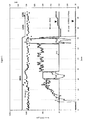
- FIG. 1 represents the elimination of hydrogen from the air on the one hand according to the method of the invention and, on the other hand, a process not in accordance with the invention.
- the catalyst consists of particles supported with gold and palladium.
- the catalyst consists of supported particles of silver and palladium.
- the particles are generally supported by an inorganic support.
- This mineral support is preferably titanium dioxide (TiO 2 ), but can also be chosen from the group consisting of alumina, zeolites or a silica.
- the alumina can be a gamma alumina or an alpha alumina.
- the zeolite can be chosen from the group consisting of X zeolites, such as 13X and 10X zeolites, A zeolites, such as 5A or 4A zeolites, Y zeolites, chabazites, mordenites or silicalites.
- Such zeolites are for example described in patents US-A-2,882,244; US-A-3,140,932 and US-A-3,140,933.
- the weight ratio between the gold and / or silver particles and the metal particles of the platinum family can be between 10/90 and 90/10; preferably, this ratio is of the order of 50/50.
- the content by weight of the gold and / or silver particles may be between 0.1 and 5%, preferably between 0.1 and 1.5% relative to the total weight of the catalyst.
- the content by weight of the platinum family metal is usually between 0.3 and 2.5%, preferably between 0.3 and 1%, relative to the total weight of the catalyst.
- cerium oxide (CeO 2 ) it may be advantageous to coat the catalyst as defined above with cerium oxide (CeO 2 ), this in particular with a view to improving its mechanical properties.
- the weight of this coating of cerium oxide (CeO 2 ) can be between 5 and 15% relative to the weight of the catalyst.
- Said support can be in different forms, for example in the form of shavings or honeycombs (monolithic structure), but preferably it is in the form of balls or sticks, which can be easily placed in a reactor.
- the support used is usually porous and can have a pore volume less than or equal to 1 cm 3 / g, preferably between 0.2 and 0.5 cm 3 / g.
- the pore radius of this support can be less than or equal to 25 nm, and preferably it is between 1 and 15 nm.
- the specific surface of the support can be between 10 and 300 m 2 / g, preferably between 50 and 250 m 2 / g, more preferably between 50 and 150 m 2 / g.
- the density of the support can be between 500 and 1000 g / l. When the support is TiO 2 , its density is preferably between 600 and 900 g / l.
- a catalyst used in the process of the invention can be prepared according to known methods of co-precipitation or impregnation.
- Preferred are catalysts prepared by an impregnation process.
- a catalyst can be prepared by impregnating the chosen support with a solution comprising a gold and / or silver salt and a salt of at least one metal from the platinum family.
- Said gold and / or silver salt or said salt of the platinum family can be a halide, in particular a chloride or advantageously a nitrate.
- the impregnated support is dried, for example by subjecting it for a period of 12 to 48 hours at a temperature between 50 ° C and 150 ° C.
- the support is then calcined, preferably at a temperature between 300 ° C and 550 ° C.
- This calcination of the dried impregnated support can be carried out in air, preferably dry air.
- the metal particles are reduced while hot, for example by sweeping using a reducing gas such as hydrogen or a mixture of hydrogen and an inert gas such as nitrogen.
- the method according to the invention can in particular be implemented for a gaseous compound consisting of a mixture of at least one inert gas with oxygen.
- the inert gas can be nitrogen or argon; preferably, the gaseous compound is air.
- the reaction of carbon monoxide and hydrogen impurities in contact with the catalyst can be carried out with oxygen contained in the gaseous compound, in particular when the latter consists of air, or with oxygen added to said gaseous compound.
- the quantity of oxygen thus added must at least correspond to the stoichiometric quantity required to form carbon dioxide and water from said impurities.
- the reaction between said impurities and oxygen in contact with the catalyst is usually carried out with a gaseous compound whose temperature is less than 130 ° C, more particularly at a temperature between -40 ° C and 130 ° C, and preferably a temperature between 80 and 120 ° C.
- the gaseous compound can be subjected to a pressure of between 10 5 and 3.10 6 Pa, more generally between 7.10 5 and 1.5.10 6 Pa.
- the gaseous compound brought into contact with the catalyst has an actual space velocity which is a function of the pressure and the temperature of the gaseous compound treated.
- the actual space speed is less than 2000 h -1 , and preferably between 1000 and 1800 h -1.
- the carbon monoxide and hydrogen contents of the gaseous compound treated according to the process of the invention are usually less than 40 ppm (parts per million by volume), more generally of the order of 1 ppm to 200 ppb, in each of these impurities.
- the gaseous compound recovered after implementation of the process according to the invention can have less than 10 ppb of hydrogen and less than 5 ppb of carbon monoxide. These contents are those usually meeting the specifications in the electronics industry.
- the carbon dioxide and water formed can be removed from said gaseous compound.
- This elimination can be carried out in a conventional manner using an adsorbent such as a molecular sieve or alumina.
- This elimination of water and carbon dioxide is more particularly required when the gaseous compound is air intended to be subsequently treated by cryogenic distillation with a view to the separation of nitrogen from the other constituents of air, essentially oxygen and, where appropriate, argon.
- the recovered gaseous compound may, when it consists of a mixture of gases, be subsequently treated with a view to separating some or each of the gases which constitute it.
- said gaseous compound consists of air
- the air recovered subsequent to the process according to the invention can be treated so that nitrogen and / or argon are separated from the oxygen of the air.
- This separation can be carried out conventionally by cryogenic distillation, by selective adsorption (PSA and VSA processes) or by membrane separation.
- the process for separating nitrogen from the oxygen in the air is preferably a conventional cryogenic distillation process.
- the upstream (at the inlet of the reactor) and downstream (at the outlet of the reactor) contents of carbon monoxide and hydrogen contained in the treated air were measured using an RGA3 analyzer marketed by the company Trace Analytical, of which the detection threshold was less than or equal to 5 ppb for hydrogen and less than 3 ppb for carbon monoxide.
- the process according to the invention can be carried out by means of a catalyst arranged in a single bed, which it is not necessary to regenerate.
- the catalyst according to the invention makes it possible to remove carbon monoxide and hydrogen impurities from a gaseous compound, so as to comply with the specifications of the electronic industry, this over a period of several months, even several years. , and at a temperature which may be between 80 ° C. and 120 ° C. After this time, simply replace the used catalyst bed with a new one.
- the operating time corresponds to the period of time during which the downstream hydrogen and carbon monoxide contents corresponded to the specifications of the electronics industry, ie a content less than 10 ppb in hydrogen and a content less than 5 ppb in monoxide of carbon.
- the test is interrupted as soon as the downstream contents exceed those fixed by the specifications. However, the test can be stopped voluntarily when the downstream contents remain in conformity to the specifications, insofar as the experimenter considered that the duration of the test is sufficiently convincing as to the efficiency of the catalyst.
- Test 1 is in accordance with the invention.
- Tests A, B and C are comparative examples.
- a catalyst according to the invention comprising 1% by weight of precious metal (Au + Pd) palladium and gold has an operating time much longer than that of a conventional catalyst, comprising 2% by weight of palladium, for better efficiency (elimination of impurities).
- Tests B and C further show that a catalyst comprising only palladium particles is more effective than a catalyst comprising only gold, even though the temperature used in test C is higher than that of test B.
- Example 2 In a reactor identical to that of Example 1, various catalysts were placed, whether or not in accordance with the invention, consisting of metallic particles supported by titanium dioxide rods. The density of this support was 915 g / l and its specific surface of 140 m 2 / g. These catalysts are coated or not with a layer of CeO 2 .
- Tests 2 to 7 are in accordance with the invention.
- Tests D and E are not in accordance with the invention. Comparative test D was carried out under the same conditions as test 4, but with a catalyst comprising 2% by weight of palladium, and not 0.5% by weight of palladium and 0.5% by weight of gold. It is found that a catalyst according to the invention allows an operating time of at least 15 times higher than that of a catalyst not in accordance with the invention, and this, on the one hand, for a better efficiency of elimination of impurities and, on the other hand, with a precious metal content twice lower.
- Test 7 was carried out under the same conditions as comparative test E, but with a content half of precious metals.
- the catalyst according to test E only allowed purification in accordance with the specifications for a period of less than 20 hours.
- Test 7 allowed purification in accordance with the specifications for 150 hours, after which the test was voluntarily interrupted.
- Example 2 In a reactor identical to that of Example 1, various catalysts were placed, comprising metallic particles supported by alumina or a titanium dioxide identical to that of Example 2.
- Tests 8 to 10 are in accordance with the invention. They were produced with catalysts comprising 1% by weight of precious metals (Au + Pd or Ag + Pd). Tests F to H are not in accordance with the invention. They were made with 2% by weight of palladium.
- a catalyst in accordance with the invention was placed, consisting of rods of TiO 2 supporting particles of palladium and gold.
- the content by weight of palladium and gold in the catalyst is 0.5% in each of these metals.
- a catalyst not conforming to the invention, was placed, consisting of rods of TiO 2 supporting particles of palladium (1% by weight relative to the total weight of the catalyst ).
- the density of TiO 2 was 780 g / l and its specific surface of 95 m 2 / g.
- FIG. 1 show in particular that, from the eighth day, the hydrogen content of the air treated with the catalyst not in accordance with the invention reached, then exceeds 10 ppb.
- a catalyst according to the invention can maintain a content of less than 10 ppb for 11 days.
- the hydrogen content of the treated air can only be kept below 10 ppb for 8 days, using a catalyst not in accordance with the invention.
- the hydrogen could not be detected over a period of at least 28 days.
- a catalyst according to the invention consisting of rods of TiO 2 supporting particles of palladium.
- the content by weight of palladium supported by the catalyst is 0.5%.
- the density was 780 g / l and its specific surface 95 m 2 / g.
- a catalyst not in accordance with the invention consisting of ZrO 2 balls supporting palladium particles (0.5% by weight per based on the total weight of the catalyst).
- the density of ZrO 2 was 1200 g / l and its specific surface 95 m 2 / g.
- the actual space velocity of the air at the inlet of the reactor was 1800 h -1 and the operating temperature 120 ° C.
- test 11 is in accordance with the invention, while tests I and J are not.
- a catalyst in accordance with the invention was placed, consisting of rods of TiO 2 supporting 0.5% Pd + 5% Ag (% by weight per relative to the mass of the catalyst); the density of this catalyst was 850 g / l and its specific surface of 150 m 2 / g.
- test 12 is in accordance with the invention, while test K is not.
Landscapes
- Chemical & Material Sciences (AREA)
- Organic Chemistry (AREA)
- Chemical Kinetics & Catalysis (AREA)
- Analytical Chemistry (AREA)
- Engineering & Computer Science (AREA)
- General Chemical & Material Sciences (AREA)
- Inorganic Chemistry (AREA)
- Materials Engineering (AREA)
- Environmental & Geological Engineering (AREA)
- Health & Medical Sciences (AREA)
- Biomedical Technology (AREA)
- Oil, Petroleum & Natural Gas (AREA)
- Catalysts (AREA)
- Exhaust Gas Treatment By Means Of Catalyst (AREA)
Priority Applications (5)
| Application Number | Priority Date | Filing Date | Title |
|---|---|---|---|
| FR9500833A FR2729583A1 (fr) | 1995-01-25 | 1995-01-25 | Procede pour l'elimination d'impuretes contenues dans un compose gazeux |
| PCT/FR1996/000724 WO1997043212A1 (fr) | 1995-01-25 | 1996-05-13 | Procede pour l'elimination d'impuretes contenues dans un compose gazeux |
| JP54056697A JP4162713B2 (ja) | 1995-01-25 | 1996-05-13 | 気体組成物に含有されている不純物を除去するための方法 |
| DE69606163T DE69606163T2 (de) | 1995-01-25 | 1996-05-13 | Verfahren zur Entfernung von Verunreinigungen aus gasförmingen Zusammenstellungen |
| EP96401038A EP0807599B1 (de) | 1995-01-25 | 1996-05-13 | Verfahren zur Entfernung von Verunreinigungen aus gasförmingen Zusammenstellungen |
Applications Claiming Priority (3)
| Application Number | Priority Date | Filing Date | Title |
|---|---|---|---|
| FR9500833A FR2729583A1 (fr) | 1995-01-25 | 1995-01-25 | Procede pour l'elimination d'impuretes contenues dans un compose gazeux |
| PCT/FR1996/000724 WO1997043212A1 (fr) | 1995-01-25 | 1996-05-13 | Procede pour l'elimination d'impuretes contenues dans un compose gazeux |
| EP96401038A EP0807599B1 (de) | 1995-01-25 | 1996-05-13 | Verfahren zur Entfernung von Verunreinigungen aus gasförmingen Zusammenstellungen |
Publications (2)
| Publication Number | Publication Date |
|---|---|
| EP0807599A1 true EP0807599A1 (de) | 1997-11-19 |
| EP0807599B1 EP0807599B1 (de) | 2000-01-12 |
Family
ID=27237835
Family Applications (1)
| Application Number | Title | Priority Date | Filing Date |
|---|---|---|---|
| EP96401038A Expired - Lifetime EP0807599B1 (de) | 1995-01-25 | 1996-05-13 | Verfahren zur Entfernung von Verunreinigungen aus gasförmingen Zusammenstellungen |
Country Status (5)
| Country | Link |
|---|---|
| EP (1) | EP0807599B1 (de) |
| JP (1) | JP4162713B2 (de) |
| DE (1) | DE69606163T2 (de) |
| FR (1) | FR2729583A1 (de) |
| WO (1) | WO1997043212A1 (de) |
Families Citing this family (5)
| Publication number | Priority date | Publication date | Assignee | Title |
|---|---|---|---|---|
| FR2729583A1 (fr) * | 1995-01-25 | 1996-07-26 | Air Liquide | Procede pour l'elimination d'impuretes contenues dans un compose gazeux |
| US6168774B1 (en) | 1997-08-07 | 2001-01-02 | Praxair Technology, Inc. | Compact deoxo system |
| ATE366619T1 (de) * | 2001-04-14 | 2007-08-15 | Umicore Ag & Co Kg | Katalysator und verfahren zur entfernung von kohlenmonoxid aus einem reformatgas, und verfahren zur herstellung des katalysators |
| JP4438850B2 (ja) | 2006-10-19 | 2010-03-24 | 東京エレクトロン株式会社 | 処理装置、このクリーニング方法及び記憶媒体 |
| JP5971136B2 (ja) * | 2013-01-28 | 2016-08-17 | 新日鐵住金株式会社 | 一酸化炭素酸化触媒及びその製造方法並びにガス中の一酸化炭素の除去方法 |
Citations (6)
| Publication number | Priority date | Publication date | Assignee | Title |
|---|---|---|---|---|
| US4136062A (en) * | 1977-10-17 | 1979-01-23 | The Board Of Trustees Of Leland Stanford Junior University | Highly active pd-au catalyst |
| DE3401197A1 (de) * | 1984-01-14 | 1985-07-18 | Basf Ag, 6700 Ludwigshafen | Verfahren zur katalytischen feinreinigung von inertgasen |
| EP0222497A2 (de) * | 1985-11-08 | 1987-05-20 | General Motors Corporation | Verfahren zur simultanen Oxidation von Kohlenstoffmonoxid und unverbrannten Brennstoffen in Auspuffvorrichtungen von mit Methanol gefeuerten Fahrzeugen |
| EP0395856A1 (de) * | 1989-04-29 | 1990-11-07 | SOLVAY CATALYSTS GmbH | Verfahren zur Herstellung von Traegerkatalysatoren zur Oxidation von Kohlenmonoxid |
| EP0454531A1 (de) * | 1990-04-20 | 1991-10-30 | L'air Liquide, Societe Anonyme Pour L'etude Et L'exploitation Des Procedes Georges Claude | Verfahren und Einrichtung zur Herstellung von ultrareinem Stickstoff |
| FR2690357A1 (fr) * | 1992-04-24 | 1993-10-29 | Air Liquide | Procédé d'épuration d'air. |
Family Cites Families (1)
| Publication number | Priority date | Publication date | Assignee | Title |
|---|---|---|---|---|
| FR2729583A1 (fr) * | 1995-01-25 | 1996-07-26 | Air Liquide | Procede pour l'elimination d'impuretes contenues dans un compose gazeux |
-
1995
- 1995-01-25 FR FR9500833A patent/FR2729583A1/fr active Granted
-
1996
- 1996-05-13 JP JP54056697A patent/JP4162713B2/ja not_active Expired - Fee Related
- 1996-05-13 WO PCT/FR1996/000724 patent/WO1997043212A1/fr not_active Ceased
- 1996-05-13 EP EP96401038A patent/EP0807599B1/de not_active Expired - Lifetime
- 1996-05-13 DE DE69606163T patent/DE69606163T2/de not_active Expired - Lifetime
Patent Citations (6)
| Publication number | Priority date | Publication date | Assignee | Title |
|---|---|---|---|---|
| US4136062A (en) * | 1977-10-17 | 1979-01-23 | The Board Of Trustees Of Leland Stanford Junior University | Highly active pd-au catalyst |
| DE3401197A1 (de) * | 1984-01-14 | 1985-07-18 | Basf Ag, 6700 Ludwigshafen | Verfahren zur katalytischen feinreinigung von inertgasen |
| EP0222497A2 (de) * | 1985-11-08 | 1987-05-20 | General Motors Corporation | Verfahren zur simultanen Oxidation von Kohlenstoffmonoxid und unverbrannten Brennstoffen in Auspuffvorrichtungen von mit Methanol gefeuerten Fahrzeugen |
| EP0395856A1 (de) * | 1989-04-29 | 1990-11-07 | SOLVAY CATALYSTS GmbH | Verfahren zur Herstellung von Traegerkatalysatoren zur Oxidation von Kohlenmonoxid |
| EP0454531A1 (de) * | 1990-04-20 | 1991-10-30 | L'air Liquide, Societe Anonyme Pour L'etude Et L'exploitation Des Procedes Georges Claude | Verfahren und Einrichtung zur Herstellung von ultrareinem Stickstoff |
| FR2690357A1 (fr) * | 1992-04-24 | 1993-10-29 | Air Liquide | Procédé d'épuration d'air. |
Also Published As
| Publication number | Publication date |
|---|---|
| WO1997043212A1 (fr) | 1997-11-20 |
| DE69606163T2 (de) | 2000-11-23 |
| DE69606163D1 (de) | 2000-02-17 |
| EP0807599B1 (de) | 2000-01-12 |
| JPH11509512A (ja) | 1999-08-24 |
| FR2729583B1 (de) | 1997-03-07 |
| JP4162713B2 (ja) | 2008-10-08 |
| FR2729583A1 (fr) | 1996-07-26 |
Similar Documents
| Publication | Publication Date | Title |
|---|---|---|
| EP0454531B1 (de) | Verfahren und Einrichtung zur Herstellung von ultrareinem Stickstoff | |
| EP0750933B1 (de) | Verfahren und Vorrichtung zur Herstellung von im wesentlichen gereinigten Flux von mindestens einer der Verunreinigungen aus Sauerstoff und Kohlstoffmonoxid | |
| EP0840708B1 (de) | Verfahren zur reinigung von auf wasserstoff basierenden gasmischungen mit hilfe von lithium ausgetauschtem x typ-zeolith | |
| CA2411144C (fr) | Procede de purification de gaz de synthese | |
| KR0172121B1 (ko) | 개스의 저온 정제법 | |
| EP0922482B1 (de) | Verfahren zur Abscheidung von CO2 und Wasser aus Luft durch Adsorption mit kalziniertem Alumina | |
| WO2002004096A1 (fr) | Procede pour la purification de melanges gazeux a base d'hydrogene utilisant une zeolite x au calcium | |
| EP1120149A1 (de) | Verfahren zur Reinung von Gas durch Adsorption der Verunreinigungen mittels mehrerer Aktivkohleeinheiten | |
| US5840099A (en) | Process for the removal of water, CO2, ethane and C3 + hydrocarbons from a gas stream | |
| EP0723931B1 (de) | Verfahren zur Entfernung von Verunreinigungen aus einer gasförmigen Verbindung | |
| EP1095701A1 (de) | Verfahren zur Erzeugung von Wasserstoff unter Verwendung eines Adsorbtionsmittels mit ausgewählten Dubinin Parametern | |
| EP0677023A1 (de) | Verfahren zur reinigung von luft | |
| EP0807599B1 (de) | Verfahren zur Entfernung von Verunreinigungen aus gasförmingen Zusammenstellungen | |
| US5693302A (en) | Process for the removal of an impurity contained in a composite gas | |
| EP0820960B1 (de) | Entfernung von O2 und/oder CO aus einem inerten Gas durch Adsorption an porösem Metalloxid | |
| FR2739304A1 (fr) | Procede et dispositif d'epuration d'air comprime, procede et installation de distillation d'air les utilisant | |
| EP0691393A1 (de) | Verfahren zum Trocknen einer Gas- oder Flüssigkeitmischung mittels eines aus Aluminiumoxyd und Molekular sieb bestehenden Absorbers | |
| EP0829292B1 (de) | Entfernung von H2 und/oder CO Verunreinigungen aus einem inerten, flüssigen Fluidum | |
| KR100438266B1 (ko) | 기체상 화합물에 함유된 불순물을 제거하는 방법 | |
| FR2751561A1 (fr) | Procede d'epuration de l'air en ses impuretes co et co2 | |
| FR2668140A1 (fr) | Procede d'elaboration d'azote ultra-pur. | |
| FR2797780A1 (fr) | Procede pour eviter l'empoisonnement des catalyseurs d'oxydation utilises pour purifier de l'air |
Legal Events
| Date | Code | Title | Description |
|---|---|---|---|
| PUAI | Public reference made under article 153(3) epc to a published international application that has entered the european phase |
Free format text: ORIGINAL CODE: 0009012 |
|
| AK | Designated contracting states |
Kind code of ref document: A1 Designated state(s): DE GB IT NL SE |
|
| 17P | Request for examination filed |
Effective date: 19980519 |
|
| 17Q | First examination report despatched |
Effective date: 19990311 |
|
| GRAG | Despatch of communication of intention to grant |
Free format text: ORIGINAL CODE: EPIDOS AGRA |
|
| GRAG | Despatch of communication of intention to grant |
Free format text: ORIGINAL CODE: EPIDOS AGRA |
|
| GRAH | Despatch of communication of intention to grant a patent |
Free format text: ORIGINAL CODE: EPIDOS IGRA |
|
| GRAH | Despatch of communication of intention to grant a patent |
Free format text: ORIGINAL CODE: EPIDOS IGRA |
|
| GRAA | (expected) grant |
Free format text: ORIGINAL CODE: 0009210 |
|
| AK | Designated contracting states |
Kind code of ref document: B1 Designated state(s): DE GB IT NL SE |
|
| PG25 | Lapsed in a contracting state [announced via postgrant information from national office to epo] |
Ref country code: NL Free format text: LAPSE BECAUSE OF FAILURE TO SUBMIT A TRANSLATION OF THE DESCRIPTION OR TO PAY THE FEE WITHIN THE PRESCRIBED TIME-LIMIT Effective date: 20000112 |
|
| REF | Corresponds to: |
Ref document number: 69606163 Country of ref document: DE Date of ref document: 20000217 |
|
| ITF | It: translation for a ep patent filed | ||
| GBT | Gb: translation of ep patent filed (gb section 77(6)(a)/1977) |
Effective date: 20000317 |
|
| PGFP | Annual fee paid to national office [announced via postgrant information from national office to epo] |
Ref country code: SE Payment date: 20000417 Year of fee payment: 5 |
|
| NLV1 | Nl: lapsed or annulled due to failure to fulfill the requirements of art. 29p and 29m of the patents act | ||
| PLBE | No opposition filed within time limit |
Free format text: ORIGINAL CODE: 0009261 |
|
| STAA | Information on the status of an ep patent application or granted ep patent |
Free format text: STATUS: NO OPPOSITION FILED WITHIN TIME LIMIT |
|
| 26N | No opposition filed | ||
| PG25 | Lapsed in a contracting state [announced via postgrant information from national office to epo] |
Ref country code: SE Free format text: LAPSE BECAUSE OF NON-PAYMENT OF DUE FEES Effective date: 20010531 |
|
| REG | Reference to a national code |
Ref country code: GB Ref legal event code: IF02 |
|
| PGFP | Annual fee paid to national office [announced via postgrant information from national office to epo] |
Ref country code: DE Payment date: 20120523 Year of fee payment: 17 |
|
| PGFP | Annual fee paid to national office [announced via postgrant information from national office to epo] |
Ref country code: GB Payment date: 20120522 Year of fee payment: 17 |
|
| PGFP | Annual fee paid to national office [announced via postgrant information from national office to epo] |
Ref country code: IT Payment date: 20120528 Year of fee payment: 17 |
|
| GBPC | Gb: european patent ceased through non-payment of renewal fee |
Effective date: 20130513 |
|
| PG25 | Lapsed in a contracting state [announced via postgrant information from national office to epo] |
Ref country code: DE Free format text: LAPSE BECAUSE OF NON-PAYMENT OF DUE FEES Effective date: 20131203 |
|
| PG25 | Lapsed in a contracting state [announced via postgrant information from national office to epo] |
Ref country code: IT Free format text: LAPSE BECAUSE OF NON-PAYMENT OF DUE FEES Effective date: 20130513 |
|
| REG | Reference to a national code |
Ref country code: DE Ref legal event code: R119 Ref document number: 69606163 Country of ref document: DE Effective date: 20131203 |
|
| PG25 | Lapsed in a contracting state [announced via postgrant information from national office to epo] |
Ref country code: GB Free format text: LAPSE BECAUSE OF NON-PAYMENT OF DUE FEES Effective date: 20130513 |