EP0807183B1 - Genetic therapy of diseases caused by the immune system, said therapy using a cell-specific active substance regulated by the cell cycle - Google Patents
Genetic therapy of diseases caused by the immune system, said therapy using a cell-specific active substance regulated by the cell cycle Download PDFInfo
- Publication number
- EP0807183B1 EP0807183B1 EP95931205A EP95931205A EP0807183B1 EP 0807183 B1 EP0807183 B1 EP 0807183B1 EP 95931205 A EP95931205 A EP 95931205A EP 95931205 A EP95931205 A EP 95931205A EP 0807183 B1 EP0807183 B1 EP 0807183B1
- Authority
- EP
- European Patent Office
- Prior art keywords
- active compound
- receptor
- sequence
- cell
- promoter
- Prior art date
- Legal status (The legal status is an assumption and is not a legal conclusion. Google has not performed a legal analysis and makes no representation as to the accuracy of the status listed.)
- Expired - Lifetime
Links
- 239000013543 active substance Substances 0.000 title claims abstract description 80
- 230000001105 regulatory effect Effects 0.000 title claims abstract description 29
- 230000022131 cell cycle Effects 0.000 title claims abstract description 22
- 201000010099 disease Diseases 0.000 title claims abstract description 13
- 208000037265 diseases, disorders, signs and symptoms Diseases 0.000 title claims abstract description 13
- 210000000987 immune system Anatomy 0.000 title claims abstract description 10
- 238000002560 therapeutic procedure Methods 0.000 title claims description 41
- 230000002068 genetic effect Effects 0.000 title 1
- 210000004027 cell Anatomy 0.000 claims abstract description 247
- 108090000623 proteins and genes Proteins 0.000 claims abstract description 132
- 108091028043 Nucleic acid sequence Proteins 0.000 claims abstract description 85
- 239000003446 ligand Substances 0.000 claims abstract description 51
- 208000032839 leukemia Diseases 0.000 claims abstract description 44
- 239000012190 activator Substances 0.000 claims abstract description 40
- 241000700605 Viruses Species 0.000 claims abstract description 28
- 206010003246 arthritis Diseases 0.000 claims abstract description 23
- 208000023275 Autoimmune disease Diseases 0.000 claims abstract description 17
- 238000011321 prophylaxis Methods 0.000 claims abstract description 14
- 230000015572 biosynthetic process Effects 0.000 claims abstract description 13
- 206010020751 Hypersensitivity Diseases 0.000 claims abstract description 9
- 230000007815 allergy Effects 0.000 claims abstract description 9
- 230000001580 bacterial effect Effects 0.000 claims abstract description 9
- 210000000601 blood cell Anatomy 0.000 claims abstract description 9
- 208000036142 Viral infection Diseases 0.000 claims abstract description 7
- 210000000056 organ Anatomy 0.000 claims abstract description 7
- 102000004127 Cytokines Human genes 0.000 claims description 78
- 108090000695 Cytokines Proteins 0.000 claims description 78
- 108020004414 DNA Proteins 0.000 claims description 77
- 239000000427 antigen Substances 0.000 claims description 59
- 108010031429 Tissue Inhibitor of Metalloproteinase-3 Proteins 0.000 claims description 54
- 102000004169 proteins and genes Human genes 0.000 claims description 47
- 102000003814 Interleukin-10 Human genes 0.000 claims description 40
- 108090000174 Interleukin-10 Proteins 0.000 claims description 40
- 108091007433 antigens Proteins 0.000 claims description 40
- 102000036639 antigens Human genes 0.000 claims description 40
- 102000004889 Interleukin-6 Human genes 0.000 claims description 38
- 108090001005 Interleukin-6 Proteins 0.000 claims description 38
- 239000012634 fragment Substances 0.000 claims description 37
- 102000000589 Interleukin-1 Human genes 0.000 claims description 36
- 108010002352 Interleukin-1 Proteins 0.000 claims description 36
- 102000005962 receptors Human genes 0.000 claims description 33
- 108020003175 receptors Proteins 0.000 claims description 33
- 102000004388 Interleukin-4 Human genes 0.000 claims description 30
- 108090000978 Interleukin-4 Proteins 0.000 claims description 30
- 102000004887 Transforming Growth Factor beta Human genes 0.000 claims description 30
- 108090001012 Transforming Growth Factor beta Proteins 0.000 claims description 30
- 230000027455 binding Effects 0.000 claims description 30
- 108010017213 Granulocyte-Macrophage Colony-Stimulating Factor Proteins 0.000 claims description 28
- 102100039620 Granulocyte-macrophage colony-stimulating factor Human genes 0.000 claims description 28
- 102000000646 Interleukin-3 Human genes 0.000 claims description 28
- 108010002386 Interleukin-3 Proteins 0.000 claims description 28
- 108010002350 Interleukin-2 Proteins 0.000 claims description 26
- 102000000588 Interleukin-2 Human genes 0.000 claims description 26
- 239000013598 vector Substances 0.000 claims description 26
- 102000019223 Interleukin-1 receptor Human genes 0.000 claims description 25
- 108050006617 Interleukin-1 receptor Proteins 0.000 claims description 25
- 239000003102 growth factor Substances 0.000 claims description 25
- 210000002437 synoviocyte Anatomy 0.000 claims description 24
- 241000282414 Homo sapiens Species 0.000 claims description 23
- 108060008682 Tumor Necrosis Factor Proteins 0.000 claims description 23
- 102000000852 Tumor Necrosis Factor-alpha Human genes 0.000 claims description 23
- 102000004190 Enzymes Human genes 0.000 claims description 22
- 108090000790 Enzymes Proteins 0.000 claims description 22
- 108010074328 Interferon-gamma Proteins 0.000 claims description 22
- 102100037850 Interferon gamma Human genes 0.000 claims description 19
- 108010076504 Protein Sorting Signals Proteins 0.000 claims description 19
- 239000002773 nucleotide Substances 0.000 claims description 19
- 125000003729 nucleotide group Chemical group 0.000 claims description 19
- 239000000126 substance Substances 0.000 claims description 19
- 102000013462 Interleukin-12 Human genes 0.000 claims description 18
- 108010065805 Interleukin-12 Proteins 0.000 claims description 18
- 102100040247 Tumor necrosis factor Human genes 0.000 claims description 18
- 239000013612 plasmid Substances 0.000 claims description 18
- 101000611183 Homo sapiens Tumor necrosis factor Proteins 0.000 claims description 17
- 108010021625 Immunoglobulin Fragments Proteins 0.000 claims description 17
- 102000008394 Immunoglobulin Fragments Human genes 0.000 claims description 17
- 210000004379 membrane Anatomy 0.000 claims description 17
- 239000012528 membrane Substances 0.000 claims description 17
- 229940123587 Cell cycle inhibitor Drugs 0.000 claims description 16
- 102000040945 Transcription factor Human genes 0.000 claims description 16
- 108091023040 Transcription factor Proteins 0.000 claims description 16
- 210000002540 macrophage Anatomy 0.000 claims description 16
- 210000001519 tissue Anatomy 0.000 claims description 16
- 102000010787 Interleukin-4 Receptors Human genes 0.000 claims description 15
- 108010038486 Interleukin-4 Receptors Proteins 0.000 claims description 15
- 238000001246 colloidal dispersion Methods 0.000 claims description 15
- 239000000824 cytostatic agent Substances 0.000 claims description 15
- 230000028327 secretion Effects 0.000 claims description 15
- 102000053187 Glucuronidase Human genes 0.000 claims description 14
- 108010060309 Glucuronidase Proteins 0.000 claims description 14
- 102100025390 Integrin beta-2 Human genes 0.000 claims description 14
- 241000700584 Simplexvirus Species 0.000 claims description 14
- 102000004289 Interferon regulatory factor 1 Human genes 0.000 claims description 13
- 108090000890 Interferon regulatory factor 1 Proteins 0.000 claims description 13
- 102000010789 Interleukin-2 Receptors Human genes 0.000 claims description 13
- 108010038453 Interleukin-2 Receptors Proteins 0.000 claims description 13
- 230000001085 cytostatic effect Effects 0.000 claims description 13
- 108020004684 Internal Ribosome Entry Sites Proteins 0.000 claims description 12
- 102000036693 Thrombopoietin Human genes 0.000 claims description 12
- 108010041111 Thrombopoietin Proteins 0.000 claims description 12
- 210000004698 lymphocyte Anatomy 0.000 claims description 12
- 150000001413 amino acids Chemical class 0.000 claims description 11
- 108010092372 Granulocyte-Macrophage Colony-Stimulating Factor Receptors Proteins 0.000 claims description 10
- 102000016355 Granulocyte-Macrophage Colony-Stimulating Factor Receptors Human genes 0.000 claims description 10
- 241000711549 Hepacivirus C Species 0.000 claims description 10
- 241000700721 Hepatitis B virus Species 0.000 claims description 10
- 108090000177 Interleukin-11 Proteins 0.000 claims description 10
- 102000003815 Interleukin-11 Human genes 0.000 claims description 10
- 108010038452 Interleukin-3 Receptors Proteins 0.000 claims description 10
- 102000010790 Interleukin-3 Receptors Human genes 0.000 claims description 10
- 102000015696 Interleukins Human genes 0.000 claims description 10
- 108010063738 Interleukins Proteins 0.000 claims description 10
- 102000003675 cytokine receptors Human genes 0.000 claims description 10
- 108010057085 cytokine receptors Proteins 0.000 claims description 10
- 230000004054 inflammatory process Effects 0.000 claims description 10
- 239000003112 inhibitor Substances 0.000 claims description 10
- 238000002347 injection Methods 0.000 claims description 10
- 239000007924 injection Substances 0.000 claims description 10
- 102000004269 Granulocyte Colony-Stimulating Factor Human genes 0.000 claims description 9
- 108010017080 Granulocyte Colony-Stimulating Factor Proteins 0.000 claims description 9
- 241000701806 Human papillomavirus Species 0.000 claims description 9
- 206010061218 Inflammation Diseases 0.000 claims description 9
- 108090000723 Insulin-Like Growth Factor I Proteins 0.000 claims description 9
- 102000014429 Insulin-like growth factor Human genes 0.000 claims description 9
- 102000003816 Interleukin-13 Human genes 0.000 claims description 9
- 108090000176 Interleukin-13 Proteins 0.000 claims description 9
- 102000007651 Macrophage Colony-Stimulating Factor Human genes 0.000 claims description 9
- 102100038895 Myc proto-oncogene protein Human genes 0.000 claims description 9
- 101710135898 Myc proto-oncogene protein Proteins 0.000 claims description 9
- 108010031374 Tissue Inhibitor of Metalloproteinase-1 Proteins 0.000 claims description 9
- 101710150448 Transcriptional regulator Myc Proteins 0.000 claims description 9
- -1 bcl-1 Proteins 0.000 claims description 9
- 210000000777 hematopoietic system Anatomy 0.000 claims description 9
- 210000000130 stem cell Anatomy 0.000 claims description 9
- 108700028146 Genetic Enhancer Elements Proteins 0.000 claims description 8
- 108010002616 Interleukin-5 Proteins 0.000 claims description 8
- 108010046938 Macrophage Colony-Stimulating Factor Proteins 0.000 claims description 8
- 108010000684 Matrix Metalloproteinases Proteins 0.000 claims description 8
- 108010031372 Tissue Inhibitor of Metalloproteinase-2 Proteins 0.000 claims description 8
- 210000003958 hematopoietic stem cell Anatomy 0.000 claims description 8
- 102100021569 Apoptosis regulator Bcl-2 Human genes 0.000 claims description 7
- 102000005367 Carboxypeptidases Human genes 0.000 claims description 7
- 108010006303 Carboxypeptidases Proteins 0.000 claims description 7
- 101000971171 Homo sapiens Apoptosis regulator Bcl-2 Proteins 0.000 claims description 7
- 108010064548 Lymphocyte Function-Associated Antigen-1 Proteins 0.000 claims description 7
- 108010016113 Matrix Metalloproteinase 1 Proteins 0.000 claims description 7
- 102000002274 Matrix Metalloproteinases Human genes 0.000 claims description 7
- 102100026262 Metalloproteinase inhibitor 2 Human genes 0.000 claims description 7
- 102000003992 Peroxidases Human genes 0.000 claims description 7
- 102100039120 Retinoblastoma-like protein 1 Human genes 0.000 claims description 7
- 108050002592 Retinoblastoma-like protein 1 Proteins 0.000 claims description 7
- 239000002260 anti-inflammatory agent Substances 0.000 claims description 7
- 230000001419 dependent effect Effects 0.000 claims description 7
- 230000035772 mutation Effects 0.000 claims description 7
- 108040007629 peroxidase activity proteins Proteins 0.000 claims description 7
- 102100025064 Cellular tumor antigen p53 Human genes 0.000 claims description 6
- 101000721661 Homo sapiens Cellular tumor antigen p53 Proteins 0.000 claims description 6
- 241000598436 Human T-cell lymphotropic virus Species 0.000 claims description 6
- 108090001007 Interleukin-8 Proteins 0.000 claims description 6
- 102000004890 Interleukin-8 Human genes 0.000 claims description 6
- 108010002335 Interleukin-9 Proteins 0.000 claims description 6
- 102000000585 Interleukin-9 Human genes 0.000 claims description 6
- 102100022828 Retinoblastoma-like protein 2 Human genes 0.000 claims description 6
- 108050002651 Retinoblastoma-like protein 2 Proteins 0.000 claims description 6
- 230000001506 immunosuppresive effect Effects 0.000 claims description 6
- 210000004969 inflammatory cell Anatomy 0.000 claims description 6
- 210000004185 liver Anatomy 0.000 claims description 6
- 238000006386 neutralization reaction Methods 0.000 claims description 6
- 238000003786 synthesis reaction Methods 0.000 claims description 6
- 101001024630 Drosophila melanogaster RNA cytidine acetyltransferase Proteins 0.000 claims description 5
- 101000652705 Drosophila melanogaster Transcription initiation factor TFIID subunit 4 Proteins 0.000 claims description 5
- 108091035710 E-box Proteins 0.000 claims description 5
- 102000003951 Erythropoietin Human genes 0.000 claims description 5
- 108090000394 Erythropoietin Proteins 0.000 claims description 5
- 102000010834 Extracellular Matrix Proteins Human genes 0.000 claims description 5
- 108010037362 Extracellular Matrix Proteins Proteins 0.000 claims description 5
- 108700039691 Genetic Promoter Regions Proteins 0.000 claims description 5
- 208000037262 Hepatitis delta Diseases 0.000 claims description 5
- 101001046686 Homo sapiens Integrin alpha-M Proteins 0.000 claims description 5
- 101000935040 Homo sapiens Integrin beta-2 Proteins 0.000 claims description 5
- 101000873927 Homo sapiens Squamous cell carcinoma antigen recognized by T-cells 3 Proteins 0.000 claims description 5
- 108010050904 Interferons Proteins 0.000 claims description 5
- 102000014150 Interferons Human genes 0.000 claims description 5
- 102000010781 Interleukin-6 Receptors Human genes 0.000 claims description 5
- 108010038501 Interleukin-6 Receptors Proteins 0.000 claims description 5
- 108010002586 Interleukin-7 Proteins 0.000 claims description 5
- 101000962498 Macropis fulvipes Macropin Proteins 0.000 claims description 5
- 102000019218 Mannose-6-phosphate receptors Human genes 0.000 claims description 5
- 108050002653 Retinoblastoma protein Proteins 0.000 claims description 5
- 101000996915 Saccharomyces cerevisiae (strain ATCC 204508 / S288c) Nucleoporin NSP1 Proteins 0.000 claims description 5
- 102100035748 Squamous cell carcinoma antigen recognized by T-cells 3 Human genes 0.000 claims description 5
- 101710108790 Stromelysin-1 Proteins 0.000 claims description 5
- 230000003110 anti-inflammatory effect Effects 0.000 claims description 5
- 210000002390 cell membrane structure Anatomy 0.000 claims description 5
- 229940105423 erythropoietin Drugs 0.000 claims description 5
- 210000002744 extracellular matrix Anatomy 0.000 claims description 5
- 230000002757 inflammatory effect Effects 0.000 claims description 5
- 244000045947 parasite Species 0.000 claims description 5
- OXCMYAYHXIHQOA-UHFFFAOYSA-N potassium;[2-butyl-5-chloro-3-[[4-[2-(1,2,4-triaza-3-azanidacyclopenta-1,4-dien-5-yl)phenyl]phenyl]methyl]imidazol-4-yl]methanol Chemical compound [K+].CCCCC1=NC(Cl)=C(CO)N1CC1=CC=C(C=2C(=CC=CC=2)C2=N[N-]N=N2)C=C1 OXCMYAYHXIHQOA-UHFFFAOYSA-N 0.000 claims description 5
- 230000009385 viral infection Effects 0.000 claims description 5
- 101150013553 CD40 gene Proteins 0.000 claims description 4
- 102000014914 Carrier Proteins Human genes 0.000 claims description 4
- 108010031792 IGF Type 2 Receptor Proteins 0.000 claims description 4
- 108010047761 Interferon-alpha Proteins 0.000 claims description 4
- 102100040245 Tumor necrosis factor receptor superfamily member 5 Human genes 0.000 claims description 4
- 230000003302 anti-idiotype Effects 0.000 claims description 4
- 108091008324 binding proteins Proteins 0.000 claims description 4
- 210000000170 cell membrane Anatomy 0.000 claims description 4
- 230000002401 inhibitory effect Effects 0.000 claims description 4
- NOESYZHRGYRDHS-UHFFFAOYSA-N insulin Chemical compound N1C(=O)C(NC(=O)C(CCC(N)=O)NC(=O)C(CCC(O)=O)NC(=O)C(C(C)C)NC(=O)C(NC(=O)CN)C(C)CC)CSSCC(C(NC(CO)C(=O)NC(CC(C)C)C(=O)NC(CC=2C=CC(O)=CC=2)C(=O)NC(CCC(N)=O)C(=O)NC(CC(C)C)C(=O)NC(CCC(O)=O)C(=O)NC(CC(N)=O)C(=O)NC(CC=2C=CC(O)=CC=2)C(=O)NC(CSSCC(NC(=O)C(C(C)C)NC(=O)C(CC(C)C)NC(=O)C(CC=2C=CC(O)=CC=2)NC(=O)C(CC(C)C)NC(=O)C(C)NC(=O)C(CCC(O)=O)NC(=O)C(C(C)C)NC(=O)C(CC(C)C)NC(=O)C(CC=2NC=NC=2)NC(=O)C(CO)NC(=O)CNC2=O)C(=O)NCC(=O)NC(CCC(O)=O)C(=O)NC(CCCNC(N)=N)C(=O)NCC(=O)NC(CC=3C=CC=CC=3)C(=O)NC(CC=3C=CC=CC=3)C(=O)NC(CC=3C=CC(O)=CC=3)C(=O)NC(C(C)O)C(=O)N3C(CCC3)C(=O)NC(CCCCN)C(=O)NC(C)C(O)=O)C(=O)NC(CC(N)=O)C(O)=O)=O)NC(=O)C(C(C)CC)NC(=O)C(CO)NC(=O)C(C(C)O)NC(=O)C1CSSCC2NC(=O)C(CC(C)C)NC(=O)C(NC(=O)C(CCC(N)=O)NC(=O)C(CC(N)=O)NC(=O)C(NC(=O)C(N)CC=1C=CC=CC=1)C(C)C)CC1=CN=CN1 NOESYZHRGYRDHS-UHFFFAOYSA-N 0.000 claims description 4
- 229940047124 interferons Drugs 0.000 claims description 4
- 239000002502 liposome Substances 0.000 claims description 4
- 239000002243 precursor Substances 0.000 claims description 4
- 102000014452 scavenger receptors Human genes 0.000 claims description 4
- 101710151806 72 kDa type IV collagenase Proteins 0.000 claims description 3
- 108010042708 Acetylmuramyl-Alanyl-Isoglutamine Proteins 0.000 claims description 3
- 241000894006 Bacteria Species 0.000 claims description 3
- 108010067306 Fibronectins Proteins 0.000 claims description 3
- 108700007032 GADD45 Proteins 0.000 claims description 3
- 102000054184 GADD45 Human genes 0.000 claims description 3
- 101000599951 Homo sapiens Insulin-like growth factor I Proteins 0.000 claims description 3
- 101000934346 Homo sapiens T-cell surface antigen CD2 Proteins 0.000 claims description 3
- 101000914514 Homo sapiens T-cell-specific surface glycoprotein CD28 Proteins 0.000 claims description 3
- 102100037852 Insulin-like growth factor I Human genes 0.000 claims description 3
- 108010015302 Matrix metalloproteinase-9 Proteins 0.000 claims description 3
- 101001055320 Myxine glutinosa Insulin-like growth factor Proteins 0.000 claims description 3
- 102000004140 Oncostatin M Human genes 0.000 claims description 3
- 108090000630 Oncostatin M Proteins 0.000 claims description 3
- 102000004316 Oxidoreductases Human genes 0.000 claims description 3
- 108090000854 Oxidoreductases Proteins 0.000 claims description 3
- 208000002606 Paramyxoviridae Infections Diseases 0.000 claims description 3
- KHGNFPUMBJSZSM-UHFFFAOYSA-N Perforine Natural products COC1=C2CCC(O)C(CCC(C)(C)O)(OC)C2=NC2=C1C=CO2 KHGNFPUMBJSZSM-UHFFFAOYSA-N 0.000 claims description 3
- 108700019535 Phosphoprotein Phosphatases Proteins 0.000 claims description 3
- 102000045595 Phosphoprotein Phosphatases Human genes 0.000 claims description 3
- MTCFGRXMJLQNBG-UHFFFAOYSA-N Serine Natural products OCC(N)C(O)=O MTCFGRXMJLQNBG-UHFFFAOYSA-N 0.000 claims description 3
- 102000019197 Superoxide Dismutase Human genes 0.000 claims description 3
- 108010012715 Superoxide dismutase Proteins 0.000 claims description 3
- 102100025237 T-cell surface antigen CD2 Human genes 0.000 claims description 3
- 102100036011 T-cell surface glycoprotein CD4 Human genes 0.000 claims description 3
- 102100034922 T-cell surface glycoprotein CD8 alpha chain Human genes 0.000 claims description 3
- 102100027213 T-cell-specific surface glycoprotein CD28 Human genes 0.000 claims description 3
- 102000006601 Thymidine Kinase Human genes 0.000 claims description 3
- 108020004440 Thymidine kinase Proteins 0.000 claims description 3
- 108010065472 Vimentin Proteins 0.000 claims description 3
- 239000002671 adjuvant Substances 0.000 claims description 3
- 108700039689 bcl-2 Homologous Antagonist-Killer Proteins 0.000 claims description 3
- 102000055574 bcl-2 Homologous Antagonist-Killer Human genes 0.000 claims description 3
- 150000001720 carbohydrates Chemical group 0.000 claims description 3
- 239000003145 cytotoxic factor Substances 0.000 claims description 3
- 239000002158 endotoxin Substances 0.000 claims description 3
- 230000000977 initiatory effect Effects 0.000 claims description 3
- 229940047122 interleukins Drugs 0.000 claims description 3
- GZQKNULLWNGMCW-PWQABINMSA-N lipid A (E. coli) Chemical compound O1[C@H](CO)[C@@H](OP(O)(O)=O)[C@H](OC(=O)C[C@@H](CCCCCCCCCCC)OC(=O)CCCCCCCCCCCCC)[C@@H](NC(=O)C[C@@H](CCCCCCCCCCC)OC(=O)CCCCCCCCCCC)[C@@H]1OC[C@@H]1[C@@H](O)[C@H](OC(=O)C[C@H](O)CCCCCCCCCCC)[C@@H](NC(=O)C[C@H](O)CCCCCCCCCCC)[C@@H](OP(O)(O)=O)O1 GZQKNULLWNGMCW-PWQABINMSA-N 0.000 claims description 3
- 229920006008 lipopolysaccharide Polymers 0.000 claims description 3
- 210000004072 lung Anatomy 0.000 claims description 3
- 201000004792 malaria Diseases 0.000 claims description 3
- 210000004400 mucous membrane Anatomy 0.000 claims description 3
- 229930192851 perforin Natural products 0.000 claims description 3
- 239000002464 receptor antagonist Substances 0.000 claims description 3
- 229940044551 receptor antagonist Drugs 0.000 claims description 3
- 210000000952 spleen Anatomy 0.000 claims description 3
- 210000005048 vimentin Anatomy 0.000 claims description 3
- 241000589969 Borreliella burgdorferi Species 0.000 claims description 2
- 102000017420 CD3 protein, epsilon/gamma/delta subunit Human genes 0.000 claims description 2
- 108050005493 CD3 protein, epsilon/gamma/delta subunit Proteins 0.000 claims description 2
- 102000019034 Chemokines Human genes 0.000 claims description 2
- 108010012236 Chemokines Proteins 0.000 claims description 2
- 108010080611 Cytosine Deaminase Proteins 0.000 claims description 2
- 102000000311 Cytosine Deaminase Human genes 0.000 claims description 2
- 108010087819 Fc receptors Proteins 0.000 claims description 2
- 102000009109 Fc receptors Human genes 0.000 claims description 2
- 102000001398 Granzyme Human genes 0.000 claims description 2
- 108060005986 Granzyme Proteins 0.000 claims description 2
- 208000031886 HIV Infections Diseases 0.000 claims description 2
- 241000590002 Helicobacter pylori Species 0.000 claims description 2
- 108090001061 Insulin Proteins 0.000 claims description 2
- 108010001127 Insulin Receptor Proteins 0.000 claims description 2
- 101710128836 Large T antigen Proteins 0.000 claims description 2
- 241000712079 Measles morbillivirus Species 0.000 claims description 2
- 102000004459 Nitroreductase Human genes 0.000 claims description 2
- 108091008121 PML-RARA Proteins 0.000 claims description 2
- 206010037742 Rabies Diseases 0.000 claims description 2
- 241000702670 Rotavirus Species 0.000 claims description 2
- 208000000389 T-cell leukemia Diseases 0.000 claims description 2
- 208000028530 T-cell lymphoblastic leukemia/lymphoma Diseases 0.000 claims description 2
- 102000004338 Transferrin Human genes 0.000 claims description 2
- 108090000901 Transferrin Proteins 0.000 claims description 2
- 108010033576 Transferrin Receptors Proteins 0.000 claims description 2
- 102100026144 Transferrin receptor protein 1 Human genes 0.000 claims description 2
- 241000607626 Vibrio cholerae Species 0.000 claims description 2
- 229920002988 biodegradable polymer Polymers 0.000 claims description 2
- 239000004621 biodegradable polymer Substances 0.000 claims description 2
- 210000002808 connective tissue Anatomy 0.000 claims description 2
- 229930182830 galactose Natural products 0.000 claims description 2
- 229940037467 helicobacter pylori Drugs 0.000 claims description 2
- 238000002649 immunization Methods 0.000 claims description 2
- 230000003053 immunization Effects 0.000 claims description 2
- 230000002779 inactivation Effects 0.000 claims description 2
- 229940125396 insulin Drugs 0.000 claims description 2
- 238000001361 intraarterial administration Methods 0.000 claims description 2
- 125000000311 mannosyl group Chemical group C1([C@@H](O)[C@@H](O)[C@H](O)[C@H](O1)CO)* 0.000 claims description 2
- 108020001162 nitroreductase Proteins 0.000 claims description 2
- 239000002516 radical scavenger Substances 0.000 claims description 2
- KUMKLUDNETVLDS-UHFFFAOYSA-N ser-601 Chemical compound O=C1C2=CC(C(C)C)=CC=C2N(CCCCC)C=C1C(=O)NC1(C2)CC(C3)CC2CC3C1 KUMKLUDNETVLDS-UHFFFAOYSA-N 0.000 claims description 2
- 239000012581 transferrin Substances 0.000 claims description 2
- 241001430294 unidentified retrovirus Species 0.000 claims description 2
- 150000001875 compounds Chemical class 0.000 claims 52
- 108010058398 Macrophage Colony-Stimulating Factor Receptor Proteins 0.000 claims 4
- 208000015181 infectious disease Diseases 0.000 claims 4
- 241000725303 Human immunodeficiency virus Species 0.000 claims 3
- 102000008070 Interferon-gamma Human genes 0.000 claims 3
- 102000000743 Interleukin-5 Human genes 0.000 claims 3
- 229960003130 interferon gamma Drugs 0.000 claims 3
- 102000005353 Tissue Inhibitor of Metalloproteinase-1 Human genes 0.000 claims 2
- 102000005876 Tissue Inhibitor of Metalloproteinases Human genes 0.000 claims 2
- 108010005246 Tissue Inhibitor of Metalloproteinases Proteins 0.000 claims 2
- 230000002458 infectious effect Effects 0.000 claims 2
- 244000052769 pathogen Species 0.000 claims 2
- 230000001717 pathogenic effect Effects 0.000 claims 2
- 239000000137 peptide hydrolase inhibitor Substances 0.000 claims 2
- 210000003491 skin Anatomy 0.000 claims 2
- 102000005427 Asialoglycoprotein Receptor Human genes 0.000 claims 1
- 241000193755 Bacillus cereus Species 0.000 claims 1
- 108010047041 Complementarity Determining Regions Proteins 0.000 claims 1
- 108090000266 Cyclin-dependent kinases Proteins 0.000 claims 1
- 102000003903 Cyclin-dependent kinases Human genes 0.000 claims 1
- 101710154385 D-aminopeptidase Proteins 0.000 claims 1
- 241000702421 Dependoparvovirus Species 0.000 claims 1
- 241000196324 Embryophyta Species 0.000 claims 1
- 108090000371 Esterases Proteins 0.000 claims 1
- 102100037362 Fibronectin Human genes 0.000 claims 1
- 108010031186 Glycoside Hydrolases Proteins 0.000 claims 1
- 102000005744 Glycoside Hydrolases Human genes 0.000 claims 1
- 108010054017 Granulocyte Colony-Stimulating Factor Receptors Proteins 0.000 claims 1
- 206010020164 HIV infection CDC Group III Diseases 0.000 claims 1
- 101001076407 Homo sapiens Interleukin-1 receptor antagonist protein Proteins 0.000 claims 1
- 101001109620 Homo sapiens Nucleolar and coiled-body phosphoprotein 1 Proteins 0.000 claims 1
- 101000716102 Homo sapiens T-cell surface glycoprotein CD4 Proteins 0.000 claims 1
- 101000946843 Homo sapiens T-cell surface glycoprotein CD8 alpha chain Proteins 0.000 claims 1
- 241000701085 Human alphaherpesvirus 3 Species 0.000 claims 1
- 241000701044 Human gammaherpesvirus 4 Species 0.000 claims 1
- 241000713772 Human immunodeficiency virus 1 Species 0.000 claims 1
- 241000713340 Human immunodeficiency virus 2 Species 0.000 claims 1
- 241000341655 Human papillomavirus type 16 Species 0.000 claims 1
- 102000004877 Insulin Human genes 0.000 claims 1
- 102100036721 Insulin receptor Human genes 0.000 claims 1
- 102000006992 Interferon-alpha Human genes 0.000 claims 1
- 108090000467 Interferon-beta Proteins 0.000 claims 1
- 102000003996 Interferon-beta Human genes 0.000 claims 1
- 229940119178 Interleukin 1 receptor antagonist Drugs 0.000 claims 1
- 102000051628 Interleukin-1 receptor antagonist Human genes 0.000 claims 1
- 101000762244 Mus musculus Cadherin-17 Proteins 0.000 claims 1
- 102100022726 Nucleolar and coiled-body phosphoprotein 1 Human genes 0.000 claims 1
- 108091005804 Peptidases Proteins 0.000 claims 1
- 102000035195 Peptidases Human genes 0.000 claims 1
- 108010056995 Perforin Proteins 0.000 claims 1
- 102000004503 Perforin Human genes 0.000 claims 1
- 108010039918 Polylysine Proteins 0.000 claims 1
- 239000004365 Protease Substances 0.000 claims 1
- 241000589516 Pseudomonas Species 0.000 claims 1
- 108090000919 Pyroglutamyl-Peptidase I Proteins 0.000 claims 1
- 102000005406 Tissue Inhibitor of Metalloproteinase-3 Human genes 0.000 claims 1
- 102000016715 Transforming Growth Factor beta Receptors Human genes 0.000 claims 1
- 108010092867 Transforming Growth Factor beta Receptors Proteins 0.000 claims 1
- 241000700618 Vaccinia virus Species 0.000 claims 1
- 101900150902 Varicella-zoster virus Thymidine kinase Proteins 0.000 claims 1
- 102000013127 Vimentin Human genes 0.000 claims 1
- WNROFYMDJYEPJX-UHFFFAOYSA-K aluminium hydroxide Chemical compound [OH-].[OH-].[OH-].[Al+3] WNROFYMDJYEPJX-UHFFFAOYSA-K 0.000 claims 1
- 229910021502 aluminium hydroxide Inorganic materials 0.000 claims 1
- 108010006523 asialoglycoprotein receptor Proteins 0.000 claims 1
- 210000004204 blood vessel Anatomy 0.000 claims 1
- 108700021031 cdc Genes Proteins 0.000 claims 1
- 239000000470 constituent Substances 0.000 claims 1
- 230000003247 decreasing effect Effects 0.000 claims 1
- 229910001679 gibbsite Inorganic materials 0.000 claims 1
- 206010022000 influenza Diseases 0.000 claims 1
- 229960001388 interferon-beta Drugs 0.000 claims 1
- 239000003407 interleukin 1 receptor blocking agent Substances 0.000 claims 1
- 238000010253 intravenous injection Methods 0.000 claims 1
- 210000003734 kidney Anatomy 0.000 claims 1
- 230000002132 lysosomal effect Effects 0.000 claims 1
- 108010031620 mandelonitrile lyase Proteins 0.000 claims 1
- 210000003205 muscle Anatomy 0.000 claims 1
- 239000000825 pharmaceutical preparation Substances 0.000 claims 1
- 210000003281 pleural cavity Anatomy 0.000 claims 1
- 229920000656 polylysine Polymers 0.000 claims 1
- 235000019419 proteases Nutrition 0.000 claims 1
- 230000018448 secretion by cell Effects 0.000 claims 1
- ZRKFYGHZFMAOKI-QMGMOQQFSA-N tgfbeta Chemical compound C([C@H](NC(=O)[C@H](C(C)C)NC(=O)CNC(=O)[C@H](CCC(O)=O)NC(=O)[C@H](CCCNC(N)=N)NC(=O)[C@H](CC(N)=O)NC(=O)[C@H](CC(C)C)NC(=O)[C@H]([C@@H](C)O)NC(=O)[C@H](CCC(O)=O)NC(=O)[C@H]([C@@H](C)O)NC(=O)[C@H](CC(C)C)NC(=O)CNC(=O)[C@H](C)NC(=O)[C@H](CO)NC(=O)[C@H](CCC(N)=O)NC(=O)[C@@H](NC(=O)[C@H](C)NC(=O)[C@H](C)NC(=O)[C@@H](NC(=O)[C@H](CC(C)C)NC(=O)[C@@H](N)CCSC)C(C)C)[C@@H](C)CC)C(=O)N[C@@H]([C@@H](C)O)C(=O)N[C@@H](C(C)C)C(=O)N[C@@H](CC=1C=CC=CC=1)C(=O)N[C@@H](C)C(=O)N1[C@@H](CCC1)C(=O)N[C@@H]([C@@H](C)O)C(=O)N[C@@H](CC(N)=O)C(=O)N[C@@H](CCC(O)=O)C(=O)N[C@@H](C)C(=O)N[C@@H](CC=1C=CC=CC=1)C(=O)N[C@@H](CCCNC(N)=N)C(=O)N[C@@H](C)C(=O)N[C@@H](CC(C)C)C(=O)N1[C@@H](CCC1)C(=O)N1[C@@H](CCC1)C(=O)N[C@@H](CCCNC(N)=N)C(=O)N[C@@H](CCC(O)=O)C(=O)N[C@@H](CCCNC(N)=N)C(=O)N[C@@H](CO)C(=O)N[C@@H](CCCNC(N)=N)C(=O)N[C@@H](CC(C)C)C(=O)N[C@@H](CC(C)C)C(O)=O)C1=CC=C(O)C=C1 ZRKFYGHZFMAOKI-QMGMOQQFSA-N 0.000 claims 1
- 239000003053 toxin Substances 0.000 claims 1
- 231100000765 toxin Toxicity 0.000 claims 1
- 241000701161 unidentified adenovirus Species 0.000 claims 1
- 239000013603 viral vector Substances 0.000 abstract description 20
- 230000003612 virological effect Effects 0.000 abstract description 16
- 230000004913 activation Effects 0.000 abstract description 7
- 238000001415 gene therapy Methods 0.000 abstract description 6
- 208000030852 Parasitic disease Diseases 0.000 abstract description 4
- 230000002950 deficient Effects 0.000 abstract description 3
- 208000035143 Bacterial infection Diseases 0.000 abstract description 2
- 208000022362 bacterial infectious disease Diseases 0.000 abstract description 2
- 238000006243 chemical reaction Methods 0.000 abstract description 2
- 210000004369 blood Anatomy 0.000 description 81
- 239000008280 blood Substances 0.000 description 81
- 206010028980 Neoplasm Diseases 0.000 description 56
- 201000011510 cancer Diseases 0.000 description 48
- 239000002253 acid Substances 0.000 description 43
- 239000004480 active ingredient Substances 0.000 description 43
- 102100026261 Metalloproteinase inhibitor 3 Human genes 0.000 description 40
- 150000007513 acids Chemical class 0.000 description 38
- 230000014509 gene expression Effects 0.000 description 36
- 230000000694 effects Effects 0.000 description 33
- 238000013518 transcription Methods 0.000 description 23
- 230000035897 transcription Effects 0.000 description 23
- 239000003814 drug Substances 0.000 description 22
- 210000002966 serum Anatomy 0.000 description 22
- 239000002299 complementary DNA Substances 0.000 description 20
- 229940088598 enzyme Drugs 0.000 description 19
- 229960005486 vaccine Drugs 0.000 description 18
- 229940079593 drug Drugs 0.000 description 16
- 238000001727 in vivo Methods 0.000 description 16
- 238000010276 construction Methods 0.000 description 15
- 230000002062 proliferating effect Effects 0.000 description 15
- 239000012678 infectious agent Substances 0.000 description 14
- 102000004058 Leukemia inhibitory factor Human genes 0.000 description 13
- 108090000581 Leukemia inhibitory factor Proteins 0.000 description 13
- 102100026018 Interleukin-1 receptor antagonist protein Human genes 0.000 description 12
- 101710144554 Interleukin-1 receptor antagonist protein Proteins 0.000 description 12
- 102100039364 Metalloproteinase inhibitor 1 Human genes 0.000 description 12
- 230000006870 function Effects 0.000 description 12
- 238000000034 method Methods 0.000 description 12
- 208000035473 Communicable disease Diseases 0.000 description 11
- 108060003951 Immunoglobulin Proteins 0.000 description 11
- 102100040019 Interferon alpha-1/13 Human genes 0.000 description 11
- 239000005089 Luciferase Substances 0.000 description 11
- 102000018358 immunoglobulin Human genes 0.000 description 11
- 238000004458 analytical method Methods 0.000 description 10
- 230000006698 induction Effects 0.000 description 10
- 238000002360 preparation method Methods 0.000 description 10
- 230000022532 regulation of transcription, DNA-dependent Effects 0.000 description 10
- 230000000284 resting effect Effects 0.000 description 10
- 206010025323 Lymphomas Diseases 0.000 description 9
- 238000000338 in vitro Methods 0.000 description 9
- 210000002751 lymph Anatomy 0.000 description 9
- 239000013600 plasmid vector Substances 0.000 description 9
- 108060001084 Luciferase Proteins 0.000 description 8
- 241000219061 Rheum Species 0.000 description 8
- 108020001507 fusion proteins Proteins 0.000 description 8
- 102000037865 fusion proteins Human genes 0.000 description 8
- 238000004519 manufacturing process Methods 0.000 description 8
- 230000002018 overexpression Effects 0.000 description 8
- 235000020004 porter Nutrition 0.000 description 8
- 101150012716 CDK1 gene Proteins 0.000 description 7
- 108091026890 Coding region Proteins 0.000 description 7
- 108010068192 Cyclin A Proteins 0.000 description 7
- 102100025191 Cyclin-A2 Human genes 0.000 description 7
- 101100059559 Emericella nidulans (strain FGSC A4 / ATCC 38163 / CBS 112.46 / NRRL 194 / M139) nimX gene Proteins 0.000 description 7
- 102000000422 Matrix Metalloproteinase 3 Human genes 0.000 description 7
- 108700020796 Oncogene Proteins 0.000 description 7
- 108010014608 Proto-Oncogene Proteins c-kit Proteins 0.000 description 7
- 102000016971 Proto-Oncogene Proteins c-kit Human genes 0.000 description 7
- 101100273808 Xenopus laevis cdk1-b gene Proteins 0.000 description 7
- 210000002865 immune cell Anatomy 0.000 description 7
- 230000035755 proliferation Effects 0.000 description 7
- 238000011282 treatment Methods 0.000 description 7
- 208000032791 BCR-ABL1 positive chronic myelogenous leukemia Diseases 0.000 description 6
- 208000010833 Chronic myeloid leukaemia Diseases 0.000 description 6
- 241000701022 Cytomegalovirus Species 0.000 description 6
- 101100457913 Homo sapiens CDC25C gene Proteins 0.000 description 6
- 102000000380 Matrix Metalloproteinase 1 Human genes 0.000 description 6
- 102000005741 Metalloproteases Human genes 0.000 description 6
- 108010006035 Metalloproteases Proteins 0.000 description 6
- 208000033761 Myelogenous Chronic BCR-ABL Positive Leukemia Diseases 0.000 description 6
- 238000012217 deletion Methods 0.000 description 6
- 230000037430 deletion Effects 0.000 description 6
- 239000003623 enhancer Substances 0.000 description 6
- 238000002474 experimental method Methods 0.000 description 6
- 230000028993 immune response Effects 0.000 description 6
- 102000006240 membrane receptors Human genes 0.000 description 6
- 108020004084 membrane receptors Proteins 0.000 description 6
- 230000036961 partial effect Effects 0.000 description 6
- 238000012552 review Methods 0.000 description 6
- 230000000638 stimulation Effects 0.000 description 6
- 206010043554 thrombocytopenia Diseases 0.000 description 6
- 208000010839 B-cell chronic lymphocytic leukemia Diseases 0.000 description 5
- 102000019063 CCAAT-Binding Factor Human genes 0.000 description 5
- 108010026988 CCAAT-Binding Factor Proteins 0.000 description 5
- 241001295925 Gegenes Species 0.000 description 5
- 108010026132 Gelatinases Proteins 0.000 description 5
- 102000013382 Gelatinases Human genes 0.000 description 5
- 101000645293 Homo sapiens Metalloproteinase inhibitor 3 Proteins 0.000 description 5
- 102100039897 Interleukin-5 Human genes 0.000 description 5
- 108091026898 Leader sequence (mRNA) Proteins 0.000 description 5
- 102100032352 Leukemia inhibitory factor Human genes 0.000 description 5
- 102000008072 Lymphokines Human genes 0.000 description 5
- 108010074338 Lymphokines Proteins 0.000 description 5
- 241001529936 Murinae Species 0.000 description 5
- 239000000654 additive Substances 0.000 description 5
- 230000000840 anti-viral effect Effects 0.000 description 5
- 230000001413 cellular effect Effects 0.000 description 5
- 230000001684 chronic effect Effects 0.000 description 5
- 208000032852 chronic lymphocytic leukemia Diseases 0.000 description 5
- 238000012937 correction Methods 0.000 description 5
- 231100000433 cytotoxic Toxicity 0.000 description 5
- 230000001472 cytotoxic effect Effects 0.000 description 5
- 230000008105 immune reaction Effects 0.000 description 5
- 108020004999 messenger RNA Proteins 0.000 description 5
- 238000004904 shortening Methods 0.000 description 5
- 108091007196 stromelysin Proteins 0.000 description 5
- 230000002195 synergetic effect Effects 0.000 description 5
- 230000009885 systemic effect Effects 0.000 description 5
- VKUYLANQOAKALN-UHFFFAOYSA-N 2-[benzyl-(4-methoxyphenyl)sulfonylamino]-n-hydroxy-4-methylpentanamide Chemical compound C1=CC(OC)=CC=C1S(=O)(=O)N(C(CC(C)C)C(=O)NO)CC1=CC=CC=C1 VKUYLANQOAKALN-UHFFFAOYSA-N 0.000 description 4
- 208000024893 Acute lymphoblastic leukemia Diseases 0.000 description 4
- 208000011691 Burkitt lymphomas Diseases 0.000 description 4
- 108010058546 Cyclin D1 Proteins 0.000 description 4
- 102000006311 Cyclin D1 Human genes 0.000 description 4
- 241000991587 Enterovirus C Species 0.000 description 4
- 241000724675 Hepatitis E virus Species 0.000 description 4
- 241000724709 Hepatitis delta virus Species 0.000 description 4
- 241000709721 Hepatovirus A Species 0.000 description 4
- 208000007514 Herpes zoster Diseases 0.000 description 4
- 101000800488 Homo sapiens T-cell leukemia homeobox protein 1 Proteins 0.000 description 4
- 208000015914 Non-Hodgkin lymphomas Diseases 0.000 description 4
- 108700008625 Reporter Genes Proteins 0.000 description 4
- 241000725643 Respiratory syncytial virus Species 0.000 description 4
- 102100030416 Stromelysin-1 Human genes 0.000 description 4
- 102100033111 T-cell leukemia homeobox protein 1 Human genes 0.000 description 4
- 230000002456 anti-arthritic effect Effects 0.000 description 4
- 244000285940 beete Species 0.000 description 4
- 235000011222 chang cao shi Nutrition 0.000 description 4
- 230000007423 decrease Effects 0.000 description 4
- 230000004069 differentiation Effects 0.000 description 4
- VAYGXNSJCAHWJZ-UHFFFAOYSA-N dimethyl sulfate Chemical compound COS(=O)(=O)OC VAYGXNSJCAHWJZ-UHFFFAOYSA-N 0.000 description 4
- 210000001503 joint Anatomy 0.000 description 4
- 201000002364 leukopenia Diseases 0.000 description 4
- 230000007246 mechanism Effects 0.000 description 4
- 230000001404 mediated effect Effects 0.000 description 4
- 210000000885 nephron Anatomy 0.000 description 4
- 102000039446 nucleic acids Human genes 0.000 description 4
- 108020004707 nucleic acids Proteins 0.000 description 4
- 150000007523 nucleic acids Chemical class 0.000 description 4
- 230000001225 therapeutic effect Effects 0.000 description 4
- 230000010474 transient expression Effects 0.000 description 4
- 238000011144 upstream manufacturing Methods 0.000 description 4
- WEVYNIUIFUYDGI-UHFFFAOYSA-N 3-[6-[4-(trifluoromethoxy)anilino]-4-pyrimidinyl]benzamide Chemical compound NC(=O)C1=CC=CC(C=2N=CN=C(NC=3C=CC(OC(F)(F)F)=CC=3)C=2)=C1 WEVYNIUIFUYDGI-UHFFFAOYSA-N 0.000 description 3
- 208000014697 Acute lymphocytic leukaemia Diseases 0.000 description 3
- 208000031261 Acute myeloid leukaemia Diseases 0.000 description 3
- 208000036762 Acute promyelocytic leukaemia Diseases 0.000 description 3
- 102100022749 Aminopeptidase N Human genes 0.000 description 3
- 206010060968 Arthritis infective Diseases 0.000 description 3
- 102100026189 Beta-galactosidase Human genes 0.000 description 3
- 230000010190 G1 phase Effects 0.000 description 3
- 101000933465 Homo sapiens Beta-glucuronidase Proteins 0.000 description 3
- 102000004160 Phosphoric Monoester Hydrolases Human genes 0.000 description 3
- 108090000608 Phosphoric Monoester Hydrolases Proteins 0.000 description 3
- 208000006664 Precursor Cell Lymphoblastic Leukemia-Lymphoma Diseases 0.000 description 3
- 102000057361 Pseudogenes Human genes 0.000 description 3
- 108091008109 Pseudogenes Proteins 0.000 description 3
- 238000002105 Southern blotting Methods 0.000 description 3
- 108091081024 Start codon Proteins 0.000 description 3
- 206010042971 T-cell lymphoma Diseases 0.000 description 3
- 208000027585 T-cell non-Hodgkin lymphoma Diseases 0.000 description 3
- 108700009124 Transcription Initiation Site Proteins 0.000 description 3
- OMOVVBIIQSXZSZ-UHFFFAOYSA-N [6-(4-acetyloxy-5,9a-dimethyl-2,7-dioxo-4,5a,6,9-tetrahydro-3h-pyrano[3,4-b]oxepin-5-yl)-5-formyloxy-3-(furan-3-yl)-3a-methyl-7-methylidene-1a,2,3,4,5,6-hexahydroindeno[1,7a-b]oxiren-4-yl] 2-hydroxy-3-methylpentanoate Chemical compound CC12C(OC(=O)C(O)C(C)CC)C(OC=O)C(C3(C)C(CC(=O)OC4(C)COC(=O)CC43)OC(C)=O)C(=C)C32OC3CC1C=1C=COC=1 OMOVVBIIQSXZSZ-UHFFFAOYSA-N 0.000 description 3
- 230000003213 activating effect Effects 0.000 description 3
- 230000001154 acute effect Effects 0.000 description 3
- 230000033228 biological regulation Effects 0.000 description 3
- 210000001185 bone marrow Anatomy 0.000 description 3
- 238000012512 characterization method Methods 0.000 description 3
- 208000037976 chronic inflammation Diseases 0.000 description 3
- 230000006020 chronic inflammation Effects 0.000 description 3
- 239000012636 effector Substances 0.000 description 3
- 108010052305 exodeoxyribonuclease III Proteins 0.000 description 3
- 230000003394 haemopoietic effect Effects 0.000 description 3
- 230000005764 inhibitory process Effects 0.000 description 3
- 230000003993 interaction Effects 0.000 description 3
- 238000011835 investigation Methods 0.000 description 3
- 208000018937 joint inflammation Diseases 0.000 description 3
- 210000000265 leukocyte Anatomy 0.000 description 3
- 210000005229 liver cell Anatomy 0.000 description 3
- 239000000203 mixture Substances 0.000 description 3
- 238000012163 sequencing technique Methods 0.000 description 3
- 238000010361 transduction Methods 0.000 description 3
- 230000026683 transduction Effects 0.000 description 3
- AFWRJOYNLMVZQO-GMFATLNBSA-N (1r,2r,4as,8as)-1-[(1e,3e)-5-hydroxy-3-methylpenta-1,3-dienyl]-2,5,5,8a-tetramethyl-3,4,4a,6,7,8-hexahydro-1h-naphthalen-2-ol Chemical compound CC1(C)CCC[C@]2(C)[C@@H](/C=C/C(=C/CO)/C)[C@](C)(O)CC[C@H]21 AFWRJOYNLMVZQO-GMFATLNBSA-N 0.000 description 2
- 108091032973 (ribonucleotides)n+m Proteins 0.000 description 2
- BFSVOASYOCHEOV-UHFFFAOYSA-N 2-diethylaminoethanol Chemical compound CCN(CC)CCO BFSVOASYOCHEOV-UHFFFAOYSA-N 0.000 description 2
- 102100026802 72 kDa type IV collagenase Human genes 0.000 description 2
- 208000004736 B-Cell Leukemia Diseases 0.000 description 2
- 102100027106 BRCA1-associated protein Human genes 0.000 description 2
- 101710196510 BRCA1-associated protein Proteins 0.000 description 2
- 108091028690 C-myc mRNA Proteins 0.000 description 2
- 108010059108 CD18 Antigens Proteins 0.000 description 2
- 102100032912 CD44 antigen Human genes 0.000 description 2
- 244000135860 Capparis spinosa subsp spinosa Species 0.000 description 2
- 102000016736 Cyclin Human genes 0.000 description 2
- 108050006400 Cyclin Proteins 0.000 description 2
- 102100024458 Cyclin-dependent kinase inhibitor 2A Human genes 0.000 description 2
- 108010041986 DNA Vaccines Proteins 0.000 description 2
- 229940021995 DNA vaccine Drugs 0.000 description 2
- 102000016359 Fibronectins Human genes 0.000 description 2
- 206010019799 Hepatitis viral Diseases 0.000 description 2
- 101000868273 Homo sapiens CD44 antigen Proteins 0.000 description 2
- 101000934338 Homo sapiens Myeloid cell surface antigen CD33 Proteins 0.000 description 2
- 101100046340 Homo sapiens TIMP3 gene Proteins 0.000 description 2
- 102000009490 IgG Receptors Human genes 0.000 description 2
- 108010073807 IgG Receptors Proteins 0.000 description 2
- 206010062016 Immunosuppression Diseases 0.000 description 2
- 101710144867 Inositol monophosphatase Proteins 0.000 description 2
- 108010064593 Intercellular Adhesion Molecule-1 Proteins 0.000 description 2
- 102100037877 Intercellular adhesion molecule 1 Human genes 0.000 description 2
- 101710177504 Kit ligand Proteins 0.000 description 2
- 102100020880 Kit ligand Human genes 0.000 description 2
- 101000839464 Leishmania braziliensis Heat shock 70 kDa protein Proteins 0.000 description 2
- 102000014944 Lysosome-Associated Membrane Glycoproteins Human genes 0.000 description 2
- 108010064171 Lysosome-Associated Membrane Glycoproteins Proteins 0.000 description 2
- 108010016160 Matrix Metalloproteinase 3 Proteins 0.000 description 2
- 102100030412 Matrix metalloproteinase-9 Human genes 0.000 description 2
- 208000033776 Myeloid Acute Leukemia Diseases 0.000 description 2
- 102100025243 Myeloid cell surface antigen CD33 Human genes 0.000 description 2
- 102100026379 Neurofibromin Human genes 0.000 description 2
- 102000007530 Neurofibromin 1 Human genes 0.000 description 2
- 235000008331 Pinus X rigitaeda Nutrition 0.000 description 2
- 235000011613 Pinus brutia Nutrition 0.000 description 2
- 241000018646 Pinus brutia Species 0.000 description 2
- 108010022233 Plasminogen Activator Inhibitor 1 Proteins 0.000 description 2
- 102000004179 Plasminogen Activator Inhibitor 2 Human genes 0.000 description 2
- 108090000614 Plasminogen Activator Inhibitor 2 Proteins 0.000 description 2
- 102100039418 Plasminogen activator inhibitor 1 Human genes 0.000 description 2
- 108010087705 Proto-Oncogene Proteins c-myc Proteins 0.000 description 2
- 102000009092 Proto-Oncogene Proteins c-myc Human genes 0.000 description 2
- 244000082988 Secale cereale Species 0.000 description 2
- 235000007238 Secale cereale Nutrition 0.000 description 2
- 238000012300 Sequence Analysis Methods 0.000 description 2
- 108091008874 T cell receptors Proteins 0.000 description 2
- 102000016266 T-Cell Antigen Receptors Human genes 0.000 description 2
- 210000001744 T-lymphocyte Anatomy 0.000 description 2
- 108700026226 TATA Box Proteins 0.000 description 2
- 108060008683 Tumor Necrosis Factor Receptor Proteins 0.000 description 2
- 101710098624 Tyrosine-protein kinase ABL1 Proteins 0.000 description 2
- 102100035071 Vimentin Human genes 0.000 description 2
- 238000010521 absorption reaction Methods 0.000 description 2
- 230000000996 additive effect Effects 0.000 description 2
- SHGAZHPCJJPHSC-YCNIQYBTSA-N all-trans-retinoic acid Chemical compound OC(=O)\C=C(/C)\C=C\C=C(/C)\C=C\C1=C(C)CCCC1(C)C SHGAZHPCJJPHSC-YCNIQYBTSA-N 0.000 description 2
- 208000007502 anemia Diseases 0.000 description 2
- 239000005557 antagonist Substances 0.000 description 2
- 230000001093 anti-cancer Effects 0.000 description 2
- 239000002246 antineoplastic agent Substances 0.000 description 2
- 229940041181 antineoplastic drug Drugs 0.000 description 2
- 210000004899 c-terminal region Anatomy 0.000 description 2
- 101150069072 cdc25 gene Proteins 0.000 description 2
- 238000010370 cell cloning Methods 0.000 description 2
- 239000003795 chemical substances by application Substances 0.000 description 2
- 210000000349 chromosome Anatomy 0.000 description 2
- 230000000295 complement effect Effects 0.000 description 2
- 230000003831 deregulation Effects 0.000 description 2
- 238000009792 diffusion process Methods 0.000 description 2
- 239000003937 drug carrier Substances 0.000 description 2
- 238000010230 functional analysis Methods 0.000 description 2
- 230000007124 immune defense Effects 0.000 description 2
- 230000002998 immunogenetic effect Effects 0.000 description 2
- 230000001771 impaired effect Effects 0.000 description 2
- HSMPDPBYAYSOBC-UHFFFAOYSA-N khellin Chemical compound O1C(C)=CC(=O)C2=C1C(OC)=C1OC=CC1=C2OC HSMPDPBYAYSOBC-UHFFFAOYSA-N 0.000 description 2
- 231100001022 leukopenia Toxicity 0.000 description 2
- 150000002632 lipids Chemical class 0.000 description 2
- 230000007774 longterm Effects 0.000 description 2
- 108091005485 macrophage scavenger receptors Proteins 0.000 description 2
- 239000011159 matrix material Substances 0.000 description 2
- UXOUKMQIEVGVLY-UHFFFAOYSA-N morin Natural products OC1=CC(O)=CC(C2=C(C(=O)C3=C(O)C=C(O)C=C3O2)O)=C1 UXOUKMQIEVGVLY-UHFFFAOYSA-N 0.000 description 2
- 208000004235 neutropenia Diseases 0.000 description 2
- 230000026731 phosphorylation Effects 0.000 description 2
- 238000006366 phosphorylation reaction Methods 0.000 description 2
- 230000002265 prevention Effects 0.000 description 2
- 229940002612 prodrug Drugs 0.000 description 2
- 239000000651 prodrug Substances 0.000 description 2
- 230000009467 reduction Effects 0.000 description 2
- 230000002829 reductive effect Effects 0.000 description 2
- 230000022983 regulation of cell cycle Effects 0.000 description 2
- 108091008146 restriction endonucleases Proteins 0.000 description 2
- 229930002330 retinoic acid Natural products 0.000 description 2
- 108090000064 retinoic acid receptors Proteins 0.000 description 2
- 102000003702 retinoic acid receptors Human genes 0.000 description 2
- 239000000523 sample Substances 0.000 description 2
- 210000002023 somite Anatomy 0.000 description 2
- 238000012916 structural analysis Methods 0.000 description 2
- 238000007910 systemic administration Methods 0.000 description 2
- 238000001890 transfection Methods 0.000 description 2
- 230000014616 translation Effects 0.000 description 2
- 229960001727 tretinoin Drugs 0.000 description 2
- 102000003298 tumor necrosis factor receptor Human genes 0.000 description 2
- 238000002255 vaccination Methods 0.000 description 2
- AKWUNZFZIXEOPV-UHFFFAOYSA-N 2-[4-[[3-[7-chloro-1-(oxan-4-ylmethyl)indol-3-yl]-1,2,4-oxadiazol-5-yl]methyl]piperazin-1-yl]acetamide Chemical compound C1CN(CC(=O)N)CCN1CC1=NC(C=2C3=CC=CC(Cl)=C3N(CC3CCOCC3)C=2)=NO1 AKWUNZFZIXEOPV-UHFFFAOYSA-N 0.000 description 1
- 108020005029 5' Flanking Region Proteins 0.000 description 1
- 208000030507 AIDS Diseases 0.000 description 1
- 102000002260 Alkaline Phosphatase Human genes 0.000 description 1
- 108020004774 Alkaline Phosphatase Proteins 0.000 description 1
- 102100035248 Alpha-(1,3)-fucosyltransferase 4 Human genes 0.000 description 1
- 208000003950 B-cell lymphoma Diseases 0.000 description 1
- 102100024222 B-lymphocyte antigen CD19 Human genes 0.000 description 1
- 241000589968 Borrelia Species 0.000 description 1
- 101710186200 CCAAT/enhancer-binding protein Proteins 0.000 description 1
- 101100119767 Caenorhabditis elegans fat-4 gene Proteins 0.000 description 1
- 101100280477 Caenorhabditis elegans lbp-1 gene Proteins 0.000 description 1
- 101100468762 Caenorhabditis elegans ric-3 gene Proteins 0.000 description 1
- 241000189662 Calla Species 0.000 description 1
- 102100035882 Catalase Human genes 0.000 description 1
- 108010053835 Catalase Proteins 0.000 description 1
- 206010008631 Cholera Diseases 0.000 description 1
- 108060005980 Collagenase Proteins 0.000 description 1
- 102000029816 Collagenase Human genes 0.000 description 1
- 241001559589 Cullen Species 0.000 description 1
- WQZGKKKJIJFFOK-QTVWNMPRSA-N D-mannopyranose Chemical compound OC[C@H]1OC(O)[C@@H](O)[C@@H](O)[C@@H]1O WQZGKKKJIJFFOK-QTVWNMPRSA-N 0.000 description 1
- 108090000204 Dipeptidase 1 Proteins 0.000 description 1
- 101100457919 Drosophila melanogaster stg gene Proteins 0.000 description 1
- 108050002772 E3 ubiquitin-protein ligase Mdm2 Proteins 0.000 description 1
- 102000012199 E3 ubiquitin-protein ligase Mdm2 Human genes 0.000 description 1
- 101710181478 Envelope glycoprotein GP350 Proteins 0.000 description 1
- 230000035519 G0 Phase Effects 0.000 description 1
- 230000010337 G2 phase Effects 0.000 description 1
- 102000003886 Glycoproteins Human genes 0.000 description 1
- 108090000288 Glycoproteins Proteins 0.000 description 1
- 208000037357 HIV infectious disease Diseases 0.000 description 1
- 241000589989 Helicobacter Species 0.000 description 1
- 208000009889 Herpes Simplex Diseases 0.000 description 1
- 101001022185 Homo sapiens Alpha-(1,3)-fucosyltransferase 4 Proteins 0.000 description 1
- 101000757160 Homo sapiens Aminopeptidase N Proteins 0.000 description 1
- 101000980825 Homo sapiens B-lymphocyte antigen CD19 Proteins 0.000 description 1
- 101000715499 Homo sapiens Catalase Proteins 0.000 description 1
- 101000987586 Homo sapiens Eosinophil peroxidase Proteins 0.000 description 1
- 101000980756 Homo sapiens G1/S-specific cyclin-D1 Proteins 0.000 description 1
- 101001002657 Homo sapiens Interleukin-2 Proteins 0.000 description 1
- 101000716729 Homo sapiens Kit ligand Proteins 0.000 description 1
- 101000878605 Homo sapiens Low affinity immunoglobulin epsilon Fc receptor Proteins 0.000 description 1
- 101000946889 Homo sapiens Monocyte differentiation antigen CD14 Proteins 0.000 description 1
- 101001054867 Homo sapiens Protein-lysine 6-oxidase Proteins 0.000 description 1
- 101000799461 Homo sapiens Thrombopoietin Proteins 0.000 description 1
- 101000694103 Homo sapiens Thyroid peroxidase Proteins 0.000 description 1
- 241000712431 Influenza A virus Species 0.000 description 1
- 102100023915 Insulin Human genes 0.000 description 1
- 102000003746 Insulin Receptor Human genes 0.000 description 1
- 102100029228 Insulin-like growth factor-binding protein 7 Human genes 0.000 description 1
- KDXKERNSBIXSRK-YFKPBYRVSA-N L-lysine Chemical compound NCCCC[C@H](N)C(O)=O KDXKERNSBIXSRK-YFKPBYRVSA-N 0.000 description 1
- 102100038007 Low affinity immunoglobulin epsilon Fc receptor Human genes 0.000 description 1
- 208000016604 Lyme disease Diseases 0.000 description 1
- KDXKERNSBIXSRK-UHFFFAOYSA-N Lysine Natural products NCCCCC(N)C(O)=O KDXKERNSBIXSRK-UHFFFAOYSA-N 0.000 description 1
- 239000004472 Lysine Substances 0.000 description 1
- 108050006616 Mannose-6-phosphate receptors Proteins 0.000 description 1
- 201000005505 Measles Diseases 0.000 description 1
- 241001465754 Metazoa Species 0.000 description 1
- 102100035877 Monocyte differentiation antigen CD14 Human genes 0.000 description 1
- 125000001429 N-terminal alpha-amino-acid group Chemical group 0.000 description 1
- 102000048850 Neoplasm Genes Human genes 0.000 description 1
- 108700019961 Neoplasm Genes Proteins 0.000 description 1
- 102000003729 Neprilysin Human genes 0.000 description 1
- 108090000028 Neprilysin Proteins 0.000 description 1
- 102100023050 Nuclear factor NF-kappa-B p105 subunit Human genes 0.000 description 1
- 101710082694 Nuclear factor NF-kappa-B p105 subunit Proteins 0.000 description 1
- 108091034117 Oligonucleotide Proteins 0.000 description 1
- 241000283973 Oryctolagus cuniculus Species 0.000 description 1
- 206010033661 Pancytopenia Diseases 0.000 description 1
- 208000037581 Persistent Infection Diseases 0.000 description 1
- 206010035226 Plasma cell myeloma Diseases 0.000 description 1
- 208000033826 Promyelocytic Acute Leukemia Diseases 0.000 description 1
- 102100026375 Protein PML Human genes 0.000 description 1
- 101710149951 Protein Tat Proteins 0.000 description 1
- 108010003894 Protein-Lysine 6-Oxidase Proteins 0.000 description 1
- 102100026858 Protein-lysine 6-oxidase Human genes 0.000 description 1
- 241000711798 Rabies lyssavirus Species 0.000 description 1
- 230000018199 S phase Effects 0.000 description 1
- OUUQCZGPVNCOIJ-UHFFFAOYSA-M Superoxide Chemical class [O-][O] OUUQCZGPVNCOIJ-UHFFFAOYSA-M 0.000 description 1
- 230000024932 T cell mediated immunity Effects 0.000 description 1
- 102000007591 Tartrate-Resistant Acid Phosphatase Human genes 0.000 description 1
- 108010032050 Tartrate-Resistant Acid Phosphatase Proteins 0.000 description 1
- 102000003978 Tissue Plasminogen Activator Human genes 0.000 description 1
- 108090000373 Tissue Plasminogen Activator Proteins 0.000 description 1
- 241000607598 Vibrio Species 0.000 description 1
- 230000002378 acidificating effect Effects 0.000 description 1
- 108091006088 activator proteins Proteins 0.000 description 1
- 230000000947 anti-immunosuppressive effect Effects 0.000 description 1
- 230000002141 anti-parasite Effects 0.000 description 1
- 230000001028 anti-proliverative effect Effects 0.000 description 1
- 229940124346 antiarthritic agent Drugs 0.000 description 1
- 210000000612 antigen-presenting cell Anatomy 0.000 description 1
- 239000003096 antiparasitic agent Substances 0.000 description 1
- 239000003435 antirheumatic agent Substances 0.000 description 1
- 239000003443 antiviral agent Substances 0.000 description 1
- 208000034615 apoptosis-related disease Diseases 0.000 description 1
- 230000006907 apoptotic process Effects 0.000 description 1
- 238000013459 approach Methods 0.000 description 1
- 230000002917 arthritic effect Effects 0.000 description 1
- 108010084541 asialoorosomucoid Proteins 0.000 description 1
- 210000003719 b-lymphocyte Anatomy 0.000 description 1
- 102000006635 beta-lactamase Human genes 0.000 description 1
- 210000001772 blood platelet Anatomy 0.000 description 1
- 238000010322 bone marrow transplantation Methods 0.000 description 1
- 244000309464 bull Species 0.000 description 1
- 210000000845 cartilage Anatomy 0.000 description 1
- 210000003321 cartilage cell Anatomy 0.000 description 1
- 230000001364 causal effect Effects 0.000 description 1
- 238000004113 cell culture Methods 0.000 description 1
- 230000010261 cell growth Effects 0.000 description 1
- 230000004663 cell proliferation Effects 0.000 description 1
- 238000002512 chemotherapy Methods 0.000 description 1
- 210000001612 chondrocyte Anatomy 0.000 description 1
- 238000003776 cleavage reaction Methods 0.000 description 1
- 238000011281 clinical therapy Methods 0.000 description 1
- 238000004891 communication Methods 0.000 description 1
- 230000009850 completed effect Effects 0.000 description 1
- 229940043378 cyclin-dependent kinase inhibitor Drugs 0.000 description 1
- 208000024389 cytopenia Diseases 0.000 description 1
- 210000001151 cytotoxic T lymphocyte Anatomy 0.000 description 1
- 230000007123 defense Effects 0.000 description 1
- 230000007812 deficiency Effects 0.000 description 1
- 230000007850 degeneration Effects 0.000 description 1
- 230000003111 delayed effect Effects 0.000 description 1
- 230000002074 deregulated effect Effects 0.000 description 1
- 238000011161 development Methods 0.000 description 1
- 230000018109 developmental process Effects 0.000 description 1
- 238000002405 diagnostic procedure Methods 0.000 description 1
- 238000009826 distribution Methods 0.000 description 1
- 238000002651 drug therapy Methods 0.000 description 1
- 238000002337 electrophoretic mobility shift assay Methods 0.000 description 1
- 230000008030 elimination Effects 0.000 description 1
- 238000003379 elimination reaction Methods 0.000 description 1
- 238000005516 engineering process Methods 0.000 description 1
- 239000002532 enzyme inhibitor Substances 0.000 description 1
- 210000003743 erythrocyte Anatomy 0.000 description 1
- 230000000925 erythroid effect Effects 0.000 description 1
- 238000010195 expression analysis Methods 0.000 description 1
- 201000003444 follicular lymphoma Diseases 0.000 description 1
- 238000009472 formulation Methods 0.000 description 1
- 230000004927 fusion Effects 0.000 description 1
- 210000001035 gastrointestinal tract Anatomy 0.000 description 1
- ZDXPYRJPNDTMRX-UHFFFAOYSA-N glutamine Natural products OC(=O)C(N)CCC(N)=O ZDXPYRJPNDTMRX-UHFFFAOYSA-N 0.000 description 1
- 125000000404 glutamine group Chemical class N[C@@H](CCC(N)=O)C(=O)* 0.000 description 1
- RWSXRVCMGQZWBV-WDSKDSINSA-N glutathione Chemical compound OC(=O)[C@@H](N)CCC(=O)N[C@@H](CS)C(=O)NCC(O)=O RWSXRVCMGQZWBV-WDSKDSINSA-N 0.000 description 1
- 210000003714 granulocyte Anatomy 0.000 description 1
- 201000009277 hairy cell leukemia Diseases 0.000 description 1
- 230000035876 healing Effects 0.000 description 1
- 230000036541 health Effects 0.000 description 1
- 230000011132 hemopoiesis Effects 0.000 description 1
- 210000003630 histaminocyte Anatomy 0.000 description 1
- 102000045501 human CAT Human genes 0.000 description 1
- 102000047723 human CCND1 Human genes 0.000 description 1
- 102000055151 human KITLG Human genes 0.000 description 1
- 102000051318 human LOX Human genes 0.000 description 1
- 102000053400 human TPO Human genes 0.000 description 1
- 208000033519 human immunodeficiency virus infectious disease Diseases 0.000 description 1
- 229940027941 immunoglobulin g Drugs 0.000 description 1
- 229940072221 immunoglobulins Drugs 0.000 description 1
- 238000010348 incorporation Methods 0.000 description 1
- 208000037797 influenza A Diseases 0.000 description 1
- 239000003999 initiator Substances 0.000 description 1
- 229940079322 interferon Drugs 0.000 description 1
- 229940076264 interleukin-3 Drugs 0.000 description 1
- 230000016507 interphase Effects 0.000 description 1
- 238000001990 intravenous administration Methods 0.000 description 1
- 230000009545 invasion Effects 0.000 description 1
- 238000002955 isolation Methods 0.000 description 1
- 210000000281 joint capsule Anatomy 0.000 description 1
- 230000002147 killing effect Effects 0.000 description 1
- 208000025036 lymphosarcoma Diseases 0.000 description 1
- 210000003712 lysosome Anatomy 0.000 description 1
- 230000001868 lysosomic effect Effects 0.000 description 1
- 230000007257 malfunction Effects 0.000 description 1
- 238000013507 mapping Methods 0.000 description 1
- 230000035800 maturation Effects 0.000 description 1
- 238000002483 medication Methods 0.000 description 1
- 239000002609 medium Substances 0.000 description 1
- MYWUZJCMWCOHBA-VIFPVBQESA-N methamphetamine Chemical compound CN[C@@H](C)CC1=CC=CC=C1 MYWUZJCMWCOHBA-VIFPVBQESA-N 0.000 description 1
- 210000000865 mononuclear phagocyte system Anatomy 0.000 description 1
- 201000006417 multiple sclerosis Diseases 0.000 description 1
- BSOQXXWZTUDTEL-ZUYCGGNHSA-N muramyl dipeptide Chemical compound OC(=O)CC[C@H](C(N)=O)NC(=O)[C@H](C)NC(=O)[C@@H](C)O[C@H]1[C@H](O)[C@@H](CO)O[C@@H](O)[C@@H]1NC(C)=O BSOQXXWZTUDTEL-ZUYCGGNHSA-N 0.000 description 1
- 208000025113 myeloid leukemia Diseases 0.000 description 1
- 201000000050 myeloid neoplasm Diseases 0.000 description 1
- 230000003606 oligomerizing effect Effects 0.000 description 1
- 229910052760 oxygen Inorganic materials 0.000 description 1
- 239000001301 oxygen Substances 0.000 description 1
- 210000000496 pancreas Anatomy 0.000 description 1
- 230000001575 pathological effect Effects 0.000 description 1
- 238000010837 poor prognosis Methods 0.000 description 1
- 230000001124 posttranscriptional effect Effects 0.000 description 1
- 210000002307 prostate Anatomy 0.000 description 1
- 230000002285 radioactive effect Effects 0.000 description 1
- 230000008844 regulatory mechanism Effects 0.000 description 1
- 230000000754 repressing effect Effects 0.000 description 1
- 238000011160 research Methods 0.000 description 1
- 206010039073 rheumatoid arthritis Diseases 0.000 description 1
- 230000007017 scission Effects 0.000 description 1
- 125000003607 serino group Chemical group [H]N([H])[C@]([H])(C(=O)[*])C(O[H])([H])[H] 0.000 description 1
- 239000012679 serum free medium Substances 0.000 description 1
- 230000004936 stimulating effect Effects 0.000 description 1
- 238000001356 surgical procedure Methods 0.000 description 1
- 230000004083 survival effect Effects 0.000 description 1
- 210000001258 synovial membrane Anatomy 0.000 description 1
- 229940124597 therapeutic agent Drugs 0.000 description 1
- 238000011287 therapeutic dose Methods 0.000 description 1
- 229960000187 tissue plasminogen activator Drugs 0.000 description 1
- 230000005026 transcription initiation Effects 0.000 description 1
- 230000002103 transcriptional effect Effects 0.000 description 1
- 238000003146 transient transfection Methods 0.000 description 1
- 238000013519 translation Methods 0.000 description 1
- 238000011269 treatment regimen Methods 0.000 description 1
- 210000004881 tumor cell Anatomy 0.000 description 1
- 241001529453 unidentified herpesvirus Species 0.000 description 1
- 235000013311 vegetables Nutrition 0.000 description 1
- 201000001862 viral hepatitis Diseases 0.000 description 1
Images




Classifications
-
- A—HUMAN NECESSITIES
- A61—MEDICAL OR VETERINARY SCIENCE; HYGIENE
- A61K—PREPARATIONS FOR MEDICAL, DENTAL OR TOILETRY PURPOSES
- A61K48/00—Medicinal preparations containing genetic material which is inserted into cells of the living body to treat genetic diseases; Gene therapy
-
- A—HUMAN NECESSITIES
- A61—MEDICAL OR VETERINARY SCIENCE; HYGIENE
- A61P—SPECIFIC THERAPEUTIC ACTIVITY OF CHEMICAL COMPOUNDS OR MEDICINAL PREPARATIONS
- A61P19/00—Drugs for skeletal disorders
- A61P19/02—Drugs for skeletal disorders for joint disorders, e.g. arthritis, arthrosis
-
- A—HUMAN NECESSITIES
- A61—MEDICAL OR VETERINARY SCIENCE; HYGIENE
- A61P—SPECIFIC THERAPEUTIC ACTIVITY OF CHEMICAL COMPOUNDS OR MEDICINAL PREPARATIONS
- A61P29/00—Non-central analgesic, antipyretic or antiinflammatory agents, e.g. antirheumatic agents; Non-steroidal antiinflammatory drugs [NSAID]
-
- A—HUMAN NECESSITIES
- A61—MEDICAL OR VETERINARY SCIENCE; HYGIENE
- A61P—SPECIFIC THERAPEUTIC ACTIVITY OF CHEMICAL COMPOUNDS OR MEDICINAL PREPARATIONS
- A61P31/00—Antiinfectives, i.e. antibiotics, antiseptics, chemotherapeutics
- A61P31/12—Antivirals
-
- A—HUMAN NECESSITIES
- A61—MEDICAL OR VETERINARY SCIENCE; HYGIENE
- A61P—SPECIFIC THERAPEUTIC ACTIVITY OF CHEMICAL COMPOUNDS OR MEDICINAL PREPARATIONS
- A61P35/00—Antineoplastic agents
- A61P35/02—Antineoplastic agents specific for leukemia
-
- A—HUMAN NECESSITIES
- A61—MEDICAL OR VETERINARY SCIENCE; HYGIENE
- A61P—SPECIFIC THERAPEUTIC ACTIVITY OF CHEMICAL COMPOUNDS OR MEDICINAL PREPARATIONS
- A61P37/00—Drugs for immunological or allergic disorders
- A61P37/02—Immunomodulators
- A61P37/06—Immunosuppressants, e.g. drugs for graft rejection
-
- A—HUMAN NECESSITIES
- A61—MEDICAL OR VETERINARY SCIENCE; HYGIENE
- A61P—SPECIFIC THERAPEUTIC ACTIVITY OF CHEMICAL COMPOUNDS OR MEDICINAL PREPARATIONS
- A61P37/00—Drugs for immunological or allergic disorders
- A61P37/08—Antiallergic agents
-
- C—CHEMISTRY; METALLURGY
- C12—BIOCHEMISTRY; BEER; SPIRITS; WINE; VINEGAR; MICROBIOLOGY; ENZYMOLOGY; MUTATION OR GENETIC ENGINEERING
- C12N—MICROORGANISMS OR ENZYMES; COMPOSITIONS THEREOF; PROPAGATING, PRESERVING, OR MAINTAINING MICROORGANISMS; MUTATION OR GENETIC ENGINEERING; CULTURE MEDIA
- C12N15/00—Mutation or genetic engineering; DNA or RNA concerning genetic engineering, vectors, e.g. plasmids, or their isolation, preparation or purification; Use of hosts therefor
- C12N15/09—Recombinant DNA-technology
- C12N15/63—Introduction of foreign genetic material using vectors; Vectors; Use of hosts therefor; Regulation of expression
- C12N15/79—Vectors or expression systems specially adapted for eukaryotic hosts
- C12N15/85—Vectors or expression systems specially adapted for eukaryotic hosts for animal cells
-
- A—HUMAN NECESSITIES
- A61—MEDICAL OR VETERINARY SCIENCE; HYGIENE
- A61K—PREPARATIONS FOR MEDICAL, DENTAL OR TOILETRY PURPOSES
- A61K38/00—Medicinal preparations containing peptides
-
- C—CHEMISTRY; METALLURGY
- C12—BIOCHEMISTRY; BEER; SPIRITS; WINE; VINEGAR; MICROBIOLOGY; ENZYMOLOGY; MUTATION OR GENETIC ENGINEERING
- C12N—MICROORGANISMS OR ENZYMES; COMPOSITIONS THEREOF; PROPAGATING, PRESERVING, OR MAINTAINING MICROORGANISMS; MUTATION OR GENETIC ENGINEERING; CULTURE MEDIA
- C12N2830/00—Vector systems having a special element relevant for transcription
- C12N2830/007—Vector systems having a special element relevant for transcription cell cycle specific enhancer/promoter combination
-
- C—CHEMISTRY; METALLURGY
- C12—BIOCHEMISTRY; BEER; SPIRITS; WINE; VINEGAR; MICROBIOLOGY; ENZYMOLOGY; MUTATION OR GENETIC ENGINEERING
- C12N—MICROORGANISMS OR ENZYMES; COMPOSITIONS THEREOF; PROPAGATING, PRESERVING, OR MAINTAINING MICROORGANISMS; MUTATION OR GENETIC ENGINEERING; CULTURE MEDIA
- C12N2830/00—Vector systems having a special element relevant for transcription
- C12N2830/15—Vector systems having a special element relevant for transcription chimeric enhancer/promoter combination
-
- C—CHEMISTRY; METALLURGY
- C12—BIOCHEMISTRY; BEER; SPIRITS; WINE; VINEGAR; MICROBIOLOGY; ENZYMOLOGY; MUTATION OR GENETIC ENGINEERING
- C12N—MICROORGANISMS OR ENZYMES; COMPOSITIONS THEREOF; PROPAGATING, PRESERVING, OR MAINTAINING MICROORGANISMS; MUTATION OR GENETIC ENGINEERING; CULTURE MEDIA
- C12N2830/00—Vector systems having a special element relevant for transcription
- C12N2830/60—Vector systems having a special element relevant for transcription from viruses
-
- C—CHEMISTRY; METALLURGY
- C12—BIOCHEMISTRY; BEER; SPIRITS; WINE; VINEGAR; MICROBIOLOGY; ENZYMOLOGY; MUTATION OR GENETIC ENGINEERING
- C12N—MICROORGANISMS OR ENZYMES; COMPOSITIONS THEREOF; PROPAGATING, PRESERVING, OR MAINTAINING MICROORGANISMS; MUTATION OR GENETIC ENGINEERING; CULTURE MEDIA
- C12N2830/00—Vector systems having a special element relevant for transcription
- C12N2830/80—Vector systems having a special element relevant for transcription from vertebrates
- C12N2830/85—Vector systems having a special element relevant for transcription from vertebrates mammalian
-
- C—CHEMISTRY; METALLURGY
- C12—BIOCHEMISTRY; BEER; SPIRITS; WINE; VINEGAR; MICROBIOLOGY; ENZYMOLOGY; MUTATION OR GENETIC ENGINEERING
- C12N—MICROORGANISMS OR ENZYMES; COMPOSITIONS THEREOF; PROPAGATING, PRESERVING, OR MAINTAINING MICROORGANISMS; MUTATION OR GENETIC ENGINEERING; CULTURE MEDIA
- C12N2840/00—Vectors comprising a special translation-regulating system
- C12N2840/20—Vectors comprising a special translation-regulating system translation of more than one cistron
-
- C—CHEMISTRY; METALLURGY
- C12—BIOCHEMISTRY; BEER; SPIRITS; WINE; VINEGAR; MICROBIOLOGY; ENZYMOLOGY; MUTATION OR GENETIC ENGINEERING
- C12N—MICROORGANISMS OR ENZYMES; COMPOSITIONS THEREOF; PROPAGATING, PRESERVING, OR MAINTAINING MICROORGANISMS; MUTATION OR GENETIC ENGINEERING; CULTURE MEDIA
- C12N2840/00—Vectors comprising a special translation-regulating system
- C12N2840/20—Vectors comprising a special translation-regulating system translation of more than one cistron
- C12N2840/203—Vectors comprising a special translation-regulating system translation of more than one cistron having an IRES
-
- Y—GENERAL TAGGING OF NEW TECHNOLOGICAL DEVELOPMENTS; GENERAL TAGGING OF CROSS-SECTIONAL TECHNOLOGIES SPANNING OVER SEVERAL SECTIONS OF THE IPC; TECHNICAL SUBJECTS COVERED BY FORMER USPC CROSS-REFERENCE ART COLLECTIONS [XRACs] AND DIGESTS
- Y02—TECHNOLOGIES OR APPLICATIONS FOR MITIGATION OR ADAPTATION AGAINST CLIMATE CHANGE
- Y02A—TECHNOLOGIES FOR ADAPTATION TO CLIMATE CHANGE
- Y02A50/00—TECHNOLOGIES FOR ADAPTATION TO CLIMATE CHANGE in human health protection, e.g. against extreme weather
- Y02A50/30—Against vector-borne diseases, e.g. mosquito-borne, fly-borne, tick-borne or waterborne diseases whose impact is exacerbated by climate change
Definitions
- the essential elements of the DNA sequence consist of a Activator sequence, a promoter module and a gene for the active substance.
- the activator sequence is activated cell-specifically or virus-specifically and this activation regulated by the promoter module.
- the choice of Activator sequence and active substance depends on the indication area.
- the DNA sequence is inserted into a viral or non-viral vector, supplemented by a ligand with affinity for the target cell.
- the hematopoietic system is controlled by a hierarchy of different cytokines, which by their different functions Multiplication of the individual levels of differentiation and over the individual Differentiation levels the continuous formation of mature blood cells such as erythrocytes, platelets, granulocytes, macrophages and lymphocytes ensure (Dexter et al., Haematopoietic Growth Factors, Gardiner Well Communication, Macclesfield (1993)).
- cytokines and growth factors play an important role in the cooperation of cells with one another (Pusztal et al., J. Pathol. 169 , 191 (1993), Cross et al., Cell 64 , 271 (1991)).
- cytokines for example, in immune defense, the cooperation between antigen-presenting cells, T-lymphocytes and B-lymphocytes is controlled by different cytokines, whereby their order and concentration are decisive for the type and strength of the immune response (Aulitzky et al., Drugs 48 , 667 (1994) , Sedlacek et al., Immune Reactions, Springer Verlag (1995)). Furthermore, the defense against infectious agents, such as viruses, is influenced and supported by cytokines such as interferons (Edgington, Biotechnol. 11 , 465 (1993)).
- cytokines in common is the disadvantage that they mostly over are to be administered parenterally daily for a longer period of time and furthermore that for their best possible effectiveness several cytokines in the necessary hierarchical order can be injected one after the other or corresponding There must be sufficient cytokines in the body.
- the decisive factor for the effect is the concentration of the respective cytokines on site the cell to be stimulated.
- the cytokines become daily subcutaneously or i.m. injected.
- This type of application ensures a desired delayed systemic distribution, on the other hand, relatively large amounts are too
- Administer to a sufficient concentration locally at the desired location Ensure effect.
- the resulting increased dose is due to the high manufacturing price of the cytokines represents a considerable cost factor that the Use of cytokines significantly restricted.
- cytokines in the therapeutic dose range cause significant side effects.
- IL-1 Smith et al., New Engl. J. Med. 328 , 756 (1993)
- IL-3 Kerzrock et al., J. Clin. Oncol. 9 , 1241 (1991)
- II -2 Siegel et al., J. Clin. Oncol. 9 , 694 (1991)
- the antiarthritic To produce substance After local administration, depending on the vector used, either preferably proliferating cells (when using an RTV vector) or but also also resting cells (when using other viral or non-viral cells Vectors) can be transduced in vivo, the antiarthritic To produce substance. Because a large part of such substances would have an anti-inflammatory effect, the immune and inflammatory reactions in the joints, regardless of whether the chronic arthritis is in is in a resting phase or in an acute episode of illness. By the local inhibition of the immune response favors and by the causal Factors causing chronic arthritis would be an increased risk pathological immune and inflammatory reaction after the Effectiveness of the antiarthritic substances, but none extensive relief or healing of arthritis.
- the present invention now relates to an active ingredient (i.e. a Drug), which can be given locally as well as systemically to patients and which cell-specific, cell cycle-regulated formation of active substances for the therapy of diseases of the immune system.
- a drug i.e. a Drug
- DNA is used throughout the text of this application as a common term for both a complementary (cDNA) and a genomic DNA sequence).
- the central element of the active ingredient according to the invention is one cell cycle regulated promoter module.
- the cell cycle-regulated promoter module is, for example, the Understand nucleotide sequence -CDE-CHR-Inr- (see below).
- the essential The function of the promoter module part is to inhibit the function of the activator sequence in the G0 / G1 phase of the cell cycle and a cell cycle specific Expression in the S / G2 phase and thus in proliferating cells.
- the promoter module CDE-CHR-Inr was discovered in the context of a detailed investigation of the G2-specific expression of the human cdc25C promoter.
- the starting point was the discovery ( "lement c ell cycle d ependent e”; CDE) a repressor element that is responsible for switching off the promoter in the G1 phase of the cell cycle (Lucibello et al, EMBO J. 14, 132 (1995). ).
- Genomic dimethyl sulfate (DMS) footprinting and functional analyzes (FIGS. 1, 2) showed that the CDE binds a repressor (" CD E-binding factor"; CDF) G1-specific and thereby inhibits transcription in leads to non-proliferating (G0) cells.
- CD E-binding factor CD E-binding factor
- the CDE located in the area of the basal promoter is dependent on an "upstream activating sequence" (UAS) in its repressing function.
- UAS upstream activating sequence
- NF-Y within the cdc25C enhancer can only activate transcription efficiently in cooperation with at least one other NF-Y complex or with CIF.
- Both NF-Y and Sp1 belong to the class of glutamine-rich Activators, which provides important information on the mechanism of repression (eg interaction or interference with certain basal transcription factors or TAFs).
- activator sequence upstream activator sequence
- CMV enhancer the CMV promoter (EP 0173. 177.B1), the SV40 promoter or any other known to those skilled in the art Promoter or enhancer sequence can be used.
- the preferred activator sequences are however, gene regulatory sequences or elements from genes that especially in cells of the hematopoietic system, in activated lymphocytes, in activated synovial cells or macrophages, in virus infected cells or in Encode proteins formed by leukemia cells.
- the active substance is DNA for a protein that is located at the site of the Emergence of the therapeutic effect, i.e. the elimination of the disease of the Immune system.
- the selection of the nucleotide sequence for the Activator sequence and for the active substance depends on the target cell and the desired active substance.
- the DNA construct according to the invention is completed to a vector in a manner familiar to the person skilled in the art; for example, it is inserted into a viral vector (see in this regard D. Jolly, Cancer Gene Therapy 1 , 51 (1994)), or used as a plasmid.
- Viral vectors or plasmids can be complexed with colloidal dispersions, for example with liposomes (Farhood et al., Annals of the New York Academy of Sciences 716 , 23 (1994)) or with a polylysine-ligand conjugate (Curiel et al. , Annals of the New York Academy of Sciences 716 , 36 (1994)).
- Such viral or non-viral vectors can be through a ligand which binding affinity for a membrane structure on the selected target cell.
- the selection of the ligand is therefore dependent on the selection of the target cell.
- a DNA sequence is to be understood as an active substance in the sense of the invention, whose expressed protein is the proliferation and / or differentiation of Blood cells causes.
- DNA sequences can also be used as active substance in the sense of the invention fusion proteins between the cytokines listed, Growth factors or the extracellular part of the receptors on the one hand and the Fc portion of human immunoglobulin for other use Find.
- fusion proteins between the cytokines listed, Growth factors or the extracellular part of the receptors on the one hand and the Fc portion of human immunoglobulin for other use Find.
- Such DNA sequences and their preparation have been described in the EPA 0464 633 A1.
- the invention further relates to an active ingredient in which a Combination of the DNA sequences from several identical active substances (A, A) or different active substances (A, B) is present.
- a Combination of the DNA sequences from several identical active substances (A, A) or different active substances (A, B) is present.
- two DNA sequences is preferably the cDNA of an "internal ribosome entry site "(IRES) as a regulatory element.
- IRES IRES have been described, for example, by Montford and Smith (TIG 11 , 179 (1995), Kaufman et al., Nucl. Acids Res. 19 , 4485 (1991), Morgan et al., Nucl. Acids Res. 20 , 1293 (1992, Dirks et al., Gene 128 , 247 (1993), Pelletier and Sonenberg, Nature 334 , 320 (1988) and Sugitomo et al., BioTechn. 12 , 694 (1994).
- the cDNA of the IRES sequence of the poliovirus (position ⁇ 140 to ⁇ 630 of the 5 'UTR (Pelletier and Sonenberg, Nature 334 , 320 (1988)) for linking the DNA of the anti-inflammatory substance A (at the 3' end) and the DNA of the anti-inflammatory substance B (at the 5 'terminus) can be used.
- such an active ingredient has additives (A + A, A + B) or synergistic (A + B) effect on.
- the goal should be to deliver the drug to the target cell or to cells adjacent to it Bring target cell.
- Viral or non-viral vectors with a Ligands are provided.
- the ligand should preferably be with Membrane structures or membrane receptors on undifferentiated or low bind differentiated blood cells.
- the ligands include antibodies or antibody fragments, directed against receptors expressed on poorly differentiated blood cells.
- the ligands also include monoclonal or polyclonal antibodies or antibody fragments which bind with their constant domains to Fc- ⁇ receptors of immune cells (Rojanasakul et al., Pharm. Res. 11 , 1731 (1994)).
- the murine monoclonal antibodies are preferably used in humanized form. Humanization takes place in the method described by Winter et al. (Nature 349 , 293 (1991)) and Hoogenbooms et al. (Rev. Tr. Transfus. Haemobiol. 36 , 19 (1993)). Antibody fragments are produced according to the state of the art, for example in the Winter et al. (Nature 349 , 293 (1991), Hoogenboom et al. (Rev. Tr. Transfus. Hemobiol. 36 , 19 (1993), Girol (Mol. Immunol. 28 , 1379 (1991) and Huston et al. (Int. Rev Immunol., 10: 195 (1993).
- the ligands also include all substances which Membrane structures or membrane receptors on the surface of low differentiated blood cells bind cells.
- this includes Growth factors such as SCF, IL-1, IL-3, IL-6, GM-CSF or their fragments or partial sequences of them, which are expressed on receptors by such Bind cells.
- the human SCF receptor promoter (position ⁇ -180 to ⁇ -22, Yamamoto et al., Jpn. J. Cancer Res. 84 , 1136 (1993)) or a variant shortened by the TATA box (position ⁇ -180 to ⁇ -65) are at their 3 'end with the 5' terminus of the CDE-CHR-Inr module (position ⁇ -20 to ⁇ + 121) of the human cdc25C gene (Lucibello et al., EMBO J., 14 , 132 (1995)) linked (Fig. 6). The linkage takes place with the aid of enzymes known and commercially available to the person skilled in the art.
- the described chimeric SCF receptor repressor module transcription unit is at its 3 'ends with the 5' terminus of a DNA which encompasses the complete coding region of thrombopoietin (position ⁇ 216 to ⁇ 1277, (de Sauvage et al., Nature 369 , 533 (1994)), which also contains the signal sequence necessary for secretion.
- Transcription control units and the DNA for thrombopoietin are cloned into pUC19 / 19 or Bluescript-derived plasmid vectors which are used directly or in colloidal dispersion systems for an in vivo application can be used Alternatively, the chimeric genes can be transferred into viral vectors or other suitable vectors and injected.
- the human IL-1 receptor promoter (pos. ⁇ -489 to ⁇ -1, Ye et al., PNAS USA 30 , 2295 (1993)) is at its 3 'end with the 5' terminus of the CDE-CHR- Linked in the module of the human cdc25C gene (pos. ⁇ -20 to ⁇ +121, the sequence published by Lucibello et al., EMBO J. 14 , 132 (1995)) (see FIG. 6). The linkage takes place with the aid of enzymes known and commercially available to the person skilled in the art.
- the chimeric IL-1 receptor repressor module transcription control unit described under c) is at its 3 'end with the 5' terminus a DNA encoding the entire coding region of thrombopoietin contains, linked (see Fig. 6). This DNA also contains that for one Secretion necessary signal sequence.
- Transcription control units and the DNA for the tissue plasminogen activator are in pUC18 / 19 or Bluescript-derived plasmid vectors cloned directly or in colloidal dispersion systems used for in vivo application can be. Alternatively, the chimeric genes can be converted into viral vectors or other suitable vectors are transferred and injected.
- the SCF receptor CDE-CHR-Inr transcription unit described under a) is at its 3 'end with the 5' end of the DNA for the interleukin-3 (position ⁇ 10 to ⁇ 468, Yang et al., Cell 47 , 3 (1986)).
- the linkage takes place with the aid of enzymes known and commercially available to the person skilled in the art.
- the 3 'end of the DNA for IL-3 is now linked to the 5' end of the cDNA of the internal ribosome entry site (position 140 140 to 630 630; Pelletier and Finberg, Nature 334 , 320 (1988)) and subsequently the 3rd 'End linked to the 5' end of the DNA for the thrombopoietin (see Fig. 6).
- This active ingredient thus produced is then cloned into puc18 / 19 or into Bluescript-derived plasmid vectors which can be used directly or in colloidal dispersion systems for in vivo application.
- the chimeric genes can be transferred to viral vectors or other suitable vectors and injected.
- the active substance in the sense of the invention is the DNA sequence for a cytokine, a chemokine, a growth factor, or one of its inhibitors, one Antibodies or an enzyme.
- the selection of the active substance depends on the underlying disease to be treated and the selected activator sequence.
- receptors are selected as the active substance, their extracellular parts are closed use.
- DNA sequences can also be used as active substance in the sense of the invention fusion proteins between the cytokines listed, Growth factors or the extracellular part of the respective receptors on the one hand and the Fc part of the human immunoglobulin on the other Find use.
- fusion proteins between the cytokines listed, Growth factors or the extracellular part of the respective receptors on the one hand and the Fc part of the human immunoglobulin on the other Find use.
- Such DNA sequences and their preparation have been described in EP 0464 533 A1.
- genes are preferred to be used which mutations for have the inactivation sites of the expressed proteins without them hereby be impaired in their function.
- the retinoblastoma protein (pRb / p110) and the related p107 and p130 Proteins are inactivated by phosphorylation.
- A is therefore preferred pRb / p110, p107 or p130 cDNA sequence used that such is mutated point that the phosphorylation sites of the encoded protein are exchanged for non-phosphorylable amino acids.
- the cDNA sequence for the retinoblastoma protein (p110) can no longer be phosphorylated by replacing the amino acids in positions 246, 350, 601, 605, 780, 786, 787, 800 and 804
- its binding activity with the large T antigen is not impaired, for example the amino acids Thr-246, Ser-601, Ser-605, Ser-780, Ser-786, Ser-787 and Ser-800 with Ala, the amino acid Thr-350 exchanged with Arg and the amino acid Ser-804 with Glu.
- DNA sequence for the p107 protein or the p130 Protein mutates.
- the protein p53 is inactivated in the cell either by binding to special proteins such as MDM2 or by oligomerizing the p53 via the dephosphorylated C-terminal serine 392 (Schikawa et al., Leukemia and Lymphoma 11 , 21 (1993) and Brown, Annals of Oncology 4 , 623 (1993)).
- a DNA sequence is therefore preferably used for a p53 protein which is shortened at the C-terminal by the serine 392.
- a cell sequence inhibitor is also to be understood as a DNA sequence that expresses a cytostatic or cytotoxic protein.
- DNA sequence for an enzyme is also a cell cycle inhibitor understand which is an inactive precursor of a cytostatic in one Converts cytostatic.
- the respective in the homologous signal sequence containing the DNA sequence are replaced by a heterologous, improving extracellular discharge Signal sequence.
- the signal sequence of the ⁇ -glucuronidase (DNA position ⁇ 27 to 93; Oshima et al., PNAS 84 , 685 (1987)) can be replaced by the signal frequency for human immunoglobulin (DNA position ⁇ 63 to ⁇ 107; Riechmann et al., Nature 332 , 323 (1988).
- DNAs of such enzymes are preferred, which are stored to a lesser extent in lysosomes by point mutations.
- point mutations have been described, for example, for ⁇ -glucuronidase (Shipley et al., J. Biol. Chem. 268 , 12193 (1993)).
- the invention further relates to an active substance in which a combination of the DNA sequences of several identical active substances (A, A) or different active substances (A, B) is present.
- active substance in which a combination of the DNA sequences of several identical active substances (A, A) or different active substances (A, B) is present.
- IRES internal libosome entry site
- IRES have been described by Mountford and Smith (TIG 11 , 179 (1995), Kaufman et al., Nucl. Acids Res. 19 , 4485 (1991), Morgan et al., Nucl. Acids Res.
- such an active ingredient has additive or synergistic Effect in the sense of the invention.
- Substances which bind specifically to the surface of immune cells are preferred as ligands for viral and non-viral vectors, for example in colloidal dispersions produced using polylysine-ligand conjugates.
- ligands for viral and non-viral vectors for example in colloidal dispersions produced using polylysine-ligand conjugates.
- These include antibodies or antibody fragments directed against membrane structures of immune cells, as described, for example, by Powelson et al., Biotech. Adv. 11 , 725 (1993).
- the ligands also include monoclonal or polyclonal antibodies or antibody fragments that bind with their constant domains to Fc- ⁇ or receptors of immune cells (Rojanasakul et al., Pharm. Res. 11 , 1731 (1994)).
- the murine monoclonal antibodies are preferably used in humanized form. Humanization takes place in the method described by Winter et al. (Nature 349, 293 (1991)) and Hoogenbooms et al. (Rev. Tr. Transfus. Hemobiol. 36 , 19 (1993)). Antibody fragments are produced according to the state of the art, for example in the Winter et al. (Nature 349 , 293 (1991), Hoogenboom et al. (Rev. Tr. Transfus. Hemobiol. 36 , 19 (1993), Girol (Mol. Immunol. 28 , 1379 (1991) and Huston et al. (Int. Rev Immunol., 10: 195 (1993).
- the ligands also include all substances which Membrane structures or membrane receptors on the surface of Bind immune cells.
- this includes growth factors such as Cytokines, EGF, TGF, FGF or PDGF, or their fragments or Partial sequences of them expressed at receptors by such cells tie.
- ligands that attach to cell membrane structures such as for example the mannose 6-phosphate receptor on macrophages in spleen, Bind the liver, lungs and other tissues.
- the human IL-2 promoter (position ⁇ -373 to ⁇ -1, Wiliams et al., J. Immunol. 141 , 662 (1988)) is at its 3 'end with the 5' terminus of the CDE-CHR-Inr Module (position ⁇ -20 to ⁇ + 121) of the human cdc25C gene (Lucibello et al., EMBO J., 14 , 132 (1995)) linked (Fig. 7).
- the linkage takes place with the aid of enzymes known and commercially available to the person skilled in the art.
- the described chimeric IL-2 repressor module transcription unit is at its 3 'ends with the 5' terminus of a DNA that encompasses the complete coding region of the IL-10 (position ⁇ 76 to ⁇ 612, Moore et al., Science 248 , 1230 (1990)) contains linked (Fig. 7).
- This DNA also contains the signal sequence necessary for secretion.
- Transcription control units and the DNA for IL-10 are cloned into pUC19 / 19 or Bluescript-derived plasmid vectors which can be used directly or in colloidal dispersion systems for in vivo application.
- the chimeric genes can be transferred to viral vectors or other suitable vectors and injected.
- the human IL-1 receptor promoter (pos. ⁇ -489 to ⁇ -1, Ye et al., PNAS USA 90 , 229 (1993)) is at its 3 'end with the 5' terminus of the CDE-CHR- Linked in the module of the human cdc25C gene (items -20 to +121 (Lucibello et al., EMBO J. 14 , 132 (1995)) (see FIG. 7). The linkage is carried out with the help of those known to those skilled in the art and commercially available Enzymes.
- the chimeric IL-1 receptor repressor module transcription control unit thus produced is at its 3 'end with the 5' terminus of a DNA that contains the complete coding area of the IL-10, linked (see Fig. 7). This DNA also contains the signal sequence necessary for secretion.
- the 3 'end of the DNA for IL-10 is now linked to the 5' end of the cDNA of the internal ribosome entry site (position 140 140 to 630 630; Pelletier and Sonnenberg, Nature 334 , 320 (1988)) and subsequently the 3rd 'End linked to the 5' end of the DNA for the signal sequence of the immunoglobulin (position ⁇ 63 to ⁇ 107, Riechmann et al., Nature 332 , 323 (1988)).
- the 5' of the DNA for ⁇ -glucuronidase is linked (position 93 93 to--1982, cDNA sequence without signal sequence, Oshima et al., PNAS USA 84 , 685 (1985)).
- This active ingredient thus produced is then cloned into puc18 / 19 or into Bluescript-derived plasmid vectors which can be used directly or in colloidal dispersion systems for in vivo application.
- the chimeric genes can be transferred to viral vectors or other suitable vectors and injected.
- TIMP-3 mRNA expression during the G 0 ⁇ S progression is mainly based on an activation of the transcription of the TIMP-3 gene (Wick et al., J. Biol. Chem. 269, 18963 (1994)) .
- the 5'-flanking sequence of the human TIMP-3 gene was cloned, the starting point of the transcription of the TIMP-3 mRNA was determined and the adjacent promoter region was subjected to a structure-function analysis.
- TIMP-3 represents a single gene or several in the human genome Loci for the TIMP-3 gene or possibly also TIMP-3 pseudogenes exist.
- genomic DNA was isolated from WI-38 cells with the restriction endonucleases EcoRI, Pstl and Hindlll treated and Southern blot analysis.
- a radioactive labeled probe a 690 bp 3'-TIMP-3 cDNA fragment was used. Since the In all cases, the probe only recognized a specific DNA fragment assume that only a singular TIMP-3 gene in human Genome is present.
- the nucleotide sequence of approximately 1500 bp of the 5'-flanking gene region was determined by sequence analysis of both strands.
- the 5 'truncations of the cloned 5' gene region produced for this by exonuclease III treatment are illustrated in FIG. 8.
- the sequence region which was found to be particularly important for the TIMP-3 promoter function by the structure-function analyzes described below is shown in FIG. 9.
- Computer-assisted analysis identified a number of elements in the TIMP-3 promoter sequence which resemble the binding sites of known transcription factors, including 4 Sp1 binding sites, a possible NF1 and a C / EBP binding site (marked in FIG. 9).
- the 5 'end of the TIMP-3 mRNA was determined by a primer extension analysis certainly.
- a transcription start site (Nucleotide sequence: GGGCGGGCCCAACAGCCCG) identified the 364 bp is located 5 'of the ATG start codon (marked in Fig. 9).
- a TATA box nor TATA-like sequences were found.
- the 5'-shortened promoter fragments used for sequencing were placed in front of the luciferase gene cloned the promoterless pXP-2 vector (Nordeen, Biotechniques 6 , 454 (1988)). Due to its extremely low basal activity, this "reporter construct" is particularly suitable for performing transient expression analyzes.
- the TIMP-3 promoter deletion construct ⁇ -1010 (comprising the nucleotides -1010 to +281, see FIG. 8) transfected in NIH3T3 cells and the luciferase activity in these normally proliferating or serum-stimulated transfected cells determined.
- the expression of further luciferase promoter constructs was additionally determined, which the herpes virus tk promoter (pT81; Lucibello and Müller, Meth. Mol. Cell Biol.
- the TIMP-3 promoter construct ⁇ -1010 was expressed about 3 times higher than the 5xTRE minimal promoter and shows a 7-fold higher expression than the cyclin D1 promoter construct. Only the RSV-LTR reporter plasmid had an activity which was about 2 times higher than that of the TIMP-3 promoter construct. These results indicate that the human TIMP-3 promoter is characterized by a comparatively high transcriptional activity. As shown in Tab. 2B and Fig. 11, the TIMP-3 promoter construct ⁇ -1010 was also clearly induced in cells which had been stimulated with 20% FCS for 4 h after two days of serum withdrawal.
- the expression increased approximately 7- to 8-fold, which was approximately 3.5-fold or 2.4-fold higher than the observed induction values of the 5xTRE reporter construct or the cyclin D1 promoter construct.
- the herpes simplex tk promoter-luciferase construct (pT81) showed no induction of its expression after serum stimulation.
- TIMP-3 is a TAT-boxless gene. However, the transcription is nevertheless initiated at only one start point 364 bp upwards by the ATG start codon. Compared to other promoters, the TIMP-3 promoter sequence has a relatively high activity for which the first 112 bp are sufficient. There are numerous Sp1 binding sites in this region. He also shows a clear induction of his activity after serum stimulation of resting cells, the kinetics of which correspond to the TIMP-3 mRNA expression during the G 0 -S progression. The regulatory elements responsible for serum inducibility are located in the region between positions -112 and -463.
- DNA sequences can also be used as active substance in the sense of the invention fusion proteins between the cytokines listed, Growth factors or the extracellular part of the receptors on the one hand and the Fc portion of human immunoglobulin for other use Find.
- cDNA sequences and their preparation have been described in the EPA 0464 633 A1.
- the invention further relates to an active ingredient in which a combination of the DNA sequences of several identical anti-inflammatory substances (A, A) or of different anti-inflammatory substances (A, B) is present.
- A, A identical anti-inflammatory substances
- A, B different anti-inflammatory substances
- the cDNA of an "internal ribosome entry site" (IRES) is preferably interposed as a regulatory element.
- IRES IRES have been described, for example, by Mountford and Smith (TIG 11 , 179 (1995), Kaufman et al., Nucl. Acids, Res. 19 , 4485 (1991), Morgan et al., Nucl. Acids Res. 20 , 1293 (1992 ), Dirks et al., Gene 128 , 247 (1993), Pelletier and Sonenberg, Nature 334, 320 (1988) and Sugitomo et al., BioTechn. 12 , 694 (1994)).
- the cDNA of the IRES sequence of the poliovirus (position ⁇ 140 to ⁇ 630 of the 5 'UTR (Pelletier and Sonenberg, Nature 334 , 320 (1988)) for linking the DNA of the anti-inflammatory substance A (at the 3' end) with the DNA of anti-inflammatory substance B (at the 5 'terminus) can be used.
- such an active ingredient has additive (A + A, A + B 1 ) or synergistic effect in the sense of the invention.
- This also includes monoclonal or polyclonal antibodies or antibody fragments which bind to the Fc receptor with their constant domains (Rojanasakul et al., Pharm. Res. 11 , 1731 (1994)).
- the murine monoclonal antibodies are preferably used in humanized form. Humanization takes place in the method described by Winter et al. (Nature 349 , 293 (1991) and Hoogenbooms et al. (Rev. Tr. Transfus. Hemobiol. 36 , 19 (1993). Antibody fragments are prepared according to the prior art, for example in the manner described by Winter et al., Nature 349 , 293 (1991), Hoogenboom et al., Rev. Tr. Transfus. Hemobiol. 36 , 19 (1993), Girol, Mol. Immunol. 28 , 1379 (1991) or Huston et al., Int. Rev. Immunol 10 , 195 (1993).
- This also includes all active ingredients that are attached to membrane structures or bind membrane receptors to synovial cells.
- active ingredients include for this purpose cytokines or growth factors or their fragments or Partial sequences of them expressed at receptors by synovial cells bind such as IL-1-RA, TNF ⁇ , IL-4 IL-6, IL-10, IGF, TGF ⁇ .
- ligands the essential component of which is terminal mannose, which binds to mannose-6-phosphate receptors on macrophages (Perales et al., Eur. J. Biochem. 226 , 255 (1994)).
- the human TIMP-3 promoter (pos. ⁇ -463 to ⁇ -2) or shortened Variants (items ⁇ -112 to ⁇ -2 or ⁇ -463 to ⁇ -10 or ⁇ -112 to ⁇ -10) are at their 3 'end with the 5' terminus of the CDE-CHR-Inr module (Pos. ⁇ -20 to ⁇ + 121) of the human cdc25C gene (pos. ⁇ -20 to ⁇ +121) linked (Fig. 12).
- the link is made with the help of a specialist known and commercially available enzymes.
- TIMP-3 promoter sequence used to (1) keep the shortest possible Use promoter fragment (with the most efficient possible transcription) can and (2) undesired effects of the TIMP-3 initiator (range at +1) switch off to regulation by CDE / CHR.
- the chimeric TIMP-3 promoter module transcription control units described under a) are labeled at their 3 'ends with the 5' terminus of a DNA which contains the complete coding region of the 152 amino acid long IL-1 receptor antagonist (DNA item ⁇ 25 to ⁇ 557; Eisenberg et al., Nature 343 , 341 (1990)). This DNA also contains the signal sequence necessary for secretion (25 N-terminal amino acids) (FIG. 12). Transcription control units and IL-1 receptor antagonist DNA are cloned into pUC18 / 19 or Bluescript-derived plasmid vectors which are used directly (Yovandich et al., Hum. Gene Ther.
- the assembled transcription control units and IL-1 receptor antagonists DNA can be transferred into viral vectors or other suitable vectors and injected.
- Vaccines are used to prevent infectious diseases.
- the possibilities of producing effective vaccines by conventional means are limited (Brown, Int.J. Technol. Assessm. Health Care 10 , 161 (1994), Ellis, Adv. Exp. Med. Biol. 327 , 263 (1992), Arnon et al., FASEB J. 6 , 3265 (1992)).
- Active substances for the prophylaxis of infectious diseases in the sense of this invention are characterized by a high level due to their cell specificity and cell cycle regulation Level of security.
- Promoter sequences of proteins should be selected as the activator sequence. which are especially formed by bacteria or parasites or it Promoter sequences of such viruses are to be selected which are those of them transform infected cells and stimulate proliferation.
- viruses include, for example, HBV, HCV, HSV; HPV, HIV, EBV and HTLV.
- the HIV (long terminal repeat) LTR sequence serves as a binding site for cellular transactivating factors which occur in numerous different cells and tissues (Levy, AIDS 4 , 1051 (1990)). These include transcription factors SP1, EBP-1, UBP-1, NF-KB, LBP-1 and CTN-NF (Garcia et al., EMBO J. 6 , 3761 (1987)).
- TAR transactivator region
- TAT transactivator protein
- TAT transactivator protein
- the transactivator protein (TAT) of HIV can increase the expression of the LTR gene of HIV more than a hundred-fold (Dayton et al., Cell 44 , 941 (1986), Rosen et al., Nature 319 , 555 (1986), Laspia et al., 1989, Cell 59: 283).
- the TAR region is thus an integral part of the transcription and translation of HIV-LTR (Garcia et al., EMBO J., 8 , 765 (1989)).
- HIV-LTR can serve as a promoter not only for HIV genes but also for heterologous reporter genes and for the latter even without the presence of HIV-TAT (Banerjee et al., Hepatol. 10 , 1008 (1989), Virology 179 , 410 (1990 )).
- This promoter activity is activated by cellular transcription factors which functionally resemble the HIV-TAT.
- this activation by cellular TAT-like factors is generally less than that by HIV-TAT (Sodroski et al., Science 229 , 74 (1985), Dayton et al., Cell 44 , 941 (1986), Rosen et al., Nature 319 , 555 (1986)).
- a relatively strong activation of the HIV-LTR by cellular TAT-like factors has, however, been observed in liver cells (Pizzela and Banerjee, DNA and Cell Biol. 13 , 67 (1994)).
- TAR is available as both DNA and RNA.
- experimental studies show that TAR binds to TAT as RNA due to its secondary structure and is functionally active (Roy et al., J. Virol 64 , 1402 (1990)), ie binds to the corresponding promoter DNA and activates it (Berkhout et al., Cell 62: 757 (1990)).
- TAR is only slightly active, if at all, in conjunction with a heterologous promoter (Maesing et al., Cell 48 , 691 (1987), Berkhout et al., Cell 62 , 757 (1990)) and furthermore an optimal function of TAR guaranteed only in the immediate vicinity of the nucleotide sequences of the HIV-LTR promoter adjacent to the 5 'terminus of TAR, in particular the NF-KB / SP1 binding region (Berkhout et al., Cell 62 , 757 (1990)).
- the entire LTR sequence including the TAR sequence (position ⁇ -453 to + +80, Rosen et al., Cell 41 , 813 (1985) is to be used as a virus-specific promoter.
- Promoter sequences of the genes of such proteins are the activator sequence select which in activated macrophages and activated Lymphocytes are formed to a special degree. Examples of such Proteins and their genes were described in section 6.1. listed.
- the DNA of a protein is to be selected as the active substance has cytostatic, cytotoxic or antiviral effects.
- examples for cytotoxic or cytostatic proteins have already been described in section 6.2. e-g) listed.
- an enzyme see section 6.2.g subsequently the precursor of an antiviral cleavable by this enzyme cytotoxic or anti-parasitic substance.
- DNA sequences can also be used as active substance in the sense of the invention fusion proteins between the cytokines listed, Growth factors or the extracellular part of the receptors on the one hand and the Fc part of the human immunoglobulin to the other Find use.
- fusion proteins between the cytokines listed, Growth factors or the extracellular part of the receptors on the one hand and the Fc part of the human immunoglobulin to the other Find use.
- Such DNA sequences and their preparation have been described in EP 0 464 633 A1.
- the active substance in the meaning of this invention is the DNA sequence of an antibody of a specificity which inactivates the relevant virus, or its V H and V L fragments containing or its connected via a linker V H and V L fragments produced, for example, as by Marasco et al. (Proc. Natl. Acad. Sci. USA 90 , 7889 (1993)).
- Examples of antibodies of such specificity against viruses are given in Section 8.4. blown open.
- active substances in the sense of the invention also include the DNA of an anti-idiotype antibody or its antigen-binding Fragments, whose antigen binding structures, the "complementary determining regions ", copies of the protein or carbohydrate structure of the Represent neutralization antigen of the infectious agent.
- Such anti-idiotype antibodies can particularly contribute to carbohydrate antigens replace bacterial infectious agents.
- the invention further relates to an active ingredient in which a Combination of the DNA sequences of the same active substances (A, A) or different active substances (A, B) is present.
- an active ingredient in which a Combination of the DNA sequences of the same active substances (A, A) or different active substances (A, B) is present.
- To express two Sequences is preferably the cDNA of an "internal ribosome entry site" (IRES) interposed as a regulatory element.
- IRS internal ribosome entry site
- IRES IRES have been described, for example, by Montford and Smith (TIG 11 , 179 (1995), Kaufman et al., Nucl. Acids Res. 19 , 4485 (1991), Morgan et al., Nucl. Acids Res. 20 , 1293 (1992, Dirks et al., Gene 128 , 247 (1993), Pelletier and Sonenberg, Nature 334 , 320 (1988) and Sugitomo et al., BioTechn. 12 , 694 (1994).
- the cDNA of the IRES sequence of the poliovirus (position ⁇ 140 to ⁇ 630 of the 5 'UTR (Pelletier and Sonenberg, Nature 334 , 320 (1988)) for linking the DNA of the viral substance A (at the 3' end) and the DNA of the antiviral substance B (at the 5 'terminus) can be used.
- such an active ingredient has additives (A + A, A + B1) or synergistic effect in the sense of the invention.
- two of the same can be used for the therapy of viral diseases or two different antiviral active substances combined with each other become.
- the ligands for the treatment of infectious diseases include antibodies or antibody fragments directed against the infectious agent.
- these are the virus antigens expressed on the cell membrane of virus-infected cells.
- the ligands also include monoclonal or polyclonal antibodies or antibody fragments which bind with their constant domains to Fc- ⁇ or receptors of immune cells (Rojanasakul et al., Pharm. Res. 11 , 1731 (1994)).
- the murine monoclonal antibodies are preferably used in humanized form. Humanization takes place in the method described by Winter et al. (Nature 349 , 293 (1991)) and Hoogenbooms et al. (Rev. Tr. Transfus. Hemobiol. 36 , 19 (1993)). Antibody fragments are produced according to the state of the art, for example in the Winter et al. (Nature 349 , 293 (1991), Hoogenboom et al. (Rev. Tr. Transfus. Hemobiol. 36 , 19 (1993), Girol (Mol. Immunol. 28 , 1379 (1991) and Huston et al. (Int. Rev Immunol., 10: 195 (1993).
- the ligands also include all substances which Membrane structures or membrane receptors on the surface of bind virus-infected cells.
- this includes Growth factors such as cytokines, EGF, TGF, FGF or PDGF, or their Fragments or partial sequences of them, which are expressed by receptors bind such cells.
- ligands that bind to cell membrane structures that are selective for certain tissues include, for example: Membrane structure Ligands Tissue cells Asialoglycoprotein Asialoorosomucoid Liver cells receptor Neoglycoprotein galactose Transferrin receptor Transferrin Liver, other tissue cells Insulin receptor insulin Liver cell, other tissue cells Mannose 6-phosphate receptor Mannose Macrophages in the spleen, liver, lungs, other tissues Fc- ⁇ receptors Immunoglobulin G reticuloendo thelial system, other tissues
- ligands are for the prevention of infectious diseases Suitable substances that are attached to cell membrane structures of macrophages and / or bind lymphocytes. Such ligands have already been discussed in section 6.4. described.
- ligands for viral and non-viral vectors for example in colloidal Dispersions or in polylysine-ligand complexes become substances preferred which to the surface of macrophages and / or lymphocytes bind specifically.
- Such ligands are already in section 6.4. have been described.
- substances the vectors to mix which they for an absorption over the mucous membrane and for make oral immunization suitable, for example.
- the HIV-LTR-TAR promoter (position ⁇ -453 to ⁇ +80, (Rosen et al., Cell 4 1, 813 (1985)) is at its 3 'end with the 5' terminus of the CDE-CHR-Inr Module of the human cdc25C gene (position ⁇ -20 to ⁇ +121, Lucibello et al., EMBO J., 14 , 132 (1995)) linked (Fig. 13).
- the linkage is carried out with the help of those known to those skilled in the art and commercially available Enzymes.
- the described chimeric promoter module transcription unit is at its 3 'ends with the 5' terminus of a DNA which encompasses the entire coding region of the interferon ⁇ -1 (position ⁇ -69 to ⁇ +501, (Streuli et al., Science 209 , 1343 (1980))
- This DNA also contains the signal sequence necessary for secretion.
- Transcription control units and the DNA for interferon ⁇ -1 are cloned into pUC19 / 19 or Bluescript-derived plasmid vectors which are used directly or in colloidal dispersion systems for in vivo
- the chimeric genes can be transferred into viral vectors or other suitable vectors and injected.
- the HIV-LTR-TAR-CDE-CHR-Inr transcription unit as described under a), is at its 3 'end with the 5' end of the DNA for the interferon ⁇ -1 (position ⁇ -69 to ⁇ +501; Streuli et al., Science 209 , 1343 (1980)).
- the linkage takes place with the aid of enzymes known and commercially available to the person skilled in the art.
- the 3 'end of the DNA for interferon ⁇ -1 is now linked to the 5' end of the cDNA of the internal ribosome entry site (position ⁇ 140 to ⁇ 630; Pelletier and Sonenberg, Nature 334 , 320 (1988)) and excluding the third 'End linked to the 5' end of the DNA for the Rev-binding protein (RbP9-27) (position 1 1 to 37 378, Reid et al., PNAS USA 86 , 840 (1989)) (see FIG. 13).
- This active ingredient thus produced is then cloned into puc18 / 19 or into Bluescript-derived plasmid vectors which can be used directly or in colloidal dispersion systems for in vivo application.
- the chimeric genes can be transferred to viral vectors or other suitable vectors and injected.
- UAS upstream activator sequence
- UAS upstream activator sequence
- promoter or enhancer sequence Nucleotide sequence (promoter or enhancer sequence) provided with the Transcription factors, formed or active in leukemia cells, interact.
- the preferred activator sequences are however, gene regulatory sequences or elements from genes that encode proteins formed especially in leukemia cells.
- a DNA sequence is to be understood as an active substance in the sense of the invention, whose expressed protein is the proliferation of cells, especially of Leukemia cells, inhibited.
- These include cell cycle inhibitors for example the DNA sequences for inhibitory and cytostatic ztyotoxic proteins and enzymes, as already described in section 6.2. e-g) have been described.
- DNA sequences can also be used as active substance in the sense of the invention fusion proteins between the cytokines listed, Growth factors or the extracellular part of the receptors on the one hand and the Fc portion of human immunoglobulin for other use Find.
- fusion proteins between the cytokines listed, Growth factors or the extracellular part of the receptors on the one hand and the Fc portion of human immunoglobulin for other use Find.
- Such DNA sequences and their preparation have been described in the EP 0464 633 A1.
- IL-1, IL-2, IL-4, IL-12 or interferons by activating immune cells adjacent to the transduced leukemia cells can trigger an inflammatory reaction (Fenton et al., Int. J. Immunopharm. 14 , 401 (1992) , Janssen et al., Cancer Immunol. Immunother. 39 , 207 (1994), Kirchner, DMW 111, 64 (1986), Paul, Blood 77 , 1859 (1991), Gateley et al., Cancer Invest. 11 500 (1993 )), which kills the leukemia cells.
- cytokines as a cell cycle inhibitor in the active ingredient is that before administration of the Active ingredient was tested for the leukemia cells of the respective patient the selected cell cycle inhibitor is not a growth factor.
- the invention further relates to an active ingredient in which a combination of the DNA sequences of two identical cell cycle inhibitors (A, A) or two different cell cycle inhibitors (A, B) is present.
- the cDNA of an "internal ribosome entry site" (IRES) is preferably interposed as a regulatory element.
- IRES IRES have been described, for example, by Montford and Smith (TIB 11 , 179 (1995), Kaufman et al., Nucl. Acids Res. 19 , 4485 (1991), Morgan et al., Nucl. Acids Res. 20 , 1293 (1992) , Dirks et al., Gene 128 , 247 (1993), Pelletier and Sonenberg, Nature 334 , 320 (1988) and Sugitomo et al., BioTechn. 12 , 694 (1994).
- the cDNA of the IRES sequence of the poliovirus (position ⁇ 140 to ⁇ 630 of the 5 'UTR) can be used to link the DNA of the cell cycle inhibitor A (at the 3' end) and the DNA of the cell cycle inhibitor B (at the 5 'terminus).
- such an active ingredient has additives (A + A, A + b1) or synergistic effect in the sense of the invention.
- Substances which bind to the surface of leukemia cells are preferred as ligands for viral vectors or non-viral vectors, for example in polylysine-ligand conjugates. These include antibodies or antibody fragments, directed against membrane structures of leukemia cells. A large number of such monoclonal antibodies have already been described for diagnostic and therapeutic methods (reviews by Kristensen, Danish Medical Bulletin 41 , 52 (1994), Schranz, Therapia Hungarica 38 , 3 (1990), Drexler et al., Leuk. Res. 10 , 279 (1986), Naeim, Dis. Markers 7 , 1 (1989), Stickney et al., Current Op. Oncol.
- the murine monoclonal antibodies are preferably used in humanized form. Humanization takes place in the method described by Winter et al. (Nature 349 , 293 (1991)) and Hoogenboom et al. (Rev. Tr. Transfus. Hemobiol. 36 , 19 (1993)). Antibody fragments are prepared according to the prior art, for example in the by Winter et al., Nature 349 , 293 (1991), Hoogenboom et al., Rev. Tr. Transfus. Hemobiol. 36 , 19 (1993), Girol, Mol. Immunol. 28 , 1379 (1991) or Huston et al., Int. Rev. Immunol. 10 , 195 (1993).
- the ligands also include all active substances that are attached to membrane structures or bind membrane receptors of leukemia cells. For example this includes growth factors or their fragments or Partial sequences of them expressed at receptors by leukemia cells tie.
- the links are made with the help of enzymes known and commercially available to the person skilled in the art.
- the chimeric Myc E-box promoter module transcription unit thus produced is labeled at its 3 'end with the 5' terminus of a DNA encoding the complete coding region of human ⁇ -glucuronidase (DNA position ⁇ 27 to ⁇ 1982, which was described by Oshima et al ., PNAS USA 84 , 684 (1987)), linked (see Fig. 14).
- This DNA also contains the signal sequence necessary for secretion (22N-terminal amino acid). To facilitate cellular removal, this signal sequence should preferably be exchanged for the signal sequence of the immunoglobulin (position ⁇ 63 to ⁇ 107; Riechmann et al., Nature 332 , 323 (1988), see FIG. 15). Transcription control units and the DNA for the human ⁇ -glucuronidase are cloned into pUC18 / 19 or Bluescript-derived plasmid vectors which can be used directly or in colloidal dispersion systems for in vivo application. Alternatively, the chimeric genes can be transferred to viral vectors or other suitable vectors and injected.
- An active ingredient according to the present invention enables local (e.g. in tissues, body cavities, gastrointestinal tract, tissue spaces, Joint columns or cytokines) or according to systemic, preferably intravenous or intra-arterial, if not exclusive effect on the target cells because of the combination of tissue specific activator sequence and cell cycle regulated Promoter module ensures that the active substance predominantly or is only expressed in dividing target cells.
- the active ingredient is characterized by both its cell and cell cycle specificity promises a high level of safety, it can also be used in high doses and, if necessary, several times at days, weeks or Months of prophylaxis or therapy.
- Fig. 1 Nucleotide sequence of the cdc25C promoter region with the protein binding sites found in vivo (genomic DMS footprinting; (filled circles): complete constitutive protection; o (open circles): partial constitutive protection; * (Asterisk): cell cycle regulated, G1-specific protection). CBS: constitutive binding site; CDE: cell cycle-dependent element. Areas highlighted in gray indicate the Y c boxes (NF-Y binding points). Starting points are marked by filled squares.
- Fig. 2 Depression of the cdc25C promoter specifically in G 0 by mutation of the cdc.
- Fig. 3 Schematic representation of the cdc25C enhancer regulation by the CDE.
- Fig. 4 G 0 / G 1 - specific repression of the SV40 enhancer by the CDE.
- Fig. 5 Homologies in the CDE-CHR area and the 5 'Yc boxes in the cdc25C, cyclin A and cdc2 promoters
- Fig. 8 Schematic representation of the exonuclease III truncations of the 5'-flanking TIMP-3 gene region.
- approximately 1600 bp of the 5'-flanking TIMP-3 gene region was shortened from the 5 'end by treatment with exonuclease III and cloned into the Bluescript SK (-) vector.
- the names of the plasmids denote their 5'-shortening (for example ⁇ -1300 contains 1300 bp 5 'of the transcription start site).
- the transcription start site is marked with +1.
- Fig. 9 Nucleotide sequence of 500 bp human TIMP-3 promoter and 101 bp of the 5'-untranslated region. GC boxes (Sp1 binding sites), two half sides of a possible NF1 binding site and an element similar to the C / EBP binding site are marked. The start of transcription is indicated by an arrow.
- Fig. 10 Induction kinetics of the ⁇ -1010-TIMP-3 promoter-luciferase construct after stimulation of resting NIH3T3 cells with 20% FCS. Graphical representation. After DEAE transfection of 7 ⁇ g plasmid DNA, the NIH3T3 RT cells were incubated for 40 h in serum-free medium, stimulated with 20% FCS and the expression of the luciferase reporter gene was determined at the times indicated.
- Fig. 12 Chimeric constructs consisting of different portions of the human TIMP-3 promoter, the 3 'fused promoter module with the CDE and CHR repressor elements and a DNA for the IL-1 receptor antagonist (complete coding region) as an effector.
- Position specifications refer to the main starting point of the TIMP-3 gene, to which Lucibello et al. (EMBO J. 15 , 132 (1995)) used system for cdc25C or at positions in the IL-1 receptor antagonist DNA (Eisenberg et al., Nature 343 , 341 (1990)).
- Fig. 14 Chimeric constructs consisting of 5 Myc E-boxes (Blackwood and Eisenman, Science 251 , 1211 (1991)), the 3 'fused cdc25C basal promoter with the CDE and CHR repressor elements and a DNA for ⁇ -glucuronidase (complete coding area) as an effector. Positions refer to that of Lucibello et al. (1995) used system for cdc25C or at positions in the ⁇ -glucuronidase DNA (Oshima et al., 1987).
- Fig. 15 Positions of the signal sequence (MGWSCIILFLVATAT) of the immunoglobulin (HuVHCAMP) refer to Riechmann et al., Nature 332 , 323 (1988) B) Alternative: Incorporation of the Ig signal peptide for better extracellular removal of the ⁇ -glucuronidase
- Results of transient transfections in HIH3T3 cells are as RLUs / 1000 shown.
- mCDE mutated CDE (pos. -13: G ⁇ T);
- mCHR mutated CHR (pos. -6 to -3).
- Table 2 Expression of various promoter-luciferase constructs in normal proliferating (A) and serum-stimulating (B) NIH3T3 cells. After DEAE transfection of 7 ⁇ g plasmid DNA, the NIH3T3 cells were incubated for 40 h in serum-containing (A) or serum-free (B) medium, stimulated for 4 h with 20% FCS (B) and the expression of the luciferase reporter gene was determined .
Landscapes
- Health & Medical Sciences (AREA)
- Life Sciences & Earth Sciences (AREA)
- Engineering & Computer Science (AREA)
- Chemical & Material Sciences (AREA)
- Genetics & Genomics (AREA)
- General Health & Medical Sciences (AREA)
- Organic Chemistry (AREA)
- Medicinal Chemistry (AREA)
- Pharmacology & Pharmacy (AREA)
- Animal Behavior & Ethology (AREA)
- Bioinformatics & Cheminformatics (AREA)
- Public Health (AREA)
- Veterinary Medicine (AREA)
- General Chemical & Material Sciences (AREA)
- Nuclear Medicine, Radiotherapy & Molecular Imaging (AREA)
- Chemical Kinetics & Catalysis (AREA)
- Biotechnology (AREA)
- Immunology (AREA)
- Wood Science & Technology (AREA)
- Biomedical Technology (AREA)
- Zoology (AREA)
- Molecular Biology (AREA)
- General Engineering & Computer Science (AREA)
- Plant Pathology (AREA)
- Microbiology (AREA)
- Physics & Mathematics (AREA)
- Rheumatology (AREA)
- Biophysics (AREA)
- Epidemiology (AREA)
- Biochemistry (AREA)
- Oncology (AREA)
- Virology (AREA)
- Transplantation (AREA)
- Pulmonology (AREA)
- Communicable Diseases (AREA)
- Pain & Pain Management (AREA)
- Hematology (AREA)
- Orthopedic Medicine & Surgery (AREA)
- Physical Education & Sports Medicine (AREA)
- Medicines That Contain Protein Lipid Enzymes And Other Medicines (AREA)
Abstract
Description
Es wird eine DNA-Sequenz für die Gentherapie von Erkrankungen bedingt durch das Immunsystem beschrieben.It is a DNA sequence for the gene therapy of diseases caused by described the immune system.
Die DNA-Sequenz besteht in ihren wesentlichen Elementen aus einer Aktivatorsequenz, einem Promotormodul und einem Gen für die Wirksubstanz.The essential elements of the DNA sequence consist of a Activator sequence, a promoter module and a gene for the active substance.
Die Aktivatorsequenz wird zell- oder virusspezifisch aktiviert und diese Aktivierung zellzyklusspezifisch reguliert durch das Promotormodul. Die Wahl von Aktivatorsequenz und Wirksubstanz richtet sich nach dem Indikationsgebiet. Die DNA-Sequenz wird eingefügt in einen viralen oder nicht-viralen Vektor, ergänzt um einen Liganden mit Affinität zur Zielzelle.The activator sequence is activated cell-specifically or virus-specifically and this activation regulated by the promoter module. The choice of Activator sequence and active substance depends on the indication area. The DNA sequence is inserted into a viral or non-viral vector, supplemented by a ligand with affinity for the target cell.
Je nach Wahl der Aktivatorsequenz und Wirksubstanz können durch Verabreichung der DNA-Sequenz behandelt werden:
- mangelhafte Bildung von Blutzellen
- Autoimmunerkrankungen und Allergien desweiteren Abstoßungsreaktionen gegen transplantierte Organe
- chronische Gelenkentzündungen
- virale und parasitäre Infektionen, desweiteren Prophylaxe von viralen, bakteriellen und parasitären Infektionen
- Leukämien.
- poor blood cell formation
- Autoimmune diseases and allergies as well as rejection reactions against transplanted organs
- chronic inflammation of the joints
- viral and parasitic infections, further prophylaxis of viral, bacterial and parasitic infections
- Leukaemias.
Ein fehlerhaftes Immunsystem verursacht äußerst vielgestaltige Erkrankungen. Zu ihnen gehören beispielsweise
- die unzureichende Bildung von Zellen des Blutes durch mangelnde Cytokine
- Allergien, Autoimmunerkrankungen und chronischen Entzündungen, im besonderen chronische Gelenkentzündungen durch Fehlfunktionen des Immunsystems
- Abstoßung transplantierter Organe durch eine unzureichende Hemmbarkeit des Immunsystems
- mangelhafte Impferfolge und chronische Infektionen, z.B. durch Viren im Gefolge einer Immunschwäche
- Leukämien und Lymphome als tumoröse Entartung des Immunsystems.
- the inadequate formation of blood cells due to a lack of cytokines
- Allergies, autoimmune diseases and chronic inflammation, in particular chronic joint inflammation due to malfunctions of the immune system
- Rejection of transplanted organs due to inadequate inhibition of the immune system
- poor vaccination success and chronic infections, e.g. due to viruses following an immune deficiency
- Leukaemias and lymphomas as a tumorous degeneration of the immune system.
Die derzeitigen therapeutischen Möglichkeiten für derartige Erkrankungen sind bekanntermaßen unzureichend. Dieses soll an einigen Beispielen dargestellt werden.The current therapeutic options for such diseases are known to be inadequate. This will be illustrated using a few examples become.
Mittlerweile sind eine beträchtliche Anzahl von Cytokinen und Wachstumsfaktoren bekannt, welche in die Differenzierung, Vermehrung, Reifung und Funktion von Zellen eingreifen.There are now a significant number of cytokines and growth factors known, which in the differentiation, multiplication, maturation and function of Intervene cells.
So wird beispielsweise das blutbildende System gesteuert von einer Hierarchie von verschiedenen Cytokinen, welche durch ihre unterschiedlichen Funktionen die Vermehrung der einzelnen Differenzierungsstufen und über die einzelnen Differenzierungsstufen hinweg die fortlaufende Bildung von ausgereiften Blutzellen wie Erythrozyten, Thrombozyten, Granulozyten, Makrophagen und Lymphozyten gewährleisten (Dexter et al., Haematopoietic Growth Factors, Gardiner Well Communication, Macclesfield (1993)).For example, the hematopoietic system is controlled by a hierarchy of different cytokines, which by their different functions Multiplication of the individual levels of differentiation and over the individual Differentiation levels the continuous formation of mature blood cells such as erythrocytes, platelets, granulocytes, macrophages and lymphocytes ensure (Dexter et al., Haematopoietic Growth Factors, Gardiner Well Communication, Macclesfield (1993)).
Des weiteren ist bekannt, daß Cytokine und Wachstumsfaktoren eine bedeutende Rolle spielen bei der Kooperation von Zellen miteinander (Pusztal et al., J. Pathol. 169, 191 (1993), Cross et al., Cell 64, 271 (1991)).Furthermore, it is known that cytokines and growth factors play an important role in the cooperation of cells with one another (Pusztal et al., J. Pathol. 169 , 191 (1993), Cross et al., Cell 64 , 271 (1991)).
So wird beispielsweise bei der Immunabwehr die Zusammenarbeit zwischen antigenpräsentierenden Zellen, T-Lymphozyten und B-Lymphozyten gesteuert von unterschiedlichen Cytokinen, wobei deren Reihenfolge und Konzentration entscheidend ist für Art und Stärke der Immunreaktion (Aulitzky et al., Drugs 48, 667 (1994), Sedlacek et al., Immune Reactions, Springer Verlag (1995)). Des weiteren wird die Abwehr von Infektionserregern, wie beispielsweise von Viren, beeinflußt wie auch gestützt von Cytokinen wie beispielsweise Interferonen (Edgington, Biotechnol. 11, 465 (1993)).For example, in immune defense, the cooperation between antigen-presenting cells, T-lymphocytes and B-lymphocytes is controlled by different cytokines, whereby their order and concentration are decisive for the type and strength of the immune response (Aulitzky et al., Drugs 48 , 667 (1994) , Sedlacek et al., Immune Reactions, Springer Verlag (1995)). Furthermore, the defense against infectious agents, such as viruses, is influenced and supported by cytokines such as interferons (Edgington, Biotechnol. 11 , 465 (1993)).
Die Kenntnis dieser Zusammenhänge hat bereits zur Entwicklung von Cytokinen für die Therapie von Erkrankungen des Menschen geführt, beispielsweise von
- Erythropoietin für die Behebung der Anämie
- G-CSF für die Behebung der Neutropenie
- GM-CSF für die Behebung der Leukopenie
- IL-2 für die Immunabwehr gegen ausgewählte Tumoren
- IFNα für die Therapie der chronischen Virushepatitis
- IFNβ für die Therapie der multiplen Sklerose
- Erythropoietin for remedying anemia
- G-CSF for the correction of neutropenia
- GM-CSF for the correction of leukopenia
- IL-2 for immune defense against selected tumors
- IFNα for the therapy of chronic viral hepatitis
- IFNβ for the therapy of multiple sclerosis
Weitere Cytokine befinden sich derzeit in Prüfung (Aulitzky et al., Drugs 48, 667 (1994)). So beispielsweise
- Thrombopoietin für die Behebung der Thrombozytopenie (Metcalf, Nature 369, 519 (1994))
- IL-3 für die Tumortherapie (de Vries et al., Stem Cells 11, 72 (1993) und für die Unterstützung bei der Behebung von zytopenischen Zuständen des blutbildenden Systems (Freudl, Int. J. Immunopharm. 14, 421 (1992))
- IL-4 für die Tumortherapie (Manate et al., Blood 83, 1731 (1994))
- IL-6 für die Behebung von zytopenischen Zuständen des blutbildenden Systems (Brack et al., Int. J. Clin. Lab. Res. 22, 143 (1992))
- IL-10 für die Immunsuppression (Benjamin et al., Leuk. Lymph. 12, 205 (1994))
- IL-11 für die Behebung der Thrombozytopenie (Kobayashi et al., Blood 4, 889 (1993))
- IL-12 für die Tumortherapie (Tahara et al., Cancer Res. 54, 182 (1994))
- TNFα für die Tumortherapie (Porter, Tibitech 9, 158 (1991)).
- Thrombopoietin for the correction of thrombocytopenia (Metcalf, Nature 369 , 519 (1994))
- IL-3 for tumor therapy (de Vries et al., Stem Cells 11 , 72 (1993) and for support in correcting cytopenic states of the hematopoietic system (Freudl, Int. J. Immunopharm. 14 , 421 (1992))
- IL-4 for tumor therapy (Manate et al., Blood 83 , 1731 (1994))
- IL-6 for the correction of cytopenic states of the hematopoietic system (Brack et al., Int. J. Clin. Lab. Res. 22 , 143 (1992))
- IL-10 for immunosuppression (Benjamin et al., Leuk. Lymph. 12 , 205 (1994))
- IL-11 for the correction of thrombocytopenia (Kobayashi et al.,
Blood 4 , 889 (1993)) - IL-12 for tumor therapy (Tahara et al., Cancer Res. 54 , 182 (1994))
- TNFα for tumor therapy (Porter,
Tibitech 9 , 158 (1991)).
Der Therapie mit allen Cytokinen gemeinsam ist der Nachteil, daß sie meist über einen längeren Zeitraum täglich parenteral zu verabreichen sind und des weiteren, daß zu ihrer bestmöglichen Wirksamkeit mehrere Cytokine in der notwendigen hierarchischen Reihenfolge nacheinander injiziert werden oder entsprechende Cytokine in ausreichender Konzentration im Körper vorhanden sein müssen.Therapy with all cytokines in common is the disadvantage that they mostly over are to be administered parenterally daily for a longer period of time and furthermore that for their best possible effectiveness several cytokines in the necessary hierarchical order can be injected one after the other or corresponding There must be sufficient cytokines in the body.
Entscheidend für die Wirkung ist die Konzentration der jeweiligen Cytokine am Ort der zu stimulierenden Zelle. Der Einfachheit halber werden die Cytokine täglich subkutan oder i.m. injiziert. Diese Applikationsart gewährleistet eine angestrebte verzögerte systemische Verteilung, andererseits sind relativ hohe Mengen zu verabreichen, um eine ausreichende Konzentration lokal am Ort der gewünschten Wirkung zu gewährleisten. Die hierdurch bedingte erhöhte Dosis stellt aufgrund des hohen Herstellpreises der Cytokine einen beträchtlichen Kostenfaktor dar, der die Verwendung von Cytokinen erheblich einschränkt.The decisive factor for the effect is the concentration of the respective cytokines on site the cell to be stimulated. For the sake of simplicity, the cytokines become daily subcutaneously or i.m. injected. This type of application ensures a desired delayed systemic distribution, on the other hand, relatively large amounts are too Administer to a sufficient concentration locally at the desired location Ensure effect. The resulting increased dose is due to the high manufacturing price of the cytokines represents a considerable cost factor that the Use of cytokines significantly restricted.
Darüber hinaus verursachen einige Cytokine im therapeutischen Dosisbereich beträchtliche Nebenwirkungen. So beispielsweise IL-1 (Smith et al., New Engl. J. Med. 328, 756 (1993)), IL-3 (Kurzrock et al., J. Clin. Oncol. 9, 1241 (1991)) und II-2 (Siegel et al., J. Clin. Oncol. 9, 694 (1991)).In addition, some cytokines in the therapeutic dose range cause significant side effects. For example, IL-1 (Smith et al., New Engl. J. Med. 328 , 756 (1993)), IL-3 (Kurzrock et al., J. Clin. Oncol. 9 , 1241 (1991)) and II -2 (Siegel et al., J. Clin. Oncol. 9 , 694 (1991)).
Es besteht somit ein erheblicher Bedarf nach neuen Verfahren, Cytokine, bzw. Kombinationen von Cytokinen über einen längeren Zeitraum in ausreichender Konzentration am Ort ihrer Wirkung zur Verfügung stellen zu können.There is therefore a considerable need for new methods, cytokines or Combinations of cytokines over a longer period in sufficient To be able to provide concentration at the place of its effect.
Die chronische Gelenkentzündung ist trotz verbesserter antientzündlicher und immunsuppressiver Medikamente eine nur unzulänglich therapierbare Erkrankung, welche die Lebensqualität erheblich einschränkt und sogar die Lebenserwartung verkürzen kann (Pincus et al., Bull. Rheum. Dis. 41, 1 (1992)). Durch ihre Häufigkeit (ca. 10% der Bevölkerung in der westlichen Welt leidet an Arthritis) stellt die Arthritis einen erheblichen volkswirtschaftlichen Kostenfaktor dar.In spite of improved anti-inflammatory and immunosuppressive medications, chronic joint inflammation is an inadequately treatable disease, which considerably reduces the quality of life and can even shorten life expectancy (Pincus et al., Bull. Rheum. Dis. 41 , 1 (1992)). Due to its frequency (approx. 10% of the population in the western world suffers from arthritis), arthritis represents a significant economic cost factor.
In Anbetracht der unzulänglichen medikamentösen Therapie ist für viele Patienten die chirurgische Entfernung der Synovia der Gelenkkapsel (Synovektomie) oder der chirurgische Gelenkersatz die letztmögliche Therapieform.Considering inadequate drug therapy is common for many patients the surgical removal of the synovia of the joint capsule (synovectomy) or the surgical joint replacement the last possible form of therapy.
In Anbetracht dieser medizinischen und volkswirtschaftlichen Probleme stellt die chronische Arthritis eine Herausforderung für die Arzneimittelforschung dar. In view of these medical and economic problems, the Chronic arthritis poses a challenge for drug research.
Es ist jedoch bereits heute abzusehen, daß Medikamente, gleich welcher Art, die
oral oder parenteral verabreicht werden, Schwierigkeiten haben werden, in
ausreichender Konzentration den Entzündungsbereich des Gelenkes zu erreichen,
da sie durch die synovialen Kapillaren passiv durch das Synovium in den
Gelenkraum und von dort in die das Gelenk auskleidende Zellen diffundieren
müssen (Evans et al., Gene Therapeutics, J. Wolff, Editor, page 320, Birkhäuser,
Boston 1994).However, it is already foreseeable today that medication of any kind will
administered orally or parenterally, will have difficulty in
sufficient concentration to reach the inflammatory area of the joint,
since they passively pass through the synovial capillaries through the synovial capillaries
Diffuse joint space and from there into the cells lining the joint
(Evans et al., Gene Therapeutics, J. Wolff, Editor,
Diese Diffusion wird zusätzlich dadurch erschwert, daß die Vaskularisierung des Synoviums beispielsweise bei der rheumatoiden Arthritis deutlich vermindert ist (Stevens et al., Arthritis Rheum. 34, 1508 (1991)). Eine intraartikuläre Injektion von Medikamenten umgeht zwar das Problem der Diffusion, aufgrund der hohen Resorptionsrate ist die Verweildauer des Medikamentes im Gelenk jedoch so kurz, daß über einen längeren Zeitraum mehrfache intraartikuläre Injektionen notwendig sind. Diese sind wiederum mit dem erheblichen Risiko einer Gelenkinfektion behaftet. Zudem können sie durch die notwendige hohe lokale Konzentration des Medikaments in erheblichem Maße Nebenwirkungen verursachen.This diffusion is further complicated by the fact that the vascularization of the synovium is significantly reduced, for example in rheumatoid arthritis (Stevens et al., Arthritis Rheum. 34 , 1508 (1991)). An intra-articular injection of medication circumvents the problem of diffusion, but due to the high absorption rate, the duration of the medication in the joint is so short that multiple intra-articular injections are necessary over a longer period of time. These in turn are associated with the considerable risk of joint infection. In addition, they can cause significant side effects due to the necessary high local concentration of the drug.
Zur Behebung dieser Probleme wurde die systemische oder die lokale intraartikuläre Verabreichung von Vektoren oder von in vitro transduzierten Synovialzellen zur Therapie der chronischen Arthritis vorgeschlagen (Bandara et al., DNA Cell Biol. 11, 227 (1992), BBA 1134, 309 (1992) Evans et al., Transplant. Proc. 24, 2966 (1992)).To solve these problems, systemic or local intra-articular administration of vectors or in vitro transduced synovial cells for the therapy of chronic arthritis has been proposed (Bandara et al., DNA Cell Biol. 11 , 227 (1992), BBA 1134, 309 (1992) Evans et al., Transplant. Proc. 24: 2966 (1992)).
Das Prinzip dieser Gentherapie ist, durch in vivo im Gelenkraum transduzierte Zellen oder durch die Injektion von in vitro transduzierten Synovialzellen in den Gelenkraum hohe Konzentrationen von antiarthritischen Substanzen zu erreichen, wie beispielsweise (Evans et al., J. Rheumatol. 21, 779 (1994))
- antiinflammatorischen Cytokinen
(z.B. IL-1-Rezeptor Antagonist, IL-4 oder IL-10) - Cytokininhibitoren
(z.B. lösliche Rezeptoren für IL-1, TNFα, IL-8, TGFβ, oder für andere, die Entzündung verstärkende Cytokine und Interleukine) - Enzyminhibitoren
(z.B. TIMP, LIMP, IMP, PAI-1, PAI-2, andere) - Antiadhäsionsmolekülen
(z.B. lösliches CD-18, ICAM-1, lösliches CD44) - Antagonisten von Sauerstoffradikalen
(z.B. Superoxiddismutase) - oder von
- Wachstumsfaktoren für Knorpelzellen
(z.B. TGFβ oder IGF-1)
- anti-inflammatory cytokines
(e.g. IL-1 receptor antagonist, IL-4 or IL-10) - Cytokine inhibitors
(eg soluble receptors for IL-1, TNFα, IL-8, TGFβ, or for other inflammatory cytokines and interleukins) - Enzyme inhibitors
(e.g. TIMP, LIMP, IMP, PAI-1, PAI-2, others) - Anti-adhesion molecules
(e.g. soluble CD-18, ICAM-1, soluble CD44) - Antagonists of oxygen radicals
(e.g. superoxide dismutase) - or from
- Growth factors for cartilage cells
(e.g. TGFβ or IGF-1)
Tierexperimentell konnten im Kaninchen Anhaltspunkte für eine Wirksamkeit von
IL-1-RA exprimiert nach intraartikuläre Injektion des entsprechenden Gens
nachgewiesen werden (Bandara et al., PNAS 90, 10764 (1993), Hung et al., Gene
Therapy 1, 64 (1994)).Animal experiments have shown evidence of efficacy of IL-1-RA expressed in rabbits after intra-articular injection of the corresponding gene (Bandara et al., PNAS 90 , 10764 (1993), Hung et al.,
Grundsätzlich sind jedoch diese bislang vorgeschlagenen Methoden zur Gentherapie mit erheblichen Nachteilen behaftet:
- Bei der in vitro Transduktion von Synovialzellen sind diese aus dem Gelenkraum
zu entnehmen. Dieses alleine belastet den Patienten und birgt in sich das Risiko
einer Gelenkinfektion. Zum anderen sind Synovialzellen nur sehr schwierig und
in geringer Zahl zu gewinnen. Somit müssen die Synovialzellen in vitro vermehrt
werden, um sie in ausreichender Zahl transduzieren zu können. Es ist jedoch
bekannt, daß nur die Fibroblasten-ähnlichen Synovialzellen (Typ B) sich unter
Standard-Zellkulturbedingungen vermehren lassen, nicht jedoch der den
Makrophagen ähnelnde Typ A (Evans et al., Gene Therapeutics,
page 320, J.A. Wolff, Editor, Birkäuser Boston (1994)). Die Injektion von in vitro transduzierten Synovialzellen ist somit mit erheblichen Problemen belastet und wird technisch meist nicht oder nur mit erheblichem Aufwand zu bewerkstelligen sein. - Bei der zur Diskussion stehenden systemischen oder intraartikulären Injektion
von Vektoren zur in vivo Transduktion von Zellen (Evans et al., Gene
Therapeutics,
page 320, J.A. Wolff, Editor, Birkäuser Boston (1994)) fehlt ein Regelmechanismus, welcher nur in solchen Zellen, welche bei der chronischen Arthritis involviert und nur dann, wenn sie im Sinne einer Entzündung aktiviert sind, eine Expression der über den Vektor transferierten Gene erlaubt. Ohne einen derartigen Regelmechanismus werden nach systemischer Verabreichung des Vektors verteilt im gesamten Körper Zellen transduziert, die jeweilige antiarthritische Substanz zu produzieren, was entweder zu einer systemischen Beeinflussung der Immunreaktion führen würde, oder aber in bezug auf den arthritischen Entzündungsprozeß gleichbedeutend wäre mit der an sich bereits als unwirksam oder unzureichend wirksam angesehenen, wiederholten systemischen Gabe von antiarthritischen Wirkstoffen.
- In the in vitro transduction of synovial cells, these can be taken from the joint space. This alone puts a strain on the patient and harbors the risk of joint infection. Secondly, synovial cells are very difficult to obtain in small numbers. The synovial cells must therefore be expanded in vitro in order to be able to transduce them in sufficient numbers. However, it is known that only the fibroblast-like synovial cells (type B) can be grown under standard cell culture conditions, but not the type A similar to the macrophages (Evans et al., Gene Therapeutics,
page 320, JA Wolff, Editor, Birkauser Boston (1994)). The injection of in vitro transduced synovial cells is therefore burdened with considerable problems and will usually not be technically feasible or only with considerable effort. - In the case of the systemic or intra-articular injection under discussion for the in vivo transduction of cells (Evans et al., Gene Therapeutics,
page 320, JA Wolff, Editor, Birkauser Boston (1994)) there is no regulating mechanism which can only be found in such cells, which is involved in chronic arthritis and only allows expression of the genes transferred via the vector if they are activated in the sense of inflammation. Without such a regulating mechanism, after systemic administration of the vector, cells are transduced throughout the body to produce the respective antiarthritic substance, which would either lead to a systemic influence on the immune response or, in relation to the arthritic inflammatory process, would be synonymous with that itself Repeated systemic administration of anti-arthritic agents considered ineffective or insufficiently effective.
Nach lokaler Verabreichung würden je nach verwendetem Vektor entweder vorzugsweise proliferierende Zellen (bei Verwendung eines RTV-Vektors) oder aber zusätzlich auch ruhende Zellen (bei Verwendung anderer viraler oder nichtviraler Vektoren) in vivo transduziert werden können, die antiarthritische Substanz zu produzieren. Da ein großer Teil derartiger Substanzen antiinflammatorisch wirken, würden die Immun- und Entzündungsreaktionen in den Gelenken gehemmt sein, unabhängig, ob die chronische Arthritis sich in einer Ruhephase oder aber in einem akuten Erkrankungsschub befindet. Durch die lokale Hemmung der Immunreaktion begünstigt und durch die kausalen Faktoren der chronischen Arthritis bewirkt, wäre das Risiko eine gesteigerte pathologische Immun- und Entzündungsreaktion nach Abklingen der Wirksamkeit der antiarthritisch wirkenden Substanzen, jedoch keine weitgehende Linderung oder Heilung der Arthritis.After local administration, depending on the vector used, either preferably proliferating cells (when using an RTV vector) or but also also resting cells (when using other viral or non-viral cells Vectors) can be transduced in vivo, the antiarthritic To produce substance. Because a large part of such substances would have an anti-inflammatory effect, the immune and inflammatory reactions in the joints, regardless of whether the chronic arthritis is in is in a resting phase or in an acute episode of illness. By the local inhibition of the immune response favors and by the causal Factors causing chronic arthritis would be an increased risk pathological immune and inflammatory reaction after the Effectiveness of the antiarthritic substances, but none extensive relief or healing of arthritis.
Es besteht somit ein dringender Bedarf nach neuen therapeutischen Verfahren oder Wirkstoffen,
- welche je nach Anzahl und Schwere der chronisch entzündeten Gelenke einem Patienten lokal oder systemisch gegeben werden können
- deren Wirkung vorzugsweise wenn nicht ausschließlich auf aktivierte und proliferierende Synovialzellen oder auch Entzündungszellen beschränkt bleibt
- deren Wirkungen vorzugsweise in der längerfristigen Prophylaxe und Therapie des akuten Entzündungsschubes bestehen.
- which can be given to a patient locally or systemically depending on the number and severity of the chronically inflamed joints
- the effect of which is preferably, if not exclusively, restricted to activated and proliferating synovial cells or also inflammatory cells
- the effects of which preferably consist in the long-term prophylaxis and therapy of the acute flare-up.
Patienten mit Tumoren des blutbildenden Systems, welche nach einer vorübergehend erfolgreichen Chemotherapie ein Rezidiv erleiden, haben eine relativ schlechte Prognose (Hiddemann et al., Blood Rev. 8, 225 (1994)). Demzufolge wurden verschiedene intensive Behandlungsstrategien entwickelt, um die Überlebenszeit zu verlängern.Patients with tumors of the hematopoietic system who relapse after temporarily successful chemotherapy have a relatively poor prognosis (Hiddemann et al., Blood Rev. 8 , 225 (1994)). As a result, various intensive treatment strategies have been developed to prolong survival.
Hierzu gehören unterschiedliche Kombinationen von Zytostatika (The Medica Letter 31, 49 (1989)), wie auch die Knochenmarktransplantation (De Magalhaes-Silverman et al., Cell Transplant. 2, 75 (1993)). Beide Therapieansätze sind jedoch nur begrenzt wirksam (Sloane et al., Histophathol. 22 201 (1993)). Es besteht somit weiterhin ein erheblicher medizinischer Bedarf nach neuen, wirksamen Therapeutika für Tumoren des blutbildenden Systems.These include different combinations of cytostatics (The Medica Letter 31 , 49 (1989)), as well as bone marrow transplantation (De Magalhaes-Silverman et al., Cell Transplant. 2 , 75 (1993)). However, both therapeutic approaches have only limited effectiveness (Sloane et al., Histophathol. 22 201 (1993)). There is therefore still a considerable medical need for new, effective therapeutic agents for tumors of the hematopoietic system.
Tumorzellen des blutbildenden Systems besitzen je nach Typ des Tumors ausgeprägte molekularbiologische Veränderungen (Übersicht bei Lotter et al., Cancer Surveys 16, 157 (1993), Yunis et al., Crit. Rev. Onc. 4, 161 (1993)). Besonders ausgeprägt sind hierbei beispielsweise
- Burkitt's lymphome (BL)
- - Deregulierung von c-myc mit exzessiver c-myc-mRNA
und c-myc-Proteinproduktion
(Mc Keithan, Seminars in Oncol. 17, 30
(1990))
- Überexpression von bcl-2 (Tsujimoto et al., PNAS 86, 1958 (1989)) - B-Zell-Leukämien und - lymphome (BCL)
- - Überexpression von bcl-2 (in 85% der
Patienten mit follikulärem Lymphom und 25%
der Patienten mit diffusem Lymphom)
(Yunis et al., New Engl. J. Med. 316, 79
(1987))
- Überexpression von bcl-1 in Patienten mit zentrozytischem Lymphom (Seto et al., Oncogene 7, 1401 (1992))
- Überexpression von IL-6 (Lewis et al., Nature 317, 544 (1985))
- Überexpression von IL-10 (Levine,Blood 80, 8 (1992)) - akute B-Zell-Leukämie (aBCL)
- - Expression des Fusionsproteins E2A-PBX-1 (Yunis et al., Crit. Rev. Onco. 4, 161 (1993))
- T-Zell-Lymphome (TCL)
- - Überexpression von c-myc
(Cotter, Cancer Surveys 16, 157 (1993))
- Überexpression von HOX11 (syn. TCL3)
(Hatano et al., Science 253, 79 (1991)) - chronische myeloische Leukämie (CML)
- - Expression des Fusionsproteins BCR-Abl (Daley et al., PNAS 88, 11335 (1991))
- akute lymphatische Leukämie (ALL)
- - Überexpression von IL-3
(Mecker et al.,
Blood 76, 285 (1990)) - akute myeloische Leukämie (AML)
- - Expression des Fusionsproteins PML/RARA (Alcalay et al., PNAS 89, 4840 (1992), Pandolfi et al., EMBO J. 11, 1397 (1992))
- Burkitt's lymphoma (BL)
- - Deregulation of c-myc with excessive c-myc mRNA and c-myc protein production (Mc Keithan, Seminars in Oncol. 17 , 30 (1990))
Overexpression of bcl-2 (Tsujimoto et al., PNAS 86, 1958 (1989)) - B-cell leukemia and lymphoma (BCL)
- Overexpression of bcl-2 (in 85% of patients with follicular lymphoma and 25% of patients with diffuse lymphoma) (Yunis et al., New Engl. J. Med. 316 , 79 (1987))
Overexpression of bcl-1 in patients with centrocytic lymphoma (Seto et al., Oncogene 7 , 1401 (1992))
Overexpression of IL-6 (Lewis et al., Nature 317 , 544 (1985))
- Overexpression of IL-10 (Levine,Blood 80 , 8 (1992)) - acute B-cell leukemia (aBCL)
- Expression of the fusion protein E2A-PBX-1 (Yunis et al., Crit. Rev. Onco. 4 , 161 (1993))
- T cell lymphoma (TCL)
- - Overexpression of c-myc
(Cotter, Cancer Surveys 16 , 157 (1993))
- Overexpression of HOX11 (syn. TCL3)
(Hatano et al., Science 253 , 79 (1991)) - chronic myeloid leukemia (CML)
- - Expression of the fusion protein BCR-Abl (Daley et al., PNAS 88 , 11335 (1991))
- acute lymphoblastic leukemia (ALL)
- - Overexpression of IL-3 (Mecker et al.,
Blood 76 , 285 (1990)) - acute myeloid leukemia (AML)
- Expression of the fusion protein PML / RARA (Alcalay et al., PNAS 89 , 4840 (1992), Pandolfi et al., EMBO J. 11 , 1397 (1992))
Bislang konnten diese molekularbiologischen Veränderungen jedoch noch nicht für klinische Therapieverfahren genutzt werden. So far, however, these molecular biological changes have not been possible for clinical therapy procedures are used.
Gegenstand der vorliegenden Erfindung ist nunmehr ein Wirkstoff (d. h. ein Arzneimittel), welcher lokal wie auch systemisch Patienten gegeben werden kann und welcher eine zellspezifische, zellzyklusregulierte Bildung von Wirksubstanzen zur Therapie von Erkrankungen des Immunsystems bewirkt.The present invention now relates to an active ingredient (i.e. a Drug), which can be given locally as well as systemically to patients and which cell-specific, cell cycle-regulated formation of active substances for the therapy of diseases of the immune system.
Wesentlicher Bestandteil des Wirkstoffes ist ein DNA-Konstrukt folgender
Zusammensetzung

Das zentrale Element des erfindungsgemäßen Wirkstoffes stellt ein zellzyklusreguliertes Promotormodul dar.The central element of the active ingredient according to the invention is one cell cycle regulated promoter module.
Als zellzyklusreguliertes Promotormodul ist beispielsweise die Nukleotidsequenz -CDE-CHR-Inr- (siehe unten) zu verstehen. Die wesentliche Funktion des Promotormodulteiles ist die Hemmung der Funktion der Aktivatorsequenz in der G0/G1 Phase des Zellzyklus und eine Zellzyklusspezifische Expression in der S/G2 Phase und damit in proliferierenden Zellen.The cell cycle-regulated promoter module is, for example, the Understand nucleotide sequence -CDE-CHR-Inr- (see below). The essential The function of the promoter module part is to inhibit the function of the activator sequence in the G0 / G1 phase of the cell cycle and a cell cycle specific Expression in the S / G2 phase and thus in proliferating cells.
Das Promotormodul CDE-CHR-Inr wurde im Rahmen einer detaillierten Untersuchung der G2-spezifischen Expression des menschlichen cdc25C Promotors entdeckt. Ausgangspunkt war die Auffindung eines Repressorelementes ("cell cycle dependent element"; CDE), das für die Abschaltung des Promotors in der G1-Phase des Zellzyklus verantwortlich ist (Lucibello et al., EMBO J. 14, 132 (1995)). Durch genomisches Dimethylsulfat (DMS)-Footprinting und funktionelle Analysen (Fig. 1, 2) konnte gezeigt werden, daß das CDE einen Repressor ("CDE-binding factor"; CDF) G1-spezifisch bindet und hierdurch zu einer Inhibition der Transkription in nichtproliferierenden (G0) Zellen führt. Das im Bereich des Basalpromotors lokalisierte CDE ist in seiner reprimierenden Funktion abhängig von einer "upstream activating sequence" (UAS). Dies führte zu dem Schluß, daß der CDE-bindende Faktor die transkriptionsaktivierende Wirkung 5' gebundener Aktivatorproteine in einer zellzyklusabhängigen Weise, d.h. in nichtproliferierenden Zellen sowie in der G1-Phase des Zellzyklus, hemmt (Fig. 3).The promoter module CDE-CHR-Inr was discovered in the context of a detailed investigation of the G2-specific expression of the human cdc25C promoter. The starting point was the discovery ( "lement c ell cycle d ependent e"; CDE) a repressor element that is responsible for switching off the promoter in the G1 phase of the cell cycle (Lucibello et al, EMBO J. 14, 132 (1995). ). Genomic dimethyl sulfate (DMS) footprinting and functional analyzes (FIGS. 1, 2) showed that the CDE binds a repressor (" CD E-binding factor"; CDF) G1-specific and thereby inhibits transcription in leads to non-proliferating (G0) cells. The CDE located in the area of the basal promoter is dependent on an "upstream activating sequence" (UAS) in its repressing function. This led to the conclusion that the CDE binding factor inhibits the transcription activating activity of 5 'bound activator proteins in a cell cycle dependent manner, ie in non-proliferating cells as well as in the G1 phase of the cell cycle (FIG. 3).
Diese Schlußfolgerung konnte durch ein weiteres Experiment bestätigt werden:
Die Fusion des viralen, nicht-zellzyklusregulierten frühen SV40-Enhancers mit
einem cdc25 Minimalpromotor (bestehend aus CDE und den 3' gelegenen
Startstellen) führte zu einer klaren Zellzyklusregulation des chimären
Promotors (Fig. 4). Nachfolgende Untersuchungen des cdc25C Enhancers
haben gezeigt, daß es sich bei den vom CDF zellzyklusabhängig regulierten
Transkriptionsfaktoren um NF-Y (CBF) (Dorn et al., Cell 50, 863 (1987), van
Hujisduijnen et al., EMBO J. 9, 3119 (1990), Coustry et al., J. Biol. Chem. 270,
468 (1995)), Sp1 (Kadonaga et al., TIBS 11, 10 (1986) und einen
möglicherweise neuen an CBS7 bindenden Transkriptionsfaktor (CIF) handelt.
Ein weiterer interessanter Befund dieser Studie war die Beobachtung, daß NF-Y
innerhalb des cdc25C Enhancers nur in Kooperation mit mindestens einem
weiteren NF-Y Komplex oder mit CIF effizient die Transkription aktiviert.
Sowohl NF-Y als auch Sp1 gehören zur Klasse der glutaminreichen
Aktivatoren, was wichtige Hinweise auf den Mechanismus der Repression (z.B.
Interaktion bzw. Interferenz mit bestimmten basalen Transkriptionsfaktoren
oder TAFs) liefert.This conclusion could be confirmed by a further experiment: The fusion of the viral, non-cell cycle-regulated early SV40 enhancer with a cdc25 minimal promoter (consisting of CDE and the 3 'starting sites) led to a clear cell cycle regulation of the chimeric promoter (FIG. 4) . Subsequent investigations of the cdc25C enhancer have shown that the transcription factors regulated by the CDF depending on the cell cycle are NF-Y (CBF) (Dorn et al.,
Ein Vergleich der Promotorsequenzen von cdc25C, cyclin A und cdc2 zeigte Homologien in mehreren Bereichen (Fig. 5). Nicht nur das CDE ist in allen 3 Promotoren konserviert (die vorhandenen Abweichungen sind funktionell nicht relevant), sondern auch die benachbarten Yc-Boxen. Alle diese Bereiche zeigten wie erwartet Proteinbindung in vivo, im Falle des CDE in zellzyklusabhängiger Weise. Außerdem konnte gezeigt werden, daß alle 3 Promotoren durch eine Mutation des CDE dereguliert werden (Tabelle 1). Eine bemerkenswerte Ähnlichkeit wurde bei dem Vergleich der cdc25C, cyclin A und cdc2 Sequenzen auch im Bereich unmittelbar 3' vom CDE ("cell cycle genes homology region"; CHR) deutlich (Fig. 5). Dieser Bereich ist funktionell ebenso bedeutsam wie das CDE (Tabelle 1), wird in den in vivo DMS Footprinting Experimenten jedoch nicht sichtbar. Eine mögliche Erklärung hierfür ist eine Interaktion des Faktors mit der kleinen Furche der DNA. Ergebnisse aus "electrophoretic mobility shift assay" (EMSA) Experimenten deuten darauf hin, daß CDE und CHR gemeinsam einen Proteinkomplex, den CDF, binden. Diese Beobachtungen weisen darauf hin, daß die CDF-vermittelte Repression glutaminreicher Aktivatoren ein häufig vorkommender Mechanismus zellzyklusregulierter Transkription ist.A comparison of the promoter sequences of cdc25C, cyclin A and cdc2 showed homologies in several areas (FIG. 5). Not only the CDE is conserved in all 3 promoters (the existing deviations are not functionally relevant), but also the neighboring Y c boxes. All of these areas showed protein binding in vivo as expected, in the case of CDE in a cell cycle dependent manner. It could also be shown that all 3 promoters are deregulated by a mutation in the CDE (Table 1). A remarkable similarity was in the comparison of cdc25C, cyclin A and cdc2 sequences also in the region immediately 3 'of the CDE ( "c ell cycle h omology genes r egion" CHR) (Fig. 5) clearly. This area is functionally as important as the CDE (Table 1), but is not visible in the in vivo DMS footprinting experiments. A possible explanation for this is an interaction of the factor with the small groove of the DNA. Results from "electrophoretic mobility shift assay" (EMSA) experiments indicate that CDE and CHR bind together a protein complex, the CDF. These observations indicate that CDF-mediated repression of glutamine-rich activators is a common mechanism for cell cycle-regulated transcription.
Von Bedeutung für die Regulation des cdc25C Promotors ist jedoch
anscheinend nicht nur der CDE-CHR-Bereich, sondern auch eine der
Initiationsstellen (Position +1) innerhalb der Nukleotidsequenz des basalen
Promotors (Positionen ≤ -20 bis ≥ +30, siehe Fig. 1). Mutationen in diesem
Bereich, der die in vitro Bindestelle für YY-1 (Seto und Shenk, Nature 354, 241
(1991), Usheva und Shenk, Cell 76, 1115 (1994)) einschließt, führen zu einer
völligen Deregulation. In Anbetracht der Nähe des CDE-CHR zum basalen
Promotor ist somit eine Interaktion des CDF mit dem basalen Transkriptionskomplex
sehr wahrscheinlich.Of importance for the regulation of the cdc25C promoter is apparently not only the CDE-CHR region, but also one of the initiation sites (position +1) within the nucleotide sequence of the basal promoter (positions ≤ -20 to ≥ +30, see Fig. 1 ). Mutations in this area, which includes the in vitro binding site for YY-1 (Seto and Shenk, Nature 354, 241 (1991), Usheva and Shenk,
Als Aktivatorsequenz (UAS = upstream activator sequence) ist eine Nukleotidsequenz (Promotor- oder Enhancersequenz) zu verstehen, mit der Transkriptionsfaktoren, gebildet oder aktiv in der Zielzelle, interagieren. Als Aktivatorsequenz kann der CMV-Enhancer, der CMV-Promotor (EP 0173. 177.B1), der SV40 Promotor oder jede andere, dem Fachmann bekannte Promotor- oder Enhancersequenz verwendet werden.As activator sequence (UAS = upstream activator sequence) is one To understand nucleotide sequence (promoter or enhancer sequence) with the Transcription factors, formed or active in the target cell, interact. As The CMV enhancer, the CMV promoter (EP 0173. 177.B1), the SV40 promoter or any other known to those skilled in the art Promoter or enhancer sequence can be used.
Im Sinne dieser Erfindung zählen zu den bevorzugten Aktivatorsequenzen jedoch genregulatorische Sequenzen bzw. Elemente aus Genen, die besonders in Zellen des blutbildenden Systems, in aktivierten Lymphozyten, in aktivierten Synovialzellen oder Makrophagen, in virusinfizierten Zellen oder in Leukämiezellen gebildete Proteine kodieren. For the purposes of this invention, the preferred activator sequences are however, gene regulatory sequences or elements from genes that especially in cells of the hematopoietic system, in activated lymphocytes, in activated synovial cells or macrophages, in virus infected cells or in Encode proteins formed by leukemia cells.
Als Wirksubstanz ist die DNA für ein Protein zu verstehen, welches am Ort der Entstehung den therapeutischen Effekt, d.h. die Behebung der Erkrankung des Immunsystems, bewirken soll. Die Auswahl der Nukleotidsequenz für die Aktivatorsequenz und für die Wirksubstanz richtet sich nach der Zielzelle und der gewünschten Wirksubstanz.The active substance is DNA for a protein that is located at the site of the Emergence of the therapeutic effect, i.e. the elimination of the disease of the Immune system. The selection of the nucleotide sequence for the Activator sequence and for the active substance depends on the target cell and the desired active substance.
Das erfindungsgemäße DNA-Konstrukt wird in einer dem Fachmann geläufigen
Weise zu einem Vektor vervollständigt; so wird es beispielsweise in einen
viralen Vektor eingefügt (siehe hierzu D. Jolly, Cancer Gene Therapy 1, 51
(1994)), oder als Plasmid verwendet. Virale Vektoren oder Plasmide können
mit kolloidalen Dispersionen komplexiert werden, so beispielsweise mit Liposomen
(Farhood et al., Annals of the New York Academy of Sciences 716, 23
(1994)) oder aber mit einem Polylysin-Ligand-Konjugaten (Curiel et al., Annals
of the New York Academy of Sciences 716, 36 (1994)).The DNA construct according to the invention is completed to a vector in a manner familiar to the person skilled in the art; for example, it is inserted into a viral vector (see in this regard D. Jolly,
Derartige virale oder nicht-virale Vektoren können durch einen Liganden ergänzt werden, welcher Bindungsaffinität für eine Membranstruktur auf der ausgewählten Zielzelle hat. Die Auswahl des Liganden richtet sich somit nach der Auswahl der Zielzelle.Such viral or non-viral vectors can be through a ligand which binding affinity for a membrane structure on the selected target cell. The selection of the ligand is therefore dependent on the selection of the target cell.
Der erfindungsgemäße Wirkstoff wird in folgenden Beispielen näher beschrieben:The active ingredient according to the invention is illustrated in the following examples described:
Im Sinne der vorliegenden Erfindung wird als Aktivatorsequenz bevorzugt eine genregulatorische Sequenz bzw. ein Element aus einem Gen verwendet, welches ein Protein kodiert, welches besonders stark oder selektiv in Zellen der Blutbildung exprimiert ist. Zu solchen genregulatorischen Sequenzen gehören Promotorsequenzen für Gene eines Cytokins oder seines Rezeptors, dessen Expression in den unreifen blutbildenden Zellen (oder in benachbarten Zellen, wie beispielsweise dem Stroma), dem nachfolgenden, auf die blutbildenden Zellen einwirkenden und als Wirksubstanz gewünschten Cytokin vorgeschaltet ist. Beispielsweise sind derartige auf unreife blutbildende Zellen einwirkende Cytokine
- Stem Cell Factor (Martin et al.,
Cell 63, 203 (1990)) vorgeschaltet allen haematopoietischen Faktoren (McNiece et al., Exp. Heamtol. 19, 226 (1991)) - IL-1 (Durum et al., Ann. Rev. Immunol. 3, 263 (1985))
- IL-3 (Clark-Lewis et al., J. Biol. Chem. 259, 7488 (1984), Oster et al., Int. J. Cell Clon. 9, 5 (1991))
- IL-6 (Mizel, FASEB J. 3, 2379 (1989))
- GM-CSF (Gasson,
Blood 6, 1131 (1991), Dunlop et al.,AntiCancer Drugs 2, 327 (1991))
- Stem Cell Factor (Martin et al.,
Cell 63 , 203 (1990)) precedes all haematopoietic factors (McNiece et al., Exp. Heamtol. 19 , 226 (1991)) - IL-1 (Durum et al., Ann. Rev. Immunol. 3 , 263 (1985))
- IL-3 (Clark-Lewis et al., J. Biol. Chem. 259 , 7488 (1984), Oster et al., Int. J. Cell Clon. 9 , 5 (1991))
- IL-6 (Mizel, FASEB J. 3 , 2379 (1989))
- GM-CSF (Gasson,
Blood 6 , 1131 (1991), Dunlop et al.,AntiCancer Drugs 2 , 327 (1991))
Die Promotorsequenzen für diese Cytokine und ihre Rezeptoren sind durch folgende Arbeiten zugänglich:
- Stem Cell Factor-Receptor
- (Yamamoto et al., Jap. J. Cancer Res. 84, 1136 (1993)) * Stem Cell Factor
- (Szcylik et al., J. Exp. Med. 178, 997 (1993), Bowen et al., Leukemia 7, 1883 (1993), Yamamoto et al., Jp. J. Cancer Res. 84, 11 (1993))
- IL-1α
- (Hangen et al., Mol. Carcinog. 2, 68 (1986), Turner et et al., J. Immunol. 143, 3556 (1989), Mori et al., Blood 84, 1688 (1994))
- IL-1-Rezeptor
- (Ye et al., PNAS USA 90, 2295 (1993))
- IL-3
- (Mathey-Prevot et al., PNAS USA 87, 5046 (1990), Cameron et al., Blood 83, 2851 (1994), Arai et al., Lymphokine Res. 9, 551 (1990))
- IL-3-Rezeptor (∝-subunit)
- (Miyajima et al.,
Blood 85, 1246 (1995), Rapaport et al., Gene 137, 333 (1993), Kosugi et al., BBRC 208, 360 (1995)) - IL-3-Rezeptor (β-subunit)
- (Gorman et al., J. Biol. Chem. 267, 15842 (1992), Kitamura et al., Cell 66, 1165 (1991), Hayashida et al., PNAS USA 87, 9655 (1990))
- IL-6
- (Yukasawa et al., EMBO J. 6, 2939 (1987), Lu et al., J. Biol. Chem. 270,
9748 (1995), Ray et al.,
PNAS 85, 6701 (1988), Droogmans et al., DNA-Sequence 3, 115 (1992), Mori et al., Blood 84, 2904 (1994), Liberman et al., Mol Cell. Biol. 10, 2327 (1990), Ishiki et al., Mol. Cell. Biol. 10, 2757 (1990), Gruss et al.,Blood 80, 2563 (1992)) - IL-6-Rezeptor
- (Yamasaki et al., Science 241, 825 (1988), Mullberg et al., J. Immunol. 152, 4958 (1994))
- GM-CSF
- (Nimer et al., Mol. Cell Biol. 10, 6084 (1990), Staynow et al., PNAS USA 92, 3606 (1995), Koyano-Nakayawa et al., Int. Immunol. 5, 345 (1993), Ye et al., Nucl. Acids Res. 22, 5672 (1994))
- GM-CSF-Rezeptor (α-Kette)
- (Nakagawa et al., J. Biol. Chem. 269, 10905 (1994))
- Interferon Regulatory Factor 1 (IRF-1)
- Der Promotor von IRF-1 wird durch IL-6 gleichermaßen aktiviert wie durch IFN-γ oder IFNβ.
- (Harrock et al., EMBO J. 13, 1942 (1994)).
- Stem cell factor receptor
- (Yamamoto et al., Jap. J. Cancer Res. 84 , 1136 (1993)) * Stem Cell Factor
- (Szcylik et al., J. Exp. Med. 178 , 997 (1993), Bowen et al., Leukemia 7 , 1883 (1993), Yamamoto et al., Jp. J. Cancer Res. 84 , 11 (1993) )
- IL-1α
- (Hangen et al., Mol. Carcinog. 2 , 68 (1986), Turner et et al., J. Immunol. 143 , 3556 (1989), Mori et al., Blood 84 , 1688 (1994))
- IL-1 receptor
- (Ye et al., PNAS USA 90 , 2295 (1993))
- IL-3
- (Mathey-Prevot et al., PNAS USA 87 , 5046 (1990), Cameron et al., Blood 83 , 2851 (1994), Arai et al., Lymphokine Res. 9 , 551 (1990))
- IL-3 receptor (∝-subunit)
- (Miyajima et al.,
Blood 85 , 1246 (1995), Rapaport et al., Gene 137 , 333 (1993), Kosugi et al., BBRC 208 , 360 (1995)) - IL-3 receptor (β-subunit)
- (Gorman et al., J. Biol. Chem. 267 , 15842 (1992), Kitamura et al., Cell 66 , 1165 (1991), Hayashida et al., PNAS USA 87 , 9655 (1990))
- IL-6
- (Yukasawa et al., EMBO J. 6 , 2939 (1987), Lu et al., J. Biol. Chem. 270 , 9748 (1995), Ray et al.,
PNAS 85 , 6701 (1988), Droogmans et al .,DNA Sequence 3, 115 (1992), Mori et al., Blood 84 , 2904 (1994), Liberman et al., Mol Cell. Biol. 10 , 2327 (1990), Ishiki et al., Mol. Cell Biol. 10 , 2757 (1990), Gruss et al.,Blood 80 , 2563 (1992)) - IL-6 receptor
- (Yamasaki et al., Science 241 , 825 (1988), Mullberg et al., J. Immunol. 152 , 4958 (1994))
- GM-CSF
- (Nimer et al., Mol. Cell Biol. 10 , 6084 (1990), Staynow et al., PNAS USA 92 , 3606 (1995), Koyano-Nakayawa et al., Int. Immunol. 5 , 345 (1993), Ye et al., Nucl. Acids Res. 22 , 5672 (1994))
- GM-CSF receptor (α chain)
- (Nakagawa et al., J. Biol. Chem. 269 , 10905 (1994))
- Interferon Regulatory Factor 1 (IRF-1)
- The promoter of IRF-1 is activated by IL-6 as well as by IFN-γ or IFNβ.
- (Harrock et al., EMBO J. 13 , 1942 (1994)).
Als Wirksubstanz im Sinne der Erfindung ist eine DNA-Sequenz zu verstehen, deren exprimiertes Protein die Proliferation und/ oder Differenzierung von Blutzellen bewirkt.A DNA sequence is to be understood as an active substance in the sense of the invention, whose expressed protein is the proliferation and / or differentiation of Blood cells causes.
Je nach Typ der Blutzellarmut sind beispielsweise folgende Wirksubstanzen zu wählen:
- Wirksubstanz für die Anämie:
- DNA-Sequenz für Erythropoietin (Jacobs et al., Nature 313, 806 (1985), Lin et al., PNAS 82, 7580 (1985), Krantz, Blood 77, 419 (1991), Dube et al., J. Biol. Chem. 263, 17516 (1988)
- Wirksubstanz für die Leukopenie:
- DNA-Sequenz für G-CSF (Nagata et al., EMBO J. 5, 575 (1986), Nagata et al., Nature 319, 415 (1986), Souza et al., Science 232, 61 (1986)) oder für GM-CSF (Gough et al., Nature 309, 763 (1984), Nicola et al., J. Biol. Chem. 254, 5290 (1979), Wong et al., Science 228, 810 (1985))
- Wirksubstanz für die Thrombozytopenie:
- DNA für IL-3(Yang et al., Cell 47, 3 (1986)
DNA für Leukemia Inhibitory Factor (LIF)
(Metcalf, Int. J. Cell Clon. 9, 85 (1991),
Sutherland et al., Leuk. 3, 9 (1989), Gough
et al.,
PNAS USA 85, 2623 (1988), Gough et al., Ciba Found. Symp. 167, 24 (1992), Stahl et al., J. Biol. Chem. 265, 8833 (1990), Rathjan et al., Cell 62, 1105 (1990)) DNA-Sequenz für IL-11 (Kawashima et al., FEBS Lett. 283, 199 (1991), Paul et al., PNAS 87, 7512 (1990) und/oder DNA für Thrombopoietin (de Sauvage et al., Nature 369, 533 (1994), Kaushansky et al., Nature 369, 568 (1994), Wendling et al., Nature 369, 571 (1994)
- Active substance for anemia:
- DNA sequence for erythropoietin (Jacobs et al., Nature 313 , 806 (1985), Lin et al., PNAS 82 , 7580 (1985), Krantz, Blood 77 , 419 (1991), Dube et al., J. Biol Chem. 263 , 17516 (1988)
- Active substance for leukopenia:
- DNA sequence for G-CSF (Nagata et al., EMBO J. 5 , 575 (1986), Nagata et al., Nature 319 , 415 (1986), Souza et al., Science 232 , 61 (1986)) or for GM-CSF (Gough et al., Nature 309 , 763 (1984), Nicola et al., J. Biol. Chem. 254 , 5290 (1979), Wong et al., Science 228 , 810 (1985))
- Active substance for thrombocytopenia:
- DNA for IL-3 (Yang et al., Cell 47 , 3 (1986) DNA for Leukemia Inhibitory Factor (LIF) (Metcalf, Int. J. Cell Clon. 9 , 85 (1991), Sutherland et al., Leuk. 3 , 9 (1989), Gough et al.,
PNAS USA 85 , 2623 (1988), Gough et al., Ciba Found. Symp. 167 , 24 (1992), Stahl et al., J. Biol. Chem. 265 , 8833 (1990), Rathjan et al., Cell 62 , 1105 (1990)) DNA sequence for IL-11 (Kawashima et al., FEBS Lett. 283 , 199 (1991), Paul et al., PNAS 87 , 7512 (1990) and / or DNA for thrombopoietin (de Sauvage et al., Nature 369 , 533 (1994), Kaushansky et al., Nature 369 , 568 (1994), Wendling et al., Nature 369 , 571 (1994)
Als Wirksubstanz im Sinne der Erfindung können jedoch auch DNA-Sequenzen von Fusionsproteinen zwischen den aufgeführten Cytokinen, Wachstumsfaktoren oder dem extrazellulären Teil der Rezeptoren zum einen und dem Fc-Teil des menschlichen Immunglobulins zum anderen Verwendung finden. Derartige DNA-Sequenzen und ihre Herstellung wurden in der EPA 0464 633 A1 beschrieben.However, DNA sequences can also be used as active substance in the sense of the invention fusion proteins between the cytokines listed, Growth factors or the extracellular part of the receptors on the one hand and the Fc portion of human immunoglobulin for other use Find. Such DNA sequences and their preparation have been described in the EPA 0464 633 A1.
Gegenstand der Erfindung ist des weiteren ein Wirkstoff, in welchem eine Kombination der DNA-Sequenzen von mehreren gleichen Wirksubstanzen (A,A) oder unterschiedlichen Wirksubstanzen (A,B) vorliegt. Zur Expression zweier DNA-Sequenzen ist vorzugsweise die cDNA einer "internal ribosome entry site" (IRES) als regulatorisches Element zwischengeschaltet.The invention further relates to an active ingredient in which a Combination of the DNA sequences from several identical active substances (A, A) or different active substances (A, B) is present. For expression two DNA sequences is preferably the cDNA of an "internal ribosome entry site "(IRES) as a regulatory element.
Derartige IRES wurden beispielsweise von Montford und Smith (TIG 11, 179 (1995), Kaufman et al., Nucl. Acids Res. 19, 4485 (1991), Morgan et al., Nucl. Acids Res. 20, 1293 (1992, Dirks et al., Gene 128, 247 (1993), Pelletier und Sonenberg, Nature 334, 320 (1988) und Sugitomo et al., BioTechn. 12, 694 (1994) beschrieben.Such IRES have been described, for example, by Montford and Smith (TIG 11 , 179 (1995), Kaufman et al., Nucl. Acids Res. 19 , 4485 (1991), Morgan et al., Nucl. Acids Res. 20 , 1293 (1992, Dirks et al., Gene 128 , 247 (1993), Pelletier and Sonenberg, Nature 334 , 320 (1988) and Sugitomo et al., BioTechn. 12 , 694 (1994).
So kann die die cDNA der IRES-Sequenz des Poliovirus (Position ≤ 140 bis ≥
630 des 5' UTR (Pelletier und Sonenberg, Nature 334, 320 (1988)) zur
Verknüpfung der DNA der antientzündlichen Substanz A (am 3' Ende) und der
DNA der antientzündlichen Substanz B (am 5' Terminus) verwendet werden.

Ein derartiger Wirkstoff weist je nach Kombination additive (A+A, A+B) oder synergistische (A+B) Wirkung auf. Depending on the combination, such an active ingredient has additives (A + A, A + B) or synergistic (A + B) effect on.
Ziel sollte sein, den Wirkstoff zu der Zielzelle oder zu Zellen benachbart der Zielzelle zu bringen. Hierzu können virale oder nicht-virale Vektoren mit einem Liganden versehen werden. Der Ligand sollte vorzugsweise mit Membranstrukturen oder Membranrezeptoren auf undifferenzierte oder gering differenzierte Blutzellen binden.The goal should be to deliver the drug to the target cell or to cells adjacent to it Bring target cell. Viral or non-viral vectors with a Ligands are provided. The ligand should preferably be with Membrane structures or membrane receptors on undifferentiated or low bind differentiated blood cells.
Zu den Liganden gehören Antikörper oder Antikörperfragmente, gerichtet gegen Rezeptoren exprimiert auf gering differenzierten Blutzellen.The ligands include antibodies or antibody fragments, directed against receptors expressed on poorly differentiated blood cells.
Derartige Antikörper sind beispielsweise für folgende Rezeptoren beschrieben worden:
- Stem Cell Factor Receptor
- (Blechman et al.,
Cell 80, 103 (1995), Oez et al., Eur. Cytokine Netw. 4, 293 (1993)) - IL-1-Rezeptor (Type I)
- (McMahan et al., EMBO J. 10, 2821 (1991), Giri et al.,
Cytokine 4, 18 (1992), - IL-1-Rezeptor (Type II)
- (Scapigliati et al., J. Immunol. Methods 138, 31(1991))
- IL-3-Rezeptor α
- (Sato et al., Blood 82,752(1993))
- IL-3-Rezeptor β
- (Korpelainen et al., Blood 86, 176 (1995))
- IL-6-Rezeptor
- (Daveau et al., Eur. Cytokine Netw. 5, 601 (1994), Sui et al., PNAS USA 92, 2859 (1995), Goto et al., Jpn. J. Cancer Res. 85, 958 (1994))
- GM-CSF-Rezeptor
- (Nicola et al., Blood 82, 1724 (1993))
- Stem Cell Factor Receptor
- (Blechman et al.,
Cell 80 , 103 (1995), Oez et al., Eur. Cytokine Netw. 4 , 293 (1993)) - IL-1 receptor (Type I)
- (McMahan et al., EMBO J. 10 , 2821 (1991), Giri et al.,
Cytokine 4 , 18 (1992), - IL-1 receptor (Type II)
- (Scapigliati et al., J. Immunol. Methods 138 , 31 (1991))
- IL-3 receptor α
- (Sato et al., Blood 82 , 752 (1993))
- IL-3 receptor β
- (Korpelainen et al., Blood 86 , 176 (1995))
- IL-6 receptor
- (Daveau et al., Eur. Cytokine Netw. 5 , 601 (1994), Sui et al., PNAS USA 92 , 2859 (1995), Goto et al., Jpn. J. Cancer Res. 85 , 958 (1994) )
- GM-CSF receptor
- (Nicola et al., Blood 82 , 1724 (1993))
Desweiteren gehören zu den Liganden auch monoklonale oder polyklonale Antikörper oder Antikörperfragmente, die mit ihren konstanten Domänen an Fc-γ Rezeptoren von Immunzellen binden (Rojanasakul et al., Pharm. Res. 11, 1731 (1994)). Furthermore, the ligands also include monoclonal or polyclonal antibodies or antibody fragments which bind with their constant domains to Fc-γ receptors of immune cells (Rojanasakul et al., Pharm. Res. 11 , 1731 (1994)).
Die murinen monoklonalen Antikörper sind bevorzugt in humanisierter Form einzusetzen. Die Humanisierung erfolgt in der von Winter et al. (Nature 349, 293 (1991)) und Hoogenbooms et al. (Rev. Tr. Transfus. Haemobiol. 36, 19 (1993)) dargestellten Weise. Antikörperfragmente werden entsprechend dem Stand der Technik hergestellt, beispielsweise in der von Winter et al. (Nature 349, 293 (1991), Hoogenboom et al. (Rev. Tr. Transfus. Hemobiol. 36, 19 (1993), Girol (Mol. Immunol. 28, 1379 (1991) und Huston et al. (Int. Rev. Immunol. 10, 195 (1993) beschriebenen Weise.The murine monoclonal antibodies are preferably used in humanized form. Humanization takes place in the method described by Winter et al. (Nature 349 , 293 (1991)) and Hoogenbooms et al. (Rev. Tr. Transfus. Haemobiol. 36 , 19 (1993)). Antibody fragments are produced according to the state of the art, for example in the Winter et al. (Nature 349 , 293 (1991), Hoogenboom et al. (Rev. Tr. Transfus. Hemobiol. 36 , 19 (1993), Girol (Mol. Immunol. 28 , 1379 (1991) and Huston et al. (Int. Rev Immunol., 10: 195 (1993).
Zu den Liganden gehören des weiteren alle Substanzen, welche an Membranstrukturen oder Membranrezeptoren auf der Oberfläche von gering differenzierten Blutzellen Zellen binden. Beispielsweise gehören hierzu Wachstumsfaktoren, wie SCF, IL-1, IL-3, IL-6, GM-CSF oder deren Fragmente bzw. Teilsequenzen von ihnen, die an Rezeptoren exprimiert durch derartige Zellen binden.The ligands also include all substances which Membrane structures or membrane receptors on the surface of low differentiated blood cells bind cells. For example, this includes Growth factors such as SCF, IL-1, IL-3, IL-6, GM-CSF or their fragments or partial sequences of them, which are expressed on receptors by such Bind cells.
Die Herstellung des erfindungsgemäßen Wirkstoffes wird anhand folgender Beispiele näher beschrieben:The preparation of the active ingredient according to the invention is based on the following Examples described in more detail:
Der humane SCF-Rezeptor Promotor (Position ≤ -180 bis ≥ -22, Yamamoto et al., Jpn. J. Cancer Res. 84, 1136 (1993)) oder eine um die TATA-Box verkürzte Variante (Position ≤ -180 bis ≥ -65) werden an ihrem 3' Ende mit dem 5'-Terminus des CDE-CHR-Inr Moduls (Position ≤ -20 bis ≥ + 121) des humanen cdc25C-Gens (Lucibello et al., EMBO J., 14, 132 (1995)) verknüpft (Fig. 6). Die Verknüpfung erfolgt mit Hilfe von dem Fachmann bekannten und käuflichen Enzymen.The human SCF receptor promoter (position ≤ -180 to ≥ -22, Yamamoto et al., Jpn. J. Cancer Res. 84 , 1136 (1993)) or a variant shortened by the TATA box (position ≤ -180 to ≥ -65) are at their 3 'end with the 5' terminus of the CDE-CHR-Inr module (position ≤ -20 to ≥ + 121) of the human cdc25C gene (Lucibello et al., EMBO J., 14 , 132 (1995)) linked (Fig. 6). The linkage takes place with the aid of enzymes known and commercially available to the person skilled in the art.
Die beschriebene chimäre SCF-Rezeptor-Repressormodul-Transkriptionseinheit wird an ihren 3' Enden mit dem 5'-Terminus einer DNA, die den kompletten kodierenden Bereich des Thrombopoietin (Position ≤ 216 bis ≥ 1277, (de Sauvage et al., Nature 369, 533 (1994)) enthält, verknüpft (Fig. 6). Diese DNA enthält auch die für eine Sekretion notwendige Signalsequenz. Transkriptionskontrolleinheiten und die DNA für Thrombopoietin werden in pUC19/19 oder Bluescript-abgeleiteten Plasmidvektoren einkloniert, die direkt oder in kolloidalen Dispersionssystemen für eine in vivo Applikation genutzt werden können. Alternativ können die chimären Gene in virale Vektoren oder andere geeignete Vektoren transferiert und injiziert werden.The described chimeric SCF receptor repressor module transcription unit is at its 3 'ends with the 5' terminus of a DNA which encompasses the complete coding region of thrombopoietin (position ≤ 216 to ≥ 1277, (de Sauvage et al., Nature 369 , 533 (1994)), which also contains the signal sequence necessary for secretion.Transcription control units and the DNA for thrombopoietin are cloned into pUC19 / 19 or Bluescript-derived plasmid vectors which are used directly or in colloidal dispersion systems for an in vivo application can be used Alternatively, the chimeric genes can be transferred into viral vectors or other suitable vectors and injected.
Der humane IL-1-Rezeptor Promotor (Pos. ≤ -489 bis ≥ -1, Ye et al., PNAS USA 30, 2295 (1993)) wird an seinem 3' Ende mit dem 5'-Terminus des CDE-CHR-Inr Moduls des humanen cdc25C-Gens (Pos. ≤ -20 bis ≥ +121, der von Lucibello et al., EMBO J. 14, 132 (1995) publizierten Sequenz) verknüpft (siehe Fig. 6). Die Verknüpfung erfolgt mit Hilfe von dem Fachmann bekannten und käuflichen Enzymen.The human IL-1 receptor promoter (pos. ≤ -489 to ≥ -1, Ye et al., PNAS USA 30 , 2295 (1993)) is at its 3 'end with the 5' terminus of the CDE-CHR- Linked in the module of the human cdc25C gene (pos. ≤ -20 to ≥ +121, the sequence published by Lucibello et al., EMBO J. 14 , 132 (1995)) (see FIG. 6). The linkage takes place with the aid of enzymes known and commercially available to the person skilled in the art.
Die unter c) beschriebene chimäre IL-1-Rezeptor-Repressormodul-Transkriptionskontrolleinheit wird an ihrem 3' Ende mit dem 5'-Terminus einer DNA, die den kompletten kodierenden Bereich des Thrombopoietins enthält, verknüpft (siehe Fig. 6). Diese DNA enthält auch die für eine Sekretion notwendige Signalsequenz. Transkriptionskontrolleinheiten und die DNA für den Tissue Plasminogen Activator werden in pUC18/19 oder Bluescript-abgeleiteten Plasmidvektoren einkloniert, die direkt oder in kolloidalen Dispersionssystemen für eine in vivo Applikation genutzt werden können. Alternativ können die chimären Gene in virale Vektoren oder andere geeignete Vektoren transferiert und injiziert werden.The chimeric IL-1 receptor repressor module transcription control unit described under c) is at its 3 'end with the 5' terminus a DNA encoding the entire coding region of thrombopoietin contains, linked (see Fig. 6). This DNA also contains that for one Secretion necessary signal sequence. Transcription control units and the DNA for the tissue plasminogen activator are in pUC18 / 19 or Bluescript-derived plasmid vectors cloned directly or in colloidal dispersion systems used for in vivo application can be. Alternatively, the chimeric genes can be converted into viral vectors or other suitable vectors are transferred and injected.
Die unter a) geschilderte SCF-Rezeptor-CDE-CHR-Inr-Transkriptionseinheit wird an ihrem 3' Ende mit dem 5' Ende der DNA für das Interleukin-3 (Position ≤ 10 bis ≥ 468, Yang et al., Cell 47, 3 (1986)) verknüpft. Die Verknüpfung erfolgt mit Hilfe von dem Fachmann bekannten und käuflichen Enzymen.The SCF receptor CDE-CHR-Inr transcription unit described under a) is at its 3 'end with the 5' end of the DNA for the interleukin-3 (position ≤ 10 to ≥ 468, Yang et al., Cell 47 , 3 (1986)). The linkage takes place with the aid of enzymes known and commercially available to the person skilled in the art.
Das 3' Ende der DNA für IL-3 wird nunmehr verknüpft mit dem 5' Ende der
cDNA der internal ribosome entry site (Position≤ 140 bis ≥ 630; Pelletier
und Sonnenberg, Nature 334, 320 (1988)) und anschließend wird deren 3'
Ende mit dem 5' Ende der DNA für das Thrombopoietin verknüpft (siehe
Fig. 6). Dieser so hergestellte Wirkstoff wird anschließend in puc18/19 oder
in Bluescript-abgeleiteten Plasmidvektoren einkloniert, die direkt oder in
kolloidalen Dispersionssystemen für eine in vivo Applikation genutzt
werden können. Alternativ können die chimären Gene in virale Vektoren
oder andere geeignete Vektoren transferiert und injiziert werden.The 3 'end of the DNA for IL-3 is now linked to the 5' end of the cDNA of the internal ribosome entry site (
Die Möglichkeit der Kombination des IL-3-Rezeptor (α-Kette) Promotors, GM-CSF-Rezeptor (α-Kette) Promotors oder des GM-CSF-Rezeptor (β-Kette) Promotors mit dem Repressormodul CDE-CHR-Inr und den bereits erwähnten Effektorgenen ist in Fig. 6 dargestellt.The possibility of combining the IL-3 receptor (α chain) promoter, GM-CSF receptor (α chain) promoter or the GM-CSF receptor (β chain) Promotors with the repressor module CDE-CHR-Inr and already Effector genes mentioned is shown in Fig. 6.
Als Aktivatorsequenzen sind die Promotorsequenzen der Gene für solche Proteine zu verwenden, welche bei der Immunreaktion in Makrophagen und/oder in Lymphozyten verstärkt gebildet werden. Derartige Proteine sind beispielsweise
- IL-1 (Bensi et al., Gene 52, 95 (1987), Fibbe et al., Blut 59, 147 (1989))
- IL-1-Rezeptor (Colotta et al., Immunol.
Today 15, 562 (1994), Sims et al., Clin. Immunol. Immunopath. 72, 9 1994), Ye et al., PNAS USA 90, 2295 (1993)) - IL-2 (Jansen et al. CII 39, 207 (1994), Ohbo et al., J. Biol. Chem. 270, 7479 (1995))
- IL-2-Rezeptor (Semenzato et al., Int. J. Clin Lab. Res. 22, 133 (1992))
- IFN γ (Kirchner, DMW 111, 64 (1986), Lehmann et al., J. Immunol. 153, 165 (1994))
- IL-4 (Paul, Blood 77, 1859 (1991), te Velde et al.,
Blood 76, 1392 (1990)) - IL-4-Rezeptor (Vallenga et al., Leukemia 7, 1131 (1993), Galizzi et al., Int. Immunol. 2, 669 (1990))
- IL-3 (Frendl, Int. J. Immunopharm. 14, 421 (1992))
- IL-5 (Azuma et al., Nucl. Acid Res. 14, 9149 (1986), Yokota et al., PNAS 84, 7388 (1987))
- IL-6 (Brack et al., Int. J. Clin. Lab. Res. 22, 143 (1992))
- LIF (Metcalf, Int. J. Cell Clon. 9, 95 (1991), Samal, BBA 1260, 27 (1995))
- IL-7 (Joshi et all, 21, 681 (1991))
- IL-10 (Benjamin et al., Leuk. Lymph. 12, 205 (1994), Fluchiger et al., J. Exp. Med. 179, 91 (1994))
- IL-11 (Yang et al.,
Biofactors 4, 15 (1992)) - IL-12 (Kiniwa et al., J. Clin. Invest. 90, 262 (1992), Gatelay, Cancer Invest. 11, 500 (1993))
- IL-13 (Punnonen et al., PNAS 90, 3730 (1993), Muzio et al., Blood 83, 1738 (1994))
- GM-CSF (Metcalf,
Cancer 15, 2185 (1990)) - GM-CSF-Rezeptor (Nakagawa et al., J. Biol. Chem. 269, 10905 (1994))
Integrin beta 2 proteins (LFA-1, MAC-1, p150/95) (Nueda et al., J. Biol. Chem. 268, 19305 (1993))
- IL-1 (Bensi et al., Gene 52 , 95 (1987), Fibbe et al., Blut 59 , 147 (1989))
- IL-1 receptor (Colotta et al., Immunol.
Today 15 , 562 (1994), Sims et al., Clin. Immunol. Immunopath. 72 , 9 1994), Ye et al., PNAS USA 90 , 2295 (1993 )) - IL-2 (Jansen et al. CII 39 , 207 (1994), Ohbo et al., J. Biol. Chem. 270 , 7479 (1995))
- IL-2 receptor (Semenzato et al., Int. J. Clin Lab. Res. 22 , 133 (1992))
- IFN γ (Kirchner, DMW 111, 64 (1986), Lehmann et al., J. Immunol. 153 , 165 (1994))
- IL-4 (Paul, Blood 77 , 1859 (1991), Te Velde et al.,
Blood 76 , 1392 (1990)) - IL-4 receptor (Vallenga et al., Leukemia 7 , 1131 (1993), Galizzi et al., Int. Immunol. 2, 669 (1990))
- IL-3 (Frendl, Int. J. Immunopharm. 14 , 421 (1992))
- IL-5 (Azuma et al., Nucl. Acid Res. 14 , 9149 (1986), Yokota et al., PNAS 84 , 7388 (1987))
- IL-6 (Brack et al., Int. J. Clin. Lab. Res. 22 , 143 (1992))
- LIF (Metcalf, Int. J. Cell Clon. 9 , 95 (1991), Samal, BBA 1260 , 27 (1995))
- IL-7 (Joshi et all, 21 , 681 (1991))
- IL-10 (Benjamin et al., Leuk. Lymph. 12 , 205 (1994), Fluchiger et al., J. Exp. Med. 179 , 91 (1994))
- IL-11 (Yang et al.,
Biofactors 4 , 15 (1992)) - IL-12 (Kiniwa et al., J. Clin. Invest. 90 , 262 (1992), Gatelay, Cancer Invest. 11 , 500 (1993))
- IL-13 (Punnonen et al., PNAS 90 , 3730 (1993), Muzio et al., Blood 83 , 1738 (1994))
- GM-CSF (Metcalf,
Cancer 15 , 2185 (1990)) - GM-CSF receptor (Nakagawa et al., J. Biol. Chem. 269 , 10905 (1994))
-
Integrin beta 2 proteins (LFA-1, MAC-1, p150 / 95) (Nueda et al., J. Biol. Chem. 268 , 19305 (1993))
-
IL-1-Rezeptor
(Ye et al., PNAS USA 90, 2295 (1993))IL-1 receptor
(Ye et al., PNAS USA 90 , 2295 (1993)) -
IL-1α
(Hangen et al., Mol. Carcinog. 2, 68 (1986), Turner et al., J. Immunol. 143, 3556 (1989), Mori et al., Blood 84, 1688 (1994))IL-1α
(Hangen et al., Mol. Carcinog. 2 , 68 (1986), Turner et al., J. Immunol. 143 , 3556 (1989), Mori et al., Blood 84 , 1688 (1994)) -
IL-1β
(Fenton et al., J. Immunol. 138, 3972 (1987), Bensi et al., Cell Growth Diff. 1, 491 (1990), Turner et al., J. Immunol. 143, 3556 (1989), Hiscott et al., Mol. Cell. Biol. 13, 6231 (1993))IL-1β
(Fenton et al., J. Immunol. 138 , 3972 (1987), Bensi et al., Cell Growth Diff. 1 , 491 (1990), Turner et al., J. Immunol. 143 , 3556 (1989), Hiscott et al., Mol. Cell. Biol. 13 , 6231 (1993)) -
IL-2
(Fujita et al., Cell 46, 401 (1986), Hama et al., J. Exp. Med. 181, 1217 (1995), Kant et al., Lymph. Rec. Interact. 179 (1989), Kamps et al., Mol. Cell. Biol. 10, 5464 (1990), Williams et al., J. Immunol. 141, 662 (1988), Brunvand, FASEB J. 6, A998 (1992), Matsui et al., Lymphokines 12, 1 (1985), Tanaguchi et al., Nature 302, 305 (1983))IL-2
(Fujita et al., Cell 46 , 401 (1986), Hama et al., J. Exp. Med. 181 , 1217 (1995), Kant et al., Lymph. Rec. Interact. 179 (1989), Kamps et al., Mol. Cell. Biol. 10 , 5464 (1990), Williams et al., J. Immunol. 141 , 662 (1988), Brunvand, FASEB J. 6 , A998 (1992), Matsui et al., Lymphokines 12 , 1 (1985), Tanaguchi et al., Nature 302 , 305 (1983)) -
IL-2-Rezeptor
(Ohbo et al., J. Biol. Chem. 270, 7479 (1995), Shibuya et al., Nucl. Acids Res. 18, 3697 (1990), Lin et al., Mol. Cell. Biol. 13, 6201 (1993), Semenzato et al., Int. J. Clin. Lab. Res. 22, 133 (1992))IL-2 receptor
(Ohbo et al., J. Biol. Chem. 270 , 7479 (1995), Shibuya et al., Nucl. Acids Res. 18 , 3697 (1990), Lin et al., Mol. Cell. Biol. 13 , 6201 (1993), Semenzato et al., Int. J. Clin. Lab. Res. 22 , 133 (1992)) -
IL-3
(Mathey-Prevot et al., PNAS USA 87, 5046 (1990), Cameron et al., Blood 83, 2851 (1994), Arai et al., Lymphokine Res. 9, 551 (1990))IL-3
(Mathey-Prevot et al., PNAS USA 87 , 5046 (1990), Cameron et al., Blood 83 , 2851 (1994), Arai et al., Lymphokine Res. 9 , 551 (1990)) -
IL-3-Rezeptor (α-subunit)
(Miyajima et al., Blood 85, 1246 (1995), Rapaport et al., Gene 137, 333 (1993), Kosugi et al., BBRC 208, 360 (1995))IL-3 receptor (α-subunit)
(Miyajima et al.,Blood 85 , 1246 (1995), Rapaport et al., Gene 137 , 333 (1993), Kosugi et al., BBRC 208 , 360 (1995)) -
IL-3-Rezeptor (β-subunit)
(Gorman et al., J. Biol. Chem. 267, 15842 (1992), Kitamura et al., Cell 66, 1165 (1991), Hayashida et al., PNAS USA 87, 9655 (1990))IL-3 receptor (β-subunit)
(Gorman et al., J. Biol. Chem. 267 , 15842 (1992), Kitamura et al., Cell 66 , 1165 (1991), Hayashida et al., PNAS USA 87 , 9655 (1990)) -
IL-4
(Rooney et al., EMBO J. 13, 625 (1994), Hama et al., J. Exp. Med. 181, 1217 (1995), Li-Weber et al., J. Immunol. 153, 4122 (1994), 148, 1913 (1992), Min et al., J. Immunol. 148, 1913 (1992), Abe et al., PNAS 89, 2864 (1992))IL-4
(Rooney et al., EMBO J. 13 , 625 (1994), Hama et al., J. Exp. Med. 181 , 1217 (1995), Li-Weber et al., J. Immunol. 153 , 4122 (1994 ), 148 , 1913 (1992), Min et al., J. Immunol. 148 , 1913 (1992), Abe et al., PNAS 89 , 2864 (1992)) -
IL-4-Rezeptor
(Beckmann et al., Chem. Immunol. 51, 107 (1992), Ohara et al., PNAS 85, 8221 (1988))IL-4 receptor
(Beckmann et al., Chem. Immunol. 51 , 107 (1992), Ohara et al.,PNAS 85 , 8221 (1988)) -
IL-5
(Lee et al., J. Allerg. Clin. Immunol. 94, 594 (1994), Kauhansky et al., J. Immunol. 152, 1812 (1994), Staynov et al., PNAS USA 92, 3606 (1995))IL-5
(Lee et al., J. Allerg. Clin. Immunol. 94 , 594 (1994), Kauhansky et al., J. Immunol. 152 , 1812 (1994), Staynov et al., PNAS USA 92 , 3606 (1995) ) -
IL-6
(Lu et al., J. Biol. Chem. 270, 9748 (1995), Gruss et al., Blood 80, 2563 (1992), Ray et al., PNAS 85, 6701 (1988), Droogmans et al., DNA-Sequence 3, 115 (1992), Mori et al., Blood 84, 2904 (1994), Liberman et al., Mol Cell. Biol. 10, 2327 (1990), Ishiki et al., Mol. Cell. Biol. 10, 2757 (1990))IL-6
(Lu et al., J. Biol. Chem. 270 , 9748 (1995), Gruss et al.,Blood 80 , 2563 (1992), Ray et al.,PNAS 85 , 6701 (1988), Droogmans et al.,DNA Sequence 3, 115 (1992), Mori et al., Blood 84 , 2904 (1994), Liberman et al., Mol Cell. Biol. 10 , 2327 (1990), Ishiki et al., Mol.Cell. Biol 10 , 2757 (1990)) -
Interferon Regulatory Factor 1 (IRF-1)
(Der Promotor von IRF-1 wird durch IL-6 gleichermaßen aktiviert wie durch IFN-γ oder IFNβ. (Harrock et al., EMBO J. 13, 1942 (1994))Interferon Regulatory Factor 1 (IRF-1)
(The promoter of IRF-1 is activated by IL-6 as well as by IFN-γ or IFNβ. (Harrock et al., EMBO J. 13 , 1942 (1994)) -
IFN-γResponsive Promotor
(Lamb et al., Blood 83, 2063 (1994))IFN-γ Responsive Promoter
(Lamb et al., Blood 83 , 2063 (1994)) -
IL-7
(Pleiman et al., Mol. Cell. Biol. 11, 3052 (1991), Lapton et al., J. Immunol. 144, 3592 (1990))IL-7
(Pleiman et al., Mol. Cell. Biol. 11 , 3052 (1991), Lapton et al., J. Immunol. 144 , 3592 (1990)) -
IL-8
(Chang et al., J. Biol. Chem. 269, 25277 (1994), Sprenger et al., J. Immunol. 153, 2524 (1994))IL-8
(Chang et al., J. Biol. Chem. 269 , 25277 (1994), Sprenger et al., J. Immunol. 153 , 2524 (1994)) -
IL-10
(Kim et al., J. Immunol. 148, 3618 (1992), Platzer et al., DNA Sequence 4, 399 (1994), Kube et al., Cytokine 7, 1 (1995))IL-10
(Kim et al., J. Immunol. 148 , 3618 (1992), Platzer et al.,DNA Sequence 4 , 399 (1994), Kube et al., Cytokine 7 , 1 (1995)) -
IL-11
(Yang et al., J. Biol. Chem. 269, 32732 (1994))IL-11
(Yang et al., J. Biol. Chem. 269 , 32732 (1994)) -
IFN-γ
(Ye et al., J. Biol. Chem. 269, 25728 (1994), Hardy et al., PNAS 82, 8173 (1985))IFN-γ
(Ye et al., J. Biol. Chem. 269 , 25728 (1994), Hardy et al., PNAS 82 , 8173 (1985)) -
GM-CSF
(Nimer et al., Mol. Cell. Biol. 10, 6084 (1990), Staynov et al., PNAS USA 92, 3606 (1995), Koyano-Nakayawa et al., Int. Immunol. 5, 345 (1993), Ye et al., Nucl. Acids Res. 22, 5672 (1994))GM-CSF
(Nimer et al., Mol. Cell. Biol. 10 , 6084 (1990), Staynov et al., PNAS USA 92 , 3606 (1995), Koyano-Nakayawa et al., Int. Immunol. 5 , 345 (1993) , Ye et al., Nucl. Acids Res. 22 , 5672 (1994)) -
GM-CSF-Rezeptor (α-Kette)
(Nakagawa et al., J. Biol. Chem. 269, 10905 (1994))GM-CSF receptor (α chain)
(Nakagawa et al., J. Biol. Chem. 269 , 10905 (1994)) -
IL-13
(Staynov et al., PNAS USA 92, 3606 (1995)IL-13
(Staynov et al., PNAS USA 92 , 3606 (1995) -
LIF
(Gough et al., Ciba Found. Symp. 167, 24 (1992) Stahl et al., Cytokine 5, 386 (1993))LIF
(Gough et al., Ciba Found. Symp. 167 , 24 (1992) Stahl et al.,Cytokine 5 , 386 (1993)) - Makrophagen-Colony Stimulating Factor (M-CSF)-Rezeptor (Yue et al., Mol. Cell. Biol. 13, 3191 (1993), Zhang et al., Mol. Cell. Biol. 14, 373 (1994)) Macrophage-Colony Stimulating Factor (M-CSF) receptor (Yue et al., Mol. Cell. Biol. 13 , 3191 (1993), Zhang et al., Mol. Cell. Biol. 14 , 373 (1994))
-
Typ I und II Makrophagen Scavenger Rezeptoren
(Moulton et al., Mol. Cell. Biol. 14, 4408 (1994))Type I and II macrophage scavenger receptors
(Moulton et al., Mol. Cell. Biol. 14 , 4408 (1994)) -
MAC-1 (Leukozytenfunktionsantigen)
(Dziennis et al., Blood 85, 319 (1995), Bauer et al., Hum. Gene Ther. 5, 709 (1994), Hickstein et al., PNAS USA 89, 2105 (1992))MAC-1 (leukocyte function antigen)
(Dziennis et al.,Blood 85 , 319 (1995), Bauer et al., Hum. Gene Ther. 5 , 709 (1994), Hickstein et al., PNAS USA 89 , 2105 (1992)) -
LFA-1α (Leukozytenfunktionsantigen)
(Nueda et al., J. Biol. Chem. 268, 19305 (1993), Agura et al., Blood 79, 602 (1992), Cornwell et al., PNAS USA 90, 4221(1993))LFA-1α (leukocyte function antigen)
(Nueda et al., J. Biol. Chem. 268 , 19305 (1993), Agura et al., Blood 79 , 602 (1992), Cornwell et al., PNAS USA 90 , 4221 (1993)) -
p150,95 (Leukozytenfunktionsantigen)
(Noti et al., DNA and Cell Biol. 11, 123 (1992), Lopezcabrera et al., J. Biol. Chem. 268, 1187 (1993))p150.95 (leukocyte function antigen)
(Noti et al., DNA and Cell Biol. 11 , 123 (1992), Lopezcabrera et al., J. Biol. Chem. 268 , 1187 (1993))
Die Auflistung der Promotoren für Cytokine und Cytokinrezeptoren ist nur beispielhaft und soll nicht als Beschränkung verstanden werden.The listing of promoters for cytokines and cytokine receptors is only exemplary and should not be understood as a limitation.
Bei den verschiedenen Autoimmunerkrankungen kann beispielsweise folgende Promotorsequenz gewählt werden:
- bei Allergien: Rezeptor, IL-2, die Promotorsequenzen für IL-1, IL-1-IL-2-Rezeptor, IL-4 oder IL-4-Rezeptor
- bei Zell- oder Antikörper-mediierten Autoimmunerkrankungen: die Promotorsequenzen für IL-1, IL-1-Rezeptor, IL-2, IL-2-Rezeptor
- zur Verhinderung der Rezeptor, Organabstoßung: die Promotorsequenzen für IL-1, IL-1-IL-2, IL-2-Rezeptor
- for allergies: receptor, IL-2, the promoter sequences for IL-1, IL-1-IL-2 receptor, IL-4 or IL-4 receptor
- in cell or antibody-mediated autoimmune diseases: the promoter sequences for IL-1, IL-1 receptor, IL-2, IL-2 receptor
- to prevent the receptor, organ rejection: the promoter sequences for IL-1, IL-1-IL-2, IL-2 receptor
Die Wirksubstanz im Sinne der Erfindung ist die DNA-Sequenz für ein Cytokin, ein Chemokin, einen Wachstumsfaktor oder einer ihrer Inhibitoren, einen Antikörper oder ein Enzym. Die Auswahl der Wirksubstanz richtet sich nach der zu behandelnden Grunderkrankung und der gewählten Aktivatorsequenz. The active substance in the sense of the invention is the DNA sequence for a cytokine, a chemokine, a growth factor, or one of its inhibitors, one Antibodies or an enzyme. The selection of the active substance depends on the underlying disease to be treated and the selected activator sequence.
Beispielsweise kann bei folgenden Erkrankungen eine der folgenden Wirksubstanzen gewählt werden:
- a) Wirksubstanz zur Therapie von Allergien
- DNA-Sequenz für IFN∝ (Henco et al., J. Mol. Biol. 185, 227 (1985), Pestka et al., Ann. Rev. Biochem. 56, 727
(1987), Weissmann et al., Phil. Trans. R.
Soc. Lond. B299, 7 (1982), Goeddel et al.,
Nature 290, 20 (1981))
oder IFNβ
(Sen et al., J. Biol. Chem. 267, 5017 (1992), Mark et al., EP 192 811, EP 234 599,US 45 88 585)
oder IFN-γ
(Gray et al., Nature 295, 503 (1982), Yip et al., PNAS USA 79, 1820 (1982), Rinderknecht et al., J. Biol. Chem. 259, 6790 (1984))
oder IL-10
(Moore et al., Science 248, 1230 (1990), Vieira et al., PNAS USA 88, 1172 (1991), Kim et al., J. Immunol. 148 3618 (1992))
oder lösliche IL-4-Rezeptoren
(Idzerda et al., J. Exp. Med. 171, 861 (1990), EPA 0419 091 A1, Foxwell, Eur. J. Immunol. 19, 1637 (1989), Garrone et al., Eur. J. Immunol. 21, 1365 (1991), Gallizzi et al., Int. Immunol. 2, 226 (1990), Park et al., J. Exp. Med. 166, 476 (1987))
oder IL-12
(Kobayashi et al., J. Exp. Med. 170, 827 (1989), Gabler et al., PNAS 88, 4143 (1991), Gately et al., J. Immunol. 147, 874 (1991), Schoenhaut et al., J. Immunol. 148, 3433 (1992), Wolf et al., J. Immunol. 146, 3074 (1991))
oder TGFβ
(Massague, Ann. Rev. Cell. Biol. 6, 597 (1990), Kondiah et al., J. Biol. Chem. 265, 1089 (1990), Garnier et al., J. Molec. Biol. 120, 97 (1978)) - b) Wirksubstanz zur Verhinderung der Abstoßung von transplantierten Organen
- DNA-Sequenz für IL-10 (Moore et al., Science 248, 1230 (1990), Vieira et al., PNASUSA 88, 1172 (1991), Kim et al., J.Immunol. 148, 3618 (1992))
oder TGFβ
(Massague, Ann. Rev. CellBiol. 6, 597 (1990), Kondiah et al., J. Biol. Chem. 265, 1089 (1990), Garnier et al., J. Mol. Biol. 120, 97 (1978)
oder lösliche IL-1-Rezeptoren
(Sims et al., PNAS USA 86, 8946 (1989) (I), Dower et al., J. Exp. Med. 162, 501 (1985), Chizzonite et al., PNAS 86, 8029 (1989)), McMahan et al., EMBO J. 10, 2821 (1991) (II), Sims et al., Science 241, 585 (1988)) oder lösliche IL-2-Rezeptoren
(Taneguchi et al., Nature 302, 305 (1983), Greene et al., Ann. Rev. Immunol. 4, 69 (1986), Hatakeyama et al., Science 244, 551 (1989), Takeshita et al., Science 257, 379 (1992), Russel et al., Science 262, 1880 (1993))
oder IL-1-Rezeptorantagonisten (Eisenberg et al., Nature 343, 341 (1990), Carter et al., Nature 344, 633 (1990))
oder lösliche IL-6-Rezeptoren
(Mackiewicz et al., Cytokine 7, 142 (1995)) oder eine DNA-Sequenz für einen immunsuppressiven Antikörper oder dessen VH und VL enthaltende Fragmente oder dessen über einen Linker verbundene VH- und VL-Fragmente, hergestellt beispielsweise entsprechend der von beispielsweise entsprechend der von Marasco et al. (Proc. Natl. Acad. Sci. USA 90, 7889 (1993)) beschriebenen Methodik. Immunsuppressive Antikörper sind beispielsweise Antiörper spezifisch für den T-Zell-Rezeptor oder seinen CD3-Komplex, gegen CD4 oder CD8 des weiteren gegen den IL-2-Rezeptor (Strom et al., Ann. Rev. Med. 44, 343 (1993), Scheringer et al., Ann. Hematol. 66, 181 (1993)), IL-1-Rezeptor oder IL-4-Rezeptor oder gegen die Adhäsionsmoleküle CD2, LFA-1, CD28 oder CD40 (Olive et al., Drug Carriers Syst. 10, 29 (1993), Wendling et al., J. Rheumatol. 18, 325 (1991), Van der Lubbe et al., Arthritis Rheum. 34, 89 (1991)). - c) Wirksubstanz zur Therapie von Antikörpermediierten Autoimmunerkrankungen
- DNA-Sequenz für TGFβ (Massague, Ann. Rev. Cell Biol. 6, 597 (1990), Kondiah et al., J. Biol. Chem. 265, 1089 (1990), Garnier et al., J. Molec. Biol. 120, 97 (1978))
oder IFN α
(Henco et al., J. Mol. Biol. 185, 227 (1985), Pestka et al., Ann. Rev. Biochem. 56, 727 (1987), Weissmann et al., Phil. Trans. R. Soc. Lond. B299, 7 (1982), Goeddel et al., Nature 290, 20 (1981), (Sen et al., J. Biol. Chem. 267 5017 (1992), Mark et al. EP 192 811, EP 234 599,US 45 88 585)
oder IFNβ
(Sen et al., J. Biol. Chem. 267, 5017 (1992), Mark et al. EP 192 811, EP 234 599,US 45 88 585)
oder IFN-γ
(Gray et al., Nature 295, 503 (1982), Yip et al., PNAS USA 79, 1820 (1982), Rinderknecht et al., J. Biol. Chem. 259, 6790 (1984))
oder IL-12
(Kobayashi et al., J. Exp. Med. 170, 827 (1989), Gabler et al., PNAS 88, 4143 (1991), Gately et al., J. Immunol. 147, 874 (1991), Schoenhaut et al., J. Immunol. 148, 3433 (1992), Wolf et al., J. Immunol. 146, 3074 (1991))
oder lösliche IL-4-Rezeptoren
((Idzerda et al., J. Exp. Med. 171, 861 (1990), EPA 0419 091 A1, Foxwell, Eur. J. Immunol. 19, 1637 (1989). Garrone et al., Eur. J. Immunol. 21, 1365 (1991), Gallizzi et al., Int. Immunol. 2, 226 (1990), Park et al., J. Exp. Med. 166, 476 (1987)) oder lösliche IL-6-Rezeptoren
(Machiewicz et al., Cytokine 7, 142 (1995)) oder DNA-Sequenz für einen immunsuppressiven Antikörper (siehe Abschnitt 6.2.b) oder dessen VH- und VL-enthaltende Fragmente oder dessen über einen Linker verbunden VH- und VL-Fragmente, hergestellt beispielsweise entsprechend der von Marasco et al. (Proc. Natl. Acad. Sci. USA 90, 7889 (1993)) beschriebenen Methodik - d) Wirksubstanz zur Therapie der Zellmediierten Autoimmunerkrankung
- DNA-Sequenz für IL-6 (Wong et al., Immunol.
Today 9, 137 (1988), Brakenhoff et al., J. Immunol. 143, 1175 (1989), Yasukawa et al., EMBO J. 6, 2939 (1987))
oder IL-9
(Yang et al., Blood 74, 1880 (1989), Mock et al, Immunogenetics 31, 265 (1990))
oder IL-10
(Moore et al., Science 248, 1230 (1990), Vieira et al., PNAS USA 88, 1172 (1991), Kim et al., J. Immunol. 148 3618 (1992))
oder IL-13
(McKenzie et al., PNAS 90, 3735 (1993), Minty et al., Nature 362, 248 (1993), McKenzie et al., J. Immunol. 150, 5436 (1993))
oder TNFα
(Beutler et al.,Nature 320, 584 (1986), Kriegler et al., Cell 53, 45 (1988))
oder IL-4
(Lee et al., PNAS 83, 2061 (1986), Paul, Blood 77, 1859 (1991); Yokota et al., PNAS USA 83, 5894 (1986), von Leuven et al., Blood 73, 1142 (1989), Arai et al., J. Immunol. 142, 274 (1989))
oder TNFβ
(Gray et al., Nature 312, 721 (1984), Li et al., J. Immunol. 138, 4496 (1987), Aggarwal et al., J. Biol. Chem. 260, 2334 (1985)) oder
oder eine DNA-Sequenz für einen immunsuppressiven Antikörper oder dessen VH- und VL-enthaltende Fragmente dessen über einen Linker verbundene VH- und VL-Fragmente (siehe Abschnitt 6.2.b).
- a) Active substance for the therapy of allergies
- DNA sequence for IFN∝ (Henco et al., J. Mol. Biol. 185 , 227 (1985), Pestka et al., Ann. Rev. Biochem. 56 , 727 (1987), Weissmann et al., Phil. Trans. R. Soc. Lond. B299 , 7 (1982), Goeddel et al., Nature 290 , 20 (1981))
or IFNβ
(Sen et al., J. Biol. Chem. 267 , 5017 (1992), Mark et al., EP 192 811, EP 234 599,US 45 88 585)
or IFN-γ
(Gray et al., Nature 295 , 503 (1982), Yip et al., PNAS USA 79 , 1820 (1982), Rinderknecht et al., J. Biol. Chem. 259 , 6790 (1984))
or IL-10
(Moore et al., Science 248 , 1230 (1990), Vieira et al., PNAS USA 88 , 1172 (1991), Kim et al., J. Immunol. 148 3618 (1992))
or soluble IL-4 receptors
(Idzerda et al., J. Exp. Med. 171 , 861 (1990), EPA 0419 091 A1, Foxwell, Eur. J. Immunol. 19 , 1637 (1989), Garrone et al., Eur. J. Immunol. 21 , 1365 (1991), Gallizzi et al., Int. Immunol. 2 , 226 (1990), Park et al., J. Exp. Med. 166 , 476 (1987))
or IL-12
(Kobayashi et al., J. Exp. Med. 170 , 827 (1989), Gabler et al., PNAS 88 , 4143 (1991), Gately et al., J. Immunol. 147 , 874 (1991), Schoenhaut et al., J. Immunol. 148 , 3433 (1992), Wolf et al., J. Immunol. 146 , 3074 (1991))
or TGFβ
(Massague, Ann. Rev. Cell. Biol. 6 , 597 (1990), Kondiah et al., J. Biol. Chem. 265 , 1089 (1990), Garnier et al., J. Molec. Biol. 120 , 97 (1978)) - b) Active substance to prevent rejection of transplanted organs
- DNA sequence for IL-10 (Moore et al., Science 248 , 1230 (1990), Vieira et al., PNASUSA 88 , 1172 (1991), Kim et al., J. Immolol. 148 , 3618 (1992))
or TGFβ
(Massague, Ann. Rev. CellBiol. 6 , 597 (1990), Kondiah et al., J. Biol. Chem. 265 , 1089 (1990), Garnier et al., J. Mol. Biol. 120 , 97 (1978 )
or soluble IL-1 receptors
(Sims et al., PNAS USA 86 , 8946 (1989) (I), Dower et al., J. Exp. Med. 162 , 501 (1985), Chizzonite et al., PNAS 86 , 8029 (1989)), McMahan et al., EMBO J. 10 , 2821 (1991) (II), Sims et al., Science 241 , 585 (1988)) or soluble IL-2 receptors
(Taneguchi et al., Nature 302, 305 (1983), Greene et al., Ann. Rev. Immunol. 4 , 69 (1986), Hatakeyama et al., Science 244, 551 (1989), Takeshita et al., Science 257 , 379 (1992), Russel et al., Science 262 , 1880 (1993))
or IL-1 receptor antagonists (Eisenberg et al., Nature 343, 341 (1990), Carter et al., Nature 344 , 633 (1990))
or soluble IL-6 receptors
(Mackiewicz et al, Cytokine 7, 142 (1995).) Or a DNA sequence for an immunosuppressive antibody or its V H and V L containing fragments, or its associated via a linker V H - and V L fragments, produced for example in accordance with that of, for example, that of Marasco et al. (Proc. Natl. Acad. Sci. USA 90 , 7889 (1993)). Immunosuppressive antibodies are, for example, antibodies specific for the T cell receptor or its CD3 complex, against CD4 or CD8 and also against the IL-2 receptor (Strom et al., Ann. Rev. Med. 44, 3 43 (1993 ), Scheringer et al., Ann. Hematol. 66 , 181 (1993)), IL-1 receptor or IL-4 receptor or against the adhesion molecules CD2, LFA-1, CD28 or CD40 (Olive et al., Drug Carriers Syst. 10 , 29 (1993), Wendling et al., J. Rheumatol. 18 , 325 (1991), Van der Lubbe et al., Arthritis Rheum. 34 , 89 (1991)). - c) Active substance for the therapy of antibody-mediated autoimmune diseases
- DNA sequence for TGFβ (Massague, Ann. Rev. Cell Biol. 6 , 597 (1990), Kondiah et al., J. Biol. Chem. 265 , 1089 (1990), Garnier et al., J. Molec. Biol 120 , 97 (1978)) or IFN α
(Henco et al., J. Mol. Biol. 185 , 227 (1985), Pestka et al., Ann. Rev. Biochem. 56 , 727 (1987), Weissmann et al., Phil. Trans. R. Soc. Lond. B299 , 7 (1982), Goeddel et al., Nature 290 , 20 (1981), (Sen et al., J. Biol. Chem. 267 5017 (1992), Mark et al. EP 192 811, EP 234 599,US 45 88 585)
or IFNβ
(Sen et al., J. Biol. Chem. 267 , 5017 (1992), Mark et al. EP 192 811, EP 234 599,US 45 88 585)
or IFN-γ
(Gray et al., Nature 295 , 503 (1982), Yip et al., PNAS USA 79 , 1820 (1982), Rinderknecht et al., J. Biol. Chem. 259 , 6790 (1984))
or IL-12
(Kobayashi et al., J. Exp. Med. 170 , 827 (1989), Gabler et al., PNAS 88 , 4143 (1991), Gately et al., J. Immunol. 147 , 874 (1991), Schoenhaut et al., J. Immunol. 148 , 3433 (1992), Wolf et al., J. Immunol. 146 , 3074 (1991))
or soluble IL-4 receptors
((Idzerda et al., J. Exp. Med. 171 , 861 (1990), EPA 0419 091 A1, Foxwell, Eur. J. Immunol. 19 , 1637 (1989). Garrone et al.,Eur. J. Immunol 21 , 1365 (1991), Gallizzi et al., Int. Immunol. 2 , 226 (1990), Park et al., J. Exp. Med. 166 , 476 (1987)) or soluble IL-6 receptors
(Machiewicz et al., Cytokine 7 , 142 (1995)) or DNA sequence for an immunosuppressive antibody (see section 6.2.b) or its V H - and V L -containing fragments or its linked V H - and V L fragments produced, for example, in accordance with that of Marasco et al. (Proc. Natl. Acad. Sci. USA 90 , 7889 (1993)) - d) Active substance for the therapy of cell-mediated autoimmune disease
- DNA sequence for IL-6 (Wong et al., Immunol.
Today 9 , 137 (1988), Brakenhoff et al., J. Immunol. 143 , 1175 (1989), Yasukawa et al., EMBO J. 6 , 2939 (1987))
or IL-9
(Yang et al., Blood 74 , 1880 (1989), Mock et al, Immunogenetics 31 , 265 (1990))
or IL-10
(Moore et al., Science 248 , 1230 (1990), Vieira et al., PNAS USA 88 , 1172 (1991), Kim et al., J. Immunol. 148 3618 (1992))
or IL-13
(McKenzie et al., PNAS 90 , 3735 (1993), Minty et al., Nature 362 , 248 (1993), McKenzie et al., J. Immunol. 150, 5436 (1993))
or TNFα
(Beutler et al.,Nature 320 , 584 (1986), Kriegler et al., Cell 53 , 45 (1988))
or IL-4
(Lee et al., PNAS 83 , 2061 (1986), Paul, Blood 77 , 1859 (1991); Yokota et al., PNAS USA 83 , 5894 (1986), from Leuven et al., Blood 73 , 1142 (1989 ), Arai et al., J. Immunol. 142 , 274 (1989))
or TNFβ
(Gray et al., Nature 312 , 721 (1984), Li et al., J. Immunol. 138 , 4496 (1987), Aggarwal et al., J. Biol. Chem. 260 , 2334 (1985)) or
or a DNA sequence for an immunosuppressive antibody or its V H and V L -containing fragments, its V H and V L fragments linked via a linker (see section 6.2.b).
Als Wirksubstanz im Sinne der Erfindung können jedoch auch DNA-Sequenzen von Fusionsproteinen zwischen den aufgeführten Cytokinen, Wachstumsfaktoren oder dem extrazellulären Teil der jeweiligen Rezeptoren zum einen und dem Fc-Teil des menschlichen Immunglobulin zum anderen Verwendung finden. Derartige DNA-Sequenzen und ihre Herstellung wurden in der EP 0464 533 A1 beschrieben.However, DNA sequences can also be used as active substance in the sense of the invention fusion proteins between the cytokines listed, Growth factors or the extracellular part of the respective receptors on the one hand and the Fc part of the human immunoglobulin on the other Find use. Such DNA sequences and their preparation have been described in EP 0464 533 A1.
Als Wirksubstanz im Sinne der Erfindung ist jedoch auch ein Zellzyklusinhibitor zu verstehen. Ein Zellzyklusinhibitor im Sinne der Erfindung ist eine DNA-Sequenz, deren exprimiertes Protein die Proliferation von Zellen inhibiert. Zu diesen Zellzyklusinhibitoren gehören beispielsweise die DNA-Sequenzen für folgende Proteine:
- das Retinoblastomprotein (pRb=p110) oder die verwandten p107 und p130 Proteine (La Thangue, Curr. Opin. Cell Biol. 6, 443 (1994))
- das p53 Protein (Prives et al., Genes Dev. 7, 529 (1993))
- das p21 (WAF-1) Protein (EI-Deiry et al., Cell 75, 817 (1993))
- das p16 Protein (Serrano et al., Nature 366, 704 (1993), Kamb et al., Science 264, 436 (1994), Nobori et al., Nature 368, 753 (1994))
- andere cdK-Inhibitoren (Übersicht bei Pines, TIBS 19, 143 (1995))
- das GADD45 Protein (Papathanasiou et al., Mol. Cell. Biol. 11, 1009 (1991), Smith et al., Science 266, 1376 (1994))
- das bak Protein (Farrow et al., Nature 374, 731 (1995), Chittenden et al., Nature 374, 733 (1995), Kiefer et al., Nature 374, 736 (1995)).
- the retinoblastoma protein (pRb = p110) or the related p107 and p130 proteins (La Thangue, Curr. Opin. Cell Biol. 6 , 443 (1994))
- the p53 protein (Prives et al., Genes Dev. 7 , 529 (1993))
- the p21 (WAF-1) protein (EI-Deiry et al., Cell 75 , 817 (1993))
- the p16 protein (Serrano et al., Nature 366 , 704 (1993), Kamb et al., Science 264 , 436 (1994), Nobori et al., Nature 368 , 753 (1994))
- other cdK inhibitors (overview in Pines, TIBS 19 , 143 (1995))
- the GADD45 protein (Papathanasiou et al., Mol. Cell. Biol. 11 , 1009 (1991), Smith et al., Science 266 , 1376 (1994))
- the bak protein (Farrow et al., Nature 374 , 731 (1995), Chittenden et al., Nature 374 , 733 (1995), Kiefer et al., Nature 374, 736 (1995)).
Um eine schnelle intrazelluläre Inaktivierung dieser Zellzyklusinhibitoren zu verhindern, sind bevorzugt solche Gene zu verwenden, welche Mutationen für die Inaktivierungsstellen der exprimierten Proteine aufweisen, ohne daß diese hierdurch in ihrer Funktion beeinträchtigt werden.To rapidly inactivate these cell cycle inhibitors intracellularly prevent, genes are preferred to be used which mutations for have the inactivation sites of the expressed proteins without them hereby be impaired in their function.
Das Retinoblastomprotein (pRb/p110) und die verwandten p107 und p130 Proteine werden durch Phosphorylierung inaktiviert. Bevorzugt wird somit eine pRb/p110 -, p107 - oder p130 cDNA-Sequenz verwendet, die derart punktmutiert ist, daß die Phosphorylierungsstellen des kodierten Proteins gegen nicht phosphorylierbare Aminosäuren ausgetauscht sind.The retinoblastoma protein (pRb / p110) and the related p107 and p130 Proteins are inactivated by phosphorylation. A is therefore preferred pRb / p110, p107 or p130 cDNA sequence used that such is mutated point that the phosphorylation sites of the encoded protein are exchanged for non-phosphorylable amino acids.
Entsprechend Hamel et al. (Mol. Cell Biol. 12, 3431 (1992) wird die cDNA-Sequenz
für das Retinoblastomprotein (p110) durch Austausch der
Aminosäuren in den Positionen 246, 350, 601, 605, 780, 786, 787, 800 und
804 nicht mehr phosphorylierbar, seine Bindungsaktivität mit dem großen T-Antigen
wird jedoch nicht beeinträchtigt. Beispielsweise werden die
Aminosäuren Thr-246, Ser-601, Ser-605, Ser-780, Ser-786, Ser-787 und Ser-800
mit Ala, die Aminosäure Thr-350 mit Arg und die Aminosäure Ser-804 mit
Glu ausgetauscht.According to Hamel et al. (Mol. Cell Biol. 12 , 3431 (1992), the cDNA sequence for the retinoblastoma protein (p110) can no longer be phosphorylated by replacing the amino acids in
In analoger Weise wird die DNA-Sequenz für das p107 Protein oder das p130 Protein mutiert.In an analogous manner, the DNA sequence for the p107 protein or the p130 Protein mutates.
Das Protein p53 wird in der Zelle inaktiviert entweder durch Bindung an
spezielle Proteine, wie beispielsweise MDM2 oder durch Oligomerisierung des
p53 über das dephosphorylierte C-terminale Serin 392 (Schikawa et al.,
Leukemia und Lymphoma 11, 21 (1993) und Brown, Annals of Oncology 4, 623
(1993)). Bevorzugt wird somit eine DNA-Sequenz für ein p53 Protein
verwendet, welches C-terminal verkürzt ist um das Serin 392.The protein p53 is inactivated in the cell either by binding to special proteins such as MDM2 or by oligomerizing the p53 via the dephosphorylated C-terminal serine 392 (Schikawa et al., Leukemia and Lymphoma 11 , 21 (1993) and Brown, Annals of
Als Zellzyklusinhibitor ist desweiteren eine DNA-Sequenz zu verstehen, die ein zytostatisches oder zytotoxisches Protein exprimiert.A cell sequence inhibitor is also to be understood as a DNA sequence that expresses a cytostatic or cytotoxic protein.
Zu derartigen Proteinen zählen beispielsweise
- Perforin (Lin et al., Immunol. Today 16, 194 (1995))
- Granzym (Smyth et al., Immunol. Today 16, 202 (1995))
- TNF (Porter,
TibTech 9, 158 (1991), Sidhu et al., Pharmc. Ther. 57, 79 (1993)), im speziellen- TNFα (Beutler et al.,
Nature 320, 584 (1986), Kriegler et al., Cell 53, 45 (1988) - TNFβ (Gray et al., Nature 312, 721 (1984), Li et al., J. Immunol. 138, 4496 (1987), Aggarwal et al., J. Biol. Chem. 260, 2334 (1985)
- TNFα (Beutler et al.,
- Perforin (Lin et al., Immunol. Today 16 , 194 (1995))
- Granzyme (Smyth et al., Immunol. Today 16 , 202 (1995))
- TNF (Porter,
TibTech 9 , 158 (1991), Sidhu et al., Pharmc. Ther. 57 , 79 (1993)), in particular- TNFα (Beutler et al.,
Nature 320 , 584 (1986), Kriegler et al., Cell 53 , 45 (1988) - TNFβ (Gray et al., Nature 312 , 721 (1984), Li et al., J. Immunol. 138 , 4496 (1987), Aggarwal et al., J. Biol. Chem. 260 , 2334 (1985)
- TNFα (Beutler et al.,
Als Zellzyklusinhibitor ist jedoch auch die DNA-Sequenz für ein Enzym zu verstehen, welches eine inaktive Vorstufe eines Zytostatikums in ein Zytostatikum umwandelt.However, the DNA sequence for an enzyme is also a cell cycle inhibitor understand which is an inactive precursor of a cytostatic in one Converts cytostatic.
Derartige Enzyme, welche inaktive Vorsubstanzen (Prodrugs) in aktive Zytostatika (Drugs) spalten und die jeweils zugehörigen Prodrugs und Drugs sind bereits von Deonarain et al. (Br. J. Cancer 70, 786 (1994), von Mullen, Pharmac. Ther. 63, 199 (1994) und Harris et al., Gene Ther. 1, 170 (1994)) übersichtlich beschrieben worden.Such enzymes, which cleave inactive substances (prodrugs) into active cytostatics (drugs) and the associated prodrugs and drugs have already been described by Deonarain et al. (Br. J. Cancer 70 , 786 (1994), by Mullen, Pharmac. Ther. 63 , 199 (1994) and Harris et al., Gene Ther. 1 , 170 (1994)).
Beispielsweise ist die DNA-Sequenz folgender Enzyme zu verwenden:
- Herpes Simplex Virus Thymidinkinase
(Garapin et al.,PNAS USA 76, 3755 (1979), Vile et al., Cancer Res. 53, 3860 (1993), Wagner et al., PNAS USA 78, 1441 (1981), Moelten et al., Cancer Res. 46, 5276 (1986), J. Natl. Cancer Inst. 82, 297 (1990)) - Varizella Zoster Virus Thymidinkinase
(Huber et al., PNAS USA 88, 8039 (1991), Snoeck, Int. J. Antimicrob.Agents 4, 211 (1994)) - bakterielle Nitroreduktase
(Michael et al., FEMS Microbiol. Letters 124, 195 (1994), Bryant et al., J. Biol. Chem. 266, 4126 (1991), Watanabe et al., Nucleic Acids Res. 18, 1059 (1990)) - bakterielle β-Glucuronidase
(Jefferson et al., PNAS USA 83, 8447 (1986)) - pflanzliche β-Glucuronidase aus Secale cereale
(Schulz et al.,Phytochemistry 26, 933 (1987)) - humane β-Glucuronidase
(Bosslet et al., Br. J. Cancer 65, 234 (1992), Oshima et al., PNAS USA 84, 685 (1987)) - humane Carboxypeptidase (CB) z.B.
- CB-A der Mastzelle
(Reynolds et al., J. Clin. Invest. 89, 273 (1992)) - CB-B des Pankreas
(Yamamoto et al., J. Biol. Chem. 267, 2575 (1992), Catasus et al., J. Biol. Chem. 270, 6651 (1995))
- CB-A der Mastzelle
- bakterielle Carboxypeptidase
(Hamilton et al., J. Bacteriol. 174, 1626 (1992), Osterman et al., J. Protein Chem. 11, 561 (1992)) - bakterielle β-Laktamase
(Rodrigues et al., Cancer Res. 55, 63 (1995), Hussain et al., J. Bacteriol. 164, 223 (1985), Coque et al., Embo J. 12, 631 (1993) - bakterielle Cytosindeaminase
(Mullen et al., PNAS USA 89, 33 (1992), Austin et al., Mol. Pharmac. 43, 380 (1993), Danielson et al., Mol. Microbiol. 6, 1335 (1992) - humane Catalase bzw. Peroxidase
(Ezurum et al., Nucl. Acids Res. 21, 1607 (1993)) - Phosphatase, im besonderen
- humane alkalische Phosphatase
(Gum et al., Cancer Res. 50, 1085 (1990)) - humane saure Prostataphosphatase
(Sharieff et al., Am. J. Hum. Gen. 49, 412 (1991), Song et al., Gene 129, 291 (1993), Tailor et al., Nucl. Acids Res. 18, 4928 (1990)) - Typ 5 saure Phosphatase
(Gene 130, 201 (1993))
- humane alkalische Phosphatase
- Oxidase, im besonderen
- humane Lysyloxidase
(Kimi et al., J. Biol. Chem. 270, 7176 (1995)) - humane saure D-aminooxidase
(Fukui et al., J. Biol. Chem. 267, 18631 (1992))
- humane Lysyloxidase
- Peroxidase, im besonderen
- humane Gluthation Peroxidase
(Chada et al.,Genomics 6, 268 (1990), Ishida et al., Nucl. Acids Res. 15, 10051 (1987)) - humane Eosinophilen-Peroxidase
(Ten et al., J. Exp. Med. 169, 1757 (1989), Sahamaki et al., J. Biol. Chem. 264, 16828 (1989)) - humane Schilddrüsen-Peroxidase
(Kimura, PNAS USA 84, 5555 (1987)).
- humane Gluthation Peroxidase
- Herpes simplex virus thymidine kinase
(Garapin et al.,PNAS USA 76 , 3755 (1979), Vile et al., Cancer Res. 53 , 3860 (1993), Wagner et al., PNAS USA 78 , 1441 (1981), Moelten et al., Cancer Res. 46 , 5276 (1986), J. Natl. Cancer Inst. 82 , 297 (1990)) - Varizella zoster virus thymidine kinase
(Huber et al., PNAS USA 88 , 8039 (1991), Snoeck, Int. J. Antimicrob.Agents 4 , 211 (1994)) - bacterial nitroreductase
(Michael et al., FEMS Microbiol. Letters 124 , 195 (1994), Bryant et al., J. Biol. Chem. 266, 4126 (1991), Watanabe et al., Nucleic Acids Res. 18 , 1059 (1990) ) - bacterial β-glucuronidase
(Jefferson et al., PNAS USA 83 , 8447 (1986)) - vegetable β-glucuronidase from Secale cereale
(Schulz et al.,Phytochemistry 26 , 933 (1987)) - human β-glucuronidase
(Bosslet et al., Br. J. Cancer 65 , 234 (1992), Oshima et al., PNAS USA 84 , 685 (1987)) - human carboxypeptidase (CB) e.g.
- CB-A of the mast cell
(Reynolds et al., J. Clin. Invest. 89 , 273 (1992)) - CB-B of the pancreas
(Yamamoto et al., J. Biol. Chem. 267 , 2575 (1992), Catasus et al., J. Biol. Chem. 270 , 6651 (1995))
- CB-A of the mast cell
- bacterial carboxypeptidase
(Hamilton et al., J. Bacteriol. 174 , 1626 (1992), Osterman et al., J. Protein Chem. 11 , 561 (1992)) - bacterial β-lactamase
(Rodrigues et al., Cancer Res. 55 , 63 (1995), Hussain et al., J. Bacteriol. 164 , 223 (1985), Coque et al., Embo J. 12 , 631 (1993) - bacterial cytosine deaminase
(Mullen et al., PNAS USA 89 , 33 (1992), Austin et al., Mol. Pharmac. 43 , 380 (1993), Danielson et al., Mol. Microbiol. 6 , 1335 (1992) - human catalase or peroxidase
(Ezurum et al., Nucl. Acids Res. 21 , 1607 (1993)) - Phosphatase, in particular
- human alkaline phosphatase
(Gum et al., Cancer Res. 50 , 1085 (1990)) - human acid prostate phosphatase
(Sharieff et al., Am. J. Hum. Gen. 49 , 412 (1991), Song et al., Gene 129 , 291 (1993), Tailor et al., Nucl. Acids Res. 18, 4928 (1990) ) -
Type 5 acid phosphatase
(Gene 130 , 201 (1993))
- human alkaline phosphatase
- Oxidase, especially
- human lysyl oxidase
(Kimi et al., J. Biol. Chem. 270 , 7176 (1995)) - human acidic D-aminooxidase
(Fukui et al., J. Biol. Chem. 267 , 18631 (1992))
- human lysyl oxidase
- Peroxidase, especially
- human glutation peroxidase
(Chada et al.,Genomics 6 , 268 (1990), Ishida et al., Nucl. Acids Res. 15 , 10051 (1987)) - human eosinophil peroxidase
(Ten et al., J. Exp. Med. 169 , 1757 (1989), Sahamaki et al., J. Biol. Chem. 264 , 16828 (1989)) - human thyroid peroxidase
(Kimura, PNAS USA 84 , 5555 (1987)).
- human glutation peroxidase
Zur Erleichterung der Sekretion der aufgeführten Enzyme kann die jeweils in der DNA-Sequenz enthaltende homologe Signalsequenz ersetzt werden durch eine heterologe, die extrazelluläre Ausschleusung verbessernde Signalsequenz.To facilitate the secretion of the listed enzymes, the respective in the homologous signal sequence containing the DNA sequence are replaced by a heterologous, improving extracellular discharge Signal sequence.
So kann beispielsweise die Signalsequenz der β-Glucuronidase (DNA Position ≤ 27 bis 93; Oshima et al., PNAS 84, 685 (1987)) ersetzt werden durch die Signalfrequenz für das humane Immunglobulin (DNA Position ≤ 63 bis ≥ 107; Riechmann et al., Nature 332, 323 (1988).For example, the signal sequence of the β-glucuronidase (DNA position ≤ 27 to 93; Oshima et al., PNAS 84 , 685 (1987)) can be replaced by the signal frequency for human immunoglobulin (DNA position ≤ 63 to ≥ 107; Riechmann et al., Nature 332 , 323 (1988).
Des weiteren sind bevorzugt DNAs solcher Enzyme zu wählen, welche durch Punktmutationen in einem geringeren Maße in Lysosomen gespeichert werden. Derartige Punktmutationen wurden beispielsweise für die β-Glucuronidase beschrieben (Shipley et al., J. Biol. Chem. 268, 12193 (1993)).Furthermore, DNAs of such enzymes are preferred, which are stored to a lesser extent in lysosomes by point mutations. Such point mutations have been described, for example, for β-glucuronidase (Shipley et al., J. Biol. Chem. 268 , 12193 (1993)).
Gegenstand der Erfindung ist des weiteren ein Wirkstoff, in welchem eine
Kombination der DNA-Sequenzen von mehreren gleichen Wirksubstanzen
(A,A) oder unterschiedlichen Wirksubstanzen (A,B) vorliegt. Zur Expression
z.B. von mehreren DNA-Sequenzen ist vorzugsweise die cDNA einer "internal
libosome entry site" (IRES) als regulatorisches Element zwischengeschaltet.
Derartige IRES wurden von Mountford und Smith (TIG 11, 179 (1995),
Kaufman et al., Nucl. Acids Res. 19, 4485 (1991), Morgan et al., Nucl. Acids
Res. 20, 1293 (1992) und Dirks et al., Gene 129, 247 (1993), Pelletier und
Sonenberg, Nature 334, 320 (1988), Sugitomo et al., BioTechn. 12, 694 (1994)
beschrieben.
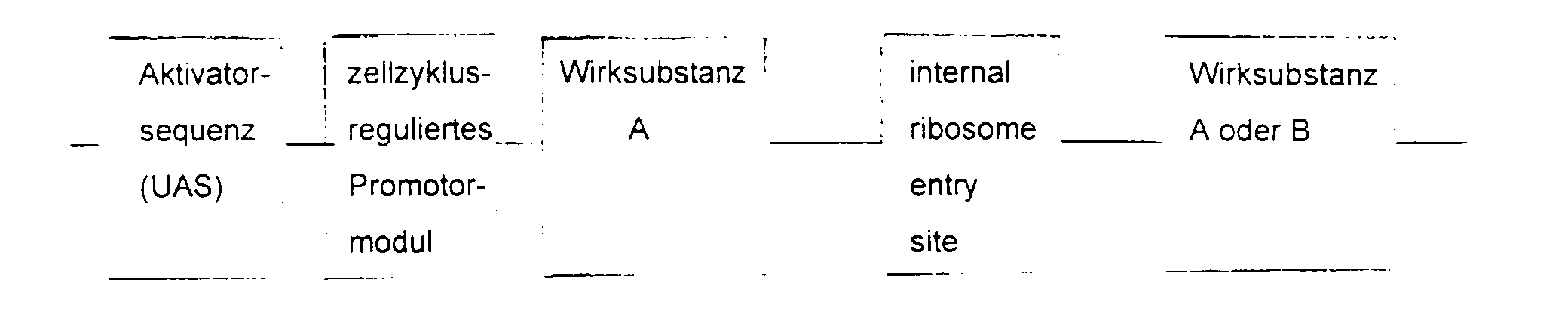
Ein derartiger Wirkstoff weist je nach Kombination additive oder synergistische Wirkung im Sinne der Erfindung auf.Depending on the combination, such an active ingredient has additive or synergistic Effect in the sense of the invention.
Als Ligand für virale und nicht-virale Vektoren, beispielsweise in kolloidalen Dispersionen hergestellt mit Polylysin-Ligand-Konjugaten, werden Substanzen bevorzugt, welche an die Oberfläche von Immunzellen (Makrophagen, Lymphozyten) spezifisch binden. Hierzu gehören Antikörper oder Antikörperfragmente gerichtet gegen Membranstrukturen von Immunzellen, wie sie beispielsweise von Powelson et al., Biotech. Adv. 11, 725 (1993) beschrieben wurden.Substances which bind specifically to the surface of immune cells (macrophages, lymphocytes) are preferred as ligands for viral and non-viral vectors, for example in colloidal dispersions produced using polylysine-ligand conjugates. These include antibodies or antibody fragments directed against membrane structures of immune cells, as described, for example, by Powelson et al., Biotech. Adv. 11 , 725 (1993).
Des weiteren gehören zu den Liganden auch monoklonale oder polyklonale Antikörper oder Antikörperfragmente, die mit ihren konstanten Domänen an Fc-γ- oder -Rezeptoren von Immunzellen binden (Rojanasakul et al., Pharm. Res. 11, 1731 (1994)).The ligands also include monoclonal or polyclonal antibodies or antibody fragments that bind with their constant domains to Fc-γ or receptors of immune cells (Rojanasakul et al., Pharm. Res. 11 , 1731 (1994)).
Die murinen monoklonalen Antikörper sind bevorzugt in humanisierter Form einzusetzen. Die Humanisierung erfolgt in der von Winter et al. (Nature 349, 293 (1991)) und Hoogenbooms et al. (Rev. Tr. Transfus. Hemobiol. 36, 19 (1993)) dargestellten Weise. Antikörperfragmente werden entsprechend dem Stand der Technik hergestellt, beispielsweise in der von Winter et al. (Nature 349, 293 (1991), Hoogenboom et al. (Rev. Tr. Transfus. Hemobiol. 36, 19 (1993), Girol (Mol. Immunol. 28, 1379 (1991) und Huston et al. (Int. Rev. Immunol. 10, 195 (1993) beschriebenen Weise.The murine monoclonal antibodies are preferably used in humanized form. Humanization takes place in the method described by Winter et al. (Nature 349, 293 (1991)) and Hoogenbooms et al. (Rev. Tr. Transfus. Hemobiol. 36 , 19 (1993)). Antibody fragments are produced according to the state of the art, for example in the Winter et al. (Nature 349 , 293 (1991), Hoogenboom et al. (Rev. Tr. Transfus. Hemobiol. 36 , 19 (1993), Girol (Mol. Immunol. 28 , 1379 (1991) and Huston et al. (Int. Rev Immunol., 10: 195 (1993).
Zu den Liganden gehören des weiteren alle Substanzen, welche an Membranstrukturen oder Membranrezeptoren auf der Oberfläche von Immunzellen binden. Beispielsweise gehören hierzu Wachstumsfaktoren, wie Zytokine, EGF, TGF, FGF oder PDGF, oder deren Fragmente bzw. Teilsequenzen von ihnen, die an Rezeptoren exprimiert durch derartige Zellen binden.The ligands also include all substances which Membrane structures or membrane receptors on the surface of Bind immune cells. For example, this includes growth factors such as Cytokines, EGF, TGF, FGF or PDGF, or their fragments or Partial sequences of them expressed at receptors by such cells tie.
Hierzu gehören des weiteren Liganden, welche an Zellmembranstrukturen, wie beispielsweise den Mannose 6-Phosphat-Rezeptor auf Makrophagen in Milz, Leber, Lunge und andere Gewebe binden.These also include ligands that attach to cell membrane structures such as for example the mannose 6-phosphate receptor on macrophages in spleen, Bind the liver, lungs and other tissues.
Diese Liganden und Membranstrukturen sind übersichtlich bei Perales et al., Eur. J. Biochem. 226, 255 (1994) beschrieben.These ligands and membrane structures are clear from Perales et al., Eur. J. Biochem. 226 , 255 (1994).
Die Herstellung des erfindungsgemäßen Wirkstoffes wird anhand folgender Beispiele näher beschrieben:The preparation of the active ingredient according to the invention is based on the following Examples described in more detail:
Der humane IL-2 Promotor (Position ≤ -373 bis ≥ -1, Wiliams et al., J. Immunol. 141, 662 (1988)) wird an seinem 3' Ende mit dem 5'-Terminus des CDE-CHR-Inr Moduls (Position ≤ -20 bis ≥ + 121) des humanen cdc25C-Gens (Lucibello et al., EMBO J., 14, 132 (1995)) verknüpft (Fig. 7). Die Verknüpfung erfolgt mit Hilfe von dem Fachmann bekannten und käuflichen Enzymen. The human IL-2 promoter (position ≤ -373 to ≥ -1, Wiliams et al., J. Immunol. 141 , 662 (1988)) is at its 3 'end with the 5' terminus of the CDE-CHR-Inr Module (position ≤ -20 to ≥ + 121) of the human cdc25C gene (Lucibello et al., EMBO J., 14 , 132 (1995)) linked (Fig. 7). The linkage takes place with the aid of enzymes known and commercially available to the person skilled in the art.
Die beschriebene chimäre IL-2 Repressormodul-Transkriptionseinheit wird an ihren 3' Enden mit dem 5'-Terminus einer DNA, die den kompletten kodierenden Bereich des IL-10 (Position ≤ 76 bis ≥ 612, Moore et al., Science 248, 1230 (1990)) enthält, verknüpft (Fig. 7). Diese DNA enthält auch die für eine Sekretion notwendige Signalsequenz. Transkriptionskontrolleinheiten und die DNA für IL-10 werden in pUC19/19 oder Bluescript-abgeleiteten Plasmidvektoren einkloniert, die direkt oder in kolloidalen Dispersionssystemen für eine in vivo Applikation genutzt werden können. Alternativ können die chimären Gene in virale Vektoren oder andere geeignete Vektoren transferiert und injiziert werden.The described chimeric IL-2 repressor module transcription unit is at its 3 'ends with the 5' terminus of a DNA that encompasses the complete coding region of the IL-10 (position ≤ 76 to ≥ 612, Moore et al., Science 248 , 1230 (1990)) contains linked (Fig. 7). This DNA also contains the signal sequence necessary for secretion. Transcription control units and the DNA for IL-10 are cloned into pUC19 / 19 or Bluescript-derived plasmid vectors which can be used directly or in colloidal dispersion systems for in vivo application. Alternatively, the chimeric genes can be transferred to viral vectors or other suitable vectors and injected.
Der humane IL-1-Rezeptor Promotor (Pos. ≥ -489 bis ≥ -1, Ye et al., PNAS USA 90, 229 (1993)) wird an seinem 3' Ende mit dem 5'-Terminus des CDE-CHR-Inr Moduls des humanen cdc25C-Gens (Pos. -20 bis +121 (Lucibello et al., EMBO J. 14, 132 (1995)) verknüpft (siehe Fig. 7). Die Verknüpfung erfolgt mit Hilfe von dem Fachmann bekannten und käuflichen Enzymen.The human IL-1 receptor promoter (pos. ≥ -489 to ≥ -1, Ye et al., PNAS USA 90 , 229 (1993)) is at its 3 'end with the 5' terminus of the CDE-CHR- Linked in the module of the human cdc25C gene (items -20 to +121 (Lucibello et al., EMBO J. 14 , 132 (1995)) (see FIG. 7). The linkage is carried out with the help of those known to those skilled in the art and commercially available Enzymes.
Die so hergestellte chimäre IL-1-Rezeptor-Repressormodul-Transkriptionskontrolleinheit wird an ihrem 3' Ende mit dem 5'-Terminus einer DNA, die den kompletten kodierenden Bereich des IL-10 enthält, verknüpft (siehe Fig. 7). Diese DNA enthält auch die für eine Sekretion notwendige Signalsequenz.The chimeric IL-1 receptor repressor module transcription control unit thus produced is at its 3 'end with the 5' terminus of a DNA that contains the complete coding area of the IL-10, linked (see Fig. 7). This DNA also contains the signal sequence necessary for secretion.
Das 3' Ende der DNA für IL-10 wird nunmehr verknüpft mit dem 5' Ende der
cDNA der internal ribosome entry site (Position ≤ 140 bis ≥ 630; Pelletier und
Sonnenberg, Nature 334, 320 (1988)) und anschließend wird deren 3' Ende
mit dem 5' Ende der DNA für die Signalsequenz des Immunglobulin
verknüpft (Position ≤ 63 bis ≥ 107, Riechmann et al., Nature 332, 323
(1988)). An derem 3' Ende wird das 5' der DNA für β-Glucuronidase
verknüpft (Position ≤ 93 bis ≥ -1982, cDNA Sequenz ohne Signalsequenz,
Oshima et al., PNAS USA 84, 685 (1985)). Dieser so hergestellte Wirkstoff
wird anschließend in puc18/19 oder in Bluescript-abgeleiteten Plasmidvektoren
einkloniert, die direkt oder in kolloidalen Dispersionssystemen für
eine in vivo Applikation genutzt werden können. Alternativ können die
chimären Gene in virale Vektoren oder andere geeignete Vektoren transferiert
und injiziert werden.The 3 'end of the DNA for IL-10 is now linked to the 5' end of the cDNA of the internal ribosome entry site (
Als Aktivatorsequenz ist eine Nukleotidsequenz (Promotor- oder Enhancersequenz) zu verstehen, mit der Transkriptionsfaktoren gebildet oder aktiv in Synovialzellen und Entzündungszellen interagieren. Im Sinne dieser Erfindung zählen zu den bevorzugten Aktivatorsequenzen genregulatorische Sequenzen bzw. Elemente aus Genen, die für besonders in Synovialzellen und Entzündungszellen exprimierte Proteine kodieren. Dieses sind beispielsweise:
- Metalloproteinasen (MMP) (Kollagenasen, Gelatinasen, Strome lysin)
im speziellen- MMP-1 (interstitielle Kollagenase)
(Lewis et al., Int. J. Immunopharm. 14, 497 (1992)) - MMP-2 (72 kD Gelatinase)
(Okada et al., Eur. J. Biochem. 194, 721 (1990)) - MMP-3 (Stromelysin)
(Saus et al., J. Biol. Chem. 263, 6742 (1988), Tetlow et al., Rheum. Internat. 13, 53 (1993)) - MMP-9 (92 kD Gelatinase)
(Tetlow et al., Rheum. Internat. 13, 53 (1993))
- MMP-1 (interstitielle Kollagenase)
(Angel et al., Mol. Cell. Biol. 7, 2256 (1987)) - MMP-3 (Stromelysin/Transin)
(Matrisian et al., Mol. Cell. Biol. 6, 1679 (1986), Kerr et al., Cell 61, 267 (1999)
- MMP-1 (interstitielle Kollagenase)
- Tissue inhibitors of Metalloproteinasen (TIMP)
im speziellen- TIMP-1
(Kolkenbrock et al., Eur. J. Biochem. 198, 775 (1991), Faucher et al., Path. Biol. 31, 199 (1989)) - TIMP-2
(Kolkenbrock et al., Eur. J. Biochem. 198, 775 (1991)) - TIMP-3
(Wick et al., J. Biol. Chemistry 269, 18953 (1994)).
- TIMP-1 (Stearns et al., Proc. Annu. Meet. Am. Assoc. Cancer Res. 33, A131 (1992))
- TIMP-2 (De Clerck et al., Gene 139, 185 (1994))
- TIMP-3:
- TIMP-1
- Metalloproteinases (MMP) (collagenases, gelatinases, currents lysine)
particularly- MMP-1 (interstitial collagenase)
(Lewis et al., Int. J. Immunopharm. 14 , 497 (1992)) - MMP-2 (72 kD gelatinase)
(Okada et al., Eur. J. Biochem. 194 , 721 (1990)) - MMP-3 (Stromelysin)
(Saus et al., J. Biol. Chem. 263 , 6742 (1988), Tetlow et al., Rheum. Internat. 13 , 53 (1993)) - MMP-9 (92 kD gelatinase)
(Tetlow et al., Rheum. Internat. 13 , 53 (1993))
- MMP-1 (interstitial collagenase)
(Angel et al., Mol. Cell. Biol. 7 , 2256 (1987)) - MMP-3 (Stromelysin / Transin)
(Matrisian et al., Mol. Cell. Biol. 6 , 1679 (1986), Kerr et al., Cell 61 , 267 (1999)
- MMP-1 (interstitial collagenase)
- Tissue inhibitors of metalloproteinases (TIMP)
particularly- TIMP-1
(Kolkenbrock et al., Eur. J. Biochem. 198 , 775 (1991), Faucher et al., Path. Biol. 31 , 199 (1989)) - TIMP-2
(Kolkenbrock et al., Eur. J. Biochem. 198 , 775 (1991)) - TIMP-3
(Wick et al., J. Biol. Chemistry 269 , 18953 (1994)).
- TIMP-1 (Stearns et al., Proc. Annu. Meet. Am. Assoc. Cancer Res. 33 , A131 (1992))
- TIMP-2 (De Clerck et al., Gene 139 , 185 (1994))
- TIMP-3:
- TIMP-1
Die Induktion der TIMP-3-mRNA-Expression während der G0→S-Progression beruht hauptsächlich auf einer Aktivierung der Transkription des TIMP-3-Gens (Wick et al., J. Biol. Chem. 269, 18963 (1994)). Die 5'-flankierende Sequenz des menschlichen TIMP-3-Gens wurde kloniert, der Startpunkt der Transkription der TIMP-3-mRNA bestimmt und der angrenzende Promotorbereich einer Struktur-Funktions-Analyse unterzogen. Diese Untersuchungen sollten die Regulationsmechanismen klären, die der spezifischen TIMP-3-Expression während der G0→S- und G1→S-Progression zugrundeliegen.The induction of TIMP-3 mRNA expression during the G 0 → S progression is mainly based on an activation of the transcription of the TIMP-3 gene (Wick et al., J. Biol. Chem. 269, 18963 (1994)) . The 5'-flanking sequence of the human TIMP-3 gene was cloned, the starting point of the transcription of the TIMP-3 mRNA was determined and the adjacent promoter region was subjected to a structure-function analysis. These investigations should clarify the regulatory mechanisms underlying the specific TIMP-3 expression during the G 0 → S and G 1 → S progression.
Durch eine genomische Southern Blot-Analyse wurde vorab bestimmt, ob TIMP-3 im menschlichen Genom ein Einzelgen darstellt oder mehrere Loci für das TIMP-3-Gen bzw. eventuell auch TIMP-3-Pseudogene existieren. Hierzu wurde genomische DNA aus WI-38-Zellen isoliert, mit den Restriktionsendonukleasen EcoRI, Pstl und Hindlll behandelt und einer Southern Blot-Analyse unterzogen. Als radioaktiv-markierte Sonde wurde ein 690 bp langes 3'-TIMP-3-cDNA-Fragment eingesetzt. Da die Sonde in allen Fällen nur ein spezifisches DNA-Fragment erkannte, ist davon auszugehen, daß nur ein singuläres TIMP-3-Gen im menschlichen Genom vorliegt.A genomic Southern blot analysis was used to determine beforehand whether TIMP-3 represents a single gene or several in the human genome Loci for the TIMP-3 gene or possibly also TIMP-3 pseudogenes exist. For this, genomic DNA was isolated from WI-38 cells with the restriction endonucleases EcoRI, Pstl and Hindlll treated and Southern blot analysis. As a radioactive labeled probe a 690 bp 3'-TIMP-3 cDNA fragment was used. Since the In all cases, the probe only recognized a specific DNA fragment assume that only a singular TIMP-3 gene in human Genome is present.
Zur Isolierung der 5'-flankierenden TIMP-3-Gensequenz wurden ca. 7x10⁵ Phagen einer genomischen WI-38-Genbibliothek mit einem 300 bp langen 5'-TIMP-3-cDNA-Fragment hybridisiert. Von den dreizehn nach dieser Primäruntersuchung isolierten rekombinanten Phagenklonen wurden vier auch von einem 30 bp langen Oligonukleotid aus dem 5'-Endbereich der TIMP-3-cDNA erkannt. Da diese Phagen wahrscheinlich auch den das ATG-Startcodon flankierenden, 5'-Sequenzbereich enthielten, wurde einer der Phagenklone für eine nähere Charakterisierung und Analyse ausgewählt. Durch kombinierte Behandlung mit verschiedenen Restriktionsendonukleasen und nachfolgender Southern Blot-Analyse konnte bestimmt werden, daß das 13 kb lange genomische DNA-"Insert" dieses Phagen ca. 4,7 kb der 5'-flankierenden TIMP-3-Gensequenz enthielt. To isolate the 5'-flanking TIMP-3 gene sequence, approximately 7x10 5 phages of a genomic WI-38 gene library were hybridized with a 300 bp long 5'-TIMP-3 cDNA fragment. Of the thirteen recombinant phage clones isolated after this primary examination, four were also recognized by a 30 bp long oligonucleotide from the 5 'end region of the TIMP-3 cDNA. Since these phages probably also contained the 5 'sequence region flanking the ATG start codon, one of the phage clones was selected for further characterization and analysis. By combined treatment with various restriction endonucleases and subsequent Southern blot analysis it could be determined that the 13 kb genomic DNA "insert" of this phage contained approximately 4.7 kb of the 5'-flanking TIMP-3 gene sequence.
Durch Sequenzanalyse beider Stränge wurde die Nukleotidsequenz von
annähernd 1500 bp des 5'-flankierenden Genbereichs bestimmt. Die
hierfür durch eine Exonuklease III-Behandlung hergestellten 5'-Verkürzungen
des klonierten 5'-Genbereichs sind in Fig. 8 illustriert.
Der Sequenzbereich, der sich durch die nachfolgend beschriebenen
Struktur-Funktions-Analysen als besonders bedeutend für die TIMP-3-Promotor-Funktion
herausstellte, ist in Fig. 9 gezeigt. Durch Computergestützte
Analyse wurden in der TIMP-3-Promotorsequenz eine Reihe
von Elementen identifiziert, die den Bindungsstellen bekannter
Transkriptionsfaktoren ähneln, u.a. 4 Sp1-Bindungsstellen, eine mögliche
NF1- sowie eine C/EBP-Bindungsstelle (markiert in Fig. 9).The nucleotide sequence of approximately 1500 bp of the 5'-flanking gene region was determined by sequence analysis of both strands. The 5 'truncations of the cloned 5' gene region produced for this by exonuclease III treatment are illustrated in FIG. 8.
The sequence region which was found to be particularly important for the TIMP-3 promoter function by the structure-function analyzes described below is shown in FIG. 9. Computer-assisted analysis identified a number of elements in the TIMP-3 promoter sequence which resemble the binding sites of known transcription factors, including 4 Sp1 binding sites, a possible NF1 and a C / EBP binding site (marked in FIG. 9).
Um den oder die Startpunkt(e) der Transkriptionsinitiation zu ermitteln, wurde das 5'-Ende der TIMP-3-mRNA durch eine Primer-Extension-Analyse bestimmt. Hierbei wurde eine Transkriptionsstartstelle (Nucleotidsequenz: GGGCGGGCCCAACAGCCCG) identifiziert, die 364 bp 5' vom ATG-Startcodon lokalisiert ist (markiert in Fig. 9). Trotz genauer Untersuchung der aufwärts der Startstelle gelegenen Nukleotidsequenz wurde weder eine TATA-Box noch TATA-ähnliche Sequenzen gefunden.To determine the starting point (s) of the transcription initiation, the 5 'end of the TIMP-3 mRNA was determined by a primer extension analysis certainly. Here was a transcription start site (Nucleotide sequence: GGGCGGGCCCAACAGCCCG) identified the 364 bp is located 5 'of the ATG start codon (marked in Fig. 9). Despite being more precise Examination of the nucleotide sequence located upstream of the starting point neither a TATA box nor TATA-like sequences were found.
Um die Aktivität der TIMP-3-Promotorsequenz in normal proliferierende,
ruhende und serumstimulierende Zellen zu bestimmen und erste
Hinweise auf funktionell wichtige Promotorbereiche zu enthalten, wurden
die zur Sequenzierung verwendeten 5'-verkürzten Promotorfragmente (s.
Fig. 8) vor das Luziferasegen in den promotorlosen pXP-2-Vektor
(Nordeen, Biotechniques 6, 454 (1988)) kloniert. Durch seine äußerst
geringe Basalaktivität eignet sich dieses "Reporterkonstrukt" besonders
zur Durchführung transienter Expressionsanalysen.In order to determine the activity of the TIMP-3 promoter sequence in normally proliferating, resting and serum-stimulating cells and to contain first indications of functionally important promoter regions, the 5'-shortened promoter fragments used for sequencing (see FIG. 8) were placed in front of the luciferase gene cloned the promoterless pXP-2 vector (Nordeen,
Um zu zeigen, daß die isolierte TIMP-3-Promotorsequenz in transienten
Expressionsanalysen aktiv ist, d.h. die Transkription des Luziferase-Reportergens
steuern kann, wurde das TIMP-3-Promotor-Deletionskonstrukt
Δ-1010 (umfaßt die Nukleotide -1010 bis +281,
s. Fig. 8) in NIH3T3-Zellen transfiziert und die Luziferase-Aktivität in
diesen normal proliferierenden oder serumstimulierten transfizierten
Zellen bestimmt. Zum Vergleich wurde zusätzlich die Expression von
weiteren Luziferase-Promotorkonstrukten ermittelt, die den Herpes Virus
tk-Promotor (pT81; Lucibello und Müller, Meth. Mol. Cell Biol. 1, 9 (1989)),
einen 5xTRE-Minimalpromotor (Angel et al., Mol. Cell Biol. 7, 2256
(1987)), einen RSV-LTR (Setoyama et al., Proc. Natl. Acad. Sci. USA 83,
3213 (1986) oder ein 937 bp langes Fragment des menschlichen Cyclin
D1-Promotors (Herber et al., Oncogene 9, 1295 (1994)) enthielten. Die
Ergebnisse dieser Untersuchungen sind in Tabelle 2 aufgeführt.In order to show that the isolated TIMP-3 promoter sequence is active in transient expression analyzes, ie can control the transcription of the luciferase reporter gene, the TIMP-3 promoter deletion construct Δ-1010 (comprising the nucleotides -1010 to +281, see FIG. 8) transfected in NIH3T3 cells and the luciferase activity in these normally proliferating or serum-stimulated transfected cells determined. For comparison, the expression of further luciferase promoter constructs was additionally determined, which the herpes virus tk promoter (pT81; Lucibello and Müller, Meth. Mol. Cell Biol. 1 , 9 (1989)), a 5xTRE minimal promoter (Angel et al ., Mol. Cell Biol. 7 , 2256 (1987)), an RSV-LTR (Setoyama et al., Proc. Natl. Acad. Sci. USA 83 , 3213 (1986) or a 937 bp fragment of the human cyclin D1 Promoter (Herber et al.,
In normal proliferierenden NIH3T3-Zellen (Tab. 2A) wurde das TIMP-3-Promotorkonstrukt Δ-1010 ca. 3-fach höher exprimiert als der 5xTRE-Minimalpromotor und zeigt eine 7-fach höhere Expression als das Cyclin D1-Promotorkonstrukt. Einzig das RSV-LTR-Reporterplasmid wies eine ca. 2-fach höhere Aktivität als das TIMP-3-Promotorkonstrukt auf. Diese Ergebnisse deuten darauf hin, daß der menschliche TIMP-3-Promotor durch eine vergleichsweise hohe transkriptionelle Aktivität gekennzeichnet ist. Wie in Tab. 2B und Fig. 11 gezeigt, wurde das TIMP-3-Promotor-konstrukt Δ-1010 außerdem deutlich in Zellen induziert, die nach zweitägigem Serumentzug für 4 h mit 20% FKS stimuliert worden waren. Verglichen mit ruhenden (G0) Zellen stieg die Expression dabei ca. 7- bis 8-fach an, was etwa 3,5-fach bzw. 2,4-fach höher lag als die beobachteten Induktionswerte des 5xTRE-Reporterkonstruktes bzw. des Cyclin D1-Promotorkonstrukts. Dagegen zeigte das Herpes simplex tk-Promotor-Luziferasekonstrukt (pT81) keine Induktion seiner Expression nach Serumstimulation.In normal proliferating NIH3T3 cells (Table 2A), the TIMP-3 promoter construct Δ-1010 was expressed about 3 times higher than the 5xTRE minimal promoter and shows a 7-fold higher expression than the cyclin D1 promoter construct. Only the RSV-LTR reporter plasmid had an activity which was about 2 times higher than that of the TIMP-3 promoter construct. These results indicate that the human TIMP-3 promoter is characterized by a comparatively high transcriptional activity. As shown in Tab. 2B and Fig. 11, the TIMP-3 promoter construct Δ-1010 was also clearly induced in cells which had been stimulated with 20% FCS for 4 h after two days of serum withdrawal. Compared to resting (G 0 ) cells, the expression increased approximately 7- to 8-fold, which was approximately 3.5-fold or 2.4-fold higher than the observed induction values of the 5xTRE reporter construct or the cyclin D1 promoter construct. In contrast, the herpes simplex tk promoter-luciferase construct (pT81) showed no induction of its expression after serum stimulation.
In Fig. 10 ist die Kinetik der Induktion des Δ-1010 TIMP-3-Promotor-konstrukts nach Serumstimulation ruhender Zellen gezeigt. Die Luziferase-Aktivität stieg bereits nach 1 h an und erreichte mit einer 7-fachen Induktion nach 4 h Maximalwerte.10 is the kinetics of induction of the Δ-1010 TIMP-3 promoter construct shown after serum stimulation of resting cells. The Luciferase activity increased after 1 h and reached a 7-fold Induction after 4 h maximum values.
Zusammenfassend zeigen diese Ergebnisse, daß das verwendete Δ-1010 TIMP-3-Promotorkonstrukt die wesentlichen, wenn nicht alle regulatorischen Elemente aufweist, die für eine effiziente Transkription sowie für die Induzierbarkeit durch Serum benötigt werden.In summary, these results show that the Δ-1010 used TIMP-3 promoter construct the essential, if not all, regulatory Has elements necessary for efficient transcription as well as for the Inducibility through serum are needed.
Eine Struktur- und Funktionsanalyse der isolierten TIMP-3-Promotorsequenz
sollte erste Hinweise auf diejenigen Promotorregionen liefern,
die für die Basalexpression sowie die Seruminduzierbarkeit funktionell
bedeutend sind. Hierzu wurde die Aktivität der verschiedenen, für die
Promotorsequenzierung hergestellten und in den pXP-2-Vektor
umklonierten, TIMP-3-Promotor-Deletionskonstrukte (s. Fig. 8) in
transienten Expressionsanalysen bestimmt. Die Analyse der basalen
Expression der verschiedenen Deletionskonstrukte in normal
proliferierenden NIH3T3-Zellen (Fig. 11) ergab drei wesentliche
Ergebnisse:
Im abschließenden Experiment wurde die Seruminduzierbarkeit der verschiedenen TIMP-3-Promotor-Deletionskonstrukte analysiert. Die Ergebnisse dieser, wie in Tabelle 2 beschriebenen durchgeführten, Expressionsanalysen sind in Fig. 11b dargestellt. Auffällig ist das ähnliche Expressionsprofil zwischen normal proliferierenden (Fig. 11a), ruhenden und serumstimulierten Zellen (Fig. 11b). Die Expressionswerte in ruhenden Zellen lagen aber ca. 2-fach niedriger als in proliferierenden Zellen und wurden 4 h nach Serumstimulation 2,9- bis 8,5-fach induziert. Wie in den proliferierenden Zellen gezeigt (Fig. 11a), übt die Region zwischen Position Δ-1300 und Δ-1010 einen negativen Effekt auf die Promotoraktivität in ruhenden und serumstimulierten Zellen aus, hat aber keinen Einfluß auf die Seruminduzierbarkeit des Konstruktes Δ-1300 (8,5-fache Induktion). Auch hier wurden die höchsten Luziferaseaktivitäten wieder mit dem Deletionskonstrukt -1010 gemessen.In the final experiment, the serum inducibility of the different TIMP-3 promoter deletion constructs were analyzed. The Results of these, as described in Table 2, Expression analyzes are shown in Fig. 11b. The similar is striking Expression profile between normal proliferating (Fig. 11a), resting and serum stimulated cells (Fig. 11b). The expression values in dormant However, cells were about 2 times lower than in proliferating cells and were induced 2.9 to 8.5 times 4 h after serum stimulation. As in the proliferating cells (Fig. 11a), the region exercises between position Δ-1300 and Δ-1010 have a negative effect on promoter activity in resting and serum stimulated cells, but has no influence on the Serum inducibility of the construct Δ-1300 (8.5-fold induction). Also here the highest luciferase activities were again with the Deletion construct measured -1010.
Weitere Verkürzungen des 5'-Endes bis zu Position -660 führten nur zu einem 1,5- bis 2-fachen Absinken der Promotoraktivität. Alle diese Konstrukte (Δ-1300, Δ-1010, Δ-925, Δ-660) zeigten aber eine deutliche, 6-bis 8-fache Induktion nach Serumzugabe. Die Verkürzung um weitere 200 bp bis zu Position -463 (Δ-463) bewirkte ein erneutes 2-faches Absinken der Aktivität, hatte aber ebenfalls keinen Einfluß auf die Seruminduzierbarkeit des Konstrukts. Erst das Konstrukt Δ-112 zeigte mit einem nur 3-fachen Expressionsanstieg nach Serumstimulation eine 50-65%ige Reduktion seiner Seruminduzierbarkeit. Dies deutet darauf hin, daß die Region zwischen Position -463 und -112 Element(e) enhält, die für die Seruminduzierbarkeit des TIMP-3-Promotors von Bedeutung sind. Zusätzliche Regionen zwischen Position -463 und -660 sowie -925 und-1010 verstärken generell und zellzyklusunabhängig die seruminduzierte Promotoraktivität.Further shortening of the 5 'end to position -660 only led to a 1.5-2 fold decrease in promoter activity. All these Constructs (Δ-1300, Δ-1010, Δ-925, Δ-660) showed a clear, 6-bis 8-fold induction after adding serum. The reduction by another 200 bp up to position -463 (Δ-463) caused a further double decrease the activity, but also had no influence on the Serum inducibility of the construct. First the construct Δ-112 showed with only a 3-fold increase in expression after serum stimulation a 50-65% reduction in its serum inducibility. This suggests indicates that the region between positions -463 and -112 contains element (s) that are important for the serum inducibility of the TIMP-3 promoter. Additional regions between positions -463 and -660 and -925 and-1010 generally amplify the serum-induced and independent of the cell cycle Promoter activity.
Die Ergebnisse der Charakterisierung sowie Struktur- und Funktionsanalyse des 5'-flankierenden TIMP-3-Genbereiches lassen sich wie folgt zusammenfassen:The results of the characterization as well as structural and functional analysis of the 5'-flanking TIMP-3 gene region can be as follows sum up:
TIMP-3 stellt ein TAT-Box-loses Gen dar. Die Transkription wird aber dennoch an nur einer Startstelle 364 bp aufwärt vom ATG-Startcodon initiiert. Verglichen mit anderen Promotoren weist die TIMP-3-Promotorsequenz eine relativ hohe Aktivität auf, für die die ersten 112 bp ausreichend sind. In dieser Region befinden sich zahlreiche Sp1-Bindungsstellen. Außerdem zeigt er eine deutliche Induktion seiner Aktivtät nach Serumstimulation ruhender Zellen, deren Kinetik der TIMP-3-mRNA-Expression während der G0-S-Progression entspricht. Die für die Seruminduzierbarkeit verantwortlichen Regulationselemente sind in der Region zwischen Position -112 und -463 lokalisiert.TIMP-3 is a TAT-boxless gene. However, the transcription is nevertheless initiated at only one start point 364 bp upwards by the ATG start codon. Compared to other promoters, the TIMP-3 promoter sequence has a relatively high activity for which the first 112 bp are sufficient. There are numerous Sp1 binding sites in this region. He also shows a clear induction of his activity after serum stimulation of resting cells, the kinetics of which correspond to the TIMP-3 mRNA expression during the G 0 -S progression. The regulatory elements responsible for serum inducibility are located in the region between positions -112 and -463.
Aktivatorsequenzen im Sinne dieser Erfindung sind des weiteren Promotoren für den
- GM-CSF-Rezeptor
(Nakagawa et al., J. Biol. Chem. 269, 10905 (1994)) - Makrophagen-Colony Stimulating Factor (M-CSF)-Rezeptor
(Yue et al., Mol. Cell. Biol. 13, 3191 (1993), Zhang et al., Mol. Cell. Biol. 14, 373 (1994)) - Typ I und II Makrophagen Scavenger Rezeptoren
(Mouton et al., Mol. Cell. Biol. 14, 4408 (1994))
- GM-CSF receptor
(Nakagawa et al., J. Biol. Chem. 269 , 10905 (1994)) - Macrophage Colony Stimulating Factor (M-CSF) receptor
(Yue et al., Mol. Cell. Biol. 13 , 3191 (1993), Zhang et al., Mol. Cell. Biol. 14 , 373 (1994)) - Type I and II macrophage scavenger receptors
(Mouton et al., Mol. Cell. Biol. 14 , 4408 (1994))
Als Wirksubstanz im Sinne der Erfindung ist eine DNA-Sequenz zu verstehen, deren exprimiertes Protein die Entzündung beispielsweise im Gelenk direkt oder indirekt hemmt und/oder die Rekonstitution von extrazellulärer Matrix (Knorpel, Bindegewebe) im Gelenk fördert. Zu diesen Proteinen zählen beispielsweise folgende Proteine (die DNA-Sequenz für das jeweilige Protein ist den angegebenen Literaturstellen zu entnehmen):
- IL-1-Rezeptorantagonist (IL-1-RA)
(Thompson et al. (1992), Eisenberg et al., Nature 343, 341 (1990), Carter et al., Nature 344, 63 (1990))
IL-1-RA inhibiert die Bindung von IL-1∝,β an den spezifischen Rezeptor (Conti et al., (1992), Granowietz et al., (1992)), IL-1 aktiviert Synovialzellen und ist hierdurch entzündungsfördernd (Dayer et al., Eur.Cytokine Network 5/6, 563 (1994)) - löslicher IL-1-Rezeptor
(Sims et al., Clin. Immun. Immunopath. 72, 9 (1994), Sims et al., Nature 35, 88 (1988), Sims et al., PNAS USA 86, 8946 (1989) (I), Dower et al., J. Exp. Med. 162, 501 (1985), Chizzonite et al., PNAS 86, 8029 (1989), McMahan et al., EMBO J. 10, 2821 (1991) (II), Sims et al., Science 241, 585 (1988))
Löslicher IL-1-Rezeptor bindet und inaktiviert IL-1 (Fanslow et al., Science 248, 739 (1990), Jacobs et al., J. Immunol. 146, 2983 (1991)) - IL-6
(Hirano, Int.J. Cell Cloning 9, 166 (1991), Brach et al., Int. J. Clin Lab. Rec. 22, 143 (1992), Wong et al., Immunol.Today 9, 137 (1988), Brakenhoff et al., J. Immunol. 143, 1175 (1989), Yasukawa et al, EMBO J. 6, 2939 (1987))
IL-6 erhöht die Sekretion von TIMP und Superoxiden und vermindert die Sekretion von IL-1 und TNF∝ durch Synovialzellen und Chondrozyten (Shingu et al., Clin. Exp. Immunol. 94, 145 (1993), Shingu et al., Inflammation 18, 613 (1994)). - löslicher TNF-Rezeptor
(Olson et al., Eur.Cytokine Network 4, 169 (1993), Tartaglia et al., Immunol. Today 13, 151 (1992), Nophar et al., EMBO J. 9, 3269 (1990), Himmler et al., DNA Cell Biol. 9, 705 (1990), Aggarwal et al., Nature 318, 665 (1985), Gray et al., PNAS 87, 7380 (1990), Tartaglia et al., Immunol. Today 13, 151 (1992), Loetcher et al., Cell 61, 351 (1990), Schall et al., Cell 61, 361 (1990), Smith et al., Science 248, 1019 (1990), Goodwin et al., Mol. Cell. Biol. 11, 3020 (1991))
Löslicher TNF-Rezeptor bindet und inaktiviert TNF. TNF aktiviert Synovialzellen zur erhöhten Sekretion von Metalloproteinasen (Dayer et al., Eur.Cytokine Network 5/6, 563, 1994)) - IL-4
(Paul, J. Am. Soc. Hemat. 77, 1859 (1991), Yokota et al., PNAS USA 83, 5894 (1986), Paul, Blood 77, 1859 (1991), von Leuven et al., Blood 73, 1142 (1989), Arai et al., J. Immunol. 142, 274 (1989))
IL-4 inhibiert die Bildung und Sekretion von IL-1, TNF∝ und MMP (Corcoran et al., J. Biol. Chemistry 267, 515 (1992), Dayer et al., Eur.Cytokine Network 5/6, 563 (1994), te Velde et al.,Blood 76, 1392 (1990)) - IL-10
(Moore et al., Science 248, 1230 (1990), Vieira et al., PNAS USA 88, 1172 (1991), Kim et al., J. Immunol. 148, 3618(1992))
IL-10 inhibiert die Bildung und Sekretion von IL-1, TNFα und MMP und erhöht die Sekretion von TIMP (Dayer et al., Eur.Cytokine Network 5/6, 563 (1994)) - Insulin-like growth factor (IGF-1)
(Jansen et al., Nature 306, 609 (1983), Ullrich et al., EMBO J. 3, 361 (1984), Bell et al., PNAS 82, 6450 (1985), Rotwein et al., PNAS 83, 77 (1986), J. Biol. Chem. 261, 4828 (1986), Jansen et al., FEBS Lett. 179, 243 (1985))Tobin et al., Mol. Endocrin. 4, 1914 (1990), Macaulay, Brit. J. Cancer 65, 311 (1992))
IGF-1 stimuliert die Synthese von extrazellulärer Matrix. - TGFβ
im speziellen- TGFβ1 und TGFβ2
(Massague, Ann. Rev. Cell. Biol. 6, 597 (1990), Kondiah et al., J. Biol. Chem. 265, 1089 (1990), Garnier et al., J. Molec. Biol. 120, 97 (1978), Wahl et al., Immunol.Today 10, 258 (1989), Dupuy D'Angeac et al., J. Cell Physiol. 147, 460 (1991))
TGFβ stimuliert die Synthese von extrazellulärer Matrix.
- TGFβ1 und TGFβ2
- Superoxiddismutase (Folz et al.,
Genomics 22, 162 (1994), Wan et al. 13/11, 1127 (1994)) - TIMP (Tissue Inhibitors of Metalloproteinases)
im speziellen- TIMP-1 (Docherty et al., Nature 318, 66 (1985))
- TIMP-2 (Stetler-Stevenson et al., J. Biol. Chem. 265, 13933 (1990))
- TIMP-3 (Wick et al., J. Biol. Chemistry, 269, 18953 (1994))
- IL-1 receptor antagonist (IL-1-RA)
(Thompson et al. (1992), Eisenberg et al., Nature 343 , 341 (1990), Carter et al., Nature 344 , 63 (1990))
IL-1-RA inhibits the binding of IL-1∝, β to the specific receptor (Conti et al., (1992), Granowietz et al., (1992)), IL-1 activates synovial cells and is therefore inflammatory (Dayer et al., Eur.Cytokine Network 5/6 , 563 (1994)) - soluble IL-1 receptor
(Sims et al., Clin. Immun. Immunopath. 72 , 9 (1994), Sims et al., Nature 35 , 88 (1988), Sims et al., PNAS USA 86 , 8946 (1989) (I), Dower et al., J. Exp. Med. 162 , 501 (1985), Chizzonite et al., PNAS 86 , 8029 (1989), McMahan et al., EMBO J. 10 , 2821 (1991) (II), Sims et al., Science 241, 585 (1988))
Soluble IL-1 receptor binds and inactivates IL-1 (Fanslow et al., Science 248 , 739 (1990), Jacobs et al., J. Immunol. 146 , 2983 (1991)) - IL-6
(Hirano, Int.J. Cell Cloning 9 , 166 (1991), Brach et al., Int. J. Clin Lab. Rec. 22 , 143 (1992), Wong et al., Immunol.Today 9 , 137 (1988 ), Brakenhoff et al., J. Immunol. 143 , 1175 (1989), Yasukawa et al, EMBO J. 6 , 2939 (1987))
IL-6 increases the secretion of TIMP and superoxides and decreases the secretion of IL-1 and TNF∝ by synovial cells and chondrocytes (Shingu et al., Clin. Exp. Immunol. 94 , 145 (1993), Shingu et al., Inflammation 18 , 613 (1994)). - soluble TNF receptor
(Olson et al., Eur.Cytokine Network 4 , 169 (1993), Tartaglia et al., Immunol. Today 13 , 151 (1992), Nophar et al., EMBO J. 9 , 3269 (1990), Himmler et al ., 1990, DNA Cell Biol. 9 , 705, Aggarwal et al., Nature 318 , 665 (1985), Gray et al., PNAS 87 , 7380 (1990), Tartaglia et al., Immunol. Today 13 , 151 (1992), Loetcher et al., Cell 61 , 351 (1990), Schall et al., Cell 61 , 361 (1990), Smith et al., Science 248 , 1019 (1990), Goodwin et al., Mol. Cell. Biol. 11 , 3020 (1991))
Soluble TNF receptor binds and inactivates TNF. TNF activates synovial cells for increased secretion of metalloproteinases (Dayer et al., Eur.Cytokine Network 5/6 , 563, 1994)) - IL-4
(Paul, J. Am. Soc. Hemat. 77 , 1859 (1991), Yokota et al., PNAS USA 83 , 5894 (1986), Paul, Blood 77 , 1859 (1991), by Leuven et al., Blood 73 , 1142 (1989), Arai et al., J. Immunol. 142 , 274 (1989))
IL-4 inhibits the formation and secretion of IL-1, TNF∝ and MMP (Corcoran et al., J. Biol. Chemistry 267 , 515 (1992), Dayer et al., Eur.Cytokine Network 5/6 , 563 ( 1994), Te Velde et al.,Blood 76 , 1392 (1990)) - IL-10
(Moore et al., Science 248 , 1230 (1990), Vieira et al., PNAS USA 88 , 1172 (1991), Kim et al., J. Immunol. 148 , 3618 (1992))
IL-10 inhibits the formation and secretion of IL-1, TNFα and MMP and increases the secretion of TIMP (Dayer et al., Eur.Cytokine Network 5/6 , 563 (1994)) - Insulin-like growth factor (IGF-1)
(Jansen et al., Nature 306 , 609 (1983), Ullrich et al., EMBO J. 3 , 361 (1984), Bell et al., PNAS 82 , 6450 (1985), Rotwein et al., PNAS 83 , 77 (1986), J. Biol. Chem. 261 , 4828 (1986), Jansen et al., FEBS Lett. 179 , 243 (1985)) Tobin et al., Mol. Endocrin. 4 , 1914 (1990), Macaulay, Brit. J. Cancer 65 , 311 (1992))
IGF-1 stimulates the synthesis of extracellular matrix. - TGFβ
particularly- TGFβ1 and TGFβ2
(Massague, Ann. Rev. Cell. Biol. 6 , 597 (1990), Kondiah et al., J. Biol. Chem. 265 , 1089 (1990), Garnier et al., J. Molec. Biol. 120 , 97 (1978), Wahl et al., Immunol.Today 10 , 258 (1989), Dupuy D'Angeac et al., J. Cell Physiol. 147 , 460 (1991))
TGFβ stimulates the synthesis of extracellular matrix.
- TGFβ1 and TGFβ2
- Superoxide dismutase (Folz et al.,
Genomics 22 , 162 (1994), Wan et al. 13/11 , 1127 (1994)) - TIMP (Tissue Inhibitors of Metalloproteinases)
particularly- TIMP-1 (Docherty et al., Nature 318 , 66 (1985))
- TIMP-2 (Stetler-Stevenson et al., J. Biol. Chem. 265 , 13933 (1990))
- TIMP-3 (Wick et al., J. Biol. Chemistry, 269 , 18953 (1994))
Als Wirksubstanz im Sinne der Erfindung können jedoch auch DNA-Sequenzen von Fusionsproteinen zwischen den aufgeführten Cytokinen, Wachstumsfaktoren oder dem extralzelluären Teil der Rezeptoren zum einen und dem Fc-Teil des menschlichen Immunglobulins zum anderen Verwendung finden. Derartige cDNA-Sequenzen und ihre Herstellung wurden in der EPA 0464 633 A1 beschrieben.However, DNA sequences can also be used as active substance in the sense of the invention fusion proteins between the cytokines listed, Growth factors or the extracellular part of the receptors on the one hand and the Fc portion of human immunoglobulin for other use Find. Such cDNA sequences and their preparation have been described in the EPA 0464 633 A1.
Gegenstand der Erfindung ist des weiteren ein Wirkstoff, in welchem eine
Kombination der DNA-Sequenzen von mehreren gleichen antientzündlichen
Substanzen (A,A) oder von unterschiedlichen antientzündlichen Substanzen
(A,B) vorliegt. Zur Expression von zwei DNA-Sequenzen wird vorzugsweise die
cDNA einer "internal ribosome entry site" (IRES) als regulatorisches Element
zwischengeschaltet.

Derartige IRES wurden beispielsweise von Mountford und Smith (TIG 11, 179 (1995), Kaufman et al., Nucl. Acids, Res. 19, 4485 (1991), Morgan et al., Nucl. Acids Res. 20, 1293 (1992), Dirks et al., Gene 128, 247 (1993), Pelletier und Sonenberg, Nature 334, 320 (1988) und Sugitomo et al., BioTechn. 12, 694 (1994)) beschrieben.Such IRES have been described, for example, by Mountford and Smith (TIG 11 , 179 (1995), Kaufman et al., Nucl. Acids, Res. 19 , 4485 (1991), Morgan et al., Nucl. Acids Res. 20 , 1293 (1992 ), Dirks et al., Gene 128 , 247 (1993), Pelletier and Sonenberg, Nature 334, 320 (1988) and Sugitomo et al., BioTechn. 12 , 694 (1994)).
So kann die cDNA der IRES-Sequenz des Poliovirus (Position ≤ 140 bis ≥ 630 des 5' UTR (Pelletier und Sonenberg, Nature 334, 320 (1988)) zur Verknüpfung der DNA der antientzündlichen Substanz A (am 3' Ende) mit der DNA der antientzündlichen Substanz B (am 5' Terminus) verwendet werden. Thus, the cDNA of the IRES sequence of the poliovirus (position ≤ 140 to ≥ 630 of the 5 'UTR (Pelletier and Sonenberg, Nature 334 , 320 (1988)) for linking the DNA of the anti-inflammatory substance A (at the 3' end) with the DNA of anti-inflammatory substance B (at the 5 'terminus) can be used.
Ein derartiger Wirkstoff weist, je nach Kombination, additive (A+A, A+B1) oder synergistische Wirkung im Sinne der Erfindung auf.Depending on the combination, such an active ingredient has additive (A + A, A + B 1 ) or synergistic effect in the sense of the invention.
Als Ligand für virale und nicht-virale Vektoren, beispielsweise in Polylysin-Ligand-Konjugaten, werden Substanzen bevorzugt, welche an die Oberfläche von Synovialzellen binden. Hierzu gehören monoklonale oder polyklonale Antikörper oder Antikörperfragmente, die mit ihren variablen Domänen an Membranstrukturen von Synovialzellen oder Entzündungszellen binden, welche beispielsweise sind
- Vimentin (Miettinen et la., Am. J. Pathol. 117, 18 (1984))
- Fibronectin (Wojciak et al., Clin. Exp. Immunol. 93, 108 (1993))
- Vimentin (Miettinen et la., Am. J. Pathol. 117, 18 (1984))
- Fibronectin (Wojciak et al., Clin. Exp. Immunol. 93 , 108 (1993))
Hierzu gehören auch monoklonale oder polyklonale Antikörper oder Antikörperfragmente, die mit ihren konstanten Domänen an Fc-Rezeptor binden (Rojanasakul et al., Pharm. Res. 11, 1731 (1994)).This also includes monoclonal or polyclonal antibodies or antibody fragments which bind to the Fc receptor with their constant domains (Rojanasakul et al., Pharm. Res. 11 , 1731 (1994)).
Die murinen monoklonalen Antikörper sind bevorzugt in humanisierter Form
einzusetzen. Die Humanisierung erfolgt in der von Winter et al. (Nature 349,
293 (1991) und Hoogenbooms et al. (Rev. Tr. Transfus. Hemobiol. 36, 19
(1993) dargestellten Weise. Antikörperfragmente werden gemäß dem Stand
der Technik hergestellt, beispielsweise in der von Winter et al., Nature 349, 293
(1991), Hoogenboom et al., Rev. Tr. Transfus. Hemobiol. 36, 19 (1993), Girol,
Mol. Immunol. 28, 1379 (1991) oder Huston et al., Int. Rev. Immunol. 10, 195
(1993) beschriebenen Weise.The murine monoclonal antibodies are preferably used in humanized form. Humanization takes place in the method described by Winter et al. (Nature 349 , 293 (1991) and Hoogenbooms et al. (Rev. Tr. Transfus. Hemobiol. 36 , 19 (1993). Antibody fragments are prepared according to the prior art, for example in the manner described by Winter et al., Nature 349 , 293 (1991), Hoogenboom et al., Rev. Tr. Transfus. Hemobiol. 36 , 19 (1993), Girol, Mol. Immunol. 28 , 1379 (1991) or Huston et al.,
Hierzu gehören des weiteren alle Wirkstoffe, welche an Membranstrukturen oder Membranrezeptoren auf Synovialzellen binden. Beispielsweise gehören hierzu Cytokine oder Wachstumsfaktoren oder deren Fragmente bzw. Teilsequenzen von ihnen, die an Rezeptoren exprimiert durch Synovialzellen binden wie beispielsweise IL-1-RA, TNFα, IL-4 IL-6, IL-10, IGF, TGFβ. This also includes all active ingredients that are attached to membrane structures or bind membrane receptors to synovial cells. For example, include for this purpose cytokines or growth factors or their fragments or Partial sequences of them expressed at receptors by synovial cells bind such as IL-1-RA, TNFα, IL-4 IL-6, IL-10, IGF, TGFβ.
Desweiteren gehören hierzu Liganden, deren wesentlicher Bestandteil endständige Mannose ist, welche an Mannose-6-phosphatrezeptoren auf Makrophagen bindet (Perales et al., Eur. J. Biochem. 226, 255 (1994)).These also include ligands, the essential component of which is terminal mannose, which binds to mannose-6-phosphate receptors on macrophages (Perales et al., Eur. J. Biochem. 226 , 255 (1994)).
Der humane TIMP-3 Promotor (Pos. ≤ -463 bis ≥ -2) oder verkürzte Varianten (Pos. ≤ -112 bis ≥ -2 oder ≤ -463 bis ≥ -10 oder ≤ -112 bis ≥ -10) werden an ihrem 3' Ende mit dem 5'-Terminus des CDE-CHR-Inr Moduls (Pos. ≤ -20 bis ≥ + 121) des humanen cdc25C-Gens (Pos. ≤ -20 bis ≥ +121) verknüpft (Fig. 12). Die Verknüpfung erfolgt mit Hilfe von dem Fachmann bekannten und käuflichen Enzymen. Es werden verschiedene Fragmente der TIMP-3 Promotorsequenz verwendet, um (1) ein möglichst kurzes Promotorfragment (bei möglichst effizienter Transkription) einsetzen zu können und (2) ungewünschte Effekte des TIMP-3 Initiators (Bereich bei +1) auf die Regulation durch CDE/CHR auszuschalten.The human TIMP-3 promoter (pos. ≤ -463 to ≥ -2) or shortened Variants (items ≤ -112 to ≥ -2 or ≤ -463 to ≥ -10 or ≤ -112 to ≥ -10) are at their 3 'end with the 5' terminus of the CDE-CHR-Inr module (Pos. ≤ -20 to ≥ + 121) of the human cdc25C gene (pos. ≤ -20 to ≥ +121) linked (Fig. 12). The link is made with the help of a specialist known and commercially available enzymes. There are different fragments the TIMP-3 promoter sequence used to (1) keep the shortest possible Use promoter fragment (with the most efficient possible transcription) can and (2) undesired effects of the TIMP-3 initiator (range at +1) switch off to regulation by CDE / CHR.
Die unter a) beschriebenen chimären TIMP-3 Promotormodul-Transkriptionskontrolleinheiten werden an ihren 3' Enden mit dem 5'-Terminus einer DNA, die den kompletten kodierenden Bereich des 152 Aminosäuren langen IL-1-Rezeptor-Antagonisten enthält (DNA Pos. ≤ 25 bis ≥ 557; Eisenberg et al., Nature 343, 341 (1990)), verknüpft. Diese DNA enthält auch die für eine Sekretion notwendige Signalsequenz (25 N-terminale Aminosäuren) (Fig. 12). Transkriptionskontrolleinheiten und IL-1-Rezeptor-Antagonist DNA werden in pUC18/19 oder Bluescript-abgeleiteten Plasmidvektoren einkloniert, die direkt (Yovandich et al., Hum. Gene Ther. 6, 603 (1995)) oder in kolloidalen Dispersionssystemen für eine in vivo Applikation zur Transduktion von Synovialzellen genutzt werden können. Alternativ können die zusammengefügten Transkriptionskontrolleinheiten und IL-1-Rezeptor-Antagonisten DNA in virale Vektoren oder andere geeignete Vektoren transferiert und injiziert werden.The chimeric TIMP-3 promoter module transcription control units described under a) are labeled at their 3 'ends with the 5' terminus of a DNA which contains the complete coding region of the 152 amino acid long IL-1 receptor antagonist (DNA item ≤ 25 to ≥ 557; Eisenberg et al., Nature 343 , 341 (1990)). This DNA also contains the signal sequence necessary for secretion (25 N-terminal amino acids) (FIG. 12). Transcription control units and IL-1 receptor antagonist DNA are cloned into pUC18 / 19 or Bluescript-derived plasmid vectors which are used directly (Yovandich et al., Hum. Gene Ther. 6 , 603 (1995)) or in colloidal dispersion systems for in vivo Application for transduction of synovial cells can be used. Alternatively, the assembled transcription control units and IL-1 receptor antagonists DNA can be transferred into viral vectors or other suitable vectors and injected.
Der Wirkstoff kann in zwei grundsätzlich unterschiedlichen Formen hergestellt werden
- für die Therapie von Virusinfektionen und Parasiteninvasionen oder aber
- für die Prophylaxe von Infektionserkrankungen durch Viren, Bakterien oder Parasiten.
- for the therapy of viral infections and parasite invasions or
- for the prophylaxis of infectious diseases caused by viruses, bacteria or parasites.
Zur Prophylaxe von Infektionserkrankungen dienen Impfstoffe. Die Möglichkeiten,
auf konventionellem Wege wirkungsvolle Impfstoffe herzustellen, sind jedoch
beschränkt (Brown, Int.J. Technol. Assessm. Health Care 10, 161 (1994), Ellis,
Adv. Exp. Med. Biol. 327, 263 (1992), Arnon et al., FASEB J. 6, 3265 (1992)).Vaccines are used to prevent infectious diseases. However, the possibilities of producing effective vaccines by conventional means are limited (Brown, Int.J. Technol. Assessm.
Demzufolge wurde die Technologie der DNA-Vakzine entwickelt. Diese DNA-Vakzinen werfen jedoch Fragen zur Sicherheit und zu Nebenwirkungen auf (Fynan et al., Int. J. Immunopharm. 17, 79 (1995), Donnelly et al., Immunol. 2, 20 (1994)).As a result, the technology of the DNA vaccine was developed. However, these DNA vaccines raise questions about safety and side effects (Fynan et al., Int. J. Immunopharm. 17 , 79 (1995), Donnelly et al., Immunol. 2 , 20 (1994)).
Wirkstoffe zur Prophylaxe von Infektionserkrankungen im Sinne dieser Erfindung zeichnen sich wegen ihrer Zellspezifität und Zellzyklusregulation durch ein hohes Maß an Sicherheit aus.Active substances for the prophylaxis of infectious diseases in the sense of this invention are characterized by a high level due to their cell specificity and cell cycle regulation Level of security.
Als Aktivatorsequenz sind Promotorsequenzen von Proteinen auszuwählen, welche besonders von Bakterien oder Parasiten gebildet werden oder es sind Promotorsequenzen solcher Viren auszuwählen, die die von ihnen infizierten Zellen transformieren und zur Proliferation anregen.Promoter sequences of proteins should be selected as the activator sequence. which are especially formed by bacteria or parasites or it Promoter sequences of such viruses are to be selected which are those of them transform infected cells and stimulate proliferation.
Zu diesen Viren gehören beispielsweise HBV, HCV, HSV; HPV, HIV, EBV und HTLV. These viruses include, for example, HBV, HCV, HSV; HPV, HIV, EBV and HTLV.
Promotorsequenzen für derartige Viren wurden wie folgt beschrieben:
- HBV
(Sato et al., Annals Int. Med. 122, 241 (1995), Raney et al., J. Gen. Virol. 75, 2671 (1994), Raney et al. J. Virol. 66, 6912 (1992), Zhang et al., J. Virol. 67, 1472 (1993), Guo et al., J. Virol. 65, 6686 (1991)) - HCV
(Matsuura et al., Intervirol. 37, 114 (1994), Kumar et al., J. General Virol. 73, 1521 (1992), Kim et al., Jap. J. Med. Sci. Biol. 47, 211 (1994)) - HSV
(Greco et al., J. Gen. Virol. 75, 1693 (1994), Papavassiliou et al., J. Biol. Chem. 265, 9402 (1990)) - HPV
(May et al., EMBO J. 13, 1460 (1994), Thierry et al., EMBO J. 6, 3391 (1987)) - EBV
(Chen et al., DNA and Cell Biol. 14, 205 (1995), Nonkwelo et al., Virol. 206, 183 (1995), Smith et al., J. Virol. 66, 706 (1992), Lear et al., J. Virol. 66, 7461 (1992), Rooney et al., J. Virol. 66, 496 (1992)) - HTLV
(Ohtani et al., EMBO J. 6, 389 (1987)) - HIV
(Koken et al., Virol. 191, 968 (1992), Berghout et al., J. Virol. 66, 139 (1992), Cherrington et al., EMBO J. 11, 1513 (1992), Rosen et al., Cell 41, 813 (1985))
- HBV
(Sato et al., Annals Int. Med. 122 , 241 (1995), Raney et al., J. Gen. Virol. 75 , 2671 (1994), Raney et al. J. Virol. 66 , 6912 (1992) , Zhang et al., J. Virol. 67 , 1472 (1993), Guo et al., J. Virol. 65 , 6686 (1991)) - HCV
(Matsuura et al., Intervirol. 37 , 114 (1994), Kumar et al., J. General Virol. 73 , 1521 (1992), Kim et al., Jap. J. Med. Sci. Biol. 47 , 211 (1994)) - HSV
(Greco et al., J. Gen. Virol. 75 , 1693 (1994), Papavassiliou et al., J. Biol. Chem. 265 , 9402 (1990)) - HPV
(May et al., EMBO J. 13 , 1460 (1994), Thierry et al., EMBO J. 6 , 3391 (1987)) - EBV
(Chen et al., DNA and Cell Biol. 14 , 205 (1995), Nonkwelo et al., Virol. 206 , 183 (1995), Smith et al., J. Virol. 66 , 706 (1992), Lear et al., J. Virol. 66 , 7461 (1992), Rooney et al., J. Virol. 66 , 496 (1992)) - HTLV
(Ohtani et al., EMBO J. 6 , 389 (1987)) - HIV
(Koken et al., Virol. 191 , 968 (1992), Berghout et al., J. Virol. 66 , 139 (1992), Cherrington et al., EMBO J. 11 , 1513 (1992), Rosen et al. , Cell 41 , 813 (1985))
Die HIV- (long terminal repeat) LTR-Sequenz dient als Bindungsstelle für
zelluläre transaktivierende Faktoren, die in zahlreichen unterschiedlichen
Zellen und Geweben vorkommen (Levy, AIDS 4, 1051 (1990)). Zu diesen
gehören die Trankriptionsfaktoren SP1, EBP-1, UBP-1, NF-KB, LBP-1 und
CTN-NF (Garcia et al., EMBO J. 6, 3761 (1987)). Am 3' Ende des LTR
befindet sich die Transaktivatorregion (TAR), an welche das Transaktivatorprotein
(TAT) von HIV bindet (Cullen, Cell 63, 655 (1986), Selby et al.,
Genes and Dev. 3, 547 (1989)). Eine weitere Bindungsstelle für das TAT
Protein wurde in der NF-KB Domäne des HIV-LTR beschrieben (Taylor et
al., EMBO J. 11, 3395 (1992)). Das Transaktivatorprotein (TAT) von HIV
kann die Expression des LTR Genes von HIV um mehr als das hundertfache
steigern (Dayton et al., Cell 44, 941 (1986), Rosen et al., Nature 319, 555
(1986), Laspia et al., Cell 59, 283 (1989)). Die TAR-Region ist somit
integraler Bestandteil der Transkription und Translation von HIV-LTR (Garcia
et al., EMBO J., 8, 765 (1989)). HIV-LTR kann als Promotor nicht nur für
HIV-Gene sondern auch für heterologe Reportergene und für letztere auch
ohne die Anwesenheit von HIV-TAT dienen (Banerjee et al., Hepatol. 10,
1008 (1989), Virology 179, 410 (1990)). Anhaltspunkte bestehen, daß diese
Promotoraktivität durch zelluläre Transkriptionsfaktoren, die dem HIV-TAT
funktionell ähneln, aktiviert werden. Diese Aktivierung durch zelluläre TAT-ähnliche
Faktoren ist im allgemeinen jedoch geringer als durch HIV-TAT
(Sodroski et al., Science 229, 74 (1985), Dayton et al., Cell 44, 941 (1986),
Rosen et al., Nature 319, 555 (1986)). Eine relativ starke Aktivierung des
HIV-LTR durch zelluläre TAT-ähnliche Faktoren konnte jedoch in
Leberzellen beobachtet werden (Pizzela und Banerjee, DNA and Cell Biol.
13, 67 (1994)).The HIV (long terminal repeat) LTR sequence serves as a binding site for cellular transactivating factors which occur in numerous different cells and tissues (Levy,
TAR liegt sowohl als DNA als auch als RNA vor. Experimentelle Studien zeigen jedoch, daß die TAR als RNA durch deren Sekundärstruktur an TAT bindet und funktionell aktiv ist (Roy et al., J. Virol 64, 1402 (1990)), d.h. an die korrespondierende Promotor DNA bindet und diese aktiviert (Berkhout et al., Cell 62, 757 (1990)). TAR ist, wenn überhaupt, nur geringfügig aktiv in Verbindung mit einem heterologen Promotor (Maesing et al., Cell 48, 691 (1987), Berkhout et al., Cell 62, 757 (1990)) des weiteren ist eine optimale Funktion von TAR nur bei direkter Nachbarschaft zu den am 5' Terminus von TAR angrenzenden Nukleotidsequenzen des HIV-LTR Promotors, insbesondere der NF-KB/SP1-Bindungsregion, gewährleistet (Berkhout et al., Cell 62, 757 (1990)).TAR is available as both DNA and RNA. However, experimental studies show that TAR binds to TAT as RNA due to its secondary structure and is functionally active (Roy et al., J. Virol 64 , 1402 (1990)), ie binds to the corresponding promoter DNA and activates it (Berkhout et al., Cell 62: 757 (1990)). TAR is only slightly active, if at all, in conjunction with a heterologous promoter (Maesing et al., Cell 48 , 691 (1987), Berkhout et al., Cell 62 , 757 (1990)) and furthermore an optimal function of TAR guaranteed only in the immediate vicinity of the nucleotide sequences of the HIV-LTR promoter adjacent to the 5 'terminus of TAR, in particular the NF-KB / SP1 binding region (Berkhout et al., Cell 62 , 757 (1990)).
Für HIV ist somit die gesamte LTR-Sequenz einschließlich der TAR-Sequenz (Position ≤ -453 bis ≥ +80, Rosen et al., Cell 41, 813 (1985) als virusspezifischer Promotor einzusetzen.For HIV, the entire LTR sequence including the TAR sequence (position ≤ -453 to + +80, Rosen et al., Cell 41 , 813 (1985) is to be used as a virus-specific promoter.
Als Aktivatorsequenz sind Promotorsequenzen der Gene solcher Proteine auszuwählen, welche in aktivierten Makrophagen und aktivierten Lymphozyten in besonderem Maße gebildet werden. Beispiele für derartige Proteine und ihre Gene wurden im Abschnitt 6.1. aufgeführt.Promoter sequences of the genes of such proteins are the activator sequence select which in activated macrophages and activated Lymphocytes are formed to a special degree. Examples of such Proteins and their genes were described in section 6.1. listed.
Als Wirksubstanz ist die DNA eines Proteins auszuwählen, welches zytostatische, zytotoxische oder antivirale Wirkungen aufweist. Beispiele für zytotoxische oder zytostatische Proteine wurden schon im Abschnitt 6.2. e-g) aufgeführt. Bei Wahl eines Enzyms (siehe hierzu Abschnitt 6.2.g) ist nachfolgend die durch dieses Enzym spaltbare Vorstufe einer antiviralen zytotoxischen oder antiparasitären Substanz zu verabreichen.The DNA of a protein is to be selected as the active substance has cytostatic, cytotoxic or antiviral effects. examples for cytotoxic or cytostatic proteins have already been described in section 6.2. e-g) listed. When choosing an enzyme (see section 6.2.g) subsequently the precursor of an antiviral cleavable by this enzyme cytotoxic or anti-parasitic substance.
Wirksubstanzen für antivirale Proteine im Sinne dieser Erfindung sind des weiteren antiviral wirksame Cytokine und Wachstumsfaktoren. Hierzu zählen beispielsweise die DNA-Sequenzen für folgende Wirksubstanzen:
- IFNα
(Henco et al., J. Mol. Biol. 185, 227 (1985), Pestka et al., Ann. Rev. Biochem. 56, 727 (1987), Weissmann et al., Phil. Trans. R. Soc. Lond. B299, 7 (1982), Goeddel et al., Nature 290, 20 (1981)) - IFNβ
(Sen et al., J. Biol. Chem. 267 5017 (1992), Mark et al. EP 192 811, EP 234 599,US 45 88 585) - IFN-γ
(Gray et al., Nature 295, 503 (1982), Yip et al., PNAS USA 79, 1820 (1982), Rinderknecht et al., J. Biol. Chem. 259, 6790 (1984)) - TNFβ
(Gray et al., Nature 312, 721 (1984), Li et al., J. Immunol. 138, 4496 (1967), Aggarwal et al., J. Biol. Chem. 260, 2334 (1985)) - TNFα
(Beutler et al.,Nature 320, 584 (1986), Kriegler et al., Cell 53, 45 (1988) - IL-1
(Furntani et al., Nucl. Acids Res. 14, 3167 (1986), Lafage et al., Blood 73, 104 (1989), March et al., Nature 315, 641 (1985), Bensi et al., Gene 52, 95 (1987), Auron et al., PNAS 81, 7907 (1984), Clark et al., Nucl. Acids Res. 14, 7897 (1986)) - TGFβ
(Massague, Ann. Rev. Cell Biol. 6, 597 (1990), Kondiah et al., J. Biol. Chem. 265, 1089 (1990), Garnier et al., J. Molec. Biol. 120, 97 (1978))
- IFNα
(Henco et al., J. Mol. Biol. 185 , 227 (1985), Pestka et al., Ann. Rev. Biochem. 56 , 727 (1987), Weissmann et al., Phil. Trans. R. Soc. Lond. B299, 7 (1982), Goeddel et al., Nature 290 , 20 (1981)) - IFNβ
(Sen et al., J. Biol. Chem. 267 5017 (1992), Mark et al. EP 192 811, EP 234 599,US 45 88 585) - IFN-γ
(Gray et al., Nature 295 , 503 (1982), Yip et al., PNAS USA 79 , 1820 (1982), Rinderknecht et al., J. Biol. Chem. 259 , 6790 (1984)) - TNFβ
(Gray et al., Nature 312 , 721 (1984), Li et al., J. Immunol. 138 , 4496 (1967), Aggarwal et al., J. Biol. Chem. 260 , 2334 (1985)) - TNFα
(Beutler et al.,Nature 320 , 584 (1986), Kriegler et al., Cell 53 , 45 (1988) - IL-1
(Furntani et al., Nucl. Acids Res. 14 , 3167 (1986), Lafage et al., Blood 73 , 104 (1989), March et al., Nature 315 , 641 (1985), Bensi et al., Gene 52 , 95 (1987), Auron et al., PNAS 81 , 7907 (1984), Clark et al., Nucl. Acids Res. 14 , 7897 (1986)) - TGFβ
(Massague, Ann. Rev. Cell Biol. 6 , 597 (1990), Kondiah et al., J. Biol. Chem. 265 , 1089 (1990), Garnier et al., J. Molec. Biol. 120 , 97 ( 1978))
Als Wirksubstanz im Sinne der Erfindung können jedoch auch DNA-Sequenzen
von Fusionsproteinen zwischen den aufgeführten Cytokinen,
Wachstumsfaktoren oder dem extrazellulären Teil der Rezeptoren zum einen
und dem Fc-Teil des menschlichen Immunglobulins zum anderen
Verwendung finden. Derartige DNA-Sequenzen und ihre Herstellung wurden
in der EP 0 464 633 A1 beschrieben.However, DNA sequences can also be used as active substance in the sense of the invention
fusion proteins between the cytokines listed,
Growth factors or the extracellular part of the receptors on the one hand
and the Fc part of the human immunoglobulin to the other
Find use. Such DNA sequences and their preparation have been
described in
Desweiteren ist Wirksubstanz im Sinne dieser Erfindung die DNA-Sequenz für einen Antikörper einer Spezifität, die das jeweilige Virus inaktiviert oder dessen VH und VL enthaltende Fragmente oder dessen über einen Linker verbundene VH und VL Fragmente, hergestellt beispielsweise entsprechend der von Marasco et al. (Proc. Natl. Acad. Sci. USA 90, 7889 (1993)) beschriebenen Methodik. Beispiele für Antikörper einer derartigen Spezifität gegen Viren werden im Abschnitt 8.4. aufgefünrt.Furthermore, the active substance in the meaning of this invention is the DNA sequence of an antibody of a specificity which inactivates the relevant virus, or its V H and V L fragments containing or its connected via a linker V H and V L fragments produced, for example, as by Marasco et al. (Proc. Natl. Acad. Sci. USA 90 , 7889 (1993)). Examples of antibodies of such specificity against viruses are given in Section 8.4. blown open.
Desweiteren ist Wirksubstanz im Sinne dieser Erfindung die DNA-Sequenz für ein Rev bindendes Protein. Diese Proteine binden an die Rev-RNA und inhibieren Rev-abhängige posttranskriptionelle Stufen der Retrovirus-Genexpression. Beispiele für Rev-bindende Proteine sind:
- RBP9-27
(Constantoulakis et al., Science 259, 1314 (1993), Reid et al., PNAS USA 86, 840 (1989)) - RBP1-8U
(Kerr und Stark, FEBS Lett. 285, 194 (1991), Friedman et al., Cell 38, 745 (1984)) - RBP1-8D
(Lewin et al., Eur. J. Biochem. 199, 417 (1991)) - Pseudogene von RBP1-8
(Lewin et al., Eur. J. Biochem. 199, 417 (1991)).
- RBP9-27
(Constantoulakis et al., Science 259 , 1314 (1993), Reid et al., PNAS USA 86 , 840 (1989)) - RBP1-8U
(Kerr and Stark, FEBS Lett. 285 , 194 (1991), Friedman et al., Cell 38 , 745 (1984)) - RBP1-8D
(Lewin et al., Eur. J. Biochem. 199 , 417 (1991)) - Pseudogenes of RBP1-8
(Lewin et al., Eur. J. Biochem. 199 , 417 (1991)).
Als Wirksubstanz ist die DNA eines vom Infektionserreger gebildeten Proteins auszuwählen, welches durch eine Immunreaktion, d.h. durch Antikörperbindung und/oder durch zytotoxische T-Lymphozyten zur Neutralisierung und/oder zur Abtötung des Erregers führt. Derartige Neutralisationsantigene werden als Impfantigene bereits angewandt (siehe Übersicht bei Ellis, Adv. Exp. Med. Biol. 327, 263 (1992)). Beispiele für DNA-Sequenzen, die Neutralisationsantigene kodieren, sind durch die folgenden Arbeiten zugänglich:
- Influenza A-Virus-Antigen
(Ulmer et al., Science 259, 1745 (1993), Robinson et al., Vaccine 11, 957 (1993), Fynan et al., Int. J. Immunopharmac. 17, 79 (1995)) - HIV-Antigene
(Wang et al., PNAS USA 90, 4156 (1993)) - Tollwut-Virus-Antigen
(Donnelly et al., Immunol. 2/1, 20 (1994)) - HSV (Herpes Simplex Virus)-Antigen
(Fleckenstein et al., Nature 274, 57 (1978)) - RSV (Respiratory Syncytial Virus)-Antigen
(Du et al., Bio/Tech. 12, 813 (1994), Hall, Science 265, 1393 (1993)) - Parainfluenza-Virus-Antigen
(Du et al., Bio/Techn. 12, 813 (1994)) - Rotavirus-Antigen
(Albert et al., J. Clin. Microbiol. 25, 183 (1987), Anderson et al., J. Infect. Dis. 153, 823 (1986), Battaglia et al., J. Infect. Dis. 155, 140 (1987), Chanock et al., J. Infect. Dis. 148, 49 (1983), Dyall-Smith et al., J. Virol. 38, 1099 (1981), Glass et al., Science 265, 1389 (1994)) - VZV (Varizella Zoster Virus)-Antigen
(Straus et al., Ann. Intern. Med. 109, 438 (1988), Gershon, Pediatr. Infect. Dis. 2, 171 (1991), Kinchington et al., J. Virol. 64, 4540 (1990)) - CMV (Cytomegalo-Virus)-Antigen
(Plotkin, Science 265, 1383 (1994)) - Masern-Virus-Antigen
(Katz und Kellin, Science 265, 1391 (1994)) - HPV (Humanes Papillomvirus)-Antigen
(Tindl und Frazer, Curr. Topics Microbiol. Immunol. 186, 217 (1994)) - HBV (Hepatitis B-Virus)-Antigen
(Valenzuela et al., Nature 280, 815 (1979), Heerman et al., J. Virol. 52, 396 (1984)) - HCV (Hepatitis C-Virus)-Antigen
(Cerny et al., Curr. Topics Microbiol. Immunol. 189, 169 (1994), Esteban et al., Progr. Liver Dis. 10, 253 (1992), Jung et al., Eur. J. Clin. Invest. 24, 641 (1994)) - HDV (Hepatitis D-Virus)-Antigen
(Iwarson, Scand. J. Infect. Dis. 24, 129 (1992), Consolo et al., Nephron. 61, 251 (1992)) - HEV (Hepatitis E-Virus)-Antigen
(Iwarson, Scand. J. Infect. Dis. 24, 129 (1992), Consolo et al., Nephron. 61, 251 (1992)) - HAV (Hepatitis A-Virus)-Antigen
(d'Hondt,Vaccine 10, 48 (1992), Andre, J. Infect. Dis. 171, 33 (1995), Lemon et al.,Vaccine 10, 40 (1992), Melnick et al.,Vaccine 10, 24 (1992), Flehmig, Baillieres Clin. Gastroenterol. 4, 707 (1990)) - Vibrio Cholera-Antigen
(Levine und Kaper, Vaccine 11, 207 (1993)) - Borrelia Burgdorferi-Antigen
(Schaible et al., Immunol. Letters 36, 219 (1993), Wallich et al., Lab. Med. 17, 669 (1993)) - Helicobacter pylori-Antigen
(Crabtree et al., Lancet 338, 332 (1991), Blaser, J. Infect. Dis. 161, 626 (1990), Cover und Blaser, J. Biol. Chem. 267, 10570 (1993), Cover et al., Infect. Immunol. 58, 603 (1990), Dunn et al., J. Biol. Chem. 265, 9464 (1990), Dunn e tal., Infect. Immunol. 60, 1946 (1992), Lage et al., Acta Gastroenterol. Belg. 56 (suppl.), 61 (1993), Mobley et al., Scand. J. Gastroint. 26 (suppl. 187), 39 (1991)) - Malaria-Antigen
(Nussenzweig und Long, Science 265, 1381 (1994), Maurice, Science 267, 320 (1995), Enders et al.,Vaccines 10, 920 (1992), Knapp et al., Infect. Imm. 60, 2397 (1992))
- Influenza A virus antigen
(Ulmer et al., Science 259 , 1745 (1993), Robinson et al., Vaccine 11 , 957 (1993), Fynan et al., Int. J. Immunopharmac. 17 , 79 (1995)) - HIV antigens
(Wang et al., PNAS USA 90 , 4156 (1993)) - Rabies virus antigen
(Donnelly et al., Immunol. 2/1 , 20 (1994)) - HSV (Herpes Simplex Virus) antigen
(Fleckenstein et al., Nature 274, 57 (1978)) - RSV (Respiratory Syncytial Virus) antigen
(Du et al., Bio / Tech. 12 , 813 (1994), Hall, Science 265 , 1393 (1993)) - Parainfluenza virus antigen
(Du et al., Bio / Techn. 12 , 813 (1994)) - Rotavirus antigen
(Albert et al., J. Clin. Microbiol. 25 , 183 (1987), Anderson et al., J. Infect. Dis. 153 , 823 (1986), Battaglia et al., J. Infect. Dis. 155 , 140 (1987), Chanock et al., J. Infect. Dis. 148 , 49 (1983), Dyall-Smith et al., J. Virol. 38 , 1099 (1981), Glass et al., Science 265 , 1389 (1994)) - VZV (Varizella Zoster Virus) antigen
(Straus et al., Ann. Intern. Med. 109 , 438 (1988), Gershon, Pediatr. Infect. Dis. 2 , 171 (1991), Kinchington et al., J. Virol. 64, 4540 (1990)) - CMV (cytomegalo virus) antigen
(Plotkin, Science 265 , 1383 (1994)) - Measles virus antigen
(Katz and Kellin, Science 265 , 1391 (1994)) - HPV (Human Papilloma Virus) antigen
(Tindl and Frazer, Curr. Topics Microbiol. Immunol. 186 , 217 (1994)) - HBV (hepatitis B virus) antigen
(Valenzuela et al., Nature 280 , 815 (1979), Heerman et al., J. Virol. 52 , 396 (1984)) - HCV (hepatitis C virus) antigen
(Cerny et al., Curr. Topics Microbiol. Immunol. 189 , 169 (1994), Esteban et al., Progr. Liver Dis. 10 , 253 (1992), Jung et al., Eur. J. Clin. Invest. 24 , 641 (1994)) - HDV (hepatitis D virus) antigen
(Iwarson, Scand. J. Infect. Dis. 24 , 129 (1992), Consolo et al., Nephron. 61 , 251 (1992)) - HEV (hepatitis E virus) antigen
(Iwarson, Scand. J. Infect. Dis. 24 , 129 (1992), Consolo et al., Nephron. 61 , 251 (1992)) - HAV (hepatitis A virus) antigen
(d'Hondt,Vaccine 10 , 48 (1992), Andre, J. Infect. Dis. 171 , 33 (1995), Lemon et al.,Vaccine 10 , 40 (1992), Melnick et al.,Vaccine 10 , 24 (1992), Flehmig, Baillieres Clin. Gastroenterol. 4 , 707 (1990)) - Vibrio cholera antigen
(Levine and Kaper, Vaccine 11 , 207 (1993)) - Borrelia Burgdorferi antigen
(Schaible et al., Immunol. Letters 36 , 219 (1993), Wallich et al., Lab. Med. 17 , 669 (1993)) - Helicobacter pylori antigen
(Crabtree et al., Lancet 338 , 332 (1991), Blaser, J. Infect. Dis. 161 , 626 (1990), Cover and Blaser, J. Biol. Chem. 267 , 10570 (1993), Cover et al. , Infect. Immunol. 58 , 603 (1990), Dunn et al., J. Biol. Chem. 265 , 9464 (1990), Dunn et al., Infect. Immunol. 60 , 1946 (1992), Lage et al. , Acta Gastroenterol. Belg. 56 (suppl.), 61 (1993), Mobley et al., Scand. J. Gastroint. 26 (suppl. 187), 39 (1991)) - Malaria antigen
(Nussenzweig and Long, Science 265 , 1381 (1994), Maurice, Science 267, 320 (1995), Enders et al.,Vaccines 10 , 920 (1992), Knapp et al., Infect. Imm. 60 , 2397 (1992 ))
Zu derartigen Wirksubstanzen im Sinne der Erfindung gehört jedoch auch die DNA eines Antiidiotyp-Antikörpers oder seiner Antigen-bindenden Fragmente, dessen Antigenbindungsstrukturen, die "complementary determining regions", Kopien der Protein- oder Kohlenhydratstruktur des Neutralisationsantigens des Infektionserregers darstellen.However, such active substances in the sense of the invention also include the DNA of an anti-idiotype antibody or its antigen-binding Fragments, whose antigen binding structures, the "complementary determining regions ", copies of the protein or carbohydrate structure of the Represent neutralization antigen of the infectious agent.
Derartige Antiidiotyp-Antikörper können besonders Kohlenhydratantigene bei bakteriellen Infektionserregern ersetzen.Such anti-idiotype antibodies can particularly contribute to carbohydrate antigens replace bacterial infectious agents.
Derartige antiidiotypische Antikörper und ihre Spaltprodukte wurden von Hawkins et al. (J. Immunother. 14, 273 (1993)) und Westerink und Apicella (Springer Seminars in Immunopathol. 15, 227 (1993)) übersichtlich beschrieben.Such anti-idiotypic antibodies and their cleavage products have been described by Hawkins et al. (J. Immunother. 14 , 273 (1993)) and Westerink and Apicella (Springer Seminars in Immunopathol. 15 , 227 (1993)) are clearly described.
Gegenstand der Erfindung ist desweiteren ein Wirkstoff, in welchem eine Kombination der DNA-Sequenzen von gleichen Wirksubstanzen (A,A) oder unterschiedlichen Wirksubstanzen (A,B) vorliegt. Zur Expression von zwei Sequenzen ist vorzugsweise die cDNA einer "internal ribosome entry site" (IRES) als regulatorisches Element zwischengeschaltet.The invention further relates to an active ingredient in which a Combination of the DNA sequences of the same active substances (A, A) or different active substances (A, B) is present. To express two Sequences is preferably the cDNA of an "internal ribosome entry site" (IRES) interposed as a regulatory element.
Derartige IRES wurden beispielsweise von Montford und Smith (TIG 11, 179 (1995), Kaufman et al., Nucl. Acids Res. 19, 4485 (1991), Morgan et al., Nucl. Acids Res. 20, 1293 (1992, Dirks et al., Gene 128, 247 (1993), Pelletier und Sonenberg, Nature 334, 320 (1988) und Sugitomo et al., BioTechn. 12, 694 (1994) beschrieben.Such IRES have been described, for example, by Montford and Smith (TIG 11 , 179 (1995), Kaufman et al., Nucl. Acids Res. 19 , 4485 (1991), Morgan et al., Nucl. Acids Res. 20 , 1293 (1992, Dirks et al., Gene 128 , 247 (1993), Pelletier and Sonenberg, Nature 334 , 320 (1988) and Sugitomo et al., BioTechn. 12 , 694 (1994).
So kann die cDNA der IRES-Sequenz des Poliovirus (Position ≤ 140 bis ≥
630 des 5' UTR (Pelletier und Sonenberg, Nature 334, 320 (1988)) zur
Verknüpfung der DNA der viralen Substanz A (am 3' Ende) und der DNA der
antiviralen Substanz B (am 5' Terminus) verwendet werden.
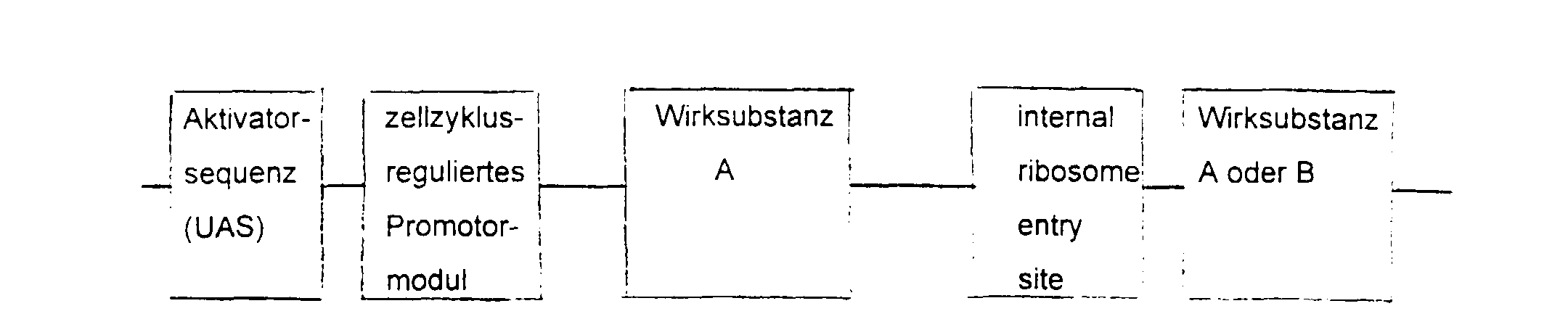
Ein derartiger Wirkstoff weist je nach Kombination additive (A+A, A+B1) oder synergistische Wirkung im Sinne der Erfindung auf.Depending on the combination, such an active ingredient has additives (A + A, A + B1) or synergistic effect in the sense of the invention.
So können beispielsweise für die Therapie von Viruserkrankungen zwei gleiche oder zwei unterschiedliche antivirale Wirksubstanzen miteinander kombiniert werden.For example, two of the same can be used for the therapy of viral diseases or two different antiviral active substances combined with each other become.
Bei der Prophylaxe von Infektionserkrankungen können mehrere Wirksubstanzen, die für unterschiedliche Antigene eines Infektionserregers oder unterschiedlicher Infektionserreger kodieren, miteinander kombiniert werden. Des weiteren kann die Wirksubstanz, die für das Antigen eines Infektionserregers kodiert, kombiniert werden mit einer Wirksubstanz, die kodiert für ein Cytokin oder einen Cytokinrezeptor.In the prophylaxis of infectious diseases, several can Active substances for different antigens of an infectious agent or code different infectious agents, combined with each other become. Furthermore, the active substance responsible for the antigen of a Infectious agents are coded, combined with an active substance that encodes a cytokine or a cytokine receptor.
Die sich so (nach Injektion des Wirkstoffes) gleichzeitig mit dem Infektionserregerantigen bildenden Cytokine oder Cytokinrezeptoren können Einfluß auf die Art und Stärke der sich entwickelnden Immunreaktion nehmen.Which is (after injection of the active ingredient) simultaneously with the Infectious agent-producing cytokines or cytokine receptors can Influence the type and strength of the developing immune response.
DNA-Sequenzen für Cytokine und Cytokinrezeptoren, welche die humorale Immunreaktion verstärken, sind bereits unter 6.2.d) beschrieben, solche zur Verstärkung der zellulären Immunreaktion unter 6.2.a) und 6.2.c).DNA sequences for cytokines and cytokine receptors, which the humoral Enhance immune response have already been described under 6.2.d), those for Enhancement of the cellular immune response under 6.2.a) and 6.2.c).
DNA-Sequenzen für Cytokine, welche die Immunreaktion insgesamt verstärken, sind beispielsweise:
- IL-1α
(Fenton, Int. J. Immunopharm. 14, 401 (1992), Furntani et al., Nucl. Acids Res. 14, 3167 (1986), Lafage et al., Blood 73, 104 (1989), March et al., Nature 315, 641 (1985)) - IL-1β
(Bensi et al., Gene 52, 95 (1987), Auron et al., PNAS 81, 7907 (1984), Clark et al., Nucl. Acids Res. 14, 7897 (1986)) - IL-2
(Fletscher et al., Lymphok. Res. 6, 45 (1987), Matsui et al., Lymphokines 12, 1 (1985), Tanaguchi et al., Nature 302, 305 (1983)) - GM-CSF
(Gough et al., Nature 309, 763 (1984), Nicola et al., J. Biol. Chem. 254, 5290 (1979), Wong et al., Science 228, 810 (1985))
- IL-1α
(Fenton, Int. J. Immunopharm. 14 , 401 (1992), Furntani et al., Nucl. Acids Res. 14 , 3167 (1986), Lafage et al., Blood 73 , 104 (1989), March et al. , Nature 315 , 641 (1985)) - IL-1β
(Bensi et al., Gene 52 , 95 (1987), Auron et al., PNAS 81 , 7907 (1984), Clark et al., Nucl. Acids Res. 14 , 7897 (1986)) - IL-2
(Fletscher et al., Lymphok. Res. 6 , 45 (1987), Matsui et al., Lymphokines 12 , 1 (1985), Tanaguchi et al., Nature 302 , 305 (1983)) - GM-CSF
(Gough et al., Nature 309 , 763 (1984), Nicola et al., J. Biol. Chem. 254, 5290 (1979), Wong et al., Science 228 , 810 (1985))
Zur Therapie von Infektionserkrankungen gehören zu den Liganden Antikörper oder Antikörperfragmente, gerichtet gegen die Infektionserreger. Beispielsweise sind dies bei Virusinfektionen die Virusantigene exprimiert auf der Zellmembran von virusinfizierten Zellen.The ligands for the treatment of infectious diseases include antibodies or antibody fragments directed against the infectious agent. For example, in the case of virus infections, these are the virus antigens expressed on the cell membrane of virus-infected cells.
Derartige Antikörper sind beispielsweise für mit folgenden Viren infizierte Zellen beschrieben worden:
- HBV (Shonval et al., PNAS USA 79, 650 (1982), Intercell. Intracell.
Comm. 2, 221 (1986), Klein et al.,
Virus Genes 5, 157 (1991)) - HCV (Takahashi et al., Virol. 191, 431 (1992))
- HSV (Sanchez-Pescador et al., J. Infect. dis. 166, 623 (1992))
- HPV (Doorbar et al., Virol. 187, 353 (1992))
- HIV (Nishino et al.,
Vaccine 10, 677 (1992)) - EBV (Thorley-Lawson et al., Cell 30, 415 (1982))
- HTLV (Robert-Garoff et al., J. Virol. 53, 214 (1985), Matsushita et al., J. Virol. 62, 2107 (1988)).
- HBV (Shonval et al., PNAS USA 79 , 650 (1982), Intercell. Intracell. Comm. 2, 221 (1986), Klein et al.,
Virus Genes 5 , 157 (1991)) - HCV (Takahashi et al., Virol. 191 , 431 (1992))
- HSV (Sanchez-Pescador et al., J. Infect. Dis. 166 , 623 (1992))
- HPV (Doorbar et al., Virol. 187 , 353 (1992))
- HIV (Nishino et al.,
Vaccine 10 , 677 (1992)) - EBV (Thorley-Lawson et al., Cell 30 , 415 (1982))
- HTLV (Robert-Garoff et al., J. Virol. 53 , 214 (1985), Matsushita et al., J. Virol. 62 , 2107 (1988)).
Desweiteren gehören zu den Liganden auch monoklonale oder polyklonale Antikörper oder Antikörperfragmente, die mit ihren konstanten Domänen an Fc-γ- oder -Rezeptoren von Immunzellen binden (Rojanasakul et al., Pharm. Res. 11, 1731 (1994)).Furthermore, the ligands also include monoclonal or polyclonal antibodies or antibody fragments which bind with their constant domains to Fc-γ or receptors of immune cells (Rojanasakul et al., Pharm. Res. 11 , 1731 (1994)).
Die murinen monoklonalen Antikörper sind bevorzugt in humanisierter Form einzusetzen. Die Humanisierung erfolgt in der von Winter et al. (Nature 349, 293 (1991)) und Hoogenbooms et al. (Rev. Tr. Transfus. Hemobiol. 36, 19 (1993)) dargestellten Weise. Antikörperfragmente werden entsprechend dem Stand der Technik hergestellt, beispielsweise in der von Winter et al. (Nature 349, 293 (1991), Hoogenboom et al. (Rev. Tr. Transfus. Hemobiol. 36, 19 (1993), Girol (Mol. Immunol. 28, 1379 (1991) und Huston et al. (Int. Rev. Immunol. 10, 195 (1993) beschriebenen Weise.The murine monoclonal antibodies are preferably used in humanized form. Humanization takes place in the method described by Winter et al. (Nature 349 , 293 (1991)) and Hoogenbooms et al. (Rev. Tr. Transfus. Hemobiol. 36 , 19 (1993)). Antibody fragments are produced according to the state of the art, for example in the Winter et al. (Nature 349 , 293 (1991), Hoogenboom et al. (Rev. Tr. Transfus. Hemobiol. 36 , 19 (1993), Girol (Mol. Immunol. 28 , 1379 (1991) and Huston et al. (Int. Rev Immunol., 10: 195 (1993).
Zu den Liganden gehören des weiteren alle Substanzen, welche an Membranstrukturen oder Membranrezeptoren auf der Oberfläche von virusinfizierten Zellen binden. Beispielsweise gehören hierzu Wachstumsfaktoren, wie Zytokine, EGF, TGF, FGF oder PDGF, oder deren Fragmente bzw. Teilsequenzen von ihnen, die an Rezeptoren exprimiert durch derartige Zellen binden.The ligands also include all substances which Membrane structures or membrane receptors on the surface of bind virus-infected cells. For example, this includes Growth factors such as cytokines, EGF, TGF, FGF or PDGF, or their Fragments or partial sequences of them, which are expressed by receptors bind such cells.
Hierzu gehören des weiteren Liganden, welche an Zellmembranstrukturen
binden, welche selektiv sind für bestimmte Gewebe. Hierzu zählen
beispielsweise:
Diese Liganden und Membranstrukturen sind übersichtlich bei Perales et al., Eur. J. Biochem. 226, 255 (1994) beschrieben.These ligands and membrane structures are clear from Perales et al., Eur. J. Biochem. 226 , 255 (1994).
Für die Prophylaxe von Infektionserkrankungen sind als Liganden alle Substanzen geeignet, welche an Zellmembranstrukturen von Makrophagen und/oder Lymphozyten binden. Derartige Liganden wurden bereits im Abschnitt 6.4. beschrieben.All ligands are for the prevention of infectious diseases Suitable substances that are attached to cell membrane structures of macrophages and / or bind lymphocytes. Such ligands have already been discussed in section 6.4. described.
Als Liganden für virale und nicht-virale Vektoren, beispielsweise in kolloidalen Dispersionen oder in Polylysin-Ligand-Komplexen werden Substanzen bevorzugt, welche an die Oberfläche von Makrophagen und/oder Lymphozyten spezifisch binden. Derartige Liganden sind bereits im Abschnitt 6.4. beschrieben worden.As ligands for viral and non-viral vectors, for example in colloidal Dispersions or in polylysine-ligand complexes become substances preferred which to the surface of macrophages and / or lymphocytes bind specifically. Such ligands are already in section 6.4. have been described.
Diese Liganden sind Bestandteil der Vektoren. Im Sinne dieser Erfindung können jedoch auch Liganden den Vektoren zugemischt werden. Für diese Mischung sind besonders Liganden zu verwenden, welche in der Lage sind, Makrophagen und/oder Lymphozyten zu aktivieren. Hierzu gehören beispielsweise:
- Cytokine wie beispielsweise IL-1α, IL-1β, IL-2, IL-3, IL-4, IL-5, IL-6, IL-10,
IL-12, IFN-γ, GM-CSF oder M-CSF
(Hadden, Int. J. Immunopharm. 16, 703 (1994)) - lösliche Cytokinrezeptoren wie beispielsweise IL-4-Rezeptor.
- Cytokines such as IL-1α, IL-1β, IL-2, IL-3, IL-4, IL-5, IL-6, IL-10, IL-12, IFN-γ, GM-CSF or M-CSF
(Hadden, Int. J. Immunopharm. 16 , 703 (1994)) - soluble cytokine receptors such as IL-4 receptor.
Alternativ oder zusätzlich können Adjuvantien hinzugemischt werden. Hierzu gehören beispielsweise:
- synthetische Adjuvantien
(Übersichten bei: Parant, Int. J. Immunopharm. 16, 445 (1994), Cernescu, Int. J. Immunopharm. 16, 369 (1994)) - Liposomen
(Übersichten bei: Alving, J. Immunol.Methods 140, 1 (1991) und BBA 1113, 307 (1992), Sato und Sanamoto, Prog. Lipid Res. 31, 345 (1992)) - Lipopolysaccharide oder Lipid A
(Übersicht bei: Alving, Immunobiol. 187, 430 (1993)) - bioabbaubare Polymere wie beispielsweise
- Poly (DL-Lactide-Co-Glycolide)
(Eldridge et al., Infect. Immun. 59, 2978 (1991)) - Pseudolatexes
(Coffin und McGiuity, Pharmaceut. Res. 9, 200 (1992))
- Poly (DL-Lactide-Co-Glycolide)
- Muramyldipeptide
(Morin et al., Int. J. Immunopharm. 16, 451 (1994)).
- synthetic adjuvants
(Reviews at: Parant, Int. J. Immunopharm. 16 , 445 (1994), Cernescu, Int. J. Immunopharm. 16 , 369 (1994)) - Liposomes
(Reviews by: Alving, J. Immunol.Methods 140 , 1 (1991) and BBA 1113 , 307 (1992), Sato and Sanamoto, Prog. Lipid Res. 31 , 345 (1992)) - Lipopolysaccharide or Lipid A
(Overview at: Alving, Immunobiol. 187 , 430 (1993)) - biodegradable polymers such as
- Poly (DL-lactide-co-glycolide)
(Eldridge et al., Infect. Immun. 59 , 2978 (1991)) - Pseudolatexes
(Coffin and McGiuity, Pharmaceut. Res. 9 , 200 (1992))
- Poly (DL-lactide-co-glycolide)
- Muramyl dipeptides
(Morin et al., Int. J. Immunopharm. 16 , 451 (1994)).
Desweiteren ist es im Sinne der Erfindung, Substanzen den Vektoren zuzumischen, welche sie für eine Aufnahme über die Schleimhaut und für beispielsweise orale Immunisierung geeignet machen.Furthermore, it is within the meaning of the invention, substances the vectors to mix, which they for an absorption over the mucous membrane and for make oral immunization suitable, for example.
Derartige Substanzen und Formulierungen wurden von Walker (Vaccine 12, 387 (1994)) übersichtlich dargestellt.Such substances and formulations have been clearly presented by Walker (Vaccine 12 , 387 (1994)).
Die Herstellung des erfindungsgemäßen Wirkstoffes wird anhand folgender Beispiele näher beschrieben:The preparation of the active ingredient according to the invention is based on the following Examples described in more detail:
Der HIV-LTR-TAR Promotor (Position ≤ -453 bis ≥ +80, (Rosen et al., Cell
41, 813 (1985)) wird an seinem 3' Ende mit dem 5'-Terminus des CDE-CHR-Inr
Moduls des humanen cdc25C-Gens (Position ≤ -20 bis ≥ +121, Lucibello
et al., EMBO J., 14, 132 (1995)) verknüpft (Fig. 13). Die Verknüpfung erfolgt
mit Hilfe von dem Fachmann bekannten und käuflichen Enzymen.The HIV-LTR-TAR promoter (position ≤ -453 to ≥ +80, (Rosen et al.,
Die beschriebene chimäre Promotormodul-Transkriptionseinheit wird an ihren 3' Enden mit dem 5'-Terminus einer DNA, die den kompletten kodierenden Bereich des Interferon α-1 (Position ≤ -69 bis ≥ +501, (Streuli et al., Science 209, 1343 (1980)) enthält, verknüpft. Diese DNA enthält auch die für eine Sekretion notwendige Signalsequenz. Transkriptionskontrolleinheiten und die DNA für Interferonα-1 werden in pUC19/19 oder Bluescript-abgeleiteten Plasmidvektoren einkloniert, die direkt oder in kolloidalen Dispersionssystemen für eine in vivo Applikation genutzt werden können. Alternativ können die chimären Gene in virale Vektoren oder andere geeignete Vektoren transferiert und injiziert werden.The described chimeric promoter module transcription unit is at its 3 'ends with the 5' terminus of a DNA which encompasses the entire coding region of the interferon α-1 (position ≤ -69 to ≥ +501, (Streuli et al., Science 209 , 1343 (1980)) This DNA also contains the signal sequence necessary for secretion. Transcription control units and the DNA for interferonα-1 are cloned into pUC19 / 19 or Bluescript-derived plasmid vectors which are used directly or in colloidal dispersion systems for in vivo Alternatively, the chimeric genes can be transferred into viral vectors or other suitable vectors and injected.
Die, wie unter a) beschriebene, HIV-LTR-TAR-CDE-CHR-Inr-Transkriptionseinheit wird an ihrem 3' Ende mit dem 5' Ende der DNA für das Interferonα-1 (Position ≤ -69 bis ≥ +501; Streuli et al., Science 209, 1343 (1980)) verknüpft. Die Verknüpfung erfolgt mit Hilfe von dem Fachmann bekannten und käuflichen Enzymen.The HIV-LTR-TAR-CDE-CHR-Inr transcription unit, as described under a), is at its 3 'end with the 5' end of the DNA for the interferonα-1 (position ≤ -69 to ≥ +501; Streuli et al., Science 209 , 1343 (1980)). The linkage takes place with the aid of enzymes known and commercially available to the person skilled in the art.
Das 3' Ende der DNA für Interferon∝-1 wird nunmehr verknüpft mit dem 5'
Ende der cDNA der internal ribosome entry site (Position ≤ 140 bis ≥ 630;
Pelletier und Sonenberg, Nature 334, 320 (1988)) und ausschließend deren
3' Ende mit dem 5' Ende der DNA für das Rev-bindende Protein (RbP9-27)
verknüpft (Position ≤ 1 bis ≥ 378, Reid et al., PNAS USA 86, 840 (1989))
(siehe Fig. 13). Dieser so hergestellte Wirkstoff wird anschließend in
puc18/19 oder in Bluescript-abgeleiteten Plasmidvektoren einkloniert, die
direkt oder in kolloidalen Dispersionssystemen für eine in vivo Applikation
genutzt werden können. Alternativ können die chimären Gene in virale
Vektoren oder andere geeignete Vektoren transferiert und injiziert werden.The 3 'end of the DNA for interferon∝-1 is now linked to the 5' end of the cDNA of the internal ribosome entry site (position ≤ 140 to ≥ 630; Pelletier and Sonenberg, Nature 334 , 320 (1988)) and excluding the third 'End linked to the 5' end of the DNA for the Rev-binding protein (RbP9-27) (
Als Aktivatorsequenz (UAS = upstream activator sequence) ist eine Nukleotidsequenz (Promotor- oder Enhancersequenz) vorgesehen, mit der Transkriptionsfaktoren, gebildet oder aktiv in Leukämiezellen, interagieren.As activator sequence (UAS = upstream activator sequence) is one Nucleotide sequence (promoter or enhancer sequence) provided with the Transcription factors, formed or active in leukemia cells, interact.
Im Sinne dieser Erfindung zählen zu den bevorzugten Aktivatorsequenzen jedoch genregulatorische Sequenzen bzw. Elemente aus Genen, die besonders in Leukämiezellen gebildete Proteine kodieren.For the purposes of this invention, the preferred activator sequences are however, gene regulatory sequences or elements from genes that encode proteins formed especially in leukemia cells.
Hierzu zählen beispielsweise die in nachfolgenden Literaturzitaten aufgeführten Promotorsequenzen für Gene, die für folgende Proteine kodieren:
- c-myc
(Bentley et al., Mol. Cell. Biol. 6, 3481 (1986), Lang et al.,Oncogene 6, 2067 (1991), Meulia et al., Mol. Cell. Biol. 12, 4590 (1992), Desjardins, Mol. Cell. Biol. 13, 5710 (1993)) - HSP-70
(Taira et al., BBA 1130, 166 (1992)) - bcl-1/cyclin D-1
(Herber et al.,Oncogene 9, 1295 (1994)) - bcl-2
(Young et al., Mol. Cell. Biol. 13, 3686 (1993)) - IL-6
(Droogmans et al., DNA-Sequence 3, 115 (1992), Mori et al., Blood 84, 2904 (1994), Liberman et al., Mol. Cell. Biol. 10, 2327 (1990), Ishiki et al., Mol. Cell. Biol. 10, 2757 (1990)) - 11-10
(Kim et al., J. Immunol. 148, 3618 (1992), Kube et al., Cytokine 7, 1 (1995), Platzer et al., DNA-Sequence 4, 399 (1994), Kube et al., Cytokine 7, 1 (1995)) - NFα, TNFβ
(Sidhu et al., Pharmac. Ther. 57, 79 (1993), Vilcek et al., J. Biol. Chem. 266, 7313 (1991), Tahashiba et al., Gene 131, 307 (1993), Nedwin et al., Nucl. Acids Res. 13, 6361 (1985), Paul et al., J. Virol. 64, 5412 (1990), Shakhov et al., J. Exp. Med. 171, 35 (1990), van der Ake et al., Nucleic Acids Res. 21, 5636 (1993)).
- c-myc
(Bentley et al., Mol. Cell. Biol. 6 , 3481 (1986), Lang et al.,Oncogene 6 , 2067 (1991), Meulia et al., Mol. Cell. Biol. 12 , 4590 (1992), Desjardins, Mol. Cell. Biol. 13, 5710 (1993)) - HSP-70
(Taira et al., BBA 1130 , 166 (1992)) - bcl-1 / cyclin D-1
(Herber et al.,Oncogene 9 , 1295 (1994)) - bcl-2
(Young et al., Mol. Cell. Biol. 13 , 3686 (1993)) - IL-6
(Droogmans et al.,DNA Sequence 3 , 115 (1992), Mori et al., Blood 84, 2904 (1994), Liberman et al., Mol. Cell. Biol. 10 , 2327 (1990), Ishiki et al ., Mol. Cell. Biol. 10 , 2757 (1990)) - 11-10
(Kim et al., J. Immunol. 148 , 3618 (1992), Kube et al., Cytokine 7 , 1 (1995), Platzer et al.,DNA Sequence 4 , 399 (1994), Kube et al., Cytokine 7 , 1 (1995)) - NFα, TNFβ
(Sidhu et al., Pharmac. Ther. 57 , 79 (1993), Vilcek et al., J. Biol. Chem. 266 , 7313 (1991), Tahashiba et al., Gene 131 , 307 (1993), Nedwin et al., Nucl. Acids Res. 13 , 6361 (1985), Paul et al., J. Virol. 64 , 5412 (1990), Shakhov et al., J. Exp. Med. 171, 35 (1990), van Ake et al., Nucleic Acids Res. 21 , 5636 (1993)).
Desweiteren gehören hierzu Bindungssequenzen für Proteine, gebildet von folgenden Genen:
- HOX-11
(Dear et al., PNAS USA 90, 4431 (1990)) - BCR-Abl
(Zhu et al., Nucl. Acid Res. 18, 7119 (1990), Shah et al., Mol. Cell. Biol. 11, 1854 (1991)) - E2A-PBX-1
(Monica et al., Mol. Cell. Biol. 14, 8304 (1994), Numata et al., Leukemia 7, 1441 (1993), von Dijk et al., PNAS USA 90, 6061 (1993)) - PML-RARA
(Promyelocytic Leukemia - Retinoic Acid Receptor) (Potter et al., Leukemia 7, 1302 (1993), Yoshida et al., Genes, Chromosomes Cancer 12, 37 (1995), Brand et al., Nucl. Acids Res. 18, 6799 (1990)) - c-myc
c-myc-Proteine binden an und aktivieren Multimere der als Myc E-Box bezeichneten Nukleotidsequenz (5'-GGAAGCAGACCACGTGGTCT-GCTTCC-3')
(Blackwood und Eisenman, Science 251, 1211 (1991))
- HOX-11
(Dear et al., PNAS USA 90 , 4431 (1990)) - BCR OJ
(Zhu et al., Nucl. Acid Res. 18 , 7119 (1990), Shah et al., Mol. Cell. Biol. 11 , 1854 (1991)) - E2A-PBX-1
(Monica et al., Mol. Cell. Biol. 14 , 8304 (1994), Numata et al., Leukemia 7 , 1441 (1993), by Dijk et al., PNAS USA 90 , 6061 (1993)) - PML-RARA
(Promyelocytic Leukemia - Retinoic Acid Receptor) (Potter et al., Leukemia 7 , 1302 (1993), Yoshida et al., Genes, Chromosomes Cancer 12 , 37 (1995), Brand et al., Nucl. Acids Res. 18 , 6799 (1990)) - c-myc
c-myc proteins bind and activate multimers of the nucleotide sequence called Myc E-Box (5'-GGAAGCAGACCACGTGGTCT-GCTTCC-3 ')
(Blackwood and Eisenman, Science 251 , 1211 (1991))
Als Wirksubstanz im Sinne der Erfindung ist eine DNA-Sequenz zu verstehen, deren exprimiertes Protein die Proliferation von Zellen, insbesondere auch von Leukämiezellen, inhibiert. Zu diesen Zellzyklusinhibitoren gehören beispielsweise die DNA-Sequenzen für inhibitorische zytostatische und ztyotoxische Proteine und Enzyme, wie sie bereits im Abschnitt 6.2. e-g) beschrieben wurden.A DNA sequence is to be understood as an active substance in the sense of the invention, whose expressed protein is the proliferation of cells, especially of Leukemia cells, inhibited. These include cell cycle inhibitors for example the DNA sequences for inhibitory and cytostatic ztyotoxic proteins and enzymes, as already described in section 6.2. e-g) have been described.
Als Zellzyklusinhibitor ist des weiteren eine DNA-Sequenz zu verstehen, welche ein Protein exprimiert, welches direkt oder indirekt eine zytostatische oder zytotoxische Wirkung auf Leukämien aufweist. Zu derartigen Proteinen zählen beispielsweise:
- IL-1α
(Fenton, Int. J. Immunopharm. 14, 401 (1992), Furntani et al., Nucl. Acids Res. 14, 3167 (1986), Lafage et al., Blood 73, 104 (1989), March et al., Nature 315, 641 (1985)) - IL-1β
(Bensi et al., Gene 52, 95 (1987), Auron et al., PNAS 81, 7907 (1984), Clark et al., Nucl. Acids Res. 14, 7897 (1986)) - IL-2
(Fletscher et al., Lymphok. Res. 6, 45 (1987), Matsui et al., Lymphokines 12, 1 (1985), Tanaguchi et al., Nature 302, 305 (1983)) - IL-4
(Lee et al., PNAS 83, 2061 (1986); Paul, Blood 77, 1859 (1991), Yokota et al., PNAS USA 83, 5894 (1986), von Leuven et al., Blood 73, 1142 (1989), Arai et al., J. Immunol. 142, 274 (1989)) - IL-10
(Vieira et al., PNAS USA 88, 1172 (1991), Moore et al., Science 248, 1230 (1990), Kim et al., J. Immunol. 148, 3618 (1992)) - IL-12
(Gubler et al., PNAS USA 88, 4143 (1991), Wolf et al., J. Immunol. 146, 3074 (1991), Kobayashi et al., J. Exp. Med. 170, 827 (1989), Gately et al., J. Immunol. 147, 874 (1991), Schoenhaut et al., J. Immunol. 148, 3433 (1992), - Interferone, wie beispielsweise
- IFNα (Henco et al., J. Mol. Biol. 185, 227 (1985), Pestka et al., Annu. Rev. Biochem. 56, 727 (1987), Weissmann et al., Phil. Trans. R. Soc. Lond. B299, 7 (1982), Goeddel et al., Nature 290, 20 (1981))
- IFNβ (Sen et al., J. Biol. Chem. 267, 5017 (1992), Mark et al. EP 192.811, EP 234.599, US 4588.585
- IFN-γ(Gray et al., Nature 295, 503 (1982), Yip et al., PNAS USA 79,
- Leukemia inhibitory Factor (LIF)
(Metcalf, Int. J. Cell Clon. 9, 85 (1991), Sutherland et al., Leuk. 3, 9 (1989), Gough et al.,PNAS USA 85, 2623 (1988), Gough et al., Ciba Found. Symp. 167, 24 (1992), Stahl et al., J. Biol. Chem. 265, 8833 (1990), Rathjan et al., Cell 62, 1105 (1990)) - TNF
(Porter,TiBTech 9, 158 (1991); Sidhu et al., Pharmac. Ther. 57, 79 (1993)) im speziellen- TNFα (Beutler et al.,
Nature 320, 584 (1986), Kriegler et al., Cell 53, 45 (1988)) - TNFβ (Gray et al., Nature 312, 721 (1984), Li et al., J. Immunol. 138, 4496 (1987), Aggarwal et al., J. Biol. Chem. 260, 2334 (1985))
- TNFα (Beutler et al.,
- TGFβ
(Kehrl et al., J. Immunol. 137, 3855 (1986), J. Exp. Med. 163, 1037 (1986), Ten Dikje et al.,PNAS USA 85, 4715 (1988), Derynck et al., EMBO J. 7, 3737 (1988), Massague, Ann. Rev. Cell Biol. 6, 597 (1990), Kondiah et al., J. Biol. Chem. 265, 1089 (1990), Garnier et al., J. Mol. Biol. 120, 97 1978)) - Oncostatin M
(Brown et al., J. Immunol. 147, 2175 (1991); Grove et al., J. Biol. Chem. 266, 18194 (1991); Hamilton et al., Biochem. Biophys. Res. Commun. 180, 652 (1991), Malik et al., Mol. Cell. Biol. 9, 2847 (1989), Kallstad et al., J. Biol. Chem. 266, 8940 (1991)
- IL-1α
(Fenton, Int. J. Immunopharm. 14 , 401 (1992), Furntani et al., Nucl. Acids Res. 14 , 3167 (1986), Lafage et al., Blood 73 , 104 (1989), March et al. , Nature 315, 641 (1985)) - IL-1β
(Bensi et al., Gene 52 , 95 (1987), Auron et al., PNAS 81 , 7907 (1984), Clark et al., Nucl. Acids Res. 14 , 7897 (1986)) - IL-2
(Fletscher et al., Lymphok. Res. 6 , 45 (1987), Matsui et al., Lymphokines 12 , 1 (1985), Tanaguchi et al., Nature 302 , 305 (1983)) - IL-4
(Lee et al., PNAS 83 , 2061 (1986); Paul, Blood 77 , 1859 (1991), Yokota et al., PNAS USA 83 , 5894 (1986), from Leuven et al., Blood 73 , 1142 (1989 ), Arai et al., J. Immunol. 142 , 274 (1989)) - IL-10
(Vieira et al., PNAS USA 88 , 1172 (1991), Moore et al., Science 248, 1230 (1990), Kim et al., J. Immunol. 148, 3618 (1992)) - IL-12
(Gubler et al., PNAS USA 88 , 4143 (1991), Wolf et al., J. Immunol. 146 , 3074 (1991), Kobayashi et al., J. Exp. Med. 170 , 827 (1989), Gately et al., J. Immunol. 147, 874 (1991), Schoenhaut et al., J. Immunol. 148 , 3433 (1992), - Interferons such as
- IFNα (Henco et al., J. Mol. Biol. 185 , 227 (1985), Pestka et al., Annu. Rev. Biochem. 56 , 727 (1987), Weissmann et al., Phil. Trans. R. Soc Lond. B299, 7 (1982), Goeddel et al., Nature 290 , 20 (1981))
- IFNβ (Sen et al., J. Biol. Chem. 267 , 5017 (1992), Mark et al. EP 192.811, EP 234.599, US 4588,585
- IFN-γ (Gray et al., Nature 295 , 503 (1982), Yip et al., PNAS USA 79 ,
- Leukemia inhibitory factor (LIF)
(Metcalf, Int. J. Cell Clon. 9 , 85 (1991), Sutherland et al., Leuk. 3 , 9 (1989), Gough et al.,PNAS USA 85 , 2623 (1988), Gough et al., Ciba Found. Symp. 167 , 24 (1992), Stahl et al., J. Biol. Chem. 265, 8833 (1990), Rathjan et al., Cell 62 , 1105 (1990)) - TNF
(Porter,TiBTech 9 , 158 (1991); Sidhu et al., Pharmac. Ther. 57 , 79 (1993)) in particular- TNFα (Beutler et al.,
Nature 320 , 584 (1986), Kriegler et al., Cell 53 , 45 (1988)) - TNFβ (Gray et al., Nature 312, 721 (1984), Li et al., J. Immunol. 138 , 4496 (1987), Aggarwal et al., J. Biol. Chem. 260 , 2334 (1985))
- TNFα (Beutler et al.,
- TGFβ
(Kehrl et al., J. Immunol. 137 , 3855 (1986), J. Exp. Med. 163 , 1037 (1986), Ten Dikje et al.,PNAS USA 85 , 4715 (1988), Derynck et al., EMBO J. 7 , 3737 (1988), Massague, Ann. Rev. Cell Biol. 6 , 597 (1990), Kondiah et al., J. Biol. Chem. 265 , 1089 (1990), Garnier et al., J Mol. Biol. 120 , 97 1978)) - Oncostatin M
(Brown et al., J. Immunol. 147 , 2175 (1991); Grove et al., J. Biol. Chem. 266 , 18194 (1991); Hamilton et al., Biochem. Biophys. Res. Commun. 180 , 652 (1991), Malik et al., Mol. Cell. Biol. 9 , 2847 (1989), Kallstad et al., J. Biol. Chem. 266 , 8940 (1991)
Als Wirksubstanz im Sinne der Erfindung können jedoch auch DNA-Sequenzen von Fusionsproteinen zwischen den aufgeführten Cytokinen, Wachstumsfaktoren oder dem extrazellulären Teil der Rezeptoren zum einen und dem Fc-Teil des menschlichen Immunglobulins zum anderen Verwendung finden. Derartige DNA-Sequenzen und ihre Herstellung wurden in der EP 0464 633 A1 beschrieben.However, DNA sequences can also be used as active substance in the sense of the invention fusion proteins between the cytokines listed, Growth factors or the extracellular part of the receptors on the one hand and the Fc portion of human immunoglobulin for other use Find. Such DNA sequences and their preparation have been described in the EP 0464 633 A1.
Die Auswahl des Zellzyklusinhibitors ist abhängig vom Typ der Leukämie.
- So sind IL-4 und IL-6 besonders antiproliferativ wirksam bei der B-CLL (von Kooten et al., Leuk. Lymph. 12, 27 (1993)).
- TGFβ inhibiert bevorzugt die Lymphozytenproliferation (Kehrl et al., J. Immunol. 143, 1868 (1989)).
- TNF, insbesondere TNF∝, inhibiert myeloische Leukämiezellen (Porter, FEMS Microbiol. Immunol. 64, 193 (1990)) und Lymphomzellen (Sidhu et al., Pharm. Therp. 57, 79 (1993)).
- IFN-γ inhibiert Myelomzellen (Portier et al., Blood 81, 3076 (1993)).
- IFNα inhibiert die Haarzell-Leukämie (Gutterman, PNAS USA 91, 1198
(1994)), wie auch Non-Hodgkin Lymphome (Solal-Celigny et al, New Engl. J.
Med. 329, 1608 (1993), CLL, T-CLL, CML und ALL (Gutterman, PNAS USA
91, 1198 (1994), Dorr,
Drugs 45, 177 (1993)). - LIF inhibiert die Proliferation von CML Zellen (Metcalf, Int. J. Cell Clon. 9, 95 (1991)).
- IL-10 induziert Apoptose in B-CLL-Zellen (Fluchinger et al., J. Exp. Med. 179, 91(1994)).
- For example, IL-4 and IL-6 are particularly antiproliferative in B-CLL (von Kooten et al., Leuk. Lymph. 12 , 27 (1993)).
- TGFβ preferentially inhibits lymphocyte proliferation (Kehrl et al., J. Immunol. 143 , 1868 (1989)).
- TNF, especially TNF∝, inhibits myeloid leukemia cells (Porter, FEMS Microbiol. Immunol. 64 , 193 (1990)) and lymphoma cells (Sidhu et al., Pharm. Therp. 57 , 79 (1993)).
- IFN-γ inhibits myeloma cells (Portier et al., Blood 81 , 3076 (1993)).
- IFNα inhibits hairy cell leukemia (Gutterman, PNAS USA 91 , 1198 (1994)) as well as non-Hodgkin lymphomas (Solal-Celigny et al, New Engl. J. Med. 329 , 1608 (1993), CLL, T- CLL, CML and ALL (Gutterman, PNAS USA 91 , 1198 (1994), Dorr,
Drugs 45 , 177 (1993)). - LIF inhibits the proliferation of CML cells (Metcalf, Int. J. Cell Clon. 9 , 95 (1991)).
- IL-10 induces apoptosis in B-CLL cells (Fluchinger et al., J. Exp. Med. 179 , 91 (1994)).
Andererseits können inbesondere IL-1, IL-2, IL-4, IL-12 oder Interferone durch Aktivierung von Immunzellen, benachbart den transduzierten Leukämiezellen eine Entzündungsreaktion auslösen (Fenton et al., Int. J. Immunopharm. 14, 401 (1992), Janssen et al., Cancer Immunol. Immunother. 39, 207 (1994), Kirchner, DMW 111, 64 (1986), Paul, Blood 77, 1859 (1991), Gateley et al., Cancer Invest. 11 500 (1993)), welche die Leukämiezellen abtötet.On the other hand, in particular IL-1, IL-2, IL-4, IL-12 or interferons by activating immune cells adjacent to the transduced leukemia cells can trigger an inflammatory reaction (Fenton et al., Int. J. Immunopharm. 14 , 401 (1992) , Janssen et al., Cancer Immunol. Immunother. 39 , 207 (1994), Kirchner, DMW 111, 64 (1986), Paul, Blood 77 , 1859 (1991), Gateley et al., Cancer Invest. 11 500 (1993 )), which kills the leukemia cells.
Voraussetzung für die Verwendung der DNA-Sequenz eines der aufgeführten Cytokine als Zellzyklusinhibitor im Wirkstoff ist jedoch, daß vor Gabe des Wirkstoffes geprüft wurde, daß für die Leukämiezellen des jeweiligen Patienten der ausgewählte Zellzyklusinhibitor kein Wachstumsfaktor darstellt.Prerequisite for using the DNA sequence one of the listed However, cytokines as a cell cycle inhibitor in the active ingredient is that before administration of the Active ingredient was tested for the leukemia cells of the respective patient the selected cell cycle inhibitor is not a growth factor.
Gegenstand der Erfindung ist des weiteren ein Wirkstoff, in welchem eine
Kombination der DNA-Sequenzen von zwei gleichen Zellzyklusinhibitoren (A,A)
oder zwei unterschiedlichen Zellzyklusinhibitoren (A,B) vorliegt. Zur Expression
beider DNA-Sequenzen ist vorzugsweise die cDNA einer "internal ribosome
entry site" (IRES) als regulatorisches Element zwischengeschaltet.

Derartige IRES wurden beispielsweise von Montford und Smith (TIB 11, 179
(1995), Kaufman et al., Nucl. Acids Res. 19, 4485 (1991), Morgan et al., Nucl.
Acids Res. 20, 1293 (1992), Dirks et al., Gene 128, 247 (1993), Pelletier und
Sonenberg, Nature 334, 320 (1988) und Sugitomo et al., BioTechn. 12, 694
(1994) beschrieben.
So kann die cDNA der IRES-Sequenz des Poliovirus (Position < 140 bis ≥ 630
des 5' UTR) zur Verknüpfung der DNA des Zellzyklusinhibitor A (am 3' Ende)
und der DNA des Zellzyklusinhibitors B (am 5' Terminus) verwendet werden.Such IRES have been described, for example, by Montford and Smith (TIB 11 , 179 (1995), Kaufman et al., Nucl. Acids Res. 19 , 4485 (1991), Morgan et al., Nucl. Acids Res. 20 , 1293 (1992) , Dirks et al., Gene 128 , 247 (1993), Pelletier and Sonenberg, Nature 334 , 320 (1988) and Sugitomo et al., BioTechn. 12 , 694 (1994).
Thus, the cDNA of the IRES sequence of the poliovirus (position <140 to ≥ 630 of the 5 'UTR) can be used to link the DNA of the cell cycle inhibitor A (at the 3' end) and the DNA of the cell cycle inhibitor B (at the 5 'terminus).
Ein derartiger Wirkstoff weist je nach Kombination additive (A+A, A+b1) oder synergistische Wirkung im Sinne der Erfindung auf.Depending on the combination, such an active ingredient has additives (A + A, A + b1) or synergistic effect in the sense of the invention.
Als Liganden für virale Vektoren oder nicht-virale Vektoren, beispielsweise in
Polylysin-Ligand-Konjugaten, werden Substanzen bevorzugt, welche an die
Oberfläche von Leukämiezellen binden. Hierzu gehören Antikörper oder Antikörperfragmente,
gerichtet gegen Membranstrukturen von Leukämiezellen.
Eine große Anzahl derartiger monoklonaler Antikörper sind bereits für
diagnostische und therapeutische Verfahren beschrieben worden (Übersichten
bei Kristensen, Danish Medical Bulletin 41, 52 (1994), Schranz, Therapia
Hungarica 38, 3 (1990), Drexler et al., Leuk. Res. 10, 279 (1986), Naeim, Dis.
Markers 7, 1 (1989), Stickney et al., Current Op. Oncol. 4, 847 (1992), Drexler
et al., Blut 57, 327 (1988), Freedman et al., Cancer Invest. 9, 69 (1991)). Je
nach Typ der Leukämie sind als Liganden beispielsweise folgende
monoklonale Antikörper oder deren antigenbindende Antikörperfragmente
geeignet:
-
Muroi et al., Blood 79, 713 (1992)
Caron et al., Cancer 73, 1049 (1994)
Tassone et al. Immunology Lett. 39, 137 (1994)
Non-Hodgkin Lymphoma
Okazaki et al., Blood 81, 84 (1993)
-
Muroi et al., Blood 79 , 713 (1992)
Caron et al., Cancer 73 , 1049 (1994)
Tassone et al. Immunology Lett. 39 , 137 (1994)
Non-Hodgkin lymphoma
Okazaki et al., Blood 81 , 84 (1993)
Die murinen monoklonalen Antikörper sind bevorzugt in humanisierter Form einzusetzen. Die Humanisierung erfolgt in der von Winter et al. (Nature 349, 293 (1991)) und Hoogenboom et al. (Rev. Tr. Transfus. Hemobiol. 36, 19 (1993)) dargestellten Weise. Antikörperfragmente werden entsprechend dem Stand der Technik hergestellt, beispielsweise in der von Winter et al., Nature 349, 293 (1991), Hoogenboom et al., Rev. Tr. Transfus. Hemobiol. 36, 19 (1993), Girol, Mol. Immunol. 28, 1379 (1991) oder Huston et al., Int. Rev. Immunol. 10, 195 (1993) beschriebenen Weise.The murine monoclonal antibodies are preferably used in humanized form. Humanization takes place in the method described by Winter et al. (Nature 349 , 293 (1991)) and Hoogenboom et al. (Rev. Tr. Transfus. Hemobiol. 36 , 19 (1993)). Antibody fragments are prepared according to the prior art, for example in the by Winter et al., Nature 349 , 293 (1991), Hoogenboom et al., Rev. Tr. Transfus. Hemobiol. 36 , 19 (1993), Girol, Mol. Immunol. 28 , 1379 (1991) or Huston et al., Int. Rev. Immunol. 10 , 195 (1993).
Zu den Liganden gehören desweiteren alle Wirkstoffe, welche an Membranstrukturen oder Membranrezeptoren von Leukämiezellen binden. Beispielsweise gehören hierzu Wachstumsfaktoren oder deren Fragmente bzw. Teilsequenzen von ihnen, die an Rezeptoren exprimiert durch Leukämiezellen binden.The ligands also include all active substances that are attached to membrane structures or bind membrane receptors of leukemia cells. For example this includes growth factors or their fragments or Partial sequences of them expressed at receptors by leukemia cells tie.
Derartige Wachstumsfaktoren wurden bereits beschrieben (Übersichten bei Cross et al., Cell 64, 271 (1991), Aulitzky et al., Drugs 48, 667 (1994), Moore, Clin. Cancer Res. 1, 3 (1995), Van Kooten et al., Leuk. Lymph. 12, 27 (1993)). Beispielsweise gehören zu ihnen:
- IFNα bei Non-Hodgkin Lymphomen
(Hiddemann et al., Blood Rev. 8, 225 (1994)) - IL-2, besonders bei T-Zell-Leukämien
(Waldmann, J. Nat. Cancer Inst. 81, 914 (1989), Kreitman et al., Int. J. Immunopharm. 14, 465 (1992) - FGF bei T-Zell-, monozytären, myeloiden, erythroiden und
megakaryoblastischen Leukämien (Armstrong et al., Cancer Res. 52, 2004 (1992) - TGFβ bei Leukämien
(Keller et al. J. Cell Biochem. 39, 79 (1989)) - Retinoide, z.B. "Retinoic acid" bei akuter promyelozytärer Leukämie
(Cornic et al., Anticancer Res. 14, 2339 (1994)).
- IFNα in non-Hodgkin's lymphoma
(Hiddemann et al., Blood Rev. 8 , 225 (1994)) - IL-2, especially in T cell leukemia
(Waldmann, J. Nat. Cancer Inst. 81 , 914 (1989), Kreitman et al., Int. J. Immunopharm. 14 , 465 (1992) - FGF in T cell, monocytic, myeloid, erythroid and
megakaryoblastic leukaemias (Armstrong et al., Cancer Res. 52 , 2004 (1992) - TGFβ in leukaemias
(Keller et al. J. Cell Biochem. 39 , 79 (1989)) - Retinoids, eg "retinoic acid" in acute promyelocytic leukemia
(Cornic et al., Anticancer Res. 14 , 2339 (1994)).
Die Herstellung des Wirkstoffes wird an folgenden Beispielen verdeutlicht:The preparation of the active ingredient is illustrated by the following examples:
5 Kopien der humanen Myc E-Box (Nukleotidsequenz 5'-GGAAGCAG-ACCACGTGGTCTGCTTCC-3'; Blackwood und Eisenman, Science 251, 1211 (1991)) werden in 5'-3' Orientierung miteinander verknüpft und an ihrem 3' Ende mit dem 5'Terminus des CDE-CHR-Inr Moduls des humanen cdc25-Gens (Position -20 bis >_ +121 der von Lucibello et al., EMBO J. 14, 132 (1995)) verbunden (siehe Fig. 14).5 copies of the human Myc E box (nucleotide sequence 5'-GGAAGCAG-ACCACGTGGTCTGCTTCC-3 '; Blackwood and Eisenman, Science 251 , 1211 (1991)) are linked together in 5'-3' orientation and at their 3 'end with the 5'terminus of the CDE-CHR-Inr module of the human cdc25 gene (position -20 to> _ +121 linked to that of Lucibello et al., EMBO J. 14 , 132 (1995)) (see FIG. 14).
Die Verknüpfungen erfolgen mit Hilfe von dem Fachmann bekannten und käuflichen Enzymen. Die so hergestellte chimäre Myc E-Box-Promtormodul-Transkriptionseinheit wird an ihrem 3' Ende mit dem 5' Terminus einer DNA, die den kompletten kodierenden Bereich der humanen β-Glucuronidase (DNA Position ≤ 27 bis ≥ 1982, der von Oshima et al., PNAS USA 84, 684 (1987)) enthält, verknüpft (siehe Fig. 14).The links are made with the help of enzymes known and commercially available to the person skilled in the art. The chimeric Myc E-box promoter module transcription unit thus produced is labeled at its 3 'end with the 5' terminus of a DNA encoding the complete coding region of human β-glucuronidase (DNA position ≤ 27 to ≥ 1982, which was described by Oshima et al ., PNAS USA 84 , 684 (1987)), linked (see Fig. 14).
Diese DNA enthält auch die für eine Sekretion notwendige Signalsequenz (22N-terminale Aminosäure). Zur Erleichterung der zellulären Ausschleusung ist diese Signalsequenz bevorzugt auszutauschen gegen die Signalsequenz des Immunglobulins (Position < 63 bis ≥ 107; Riechmann et al., Nature 332, 323 (1988), siehe Fig. 15). Transkriptionskontrolleinheiten und die DNA für die humane β-Glucuronidase werden in pUC18/19 oder Bluescript-abgeleiteten Plasmidvektoren einkloniert, die direkt oder in kolloidalen Dispersionssystemen für eine in vivo Applikation genutzt werden können. Alternativ können die chimären Gene in virale Vektoren oder andere geeignete Vektoren transferiert und injiziert werden.This DNA also contains the signal sequence necessary for secretion (22N-terminal amino acid). To facilitate cellular removal, this signal sequence should preferably be exchanged for the signal sequence of the immunoglobulin (position <63 to ≥ 107; Riechmann et al., Nature 332 , 323 (1988), see FIG. 15). Transcription control units and the DNA for the human β-glucuronidase are cloned into pUC18 / 19 or Bluescript-derived plasmid vectors which can be used directly or in colloidal dispersion systems for in vivo application. Alternatively, the chimeric genes can be transferred to viral vectors or other suitable vectors and injected.
Ein Wirkstoff gemäß der vorliegenden Erfindung ermöglicht nach lokaler (z.B. in Gewebe, Körperhöhlen, Magen-Darm-Trakt, Gewebezwischenräumen, Gelenkspalten oder Cytokine) oder nach systemischer, bevorzugt intravenöser oder intraarterieller Gabe eine vorwiegende, wenn nicht ausschließliche Wirkung an den Zielzellen, da durch die Kombination aus gewebespezifischer Aktivatorsequenz und zellzyklusreguliertem Promotormodul gewährleistet ist, daß die Wirksubstanz überwiegend oder ausschließlich in sich teilenden Zielzellen exprimiert wird. An active ingredient according to the present invention enables local (e.g. in tissues, body cavities, gastrointestinal tract, tissue spaces, Joint columns or cytokines) or according to systemic, preferably intravenous or intra-arterial, if not exclusive effect on the target cells because of the combination of tissue specific activator sequence and cell cycle regulated Promoter module ensures that the active substance predominantly or is only expressed in dividing target cells.
So kann eine langanhaltende Behebung von haematopoietischen Cytopenien und eine deutliche Linderung von Allergien und Autoimmunerkrankungen erreicht werden. Bei chronischen Gelenkentzündungen bewirkt die intraartikuläre Injektion des Wirkstoffes eine Hemmung der Synovialzellproliferation. Bei chronischen Virusinfektionen ist durch den Wirkstoff eine Therapie möglich. Desweiteren bietet der Wirkstoff eine wirksame und sichere Möglichkeit der Impfung gegen Infektionserreger. Bei Leukämien ist die Chance für eine therapeutische Wirkung gegeben.This can be a long-term remedy for haematopoietic cytopenias and a significant relief from allergies and autoimmune diseases can be achieved. In chronic inflammation of the joints, this causes intra-articular injection of the drug inhibition Synovial cell proliferation. In the case of chronic viral infections, the Therapy possible. Furthermore, the active ingredient offers one effective and safe way of vaccination against infectious agents. At Leukaemias are given the chance for a therapeutic effect.
Da der Wirkstoff sowohl durch seine Zell- als auch Zellzyklusspezifität ein hohes Maß an Sicherheit verspricht, kann er auch in hohen Dosierungen und, falls notwendig, mehrmals in Abständen von Tagen, Wochen oder Monaten zur Prophylaxe oder zur Therapie angewandt werden. Because the active ingredient is characterized by both its cell and cell cycle specificity promises a high level of safety, it can also be used in high doses and, if necessary, several times at days, weeks or Months of prophylaxis or therapy.
Legende zu Fig. 1 - 15:Legend for Fig. 1 - 15:
Fig. 1:
Nukleotidsequenz des cdc25C - Promotorbereichs mit den in vivo
gefundenen Proteinbindungsstellen (genomisches DMS Footprinting; 
Nucleotide sequence of the cdc25C promoter region with the protein binding sites found in vivo (genomic DMS footprinting;
Fig. 2:
Derepression des cdc25C-Promotors spezifisch in G0 durch Mutation des
cdc.Fig. 2:
Depression of the cdc25C promoter specifically in G 0 by mutation of the cdc.
Fig. 3:
Schematische Darstellung der cdc25C Enhancer-Regulation durch das
CDE.Fig. 3:
Schematic representation of the cdc25C enhancer regulation by the CDE.
Fig. 4:
G0 / G1 - spezifische Repression des SV40-Enhancers durch das CDE.Fig. 4:
G 0 / G 1 - specific repression of the SV40 enhancer by the CDE.
Fig. 5:
Homologien im CDE-CHR-Bereich und den 5' gelegenen Yc-Boxen in den
cdc25C, cyclin A und cdc2-PromotorenFig. 5:
Homologies in the CDE-CHR area and the 5 'Yc boxes in the cdc25C, cyclin A and cdc2 promoters
Fig. 6:
Chimäre Promotoren zur Expression von Thrombopoietin
Positionsangaben beziehen sich auf folgende Literatur:
- SCF-Rezeptor-Promotor:
- Yamamoto et al., Jpn. J. Cancer Res. 84, 1136(1993)
- IL-1-Rezeptor-Promotor:
- Ye et al., PNAS USA 90, 2295 (1993)
- IL-3-Rezeptor (α)-Promotor:
- Miyajima et al.,
Blood 85, 1246 (1995) - GM-CSF-Rezeptor (α)-Promotor:
- Nakagawa et al., J. Biol. Chem. 269, 10905 (1994)
- β-Kette (IL-3-Rez./GM-CSF):
- Gorman et al., J. Biol. Chem. 267, 15842 (1992)
- CDE-CR-Inr:
- Lucibello et al., EMBO J. 14, 132 (1995)
- IL-3:
- Yang et al., Cell 47, 3 (1986)
- internal ribosome entry site:
- Pelletier und Sonenberg, Nature 334, 320 (1988)
- Thrombopoietin:
- de Sauvage et al., Nature 369, 533 (1994)
Chimeric promoters for the expression of thrombopoietin position information refer to the following literature:
- SCF receptor promoter:
- Yamamoto et al., Jpn. J. Cancer Res. 84 , 1136 (1993)
- IL-1 receptor promoter:
- Ye et al., PNAS USA 90 , 2295 (1993)
- IL-3 receptor (α) promoter:
- Miyajima et al.,
Blood 85 , 1246 (1995) - GM-CSF receptor (α) promoter:
- Nakagawa et al., J. Biol. Chem. 269 , 10905 (1994)
- β chain (IL-3-Rez./GM-CSF):
- Gorman et al., J. Biol. Chem. 267 , 15842 (1992)
- CDE-CR-Inr:
- Lucibello et al., EMBO J. 14 , 132 (1995)
- IL-3:
- Yang et al., Cell 47 , 3 (1986)
- internal ribosome entry site:
- Pelletier and Sonenberg, Nature 334 , 320 (1988)
- Thrombopoietin:
- de Sauvage et al., Nature 369 , 533 (1994)
Fig. 7:
Chimäre Promotoren für die Prophylaxe oder Therapie von
Autoimmunerkrankungen und/oder Allergien.
Positionsangaben beziehen sich auf folgende Literatur:
- IL-2-Promotor:
- Williams et al., J. Immunol. 141, 662 (1988)
- IL-1-Rezeptor-Promotor:
- Ye et al., PNAS USA 90, 2295 (1993)
- CDE-CHR-Inr:
- Lucibello et al., EMBO J. 14, 132 (1995)
- IL-10:
- Moore et al., Science 248, 1230 (1990)
- internal ribosome entry site:
- Pelletier und Sonenberg, Nature 334, 320 (1988)
- β-Glucuronidase:
- Oshima et al., PNAS USA 84, 685 (1985)
- Signalsequenz Immunglobulin:
- Riechmann et al., Nature 332. 323 (1988)
Chimeric promoters for the prophylaxis or therapy of autoimmune diseases and / or allergies.
Positions refer to the following literature:
- IL-2 promoter:
- Williams et al., J. Immunol. 141 , 662 (1988)
- IL-1 receptor promoter:
- Ye et al., PNAS USA 90 , 2295 (1993)
- CDE-CHR-Inr:
- Lucibello et al., EMBO J. 14 , 132 (1995)
- IL-10:
- Moore et al., Science 248 , 1230 (1990)
- internal ribosome entry site:
- Pelletier and Sonenberg, Nature 334 , 320 (1988)
- β-glucuronidase:
- Oshima et al., PNAS USA 84, 685 (1985)
- Signal sequence immunoglobulin:
- Riechmann et al., Nature 332, 323 (1988)
Fig. 8:
Schematische Darstellung der Exonuklease III-Verkürzungen des 5'-flankierenden
TIMP-3-Genbereichs. Zur Erleichterung der Sequenzierung
wurden annähernd 1600 bp des 5'-flankierenden TIMP-3-Genbereichs durch
Behandlung mit Exonuklease III vom 5'-Ende her verkürzt und in den
Bluescript SK(-)-Vektor kloniert. Die Namen der Plasmide bezeichnen ihre 5'-Verkürzung
(z.B. Δ-1300 enthält 1300 bp 5' der Transkriptionsstartstelle). Die
Transkriptionsstartstelle ist mit +1 markiert.Fig. 8:
Schematic representation of the exonuclease III truncations of the 5'-flanking TIMP-3 gene region. To facilitate sequencing, approximately 1600 bp of the 5'-flanking TIMP-3 gene region was shortened from the 5 'end by treatment with exonuclease III and cloned into the Bluescript SK (-) vector. The names of the plasmids denote their 5'-shortening (for example Δ-1300 contains 1300 bp 5 'of the transcription start site). The transcription start site is marked with +1.
Fig. 9:
Nukleotidsequenz von 500 bp menschlichen TIMP-3-Promotors sowie 101 bp
der 5'-untranslatierten Region. GC-Boxen (Sp1-Bindungsstellen), zwei
Halbseiten einer möglichen NF1-Bindungsstelle sowie ein der C/EBP-Bindungsstelle
ähnelndes Element sind markiert. Die Transkriptionsstartstelle
ist durch einen Pfeil gekennzeichnet.Fig. 9:
Nucleotide sequence of 500 bp human TIMP-3 promoter and 101 bp of the 5'-untranslated region. GC boxes (Sp1 binding sites), two half sides of a possible NF1 binding site and an element similar to the C / EBP binding site are marked. The start of transcription is indicated by an arrow.
Fig. 10:
Induktionskinetik des Δ-1010-TIMP-3-Promotor-Luziferase-konstrukts nach
Stimulation ruhender NIH3T3-Zellen mit 20 % FKS.
Graphische Darstellung. Nach DEAE-Transfektion von 7 µg Plasmid-DNA
wurden die NIH3T3RT-Zellen für 40 h in serumfreiem Medium inkubiert, mit 20
% FKS stimuliert und zu den angegebenen Zeitpunkten die Expression des
Luziferase-Reportergens bestimmt.Fig. 10:
Induction kinetics of the Δ-1010-TIMP-3 promoter-luciferase construct after stimulation of resting NIH3T3 cells with 20% FCS.
Graphical representation. After DEAE transfection of 7 μg plasmid DNA, the NIH3T3 RT cells were incubated for 40 h in serum-free medium, stimulated with 20% FCS and the expression of the luciferase reporter gene was determined at the times indicated.
Fig. 11:
Transiente Expressionsanalyse 5'-verkürzter TIMP-3-Promotor-Luziferasekonstrukte
in normal wachsenden, ruhenden und serumstimulierten
NIH3T3RT-Zellen.
Die Plasmide wurden entsprechend ihrer Verkürzungen bezeichnet (s. Fig. 8)
Transient expression analysis of 5'-truncated TIMP-3 promoter-luciferase constructs in normally growing, resting and serum-stimulated NIH3T3 RT cells.
The plasmids were named according to their shortenings (see FIG. 8).
Fig. 12:
Chimäre Konstrukte bestehend aus verschiedenen Anteilen des humanen
TIMP-3 Promotors, dem 3' fusionierten Promotormodul mit den CDE und CHR
Repressorelementen sowie einer DNA für den IL-1-Rezeptor-Antagonisten
(kompletter kodierender Bereich) als Effektor. Positionsangaben beziehen
sich auf die Hauptstartstelle des TIMP-3 Gens, auf das von Lucibello et al.
(EMBO J. 15, 132 (1995)) verwendete System für cdc25C bzw. auf Positionen
in der IL-1-Rezeptor-Antagonist DNA (Eisenberg et al., Nature 343, 341
(1990)).Fig. 12:
Chimeric constructs consisting of different portions of the human TIMP-3 promoter, the 3 'fused promoter module with the CDE and CHR repressor elements and a DNA for the IL-1 receptor antagonist (complete coding region) as an effector. Position specifications refer to the main starting point of the TIMP-3 gene, to which Lucibello et al. (EMBO J. 15 , 132 (1995)) used system for cdc25C or at positions in the IL-1 receptor antagonist DNA (Eisenberg et al., Nature 343 , 341 (1990)).
Fig. 13:
Chimäre Promotoren für die Therapie der HIV-Infektion
Die Positionsangaben beziehen sich auf folgende Literatur:
- HIV-LTR
- (Rosen et al., Cell 41, 813 (1985))
- CDE-CHR-Inr
- (Lucibello et al., EMBO J. 14, 132 (1995))
- IFN α
- (Streuli et al., Science 209, 1343 (1980))
- IRES
- (Pelletier und Sonenberg, Nature 334, 320 (1988))
- RBP9-27
- (Reid, PNAS USA 86, 840 (1989))
Chimeric promoters for the therapy of HIV infection
The position information refers to the following literature:
- HIV-LTR
- (Rosen et al., Cell 41 , 813 (1985))
- CDE-CHR-Inr
- (Lucibello et al., EMBO J. 14 , 132 (1995))
- IFN α
- (Streuli et al., Science 209 , 1343 (1980))
- IRES
- (Pelletier and Sonenberg, Nature 334 , 320 (1988))
- RBP9-27
- (Reid, PNAS USA 86 , 840 (1989))
Fig. 14:
Chimäre Konstrukte bestehend aus 5 Myc E-Boxen (Blackwood und
Eisenman, Science 251, 1211 (1991)), dem 3' fusionierten cdc25C
Basalpromotor mit den CDE und CHR Repressorelementen sowie einer DNA
für β-Glucuronidase (kompletter kodierender Bereich) als Effektor.
Positionsangaben beziehen sich auf das von Lucibello et al. (1995)
verwendete System für cdc25C bzw. auf Positionen in der β-Glucuronidase
DNA (Oshima et al., 1987).Fig. 14:
Chimeric constructs consisting of 5 Myc E-boxes (Blackwood and Eisenman, Science 251 , 1211 (1991)), the 3 'fused cdc25C basal promoter with the CDE and CHR repressor elements and a DNA for β-glucuronidase (complete coding area) as an effector.
Positions refer to that of Lucibello et al. (1995) used system for cdc25C or at positions in the β-glucuronidase DNA (Oshima et al., 1987).
Fig. 15:
Positionsangaben der Signalsequenz (MGWSCIILFLVATAT) des
Immunglobulins (HuVHCAMP) beziehen sich auf Riechmann et al., Nature
332, 323 (1988)
B) Alternative: Einbau des Signalpeptids des Ig zur besseren extrazellulären
Ausschleusung der β-glucuronidase Fig. 15:
Positions of the signal sequence (MGWSCIILFLVATAT) of the immunoglobulin (HuVHCAMP) refer to Riechmann et al., Nature 332 , 323 (1988)
B) Alternative: Incorporation of the Ig signal peptide for better extracellular removal of the β-glucuronidase
Ergebnisse transienter Transfektionen in HIH3T3-Zellen sind als RLUs/1000 dargestellt. mCDE: mutiertes CDE (Pos. -13: G → T); mCHR: mutiertes CHR (Pos. -6 bis -3). Results of transient transfections in HIH3T3 cells are as RLUs / 1000 shown. mCDE: mutated CDE (pos. -13: G → T); mCHR: mutated CHR (pos. -6 to -3).
Claims (50)
- An active compound for the prophylaxis or therapy of diseases which are associated with the immune system, which active compound contains a DNA construct which is composed of an activator sequence, a cell cycle-regulated promoter module and a DNA sequence for the active substance.
- The active compound as claimed in claim 1, in which the promoter module possesses the CDE-CHR-Inr elements and contains positions ≤ -20 to ≥ +30 of the cdc25C promoter region (nucleotide sequence: GGCTGGCGGAAGGTTTGAATGGTCAACGCCTGCGGCTGTTGATATTCTTG), where CDE constitutes the cell cycle-dependent element (nucleotide sequence: TGGCGG), CHR constitutes the cell cycle gene homology region (nucleotide sequence: GTTTGAA) and Inr constitutes the initiation site (position +1) and also the neighboring sequences which are important for initiation.
- The active compound as claimed in claim 1, containing an activator sequence (promoter sequence or enhancer sequence) which is regulated by transcription factors which are formed to a particularly great degree in cells of the hematopoietic system, in synovial cells, in virus-infected cells, in parasites, in macrophages, in lymphocytes or in leukemia cells.
- The active compound as claimed in claim 3, containing the CMV promoter sequence, the CMV enhancer sequence or the SV40 promoter sequence.
- The active compound as claimed in claim 3, for the therapy of an inadequate formation of blood cells, in which the activator sequence constitutes the promoter sequence of a gene for a cytokine, or of the receptor for this cytokine, which is activated in undifferentiated, or only slightly differentiated, cells of the hematopoietic system or in directly adjacent stroma cells.
- The active compound as claimed in claim 5, containing the promoter sequence for stem cell factor, interleukin (IL)-1α, IL-1β, IL-3, IL-6, LIF or granulocyte macrophage colony stimulating factor, or the promoter sequence of the receptors for stem cell factor, IL-1 or IL-3, IL-6, LIF or GM-CSF, or the promoter sequence for interferon regulatory factor 1 (IRF-1).
- The active compound as claimed in claim 3, for the therapy of autoimmune diseases, allergies and inflammations, and for preventing organ rejections, in which the activator sequence constitutes the promoter sequence of a gene for a protein which is formed to an increased extent when macrophages or lymphocytes are activated.
- The active compound as claimed in claim 7, containing the promoter sequence for interleukin (IL)-1α or IL-1β, IL-1 receptor, IL-2, IL-2 receptor, interferon γ, IL-3, IL-3 receptor, IL-4, IL-4 receptor, IL-5, IL-6, interferon regulatory factor 1, IFN-γ responsive promoter, IL-7, IL-8, IL-9, IL-10, IL-11, IL-12, IL-13, granulocyte macrophage colony stimulating factor (GM-CSF), GM-CSF receptor, granulocyte colony stimulating factor (G-CSF), macrophage colony stimulating factor receptor, macrophage scavenger type I or type II receptor or leukemia-inhibiting factor (LIF), LFA-1, MAC-1 or p150.95.
- The active compound as claimed in claim 1 for the therapy of arthritis, containing an activator sequence (promoter sequence or enhancer sequence) which is regulated by transcription factors which are formed in synovial cells or inflammatory cells.
- The active compound as claimed in claim 9, containing the promoter sequence for a matrix metalloproteinase gene (MMP), a tissue inhibitor of metalloproteinases (TIMP) gene, or for the M-CSF receptor or macrophage scavenger type I or type II receptor.
- The active compound as claimed in claim 10, containing the promoter sequence for the MMP-1 gene, the MMP-2 gene, the MMP-3 gene, the MMP-9 gene, the TIMP-1 gene or the TIMP-2 gene.
- The active compound as claimed in claim 10, containing the promoter sequence for the tissue inhibitor of metalloproteinase-3 gene, containing promoter-active DNA fragments, containing position ≤ -463 to ≥ -2 of the following nucleotide sequence:

- The active compound as claimed in claim 12, containing promoter-active DNA fragments for the tissue inhibitor of metalloproteinase-3 gene, containingposition ≥ -463 to < -10
orposition ≥ -112 to ≤ -2
orposition ≥ -112 to ≤ -10
of the nucleotide sequence listed in claim 12. - The active compound as claimed in claims 1-3 for the therapy of viral infections, in which active compound the activator sequence constitutes the promoter sequence of viruses which transform the cells which they have infected and stimulate these cells to proliferate.
- The active compound as claimed in claim 14, containing the promoter sequence of hepatitis B virus, hepatitis C virus, herpes simplex virus I and II, human papilloma viruses, in particular HPV-16 and HPV-18, human immunodeficiency virus, in particular HIV-1, HIV-2 and HIV-3, Epstein Barr virus or human T cell leukemia virus.
- The active compound as claimed in claim 1 for the prophylaxis of infections, containing the promoter sequence for interleukin (IL)-1α or IL-1β, IL-1 receptor, IL-2, IL-2 receptor, interferon γ, IL-3, IL-3 receptor, IL-4, IL-4 receptor, IL-5, IL-6, interferon regulatory factor 1, IFN-γ responsive promoter, IL-7, IL-8, IL-9, IL-10, IL-11, IL-12, IL-13, granulocyte macrophage colony stimulating factor (GM-CSF), M-CSF receptor, macrophage scavenger type I or type II receptor, GM-CSF receptor, granulocyte colony stimulating factor (G-CSF) or leukemia-inhibiting factor (LIF), LFA-1, MAC-1 or p150.95.
- The active compound as claimed in claim 1 for the therapy of leukemias, containing an activator sequence (promoter sequence or enhancer sequence) which is activated by transcription factors which are formed in leukemia cells.
- The active compound as claimed in claim 17, containingthe promoter sequence for c-myc, bcl-2, bcl-1, IL-6, IL-10, TNFα or TNFβ
orthe binding sequence for proteins which are formed in HOX-11, BCR-Ab1, E2A-PBX-1 or PML/RARA, orthe human myc E box in single or multiple form. - The active compound as claimed in claim 5, wherein the DNA sequence for the active substance encodes erythropoietin, G-CSF, GM-CSF, IL-3, LIF, IL-11 and/or thrombopoietin.
- The active compound as claimed in claim 7, wherein the DNA sequence for the active substance encodesIFNα, IFNβ, IFNγ, IL-10, soluble IL-4 receptors, TGFβ, IL-12, soluble IL-1 receptors, soluble IL-2 receptors, soluble IL-6 receptors, IL-1 receptor antagonists, IL-1, IL-4, IL-6, IL-9, IL-13, TNFα or TNFβ, oran immunosuppressive antibody, in particular having specificity for CD4, CD8, CD3, IL-2 receptor, IL-1 receptor or IL-4 receptor, CD2, LFA-1, CD28, CD40 linker or CD40, orfragments of this antibody which contain VH and VL or constitute its VH and VL fragments which are connected via a linker.
- The active compound as claimed in claim 9, wherein the DNA sequence for an antiinflammatory substance encodesan inhibitor for inflammatory interleukins or growth factors, oran antiinflammatory interleukin, ora growth factor which stimulates synthesis of the extracellular matrix, orsuperoxide dismutase, ora proteinase inhibitor.
- The active compound as claimed in claim 21, whereinthe inhibitor for inflammatory interleukins or growth factors is the interleukin-1 receptor antagonist, the soluble interleukin-1 receptor or the soluble tumor necrosis factor α (TNFα) receptor, orthe antiinflammatory interleukin IL-4, IL-6 or IL-10, orthe growth factor which stimulates synthesis of the extracellular matrix, insulin-like growth factor or transforming growth factor β (TGFβ), orconstitutes the proteinase inhibitor tissue inhibitor of metalloproteinase-1 (TIMP-1), TIMP-2 or TIMP-3.
- The active compound as claimed in claim 14, wherein the DNA sequence for the active substance encodesIFNα, IFNβ, IFNγ, TNF, in particular TNFα, IL-1 or TGFβ, oran antibody of a specificity which inactivates the relevant virus, ora VH and VL-containing fragment of this antibody or its VH and VL fragments which are connected via a linker, ora rev-binding protein, in particular RBP9-27, RBP1-8U or RBP1-8D.
- The active compound as claimed in claim 16, wherein the DNA sequence for the active substance encodesthe neutralization or inactivation antigen of a virus, of a bacterium or of a parasite, oran antiidiotype antibody, or a fragment of this antibody, whose complementarity determining regions are a copy of the protein structure or carbohydrate structure of the neutralization antigen of an infectious pathogen.
- The active compound as claimed in claim 24, wherein the DNA sequence encodes the antigens of influenza, HIV, rabies, HSV, RSV, parainfluenza virus, rota-virus, VZV, CMV, measles virus, HPV, HBV, HCV, HDV, HEV, HAV, Vibriocholera toxin, Borrelia burgdorferi, Helicobacter pylori or malaria.
- The active compound as claimed in claims 7, 14 and 17, wherein the active substance is a DNA sequence for a cell cycle inhibitor.
- The active compound as claimed in claim 26, wherein the DNA sequence for the cell cycle inhibitor encodesthe retinoblastoma protein pRb/p110, or the related p107 and p130 proteins, orthe p53 protein, orthe p21 protein, the P16 protein or another cyclin-dependent kinase (cdK) inhibitor, orthe GADD45 protein, orthe bak protein, ora cytotoxic protein, ora cytostatic cytokine, oran enzyme for cleaving precursors of cytostatic agents to form cytostatic agents.
- The active compound as claimed in claim 27,wherein the DNA sequence for the retinoblastoma protein (pRb/p110) can no longer be phosphorylated as a result of the replacement of the amino acids in positions 246, 350, 601, 605, 780, 786, 787, 800 and 804, without, however, the mutated pRb/p110 forfeiting its binding activity with the large T antigen, in particular with the amino acids Thr-246, Ser-601, Ser-605, Ser-780, Ser-786, Ser-787 and Ser-800 being replaced with Ala, the amino acid Thr-350 being replaced with Arg and the amino acid Ser-804 being replaced with Glu, orwherein the DNA sequence for the p107 protein or the P130 protein is mutated in a manner which is analogous to that in the case of the mutated pRb/p110 protein.
- The active compound as claimed in claim 27, wherein the DNA sequence for the p53 protein is truncated at the C terminus by removing serine 392.
- The active compound as claimed in claim 27, wherein the DNA sequence encodes the cytotoxic protein or cytostatic cytokine perforin, granzyme, IL-2, IL-4, IFNα, IFNβ, IFNγ, TNFα, TNFβ, TGFβ or oncostatin M.
- The active compound as claimed in claim 27, wherein the enzyme is a herpes simplex virus thymidine kinase, cytosine deaminase, varicella zoster virus thymidine kinase, nitroreductase, β-glucuronidase (in particular a human, plant or bacterial β-glucuronidase), carboxypeptidase (preferably from Pseudomonas), lactamase (preferably from Bacillus cereus), pyroglutamate aminopeptidase, D-aminopeptidase, oxidase, peroxidase, phosphatase, hydroxynitrile lyase, protease, esterase or a glycosidase, with the homologous signal sequence, or, for ensuring improved cellular secretion, a heterologous signal sequence, being used.
- The active compound as claimed in claim 31, wherein lysosomal storage is decreased, and extracellular secretion is increased, by means of point mutations in the DNA sequence of the enzyme.
- The active compound as claimed in claims 19-32, which contains the DNA sequences of several identical or different active substances, with two DNA sequences being connected to each other through a DNA sequence for the internal ribosome entry site.
- The active compound as claimed in claim 33, wherein one active substance encodes the antigen, or the antiidiotype antibody for this antigen, of an infectious pathogen and the second active substance encodes a cytokine or a cytokine receptor, in particularTGFβ, IFNα, IFNβ, IFNγ, IL-12 or soluble IL-4 receptors, orIL-4, IL-6, LIF, IL-9, IL-10, IL-13, TNFα or TNFβ, orIL-1, IL-2, M-CSF or GM-CSF.
- The active compound as claimed in claims 1-34, which is inserted into a vector.
- The active compound as claimed in claim 35, wherein the vector is a virus.
- The active compound as claimed in claim 36, wherein the virus is a retrovirus, adenovirus, adeno-associated virus, herpes simplex virus or vaccinia virus.
- The active compound as claimed in claims 1-34, which is inserted into a plasmid.
- The active compound as claimed in claims 35-38, which is prepared in a colloidal dispersion system.
- The active compound as claimed in claim 39, wherein the colloidal dispersion system is liposomes.
- The active compound as claimed in claim 39, wherein the colloidal dispersion system is polylysine ligands.
- The active compound as claimed in claims 1-41, which is supplemented with a ligand which binds to membrane structures of hematopoietic cells, to activated lymphocytes, to activated macrophages, to activated synovial cells, to virus-infected cells or to leukemia cells.
- The active compound as claimed in claim 42, wherein the ligandis a polyclonal or monoclonal antibody, or an antibody fragment thereof, which specifically binds, by its variable domains, to the cell membrane, oris a polyclonal or monoclonal antibody, or an antibody fragment thereof, which binds, by its constant domains, to Fc receptors on the cell membrane, oris a cytokine or growth factor, or a fragment or a constituent sequence thereof, which binds to the corresponding receptors on the cell membrane, oris a ligand containing a terminal galactose, which ligand binds to the asialoglycoprotein receptor, oris a transferrin, or fragment thereof, which binds to the transferrin receptor, oris an insulin, or a fragment thereof, which binds to the insulin receptor, oris a ligand which contains a terminal mannose, which ligand binds to the mannose 6-phosphate receptor.
- The active compound as claimed in claim 43, wherein the cell membrane structures are receptors for cytokines, growth factors, interferons or chemokines, in particular receptors for stem cell factor, IL-1, IL-2, IL-3, IL-4, IL-6, IL-8, IL-10, interferon α, interferon β, interferon γ, LIF, GM-CSF, G-CSF, TNF∝, EGF, FGF, TGFβ, PDGF or IGF.
- The active compound as claimed in claim 21, wherein the membrane structure of synovial cells or inflammatory cells is vimentin, fibronectin, IL-1 receptor, IL-2 receptor, TNFα receptor, IL-4 receptor, IL-10 receptor, IGF receptor, TGFβ receptor or mannose 6-phosphate receptor.
- The active compound as claimed in claim 43, wherein the cell membrane structures are antigens which are elicited by infection with viruses, in particular by HBV, HCV, HAV, HSV, HPV, EBV, HTLV or HIV.
- The active compound as claimed in claim 43, wherein the membrane structures of leukemia cells are receptors for IFNá, IL-2, FGF, TGFâ or retinoids.
- The active compound as claimed in claims 1-47, wherein the vector is mixed with a cytokine, a cytokine receptor or an adjuvant, or with substances which facilitate uptake and immunization by way of the mucous membrane.
- The active compound as claimed in claim 48, whereinwere admixed.IL-1α, IL-1β, IL-2, IL-3, IL-4, IL-5, IL-6, IL-10, IL-12, IFNγ, M-CSF, GM-CSF and/or IL-4 receptor, orliposomes, biodegradable polymers, muramyl dipeptides, lipopolysaccharides, lipid A, or Al(OH)3 or Ca(OH)3
- The active compound as claimed in claims 1-49, in a pharmaceutical preparation for injection into a tissue, such as muscle, connective tissue, liver, kidney, spleen, lung or skin, for local application to the skin or to mucous membranes, for injection into body cavities, such as joints, pleural space, peritoneal space or subarachinoid space, or for injection into the blood vessel system, such as intraarterial or intravenous injection, or for oral uptake.
Applications Claiming Priority (7)
| Application Number | Priority Date | Filing Date | Title |
|---|---|---|---|
| GB9417366 | 1994-08-26 | ||
| GB9417366A GB9417366D0 (en) | 1994-08-26 | 1994-08-26 | Cell cycle regulated repressor and DNA element |
| GBGB9506466.3A GB9506466D0 (en) | 1994-08-26 | 1995-03-29 | Cell cycle regulated repressor and dna element |
| GB9506466 | 1995-03-29 | ||
| DE19524720A DE19524720A1 (en) | 1995-07-12 | 1995-07-12 | Cell-specific gene therapy using a new promoter for the "tissue inhibitor of metalloproteinase-3" |
| DE19524720 | 1995-07-12 | ||
| PCT/EP1995/003371 WO1996006941A1 (en) | 1994-08-26 | 1995-08-25 | Genetic therapy of diseases caused by the immune system, said therapy using a cell-specific active substance regulated by the cell cycle |
Publications (2)
| Publication Number | Publication Date |
|---|---|
| EP0807183A1 EP0807183A1 (en) | 1997-11-19 |
| EP0807183B1 true EP0807183B1 (en) | 2001-01-03 |
Family
ID=27215261
Family Applications (1)
| Application Number | Title | Priority Date | Filing Date |
|---|---|---|---|
| EP95931205A Expired - Lifetime EP0807183B1 (en) | 1994-08-26 | 1995-08-25 | Genetic therapy of diseases caused by the immune system, said therapy using a cell-specific active substance regulated by the cell cycle |
Country Status (12)
| Country | Link |
|---|---|
| US (2) | US6384202B1 (en) |
| EP (1) | EP0807183B1 (en) |
| JP (1) | JP2002502228A (en) |
| AT (1) | ATE198492T1 (en) |
| AU (1) | AU690336B2 (en) |
| CA (1) | CA2198462A1 (en) |
| DE (1) | DE59508945D1 (en) |
| DK (1) | DK0807183T3 (en) |
| ES (1) | ES2153045T3 (en) |
| GR (1) | GR3035322T3 (en) |
| PT (1) | PT807183E (en) |
| WO (1) | WO1996006941A1 (en) |
Families Citing this family (24)
| Publication number | Priority date | Publication date | Assignee | Title |
|---|---|---|---|---|
| DE19524720A1 (en) * | 1995-07-12 | 1997-01-16 | Hoechst Ag | Cell-specific gene therapy using a new promoter for the "tissue inhibitor of metalloproteinase-3" |
| AUPN816196A0 (en) * | 1996-02-19 | 1996-03-14 | Forbio Research Pty Ltd | Regulation of eukaryotic gene expression |
| DE19617851A1 (en) * | 1996-05-03 | 1997-11-13 | Hoechst Ag | Nucleic acid constructs with genes coding for transport signals |
| US6020144A (en) | 1996-09-12 | 2000-02-01 | Symbiontics, Inc. | Sustained delivery device comprising a Leishmania protozoa and methods of making and using the same |
| DE19639103A1 (en) | 1996-09-24 | 1998-03-26 | Hoechst Ag | DNA construct with inhibitory mutation and corrective mutation |
| DE19710643A1 (en) * | 1997-03-14 | 1998-09-17 | Hoechst Ag | The promoter of the cdc25B gene and its use in gene therapy |
| JP2001514235A (en) * | 1997-09-02 | 2001-09-11 | カイロン コーポレイション | Compositions and methods for treating arthritis utilizing gene therapy |
| DE19751587A1 (en) | 1997-11-21 | 1999-07-29 | Hoechst Marion Roussel De Gmbh | Oncogene or virus driven expression systems |
| DE19831420A1 (en) * | 1998-07-14 | 2000-01-20 | Hoechst Marion Roussel De Gmbh | Chimeric promoter constructs with binding sites for recombinant transcription factors useful for producing agents to treat cancer, inflammation, allergy and autoimmune diseases |
| CA2386457A1 (en) * | 1999-10-06 | 2001-04-12 | Basf Aktiengesellschaft | Inhibitors of the endothelin signalling pathway and .alpha.v.beta.3 integrin receptor antagonists for combination therapy |
| US7754208B2 (en) | 2001-01-17 | 2010-07-13 | Trubion Pharmaceuticals, Inc. | Binding domain-immunoglobulin fusion proteins |
| US7829084B2 (en) | 2001-01-17 | 2010-11-09 | Trubion Pharmaceuticals, Inc. | Binding constructs and methods for use thereof |
| WO2004028339A2 (en) * | 2002-09-27 | 2004-04-08 | Brigham And Women's Hospital, Inc. | Treatment of patients with multiple sclerosis based on gene expression changes in central nervous system tissues |
| WO2005085455A1 (en) * | 2004-03-09 | 2005-09-15 | Kam Man Hui | Compositions and methods for treating disease |
| ES2460517T3 (en) | 2005-07-25 | 2014-05-13 | Emergent Product Development Seattle, Llc | Reduction of b cells by using cd37 specific binding and cd20 specific binding molecules |
| EP2418223A3 (en) | 2006-06-12 | 2013-01-16 | Emergent Product Development Seattle, LLC | Single-chain multivalent binding proteins with effector function |
| CA2691819A1 (en) * | 2007-07-06 | 2009-02-19 | Trubion Pharmaceuticals, Inc. | Binding peptides having a c-terminally disposed specific binding domain |
| PT2132228E (en) * | 2008-04-11 | 2011-10-11 | Emergent Product Dev Seattle | Cd37 immunotherapeutic and combination with bifunctional chemotherapeutic thereof |
| EP2452688A1 (en) | 2010-11-12 | 2012-05-16 | Ruprecht-Karls-Universität Heidelberg | Use of interleukine 10 RNA transfected macrophages in anti-inflammatory therapies |
| WO2015182121A1 (en) * | 2014-05-29 | 2015-12-03 | 国立研究開発法人医薬基盤・健康・栄養研究所 | Method for examining allergy-inducing substance and diagnosis and treatment of allergy |
| US20180153984A1 (en) * | 2015-04-30 | 2018-06-07 | The Regents Of The University Of California | Adjuvant particles comprising adenosine receptor antagonists |
| MX2018003292A (en) | 2015-09-21 | 2018-08-01 | Aptevo Res & Development Llc | Cd3 binding polypeptides. |
| RU2651048C1 (en) * | 2016-11-21 | 2018-04-18 | Общество с ограниченной ответственностью "Аллель Центр Инновационных Биотехнологий" | Agent for treatment of human organism states related to decrease in il-11 gene expression and/or decrease in the amount of interleukin-11 protein on the basis of gene-therapeutic substances with il-11 gene, the method of obtaining and using |
| RU2748979C1 (en) * | 2020-03-10 | 2021-06-02 | Федеральное государственное бюджетное научное учреждение "Всероссийский научно-исследовательский ветеринарный институт патологии, фармакологии и терапии" (ФГБНУ "ВНИВИПФиТ") | Method for diagnosis of calf malnutrition (bos taurus) based on analysing expression of pro-inflammatory cytokine gene of interleukin il1α |
Family Cites Families (6)
| Publication number | Priority date | Publication date | Assignee | Title |
|---|---|---|---|---|
| EP0563239A4 (en) * | 1990-12-20 | 1994-10-12 | Univ Pittsburgh | TRUNK INTERCEUKIN-1 RECEPTOR GENE USED FOR THE TREATMENT OF ARTHRITIS. |
| CA2134773A1 (en) * | 1992-06-04 | 1993-12-09 | Robert J. Debs | Methods and compositions for in vivo gene therapy |
| DE19524720A1 (en) | 1995-07-12 | 1997-01-16 | Hoechst Ag | Cell-specific gene therapy using a new promoter for the "tissue inhibitor of metalloproteinase-3" |
| GB9506466D0 (en) | 1994-08-26 | 1995-05-17 | Prolifix Ltd | Cell cycle regulated repressor and dna element |
| DE19605279A1 (en) | 1996-02-13 | 1997-08-14 | Hoechst Ag | Target cell-specific vectors for the introduction of genes into cells, drugs containing such vectors and their use |
| DE19605274A1 (en) | 1996-02-13 | 1997-08-14 | Hoechst Ag | Nucleic acid constructs for the cell cycle regulated expression of genes, cells containing such constructs and their use for the production of medicinal products |
-
1995
- 1995-08-25 PT PT95931205T patent/PT807183E/en unknown
- 1995-08-25 JP JP50848096A patent/JP2002502228A/en not_active Ceased
- 1995-08-25 DE DE59508945T patent/DE59508945D1/en not_active Expired - Fee Related
- 1995-08-25 WO PCT/EP1995/003371 patent/WO1996006941A1/en not_active Ceased
- 1995-08-25 AT AT95931205T patent/ATE198492T1/en not_active IP Right Cessation
- 1995-08-25 AU AU34733/95A patent/AU690336B2/en not_active Ceased
- 1995-08-25 EP EP95931205A patent/EP0807183B1/en not_active Expired - Lifetime
- 1995-08-25 CA CA002198462A patent/CA2198462A1/en not_active Abandoned
- 1995-08-25 US US08/793,109 patent/US6384202B1/en not_active Expired - Fee Related
- 1995-08-25 DK DK95931205T patent/DK0807183T3/en active
- 1995-08-25 ES ES95931205T patent/ES2153045T3/en not_active Expired - Lifetime
-
2001
- 2001-01-31 GR GR20010400149T patent/GR3035322T3/en not_active IP Right Cessation
-
2002
- 2002-04-02 US US10/112,953 patent/US20030018005A1/en not_active Abandoned
Also Published As
| Publication number | Publication date |
|---|---|
| GR3035322T3 (en) | 2001-04-30 |
| JP2002502228A (en) | 2002-01-22 |
| AU690336B2 (en) | 1998-04-23 |
| PT807183E (en) | 2001-05-31 |
| AU3473395A (en) | 1996-03-22 |
| WO1996006941A1 (en) | 1996-03-07 |
| ES2153045T3 (en) | 2001-02-16 |
| EP0807183A1 (en) | 1997-11-19 |
| US6384202B1 (en) | 2002-05-07 |
| DK0807183T3 (en) | 2001-03-05 |
| ATE198492T1 (en) | 2001-01-15 |
| CA2198462A1 (en) | 1996-03-07 |
| DE59508945D1 (en) | 2001-02-08 |
| US20030018005A1 (en) | 2003-01-23 |
Similar Documents
| Publication | Publication Date | Title |
|---|---|---|
| EP0807183B1 (en) | Genetic therapy of diseases caused by the immune system, said therapy using a cell-specific active substance regulated by the cell cycle | |
| EP0804601B1 (en) | Genetic therapy of tumours with an endothelium cell-specific active substance which is dependent on the cell cycle | |
| DE69615650T2 (en) | VIRAL VECTORS FOR GENE THERAPY | |
| DE69330774T2 (en) | CYTOKIN EXPECTING DEFECTIVE RECOMBINANT ADENOVIRUS IN USE IN ANTITUMORAL TREATMENT | |
| DE60038011T2 (en) | IMPROVEMENT OF THE IMMUNE RESPONSE AS APPLICATION IN VACCINATION AND GENE THERAPY | |
| DE69434708T2 (en) | Antitumor gene therapy in immuno and / or inflammatory modulation | |
| DE69433921T2 (en) | RECOMBINANT CELLS OF MONOCYTE MACROPHAGES CELL LINE TO GENE THERAPY | |
| DE3751922T2 (en) | Production and use of IL-6 | |
| DE69616559T2 (en) | AUXILIARY VIRUS FOR THE PRODUCTION OF RECOMBINANT VIRUS VECTORS | |
| WO2000047757A1 (en) | Method of producing a recombinant adeno-associated virus, suitable means for producing the same and use thereof for producing a medicament | |
| EP0893493A2 (en) | Genetically modified cells and their use for prophylaxis or treatment of diseases | |
| DE19651443A1 (en) | Self-reinforcing, pharmacologically controllable expression systems | |
| DE19639103A1 (en) | DNA construct with inhibitory mutation and corrective mutation | |
| DE19617851A1 (en) | Nucleic acid constructs with genes coding for transport signals | |
| DE4318387A1 (en) | Recombinant Foamy Virus vectors for medical and diagnostic applications and methods for producing recombinant Foamy Virus vectors | |
| EP1097232A1 (en) | Expression system containing chimeric promoters with binding sites for recombinant transcription factors | |
| DE19710643A1 (en) | The promoter of the cdc25B gene and its use in gene therapy | |
| EP0922768A2 (en) | Oncogene or virus-driven expression systems | |
| DE69534633T2 (en) | IMPLANT AND VECTOR FOR THE TREATMENT OF PUBLIC DISEASES | |
| WO1996006938A1 (en) | Genetic therapy of vascular diseases with a cell-specific active substance which is dependent on the cell cycle | |
| DE19731154C2 (en) | Genetically modified endothelial cells and their use in the prophylaxis or treatment of diseases | |
| DE3640550A1 (en) | DOMESTIC CELLS, THE DNA SEQUENCE CODING FOR HUMAN TISSUE PLASMINOGEN ACTIVATOR CONTAINING DNA SEQUENCE, INCORPORATING RECOMBINANT ADMINISTRATORS FROM THE RECOMBINANT WIRELESS ADMINISTRATOR | |
| DE10039856A1 (en) | Inducing cell replication in resting cells, useful for producing cells for e.g. toxicology testing, by transient expression of immortalizing gene | |
| WO2000078939A2 (en) | Vectors for the treatment of tumors by gene therapy |
Legal Events
| Date | Code | Title | Description |
|---|---|---|---|
| PUAI | Public reference made under article 153(3) epc to a published international application that has entered the european phase |
Free format text: ORIGINAL CODE: 0009012 |
|
| 17P | Request for examination filed |
Effective date: 19970326 |
|
| AK | Designated contracting states |
Kind code of ref document: A1 Designated state(s): AT BE CH DE DK ES FR GB GR IE IT LI LU NL PT SE |
|
| GRAG | Despatch of communication of intention to grant |
Free format text: ORIGINAL CODE: EPIDOS AGRA |
|
| 17Q | First examination report despatched |
Effective date: 19991129 |
|
| RAP1 | Party data changed (applicant data changed or rights of an application transferred) |
Owner name: HOECHST AKTIENGESELLSCHAFT |
|
| RAP1 | Party data changed (applicant data changed or rights of an application transferred) |
Owner name: AVENTIS PHARMA DEUTSCHLAND GMBH |
|
| GRAG | Despatch of communication of intention to grant |
Free format text: ORIGINAL CODE: EPIDOS AGRA |
|
| GRAH | Despatch of communication of intention to grant a patent |
Free format text: ORIGINAL CODE: EPIDOS IGRA |
|
| GRAH | Despatch of communication of intention to grant a patent |
Free format text: ORIGINAL CODE: EPIDOS IGRA |
|
| GRAH | Despatch of communication of intention to grant a patent |
Free format text: ORIGINAL CODE: EPIDOS IGRA |
|
| GRAH | Despatch of communication of intention to grant a patent |
Free format text: ORIGINAL CODE: EPIDOS IGRA |
|
| GRAA | (expected) grant |
Free format text: ORIGINAL CODE: 0009210 |
|
| AK | Designated contracting states |
Kind code of ref document: B1 Designated state(s): AT BE CH DE DK ES FR GB GR IE IT LI LU NL PT SE |
|
| REF | Corresponds to: |
Ref document number: 198492 Country of ref document: AT Date of ref document: 20010115 Kind code of ref document: T |
|
| REG | Reference to a national code |
Ref country code: CH Ref legal event code: NV Representative=s name: PATENTANWAELTE SCHAAD, BALASS, MENZL & PARTNER AG Ref country code: CH Ref legal event code: EP |
|
| REG | Reference to a national code |
Ref country code: IE Ref legal event code: FG4D Free format text: GERMAN |
|
| REF | Corresponds to: |
Ref document number: 59508945 Country of ref document: DE Date of ref document: 20010208 |
|
| ET | Fr: translation filed | ||
| REG | Reference to a national code |
Ref country code: ES Ref legal event code: FG2A Ref document number: 2153045 Country of ref document: ES Kind code of ref document: T3 |
|
| REG | Reference to a national code |
Ref country code: DK Ref legal event code: T3 |
|
| ITF | It: translation for a ep patent filed | ||
| GBT | Gb: translation of ep patent filed (gb section 77(6)(a)/1977) |
Effective date: 20010308 |
|
| REG | Reference to a national code |
Ref country code: PT Ref legal event code: SC4A Free format text: AVAILABILITY OF NATIONAL TRANSLATION Effective date: 20010216 |
|
| PLBE | No opposition filed within time limit |
Free format text: ORIGINAL CODE: 0009261 |
|
| STAA | Information on the status of an ep patent application or granted ep patent |
Free format text: STATUS: NO OPPOSITION FILED WITHIN TIME LIMIT |
|
| REG | Reference to a national code |
Ref country code: GB Ref legal event code: IF02 |
|
| 26N | No opposition filed | ||
| PGFP | Annual fee paid to national office [announced via postgrant information from national office to epo] |
Ref country code: DE Payment date: 20020611 Year of fee payment: 8 Ref country code: AT Payment date: 20020611 Year of fee payment: 8 |
|
| PGFP | Annual fee paid to national office [announced via postgrant information from national office to epo] |
Ref country code: NL Payment date: 20020612 Year of fee payment: 8 Ref country code: FR Payment date: 20020612 Year of fee payment: 8 Ref country code: DK Payment date: 20020612 Year of fee payment: 8 |
|
| PGFP | Annual fee paid to national office [announced via postgrant information from national office to epo] |
Ref country code: SE Payment date: 20020614 Year of fee payment: 8 Ref country code: GB Payment date: 20020614 Year of fee payment: 8 Ref country code: CH Payment date: 20020614 Year of fee payment: 8 |
|
| PGFP | Annual fee paid to national office [announced via postgrant information from national office to epo] |
Ref country code: PT Payment date: 20020617 Year of fee payment: 8 |
|
| PGFP | Annual fee paid to national office [announced via postgrant information from national office to epo] |
Ref country code: GR Payment date: 20020701 Year of fee payment: 8 |
|
| PGFP | Annual fee paid to national office [announced via postgrant information from national office to epo] |
Ref country code: BE Payment date: 20020703 Year of fee payment: 8 |
|
| PGFP | Annual fee paid to national office [announced via postgrant information from national office to epo] |
Ref country code: IE Payment date: 20020708 Year of fee payment: 8 |
|
| PGFP | Annual fee paid to national office [announced via postgrant information from national office to epo] |
Ref country code: LU Payment date: 20020729 Year of fee payment: 8 Ref country code: ES Payment date: 20020729 Year of fee payment: 8 |
|
| PG25 | Lapsed in a contracting state [announced via postgrant information from national office to epo] |
Ref country code: LU Free format text: LAPSE BECAUSE OF NON-PAYMENT OF DUE FEES Effective date: 20030825 Ref country code: IE Free format text: LAPSE BECAUSE OF NON-PAYMENT OF DUE FEES Effective date: 20030825 Ref country code: GB Free format text: LAPSE BECAUSE OF NON-PAYMENT OF DUE FEES Effective date: 20030825 Ref country code: AT Free format text: LAPSE BECAUSE OF NON-PAYMENT OF DUE FEES Effective date: 20030825 |
|
| PG25 | Lapsed in a contracting state [announced via postgrant information from national office to epo] |
Ref country code: SE Free format text: LAPSE BECAUSE OF NON-PAYMENT OF DUE FEES Effective date: 20030826 Ref country code: ES Free format text: LAPSE BECAUSE OF NON-PAYMENT OF DUE FEES Effective date: 20030826 |
|
| PG25 | Lapsed in a contracting state [announced via postgrant information from national office to epo] |
Ref country code: LI Free format text: LAPSE BECAUSE OF NON-PAYMENT OF DUE FEES Effective date: 20030831 Ref country code: CH Free format text: LAPSE BECAUSE OF NON-PAYMENT OF DUE FEES Effective date: 20030831 Ref country code: BE Free format text: LAPSE BECAUSE OF NON-PAYMENT OF DUE FEES Effective date: 20030831 |
|
| PG25 | Lapsed in a contracting state [announced via postgrant information from national office to epo] |
Ref country code: DK Free format text: LAPSE BECAUSE OF NON-PAYMENT OF DUE FEES Effective date: 20030901 |
|
| BERE | Be: lapsed |
Owner name: *AVENTIS PHARMA DEUTSCHLAND G.M.B.H. Effective date: 20030831 |
|
| PG25 | Lapsed in a contracting state [announced via postgrant information from national office to epo] |
Ref country code: PT Free format text: LAPSE BECAUSE OF NON-PAYMENT OF DUE FEES Effective date: 20040229 |
|
| PG25 | Lapsed in a contracting state [announced via postgrant information from national office to epo] |
Ref country code: NL Free format text: LAPSE BECAUSE OF NON-PAYMENT OF DUE FEES Effective date: 20040301 |
|
| PG25 | Lapsed in a contracting state [announced via postgrant information from national office to epo] |
Ref country code: DE Free format text: LAPSE BECAUSE OF NON-PAYMENT OF DUE FEES Effective date: 20040302 |
|
| PG25 | Lapsed in a contracting state [announced via postgrant information from national office to epo] |
Ref country code: GR Free format text: LAPSE BECAUSE OF NON-PAYMENT OF DUE FEES Effective date: 20040303 |
|
| EUG | Se: european patent has lapsed | ||
| REG | Reference to a national code |
Ref country code: DK Ref legal event code: EBP |
|
| GBPC | Gb: european patent ceased through non-payment of renewal fee | ||
| REG | Reference to a national code |
Ref country code: CH Ref legal event code: PL |
|
| PG25 | Lapsed in a contracting state [announced via postgrant information from national office to epo] |
Ref country code: FR Free format text: LAPSE BECAUSE OF NON-PAYMENT OF DUE FEES Effective date: 20040430 |
|
| NLV4 | Nl: lapsed or anulled due to non-payment of the annual fee |
Effective date: 20040301 |
|
| REG | Reference to a national code |
Ref country code: PT Ref legal event code: MM4A Free format text: LAPSE DUE TO NON-PAYMENT OF FEES Effective date: 20040229 |
|
| REG | Reference to a national code |
Ref country code: IE Ref legal event code: MM4A |
|
| REG | Reference to a national code |
Ref country code: FR Ref legal event code: ST |
|
| REG | Reference to a national code |
Ref country code: ES Ref legal event code: FD2A Effective date: 20030826 |
|
| PG25 | Lapsed in a contracting state [announced via postgrant information from national office to epo] |
Ref country code: IT Free format text: LAPSE BECAUSE OF NON-PAYMENT OF DUE FEES Effective date: 20050825 |