EP0806733B1 - Bildsuchgerät und -verfahren mit mehrfachen Auflösungen - Google Patents
Bildsuchgerät und -verfahren mit mehrfachen Auflösungen Download PDFInfo
- Publication number
- EP0806733B1 EP0806733B1 EP97107090A EP97107090A EP0806733B1 EP 0806733 B1 EP0806733 B1 EP 0806733B1 EP 97107090 A EP97107090 A EP 97107090A EP 97107090 A EP97107090 A EP 97107090A EP 0806733 B1 EP0806733 B1 EP 0806733B1
- Authority
- EP
- European Patent Office
- Prior art keywords
- resolution
- correlation
- current
- fourier
- pattern
- Prior art date
- Legal status (The legal status is an assumption and is not a legal conclusion. Google has not performed a legal analysis and makes no representation as to the accuracy of the status listed.)
- Expired - Lifetime
Links
Images

Classifications
-
- G—PHYSICS
- G06—COMPUTING OR CALCULATING; COUNTING
- G06T—IMAGE DATA PROCESSING OR GENERATION, IN GENERAL
- G06T3/00—Geometric image transformations in the plane of the image
- G06T3/40—Scaling of whole images or parts thereof, e.g. expanding or contracting
- G06T3/4084—Scaling of whole images or parts thereof, e.g. expanding or contracting in the transform domain, e.g. fast Fourier transform [FFT] domain scaling
-
- G—PHYSICS
- G06—COMPUTING OR CALCULATING; COUNTING
- G06F—ELECTRIC DIGITAL DATA PROCESSING
- G06F16/00—Information retrieval; Database structures therefor; File system structures therefor
- G06F16/50—Information retrieval; Database structures therefor; File system structures therefor of still image data
- G06F16/58—Retrieval characterised by using metadata, e.g. metadata not derived from the content or metadata generated manually
- G06F16/583—Retrieval characterised by using metadata, e.g. metadata not derived from the content or metadata generated manually using metadata automatically derived from the content
-
- G—PHYSICS
- G06—COMPUTING OR CALCULATING; COUNTING
- G06V—IMAGE OR VIDEO RECOGNITION OR UNDERSTANDING
- G06V10/00—Arrangements for image or video recognition or understanding
- G06V10/40—Extraction of image or video features
- G06V10/42—Global feature extraction by analysis of the whole pattern, e.g. using frequency domain transformations or autocorrelation
- G06V10/431—Frequency domain transformation; Autocorrelation
-
- G—PHYSICS
- G06—COMPUTING OR CALCULATING; COUNTING
- G06V—IMAGE OR VIDEO RECOGNITION OR UNDERSTANDING
- G06V30/00—Character recognition; Recognising digital ink; Document-oriented image-based pattern recognition
- G06V30/10—Character recognition
- G06V30/24—Character recognition characterised by the processing or recognition method
- G06V30/248—Character recognition characterised by the processing or recognition method involving plural approaches, e.g. verification by template match; Resolving confusion among similar patterns, e.g. "O" versus "Q"
- G06V30/2504—Coarse or fine approaches, e.g. resolution of ambiguities or multiscale approaches
Definitions
- This invention relates to the field of image storage and retrieval and in particular to a method and apparatus for searching for a particular image contained within a database of images.
- Image databases are databases that contain digital data of images and are finding ever-increasing uses in business and entertainment.
- the widespread use of image databases, however, is intensifying the need to develop more effective ways of searching such databases.
- a database is a collection of related data. Oftentimes, the data in a database are structurally organized as tables, fields and records. Generally, each record in the database possesses a set of attributes and a user may wish to conduct a search of the database based upon a value of one or more of the attributes. For example, in a database of football statistics, one may desire to search for all quarterbacks who completed 100 or more passes in a single season, etc.
- each record possesses several attributes and the user wants to search for records that possess certain values of certain attributes.
- input variables are denoted by lower case letters x and y where x is one of several possible images and y is a fixed pattern or subimage sought in images contained in an image database.
- x is one of several possible images and y is a fixed pattern or subimage sought in images contained in an image database.
- images are two dimensional, all of the discussion herein is for one-dimensional row vectors x and y thereby simplifying the notation used.
- the extension to two dimensions is straightforward.
- the x and y vectors both have a length depicted as N .
- x T is used to denote the transpose of x , which changes the row N ⁇ 1 row-vector x into a 1 ⁇ N column vector.
- the circular correlation is used together with other functions such that a new function is produced whose peaks indicate positions within x that best match y .
- the circular correlation produces a vector of length N from two vectors of length N .
- a wavelet transform of an image x is for a wavelet transform H , where H is an N ⁇ N matrix, denoted by a N -vector H x T .
- the wavelet transform is advantageous for image compression because it leads to transformed vectors with many components of small magnitude, which can be represented by a relatively small number of bits. Often these components are replaced by 0s which are efficiently encoded in the wavelet transform.
- Those skilled in the art can readily appreciate that not only are the image representations reduced, but the time required to process the wavelet transforms is reduced as well because any zero components do not have to be processed during arithmetic operations.
- the wavelet transform matrix H has a special structure. Specifically, it is assumed that H is block diagonal with a block size of R . By definition, this means that H may be partitioned into individual blocks having a size R ⁇ R , and that all of the blocks within H ⁇ except for the individual blocks that fall on the diagonal contain only 0s.
- the matrix Y below is a block diagonal matrix having a block size of 3. Its diagonal blocks are identical to each other, and the following discussion is limited to such block diagonal matrices which have identical blocks down their diagonal.
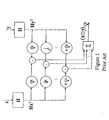
- Vaidyanathan's theorem states that given wavelet transforms of x and y , then some of the components of the circular convolution of x and y may be found without first transforming x and y from the wavelet domain back to the pixel domain. Graphically, the theorem may be depicted as in Figure 1.
- each subband contains 8 components, and there are four such subbands.
- Vaidyanathan's theorem requires the formation of 4 subbands of x and y , the calculation of 4 circular correlations each of length 8, and then the addition of these together component by component to produce a single vector of length 8. This resulting single vector is exactly equal to subband 0 of the circular correlation of the full vectors x and y .
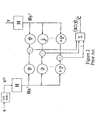
- Subband 0 of the circular correlation gives only a low-resolution version of the circular correlation. And while it may indicate that a match for a particular search may be present, there remains the possibility that no match exists. Therefore, an effective search method must be able to produce the remaining components of the circular correlation to resolve if a match is present. Conveniently, Vaidyanathan's theorem may be extended to the computation of other subbands of a circular correlation as indicated in Figure 2.
- the cyclic correlation of x and y may be computed by an alternative method, namely by taking inverse transforms of Hx T and Hy T , followed by cyclic correlations in the pixel domain.
- This alternative method incurs a cost equivalent to two wavelet transforms plus the cost of the cyclic correlations.
- Vaidyanathan's method requires R -1 more wavelet transforms. The net cost comparison depends on the relative cost of the cyclic correlations when done by Vaidyanathan's method and when done in the pixel domain by inverting the transforms first.
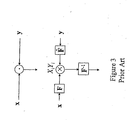
- the Convolution Theorem improves the efficiency of the calculation because each forward or inverse transform requires only about 5 N log N operations, and the point-by-point multiply requires only N. This is usually much less than the N 2 operations required to compute the circular convolution by more na ⁇ ve methods.
- the costs of each method are computed as follows:
- Vaidyanathan's method the total cost for Vaidyanathan's method is about R times as large as the straightforward method, which moves first to the pixel domain and then does fast correlation there.
- the straightforward method is not progressive. It requires a full calculation to obtain any significant search result.
- Vaidyanathan's method is progressive and can be discontinued before performing all of the operations, it is simply too computationally expensive to use in practice.
- the method advantageously permits the searching of a database of images where the search is performed on the compressed images, without first decompressing them.
- the method of the present invention operates by searching the database of compressed images first at a low resolution to obtain the relative quality of a match between a search template and a candidate image. If the match is below a particular threshold, the search may be terminated without committing any further computational resources to the search. Conversely, if the match is above a particular threshold, the method enhances the resolution of the candidate image and then performs another match. As long as the relative quality of the match is above the particular threshold, the resolution of the candidate image is successively enhanced, until a match determination is made at a full resolution of the candidate image.
- the present invention provides an apparatus for the efficient searching of images contained in an image database. Further features and advantages of the present invention, as well as the structure and operation of various embodiments of the present invention are described in detail below with reference to the accompanying drawings.
- the invention of the present application utilizes a multiresolution technique which overcomes the debilitating inefficiency associated with the prior art.
- multiresolution wavelet decompositions there exist a sequence of matrices H 1 , H 2 , etc. such that each successive matrix produces finer and finer wavelet transforms.
- H 2 is a coarse transform that is block diagonal with blocks of size R 2 , and operates on R 2 subbands, each of length N / R 2 .
- H 1 is a fine transform matrix that is block diagonal with blocks of size N / R , and operates on R subbands, each of length N / R .
- H 1 U 12 H 2 .
- the matrix U 12 is block diagonal with blocks of size R 2 .
- the blocks of U 12 consist of R interlaced copies of the block matrix that is on the diagonal of H 1 .
- H 2 be the coarse wavelet transform given by:
- the fine transform is given by the matrix H 1 whose structure is given by:
- the update matrix U 12 is the matrix given by:
- the pattern of 1s and -1s in the one-step update matrix U 12 is the same as in the fine wavelet transform matrix except that the 1s and -1s in U 12 are interlaced every 2 apart and they lie within blocks of size 2 in H 1 and within blocks of size 4 within U 12 .
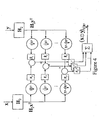
- the R circular correlations are replaced by Fourier transforms F 2 that operate on vectors, of size N / R .
- the component-by-component multiplies are followed by inverse Fourier transforms to produce Subband 0 of the circular correlation.
- Other subbands may be computed by applying this process recursively in a multiresolution analysis.
- the process is efficient because the cost in computation is no greater than the cost of inverting the wavelet transforms first, and following with the efficient implementation of circular correlations in the pixel domain by means of Fourier domains in that domain and component-by-component multiplication.
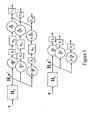
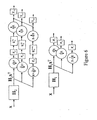
- the coefficients of Subband 0 mod R 2 are obtained as indicated in Figure 4. There are N / R 2 such coefficients in each of R 2 subbands. Subsequently, the relation represented by Figure. 5 is applied thereby obtaining the coefficients of Subband 0 mod R. There are N / R of these coefficients, or R times as many as in the coarse analysis.
- FIG. 5 shows the subsampling of the H transform followed by a coarse Fourier transform ( F 2 ), and then shows how to obtain the Fourier transforms for finer resolutions from the coarser ones.
- F 2 coarse Fourier transform
- the R 2 vectors of length N / R 2 are transformed by the matrices u 12 .
- Each of these matrices is a square matrix of size N / R 2 and is a block of the update matrix U 12 that refines H 2 into H 1 .
- Figure 5 shows that the coarse transforms are upsampled.
- the upsampling interlaces together R 2 vectors of length N / R 2 to create R vectors of length N / R . (Interlacing the vectors (1,3,5,7), (2,4,6,8), (9,11,13,15), by (10,12,14,16) by upsampling by 2, produces the vectors (1,9,3,11,5,13,7,15) and (2,10,4,12,6,14,8,16.))
- the resulting vectors are transformed by the matrix T 12 .
- the "cross" operation in this equation indicates a matrix cross product, and in this case expresses the fact that F 2 is a fourier transform that is repeated and interlaced with a period of length R to create a matrix F 1 of size N / R ⁇ N / R from a matrix F 2 having size N / R 2 ⁇ N / R 2 .
- the number of operations required to perform T 12 on the output of the interlaced transforms F 2 is proportional to N / R .
- the effect of the fine transform H 1 followed by the fourier transform F 1 may be computed by using the update matrices u 12 and the fourier update matrix T 12 on the fourier transforms of the coarse wavelet transforms.
- the amount of work is substantially less by the computation at the top because the Fourier update matrix requires only N / R operations instead of N / R log N / R operations.
- the multiresolution method of the present invention is recursive and can be repeated on any outputs shown in Figure 5 to create a full resolution search. If the full resolution search is carried out, the amount of computation performed is precisely the same as if an inverse wavelet transform had been performed on the original image transforms, and then followed by a fourier transform from the pixel domain to the frequency domain, point-by-point mutliplication in the frequency domain, and an inverse fourier transform back to the pixel domain.
- Figure 7 provides an overview of the steps necessary to perform a multiresolution search according to the present invention. Specifically, for a particular image a pattern template is transformed into a wavelet pattern at block 70. A candidate image is then coarse correlated with the transformed pattern at block 71 and a determination is made at block 72 whether the transformed pattern suitably matches the candidate image. If not, then another candidate image may be chosen or the search abandoned, 79. If the match was suitable, then the candidate image is medium correlated 73 and another similar match test is performed at block 74. The procedure proceeds similarly through blocks 75 and 77 with fine correlated and fully correlated images respectively undergoing a suitable match check at blocks 77 and 78. If a suitable match is found for the fully correlated image at block 78, then the image searched for has been found.
- the search can be terminated early in the multiresolution analysis, because match information is obtained early in the search.
- the transforms to the image domain are done first rather than performing multiresolution analysis, then the work is committed before any information is used, and the cost cannot be avoided later as search information is discovered.
- the wavelet representations tend to be sparse, that is, they contain many zeros, and this can reduce computational cost.
- the pixel domain representation is not sparse, because virtually all the pixels are nonzero. Consequently, it may be possible to exploit the sparsity in the wavelet domain and equivalent exploitation is not possible in the pixel domain.
- a right circulant matrix X is a square matrix in which each row is the same as the immediately preceding row, except that it is shifted cyclically to the right by 1 position.
- the matrix X below is right circulant.
- a right block-circulant matrix is a matrix composed of equal-sized submatrices (blocks), and each row of blocks is the same as previous row of blocks, except that it is shifted to the right by the size of 1 block.
- the matrix Y below is right-block circulant with a block size of 2.
- u 12 is a subblock of the update matrix U 12 , and can be obtained directly that matrix. Moreover, each instance of u 12 in Figure 5 uses the same matrix u 12 for the computation.
- the matrix û ( i ) 12 has to be calculated from U 12 , and the entries in the matrix û ( i ) 12 depend on the subband that it transforms.
- the matrix ⁇ 12 is block diagonal, and within its blocks along diagonal lines it contains Fourier transforms of the rows of U 12 . For a search of one pattern over many images of the same size, the matrices ⁇ 12 can be computed once and stored reused when searching each image.
Landscapes
- Engineering & Computer Science (AREA)
- Theoretical Computer Science (AREA)
- Physics & Mathematics (AREA)
- General Physics & Mathematics (AREA)
- Library & Information Science (AREA)
- Multimedia (AREA)
- Computer Vision & Pattern Recognition (AREA)
- Data Mining & Analysis (AREA)
- Databases & Information Systems (AREA)
- General Engineering & Computer Science (AREA)
- Image Analysis (AREA)
- Information Retrieval, Db Structures And Fs Structures Therefor (AREA)
- Compression Or Coding Systems Of Tv Signals (AREA)
- Processing Or Creating Images (AREA)
- Image Processing (AREA)
Claims (18)
- Inhaltsbasiertes Bildsuchverfahren zum Bestimmen, ob ein Kandidatenbild mit einer Mustervorlage übereinstimmt, wobei das Verfahren die folgenden Schritte aufweist:(a) Transformieren der Mustervorlage in ein Waveletmuster;(b) Transformieren des Kandidatenbilds in ein Waveletkandidatenbild mit einer ersten Auflösung;(c) Korrelieren des Waveletkandidatenbilds mit dem Waveletmuster im Fourierbereich und mit der ersten Auflösung, um eine Erstauflösungskorrelation mit mehreren Werten zu erzeugen;(d) Schwellwertbestimmen der Erstauflösungskorrelation durch Vergleichen jedes Erstauflösungskorrelationswerts mit einem vorbestimmten Erstauflösungsschwellwert, um zu bestimmen, ob ein Erstauflösungskorrelationswert den Erstauflösungsschwellwert erfüllt oder übersteigt, und wenn ja, Fortfahren mit Schritten (e) bis (f);(e) Korrelieren des Waveletkandidatenbilds mit dem Waveletmuster mit einer zweiten Auflösung unter Nutzung mindestens eines Teils von Berechnungen, die in der Erstauflösungskorrelation von Schritt (c) durchgeführt werden, um eine Zweitauflösungskorrelation mit mehreren Werten zu erzeugen, wobei die zweite Auflösung feiner als die erste Auflösung ist; und(f) Schwellwertbestimmen der Zweitauflösungskorrelation durch Vergleichen jedes Zweitauflösungskorrelationswerts mit einem vorbestimmten Zweitauflösungsschwellwert, um zu bestimmen, ob ein Zweitauflösungskorrelationswert den zweitauflösungsschwellwert erfüllt oder übersteigt.
- Verfahren nach Anspruch 1, ferner mit dem folgenden Schritt:(g) Bestimmen, daß eine geeignete Übereinstimmung zwischen dem Kandidatenbild und der Mustervorlage existiert, wenn ein Zweitauflösungskorrelationswert den Zweitauflösungsschwellwert erfüllt oder übersteigt.
- Verfahren nach Anspruch 2, wobei die Zweitauflösungskorrelation vollständig korreliert ist.
- Verfahren nach Anspruch 1, ferner mit den folgenden Schritten:(g) Korrelieren des Waveletkandidatenbilds mit dem Waveletmuster mit einer dritten Auflösung unter Nutzung mindestens eines Teils von Berechnungen, die in der Zweitauflösungskorrelation von Schritt (e) durchgeführt werden, um eine Drittauflösungskorrelation mit mehreren Werten zu erzeugen, wobei die dritte Auflösung feiner als die zweite Auflösung ist; und(h) Schwellwertbestimmen der Drittauflösungskorrelation durch Vergleichen jedes Drittauflösungskorrelationswerts mit einem vorbestimmten Drittauflösungsschwellwert, um zu bestimmen, ob ein Drittauflösungskorrelationswert den Drittauflösungsschwellwert erfüllt oder übersteigt.
- Verfahren nach Anspruch 4, ferner mit dem folgenden Schritt:(i) Bestimmen, daß eine geeignete Übereinstimmung zwischen dem Kandidatenbild und der Mustervorlage existiert, wenn ein Drittauflösungskorrelationswert den Drittauflösungsschwellwert erfüllt oder übersteigt.
- Verfahren nach Anspruch 5, wobei die Drittauflösungskorrelation vollständig korreliert ist.
- Verfahren nach Anspruch 1, ferner mit den folgenden Schritten:(g) Korrelieren des Waveletkandidatenbilds mit dem Waveletmuster mit einer aktuellen Auflösung, die eine feinere Auflösung als die Auflösung der vorherigen Korrelation ist, unter Nutzung mindestens eines Teils von Berechnungen, die in der vorherigen Korrelation durchgeführt werden, um eine Aktuellauflösungskorrelation mit mehreren Werten zu erzeugen;(h) Schwellwertbestimmen der Aktuellauflösungskorrelation durch Vergleichen jedes Aktuellauflösungskorrelationswerts mit einem vorbestimmten Aktuellauflösungsschwellwert, um zu bestimmen, ob ein Aktuellauflösungskorrelationswert den Aktuellauflösungsschwellwert erfüllt oder übersteigt;(i) Wiederholen der Schritte (g) und (h) mit zunehmend feineren Auflösungen, solange bestimmt wird, daß ein Aktuellauflösungskorrelationswert den Aktuellauflösungsschwellwert für diese Korrelation im Schritt (h) erfüllt oder übersteigt, bis eine gewünschte Endauflösung erreicht ist; und(j) Bestimmen, daß eine geeignete Übereinstimmung zwischen dem Kandidatenbild und der Mustervorlage existiert, wenn ein Endauflösungskorrelationswert einen vorbestimmten Endauflösungsschwellwert erfüllt oder übersteigt.
- Verfahren nach Anspruch 7, wobei die Endauflösungskorrelation vollständig korreliert ist.
- Vorrichtung zum Durchführen einer inhaltsbasierten Bildsuche zum Bestimmen, ob ein Kandidatenbild mit einer Mustervorlage übereinstimmt, wobei die Vorrichtung aufweist:(a) eine Einrichtung zum Transformieren der Mustervorlage in ein Waveletmuster;(b) eine Einrichtung zum Transformieren des Kandidatenbilds in ein Waveletkandidatenbild mit einer ersten Auflösung;(c) eine Einrichtung zum Korrelieren des Waveletkandidatenbilds mit dem Waveletmuster im Fourierbereich und mit der ersten Auflösung, um eine Erstauflösungskorrelation mit mehreren Werten zu erzeugen;(d) eine Einrichtung zum Schwellwertbestimmen der Erstauflösungskorrelation durch Vergleichen jedes Erstauflösungskorrelationswerts mit einem vorbestimmten Erstauflösungsschwellwert, um zu bestimmen, ob ein Erstauflösungskorrelationswert den Erstauflösungsschwellwert erfüllt oder übersteigt;(e) eine Einrichtung zum Korrelieren des Waveletkandidatenbilds mit dem Waveletmuster mit einer zweiten Auflösung unter Nutzung mindestens eines Teils von Berechnungen, die in der Erstauflösungskorrelation durch die Einrichtung (c) zum Korrelieren mit der ersten Auflösung durchgeführt werden, um eine Zweitauflösungskorrelation mit mehreren Werten zu erzeugen, wobei die zweite Auflösung feiner als die erste Auflösung ist, wobei die Einrichtung (e) zum Korrelieren auf die Einrichtung (d) zum Schwellwertbestimmen reagiert und nur aktiviert wird, wenn die Einrichtung (d) zum Schwellwertbestimmen bestimmt, daß ein Erstauflösungskorrelationswert den Erstauflösungsschwellwert erfüllt oder übersteigt; und(f) eine Einrichtung zum Schwellwertbestimmen der Zweitauflösungskorrelation durch Vergleichen jedes Zweitauflösungskorrelationswerts mit einem vorbestimmten Zweitauflösungsschwellwert, um zu bestimmen, ob ein Zweitauflösungskorrelationswert den zweitauflösungsschwellwert erfüllt oder übersteigt.
- Vorrichtung nach Anspruch 9, ferner mit:(g) einer Einrichtung zum Bestimmen, daß eine geeignete Übereinstimmung zwischen dem Kandidatenbild und der Mustervorlage existiert, wenn ein Zweitauflösungskorrelationswert den Zweitauflösungsschwellwert erfüllt oder übersteigt.
- Vorrichtung nach Anspruch 10, wobei die Zweitauflösungskorrelation vollständig korreliert ist.
- Vorrichtung nach Anspruch 9, ferner mit:(g) einer Einrichtung zum Korrelieren des Waveletkandidatenbilds mit dem Waveletmuster mit einer dritten Auflösung unter Nutzung mindestens eines Teils von Berechnungen, die in der Zweitauflösungskorrelation durch die Einrichtung (e) zum Korrelieren mit der zweiten Auflösung durchgeführt werden, um eine Drittauflösungskorrelation mit mehreren Werten zu erzeugen, wobei die dritte Auflösung feiner als die zweite Auflösung ist; und(h) einer Einrichtung zum Schwellwertbestimmen der Drittauflösungskorrelation durch Vergleichen jedes Drittauflösungskorrelationswerts mit einem vorbestimmten Drittauflösungsschwellwert, um zu bestimmen, ob ein Drittauflösungskorrelationswert den Drittauflösungsschwellwert erfüllt oder übersteigt.
- Vorrichtung nach Anspruch 12, ferner mit:(i) einer Einrichtung zum Bestimmen, daß eine geeignete Übereinstimmung zwischen dem Kandidatenbild und der Mustervorlage existiert, wenn ein Drittauflösungskorrelationswert den Drittauflösungsschwellwert erfüllt oder übersteigt.
- Vorrichtung nach Anspruch 13, wobei die Drittauflösungskorrelation vollständig korreliert ist.
- Vorrichtung nach Anspruch 9, ferner mit:(g) einer Einrichtung zum Korrelieren des Waveletkandidatenbilds mit dem Waveletmuster mit einer aktuellen Auflösung, die eine feinere Auflösung als die der vorherigen Korrelation ist, unter Nutzung mindestens eines Teils von Berechnungen, die in der vorherigen Korrelation durchgeführt werden, um eine Aktuellauflösungskorrelation mit mehreren Werten zu erzeugen;(h) einer Einrichtung zum Schwellwertbestimmen der Aktuellauflösungskorrelation durch Vergleichen jedes Aktuellauflösungskorrelationswerts mit einem vorbestimmten Aktuellauflösungsschwellwert, um zu bestimmen, ob ein Aktuellauflösungskorrelationswert den Aktuellauflösungsschwellwert erfüllt oder übersteigt;(i) einer Einrichtung zum Wiederholen der durch die Einrichtung (g) zum Korrelieren und die Einrichtung (h) zum Schwellwertbilden durchgeführten Verarbeitung mit zunehmend feineren Auflösungen, solange bestimmt wird, daß ein Aktuellauflösungskorrelationswert den Aktuellauflösungsschwellwert für diese Korrelation in der Bestimmung durch die Einrichtung (h) zum Schwellwertbilden erfüllt oder übersteigt, bis eine gewünschte Endauflösung erreicht ist; und(j) einer Einrichtung zum Bestimmen, daß eine geeignete Übereinstimmung zwischen dem Kandidatenbild und der Mustervorlage existiert, wenn ein Endauflösungskorrelationswert einen vorbestimmten Endauflösungsschwellwert erfüllt oder übersteigt.
- Vorrichtung nach Anspruch 15, wobei die Endauflösungskorrelation vollständig korreliert ist.
- Inhaltsbasiertes Bildsuchverfahren zum Bestimmen, ob ein Kandidatenbild mit einer Mustervorlage übereinstimmt, wobei das Verfahren die folgenden Schritte aufweist:(a) Transformieren der Mustervorlage in ein Waveletmuster mit mehreren Musterteilbändern mit einer ersten Auflösung;(b) Transformieren des Kandidatenbilds in ein Waveletbild mit mehreren Bildteilbändern mit der ersten Auflösung;(c) Korrelieren des Erstauflösungs-Waveletbilds und des Waveletmusters mit den folgenden Teilschritten:(c1) Transformieren aller Musterteilbänder des Erstauflösungs-Waveletmusters in den Fourierbereich, um ein fouriertransformiertes Erstauflösungsmuster zu erzeugen;(c2) Transformieren aller Bildteilbänder des Erstauflösungs-Waveletbilds in den Fourierbereich, um ein fouriertransformiertes Erstauflösungsbild zu erzeugen;(c3) Korrelieren des fouriertransformierten Erstauflösungsbilds und des fouriertransformierten Erstauflösungsmusters auf teilbandweiser Grundlage im Fourierbereich, um eine Erstauflösungs-Fourierbereichsteilbandkorrelation für jedes Teilband zu erzeugen;(c4) Summieren der Erstauflösungs-Fourierbereichsteilbandkorrelationen, um eine Erstauflösungs-Fourierbereichskorrelation zu erzeugen;(c5) Invertieren der Erstauflösungs-Fourierbereichskorrelation in den Pixelbereich, um eine Erstauflösungs-Pixelbereichskorrelation mit mehreren Korrelationswerten zu erzeugen, wobei jeder Korrelationswert einer Pixelposition zugeordnet ist;(c6) Vergleichen des Korrelationswerts der Erstauflösungs-Pixelbereichskorrelation an jeder Pixelposition mit einem ersten vorbestimmten Schwellwert, um zu bestimmen, welche Pixelpositionen den ersten Schwellwert übersteigen, wodurch die Pixelpositionen einer potentiellen Übereinstimmung angezeigt werden;(d) wenn mindestens eine potentielle Übereinstimmung im Schritt (c6) angezeigt wird, erneutes Korrelieren mit einer aktuellen Auflösung, die eine feinere Auflösung als die vorherigen Auflösung ist, mit den folgenden Teilschritten:(d1a) Durchführen einer einstufigen Waveletinversion der Fouriertransformationen der Vorherauflösungs-Musterteilbänder, um ein intermediäres fouriertransformiertes Aktuellauflösungsmuster zu bilden;(d1b) Butterflytransformieren des intermediären fouriertransformierten Aktuellauflösungsmusters, um ein vollständiges fouriertransformiertes Aktuellauflösungsmuster zu erzeugen;(d2a) Durchführen einer einstufigen Waveletinversion der Fouriertransformationen der Vorherauflösungs-Teilbänder des Bilds, um ein intermediäres fouriertransfonniertes Aktuellauflösungsbild zu bilden;(d2b) Butterflytransformieren des intermediären fouriertransformierten Aktuellauflösungs-Kandidatenbilds, um ein vollständiges fouriertransformiertes Aktuellauflösungs-Kandidatenbild zu erzeugen;(d3) Korrelieren des vollständigen fouriertransformierten Aktuellauflösungsmusters und des vollständigen fouriertransformierten Aktuellauflösungsbilds auf teilbandweiser Grundlage im Fourierbereich, um eine Aktuellauflösungs-Fourierbereichsteilbandkorrelation für jedes Teilband zu erzeugen;(d4) wenn die aktuelle Auflösung keine gewünschte Endauflösung ist, Summieren der Aktuellauflösungs-Fourierbereichsteilbandkorrelationen, um eine Aktuellauflösungs-Fourierbereichskorrelation zu erzeugen;(d5) Invertieren der Aktuellauflösungs-Fourierbereichskorrelation in den Pixelbereich, um eine Aktuellauflösungs-Pixelbereichskorrelation mit mehreren Korrelationswerten zu erzeugen, wobei jeder Korrelationswert einer Pixelposition zugeordnet ist;(d6) Vergleichen des Korrelationswerts der Aktuellauflösungs-Pixelbereichskorrelation an jeder Pixelposition mit einem vorbestimmten Aktuellauflösungsschwellwert, um zu bestimmen, welche Pixelpositionen den Aktuellauflösungsschwellwert überschreiten, wodurch die Pixelpositionen einer potentiellen Übereinstimmung angegeben werden; und(e) Wiederholen des Schritts (d) mit den Teilschritten (d1a) bis (d6) zunehmend feineren Auflösungen, solange mindestens eine potentielle Übereinstimmung im Schritt (d6) angezeigt wird und bis die aktuelle Auflösung die gewünschte Endauflösung ist, wobei der Vergleichsschritt (d6) mit der Endauflösung die Pixelpositionen jeder Übereinstimmung zwischen dem Kandidatenbild und der Mustervorlage anzeigt.
- Inhaltsbasierte Bildsuchvorrichtung zum Bestimmen, ob ein Kandidatenbild mit einer Mustervorlage übereinstimmt, wobei die Vorrichtung aufweist:(a) eine Einrichtung zum Transformieren der Mustervorlage in ein Waveletmuster mit mehreren Musterteilbändern mit einer ersten Auflösung;(b) eine Einrichtung zum Transformieren des Kandidatenbilds in ein Waveletbild mit mehreren Bildteilbändern mit der ersten Auflösung;(c) eine Einrichtung zum Korrelieren des Erstauflösungs-Waveletbilds und des Waveletmusters mit:(c1) einer Einrichtung zum Transformieren aller Musterteilbänder des Erstauflösungs-Waveletmusters in den Fourierbereich, um ein fouriertransformiertes Erstauflösungsmuster zu erzeugen;(c2) einer Einrichtung zum Transformieren aller Bildteilbänder des Erstauflösungs-Waveletbilds in den Fourierbereich, um ein fouriertransformiertes Erstauflösungsbild zu erzeugen;(c3) einer Einrichtung zum Korrelieren des fouriertransformierten Erstauflösungsbilds und des fouriertransformierten Erstauflösungsmusters auf teilbandweiser Grundlage im Fourierbereich, um eine Erstauflösungs-Fourierbereichsteilbandkorrelation für jedes Teilband zu erzeugen;(c4) einer Einrichtung zum Summieren der Erstauflösungs-Fourierbereichsteilbandkorrelationen, um eine Erstauflösungs-Fourierbereichskorrelation zu erzeugen;(c5) einer Einrichtung zum Invertieren der Erstauflösungs-Fourierbereichskorrelation in den Pixelbereich, um eine Erstauflösungs-Pixelbereichskorrelation mit mehreren Korrelationswerten zu erzeugen, wobei jeder Korrelationswert einer Pixelposition zugeordnet ist;(c6) einer Einrichtung zum Vergleichen des Korrelationswerts der Erstauflösungs-Pixelbereichskorrelation an jeder Pixelposition mit einem ersten vorbestimmten Schwellwert, um zu bestimmen, welche Pixelpositionen den ersten Schwellwert übersteigen, wodurch die Pixelpositionen einer potentiellen Übereinstimmung angezeigt werden;(d) eine Einrichtung zum erneuten Korrelieren mit einer aktuellen Auflösung, die eine feinere Auflösung als die vorherige Auflösung ist, wobei die Einrichtung zum erneuten Korrelieren auf die Einrichtung (c6) zum Vergleichen und/oder die Einrichtung (d6) zum Vergleichen reagiert und nur aktiviert wird, wenn mindestens eine potentielle Übereinstimmung durch die Einrichtung (c6) zum Vergleichen oder die Einrichtung (d6) zum Vergleichen bei der vorherigen Auflösung angezeigt wird, mit:(d1a) einer Einrichtung zum Durchführen einer einstufigen Waveletinversion der Fouriertransformationen der Vorherauflösungs-Musterteilbänder, um ein intermediäres fouriertransformiertes Aktuellauflösungsmuster zu bilden;(d1b) einer Einrichtung zum Butterflytransformieren des intermediären fouriertransformierten Aktuellauflösungsmusters, um ein vollständiges fouriertransformiertes Aktuellauflösungsmuster zu erzeugen;(d2a)einer Einrichtung zum Durchführen einer einstufigen Waveletinversion der Fouriertransformationen der Vorherauflösungs-Teilbänder des Bilds, um ein intermediäres fouriertransformiertes Aktuellauflösungsbild zu bilden;(d2b)einer Einrichtung zum Butterflytransformieren des intermediären fouriertransformierten Aktuellauflösungs-Kandidatenbilds, um ein vollständiges fouriertransformiertes Aktuellauflösungs-Kandidatenbild zu erzeugen;(d3) einer Einrichtung zum Korrelieren des vollständigen fouriertransformierten Aktuellauflösungsmusters und des vollständigen fouriertransformierten Aktuellauflösungsbilds auf teilbandweiser Grundlage im Fourierbereich, um eine Aktuellauflösungs-Fourierbereichsteilbandkorrelation für jedes Teilband zu erzeugen;(d4) einer Einrichtung Summieren der Aktuellauflösungs-Fourierbereichsteilbandkorrelationen, um eine Aktuellauflösungs-Fourierbereichskorrelation zu erzeugen, wenn die aktuelle Auflösung keine gewünschte Endauflösung ist,;(d5) einer Einrichtung zum Invertieren der Aktuellauflösungs-Fourierbereichskorrelation in den Pixelbereich, um eine Aktuellauflösungs-Pixelbereichskorrelation mit mehreren Korrelationswerten zu erzeugen, wobei jeder Korrelationswert einer Pixelposition zugeordnet ist;(d6) einer Einrichtung zum Vergleichen des Korrelationswerts der Aktuellauflösungs-Pixelbereichskorrelation an jeder Pixelposition mit einem vorbestimmten Aktuellauflösungsschwellwert, um zu bestimmen, welche Pixelpositionen den Aktuellauflösungsschwellwert überschreiten, wodurch die Pixelpositionen einer potentiellen Übereinstimmung angegeben werden; und(e) eine Einrichtung zum Wiederholen der durch die Einrichtung (d) zum erneuten Korrelieren mit den Komponenten (d1a) bis (d6) durchgeführten Verarbeitung mit zunehmend feineren Auflösungen, solange mindestens eine potentielle Übereinstimmung durch die Einrichtung (d6) zum Vergleichen angezeigt wird und bis die aktuelle Auflösung die gewünschte Endauflösung ist, wobei die Einrichtung (d6) zum Vergleichen mit der Endauflösung die Pixelpositionen jeder Übereinstimmung zwischen dem Kandidatenbild und der Mustervorlage anzeigt.
Applications Claiming Priority (2)
| Application Number | Priority Date | Filing Date | Title |
|---|---|---|---|
| US643691 | 1996-05-06 | ||
| US08/643,691 US5933546A (en) | 1996-05-06 | 1996-05-06 | Method and apparatus for multi-resolution image searching |
Publications (3)
| Publication Number | Publication Date |
|---|---|
| EP0806733A2 EP0806733A2 (de) | 1997-11-12 |
| EP0806733A3 EP0806733A3 (de) | 1998-12-23 |
| EP0806733B1 true EP0806733B1 (de) | 2003-07-09 |
Family
ID=24581885
Family Applications (1)
| Application Number | Title | Priority Date | Filing Date |
|---|---|---|---|
| EP97107090A Expired - Lifetime EP0806733B1 (de) | 1996-05-06 | 1997-04-29 | Bildsuchgerät und -verfahren mit mehrfachen Auflösungen |
Country Status (5)
| Country | Link |
|---|---|
| US (1) | US5933546A (de) |
| EP (1) | EP0806733B1 (de) |
| JP (1) | JP3053004B2 (de) |
| CN (1) | CN1125410C (de) |
| DE (1) | DE69723356T2 (de) |
Families Citing this family (43)
| Publication number | Priority date | Publication date | Assignee | Title |
|---|---|---|---|---|
| US10361802B1 (en) | 1999-02-01 | 2019-07-23 | Blanding Hovenweep, Llc | Adaptive pattern recognition based control system and method |
| USRE47908E1 (en) | 1991-12-23 | 2020-03-17 | Blanding Hovenweep, Llc | Ergonomic man-machine interface incorporating adaptive pattern recognition based control system |
| USRE48056E1 (en) | 1991-12-23 | 2020-06-16 | Blanding Hovenweep, Llc | Ergonomic man-machine interface incorporating adaptive pattern recognition based control system |
| US6850252B1 (en) | 1999-10-05 | 2005-02-01 | Steven M. Hoffberg | Intelligent electronic appliance system and method |
| USRE46310E1 (en) | 1991-12-23 | 2017-02-14 | Blanding Hovenweep, Llc | Ergonomic man-machine interface incorporating adaptive pattern recognition based control system |
| US5903454A (en) * | 1991-12-23 | 1999-05-11 | Hoffberg; Linda Irene | Human-factored interface corporating adaptive pattern recognition based controller apparatus |
| JP3506200B2 (ja) * | 1997-02-05 | 2004-03-15 | シャープ株式会社 | 位置合わせ装置 |
| US6285788B1 (en) | 1997-06-13 | 2001-09-04 | Sharp Laboratories Of America, Inc. | Method for fast return of abstracted images from a digital image database |
| US6292592B1 (en) * | 1998-10-19 | 2001-09-18 | Raytheon Company | Efficient multi-resolution space-time adaptive processor |
| US6243494B1 (en) | 1998-12-18 | 2001-06-05 | University Of Washington | Template matching in 3 dimensions using correlative auto-predictive search |
| US6546117B1 (en) | 1999-06-10 | 2003-04-08 | University Of Washington | Video object segmentation using active contour modelling with global relaxation |
| US6301387B1 (en) | 1998-12-18 | 2001-10-09 | University Of Washington | Template matching using correlative auto-predictive search |
| US7904187B2 (en) * | 1999-02-01 | 2011-03-08 | Hoffberg Steven M | Internet appliance system and method |
| US6477269B1 (en) * | 1999-04-20 | 2002-11-05 | Microsoft Corporation | Method and system for searching for images based on color and shape of a selected image |
| US6563959B1 (en) | 1999-07-30 | 2003-05-13 | Pixlogic Llc | Perceptual similarity image retrieval method |
| EP1516264B1 (de) * | 1999-07-30 | 2017-05-24 | Intellectual Ventures Holding 81 LLC | Auffinden von bildern durch generierung eines deskriptors für jeden bereich eines bildes dessen zellen visuelle merkmale innerhalb einer gewissen toleranz aufweisen |
| US7058647B1 (en) | 1999-08-31 | 2006-06-06 | Charles E. Hill & Associates | Electronic presentation generation system and method |
| US6658148B1 (en) * | 2000-06-06 | 2003-12-02 | Matsushita Electric Works, Ltd. | Image processing method and apparatus |
| US7433881B1 (en) | 2000-08-31 | 2008-10-07 | Charles E. Hill & Associates, Inc. | System and method for handling multi-resolution graphics files |
| JP4063486B2 (ja) * | 2000-09-06 | 2008-03-19 | 日本電気株式会社 | 画像検索装置及び方法並びに画像検索プログラムを記録した記憶媒体 |
| US7395261B1 (en) | 2000-11-21 | 2008-07-01 | Amy Hobbs Atzel | System and method for ordering items |
| US20040022436A1 (en) * | 2001-03-16 | 2004-02-05 | Paul Patti | System and method for data analysis of x-ray images |
| WO2002091219A1 (en) * | 2001-05-07 | 2002-11-14 | Hrl Laboratories, Llc | Method and apparatus for jointly optimizing linear signal processing filters with subband filters |
| US20030103673A1 (en) * | 2001-11-30 | 2003-06-05 | Nainesh Rathod | Shape searcher |
| US7280700B2 (en) * | 2002-07-05 | 2007-10-09 | Microsoft Corporation | Optimization techniques for data compression |
| US7020337B2 (en) * | 2002-07-22 | 2006-03-28 | Mitsubishi Electric Research Laboratories, Inc. | System and method for detecting objects in images |
| US6911992B2 (en) * | 2002-10-18 | 2005-06-28 | Hewlett-Packard Development Company, L.P. | Poster preparation system and method |
| US7606417B2 (en) | 2004-08-16 | 2009-10-20 | Fotonation Vision Limited | Foreground/background segmentation in digital images with differential exposure calculations |
| US7680342B2 (en) | 2004-08-16 | 2010-03-16 | Fotonation Vision Limited | Indoor/outdoor classification in digital images |
| JP4428067B2 (ja) * | 2004-01-28 | 2010-03-10 | ソニー株式会社 | 画像照合装置、プログラム、および画像照合方法 |
| US7813552B2 (en) | 2004-09-23 | 2010-10-12 | Mitsubishi Denki Kabushiki Kaisha | Methods of representing and analysing images |
| GB2418555A (en) * | 2004-09-23 | 2006-03-29 | Mitsubishi Electric Inf Tech | Representing an image using descriptors based on colour information |
| JP4301193B2 (ja) * | 2005-03-31 | 2009-07-22 | ソニー株式会社 | 画像比較装置及び方法、画像検索装置及び方法、並びにプログラム及び記録媒体 |
| KR20070118155A (ko) * | 2005-06-30 | 2007-12-13 | 올림푸스 가부시키가이샤 | 검색 시스템 및 검색 방법 |
| WO2007004520A1 (ja) * | 2005-06-30 | 2007-01-11 | Olympus Corporation | 検索システム及び検索方法 |
| US7805005B2 (en) * | 2005-08-02 | 2010-09-28 | The United States Of America As Represented By The Secretary Of The Army | Efficient imagery exploitation employing wavelet-based feature indices |
| JP4952026B2 (ja) * | 2006-03-31 | 2012-06-13 | 株式会社日立製作所 | 生体情報認証装置および認証方法 |
| JP4518139B2 (ja) * | 2007-11-30 | 2010-08-04 | トヨタ自動車株式会社 | 画像処理装置 |
| US20100246798A1 (en) * | 2009-03-26 | 2010-09-30 | General Motors Corporation | System and method for determining a user request |
| US9008192B2 (en) | 2011-10-20 | 2015-04-14 | Digimarc Corporation | Arrangements for increasing detection confidence |
| US9058541B2 (en) | 2012-09-21 | 2015-06-16 | Fondation De L'institut De Recherche Idiap | Object detection method, object detector and object detection computer program |
| KR101382892B1 (ko) * | 2012-10-08 | 2014-04-08 | 재단법인대구경북과학기술원 | 저해상도 영상 얼굴 인식 방법 및 저해상도 영상 얼굴 인식 장치 |
| JP6951738B2 (ja) * | 2017-07-10 | 2021-10-20 | 国立大学法人千葉大学 | ホログラムデータ作成プログラム及びホログラムデータ作成方法 |
Family Cites Families (8)
| Publication number | Priority date | Publication date | Assignee | Title |
|---|---|---|---|---|
| US4200861A (en) * | 1978-09-01 | 1980-04-29 | View Engineering, Inc. | Pattern recognition apparatus and method |
| US5067162A (en) * | 1986-06-30 | 1991-11-19 | Identix Incorporated | Method and apparatus for verifying identity using image correlation |
| EP0329166B1 (de) * | 1988-02-17 | 1994-10-12 | Nippondenso Co., Ltd. | Fingerabdruck-Prüfungsverfahren mit Verwendung mehrerer Korrelierungsentscheidungspegel und aufeinanderfolgenden Entscheidungsstufen |
| US5253530A (en) * | 1991-08-12 | 1993-10-19 | Letcher Iii John H | Method and apparatus for reflective ultrasonic imaging |
| US5394349A (en) * | 1992-07-10 | 1995-02-28 | Xing Technology Corporation | Fast inverse discrete transform using subwords for decompression of information |
| US5392255A (en) * | 1992-10-15 | 1995-02-21 | Western Atlas International | Wavelet transform method for downward continuation in seismic data migration |
| US5546477A (en) * | 1993-03-30 | 1996-08-13 | Klics, Inc. | Data compression and decompression |
| US5659626A (en) * | 1994-10-20 | 1997-08-19 | Calspan Corporation | Fingerprint identification system |
-
1996
- 1996-05-06 US US08/643,691 patent/US5933546A/en not_active Expired - Lifetime
-
1997
- 1997-04-29 EP EP97107090A patent/EP0806733B1/de not_active Expired - Lifetime
- 1997-04-29 DE DE69723356T patent/DE69723356T2/de not_active Expired - Lifetime
- 1997-05-01 JP JP9113807A patent/JP3053004B2/ja not_active Expired - Fee Related
- 1997-05-06 CN CN97111722A patent/CN1125410C/zh not_active Expired - Fee Related
Also Published As
| Publication number | Publication date |
|---|---|
| JPH1055433A (ja) | 1998-02-24 |
| EP0806733A3 (de) | 1998-12-23 |
| CN1125410C (zh) | 2003-10-22 |
| US5933546A (en) | 1999-08-03 |
| DE69723356D1 (de) | 2003-08-14 |
| EP0806733A2 (de) | 1997-11-12 |
| JP3053004B2 (ja) | 2000-06-19 |
| DE69723356T2 (de) | 2004-02-05 |
| CN1167959A (zh) | 1997-12-17 |
Similar Documents
| Publication | Publication Date | Title |
|---|---|---|
| US5933546A (en) | Method and apparatus for multi-resolution image searching | |
| Wang et al. | Wavelet-based image indexing techniques with partial sketch retrieval capability | |
| Sheikholeslami et al. | Wavecluster: A multi-resolution clustering approach for very large spatial databases | |
| Wang et al. | Content-based image indexing and searching using Daubechies' wavelets | |
| Bruce et al. | Applied wavelet analysis with S-plus | |
| Bhatia et al. | A wavelet-based method for multiscale tomographic reconstruction | |
| Li et al. | Hierarchyscan: A hierarchical similarity search algorithm for databases of long sequences | |
| US5799301A (en) | Apparatus and method for performing adaptive similarity searching in a sequence database | |
| Vo et al. | Using phase and magnitude information of the complex directional filter bank for texture image retrieval | |
| Chou et al. | Recursive and iterative estimation algorithms for multiresolution stochastic processes | |
| Stone | Progressive wavelet correlation using Fourier methods | |
| Manian et al. | Scaled and rotated texture classification using a class of basis functions | |
| Shi et al. | A new two-dimensional Fourier transform algorithm based on image sparsity | |
| Li et al. | Wavelet methods in data mining | |
| Li et al. | Progressive template matching for content-based retrieval in earth-observing satellite image database | |
| Baldwin et al. | Multi-resolution modeling of large scale scientific simulation data | |
| Fauzi et al. | Query by fax for content-based image retrieval | |
| Piamsa-nga | Multi-feature content-based image retrieval | |
| Rouhafzay et al. | Improving texture image retrieval with redundant contourlet features | |
| Mohan et al. | AN ENHANCEMENT PROCESS FOR GRAY-SCALE IMAGES RESULTED FROM IMAGE FUSION USING MULTIRESOLUTION AND LAPLACIAN PYRAMID. | |
| Borde et al. | Feature vectors based CBIR in spatial and transform domain | |
| Stojanovic et al. | Retrieving images using content-based followed by pixel-based search | |
| Kokare et al. | Cosine-modulated wavelet packet based texture features for content based image retrieval | |
| Manian et al. | Scaled and rotated texture segmentation using a class of basis functions | |
| Swathi et al. | Enhanced Image Retrieval System Using Relavance Feedback |
Legal Events
| Date | Code | Title | Description |
|---|---|---|---|
| PUAI | Public reference made under article 153(3) epc to a published international application that has entered the european phase |
Free format text: ORIGINAL CODE: 0009012 |
|
| AK | Designated contracting states |
Kind code of ref document: A2 Designated state(s): DE FR GB |
|
| PUAL | Search report despatched |
Free format text: ORIGINAL CODE: 0009013 |
|
| AK | Designated contracting states |
Kind code of ref document: A3 Designated state(s): DE FR GB |
|
| 17P | Request for examination filed |
Effective date: 19981116 |
|
| 17Q | First examination report despatched |
Effective date: 20010629 |
|
| GRAH | Despatch of communication of intention to grant a patent |
Free format text: ORIGINAL CODE: EPIDOS IGRA |
|
| RIC1 | Information provided on ipc code assigned before grant |
Free format text: 7G 06K 9/52 A, 7G 06K 9/68 B, 7G 06F 17/14 B |
|
| RIC1 | Information provided on ipc code assigned before grant |
Free format text: 7G 06K 9/52 A, 7G 06K 9/68 B, 7G 06F 17/14 B |
|
| GRAH | Despatch of communication of intention to grant a patent |
Free format text: ORIGINAL CODE: EPIDOS IGRA |
|
| GRAA | (expected) grant |
Free format text: ORIGINAL CODE: 0009210 |
|
| AK | Designated contracting states |
Designated state(s): DE FR GB |
|
| REG | Reference to a national code |
Ref country code: GB Ref legal event code: FG4D |
|
| REF | Corresponds to: |
Ref document number: 69723356 Country of ref document: DE Date of ref document: 20030814 Kind code of ref document: P |
|
| ET | Fr: translation filed | ||
| PLBE | No opposition filed within time limit |
Free format text: ORIGINAL CODE: 0009261 |
|
| STAA | Information on the status of an ep patent application or granted ep patent |
Free format text: STATUS: NO OPPOSITION FILED WITHIN TIME LIMIT |
|
| 26N | No opposition filed |
Effective date: 20040414 |
|
| PGFP | Annual fee paid to national office [announced via postgrant information from national office to epo] |
Ref country code: GB Payment date: 20130424 Year of fee payment: 17 Ref country code: DE Payment date: 20130508 Year of fee payment: 17 |
|
| PGFP | Annual fee paid to national office [announced via postgrant information from national office to epo] |
Ref country code: FR Payment date: 20130625 Year of fee payment: 17 |
|
| REG | Reference to a national code |
Ref country code: DE Ref legal event code: R119 Ref document number: 69723356 Country of ref document: DE |
|
| GBPC | Gb: european patent ceased through non-payment of renewal fee |
Effective date: 20140429 |
|
| REG | Reference to a national code |
Ref country code: DE Ref legal event code: R119 Ref document number: 69723356 Country of ref document: DE Effective date: 20141101 |
|
| REG | Reference to a national code |
Ref country code: FR Ref legal event code: ST Effective date: 20141231 |
|
| PG25 | Lapsed in a contracting state [announced via postgrant information from national office to epo] |
Ref country code: GB Free format text: LAPSE BECAUSE OF NON-PAYMENT OF DUE FEES Effective date: 20140429 Ref country code: DE Free format text: LAPSE BECAUSE OF NON-PAYMENT OF DUE FEES Effective date: 20141101 |
|
| PG25 | Lapsed in a contracting state [announced via postgrant information from national office to epo] |
Ref country code: FR Free format text: LAPSE BECAUSE OF NON-PAYMENT OF DUE FEES Effective date: 20140430 |