EP0806663B1 - Gerät und Verfahren zur Feststellung von nicht-hämolisierten, okkulten Blutpegeln im Urin - Google Patents
Gerät und Verfahren zur Feststellung von nicht-hämolisierten, okkulten Blutpegeln im Urin Download PDFInfo
- Publication number
- EP0806663B1 EP0806663B1 EP97107009A EP97107009A EP0806663B1 EP 0806663 B1 EP0806663 B1 EP 0806663B1 EP 97107009 A EP97107009 A EP 97107009A EP 97107009 A EP97107009 A EP 97107009A EP 0806663 B1 EP0806663 B1 EP 0806663B1
- Authority
- EP
- European Patent Office
- Prior art keywords
- reagent pad
- reflectance
- magnitude
- illuminating
- reagent
- Prior art date
- Legal status (The legal status is an assumption and is not a legal conclusion. Google has not performed a legal analysis and makes no representation as to the accuracy of the status listed.)
- Expired - Lifetime
Links
Images

Classifications
-
- G—PHYSICS
- G01—MEASURING; TESTING
- G01N—INVESTIGATING OR ANALYSING MATERIALS BY DETERMINING THEIR CHEMICAL OR PHYSICAL PROPERTIES
- G01N21/00—Investigating or analysing materials by the use of optical means, i.e. using sub-millimetre waves, infrared, visible or ultraviolet light
- G01N21/84—Systems specially adapted for particular applications
- G01N21/8483—Investigating reagent band
-
- G—PHYSICS
- G01—MEASURING; TESTING
- G01N—INVESTIGATING OR ANALYSING MATERIALS BY DETERMINING THEIR CHEMICAL OR PHYSICAL PROPERTIES
- G01N21/00—Investigating or analysing materials by the use of optical means, i.e. using sub-millimetre waves, infrared, visible or ultraviolet light
- G01N21/17—Systems in which incident light is modified in accordance with the properties of the material investigated
- G01N21/47—Scattering, i.e. diffuse reflection
Definitions
- the present invention relates to apparatus and method for performing tests on a sample of body fluid to be analyzed, and more particularly to a reflectance spectroscope and method for determination of non-hemolyzed levels of occult blood in urine.
- a reflectance spectroscope it is useful for various medical diagnostic purposes to utilize a reflectance spectroscope to analyze samples of body fluid, for example, to detect the presence of blood in a person's urine.
- Conventional reflectance spectroscopes like the one disclosed in DE 2 462 716, have been used to detect the presence of blood in a urine sample disposed on a reagent pad. Any blood present in the urine reacts with the reagent on the reagent pad, causing the reagent pad to change color over time to an extent which depends on the concentration of the blood. For example, in the presence of a relatively large concentration of blood, such a reagent pad may change in color from yellow to dark green.
- One prior art reflectance spectroscope detects the concentration of the blood by illuminating a single portion of the reagent pad and detecting, via a conventional reflectance detector, the amount of light received from the reagent pad, which is related to the color of the reagent pad. Based upon the magnitude of the reflectance signal generated by the reflectance detector, the spectroscope assigns the urine sample to one of a number of categories, e.g. a first category corresponding to no blood, a second category corresponding to a small blood concentration, a third category corresponding to a medium blood concentration, and a fourth category corresponding to a large blood concentration.
- a number of categories e.g. a first category corresponding to no blood, a second category corresponding to a small blood concentration, a third category corresponding to a medium blood concentration, and a fourth category corresponding to a large blood concentration.
- the assignment of a urine sample into one of the categories described above has been performed by successively comparing the magnitude of the reflectance signal with each of three threshold levels which define the categories. For example, if the reflectance signal has a magnitude that corresponds to a 10% light reflectance (which would correspond to a dark reagent pad having a large blood concentration), the spectroscope would compare that 10% reflectance signal with the threshold for large blood concentrations, e.g. 15%, and would assign the urine sample to that category.
- a conventional spectroscope is the possibility of miscategorizing the blood concentration in cases where non-hemolyzed blood is present.
- Blood present in a normal urine sample is hemolyzed, which means that the blood is relatively uniformly distributed throughout the urine sample as small blood cell fragments which are visually undetectable.
- the blood is non-hemolyzed, meaning that there are substantially intact red blood cells or relatively large blood cell fragments present which can be visually detected with the unaided eye or with a small amount of magnification.
- a conventional spectroscope may generate a false negative (erroneously reporting the absence of blood) if the concentration of the individual blood cells is small enough.
- the large blood cell fragments could be seen, thus leading the doctor to erroneously believe that the spectroscope was faulty.
- EP 0 743 514 which was published after the priority date of the present application, discloses a method and apparatus for detecting the presence of non-hemolized trace and hemolized occult blood.
- the invention is directed to an apparatus for analyzing a body-fluid sample disposed on a reagent pad.
- the apparatus is provided with means for successively illuminating a plurality of different portions of the reagent pad on which the body-fluid sample is disposed and means for generating a plurality of reflectance signals in response to light received from a corresponding one of the different portions of the reagent pad illuminated by the illuminating means.
- the apparatus is also provided with means for determining whether the magnitude of one of the reflectance signals is substantially different than the magnitude of another of the reflectance signals. Where the body-fluid sample is urine, this capability allows the apparatus to detect the presence of non-hemolyzed blood in the urine sample.
- the illuminating means may successively illuminate a plurality of overlapping portions of the reagent pad, and may successively illuminate at least three different portions of the reagent pad which are linearly offset from each other.
- the apparatus may also be provided with means for determining a decode signal based upon the reflectance signals, and means for comparing the decode signal with a plurality of predetermined thresholds to categorize the body-fluid sample.
- the apparatus may include means for determining a difference between the magnitude of one of the reflectance signals and the magnitude of another of the reflectance signals and means for comparing the difference with a predetermined threshold to detect the presence of non-hemolyzed blood in the urine sample.
- the means for determining the difference may include means for determining which of the reflectance signals has the largest magnitude, means for determining which of the reflectance signals has the smallest magnitude, and means for determining a difference between the largest magnitude and the smallest magnitude of the reflectance signals.
- the invention is also directed to a method of analyzing a urine sample disposed on a reagent pad.
- the method includes the steps of: illuminating a first portion of the reagent pad, detecting light received from the first portion of the reagent pad, and generating a first reflectance signal having a magnitude based on the light detected from the first illuminated portion.
- the method also includes the steps of illuminating a second portion of the reagent pad, detecting light received from the second portion of the reagent pad, and generating a second reflectance signal having a magnitude based on the light detected from the second illuminated portion.
- the method determines whether the magnitude of the first reflectance signal is substantially different than the magnitude of the second reflectance signal.
- the invention is directed to an apparatus for illuminating a body-fluid sample disposed on a reagent pad.
- the apparatus is provided with means for illuminating a first portion of the reagent pad on which the body-fluid sample is disposed, the first portion of the reagent pad having an area that is smaller than the overall area of the reagent pad.
- the apparatus includes means for moving the reagent pad relative to the illuminating means so that the illuminating means illuminates a second portion of the reagent pad different from the first portion of the reagent pad, the second portion of the reagent pad having an area that is smaller than the overall area of the reagent pad.
- the apparatus also includes means for detecting light received from the illuminated portions of the reagent pad.
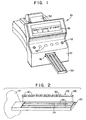
- Fig. 1 illustrates a reflectance spectroscope 10 for performing various tests, such as urinalysis tests, on a reagent strip.
- the spectroscope 10 has an integral keyboard 12 with a number of entry keys 14 that may be depressed by the user.
- a visual display 16 for displaying various messages relating to the operation of the spectroscope 10 is disposed above the keyboard 12.
- the spectroscope 10 has a front face 17 with an opening 18 formed therein in which a tray 20 for carrying a reagent strip 22 is retractably disposed.
- the tray 20 has a central channel 24 and two side channels 26 formed therein, and the central channel 24 is sized to conform to the shape of the reagent strip 22.
- the reagent strip 22 has a thin, non-reactive substrate 28 on which a number of reagent pads 30 are fixed.
- Each reagent pad 30 is composed of a relatively absorbent material impregnated with a respective reagent, each reagent and reagent pad 30 being associated with a particular test to be performed.
- test to be performed they may include, for example, a test for leukocytes in the urine, a test of the pH of the urine, a test for blood in the urine, etc.
- the pad 30 When each reagent pad 30 comes into contact with a urine sample, the pad changes color over a time period, depending on the reagent used and the characteristics of the urine sample.
- the reagent strip 22 may be, for example, a Multistix® reagent strip commercially available from Bayer Corporation.
- the reagent strip 22 is dipped into a urine sample to be tested so that all of the reagent pads 30 are immersed in the sample. After the side of the reagent strip 22 is blotted to remove excess urine, the strip 22 is placed in the central channel 24 of the tray 20, and after the user presses one of the start keys 14 to initiate testing, the tray 20 is automatically retracted into the spectroscope 10.
- a respective test is performed on each of the reagent pads 30 by illuminating a portion of the reagent pad 30 with white light from a light source and then determining the color of the reagent pad 30 based upon detection of light received from the illuminated portion of the reagent pad 30 at an angle (e.g. 45°) from the upper surface of the pad 30.
- the tray 20 is repositioned relative to the light source so that the next reagent pad 30 to be tested is illuminated.
- the spectroscope 10 When the testing is completed, the spectroscope 10 generates a record of the results, which are displayed on the display 16 and/or printed on a strip of paper 32 via a printer and/or sent to a computer.
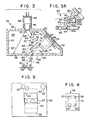
- Fig. 3 is a cross-sectional view of an optical system, in the form of a read head 34, for illuminating portions of the reagent pads 30 and for detecting light from the reagent pads 30, and a portion of the tray 20 on which the reagent strip 22 is disposed.
- the read head 34 has a housing with a top wall 36, a bottom wall 38, a side wall 40, an angled wall 42, a planar back wall 44, and a planar front wall (not shown) parallel to the back wall 44.
- An illumination source in the form of a light bulb 46 is supported directly above the reagent pad 30 to be tested via a cylindrical housing portion 48 integrally formed with the top wall 36.
- the lower spherical portion of the light bulb 46 has a concentrating lens integrally formed therein, and the lower spherical surface is acid-etched to provide it with an uneven, diffusing surface so that the shape of the bulb filament does not contribute to non-uniformity of the emitted light.
- the bulb 46 is dynamically fitted to a ceramic base 49 when the bulb 46 is illuminated to ensure that the axial direction in which bulb 46 emits light is substantially parallel to the longitudinal axis of the ceramic base 49.
- the bulb 46 emits light through a circular aperture 50 formed in the top wall 36 to form a cone of light defined by a first edge ray 52 and a second edge ray 54.
- the angled side wall 42 has a rectangular aperture 55 formed therein in which a rectangular detector array 56 is disposed.
- the detector array 56 has four reflectance detectors 57, 58, 59, 60 disposed therein (see Fig. 4), each of which is composed of a conventional colored or IR filter and a conventional silicon detector. Each filter allows light having a distinct wavelength to pass through so that each of the detectors 57-60 is responsive to light of a different wavelength range.
- the four wavelength bands of the filters are: 400-510 nm (nanometers) (blue); 511-586 nm (green); 587-660 nm (red); and 825-855 nm (infrared). Depending on the type of test being performed, one or more of the detectors 57-60 may be used.
- Light passes through a first optical path from the light bulb 46, through a relatively small rectangular aperture 62 formed in the bottom wall 38, to illuminate a relatively small rectangular area of the reagent pad 30 being tested.
- the reagent pad 30 may be moved relative to the aperture 62 so that different rectangular areas of the reagent pad 30 are illuminated.
- the illuminated areas may include a first area indicated by a dotted box 63, a second area indicated by a solid box 64, a third area indicated by a dotted box 65, and a fourth area indicated by a solid box 66.
- the illuminated areas 63-66 are linearly offset with respect to each other, and adjacent areas partially overlap each other.
- a number of irregularly shaped areas 67 representing non-hemolyzed blood cell fragments are also shown in Fig. 5.
- Light passes through a second optical path from the illuminated area on the reagent pad 30, through a first rectangular detection aperture 68 having angled edges 69 formed in the bottom wall 38, through a second rectangular detection aperture 70 having angled edges 71, and through a rectangular aperture 72 formed in the angled wall 42 to a detection area 73 (Fig. 4) in which the four detectors 57-60 are disposed.
- the interior of the read head 34 is provided with an irregularly shaped baffle 74 composed of a first planar wall segment 76, a second planar wall segment 78, and a zig-zag shaped wall segment 80.
- the shape of the baffle 74 is designed to prevent singly-reflected light rays from reaching the reagent pad 30 from the light bulb 46 and to prevent singly-reflected light rays from reaching the detector area 73 from the reagent pad 30.
- All surfaces of the baffle 74 and all interior surfaces of the housing walls 36, 38, 40, 42, 44 are shiny, specular surfaces so that any light incident upon any surface at an angle of incidence is reflected from that surface at an angle of reflection equal to the angle of incidence. This may be accomplished by injection-molding the read head 34 from a metal mold having highly polished molding surfaces.
- the read head 34 is preferably formed of black plastic so that only a small percentage of light, e.g. 5%, incident upon any of its internal surfaces is reflected. Consequently, any light that undergoes at least two reflections from any interior surfaces of the read head 34 is attenuated by at least 99.75%.
- the wall segment 76 has a specular surface 82 that is angled in a direction indicated by a dotted line 84, which intersects the bottom wall 38 at a point just to the left of the aperture 62. Consequently, any light rays emitted by the bulb 46 that impinge upon the surface 82 are reflected to an area to the left of the aperture 62. It should be noted that any such rays are reflected at least twice (in actuality at least three times) before they can pass through the aperture 62. It should also be noted that no light can be reflected from the surface 82 and pass directly through the aperture 62 without further reflection since the surface 82 is not visible when the interior of the read head 34 is viewed from the aperture 62.
- the wall segment 78 has a specular surface 86 angled in a direction indicated by a dotted line 88, which intersects the top wall 36 at a point to the left of the circular opening 50 through which light passes. Consequently, there is no direct path from the light bulb 46 to the surface 86; therefore, any light that is reflected from the surface 86 to the aperture 62 will have undergone at least two (more than two in actuality) reflections from the interior surfaces of the read head 34.
- Fig. 3A is an enlarged view of a portion of read head 34 shown in Fig. 3.
- the zig-zag wall segment 80 has angled surfaces 90-93, each of which is angled in a direction indicated by a respective dotted line. Since all of the dotted lines intersect the bottom wall 38 or the side wall 40 to the left of the aperture 62, no light that impinges upon these surfaces 90-93 directly from the light bulb 46 can be reflected directly to the aperture 62.
- the zig-zag wall segment 80 has two further surfaces 94, 95 (Fig. 3) that are angled so that any light that impinges on those surfaces directly from the bulb 46 is reflected exclusively to the area of the bottom wall 38 to the right sides of the aperture 62.
- the only surfaces from which light rays emitted by the bulb 46 can be singly-reflected and still pass through the aperture 62 are the vertical walls of the aperture 62 itself. However, such singly-reflected light rays constitute an insignificant amount of the total light which passes directly from the light bulb 46 to the reagent pad 30 without reflection. There is also a singly-reflected light path from the bulb 46 to the walls 40 or 44 to the aperture 62. But because the bulb 46 concentrates light in a forward direction within the cone defined by rays 52 and 54, the amount of light going through the aperture 62 from this path is insignificant.
- the second optical path from the reagent pad 30 to the detector area 73 (Fig. 4), is generally indicated by a pair of dotted lines 96, 98.
- the side of the zig-zag wall segment 80 which is disposed adjacent the second optical path has a plurality of planar, specular surfaces 100, 101, 102 which are angled in a direction indicated by a number of corresponding dotted lines (shown in Fig. 3) which intersect the angled side wall 42 at a point to the lower right of the detector area 73.
- any light rays that impinge upon these surfaces 100-102 directly from the reagent pad 30 without reflection cannot reach the detector area 73 without at least one more reflection, and thus any such light rays will be attenuated by at least 99.75%.
- the side of the zig-zag wall segment 80 which is disposed adjacent the second optical path has a plurality of planar, specular surfaces 103, 104 (Fig. 3A) which are angled so that no light rays from the reagent pad 30 can reach the surfaces 103, 104 directly without at least one reflection. Consequently, any light rays that impinge upon these surfaces 103-104 will already have undergone at least one reflection, and therefore any such light rays that eventually reach the detector area 73 will be reflected at least twice and thus be attenuated by at least 99.75%.
- the wall surfaces 100 and 103 join at an edge 105, and the wall surfaces 101 and 104 join at an edge 106, the edges 105, 106 being substantially aligned with a respective edge of the detection area 73, and the edges 69, 71 of the detection apertures 68, 70 are aligned with the edges of the detection area 73.
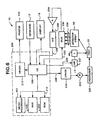
- Fig. 6 is a block diagram of the electronics and other components of the spectroscope 10.
- the operation of the spectroscope 10 is controlled by a microcontroller 200 which has a microprocessor 202, a random-access memory (RAM) 204, a read-only memory (ROM) 206, and an input/output (I/O) circuit 208, all of which are interconnected via an address/data bus 210.
- the microcontroller 200 which may be a conventional microcontroller such as a DS2253T microcontroller commercially available from Vallas Semiconductor, may incorporate a driver circuit 212 connected to the I/O circuit 208 for driving a printer 214.
- the microcontroller 200 controls the movement of the reagent strip tray 20 via a conventional positioner 220 mechanically coupled to the tray 20 and a motor 222, such as a stepping motor, that is driven by drive signals generated by a driver circuit 224 connected to the I/O circuit 208 via an electrical line 226.
- the microcontroller 200 selectively turns on the light bulb 46 via a switch 227 connected to the I/O circuit 208 via an electrical line 229.
- the light bulb 46 is turned on one second prior to the performance of a test so that it will be sufficiently warmed up. If the light bulb 46 is not needed to provide illumination within the next one-second period following a test, it is turned off to conserve its life.
- Each of the detectors 57-60 of the detector array 56 may generate an electrical reflectance signal on one of a number of electrical lines 228. Each reflectance signal has a magnitude that depends on the amount of light detected by the associated detector.
- the microcontroller 200 can selectively read any one of the reflectance signals by transmitting a select signal to a multiplexer 230 via a line 232. The multiplexer 230 then transmits the selected reflectance signal to an amplifier 234 and an analog-to-digital (A/D) converter 236, which transmits the binary signal corresponding to the analog reflectance signal output by the amplifier 234 to the microcontroller 200 via a line 238 connected to the I/O circuit 208.
- A/D analog-to-digital
- the operation of the spectroscope 10 is controlled by a computer program stored in the ROM 206 and executed by the microprocessor 202.
- a flowchart of a test routine 300 which relates to the detection of blood in the urine is shown in Fig. 7.
- the reagent pad 30 having the reagent which changes color in response to the presence of blood is positioned directly below the light bulb 46.
- the detector having the red filter is used for urinalysis testing of the reagent pad 30 for the blood test.
- the amount of light sensed by the detector from the reagent pad 30 is inversely related to the amount of blood present in the urine sample on the reagent pad.
- a relatively large blood concentration will cause the reagent pad 30 to turn from yellow to green. Since the color green is darker and absorbs more light than the color yellow, relatively large blood concentrations will cause the red-filter detector to detect a relatively small amount of light.
- the red-filter detector For each of a plurality of illuminated portions on the reagent pad 30, the red-filter detector generates an electrical reflectance signal having a magnitude directly proportional to the amount of light sensed by the detector from that portion. Based upon the magnitudes of the reflectance signals, the spectroscope 10 associates the urine sample with one of six categories: no blood present, blood trace present, non-hemolyzed blood trace present, a relatively small blood concentration present, a medium blood concentration present, or a relatively large blood concentration present.
- the test routine 300 shown in Fig. 7 may be used to perform a single urinalysis test.
- steps 301-304 cause four reflectance readings of the reagent pad 30 to be made, each reading corresponding to a different one of the illuminated portions 63-66 of the reagent pad 30 (Fig. 5).
- the light bulb 46 is turned on to illuminate a first portion of the reagent pad 30, such as the portion 63 shown in Fig. 5.
- the reflectance signal generated by the red-filter detector is "read” by transmitting it through the multiplexer 230 to the amplifier 234, the A/D converter 236, the I/O circuit 208, and the RAM 204 where its value is stored.
- step 304 if four readings have not been made, the program branches back to step 301 where a different portion of the reagent pad 30 is illuminated, such as the portion 64, and to step 302, where the reflectance reading generated by the detector is read and stored in the RAM 204. Steps 301-302 are repeated until four readings have been taken.
- the program branches to step 308 where a decode reading is determined.
- the decode reading is used to categorize the urine sample into one of three blood concentration categories: large blood concentration, medium blood concentration, or small blood concentration.
- the decode reading may be determined in a number of different ways, such as by taking the average of all four reflectance readings and assigning the average value to the decode reading. Alternatively, the reflectance reading that was taken from a central portion of the reagent pad 30, such as either one of the portions 64, 65 shown in Fig. 5, could be used as the decode reading.
- step 310 if the value of the decode reading is less than a threshold T1, such as 10.3% reflectance, the program branches to step 312 where the urine sample is categorized as having a relatively large blood concentration, which fact is stored in the RAM 204.
- step 314 if the decode reading is less than a threshold T2, such as 19.7% reflectance, the program branches to step 316 where the urine sample is categorized as having a medium blood concentration. If the program reaches step 316, then the decode reading will have a value between the T2 and T3 thresholds (e.g. between 19.7% and 29.1% reflectance), in which case the program will branch to step 318 where the urine sample is categorized as having a relatively small blood concentration.
- the program branches to step 320, where it determines whether at least three of the readings are greater than a threshold T4 (such as 56.0% reflectance), in which case the program branches to step 322 where the urine sample is categorized as being "negative" or having no blood present.
- a threshold T4 such as 56.0% reflectance
- the urine sample is considered to have a trace amount of blood present.
- This trace amount of blood can be composed of either hemolyzed blood or non-hemolyzed blood.
- the four reflectance readings can vary substantially in value, depending upon whether the blood cell fragments 67 are present within the illuminated portion.
- the illuminated portion 65 covers an area which completely encompasses one blood cell fragment 67 and parts of two others, whereas the illuminated portion 66 covers an area which encompasses no blood cell fragments 67. Consequently, the value of the reflectance reading associated with the illuminated portion 65 would be substantially different than the value of the reflectance reading associated with the illuminated portion 66.
- the program determines the difference between the largest and smallest of the four reflectance reading values.
- a predetermined value K such as 2.5% reflectance
- the program branches to step 330 where the urine sample is categorized as having a trace amount of blood.
- the category to which the urine sample was assigned (at one of steps 312, 316, 318, 322, 328 or 330) is output, such as by generating a printed record of the category and/or displaying the category on the visual display 16.
Landscapes
- Health & Medical Sciences (AREA)
- Life Sciences & Earth Sciences (AREA)
- Biochemistry (AREA)
- Physics & Mathematics (AREA)
- Chemical & Material Sciences (AREA)
- Analytical Chemistry (AREA)
- General Health & Medical Sciences (AREA)
- General Physics & Mathematics (AREA)
- Immunology (AREA)
- Pathology (AREA)
- Molecular Biology (AREA)
- Investigating Or Analysing Biological Materials (AREA)
- Investigating Or Analysing Materials By Optical Means (AREA)
Claims (10)
- Gerät zur Analyse einer Urinprobe auf einer Reagensunterlage zum Nachweis von nicht-hämolysierten Gehaltsmengen von okkultem Blut in der genannten Urinprobe, wobei das genannte Gerät umfasst:Mittel zur nacheinander erfolgenden Beleuchtung einer Vielzahl unterschiedlicher Teilbereiche der genannten Reagensunterlage, auf welcher die genannte Urinprobe angeordnet wird;Mittel zum Nachweis von Licht, das aus der genannten Reagensunterlage empfangen wird, wobei die genannten Nachweismittel eine Vielzahl von Reflexionssignalen erzeugen, die jeweils eine Größe aufweisen, wobei jedes der genannten Reflexionssignale in Reaktion auf Licht erzeugt wird, das aus einem entsprechenden der genannten unterschiedlichen Teilbereiche der genannten Reagensunterlage empfangen wird, die von den genannten Beleuchtungsmitteln beleuchtet wird;Mittel zur Bestimmung der Differenz zwischen der genannten Größe von einem der genannten Reflexionssignale und der genannten Größe von einem weiteren der genannten Reflexionssignale; undMittel zum Vergleich der genannten Differenz mit einem vorbestimmten Schwellenwert zum Nachweis des Vorliegens von nicht-hämolysiertem Blut in der genannten Urinprobe.
- Gerät gemäß Anspruch 1, worin das genannte Beleuchtungsmittel umfasst:eine Glühlampe; undMittel zur Bewegung der genannte Glühlampe relativ zur genannten Reagensunterlage.
- Gerät gemäß Anspruch 2, zusätzlich umfassend ein Tablett, worin die genannte Reagensunterlage angeordnet wird, worin die genannte Glühlampe in einer fixierten Position angeordnet ist und die genannten Mittel zur Bewegung der genannten Glühlampe relativ zur genannten Reagensunterlage Mittel zur Bewegung des genannten Tabletts umfassen.
- Gerät zur Analyse einer Körperflüssigkeitsprobe auf einer Reagensunterlage, wobei das genannte Gerät umfasst:Mittel zur nacheinander erfolgenden Beleuchtung einer Vielzahl unterschiedlicher Teilbereiche der genannten Reagensunterlage, auf welcher die genannte Körperflüssigkeitsprobe angeordnet wird;Mittel zum Nachweis von Licht, das aus der genannten Reagensunterlage empfangen wird, wobei die genannten Nachweismittel eine Vielzahl von Reflexionssignalen erzeugen, die jeweils eine Größe aufweisen, wobei jedes der genannten Reflexionssignale in Reaktion auf Licht erzeugt wird, das aus einem entsprechenden der genannten unterschiedlichen Teilbereiche der genannten Reagensunterlage empfangen wird, die vom genannten Beleuchtungsmittel beleuchtet wird; undMittel zur Bestimmung, ob sich die genannte Größe von einem der genannten Reflexionssignale wesentlich von der genannten Größe eines weiteren der genannten Reflexionssignale unterscheidet.
- Gerät gemäß Anspruch 4, zusätzlich umfassend:Mittel zur Bestimmung eines Decode-Signals auf Basis der genannten Reflexionssignale; undMittel zum Vergleich des genannten Decode-Signals mit einer Vielzahl von vorbestimmten Schwellenwerten, um die genannte Körperflüssigkeitsprobe zu kategorisieren.
- Gerät gemäß Anspruch 5, worin das genannte Mittel zur Bestimmung des Decode-Signals Mittel zur Auswahl eines der genannten Reflexionssignale als das genannte Decode-Signal umfasst.
- Verfahren zur Analyse einer Urinprobe auf einer Reagensunterlage, wobei das Verfahren die Stufen umfasst, in denen(a) ein erster Teilbereich der genannten Reagensunterlage beleuchtet wird;(b) Licht nachgewiesen wird, das aus dem genannten ersten Teilbereich der genannten ersten Reagensunterlage empfangen wird;(c) ein erstes Reflexionssignal mit einer Größe erzeugt wird, die auf das genannte Licht bezogen ist, das während der genannten Stufe (b) nachgewiesen wird;(d) ein zweiter Teilbereich der genannten Reagensunterlage beleuchtet wird, wobei sich der genannte zweite Teilbereich vom genannten ersten Teilbereich unterscheidet;(e) Licht nachgewiesen wird, das aus dem genannten zweiten Teilbereich der genannten Reagensunterlage empfangen wird;(f) ein zweites Reflexionssignal mit einer Größe erzeugt wird, die auf das genannte Licht bezogen ist, das während der genannten Stufe (e) nachgewiesen wird; und(g) bestimmt wird, ob sich die Größe des genannten ersten Reflexionssignals wesentlich von der genannten Größe des genannten zweiten Reflexionssignals unterscheidet.
- Verfahren gemäß Anspruch 7, worin die genannte Stufe (g) die Stufen umfasst, in denen:(g1) die Differenz zwischen der genannten Größe des genannten ersten Reflexionssignals und der genannten Größe des genannten zweiten Reflexionssignals bestimmt wird; und(g2) die genannte Differenz mit einem Schwellenwert verglichen wird, um zu bestimmen, ob die genannte Differenz größer als der genannte Schwellenwert ist.
- Verfahren gemäß Anspruch 7, worin die genannte Stufe (d) die Stufe zur Beleuchtung eines Teilbereichs der genannten Reagensunterlage umfasst, welcher den genannten ersten Teilbereich der genannten Reagensunterlage überlappt.
- Gerät zur Beleuchtung einer Körperflüssigkeitsprobe auf einer Reagensunterlage, wobei die genannte Reagensunterlage eine Gesamtfläche aufweist, wobei das genannte Gerät umfasst:Mittel zur Beleuchtung eines ersten Teilbereichs der genannten Reagensunterlage, auf welcher die genannte Körperflüssigkeitsprobe angeordnet wird, wobei der genannte erste Teilbereich der genannten Reagensunterlage eine Fläche aufweist, die kleiner als die genannte Gesamtfläche der genannten Reagensunterlage ist;Mittel zur Bewegung der genannten Reagensunterlage relativ zum genannten Beleuchtungsmittel, so dass das genannte Beleuchtungsmittel einen zweiten Teilbereich der genannten Reagensunterlage beleuchtet, die sich vom genannten ersten Teilbereich der genannten Reagensunterlage unterscheidet, wobei der genannte zweite Teilbereich der genannten Reagensunterlage eine Fläche aufweist, die kleiner als die genannte Gesamtfläche der genannten Reagensunterlage ist; undMittel zum Nachweis von Licht, das aus den genannten beleuchteten Teilbereichen der genannten Reagensunterlage empfangen wird.
Applications Claiming Priority (2)
| Application Number | Priority Date | Filing Date | Title |
|---|---|---|---|
| US647121 | 1996-05-09 | ||
| US08/647,121 US5654803A (en) | 1996-05-09 | 1996-05-09 | Apparatus and method for determination of non-hemolyzed levels of occult blood in urine |
Publications (3)
| Publication Number | Publication Date |
|---|---|
| EP0806663A2 EP0806663A2 (de) | 1997-11-12 |
| EP0806663A3 EP0806663A3 (de) | 1998-12-16 |
| EP0806663B1 true EP0806663B1 (de) | 2003-10-15 |
Family
ID=24595796
Family Applications (1)
| Application Number | Title | Priority Date | Filing Date |
|---|---|---|---|
| EP97107009A Expired - Lifetime EP0806663B1 (de) | 1996-05-09 | 1997-04-28 | Gerät und Verfahren zur Feststellung von nicht-hämolisierten, okkulten Blutpegeln im Urin |
Country Status (6)
| Country | Link |
|---|---|
| US (1) | US5654803A (de) |
| EP (1) | EP0806663B1 (de) |
| JP (1) | JP3720518B2 (de) |
| AU (1) | AU691441B2 (de) |
| CA (1) | CA2198945C (de) |
| DE (1) | DE69725498T2 (de) |
Families Citing this family (25)
| Publication number | Priority date | Publication date | Assignee | Title |
|---|---|---|---|---|
| AU733317B2 (en) * | 1996-09-23 | 2001-05-10 | Novoste Corporation | Intraluminal radiation treatment system |
| US6394952B1 (en) | 1998-02-03 | 2002-05-28 | Adeza Biomedical Corporation | Point of care diagnostic systems |
| US6267722B1 (en) | 1998-02-03 | 2001-07-31 | Adeza Biomedical Corporation | Point of care diagnostic systems |
| WO1999040536A1 (en) | 1998-02-10 | 1999-08-12 | Ey Laboratories, Inc. | Reflectometry system with compensation for specimen holder topography and with lock-rejection of system noise |
| US6183694B1 (en) * | 1998-10-30 | 2001-02-06 | Bayer Corporation | Spectrophotometric apparatus for reducing fluid carryover |
| CA2366802A1 (en) * | 2001-01-17 | 2002-07-17 | Bayer Corporation | Method and apparatus for using infrared readings to detect misidentification of a diagnostic test strip in a reflectance spectrometer |
| JP4005929B2 (ja) * | 2003-02-26 | 2007-11-14 | 浜松ホトニクス株式会社 | 免疫クロマト試験片の測定装置 |
| US7173704B2 (en) * | 2003-02-26 | 2007-02-06 | Hamamatsu Photonics K.K. | Measuring device for immunochromatography test piece and light source device |
| US7173705B2 (en) | 2003-02-26 | 2007-02-06 | Hamamatsu Photonics K.K. | Measuring device for immunochromatography test piece |
| US7118713B2 (en) * | 2003-06-03 | 2006-10-10 | Bayer Healthcare Llc | Tray assembly for optical inspection apparatus |
| GB2402475A (en) * | 2003-06-04 | 2004-12-08 | Inverness Medical Switzerland | Analyte assay reading providing prompt result declaration |
| US20070071641A1 (en) * | 2004-04-09 | 2007-03-29 | Brock David A | Tray assembly for optical inspection apparatus |
| US7264971B2 (en) * | 2004-07-20 | 2007-09-04 | Siemens Medical Solutions Diagnostics | Read-head for optical diagnostic device |
| US8263414B2 (en) | 2005-05-23 | 2012-09-11 | Siemens Healthcare Diagnostics Inc. | Dispensing of a diagnostic liquid onto a diagnostic reagent |
| WO2010011460A1 (en) * | 2008-07-22 | 2010-01-28 | Siemens Healthcare Diagnostic Inc. | Disease specific diagnostic aid |
| WO2012149243A1 (en) | 2011-04-29 | 2012-11-01 | Siemens Healthcare Diagnostics Inc. | High flux collimated illuminator and method of uniform field illumination |
| JP6250040B2 (ja) | 2012-05-18 | 2017-12-20 | シーメンス・ヘルスケア・ダイアグノスティックス・インコーポレーテッドSiemens Healthcare Diagnostics Inc. | 魚眼レンズ・アナライザ |
| KR102160034B1 (ko) * | 2013-07-24 | 2020-09-25 | 삼성전자주식회사 | 검사장치 및 그 제어방법 |
| US10722405B2 (en) | 2016-10-13 | 2020-07-28 | Verily Life Sciences Llc | Smart diaper for detecting and differentiating feces and urine |
| US11679036B2 (en) | 2019-04-12 | 2023-06-20 | Verily Life Sciences Llc | Determining diaper loading using color detection or activity state |
| US10575390B2 (en) | 2018-05-04 | 2020-02-25 | Verily Life Sciences Llc | Color sensing using pulsed light |
| US11373102B2 (en) | 2018-05-04 | 2022-06-28 | The Procter & Gamble Company | Sensing and activity classification for infants |
| US11585804B2 (en) | 2018-10-19 | 2023-02-21 | Youcount Inc. | Urinalysis device and test strip for home and point of care use |
| US11607143B2 (en) | 2019-04-12 | 2023-03-21 | Verily Life Sciences Llc | Sensing physiological parameters through an article |
| CA3049972A1 (en) | 2019-07-15 | 2021-01-15 | Youcount Inc. | Urinalysis test strip for over-the-counter use |
Family Cites Families (13)
| Publication number | Priority date | Publication date | Assignee | Title |
|---|---|---|---|---|
| JPS5629725Y2 (de) * | 1973-12-12 | 1981-07-15 | ||
| US3907503A (en) * | 1974-01-21 | 1975-09-23 | Miles Lab | Test system |
| US4755058A (en) * | 1984-06-19 | 1988-07-05 | Miles Laboratories, Inc. | Device and method for measuring light diffusely reflected from a nonuniform specimen |
| US4689202A (en) * | 1984-09-11 | 1987-08-25 | Miles Laboratories, Inc. | Reagent test strip reading instrument |
| US5028139A (en) * | 1987-07-16 | 1991-07-02 | Miles Inc. | Readhead for reflectance measurement of distant samples |
| US5318984A (en) * | 1988-12-05 | 1994-06-07 | The Du Pont Merck Pharmaceutical Company | Imidazoles for the treatment of atherosclerosis |
| JPH0395435A (ja) * | 1989-09-08 | 1991-04-19 | Terumo Corp | 測定装置 |
| US5250262A (en) * | 1989-11-22 | 1993-10-05 | Vettest S.A. | Chemical analyzer |
| US5246858A (en) * | 1991-02-27 | 1993-09-21 | Boehringer Mannheim Corporation | Apparatus and method for analyzing a body fluid |
| US5165078A (en) * | 1991-03-25 | 1992-11-17 | Miles Inc. | Multi-channel, multi-wavelength detection system |
| US5264348A (en) * | 1991-05-13 | 1993-11-23 | Miles Inc. | Ascorbate interference-resistant composition, device and method of assaying for predetermined analyte |
| US5464775A (en) * | 1991-09-16 | 1995-11-07 | Chimera Research And Chemical, Inc. | Method of detecting adulterant in urine |
| US5701181A (en) * | 1995-05-12 | 1997-12-23 | Bayer Corporation | Fiber optic diffuse light reflectance sensor utilized in the detection of occult blood |
-
1996
- 1996-05-09 US US08/647,121 patent/US5654803A/en not_active Expired - Lifetime
-
1997
- 1997-03-03 CA CA002198945A patent/CA2198945C/en not_active Expired - Fee Related
- 1997-03-26 JP JP07290697A patent/JP3720518B2/ja not_active Expired - Lifetime
- 1997-04-28 EP EP97107009A patent/EP0806663B1/de not_active Expired - Lifetime
- 1997-04-28 DE DE69725498T patent/DE69725498T2/de not_active Expired - Lifetime
- 1997-05-08 AU AU20122/97A patent/AU691441B2/en not_active Ceased
Also Published As
| Publication number | Publication date |
|---|---|
| CA2198945C (en) | 2002-01-08 |
| AU691441B2 (en) | 1998-05-14 |
| EP0806663A3 (de) | 1998-12-16 |
| CA2198945A1 (en) | 1997-11-09 |
| JP3720518B2 (ja) | 2005-11-30 |
| DE69725498D1 (de) | 2003-11-20 |
| JPH1010123A (ja) | 1998-01-16 |
| DE69725498T2 (de) | 2004-06-24 |
| AU2012297A (en) | 1997-11-13 |
| US5654803A (en) | 1997-08-05 |
| EP0806663A2 (de) | 1997-11-12 |
Similar Documents
| Publication | Publication Date | Title |
|---|---|---|
| US5654803A (en) | Apparatus and method for determination of non-hemolyzed levels of occult blood in urine | |
| JP3455654B2 (ja) | 微小なサンプル量を検知するための手段を備えた分析装置 | |
| US7601544B2 (en) | Method and apparatus for using infrared readings to detect misidentification of a diagnostic test strip in a reflectance spectrometer | |
| EP0837320B1 (de) | System zur optischen Erkennung von Kodierung auf einem diagnostischen Teststreifen | |
| EP0806662B1 (de) | Gerät und Verfahren zur Feststellung der Urinfarbe | |
| JP2916637B2 (ja) | 拡散分光反射率の測定装置 | |
| US5661563A (en) | Reflectance spectroscope with read head for minimizing singly-reflected light rays | |
| US7768645B2 (en) | Miniature optical readhead and colorimeter for analysis media | |
| CA2744028A1 (en) | Polarized optics for optical diagnostic device | |
| EP0087466B1 (de) | Verfahren und vorrichtung zum aufspüren von probeflüssigkeiten | |
| US20230324307A1 (en) | Circuit board with onboard light sources | |
| WO1998016815A1 (en) | Two-mode surface defect testing system | |
| JPWO1999008080A1 (ja) | 色調識別装置及び色調識別図表 |
Legal Events
| Date | Code | Title | Description |
|---|---|---|---|
| PUAI | Public reference made under article 153(3) epc to a published international application that has entered the european phase |
Free format text: ORIGINAL CODE: 0009012 |
|
| AK | Designated contracting states |
Kind code of ref document: A2 Designated state(s): BE CH DE ES FI FR GB IE IT LI NL SE |
|
| PUAL | Search report despatched |
Free format text: ORIGINAL CODE: 0009013 |
|
| AK | Designated contracting states |
Kind code of ref document: A3 Designated state(s): BE CH DE ES FI FR GB IE IT LI NL SE |
|
| 17P | Request for examination filed |
Effective date: 19990616 |
|
| GRAH | Despatch of communication of intention to grant a patent |
Free format text: ORIGINAL CODE: EPIDOS IGRA |
|
| RIC1 | Information provided on ipc code assigned before grant |
Ipc: 7G 01N 21/86 B Ipc: 7G 01N 33/487 B Ipc: 7G 01N 21/47 A |
|
| RIC1 | Information provided on ipc code assigned before grant |
Ipc: 7G 01N 21/86 B Ipc: 7G 01N 33/487 B Ipc: 7G 01N 21/47 A |
|
| GRAS | Grant fee paid |
Free format text: ORIGINAL CODE: EPIDOSNIGR3 |
|
| GRAA | (expected) grant |
Free format text: ORIGINAL CODE: 0009210 |
|
| AK | Designated contracting states |
Kind code of ref document: B1 Designated state(s): BE CH DE ES FI FR GB IE IT LI NL SE |
|
| PG25 | Lapsed in a contracting state [announced via postgrant information from national office to epo] |
Ref country code: NL Free format text: LAPSE BECAUSE OF FAILURE TO SUBMIT A TRANSLATION OF THE DESCRIPTION OR TO PAY THE FEE WITHIN THE PRESCRIBED TIME-LIMIT Effective date: 20031015 Ref country code: LI Free format text: LAPSE BECAUSE OF FAILURE TO SUBMIT A TRANSLATION OF THE DESCRIPTION OR TO PAY THE FEE WITHIN THE PRESCRIBED TIME-LIMIT Effective date: 20031015 Ref country code: CH Free format text: LAPSE BECAUSE OF FAILURE TO SUBMIT A TRANSLATION OF THE DESCRIPTION OR TO PAY THE FEE WITHIN THE PRESCRIBED TIME-LIMIT Effective date: 20031015 Ref country code: BE Free format text: LAPSE BECAUSE OF FAILURE TO SUBMIT A TRANSLATION OF THE DESCRIPTION OR TO PAY THE FEE WITHIN THE PRESCRIBED TIME-LIMIT Effective date: 20031015 |
|
| REG | Reference to a national code |
Ref country code: GB Ref legal event code: FG4D Ref country code: CH Ref legal event code: EP |
|
| REG | Reference to a national code |
Ref country code: IE Ref legal event code: FG4D |
|
| REF | Corresponds to: |
Ref document number: 69725498 Country of ref document: DE Date of ref document: 20031120 Kind code of ref document: P |
|
| REG | Reference to a national code |
Ref country code: SE Ref legal event code: TRGR |
|
| PG25 | Lapsed in a contracting state [announced via postgrant information from national office to epo] |
Ref country code: ES Free format text: LAPSE BECAUSE OF FAILURE TO SUBMIT A TRANSLATION OF THE DESCRIPTION OR TO PAY THE FEE WITHIN THE PRESCRIBED TIME-LIMIT Effective date: 20040126 |
|
| NLV1 | Nl: lapsed or annulled due to failure to fulfill the requirements of art. 29p and 29m of the patents act | ||
| PGFP | Annual fee paid to national office [announced via postgrant information from national office to epo] |
Ref country code: SE Payment date: 20040421 Year of fee payment: 8 |
|
| PGFP | Annual fee paid to national office [announced via postgrant information from national office to epo] |
Ref country code: FI Payment date: 20040422 Year of fee payment: 8 |
|
| PG25 | Lapsed in a contracting state [announced via postgrant information from national office to epo] |
Ref country code: IE Free format text: LAPSE BECAUSE OF NON-PAYMENT OF DUE FEES Effective date: 20040428 |
|
| REG | Reference to a national code |
Ref country code: CH Ref legal event code: PL |
|
| ET | Fr: translation filed | ||
| PLBE | No opposition filed within time limit |
Free format text: ORIGINAL CODE: 0009261 |
|
| STAA | Information on the status of an ep patent application or granted ep patent |
Free format text: STATUS: NO OPPOSITION FILED WITHIN TIME LIMIT |
|
| 26N | No opposition filed |
Effective date: 20040716 |
|
| REG | Reference to a national code |
Ref country code: IE Ref legal event code: MM4A |
|
| PG25 | Lapsed in a contracting state [announced via postgrant information from national office to epo] |
Ref country code: FI Free format text: LAPSE BECAUSE OF NON-PAYMENT OF DUE FEES Effective date: 20050428 |
|
| PG25 | Lapsed in a contracting state [announced via postgrant information from national office to epo] |
Ref country code: SE Free format text: LAPSE BECAUSE OF NON-PAYMENT OF DUE FEES Effective date: 20050429 |
|
| EUG | Se: european patent has lapsed | ||
| PGFP | Annual fee paid to national office [announced via postgrant information from national office to epo] |
Ref country code: IT Payment date: 20100427 Year of fee payment: 14 |
|
| REG | Reference to a national code |
Ref country code: GB Ref legal event code: 732E Free format text: REGISTERED BETWEEN 20101104 AND 20101110 |
|
| REG | Reference to a national code |
Ref country code: FR Ref legal event code: TP |
|
| PG25 | Lapsed in a contracting state [announced via postgrant information from national office to epo] |
Ref country code: IT Free format text: LAPSE BECAUSE OF NON-PAYMENT OF DUE FEES Effective date: 20110428 |
|
| REG | Reference to a national code |
Ref country code: FR Ref legal event code: PLFP Year of fee payment: 20 |
|
| PGFP | Annual fee paid to national office [announced via postgrant information from national office to epo] |
Ref country code: DE Payment date: 20160620 Year of fee payment: 20 Ref country code: GB Payment date: 20160411 Year of fee payment: 20 |
|
| PGFP | Annual fee paid to national office [announced via postgrant information from national office to epo] |
Ref country code: FR Payment date: 20160429 Year of fee payment: 20 |
|
| REG | Reference to a national code |
Ref country code: DE Ref legal event code: R071 Ref document number: 69725498 Country of ref document: DE |
|
| REG | Reference to a national code |
Ref country code: GB Ref legal event code: PE20 Expiry date: 20170427 |
|
| PG25 | Lapsed in a contracting state [announced via postgrant information from national office to epo] |
Ref country code: GB Free format text: LAPSE BECAUSE OF EXPIRATION OF PROTECTION Effective date: 20170427 |