EP0806512B1 - Method and device for fibrillating easily fibrillated cellulose fibres, particularly tencel fibres - Google Patents
Method and device for fibrillating easily fibrillated cellulose fibres, particularly tencel fibres Download PDFInfo
- Publication number
- EP0806512B1 EP0806512B1 EP97810241A EP97810241A EP0806512B1 EP 0806512 B1 EP0806512 B1 EP 0806512B1 EP 97810241 A EP97810241 A EP 97810241A EP 97810241 A EP97810241 A EP 97810241A EP 0806512 B1 EP0806512 B1 EP 0806512B1
- Authority
- EP
- European Patent Office
- Prior art keywords
- fabric
- web
- fibres
- storage means
- fabric web
- Prior art date
- Legal status (The legal status is an assumption and is not a legal conclusion. Google has not performed a legal analysis and makes no representation as to the accuracy of the status listed.)
- Expired - Lifetime
Links
Images


Classifications
-
- D—TEXTILES; PAPER
- D06—TREATMENT OF TEXTILES OR THE LIKE; LAUNDERING; FLEXIBLE MATERIALS NOT OTHERWISE PROVIDED FOR
- D06B—TREATING TEXTILE MATERIALS USING LIQUIDS, GASES OR VAPOURS
- D06B3/00—Passing of textile materials through liquids, gases or vapours to effect treatment, e.g. washing, dyeing, bleaching, sizing, impregnating
- D06B3/28—Passing of textile materials through liquids, gases or vapours to effect treatment, e.g. washing, dyeing, bleaching, sizing, impregnating of fabrics propelled by, or with the aid of, jets of the treating material
-
- D—TEXTILES; PAPER
- D06—TREATMENT OF TEXTILES OR THE LIKE; LAUNDERING; FLEXIBLE MATERIALS NOT OTHERWISE PROVIDED FOR
- D06C—FINISHING, DRESSING, TENTERING OR STRETCHING TEXTILE FABRICS
- D06C19/00—Breaking or softening of fabrics
Definitions
- the invention relates to a method and a device according to the preamble of the independent claims.
- Fibrillatable cellulose fibers especially Lyocell fibers (like Tencel fibers) enjoy good dyeing and Wearing properties and a variety of equipment options and method for influencing the "handle" increasing popularity.
- “Lyocell” fibers are in a solvent spinning process Manufactured cellulose fibers, the sheath by mechanical Influence is fissile, so from the surface of the jacket Protruding fibrils.
- Fibrillation in Lyocell fibers is common the strand treatment. Factors affecting the inclination to influence fibrillation are above all: pH value, Temperature and mechanical impact. Also be Commonly used cellulase enzymes to fibrillate promote.
- Cellulase enzymes are protein substances that are capable To break down cellulose.
- a cellulase enzyme consists of one Many different enzyme components. The 4 most important include: endocellulase, exocellulase, cellobiohydrolase and cellobiase.
- the effect of exocellulases results in soluble glucose directly from cellulose.
- the others Components systematically attack the cellulose chains, by arbitrarily making the formation of cellobiose more soluble Split glucose.
- EP 535 287 A1 describes a method and a device for improving the grip and surface of textile fabrics and knitted fabrics.
- the web to be treated will be alternating against a first and a second baffle hurled.
- the web is conveyed pneumatically, with a feed difference in the back and forth movement causes the web from the device is dissipated.
- polyester fibers to fibrillate an alkaline aqueous solution.
- the fibers can be broken open, for example, by that the web of goods through a relatively small opening is forced.
- JP 701566A it is known to act on fibers to fibrillate with a gas stream.
- JP 1-298273A it is also known, chemically pretreated cellulose fibers to break up.
- the invention proposes fibrillation of fibrillatable cellulose fibers such as Lyocell, in particular from Textile fabrics containing Tencel fibers carry out wider goods. This can be done according to the invention if the wide web is reached by a high one Velocity flowing fluid flow and accelerated by this and countered with the liquid flow an impact surface is thrown and if the acceleration and the spinning process is repeated until Surface areas of the fibers are split and up Form fibrils.
- the invention can be used to primary goods fibrillate and e.g. in a downstream enzyme process the long fibrils in a known manner by enzyme treatment to remove.
- the method according to the invention can also be used for secondary fibrillation is used, that is for a fibrillation process that is a first fibrillation, a subsequent treatment to reduce the too long fibrils and possibly other equipment steps after is switched.
- the material web is sequential in the opposite direction from such Liquid flow entrained and thrown against impact surfaces becomes. So it is e.g. conceivable that in a gap promote wide-ranging goods through the flow of liquid, hurling against a baffle, the goods in one Collect goods store, then the liquid flow in the Reverse direction and the goods in the opposite Accelerate direction through the gap and up against one the other side of the gap arranged second baffle to hurl and there the goods back in a store accumulate. The goods would alternate “forward and backwards "through the leadership gap Duration for funding in the "forward" direction is longer than the length of time for promotion in the opposite Direction, there is a resulting "forward” funding.
- the inventive method for fibrillation in a textile web containing cellulose fibers, in particular Lyocell fibers (such as Tencel fibers) can be particularly perform advantageously with a device in which a wide feed web in one of a liquid through the guide gap is accelerated when the Guide gap at least on one side through a nozzle element is limited, which is a feed channel for the liquid and the one on two opposite sides outlet gap narrowing towards the guide gap and a Valve element for alternately closing one of the Has exit column.
- Lyocell fibers such as Tencel fibers
- each exit gap towards the guide gap tapered and if the flow axis of the exit gap approximately at an angle ⁇ of 10 ° to 20 °, preferably about Is inclined 15 ° to the level of the guide gap.
- Fig. 1 shows schematically a Tencel fiber 1 of which Protruding fibrils 2.
- Tencel fiber 1 is a component of a fabric, not shown, that one according to the invention Has undergone treatment.
- a material web 3 a device for fibrillation 4 via a conveyor roller 5 supplied by a conveyor, not shown.
- the conveyor roller 5 continuously conveys the web into one Goods store 6. From there, the web 3 passes through the Guide gap 7 of an acceleration device 8.
- the guide gap 7 is formed by an upper and a lower one Guideway 9 a and 9 b limited.
- two exit gaps 10 are provided on the side, wherein one of the gaps can be closed by valve means 11 is.
- 2 is the Exit gap 10 a closed during the exit gap 10 b is open, while in the embodiment according to Fig. 3, the outlet gap 10 b shown as closed is.
- Water flows through the outlet gap at a speed of about 15 m / sec. from that of a feed line 12 is supplied. That from the exit column 10 b flowing water entrains the web 3, accelerates it and hurls it against a baffle 13, causing the Web 3 and the fibers from which web 3 is made, be mechanically stressed. From the baffle 13 falls the web down into a goods store 17, from which it can be transported away by conveyor rollers 14 and 15.
- valve means can be moved laterally, so that alternately the exit columns 10 a or the Exit columns 10 b is closed. Depending on what outlet gap the liquid is at high speed emerges, the web 3 is either against the impact surface 13 or the impact surface 16 flung.
- the mutual Skidding is particularly uniform and for the handle of the goods effective mechanical treatment of the web.
- Fig. 3 shows an embodiment in which a guide gap 7 on both the top and bottom the web 3 with exit gaps 10 a, 10 b, provided is. Accordingly, two valve means 11 are also provided, the exit columns in the operating state shown Close 10 b so that the liquid Exit columns 10 a is fed and the goods in the direction of the arrow x is promoted and accelerated.
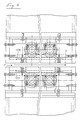
- Fig. 4 shows a top view of the guide gap 7, according to Fig. 3, through which the web 3 through which transports water at high speed becomes.
- the exit gaps 10a and 10b are on both sides indicated by dashed lines. (As stated above, the 2 only on the underside of the Guide gap 7 provided an outlet opening 10 a).
- the number of treatment steps (spinning on one Impact surface), the regulation of the impact speed, by one-sided or mutual treatment in the invention, the degree of fibrillation and thus the Affect surface quality and the feel of the goods.
- Upstream and downstream enzyme treatment steps can be used to fibrillate to influence in addition.
- the force with which the wet goods hit the impact surfaces thrown obviously depends on both Velocity of the conveying liquid as well as the length of the Acceleration path, any braking effects and the mass wet goods at the moment of impact.
- forces per centimeter of fabric width occur Of the order of 2.5 to 9 Newtons. Preferably lie the values between 5 and 9 Newtons per cm. this leads to particularly good fibrillation results.
- the invention is particularly effective when used with fabrics, which are made entirely of fibrillatable cellulose fibers, such as "Lyocell” fibers (especially Tencel fibers) exist. It but it is also possible to treat goods made from mixed fibers or blended fabrics.
Landscapes
- Engineering & Computer Science (AREA)
- Textile Engineering (AREA)
- Treatment Of Fiber Materials (AREA)
- Polysaccharides And Polysaccharide Derivatives (AREA)
- Spinning Methods And Devices For Manufacturing Artificial Fibers (AREA)
- Nonwoven Fabrics (AREA)
Abstract
Description
Die Erfindung betrifft ein Verfahren und eine Vorrichtung gemäss Oberbegriff der unabhängigen Patentansprüche.The invention relates to a method and a device according to the preamble of the independent claims.
Fibrillierbare Cellulosefasern, insbesondere Lyocell-Fasern (wie Tencel-Fasern) erfreuen sich aufgrund guter Färbe- und Trageeigenschaften sowie einer Vielzahl von Ausrüstungsmöglichkeiten und Verfahren zur Beeinflussung des "Griffs" zunehmender Beliebtheit.Fibrillatable cellulose fibers, especially Lyocell fibers (like Tencel fibers) enjoy good dyeing and Wearing properties and a variety of equipment options and method for influencing the "handle" increasing popularity.
"Lyocell"-Fasern sind in einem Lösungsmittel-Spinnverfahren hergestellte Cellulosefasern, deren Mantel durch mechanischen Einfluss spaltbar ist, so dass von der Manteloberfläche Fibrillen abstehen."Lyocell" fibers are in a solvent spinning process Manufactured cellulose fibers, the sheath by mechanical Influence is fissile, so from the surface of the jacket Protruding fibrils.
Üblich ist es dabei bei Lyocell-Fasern die Fibrillierung in der Strangbehandlung einzuleiten. Faktoren, welche die Neigung zur Fibrillierung beeinflussen sind vor allem: pH-Wert, Temperatur und mechanische Einwirkung. Ausserdem werden häufig Cellulase-Enzyme eingesetzt, um die Fibrillierung zu fördern. Cellulase-Enzyme sind Eiweissstoffe, die fähig sind Cellulose abzubauen. Ein Cellulase-Enzym besteht aus einer Vielzahl unterschiedlicher Enzymkomponenten. Die 4 wichtigsten sind dabei: Endocellulase, Exocellulase, Cellobiohydrolase und Cellobiase. Die Einwirkung von Exocellulasen resultiert in löslicher Glukose direkt aus Cellulose. Die anderen Komponenten greifen systematisch die Celluloseketten an, indem sie willkürlich die Formation von Cellobiose zu löslicher Glukose spalten.Fibrillation in Lyocell fibers is common the strand treatment. Factors affecting the inclination to influence fibrillation are above all: pH value, Temperature and mechanical impact. Also be Commonly used cellulase enzymes to fibrillate promote. Cellulase enzymes are protein substances that are capable To break down cellulose. A cellulase enzyme consists of one Many different enzyme components. The 4 most important include: endocellulase, exocellulase, cellobiohydrolase and cellobiase. The effect of exocellulases results in soluble glucose directly from cellulose. The others Components systematically attack the cellulose chains, by arbitrarily making the formation of cellobiose more soluble Split glucose.
Theoretisch lässt sich die Fibrillierung von Lyocell-Fasern auch nur durch mechanische Behandlung, insbesondere durch Nassreibung einleiten. Die Zugabe von Enzym dient der zusätzlichen Förderung und Steuerung des Prozesses. Ausserdem werden Enzymprozesse eingesetzt, um nach einer ersten Fibrillierung die langen Fibrillen zu schwächen und zu entfernen. Dieser Vorgang ist ausführlich beschrieben in "ITB Veredelung, 2/94, S. 5; R. Breier, Veredlung von Lyocell-Fasern, Chemiefasern/Textilindustrie, 44./96. Jahrgang, November/-Dezember 1994, S. 812; Lyocell-Fasern: Herstellung, Eigenschaften, Einsatzgebiete in Chemiefasern/Textilindustrie, 43./95. Jahrgang, Oktober 1993, S. 745: I. Marini, Lenzing Lyocell-Fasern in Chemiefasern/Textilindustrie, 43./95. Jahrgang, November 1993, S. 878.Theoretically, the fibrillation of Lyocell fibers only by mechanical treatment, especially by Initiate wet friction. The addition of enzyme serves the additional Promotion and control of the process. Furthermore Enzyme processes are used in order after a first fibrillation to weaken and remove the long fibrils. This process is described in detail in "ITB finishing, 2/94, p. 5; R. Breier, finishing Lyocell fibers, Chemical fibers / textile industry, 44./96. Vintage, November / December 1994, p. 812; Lyocell fibers: manufacture, properties, Areas of application in chemical fibers / textile industry, 43./95. Volume, October 1993, p. 745: I. Marini, Lenzing Lyocell fibers in chemical fibers / textile industry, 43./95. Volume, November 1993, p. 878.
In der Praxis wird die Fibrillierung meist bei der Strangbehandlung eingeleitet und diskontinuierlich durchgeführt. Bekannte Fibrillierungsverfahren beanspruchen viele Stunden Behandlungsdauer. Dagegen geht man bisher davon aus, dass bei der klassischen Form des Finish von Tencel-Stoff (Behandlung "offen-breit") keine Fibrillierung auftritt.In practice, fibrillation is mostly used during strand treatment initiated and carried out discontinuously. Known fibrillation processes take many hours Duration of treatment. In contrast, it has previously been assumed that the classic shape of the finish of Tencel fabric (treatment "open-wide") no fibrillation occurs.
Aus der EP 535 287 A1 ist ein Verfahren und eine Vorrichtung zur Griff- und Oberflächenverbesserung von textilen Geweben und Gewirken bekannt. Die zu behandelnde Warenbahn wird dabei alternierend gegen eine erste und eine zweite Prallfläche geschleudert. Die Förderung der Warenbahn erfolgt pneumatisch, wobei eine Vorschubdifferenz bei der Hin- und Zurückbewegung dazu führt, dass die Warenbahn aus der Vorrichtung abgeführt wird.EP 535 287 A1 describes a method and a device for improving the grip and surface of textile fabrics and knitted fabrics. The web to be treated will be alternating against a first and a second baffle hurled. The web is conveyed pneumatically, with a feed difference in the back and forth movement causes the web from the device is dissipated.
Aus US 4,291,442 ist es bekannt, Polyesterfasern unter Einfluss einer alkalischen wässrigen Lösung zu fibrillieren. Das Aufbrechen der Fasern kann beispielsweise dadurch geschehen, dass die Warenbahn durch eine verhältnismässig kleine Öffnung gezwungen wird.From US 4,291,442 it is known to influence polyester fibers to fibrillate an alkaline aqueous solution. The The fibers can be broken open, for example, by that the web of goods through a relatively small opening is forced.
Aus JP 701566A ist es bekannt, Fasern durch Beaufschlagung mit einem Gasstrom zu fibrillieren. Aus JP 1-298273A ist es ebenfalls bekannt, chemisch vorbehandelte Zellulose-Fasern aufzubrechen.From JP 701566A it is known to act on fibers to fibrillate with a gas stream. From JP 1-298273A it is also known, chemically pretreated cellulose fibers to break up.
Die Erfindung schlägt jedoch vor, die Fibrillierung von fibrillierbare Cellulosefasern wie Lyocell, insbesondere von Tencel-Fasern enthaltenden textilen Flächengebilden bei breiter Ware durchzuführen. Erfindungsgemäss lässt sich dies erreichen, wenn die breite Warenbahn durch einen mit hoher Geschwindigkeit strömenden Flüssigkeitsstrom beaufschlagt und von diesem beschleunigt und mit dem Flüssigkeitsstrom gegen eine Prallfläche geschleudert wird und wenn der Beschleunigungs- und Schleudervorgang so oft wiederholt wird, bis Oberflächenbereiche der Fasern gespalten werden und sich Fibrillen bilden.However, the invention proposes fibrillation of fibrillatable cellulose fibers such as Lyocell, in particular from Textile fabrics containing Tencel fibers carry out wider goods. This can be done according to the invention if the wide web is reached by a high one Velocity flowing fluid flow and accelerated by this and countered with the liquid flow an impact surface is thrown and if the acceleration and the spinning process is repeated until Surface areas of the fibers are split and up Form fibrils.
In bekannter Weise kann dabei die Fibrillierung durch Enzymbehandlung, Temperatur und pH-Werteinstellung beeinflusst werden. Die Erfindung lässt sich einsetzen, um Ware primär zu fibrillieren und z.B. in einem nachgeschalteten Enzymprozess in bekannter Weise die langen Fibrillen durch Enzymbehandlung zu entfernen. Das erfindungsgemässe Verfahren kann auch für die sekundäre Fibrillierung eingesetzt werden, das heisst also für einen Fibrillierungsprozess, der einer ersten Fibrillierung, einer darauffolgenden Behandlung zur Kürzung der zu langen Fibrillen und gegebenenfalls sonstigen Ausrüstungsschritten nach geschaltet ist.In a known manner, fibrillation by enzyme treatment, Temperature and pH adjustment affected become. The invention can be used to primary goods fibrillate and e.g. in a downstream enzyme process the long fibrils in a known manner by enzyme treatment to remove. The method according to the invention can also be used for secondary fibrillation is used, that is for a fibrillation process that is a first fibrillation, a subsequent treatment to reduce the too long fibrils and possibly other equipment steps after is switched.
Besonders vorteilhaft ist es, wenn die Warenbahn in einem Warenspeicher angesammelt und aus diesem durch die mit hoher Geschwindigkeit strömende Flüssigkeit abgezogen wird. Die lose in einem derartigen Warenspeicher liegende Ware kann besonders gut durch die mit hoher Geschwindigkeit strömende Flüssigkeit mitgerissen und beschleunigt werden.It when the web in one is particularly advantageous Store accumulated and from this through the high Speed flowing liquid is withdrawn. The Goods lying loose in such a store can particularly well thanks to the high-speed flow Liquid is carried away and accelerated.
Besonders vorteilhaft ist es weiter, wenn die Warenbahn sequentiell in entgegengesetzter Richtung von einem derartigen Flüssigkeitsstrom mitgerissen und gegen Prallflächen geschleudert wird. So ist es z.B. denkbar, die in einem Spalt breit geführte Ware durch den Flüssigkeitsstrom zu fördern, gegen eine Prallfläche zu schleudern, die Ware in einem Warenspeicher zu sammeln, sodann den Flüssigkeitsstrom in der Richtung umzukehren und die Ware in der entgegengesetzten Richtung durch den Spalt zu beschleunigen und gegen eine auf der anderen Seite des Spaltes angeordnete zweite Prallfläche zu schleudern und dort die Ware wieder in einem Warenspeicher anzusammeln. Die Ware würde also abwechselnd "vorwärts und rückwärts" durch den Führungsspalt gefördert. Wenn dabei die Zeitdauer für die Förderung in "vorwärts"-Richtung länger ist als die Zeitdauer für die Förderung in die entgegengesetzte Richtung, ergibt sich eine resultierende "Vorwärts"-Förderung. Z.B. kann in die eine Richtung sechs Sekunden gefördert werden, sodann wird umgeschaltet und für nur fünf Sekunden in die Gegenrichtung gefördert. Darnach wird wieder für sechs Sekunden vorwärts gefördert und fünf Sekunden rückwärts gefördert usw.. Damit durchläuft die Ware etwa zehn Beschleunigungsvorgänge, wobei sie jeweils gegen eine Prallplatte geschleudert wird.It is also particularly advantageous if the material web is sequential in the opposite direction from such Liquid flow entrained and thrown against impact surfaces becomes. So it is e.g. conceivable that in a gap promote wide-ranging goods through the flow of liquid, hurling against a baffle, the goods in one Collect goods store, then the liquid flow in the Reverse direction and the goods in the opposite Accelerate direction through the gap and up against one the other side of the gap arranged second baffle to hurl and there the goods back in a store accumulate. The goods would alternate "forward and backwards "through the leadership gap Duration for funding in the "forward" direction is longer than the length of time for promotion in the opposite Direction, there is a resulting "forward" funding. For example, can be conveyed in one direction for six seconds then it is switched and in for just five seconds promoted the opposite direction. After that, again for six Conveyed seconds forward and five seconds backwards conveyed, etc. The goods go through about ten acceleration processes, each against a baffle is thrown.
Konkret empfiehlt sich dementsprechend das Anordnen von zwei Warenspeichern, in welchen die Ware jeweils locker angesammelt wird, nachdem sie gegen eine Prallfläche geschleudert wurde. Aus einem solchen Warenspeicher lassen sich dann die entsprechend gewünschten Teilmengen abtransportieren, während der verbleibende Rest für einen weiteren Behandlungszyklus, das heisst Beschleunigung in die entgegengesetzte Richtung wieder zur Verfügung steht.Accordingly, it is advisable to arrange two Goods store in which the goods are loosely accumulated is thrown after hitting a baffle has been. The goods can then be stored in such a store remove the desired quantities while the rest for another treatment cycle, that means acceleration in the opposite direction is available again.
Derartige Behandlungszyklen mit wechselweisem Beschleunigen und Schleudern der Ware gegen Prallflächen führt zu besonders guten Griffeigenschaften. Selbstverständlich wäre es aber denkbar, die Ware nur in einer Richtung durch eine Anordnung zu fördern und nach Behandlung der gewünschten Warenmenge den Vorgang in die Gegenrichtung zu wiederholen.Such treatment cycles with alternate acceleration and hurling the goods against impact surfaces leads to particularly good grip properties. Of course it would be conceivable, the goods only in one direction by an arrangement to promote and after treatment of the desired amount of goods Repeat the process in the opposite direction.
Besonders gute Ergebnisse lassen sich erzielen, wenn die Warenbahn auf eine Geschwindigkeit von wenigstens 8 m/Sek. vorzugsweise auf eine Geschwindigkeit von 9 m/Sek. bis 15 m/Sek. beschleunigt wird.Particularly good results can be achieved if the Goods web at a speed of at least 8 m / sec. preferably to a speed of 9 m / sec. to 15 m / sec is accelerated.
Dies lässt sich vor allem erreichen, wenn die Geschwindigkeit des Flüssigkeitsstrahls (vorzugsweise ein Wasserstrahl) im Förder-Spalt etwa 12 bis 20 m/Sek., vorzugsweise etwa 15 m/Sek. beträgt.This can be achieved especially when the speed of the liquid jet (preferably a water jet) in the Conveying gap about 12 to 20 m / sec., Preferably about 15 m / sec is.
Das erfindungsgemässe Verfahren zum Fibrillieren von in einer textilen Bahn enthaltenen Cellulosefasern, insbesondere Lyocell-Fasern (wie Tencel-Fasern), lässt sich besonders vorteilhaft mit einer Vorrichtung durchführen, bei der eine breit zugeführte Warenbahn in einem von einer Flüssigkeit durchströmten Führungsspalt beschleunigt wird, wenn der Führungsspalt wenigstens auf einer Seite durch ein Düsenelement begrenzt ist, das einen Zufuhrkanal für die Flüssigkeit aufweist und das auf zwei entgegengesetzten Seiten einen sich zum Führungsspalt verengenden Austrittsspalt sowie ein Ventilelement zum abwechselnden Verschliessen eines der Austrittsspalte aufweist.The inventive method for fibrillation in a textile web containing cellulose fibers, in particular Lyocell fibers (such as Tencel fibers) can be particularly perform advantageously with a device in which a wide feed web in one of a liquid through the guide gap is accelerated when the Guide gap at least on one side through a nozzle element is limited, which is a feed channel for the liquid and the one on two opposite sides outlet gap narrowing towards the guide gap and a Valve element for alternately closing one of the Has exit column.
Besonders gleichmässige und gute Beschleunigungswerte lassen sich erreichen, wenn in beiden Flächen des Führungsspalts Austrittsspalte für die Flüssigkeit vorgesehen sind, so dass die Ware sowohl auf der Oberseite als auch auf ihrer Unterseite der Beschleunigung durch die Flüssigkeit ausgesetzt ist.Let especially uniform and good acceleration values reach out when in both surfaces of the guide gap Outlet gaps for the liquid are provided so that the goods on both the top and bottom exposed to acceleration from the liquid is.
Statt eines Austrittsspalts für die Flüssigkeit lassen sich selbstverständlich auch mehrere Austrittsspalte vorsehen, sofern dies strömungstechnisch günstige Werte mit sich bringt. In der Praxis hat es sich besonders bewährt, wenn sich jeder Austrittsspalt in Richtung auf den Führungspalt zu verjüngt und wenn die Strömungsachse des Austrittspalts etwa unter einem Winkel α von 10° bis 20° vorzugsweise von etwa 15° zur Ebene des Führungsspalts geneigt ist.Instead of an exit gap for the liquid, of course, also provide several exit gaps, provided that this has favorable aerodynamic values brings. In practice, it has proven particularly useful if each exit gap towards the guide gap tapered and if the flow axis of the exit gap approximately at an angle α of 10 ° to 20 °, preferably about Is inclined 15 ° to the level of the guide gap.
Die Erfindung ist im folgendem in Ausführungsbeispielen anhand der Zeichnungen näher erläutert. Es zeigen
- Fig. 1
- eine schematische Darstellung einer fibrillierten Tencel Faser als Beispiel für eine fibrillierte Cellulose Faser,
- Fig. 2
- die schematische Darstellung eines Warenlaufs mit den Merkmalen der Erfindung,
- Fig. 3
- eine Schnittdarstellung durch einen Führungsspalt zum Beschleunigen der Warenbahn mit den Merkmalen der Erfindung, und
- Fig. 4
- die ausschnittsweise Darstellung des Führungsspalts gemäss Fig. 3 in der Ansicht aus der Richtung "A" gemäss Fig. 3.
- Fig. 1
- 1 shows a schematic representation of a fibrillated Tencel fiber as an example of a fibrillated cellulose fiber,
- Fig. 2
- the schematic representation of a goods run with the features of the invention,
- Fig. 3
- a sectional view through a guide gap to accelerate the web with the features of the invention, and
- Fig. 4
- 3 shows a detail of the guide gap according to FIG. 3 in the view from the direction "A" according to FIG. 3.
Fig. 1 zeigt schematisch eine Tencel-Faser 1 von welcher
Fibrillen 2 abstehen. Die Tencel-Faser 1 ist Bestandteil
eines nicht dargestellten Gewebes, dass einer erfindungsgemässen
Behandlung unterzogen wurde.Fig. 1 shows schematically a
Wie in Fig. 2 schematisch dargestellt, wird eine Warenbahn 3
einer Vorrichtung zum Fibrillieren 4 über eine Förderwalze 5
von einer nicht dargestellten Fördereinrichtung zugeführt.
Die Förderwalze 5 fördert laufend die Warenbahn in einen
Warenspeicher 6. Von dort durchläuft die Warenbahn 3 den
Führungsspalt 7 einer Beschleunigungseinrichtung 8.As shown schematically in FIG. 2, a material web 3
a device for
Der Führungsspalt 7 wird durch eine obere und eine untere
Führungsbahn 9 a und 9 b begrenzt. In der unteren Führungsbahn
sind seitlich zwei Austrittsspalte 10 vorgesehen, wobei
jeweils einer der Spalte durch Ventil-Mittel 11 verschliessbar
ist. Beim Ausführungsbeispiel gemäss Fig. 2 ist der
Austrittsspalt 10 a verschlossen, während der Austrittsspalt
10 b geöffnet ist, während beim Ausführungsbeispiel gemäss
Fig. 3 der Austrittsspalt 10 b als verschlossen dargestellt
ist. Durch den Austrittsspalt tritt Wasser mit einer Geschwindigkeit
von etwa 15 m/Sek. aus, das von einer Zuführleitung
12 zugeführt wird. Das aus der Austrittsspalte 10 b
strömende Wasser reisst die Warenbahn 3 mit, beschleunigt sie
und schleudert sie gegen eine Prallfläche 13, wodurch die
Warenbahn 3 und die Fasern, aus der die Warenbahn 3 besteht,
mechanisch beansprucht werden. Von der Prallfläche 13 fällt
die Warenbahn abwärts in einen Warenspeicher 17, aus welchem
sie durch Förderwalzen 14 und 15 abtransportiert werden kann.The
Um die Warenbahn 3 mehrfach der beschriebenen Behandlung
auszusetzen, lässt sich das Ventil-Mittel seitlich verschieben,
so dass abwechselnd die Austrittsspalten 10 a oder die
Austrittsspalten 10 b verschlossen wird. Je nachdem, durch
welchen Austrittsspalt die Flüssigkeit mit hoher Geschwindigkeit
austritt, wird die Warenbahn 3 entweder gegen die Prallfläche
13 oder die Prallfläche 16 geschleudert. Das wechselseitige
Schleudern bewirkt besonders gleichmässige und für
den Griff der Ware wirksame mechanische Behandlung der Warenbahn.To the
Fig. 3 zeigt ein Ausführungsbeispiel bei dem ein Führungsspalt
7 sowohl auf der Oberseite als auch auf der Unterseite
der Warenbahn 3 mit Austrittsspalten 10 a, 10 b, versehen
ist. Dementsprechend sind auch zwei Ventil-Mittel 11 vorgesehen,
die beim dargestellten Betriebszustand die Austrittspalten
10 b verschliessen, so dass die Flüssigkeit den
Austrittsspalten 10 a zugeführt wird und die Ware in Richtung
des Pfeils x gefördert und beschleunigt wird.Fig. 3 shows an embodiment in which a
Fig. 4 zeigt im Ausschnitt eine Daraufsicht auf den Führungsspalt
7 gemäss Fig. 3, durch welchen die Warenbahn 3 durch
das mit hoher Geschwindigkeit geförderte Wasser transportiert
wird. Die Austrittspalten 10a und 10b sind dabei beidseitig
gestrichelt angedeutet. (Wie vorstehend ausgeführt, ist beim
Ausführungsbeispiel gemäss Fig. 2 nur auf der Unterseite des
Führungsspalts 7 eine Austrittsöffnung 10 a vorgesehen).Fig. 4 shows a top view of the
Durch die Anzahl der Behandlungsschritte (Schleudern auf eine Prallfläche), die Regelung der Aufprall-Geschwindigkeit, durch einseitiges oder wechselseitiges Behandeln lässt sich bei der Erfindung der Fibrillierungsgrad und damit auch die Oberflächenbeschaffenheit und der Griff der Ware beeinflussen. Vorgeschaltete und oder nachgeschaltete Enzym-Behandlungsschritte können eingesetzt werden, um die Fibrillierung zusätzlich zu beeinflussen.The number of treatment steps (spinning on one Impact surface), the regulation of the impact speed, by one-sided or mutual treatment in the invention, the degree of fibrillation and thus the Affect surface quality and the feel of the goods. Upstream and downstream enzyme treatment steps can be used to fibrillate to influence in addition.
Vor allem bei einer Anordnung gemäss Fig. 3, bei der sowohl
an der Oberseite des Führungsspalts 7 als auch an der Unterseite
des Führungsspalts 7 Austrittsspalten 10 a und 10 b für
die Flüssigkeit vorgesehen sind, lässt sich nicht nur "offenbreite"
Ware sondern auch Schlauchware behandeln, sofern dies
gewünscht wird. Dies führt zu besonders wirtschaftlichen
Resultaten, wobei überraschenderweise eine Oberflächenbehandlung
auch im inneren des Schlauches auftritt, obwohl dieser
nicht direkt mit der Prallfläche in Berührung kommt. Die
Behandlung besteht generell aus drei Komponenten: (1) Stoff-Prallblech;
(2) Stoff-Wasser; (3) Stoff-Stoff.Especially with an arrangement according to FIG. 3, in which both
on the top of the
Die Kraft, mit der die nasse Ware gegen die Prallflächen geschleudert wird, hängt ersichtlicherweise sowohl von der Geschwindigkeit der Förder-Flüssigkeit als auch der Länge des Beschleunigungswegs, etwaiger Bremswirkungen sowie der Masse der nassen Ware im Moment des Aufpralls ab. Typischerweise treten beim Aufprall Kräfte pro Zentimeter Warenbreite in der Grössenordnung von 2,5 bis 9 Newton auf. Vorzugsweise liegen die Werte zwischen 5 und 9 Newton pro cm. Dies führt zu besonders guten Fibrillierungsergebnissen.The force with which the wet goods hit the impact surfaces thrown obviously depends on both Velocity of the conveying liquid as well as the length of the Acceleration path, any braking effects and the mass wet goods at the moment of impact. Typically In the event of an impact, forces per centimeter of fabric width occur Of the order of 2.5 to 9 Newtons. Preferably lie the values between 5 and 9 Newtons per cm. this leads to particularly good fibrillation results.
Besonders wirksam ist die Erfindung beim Einsatz mit Geweben, die vollständig aus fibrillierbaren Cellulose-Fasern, wie "Lyocell"-Fasern (insbesondere Tencel-Fasern) bestehen. Es ist aber auch möglich, Ware zu behandeln, die aus Mischfasern oder Mischgeweben besteht.The invention is particularly effective when used with fabrics, which are made entirely of fibrillatable cellulose fibers, such as "Lyocell" fibers (especially Tencel fibers) exist. It but it is also possible to treat goods made from mixed fibers or blended fabrics.
Claims (9)
- A method of fibrillating fibrillatable cellulose fibres contained in a textile fabric web (3), in particular Lyocell fibres, characterised in that the spread-out fabric web is acted upon and accelerated by a fluid flow flowing at high speed, that the accelerated fabric web is flung by the fluid flow against an impact surface (13, 16), and that the accelerating and flinging procedure is repeated until surface regions of the fibres are split and fibrils are formed.
- A method according to claim 1 characterised in that the fabric web (3) is assembled in a fabric storage means (6) and is then fed to the fluid flow.
- A method according to claim 1 or claim 2 characterised in that the fabric web (3) is guided by the impact surface (13) to a second fabric storage means (17) and accumulated therein, that then the fabric web is withdrawn from the second fabric storage means (17) by a fluid flow flowing in the opposite direction and is conveyed back into the first fabric storage means (6), wherein the fabric web (3) is accelerated by the fluid flow flowing at high speed and flung against a second impact surface (16).
- A method according to claim 2 or claim 3 characterised in that the fabric web (3) is conveyed to and fro alternately between the two fabric storage means (6, 17) by an alternating fluid flow and in that movement is flung respectively against impact surfaces (13, 16).
- A method according to claim 4 characterised in that fabric (3) is additionally continuously fed to the first fabric storage means (6) and that fabric is continuously removed from the second fabric storage means (17) and that, in the case of predetermined conveyor and acceleration steps, a longer fabric web (3) is conveyed into the second fabric storage means (17) than is conveyed back into the first fabric storage means (6) in the subsequent acceleration procedure which is directed in opposite relationship.
- A method according to one of the preceding claims characterised in that the fabric web is accelerated to a speed of at least 8 m/sec, preferably to a speed of from 9 m/sec to 15 m/sec.
- Apparatus for fibrillating fibrillatable cellulose fibres contained in a textile fabric web, in particular Tencel fibres, characterised in that a fabric web (3) containing the fibres (1) to be fibrillated is accelerated in a guide gap (7) through which a fluid flows, wherein the guide gap (7) is delimited at least on one side by a nozzle element (9a, 9b, 10a, 10b) which has a feed passage (12) for the fluid and on two opposite sides a nozzle-like discharge gap (10a, 10b) which narrows towards the guide gap (7), and a valve element (11) for alternately closing one of the discharge gaps (10a, 10b).
- Apparatus according to claim 7 characterised in that discharge gaps (10a, 10b) are provided on both sides of the guide gap (7).
- Apparatus according to claim 7 or claim 8 characterised in that the discharge gap (10a, 10b) extends at an angle α of from 10 to 25 and preferably from 15° to 20° with respect to the plane of the guide gap (7).
Applications Claiming Priority (3)
| Application Number | Priority Date | Filing Date | Title |
|---|---|---|---|
| CH1173/96 | 1996-05-08 | ||
| CH117396 | 1996-05-08 | ||
| CH117396 | 1996-05-08 |
Publications (2)
| Publication Number | Publication Date |
|---|---|
| EP0806512A1 EP0806512A1 (en) | 1997-11-12 |
| EP0806512B1 true EP0806512B1 (en) | 2001-08-08 |
Family
ID=4204209
Family Applications (1)
| Application Number | Title | Priority Date | Filing Date |
|---|---|---|---|
| EP97810241A Expired - Lifetime EP0806512B1 (en) | 1996-05-08 | 1997-04-18 | Method and device for fibrillating easily fibrillated cellulose fibres, particularly tencel fibres |
Country Status (6)
| Country | Link |
|---|---|
| US (1) | US5845355A (en) |
| EP (1) | EP0806512B1 (en) |
| JP (1) | JPH1088467A (en) |
| AT (1) | ATE204038T1 (en) |
| DE (1) | DE59704221D1 (en) |
| ES (1) | ES2165012T3 (en) |
Families Citing this family (14)
| Publication number | Priority date | Publication date | Assignee | Title |
|---|---|---|---|---|
| DE19732230A1 (en) * | 1997-07-26 | 1999-01-28 | Kuesters Eduard Maschf | Method and device for fibrillating or defibrillating cellulose fibers |
| DE19825123C2 (en) * | 1998-06-05 | 2003-07-03 | Silke Baumann | A process for producing fibrillation on textile fabrics containing mostly regenerated cellulose fibers |
| US6630231B2 (en) | 1999-02-05 | 2003-10-07 | 3M Innovative Properties Company | Composite articles reinforced with highly oriented microfibers |
| US6110588A (en) * | 1999-02-05 | 2000-08-29 | 3M Innovative Properties Company | Microfibers and method of making |
| ES2172364B1 (en) * | 1999-05-20 | 2003-10-16 | Jaume Anglada Vinas Sa | APPARATUS FOR TREATMENT OF FABRICS |
| US6680114B2 (en) | 2001-05-15 | 2004-01-20 | 3M Innovative Properties Company | Fibrous films and articles from microlayer substrates |
| ITFI20010168A1 (en) * | 2001-09-12 | 2003-03-12 | Coramtex Srl | MACHINE AND METHOD FOR THE CONTINUOUS TREATMENT OF A FABRIC |
| US6692823B2 (en) | 2001-12-19 | 2004-02-17 | 3M Innovative Properties Company | Microfibrillated articles comprising hydrophillic component |
| US6753080B1 (en) * | 2002-01-29 | 2004-06-22 | 3M Innovative Properties Company | Receptor medium having a microfibrillated surface |
| ITMI20021220A1 (en) * | 2002-06-05 | 2003-12-05 | Savio Macchine Tessili Spa | PROCEDURE AND DEVICE FOR THE CONTINUOUS MARKETING OF TEXTILE YARNS |
| ES2677229T3 (en) * | 2014-03-05 | 2018-07-31 | Biancalani S.R.L. | Method and machine to treat textile fabrics with an adjustable air flow |
| ITUB20153062A1 (en) * | 2015-08-12 | 2017-02-12 | Salvade S R L | FABRIC TREATMENT MACHINE |
| TWI646234B (en) * | 2015-08-28 | 2019-01-01 | 立信歐洲有限責任公司 | Rope textiles for treatment device |
| CN107475864A (en) * | 2017-08-30 | 2017-12-15 | 江苏箭鹿毛纺股份有限公司 | A kind of nano-antibacterial deodorization fancy suiting and its production technology |
Family Cites Families (13)
| Publication number | Priority date | Publication date | Assignee | Title |
|---|---|---|---|---|
| US3593546A (en) * | 1967-12-16 | 1971-07-20 | Hirano Kinzoku Co Ltd | Fabric-relaxing apparatus |
| US3626449A (en) * | 1970-01-23 | 1971-12-07 | Komatsu Seiren Co | Apparatus for continuously relaxing textile material in a treating liquid |
| US4291442A (en) * | 1978-10-02 | 1981-09-29 | Milliken Research Corporation | Process for fibrillating polyester |
| EP0126178B1 (en) * | 1982-08-16 | 1988-06-22 | Toray Industries, Inc. | Apparatus for raising or cropping surface of textile fabrics |
| JPS6170065A (en) * | 1984-09-13 | 1986-04-10 | 株式会社 日阪製作所 | Fabric liquid flow processing equipment |
| JP2611334B2 (en) * | 1988-05-25 | 1997-05-21 | 東洋紡績株式会社 | Processing method of regenerated cellulose fiber woven / knitted fabric |
| JPH0735634B2 (en) * | 1991-07-29 | 1995-04-19 | 内外特殊染工株式会社 | Fabric processing method |
| ES2082957T3 (en) * | 1991-09-21 | 1996-04-01 | Solipat Ag | PROCEDURE AND DEVICE FOR THE SHRINKAGE OF TEXTILE FABRICS. |
| ES2085981T5 (en) * | 1991-09-21 | 2002-03-01 | Solipat Ag | PROCEDURE AND DEVICE FOR IMPROVING THE TOUCH AND SURFACE OF TEXTILE FABRICS AND POINT GENERATIONS BY URDIMBRE. |
| JPH0711566A (en) * | 1993-06-26 | 1995-01-13 | Toyobo Co Ltd | Production of silk-like fabric |
| ES2082694B1 (en) * | 1993-09-28 | 1998-01-01 | Jauma Anglada Vinas S A | MACHINE FOR WET TREATMENT OF TISSUES. |
| IT1269065B (en) * | 1994-01-03 | 1997-03-21 | Biancalani F & C Off Mec | MACHINE AND METHOD FOR THE CONTINUOUS WASHING OF A FABRIC, ESPECIALLY FOR ROPE WASHING |
| IT1272912B (en) * | 1995-01-19 | 1997-07-01 | Zonco Federico & Figlio | MACHINE FOR THE WET AND DRY TREATMENT OF ROPE OR WIDE FABRICS |
-
1997
- 1997-04-18 US US08/840,461 patent/US5845355A/en not_active Expired - Fee Related
- 1997-04-18 DE DE59704221T patent/DE59704221D1/en not_active Expired - Fee Related
- 1997-04-18 EP EP97810241A patent/EP0806512B1/en not_active Expired - Lifetime
- 1997-04-18 AT AT97810241T patent/ATE204038T1/en not_active IP Right Cessation
- 1997-04-18 ES ES97810241T patent/ES2165012T3/en not_active Expired - Lifetime
- 1997-05-07 JP JP9117129A patent/JPH1088467A/en active Pending
Also Published As
| Publication number | Publication date |
|---|---|
| JPH1088467A (en) | 1998-04-07 |
| EP0806512A1 (en) | 1997-11-12 |
| DE59704221D1 (en) | 2001-09-13 |
| ES2165012T3 (en) | 2002-03-01 |
| US5845355A (en) | 1998-12-08 |
| ATE204038T1 (en) | 2001-08-15 |
Similar Documents
| Publication | Publication Date | Title |
|---|---|---|
| EP0806512B1 (en) | Method and device for fibrillating easily fibrillated cellulose fibres, particularly tencel fibres | |
| DE10065859B4 (en) | Method and apparatus for producing substantially endless fine threads | |
| EP0880611B1 (en) | Method of aerodynamical texturing, texturing nozzle, nozzle head and use thereof | |
| DE69323294T2 (en) | METHOD AND APPARATUS FOR PRODUCING POLYESTER FIBERS | |
| DE2620118A1 (en) | YARN SPINNING MACHINE | |
| EP0331946B1 (en) | Device for producing fibres, particularly mineral fibres, from a melt | |
| DE2655340A1 (en) | DEVICE FOR SPINNING TEXTILE FIBERS | |
| DE4040242A1 (en) | METHOD AND DEVICE FOR PRODUCING FINE FIBERS FROM THERMOPLASTIC POLYMERS | |
| DE2653853A1 (en) | METHOD AND APPARATUS FOR MANUFACTURING NONWOVEN FABRICS | |
| DE29521570U1 (en) | Device for producing a non-woven textile cloth by means of pressurized water jets | |
| EP1058745B1 (en) | Method for air-bubble texturing endless filament yarn, yarn finishing device and its use | |
| EP4015681B1 (en) | Spinning station with a cleaning nozzle and method for cleaning a yarn forming element | |
| EP1402100B1 (en) | Method and device for treating a fiber mass | |
| DE4240026C2 (en) | Set for an opening roller of an OE spinning device | |
| DE3041089A1 (en) | NONWOVEN FABRIC | |
| CH679491A5 (en) | ||
| EP2065499B1 (en) | Nozzle bar | |
| EP0175862B1 (en) | Method and device for the production of yarn | |
| EP1215022A1 (en) | Process for manufacturing a composite of plastics and fibres of indefinite length | |
| DE1760713A1 (en) | Method and device for producing a random thread fleece from synthetic threads | |
| DE69211664T2 (en) | Process and plant for the production, in continuous process, of a mineral wool mat | |
| DE3437343A1 (en) | Process and apparatus for producing a spun yarn | |
| WO1999045182A1 (en) | Method for air-bubble texturing endless filament yarn, yarn finishing device and its use | |
| EP3289125A1 (en) | Non-woven funnel for compressing a fiber non-woven, having a guiding element | |
| EP4544115A1 (en) | Method and device for producing a fibrous web |
Legal Events
| Date | Code | Title | Description |
|---|---|---|---|
| PUAI | Public reference made under article 153(3) epc to a published international application that has entered the european phase |
Free format text: ORIGINAL CODE: 0009012 |
|
| AK | Designated contracting states |
Kind code of ref document: A1 Designated state(s): AT CH DE ES FR GB IT LI SE |
|
| 17P | Request for examination filed |
Effective date: 19980113 |
|
| 17Q | First examination report despatched |
Effective date: 19991216 |
|
| GRAG | Despatch of communication of intention to grant |
Free format text: ORIGINAL CODE: EPIDOS AGRA |
|
| 17Q | First examination report despatched |
Effective date: 19991216 |
|
| GRAG | Despatch of communication of intention to grant |
Free format text: ORIGINAL CODE: EPIDOS AGRA |
|
| GRAH | Despatch of communication of intention to grant a patent |
Free format text: ORIGINAL CODE: EPIDOS IGRA |
|
| GRAH | Despatch of communication of intention to grant a patent |
Free format text: ORIGINAL CODE: EPIDOS IGRA |
|
| GRAA | (expected) grant |
Free format text: ORIGINAL CODE: 0009210 |
|
| AK | Designated contracting states |
Kind code of ref document: B1 Designated state(s): AT CH DE ES FR GB IT LI SE |
|
| REF | Corresponds to: |
Ref document number: 204038 Country of ref document: AT Date of ref document: 20010815 Kind code of ref document: T |
|
| REG | Reference to a national code |
Ref country code: CH Ref legal event code: EP |
|
| REF | Corresponds to: |
Ref document number: 59704221 Country of ref document: DE Date of ref document: 20010913 |
|
| REG | Reference to a national code |
Ref country code: CH Ref legal event code: NV Representative=s name: HEPP, WENGER & RYFFEL AG |
|
| GBT | Gb: translation of ep patent filed (gb section 77(6)(a)/1977) |
Effective date: 20011002 |
|
| REG | Reference to a national code |
Ref country code: GB Ref legal event code: IF02 |
|
| ET | Fr: translation filed | ||
| REG | Reference to a national code |
Ref country code: ES Ref legal event code: FG2A Ref document number: 2165012 Country of ref document: ES Kind code of ref document: T3 |
|
| PGFP | Annual fee paid to national office [announced via postgrant information from national office to epo] |
Ref country code: SE Payment date: 20020313 Year of fee payment: 6 |
|
| PGFP | Annual fee paid to national office [announced via postgrant information from national office to epo] |
Ref country code: AT Payment date: 20020320 Year of fee payment: 6 |
|
| PGFP | Annual fee paid to national office [announced via postgrant information from national office to epo] |
Ref country code: GB Payment date: 20020404 Year of fee payment: 6 |
|
| PLBE | No opposition filed within time limit |
Free format text: ORIGINAL CODE: 0009261 |
|
| STAA | Information on the status of an ep patent application or granted ep patent |
Free format text: STATUS: NO OPPOSITION FILED WITHIN TIME LIMIT |
|
| 26N | No opposition filed | ||
| PGFP | Annual fee paid to national office [announced via postgrant information from national office to epo] |
Ref country code: ES Payment date: 20030407 Year of fee payment: 7 |
|
| PG25 | Lapsed in a contracting state [announced via postgrant information from national office to epo] |
Ref country code: GB Free format text: LAPSE BECAUSE OF NON-PAYMENT OF DUE FEES Effective date: 20030418 Ref country code: AT Free format text: LAPSE BECAUSE OF NON-PAYMENT OF DUE FEES Effective date: 20030418 |
|
| PG25 | Lapsed in a contracting state [announced via postgrant information from national office to epo] |
Ref country code: SE Free format text: LAPSE BECAUSE OF NON-PAYMENT OF DUE FEES Effective date: 20030419 |
|
| PGFP | Annual fee paid to national office [announced via postgrant information from national office to epo] |
Ref country code: FR Payment date: 20030428 Year of fee payment: 7 |
|
| PGFP | Annual fee paid to national office [announced via postgrant information from national office to epo] |
Ref country code: DE Payment date: 20030430 Year of fee payment: 7 |
|
| PGFP | Annual fee paid to national office [announced via postgrant information from national office to epo] |
Ref country code: CH Payment date: 20030701 Year of fee payment: 7 |
|
| EUG | Se: european patent has lapsed | ||
| GBPC | Gb: european patent ceased through non-payment of renewal fee |
Effective date: 20030418 |
|
| PG25 | Lapsed in a contracting state [announced via postgrant information from national office to epo] |
Ref country code: ES Free format text: LAPSE BECAUSE OF NON-PAYMENT OF DUE FEES Effective date: 20040419 |
|
| PG25 | Lapsed in a contracting state [announced via postgrant information from national office to epo] |
Ref country code: LI Free format text: LAPSE BECAUSE OF NON-PAYMENT OF DUE FEES Effective date: 20040430 Ref country code: CH Free format text: LAPSE BECAUSE OF NON-PAYMENT OF DUE FEES Effective date: 20040430 |
|
| PG25 | Lapsed in a contracting state [announced via postgrant information from national office to epo] |
Ref country code: DE Free format text: LAPSE BECAUSE OF NON-PAYMENT OF DUE FEES Effective date: 20041103 |
|
| REG | Reference to a national code |
Ref country code: CH Ref legal event code: PL |
|
| PG25 | Lapsed in a contracting state [announced via postgrant information from national office to epo] |
Ref country code: FR Free format text: LAPSE BECAUSE OF NON-PAYMENT OF DUE FEES Effective date: 20041231 |
|
| REG | Reference to a national code |
Ref country code: FR Ref legal event code: ST |
|
| PG25 | Lapsed in a contracting state [announced via postgrant information from national office to epo] |
Ref country code: IT Free format text: LAPSE BECAUSE OF NON-PAYMENT OF DUE FEES;WARNING: LAPSES OF ITALIAN PATENTS WITH EFFECTIVE DATE BEFORE 2007 MAY HAVE OCCURRED AT ANY TIME BEFORE 2007. THE CORRECT EFFECTIVE DATE MAY BE DIFFERENT FROM THE ONE RECORDED. Effective date: 20050418 |
|
| REG | Reference to a national code |
Ref country code: ES Ref legal event code: FD2A Effective date: 20040419 |