EP0806174A1 - Verfahren und Gerät zur Messung des arteriellen und venösen Blutflusses in Körperanhängseln - Google Patents
Verfahren und Gerät zur Messung des arteriellen und venösen Blutflusses in Körperanhängseln Download PDFInfo
- Publication number
- EP0806174A1 EP0806174A1 EP96107417A EP96107417A EP0806174A1 EP 0806174 A1 EP0806174 A1 EP 0806174A1 EP 96107417 A EP96107417 A EP 96107417A EP 96107417 A EP96107417 A EP 96107417A EP 0806174 A1 EP0806174 A1 EP 0806174A1
- Authority
- EP
- European Patent Office
- Prior art keywords
- container
- pressure
- probe
- penis
- cuff
- Prior art date
- Legal status (The legal status is an assumption and is not a legal conclusion. Google has not performed a legal analysis and makes no representation as to the accuracy of the status listed.)
- Withdrawn
Links
Images


Classifications
-
- A—HUMAN NECESSITIES
- A61—MEDICAL OR VETERINARY SCIENCE; HYGIENE
- A61B—DIAGNOSIS; SURGERY; IDENTIFICATION
- A61B5/00—Measuring for diagnostic purposes; Identification of persons
- A61B5/43—Detecting, measuring or recording for evaluating the reproductive systems
- A61B5/4375—Detecting, measuring or recording for evaluating the reproductive systems for evaluating the male reproductive system
- A61B5/4393—Sexual arousal or erectile dysfunction evaluation, e.g. tumescence evaluation
Definitions
- the present invention is directed to a non-invasive method and apparatus for measuring arterial and venous blood flow in body appendages.
- the present invention is also directed to a non-invasive method and apparatus for measuring penile tumescence as a function of arterial and venous blood flow in the penis and penile rigidity as a function of suprasystolic intra-cavernosal pressure. These measurements are performed to make a diagnosis in the field of erectile dysfunctions. Since every normal adult male experiences erections during rapid eye movement sleep, the measurements are preferably made during the patient's sleep, but can also be performed when the patient is awake for diagnosis and treatment.
- NPT Measurement of nocturnal penile tumescence
- Measurement of NPT is usually performed with the help of a plethysmograph.
- This device comprises a loop-shaped silicone elastomer tubing filled with mercury.
- the tubing is positioned around the penis of the patient and is connected to an electrical circuit. Any change in the circumference of the penis causes stretching of the silicone tubing which in turn triggers a variation in the electrical resistance of the mercury filling.
- the electrical circuit will measure this change in resistance which can then be translated into a measure of the increase in penile circumference. This measurement allows one to determine penile tumescence.
- Penile rigidity is a function of the pressure inside the corpus cavernosum. Measurement of this pressure is sufficient to determine whether vaginal penetration is possible.
- Patent number 4,747,415 describes a device for measuring intra-cavernosal pressure, hereinafter referred to as ICP.
- This device comprises a cuff including a non elastic band having one of its faces entirely covered with a plastic container filled with a liquid.
- the non elastic band is wrapped around the penis of the patient with the liquid container in direct contact with the penis.
- a pressure transducer is mounted in direct communication with the liquid inside the plastic container for sensing the pressure of the liquid.
- An electronic device is provided for amplifying the pressure signal given by the transducer and for recording and displaying this pressure.
- any erection of the penis causes an increase in ICP which in turn compresses the liquid inside the container held in position by the non expandable cuff.
- the pressure recorded is perfectly correlated with the ICP.
- the corpus cavernosum fills up with blood.
- its volume will increase until it reaches its maximum. This is known as tumescence, characterized by subsystolic pressure.
- ICP will rise to suprasystolic pressure levels.
- the corpus cavernosum comprises an arterial inflow and a venous outflow. For ICP to rise, it is necessary to have an increase in inflow simultaneously with a decrease in outflow.
- the present invention provides an apparatus for measuring arterial and venous blood flow.
- the apparatus comprises:
- the apparatus further comprises a photoplethysmograph having a probe attachable to the container so that the light beam emitted by the probe is directable either toward the container and the fluid therein or toward the appendage around which the cuff is positioned. Also included are electronic means to modify the sensitivity of the photoplethysmograph and to amplify and/or display the signals generated thereby.
- the method of this invention for measuring penile rigidity of the patient comprises the following steps:
- the invention also provides a method of obtaining a curve of arterial blood flow changes which comprises the following steps:
- the present invention further provides a method for obtaining the curve of venous blood flow changes whereby the presence of a venous leak may be determined.
- the method of obtaining this curve comprises the following steps:
- the method includes the continuous measurement of pulse frequency, duration and amplitude of ICP changes, as well as the measurement of arterial blood flow changes. It is then possible, from these measurements, to classify each patient in a group. To provide this classification, the following steps are added to the method:
- Fig. 1 is a schematic view of a first embodiment of the apparatus of the invention.
- Fig. 2 is a schematic view of a second embodiment of the apparatus of the invention.
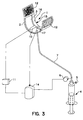
- Fig. 3 is a schematic view of a third embodiment of the apparatus of the invention.
- the cuff comprises one plastic container which is preferably filled with water.
- the use of water or another liquid is optimal for pressure measurement.
- the cuff comprises two containers, one filled with water in direct communication with the pressure transducer, the other filled with air and maintained at constant pressure and to the outside of which the photoplethysmography probe is attached on the face opposite the non elastic band.
- water and air are the preferred fluids for use in the apparatus, other fluids suitable for pressure measurement may be used.
- the first embodiment an apparatus to measure ICP and blood flow in the penis of a patient, is represented in Fig. 1.
- the apparatus comprises a penile cuff 1 including a non elastic band 2 with one of its faces covered with a transparent plastic container 3 capable of being filled with a fluid, such as water, using a syringe 4.
- a stopcock 5 is mounted between the syringe 4 and the container 3 in order to be able to remove the syringe 4 once the container 3 is filled.
- a pressure transducer 6 measures the pressure inside the container 3.
- a pressure tubing line 7 links the pressure transducer 6 to the container 3.
- the signals measured by the pressure transducer 6 are amplified and transmitted to a computer 8 which records them and displays them on its screen.
- the computer 8 also allows for numerical treatment of these signals in order to analyze them and produce a statistical analysis.
- a printer 9 allows printing of the curves displayed on the screen as well as of all numerical results.
- the probe 10 of a photoplethysmograph 11 is attached to the outside of the container 3 on the face opposite the band 2.
- the probe 10 comprises a photo-emitting diode and a photoelectric cell. A light beam is emitted by the diode and the reflected beam is captured by the photoelectric cell.
- the probe 10 is preferably mounted so that the emitted light beam will be directed toward the skin of the appendage on which the cuff 1 is positioned. However, in some cases better measurements are obtained when the probe 10 is mounted so that the light beam is directed toward the cuff 1. Accordingly, it is considered to be within the scope of this invention to mount the probe 10 in either fashion.
- the signal generated by the photoelectric cell is amplified, recorded into the memory of the computer 8 and can then be displayed on the computer screen and/or printed on the printer 9.
- the photoplethysmograph is used to measure blood flow.
- Such devices have been widely used to measure blood flow in capillaries under the skin.
- the most interesting blood flow to measure here is arterial flow inside the corpus cavernosum.
- the latter is surrounded by a thick membrane, the tunica albuginea, which can hardly be crossed by the light of a photoplethysmograph.
- Some measurements have revealed that the photoplethysmograph can measure penile blood flow when the light beam of the photoplethysmography probe is directed toward the skin.
- measurements have also been found possible when the light beam of the photoplethysmography probe is directed toward the liquid filled container. In some instances these measurements are better than those obtained when the light is directed toward the skin. In this manner, a measurement of the global penile pulse and, therefore, of the global arterial flow of the penis, is obtained.
- the plastic container 3 is filled with water and the cuff 1 is then wrapped around the penis of the patient (not shown), while non erect, so that the plastic container 3 and the photoplethysmography probe are in direct contact with the penis.
- the container 3 When erection occurs, pressure inside the corpus cavernosum increases. the container 3 is held between the penis, which exerts a pressure, and the non elastic band 2. The pressure inside the corpus cavernosum is transmitted to the container 3 which is compressed. During a predetermined period, a complete sleep period for example, the pressure transducer 6 measures pressure changes which are amplified and sent to the computer 8 for analysis.
- the measurements taken by the pressure transducer 6 and the photoplethysmograph 11 may be stored by a portable recording unit 14 for later downloading to the computer 8.
- the apparatus may be made portable and the patient may use the system at home to record nocturnal measurements and return the recording unit 14 to his doctor for subsequent downloading and analysis.
- the data may even be stored in the recording unit 14 and then transferred via modem to the doctor's office.
- the photoplethysmograph 11 measures changes in arterial blood flow.
- the photoplethysmograph provides a signal resulting from two physical phenomena:
- the light beam of a photoplethysmograph ordinarily has a low intensity and can only penetrate through a few millimeters of tissue. Therefore, it cannot ordinarily reach the internal face of the tunica albuginea and measure the blood flow in the cavernous artery within the tunica albuginea.
- Variations of the signals generated by the photoplethysmograph are most likely linked to changes in the thickness of the container. These changes in thickness are more obvious at the beginning of the erection when ICP is low and the penis is still soft and therefore compressible.
- the invention provides a means to obtain the curve of changes in penile arterial blood flow, in particular during in erection.
- This curve can be obtained from two sources;
- the photoplethysmography probe attached to a compressible container filled with air, which is compressible.
- a compressible container filled with air which is compressible.
- Such a device (cuff 1 with a container 3 filled with air) also provides a means to measure pressure.
- a non compressible fluid such as water.
- the cuff 1 is provided with two containers 31 and 32.
- the first container 31 is filled with water and is used to measure pressure in the manner previously described for the apparatus of Fig. 1.
- the second container 32 is filled with air which is kept at a constant pressure using a pressure regulator 13.
- the photoplethysmography probe 10 is attached to the second container 32 which is transparent.
- the light beam emitted by the photoplethysmography probe diode may be directed toward the container 32 or toward the skin of the appendage on which the cuff is positioned.
- Measurements with this embodiment of the apparatus are carried out using the same method as with the first embodiment. the difference in this case being that the signal from the photoplethysmograph is more sensitive and more accurate.
- the apparatus of this invention may be combined with a penile circumference measuring means, such as a mercury filled gauge 15 like the standard plethysmograph used to measure increases in penile circumference.
- a penile circumference measuring means such as a mercury filled gauge 15 like the standard plethysmograph used to measure increases in penile circumference.
- This combination provides a means whereby the compliance of the corpus cavernosum may be calculated as the result of the change in Volume divided by the change in ICP.
- the ICP is measured using the pressure cuff of the invention simultaneously with the measurement of penile circumference from the mercury gauge.
- the change in volume is derived from the change in penile circumference, and is then divided by the change in ICP as measured by the pressure cuff to obtain a value for the compliance of the corpus cavernosum.
- the mercury gauge or plethysmograph, may be provided as a separate cuff which is applied to the penis adjacent to the cuff 1 of the present apparatus, or it may be incorporated into the cuff 1 as shown in Fig. 3.
- the mercury filled gauge 15 is formed as a separate container 16 on the cuff 1.
- a signal generator 17 senses the variation in electrical resistance and provides a signal to the recording unit 14 or the computer 8 which is translated into a measure of the increase in penile circumference.
- the apparatus of this invention is suitable for use in the measurement of blood flow and pressure in other appendages of the body, for example the hand or foot of stationary or ambulatory patients.
- the apparatus of this invention and the came or similar methods, one can measure, monitor and evaluate changes in arterial and venous blood flow and tissue pressures in other appendages over a period of time and particular activity.
Landscapes
- Health & Medical Sciences (AREA)
- Life Sciences & Earth Sciences (AREA)
- Biomedical Technology (AREA)
- Heart & Thoracic Surgery (AREA)
- Reproductive Health (AREA)
- Biophysics (AREA)
- Pathology (AREA)
- Engineering & Computer Science (AREA)
- Gynecology & Obstetrics (AREA)
- Physics & Mathematics (AREA)
- Medical Informatics (AREA)
- Molecular Biology (AREA)
- Surgery (AREA)
- Animal Behavior & Ethology (AREA)
- General Health & Medical Sciences (AREA)
- Public Health (AREA)
- Veterinary Medicine (AREA)
- Measuring Pulse, Heart Rate, Blood Pressure Or Blood Flow (AREA)
Priority Applications (1)
| Application Number | Priority Date | Filing Date | Title |
|---|---|---|---|
| EP96107417A EP0806174A1 (de) | 1996-05-09 | 1996-05-09 | Verfahren und Gerät zur Messung des arteriellen und venösen Blutflusses in Körperanhängseln |
Applications Claiming Priority (1)
| Application Number | Priority Date | Filing Date | Title |
|---|---|---|---|
| EP96107417A EP0806174A1 (de) | 1996-05-09 | 1996-05-09 | Verfahren und Gerät zur Messung des arteriellen und venösen Blutflusses in Körperanhängseln |
Publications (1)
| Publication Number | Publication Date |
|---|---|
| EP0806174A1 true EP0806174A1 (de) | 1997-11-12 |
Family
ID=8222771
Family Applications (1)
| Application Number | Title | Priority Date | Filing Date |
|---|---|---|---|
| EP96107417A Withdrawn EP0806174A1 (de) | 1996-05-09 | 1996-05-09 | Verfahren und Gerät zur Messung des arteriellen und venösen Blutflusses in Körperanhängseln |
Country Status (1)
| Country | Link |
|---|---|
| EP (1) | EP0806174A1 (de) |
Cited By (3)
| Publication number | Priority date | Publication date | Assignee | Title |
|---|---|---|---|---|
| WO2001012065A1 (en) * | 1999-08-16 | 2001-02-22 | Meduck Ltd. | Penile tumescence and rigidity monitoring device |
| CN103393424A (zh) * | 2013-08-12 | 2013-11-20 | 广州莱威医疗器械有限公司 | 一种阴茎硬度测量估算方法 |
| WO2017088217A1 (en) | 2015-11-25 | 2017-06-01 | Cirq Materials Limited | Smart material based penile stimulation erectile dysfunction assistance device |
Citations (3)
| Publication number | Priority date | Publication date | Assignee | Title |
|---|---|---|---|---|
| US4747415A (en) * | 1986-06-16 | 1988-05-31 | Pierre Lavoisier | Method and device for measuring penile rigidity |
| US4928706A (en) * | 1988-05-27 | 1990-05-29 | Medical Engineering Corporation | Nocturnal penile tumescence and rigidity monitor |
| WO1992009962A1 (en) * | 1990-11-30 | 1992-06-11 | Schwartz Alan N | Apparatus and method for sensing erectile function |
-
1996
- 1996-05-09 EP EP96107417A patent/EP0806174A1/de not_active Withdrawn
Patent Citations (3)
| Publication number | Priority date | Publication date | Assignee | Title |
|---|---|---|---|---|
| US4747415A (en) * | 1986-06-16 | 1988-05-31 | Pierre Lavoisier | Method and device for measuring penile rigidity |
| US4928706A (en) * | 1988-05-27 | 1990-05-29 | Medical Engineering Corporation | Nocturnal penile tumescence and rigidity monitor |
| WO1992009962A1 (en) * | 1990-11-30 | 1992-06-11 | Schwartz Alan N | Apparatus and method for sensing erectile function |
Non-Patent Citations (1)
| Title |
|---|
| J.P.MEEHAN ET AL: "high pressure within corpus cavernosum in man during erection", UROLOGY, vol. 21, no. 4, April 1983 (1983-04-01), RIDGEWOOD US, pages 385 - 387, XP000195775 * |
Cited By (5)
| Publication number | Priority date | Publication date | Assignee | Title |
|---|---|---|---|---|
| WO2001012065A1 (en) * | 1999-08-16 | 2001-02-22 | Meduck Ltd. | Penile tumescence and rigidity monitoring device |
| CN103393424A (zh) * | 2013-08-12 | 2013-11-20 | 广州莱威医疗器械有限公司 | 一种阴茎硬度测量估算方法 |
| CN103393424B (zh) * | 2013-08-12 | 2015-12-02 | 广州莱威医疗器械有限公司 | 一种阴茎硬度测量估算方法 |
| WO2017088217A1 (en) | 2015-11-25 | 2017-06-01 | Cirq Materials Limited | Smart material based penile stimulation erectile dysfunction assistance device |
| EP3445295A4 (de) * | 2015-11-25 | 2020-12-02 | CIRQ Technologies Limited | Auf intelligentem material basierende vorrichtung zur unterstützung der stimulation von erektiler dysfunktion |
Similar Documents
| Publication | Publication Date | Title |
|---|---|---|
| US5692520A (en) | Method and apparatus for measuring arterial and venous blood flow in body appendages | |
| KR102789991B1 (ko) | 정맥이나 기관의 압력 및/또는 탄성을 측정하고 초음파측정부와 결합되는 압력측정기, 압력측정 시스템 및 그 방법 | |
| US5991654A (en) | Apparatus and method for detecting deep vein thrombosis | |
| US6162188A (en) | Penile tumescence and rigidity monitoring device | |
| US4494550A (en) | Measuring apparatus for the non-invasive detection of venous and arterial blood flow and drainage disorders | |
| US4880013A (en) | Method and apparatus for determining blood pressure and cardiovascular condition | |
| JP3951708B2 (ja) | 生体情報評価装置 | |
| US6169914B1 (en) | Devices and methods for monitoring female arousal | |
| JP4441132B2 (ja) | 血圧モニタリング方法および装置 | |
| AU2010101414A4 (en) | Device and method for measuring the stiffness and erection of a penis and the arteriovenous circulation | |
| NZ333378A (en) | Diagnosing medical conditions by monitoring peripheral arterial tone and vasoconstriction that relates to cardiopulmonary distress and blood pressure | |
| JPS62137033A (ja) | 人体の血圧を監視する装置 | |
| JPWO2001070106A1 (ja) | 生体情報評価装置 | |
| CA2375470A1 (en) | Diagnosing medical conditions by monitoring peripheral arterial tone | |
| JP2003062033A (ja) | 経穴探査装置および治療効果判定装置 | |
| US4747415A (en) | Method and device for measuring penile rigidity | |
| EP1272104A1 (de) | Messgerät für körperlichen fluss | |
| CN100346741C (zh) | 基于心音信号的血压测量装置 | |
| EP0806174A1 (de) | Verfahren und Gerät zur Messung des arteriellen und venösen Blutflusses in Körperanhängseln | |
| Kedia | Penile plethysmography useful in diagnosis of vasculogenic impotence | |
| EP1194071B1 (de) | Verfahren und vorrichtung zur blutdruckmessung | |
| CN1293943A (zh) | 动态血压计及其测量方法 | |
| CA2176160A1 (en) | Method and apparatus for measuring arterial and venous blood flow in body appendages | |
| Baker et al. | Confounders of auscultatory blood pressure measurement | |
| JPH10262935A (ja) | 動脈系血管周辺組織の押圧変形特性測定方法および装置、ならびに脈診装置 |
Legal Events
| Date | Code | Title | Description |
|---|---|---|---|
| PUAI | Public reference made under article 153(3) epc to a published international application that has entered the european phase |
Free format text: ORIGINAL CODE: 0009012 |
|
| AK | Designated contracting states |
Kind code of ref document: A1 Designated state(s): DE ES GB IT SE |
|
| 17P | Request for examination filed |
Effective date: 19980416 |
|
| STAA | Information on the status of an ep patent application or granted ep patent |
Free format text: STATUS: THE APPLICATION IS DEEMED TO BE WITHDRAWN |
|
| 18D | Application deemed to be withdrawn |
Effective date: 20021203 |