EP0805418A2 - Rechnergrafikanimationsverfahren - Google Patents
Rechnergrafikanimationsverfahren Download PDFInfo
- Publication number
- EP0805418A2 EP0805418A2 EP97106876A EP97106876A EP0805418A2 EP 0805418 A2 EP0805418 A2 EP 0805418A2 EP 97106876 A EP97106876 A EP 97106876A EP 97106876 A EP97106876 A EP 97106876A EP 0805418 A2 EP0805418 A2 EP 0805418A2
- Authority
- EP
- European Patent Office
- Prior art keywords
- stage
- client computer
- computer
- storage unit
- data
- Prior art date
- Legal status (The legal status is an assumption and is not a legal conclusion. Google has not performed a legal analysis and makes no representation as to the accuracy of the status listed.)
- Granted
Links
Images







Classifications
-
- G—PHYSICS
- G06—COMPUTING OR CALCULATING; COUNTING
- G06T—IMAGE DATA PROCESSING OR GENERATION, IN GENERAL
- G06T13/00—Animation
- G06T13/20—Three-dimensional [3D] animation
- G06T13/40—Three-dimensional [3D] animation of characters, e.g. humans, animals or virtual beings
Definitions
- the present invention relates to computer graphics animation and, more particularly, to a technique of communicating, between computers, computer graphics animation data including a case where motion of an multi-joint object or an elastic object, such as a human being or an animal, is described as time series data, and generating a computer graphics animation image in a client computer.
- WWW World-Wide-Web
- Ryusuke Masuoka and Keisuke Kobabukuro in "World-Wide-Web", Journal of Information Processing Society, pp.1155-1165, Vol.36, No.12, 1995.
- URL Uniform Resource Locator
- HTTP HyperText Transfer Protocol
- HTML HyperTextest Markup Language
- CGI Common Gateway Interface
- URL is a notation for uniformly describing various resources on the internet.
- HTTP is a protocol for performing communication between a WWW client and a WWW server.
- HTML is a descriptive language for describing a hypertext.
- CGI is an arrangement of a manner for exchanging a command between the WWW client and the WWW server.
- the WWW client obtains information specified by URL from the WWW server through the internet, using HTTP, as an HTML document, and displays it on a screen using a display program called 'browser'.
- HTTP HyperText Transfer Protocol
- a URL corresponding to the link is specified, and information specified in the URL is obtained from the linked WWW server through the internet, using HTTP, as an HTML document, and the HTML document is displayed on the screen.
- HTTP HyperText Transfer Protocol
- HTTP HyperText Markup Language
- HTML provides only a descriptive specification relating to a two-dimensional image, it cannot handle three-dimensional computer graphics.
- VRML Virtual Reality Modeling Language
- VRML descriptive specification (Version 1.0) does not have a specification for moving an object, the displayed object is absolutely static.
- Active VRML is described in "Microsoft Corporation, 'Active VRML Reference Manual', Preliminary Version, 1995” and in “Microsoft Corporation, 'A Brief Introduction to Active VRML', 1995".
- It is an object of the present invention to provide a method for communicating computer graphics animation data in a system comprising a server computer, a client computer, and a communication mediating means between the server computer and the client computer, and for generating, in the client computer, a computer graphics animation image of a complicated motion, for example, a complicated motion of an animal, such as a human being, an expression of a face, a motion of an object obtained as a result of a complicated physical calculation, or a complicated motion of a camera or a light source.
- a method for communicating and generating computer graphics animation data performs transmission and reception of computer graphics animation data in a system comprising a server computer, a client computer, and a communication mediating means between the server computer and the client computer and generation of a computer graphics animation image in the client computer, and the method comprises the following stages: first stage of performing, in the server computer, formation and edition of animation data comprising configuration data of an object, configuration data of an environment where the object exists, attribute data, light source data, camera parameters, shading method, environment setting, environment managing and controlling method, and time series motion data for generating a motion of the object corresponding to the behavior of the object in a time series, and storing the animation data in a storage unit; second stage of transmitting the animation data stored in the storage unit of the server computer, in response to a request for transmission from the client computer, from the server computer to the client computer; third stage of storing the transmitted animation data in a storage unit of the client computer; and fourth stage of performing, in the client computer, rendering on the
- a method for communicating and generating computer graphics animation data performs transmission and reception of computer graphics animation data in a system comprising a server computer, plural client computers, and a communication mediating means between the server computer and the plural client computers and relating to generation of a computer graphics animation image in each client computer, and the method comprises the following stages: first stage of performing, in the server computer, formation and edition of animation data comprising configuration data of an object, configuration data of an environment where the object exists, attribute data, light source data, camera parameters, shading method, environment setting, environment managing and controlling method, and time series motion data for generating a motion of the object corresponding to the behavior of the object in a time series, and storing the animation data in a storage unit; second stage of transmitting the animation data stored in the storage unit of the server computer, in response to requests for transmission from the plural client computers, from the server computer to the plural client computers; third stage of storing the transmitted animation data in storage units of the plural client computers; and fourth stage of performing, in the plural client computers,
- a method for communicating and generating computer graphics animation data performs transmission and reception of computer graphics animation data in a system comprising a server computer, a client computer, and a communication mediating means between the server computer and the client computer and relating to generation of a computer graphics animation image in the client computer, and the method comprises the following stages: first stage of performing, in the server computer, formation and edition of animation data comprising configuration data of an object, configuration data of an environment where the object exists, attribute data, light source data, camera parameters, shading method, environment setting, environment managing and controlling method, basic behavior of the object, behavior rule of the object, and time series basic motion data for generating a motion of the object corresponding to the basic behavior in a time series, and storing the animation data in a storage unit; second stage of transmitting the animation data stored in the storage unit of the server computer, in response to a request for transmission from the client computer, from the server computer to the client computer; third stage of storing the transmitted animation data in a storage unit of the client computer;
- a method for communicating and generating computer graphics animation data performs transmission and reception of computer graphics animation data in a system comprising a server computer, plural client computers, and a communication mediating means between the server computer and the plural client computers and relating to generation of a computer graphics animation image in each client computer, and the method comprises the following stages: first stage of performing, in the server computer, formation and edition of animation data comprising configuration data of an object, configuration data of an environment where the object exists, attribute data, light source data, camera parameters, shading method, environment setting, environment managing and controlling method, basic behavior of the object, behavior rule of the object, and time series basic motion data for generating a motion of the object corresponding to the basic behavior in a time series, and storing the animation data in a storage unit; second stage of transmitting the animation data stored in the storage unit of the server computer, in response to requests for transmission from the plural client computers, from the server computer to the plural client computers; third stage of storing the transmitted animation data in storage units of the plural client computers; fourth
- a method for communicating and generating computer graphics animation data performs transmission and reception of computer graphics animation data in a system comprising a server computer, a client computer, and a communication mediating means between the server computer and the client computer and relating to generation of a computer graphics animation image in the client computer, and the method comprises the following stages: first stage of performing, in the server computer, formation and edition of animation data comprising a skeletal structure of an articulate object, configuration data to be bound to the skeletal structure, configuration data of an environment where the object exists, attribute data, light source data, camera parameters, shading method, environment setting, environment managing and controlling method, and time series motion data for generating a motion of the skeletal structure in a time series, and storing the animation data in a storage unit; second stage of transmitting the animation data stored in the storage unit of the server computer, in response to a request for transmission from the client computer, from the server computer to the client computer; third stage of storing the animation data in a storage unit of the client computer; fourth stage of
- a method for communicating and generating computer graphics animation data performs transmission and reception of computer graphics animation data in a system comprising a server computer, plural client computers, and a communication mediating means between the server computer and the plural client computers and relating to generation of a computer graphics animation image in each client computer, and the method comprises the following stages: first stage of performing, in the server computer, formation and edition of animation data comprising a skeletal structure of an articulate object, configuration data to be bound to the skeletal structure, configuration data of an environment where the object exists, attribute data, light source data, camera parameters, shading method, environment setting, environment managing and controlling method, and time series motion data for generating a motion of the skeletal structure in a time series, and storing the animation data in a storage unit; second stage of transmitting the animation data stored in the storage unit of the server computer, in response to requests for transmission from the plural client computers, from the server computer to the plural client computers; third stage of storing the animation data in storage units of the plural client computers; fourth stage of performing
- a method for communicating and generating computer graphics animation data performs transmission and reception of computer graphics animation data in a system comprising a server computer, a client computer, and a communication mediating means between the server computer and the client computer and relating to generation of a computer graphics animation image in the client computer, and the method comprises the following stages: first stage of performing, in the server computer, formation and edition of animation data comprising a skeletal structure of an articulate object, configuration data of an environment where the object exists, attribute data, light source data, camera parameters, shading method, environment setting, environment managing and controlling method, and time series motion data for generating a motion of the skeletal structure in a time series, and storing the animation data in a storage unit; second stage of transmitting the animation data stored in the storage unit of the server computer, in response to a request for transmission from the client computer, from the server computer to the client computer; third stage of storing the animation data in a storage unit of the client computer; fourth stage of performing, in the client computer, initial arrangement of the
- a method for communicating and generating computer graphics animation data performs transmission and reception of computer graphics animation data in a system comprising a server computer, plural client computers, and a communication mediating means between the server computer and the plural client computers and relating to generation of a computer graphics animation image in each client computer, and the method comprises the following stages: first stage of performing, in the server computer, formation and edition of animation data comprising a skeletal structure of an articulate object, configuration data of an environment where the object exists, attribute data, light source data, camera parameters, shading method, environment setting, environment managing and controlling method, and time series motion data for generating a motion of the skeletal structure in a time series, and storing the animation data in a storage unit; second stage of transmitting the animation data stored in the storage unit of the server computer, in response to requests for transmission from the plural client computers, from the server computer to the plural client computers; third stage of storing the animation data in storage units of the plural client computers; fourth stage of performing, in the plural client computers, initial arrangement of the environment
- a method for communicating and generating computer graphics animation data performs transmission and reception of computer graphics animation data in a system comprising a server computer, a client computer, and a communication mediating means between the server computer and the client computer and relating to generation of a computer graphics animation image in the client computer, and the method comprises the following stages: first stage of performing, in the server computer, formation and edition of animation data comprising a skeletal structure of an articulate object, configuration data to be bound to the skeletal structure, configuration data of an environment where the object exists, attribute data, light source data, camera parameters, shading method, environment setting, environment managing and controlling method, basic behavior of the object, behavior rule of the object, and time series basic motion data for generating a motion of the skeletal structure corresponding to the basic behavior in a time series, and storing the animation data in a storage unit; second stage of transmitting the animation data stored in the storage unit of the server computer, in response to a request for transmission from the client computer, from the server computer to the client computer; third stage of transmitting the animation data stored in the storage
- a method for communicating and generating computer graphics animation data performs transmission and reception of computer graphics animation data in a system comprising a server computer, plural client computers, and a communication mediating means between the server computer and the plural client computers and relating to generation of a computer graphics animation image in each client computer, and the method comprises the following stages: first stage of performing, in the server computer, formation and edition of animation data comprising a skeletal structure of an articulate object, configuration data to be bound to the skeletal structure, configuration data of an environment where the object exists, attribute data, light source data, camera parameters, shading method, environment setting, environment managing and controlling method, basic behavior of the object, behavior rule of the object, and time series basic motion data for generating a motion of the skeletal structure corresponding to the basic behavior in a time series, and storing the animation data in a storage unit; second stage of transmitting the animation data stored in the storage unit of the server computer, in response to requests for transmission from the plural client computers, from the server computer to the plural client computers;
- a method for communicating and generating computer graphics animation data performs transmission and reception of computer graphics animation data in a system comprising a server computer, a client computer, and a communication mediating means between the server computer and the client computer and relating to generation of a computer graphics animation image in the client computer, and the method comprises the following stages: first stage of performing, in the server computer, formation and edition of animation data comprising a skeletal structure of an articulate object, configuration data of an environment where the object exists, attribute data, light source data, camera parameters, shading method, environment setting, environment managing and controlling method, basic behavior of the object, behavior rule of the object, and time series basic motion data for generating a motion of the skeletal structure corresponding to the basic behavior in a time series, and storing the animation data in a storage unit; second stage of transmitting the animation data stored in the storage unit of the server computer, in response to a request for transmission from the client computer, from the server computer to the client computer; third stage of storing the animation data in a storage unit
- a method for communicating and generating computer graphics animation data performs transmission and reception of computer graphics animation data in a system comprising a server computer, plural client computers, and a communication mediating means between the server computer and the plural client computers and relating to generation of a computer graphics animation image in each client computer, and the method comprises the following stages: first stage of performing, in the server computer, formation and edition of animation data comprising a skeletal structure of an articulate object, configuration data of an environment where the object exists, attribute data, light source data, camera parameters, shading method, environment setting, environment managing and controlling method, basic behavior of the object, behavior rule of the object, and time series basic motion data for generating a motion of the skeletal structure corresponding to the basic behavior in a time series, and storing the animation data in a storage unit; second stage of transmitting the animation data stored in the storage unit of the server computer, in response to requests for transmission from the plural client computers, from the server computer to the client computers; third stage of storing the animation data in storage
- a method for communicating and generating computer graphics animation data performs transmission and reception of computer graphics animation data in a system comprising a server computer, a client computer, and a communication mediating means between the server computer and the client computer and relating to generation of a computer graphics animation image in the client computer, and the method comprises the following stages: first stage of performing, in the server computer, formation and edition of animation data comprising a skeletal structure of an articulate object, configuration data to be bound to the skeletal structure, configuration data of an environment where the object exists, attribute data, light source data, camera parameters, shading method, environment setting, environment managing and controlling method, basic behavior of the object, behavior rule showing state transition of behavior of the object against generation of event, and time series basic motion data for generating a motion of the skeletal structure corresponding to the basic behavior in a time series, and storing the animation data in a storage unit; second stage of transmitting the animation data stored in the storage unit of the server computer, in response to a request for transmission from the client computer, from
- a method for communicating and generating computer graphics animation data performs transmission and reception of computer graphics animation data in a system comprising a server computer, plural client computers, and a communication mediating means between the server computer and the plural client computers and relating to generation of a computer graphics animation image in each client computer, and the method comprises the following stages: first stage of performing, in the server computer, formation and edition of animation data comprising a skeletal structure of an articulate object, configuration data to be bound to the skeletal structure, configuration data of an environment where the object exists, attribute data, light source data, camera parameters, shading method, environment setting, environment managing and controlling method, basic behavior of the object, behavior rule showing state transition of behavior of the object against generation of event, and time series basic motion data for generating a motion of the skeletal structure corresponding to the basic behavior in a time series, and storing the animation data in a storage unit; second stage of transmitting the animation data stored in the storage unit of the server computer, in response to requests for transmission from the plural client computers, from the
- a method for communicating and generating computer graphics animation data performs transmission and reception of computer graphics animation data in a system comprising a server computer, a client computer, and a communication mediating means between the server computer and the client computer and relating to generation of a computer graphics animation image in the client computer, and the method comprises the following stages: first stage of performing, in the server computer, formation and edition of animation data comprising a skeletal structure of an articulate object, configuration data of an environment where the object exists, attribute data, light source data, camera parameters, shading method, environment setting, environment managing and controlling method, basic behavior of the object, behavior rule showing state transition of behavior of the object against generation of event, and time series basic motion data for generating a motion of the skeletal structure corresponding to the basic behavior in a time series, and storing the animation data in a storage unit; second stage of transmitting the animation data stored in the storage unit of the server computer, in response to a request for transmission from the client computer, from the server computer to the client computer; third stage of
- a method for communicating and generating computer graphics animation data performs transmission and reception of computer graphics animation data in a system comprising a server computer, plural client computers, and a communication mediating means between the server computer and the plural client computers and relating to generation of a computer graphics animation image in each client computer, and the method comprises the following stages: first stage of performing, in the server computer, formation and edition of animation data comprising a skeletal structure of an articulate object, configuration data of an environment where the object exists, attribute data, light source data, camera parameters, shading method, environment setting, environment managing and controlling method, basic behavior of the object, behavior rule showing state transition of behavior of the object against generation of event, and time series basic motion data for generating a motion of the skeletal structure corresponding to the basic behavior in a time series, and storing the animation data in a storage unit; second stage of transmitting the animation data stored in the storage unit of the server computer, in response to requests for transmission from the plural client computers, from the server computer to the client computers; third stage of
- a method for communicating and generating computer graphics animation data performs transmission and reception of computer graphics animation data in a system comprising a server computer, a client computer, and a communication mediating means between the server computer and the client computer and relating to generation of a computer graphics animation image in the client computer, and the method comprises the following stages: first stage of performing, in the server computer, formation and edition of animation data comprising a skeletal structure of an articulate object, configuration data to be bound to the skeletal structure, configuration data of an environment where the object exists, attribute data, light source data, camera parameters, shading method, environment setting, environment managing and controlling method, basic behavior of the object, behavior rule showing state transition of behavior of the object against generation of event, and time series basic motion data for generating a motion of the skeletal structure corresponding to the basic behavior in a time series, and storing the animation data in a storage unit; second stage of transmitting the animation data stored in the storage unit of the server computer, in response to a request for transmission from the client computer, from
- a method for communicating and generating computer graphics animation data performs transmission and reception of computer graphics animation data in a system comprising a server computer, plural client computers, and a communication mediating means between the server computer and the plural client computers and relating to generation of a computer graphics animation image in each client computer, and the method comprises the following stages: first stage of performing, in the server computer, formation and edition of animation data comprising a skeletal structure of an articulate object, configuration data to be bound to the skeletal structure, configuration data of an environment where the object exists, attribute data, light source data, camera parameters, shading method, environment setting, environment managing and controlling method, basic behavior of the object, behavior rule showing state transition of behavior of the object against generation of event, and time series basic motion data for generating a motion of the skeletal structure corresponding to the basic behavior in a time series, and storing the animation data in a storage unit; second stage of transmitting the animation data stored in the storage unit of the server computer, in response to requests for transmission from the plural client computers, from
- a method for communicating and generating computer graphics animation data performs transmission and reception of computer graphics animation data in a system comprising a server computer, a client computer, and a communication mediating means between the server computer and the client computer and relating to generation of a computer graphics animation image in the client computer, and the method comprises the following stages: first stage of performing, in the server computer, formation and edition of animation data comprising a skeletal structure of an articulate object, configuration data of an environment where the object exists, attribute data, light source data, camera parameters, shading method, environment setting, environment managing and controlling method, basic behavior of the object, behavior rule showing state transition of behavior of the object against generation of event, and time series basic motion data for generating a motion of the skeletal structure corresponding to the basic behavior in a time series, and storing the animation data in a storage unit; second stage of transmitting the animation data stored in the storage unit of the server computer, in response to a request for transmission from the client computer, from the server computer to the client computer; third stage of
- a method for communicating and generating computer graphics animation data performs transmission and reception of computer graphics animation data in a system comprising a server computer, plural client computers, and a communication mediating means between the server computer and the plural client computers and relating to generation of a computer graphics animation image in each client computer, and the method comprises the following stages: first stage of performing, in the server computer, formation and edition of animation data comprising a skeletal structure of an articulate object, configuration data of an environment where the object exists, attribute data, light source data, camera parameters, shading method, environment setting, environment managing and controlling method, basic behavior of the object, behavior rule showing state transition of behavior of the object against generation of event, and time series basic motion data for generating a motion of the skeletal structure corresponding to the basic behavior in a time series, and storing the animation data in a storage unit; second stage of transmitting the animation data stored in the storage unit of the server computer, in response to requests for transmission from the plural client computers, from the server computer to the client computers; third stage of storing
- binocular parallax and binocular view direction are specified, and a computer graphics animation image is generated stereoscopically on the basis of the binocular parallax and the binocular view direction.
- move of light source, change in intensity of light source, change in direction of light beam, and change in extension of light beam are described as the time series basic motion data, and the position of light source, the intensity of light source, the direction of light beam, and the extension of light beam are changed while connecting the time series basic motion data.
- this connection is performed by the steps of: specifying a connecting period of time (frame number); generating a backward prediction curve in the connecting period, for the previous basic motion data; generating a forward prediction curve in the connecting period, for the rear basic motion data; and using a connection weighting function which is differentiable in respect of time, monotonically decreasing, and becomes 1 at the connection start time and 0 at the connection end time, obtaining the product of the backward prediction curve and the connection weighting function, and the product of the forward prediction curve and a result of subtracting the connection weighting function from 1, and generating a motion of the connection between the previous basic motion data and the rear basic motion data from the sum of these products.
- this connection is performed by the steps of: specifying a connecting period of time (frame number); generating a backward prediction curve in the connecting period, for the previous basic motion data; generating a forward prediction curve in the connecting period, for the subsequent basic motion data; and using a connection weighting function which is differentiable in respect of time, monotonically increasing, and becomes 1 at the connection start time and 0 at the connection end time, obtaining the product of the backward prediction curve and a result of subtracting the connection weighting function from 1, and the product of the forward prediction curve and the connection weighting function, and generating a motion of the connection between the previous basic motion data and the subsequent basic motion data from the sum of these products.
- a recording medium contains a program for performing transmission and reception of computer graphics animation data in a system comprising a server computer, a client computer, and a communication mediating means between the server computer and the client computer, and generation of a computer graphics animation image in the client computer, and a procedure described in this program comprises the following stages: first stage of performing, in the server computer, formation and edition of animation data comprising a skeletal structure of an articulate object, configuration data of an environment where the object exists, attribute data, light source data, camera parameters, shading method, environment setting, environment managing and controlling method, basic behavior of the object, behavior rule of the object, and time series basic motion data for generating a motion of the skeletal structure corresponding to the basic behavior in a time series, and storing the animation data in a storage unit; second stage of transmitting the animation data stored in the storage unit of the server computer, in response to a request for transmission from the client computer, from the server computer to the client computer; third stage of storing the animation data in
- a recording medium contains a program for performing transmission and reception of computer graphics animation data in a system comprising a server computer, plural client computers, and a communication mediating means between the server computer and the plural client computers, and generation of a computer graphics animation image in each client computer, and a procedure described in this program comprises the following stages: first stage of performing, in the server computer, formation and edition of animation data comprising a skeletal structure of an articulate object, configuration data of an environment where the object exists, attribute data, light source data, camera parameters, shading method, environment setting, environment managing and controlling method, basic behavior of the object, behavior rule of the object, and time series basic motion data for generating a motion of the skeletal structure corresponding to the basic behavior in a time series, and storing the animation data in a storage unit; second stage of transmitting the animation data stored in the storage unit of the server computer, in response to requests for transmission from the plural client computers, from the server computer to the client computers; third stage of storing the animation data in storage units
- a recording medium contains a program for performing transmission and reception of computer graphics animation data in a system comprising a server computer, a client computer, and a communication mediating means between the server computer and the client computer, and generation of a computer graphics animation image in the client computer, and a procedure described in this program comprises the following stages: first stage of performing, in the server computer, formation and edition of animation data comprising a skeletal structure of an articulate object, configuration data to be bound to the skeletal structure, configuration data of an environment where the object exists, attribute data, light source data, camera parameters, shading method, environment setting, environment managing and controlling method, basic behavior of the object, behavior rule showing state transition of behavior of the object against generation of event, and time series basic motion data for generating a motion of the skeletal structure corresponding to the basic behavior in a time series, and storing the animation data in a storage unit; second stage of transmitting the animation data stored in the storage unit of the server computer, in response to a request for transmission from the client computer,
- a recording medium contains a program for performing transmission and reception of computer graphics animation data in a system comprising a server computer, plural client computers, and a communication mediating means between the server computer and the plural client computers, and generation of a computer graphics animation image in each client computer, and a procedure described in this program comprises the following stages: first stage of performing, in the server computer, formation and edition of animation data comprising a skeletal structure of an articulate object, configuration data to be bound to the skeletal structure, configuration data of an environment where the object exists, attribute data, light source data, camera parameters, shading method, environment setting, environment managing and controlling method, basic behavior of the object, behavior rule showing state transition of behavior of the object against generation of event, and time series basic motion data for generating a motion of the skeletal structure corresponding to the basic behavior in a time series, and storing the animation data in a storage unit; second stage of transmitting the animation data stored in the storage unit of the server computer, in response to requests for transmission from the plural client computers, from the
- a recording medium contains a program for performing transmission and reception of computer graphics animation data in a system comprising a server computer, a client computer, and a communication mediating means between the server computer and the client computer, and generation of a computer graphics animation image in the client computer, and a procedure described in this program comprises the following stages: first stage of performing, in the server computer, formation and edition of animation data comprising a skeletal structure of an articulate object, configuration data of an environment where the object exists, attribute data, light source data, camera parameters, shading method, environment setting, environment managing and controlling method, basic behavior of the object, behavior rule showing state transition of behavior of the object against generation of event, and time series basic motion data for generating a motion of the skeletal structure corresponding to the basic behavior in a time series, and storing the animation data in a storage unit; second stage of transmitting the animation data stored in the storage unit of the server computer, in response to a request for transmission from the client computer, from the server computer to the client computer; third stage of
- a recording medium contains a program for performing transmission and reception of computer graphics animation data in a system comprising a server computer, plural client computers, and a communication mediating means between the server computer and the plural client computers, and generation of a computer graphics animation image in each client computer, and a procedure described in this program comprises the following stages: first stage of performing, in the server computer, formation and edition of animation data comprising a skeletal structure of an articulate object, configuration data of an environment where the object exists, attribute data, light source data, camera parameters, shading method, environment setting, environment managing and controlling method, basic behavior of the object, behavior rule showing state transition of behavior of the object against generation of event, and time series basic motion data for generating a motion of the skeletal structure corresponding to the basic behavior in a time series, and storing the animation data in a storage unit; second stage of transmitting the animation data stored in the storage unit of the server computer, in response to requests for transmission from the plural client computers, from the server computer to the client computers; third stage of
- a recording medium contains a program for performing transmission and reception of computer graphics animation data in a system comprising a server computer, a client computer, and a communication mediating means between the server computer and the client computer, and generation of a computer graphics animation image in the client computer, and a procedure described in this program comprises the following stages: first stage of performing, in the server computer, formation and edition of animation data comprising a skeletal structure of an articulate object, configuration data to be bound to the skeletal structure, configuration data of an environment where the object exists, attribute data, light source data, camera parameters, shading method, environment setting, environment managing and controlling method, basic behavior of the object, behavior rule showing state transition of behavior of the object against generation of event, and time series basic motion data for generating a motion of the skeletal structure corresponding to the basic behavior in a time series, and storing the animation data in a storage unit; second stage of transmitting the animation data stored in the storage unit of the server computer, in response to a request for transmission from the client computer,
- a recording medium contains a program for performing transmission and reception of computer graphics animation data in a system comprising a server computer, plural client computers, and a communication mediating means between the server computer and the plural client computers, and generation of a computer graphics animation image in each client computer, and a procedure described in this program comprises the following stages: first stage of performing, in the server computer, formation and edition of animation data comprising a skeletal structure of an articulate object, configuration data to be bound to the skeletal structure, configuration data of an environment where the object exists, attribute data, light source data, camera parameters, shading method, environment setting, environment managing and controlling method, basic behavior of the object, behavior rule showing state transition of behavior of the object against generation of event, and time series basic motion data for generating a motion of the skeletal structure corresponding to the basic behavior in a time series, and storing the animation data in a storage unit; second stage of transmitting the animation data stored in the storage unit of the server computer, in response to requests for transmission from the plural client computers,
- a recording medium contains a program for performing transmission and reception of computer graphics animation data in a system comprising a server computer, a client computer, and a communication mediating means between the server computer and the client computer, and generation of a computer graphics animation image in the client computer, and a procedure described in this program comprises the following stages: first stage of performing, in the server computer, formation and edition of animation data comprising a skeletal structure of an articulate object, configuration data of an environment where the object exists, attribute data, light source data, camera parameters, shading method, environment setting, environment managing and controlling method, basic behavior of the object, behavior rule showing state transition of behavior of the object against generation of event, and time series basic motion data for generating a motion of the skeletal structure corresponding to the basic behavior in a time series, and storing the animation data in a storage unit; second stage of transmitting the animation data stored in the storage unit of the server computer, in response to a request for transmission from the client computer, from the server computer to the client computer; third
- a recording medium contains a program for performing transmission and reception of computer graphics animation data in a system comprising a server computer, plural client computers, and a communication mediating means between the server computer and the plural client computers, and generation of a computer graphics animation image in each client computer, and a procedure described in this program comprises the following stages: first stage of performing, in the server computer, formation and edition of animation data comprising a skeletal structure of an articulate object, configuration data of an environment where the object exists, attribute data, light source data, camera parameters, shading method, environment setting, environment managing and controlling method, basic behavior of the object, behavior rule showing state transition of behavior of the object against generation of event, and time series basic motion data for generating a motion of the skeletal structure corresponding to the basic behavior in a time series, and storing the animation data in a storage unit; second stage of transmitting the animation data stored in the storage unit of the server computer, in response to requests for transmission from the plural client computers, from the server computer to the client computers; third stage of transmitting the animation data stored in the storage unit of the server
- Figure 1 is a block diagram illustrating a system according to the present invention.
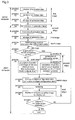
- Figure 2 is a flowchart of process steps in a method for communicating and generating computer graphics animation data according to a first embodiment of the invention.
- Figure 3 is a flowchart of process steps in a method for communicating and generating computer graphics animation data according to a second embodiment of the invention.
- Figure 4 is a flowchart of process steps in a method for communicating and generating computer graphics animation data according to a third embodiment of the invention.
- Figure 5 is a flowchart of process steps in a method for communicating and generating computer graphics animation data according to a fourth embodiment of the invention.
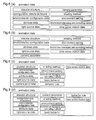
- Figures 6(a)-6(d) are diagrams illustrating structures of animation data according to the present invention.
- Figures 7(a)-7(c) are diagrams for explaining a skeletal structure.
- Figure 8 is a diagram for explaining a skeletal structure.
- Figures 9(a)-9(d) are diagrams for explaining joint angle data.
- Figures 10(a) and 10(b) are diagrams for explaining time series data.
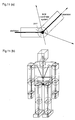
- Figures 11(a) and 11(b) are diagrams for explaining binding of configuration data.
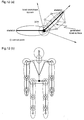
- Figures 12(a) and 12(b) are diagrams for explaining generation of surface data of an object.
- Figures 13(a) and 13(b) are diagrams for explaining state transition of basic behavior due to generation of event.
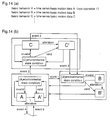
- Figures 14(a) and 14(b) are diagrams for explaining state transition of basic behavior due to generation of event.
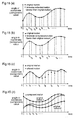
- Figures 15(a)-15(d) are diagrams for explaining alteration of time series basic motion data.
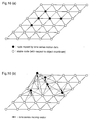
- Figures 16(a) and 16(b) are diagrams for explaining transformation of mesh configuration.
- Figure 1 is a block diagram illustrating a structure of a system for executing a method according to the present invention.
- reference numeral 1 designates a server computer
- numeral 2 designates a storage unit included in the server computer
- numeral 3 designates a communication mediating means
- numeral 4 designates a client computer
- numeral 5 designates a storage unit included in the client computer
- numeral 6 designates a display unit serving as an interface between the client computer and the user.
- the whole process is executed in the first stage through the seventh stage.
- the first stage is executed by process 1, process 2, and process 3, the second stage is executed by process 4 and process 5, the third stage is executed by process 6, the fourth stage is executed by process 7, the fifth stage is executed by process 8, the sixth stage is executed by process 9, and the seventh stage is executed by process 10 and process 11.
- Process 1 is to create animation data
- process 2 is to edit the animation data
- process 3 is to store the animation data in the storage unit 2
- process 4 is to transmit the animation data
- process 5 is to receive the animation data
- process 6 is to store the animation data in the storage unit 5
- process 7 is to perform initial arrangement of environmental configuration data described later
- process 8 is to calculate a position and a shape of a skeletal structure at a certain time
- process 9 is to bind configuration data of an object (human being) to the skeletal structure or to generate surface data of the object
- process 10 is to perform rendering by a specified shading method
- process 11 is to display a rendered computer graphics image on the display unit 6, and step 12 is to judge whether an end instruction is ordered or not.
- Process 1 to process 4 are executed by the server computer 1 using the storage unit 2 and, after transmitting the animation data via the communication mediating means 3, process 5 to process 12 are executed by the client computer using the storage unit 5 and the display unit 6.
- Figure 6(a) shows the structure of animation data generated in process 1 in the case where a configuration is bound to an object.
- the animation data is composed of a skeletal structure, configuration data to be bound, configuration data of environment, attribute data, light source data, camera parameters, a shading method, environment setting, an environment managing and controlling method, and time series motion data.
- Figure 6(b) shows the structure of animation data generated in process 1 in the case where a surface of an object is generated adapting to a skeletal structure.
- the animation data is composed of a skeletal structure, configuration data of environment, attribute data, light source data, camera parameters, a shading method, environment setting, an environment managing and controlling method, and time series motion data.
- each term will be explained.
- a plurality of sites (end portions of skeletons) connected by links (three-dimensional vectors) are called a segment and, particularly, two sites connected by a link are called a skeleton.
- a segment can be divided into a skeleton or skeletons.
- a portion connecting a segment (skeleton) with another segment (skeleton) at their sites is called a joint.
- a skeletal structure object An object described by these segments, skeletons, and joints is called a skeletal structure object.
- a local coordinate system (a point and three vectors orthogonal each other) for deciding the position and direction of the whole skeletal structure object is needed, and this is called a root.
- the position of the skeletal structure object in the whole coordinate system is specified by the position of the root (the origin of the local coordinate system), and the front, top, and side directions of the skeletal structure object are specified by unit vectors defining the coordinate axes of the local coordinate system.
- the site position is specified by the local coordinate system defined for each segment, and the position in the whole coordinate system is specified by conversion sequences between the local coordinate systems.
- the root when the root belongs to one of the segments, since the site (joint) of this segment can be described by the local coordinate system of the root, one transformation sequence is dispensed with as compared with the case where the root does not belong to one of the segments. Accordingly, the root can be regarded as a special site.
- figure 7(c) as an example, a skeletal structure of a human being is illustrated.
- Figure 7(c) shows the skeletal structure object hierarchically. Since the number of segments and the number of joints are smaller in the upper hierarchy skeletal structure object (rough model skeletal structure object) than in the lower hierarchy skeletal structure object (detailed model skeletal structure object), the upper hierarchy skeletal structure object lacks degree of freedom and smoothness in motion as compared with the lower hierarchy skeletal structure object, but computational complexity and amount of time series motion data for computer graphics animation are reduced in the upper hierarchy skeletal structure object. Therefore, an effective utilization is realized when the upper and lower hierarchy skeletal structure objects are properly used considering the data amount, the performance of the client computer, and the situation of animation (when the view point is far).
- terms without parentheses are joint names
- terms with parentheses are segment (skeleton) names.
- end portions are called end sites. Since these names are identifiers, these names may be represented by symbols as long as identification is possible.
- site names since one joint is defined by two sites according to the above-mentioned definition, when these two sites are compared, one nearer to the root than the other is described by adding 'site 0' to the joint name, and the other site is described by adding 'site 1' to the joint name, whereby these sites are named.
- site names are given only to the right elbow, and site names of other parts are omitted.
- FIG. 8 shows a tree structure of the skeletal structure object shown in figure 7(c).
- the sites corresponding to the joints and the end sites are excluded from the segments, or it is considered that these sites are doubly used.
- the manner of illustrating the tree structure adopted here is as follows.
- the skeletal structure can be illustrated by the tree structure, it can be described in the form of a list structure. This description form is, in case of single hierarchy, realized by the following process steps.
- the configuration of an object to be bound is described (figure 6(a)).
- the configuration of an object is defined by a polygon (polygonal plane surface), a mesh (triangle mesh, rectangle mesh), or a primitive configuration.
- the primitive configuration is a spatially symmetric configuration, such as a cube or a sphere.
- the object configuration is defined by a curved surface which is defined by B-spline or Bezier, or an energy (potential) boundary surface called 'metaball'.
- the configuration is simple, it is defined by single hierarchy. In this case, a local coordinate system called 'object coordinate system' is used.
- configurations of parts are constructed by local coordinate systems which are specified for the respective parts, and the whole structure is constructed by mapping for converting these parts into the local coordinate system showing the whole object.
- the part itself is multiple hierarchy, the above-mentioned operation is repeated.
- the local coordinate systems of parts may be defined roughly. However, in case of the configuration to be bound, it is necessary to define the parts with the local coordinate systems corresponding to the segments of the skeletal structure object.
- the parts are constructed with the local coordinate systems of the segments when animation data is generated.
- mapping for transforming the originally used local coordinate system into the local coordinate system of the segment is performed when animation data is edited. This transformation is calculated as follows. Initially, it is specified where, in the segment, the representative points (nine points or more) of a polygon or a mesh constituting the configuration of a part are located, and simultaneous equations representing the corresponding relationship to the original position is solved.
- An alternative method for preventing the breaking is as follows. That is, the boundary of part configurations to be bound to two segments is made changeable, and the boundary is changed in response to the change of the joint to connect these part configurations without fail.
- Described as light source data are as follows. In case of a point light source, initial position, light source intensity, and attenuation ratio are given. In case of a line light source, initial position of its end point, direction vector, light source intensity, attenuation ratio, and length are given. In case of a surface light source, initial position of its representative point, normal vector, light source intensity, attenuation ratio, definition of configuration, and area are given. In any case, when the light source is provided with light distribution, it is described in addition to those mentioned above.
- initial position initial position
- initial view direction vector upper vector (vector showing the upward direction of the camera)
- focal distance focal distance
- angle of view is described.
- the algorithm name or identifier of a specific shading method used when rendering is performed is described. More specifically, the name, such as wire frame, flat shading, glow shading, Phong shading, ray tracing, or illumination mapping, or corresponding identifier is described. However, illumination mapping is available only when illumination distribution is given as the attribute data.
- Plural names (identifiers) of shading methods can be described by giving priority. The priority is given with respect to the processing time so that the shading methods can be properly used according to the performance of the client computer.
- Environment setting is data for performing initial arrangement of environmental configurations, and this is described by affine matrix. Concrete description is performed as follows.
- the environment managing and controlling method is to manage the motion of the object (skeletal structure object).
- the light source or camera moves, its motion is also managed. Concrete description is performed as follows.
- time series motion data fundamentally, motion of the skeletal structure object is described. Besides, motion of the object relative to motion of the camera or light source is described.
- the time series motion data is composed of time series data of affine transformation of the root and time series data of the joint angle (rotation amount).
- time series data relating to the link which is mentioned later, must be added.
- the time series data of affine transformation of the root is composed of the root position, i.e., the position where the whole skeletal structure object exists, and the rotation amount, i.e., the pose control amount of the whole skeletal structure object.
- the root position is given by a three-dimensional coordinate value (three-dimensional position vector) of the world (whole) coordinate system.
- rotation amount like the joint angle.
- typical joint angles (rotation amounts) will be explained using figures 9(a)-9(d) and, thereafter, the rotation amount of the root will be explained.
- Figures 9(a) and 9(b) show joint angles (rotation amounts) used when the local coordinate system defined by each segment is parallel to the local coordinate system of the root, i.e., when unit vectors on x, y, z axes are identical.
- the rotation amount is given to the initial state of the skeletal structure object so that the link state at the present time is obtained when the link rotates around the x-axis, y-axis, and z-axis.
- the rotation amount is given to the state of the skeletal structure object at a time just before the present time so that the link state at the present time is obtained when the link rotates around the x-axis, y-axis, and z-axis.
- Figure 9(b) shows a joint angle according to polar coordinate representation, and it is given by the rotation amount of the link around the z-axis and the angle formed between the link and the z-axis.
- the position of the site represented by this local coordinate system is unchanged if the link length is fixed.
- the link length is not fixed, it is supposed that, in addition to the joint-rotation, joint-sliding occurs (so-called 'sliding joint' in robotics).
- DH Densavit-Hartenberg
- the angle is decided according to the degree of freedom of each joint (the degree of freedom is 3 when all rotations are possible).
- the rotation amount varies depending on the order of the rotations, the order of the rotations must be specified.
- the rotation amount of the root is given by the method of figure 9(a) or 9(b). More specifically, when the whole coordinate system is moved in parallel so that its origin point is placed on that of the local coordinate system defined by the root, in case of figure 9(a), it is given as rotation amounts in rotational transformation around the x-axis, y-axis, and z-axis in which the whole coordinate system matches the local coordinate system of the root. In case of figure 9(b), it is given by rotation amounts around the z-axis of the respective axes of the local coordinate system of the root, to the whole coordinate system, and angles formed between the respective axes and the z-axis.
- the time series motion data for the skeletal structure object is composed of the above-mentioned vector amount to the root and the vector amount to the segment, and there are two methods for describing the data as mentioned hereinafter.
- method (1) Since drawing is performed at each time, when these methods (1) and (2) are compared in view of data loading, method (1) is executed by an access to a localized region whereas method (2) needs to access to some dispersed regions. From this point of view, method (1) is superior to method (2).
- time series motion data to the motion of a camera are as follows: camera position at each time, view direction vector, (3+3+3)-dimensional vector describing the upper vector (or affine transformation matrix), focal distance, angle of view.
- time series motion data to the motion of the light source can be fundamentally given to all of the above-mentioned data relating to the light source.
- a moving light source object such as a lightning bug or a noctiluca, can be represented by giving the position and the light source intensity at each time.
- time series motion data is performed as follows.
- time series motion data is formed by direct/inverse kinematics, direct/inverse dynamics, optimizing calculation of motion, or motion capture.
- the time series motion data is generated by combining various motions (refer to figure 10(a)).
- the animation data is described, for each item, in a region identifying the item (a region enclosed by a start identifier and an end identifier), or in a file with a file name that shows the item.
- edition of the animation data is performed.
- 'edition' means confirmation and data adjustment for performing desired computer graphics animation.
- the edition relating to the object configuration to be bound to the skeletal structure object is as described above.
- the environmental configuration it is confirmed whether a desired environmental configuration is generated and whether it is arranged according to the environment setting, followed by modification at appropriate time.
- the time series motion data especially when the motion is long timewise, since the time series motion data is generated by combining various motions as mentioned above, connections of these motions are adjusted, and whether the intended motion is realized or not is confirmed, followed by modification at appropriate time.
- attribute data, light source data, camera parameters, shading method, environment setting, and environment managing and controlling method are also confirmed.
- process 4 and process 5 communication (transmission and reception) of the animation data stored in the storage unit 2 is performed. Since this communication can be performed by 'http' or 'ftp', it is performed in conformity with the protocol format, from the server computer 1 to the client computer 4 through the communication mediating means 3.
- received animation data is stored in the storage unit 5 in the client computer 4.
- Process 7 through process 12 are to generate a computer graphics animation image in the client computer 4.
- the environmental configuration object to be processed is identified by the name or identifier of the environmental configuration object described in the environment setting of the animation data, and the environmental configuration data represented by the object coordinate system is transformed according to the affine matrix that is described next to the name or identifier, whereby the environmental configuration object is arranged in a prescribed position in the world (whole) space.
- the actual process is coordinate transformation.
- the above-mentioned processes are performed to all the environmental configuration objects, and the transformed data is temporarily stored in the storage unit 5.
- the skeletal structure object to be processed (light source, camera) is identified from the name or identifier of the skeletal structure object described in the environment managing and control method of the animation data, and the vector amount (state data) of the skeletal structure object at a certain time (hereinafter referred to as time T) is read from the time series motion data whose name or identifier is described next to the name or identifier of the skeletal structure object.
- time T the vector amount of the skeletal structure object at a certain time
- the read vector amount in case of the skeletal structure object, it is moved (transformed) to a position corresponding to time T, and transformed to the skeletal state (attitude) at time T. This is performed according to the transformation relationship between the local coordinate system defined for each segment and the world (whole) coordinate system, and the transformation relationship between the local coordinate systems.
- the light source (camera) it is moved to a position at time T described in the time series motion data, and transformed to light source (camera) parameters at time T.
- the data thus obtained is
- process 9 according to the position of the skeletal structure object and the skeletal state (attitude) stored in the storage unit 5, corresponding object configuration is bound to the object, or the surface of the object is generated.
- the part configuration which is grouped for each segment as shown in figure 11 is transformed according to the transformation between the whole (world) coordinate system and the local coordinate system and the transformation sequence between the local coordinate systems which are used for the above-mentioned calculation of the position of the skeletal structure object and the skeletal state (attitude).
- breaking of the part configuration is prevented by binding a configuration, such as a sphere, to the joint, as shown in figure 11.
- a configuration such as a sphere
- it is generated by a radius that is determined by the movable ranges of the part configuration and the joint with the joint position as the center.
- a sphere defined by the object coordinate system is affine-transformed at that position.
- the bound object configuration data (transformed data) is temporarily stored in the storage unit 5.
- the control point for generating a curved surface of a part defined for each segment which is added to the skeletal structure of the animation data, is transformed according to the transformation of the local coordinate system to the whole (world) coordinate system and the transformation sequence between the local coordinate systems, and the curved surface is generated on the basis of the transformed control point.
- the curved surface so generated is used as it is, or a mesh obtained by approximating the curved surface is used.
- the former case is not so general because the computational complexity increases, and the rendering method is also restricted (as a method like ray tracing). So, the latter case will be described hereinafter.
- a method for generating a mesh from the control point is as follows. Two parameters defining a curved surface equation are subjected to discretization into the number of nodal points to be generated, and the discrete values are assigned to the curved surface equation, whereby points on the curved surface, corresponding to the discrete values, are obtained. These points are used as nodal points of a mesh.
- FIG. 12 is a schematic diagram illustrating the result of the above-mentioned processing.
- rendering is performed to generate an image at time T, by the shading method described in the animation data, using the above-mentioned environmental configuration arrangement data, light source data, camera data, and configuration data of the bound object or surface data of the generated object, which data are stored in the storage unit 5.
- This rendering is identical to rendering performed in ordinary computer graphics, and the generated image data is color data (RGB value) for each pixel.
- the generated image data is temporarily stored in the storage unit 5.
- process 11 the image data stored in the storage unit 5 is displayed on the display unit by the same manner as performed in ordinary computer graphics.
- process 12 it is judged whether an end instruction is ordered or not.
- the end instruction is ordered during a period from process 8 to process 11.
- the end instruction is ordered, it is subjected to interrupt processing, and an identification symbol showing the order is assigned to a region provided in the storage unit 5. By seeing this identification mark, it is judged whether the end instruction is ordered or not.
- process 12 When it is judged in process 12 that the end instruction is ordered, the processing is ended. When the end instruction has not been ordered yet, process 8 through process 12 are repeated.
- the time series motion data is made cyclical, i.e., the first and the last are made identical.
- the cycle is the length of the time series motion data.
- the whole process is executed in the first stage through the ninth stage.
- the first stage is executed by process 21, process 22, and process 23, the second stage is executed by process 24 and process 25, the third stage is executed by process 26, the fourth stage is executed by process 27, the fifth stage is executed by process 28, the sixth stage is executed by process 29, the seventh stage is executed by process 30 and process 31, the eighth stage is executed by process 32, and the ninth stage is executed by process 33 and process 34.
- Process 21 is to create animation data
- process 22 is to edit the animation data
- process 23 is to store the animation data in the storage unit 2
- process 24 is to transmit the animation data
- process 25 is to receive the animation data
- process 26 is to store the animation data in the storage unit 5
- process 27 is to perform initial arrangement of environmental configuration data
- process 28 is to judge whether time T is within a basic behavior period or within a connecting period
- process 29 is to calculate a position and a shape of a skeletal structure at time T, when it is judged that time T is within the basic behavior period
- process 30 is to generate a connecting motion when it is judged that time T is within the connecting period
- process 31 is to calculate a position and a shape of the skeletal structure at time T, when it is judged that time T is within the connecting period
- process 32 is to bind configuration data of an object (human being) to the skeletal structure or to generate surface data of the object
- process 33 is to perform rendering by a specified shading method
- process 34 is to display a
- Process 21 to process 24 are executed by the server computer 1 using the storage unit 2 and, after transmitting the animation data via the communication mediating means 3, process 25 to process 35 are executed by the client computer 4 using the storage unit 5 and the display unit 6.
- Figure 6(c) shows the structure of animation data generated in process 21 in the case where a configuration is bound to an object.
- the animation data is composed of a skeletal structure, configuration data to be bound, configuration data of an environment, attribute data, light source data, camera parameters, a shading method, environment setting, an environment managing and controlling method, basic behaviors, behavior rule, and time series basic motion data.
- the animation data is composed of a skeletal structure, configuration data of an environment, attribute data, light source data, camera parameters, a shading method, environment setting, an environment managing and controlling method, basic behaviors, behavior rule, and time series basic motion data.
- the skeletal structure, the configuration data to be bound, the environmental configuration data, the attribute data, the light source data, the camera parameters, the shading method, and the environment setting are identical to those mentioned for the first embodiment, descriptions thereof are omitted.
- the basic behaviors, the behavior rule, the time series basic motion data, and the environment managing and controlling method are described.
- a basic behavior is a unit motion into which a series of motions of the skeletal structure object is divided.
- 'sit', 'stand', 'walk', 'kick' are basic behaviors, and names or identifiers are given to these basic behaviors to make them distinguishable. Since the division into these basic behaviors is experiential one, the unit of the division varies, in some measure, according to the user. However, since the following processing has no dependence on the division unit (division method), any division unit can be employed.
- the basic behavior makes a one-to-one correspondence with the time series basic motion data, and this correspondence is described as a description of the basic behavior.
- the behavior period of the basic behavior time series basic motion data
- Concrete description is performed as follows.
- the management of data is performed favorably when the total number of the basic behaviors is described at the top of the description.
- the behavior rule is composed of a sequence of combined basic behaviors when the skeletal structure objects behaves actually, and a connecting period between the basic behaviors. Concrete description is performed as follows.
- the time series basic motion data is time series data which corresponds to each basic behavior and is shorter, timewise, than the above-mentioned time series motion data, i.e., it is a unit into which the time series motion data is divided.
- the description form of the time series basic motion data is identical to that of the time series motion data.
- the above-mentioned basic behaviors, behavior rule, and time series basic motion data are applicable to a light source or a camera.
- the environment managing and controlling method is to manage the motion of the object (skeletal structure object).
- the light source or camera moves, its motion is also managed. Concrete description is performed as follows.
- edition of the animation data is performed.
- 'edition' means confirmation and data adjustment for performing desired computer graphics animation.
- the edition relating to the object configuration to be bound to the skeletal structure object is as described above.
- the environmental configuration it is confirmed whether a desired environmental configuration is generated and whether it is arranged according to the environment setting, followed by modification at appropriate time.
- the basic behaviors, the behavior rule, and the time series motion data the combination of the basic behaviors and the connecting period are adjusted and it is confirmed whether the object moves as desired, followed by modification at appropriate time.
- attribute data, light source data, camera parameters, shading method, environment setting, and environment managing and controlling method are also confirmed.
- Process 23 is performed in the same way as process 3 according to the first embodiment of the invention.
- Process 24 and process 25 are performed in the same way as process 4 and process 5 according to the first embodiment of the invention.
- Process 26 is performed in the same way as process 6 according to the first embodiment of the invention.
- Process 27 through process 35 are to generate an computer graphics animation image in the client computer 4. Hereinafter, these processes will be explained.
- Process 27 is performed in the same way as process 7 according to the first embodiment of the invention.
- the skeletal structure object to be processed (light source, camera) is identified from the name or identifier of the skeletal structure object described in the environment managing and control method of the animation data, and it is judged whether the skeletal structure object at a certain time is within the basic behavior period or within the connecting period. This judgment is performed on the basis of the connecting period which is shown in the behavior rule having the behavior rule name described next to the skeletal structure object name in the environment managing and controlling method, and the basic behavior period which is shown in the basic behavior having the basic behavior name described in the behavior rule.
- the judgment is performed according to the following procedure.
- step (1) if an identification number of the connecting period which has expired is stored for each skeletal structure object, it is the maximum n obtained.
- the identification number starts from 1, and the initial state of the storage region is 0.
- the stored identification number is 0, it is judged that the maximum n does not exist.
- the time within the basic behavior period or the connecting period is temporarily stored in the storage unit 5.
- the vector amount (status data) of the skeletal structure object (light source, camera) at time T is read from the corresponding time series basic motion data.
- the time in the basic behavior period which is stored in the storage unit 5, is utilized.
- the read vector amount in case of the skeletal structure, it is moved (transformed) to a position corresponding to time T and transformed to a skeletal state (attitude) at time T. This is performed according to the transformation relationship between the local coordinate system defined for each segment and the world (whole) coordinate system, and the transformation relationship between the local coordinate systems.
- the light source camera
- it is moved to a position corresponding to time T described in the time series motion data, and transformed to light source (camera) parameters at time T.
- the data thus obtained is temporarily stored in the storage unit 5.
- time T when it is judged in process 28 that time T is within the connecting period, the connecting motion is generated.
- a method for generating the connecting motion will be described with reference to figure 10(b).
- Time series basic motion data corresponding to the basic behaviors before and after the desired connecting motion are specified as previous basic motion data and subsequent basic motion data, respectively.
- the whole basic motion data period is ts, and the connecting period is te-ts.
- the read basic motion data starts from time te.
- Each time series basic motion data starts from time 0, and the 'after' basic motion data is moved in parallel, timewise, by te.
- the connecting motion is generated according to the following procedure.
- the connecting motion continues during the te-ts period. So, generation of connecting motion is performed only when the process enters in the connecting period for the first time, and time series connecting motion data is generated until the end of the connecting motion and stored in the storage unit 5. From the second time on, the connecting motion is not generated but only reading from the storage unit 5 is performed. Further, since the forward prediction curve and the backward prediction curve are fixable for each time series basic motion data, if these prediction curves are calculated for the maximum connecting period and stored in advance, it is not necessary to calculate these curves at each connection.
- process 31 according to the connecting motion generated in process 30, in case of the skeletal structure object, it is moved (transformed) to a position corresponding to time T, and transformed to a skeletal state (attitude) at time T. This is performed according to the transformation relationship between the local coordinate system defined for each segment and the world (whole) coordinate system, and the transformation relationship between the local coordinate systems.
- the light source it is moved to a position corresponding to time T described in the time series motion data, and transformed to light source (camera) parameters at time T. The data thus obtained is temporarily stored in the storage unit 5.
- process 32 according to the position of the skeletal structure object and the skeletal state (attitude) stored in the storage unit 5, corresponding object configuration is bound to the object, or the surface of the object is generated. This process is performed in the same manner as process 9 according to the first embodiment of the invention.
- rendering is performed to generate an image at time T, by the shading method described in the animation data, using the environmental configuration arrangement data, light source data, camera data, and configuration data of the bound object or surface data of the generated object, which data are stored in the storage unit 5. This process is performed in the same manner as process 10 according to the first embodiment.
- the image data stored in the storage unit 5 is displayed on the display unit by the same manner as performed in ordinary computer graphics.
- process 35 it is judged whether an end instruction is ordered or not, in the same manner as process 12 according to the first embodiment. When the end instruction has not been ordered yet, process 28 through process 35 are repeated.
- the basic behaviors described in the behavior rule is made cyclical, i.e., the first and the last are made identical.
- the cycle is the total time required for the time series basic motion data and the connecting motion.
- the whole process is executed in the first stage through the tenth stage.
- the first stage is executed by process 41, process 42, and process 43
- the second stage is executed by process 44 and process 45
- the third stage is executed by process 46
- the fourth stage is executed by process 47
- the fifth stage is executed by process 48
- the sixth stage is executed by process 49
- the seventh stage is executed by process 50
- the eighth stage is executed by process 51 and process 52
- the ninth stage is executed by process 53
- the tenth stage is executed by process 54 and process 55.
- Process 41 is to create animation data
- process 42 is to edit the animation data
- process 43 is to store the animation data in the storage unit 2
- process 44 is to transmit the animation data
- process 45 is to receive the animation data
- process 46 is to store the animation data in the storage unit 5
- process 47 is to perform initial arrangement of environmental configuration data
- process 48 is to detect generation of events and execute a process relating to state transition of a basic behavior
- process 49 is to judge whether a certain time (hereinafter referred to as time T) is within a basic behavior period or within a connecting period
- process 50 is to calculate a position and a shape of a skeletal structure at time T, when it is judged that time T is within the basic behavior period
- process 51 is to generate a connecting motion when it is judged that time T is within the connecting period
- process 52 is to calculate a position and a shape of the skeletal structure at time T, when it is judged that time T is within the connecting period
- process 53 is to bind configuration data of an object (human
- Process 41 to process 44 are executed by the server computer 1 using the storage unit 2 and, after transmitting the animation data via the communication mediating means 3, process 45 to process 56 are executed by the client computer 4 using the storage unit 5 and the display unit 6.
- the animation data generated in process 41 is, as shown in figure 6(c), composed of a skeletal structure, configuration data to be bound, configuration data of an environment, attribute data, light source data, camera parameters, a shading method, environment setting, an environment managing and controlling method, basic behaviors, behavior rule, and time series basic motion data.
- the animation data is composed of a skeletal structure, configuration data of an environment, attribute data, light source data, camera parameters, a shading method, environment setting, an environment managing and controlling method, basic behaviors, behavior rule, and time series basic motion data.
- the environmental configuration data to be bound the environmental configuration data, the attribute data, the light source data, the camera parameters, the shading method, the environment setting, the basic behaviors, and the time series basic motion data are identical to those mentioned for the second embodiment, descriptions thereof are omitted.
- the skeletal structure, the behavior rule, and the environment managing and controlling method are described.
- an item relating to sensing to the external world is added.
- a visual sensor and a tactual sensor are prepared.
- a sensing region is, for example, a three-dimensional region obtained by combining sectors in a sphere or a great circle of a sphere, with a portion corresponding to a site that corresponds to an eye as its center.
- the tactual sensor defined as a sensing region is, for example, a spherical region with a site such as fingers as its center.
- the skeletal structure object When the skeletal structure object actually moves while combining the basic behaviors, described as the behavior rule are the state transition between these basic behaviors, an event producing the state transition, and the connecting period of the connecting motion at the state transition.
- the event is either an event relating to the sensing to the above-mentioned skeletal structure or an event caused by an external input, such as a mouse or a key board.
- Figure 13 shows a state transition diagram of the basic behaviors.
- the behavior rule is a description of this state transition diagram. Concrete description is as follows.
- the environment managing and controlling method is to manage the motion of the object (skeletal structure object), and the event. When the light source or the camera moves, this motion is also managed by the environment managing and controlling method. Concrete description is as follows.
- edition of the animation data is performed.
- 'edition' means confirmation and data adjustment for performing desired computer graphics animation.
- the edition relating to the object configuration to be bound to the skeletal structure object is as described above.
- the environmental configuration it is confirmed whether a desired environmental configuration is generated and whether it is arranged according to the environment setting, followed by modification at appropriate time.
- the behavior rule, and the time series motion data, performed are adjustment of combination or transition of the basic behaviors, adjustment of connecting period, and confirmation whether the object moves as desired, followed by modification at appropriate time.
- attribute data, light source data, camera parameters, shading method, environment setting, and environment managing and controlling method are also confirmed.
- Process 43 is performed in the same manner as process 3 according to the first embodiment.
- Process 44 and process 45 are performed in the same manner as process 4 and process 5 according to the first embodiment.
- Process 46 is performed in the same manner as process 6 according to the first embodiment.
- Process 47 through process 56 are to generate a computer graphics animation image in the client computer 4. Hereinafter, these processes are described.
- Process 47 is performed in the same manner as process 7 according to the first embodiment.
- process 48 detection of generation of events and a process relating to state transition of basic behaviors are performed.
- a region where the present state of each skeletal structure object is to be written is secured in the storage unit 5.
- the present state is that the basic behavior is performed in a loop
- stored in this region are the name or identifier of this basic behavior and the time of the present state in the time series basic motion data.
- the present state is that the basic behavior is under transition
- stored in this region are the identifier showing 'under transition', the names or identifiers of basic behaviors before and after the transition, the transition start time, and the connecting period.
- Writing of 'under transition' is performed from a certain time (time T) immediately after generation of the event.
- 'under transition' is a period from the time immediately after generation of the event (time T) to moving to the basic behavior after the transition.
- the event detection is performed as follows. Initially, all the conditions for judging generation of events, which are described in the environment managing and controlling method of the animation data, are checked to find the relevant event, and its event identifier is stored. Then, the skeletal structure object (light source, camera) and the behavior rule corresponding the stored event identifier are found from the environment managing and controlling method, and the name or identifier of the behavior rule is stored. Next, the transition of the basic behavior is performed while watching the behavior rule corresponding to the stored name or identifier of the behavior rule. This process is performed in the storage unit 5, and the results are written and stored in the above-mentioned region showing the present state, which is provided for each skeletal structure object. Further, for the skeletal structure object whose present state is 'under transition', generation of events is ignored.
- process 49 it is judged whether the skeletal structure object (light source, camera) to be processed is, at a certain time (time T), within the basic behavior period or within the connecting period. This judgment is performed while watching the present state provided for each skeletal structure object.
- time T time
- the skeletal structure object is not under state transition, it is judged as one within the period of the stored basic behavior.
- the skeletal structure object is under state transition, it is judged whether or not the transition is toward the basic behavior of the type that transits to another basic behavior unconditionally. If it is not so, the skeletal structure object is judged as one within the connecting period. More specifically, when the connecting period is Ct0 and the transit start time is Ts, it is judged as one in the T-Ts state within the connecting period.
- the identifier of the basic behavior under the transition in the region showing the present state is changed to the name or identifier of the destination basic behavior, the present time in the time series basic motion data is set at -1, and the result of judgment is changed to 'within basic behavior period'.
- the procedure is as follows. Initially, it is assumed that the operating time of the basic behavior via which the transition is performed (hereinafter referred to as transit basic behavior) is Bt, the connecting periods of the basic behaviors before and after the transit basic behavior are Ct0 and Ct1, respectively, the transit start time is Ts, and Ts ⁇ T ⁇ Ct0+Bt+Ct1 .
- the vector amount (status data) of the skeletal structure object (light source, camera) at time T is read from the corresponding time series basic motion data.
- the vector amount at the time of 1 + [the present time assigned for each basic behavior and stored in the storage unit 5] is read from the corresponding time series basic motion data.
- the present time is updated.
- the vector amount is 0 (the residue of [the maximum value of time + 1]). Thereby, toggle operation is possible.
- the read vector amount in case of the skeletal structure object, it is moved (transformed) to the position at time T, and transformed to the skeletal state (attitude) at time T.
- the connecting motion is generated as desired. That is, as mentioned above, in the case where the skeletal structure object is judged as 'under transition' of the basic behavior that transits to another basic behavior unconditionally, when it is within the transit basic behavior period, it is not necessary to generate the connecting motion, but the time series basic motion data corresponding to the transit basic behavior is used.
- the algorithm of generating the connecting motion is fundamentally identical to that of process 30 according to the second embodiment, in this third embodiment, it is necessary to connect to the subsequent basic motion data in the middle of the previous basic motion data. Therefore, the method of generating the backward prediction curve according to this third embodiment is different from that according to the second embodiment.
- a previously calculated one can be used. Further, if the event processing is not performed in the middle of the previous basic motion data, i.e., if the connecting process is performed after completion of the previous basic motion data, the connecting curve is generated in the same manner as process 30 according to the second embodiment.
- process 52 from the connecting motion generated in process 51 (in case of 'under transition', from the time series basic motion data corresponding to the transit basic behavior), in case of the skeletal structure object, it is moved (transformed) to the position at time T, and transformed to the skeletal state (attitude) at time T. This is performed according to the transformation relationship between the local coordinate system defined for each segment and the world (whole) coordinate system, and the transformation relationship between the local coordinate systems.
- the light source it is moved to the position at time T described in the time series motion data, and transformed to light source (camera) parameters at time T. The data thus obtained is temporarily stored in the storage unit 5.
- process 53 according to the position of the skeletal structure object and the skeletal state (attitude) stored in the storage unit 5, corresponding object configuration is bound to the object, or the surface of the object is generated. This process is performed in the same manner as process 9 according to the first embodiment of the invention.
- rendering is performed to generate an image at time T, by the shading method described in the animation data, using the environmental configuration arrangement data, light source data, camera data, and configuration data of the bound object or surface data of the generated object, which data are stored in the storage unit 5. This process is performed in the same manner as process 10 according to the first embodiment.
- process 55 the image data stored in the storage unit 5 is displayed on the display unit by the same manner as performed in ordinary computer graphics.
- process 56 it is judged whether an end instruction is ordered or not, in the same manner as process 12 according to the first embodiment. When the end instruction has not been ordered yet, process 48 through process 56 are repeated.
- the whole process is executed in the first stage through the tenth stage.
- the first stage is executed by process 61, process 62, and process 63
- the second stage is executed by process 64 and process 65
- the third stage is executed by process 66
- the fourth stage is executed by process 67
- the fifth stage is executed by process 68
- the sixth stage is executed by process 69
- the seventh stage is executed by process 70 and process 71
- the eighth stage is executed by process 72, process 73, and process 74
- the ninth stage is executed by process 75
- the tenth stage is executed by process 76 and process 77.
- Process 61 is to create animation data
- process 62 is to edit the animation data
- process 63 is to store the animation data in the storage unit 2
- process 64 is to transmit the animation data
- process 65 is to receive the animation data
- process 66 is to store the animation data in the storage unit 5
- process 67 is to perform initial arrangement of environmental configuration data
- process 68 is to detect generation of evens and execute a process relating to state transition of a basic behavior
- process 69 is to judge whether a certain time (hereinafter referred to as time T) is within a basic behavior period or within a connecting period
- process 70 is to identify the environmental state and change time series basic motion data
- process 71 is to calculate a position and a shape of a skeletal structure at time T, when it is judged that time T is within the basic behavior period
- process 72 is to identify the environmental state
- process 73 is to generate a connecting motion while considering the environmental state when it is judged that time T is within the connecting period
- process 74 is to calculate
- Process 61 through process 64 are executed by the server computer 1 using the storage unit 2 and, after transmitting the animation data via the communication mediating means 3, process 65 through process 78 are executed by the client computer 4 using the storage unit 5 and the display unit 6.
- the animation data generated in process 61 is, as shown in figure 6(c), composed of a skeletal structure, configuration data to be bound, configuration data of an environment, attribute data, light source data, camera parameters, a shading method, environment setting, an environment managing and controlling method, basic behaviors, behavior rule, and time series basic motion data.
- the animation data is composed of a skeletal structure, configuration data of an environment, attribute data, light source data, camera parameters, a shading method, environment setting, an environment managing and controlling method, basic behaviors, behavior rule, and time series basic motion data.
- the skeletal structure, the configuration data to be bound, the environmental configuration data, the attitude data, the light source data, the camera parameters, the shading method, the environment setting, the basic behaviors, and the time series basic motion data are identical to those mentioned for the third embodiment of the invention, descriptions thereof are omitted.
- the behavior rule and the environment managing and controlling method are described.
- Figure 14 shows an example of a state transition diagram of the basic behaviors.
- the behavior rule is a description of this state transition diagram.
- the state transition diagram shown in figure 14 is different from the state transition diagram according to the third embodiment (figure 13) in that, when an event occurs, the environmental state is observed, and a change is added to a basic behavior to which the transition is performed (hereinafter referred to as destination basic behavior), according to the environmental state.
- Concrete description of the behavior rule is as follows.
- the environment managing and controlling method is to manage the motion of the object (skeletal structure object) and the event and to change the basic behavior according to the environmental state condition.
- this motion is also managed by the environment managing and controlling method. Concrete description is as follows.
- edition of the animation data is performed.
- 'edition' means confirmation and data adjustment for performing desired computer graphics animation.
- the edition relating to the object configuration to be bound to the skeletal structure object is as described above.
- the environmental configuration it is confirmed whether a desired environmental configuration is generated and whether it is arranged according to the environment setting, followed by modification at appropriate time.
- the behavior rule, and the time series motion data performed are adjustment of combination or transition of the basic behaviors, adjustment of connecting period, confirmation whether the motion is appropriately changed according to the environmental state condition, and confirmation whether the object moves as desired, followed by modification at appropriate time.
- attribute data, light source data, camera parameters, shading method, environment setting, and environment managing and controlling method are also confirmed.
- Process 63 is performed in the same manner as process 3 according to the first embodiment.
- Process 64 and process 65 are performed in the same manner as process 4 and process 5 according to the first embodiment.
- Process 66 is performed in the same manner as process 6 according to the first embodiment.
- Process 67 through process 78 are to generate a computer graphics animation image in the client computer 4. Hereinafter, these processes are described.
- Process 67 is performed in the same manner as process 7 according to the first embodiment.
- process 68 detection of generation of events and a process relating to state transition of basic behaviors are performed in the same manner as mentioned for the third embodiment.
- the name or identifier (address) showing the position in the storage unit 5 of the time series basic motion data of the changed basic behavior, and the time of the present state are stored in the region wherein the present state of each skeletal structure object is written, which region is secured in the storage unit 5 as mentioned for the third embodiment.
- the identifier showing 'under transition' and the name or identifier (address) showing the position in the storage unit 5 of the time series data corresponding to the connecting motion are stored.
- the identifier showing 'under transition' is written from a certain time (time T) immediately after generation of the event.
- identifier showing 'under transition' (different from that mentioned above)
- name or identifier (address) showing the position in the storage unit 5 of the time series data corresponding to the connecting motion before the transition the name or identifier of the transit basic behavior (when it is changed, the name or identifier (address) showing the position in the storage unit 5 of the time series data corresponding to the changed basic behavior
- name or identifier of the basic behavior after the transition is a period from the time immediately after generation of the event (time T) to moving to the basic behavior after the transition.
- process 69 it is judged whether the skeletal structure object (light source, camera) to be processed is, at time T, within the basic behavior period or within the connecting period. This judgment is performed while watching the present state provided for each skeletal structure object described above. With respect to the skeletal structure object which is not under state transition, it is judged as one within the period of the basic behavior that is stored.
- process 70 when the judgment in process 69 is 'within basic behavior period', if the present state is in the final period of the basic behavior (time series basic motion data) in each skeletal structure object, according to the environment managing method and the behavior rule of the skeletal structure object described, it is confirmed whether the environment fits any of the environmental state conditions. In this confirmation, when the environment fits any of the conditions, basic behaviors (corresponding time series basic motion data) are changed.
- Specific methods for changing basic behaviors are as follows: extension and compression of motion in respect of time, change of a via-point of the original motion, synthesis of two motions, and exchange of motions of part structures of the skeletal structure.
- Figure 15(a) is a diagram for explaing extension of motion in respect of time.
- time series basic motion data corresponding to the original basic behavior
- time series basic motion data when its time number (frame number) is F and its operating time is T, this data is extended timewise by changing the time number to F'>F.
- an interpolation curve is generated from the original time series basic motion data by polynomial interpolation or the like, and then a value of the interpolation curve at every time T/F' is obtained to generate new time series data, whereby time series basic motion data extended timewise is generated.
- Figure 15(b) is a diagram for explaining compression of motion in respect of time.
- change parameters scale amounts to F' or F are given. When these parameters are constants, the change of the basic behavior is stationary.
- change parameters are variables, values according to the circumstances are given.
- Figure 15(c) is a diagram for explaining change of a via-point of the original motion.
- the time serving as a key of the via-point to be changed (in figure 15(c), tp, tq), the changed value, and the change period including the key time are given.
- an interpolation curve is generated using data before and after the change period and data at the key time, and values at times other than the key time, within the change period, are obtained from the interpolation curve, whereby changed time series basic motion data is generated.
- the change parameters are the key time sequence, the changed value sequence corresponding to the key time sequence, and the change period.
- the timewise extension or compression when these parameters are constants, the change of the basic behavior is stationary. However, when these parameters are defined as variables and the values are given at every change, motion change adapted to the circumstances is realized.
- Figure 15(d) is a diagram for explaining synthesis of two motions using the connection weight function which is employed in process 30 according to the second embodiment.
- the operation time numbers (frame numbers) of these two motions are added using the above-mentioned timewise extension or compression.
- these two motions are synthesized using the connection weight function which is employed in process 30 according to the second embodiment. That is, when two motions, time numbers of which are adjusted, are A(t) and B(t), and the connection weight function is ⁇ (t), a synthesizing motion is generated by A(t) ⁇ (t)+B(t)(1- ⁇ (t)) This synthesizing motion is such a motion that gradually changes from A(t) to B(t).
- Exchange of motions of part structures of the skeletal structure is performed as follows. That is, using the above-mentioned timewise extension and compression, the time number of the motion after the exchange is adjusted to the time number of the motion before the exchange, and the motions of the part structures are exchanged.
- change parameters are the names or identifiers of the part structures and the names or identifiers of the basic motions to be exchanged.
- the vector amount (status data) of the skeletal structure object (light source, camera) at time T is read.
- the vector amount at the time of 1 + [the present time assigned for each basic behavior stored in the storage unit 5] is read from the corresponding time series basic motion data.
- the present time is updated.
- the vector amount is 0 (the residue of [the maximum value of time + 1]).
- toggle operation is possible.
- the read vector amount in case of the skeletal structure object, it is moved (transformed) to the position at time T, and transformed to the skeletal state (attitude) at time T.
- process 72 when it is judged in process 69 that the skeletal structure object is within the connecting period (i.e., under transition) and it is immediately after generation of the event (time T), the environmental state condition for the destination basic behavior is discriminated.
- the basic behavior is the type that transits to another basic behavior unconditionally and it has entered in the state of 'under transition' immediately after generation of the event, the environmental state condition for the transit basic behavior and the environmental state condition for the basic behavior after the transition are discriminated.
- the connecting motion is generated on the basis of the result of the discrimination in process 72, and the name or identifier (address), the connecting period, and the generated time series connecting motion data are stored in the storage unit 5. In other cases, it is not necessary to generate the connecting motion.
- the method of generating the connecting motion is the same as process 51 according to the third embodiment when the result of the discrimination of the environmental state condition in process 72 is that it is not necessary to change the subsequent basic behavior (the result conforms to none of the environmental state conditions). From the result of the discrimination, when it is necessary to change the subsequent basic behavior, the subsequent basic motion data is changed and, thereafter, the connecting motion is generated for the changed subsequent basic motion data using the same method as process 51 according to the third embodiment. Further, the generated connecting motion is changed according to the above-mentioned behavior change method, on the basis of the change method and the connecting motion change parameters, which are described in the behavior rule.
- the same process as mentioned above is applied to both the transit basic behavior and the basic behavior after the transition, thereby generating two connecting motions.
- the connecting motions so generated their names or identifiers, connecting periods, and generated time series connecting motion data are stored in the storage unit 5.
- the changed time series basic motion data is used for the first time.
- process 74 from the connecting motion generated in process 73 (in case of 'under transition', from the changed time series basic motion data corresponding to the transit basic behavior or the original time series basic motion data), in case of the skeletal structure object, it is moved (transformed) to the position corresponding to time T, and transformed to the skeletal state (attitude) at time T. This is performed according to the transformation relationship between the local coordinate system defined for each segment and the world (whole) coordinate system, and the transformation relationship between the local coordinate systems.
- the light source camera
- it is moved to the position at time T described in the time series motion data, and changed to light source (camera) parameters at time T.
- the data thus obtained is temporarily stored in the storage unit 5.
- process 75 according to the position of the skeletal structure object and the skeletal state (attitude) stored in the storage unit 5, corresponding object configuration is bound to the object, or the surface of the object is generated. This process is performed in the same manner as process 9 according to the first embodiment of the invention.
- process 76 rendering is performed to generate an image at time T, by the shading method described in the animation data, using the environmental configuration arrangement data, light source data, camera data, and configuration data of the bound object or surface data of the generated object, which data are stored in the storage unit 5. This process is performed in the same manner as process 10 according to the first embodiment.
- process 77 the image data stored in the storage unit 5 is displayed on the display unit by the same manner as performed in ordinary computer graphics.
- process 78 it is judged whether an end instruction is ordered or not, in the same manner as process 12 according to the first embodiment. When the end instruction has not been ordered yet, process 68 through process 78 are repeated.
- plural client computers may be employed.
- animation data is successively sent to the client computer to which a request for transmission is applied.
Landscapes
- Physics & Mathematics (AREA)
- General Physics & Mathematics (AREA)
- Engineering & Computer Science (AREA)
- Theoretical Computer Science (AREA)
- Processing Or Creating Images (AREA)
Applications Claiming Priority (3)
| Application Number | Priority Date | Filing Date | Title |
|---|---|---|---|
| JP10507696 | 1996-04-25 | ||
| JP10507696 | 1996-04-25 | ||
| JP105076/96 | 1996-04-25 |
Publications (3)
| Publication Number | Publication Date |
|---|---|
| EP0805418A2 true EP0805418A2 (de) | 1997-11-05 |
| EP0805418A3 EP0805418A3 (de) | 1999-11-03 |
| EP0805418B1 EP0805418B1 (de) | 2004-08-25 |
Family
ID=14397855
Family Applications (1)
| Application Number | Title | Priority Date | Filing Date |
|---|---|---|---|
| EP97106876A Expired - Lifetime EP0805418B1 (de) | 1996-04-25 | 1997-04-25 | Rechnergrafikanimation |
Country Status (4)
| Country | Link |
|---|---|
| US (1) | US6414684B1 (de) |
| EP (1) | EP0805418B1 (de) |
| CN (1) | CN1146805C (de) |
| DE (1) | DE69730372T2 (de) |
Cited By (9)
| Publication number | Priority date | Publication date | Assignee | Title |
|---|---|---|---|---|
| WO1999050988A3 (en) * | 1998-04-01 | 1999-11-25 | Multiscience System Pte Ltd | A method of relaying digital video and audio data via a communication media |
| WO2000042576A3 (en) * | 1999-01-12 | 2000-11-02 | Schlumberger Ltd | Scalable visualization for interactive geometry modeling |
| WO2002021823A1 (en) * | 2000-09-08 | 2002-03-14 | Casio Computer Co., Ltd. | Shooting condition providing apparatus, shooting condition setting system, and shooting condition providing method |
| DE10045117A1 (de) * | 2000-09-13 | 2002-03-28 | Bernd Von Prittwitz | Frei spezifizierbare Geometrie- und Klangsteuerung |
| EP1138022A4 (de) * | 1998-12-10 | 2002-12-04 | Zapa Digital Arts Ltd | Schnelle übermittlung von graphischen objekten |
| EP1280108A3 (de) * | 2001-07-23 | 2004-03-24 | Egisys AG | Verfahren zum serverunterstützten Erzeugen von komplexen Bildern |
| US6910001B2 (en) | 2000-03-22 | 2005-06-21 | Schlumberger Technology Corp. | Distributed multiresolution geometry modeling system and method |
| EP1324589A4 (de) * | 2000-10-06 | 2006-12-20 | Sony Corp | VERFAHREN ZUR BERBESSERUNG DER BILDQUAlITÄT, BUILDDATENVERARBEITUNGSVORRICHTUNG,VERFAHREN ZUR SPEICHERUNG/WIEDERGABE VON DATEN, SYSTEM ZUR STAPELVERARBEITUNG VON DATEN, VERFAHREN UND SYSTEM ZUR DATENVERARBEITUNG |
| CN101814190A (zh) * | 2010-04-28 | 2010-08-25 | 邹玉杰 | 一种动画制作系统和方法 |
Families Citing this family (38)
| Publication number | Priority date | Publication date | Assignee | Title |
|---|---|---|---|---|
| GB9722343D0 (en) * | 1997-10-22 | 1997-12-17 | British Telecomm | Distributed virtual environment |
| JP4215891B2 (ja) * | 1999-02-19 | 2009-01-28 | 任天堂株式会社 | オブジェクト画像プリントサービスシステム |
| US6559845B1 (en) * | 1999-06-11 | 2003-05-06 | Pulse Entertainment | Three dimensional animation system and method |
| US6996770B1 (en) * | 1999-07-26 | 2006-02-07 | Microsoft Corporation | Methods and systems for preparing extensible markup language (XML) documents and for responding to XML requests |
| US6957177B1 (en) * | 1999-12-10 | 2005-10-18 | Microsoft Corporation | Geometric model database for use in ubiquitous computing |
| US7362331B2 (en) * | 2000-01-05 | 2008-04-22 | Apple Inc. | Time-based, non-constant translation of user interface objects between states |
| JP3636681B2 (ja) * | 2000-08-24 | 2005-04-06 | 株式会社ソニー・コンピュータエンタテインメント | 画像処理方法、画像処理装置、半導体デバイス、コンピュータプログラム及び記録媒体 |
| JP4380042B2 (ja) * | 2000-09-04 | 2009-12-09 | ソニー株式会社 | アニメーション生成方法および装置 |
| JP2002095012A (ja) * | 2000-09-18 | 2002-03-29 | Hitachi Ltd | ステレオ画像生成装置およびその方法 |
| US20030140126A1 (en) * | 2001-03-30 | 2003-07-24 | Vitria Technology, Inc. | Method of deployment for concurrent execution of multiple versions of an integration model |
| US7714880B2 (en) * | 2001-11-16 | 2010-05-11 | Honeywell International Inc. | Method and apparatus for displaying images on a display |
| EP1345179A3 (de) * | 2002-03-13 | 2004-01-21 | Matsushita Electric Industrial Co., Ltd. | Vorrichtung und Verfahren zur Animation von Computergrafiken |
| JP2004021866A (ja) * | 2002-06-19 | 2004-01-22 | Matsushita Electric Ind Co Ltd | オブジェクト形状変形装置 |
| US20060221081A1 (en) * | 2003-01-17 | 2006-10-05 | Cohen Irun R | Reactive animation |
| US7333111B2 (en) * | 2003-04-25 | 2008-02-19 | Honda Giken Kogyo Kabushiki Kaisha | Joint component framework for modeling complex joint behavior |
| US7173623B2 (en) * | 2003-05-09 | 2007-02-06 | Microsoft Corporation | System supporting animation of graphical display elements through animation object instances |
| US7098911B2 (en) * | 2003-07-18 | 2006-08-29 | Microsoft Corporation | Placing feathers on a surface |
| US7042456B2 (en) * | 2003-07-18 | 2006-05-09 | Microsoft Corporation | Modeling and rendering of realistic feathers |
| US20050017975A1 (en) * | 2003-07-23 | 2005-01-27 | Russo Michael John | Displaying image data |
| JP4559092B2 (ja) * | 2004-01-30 | 2010-10-06 | 株式会社エヌ・ティ・ティ・ドコモ | 携帯通信端末及びプログラム |
| US7696995B2 (en) * | 2004-05-07 | 2010-04-13 | Valve Corporation | System and method for displaying the effects of light illumination on a surface |
| US7433760B2 (en) * | 2004-10-28 | 2008-10-07 | Accelerated Pictures, Inc. | Camera and animation controller, systems and methods |
| US7412389B2 (en) * | 2005-03-02 | 2008-08-12 | Yang George L | Document animation system |
| US7636093B1 (en) * | 2005-07-29 | 2009-12-22 | Adobe Systems Incorporated | Parameterized motion paths |
| JP4244972B2 (ja) * | 2005-08-02 | 2009-03-25 | ソニー株式会社 | 情報処理装置,情報処理方法,およびコンピュータプログラム |
| US8026917B1 (en) * | 2006-05-01 | 2011-09-27 | Image Metrics Ltd | Development tools for animated character rigging |
| WO2008014486A2 (en) * | 2006-07-28 | 2008-01-31 | Accelerated Pictures, Inc. | Improved camera control |
| WO2008014487A2 (en) * | 2006-07-28 | 2008-01-31 | Accelerated Pictures, Inc. | Scene organization in computer-assisted filmmaking |
| US8508537B2 (en) * | 2008-11-17 | 2013-08-13 | Disney Enterprises, Inc. | System and method for dependency graph evaluation for animation |
| WO2011133768A1 (en) * | 2010-04-22 | 2011-10-27 | Abbott Diabetes Care Inc. | Devices, systems, and methods related to analyte monitoring and management |
| US8860732B2 (en) * | 2010-09-27 | 2014-10-14 | Adobe Systems Incorporated | System and method for robust physically-plausible character animation |
| US8922547B2 (en) * | 2010-12-22 | 2014-12-30 | Electronics And Telecommunications Research Institute | 3D model shape transformation method and apparatus |
| US8887074B2 (en) * | 2011-02-16 | 2014-11-11 | Apple Inc. | Rigging parameters to create effects and animation |
| CN105427365A (zh) * | 2015-11-26 | 2016-03-23 | 盛趣信息技术(上海)有限公司 | 动画实现方法、系统以及动画更新方法 |
| US10121221B2 (en) * | 2016-01-18 | 2018-11-06 | Advanced Micro Devices, Inc. | Method and apparatus to accelerate rendering of graphics images |
| US11016643B2 (en) | 2019-04-15 | 2021-05-25 | Apple Inc. | Movement of user interface object with user-specified content |
| CN116528759A (zh) * | 2020-12-08 | 2023-08-01 | 索尼集团公司 | 信息处理装置、信息处理方法和程序 |
| KR20240055025A (ko) * | 2021-10-14 | 2024-04-26 | 로브록스 코포레이션 | 실용 3d 에셋을 위한 추론된 골격 구조 |
Family Cites Families (5)
| Publication number | Priority date | Publication date | Assignee | Title |
|---|---|---|---|---|
| US5261041A (en) * | 1990-12-28 | 1993-11-09 | Apple Computer, Inc. | Computer controlled animation system based on definitional animated objects and methods of manipulating same |
| FR2695230B1 (fr) * | 1992-08-26 | 1994-11-04 | Cuadros Isabelle | Procédé de création d'images animées. |
| US5485600A (en) * | 1992-11-09 | 1996-01-16 | Virtual Prototypes, Inc. | Computer modelling system and method for specifying the behavior of graphical operator interfaces |
| JPH0816820A (ja) * | 1994-04-25 | 1996-01-19 | Fujitsu Ltd | 3次元アニメーション作成装置 |
| US5793382A (en) * | 1996-06-10 | 1998-08-11 | Mitsubishi Electric Information Technology Center America, Inc. | Method for smooth motion in a distributed virtual reality environment |
-
1997
- 1997-04-24 US US08/842,447 patent/US6414684B1/en not_active Expired - Lifetime
- 1997-04-24 CN CNB97113510XA patent/CN1146805C/zh not_active Expired - Fee Related
- 1997-04-25 EP EP97106876A patent/EP0805418B1/de not_active Expired - Lifetime
- 1997-04-25 DE DE69730372T patent/DE69730372T2/de not_active Expired - Fee Related
Non-Patent Citations (4)
| Title |
|---|
| CROSS R A ET AL: "VIRTUAL REALITY PERFORMANCE FOR VIRTUAL GEOMETRY" PROCEEDINGS OF THE VISUALIZATION CONFERENCE, WASHINGTON, OCT. 17 - 21, 1994, no. CONF. 5, 17 October 1994 (1994-10-17), pages 156-163, XP000515786 INSTITUTE OF ELECTRICAL AND ELECTRONICS ENGINEERS * |
| MUNETOSHI UNUMA ET AL: "FOURIER PRINCIPLES FOR EMOTION-BASED HUMAN FIGURE ANIMATION" COMPUTER GRAPHICS PROCEEDINGS, LOS ANGELES, AUG. 6 - 11, 1995, 6 August 1995 (1995-08-06), pages 91-96, XP000546219 COOK R * |
| NAKAMURA N ET AL: "DISTRIBUTED VIRTUAL REALITY SYSTEM FOR COOPERATIVE WORK" NEC RESEARCH AND DEVELOPMENT, vol. 35, no. 4, 1 October 1994 (1994-10-01), pages 403-409, XP000496860 * |
| SINGH K ET AL: "HUMAN FIGURE SYNTHESIS AND ANIMATION FOR VIRTUAL SPACE TELECONFERENCING" PROCEEDINGS OF THE VIRTUAL REALITY ANNUAL INTERNATIONAL SYMPOSIUM, RESEARCH TRIANGLE PARK, MAR. 11 - 15, 1995, 11 March 1995 (1995-03-11), pages 118-126, XP000529978 INSTITUTE OF ELECTRICAL AND ELECTRONICS ENGINEERS * |
Cited By (16)
| Publication number | Priority date | Publication date | Assignee | Title |
|---|---|---|---|---|
| AU762194B2 (en) * | 1998-04-01 | 2003-06-19 | Multiscience System Pte Ltd. | A method of relaying digital video and audio data via a communication media |
| WO1999050988A3 (en) * | 1998-04-01 | 1999-11-25 | Multiscience System Pte Ltd | A method of relaying digital video and audio data via a communication media |
| EP1138022A4 (de) * | 1998-12-10 | 2002-12-04 | Zapa Digital Arts Ltd | Schnelle übermittlung von graphischen objekten |
| WO2000042576A3 (en) * | 1999-01-12 | 2000-11-02 | Schlumberger Ltd | Scalable visualization for interactive geometry modeling |
| GB2363305A (en) * | 1999-01-12 | 2001-12-12 | Schlumberger Ltd | Scalable visualization for interactive geometry modeling |
| US6373489B1 (en) | 1999-01-12 | 2002-04-16 | Schlumberger Technology Corporation | Scalable visualization for interactive geometry modeling |
| GB2363305B (en) * | 1999-01-12 | 2003-09-03 | Schlumberger Ltd | Scalable visualization for interactive geometry modeling |
| US6910001B2 (en) | 2000-03-22 | 2005-06-21 | Schlumberger Technology Corp. | Distributed multiresolution geometry modeling system and method |
| US7098943B2 (en) | 2000-09-08 | 2006-08-29 | Casio Computer Co., Ltd. | Shooting condition providing apparatus, shooting condition setting system, and shooting condition providing method |
| WO2002021823A1 (en) * | 2000-09-08 | 2002-03-14 | Casio Computer Co., Ltd. | Shooting condition providing apparatus, shooting condition setting system, and shooting condition providing method |
| DE10045117C2 (de) * | 2000-09-13 | 2002-12-12 | Bernd Von Prittwitz | Verfahren und Vorrichtung zur Echtzeit-Geometriesteuerung |
| DE10045117A1 (de) * | 2000-09-13 | 2002-03-28 | Bernd Von Prittwitz | Frei spezifizierbare Geometrie- und Klangsteuerung |
| EP1324589A4 (de) * | 2000-10-06 | 2006-12-20 | Sony Corp | VERFAHREN ZUR BERBESSERUNG DER BILDQUAlITÄT, BUILDDATENVERARBEITUNGSVORRICHTUNG,VERFAHREN ZUR SPEICHERUNG/WIEDERGABE VON DATEN, SYSTEM ZUR STAPELVERARBEITUNG VON DATEN, VERFAHREN UND SYSTEM ZUR DATENVERARBEITUNG |
| US7586631B2 (en) | 2000-10-06 | 2009-09-08 | Sony Corporation | Image quality correction method, image data processing device, data storing/reproducing method, data batch-processing system, data processing method, and data processing system |
| EP1280108A3 (de) * | 2001-07-23 | 2004-03-24 | Egisys AG | Verfahren zum serverunterstützten Erzeugen von komplexen Bildern |
| CN101814190A (zh) * | 2010-04-28 | 2010-08-25 | 邹玉杰 | 一种动画制作系统和方法 |
Also Published As
| Publication number | Publication date |
|---|---|
| EP0805418A3 (de) | 1999-11-03 |
| DE69730372D1 (de) | 2004-09-30 |
| US6414684B1 (en) | 2002-07-02 |
| CN1171580A (zh) | 1998-01-28 |
| EP0805418B1 (de) | 2004-08-25 |
| CN1146805C (zh) | 2004-04-21 |
| DE69730372T2 (de) | 2005-09-01 |
Similar Documents
| Publication | Publication Date | Title |
|---|---|---|
| EP0805418B1 (de) | Rechnergrafikanimation | |
| EP2092487B1 (de) | Bildabgebildete punktwolke mit der fähigkeit zur genauen repräsentation von punktkoordinaten | |
| US8269779B2 (en) | Development tools for animated character rigging | |
| US7088367B2 (en) | Methods and system for general skinning via hardware accelerators | |
| KR100915209B1 (ko) | 엑스엠엘 기반의 입체 건물 입면 및 내부 자동 모델링 및내비게이션 시스템 및 그 방법 | |
| JP3337938B2 (ja) | 3次元骨格構造の動き送受信装置、および動き送受信方法 | |
| JP6430079B1 (ja) | 監視システムおよび監視方法 | |
| EP0972272A1 (de) | Interaktive zeitspannenanzeige | |
| JP4053627B2 (ja) | 通信型コンピュータグラフィックスアニメーション方法 | |
| EP1031946B1 (de) | Aufzeichnungsmedium, Verfahren und Einrichtung zur Bildverarbeitung mit integrierten Daten zur Formmodellierung | |
| Safaric et al. | Control of robot arm with virtual environment via the internet | |
| Luo et al. | An Internet-enabled image-and model-based virtual machining system | |
| USRE40693E1 (en) | Method and apparatus for creating a wireframe and polygon virtual world | |
| JP3516377B2 (ja) | 多関節構造体の運動像生成方法及びそれを記録した記録媒体及びそれを使った運動像生成装置 | |
| Huang et al. | A novel WebVR-based lightweight framework for virtual visualization of blood vasculum | |
| Vanegas et al. | Using simulation and visualization technologies to strengthen the design/construction interface | |
| Gobbetti et al. | i3D: An interactive system for exploring annotated 3D environments | |
| Torguet | Cavalcade: A system for collaborative prototyping | |
| Pan et al. | Level of detail and multi-resolution modeling for virtual prototyping | |
| Gobbetti12 et al. | Virtual sardinia: a hypermedia fly-through with real data | |
| Naji | The development of a virtual environment for simulating equipment-based construction operations in real-time object-oriented systems | |
| Huegel et al. | Telepresence for distributed rapid prototyping: A VRML approach | |
| Smith et al. | Seamless VRML Humans | |
| De Amicis et al. | Virtual engineering and using virtual reality for engineering | |
| CN121637657A (zh) | 一种船舶工业模型导航及标注显示系统 |
Legal Events
| Date | Code | Title | Description |
|---|---|---|---|
| PUAI | Public reference made under article 153(3) epc to a published international application that has entered the european phase |
Free format text: ORIGINAL CODE: 0009012 |
|
| AK | Designated contracting states |
Kind code of ref document: A2 Designated state(s): DE FR GB |
|
| PUAL | Search report despatched |
Free format text: ORIGINAL CODE: 0009013 |
|
| AK | Designated contracting states |
Kind code of ref document: A3 Designated state(s): DE FR GB |
|
| 17P | Request for examination filed |
Effective date: 20000502 |
|
| 17Q | First examination report despatched |
Effective date: 20020723 |
|
| RTI1 | Title (correction) |
Free format text: COMPUTER GRAPHICS ANIMATION |
|
| GRAP | Despatch of communication of intention to grant a patent |
Free format text: ORIGINAL CODE: EPIDOSNIGR1 |
|
| GRAS | Grant fee paid |
Free format text: ORIGINAL CODE: EPIDOSNIGR3 |
|
| GRAA | (expected) grant |
Free format text: ORIGINAL CODE: 0009210 |
|
| AK | Designated contracting states |
Kind code of ref document: B1 Designated state(s): DE FR GB |
|
| REG | Reference to a national code |
Ref country code: GB Ref legal event code: FG4D |
|
| REF | Corresponds to: |
Ref document number: 69730372 Country of ref document: DE Date of ref document: 20040930 Kind code of ref document: P |
|
| ET | Fr: translation filed | ||
| PLBE | No opposition filed within time limit |
Free format text: ORIGINAL CODE: 0009261 |
|
| STAA | Information on the status of an ep patent application or granted ep patent |
Free format text: STATUS: NO OPPOSITION FILED WITHIN TIME LIMIT |
|
| 26N | No opposition filed |
Effective date: 20050526 |
|
| PGFP | Annual fee paid to national office [announced via postgrant information from national office to epo] |
Ref country code: FR Payment date: 20090417 Year of fee payment: 13 Ref country code: DE Payment date: 20090428 Year of fee payment: 13 |
|
| PGFP | Annual fee paid to national office [announced via postgrant information from national office to epo] |
Ref country code: GB Payment date: 20090422 Year of fee payment: 13 |
|
| GBPC | Gb: european patent ceased through non-payment of renewal fee |
Effective date: 20100425 |
|
| REG | Reference to a national code |
Ref country code: FR Ref legal event code: ST Effective date: 20101230 |
|
| PG25 | Lapsed in a contracting state [announced via postgrant information from national office to epo] |
Ref country code: DE Free format text: LAPSE BECAUSE OF NON-PAYMENT OF DUE FEES Effective date: 20101103 |
|
| PG25 | Lapsed in a contracting state [announced via postgrant information from national office to epo] |
Ref country code: GB Free format text: LAPSE BECAUSE OF NON-PAYMENT OF DUE FEES Effective date: 20100425 |
|
| PG25 | Lapsed in a contracting state [announced via postgrant information from national office to epo] |
Ref country code: FR Free format text: LAPSE BECAUSE OF NON-PAYMENT OF DUE FEES Effective date: 20100430 |