EP0805064A2 - Seat cushion and method of molding a seat unit including the seat cushion - Google Patents
Seat cushion and method of molding a seat unit including the seat cushion Download PDFInfo
- Publication number
- EP0805064A2 EP0805064A2 EP97302932A EP97302932A EP0805064A2 EP 0805064 A2 EP0805064 A2 EP 0805064A2 EP 97302932 A EP97302932 A EP 97302932A EP 97302932 A EP97302932 A EP 97302932A EP 0805064 A2 EP0805064 A2 EP 0805064A2
- Authority
- EP
- European Patent Office
- Prior art keywords
- layer
- cushion
- seat unit
- base structure
- mold section
- Prior art date
- Legal status (The legal status is an assumption and is not a legal conclusion. Google has not performed a legal analysis and makes no representation as to the accuracy of the status listed.)
- Withdrawn
Links
Images





Classifications
-
- B—PERFORMING OPERATIONS; TRANSPORTING
- B60—VEHICLES IN GENERAL
- B60N—SEATS SPECIALLY ADAPTED FOR VEHICLES; VEHICLE PASSENGER ACCOMMODATION NOT OTHERWISE PROVIDED FOR
- B60N2/00—Seats specially adapted for vehicles; Arrangement or mounting of seats in vehicles
- B60N2/70—Upholstery springs ; Upholstery
- B60N2/7017—Upholstery springs ; Upholstery characterised by the manufacturing process; manufacturing upholstery or upholstery springs not otherwise provided for
Definitions
- the invention relates generally to seat cushions and methods of molding seat units including seat cushions, and more particularly to a seat cushion comprised of a mesh of plastic filament wherein multiple cushion layers comprised of plastic filament may be combined, each cushion layer having a different density, as well as a method for molding the perimeter of a seat cushion with a seat base structure.
- seat units used in furniture or in automobiles have internal cushioning comprised of expanded urethane or ethylene.
- the expanded urethane or ethylene cushion compresses, thus resulting in the cushion becoming more dense. This increased density results in less circulation of air throughout the cushion.
- the seating area of the seat unit is more likely to become overheated, resulting in the seated person becoming uncomfortable.
- a woven seat covering is supported across a base structure with the perimeter of the woven seat covering secured to the base structure at spaced positions by staples, sewing, or the like.
- the tension in the covering is thus maintained only by the stapled or sewed strands of the woven material. Under load application, these strands soon become weakened and break or tear loose.
- these seat units have a relatively short service life with a lack of firmness and support for their intended purpose.
- a superior seat unit construction is one where a pretensioned woven seat covering is molded in with a base structure.
- An effective method for molding a composite article such as this is disclosed in U.S. Patent No. 4,743,323. While the method of molding in the woven seat covering helps to make the securement of the covering more durable, the problem of inadequate air circulation throughout the seat cushion of the seat unit is not rectified. This is because in order for a seat cushion to have adequate firmness, it has been necessary for the cushion to be so dense that inadequate air circulation therethrough results once a load is applied to the seating area.
- the aim of the invention is to overcome one or more of the difficulties encountered in the prior art.
- a seat unit comprising: (a) a base structure; (b) a cover layer secured to the base structure; and (c) a cushion layer between the base structure and the cover layer, said cushion layer comprised of a mesh of plastic filament.
- a seat unit comprising: (a) a base structure; (b) a cover layer secured to the base structure; and (c) at least two cushion layers between the base structure and the cover layer, at least two of said cushion layers comprising a mesh of plastic filament, at least one of the cushion layers having a different density than another cushion layer.
- a method of molding a seat unit comprising the steps of: (a) providing a mold unit, said mold unit having a male mold section and a female mold section which, on being brought together, form a mold cavity; (b) supporting at least one cushion layer comprising plastic filament across an open side of said male mold section; (c) bringing said male mold section and said female mold section together so that said female mold section engages and stretches said cushion layer supported across said open side of said male mold section; (d) injecting a plastic material into said mold cavity so that said plastic material bonds with said cushion layer; and (e) removing said resultant seat unit from said mold unit.
- a method of molding a seat unit comprising the steps of: (a) providing a mold unit, said mold unit having a male mold section and a female mold section which, on being brought together, form a mold cavity; (b) supporting a plurality of cushion layers across an open side of said male mold section, where at least one cushion layer is of a different density from another cushion layer; (c) bringing said male mold section and said female mold section together so that said female mold section engages and stretches said cushion layer supported across said open side of said male mold section; (d) injecting a plastic material into said mold cavity so that said plastic material bonds with said cushion layer; and (e) removing said resultant seat unit from said mold unit.
- Another advantage of the present invention is to provide a method of making a seat unit where the seat unit has cushioning that not only has adequate firmness, but air circulation therethrough after a load is applied.
- Yet another advantage of the present invention is to provide a seat unit in which cushioning is molded in with a base structure.
- a further advantage of the present invention is to provide a method of making a seat unit in which cushioning is molded in with a base structure.
- Another advantage of the present invention is to provide a seat unit having multiple layers of cushioning where the multiple layers are of differing density thereby allowing the cushion to have a desired firmness as well as air circulation therethrough after a load is applied.
- Still another advantage of the present invention is to provide a method of molding in multiple layers of cushioning with a base structure where the multiple layers are of differing density thereby allowing the cushion to have a desired firmness as well as air circulation therethrough after a load is applied.
- a seat unit comprising a base structure and at least one cushion layer comprised of a mesh of plastic filament.
- the cushion layer not only provides adequate firmness, but has air circulation therethrough.
- the perimeter of the cushion layer and/or the perimeter of a cover layer may be molded in with a plastic base structure, and there may be multiple cushion layers where each layer has a different density.
- the multiple layers of cushioning where each layer has a different density further allow the seat unit to have both a specifically desired firmness and air circulation therethrough.
- the invention also provides a method for molding in at least one cushion layer comprised of plastic filament with a base structure as well as molding in a spring layer and a cover layer.
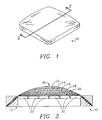
- FIG. 1 A seat unit 10 is generally shown in FIG. 1.
- the seat unit 10 is provided as shown in FIG. 2 where the seat unit 10 includes a base structure 12 for supporting cushion layers 14, 16 and 18 sandwiched between a spring layer 20 and a cover layer 22.
- FIG. 3 is an exploded perspective view of the seat unit 10 of FIG. 2 showing the base structure 12, cushion layers 14, 16 and 18, spring layer 20 and cover layer 22.
- the spring layer 20, the cushion layers 14, 16 and 18, and the cover layer 22 are molded in with the base structure 12.
- the first layer closest to the base structure 12 is the spring layer 20.
- the spring layer 20 may be comprised of any material which adds firmness to the cushion layers 14, 16 and 18.
- first cushion layer 18 having a high density.
- first cushion layer 18 may be comprised of a mesh of strands of plastic filament 28 as shown in FIGS. 3 and 4c where the plastic filament 28 has a relatively large diameter as shown in FIG. 4c'.
- second cushion layer 16 Located on top of the first cushion layer 18 is a second cushion layer 16 having a medium density.
- the second cushion layer 16 may be comprised of a mesh of strands of plastic filament 26 as shown in FIGS. 3 and 4b, where the plastic filament 26 has a medium diameter as shown in FIG.
- the third cushion layer 14 Located on top of the second cushion layer 16 is a third cushion layer 14 having a relatively low density.
- the third cushion layer 14 may be comprised of a mesh of strands of plastic filament 24 as shown in FIGS. 3 and 4a, where the plastic filament 24 has a relatively small diameter as shown in FIG. 4a' and where there is less plastic filament 24 per cubic inch than of plastic filament 26 per cubic inch within the second cushion layer 16 and of plastic filament 28 per cubic inch within the first cushion layer 18.
- the plastic filament 24, 26 and 28 of cushion layers 14, 16 and 18 may be a continuous hot melt filament fiber or an extruded string-like material which after being generally shaped into the cushion layers 14, 16 and 18, is deformed through a deforming process such as punching.
- the spring layer 20 supports the cushion layers 14, 16 and 18. Space between the plastic filament 24, 26 and 28 within each cushion layer 14, 16 and 18 allows air to move through the cushion layers 14, 16 and 18, thus resulting in the seating area 30 being less likely to overheat.
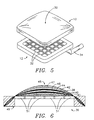
- the base structure 12 is provided with air holes 32 such that the seat unit 10 may be positioned over an air supply line 34 as shown in FIG. 5 thus providing for maximum air circulation through the cushion layers 14, 16 and 18 and to the seating area 30.
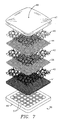
- One alternative to the preferred embodiment is to provide a seat unit 36 wherein a first barrier layer 38 is between cushion layers 40 and 42, and a second barrier layer 44 is between cushion layers 42 and 46 as shown in FIGS. 6 and 7.
- Cushion layers 40, 42 and 46 may be identical to cushion layers 18, 16 and 14, respectively, which were described above with relation to seat unit 10 shown in FIGS. 2 and 3.
- the cushion layers 40, 42 and 46, barrier layers 38 and 44, a spring layer 41, and a cover layer 47 may be molded in with a base structure 49.
- the barrier layers 38 and 44 may be comprised of a textile, and the barrier layers 38 and 44 function to minimize penetration amongst the cushion layers 40, 42 and 46 when a load (not shown) is applied to a seating area 48 of the seat unit 36, thus maintaining the integrity of the difference in densities between the cushion layers 40, 42 and 46. Any or all of the cushion layers 40, 42 and 46 may be adhered, such as by flame adhesion, to the adjacent barrier layer 38 or 44. As an alternative to providing barrier layers 38 and 44, each cushion layer 40, 42 and 46 may have a melted or otherwise prepared densified side. Much like the base structure 12 shown in Fig. 2, the base structure 49 of Fig. 6 may have air holes 51 such that the seat unit 36 may be positioned over the air supply line 34 much like the seat unit 10 shown in Fig. 5.
- a seat unit 50 may be provided such that the seat unit 50 is of a more conventional construction where a cover layer 52 is affixed to a base structure 54 through conventional means and neither cushion layers 56, 58, and 60 nor a spring layer 62 is molded in with the base structure 54.
- the base structure 54 shown in Fig. 8 may be provided with air holes 61 so that the seat unit 50 may be positioned over the air supply line 34 much like the seat unit 10 as shown in Fig. 5.
- a seat unit 64 as schematically shown in FIG. 9, where only a spring layer 66 and cushion layers 68, 70 and 72 are molded in with a base structure 74 while a cover layer 75 is not molded in, but is instead affixed to the base structure 74 through conventional means.
- the base structure 74 may also be provided with air holes 71 so that the seat unit 64 may be positioned over the air supply line 34 much like the seat unit 10 as shown in Fig. 5.
- each cushion layer has a different density. For example, it is possible to vary the diameters of the plastic filament and/or vary the amount of filament per cubic inch.
- One of ordinary skill in the art would undoubtedly realize still other possible variations of the present invention comprising multiple cushion layers.
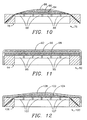
- the seat unit 76 includes a base structure 78 for supporting a single cushion layer 80 comprised of a mesh of strands of plastic filament much like any of the cushion layers 14, 16 or 18 shown in Figs. 4a, 4b or 4c.
- the cushion layer 80 is sandwiched between a spring layer 84 and a cover layer 86, and the spring layer 84, the cushion layer 80, and the cover layer 86 may be molded in with the base structure 78.
- the base structure 78 may have air holes 88 such that the seat unit 76 may be positioned over the air supply line 34 in much the same manner as the seat unit 10 is positioned over the air supply line 34 as shown in FIG. 5, thus providing for maximum air circulation through the cushion layer 80.
- a seat unit 90 may be provided such that the seat unit 90 is of a more conventional construction where a cover layer 92 is affixed to a base structure 94 through conventional means and neither a cushion layer 96 nor a spring layer 98 is molded in with the base structure 94.
- the base structure 94 may also be provided with air holes 95 as shown in Fig. 11.
- a seat unit 100 as schematically shown in FIG. 12 where only a spring layer 102 and a cushion layer 104 are molded in with a base structure 106 while a cover layer 108 is not molded in, but is instead affixed to the base structure 106 through conventional means.
- the base structure 106 may be provided with air holes 107 as shown in Fig. 12.
- One of ordinary skill in the art would undoubtedly realize still other possible variations of the present invention including a single cushion layer comprised of plastic filament.
- a plastic injection molding process such as the process described below may be utilized in order to construct any of the seat units described above.
- the seat unit 10 of FIG. 2 may be constructed by utilizing the plastic injection molding process described below.
- a mold unit 110 having a stationery male mold section 112 and a moveable female mold section 114.
- the mold sections 112 and 114 When the mold sections 112 and 114 are in their closed positions, as shown in FIG. 15, the mold sections 112 and 114 form a mold cavity 116 for forming the base structure 12 of the seat unit 10 shown in FIG. 2.
- the mold sections 112 and 114 are in their open positions as shown in FIG.
- the cushion layers 14, 16 and 18 and the spring layer 20, shown exaggerated for clarity, are placed across an open side 118 of the male mold section 112 with their outer edges 120, 122, 124 and 126 secured outside the male mold section 112 by suitable clamping means 128 as shown in FIG. 14.
- the spring layer 20 has a central portion 130 positioned against protrusions 132 on a projected central portion 134 of the male mold section 112, and the cushion layers 14, 16 and 18 and the spring layer 20 have inclined sections 136, 138, 140 and 142 extending from the projected central portion 134 of the male mold section 112 to the clamping means 128.
- a plastic material 170 is then injected into the mold cavity 116 through a gate opening 172 from an injection nozzle 174 to fill the mold cavity 116 as shown in FIG. 16 and surround the protrusions 132 on the projected central portion 134 of the male mold section 112.
- the inner portions 158, 160, 162, and 164 of the inclined sections 136, 138, 140 and 142 of the cushion layers 14, 16 and 18 and the spring layer 20 are imbedded within the injected plastic material 170 along with the inclined sections 168 of the cover layer 22.
- the base structure 12 has air holes 32 as a result of the plastic material 170 having surrounded the protrusions 132 in the mold cavity 116, and the cover layer 22, the cushion layers 14, 16 and 18, and the spring layer 20 are molded in with the base structure 12. Subsequently, the cushion layers 14, 16 and 18 and the spring layer 20 are trimmed at the junction of the outer 150, 152, 154 and 156 and inner portions 158, 160, 162 and 164 of the inclined sections 136, 138, 140 and 142 of the layers 14, 16, 18 and 20, and the cover layer 22 is trimmed at the junction of the outer sections 166 and inclined sections 168. Thereafter, the formed seat unit 10 may be positioned over an air supply line 34 as shown in FIG.
- the male mold section 112 may be shaped such that the resulting base structure 12 has a true open central area, whereby a grid (not shown) is later attached to the base structure 12 to provide air holes 32 underneath the seat unit 10.
- each cushion layer 40, 42 and 46 may have a melted or otherwise prepared densified side (not shown).
- the seat unit 10 as shown in FIG. 2 where the spring layer 20, the cushion layers 14, 16 and 18, and the cover layer 22 are molded in with the base structure 12, it is possible to provide additional alternative methods of the present invention comprising multiple cushion layers.
- the base structure 54 alone may be molded by omitting the steps of securing any layers against either mold section 112 or 114, and upon removing the base structure 54 from the mold unit 110, the cover layer 52 may be affixed to the base structure 54 through conventional means so that the cushion layers 56, 58 and 60 and the spring layer 62 are sandwiched between the base structure 54 and the cover layer 52.
- the seat unit 64 schematically shown in FIG.
- a seat unit having a single cushion layer comprised of plastic filament instead of molding a seat unit having multiple cushion layers, it is possible to mold a seat unit having a single cushion layer comprised of plastic filament.
- a plastic injection molding process such as the process described below may be utilized in order to construct the seat unit 76 of FIG. 10.
- a single cushion layer 80 comprised of a mesh of strands of plastic filament and a spring layer 84, shown exaggerated for clarity are placed across the open side 118 of the male mold section 112, and the cover layer 86 is placed across the open side 144 of the female mold section 114 as shown in FIG. 19 in much the same manner as described above with relation to FIG. 14.
- cover layer 86 across the male mold section 112 along with the cushion layer 80 and the spring layer 84, or it is possible to secure the cushion layer 80 and the spring layer 84 across the female mold section 114 along with the cover layer 86.
- the seat unit 76 may be positioned over the air supply line 34 in much the same manner as the seat unit 10 is positioned over the air supply line 34 as shown in FIG. 5 thus providing for maximum air circulation through the cushion layer 80.
- the cover layer 92 may be affixed to the base structure 94 through conventional means so that the cushion layer 96 and the spring layer 98 are sandwiched between the base structure 94 and the cover layer 92. Additionally, it is possible to mold the seat unit 100 schematically shown in FIG. 12, by molding in only the spring layer 102 and the cushion layer 104 with the base structure 106, while the cover layer 108 is subsequently affixed to the base structure 106 through conventional means after the plastic injection molding process.
- One of ordinary skill in the art would undoubtedly realize still other possible variations of the present invention comprising a single cushion layer. For example, it is possible to eliminate the spring layer from any of the molding methods described herein.
Landscapes
- Engineering & Computer Science (AREA)
- Manufacturing & Machinery (AREA)
- Aviation & Aerospace Engineering (AREA)
- Transportation (AREA)
- Mechanical Engineering (AREA)
- Laminated Bodies (AREA)
- Moulds For Moulding Plastics Or The Like (AREA)
- Mattresses And Other Support Structures For Chairs And Beds (AREA)
Abstract
A seat unit is provided comprising a base structure and at least one cushion layer comprised of a random mesh of plastic filament between the base structure and the cover layer. The cushion layer not only provides adequate firmness, but has adequate air circulation therethrough. The perimeter of the cushion may be molded in with a plastic base structure, and there may be multiple cushion layers where each layer has a different density. The multiple layers of cushioning where each layer has a different density further allow the seat to have both a specifically desired firmness and air circulation therethrough. Also provided is a method for molding in the cushioning with the base structure as well as molding in a spring layer and a cover layer.
Description
- The invention relates generally to seat cushions and methods of molding seat units including seat cushions, and more particularly to a seat cushion comprised of a mesh of plastic filament wherein multiple cushion layers comprised of plastic filament may be combined, each cushion layer having a different density, as well as a method for molding the perimeter of a seat cushion with a seat base structure.
- Presently, seat units used in furniture or in automobiles have internal cushioning comprised of expanded urethane or ethylene. Generally, as a load is applied to the seating area of the seat unit, the expanded urethane or ethylene cushion compresses, thus resulting in the cushion becoming more dense. This increased density results in less circulation of air throughout the cushion. Thus, the seating area of the seat unit is more likely to become overheated, resulting in the seated person becoming uncomfortable.
- Also, in most present seat unit constructions, a woven seat covering is supported across a base structure with the perimeter of the woven seat covering secured to the base structure at spaced positions by staples, sewing, or the like. The tension in the covering is thus maintained only by the stapled or sewed strands of the woven material. Under load application, these strands soon become weakened and break or tear loose. Thus, these seat units have a relatively short service life with a lack of firmness and support for their intended purpose.
- A superior seat unit construction is one where a pretensioned woven seat covering is molded in with a base structure. An effective method for molding a composite article such as this is disclosed in U.S. Patent No. 4,743,323. While the method of molding in the woven seat covering helps to make the securement of the covering more durable, the problem of inadequate air circulation throughout the seat cushion of the seat unit is not rectified. This is because in order for a seat cushion to have adequate firmness, it has been necessary for the cushion to be so dense that inadequate air circulation therethrough results once a load is applied to the seating area.
- The aim of the invention is to overcome one or more of the difficulties encountered in the prior art.
- According to a first aspect of the invention there is provided a seat unit comprising: (a) a base structure; (b) a cover layer secured to the base structure; and (c) a cushion layer between the base structure and the cover layer, said cushion layer comprised of a mesh of plastic filament.
- According to a second aspect of the invention there is provided a seat unit comprising: (a) a base structure; (b) a cover layer secured to the base structure; and (c) at least two cushion layers between the base structure and the cover layer, at least two of said cushion layers comprising a mesh of plastic filament, at least one of the cushion layers having a different density than another cushion layer.
- According to a third aspect of the invention there is provided a method of molding a seat unit comprising the steps of: (a) providing a mold unit, said mold unit having a male mold section and a female mold section which, on being brought together, form a mold cavity; (b) supporting at least one cushion layer comprising plastic filament across an open side of said male mold section; (c) bringing said male mold section and said female mold section together so that said female mold section engages and stretches said cushion layer supported across said open side of said male mold section; (d) injecting a plastic material into said mold cavity so that said plastic material bonds with said cushion layer; and (e) removing said resultant seat unit from said mold unit.
- According to a fourth aspect of the invention there is provided a method of molding a seat unit comprising the steps of: (a) providing a mold unit, said mold unit having a male mold section and a female mold section which, on being brought together, form a mold cavity; (b) supporting a plurality of cushion layers across an open side of said male mold section, where at least one cushion layer is of a different density from another cushion layer; (c) bringing said male mold section and said female mold section together so that said female mold section engages and stretches said cushion layer supported across said open side of said male mold section; (d) injecting a plastic material into said mold cavity so that said plastic material bonds with said cushion layer; and (e) removing said resultant seat unit from said mold unit.
- Accordingly, it is an advantage of the present invention to provide a seat unit with firm cushioning as well as air circulation therethrough after a load is applied.
- Another advantage of the present invention is to provide a method of making a seat unit where the seat unit has cushioning that not only has adequate firmness, but air circulation therethrough after a load is applied.
- Yet another advantage of the present invention is to provide a seat unit in which cushioning is molded in with a base structure.
- A further advantage of the present invention is to provide a method of making a seat unit in which cushioning is molded in with a base structure.
- Another advantage of the present invention is to provide a seat unit having multiple layers of cushioning where the multiple layers are of differing density thereby allowing the cushion to have a desired firmness as well as air circulation therethrough after a load is applied.
- Still another advantage of the present invention is to provide a method of molding in multiple layers of cushioning with a base structure where the multiple layers are of differing density thereby allowing the cushion to have a desired firmness as well as air circulation therethrough after a load is applied.
- By the present invention, it is proposed to overcome the difficulties heretofore. To this end, a seat unit is provided comprising a base structure and at least one cushion layer comprised of a mesh of plastic filament. The cushion layer not only provides adequate firmness, but has air circulation therethrough. The perimeter of the cushion layer and/or the perimeter of a cover layer may be molded in with a plastic base structure, and there may be multiple cushion layers where each layer has a different density. The multiple layers of cushioning where each layer has a different density further allow the seat unit to have both a specifically desired firmness and air circulation therethrough. The invention also provides a method for molding in at least one cushion layer comprised of plastic filament with a base structure as well as molding in a spring layer and a cover layer.
- Other advantageous features of the invention are defined in the dependent claims appended hereto.
- There now follows a description of preferred embodiments of the invention, by way of example, with reference being made to the accompanying drawings in which:
- FIG. 1 is a perspective view of a seat unit where the seat unit has a structure in accordance with the present invention;
- FIG. 2 is an elevational sectional view of the seat unit shown in FIG. 1 taken along line 2-2;
- FIG. 3 is an exploded perspective view of the seat unit shown in FIGS. 1 and 2;
- FIG. 4a is a top, schematic view of a cushion layer comprising a mesh of strands of plastic filament;
- FIG. 4a' is a cross sectional view of the plastic filament of the cushion layer shown in FIG. 4a;
- FIG. 4b is a top, schematic view of a second cushion layer comprising a mesh of strands of plastic filament;
- FIG. 4b' is a cross sectional view of the plastic filament of the second cushion layer shown in FIG. 4b;
- FIG. 4c is a top, schematic view of a third cushion layer comprising a mesh of strands of plastic filament;
- FIG. 4c' is a cross sectional view of the plastic filament of the third cushion layer shown in FIG. 4c;
- FIG. 5 is a perspective view showing the seat unit of FIGS. 1, 2 and 3 positioned over an air supply;
- FIG. 6 is an elevational sectional view of a seat unit where the seat unit has barrier layers between cushion layers;
- FIG. 7 is an exploded perspective view of the seat unit of FIG. 6;
- FIG. 8 is an elevational sectional view of a seat unit where a spring layer, cushion layers, and a cover layer are attached to a base structure in a conventional manner;
- FIG. 9 is an elevational sectional view of a seat unit where a spring layer and cushion layers are molded in with a base structure, and a cover layer is attached to the base structure in a conventional manner;
- FIG. 10 is an elevational sectional view of a seat unit where a spring layer, a single cushion layer, and a cover layer are molded in with a base structure;
- FIG. 11 is an elevational sectional view of a seat unit where a spring layer, a single cushion layer, and a cover layer are attached to a base structure in a conventional manner;
- FIG. 12 is an elevational sectional view of a seat unit where a spring layer and a single cushion layer are molded in with a base structure, and a cover layer is attached to the base structure in a conventional manner;
- FIG. 13 shows a mold unit in an open position;
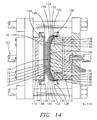
- FIG. 14 shows the mold unit of FIG. 13 with a spring layer and cushion layers secured to a male mold section of the mold unit, and a cover layer secured to a female mold section of the mold unit;
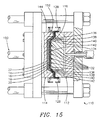
- FIG. 15 shows the mold unit of FIGS. 13 and 14 in a closed position thus forming a mold cavity;
- FIG. 16 shows the mold unit of FIGS. 15 with plastic material injected into the mold cavity;
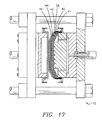
- FIG. 17 shows the mold unit of FIG. 14 in an open position with barrier layers between the cushion layers;
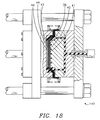
- FIG. 18 shows the mold unit of FIG. 17 in a closed position with plastic injected into a mold cavity;
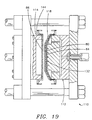
- FIG. 19 shows the mold unit of FIG. 13 with a spring layer and a cushion layer secured to a male section of the mold unit, and a cover layer secured to a female section of the mold unit; and
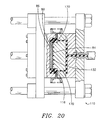
- FIG. 20 shows the mold unit of FIG. 19 in a closed position with plastic material injected into a mold cavity.
- A
seat unit 10 is generally shown in FIG. 1. In a preferred embodiment of the present invention, theseat unit 10 is provided as shown in FIG. 2 where theseat unit 10 includes abase structure 12 for supporting cushion layers 14, 16 and 18 sandwiched between aspring layer 20 and acover layer 22. FIG. 3 is an exploded perspective view of theseat unit 10 of FIG. 2 showing thebase structure 12, cushion layers 14, 16 and 18,spring layer 20 andcover layer 22. As schematically shown in FIG. 2, thespring layer 20, the cushion layers 14, 16 and 18, and thecover layer 22 are molded in with thebase structure 12. The first layer closest to thebase structure 12 is thespring layer 20. Thespring layer 20 may be comprised of any material which adds firmness to the cushion layers 14, 16 and 18. Located on top of thespring layer 20 is afirst cushion layer 18 having a high density. To provide that thefirst cushion layer 18 has a high density, thefirst cushion layer 18 may be comprised of a mesh of strands ofplastic filament 28 as shown in FIGS. 3 and 4c where theplastic filament 28 has a relatively large diameter as shown in FIG. 4c'. Located on top of thefirst cushion layer 18 is asecond cushion layer 16 having a medium density. To provide that thesecond cushion layer 16 has a medium density, thesecond cushion layer 16 may be comprised of a mesh of strands ofplastic filament 26 as shown in FIGS. 3 and 4b, where theplastic filament 26 has a medium diameter as shown in FIG. 4b' and where there is lessplastic filament 26 per cubic inch than ofplastic filament 28 per cubic inch within thefirst cushion layer 18. Located on top of thesecond cushion layer 16 is athird cushion layer 14 having a relatively low density. To provide that thethird cushion layer 14 has a relatively low density, thethird cushion layer 14 may be comprised of a mesh of strands ofplastic filament 24 as shown in FIGS. 3 and 4a, where theplastic filament 24 has a relatively small diameter as shown in FIG. 4a' and where there is lessplastic filament 24 per cubic inch than ofplastic filament 26 per cubic inch within thesecond cushion layer 16 and ofplastic filament 28 per cubic inch within thefirst cushion layer 18. Theplastic filament - When a load (not shown) is applied to a
seating area 30 of theseat unit 10 shown in FIGS. 2 and 3, thespring layer 20 supports the cushion layers 14, 16 and 18. Space between theplastic filament cushion layer seating area 30 being less likely to overheat. Also, thebase structure 12 is provided withair holes 32 such that theseat unit 10 may be positioned over anair supply line 34 as shown in FIG. 5 thus providing for maximum air circulation through the cushion layers 14, 16 and 18 and to theseating area 30. - While the foregoing explains the preferred embodiment, alternative embodiments are discussed below. One alternative to the preferred embodiment is to provide a
seat unit 36 wherein afirst barrier layer 38 is between cushion layers 40 and 42, and asecond barrier layer 44 is between cushion layers 42 and 46 as shown in FIGS. 6 and 7. Cushion layers 40, 42 and 46 may be identical to cushionlayers seat unit 10 shown in FIGS. 2 and 3. As shown in FIG. 6, the cushion layers 40, 42 and 46, barrier layers 38 and 44, aspring layer 41, and acover layer 47 may be molded in with abase structure 49. The barrier layers 38 and 44 may be comprised of a textile, and the barrier layers 38 and 44 function to minimize penetration amongst the cushion layers 40, 42 and 46 when a load (not shown) is applied to aseating area 48 of theseat unit 36, thus maintaining the integrity of the difference in densities between the cushion layers 40, 42 and 46. Any or all of the cushion layers 40, 42 and 46 may be adhered, such as by flame adhesion, to theadjacent barrier layer barrier layers cushion layer base structure 12 shown in Fig. 2, thebase structure 49 of Fig. 6 may haveair holes 51 such that theseat unit 36 may be positioned over theair supply line 34 much like theseat unit 10 shown in Fig. 5. - Furthermore, while it is preferable to provide the
seat unit 10 as shown in FIG. 2 where thespring layer 20, the cushion layers 14, 16 and 18, and thecover layer 22 are molded in with thebase structure 12, it is possible to provide additional alternative embodiments of the present invention comprising multiple cushion layers identical to cushionlayers seat unit 10 shown in FIGS. 2 and 3. For example, as schematically shown in FIG. 8, aseat unit 50 may be provided such that theseat unit 50 is of a more conventional construction where acover layer 52 is affixed to abase structure 54 through conventional means and neither cushion layers 56, 58, and 60 nor aspring layer 62 is molded in with thebase structure 54. Much like thebase structure 12 shown in Fig. 2, thebase structure 54 shown in Fig. 8 may be provided withair holes 61 so that theseat unit 50 may be positioned over theair supply line 34 much like theseat unit 10 as shown in Fig. 5. - Additionally, it is possible to provide a
seat unit 64 as schematically shown in FIG. 9, where only aspring layer 66 and cushion layers 68, 70 and 72 are molded in with abase structure 74 while a cover layer 75 is not molded in, but is instead affixed to thebase structure 74 through conventional means. As shown in Fig. 9, thebase structure 74 may also be provided withair holes 71 so that theseat unit 64 may be positioned over theair supply line 34 much like theseat unit 10 as shown in Fig. 5. - Moreover, it is possible to provide the cushion layers in any of the embodiments mentioned above such that the first cushion layer closest to the spring layer is of low density, the second cushion layer is of medium density, and the third cushion layer is of high density. Finally, there are alternative ways in which to provide that each cushion layer has a different density. For example, it is possible to vary the diameters of the plastic filament and/or vary the amount of filament per cubic inch. One of ordinary skill in the art would undoubtedly realize still other possible variations of the present invention comprising multiple cushion layers. For example, it is possible to eliminate the spring layer from any of the embodiments described herein.
- It is possible to provide a
seat unit 76 as schematically shown in FIG. 10 where theseat unit 76 includes abase structure 78 for supporting asingle cushion layer 80 comprised of a mesh of strands of plastic filament much like any of the cushion layers 14, 16 or 18 shown in Figs. 4a, 4b or 4c. As shown in Fig. 10, thecushion layer 80 is sandwiched between aspring layer 84 and acover layer 86, and thespring layer 84, thecushion layer 80, and thecover layer 86 may be molded in with thebase structure 78. Thebase structure 78 may haveair holes 88 such that theseat unit 76 may be positioned over theair supply line 34 in much the same manner as theseat unit 10 is positioned over theair supply line 34 as shown in FIG. 5, thus providing for maximum air circulation through thecushion layer 80. - It is possible to provide alternative embodiments of the present invention including a single cushion layer comprising a mesh of strands of plastic filament. For example, as schematically shown in FIG. 11, a
seat unit 90 may be provided such that theseat unit 90 is of a more conventional construction where acover layer 92 is affixed to abase structure 94 through conventional means and neither acushion layer 96 nor aspring layer 98 is molded in with thebase structure 94. Thebase structure 94 may also be provided withair holes 95 as shown in Fig. 11. - Additionally, it is possible to provide a
seat unit 100 as schematically shown in FIG. 12 where only aspring layer 102 and acushion layer 104 are molded in with abase structure 106 while acover layer 108 is not molded in, but is instead affixed to thebase structure 106 through conventional means. Thebase structure 106 may be provided withair holes 107 as shown in Fig. 12. One of ordinary skill in the art would undoubtedly realize still other possible variations of the present invention including a single cushion layer comprised of plastic filament. For example, it is possible to provide the cushion layer with any density, and it is possible to eliminate the spring layer from any of the embodiments described herein. - A plastic injection molding process such as the process described below may be utilized in order to construct any of the seat units described above. For example, the
seat unit 10 of FIG. 2 may be constructed by utilizing the plastic injection molding process described below. Referring to FIG. 13, there is provided amold unit 110 having a stationerymale mold section 112 and a moveablefemale mold section 114. When themold sections mold sections mold cavity 116 for forming thebase structure 12 of theseat unit 10 shown in FIG. 2. When themold sections spring layer 20, shown exaggerated for clarity, are placed across anopen side 118 of themale mold section 112 with theirouter edges male mold section 112 by suitable clamping means 128 as shown in FIG. 14. When secured to themale mold section 112, thespring layer 20 has acentral portion 130 positioned againstprotrusions 132 on a projectedcentral portion 134 of themale mold section 112, and the cushion layers 14, 16 and 18 and thespring layer 20 have inclinedsections central portion 134 of themale mold section 112 to the clamping means 128. This association of the cushion layers 14, 16 and 18 and thespring layer 20 with themale mold section 112 places thelayers cover layer 22 is placed across anopen side 144 of thefemale mold section 114 with itsouter edges 146 secured outside thefemale mold section 114 by suitable clamping means 148. Alternatively, it is possible to secure thecover layer 22 across themale mold section 112 along with the cushion layers 14, 16 and 18 and thespring layer 20, or it is possible to secure the cushion layers 14, 16 and 18 and thespring layer 20 across thefemale mold section 114 along with thecover layer 22. - On movement of the
female mold section 114 toward themale mold section 112 by aram 150, into the closed position, as shown in FIG. 15, wherein the projectedcentral portion 134 of themale mold section 112 is received within acoacting recess 152 formed within thefemale mold section 114, theinclined sections spring layer 20 are engaged by thefemale mold section 114 inwardly of the clamping means 128 and theinclined sections outer portions inclined sections spring layer 20 and the cushion layers 14, 16 and 18 are clamped between theclosed mold sections inner portions 158, 160, 162 and 164 of theinclined sections mold cavity 116. Additionally, thecover layer 22 is engaged by themale mold section 112 when thefemale mold section 114 is moved toward themale mold section 112 resulting in thecover layer 22 havingouter sections 166 andinclined sections 168. - A
plastic material 170 is then injected into themold cavity 116 through a gate opening 172 from an injection nozzle 174 to fill themold cavity 116 as shown in FIG. 16 and surround theprotrusions 132 on the projectedcentral portion 134 of themale mold section 112. When theplastic material 170 is injected into themold cavity 116, theinner portions 158, 160, 162, and 164 of theinclined sections spring layer 20 are imbedded within the injectedplastic material 170 along with theinclined sections 168 of thecover layer 22. On removal from themold unit 110 after theplastic material 170 has hardened, as shown in FIGS. 2 and 3, thebase structure 12 hasair holes 32 as a result of theplastic material 170 having surrounded theprotrusions 132 in themold cavity 116, and thecover layer 22, the cushion layers 14, 16 and 18, and thespring layer 20 are molded in with thebase structure 12. Subsequently, the cushion layers 14, 16 and 18 and thespring layer 20 are trimmed at the junction of the outer 150, 152, 154 and 156 andinner portions 158, 160, 162 and 164 of theinclined sections layers cover layer 22 is trimmed at the junction of theouter sections 166 andinclined sections 168. Thereafter, the formedseat unit 10 may be positioned over anair supply line 34 as shown in FIG. 5 in order to maximize the air circulation through the cushion layers 14, 16 and 18. Instead of providing the projectedcentral portion 134 of themale mold section 112 withprotrusions 132, themale mold section 112 may be shaped such that the resultingbase structure 12 has a true open central area, whereby a grid (not shown) is later attached to thebase structure 12 to provideair holes 32 underneath theseat unit 10. - By virtue of the engagement of the
inclined sections spring layer 20 by thefemale mold section 104 and its movement toward themale mold section 112, and the continuing of such engagement to the final closed positions of themold sections spring layer 20 is increased uniformly to a final tension of the total area thereof extended across thebase structure 12. Additionally, by virtue of the engagement of theinclined sections 168 of thecover layer 22 by themale mold section 112, and the continuing of such engagement to the final closed positions of themolds cover layer 22 is increased uniformly to a final tension extended across thebase structure 12. As shown in FIG. 2, under final tension, thecover layer 22, the cushion layers 14, 16 and 18, and thespring layer 20 lie in a plane common to thebase structure 12. - While the foregoing explains the preferred method, alternative methods are discussed below. One alternative to the preferred method is to utilize generally the method and
mold unit 110 described above, but to also provide afirst barrier layer 38 between cushion layers 40 and 42, and asecond barrier layer 44 between cushion layers 42 and 46 as shown in FIGS. 17 and 18 in order to mold theseat unit 36 shown in FIGS. 6 and 7. As an alternative to providingbarrier layers cushion layer - Furthermore, while it is preferable to mold the
seat unit 10 as shown in FIG. 2 where thespring layer 20, the cushion layers 14, 16 and 18, and thecover layer 22 are molded in with thebase structure 12, it is possible to provide additional alternative methods of the present invention comprising multiple cushion layers. For example, in providing theseat unit 50 shown in FIG. 8, thebase structure 54 alone may be molded by omitting the steps of securing any layers against eithermold section base structure 54 from themold unit 110, thecover layer 52 may be affixed to thebase structure 54 through conventional means so that the cushion layers 56, 58 and 60 and thespring layer 62 are sandwiched between thebase structure 54 and thecover layer 52. Additionally, it is possible to mold theseat unit 64 schematically shown in FIG. 9, by molding in only thespring layer 66 and the cushion layers 68, 70 and 72 with thebase structure 74, while the cover layer 75 is affixed to thebase structure 74 through conventional means subsequent to the plastic injection molding process. Moreover, as discussed above, it is possible, within the molding process, to provide the cushion layers such that the cushion layer closest to the spring layer is of low density, the second cushion layer is of medium density, and the third cushion layer is of high density. Finally, as described above, there are alternative ways in which to provide that each cushion layer has a different density. For example, it is possible to vary the diameters of the plastic filament and/or vary the amount of filament per cubic inch. One of ordinary skill in the art would undoubtedly realize still other possible variations of the present invention comprising multiple cushion layers. For example, it is possible to eliminate the spring layer from any of the molding methods described herein. - Instead of molding a seat unit having multiple cushion layers, it is possible to mold a seat unit having a single cushion layer comprised of plastic filament. For instance, a plastic injection molding process such as the process described below may be utilized in order to construct the
seat unit 76 of FIG. 10. In molding theseat unit 76 shown in FIG. 10, asingle cushion layer 80 comprised of a mesh of strands of plastic filament and aspring layer 84, shown exaggerated for clarity, are placed across theopen side 118 of themale mold section 112, and thecover layer 86 is placed across theopen side 144 of thefemale mold section 114 as shown in FIG. 19 in much the same manner as described above with relation to FIG. 14. Alternatively, it is possible to secure thecover layer 86 across themale mold section 112 along with thecushion layer 80 and thespring layer 84, or it is possible to secure thecushion layer 80 and thespring layer 84 across thefemale mold section 114 along with thecover layer 86. - In much the same manner as described above with relation to FIG. 16, after the
mold sections mold cavity 116,plastic material 170 is then injected into themold cavity 116 as shown in FIG. 20 and the resultingseat unit 76 is subsequently removed from themold unit 110 after theplastic material 170 has hardened. Thereafter, theseat unit 76 may be positioned over theair supply line 34 in much the same manner as theseat unit 10 is positioned over theair supply line 34 as shown in FIG. 5 thus providing for maximum air circulation through thecushion layer 80. - While it is preferable to mold the
seat unit 76 as shown in FIG. 10 where thespring layer 84, thesingle cushion layer 80 and thecover layer 86 are molded in with thebase structure 78, additional methods of molding seat units including a single cushion layer comprising a mesh of strands of plastic filament are discussed below. It is possible to utilize generally the injection molding process described above to mold theseat unit 90 shown in FIG. 11 by molding only thebase structure 94 and omitting the steps of securing any layers to eithermold section base structure 94 from themold unit 110, thecover layer 92 may be affixed to thebase structure 94 through conventional means so that thecushion layer 96 and thespring layer 98 are sandwiched between thebase structure 94 and thecover layer 92. Additionally, it is possible to mold theseat unit 100 schematically shown in FIG. 12, by molding in only thespring layer 102 and thecushion layer 104 with thebase structure 106, while thecover layer 108 is subsequently affixed to thebase structure 106 through conventional means after the plastic injection molding process. One of ordinary skill in the art would undoubtedly realize still other possible variations of the present invention comprising a single cushion layer. For example, it is possible to eliminate the spring layer from any of the molding methods described herein. - The foregoing description and drawings merely explain and illustrate the invention and the invention is not limited thereto, except in so far as the claims are so limited , as those skilled in the art with the disclosure before them will be able to make modifications and variations therein without departing from the scope of the invention. For example, more or less than three cushion layers may be provided within a seat unit having multiple cushion layers, a spring layer may not be included within the seat unit, or a differently shaped base structure may be provided than that which is depicted herein.
Claims (25)
- A seat unit comprising:(a) a base structure;(b) a cover layer secured to the base structure; and(c) a cushion layer between the base structure and the cover layer, said cushion layer comprised of a mesh of plastic filament.
- A seat unit comprising:(a) a base structure;(b) a cover layer secured to the base structure; and(c) at least two cushion layers between the base structure and the cover layer, at least two of said cushion layers comprising a mesh of plastic filament, at least one of the cushion layers having a different density than another cushion layer.
- The seat unit according to Claim 1 or 2 further comprising air holes on the base structure.
- The seat unit according to any preceding claim wherein the base structure is comprised of plastic.
- The seat unit according to any preceding claim wherein the cover layer is comprised of fabric.
- The seat unit according to any preceding claim wherein at least a portion of the cushion layer is molded in with the base structure.
- The seat unit according to any preceding claim wherein at least a portion of the cover layer is molded in with the base structure.
- The seat unit according to any preceding claim wherein at least a portion of the cushion layer is molded in with the base structure and at least a portion of the cover layer is molded in with the base structure.
- The seat unit according to any preceding claim wherein the plastic filament is comprised of a hot melt filament fiber.
- The seat unit according to any preceding claim wherein the plastic filament is an extruded string-like material.
- The seat unit according to any preceding claim further comprising a spring layer between the cushion layer and the base structure.
- The seat unit according to Claim 11 wherein at least a portion of the spring layer is molded in with the base structure.
- The seat unit according to Claim 2 wherein at least one cushion layer comprises plastic filament of a first diameter and wherein at least one other cushion layer comprises plastic filament of a second diameter, said first diameter not being equal to said second diameter.
- The seat unit according to Claim 2 or any claim dependent therefrom wherein at least one cushion layer comprises plastic filament in a first average weight of filament per square inch and wherein at least one other cushion layer comprises plastic filament in a second average weight of filament per square inch, said first average weight not being equal to said second average weight.
- The seat unit according to Claim 2 or any claim dependent therefrom further comprising a barrier layer between two cushion layers.
- The seat unit according to Claim 15 wherein the barrier layer is adhered to at least one cushion layer.
- The seat unit of Claim 2 or any claim dependent therefrom wherein at least one cushion layer has a melted side.
- A method of molding a seat unit comprising the steps of:(a) providing a mold unit, said mold unit having a male mold section and a female mold section which, on being brought together, form a mold cavity;(b) supporting at least one cushion layer comprising plastic filament across an open side of said male mold section;(c) bringing said male mold section and said female mold section together so that said female mold section engages and stretches said cushion layer supported across said open side of said male mold section;(d) injecting a plastic material into said mold cavity so that said plastic material bonds with said cushion layer; and(e) removing said resultant seat unit from said mold unit.
- The method according to Claim 18 wherein a plurality of cushion layers comprising plastic filament are supported across the open side of the male mold section, where at least one cushion layer is of a different density from another cushion layer.
- The method according to Claim 18 or 19 further including the steps of:(a) applying an initial tension to said cushion layer when supported across said open side of said mold section; and(b) applying a final tension to said cushion layer when said male mold section and said female mold section are brought together.
- The method according to any of Claims 18 to 20 including the step of:
(a) supporting a cover layer across an open side of said female mold section. - The method according to Claim 21 including the steps of:(a) applying an initial tension to said cover layer supported across said open side of said female mold section; and(b) applying a final tension to said cover layer supported across said open side of said female mold section when said male mold section and said female mold section are brought together.
- The method according to any of Claims 18 to 22 wherein said cushion layer has a densified side.
- The method according to Claim 19 or any claim dependent therefrom including the step of providing a barrier layer between said first cushion layer and said second cushion layer.
- A method of molding a seat unit comprising the steps of:(a) providing a mold unit, said mold unit having a male mold section and a female mold section which, on being brought together, form a mold cavity;(b) supporting a plurality of cushion layers across an open side of said male mold section, where at least one cushion layer is of a different density from another cushion layer;(c) bringing said male mold section and said female mold section together so that said female mold section engages and stretches said cushion layer supported across said open side of said male mold section;(d) injecting a plastic material into said mold cavity so that said plastic material bonds with said cushion layer; and(e) removing said resultant seat unit from said mold unit.
Applications Claiming Priority (2)
| Application Number | Priority Date | Filing Date | Title |
|---|---|---|---|
| US08/639,777 US5788332A (en) | 1996-04-29 | 1996-04-29 | Seat unit and cushion |
| US639777 | 1996-04-29 |
Publications (2)
| Publication Number | Publication Date |
|---|---|
| EP0805064A2 true EP0805064A2 (en) | 1997-11-05 |
| EP0805064A3 EP0805064A3 (en) | 2000-07-19 |
Family
ID=24565502
Family Applications (1)
| Application Number | Title | Priority Date | Filing Date |
|---|---|---|---|
| EP97302932A Withdrawn EP0805064A3 (en) | 1996-04-29 | 1997-04-29 | Seat cushion and method of molding a seat unit including the seat cushion |
Country Status (2)
| Country | Link |
|---|---|
| US (1) | US5788332A (en) |
| EP (1) | EP0805064A3 (en) |
Cited By (18)
| Publication number | Priority date | Publication date | Assignee | Title |
|---|---|---|---|---|
| EP1295696A3 (en) * | 2001-09-19 | 2004-11-24 | Nhk Spring Co., Ltd. | Method of manufacturing a seat or part of a seat |
| EP2607156A1 (en) * | 2011-12-22 | 2013-06-26 | Grammer Ag | Vehicle seat, method for producing a vehicle seat upholstery part and use of a hot press stamp |
| USD840724S1 (en) * | 2017-12-01 | 2019-02-19 | Davinci Ii Csj, Llc | Seat cushion |
| WO2020163212A1 (en) * | 2019-02-08 | 2020-08-13 | Gentherm Incorporated | Climate controlled insert with lattice structure |
| US11318869B2 (en) | 2018-12-06 | 2022-05-03 | Gentherm Incorporated | Single piece plenum |
| USD976614S1 (en) | 2017-12-01 | 2023-01-31 | Davinci Ii Csj, Llc | Cushion with honeycomb pattern |
| DK202370197A1 (en) * | 2022-06-14 | 2024-02-14 | Lear Corp | Extruded plastic mesh, seat assembly, cushion and/or method of forming |
| US12269384B2 (en) | 2021-03-31 | 2025-04-08 | Lear Corporation | Seat support |
| US12286045B2 (en) | 2021-12-02 | 2025-04-29 | Lear Corporation | Vehicle seating system and method for producing same |
| US12286044B2 (en) | 2023-05-12 | 2025-04-29 | Lear Corporation | Method and apparatus for producing a vehicle interior component |
| US12319183B2 (en) | 2021-03-31 | 2025-06-03 | Lear Corporation | Seat support |
| US12325168B2 (en) | 2021-12-20 | 2025-06-10 | Lear Corporation | System and method of making a mesh cushion |
| US12325624B2 (en) | 2023-03-06 | 2025-06-10 | Lear Corporation | Seat assembly, cushion, and tool and method of forming |
| US12384094B2 (en) | 2022-03-08 | 2025-08-12 | Lear Corporation | Method for producing a vehicle interior component |
| US12407332B2 (en) | 2023-12-15 | 2025-09-02 | Lear Corporation | Apparatus for providing parallel filtering |
| US12454111B2 (en) | 2022-05-11 | 2025-10-28 | Lear Corporation | Tool to manufacture a cushion |
| US12479143B2 (en) | 2021-12-20 | 2025-11-25 | Lear Corporation | System and method of making a mesh cushion |
| US12509343B2 (en) | 2023-02-28 | 2025-12-30 | Lear Corporation | Automated trench manufacturing and assembly for attaching trim covers to a cushion assembly |
Families Citing this family (32)
| Publication number | Priority date | Publication date | Assignee | Title |
|---|---|---|---|---|
| DE19955159A1 (en) * | 1999-11-17 | 2001-05-23 | Johnson Controls Gmbh | Upholstery part, in particular for a motor vehicle seat, as well as mold and method for its production |
| JPWO2002041736A1 (en) * | 2000-11-21 | 2004-03-25 | 株式会社ブリヂストン | Vehicle seat pad |
| US6598251B2 (en) | 2001-06-15 | 2003-07-29 | Hon Technology Inc. | Body support system |
| US6983997B2 (en) | 2001-06-29 | 2006-01-10 | Haworth, Inc. | Chair having a suspension seat assembly |
| EP1391284A1 (en) * | 2002-08-23 | 2004-02-25 | Kasai Kogyo Co., Ltd. | Laminated structure and method for manufacturing the same |
| US20170367496A1 (en) | 2016-06-28 | 2017-12-28 | Breathablebaby, Llc | Durable crib shield system |
| US10722049B2 (en) | 2016-06-28 | 2020-07-28 | Breathablebaby, Llc | Reversible crib shield system |
| US20170367497A1 (en) * | 2016-06-28 | 2017-12-28 | Breathablebaby, Llc | Porous crib shield system |
| DE20316703U1 (en) * | 2003-10-30 | 2004-02-19 | Wu, Ching-Hsun, Wuri Hsiang | Cushion for improving the comfort of a chair seat or a bed comprises a square mat packed in a cover and constructed from tubes welded together by a heat process to produce welding connection points and air chambers between the tubes |
| US7444700B2 (en) * | 2004-10-21 | 2008-11-04 | Sears Manufacturing Co. | Seat cushion with integral cover attachment |
| US7250125B2 (en) * | 2005-03-30 | 2007-07-31 | Shiun Jiug Industrial Co., Ltd. | Method of fabricating foamed rubber member |
| USD546709S1 (en) * | 2006-03-08 | 2007-07-17 | Brooks Rosemary H | Combined pillow and alarm clock |
| US7267408B2 (en) * | 2006-05-19 | 2007-09-11 | Zhejiang Yongqiang Group Co., Ltd. | Article of rattan furniture having a seat support cushion |
| US7690732B2 (en) * | 2007-02-22 | 2010-04-06 | Series International, Llc | Molded seat assembly with flexible weaving |
| US7871039B2 (en) * | 2007-05-22 | 2011-01-18 | The Boeing Company | Modular passenger seat for an aircraft |
| CA2637973C (en) * | 2007-07-16 | 2018-02-27 | David Gellis | Utility glove |
| US9555567B2 (en) | 2007-07-16 | 2017-01-31 | Madgrip Holdings, Llc | Utility glove |
| US9498009B2 (en) | 2007-07-16 | 2016-11-22 | Madgrip Holdings, Llc | Utility glove |
| JP5557252B2 (en) * | 2008-05-22 | 2014-07-23 | 株式会社デルタツーリング | Bead foam resin elastic member, laminated elastic structure and seat structure |
| EP2181887B1 (en) * | 2008-10-31 | 2011-08-03 | C.R.F. Società Consortile per Azioni | Vehicle seat supporting body |
| US8087726B2 (en) * | 2009-11-04 | 2012-01-03 | Formosa Sounding Corp. | Back cushion |
| TWI527539B (en) * | 2013-09-18 | 2016-04-01 | Solid-state gel cushions | |
| US10189570B2 (en) * | 2014-09-24 | 2019-01-29 | B/E Aerospace, Inc. | Seat pan assembly with encased comfort spring |
| US9993086B2 (en) | 2015-03-03 | 2018-06-12 | Glenn W. Harte | Prostatic relief cushion and method |
| US9591926B2 (en) * | 2015-03-03 | 2017-03-14 | Glenn W. Harte | Prostatic relief cushion and method |
| US20170065093A1 (en) * | 2015-09-08 | 2017-03-09 | Mindsinsync (Hong Kong) Ltd | Cushion |
| USD789652S1 (en) | 2015-09-30 | 2017-06-20 | Madgrip Holdings, Llc | Glove |
| USD783229S1 (en) | 2015-09-30 | 2017-04-11 | Madgrip Holdings, Llc | Glove |
| US11801781B1 (en) * | 2022-04-06 | 2023-10-31 | Lear Corporation | Seat assembly |
| US12408756B1 (en) | 2022-05-27 | 2025-09-09 | Series International, Llc | Stacking chair with removable back |
| CN119546480A (en) * | 2022-06-14 | 2025-02-28 | 李尔公司 | Extruded plastic mesh, seat component, cushion and/or forming method |
| USD1073366S1 (en) * | 2023-11-08 | 2025-05-06 | Yiwu Kuanggu Trading Co., Ltd | Two-faced reversible seat cushion |
Family Cites Families (11)
| Publication number | Priority date | Publication date | Assignee | Title |
|---|---|---|---|---|
| FR1601041A (en) * | 1968-01-15 | 1970-08-03 | ||
| US3823980A (en) * | 1973-05-14 | 1974-07-16 | Blair Mfg Co | Chair |
| US3907363A (en) * | 1974-04-22 | 1975-09-23 | Steelcase Inc | Upholstery system |
| US4743323A (en) * | 1986-11-04 | 1988-05-10 | Siebolt Hettinga | Method of molding a composite article |
| JPH056824Y2 (en) * | 1986-12-02 | 1993-02-22 | ||
| US5000515A (en) * | 1989-02-14 | 1991-03-19 | Hoover Universal, Inc. | Variable density foam vehicle seat |
| US5067772A (en) * | 1990-03-29 | 1991-11-26 | Michigan Seat Company | Foam seat with insert |
| AT399488B (en) * | 1991-04-22 | 1995-05-26 | Greiner & Soehne C A | Seat cushion, in particular an aircraft seat |
| JP2842100B2 (en) * | 1992-11-04 | 1998-12-24 | トヨタ自動車株式会社 | Manufacturing method of cushioning material |
| US5400490A (en) * | 1993-02-26 | 1995-03-28 | Woodbridge Foam Corporation | Method of molding a seat having anchoring means connected thereto |
| US5482665A (en) * | 1994-03-18 | 1996-01-09 | General Motors Corporation | Method/apparatus for making fiber-filled cushion |
-
1996
- 1996-04-29 US US08/639,777 patent/US5788332A/en not_active Expired - Fee Related
-
1997
- 1997-04-29 EP EP97302932A patent/EP0805064A3/en not_active Withdrawn
Cited By (20)
| Publication number | Priority date | Publication date | Assignee | Title |
|---|---|---|---|---|
| EP1295696A3 (en) * | 2001-09-19 | 2004-11-24 | Nhk Spring Co., Ltd. | Method of manufacturing a seat or part of a seat |
| US7090739B2 (en) | 2001-09-19 | 2006-08-15 | Nhk Spring Co., Ltd. | Method of manufacturing a seat |
| EP2607156A1 (en) * | 2011-12-22 | 2013-06-26 | Grammer Ag | Vehicle seat, method for producing a vehicle seat upholstery part and use of a hot press stamp |
| USD840724S1 (en) * | 2017-12-01 | 2019-02-19 | Davinci Ii Csj, Llc | Seat cushion |
| USD976614S1 (en) | 2017-12-01 | 2023-01-31 | Davinci Ii Csj, Llc | Cushion with honeycomb pattern |
| US11318869B2 (en) | 2018-12-06 | 2022-05-03 | Gentherm Incorporated | Single piece plenum |
| WO2020163212A1 (en) * | 2019-02-08 | 2020-08-13 | Gentherm Incorporated | Climate controlled insert with lattice structure |
| US12319183B2 (en) | 2021-03-31 | 2025-06-03 | Lear Corporation | Seat support |
| US12269384B2 (en) | 2021-03-31 | 2025-04-08 | Lear Corporation | Seat support |
| US12286045B2 (en) | 2021-12-02 | 2025-04-29 | Lear Corporation | Vehicle seating system and method for producing same |
| US12325168B2 (en) | 2021-12-20 | 2025-06-10 | Lear Corporation | System and method of making a mesh cushion |
| US12479143B2 (en) | 2021-12-20 | 2025-11-25 | Lear Corporation | System and method of making a mesh cushion |
| US12384094B2 (en) | 2022-03-08 | 2025-08-12 | Lear Corporation | Method for producing a vehicle interior component |
| US12454111B2 (en) | 2022-05-11 | 2025-10-28 | Lear Corporation | Tool to manufacture a cushion |
| DK181948B1 (en) * | 2022-06-14 | 2025-04-08 | Lear Corp | Seat support comprising a plurality of layers or regions of a plastic mesh, a seat assembly, a tool and method of forming the seat support |
| DK202370197A1 (en) * | 2022-06-14 | 2024-02-14 | Lear Corp | Extruded plastic mesh, seat assembly, cushion and/or method of forming |
| US12509343B2 (en) | 2023-02-28 | 2025-12-30 | Lear Corporation | Automated trench manufacturing and assembly for attaching trim covers to a cushion assembly |
| US12325624B2 (en) | 2023-03-06 | 2025-06-10 | Lear Corporation | Seat assembly, cushion, and tool and method of forming |
| US12286044B2 (en) | 2023-05-12 | 2025-04-29 | Lear Corporation | Method and apparatus for producing a vehicle interior component |
| US12407332B2 (en) | 2023-12-15 | 2025-09-02 | Lear Corporation | Apparatus for providing parallel filtering |
Also Published As
| Publication number | Publication date |
|---|---|
| US5788332A (en) | 1998-08-04 |
| EP0805064A3 (en) | 2000-07-19 |
Similar Documents
| Publication | Publication Date | Title |
|---|---|---|
| US5788332A (en) | Seat unit and cushion | |
| EP0266742B1 (en) | Method of molding a composite article | |
| US11801781B1 (en) | Seat assembly | |
| US20090321987A1 (en) | Seat cushion using vertically lapped fiber | |
| JP2024541189A (en) | Thermoplastic fiber web structure and automotive interior part | |
| CN100586344C (en) | Cushioning material composed of elastic structural resin molded article, manufacturing method thereof, and mold used in the manufacturing method | |
| US6505570B1 (en) | Method for forming a foamed product integral with trim cover assembly | |
| EP1903914B1 (en) | Removable seat cushion | |
| US6663734B2 (en) | Method for forming a foamed product integral with trim cover assembly | |
| JP2611422B2 (en) | Foam molded product and its reinforcing material base fabric | |
| CN120056832A (en) | Seat assembly and method of assembly | |
| EP0100698B1 (en) | Single shell seat with integrated upholstery and padding, and method of manufacturing it | |
| RU2342895C2 (en) | Method for manufacture of cushioning material from molded polymer product (versions) and cushioning material (versions) | |
| JP2001054690A (en) | Cushion material made of fiber aggregate | |
| US5181980A (en) | Method of manufacturing skin cover for seat | |
| US20060192420A1 (en) | Furniture item and a method for attaching webbing thereto | |
| CA1281867C (en) | Method of molding a composite article | |
| JP3819527B2 (en) | Cushion body for seat and method for manufacturing the same | |
| US20030211304A1 (en) | Molded finished part and method of making same cross-references to related applications | |
| EP4631783A1 (en) | Polyester seat upholstery | |
| WO2024173295A2 (en) | Molded polyester pad and process for producing the same | |
| KR20060079843A (en) | Cushioning material and cushioning material made of spring-structured resin molded article and mold used in the manufacturing method | |
| EP1272341A1 (en) | Molded finished part and method of making same | |
| JPH0557827A (en) | Reinforcing material for foam-molded article | |
| HK1021495A (en) | Method for producing a furniture element and such an element |
Legal Events
| Date | Code | Title | Description |
|---|---|---|---|
| PUAI | Public reference made under article 153(3) epc to a published international application that has entered the european phase |
Free format text: ORIGINAL CODE: 0009012 |
|
| AK | Designated contracting states |
Kind code of ref document: A2 Designated state(s): DE FR GB IT |
|
| PUAL | Search report despatched |
Free format text: ORIGINAL CODE: 0009013 |
|
| AK | Designated contracting states |
Kind code of ref document: A3 Designated state(s): DE FR GB IT |
|
| STAA | Information on the status of an ep patent application or granted ep patent |
Free format text: STATUS: THE APPLICATION HAS BEEN WITHDRAWN |
|
| 18W | Application withdrawn |
Withdrawal date: 20010212 |