EP0804973B1 - Surface treatment of metal sheets - Google Patents
Surface treatment of metal sheets Download PDFInfo
- Publication number
- EP0804973B1 EP0804973B1 EP97400825A EP97400825A EP0804973B1 EP 0804973 B1 EP0804973 B1 EP 0804973B1 EP 97400825 A EP97400825 A EP 97400825A EP 97400825 A EP97400825 A EP 97400825A EP 0804973 B1 EP0804973 B1 EP 0804973B1
- Authority
- EP
- European Patent Office
- Prior art keywords
- film
- sheet
- product
- varnish
- treatment
- Prior art date
- Legal status (The legal status is an assumption and is not a legal conclusion. Google has not performed a legal analysis and makes no representation as to the accuracy of the status listed.)
- Expired - Lifetime
Links
- 238000004381 surface treatment Methods 0.000 title claims abstract description 28
- 229910052751 metal Inorganic materials 0.000 title claims description 32
- 239000002184 metal Substances 0.000 title claims description 32
- 239000002966 varnish Substances 0.000 claims abstract description 57
- 238000000034 method Methods 0.000 claims abstract description 24
- 239000002904 solvent Substances 0.000 claims abstract description 17
- 229910000831 Steel Inorganic materials 0.000 claims abstract description 16
- 239000010959 steel Substances 0.000 claims abstract description 16
- 230000008569 process Effects 0.000 claims abstract description 13
- 239000007788 liquid Substances 0.000 claims abstract description 7
- 238000004806 packaging method and process Methods 0.000 claims abstract description 7
- 235000021056 liquid food Nutrition 0.000 claims abstract description 3
- 235000021055 solid food Nutrition 0.000 claims abstract description 3
- 238000011282 treatment Methods 0.000 claims description 56
- 238000010438 heat treatment Methods 0.000 claims description 14
- 238000004519 manufacturing process Methods 0.000 claims description 9
- VYZAMTAEIAYCRO-UHFFFAOYSA-N Chromium Chemical compound [Cr] VYZAMTAEIAYCRO-UHFFFAOYSA-N 0.000 claims description 8
- HCHKCACWOHOZIP-UHFFFAOYSA-N Zinc Chemical compound [Zn] HCHKCACWOHOZIP-UHFFFAOYSA-N 0.000 claims description 6
- 239000011701 zinc Substances 0.000 claims description 6
- 229910052725 zinc Inorganic materials 0.000 claims description 6
- 229910052804 chromium Inorganic materials 0.000 claims description 5
- 239000011651 chromium Substances 0.000 claims description 5
- 239000004593 Epoxy Substances 0.000 claims description 4
- BLRPTPMANUNPDV-UHFFFAOYSA-N Silane Chemical compound [SiH4] BLRPTPMANUNPDV-UHFFFAOYSA-N 0.000 claims description 4
- ATJFFYVFTNAWJD-UHFFFAOYSA-N Tin Chemical compound [Sn] ATJFFYVFTNAWJD-UHFFFAOYSA-N 0.000 claims description 4
- 150000001412 amines Chemical class 0.000 claims description 4
- 150000001732 carboxylic acid derivatives Chemical class 0.000 claims description 4
- 229910000077 silane Inorganic materials 0.000 claims description 4
- 229910052718 tin Inorganic materials 0.000 claims description 4
- ISWSIDIOOBJBQZ-UHFFFAOYSA-N phenol group Chemical group C1(=CC=CC=C1)O ISWSIDIOOBJBQZ-UHFFFAOYSA-N 0.000 claims description 3
- 125000000391 vinyl group Chemical group [H]C([*])=C([H])[H] 0.000 claims description 3
- 229920002554 vinyl polymer Polymers 0.000 claims description 3
- 229910000599 Cr alloy Inorganic materials 0.000 claims description 2
- 229910001128 Sn alloy Inorganic materials 0.000 claims description 2
- 229910001297 Zn alloy Inorganic materials 0.000 claims description 2
- 239000000788 chromium alloy Substances 0.000 claims description 2
- 238000000576 coating method Methods 0.000 abstract description 18
- 239000011248 coating agent Substances 0.000 abstract description 16
- 229920006395 saturated elastomer Polymers 0.000 abstract description 2
- 239000010408 film Substances 0.000 description 52
- 238000005260 corrosion Methods 0.000 description 43
- 230000007797 corrosion Effects 0.000 description 43
- ZQPPMHVWECSIRJ-KTKRTIGZSA-N oleic acid Chemical compound CCCCCCCC\C=C/CCCCCCCC(O)=O ZQPPMHVWECSIRJ-KTKRTIGZSA-N 0.000 description 21
- 238000012360 testing method Methods 0.000 description 21
- WRIDQFICGBMAFQ-UHFFFAOYSA-N (E)-8-Octadecenoic acid Natural products CCCCCCCCCC=CCCCCCCC(O)=O WRIDQFICGBMAFQ-UHFFFAOYSA-N 0.000 description 19
- LQJBNNIYVWPHFW-UHFFFAOYSA-N 20:1omega9c fatty acid Natural products CCCCCCCCCCC=CCCCCCCCC(O)=O LQJBNNIYVWPHFW-UHFFFAOYSA-N 0.000 description 19
- QSBYPNXLFMSGKH-UHFFFAOYSA-N 9-Heptadecensaeure Natural products CCCCCCCC=CCCCCCCCC(O)=O QSBYPNXLFMSGKH-UHFFFAOYSA-N 0.000 description 19
- ZQPPMHVWECSIRJ-UHFFFAOYSA-N Oleic acid Natural products CCCCCCCCC=CCCCCCCCC(O)=O ZQPPMHVWECSIRJ-UHFFFAOYSA-N 0.000 description 19
- 239000005642 Oleic acid Substances 0.000 description 19
- QXJSBBXBKPUZAA-UHFFFAOYSA-N isooleic acid Natural products CCCCCCCC=CCCCCCCCCC(O)=O QXJSBBXBKPUZAA-UHFFFAOYSA-N 0.000 description 19
- XEEYBQQBJWHFJM-UHFFFAOYSA-N Iron Chemical compound [Fe] XEEYBQQBJWHFJM-UHFFFAOYSA-N 0.000 description 18
- 238000004532 chromating Methods 0.000 description 11
- 238000005238 degreasing Methods 0.000 description 10
- 238000002360 preparation method Methods 0.000 description 10
- 229910052742 iron Inorganic materials 0.000 description 9
- 239000005028 tinplate Substances 0.000 description 9
- OKTJSMMVPCPJKN-UHFFFAOYSA-N Carbon Chemical group [C] OKTJSMMVPCPJKN-UHFFFAOYSA-N 0.000 description 8
- 239000000523 sample Substances 0.000 description 7
- 229910052799 carbon Inorganic materials 0.000 description 6
- 235000013305 food Nutrition 0.000 description 6
- 238000007654 immersion Methods 0.000 description 6
- 229920000642 polymer Polymers 0.000 description 6
- 239000013074 reference sample Substances 0.000 description 6
- 238000007493 shaping process Methods 0.000 description 6
- 238000003860 storage Methods 0.000 description 6
- 239000002253 acid Substances 0.000 description 5
- 239000003921 oil Substances 0.000 description 5
- CSCPPACGZOOCGX-UHFFFAOYSA-N Acetone Chemical compound CC(C)=O CSCPPACGZOOCGX-UHFFFAOYSA-N 0.000 description 4
- 230000008901 benefit Effects 0.000 description 4
- IPCSVZSSVZVIGE-UHFFFAOYSA-N hexadecanoic acid Chemical compound CCCCCCCCCCCCCCCC(O)=O IPCSVZSSVZVIGE-UHFFFAOYSA-N 0.000 description 4
- 230000001681 protective effect Effects 0.000 description 4
- 239000000243 solution Substances 0.000 description 4
- 125000004432 carbon atom Chemical group C* 0.000 description 3
- KRKNYBCHXYNGOX-UHFFFAOYSA-N citric acid Chemical compound OC(=O)CC(O)(C(O)=O)CC(O)=O KRKNYBCHXYNGOX-UHFFFAOYSA-N 0.000 description 3
- 239000007822 coupling agent Substances 0.000 description 3
- 238000004132 cross linking Methods 0.000 description 3
- 238000000151 deposition Methods 0.000 description 3
- 235000014113 dietary fatty acids Nutrition 0.000 description 3
- 229930195729 fatty acid Natural products 0.000 description 3
- 239000000194 fatty acid Substances 0.000 description 3
- 150000004665 fatty acids Chemical class 0.000 description 3
- JEIPFZHSYJVQDO-UHFFFAOYSA-N iron(III) oxide Inorganic materials O=[Fe]O[Fe]=O JEIPFZHSYJVQDO-UHFFFAOYSA-N 0.000 description 3
- 238000005461 lubrication Methods 0.000 description 3
- 238000010422 painting Methods 0.000 description 3
- 238000002161 passivation Methods 0.000 description 3
- 239000011135 tin Substances 0.000 description 3
- NJWSNNWLBMSXQR-UHFFFAOYSA-N 2-hexyloxirane Chemical compound CCCCCCC1CO1 NJWSNNWLBMSXQR-UHFFFAOYSA-N 0.000 description 2
- 229920004688 Altek® Polymers 0.000 description 2
- 235000021314 Palmitic acid Nutrition 0.000 description 2
- XTXRWKRVRITETP-UHFFFAOYSA-N Vinyl acetate Chemical compound CC(=O)OC=C XTXRWKRVRITETP-UHFFFAOYSA-N 0.000 description 2
- 150000007513 acids Chemical class 0.000 description 2
- 125000003545 alkoxy group Chemical group 0.000 description 2
- XAGFODPZIPBFFR-UHFFFAOYSA-N aluminium Chemical compound [Al] XAGFODPZIPBFFR-UHFFFAOYSA-N 0.000 description 2
- 238000007743 anodising Methods 0.000 description 2
- 238000006243 chemical reaction Methods 0.000 description 2
- ZCDOYSPFYFSLEW-UHFFFAOYSA-N chromate(2-) Chemical compound [O-][Cr]([O-])(=O)=O ZCDOYSPFYFSLEW-UHFFFAOYSA-N 0.000 description 2
- 238000001035 drying Methods 0.000 description 2
- 150000002148 esters Chemical class 0.000 description 2
- 238000009434 installation Methods 0.000 description 2
- WQEPLUUGTLDZJY-UHFFFAOYSA-N n-Pentadecanoic acid Natural products CCCCCCCCCCCCCCC(O)=O WQEPLUUGTLDZJY-UHFFFAOYSA-N 0.000 description 2
- 239000003973 paint Substances 0.000 description 2
- 238000001420 photoelectron spectroscopy Methods 0.000 description 2
- 229920000098 polyolefin Polymers 0.000 description 2
- 238000012545 processing Methods 0.000 description 2
- 238000005211 surface analysis Methods 0.000 description 2
- 239000010409 thin film Substances 0.000 description 2
- QZCLKYGREBVARF-UHFFFAOYSA-N Acetyl tributyl citrate Chemical compound CCCCOC(=O)CC(C(=O)OCCCC)(OC(C)=O)CC(=O)OCCCC QZCLKYGREBVARF-UHFFFAOYSA-N 0.000 description 1
- ZAMOUSCENKQFHK-UHFFFAOYSA-N Chlorine atom Chemical compound [Cl] ZAMOUSCENKQFHK-UHFFFAOYSA-N 0.000 description 1
- 229910000669 Chrome steel Inorganic materials 0.000 description 1
- PXGOKWXKJXAPGV-UHFFFAOYSA-N Fluorine Chemical compound FF PXGOKWXKJXAPGV-UHFFFAOYSA-N 0.000 description 1
- 239000004698 Polyethylene Substances 0.000 description 1
- 229910001037 White iron Inorganic materials 0.000 description 1
- 240000008042 Zea mays Species 0.000 description 1
- 229910052782 aluminium Inorganic materials 0.000 description 1
- 238000004458 analytical method Methods 0.000 description 1
- 239000012736 aqueous medium Substances 0.000 description 1
- 239000007864 aqueous solution Substances 0.000 description 1
- 238000009835 boiling Methods 0.000 description 1
- 150000007942 carboxylates Chemical class 0.000 description 1
- 239000003795 chemical substances by application Substances 0.000 description 1
- 229910052801 chlorine Inorganic materials 0.000 description 1
- 239000000460 chlorine Substances 0.000 description 1
- 238000004320 controlled atmosphere Methods 0.000 description 1
- 238000007796 conventional method Methods 0.000 description 1
- 230000008878 coupling Effects 0.000 description 1
- 238000010168 coupling process Methods 0.000 description 1
- 238000005859 coupling reaction Methods 0.000 description 1
- 238000000354 decomposition reaction Methods 0.000 description 1
- 230000008021 deposition Effects 0.000 description 1
- 238000003795 desorption Methods 0.000 description 1
- MIMDHDXOBDPUQW-UHFFFAOYSA-N dioctyl decanedioate Chemical compound CCCCCCCCOC(=O)CCCCCCCCC(=O)OCCCCCCCC MIMDHDXOBDPUQW-UHFFFAOYSA-N 0.000 description 1
- 230000008034 disappearance Effects 0.000 description 1
- KPUWHANPEXNPJT-UHFFFAOYSA-N disiloxane Chemical class [SiH3]O[SiH3] KPUWHANPEXNPJT-UHFFFAOYSA-N 0.000 description 1
- 238000001704 evaporation Methods 0.000 description 1
- 229910052731 fluorine Inorganic materials 0.000 description 1
- 239000011737 fluorine Substances 0.000 description 1
- 230000007062 hydrolysis Effects 0.000 description 1
- 238000006460 hydrolysis reaction Methods 0.000 description 1
- 230000006872 improvement Effects 0.000 description 1
- 238000012432 intermediate storage Methods 0.000 description 1
- 230000002045 lasting effect Effects 0.000 description 1
- 230000000670 limiting effect Effects 0.000 description 1
- 230000001050 lubricating effect Effects 0.000 description 1
- 239000010687 lubricating oil Substances 0.000 description 1
- 238000005259 measurement Methods 0.000 description 1
- 239000002609 medium Substances 0.000 description 1
- 150000002894 organic compounds Chemical class 0.000 description 1
- 230000036961 partial effect Effects 0.000 description 1
- 239000002798 polar solvent Substances 0.000 description 1
- -1 polyethylene Polymers 0.000 description 1
- 229920000573 polyethylene Polymers 0.000 description 1
- 229920000915 polyvinyl chloride Polymers 0.000 description 1
- 239000004800 polyvinyl chloride Substances 0.000 description 1
- 230000005855 radiation Effects 0.000 description 1
- 230000000284 resting effect Effects 0.000 description 1
- 230000002441 reversible effect Effects 0.000 description 1
- 150000003839 salts Chemical class 0.000 description 1
- 230000001954 sterilising effect Effects 0.000 description 1
- 238000004659 sterilization and disinfection Methods 0.000 description 1
- 239000000126 substance Substances 0.000 description 1
- 239000000758 substrate Substances 0.000 description 1
- 230000002110 toxicologic effect Effects 0.000 description 1
- 231100000027 toxicology Toxicity 0.000 description 1
- 239000002699 waste material Substances 0.000 description 1
- XLYOFNOQVPJJNP-UHFFFAOYSA-N water Substances O XLYOFNOQVPJJNP-UHFFFAOYSA-N 0.000 description 1
Images
Classifications
-
- B—PERFORMING OPERATIONS; TRANSPORTING
- B82—NANOTECHNOLOGY
- B82Y—SPECIFIC USES OR APPLICATIONS OF NANOSTRUCTURES; MEASUREMENT OR ANALYSIS OF NANOSTRUCTURES; MANUFACTURE OR TREATMENT OF NANOSTRUCTURES
- B82Y30/00—Nanotechnology for materials or surface science, e.g. nanocomposites
-
- B—PERFORMING OPERATIONS; TRANSPORTING
- B05—SPRAYING OR ATOMISING IN GENERAL; APPLYING FLUENT MATERIALS TO SURFACES, IN GENERAL
- B05D—PROCESSES FOR APPLYING FLUENT MATERIALS TO SURFACES, IN GENERAL
- B05D1/00—Processes for applying liquids or other fluent materials
- B05D1/18—Processes for applying liquids or other fluent materials performed by dipping
- B05D1/185—Processes for applying liquids or other fluent materials performed by dipping applying monomolecular layers
-
- B—PERFORMING OPERATIONS; TRANSPORTING
- B05—SPRAYING OR ATOMISING IN GENERAL; APPLYING FLUENT MATERIALS TO SURFACES, IN GENERAL
- B05D—PROCESSES FOR APPLYING FLUENT MATERIALS TO SURFACES, IN GENERAL
- B05D7/00—Processes, other than flocking, specially adapted for applying liquids or other fluent materials to particular surfaces or for applying particular liquids or other fluent materials
- B05D7/14—Processes, other than flocking, specially adapted for applying liquids or other fluent materials to particular surfaces or for applying particular liquids or other fluent materials to metal, e.g. car bodies
- B05D7/16—Processes, other than flocking, specially adapted for applying liquids or other fluent materials to particular surfaces or for applying particular liquids or other fluent materials to metal, e.g. car bodies using synthetic lacquers or varnishes
-
- B—PERFORMING OPERATIONS; TRANSPORTING
- B82—NANOTECHNOLOGY
- B82Y—SPECIFIC USES OR APPLICATIONS OF NANOSTRUCTURES; MEASUREMENT OR ANALYSIS OF NANOSTRUCTURES; MANUFACTURE OR TREATMENT OF NANOSTRUCTURES
- B82Y40/00—Manufacture or treatment of nanostructures
-
- C—CHEMISTRY; METALLURGY
- C09—DYES; PAINTS; POLISHES; NATURAL RESINS; ADHESIVES; COMPOSITIONS NOT OTHERWISE PROVIDED FOR; APPLICATIONS OF MATERIALS NOT OTHERWISE PROVIDED FOR
- C09D—COATING COMPOSITIONS, e.g. PAINTS, VARNISHES OR LACQUERS; FILLING PASTES; CHEMICAL PAINT OR INK REMOVERS; INKS; CORRECTING FLUIDS; WOODSTAINS; PASTES OR SOLIDS FOR COLOURING OR PRINTING; USE OF MATERIALS THEREFOR
- C09D5/00—Coating compositions, e.g. paints, varnishes or lacquers, characterised by their physical nature or the effects produced; Filling pastes
- C09D5/002—Priming paints
-
- Y—GENERAL TAGGING OF NEW TECHNOLOGICAL DEVELOPMENTS; GENERAL TAGGING OF CROSS-SECTIONAL TECHNOLOGIES SPANNING OVER SEVERAL SECTIONS OF THE IPC; TECHNICAL SUBJECTS COVERED BY FORMER USPC CROSS-REFERENCE ART COLLECTIONS [XRACs] AND DIGESTS
- Y10—TECHNICAL SUBJECTS COVERED BY FORMER USPC
- Y10T—TECHNICAL SUBJECTS COVERED BY FORMER US CLASSIFICATION
- Y10T428/00—Stock material or miscellaneous articles
- Y10T428/31504—Composite [nonstructural laminate]
- Y10T428/31678—Of metal
Definitions
- the invention relates to a surface treatment of metal sheets, in particular of bare steel or coated with a metallic layer.
- the surface treatment according to the invention relates more particularly these three types of application.
- the first area is that of preparing a surface for deposition of a coating.
- tinned sheets To manufacture food packaging, commonly used tinned sheets (tinplate) coated with a layer of protective varnish.
- the application of the protective varnish requires a prior treatment of the metal surface, necessary in particular to obtain good adhesion of the varnish to the surface, including in an aqueous medium, in a medium solvent, or in a corrosive environment.
- This preliminary treatment of the metal surface commonly consists of a passivation treatment of the chemical chromation type or electrochemical.
- the surface treatment described in this document replaces advantageously a chromating treatment to promote the adhesion of the sheet metal varnish.
- this surface treatment requires a preliminary step anodizing, which complicates the process; otherwise this step is not necessarily achievable on other types of substrates, such as on sheets of steel coated with a metallic layer, for example steel sheets tinned, chrome or zinc plated.
- the drawback of such a method is also that it requires a reaction step, for example by irradiation, to react and adhere the polymer layer on the surface treatment film.
- the second and third possible fields of application of the invention are those of corrosion protection and lubrication for shape, especially stamping.
- the sheets are generally oiled to ensure corrosion protection, at least temporary, i.e. at least during a storage period (at least a day, sometimes even a few month).
- oils used for this protection must also be adapted to facilitate shaping, directly out of storage and without prior degreasing.
- oils intended for these applications are for example di-octyl-sebaçate or acetyl-tributyl-citrate base.
- the object of the invention is a surface treatment of metal sheets applicable for protection against corrosion and lubrication on the one hand, for coating preparation while limiting refusals of other varnishes go.
- the application of the film and its heating can be successive or simultaneous.
- the subject of the invention is also a steel sheet, bare or coated with a metallic layer, coated on the outer surface with a film of said product organic, crosslinked and fixed, resulting from the surface treatment of said sheet according to the invention.
- the invention also relates to the use of a painted steel sheet according to the invention for the manufacture of packaging for liquid or solid food.
- the invention may also have the characteristic that the period between said first step and said second step is more than 1 day.
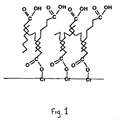
- FIG. 1 schematizes the typical structure of a treatment according to the invention of a steel sheet chromated by a fatty acid.
- the metal sheet whose surface is to be treated, is for example a sheet steel, bare or coated with tin (tinplate), chromium or zinc.
- the polar radical is chosen from at least one of the following radicals: carboxylic acid, phenolic, epoxy, vinyl, amine or silane.
- the number of carbon atoms in the linear chain main frame is weak enough that the product is easy to apply in a liquid state and high enough not to evaporate quickly when heating the film applied to the surface.
- the number of successive carbon in the linear chain is preferably greater than or equal to 8.
- the linear main frame chain does not include so no polar ramifications, and on the opposite side of the end with a polar radical, all the C-C bonds in the chain are saturated.
- organic products which can be used to implement the invention, there may be mentioned oleic acid, palmitic acid, epoxyoctane.
- this product can be diluted in a solvent.
- the polar radicals are positioned at the outside of the “balls”, whereas in the absence of solvent or if a apolar solvent, these are the apolar linear carbon chains which are turned towards the outside of the "balls".
- the sheet coated with its product film is then heated to a temperature and for a suitable time to react the product with the metal surface and make it react with itself, that is to say that part of the product is fixed on the surface to be treated and part of the product crosslinks partially.
- Heating also aims to break down the "balls" of molecules so that the polar radicals turn to outside the film, towards the metal surface or towards the external surface of the film and so that the linear carbon chains remain on the contrary tangled in the thickness of the film.
- heating is also suitable for evaporating this solvent.
- oleic acid When using oleic acid, you can for example choose a heating temperature of approximately 200 ° C for approximately 5 seconds, or 140 ° C for approximately 5 minutes.
- this temperature is at least equal to 120 ° C.
- this temperature is approximately 10 to 60 ° C lower than the boiling or decomposition temperature of the organic product.
- the product is applied while making it react and crosslink in the same operation, for example by immersing the sheet in a bath of said product; bath temperature and immersion time are then adapted as before to obtain fixing and crosslinking part of the product on the surface to be treated.
- the product can even be applied on a hot sheet, previously heated.
- a sheet is then obtained coated with a homogeneous film of product, at least part of the product being fixed and / or having crosslinked on the surface.
- the polar radicals are particularly important for bonding and fixing with the surface to be treated and that the Apolar linear chains are particularly important for obtaining a crosslinking of part of the film product applied to the surface.
- the organic product molecules in the applied film are considered to be fixed or crosslinked on the surface when linked to this surface either by a polar terminal function of a molecule, or indirectly when they are nested, entangled or crosslinked in another product molecule directly linked to the surface.
- the heating conditions of the applied film must allow nesting of at least two monomolecular layers through entangled apolar chains.
- Application and heating conditions can be checked by surface analysis, as described below.
- organic product which, during heating, did not settle and / or did not settle not crosslinked on the surface; this part not fixed and / or not crosslinked, it is say "free” can be considered to be in a liquid state.
- the rinsing solvent has a polar character.
- the sheet After rinsing, the sheet is dried.
- a sheet is then obtained coated on the external surface with a film of said organic product, crosslinked and adhering to the sheet, this film comprising at least two monomolecular layers of said organic product.
- a means of controlling the application conditions (sufficient quantity of product) and heating (proper orientation of the molecules) consists of verify by these means of analysis that the proportion of polar radicals to the surface of the treatment film is greater than the stoichiometric proportion of these radicals in the molecules of the organic surface treatment product.
- the treatment can be repeated on the surface already treated a first time and / or modify the application conditions and / or heating for subsequent treatments.
- the treatment according to the invention therefore coats the metal surface with a film very thin, with a thickness corresponding to only a few molecules of the product used.
- This very thin film is sufficiently crosslinked to resist water and solvents.
- This treatment film is strongly linked to the metal surface.
- This treatment film has a polar outer surface, as illustrated by FIG. 1 which represents a treatment film according to the invention applied on a chrome steel surface, the organic product used for the treatment being here a fatty acid.
- a coating for example varnish or paint
- the coatings applied to the surfaces treated according to the invention adhered to the less as well as coatings applied to the same surfaces treated by chromation according to the prior art.
- the treatment according to the invention therefore advantageously replaces the chromate treatments; unlike chromating treatments, it is a treatment without risks of pollution and / or corrosion, and whose effluents are easier to treat.
- the treatment according to the invention therefore resembles a treatment of surface passivation.
- the treatment according to the invention can be substitute a protective and / or lubricating oil.
- the treatment according to the invention alone provides superior corrosion protection obtained by oiling sheets, even passivated.
- a varnish on a sheet treated according to the invention much more easily than on an oiled sheet for storage and then degreased: in fact, not only avoids a degreasing operation before applying the varnish, but also no more refusal of varnish is observed after application of the varnish.
- the treatment according to the invention improves the tribological properties of the surface as would a conventional oiling.
- sheets treated according to the invention are protected against corrosion during a storage period between one day and several months, and remain directly usable, after storage, both for a forming operation only for a coating operation, in particular varnish type, without other intermediate degreasing and surface treatment (chromate type).
- the treatment according to the invention is therefore particularly advantageous in exit from the sheet metal production line, in preparation for storage and whatever or the destination of the sheet.
- the processing according to the invention therefore makes it possible to simplify the scheduling at the end of the sheet metal production line, as it simplifies the sheet metal coating, in particular with varnishes.
- varnishing or painting of sheet metal such as treatment according to the invention is both an adhesion treatment, passivation and protection, there is no need to apply varnish at all or painting directly after surface treatment, unlike process described in document US 5 103 550.
- a large number of organic products which can be used to the invention are compatible with food applications, especially fatty acids, without toxicological risks or even pollution in terms of effluents, which makes the process advantageous for the preparation sheet for food packaging.
- the layer deposited on the surface of the sheet according to the invention is resistant to solvents, in other words, that the sheet treated according to the invention is not easily “degreasable”.
- the sheet treated according to does the invention retain its protection against corrosion and elsewhere also its tribological properties.
- the treatment according to the invention can therefore replace other operations than sheet oiling; it can, for example, replace the exterior varnishing of metallic food packaging; he can, by example, used to protect and lubricate the external bottoms of boxes stackable metal.
- the temperature at which the product is submitted during or after application is always less than that used in the invention.
- the purpose of this example is to illustrate an embodiment of the invention in which the treatment product film is simultaneously applied and heated.
- This sheet to be treated is soaked in a hot oleic acid bath: either for approximately 5 seconds at approximately 200 ° C, i.e. for approximately 5 minutes at 140 ° C approximately.
- oleic acid in the surface film covering the sheet is in liquid form, but some of the oleic acid is fixed and crosslinked on the surface to be treated during immersion.
- the sheet is then rinsed in a stirred acetone bath for one minute approx., to remove the part of the applied film which has not fixed and / or crosslinked.
- XPS photoelectron spectroscopy
- the purpose of this example is to illustrate an embodiment of the invention in which the treatment product film is applied and then heated.
- this film could be easily removed by rinsing in a solvent.
- the sheet to be treated is then heated for approximately 5 minutes to a temperature of about 180 ° C.
- rinsing in a solvent is not necessary, because the applied film is already very thin and most of the applied oleic acid was able to bind and / or crosslink during heating.
- the purpose of this example is to illustrate that the surface treatment according to the invention can be carried out on an oiled sheet, without it being necessary to degrease before.
- Example 2 We then proceed as in Example 1, with the difference that increases the immersion time in hot oleic acid to allow desorption of the oily layer in oleic acid.
- immersion in oleic acid serves both to clean the sheet metal surface and coat with oleic acid.
- the purpose of this example is to illustrate corrosion protection provided by treatments according to the invention.
- the corrosion test consists of evaluating the number of cycles (1 to 20) required on the one hand to see rust appear, on the other hand to observe a complete coiling of the sample.
- the treatment according to the invention provides a higher corrosion resistance than the treatments used commonly used for temporary protection such as oiling.
- the purpose of this example is to illustrate the advantage that the invention provides for prepare a metal surface for coating, especially varnish.
- the essential goal sought by the application of a varnish on a sheet is provide very high resistance to corrosion, especially corrosion aqueous.
- aqueous corrosion - of varnished samples to be tested they are subjected to a standard corrosion test then the corrosion level is measured on these samples.
- the standard corrosion test is to soak the samples in an aqueous solution containing 50 g / l of citric acid, to keep them in this solution for one hour at the boil then for seven days at ambient temperature.
- the surface treatment according to the invention improves significantly the corrosion protection provided by a layer of varnish on this surface (this improvement may remain less than what we obtained with chromating) avoiding the disadvantages, in particular of pollution and corrosion, linked to the use of chromating solutions.
- This example is also intended to illustrate the benefit of the invention to prepare the application of a varnish.
- the treatment according to the invention simplifies the operations for preparing surface (no risk of pollution and / or chromium corrosion) and improves or maintains at least the ability to varnish metal surfaces (no risk of varnish rejection).
- the ALTEK method consists in depositing, on the surface to be tested, a weight three kilograms resting on the surface through three feet semi-spherical and measure the force required to drag the weight over this surface; the force / weight ratio gives the coefficient of friction.
- the treatment according to the invention improves the tribological properties of the surface, without necessarily reaching the level of lubrication provided with oiling classic of the prior art, nor, a fortiori, that provided by a layer of varnish.
Landscapes
- Engineering & Computer Science (AREA)
- Chemical & Material Sciences (AREA)
- Nanotechnology (AREA)
- General Physics & Mathematics (AREA)
- Crystallography & Structural Chemistry (AREA)
- Materials Engineering (AREA)
- Physics & Mathematics (AREA)
- Condensed Matter Physics & Semiconductors (AREA)
- Life Sciences & Earth Sciences (AREA)
- Wood Science & Technology (AREA)
- Manufacturing & Machinery (AREA)
- Organic Chemistry (AREA)
- Composite Materials (AREA)
- Application Of Or Painting With Fluid Materials (AREA)
- Preventing Corrosion Or Incrustation Of Metals (AREA)
- Laminated Bodies (AREA)
- Cleaning And De-Greasing Of Metallic Materials By Chemical Methods (AREA)
- Paints Or Removers (AREA)
- Chemical Treatment Of Metals (AREA)
Abstract
Description
L'invention concerne un traitement de surface de tôles métalliques, notamment d'acier nu ou revêtu d'une couche métallique.The invention relates to a surface treatment of metal sheets, in particular of bare steel or coated with a metallic layer.
On connaít des traitements de surface qui servent à préparer une surface métallique au dépôt d'un revêtement (comme la chromatation), à protéger contre la corrosion (comme le huilage), ou encore à lubrifier la surface pour des opérations de mise en forme ou d'emboutissage (également comme le huilage).We know of surface treatments used to prepare a surface metallic when depositing a coating (such as chromating), to protect against corrosion (such as oiling), or to lubricate the surface to shaping or stamping operations (also such as oiling).
Le traitement de surface selon l'invention concerne plus particulièrement ces trois types d'application.The surface treatment according to the invention relates more particularly these three types of application.
Le premier domaine est celui de la préparation d'une surface au dépôt d'un revêtement.The first area is that of preparing a surface for deposition of a coating.
Pour fabriquer des emballages alimentaires, on utilise couramment des tôles étamées (fer blanc) revêtues d'une couche de vernis protecteur.To manufacture food packaging, commonly used tinned sheets (tinplate) coated with a layer of protective varnish.
L'application du vernis protecteur nécessite un traitement préalable de la surface métallique, nécessaire en particulier pour obtenir une bonne adhérence du vernis sur la surface, y compris en milieu aqueux, en milieu solvant, ou en milieu corrosif.The application of the protective varnish requires a prior treatment of the metal surface, necessary in particular to obtain good adhesion of the varnish to the surface, including in an aqueous medium, in a medium solvent, or in a corrosive environment.
Ce traitement préalable de la surface métallique consiste couramment en un traitement de passivation de type chromatation chimique ou électrochimique.This preliminary treatment of the metal surface commonly consists of a passivation treatment of the chemical chromation type or electrochemical.
La mise en oeuvre de ces traitements entraíne donc généralement des risques de corrosion et de pollution liés au chrome, notamment lors de la manipulation des solutions de traitement et au niveau des effluents de traitement.The implementation of these treatments therefore generally results in corrosion and pollution risks linked to chromium, especially during the handling of treatment solutions and in terms of effluents from treatment.
Le document US 5 103 550 décrit un procédé d'application de vernis sur la surface d'une tôle métallique d'aluminium dans lequel :
- on effectue un traitement de surface préalable qui consiste à :
- a) anodiser ladite surface pour former une surface oxydée,
- b) appliquer une pellicule homogène d'un produit organique à base d'acides ou d'esters phosphoniques ou phosphiniques , ou de sels de ces acides, polymérisés ou non,
- c) le cas échéant, à l'aide d'un solvant dudit produit organique, éliminer ensuite de ladite pellicule la quantité de produit organique qui n'est pas fixée sur ladite surface, par rinçage, et sécher éventuellement ladite pellicule,
- et on applique immédiatement un vernis sur la surface traitée, par exemple un vernis polychlorure de vinyle modifié époxy d'usage courant dans le domaine des tôles pour emballage alimentaire.
- a prior surface treatment is carried out which consists of:
- a) anodizing said surface to form an oxidized surface,
- b) applying a homogeneous film of an organic product based on phosphonic or phosphinic acids or esters, or of salts of these acids, polymerized or not,
- c) where appropriate, using a solvent for said organic product, then remove from said film the amount of organic product which is not fixed on said surface, by rinsing, and optionally dry said film,
- and a varnish is immediately applied to the treated surface, for example an epoxy modified polyvinyl chloride varnish commonly used in the field of sheets for food packaging.
Le traitement de surface décrit dans ce document remplace avantageusement un traitement de chromatation pour favoriser l'adhérence du vernis à la tôle.The surface treatment described in this document replaces advantageously a chromating treatment to promote the adhesion of the sheet metal varnish.
Mais ce traitement de surface nécessite une étape préalable d'anodisation, ce qui complique le procédé ; par ailleurs cette étape n'est pas forcément réalisable sur d'autres types de substrats, comme sur des tôles d'acier revêtues d'une couche métallique, par exemple des tôles d'acier étamées, chromées ou zinguées.But this surface treatment requires a preliminary step anodizing, which complicates the process; otherwise this step is not necessarily achievable on other types of substrates, such as on sheets of steel coated with a metallic layer, for example steel sheets tinned, chrome or zinc plated.
Mais ce traitement de surface nécessite l'application immédiate du vernis, la surface traitée n'étant pas susceptible de conserver ses propriétés favorisant l'adhérence du vernis.But this surface treatment requires the immediate application of the varnish, the treated surface is not likely to retain its properties favoring the adhesion of the varnish.
Un tel traitement de surface ne permet donc pas d'envisager de stocker des tôles traitées, ce qui est un grave inconvénient.Such surface treatment therefore does not make it possible to envisage storing treated sheets, which is a serious drawback.
Le document EP 484 886 décrit un procédé d'application d'un polymère carbofluoré sur la surface d'une tôle métallique, notamment d'aluminium, dans lequel :
- on traite ladite surface par application d'une pellicule homogène monomoléculaire d'un produit organique (ou « agent de couplage ») à base de molécules dont l'ossature principale est en forme de chaíne carbonée linéaire, dotée, à une seule extrémité, d'un radical polaire siloxane,
- on applique immédiatement ledit polymère carbofluoré,
- puis on fait réagir ledit polymère sur ladite pellicule et on fait réticuler ledit polymère, notamment par irradiation.
- said surface is treated by applying a homogeneous monomolecular film of an organic product (or “coupling agent”) based on molecules whose main framework is in the form of a linear carbon chain, provided, at one end, with 'a polar siloxane radical,
- said carbofluorinated polymer is immediately applied,
- then said polymer is reacted on said film and said polymer is crosslinked, in particular by irradiation.
Selon ce document, la réaction, qui provoque l'adhérence, entre la pellicule d'agent de couplage et la couche de polymère appliquée, suppose des liaisons C=C ou C≡C , notamment dans la chaíne carbonée linéaire du côté de l'extrémité opposée à celle du radical siloxane.According to this document, the reaction, which causes adhesion, between the coupling agent film and the applied polymer layer assumes C = C or C≡C bonds, especially in the linear carbon chain of side of the end opposite to that of the siloxane radical.
Ainsi, l'inconvénient d'un tel procédé est qu'il nécessite l'application d'une pellicule seulement monomoléculaire d'agent de couplage, ce qui est parfois difficile à obtenir par des méthodes simples.The disadvantage of such a method is that it requires the application of a only monomolecular film of coupling agent, which is sometimes difficult to obtain by simple methods.
Ainsi, l'inconvénient d'un tel procédé est également qu'il nécessite une étape de réaction, par exemple par irradiation, pour faire réagir et adhérer la couche de polymère sur la pellicule de traitement de surface.Thus, the drawback of such a method is also that it requires a reaction step, for example by irradiation, to react and adhere the polymer layer on the surface treatment film.
Ainsi, l'inconvénient d'un tel procédé est aussi qu'une surface traitée ne peut pas être stockée sans perdre ses propriétés de « couplage » , puisque les liaisons C=C ou C≡C sont progressivement oxydées, notamment sous exposition naturelle aux rayonnement ultra-violets.Thus, the disadvantage of such a method is also that a treated surface does not cannot be stored without losing its “coupling” properties, since the C = C or C≡C bonds are progressively oxidized, especially under natural exposure to ultraviolet radiation.
Les deuxième et troisième domaines d'application possible de l'invention sont ceux de la protection contre la corrosion et de la lubrification pour mise en forme, notamment emboutissage.The second and third possible fields of application of the invention are those of corrosion protection and lubrication for shape, especially stamping.
En sortie de fabrication, on huile généralement les tôles pour assurer une protection contre la corrosion, au moins temporaire, c'est à dire au moins pendant un temps de stockage (au moins une journée, voire parfois quelques mois).At the end of production, the sheets are generally oiled to ensure corrosion protection, at least temporary, i.e. at least during a storage period (at least a day, sometimes even a few month).
Les huiles qu'on utilise pour cette protection doivent également être adaptées pour faciliter la mise en forme, directement en sortie de stockage et sans dégraissage préalable.The oils used for this protection must also be adapted to facilitate shaping, directly out of storage and without prior degreasing.
Les huiles courantes prévues pour ces applications sont par exemple à base de di-octyl-sébaçate ou d'acétyl-tributyl-citrate.Common oils intended for these applications are for example di-octyl-sebaçate or acetyl-tributyl-citrate base.
Quand on cherche à revêtir des tôles provenant d'un stockage, donc généralement huilées, il convient alors au préalable de les dégraisser.When we try to coat sheets coming from a repository, therefore generally oiled, it is then advisable to degrease them beforehand.
Entre la sortie de fabrication des tôles et l'entrée dans l'installation de revêtement (vernissage ou peinture par exemple), on distingue alors au moins trois opérations : huilage, dégraissage, chromatation.Between the end of sheet metal fabrication and the entry into the installation of coating (varnishing or painting for example), we can then distinguish at least three operations: oiling, degreasing, chromating.
En outre, malgré le dégraissage préalable au revêtement, au moment de l'application du vernis, il est fréquent de constater des "refus de vernis" c'est à dire la présence de zones de la surface de tôle non couvertes par le vernis.In addition, despite the degreasing prior to coating, when the application of the varnish, it is frequent to note "refusals of varnish" it is indicate the presence of areas of the sheet surface not covered by the varnish.
Ces refus de vernis proviennent en général de défauts et de difficultés de dégraissage et peuvent conduire à des rebuts importants.These refusals of varnish generally come from faults and difficulties in degreasing and can lead to significant waste.
L'invention a pour but un traitement de surface de tôles métalliques applicable pour la protection contre la corrosion et la lubrification d'une part, pour la préparation au revêtement tout en limitant les refus de vernis d'autre part.The object of the invention is a surface treatment of metal sheets applicable for protection against corrosion and lubrication on the one hand, for coating preparation while limiting refusals of other varnishes go.
L'invention a donc pour objet un traitement de surface de tôle métallique, caractérisé en ce que :
- on applique sur ladite surface métallique une pellicule homogène d'un produit organique à base de molécules dont l'ossature principale est en forme de chaíne linéaire apolaire formée de liaisons carbone-carbone saturées à une extrémité et dotée, seulement à l'autre extrémité, d'un radical polaire,
- on chauffe ladite pellicule à une température et pendant une durée adaptées pour fixer une partie dudit produit sur ladite surface et pour faire partiellement réticuler ledit produit sur ladite surface,
- et, le cas échéant, à l'aide d'un solvant dudit produit organique, on élimine ensuite de ladite pellicule la quantité de produit organique qui n'est pas fixée et/ou réticulée sur ladite surface.
- a homogeneous film of an organic product based on molecules is applied to the said metallic surface, the main framework of which is in the form of an apolar linear chain formed of saturated carbon-carbon bonds at one end and provided, only at the other end, of a polar radical,
- said film is heated to a temperature and for a period of time suitable for fixing part of said product on said surface and for partially crosslinking said product on said surface,
- and, if necessary, using a solvent for said organic product, the quantity of organic product which is not fixed and / or crosslinked on said surface is then removed from said film.
Selon le mode de réalisation retenu, l'application de la pellicule et son chauffage peuvent être successifs ou simultanés.Depending on the embodiment chosen, the application of the film and its heating can be successive or simultaneous.
L'invention peut également présenter une ou plusieurs des caractéristiques suivantes :
- on adapte les conditions d'application et de chauffage de ladite pellicule de manière à ce que, après traitement, la proportion desdits radicaux polaires à la surface de la pellicule soit supérieure à la proportion stoechiométrique de ces radicaux dans les molécules dudit produit organique .
- ledit radical polaire est choisi parmi l'un au moins des radicaux suivants : acide carboxylique, phénolique, époxy, vinyle, amine ou silane.
- the conditions of application and heating of said film are adapted so that, after treatment, the proportion of said polar radicals on the surface of the film is greater than the stoichiometric proportion of these radicals in the molecules of said organic product.
- said polar radical is chosen from at least one of the following radicals: carboxylic acid, phenolic, epoxy, vinyl, amine or silane.
L'invention a également pour objet une tôle d'acier, nu ou revêtu d'une couche métallique, revêtue en surface externe d'un film dudit produit organique, réticulé et fixé, résultant du traitement de surface de ladite tôle selon l'invention.The subject of the invention is also a steel sheet, bare or coated with a metallic layer, coated on the outer surface with a film of said product organic, crosslinked and fixed, resulting from the surface treatment of said sheet according to the invention.
L'invention peut également présenter une ou plusieurs des caractéristiques suivantes :
- l'épaisseur dudit film comprend au moins deux couches monomoléculaires dudit produit organique.
- dans le cas d'une tôle d'acier revêtu d'une couche métallique, ladite couche métallique est en zinc, alliage de zinc, chrome ou alliage de chrome, étain, ou alliage d'étain.
- the thickness of said film comprises at least two monomolecular layers of said organic product.
- in the case of a steel sheet coated with a metallic layer, said metallic layer is made of zinc, zinc alloy, chromium or chromium alloy, tin, or tin alloy.
L'invention a également pour objet un procédé d'application de vernis sur la surface d'une tôle d'acier, nu ou revêtu d'une couche métallique, dans lequel :
- dans une première étape, on traite ladite surface selon l'invention,
- puis, dans une deuxième étape, on applique à proprement parler ledit vernis directement sur ladite surface traitée.
- in a first step, said surface is treated according to the invention,
- then, in a second step, strictly speaking, said varnish is applied directly to said treated surface.
L'invention peut également présenter une ou plusieurs des caractéristiques suivantes :
- la période s'écoulant entre ladite première étape et ladite seconde étape est supérieure à 1 jour.
- ledit vernis est de type polaire.
- the period elapsing between said first step and said second step is greater than 1 day.
- said varnish is of polar type.
L'invention a également pour objet l'utilisation d'une tôle d'acier vernie selon l'invention pour la fabrication d'emballage d'aliments liquides ou solides. The invention also relates to the use of a painted steel sheet according to the invention for the manufacture of packaging for liquid or solid food.
L'invention a également pour objet un procédé de mise en forme d'une tôle d'acier, nu ou revêtu d'une couche métallique, à l'aide d'un outil de mise en forme, dans lequel :
- dans une première étape, on traite la surface de la tôle devant être mise en contact avec ledit outil de mise en forme selon l'invention,
- et, dans une deuxième étape, on procède à la mise en forme à proprement parler à l'aide dudit outil.
- in a first step, the surface of the sheet metal to be brought into contact with said shaping tool according to the invention is treated,
- and, in a second step, the actual shaping is carried out using said tool.
L'invention peut également présenter la caractéristique selon laquelle la période s'écoulant entre ladite première étape et ladite seconde étape est supérieure à 1 jour.The invention may also have the characteristic that the period between said first step and said second step is more than 1 day.
L'invention sera mieux comprise à la lecture de la description qui va suivre, donnée à titre d'exemple non limitatif en référence à la figure 1 qui schématise la structure-type d'un traitement selon l'invention d'une tôle d'acier chromée par un acide gras.The invention will be better understood on reading the description which will follow, given by way of nonlimiting example with reference to FIG. 1 which schematizes the typical structure of a treatment according to the invention of a steel sheet chromated by a fatty acid.
La tôle métallique, dont la surface est à traiter, est par exemple une tôle d'acier, nue ou revêtue d'étain (fer blanc), de chrome ou de zinc.The metal sheet, whose surface is to be treated, is for example a sheet steel, bare or coated with tin (tinplate), chromium or zinc.
Par une méthode classique, par exemple d'immersion, d'enduction ou de huilage électrostatique, on applique sur la surface une pellicule homogène de produit organique.By a conventional method, for example immersion, coating or electrostatic oiling, a homogeneous film of organic product.
On choisit un produit organique à base de molécules dont l'ossature principale est en forme de chaíne carbonée linéaire apolaire, dotée, à une seule extrémité, d'un radical polaire.We choose an organic product based on molecules whose framework main is in the form of a linear apolar carbon chain, endowed single end, of a polar radical.
De préférence, le radical polaire est choisi parmi l'un au moins des radicaux suivants : acide carboxylique, phénolique, époxy, vinyle, amine ou silane.Preferably, the polar radical is chosen from at least one of the following radicals: carboxylic acid, phenolic, epoxy, vinyl, amine or silane.
De préférence, le nombre d'atomes de carbone dans la chaíne linéaire d'ossature principale est suffisamment faible pour que le produit soit facile à appliquer à l'état liquide et suffisamment élevé pour ne pas s'évaporer rapidement lors du chauffage de la pellicule appliquée sur la surface.Preferably, the number of carbon atoms in the linear chain main frame is weak enough that the product is easy to apply in a liquid state and high enough not to evaporate quickly when heating the film applied to the surface.
Ainsi le nombre de carbone successifs dans la chaíne linéaire est de préférence supérieur ou égal à 8.So the number of successive carbon in the linear chain is preferably greater than or equal to 8.
Selon l'invention, la chaíne linéaire d'ossature principale ne comporte donc pas de ramifications polaires, et, du côté opposé à l'extrémité dotée d'un radical polaire, toutes les liaisons C-C de la chaíne sont saturées.According to the invention, the linear main frame chain does not include so no polar ramifications, and on the opposite side of the end with a polar radical, all the C-C bonds in the chain are saturated.
Cette disposition exclut par exemple l'utilisation d'acide perfluorocarboxylique ou perchlorocarboxylique, car les atomes de fluor ou de chlore greffés sur l'ossature de la molécule de ce produit empêcheraient ou limiteraient l'adhérence d'un vernis appliqué ultérieurement sur la surface traitée, ce qui est l'inverse du but poursuivi par l'invention.This provision excludes for example the use of acid perfluorocarboxylic or perchlorocarboxylic, because the fluorine or chlorine grafted onto the backbone of the molecule this product would prevent or limit the adhesion of a varnish subsequently applied to the surface treated, which is the reverse of the aim pursued by the invention.
Cette disposition exclut par exemple des chaínes carbonées comportant des fonctions alcoxy en dehors de l'extrémité correspondant au radical polaire, ces fonctions alcoxy conférant un caractère polaire à la chaíne carbonée elle-même, qui nuit à la mise en oeuvre de l'invention.This provision excludes for example carbon chains comprising alkoxy functions outside the end corresponding to the polar radical, these alkoxy functions conferring a polar character on the carbon chain itself, which harms the implementation of the invention.
Ainsi, parmi les produits organiques utilisables pour mettre en oeuvre l'invention, on peut citer l'acide oléique, l'acide palmitique, l'époxyoctane.Thus, among the organic products which can be used to implement the invention, there may be mentioned oleic acid, palmitic acid, epoxyoctane.
Au moment de son application sur la surface, les molécules du produit organique ont tendance à se regrouper spontanément en « boules » pour minimiser leur énergie de surface.When it is applied to the surface, the molecules of the product organic tend to spontaneously cluster into "balls" to minimize their surface energy.
Pour faciliter l'application sur la surface à traiter, ce produit peut être dilué dans un solvant.To facilitate application on the surface to be treated, this product can be diluted in a solvent.
Si on utilise un solvant polaire, les radicaux polaires se positionnent à l'extérieur des « boules », alors que en l'absence de solvant ou si on utilise un solvant apolaire, ce sont les chaínes carbonées linéaires apolaires qui sont tournées vers l'extérieur des « boules ».If a polar solvent is used, the polar radicals are positioned at the outside of the “balls”, whereas in the absence of solvent or if a apolar solvent, these are the apolar linear carbon chains which are turned towards the outside of the "balls".
Après application du produit, on obtient une tôle dont la surface à traiter est revêtue d'une pellicule homogène de produit.After application of the product, a sheet is obtained whose surface to be treated is coated with a homogeneous film of product.
On chauffe ensuite la tôle revêtue de sa pellicule de produit à une température et pendant une durée adaptée pour faire réagir le produit avec la surface métallique et le faire réagir avec lui-même, c'est à dire qu'une partie du produit se fixe sur la surface à traiter et qu'une partie du produit réticule partiellement.The sheet coated with its product film is then heated to a temperature and for a suitable time to react the product with the metal surface and make it react with itself, that is to say that part of the product is fixed on the surface to be treated and part of the product crosslinks partially.
Le chauffage a également pour but de désagréger les « boules » de molécules de manière à ce que les radicaux polaires se tournent vers l'extérieur de la pellicule, vers la surface métallique ou vers la surface externe de la pellicule et de manière à ce que les chaínes carbonées linéaires restent au contraire enchevêtrées dans l'épaisseur de la pellicule.Heating also aims to break down the "balls" of molecules so that the polar radicals turn to outside the film, towards the metal surface or towards the external surface of the film and so that the linear carbon chains remain on the contrary tangled in the thickness of the film.
En cas d'utilisation d'un solvant pour l'application, le chauffage est également adapté pour évaporer ce solvant.If a solvent is used for the application, heating is also suitable for evaporating this solvent.
Lorsqu'on utilise de l'acide oléique, on peut par exemple choisir une température de chauffage de 200°C environ pendant 5 secondes environ, ou 140°C environ pendant 5 minutes environ.When using oleic acid, you can for example choose a heating temperature of approximately 200 ° C for approximately 5 seconds, or 140 ° C for approximately 5 minutes.
De préférence, cette température est au moins égale à 120°C.Preferably, this temperature is at least equal to 120 ° C.
De préférence, cette température est environ de 10 à 60°C inférieure à la température d'ébullition ou de décomposition du produit organique. Preferably, this temperature is approximately 10 to 60 ° C lower than the boiling or decomposition temperature of the organic product.
Selon une variante de l'invention, on applique le produit tout en le faisant réagir et réticuler dans la même opération, par exemple en immergeant la tôle dans un bain dudit produit ; la température du bain et la durée d'immersion sont alors adaptées comme précédemment pour obtenir la fixation et la réticulation d'une partie du produit sur la surface à traiter.According to a variant of the invention, the product is applied while making it react and crosslink in the same operation, for example by immersing the sheet in a bath of said product; bath temperature and immersion time are then adapted as before to obtain fixing and crosslinking part of the product on the surface to be treated.
Selon une autre variante de l'invention, on peut même appliquer le produit sur une tôle chaude, chauffée au préalable.According to another variant of the invention, the product can even be applied on a hot sheet, previously heated.
On obtient alors une tôle revêtue d'une pellicule homogène de produit, une partie au moins du produit étant fixée et/ou ayant réticulé sur la surface.A sheet is then obtained coated with a homogeneous film of product, at least part of the product being fixed and / or having crosslinked on the surface.
On constate ainsi que les radicaux polaires sont particulièrement importants pour la liaison et la fixation avec la surface à traiter et que les chaínes linéaires apolaires sont particulièrement importantes pour obtenir une réticulation d'une partie du produit de la pellicule appliquée sur la surface.It can thus be seen that the polar radicals are particularly important for bonding and fixing with the surface to be treated and that the Apolar linear chains are particularly important for obtaining a crosslinking of part of the film product applied to the surface.
Les molécules de produit organique de la pellicule appliquée sont considérées comme fixées ou réticulées sur la surface lorsqu'elles sont liées à cette surface soit par une fonction terminale polaire d'une molécule, soit indirectement lorsqu'elles sont imbriquées, enchevêtrées ou réticulées dans une autre molécule de produit directement liée à la surface.The organic product molecules in the applied film are considered to be fixed or crosslinked on the surface when linked to this surface either by a polar terminal function of a molecule, or indirectly when they are nested, entangled or crosslinked in another product molecule directly linked to the surface.
Il est important que les conditions d'application soient adaptées pour appliquer une quantité suffisante de produit correspondant à plusieurs couches monomoléculaires.It is important that the application conditions are adapted to apply a sufficient quantity of product corresponding to several coats monolayers.
Les conditions de chauffage de la pellicule appliquée doivent permettre l'imbrication d'au moins deux couches monomoléculaires par l'intermédiaire des chaínes apolaires enchevêtrées.The heating conditions of the applied film must allow nesting of at least two monomolecular layers through entangled apolar chains.
Le contrôle de conditions d'application et de chauffage peut être effectué par analyse de surface, comme décrit ci-après.Application and heating conditions can be checked by surface analysis, as described below.
Le cas échéant, on élimine ensuite de la pellicule appliquée la partie de produit organique qui, au cours du chauffage, ne s'est pas fixée et/ou ne s'est pas réticulée sur la surface ; cette partie non fixée et/ou non réticulée, c'est à dire "libre", peut être considérée comme étant à l'état liquide.If necessary, the part of the film is then removed from the applied film. organic product which, during heating, did not settle and / or did not settle not crosslinked on the surface; this part not fixed and / or not crosslinked, it is say "free" can be considered to be in a liquid state.
Pour éliminer la partie "libre" de pellicule de produit organique, il suffit par exemple de rincer la tôle dans un solvant dudit produit.To remove the "free" part of organic product film, simply example of rinsing the sheet in a solvent for said product.
De préférence, le solvant de rinçage présente un caractère polaire.Preferably, the rinsing solvent has a polar character.
Après rinçage, on sèche la tôle.After rinsing, the sheet is dried.
On obtient alors une tôle revêtue en surface externe d'un film dudit produit organique, réticulé et adhérant à la tôle, ce film comprenant au moins deux couches monomoléculaires dudit produit organique. A sheet is then obtained coated on the external surface with a film of said organic product, crosslinked and adhering to the sheet, this film comprising at least two monomolecular layers of said organic product.
On peut, à l'aide de moyens d'analyse de surface (par exemple la spectroscopie de photoélectrons ou "XPS"), mesurer la densité surfacique des extrémités des molécules du composé organique, sur la surface externe de la pellicule fixée et réticulée sur la surface métallique à traiter.It is possible, using surface analysis means (for example the photoelectron spectroscopy or "XPS"), measure the surface density of ends of the molecules of the organic compound, on the outer surface of the film fixed and crosslinked on the metal surface to be treated.
Un moyen de contrôle des conditions d'application (quantité suffisante de produit) et de chauffage (orientation convenable des molécules) consiste à vérifier par ces moyens d'analyse que la proportion de radicaux polaires à la surface du film de traitement est supérieure à la proportion stoechiométrique de ces radicaux dans les molécules du produit organique de traitement de surface.A means of controlling the application conditions (sufficient quantity of product) and heating (proper orientation of the molecules) consists of verify by these means of analysis that the proportion of polar radicals to the surface of the treatment film is greater than the stoichiometric proportion of these radicals in the molecules of the organic surface treatment product.
Lorsque le produit organique appliqué est un acide carboxylique, on met alors en évidence un niveau élevé de carboxylates à la surface de la tôle; on mesure ainsi une proportion élevée de radicaux COOH en surface ; dans le cas de l'acide oléique, une proportion supérieure à 10% environ de radicaux COOH en surface du film de traitement est considérée comme un indice de traitement satisfaisant de la surface.When the organic product applied is a carboxylic acid, we put then evidence of a high level of carboxylates on the surface of the sheet; we thus measures a high proportion of COOH radicals on the surface; in the case oleic acid, a proportion greater than approximately 10% of COOH radicals on the surface of the treatment film is considered as a treatment index satisfactory from the surface.
Si le traitement n'est pas satisfaisant, on peut réitérer le traitement sur la surface déjà traitée une première fois et/ou modifier les conditions d'application et/ou de chauffage pour des traitements ultérieurs.If the treatment is not satisfactory, the treatment can be repeated on the surface already treated a first time and / or modify the application conditions and / or heating for subsequent treatments.
Le traitement selon l'invention revêt donc la surface métallique d'un film très fin, d'une épaisseur correspondant à quelques molécules seulement du produit utilisé.The treatment according to the invention therefore coats the metal surface with a film very thin, with a thickness corresponding to only a few molecules of the product used.
Ce film très fin est suffisamment réticulé pour résister à l'eau et aux solvants.This very thin film is sufficiently crosslinked to resist water and solvents.
Ce film de traitement est fortement lié à la surface métallique.This treatment film is strongly linked to the metal surface.
Ce film de traitement présente une surface externe polaire, comme illustré par la figure 1 qui représente un film de traitement selon l'invention appliqué sur une surface d'acier chromé, le produit organique utilisé pour le traitement étant ici un acide gras.This treatment film has a polar outer surface, as illustrated by FIG. 1 which represents a treatment film according to the invention applied on a chrome steel surface, the organic product used for the treatment being here a fatty acid.
Les avantages du traitement selon l'invention résultent des propriétés de ce film.The advantages of the treatment according to the invention result from the properties of this film.
En premier lieu, après le traitement selon l'invention, on peut directement appliquer un revêtement, par exemple de vernis ou de peinture ; les revêtements appliqués sur les surfaces traitées selon l'invention adhérent au moins aussi bien que des revêtements appliqués sur les mêmes surfaces traitées par chromatation selon l'art antérieur.Firstly, after the treatment according to the invention, it is possible directly apply a coating, for example varnish or paint; the coatings applied to the surfaces treated according to the invention adhered to the less as well as coatings applied to the same surfaces treated by chromation according to the prior art.
Le traitement selon l'invention se substitue donc avantageusement aux traitements de chromatation ; contrairement aux traitements de chromatation, c'est un traitement sans risques de pollution et/ou de corrosion, et dont les effluents sont plus faciles à traiter.The treatment according to the invention therefore advantageously replaces the chromate treatments; unlike chromating treatments, it is a treatment without risks of pollution and / or corrosion, and whose effluents are easier to treat.
Le traitement selon l'invention s'apparente donc à un traitement de passivation de surface.The treatment according to the invention therefore resembles a treatment of surface passivation.
En deuxième lieu, on constate que le traitement selon l'invention peut se substituer à un huilage de protection et/ou de lubrification.Secondly, it can be seen that the treatment according to the invention can be substitute a protective and / or lubricating oil.
D'une part, en traitant selon l'invention des tôles, on constate des avantages au niveau de leur résistance à la corrosion et au niveau de l'applicabilité d'un revêtement.On the one hand, by treating sheets according to the invention, we observe advantages in terms of their resistance to corrosion and in terms of the applicability of a coating.
Au niveau de la résistance à la corrosion, le traitement selon l'invention apporte à lui seul une protection contre la corrosion supérieure à celle qu'on obtient par huilage de tôles, même passivées.In terms of corrosion resistance, the treatment according to the invention alone provides superior corrosion protection obtained by oiling sheets, even passivated.
Au niveau de l'applicabilité d'un revêtement, on applique par exemple un vernis sur une tôle traitée selon l'invention beaucoup plus facilement que sur une tôle huilée pour stockage puis dégraissée : en effet, non seulement on évite une opération de dégraissage avant d'appliquer le vernis, mais en outre on n'observe plus de refus de vernis après application du vernis.In terms of the applicability of a coating, for example, a varnish on a sheet treated according to the invention much more easily than on an oiled sheet for storage and then degreased: in fact, not only avoids a degreasing operation before applying the varnish, but also no more refusal of varnish is observed after application of the varnish.
On constate cette disparition des refus de vernis, que la surface traitée selon l'invention ait été au préalablement huilée ou non.We notice this disappearance of the refusals of varnish, that the treated surface according to the invention has been previously oiled or not.
D'autre part, on constate que le traitement selon l'invention améliore les propriétés tribologiques de la surface comme le ferait un huilage classique.On the other hand, it can be seen that the treatment according to the invention improves the tribological properties of the surface as would a conventional oiling.
Ainsi des tôles traitées selon l'invention sont protégées contre la corrosion pendant une période de stockage comprise entre un jour et plusieurs mois, et restent directement utilisables, après stockage, tant pour une opération de mise en forme que pour une opération de revêtement, notamment de type vernis, sans autres opérations intermédiaires de dégraissage et de traitement de surface (type chromatation).Thus sheets treated according to the invention are protected against corrosion during a storage period between one day and several months, and remain directly usable, after storage, both for a forming operation only for a coating operation, in particular varnish type, without other intermediate degreasing and surface treatment (chromate type).
Le traitement selon l'invention est donc particulièrement avantageux en sortie de ligne de fabrication de tôle, en préparation du stockage et quelle que soit la destination de la tôle.The treatment according to the invention is therefore particularly advantageous in exit from the sheet metal production line, in preparation for storage and whatever or the destination of the sheet.
Entre la sortie de fabrication de tôle et l'entrée dans une installation de revêtement, on peut alors remplacer avantageusement la séquence huilage - dégraissage - chromatation par une seule opération de traitement de surface selon l'invention.Between the exit from sheet metal fabrication and the entry into a coating, we can then advantageously replace the oiling sequence - degreasing - chromating with a single surface treatment operation according to the invention.
Le traitement selon l'invention permet donc de simplifier l'ordonnancement en sortie de ligne de fabrication de tôle, comme il permet de simplifier le revêtement de tôle, notamment par des vernis. The processing according to the invention therefore makes it possible to simplify the scheduling at the end of the sheet metal production line, as it simplifies the sheet metal coating, in particular with varnishes.
Dans les cas de vernissage ou de mise en peinture de tôle, comme le traitement selon l'invention est à la fois un traitement d'adhérisation, de passivation et de protection, il n'est pas du tout nécessaire d'appliquer le vernis ou la peinture directement après le traitement de surface, contrairement au procédé décrit dans le document US 5 103 550.In the case of varnishing or painting of sheet metal, such as treatment according to the invention is both an adhesion treatment, passivation and protection, there is no need to apply varnish at all or painting directly after surface treatment, unlike process described in document US 5 103 550.
En effet, une période de stockage intermédiaire entre le traitement de surface et l'application du vernis ou de la peinture, d'une durée par exemple supérieure à une journée, ne pose ici aucun problème de perte d'adhérisation ou de risque de corrosion.Indeed, an intermediate storage period between the processing of surface and application of varnish or paint, lasting for example longer than a day, here poses no problem of loss of adhesion or risk of corrosion.
Un grand nombre de produits organiques utilisables pour mettre en oeuvre l'invention sont compatibles avec des applications alimentaires, notamment les acides gras, sans risques toxicologiques ni même de pollution au niveau des effluents, ce qui rend le procédé avantageux pour la préparation de tôle pour emballage alimentaire.A large number of organic products which can be used to the invention are compatible with food applications, especially fatty acids, without toxicological risks or even pollution in terms of effluents, which makes the process advantageous for the preparation sheet for food packaging.
Enfin, on constate que la couche déposée en surface de la tôle selon l'invention résiste aux solvants, autrement dit, que la tôle traitée selon l'invention n'est pas facilement "dégraissable".Finally, it can be seen that the layer deposited on the surface of the sheet according to the invention is resistant to solvents, in other words, that the sheet treated according to the invention is not easily "degreasable".
Ainsi, même après rinçage dans des solvants, la tôle traitée selon l'invention conserve-t-elle sa protection contre la corrosion et d'ailleurs également ses propriétés tribologiques.Even after rinsing in solvents, the sheet treated according to does the invention retain its protection against corrosion and elsewhere also its tribological properties.
Le traitement selon l'invention peut de ce fait se substituer à d'autres opérations que le huilage de tôle ; il peut, par exemple, remplacer le vernissage extérieur d'emballages métalliques alimentaires ; il peut, par exemple, servir à protéger et à lubrifier les fonds externes de boítes métalliques empilables.The treatment according to the invention can therefore replace other operations than sheet oiling; it can, for example, replace the exterior varnishing of metallic food packaging; he can, by example, used to protect and lubricate the external bottoms of boxes stackable metal.
Par ailleurs, il s'avère difficile de faire adhérer un film polyoléfine, comme du polyéthylène, sur une tôle traitée selon l'invention ; cette caractéristique différencie nettement le traitement selon l'invention de traitements déjà connus par ailleurs dans lesquels on applique sur une tôle une couche monomoléculaire de produits organiques analogues à ceux de l'invention dans le but de préparer le collage d'un film polyoléfine, tel que décrit dans le document FR 1 395 228.Furthermore, it proves difficult to adhere a polyolefin film, such as polyethylene, on a sheet treated according to the invention; this characteristic clearly differentiates the treatment according to the invention from already known treatments moreover in which a layer is applied to a sheet monomolecular organic products similar to those of the invention in the purpose of preparing the bonding of a polyolefin film, as described in the document FR 1 395 228.
Dans ces traitements de préparation du collage, la température à laquelle on soumet le produit pendant ou après application reste toujours inférieure à celle qu'on utilise dans l'invention.In these bonding preparation treatments, the temperature at which the product is submitted during or after application is always less than that used in the invention.
Pour la description de l'invention, on se référera également aux exemples suivants : For the description of the invention, reference will also be made to the examples following:
Cet exemple a pour but d'illustrer un mode de réalisation de l'invention dans lequel la pellicule de produit de traitement est simultanément appliquée et chauffée.The purpose of this example is to illustrate an embodiment of the invention in which the treatment product film is simultaneously applied and heated.
On cherche à traiter selon l'invention une tôle en fer blanc.It is sought to treat according to the invention a sheet of tinplate.
On trempe cette tôle à traiter dans un bain d'acide oléique chaud : soit pendant 5 secondes environ à 200°C environ, soit pendant 5 minutes environ à 140°C environ.This sheet to be treated is soaked in a hot oleic acid bath: either for approximately 5 seconds at approximately 200 ° C, i.e. for approximately 5 minutes at 140 ° C approximately.
Après cette immersion, on obtient une tôle revêtue d'une pellicule d'acide oléique.After this immersion, a sheet coated with an acid film is obtained. oleic.
La majeure partie de l'acide oléique du film superficiel qui recouvre la tôle est sous forme liquide, mais une partie de l'acide oléique s'est fixée et réticulée sur la surface à traiter pendant l'immersion.Most of the oleic acid in the surface film covering the sheet is in liquid form, but some of the oleic acid is fixed and crosslinked on the surface to be treated during immersion.
On rince ensuite la tôle dans un bain agité d'acétone pendant une minute environ, pour éliminer la partie de la pellicule appliquée qui ne s'est pas fixée et/ou réticulée.The sheet is then rinsed in a stirred acetone bath for one minute approx., to remove the part of the applied film which has not fixed and / or crosslinked.
Après rinçage (et séchage), on obtient alors une tôle traitée selon l'invention.After rinsing (and drying), we obtain a sheet treated according to the invention.
Pour contrôler le traitement selon l'invention, on peut vérifier par spectroscopie de photoélectrons ("XPS") que la proportion de radicaux COOH est supérieure ou égale à 10% sur la surface traitée ; une proportion insuffisante de radicaux carboxylates doit, conformément à l'invention, conduire à augmenter la durée et/ou la température de chauffage de la pellicule appliquée pendant le traitement.To control the treatment according to the invention, it is possible to check by photoelectron spectroscopy ("XPS") as the proportion of COOH radicals is greater than or equal to 10% on the treated surface; a proportion insufficient carboxylate radicals must, in accordance with the invention, lead to increase the duration and / or the heating temperature of the film applied during treatment.
Cet exemple a pour but d'illustrer un mode de réalisation de l'invention dans lequel la pellicule de produit de traitement est appliquée puis chauffée.The purpose of this example is to illustrate an embodiment of the invention in which the treatment product film is applied and then heated.
A l'aide d'une baguette rugueuse enduite d'acide oléique, on applique à froid une fine pellicule d'acide oléique sur la surface d'une tôle à traiter.Using a rough rod coated with oleic acid, apply to cold a thin film of oleic acid on the surface of a sheet to be treated.
Après cette application, on obtient une tôle revêtue d'une pellicule d'acide oléique, essentiellement sous forme liquide, c'est à dire non fixée et non réticulée.After this application, a sheet coated with an acid film is obtained. oleic, essentially in liquid form, i.e. not fixed and not crosslinked.
A ce stade du procédé, cette pellicule pourrait être facilement éliminée par rinçage dans un solvant.At this stage of the process, this film could be easily removed by rinsing in a solvent.
On chauffe ensuite pendant environ 5 minutes la tôle à traiter à une température de environ 180°C.The sheet to be treated is then heated for approximately 5 minutes to a temperature of about 180 ° C.
On obtient alors une tôle traitée selon l'invention. This gives a sheet treated according to the invention.
Dans ce mode de réalisation de l'invention, le rinçage dans un solvant n'est pas nécessaire, parce que la pellicule appliquée est déjà très fine et que la plus grande partie de l'acide oléique appliqué a pu se fixer et/ou se réticuler pendant le chauffage.In this embodiment of the invention, rinsing in a solvent is not necessary, because the applied film is already very thin and most of the applied oleic acid was able to bind and / or crosslink during heating.
Cet exemple a pour but d'illustrer que le traitement de surface selon l'invention peut être effectué sur une tôle huilée, sans qu'il soit nécessaire de la dégraisser auparavant.The purpose of this example is to illustrate that the surface treatment according to the invention can be carried out on an oiled sheet, without it being necessary to degrease before.
On cherche à traiter selon l'invention une tôle en fer blanc, grasse et huileuse ; une couche d'huile a donc été déposée sur la tôle pour assurer une protection temporaire contre la corrosion et présente par exemple une densité de 0,5 g/m2.It is sought to treat according to the invention a sheet of tinplate, fatty and oily; a layer of oil has therefore been deposited on the sheet to ensure temporary protection against corrosion and for example has a density 0.5 g / m2.
On procède ensuite comme dans l'exemple 1, à la différence qu'on augmente la durée d'immersion dans l'acide oléique chaud pour permettre la désorption de la couche huileuse dans l'acide oléique.We then proceed as in Example 1, with the difference that increases the immersion time in hot oleic acid to allow desorption of the oily layer in oleic acid.
Comme la couche d'huile présente en surface de la tôle est soluble dans l'acide oléique, l'immersion dans l'acide oléique sert à la fois à nettoyer la surface de la tôle et à l'enduire d'acide oléique.As the oil layer present on the surface of the sheet is soluble in oleic acid, immersion in oleic acid serves both to clean the sheet metal surface and coat with oleic acid.
Après rinçage (et séchage), on obtient alors une tôle traitée selon l'invention.After rinsing (and drying), we obtain a sheet treated according to the invention.
Ainsi, grâce à l'invention, il n'est pas nécessaire d'effectuer de dégraissage lorsque l'on cherche à traiter selon l'invention des tôles grasses.Thus, thanks to the invention, it is not necessary to perform degreasing when one seeks to treat according to the invention fatty sheets.
Cet exemple a pour but d'illustrer la protection contre la corrosion apportée par des traitements selon l'invention.The purpose of this example is to illustrate corrosion protection provided by treatments according to the invention.
Pour évaluer la résistance à la corrosion d'une tôle traitée, on procède d'une manière connue en elle-même en soumettant des échantillons à tester à des cycles de corrosion sous atmosphère contrôlée (enceinte climatique) ; le test de corrosion consiste à évaluer le nombre de cycles (1 à 20) nécessaires pour d'une part voir apparaítre la rouille, pour d'autre part observer un enrouillement complet de l'échantillon.To assess the corrosion resistance of a treated sheet, we proceed in a manner known per se by submitting samples to be tested to corrosion cycles under a controlled atmosphere (climatic enclosure); the corrosion test consists of evaluating the number of cycles (1 to 20) required on the one hand to see rust appear, on the other hand to observe a complete coiling of the sample.
On procède à ce test sur trois types d'échantillons :
- un échantillon de référence en fer blanc passivé et huilé selon l'art antérieur,
- un échantillon selon l'exemple 1, directement traité à l'acide oléique,
- a reference sample of passivated and oiled tinplate according to the prior art,
- a sample according to Example 1, directly treated with oleic acid,
Les résultats sont reportés au tableau I (tests de corrosion
atmosphérique).
On constate donc que le traitement selon l'invention apporte une résistance à la corrosion supérieure à celle des traitements qu'on utilise couramment pour une protection temporaire comme le huilage.It can therefore be seen that the treatment according to the invention provides a higher corrosion resistance than the treatments used commonly used for temporary protection such as oiling.
Cet exemple a pour but d'illustrer l'avantage qu'apporte l'invention pour préparer une surface métallique à un revêtement, notamment de vernis.The purpose of this example is to illustrate the advantage that the invention provides for prepare a metal surface for coating, especially varnish.
Le but essentiel recherché par l'application d'un vernis sur une tôle est d'apporter une très forte résistance à la corrosion, notamment la corrosion aqueuse.The essential goal sought by the application of a varnish on a sheet is provide very high resistance to corrosion, especially corrosion aqueous.
Pour évaluer la résistance à la corrosion - ici, corrosion aqueuse - d'échantillons vernis à tester, on les soumet à un test standard de corrosion puis on mesure le niveau de corrosion sur ces échantillons.To assess corrosion resistance - here, aqueous corrosion - of varnished samples to be tested, they are subjected to a standard corrosion test then the corrosion level is measured on these samples.
Le test standard de corrosion consiste à tremper les échantillons dans une solution aqueuse contenant 50 g/l d'acide citrique, à les maintenir dans cette solution pendant une heure à ébullition puis pendant sept jours à température ambiante.The standard corrosion test is to soak the samples in an aqueous solution containing 50 g / l of citric acid, to keep them in this solution for one hour at the boil then for seven days at ambient temperature.
Pour mesurer le niveau de corrosion, on évalue ensuite d'une part sur quelle largeur (notamment autour des bords) le vernis est éventuellement décollé de la tôle, d'autre part la densité éventuelle de "blush" sur la surface vernie (une partie importante de la surface - en % - couverte de "blush" traduit une mauvaise résistance à la corrosion).To measure the level of corrosion, we then evaluate on the one hand what width (especially around the edges) the varnish is possibly detached from the sheet, on the other hand the possible density of "blush" on the surface varnished (a significant part of the surface - in% - covered with "blush" translated poor corrosion resistance).
On appelle "blush" des voiles blanchâtres qui peuvent apparaítre sur une surface vernie, par exemple sur la surface interne d'un emballage métallique, après stérilisation des aliments qu'il contient ; ces "blush" résultent par exemple d'une hydrolyse partielle et/ou localisée des liaisons métal-vernis et/ou de décollements localisés du vernis.We call "blush" whitish veils which can appear on a varnished surface, for example on the internal surface of a metallic package, after sterilization of the food it contains; these "blush" result by example of partial and / or localized hydrolysis of metal-varnish bonds and / or localized loosening of the varnish.
Selon cette procédure, on évalue la résistance à la corrosion de plusieurs échantillons revêtus du même vernis protecteur :
- un échantillon de référence ("réf.1") est en fer noir vernis sans préparation de surface ;
- un autre échantillon de référence ("réf.2") est en fer noir vernis après préparation de surface selon l'art antérieur, c'est à dire après chromatation.
- un échantillon selon l'invention ("lnv."), en fer noir vernis après traitement de surface selon l'invention, en utilisant l'acide oléique comme dans l'exemple 1.
- a reference sample ("ref.1") is made of varnished black iron without surface preparation;
- another reference sample ("ref. 2") is made of varnished black iron after surface preparation according to the prior art, ie after chromating.
- a sample according to the invention ("lnv."), in black iron varnished after surface treatment according to the invention, using oleic acid as in Example 1.
Les résultats sont reportés au tableau Il (tests de corrosion aqueuse - fer
noir vernis).
Selon la même procédure, on évalue la résistance à la corrosion de plusieurs échantillons vernis réalisé à partir de fer blanc, au lieu de fer noir.Using the same procedure, the corrosion resistance of the several varnished samples made from white iron, instead of black iron.
Les résultats sont reportés au tableau III (tests de corrosion aqueuse - fer
blanc vernis).
On constate donc que le traitement de surface selon l'invention améliore sensiblement la protection contre la corrosion qu'apporte une couche de vernis sur cette surface (cette amélioration pouvant rester inférieure à ce qu'on obtient avec une chromatation) en évitant les inconvénients, notamment de pollution et de corrosion, liés à l'emploi de solutions de chromatation.It can therefore be seen that the surface treatment according to the invention improves significantly the corrosion protection provided by a layer of varnish on this surface (this improvement may remain less than what we obtained with chromating) avoiding the disadvantages, in particular of pollution and corrosion, linked to the use of chromating solutions.
Cet exemple a également pour but d'illustrer l'avantage qu'apporte l'invention pour préparer l'application d'un vernis.This example is also intended to illustrate the benefit of the invention to prepare the application of a varnish.
Sur des échantillons de fer blanc, de fer chromé, de fer noir, et à l'aide d'installations industrielles de vernissage, on applique deux vernis époxyphénoliques classiques après préparation de surface, par chromatation comme dans l'art antérieur d'une part, ou selon l'invention d'autre part. On samples of tinplate, chromed iron, black iron, and using industrial varnishing installations, two varnishes are applied classic epoxyphenolics after surface preparation, by chromating as in the prior art on the one hand, or according to the invention on the other hand.
Des tests d'adhérence de la couche de vernis et d'emboutissabilité des échantillons vernis donnent des résultats satisfaisants et comparables quelle que soit la solution retenue.Varnish layer adhesion and stampability tests varnished samples give satisfactory and comparable results which whatever solution is chosen.
Lors de l'application du vernis, on n'observe par contre aucun refus de vernis dans le cas des échantillons traités selon l'invention, contrairement au cas des échantillons traités par chromatation selon l'art antérieur.On the other hand, when applying the varnish, no refusal to varnish in the case of samples treated according to the invention, unlike case of samples treated by chromation according to the prior art.
Le traitement selon l'invention simplifie les opérations de préparation de surface (pas de risques de pollution et/ou de corrosion chrome) et améliore ou maintient au moins l'aptitude au vernissage des surfaces métalliques (pas de risques de refus de vernis).The treatment according to the invention simplifies the operations for preparing surface (no risk of pollution and / or chromium corrosion) and improves or maintains at least the ability to varnish metal surfaces (no risk of varnish rejection).
Cet exemple a pour but d'illustrer les propriétés lubrifiantes qu'apporte le traitement selon l'invention.The purpose of this example is to illustrate the lubricating properties which the treatment according to the invention.
Sur différents échantillons de fer blanc, on procède à des mesures de coefficient de frottement selon la méthode dite "ALTEK".On different samples of tinplate, measurements are made of friction coefficient according to the so-called "ALTEK" method.
La méthode ALTEK consiste à déposer, sur la surface à tester, un poids de trois kilogrammes reposant sur la surface par l'intermédiaire de trois pieds demi-spériques et à mesurer la force nécessaire pour faire glisser le poids sur cette surface ; le rapport force/poids donne le coefficient de frottement.The ALTEK method consists in depositing, on the surface to be tested, a weight three kilograms resting on the surface through three feet semi-spherical and measure the force required to drag the weight over this surface; the force / weight ratio gives the coefficient of friction.
Les résultats obtenus sont reportés au tableau IV (tests de glissance).
Le traitement selon l'invention améliore les propriétés tribologiques de la surface, sans forcément atteindre le niveau de lubrification apporté un huilage classique de l'art antérieur, ni, a fortiori, celui apporté par une couche de vernis.The treatment according to the invention improves the tribological properties of the surface, without necessarily reaching the level of lubrication provided with oiling classic of the prior art, nor, a fortiori, that provided by a layer of varnish.
Cet exemple a pour but d'illustrer la mise en oeuvre de l'invention à l'aide d'autres produits de traitement de surface que l'acide oléique.The purpose of this example is to illustrate the implementation of the invention using other surface treatment products than oleic acid.
En procédant comme dans l'exemple 1 sur des échantillons de tôle en fer blanc, on traite la surface de ces échantillons à l'aide de différents types de produits organiques, puis on dépose sur ces échantillons la même couche de vernis.By proceeding as in Example 1 on samples of iron sheet white, we treat the surface of these samples using different types of organic products, and then the same layer of varnish.
Pendant la préparation de ces échantillons, on procède à des tests d'application :
- test de "traitabilité" au niveau du traitement de surface préalable au vernissage : elle est considérée comme facile quand le produit de traitement est facile à appliquer.
- test de corrosion : après le traitement mais avant le vernissage, on mesure le nombre de cycles pour obtenir soit l'apparition de la rouille ("apparition") soit un enrouillement complet ("complet") selon la même procédure que dans l'exemple 4.
- test de vernissabilité (cf. exemple 6) au niveau de l'opération de vernissage: elle est considérée comme "bonne" en absence de refus de vernis et quand on obtient une bonne adhérence du vernis sur la surface traitée.
- "treatability" test at the level of the surface treatment prior to varnishing: it is considered to be easy when the treatment product is easy to apply.
- corrosion test: after treatment but before varnishing, the number of cycles is measured to obtain either the appearance of rust ("appearance") or a complete rusting ("complete") according to the same procedure as in the example 4.
- varnishability test (cf. example 6) at the level of the varnishing operation: it is considered to be "good" in the absence of refusal of varnish and when good adhesion of the varnish to the treated surface is obtained.
On prépare également un échantillon dit de référence en rajoutant une opération de dégraissage, de chromatation puis de vernissage à la préparation de l'échantillon de référence de l'exemple 4.We also prepare a so-called reference sample by adding a degreasing, chromating and varnishing operation during preparation of the reference sample of Example 4.
Les résultats obtenus figurent au tableau V (produits de traitement selon l'invention).The results obtained appear in Table V (treatment products according to the invention).
La valeur de "C" entre parenthèses indiquée au regard de chaque produit
de traitement correspond au nombre d'atomes de carbone dans la chaíne
linéaire apolaire du produit, sans prendre en compte les atomes de carbones
greffés sur la chaíne ou ceux du radical polaire d'extrémité du produit.
Apparition.Complet
Apparition.Complet
En comparant les échantillons, entre la sortie de fabrication d'une tôle (ici revêtue d'une couche métallique d'étain) et son entrée dans une ligne de revêtement (ici : vernissage), les opérations sont :
- pour l'échantillon de référence : huilage, dégraissage, chromatation, soit trois opérations.
- pour les échantillons selon l'invention : seulement une opération de traitement de surface selon l'invention, puisque le même traitement est à la fois efficace pour protéger contre la corrosion et pour préparer un revêtement.
- for the reference sample: oiling, degreasing, chromating, ie three operations.
- for samples according to the invention: only one surface treatment operation according to the invention, since the same treatment is both effective in protecting against corrosion and in preparing a coating.
Ainsi, grâce à l'invention, on simplifie considérablement les opérations de préparation de tôles revêtues, notamment vernies ou peintes.Thus, thanks to the invention, the operations of preparation of coated sheets, in particular varnished or painted.
Claims (12)
- Surface treatment for a metal sheet, characterized in that:a uniform film of an organic product, based on molecules whose main backbone is in the form of an apolar linear chain formed from saturated carbon-carbon bonds at one end and provided, only at the other end, with a polar radical, is applied to the said metal surface;the said film is heated to a temperature and for a time that are suitable for fixing part of the said product on the said surface and for making the said product on the said surface partially crosslinked; andif required, the amount of organic product that is not fixed and/or crosslinked on the said surface is then removed from the said film using a solvent for the said organic product.
- Surface treatment according to Claim 1, characterized in that the conditions for applying and for heating the said film are tailored so that, after the treatment, the proportion of the said polar radicals at the surface of the film is greater than the stoichiometric proportion of these radicals in the molecules of the said organic product.
- Surface treatment according to any one of the preceding claims, characterized in that the said polar radical is chosen from at least one of the following radicals: carboxylic acid, phenolic, epoxy, vinyl, amine or silane.
- Steel sheet, bare or coated with a metal layer, coated on the external surface with said organic product, which is crosslinked and fixed, resulting from the surface treatment of the said sheet according to any one of the preceding claims.
- Sheet according to Claim 4, characterized in that the thickness of the said film comprises at least two monomolecular layers of the said organic product.
- Steel sheet coated with a metal layer according to either of Claims 4 and 5, characterized in that the said metal layer is made of zinc, a zinc alloy, tin, a tin alloy, chromium or a chromium alloy.
- Process for applying varnish to the surface of a steel sheet, bare or coated with a metal layer, in which:in a first step, the said surface is treated according to any one of Claims 1 to 3; and thenin a second step, the said varnish proper is applied directly to the said treated surface.
- Process according to Claim 7, characterized in that the period elapsing between the said first step and the said second step is greater than one day.
- Process according to either of Claims 7 and 8, characterized in that the said varnish is of the polar type.
- Use of a steel sheet varnished according to any one of Claims 7 to 9, for the manufacture of packaging for liquid or solid food.
- Process for forming a steel sheet, bare or coated with a metal layer, using a forming tool, in which:in a first step, the surface of the sheet that has to be brought into contact with the said forming tool is treated according to any one of Claims 1 to 3; andin a second step, the actual forming operation is carried out using the said tool.
- Process according to Claim 11, characterized in that the period elapsing between the said first step and the said second step is greater than one day.
Applications Claiming Priority (2)
| Application Number | Priority Date | Filing Date | Title |
|---|---|---|---|
| FR9605267 | 1996-04-26 | ||
| FR9605267A FR2747945B1 (en) | 1996-04-26 | 1996-04-26 | METAL SHEET SURFACE TREATMENT |
Publications (2)
| Publication Number | Publication Date |
|---|---|
| EP0804973A1 EP0804973A1 (en) | 1997-11-05 |
| EP0804973B1 true EP0804973B1 (en) | 2003-06-04 |
Family
ID=9491612
Family Applications (1)
| Application Number | Title | Priority Date | Filing Date |
|---|---|---|---|
| EP97400825A Expired - Lifetime EP0804973B1 (en) | 1996-04-26 | 1997-04-11 | Surface treatment of metal sheets |
Country Status (7)
| Country | Link |
|---|---|
| US (1) | US5925417A (en) |
| EP (1) | EP0804973B1 (en) |
| JP (1) | JPH1060677A (en) |
| AT (1) | ATE242063T1 (en) |
| DE (1) | DE69722509T2 (en) |
| ES (1) | ES2197318T3 (en) |
| FR (1) | FR2747945B1 (en) |
Families Citing this family (9)
| Publication number | Priority date | Publication date | Assignee | Title |
|---|---|---|---|---|
| JP3866811B2 (en) * | 1996-12-27 | 2007-01-10 | 松下電器産業株式会社 | Monomolecular film and method for producing the same |
| JP3297861B2 (en) * | 1998-06-29 | 2002-07-02 | 日本航空電子工業株式会社 | Plating material |
| US7104850B2 (en) * | 2004-08-18 | 2006-09-12 | Yazaki Corporation | Low insertion-force connector terminal, method of producing the same and substrate for the same |
| DE102005059058A1 (en) | 2005-12-08 | 2007-06-14 | Beiersdorf Ag | Acrylic adhesive with waterproof adhesive properties |
| US20090050143A1 (en) * | 2006-03-24 | 2009-02-26 | Boardman Larry D | Medicinal formulation container with a treated metal surface |
| WO2016178963A1 (en) | 2015-05-01 | 2016-11-10 | Novelis Inc. | Continuous coil pretreatment process |
| CN109148736B (en) * | 2017-06-19 | 2020-05-22 | Tcl科技集团股份有限公司 | Device packaging method based on alternation of organic thin film and inorganic thin film |
| CN109148732B (en) * | 2017-06-19 | 2020-08-18 | Tcl科技集团股份有限公司 | Device packaging method based on metal particle and organic small molecule crosslinking |
| CN108448006B (en) * | 2018-03-29 | 2021-01-22 | 京东方科技集团股份有限公司 | Packaging structure, electronic device and packaging method |
Family Cites Families (16)
| Publication number | Priority date | Publication date | Assignee | Title |
|---|---|---|---|---|
| US3284248A (en) * | 1963-01-07 | 1966-11-08 | Brown Co | Metal surface treatment |
| FR1395228A (en) * | 1963-05-09 | 1965-04-09 | Unilever Nv | Razor blades |
| US3644566A (en) * | 1970-11-17 | 1972-02-22 | Cook Paint & Varnish Co | Silicon acrylic copolymers |
| FR2166404A5 (en) * | 1971-08-30 | 1973-08-17 | Massin Michel Francois | Non-stitck coating - for glass, metal or ceramic |
| US4169904A (en) * | 1978-01-05 | 1979-10-02 | International Business Machines Corporation | Preparation of polymer monomolecular films |
| US4564557A (en) * | 1984-04-14 | 1986-01-14 | Chisso Corporation | Thermoset acrylic resin composition for coating metallic materials and stainless steel coated with the composition |
| NZ222904A (en) * | 1987-01-15 | 1989-09-27 | Glidden Co | Acrylic modified silicone resins |
| US5103550A (en) * | 1989-12-26 | 1992-04-14 | Aluminum Company Of America | Method of making a food or beverage container |
| DE4021733A1 (en) * | 1990-07-07 | 1992-01-09 | Hoechst Ag | METHOD FOR PRODUCING INORGANIC MICROSTRUCTURES FROM LANGMUIR BLODGETT LAYERS |
| US5238746A (en) * | 1990-11-06 | 1993-08-24 | Matsushita Electric Industrial Co., Ltd. | Fluorocarbon-based polymer lamination coating film and method of manufacturing the same |
| EP0511548B1 (en) * | 1991-04-30 | 1997-07-09 | Matsushita Electric Industrial Co., Ltd. | Chemically adsorbed film and method of manufacturing the same |
| FR2681334A1 (en) * | 1991-09-18 | 1993-03-19 | Siderurgie Fse Inst Rech | METHOD AND DEVICE FOR COATING A METALLURGIC PRODUCT WITH POLYMER LAYERS AND PRODUCT OBTAINED THEREBY |
| BR9104402A (en) * | 1991-10-10 | 1993-04-20 | Glasurit Do Brasil Limitada | WATER DILUTABLE EMULSION POLYMER, PROCESS FOR THE PREPARATION OF A WATER DILUTABLE EMULSION POLYMER, WATER COATING COMPOSITION AND POLYMER USE |
| US5435839A (en) * | 1992-12-24 | 1995-07-25 | Matsushita Electric Industrial Co., Ltd. | Finishing agents and method of manufacturing the same |
| US5409739A (en) * | 1993-09-17 | 1995-04-25 | University Technologies International Inc. | Monolayer coating |
| MX9606330A (en) * | 1994-06-13 | 1997-03-29 | Du Pont | Corrosion inhibitor composition for steel. |
-
1996
- 1996-04-26 FR FR9605267A patent/FR2747945B1/en not_active Expired - Fee Related
-
1997
- 1997-04-11 DE DE1997622509 patent/DE69722509T2/en not_active Expired - Fee Related
- 1997-04-11 AT AT97400825T patent/ATE242063T1/en not_active IP Right Cessation
- 1997-04-11 EP EP97400825A patent/EP0804973B1/en not_active Expired - Lifetime
- 1997-04-11 ES ES97400825T patent/ES2197318T3/en not_active Expired - Lifetime
- 1997-04-22 JP JP11874197A patent/JPH1060677A/en not_active Withdrawn
- 1997-04-28 US US08/845,834 patent/US5925417A/en not_active Expired - Fee Related
Also Published As
| Publication number | Publication date |
|---|---|
| US5925417A (en) | 1999-07-20 |
| JPH1060677A (en) | 1998-03-03 |
| FR2747945A1 (en) | 1997-10-31 |
| ATE242063T1 (en) | 2003-06-15 |
| ES2197318T3 (en) | 2004-01-01 |
| EP0804973A1 (en) | 1997-11-05 |
| FR2747945B1 (en) | 1998-08-21 |
| DE69722509T2 (en) | 2004-05-13 |
| DE69722509D1 (en) | 2003-07-10 |
Similar Documents
| Publication | Publication Date | Title |
|---|---|---|
| JP4227999B2 (en) | Method and composition for corrosion protection of metal substrates | |
| AU726765B2 (en) | Method of preventing corrosion of metals using silanes | |
| EP0804973B1 (en) | Surface treatment of metal sheets | |
| CA2479060C (en) | Coating composition for a metal substrate | |
| WO2013054066A1 (en) | Process for the anticorrosion treatment of a solid metal substrate and metal substrate capable of being obtained by such a process | |
| CA2099449C (en) | Method for protecting metal parts against corrosion and metal parts treated according to said method | |
| CA2442502C (en) | Method for treating metal surfaces by carboxylation | |
| FR2796655A1 (en) | Aqueous anti-corrosion composition for a metal substrate protected by zinc-based layer contains silane, boric and/or phosphoric acid, micronized silica and wetting agent | |
| FR2677375A1 (en) | PROCESS FOR FORMING AN ANTICORROSIVE COATING BASED ON COPOLYMER ON A METAL SURFACE AND PRODUCTS THUS OBTAINED. | |
| US8252381B1 (en) | Molecular coating on metal surfaces | |
| JP2528698B2 (en) | Method for producing oil-coated aluminum alloy sheet having excellent degreasing property | |
| EP0295980B1 (en) | Process for colouring metal surfaces of zinc or zinc alloys or of zinc plated surfaces | |
| JPH08323286A (en) | Aluminum alloy plate having good lubrication property | |
| KR940004904B1 (en) | Chromate treatment solution for galvanized steel with excellent black and corrosion resistance | |
| JP2025135487A (en) | Metal surface treatment agent, method for manufacturing coated body, and vehicle | |
| WO2002040419A1 (en) | Object with metallic layer, method for making same and uses | |
| FR2747685A1 (en) | Method for adhering film on polar surface of metal substrate for e.g. food packaging | |
| BE635431A (en) | METAL TREATMENT SOLUTION AND METHOD FOR TREATING THEM | |
| FR2687693A1 (en) | Process for treating the surface of a product made up of a metal substrate comprising a multilayer metal coating and an organic coating and products obtained by this process | |
| CH720102A2 (en) | Method for producing an article comprising a colored abrasion-resistant coating, and article comprising such a coating | |
| JPH0931664A (en) | Formation of corrosion resistant coating film on magnesium alloy member | |
| JPH01198458A (en) | Highly corrosion resistant surface-treated steel sheet | |
| FR2827615A1 (en) | Hot galvanization of steel sheet involves pretreatment with zinc and ammonium chloride to form an interface layer followed by galvanization in a bath of zinc containing aluminum and bismuth | |
| FR2737217A1 (en) | PROTECTIVE COATING, ESPECIALLY FOR METALLIC SUBSTRATE, OBTAINING AND APPLICATIONS | |
| BE849581A (en) | PROCESS FOR APPLYING A COATING ON A HOLLOW METAL OBJECT |
Legal Events
| Date | Code | Title | Description |
|---|---|---|---|
| PUAI | Public reference made under article 153(3) epc to a published international application that has entered the european phase |
Free format text: ORIGINAL CODE: 0009012 |
|
| AK | Designated contracting states |
Kind code of ref document: A1 Designated state(s): AT BE CH DE DK ES FI FR GB GR IE IT LI LU NL PT SE |
|
| 17P | Request for examination filed |
Effective date: 19971119 |
|
| GRAH | Despatch of communication of intention to grant a patent |
Free format text: ORIGINAL CODE: EPIDOS IGRA |
|
| GRAH | Despatch of communication of intention to grant a patent |
Free format text: ORIGINAL CODE: EPIDOS IGRA |
|
| GRAA | (expected) grant |
Free format text: ORIGINAL CODE: 0009210 |
|
| AK | Designated contracting states |
Designated state(s): AT BE CH DE DK ES FI FR GB GR IE IT LI LU NL PT SE |
|
| PG25 | Lapsed in a contracting state [announced via postgrant information from national office to epo] |
Ref country code: IE Free format text: LAPSE BECAUSE OF FAILURE TO SUBMIT A TRANSLATION OF THE DESCRIPTION OR TO PAY THE FEE WITHIN THE PRESCRIBED TIME-LIMIT Effective date: 20030604 Ref country code: FI Free format text: LAPSE BECAUSE OF FAILURE TO SUBMIT A TRANSLATION OF THE DESCRIPTION OR TO PAY THE FEE WITHIN THE PRESCRIBED TIME-LIMIT Effective date: 20030604 Ref country code: AT Free format text: LAPSE BECAUSE OF FAILURE TO SUBMIT A TRANSLATION OF THE DESCRIPTION OR TO PAY THE FEE WITHIN THE PRESCRIBED TIME-LIMIT Effective date: 20030604 |
|
| REG | Reference to a national code |
Ref country code: GB Ref legal event code: FG4D Free format text: NOT ENGLISH |
|
| REG | Reference to a national code |
Ref country code: CH Ref legal event code: EP |
|
| REG | Reference to a national code |
Ref country code: IE Ref legal event code: FG4D Free format text: FRENCH |
|
| REF | Corresponds to: |
Ref document number: 69722509 Country of ref document: DE Date of ref document: 20030710 Kind code of ref document: P |
|
| PG25 | Lapsed in a contracting state [announced via postgrant information from national office to epo] |
Ref country code: SE Free format text: LAPSE BECAUSE OF FAILURE TO SUBMIT A TRANSLATION OF THE DESCRIPTION OR TO PAY THE FEE WITHIN THE PRESCRIBED TIME-LIMIT Effective date: 20030904 Ref country code: PT Free format text: LAPSE BECAUSE OF FAILURE TO SUBMIT A TRANSLATION OF THE DESCRIPTION OR TO PAY THE FEE WITHIN THE PRESCRIBED TIME-LIMIT Effective date: 20030904 Ref country code: GR Free format text: LAPSE BECAUSE OF FAILURE TO SUBMIT A TRANSLATION OF THE DESCRIPTION OR TO PAY THE FEE WITHIN THE PRESCRIBED TIME-LIMIT Effective date: 20030904 Ref country code: DK Free format text: LAPSE BECAUSE OF FAILURE TO SUBMIT A TRANSLATION OF THE DESCRIPTION OR TO PAY THE FEE WITHIN THE PRESCRIBED TIME-LIMIT Effective date: 20030904 |
|
| GBT | Gb: translation of ep patent filed (gb section 77(6)(a)/1977) | ||
| REG | Reference to a national code |
Ref country code: ES Ref legal event code: FG2A Ref document number: 2197318 Country of ref document: ES Kind code of ref document: T3 |
|
| REG | Reference to a national code |
Ref country code: IE Ref legal event code: FD4D |
|
| PGFP | Annual fee paid to national office [announced via postgrant information from national office to epo] |
Ref country code: NL Payment date: 20040331 Year of fee payment: 8 Ref country code: GB Payment date: 20040331 Year of fee payment: 8 |
|
| PGFP | Annual fee paid to national office [announced via postgrant information from national office to epo] |
Ref country code: DE Payment date: 20040408 Year of fee payment: 8 |
|
| PLBE | No opposition filed within time limit |
Free format text: ORIGINAL CODE: 0009261 |
|
| STAA | Information on the status of an ep patent application or granted ep patent |
Free format text: STATUS: NO OPPOSITION FILED WITHIN TIME LIMIT |
|
| PG25 | Lapsed in a contracting state [announced via postgrant information from national office to epo] |
Ref country code: LU Free format text: LAPSE BECAUSE OF NON-PAYMENT OF DUE FEES Effective date: 20040411 |
|
| PGFP | Annual fee paid to national office [announced via postgrant information from national office to epo] |
Ref country code: FR Payment date: 20040415 Year of fee payment: 8 |
|
| PGFP | Annual fee paid to national office [announced via postgrant information from national office to epo] |
Ref country code: ES Payment date: 20040422 Year of fee payment: 8 |
|
| PG25 | Lapsed in a contracting state [announced via postgrant information from national office to epo] |
Ref country code: LI Free format text: LAPSE BECAUSE OF NON-PAYMENT OF DUE FEES Effective date: 20040430 Ref country code: CH Free format text: LAPSE BECAUSE OF NON-PAYMENT OF DUE FEES Effective date: 20040430 Ref country code: BE Free format text: LAPSE BECAUSE OF NON-PAYMENT OF DUE FEES Effective date: 20040430 |
|
| 26N | No opposition filed |
Effective date: 20040305 |
|
| BERE | Be: lapsed |
Owner name: S.A. *SOLLAC Effective date: 20040430 |
|
| REG | Reference to a national code |
Ref country code: CH Ref legal event code: PL |
|
| PG25 | Lapsed in a contracting state [announced via postgrant information from national office to epo] |
Ref country code: IT Free format text: LAPSE BECAUSE OF NON-PAYMENT OF DUE FEES;WARNING: LAPSES OF ITALIAN PATENTS WITH EFFECTIVE DATE BEFORE 2007 MAY HAVE OCCURRED AT ANY TIME BEFORE 2007. THE CORRECT EFFECTIVE DATE MAY BE DIFFERENT FROM THE ONE RECORDED. Effective date: 20050411 Ref country code: GB Free format text: LAPSE BECAUSE OF NON-PAYMENT OF DUE FEES Effective date: 20050411 |
|
| PG25 | Lapsed in a contracting state [announced via postgrant information from national office to epo] |
Ref country code: ES Free format text: LAPSE BECAUSE OF NON-PAYMENT OF DUE FEES Effective date: 20050412 |
|
| PG25 | Lapsed in a contracting state [announced via postgrant information from national office to epo] |
Ref country code: NL Free format text: LAPSE BECAUSE OF NON-PAYMENT OF DUE FEES Effective date: 20051101 Ref country code: DE Free format text: LAPSE BECAUSE OF NON-PAYMENT OF DUE FEES Effective date: 20051101 |
|
| GBPC | Gb: european patent ceased through non-payment of renewal fee |
Effective date: 20050411 |
|
| PG25 | Lapsed in a contracting state [announced via postgrant information from national office to epo] |
Ref country code: FR Free format text: LAPSE BECAUSE OF NON-PAYMENT OF DUE FEES Effective date: 20051230 |
|
| NLV4 | Nl: lapsed or anulled due to non-payment of the annual fee |
Effective date: 20051101 |
|
| REG | Reference to a national code |
Ref country code: FR Ref legal event code: ST Effective date: 20051230 |
|
| REG | Reference to a national code |
Ref country code: ES Ref legal event code: FD2A Effective date: 20050412 |