EP0804856B1 - Interactive television - Google Patents
Interactive television Download PDFInfo
- Publication number
- EP0804856B1 EP0804856B1 EP96935287A EP96935287A EP0804856B1 EP 0804856 B1 EP0804856 B1 EP 0804856B1 EP 96935287 A EP96935287 A EP 96935287A EP 96935287 A EP96935287 A EP 96935287A EP 0804856 B1 EP0804856 B1 EP 0804856B1
- Authority
- EP
- European Patent Office
- Prior art keywords
- answer
- viewers
- television
- questions
- viewer
- Prior art date
- Legal status (The legal status is an assumption and is not a legal conclusion. Google has not performed a legal analysis and makes no representation as to the accuracy of the status listed.)
- Expired - Lifetime
Links
- 230000002452 interceptive effect Effects 0.000 title claims abstract description 23
- 238000000034 method Methods 0.000 claims description 14
- 238000004891 communication Methods 0.000 claims description 13
- 230000002829 reductive effect Effects 0.000 claims description 4
- 230000005540 biological transmission Effects 0.000 abstract description 19
- 101100011750 Mus musculus Hsp90b1 gene Proteins 0.000 abstract description 3
- 101150117196 tra-1 gene Proteins 0.000 abstract description 3
- 238000010586 diagram Methods 0.000 description 4
- 239000003086 colorant Substances 0.000 description 3
- 230000009471 action Effects 0.000 description 2
- 230000003321 amplification Effects 0.000 description 2
- 230000008901 benefit Effects 0.000 description 2
- 230000000903 blocking effect Effects 0.000 description 2
- 230000000694 effects Effects 0.000 description 2
- 238000005516 engineering process Methods 0.000 description 2
- 230000006870 function Effects 0.000 description 2
- 230000007274 generation of a signal involved in cell-cell signaling Effects 0.000 description 2
- 238000003199 nucleic acid amplification method Methods 0.000 description 2
- 230000008054 signal transmission Effects 0.000 description 2
- 230000005236 sound signal Effects 0.000 description 2
- 101000812663 Homo sapiens Endoplasmin Proteins 0.000 description 1
- 101000689394 Homo sapiens Phospholipid scramblase 4 Proteins 0.000 description 1
- 101000796673 Homo sapiens Transformation/transcription domain-associated protein Proteins 0.000 description 1
- 101001067395 Mus musculus Phospholipid scramblase 1 Proteins 0.000 description 1
- 102100024494 Phospholipid scramblase 4 Human genes 0.000 description 1
- 238000001514 detection method Methods 0.000 description 1
- 230000002401 inhibitory effect Effects 0.000 description 1
- 238000002955 isolation Methods 0.000 description 1
- 238000012544 monitoring process Methods 0.000 description 1
- 238000005192 partition Methods 0.000 description 1
- 230000008569 process Effects 0.000 description 1
- 230000004044 response Effects 0.000 description 1
- 230000002441 reversible effect Effects 0.000 description 1
- 230000011664 signaling Effects 0.000 description 1
Images


Classifications
-
- A63F13/12—
-
- A—HUMAN NECESSITIES
- A63—SPORTS; GAMES; AMUSEMENTS
- A63F—CARD, BOARD, OR ROULETTE GAMES; INDOOR GAMES USING SMALL MOVING PLAYING BODIES; VIDEO GAMES; GAMES NOT OTHERWISE PROVIDED FOR
- A63F13/00—Video games, i.e. games using an electronically generated display having two or more dimensions
- A63F13/30—Interconnection arrangements between game servers and game devices; Interconnection arrangements between game devices; Interconnection arrangements between game servers
- A63F13/33—Interconnection arrangements between game servers and game devices; Interconnection arrangements between game devices; Interconnection arrangements between game servers using wide area network [WAN] connections
- A63F13/338—Interconnection arrangements between game servers and game devices; Interconnection arrangements between game devices; Interconnection arrangements between game servers using wide area network [WAN] connections using television networks
-
- H—ELECTRICITY
- H04—ELECTRIC COMMUNICATION TECHNIQUE
- H04N—PICTORIAL COMMUNICATION, e.g. TELEVISION
- H04N7/00—Television systems
- H04N7/14—Systems for two-way working
-
- A—HUMAN NECESSITIES
- A63—SPORTS; GAMES; AMUSEMENTS
- A63F—CARD, BOARD, OR ROULETTE GAMES; INDOOR GAMES USING SMALL MOVING PLAYING BODIES; VIDEO GAMES; GAMES NOT OTHERWISE PROVIDED FOR
- A63F13/00—Video games, i.e. games using an electronically generated display having two or more dimensions
- A63F13/30—Interconnection arrangements between game servers and game devices; Interconnection arrangements between game devices; Interconnection arrangements between game servers
-
- A—HUMAN NECESSITIES
- A63—SPORTS; GAMES; AMUSEMENTS
- A63F—CARD, BOARD, OR ROULETTE GAMES; INDOOR GAMES USING SMALL MOVING PLAYING BODIES; VIDEO GAMES; GAMES NOT OTHERWISE PROVIDED FOR
- A63F13/00—Video games, i.e. games using an electronically generated display having two or more dimensions
- A63F13/45—Controlling the progress of the video game
- A63F13/46—Computing the game score
-
- A—HUMAN NECESSITIES
- A63—SPORTS; GAMES; AMUSEMENTS
- A63F—CARD, BOARD, OR ROULETTE GAMES; INDOOR GAMES USING SMALL MOVING PLAYING BODIES; VIDEO GAMES; GAMES NOT OTHERWISE PROVIDED FOR
- A63F13/00—Video games, i.e. games using an electronically generated display having two or more dimensions
- A63F13/80—Special adaptations for executing a specific game genre or game mode
-
- H—ELECTRICITY
- H04—ELECTRIC COMMUNICATION TECHNIQUE
- H04N—PICTORIAL COMMUNICATION, e.g. TELEVISION
- H04N7/00—Television systems
- H04N7/08—Systems for the simultaneous or sequential transmission of more than one television signal, e.g. additional information signals, the signals occupying wholly or partially the same frequency band, e.g. by time division
- H04N7/087—Systems for the simultaneous or sequential transmission of more than one television signal, e.g. additional information signals, the signals occupying wholly or partially the same frequency band, e.g. by time division with signal insertion during the vertical blanking interval only
- H04N7/088—Systems for the simultaneous or sequential transmission of more than one television signal, e.g. additional information signals, the signals occupying wholly or partially the same frequency band, e.g. by time division with signal insertion during the vertical blanking interval only the inserted signal being digital
- H04N7/0882—Systems for the simultaneous or sequential transmission of more than one television signal, e.g. additional information signals, the signals occupying wholly or partially the same frequency band, e.g. by time division with signal insertion during the vertical blanking interval only the inserted signal being digital for the transmission of character code signals, e.g. for teletext
-
- H—ELECTRICITY
- H04—ELECTRIC COMMUNICATION TECHNIQUE
- H04N—PICTORIAL COMMUNICATION, e.g. TELEVISION
- H04N7/00—Television systems
- H04N7/16—Analogue secrecy systems; Analogue subscription systems
- H04N7/173—Analogue secrecy systems; Analogue subscription systems with two-way working, e.g. subscriber sending a programme selection signal
- H04N7/17309—Transmission or handling of upstream communications
- H04N7/17318—Direct or substantially direct transmission and handling of requests
-
- A—HUMAN NECESSITIES
- A63—SPORTS; GAMES; AMUSEMENTS
- A63F—CARD, BOARD, OR ROULETTE GAMES; INDOOR GAMES USING SMALL MOVING PLAYING BODIES; VIDEO GAMES; GAMES NOT OTHERWISE PROVIDED FOR
- A63F2300/00—Features of games using an electronically generated display having two or more dimensions, e.g. on a television screen, showing representations related to the game
- A63F2300/40—Features of games using an electronically generated display having two or more dimensions, e.g. on a television screen, showing representations related to the game characterised by details of platform network
- A63F2300/401—Secure communication, e.g. using encryption or authentication
-
- A—HUMAN NECESSITIES
- A63—SPORTS; GAMES; AMUSEMENTS
- A63F—CARD, BOARD, OR ROULETTE GAMES; INDOOR GAMES USING SMALL MOVING PLAYING BODIES; VIDEO GAMES; GAMES NOT OTHERWISE PROVIDED FOR
- A63F2300/00—Features of games using an electronically generated display having two or more dimensions, e.g. on a television screen, showing representations related to the game
- A63F2300/40—Features of games using an electronically generated display having two or more dimensions, e.g. on a television screen, showing representations related to the game characterised by details of platform network
- A63F2300/409—Data transfer via television network
-
- A—HUMAN NECESSITIES
- A63—SPORTS; GAMES; AMUSEMENTS
- A63F—CARD, BOARD, OR ROULETTE GAMES; INDOOR GAMES USING SMALL MOVING PLAYING BODIES; VIDEO GAMES; GAMES NOT OTHERWISE PROVIDED FOR
- A63F2300/00—Features of games using an electronically generated display having two or more dimensions, e.g. on a television screen, showing representations related to the game
- A63F2300/50—Features of games using an electronically generated display having two or more dimensions, e.g. on a television screen, showing representations related to the game characterized by details of game servers
- A63F2300/53—Features of games using an electronically generated display having two or more dimensions, e.g. on a television screen, showing representations related to the game characterized by details of game servers details of basic data processing
- A63F2300/532—Features of games using an electronically generated display having two or more dimensions, e.g. on a television screen, showing representations related to the game characterized by details of game servers details of basic data processing using secure communication, e.g. by encryption, authentication
Definitions
- the invention relates to a method of performing a quiz show using an interactive television system, and to a television receiver or decoder for use in an interactive television system.
- An interactive television game show is known in which the viewer participates in a game being broadcast from a television studio.
- the broadcaster transmits via teletext signals multiple choice answers which are displayed on the television screen superimposed on the transmitted picture. These multiple choice answers are colour coded so that the viewer may select an answer by pressing an appropriate key on the receiver's associated remote control device. Conveniently the colour coded answers may take the colours used for the selection of Fastext pages in the UK teletext system.
- the receiver includes means for checking whether the correct answer has been selected and allocating marks for that answer.
- the broadcaster will have included in the teletext transmission associated with the game show the multiple choice answers, the correct one of the answers, and the marks to be awarded for a correct answer and, optionally, marks to be deducted for an incorrect answer.
- a blocking signal which prevents answers being entered once competitors in the studio start answering the question. The blocking signal can be generated, for example by monitoring a buzzer which the studio participants have to sound before answering the question.
- the marks are accumulated and the broadcaster invites viewers to send in their accumulated marks with prizes for the best scores.
- This may be achieved by connecting to a telephone and using multifrequency tones to encode the scores read from the microprocessor in the television receiver.
- cheating which can be employed to defeat this arrangement using, for example, video recorders.
- US Patent No. 4 592 546 discloses an interactive television system in which viewers predict events in a game and are allocated scores in dependence on the correctness of the prediction.
- a series of timers are randomly started by a signal from the transmission end and their state is transmitted back to the transmitting end at the same time as the score.
- the state of these counters is then compared with corresponding timers at the transmission end and the score is only accepted if the counters at both ends have the same states. This increases the difficulty of cheating by time shifting the recorded signal using video recorders but requires the transmission of more information and greater complexity of equipment at both the transmission source and the receivers.
- WO-A-9405 117 discloses a participatory television system in which a viewer participates in a television program using conventional dual-tone multifrequency (DTMF) telephone keypad.
- the viewer dials an access number which connects him to the telephone computer portion, then inputs his personal identification data, data specifying the participating activity and data required to participate in the activity.
- the tones generated by key-pad are received and decoded by a DTMF receiver.
- a bank of DTMF receivers is located at the telephone company's local exchange.
- the output of each DTMF receiver corresponds to the inputs, in real time, sequentially scanned and stored in memory with a time-tag is then used as the input to a criterion program.
- the outputs of criterion program are passed to the judging program selecting the winners. Additional software is used to select, announce, and notify winners.
- the invention provides a method of enabling viewers to take part in a television quiz show with studio participants using an interactive television system, the method comprising the steps of;
- the communication link may comprise a line in a public telephone network.
- the communication link may comprise a return channel in the cable television network.
- An inhibit signal may be transmitted for each question, which inhibit signal determines the end of the time during which the viewer is allowed to answer the question.
- This inhibit signal may be sent when a studio contestant starts to answer a question so that the viewer is not prompted by the studio contestant's answer. Thus unless the viewer enters the answer to the question before the studio contestant starts to answer a question the answer from the viewer is locked out.
- the inhibit signal may be generated, for example, when the studio contestant presses a buzzer to answer the question.
- the qualifying score may be progressively reduced until sufficient viewer participants are obtained.
- the broadcaster will want a small number of live participants from the home viewers and to achieve this may start by inviting only those with maximum, or near maximum, marks. This may, however, result in no (or too few) participants and to overcome this problem the required marks may be reduced until sufficient participants are achieved.
- Multiple choice answers may be transmitted to the viewers and scores allocated to each question may also be transmitted to enable total scores to be accumulated. This allows easy input of the answers to the questions which may be for example by means of a remote control unit having colour coded keys corresponding to colours displayed on the screen adjacent each multiple choice answer. Alternatively the multiple choice answers may be displayed in individual colours to enable easy selection by means of colour coded keys on a remote control unit. Scores may be transmitted so that individual questions may be allocated different numbers of marks depending on their difficulty.
- a television transmission apparatus for use in an interactive television system may comprise means for generating television signals representing a quiz show, means for generating answers to each of the questions asked and transmitting them in an auxiliary data channel, and means for generating at a given point in the quiz show a request signal inviting viewers of the quiz show to participate live on the remainder of the quiz show if their total score up to the time of receiving the request signal reaches at least a given value.
- Such television transmission apparatus enables the method of the invention to be performed by a television service provider.
- a television service provider By transmitting a television quiz show and allowing viewers to answer the questions asked in the studio the viewers can accumulate a score in the same way as the studio participants and compete directly with those participants.
- Means for transmitting an inhibit signal to prevent a viewer answering a question after a studio participant starts to answer the question may be provided. This prevents the viewer from being prompted by the answer given by the studio participant.
- An alternative to transmitting an inhibit signal is to provide a timer within the receiver which prevents the viewer from answering a question a given time after the question has been asked. This however would involve preventing the studio contestant from answering the question for that time period.
- the answers may be transmitted in the form of multiple choice answers to be displayed and a non displayable correct answer for comparison with the answer selected by the viewer.
- Multiple choice answers allow an easy entry of the answer by the viewer.
- the answer may be entered by pressing one of a number of coloured keys on a remote control unit.
- the multiple choice answers could be displayed in a numbered format so that the answer would be entered by pressing numbered keys. This gives a potentially unlimited number of choices.
- the correct answer may be transmitted at a time later than the multiple choice answers.
- the correct answer could be displayed provided that it is transmitted after the time for answering the question had elapsed. It would be preferable that the correct answer is transmitted before the next question is asked or at least before the multiple choice answers for the next question are transmitted. This is however not essential if sufficient memory is provided within the television receiver to enable the choices made to be stored and later compared with the correct answers.
- Means for transmitting a score for each question may be provided. In this way questions of differing difficulty may be allocated different marks. Such means is not of course necessary if every question is allocated the same mark.
- the auxiliary data channel may be carried in the vertical blanking interval of the television signal and may be a teletext channel, the answers being encoded in one or more teletext data packets. This enables the broadcaster to use the normal teletext data network which is already in existence for the purpose of sending the answers to the questions.
- Means for reducing the given value until sufficient participants are obtained may be provided.
- the quiz show organiser can limit the number of viewers invited to participate live in the later stages of the quiz show by initially setting a high score to qualify for participation and reducing the score until sufficient participants are obtained.
- the invention further provides a television receiver for use in an interactive television system enabling viewers to take part in a television quiz show with studio participants, the receiver comprising:
- Such a television receiver will enable a viewer to take part in interactive television quizzes with the minimum possibility for cheating since there will be little incentive to do so as the major prizes will require the successful participation in the live part of the quiz show. There is therefore little benefit in inhibiting the action of the inhibit signal controlling the time during which answers can be entered or in time shifting the programme using video recorders. It becomes very difficult to cheat once you have to answer questions live in the same time slot as the studio participants.
- the television receiver may be arranged to receive multiple choice answers to the questions posed together with an indication of the correct answer, the receiver comprising means for displaying the multiple choice answers, means for enabling the viewer to select one of the multiple choice answers, and means for comparing the selected answer with the correct answer.
- the correct answer is sent at the same time as the multiple choice answers it is, of course, necessary to ensure that the correct answer is not displayed. It could alternatively be sent at a later time once the answer to the question had been entered by the viewer or at least after the time allowed to the viewer for entering his or her answer.
- the television receiver may additionally comprise means for receiving an inhibit signal and means for preventing the viewer from entering an answer after receipt of the inhibit signal.
- This inhibit signal will normally be transmitted by the television programme supplier who is running the quiz show and will be transmitted for example, when a studio participant presses a buzzer in order to give the answer to the quiz master. This will then lock out the viewer's answer so that the viewer is unable to use the prompting of the studio participant's answer. In other words the viewer has to enter the answer before the studio participant starts to answer.
- the auxiliary data channel may be a teletext data channel and the answers may be encoded and transmitted in one or more teletext data packet, the television receiver comprising a teletext decoder and means for storing the correct answer for comparison with the viewer's answer.
- the precise implementation of the television receiver will depend on the way in which the answers are transmitted by the programme supplier. If, in the case of multiple choice answers, they are transmitted concurrently with the asking of the questions and the correct answer is also transmitted at that time, then the correct answer needs to be stored for comparison with the answer entered by the viewer, since that answer will be entered subsequent to the receipt of the correct answer. If, on the other hand, the multiple choice answers are sent concurrently with the asking of the question and the correct answer is not sent until after the viewer has selected one of the multiple choice answers, it is not necessary to store the correct answer for comparison but of course it will then be necessary to store the viewer's choice.
- the inhibit signal may be transmitted in a teletext packet.
- the teletext channel is one which is provided in many countries and which has capacity which could be used for this purpose.
- the means for enabling the viewer to answer the questions may comprise a remote control unit.
- a remote control unit which contains a key pad and also further buttons, for example coloured buttons which will access the Fastext pages or other linked pages in other teletext systems.
- the control software within the television receiver can be arranged so that these buttons can also be used for answering in particular multiple choice questions which can be colour coded and use the same colour coded keys as are used for Fastext.
- the remote control unit in other ways, for example if the questions are such that numerical answers are required then the numeric keys on the remote control unit can be used.
- the invention yet further provides a decoder for use in an interactive television system enabling viewers to take part in a television quiz show with studio participants, the decoder comprising:
- the decoder When the decoder is arranged to receive multiple choice answers to the questions posed together with an indication of the correct answer, the decoder may comprise means for enabling the viewer to select one of the multiple choice answers, and means for comparing the selected answer with the correct answer.
- the decoder may comprise means for receiving an inhibit signal and means for preventing the viewer from entering an answer after receipt of the inhibit signal.
- the auxiliary data channel may be a teletext data channel, the answers being encoded and transmitted in one or more teletext data packets, the decoder then comprising a teletext decoder and means for storing the correct answer for comparison with the viewers answer.
- FIG. 1 shows in block schematic form an example of an interactive television system which comprises television signal generation and transmission apparatus TTA, a plurality of interactive television receiver arrangements TRA1 to TRA-n, and a two way transmission path TPA.
- the television signal generation and transmission apparatus TTA comprises a television signal generator TSG which may be conventional studio equipment and a teletext signal inserter TSI, which again may be of known form which are together fed to a modulator TM which assembles the video and teletext signals into an appropriate form for transmission, for example encoded according to the PAL system.
- the encoded signal is then passed to a television transmitter TT for broadcast over a suitable transmission medium TPA, for example by satellite, terrestrial radio waves, or cable.
- the television receivers TRA-1 to TRA-n comprise conventional television receivers which have certain additional features provided. These features include a telephone interface TRT-1 to TRT-n which enable communication, for example via the public switched telephone network (PSTN), between the receivers and the television studio originating the programme being viewed.
- the television studio which forms part of the television signal generating and transmission apparatus TTA includes a telephone interface TI which receives signals from the television receivers TRA-1 to TRA-n via the public telephone network PSTN.
- the system shown in Figure 1 may be used to enable viewers to take part in television games shows and quizzes. These may be conventional game shows, having additional information transmitted to allow the views to compete at home, with locally-generated text overlaid on the TV programme, without a real-time reverse channel.
- the viewers can transmit their score via the telephone line either on specific invitation from the programme provider during the show or after the end of the game.
- Games on Demand In these games all viewers receive the same video (although it would be possible to switch between a small number of related channels for more sophisticated games), but, although the inability to interact directly with the video may be considered to be too restrictive by those used to Video on Demand (VoD) and GoD, it allows conventional programming techniques to be used with live studio contestants, with whom many viewers will be able to empathise more readily than with animated figures.
- VoD Video on Demand
- GoD it allows conventional programming techniques to be used with live studio contestants, with whom many viewers will be able to empathise more readily than with animated figures.
- Broadcast games have several advantages: First, the programme can, and should, be designed so that it is interesting, even for those without the equipment, or desire, to interact. This ensures that the service providers receive at least the advertising revenue that they would from any other programme. It encourages the purchase of equipment, since all will be able to watch the programme and it will be quite clear to the viewer what they are missing. Secondly, there is a very low threshold for the viewer to decide to play a particular game since the decision can be taken at the time of the broadcast is scheduled, and there is no cost when they start to play. Thirdly, prizes can be offered to those playing at home, who will make a premium rate telephone call to register their score, giving an extra opportunity of increasing the revenue.
- Prizes are awarded to a selection of these with the highest scores at the end of a complete game. This is likely to encourage many who see current "viewers' questions" as being no more than a lottery to enter, and some prizes could be allocated randomly amongst those who submit their scores so that those with lower scores are still likely to enter.
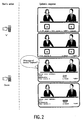
- Figure 2 shows an event sequence diagram showing how the user would activate the application and answer a question in a multiple choice (MC) general knowledge quiz, in which the potential answers are colour-coded and mapped onto the remote control menu keys. This has the following steps:
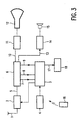
- Figure 3 shows in block schematic form an embodiment of a television receiver suitable for use in the system shown in Figure 1 for enabling the participation in interactive game shows.
- an aerial 1 is connected to the input of the front end 2 of a television receiver, the front end performing the usual RF amplification, demodulation, and detection functions as is well known in the television art.
- the front end operates under the control of a micro processor and teletext acquisition circuit 3 which receives, from an infra red receiver 4, signals which represent the pressing of keys on a remote control unit 16.
- the demodulated video signal is passed over a path 5 to a T.V. processor 6. This provides the usual video signal processing to allow colour decoding, the generation of synchronising pulses, etc.
- a combined video and blanking signal is supplied over a line 7 to the micro controller and teletext acquisition circuit 3 as are synchronising pulses over a line 8.
- the micro controller and teletext acquisition circuit 3 provides an output over a line 9 which is an RGB signal which is fed to the television processor 6.
- the RGB signals are fed via a line 10 from the T.V. processor 6 to video amplifiers 11 and thence to a display device 12, while audio output signals are fed via a line 13 to audio amplifiers 14 and to a loudspeaker 15.
- the micro processor 3 is further connected over path 17 to a telephone interface 18 by means of which transmission to the television studio may be effected.
- the telephone interface 18 may include an autodialler which is controlled by the micro processor 3 which may either store telephone numbers entered by the viewer using the remote control unit or may receive via the auxiliary data channel the number of the programme provider's terminal.
- the telephone interface 18 may also include a normal telephone handset to enable the viewer to answer questions verbally once the telephone connection has been established. Alternatively the viewer may continue to answer the questions using the remote control unit buttons. In that case the microprocessor 3 will determine which button has been pressed and consequently which of the multiple choice answers has been selected. It will then signal via the telephone interface 18 the answer selected by the viewer to the programme supplier. This may be achieved using the standard multi frequency codes used for dialling. Using these codes will also allow easy signalling of numeric answers if they are used instead of multiple choice answers.
- the aerial 1, front end 2, microprocessor and teletext acquisition circuit 3, infra red receiver 4, T.V. processor 6, and telephone interface 18 could be incorporated in a "set-top” decoder box which feeds a RGB signals and audio signals to the video amplifiers 11 and audio amplifier 14 respectively.
- "Set-top” decoder boxes are known for use with satellite television signals where the transmission standard may be different from the standard for which the television receiver was designed.
- the partition of functions between the "set top” decoder box and receiver may vary and, in particular, the "set-top” decoder box may decode the received signal to produce RGB and audio signals or may re-encode then to PAL, SECAM or NTSC standards. In the latter case it may feed a combined video and blanking signal (CVBS) into the TV processor 6 or may remodulate the CVBS signal into a spare terrestrial channel and feed that signal to the front end 2 of the television receiver via an aerial socket.
- CVBS combined video and blanking signal
- Decoder boxes may also or alternatively include means for decoding one or more of the proposed digital television signals or be used in Cable Television Systems including access and payment control systems. In that case they may also include smart card readers and decryption circuitry. Such decoders are in themselves well known to persons skilled in the art.
- Such a decoder box may also be used in Cable Television Systems to include the means for selecting the particular channel to be viewed and possibly de-scrambling circuitry to allow access to pay per view programmes. It may also include means for communication with the programme provider over a return path in the cable network.
- FIG 4 shows in greater detail the micro controller and teletext processing circuit 3 shown in Figure 3.
- the arrangement has an input 100 which is fed to a data slicer 101.
- the input 100 receives the combined video and blanking signal (CVBS) which is present on line 7.
- the data slicer feeds a teletext acquisition circuit 102 which acquires and decodes the teletext transmissions.
- a micro controller 103 receives, via input/output ports 104 over an I 2 C Bus 105, control information from a remote control unit by means of which the viewer can select a programme to be viewed and/or other facilities such as teletext and on screen displays.
- the micro processor 103 puts out instructions over a bus 106 via an interface 107 to the teletext acquisition circuits 102 which causes it to acquire a selected page.
- a selected page is fed into a page memory 108.
- a read only memory 109 Also attached to the bus 106 is a read only memory 109, a random access memory 110, timer counter circuits 112, analogue to digital converters 113, pulse width modulators 114, and a tuning pulse width modulator 115. These are all connected to the other circuits within the television receiver through the input/output ports 104.
- the micro controller 103 is also connected via the bus 106 and interface circuit 107 to the page RAM 108 and to a teletext character generator 116.
- the character generator 116 also receives timing pulses from a display timing generator 117 which is fed via input 118 and 119 with the vertical and horizontal synchronising pulses.
- the character generator 116 produces an RGB output at 120 which is fed over the line 9 to the T.V. processing circuits for amplification and application to the display device.
- the micro controller 103 also receives clock pulses from a clock generator 121
- the telephone interface 18 is connected via the I 2 C bus to the microprocessor 103 which generates the appropriate signals for passing live participation requests to the studio and also to pass the answers to subsequent questions decoded from the key depressions on the remote control unit.
- the microprocessor passes the accumulated score to the broadcaster through the telephone interface either when live participation in the final stages is invited and accepted or at the end of the show for those who are not live participants.
- the question answers i.e. the multiple choices and correct choice, and the allocated marks for the question are transmitted as a teletext page by the broadcaster and detected and decoded by the teletext acquisition circuit 102 and stored in the RAM 110.
- the microprocessor will process this information and cause the multiple choice answers to be displayed (but not, of course, the correct choice) and optionally the marks available.
- the microprocessor 103 causes this to be compared with the correct answer stored in the RAM 110 and allocates marks depending on the correctness of the answer.
- the score is stored in the RAM 110 and updated as each question is asked and answered.
- the multiple choice answerers may be transmitted before the question is asked and enabled by a signal transmitted as the question is being asked.
- the viewer may be given a fixed time interval to answer the questions, which interval can be controlled by the micro processor, but when competing with a studio contestant this is not normally satisfactory. Consequently, it is desirable for the broadcaster to transmit an inhibit signal, in this example using teletext data transmission, which is detected by the teletext decoder and passed to the microprocessor which then inhibits action on the remote control key depressions and indicates on the screen that answers are too late.
- the broadcaster invites those viewers having a qualifying score to participate live by sending a teletext page specifying the qualifying score and containing the invitation.
- the teletext decoder passes this to the microprocessor which causes the invitation to be displayed to the viewer.
- the microprocessor first compares the qualifying score with that of the viewer stored in the RAM 110 and only displays the invitation if the qualifying score has been reached.
- the micro processor to inhibit requests by the viewer if the qualifying score has not been reached but this is less satisfactory as the viewer may think there is a fault and repeatedly try to enter such requests leading to frustration.
- auxiliary data is transmitted as teletext data this is not essential to the invention but enables currently available technology and facilities commonly available in conventional television receivers to be utilised.
- Any auxiliary channel could be used provided that it has sufficient security, i.e. it is not easy for the viewer to extract the transmitted correct answers or to disable the inhibit signal. It is preferable that the auxiliary data channel lies within the standard television channel in order to keep the receiver complexity as low as possible.
- the game could be arranged so that numeric answers are required.
- the number keys on the remote control unit could be used for entering the answers.
- An alternative input device could be a touch sensitive screen where the viewer touched the portion of the screen where the potential answer was shown.
Landscapes
- Engineering & Computer Science (AREA)
- Multimedia (AREA)
- Signal Processing (AREA)
- Theoretical Computer Science (AREA)
- Two-Way Televisions, Distribution Of Moving Picture Or The Like (AREA)
Abstract
Description
Claims (17)
- A method of enabling viewers to take part in a television quiz show with studio participants using an interactive television system, the method comprising the steps of;i) transmitting (TTA) live and receiving in a television signal receiving apparatus (TRA) a quiz show in which questions are asked of studio participants,ii) transmitting (TTA) and receiving in the receiving apparatus (TRA) answers to the questions at an appropriate time in the programme;iii) transmitting (TTA) and receiving in the receiving apparatus (TRA) a signal which determines the time during which viewers are allowed to answer the questions;iv) allocating scores to the questions;v) accumulating within the receiving apparatus the scores of the correctly answered questions;vi) at a given time during the quiz show inviting viewers who have accumulated a qualifying score to take part live in the quiz show with the studio participants;vii) providing each of the invited viewers with a communication link (TRT, TPA, TI) to the studio (TTA) to enable live participation; andviii) receiving at the studio (TTA) answers in real time from the invited viewers for the remainder of the quiz show; andix) accumulating the scores of both the invited viewers and the studio participants to determine the winner(s).
- A method as claimed in Claim 1 in which the communication link (TPA) comprises a line in a public telephone network (PSTN).
- A method as claimed in Claim 1 in which the communication link (TPA) comprises a return channel in a cable television network.
- A method as claimed in any of Claims 1 to 3 in which the qualifying score is progressively reduced until sufficient viewer participants are obtained.
- A method as claimed in any of Claims 1 to 4 in which an inhibit signal is transmitted (TTA) for each question, which inhibit signal determines the end of the time during which the viewer is allowed to answer the question.
- A method as claimed in any preceding claim in which multiple choice answers are transmitted to the viewers.
- A method as claimed in any preceding claim in which scores allocated to each question are transmitted (TTA) to enable total scores to be accumulated.
- A television receiver for use in an interactive television system enabling viewers to take part in a television quiz show with studio participants, the receiver comprising:means (1,2) for receiving a television signal representing a quiz show in which questions are asked of studio participants;means (2,3) for receiving via an auxiliary data channel answers to each question posed in the quiz show,means for receiving a signal which determines the time during which viewers are allowed to answer the questions;means (16,4) for enabling the viewer to answer each question posed;means (3) for comparing the viewer's answer with the correct answer and allocating a score for that answer on the basis of the result of the comparison;means for accumulating the scores for each of the questions;means (1,2) for receiving a signal inviting viewers whose accumulated scores at least reach a given value to participate live in the remainder of the quiz show; andmeans (3,18) for requesting participation in the rest of the show via a provided communication link to the studio if the accumulated score reaches the given value.
- A television receiver as claimed in Claim 8 arranged to receive multiple choice answers to the questions posed together with an indication of the correct answer, the receiver comprising means (11,12) for displaying the multiple choice answers, means (16,4) for enabling the viewer to select one of the multiple choice answers, and means (3) for comparing the selected answer with the correct answer.
- A television receiver as claimed in Claim 8 or Claim 9 wherein said means for receiving a signal which determines the time during which viewers are allowed to answer the questions comprises means for receiving an inhibit signal and means for preventing the viewer from entering an answer after receipt of the inhibit signal.
- A television receiver as claimed in any of Claims 8 to 10 wherein the auxiliary data channel is a teletext data channel and the answers are encoded and transmitted in one or more teletext data packets, the television receiver comprising a teletext decoder (3) and means for storing the correct answer for comparison with the viewers answer.
- A television receiver as claimed in Claim 11 in which the inhibit signal is transmitted in a teletext packet.
- A television receiver as claimed in any of Claims 8 to 12 in which the means for enabling the viewer to answer the questions comprises a remote control unit (16).
- A decoder for use in an interactive television system enabling viewers to take part in a television quiz show with studio participants, the decoder comprising:means (1,2) for receiving and decoding a television signal representing a quiz show in which questions are asked of studio participants;means (2,3) for receiving via an auxiliary data channel and decoding answers to each question posed in the quiz show,means for receiving a signal which determines the time during which viewers are allowed to answer questions;means (16,4) for enabling the viewer to answer each question posed;means (3) for comparing the viewer's answer with the correct answer and allocating a score for that answer on the basis of the result of the comparison;means for accumulating the scores for each of the questions;means (1,2) for receiving a signal inviting viewers whose accumulated scores at least reach a given value to participate live in the remainder of the quiz show; andmeans (3,18) for requesting participation in the rest of the show via a provided communication link to the studio if the accumulated score reaches the given value.
- A decoder as claimed in claim 14 arranged to receive multiple choice answers to the questions posed together with an indication of the correct answer, the decoder comprising means (16) for enabling the viewer to select one of the multiple choice answers, and means for comparing (3) the selected answer with the correct answer.
- A decoder as claimed in claim 14 or Claim 15 wherein said means for receiving a signal which determines the time during which viewers are allowed to answer the questions comprises means for receiving an inhibit signal and means for preventing the viewer from entering an answer after receipt of the inhibit signal.
- A decoder as claimed in any of Claims 14 to 16 wherein the auxiliary data channel is a teletext data channel and the answers are encoded and transmitted in one or more teletext data packets, the decoder comprising a teletext decoder (3) and means for storing the correct answer for comparison with the viewers answer.
Applications Claiming Priority (3)
| Application Number | Priority Date | Filing Date | Title |
|---|---|---|---|
| GBGB9523869.7A GB9523869D0 (en) | 1995-11-22 | 1995-11-22 | Interactive television |
| GB9523869 | 1995-11-22 | ||
| PCT/IB1996/001255 WO1997019556A1 (en) | 1995-11-22 | 1996-11-19 | Interactive television |
Publications (2)
| Publication Number | Publication Date |
|---|---|
| EP0804856A1 EP0804856A1 (en) | 1997-11-05 |
| EP0804856B1 true EP0804856B1 (en) | 2003-05-14 |
Family
ID=10784266
Family Applications (1)
| Application Number | Title | Priority Date | Filing Date |
|---|---|---|---|
| EP96935287A Expired - Lifetime EP0804856B1 (en) | 1995-11-22 | 1996-11-19 | Interactive television |
Country Status (8)
| Country | Link |
|---|---|
| US (1) | US5936661A (en) |
| EP (1) | EP0804856B1 (en) |
| JP (1) | JP3911295B2 (en) |
| KR (1) | KR100485458B1 (en) |
| CN (1) | CN1149845C (en) |
| DE (1) | DE69628142T2 (en) |
| GB (1) | GB9523869D0 (en) |
| WO (1) | WO1997019556A1 (en) |
Cited By (2)
| Publication number | Priority date | Publication date | Assignee | Title |
|---|---|---|---|---|
| DE102005032681A1 (en) * | 2005-07-13 | 2007-01-25 | Deutsche Telekom Ag | Interactive television-conference executing method, involves connecting television subscriber with central server by using remote control to respond to content of program based on option that is provided by user interface |
| WO2007034256A1 (en) * | 2005-09-19 | 2007-03-29 | Farimex S.A. | Interactive tv signal receiver |
Families Citing this family (71)
| Publication number | Priority date | Publication date | Assignee | Title |
|---|---|---|---|---|
| GB2318942A (en) * | 1996-10-30 | 1998-05-06 | Ibm | Accessing data files in a computer network |
| EP1057340A2 (en) * | 1998-05-08 | 2000-12-06 | Koninklijke Philips Electronics N.V. | Interactive television |
| US6799327B1 (en) * | 1998-07-14 | 2004-09-28 | United Video Properties, Inc. | Program guide with selectable advertisements and pseudo-ads |
| GB2339660A (en) * | 1998-07-15 | 2000-02-02 | Adrian Stroud | An interactive digital receiver system |
| NZ336800A (en) | 1998-08-28 | 2000-10-27 | Two Way Tv Ltd | Interactive television system, remote TV receivers polled to transmit game scores to central game controller |
| AU757751B2 (en) * | 1998-09-08 | 2003-03-06 | Obschestvo S Ogranichennoi Otvetstvennostiju "Sivera" | Method for playing a lottery game and system for realising the same |
| US6345389B1 (en) * | 1998-10-21 | 2002-02-05 | Opentv, Inc. | Interactive television system and method for converting non-textual information to textual information by a remote server |
| US6446262B1 (en) * | 1998-10-26 | 2002-09-03 | Two Way Tv Limited | Broadcasting interactive applications |
| GB2344491A (en) * | 1998-12-03 | 2000-06-07 | Red Fig Limited | Browsing the Internet using a mobile telephone |
| NZ500956A (en) * | 1998-12-04 | 2000-08-25 | Two Way Tv Ltd | Interactive TV game system, start signal transmitted to all users simultaneously |
| US7211000B2 (en) * | 1998-12-22 | 2007-05-01 | Intel Corporation | Gaming utilizing actual telemetry data |
| JP2000261781A (en) * | 1999-03-10 | 2000-09-22 | Sony Corp | Two-way transmission / reception system, two-way transmission / reception method, and transmission device |
| AU758059B2 (en) * | 1999-05-04 | 2003-03-13 | Two Way Media Limited | Interactive applications |
| DE10024895A1 (en) * | 2000-05-19 | 2001-11-22 | Thomson Brandt Gmbh | System for operating electronic entertainment equipment has several menus with different numbers and/or types of menu points stored in memory and optionally called up for operation |
| US6565084B1 (en) * | 2000-06-02 | 2003-05-20 | Milestone Entertainment | Games, and methods for improved game play in games of chance and games of skill |
| US10173128B2 (en) | 2000-06-02 | 2019-01-08 | Milestone Entertainment Llc | Games, and methods for improved game play in games of chance and games of skill |
| KR20020006216A (en) * | 2000-07-11 | 2002-01-19 | 정상호 | An advertizing device and a advertizing method using the device |
| US6819669B2 (en) | 2000-07-26 | 2004-11-16 | International Business Machines Corporation | Method and system for data communication |
| WO2002013163A2 (en) * | 2000-08-03 | 2002-02-14 | Lyda Edwin L | Apparatus for remote learning system |
| US7194511B2 (en) * | 2000-08-10 | 2007-03-20 | Digeo, Inc. | System and method to manage participant input for an interactive show |
| US7201653B2 (en) * | 2000-09-07 | 2007-04-10 | Benny Radom | Book of wishes game |
| FR2814630B1 (en) * | 2000-09-22 | 2003-04-18 | Eric Amsellem | INTERACTIVE TELEVISION METHOD AND SYSTEM, AND DEVICE CARRYING OUT SAID METHOD |
| US8727853B2 (en) | 2000-09-27 | 2014-05-20 | Milestone Entertainment, LLC | Methods and apparatus for enhanced play in lottery and gaming environments |
| US6488280B1 (en) * | 2000-09-27 | 2002-12-03 | Milestone Entertainment | Games, and methods and apparatus for game play in games of chance |
| US6811484B2 (en) * | 2001-09-26 | 2004-11-02 | Milestone Entertainment Llc | Games, and methods and apparatus for game play in games of chance |
| US8393946B2 (en) | 2001-09-26 | 2013-03-12 | Milestone Entertainment Llc | Apparatus and method for game play in an electronic environment |
| US7798896B2 (en) | 2000-09-27 | 2010-09-21 | Milestone Entertainment Llc | Apparatus, systems and methods for implementing enhanced gaming and prizing parameters in an electronic environment |
| US20040107138A1 (en) * | 2000-10-12 | 2004-06-03 | Maggio Frank S. | Method and system for verifying immersion in advertising content via an immersion enhancing content vignette |
| US20040103032A1 (en) * | 2000-10-12 | 2004-05-27 | Maggio Frank S. | Remote control system and method for interacting with broadcast content |
| US20050060232A1 (en) * | 2000-10-12 | 2005-03-17 | Maggio Frank S. | Method and system for interacting with a writing |
| US20040015399A1 (en) * | 2000-10-12 | 2004-01-22 | Maggio Frank S. | Method and system for verifying exposure to message content delivered via outdoor media or in a concentrated format |
| CA2425260A1 (en) * | 2000-10-12 | 2002-04-18 | Frank S. Maggio | Method and system for communicating advertising and entertainment content and gathering consumer information |
| US6447396B1 (en) * | 2000-10-17 | 2002-09-10 | Nearlife, Inc. | Method and apparatus for coordinating an interactive computer game with a broadcast television program |
| US7409700B1 (en) | 2000-11-03 | 2008-08-05 | The Walt Disney Company | System and method for enhanced broadcasting and interactive |
| US20020091564A1 (en) * | 2000-11-16 | 2002-07-11 | Uri Geller | Method and system for enabling viewer polling and election of prospective parents in broadcast child adoption proceedings |
| JP4765182B2 (en) * | 2001-01-19 | 2011-09-07 | ソニー株式会社 | Interactive television communication method and interactive television communication client device |
| US20020162117A1 (en) * | 2001-04-26 | 2002-10-31 | Martin Pearson | System and method for broadcast-synchronized interactive content interrelated to broadcast content |
| JP4091752B2 (en) * | 2001-05-31 | 2008-05-28 | 株式会社エヌ・ティ・ティ・ドコモ | Program participation restriction method and server |
| US7153211B2 (en) * | 2001-07-10 | 2006-12-26 | Bect Power, Inc. | Method and system to optimize group achievement employing group members' collective intelligence |
| WO2003019965A1 (en) * | 2001-08-24 | 2003-03-06 | Kabushiki Kaisha Eighting | Method for delivering information to cellular terminal and information delivery server |
| US9626837B2 (en) | 2001-09-26 | 2017-04-18 | Milestone Entertainment Llc | System for game play in an electronic environment |
| CN1218574C (en) * | 2001-10-15 | 2005-09-07 | 华为技术有限公司 | Interactive video equipment and its caption superposition method |
| EP1364689A1 (en) * | 2002-02-22 | 2003-11-26 | Aluryina International Corporation | Set-top-box |
| US20030196206A1 (en) * | 2002-04-15 | 2003-10-16 | Shusman Chad W. | Method and apparatus for internet-based interactive programming |
| US20040210947A1 (en) | 2003-04-15 | 2004-10-21 | Shusman Chad W. | Method and apparatus for interactive video on demand |
| WO2003096668A2 (en) * | 2002-05-10 | 2003-11-20 | Maggio Frank S | Method and system for verifying exposure to message content and collecting a printed verification response |
| AU2003239385A1 (en) | 2002-05-10 | 2003-11-11 | Richard R. Reisman | Method and apparatus for browsing using multiple coordinated device |
| WO2004012065A2 (en) * | 2002-07-31 | 2004-02-05 | Bluestreak Technology Inc. | System and method for providing real-time ticker information |
| US20040244031A1 (en) * | 2003-02-26 | 2004-12-02 | Peter Martinez | System and method for a network of interactive televisions |
| US20040171425A1 (en) * | 2003-02-28 | 2004-09-02 | Jack Misraje | Pre-existing knowledge and internet-based research game show |
| WO2004099928A2 (en) * | 2003-05-02 | 2004-11-18 | Maggio Frank S | Method and system for verifying exposure to message content delivered via subscription networks |
| KR100949483B1 (en) * | 2003-06-29 | 2010-03-24 | 엔디에스 리미티드 | Interactive inter-channel games |
| US7415711B2 (en) * | 2003-08-01 | 2008-08-19 | Microsoft Corporation | System and method for a transport independent gaming API for mobile devices |
| US20050114891A1 (en) * | 2003-11-20 | 2005-05-26 | Reidar Wasenius | Method of controlling a TV apparatus |
| US9773373B2 (en) | 2004-09-01 | 2017-09-26 | Milestone Entertainment Llc | Systems for implementing enhanced gaming and prizing parameters in an electronic environment |
| US11875642B2 (en) | 2004-09-01 | 2024-01-16 | Milestone Entertainment, LLC | Systems for implementing enhanced gaming and prizing parameters in an electronic environment |
| EP1675398B1 (en) * | 2004-12-22 | 2015-09-23 | Alcatel Lucent | Interactive video communication system with chat |
| EP1675397A1 (en) * | 2004-12-22 | 2006-06-28 | Alcatel | Interactive video communication system with chat |
| US20060183549A1 (en) * | 2005-02-17 | 2006-08-17 | Chow Timothy Y | Codeword matching game using a mass media network |
| US20060271437A1 (en) * | 2005-05-26 | 2006-11-30 | Maggio Frank S | System and method for home product delivery |
| US8037506B2 (en) * | 2006-03-03 | 2011-10-11 | Verimatrix, Inc. | Movie studio-based network distribution system and method |
| US20070290878A1 (en) * | 2006-04-07 | 2007-12-20 | Media Ip Holdings, Llc | System and method for interacting with automobile race and advertising content |
| US9508225B2 (en) | 2006-10-11 | 2016-11-29 | Milestone Entertainment Llc | Methods and apparatus for enhanced interactive game play in lottery and gaming environments |
| US8241100B2 (en) | 2006-10-11 | 2012-08-14 | Milestone Entertainment Llc | Methods and apparatus for enhanced interactive game play in lottery and gaming environments |
| US20090049128A1 (en) * | 2007-08-17 | 2009-02-19 | Sony Computer Entertainment America Inc. | Schemes for game chat routing and taunt control |
| US8535134B2 (en) | 2008-01-28 | 2013-09-17 | Milestone Entertainment Llc | Method and system for electronic interaction in a multi-player gaming system |
| US20090259531A1 (en) * | 2008-04-11 | 2009-10-15 | Yahoo! Inc. | Interactive advertisements |
| US8359616B2 (en) | 2009-09-30 | 2013-01-22 | United Video Properties, Inc. | Systems and methods for automatically generating advertisements using a media guidance application |
| US8313368B2 (en) | 2010-02-19 | 2012-11-20 | Igt | Gaming systems, gaming devices and methods with non-competitive play and optional competitive play |
| GB2486744A (en) * | 2010-12-24 | 2012-06-27 | Starbucks Hk Ltd | Multimedia system with separately transmitted supplementary data overlaid onto broadcast video stream based on user input |
| KR102222370B1 (en) | 2013-12-27 | 2021-03-03 | 주식회사 알티캐스트 | System and method of servicing invitation of a game |
Family Cites Families (10)
| Publication number | Priority date | Publication date | Assignee | Title |
|---|---|---|---|---|
| US4592546A (en) * | 1984-04-26 | 1986-06-03 | David B. Lockton | Game of skill playable by remote participants in conjunction with a live event |
| US5108115A (en) * | 1989-12-07 | 1992-04-28 | Robert Berman | Interactive game show and method for achieving interactive communication therewith |
| US5734413A (en) * | 1991-11-20 | 1998-03-31 | Thomson Multimedia S.A. | Transaction based interactive television system |
| US5519433A (en) * | 1991-11-20 | 1996-05-21 | Zing Systems, L.P. | Interactive television security through transaction time stamping |
| US5343239A (en) * | 1991-11-20 | 1994-08-30 | Zing Systems, L.P. | Transaction based interactive television system |
| AU5014493A (en) * | 1992-08-14 | 1994-03-15 | Dtmf Television, Inc. | A participatory television system |
| IL119874A (en) * | 1993-04-16 | 1999-05-09 | News Datacom Research Ltd | Methods and systems for non program applications for subscriber television |
| JPH0723356A (en) * | 1993-06-30 | 1995-01-24 | Hitachi Ltd | Interactive television broadcasting system |
| JPH0775076A (en) * | 1993-09-01 | 1995-03-17 | Sega Enterp Ltd | Interactive video method and apparatus |
| IT1271639B (en) * | 1994-05-06 | 1997-06-04 | Italtel Spa | INTERACTIVE TELEVISION SYSTEM |
-
1995
- 1995-11-22 GB GBGB9523869.7A patent/GB9523869D0/en active Pending
-
1996
- 1996-11-19 CN CNB961925183A patent/CN1149845C/en not_active Expired - Fee Related
- 1996-11-19 EP EP96935287A patent/EP0804856B1/en not_active Expired - Lifetime
- 1996-11-19 KR KR1019970704970A patent/KR100485458B1/en not_active Expired - Fee Related
- 1996-11-19 JP JP51955597A patent/JP3911295B2/en not_active Expired - Fee Related
- 1996-11-19 US US08/752,365 patent/US5936661A/en not_active Expired - Lifetime
- 1996-11-19 DE DE69628142T patent/DE69628142T2/en not_active Expired - Lifetime
- 1996-11-19 WO PCT/IB1996/001255 patent/WO1997019556A1/en not_active Ceased
Cited By (2)
| Publication number | Priority date | Publication date | Assignee | Title |
|---|---|---|---|---|
| DE102005032681A1 (en) * | 2005-07-13 | 2007-01-25 | Deutsche Telekom Ag | Interactive television-conference executing method, involves connecting television subscriber with central server by using remote control to respond to content of program based on option that is provided by user interface |
| WO2007034256A1 (en) * | 2005-09-19 | 2007-03-29 | Farimex S.A. | Interactive tv signal receiver |
Also Published As
| Publication number | Publication date |
|---|---|
| DE69628142D1 (en) | 2003-06-18 |
| DE69628142T2 (en) | 2004-01-08 |
| US5936661A (en) | 1999-08-10 |
| KR100485458B1 (en) | 2005-09-02 |
| CN1178622A (en) | 1998-04-08 |
| JPH11502089A (en) | 1999-02-16 |
| EP0804856A1 (en) | 1997-11-05 |
| KR19980701578A (en) | 1998-05-15 |
| GB9523869D0 (en) | 1996-01-24 |
| WO1997019556A1 (en) | 1997-05-29 |
| JP3911295B2 (en) | 2007-05-09 |
| CN1149845C (en) | 2004-05-12 |
Similar Documents
| Publication | Publication Date | Title |
|---|---|---|
| EP0804856B1 (en) | Interactive television | |
| US6681393B1 (en) | Viewer interaction feedback method and system for use with an interactive telecommunication system | |
| US5716273A (en) | Apparatus and method for controlling educational and amusement use of a television | |
| EP0746941B1 (en) | Interactive television security through transaction time stamping | |
| EP0740884B1 (en) | Transaction based interactive system | |
| US5539822A (en) | System and method for subscriber interactivity in a television system | |
| US5537143A (en) | Interactive communication system | |
| US9511287B2 (en) | Cellular phone games based upon television archives | |
| WO1998007485A2 (en) | Interactive broadcasting systems | |
| RU2213993C2 (en) | Method and device for checking show quiz answers | |
| JPH09163343A (en) | Interactive broadcasting system | |
| IL121021A (en) | User interaction feedback system | |
| GB2376420A (en) | Interactive game system | |
| NL1018339C2 (en) | Interactive television quiz system allows users to answers via control unit plugged into aerial socket. Players getting all questions right are given code number to use via phone to claim prize | |
| JP2002503934A (en) | Method and apparatus for establishing contact between selected TV viewers and established game programs based on a telecommunications network | |
| MXPA00008136A (en) | Method and device for establishing contact, based on the telecommunications network, between a selection of tv-viewers and an established game program | |
| IL161065A (en) | User interaction feedback system | |
| PL190539B1 (en) | Method of and apparatus for establishing communication between a selected group of television spectators and an operative game programme through a telecommunication network |
Legal Events
| Date | Code | Title | Description |
|---|---|---|---|
| PUAI | Public reference made under article 153(3) epc to a published international application that has entered the european phase |
Free format text: ORIGINAL CODE: 0009012 |
|
| AK | Designated contracting states |
Kind code of ref document: A1 Designated state(s): DE FR GB IT |
|
| 17P | Request for examination filed |
Effective date: 19971201 |
|
| 17Q | First examination report despatched |
Effective date: 19990824 |
|
| GRAH | Despatch of communication of intention to grant a patent |
Free format text: ORIGINAL CODE: EPIDOS IGRA |
|
| GRAH | Despatch of communication of intention to grant a patent |
Free format text: ORIGINAL CODE: EPIDOS IGRA |
|
| GRAA | (expected) grant |
Free format text: ORIGINAL CODE: 0009210 |
|
| AK | Designated contracting states |
Designated state(s): DE FR GB IT |
|
| REG | Reference to a national code |
Ref country code: GB Ref legal event code: FG4D |
|
| RIC1 | Information provided on ipc code assigned before grant |
Ipc: 7A 63F 3/04 B Ipc: 7H 04N 7/173 A |
|
| REF | Corresponds to: |
Ref document number: 69628142 Country of ref document: DE Date of ref document: 20030618 Kind code of ref document: P |
|
| ET | Fr: translation filed | ||
| PLBE | No opposition filed within time limit |
Free format text: ORIGINAL CODE: 0009261 |
|
| STAA | Information on the status of an ep patent application or granted ep patent |
Free format text: STATUS: NO OPPOSITION FILED WITHIN TIME LIMIT |
|
| 26N | No opposition filed |
Effective date: 20040217 |
|
| PGFP | Annual fee paid to national office [announced via postgrant information from national office to epo] |
Ref country code: IT Payment date: 20121122 Year of fee payment: 17 Ref country code: GB Payment date: 20121130 Year of fee payment: 17 |
|
| PGFP | Annual fee paid to national office [announced via postgrant information from national office to epo] |
Ref country code: FR Payment date: 20121219 Year of fee payment: 17 |
|
| PGFP | Annual fee paid to national office [announced via postgrant information from national office to epo] |
Ref country code: DE Payment date: 20130131 Year of fee payment: 17 |
|
| REG | Reference to a national code |
Ref country code: DE Ref legal event code: R082 Ref document number: 69628142 Country of ref document: DE Representative=s name: MEYER, MICHAEL, DIPL.-ING., DE |
|
| REG | Reference to a national code |
Ref country code: DE Ref legal event code: R082 Ref document number: 69628142 Country of ref document: DE Representative=s name: MEYER, MICHAEL, DIPL.-ING., DE Effective date: 20140331 Ref country code: DE Ref legal event code: R081 Ref document number: 69628142 Country of ref document: DE Owner name: KONINKLIJKE PHILIPS N.V., NL Free format text: FORMER OWNER: KONINKLIJKE PHILIPS ELECTRONICS N.V., EINDHOVEN, NL Effective date: 20140331 |
|
| GBPC | Gb: european patent ceased through non-payment of renewal fee |
Effective date: 20131119 |
|
| REG | Reference to a national code |
Ref country code: FR Ref legal event code: ST Effective date: 20140731 |
|
| PG25 | Lapsed in a contracting state [announced via postgrant information from national office to epo] |
Ref country code: DE Free format text: LAPSE BECAUSE OF NON-PAYMENT OF DUE FEES Effective date: 20140603 Ref country code: IT Free format text: LAPSE BECAUSE OF NON-PAYMENT OF DUE FEES Effective date: 20131119 |
|
| REG | Reference to a national code |
Ref country code: DE Ref legal event code: R119 Ref document number: 69628142 Country of ref document: DE Effective date: 20140603 |
|
| PG25 | Lapsed in a contracting state [announced via postgrant information from national office to epo] |
Ref country code: GB Free format text: LAPSE BECAUSE OF NON-PAYMENT OF DUE FEES Effective date: 20131119 Ref country code: FR Free format text: LAPSE BECAUSE OF NON-PAYMENT OF DUE FEES Effective date: 20131202 |