EP0804689B1 - Spannvorrichtung für befestigungselemente und verfahren zum spannen eines befestigungselementes - Google Patents
Spannvorrichtung für befestigungselemente und verfahren zum spannen eines befestigungselementesInfo
- Publication number
- EP0804689B1 EP0804689B1 EP95901466A EP95901466A EP0804689B1 EP 0804689 B1 EP0804689 B1 EP 0804689B1 EP 95901466 A EP95901466 A EP 95901466A EP 95901466 A EP95901466 A EP 95901466A EP 0804689 B1 EP0804689 B1 EP 0804689B1
- Authority
- EP
- European Patent Office
- Prior art keywords
- shape
- memory metal
- fastening element
- tensioning
- piece
- Prior art date
- Legal status (The legal status is an assumption and is not a legal conclusion. Google has not performed a legal analysis and makes no representation as to the accuracy of the status listed.)
- Expired - Lifetime
Links
- 238000000034 method Methods 0.000 title claims description 7
- 229910052751 metal Inorganic materials 0.000 claims abstract description 80
- 239000002184 metal Substances 0.000 claims abstract description 80
- 230000009466 transformation Effects 0.000 claims abstract description 24
- 238000010438 heat treatment Methods 0.000 claims description 15
- 230000008859 change Effects 0.000 claims description 14
- 230000000694 effects Effects 0.000 claims description 12
- 238000001816 cooling Methods 0.000 claims description 4
- 230000001131 transforming effect Effects 0.000 claims 1
- 229910000831 Steel Inorganic materials 0.000 description 6
- 150000002739 metals Chemical class 0.000 description 6
- 239000010959 steel Substances 0.000 description 6
- 238000006243 chemical reaction Methods 0.000 description 3
- 229910000734 martensite Inorganic materials 0.000 description 3
- 229910001092 metal group alloy Inorganic materials 0.000 description 3
- 230000008878 coupling Effects 0.000 description 2
- 238000010168 coupling process Methods 0.000 description 2
- 238000005859 coupling reaction Methods 0.000 description 2
- 230000002441 reversible effect Effects 0.000 description 2
- 230000007704 transition Effects 0.000 description 2
- 230000001960 triggered effect Effects 0.000 description 2
- CURLTUGMZLYLDI-UHFFFAOYSA-N Carbon dioxide Chemical compound O=C=O CURLTUGMZLYLDI-UHFFFAOYSA-N 0.000 description 1
- 239000000654 additive Substances 0.000 description 1
- 230000008901 benefit Effects 0.000 description 1
- 230000005540 biological transmission Effects 0.000 description 1
- 235000011089 carbon dioxide Nutrition 0.000 description 1
- 239000013078 crystal Substances 0.000 description 1
- 230000005611 electricity Effects 0.000 description 1
- 238000003780 insertion Methods 0.000 description 1
- 230000037431 insertion Effects 0.000 description 1
- 230000002427 irreversible effect Effects 0.000 description 1
- 229910001000 nickel titanium Inorganic materials 0.000 description 1
- 230000002093 peripheral effect Effects 0.000 description 1
- 238000011084 recovery Methods 0.000 description 1
- 230000000717 retained effect Effects 0.000 description 1
- 230000035939 shock Effects 0.000 description 1
Images

Classifications
-
- B—PERFORMING OPERATIONS; TRANSPORTING
- B23—MACHINE TOOLS; METAL-WORKING NOT OTHERWISE PROVIDED FOR
- B23P—METAL-WORKING NOT OTHERWISE PROVIDED FOR; COMBINED OPERATIONS; UNIVERSAL MACHINE TOOLS
- B23P19/00—Machines for simply fitting together or separating metal parts or objects, or metal and non-metal parts, whether or not involving some deformation; Tools or devices therefor so far as not provided for in other classes
- B23P19/04—Machines for simply fitting together or separating metal parts or objects, or metal and non-metal parts, whether or not involving some deformation; Tools or devices therefor so far as not provided for in other classes for assembling or disassembling parts
- B23P19/06—Screw or nut setting or loosening machines
- B23P19/067—Bolt tensioners
- B23P19/068—Bolt tensioners by using heating means
-
- B—PERFORMING OPERATIONS; TRANSPORTING
- B25—HAND TOOLS; PORTABLE POWER-DRIVEN TOOLS; MANIPULATORS
- B25B—TOOLS OR BENCH DEVICES NOT OTHERWISE PROVIDED FOR, FOR FASTENING, CONNECTING, DISENGAGING OR HOLDING
- B25B29/00—Accessories
- B25B29/02—Bolt tensioners
-
- F—MECHANICAL ENGINEERING; LIGHTING; HEATING; WEAPONS; BLASTING
- F16—ENGINEERING ELEMENTS AND UNITS; GENERAL MEASURES FOR PRODUCING AND MAINTAINING EFFECTIVE FUNCTIONING OF MACHINES OR INSTALLATIONS; THERMAL INSULATION IN GENERAL
- F16B—DEVICES FOR FASTENING OR SECURING CONSTRUCTIONAL ELEMENTS OR MACHINE PARTS TOGETHER, e.g. NAILS, BOLTS, CIRCLIPS, CLAMPS, CLIPS OR WEDGES; JOINTS OR JOINTING
- F16B31/00—Screwed connections specially modified in view of tensile load; Break-bolts
- F16B31/04—Screwed connections specially modified in view of tensile load; Break-bolts for maintaining a tensile load
- F16B31/043—Prestressed connections tensioned by means of liquid, grease, rubber, explosive charge, or the like
-
- F—MECHANICAL ENGINEERING; LIGHTING; HEATING; WEAPONS; BLASTING
- F16—ENGINEERING ELEMENTS AND UNITS; GENERAL MEASURES FOR PRODUCING AND MAINTAINING EFFECTIVE FUNCTIONING OF MACHINES OR INSTALLATIONS; THERMAL INSULATION IN GENERAL
- F16B—DEVICES FOR FASTENING OR SECURING CONSTRUCTIONAL ELEMENTS OR MACHINE PARTS TOGETHER, e.g. NAILS, BOLTS, CIRCLIPS, CLAMPS, CLIPS OR WEDGES; JOINTS OR JOINTING
- F16B2200/00—Constructional details of connections not covered for in other groups of this subclass
- F16B2200/77—Use of a shape-memory material
-
- Y—GENERAL TAGGING OF NEW TECHNOLOGICAL DEVELOPMENTS; GENERAL TAGGING OF CROSS-SECTIONAL TECHNOLOGIES SPANNING OVER SEVERAL SECTIONS OF THE IPC; TECHNICAL SUBJECTS COVERED BY FORMER USPC CROSS-REFERENCE ART COLLECTIONS [XRACs] AND DIGESTS
- Y10—TECHNICAL SUBJECTS COVERED BY FORMER USPC
- Y10S—TECHNICAL SUBJECTS COVERED BY FORMER USPC CROSS-REFERENCE ART COLLECTIONS [XRACs] AND DIGESTS
- Y10S411/00—Expanded, threaded, driven, headed, tool-deformed, or locked-threaded fastener
- Y10S411/909—Fastener or fastener element composed of thermo-responsive memory material
-
- Y—GENERAL TAGGING OF NEW TECHNOLOGICAL DEVELOPMENTS; GENERAL TAGGING OF CROSS-SECTIONAL TECHNOLOGIES SPANNING OVER SEVERAL SECTIONS OF THE IPC; TECHNICAL SUBJECTS COVERED BY FORMER USPC CROSS-REFERENCE ART COLLECTIONS [XRACs] AND DIGESTS
- Y10—TECHNICAL SUBJECTS COVERED BY FORMER USPC
- Y10S—TECHNICAL SUBJECTS COVERED BY FORMER USPC CROSS-REFERENCE ART COLLECTIONS [XRACs] AND DIGESTS
- Y10S411/00—Expanded, threaded, driven, headed, tool-deformed, or locked-threaded fastener
- Y10S411/916—Bolt having tension feature
-
- Y—GENERAL TAGGING OF NEW TECHNOLOGICAL DEVELOPMENTS; GENERAL TAGGING OF CROSS-SECTIONAL TECHNOLOGIES SPANNING OVER SEVERAL SECTIONS OF THE IPC; TECHNICAL SUBJECTS COVERED BY FORMER USPC CROSS-REFERENCE ART COLLECTIONS [XRACs] AND DIGESTS
- Y10—TECHNICAL SUBJECTS COVERED BY FORMER USPC
- Y10S—TECHNICAL SUBJECTS COVERED BY FORMER USPC CROSS-REFERENCE ART COLLECTIONS [XRACs] AND DIGESTS
- Y10S411/00—Expanded, threaded, driven, headed, tool-deformed, or locked-threaded fastener
- Y10S411/917—Nut having tension feature
-
- Y—GENERAL TAGGING OF NEW TECHNOLOGICAL DEVELOPMENTS; GENERAL TAGGING OF CROSS-SECTIONAL TECHNOLOGIES SPANNING OVER SEVERAL SECTIONS OF THE IPC; TECHNICAL SUBJECTS COVERED BY FORMER USPC CROSS-REFERENCE ART COLLECTIONS [XRACs] AND DIGESTS
- Y10—TECHNICAL SUBJECTS COVERED BY FORMER USPC
- Y10T—TECHNICAL SUBJECTS COVERED BY FORMER US CLASSIFICATION
- Y10T29/00—Metal working
- Y10T29/49—Method of mechanical manufacture
- Y10T29/49826—Assembling or joining
- Y10T29/49863—Assembling or joining with prestressing of part
- Y10T29/49865—Assembling or joining with prestressing of part by temperature differential [e.g., shrink fit]
Definitions
- the invention relates to a pre-tensioning device for a screw or the like fastening element, which is used in engineering particularly when the purpose is to pre-tension large screws during an assembling operation.
- the pre-tensioning is carried out by stretching the screw using a certain pre-calculated force before a nut is screwed tight.
- some pre-tensioning tools have been developed, of which for instance hydraulic pre-tensioning devices can be mentioned, one example being Swedish publication 7701049-4, where a screw is stretched by means of hydraulic pressure and thereafter the nut is screwed down. After removing the pressure, the coupling will be tightened and the desired pre-stress will remain in the screw.
- the streching takes place at the end of the screw to be stretched, but often also a piston-like part is placed in a hole bored inside the screw, and hydraulic pressure can be exerted on one end of the piston-like part.
- the stretching force will be directed by the contribution of the piston directly to the screw ends, between which the pre-tensioning elongation will thus be present.
- German publication DE-OS 3733243 is used a piston element which is placed within a hole bored inside a screw and which can also be heated.
- a steel rod placed within a screw is used, being heatable for instance with electric current, whereby the rod will stretch the screw to be pre-tensioned through the thermal expansion caused by the heat introduced therein. All above-mentioned methods require complicated devices and tools, which often have to be manufactured each for the respective screw size.
- U.S. Patent 5,248,233 discloses a sort of releasing device for a screw coupling, employing a phase change of a shape-memory metal cylinder provided with a heating element to release a segmented nut without causing a shock effect on the structure. This patent shows no pre-tensioning for performing a fastening operation.
- U.S. Patent 4,450,616 comprises a shape-memory metal disc utilizing the properties of the shape-memory metal only for ensuring the tightness of a nut or a screw.
- the device according to the invention is based on the use of shape-memory metals known as such.
- the invention is based on a phase transformation occurring in the crystal structure of the shape-memory metal, effected by temperature.
- the phenomenon is called martensitic reaction.
- the shapes and volumes of pieces made of shape-memory metal alloys are recovered exactly to correspond to the original status at a relatively low temperature on heating after a deformation caused by an external force. The recovery is complete typically still after a deformation of 4-8%.
- the martensitic reaction starts and takes place in a quite narrow transition temperature range of typically ca. 20°C (range A s to A f ), which can usually be fitted in a desired area within the temperature range of -30...+100°C. On certain conditions, the martensitic reaction is crystallographically completely reversible.
- shape-memory metals are not based on thermal expansion, but on a phase change in the crystalline structure triggered by a temperature change.
- the transformation takes place quickly once the transformation temperature has been attained. Because of the low transformation temperature, the piece to be heated does not require large amounts of heat.
- the shape-memory metals exist as two main groups, whereof one shows a one-way shape-memory effect and the other a two-way effect. Those shape-memory metals based on the one-way shape-memory effect, the deformation triggered by a predetermined transformation temperature is irreversible. In the case of the two-way shape-memory effect, the deformation is reversible as the piece is being cooled below a predetermined temperature (range M s to M f ).
- a shape-memory metal based on the one-way shape-memory effect is designated one-way shape-memory metal
- a shape-memory metal based on the two-way shape-memory effect is designated two-way shape-memory metal
- the temperatures are designated upper transformation temperature (A f ) and respectively lower transformation temperature (M f ).
- a two-way shape-memory metal has the upper transformation temperature typically within the range of 80 to 100°C, and the piece will not recover its original state until the piece cools or is cooled to the lower transformation temperature, which is typically in the range of -20°C to +20°C.
- the above-mentioned cycle can be repeated several times, even to the extent of 10 000 times depending on the deformation and load.
- shape-memory metal alloys can withstand very high stresses without plasticizing and losing their shape-memory characteristics, even 800 to 1000 N/mm 2 , and consequently a piece made of such metal can produce large forces in connection with the deformation.
- the phase change starting within the pre-determined transition temperature range of the so-called shape-memory metal is used as the source of stretching power for a fastening element, this change causing a dimensional change in the shape-memory metal piece.
- the force occurring in association with this dimensional change is used for the stretching of the fastening element.
- the deformation capacity of a two-way shape-memory metal is typically ca. 4%, whereas a pre-stress elongation of for example a steel screw is typically ca. 0.2% of the elongation length.
- the fastening element is understood to mean a fastening element, as a rule of elongate shape, stretchable upon application of a force and tightenable to a fixed relation to parts to be joined by means of a tightening member movable in the longitudinal direction of the fastening element.
- the fastening element is freely expandable at least relative to a first piece to be joined, on which the tightening member abuts, and its movement is limited in the stretching direction relative to the second piece to be joined at least when the tightening member is tightened against the first piece.
- the parts 1a, 1b to be joined together are connected by means of a screw 2 acting as the fastening element.
- the screw is shown engaged through a threading 8 with the lower one 1b of the pieces to be joined together and to pass through the upper piece 1a.
- a tightening member for instance a nut 3
- a locking piece 5 inside which the nut 3 has space to move freely.
- annular sleeve 4 manufactured of a two-way shape-memory metal.
- the locking piece 5 and the sleeve 4 together form a pre-tensioning unit where the locking piece 5 acts as a retaining piece receiving the effects which are due to changes in the sleeve 4 and transmits them further to the screw 2.
- the device operates in the following way:
- the sleeve 4 is heated in some way, for example with a heating fan, to the upper transformation temperature, whereby a phase change occurs therein and it expands also in the direction of the screw and through the locking piece 5 will stretch the screw 2 which is able to expand relative to the first piece 1a to be joined.
- the nut 3 can be tightened at recesses 10 in the nut 3 using a tool known as such by insertion through openings 7 in the locking piece 5.
- the shape-memory metal sleeve 4 is allowed to cool or it is cooled to the lower transformation temperature, whereby the sleeve 4 recovers its original dimensions and the screw is tightened.
- the locking piece 5 can now be released and the shape-memory metal sleeve 4 is removed.
- the shape-memory metal sleeve can be dimensioned separately for each screw length and each force required for stretching the screw. However, most practical is to dimension the sleeve to have such thickness that it will be sufficient for stretching screws of various lengths up to a pre-determined maximum length. If the expansion required for the pre-tensioned screw is smaller than the expansion of the shape-memory metal sleeve 4, a clearance 11 is left between the shape-memory metal sleeve 4 and the edge portion 13 of the locking piece, the clearance being so dimensioned that the expansion of the shape-memory metal sleeve minus the dimension of the clearance equals the required pre-tensioning expansion of the screw. The clearance can be measured by means of some well-known measuring instrument.
- the shape-memory metal sleeve 4 can be heated to the upper transformation temperature in a well-known way by using for example a heating fan or electric resistance, which can be disposed ready around the sleeve. Because the transformation temperature is relatively low, the amount of the necessary heat is not very large. A sleeve made of a two-way shape-memory metal reverts to its original shape as its temperature drops below the lower transformation temperature. If this temperature lies below the ambient temperature, the cooling to the lower transformation temperature can take place for example with dry ice.
- the device according to the invention has the significant advantage that it allows to use usual screws with heads or tenons. Also the space required by the devices for performing the pre-tensioning is small. No measuring devices are necessarily needed for performing the pre-tensioning. The screw can be released using the same device.
- the device can be used for pre-tensioning screws of several sizes.
- the sleeve can also be divided in its peripheral direction into several sections.
- the locking piece 5 instead of the skirt-like edge portion 13, the locking piece 5 comprises two or several separate legs directed towards the part 1a to be joined, under which legs the shape-memory metal pieces are placed.
- the shape-memory metal piece can also be fastened to the locking piece 5 in such a way that the pieces are retained together.
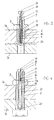
- Figure 3 shows another alternative which employs a pre-tensioning unit supported by the bottom of a hole located inside the fastening element.
- a hole 15 has been bored in the center of the screw 2 to be pre-tensioned and it receives a shape-memory metal cartridge 4.
- a heating element 16 which can be for instance an electric resistance heatable by electricity.
- a restrictor screw 5 acting as a retaining piece can be fastened in an internal threading 17 on one end of the screw on the mouth side of the hole 15.
- the restrictor screw will hereinafter be designated restrictor.
- the electric wires 19 to the cartridge 4 pass through the restrictor along a hole 18 bored therein.
- the hole 15 bored in the screw 2 extends mainly over the area which should be expanded during the pre-tensioning of the screw 2.
- the device operates in the following way:
- the screw 2 to be pre-tensioned is mounted in its place and the shape-memory metal cartridge 4 is placed in the screw hole 15.
- the restrictor is rotated into the threading 17 in such a fashion that the wires 19 for the heating element 16 of the cartridge pass through the hole 18 of the restrictor 5.
- a clearance 11 can be left between the cartridge 4 and the restrictor 5, the clearance being so dimensioned that the change of length of the shape-memory metal cartridge 4 minus the clearance equals the desired elongation of the screw.
- the shape-memory metal cartridge 4 When the shape-memory metal cartridge 4 is heated by the heating element 16 to the upper transformation temperature, a deformation in the form of length increase of the cartridge will take place, which in turn through the bottom 20 of the hole 15 and through the restrictor 5 stretches the screw 2. While the screw is in the streched state, the nut 3 is tightened. As the shape-memory metal cartridge 4 cools to the lower transformation temperature, it reverts to its original dimension, and the screw 2 has been pre-tensioned. The restrictor 5 and the cartridge 4 can now be removed. The releasing of the screw 2 is carried out in an analogous manner.
- the screw 2 is heated by an electric resistance. It is apparent for a man skilled in the art that the heating can take place also in some other known way.
- the shape-memory metal cartridge 4 can be separately dimensioned for each screw length and each force required for the stretching of the screw 2. It is, however, practical that the cartridge is dimensioned to have such length that it is sufficient for stretching a screw of a given length. If the elongation required for the screw to be pre-tensioned is smaller than the elongation of the shape-memory metal cartridge 4, a clearance 11 can be left between the shape-memory metal cartridge 4 and the restrictor, and so the same cartridge can be used for pretightening of screws of several sizes. The clearance can be measured by first screwing the restrictor 5 down and thereafter by opening it by a given number of revolutions or by measuring the extent of protrusion of the restrictor in some well-known manner.
- Figure 4 shows a third alternative for performing the pre-tensioning operation.
- a restrictor 5 is rotated in the internal threading 17 on the mouth portion of a hole 15 located at one end of the screw 2 to be pre-tensioned.
- a shape-memory metal cartridge 4 In a non-threaded extension 17a of the mouth portion is placed a shape-memory metal cartridge 4. From the cartridge 4 extends a metal rod 21 placed within the bore 15 extending inside the screw, the purpose of which rod is to transmit the force caused by the deformation of the shape-memory metal cartridge to the other end of the screw 2 through the bottom 20 of the bore.
- the device operates in the same manner as described hereinbefore.
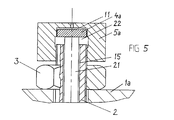
- Figure 5 shows a fourth alternative where the shape-memory metal cartridge 4 is deplaced outside the screw hole and for example a steel rod 21 has been placed in the hole.
- the steel rod is longer than the hole bored in the screw 2 and so dimensioned that it will withstand the force required for stretching the screw 2.
- a nut 3 and thereafter a restrictor nut 5a corresponding to the restrictor 5 of Fig. 3 have been rotated at the end of the screw 2 on its threading, the former being designated hereinafter restrictor and accommodating in its interior at least one cylindrical shape-memory metal piece 4a corresponding to the shape-memory metal cartridge 4 of Fig. 3. The piece abuts on the rod 21 and on its other side on the restrictor 5a.
- the heating of the shape-memory metal cylinder 4a to the upper transformation temperature can take place by means of a heating element placed inside it or the heating element can be placed in a space 22 inside the restrictor.
- the heating can be performed also by heating the restrictor 5a from the outside, whereby the heat will be conducted along the restrictor to the shape-memory metal cylinder 4a starting there the desired phase change, which causes the transformation giving rise to a expansion force for the screw 2, the force being transmitted from the shape-memory metal cylinder 4a through the restrictor 5a to one end of the screw 2, as well as through the rod 21 to the other end of the screw 2, thus stretching the screw.
- the nut 13 is screwed down onto the first piece 1a to be joined, relative to which the screw has been able to expand freely, the operation being performed in the same way as in Figs. 3 and 4.
- the shape-memory metal cylinder 4a After the shape-memory metal cylinder 4a has been cooled, or during its cooling to the lower transformation temperature, it recovers its original dimensions, and the pre-tensioning means, the restrictor 5a, the shape-memory metal cylinder 4a, the possible heating element and the rod 21, can be removed. The releasing of the screw takes place in an analogous manner.
- a shape-memory metal cartridge 4, 4a made of a one-way shape-memory metal is used in the device, it is difficult to remove it after the pre-tensioning. If a cartridge made of a two-way shape-memory metal is used, it can be easily removed after the pre-tensioning of the cartridge and it can be used again for pre-tensioning of other screws. The same applies to the removal of the shape-memory metal piece from the pre-tensioning device of Figs. 1 and 2. However, the phenomena taking place during the cooling, such as relaxation and thermal shrinkage, can facilitate the removal of the pre-tensioning device also in case of one-way shape-memory metals.
- the shape-memory metals are usually metal alloys, and they are known in a variety of types, for instance a nickel-titanium alloy mixed with additives.
- the invention is not limited to any single well-known or later discovered shape-memory metal.
Landscapes
- Engineering & Computer Science (AREA)
- Mechanical Engineering (AREA)
- General Engineering & Computer Science (AREA)
- Hand Tools For Fitting Together And Separating, Or Other Hand Tools (AREA)
- Flanged Joints, Insulating Joints, And Other Joints (AREA)
- Forging (AREA)
- Formation And Processing Of Food Products (AREA)
- Dowels (AREA)
- Clamps And Clips (AREA)
- Connection Of Plates (AREA)
- Reinforcement Elements For Buildings (AREA)
- Heat Treatment Of Articles (AREA)
Claims (14)
- Vorspannvorrichtung für Befestigungselemente, umfassend eine Vorspanneinheit (4, 5), welche einen ersten Teil (5), der an einem Ende eines Befestigungselements (2) in einem ersten Bereich angebracht ist, und einen dem ersten Teil benachbarten zweiten Teil (4) aufweist, zusammen mit einem Festziehglied (3), das ein von der Vorpanneinheit (4, 5) getrenntes Glied ist und am Befestigungselement (2) angebracht ist, um unabhängig von der Vorspanneinheit beweglich zu sein, wobei das andere Ende des Befestigungselementes an einem Stück (1b) angebracht werden kann, welches die Bewegung des Befestigungselementes (2) in der Expansionsrichtung begrenzt, wobei der zweite Teil (4) der Vorspanneinheit (4, 5) Formgedächtniseffekt-Metall umfaßt und ausgebildet ist, um sich durch eine Phasenänderung auszudehnen, um dadurch auf den ersten Teil (5) einzuwirken, um das Befestigungselement zu dehnen und zuzulassen, daß das Festziehglied (3) in die Festziehposition'hin zu einem zweiten Stück (la) bewegt wird, um mittels des Befestigungselementes mit dem ersten Stück (1b) verbunden zu werden, ehe die Dehnwirkung des Formgedächtniseffekt-Metalls beseitigt wird.
- Vorspannvorrichtung nach Anspruch 1, dadurch gekennzeichnet, daß der erste Teil (5) einen Rückhalteteil (5) umfaßt, der am ersten Bereich angebracht ist, und der Teil (4; 4a) aus Formgedächtniseffekt-Metall zwischen dem Rückhalteteil und einem starren Teil (1a, 20) angeordnet ist.
- Vorspannvorrichtung nach Anspruch 1 oder 2, dadurch gekennzeichnet, daß das Formgedächtniseffekt-Metall ein Zweiwege-Formgedächtniseffekt-Metall ist, wobei zumindest die obere Umwandlungstemperatur über der Montagetemperatur der Vorspanneinheit liegt.
- Vorspannvorrichtung nach Anspruch 1, 2 oder 3, dadurch gekennzeichnet, daß der erste Teil einen Verriegelungsteil (5) umfaßt, der über einem entlang einem Gewinde beweglichen Festziehglied, beispielsweise einer Mutter (3), angeordnet ist, wobei der Verriegelungsteil auf dem selben Gewinde angeordnet wird und über seinen Kantenabschnitt (13), der zum zu verbindenden Stück (la) hingerichtet ist, lagerbar ist.
- Vorrichtung nach Anspruch 2 und 4, dadurch gekennzeichnet, daß, angeordnet in Verbindung mit dem Kantenabschnitt (13) des Verriegelungsteiles, der zweite Teil (4) vorliegt, der aus einem Formgedächtniseffekt-Metall besteht, beispielsweise eine Hülse oder getrennte Stücke.
- Vorrichtung nach Anspruch 4 oder 5, dadurch gekennzeichnet, daß der Verriegelungsteil (5), um ihn in das Gewinde des vorzuspannenden Befestigungselementes (1) einzupassen, einen Adapterring (12) aufweist, wobei der Verriegelungsteil (5) des weiteren einen Kantenabschnitt (13) aufweist, der am Adapterring (12) angebracht werden kann.
- Vorrichtung nach Anspruch 5 oder 6, dadurch gekennzeichnet, daß der Teil (4) aus Formgedächtniseffekt-Metall am Verriegelungsteil (5) angebracht ist.
- Vorrichtung nach Anspruch 2 oder 3, dadurch gekennzeichnet, daß in einem Raum, der durch eine Bohrung (15), die in das vorzuspannende Befestigungselement (2) gebohrt ist, und durch eine Drossel (5, 5a), die am Ende des Befestigungselements angebracht ist, begrenzt wird, eine Patrone (4; 4a) angeordnet ist, welche aus Formgedächtniseffekt-Metall besteht und ausgebildet ist, um das Vorspannen auszuführen.
- Vorrichtung nach Anspruch 8, dadurch gekennzeichnet, daß die Patrone (4; 4a) an einem Ende an der Drossel (5; 5a) und am anderen Ende an einer Stange (21), welche sich als Verlängerung der Patrone nach unten zum Boden (20) der Bohrung erstreckt, anliegt.
- Vorrichtung nach Anspruch 8 oder 9, dadurch gekennzeichnet, daß die Patrone mit einem Heizelement (16) versehen ist, zu welchem die Wärmeenergie beispielsweise über die Drossel (5; 5a) zugeführt wird.
- Vorspannverfahren unter Verwendung einer Vorrichtung nach Anspruch 1, bei welchem Verfahren das andere Ende des Befestigungselements durch das zweite Stück (la) hindurchgeführt und am ersten Stück (1b) angebracht wird, das Formgedächtniseffekt-Metall auf seine Umwandlungstemperatur erhitzt wird, bei der es sich durch eine Phasenänderung ausdehnt und auf den ersten Teil (5) einwirkt, um das Befestigungselement zu dehnen, das Festziehglied (3), das am Befestigungselement (2) befestigt ist, durch eine Bewegung zum zweiten Stück (la) hin festgezogen wird, wonach die Dehnwirkung des Formgedächtniseffekt-Metalls beseitigt wird, so daß das Befestigungselement (2) endgültig festgezogen wird.
- Verfahren nach Anspruch 11, dadurch gekennzeichnet, daß das Formgedächtniseffekt-Metall ein Zweiwege-Formgedächtniseffekt-Metall ist, wobei die Vorspannwirkung des Formgedächtniseffekt-Metalls beseitigt wird, indem es auf seine untere Umwandlungstemperatur gekühlt oder abkühlen gelassen wird.
- Verfahren nach Anspruch 11 oder 12, dadurch gekennzeichnet, daß ein Rückhalteteil (5) am Befestigungselement (2) angebracht ist und das Vorspannen mittels des zweiten Teils (4) aus Formgedächtniseffekt-Metall, der zwischen dem Rückhalteteil und einem starren Teil (la; 20) angeordnet ist, erfolgt.
- Verfahren nach Anspruch 13, dadurch gekennzeichnet, daß eine gewünschte Vorspanndehnung im Befestigungselement (2) und die Ausdehnungsänderung des Stücks (4) aus Formgedächtniseffekt-Metall durch Freilassen eines Zwischenraums (11) zwischen dem Teil (4) aus Formgedächtniseffekt-Metall und jenem Teil, auf den das Stück (4) aus Formgedächtniseffekt-Metall infolge der Phasenänderung einwirkt, aneinander angepaßt werden.
Applications Claiming Priority (5)
| Application Number | Priority Date | Filing Date | Title |
|---|---|---|---|
| FI935330A FI93671C (fi) | 1993-11-30 | 1993-11-30 | Laite sekä menetelmä ruuvin esijännittämiseksi |
| FI935330 | 1993-11-30 | ||
| FI935329A FI93893C (fi) | 1993-11-30 | 1993-11-30 | Ruuvin esijännityslaite ja menetelmä esijännityksen toteuttamiseksi |
| FI935329 | 1993-11-30 | ||
| PCT/FI1994/000539 WO1995015442A1 (en) | 1993-11-30 | 1994-11-30 | Pre-tensioning device for fastening elements and method for pre-tensioning a fastening element |
Publications (2)
| Publication Number | Publication Date |
|---|---|
| EP0804689A1 EP0804689A1 (de) | 1997-11-05 |
| EP0804689B1 true EP0804689B1 (de) | 1999-08-11 |
Family
ID=26159621
Family Applications (1)
| Application Number | Title | Priority Date | Filing Date |
|---|---|---|---|
| EP95901466A Expired - Lifetime EP0804689B1 (de) | 1993-11-30 | 1994-11-30 | Spannvorrichtung für befestigungselemente und verfahren zum spannen eines befestigungselementes |
Country Status (9)
| Country | Link |
|---|---|
| US (1) | US5772378A (de) |
| EP (1) | EP0804689B1 (de) |
| CN (1) | CN1066806C (de) |
| AT (1) | ATE183290T1 (de) |
| AU (1) | AU1069595A (de) |
| DE (1) | DE69420057T2 (de) |
| ES (1) | ES2135688T3 (de) |
| NO (1) | NO315993B1 (de) |
| WO (1) | WO1995015442A1 (de) |
Families Citing this family (47)
| Publication number | Priority date | Publication date | Assignee | Title |
|---|---|---|---|---|
| SE505839C2 (sv) * | 1995-04-12 | 1997-10-13 | Int Patents & Licenses Russia | Sätt och anordning att förbinda maskinelement medelst drag- eller pinnbultar |
| US6126371A (en) * | 1999-04-05 | 2000-10-03 | Lockheed Martin Corporation | Shape memory metal alloy preload attenuation device |
| US6348674B1 (en) | 2000-08-25 | 2002-02-19 | Larry R. Russell | Method and apparatus for pretensioning remotely installed clamps and flanges |
| US6688828B1 (en) * | 2000-12-01 | 2004-02-10 | Arizona Board Of Regents | Self-torquing fasteners |
| US20040067122A1 (en) * | 2002-02-26 | 2004-04-08 | Arizona Board Of Regents | Self-torquing fasteners |
| US7040323B1 (en) * | 2002-08-08 | 2006-05-09 | Tini Alloy Company | Thin film intrauterine device |
| DE10312011B3 (de) * | 2003-03-18 | 2004-11-25 | P&S Vorspannsysteme Ag | Verspannungsanordnung mit Überspannungsschutz |
| JP4328229B2 (ja) * | 2003-06-04 | 2009-09-09 | 株式会社ユニオン精密 | ねじ付属品を用いた締結体構造及びねじ付属品を用いた解体方法 |
| US7586828B1 (en) | 2003-10-23 | 2009-09-08 | Tini Alloy Company | Magnetic data storage system |
| US7422403B1 (en) * | 2003-10-23 | 2008-09-09 | Tini Alloy Company | Non-explosive releasable coupling device |
| US20050244245A1 (en) * | 2004-04-30 | 2005-11-03 | Anatoly Efremov | Method and devices to limit a creep of mechanical fasteners |
| FR2865571B1 (fr) * | 2004-01-23 | 2006-04-28 | Cogema Logistics | Dispositif de rangement prevu pour etre place dans un emballage destine au transport de matieres radioactives |
| US7632361B2 (en) * | 2004-05-06 | 2009-12-15 | Tini Alloy Company | Single crystal shape memory alloy devices and methods |
| US20060118210A1 (en) * | 2004-10-04 | 2006-06-08 | Johnson A D | Portable energy storage devices and methods |
| US20060145016A1 (en) * | 2004-12-30 | 2006-07-06 | The Boeing Company | Mating of spacecraft components using shape memory materials |
| US7763342B2 (en) * | 2005-03-31 | 2010-07-27 | Tini Alloy Company | Tear-resistant thin film methods of fabrication |
| US7441888B1 (en) | 2005-05-09 | 2008-10-28 | Tini Alloy Company | Eyeglass frame |
| US7540899B1 (en) | 2005-05-25 | 2009-06-02 | Tini Alloy Company | Shape memory alloy thin film, method of fabrication, and articles of manufacture |
| US20080213062A1 (en) * | 2006-09-22 | 2008-09-04 | Tini Alloy Company | Constant load fastener |
| US20080075557A1 (en) * | 2006-09-22 | 2008-03-27 | Johnson A David | Constant load bolt |
| US8349099B1 (en) | 2006-12-01 | 2013-01-08 | Ormco Corporation | Method of alloying reactive components |
| US8584767B2 (en) | 2007-01-25 | 2013-11-19 | Tini Alloy Company | Sprinkler valve with active actuation |
| US8684101B2 (en) | 2007-01-25 | 2014-04-01 | Tini Alloy Company | Frangible shape memory alloy fire sprinkler valve actuator |
| WO2009018289A2 (en) | 2007-07-30 | 2009-02-05 | Tini Alloy Company | Method and devices for preventing restenosis in cardiovascular stents |
| WO2009073609A1 (en) | 2007-11-30 | 2009-06-11 | Tini Alloy Company | Biocompatible copper-based single-crystal shape memory alloys |
| US7842143B2 (en) * | 2007-12-03 | 2010-11-30 | Tini Alloy Company | Hyperelastic shape setting devices and fabrication methods |
| JP5099548B2 (ja) * | 2007-12-03 | 2012-12-19 | 学校法人東海大学 | 締結体構造 |
| US8382917B2 (en) * | 2007-12-03 | 2013-02-26 | Ormco Corporation | Hyperelastic shape setting devices and fabrication methods |
| US7946781B2 (en) * | 2008-04-09 | 2011-05-24 | Gm Global Technology Operations, Inc. | Assembly and method for retaining a fastener |
| US8834539B2 (en) * | 2008-11-21 | 2014-09-16 | Nitilick Ltd. | Superelastic washer |
| GB2474887B (en) * | 2009-10-30 | 2013-12-04 | Stats Uk Ltd | Device and method for pre-tensioning a coupling |
| US8388292B2 (en) * | 2009-12-07 | 2013-03-05 | The Boeing Company | Self expanding fastener |
| KR101136382B1 (ko) * | 2009-12-08 | 2012-04-18 | 한국기계연구원 | 형상기억합금을 이용한 공구 홀더 및 공구 고정방법 |
| US9427709B2 (en) * | 2011-09-23 | 2016-08-30 | W. L. Gore & Associates, Inc. | Surface-modified fluoropolymer membrane |
| GB201121976D0 (en) * | 2011-12-20 | 2012-02-01 | Ceney David | Stud tensioning apparatus |
| US10124197B2 (en) | 2012-08-31 | 2018-11-13 | TiNi Allot Company | Fire sprinkler valve actuator |
| US11040230B2 (en) | 2012-08-31 | 2021-06-22 | Tini Alloy Company | Fire sprinkler valve actuator |
| JP2017519945A (ja) * | 2014-04-17 | 2017-07-20 | コリア・インスティテュート・オブ・サイエンス・アンド・テクノロジー | 緩み止めねじ締結構造、及び緩み止めねじ締結構造の製造方法 |
| CN104482338B (zh) * | 2014-12-09 | 2016-08-24 | 同济大学 | 一种具有应急自恢复能力供水管线k形接头 |
| CA3002770C (en) * | 2015-06-03 | 2019-05-14 | Onguard Group Limited | Securing assembly |
| CN107989863A (zh) * | 2017-11-22 | 2018-05-04 | 有研亿金新材料有限公司 | 一种自膨式板材紧固连接件及其制备和使用方法 |
| DE112017008317T5 (de) * | 2017-12-27 | 2020-09-10 | Nabrawind Technologies, S.L | Regelungssystem zum Vorspannen von Bolzen |
| CN109798296B (zh) * | 2019-01-30 | 2019-11-29 | 荣成华东锻压机床股份有限公司 | 一种用于机械压力机上的紧固装置及方法 |
| CN109676989B (zh) * | 2019-01-30 | 2020-01-14 | 荣成华东锻压机床股份有限公司 | 一种机械压力机曲轴连杆紧固装置 |
| CN111446787B (zh) * | 2020-04-23 | 2024-07-16 | 安徽机电职业技术学院 | 一种定子结构及永磁电机 |
| EP4414133A1 (de) * | 2023-02-09 | 2024-08-14 | Nimesis Technology | Werkzeugvorrichtung zur herstellung einer axialspannung auf basis einer formgedächtnislegierung |
| US12292073B1 (en) * | 2024-12-29 | 2025-05-06 | Zoltan A. Kemeny | Bolt tensioner and fastener assemblies |
Family Cites Families (10)
| Publication number | Priority date | Publication date | Assignee | Title |
|---|---|---|---|---|
| US2571265A (en) * | 1945-06-13 | 1951-10-16 | Leufven Axel Gustav Edvard | Hydraulic tensioning nut |
| GB1382191A (en) * | 1972-03-08 | 1975-01-29 | Doncaster Sons Ltd Daniel | Hydraulic jacking devices |
| US4120230A (en) * | 1977-02-23 | 1978-10-17 | Pilgrim Engineering Developments Limited | Self-straining bolts |
| JPS588817A (ja) * | 1981-07-03 | 1983-01-19 | 株式会社山科精工所 | 弾性座金 |
| JPH0755414B2 (ja) * | 1986-10-01 | 1995-06-14 | 株式会社東芝 | 接合ボルトおよびその締付力の調整方法 |
| FR2620180B1 (fr) * | 1987-09-04 | 1990-01-19 | Aerospatiale | Rondelle ressort en alliage a memoire de forme et son application a un dispositif pour exercer sur une piece une pression evoluant par paliers |
| FR2629153B1 (fr) * | 1988-03-22 | 1990-05-04 | Bull Sa | Dispositif de fixation a pression de deux pieces l'une a l'autre |
| US4991563A (en) * | 1989-06-06 | 1991-02-12 | Ashley Royce C | Apparatus and method for heating hollow bolts |
| US5248233A (en) * | 1992-09-25 | 1993-09-28 | Webster Richard G | No-shock separation mechanism |
| US5366331A (en) * | 1993-02-10 | 1994-11-22 | General Electric Company | Shape memory lock fastener |
-
1994
- 1994-11-30 ES ES95901466T patent/ES2135688T3/es not_active Expired - Lifetime
- 1994-11-30 EP EP95901466A patent/EP0804689B1/de not_active Expired - Lifetime
- 1994-11-30 AU AU10695/95A patent/AU1069595A/en not_active Abandoned
- 1994-11-30 DE DE69420057T patent/DE69420057T2/de not_active Expired - Fee Related
- 1994-11-30 US US08/647,915 patent/US5772378A/en not_active Expired - Fee Related
- 1994-11-30 AT AT95901466T patent/ATE183290T1/de not_active IP Right Cessation
- 1994-11-30 WO PCT/FI1994/000539 patent/WO1995015442A1/en not_active Ceased
- 1994-11-30 CN CN94194849A patent/CN1066806C/zh not_active Expired - Fee Related
-
1996
- 1996-05-29 NO NO19962169A patent/NO315993B1/no not_active IP Right Cessation
Also Published As
| Publication number | Publication date |
|---|---|
| NO962169L (no) | 1996-05-29 |
| NO315993B1 (no) | 2003-11-24 |
| ES2135688T3 (es) | 1999-11-01 |
| CN1066806C (zh) | 2001-06-06 |
| WO1995015442A1 (en) | 1995-06-08 |
| NO962169D0 (no) | 1996-05-29 |
| DE69420057D1 (de) | 1999-09-16 |
| ATE183290T1 (de) | 1999-08-15 |
| EP0804689A1 (de) | 1997-11-05 |
| DE69420057T2 (de) | 2000-02-03 |
| US5772378A (en) | 1998-06-30 |
| AU1069595A (en) | 1995-06-19 |
| CN1141668A (zh) | 1997-01-29 |
Similar Documents
| Publication | Publication Date | Title |
|---|---|---|
| EP0804689B1 (de) | Spannvorrichtung für befestigungselemente und verfahren zum spannen eines befestigungselementes | |
| EP0804691B1 (de) | Unterlegescheibe und verfahren zu seiner anwendung | |
| US6425829B1 (en) | Threaded load transferring attachment | |
| US5248233A (en) | No-shock separation mechanism | |
| KR100700120B1 (ko) | 텐션을 가하는 유압 너트 | |
| US3900939A (en) | Method of plugging steam generator tubes | |
| US7422403B1 (en) | Non-explosive releasable coupling device | |
| US4293942A (en) | Waterproof watch and method for making | |
| CN109991072B (zh) | 一种高温拉伸试验夹头及试验机 | |
| US3546996A (en) | Release latch actuated by temperature excursion | |
| US4800637A (en) | Method of removing plugs | |
| US6499700B1 (en) | Attachment device for a cryogenic satellite tank | |
| US4011132A (en) | Nuclear reactor pressure vessel for nuclear reactors with plastically deformable spacers | |
| FI93893B (fi) | Ruuvin esijännityslaite ja menetelmä esijännityksen toteuttamiseksi | |
| FI93671B (fi) | Laite sekä menetelmä ruuvin esijännittämiseksi | |
| FI93986B (fi) | Esijännittyvä ruuvi ja menetelmä esijännityksen toteuttamiseksi | |
| JPS6239283B2 (de) | ||
| JP2007120462A (ja) | 蒸気タービンケーシング締結装置および蒸気タービン | |
| SU973341A1 (ru) | Устройство дл зат жки резьбовых соединений | |
| KR910008776Y1 (ko) | 열팽창을 이용한 고정용 조임볼트 | |
| US1846565A (en) | Casing for machines subject to high pressure | |
| JPH02187298A (ja) | 加圧装置 | |
| US4407124A (en) | Memory power engine | |
| Fouché et al. | Development and testing of a high-temperature shape memory actuator using CN-250X for hold down and release mechanisms (HRM) | |
| RU1778359C (ru) | Мартенситный привод |
Legal Events
| Date | Code | Title | Description |
|---|---|---|---|
| PUAI | Public reference made under article 153(3) epc to a published international application that has entered the european phase |
Free format text: ORIGINAL CODE: 0009012 |
|
| 17P | Request for examination filed |
Effective date: 19960618 |
|
| AK | Designated contracting states |
Kind code of ref document: A1 Designated state(s): AT BE CH DE DK ES FR GB IT LI NL PT SE |
|
| GRAG | Despatch of communication of intention to grant |
Free format text: ORIGINAL CODE: EPIDOS AGRA |
|
| 17Q | First examination report despatched |
Effective date: 19980709 |
|
| GRAG | Despatch of communication of intention to grant |
Free format text: ORIGINAL CODE: EPIDOS AGRA |
|
| GRAH | Despatch of communication of intention to grant a patent |
Free format text: ORIGINAL CODE: EPIDOS IGRA |
|
| GRAG | Despatch of communication of intention to grant |
Free format text: ORIGINAL CODE: EPIDOS AGRA |
|
| GRAH | Despatch of communication of intention to grant a patent |
Free format text: ORIGINAL CODE: EPIDOS IGRA |
|
| GRAH | Despatch of communication of intention to grant a patent |
Free format text: ORIGINAL CODE: EPIDOS IGRA |
|
| GRAA | (expected) grant |
Free format text: ORIGINAL CODE: 0009210 |
|
| AK | Designated contracting states |
Kind code of ref document: B1 Designated state(s): AT BE CH DE DK ES FR GB IT LI NL PT SE |
|
| PG25 | Lapsed in a contracting state [announced via postgrant information from national office to epo] |
Ref country code: BE Free format text: LAPSE BECAUSE OF FAILURE TO SUBMIT A TRANSLATION OF THE DESCRIPTION OR TO PAY THE FEE WITHIN THE PRESCRIBED TIME-LIMIT Effective date: 19990811 |
|
| REF | Corresponds to: |
Ref document number: 183290 Country of ref document: AT Date of ref document: 19990815 Kind code of ref document: T |
|
| REG | Reference to a national code |
Ref country code: CH Ref legal event code: EP |
|
| REF | Corresponds to: |
Ref document number: 69420057 Country of ref document: DE Date of ref document: 19990916 |
|
| REG | Reference to a national code |
Ref country code: CH Ref legal event code: NV Representative=s name: DIEHL & PARTNER AG |
|
| REG | Reference to a national code |
Ref country code: ES Ref legal event code: FG2A Ref document number: 2135688 Country of ref document: ES Kind code of ref document: T3 |
|
| ITF | It: translation for a ep patent filed | ||
| PG25 | Lapsed in a contracting state [announced via postgrant information from national office to epo] |
Ref country code: PT Free format text: LAPSE BECAUSE OF FAILURE TO SUBMIT A TRANSLATION OF THE DESCRIPTION OR TO PAY THE FEE WITHIN THE PRESCRIBED TIME-LIMIT Effective date: 19991111 Ref country code: DK Free format text: LAPSE BECAUSE OF FAILURE TO SUBMIT A TRANSLATION OF THE DESCRIPTION OR TO PAY THE FEE WITHIN THE PRESCRIBED TIME-LIMIT Effective date: 19991111 |
|
| ET | Fr: translation filed | ||
| PLBE | No opposition filed within time limit |
Free format text: ORIGINAL CODE: 0009261 |
|
| STAA | Information on the status of an ep patent application or granted ep patent |
Free format text: STATUS: NO OPPOSITION FILED WITHIN TIME LIMIT |
|
| 26N | No opposition filed | ||
| REG | Reference to a national code |
Ref country code: GB Ref legal event code: IF02 |
|
| PGFP | Annual fee paid to national office [announced via postgrant information from national office to epo] |
Ref country code: GB Payment date: 20021119 Year of fee payment: 9 |
|
| PGFP | Annual fee paid to national office [announced via postgrant information from national office to epo] |
Ref country code: SE Payment date: 20021122 Year of fee payment: 9 |
|
| PGFP | Annual fee paid to national office [announced via postgrant information from national office to epo] |
Ref country code: CH Payment date: 20021125 Year of fee payment: 9 |
|
| PGFP | Annual fee paid to national office [announced via postgrant information from national office to epo] |
Ref country code: FR Payment date: 20021126 Year of fee payment: 9 Ref country code: AT Payment date: 20021126 Year of fee payment: 9 |
|
| PGFP | Annual fee paid to national office [announced via postgrant information from national office to epo] |
Ref country code: ES Payment date: 20021128 Year of fee payment: 9 |
|
| PGFP | Annual fee paid to national office [announced via postgrant information from national office to epo] |
Ref country code: DE Payment date: 20021129 Year of fee payment: 9 |
|
| PGFP | Annual fee paid to national office [announced via postgrant information from national office to epo] |
Ref country code: NL Payment date: 20021130 Year of fee payment: 9 |
|
| PG25 | Lapsed in a contracting state [announced via postgrant information from national office to epo] |
Ref country code: LI Free format text: LAPSE BECAUSE OF NON-PAYMENT OF DUE FEES Effective date: 20031130 Ref country code: GB Free format text: LAPSE BECAUSE OF NON-PAYMENT OF DUE FEES Effective date: 20031130 Ref country code: CH Free format text: LAPSE BECAUSE OF NON-PAYMENT OF DUE FEES Effective date: 20031130 Ref country code: AT Free format text: LAPSE BECAUSE OF NON-PAYMENT OF DUE FEES Effective date: 20031130 |
|
| PG25 | Lapsed in a contracting state [announced via postgrant information from national office to epo] |
Ref country code: SE Free format text: LAPSE BECAUSE OF NON-PAYMENT OF DUE FEES Effective date: 20031201 Ref country code: ES Free format text: LAPSE BECAUSE OF NON-PAYMENT OF DUE FEES Effective date: 20031201 |
|
| PG25 | Lapsed in a contracting state [announced via postgrant information from national office to epo] |
Ref country code: NL Free format text: LAPSE BECAUSE OF NON-PAYMENT OF DUE FEES Effective date: 20040601 |
|
| PG25 | Lapsed in a contracting state [announced via postgrant information from national office to epo] |
Ref country code: DE Free format text: LAPSE BECAUSE OF NON-PAYMENT OF DUE FEES Effective date: 20040602 |
|
| REG | Reference to a national code |
Ref country code: CH Ref legal event code: PL |
|
| GBPC | Gb: european patent ceased through non-payment of renewal fee |
Effective date: 20031130 |
|
| PG25 | Lapsed in a contracting state [announced via postgrant information from national office to epo] |
Ref country code: FR Free format text: LAPSE BECAUSE OF NON-PAYMENT OF DUE FEES Effective date: 20040730 |
|
| NLV4 | Nl: lapsed or anulled due to non-payment of the annual fee |
Effective date: 20040601 |
|
| EUG | Se: european patent has lapsed | ||
| REG | Reference to a national code |
Ref country code: FR Ref legal event code: ST |
|
| REG | Reference to a national code |
Ref country code: ES Ref legal event code: FD2A Effective date: 20031201 |
|
| PG25 | Lapsed in a contracting state [announced via postgrant information from national office to epo] |
Ref country code: IT Free format text: LAPSE BECAUSE OF NON-PAYMENT OF DUE FEES;WARNING: LAPSES OF ITALIAN PATENTS WITH EFFECTIVE DATE BEFORE 2007 MAY HAVE OCCURRED AT ANY TIME BEFORE 2007. THE CORRECT EFFECTIVE DATE MAY BE DIFFERENT FROM THE ONE RECORDED. Effective date: 20051130 |