EP0804606B1 - Biochemical process for preparing aromatic substances - Google Patents
Biochemical process for preparing aromatic substances Download PDFInfo
- Publication number
- EP0804606B1 EP0804606B1 EP96901412A EP96901412A EP0804606B1 EP 0804606 B1 EP0804606 B1 EP 0804606B1 EP 96901412 A EP96901412 A EP 96901412A EP 96901412 A EP96901412 A EP 96901412A EP 0804606 B1 EP0804606 B1 EP 0804606B1
- Authority
- EP
- European Patent Office
- Prior art keywords
- process according
- medium
- protein
- radical
- reaction
- Prior art date
- Legal status (The legal status is an assumption and is not a legal conclusion. Google has not performed a legal analysis and makes no representation as to the accuracy of the status listed.)
- Expired - Lifetime
Links
- 125000003118 aryl group Chemical group 0.000 title claims abstract description 13
- 239000000126 substance Substances 0.000 title claims abstract description 12
- 230000003851 biochemical process Effects 0.000 title 1
- 238000004519 manufacturing process Methods 0.000 title 1
- 238000000034 method Methods 0.000 claims abstract description 34
- 238000002360 preparation method Methods 0.000 claims abstract description 23
- 102000004169 proteins and genes Human genes 0.000 claims abstract description 23
- 108090000623 proteins and genes Proteins 0.000 claims abstract description 23
- 239000000758 substrate Substances 0.000 claims abstract description 20
- 150000003254 radicals Chemical class 0.000 claims abstract description 19
- 125000000956 methoxy group Chemical group [H]C([H])([H])O* 0.000 claims abstract description 12
- 229910021645 metal ion Inorganic materials 0.000 claims abstract description 11
- 238000007254 oxidation reaction Methods 0.000 claims abstract description 9
- 125000003178 carboxy group Chemical group [H]OC(*)=O 0.000 claims abstract description 4
- 125000000896 monocarboxylic acid group Chemical group 0.000 claims abstract description 4
- XEEYBQQBJWHFJM-UHFFFAOYSA-N Iron Chemical compound [Fe] XEEYBQQBJWHFJM-UHFFFAOYSA-N 0.000 claims description 71
- 239000012429 reaction media Substances 0.000 claims description 62
- 229910052742 iron Inorganic materials 0.000 claims description 36
- MWOOGOJBHIARFG-UHFFFAOYSA-N vanillin Chemical compound COC1=CC(C=O)=CC=C1O MWOOGOJBHIARFG-UHFFFAOYSA-N 0.000 claims description 27
- FGQOOHJZONJGDT-UHFFFAOYSA-N vanillin Natural products COC1=CC(O)=CC(C=O)=C1 FGQOOHJZONJGDT-UHFFFAOYSA-N 0.000 claims description 26
- 235000012141 vanillin Nutrition 0.000 claims description 26
- 235000018102 proteins Nutrition 0.000 claims description 22
- 239000000203 mixture Substances 0.000 claims description 20
- HUMNYLRZRPPJDN-UHFFFAOYSA-N benzaldehyde Chemical compound O=CC1=CC=CC=C1 HUMNYLRZRPPJDN-UHFFFAOYSA-N 0.000 claims description 19
- ZRSNZINYAWTAHE-UHFFFAOYSA-N p-methoxybenzaldehyde Chemical compound COC1=CC=C(C=O)C=C1 ZRSNZINYAWTAHE-UHFFFAOYSA-N 0.000 claims description 13
- 108010010803 Gelatin Proteins 0.000 claims description 12
- 229920000159 gelatin Polymers 0.000 claims description 12
- 239000008273 gelatin Substances 0.000 claims description 12
- 235000019322 gelatine Nutrition 0.000 claims description 12
- 235000011852 gelatine desserts Nutrition 0.000 claims description 12
- QVGXLLKOCUKJST-UHFFFAOYSA-N atomic oxygen Chemical compound [O] QVGXLLKOCUKJST-UHFFFAOYSA-N 0.000 claims description 11
- 229910052760 oxygen Inorganic materials 0.000 claims description 11
- 239000001301 oxygen Substances 0.000 claims description 11
- QNGNSVIICDLXHT-UHFFFAOYSA-N para-ethylbenzaldehyde Natural products CCC1=CC=C(C=O)C=C1 QNGNSVIICDLXHT-UHFFFAOYSA-N 0.000 claims description 8
- FYYHWMGAXLPEAU-UHFFFAOYSA-N Magnesium Chemical compound [Mg] FYYHWMGAXLPEAU-UHFFFAOYSA-N 0.000 claims description 5
- RYGMFSIKBFXOCR-UHFFFAOYSA-N Copper Chemical compound [Cu] RYGMFSIKBFXOCR-UHFFFAOYSA-N 0.000 claims description 4
- SHZGCJCMOBCMKK-UHFFFAOYSA-N D-mannomethylose Natural products CC1OC(O)C(O)C(O)C1O SHZGCJCMOBCMKK-UHFFFAOYSA-N 0.000 claims description 4
- WQZGKKKJIJFFOK-GASJEMHNSA-N Glucose Chemical compound OC[C@H]1OC(O)[C@H](O)[C@@H](O)[C@@H]1O WQZGKKKJIJFFOK-GASJEMHNSA-N 0.000 claims description 4
- PWHULOQIROXLJO-UHFFFAOYSA-N Manganese Chemical compound [Mn] PWHULOQIROXLJO-UHFFFAOYSA-N 0.000 claims description 4
- 108010063312 Metalloproteins Proteins 0.000 claims description 4
- 102000010750 Metalloproteins Human genes 0.000 claims description 4
- 241001465754 Metazoa Species 0.000 claims description 4
- HCHKCACWOHOZIP-UHFFFAOYSA-N Zinc Chemical compound [Zn] HCHKCACWOHOZIP-UHFFFAOYSA-N 0.000 claims description 4
- 229910017052 cobalt Inorganic materials 0.000 claims description 4
- 239000010941 cobalt Substances 0.000 claims description 4
- GUTLYIVDDKVIGB-UHFFFAOYSA-N cobalt atom Chemical compound [Co] GUTLYIVDDKVIGB-UHFFFAOYSA-N 0.000 claims description 4
- 229910052749 magnesium Inorganic materials 0.000 claims description 4
- 239000011777 magnesium Substances 0.000 claims description 4
- 230000003647 oxidation Effects 0.000 claims description 4
- 239000011701 zinc Substances 0.000 claims description 4
- 229910052725 zinc Inorganic materials 0.000 claims description 4
- 238000013019 agitation Methods 0.000 claims description 3
- 239000012736 aqueous medium Substances 0.000 claims description 3
- 229910052802 copper Inorganic materials 0.000 claims description 3
- 239000010949 copper Substances 0.000 claims description 3
- 238000004821 distillation Methods 0.000 claims description 3
- 238000000605 extraction Methods 0.000 claims description 3
- 229910052748 manganese Inorganic materials 0.000 claims description 3
- 239000011572 manganese Substances 0.000 claims description 3
- 235000013311 vegetables Nutrition 0.000 claims description 3
- 108091003079 Bovine Serum Albumin Proteins 0.000 claims description 2
- 108010076119 Caseins Proteins 0.000 claims description 2
- 108020005199 Dehydrogenases Proteins 0.000 claims description 2
- SRBFZHDQGSBBOR-HWQSCIPKSA-N L-arabinopyranose Chemical compound O[C@H]1COC(O)[C@H](O)[C@H]1O SRBFZHDQGSBBOR-HWQSCIPKSA-N 0.000 claims description 2
- 108010062374 Myoglobin Proteins 0.000 claims description 2
- 108090000417 Oxygenases Proteins 0.000 claims description 2
- 102000004020 Oxygenases Human genes 0.000 claims description 2
- 229940098773 bovine serum albumin Drugs 0.000 claims description 2
- 239000005018 casein Substances 0.000 claims description 2
- BECPQYXYKAMYBN-UHFFFAOYSA-N casein, tech. Chemical compound NCCCCC(C(O)=O)N=C(O)C(CC(O)=O)N=C(O)C(CCC(O)=N)N=C(O)C(CC(C)C)N=C(O)C(CCC(O)=O)N=C(O)C(CC(O)=O)N=C(O)C(CCC(O)=O)N=C(O)C(C(C)O)N=C(O)C(CCC(O)=N)N=C(O)C(CCC(O)=N)N=C(O)C(CCC(O)=N)N=C(O)C(CCC(O)=O)N=C(O)C(CCC(O)=O)N=C(O)C(COP(O)(O)=O)N=C(O)C(CCC(O)=N)N=C(O)C(N)CC1=CC=CC=C1 BECPQYXYKAMYBN-UHFFFAOYSA-N 0.000 claims description 2
- 235000021240 caseins Nutrition 0.000 claims description 2
- 229930182478 glucoside Natural products 0.000 claims description 2
- 150000008131 glucosides Chemical class 0.000 claims description 2
- 230000000813 microbial effect Effects 0.000 claims description 2
- 210000000056 organ Anatomy 0.000 claims description 2
- 239000000725 suspension Substances 0.000 claims description 2
- XLYOFNOQVPJJNP-UHFFFAOYSA-N water Substances O XLYOFNOQVPJJNP-UHFFFAOYSA-N 0.000 claims description 2
- IBGBGRVKPALMCQ-UHFFFAOYSA-N 3,4-dihydroxybenzaldehyde Chemical compound OC1=CC=C(C=O)C=C1O IBGBGRVKPALMCQ-UHFFFAOYSA-N 0.000 claims 2
- 102000036675 Myoglobin Human genes 0.000 claims 1
- 101710157860 Oxydoreductase Proteins 0.000 claims 1
- 229960003371 protocatechualdehyde Drugs 0.000 claims 1
- 239000002609 medium Substances 0.000 description 57
- 102000001554 Hemoglobins Human genes 0.000 description 40
- 108010054147 Hemoglobins Proteins 0.000 description 40
- BTBUEUYNUDRHOZ-UHFFFAOYSA-N Borate Chemical compound [O-]B([O-])[O-] BTBUEUYNUDRHOZ-UHFFFAOYSA-N 0.000 description 21
- 229920000136 polysorbate Polymers 0.000 description 18
- 238000006243 chemical reaction Methods 0.000 description 14
- RRAFCDWBNXTKKO-UHFFFAOYSA-N eugenol Chemical compound COC1=CC(CC=C)=CC=C1O RRAFCDWBNXTKKO-UHFFFAOYSA-N 0.000 description 14
- KSFOVUSSGSKXFI-GAQDCDSVSA-N CC1=C/2NC(\C=C3/N=C(/C=C4\N\C(=C/C5=N/C(=C\2)/C(C=C)=C5C)C(C=C)=C4C)C(C)=C3CCC(O)=O)=C1CCC(O)=O Chemical compound CC1=C/2NC(\C=C3/N=C(/C=C4\N\C(=C/C5=N/C(=C\2)/C(C=C)=C5C)C(C=C)=C4C)C(C)=C3CCC(O)=O)=C1CCC(O)=O KSFOVUSSGSKXFI-GAQDCDSVSA-N 0.000 description 12
- 229950003776 protoporphyrin Drugs 0.000 description 12
- XUJNEKJLAYXESH-UHFFFAOYSA-N cysteine Natural products SCC(N)C(O)=O XUJNEKJLAYXESH-UHFFFAOYSA-N 0.000 description 10
- RUVINXPYWBROJD-ONEGZZNKSA-N trans-anethole Chemical compound COC1=CC=C(\C=C\C)C=C1 RUVINXPYWBROJD-ONEGZZNKSA-N 0.000 description 10
- 235000018417 cysteine Nutrition 0.000 description 9
- BJIOGJUNALELMI-ONEGZZNKSA-N Isoeugenol Natural products COC1=CC(\C=C\C)=CC=C1O BJIOGJUNALELMI-ONEGZZNKSA-N 0.000 description 8
- BJIOGJUNALELMI-ARJAWSKDSA-N cis-isoeugenol Chemical compound COC1=CC(\C=C/C)=CC=C1O BJIOGJUNALELMI-ARJAWSKDSA-N 0.000 description 8
- BJIOGJUNALELMI-UHFFFAOYSA-N trans-isoeugenol Natural products COC1=CC(C=CC)=CC=C1O BJIOGJUNALELMI-UHFFFAOYSA-N 0.000 description 8
- NPBVQXIMTZKSBA-UHFFFAOYSA-N Chavibetol Natural products COC1=CC=C(CC=C)C=C1O NPBVQXIMTZKSBA-UHFFFAOYSA-N 0.000 description 7
- 239000005770 Eugenol Substances 0.000 description 7
- UVMRYBDEERADNV-UHFFFAOYSA-N Pseudoeugenol Natural products COC1=CC(C(C)=C)=CC=C1O UVMRYBDEERADNV-UHFFFAOYSA-N 0.000 description 7
- 244000061458 Solanum melongena Species 0.000 description 7
- 235000013399 edible fruits Nutrition 0.000 description 7
- 229960002217 eugenol Drugs 0.000 description 7
- 229910021577 Iron(II) chloride Inorganic materials 0.000 description 6
- 235000002597 Solanum melongena Nutrition 0.000 description 6
- 150000001875 compounds Chemical class 0.000 description 6
- NMCUIPGRVMDVDB-UHFFFAOYSA-L iron dichloride Chemical compound Cl[Fe]Cl NMCUIPGRVMDVDB-UHFFFAOYSA-L 0.000 description 6
- KRKNYBCHXYNGOX-UHFFFAOYSA-K Citrate Chemical compound [O-]C(=O)CC(O)(CC([O-])=O)C([O-])=O KRKNYBCHXYNGOX-UHFFFAOYSA-K 0.000 description 5
- 102000004190 Enzymes Human genes 0.000 description 5
- 108090000790 Enzymes Proteins 0.000 description 5
- 229910019142 PO4 Inorganic materials 0.000 description 5
- 150000001299 aldehydes Chemical class 0.000 description 5
- 229940011037 anethole Drugs 0.000 description 5
- 239000008280 blood Substances 0.000 description 5
- RUVINXPYWBROJD-UHFFFAOYSA-N para-methoxyphenyl Natural products COC1=CC=C(C=CC)C=C1 RUVINXPYWBROJD-UHFFFAOYSA-N 0.000 description 5
- NBIIXXVUZAFLBC-UHFFFAOYSA-K phosphate Chemical compound [O-]P([O-])([O-])=O NBIIXXVUZAFLBC-UHFFFAOYSA-K 0.000 description 5
- 239000010452 phosphate Substances 0.000 description 5
- AXMVYSVVTMKQSL-UHFFFAOYSA-N UNPD142122 Natural products OC1=CC=C(C=CC=O)C=C1O AXMVYSVVTMKQSL-UHFFFAOYSA-N 0.000 description 4
- 210000004369 blood Anatomy 0.000 description 4
- 210000004027 cell Anatomy 0.000 description 4
- 229940117916 cinnamic aldehyde Drugs 0.000 description 4
- KJPRLNWUNMBNBZ-UHFFFAOYSA-N cinnamic aldehyde Natural products O=CC=CC1=CC=CC=C1 KJPRLNWUNMBNBZ-UHFFFAOYSA-N 0.000 description 4
- 150000002500 ions Chemical class 0.000 description 4
- KJPRLNWUNMBNBZ-QPJJXVBHSA-N (E)-cinnamaldehyde Chemical compound O=C\C=C\C1=CC=CC=C1 KJPRLNWUNMBNBZ-QPJJXVBHSA-N 0.000 description 3
- IKHGUXGNUITLKF-UHFFFAOYSA-N Acetaldehyde Chemical compound CC=O IKHGUXGNUITLKF-UHFFFAOYSA-N 0.000 description 3
- 102000018832 Cytochromes Human genes 0.000 description 3
- 108010052832 Cytochromes Proteins 0.000 description 3
- YMWUJEATGCHHMB-UHFFFAOYSA-N Dichloromethane Chemical compound ClCCl YMWUJEATGCHHMB-UHFFFAOYSA-N 0.000 description 3
- XUJNEKJLAYXESH-REOHCLBHSA-N L-Cysteine Chemical compound SC[C@H](N)C(O)=O XUJNEKJLAYXESH-REOHCLBHSA-N 0.000 description 3
- 230000000694 effects Effects 0.000 description 3
- VLKZOEOYAKHREP-UHFFFAOYSA-N n-Hexane Chemical compound CCCCCC VLKZOEOYAKHREP-UHFFFAOYSA-N 0.000 description 3
- 230000009257 reactivity Effects 0.000 description 3
- DOUMFZQKYFQNTF-WUTVXBCWSA-N (R)-rosmarinic acid Chemical compound C([C@H](C(=O)O)OC(=O)\C=C\C=1C=C(O)C(O)=CC=1)C1=CC=C(O)C(O)=C1 DOUMFZQKYFQNTF-WUTVXBCWSA-N 0.000 description 2
- CSCPPACGZOOCGX-UHFFFAOYSA-N Acetone Chemical compound CC(C)=O CSCPPACGZOOCGX-UHFFFAOYSA-N 0.000 description 2
- 241000894006 Bacteria Species 0.000 description 2
- 102000016938 Catalase Human genes 0.000 description 2
- 108010053835 Catalase Proteins 0.000 description 2
- 241000196324 Embryophyta Species 0.000 description 2
- 240000003768 Solanum lycopersicum Species 0.000 description 2
- 244000290333 Vanilla fragrans Species 0.000 description 2
- 235000021022 fresh fruits Nutrition 0.000 description 2
- RWSXRVCMGQZWBV-WDSKDSINSA-N glutathione Chemical compound OC(=O)[C@@H](N)CCC(=O)N[C@@H](CS)C(=O)NCC(O)=O RWSXRVCMGQZWBV-WDSKDSINSA-N 0.000 description 2
- UAEPNZWRGJTJPN-UHFFFAOYSA-N methylcyclohexane Chemical compound CC1CCCCC1 UAEPNZWRGJTJPN-UHFFFAOYSA-N 0.000 description 2
- 244000005700 microbiome Species 0.000 description 2
- 235000010482 polyoxyethylene sorbitan monooleate Nutrition 0.000 description 2
- 229920000053 polysorbate 80 Polymers 0.000 description 2
- 150000004032 porphyrins Chemical class 0.000 description 2
- 230000003389 potentiating effect Effects 0.000 description 2
- 238000003756 stirring Methods 0.000 description 2
- SCYULBFZEHDVBN-UHFFFAOYSA-N 1,1-Dichloroethane Chemical compound CC(Cl)Cl SCYULBFZEHDVBN-UHFFFAOYSA-N 0.000 description 1
- 108010088751 Albumins Proteins 0.000 description 1
- 102000009027 Albumins Human genes 0.000 description 1
- 102000007698 Alcohol dehydrogenase Human genes 0.000 description 1
- 108010021809 Alcohol dehydrogenase Proteins 0.000 description 1
- 102000004506 Blood Proteins Human genes 0.000 description 1
- 108010017384 Blood Proteins Proteins 0.000 description 1
- 241000283690 Bos taurus Species 0.000 description 1
- XDTMQSROBMDMFD-UHFFFAOYSA-N Cyclohexane Chemical compound C1CCCCC1 XDTMQSROBMDMFD-UHFFFAOYSA-N 0.000 description 1
- 108050008072 Cytochrome c oxidase subunit IV Proteins 0.000 description 1
- 102000000634 Cytochrome c oxidase subunit IV Human genes 0.000 description 1
- 102000016680 Dioxygenases Human genes 0.000 description 1
- 108010028143 Dioxygenases Proteins 0.000 description 1
- 108010074122 Ferredoxins Proteins 0.000 description 1
- 102000008857 Ferritin Human genes 0.000 description 1
- 108050000784 Ferritin Proteins 0.000 description 1
- 238000008416 Ferritin Methods 0.000 description 1
- 102000006395 Globulins Human genes 0.000 description 1
- 108010044091 Globulins Proteins 0.000 description 1
- 108010024636 Glutathione Proteins 0.000 description 1
- 235000007688 Lycopersicon esculentum Nutrition 0.000 description 1
- 102100030856 Myoglobin Human genes 0.000 description 1
- 102000004316 Oxidoreductases Human genes 0.000 description 1
- 108090000854 Oxidoreductases Proteins 0.000 description 1
- 102000003992 Peroxidases Human genes 0.000 description 1
- 244000088415 Raphanus sativus Species 0.000 description 1
- 235000006140 Raphanus sativus var sativus Nutrition 0.000 description 1
- ZZAFFYPNLYCDEP-HNNXBMFYSA-N Rosmarinsaeure Natural products OC(=O)[C@H](Cc1cccc(O)c1O)OC(=O)C=Cc2ccc(O)c(O)c2 ZZAFFYPNLYCDEP-HNNXBMFYSA-N 0.000 description 1
- 240000004808 Saccharomyces cerevisiae Species 0.000 description 1
- 244000300264 Spinacia oleracea Species 0.000 description 1
- 235000009337 Spinacia oleracea Nutrition 0.000 description 1
- 235000009499 Vanilla fragrans Nutrition 0.000 description 1
- 235000012036 Vanilla tahitensis Nutrition 0.000 description 1
- 240000008042 Zea mays Species 0.000 description 1
- 238000005273 aeration Methods 0.000 description 1
- 150000001491 aromatic compounds Chemical class 0.000 description 1
- 230000015572 biosynthetic process Effects 0.000 description 1
- 210000000601 blood cell Anatomy 0.000 description 1
- DJINZKSHLUSBEQ-UHFFFAOYSA-N boric acid;2-hydroxypropane-1,2,3-tricarboxylic acid;phosphoric acid Chemical compound OB(O)O.OP(O)(O)=O.OC(=O)CC(O)(C(O)=O)CC(O)=O DJINZKSHLUSBEQ-UHFFFAOYSA-N 0.000 description 1
- 230000005587 bubbling Effects 0.000 description 1
- 125000002871 cinnamic aldehydes group Chemical group 0.000 description 1
- VHJLVAABSRFDPM-ZXZARUISSA-N dithioerythritol Chemical compound SC[C@H](O)[C@H](O)CS VHJLVAABSRFDPM-ZXZARUISSA-N 0.000 description 1
- VHJLVAABSRFDPM-QWWZWVQMSA-N dithiothreitol Chemical compound SC[C@@H](O)[C@H](O)CS VHJLVAABSRFDPM-QWWZWVQMSA-N 0.000 description 1
- 229940082150 encore Drugs 0.000 description 1
- 239000000284 extract Substances 0.000 description 1
- 230000002349 favourable effect Effects 0.000 description 1
- 235000013305 food Nutrition 0.000 description 1
- 229960003180 glutathione Drugs 0.000 description 1
- 150000003278 haem Chemical group 0.000 description 1
- 238000010438 heat treatment Methods 0.000 description 1
- 230000036512 infertility Effects 0.000 description 1
- BAUYGSIQEAFULO-UHFFFAOYSA-L iron(2+) sulfate (anhydrous) Chemical compound [Fe+2].[O-]S([O-])(=O)=O BAUYGSIQEAFULO-UHFFFAOYSA-L 0.000 description 1
- 229910000359 iron(II) sulfate Inorganic materials 0.000 description 1
- 210000005229 liver cell Anatomy 0.000 description 1
- GYNNXHKOJHMOHS-UHFFFAOYSA-N methyl-cycloheptane Natural products CC1CCCCCC1 GYNNXHKOJHMOHS-UHFFFAOYSA-N 0.000 description 1
- 239000003960 organic solvent Substances 0.000 description 1
- 230000001590 oxidative effect Effects 0.000 description 1
- 239000002304 perfume Substances 0.000 description 1
- 108040007629 peroxidase activity proteins Proteins 0.000 description 1
- DOUMFZQKYFQNTF-MRXNPFEDSA-N rosemarinic acid Natural products C([C@H](C(=O)O)OC(=O)C=CC=1C=C(O)C(O)=CC=1)C1=CC=C(O)C(O)=C1 DOUMFZQKYFQNTF-MRXNPFEDSA-N 0.000 description 1
- TVHVQJFBWRLYOD-UHFFFAOYSA-N rosmarinic acid Natural products OC(=O)C(Cc1ccc(O)c(O)c1)OC(=Cc2ccc(O)c(O)c2)C=O TVHVQJFBWRLYOD-UHFFFAOYSA-N 0.000 description 1
- -1 sulphydryl compound Chemical class 0.000 description 1
- 238000003786 synthesis reaction Methods 0.000 description 1
- 210000001519 tissue Anatomy 0.000 description 1
Classifications
-
- C—CHEMISTRY; METALLURGY
- C12—BIOCHEMISTRY; BEER; SPIRITS; WINE; VINEGAR; MICROBIOLOGY; ENZYMOLOGY; MUTATION OR GENETIC ENGINEERING
- C12P—FERMENTATION OR ENZYME-USING PROCESSES TO SYNTHESISE A DESIRED CHEMICAL COMPOUND OR COMPOSITION OR TO SEPARATE OPTICAL ISOMERS FROM A RACEMIC MIXTURE
- C12P7/00—Preparation of oxygen-containing organic compounds
- C12P7/24—Preparation of oxygen-containing organic compounds containing a carbonyl group
-
- C—CHEMISTRY; METALLURGY
- C12—BIOCHEMISTRY; BEER; SPIRITS; WINE; VINEGAR; MICROBIOLOGY; ENZYMOLOGY; MUTATION OR GENETIC ENGINEERING
- C12P—FERMENTATION OR ENZYME-USING PROCESSES TO SYNTHESISE A DESIRED CHEMICAL COMPOUND OR COMPOSITION OR TO SEPARATE OPTICAL ISOMERS FROM A RACEMIC MIXTURE
- C12P19/00—Preparation of compounds containing saccharide radicals
- C12P19/44—Preparation of O-glycosides, e.g. glucosides
Definitions
- the subject of the invention is a method of preparation certain aromatic substances biochemically.
- aromatic substances aldehydes natural with aromatic interest, that is to say a perfume and / or taste specific to their use in the food, pharmaceutical or perfumery.
- Patent application WO 94/02621 describes a method of synthesis of aromatic compounds enzymatically from substrates identical to those of this patent.
- the object of the present invention is to remedy the disadvantages of the technique and allows the preparation of aromatic substances by means of easy-to-mix compounds procure, inexpensive and under reaction conditions easy to make.
- the glucoside of the radical O-glucoside is chosen from the group comprising glucopyranoside alone or linked to an oside such as glucopyranoside, rhamnopyranoside, arabinopyranoside.
- the aromatic substances according to the invention belong to the group comprising vanillin, benzoic aldehyde, anisic aldehyde and Protocatechic aldehyde.
- the metal ion under free or complexed form, is chosen from the group including iron, cobalt, copper, magnesium, manganese and zinc.
- the process according to the invention has in particular the advantage of being able to be implemented at using inexpensive and readily available compounds.
- the reaction conditions do not require no special sterility or regulation precautions of the reaction medium.
- the metal ion under whatever whatever form, is used at a rate of 0.0005 to 0.2% by weight relative to the substrate.
- the substrates subjected to the action joint of a protein and a metal ion are chosen from the group comprising isoeugenol, eugenol, cinnamic aldehyde, anethole and rosmarinic acid.
- the protein in any form whatever it is is used at a rate of 0.01 to 20% by weight relative to the substrate, preferably at a rate of 0.1 to 5% by weight relative to the substrate.
- the process according to the invention can be implemented works in water or in an aqueous medium buffered to using a phosphate, citrate, borate or phosphate-citrate-borate buffer, the pH of the reaction to be between 2 and 10.
- pH is preferably between 4 and 9 and more preferably between 5 and 7; in the case where the substrate is eugenol, the pH is preferably between 2 and 7 and more preferably between 2.5 and 4.5.
- the process according to the invention can also be implemented in a non-aqueous medium such as in one or more organic solvents chosen from: hexane, cyclohexane, methylcyclohexane, dichloroethane, dichloromethane.
- a sulphydryl compound can be favorable.
- This compound can be chosen from the group including cysteine, glutathione, dithiothreitol, dithioerythritol.
- a reaction medium in accordance with the invention is also prepared and includes, in addition to the reaction medium base, purified hemoglobin.
- reaction media are incubated at 28 ° C, for 3 days, in bottles placed on a table stirred at 175 rpm.
- the gelatin + iron combination allows significantly increase the amount of vanillin obtained, especially since protoporphyrin is present in the medium and that the amount of iron in the middle is high.
- Table III presents the results obtained.
- Composition of the reaction medium Vanillin obtained in g / l Yield base medium (control) 1.15 100% basic medium + purified hemoglobin (20 mg) 1.72 149% basic medium + purified hemoglobin (20 mg) + protoporphyrin (20 mg) + iron (0.025 mg) 3.56 309% basic medium + purified hemoglobin (20 mg) + protoporphyrin (20 mg) + iron (0.125 mg) 5.07 440%
- hemoglobin on yield is potentiated by the presence of protoporphyrin and iron, and this all the more so as the quantity of the latter is important.
- Two reaction media in accordance with the invention are also prepared and include, in addition to the middle basic reaction, respectively 1 g hemoglobin purified and 1 g of dried blood.
- reaction media are incubated at 30 ° C for 24 hours in a stirred medium at 600 rpm, under a pressure of 4.10 4 pascals of oxygen.
- Table IV collates the results obtained. Composition of the reaction medium Vanillin obtained in g / l Yield base medium (control) 1.75 100% basic medium + purified hemoglobin (1 g) 3.45 196% basic medium + dried blood (1 g) 4.25 243%
- Dried blood the composition of which also includes hemoglobin, plasma proteins (like albumin and globulins) and iron, allows obtaining even better results than with purified hemoglobin.
- a reaction medium in accordance with the invention is also prepared and includes, in addition to the reaction medium base, 2 g of purified hemoglobin.
- reaction media are incubated at 30 ° C for 24 hours, in a stirred medium at 600 rpm, under an oxygen pressure of 5.10 4 pascals.
- Table V reports the results obtained. Composition of the reaction medium Vanillin obtained in g / l Yield base medium (control) 1.75 100% basic medium + purified hemoglobin (2 g) 8.4 480%
- One of them, considered the middle control, is added with 25 g of crushed eggplant fruit finely having previously undergone a heat treatment at 110 ° C for 15 minutes.
- the other medium is supplemented with 25 g of fruit eggplant finely ground and not heat treated (fresh fruit).
- the whole eggplant fruit includes protein at a rate of 1 g per 100 g of eggplant. So, in 25 g of eggplant, we have about 250 mg protein (some of which oxidative enzyme activities) and approximately 0.075 mg of iron and 3.75 mg of magnesium.
- the two media are incubated at 28 ° C, for 3 days, in bottles placed on a shaken table at 175 rpm.
- Table VI presents the results obtained.
- Two reaction media in accordance with the invention are also prepared and include, in addition to the middle basic reaction, cysteine and cysteine + purified hemoglobin.
- reaction media are incubated at 30 ° C for 2 hours in a stirred medium at 150 rpm, under an oxygen pressure of 8.10 5 pascals.
- Table VII reports the results obtained. Composition of the reaction medium Vanillin obtained, in mg / l Yield base medium (control) 18 100% basic medium + cysteine (0.6 g) 177 983% basic medium + cysteine (0.6 g) + purified hemoglobin (20 mg) 703 3,950%
- reaction media are incubated at 30 ° C for 2 hours in a stirred medium at 150 rpm, under an oxygen pressure of 10 5 pascals.
- reaction media are incubated at 30 ° C for 48 hours in a stirred medium at 600 rpm, under an oxygen pressure of 10 4 pascals.
- reaction media are incubated at 30 ° C for 48 hours in a stirred medium at 600 rpm, under an oxygen pressure of 10 4 pascals.
- Table X presents the results obtained.
- Hemoglobin and iron potentiate so spectacular the oxidation reaction of anethole in anisaldehyde.
- reaction media are incubated at 28 ° C for 2 hours in a stirred medium at 150 rpm, under an oxygen pressure of 5.10 4 pascals.
- Tables XI to XIII present the results obtained.
- the substrate is isoeugenol.
- the substrate is anethole.
- the substrate is cinnamic aldehyde.
- Composition of the reaction medium Benzaldehyde obtained in g / l Yield base medium (control) 0.089 100% basic medium + purified hemoglobin (20mg) 0.809 909% basic medium + purified hemoglobin (20 mg) + iron (0.1 mg) 0.833 936%
- Purified hemoglobin potentiates so spectacular the aldehyde oxidation reaction cinnamic to benzaldehyde, this reaction being all the more more reinforced by the presence of iron.
- reaction media are incubated at 28 ° C for 2 hours, in a stirred medium at 150 rpm, under an oxygen pressure of 8.10 5 pascals.
Landscapes
- Organic Chemistry (AREA)
- Chemical & Material Sciences (AREA)
- Engineering & Computer Science (AREA)
- Life Sciences & Earth Sciences (AREA)
- Zoology (AREA)
- Wood Science & Technology (AREA)
- Health & Medical Sciences (AREA)
- General Engineering & Computer Science (AREA)
- General Chemical & Material Sciences (AREA)
- Chemical Kinetics & Catalysis (AREA)
- Biotechnology (AREA)
- Biochemistry (AREA)
- Bioinformatics & Cheminformatics (AREA)
- Microbiology (AREA)
- General Health & Medical Sciences (AREA)
- Genetics & Genomics (AREA)
- Organic Low-Molecular-Weight Compounds And Preparation Thereof (AREA)
- Preparation Of Compounds By Using Micro-Organisms (AREA)
- Saccharide Compounds (AREA)
- Nitrogen And Oxygen Or Sulfur-Condensed Heterocyclic Ring Systems (AREA)
Abstract
Description
L'invention a pour objet un procédé de préparation de certaines substances aromatiques par voie biochimique.The subject of the invention is a method of preparation certain aromatic substances biochemically.
Par substances aromatiques, on entend des aldéhydes naturels présentant un intérêt aromatique, c'est-à-dire un parfum et/ou un goût propre à leur utilisation dans les industries alimentaire, pharmaceutique ou de la parfumerie.By aromatic substances is meant aldehydes natural with aromatic interest, that is to say a perfume and / or taste specific to their use in the food, pharmaceutical or perfumery.
Différents procédés de préparation des aldéhydes naturels ont déjà été décrits. Ainsi :
- le brevet US n° 4 617 419 décrit un procédé de préparation du benzaldéhyde et de l'acétaldéhyde au moyen d'une réaction "rétro-aldol",
- des phénylaldéhydes sont préparés par voie enzymatique dans la demande de brevet européen n° 542 348,
- les brevets US n° 5 017 388, US n° 5 128 253 et la demande de brevet européen n° 453 368 décrivent des procédés de préparation de la vanilline faisant intervenir des microorganismes,
- le brevet américain n° 5 057 424 décrit un procédé de préparation de compositions aromatiques de vanille au moyen de cellules végétales.
- US Pat. No. 4,617,419 describes a process for the preparation of benzaldehyde and acetaldehyde by means of a "retro-aldol" reaction,
- phenylaldehydes are prepared enzymatically in European patent application No. 542 348,
- US Patents No. 5,017,388, US No. 5,128,253 and European Patent Application No. 453,368 describe processes for the preparation of vanillin involving microorganisms,
- US Patent 5,057,424 describes a process for the preparation of aromatic vanilla compositions using plant cells.
Ces procédés nécessitent cependant la mise en oeuvre de composés ou produits spécifiques et onéreux devant être mis en oeuvre dans des conditions relativement strictes.These methods however require the implementation work of specific and expensive compounds or products to be implemented under relatively conditions strict.
La demande de brevet WO 94/02621 décrit un procédé de synthèse de composés aromatiques par voie enzymatique à partir de substrats identiques à ceux du présent brevet.Patent application WO 94/02621 describes a method of synthesis of aromatic compounds enzymatically from substrates identical to those of this patent.
La présente invention a pour but de remédier aux inconvénients de la technique et permet la préparation de substances aromatiques au moyen de composés faciles à se procurer, peu coûteux et dans des conditions réactionnelles faciles à réaliser.The object of the present invention is to remedy the disadvantages of the technique and allows the preparation of aromatic substances by means of easy-to-mix compounds procure, inexpensive and under reaction conditions easy to make.
La Société demanderesse a en effet eu le mérite
d'établir qu'il était possible de préparer des substances
aromatiques de formule:

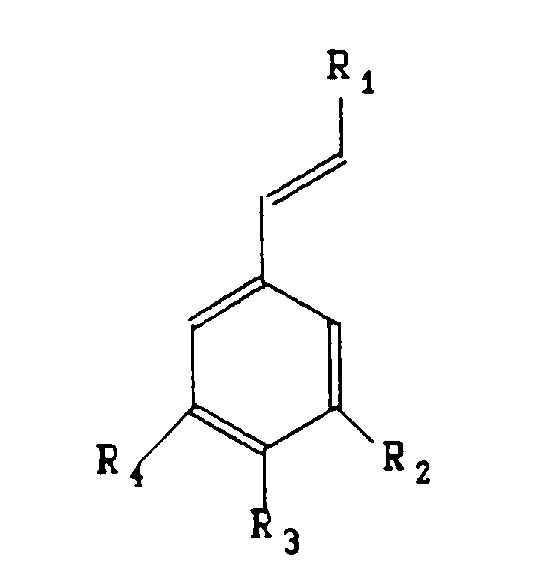
En ce qui concerne le radical R3, le glucoside du radical O-glucoside est choisi dans le groupe comprenant le glucopyranoside seul ou lié à un oside tel que le glucopyranoside, le rhamnopyranoside, l'arabinopyranoside.With regard to the radical R 3 , the glucoside of the radical O-glucoside is chosen from the group comprising glucopyranoside alone or linked to an oside such as glucopyranoside, rhamnopyranoside, arabinopyranoside.
Avantageusement, les substances aromatiques conformes à l'invention appartiennent au groupe comprenant la vanilline, l'aldéhyde benzoïque, l'aldéhyde anisique et l'aldéhyde protocatéchique. Advantageously, the aromatic substances according to the invention belong to the group comprising vanillin, benzoic aldehyde, anisic aldehyde and Protocatechic aldehyde.
La protéine mise en oeuvre dans le procédé conforme à l'invention peut être choisie parmi :
- les métalloprotéines, c'est-à-dire :
- des protéines ou des enzymes ayant une structure hémique ; parmi elles, on peut citer la myoglobine, l'hémoglobine, les cytochromes (c, P450...) ainsi que de nombreuses oxydoréductases comme la peroxydase, la catalase, la cytochrome oxydase, ou des deshydrogénases comme l'alcool deshydrogénase, ou encore des oxygénases,
- des protéines ou des enzymes associées à un ion métallique, parmi elles on peut citer la ferritine ainsi que la ferredoxine et certaines dioxygénases,
- des protéines dites "simples" dont l'action, dans le cadre de la présente invention, doit être complétée par un ion métallique non compris dans leur structure, cet ion métallique pouvant se trouver soit sous forme libre soit sous forme complexée (par exemple à des porphyrines ou à des protoporphyrines) ; parmi elles, on peut citer la gélatine, la caséine, la sérum albumine bovine.
- metalloproteins, that is to say:
- proteins or enzymes having a heme structure; among them, there may be mentioned myoglobin, hemoglobin, cytochromes (c, P450 ...) as well as numerous oxidoreductases such as peroxidase, catalase, cytochrome oxidase, or dehydrogenases such as alcohol dehydrogenase, or else oxygenases,
- proteins or enzymes associated with a metal ion, among them mention may be made of ferritin as well as ferredoxin and certain dioxygenases,
- so-called "simple" proteins whose action, in the context of the present invention, must be supplemented by a metal ion not included in their structure, this metal ion possibly being either in free form or in complexed form (for example at porphyrins or protoporphyrins); among them, there may be mentioned gelatin, casein, bovine serum albumin.
Quelle que soit la protéine mise en oeuvre dans le procédé conforme à l'invention, l'ion métallique, sous forme libre ou complexée, est choisi dans le groupe comprenant le fer, le cobalt, le cuivre, le magnésium, le manganèse et le zinc.Whatever protein used in the process according to the invention, the metal ion, under free or complexed form, is chosen from the group including iron, cobalt, copper, magnesium, manganese and zinc.
Avantageusement, plusieurs protéines et plusieurs ions métalliques, sous forme libre ou complexée, peuvent simultanément être mis en oeuvre dans le procédé conforme à l'invention. En effet, il a été constaté que les rendements obtenus étaient d'autant plus élevés qu'ils résultaient de la mise en oeuvre de la combinaison d'au moins deux des composés suivants : une protéine "simple", une métalloprotéine, un ion métallique, une protoporphyrine, une porphyrine.Advantageously, several proteins and several metal ions, in free or complexed form, can simultaneously be implemented in the conforming process to the invention. Indeed, it was found that the yields obtained were higher the more they resulted of the implementation of the combination of at least two of the following: a "simple" protein, a metalloprotein, a metal ion, a protoporphyrin, a porphyrin.
Le procédé conforme à l'invention présente notamment l'avantage de pouvoir être mis en oeuvre au moyen de composés peu coûteux et faciles à se procurer. De plus, les conditions réactionnelles ne nécessitent aucune précaution particulière de stérilité ou de régulation du milieu réactionnel.The process according to the invention has in particular the advantage of being able to be implemented at using inexpensive and readily available compounds. In addition, the reaction conditions do not require no special sterility or regulation precautions of the reaction medium.
Selon un mode de réalisation avantageux du procédé conforme à l'invention, l'ion métallique, sous quelque forme qu'il soit, est utilisé à raison de 0,0005 à 0,2 % en poids par rapport au substrat.According to an advantageous embodiment of the method in accordance with the invention, the metal ion, under whatever whatever form, is used at a rate of 0.0005 to 0.2% by weight relative to the substrate.
Avantageusement, les substrats soumis à l'action conjointe d'une protéine et d'un ion métallique sont choisis dans le groupe comprenant l'isoeugénol, l'eugénol, l'aldéhyde cinnamique, l'anéthol et l'acide rosmarinique.Advantageously, the substrates subjected to the action joint of a protein and a metal ion are chosen from the group comprising isoeugenol, eugenol, cinnamic aldehyde, anethole and rosmarinic acid.
Les protéines mises en oeuvre dans le procédé conforme à l'invention peuvent être utilisées sous forme purifiée ou non purifiée. Sous une forme non purifiée, ces protéines peuvent être mises en oeuvre par le biais de compositions les contenant telles qu'une suspension de cellules microbiennes, d'un broyat de cellules, de tissus ou d'organes d'origine végétale ou animale, ou encore d'un préconcentré protéique de ces compositions appelé fraction acétonique. A titre d'exemple on peut citer :
- des cellules de bactéries de levure ou de moisissure,
- des broyats végétaux tels que de fruits d'aubergines, de fruits de tomates, de feuilles d'épinards ou de fanes de radis,
- des extraits animaux, tels que du sang frais, du sang séché ou des cellules du foie.
- yeast or mold bacteria cells,
- vegetable shreds such as eggplant fruit, tomato fruit, spinach leaves or radish tops,
- animal extracts, such as fresh blood, dried blood or liver cells.
Selon un mode de réalisation avantageux du procédé conforme à l'invention, la protéine, sous quelque forme qu'elle soit, est utilisée à raison de 0,01 à 20% en poids par rapport au substrat, de préférence à raison de 0,1 à 5 % en poids par rapport au substrat. According to an advantageous embodiment of the method according to the invention, the protein in any form whatever it is, is used at a rate of 0.01 to 20% by weight relative to the substrate, preferably at a rate of 0.1 to 5% by weight relative to the substrate.
Le procédé conforme à l'invention peut être mis en oeuvre dans de l'eau ou dans un milieu aqueux tamponné à l'aide d'un tampon phosphate, citrate, borate ou phosphate-citrate-borate, le pH de la réaction devant être compris entre 2 et 10.The process according to the invention can be implemented works in water or in an aqueous medium buffered to using a phosphate, citrate, borate or phosphate-citrate-borate buffer, the pH of the reaction to be between 2 and 10.
Avantageusement, dans le cas où le substrat est l'isoeugénol, l'anéthol ou l'aldéhyde cinnamique, le pH est compris de préférence entre 4 et 9 et plus préférentiellement entre 5 et 7 ; dans le cas où le substrat est l'eugénol, le pH est de préférence compris entre 2 et 7 et plus préférentiellement entre 2,5 et 4,5.Advantageously, in the case where the substrate is isoeugenol, anethole or cinnamic aldehyde, pH is preferably between 4 and 9 and more preferably between 5 and 7; in the case where the substrate is eugenol, the pH is preferably between 2 and 7 and more preferably between 2.5 and 4.5.
Le procédé conforme à l'invention peut également être mis en oeuvre dans un milieu non aqueux tel que dans un ou plusieurs solvants organiques choisis parmi : l'hexane, le cyclohexane, le méthylcyclohexane, le dichloroéthane, le dichlorométhane.The process according to the invention can also be implemented in a non-aqueous medium such as in one or more organic solvents chosen from: hexane, cyclohexane, methylcyclohexane, dichloroethane, dichloromethane.
Par ailleurs, dans le cas où le substrat est l'eugénol, et ceci en raison de la très grande réactivité de ses groupements SH, l'ajout d'un composé sulphydryl peut être favorable. Ce composé peut être choisi dans le groupe comprenant la cystéine, le glutathion, le dithiothreitol, le dithioérythritol.Furthermore, in the case where the substrate is eugenol, and this because of the very high reactivity of its SH groups, the addition of a sulphydryl compound can be favorable. This compound can be chosen from the group including cysteine, glutathione, dithiothreitol, dithioerythritol.
Selon d'autres caractéristiques avantageuses de l'invention :
- la température du milieu de réaction est comprise entre 15 et 50°C et de préférence entre 25 et 40°C,
- l'aération du milieu de réaction doit permettre la fourniture d'au moins une mole d'oxygène par mole de substrat à oxyder, de ce fait la réaction est réalisable à la pression atmosphérique, mais peut donner lieu à des rendements améliorés si le milieu réactionnel est enrichi en air ou en oxygène par exemple par simple bullage ; la réaction est également réalisable sous une pression comprise entre 103 et 107 pascals,
- le milieu réactionnel est soumis à une agitation vigoureuse pouvant être comprise entre 150 et 250 tr/min sur table d'agitation et entre 100 et 1000 tr/min en réacteur agité,
- la durée de la réaction est comprise entre 2 heures et 5 jours,
- les substances aromatiques préparées sont isolées du milieu réactionnel par extraction ou par distillation.
- the temperature of the reaction medium is between 15 and 50 ° C and preferably between 25 and 40 ° C,
- the aeration of the reaction medium must allow the supply of at least one mole of oxygen per mole of substrate to be oxidized, therefore the reaction is feasible at atmospheric pressure, but can give rise to improved yields if the medium reaction is enriched with air or oxygen, for example by simple bubbling; the reaction can also be carried out under a pressure of between 10 3 and 10 7 pascals,
- the reaction medium is subjected to vigorous stirring which can be between 150 and 250 rpm on the stirring table and between 100 and 1000 rpm in a stirred reactor,
- the duration of the reaction is between 2 hours and 5 days,
- the aromatic substances prepared are isolated from the reaction medium by extraction or by distillation.
L'invention ne se limite pas strictement au procédé décrit, elle en embrasse au contraire toutes les variantes.The invention is not strictly limited to described process, on the contrary it embraces all variants.
Les exemples qui suivent permettront de mieux comprendre l'invention ; ils ne sont pas limitatifs et concernent les modes de réalisation avantageux de l'invention.The following examples will better illustrate understand the invention; they are not limiting and relate to the advantageous embodiments of the invention.
On prépare un milieu réactionnel de base devant servir de témoin comprenant :
- 20 g de tampon borate, 0,1 M, pH 6,5,
- 800 mg d'isoeugénol et
- 50 mg de Tween® 80.
- 20 g of borate buffer, 0.1 M, pH 6.5,
- 800 mg of isoeugenol and
- 50 mg of Tween® 80.
Un milieu réactionnel conforme à l'invention est également préparé et comprend, outre le milieu réactionnel de base, de l'hémoglobine purifiée.A reaction medium in accordance with the invention is also prepared and includes, in addition to the reaction medium base, purified hemoglobin.
Les milieux réactionnels sont mis à incuber à 28°C, pendant 3 jours, en flacons placés sur une table agitée à 175 tr/min.The reaction media are incubated at 28 ° C, for 3 days, in bottles placed on a table stirred at 175 rpm.
Le tableau I rend compte des résultats obtenus.
Il apparaít très clairement que l'ajout d'hémoglobine purifiée améliore nettement le rendement d'obtention de la vanilline.It is very clear that adding hemoglobin purified significantly improves the yield vanillin.
Le milieu réactionnel de base devant servir de témoin est le même que celui de l'exemple 1.The basic reaction medium to serve as witness is the same as that of Example 1.
Plusieurs milieux réactionnels conformes à l'invention sont préparés et comprennent, outre le milieu réactionnel de base décrit dans l'exemple 1, au moins un des composés suivants à la quantité indiquée :
- de la gélatine,
- du fer sous forme FeCl2,
- de la protoporphyrine IX.
- gelatin,
- iron in the form of FeCl 2 ,
- protoporphyrin IX.
Les conditions réactionnelles sont identiques à celles indiquées dans l'exemple 1.The reaction conditions are identical to those indicated in Example 1.
Les résultats obtenus sont résumés dans le tableau
II.
Alors que le rendement obtenu au moyen du milieu de base + gélatine ou du milieu de base + fer est inférieur à celui obtenu avec le milieu de base seul (simple constatation), l'association gélatine + fer permet d'accroítre considérablement la quantité de vanilline obtenue, ceci d'autant plus que la protoporphyrine est présente dans le milieu et que la quantité de fer dans le milieu est élevée.While the yield obtained by means of the medium base + gelatin or base medium + iron is less to that obtained with the basic medium alone (simple observation), the gelatin + iron combination allows significantly increase the amount of vanillin obtained, especially since protoporphyrin is present in the medium and that the amount of iron in the middle is high.
Le milieu réactionnel de base devant servir de témoin est le même que celui de l'exemple 1.The basic reaction medium to serve as witness is the same as that of Example 1.
Plusieurs milieux réactionnels conformes à l'invention sont préparés et comprennent, outre le milieu réactionnel de base décrit dans l'exemple 1, au moins un des composés suivants à la quantité indiquée :
- de l'hémoglobine purifiée,
- du fer sous forme FeCl2,
- de la protoporphyrine IX.
- purified hemoglobin,
- iron in the form of FeCl 2 ,
- protoporphyrin IX.
Les conditions réactionnelles sont identiques à celles indiquées dans l'exemple 1.The reaction conditions are identical to those indicated in Example 1.
Le tableau III présente les résultats obtenus.
L'effet de l'hémoglobine sur le rendement est potentialisé par la présence de la protoporphyrine et du fer, et ceci d'autant plus que la quantité de ce dernier est importante.The effect of hemoglobin on yield is potentiated by the presence of protoporphyrin and iron, and this all the more so as the quantity of the latter is important.
On prépare, dans un réacteur agité, un milieu réactionnel de base devant servir de témoin comprenant :
- 2 l de tampon borate, 0,1 M, pH 6,5,
- 80 g d'isoeugénol et
- 500 mg de Tween® 80.
- 2 l of borate buffer, 0.1 M, pH 6.5,
- 80 g isoeugenol and
- 500 mg of Tween® 80.
Deux milieux réactionnels conformes à l'invention sont également préparés et comprennent, outre le milieu réactionnel de base, respectivement 1 g d'hémoglobine purifiée et 1 g de sang séché.Two reaction media in accordance with the invention are also prepared and include, in addition to the middle basic reaction, respectively 1 g hemoglobin purified and 1 g of dried blood.
Les milieux réactionnels sont mis à incuber à 30°C, pendant 24 heures, en milieu agité à 600 tr/min, sous une pression de 4.104 pascals d'oxygène.The reaction media are incubated at 30 ° C for 24 hours in a stirred medium at 600 rpm, under a pressure of 4.10 4 pascals of oxygen.
Le tableau IV rassemble les résultats obtenus.
Le sang séché, dont la composition comprend outre l'hémoglobine, des protéines plasmatiques (comme l'albumine et les globulines) et du fer, permet l'obtention de meilleurs résultats encore qu'avec l'hémoglobine purifiée.Dried blood, the composition of which also includes hemoglobin, plasma proteins (like albumin and globulins) and iron, allows obtaining even better results than with purified hemoglobin.
On prépare, dans un réacteur agité, un milieu réactionnel de base devant servir de témoin comprenant :
- 2 l de tampon borate, 0,1 M, pH 6,5,
- 100 g d'isoeugénol et
- 500 mg de Tween® 80.
- 2 l of borate buffer, 0.1 M, pH 6.5,
- 100 g of isoeugenol and
- 500 mg of Tween® 80.
Un milieu réactionnel conforme à l'invention est également préparé et comprend, outre le milieu réactionnel de base, 2 g d'hémoglobine purifiée.A reaction medium in accordance with the invention is also prepared and includes, in addition to the reaction medium base, 2 g of purified hemoglobin.
Les milieux réactionnels sont mis à incuber à 30°C, pendant 24 heures, en milieu agité à 600 tr/min, sous une pression d'oxygène de 5.104 pascals.The reaction media are incubated at 30 ° C for 24 hours, in a stirred medium at 600 rpm, under an oxygen pressure of 5.10 4 pascals.
Le tableau V rend compte des résultats obtenus.
Ces résultats confirment les résultats obtenus dans les exemples précédents.These results confirm the results obtained in the previous examples.
On prépare deux milieux réactionnels de base identiques comprenant :
- 25 g de tampon borate, 0,1 M, pH 6,5,
- 400 mg d'isoeugénol et
- 50 mg de Tween® 80.
- 25 g of borate buffer, 0.1 M, pH 6.5,
- 400 mg of isoeugenol and
- 50 mg of Tween® 80.
L'un d'entre eux, considéré comme le milieu témoin, est additionné de 25 g de fruit d'aubergine broyé finement ayant subi au préalable un traitement thermique à 110°C pendant 15 minutes.One of them, considered the middle control, is added with 25 g of crushed eggplant fruit finely having previously undergone a heat treatment at 110 ° C for 15 minutes.
L'autre milieu est complémenté avec 25 g de fruit d'aubergine broyé finement et non traité thermiquement (fruit frais).The other medium is supplemented with 25 g of fruit eggplant finely ground and not heat treated (fresh fruit).
Il est connu que le fruit entier d'aubergine comprend des protéines à raison de 1 g par 100 g d'aubergine. Ainsi, dans 25 g d'aubergine, on a environ 250 mg de protéines (parmi lesquelles on compte certaines activités enzymatiques oxydatives) et environ 0,075 mg de fer et 3,75 mg de magnésium.It is known that the whole eggplant fruit includes protein at a rate of 1 g per 100 g of eggplant. So, in 25 g of eggplant, we have about 250 mg protein (some of which oxidative enzyme activities) and approximately 0.075 mg of iron and 3.75 mg of magnesium.
Les deux milieux sont mis à incuber à 28°C, pendant 3 jours, en flacons placés sur table agitée à 175 tr/min.The two media are incubated at 28 ° C, for 3 days, in bottles placed on a shaken table at 175 rpm.
Le tableau VI présente les résultats obtenus.
Ceci démontre que les broyats végétaux notamment permettent l'obtention d'excellents résultats dans le cadre de l'invention.This demonstrates that the ground vegetables in particular provide excellent results in the part of the invention.
On prépare un milieu réactionnel de base devant servir de témoin comprenant :
- 20 g de tampon phosphate/citrate/borate, 0,1 M, pH 6,5,
- 800 mg d'eugénol et
- 50 mg de Tween® 80.
- 20 g of phosphate / citrate / borate buffer, 0.1 M, pH 6.5,
- 800 mg of eugenol and
- 50 mg of Tween® 80.
Deux milieux réactionnels conformes à l'invention sont également préparés et comprennent, outre le milieu réactionnel de base, respectivement de la cystéine et de la cystéine + de l'hémoglobine purifiée.Two reaction media in accordance with the invention are also prepared and include, in addition to the middle basic reaction, cysteine and cysteine + purified hemoglobin.
Les milieux réactionnels sont mis à incuber à 30°C, pendant 2 heures, en milieu agité à 150 tr/min, sous une pression d'oxygène de 8.105 pascals.The reaction media are incubated at 30 ° C for 2 hours in a stirred medium at 150 rpm, under an oxygen pressure of 8.10 5 pascals.
Le tableau VII rend compte des résultats obtenus.
La grande réactivité de l'eugénol vis à vis de la cystéine se trouve ici démontrée et cette combinaison est considérablement potentialisée par l'ajout d'hémoglobine purifiée.The high reactivity of eugenol with respect to cysteine is shown here and this combination is significantly potentiated by the addition of hemoglobin purified.
On prépare un milieu réactionnel de base, devant servir de témoin, comprenant :
- 20 g de tampon phosphate/citrate/borate, 0,1 M, pH 6,5,
- 800 mg d'eugénol,
- 50 mg de Tween® 80.
- 20 g of phosphate / citrate / borate buffer, 0.1 M, pH 6.5,
- 800 mg of eugenol,
- 50 mg of Tween® 80.
Un milieu réactionnel conforme à l'invention est également préparé et comprend, outre le milieu réactionnel de base :
- de la cystéine,
- de la gélatine,
- de la protoporphyrine IX et
- du fer sous forme FeSO4.
- cysteine,
- gelatin,
- protoporphyrin IX and
- iron as FeSO 4 .
Les milieux réactionnels sont mis à incuber à 30°C, pendant 2 heures, en milieu agité à 150 tr/min, sous une pression d'oxygène de 105 pascals.The reaction media are incubated at 30 ° C for 2 hours in a stirred medium at 150 rpm, under an oxygen pressure of 10 5 pascals.
Les résultats obtenus sont résumés dans le tableau
VIII.
Ici, d'excellents résultats sont encore obtenus et la réactivité de l'eugénol vis à vis de la cystéine est renforcée par la présence de la gélatine, de la protoporphyrine IX et du fer.Here, excellent results are still obtained and the reactivity of eugenol to cysteine is reinforced by the presence of gelatin, protoporphyrin IX and iron.
On prépare, dans un réacteur agité, un milieu réactionnel de base devant servir de témoin comprenant :
- 2 l de tampon borate, 0,1 M, pH 6,5,
- 82 g d'aldéhyde cinnamique et
- 1 g de Tween® 80.
- 2 l of borate buffer, 0.1 M, pH 6.5,
- 82 g of cinnamic aldehyde and
- 1 g of Tween® 80.
Un milieu réactionnel conforme à l'invention est également préparé et comprend, outre le milieu réactionnel de base :
- de l'hémoglobine purifiée,
- du fer sous forme FeCl2.
- purified hemoglobin,
- iron as FeCl 2 .
Les milieux réactionnels sont mis à incuber à 30°C, pendant 48 heures, en milieu agité à 600 tr/min, sous une pression d'oxygène de 104 pascals.The reaction media are incubated at 30 ° C for 48 hours in a stirred medium at 600 rpm, under an oxygen pressure of 10 4 pascals.
Le tableau IX présente les résultats obtenus.
L'hémoglobine et le fer potentialisent de façon spectaculaire la réaction d'oxydation de l'aldéhyde cinnamique en benzaldéhyde. Hemoglobin and iron potentiate so spectacular the aldehyde oxidation reaction cinnamic to benzaldehyde.
On prépare, dans un réacteur agité, un milieu réactionnel de base devant servir de témoin comprenant :
- 2 l de tampon borate, 0,1 M, pH 6,5,
- 80 g d'anéthol et
- 1 g de Tween® 80.
- 2 l of borate buffer, 0.1 M, pH 6.5,
- 80 g of anethole and
- 1 g of Tween® 80.
Un milieu réactionnel conforme à l'invention est également préparé et comprend, outre le milieu réactionnel de base :
- de l'hémoglobine purifiée,
- du fer sous forme FeCl2.
- purified hemoglobin,
- iron as FeCl 2 .
Les milieux réactionnels sont mis à incuber à 30°C, pendant 48 heures, en milieu agité à 600 tr/min, sous une pression d'oxygène de 104 pascals.The reaction media are incubated at 30 ° C for 48 hours in a stirred medium at 600 rpm, under an oxygen pressure of 10 4 pascals.
Le tableau X présente les résultats obtenus.
L'hémoglobine et le fer potentialisent de façon spectaculaire la réaction d'oxydation de l'anéthol en anisaldéhyde.Hemoglobin and iron potentiate so spectacular the oxidation reaction of anethole in anisaldehyde.
Dans les EXEMPLES 11 à 13, les conditions réactionnelles sont les mêmes et sont exposées ci-après.In EXAMPLES 11 to 13, the reaction conditions are the same and are set out below.
On prépare, dans un réacteur agité, un milieu réactionnel de base devant servir de témoin comprenant :
- 20 g de tampon borate,0,1 M, pH 6,5,
- 800 mg de substrat,
- 50 mg de Tween® 80.
- 20 g of borate buffer, 0.1 M, pH 6.5,
- 800 mg of substrate,
- 50 mg of Tween® 80.
Un milieu réactionnel conforme à l'invention est également préparé et comprend, outre le milieu réactionnel de base :
- de l'hémoglobine purifiée ou
- de l'hémoglobine purifiée et du fer sous forme FeCl2.
- purified hemoglobin or
- purified hemoglobin and iron as FeCl 2 .
Les milieux réactionnels sont mis à incuber à 28°C, pendant 2 heures, en milieu agité à 150 tr/min, sous une pression d'oxygène de 5.104 pascals. Les tableaux XI à XIII présentent les résultats obtenus.The reaction media are incubated at 28 ° C for 2 hours in a stirred medium at 150 rpm, under an oxygen pressure of 5.10 4 pascals. Tables XI to XIII present the results obtained.
Le substrat est l'isoeugénol.
L'effet de l'hémoglobine purifiée sur le rendement est clairement potentialisé par la présence du fer. The Effect of Purified Hemoglobin on Yield is clearly potentiated by the presence of iron.
Le substrat est l'anéthol.
Nous ne pouvons que constater une diminution (non expliquée) du rendement dans le cas où l'hémoglobine purifiée est ajoutée au milieu de base mais la combinaison hémoglobine purifiée-fer permet l'obtention d'un rendement en accord avec celui obtenu dans l'exemple précédent.We can only note a decrease (not explained) of the yield in the case where hemoglobin purified is added to the base medium but the combination purified hemoglobin-iron allows obtaining a yield in agreement with that obtained in the example previous.
Le substrat est l'aldéhyde cinnamique.
L'hémoglobine purifiée potentialise de façon spectaculaire la réaction d'oxydation de l'aldéhyde cinnamique en benzaldéhyde, cette réaction étant d'autant plus renforcée par la présence du fer. Purified hemoglobin potentiates so spectacular the aldehyde oxidation reaction cinnamic to benzaldehyde, this reaction being all the more more reinforced by the presence of iron.
On prépare un milieu réactionnel de base, devant servir de témoin, comprenant :
- 20 g de tampon borate, 0,1 M, pH 6,5,
- 800 mg d'isoeugénol,
- 50 mg de Tween 80®.
- 20 g of borate buffer, 0.1 M, pH 6.5,
- 800 mg of isoeugenol,
- 50 mg of Tween 80®.
Un milieu réactionnel conforme à l'invention est également préparé et comprend, outre le milieu réactionnel de base :
- de l'hémoglobine purifiée ou
- de l'hémoglobine purifiée et du fer sous forme FeCl2.
- purified hemoglobin or
- purified hemoglobin and iron as FeCl 2 .
Les milieux réactionnels sont mis à incuber à 28° C, pendant 2 heures, en milieu agité à 150 tr/min, sous une pression d'oxygène de 8.105 pascals.The reaction media are incubated at 28 ° C for 2 hours, in a stirred medium at 150 rpm, under an oxygen pressure of 8.10 5 pascals.
Les résultats obtenus sont résumés dans le tableau
XIV.
L'ajout de fer au milieu de base en plus de l'hémoblogine purifiée renforce de façon substantielle le rendement d'obtention de la vanilline par rapport au rendement, déjà intéressant, obtenu dans le cas où le milieu réactionnel ne se compose que du milieu de base et de l'hémoglobine purifiée.Adding iron to the base medium in addition to purified hemoblogin substantially strengthens the yield of obtaining vanillin relative to yield, already interesting, obtained in the case where the reaction medium consists only of the base medium and purified hemoglobin.
Claims (15)
- A process for the preparation of aromatic substances having the formulacharacterised in that a substrate corresponding to the formula
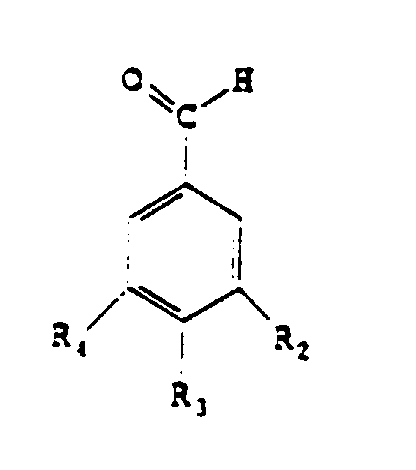 is subjected to oxidation, a formula wherein
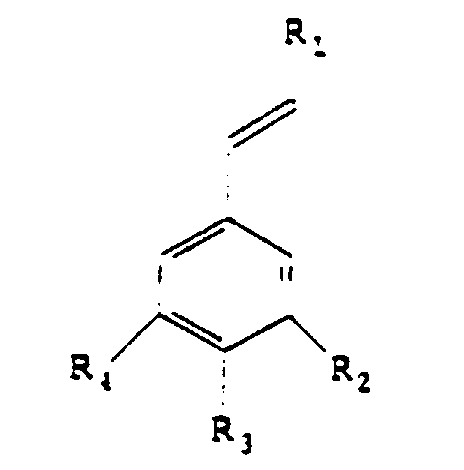 said oxidation being carried out in the presence of at least one protein and of 0.0005 to 0.2% by weight with respect to the substrate of a metal ion which is in the free or complexed form and which is chosen from the group comprising iron, cobalt, copper, magnesium, manganese and zinc.R1 may be a radical -H, -CH3, -CH2OH, -CHO, -COOH, -OCH3 or -COO-CH(COOH)-CH2-C6H3(OH)2,R2 may be a radical -H, -OH, or -OCH3,R3 may be a radical -H, -OH, -OCH3, or 0-glucoside,R4 may be a radical -H, -OH, or -OCH3.
 - A process according to claim 1, characterised in that the glucoside in the radical R3 is chosen from the group comprising glucopyranoside alone or attached to an oside such as glucopyranoside, rhamnopyranoside, arabinopyranoside.
- A process according to claim 1 or 2, characterised in that the aromatic substances belong to the group comprising vanillin, benzaldehyde, anisaldehyde, protocatechualdehyde.
- A process according to one of claims 1 to 3, characterised in that the protein used is a metalloprotein.
- A process according to claim 4, characterised in that the metalloprotein is chosen from the group comprising haemoglobin, myoglobin, oxydoreductases, dehydrogenases, oxygenases.
- A process according to one of claims 1 to 3, characterised in that the protein is chosen from the group comprising gelatin, casein, bovine serum albumin.
- A process according to one of claims 1 to 6, characterised in that the protein is used in the purified form.
- A process according to one of claims 1 to 6, characterised in that the protein is used in the unpurified form by means of a suspension of microbial cells, a ground preparation of cells, tissues or organs of vegetable or animal origin or of a protein preconcentrate of said compositions.
- A process according to one of claims 1 to 8, characterised in that the protein is used in a quantity of 0.01 to 20% by weight with respect to the substrate, preferably in a quantity of 0.1 to 5% by weight with respect to the substrate.
- A process according to one of claims 1 to 9, characterised in that it is used in water or in a buffered aqueous medium having a pH between 2 and 10.
- A process according to one of claims 1 to 10, characterised in that it is used at a temperature between 15 and 50°C and preferably between 25 and 40°C.
- A process according to one of claims 1 to 11, characterised in that it is used at atmospheric pressure or under a pressure of air or oxygen between 103 and 107 pascals.
- A process according to one of claims 1 to 12, characterised in that it is used under agitation.
- A process according to one of claims 1 to 13, characterised in that it is used for a period between 2 hours and 5 days.
- A process according to one of claims 1 to 14, characterised in that the aromatic substances prepared are isolated from the reaction medium by extraction or by distillation.
Applications Claiming Priority (3)
| Application Number | Priority Date | Filing Date | Title |
|---|---|---|---|
| FR9500581A FR2729661B1 (en) | 1995-01-19 | 1995-01-19 | PROCESS FOR THE PREPARATION OF AROMATIC SUBSTANCES BY BIOCHEMICAL ROUTE |
| FR9500581 | 1995-01-19 | ||
| PCT/FR1996/000082 WO1996022381A1 (en) | 1995-01-19 | 1996-01-18 | Biochemical process for preparing aromatic substances |
Publications (2)
| Publication Number | Publication Date |
|---|---|
| EP0804606A1 EP0804606A1 (en) | 1997-11-05 |
| EP0804606B1 true EP0804606B1 (en) | 1999-06-16 |
Family
ID=9475284
Family Applications (1)
| Application Number | Title | Priority Date | Filing Date |
|---|---|---|---|
| EP96901412A Expired - Lifetime EP0804606B1 (en) | 1995-01-19 | 1996-01-18 | Biochemical process for preparing aromatic substances |
Country Status (8)
| Country | Link |
|---|---|
| US (1) | US5861286A (en) |
| EP (1) | EP0804606B1 (en) |
| JP (1) | JP3506436B2 (en) |
| AT (1) | ATE181365T1 (en) |
| DE (1) | DE69602921T2 (en) |
| DK (1) | DK0804606T3 (en) |
| FR (1) | FR2729661B1 (en) |
| WO (1) | WO1996022381A1 (en) |
Families Citing this family (16)
| Publication number | Priority date | Publication date | Assignee | Title |
|---|---|---|---|---|
| DE19835542A1 (en) * | 1998-08-06 | 2000-02-10 | Degussa | Process for the selective enrichment and separation of aroma-active molecules by adsorption |
| DE19928158C2 (en) | 1999-06-19 | 2003-09-04 | Haarmann & Reimer Gmbh | Process for the preparation of aromatic carbonyl compounds from styrenes |
| FR2898131B1 (en) | 2006-03-01 | 2012-08-31 | Mane Fils V | SYSTEM FOR PRODUCING AROMATIC MOLECULES BY BIOCONVERSION |
| AT505436B1 (en) * | 2007-07-10 | 2009-03-15 | Univ Graz | ENZYME CATALYSIS METHOD FOR THE OXIDATIVE CLEAVAGE OF ETHYLENIC DOUBLE BONDINGS |
| WO2009006662A2 (en) * | 2007-07-10 | 2009-01-15 | Universität Graz | Process for the oxidative cleavage of vinylaromatics using peroxidases or laccases |
| AT506983B1 (en) * | 2008-07-09 | 2011-11-15 | Univ Graz | Heme COMPLEX |
| GB201021864D0 (en) * | 2010-12-23 | 2011-02-02 | Givaudan Sa | Organic compounds |
| CN102206146B (en) * | 2011-03-23 | 2014-04-16 | 中山大学 | A kind of preparation method of vanillin |
| EP2748310B1 (en) | 2011-08-26 | 2015-10-07 | Universität Graz | Enzymatic alkene cleavage |
| CN102367222A (en) * | 2011-11-16 | 2012-03-07 | 上海师范大学 | Method for preparing vanillin |
| CN104119213B (en) * | 2014-06-30 | 2016-04-27 | 上海应用技术学院 | A kind of preparation method of vanillin food grade,1000.000000ine mesh |
| CN104496777A (en) * | 2014-12-17 | 2015-04-08 | 成都快典科技有限公司 | Process for preparing benzaldehyde from phenylethylene through catalytic oxidation by adopting BuN-PMo12 |
| CN104496776A (en) * | 2014-12-17 | 2015-04-08 | 成都快典科技有限公司 | Process for preparing benzaldehyde from phenylethylene through catalytic oxidation by adopting BuN-PMo12 |
| CN107141211B (en) * | 2017-07-03 | 2020-11-13 | 广西大学 | Preparation method of benzaldehyde |
| CN115417756B (en) * | 2022-08-30 | 2023-11-14 | 安徽华业香料合肥有限公司 | Process for preparing vanillin from eugenol by one-pot method |
| WO2026160275A1 (en) * | 2025-01-24 | 2026-07-30 | 天野エンザイム株式会社 | Enzymatic agent for vanillin production and application thereof |
Family Cites Families (4)
| Publication number | Priority date | Publication date | Assignee | Title |
|---|---|---|---|---|
| JP2693555B2 (en) * | 1988-10-25 | 1997-12-24 | 長谷川香料株式会社 | Dioxygenase and method for producing the same |
| JP2679739B2 (en) * | 1988-10-25 | 1997-11-19 | 長谷川香料株式会社 | Method for producing aldehydes |
| DE69220455T2 (en) * | 1991-11-11 | 1997-11-27 | Quest Int | Process for the preparation of phenyl aldehydes |
| FR2694020B1 (en) * | 1992-07-24 | 1994-10-14 | Mane Fils Sa V | Process for the preparation of aromatic substances by enzymatic route. |
-
1995
- 1995-01-19 FR FR9500581A patent/FR2729661B1/en not_active Expired - Lifetime
-
1996
- 1996-01-18 EP EP96901412A patent/EP0804606B1/en not_active Expired - Lifetime
- 1996-01-18 DK DK96901412T patent/DK0804606T3/en active
- 1996-01-18 DE DE69602921T patent/DE69602921T2/en not_active Expired - Fee Related
- 1996-01-18 US US08/860,876 patent/US5861286A/en not_active Expired - Fee Related
- 1996-01-18 WO PCT/FR1996/000082 patent/WO1996022381A1/en not_active Ceased
- 1996-01-18 JP JP52208996A patent/JP3506436B2/en not_active Expired - Fee Related
- 1996-01-18 AT AT96901412T patent/ATE181365T1/en not_active IP Right Cessation
Also Published As
| Publication number | Publication date |
|---|---|
| WO1996022381A1 (en) | 1996-07-25 |
| DE69602921D1 (en) | 1999-07-22 |
| DE69602921T2 (en) | 1999-12-23 |
| US5861286A (en) | 1999-01-19 |
| EP0804606A1 (en) | 1997-11-05 |
| ATE181365T1 (en) | 1999-07-15 |
| DK0804606T3 (en) | 1999-12-13 |
| JPH10512858A (en) | 1998-12-08 |
| JP3506436B2 (en) | 2004-03-15 |
| FR2729661A1 (en) | 1996-07-26 |
| FR2729661B1 (en) | 1997-04-04 |
Similar Documents
| Publication | Publication Date | Title |
|---|---|---|
| EP0804606A1 (en) | Biochemical process for preparing aromatic substances | |
| US4266034A (en) | Method for producing microbial cells and use thereof to produce oxidation products | |
| JPH05244965A (en) | Vanillin production method by microbial conversion | |
| JP2901008B2 (en) | Diacetyl and acetoin fermentation by lactic acid bacteria | |
| EP2326708B1 (en) | Photosynthetic microorganisms enriched in selenium using selenohydroxy acid compounds, uses thereof in nutrition, cosmetics and pharmacy | |
| US4269940A (en) | Microbiological alkane oxidation process | |
| EP0437500B1 (en) | METHOD FOR PRODUCING LIGNIN-PEROXYDASE BY USING NON-PROLIFERATING CELLS OF $i(PHANEROCHAETE CHRYSOSPORIUM) | |
| EP0770686A1 (en) | Process for the production of thiols | |
| EP0782629B1 (en) | Enzymatic hydrolysis of 4-methylthiobutyronitriles | |
| EP0606441B1 (en) | Method for enzymatically preparing aromatic substances | |
| US4241184A (en) | Secondary alcohol dehydrogenase enzyme and use thereof | |
| DE3307095A1 (en) | MICROBIOLOGICALLY PRODUCED L-PHENYLALANINE DEHYDROGENASE, METHOD FOR THEIR DETERMINATION AND THEIR USE | |
| EP0443926B1 (en) | Process for the enzymatic obtention of irone | |
| JP5351495B2 (en) | Acetaldehyde decomposition method using superoxide dismutase | |
| FR2573771A1 (en) | PROCESS FOR PRODUCING PEROXIDASE | |
| Furukawa et al. | Purification and characterization of vanillyl-alcohol oxidase from Byssochlamys fulva V107 | |
| DE2915106A1 (en) | PROCESS FOR THE ENZYMATIC CONVERSION OF ORGANIC SUBSTRATES INTO KETONE | |
| EP0797681B1 (en) | Method for preparing butanone derivatives | |
| JPH0436180A (en) | Enhancement of productivity of proliferative and antifungal substance for lactic bacteria | |
| FR3125062A1 (en) | Genetically modified strain of Pseudomonas putida to express benzalacetone reductase | |
| EP0252855B1 (en) | Process for the selective bioconversion of isosorbide dinitrate | |
| FR2658534A1 (en) | METHOD OF OBTAINING IRONE MICROBIOLOGICALLY. | |
| CH643299A5 (en) | PROCESS FOR THE PREPARATION OF D-ALPHA-AMINO-ACIDS. | |
| Lisov et al. | Hybrid Mn-peroxidases from basidiomycetes | |
| Jaeger | Purification of coniferyl alcohol dehydrogenase from Rhodococcus erythropolis |
Legal Events
| Date | Code | Title | Description |
|---|---|---|---|
| PUAI | Public reference made under article 153(3) epc to a published international application that has entered the european phase |
Free format text: ORIGINAL CODE: 0009012 |
|
| 17P | Request for examination filed |
Effective date: 19970714 |
|
| AK | Designated contracting states |
Kind code of ref document: A1 Designated state(s): AT BE CH DE DK ES FR GB GR IE IT LI LU MC NL PT SE |
|
| GRAG | Despatch of communication of intention to grant |
Free format text: ORIGINAL CODE: EPIDOS AGRA |
|
| 17Q | First examination report despatched |
Effective date: 19981007 |
|
| GRAG | Despatch of communication of intention to grant |
Free format text: ORIGINAL CODE: EPIDOS AGRA |
|
| GRAH | Despatch of communication of intention to grant a patent |
Free format text: ORIGINAL CODE: EPIDOS IGRA |
|
| GRAH | Despatch of communication of intention to grant a patent |
Free format text: ORIGINAL CODE: EPIDOS IGRA |
|
| GRAA | (expected) grant |
Free format text: ORIGINAL CODE: 0009210 |
|
| AK | Designated contracting states |
Kind code of ref document: B1 Designated state(s): AT BE CH DE DK ES FR GB GR IE IT LI LU MC NL PT SE |
|
| PG25 | Lapsed in a contracting state [announced via postgrant information from national office to epo] |
Ref country code: IT Free format text: LAPSE BECAUSE OF FAILURE TO SUBMIT A TRANSLATION OF THE DESCRIPTION OR TO PAY THE FEE WITHIN THE PRE;WARNING: LAPSES OF ITALIAN PATENTS WITH EFFECTIVE DATE BEFORE 2007 MAY HAVE OCCURRED AT ANY TIME BEFORE 2007. THE CORRECT EFFECTIVE DATE MAY BE DIFFERENT FROM THE ONE RECORDED.SCRIBED TIME-LIMIT Effective date: 19990616 Ref country code: GR Free format text: LAPSE BECAUSE OF NON-PAYMENT OF DUE FEES Effective date: 19990616 Ref country code: ES Free format text: THE PATENT HAS BEEN ANNULLED BY A DECISION OF A NATIONAL AUTHORITY Effective date: 19990616 Ref country code: AT Free format text: LAPSE BECAUSE OF FAILURE TO SUBMIT A TRANSLATION OF THE DESCRIPTION OR TO PAY THE FEE WITHIN THE PRESCRIBED TIME-LIMIT Effective date: 19990616 |
|
| REF | Corresponds to: |
Ref document number: 181365 Country of ref document: AT Date of ref document: 19990715 Kind code of ref document: T |
|
| RIN1 | Information on inventor provided before grant (corrected) |
Inventor name: ZUCCA, JOSEPH Inventor name: MANE, JEAN |
|
| REG | Reference to a national code |
Ref country code: CH Ref legal event code: EP |
|
| REF | Corresponds to: |
Ref document number: 69602921 Country of ref document: DE Date of ref document: 19990722 |
|
| REG | Reference to a national code |
Ref country code: CH Ref legal event code: NV Representative=s name: KELLER & PARTNER PATENTANWAELTE AG |
|
| REG | Reference to a national code |
Ref country code: IE Ref legal event code: FG4D Free format text: FRENCH |
|
| PG25 | Lapsed in a contracting state [announced via postgrant information from national office to epo] |
Ref country code: PT Free format text: LAPSE BECAUSE OF FAILURE TO SUBMIT A TRANSLATION OF THE DESCRIPTION OR TO PAY THE FEE WITHIN THE PRESCRIBED TIME-LIMIT Effective date: 19990916 |
|
| GBT | Gb: translation of ep patent filed (gb section 77(6)(a)/1977) |
Effective date: 19990903 |
|
| REG | Reference to a national code |
Ref country code: DK Ref legal event code: T3 |
|
| PG25 | Lapsed in a contracting state [announced via postgrant information from national office to epo] |
Ref country code: LU Free format text: LAPSE BECAUSE OF NON-PAYMENT OF DUE FEES Effective date: 20000118 |
|
| PG25 | Lapsed in a contracting state [announced via postgrant information from national office to epo] |
Ref country code: MC Free format text: THE PATENT HAS BEEN ANNULLED BY A DECISION OF A NATIONAL AUTHORITY Effective date: 20000131 |
|
| PLBE | No opposition filed within time limit |
Free format text: ORIGINAL CODE: 0009261 |
|
| STAA | Information on the status of an ep patent application or granted ep patent |
Free format text: STATUS: NO OPPOSITION FILED WITHIN TIME LIMIT |
|
| 26N | No opposition filed | ||
| PG25 | Lapsed in a contracting state [announced via postgrant information from national office to epo] |
Ref country code: IE Free format text: LAPSE BECAUSE OF NON-PAYMENT OF DUE FEES Effective date: 20000719 |
|
| REG | Reference to a national code |
Ref country code: IE Ref legal event code: FD4D |
|
| REG | Reference to a national code |
Ref country code: GB Ref legal event code: IF02 |
|
| PGFP | Annual fee paid to national office [announced via postgrant information from national office to epo] |
Ref country code: SE Payment date: 20041217 Year of fee payment: 10 Ref country code: NL Payment date: 20041217 Year of fee payment: 10 |
|
| PGFP | Annual fee paid to national office [announced via postgrant information from national office to epo] |
Ref country code: DK Payment date: 20041222 Year of fee payment: 10 |
|
| PGFP | Annual fee paid to national office [announced via postgrant information from national office to epo] |
Ref country code: GB Payment date: 20050104 Year of fee payment: 10 |
|
| PGFP | Annual fee paid to national office [announced via postgrant information from national office to epo] |
Ref country code: DE Payment date: 20050107 Year of fee payment: 10 |
|
| PGFP | Annual fee paid to national office [announced via postgrant information from national office to epo] |
Ref country code: CH Payment date: 20050111 Year of fee payment: 10 |
|
| PGFP | Annual fee paid to national office [announced via postgrant information from national office to epo] |
Ref country code: BE Payment date: 20050217 Year of fee payment: 10 |
|
| PG25 | Lapsed in a contracting state [announced via postgrant information from national office to epo] |
Ref country code: GB Free format text: LAPSE BECAUSE OF NON-PAYMENT OF DUE FEES Effective date: 20060118 |
|
| PG25 | Lapsed in a contracting state [announced via postgrant information from national office to epo] |
Ref country code: SE Free format text: LAPSE BECAUSE OF NON-PAYMENT OF DUE FEES Effective date: 20060119 |
|
| PG25 | Lapsed in a contracting state [announced via postgrant information from national office to epo] |
Ref country code: LI Free format text: LAPSE BECAUSE OF NON-PAYMENT OF DUE FEES Effective date: 20060131 Ref country code: DK Free format text: LAPSE BECAUSE OF NON-PAYMENT OF DUE FEES Effective date: 20060131 Ref country code: CH Free format text: LAPSE BECAUSE OF NON-PAYMENT OF DUE FEES Effective date: 20060131 Ref country code: BE Free format text: LAPSE BECAUSE OF NON-PAYMENT OF DUE FEES Effective date: 20060131 |
|
| PG25 | Lapsed in a contracting state [announced via postgrant information from national office to epo] |
Ref country code: NL Free format text: LAPSE BECAUSE OF NON-PAYMENT OF DUE FEES Effective date: 20060801 Ref country code: DE Free format text: LAPSE BECAUSE OF NON-PAYMENT OF DUE FEES Effective date: 20060801 |
|
| REG | Reference to a national code |
Ref country code: DK Ref legal event code: EBP |
|
| REG | Reference to a national code |
Ref country code: CH Ref legal event code: PL |
|
| EUG | Se: european patent has lapsed | ||
| GBPC | Gb: european patent ceased through non-payment of renewal fee |
Effective date: 20060118 |
|
| NLV4 | Nl: lapsed or anulled due to non-payment of the annual fee |
Effective date: 20060801 |
|
| BERE | Be: lapsed |
Owner name: ETS V. *MANE FILS Effective date: 20060131 |
|
| PGFP | Annual fee paid to national office [announced via postgrant information from national office to epo] |
Ref country code: FR Payment date: 20090128 Year of fee payment: 14 |
|
| REG | Reference to a national code |
Ref country code: FR Ref legal event code: ST Effective date: 20100930 |
|
| PG25 | Lapsed in a contracting state [announced via postgrant information from national office to epo] |
Ref country code: FR Free format text: LAPSE BECAUSE OF NON-PAYMENT OF DUE FEES Effective date: 20100201 |