EP0803701A2 - Multi-axis unfolding mechanism with rate controlled synchronized movement - Google Patents
Multi-axis unfolding mechanism with rate controlled synchronized movement Download PDFInfo
- Publication number
- EP0803701A2 EP0803701A2 EP97250096A EP97250096A EP0803701A2 EP 0803701 A2 EP0803701 A2 EP 0803701A2 EP 97250096 A EP97250096 A EP 97250096A EP 97250096 A EP97250096 A EP 97250096A EP 0803701 A2 EP0803701 A2 EP 0803701A2
- Authority
- EP
- European Patent Office
- Prior art keywords
- axis
- rotation
- wing
- elevation
- frame
- Prior art date
- Legal status (The legal status is an assumption and is not a legal conclusion. Google has not performed a legal analysis and makes no representation as to the accuracy of the status listed.)
- Granted
Links
- 230000007246 mechanism Effects 0.000 title claims abstract description 73
- 230000001360 synchronised effect Effects 0.000 title abstract description 4
- 239000011888 foil Substances 0.000 claims abstract description 93
- 239000012530 fluid Substances 0.000 claims description 36
- 230000007704 transition Effects 0.000 abstract description 2
- 239000007789 gas Substances 0.000 description 5
- 238000000926 separation method Methods 0.000 description 4
- 230000035939 shock Effects 0.000 description 4
- 239000006096 absorbing agent Substances 0.000 description 3
- 238000012986 modification Methods 0.000 description 3
- 230000004048 modification Effects 0.000 description 3
- 238000007789 sealing Methods 0.000 description 3
- 102000003979 Mineralocorticoid Receptors Human genes 0.000 description 2
- 108090000375 Mineralocorticoid Receptors Proteins 0.000 description 2
- 230000008901 benefit Effects 0.000 description 2
- 230000007423 decrease Effects 0.000 description 2
- 238000013461 design Methods 0.000 description 2
- 230000009977 dual effect Effects 0.000 description 2
- 229910000831 Steel Inorganic materials 0.000 description 1
- 230000009471 action Effects 0.000 description 1
- 230000004913 activation Effects 0.000 description 1
- XAGFODPZIPBFFR-UHFFFAOYSA-N aluminium Chemical compound [Al] XAGFODPZIPBFFR-UHFFFAOYSA-N 0.000 description 1
- 229910052782 aluminium Inorganic materials 0.000 description 1
- 238000013459 approach Methods 0.000 description 1
- 230000009172 bursting Effects 0.000 description 1
- 238000005266 casting Methods 0.000 description 1
- 238000010276 construction Methods 0.000 description 1
- 230000008878 coupling Effects 0.000 description 1
- 238000010168 coupling process Methods 0.000 description 1
- 238000005859 coupling reaction Methods 0.000 description 1
- 238000013016 damping Methods 0.000 description 1
- 230000003247 decreasing effect Effects 0.000 description 1
- 238000000034 method Methods 0.000 description 1
- 230000000284 resting effect Effects 0.000 description 1
- 239000010959 steel Substances 0.000 description 1
- 238000012546 transfer Methods 0.000 description 1
Images




Classifications
-
- F—MECHANICAL ENGINEERING; LIGHTING; HEATING; WEAPONS; BLASTING
- F42—AMMUNITION; BLASTING
- F42B—EXPLOSIVE CHARGES, e.g. FOR BLASTING, FIREWORKS, AMMUNITION
- F42B10/00—Means for influencing, e.g. improving, the aerodynamic properties of projectiles or missiles; Arrangements on projectiles or missiles for stabilising, steering, range-reducing, range-increasing or fall-retarding
- F42B10/02—Stabilising arrangements
- F42B10/14—Stabilising arrangements using fins spread or deployed after launch, e.g. after leaving the barrel
Definitions
- This invention relates to an air foil deployment system for use on a missile, rocket or the like.
- a mechanism for deploying an air foil.
- the mechanism includes a frame and a pivot pin pivotally mounted on the frame for pivotal motion between a first position and a second position about a first axis.
- An air foil is mounted to the pivot pin. The air flow over the air foil can be used to move the air foil and pivot pin from the first position to the second position.
- a pressurized fluid, pyrotechnic or drogue chute can be used for pivoting the air foil and pin between the first and second positions.
- a cam is mounted on the frame which causes elevation of the air foil about a second axis perpendicular to the first axis as the pivot pin moves from the first position to the second position.
- the pivot pin is secured to a rotation gear which meshes with a rack shaft.
- the mechanism can also include a sliding gear rack engaging the cam.
- the sliding gear rack has teeth meshed with teeth on the air foil.
- the mechanism has a lock to lock the air foil in the elevated and rotated position.
- a stop device can be provided to limit the motion of the air foil into the elevated and rotated position.
- the mechanism can have a second air foil which is deployed to the rotated and elevated position simultaneously with the first air foil.
- the mechanism has an unfolding motion rate limiting orifice through which hydraulic fluid is forced.
- This orifice is adjustable to provide alternate air foil deployment time histories.
- a mechanism for deploying an air foil.
- the mechanism includes a frame and an elevation plate mounted on the frame for pivotal motion about a first axis.
- a T-joint is mounted to the frame for pivotal motion about a second axis.
- a wing assembly is mounted to the T-joint for pivotal motion about a third axis between a storage position and an elevated position. Pivotal motion of the T-joint about the second axis causes pivotal motion of the elevation plate about the first axis and of the wing assembly about the third axis.
- the wing assembly is formed by a wing mounted on a wing root. Further, the first and second axes are parallel and the third axis is perpendicular thereto.
- the wing root has a series of gear teeth thereon and the elevation plate has a series of gear teeth thereon, the gear teeth on the wing root and elevation plate in meshing engagement.
- a second mechanism is provided, the elevation plate of each mechanism having a series of beveled gear teeth around the peripheries thereof.
- a cross shaft having beveled teeth engaging the beveled teeth on the elevation plates insure joint motion of the elevation plates.
- a hydraulic damper is in operable engagement with the cross shaft to control the speed of motion of the elevation plates.
- a mechanism 10 is illustrated which is capable of deploying simultaneously a pair of air foils 12 and 14 on the exterior surface 16 of a bridge structure 18.
- the bridge structure can be a portion of the frame or body of a rocket or missile. More specifically, the mechanism can be applied to the LOCAAS/LORISK air frame, although the general principles of this mechanism could be tailored to suit many different applications.
- the mechanism 10 allows pivotal motion of the air foils about rotation axes 20 while simultaneously pivoting the air foils about elevation axes 22 perpendicular to rotation axes 20 when moving between the folded configuration, seen in FIGURE 1, and the deployed configuration, shown in FIGURE 2, at an adjustably controlled rate.
- the bridge structure 18 can be seen to be formed in a symmetrical manner about its center line 24 to define first portion 56 and second portion 58.
- Each portion of the bridge structure includes a rack boss defining facing passages 26 and 28 for receiving the ends of a rack shaft 30.
- An aperture 32 through each portion of the bridge structure 18 receives a rotation axle 34 (best seen in FIGURE 7).
- a rotation gear 36 is secured to the inner end of the rotation axle 34 for rotation therewith by a snap ring 38.
- the teeth 40 of the rotation gear 36 are meshed with teeth 42 of the rack shaft 30.
- Each portion of the bridge structure 18 also has a threaded boss 44 which receives a bump stop 46.
- a lock boss defines a passage 48 which receives a rotation lock 50 that is urged toward the rotation gear 36 by a spring 52 (see FIGURE 3) in passage 48 acting on the lock 50.
- a passage 54 interconnects the passage 28 formed on the first portion 56 of the bridge structure 18 and passage 26 on the second portion 58 of the bridge structure 18. Hydraulic seals are provided at each end of the rack shafts 30 to seal against the surfaces of passages 26 and 28 to provide a hydraulic seal.
- the passage 26 on the first portion 56 connects to a pocket 66 which opens through the exterior surface 16 of the bridge structure 18.
- a hydraulic damper 68 which will be described in detail hereinafter, is mounted in the pocket 66 to control the movement of the rack shafts 30.
- the passage 26 in second portion 58, passage 54 and passage 28 on first portion 56 are completely filled with a hydraulic fluid.
- the fluid can be entered into the passages through a hydraulic fill port 60. It is important to bleed all air and other gases out of the passages so that fluid completely occupies the volume in the passages.
- a hydraulic volume adjust screw 61 in the fill port 60 allows the volume in the passages to be varied slightly by screwing the adjustment screw in or out. This permits an adjustment of the angle of the air foils to insure that the air foils are not skewed when in the folded or open configurations. It is desired to have the air foils oriented in the open position within 1 ⁇ 4° of angle relative each other.
- the passage 26 in the first portion 56 is completely filled with hydraulic fluid.
- any movement of one of the air foils is immediately transmitted through the hydraulic fluid to influence the other air foil. Further, movements of the air foils in the direction of deployment will pressurize the hydraulic fluid in the passage 26 in the first portion 56, exerting a force on the hydraulic damper 68, which causes a pressure diaphragm to burst and thereafter controlling the rate of discharge of the hydraulic fluid and thus controlling the rate of deployment of the air foils.
- each rotation axle 34 can be seen to end in a cylinder 80 with a bore 82 therethrough which extends along the elevation axis 22.
- the air foils 12 and 14 each have a pair of extensions 84 which fit around the ends of the cylinder 80 and have bores 86 formed therein.
- a shaft 88 passes through bores 82 and 86 to pivotally secure the air foils 12 and 14 to the rotation axles 34 for pivotal motion about the elevation axis 22.
- each of the extensions 84 have a series of elevation gear teeth 90 thereon.
- a sliding gear rack 92 is mounted on the exterior surface 16 about each aperture 32.
- the sliding gear rack 92 engages an eccentric boss 94 formed on the exterior surface 16 about each of the apertures 32, as seen in FIGURE 11.
- the exposed surface of the sliding gear rack 92 is formed of elevation gear teeth 96 which mesh with teeth 90 on the air foil.
- the sliding gear rack 92 is capable of pivotal motion relative the rotation axis 20 but, because of the eccentricity of the boss 94, the center axis of the sliding gear rack 92 is offset from the rotational axis 20.
- the eccentricity of boss 94 can be achieved by using a cylindrical boss 94 with its axis 99 offset from axis 20 as shown.
- a pressurized fluid or gas could be provided in passage 28 of portion 58 to drive the air foils to the deployed position.
- a pressurized fluid or gas could be provided in passage 28 of portion 58 to drive the air foils to the deployed position.
- an air or other gas pressure cylinder at perhaps 3,000 psi, can be used to pressurize the hydraulic fluid and deploy the air foils.
- a pyrotectic squib can be used to pressurize the hydraulic fluid.
- the rotation gears 36 are splined to the rotation axles 34 for joint rotation. As the pivotal motion is initiated about rotation axes 20, the sliding gear racks 92 also pivot through engagement with the air foils and begin to rotate on surface 16 around eccentric boss 94. The rotation is about axis 99. A clearance cut 93 may be necessary in boss 94 to pass teeth 90 of the air foils as the air foil and axle 34 pivot about axis 20.
- the structure is designed so that when the rotation gears 36 are stopped by bump stops 46, the air foils have been fully deployed both by movement about the rotation axis 20 and about the elevation axis 22.
- the deployed position can be adjusted slightly by threading bump stops 46 into or out of the threaded bosses 44. In the deployed position, the rotation locks 50 are urged into lock notches 70 on the rotation gears 36 to hold the air foils in the deployed position.
- the hydraulic damper 68 controls the deploying rate of the mechanism 10.
- An orifice housing 100 is fit within the pocket 66 and sealed thereto by an O-ring 102.
- the housing defines a small orifice to bleed hydraulic fluid from passage 26 in portion 56 to exterior the mechanism 10.
- An orifice rate adjustment screw 105 is screwed into housing 100.
- the orifice rate adjustment screw 105 has a tapered end 107 which extends into the orifice in the housing 100.
- the screw 105 can be threaded in or out of the housing to vary the area of the annulus formed between the tapered end 107 and the walls of the orifice in the housing.
- a burst diaphragm 106 is sealed over the orifice with an O-ring 108.
- a washer 110 provides the sealing pressure against the burst diaphragm 106 when snap ring 112 engages a retaining groove in the pocket 66, trapping the damper and compressing the O-ring 108 for sealing.
- the hydraulic pressure rapidly increases in the passage 26, bursting the diaphragm 106 and allowing the hydraulic fluid to escape at a controlled rate through the orifice, thus providing deployment of the air foils at a controlled rate.
- the rate of hydraulic fluid discharge, and therefore the rate of deployment of the air foils can be adjusted by threading the screw 105 further into the orifice housing 100 to decrease the area of the annulus between the orifice in the housing and the tapered end 107, thereby slowing the flow rate of fluid through the annulus and the rate of deployment, or backing the screw 105 slightly out of the housing 100 to enlarge the annulus between the orifice in the housing 100 and the tapered end 107 to increase the discharge rate of the hydraulic fluid, lessening the time of deployment of the air foils.
- a deployment rate of about 0.5 seconds is desired.
- the hydraulic damper is mounted through the exterior surface 16 of the bridge structure 18. This provides easy replacement of the burst diaphragm should the system be accidentally discharged.
- a shock absorber system could be used as a substitute.
- the shock absorber system would delay the deployment of the air foils at a rate determined by the shock absorber.
- the mechanism 10 provides for the facilitation of maximum load out of submunitions in delivery vehicles such as TACMs or MLRs.
- a minimum intrusive volume, two axis fold mechanism as disclosed allows aerodynamic surfaces or other devices, which normally extend perpendicular to the body length, to be folded along the submunition body length.
- the general principles of the mechanism disclosed herein could be tailored to suit many other different applications as well.
- the entire mechanism mounts as a modular unit. This allows assembly and adjustment of the wing anhedral and incidence angle to be performed prior to attachment to the main structure, as well as providing additional access to the interior of the vehicle for other assembly tasks.
- the air foils are folded forward along the fuselage of a vehicle, aerodynamic forces can provide the energy to open the air foils.
- the passage 28 on portion 58 need not be provided with a high pressure gas or fluid to activate the air foils.
- the mechanism is equally adaptable to the air foils being folded rearward along the fuselage by providing a suitable energy source to apply to the air foils to deploy the air foils against aerodynamic loads as discussed previously.
- the mechanism will function for a large range of rotation and elevation fold angles, allowing tailoring of the mechanism to many different applications.
- the bridge structure 18 can be a one-piece casting, including the bosses 94, the bosses necessary to form the hydraulic passages 26, 28, 54 and 60, the bosses for containing the rotation locks 50, the bump stops 46 and for general structural stiffening. Jig boring of the part is not required. A simple drill fixture will allow all hydraulic passages and axle or slide bores to be machined.
- the bridge structure is designed to fit both the glider and powered submunition LOCAAS vehicles with no modifications and provides a portion of the upper fuselage skin.
- the coupling through passages 54 as shown can be reversed side for side, or even used as a dual link system, if desired.
- each of the passages can be closed off with short press-in plugs or removable plugs, if desired.
- the gear racks For an aft deploying system (i.e., wings folded forward), the gear racks would move forward.
- a forward deploying system i.e., wings folded aft
- the gear racks would move aft.
- One option for an energy supply to open the air foils against aerodynamic loads on an aft folded system would be, as previously noted, to allow a gas generator squib to pressurize the forward end of a rack shaft, transferring the opening energy through the hydraulic link to open the other rack.
- the snap ring 38 securing the rotation gear 36 to the rotation axle 34 can be replaced by bolting the gear to the rotation axle.
- the physical distance between the sliding gear rack 92 axis 99 and the rotation axis 20 is determined by the desired ratio of air foil rotation to air foil elevation angles, and by the pitch diameter of the air foil gear teeth.
- rotation angle equals 90°
- elevation angle equals 49°
- air foil gear pitch diameter is 0.625 inch
- the sliding gear rack versus rotation axis separation must be 0.267 inch.
- Elevation angle (total fold angle) (sin[rotation angle])
- This particular arrangement illustrated allows the wing elevation motion to come up to a very soft stop, thus requiring damping in the rotation axis direction only.
- any number of air foils can be deployed by connecting the air foils through a hydraulic fluid connection as described previously.
- four air foils can be deployed simultaneously, if desired, with hydraulic circuits 26, 54, 28 connected in series to four air foils to deploy the air foils in a controlled synchronized manner.
- the mechanism includes a pair of wing deployment apparatus 132, each having an air foil or wing 104.
- the mechanism 100 is mounted on bridge structure 102 which can be a portion of the frame or body of a rocket or missile also.
- the mechanism 100 deploys wings 104 simultaneously from a folded configuration to the deployed configuration at a controlled rate.
- a circular pocket 106 On each side of the center line of the bridge structure 102 is formed a circular pocket 106.
- An elevation plate 108 is received in the pocket such that it is confined by the walls of the pocket but can pivot about axis 130 shown in FIGURES 14A and 14B in the pocket.
- the elevation plate 108 has a shaped aperture 110 which receives a portion 113 of a T-joint fitting 112.
- a securing bolt 114 is inserted into the top of the T-portion 115 of the T-joint fitting with the head of the bolt resting against a flange within the fitting.
- the securing bolt is then threaded into the bridge structure 102 to secure the T-joint fitting and elevation plate 108 within the pocket 106.
- the T-joint fitting 112 is permitted to pivot about a rotation axis 116 coinciding with the center line of the securing bolt 114 while the elevation plate pivots about axis 130 at the center of pocket 106.
- the front surface 118 of the elevation plate 108 is formed with a series of gear teeth 120.
- a wing root 122 is mounted to the T-joint fitting 112 At T-portion 115 by an axle pin 124 which permits the wing root 122 to pivot about an elevation axis 126 relative the T-joint fitting 112.
- the wing root is formed with a series of gear teeth 128 which mesh with the gear teeth 120 on the elevation plate 108.
- the wing 123 itself is bolted or otherwise secured to the wing root to form the complete wing assembly or air foil 104.
- the elevation plate 108 and T-joint fitting 112 effectively slide relative each other so that the gear teeth 120 on the elevation plate 108 engaging the gear teeth 128 on the wing root 122 cause the wing root to move between the folded positipn F and the elevated position E.
- the shaped aperture 110 must be sufficiently large to allow the movement required between the elevation plate 108 and the T-joint fitting 112. It is illustrated as a kidney-shaped configuration in FIGURES 14a and 14b, making the mechanism bi-directional, allowing the wing to be elevated in either direction from the folded position. However, if only a single direction is necessary, the aperture 110 can be suitably modified. Further, the aperture 110 can clearly be simply a large enough circle to accommodate the necessary range of motion, if desired.
- FIGURE 15 illustrates a graph of the deployment of the wing from the folded position F to the deployed or elevated position E.
- the deployment follows a portion of a sine curve S which can be defined by the angular and radial offset of the T-joint axis of rotation 116 and the elevation plate axis of rotation 130, the total amount of rotation and the pitch diameter of the gear teeth on the wing root and T-joint fitting.
- a pair of wing deployment apparatus 132 can be mounted on the bridge structure 102 and operated simultaneously through the use of a cross shaft 134.
- the cross shaft 134 is mounted within the bridge structure 102 for rotational motion about its elongate axis.
- the back side 138 of each elevation plate 108 is provided with beveled gear teeth 140.
- the ends of the cross shaft 134 are similarly formed with beveled gear teeth 142, which mate with teeth 140.
- the cross shaft 134 can also be provided with spur teeth 144 to engage a hydraulic damper 146 to control the speed of deployment of the wings.
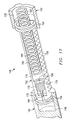
- a portion of the hydraulic damper 146 is formed by the bridge structure 102 itself defining a first fluid chamber 148 and a second fluid chamber 150 separated by an open passage facing the cross shaft 134.
- a damper piston 152 is sealed at its ends within the first and second fluid'chambers 148 and 150 by pairs of sealing rings 154.
- the middle portion of the damper piston 152 is provided with rack gear teeth 156 which mesh with the spur gear teeth on the cross shaft 134.
- a plug 158 which seals the fluid chamber but allows fluid to be added when necessary.
- the first fluid chamber 148 preferably is a blind boring, although a plug can be mounted in the end thereof, if desired.
- a spring 160 is positioned within the second fluid chamber 150 between the plug 158 and the damper piston 152 to either assist or retard wing deployment, depending on the particular direction of wing deployment rotation selected.
- a passage 164 is formed through the damper piston 152 to connect the first and second fluid chambers 148 and 150.
- the passage 164 is formed with different diameters.
- a bleed passage 166 provides a small diameter aperture to permit control of the flow rate of fluid from one fluid chamber to the other.
- a larger diameter intermediate passage 168 has a threaded wall to receive a threaded flow rate adjuster 170.
- the flow rate adjuster has a pin 172 at the end thereof which is extended into the bleed passage 166.
- Either the bleed passage 166, or pin 172, or both, are tapered so that screwing the flow rate adjuster 170 so that pin 172 moves either further into the bleed passage 166 or retracts out of the bleed passage varies the effective orifice size for flow of fluid between the fluid chambers 148 and 150, thus providing a control for the speed of deployment of the wings.
- a spring passage 174 is of larger diameter, containing a portion of the spring 160 and defining an annular spring surface 176 against which the end of the spring within the piston rests. The surface 176 is formed in the transition between spring passage 174 and intermediate passage 168.
- the pocket 106 within the bridge structure 102 can mount a locking pin 178.
- the locking pin is urged outwardly by a spring 180.
- the locking pin 178 will be forced into a locking pin hole 182 in the elevation plate 108 to lock the elevation plate 108 and wing in the deployed position.
- the pin 178 can be pushed out of hole 182 by a suitable tool from the outside surface of the elevation plate 108 to allow the wing to be moved back to the folded position.
- locking pins 178 can be used in each wing deployment apparatus, if desired.
- a single locking pin in one apparatus can be effective to lock both apparatus in the deployed position.
- both locking pins must be retracted simultaneously to permit the apparatus to be returned to the folded position.
- the wing root 122 can be made of 260 ksi strength steel while the wing 123 attached thereto is cast aluminum.
- the wing root 122 had dimensions of roughly three by three inches while the wing 123 attached thereto was twelve inches long and four inches wide.
- the wing 123 would fit over the wing root 122, including the ends of the axle pin 124 to hold the axle pin 124 in place.
- the axle pin 124 can be swaged, threaded or otherwise secured within the wing root 122 to prevent its inadvertent movement.
Landscapes
- Physics & Mathematics (AREA)
- Fluid Mechanics (AREA)
- Engineering & Computer Science (AREA)
- General Engineering & Computer Science (AREA)
- Fluid-Damping Devices (AREA)
- Air-Flow Control Members (AREA)
Abstract
Description
- This invention relates to an air foil deployment system for use on a missile, rocket or the like.
- To facilitate maximum load out of submunitions in delivery vehicles such as TACMs or MLRs, folding aerodynamic surfaces on the submunition are often required. Such a construction preferably has a minimum intrusive volume, a minimum of complexity and high reliability. A need exists for an effective design for the deployment of aerodynamic surfaces in such an environment.
- In accordance with one aspect of the present invention, a mechanism is provided for deploying an air foil. The mechanism includes a frame and a pivot pin pivotally mounted on the frame for pivotal motion between a first position and a second position about a first axis. An air foil is mounted to the pivot pin. The air flow over the air foil can be used to move the air foil and pivot pin from the first position to the second position. Alternatively, a pressurized fluid, pyrotechnic or drogue chute can be used for pivoting the air foil and pin between the first and second positions. A cam is mounted on the frame which causes elevation of the air foil about a second axis perpendicular to the first axis as the pivot pin moves from the first position to the second position. In accordance with another aspect of the present invention, the pivot pin is secured to a rotation gear which meshes with a rack shaft. The mechanism can also include a sliding gear rack engaging the cam. The sliding gear rack has teeth meshed with teeth on the air foil.
- In accordance with another aspect of the present invention, the mechanism has a lock to lock the air foil in the elevated and rotated position. A stop device can be provided to limit the motion of the air foil into the elevated and rotated position.
- In accordance with another aspect of the present invention, the mechanism can have a second air foil which is deployed to the rotated and elevated position simultaneously with the first air foil.
- In accordance with another aspect of the present invention, the mechanism has an unfolding motion rate limiting orifice through which hydraulic fluid is forced. This orifice is adjustable to provide alternate air foil deployment time histories.
- In accordance with another aspect of the present invention, a mechanism is provided for deploying an air foil. The mechanism includes a frame and an elevation plate mounted on the frame for pivotal motion about a first axis. A T-joint is mounted to the frame for pivotal motion about a second axis. A wing assembly is mounted to the T-joint for pivotal motion about a third axis between a storage position and an elevated position. Pivotal motion of the T-joint about the second axis causes pivotal motion of the elevation plate about the first axis and of the wing assembly about the third axis.
- In accordance with another aspect of the present invention, the wing assembly is formed by a wing mounted on a wing root. Further, the first and second axes are parallel and the third axis is perpendicular thereto. In accordance with another aspect of the present invention, the wing root has a series of gear teeth thereon and the elevation plate has a series of gear teeth thereon, the gear teeth on the wing root and elevation plate in meshing engagement.
- In accordance with another aspect of the present invention, a second mechanism is provided, the elevation plate of each mechanism having a series of beveled gear teeth around the peripheries thereof. A cross shaft having beveled teeth engaging the beveled teeth on the elevation plates insure joint motion of the elevation plates. In accordance with another aspect of the present invention, a hydraulic damper is in operable engagement with the cross shaft to control the speed of motion of the elevation plates.
- For a more complete understanding of the present invention and for further advantages thereof, reference is now made to the following description of the preferred embodiment taken in conjunction with the accompanying drawings, in which:
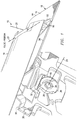
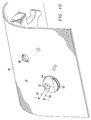
- FIGURE 1 is a perspective view of a mechanism forming a first embodiment of the present invention with the air foils in the folded position;
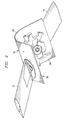
- FIGURE 2 is a perspective view of the mechanism showing the air foils in the deployed position;
- FIGURE 3 is an exploded view of the mechanism;
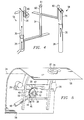
- FIGURE 4 is an illustrative view of the hydraulic circuit and rack shaft and rotation gear of the mechanism;
- FIGURE 5 is a perspective view of the bridge of the mechanism illustrating the rack shaft and rotation gear and cam surface on the bridge;
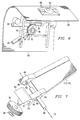
- FIGURE 6 is a perspective view of the bridge illustrating the sliding gear on the bridge;
- FIGURE 7 is a perspective view of the air foil;
- FIGURE 8 is an exploded view of the hydraulic orifice assembly;
- FIGURE 9 is a perspective view of the mechanism showing the air foil deployed;
- FIGURE 10 is a perspective view of the bridge structure illustrating the eccentric boss;
- FIGURE 11 is a perspective view of the bridge structure illustrating the sliding gear rack mounted on the eccentric boss;
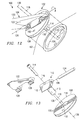
- FIGURE 12 is an exploded perspective view of the mechanism forming a second embodiment of the present invention;
- FIGURE 13 is an exploded view of a portion of the mechanism of FIGURE 12;
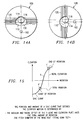
- FIGURES 14a and 14b illustrate the elevation plate in the unfolded position and the folded position;
- FIGURE 15 is a graphical representation of the elevation versus rotation of the mechanism;
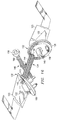
- FIGURE 16 is a perspective view of the mechanism illustrating the cross shaft and hydraulic damper;
- FIGURE 17 is a perspective detail view of the hydraulic damper; and
- FIGURE 18 is a perspective view of the mechanism illustrating the locking pin.
- With reference now to the figures, and in particular to FIGURES 1-3, a
mechanism 10 is illustrated which is capable of deploying simultaneously a pair ofair foils exterior surface 16 of abridge structure 18. The bridge structure can be a portion of the frame or body of a rocket or missile. More specifically, the mechanism can be applied to the LOCAAS/LORISK air frame, although the general principles of this mechanism could be tailored to suit many different applications. - As will be described in greater detail, the
mechanism 10 allows pivotal motion of the air foils aboutrotation axes 20 while simultaneously pivoting the air foils aboutelevation axes 22 perpendicular to rotationaxes 20 when moving between the folded configuration, seen in FIGURE 1, and the deployed configuration, shown in FIGURE 2, at an adjustably controlled rate. - With reference to FIGURE 5, the
bridge structure 18 can be seen to be formed in a symmetrical manner about itscenter line 24 to definefirst portion 56 andsecond portion 58. Each portion of the bridge structure includes a rack boss defining facingpassages rack shaft 30. Anaperture 32 through each portion of thebridge structure 18 receives a rotation axle 34 (best seen in FIGURE 7). Arotation gear 36 is secured to the inner end of therotation axle 34 for rotation therewith by asnap ring 38. Theteeth 40 of therotation gear 36 are meshed withteeth 42 of therack shaft 30. Each portion of thebridge structure 18 also has a threadedboss 44 which receives abump stop 46. Also, a lock boss defines apassage 48 which receives arotation lock 50 that is urged toward therotation gear 36 by a spring 52 (see FIGURE 3) inpassage 48 acting on thelock 50. - As best seen in FIGURE 4, a
passage 54 interconnects thepassage 28 formed on thefirst portion 56 of thebridge structure 18 andpassage 26 on thesecond portion 58 of thebridge structure 18. Hydraulic seals are provided at each end of therack shafts 30 to seal against the surfaces ofpassages passage 26 on thefirst portion 56 connects to apocket 66 which opens through theexterior surface 16 of thebridge structure 18. Ahydraulic damper 68, which will be described in detail hereinafter, is mounted in thepocket 66 to control the movement of therack shafts 30. - The
passage 26 insecond portion 58,passage 54 andpassage 28 onfirst portion 56 are completely filled with a hydraulic fluid. The fluid can be entered into the passages through ahydraulic fill port 60. It is important to bleed all air and other gases out of the passages so that fluid completely occupies the volume in the passages. A hydraulic volume adjustscrew 61 in thefill port 60 allows the volume in the passages to be varied slightly by screwing the adjustment screw in or out. This permits an adjustment of the angle of the air foils to insure that the air foils are not skewed when in the folded or open configurations. It is desired to have the air foils oriented in the open position within ¼° of angle relative each other. - Simultaneously, the
passage 26 in thefirst portion 56 is completely filled with hydraulic fluid. - With the hydraulic fluid passages filled, any movement of one of the air foils is immediately transmitted through the hydraulic fluid to influence the other air foil. Further, movements of the air foils in the direction of deployment will pressurize the hydraulic fluid in the
passage 26 in thefirst portion 56, exerting a force on thehydraulic damper 68, which causes a pressure diaphragm to burst and thereafter controlling the rate of discharge of the hydraulic fluid and thus controlling the rate of deployment of the air foils. - With reference now to FIGURES 1, 2 and 7, each
rotation axle 34 can be seen to end in acylinder 80 with abore 82 therethrough which extends along theelevation axis 22. The air foils 12 and 14 each have a pair ofextensions 84 which fit around the ends of thecylinder 80 and havebores 86 formed therein. Ashaft 88 passes throughbores rotation axles 34 for pivotal motion about theelevation axis 22. As can best be seen in FIGURE 7, each of theextensions 84 have a series ofelevation gear teeth 90 thereon. - As best seen in FIGURES 1, 10 and 11, a sliding
gear rack 92 is mounted on theexterior surface 16 about eachaperture 32. The slidinggear rack 92 engages aneccentric boss 94 formed on theexterior surface 16 about each of theapertures 32, as seen in FIGURE 11. The exposed surface of the slidinggear rack 92 is formed ofelevation gear teeth 96 which mesh withteeth 90 on the air foil. The slidinggear rack 92 is capable of pivotal motion relative therotation axis 20 but, because of the eccentricity of theboss 94, the center axis of the slidinggear rack 92 is offset from therotational axis 20. As best seen in FIGURE 10, the eccentricity ofboss 94 can be achieved by using acylindrical boss 94 with itsaxis 99 offset fromaxis 20 as shown. - As can be understood, once the munition on which
mechanism 10 is mounted begins flight, air pressure will build up against the air foils. The airfoils will try to deploy, pressurizing the hydraulic fluid in thechamber 26 of thefirst portion 56 through therotation axles 34 andrack shafts 30 until the first diaphragm therein, described below, bursts, permitting the air flow to drive the air foils into the deployed position. The motion of the air foils will be synchronized together through the action of the hydraulic fluid between the foils and deployed at a controlled speed by the controlled rate of flow from the hydraulic damper. - In place of air flow activation of the air foils, a pressurized fluid or gas could be provided in
passage 28 ofportion 58 to drive the air foils to the deployed position. For example, an air or other gas pressure cylinder, at perhaps 3,000 psi, can be used to pressurize the hydraulic fluid and deploy the air foils. Also, a pyrotectic squib can be used to pressurize the hydraulic fluid. These methods would deploy the air foils, if desired, against the air flow pressure of the munition in flight. - Rather than having the air flow acting on the air foils directly deploy the air foils, another mechanism, such as a lanyard connected to a drag chute, can be acted on by the air flow to deploy the air foils.
- The rotation gears 36 are splined to the
rotation axles 34 for joint rotation. As the pivotal motion is initiated about rotation axes 20, the slidinggear racks 92 also pivot through engagement with the air foils and begin to rotate onsurface 16 aroundeccentric boss 94. The rotation is aboutaxis 99. A clearance cut 93 may be necessary inboss 94 to passteeth 90 of the air foils as the air foil andaxle 34 pivot aboutaxis 20. The structure is designed so that when the rotation gears 36 are stopped by bump stops 46, the air foils have been fully deployed both by movement about therotation axis 20 and about theelevation axis 22. The deployed position can be adjusted slightly by threading bump stops 46 into or out of the threadedbosses 44. In the deployed position, the rotation locks 50 are urged intolock notches 70 on the rotation gears 36 to hold the air foils in the deployed position. - With reference to FIGURE 8, the
hydraulic damper 68 controls the deploying rate of themechanism 10. Anorifice housing 100 is fit within thepocket 66 and sealed thereto by an O-ring 102. The housing defines a small orifice to bleed hydraulic fluid frompassage 26 inportion 56 to exterior themechanism 10. An orificerate adjustment screw 105 is screwed intohousing 100. The orificerate adjustment screw 105 has atapered end 107 which extends into the orifice in thehousing 100. Thescrew 105 can be threaded in or out of the housing to vary the area of the annulus formed between thetapered end 107 and the walls of the orifice in the housing. Aburst diaphragm 106 is sealed over the orifice with an O-ring 108. Awasher 110 provides the sealing pressure against theburst diaphragm 106 whensnap ring 112 engages a retaining groove in thepocket 66, trapping the damper and compressing the O-ring 108 for sealing. When the air foils begin deployment, the hydraulic pressure rapidly increases in thepassage 26, bursting thediaphragm 106 and allowing the hydraulic fluid to escape at a controlled rate through the orifice, thus providing deployment of the air foils at a controlled rate. The rate of hydraulic fluid discharge, and therefore the rate of deployment of the air foils, can be adjusted by threading thescrew 105 further into theorifice housing 100 to decrease the area of the annulus between the orifice in the housing and thetapered end 107, thereby slowing the flow rate of fluid through the annulus and the rate of deployment, or backing thescrew 105 slightly out of thehousing 100 to enlarge the annulus between the orifice in thehousing 100 and thetapered end 107 to increase the discharge rate of the hydraulic fluid, lessening the time of deployment of the air foils. In one embodiment, a deployment rate of about 0.5 seconds is desired. - The hydraulic damper is mounted through the
exterior surface 16 of thebridge structure 18. This provides easy replacement of the burst diaphragm should the system be accidentally discharged. - Instead of a hydraulic damper, a shock absorber system could be used as a substitute. The shock absorber system would delay the deployment of the air foils at a rate determined by the shock absorber.
- As can be understood, the
mechanism 10 provides for the facilitation of maximum load out of submunitions in delivery vehicles such as TACMs or MLRs. A minimum intrusive volume, two axis fold mechanism as disclosed allows aerodynamic surfaces or other devices, which normally extend perpendicular to the body length, to be folded along the submunition body length. The general principles of the mechanism disclosed herein could be tailored to suit many other different applications as well. - By mounting the air foils 12 and 14 on the
bridge structure 18, the entire mechanism mounts as a modular unit. This allows assembly and adjustment of the wing anhedral and incidence angle to be performed prior to attachment to the main structure, as well as providing additional access to the interior of the vehicle for other assembly tasks. If the air foils are folded forward along the fuselage of a vehicle, aerodynamic forces can provide the energy to open the air foils. As such, thepassage 28 onportion 58 need not be provided with a high pressure gas or fluid to activate the air foils. However, the mechanism is equally adaptable to the air foils being folded rearward along the fuselage by providing a suitable energy source to apply to the air foils to deploy the air foils against aerodynamic loads as discussed previously. The mechanism will function for a large range of rotation and elevation fold angles, allowing tailoring of the mechanism to many different applications. - The
bridge structure 18 can be a one-piece casting, including thebosses 94, the bosses necessary to form thehydraulic passages - The coupling through
passages 54 as shown can be reversed side for side, or even used as a dual link system, if desired. - The ends of each of the passages can be closed off with short press-in plugs or removable plugs, if desired. For an aft deploying system (i.e., wings folded forward), the gear racks would move forward. For a forward deploying system (i.e., wings folded aft), the gear racks would move aft. One option for an energy supply to open the air foils against aerodynamic loads on an aft folded system would be, as previously noted, to allow a gas generator squib to pressurize the forward end of a rack shaft, transferring the opening energy through the hydraulic link to open the other rack.
- If desired, the
snap ring 38 securing therotation gear 36 to therotation axle 34 can be replaced by bolting the gear to the rotation axle. - The physical distance between the sliding
gear rack 92axis 99 and therotation axis 20 is determined by the desired ratio of air foil rotation to air foil elevation angles, and by the pitch diameter of the air foil gear teeth. For one particular example for LOCAAS, rotation angle equals 90°, elevation angle equals 49°, and air foil gear pitch diameter is 0.625 inch, the sliding gear rack versus rotation axis separation must be 0.267 inch. The separation, or eccentricity, can be derived from the following formula:
- This formula assumes that the eccentric separation of the
rotation axis 20 and slidinggear rack axis 99 is parallel to the wing elevationaxis center line 22 with the mechanism in the folded position, and that theaxis 22 is rotated 90° aboutaxis 20. - The fold axis movement approaches the elevated position by following a portion of a sine curve, i.e.,

- This particular arrangement illustrated allows the wing elevation motion to come up to a very soft stop, thus requiring damping in the rotation axis direction only.
- In the graph below, the above example application is illustrated where the rate of rotation axis movement to elevation axis movement is shown. Zero degrees rotation angle and zero degrees elevation angle start in the folded position.

- Placing the eccentric separation of the rotation and sliding gear rack axes on some orientation other than the closed air foil elevation axis position moves the elevation motion to a different portion of a sine curve. This phenomena can be used to tailor elevation motion to allow additional energy for engaging locking mechanisms or other devices requiring higher closing shocks. However, the alignment of the eccentricity as shown in LOCAAS example above has the advantage that positive and negative lift loads on the wing cannot create torques around the rotation axis. This significantly reduces the forces trying to disengage the rotation axis locking device.
- While the present invention has been illustrated for deploying two air foils, any number of air foils can be deployed by connecting the air foils through a hydraulic fluid connection as described previously. For example, four air foils can be deployed simultaneously, if desired, with
hydraulic circuits - With reference now to FIGURES 12-18, a second embodiment of the present invention will be described which is formed by a
mechanism 100. The mechanism includes a pair ofwing deployment apparatus 132, each having an air foil orwing 104. Themechanism 100 is mounted onbridge structure 102 which can be a portion of the frame or body of a rocket or missile also. Themechanism 100 deployswings 104 simultaneously from a folded configuration to the deployed configuration at a controlled rate. - On each side of the center line of the
bridge structure 102 is formed acircular pocket 106. Anelevation plate 108 is received in the pocket such that it is confined by the walls of the pocket but can pivot aboutaxis 130 shown in FIGURES 14A and 14B in the pocket. Theelevation plate 108 has a shapedaperture 110 which receives aportion 113 of a T-joint fitting 112. A securingbolt 114 is inserted into the top of the T-portion 115 of the T-joint fitting with the head of the bolt resting against a flange within the fitting. The securing bolt is then threaded into thebridge structure 102 to secure the T-joint fitting andelevation plate 108 within thepocket 106. The T-joint fitting 112 is permitted to pivot about arotation axis 116 coinciding with the center line of the securingbolt 114 while the elevation plate pivots aboutaxis 130 at the center ofpocket 106. - The
front surface 118 of theelevation plate 108 is formed with a series ofgear teeth 120. Awing root 122 is mounted to the T-joint fitting 112 At T-portion 115 by anaxle pin 124 which permits thewing root 122 to pivot about anelevation axis 126 relative the T-joint fitting 112. The wing root is formed with a series ofgear teeth 128 which mesh with thegear teeth 120 on theelevation plate 108. Thewing 123 itself is bolted or otherwise secured to the wing root to form the complete wing assembly orair foil 104. As can be understood with reference to FIGURES 14a, 14b and 15, as air flow strikes thewing 123 andwing root 122, the air flow exerts a force tending to rotate the wing, wing root and T-joint fitting 112 about therotation axis 116 of the T-joint fitting 112. Because of the engagement between thegear teeth 128 ofwing root 122 and thegear teeth 120 ofelevation plate 108, theelevation plate 108 is also pivoted at the same time. However, theelevation plate 108 rotates about thecenter axis 130 which is spaced from therotation axis 116. Thus, theelevation plate 108 and T-joint fitting 112 effectively slide relative each other so that thegear teeth 120 on theelevation plate 108 engaging thegear teeth 128 on thewing root 122 cause the wing root to move between the folded positipn F and the elevated position E. The shapedaperture 110 must be sufficiently large to allow the movement required between theelevation plate 108 and the T-joint fitting 112. It is illustrated as a kidney-shaped configuration in FIGURES 14a and 14b, making the mechanism bi-directional, allowing the wing to be elevated in either direction from the folded position. However, if only a single direction is necessary, theaperture 110 can be suitably modified. Further, theaperture 110 can clearly be simply a large enough circle to accommodate the necessary range of motion, if desired. - FIGURE 15 illustrates a graph of the deployment of the wing from the folded position F to the deployed or elevated position E. The deployment follows a portion of a sine curve S which can be defined by the angular and radial offset of the T-joint axis of
rotation 116 and the elevation plate axis ofrotation 130, the total amount of rotation and the pitch diameter of the gear teeth on the wing root and T-joint fitting. By positioning the deployed position toward the top of the sine curve where the rate of elevation to rotation decreases, the momentum of the mechanism is decreased at the deployed position to provide a softer entry into the deployed position. - As seen in FIGURE 16, a pair of
wing deployment apparatus 132 can be mounted on thebridge structure 102 and operated simultaneously through the use of across shaft 134. Thecross shaft 134 is mounted within thebridge structure 102 for rotational motion about its elongate axis. Theback side 138 of eachelevation plate 108 is provided withbeveled gear teeth 140. The ends of thecross shaft 134 are similarly formed withbeveled gear teeth 142, which mate withteeth 140. Thus, pivotal motion of oneelevation plate 108 will be replicated in theother elevation plate 108, and vice versa, through thecross shaft 134. - The
cross shaft 134 can also be provided withspur teeth 144 to engage ahydraulic damper 146 to control the speed of deployment of the wings. A portion of thehydraulic damper 146 is formed by thebridge structure 102 itself defining a firstfluid chamber 148 and a secondfluid chamber 150 separated by an open passage facing thecross shaft 134. Adamper piston 152 is sealed at its ends within the first and second fluid'chambers 148 and 150 by pairs of sealing rings 154. The middle portion of thedamper piston 152 is provided withrack gear teeth 156 which mesh with the spur gear teeth on thecross shaft 134. At the end of the secondfluid chamber 150 opposite thedamper piston 152 is aplug 158 which seals the fluid chamber but allows fluid to be added when necessary. The firstfluid chamber 148 preferably is a blind boring, although a plug can be mounted in the end thereof, if desired. - A
spring 160 is positioned within the secondfluid chamber 150 between theplug 158 and thedamper piston 152 to either assist or retard wing deployment, depending on the particular direction of wing deployment rotation selected. - A
passage 164 is formed through thedamper piston 152 to connect the first and secondfluid chambers passage 164 is formed with different diameters. Ableed passage 166 provides a small diameter aperture to permit control of the flow rate of fluid from one fluid chamber to the other. A larger diameterintermediate passage 168 has a threaded wall to receive a threadedflow rate adjuster 170. The flow rate adjuster has apin 172 at the end thereof which is extended into thebleed passage 166. Either thebleed passage 166, or pin 172, or both, are tapered so that screwing theflow rate adjuster 170 so thatpin 172 moves either further into thebleed passage 166 or retracts out of the bleed passage varies the effective orifice size for flow of fluid between thefluid chambers spring passage 174 is of larger diameter, containing a portion of thespring 160 and defining anannular spring surface 176 against which the end of the spring within the piston rests. Thesurface 176 is formed in the transition betweenspring passage 174 andintermediate passage 168. - With reference to FIGURE 18, the
pocket 106 within thebridge structure 102 can mount alocking pin 178. The locking pin is urged outwardly by aspring 180. As theelevation plate 108 pivots to a position with the wing deployed, the lockingpin 178 will be forced into alocking pin hole 182 in theelevation plate 108 to lock theelevation plate 108 and wing in the deployed position. If desired, thepin 178 can be pushed out ofhole 182 by a suitable tool from the outside surface of theelevation plate 108 to allow the wing to be moved back to the folded position. When dualwing deployment apparatus 132 are used, lockingpins 178 can be used in each wing deployment apparatus, if desired. Alternatively, a single locking pin in one apparatus can be effective to lock both apparatus in the deployed position. Clearly, if a locking pin is used for each apparatus, both locking pins must be retracted simultaneously to permit the apparatus to be returned to the folded position. - Because of the critical force transfer between the gear teeth of the
wing root 122 and the T-joint fitting 112, it is preferred to make the wing in two parts, thewing root 122 and theaerodynamic wing attachment 123 which is bolted or otherwise secured to thewing root 122. For example, thewing root 122 can be made of 260 ksi strength steel while thewing 123 attached thereto is cast aluminum. For example, in one design constructed in accordance with the teachings of the invention, thewing root 122 had dimensions of roughly three by three inches while thewing 123 attached thereto was twelve inches long and four inches wide. Thewing 123 would fit over thewing root 122, including the ends of theaxle pin 124 to hold theaxle pin 124 in place. Alternatively, theaxle pin 124 can be swaged, threaded or otherwise secured within thewing root 122 to prevent its inadvertent movement. - Although the present invention has been described with respect to specific preferred embodiments thereof, various changes and modifications may be suggested to one skilled in the art. It is intended that the present invention encompass such changes and modifications as fall within the scope of the appended claims.
Claims (22)
- A mechanism for deploying an air foil, comprising:a frame;a pivot pin pivotally mounted on the frame for pivotal motion about a first axis between a folded position and a deployed position;an air foil mounted to the pin;a cam mounted on the frame, the cam causing elevation of the air foil about a second axis perpendicular to the first axis as the pivot pin pivots from the folded position to the deployed position.
- The mechanism of Claim 1 further having a lock pin to lock the pivot pin in the deployed position.
- The mechanism of Claim 1 further having a stop pin defining the limit of motion of the pivot pin in the deployed position.
- The mechanism of Claim 1 wherein the frame is a bridge structure forming a portion of an exterior of a flying object.
- The mechanism of Claim 1 wherein the pivot means includes a gear rack shaft and a rotation gear, the gear rack shaft engaging the rotation gear so that linear movement of the gear rack shaft causes rotational movement of the rotation gear about the first axis.
- The mechanism of Claim 1 further comprising a second pivot pin pivotally mounted on the frame for pivotal motion about a rotation axis between a folded position and deployed position and a second air foil mounted to the second pivot pin, a second cam mounted on the frame with the second cam causing elevation of the second air foil about an elevation axis perpendicular to the rotation axis as the second pivot pin moves from the folded position to the deployed position.
- The mechanism of Claim 6 wherein the pivot means pivots the first and second pivot pins simultaneously between the folded and deployed positions.
- The mechanism of Claim 1 wherein said pivot means includes an adjustable hydraulic damper to damp the motion of the pivot pin between the folded position and deployed position.
- The mechanism of Claim 1 further comprising a sliding gear rack engaging the cam on the frame, said sliding gear rack rotating about a second axis perpendicular to and spaced from the first axis, the sliding gear rack moving linearly as it pivots about the cam, the sliding gear rack pivoting the air foil about the elevation axis into the deployed position.
- A mechanism for deploying an air foil, comprising:a bridge structure having a first portion and a second portion divided by an axis of symmetry, each of said portions including a rotation axle aperture, a boss formed about the aperture, a rack shaft boss, a rotation lock boss and a bump stop boss;the mechanism further including for each portion:a rack shaft mounted for linear movement in the rack shaft boss;a rotation axle mounted through the rotation axle aperture;a rotation gear mounted on the rotation axle and engaged with the rack shaft;a rotation lock mounted in the rotation lock boss;a bump stop mounted in the bump stop boss;a sliding gear rack engaged with the boss;an air foil mounted to the rotation axle for pivotal motion about a elevation axis and having gear teeth engaged with the sliding gear rack;the air foils pivoting about the rotation axes and elevation axes from a folded position to a deployed position, the bump stops stopping the rotation gears and the rotation locks locking the rotation gears when the air foils move into the deployed position.
- The mechanism of Claim 10 wherein the rack shaft boss in each portion of said bridge structure is connected by hydraulic fluid so that the rack shafts move in synchronization.
- The mechanism of Claim 10 further having an adjustable hydraulic damper system to damp the motion of the air foils moving between the folded and deployed positions.
- A mechanism for deploying an air foil, comprising:a frame;an elevation plate mounted to the frame for pivotal motion about a first axis;a T-joint mounted to the frame for pivotal motion about a second axis;a wing assembly mounted to the T-joint for pivotal motion about a third axis between a folded position and an elevated position, pivotal motion of the T-joint about the second axis causing pivotal motion of the elevation plate about the first axis and pivotal motion of the wing assembly about the third axis.
- The mechanism of Claim 13, wherein the wing assembly includes a wing root and a wing mounted on the wing root.
- The mechanism of Claim 13, wherein the first and second axes are parallel and the third axis is perpendicular to the first and second axis.
- The mechanism of Claim 13, wherein the elevation plate has gear teeth formed thereon and the wing assembly has gear teeth formed thereon, the gear teeth of the elevation plate and wing assembly in meshing engagement.
- The mechanism of Claim 13, wherein the elevation plate, T-joint mechanism and wing assembly define a first wing deployment apparatus, a second wing deployment apparatus being mounted on the frame, each of the elevation plates in the first and second wing deployment apparatus having a series of beveled gear teeth about the periphery thereof, the mechanism further comprising a cross shaft mounted on the frame and having beveled teeth engaging the beveled teeth on the elevation plates to ensure joint motion of the elevation plates of the first and second wing deployment apparatus.
- The mechanism of Claim 17, further comprising a damper in operable engagement with the cross shaft to control the speed of movement of the elevation plates of the first and second wing deployment apparatus.
- The mechanism of Claim 13, further comprising a lock pin mounted in the frame, the lock pin engaging the elevation plate when the wing portion is pivoted to the elevated position to secure the wing portion in the elevated position.
- The mechanism of Claim 13, wherein the wing assembly portion is oriented on the frame so that air flow past the frame pivots the T-joint member and the wing assembly to the elevated position.
- The mechanism of Claim 18, wherein the damper is a hydraulic damper.
- The mechanism of Claim 21, wherein the hydraulic damper is adjustable to provide variable speed deployment.
Applications Claiming Priority (4)
| Application Number | Priority Date | Filing Date | Title |
|---|---|---|---|
| US748149 | 1991-08-21 | ||
| US63493196A | 1996-04-19 | 1996-04-19 | |
| US634931 | 1996-04-19 | ||
| US08/748,149 US5829715A (en) | 1996-04-19 | 1996-11-12 | Multi-axis unfolding mechanism with rate controlled synchronized movement |
Publications (3)
| Publication Number | Publication Date |
|---|---|
| EP0803701A2 true EP0803701A2 (en) | 1997-10-29 |
| EP0803701A3 EP0803701A3 (en) | 1998-11-25 |
| EP0803701B1 EP0803701B1 (en) | 2003-10-08 |
Family
ID=27092264
Family Applications (1)
| Application Number | Title | Priority Date | Filing Date |
|---|---|---|---|
| EP97250096A Expired - Lifetime EP0803701B1 (en) | 1996-04-19 | 1997-03-24 | Multi-axis unfolding mechanism with rate controlled synchronized movement |
Country Status (4)
| Country | Link |
|---|---|
| US (1) | US5829715A (en) |
| EP (1) | EP0803701B1 (en) |
| JP (1) | JPH1047896A (en) |
| DE (1) | DE69725376T2 (en) |
Cited By (6)
| Publication number | Priority date | Publication date | Assignee | Title |
|---|---|---|---|---|
| EP1265050A1 (en) * | 2001-06-04 | 2002-12-11 | Smiths Industries Actuation Systems Inc. | Extendable and controllable flight vehicle wing/control surface assembly |
| CN102556337A (en) * | 2011-12-30 | 2012-07-11 | 北京理工大学 | Bevel gear guiding type wing unfolding mechanism |
| US9137491B2 (en) | 2000-02-01 | 2015-09-15 | Rovi Guides, Inc. | Methods and systems for forced advertising |
| EP2598833A4 (en) * | 2010-07-27 | 2016-01-13 | Raytheon Co | AERODYNAMIC AILER LOCK FOR AN ADJUSTABLE AND DEPLOYABLE FIN |
| CN107914864A (en) * | 2017-11-01 | 2018-04-17 | 成都飞亚航空设备应用研究所有限公司 | Aircraft wing rotates jack and its accommodation method |
| CN110127030A (en) * | 2019-05-24 | 2019-08-16 | 刘占波 | A folding self-locking device for UAV wings |
Families Citing this family (19)
| Publication number | Priority date | Publication date | Assignee | Title |
|---|---|---|---|---|
| DE19640540C1 (en) * | 1996-10-01 | 1998-04-02 | Daimler Benz Aerospace Ag | Rudder control system for a guided missile |
| US6742183B1 (en) | 1998-05-15 | 2004-05-25 | United Video Properties, Inc. | Systems and methods for advertising television networks, channels, and programs |
| US6092264A (en) * | 1998-11-13 | 2000-07-25 | Lockheed Martin Corporation | Single axis fold actuator and lock for member |
| SE521445C2 (en) * | 2001-03-20 | 2003-11-04 | Bofors Defence Ab | Methods for synchronizing the fine precipitation in a finely stabilized artillery grenade and a correspondingly designed artillery grenade |
| US6928400B2 (en) * | 2001-10-02 | 2005-08-09 | Raytheon Company | Method for designing a deployment mechanism |
| US6609597B1 (en) | 2002-02-06 | 2003-08-26 | Enertrols, Inc. | Dampening apparatus |
| US7083140B1 (en) * | 2004-09-14 | 2006-08-01 | The United States Of America As Represented By The Secretary Of The Army | Full-bore artillery projectile fin development device and method |
| US20070299994A1 (en) * | 2006-06-21 | 2007-12-27 | Broadcom Corporation, A California Corporation | Disk controller, host interface module and methods for use therewith |
| US8319164B2 (en) * | 2009-10-26 | 2012-11-27 | Nostromo, Llc | Rolling projectile with extending and retracting canards |
| US8436285B2 (en) * | 2010-07-26 | 2013-05-07 | Raytheon Company | Projectile that includes a fin adjustment mechanism with changing backlash |
| CN101973390B (en) * | 2010-09-25 | 2013-05-22 | 中国航天科工集团第二研究院二一〇所 | Unfolding mechanism for foldable double wing boards of aircraft |
| RU2460965C1 (en) * | 2011-01-12 | 2012-09-10 | Открытое акционерное общество "Конструкторское бюро приборостроения" | Missile |
| US8949901B2 (en) | 2011-06-29 | 2015-02-03 | Rovi Guides, Inc. | Methods and systems for customizing viewing environment preferences in a viewing environment control application |
| CN102602529A (en) * | 2011-12-30 | 2012-07-25 | 北京理工大学 | Folding full-motion horizontal tail mechanism |
| US9288521B2 (en) | 2014-05-28 | 2016-03-15 | Rovi Guides, Inc. | Systems and methods for updating media asset data based on pause point in the media asset |
| FR3041744B1 (en) * | 2015-09-29 | 2018-08-17 | Nexter Munitions | ARTILLERY PROJECTILE HAVING A PILOTED PHASE. |
| FR3054030B1 (en) * | 2016-07-18 | 2018-08-24 | Nexter Munitions | PROJECTILE COMPRISING A DEVICE FOR DEPLOYING A VESSEL OR AILT |
| US11644287B2 (en) | 2019-06-13 | 2023-05-09 | Raytheon Company | Single-actuator rotational deployment mechanism for multiple objects |
| CN119190454B (en) * | 2024-11-27 | 2025-02-07 | 中航(成都)无人机系统股份有限公司 | A wing folding mechanism capable of rotating and folding at an integrally variable angle and an aircraft |
Family Cites Families (13)
| Publication number | Priority date | Publication date | Assignee | Title |
|---|---|---|---|---|
| US3029043A (en) * | 1958-01-27 | 1962-04-10 | Robert D Lindeman | Free floating wing structure and control system for convertible aircraft |
| GB1597098A (en) * | 1971-06-23 | 1981-09-03 | British Aerospace | Missiles |
| AU524255B2 (en) * | 1978-12-29 | 1982-09-09 | Commonwealth Of Australia, The | Deployable wing |
| GB2041502B (en) * | 1979-02-08 | 1982-09-08 | British Aerospace | Folding fin assembly |
| US4323208A (en) * | 1980-02-01 | 1982-04-06 | British Aerospace | Folding fins |
| GB2140136B (en) * | 1983-05-14 | 1987-05-07 | British Aerospace | Folding fin assembly for missiles |
| DE3405974C1 (en) * | 1984-02-18 | 1985-04-11 | Messerschmitt-Bölkow-Blohm GmbH, 8012 Ottobrunn | Aerodynamic stabilization device for missiles |
| US4588146A (en) * | 1984-03-29 | 1986-05-13 | The United States Of America As Represented By The Secretary Of The Army | Biaxial folding lever wing |
| WO1988005898A1 (en) * | 1987-02-02 | 1988-08-11 | Eskam, Armin | Finned projectile or missile |
| US4884766A (en) * | 1988-05-25 | 1989-12-05 | The United States Of America As Represented By The Secretary Of The Air Force | Automatic fin deployment mechanism |
| US5192037A (en) * | 1991-08-23 | 1993-03-09 | Mcdonnell Douglas Corporation | Double-pivoting deployment system for aerosurfaces |
| IL101730A (en) * | 1992-04-30 | 1995-12-31 | Israel State | Moving body such as missile having wings erectable upon acceleration |
| US5480111A (en) * | 1994-05-13 | 1996-01-02 | Hughes Missile Systems Company | Missile with deployable control fins |
-
1996
- 1996-11-12 US US08/748,149 patent/US5829715A/en not_active Expired - Fee Related
-
1997
- 1997-03-24 DE DE69725376T patent/DE69725376T2/en not_active Expired - Fee Related
- 1997-03-24 EP EP97250096A patent/EP0803701B1/en not_active Expired - Lifetime
- 1997-04-18 JP JP9115007A patent/JPH1047896A/en active Pending
Cited By (7)
| Publication number | Priority date | Publication date | Assignee | Title |
|---|---|---|---|---|
| US9137491B2 (en) | 2000-02-01 | 2015-09-15 | Rovi Guides, Inc. | Methods and systems for forced advertising |
| EP1265050A1 (en) * | 2001-06-04 | 2002-12-11 | Smiths Industries Actuation Systems Inc. | Extendable and controllable flight vehicle wing/control surface assembly |
| US6581871B2 (en) | 2001-06-04 | 2003-06-24 | Smiths Aerospace, Inc. | Extendable and controllable flight vehicle wing/control surface assembly |
| EP2598833A4 (en) * | 2010-07-27 | 2016-01-13 | Raytheon Co | AERODYNAMIC AILER LOCK FOR AN ADJUSTABLE AND DEPLOYABLE FIN |
| CN102556337A (en) * | 2011-12-30 | 2012-07-11 | 北京理工大学 | Bevel gear guiding type wing unfolding mechanism |
| CN107914864A (en) * | 2017-11-01 | 2018-04-17 | 成都飞亚航空设备应用研究所有限公司 | Aircraft wing rotates jack and its accommodation method |
| CN110127030A (en) * | 2019-05-24 | 2019-08-16 | 刘占波 | A folding self-locking device for UAV wings |
Also Published As
| Publication number | Publication date |
|---|---|
| EP0803701A3 (en) | 1998-11-25 |
| US5829715A (en) | 1998-11-03 |
| JPH1047896A (en) | 1998-02-20 |
| DE69725376T2 (en) | 2004-08-19 |
| EP0803701B1 (en) | 2003-10-08 |
| DE69725376D1 (en) | 2003-11-13 |
Similar Documents
| Publication | Publication Date | Title |
|---|---|---|
| US5829715A (en) | Multi-axis unfolding mechanism with rate controlled synchronized movement | |
| CN105035321B (en) | Miniature cylindrical launched unmanned plane and launcher | |
| US4884766A (en) | Automatic fin deployment mechanism | |
| US11685510B2 (en) | Wing deployment mechanism and design method using pneumatic technique | |
| CN112109879A (en) | A folding wing unfolding shaft mechanism | |
| CN104089547B (en) | A kind of Deployment and locking device of folding rudder face | |
| CN109631686B (en) | Flying missile inspection folding wing mechanism | |
| CN112298620A (en) | Firer connecting and unlocking device | |
| RU2406662C1 (en) | Device to separated and jettison launch vehicle nose cone | |
| EP0180722B1 (en) | Missile | |
| CN109515697A (en) | The holder locking apparatus that rises and falls suitable for different motion track | |
| US6298786B1 (en) | Frangible access panel system | |
| US4111602A (en) | Deployable rotor | |
| WO2020251649A1 (en) | Single-actuator rotational deployment mechanism for multiple objects | |
| CN116374155B (en) | A synchronous unfolding mechanism for aircraft wings | |
| US4679751A (en) | Weapon dispensing system for an aircraft | |
| CN115823971A (en) | Patrol missile electromechanical triggering fuse | |
| EP1265050B1 (en) | Extendable and controllable flight vehicle wing/control surface assembly | |
| WO1992019493A1 (en) | Damped automatic variable pitch marine propeller | |
| EP0102684B1 (en) | Fluid actuator with feedback mechanism | |
| CN113353238A (en) | Unmanned aerial vehicle wing folding mechanism and unmanned aerial vehicle | |
| US6450444B1 (en) | Fin lock system | |
| CN216348105U (en) | Wing device and projectile | |
| CN212500997U (en) | A folding wing unfolding shaft mechanism | |
| CN215285238U (en) | UAV wing folding mechanism and UAV |
Legal Events
| Date | Code | Title | Description |
|---|---|---|---|
| PUAI | Public reference made under article 153(3) epc to a published international application that has entered the european phase |
Free format text: ORIGINAL CODE: 0009012 |
|
| AK | Designated contracting states |
Kind code of ref document: A2 Designated state(s): DE FR GB |
|
| PUAL | Search report despatched |
Free format text: ORIGINAL CODE: 0009013 |
|
| AK | Designated contracting states |
Kind code of ref document: A3 Designated state(s): DE FR GB |
|
| 17P | Request for examination filed |
Effective date: 19990510 |
|
| 17Q | First examination report despatched |
Effective date: 20010219 |
|
| RAP1 | Party data changed (applicant data changed or rights of an application transferred) |
Owner name: LOCKHEED MARTIN CORPORATION |
|
| GRAH | Despatch of communication of intention to grant a patent |
Free format text: ORIGINAL CODE: EPIDOS IGRA |
|
| GRAS | Grant fee paid |
Free format text: ORIGINAL CODE: EPIDOSNIGR3 |
|
| GRAA | (expected) grant |
Free format text: ORIGINAL CODE: 0009210 |
|
| AK | Designated contracting states |
Kind code of ref document: B1 Designated state(s): DE FR GB |
|
| REG | Reference to a national code |
Ref country code: GB Ref legal event code: FG4D |
|
| REF | Corresponds to: |
Ref document number: 69725376 Country of ref document: DE Date of ref document: 20031113 Kind code of ref document: P |
|
| ET | Fr: translation filed | ||
| PLBE | No opposition filed within time limit |
Free format text: ORIGINAL CODE: 0009261 |
|
| STAA | Information on the status of an ep patent application or granted ep patent |
Free format text: STATUS: NO OPPOSITION FILED WITHIN TIME LIMIT |
|
| 26N | No opposition filed |
Effective date: 20040709 |
|
| PGFP | Annual fee paid to national office [announced via postgrant information from national office to epo] |
Ref country code: FR Payment date: 20060317 Year of fee payment: 10 |
|
| PGFP | Annual fee paid to national office [announced via postgrant information from national office to epo] |
Ref country code: DE Payment date: 20060502 Year of fee payment: 10 |
|
| GBPC | Gb: european patent ceased through non-payment of renewal fee |
Effective date: 20070324 |
|
| REG | Reference to a national code |
Ref country code: FR Ref legal event code: ST Effective date: 20071130 |
|
| PG25 | Lapsed in a contracting state [announced via postgrant information from national office to epo] |
Ref country code: DE Free format text: LAPSE BECAUSE OF NON-PAYMENT OF DUE FEES Effective date: 20071002 |
|
| PG25 | Lapsed in a contracting state [announced via postgrant information from national office to epo] |
Ref country code: GB Free format text: LAPSE BECAUSE OF NON-PAYMENT OF DUE FEES Effective date: 20070324 |
|
| PG25 | Lapsed in a contracting state [announced via postgrant information from national office to epo] |
Ref country code: FR Free format text: LAPSE BECAUSE OF NON-PAYMENT OF DUE FEES Effective date: 20070402 |
|
| PGFP | Annual fee paid to national office [announced via postgrant information from national office to epo] |
Ref country code: GB Payment date: 20060329 Year of fee payment: 10 |