EP0803371A2 - Sheet conveying apparatus - Google Patents
Sheet conveying apparatus Download PDFInfo
- Publication number
- EP0803371A2 EP0803371A2 EP97106844A EP97106844A EP0803371A2 EP 0803371 A2 EP0803371 A2 EP 0803371A2 EP 97106844 A EP97106844 A EP 97106844A EP 97106844 A EP97106844 A EP 97106844A EP 0803371 A2 EP0803371 A2 EP 0803371A2
- Authority
- EP
- European Patent Office
- Prior art keywords
- sheet
- convey
- guide
- roller
- sheet conveying
- Prior art date
- Legal status (The legal status is an assumption and is not a legal conclusion. Google has not performed a legal analysis and makes no representation as to the accuracy of the status listed.)
- Granted
Links
Images


Classifications
-
- B—PERFORMING OPERATIONS; TRANSPORTING
- B41—PRINTING; LINING MACHINES; TYPEWRITERS; STAMPS
- B41J—TYPEWRITERS; SELECTIVE PRINTING MECHANISMS, i.e. MECHANISMS PRINTING OTHERWISE THAN FROM A FORME; CORRECTION OF TYPOGRAPHICAL ERRORS
- B41J11/00—Devices or arrangements of selective printing mechanisms, e.g. ink-jet printers or thermal printers, for supporting or handling copy material in sheet or web form
- B41J11/0045—Guides for printing material
- B41J11/005—Guides in the printing zone, e.g. guides for preventing contact of conveyed sheets with printhead
-
- B—PERFORMING OPERATIONS; TRANSPORTING
- B41—PRINTING; LINING MACHINES; TYPEWRITERS; STAMPS
- B41J—TYPEWRITERS; SELECTIVE PRINTING MECHANISMS, i.e. MECHANISMS PRINTING OTHERWISE THAN FROM A FORME; CORRECTION OF TYPOGRAPHICAL ERRORS
- B41J13/00—Devices or arrangements of selective printing mechanisms, e.g. ink-jet printers or thermal printers, specially adapted for supporting or handling copy material in short lengths, e.g. sheets
- B41J13/0063—Handling thick cut sheets, e.g. greeting cards or postcards, larger than credit cards, e.g. using means for enabling or facilitating the conveyance of thick sheets
-
- B—PERFORMING OPERATIONS; TRANSPORTING
- B41—PRINTING; LINING MACHINES; TYPEWRITERS; STAMPS
- B41J—TYPEWRITERS; SELECTIVE PRINTING MECHANISMS, i.e. MECHANISMS PRINTING OTHERWISE THAN FROM A FORME; CORRECTION OF TYPOGRAPHICAL ERRORS
- B41J13/00—Devices or arrangements of selective printing mechanisms, e.g. ink-jet printers or thermal printers, specially adapted for supporting or handling copy material in short lengths, e.g. sheets
- B41J13/10—Sheet holders, retainers, movable guides, or stationary guides
- B41J13/14—Aprons or guides for the printing section
Definitions
- the present invention relates to a sheet conveying apparatus having a U-turn path.
- Fig. 6 is a perspective view of a conventional sheet conveying apparatus having a so-called U-turn path for greatly changing a conveying direction of a sheet.
- This apparatus comprises a convey roller 100 rotated in a direction shown by the arrow R100, a convey guide 101 having an outer guide surface 101a facing to an outer peripheral surface 100a of the convey roller 100, and a pinch roller (convey sub-roller) 102 disposed downstream of the convey guide 101 in a rotating direction of the convey roller 100.
- a pinch roller convey sub-roller
- the pinch roller 102 is rotatably mounted on a front end of a pressure plate 103 rocked around a shaft 103a, and a rear end of the pressure plate 103 is biased upwardly by a pair of tension springs 104 so that the pinch roller is urged against the outer peripheral surface 100a of the convey roller 100 with moderate pressure from the above.
- a downstream outlet Gb of the U-turn path G is defined as a straight gap formed between the generatrix of the convey roller 100 and a terminal edge 101b of the outer guide surface 101a of the guide 101.
- the sheet fed to an inlet Ga of the U-turn guide G from a direction shown by the arrow A is conveyed through the U-turn path G by the convey roller 100 rotating in the direction R100.
- the tip end of the sheet reaches the pinch roller 102 while being guided by a lower surface of the pressure plate 103.
- the sheet is conveyed by the convey roller 100 and the pinch roller 102.
- a trail end of the sheet passes through the outlet Gb of the U-turn path G and then leaves through the pinch roller 102. Then, the sheet is conveyed to, for example, a downstream image forming portion.
- a recording apparatus 105 includes a recording means 106 disposed immediately downstream of the pinch roller 102, since the sheet P is intermittently conveyed by the convey roller 100 by a predetermined amount and one-line recording is effected by the recording means 106, if the convey amount of the sheet P does not coincide with the recording width (in the conveying direction), a recording area will be deviated from a correct one, so that the desired image cannot be obtained.
- An object of the present invention is to provide a sheet conveying apparatus which can prevent dispersion of a convey amount of a sheet caused due to a restoring force of the sheet generated when a trail end of the sheet is disengaged from a terminal edge of an outer guide surface, with a simple construction and without using an additional means such as a braking means or a flexible sheet member.
- a sheet conveying apparatus comprises an arc-shaped U-turn path formed between an outer peripheral surface of a convey roller for conveying a sheet and an outer guide surface curved along the outer peripheral surface to convey the sheet passed through the U-turn path by the convey roller and a convey sub-roller urged against the convey roller.
- the outer guide surface has a terminal edge disposed at downstream end thereof in a sheet conveying direction and cooperating with the generatrix of the outer peripheral surface to define an outlet of the U-turn path therebetween, and the terminal edge is configured not to coincide with a straight line parallel with a longitudinal axis of the convey roller.
- the sheet conveying apparatus further comprises a pressurizing member for urging the convey sub-roller against the outer peripheral surface of the convey roller, and the pressurizing member has an auxiliary guide surface facing to the outer peripheral surface of the convey roller between the outlet of the U-turn path and the convey sub-roller.
- the pressurizing member has a second guide surface contiguous to the upstream auxiliary guide surface so that the second guide surface and the auxiliary guide surface form a part of a straight path extending to the convey sub-roller.
- the terminal edge of the outer guide surface is configured not to coincide with the straight line parallel with the longitudinal axis of the convey roller, for example, even when a trail end of a sheet (such as a thick sheet) having great resiliency is disengaged from the terminal edge of the outer guide surface, the entire trail end of the sheet is not disengaged from the terminal edge of the outer guide surface at once. Thus, the trail end of the sheet is gradually disengaged from the terminal edge, so that the restoring force can be weakened.
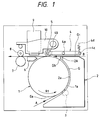
- a sheet conveying apparatus shown in Figs. 1 and 2 comprises a convey roller 1, a guide member 2 and a convey sub-roller 5.
- the convey roller 1 having an outer peripheral surface 1a is rotatably supported by a frame (not shown) of the sheet conveying apparatus and is rotated in a direction shown by the arrow R1 by a drive means (not shown).
- the guide member 2 is disposed to face to the convey roller 1 at the right side.
- the guide member 2 has an arc-shaped outer guide surface 2a facing to the outer peripheral surface 1a of the convey roller 1 and substantially coaxial with the outer peripheral surface 1a of the convey roller 1, so that a U-turn path G for conveying a sheet P is formed between the outer guide surface 2a and the outer peripheral surface 1a of the convey roller 1.
- the U-turn path G has a lower inlet Ga for the sheet P and an upper outlet Gb to change a conveying direction of the sheet from a direction shown by the arrow A to a direction shown by the arrow B.
- the outlet Gb is defined between a terminal edge 2A (disposed at a downstream end in the sheet conveying direction) of the outer guide surface 2a and the generatrix of the outer peripheral surface 1a opposed to the terminal edge.
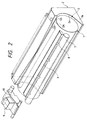
- the terminal edge 2A is formed along the generatrix of the outer peripheral surface 1a (transverse to the sheet conveying direction), but is configured not to coincide with a straight line parallel to a longitudinal axis of the convey roller 1.
- the terminal edge 2A is tapered so that a central portion (in the axial direction) of the terminal edge is convex outwardly.
- a pinch sub-roller 3 urged against the outer peripheral surface 1a of the convey roller 1 is disposed within the U-turn path G.
- the convey sub-roller 5 is urged against the outer peripheral surface 1a of the convey roller 1 immediately at a downstream side of the outlet Gb of the U-turn path G in the sheet conveying direction and is rotatably mounted on a distal end 4b of a pressure plate (pressurizing member) 4.
- the pressure plate 4 can be rocked around a shaft 4a (parallel to the generatrix of the convey roller) and a proximal end 4c of the pressure plate is biased upwardly by tension springs 4d. With this arrangement, the convey sub-roller 5 mounted on the distal end 4b is urged against the outer peripheral surface of the convey roller 1 from the above with moderate pressure.
- a portion (left side portion) of a lower surface of the pressure plate 4 which faces to the outer peripheral surface 1a between the outlet Gb and the convey sub-roller 5 acts as an auxiliary guide surface for guiding the sheet P from the outlet Gb to the convey sub-roller 5.
- a portion (right side portion) of the lower surface of the pressure plate 4 which is contiguous to the downstream auxiliary guide surface acts as a second guide surface, and a straight path G1 for conveying the sheet P in a direction shown by the arrow B is defined between the second guide surface (and the auxiliary guide surface) and an upper surface of the guide member 2.
- An image forming portion is disposed downstream of the convey sub-roller 5, and includes a platen 6 for supporting a lower surface of the sheet P during the image formation, a recording head 9 for effecting the recording (for example, by discharging ink onto the sheet P), and a carriage 10 on which the recording head 9 is mounted and which is reciprocally shifted in a direction transverse to the sheet conveying direction.
- a discharge roller 7 and spur wheels 8 At a downstream side of the image forming portion, there are disposed a discharge roller 7 and spur wheels 8 for pinching and discharging the sheet P on which the image was recorded.
- thick sheet P conveyed from the direction A is pinched between the convey roller 1 and the pinch sub-roller 3 to be conveyed through the U-turn path G.
- the tip end of the sheet leaves the outlet Gb of the U-turn path G, the tip end of the sheet is guided by the pressure plate 4 and then is pinched by the convey sub-roller 5. Thereafter, the sheet P is further conveyed to pass through the platen 6.
- the tip end of the sheet is pinched between the discharge roller 7 and the spur wheels 8, the sheet is temporarily stopped.
- the recording is started. That is to say, first of all, one-line recording is performed by reciprocally shifting the recording head 9 by the carriage 10 while discharging the ink toward the surface of the sheet P, and then, the sheet P is conveyed by the convey roller 1 by a predetermined amount. One-line recording and the predetermined amount conveyance of the sheet are repeated until one-page recording is finished.
- the terminal edge 2A of the guide member 2 is configured not to coincide with a straight line but to be convex at the central portion, the trail end Pb of the sheet P is gradually disengaged from the terminal edge 2A from its both ends to its central portion. Accordingly, the conveying accuracy is maintained, thereby providing the good image. Further, since any additional braking means or an additional flexible sheet member is not required, the apparatus can be made cheaper and the operability can be improved.
- Fig. 3 is a perspective view showing a sheet conveying apparatus according to a second embodiment of the present invention.
- a terminal edge 2B of the outer guide surface 2a is not curved to be convex outwardly (as is in the first embodiment), but is steppingly protruded outwardly (in the sheet conveying direction) from its both ends to its central portion as steps, as shown in Fig. 3.
- the trail end Pb of the sheet P is gradually disengaged from the terminal edge 2B from its both ends to its central portion, thereby achieving the same advantage as the first embodiment.
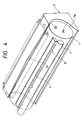
- Fig. 4 is a perspective view showing a sheet conveying apparatus according to a third embodiment of the present invention.
- a terminal edge 2C of the outer guide surface 2a is tapered to be concave inwardly at its central portion.
- the trail end Pb of the sheet P is gradually disengaged from the terminal edge 2C from its central portion to its both ends, thereby achieving the same advantage as those in the first and second embodiments.
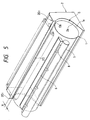
- Fig. 5 is a perspective view showing a sheet conveying apparatus according to a fourth embodiment of the present invention.
- a terminal edge 2D of the outer guide surface 2a is linearly tapered so that one end 2D1 of the terminal edge is protruded from the other end 2D2 in the sheet conveying direction by an amount of X.
- the trail end Pb of the sheet P is gradually disengaged from the terminal edge 2D from the left end (end 2D2) to the right end (end 2D1).
- substantially the same advantage as those in the first to third embodiments can be expected.
- the tapered amount X may be greater than 2 mm. The reason is that, even if the sheet is skew-fed more or less or the dimension of the sheet itself has slight error, the desired advantage can be obtained.
- the terminal edge 2A, 2B, 2C and 2D are tapered or stepped
- the terminal edge can be formed by combination of tapers or tapers and steps or may be curved to have an arcuate curvature. That is to say, the terminal edge is not limited to a special configuration, but may be appropriately configured so long as the trail end Pb of the sheet P can be gradually disengaged from the terminal edge.
- the configuration of the terminal edge may be determined by tests for providing the optimum advantage for various sheets having different size and resiliency or may be selected on the basis of design and/or manufacturing limitations.
- the configuration of the terminal edge can be differentiated from the edge (generally, straight line) of the trail end of the sheet to be disengaged from the terminal edge so that the trail end of the sheet is gradually disengaged from the terminal end.
- the shock of the disengagement is reduced to prevent the conveying accuracy from being worsened.
- the image forming portion is disposed immediately at a downstream side of the U-turn path, the poor image due to the reduction in conveying accuracy can be avoided.
- the above-mentioned effective advantage can be obtained with a simple construction in which the terminal edge of the outer guide surface is merely altered and without using any additional braking means or additional flexible sheet member.
- the apparatus can be made cheaper and the operability can be improved.
- the configuration of the terminal edge from which the trail end of the sheet is gradually disengaged may be taper(s) of steps.
- the recording head used in the above-mentioned embodiments may be an ink jet head which includes heat generating elements disposed in nozzles and in which an ink droplet is discharged from the corresponding nozzle by growth of a bubble generated in the ink by thermal energy from the selected heat generating element.
- a U-turn path G is formed by facing an outer guide surface 2a of a guide member 2 to an outer peripheral surface 1a of a convey roller 1.
- a terminal edge 2A of the outer guide surface 2a forming a part of an outlet Gb of the U-turn path G is configured not to coincide with a straight line but is tapered to be convex at a central portion.
Landscapes
- Feeding Of Articles By Means Other Than Belts Or Rollers (AREA)
- Delivering By Means Of Belts And Rollers (AREA)
- Registering Or Overturning Sheets (AREA)
- Registering, Tensioning, Guiding Webs, And Rollers Therefor (AREA)
Abstract
Description
- The present invention relates to a sheet conveying apparatus having a U-turn path.
- Fig. 6 is a perspective view of a conventional sheet conveying apparatus having a so-called U-turn path for greatly changing a conveying direction of a sheet. This apparatus comprises a
convey roller 100 rotated in a direction shown by the arrow R100, aconvey guide 101 having anouter guide surface 101a facing to an outerperipheral surface 100a of theconvey roller 100, and a pinch roller (convey sub-roller) 102 disposed downstream of theconvey guide 101 in a rotating direction of theconvey roller 100. Between the outerperipheral surface 100a of theconvey roller 100 and theouter guide surface 101a of theguide 101, there is disposed an arc-shaped U-turn path G through which the sheet is passed. Thepinch roller 102 is rotatably mounted on a front end of apressure plate 103 rocked around ashaft 103a, and a rear end of thepressure plate 103 is biased upwardly by a pair oftension springs 104 so that the pinch roller is urged against the outerperipheral surface 100a of theconvey roller 100 with moderate pressure from the above. Incidentally, a downstream outlet Gb of the U-turn path G is defined as a straight gap formed between the generatrix of theconvey roller 100 and aterminal edge 101b of theouter guide surface 101a of theguide 101. - The sheet fed to an inlet Ga of the U-turn guide G from a direction shown by the arrow A is conveyed through the U-turn path G by the
convey roller 100 rotating in the direction R100. When a tip end of the sheet leaves the outlet Gb, the tip end of the sheet reaches thepinch roller 102 while being guided by a lower surface of thepressure plate 103. When the tip end of the sheet reaches thepinch roller 102, the sheet is conveyed by theconvey roller 100 and thepinch roller 102. As the sheet is further conveyed, a trail end of the sheet passes through the outlet Gb of the U-turn path G and then leaves through thepinch roller 102. Then, the sheet is conveyed to, for example, a downstream image forming portion. - However, in the above-mentioned conventional sheet conveying apparatus, when a sheet (for example, a thick sheet) having great resiliency is conveyed and image formation is effected regarding the thick sheet at the downstream image forming portion, there arose a problem that a good image could not often be formed. That is to say, as shown in Fig. 7, since the sheet P having great resiliency is hard to be bent or curved, when the sheet is being conveyed through the U-turn path G, it is forcibly curved in accordance with a curvature of the U-turn path G. As a result, the tip and trail ends of the sheet rub the
outer guide surface 101a of theguide 101. And, when the trail end Pb of the sheet P leaves the outlet Gb of the U-turn path G, i.e., when the trail end Pb is disengaged from theterminal edge 101b of theouter guide surface 101a of theguide 101, since the trail end Pb of the sheet P is abruptly returned from a posture shown by the solid line to a posture shown by the broken line by the resiliency (storing force) of the sheet P, a convey amount of the sheet P becomes unstable due to the shock, thereby worsening the image quality. - For example, as shown in Fig. 7, when a
recording apparatus 105 includes a recording means 106 disposed immediately downstream of thepinch roller 102, since the sheet P is intermittently conveyed by theconvey roller 100 by a predetermined amount and one-line recording is effected by the recording means 106, if the convey amount of the sheet P does not coincide with the recording width (in the conveying direction), a recording area will be deviated from a correct one, so that the desired image cannot be obtained. If theconvey roller 100 is stopped in a condition (as shown by the solid line) that the trail end Pb of the sheet P is slightly caught by theterminal edge 101b of theouter guide surface 101a, the trail end Pb of the sheet is snappingly disengaged from theterminal edge 101b to reach the posture shown by the broken line. In this case, due to the presence of any play in a drive transmitting system for theconvey roller 100 and any plays in bearings, the desired convey amount cannot be obtained. To eliminate such inconvenience, there is proposed a technique in which a braking means is incorporated into the drive transmitting system to minimize influence of the play. However, in this case, since load torque is increased and greater motor torque is required, a desired result cannot be achieved. - As another proposal, there has been provided a technique in which a flexible sheet member (for example, PET sheet member) is adhered to the
guide 101 so that a buffer (provided by the flexible sheet member) is formed between theterminal edge 101b of theouter guide surface 101a and thepressure plate 103, thereby eliminate the above drawback. However, in this case, if the sheet member is not adhered to the guide at a correct or accurate position, the sheet jam may frequently be caused. Thus, the accuracy of adhesion must be maintained, which in turn worsen the operability. - An object of the present invention is to provide a sheet conveying apparatus which can prevent dispersion of a convey amount of a sheet caused due to a restoring force of the sheet generated when a trail end of the sheet is disengaged from a terminal edge of an outer guide surface, with a simple construction and without using an additional means such as a braking means or a flexible sheet member.
- According to a preferred aspect of the present invention, a sheet conveying apparatus comprises an arc-shaped U-turn path formed between an outer peripheral surface of a convey roller for conveying a sheet and an outer guide surface curved along the outer peripheral surface to convey the sheet passed through the U-turn path by the convey roller and a convey sub-roller urged against the convey roller. The outer guide surface has a terminal edge disposed at downstream end thereof in a sheet conveying direction and cooperating with the generatrix of the outer peripheral surface to define an outlet of the U-turn path therebetween, and the terminal edge is configured not to coincide with a straight line parallel with a longitudinal axis of the convey roller.
- Also, the sheet conveying apparatus further comprises a pressurizing member for urging the convey sub-roller against the outer peripheral surface of the convey roller, and the pressurizing member has an auxiliary guide surface facing to the outer peripheral surface of the convey roller between the outlet of the U-turn path and the convey sub-roller.
- Also, the pressurizing member has a second guide surface contiguous to the upstream auxiliary guide surface so that the second guide surface and the auxiliary guide surface form a part of a straight path extending to the convey sub-roller.
- With the arrangement as mentioned above, since the terminal edge of the outer guide surface is configured not to coincide with the straight line parallel with the longitudinal axis of the convey roller, for example, even when a trail end of a sheet (such as a thick sheet) having great resiliency is disengaged from the terminal edge of the outer guide surface, the entire trail end of the sheet is not disengaged from the terminal edge of the outer guide surface at once. Thus, the trail end of the sheet is gradually disengaged from the terminal edge, so that the restoring force can be weakened.
-
- Fig. 1 is an elevational sectional view of a sheet conveying apparatus according to a first embodiment of the present invention;
- Fig. 2 is a perspective view of the sheet conveying apparatus according to the first embodiment;
- Fig. 3 is a perspective view of a sheet conveying apparatus according to a second embodiment of the present invention;
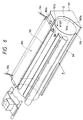
- Fig. 4 is a perspective view of a sheet conveying apparatus according to a third embodiment of the present invention;
- Fig. 5 is a perspective view of a sheet conveying apparatus according to a fourth embodiment of the present invention; and
- Figs. 6 and 7 are perspective views of a conventional sheet conveying apparatus.
- The present invention will now be explained in connection with embodiments thereof with reference to the accompanying drawings.
- A sheet conveying apparatus shown in Figs. 1 and 2 comprises a
convey roller 1, aguide member 2 and aconvey sub-roller 5. Theconvey roller 1 having an outerperipheral surface 1a is rotatably supported by a frame (not shown) of the sheet conveying apparatus and is rotated in a direction shown by the arrow R1 by a drive means (not shown). - The
guide member 2 is disposed to face to theconvey roller 1 at the right side. Theguide member 2 has an arc-shapedouter guide surface 2a facing to the outerperipheral surface 1a of theconvey roller 1 and substantially coaxial with the outerperipheral surface 1a of theconvey roller 1, so that a U-turn path G for conveying a sheet P is formed between theouter guide surface 2a and the outerperipheral surface 1a of theconvey roller 1. The U-turn path G has a lower inlet Ga for the sheet P and an upper outlet Gb to change a conveying direction of the sheet from a direction shown by the arrow A to a direction shown by the arrow B. The outlet Gb is defined between aterminal edge 2A (disposed at a downstream end in the sheet conveying direction) of theouter guide surface 2a and the generatrix of the outerperipheral surface 1a opposed to the terminal edge. Theterminal edge 2A is formed along the generatrix of the outerperipheral surface 1a (transverse to the sheet conveying direction), but is configured not to coincide with a straight line parallel to a longitudinal axis of theconvey roller 1. For example, as shown in Fig. 2, theterminal edge 2A is tapered so that a central portion (in the axial direction) of the terminal edge is convex outwardly. Apinch sub-roller 3 urged against the outerperipheral surface 1a of theconvey roller 1 is disposed within the U-turn path G. - The
convey sub-roller 5 is urged against the outerperipheral surface 1a of theconvey roller 1 immediately at a downstream side of the outlet Gb of the U-turn path G in the sheet conveying direction and is rotatably mounted on a distal end 4b of a pressure plate (pressurizing member) 4. Thepressure plate 4 can be rocked around ashaft 4a (parallel to the generatrix of the convey roller) and a proximal end 4c of the pressure plate is biased upwardly by tension springs 4d. With this arrangement, theconvey sub-roller 5 mounted on the distal end 4b is urged against the outer peripheral surface of theconvey roller 1 from the above with moderate pressure. - In the illustrated embodiment, a portion (left side portion) of a lower surface of the
pressure plate 4 which faces to the outerperipheral surface 1a between the outlet Gb and theconvey sub-roller 5 acts as an auxiliary guide surface for guiding the sheet P from the outlet Gb to theconvey sub-roller 5. Further, a portion (right side portion) of the lower surface of thepressure plate 4 which is contiguous to the downstream auxiliary guide surface acts as a second guide surface, and a straight path G1 for conveying the sheet P in a direction shown by the arrow B is defined between the second guide surface (and the auxiliary guide surface) and an upper surface of theguide member 2. - An image forming portion is disposed downstream of the
convey sub-roller 5, and includes aplaten 6 for supporting a lower surface of the sheet P during the image formation, arecording head 9 for effecting the recording (for example, by discharging ink onto the sheet P), and acarriage 10 on which therecording head 9 is mounted and which is reciprocally shifted in a direction transverse to the sheet conveying direction. At a downstream side of the image forming portion, there are disposed adischarge roller 7 andspur wheels 8 for pinching and discharging the sheet P on which the image was recorded. - With the arrangement as mentioned above, thick sheet P conveyed from the direction A is pinched between the
convey roller 1 and thepinch sub-roller 3 to be conveyed through the U-turn path G. When a tip end of the sheet leaves the outlet Gb of the U-turn path G, the tip end of the sheet is guided by thepressure plate 4 and then is pinched by theconvey sub-roller 5. Thereafter, the sheet P is further conveyed to pass through theplaten 6. When the tip end of the sheet is pinched between thedischarge roller 7 and thespur wheels 8, the sheet is temporarily stopped. - In this condition, the recording is started. That is to say, first of all, one-line recording is performed by reciprocally shifting the
recording head 9 by thecarriage 10 while discharging the ink toward the surface of the sheet P, and then, the sheet P is conveyed by theconvey roller 1 by a predetermined amount. One-line recording and the predetermined amount conveyance of the sheet are repeated until one-page recording is finished. - In the above sheet conveying apparatus, since there is the straight path G1, it is necessary to form a gap (for the straight path G1) between the upper surface of the
guide member 2 and the lower surface of thepressure plate 4. With this arrangement, as mentioned above, when the trail end Pb of the sheet P having great resiliency leaves theterminal edge 2A of theouter guide surface 2a, the trail end Pb is snappingly returned to its straight condition, thereby worsening the conveying accuracy. - However, in the illustrated embodiment, as mentioned above, since the
terminal edge 2A of theguide member 2 is configured not to coincide with a straight line but to be convex at the central portion, the trail end Pb of the sheet P is gradually disengaged from theterminal edge 2A from its both ends to its central portion. Accordingly, the conveying accuracy is maintained, thereby providing the good image. Further, since any additional braking means or an additional flexible sheet member is not required, the apparatus can be made cheaper and the operability can be improved. - Fig. 3 is a perspective view showing a sheet conveying apparatus according to a second embodiment of the present invention. In this second embodiment, a
terminal edge 2B of theouter guide surface 2a is not curved to be convex outwardly (as is in the first embodiment), but is steppingly protruded outwardly (in the sheet conveying direction) from its both ends to its central portion as steps, as shown in Fig. 3. With this arrangement, the trail end Pb of the sheet P is gradually disengaged from theterminal edge 2B from its both ends to its central portion, thereby achieving the same advantage as the first embodiment. - Fig. 4 is a perspective view showing a sheet conveying apparatus according to a third embodiment of the present invention. In this third embodiment, a terminal edge 2C of the
outer guide surface 2a is tapered to be concave inwardly at its central portion. With this arrangement, the trail end Pb of the sheet P is gradually disengaged from the terminal edge 2C from its central portion to its both ends, thereby achieving the same advantage as those in the first and second embodiments. - Fig. 5 is a perspective view showing a sheet conveying apparatus according to a fourth embodiment of the present invention. In this fourth embodiment, a terminal edge 2D of the
outer guide surface 2a is linearly tapered so that one end 2D1 of the terminal edge is protruded from the other end 2D2 in the sheet conveying direction by an amount of X. With this arrangement, the trail end Pb of the sheet P is gradually disengaged from the terminal edge 2D from the left end (end 2D2) to the right end (end 2D1). Also in this embodiment, substantially the same advantage as those in the first to third embodiments can be expected. Incidentally, in the arrangement as shown in Fig. 5, the tapered amount X may be greater than 2 mm. The reason is that, even if the sheet is skew-fed more or less or the dimension of the sheet itself has slight error, the desired advantage can be obtained. - In the above-mentioned first to fourth embodiments, while examples that the terminal edges 2A, 2B, 2C and 2D are tapered or stepped were explained, the terminal edge can be formed by combination of tapers or tapers and steps or may be curved to have an arcuate curvature. That is to say, the terminal edge is not limited to a special configuration, but may be appropriately configured so long as the trail end Pb of the sheet P can be gradually disengaged from the terminal edge. The configuration of the terminal edge may be determined by tests for providing the optimum advantage for various sheets having different size and resiliency or may be selected on the basis of design and/or manufacturing limitations.
- As mentioned above, according to the present invention, by using the downstream terminal edge of the outer guide surface of the U-turn path having the configuration other than the straight line, the configuration of the terminal edge can be differentiated from the edge (generally, straight line) of the trail end of the sheet to be disengaged from the terminal edge so that the trail end of the sheet is gradually disengaged from the terminal end. Thus, the shock of the disengagement is reduced to prevent the conveying accuracy from being worsened. As a result, for example, when the image forming portion is disposed immediately at a downstream side of the U-turn path, the poor image due to the reduction in conveying accuracy can be avoided.
- In the present invention, the above-mentioned effective advantage can be obtained with a simple construction in which the terminal edge of the outer guide surface is merely altered and without using any additional braking means or additional flexible sheet member. Thus, the apparatus can be made cheaper and the operability can be improved. Incidentally, the configuration of the terminal edge from which the trail end of the sheet is gradually disengaged may be taper(s) of steps.
- The recording head used in the above-mentioned embodiments may be an ink jet head which includes heat generating elements disposed in nozzles and in which an ink droplet is discharged from the corresponding nozzle by growth of a bubble generated in the ink by thermal energy from the selected heat generating element.
- In the present invention, a U-turn path G is formed by facing an
outer guide surface 2a of aguide member 2 to an outerperipheral surface 1a of a conveyroller 1. Aterminal edge 2A of theouter guide surface 2a forming a part of an outlet Gb of the U-turn path G is configured not to coincide with a straight line but is tapered to be convex at a central portion. When a thick sheet is conveyed through the U-turn path G, a trail end of the thick sheet is shifted to theterminal edge 2A while rubbing theouter guide surface 2a. Then, the trail end of the sheet leaves theterminal edge 2A. Since theterminal edge 2A has the tapered configuration, the trail end of the sheet is gradually disengaged from the terminal edge, thereby preventing the snapping restoring action of the trail end to weaken shock.
Claims (10)
- A sheet conveying apparatus having an arcuate U-turn path formed between an outer peripheral surface of a convey roller for conveying a sheet and an outer guide surface curved along said outer peripheral surface to convey the sheet passed through the U-turn path by said convey roller and a convey sub-roller urged against said convey roller,
characterized by that said outer guide surface has a terminal edge disposed at downstream end thereof in a sheet conveying direction and cooperating with the generatrix of said outer peripheral surface to define an outlet of said U-turn path therebetween, and said terminal edge is configured not to coincide with a straight line parallel with a longitudinal axis of said convey roller. - A sheet conveying apparatus according to claim 1, further comprising a pressurizing member for urging said convey sub-roller against the outer peripheral surface of said convey roller, said pressurizing member having an auxiliary guide surface facing to the outer peripheral surface of said convey roller between the outlet of said U-turn path and said convey sub-roller.
- A sheet conveying apparatus according to claim 2, wherein said pressurizing member has a second guide surface contiguous to said upstream auxiliary guide surface so that said second guide surface and said auxiliary guide surface form a part of a straight path extending to said convey sub-roller.
- A sheet conveying apparatus comprising:a first guide disposed out of an arcuate convey path to guide a sheet along said arcuate convey path; anda second guide disposed downstream of said first guide in a sheet conveying direction to guide the sheet passed through said first guide;
characterized by that a position of a downstream terminal edge of said first guide in the sheet conveying direction is varied in a width-wise direction of said guide. - A sheet conveying apparatus according to claim 4, further comprising a second convey path capable of entering the sheet through a gap formed between the downstream terminal edge of said first guide and said second guide so that the sheet is guided by said second guide without passed through said first guide.
- A sheet conveying apparatus according to claim 5, wherein said second guide extends toward downstream side beyond the downstream terminal edge of said first guide to thereby form said second convey path.
- A sheet conveying apparatus according to claim 4, further comprising a convey roller disposed inside said arcuate convey path and having a peripheral surface along said arcuate convey path.
- A sheet conveying apparatus according to claim 4, further comprising an image forming means for forming an image on the sheet guided by said second guide.
- A sheet conveying apparatus according to claim 8, wherein said image forming means is an ink jet head for forming the image on the sheet by discharging ink.
- A sheet conveying apparatus according to claim 9, wherein said image forming means forms the image by using an ink droplet discharged by thermal energy.
Applications Claiming Priority (3)
| Application Number | Priority Date | Filing Date | Title |
|---|---|---|---|
| JP10589696 | 1996-04-25 | ||
| JP105896/96 | 1996-04-25 | ||
| JP10589696A JP3290886B2 (en) | 1996-04-25 | 1996-04-25 | Sheet material transport device |
Publications (3)
| Publication Number | Publication Date |
|---|---|
| EP0803371A2 true EP0803371A2 (en) | 1997-10-29 |
| EP0803371A3 EP0803371A3 (en) | 1998-08-26 |
| EP0803371B1 EP0803371B1 (en) | 2003-10-22 |
Family
ID=14419669
Family Applications (1)
| Application Number | Title | Priority Date | Filing Date |
|---|---|---|---|
| EP97106844A Expired - Lifetime EP0803371B1 (en) | 1996-04-25 | 1997-04-24 | Sheet conveying apparatus |
Country Status (4)
| Country | Link |
|---|---|
| US (1) | US5913511A (en) |
| EP (1) | EP0803371B1 (en) |
| JP (1) | JP3290886B2 (en) |
| DE (1) | DE69725641T2 (en) |
Families Citing this family (11)
| Publication number | Priority date | Publication date | Assignee | Title |
|---|---|---|---|---|
| US6170820B1 (en) * | 1997-09-12 | 2001-01-09 | Unisys Corporation | Roller biasing for sheet engagement |
| US20040164486A1 (en) * | 2003-02-26 | 2004-08-26 | Chuan-Yu Hsu | Document sheet conveying apparatus |
| JP4555253B2 (en) * | 2006-05-10 | 2010-09-29 | 株式会社リコー | Paper conveying apparatus and image forming apparatus |
| JP2008110529A (en) * | 2006-10-30 | 2008-05-15 | Sony Corp | Conveying apparatus and image forming apparatus |
| US7594657B2 (en) * | 2007-01-31 | 2009-09-29 | Hewlett-Packard Development Company, L.P. | Medium pressing guide |
| KR101428481B1 (en) * | 2007-08-17 | 2014-08-11 | 삼성전자 주식회사 | Print medium transferring apparatus and image forming apparatus having the same |
| JP4702417B2 (en) * | 2008-08-29 | 2011-06-15 | ブラザー工業株式会社 | Recording sheet transport device |
| JP2012082058A (en) * | 2010-10-13 | 2012-04-26 | Seiko Epson Corp | Carrying device and carrying method |
| JP5750418B2 (en) * | 2012-09-20 | 2015-07-22 | 京セラドキュメントソリューションズ株式会社 | Sheet conveying apparatus and image forming apparatus provided with the same |
| CN103552862A (en) * | 2013-11-19 | 2014-02-05 | 赵士立 | Paper feeder of die-cutting machine |
| EP4188715A4 (en) * | 2020-09-30 | 2024-09-18 | Hewlett-Packard Development Company, L.P. | BLADE INLET AND OUTLET |
Family Cites Families (5)
| Publication number | Priority date | Publication date | Assignee | Title |
|---|---|---|---|---|
| JPH07106798B2 (en) * | 1988-11-30 | 1995-11-15 | 三田工業株式会社 | Feeder |
| DE69203953T2 (en) * | 1991-05-15 | 1995-11-23 | Seiko Epson Corp | Serial impact printer. |
| KR970000610B1 (en) * | 1992-06-04 | 1997-01-16 | 가부시키가이샤 테크 | Paper ejecting device of printer |
| JP3093560B2 (en) * | 1993-05-10 | 2000-10-03 | キヤノン株式会社 | Image forming device |
| JP3584085B2 (en) * | 1995-06-09 | 2004-11-04 | セイコーエプソン株式会社 | Printer |
-
1996
- 1996-04-25 JP JP10589696A patent/JP3290886B2/en not_active Expired - Fee Related
-
1997
- 1997-04-23 US US08/842,044 patent/US5913511A/en not_active Expired - Fee Related
- 1997-04-24 EP EP97106844A patent/EP0803371B1/en not_active Expired - Lifetime
- 1997-04-24 DE DE69725641T patent/DE69725641T2/en not_active Expired - Fee Related
Also Published As
| Publication number | Publication date |
|---|---|
| DE69725641D1 (en) | 2003-11-27 |
| US5913511A (en) | 1999-06-22 |
| DE69725641T2 (en) | 2004-08-05 |
| EP0803371B1 (en) | 2003-10-22 |
| EP0803371A3 (en) | 1998-08-26 |
| JP3290886B2 (en) | 2002-06-10 |
| JPH09290944A (en) | 1997-11-11 |
Similar Documents
| Publication | Publication Date | Title |
|---|---|---|
| US5913511A (en) | Sheet conveying apparatus | |
| EP0472893B1 (en) | Sheet conveying means and ink jet recording apparatus having the same | |
| US10233043B2 (en) | Ink-jet printer | |
| US20030103132A1 (en) | Roll paper curl correction device and record apparatus with the roll paper curl correction device | |
| EP0927640B1 (en) | Printer with improved paper handling mechanism | |
| US6170817B1 (en) | Sheet feeding apparatus | |
| US6382857B1 (en) | Bearing mechanism and conveying apparatus and recording apparatus | |
| US6890114B2 (en) | Recording apparatus | |
| JPH05186086A (en) | Sheet carrying device and recording device using this sheet carrying device | |
| US6979080B2 (en) | Printer having improved recording medium feeding mechanism | |
| JP2886312B2 (en) | Print media guide device | |
| JP2000071538A (en) | Sheet conveying device and recording device | |
| JP3861829B2 (en) | Recording media cassette | |
| EP1288005B1 (en) | Recording material conveying device and ink jet recording apparatus using such device | |
| JP2994392B2 (en) | Recording device | |
| JPH07149013A (en) | Recording apparatus | |
| JPH08290622A (en) | Recording device | |
| JPH106593A (en) | Printer for long recording medium | |
| JP2005212179A (en) | Paper transport mechanism and recording apparatus | |
| JPH0768870A (en) | Recording device | |
| JPH08133542A (en) | Image reading and recording device | |
| JPH07214845A (en) | Recording device | |
| JP2000302286A (en) | Sheet guide device and image recording device provided with this device | |
| JPS5968281A (en) | Inkjet printer paper feed device | |
| JP2003145867A (en) | Recording material transport device and ink jet recording device using the same |
Legal Events
| Date | Code | Title | Description |
|---|---|---|---|
| PUAI | Public reference made under article 153(3) epc to a published international application that has entered the european phase |
Free format text: ORIGINAL CODE: 0009012 |
|
| AK | Designated contracting states |
Kind code of ref document: A2 Designated state(s): DE FR GB IT |
|
| PUAL | Search report despatched |
Free format text: ORIGINAL CODE: 0009013 |
|
| AK | Designated contracting states |
Kind code of ref document: A3 Designated state(s): DE FR GB IT |
|
| 17P | Request for examination filed |
Effective date: 19990108 |
|
| 17Q | First examination report despatched |
Effective date: 20000607 |
|
| GRAH | Despatch of communication of intention to grant a patent |
Free format text: ORIGINAL CODE: EPIDOS IGRA |
|
| GRAS | Grant fee paid |
Free format text: ORIGINAL CODE: EPIDOSNIGR3 |
|
| GRAA | (expected) grant |
Free format text: ORIGINAL CODE: 0009210 |
|
| AK | Designated contracting states |
Kind code of ref document: B1 Designated state(s): DE FR GB IT |
|
| REG | Reference to a national code |
Ref country code: GB Ref legal event code: FG4D |
|
| REF | Corresponds to: |
Ref document number: 69725641 Country of ref document: DE Date of ref document: 20031127 Kind code of ref document: P |
|
| ET | Fr: translation filed | ||
| PLBE | No opposition filed within time limit |
Free format text: ORIGINAL CODE: 0009261 |
|
| STAA | Information on the status of an ep patent application or granted ep patent |
Free format text: STATUS: NO OPPOSITION FILED WITHIN TIME LIMIT |
|
| 26N | No opposition filed |
Effective date: 20040723 |
|
| PGFP | Annual fee paid to national office [announced via postgrant information from national office to epo] |
Ref country code: IT Payment date: 20090415 Year of fee payment: 13 Ref country code: FR Payment date: 20090424 Year of fee payment: 13 Ref country code: DE Payment date: 20090430 Year of fee payment: 13 |
|
| PGFP | Annual fee paid to national office [announced via postgrant information from national office to epo] |
Ref country code: GB Payment date: 20090428 Year of fee payment: 13 |
|
| GBPC | Gb: european patent ceased through non-payment of renewal fee |
Effective date: 20100424 |
|
| REG | Reference to a national code |
Ref country code: FR Ref legal event code: ST Effective date: 20101230 |
|
| PG25 | Lapsed in a contracting state [announced via postgrant information from national office to epo] |
Ref country code: DE Free format text: LAPSE BECAUSE OF NON-PAYMENT OF DUE FEES Effective date: 20101103 |
|
| PG25 | Lapsed in a contracting state [announced via postgrant information from national office to epo] |
Ref country code: GB Free format text: LAPSE BECAUSE OF NON-PAYMENT OF DUE FEES Effective date: 20100424 Ref country code: IT Free format text: LAPSE BECAUSE OF NON-PAYMENT OF DUE FEES Effective date: 20100424 |
|
| PG25 | Lapsed in a contracting state [announced via postgrant information from national office to epo] |
Ref country code: FR Free format text: LAPSE BECAUSE OF NON-PAYMENT OF DUE FEES Effective date: 20100430 |