EP0803104B1 - Verfahren und system zum formatieren von numerischer information - Google Patents
Verfahren und system zum formatieren von numerischer information Download PDFInfo
- Publication number
- EP0803104B1 EP0803104B1 EP94913899A EP94913899A EP0803104B1 EP 0803104 B1 EP0803104 B1 EP 0803104B1 EP 94913899 A EP94913899 A EP 94913899A EP 94913899 A EP94913899 A EP 94913899A EP 0803104 B1 EP0803104 B1 EP 0803104B1
- Authority
- EP
- European Patent Office
- Prior art keywords
- formatting
- numerical information
- text
- classes
- formatter
- Prior art date
- Legal status (The legal status is an assumption and is not a legal conclusion. Google has not performed a legal analysis and makes no representation as to the accuracy of the status listed.)
- Expired - Lifetime
Links
Images


Classifications
-
- G—PHYSICS
- G06—COMPUTING OR CALCULATING; COUNTING
- G06F—ELECTRIC DIGITAL DATA PROCESSING
- G06F40/00—Handling natural language data
- G06F40/10—Text processing
- G06F40/12—Use of codes for handling textual entities
- G06F40/123—Storage facilities
-
- G—PHYSICS
- G06—COMPUTING OR CALCULATING; COUNTING
- G06F—ELECTRIC DIGITAL DATA PROCESSING
- G06F40/00—Handling natural language data
- G06F40/10—Text processing
- G06F40/103—Formatting, i.e. changing of presentation of documents
-
- G—PHYSICS
- G06—COMPUTING OR CALCULATING; COUNTING
- G06F—ELECTRIC DIGITAL DATA PROCESSING
- G06F40/00—Handling natural language data
- G06F40/10—Text processing
- G06F40/12—Use of codes for handling textual entities
- G06F40/126—Character encoding
-
- G—PHYSICS
- G06—COMPUTING OR CALCULATING; COUNTING
- G06F—ELECTRIC DIGITAL DATA PROCESSING
- G06F40/00—Handling natural language data
- G06F40/10—Text processing
- G06F40/12—Use of codes for handling textual entities
- G06F40/151—Transformation
-
- G—PHYSICS
- G06—COMPUTING OR CALCULATING; COUNTING
- G06F—ELECTRIC DIGITAL DATA PROCESSING
- G06F40/00—Handling natural language data
- G06F40/10—Text processing
- G06F40/166—Editing, e.g. inserting or deleting
- G06F40/177—Editing, e.g. inserting or deleting of tables; using ruled lines
- G06F40/18—Editing, e.g. inserting or deleting of tables; using ruled lines of spreadsheets
Definitions
- This invention generally relates to improvements in computer systems, and more particularly to a system and method for formatting numerical data.
- This document discloses an apparatus/method for performing numerical conversions by providing independent conversion routines (pipes) to perform a specific conversion while transferring data (this apparatus/method uses object-oriented programming methods).
- These pipes are modular in that new pipes can be added to the applications that use the pipes without modifying those applications.
- this invention enables the addition of new conversions by organizing the conversion routines into pipes independent from the applications that send and receive data through the pipes. Therefore, this invention enables the addition of new data conversion capability to a system of communicating applications without requiring the entire system of applications to be recompiled, linked and tested. Hence, new data conversion routines can be developed, tested, and incorporated into the system of applications without affecting already existing capabilities of that system.
- this document does not describe how conversions are performed within the pipes nor how an object-oriented framework could be designed to perform these conversions. Instead, it describes a means of converting data by using a plurality of programs (pipes) that allows future expansion by adding new pipes to a system of applications instead of modifying existing programming at the end of the pipes.
- a preferred embodiment of the invention comprises a number formatter framework including class information for creating and managing number formatting objects which provide various number formatting services. Some objects scan text and convert the text to numerical information. Other objects convert non-text numerical information to text. Conversion between numerical formats and languages is also supported.
- the system provides a common ground from which application programs can speak a seemingly common numerical language without concern about the details of converting numerical information between systems of representation. The present system relieves application developers of the burden of handling details of numerical information.
- the system also provide ease of information transfer between monetary systems and cultures having differing languages.
- the system also provides for conversion between number formats to allow for easier processing and/or comprehension of the numerical information.
- number information may include any information related to numbers. This includes text representing numbers, symbols representing numbers, various number svstems, text associated with numbers, and symbols associated with numbers. Numerical information could be any information which conveys meaning relative to numbers. In general, it is conversion among this universe of information, as discussed explicitly herein, and known as conveying information regarding numbers, that the present invention is directed toward.
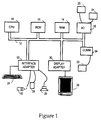
- FIG. 1 illustrates a typical hardware configuration of a computer in accordance with the subject invention having a central processing unit 10, such as a conventional microprocessor, and a number of other units interconnected via a system bus 12.
- a central processing unit 10 such as a conventional microprocessor
- the computer shown in Figure 1 includes a Read Only Memory (ROM) 16, a Random Access Memory (RAM) 14, an I/O adapter 18 for connecting peripheral devices such as disk units 20 and other I/O peripherals represented by 21 to the system bus 12, a user interface adapter 22 for connecting a keyboard 24, a mouse 32, a speaker 28, a microphone 26, and/or other user interface devices such as a touch screen device (not shown) to the bus 12, a communication adapter 34 for connecting the workstation to a data processing network represented by 23.
- a display adapter 36 for connecting the bus to a display device 38.
- the workstation has resident thereon an operating system such as the Apple System/7 ® operating system.
- the present invention describes a set of classes that provide conversion services for numbers. Both text scanning to extract a number, and number formatting to convert a number to text, are handled by the same class. Number formats are provided for most numerical formats, and for different languages. It is also possible to use number formatting classes to format such numbers as 2.99792458 x 10 8 and (1,234.56) correctly, where parenthesis are used to indicate negative numbers.
- Figure 2 provides an overview of the class relationships in the number formatting system.
- the number formatting classes use the TCanonicalNumberFormatter 202 and TCanonicalNumber 204 classes internally.
- the number formatting classes convert text to a TCanonicalNumber 204 and then, using a TCanonicalNumberFormatter 202, perform the further conversion to the binary level. Only people who create new number formatting classes will need to access the TCanonicalNumberFormatter 202, TCanonicalNumber 204, and their methods. Certain of the number formats are intended for specialized use, such as using Roman numerals in outlines or for numbering pages in prefaces.
- the base number format class is TNumberFormat 218, which is an abstract base class.
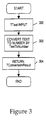
- Figure 3 shows the overall text to number conversion process. This is the most common scanning method for converting a TText object into a number. It takes a TText as its input at 300, converts the text at 302, and returns the scanned number. Information on how well the text was parsed is returned in the TConversionResult 200, at step 304.
- the TRange object is used to determine which portion of the text to convert; it defaults to the entire text.
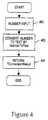
- Figure 4 shows the conversion of a number to text.
- This method handles the conversion from an input number at 400, and converts the number to its textual representation at 402.
- a TConversionResult 200 is returned at 404 to indicate the success of the conversion; problems might arise, for example, from trying to write a number such as 1.618 in Roman numerals.
- NumberToText() There are two reasons why an exception is not thrown by NumberToText() to indicate an incomplete conversion.
- Some number formats simply do not support all kinds of numbers. Since it is possible to do at least part of the conversion ⁇ in this case, turning 1.618 into "I" ⁇ this is not an error and an exception is not thrown.) Again, overloaded forms exist for different number types.
- the method set forth directly above takes as input a range of numbers, and returns the maximum width a number in the range can take up when displayed using the styleSet. This is a pure virtual method that must be overridden in any derived classes.
- This method given a range of numbers, returns the maximum number of UniChar characters a number in the range can take up when converted to a TText. This is a pure virtual method that must be overridden in anv derived classes.
- Distinct formatting for positive and negative numerals is provided by appending text at the beginning or end of a formatted numeral. Certain methods are used to specify the text used on either side of a positive or negative numeral and related properties. The default behavior that these methods assume is that some text is appended before and after every numeral to indicate its sign. This text may or may not be empty. Negative numerals always have the specified text appended; positive numerals may or may not ⁇ this is controlled by the SetShowPlusSign(). Thus, the familiar behavior would be to append a minus sign at the beginning of negative numerals and nothing at the end. Positive numerals can be set apart by inserting a "+" at the beginning.
- TRomanFormat 230 ignores empty strings for the prefix and suffix text.
- Others can override the methods in TNumberFormat 218 that set up the default behavior, as set forth below.
- the default affixes for positive numbers are empty strings, as is the default suffix for negative numbers.
- the default prefix for negative numbers is "-", which, despite appearances is not the minus sign/hyphen we all know and love from ASCII, but the visually identical version of the minus sign.
- Every number format has a numerical range associated with it over which it can produce valid results. For example, Roman numerals are generally not used to represent numbers below 1 and are only rarely used to represent numbers above 5000.
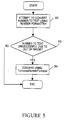
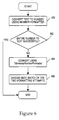
- Figure 5 shows the number to text process using the number formatter.
- an universal number formatter is used at 504.
- Each number formatter contains another number formatter to use in just such a situation.
- this out of bounds number formatter is a TUniversalNumberFormatter, which is guaranteed to be able to handle any number.
- AdoptOutOfBoundsNumberFormat() determines that the out of bounds number format has the larger range before adopting it.
- the process of conversion between text and binary numerals falls algorithmically into two distinct parts: one part is primarily concerned with numerical formatting such as rounding, while the other handles the mechanics of writing systems.
- the TNumberFormatter class 218 formats numbers , as shown in Figure 7, by dividing the process into two steps: conversion between a binary number and a standard intermediate form (a TCanonicalNumber 204) at 700; and conversion between the standard intermediate form and text at 702.
- TConversionResult could be implemented by two classes, TScanResult and TFormattingResult to provide more directed classes of conversion results.
- the number formatting classes do not make heavy use of exceptions. There are two reasons for this. One reason is that mistakes are not really exceptional. A user sometimes types an ill-formed numeral and expects it to be converted to a binary number. It will also be common for a user to expect a binary number to be converted to text using an inappropriate format (e.g., writing ⁇ using Roman numerals).
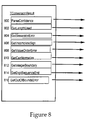
- the TConversionResult 200 class exists to provide extensive information to a programmer regarding how successful a conversion was. It also conveys other information about a conversion which a programmer may find helpful.
- a ParseConfidence 800 is a floating-point number between 0.0 and 1.0 that indicates an overall rating of the conversion.
- GetLengthUsed 802 indicates how many characters in a given text string were used in a conversion from text to a number. It can be used by text parsers to indicate where the next stage of the parsing should take place.
- GetSeparatorError 804 is used to indicate an error involving a digit separator in a conversion from text to a binary number. For example, the numeral "1,23.45” is clearly intended to mean “123.45". In this instance, the conversion will take place, and GetSeparatorError() will return TRUE. virtual Boolean GetlncompleteSign() const;
- GetIncompleteSign 806 is used to indicate an error involving a plus or minus sign in a conversion from text to a binary number. For example, if we have set negative numerals to be bracketed with parentheses, then "(123.45” would seem to be a mistake for (123.45)". In this instance, the conversion will take place, and GetlncompleteSign() will return TRUE. virtual Boolean GetValueOrderError() const;
- GetValueOrderError 808 is used to indicate an error involving the order of digits in number formats which are sensitive to digit order ⁇ specifically, Roman numerals.
- the string "IILCMM” would appear to be an attempt at writing a Roman numeral, but the order of the digits is incorrect.
- a Roman number formatter would do its best to turn this string into a binary number and GetValueOrderError() would return TRUE.
- GetCanNormalize 810 returns TRUE if a text string can be turned into a binary number and back into a text string in such a fashion that:
- GetIntegerBoundary() 712 returns an index into the text string generated by a number to text conversion giving precisely this information.
- GetOutOfBoundsError() 716 returns TRUE.
- a different color is used to indicate an out-of-bounds number conversion.
- TNumerals 206 is a class that is used by the number format for the individual numeral char-value mapping, i.e. that the value of kDigitSeven is 7 in a U.S. decimal format and that kRomanNumeralTen has the value 10 using Roman numerals.
- TNumerals 206 The main methods within TNumerals 206 for use in number formatting are:
- the TNumerals 206 object used by a particular TNumberFormat 218 defines what the numerals are for that instance of the object only. It would be perfectly possible to have an instance of a TNumberFormat 218 object that uses the letter "q" for 1 and "z” for 7. Developers writing their own number format objects should use the information derived from the object's TNumerals 206. An exceptional case would be a number formatter such as the TUniversalNumberFormat class, which is specifically designed to handle any valid numerical digit.
- TNumerals 206 subclasses-TUnicodeNumerals 216 which uses the default numerical characteristics defined by Unicode; TSequentialNumerals 208 for a numeral set where the values are sequential; TContiguousNumerals 210 where, in addition to the values being sequential, the characters representing them are also contiguous; and THybridNumerals 214 for arbitrary sets of numeral-value pairs.
- the TUnicodeNumerals 216 class will accept any of the digit values defined for text-to-binary conversions. Thus, the Latin-Arabic digit one, the Arabic-Indic digit 1, the Devanagari digit 1, and so on, will all have the value 1.
- TUnicodeNumerals 216 object needs to know which set of digits to use. This is done with the methods void SetScript (TUnicode::ScriptName); TUnicode::ScriptName GetScript (void);
- the script can also be specified when a TUnicodeNumerals 216 object is constructed. (The default is TUnicode::kRoman.)
- TUnicode::kRoman When providing the UniChar that a certain value maps to, the TUnicodeNumerals 216 class uses the script information to determine which possible UniChar would be appropriate. Thus, with the script equal to TUnicode::kRoman, TUnicode::kGreek, or TUnicode::kCyrillic, it would return TUnicode::kDigitOne for 1. If the script were TUnicode::kArabic, it would return TUnicode::kArabic_indicDigitone, and so on.
- a THybridNumerals 214 object contains two sets of numeral pairs. One set of pairs is used for converting text to numbers only; this is the set of scanning pairs. Two different UniChar's can be associated with the same numerical value in this list (e.g., for Roman numbers, either "i” or "I” would be converted to 1). Number pairs are added to the set of scanning pairs using the method AddScanningPair(). There is also a set of formatting pairs in which each numerical value can be associated with at most one UniChar. Everything in the collection of formatting pairs is considered automatically to be in the set of scanning pairs. A number pair is added to the set of formatting pairs by using the method AddFormattingPair().
- a TPositionalNumberFormat 220 is used for integers written with a value-based system where the value of a digit depends partly on the digit itself and on where it is found in the numeral.
- the TPositionalNumber format defines a number of additional setter and getter methods to determine, for example, the rounding method to use (the rounding methods available are defined in CanonicalNumber.h), the number of digits to display, and so on. The most important of these include:
- TFloatingPointFormats 222 are used for position-based numeral systems which extend the algorithm to include non-integers.
- a TFloatingPointFormat 222 could represent ⁇ , for example, as 3.14159265358979323846264338327950.
- the TFloatingPointFormat 222 includes special methods to specify such parameters as the number of decimal points to display; these include:
- TFloatingPointFormat 222 This is a special subclass of TFloatingPointFormat 222, which has auniversal range (and the class used as the default out-of-bounds number format for all other number formats).
- TUniversalNumberFormat can handle infinity, NaN's of various types (such as the results of division by zero). Its main purpose is to provide a default out-of-bounds format and guarantee that any format will return something when asked to turn any binary number into a numeral.
- Each rational number format requires information associated with formatting integers, however. This is specified by using the methods virtual TNumberFormat* GetlntegerFormat() const; virtual void AdoptIntegerFormat (TNumberFormat *); The integer format defaults to a standard TPositionalNumberFormat 220, but can be overridden. This allows full control over the representation of the numerator and denominator of a rational number and makes "III I /VII" as easy to write as " 22 / 7 ".
- fractional numeral characters such as " 1 / 2" and " 1 / 3" are also defined.
- characters that can be used to separate the numerator and denominator of a fraction such as kSlash (i.e., "/") and kFractionSlash ("/").
- the TRationalNumberFormat 224 object supports the use of these characters only in conversion from text to numbers. Because few fonts contain glyphs for the fraction characters, conversion from numbers to text will use the standard Arabic numeral characters and styled text to represent fractions.
- This method is derived from TNumberFormat 218 and implements an outline-style numbering scheme of the sequence a, b, c, ..., z, aa, bb, cc zz, aaa, ...
- TAddiditiveNumberFormat 236 is derived from TNumberFormat 218 and handles simple additive numerical representations, where the values of different numerals are just added together to form the number; i.e. the number 47 is represented as " ⁇ ” in classical Greek, where " ⁇ ” is used to represent 40 and " ⁇ ” represents 7.
- This class by itself is not very intelligent; it would accept "uu ⁇ ,” “u ⁇ ,” or “ ⁇ ” as 47 as readily as the correct “ ⁇ .” It is not much more sophisticated in turning numbers to text. Number systems with more sophisticated conversion algorithms or more sophisticated error checking would need to be represented by subclasses, as is done with Roman and Hebrew numerals.
- This method is derived from TAddiditiveNumberFormat 236 and handles Roman numerals.
- the support for Roman numerals is largely intended for limited situations such as page numbers or numbers in an outline.
- the control of the case of Roman numerals is facilitated by using the following: enum ERomanNumeralcase ⁇ kUpperCase, kLowerCase ⁇ ; ERomanNumeralCase GetRomanNumeralCase() const; void SetRomanNumeralCase (const ERomanNumeralCase);
- TRomanFormat 230 has a special enum defined to control this behavior: enum ERomanNumeralType ⁇ kshort, kNormalLong4Long8, kNormalLong4Short8, kNormalShort4Long8, kNormalShort4Short8, kLong ⁇ ;
- the short system uses the subtractive principle as much as possible to make the Roman numeral as short as can be.
- the long system never uses the subtractive principle at all (and was the original system, favored by purists).
- the others vary in whether they use subtraction to reDresent 4's and 8's.
- the TRomanFormat 230 object supports the use of these characters only in conversion from text to numbers. Because few fonts will have glyphs for the Roman numeral characters, conversion from numbers to text will not use the Roman numeral characters in Unicode, including the rare Roman numerals such as 5,000 and 10,000 , and the alternate form of 1,000 which have no analogs in the alphabet. These characters can, however, be used in text-to-number conversions.
- TRomanFormat 230 The use of an arbitrary THybridNumerals 214 object is not supported with TRomanFormat 230. There is no need to specify a THybridNumerals 214 object or base in the constructor for TRomanFormat 230. This behavior is overridden by subclassing TRomanFormat 230.
- Hebrew numerals are written using the Hebrew alphabet in a fashion similar to the ancient Greek numerals, where the first nine letters are assigned the values 1 through 9, the next nine 10 through 90, and so on.
- the value of a numeral is the total value of the letters making it up. This would ordinarily be represented by using a TAdditiveNumberFormat 236; but to avoid using portions of the ineffable Name of God as numerals, 14 must be written as 9+5 not 10+4 and 15 as 9+6 This necessitates using a special object for Hebrew numerals.
- Hebrew does not distinguish between upper- and lower cases, and there are no alternate characters that might be used in turning numbers to Hebrew numerals, so there are no complications beyond this one in the THebrewNumberFormat 232. There is no need to specify a THybridNumerals 214 object or base in the constructor for THebrewNumberFormat 232.
- THebrewNumberFormat 232 provides an interface for distinguishing cabalistic from standard Hebrew numerals.
- the standard system is the one in most frequent use and provides the uniform approach for writing numerals up to 99,999.
- TNumberFormat 218 objects should not find it necessary to override the NumberToText and TextToNumber methods, as these methods merely call CanonicalNumberToText and TextToCanonicalNumber to create the canonical number format and use the appropriate TCanonicalNumberFormatter 202 and TCanonicalNumber 204 methods for the most efficient binary-canonical number format conversion.
- TCanonicalNumberFormatter 202 used by a TNumberFormat 218 is persistent.
- the number formatting classes defined by the present invention provide default values for the fields within TCanonicalNumberFormatter 202 and include setters and getters for these fields where appropriate. This means that developers writing their own TNumberFormat 218 objects do not need to worry about many of the details of setting up a TCanonicalNumberFormatter 202 and TCanonicalNumber 204 but can concentrate on those details relevant to their needs. In particular, it will not be necessary to override the methods that set and return the values for TCanonicalNumberFormatter 202 fields such as precision and rounding. These are handled by the setters and getters in the TPositionalNumberFormat 220. TFloatingPointFormat 222, and TRationalNumberFormat 224 objects.
- the above interface is what one uses to convert between numbers and text, in the examples below using a TNumberFormat 218* format.
- TFloatingPointNumberFormat object uses a TFloatingPointNumberFormat object to show some unique parameters that can be changed for that class of number format.
- TNumberFormat 218 polymorphically for number conversion.
Landscapes
- Engineering & Computer Science (AREA)
- Theoretical Computer Science (AREA)
- Health & Medical Sciences (AREA)
- Artificial Intelligence (AREA)
- Audiology, Speech & Language Pathology (AREA)
- Computational Linguistics (AREA)
- General Health & Medical Sciences (AREA)
- Physics & Mathematics (AREA)
- General Engineering & Computer Science (AREA)
- General Physics & Mathematics (AREA)
- Document Processing Apparatus (AREA)
Claims (26)
- Eine Einrichtung zum Formatieren numerischer Informationen mit einem Prozessor (10) und einem an den Prozessor angeschlossenen Speicher (14, 18) zum Speichern von Informationen und mit einer Vielzahl von Formatierungsobjekten zur Umsetzung erster numerischer Informationen in zweite numerische Informationen, dadurch gekennzeichnet, daß besagte Einrichtung enthält:
einen Formatierungs-Rahmenwerk für Zahlenwerte (Fig. 2), das in besagtem Speicher des besagten Prozessors resident ist zur Erzeugung und Verwaltung von Formatierungsobjekten und das umfaßt:(a) eine Vielzahl von Zahlenwert-Formatierungsklassen (218, 220, 222, 224, 226, 228, 230, 232, 234, 236), die in einer Klassenhierarchie angeordnet sind, jede der Zahlenwert-Formatierungsklassen hat(i) eine Abtastmethode zum Umsetzen numerischer Informationen zwischen einer von einer Vielzahl von Zahlenwert-Textdarstellungen, einschließlich wenigstens einer sprachspezifischen Zahlenwert-Textdarstellung, und einer kanonischen Zwischendarstellung (204) und(ii) eine Textformatierungsmethode zum Umsetzen numerischer Informationen zwischen der kanonischen Zwischendarstellung (204) und einer der Vielzahl von Zahlenwert-Textdarstellungen;(b) Mittel zum polymorphen Instantiieren eines Zahlenwert-Formatierungsobjekt von einer der Vielzahl von Zahlenwert-Formatierungsklassen in Beantwortung numerischer Informationen in einer ersten Zahlenwert-Textdarstellung, welches Zahlenwert-Formatierungsobjekt eine Umsetzung zwischen numerischer Informationen in der ersten Zahlenwert-Textdarstellung und der kanonischen Zwischendarstellung durchführt; und(c) eine kanonische Zahlenwert-Formatierungsklasse (202) zur Erzeugung eines kanonischen Zahlenwert-Formatierungsobjekts im Speicher, das eine Umsetzung zwischen numerischer Informationen in der kanonischen Zwischenform und einer Binärzahl durchführt. - Die Einrichtung nach Anspruch 1, worin die kanonische Zahlenwert-Formatierungsklasse (202) wenigstens eine Text-zu-Zahlenwert-Umsetzungsmethode enthält zum Umsetzen von Text in die kanonische Zwischenform (204) und wenigstens eine Zahlenwert-zu-Text-Methode enthält zum Umsetzen von numerischer Informationen aus der kanonischen Zwischenform in Text.
- Die Einrichtung nach Anspruch 1, worin das Formatierungs-Rahmenwerk für Zahlenwerte wenigstens ein Klasse (206) enthält, die numerische Zeichen auf einen numerischen Wert abbildet für individuelle Zahlenwert-Zeichen.
- Die Einrichtung nach Anspruch 1, worin das Formatierungs-Rahmenwerk für Zahlenwerte wenigstens ein Klasse (200) enthält, die eine Methode aufweist zur Bereitstellung einer Vertraulichkeitsanzeige (800).
- Die Einrichtung nach Anspruch 1, worin die Vielzahl von Zahlenwert-Formatierungsklassen (218, 220, 222, 224, 226, 228, 230, 232, 234, 236) wenigstens eine Klasse (226, 230, 232) enthält zur Umsetzung zwischen numerischen Informationen in einer sprachspezifischen Zahlenwert-Textdarstellung und der kanonischen Zwischenform (204).
- Die Einrichtung nach Anspruch 1, worin jede der Vielzahl von Zahlenwert-Formatierungsklassen (218, 220, 222, 224, 226, 228, 230, 232, 234, 236) wenigstens eine Methode enthält zum Formatieren positiver und negativer Zahlenwerte.
- Die Einrichtung nach Anspruch 1, worin jede der Vielzahl von Zahlenwert-Formatierungsklassen (218, 220, 222, 224, 226, 228, 230, 232, 234, 236) wenigstens eine Klasse enthält zur Bildung eines Objekts zur Verarbeitung von bereichsüberschreitenden Umsetzungen.
- Die Einrichtung nach Anspruch 1, worin die Mittel zum polymorphen Instantiieren enthalten:(b1) Mittel, die auf numerische Informationen in einem ersten Format ansprechen zum polymorphen Instantiieren eines ersten Zahlenwert-Formatierungsobjekts von der Vielzahl von Zahlenwert-Formatierungsklassen (218, 220, 222, 224, 226, 228, 230, 232, 234, 236) zum Versuch einer ersten Umsetzung von numerischen Informationen und zur Rückgabe eines Vertraulichkeitswertes (800) zur Anzeige des Resultats des ersten Umsetzungsversuchs; und(b2) Mittel, die auf numerische Informationen in dem ersten Format ansprechen zum polymorphen Instantiieren eines zweiten Zahlenwert-Formatierungsobjekts von der Vielzahl von Zahlenwert-Formatierungsklassen zur Ausführung einer zweiten Umsetzung, wenn die erste Umsetzung einen Vertraulichkeitswert (800) ergibt, der vorbestimmte Kriterien nicht erfüllt.
- Die Einrichtung nach Anspruch 1, worin das Formatierungs-Rahmenwerk für Zahlenwerte Klassencode (216) enthält zum Instantiieren von wenigstens einem Objekt zur Abbildung von Zeichenwerten für jeden Ziffernwert, der für Text-nach-Binär-Umsetzungen definiert ist.
- Die Einrichtung nach Anspruch 1, worin wenigstens eines (236) der Vielzahl von Zahlenwert-Formatierungsklassen (218, 220, 222, 224, 226, 228, 230, 232, 234, 236) Methoden enthält zur Formatierung numerischer Informationen in einem additiven Format.
- Die Einrichtung nach Anspruch 1, worin wenigstens eines (220) der Vielzahl von Zahlenwert-Formatierungsklassen (218, 220, 222, 224, 226, 228, 230, 232, 234, 236) Methoden enthält zur Formatierung numerischer Informationen in einem Positionsformat.
- Die Einrichtung nach Anspruch 7, worin wenigstens eines (TUniversalNumberFormat) der Vielzahl von Zahlenwert-Formatierungsklassen (218, 220, 222, 224, 226, 228, 230, 232, 234, 236) Methoden (504, 604) enthält zur Formatierung beliebiger numerischer Informationen.
- Die Einrichtung nach Anspruch 1, worin wenigstens eines (230) der Vielzahl von Zahlenwert-Formatierungsklassen (218, 220, 222, 224, 226, 228, 230, 232, 234, 236) Methoden enthält zur Formatierung numerischer Informationen in einem römischen Ziffernformat.
- Ein Verfahren zum Formatieren numerischer Informationen unter Verwendung eines Prozessors (10) und eines an den Prozessor angeschlossenen Speicher (14, 18) zum Speichern von Informationen und einer Vielzahl von Formatierungsobjekten zur Umsetzung erster numerischer Informationen in zweite numerische Informationen, gekennzeichnet durch die folgenden Schritte:(a) Bildung eines Formatierungs-Rahmenwerks für Zahlenwerte (Fig. 2) in dem Speicher zur Erzeugung und Verwaltung von Zahlenwert-Formatierungsobjekten und das Formatierungs-Rahmenwerks für Zahlenwerte umfaßt eine Vielzahl von Zahlenwert-Formatierungsklassen (218, 220, 222, 224, 226, 228, 230, 232, 234, 236), die in einer Klassenhierarchie angeordnet sind, jede der Zahlenwert-Formatierungsklassen hat(i) eine Abtastmethode zum Umsetzen numerischer Informationen zwischen einer von einer Vielzahl von Zahlenwert-Textdarstellungen, einschließlich wenigstens einer sprachspezifischen Zahlenwert-Textdarstellung, und einer kanonischen Zwischendarstellung (204) und(ii) einer Textformatierungsmethode zum Umsetzen numerischer Informationen zwischen der kanonischen Zwischendarstellung (204) und einer der Vielzahl von Zahlenwert-Textdarstellungen;(b) polymorphes Instantiieren eines Zahlenwert-Formatierungsobjekts von einer der Vielzahl von Zahlenwert-Formatierungsklassen in Beantwortung numerischer Informationen in einer ersten Zahlenwert-Textdarstellung, welches Zahlenwert-Formatierungsobjekt eine Umsetzung zwischen numerischer Informationen in der ersten Zahlenwert-Textdarstellung und der kanonischen Zwischendarstellung durchführt; und(c) Bildung eines kanonischen Zahlenwert-Formatierungs-objekts im Speicher von einer kanonischen Zahlenwert-Formatierungsklasse (202), welches eine Umsetzung zwischen numerischer Informationen in der kanonischen Zwischenform und einer Binärzahl durchführt.
- Das Verfahren nach Anspruch 14, worin die kanonische Zahlenwert-Formatierungsklasse (202) wenigstens eine Text-zu-Zahlenwert-Umsetzungsmethode enthält zum Umsetzen von Text in die kanonische Zwischenform (204) und wenigstens eine Zahlenwert-zu-Text-Methode enthält zum Umsetzen von numerischer Informationen aus der kanonischen Zwischenform in Text.
- Das Verfahren nach Anspruch 14, worin das Formatierungs-Rahmenwerk für Zahlenwerte wenigstens ein Klasse (206) enthält, die numerische Zeichen auf einen numerischen Wert abbildet für individuelle Zahlenwert-Zeichen.
- Das Verfahren nach Anspruch 14, worin das Formatierungs-Rahmenwerk für zahlenwerte wenigstens ein Klasse (200) enthält, die eine Methode zur Bereitstellung einer Vertraulichkeitsanzeige (800) aufweist.
- Das Verfahren nach Anspruch 14, worin die Vielzahl von Zahlenwert-Formatierungsklassen (218, 220, 222, 224, 226, 228, 230, 232, 234, 236) wenigstens eine Klasse (226, 230, 232) enthält zur Umsetzung zwischen numerischen Informationen in einer sprachspezifischen Zahlenwert-Textdarstellung und der kanonischen Zwischenform (204).
- Das Verfahren nach Anspruch 14, worin jede der Vielzahl von Zahlenwert-Formatierungsklassen (218, 220, 222, 224, 226, 228, 230, 232, 234, 236) wenigstens eine Methode enthält zum Formatieren positiver und negativer Zahlenwerte.
- Das Verfahren nach Anspruch 14, worin jede der Vielzahl von Zahlenwert-Formatierungsklassen (218, 220, 222, 224, 226, 228, 230, 232, 234, 236) wenigstens eine Klasse enthält zur Bildung eines Objekts zur Verarbeitung von bereichsüberschreitenden Umsetzungen.
- Das Verfahren nach Anspruch 14, worin Schritt (b) die Schritte enthält:(b1) Versuch einer ersten Umsetzung von numerischen Informationen und Rückgabe eines Vertraulichkeitswertes (800), der das Resultat des ersten Umsetzungsversuchs anzeigt; und(b2) polymorphes Instantiieren eines zweiten Zahlenwert-Formatierungsobjekts von der Vielzahl von Zahlenwert-Formatierungsklassen zur Ausführung einer zweiten Umsetzung, wenn die erste Umsetzung einen Vertraulichkeitswert (800) ergibt, der vorbestimmte Kriterien nicht erfüllt.
- Das Verfahren nach Anspruch 14, worin das Formatierungs-Rahmenwerk für Zahlenwerte Klassencode (216) enthält zum Instantiieren von wenigstens einem Objekt zur Abbildung von Zeichenwerten für jeden Ziffernwert, der für Text-nach-Binär-Umsetzungen definiert ist.
- Das Verfahren nach Anspruch 14, worin wenigstens eine (236) der Vielzahl von Zahlenwert-Formatierungsklassen (218, 220, 222, 224, 226, 228, 230, 232, 234, 236) Methoden enthält zur Formatierung numerischer Informationen in einem additiven Format.
- Das Verfahren nach Anspruch 14, worin wenigstens eine (220) der Vielzahl von Zahlenwert-Formatierungsklassen (218, 220, 222, 224, 226, 228, 230, 232, 234, 236) Methoden enthält zur Formatierung numerischer Informationen in einem Positionsformat.
- Das Verfahren nach Anspruch 20, worin wenigstens eine der Vielzahl von Zahlenwert-Formatierungsklassen (218, 220, 222, 224, 226, 228, 230, 232, 234, 236) Methoden (504, 604) enthält zur Formatierung beliebiger numerischer Informationen.
- Das Verfahren nach Anspruch 14, worin wenigstens eine (230) der Vielzahl von Zahlenwert-Formatierungsklassen (218, 220, 222, 224, 226, 228, 230, 232, 234, 236) Methoden enthält zur Formatierung numerischer Informationen in einem römischen Ziffernformat.
Applications Claiming Priority (3)
| Application Number | Priority Date | Filing Date | Title |
|---|---|---|---|
| US08/184,127 US5657259A (en) | 1994-01-21 | 1994-01-21 | Number formatting framework |
| PCT/US1994/002628 WO1995020198A1 (en) | 1994-01-21 | 1994-03-11 | Number formatting framework |
| US184127 | 1998-11-02 |
Publications (2)
| Publication Number | Publication Date |
|---|---|
| EP0803104A1 EP0803104A1 (de) | 1997-10-29 |
| EP0803104B1 true EP0803104B1 (de) | 1999-06-16 |
Family
ID=22675654
Family Applications (1)
| Application Number | Title | Priority Date | Filing Date |
|---|---|---|---|
| EP94913899A Expired - Lifetime EP0803104B1 (de) | 1994-01-21 | 1994-03-11 | Verfahren und system zum formatieren von numerischer information |
Country Status (7)
| Country | Link |
|---|---|
| US (1) | US5657259A (de) |
| EP (1) | EP0803104B1 (de) |
| JP (1) | JP3599740B2 (de) |
| AU (1) | AU6587894A (de) |
| CA (1) | CA2178584A1 (de) |
| DE (1) | DE69419184T2 (de) |
| WO (1) | WO1995020198A1 (de) |
Families Citing this family (56)
| Publication number | Priority date | Publication date | Assignee | Title |
|---|---|---|---|---|
| US5822720A (en) | 1994-02-16 | 1998-10-13 | Sentius Corporation | System amd method for linking streams of multimedia data for reference material for display |
| US5624456A (en) * | 1996-02-07 | 1997-04-29 | Hellenkamp; Johann F. | Automatic surgical device for cutting a cornea |
| US6119130A (en) * | 1996-03-28 | 2000-09-12 | Oracle Corporation | Method and apparatus for providing schema evolution without recompilation |
| US5905979A (en) * | 1996-07-02 | 1999-05-18 | Electronic Data Systems Corporation | Abstract manager system and method for managing an abstract database |
| US6032151A (en) * | 1997-11-17 | 2000-02-29 | Sun Microsystems, Inc. | Database system employing polymorphic entry and entry matching |
| US7421645B2 (en) * | 2000-06-06 | 2008-09-02 | Microsoft Corporation | Method and system for providing electronic commerce actions based on semantically labeled strings |
| US7788602B2 (en) | 2000-06-06 | 2010-08-31 | Microsoft Corporation | Method and system for providing restricted actions for recognized semantic categories |
| US7712024B2 (en) * | 2000-06-06 | 2010-05-04 | Microsoft Corporation | Application program interfaces for semantically labeling strings and providing actions based on semantically labeled strings |
| US7770102B1 (en) | 2000-06-06 | 2010-08-03 | Microsoft Corporation | Method and system for semantically labeling strings and providing actions based on semantically labeled strings |
| US7716163B2 (en) | 2000-06-06 | 2010-05-11 | Microsoft Corporation | Method and system for defining semantic categories and actions |
| US6636880B1 (en) * | 2000-09-18 | 2003-10-21 | International Business Machines Corporation | Automatic conversion of units in a computer program |
| US6957385B2 (en) * | 2001-01-05 | 2005-10-18 | Microsoft Corporation | Worldwide number format for a spreadsheet program module |
| US7117430B2 (en) * | 2001-02-27 | 2006-10-03 | Microsoft Corporation | Spreadsheet error checker |
| US7032174B2 (en) * | 2001-03-27 | 2006-04-18 | Microsoft Corporation | Automatically adding proper names to a database |
| US7778816B2 (en) | 2001-04-24 | 2010-08-17 | Microsoft Corporation | Method and system for applying input mode bias |
| US7130861B2 (en) | 2001-08-16 | 2006-10-31 | Sentius International Corporation | Automated creation and delivery of database content |
| US20050108195A1 (en) * | 2002-05-07 | 2005-05-19 | Microsoft Corporation | Method, system, and apparatus for processing information based on the discovery of semantically labeled strings |
| US7325194B2 (en) * | 2002-05-07 | 2008-01-29 | Microsoft Corporation | Method, system, and apparatus for converting numbers between measurement systems based upon semantically labeled strings |
| US7707496B1 (en) | 2002-05-09 | 2010-04-27 | Microsoft Corporation | Method, system, and apparatus for converting dates between calendars and languages based upon semantically labeled strings |
| US7742048B1 (en) * | 2002-05-23 | 2010-06-22 | Microsoft Corporation | Method, system, and apparatus for converting numbers based upon semantically labeled strings |
| US7707024B2 (en) | 2002-05-23 | 2010-04-27 | Microsoft Corporation | Method, system, and apparatus for converting currency values based upon semantically labeled strings |
| US7827546B1 (en) | 2002-06-05 | 2010-11-02 | Microsoft Corporation | Mechanism for downloading software components from a remote source for use by a local software application |
| US7281245B2 (en) | 2002-06-05 | 2007-10-09 | Microsoft Corporation | Mechanism for downloading software components from a remote source for use by a local software application |
| US7356537B2 (en) | 2002-06-06 | 2008-04-08 | Microsoft Corporation | Providing contextually sensitive tools and help content in computer-generated documents |
| US7003522B1 (en) | 2002-06-24 | 2006-02-21 | Microsoft Corporation | System and method for incorporating smart tags in online content |
| US7716676B2 (en) | 2002-06-25 | 2010-05-11 | Microsoft Corporation | System and method for issuing a message to a program |
| US7392479B2 (en) | 2002-06-27 | 2008-06-24 | Microsoft Corporation | System and method for providing namespace related information |
| US20040001099A1 (en) * | 2002-06-27 | 2004-01-01 | Microsoft Corporation | Method and system for associating actions with semantic labels in electronic documents |
| US7209915B1 (en) | 2002-06-28 | 2007-04-24 | Microsoft Corporation | Method, system and apparatus for routing a query to one or more providers |
| US20040019856A1 (en) * | 2002-07-25 | 2004-01-29 | Bruce Hamilton | Numeric coding method |
| US7783614B2 (en) | 2003-02-13 | 2010-08-24 | Microsoft Corporation | Linking elements of a document to corresponding fields, queries and/or procedures in a database |
| US7711550B1 (en) | 2003-04-29 | 2010-05-04 | Microsoft Corporation | Methods and system for recognizing names in a computer-generated document and for providing helpful actions associated with recognized names |
| US7558841B2 (en) | 2003-05-14 | 2009-07-07 | Microsoft Corporation | Method, system, and computer-readable medium for communicating results to a data query in a computer network |
| US7739588B2 (en) | 2003-06-27 | 2010-06-15 | Microsoft Corporation | Leveraging markup language data for semantically labeling text strings and data and for providing actions based on semantically labeled text strings and data |
| US20050071756A1 (en) * | 2003-09-23 | 2005-03-31 | International Business Machines Corporation | XML to numeric conversion method, system, article of manufacture, and computer program product |
| US7434157B2 (en) | 2003-12-09 | 2008-10-07 | Microsoft Corporation | Programmable object model for namespace or schema library support in a software application |
| US7178102B1 (en) | 2003-12-09 | 2007-02-13 | Microsoft Corporation | Representing latent data in an extensible markup language document |
| US7487515B1 (en) | 2003-12-09 | 2009-02-03 | Microsoft Corporation | Programmable object model for extensible markup language schema validation |
| US7404195B1 (en) | 2003-12-09 | 2008-07-22 | Microsoft Corporation | Programmable object model for extensible markup language markup in an application |
| US7509573B1 (en) | 2004-02-17 | 2009-03-24 | Microsoft Corporation | Anti-virus security information in an extensible markup language document |
| US7992085B2 (en) | 2005-09-26 | 2011-08-02 | Microsoft Corporation | Lightweight reference user interface |
| US7788590B2 (en) | 2005-09-26 | 2010-08-31 | Microsoft Corporation | Lightweight reference user interface |
| US8077974B2 (en) | 2006-07-28 | 2011-12-13 | Hewlett-Packard Development Company, L.P. | Compact stylus-based input technique for indic scripts |
| US8171402B2 (en) | 2006-11-10 | 2012-05-01 | Research In Motion Limited | Handheld electronic device including auto completion of punctuation in numerical entry, and associated method |
| US8086439B2 (en) * | 2007-02-06 | 2011-12-27 | Microsoft Corporation | Translation of text into numbers |
| US8078658B2 (en) * | 2008-02-01 | 2011-12-13 | International Business Machines Corporation | ASCII to binary decimal integer conversion in a vector processor |
| US9454514B2 (en) * | 2009-09-02 | 2016-09-27 | Red Hat, Inc. | Local language numeral conversion in numeric computing |
| US8949783B2 (en) * | 2010-06-30 | 2015-02-03 | International Business Machines Corporation | Method and system for lazy data serialization in computer communications |
| US8468021B2 (en) * | 2010-07-15 | 2013-06-18 | King Abdulaziz City For Science And Technology | System and method for writing digits in words and pronunciation of numbers, fractions, and units |
| US9710227B2 (en) | 2012-09-15 | 2017-07-18 | John W. Ogilvie | Formatting floating point numbers |
| US10268449B1 (en) * | 2015-06-25 | 2019-04-23 | EMC IP Holding Company LLC | Natural order in API calls |
| US10984030B2 (en) | 2017-03-20 | 2021-04-20 | International Business Machines Corporation | Creating cognitive intelligence queries from multiple data corpuses |
| US11182414B2 (en) | 2017-03-20 | 2021-11-23 | International Business Machines Corporation | Search queries of multi-datatype databases |
| US11080273B2 (en) | 2017-03-20 | 2021-08-03 | International Business Machines Corporation | Image support for cognitive intelligence queries |
| US11100100B2 (en) | 2017-03-20 | 2021-08-24 | International Business Machines Corporation | Numeric data type support for cognitive intelligence queries |
| US12141114B2 (en) | 2021-12-09 | 2024-11-12 | International Business Machines Corporation | Semantic indices for accelerating semantic queries on databases |
Family Cites Families (9)
| Publication number | Priority date | Publication date | Assignee | Title |
|---|---|---|---|---|
| US3860908A (en) * | 1974-02-04 | 1975-01-14 | Honeywell Inf Systems | Rom multiple code conversion apparatus |
| US4415766A (en) * | 1980-06-06 | 1983-11-15 | Alephtran Technology N.V. | Recognizer/converter for arabic and other language codes |
| US5055998A (en) * | 1984-12-10 | 1991-10-08 | Wang Laboratories, Inc. | Intermediate spreadsheet structure |
| US5257369A (en) * | 1990-10-22 | 1993-10-26 | Skeen Marion D | Apparatus and method for providing decoupling of data exchange details for providing high performance communication between software processes |
| US5225833A (en) * | 1989-10-20 | 1993-07-06 | Digital Equipment Corporation | Character encoding |
| US5050121A (en) * | 1990-01-22 | 1991-09-17 | Vaughan H W | Communication system which uses characters that represent binary-coded decimal numbers |
| US5299304A (en) * | 1991-04-16 | 1994-03-29 | International Business Machines Corporation | Method and apparatus for identifying multiple stage document format transformations |
| US5337233A (en) * | 1992-04-13 | 1994-08-09 | Sun Microsystems, Inc. | Method and apparatus for mapping multiple-byte characters to unique strings of ASCII characters for use in text retrieval |
| AU3975493A (en) * | 1992-04-14 | 1993-11-18 | Teknekron Communications Systems, Inc. | Method for converting a first data collection to a second data collection |
-
1994
- 1994-01-21 US US08/184,127 patent/US5657259A/en not_active Expired - Lifetime
- 1994-03-11 DE DE69419184T patent/DE69419184T2/de not_active Expired - Lifetime
- 1994-03-11 WO PCT/US1994/002628 patent/WO1995020198A1/en not_active Ceased
- 1994-03-11 JP JP51953895A patent/JP3599740B2/ja not_active Expired - Lifetime
- 1994-03-11 CA CA002178584A patent/CA2178584A1/en not_active Abandoned
- 1994-03-11 AU AU65878/94A patent/AU6587894A/en not_active Abandoned
- 1994-03-11 EP EP94913899A patent/EP0803104B1/de not_active Expired - Lifetime
Also Published As
| Publication number | Publication date |
|---|---|
| US5657259A (en) | 1997-08-12 |
| JP3599740B2 (ja) | 2004-12-08 |
| CA2178584A1 (en) | 1995-07-27 |
| EP0803104A1 (de) | 1997-10-29 |
| DE69419184D1 (de) | 1999-07-22 |
| JPH09508726A (ja) | 1997-09-02 |
| DE69419184T2 (de) | 1999-12-23 |
| AU6587894A (en) | 1995-08-08 |
| WO1995020198A1 (en) | 1995-07-27 |
Similar Documents
| Publication | Publication Date | Title |
|---|---|---|
| US5657259A (en) | Number formatting framework | |
| US6496793B1 (en) | System and methods for national language support with embedded locale-specific language driver identifiers | |
| US7251667B2 (en) | Unicode input method editor | |
| AU607795B2 (en) | Data integration by object management | |
| EP0686286A1 (de) | System zum transkribieren von texteingaben | |
| EP0268069A2 (de) | Verfahren zur Herstellung einer Meldungsdatei in einem Computer | |
| AU3768089A (en) | Intermediate spreadsheet structure | |
| US5544298A (en) | Code generation and data access system | |
| CN112667563A (zh) | 一种文档管理及操作方法和系统 | |
| US20050251519A1 (en) | Efficient language-dependent sorting of embedded numerics | |
| US20020069049A1 (en) | Dynamic determination of language-specific data output | |
| US5479167A (en) | Character code conversion unit | |
| JP2740335B2 (ja) | 自動セル属性判定機能を有する表読取装置 | |
| CN1117332C (zh) | 多内码转换系统及其转换方法 | |
| JPH08160929A (ja) | 情報処理装置及び情報処理方法 | |
| JPH08115330A (ja) | 類似文書検索方法および装置 | |
| Davis et al. | Creating global software: Text handling and localization in Taligent's CommonPoint application system | |
| JPH077411B2 (ja) | 文書処理装置 | |
| JP2707565B2 (ja) | 文書表示装置 | |
| CN119089864A (zh) | 汉语汉字表达式规则制定方法、将汉字编制为表达的方法及装置 | |
| Strous | LUX Image Processing Package Louis Strous 5 May 2019 | |
| Walters | Microprocessors as intelligent front-end devices for medical-information systems | |
| Terry | Unix standards and the native language system | |
| JPH096772A (ja) | 文字処理装置 | |
| EP0462760A2 (de) | Identifizierungssystem von Kodeseiten |
Legal Events
| Date | Code | Title | Description |
|---|---|---|---|
| PUAI | Public reference made under article 153(3) epc to a published international application that has entered the european phase |
Free format text: ORIGINAL CODE: 0009012 |
|
| 17P | Request for examination filed |
Effective date: 19960718 |
|
| AK | Designated contracting states |
Kind code of ref document: A1 Designated state(s): DE FR GB |
|
| 17Q | First examination report despatched |
Effective date: 19971024 |
|
| GRAG | Despatch of communication of intention to grant |
Free format text: ORIGINAL CODE: EPIDOS AGRA |
|
| GRAG | Despatch of communication of intention to grant |
Free format text: ORIGINAL CODE: EPIDOS AGRA |
|
| GRAH | Despatch of communication of intention to grant a patent |
Free format text: ORIGINAL CODE: EPIDOS IGRA |
|
| RBV | Designated contracting states (corrected) |
Designated state(s): DE FR GB |
|
| GRAH | Despatch of communication of intention to grant a patent |
Free format text: ORIGINAL CODE: EPIDOS IGRA |
|
| GRAA | (expected) grant |
Free format text: ORIGINAL CODE: 0009210 |
|
| AK | Designated contracting states |
Kind code of ref document: B1 Designated state(s): DE FR GB |
|
| REF | Corresponds to: |
Ref document number: 69419184 Country of ref document: DE Date of ref document: 19990722 |
|
| ET | Fr: translation filed | ||
| PLBE | No opposition filed within time limit |
Free format text: ORIGINAL CODE: 0009261 |
|
| STAA | Information on the status of an ep patent application or granted ep patent |
Free format text: STATUS: NO OPPOSITION FILED WITHIN TIME LIMIT |
|
| 26N | No opposition filed | ||
| REG | Reference to a national code |
Ref country code: GB Ref legal event code: IF02 |
|
| REG | Reference to a national code |
Ref country code: GB Ref legal event code: 732E Free format text: REGISTERED BETWEEN 20100603 AND 20100609 |
|
| REG | Reference to a national code |
Ref country code: FR Ref legal event code: TP Ref country code: FR Ref legal event code: CA |
|
| REG | Reference to a national code |
Ref country code: DE Ref legal event code: R082 Ref document number: 69419184 Country of ref document: DE |
|
| PGFP | Annual fee paid to national office [announced via postgrant information from national office to epo] |
Ref country code: DE Payment date: 20130306 Year of fee payment: 20 Ref country code: FR Payment date: 20130325 Year of fee payment: 20 Ref country code: GB Payment date: 20130306 Year of fee payment: 20 |
|
| REG | Reference to a national code |
Ref country code: DE Ref legal event code: R071 Ref document number: 69419184 Country of ref document: DE |
|
| REG | Reference to a national code |
Ref country code: GB Ref legal event code: PE20 Expiry date: 20140310 |
|
| PG25 | Lapsed in a contracting state [announced via postgrant information from national office to epo] |
Ref country code: DE Free format text: LAPSE BECAUSE OF EXPIRATION OF PROTECTION Effective date: 20140312 Ref country code: GB Free format text: LAPSE BECAUSE OF EXPIRATION OF PROTECTION Effective date: 20140310 |