EP0802218B1 - Utilisation d'un système composite avec une couche barrière d'arôme ou de parfum - Google Patents
Utilisation d'un système composite avec une couche barrière d'arôme ou de parfum Download PDFInfo
- Publication number
- EP0802218B1 EP0802218B1 EP97104687A EP97104687A EP0802218B1 EP 0802218 B1 EP0802218 B1 EP 0802218B1 EP 97104687 A EP97104687 A EP 97104687A EP 97104687 A EP97104687 A EP 97104687A EP 0802218 B1 EP0802218 B1 EP 0802218B1
- Authority
- EP
- European Patent Office
- Prior art keywords
- use according
- polycondensate
- compounds
- silicic acid
- hetero
- Prior art date
- Legal status (The legal status is an assumption and is not a legal conclusion. Google has not performed a legal analysis and makes no representation as to the accuracy of the status listed.)
- Expired - Lifetime
Links
- 0 C*O*(*(*)=N)=O Chemical compound C*O*(*(*)=N)=O 0.000 description 3
Images


Classifications
-
- C—CHEMISTRY; METALLURGY
- C08—ORGANIC MACROMOLECULAR COMPOUNDS; THEIR PREPARATION OR CHEMICAL WORKING-UP; COMPOSITIONS BASED THEREON
- C08J—WORKING-UP; GENERAL PROCESSES OF COMPOUNDING; AFTER-TREATMENT NOT COVERED BY SUBCLASSES C08B, C08C, C08F, C08G or C08H
- C08J7/00—Chemical treatment or coating of shaped articles made of macromolecular substances
- C08J7/04—Coating
- C08J7/0427—Coating with only one layer of a composition containing a polymer binder
-
- C—CHEMISTRY; METALLURGY
- C08—ORGANIC MACROMOLECULAR COMPOUNDS; THEIR PREPARATION OR CHEMICAL WORKING-UP; COMPOSITIONS BASED THEREON
- C08J—WORKING-UP; GENERAL PROCESSES OF COMPOUNDING; AFTER-TREATMENT NOT COVERED BY SUBCLASSES C08B, C08C, C08F, C08G or C08H
- C08J7/00—Chemical treatment or coating of shaped articles made of macromolecular substances
- C08J7/04—Coating
- C08J7/046—Forming abrasion-resistant coatings; Forming surface-hardening coatings
-
- C—CHEMISTRY; METALLURGY
- C08—ORGANIC MACROMOLECULAR COMPOUNDS; THEIR PREPARATION OR CHEMICAL WORKING-UP; COMPOSITIONS BASED THEREON
- C08J—WORKING-UP; GENERAL PROCESSES OF COMPOUNDING; AFTER-TREATMENT NOT COVERED BY SUBCLASSES C08B, C08C, C08F, C08G or C08H
- C08J7/00—Chemical treatment or coating of shaped articles made of macromolecular substances
- C08J7/04—Coating
- C08J7/043—Improving the adhesiveness of the coatings per se, e.g. forming primers
-
- C—CHEMISTRY; METALLURGY
- C08—ORGANIC MACROMOLECULAR COMPOUNDS; THEIR PREPARATION OR CHEMICAL WORKING-UP; COMPOSITIONS BASED THEREON
- C08J—WORKING-UP; GENERAL PROCESSES OF COMPOUNDING; AFTER-TREATMENT NOT COVERED BY SUBCLASSES C08B, C08C, C08F, C08G or C08H
- C08J7/00—Chemical treatment or coating of shaped articles made of macromolecular substances
- C08J7/04—Coating
- C08J7/048—Forming gas barrier coatings
-
- C—CHEMISTRY; METALLURGY
- C08—ORGANIC MACROMOLECULAR COMPOUNDS; THEIR PREPARATION OR CHEMICAL WORKING-UP; COMPOSITIONS BASED THEREON
- C08J—WORKING-UP; GENERAL PROCESSES OF COMPOUNDING; AFTER-TREATMENT NOT COVERED BY SUBCLASSES C08B, C08C, C08F, C08G or C08H
- C08J2483/00—Characterised by the use of macromolecular compounds obtained by reactions forming in the main chain of the macromolecule a linkage containing silicon with or without sulfur, nitrogen, oxygen, or carbon only; Derivatives of such polymers
Definitions
- the invention relates to the use of composite systems consisting of a carrier material and a Aroma barrier layer or a fragrance barrier layer.
- composite systems consisting of a carrier material and a Aroma barrier layer or a fragrance barrier layer.
- Such composite systems can, for example in the packaging sector (eg foils, sheets, shaped and hollow bodies) but also for technical applications (e.g., membranes, protective coatings for Sensors) are used.
- Polymers are unlike metals or glass for gases and for many low molecular weight ones Permeable to substances. There is no plastic that is or vapor molecules represents an absolute barrier. This is on the structural Properties of the plastics, e.g. the general porosity, the intermolecular Interstices and molecular mobility, due. Certain molecular structures are responsible for good barrier properties in polymers responsible. Very often, however, a structure that creates a good gas barrier results conditionally, poor water vapor barrier properties. This effect can be in be based on the polarity of a polymer. Very polar polymers, e.g. polyvinyl alcohol, are excellent gas and aroma barriers, but very bad Water vapor barrier. As a result, suffers their property as gas or Aroma barrier on exposure to moisture. Non-polar polymers, e.g. PE, have excellent water vapor but poor gas or aroma barrier properties. For many barrier polymers, therefore, high material thicknesses are required, to achieve the desired barrier properties.
- Very polar polymers e.g. polyvin
- polymers with a very low permeation of flavorings so-called barrier plastics, play in particular in the field of food packaging and packaging of pharmaceutical or chemical products a very important role. They are used if filled goods during the guaranteed minimum shelf life either from external influences or loss of ingredients (e.g., flavorings) must be sufficiently protected.
- barrier plastics play in particular in the field of food packaging and packaging of pharmaceutical or chemical products a very important role. They are used if filled goods during the guaranteed minimum shelf life either from external influences or loss of ingredients (e.g., flavorings) must be sufficiently protected.
- the packaging materials can often be used in addition to metal and glass packaging only combinations of different plastics or plastic films with vapor-deposited, thin inorganic layers are sufficient.
- Such films show still measurable permeabilities to the most diverse gases, allow but low material and manufacturing costs, as well as a low weight the packaging.
- packaging materials With packaging materials, the trade-off between the economic ones is becoming more and more important Advantages of plastics on the one hand and the achievable shelf life on the other hand, which depends on the type of contents sought.
- Packaging Ordinance of 12.06.1991 and the resulting claim after packaging avoidance packaging reduction, reusability or material usability are now especially composite materials in the Focus of criticism advised.
- the reduction of material usage has been the original approach these materials in terms of recyclability or recyclability inferior to the glass or metal packaging.
- DE 4305856 C1 discloses a process for the production of vacuum-deposited SiO x barrier layers (permeation barrier layers) on packaging films, which is characterized in that the evaporation is carried out with a vapor-deposited material comprising silicon and an oxygen compound of silicon and boron or a Contains boron compound, wherein the proportion of boron is at least 1 mol% of the total silicon content.
- these barrier layers show a reduced shrinkage and thus a reduced cracking, also with this method, the barrier properties of polymers can be significantly improved, but the permeation rates can still be detected with conventional measuring technology and thus remain too high for many applications.
- polymers made of renewable raw materials have a much higher permeation rate even after coating compared to coated standard polymers, such as polyethylene or polypropylene. Since the vapor-deposited layers are very sensitive to mechanical stress, it is usually necessary to laminate the coated substrates with a film, for example. In addition, vacuum deposition processes require high costs.
- SiO x barrier layers are further described in DE 3925901C, EP-A-0392115, DE 4303570A, DE 3407087, JP 07003206A and US 5434007.
- This aroma barrier layer is intended for use on a wide variety of organic substrates (Paper, cardboard, organic polymers, etc.) adhere very well, and the carrier materials provided with the aroma barrier layer are intended to be e.g. also in Packing be used.
- the aroma barrier stories are also under Have moisture influence very good barrier and adhesion properties, and not only simple forms of support material, e.g. Slides, with one Aromatabarriere Anlagen be provided, but also complicated shaped parts.
- the carrier materials provided with an aroma barrier layer should have a mechanically robust surface. It is also desirable when the barrier layers are not only effective against flavorings but also to water vapor and oxygen.
- a further object of the present invention is to provide a method with the most diverse organic support materials with a flavor barrier layer can be provided.
- This method should be simple, inexpensive and universally feasible, and there are only low initial costs for Plants become necessary.
- the aroma barrier layer should be prepared by conventional methods (Spray, spin, roll or doctor blade method) can be applied.
- the inventive method should be unproblematic in rohstoffaji and material Processing and energetic use.
- the silanes of the formula I can be hydrolyzed via the radicals X and via the radicals R polymerizable and / or polyaddable and / or polycondensable.
- About the hydrolyzable groups becomes an inorganic network with Si-O-Si units built and the radicals R an organic network.
- the alkyl radicals are e.g. straight-chain, branched or cyclic radicals having 1 to 50, in particular having 1 to 20 carbon atoms and preferably lower alkyl radicals with 1 to 6, more preferably with 1 to 4 carbon atoms. Special examples are methyl, ethyl, n-propyl, i-propyl, n-butyl, i-butyl, s-butyl, t-butyl, n-pentyl, n-hexyl, cyclohexyl, 2-ethylhexyl, dodecyl and octadecyl.
- alkenyl radicals are e.g. straight-chain, branched or cyclic radicals having 2 to 50, preferably having 2 to 20 carbon atoms and preferably lower alkenyl radicals with 2 to 6 carbon atoms, e.g. Vinyl, allyl and 2-butenyl.
- Preferred aryl radicals are phenyl, biphenyl and naphthyl.
- the alkoxy, acyloxy, Alkylamino, dialkylamino, alkylcarbonyl, alkoxycarbonyl, arylalkyl, alkylaryl, Alkylene and Alkylenearlen radicals are preferably derived from the above Alkyl and aryl radicals from.
- radicals mentioned may optionally bear one or more substituents, for example halogen, alkyl, hydroxyalkyl, alkoxy, aryl, aryloxy, alkylcarbonyl, alkoxycarbonyl, furfuryl, tetrahydrofurfuryl, amino, monoalkylamino, dialkylamino, trialkylammonium, amido, hydroxy, formyl, carboxy, mercapto, Cyano, isocyanato, nitro, epoxy, SO 3 H or PO 4 H 2 .
- substituents for example halogen, alkyl, hydroxyalkyl, alkoxy, aryl, aryloxy, alkylcarbonyl, alkoxycarbonyl, furfuryl, tetrahydrofurfuryl, amino, monoalkylamino, dialkylamino, trialkylammonium, amido, hydroxy, formyl, carboxy, mercapto, Cyano, isocyanato, nitro
- halogens fluorine, chlorine and bromine, and especially chlorine, are preferred.
- radicals X and R may each be the same or different Have meaning.
- the silanes of the general formula VI are polymerizable via the radicals B, i. hardy, and hydrolyzable via the radicals X, wherein in the hydrolytic condensation built up via the radicals X, the inorganic network with Si-O-Si units and via the polymerization of the radicals B, the organic network.
- radicals X and R the statements made for the general formula apply.
- the unit with the index x is selected from triethoxysilyl, methyldiethoxysilyl, methyldichlorosilyl, 3-methyldimethoxysilylpropylthio, 3-triethoxysilyl-propylthio, ethoxydimethylsilylmethylthio, methyldiethoxysilylmethylthio, Trimethoxysilyl or 3-triethoxysilyl-propylurethane.
- Preferably conducts B is derived from a substituted or unsubstituted compound B 'with two or more acrylate and / or methacrylate groups. If the connection B ' substituted, the substituents among the above substituents be elected.
- B is derived from acrylic acid esters of trimethylolpropane, pentaerythritol, dipentaerythritol, C 2 -C 4 -alkanediols, for example of glycerol (for example glycerol dimethacrylate), polyethylene glycols, polypropylene glycols or optionally substituted and / or alkoxylated bisphenol A down.
- glycerol for example glycerol dimethacrylate
- polyethylene glycols polypropylene glycols or optionally substituted and / or alkoxylated bisphenol A down.
- silanes of the general formula VI and their preparation can be found in EP 0451709 A2 or DE 4011044 C2.
- silanes of the general formula II can be used for their preparation, SiX 4 in which the radicals X are the same or different and are as defined in the case of the general formula I.
- silanes are Si (OCH 3 ) 4 , Si (OC 2 H 5 ) 4 , Si (OCH 3 ) (OC 2 H 5 ) 3 , Si (OCH 3 ) 2 (OC 2 H 5 ) 2 and Si (OCH 3 ) 3 (OC 2 H 5 ).
- precondensates derived from silanes of the general formula II are examples of such precondensates.
- silanes of the general formula III can be used for their preparation, SiR 4 in which the radicals R are the same or different and are as defined in the case of the general formula I. If silanes of the general formula III have polymerizable, polyaddable or polycondensable groups, then they have the function of forming a network, and if such radicals are missing, these silanes are used as network converters.
- silanes are Si (CH 3 ) 4 , Si (C 2 H 5 ) 4 , Si (CH 3 ) (C 2 H 5 ) 3 , Si (CH 3 ) 2 (C 2 H 5 ) 2 , Si (CH 3 ) 3 (C 2 H 5 ) or tetravinylsilane.
- Tri-, tetra- or oligosiloxanes are used.
- siloxanes are 1.1.3.3-tetravinyldimethyldisiloxane or 1.3.5.7-tetravinyltetramethylcyclotetrasiloxane
- silanes or siloxanes are commercially available or can be prepared by methods, as they are e.g. in W. Noll, Chemistry and Technology of Silicones, Verlag Chemie, Weinheim / Bergstrasse, 1986, are described.
- Suitable aluminum compounds have the general formula IV, AIR 1 3 in which the radicals R 1 are identical or different and are halogen, hydroxy, alkoxy or acyloxy.
- Particularly preferred aluminum compounds are aluminum alkoxides and halides.
- Suitable hydrolyzable titanium and zirconium compounds which can be used according to the invention are those of the general formula V MX y R 4-y in which M is titanium or zirconium, the radicals X and R are the same or different and are as defined in the case of the general formula I, and y is an integer from 1 to 4.
- Zr and Ti compounds are TiCl 4 , Ti (OC 2 H 5 ) 4 , Ti (OC 3 H 7 ) 4 , Ti (OiC 3 H 7 ) 4 , Ti (OC 4 H 9 ) 4 , Ti (2-ethylhexoxy) 4 , ZrCl 4 , Zr (OC 2 H 5 ) 4 , Zr (OC 3 H 7 ) 4 , Zr (OiC 3 H 7 ) 4 , Zr (OC 4 H 9 ) 4 , Zr (2 ethylhexoxy) 4 and ZrOCl 2 .
- fillers may be added to the organically modified silica (hetero) polycondensate. It is preferred if these are pore-free SiO 2 and / or Al 2 O 3 particles. It is particularly preferred if the surface of these particles is functionalized in such a way that they can be incorporated via covalent bonds into the organic network of the aroma barrier layer. As a result, interfaces between the filler and the silicic acid (hetero) polycondensate matrix are avoided. Without limiting the generality of these particles carry on the surface, for example, amino or (meth) acrylate groups.
- the functionalization of SiO 2 particles takes place, for example, via the condensation of silanes of the general formula I with SiOH groups of the SiO 2 particle surface.
- mica, glass flakes or glass flakes whose surface can also be functionalized can be used as fillers.
- the preferred particle size of the fillers is between 40 ⁇ and 10 ⁇ m, smaller or larger particle sizes are also possible.
- up to 10% by weight of the aroma barrier layer according to the invention consists of fillers. A higher proportion of fillers is also possible. In general, it can be said that the transparency of the aroma barrier layer according to the invention decreases with increasing filler content.
- aroma barrier layers of the invention is added to the silicic acid (hetero) polycondensate methocrylic acid.
- she serves on the one hand as a complexing agent for optionally used hydrolyzable Metal compounds and thus to increase the pot life.
- suitable Complexing agents are e.g. Acetylacetone, polyfunctional amines or polyfunctional alcohols.
- methacrylic acid offers further advantages, e.g. additionally performs the function of an organic network former.
- the complexing agent is therefore einpolymerisierbar in the organic network, without thereby the To reduce abrasion resistance of the inventive aroma barrier layers.
- methacrylic acid other polymerizable complexing agents be used.
- the methacrylic acid also performs the function of a reactive monomer.
- the adjustment of viscosity i. Lackrheologie possible.
- This offers in addition, the advantage that after the coating process, the solvent is not must be removed, it is copolymerized.
- the preparation of the aroma barrier layer according to the invention is carried out by applying the coating composition according to the invention on the Trögermaterial by conventional methods, e.g. by a spray, spin, roll or doctor blade method. Subsequently, the coating is optionally dried and thermally and / or under the influence of electromagnetic Radiation, e.g. UV radiation or microwaves, hardened. Electron beam hardening is also possible.
- electromagnetic Radiation e.g. UV radiation or microwaves
- the coating composition is prepared by hydrolytic condensation of a or more hydrolytically condensable compounds of silicon and optionally other elements from the group B, Al, P, Sn, Pb, the transition metals, the lanthanides and the actinides, and / or from the above Compounds derived precondensates, optionally in the presence of a Catalyst and / or a solvent by the action of water or Get moisture.
- the silanes of general formula I are either alone or together with other hydrolytically condensable and optionally polymerizable and / or polyaddable and / or polycondensable Components by hydrolytic condensation to silicic acid (hetero) polycondensates processed.
- These optionally used components can e.g.
- the organic Modified silicic acid (hetero) polycondensates become the hydrolytically condensable Optionally in the presence of a catalyst and / or a solvent hydrolyzed by the action of water or moisture and polycondensed.
- This polycondensation is preferably carried out after the sol-gel method as described e.g. in the published specifications DE 2758414, 2758415, 3011761, 3826715 and 3835968.
- Keselsaure (hetero) polycondensates can in the usual manner in the field of poly (hetero) condensates respectively. If virtually exclusively silicon compounds are used, can the hydrolytic condensation in most cases carried out by the silicon compounds to be hydrolyzed, either as such or dissolved in a suitable solvent, the required water at Room temperature or with gentle cooling directly (preferably below Stirring and optionally in the presence of a hydrolysis and condensation catalyst) and then the resulting mixture for some time (one to several Hours).
- the hydrolysis usually at temperatures between -20 and 130 ° C, preferably between 0 and 30 ° C or the boiling point of the optionally used Solvent.
- the best way depends on Addition of water mainly from the reactivity of the starting compounds used from. So you can, for example the dissolved starting compounds slowly too drop an excess of water or you give water in one portion or in portions to the optionally dissolved starting compounds. It can also be useful not to admit the water as such, but with the help of it of water-containing organic or inorganic systems in the reaction system entered.
- the entry has been particularly suitable the amount of water in the reaction mixture by means of moisture-laden Adsorbents, e.g. molecular sieves, and hydrous, oganic Solvents, e.g. of 80% ethanol.
- moisture-laden Adsorbents e.g. molecular sieves, and hydrous, oganic Solvents, e.g. of 80% ethanol.
- the addition of water but it can also be done via a chemical reaction, in which water in the course the reaction is released. Examples of this are esterifications.
- Alcohols e.g., ethanol or i-propanol
- Alcohols also include ketones, preferably lower ones Dialkyl ketones, such as acetone or methyl isobutyl ketone, ethers, preferably lower Dialkyl ethers such as diethyl ether or dibutyl ether, THF, amides, esters, in particular Essigsaureethylether, dimethylformamide, amines, especially triethylamine, and their mixtures in question.
- the output connections do not necessarily already have all at the beginning the hydrolysis (polycondensation) may be present, but in certain cases It may even prove advantageous if only a part of these compounds first contacted with water and later the remaining compounds be added.
- hydrolyzable compounds are precipitates during the hydrolysis and the To avoid polycondensation as much as possible, the addition of water in several stages, e.g. in three stages. It can be in the first Stage e.g. one tenth to one twentieth of the amount of water required for hydrolysis be added. After brief stirring, the addition of a One-fifth to one-tenth of the required amount of water and after with further stirring, the remainder may finally be added.
- the condensation time depends on the respective output components and their proportions, the optionally used catalyst, the Reaction temperature, etc.
- the polycondensation is carried out at normal pressure, However, it can also at elevated or at reduced pressure be performed.
- the polycondensate thus obtained can be either as such or partially or almost complete removal of the solvent used or the during the reaction formed solvent to the inventive Aroma barrier layers are processed. In some cases, it may prove beneficial prove, in the still polycondensation product obtained excess water and the formed and optionally additionally used Solvent with another solvent to replace the polycondensate to stabilize.
- the reaction mixture may be e.g. in a vacuum at a slightly elevated temperature (up to a maximum of 80 ° C) are thickened so far, that they still easily absorbed with a different solvent can be.
- the polycondensate may e.g. (functionalized) fillers, solvents, reactive diluents, Photoinitiators and optionally admixed with other additives become.
- the polycondensate thus obtained is applied to the support material by conventional methods applied and by polymerization and / or polyaddition and / or Polycondensation of the radical R of the silanes of the general formulas I and / or III hardened functional groups contained. This becomes the organic network built up.
- the polymerization e.g. can be thermal, redox-induced, covalently nucleophilic and / or photochemically using methods such as they e.g. in DE-A1 3143820, 3826715 and 3835968 are described.
- the layer thicknesses of the aroma barrier layers according to the invention can be widely used Areas are varied. Preferably, layer thicknesses between 1 micron and 50 ⁇ m, lower or higher values are also possible.
- carrier material for the aroma barrier layer according to the invention come biodegradable polymers and vorollem native polymers, e.g. Cellophane, proteinaceous or starchy polymers, inherent with low barrier effect as support materials in question.
- biodegradable polymers and vorollem native polymers e.g. Cellophane, proteinaceous or starchy polymers, inherent with low barrier effect as support materials in question.
- paper, cardboard, Coated paper or coated paperboard are suitable as support materials.
- the coating according to the invention can be at thin Trögermaterialien (e.g., films) having thicknesses of at least 4 microns particularly pronounced Improve flavor permeability.
- Plastics coated according to the invention in particular native polymers, open a large number of new fields of application, which plastics so far remained closed, namely food packaging, for pharmaceutical or chemical products.
- plastics so far remained closed namely food packaging, for pharmaceutical or chemical products.
- inventively coated plastics which is a dramatic weight saving means.
- the barrier properties of organically modified silicic acid (hetero) polycondensates can be adjusted specifically. In this way, both wetting behavior and layer adhesion, as well as the barrier properties of the aroma barrier layers according to the invention can be optimized.
- the addition of functionalized SiO 2 and / or Al 2 O 3 particles covalently attached to the organic network increases the density of the inorganic network.
- the coating materials according to the invention are, as already described, produced via a sol-gel process. During this process takes over the controlled hydrolysis and condensation of alkoxysilanes, organoalkoxysilanes, Acrylatalkoxysilanes or metal alcoholates a partial structure of the inorganic Network by formation of inorganic-organic oligomers. During the thermal or UV-induced polymerization, the organic Network formed by polymerization of the organofunctional groups.
- the coating varnish is derived from the following components: 40.0 mol% tetramethoxysilane 32.5 mol% 3-glycidoxypropyltrimethoxysilane 5.0 mol% 3-aminopropyltrimethoxysilane 12.5 mol% Al (OBu s ) 3 10.0 mol% Zr (OPr) 4
- this varnish is thermally cured.
- the paint according to this embodiment has a high inorganic content, resulting in a dense inorganic network in the coating.
- the coating varnish is derived from the following components: 70.0 mol% 3-methacryloxypropyltrimethoxysilane 15.0 mol% Zr (OPr) 4 15.0 mol% methacrylic acid After coating, the paint is cured by UV irradiation. Thermal curing is also possible.
- the coating varnish is derived from the following components: 40.0 mol% tetramethoxysilane 32.5 mol% 3-glycidoxypropyltrimethoxysilane 5.0 mol% 3-aminopropyltrimethoxysilane 12.5 mol% Al (OBu s ) 3 10.0 mol% Zr (OPr) 4 Amino-functionalized SiO 2 particles After coating, this varnish is thermally cured.
- the paint of this embodiment has a high inorganic content, resulting in a dense inorganic network in the coating.
- the coating varnish is derived from the following components: 70.0 mol% 3-methacryloxypropyltrimethoxysilane 15.0 mol% Zr (OPr) 4 15.0 mol% methacrylic acid Methacrylate-functionalized SiO 2 particles After coating, the paint is heard by UV irradiation. Thermal curing is also possible.
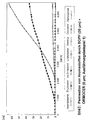
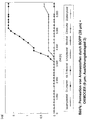
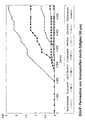
- Figures 2 and 3 show the permeations of the flavorings by uncoated and by coated according to the invention BOPP, applied against time. While in the uncoated BOPP film after a short time a permeation the aroma substances is detectable, the permeation of flavorings in the according to the invention coated film only after a certain longer measurement time, the so-called breakthrough time can be detected.
- the coatings according to the invention show on a wide variety of substrates very good adhesion and very good aroma barrier properties. They point very good resistance in the humid climate, so that the inventive Barrier layers retain their function even under the influence of moisture. Furthermore are in the inventive coating material several barrier functions, e.g. Oxygen with aroma barrier properties, combinable. In order to is multi-functional with the coating material according to the invention Barrier material available, which by the conventional paint application techniques can be applied. In addition, the coating material according to the invention gives the substrate or the substrate surface even more favorable Properties, such as mechanical stability and abrasion resistance.
Landscapes
- Chemical & Material Sciences (AREA)
- Health & Medical Sciences (AREA)
- Chemical Kinetics & Catalysis (AREA)
- Medicinal Chemistry (AREA)
- Polymers & Plastics (AREA)
- Organic Chemistry (AREA)
- Laminated Bodies (AREA)
- Fats And Perfumes (AREA)
- Wrappers (AREA)
Claims (13)
- Utilisation d'un système composite, composé d'une couche barrière d'arôme ou de parfum réalisée à partir d'un polycondensat d'acide silicique modifié organiquement ou d'un hétéropolycondensat d'acide silicique modifié organiquement et d'un matériau porteur qui est choisi entre un ou plusieurs polymères biodégradables et/ou un ou plusieurs polymères natifs, comme des feuilles d'emballage pour aliments, pour produits pharmaceutiques ou chimiques.
- Utilisation selon la revendication 1, caractérisée en ce que l'(hétéro)polycondensat d'acide silicique modifié organiquement est obtenu par condensation hydrolytique d'un ou de plusieurs composés, condensables par hydrolyse, du silicium et éventuellement d'autres éléments du groupe B, Al, P, Sn, Pb, des métaux de transition, des lanthanides et des actinides et/ou des précondensats dérivés des composés précités, éventuellement en présence d'un catalyseur et/ou d'un solvant par action de l'eau ou de l'humidité, moyennant quoi 10 à 100 % en moles, sur la base des composés monomères, des composants condensables par hydrolyse, sont des silanes de la formule générale I,R = alkyle, alkényle, aryle, alkylaryle ou arylalkyle éventuellement substitués, avec 1 à 50 atomes de carbone, ces radicaux pouvant être interrompus par des atomes d'oxygène ou de soufre, par des groupes uréthanne, ester, carbonyle, amide ou amino ;X = hydrogène, halogène, hydroxy, alkoxy, acyloxy, alkylcarbonyle, alkoxycarbonyle ou NR'2, avec R' = hydrogène, alkyle ou aryle ;a = 1, 2 ou 3.
- Utilisation selon la revendication 2, caractérisée en ce que les composés de silicium hydrolysés, éventuellement encore présents dans l'(hétéro)polycondensat d'acide silicique modifié organiquement, sont dérivés de silanes de formule générale II,
- Utilisation selon la revendication 2 ou 3, caractérisée en ce que les composés de silicium hydrolysés, éventuellement encore présents dans l'(hétéro)polycondensat d'acide silicique modifié organiquement, sont dérivés de silanes de formule générale III,
- Utilisation selon une ou plusieurs des revendications 1 ou 4, caractérisée en ce que les composés d'aluminium hydrolysés, éventuellement encore présents dans l'(hétéro)polycondensat d'acide silicique modifié organiquement, sont dérivés de composés d'aluminium de formule générale (IV),
- Utilisation selon une ou plusieurs des revendications 2 à 5, caractérisée en ce que les composés de titane et/ou de zirconium hydrolysés, éventuellement encore présents dans l'(hétéro)polycondensat d'acide silicique modifié organiquement, sont dérivés de composés de la formule générale V,
- Utilisation selon une ou plusieurs des revendications 2 à 6, caractérisée en ce que l'(hétéro)polycondensat d'acide silicique modifié organiquement contient des adjuvants qui sont dérivés de l'acide méthacrylique et/ou d'un autre agent complexant pouvant être polymérisé par polymérisation et/ou par copolymérisation avec un composant pouvant être copolymérisé.
- Utilisation selon une ou plusieurs des revendications 2 à 7, caractérisée en ce que l'(hétéro)polycondensat d'acide silicique modifié organiquement contient des particules de Si02 fonctionnalisées et/ou des particules d'Al2O3 fonctionnalisées.
- Utilisation selon une ou plusieurs des revendications 1 à 8, caractérisée en ce que l'(hétéro)polycondensat d'acide silicique modifié organiquement présente une épaisseur de couche comprise entre 1 µm et 50 µm.
- Utilisation selon une ou plusieurs des revendications 1 à 9, caractérisée en ce que le matériau porteur contient du papier et/ou du carton et/ou du papier enduit et/ou du carton enduit.
- Utilisation selon une ou plusieurs des revendications 1 à 10, caractérisée en ce que le matériau porteur constitue une feuille d'une épaisseur d'au moins 4 µm.
- Utilisation selon une ou plusieurs des revendications 1 à 11, caractérisée en ce que le matériau porteur constitue un matériau d'emballage.
- Utilisation selon une ou plusieurs des revendications 2 à 12, caractérisée en ce que l'(hétéro)polycondensat d'acide silicique modifié organiquement contient des adjuvants.
Applications Claiming Priority (2)
| Application Number | Priority Date | Filing Date | Title |
|---|---|---|---|
| DE19615192 | 1996-04-17 | ||
| DE19615192A DE19615192A1 (de) | 1996-04-17 | 1996-04-17 | Verbundsystem mit einer Aromabarriere- oder einer Riechstoffbarriereschicht |
Publications (3)
| Publication Number | Publication Date |
|---|---|
| EP0802218A2 EP0802218A2 (fr) | 1997-10-22 |
| EP0802218A3 EP0802218A3 (fr) | 1998-05-20 |
| EP0802218B1 true EP0802218B1 (fr) | 2005-05-18 |
Family
ID=7791550
Family Applications (1)
| Application Number | Title | Priority Date | Filing Date |
|---|---|---|---|
| EP97104687A Expired - Lifetime EP0802218B1 (fr) | 1996-04-17 | 1997-03-19 | Utilisation d'un système composite avec une couche barrière d'arôme ou de parfum |
Country Status (4)
| Country | Link |
|---|---|
| EP (1) | EP0802218B1 (fr) |
| AT (1) | ATE295866T1 (fr) |
| DE (2) | DE19615192A1 (fr) |
| ES (1) | ES2241012T3 (fr) |
Cited By (1)
| Publication number | Priority date | Publication date | Assignee | Title |
|---|---|---|---|---|
| EP2272928A1 (fr) | 2009-06-23 | 2011-01-12 | Fraunhofer-Gesellschaft zur Förderung der angewandten Forschung e.V. | Composites à barrière élevée et son procédé de fabrication |
Families Citing this family (7)
| Publication number | Priority date | Publication date | Assignee | Title |
|---|---|---|---|---|
| DE10362060B4 (de) * | 2003-10-21 | 2009-07-09 | Altana Coatings & Sealants Gmbh | Verpackungsmaterial mit einer Barriereschicht für Gase |
| EP2295476A3 (fr) | 2005-11-07 | 2011-04-06 | Fraunhofer-Gesellschaft zur Förderung der angewandten Forschung e.V. | Laque dotée d'une fonction d'indicateur d'oxygène pour le revêtement ou le collage et produits ainsi fabriqués |
| DE102008039129A1 (de) | 2007-08-23 | 2009-05-20 | Fraunhofer-Gesellschaft zur Förderung der angewandten Forschung e.V. | Hybridpolymere Nanokomposit-Beschichtungsmaterialien mit Kohlenstoff-Nanoröhren |
| DE102009013884A1 (de) | 2009-03-19 | 2010-09-30 | Fraunhofer-Gesellschaft zur Förderung der angewandten Forschung e.V. | Antimikrobiell behandelte und/oder schmutzabweisende Textilmaterialien sowie Verfahren zu deren Herstellung |
| EP2279801B1 (fr) | 2009-07-27 | 2015-01-28 | Fraunhofer-Gesellschaft zur Förderung der angewandten Forschung e.V. | Procédés de revêtement utilisant un jet de plasma et appareil de revêtement au plasma |
| DE102016107760B4 (de) | 2016-04-26 | 2018-09-20 | Fraunhofer-Gesellschaft zur Förderung der angewandten Forschung e.V. | Essbare Funktionsschichten und Überzüge auf Hybridpolymerbasis für Pharmazie und Lebensmittel |
| DE102022110131A1 (de) | 2022-04-27 | 2023-11-02 | Fraunhofer-Gesellschaft zur Förderung der angewandten Forschung eingetragener Verein | Zusammensetzung für Hybridpolymere mit Barrierefunktion |
Family Cites Families (6)
| Publication number | Priority date | Publication date | Assignee | Title |
|---|---|---|---|---|
| DE3407087C3 (de) * | 1984-02-27 | 1994-07-07 | Fraunhofer Ges Forschung | Verfahren und Lack zur Herstellung von kratzfesten Beschichtungen |
| DE3439880C1 (de) * | 1984-10-31 | 1986-05-22 | Fraunhofer-Gesellschaft zur Förderung der angewandten Forschung e.V., 8000 München | Lack und Verfahren zur Herstellung von Korrosionsschutzbeschichtungen |
| US5077135A (en) * | 1989-04-12 | 1991-12-31 | Energy Sciences Inc. | Siloxane polymers and copolymers as barrier coatings and method of producing barrier coating properties therewith |
| DE3925901C1 (fr) * | 1989-08-04 | 1990-11-29 | Fraunhofer-Gesellschaft Zur Foerderung Der Angewandten Forschung Ev, 8000 Muenchen, De | |
| DE4303570C2 (de) * | 1993-02-08 | 1997-03-20 | Fraunhofer Ges Forschung | Verfahren zur Herstellung von funktionellen Beschichtungen, beschichtete Substrate und Beschichtungsmaterial |
| JP3277615B2 (ja) * | 1993-06-18 | 2002-04-22 | 株式会社日本触媒 | ガスバリヤ用表面処理用組成物 |
-
1996
- 1996-04-17 DE DE19615192A patent/DE19615192A1/de not_active Ceased
-
1997
- 1997-03-19 DE DE59712310T patent/DE59712310D1/de not_active Expired - Lifetime
- 1997-03-19 AT AT97104687T patent/ATE295866T1/de active
- 1997-03-19 EP EP97104687A patent/EP0802218B1/fr not_active Expired - Lifetime
- 1997-03-19 ES ES97104687T patent/ES2241012T3/es not_active Expired - Lifetime
Cited By (1)
| Publication number | Priority date | Publication date | Assignee | Title |
|---|---|---|---|---|
| EP2272928A1 (fr) | 2009-06-23 | 2011-01-12 | Fraunhofer-Gesellschaft zur Förderung der angewandten Forschung e.V. | Composites à barrière élevée et son procédé de fabrication |
Also Published As
| Publication number | Publication date |
|---|---|
| DE59712310D1 (de) | 2005-06-23 |
| ES2241012T3 (es) | 2005-10-16 |
| ATE295866T1 (de) | 2005-06-15 |
| EP0802218A3 (fr) | 1998-05-20 |
| EP0802218A2 (fr) | 1997-10-22 |
| DE19615192A1 (de) | 1997-10-23 |
Similar Documents
| Publication | Publication Date | Title |
|---|---|---|
| DE4011045C2 (fr) | ||
| EP0450624B1 (fr) | Hétéropolycondensats polymérisables d'acide silicique et leur emploi | |
| EP0682033B1 (fr) | Silanes hydrolysables et polymérisables | |
| EP0728164B1 (fr) | Procede de preparation de compositions a base de silanes contenant des groupes epoxy | |
| EP0792846B1 (fr) | Couches d'étanchéité | |
| EP0587667B1 (fr) | Compositions d'enduction a base de polycondenses anorganiques fluores, leur preparation et leur utilisation | |
| DE4020316B4 (de) | Verfahren zur Herstellung eines Lacks und dessen Verwendung | |
| DE3751856T2 (de) | Organisch-anorganisches Hybridpolymer | |
| EP0779890B1 (fr) | Thiolisanes, leur procede de production et leur utilisation | |
| DE69920642T2 (de) | Organische/anorganische Hybridmaterialien und Verfahren zu deren Herstellung | |
| EP0799832B1 (fr) | Silanes fluorées hydrolysables, procédé pour les préparer et leur utilisation pour la production de polycondensats d'acide silicique et d'hétéropolycondensats d'acide silicique | |
| WO1998038251A1 (fr) | Materiaux hybrides organiques-inorganiques | |
| DE4125201C1 (fr) | ||
| DE19934407A1 (de) | Hydrolysierbare und polymerisierbare Silane mit geringer Viskosität und deren Verwendung | |
| DE19726829A1 (de) | Verwendung von nanoskaligen Metalloxid-Teilchen als Polymerisationskatalysatoren | |
| WO2004044627A1 (fr) | Systeme stratifie, composition de revetement et procede de production de ladite composition | |
| EP0802218B1 (fr) | Utilisation d'un système composite avec une couche barrière d'arôme ou de parfum | |
| EP0618242A2 (fr) | Systèmes auto-durcissants | |
| WO2004108801A1 (fr) | Procede de realisation de systemes de couches antirayures sans formation de buee | |
| DE19719948A1 (de) | Nanostrukturierte Formkörper und Schichten sowie Verfahren zu deren Herstellung | |
| WO2004031273A1 (fr) | Systeme stratifie et procede de fabrication dudit systeme | |
| DE10215941A1 (de) | Anorganische UV-Absorber enthaltene Bindemittel | |
| EP0668326A2 (fr) | Systèmes auto-réticulables de manière covalente-nucléophile | |
| DE102022110131A1 (de) | Zusammensetzung für Hybridpolymere mit Barrierefunktion | |
| DE19910905A1 (de) | Verwendung von makromolekularen Zusammensetzungen auf Silanbasis als gegenüber konzentrierten oxidierenden Säuren widerstandsfähige Werkstoffe |
Legal Events
| Date | Code | Title | Description |
|---|---|---|---|
| PUAI | Public reference made under article 153(3) epc to a published international application that has entered the european phase |
Free format text: ORIGINAL CODE: 0009012 |
|
| AK | Designated contracting states |
Kind code of ref document: A2 Designated state(s): AT CH DE ES FR GB GR IT LI NL SE |
|
| PUAL | Search report despatched |
Free format text: ORIGINAL CODE: 0009013 |
|
| AK | Designated contracting states |
Kind code of ref document: A3 Designated state(s): AT CH DE ES FR GB GR IT LI NL SE |
|
| 17P | Request for examination filed |
Effective date: 19980604 |
|
| 17Q | First examination report despatched |
Effective date: 20020902 |
|
| RAP1 | Party data changed (applicant data changed or rights of an application transferred) |
Owner name: FRAUNHOFER-GESELLSCHAFT ZUR FOERDERUNG DERANGEWAND |
|
| GRAP | Despatch of communication of intention to grant a patent |
Free format text: ORIGINAL CODE: EPIDOSNIGR1 |
|
| RTI1 | Title (correction) |
Free format text: USE OF A COMPOSITE WITH AN AROMA OR A FLAVOURS BARRIER LAYER |
|
| GRAS | Grant fee paid |
Free format text: ORIGINAL CODE: EPIDOSNIGR3 |
|
| GRAA | (expected) grant |
Free format text: ORIGINAL CODE: 0009210 |
|
| AK | Designated contracting states |
Kind code of ref document: B1 Designated state(s): AT CH DE ES FR GB GR IT LI NL SE |
|
| REG | Reference to a national code |
Ref country code: GB Ref legal event code: FG4D Free format text: NOT ENGLISH |
|
| REG | Reference to a national code |
Ref country code: CH Ref legal event code: NV Representative=s name: TROESCH SCHEIDEGGER WERNER AG Ref country code: CH Ref legal event code: EP |
|
| GBT | Gb: translation of ep patent filed (gb section 77(6)(a)/1977) |
Effective date: 20050518 |
|
| REF | Corresponds to: |
Ref document number: 59712310 Country of ref document: DE Date of ref document: 20050623 Kind code of ref document: P |
|
| REG | Reference to a national code |
Ref country code: SE Ref legal event code: TRGR |
|
| REG | Reference to a national code |
Ref country code: GR Ref legal event code: EP Ref document number: 20050402476 Country of ref document: GR |
|
| REG | Reference to a national code |
Ref country code: ES Ref legal event code: FG2A Ref document number: 2241012 Country of ref document: ES Kind code of ref document: T3 |
|
| PLBE | No opposition filed within time limit |
Free format text: ORIGINAL CODE: 0009261 |
|
| STAA | Information on the status of an ep patent application or granted ep patent |
Free format text: STATUS: NO OPPOSITION FILED WITHIN TIME LIMIT |
|
| ET | Fr: translation filed | ||
| 26N | No opposition filed |
Effective date: 20060221 |
|
| REG | Reference to a national code |
Ref country code: FR Ref legal event code: PLFP Year of fee payment: 20 |
|
| PGFP | Annual fee paid to national office [announced via postgrant information from national office to epo] |
Ref country code: CH Payment date: 20160322 Year of fee payment: 20 Ref country code: NL Payment date: 20160322 Year of fee payment: 20 Ref country code: DE Payment date: 20160322 Year of fee payment: 20 Ref country code: ES Payment date: 20160322 Year of fee payment: 20 |
|
| PGFP | Annual fee paid to national office [announced via postgrant information from national office to epo] |
Ref country code: GB Payment date: 20160322 Year of fee payment: 20 Ref country code: FR Payment date: 20160322 Year of fee payment: 20 Ref country code: SE Payment date: 20160322 Year of fee payment: 20 Ref country code: AT Payment date: 20160318 Year of fee payment: 20 Ref country code: GR Payment date: 20160318 Year of fee payment: 20 |
|
| PGFP | Annual fee paid to national office [announced via postgrant information from national office to epo] |
Ref country code: IT Payment date: 20160318 Year of fee payment: 20 |
|
| REG | Reference to a national code |
Ref country code: DE Ref legal event code: R071 Ref document number: 59712310 Country of ref document: DE |
|
| REG | Reference to a national code |
Ref country code: NL Ref legal event code: MK Effective date: 20170318 |
|
| REG | Reference to a national code |
Ref country code: CH Ref legal event code: PL |
|
| REG | Reference to a national code |
Ref country code: GB Ref legal event code: PE20 Expiry date: 20170318 |
|
| REG | Reference to a national code |
Ref country code: SE Ref legal event code: EUG |
|
| REG | Reference to a national code |
Ref country code: AT Ref legal event code: MK07 Ref document number: 295866 Country of ref document: AT Kind code of ref document: T Effective date: 20170319 |
|
| PG25 | Lapsed in a contracting state [announced via postgrant information from national office to epo] |
Ref country code: GB Free format text: LAPSE BECAUSE OF EXPIRATION OF PROTECTION Effective date: 20170318 |
|
| REG | Reference to a national code |
Ref country code: ES Ref legal event code: FD2A Effective date: 20170626 |
|
| REG | Reference to a national code |
Ref country code: GR Ref legal event code: MA Ref document number: 20050402476 Country of ref document: GR Effective date: 20170320 |
|
| PG25 | Lapsed in a contracting state [announced via postgrant information from national office to epo] |
Ref country code: ES Free format text: LAPSE BECAUSE OF EXPIRATION OF PROTECTION Effective date: 20170320 |