EP0801867B1 - Motion estimation for predictive image coding - Google Patents
Motion estimation for predictive image coding Download PDFInfo
- Publication number
- EP0801867B1 EP0801867B1 EP96929478A EP96929478A EP0801867B1 EP 0801867 B1 EP0801867 B1 EP 0801867B1 EP 96929478 A EP96929478 A EP 96929478A EP 96929478 A EP96929478 A EP 96929478A EP 0801867 B1 EP0801867 B1 EP 0801867B1
- Authority
- EP
- European Patent Office
- Prior art keywords
- macroblock
- vector
- motion vectors
- cost function
- image
- Prior art date
- Legal status (The legal status is an assumption and is not a legal conclusion. Google has not performed a legal analysis and makes no representation as to the accuracy of the status listed.)
- Expired - Lifetime
Links
- 239000013598 vector Substances 0.000 claims description 138
- 238000000034 method Methods 0.000 claims description 23
- 230000006835 compression Effects 0.000 claims description 8
- 238000007906 compression Methods 0.000 claims description 8
- 238000006073 displacement reaction Methods 0.000 claims description 7
- 230000001186 cumulative effect Effects 0.000 claims description 5
- 230000009467 reduction Effects 0.000 claims description 3
- 238000009795 derivation Methods 0.000 description 5
- 230000006872 improvement Effects 0.000 description 4
- 238000013459 approach Methods 0.000 description 2
- 238000007796 conventional method Methods 0.000 description 2
- 238000010586 diagram Methods 0.000 description 2
- 230000003044 adaptive effect Effects 0.000 description 1
- 238000002955 isolation Methods 0.000 description 1
- 239000000463 material Substances 0.000 description 1
- 238000012986 modification Methods 0.000 description 1
- 230000004048 modification Effects 0.000 description 1
- 238000005457 optimization Methods 0.000 description 1
- 230000008569 process Effects 0.000 description 1
- 238000007670 refining Methods 0.000 description 1
- 230000002123 temporal effect Effects 0.000 description 1
- 238000012360 testing method Methods 0.000 description 1
- 230000009466 transformation Effects 0.000 description 1
- 230000000007 visual effect Effects 0.000 description 1
Images

Classifications
-
- H—ELECTRICITY
- H04—ELECTRIC COMMUNICATION TECHNIQUE
- H04N—PICTORIAL COMMUNICATION, e.g. TELEVISION
- H04N19/00—Methods or arrangements for coding, decoding, compressing or decompressing digital video signals
- H04N19/50—Methods or arrangements for coding, decoding, compressing or decompressing digital video signals using predictive coding
- H04N19/503—Methods or arrangements for coding, decoding, compressing or decompressing digital video signals using predictive coding involving temporal prediction
- H04N19/51—Motion estimation or motion compensation
- H04N19/567—Motion estimation based on rate distortion criteria
-
- H—ELECTRICITY
- H04—ELECTRIC COMMUNICATION TECHNIQUE
- H04N—PICTORIAL COMMUNICATION, e.g. TELEVISION
- H04N19/00—Methods or arrangements for coding, decoding, compressing or decompressing digital video signals
- H04N19/10—Methods or arrangements for coding, decoding, compressing or decompressing digital video signals using adaptive coding
- H04N19/102—Methods or arrangements for coding, decoding, compressing or decompressing digital video signals using adaptive coding characterised by the element, parameter or selection affected or controlled by the adaptive coding
- H04N19/103—Selection of coding mode or of prediction mode
- H04N19/105—Selection of the reference unit for prediction within a chosen coding or prediction mode, e.g. adaptive choice of position and number of pixels used for prediction
-
- H—ELECTRICITY
- H04—ELECTRIC COMMUNICATION TECHNIQUE
- H04N—PICTORIAL COMMUNICATION, e.g. TELEVISION
- H04N19/00—Methods or arrangements for coding, decoding, compressing or decompressing digital video signals
- H04N19/10—Methods or arrangements for coding, decoding, compressing or decompressing digital video signals using adaptive coding
- H04N19/169—Methods or arrangements for coding, decoding, compressing or decompressing digital video signals using adaptive coding characterised by the coding unit, i.e. the structural portion or semantic portion of the video signal being the object or the subject of the adaptive coding
- H04N19/17—Methods or arrangements for coding, decoding, compressing or decompressing digital video signals using adaptive coding characterised by the coding unit, i.e. the structural portion or semantic portion of the video signal being the object or the subject of the adaptive coding the unit being an image region, e.g. an object
- H04N19/174—Methods or arrangements for coding, decoding, compressing or decompressing digital video signals using adaptive coding characterised by the coding unit, i.e. the structural portion or semantic portion of the video signal being the object or the subject of the adaptive coding the unit being an image region, e.g. an object the region being a slice, e.g. a line of blocks or a group of blocks
-
- H—ELECTRICITY
- H04—ELECTRIC COMMUNICATION TECHNIQUE
- H04N—PICTORIAL COMMUNICATION, e.g. TELEVISION
- H04N19/00—Methods or arrangements for coding, decoding, compressing or decompressing digital video signals
- H04N19/10—Methods or arrangements for coding, decoding, compressing or decompressing digital video signals using adaptive coding
- H04N19/169—Methods or arrangements for coding, decoding, compressing or decompressing digital video signals using adaptive coding characterised by the coding unit, i.e. the structural portion or semantic portion of the video signal being the object or the subject of the adaptive coding
- H04N19/17—Methods or arrangements for coding, decoding, compressing or decompressing digital video signals using adaptive coding characterised by the coding unit, i.e. the structural portion or semantic portion of the video signal being the object or the subject of the adaptive coding the unit being an image region, e.g. an object
- H04N19/176—Methods or arrangements for coding, decoding, compressing or decompressing digital video signals using adaptive coding characterised by the coding unit, i.e. the structural portion or semantic portion of the video signal being the object or the subject of the adaptive coding the unit being an image region, e.g. an object the region being a block, e.g. a macroblock
-
- H—ELECTRICITY
- H04—ELECTRIC COMMUNICATION TECHNIQUE
- H04N—PICTORIAL COMMUNICATION, e.g. TELEVISION
- H04N19/00—Methods or arrangements for coding, decoding, compressing or decompressing digital video signals
- H04N19/10—Methods or arrangements for coding, decoding, compressing or decompressing digital video signals using adaptive coding
- H04N19/189—Methods or arrangements for coding, decoding, compressing or decompressing digital video signals using adaptive coding characterised by the adaptation method, adaptation tool or adaptation type used for the adaptive coding
- H04N19/19—Methods or arrangements for coding, decoding, compressing or decompressing digital video signals using adaptive coding characterised by the adaptation method, adaptation tool or adaptation type used for the adaptive coding using optimisation based on Lagrange multipliers
-
- H—ELECTRICITY
- H04—ELECTRIC COMMUNICATION TECHNIQUE
- H04N—PICTORIAL COMMUNICATION, e.g. TELEVISION
- H04N19/00—Methods or arrangements for coding, decoding, compressing or decompressing digital video signals
- H04N19/50—Methods or arrangements for coding, decoding, compressing or decompressing digital video signals using predictive coding
- H04N19/503—Methods or arrangements for coding, decoding, compressing or decompressing digital video signals using predictive coding involving temporal prediction
- H04N19/51—Motion estimation or motion compensation
-
- H—ELECTRICITY
- H04—ELECTRIC COMMUNICATION TECHNIQUE
- H04N—PICTORIAL COMMUNICATION, e.g. TELEVISION
- H04N19/00—Methods or arrangements for coding, decoding, compressing or decompressing digital video signals
- H04N19/50—Methods or arrangements for coding, decoding, compressing or decompressing digital video signals using predictive coding
- H04N19/503—Methods or arrangements for coding, decoding, compressing or decompressing digital video signals using predictive coding involving temporal prediction
- H04N19/51—Motion estimation or motion compensation
- H04N19/523—Motion estimation or motion compensation with sub-pixel accuracy
-
- H—ELECTRICITY
- H04—ELECTRIC COMMUNICATION TECHNIQUE
- H04N—PICTORIAL COMMUNICATION, e.g. TELEVISION
- H04N19/00—Methods or arrangements for coding, decoding, compressing or decompressing digital video signals
- H04N19/60—Methods or arrangements for coding, decoding, compressing or decompressing digital video signals using transform coding
- H04N19/61—Methods or arrangements for coding, decoding, compressing or decompressing digital video signals using transform coding in combination with predictive coding
Definitions
- the present invention relates to a method and apparatus for the encoding of pixel images and, in particular, to coding techniques using motion compensated prediction in accordance with standards such as MPEG and H.261.
- Motion compensated prediction is an essential element of techniques such as MPEG video compression, where it is used to reduce the temporal redundancy in the signal. Since one picture in an image sequence is normally very similar to a displaced copy of its predecessors, transmitting motion vector data allows a good prediction of the current picture from previous pictures.
- a coded picture is transmitted by multiplexing into a single stream data representing different types of information. It is a layered coding syntax, with the higher layers transmitting information about the encoding parameters used, and the lower layers containing several classes of information that allow a decoder to reconstruct individual pixel values.
- the basic unit of coding is the 16x16 (256-pixel) macroblock. Each macroblock has an associated "macroblock type" that defines the coding mode in use in that block, other overhead information defining parameters of coding, suitably one or more motion vectors used for motion compensated prediction, and coded data representing discrete cosine transform (DCT) coefficients.
- DCT discrete cosine transform
- the motion vectors are used to form an estimator (or prediction) of the pixel values of the current macroblock based on past and future "reference" pictures.
- the motion vector defines a displacement in the reference picture from the position of the current macroblock where a prediction of the current macroblock may be found.
- Known MPEG-compatible encoders search for a set of motion vectors that give a good prediction of the current frame without regard to the bit-rate needed to represent the vectors.
- An example of such an encoder is described in European Patent Application EP-A-0 540 961 (Gonzales et al/IBM), which is concerned with allocating a budget of bits to the different pictures in a sequence and optimizing the visual quality of each picture given the number of allocated bits, by adaptive quantisation of the DCT coefficients in the picture.
- EP-A-0 535 746 describes a method for encoding an ordered sequence of pixel image frames in which each frame is divided into rows containing an integer number of pixel macroblocks, at least some of the macroblocks are coded with motion vectors specifying a displacement for macroblock data from a further image frame of the sequence, and the image data is then subject to transform compression to provide an encoded signal.
- An encoding strategy is adopted which favours motion vectors which require fewer bits to encode.
- a method for encoding an ordered sequence of pixel image frames in which each frame is divided into rows containing an integer number of pixel macroblocks, at least some of the macroblocks are coded with motion vectors specifying a displacement for macroblock data from a further image frame of the sequence, and the image data is then subject to transform compression to provide an encoded signal; characterised in that the motion vectors are selected from a set of candidate motion vectors on the basis of a cost function relating motion vector accuracy to an exponential function of vector data bit rate in the encoded signal, and in that accuracy of said motion vectors is determined by a displaced frame difference for said macroblock.
- the selected motion vectors are not necessarily optimum but the bit rate saving can then be applied to the coded transform coefficients such as to produce an overall improvement in the quality of the decoded image.
- the selection of the coding mode may also be subject to the cost function such as to produce a further enhancement.
- the cost function is preferably made cumulative over a macroblock row, with the motion vectors (and optionally coding mode) per macroblock of the row being chosen to minimise the accumulated row cost function.
- Dynamic programming may suitably be used to specify a recurrence relationship between the cost function for eachmacroblock of a row and that of the row as a whole.
- the candidate motion vectors are preferably selected by a rate constrained search, in which a number of motion vectors to half pixel accuracy are derived for the N integer pixel placements having the lowest frame difference, where N is an integer.
- DCT discrete cosine transform
- an image signal encoding apparatus for encoding an ordered sequence of pixel image frames, the apparatus comprising: an encoder arranged to receive the image frames, apply transform compression to the image data, and output an encoded image signal; and a motion estimator arranged to receive the image frames, to divide each into rows of pixel macroblocks and, for predetermined ones of the macroblocks, to generate motion vectors specifying a displacement for the macroblock data from a further image frame of the sequence, wherein the generated motion vector data is passed to the encoder and incorporated in the output encoded signal; wherein the motion estimator comprises a vector generator arranged to generate a set of candidate motion vectors for each of the predetermined ones of the macroblocks in accordance with a predetermined criteria; characterised in that the vector generator is arranged to generate an indication of the accuracy for each candidate motion vector determined by a displaced frame difference for the macroblock, and in that the apparatus further comprises a vector selection means operable to apply, to each candidate motion vector, a cost function
- the encoder may be operable to assign data bit rates in the encoded signal to motion vector data and to transform coefficient data in a ratio where the addition of one extra bit to either provides substantially the same reduction in image distortion for an encoded image when decoded, and the motion estimator is operable to modify the cost function in accordance with changes in the assigned motion vector data bit rate.
- the encoder is operable to apply a selected one from a number of coding modes (as described previously)
- the selection may suitably be made on the basis of the cost function from the vector selection means.
- the vector selection means and encoder may suitably be respectively arranged to select the motion vectors and coding mode for each macroblock such as to minimise the accumulated row cost function.
- MPEG and H.261 are digital coding systems conventionally used for storing and compressing natural picture sequences, with the decoders being designed to interpret such encoded data and reproduce the same original sequence of images.
- Compressed MPEG streams consist of a number of different data-types in a layered structure. some of the data is overhead that describes the coding parameters and options chosen and the motion vectors, and some is a direct representation of the DCT coefficient data.
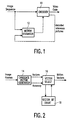
- FIG. 1 An MPEG encoding arrangement is shown in Figure 1 where the re-ordered sequence of image frames is fed to an encoder stage 10 and also to a motion estimator stage 12.
- the motion estimator 12 the motion vectors for each macroblock of an image are selected to define a displacement in the reference image frame for that block. These motion vectors are then passed to the encoder stage 10. Motion vectors based on recreated (i.e decoded) pictures obtained from the encoder may also be generated.
- the motion estimator selects which mode to use and searches for the motion vectors that give the best prediction, irrespective of the number of bits that must be used to transmit this data.
- the available bit-rate (from bandwidth considerations) that is left over after subtracting this overhead is used for the coefficient data.
- motion vector data forms up to about 25% of the data rate. In these circumstances, this bit allocation strategy will not generally give the best picture quality.
- improvements are proposed for the selection of both motion vectors and coding modes.
- the present invention provides the means for selecting a different choice on the basis of a cost function (to be described) where the choice consumes fewer bits for the motion vectors but provides nearly as good a prediction, thus providing a better use of the bit-rate as the bits that are saved can be used to provide more accurate representations of the DCT coefficients.
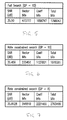
- Figure 2 shows an arrangement for the motion estimator stage of Figure 1 embodying the present invention.
- a first stage 14 generates a set of candidate motion vectors, suitably from a list of half-pixel candidates from about each of N candidate integer pixels.
- Those candidate vectors, together with an indication of their respective accuracies, are passed to a vector selection stage 16.
- a vector bit counter 18 determines the number of bits required per vector and the selection stage 16 then selects those of the candidate vectors for a macroblock line (or "slice") which minimise a cumulative cost function for the line and provide the best trade-off between motion vector accuracy and required bit rate for each block of the line.
- a first (direct) approach to the problem is to minimise the total bit-rate (R 1 + R 2 ) given a certain distortion D after decoding.
- bit-rate associated with a macroblock vector in MPEG is determined by the vector in the previous macroblock, because each motion vector is coded differentially with respect to the vector in the previous macroblock. This means that it is not possible to make optimal macroblock decisions in isolation from the neighbouring blocks (the bit-rate R 2 in equation 4 depends on the choice of vector in the previous macroblock), leading to the problem that the decisions have to made jointly over an entire MPEG "slice" (a line of macroblocks).
- each macroblock may have up to four vectors depending on its macroblock type. There may be 0, 1 or 2 frame based vectors or there may be 0, 1, 2, 3 or 4 field-based vectors, and vectors may reference a future field or frame or a past field or frame or a combination of past and future.
- the capability is preferably provided for handling different vector types synchronously. For example, we consider the frame-based forward vectors separately from the frame-based backwards vectors.
- a set of candidate motion vectors is calculated to half pixel accuracy (as specified by MPEG) and a value of a prediction error function is found. From the values found, a table is built up for each macroblock in the slice giving candidate vectors and their prediction error cost.
- dfd is the prediction error cost.
- a different prediction error function may be required, as will be understood.
- a dynamic program is used to find the set of vectors, one per macroblock, that give the minimum value of the cost function C from equation 4 summed over all the macroblocks in the slice.
- a dynamic program starts from the final decision in the problem and works backwards to the earlier ones. It is based on the Principle of Optimality which states that: for a complete set of N decisions to be optimal, if the first (N-1) decisions are optimal then the Nth decision must also be optimal. We use this principle to break the optimisation problem down into a sequential set of decisions and to generate a recurrence relation that works backwards through the problem.
- J(n) is the summed cost of continuing the optimal set of decisions at a point n macroblocks from the end of the slice, where J(1) is the cost of the optimal decision for the last macroblock in the slice given optimal decisions up to that point, J(2) is the cost of the optimal decision in the last two macroblocks of the slice and so on.
- J ( n +1, v m-1 ( j )) min i [ J ( n,v m ( i )) + C m ( v m ( i ), v m-1 ( j ))] where:
- the number of candidate vectors considered for each macroblock is restricted since, if all possible vectors were considered in the dynamic program, the computational effort required would be enormous and the size of the table, J (..,..), would be excessive.
- MPEG defines that vectors giving accuracy of prediction to within half a pixel may be used.
- the vector search is done in two phases. First, the best matching integer vector is found by making comparisons between the current source picture and the reference picture (either the original uncoded picture or the decoded version). The second stage is to examine the eight neighbouring half-pixel vector locations around the integer pixel match to find the best half-pixel accurate vector.
- the first phase finds a set of N candidate integer pixels with the lowest displaced frame (field) difference.
- a list of half-pixel candidates is drawn up based on the eight neighbours of each integer pixel candidate. Duplicate half-pixel vectors are eliminated from this list (duplicates can arise where neighbouring integer pixels both define the same half-pixel vector).
- the displaced frame difference dfd for each half-pixel vector in the candidate list is calculated using the current source frame and the decoded and reconstructed reference frames.
- the dynamic program is run to find the best set of macroblock vectors for each slice.
- This procedure is run independently of each set of the vectors (that is the forwards frame-based vectors, forwards field-based vectors, backwards frame-based vectors and backwards field-based vectors) although, as mentioned above, independent runs may occur synchronously.
- the bit-rate for coding the vectors should also take into account the macroblock type (coding mode) decision although the improvements in image quality will generally be at the expense of system complexity.
- vector information will be needed before the macroblock type decision is made.
- a two-pass procedure may be used with the first pass finding provisional vectors and making macroblock type decisions, and the second pass using the macroblock type decisions find the optimal set of vectors and, optionally, refining the macroblock type decisions.
- a preferred option is to make the macroblock type decisions jointly with the vector decisions in a larger decision making process (i.e applying cost function optimisation to each), although this may have penalties in terms of complexity.
- the optimisation of macroblock type/coding mode works in the manner previously described for the motion vector search procedure.
- the cost function in the form of dfd .exp is calculated for each vector and each mode and proceeds as described above to optimise both (or the net result thereof) over the slice.
- the technique requires that the number of bits jointly allocated to motion vectors and to coefficient data is adjusted so that the marginal improvement in picture quality is equal when an extra bit is allocated to either motion vector data or coefficient data.
Landscapes
- Engineering & Computer Science (AREA)
- Multimedia (AREA)
- Signal Processing (AREA)
- Compression Or Coding Systems Of Tv Signals (AREA)
Applications Claiming Priority (3)
| Application Number | Priority Date | Filing Date | Title |
|---|---|---|---|
| GBGB9519923.8A GB9519923D0 (en) | 1995-09-29 | 1995-09-29 | Motion estimation for predictive image coding |
| GB9519923 | 1995-09-29 | ||
| PCT/IB1996/000970 WO1997013374A1 (en) | 1995-09-29 | 1996-09-20 | Motion estimation for predictive image coding |
Publications (2)
| Publication Number | Publication Date |
|---|---|
| EP0801867A1 EP0801867A1 (en) | 1997-10-22 |
| EP0801867B1 true EP0801867B1 (en) | 2001-12-19 |
Family
ID=10781510
Family Applications (1)
| Application Number | Title | Priority Date | Filing Date |
|---|---|---|---|
| EP96929478A Expired - Lifetime EP0801867B1 (en) | 1995-09-29 | 1996-09-20 | Motion estimation for predictive image coding |
Country Status (6)
| Country | Link |
|---|---|
| US (1) | US5818536A (enExample) |
| EP (1) | EP0801867B1 (enExample) |
| JP (1) | JPH10510132A (enExample) |
| DE (1) | DE69618171T2 (enExample) |
| GB (1) | GB9519923D0 (enExample) |
| WO (1) | WO1997013374A1 (enExample) |
Cited By (1)
| Publication number | Priority date | Publication date | Assignee | Title |
|---|---|---|---|---|
| US10142650B2 (en) | 2009-10-20 | 2018-11-27 | Interdigital Madison Patent Holdings | Motion vector prediction and refinement using candidate and correction motion vectors |
Families Citing this family (70)
| Publication number | Priority date | Publication date | Assignee | Title |
|---|---|---|---|---|
| JP2897763B2 (ja) * | 1997-07-28 | 1999-05-31 | 日本ビクター株式会社 | 動き補償符号化装置、復号化装置、符号化方法及び復号化方法 |
| KR100249223B1 (ko) * | 1997-09-12 | 2000-03-15 | 구자홍 | 엠팩(mpeg)-4의움직임벡터코딩방법 |
| EP0940041B1 (en) * | 1997-09-23 | 2006-11-22 | Koninklijke Philips Electronics N.V. | Motion estimation and motion-compensated interpolation |
| US6037987A (en) * | 1997-12-31 | 2000-03-14 | Sarnoff Corporation | Apparatus and method for selecting a rate and distortion based coding mode for a coding system |
| US6542549B1 (en) * | 1998-10-13 | 2003-04-01 | Matsushita Electric Industrial Co., Ltd. | Method and model for regulating the computational and memory requirements of a compressed bitstream in a video decoder |
| WO2000040031A1 (en) * | 1998-12-29 | 2000-07-06 | Koninklijke Philips Electronics N.V. | Method and device for encoding a video signal |
| US6735249B1 (en) * | 1999-08-11 | 2004-05-11 | Nokia Corporation | Apparatus, and associated method, for forming a compressed motion vector field utilizing predictive motion coding |
| US7295614B1 (en) * | 2000-09-08 | 2007-11-13 | Cisco Technology, Inc. | Methods and apparatus for encoding a video signal |
| US20030072368A1 (en) * | 2001-10-15 | 2003-04-17 | Chan Joseph C. | Selectively protecting motion information of multimedia data |
| US7460722B2 (en) * | 2002-01-11 | 2008-12-02 | Canon Kabushiki Kaisha | Encoding of digital data with determination of sample path |
| KR100457517B1 (ko) * | 2002-02-19 | 2004-11-17 | 삼성전자주식회사 | 프레임 레이트 변환장치 및 그 방법 |
| US7305032B2 (en) * | 2002-08-02 | 2007-12-04 | Kddi Corporation | Image matching device and method for motion pictures |
| US6944224B2 (en) * | 2002-08-14 | 2005-09-13 | Intervideo, Inc. | Systems and methods for selecting a macroblock mode in a video encoder |
| US8824553B2 (en) * | 2003-05-12 | 2014-09-02 | Google Inc. | Video compression method |
| CN100542287C (zh) * | 2003-06-27 | 2009-09-16 | Nxp股份有限公司 | 用于手持设备的编码的方法 |
| WO2006001777A1 (en) | 2004-06-23 | 2006-01-05 | Agency For Science, Technology And Research | Scalable video coding with grid motion estimation and compensation |
| US7953152B1 (en) | 2004-06-28 | 2011-05-31 | Google Inc. | Video compression and encoding method |
| US20060120612A1 (en) * | 2004-12-08 | 2006-06-08 | Sharath Manjunath | Motion estimation techniques for video encoding |
| US20070064805A1 (en) * | 2005-09-16 | 2007-03-22 | Sony Corporation | Motion vector selection |
| US7596243B2 (en) * | 2005-09-16 | 2009-09-29 | Sony Corporation | Extracting a moving object boundary |
| US7620108B2 (en) * | 2005-09-16 | 2009-11-17 | Sony Corporation | Integrated spatial-temporal prediction |
| US8761259B2 (en) | 2005-09-22 | 2014-06-24 | Qualcomm Incorporated | Multi-dimensional neighboring block prediction for video encoding |
| US8358693B2 (en) | 2006-07-14 | 2013-01-22 | Microsoft Corporation | Encoding visual data with computation scheduling and allocation |
| US8311102B2 (en) * | 2006-07-26 | 2012-11-13 | Microsoft Corporation | Bitstream switching in multiple bit-rate video streaming environments |
| US8340193B2 (en) * | 2006-08-04 | 2012-12-25 | Microsoft Corporation | Wyner-Ziv and wavelet video coding |
| US7388521B2 (en) * | 2006-10-02 | 2008-06-17 | Microsoft Corporation | Request bits estimation for a Wyner-Ziv codec |
| US8340192B2 (en) * | 2007-05-25 | 2012-12-25 | Microsoft Corporation | Wyner-Ziv coding with multiple side information |
| US8938009B2 (en) | 2007-10-12 | 2015-01-20 | Qualcomm Incorporated | Layered encoded bitstream structure |
| BRPI0818444A2 (pt) | 2007-10-12 | 2016-10-11 | Qualcomm Inc | codificação adaptativa de informação de cabeçalho de bloco de vídeo |
| US8432970B1 (en) * | 2007-12-14 | 2013-04-30 | Marvell International Ltd. | Block type selection |
| FR2925819A1 (fr) * | 2007-12-21 | 2009-06-26 | Thomson Licensing Sas | Procede de codage double passe par macrobloc |
| US20090168871A1 (en) * | 2007-12-31 | 2009-07-02 | Ning Lu | Video motion estimation |
| US8175160B1 (en) * | 2008-06-09 | 2012-05-08 | Nvidia Corporation | System, method, and computer program product for refining motion vectors |
| US8385404B2 (en) | 2008-09-11 | 2013-02-26 | Google Inc. | System and method for video encoding using constructed reference frame |
| US8326075B2 (en) | 2008-09-11 | 2012-12-04 | Google Inc. | System and method for video encoding using adaptive loop filter |
| US8325796B2 (en) | 2008-09-11 | 2012-12-04 | Google Inc. | System and method for video coding using adaptive segmentation |
| KR20110017302A (ko) * | 2009-08-13 | 2011-02-21 | 삼성전자주식회사 | 움직임 벡터의 정확도 조절을 이용한 영상 부호화, 복호화 방법 및 장치 |
| US20110268365A1 (en) * | 2010-04-30 | 2011-11-03 | Acer Incorporated | 3d hand posture recognition system and vision based hand posture recognition method thereof |
| EP2606648A1 (en) | 2010-10-05 | 2013-06-26 | General instrument Corporation | Coding and decoding utilizing adaptive context model selection with zigzag scan |
| BR122020020892B1 (pt) | 2011-03-09 | 2023-01-24 | Kabushiki Kaisha Toshiba | Método para codificação e decodificação de imagem e a realização de interpredição em um bloco de pixels divididos |
| US9648334B2 (en) * | 2011-03-21 | 2017-05-09 | Qualcomm Incorporated | Bi-predictive merge mode based on uni-predictive neighbors in video coding |
| US8938001B1 (en) | 2011-04-05 | 2015-01-20 | Google Inc. | Apparatus and method for coding using combinations |
| US8638854B1 (en) | 2011-04-07 | 2014-01-28 | Google Inc. | Apparatus and method for creating an alternate reference frame for video compression using maximal differences |
| US8781004B1 (en) | 2011-04-07 | 2014-07-15 | Google Inc. | System and method for encoding video using variable loop filter |
| US9154799B2 (en) | 2011-04-07 | 2015-10-06 | Google Inc. | Encoding and decoding motion via image segmentation |
| US8780996B2 (en) | 2011-04-07 | 2014-07-15 | Google, Inc. | System and method for encoding and decoding video data |
| US8780971B1 (en) | 2011-04-07 | 2014-07-15 | Google, Inc. | System and method of encoding using selectable loop filters |
| US8891616B1 (en) | 2011-07-27 | 2014-11-18 | Google Inc. | Method and apparatus for entropy encoding based on encoding cost |
| US8885706B2 (en) | 2011-09-16 | 2014-11-11 | Google Inc. | Apparatus and methodology for a video codec system with noise reduction capability |
| GB2509881B (en) * | 2011-11-08 | 2018-09-12 | Kt Corp | A method of decoding a video signal using an AMVP mode |
| US9247257B1 (en) | 2011-11-30 | 2016-01-26 | Google Inc. | Segmentation based entropy encoding and decoding |
| US9262670B2 (en) | 2012-02-10 | 2016-02-16 | Google Inc. | Adaptive region of interest |
| US9131073B1 (en) | 2012-03-02 | 2015-09-08 | Google Inc. | Motion estimation aided noise reduction |
| US11039138B1 (en) | 2012-03-08 | 2021-06-15 | Google Llc | Adaptive coding of prediction modes using probability distributions |
| US9609341B1 (en) | 2012-04-23 | 2017-03-28 | Google Inc. | Video data encoding and decoding using reference picture lists |
| US9426459B2 (en) | 2012-04-23 | 2016-08-23 | Google Inc. | Managing multi-reference picture buffers and identifiers to facilitate video data coding |
| US9014266B1 (en) | 2012-06-05 | 2015-04-21 | Google Inc. | Decimated sliding windows for multi-reference prediction in video coding |
| US8819525B1 (en) | 2012-06-14 | 2014-08-26 | Google Inc. | Error concealment guided robustness |
| US9774856B1 (en) | 2012-07-02 | 2017-09-26 | Google Inc. | Adaptive stochastic entropy coding |
| US9344729B1 (en) | 2012-07-11 | 2016-05-17 | Google Inc. | Selective prediction signal filtering |
| US9509998B1 (en) | 2013-04-04 | 2016-11-29 | Google Inc. | Conditional predictive multi-symbol run-length coding |
| US9756331B1 (en) | 2013-06-17 | 2017-09-05 | Google Inc. | Advance coded reference prediction |
| US9392288B2 (en) | 2013-10-17 | 2016-07-12 | Google Inc. | Video coding using scatter-based scan tables |
| US9179151B2 (en) | 2013-10-18 | 2015-11-03 | Google Inc. | Spatial proximity context entropy coding |
| US10009626B2 (en) | 2014-01-29 | 2018-06-26 | Ecole De Technologie Superieure | Method and system for rate-constrained search ordering |
| US10102613B2 (en) | 2014-09-25 | 2018-10-16 | Google Llc | Frequency-domain denoising |
| EP3225026A4 (en) * | 2015-07-31 | 2017-12-13 | SZ DJI Technology Co., Ltd. | Method of sensor-assisted rate control |
| GB2544083B (en) * | 2015-11-05 | 2020-05-20 | Advanced Risc Mach Ltd | Data stream assembly control |
| US10007519B2 (en) * | 2015-12-22 | 2018-06-26 | Intel IP Corporation | Instructions and logic for vector bit field compression and expansion |
| US10511853B2 (en) * | 2016-11-24 | 2019-12-17 | Ecole De Technologie Superieure | Method and system for parallel rate-constrained motion estimation in video coding |
Family Cites Families (8)
| Publication number | Priority date | Publication date | Assignee | Title |
|---|---|---|---|---|
| FR2651405B1 (fr) * | 1989-08-29 | 1992-05-22 | Philips Electronique Lab | Procede et dispositif de traitement d'images a estimation de mouvement amelioree. |
| CA2079434A1 (en) * | 1991-09-30 | 1993-03-31 | Derek Andrew | Motion vector estimation, motion picture encoding and storage |
| US5231484A (en) * | 1991-11-08 | 1993-07-27 | International Business Machines Corporation | Motion video compression system with adaptive bit allocation and quantization |
| EP0647058B1 (en) * | 1993-09-28 | 1999-04-14 | Hewlett-Packard Company | Digital halftone rendering of a gray scale image with frequency-dependent diagonal correlation |
| JP2902284B2 (ja) * | 1993-11-12 | 1999-06-07 | ケイディディ株式会社 | 動画像の符号化装置 |
| US5576765A (en) * | 1994-03-17 | 1996-11-19 | International Business Machines, Corporation | Video decoder |
| US5627601A (en) * | 1994-11-30 | 1997-05-06 | National Semiconductor Corporation | Motion estimation with bit rate criterion |
| US5654759A (en) * | 1995-02-15 | 1997-08-05 | Hitachi America Ltd. | Methods and apparatus for reducing blockiness in decoded video |
-
1995
- 1995-09-29 GB GBGB9519923.8A patent/GB9519923D0/en active Pending
-
1996
- 1996-09-20 EP EP96929478A patent/EP0801867B1/en not_active Expired - Lifetime
- 1996-09-20 WO PCT/IB1996/000970 patent/WO1997013374A1/en not_active Ceased
- 1996-09-20 JP JP9514094A patent/JPH10510132A/ja not_active Ceased
- 1996-09-20 DE DE69618171T patent/DE69618171T2/de not_active Expired - Fee Related
- 1996-09-27 US US08/721,915 patent/US5818536A/en not_active Expired - Lifetime
Cited By (1)
| Publication number | Priority date | Publication date | Assignee | Title |
|---|---|---|---|---|
| US10142650B2 (en) | 2009-10-20 | 2018-11-27 | Interdigital Madison Patent Holdings | Motion vector prediction and refinement using candidate and correction motion vectors |
Also Published As
| Publication number | Publication date |
|---|---|
| JPH10510132A (ja) | 1998-09-29 |
| WO1997013374A1 (en) | 1997-04-10 |
| US5818536A (en) | 1998-10-06 |
| EP0801867A1 (en) | 1997-10-22 |
| GB9519923D0 (en) | 1995-11-29 |
| DE69618171T2 (de) | 2002-08-29 |
| DE69618171D1 (de) | 2002-01-31 |
Similar Documents
| Publication | Publication Date | Title |
|---|---|---|
| US5818536A (en) | Motion vector selection using a cost function relating accuracy to bit rate | |
| US5438374A (en) | System and method for filtering video signals | |
| US5764805A (en) | Low bit rate video encoder using overlapping block motion compensation and zerotree wavelet coding | |
| US5500678A (en) | Optimized scanning of transform coefficients in video coding | |
| US6084912A (en) | Very low bit rate video coding/decoding method and apparatus | |
| US5786856A (en) | Method for adaptive quantization by multiplication of luminance pixel blocks by a modified, frequency ordered hadamard matrix | |
| US5907374A (en) | Method and apparatus for processing a compressed input bitstream representing an information signal | |
| EP0676900B1 (en) | Motion compensation for interlaced digital video signals | |
| US5987184A (en) | Device for coding/decoding image information | |
| US5218435A (en) | Digital advanced television systems | |
| US6023296A (en) | Apparatus and method for object based rate control in a coding system | |
| US5731850A (en) | Hybrid hierarchial/full-search MPEG encoder motion estimation | |
| KR100559924B1 (ko) | 코딩 시스템의 매크로 블록 기반 비율을 제어하기 위한장치 및 방법 | |
| US6996186B2 (en) | Programmable horizontal filter with noise reduction and image scaling for video encoding system | |
| EP0615386B1 (en) | A motion vector processor for compressing video signal | |
| US5777680A (en) | Video signal encoding system controller for deciding an inter/intra mode, a field/frame DCT mode, and a quantization parameter | |
| EP1059812A2 (en) | Methods and apparatus for context-based inter/intra coding mode selection | |
| US20060153294A1 (en) | Inter-layer coefficient coding for scalable video coding | |
| US6339617B1 (en) | Moving picture compressing apparatus and moving picture compressing method | |
| JPS62291280A (ja) | 画像信号を変換により符号化して伝送する方法 | |
| US5920359A (en) | Video encoding method, system and computer program product for optimizing center of picture quality | |
| US20080232473A1 (en) | Method for Encoding Interlaced Digital Video Data | |
| US20060193526A1 (en) | Video encoder with low complexity noise reduction | |
| US6480544B1 (en) | Encoding apparatus and encoding method | |
| KR100384327B1 (ko) | 블록-기반코딩시스템에서코딩모드를선택하기위한방법및장치 |
Legal Events
| Date | Code | Title | Description |
|---|---|---|---|
| PUAI | Public reference made under article 153(3) epc to a published international application that has entered the european phase |
Free format text: ORIGINAL CODE: 0009012 |
|
| AK | Designated contracting states |
Kind code of ref document: A1 Designated state(s): DE FR GB |
|
| 17P | Request for examination filed |
Effective date: 19971010 |
|
| 17Q | First examination report despatched |
Effective date: 19990914 |
|
| GRAG | Despatch of communication of intention to grant |
Free format text: ORIGINAL CODE: EPIDOS AGRA |
|
| GRAG | Despatch of communication of intention to grant |
Free format text: ORIGINAL CODE: EPIDOS AGRA |
|
| GRAH | Despatch of communication of intention to grant a patent |
Free format text: ORIGINAL CODE: EPIDOS IGRA |
|
| GRAH | Despatch of communication of intention to grant a patent |
Free format text: ORIGINAL CODE: EPIDOS IGRA |
|
| GRAA | (expected) grant |
Free format text: ORIGINAL CODE: 0009210 |
|
| AK | Designated contracting states |
Kind code of ref document: B1 Designated state(s): DE FR GB |
|
| REG | Reference to a national code |
Ref country code: GB Ref legal event code: IF02 |
|
| REF | Corresponds to: |
Ref document number: 69618171 Country of ref document: DE Date of ref document: 20020131 |
|
| ET | Fr: translation filed | ||
| PLBE | No opposition filed within time limit |
Free format text: ORIGINAL CODE: 0009261 |
|
| STAA | Information on the status of an ep patent application or granted ep patent |
Free format text: STATUS: NO OPPOSITION FILED WITHIN TIME LIMIT |
|
| 26N | No opposition filed | ||
| PGFP | Annual fee paid to national office [announced via postgrant information from national office to epo] |
Ref country code: GB Payment date: 20060926 Year of fee payment: 11 |
|
| PGFP | Annual fee paid to national office [announced via postgrant information from national office to epo] |
Ref country code: DE Payment date: 20061110 Year of fee payment: 11 |
|
| GBPC | Gb: european patent ceased through non-payment of renewal fee |
Effective date: 20070920 |
|
| PG25 | Lapsed in a contracting state [announced via postgrant information from national office to epo] |
Ref country code: DE Free format text: LAPSE BECAUSE OF NON-PAYMENT OF DUE FEES Effective date: 20080401 |
|
| REG | Reference to a national code |
Ref country code: FR Ref legal event code: ST Effective date: 20080531 |
|
| PG25 | Lapsed in a contracting state [announced via postgrant information from national office to epo] |
Ref country code: FR Free format text: LAPSE BECAUSE OF NON-PAYMENT OF DUE FEES Effective date: 20071001 |
|
| PGFP | Annual fee paid to national office [announced via postgrant information from national office to epo] |
Ref country code: FR Payment date: 20060929 Year of fee payment: 11 |
|
| PG25 | Lapsed in a contracting state [announced via postgrant information from national office to epo] |
Ref country code: GB Free format text: LAPSE BECAUSE OF NON-PAYMENT OF DUE FEES Effective date: 20070920 |