EP0797462B1 - Vorrichtung zur überwachung des infusionsflusses - Google Patents
Vorrichtung zur überwachung des infusionsflusses Download PDFInfo
- Publication number
- EP0797462B1 EP0797462B1 EP95941063A EP95941063A EP0797462B1 EP 0797462 B1 EP0797462 B1 EP 0797462B1 EP 95941063 A EP95941063 A EP 95941063A EP 95941063 A EP95941063 A EP 95941063A EP 0797462 B1 EP0797462 B1 EP 0797462B1
- Authority
- EP
- European Patent Office
- Prior art keywords
- unit
- infusion
- drops
- parameters
- drop
- Prior art date
- Legal status (The legal status is an assumption and is not a legal conclusion. Google has not performed a legal analysis and makes no representation as to the accuracy of the status listed.)
- Expired - Lifetime
Links
- 238000001802 infusion Methods 0.000 title claims abstract description 86
- 238000012806 monitoring device Methods 0.000 title claims abstract description 8
- 238000001990 intravenous administration Methods 0.000 title description 6
- 238000012544 monitoring process Methods 0.000 claims abstract description 64
- 239000003708 ampul Substances 0.000 claims abstract description 4
- 238000004364 calculation method Methods 0.000 claims description 37
- 230000003287 optical effect Effects 0.000 claims description 11
- 230000007704 transition Effects 0.000 claims description 11
- 230000006870 function Effects 0.000 claims description 10
- 238000004422 calculation algorithm Methods 0.000 claims description 9
- 230000000007 visual effect Effects 0.000 claims description 8
- 230000005855 radiation Effects 0.000 claims description 4
- 230000001360 synchronised effect Effects 0.000 claims description 2
- 238000009827 uniform distribution Methods 0.000 claims description 2
- 230000000694 effects Effects 0.000 claims 1
- 238000007781 pre-processing Methods 0.000 claims 1
- 230000001131 transforming effect Effects 0.000 claims 1
- 230000010412 perfusion Effects 0.000 description 11
- 238000013479 data entry Methods 0.000 description 7
- 230000005484 gravity Effects 0.000 description 7
- 238000005259 measurement Methods 0.000 description 5
- 239000000243 solution Substances 0.000 description 5
- 230000004888 barrier function Effects 0.000 description 4
- 230000008901 benefit Effects 0.000 description 4
- 238000010586 diagram Methods 0.000 description 4
- 238000001514 detection method Methods 0.000 description 3
- 235000021183 entrée Nutrition 0.000 description 3
- 239000003978 infusion fluid Substances 0.000 description 3
- 238000000034 method Methods 0.000 description 3
- 230000035945 sensitivity Effects 0.000 description 3
- XEEYBQQBJWHFJM-UHFFFAOYSA-N Iron Chemical compound [Fe] XEEYBQQBJWHFJM-UHFFFAOYSA-N 0.000 description 2
- 230000008859 change Effects 0.000 description 2
- 238000013461 design Methods 0.000 description 2
- 230000005611 electricity Effects 0.000 description 2
- 239000011159 matrix material Substances 0.000 description 2
- 230000003071 parasitic effect Effects 0.000 description 2
- 230000011664 signaling Effects 0.000 description 2
- 230000003595 spectral effect Effects 0.000 description 2
- 206010016803 Fluid overload Diseases 0.000 description 1
- 206010019280 Heart failures Diseases 0.000 description 1
- 206010037423 Pulmonary oedema Diseases 0.000 description 1
- 238000013459 approach Methods 0.000 description 1
- 230000005540 biological transmission Effects 0.000 description 1
- 238000006243 chemical reaction Methods 0.000 description 1
- 230000008094 contradictory effect Effects 0.000 description 1
- 238000012937 correction Methods 0.000 description 1
- 238000010168 coupling process Methods 0.000 description 1
- 230000001955 cumulated effect Effects 0.000 description 1
- 238000013481 data capture Methods 0.000 description 1
- JXSJBGJIGXNWCI-UHFFFAOYSA-N diethyl 2-[(dimethoxyphosphorothioyl)thio]succinate Chemical compound CCOC(=O)CC(SP(=S)(OC)OC)C(=O)OCC JXSJBGJIGXNWCI-UHFFFAOYSA-N 0.000 description 1
- 238000009826 distribution Methods 0.000 description 1
- 229940088679 drug related substance Drugs 0.000 description 1
- 230000004907 flux Effects 0.000 description 1
- 229910052736 halogen Inorganic materials 0.000 description 1
- 150000002367 halogens Chemical class 0.000 description 1
- 238000005286 illumination Methods 0.000 description 1
- 230000010365 information processing Effects 0.000 description 1
- 238000002347 injection Methods 0.000 description 1
- 239000007924 injection Substances 0.000 description 1
- 230000010354 integration Effects 0.000 description 1
- 229910052742 iron Inorganic materials 0.000 description 1
- 230000002045 lasting effect Effects 0.000 description 1
- 239000007788 liquid Substances 0.000 description 1
- 239000004973 liquid crystal related substance Substances 0.000 description 1
- 239000000463 material Substances 0.000 description 1
- 230000003446 memory effect Effects 0.000 description 1
- 230000008520 organization Effects 0.000 description 1
- 244000045947 parasite Species 0.000 description 1
- 230000002572 peristaltic effect Effects 0.000 description 1
- 229920001296 polysiloxane Polymers 0.000 description 1
- 238000012545 processing Methods 0.000 description 1
- 230000000750 progressive effect Effects 0.000 description 1
- 208000005333 pulmonary edema Diseases 0.000 description 1
- 230000004044 response Effects 0.000 description 1
- 238000000926 separation method Methods 0.000 description 1
- 230000035939 shock Effects 0.000 description 1
- 230000001954 sterilising effect Effects 0.000 description 1
- 238000004659 sterilization and disinfection Methods 0.000 description 1
- 230000009897 systematic effect Effects 0.000 description 1
- 230000001988 toxicity Effects 0.000 description 1
- 231100000419 toxicity Toxicity 0.000 description 1
- 238000012800 visualization Methods 0.000 description 1
Images





Classifications
-
- A—HUMAN NECESSITIES
- A61—MEDICAL OR VETERINARY SCIENCE; HYGIENE
- A61M—DEVICES FOR INTRODUCING MEDIA INTO, OR ONTO, THE BODY; DEVICES FOR TRANSDUCING BODY MEDIA OR FOR TAKING MEDIA FROM THE BODY; DEVICES FOR PRODUCING OR ENDING SLEEP OR STUPOR
- A61M5/00—Devices for bringing media into the body in a subcutaneous, intra-vascular or intramuscular way; Accessories therefor, e.g. filling or cleaning devices, arm-rests
- A61M5/14—Infusion devices, e.g. infusing by gravity; Blood infusion; Accessories therefor
- A61M5/168—Means for controlling media flow to the body or for metering media to the body, e.g. drip meters, counters ; Monitoring media flow to the body
- A61M5/172—Means for controlling media flow to the body or for metering media to the body, e.g. drip meters, counters ; Monitoring media flow to the body electrical or electronic
-
- A—HUMAN NECESSITIES
- A61—MEDICAL OR VETERINARY SCIENCE; HYGIENE
- A61M—DEVICES FOR INTRODUCING MEDIA INTO, OR ONTO, THE BODY; DEVICES FOR TRANSDUCING BODY MEDIA OR FOR TAKING MEDIA FROM THE BODY; DEVICES FOR PRODUCING OR ENDING SLEEP OR STUPOR
- A61M5/00—Devices for bringing media into the body in a subcutaneous, intra-vascular or intramuscular way; Accessories therefor, e.g. filling or cleaning devices, arm-rests
- A61M5/14—Infusion devices, e.g. infusing by gravity; Blood infusion; Accessories therefor
- A61M5/168—Means for controlling media flow to the body or for metering media to the body, e.g. drip meters, counters ; Monitoring media flow to the body
- A61M5/16886—Means for controlling media flow to the body or for metering media to the body, e.g. drip meters, counters ; Monitoring media flow to the body for measuring fluid flow rate, i.e. flowmeters
- A61M5/1689—Drip counters
-
- A—HUMAN NECESSITIES
- A61—MEDICAL OR VETERINARY SCIENCE; HYGIENE
- A61M—DEVICES FOR INTRODUCING MEDIA INTO, OR ONTO, THE BODY; DEVICES FOR TRANSDUCING BODY MEDIA OR FOR TAKING MEDIA FROM THE BODY; DEVICES FOR PRODUCING OR ENDING SLEEP OR STUPOR
- A61M2209/00—Ancillary equipment
- A61M2209/02—Equipment for testing the apparatus
Definitions
- the present invention relates to a device for monitoring the flow of an intravenous infusion.
- an infusion rate control device can be integrated.
- a flow control device comprises an electro-optical sensor, of the optical barrier type, which is associated with a dropper bulb to detect the presence, respectively the absence of a drop.
- the sensor signal is processed in a counting and timing unit.
- a calculation unit monitors the drop rate, to trigger an acoustic and / or visual alarm and / or to intervene in the metering pump adjustment system when this drop rate has a positive or negative deviation from a value setpoint.
- Such a flow monitoring device is for example described in document EP-A-0441323.
- infusion rate monitors to monitor gravity infusions.
- the price of the flow control device plays a minor role, such n is not the case if l we want to systematically use an autonomous flow monitoring device for gravity perfusion monitoring.
- Such a flow monitoring device should be inexpensive (given the large number of devices required in a hospital), be very compact and consume little energy (so as not to restrict the mobility of a patient who n is not bedridden), present a good comfort of use (in order to guarantee its acceptance by the medical personnel) and guarantee a safety of high usage.
- an perfusion monitoring device comprises two types of physically independent but functionally linked devices, namely an autonomous and independent programming console and an autonomous and independent monitoring unit.
- an autonomous monitoring unit which has been preprogrammed with the using the programming console. It follows that a hospital can settle for acquire a single programming unit for a large number of surveillance units, which naturally significantly reduces the cost of investment to be made to ensure, for example, systematic monitoring of all infusions performed.
- the physical separation of the surveillance function and the programming function also has an advantage in terms of organization and security.
- Programming of autonomous monitoring units can be done exclusively by the person who has access to the programming console. It follows that l Access to the programming of the monitoring units can be reserved for personnel who have the necessary skills. A person who n has no access to the programming console cannot change the settings d an infusion. Responsibility for programming monitoring parameters is thus clearly delimited.
- L integration of unit of input of data into an independent programming console allows this unit to be designed data entry d a very friendly way.
- the space available, the weight and the electricity consumption constitute constraints of secondary order for the design of the programming console, but constraints d primary order for the design of a compact and autonomous monitoring unit.
- the price of a programming unit can be ventilated over a large number of autonomous monitoring units, which allows you to choose an optimal solution from the point of view of infusion data capture, without having to pay too much attention to the cost of this solution.
- the programming console has its own calculation unit which allows the data entered to be preconditioned for final use in the monitoring unit. This technique of preconditioning the parameters entered at the level of the programming console makes it possible to reduce the number of operations to be performed by calculation unit of monitoring unit and therefore d save money electrical energy at this autonomous monitoring unit.
- autonomous monitoring unit it can be designed very compactly as a user-friendly unit large data entry n don't need be integrated into the housing autonomous monitoring unit. Compact and electrically autonomous, it does not constitute barrier to patient mobility.
- L unit of data entry advantageously comprises means for directly entering the volume of the infusion and means to directly enter the duration of the infusion. So he n there is no possibility of making an error when converting these two fundamental characteristics into a derived quantity, for example the number of drops per minute. This conversion is then carried out automatically by one of the two calculation units, preferably already by the programming unit calculation unit.
- L unit of data entry further advantageously comprises means for entering a tolerance margin.
- This margin of tolerance then intervenes in the l calculation algorithm monitoring unit to determine a bandwidth around the theoretically required bit rate, in which there n there is no triggering alarm.
- This margin of tolerance allows avoid alarms when the deviations detected n have no harmful consequences for the overall progress of the infusion.
- the means to enter a tolerance margin for the flow d infusion preferably include means for entering a separate tolerance for the case of negative (delay) and positive (advance) differences. Depending on the type of infusion or the patient's condition, it may indeed be recommended to set a narrower tolerance margin in case of a negative difference that in case of a positive difference, or vice versa.
- the parameters used to calibrate the autonomous surveillance units also entered advantageously through the intermediate unit of data input. These parameters used for calibration characterize for example the nature of the infusion liquid and the type of dropper bulb used. They allow one of the two calculation units, preferably that of the programming console, to calculate the number of drops per unit of volume. It is however also possible to directly enter the number of drops per unit volume as a calibration parameter.
- a friendly unit of data entry which is well accepted by medical personnel, preferably includes a keyboard with keys, each key of which is dedicated to a usual value d a characteristic parameter of l infusion. L use of such a keyboard type is very simple and the risk of errors is minimized.
- the unit of alphanumeric display allows display characteristic parameters of the infusion directly deduced from the parameters loaded in the memory unit autonomous monitoring unit. These characteristic parameters, preferably displayed in the form of a bar condition, preferably include volume infusion and the duration of the infusion.
- the alphanumeric display unit displays, preferably graphically as a a linear scale, l positive or negative relative difference between the number of drops detected during a moving interval d observation t1 and the number of drops that there should have been during said interval t1 in case of a uniform distribution of the drops over the total duration initially planned for the infusion.
- the margins of positive and negative tolerance can then be indicated.
- the first calculation unit calculates in real time an optimal number of drops which is defined as follows: all multiplied by the duration t1 of l interval d mobile observation. This optimum value can then be displayed graphically on said linear scale. If the we want to correct a difference, just vary the flow to match on the linear scale a moving frame corresponding to the number of drops detected to a moving frame corresponding to the optimal number of drops.
- the sensor connected to the autonomous monitoring unit preferably comprises a source of infrared radiation operating in pulsed mode and an optical receiver activated synchronously.
- L transmission / reception in pulsed mode allows improve the signal / noise ratio (S / N), make the system less sensitive to artificial light (50 or 60 Hz) and at the same time limit the consumption of sensor energy. Indeed, instead of distributing the energy emitted uniformly over time, it is concentrated in peaks d high amplitude emission.
- the receiver n is activated only when a light signal is emitted.
- the optical receiver advantageously comprises several photodiodes which are electrically connected in series and which are distributed in an angular sector opposite said source of infrared radiation. He s acts of an inexpensive receiver which allows to detect not only the drops passing in a region close to the central axis of the bulb, but also those passing at a certain distance from this axis, when l dropper bulb is tilted. In addition, this detector is very sensitive to variations in the light intensity which concerns a very small portion of the total photosensitive surface.
- an opto-coupler is advantageously used. He s acts of an inexpensive and reliable coupling method in a hospital environment which is increasingly polluted by parasitic electromagnetic waves.
- an operating mode monitoring / alarms in an operating mode flow adjustment preferably added to the autonomous monitoring unit for switching means for switching d an operating mode monitoring / alarms in an operating mode flow adjustment .
- the audible alarms are out of service and an audible unit advantageously produces an acoustic signal for each drop detected.
- L nurse so has a powerful instrument, fully preprogrammed, to carry out the initial setting of a gravity infusion. Calculations of the number of drops and manual timing of drops are no longer required. It is therefore impossible to make an error with regard to setting the flow rate.
- Figure 1 are represented the different components of a device according to invention. He s acts mainly d a programming console 10, d at least one autonomous monitoring unit 12, 12 and D a dropper sensor 14.
- a dropper sensor 14 which can be mounted on a dropper bulb (not shown) as conventionally used for a gravity infusion.
- An opto-coupler 15 is used to temporarily couple each of the autonomous monitoring units 12, 12 to the programming console.
- the function of the programming console 10 is to program the autonomous monitoring units 12, 12 , in d other words, to load the characteristic parameters d a specific infusion - such as infusion volume, infusion time, volume d a drop - in autonomous monitoring units.
- the latter advantageously comprises a keyboard 20 as shown in FIG. 2.
- This keyboard 20 has for each type of parameters to be entered, d a separate block 21, 22, 23, 24 of keys.
- Reference 21 identifies the keypad used to enter the volume of the infusion.
- each key is assigned a volume usually used for a gravity infusion, for example: 1000 ml, 500 ml, 250 ml, 125 ml, 50 ml, 20 ml, 10 ml and 5 ml.
- Reference 22 locates a similar block for entering the duration of the infusion. This block 22 includes individual keys for entering the most usual durations of an infusion.
- Reference 23 locates an analog block for entering margins of error, for example: 20%, 10%, 5% and 2%, ahead or behind the theoretical flow.
- Reference 24 marks an analog block for entering device calibration parameters, namely either the type of infusion liquid used and the type of dropper bulb used, i.e. directly the number of drops per ml.
- Function keys 25 make it possible to add or subtract values for each type of parameter and to correct the values entered, to confirm the value of an unusual parameter or of a combination deviating from a safety standard, to choose combinations of parameters or calibration (for example the number of drops per unit of volume). Finally, a combination of two keys 26 allows you to validate the parameters entered and send them to the autonomous monitoring unit 12.
- the console 10 includes display means 27, for example a liquid crystal display. This screen 27 displays the combinations of values inputs, as well as warning messages in case of anomaly programming.
- the console 10 can be connected to a computer 28, for example using a serial link, in order to communicate and receive prescription information, or clinical patient information (for example: heart failure, which requires limiting the flow and higher margin of error to avoid a volume overload that could induce pulmonary edema).
- a printer 11 can also be connected to the control console 10, which publishes a summary of the programmed parameters. This summary, which bears the identification number of the autonomous surveillance unit 12 which comes from be programmed, will be dragged into a viewing window on the autonomous surveillance unit 12, this in order to avoid accidental permutations between autonomous surveillance units 12, 12 programmed differently.
- the programming console mainly comprises the matrix keyboard 20 (which has been described in detail above), a calculation unit (arithmetic and logic unit 40), a clock 44 associated with the computation unit 40 and an interface d input and output 42.
- the parameters entered by the matrix keyboard 20 are transmitted to the calculation unit 40 where they are preconditioned before d be transmitted by connection interface 42 to a monitoring unit 12.
- l clock 44 l computer unit 40 is stopped and the calculation unit is put in mode stand-by .
- an operator no or 46 generates a signal which restarts l clock 44 and reactivates l calculation unit 40. This operating mode allows save money electric energy.
- L autonomous monitoring unit 12 is integrated in a housing 50, preferably a hermetically sealed housing to facilitate sterilization of the unit.
- a housing 50 On its front surface 52 the housing 50 is provided with an LCD display screen 54, various control buttons 56 and indicator lights 58.
- This housing 50 also has a socket for input 60 to connect the sensor connection cable 14 and an optical window 62 to connect the opto-coupler 15 electrically connected to the programming console (see Figure 1). It will be noted that the housing 50 does not include means for entering parameters of the infusion. Indeed, each autonomous monitoring unit 12 is programmed for a specific infusion and is assigned to it for its entire duration. A change in the programmed parameters n is in principle not required and should be done, if necessary, by connecting the stand-alone monitoring unit 12 back to the programming console.
- Reference 64 identifies a battery d accumulators which is plugged into the housing so that it can be replaced during operation.
- a backup battery or accumulator built into the unit itself, ensures the power when exchanging the battery d accumulators 64 exhausted, so that there is no discontinuity in monitoring.
- the box can also be provided with connectors for an external battery so that the we can remove a battery from accumulators 64 without causing an interruption of the power supply.
- a warning signal precedes the complete exhaustion of the interchangeable battery, lasting approximately thirty minutes.
- a button 68 allows you to stop there audible alarm, which however automatically switches on again if the detected fault persists.
- a key marked with the reference 70 makes it possible to delete the monitoring for a fixed time to allow intervention on the infusion.
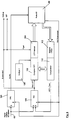
- Infusion parameters are entered via a user interface entry of the parameters 80, of which the optical window 60 forms a part. These perfusion parameters are stored in a memory unit 82, which is connected to a calculation unit 88. L interface d input 80 returns a reception protocol to the programming console 10.
- a logic signal 83 coming from the dropper sensor 14 is received by a timing and counting unit 84.
- the latter timers l time interval between two drops, or provides a timeout signal in l no drops beyond a time limit. In L possibility of the passage of a drop, this triggers a specific signal.
- l calculation unit 88 is therefore informed of the time separating two drops or of the excessive delay d appearance of a drop.
- a calculation algorithm managed by l calculation unit 88, compares the data received from the timing and counting unit 84 with values stored in the memory unit 82 and triggers an audible and / or visual alarm on a memory unit alarm 90, for example if the time interval measured between several consecutive drops exceeds preprogrammed tolerance limits.
- L computation unit 88 also manages a d display 92, allowing both display of measured parameters only of programmed parameters.
- Reference 96 indicates a high frequency oscillator synchronizing the calculation unit 88. Between successive events (passage of a drop, exceeding the time limit between two drops or sensor fault), once information processing is complete, the electricity consumption of the monitoring unit is reduced by decommissioning the calculation unit 88 by stopping the oscillator 96.
- a switching circuit 94 for switching d an operating mode monitoring / alarms in an operating mode flow adjustment .
- the audible alarms are out of service and an audible unit advantageously produces an acoustic signal for each drop detected.
- L nurse so has a powerful instrument, fully preprogrammed, to carry out the initial setting of a gravity infusion. Calculations of the number of drops and manual timing of drops are no longer required. It is therefore impossible to make an error with regard to setting the flow rate.
- the impulses of a low frequency clock 100 are counted by divider-counter circuits 102.
- a counting on 16 bits makes it possible to reach a time of more than one minute between two drops, which is equivalent to approximately three at four times the time limit for a very low flow rate (250 ml in 24 hours).
- the value of the divider-counter circuits 102 is simultaneously passed to data-latch circuits 104.
- the logic signal 83 coming from the sensor 14 and indicating the passage of a drop causes a transition (low ⁇ high) at the exit of two flip-flops-SR 106 and 108.
- the transition from 106 indicates to l calculation unit 88 qu there was passage of a drop, while the transition from 108 only indicates that there was an event (passage of a drop, exceeding the time limit between two drops or sensor fault).
- the signal d event restarts l oscillator 96 calculation unit, causes an interruption of the calculation unit 88.
- the signal d event freezes the count of pulses on the latch circuits 104 and resets the pulse counters 102 to zero.
- the value of the counters 102 kept on the latch circuits 104 is used to determine the time elapsed since the last drop signal. In the presence of the drop signal provided by the scale-SR 106, this value can be cumulated by l calculation unit 88 on a variable on four bytes (26 significant bits for 24 hours), which makes it possible to time the total time elapsed since the beginning, without requiring an additional time counter. The number of drops passed can be accumulated on a variable on two bytes (15 significant bits for a volume of 1600 ml). After the processing of this data by the calculation unit, this resets the two flip-flops-SR 106 and 108 to zero, which also restarts the counting of the pulses on the latch circuits 104. Then l computer unit 88 is placed in state d standby, low consumption, by l shutdown of its oscillator 96.
- a comparator 110 permanently compares the value of the counters 102 permanently to a limit time interval between two drops.
- the latter which is stored in a register 112 of the memory unit 82, was fixed by programming the monitoring unit depending on the volume and duration of the infusion. . If the value of the counters 102 exceeds this limit time, the comparator 110 causes a transition (low ⁇ high) at the output of the flip-flop-SR 108 without causing a transition to the output of the flip-flop-SR 106.
- This logic state will be interpreted by l l algorithm computer unit 88 as a situation requiring a trip of an alarm.
- Figure 9 shows a mode of preferential display of these indicators.
- a line d state 120 indicating the preprogrammed parameters of the infusion 122.
- a first graphic cursor 124 pseudo-analog, moves on a scale 126 graduated in percentage of deviations from the ideal values initially entered or calculated and represents a moving average flow (this moving average is for example calculated on the last eight drops).
- a second mobile slider 128 represents the optimal flow calculated to respect the duration initially planned for the infusion.
- a third cursor 130 indicates the average flow rate since the start of the infusion.
- a third display 132 represents the fraction of the total volume infused.
- An autonomous monitoring unit 12 can also include, as additional equipment, a transmitter or a transceiver which sends either data and / or alarms to a monitoring center (if necessary, possibly by relay repeater).
- L transceiver allows remote interrogation of each autonomous monitoring unit, by sending a coded identification sequence corresponding to the autonomous monitoring unit that we want to question. Remote monitoring of all indicators advancement of infusion is therefore possible.
- the sensor 14 connected to an autonomous monitoring unit 12 is a electro-optical sensor, of the optical barrier type, using a source 140 and a receiver 142 preferably working in the near infrared (800 to 950 nanometers).
- This working range has advantages notable techniques, such as: short response time of transmitters and detectors; lack of receptor memory effects; low sensitivity to stray light.
- the proposed sensor is designed so as to detect not only the drops passing through a region close to the central axis of the dropper bulb, but also those passing away from this axis, for example when the bulb is tilted or undergoes vibrations or shocks.
- the receiver comprises several photodiodes 142 (for example three photodiodes) arranged in an angular sector opposite the source 140. Each of these photodiodes is able to limit a current passing through a bias resistor 144 placed in the input d an amplifier of impedance adapter 146, in case it receives a reduced amount of light during the passage of the drop.
- Signal amplifier impedance adapter 146 is then integrated by an integrating amplifier 148 in order to provide an average value, amplified by an adjustable factor.
- a comparator 150 compares this average value with the non-integrated signal and thus supplies the logic signal 83 from the sensor 14.
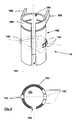
- L dropper bulb is advantageously introduced into a cylindrical measurement channel 160, arranged in a support block 162.
- This measurement channel 160 preferably has an internal reflecting surface at the level of the optical barrier, in order to cause multiple reflections of light issued by the source.
- the photodiodes 142 of the receiver then detect the disturbance caused by the passage of the drop in this system of multiple reflections to the inside the measurement channel 160. It will be appreciated that with the proposed detection system it is almost impossible to miss a drop.
- the measurement channel 160 is accessible by a lateral slot 164 arranged in the support block 162 along a generatrix of the cylindrical channel.
- This slot 164 has a width allowing the passage of the flexible tube bringing the liquid from the vial to the perfusion catheter (tube commonly called “tubing"). This allows easily insert the dropper bulb into the measuring channel.
- the upper part 166 of this support block 162 preferably comprises two flexible branches which can be separated and which tighten after loosening around the upper part of the bulb to hold it in place.
- Two levers 168 arranged on the opposite side of the slot, allow when pinched to move aside the two branches in order to position the support block on the bulb.
- the optical and electronic elements are arranged laterally, for example in one or two housings adjoining the support block 162.
Landscapes
- Health & Medical Sciences (AREA)
- Vascular Medicine (AREA)
- Engineering & Computer Science (AREA)
- Anesthesiology (AREA)
- Biomedical Technology (AREA)
- Heart & Thoracic Surgery (AREA)
- Hematology (AREA)
- Life Sciences & Earth Sciences (AREA)
- Animal Behavior & Ethology (AREA)
- General Health & Medical Sciences (AREA)
- Public Health (AREA)
- Veterinary Medicine (AREA)
- Physics & Mathematics (AREA)
- Fluid Mechanics (AREA)
- Infusion, Injection, And Reservoir Apparatuses (AREA)
- Endoscopes (AREA)
- Medicines Containing Antibodies Or Antigens For Use As Internal Diagnostic Agents (AREA)
- External Artificial Organs (AREA)
Claims (19)
- Vorrichtung zur Überwachung von Infusionen, miteinem Sensor (14), zur Anbringung an eine Tropfkammer, um den Durchlauf beziehungsweise das Ausbleiben eines Tropfens zu erfassen;einer Erfassung- und Zähleinheit (84) für die von diesem Sensor (14) erfassten Tropfen;einer Dateneingabeneinheit (20), zur Eingabe der spezifischen Parameter einer Infusion;einer Speichereinheit (82) zur Speicherung spezifischer Parameter der Infusion;einer Anzeigeeinheit (54);einer akustischen und/oder visuellen Alarmeinheit (90); sowieeiner ersten Recheneinheit (88), die sich für die Verwendung eines Rechenalgorithmus eignet, der als Parameter ein Signal der Einheit zur zeitlichen Erfassung und Zählung sowie die in der Speichereinheit gespeicherten spezifischen Parameter der Infusion berücksichtigt, um einen akustischen und/oder visuellen Alarm auszulösen,
dadurch gekennzeichnet, daßdie Einheit zur Dateneingabe (20) in eine autonome und unabhängige Programmierkonsole (10) integriert ist,diese Programmierkonsole (10) eine zweite Recheneinheit (40) und eine Ausgangsschnittstelle (42) umfaßt, wobei diese zweite Recheneinheit (40) dazu geeignet ist, die auf der Einheit zur Eingabe der Parameterdaten (20) eingegebenen spezifischen Infusionsparameter vorab aufzubereiten, und diese Ausgangsschnittstelle (42) dazu geeignet ist, diese vorab aufbereiteten Parameter in fernübertragbare Signale umzuwandeln,die Erfassung- und Zähleinheit (84), die Speichereinheit (82), die Anzeigeeinheit (92), die akustische und/oder visuelle Alarmeinheit (90) sowie die erste Recheneinheit (88) gemeinsam mit einer autonomen Stromquelle (64), die sie versorgt, in ein erstes Gehäuse integriert sind, wobei diese Gesamtheit eine autonome und unabhängige Überwachungseinheit (12) darstellt, die während der Infusion ständig an den an der Tropfkammer angebrachten Sensor (14) angeschlossen ist; unddiese autonome und unabhängige Überwachungseinheit (12) eine Eingangsschnittstelle (80) umfaßt, die dazu geeignet ist, ausgehend von den von der Ausgangsschnittstelle (42) erzeugten Signalen die vorab aufbereiteten Parameter wiederherzustellen, so daß diese vorab aufbereiteten Parameter für die Benutzung durch die erste Recheneinheit (88) in die Speichereinheit (82) einladbar sind. - Vorrichtung nach Anspruch 1, dadurch gekennzeichnet, daß die Dateneingabeeinheit (20) Mittel (21), um einen Infusionsinhalt einzugeben, sowie Mittel (22), um eine Infusionsdauer einzugeben, umfaßt.
- Vorrichtung nach Anspruch 1 oder 2, dadurch gekennzeichnet, daß die Dateneingabeeinheit (20) außerdem Mittel (23) umfaßt, um einen Toleranzbereich einzugeben, der auf die Anzahl in einem Zeitraum erfasster Tropfen anwendbar ist, wobei dieser Toleranzbereich in dem Rechenalgorithmus berücksichtigt wird, um die Auslösung eines Alarms zu verzögern.
- Vorrichtung nach Anspruch 3, dadurch gekennzeichnet, daß diese Mittel, um einen Toleranzbereich der Infusionsmenge einzugeben, Mittel umfassenum einen ersten Toleranzbereich einzugeben, der auf die in einem Zeitraum erfasste Anzahl von Tropfen anwendbar ist, falls diese Anzahl unter einem für den gleichen Zeitraum berechneten Mittelwert liegt; undum einen zweiten Toleranzbereich einzugeben, der auf die in einem Zeitraum erfasste Anzahl von Tropfen anwendbar ist, falls diese Anzahl über einem für den gleichen Zeitraum berechneten Mittelwert liegt.
- Vorrichtung nach irgendeinem der Ansprüche 1 bis 4, dadurch gekennzeichnet, daß die Dateneingabeeinheit außerdem Mittel (24) umfaßt, um zur Kalibrierung dienende Parameter einzugeben.
- Vorrichtung nach irgendeinem der Ansprüche 1 bis 5, dadurch gekennzeichnet, daß die Programmierungskonsole als Dateneingabeeinheit ein Tastenfeld umfaßt, dessen einzelne Tasten jeweils einem genauen Wert eines spezifischen Infusionsparameters zugeordnet ist.
- Vorrichtung nach irgendeinem der Ansprüche 1 bis 6, dadurch gekennzeichnet, daß die Anzeigeeinheit (54) Mittel umfaßt, um spezifische Infusionsparameter anzuzeigen, die von den in die Speichereinheit der netzunabhängigen Überwachungseinheit geladenen spezifischen Infusionsparametern abgeleitet werden.
- Vorrichtung nach Anspruch 7, dadurch gekennzeichnet, daß die angezeigten spezifische Parameter Infusionsvolumen, Infusionsdauer und Toleranzbereiche umfaßen.
- Vorrichtung nach irgendeinem der Ansprüche 1 bis 8, dadurch gekennzeichnet, daß die Anzeigeeinheit (54) Mittel umfaßt, um auf einer linearen Skala die positive oder negative Abweichung der Anzahl während eines beweglichen Beobachtungszeitraums t1 erfassten Tropfen von der Anzahl der Tropfen, die während dieses Zeitraums t1 bei einer einheitlichen Verteilung der Tropfen auf eine zu Beginn vorgegebene Infusionsdauer vorliegen müsste, graphisch darzustellen.
- Vorrichtung nach Anspruch 9, dadurch gekennzeichnet, daß die erste Recheneinheit dazu geeignet ist, eine optimale Tropfenanzahl ständig zu berechnen, die auf der linearen Skala in Form eines Cursors (128) angezeigt wird, der die relative Abweichung dieser optimalen Tropfenzahl gegenüber der Anzahl, die der Nullabweichung entspricht, angibt, und die folgendermaßen definiert wird:
- Vorrichtung nach irgendeinem der Ansprüche 1 bis 10, dadurch gekennzeichnet, daß der Sensor (14) eine Infrarotstrahlungsquelle (140), die impulsförmig betrieben wird, sowie einen optischen Empfänger, der damit synchron aktiviert wird, umfaßt.
- Vorrichtung nach Anspruch 11, dadurch gekennzeichnet, daß dieser optische Empfänger mehrere Photodioden (142) umfaßt, die elektrisch in Serie geschaltet sind und in einem Winkelsektor gegenüber der Infrarotstrahlenquelle verteilt sind.
- Vorrichtung nach Anspruch 11 oder 12, dadurch gekennzeichnet, daß der Sensor (14)einen integrierenden Verstärker (148), um das Signal des optischen Empfängers zu integrieren und als Ausgangssignal einen um einen regelbaren Faktor verstärkten Mittelwert zu liefern; sowieeinen Vergleicher (150), um dieses Ausgangssignal mit dem nicht integrierten Signal des Empfängers zu vergleichen und ein logisches Signal (83) als Eingangssignal für die Einheit zur zeitlichen Erfassung und Zählung (84) zu liefern;
umfaßt. - Vorrichtung nach irgendeinem der Ansprüche 1 bis 13, dadurch gekennzeichnet, daß zur vorübergehenden Ankopplung der Eingangsschnittstelle der Überwachungseinheit an die Ausgangsschnittstelle der Programmierkonsole ein optoelektronisches Koppelelement (15) verwendet wird.
- Vorrichtung nach irgendeinem der Ansprüche 1 bis 14, dadurch gekennzeichnet, daß die netzunabhängige Überwachungseinheit (12) außerdemMittel zur Umschaltung (94), um von einem Betriebsmodus Überwachung/Alarm auf einen Betriebsmodus Mengeneinstellung umzuschalten, in dem akustische Alarme außer Betrieb sind; sowieeine Akustikeinheit, die dazu geeignet ist, in diesem Betriebsmodus "Mengeneinstellung" ein akustisches Signal für jeden erfassten Tropfen zu erzeugen;
umfaßt. - Vorrichtung nach irgendeinem der Ansprüche 1 bis 15, dadurch gekennzeichnet, daß die netzunabhängige Überwachungseinheit (12) außerdem Mittel umfaßt, um die erste Recheneinheit (88) durch Anhalten ihres Oszillators (96) zwischen aufeinanderfolgenden Ereignissen außer Betrieb zu setzen, wobei ein Ereignis mit dem Durchlauf eines Tropfens, dem Überschreiten der Zeitgrenze zwischen zwei Tropfen oder dem Ausfall des Sensors gleichgesetzt wird.
- Vorrichtung nach Anspruch 16), dadurch gekennzeichnet, daß die Einheit zur zeitlichen Erfassung und Zählung (84)erste logische Mittel (108), um einen Übergang eines ersten logischen Signals bei einem Ereignis ersten Typs zu erzeugen, das entweder dem Durchlauf eines Tropfens oder dem Überschreiten der Zeitgrenze zwischen zwei Tropfen oder auch einem Ausfall des Sensors entspricht, wobei diese ersten logischen Mittel den Oszillator (96) der Recheneinheit (88) bei einem Ereignis ersten Typs wieder in Gang setzen;zweite logische Mittel (106), um einen Übergang eines zweiten logischen Signals ausschließlich bei Durchlauf eines Tropfens zu erzeugen, wobei diese zweiten logischen Mittel (106) in der Recheneinheit (88) bei Durchlauf eines Tropfens den Ablauf eines Rechenalgorithmus auslösen; sowieMittel zur Erzeugung eines Alarms bei Übergang des ersten logischen Signals und Nicht-Übergang des zweiten logischen Signals;
umfaßt. - Vorrichtung nach Anspruch 16 oder 17, dadurch gekennzeichnet, daß die Einheit zur zeitlichen Erfassung und Zählung (84) außerdemeinen Impulszähler (102) zum Zählen der Impulse einer Niederfrequenzuhr (100);einen Verschlußzähler (104), der diesem Impulszähler (102) beigeordnet ist und der so an die Recheneinheit (88) angeschlossen ist, daß er von ihr abgefragt werden kann;
umfaßt;
wobei die ersten logischen Mittel so an den Impulszähler (102) und an den Verschlußzähler (104) angeschlossen sind, daß sie bei Übergang des ersten logischen Signals das Abzählen der Impulse in dem Verschlußzähler (104) stoppen und den Impulszähler (102) auf Null stellen. - Vorrichtung nach Anspruch 18, dadurch gekennzeichnet, daß die Einheit zur zeitlichen Erfassung und Zählung (84) außerdemeinen Vergleicher (110), der den Wert des Impulszählers (102) ständig mit einem vorher festgelegten Grenzzeitraum vergleicht, umfaßt
wobei dieser Vergleicher (110) bei Überschreiten dieses vorher festgelegten Grenzzeitraums einen Übergang des ersten logischen Signals auslöst.
Applications Claiming Priority (3)
| Application Number | Priority Date | Filing Date | Title |
|---|---|---|---|
| LU88565 | 1994-12-07 | ||
| LU88565A LU88565A1 (fr) | 1994-12-07 | 1994-12-07 | Dispositif pour la surveillance du débit d'une perfusion intraveineuse |
| PCT/EP1995/004722 WO1996017637A1 (fr) | 1994-12-07 | 1995-11-30 | Dispositif pour la surveillance du debit d'une perfusion intraveineuse |
Publications (2)
| Publication Number | Publication Date |
|---|---|
| EP0797462A1 EP0797462A1 (de) | 1997-10-01 |
| EP0797462B1 true EP0797462B1 (de) | 1998-07-08 |
Family
ID=19731508
Family Applications (1)
| Application Number | Title | Priority Date | Filing Date |
|---|---|---|---|
| EP95941063A Expired - Lifetime EP0797462B1 (de) | 1994-12-07 | 1995-11-30 | Vorrichtung zur überwachung des infusionsflusses |
Country Status (10)
| Country | Link |
|---|---|
| US (1) | US6083206A (de) |
| EP (1) | EP0797462B1 (de) |
| AT (1) | ATE168017T1 (de) |
| AU (1) | AU4259796A (de) |
| CA (1) | CA2207319A1 (de) |
| DE (1) | DE69503391T2 (de) |
| DK (1) | DK0797462T3 (de) |
| ES (1) | ES2120783T3 (de) |
| LU (1) | LU88565A1 (de) |
| WO (1) | WO1996017637A1 (de) |
Families Citing this family (94)
| Publication number | Priority date | Publication date | Assignee | Title |
|---|---|---|---|---|
| US5750491A (en) * | 1993-08-02 | 1998-05-12 | The Procter & Gamble Company | Super concentrate emulsions with fabric actives |
| GB9803299D0 (en) * | 1998-02-18 | 1998-04-08 | Gallagher George | Improved method and apparatus for monitoring intravenous drips |
| IL141137A0 (en) * | 2001-01-28 | 2002-02-10 | Caesaria Med Electronics Ltd | Liquid pump |
| IL142446A (en) * | 2001-04-04 | 2009-07-20 | Caesarea Medical Electronics Ltd | Flow set and a method to identify said flow set by a liquid pump |
| US7540854B2 (en) * | 2001-07-10 | 2009-06-02 | Medrad, Inc. | Method of substituting a first fluid delivery device with a second fluid delivery device |
| US6599282B2 (en) | 2001-09-05 | 2003-07-29 | Zeev Burko | Intravenous set flow volumetric measurement device |
| DE10153232A1 (de) * | 2001-10-31 | 2003-05-15 | Franz Durst | Vorrichtung zum Einstellen des Volumenstroms von Infusionsflüssigkeiten |
| US10173008B2 (en) | 2002-01-29 | 2019-01-08 | Baxter International Inc. | System and method for communicating with a dialysis machine through a network |
| US7818184B2 (en) * | 2002-09-24 | 2010-10-19 | Draeger Medical Systems, Inc. | Patient medical fluid parameter data processing system |
| US20040068294A1 (en) * | 2002-10-04 | 2004-04-08 | Howard Scalzo | Braided antimicrobial suture |
| JP2006502781A (ja) * | 2002-10-15 | 2006-01-26 | コーニンクレッカ フィリップス エレクトロニクス エヌ ヴィ | 灌流の変化に関する情報の表示方法 |
| KR100543391B1 (ko) * | 2003-06-13 | 2006-01-23 | 삼원에프에이 (주) | 링거 수액 투여 감시 시스템 |
| CA2496646A1 (en) * | 2004-02-12 | 2005-08-12 | Flowtec Medical Inc. | Fluid monitoring device |
| US8961461B2 (en) * | 2004-05-27 | 2015-02-24 | Baxter International Inc. | Multi-state alarm system for a medical pump |
| US20060116639A1 (en) * | 2004-11-29 | 2006-06-01 | Russell Claudia J | Total patient input monitoring |
| US10010686B2 (en) | 2006-02-27 | 2018-07-03 | Ivenix, Inc. | Fluid control system and disposable assembly |
| US20110028937A1 (en) * | 2006-02-27 | 2011-02-03 | Fluidnet Corporation | Automated fluid flow control system |
| IL180305A0 (en) * | 2006-12-25 | 2007-06-03 | Swi Barak | Administration set with two keys |
| US7892199B2 (en) | 2007-05-21 | 2011-02-22 | Asante Solutions, Inc. | Occlusion sensing for an infusion pump |
| US7833196B2 (en) | 2007-05-21 | 2010-11-16 | Asante Solutions, Inc. | Illumination instrument for an infusion pump |
| US7981102B2 (en) | 2007-05-21 | 2011-07-19 | Asante Solutions, Inc. | Removable controller for an infusion pump |
| US8517990B2 (en) | 2007-12-18 | 2013-08-27 | Hospira, Inc. | User interface improvements for medical devices |
| US8057679B2 (en) | 2008-07-09 | 2011-11-15 | Baxter International Inc. | Dialysis system having trending and alert generation |
| US10089443B2 (en) | 2012-05-15 | 2018-10-02 | Baxter International Inc. | Home medical device systems and methods for therapy prescription and tracking, servicing and inventory |
| US8554579B2 (en) | 2008-10-13 | 2013-10-08 | Fht, Inc. | Management, reporting and benchmarking of medication preparation |
| US8692678B2 (en) * | 2009-06-04 | 2014-04-08 | Tod. H. WARNER | Automated intravenous monitoring device |
| US9151646B2 (en) | 2011-12-21 | 2015-10-06 | Deka Products Limited Partnership | System, method, and apparatus for monitoring, regulating, or controlling fluid flow |
| US20110317004A1 (en) * | 2010-06-29 | 2011-12-29 | Kai Tao | IV Monitoring by Digital Image Processing |
| US8531517B2 (en) * | 2010-07-15 | 2013-09-10 | Kai Tao | IV monitoring by video and image processing |
| US9128051B2 (en) | 2010-10-19 | 2015-09-08 | Baxter International Inc. | Optical imaging system for air bubble and empty bag detection in an infusion tube |
| US8622979B2 (en) | 2010-10-19 | 2014-01-07 | Baxter Healthcare S.A. | Infusion system using optical imager for controlling flow and method thereof |
| US9476825B2 (en) | 2010-10-19 | 2016-10-25 | Baxter International Inc. | Optical imaging system with multiple imaging channel optical sensing |
| US9186457B2 (en) * | 2011-04-27 | 2015-11-17 | Freddie Eng Hwee Lee | Intravenous infusion monitoring apparatus, system and method |
| US10556063B2 (en) | 2011-06-20 | 2020-02-11 | Renaudia Medical, Llc | Distributed medication delivery using autonomous delivery device |
| CA2839443A1 (en) | 2011-06-20 | 2012-12-27 | Renaudia Medical, Llc | Distributed medication delivery system and method having autonomous delivery devices |
| US9144644B2 (en) | 2011-08-02 | 2015-09-29 | Baxter International Inc. | Infusion pump with independently controllable valves and low power operation and methods thereof |
| CA2844807C (en) | 2011-08-19 | 2022-07-26 | Hospira, Inc. | Systems and methods for a graphical interface including a graphical representation of medical data |
| AU2012336307A1 (en) | 2011-09-30 | 2014-03-20 | Hospira, Inc. | Intravenous flow rate controller |
| WO2013090709A1 (en) | 2011-12-16 | 2013-06-20 | Hospira, Inc. | System for monitoring and delivering medication to a patient and method of using the same to minimize the risks associated with automated therapy |
| US9746093B2 (en) | 2011-12-21 | 2017-08-29 | Deka Products Limited Partnership | Flow meter and related system and apparatus |
| US9435455B2 (en) | 2011-12-21 | 2016-09-06 | Deka Products Limited Partnership | System, method, and apparatus for monitoring, regulating, or controlling fluid flow |
| US10488848B2 (en) | 2011-12-21 | 2019-11-26 | Deka Products Limited Partnership | System, method, and apparatus for monitoring, regulating, or controlling fluid flow |
| US10563681B2 (en) | 2011-12-21 | 2020-02-18 | Deka Products Limited Partnership | System, method, and apparatus for clamping |
| US9372486B2 (en) | 2011-12-21 | 2016-06-21 | Deka Products Limited Partnership | System, method, and apparatus for monitoring, regulating, or controlling fluid flow |
| US9724466B2 (en) | 2011-12-21 | 2017-08-08 | Deka Products Limited Partnership | Flow meter |
| US10228683B2 (en) | 2011-12-21 | 2019-03-12 | Deka Products Limited Partnership | System, method, and apparatus for monitoring, regulating, or controlling fluid flow |
| US9746094B2 (en) | 2011-12-21 | 2017-08-29 | Deka Products Limited Partnership | Flow meter having a background pattern with first and second portions |
| JP6306566B2 (ja) | 2012-03-30 | 2018-04-04 | アイシーユー・メディカル・インコーポレーテッド | 注入システムのポンプ内の空気を検出するための空気検出システムおよび方法 |
| EP3586891B1 (de) | 2012-07-31 | 2025-04-09 | ICU Medical, Inc. | Patientenbehandlungssystem für kritische medikamente |
| EP3453377B1 (de) | 2012-10-26 | 2026-04-29 | Baxter Corporation Englewood | Verbesserte arbeitsstation für medizinische dosiszubereitung |
| KR101695119B1 (ko) | 2012-10-26 | 2017-01-23 | 백스터 코포레이션 잉글우드 | 의료 투여분 조제 시스템을 위한 개선된 이미지 취득 |
| US9759343B2 (en) | 2012-12-21 | 2017-09-12 | Deka Products Limited Partnership | Flow meter using a dynamic background image |
| JP2014140467A (ja) * | 2013-01-23 | 2014-08-07 | Tatsuta Electric Wire & Cable Co Ltd | 点滴速度測定器 |
| US9352081B2 (en) | 2013-03-14 | 2016-05-31 | Baxter International Inc. | Drip chamber with hydrophobic interior surface |
| US9234850B2 (en) | 2013-03-14 | 2016-01-12 | Baxter International Inc. | Drip chamber with integrated optics |
| AU2014268355B2 (en) | 2013-05-24 | 2018-06-14 | Icu Medical, Inc. | Multi-sensor infusion system for detecting air or an occlusion in the infusion system |
| CA2913915C (en) | 2013-05-29 | 2022-03-29 | Hospira, Inc. | Infusion system which utilizes one or more sensors and additional information to make an air determination regarding the infusion system |
| ES2845748T3 (es) | 2013-05-29 | 2021-07-27 | Icu Medical Inc | Sistema de infusión y método de uso que impiden la sobresaturación de un convertidor analógico-digital |
| USD749206S1 (en) | 2013-11-06 | 2016-02-09 | Deka Products Limited Partnership | Apparatus to control fluid flow through a tube |
| USD751690S1 (en) | 2013-11-06 | 2016-03-15 | Deka Products Limited Partnership | Apparatus to control fluid flow through a tube |
| USD751689S1 (en) | 2013-11-06 | 2016-03-15 | Deka Products Limited Partnership | Apparatus to control fluid flow through a tube |
| USD752209S1 (en) | 2013-11-06 | 2016-03-22 | Deka Products Limited Partnership | Apparatus to control fluid flow through a tube |
| USD745661S1 (en) | 2013-11-06 | 2015-12-15 | Deka Products Limited Partnership | Apparatus to control fluid flow through a tube |
| WO2015131108A2 (en) | 2014-02-28 | 2015-09-03 | Hospira, Inc. | Infusion system and method which utilizes dual wavelength optical air-in-line detection |
| US11344673B2 (en) | 2014-05-29 | 2022-05-31 | Icu Medical, Inc. | Infusion system and pump with configurable closed loop delivery rate catch-up |
| JP2017525032A (ja) | 2014-06-30 | 2017-08-31 | バクスター・コーポレーション・イングルウッドBaxter Corporation Englewood | 管理された医療情報交換 |
| CN104174097A (zh) * | 2014-09-21 | 2014-12-03 | 王学建 | 双位红外线输液报警装置 |
| US11575673B2 (en) | 2014-09-30 | 2023-02-07 | Baxter Corporation Englewood | Central user management in a distributed healthcare information management system |
| US11107574B2 (en) | 2014-09-30 | 2021-08-31 | Baxter Corporation Englewood | Management of medication preparation with formulary management |
| EP3210183B1 (de) | 2014-10-24 | 2020-09-02 | Baxter Corporation Englewood | Automatischer austausch von gesundheitsinformationen zur einhaltung von medikamentendosierungen |
| EP3937116A1 (de) | 2014-12-05 | 2022-01-12 | Baxter Corporation Englewood | Datenanalyse für dosiszubereitung |
| US11344668B2 (en) | 2014-12-19 | 2022-05-31 | Icu Medical, Inc. | Infusion system with concurrent TPN/insulin infusion |
| US10850024B2 (en) | 2015-03-02 | 2020-12-01 | Icu Medical, Inc. | Infusion system, device, and method having advanced infusion features |
| CA2978455A1 (en) | 2015-03-03 | 2016-09-09 | Baxter Corporation Englewood | Pharmacy workflow management with integrated alerts |
| EP3314488B1 (de) | 2015-06-25 | 2024-03-13 | Gambro Lundia AB | Medizinisches vorrichtungssystem und verfahren mit einer verteilten datenbank |
| EP3364867B1 (de) * | 2015-10-21 | 2023-03-22 | Edwards Lifesciences Corporation | Thermodilutionsinjektatmessung und -steuerung |
| EP4335471A3 (de) | 2016-01-28 | 2024-08-21 | DEKA Products Limited Partnership | Vorrichtung zur überwachung, regelung oder steuerung eines fluidstroms |
| USD905848S1 (en) | 2016-01-28 | 2020-12-22 | Deka Products Limited Partnership | Apparatus to control fluid flow through a tube |
| WO2017159683A1 (ja) * | 2016-03-16 | 2017-09-21 | 株式会社トライテック | 点滴管理システム |
| CA3023658C (en) | 2016-05-13 | 2023-03-07 | Icu Medical, Inc. | Infusion pump system and method with common line auto flush |
| USD854145S1 (en) | 2016-05-25 | 2019-07-16 | Deka Products Limited Partnership | Apparatus to control fluid flow through a tube |
| AU2017277804B2 (en) | 2016-06-10 | 2022-05-26 | Icu Medical, Inc. | Acoustic flow sensor for continuous medication flow measurements and feedback control of infusion |
| CN106215282A (zh) * | 2016-08-31 | 2016-12-14 | 吴波 | 基于红外液滴检测和称重检测的输液监控方法及系统 |
| KR102476516B1 (ko) | 2016-12-21 | 2022-12-09 | 감브로 룬디아 아베 | 외부 도메인을 지원하는 안전한 클러스터 도메인을 구비한 정보 기술 인프라를 포함하는 의료 장치 시스템 |
| TWI605845B (zh) * | 2016-12-21 | 2017-11-21 | 財團法人工業技術研究院 | 靜脈輸液用藥監測裝置及其方法 |
| US10089055B1 (en) | 2017-12-27 | 2018-10-02 | Icu Medical, Inc. | Synchronized display of screen content on networked devices |
| USD964563S1 (en) | 2019-07-26 | 2022-09-20 | Deka Products Limited Partnership | Medical flow clamp |
| WO2021021596A1 (en) | 2019-07-26 | 2021-02-04 | Deka Products Limited Partnership | Apparatus for monitoring, regulating, or controlling fluid flow |
| US11278671B2 (en) | 2019-12-04 | 2022-03-22 | Icu Medical, Inc. | Infusion pump with safety sequence keypad |
| AU2021311443A1 (en) | 2020-07-21 | 2023-03-09 | Icu Medical, Inc. | Fluid transfer devices and methods of use |
| US11135360B1 (en) | 2020-12-07 | 2021-10-05 | Icu Medical, Inc. | Concurrent infusion with common line auto flush |
| US12599716B2 (en) | 2021-10-12 | 2026-04-14 | Icu Medical, Inc. | Intravenous infusion pump with cassette insertion and pump control user interface |
| USD1091564S1 (en) | 2021-10-13 | 2025-09-02 | Icu Medical, Inc. | Display screen or portion thereof with graphical user interface for a medical device |
| CA3241894A1 (en) | 2021-12-10 | 2023-06-15 | Icu Medical, Inc. | Medical fluid compounding systems with coordinated flow control |
Family Cites Families (6)
| Publication number | Priority date | Publication date | Assignee | Title |
|---|---|---|---|---|
| DE2758368C2 (de) * | 1977-12-28 | 1985-10-17 | Siemens AG, 1000 Berlin und 8000 München | Vorrichtung zur vorprogrammierbaren Infusion von Flüssigkeiten |
| DE3329977C2 (de) * | 1983-08-19 | 1985-10-17 | B. Braun Melsungen Ag, 3508 Melsungen | Vorrichtung zur dosierten gleichzeitigen Infusion von Lösungen |
| FR2599496B1 (fr) * | 1986-05-28 | 1992-02-14 | Mms | Detecteur de bulles dans un circuit de liquide |
| CS135788A2 (en) * | 1987-03-06 | 1991-08-13 | Polska Akademia Nauk Zaklad | Device for liquid's through-flow checking in through-flow pipe-lines |
| JPH03231680A (ja) * | 1990-02-06 | 1991-10-15 | Terumo Corp | 点滴検出機及びそれを備えた点滴警報装置並びに点滴量制御装置 |
| US5376070A (en) * | 1992-09-29 | 1994-12-27 | Minimed Inc. | Data transfer system for an infusion pump |
-
1994
- 1994-12-07 LU LU88565A patent/LU88565A1/fr unknown
-
1995
- 1995-11-30 DE DE69503391T patent/DE69503391T2/de not_active Expired - Fee Related
- 1995-11-30 AU AU42597/96A patent/AU4259796A/en not_active Abandoned
- 1995-11-30 DK DK95941063T patent/DK0797462T3/da active
- 1995-11-30 EP EP95941063A patent/EP0797462B1/de not_active Expired - Lifetime
- 1995-11-30 AT AT95941063T patent/ATE168017T1/de not_active IP Right Cessation
- 1995-11-30 ES ES95941063T patent/ES2120783T3/es not_active Expired - Lifetime
- 1995-11-30 CA CA002207319A patent/CA2207319A1/fr not_active Abandoned
- 1995-11-30 US US08/849,563 patent/US6083206A/en not_active Expired - Fee Related
- 1995-11-30 WO PCT/EP1995/004722 patent/WO1996017637A1/fr not_active Ceased
Also Published As
| Publication number | Publication date |
|---|---|
| AU4259796A (en) | 1996-06-26 |
| CA2207319A1 (fr) | 1996-06-13 |
| US6083206A (en) | 2000-07-04 |
| ES2120783T3 (es) | 1998-11-01 |
| WO1996017637A1 (fr) | 1996-06-13 |
| ATE168017T1 (de) | 1998-07-15 |
| EP0797462A1 (de) | 1997-10-01 |
| DE69503391T2 (de) | 1999-01-07 |
| DK0797462T3 (da) | 1999-04-19 |
| LU88565A1 (fr) | 1996-07-15 |
| DE69503391D1 (de) | 1998-08-13 |
Similar Documents
| Publication | Publication Date | Title |
|---|---|---|
| EP0797462B1 (de) | Vorrichtung zur überwachung des infusionsflusses | |
| EP0450992B1 (de) | Gerät zur Bestimmung von für Lesewesen gefährlichen Strahlungen | |
| EP0618821B1 (de) | Tragbare programmierbare infusionspumpe | |
| EP0080705B1 (de) | Elektronisches Instrument für eine Überwachung und Behandlung weiblicher Unfruchtbarkeit | |
| EP0205561B1 (de) | Tropfennachweissystem | |
| EP1241968B1 (de) | Verbesserte handwaschvorrichtung | |
| WO2005093377A2 (fr) | Systeme de traitement integre et compact pour mesurer l'autonomie en gaz d'un reservoir | |
| EP0142394B1 (de) | Vorrichtung zum Steuern der Funktionsweise eines Kohlenwasserstoffabgebers mit elektronischem Rechner | |
| EP0233115A1 (de) | System zur Fernüberwachung von mindestens einem Infusionsgerät | |
| WO2017207925A1 (fr) | Dispositif connecté de suivi comportemental d'un individu et permettant la détection et/ou la prévention d'une anomalie | |
| EP0589353A1 (de) | Analoguhr mit der Möglichkeit zur Anzeige von Zusatzinformationen | |
| WO2016038281A1 (fr) | Dispositif pour la mesure de courant | |
| US5938643A (en) | Drop monitoring unit for infusion sets | |
| EP3913276B1 (de) | Druckgasbehälter, der mit einer elektronischen vorrichtung mit mitteln zur bestätigung von alarmen ausgestattet ist | |
| EP0551043A1 (de) | Verfahren und Vorrichtung zur Überwachung eines Hämodialysevorganges | |
| FR3120438A1 (fr) | Récipient de fluide sous pression avec dispositif électronique de calcul et d’affichage réactualisé d’autonomie en fluide | |
| FR3121495A1 (fr) | Récipient de fluide sous pression avec dispositif électronique de calcul d’autonomie | |
| CH686469B5 (fr) | Pièce d'horlogerie permettant de faire le point. | |
| FR2524320A1 (fr) | Appareil de surveillance de la perfusion de liquides | |
| FR3112839A1 (fr) | Récipient de fluide sous pression avec dispositif électronique permettant de calculer l’autonomie de manière plus précise | |
| FR2880810A1 (fr) | Dispositif de controle et de regulation du debit d'oxygene adapte aux besoins physiologiques du patient | |
| JP6901162B1 (ja) | 点滴監視装置 | |
| EP2070066A2 (de) | Teleassistenzverfahren, geräte zur implementierung des verfahrens und mit solchen geräten assoziierte uhr | |
| EP4643170A1 (de) | Elektronisches fernglas | |
| FR2668369A1 (fr) | Compte gouttes electronique a cadence sonore pour la regularisation de perfusion dans le domaine medical. |
Legal Events
| Date | Code | Title | Description |
|---|---|---|---|
| PUAI | Public reference made under article 153(3) epc to a published international application that has entered the european phase |
Free format text: ORIGINAL CODE: 0009012 |
|
| 17P | Request for examination filed |
Effective date: 19970610 |
|
| AK | Designated contracting states |
Kind code of ref document: A1 Designated state(s): AT BE CH DE DK ES FR GB GR IE IT LI MC NL PT SE |
|
| GRAG | Despatch of communication of intention to grant |
Free format text: ORIGINAL CODE: EPIDOS AGRA |
|
| 17Q | First examination report despatched |
Effective date: 19971013 |
|
| GRAG | Despatch of communication of intention to grant |
Free format text: ORIGINAL CODE: EPIDOS AGRA |
|
| GRAH | Despatch of communication of intention to grant a patent |
Free format text: ORIGINAL CODE: EPIDOS IGRA |
|
| GRAH | Despatch of communication of intention to grant a patent |
Free format text: ORIGINAL CODE: EPIDOS IGRA |
|
| GRAA | (expected) grant |
Free format text: ORIGINAL CODE: 0009210 |
|
| AK | Designated contracting states |
Kind code of ref document: B1 Designated state(s): AT BE CH DE DK ES FR GB GR IE IT LI MC NL PT SE |
|
| REF | Corresponds to: |
Ref document number: 168017 Country of ref document: AT Date of ref document: 19980715 Kind code of ref document: T |
|
| REG | Reference to a national code |
Ref country code: CH Ref legal event code: EP |
|
| REF | Corresponds to: |
Ref document number: 69503391 Country of ref document: DE Date of ref document: 19980813 |
|
| REG | Reference to a national code |
Ref country code: CH Ref legal event code: NV Representative=s name: PATENTANWAELTE BREITER + WIEDMER AG |
|
| GBT | Gb: translation of ep patent filed (gb section 77(6)(a)/1977) |
Effective date: 19980807 |
|
| REG | Reference to a national code |
Ref country code: IE Ref legal event code: FG4D Free format text: FRENCH |
|
| REG | Reference to a national code |
Ref country code: ES Ref legal event code: FG2A Ref document number: 2120783 Country of ref document: ES Kind code of ref document: T3 |
|
| REG | Reference to a national code |
Ref country code: PT Ref legal event code: SC4A Free format text: AVAILABILITY OF NATIONAL TRANSLATION Effective date: 19980827 |
|
| REG | Reference to a national code |
Ref country code: DK Ref legal event code: T3 |
|
| PLBE | No opposition filed within time limit |
Free format text: ORIGINAL CODE: 0009261 |
|
| STAA | Information on the status of an ep patent application or granted ep patent |
Free format text: STATUS: NO OPPOSITION FILED WITHIN TIME LIMIT |
|
| 26N | No opposition filed | ||
| REG | Reference to a national code |
Ref country code: GB Ref legal event code: IF02 |
|
| PGFP | Annual fee paid to national office [announced via postgrant information from national office to epo] |
Ref country code: NL Payment date: 20021022 Year of fee payment: 8 Ref country code: CH Payment date: 20021022 Year of fee payment: 8 Ref country code: AT Payment date: 20021022 Year of fee payment: 8 |
|
| PGFP | Annual fee paid to national office [announced via postgrant information from national office to epo] |
Ref country code: SE Payment date: 20021031 Year of fee payment: 8 Ref country code: MC Payment date: 20021031 Year of fee payment: 8 |
|
| PGFP | Annual fee paid to national office [announced via postgrant information from national office to epo] |
Ref country code: DK Payment date: 20021101 Year of fee payment: 8 |
|
| PGFP | Annual fee paid to national office [announced via postgrant information from national office to epo] |
Ref country code: PT Payment date: 20021107 Year of fee payment: 8 |
|
| PGFP | Annual fee paid to national office [announced via postgrant information from national office to epo] |
Ref country code: GR Payment date: 20021113 Year of fee payment: 8 |
|
| PGFP | Annual fee paid to national office [announced via postgrant information from national office to epo] |
Ref country code: IE Payment date: 20021118 Year of fee payment: 8 |
|
| PGFP | Annual fee paid to national office [announced via postgrant information from national office to epo] |
Ref country code: BE Payment date: 20021127 Year of fee payment: 8 |
|
| PGFP | Annual fee paid to national office [announced via postgrant information from national office to epo] |
Ref country code: ES Payment date: 20021204 Year of fee payment: 8 |
|
| PG25 | Lapsed in a contracting state [announced via postgrant information from national office to epo] |
Ref country code: MC Free format text: LAPSE BECAUSE OF NON-PAYMENT OF DUE FEES Effective date: 20031130 Ref country code: LI Free format text: LAPSE BECAUSE OF NON-PAYMENT OF DUE FEES Effective date: 20031130 Ref country code: CH Free format text: LAPSE BECAUSE OF NON-PAYMENT OF DUE FEES Effective date: 20031130 Ref country code: BE Free format text: LAPSE BECAUSE OF NON-PAYMENT OF DUE FEES Effective date: 20031130 Ref country code: AT Free format text: LAPSE BECAUSE OF NON-PAYMENT OF DUE FEES Effective date: 20031130 |
|
| PG25 | Lapsed in a contracting state [announced via postgrant information from national office to epo] |
Ref country code: SE Free format text: LAPSE BECAUSE OF NON-PAYMENT OF DUE FEES Effective date: 20031201 Ref country code: IE Free format text: LAPSE BECAUSE OF NON-PAYMENT OF DUE FEES Effective date: 20031201 Ref country code: ES Free format text: LAPSE BECAUSE OF NON-PAYMENT OF DUE FEES Effective date: 20031201 Ref country code: DK Free format text: LAPSE BECAUSE OF NON-PAYMENT OF DUE FEES Effective date: 20031201 |
|
| BERE | Be: lapsed |
Owner name: *MIDEX MARKETING LTD Effective date: 20031130 |
|
| PG25 | Lapsed in a contracting state [announced via postgrant information from national office to epo] |
Ref country code: PT Free format text: LAPSE BECAUSE OF NON-PAYMENT OF DUE FEES Effective date: 20040531 |
|
| PG25 | Lapsed in a contracting state [announced via postgrant information from national office to epo] |
Ref country code: NL Free format text: LAPSE BECAUSE OF NON-PAYMENT OF DUE FEES Effective date: 20040601 |
|
| PG25 | Lapsed in a contracting state [announced via postgrant information from national office to epo] |
Ref country code: GR Free format text: LAPSE BECAUSE OF NON-PAYMENT OF DUE FEES Effective date: 20040603 |
|
| REG | Reference to a national code |
Ref country code: DK Ref legal event code: EBP |
|
| REG | Reference to a national code |
Ref country code: CH Ref legal event code: PL |
|
| NLV4 | Nl: lapsed or anulled due to non-payment of the annual fee |
Effective date: 20040601 |
|
| EUG | Se: european patent has lapsed | ||
| REG | Reference to a national code |
Ref country code: PT Ref legal event code: MM4A Free format text: LAPSE DUE TO NON-PAYMENT OF FEES Effective date: 20040531 |
|
| REG | Reference to a national code |
Ref country code: IE Ref legal event code: MM4A |
|
| REG | Reference to a national code |
Ref country code: ES Ref legal event code: FD2A Effective date: 20031201 |
|
| PG25 | Lapsed in a contracting state [announced via postgrant information from national office to epo] |
Ref country code: IT Free format text: LAPSE BECAUSE OF NON-PAYMENT OF DUE FEES;WARNING: LAPSES OF ITALIAN PATENTS WITH EFFECTIVE DATE BEFORE 2007 MAY HAVE OCCURRED AT ANY TIME BEFORE 2007. THE CORRECT EFFECTIVE DATE MAY BE DIFFERENT FROM THE ONE RECORDED. Effective date: 20051130 |
|
| PGFP | Annual fee paid to national office [announced via postgrant information from national office to epo] |
Ref country code: DE Payment date: 20061011 Year of fee payment: 12 |
|
| PGFP | Annual fee paid to national office [announced via postgrant information from national office to epo] |
Ref country code: GB Payment date: 20061026 Year of fee payment: 12 |
|
| GBPC | Gb: european patent ceased through non-payment of renewal fee |
Effective date: 20071130 |
|
| PG25 | Lapsed in a contracting state [announced via postgrant information from national office to epo] |
Ref country code: DE Free format text: LAPSE BECAUSE OF NON-PAYMENT OF DUE FEES Effective date: 20080603 |
|
| PGFP | Annual fee paid to national office [announced via postgrant information from national office to epo] |
Ref country code: FR Payment date: 20061011 Year of fee payment: 12 |
|
| REG | Reference to a national code |
Ref country code: FR Ref legal event code: ST Effective date: 20080930 |
|
| PG25 | Lapsed in a contracting state [announced via postgrant information from national office to epo] |
Ref country code: GB Free format text: LAPSE BECAUSE OF NON-PAYMENT OF DUE FEES Effective date: 20071130 |
|
| PG25 | Lapsed in a contracting state [announced via postgrant information from national office to epo] |
Ref country code: FR Free format text: LAPSE BECAUSE OF NON-PAYMENT OF DUE FEES Effective date: 20071130 |