EP0791646A2 - Holzfeueranzünder mit verbesserten Stapeleigenschaften - Google Patents
Holzfeueranzünder mit verbesserten Stapeleigenschaften Download PDFInfo
- Publication number
- EP0791646A2 EP0791646A2 EP97103035A EP97103035A EP0791646A2 EP 0791646 A2 EP0791646 A2 EP 0791646A2 EP 97103035 A EP97103035 A EP 97103035A EP 97103035 A EP97103035 A EP 97103035A EP 0791646 A2 EP0791646 A2 EP 0791646A2
- Authority
- EP
- European Patent Office
- Prior art keywords
- brick
- wall
- bricks
- stack
- width
- Prior art date
- Legal status (The legal status is an assumption and is not a legal conclusion. Google has not performed a legal analysis and makes no representation as to the accuracy of the status listed.)
- Withdrawn
Links
Images


Classifications
-
- C—CHEMISTRY; METALLURGY
- C10—PETROLEUM, GAS OR COKE INDUSTRIES; TECHNICAL GASES CONTAINING CARBON MONOXIDE; FUELS; LUBRICANTS; PEAT
- C10L—FUELS NOT OTHERWISE PROVIDED FOR; NATURAL GAS; SYNTHETIC NATURAL GAS OBTAINED BY PROCESSES NOT COVERED BY SUBCLASSES C10G OR C10K; LIQUIFIED PETROLEUM GAS; USE OF ADDITIVES TO FUELS OR FIRES; FIRE-LIGHTERS
- C10L11/00—Fire-lighters
- C10L11/06—Fire-lighters of a special shape
Definitions
- the present invention is directed toward a wood fire starter and more specifically toward a wax-based wood fire starter brick having improved characteristics.
- Wood fire starters are made primarily from a mixture of wax and sawdust and can be lighted easily with a match and can burn for 15 to 45 minutes, depending on the size and quality of the product. These products burn evenly and intensely, are sized to rest on a fireplace grate, and make it possible to light a fireplace fire without newspaper or kindling or when the wood is slightly damp. They allow almost anyone to start a fire successfully.
- Wood fire starters are generally brick-shaped, but almost any shape can be used. These products are often sold stacked one atop another in multiple-unit packages. A problem which often arises when the product is packaged in this manner is that the individual fire starters, being made largely of wax, tend to stick together. Because the products are rectangular, and the side and end walls of the product are evenly aligned, they can be very difficult to separate when partially stuck together. This problem is aggravated when the fire starters are stored in close proximity to a heat source such as a fireplace or wood stove or when unused fire starters are stored over the summer in hot weather. Even moderate temperatures can cause some degree of sticking.
- a first embodiment of the invention comprises a brick having a generally octagonal cross-section. This cross-section allows the fire starters to be stacked such that the area of the contact region between the bricks is less than the width of the brick.
- bricks having a cross-section with five or more sides comprise part of the present invention.
- the octagonal cross-section is preferred over these other shapes as it allows the fire starter to maintain a generally brick-shaped appearance and does not adversely affect the extrusion process by which these products are normally manufactured. Stacked octagonal bricks can also efficiently fill a substantial volume of a standard rectangular package.
- the bricks may also be provided with generally rectangular end portions to increase the stability of the bricks when stacked.
- the use of a flattened end portion in this manner creates a generally I-shaped region of contact between the bricks which provides stability while still allowing the bricks to be easily separated.
- a second embodiment of the invention comprises a generally rectangular brick having convex top and bottom walls. When stacked, these convex walls contact one another only along a narrow strip and thus are easy to separate even when slightly melted together.
- a third preferred embodiment uses a brick having concave upper and lower walls which contact one another only along the outer edges thereof when stacked.
- a fourth preferred embodiment of the invention comprises bricks having a trapezoidal cross-section with one of the parallel walls being shorter than the other, wherein the parallel walls form the top and bottom walls of the bricks when stacked.
- a fifth embodiment of the subject invention comprises bricks having a hexagonal cross-section.
- a wax-based fire starter brick has first and second vertically oriented, parallel, rectangular end walls, first and second rectangular vertically oriented side walls extending between said end walls, a top wall and a bottom wall wherein said top and bottom walls include first and second flat, horizontal end portions extending between said side walls for a distance of about 1/4 inch from each of said end walls and a horizontal, centrally disposed strip portion less than about one third of the width of said brick connecting said first and second flat, horizontal end portions to form a generally I-shaped region of contact and including first and second sloped wall portions for providing a gripping surface when a first one of said brick is stacked on a second one of said brick bounded by said region of contact and each of said side walls, said sloped wall portions being sloped at an angle of less than about 10 degrees from the horizontal such that the cross-section through said horizontal end portions normal to said side walls is generally rectangular and the cross-section through said centrally disposed strip normal to said side walls is generally octagonal.
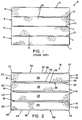
- Figure 1 shows a stack 8 of prior art fire starter bricks 9.
- These prior art bricks are rectangular solids and have parallel and planar top walls 10 and bottom walls 11 extending between parallel and planar side walls 12.
- Such bricks are all of the same size and are stacked squarely atop one another which makes them difficult to separate without the use of a knife or without breaking the bricks into unusably small fragments.
- FIGS 2 and 3 show a stack 14 of fire starter bricks 16 according to a first embodiment of the present invention and Figures 4 and 11 show one of these bricks separated from the stack.
- Each brick preferably has a length of about 7 inches, a width of about 2 1/2 inches and a height of about 1 inch.
- the bricks 16 are generally octagonal which results in the creation of gaps 18 between the bricks when stacked.
- the bricks 16 each include front and rear end walls 22, a left side wall 26 and a right side wall 28, and a top wall 30 comprising a first sloped portion 32, a central portion 34, a second sloped portion 36 and flattened end portions 37 extending about 1/4 inch inwardly of each of the end walls 22.
- the bottom wall 38 of the brick 16 is identical to the top wall 30 and includes a first sloped portion 40, a central portion 42, a second sloped portion 44 and flattened end portions 45 adjacent each of the end wails 22.
- the top wall central portions 34 are about 1/2 inch wide (or about 1/4 of the overall brick width) and are generally horizontal when the bricks are stacked and are parallel to the bottom wall central portions 42.
- the side walls 26 and 28 are about 7/8 inch high and are generally vertical and parallel to one another.
- the top wall sloped portions 32 and 36 are about 7/8 inch wide slope away from the top wall central portion 34 in the direction of the bottom wall 38 at an angle of about 2 to 10 degrees from the horizontal. A slope of about 4 degrees is preferred.
- the bottom wall sloped portions 40 and 44 slope away from the bottom wall central portion 42 toward the top wall at a similar angle.
- a first brick 16 is placed with the bottom wall central portion 42 on a horizontal surface and a second brick 16 is placed such that the bottom wall central portion 42 thereof rests on the top wall central portion 34 of the first brick and so that the flattened end portions 45 of the bottom wall rest on the flattened end portions 37 of the top wall.
- the region of contact R1 between the bricks in this embodiment is therefore generally I-shaped and defined by the flattened end portions 37 and central top wall portions 34 of the lower brick and the flattened end wall portions 45 and bottom wall central portion 42 of the upper brick.
- this region of contact is approximately 4 1/2 inches instead of the 17 1/2 square inch, rectangular, region of contact which results when prior art bricks are stacked.
- the gaps or channels 18 are about 1/8 inch wide and extend along the sides of the bricks between the flattened end portions 37.
- the channels are also preferably about 7/8 inch deep and defined by the second sloped top wall portion 36 of a lower brick and the second sloped bottom wall portion 44 of an upper brick.
- the bricks 16 are formed by an extrusion process and are cut to length as they pass through a die (not shown).
- the brick ends are formed into flattened end portions 37 and 45 in the cutting process.
- the bricks 16 have a rectangular cross-section through the flattened end portions 37 and 45 as shown in Figure 5 and an octagonal cross-section between these portions as shown in Figure 6. These rectangular end portions provide greater stability to the stack 14 and also provide a solid appearance to the stack 14 when viewed end-on.
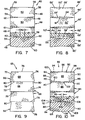
- Figure 7 shows a stack 46 of bricks 48 according to a second embodiment of the present invention.
- the bricks 48 each have front and rear end walls 50, a left side wall 54, a right side wall 56, a convex top wall 58 having flattened end portions 59 and a convex bottom wall 60 having flattened end portions 61.
- Walls 58 and 60 are smoothly radiused and bow away from one another between the side walls 54 and 56.
- the resulting region of contact R2 between the bricks is generally I-shaped and defined by the flattened end portions of the bricks and the central portions of the top and bottom walls.
- the radiused top and bottom walls produce a gap 62 between the side walls of adjacent bricks when stacked. This gap is preferably about 1/8 inch wide or more and a user's finger tips can be inserted therein to overcome any minimal stickiness between the bricks.
- Figure 8 shows a third preferred embodiment of the subject invention which comprises a stack 46' of bricks 48' similar to the bricks 48 of the second embodiment, but which include a concave top wall 58' and concave bottom wall 60' instead of the convex walls of the second preferred embodiment.
- Bricks 48 also include top wall flattened end portions 59 ' and bottom wall flattened end portions 61' in the vicinity of end walls 50'.
- the region of contact R2' between the bricks is comprised of the region near the left side wall 54 and the right side wall 56 and the flattened end portions 59' and 61'. This leaves a central gap 64 about 1/8 inch wide between the bricks.
- gaps 64 greatly reduces the amount of sticking which occurs when the bricks are stacked.
- This embodiment results in a stack of bricks which appears identical to the prior art stacks of bricks as shown in Figure 1, but by reducing the region of contact between the top and bottom walls of the bricks, the sticking problem is greatly reduced.
- Figure 9 shows a stack 65 of bricks 66 according to a fourth embodiment of the subject invention which bricks 66 have trapezoidal front and rear end walls 68, a left side wall 72, a right side wall 74, a top wall 76 and a bottom wall 78.
- the top wall 76 is narrower than the bottom wall 78, and the side walls converge toward one another in the direction from the bottom wall 78 to the top wall 76.
- the entire area of the top wall 76 of a first brick 66 contacts the bottom wall 78 of a second brick 66 when the bricks 66 are stacked.
- bottom wall 78 is wider than the top wall 76 that supports it, a portion 80 of bottom wall 78 overhangs the top wall 76 on each side thereof. This overhang provides a convenient gripping point and allows a brick 66 to be pried off of a brick beneath it in a stack. This configuration allows fire starter bricks to be easily separated while maintaining wider planar upper and lower walls, which could be desirable in some instances and provides stability.
- Figure 10 shows a stack 82 of bricks 84 according to a fifth embodiment of the subject invention.
- the bricks 84 have front and rear end walls 86, a left side wall 88, a right side wall 90, a top wall 92 having a first sloped portion 94, a top edge 96, a second sloped portion 98, and flattened end portions 100 adjacent the front end rear end walls 86, and a bottom wall 102 having a first sloped portion 104, a bottom edge 106, a second sloped portion 108 and flattened end portions 110 adjacent the front and rear end walls 86.
- the bottom wall flattened end portions 110 and the bottom edge 106 of an upper brick rest on the top wall flattened end portions 100 and the top edge 96 of a lower brick.
- These bricks contact one another over a generally I-shaped region of contact R5 defined by the top and bottom edges 96 and 106 and the top and bottom flattened end portions 100 and 110.
- the side walls 88 and 90 are generally oriented vertically when the bricks are stacked and the sloped portions 94, 98, 104 and 108 are angled at about 2 to 10 degrees to the horizontal. Therefore, when the bricks are stacked, small gaps 112 result between the side walls 88 and 90 of adjacent bricks which gaps provide a pry point for separating the bricks. On a typical brick, the resulting gap is on the order of 1/8 inch. This gap in combination with the reduced region of contact between the bricks makes the bricks easy to separate.
Landscapes
- Chemical & Material Sciences (AREA)
- Engineering & Computer Science (AREA)
- Manufacturing & Machinery (AREA)
- Oil, Petroleum & Natural Gas (AREA)
- Organic Chemistry (AREA)
- Road Paving Structures (AREA)
- Solid Fuels And Fuel-Associated Substances (AREA)
- Building Environments (AREA)
Applications Claiming Priority (2)
| Application Number | Priority Date | Filing Date | Title |
|---|---|---|---|
| US08/605,520 US5711766A (en) | 1996-02-26 | 1996-02-26 | Wood fire starter having improved stacking properties |
| US605520 | 1996-02-26 |
Publications (2)
| Publication Number | Publication Date |
|---|---|
| EP0791646A2 true EP0791646A2 (de) | 1997-08-27 |
| EP0791646A3 EP0791646A3 (de) | 1998-10-07 |
Family
ID=24424008
Family Applications (1)
| Application Number | Title | Priority Date | Filing Date |
|---|---|---|---|
| EP97103035A Withdrawn EP0791646A3 (de) | 1996-02-26 | 1997-02-25 | Holzfeueranzünder mit verbesserten Stapeleigenschaften |
Country Status (3)
| Country | Link |
|---|---|
| US (1) | US5711766A (de) |
| EP (1) | EP0791646A3 (de) |
| CA (1) | CA2197523C (de) |
Cited By (2)
| Publication number | Priority date | Publication date | Assignee | Title |
|---|---|---|---|---|
| WO2002022764A3 (en) * | 2000-09-15 | 2003-03-27 | Duraflame Inc | Environmentally-responsible artificial fireplace log and method of using same |
| DE202021003672U1 (de) | 2021-12-03 | 2022-03-11 | Anika Hanke | Zündhilfe für Brennmittel |
Families Citing this family (10)
| Publication number | Priority date | Publication date | Assignee | Title |
|---|---|---|---|---|
| US5912192A (en) * | 1998-08-28 | 1999-06-15 | Supernova Clean World | Multi-layered solid combustible article and its manufacture |
| US6027539A (en) * | 1998-09-28 | 2000-02-22 | Red-D-Lite, Inc. | Fire starter and method of making same |
| US6899740B2 (en) * | 2000-12-15 | 2005-05-31 | Rodger H. Rast | Systems and methods of enhancing consumable products |
| US20050037300A1 (en) * | 2003-08-13 | 2005-02-17 | Snyman Johannes N. | Reusable fire starter and method of use |
| US6913010B2 (en) * | 2003-10-10 | 2005-07-05 | Firebuddy Lp | Reusable fire starter and method of use |
| US7204864B2 (en) * | 2004-01-28 | 2007-04-17 | Stephens & Company, Llc | Combustible product and package |
| US8216322B2 (en) * | 2004-12-08 | 2012-07-10 | Schweickhardt Karl B | Solid fuel fire starter |
| US7597727B1 (en) | 2005-04-14 | 2009-10-06 | Morris Allan P | Method of starting a fire |
| US7823576B2 (en) | 2008-02-18 | 2010-11-02 | William Kernie Timmons | Consumable charcoal starter |
| US11149225B1 (en) | 2018-12-31 | 2021-10-19 | James Perry Merritt | Incendiary device |
Family Cites Families (37)
| Publication number | Priority date | Publication date | Assignee | Title |
|---|---|---|---|---|
| DE245835C (de) * | ||||
| DE288797C (de) * | ||||
| FR529786A (fr) * | 1921-01-13 | 1921-12-06 | Aggloméré combustible de petit volume à facettes inclinées et moyen de le fabriquer | |
| US2117415A (en) * | 1935-01-09 | 1938-05-17 | Carlisle Lumber Company | Method of making fuel briquettes |
| US3297419A (en) * | 1965-08-17 | 1967-01-10 | Fyr Tech Products Inc | Synthetic fuel log and method of manufacture |
| US3637355A (en) * | 1969-06-20 | 1972-01-25 | William Hughes Brockbank | Artificial fireplace logs which burn with colored flame |
| US3726651A (en) * | 1969-12-15 | 1973-04-10 | Husky Briquetting Inc | Synthetic fireplace log |
| US3843336A (en) * | 1972-08-31 | 1974-10-22 | Kingsford Co | Artificial fireplace log |
| US3973922A (en) * | 1974-04-29 | 1976-08-10 | Williams Thomas A | Artificial logs and log-making method and apparatus |
| US4046518A (en) * | 1976-03-22 | 1977-09-06 | Dalzell Charles J | Solid fuel element and process of manufacturing |
| CA1067286A (en) * | 1978-09-20 | 1979-12-04 | Universite Laval | Process for agglomerating particulate wood material and products obtained thereby |
| US4220453A (en) * | 1979-06-11 | 1980-09-02 | Holder Morris E | Process for producing artificial fire logs |
| NZ194493A (en) * | 1979-08-02 | 1983-07-29 | Reckitt & Colmann Prod Ltd | Ignitable combustible composition containing solid resin combustible liquid water and expanded perlite |
| FR2478669A1 (fr) * | 1980-03-20 | 1981-09-25 | Cassier Sarl | Procede et machine pour la fabrication et l'emballage de boulets de charbon de bois |
| US4308032A (en) * | 1980-09-09 | 1981-12-29 | Benson Toby T | Compacted sawdust log and method and apparatus for making the same |
| US4333738A (en) * | 1980-11-24 | 1982-06-08 | John S. Mathis | Synthetic fire log and method for making same |
| US4386937A (en) * | 1981-11-09 | 1983-06-07 | Gulf Research & Development Company | Wax-impregnated fire kindling sticks |
| US4518394A (en) * | 1981-12-22 | 1985-05-21 | Gulf Research & Development Company | Wax-impregnated fire kindling sticks |
| US4627951A (en) * | 1983-03-30 | 1986-12-09 | K. C. Shen Technology International Ltd. | Process for manufacturing composite products from lignocellulosic materials |
| JPS6025142A (ja) * | 1983-07-21 | 1985-02-07 | Matsushita Electric Ind Co Ltd | 表示装置の電極製造方法 |
| US4522585A (en) * | 1984-05-11 | 1985-06-11 | Martin Steven J | Fireplace starter |
| US4773387A (en) * | 1984-10-26 | 1988-09-27 | A. Zulkowitz Associates | Method and apparatus for making fuel elements from newspaper sheets or the like |
| US4627854A (en) * | 1985-11-04 | 1986-12-09 | Firebox Corporation | Self-contained log fire starting kit |
| US4725286A (en) * | 1986-11-20 | 1988-02-16 | Brame Dorothy H | Firestarter |
| US4810255A (en) * | 1987-01-15 | 1989-03-07 | Kimberly-Clark Corporation | Manufactured fuel article |
| US4878922A (en) * | 1987-03-24 | 1989-11-07 | A And A Realty Company | Fireplace starter composition |
| US4818249A (en) * | 1987-12-24 | 1989-04-04 | Barrett Jr Raybon | Treated wood products |
| US4877417A (en) * | 1988-03-03 | 1989-10-31 | Crace Associates, Inc. | Artificial fireplace log |
| US4952216A (en) * | 1989-03-20 | 1990-08-28 | Ronald G. Buday | Combustible log |
| US5026579A (en) * | 1989-11-28 | 1991-06-25 | Yale And Valor P.L.C. | Composite artificial log |
| US4994091A (en) * | 1990-01-05 | 1991-02-19 | Dougherty Gary J | Campfire producing element |
| US5067476A (en) * | 1990-08-02 | 1991-11-26 | Majco Building Specialties, L.P. | Artificial log assembly including combustable log members |
| US5118539A (en) * | 1991-01-22 | 1992-06-02 | Sebby David A | Fireplace logs |
| US5112365A (en) * | 1991-01-25 | 1992-05-12 | Sebring Forest Industries, Inc. | Fuel block |
| US5360586A (en) * | 1992-11-06 | 1994-11-01 | Danny R. Wyatt | Biodegradable cellulosic material and process for making such material |
| CA2157001C (en) * | 1993-02-26 | 2004-04-20 | Craig M. Reiger | Fire starter and method of making same |
| US5393310A (en) * | 1994-03-23 | 1995-02-28 | Wollen; Kenneth E. | Artificial fireplace log and method for making the same |
-
1996
- 1996-02-26 US US08/605,520 patent/US5711766A/en not_active Expired - Lifetime
-
1997
- 1997-02-13 CA CA002197523A patent/CA2197523C/en not_active Expired - Lifetime
- 1997-02-25 EP EP97103035A patent/EP0791646A3/de not_active Withdrawn
Cited By (2)
| Publication number | Priority date | Publication date | Assignee | Title |
|---|---|---|---|---|
| WO2002022764A3 (en) * | 2000-09-15 | 2003-03-27 | Duraflame Inc | Environmentally-responsible artificial fireplace log and method of using same |
| DE202021003672U1 (de) | 2021-12-03 | 2022-03-11 | Anika Hanke | Zündhilfe für Brennmittel |
Also Published As
| Publication number | Publication date |
|---|---|
| CA2197523A1 (en) | 1997-08-27 |
| EP0791646A3 (de) | 1998-10-07 |
| US5711766A (en) | 1998-01-27 |
| CA2197523C (en) | 2000-12-26 |
Similar Documents
| Publication | Publication Date | Title |
|---|---|---|
| US5711766A (en) | Wood fire starter having improved stacking properties | |
| US5858032A (en) | Solid fuels | |
| US6508849B1 (en) | Fire starter as sole fuel to quickly ignite a log of wood | |
| US4063904A (en) | Self-contained fire package | |
| US4981496A (en) | Charcoal briquet and ignition means | |
| US20130247455A1 (en) | Fire starter | |
| US6886555B2 (en) | Fireplace grate | |
| CA2157001C (en) | Fire starter and method of making same | |
| US4952217A (en) | Fire kindler | |
| EP2060618A1 (de) | Verbrennungsmaterialien | |
| US4189305A (en) | Smokeless fire kindling device | |
| EP1520002B1 (de) | Vorrichtung zum anzünden eines feuers | |
| US5858036A (en) | Artificial fire log | |
| US20080113308A1 (en) | Sectional candle apparatus | |
| US4180054A (en) | Tray for increasing wax impregnated log burning life | |
| US6086646A (en) | Apparatus for starting a log fire | |
| KR102915855B1 (ko) | 중앙 집중 연소 방식의 지연 연소형 목분 화구 | |
| JP3032807U (ja) | 燃焼材 | |
| US6855181B2 (en) | Heating means | |
| GB2442702A (en) | Carbon fuel combustion package | |
| US6071320A (en) | Apparatus for starting a log fire | |
| WO2018030543A1 (ja) | 構成薪 | |
| US20060130395A1 (en) | Fire starter utilizing recycled materials | |
| AU2928900A (en) | Improved firelighter | |
| US6193769B1 (en) | Fuel cell for chafing dishes |
Legal Events
| Date | Code | Title | Description |
|---|---|---|---|
| PUAI | Public reference made under article 153(3) epc to a published international application that has entered the european phase |
Free format text: ORIGINAL CODE: 0009012 |
|
| AK | Designated contracting states |
Kind code of ref document: A2 Designated state(s): AT BE CH DE DK ES FI FR GB GR IE IT LI LU MC NL PT SE |
|
| AX | Request for extension of the european patent |
Free format text: AL PAYMENT 970320;LT PAYMENT 970320;LV PAYMENT 970320;RO PAYMENT 970320;SI PAYMENT 970320 |
|
| PUAL | Search report despatched |
Free format text: ORIGINAL CODE: 0009013 |
|
| AK | Designated contracting states |
Kind code of ref document: A3 Designated state(s): AT BE CH DE DK ES FI FR GB GR IE IT LI LU MC NL PT SE |
|
| 17P | Request for examination filed |
Effective date: 19981106 |
|
| 17Q | First examination report despatched |
Effective date: 20010314 |
|
| GRAH | Despatch of communication of intention to grant a patent |
Free format text: ORIGINAL CODE: EPIDOS IGRA |
|
| STAA | Information on the status of an ep patent application or granted ep patent |
Free format text: STATUS: THE APPLICATION IS DEEMED TO BE WITHDRAWN |
|
| 18D | Application deemed to be withdrawn |
Effective date: 20030328 |