EP0787984B1 - Elektrochemischer Sensor ohne Eichung - Google Patents
Elektrochemischer Sensor ohne Eichung Download PDFInfo
- Publication number
- EP0787984B1 EP0787984B1 EP19970100590 EP97100590A EP0787984B1 EP 0787984 B1 EP0787984 B1 EP 0787984B1 EP 19970100590 EP19970100590 EP 19970100590 EP 97100590 A EP97100590 A EP 97100590A EP 0787984 B1 EP0787984 B1 EP 0787984B1
- Authority
- EP
- European Patent Office
- Prior art keywords
- electrochemical sensor
- sensor according
- opening
- conductive strips
- sensor
- Prior art date
- Legal status (The legal status is an assumption and is not a legal conclusion. Google has not performed a legal analysis and makes no representation as to the accuracy of the status listed.)
- Expired - Lifetime
Links
- 238000005259 measurement Methods 0.000 claims description 20
- 239000000758 substrate Substances 0.000 claims description 13
- WQZGKKKJIJFFOK-GASJEMHNSA-N Glucose Natural products OC[C@H]1OC(O)[C@H](O)[C@@H](O)[C@@H]1O WQZGKKKJIJFFOK-GASJEMHNSA-N 0.000 claims description 7
- 239000008103 glucose Substances 0.000 claims description 7
- ROFVEXUMMXZLPA-UHFFFAOYSA-N Bipyridyl Chemical class N1=CC=CC=C1C1=CC=CC=N1 ROFVEXUMMXZLPA-UHFFFAOYSA-N 0.000 claims description 6
- 239000000243 solution Substances 0.000 claims description 5
- 108090000790 Enzymes Proteins 0.000 claims description 4
- 102000004190 Enzymes Human genes 0.000 claims description 4
- KJTLSVCANCCWHF-UHFFFAOYSA-N Ruthenium Chemical compound [Ru] KJTLSVCANCCWHF-UHFFFAOYSA-N 0.000 claims description 3
- 239000007983 Tris buffer Substances 0.000 claims description 3
- 239000003446 ligand Substances 0.000 claims description 3
- 229910052762 osmium Inorganic materials 0.000 claims description 3
- SYQBFIAQOQZEGI-UHFFFAOYSA-N osmium atom Chemical compound [Os] SYQBFIAQOQZEGI-UHFFFAOYSA-N 0.000 claims description 3
- 229910052707 ruthenium Inorganic materials 0.000 claims description 3
- 229910052720 vanadium Inorganic materials 0.000 claims description 3
- LEONUFNNVUYDNQ-UHFFFAOYSA-N vanadium atom Chemical compound [V] LEONUFNNVUYDNQ-UHFFFAOYSA-N 0.000 claims description 3
- 239000000126 substance Substances 0.000 claims description 2
- 239000000470 constituent Substances 0.000 claims 2
- 125000002791 glucosyl group Chemical group C1([C@H](O)[C@@H](O)[C@H](O)[C@H](O1)CO)* 0.000 claims 1
- 239000000376 reactant Substances 0.000 claims 1
- 239000003153 chemical reaction reagent Substances 0.000 description 11
- 238000004519 manufacturing process Methods 0.000 description 11
- 239000010408 film Substances 0.000 description 9
- 108010015776 Glucose oxidase Proteins 0.000 description 4
- 239000004366 Glucose oxidase Substances 0.000 description 4
- 239000013039 cover film Substances 0.000 description 4
- 229940116332 glucose oxidase Drugs 0.000 description 4
- 235000019420 glucose oxidase Nutrition 0.000 description 4
- 239000008280 blood Substances 0.000 description 3
- 210000004369 blood Anatomy 0.000 description 3
- 238000000034 method Methods 0.000 description 3
- 238000004806 packaging method and process Methods 0.000 description 3
- 238000011088 calibration curve Methods 0.000 description 2
- 206010012601 diabetes mellitus Diseases 0.000 description 2
- 229940088598 enzyme Drugs 0.000 description 2
- 238000009413 insulation Methods 0.000 description 2
- 230000003993 interaction Effects 0.000 description 2
- 238000012360 testing method Methods 0.000 description 2
- 238000003556 assay Methods 0.000 description 1
- 238000010923 batch production Methods 0.000 description 1
- 239000013060 biological fluid Substances 0.000 description 1
- 239000004020 conductor Substances 0.000 description 1
- 238000010276 construction Methods 0.000 description 1
- 238000003869 coulometry Methods 0.000 description 1
- 238000005520 cutting process Methods 0.000 description 1
- 238000013479 data entry Methods 0.000 description 1
- 238000000151 deposition Methods 0.000 description 1
- 230000001627 detrimental effect Effects 0.000 description 1
- 238000011161 development Methods 0.000 description 1
- 238000009792 diffusion process Methods 0.000 description 1
- 229940082150 encore Drugs 0.000 description 1
- 239000012530 fluid Substances 0.000 description 1
- 239000003292 glue Substances 0.000 description 1
- 239000000463 material Substances 0.000 description 1
- 239000000203 mixture Substances 0.000 description 1
- 238000012544 monitoring process Methods 0.000 description 1
- 238000011160 research Methods 0.000 description 1
- 238000012546 transfer Methods 0.000 description 1
Images
Classifications
-
- G—PHYSICS
- G01—MEASURING; TESTING
- G01N—INVESTIGATING OR ANALYSING MATERIALS BY DETERMINING THEIR CHEMICAL OR PHYSICAL PROPERTIES
- G01N27/00—Investigating or analysing materials by the use of electric, electrochemical, or magnetic means
- G01N27/26—Investigating or analysing materials by the use of electric, electrochemical, or magnetic means by investigating electrochemical variables; by using electrolysis or electrophoresis
- G01N27/28—Electrolytic cell components
- G01N27/30—Electrodes, e.g. test electrodes; Half-cells
- G01N27/327—Biochemical electrodes, e.g. electrical or mechanical details for in vitro measurements
- G01N27/3271—Amperometric enzyme electrodes for analytes in body fluids, e.g. glucose in blood
- G01N27/3272—Test elements therefor, i.e. disposable laminated substrates with electrodes, reagent and channels
Definitions
- the present invention relates to a sensor electrochemical, intended for single use to measure the concentration of a component in a sample of a solution, fluid or effluent using a portable electronic measuring device, without being necessary to implement beforehand a means of calibration which is a function of the manufacturing batch of said sensor.
- the invention relates more particularly to such a sensor used for medical monitoring of a patient in outpatient treatment, requiring measurement of concentration of a component in a biological fluid body, such as a person’s blood glucose level individual with diabetes.
- sensors disposable electrochemicals for measurements have experienced considerable development.
- they consist of an insulating support small dimensions, supporting at least two electrodes electrically separated and connectable to a measurement, the measurement electrode being further coated with a specific reagent of the component whose concentration.
- the measurement is carried out by depositing the sample to be analyzed in an area marked by a opening made in a covering film leaving appear the electrodes and portions of the substrate insulating.
- This measurement is carried out indirectly by the exploitation of an electrical signal generated by the interaction between the reagent and the component of which wants to measure concentration.
- the intensity of this signal is a function of the area of electrodes.
- This exploitation of the electrical signal consists generally in conductometric measurements, voltametric, amperometric, coulometric, or polarographic to calibrate the device electronic measurement based on signal strength electric received so as to display directly on a screen the concentration of the component according to a mode determined (mg / dl, mmol / l). So that the displayed value actually corresponds to the concentration present in sample, the interaction between the component and the reagent is carried out rigorously from the same way, that is to say that the electrical signal produced be identical regardless of the sensor used. Now, for that these sensors can be disposable, they must be cheap, and for that they cannot be made than in batch series. Regardless of the care taken in manufacturing these sensors, both at the construction that at the dosage level of the different components of the reagent, you inevitably observe small variations from one production batch to another, variation detrimental to the reliability of said sensors.
- the sensor packages currently on the market include either a code number to be entered into the device by means of a numeric keypad, either a means of calibration to be implemented in the device before the first measurement.
- the means of calibration or data entry can be constituted by a test sensor having a resistance calibrated, a bar provided with a bar code that can be read by the device, or even a microchip.
- the calibration means currently required significantly increase the cost of each sensor, i.e. finally the cost of medical treatment performed under control of the measurements made with a sensor, by example with a glucose sensor for people suffering from diabetes.
- the present invention aims to remedy the disadvantages of the prior art by providing a sensor mass produced, but not requiring use calibration means, whatever the batch of manufacture of which said sensor originates, provided that the time limit for use is respected.
- the invention relates to a sensor electrochemical, used to measure the concentration of a component in a solution, in the form of a tongue small dimensions including a thin elongated substrate insulation supporting on either side of its midline two conductive strips of width L and L ', the facing edges are electrically isolated from one of the other by a space of width ⁇ , the widths L, L 'and ⁇ being measured perpendicular to the center line, said substrate and said conductive strips being covered with an insulating cover film, in which a connection window is cut at one end, and near the other end, at least one window measurement formed by two openings separated by a portion of said cover film, each opening delimiting on a portion of each conductive strip the surfaces useful of a working electrode and a reference, characterized in that each opening has any point of the dimensions measured perpendicular to the midline such as the edge farthest from the edge of the strip portion forming the electrode that said opening does not discover is located at a distance between L + ⁇ and ⁇ , respectively L '
- the electrochemical sensor has axial symmetry along its center line.
- Current collectors then have the same width and the useful surfaces of electrodes are identical.
- each opening has the shape of a circular area of the same surface and the portion of the film of cover intended to separate the openings has the form a narrow strip parallel to the conductive strips, width greater than ⁇ , each of its edges covering a narrow portion of the two conductive strips.
- Connection and measurement windows can be cut from the cover film using techniques known, but according to a preferred embodiment, these windows are cut by stamping said film.
- stamping was the technique which made it possible to obtain reproducibility the most perfect and therefore the greatest precision in useful surfaces of the electrodes, whatever the batch of manufacturing.
- the sensor electrochemical according to the invention allows the dosage of a component in a solution, further comprising on the working electrode a reagent containing at least one specific enzyme of the component whose we want to measure concentration and a chemical mediator to transfer the electrons.
- mediator one can choose one of those described in US Patent 5,393,903, namely 2,2'-bipyridine substituted mono, bis or tris complexes of ruthenium, osmium or vanadium, having at least one of bipyridine ligands substituted with at least one group electron donor.
- Such mediators indeed have the properties required for stability and speed of mediation while not having, or excessively little influence on the deviation of a measurement depending of the manufacturing batch of the sensor used.
- glucose oxidase GOD
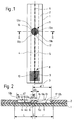
- the figures represent the sensor in its ready-to-use form, i.e. after cutting of its manufacturing batch, which can be either a strip, or a leaf.
- a sensor to measure blood glucose level that is to say an electrochemical sensor comprising at in addition to reagent 18, the nature of which will be specified more far.
- This sensor has the shape of a thin tab of small dimensions with a total thickness between 0.25 and 0.75 mm, preferably about 0.5 mm; the width is between 6 and 12 mm, preferably about 8 mm; in the example chosen with only one window measuring 11, its length is of the order of 40 mm.
- the senor comprises a thin insulating substrate 1, made of a flexible but rigid material known from those skilled in the art, such as PET.
- the substrate 1 supports two conductive strips 4, 5 whose opposite edges (4a, 5a) are isolated electrically by a space of width ⁇ .
- the assembly thus formed by the substrate 1 and by the conductive strips 4, 5 is covered by a thin insulating cover film 2 from which two windows 8 and 11 are cut, near each end.
- the window 8 is a connection window revealing portions of conductive strips 4, 5 forming the contacts 9, 10 which will allow the sensor to be connected to a portable electronic device. As seen in Figure 1, the portions of conductive strips pass through the window 8 and reveal a small strip of the substrate 1 near their outer edges.
- the window 11 is a measurement window comprising two openings 12, 13 symmetrical with respect to the axis 3 of the sensor, separated by a narrow portion 14 of the strip-shaped covering film.
- the openings 12, 13 delimit on portions of conductive strips 4, 5 the surface of each electrode 16, 17, the dimensions of each opening 12, 13 being such that no portion of the substrate 1 appears.
- its edge 12b furthest from the edge 5a of the strip portion 5 forming the electrode 17 that said opening 12 does not discover is at a distance d 1 such that L + ⁇ > d 1 > ⁇ and its nearest edge 12a of said edge 5a is located at a distance d 2 such that d 2 > ⁇ .
- edge 13b of the opening 13 is at a distance of 1 from the edge 4a of the strip portion 4 forming the electrode 16 that said opening 13 does not discover such that L '+ ⁇ > d ' 1 > ⁇ , and the nearest edge 13a at a distance of 2 such that 2 > ⁇ . All distances d 1, d 2, d '1 and 2, are measured perpendicularly to the centreline 3.
- the openings have the form of circular sectors separated by a strip 14 of width greater than ⁇ , which covers the facing edges 4a, 5a of the two strip portions 4, 5 forming the electrodes 16, 17, over a width substantially equal to the overlap width near the edges furthest from each opening.
- this overlap will for example be at least of the order of 0.10 mm over the entire periphery of each opening.
- the surface of each electrode is very precisely delimited by the surface of each opening, eliminating any variation in surface due either to the irregularity of the edges of the conductive strips, or to small variations in positioning of the covering film. 2 on the substrate 1.
- the greatest reproducibility in the surface of the openings is obtained by stamping the film 2.
- the substrate and the covering film are held together by known methods such as thermofusion of the surfaces in look, or applying a glue.
- this reagent will be, for example, that described in US Patent 5,378,628 giving the conditions for optimizing a mixture including in particular glucose oxidase (GOD) and a mediator chosen from mono, bis or tris complexes 2,2'-bipyridine substituted with ruthenium, osmium or vanadium having at least one bipyridine ligand substituted with at least one electron donor group.
- GOD glucose oxidase
- a mediator chosen from mono, bis or tris complexes 2,2'-bipyridine substituted with ruthenium, osmium or vanadium having at least one bipyridine ligand substituted with at least one electron donor group.
- the invention therefore provides a sensor which can thus be presented to the user in packaging including no means of calibration.
- the packaging may at most have a date usage limit, as is customary for consumer products, especially in the field pharmaceutical.
Landscapes
- Life Sciences & Earth Sciences (AREA)
- Health & Medical Sciences (AREA)
- Chemical & Material Sciences (AREA)
- Physics & Mathematics (AREA)
- Biochemistry (AREA)
- Hematology (AREA)
- Chemical Kinetics & Catalysis (AREA)
- Electrochemistry (AREA)
- Biophysics (AREA)
- Analytical Chemistry (AREA)
- Molecular Biology (AREA)
- General Health & Medical Sciences (AREA)
- General Physics & Mathematics (AREA)
- Immunology (AREA)
- Pathology (AREA)
- Measurement Of The Respiration, Hearing Ability, Form, And Blood Characteristics Of Living Organisms (AREA)
- Investigating Or Analysing Biological Materials (AREA)
Claims (7)
- Elektrochemischer Sensor zum Messen der Konzentration einer Komponente in einer Lösung, in Form eines Streifens mit kleinen Abmessungen, umfassend ein isolierendes, schlankes, langgestrecktes Substrat (1), welches auf beiden Seiten seiner Mittellinie (3) zwei leitende Streifen (4, 5) der Breite L und L' trägt, deren gegenüberliegende Kanten (4a, 5a) durch einen Zwischenraum (6) der Breite δ elektrisch voneinander isoliert sind, wobei die Breiten L, L' und δ senkrecht zur Mittellinie (3) gemessen werden, wobei das Substrat (1) und die leitenden Streifen (4, 5) mit einem isolierenden Abdeckungsfilm (2) bedeckt sind, aus welchem an einem Ende ein Verbindungsfenster (8) und nahe des anderen Endes mindestens ein aus zwei durch einen Abschnitt (14) des Abdeckungsfilms (2) voneinander getrennten Öffnungen (12, 13) gebildetes Meßfenster (11) ausgeschnitten sind, wobei jede Öffnung auf einem Abschnitt jedes leitenden Streifens (4, 5) die Nutzflächen einer Arbeitselektrode (16) und einer Referenzelektrode (17) begrenzt, dadurch gekennzeichnet, daß jede Öffnung (12, 13) an allen Stellen senkrecht zur Mittellinie (3) gemessene Abmessungen so aufweist, daß der von der Kante (5a, 4a) des die Elektrode (17, 16) bildenden Abschnitts des Streifens (5, 4), der die Öffnung (12, 13) nicht bedeckt, am weitesten entfernte Rand (12b, 13b) in einer Entfernung zwischen L+δ und δ bzw. L'+δ und δ, und der nächstliegende Rand (12a, 13a) in einer Entfernung, die größer ist als δ, angebracht ist, wobei eine solche Anordnung einen Sensor schafft, der keiner Kalibration bedarf.
- Elektrochemischer Sensor nach Anspruch 1, dadurch gekennzeichnet, daß er eine Symmetrieachse bezogen auf seine Mittellinie (3) aufweist, wobei die leitenden Streifen (4, 5) entlang ihrer Länge im wesentlichen die gleiche Breite L = L' haben und die Oberflächen der Elektroden (16, 17) gleichfalls identisch sind.
- Elektrochemischer Sensor nach Anspruch 2, dadurch gekennzeichnet, daß jede Öffnung (12, 13) die Gestalt eines kreisförmigen Abschnitts hat und daß die die beiden Öffnungen trennende Region (14) die Gestalt eines zu den beiden leitenden Streifen (4, 5) parallelen Streifens hat.
- Elektrochemischer Sensor nach Anspruch 1, dadurch gekennzeichnet, daß die Fenster (8, 11) durch Stanzen des Abdeckfilms (2) realisiert sind.
- Elektrochemischer Sensor nach Anspruch 1, dadurch gekennzeichnet, daß die Arbeitselektrode (16) zudem mit einem Reagenz (18) überzogen ist, welches mindestens ein für die in der Lösung enthaltene Komponente spezifisches Enzym und einen zum Übertragen von Elektronen geeigneten chemischen Vermittler enthält.
- Elektrochemischer Sensor nach Anspruch 5, dadurch gekennzeichnet, daß der Vermittler aus den mit Ruthenium, Osmium oder Vanadium substituierten Komplexen mono-, bis- oder tri-2,2'-Bipyridin ausgewählt wird, wobei mindestens einer der Bipyridin-Liganden durch mindestens eine Gruppe von Elektronendonatoren substituiert ist.
- Elektrochemischer Sensor nach Anspruch 5 oder 6, dadurch gekennzeichnet, daß das Enzym Glukoseoxidase (GOD) ist, um die Dosierung von Glukose durchzuführen.
Applications Claiming Priority (2)
| Application Number | Priority Date | Filing Date | Title |
|---|---|---|---|
| FR9601140A FR2744219B1 (fr) | 1996-01-31 | 1996-01-31 | Capteur electrochimique sans calibration |
| FR9601140 | 1996-01-31 |
Publications (2)
| Publication Number | Publication Date |
|---|---|
| EP0787984A1 EP0787984A1 (de) | 1997-08-06 |
| EP0787984B1 true EP0787984B1 (de) | 1999-04-07 |
Family
ID=9488666
Family Applications (1)
| Application Number | Title | Priority Date | Filing Date |
|---|---|---|---|
| EP19970100590 Expired - Lifetime EP0787984B1 (de) | 1996-01-31 | 1997-01-16 | Elektrochemischer Sensor ohne Eichung |
Country Status (6)
| Country | Link |
|---|---|
| EP (1) | EP0787984B1 (de) |
| JP (1) | JP3245371B2 (de) |
| AU (1) | AU709747B2 (de) |
| CA (1) | CA2196391A1 (de) |
| DE (1) | DE69700169T2 (de) |
| FR (1) | FR2744219B1 (de) |
Cited By (1)
| Publication number | Priority date | Publication date | Assignee | Title |
|---|---|---|---|---|
| US8115635B2 (en) | 2005-02-08 | 2012-02-14 | Abbott Diabetes Care Inc. | RF tag on test strips, test strip vials and boxes |
Families Citing this family (10)
| Publication number | Priority date | Publication date | Assignee | Title |
|---|---|---|---|---|
| DE69839771D1 (de) * | 1998-10-09 | 2008-09-04 | Asulab Sa | Einfach handzuhabender streifenförmiger elektrochemischer Sensor |
| DE69941563D1 (de) | 1999-02-23 | 2009-12-03 | Asulab Sa | Elektrochemisches System zur Bestimmung der Blutgerinnungszeit |
| EP1162453A1 (de) * | 2000-06-07 | 2001-12-12 | Asulab S.A. | Elektrochemischer Sensor mit verbesserter Reproduzierbarkeit |
| JP4576672B2 (ja) * | 2000-06-15 | 2010-11-10 | パナソニック株式会社 | バイオセンサ |
| ATE505724T1 (de) | 2001-09-14 | 2011-04-15 | Arkray Inc | Verfahren, gerät und vorrichtung zur konzentrationsmessung |
| US6866758B2 (en) * | 2002-03-21 | 2005-03-15 | Roche Diagnostics Corporation | Biosensor |
| EP1628129B1 (de) * | 2003-03-25 | 2013-12-25 | Arkray Inc. | Sensorbehälter mit Sensoren |
| GB201005357D0 (en) | 2010-03-30 | 2010-05-12 | Menai Medical Technologies Ltd | Sampling plate |
| GB201005359D0 (en) | 2010-03-30 | 2010-05-12 | Menai Medical Technologies Ltd | Sampling plate |
| CN103472480B (zh) * | 2013-09-22 | 2016-11-09 | 中国科学院电子学研究所 | 电化学敏感元件、其制备方法、应用其的地震检波器 |
Family Cites Families (6)
| Publication number | Priority date | Publication date | Assignee | Title |
|---|---|---|---|---|
| US4468271A (en) * | 1982-10-28 | 1984-08-28 | Eastman Kodak Company | Method of making a device for determining analyte activity |
| CA1316572C (en) * | 1988-07-18 | 1993-04-20 | Martin J. Patko | Precalibrated, disposable, electrochemical sensors |
| FR2673289B1 (fr) * | 1991-02-21 | 1994-06-17 | Asulab Sa | Capteur de mesure de la quantite d'un composant en solution. |
| FR2673183B1 (fr) * | 1991-02-21 | 1996-09-27 | Asulab Sa | Complexes mono, bis ou tris (2,2'-bipyridine substituee) d'un metal choisi parmi le fer, le ruthenium, l'osmium ou le vanadium et leurs procedes de preparation . |
| FR2701117B1 (fr) * | 1993-02-04 | 1995-03-10 | Asulab Sa | Système de mesures électrochimiques à capteur multizones, et son application au dosage du glucose. |
| US5385846A (en) * | 1993-06-03 | 1995-01-31 | Boehringer Mannheim Corporation | Biosensor and method for hematocrit determination |
-
1996
- 1996-01-31 FR FR9601140A patent/FR2744219B1/fr not_active Expired - Fee Related
-
1997
- 1997-01-15 AU AU10186/97A patent/AU709747B2/en not_active Ceased
- 1997-01-16 DE DE1997600169 patent/DE69700169T2/de not_active Expired - Fee Related
- 1997-01-16 EP EP19970100590 patent/EP0787984B1/de not_active Expired - Lifetime
- 1997-01-28 JP JP01387697A patent/JP3245371B2/ja not_active Expired - Fee Related
- 1997-01-30 CA CA002196391A patent/CA2196391A1/en not_active Abandoned
Cited By (5)
| Publication number | Priority date | Publication date | Assignee | Title |
|---|---|---|---|---|
| US8115635B2 (en) | 2005-02-08 | 2012-02-14 | Abbott Diabetes Care Inc. | RF tag on test strips, test strip vials and boxes |
| US8223021B2 (en) | 2005-02-08 | 2012-07-17 | Abbott Diabetes Care Inc. | RF tag on test strips, test strip vials and boxes |
| US8358210B2 (en) | 2005-02-08 | 2013-01-22 | Abbott Diabetes Care Inc. | RF tag on test strips, test strip vials and boxes |
| US8390455B2 (en) | 2005-02-08 | 2013-03-05 | Abbott Diabetes Care Inc. | RF tag on test strips, test strip vials and boxes |
| US8542122B2 (en) | 2005-02-08 | 2013-09-24 | Abbott Diabetes Care Inc. | Glucose measurement device and methods using RFID |
Also Published As
| Publication number | Publication date |
|---|---|
| AU709747B2 (en) | 1999-09-09 |
| DE69700169D1 (de) | 1999-05-12 |
| EP0787984A1 (de) | 1997-08-06 |
| JPH09222410A (ja) | 1997-08-26 |
| DE69700169T2 (de) | 1999-10-28 |
| FR2744219A1 (fr) | 1997-08-01 |
| AU1018697A (en) | 1997-08-07 |
| FR2744219B1 (fr) | 1998-03-20 |
| JP3245371B2 (ja) | 2002-01-15 |
| CA2196391A1 (en) | 1997-08-01 |
Similar Documents
| Publication | Publication Date | Title |
|---|---|---|
| JP4374020B2 (ja) | Ac励起を用いた検体測定システムおよび方法 | |
| CN1839313B (zh) | 涉及电化学生物传感器的设备和方法 | |
| EP0624653A1 (de) | Scheibenförmiger, multizonaler, elektrochemischer Sensor für die Bestimmung von Glykose | |
| EP1162453A1 (de) | Elektrochemischer Sensor mit verbesserter Reproduzierbarkeit | |
| EP0609760A1 (de) | Elektrochemisches System mit mehrzonigem Sensorelement zur Bestimmung von Glukose | |
| US6287451B1 (en) | Disposable sensor and method of making | |
| EP0787984A1 (de) | Elektrochemischer Sensor ohne Eichung | |
| CN101849180B (zh) | 多区域分析物测试传感器 | |
| US20040224369A1 (en) | Disposable sensor with enhanced sample port inlet | |
| ES2630225T3 (es) | Método para análisis electroquímico rápido | |
| EP1742063B1 (de) | System zur differenziellen Bestimmung der Menge eines proteolytischen Enzyms in einer Körperflüssigkeit | |
| WO1992014836A1 (fr) | Capteur de mesure de la quantite d'un composant en solution | |
| WO2008079731A1 (en) | Gel formation to reduce hematocrit sensitivity in electrochemical test | |
| JP4510933B2 (ja) | 塩分量の測定方法 | |
| AU2006272909A1 (en) | Gated amperometry | |
| BRPI0616743B1 (pt) | Métodos voltamétricos e dispositivos para medição de analito em amostra | |
| JP2001194298A (ja) | 表面プラズモン共鳴酵素センサーおよび表面プラズモン共鳴の測定方法 | |
| FR2757949A1 (fr) | Microsysteme pour analyses biologiques et son procede de fabrication | |
| CH621410A5 (de) | ||
| US20140332414A1 (en) | Disposable test sensor with improved sampling entrance | |
| EP0780684A1 (de) | Zuverlüssige integrierte elektrochemische Mikrosensoren und Mikrosysteme zur direkten chemischen Analyse von Verbindungen in komplexen wässrigen Medien | |
| EP0992790B1 (de) | Einfach handzuhabender streifenförmiger elektrochemischer Sensor | |
| JP2008157915A (ja) | 光電流を用いた被検物質の特異的検出方法、それに用いられる吸水性シート、センサユニット、および測定装置 | |
| FR2624611A1 (fr) | Capteur potentiometrique homogene | |
| CA2197465A1 (fr) | Dispositif de diagnostic rapide de toute molecule glyquee et procede de mise en oeuvre |
Legal Events
| Date | Code | Title | Description |
|---|---|---|---|
| PUAI | Public reference made under article 153(3) epc to a published international application that has entered the european phase |
Free format text: ORIGINAL CODE: 0009012 |
|
| AK | Designated contracting states |
Kind code of ref document: A1 Designated state(s): BE CH DE GB IT LI NL |
|
| RBV | Designated contracting states (corrected) |
Designated state(s): BE CH DE GB IT LI NL |
|
| 17P | Request for examination filed |
Effective date: 19980206 |
|
| GRAG | Despatch of communication of intention to grant |
Free format text: ORIGINAL CODE: EPIDOS AGRA |
|
| 17Q | First examination report despatched |
Effective date: 19980710 |
|
| GRAG | Despatch of communication of intention to grant |
Free format text: ORIGINAL CODE: EPIDOS AGRA |
|
| GRAG | Despatch of communication of intention to grant |
Free format text: ORIGINAL CODE: EPIDOS AGRA |
|
| GRAH | Despatch of communication of intention to grant a patent |
Free format text: ORIGINAL CODE: EPIDOS IGRA |
|
| GRAH | Despatch of communication of intention to grant a patent |
Free format text: ORIGINAL CODE: EPIDOS IGRA |
|
| GRAA | (expected) grant |
Free format text: ORIGINAL CODE: 0009210 |
|
| AK | Designated contracting states |
Kind code of ref document: B1 Designated state(s): BE CH DE GB IT LI NL |
|
| REG | Reference to a national code |
Ref country code: CH Ref legal event code: EP |
|
| REF | Corresponds to: |
Ref document number: 69700169 Country of ref document: DE Date of ref document: 19990512 |
|
| REG | Reference to a national code |
Ref country code: CH Ref legal event code: NV Representative=s name: ICB INGENIEURS CONSEILS EN BREVETS SA |
|
| GBT | Gb: translation of ep patent filed (gb section 77(6)(a)/1977) |
Effective date: 19990701 |
|
| PLBE | No opposition filed within time limit |
Free format text: ORIGINAL CODE: 0009261 |
|
| STAA | Information on the status of an ep patent application or granted ep patent |
Free format text: STATUS: NO OPPOSITION FILED WITHIN TIME LIMIT |
|
| 26N | No opposition filed | ||
| REG | Reference to a national code |
Ref country code: GB Ref legal event code: IF02 |
|
| PGFP | Annual fee paid to national office [announced via postgrant information from national office to epo] |
Ref country code: BE Payment date: 20021224 Year of fee payment: 7 |
|
| PGFP | Annual fee paid to national office [announced via postgrant information from national office to epo] |
Ref country code: NL Payment date: 20030107 Year of fee payment: 7 |
|
| PGFP | Annual fee paid to national office [announced via postgrant information from national office to epo] |
Ref country code: CH Payment date: 20031229 Year of fee payment: 8 |
|
| PGFP | Annual fee paid to national office [announced via postgrant information from national office to epo] |
Ref country code: GB Payment date: 20031231 Year of fee payment: 8 |
|
| PGFP | Annual fee paid to national office [announced via postgrant information from national office to epo] |
Ref country code: DE Payment date: 20040121 Year of fee payment: 8 |
|
| PG25 | Lapsed in a contracting state [announced via postgrant information from national office to epo] |
Ref country code: BE Free format text: LAPSE BECAUSE OF NON-PAYMENT OF DUE FEES Effective date: 20040131 |
|
| BERE | Be: lapsed |
Owner name: S.A. *ASULAB Effective date: 20040131 |
|
| PG25 | Lapsed in a contracting state [announced via postgrant information from national office to epo] |
Ref country code: IT Free format text: LAPSE BECAUSE OF NON-PAYMENT OF DUE FEES;WARNING: LAPSES OF ITALIAN PATENTS WITH EFFECTIVE DATE BEFORE 2007 MAY HAVE OCCURRED AT ANY TIME BEFORE 2007. THE CORRECT EFFECTIVE DATE MAY BE DIFFERENT FROM THE ONE RECORDED. Effective date: 20050116 Ref country code: GB Free format text: LAPSE BECAUSE OF NON-PAYMENT OF DUE FEES Effective date: 20050116 |
|
| PG25 | Lapsed in a contracting state [announced via postgrant information from national office to epo] |
Ref country code: LI Free format text: LAPSE BECAUSE OF NON-PAYMENT OF DUE FEES Effective date: 20050131 Ref country code: CH Free format text: LAPSE BECAUSE OF NON-PAYMENT OF DUE FEES Effective date: 20050131 |
|
| PG25 | Lapsed in a contracting state [announced via postgrant information from national office to epo] |
Ref country code: NL Free format text: LAPSE BECAUSE OF NON-PAYMENT OF DUE FEES Effective date: 20050801 |
|
| PG25 | Lapsed in a contracting state [announced via postgrant information from national office to epo] |
Ref country code: DE Free format text: LAPSE BECAUSE OF NON-PAYMENT OF DUE FEES Effective date: 20050802 |
|
| GBPC | Gb: european patent ceased through non-payment of renewal fee |
Effective date: 20050116 |
|
| REG | Reference to a national code |
Ref country code: CH Ref legal event code: PL |
|
| NLV4 | Nl: lapsed or anulled due to non-payment of the annual fee |
Effective date: 20050801 |