EP0784609B2 - Verfahren zur herstellung von pumpfähigen wässrigen tensidkonzentraten - Google Patents
Verfahren zur herstellung von pumpfähigen wässrigen tensidkonzentraten Download PDFInfo
- Publication number
- EP0784609B2 EP0784609B2 EP95935377A EP95935377A EP0784609B2 EP 0784609 B2 EP0784609 B2 EP 0784609B2 EP 95935377 A EP95935377 A EP 95935377A EP 95935377 A EP95935377 A EP 95935377A EP 0784609 B2 EP0784609 B2 EP 0784609B2
- Authority
- EP
- European Patent Office
- Prior art keywords
- alkyl
- carbon atoms
- weight
- formula
- alkylation
- Prior art date
- Legal status (The legal status is an assumption and is not a legal conclusion. Google has not performed a legal analysis and makes no representation as to the accuracy of the status listed.)
- Expired - Lifetime
Links
Classifications
-
- A—HUMAN NECESSITIES
- A61—MEDICAL OR VETERINARY SCIENCE; HYGIENE
- A61K—PREPARATIONS FOR MEDICAL, DENTAL OR TOILETRY PURPOSES
- A61K8/00—Cosmetics or similar toiletry preparations
- A61K8/18—Cosmetics or similar toiletry preparations characterised by the composition
- A61K8/30—Cosmetics or similar toiletry preparations characterised by the composition containing organic compounds
- A61K8/60—Sugars; Derivatives thereof
- A61K8/604—Alkylpolyglycosides; Derivatives thereof, e.g. esters
-
- A—HUMAN NECESSITIES
- A61—MEDICAL OR VETERINARY SCIENCE; HYGIENE
- A61K—PREPARATIONS FOR MEDICAL, DENTAL OR TOILETRY PURPOSES
- A61K8/00—Cosmetics or similar toiletry preparations
- A61K8/18—Cosmetics or similar toiletry preparations characterised by the composition
- A61K8/30—Cosmetics or similar toiletry preparations characterised by the composition containing organic compounds
- A61K8/40—Cosmetics or similar toiletry preparations characterised by the composition containing organic compounds containing nitrogen
- A61K8/44—Aminocarboxylic acids or derivatives thereof, e.g. aminocarboxylic acids containing sulfur; Salts; Esters or N-acylated derivatives thereof
- A61K8/442—Aminocarboxylic acids or derivatives thereof, e.g. aminocarboxylic acids containing sulfur; Salts; Esters or N-acylated derivatives thereof substituted by amido group(s)
-
- A—HUMAN NECESSITIES
- A61—MEDICAL OR VETERINARY SCIENCE; HYGIENE
- A61Q—SPECIFIC USE OF COSMETICS OR SIMILAR TOILETRY PREPARATIONS
- A61Q19/00—Preparations for care of the skin
- A61Q19/10—Washing or bathing preparations
-
- A—HUMAN NECESSITIES
- A61—MEDICAL OR VETERINARY SCIENCE; HYGIENE
- A61Q—SPECIFIC USE OF COSMETICS OR SIMILAR TOILETRY PREPARATIONS
- A61Q5/00—Preparations for care of the hair
- A61Q5/02—Preparations for cleaning the hair
-
- C—CHEMISTRY; METALLURGY
- C11—ANIMAL OR VEGETABLE OILS, FATS, FATTY SUBSTANCES OR WAXES; FATTY ACIDS THEREFROM; DETERGENTS; CANDLES
- C11D—DETERGENT COMPOSITIONS; USE OF SINGLE SUBSTANCES AS DETERGENTS; SOAP OR SOAP-MAKING; RESIN SOAPS; RECOVERY OF GLYCEROL
- C11D1/00—Detergent compositions based essentially on surface-active compounds; Use of these compounds as a detergent
- C11D1/88—Ampholytes; Electroneutral compounds
- C11D1/94—Mixtures with anionic, cationic or non-ionic compounds
-
- C—CHEMISTRY; METALLURGY
- C11—ANIMAL OR VEGETABLE OILS, FATS, FATTY SUBSTANCES OR WAXES; FATTY ACIDS THEREFROM; DETERGENTS; CANDLES
- C11D—DETERGENT COMPOSITIONS; USE OF SINGLE SUBSTANCES AS DETERGENTS; SOAP OR SOAP-MAKING; RESIN SOAPS; RECOVERY OF GLYCEROL
- C11D1/00—Detergent compositions based essentially on surface-active compounds; Use of these compounds as a detergent
- C11D1/66—Non-ionic compounds
- C11D1/662—Carbohydrates or derivatives
-
- C—CHEMISTRY; METALLURGY
- C11—ANIMAL OR VEGETABLE OILS, FATS, FATTY SUBSTANCES OR WAXES; FATTY ACIDS THEREFROM; DETERGENTS; CANDLES
- C11D—DETERGENT COMPOSITIONS; USE OF SINGLE SUBSTANCES AS DETERGENTS; SOAP OR SOAP-MAKING; RESIN SOAPS; RECOVERY OF GLYCEROL
- C11D1/00—Detergent compositions based essentially on surface-active compounds; Use of these compounds as a detergent
- C11D1/88—Ampholytes; Electroneutral compounds
-
- C—CHEMISTRY; METALLURGY
- C11—ANIMAL OR VEGETABLE OILS, FATS, FATTY SUBSTANCES OR WAXES; FATTY ACIDS THEREFROM; DETERGENTS; CANDLES
- C11D—DETERGENT COMPOSITIONS; USE OF SINGLE SUBSTANCES AS DETERGENTS; SOAP OR SOAP-MAKING; RESIN SOAPS; RECOVERY OF GLYCEROL
- C11D1/00—Detergent compositions based essentially on surface-active compounds; Use of these compounds as a detergent
- C11D1/88—Ampholytes; Electroneutral compounds
- C11D1/90—Betaines
Definitions
- the invention relates to a process for preparing pumpable aqueous surfactant concentrates containing alkyl and / or alkenyl oligoglycosides and betaine surfactants.
- Alkyl oligoglycosides in particular alkyl oligoglucosides, are nonionic surfactants which are becoming increasingly important as a result of their excellent detergent properties and high ecotoxicological compatibility.
- the preparation and use of these substances has recently been presented in a series of reviews, of which the publications of H.Hensen in Skin Care Forum, 1 , (Oct. 1992), D.Balzer and N.Ripke in soap Oils-Fats-Wachse 118 , 894 (1992) and B.Brancq in Soap-Oils-Fats-Wachse 118 , 905 (1992) .
- alkyl oligoglucosides are fraught with problems. That's the way to go for example, produce no pumpable aqueous concentrates having a solids content above 40 wt .-%, without partial decomposition of the sugar component occurring in the course of concentration. These By the way, the glycosides have in common property with most anionic surfactants, which are above one Active substance content of about 35 wt .-% form a viscous gel phase. Alkyl oligoglucosides further show the Tendency to crystallize during storage at low temperatures, which significantly further their use difficult.
- EP-A 0250181 Helene Curtis
- anionic surfactants and selected betaine amphoteric surfactants.
- EP-A 0341071 (Unilever) discloses surfactant combinations comprising alkyl glucosides, alkyl sulfates, betaines and / or amine oxides and optionally alkanolamides.
- EP-A2 0353580 Thi.Goldschmidt
- betaines which may contain lower aliphatic alcohols
- the resulting solution has a nonionic surfactant content of preferably 3 to 20 wt .-%.
- Particularly suitable nonionic surfactants are fatty acid polyethylene oxide esters.
- WO-9 325 650 discloses concentrates based on alkyl polyglucosides and anionic or amphoteric Surfactants containing as an obligatory component an addition of inorganic or organic electrolyte salts.
- the surfactant concentrates represent a particularly advantageous commercial form for manufacturers and users since They have been minimized in terms of their water content and thus lower costs during transport and storage cause. However, it is desirable that the surfactant concentrates when used in the final formulations, naturally are highly diluted and have a solids content of 20 to 30 wt .-%, a sufficiently high viscosity have or thicken easily using known additives.
- the complex object of the invention thus consisted of pumpable aqueous surfactant concentrates to provide good skin-cosmetic compatibility based on alkyl and / or alkenyl oligoglycosides, which are characterized by a high storage stability, a viscosity according to Brookfield of a maximum of 10,000 mPas and have a solids content of 30 to 50% by weight and when incorporated into cosmetic products with a Water content of at least 50 wt .-% easily thicken to a viscosity of at least 2000 mPas.
- the invention relates to a process for producing pumpable, aqueous surfactant concentrates, in which secondary or tertiary amines in the presence of alkyl and / or Alkenyloligoglykosiden in in a known manner with alkylating agents and following the alkylation, a post print treatment Temperatures in the range of 80 to 140 ° C, pressures in the range from 1 to 10 bar and pH values from 8 to 13. It should be noted that the preparation of the inventive Surfactant concentrates having the desired solids content by other means, i. for example by mixing the aqueous individual components or entry of powdered alkyl glucosides in aqueous betaine pastes not readily possible.
- the surfactant concentrates thus prepared are excellent have skin-cosmetic compatibility, good foam properties also in admixture with other surfactants such as especially fatty alcohol ether sulfates show and have a very good storage stability even at low temperatures feature.
- the formation of crystals as it is known from aqueous Alkylglucosidpasten becomes reliably avoided.
- the invention further includes the recognition that the surfactant concentrates required low viscosity of less than 10,000 and preferably 3,000 to 7,500 mPas (determined by the Brookfield method) However, in dilute aqueous formulations to a viscosity of at least 2,000 mPas thickened.
- Suitable amine components are secondary, in particular tertiary amines.
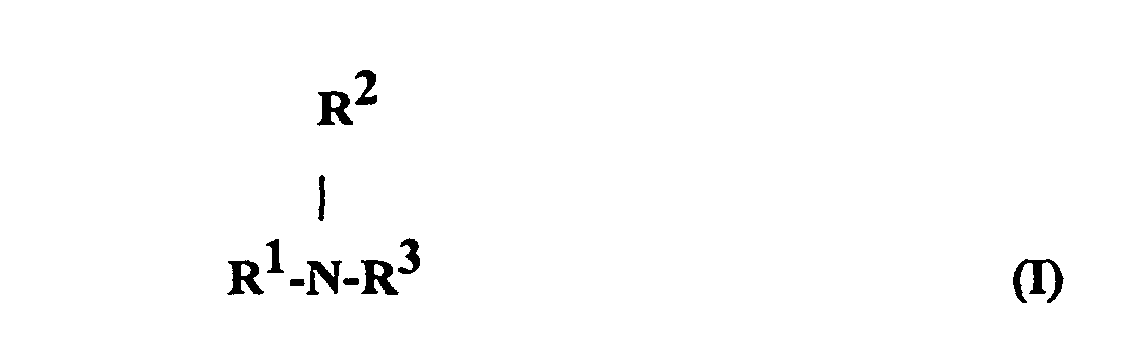
- Suitable starting materials are, for example, di-, preferably trialkylamines of the formula (I) in which R 1 is alkyl and / or alkenyl radicals having 6 to 22 carbon atoms, R 2 is hydrogen or alkyl radicals having 1 to 4 carbon atoms and R 3 is alkyl radicals having 1 to 4 carbon atoms.
- Typical examples are hexylmethylamine, hexyldimethylamine, octyldimethylamine, decyldimethylamine, dodecylmethylamine, dodecyldimethylamine, dodecylethylmethylamine, C 12/14 cocoalkyldimethylamine, myristyldimethylamine, cetyldimethylamine, stearyldimethylamine, stearylethylmethylamine, oleyldimethylamine, C 16/18 tallowalkyldimethylamine and technical mixtures thereof.
- Amidoamines are known substances that can be obtained by the relevant methods of preparative chemistry.
- one method for their preparation is to amidate fatty acids with diamines.
- Typical examples are reaction products of fatty acids having 6 to 22 carbon atoms, namely caproic, caprylic, capric, lauric, myristic, palmitic, palmitic, stearic, isostearic, oleic, elaidic, petroselic, linoleic, linolenic, elaeostearic, arachidic, gadoleic, behenic and erucic acids and their technical mixtures, with N, N-dimethylaminoethylamine, N, N-dimethylaminopropylamine, N, N-diethylaminoethylamine and N, N-diethylaminopropylamine.
- Preference is given to the use of C 8/18 coconut fatty acid N, N-dimethylamin
- Suitable suitable amines are imidazolines of the formula (III), in which R 5 is an alkyl radical having 5 to 21 carbon atoms, R 6 is a hydroxyl group, an OCOR 5 or NHCOR 5 radical and m is 2 or 3.
- These substances are known substances which, for example, by cyclizing Condensation of 1 or 2 moles of fatty acid with polyhydric amines such as aminoethylethanolamine (AEEA) or diethylenetriamine can be obtained.
- polyhydric amines such as aminoethylethanolamine (AEEA) or diethylenetriamine
- Typical examples are condensation products of the abovementioned fatty acids with AEEA, preferably imidazolines based on lauric acid or again C 12/14 coconut fatty acid.
- Alkyl and / or alkenyl oligoglycosides are known substances and follow the formula (IV) , R 7 O- [G] p in which R 7 is an alkyl and / or alkenyl radical having 10 to 22 carbon atoms, G is a sugar radical having 5 or 6 carbon atoms and p is a number from 1 to 10.
- Alkyl and / or alkenyl oligoglycosides can be obtained by the relevant methods of preparative organic chemistry; Representative of the extensive literature, reference is here made to the documents EP-A1 0301298 and WO 90103977 .
- the alkyl and / or alkenyl oligoglycosides can be derived from aldoses or ketoses having 5 or 6 carbon atoms, preferably glucose.
- the preferred alkyl and / or Alkenyloligoglykoside are thus alkyl and / or Alkenyloligo glucoside .
- the alkyl or alkenyl radical R 7 can be derived from primary alcohols having 10 to 22, preferably 12 to 16 carbon atoms. Typical examples are caprylic alcohol, capric alcohol, undecyl alcohol, lauryl alcohol, myristyl alcohol, cetyl alcohol, palmoleyl alcohol, stearyl alcohol, isoslaarylalkchol, oleyl alcohol, elaidyl alcohol, petroselinyl alcohol, arachyl alcohol, gadoleyl alcohol, behenyl alcohol, erucyl alcohol and technical mixtures thereof, as used, for example, in the hydrogenation of technical fatty acid methyl esters or in US Pat Course of hydrogenation of aldehydes from the Roelen oxo synthesis incurred. Preference is given to alkyl oligoglucosides based on hydrogenated C 12/14 coconut oil having a DP of 1 to 3.
- the amines and the glycosides are used in a weight ratio of 10:90 to 90:10, preferably 20: 80 to 80: 20 and especially in the ratio 40: 60 to 60: 40 a.
- the alkylating agents used may be halocarboxylic acids or their alkali metal salts or esters. For reasons of ready availability, the use of sodium chloroacetate is preferred.
- the amines and the halocarboxylic acids or salts thereof in a molar ratio of 1: 1.0 to 1: 2.5, preferably 1: 1 to 1: 2.0 be used. A high use ratio is particularly advantageous when used as amines imidazolines become.
- the quaternization or betainization of the amines can be carried out in a manner known per se. It recommends that the reaction be carried out in such an amount of water as a solvent that in the resulting Surfactant concentrates a solids content of 30 to 50 and preferably 43 to 48 wt .-% sets.
- water may also fatty alcohol polyglycol ethers, ethoxylated partial glycerides, Niedrigalkylglykoside 4-8 Carbon atoms in the alkyl radical and the like can be used. It is also possible any mixtures of Use water and the solvents mentioned as solvent.
- the alkylation at temperatures in the range of 70 to 98 ° C and is completed within 1 to 10, preferably 2 to 5 hours.
- reaction of the alkylating agent it has proven to be advantageous to carry out the reaction at a pH of 6 to 10, preferably 7 to 8.5.
- a further possibility for minimizing the residual content of alkylating agent is also to add a defined excess of amino acids, in particular glycine, to the reaction mixture after completion of the alkylation, as described in DE-A1 3939264 (Henkel).
- the aqueous surfactant concentrates according to the invention have a solids content in the range from 30 to 50 Wt .-% on. They are storage-stable, do not tend to crystallize, have a viscosity of less than 10,000 mPas and are accordingly pumpable. In dilute aqueous formulations, they show good repulpability and excellent skin-cosmetic compatibility. If the surfactant concentrates already a thickening agent may in many cases be based on the further addition of thickening agents, preferably fatty alcohol polyglycol ethers with narrow homolog distribution, to the cosmetic means even waived, since the desired viscosity is set automatically. Another object of the invention therefore relates to the use the surfactant concentrates according to the invention for the preparation of surfactants, such as. Hand dishwashing detergents and in particular skin and hair care agents.
- the skin and hair products can be added in minor amounts, with the other ingredients Compatible surfactants included.
- Typical examples are fatty alcohol polyglycol ether sulfates, monoglyceride sulfates, ether carboxylic acids, Fatty acid isethionates, fatty acid sarcosinates, fatty acid taurides, acylglutamates and / or protein hydrolysates or their condensates with fatty acids on animal or preferably vegetable basis.
- Skin care products such as creams, lotions and the like, generally have - in addition to the already mentioned surfactants - a content of oil bodies, emulsifiers, fats and waxes, stabilizers and also superfatting agents, thickening agents, biogenic agents, film formers, preservatives, dyes and fragrances ,
- Hair care products such as hair shampoos, hair lotions, bubble baths and the like, as additional auxiliaries and additives - in addition to the surfactants already mentioned - emulsifiers, superfatting agents, thickeners, biogenic agents, film formers, preservatives, dyes and fragrances.
- Suitable oil bodies are, for example, Guerbet alcohols preferably containing 8 to 10 carbon atoms, esters of linear C 6 -C come based on fatty alcohols having 6 to 18, 20 fatty acids with linear C 6 - C 20 -Fettalkoholert, esters of branched C 6 -C 13 -carboxylic acids with linear C 16 -C 18 fatty alcohols, esters of linear C 10 -C 18 fatty acids with branched alcohols, in particular 2-ethylhexanol, esters of linear and / or branched fatty acids with dihydric alcohols and / or Guerbet alcohols, triglycerides based on C 6 -C 10 fatty acids, vegetable oils, branched primary alcohols, substituted cyclohexanes, Guerbetcarbonate and / or dialkyl ethers into consideration.
- Suitable emulsifiers are both known W / O and O / W emulsifiers such as, for example, hydrogenated and ethoxylated castor oil, polyglycerol fatty acid esters or polyglycerol polyricinoleates.
- Typical examples of fats are glycerides, waxes include beeswax, paraffin wax or microwaxes optionally in combination with hydrophilic waxes, for example cetylstearyl alcohol in question.
- metal salts of fatty acids such as magnesium, aluminum and / or zinc stearate can be used.
- substances such as polyethoxylated lanolin derivatives, lecithin derivatives, polyol fatty acid esters, monoglycerides and fatty acid alkanolamides can be used, the latter also serving as foam stabilizers.
- Suitable thickening agents are, for example, polysaccharides, in particular xanthan gum, guar guar, agar, alginates and tyloses, carboxymethyl cellulose and hydroxyethyl cellulose, also higher molecular weight polyethylene glycol mono- and diesters of fatty acids, polyacrylates, polyvinyl alcohol and polyvinylpyrrolidone, surfactants such as fatty alcohol ethoxylates with narrow homolog distribution or alkyl oligoglucosides and electrolytes such as saline and ammonium chloride.
- polysaccharides in particular xanthan gum, guar guar, agar, alginates and tyloses, carboxymethyl cellulose and hydroxyethyl cellulose, also higher molecular weight polyethylene glycol mono- and diesters of fatty acids, polyacrylates, polyvinyl alcohol and polyvinylpyrrolidone, surfactants such as fatty alcohol ethoxylate
- Biogenic active ingredients are understood, for example, as plant extracts and vitamin complexes.
- Typical film formers are, for example, chitosan, microcrystalline chitosan, quaternized chitosan, polyvinylpyrrolidone, vinylpyrrolidone-vinyl acetate copolymers, polymers of the acrylic acid series, quaternary cellulose derivatives and similar compounds.
- Suitable preservatives are, for example, phenoxyethanol, formaldehyde solution, parabens, pentanediol or sorbic acid.
- Suitable pearlescing agents are, for example, glycol distearate esters, such as ethylene glycol distearate, but also fatty acid monoglycol esters.
- Dyes which may be used are the substances which are suitable and approved for cosmetic purposes, as compiled, for example, in the publication " Cosmetic Dyes” of the Color Commission of the Irish Klastician, published by Verlag Chemie, Weinheim, 1984, pp . 81-106 . These dyes are usually used in concentrations of 0.001 to 0.1 wt .-%, based on the total mixture.
- the total proportion of auxiliaries and additives can 1 to 50, preferably 5 to 40 wt .-% and not aqueous content ("active substance content") 20 to 80, preferably 30 to 70 wt .-% - based on the means - amount.
- active substance content aqueous content
- the preparation of the agents can be carried out in a manner known per se, i. for example, by hot, cold, hot-hot / cold or PIT emulsification. This is a purely mechanical process, a chemical reaction does not take place.
- the initial pH was about 11 due to the alkaline setting of the glycoside and dropped to a value of 9.7 during the 3 hour reaction. At this time, the amidoamine was completely consumed.
- a pumpable liquid of the following composition was obtained: 7.7% by weight betaine 40.2% by weight Alkyloligolucosid 1.3% by weight sodium chloride 50.4% by weight water 0.1% by weight sodium
- the crude product was transferred to an autoclave and with such an amount of 50 wt .-% sodium hydroxide solution added that based on a 10 wt .-% product dilution, a pH of 11.5 resulted. Subsequently, the mixture was over a period of 60 min at a temperature of 120 ° C and an autogenous Post-treated pressure of 2 bar, with the residual content of sodium chloroacetate minimized to a value ⁇ 5 ppm has been.
- Example H1 Analogously to Example H1, 85.2 g (0.72 mol) of sodium chloroacetate, 235.0 g of water and 1050 g of C 12/14 coco-oligoglucoside were mixed with 139.7 g (0.63 mol) of coconut dimethylamine and reacted at 90 ° C. brought. The initial pH was 10.4 and dropped to 8.5 in the course of a 2.5 h reaction time; the residual amine content at this time was 0.3% by weight. A readily flowable liquid of the following composition was obtained: 11.7% by weight betaine 35.0% by weight oligoglucoside 2.8% by weight sodium chloride 48.3% by weight water 0.3% by weight sodium
- compositions as well as the viscosity and stability data are summarized in Tables 1 and 2.
- the concentrates 1 to 5 according to the invention and the comparison mixtures V1 to V5 were used in the formulation of a diluted cosmetic skin lotion:
- Surfactant concentrate calculated anhydrous
Landscapes
- Health & Medical Sciences (AREA)
- Life Sciences & Earth Sciences (AREA)
- Veterinary Medicine (AREA)
- Animal Behavior & Ethology (AREA)
- General Health & Medical Sciences (AREA)
- Public Health (AREA)
- Epidemiology (AREA)
- Birds (AREA)
- Chemical & Material Sciences (AREA)
- Dermatology (AREA)
- Engineering & Computer Science (AREA)
- Chemical Kinetics & Catalysis (AREA)
- Oil, Petroleum & Natural Gas (AREA)
- Wood Science & Technology (AREA)
- Organic Chemistry (AREA)
- Cosmetics (AREA)
- Detergent Compositions (AREA)
Description


| 7,7 Gew.-% | Betain |
| 40,2 Gew.-% | Alkyloligolucosid |
| 1,3 Gew.-% | Natriumchlorid |
| 50,4 Gew.-% | Wasser |
| 0,1 Gew.-% | Natriumchloracetat |
| 11,7 Gew.-% | Betain |
| 35,0 Gew.-% | Alkyloligoglucosid |
| 2,8 Gew.-% | Natriumchlorid |
| 48,3 Gew.-% | Wasser |
| 0,3 Gew.-% | Natriumchloracetat |
| +++ | = klare Lösung, keine Kristallbildung |
| ++ | = vereinzelte Kristallbildung |
| + | = deutliche Kristallbildung |
| - | = Teile der Lösung durchkristallisiert |
| * | = trübes Produkt, instabil, Phasentrennung |
| Erfindungsgemäße Tensidkonzentrate und Vergleichsmischungen | |||||
| Komponenten | 1 | 2 | 3 | 4 | 5 |
| Compound A | 96,0 | - | 97,0 | 97,5 | - |
| Compound B | - | 97,0 | - | - | 96,0 |
| Arlypon(R) F | 1,0 | 1,0 | 0,5 | - | 1,5 |
| Konservierungsmt. | 0,1 | 0,1 | 0,1 | 0,1 | 0,1 |
| Milchsäure 85%ig | 2,9 | 1,9 | 2,4 | 2,4 | 2,4 |
| Viskosität [mPas] | 7000 | 4900 | 4250 | 3700 | 4900 |
| Stabilität | +++ | +++ | +++ | +++ | +++ |
| Komponenten | V1 | V2 | V3 | V4 | V5 |
| Plantaren(R) 600 | 50,0 | - | - | 50,0 | 50,0 |
| Plantaren(R) 2000 | - | 50,0 | - | - | - |
| Texapon(R) SB 3 | 46,0 | 46,0 | 50,0 | 40,0 | 6,0 |
| Dehyton(R) K | - | - | 46,0 | 6,0 | 40,0 |
| Arlypon(R) F | 1,0 | 1,0 | 1,0 | 1,0 | 1,0 |
| Konservierungsmt. | 0,1 | 0,1 | 0,1 | 0,1 | 0,1 |
| Milchsäure 85%ig | 2,9 | 2,9 | 2,9 | 2,9 | 2,9 |
| Viskosität [mPas] | 14000 | 12000 | 5600 | 9400 | 9400 |
| Stabilität | - | - | * | ++ | + |
| Tensidkonzentrat (berechnet wasserfrei) | 10,0 Gew.-% |
| Dehyton(R) G | 5,0 Gew.-% |
| Lamepon(R) S | 2,5 Gew.-% |
| Euperlan(R) PK 900 | 1,5 Gew.-% |
| Cetiol(R) HE | 1,0 Gew.-% |
| Lamesoft(R) LMG | 2,5 Gew.-% |
| Farbstoff | 1,0 Gew.-% |
| Konservierungsmittel | 0,1 Gew.-% |
| Wasser | 76,4 Gew.-% |
| Viskosität in der Anwendungskonzentration | |||
| Bsp. | pH-Wert | Viskosität mPas | Viskosität bei Zugabe 1 Gew.-% Arlypon(R) F mPas |
| 1 | 5,3 | 4400 | |
| 2 | 5,2 | 4100 | |
| 3 | 5,3 | 4300 | |
| 4 | 5,4 | 4350 | |
| 5 | 5,3 | 4300 | |
| V1 | 5,3 | 980 | 1200 |
| V2 | 5,3 | 940 | 1100 |
| V3 | 5,3 | 1050 | 1200 |
| V4 | 5,3 | 990 | 1100 |
| V5 | 5,4 | 960 | 1100 |
| Erläuterung der Handelsnamen | |
| Handelsnamen | CTFA-Registrierung |
| Arlypon(R) F | Laureth-2 |
| Cetiol(R) HE | PEG-7 Glyceryl Cocoate |
| Dehyton(R) G | Cocoamphodiacetate |
| Dehyton(R) K | Cocamidopropyl Betaine |
| Euperlan(R) PK 900 | PEG-3 Distearate (and) Sodium Laureth Sulfate |
| Lamepon(R) S | Potassium-Cocoyl Hydrolyzed Collagen |
| Lamesoft(R) LMG | Glyceryl Laurate (and) Potassium-Cocoyl Hydrolyzed Collagen |
| Plantaren(R) 600 | Lauryl Polyglucose |
| Plantaren(R) 2000 | Decyl Polyglucose |
| Texapon(R) SB3 | Disodium Laurethsulfosuccinat |
Claims (12)
- Verfahren zur Herstellung pumpfähiger, wäßriger Tensidkonzentrate, dadurch gekennzeichnet, daß man sekundäre oder tertiäre Amine in Gegenwart von Alkylund/oder Alkenyloligoglykosiden in an sich bekannter Weise mit Alkylierungsmitteln umsetzt und im Anschluß an die Alkylierung eine Drucknachbehandlung bei Temperaturen im Bereich von 80 bis 140°C, Drücken im Bereich von 1 bis 10 bar und pH-Werten von 8 bis 13 durchführt.
- Verfahren nach Anspruch 1, dadurch gekennzeichnet, daß man sekundäre oder tertiäre Amine der Formel (I) einsetzt,in der R1 für Alkyl- und/oder Alkenylreste mit 6 bis 22 Kohlenstoffatomen, R2 für Wasserstoff oder Alkylreste mit 1 bis 4 Kohlenstoffatomen und R3 für Alkylreste mit 1 bis 4 Kohlenstoffatomen steht.
- Verfahren nach Anspruch 1, dadurch gekennzeichnet, daß man Amidoamine der Formel (II) einsetzt,in der R4CO für einen aliphatischen Acylrest mit 6 bis 22 Kohlenstoffatomen und 0 oder 1 bis 3 Doppelbindungen, n für 0 oder Zahlen von 1 bis 3 steht und R2 und R3 die oben angegebenen Bedeutungen haben.

- Verfahren nach Anspruch 1, dadurch gekennzeichnet, daß man Imidazoline der Formel (III) einsetzt,in der R5 für einen Alkylrest mit 5 bis 21 Kohlenstoffatomen, R6 für eine Hydroxylgruppe, einen OCOR5- oder NHCOR5-Rest und m für 2 oder 3 steht.

- Verfahren nach den Ansprüchen 1 bis 4, dadurch gekennzeichnet, daß man Alkylund/oder Alkenyloligoglykoside der Formel (IV) einsetzt,
- Verfahren nach den Ansprüchen 1 bis 5, dadurch gekennzeichnet, daß man die Amine und die Glykoside im Gewichtsverhältnis 20 : 80 bis 80 : 20 einsetzt.
- Verfahren nach den Ansprüchen 1 bis 6, dadurch gekennzeichnet, daß man als Alkylierungsmittel Halogencarbonsäuren bzw. deren Alkalisalze oder Ester einsetzt.
- Verfahren nach den Ansprüchen 1 bis 7, dadurch gekennzeichnet, daß man die Amine und die Halogencarbonsäuren bzw. deren Salze im molaren Verhältnis von 1 : 1,0 bis 1 : 1,2 einsetzt.
- Verfahren nach den Ansprüchen 1 bis 8, dadurch gekennzeichnet, daß man Wasser als Lösungsmittel in einer solchen Menge einsetzt, daß sich in den resultierenden Tensidkonzentraten ein Feststoffgehalt von 30 bis 50 Gew.-% einstellt.
- Verfahren nach den Ansprüchen 1 bis 9, dadurch gekennzeichnet, daß man die Alkylierung bei Temperaturen im Bereich von 70 bis 98°C durchführt.
- Verfahren nach den Ansprüchen 1 bis 10, dadurch gekennzeichnet, daß man die Alkylierung über einen Zeitraum von 1 bis 10 h durchführt.
- Verfahren nach den Ansprüchen 1 bis 11, dadurch gekennzeichnet, daß man die Alkylierung bei einem pH-Wert von 6 bis 10 durchführt.
Applications Claiming Priority (3)
| Application Number | Priority Date | Filing Date | Title |
|---|---|---|---|
| DE4435495 | 1994-10-04 | ||
| DE4435495A DE4435495C2 (de) | 1994-10-04 | 1994-10-04 | Pumpfähige wäßrige Tensidkonzentrate |
| PCT/EP1995/003797 WO1996010558A1 (de) | 1994-10-04 | 1995-09-25 | Pumpfähige wässrige tensidkonzentrate |
Publications (3)
| Publication Number | Publication Date |
|---|---|
| EP0784609A1 EP0784609A1 (de) | 1997-07-23 |
| EP0784609B1 EP0784609B1 (de) | 1999-07-28 |
| EP0784609B2 true EP0784609B2 (de) | 2005-01-19 |
Family
ID=6529952
Family Applications (1)
| Application Number | Title | Priority Date | Filing Date |
|---|---|---|---|
| EP95935377A Expired - Lifetime EP0784609B2 (de) | 1994-10-04 | 1995-09-25 | Verfahren zur herstellung von pumpfähigen wässrigen tensidkonzentraten |
Country Status (6)
| Country | Link |
|---|---|
| US (1) | US5925747A (de) |
| EP (1) | EP0784609B2 (de) |
| CN (1) | CN1159798A (de) |
| DE (2) | DE4435495C2 (de) |
| ES (1) | ES2135772T5 (de) |
| WO (1) | WO1996010558A1 (de) |
Families Citing this family (13)
| Publication number | Priority date | Publication date | Assignee | Title |
|---|---|---|---|---|
| DE19511670A1 (de) * | 1995-03-30 | 1996-10-02 | Henkel Kgaa | Verfahren zur Herstellung wäßriger Tensidkonzentrate |
| DE19548068C1 (de) * | 1995-12-21 | 1997-06-19 | Henkel Kgaa | Verfahren zur Herstellung hellfarbiger, niedrigviskoser Tensidkonzentrate |
| GB9612067D0 (en) | 1996-06-10 | 1996-08-14 | Smithkline Beecham Plc | Composition |
| DE19742285C1 (de) * | 1997-09-25 | 1999-04-29 | Henkel Kgaa | Verwendung von ungesättigten Betaintensiden als Verdickungsmittel |
| EP0939117A1 (de) * | 1998-02-27 | 1999-09-01 | The Procter & Gamble Company | Flüssige Reinigungsmittel für harte Oberflächen |
| GB9807269D0 (en) * | 1998-04-03 | 1998-06-03 | Unilever Plc | Detergent compositions |
| US6780825B2 (en) | 2001-02-06 | 2004-08-24 | Playtex Products, Inc. | Cleansing compositions with milk protein and aromatherapy |
| US8785355B2 (en) | 2001-02-13 | 2014-07-22 | Schlumberger Technology Corporation | Viscoelastic compositions |
| GB2393722A (en) * | 2001-02-13 | 2004-04-07 | Schlumberger Holdings | Cleavable surfactants which may be useful in viscoelastic compositions for oil-field applications |
| DE10122255C1 (de) * | 2001-05-08 | 2002-11-07 | Cognis Deutschland Gmbh | Verfahren zur Herstellung von Tensidgemischen |
| CA2709534C (en) * | 2007-12-21 | 2016-06-28 | Huntsman Petrochemical Llc | Method of preparing amidoamine alkoxylates and compositions thereof |
| DE102010001193A1 (de) * | 2010-01-25 | 2011-07-28 | Dahms, Gerd, 47138 | Neue Tensidzusammensetzungen |
| WO2018206475A1 (en) | 2017-05-11 | 2018-11-15 | Basf Se | Concentrated surfactant and method of forming |
Citations (3)
| Publication number | Priority date | Publication date | Assignee | Title |
|---|---|---|---|---|
| JPS6469695A (en) † | 1987-09-09 | 1989-03-15 | Shiseido Co Ltd | Detergent composition |
| JPH02187499A (ja) † | 1989-01-13 | 1990-07-23 | Mitsubishi Petrochem Co Ltd | 液体洗浄剤組成物 |
| WO1995004592A1 (fr) † | 1993-08-06 | 1995-02-16 | Societe D'exploitation De Produits Pour Les Industries Chimiques, S.E.P.P.I.C. | Compositions aqueuses concentrees d'alkylpolyglycosides et leurs utilisations |
Family Cites Families (20)
| Publication number | Priority date | Publication date | Assignee | Title |
|---|---|---|---|---|
| DE3275202D1 (en) * | 1981-09-28 | 1987-02-26 | Procter & Gamble | Detergent compositions containing mixture of alkylpolysaccharide and amine oxide surfactants and fatty acid soap |
| US4668422A (en) * | 1985-05-31 | 1987-05-26 | A. E. Staley Manufacturing Company | Liquid hand-soap or bubble bath composition |
| AU596187B2 (en) * | 1986-06-16 | 1990-04-26 | Helene Curtis, Inc. | Mild detergent compositions |
| DE3723826A1 (de) * | 1987-07-18 | 1989-01-26 | Henkel Kgaa | Verfahren zur herstellung von alkylglykosiden |
| GB8810820D0 (en) * | 1988-05-06 | 1988-06-08 | Unilever Plc | Detergent compositions |
| DE3826654C1 (de) * | 1988-08-05 | 1991-01-31 | Th. Goldschmidt Ag, 4300 Essen, De | |
| DE3833780A1 (de) * | 1988-10-05 | 1990-04-12 | Henkel Kgaa | Verfahren zur direkten herstellung von alkylglykosiden |
| US5576425A (en) * | 1988-10-05 | 1996-11-19 | Henkel Kommanditgesellschaft Auf Aktien | Process for the direct production of alkyl glycosides |
| DE3939264A1 (de) * | 1989-11-28 | 1991-05-29 | Henkel Kgaa | Verfahren zur nachbehandlung amphoterer oder zwitterionischer tenside |
| US5281749A (en) * | 1989-11-28 | 1994-01-25 | Henkel Kommanditgesellschaft Auf Aktien | Process for reducing the residual content of free alkylating agent in aqeous solutions of amphoteric or zwitterionic surfactants |
| DE4003098A1 (de) * | 1990-02-02 | 1991-08-08 | Henkel Kgaa | Waessriges fluessiges reinigungsmittel |
| DE4009616A1 (de) * | 1990-03-26 | 1991-10-02 | Henkel Kgaa | Fluessige koerperreinigungsmittel |
| GB9008944D0 (en) * | 1990-04-20 | 1990-06-20 | Unilever Plc | Shampoo composition |
| SE468252B (sv) * | 1991-04-09 | 1992-11-30 | Berol Nobel Ab | Flytande diskmedelskomposition innehaallande ett anjoniskt ytaktivt medel och en kombination av amfotaera foereningar |
| GB9207637D0 (en) * | 1991-04-24 | 1992-05-27 | Kao Corp | Milky detergent composition for hard surfaces |
| CA2135641A1 (en) * | 1992-06-16 | 1993-12-23 | Allen D. Urfer | Viscosity-adjusted surfactant concentrate compositions |
| DE4234487A1 (de) * | 1992-10-14 | 1994-04-21 | Henkel Kgaa | Wäßrige Detergensgemische |
| DE4305083A1 (de) * | 1993-02-19 | 1994-08-25 | Henkel Kgaa | Verfahren zur Herstellung wasserfreier Detergensgemische |
| DE4311114A1 (de) * | 1993-04-05 | 1994-10-06 | Henkel Kgaa | Detergensgemische |
| DE4340423C1 (de) * | 1993-11-27 | 1995-07-13 | Henkel Kgaa | Niedrigviskose wäßrige Konzentrate von Betaintensiden |
-
1994
- 1994-10-04 DE DE4435495A patent/DE4435495C2/de not_active Expired - Fee Related
-
1995
- 1995-09-25 WO PCT/EP1995/003797 patent/WO1996010558A1/de not_active Ceased
- 1995-09-25 DE DE59506487T patent/DE59506487D1/de not_active Expired - Lifetime
- 1995-09-25 ES ES95935377T patent/ES2135772T5/es not_active Expired - Lifetime
- 1995-09-25 EP EP95935377A patent/EP0784609B2/de not_active Expired - Lifetime
- 1995-09-25 US US08/817,478 patent/US5925747A/en not_active Expired - Lifetime
- 1995-09-25 CN CN95195440A patent/CN1159798A/zh active Pending
Patent Citations (3)
| Publication number | Priority date | Publication date | Assignee | Title |
|---|---|---|---|---|
| JPS6469695A (en) † | 1987-09-09 | 1989-03-15 | Shiseido Co Ltd | Detergent composition |
| JPH02187499A (ja) † | 1989-01-13 | 1990-07-23 | Mitsubishi Petrochem Co Ltd | 液体洗浄剤組成物 |
| WO1995004592A1 (fr) † | 1993-08-06 | 1995-02-16 | Societe D'exploitation De Produits Pour Les Industries Chimiques, S.E.P.P.I.C. | Compositions aqueuses concentrees d'alkylpolyglycosides et leurs utilisations |
Also Published As
| Publication number | Publication date |
|---|---|
| ES2135772T3 (es) | 1999-11-01 |
| DE59506487D1 (de) | 1999-09-02 |
| EP0784609A1 (de) | 1997-07-23 |
| CN1159798A (zh) | 1997-09-17 |
| ES2135772T5 (es) | 2005-07-01 |
| WO1996010558A1 (de) | 1996-04-11 |
| EP0784609B1 (de) | 1999-07-28 |
| US5925747A (en) | 1999-07-20 |
| DE4435495C2 (de) | 1997-08-14 |
| DE4435495A1 (de) | 1996-04-11 |
Similar Documents
| Publication | Publication Date | Title |
|---|---|---|
| DE69516584T2 (de) | Verfahren zur Herstellung von Amidoethercarbonsäure oder deren Salz und diese enthaltende oberflächenaktive Mischung | |
| EP0910329B1 (de) | Wässrige perlglanzkonzentrate | |
| EP0942706B1 (de) | Wässrige perlglanzkonzentrate | |
| EP0784609B1 (de) | Pumpfähige wässrige tensidkonzentrate | |
| DE4428823A1 (de) | Schäumende Detergensgemische | |
| DE69527272T2 (de) | Reinigungszusammensetzung | |
| EP0785980B1 (de) | Pumpfähige wässrige tensidkonzentrate | |
| EP0910328A1 (de) | Wässrige perlglanzkonzentrate | |
| DE69416524T2 (de) | Hautreinigungstück | |
| EP0780464B1 (de) | Verfahren zur Herstellung hellfarbiger, niedrigviskoser Tensidkonzentrate | |
| EP0912700B1 (de) | Wässrige perlglanzkonzentrate | |
| EP0817827B1 (de) | Verfahren zur herstellung wässriger tensidkonzentrate | |
| EP0508038A1 (de) | Citronensäurefettalkoholesterpolyglykolethersulfosuccinate, Verfahren zu ihrer Herstellung und ihre Verwendung | |
| EP0904053B1 (de) | Haarbehandlungsmittel | |
| DE69527268T2 (de) | Reiningungszusammensetzung | |
| DE19622214A1 (de) | Hydroxycarbonsäureester | |
| DE19725964C1 (de) | Wäßrige Perlglanzkonzentrate | |
| EP0445159A1 (de) | Oberflächenaktive mischungen | |
| WO1996041858A1 (de) | Verdünnte wässrige tensidlösung mit erhöhter viskosität | |
| EP0930872B1 (de) | Wässrige perlglanzdispersionen | |
| DE19530221A1 (de) | Milde, schaumstarke Detegensgemische | |
| DE19512411A1 (de) | Verfahren zur Herstellung viskoser Zuckertenside | |
| DE19732709C1 (de) | Wäßrige Perlglanzkonzentrate | |
| WO1995028143A1 (de) | Haar- und körperpflegemittel | |
| DE4438115A1 (de) | Haarbehandlungsmittel |
Legal Events
| Date | Code | Title | Description |
|---|---|---|---|
| PUAI | Public reference made under article 153(3) epc to a published international application that has entered the european phase |
Free format text: ORIGINAL CODE: 0009012 |
|
| 17P | Request for examination filed |
Effective date: 19970327 |
|
| AK | Designated contracting states |
Kind code of ref document: A1 Designated state(s): DE ES FR GB IT NL |
|
| 17Q | First examination report despatched |
Effective date: 19971120 |
|
| GRAG | Despatch of communication of intention to grant |
Free format text: ORIGINAL CODE: EPIDOS AGRA |
|
| GRAG | Despatch of communication of intention to grant |
Free format text: ORIGINAL CODE: EPIDOS AGRA |
|
| GRAH | Despatch of communication of intention to grant a patent |
Free format text: ORIGINAL CODE: EPIDOS IGRA |
|
| GRAH | Despatch of communication of intention to grant a patent |
Free format text: ORIGINAL CODE: EPIDOS IGRA |
|
| GRAA | (expected) grant |
Free format text: ORIGINAL CODE: 0009210 |
|
| AK | Designated contracting states |
Kind code of ref document: B1 Designated state(s): DE ES FR GB IT NL |
|
| REF | Corresponds to: |
Ref document number: 59506487 Country of ref document: DE Date of ref document: 19990902 |
|
| ET | Fr: translation filed | ||
| ITF | It: translation for a ep patent filed | ||
| REG | Reference to a national code |
Ref country code: ES Ref legal event code: FG2A Ref document number: 2135772 Country of ref document: ES Kind code of ref document: T3 |
|
| PLBQ | Unpublished change to opponent data |
Free format text: ORIGINAL CODE: EPIDOS OPPO |
|
| PLBI | Opposition filed |
Free format text: ORIGINAL CODE: 0009260 |
|
| PLBF | Reply of patent proprietor to notice(s) of opposition |
Free format text: ORIGINAL CODE: EPIDOS OBSO |
|
| 26 | Opposition filed |
Opponent name: SOCIETE D'EXPLOITATION DE PRODUITS POUR L'INDUSTRI Effective date: 20000426 |
|
| NLR1 | Nl: opposition has been filed with the epo |
Opponent name: SOCIETE D'EXPLOITATION DE PRODUITS POUR L'INDUSTRI |
|
| PLBF | Reply of patent proprietor to notice(s) of opposition |
Free format text: ORIGINAL CODE: EPIDOS OBSO |
|
| PGFP | Annual fee paid to national office [announced via postgrant information from national office to epo] |
Ref country code: NL Payment date: 20000928 Year of fee payment: 6 |
|
| RAP2 | Party data changed (patent owner data changed or rights of a patent transferred) |
Owner name: COGNIS DEUTSCHLAND GMBH |
|
| NLT2 | Nl: modifications (of names), taken from the european patent patent bulletin |
Owner name: COGNIS DEUTSCHLAND GMBH |
|
| REG | Reference to a national code |
Ref country code: GB Ref legal event code: IF02 |
|
| PLBF | Reply of patent proprietor to notice(s) of opposition |
Free format text: ORIGINAL CODE: EPIDOS OBSO |
|
| PG25 | Lapsed in a contracting state [announced via postgrant information from national office to epo] |
Ref country code: NL Free format text: LAPSE BECAUSE OF NON-PAYMENT OF DUE FEES Effective date: 20020401 |
|
| RAP2 | Party data changed (patent owner data changed or rights of a patent transferred) |
Owner name: COGNIS DEUTSCHLAND GMBH & CO. KG |
|
| NLV4 | Nl: lapsed or anulled due to non-payment of the annual fee |
Effective date: 20020401 |
|
| NLV4 | Nl: lapsed or anulled due to non-payment of the annual fee |
Effective date: 20020401 |
|
| REG | Reference to a national code |
Ref country code: GB Ref legal event code: 732E |
|
| REG | Reference to a national code |
Ref country code: FR Ref legal event code: TP |
|
| RIC2 | Information provided on ipc code assigned after grant |
Ipc: 7C 11D 1/94 B Ipc: 7C 07C 231/12 B Ipc: 7C 07C 233/36 A |
|
| RTI2 | Title (correction) |
Free format text: PROCESS FOR MAKING PUMPABLE AQUEOUS TENSIDE CONCENTRATES |
|
| PUAH | Patent maintained in amended form |
Free format text: ORIGINAL CODE: 0009272 |
|
| STAA | Information on the status of an ep patent application or granted ep patent |
Free format text: STATUS: PATENT MAINTAINED AS AMENDED |
|
| 27A | Patent maintained in amended form |
Effective date: 20050119 |
|
| AK | Designated contracting states |
Kind code of ref document: B2 Designated state(s): DE ES FR GB IT NL |
|
| GBTA | Gb: translation of amended ep patent filed (gb section 77(6)(b)/1977) | ||
| REG | Reference to a national code |
Ref country code: ES Ref legal event code: DC2A Date of ref document: 20050307 Kind code of ref document: T5 |
|
| ET3 | Fr: translation filed ** decision concerning opposition | ||
| REG | Reference to a national code |
Ref country code: FR Ref legal event code: TP |
|
| REG | Reference to a national code |
Ref country code: GB Ref legal event code: 732E Free format text: REGISTERED BETWEEN 20090514 AND 20090520 |
|
| REG | Reference to a national code |
Ref country code: ES Ref legal event code: PC2A |
|
| PGFP | Annual fee paid to national office [announced via postgrant information from national office to epo] |
Ref country code: IT Payment date: 20120920 Year of fee payment: 18 |
|
| PGFP | Annual fee paid to national office [announced via postgrant information from national office to epo] |
Ref country code: DE Payment date: 20121130 Year of fee payment: 18 Ref country code: FR Payment date: 20121015 Year of fee payment: 18 |
|
| PGFP | Annual fee paid to national office [announced via postgrant information from national office to epo] |
Ref country code: GB Payment date: 20121001 Year of fee payment: 18 Ref country code: ES Payment date: 20121026 Year of fee payment: 18 |
|
| GBPC | Gb: european patent ceased through non-payment of renewal fee |
Effective date: 20130925 |
|
| REG | Reference to a national code |
Ref country code: FR Ref legal event code: ST Effective date: 20140530 |
|
| REG | Reference to a national code |
Ref country code: DE Ref legal event code: R119 Ref document number: 59506487 Country of ref document: DE Effective date: 20140401 |
|
| PG25 | Lapsed in a contracting state [announced via postgrant information from national office to epo] |
Ref country code: GB Free format text: LAPSE BECAUSE OF NON-PAYMENT OF DUE FEES Effective date: 20130925 |
|
| PG25 | Lapsed in a contracting state [announced via postgrant information from national office to epo] |
Ref country code: DE Free format text: LAPSE BECAUSE OF NON-PAYMENT OF DUE FEES Effective date: 20140401 Ref country code: FR Free format text: LAPSE BECAUSE OF NON-PAYMENT OF DUE FEES Effective date: 20130930 Ref country code: IT Free format text: LAPSE BECAUSE OF NON-PAYMENT OF DUE FEES Effective date: 20130925 |
|
| REG | Reference to a national code |
Ref country code: ES Ref legal event code: FD2A Effective date: 20141007 |
|
| PG25 | Lapsed in a contracting state [announced via postgrant information from national office to epo] |
Ref country code: ES Free format text: LAPSE BECAUSE OF NON-PAYMENT OF DUE FEES Effective date: 20130926 |