EP0779467A1 - Verfahren zur Isolierung von Rohrbündeln - Google Patents
Verfahren zur Isolierung von Rohrbündeln Download PDFInfo
- Publication number
- EP0779467A1 EP0779467A1 EP96308646A EP96308646A EP0779467A1 EP 0779467 A1 EP0779467 A1 EP 0779467A1 EP 96308646 A EP96308646 A EP 96308646A EP 96308646 A EP96308646 A EP 96308646A EP 0779467 A1 EP0779467 A1 EP 0779467A1
- Authority
- EP
- European Patent Office
- Prior art keywords
- cement
- cement composition
- water
- composition
- psi
- Prior art date
- Legal status (The legal status is an assumption and is not a legal conclusion. Google has not performed a legal analysis and makes no representation as to the accuracy of the status listed.)
- Ceased
Links
- 238000000034 method Methods 0.000 title claims description 28
- 239000004568 cement Substances 0.000 claims abstract description 112
- 239000000203 mixture Substances 0.000 claims abstract description 101
- XLYOFNOQVPJJNP-UHFFFAOYSA-N water Substances O XLYOFNOQVPJJNP-UHFFFAOYSA-N 0.000 claims abstract description 42
- 239000011396 hydraulic cement Substances 0.000 claims abstract description 20
- 239000004088 foaming agent Substances 0.000 claims abstract description 17
- 238000010438 heat treatment Methods 0.000 claims abstract description 15
- 238000006703 hydration reaction Methods 0.000 claims abstract description 7
- 238000011049 filling Methods 0.000 claims abstract description 5
- 239000007789 gas Substances 0.000 claims description 11
- IJGRMHOSHXDMSA-UHFFFAOYSA-N Atomic nitrogen Chemical compound N#N IJGRMHOSHXDMSA-UHFFFAOYSA-N 0.000 claims description 8
- 239000006260 foam Substances 0.000 claims description 8
- 239000000463 material Substances 0.000 claims description 8
- 239000011398 Portland cement Substances 0.000 claims description 5
- 239000003381 stabilizer Substances 0.000 claims description 5
- 235000008733 Citrus aurantifolia Nutrition 0.000 claims description 4
- 235000011941 Tilia x europaea Nutrition 0.000 claims description 4
- 239000000945 filler Substances 0.000 claims description 4
- 239000010881 fly ash Substances 0.000 claims description 4
- 238000009413 insulation Methods 0.000 claims description 4
- 229920000126 latex Polymers 0.000 claims description 4
- 239000004571 lime Substances 0.000 claims description 4
- 238000013022 venting Methods 0.000 claims description 4
- LSNNMFCWUKXFEE-UHFFFAOYSA-M Bisulfite Chemical compound OS([O-])=O LSNNMFCWUKXFEE-UHFFFAOYSA-M 0.000 claims description 3
- 125000001931 aliphatic group Chemical group 0.000 claims description 3
- 125000005645 linoleyl group Chemical group 0.000 claims description 3
- 229910052757 nitrogen Inorganic materials 0.000 claims description 3
- 125000001117 oleyl group Chemical group [H]C([*])([H])C([H])([H])C([H])([H])C([H])([H])C([H])([H])C([H])([H])C([H])([H])C([H])([H])/C([H])=C([H])\C([H])([H])C([H])([H])C([H])([H])C([H])([H])C([H])([H])C([H])([H])C([H])([H])C([H])([H])[H] 0.000 claims description 3
- 159000000000 sodium salts Chemical class 0.000 claims description 3
- 239000010754 BS 2869 Class F Substances 0.000 claims description 2
- PNEYBMLMFCGWSK-UHFFFAOYSA-N aluminium oxide Inorganic materials [O-2].[O-2].[O-2].[Al+3].[Al+3] PNEYBMLMFCGWSK-UHFFFAOYSA-N 0.000 claims description 2
- 239000011324 bead Substances 0.000 claims description 2
- 239000000919 ceramic Substances 0.000 claims description 2
- 239000013505 freshwater Substances 0.000 claims description 2
- 229910052602 gypsum Inorganic materials 0.000 claims description 2
- 239000010440 gypsum Substances 0.000 claims description 2
- 150000003839 salts Chemical class 0.000 claims description 2
- 239000013535 sea water Substances 0.000 claims description 2
- 229910021487 silica fume Inorganic materials 0.000 claims description 2
- 239000002893 slag Substances 0.000 claims description 2
- 239000012267 brine Substances 0.000 claims 1
- HPALAKNZSZLMCH-UHFFFAOYSA-M sodium;chloride;hydrate Chemical compound O.[Na+].[Cl-] HPALAKNZSZLMCH-UHFFFAOYSA-M 0.000 claims 1
- 238000012360 testing method Methods 0.000 description 22
- 102100039554 Galectin-8 Human genes 0.000 description 12
- 101001011019 Gallus gallus Gallinacin-10 Proteins 0.000 description 12
- 101000887168 Gallus gallus Gallinacin-8 Proteins 0.000 description 12
- 239000012530 fluid Substances 0.000 description 11
- 239000004872 foam stabilizing agent Substances 0.000 description 10
- 239000008186 active pharmaceutical agent Substances 0.000 description 7
- 239000004094 surface-active agent Substances 0.000 description 7
- 238000001816 cooling Methods 0.000 description 6
- 101000887160 Gallus gallus Gallinacin-14 Proteins 0.000 description 5
- 101000887167 Gallus gallus Gallinacin-6 Proteins 0.000 description 5
- 101000887235 Gallus gallus Gallinacin-9 Proteins 0.000 description 5
- 101000620620 Homo sapiens Placental protein 13-like Proteins 0.000 description 5
- 101000608766 Mus musculus Galectin-6 Proteins 0.000 description 5
- 102100022336 Placental protein 13-like Human genes 0.000 description 5
- 239000000306 component Substances 0.000 description 5
- 150000001875 compounds Chemical class 0.000 description 4
- 239000002002 slurry Substances 0.000 description 4
- 230000035699 permeability Effects 0.000 description 3
- 238000012546 transfer Methods 0.000 description 3
- RTZKZFJDLAIYFH-UHFFFAOYSA-N Diethyl ether Chemical compound CCOCC RTZKZFJDLAIYFH-UHFFFAOYSA-N 0.000 description 2
- LYCAIKOWRPUZTN-UHFFFAOYSA-N Ethylene glycol Chemical compound OCCO LYCAIKOWRPUZTN-UHFFFAOYSA-N 0.000 description 2
- 108010001517 Galectin 3 Proteins 0.000 description 2
- 102100039558 Galectin-3 Human genes 0.000 description 2
- VYPSYNLAJGMNEJ-UHFFFAOYSA-N Silicium dioxide Chemical compound O=[Si]=O VYPSYNLAJGMNEJ-UHFFFAOYSA-N 0.000 description 2
- 229910000831 Steel Inorganic materials 0.000 description 2
- 229910001873 dinitrogen Inorganic materials 0.000 description 2
- -1 e.g. Substances 0.000 description 2
- 239000007788 liquid Substances 0.000 description 2
- 238000002156 mixing Methods 0.000 description 2
- 239000003921 oil Substances 0.000 description 2
- 238000001556 precipitation Methods 0.000 description 2
- 239000010959 steel Substances 0.000 description 2
- 238000010998 test method Methods 0.000 description 2
- 239000010755 BS 2869 Class G Substances 0.000 description 1
- UXVMQQNJUSDDNG-UHFFFAOYSA-L Calcium chloride Chemical compound [Cl-].[Cl-].[Ca+2] UXVMQQNJUSDDNG-UHFFFAOYSA-L 0.000 description 1
- LFQSCWFLJHTTHZ-UHFFFAOYSA-N Ethanol Chemical compound CCO LFQSCWFLJHTTHZ-UHFFFAOYSA-N 0.000 description 1
- QAOWNCQODCNURD-UHFFFAOYSA-L Sulfate Chemical compound [O-]S([O-])(=O)=O QAOWNCQODCNURD-UHFFFAOYSA-L 0.000 description 1
- 239000000654 additive Substances 0.000 description 1
- 230000002411 adverse Effects 0.000 description 1
- 150000001298 alcohols Chemical class 0.000 description 1
- 239000001110 calcium chloride Substances 0.000 description 1
- 229910001628 calcium chloride Inorganic materials 0.000 description 1
- 150000001768 cations Chemical class 0.000 description 1
- 239000003795 chemical substances by application Substances 0.000 description 1
- 238000009833 condensation Methods 0.000 description 1
- 230000005494 condensation Effects 0.000 description 1
- 238000005260 corrosion Methods 0.000 description 1
- 230000007797 corrosion Effects 0.000 description 1
- 238000006073 displacement reaction Methods 0.000 description 1
- 238000001035 drying Methods 0.000 description 1
- 238000001704 evaporation Methods 0.000 description 1
- 230000008020 evaporation Effects 0.000 description 1
- 238000007676 flexural strength test Methods 0.000 description 1
- 235000013312 flour Nutrition 0.000 description 1
- 238000005187 foaming Methods 0.000 description 1
- 150000004677 hydrates Chemical class 0.000 description 1
- 230000036571 hydration Effects 0.000 description 1
- 229930195733 hydrocarbon Natural products 0.000 description 1
- 150000002430 hydrocarbons Chemical class 0.000 description 1
- 239000001257 hydrogen Substances 0.000 description 1
- 229910052739 hydrogen Inorganic materials 0.000 description 1
- 125000004435 hydrogen atom Chemical group [H]* 0.000 description 1
- WGCNASOHLSPBMP-UHFFFAOYSA-N hydroxyacetaldehyde Natural products OCC=O WGCNASOHLSPBMP-UHFFFAOYSA-N 0.000 description 1
- 238000003780 insertion Methods 0.000 description 1
- 230000037431 insertion Effects 0.000 description 1
- 238000009434 installation Methods 0.000 description 1
- 239000011810 insulating material Substances 0.000 description 1
- 238000009533 lab test Methods 0.000 description 1
- 238000010169 landfilling Methods 0.000 description 1
- 238000004519 manufacturing process Methods 0.000 description 1
- 238000005259 measurement Methods 0.000 description 1
- QSHDDOUJBYECFT-UHFFFAOYSA-N mercury Chemical compound [Hg] QSHDDOUJBYECFT-UHFFFAOYSA-N 0.000 description 1
- 229910052753 mercury Inorganic materials 0.000 description 1
- WCYWZMWISLQXQU-UHFFFAOYSA-N methyl Chemical group [CH3] WCYWZMWISLQXQU-UHFFFAOYSA-N 0.000 description 1
- GRVDJDISBSALJP-UHFFFAOYSA-N methyloxidanyl Chemical compound [O]C GRVDJDISBSALJP-UHFFFAOYSA-N 0.000 description 1
- 230000002093 peripheral effect Effects 0.000 description 1
- 239000003208 petroleum Substances 0.000 description 1
- 230000001681 protective effect Effects 0.000 description 1
- 150000003254 radicals Chemical class 0.000 description 1
- 239000000565 sealant Substances 0.000 description 1
- 239000000377 silicon dioxide Substances 0.000 description 1
- 238000001291 vacuum drying Methods 0.000 description 1
- 239000001993 wax Substances 0.000 description 1
Images
Classifications
-
- F—MECHANICAL ENGINEERING; LIGHTING; HEATING; WEAPONS; BLASTING
- F16—ENGINEERING ELEMENTS AND UNITS; GENERAL MEASURES FOR PRODUCING AND MAINTAINING EFFECTIVE FUNCTIONING OF MACHINES OR INSTALLATIONS; THERMAL INSULATION IN GENERAL
- F16L—PIPES; JOINTS OR FITTINGS FOR PIPES; SUPPORTS FOR PIPES, CABLES OR PROTECTIVE TUBING; MEANS FOR THERMAL INSULATION IN GENERAL
- F16L9/00—Rigid pipes
- F16L9/18—Double-walled pipes; Multi-channel pipes or pipe assemblies
- F16L9/19—Multi-channel pipes or pipe assemblies
-
- C—CHEMISTRY; METALLURGY
- C04—CEMENTS; CONCRETE; ARTIFICIAL STONE; CERAMICS; REFRACTORIES
- C04B—LIME, MAGNESIA; SLAG; CEMENTS; COMPOSITIONS THEREOF, e.g. MORTARS, CONCRETE OR LIKE BUILDING MATERIALS; ARTIFICIAL STONE; CERAMICS; REFRACTORIES; TREATMENT OF NATURAL STONE
- C04B28/00—Compositions of mortars, concrete or artificial stone, containing inorganic binders or the reaction product of an inorganic and an organic binder, e.g. polycarboxylate cements
- C04B28/02—Compositions of mortars, concrete or artificial stone, containing inorganic binders or the reaction product of an inorganic and an organic binder, e.g. polycarboxylate cements containing hydraulic cements other than calcium sulfates
-
- F—MECHANICAL ENGINEERING; LIGHTING; HEATING; WEAPONS; BLASTING
- F16—ENGINEERING ELEMENTS AND UNITS; GENERAL MEASURES FOR PRODUCING AND MAINTAINING EFFECTIVE FUNCTIONING OF MACHINES OR INSTALLATIONS; THERMAL INSULATION IN GENERAL
- F16L—PIPES; JOINTS OR FITTINGS FOR PIPES; SUPPORTS FOR PIPES, CABLES OR PROTECTIVE TUBING; MEANS FOR THERMAL INSULATION IN GENERAL
- F16L59/00—Thermal insulation in general
- F16L59/14—Arrangements for the insulation of pipes or pipe systems
-
- C—CHEMISTRY; METALLURGY
- C04—CEMENTS; CONCRETE; ARTIFICIAL STONE; CERAMICS; REFRACTORIES
- C04B—LIME, MAGNESIA; SLAG; CEMENTS; COMPOSITIONS THEREOF, e.g. MORTARS, CONCRETE OR LIKE BUILDING MATERIALS; ARTIFICIAL STONE; CERAMICS; REFRACTORIES; TREATMENT OF NATURAL STONE
- C04B2111/00—Mortars, concrete or artificial stone or mixtures to prepare them, characterised by specific function, property or use
- C04B2111/00474—Uses not provided for elsewhere in C04B2111/00
- C04B2111/00663—Uses not provided for elsewhere in C04B2111/00 as filling material for cavities or the like
- C04B2111/00706—Uses not provided for elsewhere in C04B2111/00 as filling material for cavities or the like around pipelines or the like
Definitions
- the present invention relates to a method of insulating pipeline bundles such as of the type utilized to transport fluids such as oil and gas.
- Insulated pipeline bundles made up of two or more pipelines, i.e. flow lines, positioned within a continuous larger diameter outer sleeve are known. Such pipeline bundles are particularly suitable for transporting fluids under water such as oil and gas produced from offshore wells.
- the pipeline bundles have heretofore been insulated by filling the space between the outside of the flow lines and the inside of the outer sleeve with insulating compositions including hydraulic cement compositions.
- the set cement sheath between the flow lines and the outer sleeve in a typical pipeline bundle configuration will be subjected to various shear and compressional stresses during the life of the pipeline.
- the stresses in the pipeline bundle are defined as the force applied over an area resulting from a strain caused by the incremental change of a body's length or volume. Stress is generally related to strain by a proportionality constant known as Young's Modulus. Each type of material has a different Young's Modulus.
- Young's Modulus a proportionality constant known as Young's Modulus.
- Each type of material has a different Young's Modulus.
- annular sealant configurations i.e.
- the Young's Modulus for the cement is about 3 x 10 6 psi and for steel pipe about 30 x 10 6 lb. psi.
- a high internal pipe pressure and/or temperature results in the expansion of the pipe both radially and longitudinally which places stresses on the cement sheath causing it to crack or the bond between the outside surface of the pipe and the cement sheath to fail.
- Another condition results from exceedingly high pressures which occur inside the annular cement sheath due to thermal expansion of fluids trapped within the annulus. This condition often occurs as a result of high temperature differentials created during fluid production and transport combined with channels or pockets containing fluids, e.g., water, within the annulus created by poor displacement during cementing operations.
- the pressure of the trapped fluids exceeds the collapse pressure of one or more flow lines causing a leak or failure.
- Still another condition occurs as a result of the stresses exerted on the entire system during transport of the pipeline bundle (as in the case of land filling the bundle with cement followed by launch and tow operations) or the movement or shifting of the bundle on the sea floor.
- hydraulic cement compositions generally have good thermal insulating properties after setting, are environmentally safe and are corrosion resistant
- pipeline bundle insulating cement compositions having improved mechanical and elastic properties to withstand the aforementioned stress conditions.
- a method of forming a highly insulated pipeline bundle made up of at least one flow line positioned within a continuous larger diameter outer sleeve comprises the steps of filling the space between the outside of said flow line and the inside of said outer sleeve with a foamed cement composition comprised of hydraulic cement, water, a gas and a foaming agent; allowing the hydration reaction between said hydraulic cement and said water in said cement composition to take place; and then heating said hydrated cement composition to evaporate and remove excess water in said cement composition and thereby increase the insulation properties of said cement composition.
- the heating step evaporates and removes excess unreacted water in the cement composition and thereby increases the insulating properties of the set cement composition, i.e. the thermal conductivity and heat transfer coefficient of the set cement are lowered.
- the optional further steps of venting the outer sleeve and subjecting the cement composition to a vacuum may be utilized during the heating of the composition to further increase the insulating properties of the set cement.
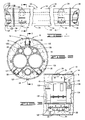
- Figure 1 is a side, partially cut away view of a pipeline bundle insulated according to one embodiment of the present invention.
- Figure 2 is a cross-sectional view taken along line 2-2 of Fig. 1.
- Figure 3 is a cross-sectional view taken along line 3-3 of Fig. 2.
- Pipeline bundles have been used heretofore, and as shown in the drawings, they are basically comprised of a least one, and usually three or more flow lines contained within an outer sleeve. That is, referring to Figs. 1-3, a typical pipeline bundle 10 is comprised of six flow lines 12A through 12F positioned within an outer protective sleeve 14 by a plurality of support members 16.
- the support members 16 can take various forms, but they are generally comprised of a frame 18 which rigidly supports the flow lines 12A through 12F in a bundle within the outer sleeve 14.
- the support members 16 each include a plurality of peripheral rollers 20 for facilitating the insertion of the flow line bundle within the outer sleeve 14.
- the space 22 between the outside of the flow lines and the inside of the outer sleeve is filled with an insulating material which functions to substantially prevent heat transfer from and to the fluids flowing through the flow lines.
- the space 22 of the pipeline bundle 10 is filled with a foamed cement composition comprised of hydraulic cement, water, a gas, a foaming agent, and optionally, a foam stabilizer.
- the foamed cement composition is allowed to initially set, i.e., the hydration reaction between the hydraulic cement and the water in the cement composition is permitted to take place.
- the cement and water react whereby the cement is hydrated and the composition sets into a hard mass.
- the particular time after mixing that is required for the hydration reaction to take place varies considerably depending on the particular types and quantities of the components in the cement composition. However, the time can be controlled by adding accelerators or retarders to the cement composition which are also well known in the art.
- the hydrated cement composition is heated to evaporate and remove excess unreacted water in the cement composition and thereby increase its insulation properties.
- the heating of the cement composition can be accomplished by circulating a heated fluid, e.g., steam or hot water, through one or more of the flow lines 12A through 12F.
- the outer sleeve 14 is preferably vented such as by removing plugs (not shown) from threaded connectors 24 spaced along the length of the outer sleeve 14.
- a vacuum can optionally be pulled on the cement composition by way of the connectors 24 to increase the evaporation and removal of excess water.
- the hydrated foamed cement composition within the space 22 of the pipeline bundle 10 is heated to a temperature in the range of from about 100°F to about 300°F for a time period in the range of from about 70 hours to about 170 hours.
- the heating is preferably accomplished while the outer sleeve is vented to the atmosphere. If the cement composition is also subjected to a vacuum during the heating and venting, it is preferably maintained at a level within the range of from about 0.75 to about 100 millimeters of mercury throughout the duration of the heating step.
- the method of the present invention results in a highly insulated pipeline bundle. That is, the set foamed cement within the outer sleeve of the bundle which is essentially devoid of excess water has a thermal conductivity in the range of from about 0.02 to about 0.35 btu/hr., ft., OF. In addition, the set foamed cement in the pipeline bundle has excellent resiliency and ductility and thereby resists stress failures.
- the foamed cement compositions useful in accordance with this invention are basically comprised of hydraulic cement, water, a gas, a foaming agent and optionally a foam stabilizer.
- hydraulic cementitious materials which hydrate to form hard cementitious masses in the presence of water can be utilized in accordance with this invention. Examples of such materials are Portland cement, high alumina cement, slag cement, ASTM Class F fly ash and lime, ASTM Class C fly ash, condensed silica fume and lime, gypsum cement and mixtures of such materials.
- Portland cements e.g., Portland cements of the types defined and described in API Specification For Materials And Testinq For Well Cements , API Specification 10, 5th Edition, dated July 1, 1990 of the American Petroleum Institute.
- the water used in the cement composition can be water from any source provided it does not contain an excess of compounds which adversely react with or otherwise affect components in the cement compositions.
- the water can be fresh water, salt water, brines or seawater.
- the water is present in the compositions of this invention in an amount in the range of from about 15% to about 180% by weight of the hydraulic cement in the compositions.
- the gas used to form the cement compositions of this invention is preferably nitrogen or air, with nitrogen being the most preferred.
- the presence of the gas in the cement composition contributes to the insulation properties of the composition and also provides elasticity to the set foamed cement whereby it resists stress failures as a result of deformation of the pipeline bundle.
- the amount of gas in the foamed cement composition must be in the range of from about 10% to about 80% by volume of the resulting foamed composition. More preferably, the gas is present in an amount in the range of from about 30% to about 70%, and most preferably, an amount in the range of from about 45% to about 65% by volume of the cement composition.
- a foaming agent is preferably included in the cement composition.
- Suitable foaming agents are surfactants having the formula: H(CH 2 ) a (OC 2 H 4 ) 3 OSO 3 X + wherein:
- Another particularly preferred foaming agent of the above mentioned type is a surfactant having the formula: H(CH 2 ) a (OC 2 H 4 ) 3 OSO 3 NH 4 + wherein:
- Another foaming agent which can be utilized in the cement compositions of this invention is comprised of polyethoxylated alcohols having the formula: H(CH 2 ) a (OC 2 H 4 ) b OH wherein:
- Still another surfactant which can be used is an alcohol ether sulfate of the formula: H(CH 2 ) a (OC 2 H 4 ) b SO 3 NH 4 + wherein:
- the foaming agent utilized is included in a cement composition of this invention in an amount in the range of from about 0.5% to about 10% by weight of water in the composition.
- the foaming agent is one of the preferred surfactants described above, it is included in the composition in an amount in the range of from about 2% to about 4% by weight of water therein.
- a foam stabilizing agent can also be included in the foamed cement compositions of this invention to enhance the stability of the foamed cement slurry.
- One such foam stabilizing agent is a compound of the formula: wherein:
- Another foam stabilizing agent which can be utilized is a compound having the formula: R-CONHCH 2 CH 2 CH 2 N + (CH 3 ) 2 CH 2 CO 2 - wherein: R is a C 10 to C 18 saturated aliphatic hydrocarbon group or an oleyl group or a linoleyl group.
- a preferred stabilizing agent of the above type is an amidopropylbetaine of the formula: R-CONHCH 2 CH 2 CH 2 N + (CH 3 ) 2 CH 2 CO 2 - wherein: R is a coco radical.
- This foam stabilizing agent is commercially available from Halliburton Energy Services under the trade designation "HC-2TM.”
- a foam stabilizing agent When a foam stabilizing agent is utilized, it is generally included in a cement composition of this invention in an amount in the range of from about 0.25% to about 5% by weight of water utilized. When the foam stabilizing agent is one of the preferred agents described above, it is preferably present in the composition in an amount in the range of from about 1% to about 2% by weight of water.
- a particularly preferred foamed cement composition of this invention which sets into a substantially impermeable highly insulative mass is comprised of Portland hydraulic cement; water present in an amount sufficient to form a pumpable slurry; nitrogen gas present in an amount in the range of from about 45% to about 65% by volume of the cement composition to produce a density in the range of from about 6 to about 8.5 pounds per gallon; a foaming agent comprised of the sodium salt of alpha-olefinic sulfonic acid present in an amount in the range of from about 1% to about 2% by weight of water in the composition; and a foam stabilizing agent comprised of an amidopropylbetaine of the formula: R-CONHCH 2 CH 2 CH 2 N + (CH 3 ) 2 CH 2 CO 2 - wherein: R is a C 10 to C 18 saturated aliphatic hydrocarbon group or an oleyl group or a linoleyl group, the foam stabilizing agent being present in an amount in the range of from about 0.5% to about 1.0% by weight of water
- the foamed cement compositions can include other useful components, additives and fillers which are well known to those skilled in the art. Additional components which impart enhanced elasticity and resilience and low thermal conductivity to the compositions are particularly suitable for use in accordance with this invention.
- the foamed cement compositions of this invention can include vulcanizable rubber latex therein. The rubber latex is vulcanized at the same approximate time as the cement hydrates to produce a foamed cement composition having high strength, elasticity and resilience. Cement-rubber latex compositions of this type are described in U.S. Patent No. 5,293,938 issued on March 15, 1994 to Onan et al., which is incorporated herein by reference.
- the foamed cement composition can include a filler material comprised of hollow ceramic beads which is commercially available from Halliburton Energy Services under the trade designation "SPHERELITETM" which lowers the thermal conductivity of the composition.
- the foamed cement composition can be formed in any conventional manner, e.g., by batch mixing or on the fly.
- the composition is preferably pumped into the outer sleeve of a section of pipeline bundle after the flow lines have been inserted therein.
- the heating step is then carried out by circulating a hot fluid, e.g., hot water or steam, through one or more of the flow lines of the bundle section for the time required to remove excess water.
- a hot fluid e.g., hot water or steam
- the outer sleeve of the pipeline bundle is preferably vented to the atmosphere or to a vacuum pump whereby a vacuum is pulled on the cement composition.
- the cement compositions each consisted of API Class G Portland cement, sufficient water to form a non-foamed base slurry having a density of 15.5 lb/gal, 40% silica flour filler by weight of cement, 2% calcium chloride by weight of cement, 1.5% of HALLIBURTON FOAM ADDITIVETM by volume of the foamed cement composition, 0.75% HALLIBURTON FOAM STABILIZERTM by volume of the foamed cement composition and sufficient nitrogen gas to produce a foamed cement composition of 6 or 8 lb/gal density.
- the thermal conductivity measurements were performed using a Halliburton CRD Thermal Conductivity Apparatus, i.e., a precision 2" diameter by 6" length radial flow device and a precision heating device.
- the foamed cement compositions were placed in an annulus between a sleeve and a heater mandrel in the flow device.
- the thermal conductivity of the cement was calculated from the temperature drop between the mandrel and outer sleeve and the power input to the heater.
- the results of the thermal conductivity tests are set forth in Table I below.
- Samples of the 6 and 8 lb/gal foamed cement compositions described in Example 1 above were tested for compressive strengths. That is, samples were tested after curing at temperatures of 40°F and 72°F for 3, 7, 14 and 28 days. Also, samples were tested after being cured for 7 days at 300°F.
- Samples of the foamed cement compositions described in Example 1 above were tested for tensile strengths in accordance with the procedures of ASTM Designations C190-85 and C496. That is, samples cured for 14 days at temperatures of 40°F and 72°F were tested for tensile strengths. Also, additional samples were tested for tensile strengths after being cured for 7 days at 300°F. The results of these tests are set forth in Table III below.
- each shear bond strength test was performed by first placing the foamed cement composition test samples between two pieces of pipe. The test samples were then cured as indicated below. After curing, a load was applied to the inside pipe to force it to move within the set cement. The total load in pounds was then divided by the surface area of the inside pipe which was in contact with the cement to obtain the shear bond strength in psi. Samples were tested after being cured for 14 days at temperatures of 40°F and 72°F. Additional samples cured for 7 days at 300°F were also tested. The results of these tests are set forth in Table V below.
- the Young's modulus of elasticity for the 6 lb/gal foamed cement was 0.071 x 10 6 psi as compared to non-foamed cements which have Young's moduli of about 3 x 10 6 psi and steel which has a modulus of about 30 x 10 6 psi.
Landscapes
- Engineering & Computer Science (AREA)
- General Engineering & Computer Science (AREA)
- Chemical & Material Sciences (AREA)
- Mechanical Engineering (AREA)
- Ceramic Engineering (AREA)
- Chemical Kinetics & Catalysis (AREA)
- Inorganic Chemistry (AREA)
- Materials Engineering (AREA)
- Structural Engineering (AREA)
- Organic Chemistry (AREA)
- Curing Cements, Concrete, And Artificial Stone (AREA)
- Thermal Insulation (AREA)
Applications Claiming Priority (2)
| Application Number | Priority Date | Filing Date | Title |
|---|---|---|---|
| US08/570,845 US5791380A (en) | 1995-12-12 | 1995-12-12 | Methods of forming insulated pipeline bundles |
| US570845 | 1995-12-12 |
Publications (1)
| Publication Number | Publication Date |
|---|---|
| EP0779467A1 true EP0779467A1 (de) | 1997-06-18 |
Family
ID=24281285
Family Applications (1)
| Application Number | Title | Priority Date | Filing Date |
|---|---|---|---|
| EP96308646A Ceased EP0779467A1 (de) | 1995-12-12 | 1996-11-29 | Verfahren zur Isolierung von Rohrbündeln |
Country Status (4)
| Country | Link |
|---|---|
| US (1) | US5791380A (de) |
| EP (1) | EP0779467A1 (de) |
| CA (1) | CA2192640A1 (de) |
| NO (1) | NO965297L (de) |
Cited By (4)
| Publication number | Priority date | Publication date | Assignee | Title |
|---|---|---|---|---|
| FR2769682A1 (fr) * | 1997-10-10 | 1999-04-16 | Doris Engineering | Conduite sous-marine de transfert de produits petroliers |
| EP1035364A1 (de) * | 1999-03-03 | 2000-09-13 | Hewing GmbH | Fernwärmeleitung |
| FR2833063A1 (fr) * | 2001-12-04 | 2003-06-06 | Bouygues Offshore | Conduite sous-marine renforcee et ensemble de deux conduites coaxiales en comprenant |
| WO2005059300A1 (en) * | 2003-12-19 | 2005-06-30 | Halliburton Energy Services, Inc. | Foamed fly ash cement compositions and methods of cementing |
Families Citing this family (38)
| Publication number | Priority date | Publication date | Assignee | Title |
|---|---|---|---|---|
| US6672371B1 (en) | 1995-09-12 | 2004-01-06 | Enlink Geoenergy Services, Inc. | Earth heat exchange system |
| US7017650B2 (en) * | 1995-09-12 | 2006-03-28 | Enlink Geoenergy Services, Inc. | Earth loop energy systems |
| US6276438B1 (en) | 1995-09-12 | 2001-08-21 | Thomas R. Amerman | Energy systems |
| US6250371B1 (en) | 1995-09-12 | 2001-06-26 | Enlink Geoenergy Services, Inc. | Energy transfer systems |
| US6041862A (en) * | 1995-09-12 | 2000-03-28 | Amerman; Thomas R. | Ground heat exchange system |
| US6585036B2 (en) | 1995-09-12 | 2003-07-01 | Enlink Geoenergy Services, Inc. | Energy systems |
| US6860320B2 (en) | 1995-09-12 | 2005-03-01 | Enlink Geoenergy Services, Inc. | Bottom member and heat loops |
| DE19618370C1 (de) * | 1996-05-09 | 1997-08-21 | Gesundheitstechnik Anton Kastn | Verfahren zur Herstellung eines wärmegedämmten Rohrabschnittes für eine Rohrleitung sowie Rohrabschnitt |
| US6199593B1 (en) * | 1997-03-17 | 2001-03-13 | Basf Aktiengesellschaft | Production of pipes insulated with foams |
| US6003559A (en) * | 1997-08-21 | 1999-12-21 | Baker; Jerry G. | Pipe-in-a-pipe bundle apparatus |
| US6167912B1 (en) * | 1997-11-25 | 2001-01-02 | Patrick J. Stephens | Method and composition for grouting water-flooded conduits |
| FR2774146B1 (fr) * | 1998-01-26 | 2000-04-07 | Regis Julien | Faisceau plurifonctionnel, et robot industriel ainsi equipe |
| US6199595B1 (en) | 1998-06-04 | 2001-03-13 | Jerry G. Baker | Insulated marine pipe apparatus and method of installation |
| DE19952103A1 (de) * | 1999-10-29 | 2001-05-03 | Abb Research Ltd | Transporteinrichtung für strömende Medien |
| US6244343B1 (en) | 2000-03-09 | 2001-06-12 | Halliburton Energy Services, Inc. | Cementing in deep water offshore wells |
| US6562122B2 (en) * | 2000-09-18 | 2003-05-13 | Halliburton Energy Services, Inc. | Lightweight well cement compositions and methods |
| US7066284B2 (en) * | 2001-11-14 | 2006-06-27 | Halliburton Energy Services, Inc. | Method and apparatus for a monodiameter wellbore, monodiameter casing, monobore, and/or monowell |
| US6722433B2 (en) * | 2002-06-21 | 2004-04-20 | Halliburton Energy Services, Inc. | Methods of sealing expandable pipe in well bores and sealing compositions |
| US6516884B1 (en) | 2002-07-23 | 2003-02-11 | Halliburton Energy Services, Inc. | Stable well cementing methods and compositions |
| US7217441B2 (en) * | 2003-03-28 | 2007-05-15 | Halliburton Energy Services, Inc. | Methods for coating pipe comprising using cement compositions comprising high tensile strength fibers and/or a multi-purpose cement additive |
| US7273100B2 (en) * | 2003-04-15 | 2007-09-25 | Halliburton Energy Services, Inc. | Biodegradable dispersants for cement compositions and methods of cementing in subterranean formations |
| US7147055B2 (en) * | 2003-04-24 | 2006-12-12 | Halliburton Energy Services, Inc. | Cement compositions with improved corrosion resistance and methods of cementing in subterranean formations |
| US6904971B2 (en) * | 2003-04-24 | 2005-06-14 | Halliburton Energy Services, Inc. | Cement compositions with improved corrosion resistance and methods of cementing in subterranean formations |
| US7055603B2 (en) * | 2003-09-24 | 2006-06-06 | Halliburton Energy Services, Inc. | Cement compositions comprising strength-enhancing lost circulation materials and methods of cementing in subterranean formations |
| US7073584B2 (en) | 2003-11-12 | 2006-07-11 | Halliburton Energy Services, Inc. | Processes for incorporating inert gas in a cement composition containing spherical beads |
| US7337841B2 (en) * | 2004-03-24 | 2008-03-04 | Halliburton Energy Services, Inc. | Casing comprising stress-absorbing materials and associated methods of use |
| US20050241545A1 (en) * | 2004-04-28 | 2005-11-03 | Vargo Richard F Jr | Methods of extending the shelf life of and revitalizing lightweight beads for use in cement compositions |
| US7373981B2 (en) | 2005-02-14 | 2008-05-20 | Halliburton Energy Services, Inc. | Methods of cementing with lightweight cement compositions |
| US20060231150A1 (en) * | 2005-04-14 | 2006-10-19 | Halliburton Energy Services, Inc. | Methods and apparatus to reduce heat transfer from fluids in conduits |
| US10927978B1 (en) | 2015-05-25 | 2021-02-23 | Damian Daigle | Low-profile casing spacer roller for high-capacity loads |
| US10627014B1 (en) * | 2016-05-25 | 2020-04-21 | Damian Daigle | Anti-corkscrewing casing spacer |
| RU2647257C2 (ru) * | 2016-06-17 | 2018-03-15 | Общество с ограниченной ответственностью "СВАП ИНЖИНИРИНГ" | Способ производства обетонированной трубы с кабель-каналом |
| RU2657381C2 (ru) * | 2016-11-17 | 2018-06-13 | Общество с ограниченной ответственностью "СВАП ИНЖИНИРИНГ" | Способ производства обетонированной трубы с кабель-каналом |
| US10634268B1 (en) | 2017-04-06 | 2020-04-28 | CCI Piping System, LLC | Method and apparatus for multidirectional pipe runners |
| US11578823B1 (en) | 2021-01-15 | 2023-02-14 | Damian Daigle | Casing spacer with roller assembly guards |
| AU2021215186A1 (en) * | 2021-07-19 | 2023-02-02 | Fortescue Future Industries Pty Ltd | Apparatus and method for transfer of cryogenic fluids |
| AU2021215196A1 (en) * | 2021-07-19 | 2023-02-02 | Fortescue Future Industries Pty Ltd | Apparatus and method for transfer of cryogenic fluids – dual use vapour return and liquid circulation line |
| AU2021215194A1 (en) * | 2021-07-19 | 2023-02-02 | Fortescue Future Industries Pty Ltd | Apparatus and method for transfer of cryogenic fluids – materials substitution |
Citations (6)
| Publication number | Priority date | Publication date | Assignee | Title |
|---|---|---|---|---|
| GB1381290A (en) * | 1971-03-12 | 1975-01-22 | Bp Chem Int Ltd | Magnesia cement |
| EP0177475A2 (de) * | 1984-10-04 | 1986-04-09 | Kvaerner Subsea Contracting A/S | Rohrleitungskabel für Unterwasserzwecke |
| US4596834A (en) * | 1985-02-14 | 1986-06-24 | The Babcock & Wilcox Company | Water resistant foamed product prepared from a latex, a mineral acid, hydraulic cement, filler, aggregate and stabilizer |
| US4640312A (en) * | 1983-12-22 | 1987-02-03 | Shaw Industries Ltd. | Prefabricated thermally insulated pipeline section |
| WO1993003234A1 (en) * | 1991-08-02 | 1993-02-18 | Lund Eriksen Consult Aps | Element and method of preparing this element |
| US5293938A (en) | 1991-06-27 | 1994-03-15 | Halliburton Company | Well completion and remedial methods utilizing cement-ladened rubber |
Family Cites Families (7)
| Publication number | Priority date | Publication date | Assignee | Title |
|---|---|---|---|---|
| GB1115175A (en) * | 1965-09-14 | 1968-05-29 | Energieprojektierung Veb | Improvements in pipes for conveying fluids under pressure |
| US3737493A (en) * | 1971-03-01 | 1973-06-05 | Armco Steel Corp | Filling an annular space between radially spaced coaxial tubes with foamed cement |
| GB1431971A (en) * | 1972-07-12 | 1976-04-14 | Heien S | Method and means for laying submarine pipe lines for oil and gas transport in sea areas |
| US3841808A (en) * | 1973-01-23 | 1974-10-15 | Armco Steel Corp | Filling an annular space between radially spaced coaxial tubes with foamed cement |
| US4304298A (en) * | 1979-05-10 | 1981-12-08 | Halliburton Company | Well cementing process and gasified cements useful therein |
| US5241993A (en) * | 1989-12-06 | 1993-09-07 | Stephens Patrick J | Method for grouting cavities using a pumpable cement grout |
| US5588489A (en) * | 1995-10-31 | 1996-12-31 | Halliburton Company | Lightweight well cement compositions and methods |
-
1995
- 1995-12-12 US US08/570,845 patent/US5791380A/en not_active Expired - Fee Related
-
1996
- 1996-11-29 EP EP96308646A patent/EP0779467A1/de not_active Ceased
- 1996-12-11 NO NO965297A patent/NO965297L/no unknown
- 1996-12-11 CA CA002192640A patent/CA2192640A1/en not_active Abandoned
Patent Citations (6)
| Publication number | Priority date | Publication date | Assignee | Title |
|---|---|---|---|---|
| GB1381290A (en) * | 1971-03-12 | 1975-01-22 | Bp Chem Int Ltd | Magnesia cement |
| US4640312A (en) * | 1983-12-22 | 1987-02-03 | Shaw Industries Ltd. | Prefabricated thermally insulated pipeline section |
| EP0177475A2 (de) * | 1984-10-04 | 1986-04-09 | Kvaerner Subsea Contracting A/S | Rohrleitungskabel für Unterwasserzwecke |
| US4596834A (en) * | 1985-02-14 | 1986-06-24 | The Babcock & Wilcox Company | Water resistant foamed product prepared from a latex, a mineral acid, hydraulic cement, filler, aggregate and stabilizer |
| US5293938A (en) | 1991-06-27 | 1994-03-15 | Halliburton Company | Well completion and remedial methods utilizing cement-ladened rubber |
| WO1993003234A1 (en) * | 1991-08-02 | 1993-02-18 | Lund Eriksen Consult Aps | Element and method of preparing this element |
Non-Patent Citations (1)
| Title |
|---|
| "API Specification 10", vol. 5, 1 July 1990, AMERICAN PETROLEUM INSTITUTE, article "API Specification for Materials and Testing For Well Cements" |
Cited By (11)
| Publication number | Priority date | Publication date | Assignee | Title |
|---|---|---|---|---|
| FR2769682A1 (fr) * | 1997-10-10 | 1999-04-16 | Doris Engineering | Conduite sous-marine de transfert de produits petroliers |
| WO1999019661A1 (fr) * | 1997-10-10 | 1999-04-22 | Doris Engineering | Conduite sous-marine de transfert de produits petroliers |
| GB2345111A (en) * | 1997-10-10 | 2000-06-28 | Engineering Doris | Submarine pipeline for transporting petroleum products |
| US6213157B1 (en) | 1997-10-10 | 2001-04-10 | Doris Engineering | Submarine pipeline for transporting petroleum products |
| EA001512B1 (ru) * | 1997-10-10 | 2001-04-23 | Дорис Инжиниринг | Подводный трубопровод для транспортировки нефтепродуктов |
| GB2345111B (en) * | 1997-10-10 | 2002-07-31 | Engineering Doris | Submarine pipeline for transporting petroleum products |
| EP1035364A1 (de) * | 1999-03-03 | 2000-09-13 | Hewing GmbH | Fernwärmeleitung |
| FR2833063A1 (fr) * | 2001-12-04 | 2003-06-06 | Bouygues Offshore | Conduite sous-marine renforcee et ensemble de deux conduites coaxiales en comprenant |
| WO2003048621A1 (fr) * | 2001-12-04 | 2003-06-12 | Saipem S.A. | Conduite sous-marine renforcee et ensemble de deux conduites coaxiales en comprenant |
| WO2005059300A1 (en) * | 2003-12-19 | 2005-06-30 | Halliburton Energy Services, Inc. | Foamed fly ash cement compositions and methods of cementing |
| US7413014B2 (en) | 2003-12-19 | 2008-08-19 | Halliburton Energy Services, Inc. | Foamed fly ash cement compositions and methods of cementing |
Also Published As
| Publication number | Publication date |
|---|---|
| US5791380A (en) | 1998-08-11 |
| NO965297L (no) | 1997-06-13 |
| NO965297D0 (no) | 1996-12-11 |
| CA2192640A1 (en) | 1997-06-13 |
Similar Documents
| Publication | Publication Date | Title |
|---|---|---|
| US5791380A (en) | Methods of forming insulated pipeline bundles | |
| US6656265B1 (en) | Cementation product and use for cementing oil wells or the like | |
| EP0787698B1 (de) | Verfahren zum Zementieren eines Bohrlochs | |
| US5736594A (en) | Cementing compositions and methods using recycled expanded polystyrene | |
| US4069870A (en) | Method of cementing well casing using a high temperature cement system | |
| CA2209236C (en) | Resilient well cement compositions and methods | |
| US6251179B1 (en) | Thermally conductive cementitious grout for geothermal heat pump systems | |
| US6516884B1 (en) | Stable well cementing methods and compositions | |
| US5897699A (en) | Foamed well cement compositions, additives and methods | |
| EP1565643B1 (de) | Verfahren und zementzusammensetzungen zum zementieren inunterirdischen bereichen | |
| CA2209232C (en) | Resilient well cement compositions and methods | |
| US6776237B2 (en) | Lightweight well cement compositions and methods | |
| US5900053A (en) | Light weight high temperature well cement compositions and methods | |
| US6210476B1 (en) | Foamed cement compositions and methods | |
| US7013975B2 (en) | Foamed cement slurries, additives and methods | |
| US6951249B1 (en) | Foamed cement slurries, additives and methods | |
| WO2005059300A1 (en) | Foamed fly ash cement compositions and methods of cementing | |
| BRPI0708947A2 (pt) | mÉtodo de manutenÇço de um furo de poÇo em uma formaÇço subterrÂnea, e, composiÇço de cimento | |
| CA2298138A1 (en) | Methods and compositions for cementing pipe strings in well bores | |
| WO2005035935A1 (en) | Methods of cementing subterranean zones with cement compositions having enhanced compressive strengths | |
| EP3004020A1 (de) | Verfahren und zementzusammensetzungen mit behandelten polyolefinfasern | |
| NO20131239A1 (no) | Skumdempende sammensetninger og fremgangsmåter for sementeringsapplikasjoner | |
| US10655045B2 (en) | Self-healing durable cement | |
| EP0816300B1 (de) | Bohrlochzementzusammensetzung | |
| EP1483220B1 (de) | Leichte bohrlochzementzusammensetzungen und verfahren |
Legal Events
| Date | Code | Title | Description |
|---|---|---|---|
| PUAI | Public reference made under article 153(3) epc to a published international application that has entered the european phase |
Free format text: ORIGINAL CODE: 0009012 |
|
| AK | Designated contracting states |
Kind code of ref document: A1 Designated state(s): DE FR GB IT NL |
|
| 17P | Request for examination filed |
Effective date: 19970709 |
|
| 17Q | First examination report despatched |
Effective date: 19971008 |
|
| GRAG | Despatch of communication of intention to grant |
Free format text: ORIGINAL CODE: EPIDOS AGRA |
|
| STAA | Information on the status of an ep patent application or granted ep patent |
Free format text: STATUS: THE APPLICATION HAS BEEN REFUSED |
|
| 18R | Application refused |
Effective date: 19990620 |