EP0776868A1 - Resistor for cathode ray tube and method of preparing same - Google Patents
Resistor for cathode ray tube and method of preparing same Download PDFInfo
- Publication number
- EP0776868A1 EP0776868A1 EP96119038A EP96119038A EP0776868A1 EP 0776868 A1 EP0776868 A1 EP 0776868A1 EP 96119038 A EP96119038 A EP 96119038A EP 96119038 A EP96119038 A EP 96119038A EP 0776868 A1 EP0776868 A1 EP 0776868A1
- Authority
- EP
- European Patent Office
- Prior art keywords
- resistance
- glass
- cathode ray
- ray tube
- resistor
- Prior art date
- Legal status (The legal status is an assumption and is not a legal conclusion. Google has not performed a legal analysis and makes no representation as to the accuracy of the status listed.)
- Granted
Links
Images


Classifications
-
- C—CHEMISTRY; METALLURGY
- C03—GLASS; MINERAL OR SLAG WOOL
- C03C—CHEMICAL COMPOSITION OF GLASSES, GLAZES OR VITREOUS ENAMELS; SURFACE TREATMENT OF GLASS; SURFACE TREATMENT OF FIBRES OR FILAMENTS MADE FROM GLASS, MINERALS OR SLAGS; JOINING GLASS TO GLASS OR OTHER MATERIALS
- C03C8/00—Enamels; Glazes; Fusion seal compositions being frit compositions having non-frit additions
- C03C8/14—Glass frit mixtures having non-frit additions, e.g. opacifiers, colorants, mill-additions
-
- C—CHEMISTRY; METALLURGY
- C03—GLASS; MINERAL OR SLAG WOOL
- C03C—CHEMICAL COMPOSITION OF GLASSES, GLAZES OR VITREOUS ENAMELS; SURFACE TREATMENT OF GLASS; SURFACE TREATMENT OF FIBRES OR FILAMENTS MADE FROM GLASS, MINERALS OR SLAGS; JOINING GLASS TO GLASS OR OTHER MATERIALS
- C03C17/00—Surface treatment of glass, not in the form of fibres or filaments, by coating
- C03C17/006—Surface treatment of glass, not in the form of fibres or filaments, by coating with materials of composite character
- C03C17/007—Surface treatment of glass, not in the form of fibres or filaments, by coating with materials of composite character containing a dispersed phase, e.g. particles, fibres or flakes, in a continuous phase
-
- C—CHEMISTRY; METALLURGY
- C03—GLASS; MINERAL OR SLAG WOOL
- C03C—CHEMICAL COMPOSITION OF GLASSES, GLAZES OR VITREOUS ENAMELS; SURFACE TREATMENT OF GLASS; SURFACE TREATMENT OF FIBRES OR FILAMENTS MADE FROM GLASS, MINERALS OR SLAGS; JOINING GLASS TO GLASS OR OTHER MATERIALS
- C03C3/00—Glass compositions
- C03C3/04—Glass compositions containing silica
- C03C3/062—Glass compositions containing silica with less than 40% silica by weight
- C03C3/07—Glass compositions containing silica with less than 40% silica by weight containing lead
- C03C3/072—Glass compositions containing silica with less than 40% silica by weight containing lead containing boron
-
- C—CHEMISTRY; METALLURGY
- C03—GLASS; MINERAL OR SLAG WOOL
- C03C—CHEMICAL COMPOSITION OF GLASSES, GLAZES OR VITREOUS ENAMELS; SURFACE TREATMENT OF GLASS; SURFACE TREATMENT OF FIBRES OR FILAMENTS MADE FROM GLASS, MINERALS OR SLAGS; JOINING GLASS TO GLASS OR OTHER MATERIALS
- C03C3/00—Glass compositions
- C03C3/04—Glass compositions containing silica
- C03C3/062—Glass compositions containing silica with less than 40% silica by weight
- C03C3/07—Glass compositions containing silica with less than 40% silica by weight containing lead
- C03C3/072—Glass compositions containing silica with less than 40% silica by weight containing lead containing boron
- C03C3/074—Glass compositions containing silica with less than 40% silica by weight containing lead containing boron containing zinc
- C03C3/0745—Glass compositions containing silica with less than 40% silica by weight containing lead containing boron containing zinc containing more than 50% lead oxide, by weight
-
- C—CHEMISTRY; METALLURGY
- C03—GLASS; MINERAL OR SLAG WOOL
- C03C—CHEMICAL COMPOSITION OF GLASSES, GLAZES OR VITREOUS ENAMELS; SURFACE TREATMENT OF GLASS; SURFACE TREATMENT OF FIBRES OR FILAMENTS MADE FROM GLASS, MINERALS OR SLAGS; JOINING GLASS TO GLASS OR OTHER MATERIALS
- C03C3/00—Glass compositions
- C03C3/12—Silica-free oxide glass compositions
- C03C3/122—Silica-free oxide glass compositions containing oxides of As, Sb, Bi, Mo, W, V, Te as glass formers
-
- C—CHEMISTRY; METALLURGY
- C03—GLASS; MINERAL OR SLAG WOOL
- C03C—CHEMICAL COMPOSITION OF GLASSES, GLAZES OR VITREOUS ENAMELS; SURFACE TREATMENT OF GLASS; SURFACE TREATMENT OF FIBRES OR FILAMENTS MADE FROM GLASS, MINERALS OR SLAGS; JOINING GLASS TO GLASS OR OTHER MATERIALS
- C03C3/00—Glass compositions
- C03C3/12—Silica-free oxide glass compositions
- C03C3/16—Silica-free oxide glass compositions containing phosphorus
- C03C3/17—Silica-free oxide glass compositions containing phosphorus containing aluminium or beryllium
-
- C—CHEMISTRY; METALLURGY
- C03—GLASS; MINERAL OR SLAG WOOL
- C03C—CHEMICAL COMPOSITION OF GLASSES, GLAZES OR VITREOUS ENAMELS; SURFACE TREATMENT OF GLASS; SURFACE TREATMENT OF FIBRES OR FILAMENTS MADE FROM GLASS, MINERALS OR SLAGS; JOINING GLASS TO GLASS OR OTHER MATERIALS
- C03C8/00—Enamels; Glazes; Fusion seal compositions being frit compositions having non-frit additions
- C03C8/02—Frit compositions, i.e. in a powdered or comminuted form
- C03C8/04—Frit compositions, i.e. in a powdered or comminuted form containing zinc
-
- C—CHEMISTRY; METALLURGY
- C03—GLASS; MINERAL OR SLAG WOOL
- C03C—CHEMICAL COMPOSITION OF GLASSES, GLAZES OR VITREOUS ENAMELS; SURFACE TREATMENT OF GLASS; SURFACE TREATMENT OF FIBRES OR FILAMENTS MADE FROM GLASS, MINERALS OR SLAGS; JOINING GLASS TO GLASS OR OTHER MATERIALS
- C03C8/00—Enamels; Glazes; Fusion seal compositions being frit compositions having non-frit additions
- C03C8/02—Frit compositions, i.e. in a powdered or comminuted form
- C03C8/08—Frit compositions, i.e. in a powdered or comminuted form containing phosphorus
-
- C—CHEMISTRY; METALLURGY
- C03—GLASS; MINERAL OR SLAG WOOL
- C03C—CHEMICAL COMPOSITION OF GLASSES, GLAZES OR VITREOUS ENAMELS; SURFACE TREATMENT OF GLASS; SURFACE TREATMENT OF FIBRES OR FILAMENTS MADE FROM GLASS, MINERALS OR SLAGS; JOINING GLASS TO GLASS OR OTHER MATERIALS
- C03C8/00—Enamels; Glazes; Fusion seal compositions being frit compositions having non-frit additions
- C03C8/02—Frit compositions, i.e. in a powdered or comminuted form
- C03C8/10—Frit compositions, i.e. in a powdered or comminuted form containing lead
-
- H—ELECTRICITY
- H01—ELECTRIC ELEMENTS
- H01C—RESISTORS
- H01C17/00—Apparatus or processes specially adapted for manufacturing resistors
- H01C17/06—Apparatus or processes specially adapted for manufacturing resistors adapted for coating resistive material on a base
- H01C17/065—Apparatus or processes specially adapted for manufacturing resistors adapted for coating resistive material on a base by thick film techniques, e.g. serigraphy
- H01C17/06506—Precursor compositions therefor, e.g. pastes, inks, glass frits or green body
-
- H—ELECTRICITY
- H01—ELECTRIC ELEMENTS
- H01J—ELECTRIC DISCHARGE TUBES OR DISCHARGE LAMPS
- H01J29/00—Details of cathode-ray tubes or of electron-beam tubes of the types covered by group H01J31/00
- H01J29/96—One or more circuit elements structurally associated with the tube
-
- C—CHEMISTRY; METALLURGY
- C03—GLASS; MINERAL OR SLAG WOOL
- C03C—CHEMICAL COMPOSITION OF GLASSES, GLAZES OR VITREOUS ENAMELS; SURFACE TREATMENT OF GLASS; SURFACE TREATMENT OF FIBRES OR FILAMENTS MADE FROM GLASS, MINERALS OR SLAGS; JOINING GLASS TO GLASS OR OTHER MATERIALS
- C03C2217/00—Coatings on glass
- C03C2217/40—Coatings comprising at least one inhomogeneous layer
- C03C2217/43—Coatings comprising at least one inhomogeneous layer consisting of a dispersed phase in a continuous phase
- C03C2217/44—Coatings comprising at least one inhomogeneous layer consisting of a dispersed phase in a continuous phase characterized by the composition of the continuous phase
- C03C2217/45—Inorganic continuous phases
- C03C2217/452—Glass
-
- C—CHEMISTRY; METALLURGY
- C03—GLASS; MINERAL OR SLAG WOOL
- C03C—CHEMICAL COMPOSITION OF GLASSES, GLAZES OR VITREOUS ENAMELS; SURFACE TREATMENT OF GLASS; SURFACE TREATMENT OF FIBRES OR FILAMENTS MADE FROM GLASS, MINERALS OR SLAGS; JOINING GLASS TO GLASS OR OTHER MATERIALS
- C03C2217/00—Coatings on glass
- C03C2217/40—Coatings comprising at least one inhomogeneous layer
- C03C2217/43—Coatings comprising at least one inhomogeneous layer consisting of a dispersed phase in a continuous phase
- C03C2217/46—Coatings comprising at least one inhomogeneous layer consisting of a dispersed phase in a continuous phase characterized by the dispersed phase
- C03C2217/47—Coatings comprising at least one inhomogeneous layer consisting of a dispersed phase in a continuous phase characterized by the dispersed phase consisting of a specific material
- C03C2217/475—Inorganic materials
-
- H—ELECTRICITY
- H01—ELECTRIC ELEMENTS
- H01J—ELECTRIC DISCHARGE TUBES OR DISCHARGE LAMPS
- H01J2229/00—Details of cathode ray tubes or electron beam tubes
- H01J2229/96—Circuit elements other than coils, reactors or the like, associated with the tube
- H01J2229/966—Circuit elements other than coils, reactors or the like, associated with the tube associated with the gun structure
Definitions
- the present invention relates to a method of preparing a resistor for cathode ray tube, for example a projection television display tube.
- a conventional cathode ray tube comprising a sealed glass envelope evacuated to a substantial vacuum.
- the glass envelope includes a generally cylindrical neck 12 having one end closed and the other end flared outwardly to define a cone which is in turn continued to a faceplate 21.
- the illustrated cathode ray tube also comprises a cathode 23, an electron gun made up of one or more electronic lens elements, all of which are accommodated within the neck 22.
- the electron gun shown therein is in the form of a triode electron gun including a triode portion 24 and a main electronic lens portion 25 made of metal cylinder, wherein electron beams discharged from the cathode 23 can be led through the main electron lens portion 25 to form a crossover image on the faceplate 21.
- the helical resistance body can be prepared by dipping a glass tube made of Pb glass material having a softening point of 640 °C into a stable binder-free slurry containing ruthenium hydroxide and glass particles to form an inner coating layer on the glass tube, and then mechanically processing the coating layer in a helical shape after drying, and finally sintering the helical layer to give a ruthenium oxide-containing resistance layer.
- the binder-free suspension containing Ru(OH) 2 and glass particles having a low melting temperature during the sintering step carried out at 400 to 600 °C, Ru(OH) 2 is thermally decomposed to produce RuO 2 and at the same time the glass particles are soften, so that a resulting resistance layer comprises very fine RuO 2 particles having a size of 0.01 to 0.03 ⁇ m crystallized around the glass particles.
- An object of the present invention is to provide a method of preparing a high resistance layer on inside of such a glass tube having a low melting temperature (glass transition point: 600 °C) in the cathode ray tube by sintering at a low temperature. That is, the present invention is to provide a method of preparing a helical resistance layer having less dependency on the sintering temperature and less change rate of load characteristic and temperature characteristic of the resistance value on applying a high voltage even by sintering at a low temperature.
- Another object of the present invention is to provide a method of preparing a more reliable high resistance layer on a glass substrate for a focussing electrode at a sintering low temperature by adjusting or selecting a composite ratio of RuO 2 and a glass component, particle sizes thereof and a kind of the glass component, further a particle size, kind and composite ratio of a metal oxide if necessary.
- the resistance layer contains small ratio such as 1 to 15% by weight of RuO 2 component, and RuO 2 particles have a relatively large size of 0.05 to 0.4 ⁇ m, and the glass particles have a small size of 0.01 to 2.0 ⁇ m, the desired high sheet resistivity of 1 M ⁇ / ⁇ and low TCR can be always obtained even if the sintering step of the resistance layer would be carried out at a low temperature of around 500 °C. Further, a good short-time overload of ⁇ 2 % or less and a low TCR of ⁇ 450 ppm/°C or less can be obtained, provided that the glass composition and the sintering condition are optimized.
- a method of preparing a resistor for cathode ray tube which comprises steps of:
- the resulting RuO 2 -glass glaze resistor has a structure after sintering wherein RuO 2 particles are dispersed in a network of glass particles, for example as shown in Journal of American Ceramic Society, 73 vol. No.7 (1990) page 1953.
- the glass composition may be adjusted to fit a coefficient of thermal expansion to that of the glass tube, the preferred examples are shown as follows.
- the glass tube has preferably a glass transition point Tg of 600 °C or less.
- Tg glass transition point 600 °C or less.
- a resistor for cathode ray tube which comprises steps of:
- the glass powder may comprises:
- the metal oxide powder may be at least one selected from the group consisting of TiO 2 , ZrO 2 , ZnO, SiO 2 and Al 2 O 3 .
- a cathode ray tube comprising a sealed glass envelope evacuated to a substantial vacuum.
- the glass envelope includes a generally cylindrical neck 12 having one end closed and the other end flared outwardly to define a cone which is in turn continued to a faceplate 11.
- the illustrated cathode ray tube also comprises a cathode 13, an electron gun made up of one or more electronic lens elements, all of which are accommodated within the neck 12.
- the electron gun shown therein is in the form of a triode electron gun including a triode 14 and a focusing electrode 15.
- the focusing electrode 15 is formed by the use of a spiral resistance element.
- This glass tube of the specific composition is available from Nippon Denki Garasu Kabushiki Kaisha, Produce # L-29F.
- the viscosity-adjusted resistance paste was applied to the inner surface of the glass tube by immersing the glass tube in a bath containing the viscosity-adjusted resistance paste and then pulling it out of the bath.
- the glass tube having the inner surface coated with the resistance paste was then dried at 80° C to complete a resistance layer of about 10 ⁇ m in thickness on the inner surface of the glass tube.
- the inner surface of the glass tube where the resistance layer was formed is subsequently ground spirally to form a coiled or helical resistance pattern having a plurality of resistance convolutions of a pitch of 300 ⁇ m, 3.5 m in total length exclusive of an intermediate tap, each of said resistance convolutions having a width of 225 ⁇ m with the neighboring resistance convolutions spaced a distance of 75 ⁇ m.
- Each of the internally coated glass tubes was assembled into the corresponding focusing electrode 15 in the cathode ray tube shown in Fig. 1.
- 40 KV voltage was applied for one minute to an anode (an end of the focusing electrode 15) of each of the resultant cathode ray tubes. It has been found that the magnitude of change in resistance was -1.0%. Results of experiments are shown in Table 1 (setting forth conditions for preparation) and Table 3 (characteristics) wherein Sample No. 1 shows Example 1.
- This glass tube of the specific composition is available from Nippon Denki Garasu Kabushiki Kaisha, Produce # L-29F.
- the viscosity-adjusted resistance paste was applied to the inner surface of the glass tube by immersing the glass tube in a bath containing the viscosity-adjusted resistance paste and then pulling it out of the bath.
- the glass tube having the inner surface coated with the resistance paste was then dried at 80°C to complete a resistance layer of about 12 ⁇ m in thickness on the inner surface of the glass tube.
- the inner surface of the glass tube where the resistance layer was formed is subsequently ground spirally to form a coiled or helical resistance pattern having a plurality of resistance convolutions of a pitch of 300 ⁇ m, 3.5 m in total length exclusive of an intermediate tap, each of said resistance convolutions having a width of 225 ⁇ m with the neighboring resistance convolutions spaced a distance of 75 ⁇ m.
- Each of the internally coated glass tubes was assembled into the corresponding focusing electrode 15 in the cathode ray tube shown in Fig. 1.
- 40 KV voltage was applied for one minute to an anode (an end of the focusing electrode 15) of each of the resultant cathode ray tubes. It has been found that the magnitude of change in resistance was -1.2%. Results of experiments are shown in Table 1 (setting forth conditions for preparation) and Table 3 (characteristics) wherein Sample No. 2 shows Example 2.
- This glass tube of the specific composition is available from Nippon Denki Garasu Kabushiki Kaisha, Produce # BCL.
- the viscosity-adjusted resistance paste was applied to the inner surface of the glass tube by immersing the glass tube in a bath containing the viscosity-adjusted resistance paste and then pulling it out of the bath.
- the glass tube having the inner surface coated with the resistance paste was then dried at 80°C to complete a resistance layer of about 15 ⁇ m in thickness on the inner surface of the glass tube.
- the inner surface of the glass tube where the resistance layer was formed is subsequently ground spirally to form a coiled or helical resistance pattern having a plurality of resistance convolutions of a pitch of 300 ⁇ m, 3.5 m in total length exclusive of an intermediate tap, each of said resistance convolutions having a width of 225 ⁇ m with the neighboring resistance convolutions spaced a distance of 75 ⁇ m.
- Each of the internally coated glass tubes was assembled into the corresponding focusing electrode 15 in the cathode ray tube shown in Fig. 1.
- 40 KV voltage was applied for one minute to an anode (an end of the focusing electrode 15) of each of the resultant cathode ray tubes. It has been found that the magnitude of change in resistance was -1.5%. Results of experiments are shown in Table 1 (setting forth conditions for preparation) and Table 3 (characteristics) wherein Sample No. 3 shows Example 3.
- each of the internally coated glass tubes were prepared except using various kinds of the glass tubes, various composite ratios of RuO 2 and glass powder, various particles of RuO 2 and the glass powder, various thickness of the resistance layer. Results of experiments are shown in Tables 1 to 4 wherein each of Sample No. shows a corresponding Example No. Please note that Samples No. 17 to 21 are comparative Examples.
- composition of the glass powder should be set within the preferred scope, otherwise the sintering temperature dependency of the resistance value and TCR will be larger.
- This glass tube of the specific composition is available from Nippon Denki Garasu Kabushiki Kaisha, Produce # L-29F.
- the viscosity-adjusted resistance paste was applied to the inner surface of the glass tube by immersing the glass tube in a bath containing the viscosity-adjusted resistance paste and then pulling it out of the bath.
- the glass tube having the inner surface coated with the resistance paste was then dried at 80°C to complete a resistance layer of about 10 ⁇ m in thickness on the inner surface of the glass tube.
- the inner surface of the glass tube where the resistance layer was formed is subsequently ground spirally to form a coiled or helical resistance pattern having a plurality of resistance convolutions of a pitch of 300 ⁇ m, 3.5 m in total length exclusive of an intermediate tap, each of said resistance convolutions having a width of 225 ⁇ m with the neighboring resistance convolutions spaced a distance of 75 ⁇ m.
- Each of the internally coated glass tubes was assembled into the corresponding focusing electrode 15 in the cathode ray tube shown in Fig. 1.
- 30 KV voltage was applied for 5,000 hours in a constant temperature oven of 70 °C to an anode (an end of the focusing electrode 15) of each of the resultant cathode ray tubes having a vacuum degree of 10 -7 Torr. It has been found that the magnitude of change in resistance was 1.3% and no change of spot diameter of the cathode ray tube.
- Results of experiments are shown in Table 5 (setting forth conditions for preparation) and Table 7 (characteristics) wherein Sample No. 22 shows Example 22.
- Table 7 Sample No. R Value (G ⁇ ) 440, 450, 460 (°C) Rmax.
- This glass tube of the specific composition is available from Nippon Denki Garasu Kabushiki Kaisha, Produce # L-29F.
- the viscosity-adjusted resistance paste was applied to the inner surface of the glass tube by immersing the glass tube in a bath containing the viscosity-adjusted resistance paste and then pulling it out of the bath.
- the glass tube having the inner surface coated with the resistance paste was then dried at 80°C to complete a resistance layer of about 10 ⁇ m in thickness on the inner surface of the glass tube.
- the inner surface of the glass tube where the resistance layer was formed is subsequently ground spirally to form a coiled or helical resistance pattern having a plurality of resistance convolutions of a pitch of 300 ⁇ m, 3.5 m in total length exclusive of an intermediate tap, each of said resistance convolutions having a width of 225 ⁇ m with the neighboring resistance convolutions spaced a distance of 75 ⁇ m.
- Each of the internally coated glass tubes was assembled into the corresponding focusing electrode 15 in the cathode ray tube shown in Fig. 1.
- 30 KV voltage was applied for 5,000 hours in a constant temperature oven of 70 °C to an anode (an end of the focusing electrode 15) of each of the resultant cathode ray tubes having a vacuum degree of 10 -7 Torr. It has been found that the magnitude of change in resistance was 0.8 % and no change of spot diameter of the cathode ray tube. Results of experiments are shown in Table 5 (setting forth conditions for preparation) and Table 8 (characteristics) wherein Sample No. 23 shows Example 23.
- This glass tube of the specific composition is available from Nippon Denki Garasu Kabushiki Kaisha, Produce # BCL.
- the viscosity-adjusted resistance paste was applied to the inner surface of the glass tube by immersing the glass tube in a bath containing the viscosity-adjusted resistance paste and then pulling it out of the bath.
- the glass tube having the inner surface coated with the resistance paste was then dried at 80°C to complete a resistance layer of about 10 ⁇ m in thickness on the inner surface of the glass tube.
- the inner surface of the glass tube where the resistance layer was formed is subsequently ground spirally to form a coiled or helical resistance pattern having a plurality of resistance convolutions of a pitch of 300 ⁇ m, 3.5 m in total length exclusive of an intermediate tap, each of said resistance convolutions having a width of 225 ⁇ m with the neighboring resistance convolutions spaced a distance of 75 ⁇ m.
- Each of the internally coated glass tubes was assembled into the corresponding focusing electrode 15 in the cathode ray tube shown in Fig. 1.
- 30 KV voltage was applied for 5,000 hours in a constant temperature oven of 70 °C to an anode (an end of the focusing electrode 15) of each of the resultant cathode ray tubes having a vacuum degree of 10 -7 Tort. It has been found that the magnitude of change in resistance was 1.5 % and no change of spot diameter of the cathode ray tube. Results of experiments are shown in Table 5 (setting ford conditions for preparation) and Table 7 (characteristics) wherein Sample No. 24 shows Example 24.
- This glass tube of the specific composition is available from Nippon Denki Garasu Kabushiki Kaisha, Produce # SK-C.
- the viscosity-adjusted resistance paste was applied to the inner surface of the glass tube by immersing the glass tube in a bath containing the viscosity-adjusted resistance paste and then pulling it out of the bath.
- the glass tube having the inner surface coated with the resistance paste was then dried at 80°C to complete a resistance layer of about 10 ⁇ m in thickness on the inner surface of the glass tube.
- the inner surface of the glass tube where the resistance layer was formed is subsequently ground spirally to form a coiled or helical resistance pattern having a plurality of resistance convolutions of a pitch of 300 ⁇ m, 3.5 m in total length exclusive of an intermediate tap, each of said resistance convolutions having a width of 225 ⁇ m with the neighboring resistance convolutions spaced a distance of 75 ⁇ m.
- Each of the internally coated glass tubes was assembled into the corresponding focusing electrode 15 in the cathode ray tube shown in Fig. 1.
- 30 KV voltage was applied for 5,000 hours in a constant temperature oven of 70 °C to an anode (an end of the focusing electrode 15) of each of the resultant cathode ray tubes having a vacuum degree of 10 -7 Torr. It has been found that the magnitude of change in resistance was 0.7 % and no change of spot diameter of the cathode ray tube. Results of experiments are shown in Table 5 (setting forth conditions for preparation) and Table 7 (characteristics) wherein Sample No. 25 shows Example 25.
- This glass tube of the specific composition is available from Nippon Denki Garasu Kabushiki Kaisha, Produce # L-29F.
- the viscosity-adjusted resistance paste was applied to the inner surface of the glass tube by immersing the glass tube in a bath containing the viscosity-adjusted resistance paste and then pulling it out of the bath.
- the glass tube having the inner surface coated with the resistance paste was then dried at 80°C to complete a resistance layer of about 10 ⁇ m in thickness on the inner surface of the glass tube.
- the inner surface of the glass tube where the resistance layer was formed is subsequently ground spirally to form a coiled or helical resistance pattern having a plurality of resistance convolutions of a pitch of 300 ⁇ m, 3.5 m in total length exclusive of an intermediate tap, each of said resistance convolutions having a width of 225 ⁇ m with the neighboring resistance convolutions spaced a distance of 75 ⁇ m.
- Each of the internally coated glass tubes was assembled into the corresponding focusing electrode 15 in the cathode ray tube shown in Fig. 1.
- 30 KV voltage was applied for 5,000 hours in a constant temperature oven of 70 °C to an anode (an end of the focusing electrode 15) of each of the resultant cathode ray tubes having a vacuum degree of 10 -7 Torr. It has been found that the magnitude of change in resistance was 1.3 % and no change of spot diameter of the cathode ray tube. Results of experiments are shown in Table 5 (setting forth conditions for preparation) and Table 7 (characteristics) wherein Sample No. 26 shows Example 26.
- each of the internally coated glass tubes were prepared except using various lands of the glass tubes, various composite ratios of RuO 2 , glass powder and metal oxide, various particles of RuO 2 , the glass powder and the metal oxide, various thickness of the resistance layer. Results of experiments are shown in Tables 5 to 8 wherein each of Sample No. shows a corresponding Example No. Please note that Samples No. 41 to 43 are comparative Examples.
- the PbO content in the glass composition is preferably in a range of 69 to 92 wt %, because less than 69 wt% makes the sintering temperature to become over 520 °C, so that it is impossible to form the resistance layer on the glass tube of # LF-29 and #BCL.
- more than 92 wt% does not provide a stable glass composition. If the other element content of the glass powder is out of the scope, the change of the resistance value after applying 30 KV for 5,000 hours becomes large (not preferable).
- the metal oxide may be provided with an insulating and heat resistant property, which prevent the metal oxide from melting into the glass and may be preferably one or mixture of more than two selected from the group consisting of TiO 2 , ZrO 2 , SiO 2 and Al 2 O 3 .
- This glass tube of the specific composition is available from Nippon Denki Garasu Kabushiki Kaisha, Produce # L-29F.
- the suspension so obtained was applied to the inner surface of the glass tube by immersing the glass tube in a bath containing the suspension and then pulling it out of the bath.
- the glass tube having the inner surface coated with the resistance liquid was then dried at 80°C to complete a resistance layer of about 7 ⁇ m in thickness on the inner surface of the glass tube.
- the inner surface of the glass tube where the resistance layer was formed is subsequently ground spirally to form a coiled or helical resistance pattern having a plurality of resistance convolutions of a pitch of 300 ⁇ m, 3.5 m in total length exclusive of an intermediate tap, each of said resistance convolutions having a width of 225 ⁇ m with the neighboring resistance convolutions spaced a distance of 75 ⁇ m.
- Each of the internally coated glass tubes was assembled into the corresponding focusing electrode 15 in the cathode ray tube shown in Fig. 1.
- 40 KV voltage was applied for one minute to an anode (an end of the focusing electrode 15) of each of the resultant cathode ray tubes. It has been found that the magnitude of change in resistance was -1.3%. Results of experiments are shown in Table 1 (setting forth conditions for preparation) and Table 3 (characteristics) wherein Sample No. 21 shows this Comparative Example.
- Fig. 3 is a comparative graph showing the sintering temperature dependency of the present invention and the conventional method.
- a much reliable helical resistance layer on the cathode ray tube having a less sintering temperature dependency of the resistance value and a less resistance load characteristic change on applying a high voltage (30KV in a constant temperature oven of 70 °C) as well as a less temperature characteristic change.
Landscapes
- Chemical & Material Sciences (AREA)
- Engineering & Computer Science (AREA)
- Materials Engineering (AREA)
- Chemical Kinetics & Catalysis (AREA)
- General Chemical & Material Sciences (AREA)
- Geochemistry & Mineralogy (AREA)
- Life Sciences & Earth Sciences (AREA)
- Organic Chemistry (AREA)
- Manufacturing & Machinery (AREA)
- Microelectronics & Electronic Packaging (AREA)
- Dispersion Chemistry (AREA)
- Composite Materials (AREA)
- Glass Compositions (AREA)
- Non-Adjustable Resistors (AREA)
Abstract
Description
- The present invention relates to a method of preparing a resistor for cathode ray tube, for example a projection television display tube. (Description of the Prior Art)
- Referring now to Fig. 2, there is schematically shown a conventional cathode ray tube comprising a sealed glass envelope evacuated to a substantial vacuum. The glass envelope includes a generally
cylindrical neck 12 having one end closed and the other end flared outwardly to define a cone which is in turn continued to afaceplate 21. The illustrated cathode ray tube also comprises acathode 23, an electron gun made up of one or more electronic lens elements, all of which are accommodated within theneck 22. The electron gun shown therein is in the form of a triode electron gun including atriode portion 24 and a mainelectronic lens portion 25 made of metal cylinder, wherein electron beams discharged from thecathode 23 can be led through the mainelectron lens portion 25 to form a crossover image on thefaceplate 21. In such electron lens system, a spot formed on the faceplate has a diameter Ds calculated according to the following formula (1):
- Recently, a lot of trials have been made to get a high precision image by making a coefficient of spherical aberration: Cs of the main electron lens into small and thus the diameter Ds formed into small. Among them, there has been proposed a method wherein in stead of the conventional main electron lens comprising plural metal cylinders as the focussing electrode, a new focussing electrode made of a helical resistance element is mounted within the neck of the cathode ray tube as shown in Japanese Patent Publications (unexamined) Nos. Sho 60-208027 and Hei 2-276138.
- According to the conventional method as shown in Japanese Patent Publication No. Sho 61-224402, the helical resistance body can be prepared by dipping a glass tube made of Pb glass material having a softening point of 640 °C into a stable binder-free slurry containing ruthenium hydroxide and glass particles to form an inner coating layer on the glass tube, and then mechanically processing the coating layer in a helical shape after drying, and finally sintering the helical layer to give a ruthenium oxide-containing resistance layer.
- However, as in the conventional method there is used the binder-free suspension containing Ru(OH)2 and glass particles having a low melting temperature, during the sintering step carried out at 400 to 600 °C, Ru(OH)2 is thermally decomposed to produce RuO2 and at the same time the glass particles are soften, so that a resulting resistance layer comprises very fine RuO2 particles having a size of 0.01 to 0.03 µm crystallized around the glass particles. If a high resistance value of 10 GΩ (corresponding to a sheet resistivity of 1 MΩ/□) would be required, there happens such a problem that a sintering temperature dependency of the resistance value is increased, that is, a small change of sintering temperature causes a large change of the resistance value and thus the temperature coefficient of resistance (TCR) increases at the same time.
- On the other hand, there is provided another method for preparing the resistance layer from RuO2 and glass particles as shown in Japanese Patent No. Sho 55-14627. However, The resulting RuO2-Glass resistance layer is used for a potential divider and is prepared on a substrate of Al2O3 by a screen printing. There are some problems that a total resistance value reaches only to 300 to 1000 MΩ and a relatively high sintering temperature of 750 to 850 °C is needed to prepare a high reliable resistor against a high voltage of about 30 KV and an electron ray because of using an Alumina substrate (Heat expansion coefficient: 75X10-7/°C; Melting point: 2050 °C) and the glass component in the resulting glaze resistor having a high melting point. Therefore, such a method can not apply to preparation of the resistance layer on the glass tube in the cathode ray tube because the glass tube is made of a low melting point glass material.
- An object of the present invention is to provide a method of preparing a high resistance layer on inside of such a glass tube having a low melting temperature (glass transition point: 600 °C) in the cathode ray tube by sintering at a low temperature. That is, the present invention is to provide a method of preparing a helical resistance layer having less dependency on the sintering temperature and less change rate of load characteristic and temperature characteristic of the resistance value on applying a high voltage even by sintering at a low temperature.
- Another object of the present invention is to provide a method of preparing a more reliable high resistance layer on a glass substrate for a focussing electrode at a sintering low temperature by adjusting or selecting a composite ratio of RuO2 and a glass component, particle sizes thereof and a kind of the glass component, further a particle size, kind and composite ratio of a metal oxide if necessary.
- After sharp researches made by the inventors, they have found that, optimization applied to composition and particle sizes of the resistance layer components realizes a more reliable resistance layer at a high region of 10 GΩ (corresponding to a sheet resistivity of 1 MΩ/□), provided with less dependency on the sintering temperature, more stability against the high voltage, a stable load characteristic and a less temperature characteristic of the resistance value. That is, provided that the resistance layer contains small ratio such as 1 to 15% by weight of RuO2 component, and RuO2 particles have a relatively large size of 0.05 to 0.4 µm, and the glass particles have a small size of 0.01 to 2.0 µm, the desired high sheet resistivity of 1 MΩ/□ and low TCR can be always obtained even if the sintering step of the resistance layer would be carried out at a low temperature of around 500 °C. Further, a good short-time overload of ± 2 % or less and a low TCR of ± 450 ppm/°C or less can be obtained, provided that the glass composition and the sintering condition are optimized.
- Accordingly, from a first aspect of the present invention there is provided a method of preparing a resistor for cathode ray tube which comprises steps of:
- preparing a liquid coating material containing 1 to 15 wt. % of RuO2 powder having an average particle size of 0.05 to 0.4 µm and 85 to 99 Wt. % of glass powder having an average particle size of 0.01 to 2.0 µm,
- applying the liquid coating material on an inner face of a glass tube to form a resistance layer,
- processing the resistance layer in a helical shape,
- sintering the helical resistance layer to obtain a sheet resistivity of at least 1 MΩ/□.
- The resulting RuO2-glass glaze resistor has a structure after sintering wherein RuO2 particles are dispersed in a network of glass particles, for example as shown in Journal of American Ceramic Society, 73 vol. No.7 (1990) page 1953.
- The glass composition may be adjusted to fit a coefficient of thermal expansion to that of the glass tube, the preferred examples are shown as follows.
- 1) 67 to 95 wt.% of PbO, 2 to 15 wt.% of SiO2 and 3 to 19 wt.% of B2O3.
- 2) 69 to 90 wt.% of PbO, 2 to 20 wt.% of ZnO and 5 to 15 wt.% of B2O3.
- 3) 40 to 52 wt.% of P2O5, 34 to 56 wt.% of ZnO and 4 to 14 wt.% of Al2O3.
- 4) 15 to 30 wt.% of ZnO, 5 to 25 wt.% of B2O3 and 50 to 75 wt.% of V2O5.
- 5) 69 to 92 wt.% of PbO, 2 to 10 wt.% of SiO2, 2 to 20 wt.% of B2O3, 1 to 5 wt.% of Al2O3, and 2 to 5 wt.% of ZnO.
- On the other hand, considering a low temperature sintering step according to the present invention, the glass tube has preferably a glass transition point Tg of 600 °C or less. The typical compositions of the glass tube is shown as follows.
- 1) PbO2 28 wt.%, SiO2 60 wt.%, Al2
O 3 1 wt.%, Na2O 8 wt.%, K2O 3 wt.% - 2) SiO2 72 wt.%, Al2O3 7 wt.%, B2O3 10.5 wt.%, BaO 3 wt.%, Na2O 7.5 wt.%.
- In addition to the above composition, metal oxide particles may be added. Therefore, according to a second aspect of the present invention there is provided a method of preparing a resistor for cathode ray tube which comprises steps of:
- preparing a liquid coating material containing 3 to 13 wt. % of RuO2 powder having an average particle size of 0.05 to 0.4 µm, 69 to 92 Wt.% of glass powder having an average particle size of 0.01 to 2.0 µm, and 15 to 40 Wt.% of metal oxide powder having an average particle size of 0.05 to 2.0 µm
- applying the liquid coating material on an inner face of a glass tube to form a resistance layer,
- processing the resistance layer in a helical shape,
- sintering the helical resistance layer to obtain a sheet resistivity of at least 1 MΩ/□.
- In a preferred embodiment according to the second invention, the glass powder may comprises:
- 1) 69 to 92 wt.% of PbO, 2 to 10 wt.% of SiO2, 2 to 20 wt.% of BO, 1 to 5 wt.% of Al2O3, and 2 to 5 wt.% of ZnO.
- 2) 67 to 95 wt.% of PbO, 2 to 15 wt.% of SiO2 and 3 to 19 wt.% of B2O3.
- In a preferred embodiment, the metal oxide powder may be at least one selected from the group consisting of TiO2, ZrO2, ZnO, SiO2 and Al2O3.
- This and other objects and features of the present invention will become clear from the following description taken in conjunction with preferred embodiments thereof with reference to the accompanying drawings, in which like parts are designated by like reference numerals and in which:
- Fig. 1 is a vertical sectional view of a cathode ray tube according to an embodiment of the present invention;
- Fig. 2 is a vertical sectional view of a conventional cathode ray tube;
- Fig. 3 is a graph showing comparative data concerning a resistance value dependency on sintering temperature in resistance layers prepared by the present invention and the conventional method.
- Referring now to Fig. 1, there is schematically shown a cathode ray tube comprising a sealed glass envelope evacuated to a substantial vacuum. The glass envelope includes a generally
cylindrical neck 12 having one end closed and the other end flared outwardly to define a cone which is in turn continued to a faceplate 11. The illustrated cathode ray tube also comprises acathode 13, an electron gun made up of one or more electronic lens elements, all of which are accommodated within theneck 12. The electron gun shown therein is in the form of a triode electron gun including atriode 14 and a focusingelectrode 15. The focusingelectrode 15 is formed by the use of a spiral resistance element. - A glass tube for the focusing
electrode 15 to be accommodated within theneck 12 of the glass envelope, 10 mm in diameter and 65 mm in length, was prepared, from a composition consisting of 60 wt% of SiO2, 28 wt% of PbO, 8 wt% of Na2O, 3 wt% of K2O and 1 wt% of Al2O3 and also having a coefficient of thermal expansion of 94 × 10-7/°C. This glass tube of the specific composition is available from Nippon Denki Garasu Kabushiki Kaisha, Produce # L-29F. - 3 parts by weight of powdery particles of ruthenium oxide (RuO2) of 0.05 µm in average particle size and 97 parts by weight of a glass powder consisting of 85 wt% of PbO, 10 wt% of B2O3 and 5 wt% of SiO2 and having an average particle size of 0.1 µm were mixed together and were kneaded by the use of a known triple-roll kneader together with terpineol dissolved with 10% ethylcellulose as an organic binder, to thereby provide a resistance paste. The resistance paste so obtained is, prior to application to an inner surface of the glass tube, added with a toluene solvent to adjust its viscosity to 50 poises per centimeter.
- The viscosity-adjusted resistance paste was applied to the inner surface of the glass tube by immersing the glass tube in a bath containing the viscosity-adjusted resistance paste and then pulling it out of the bath. The glass tube having the inner surface coated with the resistance paste was then dried at 80° C to complete a resistance layer of about 10 µm in thickness on the inner surface of the glass tube.
- Using a diamond bite, the inner surface of the glass tube where the resistance layer was formed is subsequently ground spirally to form a coiled or helical resistance pattern having a plurality of resistance convolutions of a pitch of 300 µm, 3.5 m in total length exclusive of an intermediate tap, each of said resistance convolutions having a width of 225 µm with the neighboring resistance convolutions spaced a distance of 75 µm.
- Two additional internally coated glass tubes identical to the internally coated glass tube discussed above were also prepared. All these three internally coated glass tubes were baked tunnel furnaces capable of baking them for ten minutes at 440°C, 450°C and 460°C, respectively. At this time, the resistance layers on the inner surfaces of the respective glass tubes were about 7 µm in thickness, exhibiting the total resistance of 17.9 GΩ, 15.0 GΩ and 11.8 GΩ. (Sheet resistance values of each of those resistance layers on the respective glass tubes were 3.6 MΩ/□, 3.0 MΩ/□ and 2.4 MΩ/□, and a ration of Rmax / Rmin, was 1.52 within the sintering temperature from 440 to 460 °C. Both temperature dependent change of the resistance value at a temperature within the range of 0 to 125 °C and temperature coefficient of resistance (TCR), exhibited by all of the layers on the inner surfaces of those glass tubes, were -405 ppm/°C.
- Each of the internally coated glass tubes was assembled into the corresponding focusing
electrode 15 in the cathode ray tube shown in Fig. 1. To determine the magnitude of change in resistance, 40 KV voltage was applied for one minute to an anode (an end of the focusing electrode 15) of each of the resultant cathode ray tubes. It has been found that the magnitude of change in resistance was -1.0%. Results of experiments are shown in Table 1 (setting forth conditions for preparation) and Table 3 (characteristics) wherein Sample No. 1 shows Example 1.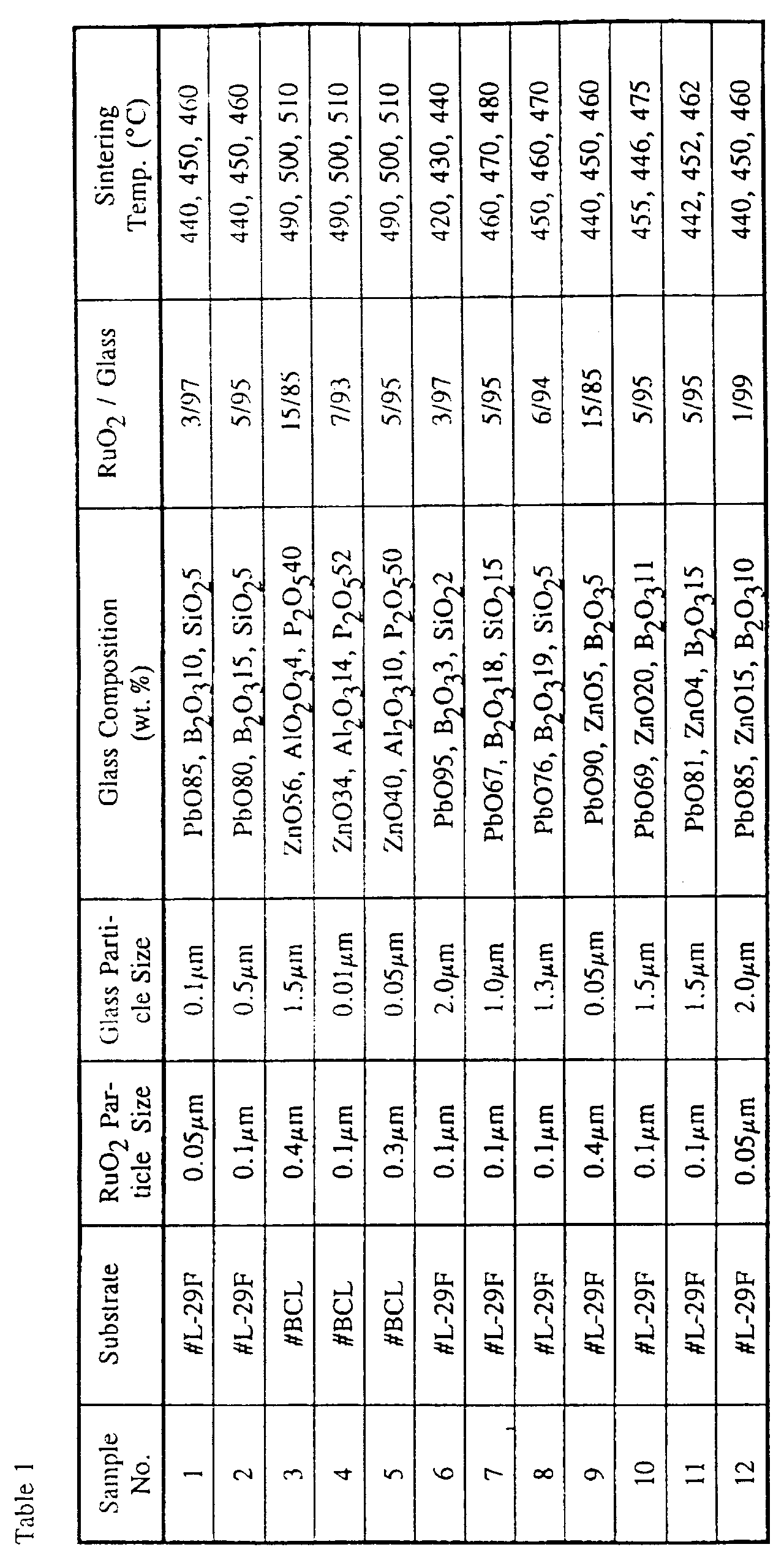


- A glass tube for the focusing
electrode 15 to be accommodated within theneck 12 of the glass envelope, 10 mm in diameter and 65 mm in length, was prepared in a similar way to Example 1, from a composition consisting of 60 wt% of SiO2, 28 wt% of PbO, 8 wt% of Na2O, 3 wt% of K2O and 1 wt% of Al2O3 and also having a coefficient of thermal expansion of 94 × 10-7/°C. This glass tube of the specific composition is available from Nippon Denki Garasu Kabushiki Kaisha, Produce # L-29F. - 5 parts by weight of powdery particles of ruthenium oxide (RuO2) of 0.1 µm in average particle size and 95 parts by weight of a glass powder consisting of 80 wt% of PbO, 15 wt% of B2O3 and 5 wt% of SiO2 and having an average particle size of 0.5 µm were mixed together and were kneaded by the use of a known triple-roll kneader together with terpineol dissolved with 10% ethylcellulose as an organic binder, to thereby provide a resistance paste. The resistance paste so obtained is, prior to application to an inner surface of the glass tube, added with a toluene solvent to adjust its viscosity to 50 poises per centimeter.
- The viscosity-adjusted resistance paste was applied to the inner surface of the glass tube by immersing the glass tube in a bath containing the viscosity-adjusted resistance paste and then pulling it out of the bath. The glass tube having the inner surface coated with the resistance paste was then dried at 80°C to complete a resistance layer of about 12 µm in thickness on the inner surface of the glass tube.
- Using a diamond bite, the inner surface of the glass tube where the resistance layer was formed is subsequently ground spirally to form a coiled or helical resistance pattern having a plurality of resistance convolutions of a pitch of 300 µm, 3.5 m in total length exclusive of an intermediate tap, each of said resistance convolutions having a width of 225 µm with the neighboring resistance convolutions spaced a distance of 75 µm.
- Two additional internally coated glass tubes identical to the internally coated glass tube discussed above were also prepared. All these three internally coated glass tubes were baked tunnel furnaces capable of baking them for ten minutes at 440°C, 450°C and 460°C, respectively. At this time, the resistance layers on the inner surfaces of the respective glass tubes were about 9 µm in thickness, exhibiting the total resistance of 14.9 GΩ, 11.9 GΩ and 10.1 GΩ. (Sheet resistance values of each of those resistance layer, on the respective glass tubes were 3.0 MΩ/□, 2.4 MΩ/□ and 2.0 MΩ/□, and a ration of Rmax / Rmin. was 1.48 within the sintering temperature change from 440 to 460 °C. Both temperature dependent change of the resistance value at a temperature within the range of 0 to 125°C and temperature coefficient of resistance (TCR), exhibited by all of the layers on the inner surfaces of those glass tubes, were -375 ppm/°C.
- Each of the internally coated glass tubes was assembled into the corresponding focusing
electrode 15 in the cathode ray tube shown in Fig. 1. To determine the magnitude of change in resistance, 40 KV voltage was applied for one minute to an anode (an end of the focusing electrode 15) of each of the resultant cathode ray tubes. It has been found that the magnitude of change in resistance was -1.2%. Results of experiments are shown in Table 1 (setting forth conditions for preparation) and Table 3 (characteristics) wherein Sample No. 2 shows Example 2. - A glass tube for the focusing
electrode 15 to be accommodated within theneck 12 of the glass envelope, 10 mm in diameter and 65 mm in length, was prepared in a similar way to Example 1, from a composition consisting of 72 wt% of SiO2, 3 wt% of BaO, 10.5 wt% of B2O3, 7.5 wt% of Na2O and 7 wt% of Al2O3 and also having a coefficient of thermal expansion of 52 × 10-7/°C. This glass tube of the specific composition is available from Nippon Denki Garasu Kabushiki Kaisha, Produce # BCL. - 15 parts by weight of powdery particles of ruthenium oxide (RuO2) of 0.4 µm in average particle size and 85 parts by weight of a glass powder consisting of 56 wt% of ZnO, 4 wt% of Al2O3 and 40 wt% of P2O5 and having an average particle size of 1.5 µm were mixed together and were kneaded by the use of a known triple-roll kneader together with terpineol dissolved with 10% ethylcellulose as an organic binder, to thereby provide a resistance paste. The resistance paste so obtained is, prior to application to an inner surface of the glass tube, added with a toluene solvent to adjust its viscosity to 50 poises per centimeter.
- The viscosity-adjusted resistance paste was applied to the inner surface of the glass tube by immersing the glass tube in a bath containing the viscosity-adjusted resistance paste and then pulling it out of the bath. The glass tube having the inner surface coated with the resistance paste was then dried at 80°C to complete a resistance layer of about 15 µm in thickness on the inner surface of the glass tube.
- Using a diamond bite, the inner surface of the glass tube where the resistance layer was formed is subsequently ground spirally to form a coiled or helical resistance pattern having a plurality of resistance convolutions of a pitch of 300 µm, 3.5 m in total length exclusive of an intermediate tap, each of said resistance convolutions having a width of 225 µm with the neighboring resistance convolutions spaced a distance of 75 µm.
- Two additional internally coated glass tubes identical to the internally coated glass tube discussed above were also prepared. All these three internally coated glass tubes were baked tunnel furnaces capable of baking them for ten minutes at 490°C, 500°C and 510°C, respectively. At this time, the resistance layers on the inner surfaces of the respective glass tubes were about 10 µm in thickness, exhibiting the total resistance of 14.2 GΩ, 12.2 GΩ and 9.5 GΩ. (Sheet resistance values of each of those resistance layers on the respective glass tubes were 2.8 MΩ/□, 2.4 MΩ/□ and 1.9 MΩ/□, and a ration of Rmax / Rmin. was 1.49 within the sintering temperature change from 490 to 510 °C. Both temperature dependent change of the resistance value at a temperature within the range of 0 to 125°C and temperature coefficient of resistance (TCR), exhibited by all of the layers on the inner surfaces of those glass tubes, were - 395 ppm/°C.
- Each of the internally coated glass tubes was assembled into the corresponding focusing
electrode 15 in the cathode ray tube shown in Fig. 1. To determine the magnitude of change in resistance, 40 KV voltage was applied for one minute to an anode (an end of the focusing electrode 15) of each of the resultant cathode ray tubes. It has been found that the magnitude of change in resistance was -1.5%. Results of experiments are shown in Table 1 (setting forth conditions for preparation) and Table 3 (characteristics) wherein Sample No. 3 shows Example 3. - In a similar way to Examples 1 to 3, each of the internally coated glass tubes were prepared except using various kinds of the glass tubes, various composite ratios of RuO2 and glass powder, various particles of RuO2 and the glass powder, various thickness of the resistance layer. Results of experiments are shown in Tables 1 to 4 wherein each of Sample No. shows a corresponding Example No. Please note that Samples No. 17 to 21 are comparative Examples.
- Apparent from the experiment data shown in Tables 1 to 4, it has been found that smaller than 0.05 µm of RuO2 particles makes the sintering temperature dependency of the resistance value to increase while larger than 0.4 µm of that makes the resistance value changeability after applying 40 KV for one minute to increase.
- Further, it has been found that smaller than 0.01 µm of average particle size of glass powder makes their dispersion property to be worse, resulting in gelatinization of the resistance paste which can not be coated while larger than 2.0 µm makes the glass powder and RuO2 to be separated, which causes preparation of ununiform resistance layer.
- Furthermore, it has been found that thinner than 0.5 µm of the resistance layer after sintering makes the resistance value to be scattered largely while thicker than 10 µm of that makes accurate helical processing by a diamond bite to be difficult.
- The composition of the glass powder should be set within the preferred scope, otherwise the sintering temperature dependency of the resistance value and TCR will be larger.
- A glass tube for the focusing
electrode 15 to be accommodated within theneck 12 of the glass envelope, 10 mm in diameter and 65 mm in length, was prepared, from a composition consisting of 60 wt% of SiO2, 28 wt% of PbO, 8 wt% of Na2O, 3 wt% of K2O and 1 wt% of Al2O3 and also having a coefficient of thermal expansion of 94 × 10-7/°C. This glass tube of the specific composition is available from Nippon Denki Garasu Kabushiki Kaisha, Produce # L-29F. - 3 parts by weight of powdery particles of ruthenium oxide (RuO2) of 0.05 µm in average particle size and 97 parts by weight of a glass powder consisting of 82 wt% of PbO, 5 wt% of B2O3, 10 wt% of SiO2, 1 wt% of Al2O3, 2 wt% of ZnO and having an average particle size of 0.1 µm were mixed together and were kneaded by the use of a known triple-roll kneader together with terpineol dissolved with 10% ethylcellulose as an organic binder, to thereby provide a resistance paste. The resistance paste so obtained is, prior to application to an inner surface of the glass tube, added with a toluene solvent to adjust its viscosity to 50 poises per centimeter.
- The viscosity-adjusted resistance paste was applied to the inner surface of the glass tube by immersing the glass tube in a bath containing the viscosity-adjusted resistance paste and then pulling it out of the bath. The glass tube having the inner surface coated with the resistance paste was then dried at 80°C to complete a resistance layer of about 10 µm in thickness on the inner surface of the glass tube.
- Using a diamond bite, the inner surface of the glass tube where the resistance layer was formed is subsequently ground spirally to form a coiled or helical resistance pattern having a plurality of resistance convolutions of a pitch of 300 µm, 3.5 m in total length exclusive of an intermediate tap, each of said resistance convolutions having a width of 225 µm with the neighboring resistance convolutions spaced a distance of 75 µm.
- Two additional internally coated glass tubes identical to the internally coated glass tube discussed above were also prepared. All these three internally coated glass tubes were baked tunnel furnaces capable of baking them for ten minutes at 440°C, 450°C and 460°C, respectively. At this time, the resistance layers on the inner surfaces of the respective glass tubes were about 7.5 µm in thickness, exhibiting the total resistance of 17.8 GΩ, 15.3 GΩ and 12.8 GΩ. (Sheet resistance values of each of those resistance layers on the respective glass tubes were 3.6 MΩ/□, 3.1 MΩ/□ and 2.6 MΩ/□, and a ratio of Rmax / Rmin. was 1.39 within the sintering temperature from 440 to 460 °C. Both temperature dependent change of the resistance value at a temperature within the range of 0 to 125 °C and temperature coefficient of resistance (TCR), exhibited by all of the layers on the inner surfaces of those glass tubes, were -345 ppm/°C.
- Each of the internally coated glass tubes was assembled into the corresponding focusing
electrode 15 in the cathode ray tube shown in Fig. 1. To determine the magnitude of change in resistance, 30 KV voltage was applied for 5,000 hours in a constant temperature oven of 70 °C to an anode (an end of the focusing electrode 15) of each of the resultant cathode ray tubes having a vacuum degree of 10-7 Torr. It has been found that the magnitude of change in resistance was 1.3% and no change of spot diameter of the cathode ray tube. Results of experiments are shown in Table 5 (setting forth conditions for preparation) and Table 7 (characteristics) wherein Sample No. 22 shows Example 22.

Table 7 Sample No. R Value (GΩ) 440, 450, 460 (°C) Rmax. / Rmin. TCR Change rate of R1* Spot Size 2*22 17.8, 15.3, 12.8 1.39 -345 ppm/°C 1.3% No Changed 23 14.1, 12.0, 11.2 1.26 -315 ppm/°C 0.8% " 24 13.6, 12.6, 10.8 1.26 -305 ppm/°C 1.5% " 25 6.5, 6.1, 5.0 1.30 -295 ppm/°C 0.7% " 26 13.5, 12.0, 10.4 1.30 -335 ppm/°C 1.3% " 27 12.4, 10.8, 9.2 1.35 -328 ppm/°C 1.2% " 28 12.0, 10.3, 8.7 1.38 -330 ppm/°C 1.4% " 29 17.9, 15.3, 12.8 1.40 -345 ppm/°C 1.4% " 30 16.5, 14.2, 11.8 1.40 -335 ppm/°C 1.4% " 31 17.1, 14.8, 12.4 1.38 -340 ppm/°C 1.2% " 32 7.6, 6.6, 5.5 1.37 -305 ppm/°C 1.7% " 33 10.9, 9.8, 8.7 1.25 -315 ppm/°C 0.7% " 34 11.0, 9.9, 8.7 1.26 -319 ppm/°C 0.9% " 1*: after applying 30KV for 5000 hours in an over of constant temp. (70°C) 2*: after 5000 hours -
Table 8 Sample No. R Value (GΩ) 440, 450, 460 (°C) Rmax. / Rmin. TCR Change rate of R1* Spot Size 2*35 12.2, 10.9, 9.5 1.28 -320 ppm/°C 0.8% No Changed 36 15.8, 14.2, 12.5 1.26 -323 ppm/°C 0.7% " 37 14.5, 13.0, 11.4 1.27 -330 ppm/°C 0.8% " 38 14.9, 19.0, 11.6 1.29 -325 ppm/°C 0.8% " 39 13.5, 12.2, 10.8 1.25 -312 ppm/°C 0.9% " 40 10.8, 9.7, 8.6 1.26 -301 ppm/°C 0.6% " 41* 15.2, 12.1, 10.2 1.49 -375 ppm/°C 3.2% little Changed 42* 15.6, 12.2, 10.9 1.43 -382 ppm/°C 3.5% " 43* 45.0, 15.2, 10.3 4.37 -510 ppm/°C 4.8% " Sample Nos. 41-43: Comparative Examples 1*: after applying 30KV for 5000 hours in an over of constant temp.(70 °C) 2*: after 5000 hours - A glass tube for the focusing
electrode 15 to be accommodated within theneck 12 of the glass envelope, 10 mm in diameter and 65 mm in length, was prepared in a similar way to Example 22, from a composition consisting of 60 wt% of SiO2, 28 wt% of PbO, 8 wt% of Na2O, 3 wt% of K2O and 1 wt% of Al2O3 and also having a coefficient of thermal expansion of 94 × 10-7/°C. This glass tube of the specific composition is available from Nippon Denki Garasu Kabushiki Kaisha, Produce # L-29F. - 3 parts by weight of powdery particles of ruthenium oxide (RuO2) of 0.1 µm in average particle size, 82 parts by weight of a glass powder consisting of 92 wt% of PbO, 3 wt% of B2O3, 2 wt% of SiO2, 1 wt% of Al2O3 and 2 wt.% of ZnO and having an average particle size of 0.5 µm and 15 parts by weight of the metal oxide (TiO2) were mixed together and were kneaded by the use of a known triple-roll kneader together with terpineol dissolved with 10% ethylcellulose as an organic binder, to thereby provide a resistance paste. The resistance paste so obtained is, prior to application to an inner surface of the glass tube, added with a toluene solvent to adjust its viscosity to 50 poises per centimeter.
- The viscosity-adjusted resistance paste was applied to the inner surface of the glass tube by immersing the glass tube in a bath containing the viscosity-adjusted resistance paste and then pulling it out of the bath. The glass tube having the inner surface coated with the resistance paste was then dried at 80°C to complete a resistance layer of about 10 µm in thickness on the inner surface of the glass tube.
- Using a diamond bite, the inner surface of the glass tube where the resistance layer was formed is subsequently ground spirally to form a coiled or helical resistance pattern having a plurality of resistance convolutions of a pitch of 300 µm, 3.5 m in total length exclusive of an intermediate tap, each of said resistance convolutions having a width of 225 µm with the neighboring resistance convolutions spaced a distance of 75 µm.
- Two additional internally coated glass tubes identical to the internally coated glass tube discussed above were also prepared. All these three internally coated glass tubes were baked tunnel furnaces capable of baking them for ten minutes at 440°C, 450°C and 460°C, respectively. At this time, the resistance layers on the inner surfaces of the respective glass tubes were about 9 µm in thickness, exhibiting the total resistance of 14.1 GΩ, 12.0 GΩ and 11.2 GΩ. (Sheet resistance values of each of those resistance layers on the respective glass tubes were 2.8 MΩ/□, 2.6 MΩ/□ and 2.4 MΩ/□, and a ration of Rmax / Rmin. was 1.26 within the sintering temperature change from 440 to 460 °C. Both temperature dependent change of the resistance value at a temperature within the range of 0 to 125°C and temperature coefficient of resistance (TCR), exhibited by all of the layers on the inner surfaces of those glass tubes, were -315 ppm/°C.
- Each of the internally coated glass tubes was assembled into the corresponding focusing
electrode 15 in the cathode ray tube shown in Fig. 1. To determine the magnitude of change in resistance, 30 KV voltage was applied for 5,000 hours in a constant temperature oven of 70 °C to an anode (an end of the focusing electrode 15) of each of the resultant cathode ray tubes having a vacuum degree of 10-7 Torr. It has been found that the magnitude of change in resistance was 0.8 % and no change of spot diameter of the cathode ray tube. Results of experiments are shown in Table 5 (setting forth conditions for preparation) and Table 8 (characteristics) wherein Sample No. 23 shows Example 23. - A glass tube for the focusing
electrode 15 to be accommodated within theneck 12 of the glass envelope, 10 mm in diameter and 65 mm in length, was prepared in a similar way to Example 22, from a composition consisting of 72 wt% of SiO2, 3 wt% of BaO, 10.5 wt% of B2O3, 7.5 wt% of Na2O and 7 wt% of Al2O3 and also having a coefficient of thermal expansion of 52 × 10-7/°C This glass tube of the specific composition is available from Nippon Denki Garasu Kabushiki Kaisha, Produce # BCL. - 5 parts by weight of powdery particles of ruthenium oxide (RuO2) of 0.4 µm in average particle size and 55 parts by weight of a glass powder consisting of 69 wt% of PbO, 16 wt% of B2O3, 5 wt% of SiO2, 5 wt% of Al2O3 and 5 wt% of ZnO and having an average particle size of 1.5 µm and 40 parts by weight of metal oxide (ZrO2) having a particle size of 0.5 µm were mixed together and were kneaded by the use of a known triple-roll kneader together with a terpineol dissolved with 10% ethylcellulose as an organic binder, to thereby provide a resistance paste. The resistance paste so obtained is, prior to application to an inner surface of the glass tube, added with a toluene solvent to adjust its viscosity to 50 poises per centimeter.
- The viscosity-adjusted resistance paste was applied to the inner surface of the glass tube by immersing the glass tube in a bath containing the viscosity-adjusted resistance paste and then pulling it out of the bath. The glass tube having the inner surface coated with the resistance paste was then dried at 80°C to complete a resistance layer of about 10 µm in thickness on the inner surface of the glass tube.
- Using a diamond bite, the inner surface of the glass tube where the resistance layer was formed is subsequently ground spirally to form a coiled or helical resistance pattern having a plurality of resistance convolutions of a pitch of 300 µm, 3.5 m in total length exclusive of an intermediate tap, each of said resistance convolutions having a width of 225 µm with the neighboring resistance convolutions spaced a distance of 75 µm.
- Two additional internally coated glass tubes identical to the internally coated glass tube discussed above were also prepared. All these three internally coated glass tubes were baked tunnel furnaces capable of baking them for ten minutes at 500°C, 510°C and 520°C; respectively. At this time, the resistance layers on the inner surfaces of the respective glass tubes were about 7.8 µm in thickness, exhibiting the total resistance of 13.6 GΩ, 12.6 GΩ and 10.8 GΩ (Sheet resistance values of each of those resistance layers on the respective glass tubes were 2.7 MΩ/□, 2.5 MΩ/□ and 2.1 MΩ/□, and a ration of Rmax / Rmin. was 1.26 within the sintering temperature change from 500 to 520 °C. Both temperature dependent change of the resistance value at a temperature within the range of 0 to 125°C and temperature coefficient of resistance (TCR), exhibited by all of the layers on the inner surfaces of those glass tubes, were - 305 ppm/°C.
- Each of the internally coated glass tubes was assembled into the corresponding focusing
electrode 15 in the cathode ray tube shown in Fig. 1. To determine the magnitude of change in resistance, 30 KV voltage was applied for 5,000 hours in a constant temperature oven of 70 °C to an anode (an end of the focusing electrode 15) of each of the resultant cathode ray tubes having a vacuum degree of 10-7 Tort. It has been found that the magnitude of change in resistance was 1.5 % and no change of spot diameter of the cathode ray tube. Results of experiments are shown in Table 5 (setting ford conditions for preparation) and Table 7 (characteristics) wherein Sample No. 24 shows Example 24. - A glass tube for the focusing
electrode 15 to be accommodated within theneck 12 of the glass envelope, 10 mm in diameter and 65 mm in length, was prepared in a similar way to Example 22, from a composition consisting of 70.3 wt% of SiO2, 1.2 wt% of B2O3, 17.8 wt% of Na2O, 2 wt% of Al2O3, 2.8 wt% of MgO and 5.9 wt% of CaO and also having a coefficient of thermal expansion of 98.5 × 10⁻⁷/°C. This glass tube of the specific composition is available from Nippon Denki Garasu Kabushiki Kaisha, Produce # SK-C. - 13 parts by weight of powdery particles of ruthenium oxide (RuO2) of 0.1 µm in average particle size and 72 parts by weight of a glass powder consisting of 90 wt% of PbO, 2 wt% of B2O3, 4 wt% of SiO2, 3 wt% of Al2o3 and 3 wt% of ZnO and having an average particle size of 0.05 µm and 15 parts by weight of mixed metal oxides (ZrO2 and SiO2; 66:34) having each particle size of 0.1 µm were mixed together and were kneaded by the use of a known triple-roll kneader together with a terpineol dissolved with 10% ethylcellulose as an organic binder, to thereby provide a resistance paste. The resistance paste so obtained is, prior to application to an inner surface of the glass tube, added with a toluene solvent to adjust its viscosity to 50 poises per centimeter.
- The viscosity-adjusted resistance paste was applied to the inner surface of the glass tube by immersing the glass tube in a bath containing the viscosity-adjusted resistance paste and then pulling it out of the bath. The glass tube having the inner surface coated with the resistance paste was then dried at 80°C to complete a resistance layer of about 10 µm in thickness on the inner surface of the glass tube.
- Using a diamond bite, the inner surface of the glass tube where the resistance layer was formed is subsequently ground spirally to form a coiled or helical resistance pattern having a plurality of resistance convolutions of a pitch of 300 µm, 3.5 m in total length exclusive of an intermediate tap, each of said resistance convolutions having a width of 225 µm with the neighboring resistance convolutions spaced a distance of 75 µm.
- Two additional internally coated glass tubes identical to the internally coated glass tube discussed above were also prepared. All these three internally coated glass tubes were baked tunnel furnaces capable of baking them for ten minutes at 490°C, 500°C and 510°C, respectively. At this time, the resistance layers on the inner surfaces of the respective glass tubes were about 8.0 µm in thickness, exhibiting the total resistance of 6.5 GΩ, 5.1 GΩ and 5.0 GΩ (Sheet resistance values of each of those resistance layers on the respective glass tubes were 1.3 MΩ/□, 1.2 MΩ/□ and 1.0 MΩ/□, and a ration of Rmax / Rmin. was 1.30 within the sintering temperature change from 490 to 510 °C. Both temperature dependent change of the resistance value at a temperature within the range of 0 to 125°C and temperature coefficient of resistance (TCR), exhibited by all of the layers on the inner surfaces of those glass tubes, were - 295 ppm/°C.
- Each of the internally coated glass tubes was assembled into the corresponding focusing
electrode 15 in the cathode ray tube shown in Fig. 1. To determine the magnitude of change in resistance, 30 KV voltage was applied for 5,000 hours in a constant temperature oven of 70 °C to an anode (an end of the focusing electrode 15) of each of the resultant cathode ray tubes having a vacuum degree of 10-7 Torr. It has been found that the magnitude of change in resistance was 0.7 % and no change of spot diameter of the cathode ray tube. Results of experiments are shown in Table 5 (setting forth conditions for preparation) and Table 7 (characteristics) wherein Sample No. 25 shows Example 25. - A glass tube for the focusing
electrode 15 to be accommodated within theneck 12 of the glass envelope, 10 mm in diameter and 65 mm in length, was prepared in a similar way to Example 22, from a composition consisting of 60 wt% of SiO2, 28 wt% of PbO, 8 wt% of Na2O, 3 wt% of K2O and 1 wt% of Al2O3 and also having a coefficient of thermal expansion of 94 × 10-7/°C. This glass tube of the specific composition is available from Nippon Denki Garasu Kabushiki Kaisha, Produce # L-29F. - 3 parts by weight of powdery particles of ruthenium oxide (RuO2) of 0.1 µm in average particle size and 72 parts by weight of a glass powder consisting of 80 wt% of PbO, 15 wt% of B2O3, 5 wt% of SiO2 and having an average particle size of 0.5 µm and 25 parts by weight of mixed metal oxides (Al2O3 and ZnO; 60:40) having each particle size of 0.5 µm were mixed together and were kneaded by the use of a known triple-roll kneader together with a terpineol dissolved with 10% ethylcellulose as an organic binder, to thereby provide a resistance paste. The resistance paste so obtained is, prior to application to an inner surface of the glass tube, added with a toluene solvent to adjust its viscosity to 50 poises per centimeter.
- The viscosity-adjusted resistance paste was applied to the inner surface of the glass tube by immersing the glass tube in a bath containing the viscosity-adjusted resistance paste and then pulling it out of the bath. The glass tube having the inner surface coated with the resistance paste was then dried at 80°C to complete a resistance layer of about 10 µm in thickness on the inner surface of the glass tube.
- Using a diamond bite, the inner surface of the glass tube where the resistance layer was formed is subsequently ground spirally to form a coiled or helical resistance pattern having a plurality of resistance convolutions of a pitch of 300 µm, 3.5 m in total length exclusive of an intermediate tap, each of said resistance convolutions having a width of 225 µm with the neighboring resistance convolutions spaced a distance of 75 µm.
- Two additional internally coated glass tubes identical to the internally coated glass tube discussed above were also prepared. All these three internally coated glass tubes were baked tunnel furnaces capable of baking them for ten minutes at 460°C, 470°C and 480°C, respectively. At this time, the resistance layers on the inner surfaces of the respective glass tubes were about 8.0 µm in thickness, exhibiting the total resistance of 13.5 GΩ, 12.0 GΩ and 10.4 GΩ (Sheet resistance values of each of those resistance layers on the respective glass tubes were 2.7 MΩ/□, 2.4 MΩ/□ and 2.1 MΩ/□, and a ration of Rmax / Rmin, was 1.30 within the sintering temperature change from 490 to 510 °C. Both temperature dependent change of the resistance value at a temperature within the range of 0 to 125°C and temperature coefficient of resistance (TCR), exhibited by all of the layers on the inner surfaces of those glass tubes, were - 335 ppm/°C.
- Each of the internally coated glass tubes was assembled into the corresponding focusing
electrode 15 in the cathode ray tube shown in Fig. 1. To determine the magnitude of change in resistance, 30 KV voltage was applied for 5,000 hours in a constant temperature oven of 70 °C to an anode (an end of the focusing electrode 15) of each of the resultant cathode ray tubes having a vacuum degree of 10-7 Torr. It has been found that the magnitude of change in resistance was 1.3 % and no change of spot diameter of the cathode ray tube. Results of experiments are shown in Table 5 (setting forth conditions for preparation) and Table 7 (characteristics) wherein Sample No. 26 shows Example 26. - In a similar way to Examples 22 to 26, each of the internally coated glass tubes were prepared except using various lands of the glass tubes, various composite ratios of RuO2, glass powder and metal oxide, various particles of RuO2, the glass powder and the metal oxide, various thickness of the resistance layer. Results of experiments are shown in Tables 5 to 8 wherein each of Sample No. shows a corresponding Example No. Please note that Samples No. 41 to 43 are comparative Examples.
- Apparent from the experiment data shown in Tables 5 to 8, it has been found that smaller than 0.05 µm of RuO2 particles makes the sintering temperature dependency of the resistance value to increase while larger than 0.4 µm of that makes the resistance value changeability after applying 30 KV for 5000 hours to increase. That is, resistance change rate of more than 2% changes the spot diameter. The PbO content in the glass composition is preferably in a range of 69 to 92 wt %, because less than 69 wt% makes the sintering temperature to become over 520 °C, so that it is impossible to form the resistance layer on the glass tube of # LF-29 and #BCL. On the other hand, more than 92 wt% does not provide a stable glass composition. If the other element content of the glass powder is out of the scope, the change of the resistance value after applying 30 KV for 5,000 hours becomes large (not preferable).
- Further, it has been found that smaller than 0.01 µm of average particle size of the glass powder makes their dispersion property to be worse, resulting in gelatinization of the resistance paste which can not be coated while larger than 2.0 µm makes the glass powder and RuO2 to be separated with ease, which causes preparation of ununiform resistance layer.
- Furthermore, the metal oxide may be provided with an insulating and heat resistant property, which prevent the metal oxide from melting into the glass and may be preferably one or mixture of more than two selected from the group consisting of TiO2, ZrO2, SiO2 and Al2O3.
- A glass tube for the focusing
electrode 15 to be accommodated within theneck 12 of the glass envelope, 10 mm in diameter and 65 mm in length, was prepared in a similar way to Example 2, from a composition consisting of 60 wt% of SiO2, 28 wt% of PbO, 8 wt% of Na2O, 3 wt% of K2O and 1 wt% of Al2O3 and also having a coefficient of thermal expansion of 93 × 10-7/°C This glass tube of the specific composition is available from Nippon Denki Garasu Kabushiki Kaisha, Produce # L-29F. - 5 parts by weight of powdery particles of ruthenium chloride (RuCl3) and 95 parts by weight of a glass powder consisting of 80 wt% of PbO, 15 wt% of B2O3, 5 wt% of SiO2 and having an average particle size of 1.5 µm were mixed together with water. To a resulting water mixture, ammonia was added to precipitate ruthenium hydroxide (Ru(OH)3). The precipitate was dried and transferred to a ball mill. The precipitate was kneaded with isopropanol and ammonia, to thereby provide a suspension. The suspension so obtained was applied to the inner surface of the glass tube by immersing the glass tube in a bath containing the suspension and then pulling it out of the bath. The glass tube having the inner surface coated with the resistance liquid was then dried at 80°C to complete a resistance layer of about 7 µm in thickness on the inner surface of the glass tube.
- Using a diamond bite, the inner surface of the glass tube where the resistance layer was formed is subsequently ground spirally to form a coiled or helical resistance pattern having a plurality of resistance convolutions of a pitch of 300 µm, 3.5 m in total length exclusive of an intermediate tap, each of said resistance convolutions having a width of 225 µm with the neighboring resistance convolutions spaced a distance of 75 µm.
- Two additional internally coated glass tubes identical to the internally coated glass tube discussed above were also prepared. All these three internally coated glass tubes were baked tunnel furnaces capable of baking them for ten minutes at 440°C, 450°C and 460°C, respectively. At this time, the resistance layers on the inner surfaces of the respective glass tubes were about 7.0 µm in thickness, exhibiting the total resistance of 45.0 GΩ, 15.2 GΩ and 10.3 GΩ (Sheet resistance values of each of those resistance layers on the respective glass tubes were 9.1 MΩ/□, 3.0 MΩ/□ and 2.1 MΩ/□, and a ration of Rmax / Rmin. was 4.37 within the sintering temperature change from 440 to 460 °C. Both temperature dependent change of the resistance value at a temperature within the range of 0 to 125°C and temperature coefficient of resistance (TCR), exhibited by all of the layers on the inner surfaces of those glass tubes, were - 510 ppm/°C.
- Each of the internally coated glass tubes was assembled into the corresponding focusing
electrode 15 in the cathode ray tube shown in Fig. 1. To determine the magnitude of change in resistance, 40 KV voltage was applied for one minute to an anode (an end of the focusing electrode 15) of each of the resultant cathode ray tubes. It has been found that the magnitude of change in resistance was -1.3%. Results of experiments are shown in Table 1 (setting forth conditions for preparation) and Table 3 (characteristics) wherein Sample No. 21 shows this Comparative Example. - Fig. 3 is a comparative graph showing the sintering temperature dependency of the present invention and the conventional method.
- Stated as the above, according to the present invention, there can be provided a much reliable helical resistance layer on the cathode ray tube having a less sintering temperature dependency of the resistance value and a less resistance load characteristic change on applying a high voltage (30KV in a constant temperature oven of 70 °C) as well as a less temperature characteristic change.
Claims (12)
- A method of preparing a resistor for cathode ray tube which comprises steps of:preparing a liquid coating material containing 1 to 15 wt.% of RuO2 powder having an average particle size of 0.05 to 0.4 µm and 85 to 99 Wt.% of glass powder having an average particle size of 0.01 to 2.0 µm,applying the liquid coating material on an inner face of a glass tube to form a resistance layer,processing the resistance layer in a helical shape,sintering the helical resistance layer to obtain a sheet resistivity of at least 1 MΩ/□.
- A method of preparing a resistor for cathode ray tube according to Claim 1, wherein the glass powder comprises 67 to 95 wt.% of PbO, 2 to 15 wt.% of SiO2 and 3 to 19 wt.% of B2O3.
- A method of preparing a resistor for cathode ray tube according to Claim 1, wherein the glass powder comprises 69 to 90 wt.% of PbO, 2 to 20 wt.% of ZnO and 5 to 15 wt.% of B2O3.
- A method of preparing a resistor for cathode ray tube according to Claim 1, wherein the glass powder comprises 40 to 52 wt.% of P2O5, 34 to 56 wt.% of ZnO and 4 to 14 wt.% of Al2O3.
- A method of preparing a resistor for cathode ray tube according to Claim 1, wherein the glass powder comprises 15 to 30 wt.% of ZnO, 5 to 25 wt.% of B2O3 and 50 to 75 wt.% of V2O5.
- A method of preparing a resistor for cathode ray tube according to Claim 1, wherein the glass powder comprises 69 to 92 wt.% of PbO, 2 to 10 wt.% of SiO2, 2 to 20 wt.% of B2O3, 1 to 5 wt.% of Al2O3, and 2 to 5 wt.% of ZnO.
- A method of preparing a resistor for cathode ray tube according to Claim 1, wherein the glass tube has a glass transition point Tg of 600 °C or less.
- A method of preparing a resistor for cathode ray tube which comprises steps of:preparing a liquid coating material containing 3 to 13 wt.% of RuO2 powder having an average particle size of 0.05 to 0.4 µm, 69 to 92 Wt.% of glass powder having an average particle size of 0.01 to 2.0 µm, and 15 to 40 Wt.% of metal oxide powder having an average particle size of 0.05 to 2.0 µmapplying the liquid coating material on an inner face of a glass tube to form a resistance layer,processing the resistance layer in a helical shape,sintering the helical resistance layer to obtain a sheet resistivity of at least 1 MΩ/□.
- A method of preparing a resistor for cathode ray tube according to Claim 8, wherein the glass powder comprises 69 to 92 wt.% of PbO, 2 to 10 wt.% of SiO2, 2 to 20 wt.% of B2O3, 1 to 5 wt.% of Al2O3, and 2 to 5 wt.% of ZnO.
- A method of preparing a resistor for cathode ray tube according to Claim 8, wherein the glass powder comprises 67 to 95 wt.% of PbO, 2 to 15 wt.% of SiO2 and 3 to 19 wt.% of B2O3.
- A method of preparing a resistor for cathode ray tube according to Claim 8, wherein the metal oxide powder is at least one selected from the group consisting of TiO2, ZrO2, ZnO, SiO2 and Al2O3.
- A method of preparing a resistor for cathode ray tube according to Claim 8, wherein the glass tube has a glass transition point Tg of 600 °C or less.
Applications Claiming Priority (8)
| Application Number | Priority Date | Filing Date | Title |
|---|---|---|---|
| JP309282/95 | 1995-11-28 | ||
| JP30928295 | 1995-11-28 | ||
| JP30928295 | 1995-11-28 | ||
| JP3770196 | 1996-02-26 | ||
| JP37701/96 | 1996-02-26 | ||
| JP3770196 | 1996-02-26 | ||
| JP8313845A JPH09293465A (en) | 1995-11-28 | 1996-11-25 | Method for manufacturing resistor for cathode ray tube |
| JP313845/96 | 1996-11-25 |
Publications (2)
| Publication Number | Publication Date |
|---|---|
| EP0776868A1 true EP0776868A1 (en) | 1997-06-04 |
| EP0776868B1 EP0776868B1 (en) | 1999-09-15 |
Family
ID=27289553
Family Applications (1)
| Application Number | Title | Priority Date | Filing Date |
|---|---|---|---|
| EP96119038A Expired - Lifetime EP0776868B1 (en) | 1995-11-28 | 1996-11-28 | Resistor for cathode ray tube and method of preparing same |
Country Status (2)
| Country | Link |
|---|---|
| EP (1) | EP0776868B1 (en) |
| JP (1) | JPH09293465A (en) |
Citations (9)
| Publication number | Priority date | Publication date | Assignee | Title |
|---|---|---|---|---|
| US4101708A (en) * | 1977-03-25 | 1978-07-18 | E. I. Du Pont De Nemours And Company | Resistor compositions |
| JPS60208027A (en) | 1984-03-12 | 1985-10-19 | エヌ・ベー・フイリツプス・フルーイランペンフアブリケン | Cathode ray tube |
| US4574055A (en) * | 1984-01-06 | 1986-03-04 | Shoei Chemical Inc. | Resistor compositions |
| JPS61224402A (en) | 1985-03-28 | 1986-10-06 | エヌ・ベー・フィリツプス・フルーイランペンファブリケン | Manufacture of apparatus having electric resistance layer |
| US4961023A (en) * | 1988-09-21 | 1990-10-02 | U.S. Philips Corporation | Cathode ray tube including a helical focusing lens |
| US4961022A (en) * | 1988-05-20 | 1990-10-02 | U.S. Philips Corporation | Display tube including a helical focusing lens with a non-rotationally symmetrical lens element |
| JPH02276138A (en) | 1989-01-12 | 1990-11-13 | Philips Gloeilampenfab:Nv | Picture display device |
| US5021194A (en) * | 1986-11-14 | 1991-06-04 | Hitachi, Ltd. | Thick film resistor material and thermal head obtained therefrom |
| EP0513909A1 (en) * | 1991-05-16 | 1992-11-19 | Koninklijke Philips Electronics N.V. | Rapidly scanning cathode-ray tube/scanning laser |
-
1996
- 1996-11-25 JP JP8313845A patent/JPH09293465A/en active Pending
- 1996-11-28 EP EP96119038A patent/EP0776868B1/en not_active Expired - Lifetime
Patent Citations (10)
| Publication number | Priority date | Publication date | Assignee | Title |
|---|---|---|---|---|
| US4101708A (en) * | 1977-03-25 | 1978-07-18 | E. I. Du Pont De Nemours And Company | Resistor compositions |
| US4574055A (en) * | 1984-01-06 | 1986-03-04 | Shoei Chemical Inc. | Resistor compositions |
| JPS60208027A (en) | 1984-03-12 | 1985-10-19 | エヌ・ベー・フイリツプス・フルーイランペンフアブリケン | Cathode ray tube |
| JPS61224402A (en) | 1985-03-28 | 1986-10-06 | エヌ・ベー・フィリツプス・フルーイランペンファブリケン | Manufacture of apparatus having electric resistance layer |
| EP0197584A1 (en) * | 1985-03-28 | 1986-10-15 | Koninklijke Philips Electronics N.V. | Method of manufacturing a resistor device having an electric resistance layer and a cathode ray tube |
| US5021194A (en) * | 1986-11-14 | 1991-06-04 | Hitachi, Ltd. | Thick film resistor material and thermal head obtained therefrom |
| US4961022A (en) * | 1988-05-20 | 1990-10-02 | U.S. Philips Corporation | Display tube including a helical focusing lens with a non-rotationally symmetrical lens element |
| US4961023A (en) * | 1988-09-21 | 1990-10-02 | U.S. Philips Corporation | Cathode ray tube including a helical focusing lens |
| JPH02276138A (en) | 1989-01-12 | 1990-11-13 | Philips Gloeilampenfab:Nv | Picture display device |
| EP0513909A1 (en) * | 1991-05-16 | 1992-11-19 | Koninklijke Philips Electronics N.V. | Rapidly scanning cathode-ray tube/scanning laser |
Non-Patent Citations (1)
| Title |
|---|
| JOURNAL OF AMERICAN CERAMIC SOCIETY, vol. 73, no. 7, 1990, pages 1953 |
Also Published As
| Publication number | Publication date |
|---|---|
| EP0776868B1 (en) | 1999-09-15 |
| JPH09293465A (en) | 1997-11-11 |
Similar Documents
| Publication | Publication Date | Title |
|---|---|---|
| GB2116356A (en) | Impregnated cathode | |
| US6592974B2 (en) | Conductive paste and ceramic electronic component | |
| DE1596851A1 (en) | Resistance material and resistor made from this resistance material | |
| US4746838A (en) | Ink for forming resistive structures and display panel containing the same | |
| EP0440822B1 (en) | Conductive pattern forming composition and method of producing the same | |
| US4530031A (en) | Dielectric composition | |
| CA1249954A (en) | Method of manufacturing a device having an electric resistance layer and the use of the method | |
| EP0012002B1 (en) | Glaze resistor compositions | |
| US5623389A (en) | Conductive paste and multilayered ceramic capacitor employing the same | |
| JPS5812302A (en) | Resistor composition for ignition plug with resistor | |
| EP0776868B1 (en) | Resistor for cathode ray tube and method of preparing same | |
| KR101212393B1 (en) | Lead-free borosilicate glass frits and glass pastes thereof | |
| JPH0381242B2 (en) | ||
| DE2835562C2 (en) | ||
| JPS60212943A (en) | Resistor installed in cathode-ray tube | |
| US20020163292A1 (en) | Viewing screen for a display device and method for the fabrication thereof | |
| EP0201362B1 (en) | Base metal resistive paints | |
| US4698265A (en) | Base metal resistor | |
| DE69938408T2 (en) | Field emission display with oxide resistance | |
| DE69202138T2 (en) | Method of manufacturing an electrode for a discharge lamp and electrode made thereby. | |
| US3957497A (en) | Polymeric based composition | |
| US5707555A (en) | Conductive paste and external electrodes for electronic product formed using same | |
| US4249107A (en) | Cathode ray tube having amorphous resistive film on internal surfaces and method of forming the film | |
| JPS60124340A (en) | Resistor built in cathode ray tube | |
| US6048244A (en) | Method for providing a resistive lens structure for an electron beam device |
Legal Events
| Date | Code | Title | Description |
|---|---|---|---|
| PUAI | Public reference made under article 153(3) epc to a published international application that has entered the european phase |
Free format text: ORIGINAL CODE: 0009012 |
|
| 17P | Request for examination filed |
Effective date: 19961128 |
|
| AK | Designated contracting states |
Kind code of ref document: A1 Designated state(s): DE |
|
| 17Q | First examination report despatched |
Effective date: 19970904 |
|
| GRAG | Despatch of communication of intention to grant |
Free format text: ORIGINAL CODE: EPIDOS AGRA |
|
| GRAG | Despatch of communication of intention to grant |
Free format text: ORIGINAL CODE: EPIDOS AGRA |
|
| GRAH | Despatch of communication of intention to grant a patent |
Free format text: ORIGINAL CODE: EPIDOS IGRA |
|
| GRAH | Despatch of communication of intention to grant a patent |
Free format text: ORIGINAL CODE: EPIDOS IGRA |
|
| GRAA | (expected) grant |
Free format text: ORIGINAL CODE: 0009210 |
|
| AK | Designated contracting states |
Kind code of ref document: B1 Designated state(s): DE |
|
| REF | Corresponds to: |
Ref document number: 69604266 Country of ref document: DE Date of ref document: 19991021 |
|
| PLBE | No opposition filed within time limit |
Free format text: ORIGINAL CODE: 0009261 |
|
| 26N | No opposition filed | ||
| PGFP | Annual fee paid to national office [announced via postgrant information from national office to epo] |
Ref country code: DE Payment date: 20051124 Year of fee payment: 10 |
|
| PG25 | Lapsed in a contracting state [announced via postgrant information from national office to epo] |
Ref country code: DE Free format text: LAPSE BECAUSE OF NON-PAYMENT OF DUE FEES Effective date: 20070601 |