EP0775889B1 - Method and device to compare ammunition - Google Patents
Method and device to compare ammunition Download PDFInfo
- Publication number
- EP0775889B1 EP0775889B1 EP97400029A EP97400029A EP0775889B1 EP 0775889 B1 EP0775889 B1 EP 0775889B1 EP 97400029 A EP97400029 A EP 97400029A EP 97400029 A EP97400029 A EP 97400029A EP 0775889 B1 EP0775889 B1 EP 0775889B1
- Authority
- EP
- European Patent Office
- Prior art keywords
- comparison
- projectile
- criteria
- imprint
- data
- Prior art date
- Legal status (The legal status is an assumption and is not a legal conclusion. Google has not performed a legal analysis and makes no representation as to the accuracy of the status listed.)
- Expired - Lifetime
Links
- 238000000034 method Methods 0.000 title claims description 59
- 238000012545 processing Methods 0.000 claims description 16
- 238000004458 analytical method Methods 0.000 claims description 12
- 238000000605 extraction Methods 0.000 claims description 9
- 230000002452 interceptive effect Effects 0.000 claims description 7
- 238000009527 percussion Methods 0.000 claims description 4
- 239000004429 Calibre Substances 0.000 claims description 3
- 238000006243 chemical reaction Methods 0.000 claims description 3
- 238000001914 filtration Methods 0.000 claims 1
- 238000010304 firing Methods 0.000 claims 1
- 230000037452 priming Effects 0.000 claims 1
- 230000000875 corresponding effect Effects 0.000 description 28
- 230000008569 process Effects 0.000 description 16
- 238000012360 testing method Methods 0.000 description 7
- 238000001514 detection method Methods 0.000 description 6
- 238000004364 calculation method Methods 0.000 description 5
- 238000011160 research Methods 0.000 description 5
- 238000009825 accumulation Methods 0.000 description 4
- 230000003287 optical effect Effects 0.000 description 4
- 239000013598 vector Substances 0.000 description 4
- 238000012800 visualization Methods 0.000 description 3
- 230000002596 correlated effect Effects 0.000 description 2
- 230000007547 defect Effects 0.000 description 2
- 230000010339 dilation Effects 0.000 description 2
- 230000006870 function Effects 0.000 description 2
- 238000009304 pastoral farming Methods 0.000 description 2
- RYGMFSIKBFXOCR-UHFFFAOYSA-N Copper Chemical compound [Cu] RYGMFSIKBFXOCR-UHFFFAOYSA-N 0.000 description 1
- 229910052802 copper Inorganic materials 0.000 description 1
- 239000010949 copper Substances 0.000 description 1
- 238000010586 diagram Methods 0.000 description 1
- 230000008030 elimination Effects 0.000 description 1
- 238000003379 elimination reaction Methods 0.000 description 1
- 238000005286 illumination Methods 0.000 description 1
- 238000009434 installation Methods 0.000 description 1
- 230000003993 interaction Effects 0.000 description 1
- 238000011835 investigation Methods 0.000 description 1
- 230000004807 localization Effects 0.000 description 1
- 239000000463 material Substances 0.000 description 1
- 230000004044 response Effects 0.000 description 1
- 238000005070 sampling Methods 0.000 description 1
- 238000012546 transfer Methods 0.000 description 1
- 238000010200 validation analysis Methods 0.000 description 1
Images



Classifications
-
- F—MECHANICAL ENGINEERING; LIGHTING; HEATING; WEAPONS; BLASTING
- F42—AMMUNITION; BLASTING
- F42B—EXPLOSIVE CHARGES, e.g. FOR BLASTING, FIREWORKS, AMMUNITION
- F42B35/00—Testing or checking of ammunition
-
- Y—GENERAL TAGGING OF NEW TECHNOLOGICAL DEVELOPMENTS; GENERAL TAGGING OF CROSS-SECTIONAL TECHNOLOGIES SPANNING OVER SEVERAL SECTIONS OF THE IPC; TECHNICAL SUBJECTS COVERED BY FORMER USPC CROSS-REFERENCE ART COLLECTIONS [XRACs] AND DIGESTS
- Y10—TECHNICAL SUBJECTS COVERED BY FORMER USPC
- Y10S—TECHNICAL SUBJECTS COVERED BY FORMER USPC CROSS-REFERENCE ART COLLECTIONS [XRACs] AND DIGESTS
- Y10S707/00—Data processing: database and file management or data structures
- Y10S707/99941—Database schema or data structure
- Y10S707/99944—Object-oriented database structure
- Y10S707/99945—Object-oriented database structure processing
-
- Y—GENERAL TAGGING OF NEW TECHNOLOGICAL DEVELOPMENTS; GENERAL TAGGING OF CROSS-SECTIONAL TECHNOLOGIES SPANNING OVER SEVERAL SECTIONS OF THE IPC; TECHNICAL SUBJECTS COVERED BY FORMER USPC CROSS-REFERENCE ART COLLECTIONS [XRACs] AND DIGESTS
- Y10—TECHNICAL SUBJECTS COVERED BY FORMER USPC
- Y10S—TECHNICAL SUBJECTS COVERED BY FORMER USPC CROSS-REFERENCE ART COLLECTIONS [XRACs] AND DIGESTS
- Y10S707/00—Data processing: database and file management or data structures
- Y10S707/99941—Database schema or data structure
- Y10S707/99948—Application of database or data structure, e.g. distributed, multimedia, or image
Definitions
- the present invention relates to a method of comparison of projectile casings and the device.
- This process requires to record the images of the projectile sections then to attach these images of the different sectors of projectiles to fully reconstruct the projectile. For this it is necessary in a first step of detecting in the image of each sector the portions of sectors overlapping with the image previous so as to eliminate these parts.
- this device subsequently requires means for modifying the position of projectiles to be able to bring them to a position where the images of each projectile are comparable between them.
- This process and device does not does not apply to projectile cases. Even if she was transferable to projectile casings, this search method is limited to a single criterion comparison concerning scratches and does not allow the taking into account other criteria.
- the first object of the invention is to propose a socket comparison method for taking account for different criteria and requiring less than storage means for a higher number of criteria.
- the technique extraction and processing varies depending on the nature of the footprint and associated criteria.
- the system calculates the center and the shape of the area then calculates an index which is the ratio of the selected area to the area of the imprint.
- the user has means for determining the criteria taken into account counts for comparison, said means consisting of a list of criteria that can be displayed on means of visualization and by actions such as clicks user selectable and validated using mouse input means.
- the process performs a comparison according to the criterion of the socket size of projectile.
- the process performs a comparison on the criteria data corresponding to the imprint of the retainer.
- the process performs a comparison of the criteria data corresponding to the primer fault imprint.
- the process performs a comparison on the criteria data corresponding to the footprint of the ejector.
- the process performs a comparison on the criteria data corresponding to the extractor footprint.
- the process performs a comparison on the criteria data corresponding to the imprint of the loading.
- the process performs a comparison on the criteria data corresponding to the food brand imprint.
- the process performs a comparison on the criteria data corresponding to the extractor passage footprint.
- the process performs a comparison on the criteria data corresponding to the ejector passage fingerprint.
- the process performs a comparison on the criteria data corresponding to the percussion imprint.
- the process performs a comparison on the criteria data corresponding to the imprint of the primer streaks and plateau left by the breech when fired.
- the comparison of data incriminated with the reference data according to the striations criterion is carried out by counting the number of incriminated projectile scratches located at same location as the stripes of the reference projectile then by applying a filter coefficient to result if the ratio between the number of scratches of the reference file having been the subject of an account and the total number of scratches in the reference folder is greater than 0.6.
- Another object of the invention is to propose a system for building a database of reference.
- the means interactive software applications display on a monitor a window with a plurality of text boxes each corresponding to a criteria and intended to receive and accept only digital information with for each text area the designation, next to the text box, of the criterion concerned.
- Another object of the invention is to propose a use of the device.
- This goal is achieved by the fact that the device is used to extract information about a projectile implicated and exploit this information on a computer system with application software allowing to select in the database the criteria of the incriminated case and in the database of the computer system the same criteria for reference files then to be carried out on each criterion counting identical information so that determine a likelihood index.
- the database of reference and the numerical values of the criteria of the incriminated file are memorized on a physical support transportable.
- Figure 1 shows a schematic view of system for setting up the database.
- FIG. 2 represents a schematic view of the computer operating system.
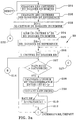
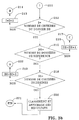
- FIGS. 3A and 3B the flow diagram of operating system.
- Figure 4 shows the mathematical principle of image processing.
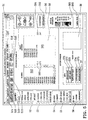
- Figure 5 shows the general window of the application software.
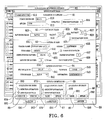
- Figure 6 shows the display window of selection criteria for research.
- Figure 7 shows the image of the socket on the installation screen and the selection means of an area.
- Figure 8 shows the principle of the algorithm of comparison according to the correlation criterion.
- the device of Figure 1 represents a tray support (1) on which the projectile sleeve (2) is arranged to be illuminated by a light beam from a light source (3).
- the beam light from this source (3) is grazing so as to illuminate the upper edge of the socket surface (2) in a direction perpendicular to the y axis of the projectile and perpendicular to the plane formed by the y axis of the projectile and to the z axis of the optical means of observation.
- the optical observation means are constituted by a binocular (4) or a microscope by example of the type marketed by the firm “LEITZ” under the reference M420 coupled with an electronic camera (5), digital high definition and wide field for example marketed by the company "VIDEK” under the name “Megaplus 1.4".
- This set delivers a digital signal processed by a computer system (6) to then send the result of the treatment to a storage means (7).
- This means of storage (7) providing a transportable or transferable support (8) on which a database constituting the set of reference records is saved.
- This support (8) can be floppy, CD-ROM, magnetic cassette digital.
- the device also then serves to provide the data corresponding to an offending object for the transfer of this data to an operating system for comparison with information from the database.
- Figure 2 shows the operating system consisting of a computer system (6) comprising a monitor (10) a central unit (11) provided with a optical disc or CD-ROM drive or any other means of mass storage likely to receive the transportable support (8) containing the data from the database.
- This system includes means (13) for entering commands allowing interaction with the application software (20) for analysis and look for evidence of likelihood between information corresponding to an incriminated projectile and those of a reference database.
- the base of data is built around an array comprising for each projectile shell reference a plurality classification criteria made up of values alphanumeric stored in this database and organized according to the following criteria represented according to the table attached.
- the form criterion we will calculate its score on contour extraction followed by criteria analysis geometric and leading to recognition.
- the score of each criterion of position is calculated based on spatial distance fingerprints of the offending file compared to that from the reference file.
- the sound texture criterion score is expressed using the co-occurrence criteria and fractal dimension taken from the analysis of textures.
- the striation criterion its score is based on the analysis of the distribution of the characteristic streaks between them, this streak analysis based on the search for corresponding lines and coordinates defining these lines in case these streaks are linear and in the case where the streaks are concentric on the value of the radius expressing the concentricity of streaks.
- the user installed in front of his operating station digitized information obtained from the image of the camera will display on the screen (16) its monitor the view to see the desired footprint and by interactive means such as the mouse (13) associated with an interface software interpreting the movements of the mouse and the cursor on the screen, it may, by selection in a menu, trigger the display of a window (17) of variable size materialized by a dotted square which he will make vary the dimension to frame the area of the image corresponding to the nature of the imprint which it wishes computer processing.
- a window (17) of variable size materialized by a dotted square which he will make vary the dimension to frame the area of the image corresponding to the nature of the imprint which it wishes computer processing.
- the digital video image acquisition system provides very high resolution images (1280/1024 pixels) with a sufficient number of gray levels for example (16, 32, 64).
- the recording of the image is materialized in memory by three pieces of information, a pair of coordinates in x and in y for each pixel, and a gray level associated with each pixel.
- the method consists in extracting the characteristic streaks and coding them so that they can be compared with the streaks of other ball images. With low-angle lighting, streaks appear either light (high gray level) or dark (low gray level).
- the projectiles having been positioned so that the ridges are practically parallel to the y axis of FIG. 1, the angle ⁇ of the different ridges will vary between - 20 and + 20 °, as shown in FIG. 4.
- the search program will therefore perform for each pixel xi, yi a calculation of a plurality of pairs ⁇ ij , ⁇ j with ⁇ j between -20 and +20 ° and varying in increments of 2 ° for example.
- the system associates with each pair xi, yi a plurality of three values ⁇ kj , ⁇ j ng (gray level) then makes the sum for identical ⁇ kj , ⁇ j gray levels and thus we determine a set of accumulation vectors which is actually a three-dimensional array where the x-axis corresponds to the parameters ⁇ , the y-axis to the parameters ⁇ , the z-axis to the sum of the gray levels of points of the sinusoids which go through the couple ⁇ , ⁇ given.
- the program detects the local extremes of gray levels which, for the detection of white lines will consist in determining the local maxima, and, for the detection of dark lines, in searching for local minima.
- Each maximum or minimum therefore corresponds to a line identified by the value ⁇ , ⁇ associated with this maximum.
- Each point ⁇ , ⁇ of the sinusoidal equation corresponds to the parametric equation of a straight line.
- the stripes appear on the camera image in a contrasting way compared on the surface of the projectile.
- the operator then completes manually the information of the database in entering other information such as caliber, weapon family, type of weapon, etc.
- This method of extracting information digital from the images taken on the one hand greatly reduce the storage space required and on the other hand to get a database on an object portable such as magnetic or electronic media and easily transportable for use anywhere place where the necessity is essential.
- the operation of the base data is carried out thanks to a computer system and application software loaded on the system IT intended to exploit on the one hand the information from the database, on the other hand those provided by analyzing and extracting criteria from a file concerning the offending projectile.
- the software first shows the user a window (201) for selecting from a menu the criteria of the incriminated case on which he wants work and then load these criteria from the floppy, CD-ROM, optical disc media.
- a second window (202) allows the user, by a menu or by buttons validated by the actions of the mouse, select the criteria for the reference on which the research will be carried out, these criteria should normally be the same as those of the incriminated file.
- the system positions a folder criteria counter (DI) incriminated at 1 then performs in step (204) the reading of the criterion of incriminated file having the number (DI).
- the system sets a file folder counter (DR) reference to 1 then step (206) positions a counter (I) criteria for the reference file having the number (DR).
- the software examines whether the nature of the criterion in the file complained of is identical to the nature of the benchmark criterion.
- step (208) the system proceeds to the next step (208) of calculation of indices. If not, the system makes a jump to step (211) which makes it possible to pass to the criterion of following reference file.
- the index calculation of likelihood will be performed in step (208) by a comparison of the numerical values for each criterion. So for the scratch criterion we will examine for each scratch of the offending projectile if the position of these stripes corresponds to the position of the stripes of the reference file.
- step (209) it is examined in step (209) whether to apply a filter by determining in step (209) the nature of the criteria and if they are scratch criteria or interayures.
- the system applies a filter in case the ratio of the number of scratches in the reference file identical to the stripes of the offending record on the number of scratches total of the reference file is greater than 0.6.
- we apply to the analysis result likelihood which corresponds to 90 or 100% for example a reducing coefficient to reduce it to a higher value close to reality, given the fact that we are looking equality between the incriminated file and the file of reference and not between the reference file and the incriminated file.
- step (212) the program continues with a test (212) to determine whether the criteria counter (I) of the reference file is equal to the total number of criteria of the reference files, in case this test is negative, in step (213) this counter (I) is incremented and the program reconnects to level (214) before the test between the nature of the criterion of the file of reference and the nature of the criterion of the file complained of.
- step (215) the program proceeds to the next step (215) which consists of a test to determine if the counter (DR) the number of reference files is equal to total number of reference files.
- step (215) If in step (215) the answer is no, the file counter (DR) of reference is incremented in step (216) and the program reconnects between the steps (205) of initialization of the reference folder counter, and step (206) for initializing the criteria counter for reference files.
- step (218) constituted by a test on the number (DI) of criteria incriminated to examine if this number is equal to the number total criteria. If not, the program increments the counter (DI) by the number of criteria incriminated (219) and reconnects between step (203) for initializing the folder criteria counter incriminated and, the step (204) of reading the criterion of the incriminated file.
- step (220) the program continues in step (220) with the classification and display of the results obtained.
- This classification makes it possible to determine in the database a number of projectiles whose characteristics come closest to the criteria used.
- This software therefore allows the user to act on the criteria of comparison and, depending on the records, select more judiciously the criteria which will allow arriving to a conclusion.
- Such software therefore allows a investigator from three portable items one containing the application software, the other the basis of given and, the third the data from the file of the incriminated projectile to progress in an investigation.
- Application software has a program interface to display the windows of figures 5 and 6 and manage events keyboard or mouse depending on the mouse button or the keyboard key pressed and cursor position shown on the screen to trigger operations corresponding to the buttons or functions displayed.
- the general window (50) has a menu bar (51) in which the operator can select the file menu (511), the display menu (512), the menu acquisition (513), the processing menu (514), the menu graph (515), the archive menu (516), and the menu weapon type (517).
- Each of these menus is associated with a under window allowing to select the operations or the functions to be performed.
- the window (50) has also a first group or button box (52) with bullet button, caliber socket button 12, 16, a socket button, any button, a weapon type button.
- buttons (54, 55) the search mode by a selection between a global search and a selective research and, in this type of research select the search methods, for example on basic criteria, on all criteria or some criteria only.
- buttons (56) allows to choose the mode of expression of score by a image, by a file or by an arrangement.
- a window (59) displays in a drop-down list (592) references of available files and to order the progress of this list by the advance buttons (593) from the list so as to bring the highlighting to the desired folder.
- a second drop-down list (591) displays the images associated with a folder highlighted, and in these associated images, of select the desired image (s) by choosing, for example the stripe (3) and the interayure (1).
- Of arrows (594) for commanding the progress of the list of menu (591) are used to bring the highlighting to a associated image that we want to select.
- the main window (50) also has a incriminated file a menu (57) allowing to choose the of the following: (571) initialization, (572) addition of images, (573) elimination images, (574) folder backup, (575) search folder and next to this menu (57) is a window (58) in which you can display an image stored in memory.
- This main window (50) also has a button (502) information and a graphic window (501) allowing to display according to a color code the calculated probability index corresponding to the comparison between an incriminated file and a file selected. Finally a button (503) provides access to a camera control menu.
- a first zone (61) corresponds to the case references and has a button (611) for indicating whether it is a weapon found and to document in a alphanumeric text area (612), the file number, in another area (613), the name of the case and in an area (614) the type of offense.
- a second area (62) concerns the nature of the image and allows by a button (621) to select the nature of the image from different natures: scratches, defects, etc., a text zone allows to indicate the number of the ball and, increase and decrease buttons (623) (624) to increase or decrease the ball number.
- a area (626) with the same increase buttons (627) and decrease (628) indicates the number of stripes and, a button (625) allows to indicate if the order of scratches is known.
- a third zone corresponds to basic criteria and allows you to select from a list drop down (631) the weapon family among families previously mentioned, a drop-down list (632) allows you to select the weapon type from a saved list, a drop-down list (633) allows you to select the orientation of the stripes on the right or on the left, a list (635) allows you to select the size, a button (634) allows you to choose the width of the stripes, a button (636) allows to determine if there is presence of socket, a button (637) allows to indicate the number of stripes and a button (638) to register the step orientation in millimeters.
- a fourth zone (64) allows to choose descriptive criteria in four drop-down lists, a first (641) describing the state of the ball (for example intact), a second (642) describing the type of bullet (e.g. armored), a third (643) describing the lining (for example copper), a fourth (645) describing the deformation (indefinite).
- a fifth zone allows you to select the geometric criteria by three sub-areas (66, 67, 68), a first sub-area for determining the localization of the edges allows by a button (663) to trigger automatic detection or by button (664) to switch to manual detection, these two buttons operating on the principle of a rocker, a third button (661) to determine if it is the edge upper and a fourth button to determine if it this is the bottom edge.
- the second sub-area (67) allows you to choose the location criteria for the streaks by a button (673) in automatic detection and by a button (674) in manual detection. This area has also an input button (671) and a button (672) of erasure.
- the third sub-area (68) allows the fault location and has a button (681) entry, an erase button (682).
- the last area (69) of the window has three buttons (691) validation, (692) comment, (693) cancellation allowing either to validate or to register to cancel the selection made by the operator on the ball information criteria.
- This correlation coefficient r is used to compare either two images of sockets with each other, or shapes extracted from images.
- the statistical variable X corresponds to the pixel of image No. 1 and the statistical variable Y corresponds to the pixel of image No. 2.
- the variable X corresponds to the contour points of the form N ° 1 extracted from an image and the variable Y to the contour points of the form N ° 2 extracted from the second image.
- the comparison algorithm using the correlation criterion is based on the principle that image No. 1 is certainly different in size from image No. 2 as shown in FIG. 8. In the case represented by the reference (81) we are going to compare the part of image N ° 2 with the part of image N ° 1 which is superimposed with image N ° 2.
- the correlation criterion r between the pixels x i of the part of image No. 1 superimposed on No. 2 and the criteria y i of image No. 2 is calculated. Then we make a horizontal shift of one pixel in the selection of the pixels of image No. 1 which are correlated to the pixels of image No. 2 and the program calculates the new correlation criterion. Then the program continues the horizontal shifts until the pixels of image No. 1 correlated to image No. 2 are superimposed as in the example referenced (82) with image No. 2 in the figure 8 and the program calculates the correlation criterion at each shift.
- the algorithm then continues by applying a vertical offset of one pixel and starting from the position where the image area N ° 1 selected is located on the left as represented by the reference (81) with a vertical offset of a pixel.
- the program will process by a succession of horizontal and vertical offsets the sets of pixels of the image areas No. 1 corresponding to the areas of image No. 2 and calculate the correlation coefficients between the different possible arrangements. After a certain number of vertical shifts we find our in the situation represented by the reference (83). Then a further succession of horizontal shifts is carried out in order to find themselves in the situation represented by the reference (84). For each situation resulting from an offset, the system also calculates the correlation coefficient. Then the program compares the series of correlation coefficient obtained following the different successive shifts to determine the maximum correlation coefficient which corresponds to the best score between the two images.
Landscapes
- Engineering & Computer Science (AREA)
- General Engineering & Computer Science (AREA)
- Processing Or Creating Images (AREA)
- Image Analysis (AREA)
Description
La présente invention concerne un procédé de comparaison de douilles de projectiles et le dispositif.The present invention relates to a method of comparison of projectile casings and the device.
Il est connu par les demandes PCT WO 93/22617 et WO 92/20988 un procédé et appareil d'analyse de projectiles, ainsi que la publication intitulée "Ballistic Signature Identification studies" de ARNDT du 1 janvier 1977 tirée de "proceedings of the Carnahan Conférence on Crime Countermeasures" et la publication intitulée "Computer Identification of Bullets" par Gardner du 1 janvier 1977 tirée de "proceedings of the Carnahan Conférence on Crime Countermeasures". Toutefois le procédé enseigné par ces brevets nécessite l'éclairage du projectile par un faisceau planaire selon un plan sécant par rapport à l'axe de symétrie du projectile de façon à générer transversalement aux projectiles une bande d'éclairage. Ce procédé nécessite d'enregistrer les images des tranches de projectiles puis d'accoler ces images des différents secteurs de projectiles pour reconstituer intégralement le projectile. Pour cela il est nécessaire dans une première étape de détecter dans l'image de chaque secteur les portions de secteurs se superposant avec l'image précédente de façon à éliminer ces parties.It is known from PCT applications WO 93/22617 and WO 92/20988 a method and apparatus for analyzing projectiles, as well as the publication entitled "Ballistic Signature Identification studies" by ARNDT of January 1, 1977 taken from "proceedings of the Carnahan Conférence on Crime Countermeasures "and the publication titled" Computer Identification of Bullets "by Gardner January 1, 1977 from "proceedings of the Carnahan Conférence on Crime Countermeasures ". However, the process taught by these patents requires illumination of the projectile by a planar beam according to a plane intersecting with respect to the axis of symmetry of the projectile so as to generate transversely to projectiles a strip of lighting. This process requires to record the images of the projectile sections then to attach these images of the different sectors of projectiles to fully reconstruct the projectile. For this it is necessary in a first step of detecting in the image of each sector the portions of sectors overlapping with the image previous so as to eliminate these parts.
De plus ce dispositif nécessite par la suite des moyens permettant de modifier la position des projectiles pour pouvoir les amener dans une position où les images correspondantes de chaque projectile sont comparables entre elles. Ceci nécessite donc des moyens de stockage important pour stocker toutes les images et d'autre part des moyens de calcul non négligeables pour arriver à faire une comparaison. Ce procédé et dispositif ne s'applique pas aux douilles de projectiles. Même si elle était transposable aux douilles de projectiles, cette méthode de recherche est limitée à un seul critère comparatif concernant les rayures et ne permet pas la prise en compte d'autres critères.In addition, this device subsequently requires means for modifying the position of projectiles to be able to bring them to a position where the images of each projectile are comparable between them. This therefore requires storage means important to store all the images and secondly significant means of calculation to arrive at make a comparison. This process and device does not does not apply to projectile cases. Even if she was transferable to projectile casings, this search method is limited to a single criterion comparison concerning scratches and does not allow the taking into account other criteria.
De même, il est connu par le brevet américain US 5 134 661 une méthode d'analyse d'une image digitalisée. Cette méthode est appliquée à l'analyse d'un motif laissé par le tir d'une décharge de fusil de chasse sur une cible. L'analyse consiste à déterminer le nombre et la répartition des impacts enregistrés sur la cible. Cette méthode ne permet pas une analyse comparative permettant de déterminer si un projectile a été tiré avec une arme référencée. De plus cette méthode n'est pas transposable aux douilles de projectiles.Likewise, it is known from American patent US 5,134,661 an analysis method. of a digital image. This method is applied to the analysis of a pattern left by the shot of a shotgun discharge at a target. Analysis involves determining the number and distribution of the impacts recorded on the target. This method does not allow analysis comparison to determine if a projectile was fired with a referenced weapon. Of the more this method cannot be transferred to projectile casings.
Le premier but de l'invention est de proposer un procédé de comparaison de douilles permettant de prendre en compte différents critères et nécessitant moins de moyens de stockage pour un nombre de critères supérieurs.The first object of the invention is to propose a socket comparison method for taking account for different criteria and requiring less than storage means for a higher number of criteria.
Ce premier but est atteint par le fait que le
procédé comporte :
Selon une autre particularité la technique d'extraction et de traitement varie en fonction de la nature de l'empreinte et du critère associé.According to another particular feature, the technique extraction and processing varies depending on the nature of the footprint and associated criteria.
Selon une autre particularité chaque nature d'empreinte à un nombre défini de critères sélectionnés parmi les critères de forme de position de texture, de striation.According to another peculiarity each nature fingerprint to a defined number of selected criteria among the texture position shape criteria, striation.
Selon une autre particularité lorsque la nature de l'empreinte est la zone de percussion le système calcule le centre et la forme de la zone puis calcule un indice qui est le rapport de la zone sélectionnée sur la surface de l'empreinte.According to another particular feature when the nature of the imprint is the percussion area the system calculates the center and the shape of the area then calculates an index which is the ratio of the selected area to the area of the imprint.
Selon une autre particularité l'utilisateur dispose de moyens permettant de déterminer les critères pris en compte pour la comparaison, lesdits moyens consistant en une liste de critères affichables sur des moyens de visualisation et par des actions telles que des clics sélectionnables et validés par l'utilisateur grâce à des moyens d'entrée de type souris.According to another particular feature, the user has means for determining the criteria taken into account counts for comparison, said means consisting of a list of criteria that can be displayed on means of visualization and by actions such as clicks user selectable and validated using mouse input means.
Selon une autre particularité le procédé effectue une comparaison selon le critère du calibre de la douille de projectile.According to another particular feature, the process performs a comparison according to the criterion of the socket size of projectile.
Selon une autre particularité le procédé effectue une comparaison sur les données des critères correspondant à l'empreinte de l'arrêtoir.According to another particular feature, the process performs a comparison on the criteria data corresponding to the imprint of the retainer.
Selon une autre particularité le procédé effectue une comparaison les données des critères correspondant à l'empreinte de défaut d'amorce.According to another particular feature, the process performs a comparison of the criteria data corresponding to the primer fault imprint.
Selon une autre particularité le procédé effectue une comparaison sur les données des critères correspondant à l'empreinte de l'éjecteur.According to another particular feature, the process performs a comparison on the criteria data corresponding to the footprint of the ejector.
Selon une autre particularité le procédé effectue une comparaison sur les données des critères correspondant à l'empreinte de l'extracteur.According to another particular feature, the process performs a comparison on the criteria data corresponding to the extractor footprint.
Selon une autre particularité le procédé effectue une comparaison sur les données des critères correspondant à l'empreinte de l'indicateur de chargement.According to another particular feature, the process performs a comparison on the criteria data corresponding to the imprint of the loading.
Selon une autre particularité le procédé effectue une comparaison sur les données des critères correspondants à l'empreinte de marque d'alimentation.According to another particular feature, the process performs a comparison on the criteria data corresponding to the food brand imprint.
Selon une autre particularité le procédé effectue une comparaison sur les données des critères correspondants à l'empreinte de passage d'extracteur. According to another particular feature, the process performs a comparison on the criteria data corresponding to the extractor passage footprint.
Selon une autre particularité le procédé effectue une comparaison sur les données des critères correspondants à l'empreinte de passage d'éjecteur.According to another particular feature, the process performs a comparison on the criteria data corresponding to the ejector passage fingerprint.
Selon une autre particularité le procédé effectue une comparaison sur les données des critères correspondant à l'empreinte de percussion.According to another particular feature, the process performs a comparison on the criteria data corresponding to the percussion imprint.
Selon une autre particularité le procédé effectue une comparaison sur les données des critères correspondants à l'empreinte des stries d'amorce et de plateau laissé par la culasse lors du tir.According to another particular feature, the process performs a comparison on the criteria data corresponding to the imprint of the primer streaks and plateau left by the breech when fired.
Selon une autre particularité la comparaison des données incriminées avec les données de référence selon le critère des striations s'effectue en comptant le nombre de rayures du projectile incriminées situées au même endroit que les rayures du projectile de référence puis par application d'un coefficient de filtre au résultat si le rapport entre le nombre de rayures du dossier de référence ayant fait l'objet d'un compte et le nombre total de rayures du dossier de référence est supérieur à 0,6.According to another feature, the comparison of data incriminated with the reference data according to the striations criterion is carried out by counting the number of incriminated projectile scratches located at same location as the stripes of the reference projectile then by applying a filter coefficient to result if the ratio between the number of scratches of the reference file having been the subject of an account and the total number of scratches in the reference folder is greater than 0.6.
Un autre but de l'invention est de proposer un dispositif de constitution d'une base de données de référence.Another object of the invention is to propose a system for building a database of reference.
Ce but est atteint par le fait que le dispositif
comporte une table de présentation de l'échantillon de
projectile pourvue d'un éclairage rasant parallèle au
support de projectile, un support maintenant une caméra
de type numérique avec grand champ selon une direction
perpendiculaire au plan du support la caméra ayant une
résolution de 1280 x 1024 pixels ;
Selon une autre particularité les moyens interactifs comportent un logiciel applicatif permettant d'afficher sur un moniteur une fenêtre comportant une pluralité de zones de texte correspondant chacune à un critère et destinées à recevoir et n'accepter que des informations numériques avec pour chaque zone de texte la désignation, à côté de la zone de texte, du critère concerné.According to another feature the means interactive software applications display on a monitor a window with a plurality of text boxes each corresponding to a criteria and intended to receive and accept only digital information with for each text area the designation, next to the text box, of the criterion concerned.
Un autre but de l'invention est de proposer une utilisation du dispositif.Another object of the invention is to propose a use of the device.
Ce but est atteint par le fait que le dispositif est utilisé pour extraire les informations concernant un projectile incriminé et exploiter ces informations sur un système informatique pourvu d'un logiciel d'application permettant de sélectionner dans la base de donnée les critères du dossier incriminé et dans la base de donnée du système informatique les mêmes critères pour les dossiers de référence puis à effectuer sur chaque critère un comptage des informations identiques de façon à déterminer un indice de vraisemblance.This goal is achieved by the fact that the device is used to extract information about a projectile implicated and exploit this information on a computer system with application software allowing to select in the database the criteria of the incriminated case and in the database of the computer system the same criteria for reference files then to be carried out on each criterion counting identical information so that determine a likelihood index.
Selon une autre particularité la base de donnée de référence et les valeurs numériques des critères du dossier incriminé sont mémorisées sur un support physique transportable.According to another particularity, the database of reference and the numerical values of the criteria of the incriminated file are memorized on a physical support transportable.
D'autres particularités et avantages de la présente invention apparaítront plus clairement à la lecture de la description ci-après faite en référence aux dessins annexés dans lesquels :Other special features and advantages of this invention will appear more clearly on reading the description below made with reference to the drawings annexed in which:
la figure 1 représente une vue schématique du dispositif de constitution de la base de donnée. Figure 1 shows a schematic view of system for setting up the database.
la figure 2 représente une vue schématique du système informatique d'exploitation.FIG. 2 represents a schematic view of the computer operating system.
les figures 3A et 3B le logigramme de fonctionnement du système d'exploitation.FIGS. 3A and 3B the flow diagram of operating system.
la figure 4 représente le principe mathématique du traitement des images.Figure 4 shows the mathematical principle of image processing.
la figure 5 représente la fenêtre générale du logiciel d'application.Figure 5 shows the general window of the application software.
la figure 6 représente la fenêtre d'affichage des critères de sélection pour la recherche.Figure 6 shows the display window of selection criteria for research.
la figure 7 représente l'image de la douille sur l'écran de l'installation et les moyens de sélection d'une zone.Figure 7 shows the image of the socket on the installation screen and the selection means of an area.
la figure 8 représente le principe de l'algorithme de comparaison suivant le critère de corrélation.Figure 8 shows the principle of the algorithm of comparison according to the correlation criterion.
Le dispositif de la figure 1 représente un plateau support (1) sur lequel la douille de projectile (2) est disposée pour être éclairé par un faisceau lumineux provenant d'une source lumineuse (3). Le faisceau lumineux de cette source (3) est rasant de façon à éclairer le bord supérieur de la surface de la douille (2) selon une direction perpendiculaire à l'axe y du projectile et perpendiculaire au plan formé par l'axe y du projectile et à l'axe z des moyens optiques d'observation. Les moyens optiques d'observation sont constitués par un binoculaire (4) ou un microscope par exemple de type commercialisé par la firme "LEITZ" sous la référence M420 couplé avec une caméra électronique (5), de type numérique à haute définition et grand champ par exemple commercialisée par la société "VIDEK" sous la dénomination "Megaplus 1.4". Cet ensemble délivre un signal numérisé traité par un système (6) informatique pour ensuite envoyer le résultat du traitement sur un moyen de stockage (7). Ce moyen de stockage (7) fournissant un support (8) transportable ou transférable sur lequel une base de donnée constituant l'ensemble des dossiers de référence est enregistrée. Ce support (8) peut être du type disquette, CD-ROM, cassette magnétique numérique. Le dispositif sert également ensuite à fournir les données correspondantes à un objet incriminé pour le transfert de ces données vers un système d'exploitation en vue de leur comparaison avec les informations de la base de donnée.The device of Figure 1 represents a tray support (1) on which the projectile sleeve (2) is arranged to be illuminated by a light beam from a light source (3). The beam light from this source (3) is grazing so as to illuminate the upper edge of the socket surface (2) in a direction perpendicular to the y axis of the projectile and perpendicular to the plane formed by the y axis of the projectile and to the z axis of the optical means of observation. The optical observation means are constituted by a binocular (4) or a microscope by example of the type marketed by the firm "LEITZ" under the reference M420 coupled with an electronic camera (5), digital high definition and wide field for example marketed by the company "VIDEK" under the name "Megaplus 1.4". This set delivers a digital signal processed by a computer system (6) to then send the result of the treatment to a storage means (7). This means of storage (7) providing a transportable or transferable support (8) on which a database constituting the set of reference records is saved. This support (8) can be floppy, CD-ROM, magnetic cassette digital. The device also then serves to provide the data corresponding to an offending object for the transfer of this data to an operating system for comparison with information from the database.
La figure 2 représente le système d'exploitation constitué d'un système informatique (6) comportant un moniteur (10) une unité centrale (11) pourvue d'un lecteur (14) de disque optique ou de CD-ROM ou de tout autre moyen de mémorisation de masse susceptible de recevoir le support transportable (8) contenant les données de la base de donnée. Ce système comporte des moyens (13) d'entrée de commandes permettant d'interagir avec le logiciel d'application (20) d'analyse et de recherche des indices de vraisemblance entre les informations correspondant à un projectile incriminé et celles d'une base de donnée de référence. La base de donnée est construite autour d'un tableau comportant pour chaque référence de douille de projectile une pluralité de critères de classification constitués de valeurs alphanumériques stockées dans cette base et organisés selon les critères suivants représentés selon le tableau joint en annexe.Figure 2 shows the operating system consisting of a computer system (6) comprising a monitor (10) a central unit (11) provided with a optical disc or CD-ROM drive or any other means of mass storage likely to receive the transportable support (8) containing the data from the database. This system includes means (13) for entering commands allowing interaction with the application software (20) for analysis and look for evidence of likelihood between information corresponding to an incriminated projectile and those of a reference database. The base of data is built around an array comprising for each projectile shell reference a plurality classification criteria made up of values alphanumeric stored in this database and organized according to the following criteria represented according to the table attached.
Pour le critère de forme on calculera son score sur l'extraction du contour suivi de l'analyse des critères géométriques et conduisant à la reconnaissance. Pour les critères de position le score de chaque critère de position est calculé en fonction de l'éloignement spatial des empreintes du dossier incriminé par rapport à celle du dossier de référence. Pour le critère de texture son score est exprimé à partir des critères de co-occurrence et de dimension fractales tirées de l'analyse des textures. Pour le critère de striation son score s'appuie sur l'analyse de distribution des stries caractéristiques entre elles, cette analyse de stries reposant sur la recherche des droites correspondantes et les coordonnées définissant ces droites dans le cas où ces stries sont linéaires et dans le cas où les stries sont concentriques sur la valeur du rayon exprimant la concentricité des stries. Pour extraire les critères de forme et de position correspondant à une nature d'empreinte, l'utilisateur installé devant sa station d'exploitation des informations numérisées obtenues à partir de l'image de la caméra, va visualiser sur l'écran (16) de son moniteur la vue permettant de voir l'empreinte souhaitée et par des moyens interactifs tels que la souris (13) associée à un logiciel d'interface interprétant les déplacements de la souris et du curseur à l'écran, il pourra, par sélection dans un menu, déclencher l'affichage d'une fenêtre (17) de taille variable matérialisée par un carré en pointillé dont il fera varier la dimension pour venir encadrer la zone de l'image correspondant à la nature de l'empreinte dont il souhaite le traitement informatique. Partant de cette image encadrée et des pixels correspondants mémorisés le système effectue un traitement permettant d'extraire d'une part le contour correspondant au plateau de la douille (20), le contour (22) correspondant aux bords de l'amorce, ainsi que le contour correspondant à l'empreinte (21) du percuteur. Ces contours sont soumis à un traitement informatique permettant de déterminer la position des centres puis par exemple de calculer un indice constitué par le rapport entre la surface carrée ou rectangulaire (17) et le contour de la douille (20). Les valeurs alphanumériques pour les striations sont extraites par un traitement informatique pour obtenir, à partir des images des striations prises par la caméra, les équations des droites représentant ces rayures. Cette phase d'extraction est effectuée dans la phase d'acquisition et de constitution de la base de donnée à l'aide du matériel de la figure 1 décrit précédemment et du programme de traitement des images décrit ci-après.For the form criterion we will calculate its score on contour extraction followed by criteria analysis geometric and leading to recognition. For the position criteria the score of each criterion of position is calculated based on spatial distance fingerprints of the offending file compared to that from the reference file. For the sound texture criterion score is expressed using the co-occurrence criteria and fractal dimension taken from the analysis of textures. For the striation criterion, its score is based on the analysis of the distribution of the characteristic streaks between them, this streak analysis based on the search for corresponding lines and coordinates defining these lines in case these streaks are linear and in the case where the streaks are concentric on the value of the radius expressing the concentricity of streaks. To extract the form and position corresponding to a type of imprint, the user installed in front of his operating station digitized information obtained from the image of the camera, will display on the screen (16) its monitor the view to see the desired footprint and by interactive means such as the mouse (13) associated with an interface software interpreting the movements of the mouse and the cursor on the screen, it may, by selection in a menu, trigger the display of a window (17) of variable size materialized by a dotted square which he will make vary the dimension to frame the area of the image corresponding to the nature of the imprint which it wishes computer processing. From this framed image and corresponding pixels memorized on system performs processing to extract on the one hand, the contour corresponding to the plateau of the socket (20), the contour (22) corresponding to the edges of the primer, as well as the outline corresponding to the imprint (21) of the striker. These contours are subject to computer processing to determine the position of the centers then for example to calculate a index formed by the ratio between the square surface or rectangular (17) and the contour of the sleeve (20). The alphanumeric values for the striations are extracted by computer processing to obtain, at from the images of the striations taken by the camera, the equations of the lines representing these stripes. This extraction phase is performed in the phase of acquisition and constitution of the database at using the equipment of figure 1 described above and of the image processing program described below.
Comme on l'a vu précédemment le système
d'acquisition d'images vidéo numériques fourni des images
de très haute résolution (1280/1024 pixels) avec un
nombre suffisant de niveau de gris par exemple (16, 32,
64). L'enregistrement de l'image se matérialise en
mémoire par trois informations, une paire de coordonnées
en x et en y pour chaque pixel, et un niveau de gris
associé à chaque pixel. Une fois ces informations
enregistrées, la méthode consiste à extraire les stries
caractéristiques et de les coder de façon à pouvoir les
comparer à les stries d'autres images de balle. Avec
l'éclairage rasant, les stries apparaissent soit claires
(niveau de gris élevé), soit sombres (niveau de gris
faible). Lors de la recherche il n'est pas possible de
distinguer les stries foncées des stries claires
puisqu'en fonction de l'éclairage et de la nature du
matériau de l'ogive de la balle, voire en fonction
d'autres phénomènes mécaniques, les stries apparaítront
tantôt noires, tantôt blanches, le reste de l'image
possédant des niveaux de gris d'intensité moyenne. Pour
extraire les points colinéaires ou quasiment alignés
parmi un ensemble de pixels d'une image binaire
mémorisée, le système informatique effectue le traitement
suivant. Ce traitement repose sur la propriété
mathématique suivante:
à toutes droites d'équation y = ax + b correspond
une autre définition en coordonnées polaires (ρ, ) qui
satisfait l'équation (ρ = x cos + y sin ). A tout
point xi et yi de la droite y = ax + b correspond donc un
ρi, i tel que ρi = xi cos i + yi sin i. Les
projectiles ayant été positionnés de façon à ce que les
stries soient pratiquement parallèles à l'axe y de la
figure 1, l'angle des différentes stries va varier
entre - 20 et + 20°, comme représenté à la figure 4. Le
programme de recherche va donc effectuer pour chaque
pixel xi, yi un calcul d'une pluralité de couples ρij, j
avec j compris entre -20 et +20 ° et variant selon des
incréments par exemple de 2°. Pour la valeur d'incrément
et la plage de variation de j choisie on obtient ainsi
20 paires de valeur ij, ρj associées à chaque couple
xi, yi. Pour un autre pixel xk, yk on va obtenir un
ensemble de valeurs ρkj, j et le système défini un
vecteur d'accumulation à partir de ces tableaux de
valeurs, le vecteur d'accumulation étant obtenu en
additionnant les niveaux de gris des pixels dont les
couples de valeurs ρij, j sont identiques. En fait le
système associe à chaque paire xi, yi une pluralité de
trois valeurs ρkj, j ng (niveau de gris) puis fait la
somme pour des ρkj, j identiques des niveaux de gris et
ainsi on détermine un ensemble de vecteurs d'accumulation
qui est en fait un tableau à trois dimensions où l'axe
des x correspond aux paramètres ρ, l'axe des y aux
paramètres , l'axe des z à la somme des niveaux de gris
de points des sinusoïdes qui passent par le couple ρ,
donné. Le programme détecte ensuite les extréma locaux
des niveaux de gris qui, pour la détection des lignes
blanches consistera à déterminer les maxima locaux, et,
pour la détection des lignes sombres, à rechercher des
minima locaux.As previously seen, the digital video image acquisition system provides very high resolution images (1280/1024 pixels) with a sufficient number of gray levels for example (16, 32, 64). The recording of the image is materialized in memory by three pieces of information, a pair of coordinates in x and in y for each pixel, and a gray level associated with each pixel. Once this information has been recorded, the method consists in extracting the characteristic streaks and coding them so that they can be compared with the streaks of other ball images. With low-angle lighting, streaks appear either light (high gray level) or dark (low gray level). During the research it is not possible to distinguish the dark streaks from the light streaks since according to the lighting and the nature of the material of the bullet head, even according to other mechanical phenomena, streaks will appear sometimes black, sometimes white, the rest of the image having gray levels of medium intensity. To extract the collinear or almost aligned points from a set of pixels from a stored binary image, the computer system performs the following processing. This processing is based on the following mathematical property:
to all lines of equation y = ax + b corresponds another definition in polar coordinates (ρ, ) which satisfies the equation (ρ = x cos + y sin ). At any point xi and yi on the line y = ax + b therefore corresponds an ρi, i such that ρi = xi cos i + yi sin i. The projectiles having been positioned so that the ridges are practically parallel to the y axis of FIG. 1, the angle of the different ridges will vary between - 20 and + 20 °, as shown in FIG. 4. The search program will therefore perform for each pixel xi, yi a calculation of a plurality of pairs ρ ij , j with j between -20 and +20 ° and varying in increments of 2 ° for example. For the increment value and the variation range of j chosen, we thus obtain 20 pairs of value ij , ρ j associated with each pair xi, yi. For another pixel xk, yk we will obtain a set of values ρ kj , j and the system defines an accumulation vector from these tables of values, the accumulation vector being obtained by adding the gray levels of the pixels whose pairs of values ρ ij , j are identical. In fact the system associates with each pair xi, yi a plurality of three values ρ kj , j ng (gray level) then makes the sum for identical ρ kj , j gray levels and thus we determine a set of accumulation vectors which is actually a three-dimensional array where the x-axis corresponds to the parameters ρ, the y-axis to the parameters , the z-axis to the sum of the gray levels of points of the sinusoids which go through the couple ρ, given. The program then detects the local extremes of gray levels which, for the detection of white lines will consist in determining the local maxima, and, for the detection of dark lines, in searching for local minima.
A chaque maximum ou minimum correspond donc une droite identifiée par la valeur ρ, associée à ce maximum. Chaque point ρ, de l'équation sinusoïdale correspond à l'équation paramétrique d'une droite. On peut donc par le calcul inverse déterminer à partir de ρ, l'équation de la droite et à partir de cette équation de chaque droite représentative des stries, déterminer les coordonnées d'un point situé sur l'intersection de cette droite représentative d'une strie avec une droite qui sera par exemple la médiatrice de l'écran. Ceci permet de définir la strie par un seul point de coordonnée et donc de limiter pour chaque balle le nombre de données numériques permettant de définir les différentes stries.Each maximum or minimum therefore corresponds to a line identified by the value ρ, associated with this maximum. Each point ρ, of the sinusoidal equation corresponds to the parametric equation of a straight line. We can therefore by inverse calculation determine from ρ, the equation of the straight line and from this equation of each line representative of the streaks, determine the coordinates of a point located on the intersection of this line representative of a streak with a line who will for example be the screen mediator. This allows you to define the streak by a single point coordinate and therefore limit for each ball the number digital data to define the different streaks.
Il est évident que le choix de la dimension du vecteur d'accumulation dépend essentiellement du type d'images analysées et du temps de calcul dont on dispose. Si les droites que l'on recherche sont orientées dans n'importe quelle direction il faudra prendre pour le paramètre un intervalle d'échantillonnage compris entre 0 et 180° avec un pas d'incrémentation de 10° par exemple.It is obvious that the choice of the dimension of the accumulation vector essentially depends on the type of analyzed images and the computing time available. If the lines we are looking for are oriented in whichever direction you will take for the parameter a sampling interval between 0 and 180 ° with a 10 ° increment step by example.
Grâce à l'éclairage rasant les rayures apparaissent sur l'image de la caméra de façon contrastée par rapport à la surface du projectile. L'opérateur complète ensuite manuellement les informations de la base de donnée en entrant les autres informations telles que le calibre, la famille de l'arme, le type de l'arme, etc....Thanks to the low-profile lighting, the stripes appear on the camera image in a contrasting way compared on the surface of the projectile. The operator then completes manually the information of the database in entering other information such as caliber, weapon family, type of weapon, etc.
Cette méthode d'extraction des informations numériques à partir des images prises permet d'une part de réduire grandement la place de stockage nécessaire et d'autre part d'obtenir une base de donnée sur un objet portable tel qu'un support magnétique ou électronique et facilement transportable pour être exploité dans tout lieu où la nécessité s'impose. L'exploitation de la base de donnée s'effectue grâce à un système informatique et un logiciel d'application chargé sur le système informatique destiné à exploiter d'une part les informations de la base de donnée, d'autre part celles fournies par l'analyse et l'extraction des critères d'un dossier concernant le projectile incriminé. Le logiciel d'exploitation fait d'abord apparaítre à l'utilisateur une fenêtre (201) permettant de sélectionner dans un menu les critères du dossier incriminé sur lequel il veut travailler puis de charger ces critères à partir du support de type disquette, CD-ROM, disque optique. Puis une deuxième fenêtre (202) permet à l'utilisateur, par un menu ou par des boutons validés par les actions de la souris, de sélectionner les critères du dossier de référence sur lequel la recherche va s'effectuer, ces critères devant être normalement les mêmes que ceux du dossier incriminé. A l'étape (203) le système positionne un compteur (DI) de critères de dossier incriminé à 1 puis effectue à l'étape (204) la lecture du critère du dossier incriminé ayant le numéro (DI). A l'étape (205) le système positionne un compteur (DR) de dossier de référence à 1 puis l'étape (206) positionne un compteur (I) de critères pour le dossier de référence ayant le numéro (DR). A l'étape (207) le logiciel examine si la nature du critère du dossier incriminé est identique à la nature du critère du dossier de référence. Cette nature est définie par une information codée associée aux informations numériques de chaque critère. Dans le cas affirmatif, le système passe à l'étape (208) suivante de calcul d'indices. Dans la négative, le système fait un saut à l'étape (211) qui permet de passer au critère de dossier de référence suivant. Le calcul d'indice de vraisemblance va s'effectuer à l'étape (208) par une comparaison des valeurs numériques pour chaque critère. Ainsi pour le critère des rayures on va examiner pour chaque rayure du projectile incriminé si la position de ces rayures correspond à la position des rayures du dossier de référence. Dans le cas où la position de toutes les rayures du projectile incriminé correspondent aux positions des rayures du dossier de référence il est examiné à l'étape (209) s'il y a lieu d'appliquer un filtre en déterminant à l'étape (209) la nature du critère et s'il s'agit de critères rayures ou interayures. Le système applique un filtre dans le cas où le rapport du nombre de rayures du dossier de référence identiques aux rayures du dossier incriminé sur le nombre de rayures total du dossier de référence est supérieur à 0,6. Dans ce cas on applique au résultat d'analyse de vraisemblance qui correspond à 90 ou 100 % par exemple un coefficient réducteur pour le ramener à une valeur plus proche de la réalité, compte tenu du fait qu'on regarde l'égalité entre le dossier incriminé et le dossier de référence et non pas entre le dossier de référence et le dossier incriminé. Puis le programme se poursuit par un test (212) pour déterminer si le compteur (I) de critères du dossier de référence est égal au nombre total de critères des dossiers de référence, dans le cas où ce test est négatif, à l'étape (213) ce compteur (I) est incrémenté et le programme se rebranche au niveau (214) avant le test entre la nature du critère du dossier de référence et la nature du critère du dossier incriminé. Dans le cas où le compteur (I) est égal au nombre total de critères le programme passe à l'étape (215) suivante qui consiste en un test pour déterminer si le compteur (DR) du nombre de dossiers de référence est égal au nombre total de dossiers de référence. Si à l'étape (215) la réponse est non, le compteur (DR) de dossier de référence est incrémenté à l'étape (216) et le programme se rebranche entre les étapes (205) d'initialisation du compteur de dossier de référence, et l'étape (206) d'initialisation du compteur de critères pour les dossiers de référence. Dans la réponse affirmative à l'étape (215) sur le test du nombre de dossiers de référence examinés, le programme passe à l'étape (218) constituée par un test sur le nombre (DI) de critères incriminés pour examiner si ce nombre est égal au nombre total de critères. Dans la négative, le programme incrémente le compteur (DI) du nombre de critères incriminés (219) et se rebranche entre l'étape (203) d'initialisation du compteur de critères du dossier incriminé et, l'étape (204) de lecture du critère du dossier incriminé. Dans le cas où le test (218) est positif, le programme se poursuit à l'étape (220) par le classement et l'affichage des résultats obtenus. Ce classement permet de déterminer dans la base de donnée un certain nombre de projectiles dont les caractéristiques se rapprochent le plus des critères retenus. Ce logiciel permet donc à l'utilisateur d'agir sur les critères de comparaison et, selon les dossiers, de sélectionner plus judicieusement les critères qui vont permettre d'arriver à une conclusion. Un tel logiciel permet donc à un enquêteur à partir de trois éléments portables l'un comportant le logiciel d'application, l'autre la base de donnée et, le troisième les données du dossier du projectile incriminé de progresser dans une enquête.This method of extracting information digital from the images taken on the one hand greatly reduce the storage space required and on the other hand to get a database on an object portable such as magnetic or electronic media and easily transportable for use anywhere place where the necessity is essential. The operation of the base data is carried out thanks to a computer system and application software loaded on the system IT intended to exploit on the one hand the information from the database, on the other hand those provided by analyzing and extracting criteria from a file concerning the offending projectile. The software first shows the user a window (201) for selecting from a menu the criteria of the incriminated case on which he wants work and then load these criteria from the floppy, CD-ROM, optical disc media. Then a second window (202) allows the user, by a menu or by buttons validated by the actions of the mouse, select the criteria for the reference on which the research will be carried out, these criteria should normally be the same as those of the incriminated file. In step (203) the system positions a folder criteria counter (DI) incriminated at 1 then performs in step (204) the reading of the criterion of incriminated file having the number (DI). At step (205) the system sets a file folder counter (DR) reference to 1 then step (206) positions a counter (I) criteria for the reference file having the number (DR). In step (207), the software examines whether the nature of the criterion in the file complained of is identical to the nature of the benchmark criterion. This nature is defined by coded information associated with digital information of each criterion. In the case affirmative, the system proceeds to the next step (208) of calculation of indices. If not, the system makes a jump to step (211) which makes it possible to pass to the criterion of following reference file. The index calculation of likelihood will be performed in step (208) by a comparison of the numerical values for each criterion. So for the scratch criterion we will examine for each scratch of the offending projectile if the position of these stripes corresponds to the position of the stripes of the reference file. In case the position of all the scratches on the offending projectile correspond at the positions of the reference folder scratches it is examined in step (209) whether to apply a filter by determining in step (209) the nature of the criteria and if they are scratch criteria or interayures. The system applies a filter in case the ratio of the number of scratches in the reference file identical to the stripes of the offending record on the number of scratches total of the reference file is greater than 0.6. In this case we apply to the analysis result likelihood which corresponds to 90 or 100% for example a reducing coefficient to reduce it to a higher value close to reality, given the fact that we are looking equality between the incriminated file and the file of reference and not between the reference file and the incriminated file. Then the program continues with a test (212) to determine whether the criteria counter (I) of the reference file is equal to the total number of criteria of the reference files, in case this test is negative, in step (213) this counter (I) is incremented and the program reconnects to level (214) before the test between the nature of the criterion of the file of reference and the nature of the criterion of the file complained of. In case the counter (I) is equal to the total number criteria the program proceeds to the next step (215) which consists of a test to determine if the counter (DR) the number of reference files is equal to total number of reference files. If in step (215) the answer is no, the file counter (DR) of reference is incremented in step (216) and the program reconnects between the steps (205) of initialization of the reference folder counter, and step (206) for initializing the criteria counter for reference files. In the affirmative response to step (215) on the test of the number of files of reference reviewed, program proceeds to step (218) constituted by a test on the number (DI) of criteria incriminated to examine if this number is equal to the number total criteria. If not, the program increments the counter (DI) by the number of criteria incriminated (219) and reconnects between step (203) for initializing the folder criteria counter incriminated and, the step (204) of reading the criterion of the incriminated file. In case the test (218) is positive, the program continues in step (220) with the classification and display of the results obtained. This classification makes it possible to determine in the database a number of projectiles whose characteristics come closest to the criteria used. This software therefore allows the user to act on the criteria of comparison and, depending on the records, select more judiciously the criteria which will allow arriving to a conclusion. Such software therefore allows a investigator from three portable items one containing the application software, the other the basis of given and, the third the data from the file of the incriminated projectile to progress in an investigation.
Le logiciel d'application comporte un programme
d'interface permettant d'effectuer l'affichage des
fenêtres des figures 5 et 6 et de gérer les événements
clavier ou souris en fonction du bouton souris ou de la
touche clavier enfoncée et de la position du curseur
représentée sur l'écran pour déclencher les opérations
correspondantes aux boutons ou aux fonctions affichés.
Ainsi la fenêtre générale (50) comporte une barre menu
(51) dans lesquelles l'opérateur peut sélectionner le
menu fichier (511), le menu visualisation (512), le menu
acquisition (513), le menu traitement (514), le menu
graphique (515), le menu d'archivage (516), et le menu
type arme (517). A chacun de ces menus est associé une
sous fenêtre permettant de sélectionner les opérations ou
les fonctions à réaliser. La fenêtre (50) comporte
également un premier groupe ou boíte à boutons (52)
comportant un bouton balle, un bouton douille de calibre
12, 16, un bouton douille, un bouton quelconque, un
bouton type arme. L'opérateur peut également sélectionner
dans un groupe de boutons (53) affichage, le type
d'affichage parmi les suivants : classique, côte à côte,
comparaison, incrustation. Enfin il peut sélectionner
dans les groupes de boutons (54, 55) le mode de recherche
par une sélection entre une recherche globale et une
recherche sélective et, dans ce type de recherche
sélectionner les modalités de recherche, par exemple sur
les critères de base, sur tous les critères ou certains
critères seulement. Enfin un groupe de boutons (56)
permet de choisir le mode d'expression de score par une
image, par un dossier ou par un arrangement. Une fenêtre
(59) permet d'afficher dans une liste déroulante (592)
les références des dossiers disponibles et de commander
le déroulement de cette liste par les boutons d'avance
(593) de la liste de façon à amener la surbrillance sur
le dossier souhaité. Une seconde liste déroulante (591)
permet d'afficher les images associées à un dossier mis
en surbrillance, et dans ces images associées, de
sélectionner la ou les images souhaitées en choisissant,
par exemple la rayure (3) et l'interayure (1). Des
flèches (594) de commandes du déroulement de la liste du
menu (591) permettent d'amener la surbrillance sur une
image associée que l'on souhaite sélectionner. Enfin la
fenêtre principale (50) comporte également pour un
dossier incriminé un menu (57) permettant de choisir les
actions à effectuer parmi les suivantes : (571)
d'initialisation, (572) ajout d'images, (573) élimination
images, (574) sauvegarde du dossier, (575) recherche
dossier et, à côté de ce menu (57) figure une fenêtre
(58) dans laquelle on peut faire apparaítre une image
stockée en mémoire.Application software has a program
interface to display the
windows of figures 5 and 6 and manage events
keyboard or mouse depending on the mouse button or the
keyboard key pressed and cursor position
shown on the screen to trigger operations
corresponding to the buttons or functions displayed.
Thus the general window (50) has a menu bar
(51) in which the operator can select the
file menu (511), the display menu (512), the menu
acquisition (513), the processing menu (514), the menu
graph (515), the archive menu (516), and the menu
weapon type (517). Each of these menus is associated with a
under window allowing to select the operations or
the functions to be performed. The window (50) has
also a first group or button box (52)
with bullet button,
Cette fenêtre principale (50) comporte encore un bouton (502) renseignements et une fenêtre graphique (501) permettant d'afficher selon un code couleur l'indice de probabilité calculé correspondant à la comparaison entre un dossier incriminé et un dossier sélectionné. Enfin un bouton (503) permet d'accéder à un menu de commande de la caméra.This main window (50) also has a button (502) information and a graphic window (501) allowing to display according to a color code the calculated probability index corresponding to the comparison between an incriminated file and a file selected. Finally a button (503) provides access to a camera control menu.
Le logiciel fait apparaítre, lorsque l'on clique le bouton (502) renseignement, la fenêtre de la figure 6 décomposée en neuf zones successives (61 à 69). Une première zone (61) correspond aux références de l'affaire et comporte un bouton (611) permettant d'indiquer s'il s'agit d'une arme retrouvée et de documenter dans une zone texte alphanumérique (612), le numéro du dossier, dans une autre zone (613), le nom de l'affaire et dans une zone (614) le type d'infraction. Une deuxième zone (62) concerne la nature de l'image et permet par un bouton (621) de sélectionner la nature de l'image parmi les natures différentes : rayures, défauts, etc., une zone texte permet d'indiquer le numéro de la balle et, des boutons (623) d'augmentation et (624) de diminution de faire augmenter ou diminuer le numéro de balle. Une zone (626) comportant les mêmes boutons d'augmentation (627) et diminution (628) permet d'indiquer le numéro de rayures et, un bouton (625) permet d'indiquer si l'ordre de rayures est connu. Une troisième zone correspond aux critères de base et permet de sélectionner par une liste déroulante (631) la famille d'arme parmi les familles citées précédemment, une liste déroulante (632) permet de sélectionner le type d'arme dans une liste enregistrée, une liste déroulante (633) permet de sélectionner l'orientation des rayures à droite ou à gauche, une liste déroulante (635) permet de sélectionner le calibre, un bouton (634) permet de choisir la largeur des rayures, un bouton (636) permet de déterminer s'il y a présence de douille, un bouton (637) permet d'indiquer le nombre de rayures et un bouton (638) permet d'inscrire le pas d'orientation en millimètres. Une quatrième zone (64) permet de choisir les critères descriptifs dans quatre listes déroulantes, une première (641) décrivant l'état de la balle (par exemple intacte), une deuxième (642) décrivant le type de balle (par exemple blindé), une troisième (643) décrivant le chemisage (par exemple cuivré), une quatrième (645) décrivant la déformation (indéterminée). Une cinquième zone permet de sélectionner les critères géométriques par trois sous-zones (66, 67, 68), une première sous-zone de détermination de la localisation des bords permet par un bouton (663) de déclencher la détection automatique ou par un bouton (664) de passer en détection manuelle, ces deux boutons fonctionnant sur le principe d'une bascule, un troisième bouton (661) permet de déterminer si c'est le bord supérieur et un quatrième bouton de déterminer s'il s'agit du bord inférieur. La deuxième sous-zone (67) permet de choisir les critères de localisation des stries par un bouton (673) en détection automatique et par un bouton (674) en détection manuelle. Cette zone comporte également un bouton (671) de saisie et un bouton (672) d'effacement. Enfin la troisième sous-zone (68) permet la localisation des défauts et comporte un bouton (681) saisie, un bouton (682) d'effacement. La dernière zone (69) de la fenêtre comporte trois boutons (691) validation, (692) commentaire, (693) annulation permettant soit de valider, soit d'inscrire des commentaires, soit d'annuler la sélection effectuée par l'opérateur sur les critères de renseignements balle.The software appears when you click on the button (502) information, window of figure 6 broken down into nine successive zones (61 to 69). A first zone (61) corresponds to the case references and has a button (611) for indicating whether it is a weapon found and to document in a alphanumeric text area (612), the file number, in another area (613), the name of the case and in an area (614) the type of offense. A second area (62) concerns the nature of the image and allows by a button (621) to select the nature of the image from different natures: scratches, defects, etc., a text zone allows to indicate the number of the ball and, increase and decrease buttons (623) (624) to increase or decrease the ball number. A area (626) with the same increase buttons (627) and decrease (628) indicates the number of stripes and, a button (625) allows to indicate if the order of scratches is known. A third zone corresponds to basic criteria and allows you to select from a list drop down (631) the weapon family among families previously mentioned, a drop-down list (632) allows you to select the weapon type from a saved list, a drop-down list (633) allows you to select the orientation of the stripes on the right or on the left, a list (635) allows you to select the size, a button (634) allows you to choose the width of the stripes, a button (636) allows to determine if there is presence of socket, a button (637) allows to indicate the number of stripes and a button (638) to register the step orientation in millimeters. A fourth zone (64) allows to choose descriptive criteria in four drop-down lists, a first (641) describing the state of the ball (for example intact), a second (642) describing the type of bullet (e.g. armored), a third (643) describing the lining (for example copper), a fourth (645) describing the deformation (indefinite). A fifth zone allows you to select the geometric criteria by three sub-areas (66, 67, 68), a first sub-area for determining the localization of the edges allows by a button (663) to trigger automatic detection or by button (664) to switch to manual detection, these two buttons operating on the principle of a rocker, a third button (661) to determine if it is the edge upper and a fourth button to determine if it this is the bottom edge. The second sub-area (67) allows you to choose the location criteria for the streaks by a button (673) in automatic detection and by a button (674) in manual detection. This area has also an input button (671) and a button (672) of erasure. Finally the third sub-area (68) allows the fault location and has a button (681) entry, an erase button (682). The last area (69) of the window has three buttons (691) validation, (692) comment, (693) cancellation allowing either to validate or to register to cancel the selection made by the operator on the ball information criteria.
Il est possible d'ajouter à côté de la troisième
sous zone (68) d'autres sous zones non représentées qui
permettraient de faire appel à d'autres critères
d'analyses des douilles tel que le critère de
corrélation. Ce critère de corrélation utilise le
principe de la corrélation statistique qui permet,
lorsque l'on dispose de deux variables statistiques x et
y comprenant le même nombres d'éléments xi et yi, i
allant de 1 à n, de calculer un coefficient de
corrélation r entre ces deux variables donné par les
formules suivantes : Sx = Σ Xi ; Sy = Σ Yi ; Sx2 = Σ
(Xi)2 ; Sy2 = Σ (Yi)2 ; Sxy = Σ Xi*Yi ; SXX = Sx2-(Sx)2/n
; SYY = Sy2 - (Sy)2/n ; SXY = Sxy - (Sx*Sy)/n ;
le coefficient de corrélation r est donné par la
formule :
Lorsque l'on utilise cet algorithme de comparaison entre deux formes on commence par appliquer une succession de dilatation entre les images des deux formes et une succession de comparaison avec des angles de rotation qui sont incrémentés de trois degrés en trois degrés. Ces rotations et ces dilatations sont combinées aux décalages horizontaux et verticaux successifs des images de façon à obtenir plusieurs séries de coefficient de corrélation parmi lesquelles on recherche le coefficient de corrélation maximum. Ceci permet de déterminer de façon automatique l'image ou les formes de douilles correspondant à la douille incriminée.When using this comparison algorithm between two forms we start by applying a succession of dilation between the images of the two forms and a succession of comparison with angles of rotation which are incremented by three degrees in three degrees. These rotations and these dilations are combined to successive horizontal and vertical shifts of images so as to obtain several series of coefficient correlation among which we search for the maximum correlation coefficient. This allows automatically determine the image or shapes of sockets corresponding to the offending socket.
On comprend que l'on a ainsi réalisé un procédé de
comparaison de projectiles permettant une plus grande
flexibilité dans l'utilisation des critères de
comparaison nécessitant un système informatique moins
sophistiqué et facilement utilisable quel que soit le
lieu d'utilisation.

Claims (21)
- Method for comparison of projectile cases, characterised in that the method comprises:a step of constitution and storage in a memory, of a data base for the different projectiles which exist, containing for each projectile (2) catalogued a plurality of items of digital information, each corresponding to a different criterion, which is associated with an imprint on the case or on the projectile;a step of taking a pre-determined number of images of an incriminated case or projectile, and processing of these images by a computer system (6), in order to extract the items of digital information, each of which corresponds to one of the criteria of the data base;a step of processing and extraction of the digital data, comprising a step of selection on a means for display, by interactive means, of an area of image which is displayed on the means (10) for display, and including the imprint corresponding to a criterion, conversion of the area selected of the image, into a digitised representation of the image, then processing of the digitised representation, in order to extract the parameters corresponding to a given criterion; anda step of comparison of each of the data for an incriminated case or projectile, with the data of each projectile reference for the same criteria.
- Method for comparison of projectile cases according to claim 1, characterised in that the technique for extraction and processing varies according to the nature of the imprint, and of the associated criterion.
- Method for comparison of projectile cases according to claim 1, characterised in that each nature of imprint has a pre-defined number of criteria, selected from amongst the criteria of form, position, texture and striation.
- Method for comparison of projectile cases according to claim 3, characterised in that, when the nature of the imprint is the area of percussion, the system calculates the centre and the form of the area, then calculates an index, which is the ratio of the area selected on the surface of the imprint.
- Method for comparison of projectile cases according to any one of claims 1 to 4, characterised in that the user has means (60) which make it possible to determine the criteria taken into account for the comparison, the said means consisting of a list of criteria which can be displayed on the means (10) for display, and of actions, such as clicking, which can be selected and validated by the user by means of means for input of the mouse type.
- Method for comparison of projectile cases according to claim 5, characterised in that the method makes a comparison according to the criterion of the calibre of the projectile case.
- Method for comparison of projectile cases according to claim 5, characterised in that the method makes a comparison of the data of criteria corresponding to the imprint of the catch.
- Method for comparison of projectile cases according to claim 5, characterised in that the method makes a comparison of the data of criteria corresponding to the imprint of a primer fault.
- Method for comparison of projectile cases according to claim 5, characterised in that the method makes a comparison of the data of criteria corresponding to the imprint of the ejector.
- Method for comparison of projectile cases according to claim 5, characterised in that the method makes a comparison of the data of criteria corresponding to the imprint of the extractor.
- Method for comparison of projectile cases according to claim 5, characterised in that the method makes a comparison of the data of criteria corresponding to the imprint of the loading indicator.
- Method for comparison of projectile cases according to claim 5, characterised in that the method makes a comparison of the data of criteria corresponding to the imprint of the supply mark.
- Method for comparison of projectile cases according to claim 5, characterised in that the method makes a comparison of the data of criteria corresponding to the imprint of passage of the extractor.
- Method for comparison of projectile cases according to claim 5, characterised in that the method makes a comparison of the data of criteria corresponding to the imprint of passage of the ejector.
- Method for comparison of projectile cases according to claim 5, characterised in that the method makes a comparison of the data of criteria corresponding to the imprint of percussion.
- Method for comparison of projectile cases according to claim 5, characterised in that the method makes a comparison of the data of criteria corresponding to the imprint of priming and plate scratches left by the breech during firing.
- Method for comparison of projectile cases according to claim 16, characterised in that the comparison of incriminated data with the reference data, according to the criterion of the striations, is carried out by counting the number of grooves on the incriminated projectile, which are situated in the same place as the grooves on the reference projectile, then by applying a filtering coefficient to the result, if the ratio of the number of grooves in the reference file which has formed the basis of counting, to the total number of grooves in the reference file, is greater than 0.6.
- Device characterised in that it comprises a table (1) for presentation of the projectile sample (2), which is provided with glancing lighting (3) parallel to the projectile support (1), a support maintaining a digital-type camera (5) with a large field according to a direction which is perpendicular to the plane of support, the camera having resolution of 1280 x 1024 pixels;a device (6) for analysis of the digital information, representing the image acquired, and permitting extraction, for a given sample (2), of the digital value which is representative of each criterion associated with a different nature of imprint of a groove;interactive means (10, 12, 13), which enable the user to complete the other criteria which constitute data of the data base, such as the information relating to the calibre, and the faults; andmeans (7) for storage of this information on a physical support (8), which can be transported or transferred.
- Device according to claim 18, characterised in that the interactive means comprise applicative software, which make it possible to display on a screen (10) a window (60) comprising a plurality of areas of text, each of which corresponds to a criterion, and which are designed to receive and accept only digital information, with designation, next to the text area, of the criterion concerned, for each text area.
- Device according to claim 18, characterised in that it is used to extract information relating to a case of an incriminated projectile, and to use this information on a computer system (6) which is provided with applicative software, which makes it possible to select in the data base the criteria of the incriminated file, and in the data base of the computer system the same criteria for the reference files, then to carry out for each criterion counting of the identical information, such as to determine an index of probability.
- Device according to claim 20, characterised in that the reference data base and the digital values of the criteria of the incriminated file are stored on a transportable physical support (8).
Applications Claiming Priority (2)
| Application Number | Priority Date | Filing Date | Title |
|---|---|---|---|
| FR9600173 | 1996-01-09 | ||
| FR9600173A FR2743416B1 (en) | 1996-01-09 | 1996-01-09 | METHOD FOR COMPARING PROJECTILE SOCKETS AND DEVICE |
Publications (2)
| Publication Number | Publication Date |
|---|---|
| EP0775889A1 EP0775889A1 (en) | 1997-05-28 |
| EP0775889B1 true EP0775889B1 (en) | 2001-11-21 |
Family
ID=9487979
Family Applications (1)
| Application Number | Title | Priority Date | Filing Date |
|---|---|---|---|
| EP97400029A Expired - Lifetime EP0775889B1 (en) | 1996-01-09 | 1997-01-08 | Method and device to compare ammunition |
Country Status (4)
| Country | Link |
|---|---|
| US (1) | US5857202A (en) |
| EP (1) | EP0775889B1 (en) |
| DE (1) | DE69708341T2 (en) |
| FR (1) | FR2743416B1 (en) |
Families Citing this family (11)
| Publication number | Priority date | Publication date | Assignee | Title |
|---|---|---|---|---|
| US6327032B1 (en) | 1997-09-16 | 2001-12-04 | Forensic Technology (Wai) Inc. | Method and apparatus for imaging a cartridge case ejector markings |
| EP1015841B1 (en) * | 1997-09-16 | 2003-04-09 | Forensic Technology Wai Inc. | A method and apparatus for imaging a cartridge case ejector markings |
| US6018394A (en) * | 1998-04-17 | 2000-01-25 | Forensic Technologies Wai Inc. | Apparatus and method for imaging fired ammunition |
| US7068808B1 (en) * | 1998-06-10 | 2006-06-27 | Prokoski Francine J | Method and apparatus for alignment, comparison and identification of characteristic tool marks, including ballistic signatures |
| US6785634B2 (en) * | 2000-01-18 | 2004-08-31 | Intelligent Automation, Inc. | Computerized system and methods of ballistic analysis for gun identifiability and bullet-to-gun classifications |
| ATE384241T1 (en) * | 2000-09-29 | 2008-02-15 | Forensic Technology Wai Inc | METHOD AND DEVICE FOR IDENTIFYING A FIREARM |
| US20030082502A1 (en) * | 2001-10-29 | 2003-05-01 | Stender H. Robert | Digital target spotting system |
| CA2577969A1 (en) * | 2004-08-31 | 2006-03-09 | Intelligent Automation, Inc. | Automated system and method for tool mark analysis |
| US7822263B1 (en) * | 2005-12-28 | 2010-10-26 | Prokoski Francine J | Method and apparatus for alignment, comparison and identification of characteristic tool marks, including ballistic signatures |
| DE102010016963A1 (en) | 2010-05-17 | 2011-11-17 | Krauss-Maffei Wegmann Gmbh & Co. Kg | Weapon system, method for firing and detecting ammunition bodies |
| CN107339945A (en) * | 2016-12-24 | 2017-11-10 | 重庆都英科技有限公司 | A kind of bullet detection means |
Family Cites Families (8)
| Publication number | Priority date | Publication date | Assignee | Title |
|---|---|---|---|---|
| US3680966A (en) * | 1971-03-12 | 1972-08-01 | Iris Corp | Apparatus and method for shell inspection |
| EP0149457B1 (en) * | 1984-01-13 | 1993-03-31 | Kabushiki Kaisha Komatsu Seisakusho | Method of identifying contour lines |
| US4596037A (en) * | 1984-03-09 | 1986-06-17 | International Business Machines Corporation | Video measuring system for defining location orthogonally |
| US5179642A (en) * | 1987-12-14 | 1993-01-12 | Hitachi, Ltd. | Image synthesizing apparatus for superposing a second image on a first image |
| US5134661A (en) * | 1991-03-04 | 1992-07-28 | Reinsch Roger A | Method of capture and analysis of digitized image data |
| US5390108A (en) * | 1991-05-24 | 1995-02-14 | Forensic Technology Wai Inc. | Computer automated bullet analysis apparatus |
| US5379106A (en) | 1992-04-24 | 1995-01-03 | Forensic Technology Wai, Inc. | Method and apparatus for monitoring and adjusting the position of an article under optical observation |
| JP3327948B2 (en) * | 1992-06-09 | 2002-09-24 | オリンパス光学工業株式会社 | Optical image reconstruction device |
-
1996
- 1996-01-09 FR FR9600173A patent/FR2743416B1/en not_active Expired - Fee Related
-
1997
- 1997-01-08 DE DE69708341T patent/DE69708341T2/en not_active Expired - Lifetime
- 1997-01-08 EP EP97400029A patent/EP0775889B1/en not_active Expired - Lifetime
- 1997-01-09 US US08/781,147 patent/US5857202A/en not_active Expired - Lifetime
Also Published As
| Publication number | Publication date |
|---|---|
| DE69708341D1 (en) | 2002-01-03 |
| US5857202A (en) | 1999-01-05 |
| DE69708341T2 (en) | 2002-10-24 |
| EP0775889A1 (en) | 1997-05-28 |
| FR2743416A1 (en) | 1997-07-11 |
| FR2743416B1 (en) | 1998-02-13 |
Similar Documents
| Publication | Publication Date | Title |
|---|---|---|
| Nandhini et al. | Deep Neural Network-based Crime Scene Detection with Frames | |
| US11004129B2 (en) | Image processing | |
| US10510152B2 (en) | Systems, methods, and devices for image matching and object recognition in images using textures | |
| Pisantanaroj et al. | Automated firearm classification from bullet markings using deep learning | |
| Ren et al. | Best frame selection in a short video | |
| US20160055179A1 (en) | System and method for using an image to provide search results | |
| WO2011048302A1 (en) | Method, computer program, and device for hybrid tracking of real-time representations of objects in image sequence | |
| FR2955681A1 (en) | SYSTEM FOR NAVIGATION AND EXPLORATION OF CREATION IMAGES | |
| EP0775889A1 (en) | Method and device to compare ammunition | |
| Li | Ballistics projectile image analysis for firearm identification | |
| US20240355088A1 (en) | Method for matching a candidate image with a reference image | |
| Smith | Fireball: a forensic ballistics imaging system | |
| US20260080650A1 (en) | Bullet casing image alignment and forensic analysis system using the same | |
| TW202227894A (en) | Bullet casing illumination module and forensic analysis system using the same | |
| Kara | Investigation of ballistic evidence through an automatic image analysis and identification system | |
| FR2743415A1 (en) | Comparison of cartridge cases by analysis of digitised images | |
| Geradts et al. | Pattern recognition in a database of cartridge cases | |
| CN113657378B (en) | Vehicle tracking method, vehicle tracking system and computing device | |
| Taspinar et al. | Fast camera fingerprint matching in very large databases | |
| Li | Ballistics image processing and analysis for firearm identification | |
| Bigdeli et al. | A multimodal fusion approach for bullet identification systems | |
| Geradts | Use of Correlation algorithms in a database of spent cartridge cases of firearms | |
| FR3109457A1 (en) | Presentation attack detection method for fingerprints | |
| Wang | Photo-based Vendor Re-identification on Darknet Marketplaces using Deep Neural Networks | |
| Caggiano et al. | Mosaic: Multi-object segmentation for assisted image reconstruction |
Legal Events
| Date | Code | Title | Description |
|---|---|---|---|
| PUAI | Public reference made under article 153(3) epc to a published international application that has entered the european phase |
Free format text: ORIGINAL CODE: 0009012 |
|
| AK | Designated contracting states |
Kind code of ref document: A1 Designated state(s): BE DE FR GB NL |
|
| 17P | Request for examination filed |
Effective date: 19980121 |
|
| 17Q | First examination report despatched |
Effective date: 19991014 |
|
| GRAG | Despatch of communication of intention to grant |
Free format text: ORIGINAL CODE: EPIDOS AGRA |
|
| GRAG | Despatch of communication of intention to grant |
Free format text: ORIGINAL CODE: EPIDOS AGRA |
|
| GRAH | Despatch of communication of intention to grant a patent |
Free format text: ORIGINAL CODE: EPIDOS IGRA |
|
| GRAH | Despatch of communication of intention to grant a patent |
Free format text: ORIGINAL CODE: EPIDOS IGRA |
|
| GRAA | (expected) grant |
Free format text: ORIGINAL CODE: 0009210 |
|
| AK | Designated contracting states |
Kind code of ref document: B1 Designated state(s): BE DE FR GB NL |
|
| REG | Reference to a national code |
Ref country code: GB Ref legal event code: IF02 |
|
| REF | Corresponds to: |
Ref document number: 69708341 Country of ref document: DE Date of ref document: 20020103 |
|
| GBT | Gb: translation of ep patent filed (gb section 77(6)(a)/1977) |
Effective date: 20020206 |
|
| PLBE | No opposition filed within time limit |
Free format text: ORIGINAL CODE: 0009261 |
|
| STAA | Information on the status of an ep patent application or granted ep patent |
Free format text: STATUS: NO OPPOSITION FILED WITHIN TIME LIMIT |
|
| 26N | No opposition filed | ||
| REG | Reference to a national code |
Ref country code: FR Ref legal event code: PLFP Year of fee payment: 19 |
|
| PGFP | Annual fee paid to national office [announced via postgrant information from national office to epo] |
Ref country code: NL Payment date: 20150123 Year of fee payment: 19 |
|
| PGFP | Annual fee paid to national office [announced via postgrant information from national office to epo] |
Ref country code: DE Payment date: 20150123 Year of fee payment: 19 |
|
| PGFP | Annual fee paid to national office [announced via postgrant information from national office to epo] |
Ref country code: GB Payment date: 20150116 Year of fee payment: 19 Ref country code: FR Payment date: 20150129 Year of fee payment: 19 |
|
| PG25 | Lapsed in a contracting state [announced via postgrant information from national office to epo] |
Ref country code: BE Free format text: LAPSE BECAUSE OF NON-PAYMENT OF DUE FEES Effective date: 20150131 |
|
| PGFP | Annual fee paid to national office [announced via postgrant information from national office to epo] |
Ref country code: BE Payment date: 20150129 Year of fee payment: 19 |
|
| PGRI | Patent reinstated in contracting state [announced from national office to epo] |
Ref country code: BE Effective date: 20150507 |
|
| PG25 | Lapsed in a contracting state [announced via postgrant information from national office to epo] |
Ref country code: BE Free format text: LAPSE BECAUSE OF NON-PAYMENT OF DUE FEES Effective date: 20160131 |
|
| REG | Reference to a national code |
Ref country code: DE Ref legal event code: R119 Ref document number: 69708341 Country of ref document: DE |
|
| GBPC | Gb: european patent ceased through non-payment of renewal fee |
Effective date: 20160108 |
|
| REG | Reference to a national code |
Ref country code: NL Ref legal event code: MM Effective date: 20160201 |
|
| REG | Reference to a national code |
Ref country code: FR Ref legal event code: ST Effective date: 20160930 |
|
| PG25 | Lapsed in a contracting state [announced via postgrant information from national office to epo] |
Ref country code: GB Free format text: LAPSE BECAUSE OF NON-PAYMENT OF DUE FEES Effective date: 20160108 Ref country code: DE Free format text: LAPSE BECAUSE OF FAILURE TO SUBMIT A TRANSLATION OF THE DESCRIPTION OR TO PAY THE FEE WITHIN THE PRESCRIBED TIME-LIMIT Effective date: 20160802 |
|
| PG25 | Lapsed in a contracting state [announced via postgrant information from national office to epo] |
Ref country code: NL Free format text: LAPSE BECAUSE OF NON-PAYMENT OF DUE FEES Effective date: 20160201 Ref country code: FR Free format text: LAPSE BECAUSE OF NON-PAYMENT OF DUE FEES Effective date: 20160201 |