EP0775673B1 - A fluorophosphate fluorescent glass capable of exhibiting fluorescence in the visible region - Google Patents
A fluorophosphate fluorescent glass capable of exhibiting fluorescence in the visible region Download PDFInfo
- Publication number
- EP0775673B1 EP0775673B1 EP96308394A EP96308394A EP0775673B1 EP 0775673 B1 EP0775673 B1 EP 0775673B1 EP 96308394 A EP96308394 A EP 96308394A EP 96308394 A EP96308394 A EP 96308394A EP 0775673 B1 EP0775673 B1 EP 0775673B1
- Authority
- EP
- European Patent Office
- Prior art keywords
- glass
- fluorescence
- exhibiting
- visible region
- fluorescent
- Prior art date
- Legal status (The legal status is an assumption and is not a legal conclusion. Google has not performed a legal analysis and makes no representation as to the accuracy of the status listed.)
- Expired - Lifetime
Links
- 239000011521 glass Substances 0.000 title claims description 119
- 230000001747 exhibiting effect Effects 0.000 title claims description 36
- DWYMPOCYEZONEA-UHFFFAOYSA-L fluoridophosphate Chemical compound [O-]P([O-])(F)=O DWYMPOCYEZONEA-UHFFFAOYSA-L 0.000 title claims description 33
- 239000000203 mixture Substances 0.000 claims description 31
- 239000011572 manganese Substances 0.000 claims description 19
- 229910052748 manganese Inorganic materials 0.000 claims description 17
- 239000000126 substance Substances 0.000 claims description 17
- 229910052772 Samarium Inorganic materials 0.000 claims description 16
- 229910052771 Terbium Inorganic materials 0.000 claims description 15
- 229910052693 Europium Inorganic materials 0.000 claims description 10
- 229910052688 Gadolinium Inorganic materials 0.000 claims description 8
- PWHULOQIROXLJO-UHFFFAOYSA-N Manganese Chemical compound [Mn] PWHULOQIROXLJO-UHFFFAOYSA-N 0.000 claims description 8
- 229910052775 Thulium Inorganic materials 0.000 claims description 8
- 229910052769 Ytterbium Inorganic materials 0.000 claims description 8
- OGPBJKLSAFTDLK-UHFFFAOYSA-N europium atom Chemical compound [Eu] OGPBJKLSAFTDLK-UHFFFAOYSA-N 0.000 claims description 8
- 229910052746 lanthanum Inorganic materials 0.000 claims description 8
- KZUNJOHGWZRPMI-UHFFFAOYSA-N samarium atom Chemical compound [Sm] KZUNJOHGWZRPMI-UHFFFAOYSA-N 0.000 claims description 8
- GZCRRIHWUXGPOV-UHFFFAOYSA-N terbium atom Chemical compound [Tb] GZCRRIHWUXGPOV-UHFFFAOYSA-N 0.000 claims description 8
- OAICVXFJPJFONN-UHFFFAOYSA-N Phosphorus Chemical compound [P] OAICVXFJPJFONN-UHFFFAOYSA-N 0.000 claims description 7
- 239000003795 chemical substances by application Substances 0.000 claims description 7
- 229910052731 fluorine Inorganic materials 0.000 claims description 6
- 229910052760 oxygen Inorganic materials 0.000 claims description 6
- 229910052727 yttrium Inorganic materials 0.000 claims description 6
- PXGOKWXKJXAPGV-UHFFFAOYSA-N Fluorine Chemical compound FF PXGOKWXKJXAPGV-UHFFFAOYSA-N 0.000 claims description 5
- QVGXLLKOCUKJST-UHFFFAOYSA-N atomic oxygen Chemical compound [O] QVGXLLKOCUKJST-UHFFFAOYSA-N 0.000 claims description 5
- 230000005284 excitation Effects 0.000 claims description 5
- 239000011737 fluorine Substances 0.000 claims description 5
- 239000001301 oxygen Substances 0.000 claims description 5
- 229910052698 phosphorus Inorganic materials 0.000 claims description 5
- 239000011574 phosphorus Substances 0.000 claims description 5
- 239000005303 fluorophosphate glass Substances 0.000 claims 1
- 239000002994 raw material Substances 0.000 description 11
- 238000001228 spectrum Methods 0.000 description 11
- 239000000463 material Substances 0.000 description 9
- 150000002500 ions Chemical class 0.000 description 7
- 238000002844 melting Methods 0.000 description 7
- 230000008018 melting Effects 0.000 description 7
- 239000011701 zinc Substances 0.000 description 7
- 239000011575 calcium Substances 0.000 description 5
- 239000011777 magnesium Substances 0.000 description 5
- OKTJSMMVPCPJKN-UHFFFAOYSA-N Carbon Chemical compound [C] OKTJSMMVPCPJKN-UHFFFAOYSA-N 0.000 description 4
- 150000001875 compounds Chemical class 0.000 description 4
- 239000010439 graphite Substances 0.000 description 4
- 229910002804 graphite Inorganic materials 0.000 description 4
- 238000009877 rendering Methods 0.000 description 4
- 229910052725 zinc Inorganic materials 0.000 description 4
- UGFAIRIUMAVXCW-UHFFFAOYSA-N Carbon monoxide Chemical compound [O+]#[C-] UGFAIRIUMAVXCW-UHFFFAOYSA-N 0.000 description 3
- UFHFLCQGNIYNRP-UHFFFAOYSA-N Hydrogen Chemical compound [H][H] UFHFLCQGNIYNRP-UHFFFAOYSA-N 0.000 description 3
- HCHKCACWOHOZIP-UHFFFAOYSA-N Zinc Chemical compound [Zn] HCHKCACWOHOZIP-UHFFFAOYSA-N 0.000 description 3
- 229910052782 aluminium Inorganic materials 0.000 description 3
- XAGFODPZIPBFFR-UHFFFAOYSA-N aluminium Chemical compound [Al] XAGFODPZIPBFFR-UHFFFAOYSA-N 0.000 description 3
- 239000012298 atmosphere Substances 0.000 description 3
- 229910002091 carbon monoxide Inorganic materials 0.000 description 3
- 239000003638 chemical reducing agent Substances 0.000 description 3
- 239000003086 colorant Substances 0.000 description 3
- 238000002425 crystallisation Methods 0.000 description 3
- 230000008025 crystallization Effects 0.000 description 3
- 230000000694 effects Effects 0.000 description 3
- -1 for example Substances 0.000 description 3
- 229910052739 hydrogen Inorganic materials 0.000 description 3
- 239000001257 hydrogen Substances 0.000 description 3
- 239000000843 powder Substances 0.000 description 3
- 229910052791 calcium Inorganic materials 0.000 description 2
- 238000007496 glass forming Methods 0.000 description 2
- 230000001678 irradiating effect Effects 0.000 description 2
- 229910052749 magnesium Inorganic materials 0.000 description 2
- 238000004519 manufacturing process Methods 0.000 description 2
- 238000002156 mixing Methods 0.000 description 2
- 239000012299 nitrogen atmosphere Substances 0.000 description 2
- 230000003287 optical effect Effects 0.000 description 2
- OYPRJOBELJOOCE-UHFFFAOYSA-N Calcium Chemical compound [Ca] OYPRJOBELJOOCE-UHFFFAOYSA-N 0.000 description 1
- FYYHWMGAXLPEAU-UHFFFAOYSA-N Magnesium Chemical compound [Mg] FYYHWMGAXLPEAU-UHFFFAOYSA-N 0.000 description 1
- KKCBUQHMOMHUOY-UHFFFAOYSA-N Na2O Inorganic materials [O-2].[Na+].[Na+] KKCBUQHMOMHUOY-UHFFFAOYSA-N 0.000 description 1
- PNEYBMLMFCGWSK-UHFFFAOYSA-N aluminium oxide Inorganic materials [O-2].[O-2].[O-2].[Al+3].[Al+3] PNEYBMLMFCGWSK-UHFFFAOYSA-N 0.000 description 1
- ILRRQNADMUWWFW-UHFFFAOYSA-K aluminium phosphate Chemical compound O1[Al]2OP1(=O)O2 ILRRQNADMUWWFW-UHFFFAOYSA-K 0.000 description 1
- 229910052788 barium Inorganic materials 0.000 description 1
- OYLGJCQECKOTOL-UHFFFAOYSA-L barium fluoride Chemical compound [F-].[F-].[Ba+2] OYLGJCQECKOTOL-UHFFFAOYSA-L 0.000 description 1
- 229910001632 barium fluoride Inorganic materials 0.000 description 1
- 230000015572 biosynthetic process Effects 0.000 description 1
- 238000006243 chemical reaction Methods 0.000 description 1
- 239000011248 coating agent Substances 0.000 description 1
- 238000000576 coating method Methods 0.000 description 1
- 230000000052 comparative effect Effects 0.000 description 1
- 229910052593 corundum Inorganic materials 0.000 description 1
- 230000003247 decreasing effect Effects 0.000 description 1
- 238000004031 devitrification Methods 0.000 description 1
- 229910001940 europium oxide Inorganic materials 0.000 description 1
- AEBZCFFCDTZXHP-UHFFFAOYSA-N europium(3+);oxygen(2-) Chemical compound [O-2].[O-2].[O-2].[Eu+3].[Eu+3] AEBZCFFCDTZXHP-UHFFFAOYSA-N 0.000 description 1
- RSEIMSPAXMNYFJ-UHFFFAOYSA-N europium(III) oxide Inorganic materials O=[Eu]O[Eu]=O RSEIMSPAXMNYFJ-UHFFFAOYSA-N 0.000 description 1
- 238000002189 fluorescence spectrum Methods 0.000 description 1
- 239000000156 glass melt Substances 0.000 description 1
- MRELNEQAGSRDBK-UHFFFAOYSA-N lanthanum oxide Inorganic materials [O-2].[O-2].[O-2].[La+3].[La+3] MRELNEQAGSRDBK-UHFFFAOYSA-N 0.000 description 1
- 238000005259 measurement Methods 0.000 description 1
- 238000000034 method Methods 0.000 description 1
- KTUFCUMIWABKDW-UHFFFAOYSA-N oxo(oxolanthaniooxy)lanthanum Chemical compound O=[La]O[La]=O KTUFCUMIWABKDW-UHFFFAOYSA-N 0.000 description 1
- 238000010791 quenching Methods 0.000 description 1
- 230000000171 quenching effect Effects 0.000 description 1
- 229910052761 rare earth metal Inorganic materials 0.000 description 1
- 238000007493 shaping process Methods 0.000 description 1
- 229910052712 strontium Inorganic materials 0.000 description 1
- FVRNDBHWWSPNOM-UHFFFAOYSA-L strontium fluoride Chemical compound [F-].[F-].[Sr+2] FVRNDBHWWSPNOM-UHFFFAOYSA-L 0.000 description 1
- 229910001637 strontium fluoride Inorganic materials 0.000 description 1
- 229910003451 terbium oxide Inorganic materials 0.000 description 1
- SCRZPWWVSXWCMC-UHFFFAOYSA-N terbium(iii) oxide Chemical compound [O-2].[O-2].[O-2].[Tb+3].[Tb+3] SCRZPWWVSXWCMC-UHFFFAOYSA-N 0.000 description 1
- XLYOFNOQVPJJNP-UHFFFAOYSA-N water Substances O XLYOFNOQVPJJNP-UHFFFAOYSA-N 0.000 description 1
- 229910001845 yogo sapphire Inorganic materials 0.000 description 1
Images


Classifications
-
- C—CHEMISTRY; METALLURGY
- C03—GLASS; MINERAL OR SLAG WOOL
- C03C—CHEMICAL COMPOSITION OF GLASSES, GLAZES OR VITREOUS ENAMELS; SURFACE TREATMENT OF GLASS; SURFACE TREATMENT OF FIBRES OR FILAMENTS MADE FROM GLASS, MINERALS OR SLAGS; JOINING GLASS TO GLASS OR OTHER MATERIALS
- C03C4/00—Compositions for glass with special properties
- C03C4/12—Compositions for glass with special properties for luminescent glass; for fluorescent glass
-
- C—CHEMISTRY; METALLURGY
- C03—GLASS; MINERAL OR SLAG WOOL
- C03C—CHEMICAL COMPOSITION OF GLASSES, GLAZES OR VITREOUS ENAMELS; SURFACE TREATMENT OF GLASS; SURFACE TREATMENT OF FIBRES OR FILAMENTS MADE FROM GLASS, MINERALS OR SLAGS; JOINING GLASS TO GLASS OR OTHER MATERIALS
- C03C3/00—Glass compositions
- C03C3/12—Silica-free oxide glass compositions
- C03C3/23—Silica-free oxide glass compositions containing halogen and at least one oxide, e.g. oxide of boron
- C03C3/247—Silica-free oxide glass compositions containing halogen and at least one oxide, e.g. oxide of boron containing fluorine and phosphorus
-
- C—CHEMISTRY; METALLURGY
- C03—GLASS; MINERAL OR SLAG WOOL
- C03C—CHEMICAL COMPOSITION OF GLASSES, GLAZES OR VITREOUS ENAMELS; SURFACE TREATMENT OF GLASS; SURFACE TREATMENT OF FIBRES OR FILAMENTS MADE FROM GLASS, MINERALS OR SLAGS; JOINING GLASS TO GLASS OR OTHER MATERIALS
- C03C4/00—Compositions for glass with special properties
- C03C4/0071—Compositions for glass with special properties for laserable glass
Definitions
- This invention relates to a fluorophosphate fluorescent glass exhibiting a visible fluorescence and, more particularly, it is concerned with a fluorophosphate fluorescent glass exhibiting a blue fluorescence, which is capable of converting invisible ultraviolet rays into visually observable visible-rays with high efficiency and is available for controlling the optical axis of a laser beam such as an excimer laser, and applicable to fluorescent displaying of full color in combination with a green or red fluorescent glass, or a fluorophosphate fluorescent glass exhibiting white fluorescence, which can be utilized for display devices and backlights of LCDs.
- Phosphors using rare earth elements have widely been used up to the present time, mainly as phosphors, for example, for lamps and color picture tubes.
- materials for the anti-Stokes-wise wavelength conversion of infrared light into visible light have extensively been studied, for example, for application to laser materials.
- the trivalent Eu ion showing a fluorescence with a narrow spectrum width in the red region has been put into practice for color pictures tubes and high color rendering fluorescent lamps.
- the divalent Eu ion obtained by reducing the trivalent Eu ion, capable of exhibiting various fluorescences depending on materials, has been put to practical use as in materials for X-ray intensifying screens, and high color rendering fluorescent lamps.
- Tb ion exhibiting green fluorescence and Mn ion exhibiting red fluorescence have been put to practical use in materials for color picture tubes, and high color rendering fluorescent lamps.
- phosphors using Tb, Eu and Mn have already been put to practical use, but such a phosphor is an opaque material which is obtained by coating a suitable carrier with a powdered phosphor to thus give only a superficial emission.
- the phosphors exhibit weak emission and look violet or red, not blue.
- the present invention aims at providing a fluorophosphate fluorescent glass exhibiting a strong blue fluorescence.
- the present invention aims are providing a fluorophosphate fluorescent glass exhibiting a strong white fluorescence by combination of the three primary colors in a glass containing blue of divalent Eu, green of Tb and Red of Mn or Sm.
- a fluorophosphate fluorescent glass capable of exhibiting fluorescence in the visible region, having a chemical composition comprising, at least, (I) phosphorus (P), oxygen (O) and fluorine (F), as glass constituting components, and (II) at least one member selected from divalent europium, terbium and (samarium + manganese), as a fluorescent agent, the divalent europium being contained as an essential component and at least one of samarium and manganese being contained as an essential component when terbium is present.
- a fluorophosphate fluorescent glass exhibiting a visible fluorescence
- a fluorescent material comprising a fluorophosphate fluorescent glass containing divalent Eu capable of exhibiting a strong blue fluorescence by irradiating with ultraviolet rays and a fluorescent material comprising a fluorophosphate fluorescent glass containing divalent Eu, Tb and Mn or Sm capable of exhibiting a strong white fluorescence by irradiating with ultraviolet rays.
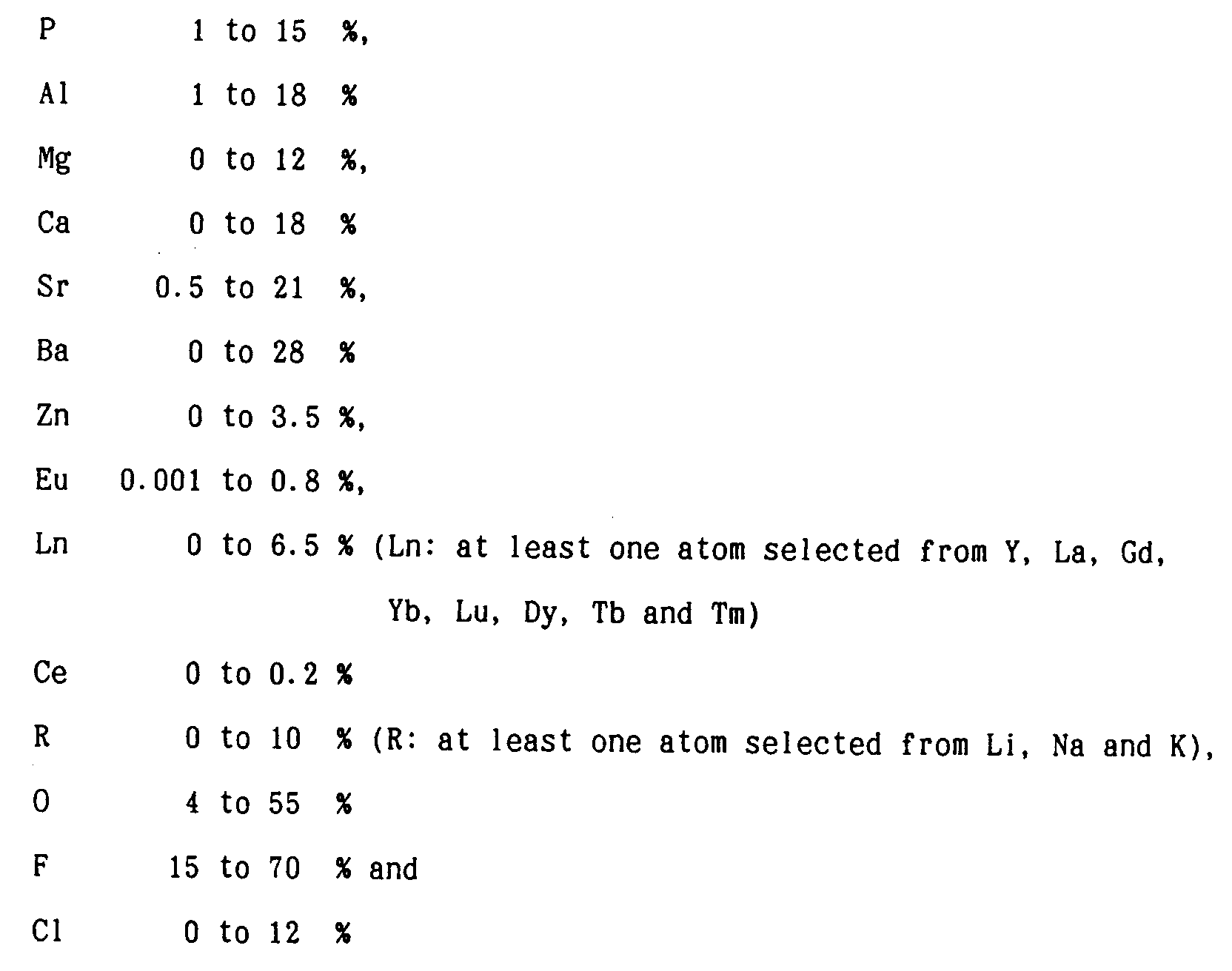
- P is a glass-forming component, which is generally present in a proportion of 1 to 15 %, since if less than the lower limit, glass formation is difficult, while if more than the upper limit, the durability is degraded.
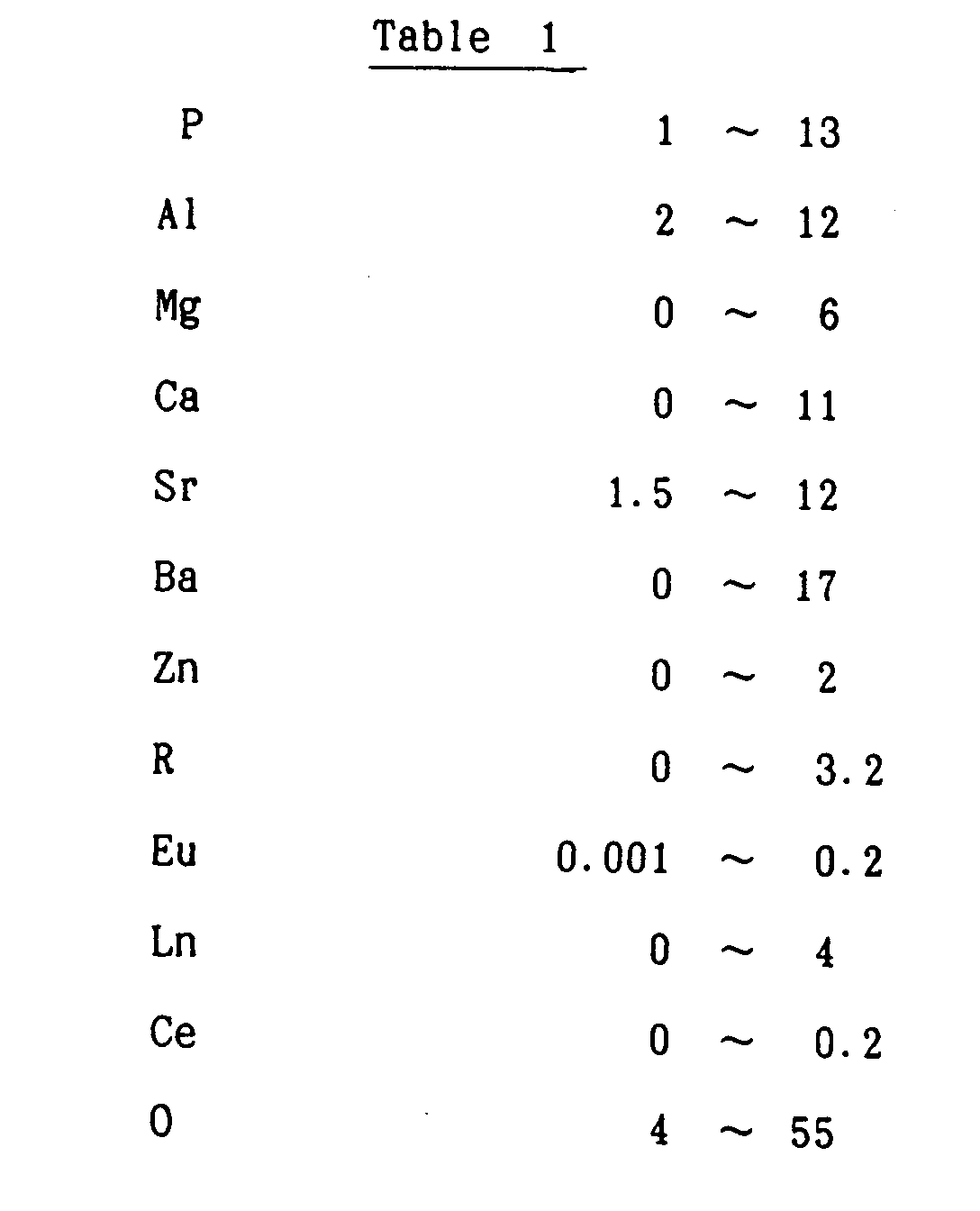
- the preferred range is 1 to 13 % in the case of the above described glass (2), and 1 to 12 % in the case of the above described glass (3).
- Al is a component for increasing the viscosity of the glass and suppressing crystallization, which is generally present in a proportion of 1 to 18 %, since if more than the upper limit, the melting property is lowered and the glass is unstable.
- the preferred range is 2 to 12 % in the case of the above described glass (2), and 3 to 10 % in the case of the above described glass (3).
- Mg, Ca, Sr, Ba and Zn are components for improving the melting property of the glass. If more than the above described ranges, the glass is unstable and tends to be crystallized.
- the preferred ranges are respectively 0 to 12 % of Mg, 0 to 18 % of Ca, 0.5 to 21 % of Sr, 0 to 28 % of Ba and 0 to 3.5 % of Zn.
- the more preferred ranges are respectively 0 to 6 % of Mg, 0 to 11 % of Ca, 1.5 to 12 % of Sr, 0 to 17 % of Ba and 0 to 2 % of Zn in the case of the above described glass (2) and the more preferred ranges are respectively 0 to 6 % of Mg, 0 to 11 % of Ca, 1.5 to 12 % of Sr, 0 to 17 % of Ba and 0 to 2 % of Zn in the case of the above described glass (3).
- R acts to lower the melting temperature of a glass melt, which is generally present in a proportion of 0 to 10 %, since if exceeding the above described range, the water resisting property is reduced and the devitrification tendency is increased, thus rendering the glass unstable.
- the preferred range is 0 to 3 %.
- Eu is an important component capable of presenting fluorescence in the visible region by ultraviolet excitation, in particular, capable of presenting a blue fluorescence by reduction. This component should be present in a proportion of 0.001 to 0.8 %, since if less than the lower limit, sufficient fluorescence cannot be obtained, while if more than the upper limit, the fluorescence is reduced due to concentration quenching.
- the preferred range of Eu is 0.001 to 0.2 % in the case of the above described glass (2) and 0.01 to 0.4 % in the case of the above described glass (3).
- Tb is an important component capable of presenting a green fluorescence in the visible region by ultraviolet excitation. If more than the above described range, a glass is hardly obtained.
- the preferred range is 0.2 to 3.5 %.
- Sm is an important component capable of presenting a red fluorescence in the visible region by ultraviolet excitation. If more than the above described range, the glass is strongly colored. The preferred range is 0 to 2.7 %.
- Mn is an important component capable of presenting a red fluorescence in the visible region by ultraviolet excitation. If more than the above described range, the fluorescence is weakened.
- the preferred range is 0 to 0.6 %.
- Ln (at least one atom selected from Y, La, Gd, Yb, Lu, Dy, Tb and Tm) is a component for increasing the viscosity of the glass and suppressing crystallization. If more than the above described range, the effect thereof is weakened.
- the preferred range is 0 to 4 %.
- Ln (at least one atom selected from Y, La, Gd, Yb, Lu, Dy and Tm) is a component for increasing the viscosity of the glass and suppressing crystallization. If more than the above described range, the effect thereof is weakened.
- the preferred range is 0 to 3 %.
- Ce is a component acting as a sensitizer of the fluorescent agent, but if exceeding the above described upper limit, this effect is decreased.
- F and O are glass-forming components. If the amounts thereof are less than or more than the above described ranges, a glass is hardly obtained.
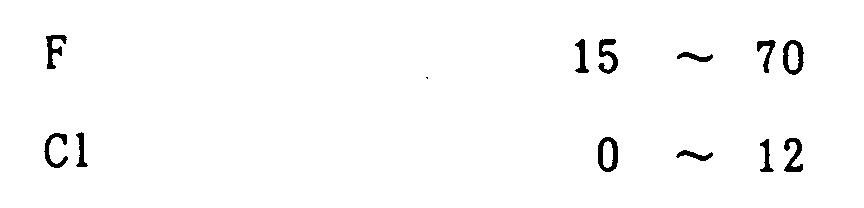
- the preferred range of F is 15 to 70 % in the above described glass (2) and 25 to 65 % in the above described glass (3).
- the preferred range of O is 4 to 55 % in the above described glass (2) and 6 to 40 % in the above described glass (3).
- Cl is a component for intensifying the emission of divalent Eu.
- the emission thereof is intensified with increase of the divalent Eu, but the glass is unstable.
- the preferred range of Cl is 0 to 12 % in the case of the above described glass (2) and 0 to 6 % in the case of the above described glass (3).
- Production of the fluorophosphate fluorescent glass capable of exhibiting fluorescence in the visible region, i.e. blue fluorescence or white fluorescence according to the present invention is carried out by mixing the corresponding raw material compounds to the proportion of the object composition, for example, aluminum phosphate, strontium fluoride, barium fluoride, europium oxide and terbium oxide, melting the resulting mixture at a temperature of 900 to 1300 °C for 1 to 2 hours in a reducing atmosphere, for example, hydrogen or carbon monoxide or in the presence of a metallic powder, for example, aluminum, zinc, calcium or magnesium, as a reducing agent inert to the glass composition and allowing the mixture to flow out into a metallic mold, followed by shaping.
- the object composition for example, aluminum phosphate, strontium fluoride, barium fluoride, europium oxide and terbium oxide
- melting the resulting mixture at a temperature of 900 to 1300 °C for 1 to 2 hours in a reducing atmosphere, for example,
- the raw materials were mixed in a proportion by weight as in Sample No. 1, melted at 900 to 1300 °C, allowed to flow into a graphite mold and shaped to obtain a glass in stable manner.
- the thus prepared glass was excited by an ultraviolet ray of 365 nm to obtain a fluorescent spectrum as shown in Fig. 1.
- the emission at 410 nm in Fig. 1 was due to divalent Eu ion, which was observed as blue with the naked eye.
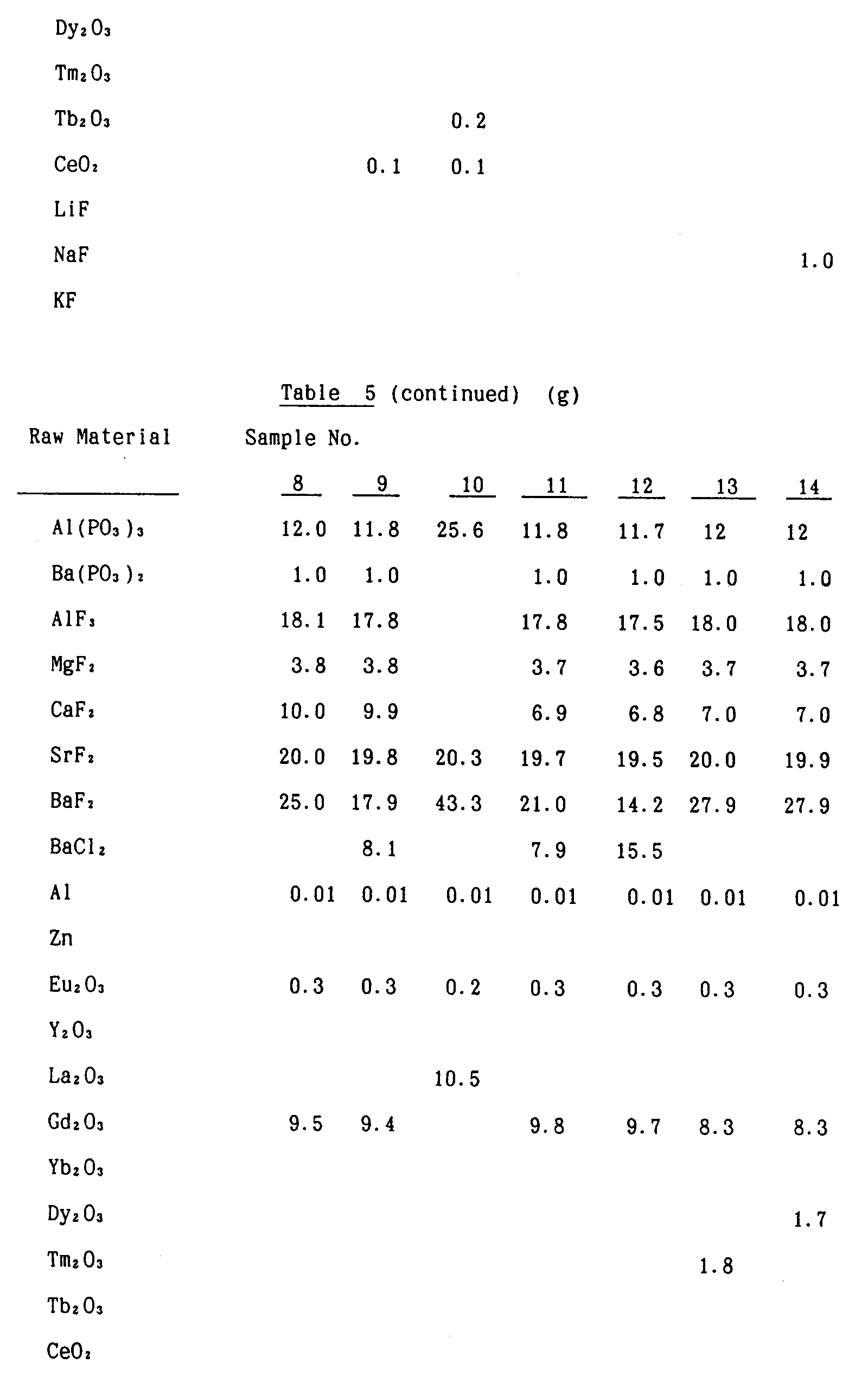
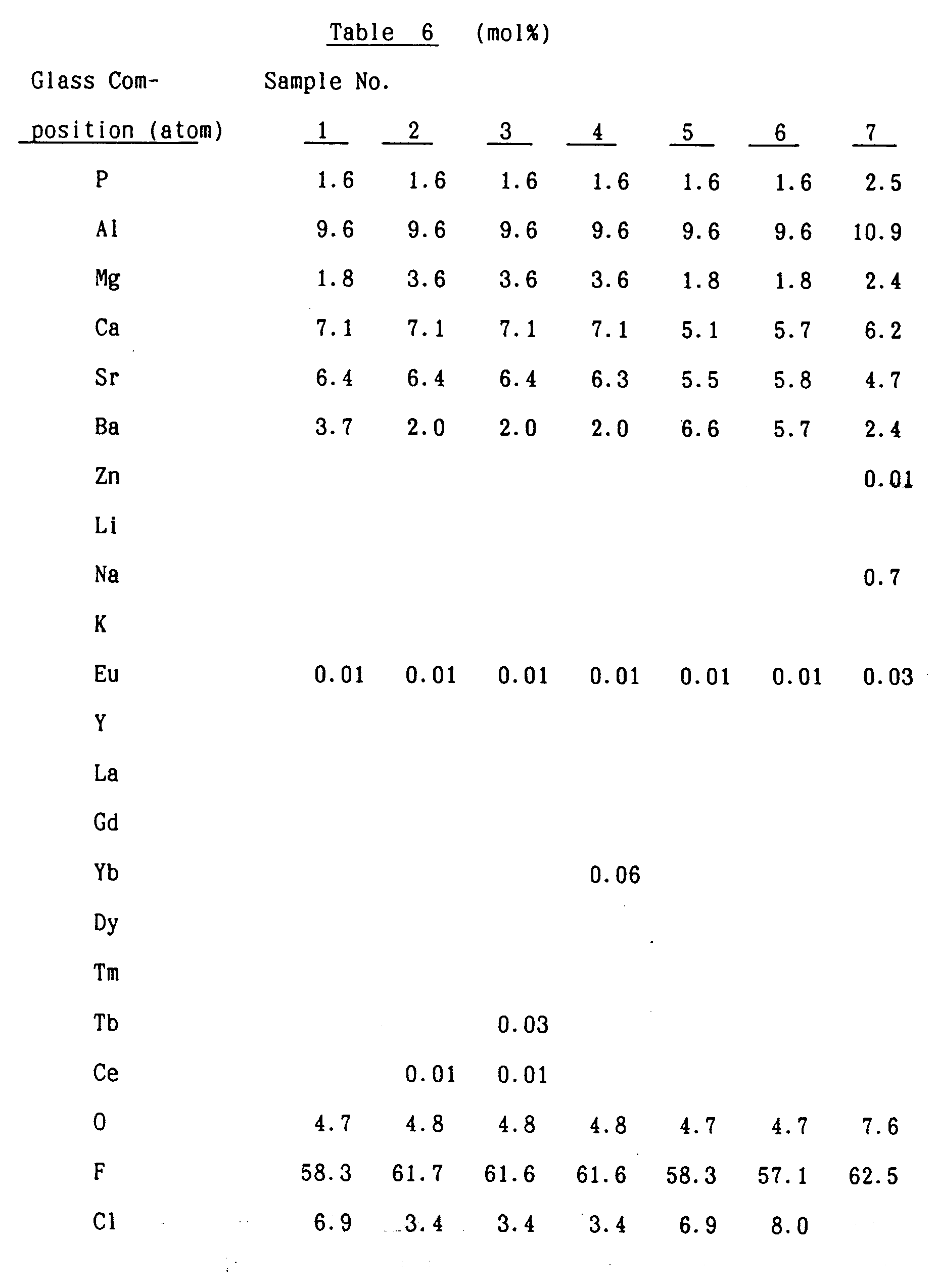
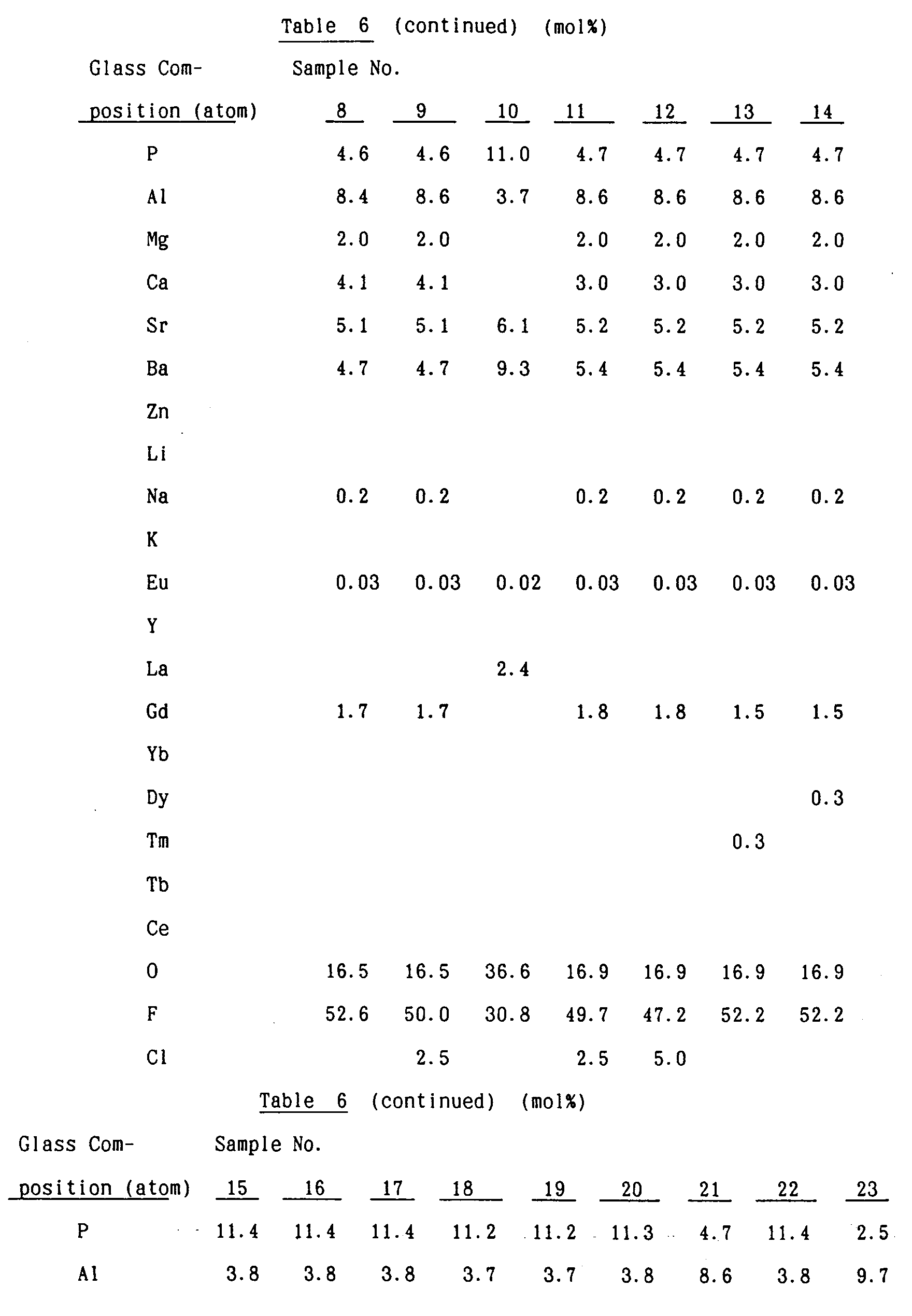
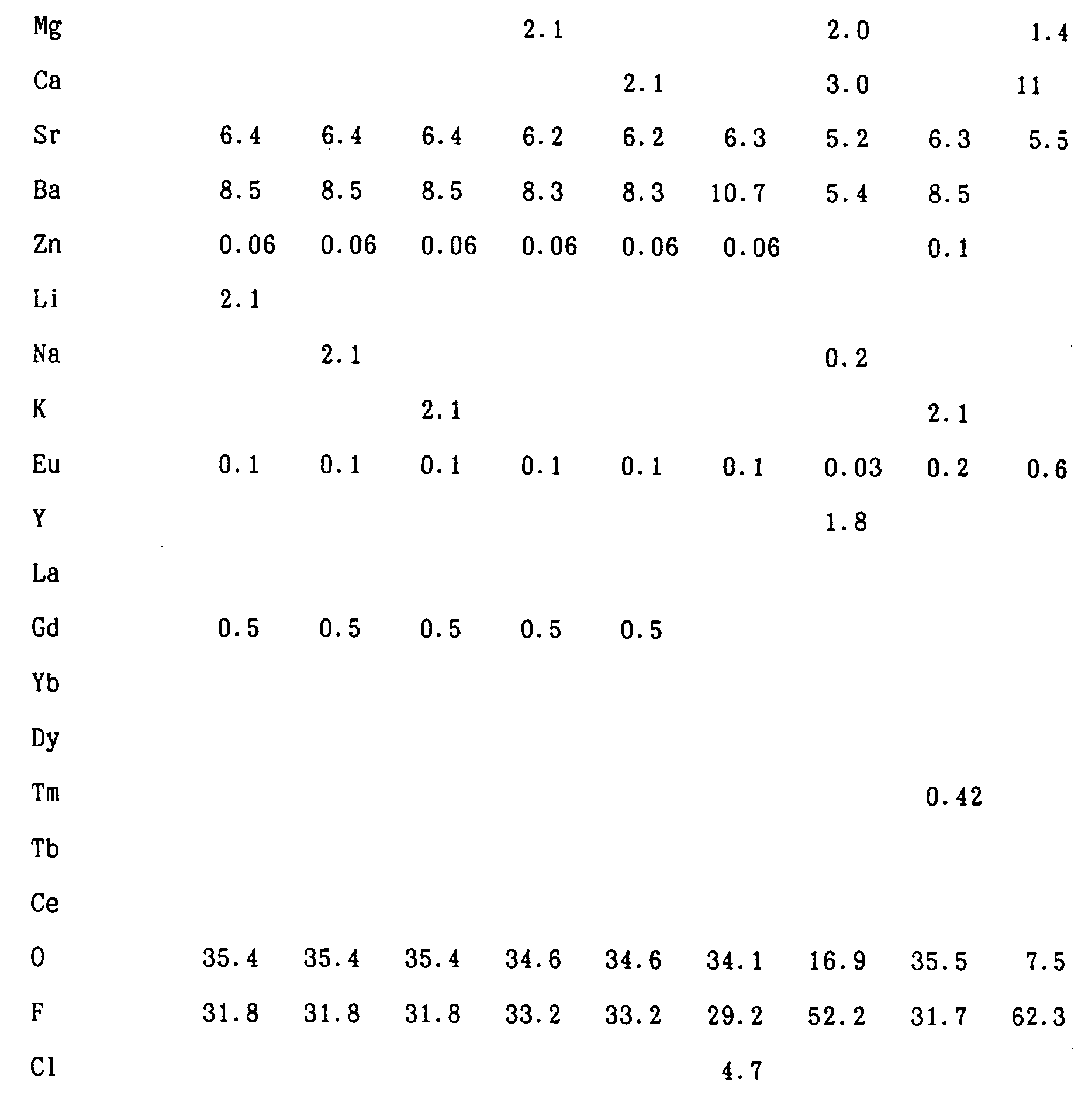
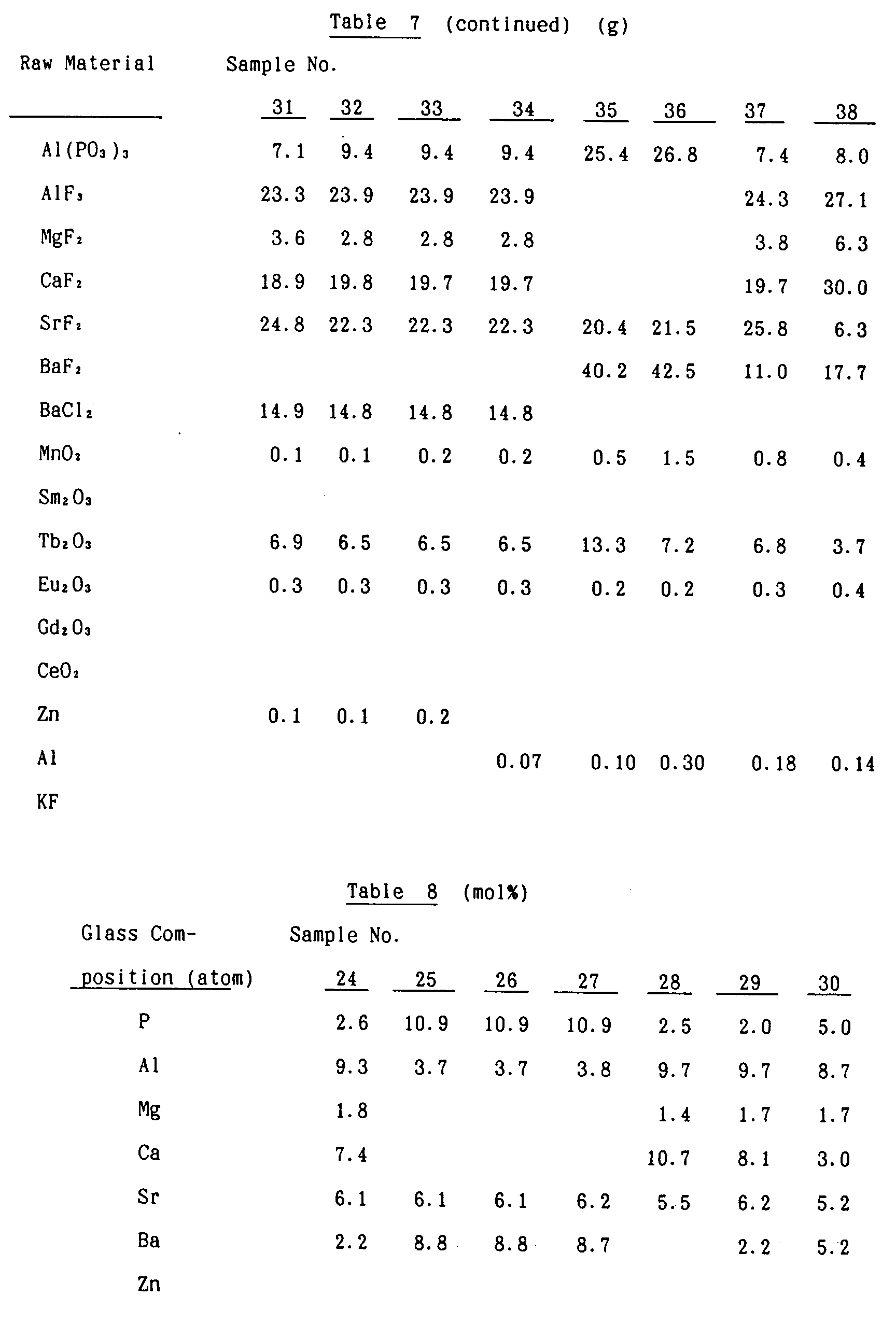
- Glasses were stably obtained by preparing raw materials in proportions by weight shown in Table 5, Sample Nos. 2 to 23 (by mol % of atoms shown in Table 6) and melting the mixture in the manner similar to Example 1.
- Raw materials were mixed in a proportion by weight, calculated from a glass composition of the prior art, i.e. 75 % of B 2 O 3 , 12 % of Na 2 O, 4 % of SrO, 4 % of Al 2 O 3 , 1 % of La 2 O 3 , 0.125 % of Eu 2 O 3 and 0.1 % of C, melted at 1100 °C, allowed to flow out into a graphite mold and shaped to obtain a glass.
- Example 2 When the thus prepared glass was excited by an ultraviolet ray of 365 nm and subjected to measurement of its fluorescence spectrum, there was obtained a similar spectrum to Example 1, presenting a light violet fluorescence. However, the emission intensity was 1/10 times as large as that of Example 1, even taking the highest peak at 410 nm.
- the raw materials were mixed in a proportion by weight as in Sample No. 24, melted at 900 to 1300°C for 1 to 2 hours in a reducing atmosphere, for example, hydrogen or carbon monoxide, or in the presence of a metallic powder, for example, aluminum or zinc as a reducing agent inert to the glass compositions in nitrogen atmosphere, allowed to flow into a graphite mold and shaped to obtain a glass in stable manner.
- a reducing atmosphere for example, hydrogen or carbon monoxide
- a metallic powder for example, aluminum or zinc as a reducing agent inert
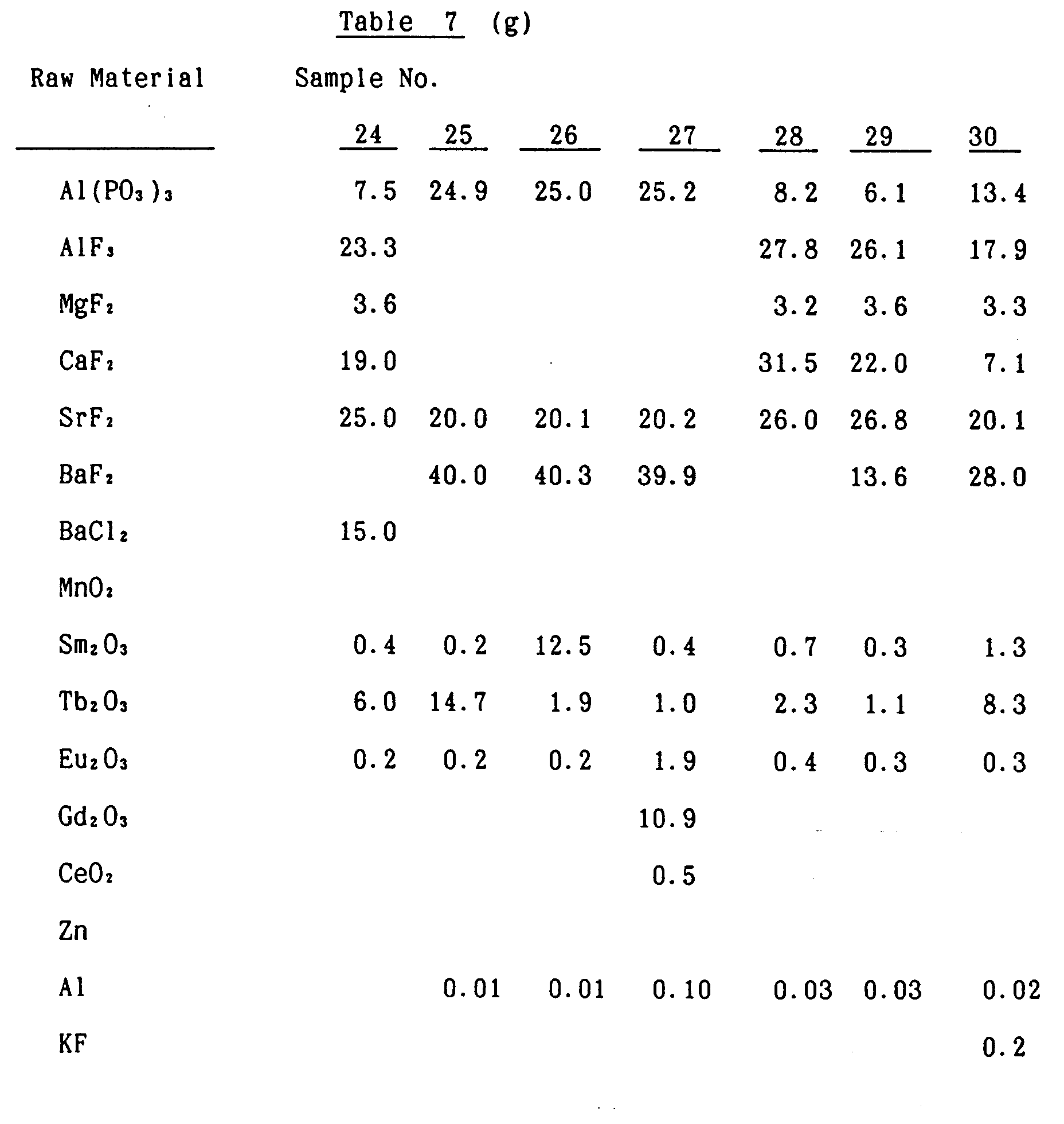
- Glasses were stably obtained by preparing raw materials in proportions by weight shown in Table 7, Sample Nos. 25 to 30 and melting the mixture in the manner similar to Example 24.
- the raw materials were mixed in a proportion by weight as in Sample No. 31, melted at 900 to 1300°C for 1 to 2 hours in a reducing atmosphere, for example, hydrogen or carbon monoxide, or in the presence of a metallic powder, for example, aluminum or zinc as a reducing agent inert to the glass compositions in nitrogen atmosphere, allowed to flow into a graphite mold and shaped to obtain a glass in stable manner.
- a reducing atmosphere for example, hydrogen or carbon monoxide
- a metallic powder for example, aluminum or zinc as a reducing agent inert
- Glasses were stably obtained by preparing raw materials in proportions by weight shown in Table 7, Sample Nos. 32 to 38 and melting the mixture in the manner similar to Example 31.
- the fluorescent glass of the present invention is capable of converting invisible ultraviolet rays into visually observable visible rays with high efficiency and is available for controlling the optical axis of a laser beam such as an excimer laser. Furthermore, according to the present invention, there can be provided a fluorophosphate fluorescent glass exhibiting a strong blue fluorescence, which is applicable to fluorescent displaying of full color in combination with a green or red fluorescent glass or a fluorophosphate fluorescent glass exhibiting white fluorescence, which can be utilized for display devices and backlights of LCDs.
Landscapes
- Chemical & Material Sciences (AREA)
- Materials Engineering (AREA)
- Engineering & Computer Science (AREA)
- Chemical Kinetics & Catalysis (AREA)
- General Chemical & Material Sciences (AREA)
- Geochemistry & Mineralogy (AREA)
- Life Sciences & Earth Sciences (AREA)
- Organic Chemistry (AREA)
- Physics & Mathematics (AREA)
- Optics & Photonics (AREA)
- Glass Compositions (AREA)
- Liquid Crystal (AREA)
- Luminescent Compositions (AREA)
Description






Claims (9)
- A fluorophosphate glass capable of exhibiting blue fluorescence in the visible region by ultraviolet excitation, having a chemical composition comprising, at least, phosphorus (P), oxygen (O) and fluorine (F), as glass constituting components, and divalent europium as a fluorescent agent.
- A fluorophosphate fluorescent glass capable of exhibiting fluorescence in the visible region, having a chemical composition comprising, at least phosphorus (P), oxygen (O) and fluorine (F), as glass constituting components, and divalent europium as a fluorescent agent, and at least one member selected from terbium and (samarium + manganese), as a fluorescent agent, at least one of samarium and manganese being contained as an essential component when terbium is present.
- A fluorophosphate fluorescent glass capable of exhibiting fluorescence in the visible region, as claimed In Claim 1, wherein the glass constituting components are represented, in term of atoms for making up the glass, by the following chemical composition (mol %):and a blue fluorescence is presented.

- A fluorophosphate fluorescent glass capable of exhibiting fluorescence in the visible region, as claimed in Claim 2, wherein the glass constituting components are represented, in term of atoms for making up the glass, by the following chemical composition (mol %):and a white fluorescence is presented.

- A fluorophosphate fluorescent glass capable of exhibiting a blue fluorescence in the visible region, as claimed in Claim 3, wherein the glass constituting components are represent, in terms of atoms for making up the glass, by the following chemical composition (mol %):
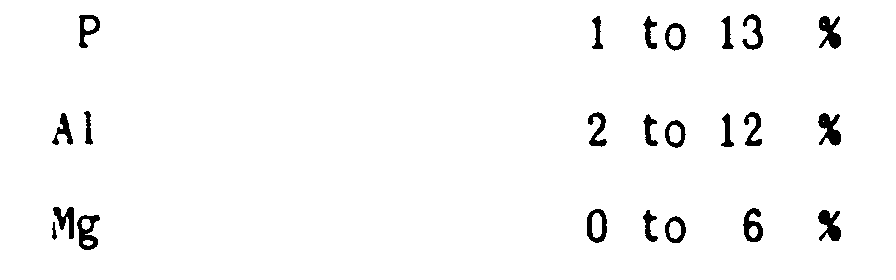 wherein R is at least one atom selected from Li, Na and K, Ln is and Ln is at least one atom selected from Y, La, Gd, Yb, Lu, Dy, Tb and Tm.
- A fluorophosphate fluorescent glass capable of exhibiting a blue fluorescence in the visible region, as claimed in Claim 3, wherein the glass constituting components are represented, in terms of atoms for making up the glass, by the following chemical composition (mol %):
 wherein the sum of 1 ○ = 0.001 ∼ 3.3 %.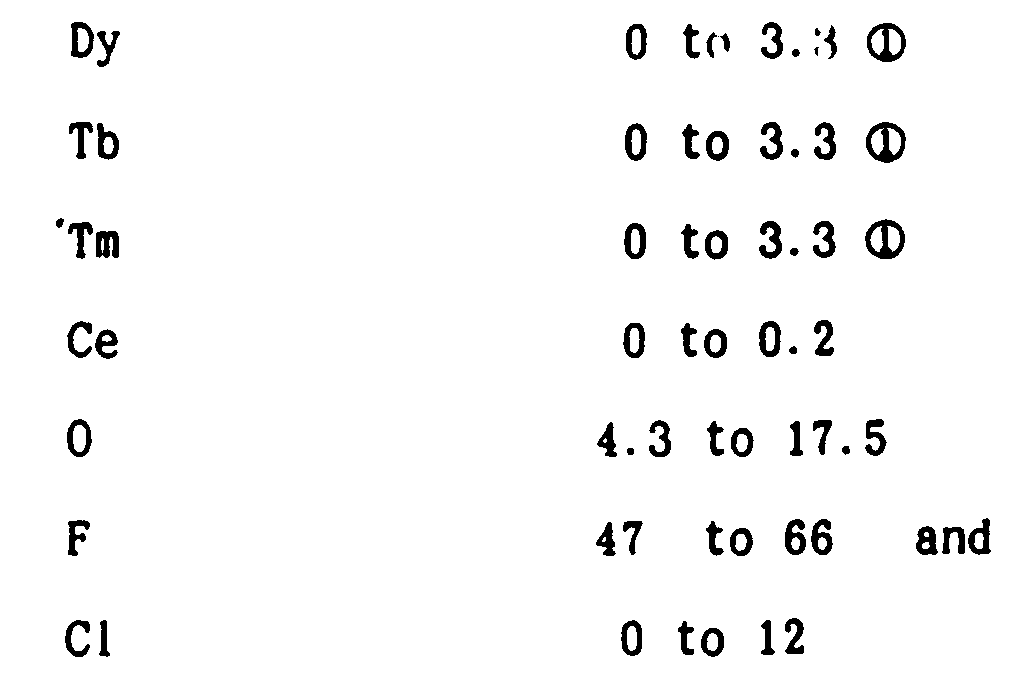
- A fluorophosphate fluorescent glass capable of exhibiting a white fluorescence in the visible region, as claimed in Claim 4, wherein the glass constituting components are represented, in term of atoms for making up the glass, by the following chemical composition (mol %):wherein R is at least one atom selected from Li, Na and K, Ln is at least one atom selected from Y, La, Gd, Yb, Lu, Dy and Tm, and either of Sm or Mn of 1 ○ or both of them are present.
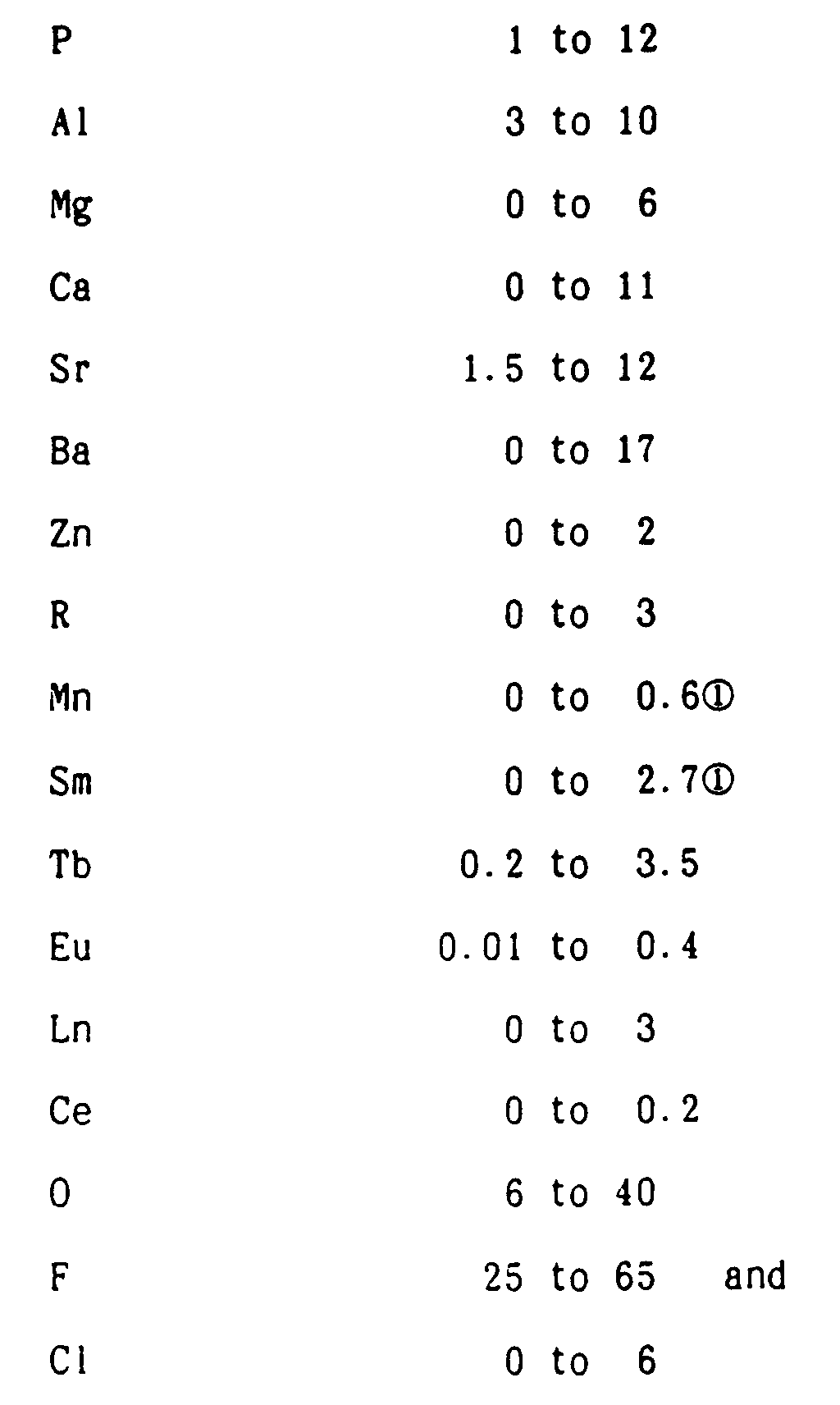
- A fluorophosphate fluorescent glass capable of exhibiting a white fluorescence in the visible region, as claimed in Claim 4, wherein the glass constituting components are represented, in term of atoms for making up the glass, by the following chemical composition (mol %):wherein R is at least one atom selected from Li, Na and K, Ln is at least one atom selected from Y, La, Gd, Yb, Lu, Dy and Tm, and either of Sm or Mn of 1 ○ or both of them are present.

- A display device or backlight of an LCD wherein comprising a fluorophosphate fluorescent glass as claimed in any one of the preceding claims.
Applications Claiming Priority (4)
| Application Number | Priority Date | Filing Date | Title |
|---|---|---|---|
| JP30289295 | 1995-11-21 | ||
| JP302892/95 | 1995-11-21 | ||
| JP08509696A JP3961585B2 (en) | 1995-11-21 | 1996-04-08 | Fluorophosphate fluorescent glass with visible fluorescence |
| JP85096/96 | 1996-04-08 |
Publications (2)
| Publication Number | Publication Date |
|---|---|
| EP0775673A1 EP0775673A1 (en) | 1997-05-28 |
| EP0775673B1 true EP0775673B1 (en) | 1999-01-20 |
Family
ID=26426123
Family Applications (1)
| Application Number | Title | Priority Date | Filing Date |
|---|---|---|---|
| EP96308394A Expired - Lifetime EP0775673B1 (en) | 1995-11-21 | 1996-11-20 | A fluorophosphate fluorescent glass capable of exhibiting fluorescence in the visible region |
Country Status (4)
| Country | Link |
|---|---|
| US (1) | US5755998A (en) |
| EP (1) | EP0775673B1 (en) |
| JP (1) | JP3961585B2 (en) |
| DE (1) | DE69601408T2 (en) |
Families Citing this family (46)
| Publication number | Priority date | Publication date | Assignee | Title |
|---|---|---|---|---|
| JPH09221336A (en) * | 1995-12-14 | 1997-08-26 | Kagaku Gijutsu Shinko Jigyodan | Photostimulated luminescent glass composition |
| JP3993301B2 (en) * | 1997-12-16 | 2007-10-17 | 株式会社住田光学ガラス | Oxide glass with long afterglow and stimulated emission |
| US6292292B1 (en) * | 2000-02-18 | 2001-09-18 | Photon-X | Rare earth polymers, optical amplifiers and optical fibers |
| US6538805B1 (en) | 1999-02-19 | 2003-03-25 | Photon-X, Inc. | Codopant polymers for efficient optical amplification |
| US20040201000A1 (en) * | 1999-02-19 | 2004-10-14 | Photon-X, Inc. | Polymer blends for optical amplification |
| US6307212B1 (en) * | 1999-04-01 | 2001-10-23 | The United States Of America As Represented By The Secretary Of The Navy | High resolution imaging using optically transparent phosphors |
| US6592882B2 (en) | 1999-05-26 | 2003-07-15 | Color Access, Inc. | Cosmetic compositions containing fluorescent minerals |
| US6313181B1 (en) * | 1999-05-26 | 2001-11-06 | Color Access, Inc. | Cosmetic compositions containing optical brighteners |
| US6352949B1 (en) * | 1999-06-15 | 2002-03-05 | Peter Willems | Fluoro glass ceramic showing photostimulable properties |
| AU2001238323A1 (en) * | 2000-02-18 | 2001-08-27 | Photon-X, Inc. | Polymer blends for optical amplification |
| CA2316587C (en) | 2000-08-14 | 2009-12-01 | Charles M. Schmeichel | Tonneau cover having rear bar lock |
| US7989376B2 (en) * | 2001-06-26 | 2011-08-02 | Afo Research, Inc. | Fluorophosphate glass and method for making thereof |
| JP4727093B2 (en) * | 2001-09-12 | 2011-07-20 | パナソニック株式会社 | Plasma display device |
| US6797657B2 (en) * | 2002-07-31 | 2004-09-28 | Corning Incorporated | Tm-doped fluorophosphate glasses for 14xx amplifiers and lasers |
| AU2003302648A1 (en) | 2002-11-29 | 2004-06-23 | Japan Science And Technology Agency | Luminescent glass |
| US7575588B2 (en) * | 2003-02-03 | 2009-08-18 | Warsaw Orthopedic Inc. | Midline occipital vertebral fixation system |
| JP2004273798A (en) * | 2003-03-10 | 2004-09-30 | Toyoda Gosei Co Ltd | Light emitting device |
| US20060113885A1 (en) * | 2004-11-29 | 2006-06-01 | Keiji Iimura | Discharge fluorescen apparatus including fluorescent fibers |
| JP2006179464A (en) * | 2004-11-29 | 2006-07-06 | Keiji Iimura | Discharge light emitting device, and manufacturing method of discharge light emitting device |
| US20060252775A1 (en) * | 2005-05-03 | 2006-11-09 | Henderson Samuel T | Methods for reducing levels of disease associated proteins |
| US7608551B2 (en) * | 2005-07-05 | 2009-10-27 | Margaryan Alfred A | Bismuth containing fluorophosphate glass and method for making thereof |
| US7795798B2 (en) | 2005-08-08 | 2010-09-14 | National Institute Of Advanced Industrial Science And Technology | Transparent fluorescent glass |
| JP5079273B2 (en) | 2006-07-03 | 2012-11-21 | Hoya株式会社 | Phosphate glass, fluorophosphate glass, precision press-molding preform, optical element and manufacturing method thereof |
| CN101622207B (en) * | 2007-03-06 | 2016-08-31 | Hoya株式会社 | Optical glass, preform for press molding, optical element, and method for producing them |
| US8632816B2 (en) | 2007-12-17 | 2014-01-21 | Elc Management, Llc | Compositions comprising solid particles entrapped in collapsed polymeric microspheres, and methods of making the same |
| US20090155371A1 (en) | 2007-12-17 | 2009-06-18 | Sojka Milan F | Compositions Comprising Solid Particles Entrapped In Collapsed Polymeric Microspheres, And Methods Of Making The Same |
| TW200940684A (en) * | 2008-03-10 | 2009-10-01 | Nikon Corp | Fluorescent film, film-forming method therefor, multilayer dielectric film, optical element, optical system, imaging unit, instrument for measuring optical characteristics, method of measuring optical characteristics, exposure apparatus, exposure met |
| JP5063537B2 (en) * | 2008-03-28 | 2012-10-31 | Hoya株式会社 | Fluorophosphate glass, precision press-molding preform, optical element blank, optical element and production method thereof |
| JP5658599B2 (en) * | 2008-03-28 | 2015-01-28 | Hoya株式会社 | Fluorophosphate glass, glass material for press molding, optical element blank, optical element and respective manufacturing methods |
| JP5069649B2 (en) * | 2008-03-28 | 2012-11-07 | Hoya株式会社 | Fluorophosphate glass, precision press-molding preform, optical element blank, optical element and production method thereof |
| JP5188269B2 (en) | 2008-05-30 | 2013-04-24 | Hoya株式会社 | Optical glass, glass material for press molding, optical element blank, optical element, and production method thereof |
| JP5116616B2 (en) * | 2008-09-04 | 2013-01-09 | Hoya株式会社 | Fluorophosphate glass, glass material for press molding, optical element blank, optical element, and production method thereof |
| US20100327186A1 (en) * | 2008-10-31 | 2010-12-30 | Afo Research, Inc. | Optical components for use in high energy environment with improved optical characteristics |
| US8361914B2 (en) * | 2008-10-31 | 2013-01-29 | Margaryan Alfred A | Optical components for use in high energy environment with improved optical characteristics |
| US8183536B2 (en) * | 2009-02-20 | 2012-05-22 | Corning Incorporated | System for monitoring optical modules of high-power lasers |
| CN101514079B (en) * | 2009-03-27 | 2012-05-02 | 成都光明光电股份有限公司 | Fluorophosphate optical glass |
| WO2011024270A1 (en) | 2009-08-26 | 2011-03-03 | Hoya株式会社 | Fluorophosphate glass, glass material for press molding, optical element blank, optical element, processes for production of same, and process for production of glass moldings |
| US20120164195A1 (en) | 2010-12-22 | 2012-06-28 | Avon Products, Inc. | Cosmetic Films |
| KR20140025568A (en) | 2011-07-07 | 2014-03-04 | 이엘씨 매니지먼트 엘엘씨 | Methods and compositions useful for treating fitzpatrick type iv, v or vi skin |
| JP5850790B2 (en) * | 2011-12-07 | 2016-02-03 | 株式会社住田光学ガラス | Glass lining glaze composition |
| DE112014001985T5 (en) | 2013-05-21 | 2015-12-31 | Central Glass Co., Ltd. | Broadband emission material and white light emission material |
| CN104003617B (en) * | 2014-05-26 | 2016-03-23 | 中国科学院上海硅酸盐研究所 | Titania based high refracting glass material of a kind of blue up-conversion and preparation method thereof |
| JP2015229724A (en) * | 2014-06-05 | 2015-12-21 | セントラル硝子株式会社 | Broadband light emitting material |
| US10393887B2 (en) | 2015-07-19 | 2019-08-27 | Afo Research, Inc. | Fluorine resistant, radiation resistant, and radiation detection glass systems |
| CN107098582B (en) * | 2017-05-05 | 2019-12-17 | 陕西师范大学 | A kind of white light emitting glass for borate matrix LED with high thermal stability and preparation method thereof |
| CN111708211A (en) * | 2020-06-12 | 2020-09-25 | 惠州市华星光电技术有限公司 | Display panel and display device |
Family Cites Families (3)
| Publication number | Priority date | Publication date | Assignee | Title |
|---|---|---|---|---|
| JPS5727047B2 (en) | 1973-01-26 | 1982-06-08 | ||
| CA1193428A (en) * | 1981-09-03 | 1985-09-17 | Akira Taya | Blue-green emitting halophosphate phosphor, and fluorescent lamp employing the same |
| JP4179641B2 (en) * | 1994-10-31 | 2008-11-12 | 株式会社住田光学ガラス | Fluorophosphate fluorescent glass containing Tb or Eu |
-
1996
- 1996-04-08 JP JP08509696A patent/JP3961585B2/en not_active Expired - Lifetime
- 1996-11-20 DE DE69601408T patent/DE69601408T2/en not_active Expired - Lifetime
- 1996-11-20 US US08/754,274 patent/US5755998A/en not_active Expired - Lifetime
- 1996-11-20 EP EP96308394A patent/EP0775673B1/en not_active Expired - Lifetime
Also Published As
| Publication number | Publication date |
|---|---|
| DE69601408D1 (en) | 1999-03-04 |
| EP0775673A1 (en) | 1997-05-28 |
| JP3961585B2 (en) | 2007-08-22 |
| US5755998A (en) | 1998-05-26 |
| DE69601408T2 (en) | 1999-07-01 |
| JPH09202642A (en) | 1997-08-05 |
Similar Documents
| Publication | Publication Date | Title |
|---|---|---|
| US5755998A (en) | Fluorophosphate fluorescent glass capable of exhibiting fluorescence in the visible region | |
| EP0847964B1 (en) | An oxide fluorescent glass capable of exhibiting visible fluorescence | |
| US5635109A (en) | Tb- or eu-containing fluorophosphate fluorescent glass | |
| EP0992463B1 (en) | Oxide glass showing long afterglow and accelerated phosphorescence | |
| JP3396443B2 (en) | Luminescent fluorescent glass ceramics | |
| US6287993B1 (en) | Long-lasting phosphorescent glasses and glass-ceramics | |
| JP2000159543A (en) | Luminescent fluorescent glass and glass ceramics | |
| EP0926102B1 (en) | An oxide phosphorescent glass capable of exhibiting a long lasting afterglow and photostimulated luminescence | |
| US20090127508A1 (en) | Novel materials used for emitting light | |
| JP2009286681A (en) | Luminescent glass and luminescent crystallized glass | |
| US6271160B1 (en) | Oxide phosphorescent glass capable of exhibiting a long lasting afterglow and photostimulated luminescence | |
| US6190577B1 (en) | Indium-substituted aluminate phosphor and method for making the same | |
| US4038203A (en) | Certain alkali metal-rare earth metaphosphate photoluminescent glasses | |
| US20040178734A1 (en) | Fluorescent device, fluorescent lamp and glass composite | |
| JP2000309775A (en) | Phosphorescent phosphor | |
| JP2000034480A (en) | Phosphorescent phosphor | |
| JP3193677B2 (en) | Phosphorescent phosphor | |
| US5597511A (en) | Phosphor and method of making same | |
| JPH09143463A (en) | High brightness long afterglow phosphorescent material | |
| EP0251550B1 (en) | Improvements in or relating to inorganic phosphors | |
| KR910005820B1 (en) | Phosphor and Cathode Ray Tube Using the Same | |
| JPS63101479A (en) | Rare earth element oxysulfide phosphor | |
| JP2000016832A (en) | Oxide glass with long afterglow and stimulated emission | |
| RU2661959C1 (en) | Glass |
Legal Events
| Date | Code | Title | Description |
|---|---|---|---|
| PUAI | Public reference made under article 153(3) epc to a published international application that has entered the european phase |
Free format text: ORIGINAL CODE: 0009012 |
|
| AK | Designated contracting states |
Kind code of ref document: A1 Designated state(s): DE FR GB |
|
| 17P | Request for examination filed |
Effective date: 19970623 |
|
| GRAG | Despatch of communication of intention to grant |
Free format text: ORIGINAL CODE: EPIDOS AGRA |
|
| 17Q | First examination report despatched |
Effective date: 19980330 |
|
| GRAG | Despatch of communication of intention to grant |
Free format text: ORIGINAL CODE: EPIDOS AGRA |
|
| GRAH | Despatch of communication of intention to grant a patent |
Free format text: ORIGINAL CODE: EPIDOS IGRA |
|
| GRAH | Despatch of communication of intention to grant a patent |
Free format text: ORIGINAL CODE: EPIDOS IGRA |
|
| GRAA | (expected) grant |
Free format text: ORIGINAL CODE: 0009210 |
|
| AK | Designated contracting states |
Kind code of ref document: B1 Designated state(s): DE FR GB |
|
| ET | Fr: translation filed | ||
| REF | Corresponds to: |
Ref document number: 69601408 Country of ref document: DE Date of ref document: 19990304 |
|
| PLBE | No opposition filed within time limit |
Free format text: ORIGINAL CODE: 0009261 |
|
| STAA | Information on the status of an ep patent application or granted ep patent |
Free format text: STATUS: NO OPPOSITION FILED WITHIN TIME LIMIT |
|
| 26N | No opposition filed | ||
| REG | Reference to a national code |
Ref country code: GB Ref legal event code: IF02 |
|
| REG | Reference to a national code |
Ref country code: FR Ref legal event code: PLFP Year of fee payment: 20 |
|
| PGFP | Annual fee paid to national office [announced via postgrant information from national office to epo] |
Ref country code: GB Payment date: 20151118 Year of fee payment: 20 Ref country code: DE Payment date: 20151119 Year of fee payment: 20 |
|
| PGFP | Annual fee paid to national office [announced via postgrant information from national office to epo] |
Ref country code: FR Payment date: 20151119 Year of fee payment: 20 |
|
| REG | Reference to a national code |
Ref country code: DE Ref legal event code: R071 Ref document number: 69601408 Country of ref document: DE |
|
| REG | Reference to a national code |
Ref country code: GB Ref legal event code: PE20 Expiry date: 20161119 |
|
| PG25 | Lapsed in a contracting state [announced via postgrant information from national office to epo] |
Ref country code: GB Free format text: LAPSE BECAUSE OF EXPIRATION OF PROTECTION Effective date: 20161119 |