EP0773449B1 - Magnetic field sensor - Google Patents
Magnetic field sensor Download PDFInfo
- Publication number
- EP0773449B1 EP0773449B1 EP96116894A EP96116894A EP0773449B1 EP 0773449 B1 EP0773449 B1 EP 0773449B1 EP 96116894 A EP96116894 A EP 96116894A EP 96116894 A EP96116894 A EP 96116894A EP 0773449 B1 EP0773449 B1 EP 0773449B1
- Authority
- EP
- European Patent Office
- Prior art keywords
- magnetic field
- magnetic
- magneto
- sensor
- field sensor
- Prior art date
- Legal status (The legal status is an assumption and is not a legal conclusion. Google has not performed a legal analysis and makes no representation as to the accuracy of the status listed.)
- Expired - Lifetime
Links
Images



Classifications
-
- G—PHYSICS
- G01—MEASURING; TESTING
- G01R—MEASURING ELECTRIC VARIABLES; MEASURING MAGNETIC VARIABLES
- G01R33/00—Arrangements or instruments for measuring magnetic variables
- G01R33/02—Measuring direction or magnitude of magnetic fields or magnetic flux
- G01R33/022—Measuring gradient
Definitions
- the present invention relates to a magnetic field sensor, and more particularly to a magnetic field sensor which can detect gradient magnetic fields and which can be used in various technical fields.
- the magnetic field sensor of the present invention can be used as a magnetic sensor head for a rotary encoder used for sophisticated arm control of an industrial robot in which the magnetic sensor head is combined with a high density ring magnet, as a sensitive magnetic sensor head for magnetic inspection, as a magnetic sensor head for detecting the image of magnetic domains of a magnetic material, as a magnetic sensor head for a high density magnetic disc of a computer, as a magnetic sensor head for a rotary encoder used for controlling the rotation of a storage disc of a computer in which the magnetic sensor head is combined with a ring magnet, as a magnetic sensor for detecting a magnetic field of an automobile, as a magnetic direction sensor, as any one of various types of magnetic sensors for current detection, or as a like device.
- magnetic sensor heads are a key technology in the modern computerized society which has progressed more and more.
- Various magnetic sensor heads such as a magnetic sensor head for a rotary encoder used in an industrial robot, a sensitive magnetic sensor head for magnetic inspection, a magnetic sensor head for detecting magnetic domains of a magnetic material, a magnetic sensor head for a high density magnetic disc, and a magnetic sensor head for a rotary encoder used for controlling the rotation of a storage disc are all required to detect weak signal magnetic fields, which have recently become more and more weakened. Also, such magnetic sensor heads are required to detect only a signal magnetic field in a disturbance field or background field stronger than the signal magnetic field, such as the terrestrial field.
- a magnetic field sensor which can cancel disturbance fields, which are spatially uniform as compared with a signal magnetic field, so as to detect, as a differential magnetic field, only the signal magnetic field which is spatially gradient.
- MI magneto-impedance
- Hall elements nor magneto resistance (MR) elements have sufficient sensitivity.
- flux gate sensors have high sensitivity for uniform magnetic fields, they are not satisfactory in terms of their sizes and response speeds.
- the MI element proposed by the present inventors has a high resolution of 7,958.10 -5 Am -1 (10 -6 Oe) in detecting alternating magnetic fields, a very high sensitivity, and a high response speed which allows detection of magnetic fields from DC (0 Hz) to a few MHz, despite its compact size of about 1 mm long.
- the power consumption of the entire sensor circuit is not greater than about 40 mW, it is easy to assemble a sensor array using these MI elements. None of various types of conventional magnetic sensors possesses these excellent characteristics.
- the strengths of magnetic fields to be measured have been decreased and the frequencies of magnetic fields to be measured have been increased, especially in the fields of computers, information equipment, mechatoronics, power electronics, medical electronics, industrial measurement, and environmental measurement.
- the strengths of magnetic fields are on the order of milli Oe, and the frequencies of the magnetic fields range from a few tens of kHz to a few hundreds of kHz. Therefore, conventional Hall elements, MR elements, and the like cannot be used due to their insufficient sensitivities. Conventional flux gate sensors cannot be used due to their insufficient response speeds and large head lengths.
- a method for detecting a gradient magnetic field while canceling the background magnetic field has been proposed in relation to a gradio meter of SQUID (superconductive quantum interference device).
- SQUID superconductive quantum interference device
- MI elements which are new high performance micro magnetic field sensors.
- a magnetic field sensor according to the preamble of claim 1 is known from US 3 065 413.
- An object of the present invention is to solve the above-mentioned problems in the conventional magnetic field sensors and to provide a magnetic field sensor for gradient field detection (gradient type magnetic field sensor) which can cancel relatively uniform disturbance magnetic fields (background magnetic fields), such as the terrestrial field, thereby making it possible to detect only a signal magnetic field (gradient field) which is considerably localized spatially.
- gradient field detection gradient type magnetic field sensor
- the detection means is composed of a self-oscillation type electronic circuit.
- the said self-oscillation type electronic circuit preferably comprises a multivibrator high frequency oscillator which has a pair of transistors and performs amplitude modulation.
- the sensor heads are made of an amorphous wire or a thin film.
- the sensor heads is made of an amorphous wire
- the bias magnetic fields are generated by supplying direct currents to coils wound around the magneto-impedance elements.
- the self-oscillation type electronic circuit comprises a multivibrator high frequency oscillator which has a pair of transistors and performs amplitude modulation, it becomes possible to obtain a magnetic field sensor which is highly sensitive and operates stably.
- FIG. 1 shows the overall structure of a magnetic field sensor according to an embodiment of the present invention
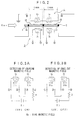
- FIG. 2 shows the structure of the head portion of the magnetic field sensor
- FIG. 3A shows the interconnection between two bias coils of the magnetic field sensor for detection of uniform magnetic fields
- FIG. 3B shows the interconnection between the two bias coils of the magnetic field sensor for detection of gradient magnetic fields
- FIG. 4 shows the interconnection between two feedback coils of the magnetic field sensor.
- the magnetic field sensor includes a pair of sensor heads A and a self-oscillation type electronic circuit B.
- the pair of sensor heads A includes a common amorphous wire 1 (magnetostriction: 0, diameter: 30 ⁇ m, length: about 3 mm) serving as a magnetic member.
- Soldering electrode terminals 2 (2a, 2b and 2c) are provided at three different locations on the amorphous wire 1.
- Two portions, 1A and 1B, of the amorphous wire 1 between the electrode terminals 2 serve as the pair of sensor heads A.
- the amorphous wire 1 is made of, for example, an FeCoSiB material.
- a tensile stress of 2 kg/mm 2 is applied to the FeCoSiB material during an annealing process in which the FeCoSiB material is heated at 475°C for one minute and is then cooled to room temperature.
- two bias coils 3 (3a and 3b) and two feedback coils 4 (4a and 4b) are wound around the pair of sensor heads A formed of a magnetic member.
- the bias coils 3a and 3b are connected to a DC power supply Eb through a resistor R (100 ⁇ ) such that the bias coils 3a and 3b generate bias magnetic fields oriented in the same direction, as shown in FIG. 3A.
- the bias coils 3a and 3b are connected to the DC power supply Eb through the resistor R (100 ⁇ ) such that the bias coils 3a and 3b generate bias magnetic fields oriented in opposite directions, as shown in FIG. 3B.
- the feedback coils 4a and 4b are connected to the output of the self-oscillation type electronic circuit B through a feedback resistor 62 (see FIG. 1) such that the feedback coils 4a and 4b generate magnetic fields oriented in the same direction.
- the self-oscillation type electronic circuit B consists of a multivibrator oscillation circuit 10, a differential amplifier 30, a detection circuit 40, and an output-stage amplifier 50.
- the multivibrator oscillation circuit 10 consists of a resistor 17 (R: 1O ⁇ ), a DC power supply 18 (E), inductances 11 and 19 [chip elements (L chip ): 0.12 ⁇ H] resistors 12 and 20 ( R b1 and R b2 20 k ⁇ ), capacitors 13 and 21 (C b1 and C b2 : 220 pF), transistors 14 and 22 (Tr1 and Tr2: 2SC1162), resistors 15 and 23 (R: 30 k ⁇ ), and resistors 16 and 24 (R 0 : 3 ⁇ ).
- the multivibrator oscillation circuit 10 is connected to the differential amplifier 30.
- the differential amplifier 30 consists of resistors 31 and 32 (R 1 and R 2 : 510 ⁇ ), a resistor 33 (R 4 : 1 k ⁇ ), an operational amplifier 34 (OP1: LM6361N) and a resistor 35 (R 3 : 1 k ⁇ ), and is connected to the detection circuit 40.
- the detection circuit 40 consists of a Schottky barrierdiode 41 (D: 1SS97), and an RC circuit consisting of a resistor 42 (R 5 : 300 k ⁇ ) and a capacitor 43 (C 1 : 2200 pF).
- the detection circuit 40 is connected to the output-stage amplifier 50.
- the output-stage amplifier 50 consists of resistors 51, 52 and 53 (R 6 , R 7 and R 12 : 10 k ⁇ ), a variable resistor 54 (R 13 : max. 5 k ⁇ ), a resistor 55 (R 9 : 100 k ⁇ ), an operational amplifier 56 (OP2: LM356N), a resistor 57 (R 8 : 100 k ⁇ ), a resistor 58 (R 10 : 1 k ⁇ ),an operational amplifier 59 (OP3: LM356N), and a resistor 60 (R 11 : 100 k ⁇ ).
- Numeral 61 denotes the above-mentioned switch SW1
- numeral 62 denotes the above-mentioned feedback resistor (Rf: max. 3k ⁇ ).
- the feedback resistor 62 is grounded through the feedback coils 4a and 4b serially connected to the feedback resistor 62.
- Numeral 63 denotes an output terminal.
- the multivibrator oscillation circuit 10 oscillates at about 20 MHz, and the oscillation voltage thereof undergoes amplitude modulation due to an externally applied magnetic field Hex.
- the modulated oscillation voltage is supplied, through the differential amplifier 30, to the detection circuit 40 having the above-mentioned Schottky barrier diode 41 and the RC circuit consisting of the resistor 42 and the capacitor 43, in which the modulated oscillation voltage is detected.
- the detection voltage output from the detection circuit 40 is amplified by the operational amplifiers 56 and 59 to a sufficient level, so that an output voltage Eout is obtained from the output terminal 63.
- the output voltage Eout is proportional to the externally applied magnetic field Hex.
- the magnetic field sensor functions as a linear magnetic field sensor.
- the output voltage Eout is proportional to the difference in the magnetic field strength between the two portions 1A and 1B of the amorphous wire 1 serving as the sensor heads A.
- FIG. 5 is a characteristic chart (characteristic chart for detection of uniform magnetic fields) of the magnetic field sensor of the present invention, which shows the relationship between an externally applied magnetic field and the output voltage.
- This characteristic chart shows the characteristic when the magnitude of a sinusoidal magnetic field (frequency: 1 kHz) is varied from -7,958 ⁇ 10 1 Am -1 to 7,958.10 1 Am -1 (-1 Oe (oersted) to +1 Oe).
- the magnetic field sensor of the present invention exhibits a nonlinearity of 0.2% or less at the full scale, so that it has an excellent linearity.
- the minimum detectable strength of the magnetic field is about 7,958.10 -5 Am -1 (10 -6 Oe).
- FIG. 6 is a characteristic chart showing the frequency characteristic of the magnetic field sensor of the present invention.
- This chart shows the detection characteristic (frequency characteristic) when the frequency f of a sinusoidal magnetic field (amplitude: 1,5916 Am -1 (0.02 Oe)) is varied.
- the horizontal axis represents the frequency (kHz) of the sinusoidal magnetic field while the vertical axis represents the variation ⁇ Eout (dB) of the output voltage of the sensor.
- FIGS. 7A and 7B show the results of experiments in which the surface magnetic field of a ring magnet of a rotary encoder for robot control was detected by the magnetic field sensor of the present invention operated in a differential mode.
- FIG. 7A shows the case where the ring magnet had a diameter of 19 mm and 1000 magnetic poles (the pitch of magnetic poles: 60 ⁇ m)
- FIG. 7B shows the case where the ring magnet had a diameter of 19 mm and 2000 magnetic poles (the pitch of magnetic poles : 30 ⁇ m).
- the horizontal axis represents the recurrence of N and S magnetic poles, while the vertical axis represents the sensor output (7,958.10 -2 Am -1 (mOe)).
- the magnetic field sensor When the magnetic field sensor was used in a differential mode, the negative feedback was not used. Since the magnetic field sensor was operated in the differential mode, the sensor was not at all affected by the terrestrial field. The influence of the rotor magnetic field of a magnet motor for driving an encoder decreased by about 75% through the operation in the differential mode.
- the sensor heads are made of an amorphous wire
- an amorphous thin film may be used instead of the amorphous wire.
Landscapes
- Physics & Mathematics (AREA)
- Condensed Matter Physics & Semiconductors (AREA)
- General Physics & Mathematics (AREA)
- Measuring Magnetic Variables (AREA)
Description
- The present invention relates to a magnetic field sensor, and more particularly to a magnetic field sensor which can detect gradient magnetic fields and which can be used in various technical fields.
- The magnetic field sensor of the present invention can be used as a magnetic sensor head for a rotary encoder used for sophisticated arm control of an industrial robot in which the magnetic sensor head is combined with a high density ring magnet, as a sensitive magnetic sensor head for magnetic inspection, as a magnetic sensor head for detecting the image of magnetic domains of a magnetic material, as a magnetic sensor head for a high density magnetic disc of a computer, as a magnetic sensor head for a rotary encoder used for controlling the rotation of a storage disc of a computer in which the magnetic sensor head is combined with a ring magnet, as a magnetic sensor for detecting a magnetic field of an automobile, as a magnetic direction sensor, as any one of various types of magnetic sensors for current detection, or as a like device.
- The use of magnetic sensor heads is a key technology in the modern computerized society which has progressed more and more. Various magnetic sensor heads such as a magnetic sensor head for a rotary encoder used in an industrial robot, a sensitive magnetic sensor head for magnetic inspection, a magnetic sensor head for detecting magnetic domains of a magnetic material, a magnetic sensor head for a high density magnetic disc, and a magnetic sensor head for a rotary encoder used for controlling the rotation of a storage disc are all required to detect weak signal magnetic fields, which have recently become more and more weakened. Also, such magnetic sensor heads are required to detect only a signal magnetic field in a disturbance field or background field stronger than the signal magnetic field, such as the terrestrial field.
- For these purposes, a magnetic field sensor is needed which can cancel disturbance fields, which are spatially uniform as compared with a signal magnetic field, so as to detect, as a differential magnetic field, only the signal magnetic field which is spatially gradient.
- Further, it is essential for the magnetic field sensors used in the above-described technical fields not only to have a high sensitivity but also to have a miniature size and a high response speed. Currently, only magneto-impedance (MI) elements meet the above-described requirements.
- Neither Hall elements nor magneto resistance (MR) elements have sufficient sensitivity. Although flux gate sensors have high sensitivity for uniform magnetic fields, they are not satisfactory in terms of their sizes and response speeds.
- The MI element proposed by the present inventors (Japanese Patent Application Laid-open (kokai) No. 7-181239) has a high resolution of 7,958.10-5 Am-1 (10-6 Oe) in detecting alternating magnetic fields, a very high sensitivity, and a high response speed which allows detection of magnetic fields from DC (0 Hz) to a few MHz, despite its compact size of about 1 mm long.
- Also, since the power consumption of the entire sensor circuit is not greater than about 40 mW, it is easy to assemble a sensor array using these MI elements. None of various types of conventional magnetic sensors possesses these excellent characteristics.
- Actually, with the current progress of technology, the strengths of magnetic fields to be measured have been decreased and the frequencies of magnetic fields to be measured have been increased, especially in the fields of computers, information equipment, mechatoronics, power electronics, medical electronics, industrial measurement, and environmental measurement. For example, in detection of the surface magnetic field of a high density magnetic disc or of a high density ring magnet of a rotary encoder, or in high speed magnetic detection of pin holes, the strengths of magnetic fields are on the order of milli Oe, and the frequencies of the magnetic fields range from a few tens of kHz to a few hundreds of kHz. Therefore, conventional Hall elements, MR elements, and the like cannot be used due to their insufficient sensitivities. Conventional flux gate sensors cannot be used due to their insufficient response speeds and large head lengths.
- Since only MI elements can achieve the new goal of magnetic measurement, it is desired to put the MI elements into practical use.
- Also, in magnetic measurement which can achieve the new goal, many cases occur in which signal magnetic fields to be measured are weaker than the background magnetic field such as the terrestrial field (about 0.3 Oe). Therefore, magnetic fields sensors used in such measurement must have robustness (ability of detecting only signal magnetic fields without being affected by disturbance magnetic fields).
- A method is known for detecting a gradient magnetic field while canceling the background magnetic field. For example, such a method has been proposed in relation to a gradio meter of SQUID (superconductive quantum interference device). However, such a method has yet not been proposed for MI elements, which are new high performance micro magnetic field sensors.
- A magnetic field sensor according to the preamble of
claim 1 is known from US 3 065 413. - An object of the present invention is to solve the above-mentioned problems in the conventional magnetic field sensors and to provide a magnetic field sensor for gradient field detection (gradient type magnetic field sensor) which can cancel relatively uniform disturbance magnetic fields (background magnetic fields), such as the terrestrial field, thereby making it possible to detect only a signal magnetic field (gradient field) which is considerably localized spatially.
- To achieve the above objects, according to the present invention provides a magnetic field sensor as defined in
claim 1. - Preferably, the detection means is composed of a self-oscillation type electronic circuit.
- In this case, the said self-oscillation type electronic circuit preferably comprises a multivibrator high frequency oscillator which has a pair of transistors and performs amplitude modulation.
- The sensor heads are made of an amorphous wire or a thin film.
- When the sensor heads is made of an amorphous wire, it is preferred to provide electrodes at three different locations on said amorphous wire, whereby two portions of said amorphous wire between said electrodes function as said pair of sensor heads.
- Preferably, the bias magnetic fields are generated by supplying direct currents to coils wound around the magneto-impedance elements.
- With the above-described structure, it becomes possible to provide a magnetic field sensor for gradient field detection (gradient type magnetic field sensor) which can cancel relatively uniform disturbance magnetic fields (background magnetic fields) such as the terrestrial field through the use of two magneto-impedance elements, thereby making it possible to detect only a signal magnetic field (gradient field) which is considerably localized spatially.
- When the self-oscillation type electronic circuit comprises a multivibrator high frequency oscillator which has a pair of transistors and performs amplitude modulation, it becomes possible to obtain a magnetic field sensor which is highly sensitive and operates stably.
-
- FIG. 1 is a diagram showing the overall structure of a magnetic field sensor according to an embodiment of the present invention;
- FIG. 2 is a view showing the structure of the head portion of the magnetic field sensor of the embodiment;
- FIGS. 3A and 3B are circuit diagrams each showing the interconnection between two bias coils of the magnetic field sensor of the embodiment;
- FIG. 4 is a circuit diagram showing the interconnection between two feedback coils of the magnetic field sensor of the embodiment;
- FIG. 5 is a characteristic chart (characteristic chart for detection of uniform magnetic fields) cf the magnetic field sensor of the present invention showing the relationship between an externally applied magnetic field and the output voltage;
- FIG. 6 is a characteristic chart showing the frequency characteristic of the magnetic field sensor of the present invention; and
- FIGS. 7A and 7B are diagrams showing the results of experiments in which the surface magnetic field of a ring magnet of a rotary encoder for robot control was detected by the magnetic field sensor of the present invention operated in a differential mode.
-
- An embodiment of the present invention will now be described with reference to the accompanying drawings.
- FIG. 1 shows the overall structure of a magnetic field sensor according to an embodiment of the present invention, FIG. 2 shows the structure of the head portion of the magnetic field sensor, FIG. 3A shows the interconnection between two bias coils of the magnetic field sensor for detection of uniform magnetic fields, FIG. 3B shows the interconnection between the two bias coils of the magnetic field sensor for detection of gradient magnetic fields, and FIG. 4 shows the interconnection between two feedback coils of the magnetic field sensor.
- As shown in these drawings, the magnetic field sensor includes a pair of sensor heads A and a self-oscillation type electronic circuit B. The pair of sensor heads A includes a common amorphous wire 1 (magnetostriction: 0, diameter: 30µ m, length: about 3 mm) serving as a magnetic member. Soldering electrode terminals 2 (2a, 2b and 2c) are provided at three different locations on the
amorphous wire 1. Two portions, 1A and 1B, of theamorphous wire 1 between theelectrode terminals 2 serve as the pair of sensor heads A. Theamorphous wire 1 is made of, for example, an FeCoSiB material. A tensile stress of 2 kg/mm2 is applied to the FeCoSiB material during an annealing process in which the FeCoSiB material is heated at 475°C for one minute and is then cooled to room temperature. - As shown in FIG. 2, two bias coils 3 (3a and 3b) and two feedback coils 4 (4a and 4b) are wound around the pair of sensor heads A formed of a magnetic member.
- When a uniform magnetic field is to be detected (switch 61 (SW1) shown in FIG. 1 is on), the
bias coils bias coils bias coils bias coils - Also, as shown in FIG. 1, the
feedback coils feedback coils - The self-oscillation type electronic circuit B consists of a
multivibrator oscillation circuit 10, adifferential amplifier 30, adetection circuit 40, and an output-stage amplifier 50. - The
multivibrator oscillation circuit 10 consists of a resistor 17 (R: 1OΩ ), a DC power supply 18 (E),inductances 11 and 19 [chip elements (Lchip): 0.12 µ H]resistors 12 and 20 ( Rb1 andR b2 20 kΩ ),capacitors 13 and 21 (Cb1 and Cb2: 220 pF), transistors 14 and 22 (Tr1 and Tr2: 2SC1162),resistors 15 and 23 (R: 30 kΩ ), andresistors 16 and 24 (R0 : 3Ω ). Themultivibrator oscillation circuit 10 is connected to thedifferential amplifier 30. - The
differential amplifier 30 consists ofresistors 31 and 32 (R1 and R2 : 510Ω ), a resistor 33 (R4 : 1 kΩ ), an operational amplifier 34 (OP1: LM6361N) and a resistor 35 (R3 : 1 kΩ ), and is connected to thedetection circuit 40. - The
detection circuit 40 consists of a Schottky barrierdiode 41 (D: 1SS97), and an RC circuit consisting of a resistor 42 (R5 : 300 kΩ ) and a capacitor 43 (C1 : 2200 pF). - The
detection circuit 40 is connected to the output-stage amplifier 50. - The output-
stage amplifier 50 consists ofresistors Numeral 61 denotes the above-mentioned switch SW1, and numeral 62 denotes the above-mentioned feedback resistor (Rf: max. 3kΩ ). - The
feedback resistor 62 is grounded through the feedback coils 4a and 4b serially connected to thefeedback resistor 62.Numeral 63 denotes an output terminal. - The
multivibrator oscillation circuit 10 oscillates at about 20 MHz, and the oscillation voltage thereof undergoes amplitude modulation due to an externally applied magnetic field Hex. The modulated oscillation voltage is supplied, through thedifferential amplifier 30, to thedetection circuit 40 having the above-mentionedSchottky barrier diode 41 and the RC circuit consisting of theresistor 42 and thecapacitor 43, in which the modulated oscillation voltage is detected. The detection voltage output from thedetection circuit 40 is amplified by theoperational amplifiers output terminal 63. - At this time, when bias magnetic fields Hb oriented in the same direction are generated at the two
portions 1A and 1B of theamorphous wire 1 serving as the sensor heads A, as shown in FIG. 3A, the output voltage Eout is proportional to the externally applied magnetic field Hex. In other words, the magnetic field sensor functions as a linear magnetic field sensor. - On the contrary, when bias magnetic fields Hb oriented in opposite directions are generated at the two
portions 1A and 1B of theamorphous wire 1 serving as the sensor heads A, as shown in FIG. 3B, the output voltage Eout is proportional to the difference in the magnetic field strength between the twoportions 1A and 1B of theamorphous wire 1 serving as the sensor heads A. - In the former case, a current proportional to the output voltage Eout is supplied to the feedback coils 4a and 4b of the sensor heads A via the
feedback resistor 62. This constitutes a strong negative feedback circuit, thereby remarkably improving the linearity and response speed of the magnetic field sensor. - FIG. 5 is a characteristic chart (characteristic chart for detection of uniform magnetic fields) of the magnetic field sensor of the present invention, which shows the relationship between an externally applied magnetic field and the output voltage. This characteristic chart shows the characteristic when the magnitude of a sinusoidal magnetic field (frequency: 1 kHz) is varied from -7,958·101Am-1 to 7,958.101Am-1 (-1 Oe (oersted) to +1 Oe). The magnetic field sensor of the present invention exhibits a nonlinearity of 0.2% or less at the full scale, so that it has an excellent linearity. The minimum detectable strength of the magnetic field is about 7,958.10-5 Am-1 (10-6 Oe).
- FIG. 6 is a characteristic chart showing the frequency characteristic of the magnetic field sensor of the present invention. This chart shows the detection characteristic (frequency characteristic) when the frequency f of a sinusoidal magnetic field (amplitude: 1,5916 Am-1 (0.02 Oe)) is varied. The horizontal axis represents the frequency (kHz) of the sinusoidal magnetic field while the vertical axis represents the variation Δ Eout (dB) of the output voltage of the sensor.
- As shown in FIG. 6, with the above-described negative feedback, magnetic fields having frequencies up to 1 MHz were able to be detected with a variation of less than ± 3 dB. When the negative feedback was not used, only magnetic fields up to 20 kHz were able to be detected.
- FIGS. 7A and 7B show the results of experiments in which the surface magnetic field of a ring magnet of a rotary encoder for robot control was detected by the magnetic field sensor of the present invention operated in a differential mode.
- FIG. 7A shows the case where the ring magnet had a diameter of 19 mm and 1000 magnetic poles (the pitch of magnetic poles: 60µ m), and FIG. 7B shows the case where the ring magnet had a diameter of 19 mm and 2000 magnetic poles (the pitch of magnetic poles : 30µ m). The horizontal axis represents the recurrence of N and S magnetic poles, while the vertical axis represents the sensor output (7,958.10-2 Am-1(mOe)).
- As is apparent from FIGS. 7A and 7B, the circumferential distribution of the surface magnetic field of the rotary encoder for robot control having a diameter of 19 mm and 2000 magnetic poles (the pitch of magnetic poles: 30µ m) was detected stably.
- When the magnetic field sensor was used in a differential mode, the negative feedback was not used. Since the magnetic field sensor was operated in the differential mode, the sensor was not at all affected by the terrestrial field. The influence of the rotor magnetic field of a magnet motor for driving an encoder decreased by about 75% through the operation in the differential mode.
- Although in the above-described embodiment, the sensor heads are made of an amorphous wire, an amorphous thin film may be used instead of the amorphous wire.
- The values of the circuit components in the drawings are merely example values, and may be varied.
- The present invention is not limited to the abovedescribed embodiment. Modifications and variations of the described embodiment are possible without departing from the scope of the present invention as defined by the attached claims.
Claims (7)
- A magnetic field sensor comprising a pair of sensor heads (A) including a magnetic member (1); magnetic field generation means (Eb, R, 3a, 3b) for applying a magnetic field to said pair of sensor heads (A); and detection means (B) for detecting a differential value of a spatially gradient magnetic field (Hex), characterized in thateach of said sensor heads (A) is made of a magneto-impedance (MI) element (1A, 1B), the MI elements extending in the same direction and being made of either amorphous wire or amorphous thin film;wherein said magnetic field generation means (Eb, R, 3a, 3b) is adapted to apply a d.c. bias magnetic field to each of said magneto-impedance elements (1A, 1B) in a direction which is parallel to said magneto-impedance elements (1A, 1B) and opposite each other; andwherein said detection means (B) is electrically connected to said magneto-impedance elements (1A, 1B) and is adapted to detect a differential value of a spatially gradient magnetic field (Hex) on the basis of the impedances of said pair of magneto-impedance elements (1A, 1B)).
- A magnetic field sensor according to Claim 1, wherein said detection means (B) is composed of a self-oscillation type electronic circuit.
- A magnetic field sensor according to Claim 2, wherein said self-oscillation type electronic circuit comprises a multivibrator high frequency oscillator (10) which has a pair of transistors (14, 22) and performs amplitude modulation.
- A magnetic field sensor according to Claim 1, wherein said amorphous wire (1) is provided with three electrodes (2a, 2b, 2c) formed at different longitudinal locations, and two portions (1A, 1B) of said amorphous wire (1) between said electrodes (2a, 2b, 2c) function as said pair of sensor heads (A).
- A magnetic field sensor according to Claim 1, wherein switching means are provided for switching the directions of the bias magnetic fields, such that when a spatially uniform magnetic field is to be detected, said magnetic field generation means (Eb, R) applies bias magnetic fields to said pair of sensor heads (A) in the same direction, which is parallel to said magneto-impedance (MI) elements (1A, 1B).
- A magnetic field sensor according to Claim 1 or 5, wherein the bias magnetic fields are generated by applying direct currents to coils (3a, 3b) wound around the magneto-impedance (MI) elements (1A, 1B).
- A magnetic field sensor according to Claim 1 or 5, further comprising feedback coils (4a, 4b) wound around the magneto-impedance (MI) elements (1A, 1B), said feedback coils (4a, 4b) being connected to the output (63) of said magnetic field sensor.
Applications Claiming Priority (3)
| Application Number | Priority Date | Filing Date | Title |
|---|---|---|---|
| JP29145095 | 1995-11-09 | ||
| JP291450/95 | 1995-11-09 | ||
| JP07291450A JP3126642B2 (en) | 1995-11-09 | 1995-11-09 | Magnetic field sensor |
Publications (3)
| Publication Number | Publication Date |
|---|---|
| EP0773449A2 EP0773449A2 (en) | 1997-05-14 |
| EP0773449A3 EP0773449A3 (en) | 1998-11-25 |
| EP0773449B1 true EP0773449B1 (en) | 2002-03-20 |
Family
ID=17769031
Family Applications (1)
| Application Number | Title | Priority Date | Filing Date |
|---|---|---|---|
| EP96116894A Expired - Lifetime EP0773449B1 (en) | 1995-11-09 | 1996-10-21 | Magnetic field sensor |
Country Status (4)
| Country | Link |
|---|---|
| US (1) | US5831432A (en) |
| EP (1) | EP0773449B1 (en) |
| JP (1) | JP3126642B2 (en) |
| DE (1) | DE69619930T2 (en) |
Cited By (1)
| Publication number | Priority date | Publication date | Assignee | Title |
|---|---|---|---|---|
| RU2554592C2 (en) * | 2010-08-14 | 2015-06-27 | Микро-Эпсилон Месстехник Гмбх Унд Ко. Кг | Method and device to record magnetic fields |
Families Citing this family (39)
| Publication number | Priority date | Publication date | Assignee | Title |
|---|---|---|---|---|
| US6232767B1 (en) * | 1996-08-23 | 2001-05-15 | Canon Kabushiki Kaisha | Method and apparatus for detecting wheel revolution using magnetic field |
| EP0862064A3 (en) * | 1997-02-26 | 2001-04-18 | Securiton General Control Systems Gesellschaft m.b.H. | Method for fabricating a magnetic field sensor and an according to this method fabricated sensor |
| CA2267299A1 (en) * | 1997-07-29 | 1999-02-11 | Shuji Ueno | Magnetic impedance effect device |
| US6232775B1 (en) * | 1997-12-26 | 2001-05-15 | Alps Electric Co., Ltd | Magneto-impedance element, and azimuth sensor, autocanceler and magnetic head using the same |
| US6268725B1 (en) * | 1998-04-29 | 2001-07-31 | Medtronic, Inc. | Flux-gate magnetometer with drive signal for reducing effects of electromagnetic interference |
| US6472868B1 (en) * | 1998-08-05 | 2002-10-29 | Minebea Co., Ltd. | Magnetic impedance element having at least two thin film-magnetic cores |
| US6229307B1 (en) * | 1998-08-12 | 2001-05-08 | Minebea Co., Ltd. | Magnetic sensor |
| JP3559459B2 (en) | 1998-12-14 | 2004-09-02 | 株式会社東芝 | Magnetic field sensor |
| US6434516B1 (en) | 1999-11-12 | 2002-08-13 | Balluff, Inc. | Method and apparatus for synthesizing an incremental signal |
| KR100383564B1 (en) * | 2000-02-17 | 2003-05-12 | 주식회사 코디소프트 | Method for forming impedance-valve type material and impedance-valve type material fabricated using the same |
| RU2178570C1 (en) * | 2000-09-18 | 2002-01-20 | Рязанская государственная радиотехническая академия | Apparatus for measuring density of variable magnetic field |
| JP2002195854A (en) * | 2000-12-25 | 2002-07-10 | Aichi Steel Works Ltd | Rotation detection sensor |
| US6727692B2 (en) | 2001-02-15 | 2004-04-27 | Petru Ciureanu | Magnetic field sensor with enhanced sensitivity, internal biasing and magnetic memory |
| JP2002247751A (en) * | 2001-02-16 | 2002-08-30 | Fuji Electric Co Ltd | Overload current protection device |
| JP2002247749A (en) * | 2001-02-16 | 2002-08-30 | Fuji Electric Co Ltd | Overload current protection device |
| US6757635B2 (en) | 2001-12-12 | 2004-06-29 | Balluff, Inc. | Programmed method and apparatus for quadrature output sensors |
| JP3786887B2 (en) * | 2002-03-04 | 2006-06-14 | アイチ・マイクロ・インテリジェント株式会社 | Magnetic detector |
| CN100502077C (en) * | 2003-07-18 | 2009-06-17 | 爱知制钢株式会社 | Three-dimensional magnetic orientation sensor and magneto-impedance sensor element |
| US7026812B2 (en) * | 2003-08-25 | 2006-04-11 | Aichi Steel Corporation | Magnetic sensor |
| JP4698959B2 (en) * | 2004-03-05 | 2011-06-08 | 東北電力株式会社 | Sensor for detecting conductor defects in electric wires |
| JP4698958B2 (en) * | 2004-03-05 | 2011-06-08 | 東北電力株式会社 | Sensor for detecting conductor defects in electric wires |
| US7145321B2 (en) | 2005-02-25 | 2006-12-05 | Sandquist David A | Current sensor with magnetic toroid |
| RU2324949C2 (en) * | 2006-02-06 | 2008-05-20 | ФГУНПП "Геологоразведка" | Magnetic induction transmitter (3 versions) and combination magnetic induction transmitter |
| US7729770B2 (en) * | 2006-04-26 | 2010-06-01 | Medtronic, Inc. | Isolation circuitry and method for gradient field safety in an implantable medical device |
| US7405559B1 (en) | 2006-06-26 | 2008-07-29 | The United States Of America As Represented By The Secretary Of The Navy | Low-power giant magneto-impedance magnetic detector that utilizes a crystal controlled oscillator |
| ES2339622B1 (en) | 2007-05-29 | 2011-06-13 | INSTITUTO NACIONAL DE TECNICA AEROESPACIAL "ESTEBAN TERRADAS" | METHOD AND DEVICE FOR THE MEASUREMENT OF MAGNETIC GRADIENT AND MAGNETIC SUSCEPTIBILITY OF A MATERIAL. |
| US9254898B2 (en) | 2008-11-21 | 2016-02-09 | Raytheon Company | Hull robot with rotatable turret |
| US9440717B2 (en) | 2008-11-21 | 2016-09-13 | Raytheon Company | Hull robot |
| US8393421B2 (en) | 2009-10-14 | 2013-03-12 | Raytheon Company | Hull robot drive system |
| JP5429717B2 (en) * | 2011-03-07 | 2014-02-26 | 国立大学法人名古屋大学 | Magnetic detector |
| JPWO2013172315A1 (en) * | 2012-05-14 | 2016-01-12 | 株式会社アミテック | Position detection device |
| US9051028B2 (en) * | 2012-09-14 | 2015-06-09 | Raytheon Company | Autonomous hull inspection |
| US8779881B2 (en) * | 2012-09-21 | 2014-07-15 | Cambridge Silicon Radio Limited | Varying inductance |
| JP6187652B2 (en) * | 2016-08-11 | 2017-08-30 | 愛知製鋼株式会社 | Magnetic field measuring device |
| JP2018091643A (en) * | 2016-11-30 | 2018-06-14 | 矢崎総業株式会社 | Magnetic field detection sensor |
| US10591320B2 (en) * | 2017-12-11 | 2020-03-17 | Nxp B.V. | Magnetoresistive sensor with stray field cancellation and systems incorporating same |
| JP7496258B2 (en) * | 2020-07-17 | 2024-06-06 | Tdk株式会社 | Gradient magnetic field sensor and magnetic object detection device |
| US11719768B2 (en) * | 2021-03-24 | 2023-08-08 | Showa Denko K.K. | Magnetic sensor and magnetic sensor device |
| JP2023127313A (en) * | 2022-03-01 | 2023-09-13 | 日本精工株式会社 | torque measuring device |
Family Cites Families (10)
| Publication number | Priority date | Publication date | Assignee | Title |
|---|---|---|---|---|
| US3065413A (en) * | 1945-09-29 | 1962-11-20 | Bell Telephone Labor Inc | Magnetic gradiometer system |
| FR1585806A (en) * | 1968-10-10 | 1970-01-30 | ||
| JPS5284719A (en) * | 1976-12-27 | 1977-07-14 | Mishima Kosan Co Ltd | Method of producing magnetic detecting integrated head |
| EP0065830A1 (en) * | 1981-05-07 | 1982-12-01 | EMI Limited | Magnetoresistive sensor arrangement |
| US4739263A (en) * | 1985-07-15 | 1988-04-19 | Tdk Corporation | Magnetic sensor using the earth's magnetism |
| JPH0534426A (en) * | 1991-07-29 | 1993-02-09 | Yoshihiro Murakami | Measuring method for magnetism |
| FR2687478B1 (en) * | 1992-02-18 | 1997-08-08 | Thomson Csf | DEVICE FOR MEASURING A MAGNETIC FIELD GRADIENT WHOSE SENSITIVITY AND MISALIGNMENT ERRORS ARE MINIMIZED. |
| JP3197414B2 (en) * | 1993-12-22 | 2001-08-13 | 科学技術振興事業団 | Magnetic impedance effect element |
| JPH07244137A (en) * | 1994-03-02 | 1995-09-19 | Mitsumi Electric Co Ltd | Magnetic field sensor |
| JP3321341B2 (en) * | 1995-09-14 | 2002-09-03 | 科学技術振興事業団 | Bistable magnetic element and method of manufacturing the same |
-
1995
- 1995-11-09 JP JP07291450A patent/JP3126642B2/en not_active Expired - Lifetime
-
1996
- 1996-05-30 US US08/655,433 patent/US5831432A/en not_active Expired - Lifetime
- 1996-10-21 EP EP96116894A patent/EP0773449B1/en not_active Expired - Lifetime
- 1996-10-21 DE DE69619930T patent/DE69619930T2/en not_active Expired - Lifetime
Cited By (1)
| Publication number | Priority date | Publication date | Assignee | Title |
|---|---|---|---|---|
| RU2554592C2 (en) * | 2010-08-14 | 2015-06-27 | Микро-Эпсилон Месстехник Гмбх Унд Ко. Кг | Method and device to record magnetic fields |
Also Published As
| Publication number | Publication date |
|---|---|
| EP0773449A2 (en) | 1997-05-14 |
| JPH09133742A (en) | 1997-05-20 |
| DE69619930D1 (en) | 2002-04-25 |
| JP3126642B2 (en) | 2001-01-22 |
| US5831432A (en) | 1998-11-03 |
| DE69619930T2 (en) | 2002-10-24 |
| EP0773449A3 (en) | 1998-11-25 |
Similar Documents
| Publication | Publication Date | Title |
|---|---|---|
| EP0773449B1 (en) | Magnetic field sensor | |
| EP1386127B1 (en) | Magnetoelastic torque sensor | |
| JP2920179B2 (en) | Magnetic position sensor with Hall element | |
| US6229307B1 (en) | Magnetic sensor | |
| US5218279A (en) | Method and apparatus for detection of physical quantities, servomotor system utilizing the method and apparatus and power steering apparatus using the servomotor system | |
| GB2154744A (en) | Magnetic field sensor | |
| US4769599A (en) | Magnetometer with magnetostrictive member of stress variable magnetic permeability | |
| EP0472162B1 (en) | Magnetic head | |
| Sasada et al. | Noncontact torque sensors using magnetic heads and a magnetostrictive layer on the shaft surface-application of plasma jet spraying process | |
| JP2001281313A (en) | Magnetic field sensor, magnetic encoder using it, and magnetic head | |
| JP3764834B2 (en) | Current sensor and current detection device | |
| US6466012B1 (en) | MI element made of thin film magnetic material | |
| JP2002169614A (en) | Vehicle position detection device | |
| JP2000055998A (en) | Magnetic sensor device and current sensor device | |
| Robertson | Microfabricated fluxgate sensors with low noise and wide bandwidth | |
| Takayama et al. | Integrated thin film magneto-impedance sensor head using plating process | |
| JP2002090432A (en) | Magnetic field detector | |
| JPH06310776A (en) | Magnetic detection element having failure detecting function | |
| EP0813070B1 (en) | Magnetic sensor with CMOS multivibrator | |
| JP3877958B2 (en) | Magnetic field sensor bias application method and magnetic field sensor | |
| KR100323906B1 (en) | Magnetic Detection Device_ | |
| JP2685489B2 (en) | Device that magnetically detects position and speed | |
| Robertson | Miniature magnetic sensor with a high sensitivity and wide bandwidth | |
| JP3607447B2 (en) | Magnetic field sensor | |
| JPH09197030A (en) | Output characteristic measuring apparatus for magnetic sensor and method for regulating output characteristics of sensor |
Legal Events
| Date | Code | Title | Description |
|---|---|---|---|
| PUAI | Public reference made under article 153(3) epc to a published international application that has entered the european phase |
Free format text: ORIGINAL CODE: 0009012 |
|
| AK | Designated contracting states |
Kind code of ref document: A2 Designated state(s): DE FR GB |
|
| PUAL | Search report despatched |
Free format text: ORIGINAL CODE: 0009013 |
|
| AK | Designated contracting states |
Kind code of ref document: A3 Designated state(s): DE FR GB |
|
| 17P | Request for examination filed |
Effective date: 19981112 |
|
| 17Q | First examination report despatched |
Effective date: 20000807 |
|
| GRAG | Despatch of communication of intention to grant |
Free format text: ORIGINAL CODE: EPIDOS AGRA |
|
| GRAG | Despatch of communication of intention to grant |
Free format text: ORIGINAL CODE: EPIDOS AGRA |
|
| GRAH | Despatch of communication of intention to grant a patent |
Free format text: ORIGINAL CODE: EPIDOS IGRA |
|
| GRAH | Despatch of communication of intention to grant a patent |
Free format text: ORIGINAL CODE: EPIDOS IGRA |
|
| REG | Reference to a national code |
Ref country code: GB Ref legal event code: IF02 |
|
| GRAA | (expected) grant |
Free format text: ORIGINAL CODE: 0009210 |
|
| AK | Designated contracting states |
Kind code of ref document: B1 Designated state(s): DE FR GB |
|
| REF | Corresponds to: |
Ref document number: 69619930 Country of ref document: DE Date of ref document: 20020425 |
|
| ET | Fr: translation filed | ||
| ET | Fr: translation filed | ||
| PLBE | No opposition filed within time limit |
Free format text: ORIGINAL CODE: 0009261 |
|
| STAA | Information on the status of an ep patent application or granted ep patent |
Free format text: STATUS: NO OPPOSITION FILED WITHIN TIME LIMIT |
|
| 26N | No opposition filed |
Effective date: 20021223 |
|
| REG | Reference to a national code |
Ref country code: FR Ref legal event code: PLFP Year of fee payment: 20 |
|
| PGFP | Annual fee paid to national office [announced via postgrant information from national office to epo] |
Ref country code: GB Payment date: 20150911 Year of fee payment: 20 |
|
| PGFP | Annual fee paid to national office [announced via postgrant information from national office to epo] |
Ref country code: FR Payment date: 20150915 Year of fee payment: 20 |
|
| PGFP | Annual fee paid to national office [announced via postgrant information from national office to epo] |
Ref country code: DE Payment date: 20150911 Year of fee payment: 20 |
|
| REG | Reference to a national code |
Ref country code: DE Ref legal event code: R071 Ref document number: 69619930 Country of ref document: DE |
|
| REG | Reference to a national code |
Ref country code: GB Ref legal event code: PE20 Expiry date: 20161020 |
|
| PG25 | Lapsed in a contracting state [announced via postgrant information from national office to epo] |
Ref country code: GB Free format text: LAPSE BECAUSE OF EXPIRATION OF PROTECTION Effective date: 20161020 |