EP0773294A2 - Leistungsfähiges System zur gerichteten genetischen Klonierung - Google Patents
Leistungsfähiges System zur gerichteten genetischen Klonierung Download PDFInfo
- Publication number
- EP0773294A2 EP0773294A2 EP96115534A EP96115534A EP0773294A2 EP 0773294 A2 EP0773294 A2 EP 0773294A2 EP 96115534 A EP96115534 A EP 96115534A EP 96115534 A EP96115534 A EP 96115534A EP 0773294 A2 EP0773294 A2 EP 0773294A2
- Authority
- EP
- European Patent Office
- Prior art keywords
- dna
- cdna
- vector
- cloning
- site
- Prior art date
- Legal status (The legal status is an assumption and is not a legal conclusion. Google has not performed a legal analysis and makes no representation as to the accuracy of the status listed.)
- Ceased
Links
- 230000002068 genetic effect Effects 0.000 title claims abstract description 13
- 238000010367 cloning Methods 0.000 title abstract description 106
- 239000002299 complementary DNA Substances 0.000 claims abstract description 232
- 239000013598 vector Substances 0.000 claims abstract description 172
- 108091008146 restriction endonucleases Proteins 0.000 claims abstract description 64
- 108020004414 DNA Proteins 0.000 claims abstract description 49
- 238000003780 insertion Methods 0.000 claims abstract description 22
- 230000037431 insertion Effects 0.000 claims abstract description 22
- 210000004027 cell Anatomy 0.000 claims description 92
- 238000000034 method Methods 0.000 claims description 87
- 108090000623 proteins and genes Proteins 0.000 claims description 54
- 108010029560 keratinocyte growth factor receptor Proteins 0.000 claims description 29
- 102000003972 Fibroblast growth factor 7 Human genes 0.000 claims description 26
- 108090000385 Fibroblast growth factor 7 Proteins 0.000 claims description 26
- 102000005962 receptors Human genes 0.000 claims description 26
- 108020003175 receptors Proteins 0.000 claims description 26
- 230000014509 gene expression Effects 0.000 claims description 19
- 102000004169 proteins and genes Human genes 0.000 claims description 16
- 239000013599 cloning vector Substances 0.000 claims description 13
- 108091028043 Nucleic acid sequence Proteins 0.000 claims description 11
- 230000001105 regulatory effect Effects 0.000 claims description 10
- 238000013518 transcription Methods 0.000 claims description 9
- 230000035897 transcription Effects 0.000 claims description 9
- 108090000379 Fibroblast growth factor 2 Proteins 0.000 claims description 7
- 102100023600 Fibroblast growth factor receptor 2 Human genes 0.000 claims description 7
- 108090000386 Fibroblast Growth Factor 1 Proteins 0.000 claims description 4
- 230000008569 process Effects 0.000 claims description 4
- 230000010354 integration Effects 0.000 claims description 3
- 230000035755 proliferation Effects 0.000 claims description 2
- 239000003446 ligand Substances 0.000 claims 3
- 125000003275 alpha amino acid group Chemical group 0.000 claims 2
- 230000000692 anti-sense effect Effects 0.000 claims 2
- 206010059866 Drug resistance Diseases 0.000 claims 1
- 102000003971 Fibroblast Growth Factor 1 Human genes 0.000 claims 1
- 102000003974 Fibroblast growth factor 2 Human genes 0.000 claims 1
- 238000012258 culturing Methods 0.000 claims 1
- 239000013612 plasmid Substances 0.000 abstract description 73
- 239000012634 fragment Substances 0.000 abstract description 68
- 238000003776 cleavage reaction Methods 0.000 abstract description 32
- 230000007017 scission Effects 0.000 abstract description 32
- 108091034057 RNA (poly(A)) Proteins 0.000 abstract description 16
- 238000002360 preparation method Methods 0.000 abstract description 11
- 239000002131 composite material Substances 0.000 abstract description 8
- 230000007246 mechanism Effects 0.000 abstract description 4
- 230000004308 accommodation Effects 0.000 abstract 1
- 108020004635 Complementary DNA Proteins 0.000 description 255
- 238000010804 cDNA synthesis Methods 0.000 description 229
- 108700020796 Oncogene Proteins 0.000 description 44
- 102000004190 Enzymes Human genes 0.000 description 33
- 108090000790 Enzymes Proteins 0.000 description 33
- 229940088598 enzyme Drugs 0.000 description 33
- 108020004999 messenger RNA Proteins 0.000 description 29
- 108091032973 (ribonucleotides)n+m Proteins 0.000 description 28
- 239000013615 primer Substances 0.000 description 27
- 101100381978 Mus musculus Braf gene Proteins 0.000 description 22
- 238000004458 analytical method Methods 0.000 description 22
- TWRXJAOTZQYOKJ-UHFFFAOYSA-L Magnesium chloride Chemical compound [Mg+2].[Cl-].[Cl-] TWRXJAOTZQYOKJ-UHFFFAOYSA-L 0.000 description 20
- KKVYYGGCHJGEFJ-UHFFFAOYSA-N 1-n-(4-chlorophenyl)-6-methyl-5-n-[3-(7h-purin-6-yl)pyridin-2-yl]isoquinoline-1,5-diamine Chemical group N=1C=CC2=C(NC=3C(=CC=CN=3)C=3C=4N=CNC=4N=CN=3)C(C)=CC=C2C=1NC1=CC=C(Cl)C=C1 KKVYYGGCHJGEFJ-UHFFFAOYSA-N 0.000 description 19
- NHBKXEKEPDILRR-UHFFFAOYSA-N 2,3-bis(butanoylsulfanyl)propyl butanoate Chemical compound CCCC(=O)OCC(SC(=O)CCC)CSC(=O)CCC NHBKXEKEPDILRR-UHFFFAOYSA-N 0.000 description 17
- 239000002773 nucleotide Substances 0.000 description 17
- 125000003729 nucleotide group Chemical group 0.000 description 17
- HEDRZPFGACZZDS-UHFFFAOYSA-N Chloroform Chemical compound ClC(Cl)Cl HEDRZPFGACZZDS-UHFFFAOYSA-N 0.000 description 16
- 108091034117 Oligonucleotide Proteins 0.000 description 16
- 238000013459 approach Methods 0.000 description 16
- 241000701959 Escherichia virus Lambda Species 0.000 description 15
- 230000027455 binding Effects 0.000 description 15
- 230000000295 complement effect Effects 0.000 description 15
- 239000000047 product Substances 0.000 description 15
- QKNYBSVHEMOAJP-UHFFFAOYSA-N 2-amino-2-(hydroxymethyl)propane-1,3-diol;hydron;chloride Chemical compound Cl.OCC(N)(CO)CO QKNYBSVHEMOAJP-UHFFFAOYSA-N 0.000 description 14
- 235000018102 proteins Nutrition 0.000 description 14
- 102000043276 Oncogene Human genes 0.000 description 13
- 239000000523 sample Substances 0.000 description 13
- 230000001131 transforming effect Effects 0.000 description 13
- 150000001413 amino acids Chemical group 0.000 description 12
- 230000001580 bacterial effect Effects 0.000 description 12
- 230000008901 benefit Effects 0.000 description 12
- 230000015572 biosynthetic process Effects 0.000 description 12
- 238000013507 mapping Methods 0.000 description 11
- 239000003550 marker Substances 0.000 description 11
- 241001045988 Neogene Species 0.000 description 10
- 206010028980 Neoplasm Diseases 0.000 description 10
- FAPWRFPIFSIZLT-UHFFFAOYSA-M Sodium chloride Chemical compound [Na+].[Cl-] FAPWRFPIFSIZLT-UHFFFAOYSA-M 0.000 description 10
- 229910001629 magnesium chloride Inorganic materials 0.000 description 10
- 101150091879 neo gene Proteins 0.000 description 10
- 238000004806 packaging method and process Methods 0.000 description 10
- 238000003786 synthesis reaction Methods 0.000 description 10
- 238000001890 transfection Methods 0.000 description 10
- 102100034343 Integrase Human genes 0.000 description 9
- 108091008606 PDGF receptors Proteins 0.000 description 9
- 102000011653 Platelet-Derived Growth Factor Receptors Human genes 0.000 description 9
- JLCPHMBAVCMARE-UHFFFAOYSA-N [3-[[3-[[3-[[3-[[3-[[3-[[3-[[3-[[3-[[3-[[3-[[5-(2-amino-6-oxo-1H-purin-9-yl)-3-[[3-[[3-[[3-[[3-[[3-[[5-(2-amino-6-oxo-1H-purin-9-yl)-3-[[5-(2-amino-6-oxo-1H-purin-9-yl)-3-hydroxyoxolan-2-yl]methoxy-hydroxyphosphoryl]oxyoxolan-2-yl]methoxy-hydroxyphosphoryl]oxy-5-(5-methyl-2,4-dioxopyrimidin-1-yl)oxolan-2-yl]methoxy-hydroxyphosphoryl]oxy-5-(6-aminopurin-9-yl)oxolan-2-yl]methoxy-hydroxyphosphoryl]oxy-5-(6-aminopurin-9-yl)oxolan-2-yl]methoxy-hydroxyphosphoryl]oxy-5-(6-aminopurin-9-yl)oxolan-2-yl]methoxy-hydroxyphosphoryl]oxy-5-(6-aminopurin-9-yl)oxolan-2-yl]methoxy-hydroxyphosphoryl]oxyoxolan-2-yl]methoxy-hydroxyphosphoryl]oxy-5-(5-methyl-2,4-dioxopyrimidin-1-yl)oxolan-2-yl]methoxy-hydroxyphosphoryl]oxy-5-(4-amino-2-oxopyrimidin-1-yl)oxolan-2-yl]methoxy-hydroxyphosphoryl]oxy-5-(5-methyl-2,4-dioxopyrimidin-1-yl)oxolan-2-yl]methoxy-hydroxyphosphoryl]oxy-5-(5-methyl-2,4-dioxopyrimidin-1-yl)oxolan-2-yl]methoxy-hydroxyphosphoryl]oxy-5-(6-aminopurin-9-yl)oxolan-2-yl]methoxy-hydroxyphosphoryl]oxy-5-(6-aminopurin-9-yl)oxolan-2-yl]methoxy-hydroxyphosphoryl]oxy-5-(4-amino-2-oxopyrimidin-1-yl)oxolan-2-yl]methoxy-hydroxyphosphoryl]oxy-5-(4-amino-2-oxopyrimidin-1-yl)oxolan-2-yl]methoxy-hydroxyphosphoryl]oxy-5-(4-amino-2-oxopyrimidin-1-yl)oxolan-2-yl]methoxy-hydroxyphosphoryl]oxy-5-(6-aminopurin-9-yl)oxolan-2-yl]methoxy-hydroxyphosphoryl]oxy-5-(4-amino-2-oxopyrimidin-1-yl)oxolan-2-yl]methyl [5-(6-aminopurin-9-yl)-2-(hydroxymethyl)oxolan-3-yl] hydrogen phosphate Polymers Cc1cn(C2CC(OP(O)(=O)OCC3OC(CC3OP(O)(=O)OCC3OC(CC3O)n3cnc4c3nc(N)[nH]c4=O)n3cnc4c3nc(N)[nH]c4=O)C(COP(O)(=O)OC3CC(OC3COP(O)(=O)OC3CC(OC3COP(O)(=O)OC3CC(OC3COP(O)(=O)OC3CC(OC3COP(O)(=O)OC3CC(OC3COP(O)(=O)OC3CC(OC3COP(O)(=O)OC3CC(OC3COP(O)(=O)OC3CC(OC3COP(O)(=O)OC3CC(OC3COP(O)(=O)OC3CC(OC3COP(O)(=O)OC3CC(OC3COP(O)(=O)OC3CC(OC3COP(O)(=O)OC3CC(OC3COP(O)(=O)OC3CC(OC3COP(O)(=O)OC3CC(OC3COP(O)(=O)OC3CC(OC3COP(O)(=O)OC3CC(OC3CO)n3cnc4c(N)ncnc34)n3ccc(N)nc3=O)n3cnc4c(N)ncnc34)n3ccc(N)nc3=O)n3ccc(N)nc3=O)n3ccc(N)nc3=O)n3cnc4c(N)ncnc34)n3cnc4c(N)ncnc34)n3cc(C)c(=O)[nH]c3=O)n3cc(C)c(=O)[nH]c3=O)n3ccc(N)nc3=O)n3cc(C)c(=O)[nH]c3=O)n3cnc4c3nc(N)[nH]c4=O)n3cnc4c(N)ncnc34)n3cnc4c(N)ncnc34)n3cnc4c(N)ncnc34)n3cnc4c(N)ncnc34)O2)c(=O)[nH]c1=O JLCPHMBAVCMARE-UHFFFAOYSA-N 0.000 description 9
- 239000000872 buffer Substances 0.000 description 9
- 238000001514 detection method Methods 0.000 description 9
- 230000029087 digestion Effects 0.000 description 9
- 238000001400 expression cloning Methods 0.000 description 9
- 229930027917 kanamycin Natural products 0.000 description 9
- 229960000318 kanamycin Drugs 0.000 description 9
- SBUJHOSQTJFQJX-NOAMYHISSA-N kanamycin Chemical compound O[C@@H]1[C@@H](O)[C@H](O)[C@@H](CN)O[C@@H]1O[C@H]1[C@H](O)[C@@H](O[C@@H]2[C@@H]([C@@H](N)[C@H](O)[C@@H](CO)O2)O)[C@H](N)C[C@@H]1N SBUJHOSQTJFQJX-NOAMYHISSA-N 0.000 description 9
- 229930182823 kanamycin A Natural products 0.000 description 9
- XLYOFNOQVPJJNP-UHFFFAOYSA-N water Chemical compound O XLYOFNOQVPJJNP-UHFFFAOYSA-N 0.000 description 9
- 102000053602 DNA Human genes 0.000 description 8
- ISWSIDIOOBJBQZ-UHFFFAOYSA-N Phenol Chemical compound OC1=CC=CC=C1 ISWSIDIOOBJBQZ-UHFFFAOYSA-N 0.000 description 8
- 108020004511 Recombinant DNA Proteins 0.000 description 8
- 238000000338 in vitro Methods 0.000 description 8
- 238000011534 incubation Methods 0.000 description 8
- 238000002955 isolation Methods 0.000 description 8
- 210000004962 mammalian cell Anatomy 0.000 description 8
- 230000008707 rearrangement Effects 0.000 description 8
- 108091026890 Coding region Proteins 0.000 description 7
- 241000282414 Homo sapiens Species 0.000 description 7
- 239000000020 Nitrocellulose Substances 0.000 description 7
- 102000004022 Protein-Tyrosine Kinases Human genes 0.000 description 7
- 108090000412 Protein-Tyrosine Kinases Proteins 0.000 description 7
- AVKUERGKIZMTKX-NJBDSQKTSA-N ampicillin Chemical compound C1([C@@H](N)C(=O)N[C@H]2[C@H]3SC([C@@H](N3C2=O)C(O)=O)(C)C)=CC=CC=C1 AVKUERGKIZMTKX-NJBDSQKTSA-N 0.000 description 7
- 229960000723 ampicillin Drugs 0.000 description 7
- 238000005119 centrifugation Methods 0.000 description 7
- 238000006243 chemical reaction Methods 0.000 description 7
- 238000010276 construction Methods 0.000 description 7
- 239000000499 gel Substances 0.000 description 7
- 229920001220 nitrocellulos Polymers 0.000 description 7
- 239000002245 particle Substances 0.000 description 7
- 241000588724 Escherichia coli Species 0.000 description 6
- LFQSCWFLJHTTHZ-UHFFFAOYSA-N Ethanol Chemical compound CCO LFQSCWFLJHTTHZ-UHFFFAOYSA-N 0.000 description 6
- 102100024785 Fibroblast growth factor 2 Human genes 0.000 description 6
- WSFSSNUMVMOOMR-UHFFFAOYSA-N Formaldehyde Chemical compound O=C WSFSSNUMVMOOMR-UHFFFAOYSA-N 0.000 description 6
- 101100334732 Mus musculus Fgfr2 gene Proteins 0.000 description 6
- 101710163270 Nuclease Proteins 0.000 description 6
- 239000000539 dimer Substances 0.000 description 6
- VHJLVAABSRFDPM-QWWZWVQMSA-N dithiothreitol Chemical compound SC[C@@H](O)[C@H](O)CS VHJLVAABSRFDPM-QWWZWVQMSA-N 0.000 description 6
- 108010030074 endodeoxyribonuclease MluI Proteins 0.000 description 6
- HYBBIBNJHNGZAN-UHFFFAOYSA-N furfural Chemical compound O=CC1=CC=CO1 HYBBIBNJHNGZAN-UHFFFAOYSA-N 0.000 description 6
- 239000012528 membrane Substances 0.000 description 6
- 238000011160 research Methods 0.000 description 6
- 238000012216 screening Methods 0.000 description 6
- 241000894007 species Species 0.000 description 6
- 102000012410 DNA Ligases Human genes 0.000 description 5
- 108010061982 DNA Ligases Proteins 0.000 description 5
- 102000004594 DNA Polymerase I Human genes 0.000 description 5
- 108010017826 DNA Polymerase I Proteins 0.000 description 5
- KCXVZYZYPLLWCC-UHFFFAOYSA-N EDTA Chemical compound OC(=O)CN(CC(O)=O)CCN(CC(O)=O)CC(O)=O KCXVZYZYPLLWCC-UHFFFAOYSA-N 0.000 description 5
- 108010092799 RNA-directed DNA polymerase Proteins 0.000 description 5
- 101100338764 Salmo salar hamp1 gene Proteins 0.000 description 5
- 238000000246 agarose gel electrophoresis Methods 0.000 description 5
- 230000003321 amplification Effects 0.000 description 5
- 238000004132 cross linking Methods 0.000 description 5
- 230000000694 effects Effects 0.000 description 5
- 210000002950 fibroblast Anatomy 0.000 description 5
- 206010073071 hepatocellular carcinoma Diseases 0.000 description 5
- 238000009396 hybridization Methods 0.000 description 5
- 238000004519 manufacturing process Methods 0.000 description 5
- 238000003199 nucleic acid amplification method Methods 0.000 description 5
- 239000008188 pellet Substances 0.000 description 5
- 230000010076 replication Effects 0.000 description 5
- 239000011780 sodium chloride Substances 0.000 description 5
- 230000009466 transformation Effects 0.000 description 5
- 238000011144 upstream manufacturing Methods 0.000 description 5
- 102000016928 DNA-directed DNA polymerase Human genes 0.000 description 4
- 239000006144 Dulbecco’s modified Eagle's medium Substances 0.000 description 4
- 101000984753 Homo sapiens Serine/threonine-protein kinase B-raf Proteins 0.000 description 4
- 101710203526 Integrase Proteins 0.000 description 4
- KFZMGEQAYNKOFK-UHFFFAOYSA-N Isopropanol Chemical compound CC(C)O KFZMGEQAYNKOFK-UHFFFAOYSA-N 0.000 description 4
- CSNNHWWHGAXBCP-UHFFFAOYSA-L Magnesium sulfate Chemical compound [Mg+2].[O-][S+2]([O-])([O-])[O-] CSNNHWWHGAXBCP-UHFFFAOYSA-L 0.000 description 4
- 108010076504 Protein Sorting Signals Proteins 0.000 description 4
- 108010065868 RNA polymerase SP6 Proteins 0.000 description 4
- 108020005091 Replication Origin Proteins 0.000 description 4
- 238000012300 Sequence Analysis Methods 0.000 description 4
- DBMJMQXJHONAFJ-UHFFFAOYSA-M Sodium laurylsulphate Chemical compound [Na+].CCCCCCCCCCCCOS([O-])(=O)=O DBMJMQXJHONAFJ-UHFFFAOYSA-M 0.000 description 4
- 239000011543 agarose gel Substances 0.000 description 4
- 235000001014 amino acid Nutrition 0.000 description 4
- 238000012512 characterization method Methods 0.000 description 4
- 238000005520 cutting process Methods 0.000 description 4
- 230000002255 enzymatic effect Effects 0.000 description 4
- 210000003527 eukaryotic cell Anatomy 0.000 description 4
- 238000002474 experimental method Methods 0.000 description 4
- 239000013604 expression vector Substances 0.000 description 4
- 239000006166 lysate Substances 0.000 description 4
- 239000000203 mixture Substances 0.000 description 4
- 230000004048 modification Effects 0.000 description 4
- 238000012986 modification Methods 0.000 description 4
- 230000008488 polyadenylation Effects 0.000 description 4
- 239000011541 reaction mixture Substances 0.000 description 4
- 235000019333 sodium laurylsulphate Nutrition 0.000 description 4
- 238000012360 testing method Methods 0.000 description 4
- 241001515965 unidentified phage Species 0.000 description 4
- JKMHFZQWWAIEOD-UHFFFAOYSA-N 2-[4-(2-hydroxyethyl)piperazin-1-yl]ethanesulfonic acid Chemical compound OCC[NH+]1CCN(CCS([O-])(=O)=O)CC1 JKMHFZQWWAIEOD-UHFFFAOYSA-N 0.000 description 3
- USFZMSVCRYTOJT-UHFFFAOYSA-N Ammonium acetate Chemical compound N.CC(O)=O USFZMSVCRYTOJT-UHFFFAOYSA-N 0.000 description 3
- 239000005695 Ammonium acetate Substances 0.000 description 3
- 241000271566 Aves Species 0.000 description 3
- 108020004705 Codon Proteins 0.000 description 3
- 108091028732 Concatemer Proteins 0.000 description 3
- 108010014303 DNA-directed DNA polymerase Proteins 0.000 description 3
- 241000701832 Enterobacteria phage T3 Species 0.000 description 3
- 101000686777 Escherichia phage T7 T7 RNA polymerase Proteins 0.000 description 3
- 102100031706 Fibroblast growth factor 1 Human genes 0.000 description 3
- 239000007995 HEPES buffer Substances 0.000 description 3
- 108020005350 Initiator Codon Proteins 0.000 description 3
- OUYCCCASQSFEME-QMMMGPOBSA-N L-tyrosine Chemical compound OC(=O)[C@@H](N)CC1=CC=C(O)C=C1 OUYCCCASQSFEME-QMMMGPOBSA-N 0.000 description 3
- 108020002230 Pancreatic Ribonuclease Proteins 0.000 description 3
- 102000005891 Pancreatic ribonuclease Human genes 0.000 description 3
- 108010029869 Proto-Oncogene Proteins c-raf Proteins 0.000 description 3
- HEMHJVSKTPXQMS-UHFFFAOYSA-M Sodium hydroxide Chemical compound [OH-].[Na+] HEMHJVSKTPXQMS-UHFFFAOYSA-M 0.000 description 3
- 238000002105 Southern blotting Methods 0.000 description 3
- 235000019257 ammonium acetate Nutrition 0.000 description 3
- 229940043376 ammonium acetate Drugs 0.000 description 3
- 238000000137 annealing Methods 0.000 description 3
- 230000003305 autocrine Effects 0.000 description 3
- 238000000211 autoradiogram Methods 0.000 description 3
- 238000000376 autoradiography Methods 0.000 description 3
- 239000006227 byproduct Substances 0.000 description 3
- 244000309466 calf Species 0.000 description 3
- 238000012217 deletion Methods 0.000 description 3
- 230000037430 deletion Effects 0.000 description 3
- 238000011161 development Methods 0.000 description 3
- 210000002919 epithelial cell Anatomy 0.000 description 3
- 239000000284 extract Substances 0.000 description 3
- 238000010353 genetic engineering Methods 0.000 description 3
- 239000003102 growth factor Substances 0.000 description 3
- 238000010438 heat treatment Methods 0.000 description 3
- 230000000977 initiatory effect Effects 0.000 description 3
- 239000002609 medium Substances 0.000 description 3
- 238000003752 polymerase chain reaction Methods 0.000 description 3
- 238000001556 precipitation Methods 0.000 description 3
- 230000006798 recombination Effects 0.000 description 3
- 238000005215 recombination Methods 0.000 description 3
- 230000008439 repair process Effects 0.000 description 3
- 239000007858 starting material Substances 0.000 description 3
- 239000006228 supernatant Substances 0.000 description 3
- 230000002194 synthesizing effect Effects 0.000 description 3
- 238000013519 translation Methods 0.000 description 3
- OUYCCCASQSFEME-UHFFFAOYSA-N tyrosine Natural products OC(=O)C(N)CC1=CC=C(O)C=C1 OUYCCCASQSFEME-UHFFFAOYSA-N 0.000 description 3
- 102000040650 (ribonucleotides)n+m Human genes 0.000 description 2
- NKDFYOWSKOHCCO-YPVLXUMRSA-N 20-hydroxyecdysone Chemical compound C1[C@@H](O)[C@@H](O)C[C@]2(C)[C@@H](CC[C@@]3([C@@H]([C@@](C)(O)[C@H](O)CCC(C)(O)C)CC[C@]33O)C)C3=CC(=O)[C@@H]21 NKDFYOWSKOHCCO-YPVLXUMRSA-N 0.000 description 2
- 229920001817 Agar Polymers 0.000 description 2
- 102100035793 CD83 antigen Human genes 0.000 description 2
- 230000006820 DNA synthesis Effects 0.000 description 2
- ZHNUHDYFZUAESO-UHFFFAOYSA-N Formamide Chemical compound NC=O ZHNUHDYFZUAESO-UHFFFAOYSA-N 0.000 description 2
- 241000287828 Gallus gallus Species 0.000 description 2
- WQZGKKKJIJFFOK-GASJEMHNSA-N Glucose Natural products OC[C@H]1OC(O)[C@H](O)[C@@H](O)[C@@H]1O WQZGKKKJIJFFOK-GASJEMHNSA-N 0.000 description 2
- 101000946856 Homo sapiens CD83 antigen Proteins 0.000 description 2
- 101001033280 Homo sapiens Cytokine receptor common subunit beta Proteins 0.000 description 2
- 108050006430 Immunoglobulin-like domains Proteins 0.000 description 2
- 102000016844 Immunoglobulin-like domains Human genes 0.000 description 2
- FFEARJCKVFRZRR-BYPYZUCNSA-N L-methionine Chemical compound CSCC[C@H](N)C(O)=O FFEARJCKVFRZRR-BYPYZUCNSA-N 0.000 description 2
- 239000012741 Laemmli sample buffer Substances 0.000 description 2
- 101001052030 Mus musculus Fibroblast growth factor 2 Proteins 0.000 description 2
- 108020004711 Nucleic Acid Probes Proteins 0.000 description 2
- 108010089430 Phosphoproteins Proteins 0.000 description 2
- 102000007982 Phosphoproteins Human genes 0.000 description 2
- 108091000080 Phosphotransferase Proteins 0.000 description 2
- 108091036407 Polyadenylation Proteins 0.000 description 2
- 108010021757 Polynucleotide 5'-Hydroxyl-Kinase Proteins 0.000 description 2
- 102000008422 Polynucleotide 5'-hydroxyl-kinase Human genes 0.000 description 2
- 101100150345 Saccharomyces cerevisiae (strain ATCC 204508 / S288c) SRS2 gene Proteins 0.000 description 2
- 108020004682 Single-Stranded DNA Proteins 0.000 description 2
- 230000002378 acidificating effect Effects 0.000 description 2
- 230000004913 activation Effects 0.000 description 2
- OIRDTQYFTABQOQ-KQYNXXCUSA-N adenosine group Chemical group [C@@H]1([C@H](O)[C@H](O)[C@@H](CO)O1)N1C=NC=2C(N)=NC=NC12 OIRDTQYFTABQOQ-KQYNXXCUSA-N 0.000 description 2
- 239000008272 agar Substances 0.000 description 2
- 238000003556 assay Methods 0.000 description 2
- 230000010310 bacterial transformation Effects 0.000 description 2
- 230000004071 biological effect Effects 0.000 description 2
- 239000001506 calcium phosphate Substances 0.000 description 2
- 229910000389 calcium phosphate Inorganic materials 0.000 description 2
- 235000011010 calcium phosphates Nutrition 0.000 description 2
- 239000003153 chemical reaction reagent Substances 0.000 description 2
- 238000007796 conventional method Methods 0.000 description 2
- OPTASPLRGRRNAP-UHFFFAOYSA-N cytosine Chemical compound NC=1C=CNC(=O)N=1 OPTASPLRGRRNAP-UHFFFAOYSA-N 0.000 description 2
- SUYVUBYJARFZHO-RRKCRQDMSA-N dATP Chemical compound C1=NC=2C(N)=NC=NC=2N1[C@H]1C[C@H](O)[C@@H](COP(O)(=O)OP(O)(=O)OP(O)(O)=O)O1 SUYVUBYJARFZHO-RRKCRQDMSA-N 0.000 description 2
- SUYVUBYJARFZHO-UHFFFAOYSA-N dATP Natural products C1=NC=2C(N)=NC=NC=2N1C1CC(O)C(COP(O)(=O)OP(O)(=O)OP(O)(O)=O)O1 SUYVUBYJARFZHO-UHFFFAOYSA-N 0.000 description 2
- RGWHQCVHVJXOKC-SHYZEUOFSA-J dCTP(4-) Chemical compound O=C1N=C(N)C=CN1[C@@H]1O[C@H](COP([O-])(=O)OP([O-])(=O)OP([O-])([O-])=O)[C@@H](O)C1 RGWHQCVHVJXOKC-SHYZEUOFSA-J 0.000 description 2
- HAAZLUGHYHWQIW-KVQBGUIXSA-N dGTP Chemical compound C1=NC=2C(=O)NC(N)=NC=2N1[C@H]1C[C@H](O)[C@@H](COP(O)(=O)OP(O)(=O)OP(O)(O)=O)O1 HAAZLUGHYHWQIW-KVQBGUIXSA-N 0.000 description 2
- 230000009977 dual effect Effects 0.000 description 2
- 238000001962 electrophoresis Methods 0.000 description 2
- 238000001976 enzyme digestion Methods 0.000 description 2
- 238000000605 extraction Methods 0.000 description 2
- 230000012010 growth Effects 0.000 description 2
- UYTPUPDQBNUYGX-UHFFFAOYSA-N guanine Chemical compound O=C1NC(N)=NC2=C1N=CN2 UYTPUPDQBNUYGX-UHFFFAOYSA-N 0.000 description 2
- 102000050152 human BRAF Human genes 0.000 description 2
- 102000055647 human CSF2RB Human genes 0.000 description 2
- 238000001727 in vivo Methods 0.000 description 2
- 208000015181 infectious disease Diseases 0.000 description 2
- 230000002458 infectious effect Effects 0.000 description 2
- 238000007689 inspection Methods 0.000 description 2
- BPHPUYQFMNQIOC-NXRLNHOXSA-N isopropyl beta-D-thiogalactopyranoside Chemical compound CC(C)S[C@@H]1O[C@H](CO)[C@H](O)[C@H](O)[C@H]1O BPHPUYQFMNQIOC-NXRLNHOXSA-N 0.000 description 2
- 238000005304 joining Methods 0.000 description 2
- 238000002372 labelling Methods 0.000 description 2
- 210000004072 lung Anatomy 0.000 description 2
- 229910052943 magnesium sulfate Inorganic materials 0.000 description 2
- 238000002844 melting Methods 0.000 description 2
- 229930182817 methionine Natural products 0.000 description 2
- 238000007069 methylation reaction Methods 0.000 description 2
- 238000010369 molecular cloning Methods 0.000 description 2
- 239000013642 negative control Substances 0.000 description 2
- 239000002853 nucleic acid probe Substances 0.000 description 2
- 102000039446 nucleic acids Human genes 0.000 description 2
- 108020004707 nucleic acids Proteins 0.000 description 2
- 150000007523 nucleic acids Chemical class 0.000 description 2
- 230000006508 oncogene activation Effects 0.000 description 2
- YBYRMVIVWMBXKQ-UHFFFAOYSA-N phenylmethanesulfonyl fluoride Chemical compound FS(=O)(=O)CC1=CC=CC=C1 YBYRMVIVWMBXKQ-UHFFFAOYSA-N 0.000 description 2
- 230000026731 phosphorylation Effects 0.000 description 2
- 238000006366 phosphorylation reaction Methods 0.000 description 2
- 102000020233 phosphotransferase Human genes 0.000 description 2
- -1 phosphotyrosyl Chemical group 0.000 description 2
- 239000013600 plasmid vector Substances 0.000 description 2
- SCVFZCLFOSHCOH-UHFFFAOYSA-M potassium acetate Chemical compound [K+].CC([O-])=O SCVFZCLFOSHCOH-UHFFFAOYSA-M 0.000 description 2
- 108010066381 preproinsulin Proteins 0.000 description 2
- 230000037452 priming Effects 0.000 description 2
- 230000004044 response Effects 0.000 description 2
- 230000001177 retroviral effect Effects 0.000 description 2
- 238000013391 scatchard analysis Methods 0.000 description 2
- 238000012163 sequencing technique Methods 0.000 description 2
- 210000002966 serum Anatomy 0.000 description 2
- 229940083575 sodium dodecyl sulfate Drugs 0.000 description 2
- 238000002415 sodium dodecyl sulfate polyacrylamide gel electrophoresis Methods 0.000 description 2
- 239000000243 solution Substances 0.000 description 2
- 230000009870 specific binding Effects 0.000 description 2
- 238000010561 standard procedure Methods 0.000 description 2
- 238000012916 structural analysis Methods 0.000 description 2
- FIAFUQMPZJWCLV-UHFFFAOYSA-N suramin Chemical compound OS(=O)(=O)C1=CC(S(O)(=O)=O)=C2C(NC(=O)C3=CC=C(C(=C3)NC(=O)C=3C=C(NC(=O)NC=4C=C(C=CC=4)C(=O)NC=4C(=CC=C(C=4)C(=O)NC=4C5=C(C=C(C=C5C(=CC=4)S(O)(=O)=O)S(O)(=O)=O)S(O)(=O)=O)C)C=CC=3)C)=CC=C(S(O)(=O)=O)C2=C1 FIAFUQMPZJWCLV-UHFFFAOYSA-N 0.000 description 2
- 229960005314 suramin Drugs 0.000 description 2
- RWQNBRDOKXIBIV-UHFFFAOYSA-N thymine Chemical compound CC1=CNC(=O)NC1=O RWQNBRDOKXIBIV-UHFFFAOYSA-N 0.000 description 2
- QORWJWZARLRLPR-UHFFFAOYSA-H tricalcium bis(phosphate) Chemical compound [Ca+2].[Ca+2].[Ca+2].[O-]P([O-])([O-])=O.[O-]P([O-])([O-])=O QORWJWZARLRLPR-UHFFFAOYSA-H 0.000 description 2
- DGVVWUTYPXICAM-UHFFFAOYSA-N β‐Mercaptoethanol Chemical compound OCCS DGVVWUTYPXICAM-UHFFFAOYSA-N 0.000 description 2
- 101150019464 ARAF gene Proteins 0.000 description 1
- 229930024421 Adenine Natural products 0.000 description 1
- GFFGJBXGBJISGV-UHFFFAOYSA-N Adenine Chemical compound NC1=NC=NC2=C1N=CN2 GFFGJBXGBJISGV-UHFFFAOYSA-N 0.000 description 1
- 229920000936 Agarose Polymers 0.000 description 1
- 108700028369 Alleles Proteins 0.000 description 1
- 108020005544 Antisense RNA Proteins 0.000 description 1
- 108010039627 Aprotinin Proteins 0.000 description 1
- 238000011719 B6C3F1 mouse Methods 0.000 description 1
- 241000894006 Bacteria Species 0.000 description 1
- 108091003079 Bovine Serum Albumin Proteins 0.000 description 1
- UXVMQQNJUSDDNG-UHFFFAOYSA-L Calcium chloride Chemical compound [Cl-].[Cl-].[Ca+2] UXVMQQNJUSDDNG-UHFFFAOYSA-L 0.000 description 1
- 208000005623 Carcinogenesis Diseases 0.000 description 1
- 108020004638 Circular DNA Proteins 0.000 description 1
- 108020001019 DNA Primers Proteins 0.000 description 1
- 108020003215 DNA Probes Proteins 0.000 description 1
- 108010076804 DNA Restriction Enzymes Proteins 0.000 description 1
- 230000008836 DNA modification Effects 0.000 description 1
- 239000003155 DNA primer Substances 0.000 description 1
- 239000003298 DNA probe Substances 0.000 description 1
- 108090000626 DNA-directed RNA polymerases Proteins 0.000 description 1
- 102000004163 DNA-directed RNA polymerases Human genes 0.000 description 1
- 108010008532 Deoxyribonuclease I Proteins 0.000 description 1
- 102000007260 Deoxyribonuclease I Human genes 0.000 description 1
- 108010067770 Endopeptidase K Proteins 0.000 description 1
- 108091008794 FGF receptors Proteins 0.000 description 1
- 101710113436 GTPase KRas Proteins 0.000 description 1
- 102100039788 GTPase NRas Human genes 0.000 description 1
- 108010010803 Gelatin Proteins 0.000 description 1
- HTTJABKRGRZYRN-UHFFFAOYSA-N Heparin Chemical compound OC1C(NC(=O)C)C(O)OC(COS(O)(=O)=O)C1OC1C(OS(O)(=O)=O)C(O)C(OC2C(C(OS(O)(=O)=O)C(OC3C(C(O)C(O)C(O3)C(O)=O)OS(O)(=O)=O)C(CO)O2)NS(O)(=O)=O)C(C(O)=O)O1 HTTJABKRGRZYRN-UHFFFAOYSA-N 0.000 description 1
- 206010019695 Hepatic neoplasm Diseases 0.000 description 1
- 101000744505 Homo sapiens GTPase NRas Proteins 0.000 description 1
- 101001047811 Homo sapiens Inactive heparanase-2 Proteins 0.000 description 1
- 108060003951 Immunoglobulin Proteins 0.000 description 1
- 102100024022 Inactive heparanase-2 Human genes 0.000 description 1
- 108091026898 Leader sequence (mRNA) Proteins 0.000 description 1
- 102000003960 Ligases Human genes 0.000 description 1
- 108090000364 Ligases Proteins 0.000 description 1
- 241001465754 Metazoa Species 0.000 description 1
- 241000713869 Moloney murine leukemia virus Species 0.000 description 1
- 101710116850 Molybdenum cofactor sulfurase 2 Proteins 0.000 description 1
- 102000016943 Muramidase Human genes 0.000 description 1
- 108010014251 Muramidase Proteins 0.000 description 1
- 241001529936 Murinae Species 0.000 description 1
- 101001027408 Mus musculus Fibroblast growth factor 7 Proteins 0.000 description 1
- 108010062010 N-Acetylmuramoyl-L-alanine Amidase Proteins 0.000 description 1
- 108700026495 N-Myc Proto-Oncogene Proteins 0.000 description 1
- 230000004988 N-glycosylation Effects 0.000 description 1
- 102100030124 N-myc proto-oncogene protein Human genes 0.000 description 1
- 208000008636 Neoplastic Processes Diseases 0.000 description 1
- 108020005187 Oligonucleotide Probes Proteins 0.000 description 1
- 108700026244 Open Reading Frames Proteins 0.000 description 1
- 102100037596 Platelet-derived growth factor subunit A Human genes 0.000 description 1
- 229920002594 Polyethylene Glycol 8000 Polymers 0.000 description 1
- 239000004353 Polyethylene glycol 8000 Substances 0.000 description 1
- 102100033479 RAF proto-oncogene serine/threonine-protein kinase Human genes 0.000 description 1
- 108020004518 RNA Probes Proteins 0.000 description 1
- 239000003391 RNA probe Substances 0.000 description 1
- 108091081021 Sense strand Proteins 0.000 description 1
- 229920005654 Sephadex Polymers 0.000 description 1
- 239000012507 Sephadex™ Substances 0.000 description 1
- 229920002684 Sepharose Polymers 0.000 description 1
- 108091081024 Start codon Proteins 0.000 description 1
- 101710137500 T7 RNA polymerase Proteins 0.000 description 1
- RZCIEJXAILMSQK-JXOAFFINSA-N TTP Chemical compound O=C1NC(=O)C(C)=CN1[C@H]1[C@H](O)[C@H](O)[C@@H](COP(O)(=O)OP(O)(=O)OP(O)(O)=O)O1 RZCIEJXAILMSQK-JXOAFFINSA-N 0.000 description 1
- 108020005038 Terminator Codon Proteins 0.000 description 1
- 108700009124 Transcription Initiation Site Proteins 0.000 description 1
- 229920004890 Triton X-100 Polymers 0.000 description 1
- 239000013504 Triton X-100 Substances 0.000 description 1
- 241000251539 Vertebrata <Metazoa> Species 0.000 description 1
- 241000700605 Viruses Species 0.000 description 1
- 230000002159 abnormal effect Effects 0.000 description 1
- 238000009825 accumulation Methods 0.000 description 1
- 210000005221 acidic domain Anatomy 0.000 description 1
- 230000003213 activating effect Effects 0.000 description 1
- 229960000643 adenine Drugs 0.000 description 1
- 150000001412 amines Chemical class 0.000 description 1
- 230000002547 anomalous effect Effects 0.000 description 1
- 239000000427 antigen Substances 0.000 description 1
- 108091007433 antigens Proteins 0.000 description 1
- 102000036639 antigens Human genes 0.000 description 1
- 229960004405 aprotinin Drugs 0.000 description 1
- 102000012740 beta Adrenergic Receptors Human genes 0.000 description 1
- 108010079452 beta Adrenergic Receptors Proteins 0.000 description 1
- 230000002457 bidirectional effect Effects 0.000 description 1
- 239000012148 binding buffer Substances 0.000 description 1
- 230000005540 biological transmission Effects 0.000 description 1
- 229940098773 bovine serum albumin Drugs 0.000 description 1
- 210000000133 brain stem Anatomy 0.000 description 1
- 239000001110 calcium chloride Substances 0.000 description 1
- 229910001628 calcium chloride Inorganic materials 0.000 description 1
- 230000036952 cancer formation Effects 0.000 description 1
- 229940041514 candida albicans extract Drugs 0.000 description 1
- 231100000504 carcinogenesis Toxicity 0.000 description 1
- 230000003197 catalytic effect Effects 0.000 description 1
- 238000004113 cell culture Methods 0.000 description 1
- 230000007910 cell fusion Effects 0.000 description 1
- 239000013592 cell lysate Substances 0.000 description 1
- 239000006285 cell suspension Substances 0.000 description 1
- 108091092356 cellular DNA Proteins 0.000 description 1
- 230000001413 cellular effect Effects 0.000 description 1
- 239000003795 chemical substances by application Substances 0.000 description 1
- VDQQXEISLMTGAB-UHFFFAOYSA-N chloramine T Chemical compound [Na+].CC1=CC=C(S(=O)(=O)[N-]Cl)C=C1 VDQQXEISLMTGAB-UHFFFAOYSA-N 0.000 description 1
- YTRQFSDWAXHJCC-UHFFFAOYSA-N chloroform;phenol Chemical compound ClC(Cl)Cl.OC1=CC=CC=C1 YTRQFSDWAXHJCC-UHFFFAOYSA-N 0.000 description 1
- 230000002759 chromosomal effect Effects 0.000 description 1
- 230000001684 chronic effect Effects 0.000 description 1
- 101150034144 ci gene Proteins 0.000 description 1
- 238000013373 clone screening Methods 0.000 description 1
- 238000012411 cloning technique Methods 0.000 description 1
- 230000005757 colony formation Effects 0.000 description 1
- 239000003184 complementary RNA Substances 0.000 description 1
- 125000000151 cysteine group Chemical group N[C@@H](CS)C(=O)* 0.000 description 1
- 230000009089 cytolysis Effects 0.000 description 1
- 229940104302 cytosine Drugs 0.000 description 1
- NHVNXKFIZYSCEB-XLPZGREQSA-N dTTP Chemical compound O=C1NC(=O)C(C)=CN1[C@@H]1O[C@H](COP(O)(=O)OP(O)(=O)OP(O)(O)=O)[C@@H](O)C1 NHVNXKFIZYSCEB-XLPZGREQSA-N 0.000 description 1
- 230000006378 damage Effects 0.000 description 1
- 238000009795 derivation Methods 0.000 description 1
- 239000008121 dextrose Substances 0.000 description 1
- 238000006073 displacement reaction Methods 0.000 description 1
- ZWIBGKZDAWNIFC-UHFFFAOYSA-N disuccinimidyl suberate Chemical compound O=C1CCC(=O)N1OC(=O)CCCCCCC(=O)ON1C(=O)CCC1=O ZWIBGKZDAWNIFC-UHFFFAOYSA-N 0.000 description 1
- 238000005516 engineering process Methods 0.000 description 1
- 108700004025 env Genes Proteins 0.000 description 1
- 101150030339 env gene Proteins 0.000 description 1
- 210000005175 epidermal keratinocyte Anatomy 0.000 description 1
- 238000012869 ethanol precipitation Methods 0.000 description 1
- 230000001747 exhibiting effect Effects 0.000 description 1
- 238000013100 final test Methods 0.000 description 1
- 238000005194 fractionation Methods 0.000 description 1
- 238000010230 functional analysis Methods 0.000 description 1
- 230000004927 fusion Effects 0.000 description 1
- 108020001507 fusion proteins Proteins 0.000 description 1
- 102000037865 fusion proteins Human genes 0.000 description 1
- 238000001502 gel electrophoresis Methods 0.000 description 1
- 239000008273 gelatin Substances 0.000 description 1
- 229920000159 gelatin Polymers 0.000 description 1
- 235000019322 gelatine Nutrition 0.000 description 1
- 235000011852 gelatine desserts Nutrition 0.000 description 1
- 238000012248 genetic selection Methods 0.000 description 1
- 239000008103 glucose Substances 0.000 description 1
- 230000013595 glycosylation Effects 0.000 description 1
- 238000006206 glycosylation reaction Methods 0.000 description 1
- 125000003630 glycyl group Chemical group [H]N([H])C([H])([H])C(*)=O 0.000 description 1
- PCHJSUWPFVWCPO-UHFFFAOYSA-N gold Chemical compound [Au] PCHJSUWPFVWCPO-UHFFFAOYSA-N 0.000 description 1
- 239000010931 gold Substances 0.000 description 1
- 229910052737 gold Inorganic materials 0.000 description 1
- 229960002897 heparin Drugs 0.000 description 1
- 229920000669 heparin Polymers 0.000 description 1
- 231100000844 hepatocellular carcinoma Toxicity 0.000 description 1
- 238000004128 high performance liquid chromatography Methods 0.000 description 1
- 238000000703 high-speed centrifugation Methods 0.000 description 1
- XLYOFNOQVPJJNP-UHFFFAOYSA-M hydroxide Chemical compound [OH-] XLYOFNOQVPJJNP-UHFFFAOYSA-M 0.000 description 1
- 230000001900 immune effect Effects 0.000 description 1
- 238000003119 immunoblot Methods 0.000 description 1
- 102000018358 immunoglobulin Human genes 0.000 description 1
- 238000001114 immunoprecipitation Methods 0.000 description 1
- 230000006698 induction Effects 0.000 description 1
- 239000003112 inhibitor Substances 0.000 description 1
- ZPNFWUPYTFPOJU-LPYSRVMUSA-N iniprol Chemical compound C([C@H]1C(=O)NCC(=O)NCC(=O)N[C@H]2CSSC[C@H]3C(=O)N[C@@H](CCCCN)C(=O)N[C@@H](C)C(=O)N[C@@H](CCCNC(N)=N)C(=O)N[C@H](C(N[C@H](C(=O)N[C@@H](CCCNC(N)=N)C(=O)N[C@@H](CC=4C=CC(O)=CC=4)C(=O)N[C@@H](CC=4C=CC=CC=4)C(=O)N[C@@H](CC=4C=CC(O)=CC=4)C(=O)N[C@@H](CC(N)=O)C(=O)N[C@@H](C)C(=O)N[C@@H](CCCCN)C(=O)N[C@@H](C)C(=O)NCC(=O)N[C@@H](CC(C)C)C(=O)N[C@@H](CSSC[C@H](NC(=O)[C@H](CC(O)=O)NC(=O)[C@H](CCC(O)=O)NC(=O)[C@H](C)NC(=O)[C@H](CO)NC(=O)[C@H](CCCCN)NC(=O)[C@H](CC=4C=CC=CC=4)NC(=O)[C@H](CC(N)=O)NC(=O)[C@H](CC(N)=O)NC(=O)[C@H](CCCNC(N)=N)NC(=O)[C@H](CCCCN)NC(=O)[C@H](C)NC(=O)[C@H](CCCNC(N)=N)NC2=O)C(=O)N[C@@H](CCSC)C(=O)N[C@@H](CCCNC(N)=N)C(=O)N[C@@H]([C@@H](C)O)C(=O)N[C@@H](CSSC[C@H](NC(=O)[C@H](CC=2C=CC=CC=2)NC(=O)[C@H](CC(O)=O)NC(=O)[C@H]2N(CCC2)C(=O)[C@@H](N)CCCNC(N)=N)C(=O)N[C@@H](CC(C)C)C(=O)N[C@@H](CCC(O)=O)C(=O)N2[C@@H](CCC2)C(=O)N2[C@@H](CCC2)C(=O)N[C@@H](CC=2C=CC(O)=CC=2)C(=O)N[C@@H]([C@@H](C)O)C(=O)NCC(=O)N2[C@@H](CCC2)C(=O)N3)C(=O)NCC(=O)NCC(=O)N[C@@H](C)C(O)=O)C(=O)N[C@@H](CCC(N)=O)C(=O)N[C@H](C(=O)N[C@@H](CC=2C=CC=CC=2)C(=O)N[C@H](C(=O)N1)C(C)C)[C@@H](C)O)[C@@H](C)CC)=O)[C@@H](C)CC)C1=CC=C(O)C=C1 ZPNFWUPYTFPOJU-LPYSRVMUSA-N 0.000 description 1
- 239000003999 initiator Substances 0.000 description 1
- 230000003993 interaction Effects 0.000 description 1
- 230000003834 intracellular effect Effects 0.000 description 1
- 210000002510 keratinocyte Anatomy 0.000 description 1
- 208000014018 liver neoplasm Diseases 0.000 description 1
- 230000007774 longterm Effects 0.000 description 1
- 238000000464 low-speed centrifugation Methods 0.000 description 1
- 239000004325 lysozyme Substances 0.000 description 1
- 229960000274 lysozyme Drugs 0.000 description 1
- 235000010335 lysozyme Nutrition 0.000 description 1
- 210000001161 mammalian embryo Anatomy 0.000 description 1
- 239000000463 material Substances 0.000 description 1
- 230000008018 melting Effects 0.000 description 1
- 230000011987 methylation Effects 0.000 description 1
- 239000003068 molecular probe Substances 0.000 description 1
- 230000035772 mutation Effects 0.000 description 1
- 239000002751 oligonucleotide probe Substances 0.000 description 1
- CMPQUABWPXYYSH-UHFFFAOYSA-N phenyl phosphate Chemical compound OP(O)(=O)OC1=CC=CC=C1 CMPQUABWPXYYSH-UHFFFAOYSA-N 0.000 description 1
- DCWXELXMIBXGTH-UHFFFAOYSA-N phosphotyrosine Chemical compound OC(=O)C(N)CC1=CC=C(OP(O)(O)=O)C=C1 DCWXELXMIBXGTH-UHFFFAOYSA-N 0.000 description 1
- 108010017843 platelet-derived growth factor A Proteins 0.000 description 1
- 229920001223 polyethylene glycol Polymers 0.000 description 1
- 229940085678 polyethylene glycol 8000 Drugs 0.000 description 1
- 235000019446 polyethylene glycol 8000 Nutrition 0.000 description 1
- 102000040430 polynucleotide Human genes 0.000 description 1
- 108091033319 polynucleotide Proteins 0.000 description 1
- 239000002157 polynucleotide Substances 0.000 description 1
- 229920001184 polypeptide Polymers 0.000 description 1
- 235000011056 potassium acetate Nutrition 0.000 description 1
- 125000002924 primary amino group Chemical group [H]N([H])* 0.000 description 1
- 108090000765 processed proteins & peptides Proteins 0.000 description 1
- 102000004196 processed proteins & peptides Human genes 0.000 description 1
- 238000012545 processing Methods 0.000 description 1
- 238000000159 protein binding assay Methods 0.000 description 1
- 239000000700 radioactive tracer Substances 0.000 description 1
- 108010014186 ras Proteins Proteins 0.000 description 1
- 102000016914 ras Proteins Human genes 0.000 description 1
- 230000000717 retained effect Effects 0.000 description 1
- 108020004418 ribosomal RNA Proteins 0.000 description 1
- 230000035939 shock Effects 0.000 description 1
- 239000011734 sodium Substances 0.000 description 1
- 238000000527 sonication Methods 0.000 description 1
- 125000006850 spacer group Chemical group 0.000 description 1
- 230000002269 spontaneous effect Effects 0.000 description 1
- 230000010473 stable expression Effects 0.000 description 1
- 238000006467 substitution reaction Methods 0.000 description 1
- 239000000758 substrate Substances 0.000 description 1
- 239000000725 suspension Substances 0.000 description 1
- 229940113082 thymine Drugs 0.000 description 1
- 210000001541 thymus gland Anatomy 0.000 description 1
- 210000001519 tissue Anatomy 0.000 description 1
- 229960001479 tosylchloramide sodium Drugs 0.000 description 1
- 238000012546 transfer Methods 0.000 description 1
- 238000011426 transformation method Methods 0.000 description 1
- 230000014621 translational initiation Effects 0.000 description 1
- 230000003612 virological effect Effects 0.000 description 1
- 239000012138 yeast extract Substances 0.000 description 1
Images







Classifications
-
- C—CHEMISTRY; METALLURGY
- C07—ORGANIC CHEMISTRY
- C07K—PEPTIDES
- C07K14/00—Peptides having more than 20 amino acids; Gastrins; Somatostatins; Melanotropins; Derivatives thereof
- C07K14/435—Peptides having more than 20 amino acids; Gastrins; Somatostatins; Melanotropins; Derivatives thereof from animals; from humans
- C07K14/705—Receptors; Cell surface antigens; Cell surface determinants
- C07K14/71—Receptors; Cell surface antigens; Cell surface determinants for growth factors; for growth regulators
-
- C—CHEMISTRY; METALLURGY
- C07—ORGANIC CHEMISTRY
- C07K—PEPTIDES
- C07K14/00—Peptides having more than 20 amino acids; Gastrins; Somatostatins; Melanotropins; Derivatives thereof
- C07K14/82—Translation products from oncogenes
-
- C—CHEMISTRY; METALLURGY
- C12—BIOCHEMISTRY; BEER; SPIRITS; WINE; VINEGAR; MICROBIOLOGY; ENZYMOLOGY; MUTATION OR GENETIC ENGINEERING
- C12N—MICROORGANISMS OR ENZYMES; COMPOSITIONS THEREOF; PROPAGATING, PRESERVING, OR MAINTAINING MICROORGANISMS; MUTATION OR GENETIC ENGINEERING; CULTURE MEDIA
- C12N15/00—Mutation or genetic engineering; DNA or RNA concerning genetic engineering, vectors, e.g. plasmids, or their isolation, preparation or purification; Use of hosts therefor
- C12N15/09—Recombinant DNA-technology
- C12N15/10—Processes for the isolation, preparation or purification of DNA or RNA
- C12N15/1096—Processes for the isolation, preparation or purification of DNA or RNA cDNA Synthesis; Subtracted cDNA library construction, e.g. RT, RT-PCR
-
- C—CHEMISTRY; METALLURGY
- C12—BIOCHEMISTRY; BEER; SPIRITS; WINE; VINEGAR; MICROBIOLOGY; ENZYMOLOGY; MUTATION OR GENETIC ENGINEERING
- C12N—MICROORGANISMS OR ENZYMES; COMPOSITIONS THEREOF; PROPAGATING, PRESERVING, OR MAINTAINING MICROORGANISMS; MUTATION OR GENETIC ENGINEERING; CULTURE MEDIA
- C12N15/00—Mutation or genetic engineering; DNA or RNA concerning genetic engineering, vectors, e.g. plasmids, or their isolation, preparation or purification; Use of hosts therefor
- C12N15/09—Recombinant DNA-technology
- C12N15/63—Introduction of foreign genetic material using vectors; Vectors; Use of hosts therefor; Regulation of expression
- C12N15/64—General methods for preparing the vector, for introducing it into the cell or for selecting the vector-containing host
-
- C—CHEMISTRY; METALLURGY
- C12—BIOCHEMISTRY; BEER; SPIRITS; WINE; VINEGAR; MICROBIOLOGY; ENZYMOLOGY; MUTATION OR GENETIC ENGINEERING
- C12N—MICROORGANISMS OR ENZYMES; COMPOSITIONS THEREOF; PROPAGATING, PRESERVING, OR MAINTAINING MICROORGANISMS; MUTATION OR GENETIC ENGINEERING; CULTURE MEDIA
- C12N15/00—Mutation or genetic engineering; DNA or RNA concerning genetic engineering, vectors, e.g. plasmids, or their isolation, preparation or purification; Use of hosts therefor
- C12N15/09—Recombinant DNA-technology
- C12N15/63—Introduction of foreign genetic material using vectors; Vectors; Use of hosts therefor; Regulation of expression
- C12N15/66—General methods for inserting a gene into a vector to form a recombinant vector using cleavage and ligation; Use of non-functional linkers or adaptors, e.g. linkers containing the sequence for a restriction endonuclease
Definitions
- the present invention relates to vectors for molecular cloning of DNA segments, particularly to cloning vectors employing non-symmetrical restriction enzyme recognition sites for insertion of DNA segments in a defined direction relative to vector.
- This invention also relates to use of such vectors in methods for efficient cloning of genomic DNA segments and of complementary DNA (cDNA) copies of messenger RNA (mRNA) molecules from eukaryotic genes, and to the manufacture and use of novel products related to these vectors and methods.
- cDNA complementary DNA
- mRNA messenger RNA
- cDNA complementary DNA
- mRNA messenger RNA
- cDNA cloning may be generally summarized as follows: first, full-length double-stranded cDNAs must be produced from the mRNA with high yield; the ends of the resulting DNA fragments must be made capable of being joined efficiently to the vector DNA by enzymatic ligation; production of undesirable ligation byproducts must be minimized; and, preferably, insertion of the cDNA into the vector DNA should provide expression of the cDNA to facilitate detection of the desired clone by means of the product.
- Production of the protein product may be necessary for detecting a gene when no nucleic acid probes for the desired gene are available. More generally, such expression of the protein is desirable because, in terms of copy number, the protein provides a molecular signal that is greatly amplified in relation to the DNA molecules of the cloned gene inside the host cell.
- mRNA encompasses any RNA species from any source, natural or synthetic, having a 3' poly(A) tail comprising two or more adenosine residues.
- synthesis of the first DNA strand from the mRNA template is initiated by annealing the 3' poly(A) of the eukaryotic mRNA to an oligo(dT) primer which forms an extension of one end of a DNA strand of the cloning plasmid.
- First strand cDNA synthesis by this "plasmid-priming" method directs the orientation of the sequence within the cDNA into a unique relationship with the sequence in the plasmid; hence, this approach has been called “directional" cloning.
- Directional cloning ensures that every cDNA clone that is formed will be correctly oriented for a promoter provided in the cloning plasmid (an SV40 promoter in the original Okayama-Berg system) to drive transcription of the proper cDNA strand to produce RNA with the correct sense for translation into the protein encoded by the original mRNA template.
- a promoter provided in the cloning plasmid an SV40 promoter in the original Okayama-Berg system
- restriction nucleases are utilized to produce short single-stranded ends on the DNA that are complementary in base sequence to any other DNA end produced by the same enzyme. Accordingly, these single-stranded ends can anneal together by forming specific DNA base pairs, or, in the vernacular, they are "sticky". This annealing greatly enhances the rate of joining DNA segments by enzymatic ligation and further provides a means for selectively joining ends of segments treated with the same enzyme.
- an oligo(dG) tail is attached enzymatically to the free end of the plasmid-primed cDNA, and then the plasmid is cleaved by a restriction enzyme ( Hind III) to produce a sticky end on the plasmid opposite to the end where the cDNA is attached.
- a short DNA fragment (“linker”), which contains the SV40 promoter and has a cleaved Hind III site on one end and oligo(dC) on the other, is then attached to the cDNA-plasmid molecule by ligation, to circularize the molecule.
- a (synthetic) linker may also be used to clone cDNAs, but it is attached after second strand DNA synthesis and further enzymatic repair which is necessary to form perfectly matched strands (i.e., a "flush” or "blunt” end).
- the cDNA is methylated with the appropriate DNA modification system associated with the given restriction enzyme.
- such protection may not be absolute; thus, internal sites may be cleaved at some frequency due to an incomplete methylation reaction.
- the Okayama-Berg approach provides yet another advantage over previous methods in which both ends of separately synthesized cDNAs are ligated to the vector ends at the same time, namely that according to Okayama-Berg, the necessary circularization of the vector DNA with the cDNA attached at one end is relatively efficient via the linker because only one juncture between the cDNA and vector molecules remains to undergo ligation.
- RNA nick translation using DNA polymerase I and RNase H is used which facilitates complete synthesis of the second strand along the entire first strand.
- This process overcomes the inherently low processivity of DNA polymerase I by using multiple sites for priming of second strand DNA synthesis with DNA primer fragments having random sequences.
- Cloning vectors based on bacteriophage ⁇ are also known.
- the second strand synthesis reaction of the Okayama-Berg method has also been utilized in a simpler cloning procedure [Gubler, U. and Hoffman, B. J. (1983) Gene 25 , 253-269], allowing cDNA cloning in such ⁇ vectors [Huynh, T.V., Young, R. A. and Davis, R.W. (1985) in DNA Cloning, A Practical Approach, ed . Glover, D. (IRL, Oxford), Vol. I, pp. 49-78].
- ⁇ -based cDNA cloning method has been widely used, mainly due to the high efficiency of transmission of recombinant DNA into cells by means of infectious phage particles, which are produced with in vitro DNA "packaging" systems.
- ⁇ phage cloning systems also offer convenient clone screening capabilities due to tolerance of a high density of ⁇ plaques on test plates to be screened, compared with most plasmid systems which permit only lower densities of bacterial host colonies.
- one such directional ⁇ vector employs a site for insertion of DNA segments that comprises two different restriction enzyme cleavage sites [Meissner, P. S., et al. (1987) Proc. Nat. Acad. Sci. USA, 84 , 4171-4175].
- the cDNA molecules are primed with oligo(dT), made double-stranded, and then methylated with the enzymes needed for protection against internal cleavage by both of the nucleases used in the DNA insertion site of the vector.
- a linker segment containing a cleavage site for only one of the nucleases of the insertion site is added to both ends of the cDNA.
- a synthetic DNA "linker-primer” segment is used which combines a single-stranded oligo(dT) primer with a restriction site for the enzyme Sac I.
- a linker segment with the site of a second restriction enzyme is ligated to the other end of the cDNA, which is then restricted with both enzymes of the insertion site of the vector, according to much the same strategy as described for the previous example of a directional ⁇ phage vector.
- restriction of cDNAs with enzymes like these causes truncation of cDNA inserts with internal Sac I (and/or Xba I) sites.
- this publication described a single cDNA library constructed by this method, starting from 1 ⁇ g of poly(A) + RNA, that contained about 1.6 x 10 6 clones with cDNA inserts.
- This method uses synthetic DNA adaptors that encode a recognition site for a particular restriction enzyme, Bst XI, which has a variable recognition sequence, as illustrated below: where A, T, G and C indicate nucleotides having the DNA bases adenine, thymine, guanine, and cytosine, respectively (for which the pairs A:T and G:C are complementary), and N and N represent bases that are included within the recognition site sequence but that can be any of the usual DNA bases, provided only, of course, that each N and the corresponding N on the opposite DNA strand be complementary.
- the arrows ( ⁇ and ⁇ ) indicate the cleavage sites on the upper and lower DNA strands, respectively. Accordingly, cleavage of the Bst XI site creates a 4-base single-stranded extension (sticky end) on the 3' end that varies from site to site.
- the report above discloses a plasmid vector with a site for insertion of DNA segments in which two identical Bst XI sites were placed in inverted orientation with respect to each other and were separated by a short replaceable segment of DNA.
- Inversion of a DNA sequence consists of representing the base sequence of each strand, conventionally expressed in the 5' to 3' direction of the polynucleotide backbone, in a DNA strand with the same base sequence presented in the 3' to 5' direction (e.g, inversion of the DNA sequence 5'-ACTG-3' produces the DNA sequence 3'-ACTG-5' or, in the conventional 5' to 3' format, 5'-GTCA-3'.
- the specific adaptor used in the above report comprises the following oligonucleotide sequences: Obviously, addition of this single adaptor to both ends of the cDNA segments would provide those segments with ends ( in bold type ) that could anneal and subsequently ligate efficiently to both identical vector ends.
- the present invention contemplates the application of methods of recombinant DNA technology to fulfill the above needs for increased efficiencies in DNA cloning systems and, in particular, to develop new means for directional insertion of cDNA fragments into cloning vectors.
- the present invention relates to highly efficient means for inserting DNA segments into cloning vectors in a defined orientation, and a method for using such means that is referred to herein as the "automatic directional cloning (ADC)" method. Novel DNA vectors and DNA segments are also included.
- ADC automatic directional cloning
- the present invention has been developed in light of recognition by these inventors of major sources of the limitations on cloning efficiency with the present systems designed for directional cloning, that they all employ restriction enzymes with recognition site sequences having one or both of the following disadvantages: they are either too short or they have a particular type of symmetry called "dyad" symmetry.
- the recognition site of the commonly used restriction enzyme, Eco RI consists of the following complementary sequences which when cleaved by the enzyme, produce the 4-base extension of the 5' end of the DNA containing the dyad "TTAA" ( shown in bold face type ): where A, T, G and C indicate DNA bases, as described above for the Bst XI site. Inspection of this Eco RI sticky end sequence readily reveals that inversion of this sequence produces its complement, namely "AATT". Thus, any DNA end produced by Eco RI can anneal to any other such DNA end; and, therefore, any Eco RI sticky end can also be ligated efficiently to any other such end.
- linear structures other than those with the desired order may form in significant amounts during ligation with cDNA fragments; and the cDNAs trapped in these other, nonviable structures cannot produce phage clones.
- These undesirable ligation byproducts may include self-ligation products of the two ends of individual vector or cDNA segments, consisting of circular DNAs.
- Ligation products in this instance may also comprise vector-cDNA combinations containing multiple inserts, which, even if viable, may create problems in expression or identification of original mRNA structure.
- each end of the vector and insert cDNA molecule are ultimately produced by two different symmetrical restriction enzymes, as in the present directional ⁇ systems, these ends are then physically distinguishable in relation to the polarity of the encoded genetic information in each DNA segment, i.e., the matching of complementary sticky ends on vector DNAs and cDNAs results in the desired directional cloning of the cDNA insert relative to functional sequences in the vector (e.g., a promoter). Further, circularization due to self-ligation of cDNAs or vectors without inserts is eliminated by the use of two different symmetrical restriction enzymes.
- dimers of vector or cDNAs which may be designated, for example, as “tail-to-tail” or "head-to-head” dimers.
- tail-to-tail dimers are not eliminated, although the population of desired molecules is significantly higher.
- the automatic directional cloning method does not permit cDNA or vector fragments to ligate to each other, ensuring the presence of a single insert in each clone, as well as higher cloning efficiencies and lower backgrounds of clones that do not contain cDNA inserts.
- non-symmetrical ends and correspondingly, non-symmetrical recognition site sequences and nzymes.
- non-symmetrical ends and correspondingly, non-symmetrical recognition site sequences and nzymes.
- Bst XI sites are not readily applicable to the ⁇ system, due to the existence of multiple Bst XI recognition sites in the ⁇ phage genome, owing to the number of base pairs in the variable recognition sequence that are not allowed to vary (i.e., the "invariable base pairs" being only six).
- the present invention relates to a genetic cloning vector comprising at least one replicon, and a site for inserting DNA segments to be cloned that includes at least two non-symmetrical restriction enzyme recognition sequences that are identical, where the first of these identical recognition sequences is in the inverted orientation with respect to a second identical sequence; and, in addition, the identical restriction enzyme recognition sequences include greater than six positions having invariable DNA base pairs.
- Recognition site sequences of the enzyme Sfi I for example, fulfill both the length and asymmetry requirements for this aspect of the invention, as will become evident below.
- this aspect of this invention may be practiced with any two non-symmetrical restriction enzyme recognition sequences that are not identical (recognitions site sequences of the enzyme Sfi I, for instance).
- the present invention also relates to a genetic cloning vector comprising at least one replicon, and a site for inserting DNA segments to be cloned that includes at least two non-symmetrical restriction enzyme recognition sequences that are nonidentical.
- two of the non-symmetrical restriction enzyme recognition sequences can be selected advantageously to be cleavable by a single restriction enzyme, for example, Bst XI or, alternatively, Sfi I; or each of two nonidentical restriction enzyme recognition site sequences may be selected to be cleavable by a different enzyme.
- At least one of the non-symmetrical recognition sequences includes greater than six positions having invariable DNA base pairs; and most preferably, two nonidentical recognition sequences include greater than six positions having invariable DNA base pairs, as typified by Sfi I recognition site sequences.
- the present invention further relates to a vector, as described above, in which the replicon comprises a form of bacteriophage ⁇ .
- the vector may advantageously further comprise regulatory elements located in relation to the site for insertion of DNA segments such that, when a DNA segment is inserted into this site, at least a portion of the sequences of the DNA segment is transcribed. This portion may be derived from either one of the strands of the inserted double-stranded DNA segment, or from both of these strands.
- these regulatory elements in the vector consist of promoters that entirely originate from bacteriophage.
- the regulatory element e.g., promoter
- the regulatory element is encoded in the genome of the instant organism or virus (e.g., bacteriophage) as it occurs in nature.
- promoters that originate from bacteriophage are not able to initiate transcription in eukaryotic hosts.
- This particular embodiment of the present invention is exemplified by two ⁇ -plasmid composite vectors, LambdaGEMTM11 and LambdaGEMTM12, which are commercially available from Promega Corporation of Madison, Wisconsin.
- the LambdaGEM-11 vector is a multi-functional genomic cloning vector designed for high resolution mapping of recombinant inserts, simplified genomic library construction, ultra-low background of non-recombinants, and rapid genomic walking.
- This lambda replacement-type cloning vehicle contains the following features ( Figure 2 [not shown]): dual opposed bacteriophage T7 and SP6 RNA polymerase promoters, flanking asymmetric Sfi I restriction sites, and a multiple cloning site with strategically positioned Xho I and Bam HI restriction sites.
- the LambdaGEM-11 vector also contains unique sites for Sac I, Avr II, Eco RI, and Xba I.
- DNA fragments ranging from 9-23kb can be cloned in the LambdaGEM-11 vector and the Spi phenotypic selection against non-recombinants is available.
- the vector was designed to make use of the Sfi I recognition sites flanking the promoters for the high resolution restriction mapping of insert DNA using the Sfi linker mapping system (Sec. 11, pg. 8).
- the T7/SP6 phage promoters simplify chromosomal "walking", as RNA probes synthesized from the extremities of the cloned insert can be used to search a library for overlapping sequences in either direction.
- the nucleotide sequence of the end of an insert cloned in the LambdaGEM-11 vector can be obtained directly form the phage template by hybridizing an SP6 or T7 oligonucleotide primer, followed by a chain termination sequencing reaction (2,3).
- the LambdaGEM-12 vector is a multi-functional genomic cloning vector designed for high resolution restriction mapping of recombinant inserts, simplified genomic library construction, ultra-low background of non-recombinants, and rapid genomic walking.
- This lambda replacement-type cloning vehicle contains the following features ( Figure 4 [not shown]): dual opposed bacteriophage T7 and SP6 RNA polymerase promoters, RNA polymerase promoters [ sic ], flanking asymmetric Sfi I restriction sites, and a multiple cloning site with strategically positioned Not I and Bam HI restriction sites.
- the LambdaGEM-12 vector also contains unique sites for Sac I, Eco RI, Xho I, and Xba I. Because it is a derivative of EMBL3(1), DNA fragments ranging from 9-23kb can be cloned in the LambdaGEM-12 vector and the Spi phenotypic selection against non-recombinants is available.
- the present invention relates to a vector that is either LambdaGEM 11 or LambdaGEM 12. Further details of the use of these vectors for restriction mapping of inserted DNA segments, according to the Sfi Linker Mapping System mentioned above, are extracted from the Promega catalog below.
- the multi-functional LambdaGEM -11 and LambdaGEM -12 genomic cloning vectors have been engineered specifically for high resolution restriction mapping of recombinant inserts.
- the vectors, derivatives of EMBL3, possess Sfi I restriction sites flanking bacteriophage T7/SP6 RNA polymerase promoters and a multiple cloning region (Sec. 11, pg. 5).
- the flanking Sfi I restriction sites allow most inserts to be excised as a single fragment, since this 8-base recognition sequence occurs infrequently in genomic DNA (in theory, once every 65,536bp).
- Sfi I recognizes the interrupted palindrome GGCCNNNN/NGGCC and cleaves within the central unspecified sequence, leaving a 3-base 3' overhang.
- the nucleotide sequence of the central region which becomes the overhanging termini thus may contain any of the four possible bases.
- the flanking Sfi I sites in the vectors have been designed in an asymmetric fashion, so that the site on the left is distinct from the site on the right. Therefore, radiolabeled linkers complementary to either the left or right Sfi I termini can be ligated separately to the Sfi I excised genomic DNA.
- a high resolution restriction map can be determined by partial digestion with a frequent cutting restriction endonuclease such as Sau3A I followed by gel electrophoresis and autoradiography ( Figure 6 [not shown]).
- mapping resolution of this method is an order of magnitude greater than conventional cos site oligo labeling, since only the ends of the centrally located insert are labeled instead of the ends of the 20kb and 9kb arms of the vector.
- the variable results generated from inaccurate size estimates of large restriction size fragments, as well as anomalous bands which result from the fusion of the insert with a vector fragment, are eliminated with this system.
- the present invention relates to a vector having nonidentical non-symmetrical restriction enzyme recognition site sequences, as described above, also including regulatory elements located such that the sequences of an inserted DNA segment are transcribed, as in the LambdaGEMTM vectors above, but where the regulatory elements are at least partly of eukaryotic origin.
- a principal embodiment of this aspect of the present invention is exemplified by two ⁇ -plasmid composite vectors, ⁇ pCEV15 and ⁇ pCEV9, the structures of which are depicted in Figure 1 and described further below.
- a DNA segment, a cDNA for example, is cloned between two Sfi I sites, A and B, as described in the section below relating to the automatic directional cloning method.
- the vectors are designed as eukaryotic expression vectors, utilizing the M-MLV LTR promoter, and they contain the SV40 early promoter-driven neo gene as a selectable marker.
- the present invention further relates to a genetic cloning vector comprising at least one replicon, and a site for inserting DNA segments to be cloned that includes at least two nonidentical restriction enzyme recognition sequences that are non-symmetrical, where the vector also includes a selectable marker that is functional in eukaryotic cells in which the vector can be replicated.
- the term "functional" as used here means that the gene for the marker is expressed and that a selection scheme for that marker is operable in these eukaryotic cells.
- the form of ⁇ -plasmid composite vector was chosen to take advantage of the efficient packaging and high density screening in ⁇ systems, and simpler DNA preparation and analysis in plasmid systems.
- pCEV plasmids with cDNA inserts can be obtained by Not I digestion of crude ⁇ DNA preparations and ligation followed by transformation of bacterial cells.
- the ⁇ genotype which supports healthy growth red + , gam + ) was chosen to maintain the intactness of inserts during the amplification step of the libraries. Deletion and/or insertion derivatives generated during the amplification step, if any, would not accumulate in the population, since they would not have a growth advantage.
- ⁇ pCEV15 has several advantages over ⁇ pCEV9 as follows: (1) ⁇ pCEV15 does not require the supF mutation in host cell due to the S + allele in the ⁇ genome. (2) ⁇ pCEV15 does not lysogenize host strains due to the deletion of the cI gene. (3) cDNA inserts in ⁇ pCEV15 can be cut out by Sal I digestion. (4) ⁇ pCEV9 loses the functional SV40 promoter after the cDNA insert is cloned, while ⁇ pCEV15 does not. (5) ⁇ pCEV15 can accommodate longer cDNA inserts (up to 10.5 kb) than ⁇ pCEV9 (up to 8.5 kb). (6) ⁇ pCEV15 DNA contains a unique Hind III site.
- ⁇ pCEV9 has at least two advantages over ⁇ pCEV15.
- the ⁇ pCEV9 genome has a stuffer fragment between the two Sfi I sites, which would be replaced by cDNA inserts during cloning process.
- ⁇ pCEV9 cDNA libraries have lower backgrounds than ⁇ pCEV15 libraries, presumably because the presence of the stuffer fragment in ⁇ pCEV9 separates the two Sfi I sites enough to ensure complete Sfi I cleavage.
- ⁇ pCEV9 grows more stably without accumulation of fast-growing derivatives. This is likely due to the longer size of the genome compared to that of ⁇ pCEV15.
- the present invention relates to a method for cloning of DNA segments referred to as the automatic directional cloning method.
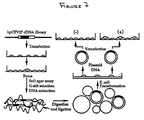
- the present invention relates to a method for cloning a cDNA copy of a eukaryotic mRNA, comprising the following steps (which are further illustrated in Figure 3 and in the Description of Specific Embodiments, below):
- vector and insert DNA fragments are mixed and ligated in a typical cloning experiment, several molecules are produced in addition to those desired. These include self-ligation products of vectors or inserts, head-to-tail or head-to-head dimers of vector or insert, and vector DNA containing multiple inserts. Formation of these molecules would reduce the cloning efficiency. Even when vector and insert DNAs are made by cutting with two different enzymes, formation of ligation products such as head-to-head dimers can not be eliminated, although the population of desired molecules is significantly higher and insertion occurs in a defined orientation.
- the restriction enzyme Sfi I was chosen to cleave both the A and B sites, because Sfi I is an infrequent cutter and leaves a non-symmetrical 3' extension of three nucleotides (Fig. 2A). Since the central 5 bases in the recognition site can be any sequence, two Sfi I sites (A and B) were designed and introduced into the vectors (Figs. 1 and 2B). The cDNA fragments to be inserted into the vectors were oriented by the use of oligo(dT) primers having attached the sequence of the Sfi I(B) site.
- cDNA synthesis The steps for cDNA synthesis are schematically shown in Fig. 3.
- the single-stranded linker-primer is repaired so as to be double-stranded.
- an adaptor designated Sfi I adaptor, having the 3' extension which fits to the Sfi I (A + ) end, is ligated.
- Sfi I an adaptor having the 3' extension which fits to the Sfi I (A + ) end
- the present invention further relates to DNA of a genetic cloning vector comprising at least one replicon; and a site for inserting DNA segments to be cloned that includes at least two nonidentical restriction enzyme recognition sequences that are non-symmetrical, in which the non-symmetrical restriction enzyme recognition sequences have been cleaved by one or more enzymes that can cleave them, so that the DNA is ready for use in cloning DNA segments having matching sticky ends.
- the present invention relates to a cloning vector suitable for use in cloning DNA segments for cDNAs, by means of stable phenotypic changes induced by a specific DNA segments.
- a cloning vector suitable for use in cloning DNA segments for cDNAs by means of stable phenotypic changes induced by a specific DNA segments.
- An example of such vectors is ⁇ pCEV27 which differs (described above) as follows:
- the present invention also relates to a reagent kit comprising cleaved vector DNA, ready for use in cloning, as described above, and further including a linker-primer having a single-stranded end that is complementary to one single-stranded end of the cleaved vector DNA; and an adaptor which after cleavage by a suitable restriction enzyme, has a single-stranded end that is complementary to the other single-stranded end of the cleaved vector DNA.
- a linker-primer having a single-stranded end that is complementary to one single-stranded end of the cleaved vector DNA
- an adaptor which after cleavage by a suitable restriction enzyme, has a single-stranded end that is complementary to the other single-stranded end of the cleaved vector DNA.
- a kit might advantageously also include appropriate quantities of enzymes, buffers and other reagents needed for the practice of the automatic directional cloning method according to the teachings
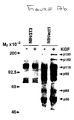
- FIG. 17 a Covalent affinity crosslinking of [ 125 I]-KGF to BALB/MK (left), NIH/3T3 (center), and NIH/ect1 cultures (right).
- the left and center panels of this autoradiogram were exposed to Kodak XAR film for 72 h at -70°C; the right panel is an 18 h exposure of the same autoradiogram.
- the second lane for each cell type shows crosslinking performed in the presence of excess unlabeled KGF.
- Molecular weight markers are indicated on the left; the positions of [ 125 I]-KGF-crosslinked complexes are indicated by arrows.
- the present invention relates to a vector having nonidentical non-symmetrical restriction enzyme recognition site sequences, as described above, also including regulatory elements located such that the sequences of an inserted DNA segment are transcribed, where the regulatory elements are at least partly of eukaryotic origin.
- a principal embodiment of this aspect of the present invention is exemplified by two ⁇ -plasmid composite vectors, ⁇ pCEV15 and ⁇ pCEV9, the structures of which are depicted in Figure 1 and described further below, in Example 1.
- a model H- ras insert was prepared so as to have Sfi I(A - ) and Sfi I(B + ) ends (Fig. 4A) and ligated with the pCEV15 Sfi I fragment.
- a similar H- ras fragment with Eco RI and Apa I ends was prepared (Fig. 4A) and ligated with the pCEV15 Eco RI/ Apa I fragment.
- cDNA was synthesized using poly(A) + RNA extracted from M426 human embryonic lung fibroblast cells under the conditions described in Example 2, below. cDNA molecules larger than 1 kb were selected by low melting point agarose gel electrophoresis, and two aliquots were used to clone into ⁇ pCEV9 and ⁇ pCEV15. The average size of the cDNA inserts was 2.0 kb in the ⁇ CEV9 library (6 x 10 6 independent clones) and 2.2 kb in the ⁇ pCEV15 library (1 x 10 7 independent clones).
- This method has been used for more than one year in the laboratory of these inventors, without public disclosure, to construct several cDNA libraries. Screening of the libraries for growth factors and receptors has been performed, and in most cases cDNA clones containing the entire coding sequence have been obtained as single clones. For example, a number of cDNA clones encoding keratinocyte growth factor have been isolated from the ⁇ pCEV9-M426 cDNA library using oligonucleotide probes. Screening of an MCF7 cDNA library in ⁇ pCEV9 constructed by the ADC method for a novel erbB -related gene resulted in the isolation of the cDNA clones of 5 kb with high frequency as well. All of these findings indicate that the ADC method using ⁇ pCEV vectors makes it possible to clone relatively long cDNAs very efficiently.
- Example 3 tests the potential of the improved approach by its application to the isolation and characterization of unknown oncogenes from hepatocellular carcinomas of the B 6 C 3 F 1 mouse strain, extensively utilized in long term carcinogenesis testing in the United States.
- Example 4 discloses the utility of the refined directional cDNA library expression vector for isolating the keratinocyte growth factor (KGF) receptor cDNA by creation of an autocrine transforming loop. This expression cloning approach was successful to identify and functionally clone the receptor for the new growth factor.
- KGF keratinocyte growth factor
- Example 1 Construction of ⁇ pCEV15 and ⁇ pCEV9 .
- NZY broth (10g NZ amine, 5g NaCl, 5g Yeast extract in 1 l, pH 7.5) was used to grow bacterial strains.
- M426 is a human lung embryonic fibroblast cell line (Aaronson and Todaro, 1968, J. Virology 36 , 254-261).
- Oligonucleotides were synthesized by a Beckman System 1 DNA Synthesizer and purified by high performance liquid chromatography. Oligonucleotides utilized had the following sequences.
- Plasmid DNA was prepared by the "selective precipitation procedure" which is a modification of the alkaline lysis method (Birnboim and Doly, 1979, Nucleic Acids Res. 7 , 1513-1523). This technique makes it possible to prepare sufficient pure plasmid DNAs to analyze and alter structures, without a requirement for lysozyme treatment, phenol extraction or repeated ethanol precipitations. Cells collected from a 10 ml culture were resuspended into 0.2 ml of TEG (25 mM Tris-HCl pH 8.0/10 mM EDTA/50 mM glucose).
- the ⁇ DNAs prepared as follows were used to modify the structure, analyze cDNA clones in ⁇ pCEV vectors and then to rescue the plasmid part.
- Host cells grown in 10 ml of NZY medium containing 2 mM MgCl 2 were suspended into the same volume of SM buffer (50 mM Tris-HCl, pH 7.5/8 mM MgSO 4 /100 mM NaCl/0.01 % gelatin).
- SM buffer 50 mM Tris-HCl, pH 7.5/8 mM MgSO 4 /100 mM NaCl/0.01 % gelatin.
- a single plaque picked by a pasteur pipet was incubated with 0.1 ml of the host cell suspension at 37 C for 30 min.
- Ten ml of pre-warmed NZY broth containing 2 mM MgCl 2 was added and shaken at 37 C for 6 h.
- Plasmid DNAs prepared by the selective precipitation method were directly used to modify the structures, by restriction enzyme digestions, repair reactions, and/or ligation with synthetic linkers. DNA fragments were separated on agarose gels and then purified using GENECLEAN (BIO 101 Inc.).
- Insertion of oligonucleotides was performed as follows. The two strands of non-phosphorylated oligonucleotides were annealed and ligated with plasmid DNA which has been digested with suitable restriction enzymes. One strand of the oligonucleotides which was not ligated (due to the 5'-OH structure) was removed by heating and then separated by agarose gel electrophoresis. The purified fragments were phosphorylated and then ligated.
- Plasmid pCEV9 was constructed as follows. A retroviral vector pDOL - (Korman et al., 1987, Proc. Natl. Acad. Sci. USA 84 , 2150-2154) was cleaved by Xba I and recircularized to remove the polyoma segment. The Cla I site was converted to a Not I site by linker insertion, and the Eco RI site was removed by repair ligation.
- a synthetic MCS linker consisting of oligonucleotides #1 and #2 (see Example 1, below) was inserted between the Sal I and Bam HI sites, and the Bcl I/ Bam HI fragment of SV40 DNA (Bethesda Research Laboratories) containing its polyadenylation signal was inserted at the Xho I site. These manipulations produced pCEV9.
- ⁇ gt11 DNA (Young and Davis, 1983, Proc. Natl. Acad. Sci. USA 80 , 1194-1198) was ligated and then cleaved by Eco RI and Xba I. The ends were repaired and Not I-linkered, and then pCEV9 DNA linearized by Not I was cloned into the ⁇ DNA to produce ⁇ pCEV9.
- pCEV15 was constructed by modifying pCEV8, which is a parental plasmid of pCEV9 and lacks the MCS linker.
- a tac promoter fragment (Pharmacia) and Xho I linker were inserted in the Sal I site.
- Sfi I(B), Hind III, and Bgl II sites were removed successively by restriction enzyme digestion, polymerase treatment, and subsequent ligation reaction. Removal of the Sfi I site (on the SV40 replication origin) did not impair the SV40 early promoter activity.
- the MCS linker was inserted between the Bam HI and Sal I sites, and Sfi I(B), Hind III, and Bgl II sites were introduced again by insertion of the MCS-2 linker (oligonucleotides #3 and #4, below) between the Eco RI and Apa I sites.
- the resulting plasmid pCEV15 was cloned in a new ⁇ vector constructed as follows. The segment spanning from the Xho I site to the right cos end of ⁇ pCEV9 was replaced by the corresponding fragment of ⁇ charon28 (Rimm et al., 1980, Gene 12 , 301-309), to introduce the cI deletion (KH54) and remove three Hind III sites.
- the resulting phage ⁇ pCEV9c DNA was ligated, cleaved by Hind III, and then repaired.
- a Not I linker was ligated to the repaired Hind III ends and the DNA was cleaved by Not I.
- the ⁇ arms were purified and ligated with Not I-digested pCEV15 DNA, to produce ⁇ pCEV15.
- Example 2 Efficiency of cloning and orientation of model inserts .
- ⁇ DNA was ligated to seal cohesive ends and then cleaved sequentially by Sfi I and EcoRI.
- ⁇ pCEV9 arms were purified by centrifugation through a 5-20% potassium acetate gradient (Maniatis et al., 1982).
- ⁇ pCEV15 arms were purified by passage through a Sephadex G-50 spin column (Boehringer Mannheim Biochem.).
- the Sfi I adaptor was prepared as follows. About 1 nmol of oligonucleotides #5 and #6 were separately phosphorylated by T4 polynucleotide kinase, mixed, heated at 80°C for 5 min and then slowly cooled to 4°C.
- RNA for making cDNAs was extracted and Poly (A) + RNA selected as described by Okayama et al. (1987).
- cDNA was synthesized essentially according to D'Alessio et al. (1987) with some modifications.
- About 2.5 mg of poly(A) + RNA in 10 ml of H 2 O was mixed with 0.5 ml of 100mM methylmercuric hydroxide (MeHg), and incubated at room temperature for 5 min, followed by addition of 0.5 ml of 1.4M b-mercaptoethanol.
- MeHg methylmercuric hydroxide
- RNasin 40 units/ml; Promega Biotech.
- 5x FS buffer 250mM Tris-HCl, pH 8.3/375mM KCl/15 mM MgCl 2 /100 mM dithiothreitol
- 2.5 ml of dNTP mixture 10 mM each of dGTP, dATP, dTTP and dCTP
- 5 ml of linker-primer oligonucleotide #8; 1 mg/ml
- 2.5 ml of M-MLV reverse transcriptase 200 units/ml
- the tube was chilled on ice and 290 ml of H 2 O, 7.5 ml of dNTP mix (10 mM each of dGTP, dATP, dCTP, and TTP), 40 ml of 10x SS buffer (188 mM Tris-HCl, pH8.3 / 906 mM KCl / 46 mM MgCl 2 / 38 mM DTT), 10 ml of DNA polymerase I (1.25 units/ml) and 1.8 ml of RNase H (0.25 units/ml) were added, mixed and incubated at 16°C for 2 h.
- reaction mixture was heated at 70°C for 10 min, and 5 ml of T4 DNA polymerase (1 unit/ml) was added and incubated at 37°C for 10 min.
- the reaction was terminated by the addition of 40 ml of 0.25M EDTA, and the mixture was extracted by phenol/chloroform twice followed by chloroform twice.
- cDNA was ethanol-precipitated from 2.5 M ammonium acetate, washed, and then dried.
- the pellet was dissolved into 10 ml of H 2 O and then 4 ml of Sfi I adaptor (0.8 mg/ml), 4 ml of 5x ligation buffer (500 mM Tris-HCl, pH7.6/100 mM MgCl 2 /10 mM ATP/10mM dithiothreitol/ 50% (w/v) polyethylene glycol-8000) and 2 ml of T4 DNA ligase (1 unit/ml) were mixed and incubated at 14°C overnight.
- 5x ligation buffer 500 mM Tris-HCl, pH7.6/100 mM MgCl 2 /10 mM ATP/10mM dithiothreitol/ 50% (w/v) polyethylene glycol-8000
- a 10 ml aliquot was then mixed with 1 ml of 10x Sfi I buffer (100 mM Tris-HCl, pH 7.9 / 500 mM NaCl / 100 mM MgCl 2 / 60 mM b-mercaptoethanol / 1 mg/ml bovine serum albumin), 2 ml of Sfi I (10 units/ml) and 7 ml of H 2 O. Digestion was performed at 50 C for 1 h. cDNA fragments were purified by low-melting point agarose gel electrophoresis or passing through a spun column (Maniatis et al., Molecular Cloning, Cold Spring Harbor 1982) packed with Sepharose CL-4B (Pharmacia).
- 10x Sfi I buffer 100 mM Tris-HCl, pH 7.9 / 500 mM NaCl / 100 mM MgCl 2 / 60 mM b-mercaptoethanol / 1 mg/ml bovine serum albumin
- RNA preparation 2.5 mg was denatured by heating and used to synthesize cDNA from a linker-primer (oligonucleotide #7).
- the cDNA was blunt-ended, and the Sfi I adaptor was ligated to both the ends.
- the molecules were cleaved partially by Sfi I, and then cloned in ⁇ pCEV9. A total of 2.5 x 10 8 plaque forming units (pfu) was obtained, indicating that the method was extremely efficient.
- Sfi I is an infrequent cutter
- almost all cDNA species in the libraries constructed by the ADC method should remain intact. Nonetheless, cDNAs containing Sfi I sites might be excluded from our cDNA libraries.
- partial Sfi I digestion is usually performed.
- An alternative strategy involves cDNA synthesis from a linker-primer containing the recognition site of another infrequent cutter Mlu I, in addition to the Sfi I site. The cDNA preparation could then be divided into two parts, one cleaved by Sfi I and the other by Mlu I.
- a short oligonucleotide ligated to the cDNAs could be utilized to convert the Mlu I end to an Sfi I(B + ) end.
- Example 3 Isolation of a Mouse Hepatoma Oncogene cDNA Using a Novel Phenotypic Expression Cloning System.
- cDNA libraries were constructed as described above except the use of newly-designed adaptor and vector.
- the new SfiI adaptor does not contain the ATG codon in the sense strand and was consisted of two oligonucleotides, 5'-CCAATCGCGACC-3' and 5'-GGTCGCGATTGGTAA-3'.
- Amplification of the library and preparation of the DNA were performed by the standard procedures (Maniatis et al. 1982).
- NIH 3T3 All cells used were the derivatives of NIH 3T3 (Jainchill, J.L., et al. (1969) J. Virol. p. 549.). Calcium phosphate transfection (Wigler, M. et al., (1977) Cell 11, 223.) was used to introduce DNA into cells. Cells were maintained in Dulbecco's modified Eagle's medium (DMEM) containing 5% calf serum.
- DMEM Dulbecco's modified Eagle's medium
- the genomic DNA (1.2 ⁇ g) isolated from CT18-2B or CT18-2C was cleaved by XhoI, extracted with phenol-chloroform and then chloroform. The DNA was precipitated and resuspended in 355 ⁇ l of H 2 O. Fifty ⁇ l of 10 x kinase-ligase buffer (660 mM Tris-HCl, pH7.5/100 mM MgCl 2 /50 mM dithiothreitol, 500 ⁇ M ATP) and 5 units of T4 DNA ligase (BRL) were added and incubated overnight at 15 °C. The ligated DNA was extracted and precipitated as above and then resuspended in 10 ⁇ l of TE.
- 10 x kinase-ligase buffer 660 mM Tris-HCl, pH7.5/100 mM MgCl 2 /50 mM dithiothreitol, 500 ⁇ M ATP
- DNA fragments were isolated by Geneclean (BIO101 Inc.) and labeled by random priming using Oligo Labeling kit (Pharmacia). Hybridizations were performed as described (Kraus et al., 1987).
- the ⁇ pCEV27 system was developed to clone cDNAs by means of stable phenotypic changes induced by a specific cDNA.
- Use of a ⁇ -plasmid composite vector made it possible to generate high complexity cDNA libraries and to efficiently excise the plasmid from the stably integrated phagemid DNA.
- This phagemid vector ( Figure 6) contained several features including two SfiI sites for construction of cDNA libraries using the automatic directional cloning (ADC) method, an M-MLV LTR promoter suitable for cDNA expression in mammalian cells, the SV40 promoter-driven neo gene as a selectable marker, and multiple excision sites (MESs) for plasmid rescue from genomic DNA.
- ADC automatic directional cloning
- M-MLV LTR promoter suitable for cDNA expression in mammalian cells
- SV40 promoter-driven neo gene as a selectable marker
- MESs multiple excision sites
- the ⁇ -pCEV27 system incorporated, in addition to the M-MLV LTR, the rat preproinsulin polyadenylation (polyA) signal downstream from the cDNA cloning site (Fig. 6).
- polyA rat preproinsulin polyadenylation
- the bacterial neo gene was placed under the independent control of the SV40 early promoter and the SV40 late polyA signal for use in marker selection in mammalian cells.
- the bona fide promoter of the neo gene was removed so as to fuse the SV40 promoter directly to the neo structural gene.
- coli was achieved by transcription from the trp-lac fused promoter tac, inserted upstream from the SV40 early promoter (Fig. 6).
- tac promoter By use of the tac promoter, it was possible to utilize IPTG-inducible selection for kanamycin resistance.
- the f1 replication origin and, SP6 and T7 phage promoters were included to facillitate analysis of cDNA inserts by production of single-stranded DNA and RNA transcripts, respectively (Fig. 6).
- Genomic DNAs of NIH/3T3 transformants containing each of the unidentified oncogenes were examined under low stringency hybridization conditions using a number of known and potential oncogene probes including abl, myb, ets, fos, fgr, fms, rel, src, sis, yes, p53, ros, PDGF-A, met, dbl, lskT, myc, N-myc, rho, mos, erbA, pin, lca, H-ras, N-ras, K-ras, c-raf, and erbB-2. None showed DNA fragments with either increased intensity or abnormal sizes relative to those detected in NIH/3T3 control DNA (data not shown). Thus, none of these transforming genes appeared to be closely related to any of the genes used as probes.
- ⁇ pCEV27 expression cloning system we attempted to clone transforming cDNA from one furfural-induced tumor, OT18.
- a cDNA library (3 x 10 6 independent clones) was constructed from poly(A) + RNA extracted from a secondary transformant of the tumor. Transfection of 80 plates of NIH/3T3 cells with 5 ⁇ g/plate of the expression cDNA library led to the detection of seven foci, which demonstrated G-418 resistance. These results indicated that each had taken up and stably integrated vector DNA, making it likely that the transformed foci were induced by exogenous cDNA rather than arising as a result of spontaneous transformation.
- CT18-2B and CT18-2C Two of these transformants, designated CT18-2B and CT18-2C, were selected for plasmid rescue.
- restriction mapping of several distinct plasmids obtained from each transformant it was possible to establish that one plasmid rescued from each had the identical insert (data not shown). These results suggested that this cDNA might encode the oncogene product.
- Transfection analysis of each rescued plasmid DNA demonstrated that these same two cDNA clones possessed high-titered transforming activity of around 10 3 ffu/nmol DNA, while none of the other plasmids rescued from the same transformants showed detectable activity.
- genomic DNA extracted from each primary transformant was digested with SalI to release cDNA inserts from the vector and subjected to Southern blotting analysis using the OT18 cDNA insert as a probe. Since SalI is an infrequent cutter for mammalian DNA, genomic DNA was cleaved to very large fragments which remained near the origin of the gel. Thus, the relatively small cDNA fragments released from cellular DNAs by SalI cleavage could be separated from the bulk of genomic fragments. As shown in Figure 8, each of the cDNA library transformants contained the OT18 oncogene cDNA insert. The sizes ranged from around 2.3 kb to 7 kb, suggesting that serveral of the inserts represented independent cDNA clones of the oncogene.
- T18 nucleotide sequence was compared with that of proto B- raf and v-R- mil . There was no homology with either sequence upstream from position 1040 in the T18 oncogene. Thus, position 1040 represents the junction between an unknown sequence and the B- raf gene.
- R- mil is a viral onocogene and encodes a gag -R- mil - env fusion protein.
- gag and R- mil has been mapped 144 nucleotide upstream from the T-18 break point (Marx et al ., 1988), while the junction of a different sequence and the human B- raf oncogene was 174 nucleotides upstream from the junction in the T18 oncogene.
- the breakpoints did not disrupt the predicted kinase domain of the protein.
- the human B-raf gene product is around 84% related to the amino acid sequence of the c-raf oncogene.
- Another member of the raf family, A-raf is also structurally similar.
- Most raf oncogenes have been activated by mechanisms involving structural rearrangements due to recombination and loss of amino terminal sequences of the raf coding sequence (Rapp, U.R., et al., (1988) In: Reddy, E.P. (ed.) The Oncogene Handbook, Elsevier Science Publishers B.V.).
- RNAs from primary or secondary NIH/3T3 transfectants containing each oncogene to analysis with DNA probe from 5' (B-raf unrelated) and 3' (B-raf) portions of the T18 oncogene.
- control NIH/3T3 cells contained a 4.2 kb RNA that hybridized with the 5' non-B-raf related portion of the oncogene but there was no detectable B-raf transcript.
- the second cycle T18 transfectant which was the source of expression cDNA library, showed a major 4.2-kb as well as minor 10- and 3-kb transcripts which appeared to hybridize with both probes.
- Fig. 11 further shows that a primary T23 oncogene transfectant contained multiple B-raf hybridizing transcripts, indicating that it also contained another B-raf oncogene.
- the several transcripts detected differed in their sizes from those of the T18 oncogene.
- none of these transcripts was detected by the B- raf probe of the T18 oncogene (Fig. 11).
- the transfectant induced by the T28 oncogene did not show abnortmal B- raf hybridizing RNAs, imply that this oncogene must be distinct from B- raf .
- each transformant When we performed plasmid rescue, each transformant gave rise to at least 3 distinct cDNA clones as determined by physical mapping. To examine their biological activities, each clone was subjected to transfection analysis on NIH/3T3 cells. A single clone rescued from each transformant was found to possess high-titered transforming activity ranging from 10 3 -10 4 focus forming units/nmole DNA. Moreover, the morphology of foci induced by each cDNA was similar to that of the parental transformant. Because of their distinct physical maps and distinguishable biological properties, we tentatively designated the genes for these transforming cDNAs as epithelial cell transforming (ect) 1, 2 and 3. Transfectants induced by the individual transforming plasmids were utilized in subsequent analyses.
- Suramin is an agent known to interfere with ligand-receptor interactions including the binding of PDGF (Fleming, T.P. et al, Proc. Natn. Acad. Sci. U.S.A. 86, 8063-8067 (1989); Belsholtz, C. et al. Proc. Natn. Acad. Sci. U.S.A. 83, 6440-6444 (1986)) and KGF with their respective receptors.
- PDGF Farnesothelial growth factor
- Belsholtz C. et al. Proc. Natn. Acad. Sci. U.S.A. 83, 6440-6444 (1986)
- KGF KGF
- ect1 might encode the KGF receptor
- BALB/MK cells demonstrated specific high affinity binding of [ 125 I]-KGF while there was no such binding detectable to NIH/3T3 cells.
- expression of the ect1 gene by NIH/3T3 cells resulted in the acquisition of 3.5-fold more [ 125 I]-KGF binding sites than BALB/MK cells (Fig. 13).
- neither NIH/ect2 nor ect3 bound significant levels of the labelled growth factor.
- ect1 To characterize ect1, the transforming 4.2kb cDNA released by SalI digestion was used as a molecular probe to hybridize SalI restricted genomic DNAs of NIH/3T3 as well as NIH/3T3 transfectants containing ect1, ect2 or ect3. While the expected 4.2kb DNA fragment was detected in the ect1 transformant (Fig. 15a), neither NIH/3T3 nor the other transfectants showed evidence of a SalI fragment hybridized by the cDNA insert. These results further argued that the ect2 and ect3 represented independent transforming genes.
- Ect1 encodes a transmembrane tyrosine kinase of the FGF receptor family.
- the amino acid sequence of the KGFR predicted a transmembrane tyrosine kinase most closely related to the mouse bFGF receptor (bFGFR). The percent similarity between both proteins is shown in Fig. 16b.
- the putative KGFR extracellular portion contained two immunoglobulin (IgG)-like domains, exhibiting 77% and 60% similarity with the IgG-like domains 2 and 3, respectively, of the mouse bFGFR.
- IgG immunoglobulin
- Recent studies have revealed a variant form of the bFGFR, whose extracellular domain also contains only these two corresponding IgG-like domains (Reid, H.H., et al., Proc. Natn. Acad. Sci U.S.A. 87, 1596-1600 (1990).
- the sequence N-terminal to the first IgG-like domain of the KGFR was 63 residues long in comparison to 88 residues found in the shorter form of the mouse bFGFR.
- Both the chicken and mouse bFGFRs contain a series of eight consecutive acidic residues between the first and second IgG-like domains (Reid, H.H., et al., Proc. natn. Acad. Sci U.S.A. 87, 1596-1600 (1990); Pasquale, E.B. & Singer, S.J. Proc. Natn. Acad. Sci. U.S.A. 86, 8722-8726 (1989); (Safran, A. et al.
- the intracellular portion of the KGFR was highly homologous to the bFGFR tyrosine kinase (Fig. 16).
- the central core of the catalytic domain was flanked by a relatively long juxtamembrane sequence, and the tyrosine kinase domain was split by a short insert of 14 residues, similar to that observed in avian, human and murine bFGF receptors (Reid, H.H., et al., Proc. natn. Acad. Sci U.S.A. 87, 1596-1600 (1990); Pasquale, E.B. & Singer, S.J. Proc. Natn. Acad. Sci. U.S.A.
- Hanafusa and cc-workers isolated a partial cDNA encoding a tyrosine kinase, designated bek, by bacterial expression cloning using phosphotyrosine antibodies (Kornbluth, S., et al., Molec. Cell Biol. 8, 5541-5544 (1988)).
- the reported sequence of bek was identical to the KGFR in the tyrosine kinase domain (Fig. 16b). Although only partical sequence of bek is available, it is very likely to encode the mouse KGF receptor.
- NIH/ect1 cells As a final test of the functional nature of the KGF receptor expressed in NIH/ect1 cells, we investigated its capacity to induce tyrosine phosphorylation of cellular proteins. Thus, intact NIH/ect1 cells were exposed to KGF for 10 min, and cell lysates were subjected to immunoprecipitation and immunoblotting analysis utilizing anti-phosphotyrosine (anti-Ptyr) antibody. As shown in Fig. 17b, several putative substrates were tyrosine phosphorylated in response to KGF addition. These included pp55, pp65, pp90, pp115, pp150 and pp190. Previous studies have indicated that similar size proteins are phosphorylated in response to KGF triggering of BALB/MK cells. Moreover, the 115-kd phosphoprotein matches the corrected size of the KGF receptor crosslinked by [ 125 I]-KGF. Thus, it may reflect the autophosphorylated KGF receptor itself.
- Applicants used a strategy involving -plasmid composite vectors.
- the vectors contain plasmid excision sites for multiple cutters including Not1 , MLuI and Xhol . This allows the intact plasmid containing insert to be efficiently rescued with low probability of internal cleavage of the insert.
Landscapes
- Health & Medical Sciences (AREA)
- Life Sciences & Earth Sciences (AREA)
- Genetics & Genomics (AREA)
- Chemical & Material Sciences (AREA)
- Organic Chemistry (AREA)
- Engineering & Computer Science (AREA)
- Zoology (AREA)
- Biotechnology (AREA)
- Wood Science & Technology (AREA)
- General Engineering & Computer Science (AREA)
- Molecular Biology (AREA)
- Biomedical Technology (AREA)
- Bioinformatics & Cheminformatics (AREA)
- Biochemistry (AREA)
- General Health & Medical Sciences (AREA)
- Biophysics (AREA)
- Microbiology (AREA)
- Plant Pathology (AREA)
- Physics & Mathematics (AREA)
- Proteomics, Peptides & Aminoacids (AREA)
- Cell Biology (AREA)
- Gastroenterology & Hepatology (AREA)
- Medicinal Chemistry (AREA)
- Oncology (AREA)
- Immunology (AREA)
- Toxicology (AREA)
- Bioinformatics & Computational Biology (AREA)
- Crystallography & Structural Chemistry (AREA)
- Micro-Organisms Or Cultivation Processes Thereof (AREA)
- Measuring Or Testing Involving Enzymes Or Micro-Organisms (AREA)
- Preparation Of Compounds By Using Micro-Organisms (AREA)
- Saccharide Compounds (AREA)
- Peptides Or Proteins (AREA)
Applications Claiming Priority (3)
| Application Number | Priority Date | Filing Date | Title |
|---|---|---|---|
| US38605389A | 1989-07-28 | 1989-07-28 | |
| US386053 | 1989-07-28 | ||
| EP19900912327 EP0484440A4 (en) | 1989-07-28 | 1990-07-30 | Efficient directional genetic cloning system |
Related Parent Applications (2)
| Application Number | Title | Priority Date | Filing Date |
|---|---|---|---|
| EP19900912327 Division EP0484440A4 (en) | 1989-07-28 | 1990-07-30 | Efficient directional genetic cloning system |
| EP90912327.5 Division | 1991-02-27 |
Publications (2)
| Publication Number | Publication Date |
|---|---|
| EP0773294A2 true EP0773294A2 (de) | 1997-05-14 |
| EP0773294A3 EP0773294A3 (de) | 1997-09-17 |
Family
ID=23523965
Family Applications (2)
| Application Number | Title | Priority Date | Filing Date |
|---|---|---|---|
| EP19900912327 Ceased EP0484440A4 (en) | 1989-07-28 | 1990-07-30 | Efficient directional genetic cloning system |
| EP96115534A Ceased EP0773294A3 (de) | 1989-07-28 | 1990-07-30 | Leistungsfähiges System zur gerichteten genetischen Klonierung |
Family Applications Before (1)
| Application Number | Title | Priority Date | Filing Date |
|---|---|---|---|
| EP19900912327 Ceased EP0484440A4 (en) | 1989-07-28 | 1990-07-30 | Efficient directional genetic cloning system |
Country Status (6)
| Country | Link |
|---|---|
| US (1) | US5595895A (de) |
| EP (2) | EP0484440A4 (de) |
| JP (2) | JPH04503309A (de) |
| AU (2) | AU649228B2 (de) |
| CA (1) | CA2064092C (de) |
| WO (1) | WO1991002077A1 (de) |
Cited By (5)
| Publication number | Priority date | Publication date | Assignee | Title |
|---|---|---|---|---|
| WO2000036088A1 (en) | 1998-12-17 | 2000-06-22 | Yuri Romantchikov | Improved methods for insertion of nucleic acids into circular vectors |
| US6150141A (en) * | 1993-09-10 | 2000-11-21 | Trustees Of Boston University | Intron-mediated recombinant techniques and reagents |
| US6358712B1 (en) | 1999-01-05 | 2002-03-19 | Trustee Of Boston University | Ordered gene assembly |
| US7439021B2 (en) | 1999-01-05 | 2008-10-21 | Trustees Of Boston University | Nucleic acid cloning |
| US8129119B2 (en) | 1999-01-05 | 2012-03-06 | Modular Genetics, Inc. | System for manipulating nucleic acids |
Families Citing this family (36)
| Publication number | Priority date | Publication date | Assignee | Title |
|---|---|---|---|---|
| US20100267023A1 (en) * | 1992-09-24 | 2010-10-21 | Keygene N.V. | Selective restriction fragment amplification: fingerprinting |
| JPH09500526A (ja) | 1993-06-14 | 1997-01-21 | ベーアーエスエフ アクツィエンゲゼルシャフト | テトラサイクリン反応性プロモーターによる真核細胞の遺伝子発現の厳密な制御 |
| US5912411A (en) * | 1993-06-14 | 1999-06-15 | University Of Heidelberg | Mice transgenic for a tetracycline-inducible transcriptional activator |
| US6004941A (en) * | 1993-06-14 | 1999-12-21 | Basf Aktiengesellschaft | Methods for regulating gene expression |
| US5859310A (en) | 1993-06-14 | 1999-01-12 | Basf Aktiengesellschaft | Mice transgenic for a tetracycline-controlled transcriptional activator |
| US5888981A (en) | 1993-06-14 | 1999-03-30 | Basf Aktiengesellschaft | Methods for regulating gene expression |
| US5866755A (en) * | 1993-06-14 | 1999-02-02 | Basf Aktiengellschaft | Animals transgenic for a tetracycline-regulated transcriptional inhibitor |
| US5597719A (en) * | 1994-07-14 | 1997-01-28 | Onyx Pharmaceuticals, Inc. | Interaction of RAF-1 and 14-3-3 proteins |
| US5948646A (en) * | 1997-12-11 | 1999-09-07 | Fordham University | Methods for preparation of vaccines against cancer comprising heat shock protein-peptide complexes |
| WO1999042121A1 (en) | 1998-02-20 | 1999-08-26 | University Of Miami | Modified heat shock protein-antigenic peptide complex |
| WO2000014282A1 (en) * | 1998-09-04 | 2000-03-16 | Lynx Therapeutics, Inc. | Method of screening for genetic polymorphism |
| US7074556B2 (en) | 1999-03-02 | 2006-07-11 | Invitrogen Corporation | cDNA synthesis improvements |
| EP1176200A3 (de) | 2000-06-20 | 2005-01-12 | Switch Biotech Aktiengesellschaft | Verwendung von Polypeptiden oder diese kodierende Nukleinsäuren zur Diagnose oder Behandlung von Hauterkrankung oder Wundheilung sowie ihre Verwendung zur Indentifizierung von pharmakologisch aktiven Substanzen |
| EP1205548A1 (de) * | 2000-11-09 | 2002-05-15 | Kabushiki Kaisha Toyota Chuo Kenkyusho | Verfahren und Vorrichtung zur Festphasen-Ligation von Doppelsträngige DNA-Molekülen |
| US20040038283A1 (en) * | 2001-04-30 | 2004-02-26 | Lynx Therapeutics, Inc. | Method of screening for genetic polymorphism |
| US6902914B2 (en) * | 2001-09-28 | 2005-06-07 | Sigma-Aldrich, Co. | Recombinant DNA processes using a dNTP mixture containing modified nucleotides |
| US7205130B2 (en) * | 2002-05-08 | 2007-04-17 | Rigel Pharmaceuticals, Inc. | Bi-directionally cloned random cDNA expression vector libraries, compositions and methods of use |
| ATE470722T1 (de) * | 2002-07-19 | 2010-06-15 | Althea Technologies Inc | Strategien zur genexpressionsanalyse |
| US20040152072A1 (en) * | 2002-07-30 | 2004-08-05 | Invitrogen Corporation | Reverse transcription |
| CA2407825A1 (en) * | 2002-10-11 | 2004-04-11 | Andrew J. Simmonds | Trap-tagging: a novel method for the identification and purification of rna-protein complexes |
| AU2004286201B2 (en) * | 2003-09-10 | 2010-09-09 | Altheadx, Inc. | Expression profiling using microarrays |
| CA2541177A1 (en) * | 2003-10-03 | 2005-09-22 | Promega Corporation | Vectors for directional cloning |
| US8293503B2 (en) | 2003-10-03 | 2012-10-23 | Promega Corporation | Vectors for directional cloning |
| CN100465278C (zh) * | 2004-06-10 | 2009-03-04 | 清华大学 | 一种构建t载体的方法 |
| EP1997898A1 (de) * | 2007-06-01 | 2008-12-03 | Rijksuniversiteit Groningen | Mittel und Verfahren zum Klonen von Nukleinsäuresequenzen |
| US8426153B2 (en) | 2007-12-03 | 2013-04-23 | Carnegie Mellon University | Linked peptides fluorogenic biosensors |
| DK2257301T3 (da) | 2008-03-03 | 2014-04-28 | Univ Miami | Immunterapi baseret på allogene cancerceller. |
| JP2011515399A (ja) | 2008-03-20 | 2011-05-19 | ユニバーシティー オブ マイアミ | 熱ショックタンパクgp96ワクチン接種及びそれを用いた方法 |
| EP3257942B1 (de) * | 2008-12-18 | 2020-07-22 | ITI Scotland Limited | Verfahren zum zusammensetzen von polynukleinsäuresequenzen |
| GB2481425A (en) | 2010-06-23 | 2011-12-28 | Iti Scotland Ltd | Method and device for assembling polynucleic acid sequences |
| US10829772B2 (en) | 2012-06-22 | 2020-11-10 | Monsanto Technology Llc | Unique modular vector design |
| AU2013381970A1 (en) * | 2013-03-15 | 2015-10-22 | Carnegie Mellon University | Linked peptide fluorogenic biosensors |
| SG11201705844SA (en) | 2015-02-06 | 2017-08-30 | Heat Biologics Inc | Vector co-expressing vaccine and costimulatory molecules |
| US11618899B2 (en) | 2016-02-09 | 2023-04-04 | Brookhaven Science Associates, Llc | Cloning and expression vectors and systems |
| CA3040123A1 (en) | 2016-10-11 | 2018-04-19 | University Of Miami | Vectors and vaccine cells for immunity against zika virus |
| CA3058938A1 (en) | 2017-04-04 | 2018-10-11 | Heat Biologics, Inc. | Intratumoral vaccination |
Family Cites Families (1)
| Publication number | Priority date | Publication date | Assignee | Title |
|---|---|---|---|---|
| US5001230A (en) * | 1988-02-18 | 1991-03-19 | Schering Corporation | T cell activation markers |
-
1990
- 1990-07-30 EP EP19900912327 patent/EP0484440A4/en not_active Ceased
- 1990-07-30 CA CA002064092A patent/CA2064092C/en not_active Expired - Lifetime
- 1990-07-30 WO PCT/US1990/004239 patent/WO1991002077A1/en not_active Ceased
- 1990-07-30 EP EP96115534A patent/EP0773294A3/de not_active Ceased
- 1990-07-30 JP JP2511399A patent/JPH04503309A/ja active Pending
- 1990-07-30 AU AU61879/90A patent/AU649228B2/en not_active Ceased
-
1992
- 1992-06-24 US US07/902,786 patent/US5595895A/en not_active Expired - Lifetime
-
1994
- 1994-08-08 AU AU68948/94A patent/AU671228B2/en not_active Expired
- 1994-10-19 JP JP6291905A patent/JPH07255491A/ja active Pending
Non-Patent Citations (1)
| Title |
|---|
| SCIENCE, vol. 245, 1989, US, pages 57-60, XP002026815 PAULINE L. LEE ET AL.: "Purification and complementary DNA cloning of a receptor for fibroblast growth factor." * |
Cited By (7)
| Publication number | Priority date | Publication date | Assignee | Title |
|---|---|---|---|---|
| US6150141A (en) * | 1993-09-10 | 2000-11-21 | Trustees Of Boston University | Intron-mediated recombinant techniques and reagents |
| WO2000036088A1 (en) | 1998-12-17 | 2000-06-22 | Yuri Romantchikov | Improved methods for insertion of nucleic acids into circular vectors |
| EP1141239A4 (de) * | 1998-12-17 | 2005-04-27 | Yuri Romantchikov | Verbesserte verfahren zur einschleusung von nukleinsäuren in ringförmige vektoren |
| US6358712B1 (en) | 1999-01-05 | 2002-03-19 | Trustee Of Boston University | Ordered gene assembly |
| US7439021B2 (en) | 1999-01-05 | 2008-10-21 | Trustees Of Boston University | Nucleic acid cloning |
| US7579146B2 (en) | 1999-01-05 | 2009-08-25 | Trustees Of Boston University | Nucleic acid cloning |
| US8129119B2 (en) | 1999-01-05 | 2012-03-06 | Modular Genetics, Inc. | System for manipulating nucleic acids |
Also Published As
| Publication number | Publication date |
|---|---|
| WO1991002077A1 (en) | 1991-02-21 |
| EP0773294A3 (de) | 1997-09-17 |
| US5595895A (en) | 1997-01-21 |
| CA2064092A1 (en) | 1991-01-29 |
| AU6187990A (en) | 1991-03-11 |
| AU671228B2 (en) | 1996-08-15 |
| JPH07255491A (ja) | 1995-10-09 |
| AU6894894A (en) | 1994-11-17 |
| JPH04503309A (ja) | 1992-06-18 |
| EP0484440A1 (de) | 1992-05-13 |
| AU649228B2 (en) | 1994-05-19 |
| CA2064092C (en) | 1996-05-21 |
| EP0484440A4 (en) | 1993-01-07 |
Similar Documents
| Publication | Publication Date | Title |
|---|---|---|
| EP0773294A2 (de) | Leistungsfähiges System zur gerichteten genetischen Klonierung | |
| Rubenstein et al. | Subtractive hybridization system using single-stranded phagemids with directional inserts | |
| US5830662A (en) | Method for construction of normalized cDNA libraries | |
| JP4489424B2 (ja) | 染色体に基くプラットホーム | |
| US7033801B2 (en) | Compositions and methods for rapidly generating recombinant nucleic acid molecules | |
| US5075227A (en) | Directional cloning | |
| Miki et al. | An efficient directional cloning system to construct cDNA libraries containing full-length inserts at high frequency | |
| JP2004517608A (ja) | 分子クローニング法および使用試薬 | |
| Ingolia et al. | Molecular cloning of the murine adenosine deaminase gene from a genetically enriched source: identification and characterization of the promoter region | |
| AU2002248173A1 (en) | Compositions and methods for rapidly generating recombinant nucleic acid molecules | |
| WO1999043850A1 (en) | Method for the non-specific amplification of nucleic acid | |
| AU652566B2 (en) | Eukaryotic expression vector system | |
| WO2000053806A1 (en) | Method of identifying gene transcription patterns | |
| US6498025B1 (en) | Methods and compositions for cDNA synthesis | |
| WO1988007585A1 (en) | Equal-abundance transcript composition and method | |
| WO1995004824A1 (en) | Generation of dna libraries and retroviral vectors for same | |
| US6509175B2 (en) | cDNA libraries and methods for their production | |
| WO2001009310A1 (en) | 5'ENRICHED cDNA LIBRARIES AND A YEAST SIGNAL TRAP | |
| EP0781330A1 (de) | Methode und zusammensetzungen zur cdna synthese | |
| Bellemare et al. | Use of a phage vector for rapid synthesis and cloning of single-stranded cDNA | |
| AU2007202811A1 (en) | Methods and reagents for molecular cloning |
Legal Events
| Date | Code | Title | Description |
|---|---|---|---|
| PUAI | Public reference made under article 153(3) epc to a published international application that has entered the european phase |
Free format text: ORIGINAL CODE: 0009012 |
|
| AC | Divisional application: reference to earlier application |
Ref document number: 484440 Country of ref document: EP |
|
| AK | Designated contracting states |
Kind code of ref document: A2 Designated state(s): AT BE CH DE DK ES FR GB IT LI LU NL SE |
|
| PUAL | Search report despatched |
Free format text: ORIGINAL CODE: 0009013 |
|
| AK | Designated contracting states |
Kind code of ref document: A3 Designated state(s): AT BE CH DE DK ES FR GB IT LI LU NL SE |
|
| 17P | Request for examination filed |
Effective date: 19970929 |
|
| 17Q | First examination report despatched |
Effective date: 20010115 |
|
| STAA | Information on the status of an ep patent application or granted ep patent |
Free format text: STATUS: THE APPLICATION HAS BEEN REFUSED |
|
| 18R | Application refused |
Effective date: 20030222 |