EP0769801A2 - Metallhalogenidlampe - Google Patents
Metallhalogenidlampe Download PDFInfo
- Publication number
- EP0769801A2 EP0769801A2 EP96116763A EP96116763A EP0769801A2 EP 0769801 A2 EP0769801 A2 EP 0769801A2 EP 96116763 A EP96116763 A EP 96116763A EP 96116763 A EP96116763 A EP 96116763A EP 0769801 A2 EP0769801 A2 EP 0769801A2
- Authority
- EP
- European Patent Office
- Prior art keywords
- lamp
- metal halide
- halide
- filled
- halide lamp
- Prior art date
- Legal status (The legal status is an assumption and is not a legal conclusion. Google has not performed a legal analysis and makes no representation as to the accuracy of the status listed.)
- Granted
Links
Images



Classifications
-
- H—ELECTRICITY
- H01—ELECTRIC ELEMENTS
- H01J—ELECTRIC DISCHARGE TUBES OR DISCHARGE LAMPS
- H01J61/00—Gas-discharge or vapour-discharge lamps
- H01J61/02—Details
- H01J61/12—Selection of substances for gas fillings; Specified operating pressure or temperature
- H01J61/18—Selection of substances for gas fillings; Specified operating pressure or temperature having a metallic vapour as the principal constituent
-
- H—ELECTRICITY
- H01—ELECTRIC ELEMENTS
- H01J—ELECTRIC DISCHARGE TUBES OR DISCHARGE LAMPS
- H01J61/00—Gas-discharge or vapour-discharge lamps
- H01J61/82—Lamps with high-pressure unconstricted discharge having a cold pressure > 400 Torr
- H01J61/827—Metal halide arc lamps
-
- H—ELECTRICITY
- H01—ELECTRIC ELEMENTS
- H01J—ELECTRIC DISCHARGE TUBES OR DISCHARGE LAMPS
- H01J61/00—Gas-discharge or vapour-discharge lamps
- H01J61/02—Details
- H01J61/12—Selection of substances for gas fillings; Specified operating pressure or temperature
- H01J61/125—Selection of substances for gas fillings; Specified operating pressure or temperature having an halogenide as principal component
-
- H—ELECTRICITY
- H01—ELECTRIC ELEMENTS
- H01J—ELECTRIC DISCHARGE TUBES OR DISCHARGE LAMPS
- H01J61/00—Gas-discharge or vapour-discharge lamps
- H01J61/84—Lamps with discharge constricted by high pressure
- H01J61/86—Lamps with discharge constricted by high pressure with discharge additionally constricted by close spacing of electrodes, e.g. for optical projection
Definitions
- the present invention relates to a metal halide lamp used as a light source of a liquid crystal projector and the like.
- liquid crystal projectors or the like are known as means for enlarging and projecting an image of characters, figures, etc. Since a certain optical output is required for such an image projector, a metal halide lamp, which has a high luminous efficacy, is widely used as a light source for the image projector in general.
- a metal halide lamp which has a high luminous efficacy, is widely used as a light source for the image projector in general.
- an iodide of Nd, Dy, and Cs has been generally used as a halide to be filled in an arc tube.
- the lamp in which the iodide of Nd, Dy and Cs is filled (hereinafter described as Dy-Nd-Cs-I series lamp), as disclosed in Japanese Unexamined Patent Publication No. 3-219546, has an excellent luminous efficacy, however, it has the disadvantage that devitrification occurs in an early stage of its lifetime, particularly because of high reactivity between neodymium iodide (NdI 3 ) and silica glass of the arc tube.
- the lack of transparency decreases the intensity of light beam, reduces the luminous intensity and disperses the light beam, resulting in nonuniform illumination intensity and reduced brightness on a screen of the liquid crystal projector.
- the drawback of the Dy-Nd-Cs-I lamp as use as the light source of a liquid crystal projector is that the lifetime of the liquid crystal projector is short.
- Luminous characteristics of metal halide lamp containing rare earth halide discloses that a light source having a high luminous efficacy can be obtained by combining a rare earth halide with a halide of Tl or In.
- the low correlated color temperature of the light source disclosed therein is unsuitable for a light source of such things as a liquid crystal projector.
- An example of a light source disclosed therein is a metal halide lamp in which InI and TmI 3 are filled, and a correlated color temperature estimated from the relative spectral distribution diagram disclosed therein is about 4 500 K.
- a white color reference for an image projector such as liquid crystal projectors is about 9000 K.
- An object of the present invention is to provide a metal halide lamp as an alternative of a prior art Dy-Nd-Cs-I series lamp or In-Tm-I series lamp.
- the metal halide lamp has an emission spectrum distributed all over the visual inspection range, a high luminous efficacy, an appropriate color temperature and a long lifetime.
- a metal halide lamp of the present invention comprises
- the halide of Tb, Dy, Ho, Er, Tm, or a mixture of said Tb, Dy, Ho, Er, Tm is filled to such an extent that an evaporable amount of said halide depending on the temperature of said halide is the minimum filler amount and 3.0 mg/cc of said halide is the maximum thereof.
- lighting is conducted with a lamp power having a tube wall load of 48 W/cm 2 to 62 W/cm 2 .
- filled materials in the light transmitting container are excited by electromagnetic wave externally supplied and begin to emit.
- a halogen of the halide of In is iodine or bromine.
- a halogen of the halide of a rare earth element is iodine or bromine.
- the lamp In the metal halide lamp , the lamp is operated by AC current.
- a pair of electrodes to be electrically connected to an external power supply is arranged so that a distance between the pair of electrodes is 5 mm or less.
- a first problem of the prior art Dy-Nd-Cs-I series lamp is that, since the reactivity of NdI 3 and silica glass of an arc tube is intense, devitrification of a arc tube occurs at an early stage of its lifetime. This problem can be solved if a material having a lower devitrification level (weaker reactivity with silica glass) than that of NdI 3 is used for the filler of the lamp.
- devitrification levels of various metal halides are evaluated firstly by the following devitrification evaluation test.
- an ampoule composed of a tube made of silica glass, having a content volume of 5 cc and filled with 10 mg of metal halide, is heated at 1, 100 °C for 100 hours, and then a total transmittance of the ampoule is measured in order to evaluate the devitrification characteristic of the metal halide.
- the ratios (%) of the total transmittances of the ampoules after heating (after the test) to the total transmittances thereof measured before heating are shown in Table 1. A larger percentage means a lower level devitrification. Blanks in the table indicate that evaluation was not conducted.
- the total transmittances of ampoules filled with TbI 3 , DyI 3 , HoI 3 ErI 3 , TmI 3 , InI, SnI 3 , DyBr 3 , TmBr 3 , InBr and SnBr 3 , respectively, are larger than the total transmittance of an ampoule filled with NdI3, and indicate a low level devitrification characteristic.
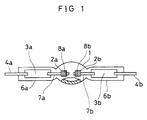
- FIG. 1 is a view showing a metal halide lamp of a first embodiment of the invention.
- reference numeral 1 denotes a light transmitting container as an arc tube made of quartz, at both ends of which sealing portions 6a, 6b are formed.
- metal foil conductors 3a, 3 b made of molybdenum are tightly attached.
- electrodes 2a, 2b, and outer lead wires 4a, 4b made of molybdenum are electrically connected, .
- the electrodes 2a, 2b are composed of tungsten rods 7a, 7b and tungsten coils 8a, 8b, respectively.
- the coils 8a, 8b are electrically fixed to tip portions of the tungsten rods 7a, 7b by welding, and serve as radiators of the electrodes 2a, 2b.
- the electrodes 2a, 2b are arranged in the arc tube 1 so as to face each other and maintain a distance of 3.5 ⁇ 0.5 mm therebetween.
- the arc tube 1 is nearly spherical, and has an inner diameter of about 10.8 mm, an inner volume of about 0.7 cc, and an inner surface area of about 3.6 cm 2 , in which 0.4 mg (0.57 mg/cc) of InI as a filling material, 1 mg (1.43 mg/cc) of HoI 3 as a rare earth iodide, 35 mg of Hg as a buffer gas, and 200 mbar of Ar as a start-up rare gas are filled.
- the metal halide lamp having the above- mentioned construction was supplied with electric power via external lead wires 4a, 4b to be lit with a rated lamp power of 200 W (tube wall load: 55 W/cm 2 ) and the emission characteristic was evaluated.
- FIG. 2 is a diagram showing a spectrum distribution of the metal halide lamp of this embodiment.
- the correlated color temperature and luminous efficacy of this case were respectively about 5500 K and about 87 lm/W. Rich emission is seen all across the visible range. The emission in the red color range is particularly rich.
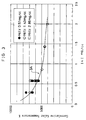
- FIG. 3 is a diagram showing the relation between the filler amount (mg) of InI per unit volume (axis of abscissa) and correlation color temperature (K) (axis of ordinate) wherein filler amounts of HoI 3 are taken as a parameter.
- Three marks ⁇ , ⁇ , ⁇ in FIGs. indicate lamps in which the filler amounts of HoI 3 are 0.57, 1.43 and 2.86 mg/cc, respectively.
- the correlated color temperature highly depends on the filler amounts of InI, as shown in curve 3A in the figure.
- the effect of filler amounts of HoI 3 on the correlation color temperature is relatively low. This is caused by the fact that InI generally conducts an unsaturated action, and HoI 3 generally conducts a saturated action.
- the correlated color temperature required for use as a light source depends on the usage purpose. When it is used for a light source of a liquid crystal projector or like apparatus, it is preferable that the correlated color temperature of the light source is about 4500 K or more. When the temperature is less than 4500 K, such bad conditions is occurred that the white color temperature on a screen becomes slightly yellow color temperature. It is preferable that the correlated color temperature of the light source is about 9000 K which is used as a white color reference in many liquid crystal projector or like apparatus. Results provided in FIG. 3show that a preferable filler amount of InI in correspondence to the requirement of such various relatively high correlated color temperatures is 0.1 mg/cc to 1.5 mg/cc in the metal halide lamp of the embodiment.
- Lamps in which each amount of InI is different and the other constructive details are the same as those of the metal halide lamp of the embodiment of FIG. 1, are operated by various powers and the correlated color temperatures of the lamps are detected.
- the results are shown in FIG. 14.
- the curves 14A, 14B, 14C show respectively the relations between the correlated color temperature and the filler amount of InI under 175 W (tube wall load: about 48 W/cm 2 ), 200 W (tube wall load: about 55 W/cm 2 ), and 225 W (tube wall load: about 62 W/cm 2 ).
- preferable correlated color temperature of about 4500 K - 9000 K can be obtained by such filler amount of InI of 0.1 mg/cc to 1.5 mg/cc even for different tube wall loads. But the higher the tube wall load is, the lower the correlated color temperature becomes. While the correlated color temperature is about 6800 K at a tube wall load of 55 W/cm 2 when the filler amount of InI is 0.57 mg/cc,the correlated color temperature is about 5800 K at a tube wall load of 62 W/cm 2 . But the more the filler amount of InI is, the less such lowering of the color temperature becomes.
- the filler amount of InI is about 1.5 mg/cc
- the variation ratio of the correlated color temperature against such change of tube wall load of 55 W/cm 2 to 62 W/cm 2 is less than 5 % and it can be negligible.
- Such results show that the correlated color temperature of about 4500 K or more can be obtained by making the filler amount of InI being 1. 5 mg/cc or less irrespective of amount of the tube wall load.
- the metal halide lamp of the embodiment was used as a light source for an optical system as shown in FIG. 4 to evaluate a maintenance factor of screen 13 illuminance to lighting time.
- reference numeral 10 denotes a light source
- reference numeral 11 denotes a converging mirror which reflects and converges light radiated from the light source 10
- reference numeral 12 denotes a projection lens system which projects the light converged by the converging mirror on the screen 13.
- Evaluation results are shown in FIG. 5 (curve 5A).
- the axis of abscissa indicates lighting time and the axis of ordinate indicates the maintenance factor of an average of illuminances of 13 points on the screen 13.
- FIG. 6 is a diagram showing a spectrum distribution of the metal halide lamp of the embodiment.
- the correlated color temperature and luminous efficacy in the case are about 6400 K and about 94 lm/W, respectively.
- the lamp wherein TmI 3 replaces HoI 3 is characterized by having a higher luminous efficacy than that of the embodiment. On the other hand, emission in the red color range is less satisfactory.
- the lamp is equivalent to the lamp wherein HoI 3 is filled
- the correlated color temperatures of the lamp of the present embodiment plotted in FIG. 3 fit to curve 3A which relates filler amounts of InI to correlated color temperatures.
- a preferable filler amount of INI in the lamp in which TmI 3 is used in lieu of HoI 3 in the present embodiment is 0.1 mg/cc to 1. 5 mg/cc, the same as in embodiment 1.
- FIG. 7 is a diagram (curve 7A) showing changes in maintenance factor of an average of illuminances of 13 points on the screen 13 to lighting time when the lamp of the present embodiment was used as a light source for the optical system shown in FIG. 4.
- curves 7B and 7C respectively.
- the average illuminance of the screen in the prior art Dy-Nd-Cs-I lamp after about 1 400 hours of lighting decreased to 50 % of that of an early stage of use, while the average illuminance of the lamp of the present embodiment, even after 2000 hours of lighting, maintains 60 % of that of the early stage of use.
- FIG. 7B it was newly found that lifetime is shortened with increase of filler amount of TmI 3 .
- the tendency was also observed in the HoI 3 -filled lamp, which is described in embodiment 1. Accordingly as small as possible filler amount of TmI 3 is preferable for lifetime.
- the minimum amount of TmI 3 is such amount being possible to evaporate (As the vapor pressures of TmI 3 and HoI 3 are low, the whole amount of filler does not evaporate).
- Meawhile an evaporable amount of said halide is determined by the temperature of said halide.
- the coolest temperature of the lamp of the embodiment is about 1000 K as like other general metal halide lamps and the saturation vapor pressure of TmI 3 at this temperature is about 4 ⁇ 10 -5 atm and therefore the amount of the evaporated TmI 3 within the lamp of 0.7 cc is about 0.0001 mg on the basis equation of gas state .
- FIG. 8 is a diagram showing the relationship between the filler amount of HoI 3 and the luminous efficacy in a lamp wherein HoI 3 replaced TmI 3 in the present embodiment.
- FIG. 9 is a diagram showing a spectrum distribution of the metal halide lamp of the present embodiment.
- the correlated color temperature and luminous efficacy in the case are about 7000 K and about 82 lm/W, respectively.
- the lamp wherein TbI 3 replaces HoI 3 is characterized by having a higher correlation color temperature indicated by the present embodiment.
- the correlated color temperature and luminous efficacy of another lamp of the present embodiment wherein 0.6 mg (0.86 mg/cc) of InI, and 2 mg (2.86 mg/cc) of TbI 3 are filled, are about 6300 K and about 80 lm/W, respectively.
- a preferable filler amount of InI in the lamp is 0.1 mg/cc to 1.5 mg/cc, the same as in the lamp of embodiment 1.
- FIG. 10 is a diagram showing a spectrum distribution of the metal halide lamp of the embodiment.
- the correlated color temperature and luminous efficacy in the case are about 5000 K and about 86 lm/W, respectively.
- the lamp of the present embodiment wherein ErI 3 is filled indicates the same emission distribution as that with HoI 3 . Given this characteristic, ErI 3 can completely replace HoI 3 .
- a preferable filler amount of InI is 0.1 mg/cc to 1.5 mg/cc, the same as in the lamp of embodiment 1.
- FIG. 11 is a diagram showing a spectrum distribution of the metal halide lamp of the present embodiment.
- the correlated color temperature and luminous efficacy in the case are about 6100 K and about 831 m/W, respectively.
- the lamp wherein TbI 3 is added to HoI 3 is characterized by emission distribution in which characteristics of both TbI 3 and HoI 3 are added. Emission around 500 nm wavelength, which is richer than that of the lamp in which only TbI 3 is filled, is an effect produced by TbI 3 , and emission around the red color range, which is richer than that of the lamp in which only TbI 3 is filled, is an effect produced by HoI 3 .
- FIG. 12 is a diagram showing a spectrum distribution of the metal halide lamp of the present embodiment.
- the correlated color temperature and luminous efficacy in the case are about 5300 K and about 801 m/W, respectively.
- InI InI
- InBr The replacement of InI by InBr is not limited to the case of the combination with HoI 3 , as indicated in the present embodiment. It is possible in combinations with TbI 3 , DyI 3 , ERI 3 , TmI 3 as well as a mixture of these iodides. Additionally, bromides may be used in lieu of iodides, and iodides may be combined with bromides.
- FIG. 13 is a diagram showing a spectrum distribution of the metal halide lamp of the present embodiment.
- the correlated color temperature and luminous efficacy in the case are about 7200 K and about 74 lm/W, respectively.
- a lamp in which HoBr3 replaced HoI 3 is characterized by a higher correlated color temperature than that of the present embodiment. Emission around 440 nm wavelength largely increased. The luminous efficacy decreased by 10 % to a level equivalent to that of the conventional Dy-Nd-Cs-I lamp.
- TmI 3 -filled lamp With respect to the TmI 3 -filled lamp described in embodiment 2, another lamp in which 1 mg (1.43 mg/cc) of TmBr 3 was filled in lieu of TmI 3 , it has a correlated color temperature of about 8600 K and a luminous efficacy of about 81 lm/W. The spectrum distribution of the lamp is shown in FIG. 14.
- a highly efficient metal halide lamp satisfying the requirement for various relatively high correlated color temperatures can be realized.
- the filler amount of said halide of the rare earth is in such range that an evaporable amount of said halide depending on the temperature of said halide is the minimum filler amount and 3.0 mg/cc of said halide is the maximum thereof , a metal halide lamp having a further extended lifetime can be realized.
- the arc length is 3.5 ⁇ 0.5mm, but when the arc length is 5 mm or less , same merits are obtained.
- the arc length is more than 5 mm, the efficacy increases but the correlated color temperature decreases.
- the luminous efficacy was less than 70 lm/W.
- a halide of Sn which indicated a low devitrification in the devitrification test results, and a iodide of In were combined, a luminous efficacy of 701 m/W or more could be obtained, but because of the low luminance, the lamp was unsuitable as a light source for a liquid crystal projector or the like.
- an economical light source having a good luminous efficacy and an emission spectrum covering the visible range, which can satisfy the requirement for various relatively high correlated color temperatures.
- This is made possible by in addition to a start-up rare gas , combining at least a halide of In and a halide of a rare earth element including Tb, Dy, Ho, Er and Tm, or a halide of a mixture of those selected from these elements.
- the currents applied to the lamps in the above mentioed embodiments are rectangular waveform of 270 Hz. It is preferable to use AC as the currents applied to the lamps in the present invention.
Landscapes
- Discharge Lamp (AREA)
- Discharge Lamps And Accessories Thereof (AREA)
- Manufacture Of Electron Tubes, Discharge Lamp Vessels, Lead-In Wires, And The Like (AREA)
Applications Claiming Priority (3)
| Application Number | Priority Date | Filing Date | Title |
|---|---|---|---|
| JP27264795 | 1995-10-20 | ||
| JP27264795 | 1995-10-20 | ||
| JP272647/95 | 1995-10-20 |
Publications (3)
| Publication Number | Publication Date |
|---|---|
| EP0769801A2 true EP0769801A2 (de) | 1997-04-23 |
| EP0769801A3 EP0769801A3 (de) | 1997-10-22 |
| EP0769801B1 EP0769801B1 (de) | 2002-01-02 |
Family
ID=17516844
Family Applications (1)
| Application Number | Title | Priority Date | Filing Date |
|---|---|---|---|
| EP96116763A Expired - Lifetime EP0769801B1 (de) | 1995-10-20 | 1996-10-18 | Verfahren zum Betreiben einer Metallhalogenidlampe |
Country Status (6)
| Country | Link |
|---|---|
| US (1) | US5965984A (de) |
| EP (1) | EP0769801B1 (de) |
| KR (1) | KR970023601A (de) |
| CN (1) | CN1086510C (de) |
| DE (1) | DE69618313T2 (de) |
| TW (1) | TW339447B (de) |
Cited By (2)
| Publication number | Priority date | Publication date | Assignee | Title |
|---|---|---|---|---|
| WO2002050868A1 (en) * | 2000-12-19 | 2002-06-27 | Fusion Lighting, Inc. | Discharge lamp with indium and erbium fill |
| US20210257206A1 (en) * | 2018-06-08 | 2021-08-19 | Ceravision Limited | A plasma light source with low metal halide dose |
Families Citing this family (15)
| Publication number | Priority date | Publication date | Assignee | Title |
|---|---|---|---|---|
| JPH11238488A (ja) * | 1997-06-06 | 1999-08-31 | Toshiba Lighting & Technology Corp | メタルハライド放電ランプ、メタルハライド放電ランプ点灯装置および照明装置 |
| US20060255741A1 (en) * | 1997-06-06 | 2006-11-16 | Harison Toshiba Lighting Corporation | Lightening device for metal halide discharge lamp |
| JPH1154091A (ja) * | 1997-07-31 | 1999-02-26 | Matsushita Electron Corp | マイクロ波放電ランプ |
| US6265827B1 (en) * | 1998-02-20 | 2001-07-24 | Matsushita Electric Industrial Co., Ltd. | Mercury-free metal halide lamp |
| US6479946B2 (en) * | 1999-03-05 | 2002-11-12 | Matsushita Electric Industrial Co., Ltd. | Method and system for driving high pressure mercury discharge lamp, and image projector |
| JP2003514350A (ja) * | 1999-11-11 | 2003-04-15 | コーニンクレッカ フィリップス エレクトロニクス エヌ ヴィ | 高圧ガス放電ランプ |
| EP1153415B1 (de) * | 1999-12-09 | 2007-01-31 | Koninklijke Philips Electronics N.V. | Metall halogen lampe |
| DE10044562A1 (de) * | 2000-09-08 | 2002-03-21 | Philips Corp Intellectual Pty | Niederdruckgasentladungslampe mit quecksilberfreier Gasfüllung |
| EP1393347A1 (de) * | 2001-05-10 | 2004-03-03 | Koninklijke Philips Electronics N.V. | Hochdruck-gasentladungslampe |
| DE10307067B8 (de) * | 2003-02-19 | 2005-01-13 | Sli Lichtsysteme Gmbh | Metallhalogendampflampe |
| EP1875489B1 (de) * | 2005-03-31 | 2016-07-13 | Koninklijke Philips N.V. | Hochintensitäts-entladungslampe |
| DE202005005200U1 (de) * | 2005-04-01 | 2006-08-10 | Patent-Treuhand-Gesellschaft für elektrische Glühlampen mbH | Metallhalogenidlampe |
| DE102006034833A1 (de) * | 2006-07-27 | 2008-01-31 | Patent-Treuhand-Gesellschaft für elektrische Glühlampen mbH | Hochdruckentladungslampe |
| US7486026B2 (en) * | 2006-11-09 | 2009-02-03 | General Electric Company | Discharge lamp with high color temperature |
| US7893619B2 (en) * | 2008-07-25 | 2011-02-22 | General Electric Company | High intensity discharge lamp |
Family Cites Families (11)
| Publication number | Priority date | Publication date | Assignee | Title |
|---|---|---|---|---|
| US3514659A (en) * | 1967-07-03 | 1970-05-26 | Sylvania Electric Prod | High pressure vapor discharge lamp with cesium iodide |
| BE754499A (fr) * | 1969-08-08 | 1971-01-18 | Patent Treuhand Ges Fuer Elektrische Gluehlampen Mbh | Lampe a decharge sous haute pression, a vapeur de mercure avec additif d'halogenure metallique |
| US3988629A (en) * | 1974-10-07 | 1976-10-26 | General Electric Company | Thermionic wick electrode for discharge lamps |
| JPS5532338A (en) * | 1978-08-29 | 1980-03-07 | Mitsubishi Electric Corp | Metal halide lamp |
| JPH0773001B2 (ja) * | 1985-10-18 | 1995-08-02 | 東芝ライテック株式会社 | 投光光源装置 |
| US4801846A (en) * | 1986-12-19 | 1989-01-31 | Gte Laboratories Incorporated | Rare earth halide light source with enhanced red emission |
| US5013968A (en) * | 1989-03-10 | 1991-05-07 | General Electric Company | Reprographic metal halide lamps having long life and maintenance |
| JP2650463B2 (ja) * | 1989-05-31 | 1997-09-03 | 岩崎電気株式会社 | メタルハライドランプ |
| JPH05334992A (ja) * | 1992-05-29 | 1993-12-17 | Iwasaki Electric Co Ltd | 金属蒸気放電灯 |
| US5479065A (en) * | 1992-12-28 | 1995-12-26 | Toshiba Lighting & Technology Corporation | Metal halide discharge lamp suitable for an optical light source having a bromine to halogen ratio of 60-90%, a wall load substantially greater than 40 W/cm2, and a D.C. potential between the anode and cathode |
| JPH06342641A (ja) * | 1993-05-31 | 1994-12-13 | Iwasaki Electric Co Ltd | ショートアークメタルハライドランプ |
-
1996
- 1996-10-18 EP EP96116763A patent/EP0769801B1/de not_active Expired - Lifetime
- 1996-10-18 DE DE69618313T patent/DE69618313T2/de not_active Expired - Fee Related
- 1996-10-18 US US08/733,594 patent/US5965984A/en not_active Expired - Fee Related
- 1996-10-18 TW TW085112780A patent/TW339447B/zh active
- 1996-10-18 KR KR1019960046633A patent/KR970023601A/ko not_active Withdrawn
- 1996-10-21 CN CN96122653A patent/CN1086510C/zh not_active Expired - Fee Related
Cited By (2)
| Publication number | Priority date | Publication date | Assignee | Title |
|---|---|---|---|---|
| WO2002050868A1 (en) * | 2000-12-19 | 2002-06-27 | Fusion Lighting, Inc. | Discharge lamp with indium and erbium fill |
| US20210257206A1 (en) * | 2018-06-08 | 2021-08-19 | Ceravision Limited | A plasma light source with low metal halide dose |
Also Published As
| Publication number | Publication date |
|---|---|
| CN1086510C (zh) | 2002-06-19 |
| US5965984A (en) | 1999-10-12 |
| CN1156896A (zh) | 1997-08-13 |
| DE69618313D1 (de) | 2002-02-07 |
| EP0769801B1 (de) | 2002-01-02 |
| TW339447B (en) | 1998-09-01 |
| EP0769801A3 (de) | 1997-10-22 |
| KR970023601A (ko) | 1997-05-30 |
| DE69618313T2 (de) | 2002-06-06 |
Similar Documents
| Publication | Publication Date | Title |
|---|---|---|
| US5965984A (en) | Indium halide and rare earth metal halide lamp | |
| US7057349B2 (en) | Lightening device for metal halide discharge lamp | |
| EP0605248B1 (de) | Metallhalogenidentladungslampe, geeignet zu einer optischen Lichtquelle | |
| US6265827B1 (en) | Mercury-free metal halide lamp | |
| EP1063681B1 (de) | Metallhalogenidentladungslampen | |
| US7098596B2 (en) | Mercury-free arc tube for discharge lamp unit | |
| US5864210A (en) | Electrodeless hid lamp and electrodeless hid lamp system using the same | |
| CA2015508A1 (en) | High efficacy electrodeless high intensity discharge lamp | |
| GB2210498A (en) | Electrodeless discharge lamp | |
| JPH0565976B2 (de) | ||
| EP0400980B1 (de) | Metallhalogenidlampe | |
| EP1310984B1 (de) | Quecksilberhochdruckentladungslampe, Beleuchtungs- und Bildprojektionssystem mit einer solchen Lampe | |
| US6946797B2 (en) | Metal halide fill, and associated lamp | |
| US20060255741A1 (en) | Lightening device for metal halide discharge lamp | |
| US5773932A (en) | Metal halide lamp with reduced color shadowing | |
| US5512800A (en) | Long life metal halide lamp and an illumination optical apparatus and image display system using same | |
| JP3241611B2 (ja) | メタルハライドランプ | |
| EP0908926B1 (de) | Metallhalogenidlampe | |
| JP3178460B2 (ja) | 高圧水銀ランプ、および高圧水銀ランプ発光装置 | |
| JP3307272B2 (ja) | 放電灯およびこの放電灯を用いた映像投射機 | |
| JPH11111219A (ja) | 短アーク形のメタルハライド放電ランプ、メタルハライド放電ランプ装置および照明装置 | |
| JP3239621B2 (ja) | メタルハライドランプ及び照明光学装置 | |
| JP3239721B2 (ja) | メタルハライドランプ | |
| JP3378361B2 (ja) | メタルハライドランプ、照明光学装置および画像表示装置 | |
| JPH06342641A (ja) | ショートアークメタルハライドランプ |
Legal Events
| Date | Code | Title | Description |
|---|---|---|---|
| PUAI | Public reference made under article 153(3) epc to a published international application that has entered the european phase |
Free format text: ORIGINAL CODE: 0009012 |
|
| AK | Designated contracting states |
Kind code of ref document: A2 Designated state(s): DE FR GB |
|
| PUAL | Search report despatched |
Free format text: ORIGINAL CODE: 0009013 |
|
| AK | Designated contracting states |
Kind code of ref document: A3 Designated state(s): DE FR GB |
|
| 17P | Request for examination filed |
Effective date: 19980205 |
|
| 17Q | First examination report despatched |
Effective date: 19990324 |
|
| RTI1 | Title (correction) |
Free format text: METHOD OF OPERATING A METAL HALIDE LAMP |
|
| GRAG | Despatch of communication of intention to grant |
Free format text: ORIGINAL CODE: EPIDOS AGRA |
|
| GRAG | Despatch of communication of intention to grant |
Free format text: ORIGINAL CODE: EPIDOS AGRA |
|
| GRAH | Despatch of communication of intention to grant a patent |
Free format text: ORIGINAL CODE: EPIDOS IGRA |
|
| GRAH | Despatch of communication of intention to grant a patent |
Free format text: ORIGINAL CODE: EPIDOS IGRA |
|
| GRAA | (expected) grant |
Free format text: ORIGINAL CODE: 0009210 |
|
| REG | Reference to a national code |
Ref country code: GB Ref legal event code: IF02 |
|
| AK | Designated contracting states |
Kind code of ref document: B1 Designated state(s): DE FR GB |
|
| REF | Corresponds to: |
Ref document number: 69618313 Country of ref document: DE Date of ref document: 20020207 |
|
| ET | Fr: translation filed | ||
| PLBE | No opposition filed within time limit |
Free format text: ORIGINAL CODE: 0009261 |
|
| STAA | Information on the status of an ep patent application or granted ep patent |
Free format text: STATUS: NO OPPOSITION FILED WITHIN TIME LIMIT |
|
| 26N | No opposition filed | ||
| PGFP | Annual fee paid to national office [announced via postgrant information from national office to epo] |
Ref country code: FR Payment date: 20051010 Year of fee payment: 10 |
|
| PGFP | Annual fee paid to national office [announced via postgrant information from national office to epo] |
Ref country code: GB Payment date: 20051012 Year of fee payment: 10 |
|
| PGFP | Annual fee paid to national office [announced via postgrant information from national office to epo] |
Ref country code: DE Payment date: 20051014 Year of fee payment: 10 |
|
| PG25 | Lapsed in a contracting state [announced via postgrant information from national office to epo] |
Ref country code: DE Free format text: LAPSE BECAUSE OF NON-PAYMENT OF DUE FEES Effective date: 20070501 |
|
| GBPC | Gb: european patent ceased through non-payment of renewal fee |
Effective date: 20061018 |
|
| REG | Reference to a national code |
Ref country code: FR Ref legal event code: ST Effective date: 20070629 |
|
| PG25 | Lapsed in a contracting state [announced via postgrant information from national office to epo] |
Ref country code: GB Free format text: LAPSE BECAUSE OF NON-PAYMENT OF DUE FEES Effective date: 20061018 |
|
| PG25 | Lapsed in a contracting state [announced via postgrant information from national office to epo] |
Ref country code: FR Free format text: LAPSE BECAUSE OF NON-PAYMENT OF DUE FEES Effective date: 20061031 |