EP0765331B1 - Oxaboroles et leurs sels, et leur utilisation comme biocides - Google Patents
Oxaboroles et leurs sels, et leur utilisation comme biocides Download PDFInfo
- Publication number
- EP0765331B1 EP0765331B1 EP95919572A EP95919572A EP0765331B1 EP 0765331 B1 EP0765331 B1 EP 0765331B1 EP 95919572 A EP95919572 A EP 95919572A EP 95919572 A EP95919572 A EP 95919572A EP 0765331 B1 EP0765331 B1 EP 0765331B1
- Authority
- EP
- European Patent Office
- Prior art keywords
- alkyl
- oxaborole
- formula
- ring
- phenyl
- Prior art date
- Legal status (The legal status is an assumption and is not a legal conclusion. Google has not performed a legal analysis and makes no representation as to the accuracy of the status listed.)
- Expired - Lifetime
Links
- 0 *C1=C(*)[S@]2(NCCC**C3C2C3)O*1 Chemical compound *C1=C(*)[S@]2(NCCC**C3C2C3)O*1 0.000 description 2
Classifications
-
- A—HUMAN NECESSITIES
- A01—AGRICULTURE; FORESTRY; ANIMAL HUSBANDRY; HUNTING; TRAPPING; FISHING
- A01N—PRESERVATION OF BODIES OF HUMANS OR ANIMALS OR PLANTS OR PARTS THEREOF; BIOCIDES, e.g. AS DISINFECTANTS, AS PESTICIDES OR AS HERBICIDES; PEST REPELLANTS OR ATTRACTANTS; PLANT GROWTH REGULATORS
- A01N55/00—Biocides, pest repellants or attractants, or plant growth regulators, containing organic compounds containing elements other than carbon, hydrogen, halogen, oxygen, nitrogen and sulfur
- A01N55/08—Biocides, pest repellants or attractants, or plant growth regulators, containing organic compounds containing elements other than carbon, hydrogen, halogen, oxygen, nitrogen and sulfur containing boron
-
- A—HUMAN NECESSITIES
- A01—AGRICULTURE; FORESTRY; ANIMAL HUSBANDRY; HUNTING; TRAPPING; FISHING
- A01N—PRESERVATION OF BODIES OF HUMANS OR ANIMALS OR PLANTS OR PARTS THEREOF; BIOCIDES, e.g. AS DISINFECTANTS, AS PESTICIDES OR AS HERBICIDES; PEST REPELLANTS OR ATTRACTANTS; PLANT GROWTH REGULATORS
- A01N55/00—Biocides, pest repellants or attractants, or plant growth regulators, containing organic compounds containing elements other than carbon, hydrogen, halogen, oxygen, nitrogen and sulfur
-
- C—CHEMISTRY; METALLURGY
- C07—ORGANIC CHEMISTRY
- C07F—ACYCLIC, CARBOCYCLIC OR HETEROCYCLIC COMPOUNDS CONTAINING ELEMENTS OTHER THAN CARBON, HYDROGEN, HALOGEN, OXYGEN, NITROGEN, SULFUR, SELENIUM OR TELLURIUM
- C07F5/00—Compounds containing elements of Groups 3 or 13 of the Periodic Table
- C07F5/02—Boron compounds
-
- C—CHEMISTRY; METALLURGY
- C07—ORGANIC CHEMISTRY
- C07F—ACYCLIC, CARBOCYCLIC OR HETEROCYCLIC COMPOUNDS CONTAINING ELEMENTS OTHER THAN CARBON, HYDROGEN, HALOGEN, OXYGEN, NITROGEN, SULFUR, SELENIUM OR TELLURIUM
- C07F5/00—Compounds containing elements of Groups 3 or 13 of the Periodic Table
- C07F5/02—Boron compounds
- C07F5/025—Boronic and borinic acid compounds
-
- C—CHEMISTRY; METALLURGY
- C08—ORGANIC MACROMOLECULAR COMPOUNDS; THEIR PREPARATION OR CHEMICAL WORKING-UP; COMPOSITIONS BASED THEREON
- C08K—Use of inorganic or non-macromolecular organic substances as compounding ingredients
- C08K5/00—Use of organic ingredients
- C08K5/0008—Organic ingredients according to more than one of the "one dot" groups of C08K5/01 - C08K5/59
- C08K5/0058—Biocides
-
- C—CHEMISTRY; METALLURGY
- C09—DYES; PAINTS; POLISHES; NATURAL RESINS; ADHESIVES; COMPOSITIONS NOT OTHERWISE PROVIDED FOR; APPLICATIONS OF MATERIALS NOT OTHERWISE PROVIDED FOR
- C09D—COATING COMPOSITIONS, e.g. PAINTS, VARNISHES OR LACQUERS; FILLING PASTES; CHEMICAL PAINT OR INK REMOVERS; INKS; CORRECTING FLUIDS; WOODSTAINS; PASTES OR SOLIDS FOR COLOURING OR PRINTING; USE OF MATERIALS THEREFOR
- C09D5/00—Coating compositions, e.g. paints, varnishes or lacquers, characterised by their physical nature or the effects produced; Filling pastes
- C09D5/14—Paints containing biocides, e.g. fungicides, insecticides or pesticides
Definitions
- the present invention relates to the use of oxaboroles and salts thereof as industrial biocides, especially fungicides, biocidal compositions containing the oxaboroles including their salts and certain oxaboroles.
- oxaborole A small number of compounds containing an oxaborole ring (hereinafter "oxaborole”) have already been described in the literature. These are N-(1,3-dihydro-1-hydroxy-2,1-benzoxaborol-6-yl)-succinamic acid (CA 55 23423c); 4-(1,3-dihydro-1-hydroxy-2,1-benzoxaborol-6-ylazo)-2-naphthoic acid (CA 55 23423c); 1,3-dihydro-1-hydroxy-6-nitro-2,1-benzoxaborole (CA 55 23423b); 6-amino-1,3-dihydro-1-hydroxy-2,1-benzoxaborole and its hydrochloride (CA 55 23423c); 1,3-dihydro-1-hydroxy-7-methyl-2,1-benzoxaborole (CA 55 6473f); 1-(benzyloxy)-1,3-dihydro-2,1-benzoxaboro
- J.Org.Chem. 27 1962, 2598-2603 discloses 3-methyl-2,1-benzoxaborol-1(3H)-ol and J.Org.Chem. 34 , 1969, 1669-1674 discloses 5-nitroboronophthalidylacetic acid, methylboronophthalidyl acetate, methyl-5-nitroboronophthalidylacetate, the dimeric ester of 2-boronophthalidylethanol, 2-boronophthalidyl-N-phenylcarbamate, 2-(5-nitroboronophthalidyl)ethylnitrate, ⁇ -cyanoboronophthalide and ⁇ -carboxyboronophthalide.
- French certificate of utility No 73 29370 discloses boronophthalide (1-hydroxy-3H-1,2-benzoxaborole) and this is the only citation known which discloses that an oxaborole is biologically active. It is disclosed as being useful in inhibiting the growth of micro organisms in aviation fuels. However, at least 100ppm of the boronophthalide is required to protect the fuel.
- the ring When A and D together with the two carbon atoms to which they are attached form a fused ring the ring may be alicyclic as in cyclopentene, cyclohexene or cycloheptene or it may be aromatic such as phenyl, pyridyl, thienyl or furanyl.
- the fused ring may also contain more than one ring system, for example, a naphthyl or quinolinyl ring system or the fused ring may also link two oxaborole rings as for example in 1H,3H-benzo[1,2-c: 4,5-c']bis[1,2]oxaborole.
- R 1 and/or R 2 is aryl it is preferably phenyl.
- R 1 and/or R 2 is aralkyl it is preferably benzyl.
- At least one of R 1 and R 2 is hydrogen and it is especially preferred that both are hydrogen.
- R is alkyl it may be linear or branched and is preferably C 1-12 - and especially C 1-6 -alkyl.
- the substitutent may be C 1-6 -alkoxy, C 1-6 -alkylthio, hydroxy, amino,. substituted amino, carboxy, aryl, aryloxy, carbonamido optionally substituted by C 1-6 -alkyl, aryl such as phenyl and aralkyl such as benzyl.
- R is aralkyl it is preferably benzyl or 2-phenylethyl
- R is aryl it is preferably phenyl.
- R is heteroaryl it is preferably quinolinyl and particularly quinolin-8-yl.
- R is cycloalkyl it is preferably cyclohexyl.
- the substituent is halogen, it is preferably bromine, chlorine and especially fluorine.
- oxaborole is a benzoxaborole of formula 1 wherein A and D together with the carbon atoms to which they are attached form a fused phenyl, naphthyl or thienyl ring.
- the oxaborole is a benzoxaborole and the substituent or substituents may be in any of positions 4,5,6 or 7 of the benzoxaborole.
- the substituent or substituents is/are in the 5 and/or 6 position.
- Preferred substituents are amino, alkyl, alkoxy, phenyl, phenoxy, sulphonamide, carbonamide, each of which may be substituted, and also trifluoromethyl, chlorine, bromine and especially fluorine.
- the fused ring is naphthyl
- the other fused phenyl ring is attached to the benzoxaborole ring system in either the 4,5- or 5,6-position.
- R is hydrogen
- R is substituted alkyl, especially where the substituent is a primary, secondary or tertiary amino group and particularly wherein the alkylene amino group forms a 5-, 6- or 7-membered ring together with the boron atom and the oxygen atom to which the group R is attached.
- R is substituted alkyl, especially where the substituent is a primary, secondary or tertiary amino group and particularly wherein the alkylene amino group forms a 5-, 6- or 7-membered ring together with the boron atom and the oxygen atom to which the group R is attached.
- Such compounds are esters containing a tetrahedral boron atom as for example in formula (3) below wherein
- R 3 and/or R 4 is alkyl the alkyl group is unsubstituted.
- the alkylene group represented by Y may be linear or branched.
- the substituent is preferably phenyl, C 1-6 -alkoxy, C 1-6 -alkylthio or carbonyl alkylene as for example a -COCH 2 - group.
- the substituent may be a fused ring which may itself be substituted.
- Y is unsubstituted alkylene.
- the ring is preferably a quinolinyl ring as obtainable, for example, from 8-hydroxyquinoline.
- the ring is preferably pyrrolidin-2-yl.
- a and D together with the carbon atoms to which they are attached form an aromatic ring or ring system such as for example a fused phenyl, thienyl or naphthyl ring which ring or ring system may be substituted as defined hereinbefore for substituted phenyl and substituted alkyl.
- the oxaborole may be a 1 H, 3H-benzo [1,2-c:4,5c'] bis [1,2] oxaborole containing an ester group attached to each boron atom.
- a particularly preferred class of oxaborole of formula 3 is that of formula 4 wherein :
- R 5 and R 6 are each, independently, optionally substituted C 1-6 - and especially optionally substituted C 1-4 -alkyl.
- R 3 , R 5 and R 6 are hydrogen. It is especially preferred that R 5 and R 6 are both hydrogen.
- n is 1 or 2 and especially 1.
- a and/or D and/or R is a group which is or contains halogen the halogen may be fluorine, chlorine, bromine or iodine.
- a and/or D is alkyl substituted by halogen, it may contain more than one halogen atom as in trifluoromethyl.
- any substituent in the fused ring form by A and D with the two carbon atoms to which they are attached is preferably attached to a carbon atom other than that adjacent to the oxaborole ring.
- the substituent or substituents are preferably in he 5 and/or 6 position.
- the group -OR attached to the boron atom is ionic as in -O-R + where R + is an alkali metal such as lithium, potassium or sodium or R + is an amine or quaternary ammonium cation. In the latter case the quaternary ammonium ion may itself be microbiologically active.
- the salt of the oxaborole of formula I may be the salt of an organic or inorganic acid.
- examples of such acids are acetic and hydrochloric acids.
- the oxaborole may be used in undiluted form but is preferably formulated in a composition together with a carrier.
- a composition comprising a carrier and an oxaborole of general formula (1) or a salt thereof (hereinafter "biocide composition") with the proviso that when boronophthalide is the only oxaborole present the carrier is not an aviation fuel.
- the carrier may be a material which shows little, if any, antimicrobial activity and may be, or include, a medium which is susceptible to the growth of micro-organisms, such as bacteria or fungi.
- the carrier may be a solid but is preferably a liquid medium and the biocide composition is preferably a solution, suspension or emulsion of the oxaborole in a liquid medium.
- the carrier is generally selected so that the biocide composition is compatible with the medium to be protected.
- the medium to be protected is a solvent-based paint, lacquer or varnish
- the carrier is preferably a solvent, especially a non-polar solvent such as white spirits.
- the carrier is preferably a plasticiser or stabiliser typically used in the fabrication of plastics articles such as dioctylphthalate, dioctyladipate or epoxidised soya bean oil.
- the carrier is preferably water or a water-miscible organic solvent or mixture thereof.
- acetic acid N,N-dimethylformamide, dimethylsulphoxide, N-methyl-2-pyrrolidine
- alcohols such as ethanol or glycols such as ethylene glycol, propylene glycol and dipropylene glycol and lower C 1-4 -alkyl carbitols such as methyl carbitol.
- the carrier is a solid, the composition may be a dry solid as described in EP 407024.
- the biocide composition is in the form of a suspension or emulsion, it preferably also contains a surface active agent to produce a stable dispersion or to maintain the non-continuous phase uniformly distributed throughout the continuous phase.
- a surface active agent which does not adversely affect the biocidal activity of the compound of formula I may be used, for example alkylene oxide adducts of fatty alcohols, alkyl phenols, amines such as ethylene diamine and anionic surfactants such as adducts of naphthol sulphonates and formaldehyde.
- the concentration of the oxaborole in the biocide composition is preferably up to a level at which the biocide composition is stable under the conditions of storage or transportation and is preferably from 1 to 50%, especially from 5 to 30% and more especially from 10 to 20% by weight relative to the total weight of the biocide composition.
- a compound of formula (1) or a salt thereof wherein A, D, R and X are all as defined hereinbefore except 1,1'-oxybis[1,3-dihydro-2,1-benzoxaborole] ; 1,1'-oxybis[4-bromo-1,3-dihydro-2,1-benzoxaborole]; 3,7-dihydro-1,5-dihydroxy-1H,3H-benzo[1,2-c:4,5-c']bis[1,2]oxaborole; boronphthalide and boronophthalide containing the following substituent(s) : -6-nitro-, 6-amino-, 7-methyl-, 6-(N,N-dimethylamino)-, 5-(N,N-dimethylamino)-, 4-bromo-, 6-methyl-, 1-benzyloxy-, 1-cyclohexyloxy-, 1-ethoxy-, 3-methyl and 3-cyano.
- a and D together with the carbon atoms to which they are attached form a fused phenyl ring which may itself be substituted as defined hereinbefore and preferably R is hydrogen or alkyl substituted by amino. It is also preferred that X is -CH 2 -.
- the fused phenyl ring contains a halogen atom in the 5 and/or 6 position of a benzoxaborole ring system, especially in the 5-position.
- Preferred halogens are fluorine and chlorine. Examples include 5-chloro and especially 5-fluoro benzoxaborole.
- oxaboroles are the O-esters obtainable by reacting the oxaborole with an aminoaliphatic carboxylic acid such as glycine or an alkanolamine such as ethanolamine, 3-aminopropanol or 4-aminobutanol.
- an aminoaliphatic carboxylic acid such as glycine
- an alkanolamine such as ethanolamine, 3-aminopropanol or 4-aminobutanol.
- the oxaboroles may be made by any method known to the art.
- the 1,3-dihydro-1-hydroxy-2,1-benzoxaboroles may be made by reacting an ortho-toluidine under Sandmeyer conditions to obtain an o- substituted halogeno toluene which is then reacted with magnesium or alkyl lithium such as butyl lithium in an inert solvent and the Grignard reagent or aryl lithium so formed is reacted with a borate ester such as tributyl borate to obtain a toluene boronic acid.
- This boronic acid is then reacted with a brominating agent such as N-bromosuccinimide in an inert solvent such as carbon tetrachloride to give a bromomethylbenzene boronic acid which is hydrolysed in alkali to give the hydroxymethyl analogue which is finally cyclised to give the benzoxaborole under acid conditions.
- a brominating agent such as N-bromosuccinimide
- an inert solvent such as carbon tetrachloride
- an appropriate benzaldehyde is reacted with p-toluenesulphonylhydrazide in an inert solvent such as dry dichloromethane and the product is subsequently reacted with boron tribromide in the presence of a catalyst such as ferric or aluminium chloride and then cyclised to give a 1,2-dihydro-1-hydroxy-2-(4-methylphenyl-sulphonyl)-2,3,1-benzodiazaborine.
- a catalyst such as ferric or aluminium chloride
- Oxaboroles containing a fused aromatic ring can be made by reacting an aromatic compound containing a -CH 2 OH group with alkyl or aryl lithium and an organoborate in a dry inert organic liquid.
- a process for making an oxaborole containing a fused aromatic ring which comprises reacting an aromatic compound containing a -CH 2 OH group with alkyl or aryl-lithium and an organo-borate in a dry inert organic liquid.
- the fused aromatic ring is a fused phenyl ring and the aromatic compound containing a -CH 2 OH group is an optionally substituted benzyl alcohol.
- the aromatic compound containing a -CH 2 OH group also contains one or more further substitutents which are ortho-lithiation activating groups since these allow for reaction under milder conditions.
- Such activating groups are preferably located in a positions) other than ortho to the -CH 2 OH group.
- activating groups are C 1-6 -alkoxy, halogen such as chlorine and fluorine, substituted alkyl such as -CH 2 OCH 3 , -CH 2 NT 2 , -CH 2 CH 2 NT 2 , substituted amino such as -NT 2 , -NHCOT, -NHCO 2 T and amides such as -SO 2 NHT, -SO 2 NT 2 , -CONHT and -CONT 2 where T is aryl or alkyl.
- T is aryl it is phenyl, and it is preferred that when T is alkyl it is C 1-6 -alkyl.
- alkyl lithium compound which may be linear or branched and is preferably C 1-6 -alkyl and especially C 1-4 -alkyl such as butyl lithium.
- the organic liquid is preferably an alkyl ether such as diethylether or preferably a cyclic-ether such as tetrahydrofuran.
- the reaction may be carried out at temperatures up to the boiling point of the organic liquid.
- the aromatic compound containing a -CH 2 OH group also contains an ortho-lithiation activating group the reaction is preferably carried out below 0°C and more preferably below -50°C. It is especially preferred that the reaction is carried out between -70 and -100°C.
- the aromatic compound containing a -CH 2 OH group may also carry further substitutents which do not react with the alkyl or aryl lithium compound.
- the organo-borate is preferably an alkyl borate which may be linear or branched, more preferably a C 1-6 -alkyl and especially a C 1-4 -alkyl borate.
- the reaction between the aromatic compound containing a -CH 2 OH group and alkyl or aryl lithium is preferably carried out in the presence of a chelating agent.
- the preferred chelating agent is tetramethyleneethylenediamine.
- Oxaboroles containing a fused aromatic ring can also be made by reacting an aromatic compound containing a -CH 2 OH group and an ortho iodo or bromo group with alkyl or aryl lithium and an organo-borate.
- an oxaborole containing a fused aromatic ring comprising reacting an aromatic compound containing a -CH 2 OH group and an ortho iodo or bromo group with alkyl or aryl lithium and an organo-borate in an inert organic liquid.
- Preferred reaction conditions are as defined for the aromatic compound containing a -CH 2 OH group.
- the boron esters of the oxaborole are typically made by reaction of an oxaborole of formula 1 where R is hydrogen with an appropriate amino-aliphatic carboxylic acid or preferably an alkanolamine in an inert solvent at 25-125°C when the boron ester is formed almost instantaneously.
- the inert solvent forms an azeotrope with water to facilitate removal of water formed when the alkanolamine is reacted with the oxaborole. It is especially preferred that the solvent is toluene. This is method C.
- the oxaborole or compositions containing the oxaborole can be used for the treatment of various media to inhibit the growth of micro-organisms and are especially effective in providing anti-fungal activity.
- a method for inhibiting the growth of micro-organisms on, or in, a medium which comprises treating the medium with an oxaborole or a biocide composition containing an oxaborole.
- the oxaborole can be used in conditions in which micro-organisms grow and cause problems.
- Systems in which micro-organisms cause problems include liquid, particularly aqueous, systems such as cooling water liquors, paper mill liquors, metal working fluids, geological drilling lubricants, polymer emulsions and especially surface coating compositions such as paints, varnishes and lacquers and more especially solid materials such as wood, plastics materials and leather.
- the oxaboroles have been found particularly effective in inhibiting microbial degradation of plastics materials such as plasticised FVC and urethanes since they are not significantly adversely affected by the high temperatures commonly used in the fabrication of such articles.
- the benzoxazoles have been found especially effective, particularly those containing one or more halogen substituents in the fused phenyl ring of the benzoxaborole.
- the oxaborole can be included in such materials to provide an anti-microbial effect.
- the amount of the compound is typically in the range from 0.00001 to 2.0% preferably from 0.0001 to 1% and especially from 0.0002 to 0.5% by weight of the compound relative to the system to which it is added. In certain cases, microbial inhibition has been obtained with from 0.0005% to 0.01% by weight of the oxaborole.
- the oxaboroles have been found to inhibit microbial growth at an applied concentration of less than 0.05%, particularly less than 0.01% and especially less than 0.005% and more especially less than 0.001%.
- the oxaborole may be the only antimicrobial compound used to protect the medium or it may be used together with one or more different oxaboroles or with one or more other compounds having antimicrobial activity.
- a mixture of anti-microbial compounds hereinafter referred to as a "biocide mixture” often has a broader anti-microbial spectrum and hence is more generally effective than the components of the mixture.
- the other antimicrobial compound or compounds may possess antibacterial, anti-fungal, anti-algal or other antimicrobial activity.
- the biocide mixture typically contains from 1 to 99% by weight, and preferably from 40 to 60% by weight, of an oxaborole relative to the total weight of an antimicrobially active compound, in the biocide mixture.
- antimicrobial compounds which may be used, together with the oxaborole are quaternary ammonium compounds such as
- An overnight culture (18 hours; 37°C) of the appropriate micro-organism was prepared in nutrient broth to give approximately 10 9 viable cells per 1 ml of culture. 20 ⁇ l of the culture was then transferred aseptically to 20 ml of the nutrient broth. 200 ⁇ l of this inoculum was then added to all vertical wells of a microtitre plate and 100 ⁇ l inoculum added to each subsequent row of vertical wells.
- a 5000 ppm solution of the chemical under test was prepared in an appropriate solvent of which 20 ⁇ l was added to the first well of the second row of vertical wells to act as control. The contents of each well were mixed, 100 ⁇ l withdrawn and transferred to adjacent horizontal wells in that row. This process was repeated across each vertical row of wells to give a serial dilution of each compound under test ranging from 500 ppm to 0.25 ppm. The microtitre plate was then sealed and incubated at 25°C for 42-48 hours. The minimum inhibitory concentration (MIC) was indicated by the well with lowest concentration showing no visible bacterial growth.
- MIC minimum inhibitory concentration
- the culture was prepared as for bacteria except that Oxoid Malt broth was substituted for nutrient broth. Incubation was for 42 to 72 hours at 30°C.
- the fungi were grown on a malt agar plate for one week at 25°C and flooded with 2ml of sterile saline. Spores were released by careful agitation using a sterile loop. The spore suspension was poured into a Glass 25 ml Universal bottle. (Spore count approx 10 7 ml -1 ).
- the MIC of the following boronophthalide derivatives was determined using the microtitre screen protocol described hereinbefore.
- fungi and two bacteria were used namely: Saccharomyces cerevisiae NCYC 124 (SC), Aspergillus niger CMI 17454 (AN), Pseudomonas aeruginosa NCIB 10421 (PA) and Staphylococcus aureus NCIB 9518 (SA).
- SC Saccharomyces cerevisiae NCYC 124
- AN Aspergillus niger CMI 17454
- PA Pseudomonas aeruginosa NCIB 10421
- SA Staphylococcus aureus NCIB 9518
- a 0.1% (w/w) solution of the fungicides under test was prepared in 50/50 dioctylphthalate and dioctyladipate. Aliquots of 0.125, 0.25, 0.5, 2.0 and 3.0 mls of each solution (to give 1.25, 2.5, 5, 20 and 30 ppm fungicide) was adjusted in volume to 3 mls by adding the dioctylphthalate/adipate mixture and then made up to 100ml with Potato Dextrose Tryptone soya agar and homogenised. Plates were cast in petri dishes and allowed to set.
- Each plate was then inoculated, using a multi-point applicator, with a 10 5 spore suspension of AP, FS, PF and SB and a 10 5 colony suspension of SW.
- the plates were incubated at 20°C for 4 days and the MIC value determined. The results are given in Table 2 below.
- Example 1 a) and b) was repeated using the equivalent weight of benzaldehyde and 3-fluorobenzaldehyde in place of the 3-chlorobenzaldehyde used in Example la to obtain the analogous 1,3-dihydro-1-hydroxy-2,1-benzoxaborole derivatives.
- benzoxaborole derivatives were then reacted with an alkanolamine as described in Example 2 by replacing the ethanolamine with the equivalent amount of alkanolamine.
- Example 2 was repeated except that the ethanolamine was replaced by an equivalent amount of 8-hydroxyquinoline to give the benzoxaborole of Example 79.
- Example 80 was obtained by replacing the boronophthalide of Example 79 with the equivalent amount of the 5-fluoro analogue.
- the analytical data and/or melting point is given in Table 6 below for the benzoxaborole of formula
- Tributylborate (17.8ml; 0.066M) was then added at between -70 and -50°C with stirring under a nitrogen blanket and the reactants allowed to warm to about 20°C.
- Water 120ml was added and the pH adjusted to 10 with hydrochloric acid.
- the pH of the aqueous phase was adjusted to pH 1-2 with hydrochloric acid and washed with diethyl ether.
- the ether extract was washed with aqueous saturated brine, dried over anhydrous magnesium sulphate and the ether evaporated to leave the product as a pale oil (3.7 parts).
- 3-fluorobenzyl alcohol (3.5 parts; 0.028 M) was stirred in THF (100 ml) containing tetramethylene ethylenediamine (10.2 ml; 0.067M).
- THF 100 ml
- tetramethylene ethylenediamine 10.2 ml; 0.067M
- sec-butyl-lithium 77ml of 0.8M solution in cyclohexane ex Aldrich; 0.061M
- tributyl borate (16.78ml; 0.061M) was added dropwise and the reactants stirred under nitrogen for 16 hrs allowing the temperature to slowly raise to 20°C.
- R 7 represents one or more substituents in the phenyl ring.
- the test method employed was as follows.
- the bacterial inoculum consisted of 24 hour cultures of the organisms grown in Oxoid Nutrient broth, subcultured daily and incubated at 37°C.
- the oxaborazoles were tested at 5, 25 and 100 ppm against the bacteria, yeast and fungi listed in the footnote to Table 8.
- Examples 23 to 58 were repeated and the MIC value for benzoxaboroles of the following structure determined.
- R 8 represents one or more substituents in the phenyl ring. The results are given in Table 9 below.
- Plastics deteriogen examples 23-34, 36-58 68 and 80 Determination of Activity against plastics deteriogen s
- Example 15 to 18 were repeated using certain of the examples listed in Examples 23 to 78.
- the activity of the various benzoxaboroles is listed in Table 11 below.
- the example reference numbers listed in Table 8 and 9 are retained.
- Example AP FS PF SB SW 23 1.25 1.25 1.25 1.25 2.5 24 1.25 1.25 2.5 2.5 5.0 25 1.25 2.5 2.5 2.5 20
- 26 1.25 1.25 1.25 1.25 2.5 27 1.25 1.25 1.25 1.25 2.5
- 28 1.25 1.25 1.25 1.25 1.25 29 1.25 1.25 1.25 1.25 1.25 1.25 30
- 1.25 1.25 1.25 1.25 31 1.25 1.25 1.25 1.25 1.25 1.25 32
- 1.25 1.25 1.25 1.25 1.25 34 1.25 1.25 1.25 1.25 1.25 36
- 1.25 1.25 1.25 1.25 5.0 37 1.25 1.25 1.25 1.25 5.0 38 1.25 1.25 1.25 5.0 39 1.25 1.25 1.25 1.25 5.0 40
Landscapes
- Chemical & Material Sciences (AREA)
- Life Sciences & Earth Sciences (AREA)
- Organic Chemistry (AREA)
- Engineering & Computer Science (AREA)
- Wood Science & Technology (AREA)
- Plant Pathology (AREA)
- Health & Medical Sciences (AREA)
- Environmental Sciences (AREA)
- Dentistry (AREA)
- General Health & Medical Sciences (AREA)
- Pest Control & Pesticides (AREA)
- Zoology (AREA)
- Agronomy & Crop Science (AREA)
- Polymers & Plastics (AREA)
- Chemical Kinetics & Catalysis (AREA)
- Medicinal Chemistry (AREA)
- Biodiversity & Conservation Biology (AREA)
- Materials Engineering (AREA)
- Preparation Of Compounds By Using Micro-Organisms (AREA)
- Organic Low-Molecular-Weight Compounds And Preparation Thereof (AREA)
- Agricultural Chemicals And Associated Chemicals (AREA)
- Catalysts (AREA)
- Low-Molecular Organic Synthesis Reactions Using Catalysts (AREA)
- Micro-Organisms Or Cultivation Processes Thereof (AREA)
- Steroid Compounds (AREA)
- Pharmaceuticals Containing Other Organic And Inorganic Compounds (AREA)
Claims (23)
- Procédé pour la protection d'un milieu industriel susceptible de subir une attaque microbienne par traitement dudit milieu avec une quantité efficace d'un oxaborole de formule (1):ou d'un sel de celui-ci,

dans laquelle :dans laquelle A, D et X sont tels que définis ci-dessus à l'exception du boronophtalide.A et D forment ensemble avec les atomes de carbone auxquels ils sont attachés, un cycle condensé à 5, 6 ou 7 chaínons qui peut être substitué par un groupe alkyle en C1-6, alcoxy en C1-6, hydroxy, un atome d'halogène, un groupe nitro, nitrile, amino (éventuellement substitué par un ou plusieurs groupes alkyle en C1-6), carboxy, acyle, aryloxy, carbonamido (éventuellement substitué par un groupe alkyle en C1-6), sulfonamido ou trifluorométhyle ou bien le cycle condensé peut lier deux cycles oxaborole ;X est un groupe -CR1R2 dans lequel R1 et R2 sont chacun, indépendamment, un atome d'hydrogène, un groupe alkyle en C1-6, nitrile, nitro, aryle, aralkyle ou bien R1 et R2 forment ensemble un cycle alicyclique avec l'atome de carbone auquel ils sont attachés ; etR est un atome d'hydrogène, un groupe alkyle en C1-18 (éventuellement substitué par un groupe alcoxy en C1-6, alkylthio en C1-6, hydroxy, amino (éventuellement substitué par un groupe alkyle en C1-18), carboxy, aryle, aryloxy, carbonamido (éventuellement substitué par un groupe alkyle en C1-6, aryle ou aralkyle)), un groupe aralkyle, aryle, hétéroaryle, cycloalkyle, alkylèneamino en C1-18 (éventuellement substitué par un groupe phényle, alcoxy en C1-6, alkylthio en C1-6), carbonylalkylèneamino ou bien un radical de formule (2)
- Procédé suivant la revendication 1, dans lequel A et D forment ensemble un cycle phényle condensé avec les atomes de carbone auxquels ils sont attachés.
- Procédé suivant l'une ou l'autre des revendications 1 ou 2, dans lequel le substituant du cycle condensé est un atome d'halogène.
- Procédé suivant l'une quelconque des revendications 1 à 3, dans lequel R est un atome d'hydrogène.
- Procédé suivant la revendication 1, dans lequel R est un groupe quinoléinyle.
- Procédé suivant la revendication 1, dans lequel l'oxaborole est un composé de formule 3 :dans laquelle :
 A, D et X sont tels que définis dans la revendication 1 ;Y est un groupe de liaison alkylène divalent contenant jusqu'à 18 atomes de carbone, éventuellement substitué par un groupe phényle, alcoxy en C1-6, ou bien alkylthio en C1-6, carbonylalkylène ; etR3 et R4 sont chacun, indépendamment, un atome d'hydrogène, un groupe alkyle en C1-18 ou phényle, ou bien R3 forme avec Y ou une partie de Y un cycle à 5, 6 ou 7 chaínons contenant l'atome d'azote.
 - Procédé suivant la revendication 5, dans lequel l'oxaborole est un composé de formule 4 :dans laquelle :
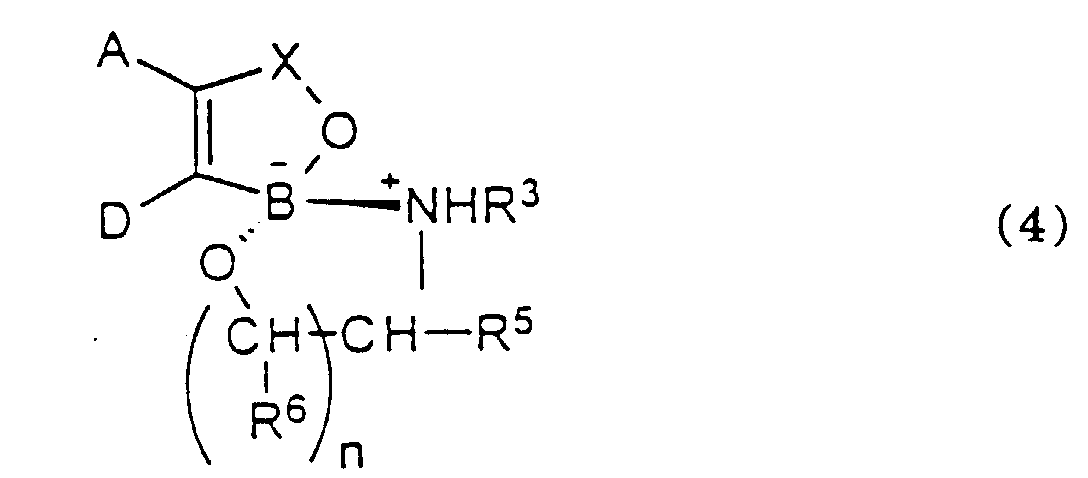 A, D et X sont tels que définis dans la revendication 1 ;n est 1, 2 ou 3 ;R3 est un atome d'hydrogène, un groupe alkyle en C1-18 ou phényle ; etR5 et R6 sont chacun, indépendamment, un atome d'hydrogène, un groupe alkyle contenant jusqu'à un total de 16 atomes de carbone ou un groupe phényle.
 - Procédé suivant l'une quelconque des revendications 1 à 7, dans lequel le milieu est un film de peinture ou une matière plastique.
- Composé de formule (1) :ou sel de celui-ci,
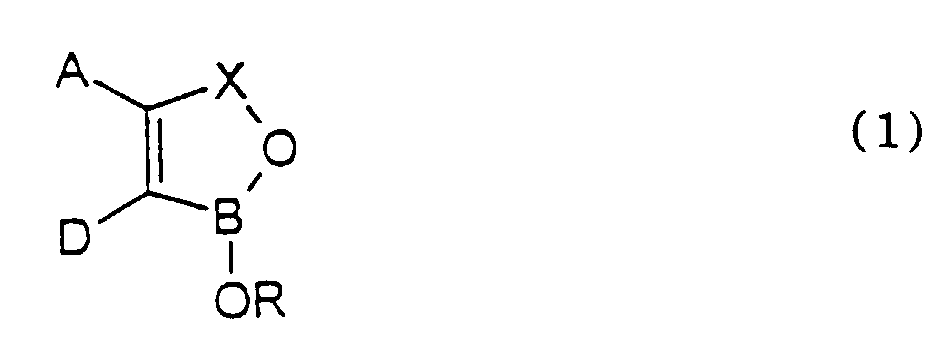
dans laquelle A, D, R et X sont tels que définis dans la revendication 1 à l'exception des 1,1'-oxybis-[1,3-dihydro-2,1-benzoxaborole] ; 1,1'-oxybis-[4-bromo-1,3-dihydro-2,1-benzoxaborole] ; 3,7-dihydro-1,5-dihydroxy-1H,3H-benzo-[1,2-c:4,5-c']-bis-[1,2]-oxaborole ; boronophtalide et boronophtalide contenant le ou les substituants suivants : 6-nitro-, 6-amino-, 7-méthyl-, 6-(NN-diméthylamino)-, 5-(NN-diméthylamino)-, 4-bromo-, 6-méthyl-, 1-benzyloxy-, 1-cyclohexyloxy-, 1-éthoxy-, 3-méthyl- et 3-cyano-. - Composé suivant la revendication 9, qui est de formule 3 :dans laquelle :
 A, D et X sont tels que définis dans la revendication 1 ;R3 et R4 sont chacun, indépendamment, un atome d'hydrogène, un groupe alkyle en C1-18 ou phényle, ou bien le groupe -NR3R4 forme avec Y ou une partie de Y un cycle à 5, 6 ou 7 chaínons contenant l'atome d'azote ; etY est tel que défini dans la revendication 6.
 - Composé suivant l'une ou l'autre des revendications 9 ou 10, dans lequel le cycle condensé formé par A et D ensemble avec les atomes de carbone auxquels ils sont attachés, est un cycle phényle.
- Composé suivant l'une ou l'autre des revendications 10 ou 11, qui est un ester dérivé de 5- ou 6-chloro, 5- ou 6-bromo ou 5- ou 6-fluoro-benzoxaborole.
- Composition comprenant un support et un oxaborole de formule 1 :ou un sel de celui-ci :
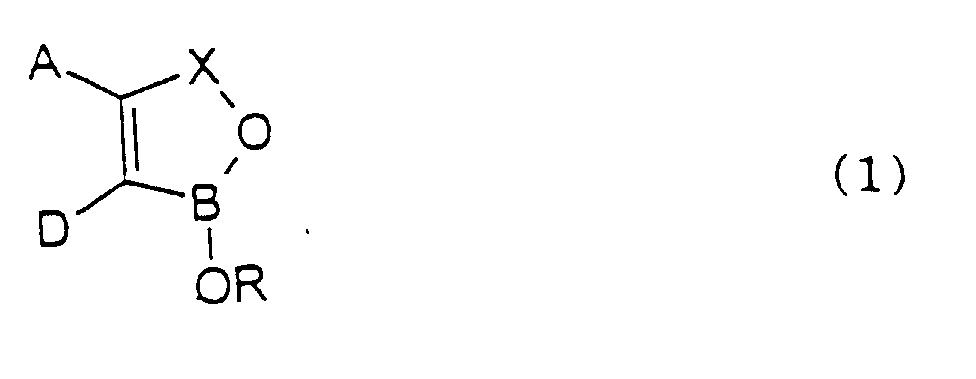
dans laquelle A, D, X et R sont tels que définis dans la revendication 1, à l'exception du cas où l'oxaborole est le boronophtalide. - Composition suivant la revendication 13, dans laquelle le support est un film de peinture ou une matière plastique.
- Composition suivant la revendication 14, dans laquelle la matière plastique est un polyuréthane ou un PVC plastifié.
- Composition suivant la revendication 13, dans laquelle le support est un stabilisant ou un plastifiant pour matière plastique.
- Composition suivant la revendication 16, dans laquelle le stabilisant ou le plastifiant est le phtalate de dioctyle, l'adipate de dioctyle ou une huile de soja époxydée.
- Procédé de préparation d'un oxaborole de formule 1 dans laquelle A et D forment ensemble un cycle phényle condensé avec les atomes de carbone auxquels ils sont attachés, qui comprend la réaction d'un toluène halo-substitué en position ortho avec du magnésium ou un alkyllithium dans un solvant inerte et la réaction du réactif de Grignard ou de l'aryllithium ainsi formé avec un borate ester pour obtenir un acide toluène boronique qui est ensuite traité avec un agent de bromation, puis hydrolysé pour donner un acide hydroxyméthylbenzène boronique et la cyclisation de l'acide boronique dans des conditions acides pour donner un benzoxaborole.
- Procédé de préparation d'un oxaborole de formule 1 dans laquelle A et D forment ensemble un cycle phényle condensé avec les atomes de carbone auxquels ils sont attachés, qui comprend la réaction d'un benzaldéhyde éventuellement substitué avec un p-toluènesulfonylhydrazide dans un solvant inerte, suivie par une réaction avec du tribromure de bore et un catalyseur pour donner un 1,2-dihydro-1-hydroxy-2-(4-méthylphénylsulfonyl)-2,3,1-benzodiazaborine qui est ensuite hydrolysée et soumise à une cyclisation pour former un benzoxaborole.
- Procédé de préparation d'un ester d'oxaborole suivant la revendication 10, qui comprend la réaction d'un oxaborole de formule 1 dans laquelle R est un atome d'hydrogène, avec un acide carboxylique amino-aliphatique, une alcanolamine ou une 8-hydroxyquinoléine dans un solvant inerte à une température de 25°C à 125°C.
- Procédé de préparation d'un oxaborole de formule 1 dans laquelle A et D forment ensemble un cycle aromatique condensé avec les atomes de carbone auxquels ils sont attachés, qui comprend la réaction d'un composé aromatique contenant un groupe -CH2OH avec un alkyl- ou aryllithium et un organoborate dans un liquide inerte anhydre.
- Procédé suivant la revendication 21, dans lequel le composé aromatique contenant un groupe -CH2OH contient aussi un ou plusieurs substituants supplémentaires qui sont des groupes qui activent l'ortho-lithiation.
- Procédé de préparation d'un oxaborole de formule 1 dans laquelle A et D forment ensemble un cycle aromatique condensé avec les atomes de carbone auxquels ils sont attachés, qui comprend la réaction d'un composé aromatique contenant un groupe -CH2OH et un groupe ortho-chloro ou fluoro avec un alkyl- ou aryllithium et un organoborate dans un liquide organique inerte.
Applications Claiming Priority (3)
| Application Number | Priority Date | Filing Date | Title |
|---|---|---|---|
| GB9411587A GB9411587D0 (en) | 1994-06-09 | 1994-06-09 | Compound, composition and use |
| GB9411587 | 1994-06-09 | ||
| PCT/GB1995/001206 WO1995033754A1 (fr) | 1994-06-09 | 1995-05-26 | Oxaboroles et leurs sels, et leur utilisation comme biocides |
Publications (2)
| Publication Number | Publication Date |
|---|---|
| EP0765331A1 EP0765331A1 (fr) | 1997-04-02 |
| EP0765331B1 true EP0765331B1 (fr) | 2000-08-09 |
Family
ID=10756481
Family Applications (1)
| Application Number | Title | Priority Date | Filing Date |
|---|---|---|---|
| EP95919572A Expired - Lifetime EP0765331B1 (fr) | 1994-06-09 | 1995-05-26 | Oxaboroles et leurs sels, et leur utilisation comme biocides |
Country Status (14)
| Country | Link |
|---|---|
| US (1) | US5880188A (fr) |
| EP (1) | EP0765331B1 (fr) |
| JP (1) | JPH10500983A (fr) |
| KR (1) | KR970703349A (fr) |
| CN (1) | CN1068005C (fr) |
| AT (1) | ATE195316T1 (fr) |
| AU (1) | AU681291B2 (fr) |
| BR (1) | BR9507966A (fr) |
| CA (1) | CA2190155A1 (fr) |
| DE (1) | DE69518323T2 (fr) |
| GB (1) | GB9411587D0 (fr) |
| NO (1) | NO965235L (fr) |
| TW (1) | TW368397B (fr) |
| WO (1) | WO1995033754A1 (fr) |
Cited By (6)
| Publication number | Priority date | Publication date | Assignee | Title |
|---|---|---|---|---|
| KR101337045B1 (ko) * | 2005-02-16 | 2013-12-05 | 아나코르 파마슈티칼스 인코포레이티드 | 보론함유 소분자 |
| US9138002B2 (en) | 2013-01-30 | 2015-09-22 | Agrofresh Inc. | Compounds and compositions |
| US9353133B2 (en) | 2005-02-16 | 2016-05-31 | Anacor Pharmaceuticals, Inc. | Boron-containing small molecules |
| US9426996B2 (en) | 2013-01-30 | 2016-08-30 | Agrofresh Inc. | Use of benzoxaboroles as volatile antimicrobial agents on meats, plants, or plant parts |
| WO2017031041A1 (fr) * | 2015-08-17 | 2017-02-23 | Channel Therapeutics, Inc. | Aminobenzoboroxoles fonctionnalisés |
| US10070649B2 (en) | 2013-01-30 | 2018-09-11 | Agrofresh Inc. | Volatile applications against pathogens |
Families Citing this family (56)
| Publication number | Priority date | Publication date | Assignee | Title |
|---|---|---|---|---|
| US6075014A (en) * | 1997-06-13 | 2000-06-13 | Northwestern University | Inhibitors of β-lactamases and uses therefor |
| US6184363B1 (en) | 1997-06-13 | 2001-02-06 | Northwestern University | Inhibitors of β-lactamases and uses therefor |
| BRPI0411582A (pt) * | 2003-06-16 | 2006-08-08 | Anacor Pharmaceuticals Inc | substáncias terapêuticas contendo boro hidroliticamente resistentes e método de uso |
| KR20050047699A (ko) * | 2003-11-18 | 2005-05-23 | 주식회사 엘지생명과학 | 살균성 수성 액상수화제 |
| MX335993B (es) * | 2005-12-30 | 2016-01-07 | Anacor Pharmaceuticals Inc | Moleculas pequeñas que contienen boro. |
| NZ570257A (en) * | 2006-02-16 | 2011-11-25 | Anacor Pharmaceuticals Inc | Boron-containing small molecules as anti-inflammatory agents |
| US20070197388A1 (en) * | 2006-02-22 | 2007-08-23 | Buckman Laboratories International, Inc. | Haloperoxidase treatment to control algae |
| CA2646240A1 (fr) * | 2006-03-16 | 2007-09-20 | Xuemin Shi | Therapie combinee pour le traitement de patients presentant des troubles neurologiques et un infarctus cerebral |
| CA2651212A1 (fr) * | 2006-05-02 | 2007-11-15 | Anacor Pharmaceuticals, Inc. | Substances therapeutiques contenant du bore resistant a l'hydrolyse et methodes d'utilisation |
| EP1900378A1 (fr) * | 2006-08-31 | 2008-03-19 | Novartis AG | Compositions pharmaceutiques pour le traitment d'infections fongiques |
| JO3396B1 (ar) * | 2007-06-20 | 2019-10-20 | Anacor Pharmaceuticals Inc | جزيئات صغيرة تحتوي على البورون |
| JP5504454B2 (ja) * | 2007-12-06 | 2014-05-28 | 国立大学法人京都大学 | 新規なホウ素化合物、それらの製造方法およびそれらを用いた機能性電子素子 |
| JP5745279B2 (ja) * | 2008-01-09 | 2015-07-08 | アナコール ファーマシューティカルズ,インコーポレイテッド | 抗炎症剤としてのホウ素含有小分子 |
| BRPI0908565A2 (pt) * | 2008-03-06 | 2017-05-23 | Anacor Pharmaceuticals Inc | composto, formulação farmacêutica, métodos para reduzir a liberação de uma citocina ou de uma quimiocina, para tratar uma condição em um animal e para inibir uma fosfodiesterase |
| US20100256092A1 (en) * | 2008-05-12 | 2010-10-07 | Anacor Pharmaceuticals, Inc. | Boron-containing small molecules |
| EP2348863A4 (fr) | 2008-09-04 | 2012-03-07 | Anacor Pharmaceuticals Inc | Petites molécules contenant du bore |
| US8461336B2 (en) | 2008-09-04 | 2013-06-11 | Anacor Pharmaceuticals, Inc. | Boron-containing small molecules |
| BRPI0919773A2 (pt) | 2008-10-15 | 2015-12-08 | Kissei Pharmaceutical | derivado de anel fundido e aplicação do mesmo na medicina |
| US9493489B2 (en) * | 2008-10-15 | 2016-11-15 | Anacor Pharmaceuticals, Inc. | Boron-containing small molecules as anti-protozoal agents |
| MX2011006334A (es) * | 2008-12-17 | 2011-09-22 | Anacor Pharmaceuticals Inc | Polimorfos de (s)-3-amino-metil-7-(3-hidroxi-propoxi)-3h-benzo-[c] [1,2]-oxaborol-1-ol. |
| KR20130031233A (ko) | 2009-07-28 | 2013-03-28 | 아나코르 파마슈티칼스 인코포레이티드 | 삼치환된 붕소 함유 분자 |
| AP4039A (en) | 2009-08-14 | 2017-02-28 | Daitao Chen | Boron-containing small molecules as antiprotozoal agents |
| MX2012002031A (es) * | 2009-08-19 | 2012-07-04 | Anacor Pharmaceuticals Inc | Moleculas pequeñas que contienen boro como agentes antiprotozoarios. |
| WO2011049971A1 (fr) | 2009-10-20 | 2011-04-28 | Anacor Pharmaceuticals, Inc. | Petites molécules contenant du bore comme agents antiprotozoaires |
| US20110212918A1 (en) * | 2009-11-11 | 2011-09-01 | Anacor Pharmaceuticals, Inc. | Boron-containing small molecules |
| WO2011094450A1 (fr) | 2010-01-27 | 2011-08-04 | Anacor Pharmaceuticals, Inc | Petites molecules contenant du bore |
| AP2012006482A0 (en) | 2010-03-19 | 2012-10-31 | Anacor Pharmacueticals Inc | Boron-containing small molecules as anti-protozoalagent |
| SG10201507032YA (en) | 2010-09-07 | 2015-10-29 | Anacor Pharmaceuticals Inc | Benzoxaborole derivatives for treating bacterial infections |
| CN103857289A (zh) * | 2011-10-07 | 2014-06-11 | 先正达参股股份有限公司 | 用于保护有用植物或植物繁殖材料的方法 |
| UY34367A (es) * | 2011-10-07 | 2014-08-29 | Syngenta Participations Ag | ?método para proteger material de propagación vegetal o plantas útiles?. |
| US20220125049A1 (en) * | 2013-01-30 | 2022-04-28 | Agrofresh Inc. | Method and system for centralized management, monitoring, and controlled delivery of biological compounds to fruit storage rooms |
| US9585396B2 (en) | 2013-01-30 | 2017-03-07 | Agrofresh Inc. | Volatile applications against pathogens |
| US11039617B2 (en) | 2013-01-30 | 2021-06-22 | Agrofresh Inc. | Large scale methods of uniformly coating packaging surfaces with a volatile antimicrobial to preserve food freshness |
| WO2014147009A1 (fr) * | 2013-03-18 | 2014-09-25 | Syngenta Participations Ag | Nouveaux microbiocides |
| WO2014173880A1 (fr) | 2013-04-22 | 2014-10-30 | Syngenta Participations Ag | Nouveaux microbiocides |
| AU2014202928B1 (en) * | 2013-06-05 | 2014-09-11 | Agrofresh Inc. | Compounds and compositions |
| WO2015097237A1 (fr) * | 2013-12-23 | 2015-07-02 | Syngenta Participations Ag | Fongicides benzoxaboroles |
| EP3086645A1 (fr) * | 2013-12-23 | 2016-11-02 | Syngenta Participations AG | Fongicides benzoxaborole |
| MA41495A (fr) * | 2015-02-12 | 2017-12-19 | Anacor Pharmaceuticals Inc | Composés benzoxaborole et leurs utilisations |
| CA2974396C (fr) * | 2015-02-12 | 2024-04-30 | Agrofresh Inc. | Composes et compositions fongicides |
| BR112017021478B1 (pt) | 2015-04-09 | 2022-04-19 | The Penn State Research Foundation | Composição antifúngica sinérgica que contém benzoxaborol |
| CA3014757C (fr) * | 2015-08-06 | 2020-01-14 | The Penn State Research Foundation | Revetement contenant du benzoxaborole resistant a un champignon susceptible d'etre porte par la cellulose |
| CN113321672A (zh) * | 2016-03-02 | 2021-08-31 | 比尔及梅琳达盖茨基金会 | 含硼小分子 |
| TW201733442A (zh) | 2016-03-07 | 2017-10-01 | 農業保鮮股份有限公司 | 殺有害生物劑之汽化給予 |
| NZ745681A (en) | 2016-03-07 | 2022-05-27 | Agrofresh Inc | Synergistic methods of using benzoxaborole compounds and preservative gases as an antimicrobial for crops |
| US11447506B2 (en) | 2016-05-09 | 2022-09-20 | Anacor Pharmaceuticals, Inc. | Crystal forms of crisaborole in free form and preparation method and use thereof |
| HK1258717A1 (zh) | 2016-05-12 | 2019-11-15 | 安纳考尔医药公司 | 氧杂硼杂环戊烷酯类及其用途 |
| EP4119566A1 (fr) | 2017-11-02 | 2023-01-18 | Halcyon Labs Private Limited | Nouveau procédé de préparation de tavaborole et de ses intermédiaires |
| BR112020010927A2 (pt) | 2017-11-30 | 2020-12-01 | Boragen, Inc. | compostos de benzoxaborol e formulações dos mesmos |
| US11427603B2 (en) | 2018-03-09 | 2022-08-30 | University Of The Sciences | Protective groups and methods for protecting benzoxaboroles or oxaboroles |
| WO2020041200A1 (fr) | 2018-08-18 | 2020-02-27 | Boragen Inc. | Formes solides de benzoxaborole substitué et compositions associées |
| CU20210023A7 (es) | 2018-10-05 | 2021-10-12 | Pfizer | Inhibidores fenil sustituidos de la piridinil 1,2-oxaborolan-2-ol fosfodiesterasa 4 |
| US12065456B2 (en) | 2019-07-25 | 2024-08-20 | National Institutes Of Health (Nih), U.S. Dept. Of Health And Human Services (Dhhs), U.S. Government | Boron-containing pharmacophore |
| AR120504A1 (es) | 2019-11-22 | 2022-02-16 | Agrofresh Inc | Composición y método para tratar a plantas y partes de plantas con activos volátiles para el control de organismos de descomposición |
| CA3166583A1 (fr) * | 2020-02-05 | 2021-08-12 | Richard M. Jacobson | Composes et compositions antimicrobiens |
| CN114644645B (zh) * | 2022-03-08 | 2023-05-26 | 南京农业大学 | 3-吲哚取代苯硼唑类化合物及其制备方法和应用 |
Family Cites Families (5)
| Publication number | Priority date | Publication date | Assignee | Title |
|---|---|---|---|---|
| US3104255A (en) * | 1960-06-16 | 1963-09-17 | Standard Oil Co | Telomerization of unsaturated hydrocarbons with alkylene glycol borates and telomeric products obtained thereby |
| US3361672A (en) * | 1965-10-23 | 1968-01-02 | Mobil Oil Corp | Stabilized organic compositions |
| GB1140399A (en) * | 1966-09-16 | 1969-01-15 | Koninklijke Pharma Fab Nv | New diphenylmethoxy derivatives |
| US3686398A (en) * | 1970-07-20 | 1972-08-22 | Chevron Res | 10,9-boroxarophenanthrene as fungicides |
| GB1396904A (en) * | 1972-08-11 | 1975-06-11 | Ici Ltd | Method for the control of micro-organisms |
-
1994
- 1994-06-09 GB GB9411587A patent/GB9411587D0/en active Pending
-
1995
- 1995-05-26 US US08/750,081 patent/US5880188A/en not_active Expired - Fee Related
- 1995-05-26 BR BR9507966A patent/BR9507966A/pt not_active Application Discontinuation
- 1995-05-26 EP EP95919572A patent/EP0765331B1/fr not_active Expired - Lifetime
- 1995-05-26 AU AU25348/95A patent/AU681291B2/en not_active Ceased
- 1995-05-26 DE DE69518323T patent/DE69518323T2/de not_active Expired - Fee Related
- 1995-05-26 AT AT95919572T patent/ATE195316T1/de not_active IP Right Cessation
- 1995-05-26 WO PCT/GB1995/001206 patent/WO1995033754A1/fr not_active Ceased
- 1995-05-26 JP JP8500489A patent/JPH10500983A/ja not_active Withdrawn
- 1995-05-26 CN CN95194519A patent/CN1068005C/zh not_active Expired - Fee Related
- 1995-05-26 CA CA002190155A patent/CA2190155A1/fr not_active Abandoned
- 1995-05-30 TW TW084105427A patent/TW368397B/zh active
-
1996
- 1996-12-06 NO NO965235A patent/NO965235L/no unknown
- 1996-12-07 KR KR1019960706993A patent/KR970703349A/ko not_active Withdrawn
Cited By (15)
| Publication number | Priority date | Publication date | Assignee | Title |
|---|---|---|---|---|
| US9353133B2 (en) | 2005-02-16 | 2016-05-31 | Anacor Pharmaceuticals, Inc. | Boron-containing small molecules |
| US9566289B2 (en) | 2005-02-16 | 2017-02-14 | Anacor Pharmaceuticals, Inc. | Boron-containing small molecules |
| KR101426220B1 (ko) * | 2005-02-16 | 2014-08-05 | 아나코르 파마슈티칼스 인코포레이티드 | 보론함유 소분자 |
| KR101456815B1 (ko) * | 2005-02-16 | 2014-10-31 | 아나코르 파마슈티칼스 인코포레이티드 | 보론함유 소분자 |
| US8889656B2 (en) | 2005-02-16 | 2014-11-18 | Anacor Pharmaceuticals, Inc. | Boron-containing small molecules |
| US9572823B2 (en) | 2005-02-16 | 2017-02-21 | Anacor Pharmaceuticals, Inc. | Boron-containing small molecules |
| KR101337068B1 (ko) * | 2005-02-16 | 2013-12-06 | 아나코르 파마슈티칼스 인코포레이티드 | 보론함유 소분자 |
| US9549938B2 (en) | 2005-02-16 | 2017-01-24 | Anacor Pharmaceuticals, Inc. | Boron-containing small molecules |
| KR101337045B1 (ko) * | 2005-02-16 | 2013-12-05 | 아나코르 파마슈티칼스 인코포레이티드 | 보론함유 소분자 |
| US9566290B2 (en) | 2005-02-16 | 2017-02-14 | Anacor Pharmaceuticals, Inc. | Boron-containing small molecules |
| US9426996B2 (en) | 2013-01-30 | 2016-08-30 | Agrofresh Inc. | Use of benzoxaboroles as volatile antimicrobial agents on meats, plants, or plant parts |
| US9138002B2 (en) | 2013-01-30 | 2015-09-22 | Agrofresh Inc. | Compounds and compositions |
| US10070649B2 (en) | 2013-01-30 | 2018-09-11 | Agrofresh Inc. | Volatile applications against pathogens |
| WO2017031041A1 (fr) * | 2015-08-17 | 2017-02-23 | Channel Therapeutics, Inc. | Aminobenzoboroxoles fonctionnalisés |
| US10633399B2 (en) | 2015-08-17 | 2020-04-28 | Channel Therapeutics, Inc. | Functionalized aminobenzoboroxoles |
Also Published As
| Publication number | Publication date |
|---|---|
| KR970703349A (ko) | 1997-07-03 |
| TW368397B (en) | 1999-09-01 |
| DE69518323T2 (de) | 2001-02-01 |
| NO965235D0 (no) | 1996-12-06 |
| DE69518323D1 (de) | 2000-09-14 |
| BR9507966A (pt) | 1997-09-02 |
| US5880188A (en) | 1999-03-09 |
| JPH10500983A (ja) | 1998-01-27 |
| NO965235L (no) | 1997-01-21 |
| CA2190155A1 (fr) | 1995-12-14 |
| GB9411587D0 (en) | 1994-08-03 |
| AU2534895A (en) | 1996-01-04 |
| ATE195316T1 (de) | 2000-08-15 |
| WO1995033754A1 (fr) | 1995-12-14 |
| CN1155286A (zh) | 1997-07-23 |
| AU681291B2 (en) | 1997-08-21 |
| EP0765331A1 (fr) | 1997-04-02 |
| CN1068005C (zh) | 2001-07-04 |
Similar Documents
| Publication | Publication Date | Title |
|---|---|---|
| US5880188A (en) | Oxaboroles and salts thereof, and their use as biocides | |
| IE63572B1 (en) | Composition and use | |
| JPS6233171A (ja) | 1−ヘテロアリ−ル−4−アリ−ル−ピラゾ−ル誘導体、その製法及び利用 | |
| CA1340330C (fr) | Acides thiohydroxamiques cycliques biocides ainsi que leurs sels ou complexes | |
| US5594018A (en) | 2-(B-branched alkyl)-benziosothiazolin-3-ones | |
| US4764527A (en) | Hydroxypyrazole derivatives, composition containing them and their use against microorganisms | |
| JPH01305064A (ja) | 2―フエニルスルフイニル―ニトロ―ピリジン類 | |
| US4062859A (en) | Halogenated 3-isothiazolidinone 1-oxide and 1,1-dioxides | |
| US3950349A (en) | N-(N1 -11 -Benzisothiazolin-31 -31 -onylcarbonylthio)-1,2-benzisothiazolin-3-one | |
| JPS5913516B2 (ja) | 新規2−アミノ−1,3−チアジン類の製造方法 | |
| US5506253A (en) | Composition, process and use | |
| JPS59116203A (ja) | ピロ−ル誘導体を含有する殺菌剤 | |
| EP0244962B1 (fr) | Thiocyanates alkyniques substitués, compositions biocides les contenant ainsi que l'utilisation de telles compositions | |
| MXPA96006038A (en) | Oxaborols and salts of them, and their use as bioci | |
| US5596102A (en) | Biocides | |
| US4147784A (en) | 4,5-Dihydro-4-oxo-1,3-dithiolo(4,5-D)pyridazine-2-ylidene-propanedinitriles | |
| EP0459660A2 (fr) | Composés halopropargyliques et leur utilisation comme microbicides | |
| WO1996019467A1 (fr) | Thiadiazoles de substitution, compositions dans laquelle ils entrent et usage de ceux-ci comme antimicrobiens et agents antisalissure | |
| US5885991A (en) | Thiocyanomethyloxy (and thiocyanothiomethyl)-1,2,3-benzatriazin-4(3H) ones, compositions containing them and their use as antimicrobial and marine antifouling agents | |
| US5661165A (en) | ((4-phenyl-1,2,5-thiadiazol-3-yl)oxy)methyl ester thiocyanic acid compounds, compositions containing them and their use as antimicrobial and marine antifouling agents | |
| KR920000734A (ko) | 벤조트리아졸술폰산 유도체, 그의 제법 및 용도 | |
| US4230704A (en) | Isothiazolidin-3-ones | |
| GB2203145A (en) | Biocidal allene thiocyanates | |
| JPH04327508A (ja) | 工業用殺菌剤 | |
| JPH0373538B2 (fr) |
Legal Events
| Date | Code | Title | Description |
|---|---|---|---|
| PUAI | Public reference made under article 153(3) epc to a published international application that has entered the european phase |
Free format text: ORIGINAL CODE: 0009012 |
|
| 17P | Request for examination filed |
Effective date: 19970109 |
|
| AK | Designated contracting states |
Kind code of ref document: A1 Designated state(s): AT BE CH DE DK ES FR GB GR IE IT LI NL PT SE |
|
| 17Q | First examination report despatched |
Effective date: 19971013 |
|
| GRAG | Despatch of communication of intention to grant |
Free format text: ORIGINAL CODE: EPIDOS AGRA |
|
| RAP1 | Party data changed (applicant data changed or rights of an application transferred) |
Owner name: AVECIA LIMITED |
|
| GRAG | Despatch of communication of intention to grant |
Free format text: ORIGINAL CODE: EPIDOS AGRA |
|
| GRAH | Despatch of communication of intention to grant a patent |
Free format text: ORIGINAL CODE: EPIDOS IGRA |
|
| GRAH | Despatch of communication of intention to grant a patent |
Free format text: ORIGINAL CODE: EPIDOS IGRA |
|
| GRAA | (expected) grant |
Free format text: ORIGINAL CODE: 0009210 |
|
| AK | Designated contracting states |
Kind code of ref document: B1 Designated state(s): AT BE CH DE DK ES FR GB GR IE IT LI NL PT SE |
|
| PG25 | Lapsed in a contracting state [announced via postgrant information from national office to epo] |
Ref country code: NL Free format text: LAPSE BECAUSE OF FAILURE TO SUBMIT A TRANSLATION OF THE DESCRIPTION OR TO PAY THE FEE WITHIN THE PRESCRIBED TIME-LIMIT Effective date: 20000809 Ref country code: LI Free format text: LAPSE BECAUSE OF FAILURE TO SUBMIT A TRANSLATION OF THE DESCRIPTION OR TO PAY THE FEE WITHIN THE PRESCRIBED TIME-LIMIT Effective date: 20000809 Ref country code: ES Free format text: THE PATENT HAS BEEN ANNULLED BY A DECISION OF A NATIONAL AUTHORITY Effective date: 20000809 Ref country code: CH Free format text: LAPSE BECAUSE OF FAILURE TO SUBMIT A TRANSLATION OF THE DESCRIPTION OR TO PAY THE FEE WITHIN THE PRESCRIBED TIME-LIMIT Effective date: 20000809 Ref country code: BE Free format text: LAPSE BECAUSE OF FAILURE TO SUBMIT A TRANSLATION OF THE DESCRIPTION OR TO PAY THE FEE WITHIN THE PRESCRIBED TIME-LIMIT Effective date: 20000809 Ref country code: AT Free format text: LAPSE BECAUSE OF FAILURE TO SUBMIT A TRANSLATION OF THE DESCRIPTION OR TO PAY THE FEE WITHIN THE PRESCRIBED TIME-LIMIT Effective date: 20000809 |
|
| REF | Corresponds to: |
Ref document number: 195316 Country of ref document: AT Date of ref document: 20000815 Kind code of ref document: T |
|
| ITF | It: translation for a ep patent filed | ||
| REG | Reference to a national code |
Ref country code: CH Ref legal event code: EP |
|
| REG | Reference to a national code |
Ref country code: IE Ref legal event code: FG4D |
|
| REF | Corresponds to: |
Ref document number: 69518323 Country of ref document: DE Date of ref document: 20000914 |
|
| ET | Fr: translation filed | ||
| PG25 | Lapsed in a contracting state [announced via postgrant information from national office to epo] |
Ref country code: SE Free format text: LAPSE BECAUSE OF FAILURE TO SUBMIT A TRANSLATION OF THE DESCRIPTION OR TO PAY THE FEE WITHIN THE PRESCRIBED TIME-LIMIT Effective date: 20001109 Ref country code: PT Free format text: LAPSE BECAUSE OF FAILURE TO SUBMIT A TRANSLATION OF THE DESCRIPTION OR TO PAY THE FEE WITHIN THE PRESCRIBED TIME-LIMIT Effective date: 20001109 Ref country code: DK Free format text: LAPSE BECAUSE OF FAILURE TO SUBMIT A TRANSLATION OF THE DESCRIPTION OR TO PAY THE FEE WITHIN THE PRESCRIBED TIME-LIMIT Effective date: 20001109 |
|
| PG25 | Lapsed in a contracting state [announced via postgrant information from national office to epo] |
Ref country code: GR Free format text: LAPSE BECAUSE OF FAILURE TO SUBMIT A TRANSLATION OF THE DESCRIPTION OR TO PAY THE FEE WITHIN THE PRESCRIBED TIME-LIMIT Effective date: 20001110 |
|
| NLV1 | Nl: lapsed or annulled due to failure to fulfill the requirements of art. 29p and 29m of the patents act | ||
| REG | Reference to a national code |
Ref country code: CH Ref legal event code: PL |
|
| PGFP | Annual fee paid to national office [announced via postgrant information from national office to epo] |
Ref country code: FR Payment date: 20010518 Year of fee payment: 7 |
|
| PGFP | Annual fee paid to national office [announced via postgrant information from national office to epo] |
Ref country code: DE Payment date: 20010522 Year of fee payment: 7 |
|
| PGFP | Annual fee paid to national office [announced via postgrant information from national office to epo] |
Ref country code: GB Payment date: 20010523 Year of fee payment: 7 |
|
| PG25 | Lapsed in a contracting state [announced via postgrant information from national office to epo] |
Ref country code: IE Free format text: LAPSE BECAUSE OF NON-PAYMENT OF DUE FEES Effective date: 20010528 |
|
| PLBE | No opposition filed within time limit |
Free format text: ORIGINAL CODE: 0009261 |
|
| STAA | Information on the status of an ep patent application or granted ep patent |
Free format text: STATUS: NO OPPOSITION FILED WITHIN TIME LIMIT |
|
| 26N | No opposition filed | ||
| REG | Reference to a national code |
Ref country code: GB Ref legal event code: IF02 |
|
| REG | Reference to a national code |
Ref country code: IE Ref legal event code: MM4A |
|
| PG25 | Lapsed in a contracting state [announced via postgrant information from national office to epo] |
Ref country code: GB Free format text: LAPSE BECAUSE OF NON-PAYMENT OF DUE FEES Effective date: 20020526 |
|
| PG25 | Lapsed in a contracting state [announced via postgrant information from national office to epo] |
Ref country code: DE Free format text: LAPSE BECAUSE OF NON-PAYMENT OF DUE FEES Effective date: 20021203 |
|
| GBPC | Gb: european patent ceased through non-payment of renewal fee |
Effective date: 20020526 |
|
| PG25 | Lapsed in a contracting state [announced via postgrant information from national office to epo] |
Ref country code: FR Free format text: LAPSE BECAUSE OF NON-PAYMENT OF DUE FEES Effective date: 20030131 |
|
| REG | Reference to a national code |
Ref country code: FR Ref legal event code: ST |
|
| PG25 | Lapsed in a contracting state [announced via postgrant information from national office to epo] |
Ref country code: IT Free format text: LAPSE BECAUSE OF NON-PAYMENT OF DUE FEES;WARNING: LAPSES OF ITALIAN PATENTS WITH EFFECTIVE DATE BEFORE 2007 MAY HAVE OCCURRED AT ANY TIME BEFORE 2007. THE CORRECT EFFECTIVE DATE MAY BE DIFFERENT FROM THE ONE RECORDED. Effective date: 20050526 |