EP0762871B1 - Stabilisierung lichtempfindlicher materialien - Google Patents
Stabilisierung lichtempfindlicher materialien Download PDFInfo
- Publication number
- EP0762871B1 EP0762871B1 EP95921012A EP95921012A EP0762871B1 EP 0762871 B1 EP0762871 B1 EP 0762871B1 EP 95921012 A EP95921012 A EP 95921012A EP 95921012 A EP95921012 A EP 95921012A EP 0762871 B1 EP0762871 B1 EP 0762871B1
- Authority
- EP
- European Patent Office
- Prior art keywords
- composition
- riboflavin
- cyclodextrin
- liposome
- photosensitive material
- Prior art date
- Legal status (The legal status is an assumption and is not a legal conclusion. Google has not performed a legal analysis and makes no representation as to the accuracy of the status listed.)
- Expired - Lifetime
Links
- 239000000463 material Substances 0.000 title claims description 69
- 230000006641 stabilisation Effects 0.000 title description 19
- AUNGANRZJHBGPY-SCRDCRAPSA-N Riboflavin Chemical compound OC[C@@H](O)[C@@H](O)[C@@H](O)CN1C=2C=C(C)C(C)=CC=2N=C2C1=NC(=O)NC2=O AUNGANRZJHBGPY-SCRDCRAPSA-N 0.000 claims description 197
- 239000002502 liposome Substances 0.000 claims description 119
- 239000002151 riboflavin Substances 0.000 claims description 100
- 235000019192 riboflavin Nutrition 0.000 claims description 99
- AUNGANRZJHBGPY-UHFFFAOYSA-N D-Lyxoflavin Natural products OCC(O)C(O)C(O)CN1C=2C=C(C)C(C)=CC=2N=C2C1=NC(=O)NC2=O AUNGANRZJHBGPY-UHFFFAOYSA-N 0.000 claims description 98
- 229960002477 riboflavin Drugs 0.000 claims description 98
- 229920000858 Cyclodextrin Polymers 0.000 claims description 88
- 238000000034 method Methods 0.000 claims description 56
- 239000000203 mixture Substances 0.000 claims description 56
- 239000003795 chemical substances by application Substances 0.000 claims description 49
- HVYWMOMLDIMFJA-DPAQBDIFSA-N cholesterol Chemical compound C1C=C2C[C@@H](O)CC[C@]2(C)[C@@H]2[C@@H]1[C@@H]1CC[C@H]([C@H](C)CCCC(C)C)[C@@]1(C)CC2 HVYWMOMLDIMFJA-DPAQBDIFSA-N 0.000 claims description 42
- 150000002632 lipids Chemical class 0.000 claims description 29
- 150000001875 compounds Chemical class 0.000 claims description 26
- HFHDHCJBZVLPGP-UHFFFAOYSA-N schardinger α-dextrin Chemical compound O1C(C(C2O)O)C(CO)OC2OC(C(C2O)O)C(CO)OC2OC(C(C2O)O)C(CO)OC2OC(C(O)C2O)C(CO)OC2OC(C(C2O)O)C(CO)OC2OC2C(O)C(O)C1OC2CO HFHDHCJBZVLPGP-UHFFFAOYSA-N 0.000 claims description 24
- 235000012000 cholesterol Nutrition 0.000 claims description 23
- 239000003963 antioxidant agent Substances 0.000 claims description 20
- 239000001116 FEMA 4028 Substances 0.000 claims description 19
- 229960004853 betadex Drugs 0.000 claims description 19
- CXVGEDCSTKKODG-UHFFFAOYSA-N sulisobenzone Chemical compound C1=C(S(O)(=O)=O)C(OC)=CC(O)=C1C(=O)C1=CC=CC=C1 CXVGEDCSTKKODG-UHFFFAOYSA-N 0.000 claims description 19
- 235000006708 antioxidants Nutrition 0.000 claims description 18
- 229940080345 gamma-cyclodextrin Drugs 0.000 claims description 18
- GDSRMADSINPKSL-HSEONFRVSA-N gamma-cyclodextrin Chemical compound OC[C@H]([C@H]([C@@H]([C@H]1O)O)O[C@H]2O[C@@H]([C@@H](O[C@H]3O[C@H](CO)[C@H]([C@@H]([C@H]3O)O)O[C@H]3O[C@H](CO)[C@H]([C@@H]([C@H]3O)O)O[C@H]3O[C@H](CO)[C@H]([C@@H]([C@H]3O)O)O[C@H]3O[C@H](CO)[C@H]([C@@H]([C@H]3O)O)O[C@H]3O[C@H](CO)[C@H]([C@@H]([C@H]3O)O)O3)[C@H](O)[C@H]2O)CO)O[C@@H]1O[C@H]1[C@H](O)[C@@H](O)[C@@H]3O[C@@H]1CO GDSRMADSINPKSL-HSEONFRVSA-N 0.000 claims description 17
- 229940088594 vitamin Drugs 0.000 claims description 16
- 229930003231 vitamin Natural products 0.000 claims description 16
- 235000013343 vitamin Nutrition 0.000 claims description 16
- 239000011782 vitamin Substances 0.000 claims description 16
- 239000011358 absorbing material Substances 0.000 claims description 15
- 150000003722 vitamin derivatives Chemical class 0.000 claims description 14
- 230000003078 antioxidant effect Effects 0.000 claims description 13
- 239000012528 membrane Substances 0.000 claims description 13
- OENHQHLEOONYIE-UKMVMLAPSA-N all-trans beta-carotene Natural products CC=1CCCC(C)(C)C=1/C=C/C(/C)=C/C=C/C(/C)=C/C=C/C=C(C)C=CC=C(C)C=CC1=C(C)CCCC1(C)C OENHQHLEOONYIE-UKMVMLAPSA-N 0.000 claims description 11
- 235000013734 beta-carotene Nutrition 0.000 claims description 11
- 239000011648 beta-carotene Substances 0.000 claims description 11
- TUPZEYHYWIEDIH-WAIFQNFQSA-N beta-carotene Natural products CC(=C/C=C/C=C(C)/C=C/C=C(C)/C=C/C1=C(C)CCCC1(C)C)C=CC=C(/C)C=CC2=CCCCC2(C)C TUPZEYHYWIEDIH-WAIFQNFQSA-N 0.000 claims description 11
- WHGYBXFWUBPSRW-FOUAGVGXSA-N beta-cyclodextrin Chemical compound OC[C@H]([C@H]([C@@H]([C@H]1O)O)O[C@H]2O[C@@H]([C@@H](O[C@H]3O[C@H](CO)[C@H]([C@@H]([C@H]3O)O)O[C@H]3O[C@H](CO)[C@H]([C@@H]([C@H]3O)O)O[C@H]3O[C@H](CO)[C@H]([C@@H]([C@H]3O)O)O[C@H]3O[C@H](CO)[C@H]([C@@H]([C@H]3O)O)O3)[C@H](O)[C@H]2O)CO)O[C@@H]1O[C@H]1[C@H](O)[C@@H](O)[C@@H]3O[C@@H]1CO WHGYBXFWUBPSRW-FOUAGVGXSA-N 0.000 claims description 11
- 229960002747 betacarotene Drugs 0.000 claims description 11
- 230000018044 dehydration Effects 0.000 claims description 11
- 238000006297 dehydration reaction Methods 0.000 claims description 11
- 235000011175 beta-cyclodextrine Nutrition 0.000 claims description 10
- DXGLGDHPHMLXJC-UHFFFAOYSA-N oxybenzone Chemical compound OC1=CC(OC)=CC=C1C(=O)C1=CC=CC=C1 DXGLGDHPHMLXJC-UHFFFAOYSA-N 0.000 claims description 10
- 230000000717 retained effect Effects 0.000 claims description 10
- XLYOFNOQVPJJNP-UHFFFAOYSA-N water Substances O XLYOFNOQVPJJNP-UHFFFAOYSA-N 0.000 claims description 10
- 238000010348 incorporation Methods 0.000 claims description 8
- 239000013543 active substance Substances 0.000 claims description 7
- 239000003960 organic solvent Substances 0.000 claims description 5
- 239000002904 solvent Substances 0.000 claims description 5
- YZOUYRAONFXZSI-SBHWVFSVSA-N (1S,3R,5R,6R,8R,10R,11R,13R,15R,16R,18R,20R,21R,23R,25R,26R,28R,30R,31S,33R,35R,36R,37S,38R,39S,40R,41S,42R,43S,44R,45S,46R,47S,48R,49S)-5,10,15,20,25,30,35-heptakis(hydroxymethyl)-37,39,40,41,42,43,44,45,46,47,48,49-dodecamethoxy-2,4,7,9,12,14,17,19,22,24,27,29,32,34-tetradecaoxaoctacyclo[31.2.2.23,6.28,11.213,16.218,21.223,26.228,31]nonatetracontane-36,38-diol Chemical compound O([C@@H]([C@H]([C@@H]1OC)OC)O[C@H]2[C@@H](O)[C@@H]([C@@H](O[C@@H]3[C@@H](CO)O[C@@H]([C@H]([C@@H]3O)OC)O[C@@H]3[C@@H](CO)O[C@@H]([C@H]([C@@H]3OC)OC)O[C@@H]3[C@@H](CO)O[C@@H]([C@H]([C@@H]3OC)OC)O[C@@H]3[C@@H](CO)O[C@@H]([C@H]([C@@H]3OC)OC)O3)O[C@@H]2CO)OC)[C@H](CO)[C@H]1O[C@@H]1[C@@H](OC)[C@H](OC)[C@H]3[C@@H](CO)O1 YZOUYRAONFXZSI-SBHWVFSVSA-N 0.000 claims description 4
- FVTCRASFADXXNN-SCRDCRAPSA-N flavin mononucleotide Chemical compound OP(=O)(O)OC[C@@H](O)[C@@H](O)[C@@H](O)CN1C=2C=C(C)C(C)=CC=2N=C2C1=NC(=O)NC2=O FVTCRASFADXXNN-SCRDCRAPSA-N 0.000 claims description 4
- 238000002156 mixing Methods 0.000 claims description 4
- 229950001574 riboflavin phosphate Drugs 0.000 claims description 4
- KBQLHHZOZSGQGO-UHFFFAOYSA-N 1-[[4-[(2,3-dimethylphenyl)diazenyl]-2,3-dimethylphenyl]diazenyl]naphthalen-2-ol Chemical compound CC1=CC=CC(N=NC=2C(=C(C)C(N=NC=3C4=CC=CC=C4C=CC=3O)=CC=2)C)=C1C KBQLHHZOZSGQGO-UHFFFAOYSA-N 0.000 claims description 3
- 241000282412 Homo Species 0.000 claims description 3
- 125000001409 beta-carotene group Chemical group 0.000 claims description 3
- 230000000903 blocking effect Effects 0.000 claims description 3
- 238000001704 evaporation Methods 0.000 claims description 3
- 150000003839 salts Chemical class 0.000 claims description 3
- 238000011200 topical administration Methods 0.000 claims description 3
- 239000008194 pharmaceutical composition Substances 0.000 claims 4
- 238000002360 preparation method Methods 0.000 description 47
- 239000006096 absorbing agent Substances 0.000 description 35
- 241000402062 Dolphin rhabdovirus Species 0.000 description 32
- 238000001782 photodegradation Methods 0.000 description 21
- 239000000243 solution Substances 0.000 description 19
- 239000000126 substance Substances 0.000 description 18
- 229940097362 cyclodextrins Drugs 0.000 description 16
- 229960000368 sulisobenzone Drugs 0.000 description 16
- 239000000725 suspension Substances 0.000 description 13
- 239000008188 pellet Substances 0.000 description 12
- 238000002835 absorbance Methods 0.000 description 11
- 239000008346 aqueous phase Substances 0.000 description 11
- 239000012071 phase Substances 0.000 description 11
- HEDRZPFGACZZDS-UHFFFAOYSA-N Chloroform Chemical compound ClC(Cl)Cl HEDRZPFGACZZDS-UHFFFAOYSA-N 0.000 description 10
- 239000013504 Triton X-100 Substances 0.000 description 10
- 229920004890 Triton X-100 Polymers 0.000 description 10
- WTJKGGKOPKCXLL-RRHRGVEJSA-N phosphatidylcholine Chemical compound CCCCCCCCCCCCCCCC(=O)OC[C@H](COP([O-])(=O)OCC[N+](C)(C)C)OC(=O)CCCCCCCC=CCCCCCCCC WTJKGGKOPKCXLL-RRHRGVEJSA-N 0.000 description 10
- 230000005855 radiation Effects 0.000 description 10
- 230000009467 reduction Effects 0.000 description 10
- 239000007864 aqueous solution Substances 0.000 description 9
- 229960001173 oxybenzone Drugs 0.000 description 9
- 239000003814 drug Substances 0.000 description 8
- OENHQHLEOONYIE-JLTXGRSLSA-N β-Carotene Chemical compound CC=1CCCC(C)(C)C=1\C=C\C(\C)=C\C=C\C(\C)=C\C=C\C=C(/C)\C=C\C=C(/C)\C=C\C1=C(C)CCCC1(C)C OENHQHLEOONYIE-JLTXGRSLSA-N 0.000 description 8
- 239000000232 Lipid Bilayer Substances 0.000 description 7
- NRJAVPSFFCBXDT-HUESYALOSA-N 1,2-distearoyl-sn-glycero-3-phosphocholine Chemical compound CCCCCCCCCCCCCCCCCC(=O)OC[C@H](COP([O-])(=O)OCC[N+](C)(C)C)OC(=O)CCCCCCCCCCCCCCCCC NRJAVPSFFCBXDT-HUESYALOSA-N 0.000 description 6
- 210000003491 skin Anatomy 0.000 description 6
- 230000009102 absorption Effects 0.000 description 5
- 238000010521 absorption reaction Methods 0.000 description 5
- 230000015556 catabolic process Effects 0.000 description 5
- 238000006731 degradation reaction Methods 0.000 description 5
- 239000012154 double-distilled water Substances 0.000 description 5
- 230000000694 effects Effects 0.000 description 5
- 230000002209 hydrophobic effect Effects 0.000 description 5
- 238000000527 sonication Methods 0.000 description 5
- 239000006228 supernatant Substances 0.000 description 5
- IJGRMHOSHXDMSA-UHFFFAOYSA-N Atomic nitrogen Chemical compound N#N IJGRMHOSHXDMSA-UHFFFAOYSA-N 0.000 description 4
- 230000008901 benefit Effects 0.000 description 4
- 229940079593 drug Drugs 0.000 description 4
- 230000005284 excitation Effects 0.000 description 4
- 230000005283 ground state Effects 0.000 description 4
- 230000002401 inhibitory effect Effects 0.000 description 4
- 150000003904 phospholipids Chemical class 0.000 description 4
- 150000003287 riboflavins Chemical class 0.000 description 4
- 239000000523 sample Substances 0.000 description 4
- 239000000516 sunscreening agent Substances 0.000 description 4
- 230000005540 biological transmission Effects 0.000 description 3
- 230000015572 biosynthetic process Effects 0.000 description 3
- 230000006378 damage Effects 0.000 description 3
- 238000010790 dilution Methods 0.000 description 3
- 239000012895 dilution Substances 0.000 description 3
- 239000012153 distilled water Substances 0.000 description 3
- 230000003993 interaction Effects 0.000 description 3
- 230000014759 maintenance of location Effects 0.000 description 3
- 239000000843 powder Substances 0.000 description 3
- 230000001681 protective effect Effects 0.000 description 3
- 150000003254 radicals Chemical class 0.000 description 3
- 238000002390 rotary evaporation Methods 0.000 description 3
- 238000009281 ultraviolet germicidal irradiation Methods 0.000 description 3
- 238000000870 ultraviolet spectroscopy Methods 0.000 description 3
- YKNCPXOFSKBINA-UHFFFAOYSA-N (2-hydroxy-4-methoxyphenyl)-phenylmethanone Chemical compound OC1=CC(OC)=CC=C1C(=O)C1=CC=CC=C1.OC1=CC(OC)=CC=C1C(=O)C1=CC=CC=C1 YKNCPXOFSKBINA-UHFFFAOYSA-N 0.000 description 2
- GVJHHUAWPYXKBD-UHFFFAOYSA-N (±)-α-Tocopherol Chemical compound OC1=C(C)C(C)=C2OC(CCCC(C)CCCC(C)CCCC(C)C)(C)CCC2=C1C GVJHHUAWPYXKBD-UHFFFAOYSA-N 0.000 description 2
- 238000005160 1H NMR spectroscopy Methods 0.000 description 2
- HIXDQWDOVZUNNA-UHFFFAOYSA-N 2-(3,4-dimethoxyphenyl)-5-hydroxy-7-methoxychromen-4-one Chemical class C=1C(OC)=CC(O)=C(C(C=2)=O)C=1OC=2C1=CC=C(OC)C(OC)=C1 HIXDQWDOVZUNNA-UHFFFAOYSA-N 0.000 description 2
- 241000894006 Bacteria Species 0.000 description 2
- 125000002353 D-glucosyl group Chemical group C1([C@H](O)[C@@H](O)[C@H](O)[C@H](O1)CO)* 0.000 description 2
- MYMOFIZGZYHOMD-UHFFFAOYSA-N Dioxygen Chemical compound O=O MYMOFIZGZYHOMD-UHFFFAOYSA-N 0.000 description 2
- 101100006310 Neurospora crassa (strain ATCC 24698 / 74-OR23-1A / CBS 708.71 / DSM 1257 / FGSC 987) chol-1 gene Proteins 0.000 description 2
- NPGIHFRTRXVWOY-UHFFFAOYSA-N Oil red O Chemical compound Cc1ccc(C)c(c1)N=Nc1cc(C)c(cc1C)N=Nc1c(O)ccc2ccccc12 NPGIHFRTRXVWOY-UHFFFAOYSA-N 0.000 description 2
- FAPWRFPIFSIZLT-UHFFFAOYSA-M Sodium chloride Chemical compound [Na+].[Cl-] FAPWRFPIFSIZLT-UHFFFAOYSA-M 0.000 description 2
- 229930182558 Sterol Natural products 0.000 description 2
- 230000004075 alteration Effects 0.000 description 2
- 150000001408 amides Chemical class 0.000 description 2
- 150000001412 amines Chemical group 0.000 description 2
- 150000001491 aromatic compounds Chemical class 0.000 description 2
- 125000003118 aryl group Chemical group 0.000 description 2
- QVGXLLKOCUKJST-UHFFFAOYSA-N atomic oxygen Chemical compound [O] QVGXLLKOCUKJST-UHFFFAOYSA-N 0.000 description 2
- 125000002915 carbonyl group Chemical group [*:2]C([*:1])=O 0.000 description 2
- 239000000969 carrier Substances 0.000 description 2
- 150000001841 cholesterols Chemical class 0.000 description 2
- -1 cyclic oligosaccharides Chemical class 0.000 description 2
- 230000003247 decreasing effect Effects 0.000 description 2
- 239000006185 dispersion Substances 0.000 description 2
- 210000002615 epidermis Anatomy 0.000 description 2
- 150000002148 esters Chemical class 0.000 description 2
- RTZKZFJDLAIYFH-UHFFFAOYSA-N ether Substances CCOCC RTZKZFJDLAIYFH-UHFFFAOYSA-N 0.000 description 2
- 238000002474 experimental method Methods 0.000 description 2
- 238000004108 freeze drying Methods 0.000 description 2
- 238000002347 injection Methods 0.000 description 2
- 239000007924 injection Substances 0.000 description 2
- 230000000670 limiting effect Effects 0.000 description 2
- ZJTJUVIJVLLGSP-UHFFFAOYSA-N lumichrome Chemical compound N1C(=O)NC(=O)C2=C1N=C1C=C(C)C(C)=CC1=N2 ZJTJUVIJVLLGSP-UHFFFAOYSA-N 0.000 description 2
- KPDQZGKJTJRBGU-UHFFFAOYSA-N lumiflavin Chemical compound CN1C=2C=C(C)C(C)=CC=2N=C2C1=NC(=O)NC2=O KPDQZGKJTJRBGU-UHFFFAOYSA-N 0.000 description 2
- 229910044991 metal oxide Inorganic materials 0.000 description 2
- 150000004706 metal oxides Chemical class 0.000 description 2
- GRVDJDISBSALJP-UHFFFAOYSA-N methyloxidanyl Chemical group [O]C GRVDJDISBSALJP-UHFFFAOYSA-N 0.000 description 2
- 229910052757 nitrogen Inorganic materials 0.000 description 2
- 229920001542 oligosaccharide Polymers 0.000 description 2
- 239000011368 organic material Substances 0.000 description 2
- 239000012074 organic phase Substances 0.000 description 2
- 230000003647 oxidation Effects 0.000 description 2
- 238000007254 oxidation reaction Methods 0.000 description 2
- 239000001301 oxygen Substances 0.000 description 2
- 229910052760 oxygen Inorganic materials 0.000 description 2
- 238000006552 photochemical reaction Methods 0.000 description 2
- 230000008569 process Effects 0.000 description 2
- 238000010791 quenching Methods 0.000 description 2
- 238000007348 radical reaction Methods 0.000 description 2
- 230000002829 reductive effect Effects 0.000 description 2
- 230000001105 regulatory effect Effects 0.000 description 2
- 239000011780 sodium chloride Substances 0.000 description 2
- 229940033816 solvent red 27 Drugs 0.000 description 2
- 238000011105 stabilization Methods 0.000 description 2
- 150000003432 sterols Chemical class 0.000 description 2
- 235000003702 sterols Nutrition 0.000 description 2
- 238000006467 substitution reaction Methods 0.000 description 2
- 230000000475 sunscreen effect Effects 0.000 description 2
- ODLHGICHYURWBS-LKONHMLTSA-N trappsol cyclo Chemical compound CC(O)COC[C@H]([C@H]([C@@H]([C@H]1O)O)O[C@H]2O[C@@H]([C@@H](O[C@H]3O[C@H](COCC(C)O)[C@H]([C@@H]([C@H]3O)O)O[C@H]3O[C@H](COCC(C)O)[C@H]([C@@H]([C@H]3O)O)O[C@H]3O[C@H](COCC(C)O)[C@H]([C@@H]([C@H]3O)O)O[C@H]3O[C@H](COCC(C)O)[C@H]([C@@H]([C@H]3O)O)O3)[C@H](O)[C@H]2O)COCC(O)C)O[C@@H]1O[C@H]1[C@H](O)[C@@H](O)[C@@H]3O[C@@H]1COCC(C)O ODLHGICHYURWBS-LKONHMLTSA-N 0.000 description 2
- 238000002211 ultraviolet spectrum Methods 0.000 description 2
- 238000005481 NMR spectroscopy Methods 0.000 description 1
- RTAQQCXQSZGOHL-UHFFFAOYSA-N Titanium Chemical group [Ti] RTAQQCXQSZGOHL-UHFFFAOYSA-N 0.000 description 1
- 229930003427 Vitamin E Natural products 0.000 description 1
- 229920004482 WACKER® Polymers 0.000 description 1
- 230000004888 barrier function Effects 0.000 description 1
- 239000011324 bead Substances 0.000 description 1
- 230000002051 biphasic effect Effects 0.000 description 1
- 238000004364 calculation method Methods 0.000 description 1
- 238000011088 calibration curve Methods 0.000 description 1
- 238000005119 centrifugation Methods 0.000 description 1
- 230000008859 change Effects 0.000 description 1
- 238000012937 correction Methods 0.000 description 1
- 230000001419 dependent effect Effects 0.000 description 1
- 238000010494 dissociation reaction Methods 0.000 description 1
- 230000005593 dissociations Effects 0.000 description 1
- 238000009826 distribution Methods 0.000 description 1
- 238000009472 formulation Methods 0.000 description 1
- 238000007710 freezing Methods 0.000 description 1
- 230000008014 freezing Effects 0.000 description 1
- WIGCFUFOHFEKBI-UHFFFAOYSA-N gamma-tocopherol Natural products CC(C)CCCC(C)CCCC(C)CCCC1CCC2C(C)C(O)C(C)C(C)C2O1 WIGCFUFOHFEKBI-UHFFFAOYSA-N 0.000 description 1
- 239000011521 glass Substances 0.000 description 1
- 239000013029 homogenous suspension Substances 0.000 description 1
- 230000036571 hydration Effects 0.000 description 1
- 238000006703 hydration reaction Methods 0.000 description 1
- 230000010354 integration Effects 0.000 description 1
- 230000002452 interceptive effect Effects 0.000 description 1
- 238000002955 isolation Methods 0.000 description 1
- 238000011068 loading method Methods 0.000 description 1
- 238000005259 measurement Methods 0.000 description 1
- 230000001404 mediated effect Effects 0.000 description 1
- 238000012544 monitoring process Methods 0.000 description 1
- 125000001997 phenyl group Chemical group [H]C1=C([H])C([H])=C(*)C([H])=C1[H] 0.000 description 1
- 229920000642 polymer Polymers 0.000 description 1
- 230000002265 prevention Effects 0.000 description 1
- 238000000611 regression analysis Methods 0.000 description 1
- 159000000000 sodium salts Chemical class 0.000 description 1
- 239000011343 solid material Substances 0.000 description 1
- 238000001228 spectrum Methods 0.000 description 1
- 238000003756 stirring Methods 0.000 description 1
- 230000008961 swelling Effects 0.000 description 1
- 230000007704 transition Effects 0.000 description 1
- 239000002691 unilamellar liposome Substances 0.000 description 1
- 239000011716 vitamin B2 Substances 0.000 description 1
- 235000019165 vitamin E Nutrition 0.000 description 1
- 229940046009 vitamin E Drugs 0.000 description 1
- 239000011709 vitamin E Substances 0.000 description 1
- 238000003260 vortexing Methods 0.000 description 1
Images

Classifications
-
- A—HUMAN NECESSITIES
- A61—MEDICAL OR VETERINARY SCIENCE; HYGIENE
- A61K—PREPARATIONS FOR MEDICAL, DENTAL OR TOILETRY PURPOSES
- A61K9/00—Medicinal preparations characterised by special physical form
- A61K9/10—Dispersions; Emulsions
- A61K9/127—Synthetic bilayered vehicles, e.g. liposomes or liposomes with cholesterol as the only non-phosphatidyl surfactant
- A61K9/1271—Non-conventional liposomes, e.g. PEGylated liposomes or liposomes coated or grafted with polymers
-
- A—HUMAN NECESSITIES
- A61—MEDICAL OR VETERINARY SCIENCE; HYGIENE
- A61K—PREPARATIONS FOR MEDICAL, DENTAL OR TOILETRY PURPOSES
- A61K9/00—Medicinal preparations characterised by special physical form
- A61K9/10—Dispersions; Emulsions
- A61K9/127—Synthetic bilayered vehicles, e.g. liposomes or liposomes with cholesterol as the only non-phosphatidyl surfactant
Definitions
- the present invention provides stabilised photosensitive materials and methods for their preparation.
- UVA 320-400nm
- UVB 290-320nm
- Protection is brought about by the absorption of the relevant photons by the chromophore in the sunscreen agent.
- photosensitive materials can be incorporated into cyclodextrins, eg by forming inclusion complexes as described in Andersen F and Bundgarrd H (1984) Int J Pharm 19: pp 189-192.
- FR2624374 discloses a preparation for introducing an active substance for regulating the tanning of the skin into the epidermis, the active substance being at least partly within a liposome.
- FR2624374 discloses a composition comprising a material retained within the liposome and an agent capable of increasing photostability.
- FR2482182 discloses a composition comprising a material retained within the liposome and an agent capable of increasing photostability.
- WO94/13265 discloses a composition comprising a photosensitive material (vitamin E) retained within a liposome and an agent capable of increasing photostability (beta-carotene) wherein the agent is associated with the lipid phase of the membrane of the liposome.
- a composition comprises a photosensitive material retained within a liposome and an agent capable of increasing photostability wherein the agent is associated with the lipid phase of the membrane of the liposome, characterised in that the composition further comprises a compound capable of forming an inclusion complex with the photosensitive material.
- the material to be stabilised by use of the compositions of the present invention is any that may suitably be incorporated into the liposome. This method is particularly useful for the stabilisation of photosensitive materials such as pharmaceuticals or vitamins, eg riboflavin-5'-(dihydrogen-phosphate) or a salt thereof.
- Photosensitive materials such as pharmaceuticals or vitamins, eg riboflavin-5'-(dihydrogen-phosphate) or a salt thereof.
- Organic material, eg organisms may also be photosensitive materials which could be photostabilised by incorporation into liposomes of the present invention.
- the liposome may suitably be multilamellar, eg liposomes prepared by the dehydration/rehydration technique, DRVs. These have the advantage of having high yield entrapment values, up to 80% or more. Giant liposomes such as unilamellar giant liposomes capable of entrapping live bacteria may also be utilised in the performance of the present invention. One method of producing such liposomes is described in PCT Patent Application Number WO 95/09610. It is expected that multilamellar liposomes also comprise a number of unilamellar liposomes.
- the agent is associated with the lipid phase of the membrane but alternatively more than one agent may be included and these may be associated with the same or different phases of the liposome.
- the liposomes may be formed from any suitable lipid components, with optional additional components, eg sterols such as cholesterols.
- sterols such as cholesterols.
- Cholesterol enhances the stability of liposomes by inhibiting the movement of acylated chains and increasing the thickness of the bilayers.
- the agent comprises a light absorbing material.
- the light absorbing material may suitably be any material capable of absorbing some or all visible and/or ultraviolet (UV) light.
- Preferred light absorbers are those that absorb UV.
- Light absorbing materials include chemical absorbers and physical blockers of UV radiation.
- Chemical absorbers are generally aromatic compounds conjugated with a carbonyl group. In many cases an electron-releasing group (an amine or methoxyl group) is substituted in the ortho- or para-position of the aromatic ring. Chemicals of this configuration absorb the harmful shortwave (high energy) UV rays (250-340nm) and convert the remaining energy into innocuous longer wave (low energy) radiation (usually above 380nm). They are excited from their ground state to a higher energy state by the absorption of the UV radiation. As the excited molecule returns to its ground state energy is emitted which is lower in magnitude (longer wavelengths) than the energy initially absorbed to cause the excitation.
- Chemical absorbers are characterised not only by their chemical properties but also by their solubility in hydrophobic (oil Red 0, oxybenzone, deoxybenzone) and hydrophilic (sulisobenzone) substances as well.
- Physical blockers reflect or scatter the ultraviolet, visible and infrared rays and usually include metal oxides.
- Antioxidants such as beta carotene quench both singlet oxygen driven photochemical reactions and free radical reactions.
- suitable light absorbing materials include azo compounds such as oil Red 0 (solvent red 27; CI26125; 1-[ ⁇ 4-[xylylazo]xylyl ⁇ -azo]-2-naphthol), and benzones such as sulisobenzone (5-benzoyl-4-hydroxy-2-methoxy-benzenesulphonic acid), oxybenzone (2-hydroxy-4-methoxy-benzophenone) and deoxybenzone (4-methoxyphenone).
- azo compounds such as oil Red 0 (solvent red 27; CI26125; 1-[ ⁇ 4-[xylylazo]xylyl ⁇ -azo]-2-naphthol)
- benzones such as sulisobenzone (5-benzoyl-4-hydroxy-2-methoxy-benzenesulphonic acid), oxybenzone (2-hydroxy-4-methoxy-benzophenone) and deoxybenzone (4-methoxyphenone).
- sulisobenzone 5-benz
- any compound capable of forming a suitable inclusion complex with the photosensitive material may be used.
- suitable compounds are the cyclodextrins, these being cyclic oligosaccharides composed of at least six ⁇ 1 ⁇ 4 linked D-glucose units with a cavity of fixed size and shape which are capable of forming an inclusion complexes with a variety of materials.
- the term cyclodextrins will be understood to include cyclodextrins and their derivatives, eg ether, ester and amide derivatives.
- Suitable cyclodextrins include ⁇ -cyclodextrin, gamma cyclodextrin, hydroxy-propyl-cyclodextrin, methyl- ⁇ -cyclodextrin and polymer- ⁇ -cyclodextrin.
- One embodiment of the present invention comprises sufficient cyclodextrin to form an inclusion complex comprising ⁇ -cyclodextrin or hydroxypropyl-cyclodextrin in molar ratio photosensitive material:cyclodextrin of 1: 1.
- a further embodiment comprises sufficient cyclodextrin to form an inclusion complex comprising gamma-cyclodextrin, hydroxypropyl-cyclodextrin and polymer- ⁇ -cyclodextrin in molar ratio photosensitive compound:cyclodextrin of 1:2 or 1:1.
- a still further embodiment comprises polymer- ⁇ -cyclodextrin with molecular weight between 4000 and 4500 as the agent capable of forming an inclusion complex with the photosensitive material.
- the agent comprises an antioxidant.
- Suitable antioxidants will be apparent to the person skilled in the art.
- One such suitable agent is beta-carotene.
- a preferred embodiment of the invention combines the agents described in the first three aspects of the invention in order to express simultaneously and dynamically their protective effect. This may be achieved by using multilamellar vesicles comprising a hydrophilic cyclodextrin capable of forming an inclusion complex with the photosensitive material in the aqueous phase and a combination of light absorbing and antioxidant agents in the lipid bilayer.
- the present invention also provides methods of producing a composition as described above, the method comprising the incorporation of a photosensitive material and an agent capable of increasing photostability into a liposome, where the agent comprises at least one of a light absorbing material, an antioxidant and a light blocking material, and wherein the said agent is associated with the lipid phase of the membrane of the characterised in that the method further comprises incorporation into the composition of a compound capable of forming an inclusion complex with the photosensitive material; in particular methods wherein the liposome is prepared by a dehydration rehydration technique.
- step (a) Any suitable organic solvent may be used in step (a), eg chloroform.
- the solvent may suitably be evaporated by rotary evaporation.
- Dispersion in step (c) may be performed by any suitable method, a preferred method being sonication, using an ultrasonic probe.
- the photosensitive material is added in step (c) or on rehydration after further dehydration.
- the liposomes formed may be freeze-dried and the resulting pellets or powder stored until further required when they can be rehydrated.
- the present invention further provides pharmaceutical mixtures comprising a composition as described above together with a physiologically acceptable carrier, suitable for administering to a living organism preferably compositions suitable for administering to humans. Furthermore, the invention provides pharmaceutical mixtures comprising a composition as described above together with a physiologically acceptable carrier characterised in that it is suitable for administration to a human by injection, orally, inhalation or topical administration.
- Suitable physiologically acceptable carriers to be included in such compositions will occur to those skilled in the art, eg saline solutions.
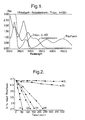
- Figure 1 shows UV spectra of riboflavin, Triton-X-100 (RTM) and sulisobenzone in doubly distilled water.
- Figure 2 shows the photodegradation kinetics of the preparations of examples 1, 2 and 4.
- Figure 3 shows the photodegradation kinetics of the preparations of examples 5 and 6.
- Figure 4 shows the percentage entrapments and stabilisation ratios of liposomes comprising different ratios of phosphatidylcholine and cholesterol.
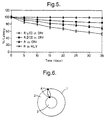
- Figure 5 shows the latency (% retention of riboflavin) values of various liposome preparations.
- Figure 6 shows a diagrammatic representation of the present invention.
- the present invention provides stabilised photosensitive materials and methods for their preparation.
- UVA 320-400nm
- UVB 290-320nm
- Protection is brought about by the absorption of the relevant photons by the chromophore in the sunscreen agent.
- photosensitive materials can be incorporated into cyclodextrins, eg by forming inclusion complexes as described in Andersen F and Bundgarrd H (1984) Int J Pharm 19: pp 189-192.
- FR2624374 discloses a preparation for introducing an active substance for regulating the tanning of the skin into the epidermis, the active substance being at least partly within a liposome.
- FR2624374 discloses a composition comprising a material retained within the liposome and an agent capable of increasing photostability.
- FR2482182 discloses a composition comprising a material retained within the liposome and an agent capable of increasing photostability.
- a composition comprises a photosensitive material retained within a liposome and an agent capable of increasing photostabilisation of the composition, characterised in that the agent is associated with the lipid phase of the membrane of the liposome.
- the material to be stabilised by use of the compositions of the present invention is any that may suitably be incorporated into the liposome. This method is particularly useful for the stabilisation of photosensitive materials such as pharmaceuticals or vitamins, eg riboflavin, riboflavin-5'-(dihydrogen-phosphate) or a salt thereof.
- Photosensitive materials such as pharmaceuticals or vitamins, eg riboflavin, riboflavin-5'-(dihydrogen-phosphate) or a salt thereof.
- Organic material, eg organisms may also be photosensitive materials which could be photostabilised by incorporation into liposomes of the present invention.
- the liposome may suitably be multilamellar, eg liposomes prepared by the dehydration/rehydration technique, DRVs. These have the advantage of having high yield entrapment values, up to 80% or more. Giant liposomes such as unilamellar giant liposomes capable of entrapping live bacteria may also be utilised in the performance of the present invention. One method of producing such liposomes is described in PCT Patent Application Number WO 95/09610. It is expected that multilamellar liposomes also comprise a number of unilamellar liposomes.
- the agent is associated with the lipid phase of the membrane but alternatively more than one agent may be included and these may be associated with the same or different phases of the liposome.
- the liposomes may be formed from any suitable lipid components, with optional additional components, eg sterols such as cholesterols.
- sterols such as cholesterols.
- Cholesterol enhances the stability of liposomes by inhibiting the movement of acylated chains and increasing the thickness of the bilayers.
- the agent comprises a light absorbing material.
- the light absorbing material may suitably be any material capable of absorbing some or all visible and/or ultraviolet (UV) light.
- Preferred light absorbers are those that absorb UV.
- Light absorbing materials include chemical absorbers and physical blockers of UV radiation.
- Chemical absorbers are generally aromatic compounds conjugated with a carbonyl group. In many cases an electron-releasing group (an amine or methoxyl group) is substituted in the ortho- or para-position of the aromatic ring. Chemicals of this configuration absorb the harmful shortwave (high energy) UV rays (250-340nm) and convert the remaining energy into innocuous longer wave (low energy) radiation (usually above 380nm). They are excited from their ground state to a higher energy state by the absorption of the UV radiation. As the excited molecule returns to its ground state energy is emitted which is lower in magnitude (longer wavelengths) than the energy initially absorbed to cause the excitation.
- Chemical absorbers are characterised not only by their chemical properties but also by their solubility in hydrophobic (oil Red 0, oxybenzone, deoxybenzone) and hydrophilic (sulisobenzone) substances as well.
- Physical blockers reflect or scatter the ultraviolet, visible and infrared rays and usually include metal oxides.
- Antioxidants such as beta carotene quench both singlet oxygen driven photochemical reactions and free radical reactions.
- suitable light absorbing materials include azo compounds such as oil Red 0 (solvent red 27; CI26125; 1-[ ⁇ 4-[xylylazo]xylyl ⁇ -azo]-2-naphthol), and benzones such as sulisobenzone (5-benzoyl-4-hydroxy-2-methoxy-benzenesulphonic acid), oxybenzone (2-hydroxy-4-methoxy-benzophenone) and deoxybenzone (4-methoxyphenone).
- azo compounds such as oil Red 0 (solvent red 27; CI26125; 1-[ ⁇ 4-[xylylazo]xylyl ⁇ -azo]-2-naphthol)
- benzones such as sulisobenzone (5-benzoyl-4-hydroxy-2-methoxy-benzenesulphonic acid), oxybenzone (2-hydroxy-4-methoxy-benzophenone) and deoxybenzone (4-methoxyphenone).
- sulisobenzone 5-benz
- the agent comprises a compound capable of forming an inclusion complex with the photosensitive material.
- Any compound capable of forming a suitable inclusion complex with the photosensitive material may be used.
- suitable compounds are the cyclodextrins, these being cyclic oligosaccharides composed of at least six ⁇ 1 ⁇ 4 linked D-glucose units with a cavity of fixed size and shape which are capable of forming an inclusion complexes with a variety of materials.
- the term cyclodextrins will be understood to include cyclodextrins and their derivatives, eg ether, ester and amide derivatives.
- Suitable cyclodextrins include ⁇ -cyclodextrin, gamma cyclodextrin, hydroxy-propyl-cyclodextrin, methyl- ⁇ -cyclodextrin and polymer- ⁇ -cyclodextrin.
- One embodiment of the present invention comprises sufficient cyclodextrin to form an inclusion complex comprising ⁇ -cyclodextrin or hydroxypropyl-cyclodextrin in molar ratio photosensitive material:cyclodextrin of 1: 1.
- a further embodiment comprises sufficient cyclodextrin to form an inclusion complex comprising gamma-cyclodextrin, hydroxypropyl-cyclodextrin and polymer- ⁇ -cyclodextrin in molar ratio photosensitive compound:cyclodextrin of 1:2 or 1:1.
- a still further embodiment comprises polymer- ⁇ -cyclodextrin with molecular weight between 4000 and 4500 as the agent capable of forming an inclusion complex with the photosensitive material.
- the agent comprises an antioxidant.
- Suitable antioxidants will be apparent to the person skilled in the art.
- One such suitable agent is beta-carotene.
- the invention also provides embodiments in which two or more agents are included, selected from light absorbing agents, compounds capable of forming inclusion compounds and antioxidants.
- a preferred embodiment of the invention combines the agents described in the first three aspects of the invention in order to express simultaneously and dynamically their protective effect. This may be achieved by using multilamellar vesicles comprising a hydrophilic cyclodextrin capable of forming an inclusion complex with the photosensitive material in the aqueous phase and a combination of light absorbing and antioxidant agents in the lipid bilayer.
- the present invention also provides methods of producing a composition as described above the method comprising the incorporation of a photosensitive material and an agent capable of increasing photostability into a liposome, wherein the agent comprises at least one of a light absorbing material, an antioxidant and a light blocking material, and wherein said agent is associated with the lipid phase of the membrane of the liposome; in particular methods wherein the liposome is prepared by a dehydration rehydration technique.
- step (a) Any suitable organic solvent may be used in step (a), eg chloroform.
- the solvent may suitably be evaporated by rotary evaporation.
- Dispersion in step (c) may be performed by any suitable method, a preferred method being sonication, using an ultrasonic probe.
- the photosensitive material is added in step (c) or on rehydration after further dehydration.
- the photosensitive material may be added in aqueous solution or it may be added in the form of an inclusion complex.
- the liposomes formed may be freeze dried and the resulting pellets or powder stored until further required when they can be rehydrated.
- the present invention further provides pharmaceutical mixtures comprising a composition as described above together with a physiologically acceptable carrier, suitable for administering to a living organism preferably compositions suitable for administering to humans. Furthermore the invention provides pharmaceutical mixtures comprising a composition as described above together with a physiologically acceptable carrier characterised in that it is suitable for administration to a human by injection, orally, inhalation or topical administration.
- Suitable physiologically acceptable carriers to be included in such compositions will occur to those skilled in the art, eg saline solutions.
- Vitamin B 2 riboflavin
- riboflavin is not affected by visible or ultraviolet light, irradiation causes it to rapidly decompose in aqueous solutions with the subsequent formation of lumichrome and/or lumiflavin. This occurs at a rate of 2.4 x 10 -2 min -1 , the compound having a half life of about 30 mins.
- Riboflavin has maximum absorptions in UV and visible range of 222, 266, 373 and 444nm as shown in Figure 1 and when it degrades there is a resultant decrease in absorbance at 444nm which provides a suitable point at which to study its photodegradation.
- the inventors have used the sodium salt of riboflavin phosphate as a suitable model light sensitive agent.
- the suspension was probe sonicated 15 times at 4°C, each time for one minute with 30 second intervals.
- the sonicated suspension containing small unilamellar vesicles (SUV) was centrifuged at 4000rpm for ten minutes to isolate contaminating titanium fragments derived from the sonicator probe which were discarded.
- 5ml of an aqueous solution of riboflavin was added and the resulting suspension flushed with nitrogen before being freeze dried overnight. It was then rehydrated with 0.1ml double distilled water followed by 0.1ml PBS buffer and allowed to stand for at least an hour at 20°C in order to complete the rehydration.
- Liposomes containing the lipid soluble oil Red 0 were prepared by mixing oil Red 0 (obtained from Sigma Chemicals) with the phosphatidyl choline and cholesterol at the start of the procedure.
- Liposomes containing an aqueous soluble light absorbing agent sulisobenzone were prepared by adding sulisobenzone (also obtained from Sigma Chemicals) at the same time as the riboflavin-5'-dihydrogen phosphate monosodium salt (obtained from Aldrich Chemical Company). Further liposomes were prepared comprising both these agents together with the riboflavin. The different preparations produced are shown below in Table 1.
- DRV LIPOSOMES CONTAINING RIBOFLAVIN AND LIGHT ABSORBING AGENTS DRV Formln Egg PC (mg) Cholesterol (mg) Riboflavin (mg) Oil Red 0 (mg) Sulisobenzone (mg) 1 10 5 0.66 - - 2 10 5 0.66 0.72 - 3 10 5 0.66 - 0.75 4 10 5 0.66 0.72 0.75
- riboflavin and light absorbing agents in liposomes were calculated by UV or fluorescence.
- a known amount of liposome suspension was dissolved in Triton-X-100 (RTM) (obtained from Sigma Chemicals) at 70°C, a known amount of distilled water added and the absorbance (A) of riboflavin or light absorbing agent measured.
- riboflavin 24mg/ml
- a cyclodextrin or derivative both obtained from Wacker Chemie
- Betacyclodextrin was added to the first portion and hydroxy- ⁇ -cyclodextrin to the second, each providing a molar ratio (drug: cyclodextrin) of 1:1.
- Hydroxypropyl-cyclodextrin was added to the third portion, methyl- ⁇ -cyclodextrin to the fourth and polymer ⁇ -cyclodextrin (average molecular weight 4000-4500) to the last; each to provide a molar ratio (drug:cyclodextrin) of 1:2.
- the resulting solutions were stirred in the dark at room temperature for two days after which time the clear yellow solutions obtained were frozen at - 40°C and freeze dried overnight.
- the preparations produced according to the methods of Examples 1 and 2 were exposed to UV irradiation as follows: 3ml of the solutions, liposome suspensions or complexes in solution were placed in a 1 x 1 x4cm 3 cuvette cell (1cm path length) and irradiated from the side at a fixed distance of 3cm with a UV lamp (254/365nm) at 24°C+/-1. At time intervals a known amount of the solution or suspension was diluted with double distilled water and the absorbance or fluorescence measured.
- Equation (2) The graphic representation of Equation (2) is linear and the slope of the line gives the photodegradation rate constant k.
- k was calculated according to a linear least-square regression analysis of equation (2).
- the increase in stability was expressed by the stabilization ratio, (k 0 /k), where k 0 is the photodegradation constant of free riboflavin in aqueous solution and k the photodegradation rate constant of the various preparations.
- Riboflavin gamma-cyclodextrin inclusion complexes were entrapped in DRV incorporating a light absorbing agent or antioxidant in their lipid phase selected from: oil Red 0, oxybenzone, deoxybenzone and beta-carotene or combinations thereof.
- the resulting liposomes were exposed to UV light (254/365nm) and their photodegradation at different time intervals monitored spectrophotometrically (excitation 445nm, emission 520nm). As in the previous examples this degradation followed first order kinetics represented by the equations given earlier.
- Example 1 The method of Example 1 was repeated with a few alterations.
- the freeze dried material was rehydrated in 1 ml of double distilled water rather than 0.1 ml by vortexing, with the resulting suspension then being allowed to stand for 30 minutes at room temperature after which 1ml of PBS was added followed by a further 6ml PBS.
- the suspension was centrifuged at 20,000rpm at 4°C to remove any untrapped material and this process repeated three times and the three supernatants collected.
- the resulting pellets were stored and later resuspended and used in the photodegradation study of Example 7.
- Entrapment values of the liposomal preparations formed by the methods of Examples 5 to 7 were determined as follows: entrapment values for liposome preparations comprising light absorbers were determined by derivative ultraviolet spectroscopy; for riboflavin by fluorescence and for cyclodextrins (complexed riboflavin) by 1 H NMR in D 2 0.
- riboflavin and cyclodextrins provided direct access to the stoichometry coefficient enabling the amount of unetrapped cyclodextrin to be determined.
- This method of calculating entrapment has the advantage that it separates the hydrophobic from the hydrophilic materials.
- the entrapment of riboflavin was first calculated in the aqueous phase fluorimetrically. The resulting values were confirmed by measuring the entrapped riboflavin in liposomal pellets directly, after dilution with Triton-X-100, both values were the same with a deviation of ⁇ 2%.
- the molar ratio R:CD in the aqueous phase was measured by integrating the anomeric protons of CDs (H1 protons, 7 in ⁇ -cyclodextrin, 8 and gamma-cyclodextrin) with the phenyl protons of riboflavin (two protons).
- the 1:1 molar ratio in the aqueous phase indicated that the riboflavin was entrapped in liposomes as a 1:1 complex. If the molar ratio of the complexes riboflavin:cyclodextrin was not 1:1, possible interaction in the liposomes would be expected.
- Example 5 The preparations of Examples 5 and 6 were exposed to UV light as described in Example 3 and their photodegradation studied.
- Tables 7 and 8 below show the percentage of entrapment in the preparations of Examples 5 to 6, together with their photodegradation rate constants, stabilization ratios and correlation coefficients r of the kinetic studies.
- the results are illustrated in Figure 3, wherein (0) denotes free riboflavin, (•) free riboflavin in DRV,( ⁇ ) 1:1 riboflavin: gamma-cyclodextrin complex, ( ⁇ ) free riboflavin co-entrapped in DRV with oil Red 0, ( ⁇ ) riboflavin: gamma-cyclodextrin complex, co-entrapped in DRV with oil Red 0, ( ⁇ ) riboflavin:gamma-cyclodextrin complex, co-entrapped in DRV with oil Red 0, oxybenzone and deoxybenzone, ( ⁇ ) riboflavin: gamma-cyclodextrin complex, co-entrapped in DRV with oil Red 0, oxybenzone, deoxy
- r.f. F (+) /F (-)
- F (+) is the fluorescence of riboflavin in the presence of oil Red 0
- F (-) is the fluorescence of riboflavin in the absence of oil Red 0.
- DSPC Distearoyl-phosphatidylcholine
- Cholesterol enhances the stability of liposomes by inhibiting the movement of acylated chains and increasing the thickness of the bilayers. Above the transition temperature (except when DSPC is present) cholesterol diminishes fluidity resulting in a considerable reduction in riboflavin release, increasing the stabilisation ratio. Increasing the amount of cholesterol to 1:1 (phospholipid: cholesterol) increased the entrapment value with a simultaneous increase in stabilistion. Molar ratio of phosphatidyl choline: cholesterol of 1:2 had no effect on the entrapment values or the stabilisation ratio. Substitution of the unsaturated lipid PC with saturated DSPC in the DRV preparations did not increase the stabilisation ratio. The light absorbing compounds appear to be responsible for the protection of the riboflavin and also for the prevention of UV driven oxidation of the lipids.
- DRV liposomes were prepared by adding an aqueous solution of vitamin before the freeze drying step, further DRV liposomes were prepared by adding the vitamin solution during the rehydration procedure. In the second case a considerable decrease in entrapment values was observed but the stabilisation values remained almost the same. The close contact of the phospholipid membranes of the SUV liposomes (obtained after sonication) with the vitamin to be entrapped during the freezing and freeze drying periods appear to be a factor in the achievement of the highest entrapment values.
- MLV liposomes were prepared in this way and were frozen and freeze dried, while all the other conditions were maintained. A considerable decrease in entrapment values was observed followed by a slight decrease stabilisation ratio.
- Figure 5 shows the latency values of various liposome preparations, ie the retention of riboflavin in the preparations in PBS. At various time intervals a known amount of the pellet suspensions were centrifuged in order to remove unentrapped riboflavin and calculations of the percentage entrapped riboflavin (latency) were made using either the supernatants or the pellets after destruction with Triton-X-100. Measurements were made in triplicate. As can be seen from Figure 5 the release of free riboflavin from the liposomes was very fast from the MLV preparations and slower from the DRV preparations. When riboflavin was complexed with cyclodextrins the latency increased, particularly when complexed with gamma-cyclodextrin.
- the incorporation of the antioxidant betacarotene with several lipid soluble light absorbers further increased the photostability of the vitamin. It is thought that the antioxidant was responsible for inhibiting UV radical mediated photoresponse as well as protecting the lipids of the liposome from oxidation.
- Cyclodextrin inclusion complexes of riboflavin provided some increase in its photostability. When these were incorporated into the aqueous phase of the DRV liposomes and lipid soluble light absorbers and an antioxidant incorporated into the lipid bilayer a very high level of photostability was achieved, having a k value of 9.2 x 10 -5 min -1 . The half life of riboflavin was thus increased from 30 minutes to 5.5 days.
- cyclodextrins have a double role in this stabilisation. They provide protection from light and also direct hydrophobic compounds in the form of complexes into the aqueous phase of the DRV liposomes. This has the advantage of separating the compound from the lipid soluble light absorbers dynamically expanding their protective effect and increasing the latency of the compounds included in the liposomes.
- the composition comprises a liposome 1, comprising a lipid bilayer 2 (membrane) and a cavity 3.
- the lipid bilayer is made up of lipid molecules 4, eg phospholipids (two only shown).
- Within the cavity 3 is located at least one material which may be of a photosensitive nature such as an organism or a vitamin. The material may also be present as an inclusion complex with a cyclodextrin.
- the agent may also be located between the bilayers in one or more aqueous phases, or in any combination of aqueous and lipid phases.
Landscapes
- Health & Medical Sciences (AREA)
- Chemical & Material Sciences (AREA)
- Dispersion Chemistry (AREA)
- Medicinal Chemistry (AREA)
- Pharmacology & Pharmacy (AREA)
- Epidemiology (AREA)
- Life Sciences & Earth Sciences (AREA)
- Animal Behavior & Ethology (AREA)
- General Health & Medical Sciences (AREA)
- Public Health (AREA)
- Veterinary Medicine (AREA)
- Medicinal Preparation (AREA)
Claims (22)
- Zusammensetzung, die ein fotoempfindliches Material, das in einem Liposom festgehalten wird, und ein Mittel, das die Fotostabilität erhöhen kann, enthält, dadurch gekennzeichnet, dass das Mittel mit der Lipidphase der Membran des Liposoms assoziiert ist.
- Zusammensetzung nach Anspruch 1, wobei das Mittel mindestens ein unter einem lichtabsorbierenden Material und einem Antioxidans ausgewähltes Material enthält.
- Zusammensetzung nach entweder Anspruch 1 oder Anspruch 2, wobei das Liposom ein mehrschichtiges Liposom ist.
- Zusammensetzung nach Anspruch 1 oder Anspruch 2, wobei das Liposom ein Dehydratations-Rehydratations-Vesikel ist.
- Zusammensetzung nach einem der vorhergehenden Ansprüche, wobei die Membran des Liposoms Cholesterin enthält.
- Zusammensetzung nach einem der Ansprüche 2 bis 5, wobei das lichtabsorbierende Material unter 1-[{4-[Xylylazo]xylyl}-azo]-2-naphthol, 5-Benzoyl-4-hydroxy-2-methoxybenzolsulphonsäure, 2-Hydroxy-4-methoxybenzophenon und 4-Methoxyphenon ausgewählt ist.
- Zusammensetzung nach einem der Ansprüche 2 bis 6, wobei das Antioxidans β-Carotin ist.
- Zusammensetzung nach einem der vorhergehenden Ansprüche, wobei die Zusammensetzung eine Verbindung enthält, die mit dem fotoempfindlichen Material eine Einschlussverbindung bilden kann.
- Zusammensetzung nach Anspruch 8, wobei die Verbindung, die mit dem fotoempfindlichen Material eine Einschlussverbindung bilden kann, ein Cyclodextrin ist.
- Zusammensetzung nach Anspruch 9, wobei das Cyclodextrin unter β-Cyclodextrin, γ-Cyclodextrin, Hydroxypropylcyclodextrin, Methyl-β-cyclodextrin und Polymer-β-Cyclodextrin ausgewählt ist.
- Zusammensetzung nach einem der vorhergehenden Ansprüche, wobei das fotoempfindliche Material einen pharmazeutischen Wirkstoff enthält.
- Zusammensetzung nach einem der Ansprüche 1 bis 10, wobei das fotoempfindliche Material ein Vitamin enthält.
- Zusammensetzung nach Anspruch 12, wobei das fotoempfindliche Material Riboflavin, Riboflavin-5'-(dihydrogen-phosphat) oder ein Salz davon enthält.
- Verfahren zur Herstellung einer Zusammensetzung nach einem der vorhergehenden Ansprüche, wobei das Verfahren die Einarbeitung eines fotoempfindlichen Materials und eines Mittels, das die Fotostabilität erhöhen kann, in ein Liposom umfasst, wobei das Mittel mindestens ein unter einem lichtabsorbierenden Material, einem Antioxidans und einem lichtblockierenden Material ausgewähltes Material enthält, und wobei das Mittel mit der Lipidphase der Membran des Liposoms assoziiert ist.
- Verfahren nach Anspruch 14, umfassend:dadurch gekennzeichnet, dass in Schritt (a) ein Mittel zugesetzt wird, das die Fotostabilisierung bewirken kann, und dass das fotoempfindliche Material in Schritt (c) oder bei Rehydratation nach weiterer Dehydratation zugesetzt wird.(a) Mischen der Komponenten, aus denen das Liposom gebildet werden soll, in Gegenwart eines anorganischen Lösungsmittels;(b) Eindampfen des Lösungsmittels;(c) Dispergieren des in Wasser gebildeten Films und Isolieren der so hergestellten Liposomen,
- Verfahren nach Anspruch 15, wobei das fotoempfindliche Material vor seiner Zugabe in Form einer Einschlussverbindung vorliegt.
- Verfahren nach Anspruch 15 oder 16, wobei der Film durch Ultrabeschallung dispergiert wird.
- Verfahren nach einem der Ansprüche 15 bis 17, wobei die gebildeten Liposomen gefriergetrocknet werden.
- Pharmazeutische Zusammensetzung, die zur Injektion in einen lebenden Organismus geeignet ist, enthaltend eine Zusammensetzung nach einem der Ansprüche 1 bis 13 und einen physiologisch verträglichen Träger.
- Pharmazeutische Zusammensetzung, die zur Injektion in einen Menschen geeignet ist, enthaltend eine Zusammensetzung nach einem der Ansprüche 1 bis 13 und einen physiologisch verträglichen Träger.
- Pharmazeutische Zusammensetzung, enthaltend eine Zusammensetzung nach einem der Ansprüche 1 bis 13 und einen physiologisch verträglichen Träger, dadurch gekennzeichnet, dass sie zur Verabreichung an Menschen durch Inhalation geeignet ist.
- Pharmazeutische Zusammensetzung, enthaltend eine Zusammensetzung nach einem der Ansprüche 1 bis 13 und einen physiologisch verträglichen Träger, dadurch gekennzeichnet, dass sie zur topischen Verabreichung an einen Menschen geeignet ist.
Applications Claiming Priority (3)
| Application Number | Priority Date | Filing Date | Title |
|---|---|---|---|
| GB9411115 | 1994-06-03 | ||
| GB9411115A GB9411115D0 (en) | 1994-06-03 | 1994-06-03 | Stabilisation of photosensitive material |
| PCT/GB1995/001258 WO1995033448A1 (en) | 1994-06-03 | 1995-06-01 | Stabilisation of photosensitive materials |
Publications (2)
| Publication Number | Publication Date |
|---|---|
| EP0762871A1 EP0762871A1 (de) | 1997-03-19 |
| EP0762871B1 true EP0762871B1 (de) | 2003-08-13 |
Family
ID=10756127
Family Applications (1)
| Application Number | Title | Priority Date | Filing Date |
|---|---|---|---|
| EP95921012A Expired - Lifetime EP0762871B1 (de) | 1994-06-03 | 1995-06-01 | Stabilisierung lichtempfindlicher materialien |
Country Status (9)
| Country | Link |
|---|---|
| US (1) | US6379697B1 (de) |
| EP (1) | EP0762871B1 (de) |
| JP (1) | JPH11503714A (de) |
| AU (1) | AU695773B2 (de) |
| CA (1) | CA2191863A1 (de) |
| DE (1) | DE69531492T2 (de) |
| GB (2) | GB9411115D0 (de) |
| WO (1) | WO1995033448A1 (de) |
| ZA (1) | ZA954577B (de) |
Families Citing this family (18)
| Publication number | Priority date | Publication date | Assignee | Title |
|---|---|---|---|---|
| FR2771636B1 (fr) * | 1997-12-01 | 2001-06-15 | Capsulis | Procede perfectionne pour eviter la degradation d'un principe actif |
| FR2771635A1 (fr) * | 1997-12-01 | 1999-06-04 | Capsulis | Procede perfectionne pour eviter la degradation d'un principe actif |
| US9044523B2 (en) * | 2000-06-15 | 2015-06-02 | Terumo Bct, Inc. | Reduction of contaminants in blood and blood products using photosensitizers and peak wavelengths of light |
| TW200726485A (en) * | 2005-07-01 | 2007-07-16 | Alza Corp | Liposomal delivery vehicle for hydrophobic drugs |
| US20070055199A1 (en) * | 2005-08-10 | 2007-03-08 | Gilbert Scott J | Drug delivery device for buccal and aural applications and other areas of the body difficult to access |
| AU2006327566A1 (en) * | 2005-12-02 | 2007-06-28 | Alembic Limited | Stabilized pharmaceutical composition of pramipexole and method of preparation thereof |
| WO2007078060A1 (en) * | 2005-12-30 | 2007-07-12 | Amorepacific Corporation | Polymer-liposome nano-complexes and the preparation method thereof, and the composition of skin external application containing the same |
| BRPI0821647A2 (pt) * | 2007-12-21 | 2015-06-16 | Schering Plough Healthcare | Realce da fotosestabillização de oximetazolina |
| US8148414B2 (en) | 2008-08-19 | 2012-04-03 | Xenoport, Inc. | Prodrugs of methyl hydrogen fumarate, pharmaceutical compositions thereof, and methods of use |
| WO2011161658A1 (en) | 2010-06-25 | 2011-12-29 | Firmenich Sa | Ingredient delivery system |
| AU2013305684B2 (en) | 2012-08-22 | 2016-11-24 | Xenoport, Inc. | Oral dosage forms of methyl hydrogen fumarate and prodrugs thereof |
| WO2014031844A1 (en) | 2012-08-22 | 2014-02-27 | Xenoport, Inc. | Methods of administering monomethyl fumarate and prodrugs thereof having reduced side effects |
| US10179118B2 (en) | 2013-03-24 | 2019-01-15 | Arbor Pharmaceuticals, Llc | Pharmaceutical compositions of dimethyl fumarate |
| US9302977B2 (en) | 2013-06-07 | 2016-04-05 | Xenoport, Inc. | Method of making monomethyl fumarate |
| US9421182B2 (en) | 2013-06-21 | 2016-08-23 | Xenoport, Inc. | Cocrystals of dimethyl fumarate |
| EP3041467A1 (de) | 2013-09-06 | 2016-07-13 | XenoPort, Inc. | Kristalline formen von (n,n-diethylcarbamoyl) methyl-methyl(2e)but-2-en-1,4-dioat, syntheseverfahren und verwendung |
| US9999672B2 (en) | 2014-03-24 | 2018-06-19 | Xenoport, Inc. | Pharmaceutical compositions of fumaric acid esters |
| WO2016174688A1 (en) | 2015-04-29 | 2016-11-03 | Sooft Italia Spa | Improved cross-linking agents of collagen fibers for the use in the treatment of corneal ectasia |
Family Cites Families (15)
| Publication number | Priority date | Publication date | Assignee | Title |
|---|---|---|---|---|
| DE272793C (de) * | ||||
| CA1044134A (en) * | 1975-04-09 | 1978-12-12 | Minnesota Mining And Manufacturing Company | Microcapsule insecticide composition |
| JPS603045B2 (ja) * | 1976-04-19 | 1985-01-25 | 中外製薬株式会社 | 1α―ヒドロキシビタミンD類軟カプセルの製造方法 |
| FR2482128A1 (fr) * | 1979-09-18 | 1981-11-13 | Oreal | Nouveaux tensio-actifs non ioniques, leur procede de preparation et composition les contenant |
| EP0143857B1 (de) * | 1983-11-30 | 1988-04-06 | Siegfried Aktiengesellschaft | Coronartherapeutikum in Form von Weichgelatine-Kapseln |
| DE3526546A1 (de) * | 1985-07-25 | 1987-01-29 | Scherer Gmbh R P | Lichtbestaendige opakisierte gelatinekapseln und verfahren zur herstellung derselben |
| DE3532129A1 (de) * | 1985-09-10 | 1987-03-12 | Bayer Ag | Ss-carotin enthaltende gelatine |
| FR2591105B1 (fr) * | 1985-12-11 | 1989-03-24 | Moet Hennessy Rech | Composition pharmaceutique, notamment dermatologique, ou cosmetique, a base de phases lamellaires lipidiques hydratees ou de liposomes contenant un retinoide ou un analogue structural dudit retinoide tel qu'un carotenoide. |
| EP0261719A3 (de) * | 1986-09-23 | 1990-10-10 | Akzo N.V. | Thermochemischlumineszierende Komplexe von Cyclodextrinen |
| US5811119A (en) * | 1987-05-19 | 1998-09-22 | Board Of Regents, The University Of Texas | Formulation and use of carotenoids in treatment of cancer |
| CH675967A5 (de) * | 1987-12-09 | 1990-11-30 | Induchem Ag | |
| WO1991007168A1 (en) * | 1989-11-09 | 1991-05-30 | Schering-Plough Healthcare Products, Inc. | Riboflavin as a tanning enhancer |
| HUT59592A (en) * | 1990-07-20 | 1992-06-29 | Egyt Gyogyszervegyeszeti Gyar | Process for the preparation of solid medical products |
| GB9126209D0 (en) * | 1991-12-10 | 1992-02-12 | Orion Yhtymae Oy | Drug formulations for parenteral use |
| US6764693B1 (en) * | 1992-12-11 | 2004-07-20 | Amaox, Ltd. | Free radical quenching composition and a method to increase intracellular and/or extracellular antioxidants |
-
1994
- 1994-06-03 GB GB9411115A patent/GB9411115D0/en active Pending
-
1995
- 1995-06-01 WO PCT/GB1995/001258 patent/WO1995033448A1/en not_active Ceased
- 1995-06-01 GB GB9624523A patent/GB2302505B/en not_active Revoked
- 1995-06-01 JP JP8500528A patent/JPH11503714A/ja active Pending
- 1995-06-01 EP EP95921012A patent/EP0762871B1/de not_active Expired - Lifetime
- 1995-06-01 AU AU26226/95A patent/AU695773B2/en not_active Ceased
- 1995-06-01 CA CA002191863A patent/CA2191863A1/en not_active Abandoned
- 1995-06-01 US US08/750,269 patent/US6379697B1/en not_active Expired - Fee Related
- 1995-06-01 DE DE69531492T patent/DE69531492T2/de not_active Expired - Lifetime
- 1995-06-02 ZA ZA954577A patent/ZA954577B/xx unknown
Also Published As
| Publication number | Publication date |
|---|---|
| AU2622695A (en) | 1996-01-04 |
| DE69531492D1 (de) | 2003-09-18 |
| GB2302505A (en) | 1997-01-22 |
| AU695773B2 (en) | 1998-08-20 |
| JPH11503714A (ja) | 1999-03-30 |
| GB2302505B (en) | 1998-06-24 |
| US6379697B1 (en) | 2002-04-30 |
| GB9624523D0 (en) | 1997-01-15 |
| WO1995033448A1 (en) | 1995-12-14 |
| GB9411115D0 (en) | 1994-07-27 |
| DE69531492T2 (de) | 2004-07-01 |
| EP0762871A1 (de) | 1997-03-19 |
| ZA954577B (en) | 1996-01-26 |
| CA2191863A1 (en) | 1995-12-14 |
Similar Documents
| Publication | Publication Date | Title |
|---|---|---|
| EP0762871B1 (de) | Stabilisierung lichtempfindlicher materialien | |
| Loukas et al. | Novel liposome-based multicomponent systems for the protection of photolabile agents | |
| AU717181B2 (en) | Methods of making liposomes containing hydro-monobenzoporphyrin photosensitizers | |
| US5389378A (en) | Benzoporphyrin vesicles and their use in photodynamic therapy | |
| EP3025732B1 (de) | Hyalurosome, deren verwendung in topischen kosmetischen oder pharmazeutischen zusammensetzungen und deren herstellungsverfahren | |
| CA2536977A1 (en) | Non-polar photosensitizer formulations for photodynamic therapy | |
| AU2009248673A1 (en) | Liposomes for drug delivery and methods for preparation thereof | |
| US11759424B2 (en) | High-efficiency encapsulation of hydrophilic compounds in unilamellar liposomes | |
| Loukas et al. | Characterization and Photoprotection Studies of a Model. gamma.-Cyclodextrin-Included Photolabile Drug Entrapped in Liposomes Incorporating Light Absorbers | |
| Xu et al. | CDBA-liposome as an effective sunscreen with longer UV protection and longer shelf life | |
| US20090324709A1 (en) | Liposomal formulations | |
| Mancuso et al. | Assessing effectiveness of multistage nanomedicines for multidrug therapy of vitiligo | |
| CA2466103C (en) | Micelle compositions containing pegylated phospholipids and a photosensitizer | |
| Loukas et al. | Entrapment of Sodium Ascorbate–α‐Cyclodextrin Inclusion Complex in Multilamellar Liposomes Containing Light Absorbers, Greatly Increases the Stability of the Vitamin Against Photochemical Oxidation | |
| CN102406552A (zh) | 一种包含护肤成分的智能化光释脂质体、用途及其制备方法 | |
| US10716758B2 (en) | Liposomal statin formulation | |
| RU2428981C1 (ru) | Средство для фотодинамической терапии, способ получения предлагаемого средства и способ проведения фотодинамической терапии с использованием предлагаемого средства | |
| ES2241488B1 (es) | Formulaciones liposomales. |
Legal Events
| Date | Code | Title | Description |
|---|---|---|---|
| PUAI | Public reference made under article 153(3) epc to a published international application that has entered the european phase |
Free format text: ORIGINAL CODE: 0009012 |
|
| 17P | Request for examination filed |
Effective date: 19961128 |
|
| AK | Designated contracting states |
Kind code of ref document: A1 Designated state(s): BE CH DE ES FR GB IT LI NL SE |
|
| 17Q | First examination report despatched |
Effective date: 19991220 |
|
| GRAH | Despatch of communication of intention to grant a patent |
Free format text: ORIGINAL CODE: EPIDOS IGRA |
|
| GRAH | Despatch of communication of intention to grant a patent |
Free format text: ORIGINAL CODE: EPIDOS IGRA |
|
| GRAA | (expected) grant |
Free format text: ORIGINAL CODE: 0009210 |
|
| AK | Designated contracting states |
Designated state(s): BE CH DE ES FR GB IT LI NL SE |
|
| PG25 | Lapsed in a contracting state [announced via postgrant information from national office to epo] |
Ref country code: NL Free format text: LAPSE BECAUSE OF FAILURE TO SUBMIT A TRANSLATION OF THE DESCRIPTION OR TO PAY THE FEE WITHIN THE PRESCRIBED TIME-LIMIT Effective date: 20030813 Ref country code: LI Free format text: LAPSE BECAUSE OF FAILURE TO SUBMIT A TRANSLATION OF THE DESCRIPTION OR TO PAY THE FEE WITHIN THE PRESCRIBED TIME-LIMIT Effective date: 20030813 Ref country code: CH Free format text: LAPSE BECAUSE OF FAILURE TO SUBMIT A TRANSLATION OF THE DESCRIPTION OR TO PAY THE FEE WITHIN THE PRESCRIBED TIME-LIMIT Effective date: 20030813 Ref country code: BE Free format text: LAPSE BECAUSE OF FAILURE TO SUBMIT A TRANSLATION OF THE DESCRIPTION OR TO PAY THE FEE WITHIN THE PRESCRIBED TIME-LIMIT Effective date: 20030813 |
|
| REG | Reference to a national code |
Ref country code: GB Ref legal event code: FG4D |
|
| REG | Reference to a national code |
Ref country code: CH Ref legal event code: EP |
|
| REF | Corresponds to: |
Ref document number: 69531492 Country of ref document: DE Date of ref document: 20030918 Kind code of ref document: P |
|
| PG25 | Lapsed in a contracting state [announced via postgrant information from national office to epo] |
Ref country code: SE Free format text: LAPSE BECAUSE OF FAILURE TO SUBMIT A TRANSLATION OF THE DESCRIPTION OR TO PAY THE FEE WITHIN THE PRESCRIBED TIME-LIMIT Effective date: 20031113 |
|
| PG25 | Lapsed in a contracting state [announced via postgrant information from national office to epo] |
Ref country code: ES Free format text: LAPSE BECAUSE OF FAILURE TO SUBMIT A TRANSLATION OF THE DESCRIPTION OR TO PAY THE FEE WITHIN THE PRESCRIBED TIME-LIMIT Effective date: 20031124 |
|
| NLV1 | Nl: lapsed or annulled due to failure to fulfill the requirements of art. 29p and 29m of the patents act | ||
| ET | Fr: translation filed | ||
| REG | Reference to a national code |
Ref country code: CH Ref legal event code: PL |
|
| PLBE | No opposition filed within time limit |
Free format text: ORIGINAL CODE: 0009261 |
|
| STAA | Information on the status of an ep patent application or granted ep patent |
Free format text: STATUS: NO OPPOSITION FILED WITHIN TIME LIMIT |
|
| 26N | No opposition filed |
Effective date: 20040514 |
|
| PGFP | Annual fee paid to national office [announced via postgrant information from national office to epo] |
Ref country code: DE Payment date: 20120622 Year of fee payment: 18 |
|
| PGFP | Annual fee paid to national office [announced via postgrant information from national office to epo] |
Ref country code: FR Payment date: 20120705 Year of fee payment: 18 Ref country code: GB Payment date: 20120622 Year of fee payment: 18 |
|
| PGFP | Annual fee paid to national office [announced via postgrant information from national office to epo] |
Ref country code: IT Payment date: 20120628 Year of fee payment: 18 |
|
| GBPC | Gb: european patent ceased through non-payment of renewal fee |
Effective date: 20130601 |
|
| REG | Reference to a national code |
Ref country code: FR Ref legal event code: ST Effective date: 20140228 |
|
| REG | Reference to a national code |
Ref country code: DE Ref legal event code: R119 Ref document number: 69531492 Country of ref document: DE Effective date: 20140101 |
|
| PG25 | Lapsed in a contracting state [announced via postgrant information from national office to epo] |
Ref country code: DE Free format text: LAPSE BECAUSE OF NON-PAYMENT OF DUE FEES Effective date: 20140101 Ref country code: GB Free format text: LAPSE BECAUSE OF NON-PAYMENT OF DUE FEES Effective date: 20130601 |
|
| PG25 | Lapsed in a contracting state [announced via postgrant information from national office to epo] |
Ref country code: IT Free format text: LAPSE BECAUSE OF NON-PAYMENT OF DUE FEES Effective date: 20130601 Ref country code: FR Free format text: LAPSE BECAUSE OF NON-PAYMENT OF DUE FEES Effective date: 20130701 |