EP0758721B1 - Slide bearing - Google Patents
Slide bearing Download PDFInfo
- Publication number
- EP0758721B1 EP0758721B1 EP95910713A EP95910713A EP0758721B1 EP 0758721 B1 EP0758721 B1 EP 0758721B1 EP 95910713 A EP95910713 A EP 95910713A EP 95910713 A EP95910713 A EP 95910713A EP 0758721 B1 EP0758721 B1 EP 0758721B1
- Authority
- EP
- European Patent Office
- Prior art keywords
- overlay layer
- intermediate layer
- acid
- overlay
- layer
- Prior art date
- Legal status (The legal status is an assumption and is not a legal conclusion. Google has not performed a legal analysis and makes no representation as to the accuracy of the status listed.)
- Expired - Lifetime
Links
Images





Classifications
-
- B—PERFORMING OPERATIONS; TRANSPORTING
- B32—LAYERED PRODUCTS
- B32B—LAYERED PRODUCTS, i.e. PRODUCTS BUILT-UP OF STRATA OF FLAT OR NON-FLAT, e.g. CELLULAR OR HONEYCOMB, FORM
- B32B15/00—Layered products comprising a layer of metal
- B32B15/02—Layer formed of wires, e.g. mesh
-
- B—PERFORMING OPERATIONS; TRANSPORTING
- B32—LAYERED PRODUCTS
- B32B—LAYERED PRODUCTS, i.e. PRODUCTS BUILT-UP OF STRATA OF FLAT OR NON-FLAT, e.g. CELLULAR OR HONEYCOMB, FORM
- B32B15/00—Layered products comprising a layer of metal
- B32B15/01—Layered products comprising a layer of metal all layers being exclusively metallic
-
- F—MECHANICAL ENGINEERING; LIGHTING; HEATING; WEAPONS; BLASTING
- F16—ENGINEERING ELEMENTS AND UNITS; GENERAL MEASURES FOR PRODUCING AND MAINTAINING EFFECTIVE FUNCTIONING OF MACHINES OR INSTALLATIONS; THERMAL INSULATION IN GENERAL
- F16C—SHAFTS; FLEXIBLE SHAFTS; ELEMENTS OR CRANKSHAFT MECHANISMS; ROTARY BODIES OTHER THAN GEARING ELEMENTS; BEARINGS
- F16C33/00—Parts of bearings; Special methods for making bearings or parts thereof
- F16C33/02—Parts of sliding-contact bearings
- F16C33/04—Brasses; Bushes; Linings
- F16C33/06—Sliding surface mainly made of metal
- F16C33/12—Structural composition; Use of special materials or surface treatments, e.g. for rust-proofing
-
- Y—GENERAL TAGGING OF NEW TECHNOLOGICAL DEVELOPMENTS; GENERAL TAGGING OF CROSS-SECTIONAL TECHNOLOGIES SPANNING OVER SEVERAL SECTIONS OF THE IPC; TECHNICAL SUBJECTS COVERED BY FORMER USPC CROSS-REFERENCE ART COLLECTIONS [XRACs] AND DIGESTS
- Y10—TECHNICAL SUBJECTS COVERED BY FORMER USPC
- Y10S—TECHNICAL SUBJECTS COVERED BY FORMER USPC CROSS-REFERENCE ART COLLECTIONS [XRACs] AND DIGESTS
- Y10S384/00—Bearings
- Y10S384/90—Cooling or heating
- Y10S384/912—Metallic
-
- Y—GENERAL TAGGING OF NEW TECHNOLOGICAL DEVELOPMENTS; GENERAL TAGGING OF CROSS-SECTIONAL TECHNOLOGIES SPANNING OVER SEVERAL SECTIONS OF THE IPC; TECHNICAL SUBJECTS COVERED BY FORMER USPC CROSS-REFERENCE ART COLLECTIONS [XRACs] AND DIGESTS
- Y10—TECHNICAL SUBJECTS COVERED BY FORMER USPC
- Y10S—TECHNICAL SUBJECTS COVERED BY FORMER USPC CROSS-REFERENCE ART COLLECTIONS [XRACs] AND DIGESTS
- Y10S384/00—Bearings
- Y10S384/90—Cooling or heating
- Y10S384/913—Metallic compounds
-
- Y—GENERAL TAGGING OF NEW TECHNOLOGICAL DEVELOPMENTS; GENERAL TAGGING OF CROSS-SECTIONAL TECHNOLOGIES SPANNING OVER SEVERAL SECTIONS OF THE IPC; TECHNICAL SUBJECTS COVERED BY FORMER USPC CROSS-REFERENCE ART COLLECTIONS [XRACs] AND DIGESTS
- Y10—TECHNICAL SUBJECTS COVERED BY FORMER USPC
- Y10S—TECHNICAL SUBJECTS COVERED BY FORMER USPC CROSS-REFERENCE ART COLLECTIONS [XRACs] AND DIGESTS
- Y10S428/00—Stock material or miscellaneous articles
- Y10S428/922—Static electricity metal bleed-off metallic stock
- Y10S428/923—Physical dimension
- Y10S428/924—Composite
- Y10S428/925—Relative dimension specified
-
- Y—GENERAL TAGGING OF NEW TECHNOLOGICAL DEVELOPMENTS; GENERAL TAGGING OF CROSS-SECTIONAL TECHNOLOGIES SPANNING OVER SEVERAL SECTIONS OF THE IPC; TECHNICAL SUBJECTS COVERED BY FORMER USPC CROSS-REFERENCE ART COLLECTIONS [XRACs] AND DIGESTS
- Y10—TECHNICAL SUBJECTS COVERED BY FORMER USPC
- Y10S—TECHNICAL SUBJECTS COVERED BY FORMER USPC CROSS-REFERENCE ART COLLECTIONS [XRACs] AND DIGESTS
- Y10S428/00—Stock material or miscellaneous articles
- Y10S428/922—Static electricity metal bleed-off metallic stock
- Y10S428/923—Physical dimension
- Y10S428/924—Composite
- Y10S428/926—Thickness of individual layer specified
-
- Y—GENERAL TAGGING OF NEW TECHNOLOGICAL DEVELOPMENTS; GENERAL TAGGING OF CROSS-SECTIONAL TECHNOLOGIES SPANNING OVER SEVERAL SECTIONS OF THE IPC; TECHNICAL SUBJECTS COVERED BY FORMER USPC CROSS-REFERENCE ART COLLECTIONS [XRACs] AND DIGESTS
- Y10—TECHNICAL SUBJECTS COVERED BY FORMER USPC
- Y10T—TECHNICAL SUBJECTS COVERED BY FORMER US CLASSIFICATION
- Y10T428/00—Stock material or miscellaneous articles
- Y10T428/12—All metal or with adjacent metals
- Y10T428/12389—All metal or with adjacent metals having variation in thickness
-
- Y—GENERAL TAGGING OF NEW TECHNOLOGICAL DEVELOPMENTS; GENERAL TAGGING OF CROSS-SECTIONAL TECHNOLOGIES SPANNING OVER SEVERAL SECTIONS OF THE IPC; TECHNICAL SUBJECTS COVERED BY FORMER USPC CROSS-REFERENCE ART COLLECTIONS [XRACs] AND DIGESTS
- Y10—TECHNICAL SUBJECTS COVERED BY FORMER USPC
- Y10T—TECHNICAL SUBJECTS COVERED BY FORMER US CLASSIFICATION
- Y10T428/00—Stock material or miscellaneous articles
- Y10T428/12—All metal or with adjacent metals
- Y10T428/12472—Microscopic interfacial wave or roughness
-
- Y—GENERAL TAGGING OF NEW TECHNOLOGICAL DEVELOPMENTS; GENERAL TAGGING OF CROSS-SECTIONAL TECHNOLOGIES SPANNING OVER SEVERAL SECTIONS OF THE IPC; TECHNICAL SUBJECTS COVERED BY FORMER USPC CROSS-REFERENCE ART COLLECTIONS [XRACs] AND DIGESTS
- Y10—TECHNICAL SUBJECTS COVERED BY FORMER USPC
- Y10T—TECHNICAL SUBJECTS COVERED BY FORMER US CLASSIFICATION
- Y10T428/00—Stock material or miscellaneous articles
- Y10T428/12—All metal or with adjacent metals
- Y10T428/12493—Composite; i.e., plural, adjacent, spatially distinct metal components [e.g., layers, joint, etc.]
- Y10T428/12708—Sn-base component
-
- Y—GENERAL TAGGING OF NEW TECHNOLOGICAL DEVELOPMENTS; GENERAL TAGGING OF CROSS-SECTIONAL TECHNOLOGIES SPANNING OVER SEVERAL SECTIONS OF THE IPC; TECHNICAL SUBJECTS COVERED BY FORMER USPC CROSS-REFERENCE ART COLLECTIONS [XRACs] AND DIGESTS
- Y10—TECHNICAL SUBJECTS COVERED BY FORMER USPC
- Y10T—TECHNICAL SUBJECTS COVERED BY FORMER US CLASSIFICATION
- Y10T428/00—Stock material or miscellaneous articles
- Y10T428/12—All metal or with adjacent metals
- Y10T428/12493—Composite; i.e., plural, adjacent, spatially distinct metal components [e.g., layers, joint, etc.]
- Y10T428/12708—Sn-base component
- Y10T428/12722—Next to Group VIII metal-base component
-
- Y—GENERAL TAGGING OF NEW TECHNOLOGICAL DEVELOPMENTS; GENERAL TAGGING OF CROSS-SECTIONAL TECHNOLOGIES SPANNING OVER SEVERAL SECTIONS OF THE IPC; TECHNICAL SUBJECTS COVERED BY FORMER USPC CROSS-REFERENCE ART COLLECTIONS [XRACs] AND DIGESTS
- Y10—TECHNICAL SUBJECTS COVERED BY FORMER USPC
- Y10T—TECHNICAL SUBJECTS COVERED BY FORMER US CLASSIFICATION
- Y10T428/00—Stock material or miscellaneous articles
- Y10T428/12—All metal or with adjacent metals
- Y10T428/12993—Surface feature [e.g., rough, mirror]
-
- Y—GENERAL TAGGING OF NEW TECHNOLOGICAL DEVELOPMENTS; GENERAL TAGGING OF CROSS-SECTIONAL TECHNOLOGIES SPANNING OVER SEVERAL SECTIONS OF THE IPC; TECHNICAL SUBJECTS COVERED BY FORMER USPC CROSS-REFERENCE ART COLLECTIONS [XRACs] AND DIGESTS
- Y10—TECHNICAL SUBJECTS COVERED BY FORMER USPC
- Y10T—TECHNICAL SUBJECTS COVERED BY FORMER US CLASSIFICATION
- Y10T428/00—Stock material or miscellaneous articles
- Y10T428/24—Structurally defined web or sheet [e.g., overall dimension, etc.]
- Y10T428/24355—Continuous and nonuniform or irregular surface on layer or component [e.g., roofing, etc.]
-
- Y—GENERAL TAGGING OF NEW TECHNOLOGICAL DEVELOPMENTS; GENERAL TAGGING OF CROSS-SECTIONAL TECHNOLOGIES SPANNING OVER SEVERAL SECTIONS OF THE IPC; TECHNICAL SUBJECTS COVERED BY FORMER USPC CROSS-REFERENCE ART COLLECTIONS [XRACs] AND DIGESTS
- Y10—TECHNICAL SUBJECTS COVERED BY FORMER USPC
- Y10T—TECHNICAL SUBJECTS COVERED BY FORMER US CLASSIFICATION
- Y10T428/00—Stock material or miscellaneous articles
- Y10T428/24—Structurally defined web or sheet [e.g., overall dimension, etc.]
- Y10T428/24479—Structurally defined web or sheet [e.g., overall dimension, etc.] including variation in thickness
-
- Y—GENERAL TAGGING OF NEW TECHNOLOGICAL DEVELOPMENTS; GENERAL TAGGING OF CROSS-SECTIONAL TECHNOLOGIES SPANNING OVER SEVERAL SECTIONS OF THE IPC; TECHNICAL SUBJECTS COVERED BY FORMER USPC CROSS-REFERENCE ART COLLECTIONS [XRACs] AND DIGESTS
- Y10—TECHNICAL SUBJECTS COVERED BY FORMER USPC
- Y10T—TECHNICAL SUBJECTS COVERED BY FORMER US CLASSIFICATION
- Y10T428/00—Stock material or miscellaneous articles
- Y10T428/24—Structurally defined web or sheet [e.g., overall dimension, etc.]
- Y10T428/24479—Structurally defined web or sheet [e.g., overall dimension, etc.] including variation in thickness
- Y10T428/24521—Structurally defined web or sheet [e.g., overall dimension, etc.] including variation in thickness with component conforming to contour of nonplanar surface
-
- Y—GENERAL TAGGING OF NEW TECHNOLOGICAL DEVELOPMENTS; GENERAL TAGGING OF CROSS-SECTIONAL TECHNOLOGIES SPANNING OVER SEVERAL SECTIONS OF THE IPC; TECHNICAL SUBJECTS COVERED BY FORMER USPC CROSS-REFERENCE ART COLLECTIONS [XRACs] AND DIGESTS
- Y10—TECHNICAL SUBJECTS COVERED BY FORMER USPC
- Y10T—TECHNICAL SUBJECTS COVERED BY FORMER US CLASSIFICATION
- Y10T428/00—Stock material or miscellaneous articles
- Y10T428/24—Structurally defined web or sheet [e.g., overall dimension, etc.]
- Y10T428/24479—Structurally defined web or sheet [e.g., overall dimension, etc.] including variation in thickness
- Y10T428/24521—Structurally defined web or sheet [e.g., overall dimension, etc.] including variation in thickness with component conforming to contour of nonplanar surface
- Y10T428/24529—Structurally defined web or sheet [e.g., overall dimension, etc.] including variation in thickness with component conforming to contour of nonplanar surface and conforming component on an opposite nonplanar surface
-
- Y—GENERAL TAGGING OF NEW TECHNOLOGICAL DEVELOPMENTS; GENERAL TAGGING OF CROSS-SECTIONAL TECHNOLOGIES SPANNING OVER SEVERAL SECTIONS OF THE IPC; TECHNICAL SUBJECTS COVERED BY FORMER USPC CROSS-REFERENCE ART COLLECTIONS [XRACs] AND DIGESTS
- Y10—TECHNICAL SUBJECTS COVERED BY FORMER USPC
- Y10T—TECHNICAL SUBJECTS COVERED BY FORMER US CLASSIFICATION
- Y10T428/00—Stock material or miscellaneous articles
- Y10T428/24—Structurally defined web or sheet [e.g., overall dimension, etc.]
- Y10T428/24479—Structurally defined web or sheet [e.g., overall dimension, etc.] including variation in thickness
- Y10T428/24521—Structurally defined web or sheet [e.g., overall dimension, etc.] including variation in thickness with component conforming to contour of nonplanar surface
- Y10T428/24545—Containing metal or metal compound
-
- Y—GENERAL TAGGING OF NEW TECHNOLOGICAL DEVELOPMENTS; GENERAL TAGGING OF CROSS-SECTIONAL TECHNOLOGIES SPANNING OVER SEVERAL SECTIONS OF THE IPC; TECHNICAL SUBJECTS COVERED BY FORMER USPC CROSS-REFERENCE ART COLLECTIONS [XRACs] AND DIGESTS
- Y10—TECHNICAL SUBJECTS COVERED BY FORMER USPC
- Y10T—TECHNICAL SUBJECTS COVERED BY FORMER US CLASSIFICATION
- Y10T428/00—Stock material or miscellaneous articles
- Y10T428/24—Structurally defined web or sheet [e.g., overall dimension, etc.]
- Y10T428/24479—Structurally defined web or sheet [e.g., overall dimension, etc.] including variation in thickness
- Y10T428/24612—Composite web or sheet
-
- Y—GENERAL TAGGING OF NEW TECHNOLOGICAL DEVELOPMENTS; GENERAL TAGGING OF CROSS-SECTIONAL TECHNOLOGIES SPANNING OVER SEVERAL SECTIONS OF THE IPC; TECHNICAL SUBJECTS COVERED BY FORMER USPC CROSS-REFERENCE ART COLLECTIONS [XRACs] AND DIGESTS
- Y10—TECHNICAL SUBJECTS COVERED BY FORMER USPC
- Y10T—TECHNICAL SUBJECTS COVERED BY FORMER US CLASSIFICATION
- Y10T428/00—Stock material or miscellaneous articles
- Y10T428/24—Structurally defined web or sheet [e.g., overall dimension, etc.]
- Y10T428/24479—Structurally defined web or sheet [e.g., overall dimension, etc.] including variation in thickness
- Y10T428/24612—Composite web or sheet
- Y10T428/2462—Composite web or sheet with partial filling of valleys on outer surface
-
- Y—GENERAL TAGGING OF NEW TECHNOLOGICAL DEVELOPMENTS; GENERAL TAGGING OF CROSS-SECTIONAL TECHNOLOGIES SPANNING OVER SEVERAL SECTIONS OF THE IPC; TECHNICAL SUBJECTS COVERED BY FORMER USPC CROSS-REFERENCE ART COLLECTIONS [XRACs] AND DIGESTS
- Y10—TECHNICAL SUBJECTS COVERED BY FORMER USPC
- Y10T—TECHNICAL SUBJECTS COVERED BY FORMER US CLASSIFICATION
- Y10T428/00—Stock material or miscellaneous articles
- Y10T428/24—Structurally defined web or sheet [e.g., overall dimension, etc.]
- Y10T428/24942—Structurally defined web or sheet [e.g., overall dimension, etc.] including components having same physical characteristic in differing degree
- Y10T428/2495—Thickness [relative or absolute]
-
- Y—GENERAL TAGGING OF NEW TECHNOLOGICAL DEVELOPMENTS; GENERAL TAGGING OF CROSS-SECTIONAL TECHNOLOGIES SPANNING OVER SEVERAL SECTIONS OF THE IPC; TECHNICAL SUBJECTS COVERED BY FORMER USPC CROSS-REFERENCE ART COLLECTIONS [XRACs] AND DIGESTS
- Y10—TECHNICAL SUBJECTS COVERED BY FORMER USPC
- Y10T—TECHNICAL SUBJECTS COVERED BY FORMER US CLASSIFICATION
- Y10T428/00—Stock material or miscellaneous articles
- Y10T428/24—Structurally defined web or sheet [e.g., overall dimension, etc.]
- Y10T428/24942—Structurally defined web or sheet [e.g., overall dimension, etc.] including components having same physical characteristic in differing degree
- Y10T428/2495—Thickness [relative or absolute]
- Y10T428/24967—Absolute thicknesses specified
Definitions
- the invention relates to a sliding bearing according to the preamble of claim 1, which is used in an internal combustion engine.
- a sliding bearing of the above type is known by JP-A-20 142 921.
- bearings including a lining member having a multiplicity of uneven surfaces formed on its surface, and in which the entire surface of the lining member, inclusive of the uneven surfaces, is coated by an intermediate layer, and the entire surface of the lining member which is coated by the intermediate layer is then additionally coated by a overlay layer wherein recesses within the uneven surfaces are filled by an overlay layer so that when the overlay layer and the intermediate layer become abraded, the exposed surface contains the exposed lining member, the exposed intermediate layer which coats the recesses within the uneven surfaces and the exposed overlay layer which is applied to the recesses within the uneven surfaces (See, for example JP-A-38,714/90).
- JP-A-62 283 216 discloses a bearing comprising an intermediate layer of a thickness between 0.01 to 2 ⁇ m.
- the overlay layer comprises Sn and the intermediate layer comprises Ni
- Sn in the overlay layer and Ni in the intermediate layer chemically react with each other to produce an Ni-Sn compound.
- the conventional sliding bearing no consideration has been paid to the relationship between the thickness of the intermediate layer and the roughness of the uneven surfaces. Accordingly, subsequent to the formation of Ni-Sn compound, as the overlay layer which is located on the surface side thereof becomes gradually abraded, the Ni-Sn compound becomes exposed across the entire sliding surface of the sliding bearing, causing a disadvantage that the anti-seizure resistance of the sliding bearing becomes rapidly degraded.
- the compound such as Sn-Ni which is found when the sliding bearing becomes heated has a thickness which is from about twice to thrice the thickness of the intermediate layer. Accordingly, in accordance with the invention, the roughness (depth) of the uneven surfaces is chosen to be thrice the thickness of the intermediate layer or greater, so that if the Ni-Sn compound is produced as mentioned, the exposure of the Ni-Sn compound across the entire sliding surface can be prevented.
- the invention relates to a sliding bearing in which the surface of a lining member is formed with a multiplicity of uneven surfaces, the entire surface of the lining member, inclusive of the uneven surfaces, is coated by an intermediate layer, and the entire surface of the lining member which is coated by the intermediate layer is additionally coated by an overlay layer. Recesses within the uneven surfaces are filled by an overlay layer, so that when the overlay layer and the intermediate layer become abraded, the exposed surface contains the exposed lining member, the exposed intermediate layer which coats recesses within the uneven surfaces, the exposed overlay layer which is located within the recesses in the uneven surfaces.
- the overlay layer comprises 0.02 to 0.5% by weight of C and the thickness of the intermediate layer is chosen to be in a range from 0.01 to 0.6 ⁇ m, whereby, according to the known bearing, the surface roughness of the lining member which results from forming the uneven surfaces was chosen to be in a range from 2 to 8 ⁇ mRz.
- the roughness (depth) of the uneven surfaces measures thrice the thickness of the intermediate layer or greater, and accordingly, as the overlay layer becomes gradually abraded, the overlay layer remains within recesses located within the uneven surfaces, thus effectively preventing the exposure of the Ni-Sn compound across the entire sliding surface.
- the diffusion of Sn which is contained in the overlay layer into the intermediate layer is suppressed, thereby suppressing the resulting Ni-Sn compound being produced, the effect is further enhanced to suppress the diffusion of Sn which is contained in the overlay layer into the intermediate layer, the overlay layer which contains Sn also contains 0.02 to 0.5% by weight of C.
- the anti-seizure resistance of the sliding bearing is improved as compared with the prior art.
- a sliding bearing 1 comprises a lining member 3 which is formed of Al-alloy which is provided on the surface of a backing 2.
- the lining member 3 may be cast, cast and rolled, sintered, extruded or prepared by any other suitable technique.
- Al-alloy which forms the lining member 3 may comprise Al-Sn, Al-Sn-Cu, Al-Sn-Si, Al-Sn-Cr, Al-Sn-Cr-Si, Al-Pb alloys. Such alloy may include a variety of additives added thereto, as required.
- a composition comprising, in percentage by weight, 12% Sn- 1.5% Pb- 2.8% Si- 1% Cu- 0.2% Cr- Al is preferred. It should be noted that the lining member 3 may be formed by Cu-alloy as well.
- the surface of the lining member 3 is formed with a multiplicity of uneven surfaces 3a by using an alkali, an acid, an electrolytic etching process or a mechanical technique such as shot blasting.
- the mechanical technique may include a boring operation to form groove-shaped uneven surfaces.
- the mechanical technique may comprising a boring operation in combination with an etching process to form a groove-shaped uneven surfaces having a multiplicity uneven surfaces 3a thereon.
- a difference in elevation of the uneven surfaces 3a formed in the surface of the lining member 3, or the surface roughness t 1 of the lining member 3 is chosen to be in a range from 2 to 8 ⁇ mRz.
- the width W of a recess, which forms the uneven surface 3a, at its opening is sized on the order of one hundred times the roughness t 1 in actuality, and it should be understood that the width W of the individual uneven surfaces 3a and the roughness ti are shown exaggerated to facilitate an understanding in Fig. 1.
- An intermediate layer 4 comprising Ni is formed across the entire surface of the lining member 3, inclusive of the individual uneven surfaces 3a, by a wet plating process such as electroless or electrolytic plating or a dry plating process such as sputtering, ion plating or the like.
- the intermediate layer 4 has a thickness t 2 , which is chosen to be in a range from 0.01 to 0.6 ⁇ m.
- Material for the intermediate layer 4 may comprise, in addition to Ni mentioned above, Cu, Cr, Fe or the like either alone or as an alloy.
- the entire surface of the intermediate layer 4 is additionally coated by a overlay layer 5, and recesses located within the uneven surfaces which are formed on the surface of the intermediate layer 4 are filled by the overlay layer 5.
- the overlay layer 5 comprises Pb-alloy, which can be applied by a wet plating process such as electrolytic plating or a dry plating process such as sputtering, ion plating or the like.
- Pb-alloy which is used to form the overlay layer 5
- it may comprises Pb having one or more of 15% or less of Sn, 15% or less of In, 5% or less of Cu and 5% or less of Sb added thereto, the percentage being by weight.
- the following composition may be used:
- the material for the overlay layer 5 contains Sn or In.
- Sn itself or Sn-alloy having Sb added thereto may be employed.
- an overlay comprising industrially pure Sn (having a purity of 99.5% or greater of Sn) or such an overlay having 10% or less of Sb added thereto may be employed.
- the surface roughness t 1 of the lining member which is produced by the uneven surfaces 3a is chosen in a range from 2 to 8 ⁇ mRz while the thickness t 2 of the intermediate layer 4 is chosen to be in a range from 0.01 to 0.6 ⁇ m.
- the thickness t 2 of the intermediate layer and the roughness t 1 of the uneven surfaces are chosen in this manner for the following reasons: specifically, it is found by a study conducted by the present inventor that when the overlay layer 5 comprises Sn-alloy and the intermediate layer 4 comprises Ni in the construction of the sliding bearing 1 of the present embodiment, as the sliding bearing 1 is heated by heat from the engine, the Sn-alloy in the overlay layer 5 and Ni in the intermediate layer 4 chemically react with each other to produce Sn-Ni compound 6, as illustrated by phantom lines in Fig. 1. It is found that the thickness of the resulting Sn-Ni compound 6 is on the order from about two times to three times the thickness of Ni in the intermediate layer 4. Accordingly, the thickness t 2 of the intermediate layer is chosen to be equal to or greater than three times the roughness t 1 of the uneven surfaces in the present embodiment.
- the Sn-alloy in the overlay layer 5 and Ni in the intermediate layer 4 chemically react with each other to produce the Sn-Ni compound 6, as illustrated by phantom lines in Fig. 1.
- the overlay layer 5 becomes gradually abraded after the Sn-Ni compound 6 is produced, the abrasion of the overlay layer 5 will proceed to a point where the outermost portion of the Sn-Ni compound 6 becomes exposed.
- the overlay layer 5 remains within recesses located within the individual uneven surfaces 3a.
- the overlay layer 5 remains as dispersed within the individual uneven surfaces 3a. In this manner, an exposure of the Sn-Ni compound 6 over the entire region of the sliding contact surface of the sliding bearing 1 can be prevented if a gradual abrasion of the overlay layer 5 continues after the formation of the Sn-Ni compound, thus improving the anti-seizure resistance of the sliding bearing 1.
- the intermediate layer comprises Cu or Fe
- an Sn-Cu compound or an Sn-Fe compound will be produced.
- the overlay layer contains In
- an In-Ni compound or In-Cu compound will be produced.
- the effect of the invention is significant when the overlay component such as Sn and In and the intermediate layer produce an intermetallic compound.
- the effect is also significant when the intermediate layer comprises Ni or Cu. In particular, the effect of the invention is most significant when Ni-Sn compound is produced.
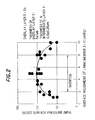
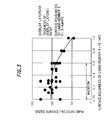
- Results of experiment shown in Figs. 2 to 5 are obtained by determining the anti-seizure resistance with respect to the product according to the invention and controls under the testing conditions and method described below.
- the product according to the invention which is used in the experiment, yielding the experimental results shown in Fig. 2, has a surface roughness of the lining member 3 which is in a range from 2 to 8 ⁇ mRz.
- the control used has a surface roughness of the lining member 3 which is either less than 2 ⁇ mRz or greater than 8 ⁇ mRz.
- the overlay layer 5 comprises Sn, and has a thickness of 5 ⁇ 1 ⁇ m.
- the intermediate layer 4 comprises an Ni plating, and has a thickness of 0.3 ⁇ 0.05 ⁇ m.
- Fig. 2 graphically shows the relationship between the seized surface pressure and surface roughness t 1 of the lining member 3. It will be noted from Fig. 2 that the product according to the invention exhibits an increased seized surface pressure as compared with the control, and thus has its anti-seizure resistance improved.
- Fig. 3 graphically illustrates the relationship between the seized surface pressure and the thickness t 2 of the intermediate layer 4 (Ni).
- the thickness of the intermediate layer 4 is from 0.05 to 0.6 ⁇ m
- the seized surface pressure is higher than that of the control, indicating an improved anti-seizure resistance.
- Fig. 4 illustrates an experimental result of simulating an abrasion of the overlay layer 5 when the sliding bearing 1 is subjected to a thermal load comparable to that from an actual engine.
- the abraded overlay layer 5 and Ni in the intermediate layer 4 produce an Sn-Ni compound, and this Figure compares the seized surface pressure when such compound is produced and when it is not produced.
- Fig. 5 illustrates the determination of the anti-seizure resistance under the similar testing conditions as mentioned above for a different embodiment where the solid black circles correspond to the testings shown in Fig. 2 and 3 while white circles correspond to the testing under a similar thermal load as in Fig. 4. It will be appreciated from Fig. 5 that the anti-seizure resistance, which demonstrates the effect of the invention, is improved as compared with the control shown in Fig. 4 also when the overlay comprises Pb material and the intermediate layer comprises Cu. When the thermal load is applied, the anti-seizure resistance is higher than that of the control.
- the anti-seizure resistance is improved according to the invention by preventing any Ni-Sn compound, for example, which is produced from becoming exposed across the entire region of the sliding contact surface of the sliding bearing 1.
- the overlay layer contains C which suppresses the diffusion of Sn. This aspect will be further described below.
- An overlay layer used in the prior art comprises a metal element such as Pb, Sn, Cu, In, Sb, Mn, Ni, Fe, Zr, Tl or the like, and a non-metal element such as C is merely contained therein as an unavoidable impurity.
- impurity C does not alloy with a principal metal in the overlay layer, and thus is considered as being introduced from organic components in the plating bath.
- the content of C has not been analyzed in the prior art, but it is found from an analysis conducted by the present inventor of overlay layers used in bearings which are manufactured in a mass production that as converted to C, the presence of organic components is detectable only in a trace amount much less than 0.001% by weight.
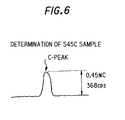
- Fig. 6 shows a C-peak which is obtained when determining a carbon steel with 0.45% C with EPMA (electron probe microanalyzer), model JCMA 773 manufactured by Nippon Denshi under the conditions indicated below.
- a count at the L-value of the analyzer was 308 cps. Employing this as an index value, the count for 1% C is determined to be 817 cps by a proportional calculation.
- a count by EPMA is obtained by counting Ck ⁇ -ray (satisfying the condition of L-value of 124.6 mm) from characteristic X-rays produced from a sample as a secondary emission when the sample is irradiated with an electron beam.
- the overlay layer must contain 0.02 percent by weight or more of C.
- the quantity of C exceeds 0.5% by weight, C presents a coarse non-metallic interposition in the plated film, which acts as a point of initiating fracture of exfoliation, causing a degradation of the bearing characteristic. Accordingly, the quantity of C must be equal to or less than 0.5% by weight.
- a preferred quantity of C is in a range from 0.1 to 0.5% by weight, and a more preferable quantity is from 0.2 to 0.4% by weight.
- a plating bath to prepare a lead alloy for the overlay layer is disclosed in the Japanese Patent Publication No. 41,695/85, for example, and contains lead borofluoride, Pb(BF4)2, borofluoric acid, HBF, hydroquinone, peptone, gelatin and ⁇ -naphthol.
- Pb(BF4)2 borofluoric acid
- HBF hydroquinone
- peptone peptone
- gelatin ⁇ -naphthol
- ⁇ -naphthol serves finely dividing crystal grains, it being believed that in these manners, they contribute to stabilizing plating qualities.
- the composition of the plating bath includes lead borofluoride, Pb(BF 4 ) 2 , in an amount from 40 to 200 g/l, borofluoric acid, HBF, in an amount from 30 to 120 g/l, hydroquinone in an amount from 0.5 to 3 g/l, peptone in an amount from 0.1 to 3 g/l, gelatin in an amount from 0.1 to 3 g/l, and ⁇ -naphthol in an amount from 0.1 to 3 g/l.
- lead borofluoride Pb(BF 4 ) 2
- HBF borofluoric acid
- hydroquinone in an amount from 0.5 to 3 g/l
- peptone in an amount from 0.1 to 3 g/l
- gelatin in an amount from 0.1 to 3 g/l
- ⁇ -naphthol in an amount from 0.1 to 3 g/l.
- a plating bath which plates Pb-Sn alloy overlay additionally contains tin borofluoride, Sn(BF 4 ) 2
- plating bath which plates Pb-Cu alloy additionally contains copper borofluoride, Cu(BF 4 ) 2 .
- a sulfamic acid indium plating bath is used (see Patent Publication No. 41,695/85).
- the bath composition contains sulfamic acid indium in an amount from 40 to 210 g/l, sulfamic acid in an amount from 10 to 60 g/l, salt in an amount from 15 to 100 g/l, glucose in an amount from 2 to 25 g/l, triethanolamine in an amount from 1 to 5 g/l, and sulfamic acid sodium in an amount from 70 to 320 g/l.
- the sulfamic acid serves as an ionizer for In or as antioxidant, glucose serving as a dendrite precipitation inhibitor, and the sulfamic acid sodium and triethanolamine serving as a stabilizer of the plating bath. They are blended into the bath in anticipation of these functioning, thereby contributing to the stabilizing of the plating qualities.
- An overlay layer containing C can be formed by using a neutral bath which has been used in the art in bright plating, in addition to the use of more conventional borofluoride bath or sulfide bath.
- the overlay layer comprises an alloy
- the alloy of these metal components may be formed by an alloy plating.
- these metals may be plated alone and then alloyed together by diffusion.
- one of these layers may be formed by conducting a plating under a condition which allows C to be introduced from an organic component.
- An increased amount of C can be introduced into the overlay layer by increasing the amount of components such as hydroquinone, peptone, gelatin, ⁇ -naphthol, cresol sulfonate, or formalin, which are used in a conventional borofluoride plating bath and which are present in the bath.
- Organic components which are used in the present embodiment are not limited in their varieties, provided they allow incorporation into the plating bath in an amount above a given quantity.
- Examples of preferred organic components are polycarboxylic acid or its ester compound as disclosed in Japanese Patent Publication No. 48,874/83 for use as a bright plating additive for metals, or water soluble polymer obtained by polymerization of organic halide polycarbonyl compound and polyamine.
- polycarboxylic acid includes an aliphatic polycarboxylic acid (for example, oxalic acid, malonic acid, succinic acid, glutamic acid, adipic acid, salicylic acid, pimelic acid, suberic acid, azelaic acid, sebacic acid, fumaric acid, itaconic acid, glutamic acid, nitroacetic acid, ethylendiaminetetraacetic acid and the like), or an aromatic polycarboxylic acid (such as phthalic acid, isophthalic acid, terephthalic acid, diphenylcarboxylic acid, trimellitic acid, methaphenilenediaminetetraacetate).
- an aromatic polycarboxylic acid such as phthalic acid, isophthalic acid, terephthalic acid, diphenylcarboxylic acid, trimellitic acid, methaphenilenediaminetetraacetate.
- aliphatic aldehyde disclosed as Sn and Sn-alloy plating additive in Japanese Patent Publication No. 48,874/83.
- Aliphatic aldehyde specifically includes formaldehyde, acetaldehyde, propionaldehyde, glyoxalaldehyde, succinic aldehyde, caproic aldehyde, and aldol aldehyde.
- Aromatic aldehyde specifically includes benzaldehyde, p-tolualdehyde, salicylaldehyde, veratraldehyde, anisaldehyde, piperonal and vanillin.
- hydroxycarboxylic acid other than citric acid or its salt hereafter abbreviated as "hydroxycarboxylic acid” or its salt
- dibasic carboxylic acid having no unsaturated bond hereafter abbreviated as "dibasic carboxylic acid”
- Hydroxycarboxylic acid specifically includes tartaric acid, malic acid, glycolic acid, glyceric acid, lactic acid, ⁇ -hydroxypropionic acid or the like.
- Dibasic carboxylic acid specifically includes oxalic acid, malonic acid, succinic acid, tartaric acid, adipic acid and the like.
- Organic compounds which are particularly preferred are carboxylic acid and malic acid.
- C which is derived from a variety of brightener materials added to a neutral plating bath having pH in a range from 4 to 9 is effective to prevent a diffusion of Ni which constitutes the intermediate layer and Sn in the overlay layer which is particularly diffusible, and thus is capable of providing a higher anti-seizure resistance to the overlay layer, even though its quantity may be of the same order as the quantity of C that is derived from hydroquinone, peptone, gelatin, ⁇ -naphthol, cresol sulfonate, and formalin which are used in a conventional plating bath.
- Fig. 7 illustrates a result of super-high pressure test of a bearing, under the conditions given below, which is formed by providing a lining member having a composition of Al-11% Sn-1.5% Pb-2.8% Si-1% Cu-0.2% Zr alloy, to which an Ni plated intermediate layer which is 0.5 ⁇ m thick is applied, and on which an Sn overlay layer having a thickness of 5 ⁇ 2 ⁇ m is formed according to the description given below and under the conditions given in Tables 1 and 2:
- Borofluoride bath No. 1 to 5 basic compositions Bath composition tin borofluoride....serving as supplying Sn 2+ ions, 18 g/l borofluoric acid 120 g/l gelatin none ⁇ -naphthol none Borofluoride composition No. 0 Bath composition tin borofluoride....serving as supplying Sn 2+ ions, 18 g/l borofluoric acid 120 g/l gelatin none ⁇ -naphthol none Neutral Sn bath, No. 1 to No.
- the borofluoride bath is that produced by components which are used in forming a conventional overlay layer by plating.
- a 0 (zero) mark corresponds to the concentration produced by a conventional plating component, and encircled 1 to 5 marks represent increased concentrations of gelatin and ⁇ -naphthol than before.
- a neutral bath is obtained by adding an organic carboxylic acid, which acts as a brightening agent, with a changed concentration to a basic plating bath of tin sulfate, the pH of which is adjusted to about from 6 to 7. It is seen that in each bath, the seized surface pressure increases as the C-quantity is increased. However, the seized surface pressure for the overlay layer, C of which is derived from the brightening agent, is higher than the seized surface pressure for an overlay layer, C of which is derived from gelatin and ⁇ -naphthol.
- C is effective to improve the anti-seizure resistance of the overlay layer itself. While the reason therefore is not understood, it is considered that the shear resistance presented by friction with mating member is reduced by C which is dispersed within the overlay layer. When the shear resistance is reduced, the overlay layer will be shaved little by little by the mating shaft, and this prevents an unevenness of a greater magnitude from being produced which would likely to cause an agglomeration with a mating member or to produce a rapid increase in the coefficient of friction, with consequence that a phenomenon which leads to the seizure is suppressed.
Landscapes
- Engineering & Computer Science (AREA)
- General Engineering & Computer Science (AREA)
- Mechanical Engineering (AREA)
- Sliding-Contact Bearings (AREA)
Description
- Testing machine:
- anti-seizure resistance testing machine of journal type
- Peripheral speed:
- 2.77 m/s
- Shaft diameter:
- 42 mm
- Surface pressure:
- 10 MPa/45 min, incrementally increased in steps
- Lubricant:
- 7.5 W-30 engine oil of SE class
- Lubricant temperature:
- 140 ± 1°C
- Oil clearance:
- 25 ± 5 µm
- Shaft material:
- S45C with or without hardening
- Shaft hardness:
- 550 ± 50 HV1
- Shaft surface roughness:
- 0.5 ± 0.1 µmRz
- Voltage:
- 10 kV
- Current:
- 3.7 × 10⁻⁷ A
- L-value:
- 124.6 mm
- Spectroscopy crystal:
- stearite (commonly referred to as STE)
| Borofluoride bath No. 1 to 5, basic compositions | ||
| Bath composition | tin borofluoride....serving as supplying Sn2+ions, | 18 g/l |
| borofluoric acid | 120 g/l | |
| gelatin | none | |
| β-naphthol | none |
| Borofluoride composition No. 0 | ||
| Bath composition | tin borofluoride....serving as supplying Sn2+ions, | 18 g/l |
| borofluoric acid | 120 g/l | |
| gelatin | none | |
| β-naphthol | none |
| Neutral Sn bath, No. 1 to No. 6, basic compositions (controls) | |
| tin sulfate | 28 g/l, as converted to metal Sn |
| inorganic ammonium salt | |
| (conduction aid and antioxidant) | 100 g/l |
| organic carboxylic acid | 20 g/l |
| NEUTRAL BATH | |||
| No. | ORGANIC CARBOXYLIC ACID CONCENTRATION (g/l) | BATH TEMPERATURE (°C) | CURRENT DENSITY (A/dm2) |
| 1 ○ | 20 | 20 | 3 |
| 2 ○ | 40 | 20 | 3 |
| 3 ○ | 80 | 23 | 3 |
| 4 ○ | 100 | 23 | 3 |
| 5 ○ | 150 | 23 | 3 |
| 6 ○ | 200 | 23 | 3 |
| BOROFLUORIDE BATH | ||||
| No. | GELATIN CONCENTRATION (g/l) | β-NAPHTHOL CONCENTRATION (g/l) | BATH TEMPERATURE (°C) | CURRENT DENSITY (A/dm2) |
| 1 ○ | 1 | 4 | 20 | 4 |
| 2 ○ | 1 | 6 | 20 | 4 |
| 3 ○ | 1 | 7 | 20 | 3 |
| 4 ○ | 2 | 7 | 20 | 3 |
| 5 ○ | 3 | 8 | 25 | 5 |
| Super-high pressure testing conditions | |
| number of revolutions | 1300 rpm |
| oil variety/temperature | 7.5 W-30/140 °C |
| shaft variety | S45C |
| |
5 ± 2 µm |
| heat treatment | none |
| Ni plating | 0.5 µm |
Claims (6)
- A sliding bearing (1) including a lining member (3), the surface of which is formed with a multiplicity of uneven surfaces (3a) to give the lining member a surface roughness in the range 2 to 8 µmRz, the entire surface of the lining member, inclusive of the uneven surfaces, is coated by an intermediate layer (4) comprising Ni, Cu, Cr or Fe, or an alloy thereof, and the entire surface of the lining member which is coated by the intermediate layer (4) is additionally coated by an overlay layer (5) of a Ph alloy comprising Sn or In, or of a Sn- or In-alloy or of Sn, recesses located within the uneven surfaces being filled by an overlay layer so that as the overlay layer (5) and the intermediate layer (4) become abraded, the exposed surface includes the exposed lining member (3), the exposed intermediate layer (4) which coats recesses located within the uneven surfaces, and the exposed overlay layers (5) which are situated within the recesses located within the uneven surfaces;
characterised in that the intermediate layer (4) has a thickness which is chosen to be in a range from 0.01 to 0.6 µm, and the overlay layer (5) comprises 0.02 to 0.5% by weight of C. - A sliding bearing according to claim 1 in which the thickness of the overlay layer (5) is in a range from 2 to 25 µm.
- A sliding bearing according to claim 2 in which the thickness of the overlay layer (5) is in a range from 2 to 10 µm.
- A sliding bearing according to claim 2 in which the thickness of the overlay layer (5) is in the range from 3 to 8 µm.
- A sliding bearing according to any one of claims 1 to 4 in which the overlay layer (5) contains 0.1 to 0.5% by weight of C.
- A sliding bearing according to claim 5 in which the overlay layer (5) contains 0.2 to 0.4% by weight of C.
Applications Claiming Priority (1)
| Application Number | Priority Date | Filing Date | Title |
|---|---|---|---|
| PCT/JP1995/000319 WO1996027088A1 (en) | 1995-03-01 | 1995-03-01 | Slide bearing |
Publications (3)
| Publication Number | Publication Date |
|---|---|
| EP0758721A1 EP0758721A1 (en) | 1997-02-19 |
| EP0758721A4 EP0758721A4 (en) | 1997-08-27 |
| EP0758721B1 true EP0758721B1 (en) | 2000-08-30 |
Family
ID=14125680
Family Applications (1)
| Application Number | Title | Priority Date | Filing Date |
|---|---|---|---|
| EP95910713A Expired - Lifetime EP0758721B1 (en) | 1995-03-01 | 1995-03-01 | Slide bearing |
Country Status (4)
| Country | Link |
|---|---|
| US (1) | US5817397A (en) |
| EP (1) | EP0758721B1 (en) |
| DE (1) | DE69518636T2 (en) |
| WO (1) | WO1996027088A1 (en) |
Cited By (1)
| Publication number | Priority date | Publication date | Assignee | Title |
|---|---|---|---|---|
| DE102004030017C5 (en) * | 2003-06-30 | 2008-12-18 | Daido Metal Co. Ltd., Nagoya | Slide |
Families Citing this family (24)
| Publication number | Priority date | Publication date | Assignee | Title |
|---|---|---|---|---|
| JP3859344B2 (en) * | 1998-01-28 | 2006-12-20 | 株式会社小松製作所 | Sliding material, sliding member and method of manufacturing the sliding member |
| TW487742B (en) * | 1999-05-10 | 2002-05-21 | Matsushita Electric Industrial Co Ltd | Electrode for PTC thermistor, manufacture thereof, and PTC thermistor |
| JP2001082481A (en) * | 1999-09-14 | 2001-03-27 | Daido Metal Co Ltd | Sliding bearing and its manufacture |
| JP3607543B2 (en) * | 1999-09-14 | 2005-01-05 | 大同メタル工業株式会社 | Plain bearing |
| JP3643272B2 (en) | 1999-10-12 | 2005-04-27 | 大同メタル工業株式会社 | Plain bearing |
| JP2001263338A (en) * | 2000-03-22 | 2001-09-26 | Daido Metal Co Ltd | Slide bearing |
| EP1334285A4 (en) | 2000-11-15 | 2006-07-05 | Federal Mogul Corp | Non-plated aluminum based bearing alloy with performance-enhanced interlayer |
| US6833339B2 (en) * | 2000-11-15 | 2004-12-21 | Federal-Mogul World Wide, Inc. | Non-plated aluminum based bearing alloy with performance-enhanced interlayer |
| JP4204233B2 (en) * | 2002-01-30 | 2009-01-07 | 日立粉末冶金株式会社 | Sintered oil-impregnated plain bearings and construction machinery hydraulic excavators or cranes |
| JP4287098B2 (en) * | 2002-07-18 | 2009-07-01 | 日本電産サンキョー株式会社 | Bearing device and manufacturing method thereof |
| JP2005023344A (en) * | 2003-06-30 | 2005-01-27 | Daido Metal Co Ltd | Sliding member |
| AT412877B (en) * | 2003-07-01 | 2005-08-25 | Miba Gleitlager Gmbh | LAYER MATERIAL |
| US8266856B2 (en) | 2004-08-02 | 2012-09-18 | Tac Technologies, Llc | Reinforced structural member and frame structures |
| US8065848B2 (en) | 2007-09-18 | 2011-11-29 | Tac Technologies, Llc | Structural member |
| US7721496B2 (en) * | 2004-08-02 | 2010-05-25 | Tac Technologies, Llc | Composite decking material and methods associated with the same |
| DE102005063325B4 (en) * | 2005-05-13 | 2008-01-10 | Federal-Mogul Wiesbaden Gmbh & Co. Kg | Slide bearing composite, use and manufacturing process |
| US20070047857A1 (en) * | 2005-08-26 | 2007-03-01 | Tsutomu Hamada | Sleeve for hydrodynamic bearing device, hydrodynamic bearing device and spindle motor using the same, and method for manufacturing sleeve |
| DE102007058744B4 (en) * | 2007-12-05 | 2019-06-06 | Federal-Mogul Wiesbaden Gmbh | Slide bearing shell and bearing arrangement |
| DK2376797T3 (en) * | 2008-12-15 | 2016-08-22 | Jochen Corts | Segmented composite bearings and wind generator that uses hydraulic pump / motor combination |
| JP5298838B2 (en) * | 2008-12-25 | 2013-09-25 | 大豊工業株式会社 | Swash plate and its manufacturing method |
| US9714471B2 (en) * | 2009-04-22 | 2017-07-25 | Arteco Nv | Hot test fluid containing vapor phase inhibition |
| JP2014013036A (en) * | 2012-06-07 | 2014-01-23 | Ntn Corp | Swash plate for swash plate type compressor, method of manufacturing the same, and swash plate type compressor |
| AT513255B1 (en) | 2012-12-28 | 2014-03-15 | Miba Gleitlager Gmbh | Multilayer plain bearings |
| DE112018000075T5 (en) | 2017-07-21 | 2019-06-06 | Taiho Kogyo Co., Ltd. | SLIDING BODIES AND SLIDING BEARINGS |
Family Cites Families (9)
| Publication number | Priority date | Publication date | Assignee | Title |
|---|---|---|---|---|
| JPS5838507B2 (en) * | 1978-06-21 | 1983-08-23 | オイレス工業株式会社 | Sliding member and its manufacturing method |
| JPS5848874A (en) * | 1981-09-18 | 1983-03-22 | Seiko Epson Corp | integrated circuit |
| DE3321826A1 (en) * | 1983-06-15 | 1984-12-20 | Schering AG, 1000 Berlin und 4709 Bergkamen | 13 alpha -Alkylgonanes, the preparation thereof and pharmaceutical products containing these |
| JPS6015716A (en) * | 1983-07-06 | 1985-01-26 | Kubota Ltd | Automatic traveling truck |
| GB8500282D0 (en) * | 1985-01-05 | 1985-02-13 | Ae Plc | Bearings |
| JPS62283216A (en) * | 1986-05-29 | 1987-12-09 | Taiho Kogyo Co Ltd | plain bearing |
| JPS636215A (en) * | 1986-06-23 | 1988-01-12 | Nissan Motor Co Ltd | Bearing |
| JP2593138B2 (en) * | 1988-07-29 | 1997-03-26 | 大豊工業 株式会社 | Plain bearing |
| JP2852521B2 (en) * | 1988-11-21 | 1999-02-03 | 株式会社 小松製作所 | Plain bearings for internal combustion engines |
-
1995
- 1995-03-01 EP EP95910713A patent/EP0758721B1/en not_active Expired - Lifetime
- 1995-03-01 WO PCT/JP1995/000319 patent/WO1996027088A1/en not_active Ceased
- 1995-03-01 DE DE69518636T patent/DE69518636T2/en not_active Expired - Fee Related
- 1995-03-01 US US08/732,310 patent/US5817397A/en not_active Expired - Fee Related
Cited By (1)
| Publication number | Priority date | Publication date | Assignee | Title |
|---|---|---|---|---|
| DE102004030017C5 (en) * | 2003-06-30 | 2008-12-18 | Daido Metal Co. Ltd., Nagoya | Slide |
Also Published As
| Publication number | Publication date |
|---|---|
| DE69518636T2 (en) | 2001-04-26 |
| EP0758721A4 (en) | 1997-08-27 |
| US5817397A (en) | 1998-10-06 |
| DE69518636D1 (en) | 2000-10-05 |
| WO1996027088A1 (en) | 1996-09-06 |
| EP0758721A1 (en) | 1997-02-19 |
Similar Documents
| Publication | Publication Date | Title |
|---|---|---|
| US5817397A (en) | Sliding bearing | |
| US4309064A (en) | Bearing of an internal combustion engine and process for producing the same | |
| US8440322B2 (en) | Plain bearing | |
| US4937149A (en) | Overlay alloy used for a surface layer of sliding material, sliding material having a surface layer comprising said alloy and the manufacturing method of the sliding material | |
| RU2354865C2 (en) | Multilayer compositional material for plain bearings, manufacturing and application | |
| US4363854A (en) | Method for manufacturing workpieces having adaptation faces capable of withstanding extremely high surface pressures and temperatures, and product produced thereby | |
| US4978587A (en) | Multilayer sliding material | |
| US5334460A (en) | CU-PB system alloy composite bearing having overlay | |
| US7455458B2 (en) | Bearings | |
| DE4036835A1 (en) | COMPOSITE PLATING FILM FOR SLIDING OR BZW. SLIDING ELEMENTS | |
| JP3570607B2 (en) | Sliding member | |
| JPH1150296A (en) | Sliding member | |
| JP2733736B2 (en) | Copper-lead alloy bearings | |
| EP0422321A1 (en) | Plane bearing | |
| KR20050002597A (en) | Sliding member | |
| US4591536A (en) | Plain bearing and method of manufacture | |
| JPH06322462A (en) | Copper-lead bearing alloy material excellent in corrosion resistance and its production | |
| US5387461A (en) | Sliding-bearing material | |
| GB2285060A (en) | Copper-head alloy bearing | |
| JPS6041695B2 (en) | Bearings for internal combustion engines and their manufacturing method | |
| JP2535105B2 (en) | Sliding bearing with composite plating film | |
| JP3397334B2 (en) | Plain bearing | |
| US3307926A (en) | Bearing construction | |
| JPS6220915A (en) | Plain bearing | |
| JPS6199648A (en) | Plated alloy for overlay |
Legal Events
| Date | Code | Title | Description |
|---|---|---|---|
| PUAI | Public reference made under article 153(3) epc to a published international application that has entered the european phase |
Free format text: ORIGINAL CODE: 0009012 |
|
| 17P | Request for examination filed |
Effective date: 19961120 |
|
| AK | Designated contracting states |
Kind code of ref document: A1 Designated state(s): DE GB |
|
| A4 | Supplementary search report drawn up and despatched |
Effective date: 19970716 |
|
| AK | Designated contracting states |
Kind code of ref document: A4 Designated state(s): DE GB |
|
| 17Q | First examination report despatched |
Effective date: 19981209 |
|
| GRAG | Despatch of communication of intention to grant |
Free format text: ORIGINAL CODE: EPIDOS AGRA |
|
| GRAG | Despatch of communication of intention to grant |
Free format text: ORIGINAL CODE: EPIDOS AGRA |
|
| GRAG | Despatch of communication of intention to grant |
Free format text: ORIGINAL CODE: EPIDOS AGRA |
|
| GRAH | Despatch of communication of intention to grant a patent |
Free format text: ORIGINAL CODE: EPIDOS IGRA |
|
| GRAG | Despatch of communication of intention to grant |
Free format text: ORIGINAL CODE: EPIDOS AGRA |
|
| GRAH | Despatch of communication of intention to grant a patent |
Free format text: ORIGINAL CODE: EPIDOS IGRA |
|
| GRAG | Despatch of communication of intention to grant |
Free format text: ORIGINAL CODE: EPIDOS AGRA |
|
| GRAH | Despatch of communication of intention to grant a patent |
Free format text: ORIGINAL CODE: EPIDOS IGRA |
|
| GRAH | Despatch of communication of intention to grant a patent |
Free format text: ORIGINAL CODE: EPIDOS IGRA |
|
| GRAA | (expected) grant |
Free format text: ORIGINAL CODE: 0009210 |
|
| AK | Designated contracting states |
Kind code of ref document: B1 Designated state(s): DE GB |
|
| REF | Corresponds to: |
Ref document number: 69518636 Country of ref document: DE Date of ref document: 20001005 |
|
| EN | Fr: translation not filed | ||
| PLBE | No opposition filed within time limit |
Free format text: ORIGINAL CODE: 0009261 |
|
| STAA | Information on the status of an ep patent application or granted ep patent |
Free format text: STATUS: NO OPPOSITION FILED WITHIN TIME LIMIT |
|
| 26N | No opposition filed | ||
| REG | Reference to a national code |
Ref country code: GB Ref legal event code: IF02 |
|
| PGFP | Annual fee paid to national office [announced via postgrant information from national office to epo] |
Ref country code: GB Payment date: 20080227 Year of fee payment: 14 |
|
| PGFP | Annual fee paid to national office [announced via postgrant information from national office to epo] |
Ref country code: DE Payment date: 20080228 Year of fee payment: 14 |
|
| GBPC | Gb: european patent ceased through non-payment of renewal fee |
Effective date: 20090301 |
|
| PG25 | Lapsed in a contracting state [announced via postgrant information from national office to epo] |
Ref country code: DE Free format text: LAPSE BECAUSE OF NON-PAYMENT OF DUE FEES Effective date: 20091001 |
|
| PG25 | Lapsed in a contracting state [announced via postgrant information from national office to epo] |
Ref country code: GB Free format text: LAPSE BECAUSE OF NON-PAYMENT OF DUE FEES Effective date: 20090301 |