EP0758633B1 - Poröse Granulate - Google Patents
Poröse Granulate Download PDFInfo
- Publication number
- EP0758633B1 EP0758633B1 EP96305366A EP96305366A EP0758633B1 EP 0758633 B1 EP0758633 B1 EP 0758633B1 EP 96305366 A EP96305366 A EP 96305366A EP 96305366 A EP96305366 A EP 96305366A EP 0758633 B1 EP0758633 B1 EP 0758633B1
- Authority
- EP
- European Patent Office
- Prior art keywords
- chemical
- granules
- enclosure
- porous
- pores
- Prior art date
- Legal status (The legal status is an assumption and is not a legal conclusion. Google has not performed a legal analysis and makes no representation as to the accuracy of the status listed.)
- Expired - Lifetime
Links
- 239000008187 granular material Substances 0.000 title claims abstract description 141
- 239000000126 substance Substances 0.000 claims abstract description 96
- 239000000463 material Substances 0.000 claims abstract description 43
- 238000000034 method Methods 0.000 claims abstract description 42
- 229910010293 ceramic material Inorganic materials 0.000 claims abstract description 41
- 239000011148 porous material Substances 0.000 claims abstract description 35
- 238000001354 calcination Methods 0.000 claims abstract description 19
- 239000004927 clay Substances 0.000 claims abstract description 11
- 239000011236 particulate material Substances 0.000 claims abstract description 9
- 239000002904 solvent Substances 0.000 claims abstract description 8
- 238000003860 storage Methods 0.000 claims abstract description 8
- 230000001413 cellular effect Effects 0.000 claims abstract description 6
- 239000006193 liquid solution Substances 0.000 claims abstract 3
- 239000007788 liquid Substances 0.000 claims description 26
- 239000008188 pellet Substances 0.000 claims description 21
- 239000012530 fluid Substances 0.000 claims description 5
- 238000011068 loading method Methods 0.000 claims description 5
- 239000012466 permeate Substances 0.000 claims description 3
- FGIUAXJPYTZDNR-UHFFFAOYSA-N potassium nitrate Chemical compound [K+].[O-][N+]([O-])=O FGIUAXJPYTZDNR-UHFFFAOYSA-N 0.000 description 30
- 239000003139 biocide Substances 0.000 description 24
- 230000003115 biocidal effect Effects 0.000 description 23
- 239000000243 solution Substances 0.000 description 20
- 235000010333 potassium nitrate Nutrition 0.000 description 15
- 239000004323 potassium nitrate Substances 0.000 description 15
- 210000004027 cell Anatomy 0.000 description 14
- OKKJLVBELUTLKV-UHFFFAOYSA-N Methanol Chemical compound OC OKKJLVBELUTLKV-UHFFFAOYSA-N 0.000 description 12
- 239000000919 ceramic Substances 0.000 description 12
- XLYOFNOQVPJJNP-UHFFFAOYSA-N water Substances O XLYOFNOQVPJJNP-UHFFFAOYSA-N 0.000 description 11
- 239000000203 mixture Substances 0.000 description 10
- 229910052500 inorganic mineral Inorganic materials 0.000 description 9
- 239000011707 mineral Substances 0.000 description 9
- 238000002474 experimental method Methods 0.000 description 8
- 238000001125 extrusion Methods 0.000 description 8
- 239000006260 foam Substances 0.000 description 7
- 239000002245 particle Substances 0.000 description 6
- 239000007787 solid Substances 0.000 description 6
- 239000004094 surface-active agent Substances 0.000 description 6
- 239000010427 ball clay Substances 0.000 description 5
- NLYAJNPCOHFWQQ-UHFFFAOYSA-N kaolin Chemical compound O.O.O=[Al]O[Si](=O)O[Si](=O)O[Al]=O NLYAJNPCOHFWQQ-UHFFFAOYSA-N 0.000 description 5
- 239000003795 chemical substances by application Substances 0.000 description 4
- 239000008367 deionised water Substances 0.000 description 4
- 238000001035 drying Methods 0.000 description 4
- 229910052622 kaolinite Inorganic materials 0.000 description 4
- 239000002304 perfume Substances 0.000 description 4
- 229920002994 synthetic fiber Polymers 0.000 description 4
- 239000000654 additive Substances 0.000 description 3
- 230000015572 biosynthetic process Effects 0.000 description 3
- 239000002734 clay mineral Substances 0.000 description 3
- 238000004090 dissolution Methods 0.000 description 3
- 239000010445 mica Substances 0.000 description 3
- 229910052618 mica group Inorganic materials 0.000 description 3
- 230000000717 retained effect Effects 0.000 description 3
- 239000012042 active reagent Substances 0.000 description 2
- 239000006265 aqueous foam Substances 0.000 description 2
- 239000007864 aqueous solution Substances 0.000 description 2
- 239000012298 atmosphere Substances 0.000 description 2
- 239000003153 chemical reaction reagent Substances 0.000 description 2
- 239000010433 feldspar Substances 0.000 description 2
- 238000011049 filling Methods 0.000 description 2
- 229910010272 inorganic material Inorganic materials 0.000 description 2
- 239000011147 inorganic material Substances 0.000 description 2
- 238000004519 manufacturing process Methods 0.000 description 2
- 238000002844 melting Methods 0.000 description 2
- 230000008018 melting Effects 0.000 description 2
- 235000015097 nutrients Nutrition 0.000 description 2
- 239000000047 product Substances 0.000 description 2
- 239000010453 quartz Substances 0.000 description 2
- VYPSYNLAJGMNEJ-UHFFFAOYSA-N silicon dioxide Inorganic materials O=[Si]=O VYPSYNLAJGMNEJ-UHFFFAOYSA-N 0.000 description 2
- 239000002002 slurry Substances 0.000 description 2
- 238000002791 soaking Methods 0.000 description 2
- 239000000725 suspension Substances 0.000 description 2
- 239000011800 void material Substances 0.000 description 2
- DHVLDKHFGIVEIP-UHFFFAOYSA-N 2-bromo-2-(bromomethyl)pentanedinitrile Chemical compound BrCC(Br)(C#N)CCC#N DHVLDKHFGIVEIP-UHFFFAOYSA-N 0.000 description 1
- 239000005995 Aluminium silicate Substances 0.000 description 1
- 241000196324 Embryophyta Species 0.000 description 1
- 239000004606 Fillers/Extenders Substances 0.000 description 1
- 241001465754 Metazoa Species 0.000 description 1
- 235000008331 Pinus X rigitaeda Nutrition 0.000 description 1
- 235000011613 Pinus brutia Nutrition 0.000 description 1
- 241000018646 Pinus brutia Species 0.000 description 1
- BLRPTPMANUNPDV-UHFFFAOYSA-N Silane Chemical compound [SiH4] BLRPTPMANUNPDV-UHFFFAOYSA-N 0.000 description 1
- QAOWNCQODCNURD-UHFFFAOYSA-N Sulfuric acid Chemical compound OS(O)(=O)=O QAOWNCQODCNURD-UHFFFAOYSA-N 0.000 description 1
- 239000004480 active ingredient Substances 0.000 description 1
- 239000011149 active material Substances 0.000 description 1
- 239000013543 active substance Substances 0.000 description 1
- 230000000996 additive effect Effects 0.000 description 1
- 238000013019 agitation Methods 0.000 description 1
- 239000002386 air freshener Substances 0.000 description 1
- -1 alkyl ethoxy sulphate Chemical compound 0.000 description 1
- 229910000323 aluminium silicate Inorganic materials 0.000 description 1
- 235000012211 aluminium silicate Nutrition 0.000 description 1
- HPTYUNKZVDYXLP-UHFFFAOYSA-N aluminum;trihydroxy(trihydroxysilyloxy)silane;hydrate Chemical compound O.[Al].[Al].O[Si](O)(O)O[Si](O)(O)O HPTYUNKZVDYXLP-UHFFFAOYSA-N 0.000 description 1
- 238000004458 analytical method Methods 0.000 description 1
- 125000000129 anionic group Chemical group 0.000 description 1
- 239000003125 aqueous solvent Substances 0.000 description 1
- 239000007900 aqueous suspension Substances 0.000 description 1
- 239000011230 binding agent Substances 0.000 description 1
- 238000009835 boiling Methods 0.000 description 1
- 239000000969 carrier Substances 0.000 description 1
- 125000002091 cationic group Chemical group 0.000 description 1
- 210000002421 cell wall Anatomy 0.000 description 1
- 239000011248 coating agent Substances 0.000 description 1
- 238000000576 coating method Methods 0.000 description 1
- 238000013270 controlled release Methods 0.000 description 1
- 238000001816 cooling Methods 0.000 description 1
- 239000013078 crystal Substances 0.000 description 1
- 238000002425 crystallisation Methods 0.000 description 1
- 239000002274 desiccant Substances 0.000 description 1
- 229910001649 dickite Inorganic materials 0.000 description 1
- 239000006185 dispersion Substances 0.000 description 1
- 238000009826 distribution Methods 0.000 description 1
- 239000003814 drug Substances 0.000 description 1
- 229910052571 earthenware Inorganic materials 0.000 description 1
- 235000013399 edible fruits Nutrition 0.000 description 1
- 238000013401 experimental design Methods 0.000 description 1
- 239000000945 filler Substances 0.000 description 1
- 238000005429 filling process Methods 0.000 description 1
- 239000012065 filter cake Substances 0.000 description 1
- 238000001914 filtration Methods 0.000 description 1
- 239000000796 flavoring agent Substances 0.000 description 1
- 230000003311 flocculating effect Effects 0.000 description 1
- 239000006261 foam material Substances 0.000 description 1
- 239000003205 fragrance Substances 0.000 description 1
- 239000011521 glass Substances 0.000 description 1
- 229910052621 halloysite Inorganic materials 0.000 description 1
- 229910052900 illite Inorganic materials 0.000 description 1
- 238000005470 impregnation Methods 0.000 description 1
- 239000010954 inorganic particle Substances 0.000 description 1
- 239000002609 medium Substances 0.000 description 1
- 238000001000 micrograph Methods 0.000 description 1
- VGIBGUSAECPPNB-UHFFFAOYSA-L nonaaluminum;magnesium;tripotassium;1,3-dioxido-2,4,5-trioxa-1,3-disilabicyclo[1.1.1]pentane;iron(2+);oxygen(2-);fluoride;hydroxide Chemical compound [OH-].[O-2].[O-2].[O-2].[O-2].[O-2].[F-].[Mg+2].[Al+3].[Al+3].[Al+3].[Al+3].[Al+3].[Al+3].[Al+3].[Al+3].[Al+3].[K+].[K+].[K+].[Fe+2].O1[Si]2([O-])O[Si]1([O-])O2.O1[Si]2([O-])O[Si]1([O-])O2.O1[Si]2([O-])O[Si]1([O-])O2.O1[Si]2([O-])O[Si]1([O-])O2.O1[Si]2([O-])O[Si]1([O-])O2.O1[Si]2([O-])O[Si]1([O-])O2.O1[Si]2([O-])O[Si]1([O-])O2 VGIBGUSAECPPNB-UHFFFAOYSA-L 0.000 description 1
- 239000003960 organic solvent Substances 0.000 description 1
- 239000000843 powder Substances 0.000 description 1
- 238000002360 preparation method Methods 0.000 description 1
- 239000012047 saturated solution Substances 0.000 description 1
- 229910000077 silane Inorganic materials 0.000 description 1
- 159000000000 sodium salts Chemical class 0.000 description 1
- 238000004611 spectroscopical analysis Methods 0.000 description 1
- 239000001117 sulphuric acid Substances 0.000 description 1
- 235000011149 sulphuric acid Nutrition 0.000 description 1
Images


Classifications
-
- C—CHEMISTRY; METALLURGY
- C04—CEMENTS; CONCRETE; ARTIFICIAL STONE; CERAMICS; REFRACTORIES
- C04B—LIME, MAGNESIA; SLAG; CEMENTS; COMPOSITIONS THEREOF, e.g. MORTARS, CONCRETE OR LIKE BUILDING MATERIALS; ARTIFICIAL STONE; CERAMICS; REFRACTORIES; TREATMENT OF NATURAL STONE
- C04B41/00—After-treatment of mortars, concrete, artificial stone or ceramics; Treatment of natural stone
- C04B41/009—After-treatment of mortars, concrete, artificial stone or ceramics; Treatment of natural stone characterised by the material treated
-
- A—HUMAN NECESSITIES
- A01—AGRICULTURE; FORESTRY; ANIMAL HUSBANDRY; HUNTING; TRAPPING; FISHING
- A01N—PRESERVATION OF BODIES OF HUMANS OR ANIMALS OR PLANTS OR PARTS THEREOF; BIOCIDES, e.g. AS DISINFECTANTS, AS PESTICIDES OR AS HERBICIDES; PEST REPELLANTS OR ATTRACTANTS; PLANT GROWTH REGULATORS
- A01N25/00—Biocides, pest repellants or attractants, or plant growth regulators, characterised by their forms, or by their non-active ingredients or by their methods of application, e.g. seed treatment or sequential application; Substances for reducing the noxious effect of the active ingredients to organisms other than pests
- A01N25/08—Biocides, pest repellants or attractants, or plant growth regulators, characterised by their forms, or by their non-active ingredients or by their methods of application, e.g. seed treatment or sequential application; Substances for reducing the noxious effect of the active ingredients to organisms other than pests containing solids as carriers or diluents
-
- B—PERFORMING OPERATIONS; TRANSPORTING
- B01—PHYSICAL OR CHEMICAL PROCESSES OR APPARATUS IN GENERAL
- B01J—CHEMICAL OR PHYSICAL PROCESSES, e.g. CATALYSIS OR COLLOID CHEMISTRY; THEIR RELEVANT APPARATUS
- B01J20/00—Solid sorbent compositions or filter aid compositions; Sorbents for chromatography; Processes for preparing, regenerating or reactivating thereof
- B01J20/02—Solid sorbent compositions or filter aid compositions; Sorbents for chromatography; Processes for preparing, regenerating or reactivating thereof comprising inorganic material
- B01J20/10—Solid sorbent compositions or filter aid compositions; Sorbents for chromatography; Processes for preparing, regenerating or reactivating thereof comprising inorganic material comprising silica or silicate
-
- B—PERFORMING OPERATIONS; TRANSPORTING
- B01—PHYSICAL OR CHEMICAL PROCESSES OR APPARATUS IN GENERAL
- B01J—CHEMICAL OR PHYSICAL PROCESSES, e.g. CATALYSIS OR COLLOID CHEMISTRY; THEIR RELEVANT APPARATUS
- B01J20/00—Solid sorbent compositions or filter aid compositions; Sorbents for chromatography; Processes for preparing, regenerating or reactivating thereof
- B01J20/02—Solid sorbent compositions or filter aid compositions; Sorbents for chromatography; Processes for preparing, regenerating or reactivating thereof comprising inorganic material
- B01J20/10—Solid sorbent compositions or filter aid compositions; Sorbents for chromatography; Processes for preparing, regenerating or reactivating thereof comprising inorganic material comprising silica or silicate
- B01J20/103—Solid sorbent compositions or filter aid compositions; Sorbents for chromatography; Processes for preparing, regenerating or reactivating thereof comprising inorganic material comprising silica or silicate comprising silica
-
- B—PERFORMING OPERATIONS; TRANSPORTING
- B01—PHYSICAL OR CHEMICAL PROCESSES OR APPARATUS IN GENERAL
- B01J—CHEMICAL OR PHYSICAL PROCESSES, e.g. CATALYSIS OR COLLOID CHEMISTRY; THEIR RELEVANT APPARATUS
- B01J20/00—Solid sorbent compositions or filter aid compositions; Sorbents for chromatography; Processes for preparing, regenerating or reactivating thereof
- B01J20/02—Solid sorbent compositions or filter aid compositions; Sorbents for chromatography; Processes for preparing, regenerating or reactivating thereof comprising inorganic material
- B01J20/10—Solid sorbent compositions or filter aid compositions; Sorbents for chromatography; Processes for preparing, regenerating or reactivating thereof comprising inorganic material comprising silica or silicate
- B01J20/12—Naturally occurring clays or bleaching earth
-
- B—PERFORMING OPERATIONS; TRANSPORTING
- B01—PHYSICAL OR CHEMICAL PROCESSES OR APPARATUS IN GENERAL
- B01J—CHEMICAL OR PHYSICAL PROCESSES, e.g. CATALYSIS OR COLLOID CHEMISTRY; THEIR RELEVANT APPARATUS
- B01J20/00—Solid sorbent compositions or filter aid compositions; Sorbents for chromatography; Processes for preparing, regenerating or reactivating thereof
- B01J20/02—Solid sorbent compositions or filter aid compositions; Sorbents for chromatography; Processes for preparing, regenerating or reactivating thereof comprising inorganic material
- B01J20/10—Solid sorbent compositions or filter aid compositions; Sorbents for chromatography; Processes for preparing, regenerating or reactivating thereof comprising inorganic material comprising silica or silicate
- B01J20/16—Alumino-silicates
-
- B—PERFORMING OPERATIONS; TRANSPORTING
- B01—PHYSICAL OR CHEMICAL PROCESSES OR APPARATUS IN GENERAL
- B01J—CHEMICAL OR PHYSICAL PROCESSES, e.g. CATALYSIS OR COLLOID CHEMISTRY; THEIR RELEVANT APPARATUS
- B01J20/00—Solid sorbent compositions or filter aid compositions; Sorbents for chromatography; Processes for preparing, regenerating or reactivating thereof
- B01J20/30—Processes for preparing, regenerating, or reactivating
- B01J20/3007—Moulding, shaping or extruding
-
- B—PERFORMING OPERATIONS; TRANSPORTING
- B01—PHYSICAL OR CHEMICAL PROCESSES OR APPARATUS IN GENERAL
- B01J—CHEMICAL OR PHYSICAL PROCESSES, e.g. CATALYSIS OR COLLOID CHEMISTRY; THEIR RELEVANT APPARATUS
- B01J20/00—Solid sorbent compositions or filter aid compositions; Sorbents for chromatography; Processes for preparing, regenerating or reactivating thereof
- B01J20/30—Processes for preparing, regenerating, or reactivating
- B01J20/3078—Thermal treatment, e.g. calcining or pyrolizing
-
- C—CHEMISTRY; METALLURGY
- C04—CEMENTS; CONCRETE; ARTIFICIAL STONE; CERAMICS; REFRACTORIES
- C04B—LIME, MAGNESIA; SLAG; CEMENTS; COMPOSITIONS THEREOF, e.g. MORTARS, CONCRETE OR LIKE BUILDING MATERIALS; ARTIFICIAL STONE; CERAMICS; REFRACTORIES; TREATMENT OF NATURAL STONE
- C04B38/00—Porous mortars, concrete, artificial stone or ceramic ware; Preparation thereof
- C04B38/009—Porous or hollow ceramic granular materials, e.g. microballoons
-
- C—CHEMISTRY; METALLURGY
- C04—CEMENTS; CONCRETE; ARTIFICIAL STONE; CERAMICS; REFRACTORIES
- C04B—LIME, MAGNESIA; SLAG; CEMENTS; COMPOSITIONS THEREOF, e.g. MORTARS, CONCRETE OR LIKE BUILDING MATERIALS; ARTIFICIAL STONE; CERAMICS; REFRACTORIES; TREATMENT OF NATURAL STONE
- C04B41/00—After-treatment of mortars, concrete, artificial stone or ceramics; Treatment of natural stone
- C04B41/45—Coating or impregnating, e.g. injection in masonry, partial coating of green or fired ceramics, organic coating compositions for adhering together two concrete elements
- C04B41/4584—Coating or impregnating of particulate or fibrous ceramic material
-
- C—CHEMISTRY; METALLURGY
- C04—CEMENTS; CONCRETE; ARTIFICIAL STONE; CERAMICS; REFRACTORIES
- C04B—LIME, MAGNESIA; SLAG; CEMENTS; COMPOSITIONS THEREOF, e.g. MORTARS, CONCRETE OR LIKE BUILDING MATERIALS; ARTIFICIAL STONE; CERAMICS; REFRACTORIES; TREATMENT OF NATURAL STONE
- C04B41/00—After-treatment of mortars, concrete, artificial stone or ceramics; Treatment of natural stone
- C04B41/80—After-treatment of mortars, concrete, artificial stone or ceramics; Treatment of natural stone of only ceramics
- C04B41/81—Coating or impregnation
-
- C—CHEMISTRY; METALLURGY
- C05—FERTILISERS; MANUFACTURE THEREOF
- C05D—INORGANIC FERTILISERS NOT COVERED BY SUBCLASSES C05B, C05C; FERTILISERS PRODUCING CARBON DIOXIDE
- C05D9/00—Other inorganic fertilisers
-
- C—CHEMISTRY; METALLURGY
- C05—FERTILISERS; MANUFACTURE THEREOF
- C05G—MIXTURES OF FERTILISERS COVERED INDIVIDUALLY BY DIFFERENT SUBCLASSES OF CLASS C05; MIXTURES OF ONE OR MORE FERTILISERS WITH MATERIALS NOT HAVING A SPECIFIC FERTILISING ACTIVITY, e.g. PESTICIDES, SOIL-CONDITIONERS, WETTING AGENTS; FERTILISERS CHARACTERISED BY THEIR FORM
- C05G5/00—Fertilisers characterised by their form
- C05G5/40—Fertilisers incorporated into a matrix
Definitions
- the present invention relates to porous granules especially granules which are loaded for the storage and release of chemicals.
- This invention is concerned in particular with porous granules which possess a void volume which is a significant proportion of their total volume, and which absorbs a reagent into its void volume, and releases the same slowly into a medium in which the granules are suspended.
- porous material which will absorb a chemical, eg. an active reagent, and release the same in a controlled manner into a medium in which the porous material is suspended.
- Possible applications include the release of a biocide or a plant nutrient into a liquid medium, and the release of a perfume into a gas or vapour. If a porous material is to be useful in these applications, it should be able to absorb the active reagent quickly, and in a volume which represents a high proportion of its own volume, but to release the active ingredient relatively slowly.
- porous granule for slow release of reagents are known in the prior art.
- such granules are organic or have an organic coating or film especially ones provided by a polymeric material, which confers the slow release properties on the granules.
- the present invention is concerned with granules for storage and slow release of chemicals which granules comprise an inorganic porous ceramic material.
- GB1570608 describes use of an inorganic porous ceramic material for storage and release of chemicals, eg. as a pine scented tree shaped ceramic article.
- the pore structure of such material and the method described for introducing the chemical into the pores thereof are not ideal.
- the material described has an open fine pore structure wherein the pores are smaller than 5 ⁇ m.
- DE-A-2,648,119 describes granules for slow release of active substances.
- the granules have a porous structure with semi-permeable walls.
- the granules are preferably formed from bloated clay.
- FR-A-2,548,175 describes impregnation of ceramic articles with perfume in such a way that the perfume is released over a long period.
- the ceramic articles are relatively large, eg earthenware pebbles, fruit, flowers or ash trays.
- GB-A-2,271,987 describes a method of producing porous ceramic granules.
- the present invention provides a method and product produced thereby which enables granules produced in a manner described in GB-A-2,271,987 to be produced suitable for use in slow release applications.
- a method of producing a porous, ceramic material which comprises granules of an extruded, foamed material comprising a kandite clay which includes the steps of producing a foamed ceramic-forming material from a wet kandite clay-containing particulate material, extruding the foamed ceramic-forming material in the form of pellets or prills and calcining the extruded pellets or prills to provide an inner structure comprising closed cell pores within the pellets or prills, and characterised in that the calcining is carried out in a rotary calciner, whereby a multiplicity of the pellets or prills are tumbled over one another during calcination, the granules produced thereby having a continuous outer skin which has a porosity which allows fluids to diffuse slowly therethrough, granules being suitable for the storage in and slow release of a chemical or chemicals from the closed cells inner structure.
- extruded pellets or prills may be dried prior to calcining.
- a porous ceramic material suitable for the storage and slow release therefrom of a chemical or chemicals which comprises granules produced by the method according to the first aspect, the granules having an inner structure comprising closed cell pores and, covering substantially all of the material comprising the inner structure, a continuous outer skin which has pores having a size less than 0.1 ⁇ m.
- the granules may have a chemical or chemicals contained in the closed cell pores of the inner structure of the granules for slow release therefrom.
- granules is meant pieces, lengths, prills, pellets and the like which may for example have sizes having a major dimension in the range O.lmm to 20mm, especially 1mm to 10mm.
- the inner structure of the granules may be such that, mainly, the closed cell pores have sizes of or greater than 5 ⁇ m, especially mainly from 5 ⁇ m to 100 ⁇ m.
- the continuous outer skin may mainly have a thickness less than 50 ⁇ m and preferably less than the size of the closed cell pores.
- the said skin may have a porosity which allows fluids to diffuse slowly through the skin.
- the said skin may be microporous, eg have pores through the skin which are less than 1 ⁇ m, especially less than 0.1 ⁇ m in size.
- the skin has few pores greater than 1 ⁇ m in size.
- the skin may be such that at least 99% of its surface area has no pores greater than 1 ⁇ m in size.
- the outer skin extends substantially all around the material comprising the inner structure.
- the porous ceramic material according to the first aspect may be made in one of the ways described hereinafter.
- a method of preparing a porous granular material containing a chemical or chemicals releasable therefrom including the steps of forming granules of a porous ceramic material according to the first aspect, placing the granules in an evacuable enclosure, evacuating the enclosure to withdraw air or any other substance already contained in the pores of the porous granular material, and allowing the chemical or a substance to be converted into the chemical to be absorbed into the granules to be stored in the closed cell pores thereof.
- the chemical may be contained in the enclosure when the enclosure is evacuated. However, we prefer to have a source of the chemical outside the enclosure and to deliver, whilst the granules are in the evacuated enclosure, a stream comprising the chemical to be contained by the granules into the enclosure to load the cellular pores of the granules with the chemical. This avoids the need for maintaining a supply of the chemical in the enclosure and gives better control over the pore filling process conditions, eg. if the temperature of the source of chemical is required to be different from that of the granules.
- the evacuable enclosure may be a conventional flask or other vessel connected to a vacuum pump. Evacuation of the enclosure may be applied until the pressure has reached less than 10 -3 kg/m 2 , preferably less than 6 x 10 -4 kg/m 2 , and is maintained at that level for at least 5 minutes, preferably at least 10 minutes.
- the stream of the chemical to be applied to and contained by the granules in the evacuated enclosure may conveniently be formed by allowing the pressure differential between the evacuated enclosure and its outside environment at least partially to equilibrate by suction into the enclosure from the outside environment through a fluid source of the chemical.
- the chemical is sucked into the enclosure and into the cellular pores of the granules therein by release of the vacuum between the enclosure and the source of the chemical.
- the chemical is preferably admitted into the evacuated enclosure at an inlet which is adapted so that the chemical may permeate upwardly through the granules within the enclosure.
- the enclosure may comprise a flask or vessel in which the granules are contained in a bed or collection and the inlet may comprise an end member of a line or pipe extending from the source of the chemical, the end member being located near the bottom of the bed or collection of the granules in the flask or vessel.
- the end member may conveniently comprise a perforated bulb from which the chemical may be ejected in various directions to permeate laterally and upwardly through the surrounding region containing the granules.
- the chemical to be delivered to the granules may be in the form of a liquid and may be deposited in the granules as a liquid, or as a semi-solid or solid, although it could alternatively comprise a gaseous substance, eg. silane, which reacts with another substance, also delivered to the granules, to form a liquid, semi-liquid or solid deposit in the granules as appropriate.
- a gaseous substance eg. silane
- the source of the chemical may comprise a solution formed using a liquid solvent, which may be an aqueous and/or organic solvent as appropriate, in which the chemical is contained or, alternatively, a charge of the chemical itself in liquid form, eg. obtained by melting the chemical.
- a moderate elevated temperature eg. in the range 30°C to 90°C, may be employed to heat the source of the chemical and the enclosure containing the granules to facilitate the granule filling procedure.
- the chemical where in liquid form is admitted to the enclosure until the liquid reaches a level in the enclosure above the granules.
- the liquid in the enclosure may reach a level equivalent to from 10% to 30% by volume in excess of the bulk volume of the granules.
- the pressure in the enclosure may be returned to atmospheric by admitting atmospheric air into the enclosure preferably via the region above the granules. This will pressurise the enclosure and force more of the chemical-containing liquid into the pores of the granules.
- the source of the chemical where outside the enclosure, may be isolated from the granules by use of a suitable control valve in the chemical delivery line (ie., from the source to the enclosure).
- the solvent may, following loading of the cellular pores of the granules with the chemical in the solvent, be removed in a known way, eg. by drying the granules optionally using a current of a drying agent, eg. warm air.
- a drying agent eg. warm air.
- the chemical may be stored for long periods in large percentage volumes in the granules and released only slowly at a controlled rate which can be selected into a required environment.
- the granules may be employed in an aqueous or other flowing system to release the chemical slowly and in controlled quantities into the flow.
- the granules of porous ceramic material are treated so as to store the chemical therein by simple soaking as described in the prior art the amount of chemical stored will not reach a suitable level.
- the granules may be formed of ceramic material whose particles have a density of say 2.6g/cm 3 but which themselves have a density of less than 1g/cm 3 , eg. 0.2g/cm 3 . If the granules are soaked in an aqueous solution containing the chemical to be stored, the granules will initially float and absorb the solution by displacing air. However, when the density of the granules containing the solution reaches that of the solution (ie.
- the granules will sink, and no more air will be displaced, and no more solution will be absorbed.
- the granules may only be partially filled using soaking alone. Filling the granules with chemical in accordance with the second aspect of the present invention allows the volume of chemical absorbed to be closer to the theoretical maximum, thereby facilitating greater storage capacity of the chemical in the granules.
- the continuous skin of the granules is formed as a result of the method employed to produce the granules.
- the foamed ceramic material prior to calcining is extruded as pellets or prills in such a manner that a skin of the ceramic material is formed on extrusion by the frictional drag over the surface of the prills or pellets produced by the extrusion nozzle.
- the shape and size of the extrusion aperture may be chosen by experimental design to give a suitable surface frictional drag.
- the calcining is carried out in a rotary calciner in which a plurality of the pellets or prills are calcined together and the pellets or prills are tumbled over one another, thereby facilitating formation of a skin of the ceramic material over the ends of the pellets or prills.
- the temperature of calcining may be not more than 100°C below the fluxing temperature of the material being calcined, which further facilitates the skin formation.
- foamed ceramic material may be produced by using one of the methods described in prior patent specifications GB986,635; and GB2,067,174B.
- the foamed ceramic material is advantageously prepared by use of one form of the method disclosed in Patent Specification GB2,271,987 by the present Applicants in which a ceramic granular foam material is prepared by:
- the foamed ceramic material produced by that method incorporates suitable bubbles or cells or parts thereof providing the closed cell pores of the granule inner structure.
- the bubbles produced by the method described in GB2,271,987B are polyhedral bubbles of varying sizes bounded by thin walls, the walls and junctions between walls generally bounding two or usually more bubbles.
- Granules larger than 100 ⁇ m, preferably larger than 200 ⁇ m, will usually incorporate a plurality of such bubbles or parts thereof. Thus, granules having millimetre dimensions will incorporate many such bubbles.
- the material which is employed to form the foamed ceramic material may comprise any one or more of the known minerals and/or synthetic kandite clay containing materials from which ceramics may be formed.
- Clay minerals of the kandite group include, for example, kaolinite, dickite, nacrite and halloysite.
- "Kaolinite” includes kaolin type clays, ball clays, fire clays and China clays. Such clays occur in nature (and may be used) in the form of kaolinite plus other minerals, eg one or more of illite, mica, quartz and feldspar.
- the kandite clay mineral may be used in its natural, hydroxylated or hydrous state.
- the foamed ceramic material employed to produce material employed in the method according to the invention is formed from one or more mineral materials (optionally together with synthetic material)
- the mineral(s) may for example be one or more of the naturally occurring kandite clay minerals described above.
- the foamed ceramic material is formed from one or more synthetic ceramic forming materials (together with mineral material)
- the material(s) may in general be selected from the wide range of synthetic materials, eg synthetic aluminosilicates, known to form ceramics.
- the foamed ceramic material may comprise porous granules substantially all of which are composed of inorganic particles which have been sintered together, the bulk density of the material preferably being no greater than 0.75g.cm -3 .
- the granules may have a largest dimension of up to 20mm or more in size although the preferred granule size range is from 1mm to 10mm.
- the granules preferably have a bulk density of at least 0.120 g.cm -3 .
- the bulk density is no greater than 0.700 g.cm -3 .
- the mineral and/or synthetic material employed to produce the required foamed ceramic material will generally be employed initially as particulate material incorporated in a suitable liquid medium in which a suitable suspension or dispersion can be formed.
- suitable liquid media are known in relation to the formation of ceramic materials from the various classes of known material.
- a suitable liquid medium comprises water or an aqueous solution.
- Foam may be made from the liquid medium by a process involving incorporating a gas in the liquid.
- the liquid may contain a surface active agent or surfactant to form a stable froth.
- Suitable surface active agents include known cationic, anionic, non-ionic and amphoteric surface active agents. Non-ionic agents are preferred.
- the gas may for example be air incorporated by agitating the liquid medium to form a froth.
- the gas may be added to the liquid medium before or after the particulate material (and other optional additives) is added thereto.
- an aqueous foam containing a surface active agent may be formed prior to addition to the ceramic forming particulate material.
- the aqueous foam may be added to a paste or slurry containing the particulate material.
- the addition may conveniently be carried out in an extrusion machine from which foamed ceramic material is to be extruded.
- the machine may be a screw extruder, eg. a co-rotating twin screw extruder.
- the machine may extrude foamed ceramic material into a plurality of individual elongate portions. A plurality of such portions may be formed at the same time by extrusion through a nozzle having multiple extrusion apertures.
- the portions may be divided by allowing extrudate to fall onto a moving belt which by the action of carrying away the material causes lengths or portions to break from the extruding material.
- the portions or pellets so formed may be collected and sized by one or more screen meshes, eg so that only lengths not less than 0.1mm preferably between lmm and lOmm, are selected.
- the moving belt itself may comprise a wire mesh providing a screen.
- the selected portions may be further treated by drying in a heated atmosphere, eg 100°C to 200°C and thereafter by calcining as described hereinafter.
- the foamed ceramic material produced in the manner described may incorporate one or more additive materials added at one or more of the stages of producing such material or after its production.
- the foamed ceramic material may, for example, incorporate one or more of a fluxing material, for example forming from 5 per cent to 50 per cent by weight of the mixture with the particulate material (mineral and/or synthetic material), the fluxing agent comprising for example mica or feldspar, which subsequently reduces the temperature at which the material may be calcined, a biocide eg forming up to 1 per cent by weight of the solids portion of the foamed ceramic material, or an organic or inorganic binder or filler or a combustible material, eg forming up to 30 per cent by weight of the solids portion of the foamed ceramic material.
- a fluxing material for example forming from 5 per cent to 50 per cent by weight of the mixture with the particulate material (mineral and/or synthetic material
- the fluxing agent comprising for example mica or felds
- a particular method of carrying out the method according to the first aspect of the present invention comprises the following steps:
- Calcining is carried out in a rotary calciner giving the tumbling action described hereinbefore.
- the temperature and time of the calcining will depend on the material being calcined and the amount of fluxing agent present but, for example, material comprising clay may be calcined at a temperature typically in the range 800C to 1600C for a period of 5 minutes to 24 hours.
- the granules employed in the method according to the first aspect may have at least 25% its volume, preferably up to at least 80% of its volume consisting of voids provided by the closed cells of the porous inner structure.
- the outer skin of the granules affords resistance to the passage of the chemical therethrough, and enables the release of the chemical to be controlled.
- the granule skin resistance and the cell sizes of the inner structure of the granules may be chosen to give the desired release properties in the particular application in which the chemical loaded granules are to be used.
- the chemical(s) loaded into the granules in accordance with the present invention may in general comprise many of the chemicals loaded into inert carriers for slow release therefrom as in the prior art.
- the chemical(s) may comprise air freshener, fragrance, scent or perfume etc., for release into a gaseous medium or biocides, flavourings and nutrients for release into liquid media, eg. aqueous flowing systems or chemical or biochemical reactors.
- Other possible chemicals include pharmaceuticals for controlled release into the body of humans or animals.
- Figure 1 is a micrograph showing the structure of a porous ceramic material embodying the invention in its first aspect.
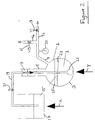
- Figure 2 is a diagrammatic side view of apparatus for carrying out a method embodying the second aspect of the present invention.
- Figure 3 is a graph of conductivity against time for various samples including two loaded with potassium nitrate solution in the manner embodying the present invention as illustrated with reference to Figure 2.
- curves A and B represent samples loaded at rates of 184 ml/minute and 43ml/minute respectively by the method embodying the invention and curves C and D represent control and flooded samples all as described in Example 1 hereinafter.
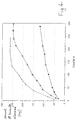
- Figure 4 is a graph, curve A, of biocide released versus time for a porous ceramic material loaded with biocide by a method embodying the invention. Also shown in Figure 4, as described in Example 2, are corresponding curves b and c for control and prior art material (BIOFIX E5) respectively.
- Figure 1 shows a cross-sectional view of the structure of a porous ceramic material embodying the invention, eg. as produced by the method described in Example 1 hereinafter.
- the material consists of a pellet having a diameter of about 2.5mm and a length of several millimetres the material comprising a multiplicity of hollow cells surrounded by a continuous outer skin.
- FIG 1b a portion of the interior of the structure of area Q similar to that marked in Figure 1a is shown enlarged several times. As seen in Figure 1b, a multiplicity of cells of varying sizes generally from 5 ⁇ m to 50 ⁇ m are shown. The cells are bounded from one another by thin cell walls.
- a collection of porous ceramic granules 1 of the kind described and illustrated in Figure 1 is contained in a flask 3.
- the flask 3 has a neck 5 sealed by a seal 7 and a branched outlet tube 9, which has branches 9a, 9b leading via open/shut valves 11, 13 to a vacuum pump (not shown) and an external air atmosphere respectively.
- the pressure inside the flask 3 is recorded on a gauge 23.
- a liquid source 15 of a solution containing the chemical to be loaded into the pores of the granules 1 is contained in a vessel 17.
- a delivery line 19 containing an on/off valve 21 leads from the source 15 to the flask 3.
- the line 19 has an end in the form of a closed perforated bulb 21 near to the bottom of the flask 3 and buried in the granules 1.
- valves 13 and 21 are closed and the valve 11 is opened.
- the flask 3 and its contents are evacuated by the action of the vacuum pump.
- the vessel 17 and the flask 3 are heated by applying heat as indicated by arrows X and Y to a temperature below the boiling point of the solution in the source 15, eg. a temperature in the range 30°C to 90°C.
- the pressure inside the flask 3 being evacuated as indicated on the gauge 23 is monitored. When this pressure reaches a minimum, preferably less than 6 x 10 -4 g/cm 3 , it is maintained at the minimum for a suitable period, eg. 10 minutes.
- the valve 11 is then closed and the valve 21 is opened.
- the solution in the source 15 flows from the vessel 17 into the flask 3 via the bulb 23.
- the solution flows laterally and upwardly into the flask 3 and seeps through the granules 1 and eventually forms a body of liquid in the flask 1 which saturates the granules 1.
- the body of liquid is allowed to rise to a level 25, about 20% by volume above the upper level of the granules 1 indicated by reference numeral 27.
- the valve 21 is then closed and the valve 13 is opened. This allows atmospheric air to enter the flask 3 above the level 25 of the solution effectively pressurising the system and forcing more solution into the pores of the granules 1.
- the contents of the flask 3 are poured into a screen or filter (not shown) to remove excess loading solution. This is preferably carried out quickly when the solution has been heated to prevent crystallisation from the cooling solution.
- the filtered, chemical-loaded granules are then dried to remove the solvent of the loading solution.
- the drying may be carried out by use of an oven, eg. for a period of 1 to 2 hours.
- a ball clay in the form of a substantially dry powder was fed at a rate of 15kg.hr -1 into the feed inlet of a co-rotating, twin-screw compounder extruder with inlets provided along the length of its casing to permit the introduction of liquid additives into the material passing through the extender. At the same time sufficient water to form a suspension containing 60% by weight of dry ball clay was injected through some of the inlets in the casing of the extruder.
- the ball clay had a particle size distribution such that 85% by weight consisted of particles having an equivalent spherical diameter smaller than 2 ⁇ m and the following mineralogical composition: kaolinite 56% by weight mica 34% by weight quartz 10% by weight.
- foam which had been separately generated by forcing a mixture of water, air and a surfactant which was a sodium salt of a linear alkyl ethoxy sulphate through a fine mesh.
- the resultant foamed mixture was extruded through a plurality of apertures of diameter approximately 2.5mm onto a wire mesh belt to form granules in the form of pellets several millimetres long which were dried in a dryer at a temperature of 150°C for one hour.
- a multiplicity of the granules were transferred to a rotary calciner and the granules were calcined at a temperature of about 1100°C for a period of 15 minutes.
- the granules were found to have a density of 0.541g.cm -3 , which corresponds to a voidage of 80% by volume.
- a sample of the granules was placed in a closed container and heated to a temperature of 70°C.
- a vacuum of 0.89bar was applied to the heated granules for a time of 10 minutes, and there was then introduced into the closed container a previously prepared saturated solution of potassium nitrate at 70°C which covered the granules while the pressure was allowed to return to atmospheric. In this way the voidage of the granules was substantially filled with potassium nitrate solution.
- the excess potassium nitrate solution was then removed and the loaded granules were dried at 140°C for 16 hours.
- the granules were weighed and the weight of potassium nitrate retained was determined.
- Potassium nitrate was used to represent a water-soluble active material such as might be required to be absorbed within, and released under controlled conditions from, the granular material.
- a further experiment (C) was performed in which a 10g sample of the loaded granules was introduced into 2 litres of deionised water in the reservoir with gentle agitation. The water containing dissolved potassium nitrate was then pumped past the conductivity meter at a rate of 184ml.min -1 and the change in conductivity with time was recorded.
- the rate of dissolution of potassium nitrate was about the same for Experiment A (loaded granules in column - flow rate 184ml.min -1 ) and for Experiment C (loaded granules in reservoir - flow rate 184ml.min -1 ). There was an initial rapid rise in conductivity as potassium nitrate deposited on the surface of the granules was removed, followed by a slower rise in conductivity as potassium nitrate which had been retained within the voidage of the granules diffused out.
- a further sample of porous inorganic granules was prepared by the method described in Example 1 above.
- the particles were found to have a density of 0.492g.cm -3 which corresponds to a voidage of 82% by volume.
- the biocide has a melting point of 55°C, and it was therefore possible to introduce the biocide into the granules in a molten state.
- 5g of the granules was mixed with 8.3g of the solid biocide in a round bottomed flask. The flask was connected to a source of vacuum at 0.98bar and maintained at this reduced pressure for 10-15 minutes. The flask was then lowered into a water bath at 65°C, and the biocide melted and was slowly absorbed into the voidage of the granules. It was found that the granules had absorbed approximately twice their own weight of the biocide.
- the rate of release of the biocide from the loaded granules was determined by placing 390mg of the loaded granules, containing 246mg of absorbed biocide, in 100ml of a mixture of 9 parts by volume of water to 1 part by volume of methanol.
- the biocide is soluble in this mixture although it is only sparingly soluble in water alone.
- the mixture was maintained at a temperature of 21°C and stirred constantly.
- Samples of the water/methanol medium were taken at intervals and subjected to analysis by uv - visible spectroscopy. The magnitude of a peak at the wavelength of 256nm was determined and used as a measure of the quantity of the biocide released into the medium.
- the amount of biocide released after a given time was plotted and the resultant graph is shown in Figure 2.
- the material was loaded with the biocide by the method described above, except that, in this case, 5g of the granules was mixed with 4.1g of the biocide.
- the graph of amount of biocide released in a given time is shown in Figure 2.
Landscapes
- Chemical & Material Sciences (AREA)
- Organic Chemistry (AREA)
- Engineering & Computer Science (AREA)
- Ceramic Engineering (AREA)
- Chemical Kinetics & Catalysis (AREA)
- Analytical Chemistry (AREA)
- Inorganic Chemistry (AREA)
- Life Sciences & Earth Sciences (AREA)
- Materials Engineering (AREA)
- Structural Engineering (AREA)
- General Health & Medical Sciences (AREA)
- Health & Medical Sciences (AREA)
- Pest Control & Pesticides (AREA)
- Wood Science & Technology (AREA)
- Zoology (AREA)
- Agronomy & Crop Science (AREA)
- Dispersion Chemistry (AREA)
- Physics & Mathematics (AREA)
- Plant Pathology (AREA)
- Toxicology (AREA)
- Dentistry (AREA)
- Geochemistry & Mineralogy (AREA)
- Thermal Sciences (AREA)
- Environmental Sciences (AREA)
- Medicinal Preparation (AREA)
- Acyclic And Carbocyclic Compounds In Medicinal Compositions (AREA)
- Manufacturing Of Micro-Capsules (AREA)
- Porous Artificial Stone Or Porous Ceramic Products (AREA)
- Solid-Sorbent Or Filter-Aiding Compositions (AREA)
- Press-Shaping Or Shaping Using Conveyers (AREA)
- Coloring Foods And Improving Nutritive Qualities (AREA)
- Agricultural Chemicals And Associated Chemicals (AREA)
Claims (14)
- Verfahren zur Herstellung eines porenhaltigen Keramikmaterials, beinhaltend Körnchen aus einem extrudierten, geschäumten Material, das Kanditton enthält, umfassend die Schritte:Herstellen eines geschäumten keramikbildenden Materials aus einem nassen Kanditton-haltigen Teilchenmaterial;Extrudieren des geschäumten keramikbildenden Materials in die Form von Pellets oder Granalien; undKalzinieren der extrudierten Pellets oder Granalien, wobei man eine innere Struktur bereitstellt, die innerhalb der Pellets oder Granalien geschlossenzellige Poren aufweist; dadurch gekennzeichnet, dassdas Kalzinieren in einem Rotationsbrennofen erfolgt, so dass beim Kalzinieren eine Anzahl Pellets oder Granalien übereinandergeworfen werden,die dabei hergestellten Körnchen eine durchgängige Außenhaut besitzen, welche eine Porosität besitzt, dass Flüssigkeiten langsam hindurchdiffundieren können; unddie Körnchen geeignet sind für die Speicherung und die langsame Freigabe ein oder einer Anzahl Chemiestoffe aus den geschlossenen Zellen der inneren Körnchenstruktur.
- Verfahren nach Anspruch 1, wobei vor dem Kalzinieren die extrudierten Pellets oder Granalien getrocknet werden.
- Verfahren nach Anspruch 1 oder 2, wobei die Kalzinierungstemperatur nicht mehr als 100°C unterhalb der Fließtemperatur des zu kalzinierenden Materials liegt.
- Porenhaltiges Keramikmaterial, hergestellt durch das Verfahren nach Anspruch 1, 2 oder 3, umfassend Körnchen mit einer inneren Struktur, die geschlossenzellige Poren aufweist, und von einer durchgängigen Außenhaut, welche im Wesentlichen das ganze Material, das die Innenstruktur aufweist, überdeckt sind und die eine Porosität besitzt, dass Flüssigkeiten langsam durch die Außenhaut diffundieren können, wobei die Poren der Außenhaut weniger als 0,1 µm groß sind.
- Porenhaltiges Keramikmaterial nach Anspruch 4, wobei die durchgängige Außenhaut eine äußere Oberfläche hat, die auf wenigstens 99% der Fläche keine Poren aufweist, die größer als 1 µm sind.
- Porenhaltiges Keramikmaterial nach Anspruch 4 oder 5, das zudem, enthaltend in den zellenartigen Poren, einen oder eine Anzahl Chemiestoffe enthält, welche langsam daraus freigesetzt werden.
- Verfahren zur Herstellung eines porenhaltigen Körnchenmaterials, das einen daraus freisetzbaren Chemiestoff enthält, umfassend die Schritte:Herstellen von Körnchen aus einem porenhaltigen Keramikmaterial nach einem der Ansprüche 4 bis 6;Einbringen der Körnchen in ein evakuierbares Gehäuse;Evakuieren des Gehäuses und Absorbieren lassen des Chemiestoffs oder einer Substanz, die in den Chemiestoff umgewandelt wird, in die Körnchen, so dass dieser in deren geschlossenzelligen Poren gespeichert wird.
- Verfahren nach Anspruch 7, zudem umfassend das Anbringen aus einer Quelle außerhalb des Gehäuses eines Stroms, welcher den Chemiestoff enthält, der in die Körnchen gebracht werden soll, so dass die zellulären Poren der Körnchen mit dem Chemiestoff beladen werden.
- Verfahren nach Anspruch 8, wobei der Druckunterschied zwischen dem evakuierten Gehäuse und der Außenumgebung durch eine Quelle für den Chemiestoff teilweise ausgeglichen wird, wodurch der Chemiestoff in das Gehäuse gesogen wird.
- Verfahren nach Anspruch 7, 8 oder 9, wobei die Quelle für den Chemiestoff eine flüssige Lösung des chemischen Stoffs in einem Lösungsmittel umfasst.
- Verfahren nach Anspruch 7, 8 oder 9, wobei die Quelle für den Chemiestoff der Stoff selbst in geschmolzener Form beinhaltet.
- Verfahren nach einem der Ansprüche 8 bis 11, wobei der Strom des Chemiestoffs in das Gehäuse zugelassen wird an einem Einlass, der so eingerichtet ist, dass der Chemiestoff von der Seite und nach oben durch die Körnchen in das Gehäuse dringen kann.
- Verfahren nach einem der Ansprüche 8 bis 12, wobei der den Chemiestoff enthaltende Strom eine erhitzte Flüssigkeit umfasst.
- Verfahren nach einem der Ansprüche 8 bis 13, wobei der Strom eine flüssige, den Chemiestoff enthaltende Lösung umfasst und die Körnchen nach dem Beladen mit der Lösung getrocknet werden, wobei man das Lösungsmittel der Lösung entfernt.
Applications Claiming Priority (2)
| Application Number | Priority Date | Filing Date | Title |
|---|---|---|---|
| GBGB9515242.7A GB9515242D0 (en) | 1995-07-25 | 1995-07-25 | Porous mineral granules |
| GB9515242 | 1995-07-25 |
Publications (2)
| Publication Number | Publication Date |
|---|---|
| EP0758633A1 EP0758633A1 (de) | 1997-02-19 |
| EP0758633B1 true EP0758633B1 (de) | 1999-04-21 |
Family
ID=10778224
Family Applications (1)
| Application Number | Title | Priority Date | Filing Date |
|---|---|---|---|
| EP96305366A Expired - Lifetime EP0758633B1 (de) | 1995-07-25 | 1996-07-19 | Poröse Granulate |
Country Status (5)
| Country | Link |
|---|---|
| EP (1) | EP0758633B1 (de) |
| JP (1) | JPH09165278A (de) |
| AT (1) | ATE179158T1 (de) |
| DE (1) | DE69602137T2 (de) |
| GB (1) | GB9515242D0 (de) |
Cited By (3)
| Publication number | Priority date | Publication date | Assignee | Title |
|---|---|---|---|---|
| EP1698672A2 (de) | 2002-06-19 | 2006-09-06 | THOR GmbH | Beschichtungsmasse mit Biozidmikrokapseln |
| WO2010121606A2 (de) | 2009-04-24 | 2010-10-28 | Chemische Werke Kluthe Gmbh | Verfahren, formulierungen und erzeugnis für die biozide behandlung eines kühlschmierstoffs |
| EP4281427A4 (de) * | 2021-01-21 | 2025-04-09 | Carbo Ceramics Inc. | Pellets mit landwirtschaftlichen behandlungsmaterialien und verfahren zur herstellung davon |
Families Citing this family (16)
| Publication number | Priority date | Publication date | Assignee | Title |
|---|---|---|---|---|
| CN1262183C (zh) * | 1997-10-20 | 2006-07-05 | 萧炎昆 | 可去除有害微生物的多孔状成型物件及其制造方法和用途 |
| DE10010210C1 (de) * | 2000-03-02 | 2001-12-13 | Masterfoods Gmbh | Verfahren zur Herstellung eines mit flüchtigen Substanzen beladenen porösen Keramikgranulates und dessen Verwendung |
| GB0020610D0 (en) * | 2000-08-21 | 2000-10-11 | Dytech Corp Ltd | Uses of porous carriers |
| EP1359133A4 (de) * | 2001-02-08 | 2007-03-07 | Sumitomo Electric Industries | Poröse keramik und verfahren zur hestellung derselben und mikrostripsubstrate |
| JP2003160384A (ja) * | 2001-09-04 | 2003-06-03 | Sumitomo Electric Ind Ltd | 多孔質窒化ケイ素セラミックスおよびその製造方法 |
| WO2004101736A1 (ja) * | 2003-05-15 | 2004-11-25 | Phytoculture Control Co., Ltd. | 生物培養装置および培養方法 |
| DE10342894A1 (de) * | 2003-09-17 | 2005-04-14 | Zf Friedrichshafen Ag | Verfahren zur Zirkulation einer Ölmenge und Ölkreislauf zur Durchführung des Verfahrens |
| DE102007028923A1 (de) | 2007-06-22 | 2008-12-24 | Lanxess Deutschland Gmbh | Biozodwirkstoff haltige partikuläre Polymere |
| EP2082999A1 (de) * | 2008-01-23 | 2009-07-29 | Technische Universiteit Delft | Mittel zur Selbstheilung von zementartigen Materialien und Strukturen und Verfahren zu seiner Herstellung |
| EP2387308B1 (de) * | 2009-01-16 | 2018-02-28 | VKR Holding A/S | Eine methpode zur herstellung von partikeln zur gesteuerten abgabe eines biozids |
| EP2380438A1 (de) | 2010-04-22 | 2011-10-26 | LANXESS Deutschland GmbH | Biozide Stoffe |
| EP2801256A1 (de) | 2013-05-08 | 2014-11-12 | LANXESS Deutschland GmbH | Mikrokapseln enthaltend ein Algizid und ein Melamin-Formaldehyd-Polymer |
| JP6247404B2 (ja) | 2014-02-27 | 2017-12-13 | ランクセス・ドイチュランド・ゲーエムベーハー | 殺生物性マイクロカプセル |
| EP2926659A1 (de) | 2014-04-04 | 2015-10-07 | LANXESS Deutschland GmbH | Biozide Mittel |
| CN104150799B (zh) * | 2014-08-23 | 2016-04-20 | 济南大学 | 一种肥效缓释型轻骨料的制备方法 |
| US11577212B2 (en) | 2018-07-16 | 2023-02-14 | SAS Nanotechnologies Inc. | Stimuli-responsive micro-reservoirs for release of encapsulants |
Family Cites Families (8)
| Publication number | Priority date | Publication date | Assignee | Title |
|---|---|---|---|---|
| DE2648119A1 (de) * | 1976-10-23 | 1978-04-27 | Blaehton Kontor | Wirkstoffspender zur abgabe von wirk- oder naehrstoffen und verfahren zu dessen herstellung |
| DE3123938C2 (de) * | 1981-06-16 | 1983-03-17 | Fraunhofer-Gesellschaft zur Förderung der angewandten Forschung e.V., 8000 München | Depotwerkstoffe auf Basis von geblähtem Perlit oder ähnlichen porösen Trägern, Verfahren zu ihrer Herstellung und ihre Verwendung |
| FR2548175B1 (fr) * | 1983-06-20 | 1991-10-11 | Atelier Realisation Ceramique | Procede permettant l'impregnation de parfum dans un objet en ceramique |
| DE3744732A1 (de) * | 1987-02-19 | 1989-01-05 | Effem Gmbh | Pflanzensubstrat |
| JPH0764558B2 (ja) * | 1987-11-16 | 1995-07-12 | 昭和電工株式会社 | アルミナ質多孔性粒状物及びこの粒状物を骨材とする耐火物 |
| DE4011255C1 (de) * | 1990-04-05 | 1991-06-20 | Effem Gmbh, 2810 Verden, De | |
| US5195843A (en) * | 1991-05-30 | 1993-03-23 | Minnesota Mining And Manufacturing Company | Ceramic foam body having closed cell structure |
| GB9222638D0 (en) * | 1992-10-28 | 1992-12-09 | Ecc Int Ltd | Porous ceramic granules |
-
1995
- 1995-07-25 GB GBGB9515242.7A patent/GB9515242D0/en active Pending
-
1996
- 1996-07-19 DE DE69602137T patent/DE69602137T2/de not_active Expired - Lifetime
- 1996-07-19 EP EP96305366A patent/EP0758633B1/de not_active Expired - Lifetime
- 1996-07-19 AT AT96305366T patent/ATE179158T1/de not_active IP Right Cessation
- 1996-07-25 JP JP8227314A patent/JPH09165278A/ja active Pending
Cited By (4)
| Publication number | Priority date | Publication date | Assignee | Title |
|---|---|---|---|---|
| EP1698672A2 (de) | 2002-06-19 | 2006-09-06 | THOR GmbH | Beschichtungsmasse mit Biozidmikrokapseln |
| WO2010121606A2 (de) | 2009-04-24 | 2010-10-28 | Chemische Werke Kluthe Gmbh | Verfahren, formulierungen und erzeugnis für die biozide behandlung eines kühlschmierstoffs |
| DE102010018312A1 (de) | 2009-04-24 | 2010-11-04 | Chemische Werke Kluthe Gmbh | Verfahren und Erzeugnis für die biozide Behandlung eines Kühlschmierstoffs |
| EP4281427A4 (de) * | 2021-01-21 | 2025-04-09 | Carbo Ceramics Inc. | Pellets mit landwirtschaftlichen behandlungsmaterialien und verfahren zur herstellung davon |
Also Published As
| Publication number | Publication date |
|---|---|
| JPH09165278A (ja) | 1997-06-24 |
| EP0758633A1 (de) | 1997-02-19 |
| DE69602137D1 (de) | 1999-05-27 |
| DE69602137T2 (de) | 1999-08-19 |
| ATE179158T1 (de) | 1999-05-15 |
| GB9515242D0 (en) | 1995-09-20 |
Similar Documents
| Publication | Publication Date | Title |
|---|---|---|
| EP0758633B1 (de) | Poröse Granulate | |
| JP2603449B2 (ja) | 中空多孔性微小球体の製造方法 | |
| US4777154A (en) | Hollow microspheres made from dispersed particle compositions and their production | |
| US5212143A (en) | Hollow porous microspheres made from dispersed particle compositions | |
| Naz et al. | Slow release coating remedy for nitrogen loss from conventional urea: a review | |
| US4275684A (en) | Animal litter | |
| US5418195A (en) | Porous ceramic granules | |
| EP0259441A1 (de) | Faserverstärkte hohle mikrokugeln, hergestellt aus dispersen teilchenzubereitungen und deren herstellungsverfahren | |
| US3630446A (en) | Insecticide-releasing shaped bodies and process for producing them | |
| DE19929861A1 (de) | Speicherverbundsysteme, bestehend aus Schmelzwärme-Speichermaterialien in porösen Trägermaterialien | |
| US6368703B1 (en) | Supported porous materials | |
| PT790764E (pt) | Dispositivo implantavel para a administracao de substancias activas a plantas | |
| US4213882A (en) | Preparation method for catalyst support and materials produced thereby | |
| US3668149A (en) | Method and equipment for the preparation of catalytically active bodies | |
| US4036928A (en) | Process for pelletizing sorptive mineral fines | |
| CN1153752C (zh) | 多孔性的陶瓷体的制法及其产品 | |
| CN106116492A (zh) | 炉渣轻质通孔陶粒 | |
| US4253990A (en) | Preparation method for catalyst supports and materials produced thereby | |
| US3992216A (en) | Lightweight aggregate for concrete and method for making same | |
| CS275839B6 (en) | Process for producing ceramic profiled composite body with a cavity | |
| RU2605714C1 (ru) | Способ получения загрузки биофильтра с иммобилизационными свойствами | |
| JPH10330172A (ja) | 多孔質セラミックス、精水器用多孔質セラミックフィルター | |
| WO2000037694A1 (en) | Porous inorganic granular material | |
| WO2000001640A1 (en) | Foamed inorganic materials | |
| CN106630984A (zh) | 多功能梅花形麦饭石轻质通孔陶粒的生产方法 |
Legal Events
| Date | Code | Title | Description |
|---|---|---|---|
| PUAI | Public reference made under article 153(3) epc to a published international application that has entered the european phase |
Free format text: ORIGINAL CODE: 0009012 |
|
| 17P | Request for examination filed |
Effective date: 19960730 |
|
| AK | Designated contracting states |
Kind code of ref document: A1 Designated state(s): AT BE CH DE DK ES FI FR GB GR IE IT LI LU NL PT SE |
|
| 17Q | First examination report despatched |
Effective date: 19971017 |
|
| GRAG | Despatch of communication of intention to grant |
Free format text: ORIGINAL CODE: EPIDOS AGRA |
|
| GRAG | Despatch of communication of intention to grant |
Free format text: ORIGINAL CODE: EPIDOS AGRA |
|
| GRAH | Despatch of communication of intention to grant a patent |
Free format text: ORIGINAL CODE: EPIDOS IGRA |
|
| GRAH | Despatch of communication of intention to grant a patent |
Free format text: ORIGINAL CODE: EPIDOS IGRA |
|
| GRAA | (expected) grant |
Free format text: ORIGINAL CODE: 0009210 |
|
| AK | Designated contracting states |
Kind code of ref document: B1 Designated state(s): AT BE CH DE DK ES FI FR GB GR IE IT LI LU NL PT SE |
|
| PG25 | Lapsed in a contracting state [announced via postgrant information from national office to epo] |
Ref country code: SE Free format text: THE PATENT HAS BEEN ANNULLED BY A DECISION OF A NATIONAL AUTHORITY Effective date: 19990421 Ref country code: NL Free format text: LAPSE BECAUSE OF FAILURE TO SUBMIT A TRANSLATION OF THE DESCRIPTION OR TO PAY THE FEE WITHIN THE PRESCRIBED TIME-LIMIT Effective date: 19990421 Ref country code: LI Free format text: LAPSE BECAUSE OF FAILURE TO SUBMIT A TRANSLATION OF THE DESCRIPTION OR TO PAY THE FEE WITHIN THE PRESCRIBED TIME-LIMIT Effective date: 19990421 Ref country code: GR Free format text: LAPSE BECAUSE OF NON-PAYMENT OF DUE FEES Effective date: 19990421 Ref country code: FI Free format text: LAPSE BECAUSE OF NON-PAYMENT OF DUE FEES Effective date: 19990421 Ref country code: ES Free format text: THE PATENT HAS BEEN ANNULLED BY A DECISION OF A NATIONAL AUTHORITY Effective date: 19990421 Ref country code: CH Free format text: LAPSE BECAUSE OF FAILURE TO SUBMIT A TRANSLATION OF THE DESCRIPTION OR TO PAY THE FEE WITHIN THE PRESCRIBED TIME-LIMIT Effective date: 19990421 Ref country code: BE Free format text: LAPSE BECAUSE OF FAILURE TO SUBMIT A TRANSLATION OF THE DESCRIPTION OR TO PAY THE FEE WITHIN THE PRESCRIBED TIME-LIMIT Effective date: 19990421 Ref country code: AT Free format text: LAPSE BECAUSE OF FAILURE TO SUBMIT A TRANSLATION OF THE DESCRIPTION OR TO PAY THE FEE WITHIN THE PRESCRIBED TIME-LIMIT Effective date: 19990421 |
|
| REF | Corresponds to: |
Ref document number: 179158 Country of ref document: AT Date of ref document: 19990515 Kind code of ref document: T |
|
| REG | Reference to a national code |
Ref country code: CH Ref legal event code: EP |
|
| REG | Reference to a national code |
Ref country code: IE Ref legal event code: FG4D |
|
| REF | Corresponds to: |
Ref document number: 69602137 Country of ref document: DE Date of ref document: 19990527 |
|
| ET | Fr: translation filed | ||
| PG25 | Lapsed in a contracting state [announced via postgrant information from national office to epo] |
Ref country code: LU Free format text: LAPSE BECAUSE OF NON-PAYMENT OF DUE FEES Effective date: 19990719 Ref country code: IE Free format text: LAPSE BECAUSE OF NON-PAYMENT OF DUE FEES Effective date: 19990719 |
|
| PG25 | Lapsed in a contracting state [announced via postgrant information from national office to epo] |
Ref country code: DK Free format text: LAPSE BECAUSE OF FAILURE TO SUBMIT A TRANSLATION OF THE DESCRIPTION OR TO PAY THE FEE WITHIN THE PRESCRIBED TIME-LIMIT Effective date: 19990721 |
|
| PG25 | Lapsed in a contracting state [announced via postgrant information from national office to epo] |
Ref country code: PT Free format text: LAPSE BECAUSE OF FAILURE TO SUBMIT A TRANSLATION OF THE DESCRIPTION OR TO PAY THE FEE WITHIN THE PRESCRIBED TIME-LIMIT Effective date: 19990726 |
|
| REG | Reference to a national code |
Ref country code: CH Ref legal event code: PL |
|
| PLBE | No opposition filed within time limit |
Free format text: ORIGINAL CODE: 0009261 |
|
| STAA | Information on the status of an ep patent application or granted ep patent |
Free format text: STATUS: NO OPPOSITION FILED WITHIN TIME LIMIT |
|
| 26N | No opposition filed | ||
| REG | Reference to a national code |
Ref country code: IE Ref legal event code: MM4A |
|
| REG | Reference to a national code |
Ref country code: GB Ref legal event code: IF02 |
|
| PG25 | Lapsed in a contracting state [announced via postgrant information from national office to epo] |
Ref country code: IT Free format text: LAPSE BECAUSE OF NON-PAYMENT OF DUE FEES Effective date: 20050719 |
|
| REG | Reference to a national code |
Ref country code: DE Ref legal event code: R082 Ref document number: 69602137 Country of ref document: DE Representative=s name: HASELTINE LAKE LLP, DE |
|
| REG | Reference to a national code |
Ref country code: FR Ref legal event code: PLFP Year of fee payment: 20 |
|
| PGFP | Annual fee paid to national office [announced via postgrant information from national office to epo] |
Ref country code: DE Payment date: 20150729 Year of fee payment: 20 Ref country code: GB Payment date: 20150727 Year of fee payment: 20 |
|
| PGFP | Annual fee paid to national office [announced via postgrant information from national office to epo] |
Ref country code: FR Payment date: 20150717 Year of fee payment: 20 |
|
| REG | Reference to a national code |
Ref country code: DE Ref legal event code: R071 Ref document number: 69602137 Country of ref document: DE |
|
| REG | Reference to a national code |
Ref country code: GB Ref legal event code: PE20 Expiry date: 20160718 |
|
| PG25 | Lapsed in a contracting state [announced via postgrant information from national office to epo] |
Ref country code: GB Free format text: LAPSE BECAUSE OF EXPIRATION OF PROTECTION Effective date: 20160718 |