EP0756874B1 - Cleaning and disinfecting agent for contact lens and method for cleaning and disinfecting contact lens using the same - Google Patents
Cleaning and disinfecting agent for contact lens and method for cleaning and disinfecting contact lens using the same Download PDFInfo
- Publication number
- EP0756874B1 EP0756874B1 EP96902472A EP96902472A EP0756874B1 EP 0756874 B1 EP0756874 B1 EP 0756874B1 EP 96902472 A EP96902472 A EP 96902472A EP 96902472 A EP96902472 A EP 96902472A EP 0756874 B1 EP0756874 B1 EP 0756874B1
- Authority
- EP
- European Patent Office
- Prior art keywords
- cleaning
- contact lens
- disinfecting
- solution
- disinfecting solution
- Prior art date
- Legal status (The legal status is an assumption and is not a legal conclusion. Google has not performed a legal analysis and makes no representation as to the accuracy of the status listed.)
- Expired - Lifetime
Links
- 238000004140 cleaning Methods 0.000 title claims description 177
- 230000000249 desinfective effect Effects 0.000 title claims description 172
- 238000000034 method Methods 0.000 title claims description 43
- 239000000645 desinfectant Substances 0.000 title description 9
- 239000012459 cleaning agent Substances 0.000 title 1
- 239000000243 solution Substances 0.000 claims description 140
- DNIAPMSPPWPWGF-UHFFFAOYSA-N Propylene glycol Chemical compound CC(O)CO DNIAPMSPPWPWGF-UHFFFAOYSA-N 0.000 claims description 135
- 102000035195 Peptidases Human genes 0.000 claims description 74
- 108091005804 Peptidases Proteins 0.000 claims description 74
- PEDCQBHIVMGVHV-UHFFFAOYSA-N Glycerine Chemical compound OCC(O)CO PEDCQBHIVMGVHV-UHFFFAOYSA-N 0.000 claims description 68
- 235000011187 glycerol Nutrition 0.000 claims description 34
- XLYOFNOQVPJJNP-UHFFFAOYSA-N water Substances O XLYOFNOQVPJJNP-UHFFFAOYSA-N 0.000 claims description 19
- 108010022999 Serine Proteases Proteins 0.000 claims description 17
- 102000012479 Serine Proteases Human genes 0.000 claims description 17
- 239000004094 surface-active agent Substances 0.000 claims description 16
- BHPQYMZQTOCNFJ-UHFFFAOYSA-N Calcium cation Chemical compound [Ca+2] BHPQYMZQTOCNFJ-UHFFFAOYSA-N 0.000 claims description 15
- 229910001424 calcium ion Inorganic materials 0.000 claims description 15
- 239000000644 isotonic solution Substances 0.000 claims description 8
- 230000000694 effects Effects 0.000 description 48
- 235000018102 proteins Nutrition 0.000 description 30
- 102000004169 proteins and genes Human genes 0.000 description 30
- 108090000623 proteins and genes Proteins 0.000 description 30
- 239000000203 mixture Substances 0.000 description 23
- 150000002632 lipids Chemical class 0.000 description 17
- 239000000872 buffer Substances 0.000 description 15
- 102000004190 Enzymes Human genes 0.000 description 14
- 108090000790 Enzymes Proteins 0.000 description 14
- 229940088598 enzyme Drugs 0.000 description 14
- 239000012266 salt solution Substances 0.000 description 14
- 241000233866 Fungi Species 0.000 description 13
- 239000004365 Protease Substances 0.000 description 11
- 230000000052 comparative effect Effects 0.000 description 11
- 239000007788 liquid Substances 0.000 description 10
- 230000001954 sterilising effect Effects 0.000 description 10
- LFQSCWFLJHTTHZ-UHFFFAOYSA-N Ethanol Chemical compound CCO LFQSCWFLJHTTHZ-UHFFFAOYSA-N 0.000 description 9
- 239000002609 medium Substances 0.000 description 9
- 238000004659 sterilization and disinfection Methods 0.000 description 9
- 241000193830 Bacillus <bacterium> Species 0.000 description 8
- -1 alkylene glycol Chemical compound 0.000 description 8
- 239000000463 material Substances 0.000 description 8
- 238000012360 testing method Methods 0.000 description 8
- 241000894006 Bacteria Species 0.000 description 7
- 239000007864 aqueous solution Substances 0.000 description 7
- 229910052751 metal Inorganic materials 0.000 description 7
- 239000002184 metal Substances 0.000 description 7
- 239000000126 substance Substances 0.000 description 7
- MHAJPDPJQMAIIY-UHFFFAOYSA-N Hydrogen peroxide Chemical compound OO MHAJPDPJQMAIIY-UHFFFAOYSA-N 0.000 description 6
- HEMHJVSKTPXQMS-UHFFFAOYSA-M Sodium hydroxide Chemical compound [OH-].[Na+] HEMHJVSKTPXQMS-UHFFFAOYSA-M 0.000 description 6
- 229920001400 block copolymer Polymers 0.000 description 6
- 239000012530 fluid Substances 0.000 description 6
- 229920002503 polyoxyethylene-polyoxypropylene Polymers 0.000 description 6
- 230000000087 stabilizing effect Effects 0.000 description 6
- 239000000725 suspension Substances 0.000 description 6
- 229920001817 Agar Polymers 0.000 description 5
- 239000008272 agar Substances 0.000 description 5
- 239000004599 antimicrobial Substances 0.000 description 5
- LYCAIKOWRPUZTN-UHFFFAOYSA-N ethylene glycol Natural products OCCO LYCAIKOWRPUZTN-UHFFFAOYSA-N 0.000 description 5
- 239000008213 purified water Substances 0.000 description 5
- WQZGKKKJIJFFOK-GASJEMHNSA-N Glucose Natural products OC[C@H]1OC(O)[C@H](O)[C@@H](O)[C@@H]1O WQZGKKKJIJFFOK-GASJEMHNSA-N 0.000 description 4
- 239000001888 Peptone Substances 0.000 description 4
- 108010080698 Peptones Proteins 0.000 description 4
- FAPWRFPIFSIZLT-UHFFFAOYSA-M Sodium chloride Chemical compound [Na+].[Cl-] FAPWRFPIFSIZLT-UHFFFAOYSA-M 0.000 description 4
- 101710097834 Thiol protease Proteins 0.000 description 4
- 238000002835 absorbance Methods 0.000 description 4
- 230000002411 adverse Effects 0.000 description 4
- 229910021538 borax Inorganic materials 0.000 description 4
- 125000003178 carboxy group Chemical group [H]OC(*)=O 0.000 description 4
- 239000008103 glucose Substances 0.000 description 4
- 235000019319 peptone Nutrition 0.000 description 4
- 235000010339 sodium tetraborate Nutrition 0.000 description 4
- QTBSBXVTEAMEQO-UHFFFAOYSA-N Acetic acid Chemical compound CC(O)=O QTBSBXVTEAMEQO-UHFFFAOYSA-N 0.000 description 3
- UXVMQQNJUSDDNG-UHFFFAOYSA-L Calcium chloride Chemical compound [Cl-].[Cl-].[Ca+2] UXVMQQNJUSDDNG-UHFFFAOYSA-L 0.000 description 3
- KFZMGEQAYNKOFK-UHFFFAOYSA-N Isopropanol Chemical compound CC(C)O KFZMGEQAYNKOFK-UHFFFAOYSA-N 0.000 description 3
- 229920003171 Poly (ethylene oxide) Polymers 0.000 description 3
- 239000000607 artificial tear Substances 0.000 description 3
- 239000001110 calcium chloride Substances 0.000 description 3
- 229960002713 calcium chloride Drugs 0.000 description 3
- 229910001628 calcium chloride Inorganic materials 0.000 description 3
- 239000003638 chemical reducing agent Substances 0.000 description 3
- MTHSVFCYNBDYFN-UHFFFAOYSA-N diethylene glycol Chemical compound OCCOCCO MTHSVFCYNBDYFN-UHFFFAOYSA-N 0.000 description 3
- 239000012895 dilution Substances 0.000 description 3
- 238000010790 dilution Methods 0.000 description 3
- 210000005224 forefinger Anatomy 0.000 description 3
- 238000006386 neutralization reaction Methods 0.000 description 3
- 230000003204 osmotic effect Effects 0.000 description 3
- 238000002360 preparation method Methods 0.000 description 3
- 210000003813 thumb Anatomy 0.000 description 3
- 239000006150 trypticase soy agar Substances 0.000 description 3
- 241000222122 Candida albicans Species 0.000 description 2
- VEXZGXHMUGYJMC-UHFFFAOYSA-N Hydrochloric acid Chemical compound Cl VEXZGXHMUGYJMC-UHFFFAOYSA-N 0.000 description 2
- OUYCCCASQSFEME-QMMMGPOBSA-N L-tyrosine Chemical compound OC(=O)[C@@H](N)CC1=CC=C(O)C=C1 OUYCCCASQSFEME-QMMMGPOBSA-N 0.000 description 2
- 230000002378 acidificating effect Effects 0.000 description 2
- 244000052616 bacterial pathogen Species 0.000 description 2
- KGBXLFKZBHKPEV-UHFFFAOYSA-N boric acid Chemical compound OB(O)O KGBXLFKZBHKPEV-UHFFFAOYSA-N 0.000 description 2
- 239000004327 boric acid Substances 0.000 description 2
- LLSDKQJKOVVTOJ-UHFFFAOYSA-L calcium chloride dihydrate Chemical compound O.O.[Cl-].[Cl-].[Ca+2] LLSDKQJKOVVTOJ-UHFFFAOYSA-L 0.000 description 2
- 159000000007 calcium salts Chemical class 0.000 description 2
- OSGAYBCDTDRGGQ-UHFFFAOYSA-L calcium sulfate Chemical compound [Ca+2].[O-]S([O-])(=O)=O OSGAYBCDTDRGGQ-UHFFFAOYSA-L 0.000 description 2
- 229940095731 candida albicans Drugs 0.000 description 2
- 239000005018 casein Substances 0.000 description 2
- BECPQYXYKAMYBN-UHFFFAOYSA-N casein, tech. Chemical compound NCCCCC(C(O)=O)N=C(O)C(CC(O)=O)N=C(O)C(CCC(O)=N)N=C(O)C(CC(C)C)N=C(O)C(CCC(O)=O)N=C(O)C(CC(O)=O)N=C(O)C(CCC(O)=O)N=C(O)C(C(C)O)N=C(O)C(CCC(O)=N)N=C(O)C(CCC(O)=N)N=C(O)C(CCC(O)=N)N=C(O)C(CCC(O)=O)N=C(O)C(CCC(O)=O)N=C(O)C(COP(O)(O)=O)N=C(O)C(CCC(O)=N)N=C(O)C(N)CC1=CC=CC=C1 BECPQYXYKAMYBN-UHFFFAOYSA-N 0.000 description 2
- 235000021240 caseins Nutrition 0.000 description 2
- 239000003153 chemical reaction reagent Substances 0.000 description 2
- HVYWMOMLDIMFJA-DPAQBDIFSA-N cholesterol Chemical compound C1C=C2C[C@@H](O)CC[C@]2(C)[C@@H]2[C@@H]1[C@@H]1CC[C@H]([C@H](C)CCCC(C)C)[C@@]1(C)CC2 HVYWMOMLDIMFJA-DPAQBDIFSA-N 0.000 description 2
- 238000007796 conventional method Methods 0.000 description 2
- 230000002542 deteriorative effect Effects 0.000 description 2
- 238000011161 development Methods 0.000 description 2
- 235000014113 dietary fatty acids Nutrition 0.000 description 2
- 150000004683 dihydrates Chemical class 0.000 description 2
- 238000003113 dilution method Methods 0.000 description 2
- 239000012153 distilled water Substances 0.000 description 2
- 230000001747 exhibiting effect Effects 0.000 description 2
- 239000000194 fatty acid Substances 0.000 description 2
- 229930195729 fatty acid Natural products 0.000 description 2
- 239000000706 filtrate Substances 0.000 description 2
- 238000001914 filtration Methods 0.000 description 2
- 108010074605 gamma-Globulins Proteins 0.000 description 2
- BXWNKGSJHAJOGX-UHFFFAOYSA-N hexadecan-1-ol Chemical compound CCCCCCCCCCCCCCCCO BXWNKGSJHAJOGX-UHFFFAOYSA-N 0.000 description 2
- WGCNASOHLSPBMP-UHFFFAOYSA-N hydroxyacetaldehyde Natural products OCC=O WGCNASOHLSPBMP-UHFFFAOYSA-N 0.000 description 2
- 238000007654 immersion Methods 0.000 description 2
- 230000007794 irritation Effects 0.000 description 2
- 238000005259 measurement Methods 0.000 description 2
- 239000012046 mixed solvent Substances 0.000 description 2
- 230000035790 physiological processes and functions Effects 0.000 description 2
- 230000035755 proliferation Effects 0.000 description 2
- 239000011780 sodium chloride Substances 0.000 description 2
- 239000004328 sodium tetraborate Substances 0.000 description 2
- 239000003206 sterilizing agent Substances 0.000 description 2
- BSVBQGMMJUBVOD-UHFFFAOYSA-N trisodium borate Chemical compound [Na+].[Na+].[Na+].[O-]B([O-])[O-] BSVBQGMMJUBVOD-UHFFFAOYSA-N 0.000 description 2
- OUYCCCASQSFEME-UHFFFAOYSA-N tyrosine Natural products OC(=O)C(N)CC1=CC=C(O)C=C1 OUYCCCASQSFEME-UHFFFAOYSA-N 0.000 description 2
- WRIDQFICGBMAFQ-UHFFFAOYSA-N (E)-8-Octadecenoic acid Natural products CCCCCCCCCC=CCCCCCCC(O)=O WRIDQFICGBMAFQ-UHFFFAOYSA-N 0.000 description 1
- CHHHXKFHOYLYRE-UHFFFAOYSA-M 2,4-Hexadienoic acid, potassium salt (1:1), (2E,4E)- Chemical compound [K+].CC=CC=CC([O-])=O CHHHXKFHOYLYRE-UHFFFAOYSA-M 0.000 description 1
- LQJBNNIYVWPHFW-UHFFFAOYSA-N 20:1omega9c fatty acid Natural products CCCCCCCCCCC=CCCCCCCCC(O)=O LQJBNNIYVWPHFW-UHFFFAOYSA-N 0.000 description 1
- XUGISPSHIFXEHZ-UHFFFAOYSA-N 3beta-acetoxy-cholest-5-ene Natural products C1C=C2CC(OC(C)=O)CCC2(C)C2C1C1CCC(C(C)CCCC(C)C)C1(C)CC2 XUGISPSHIFXEHZ-UHFFFAOYSA-N 0.000 description 1
- QSBYPNXLFMSGKH-UHFFFAOYSA-N 9-Heptadecensaeure Natural products CCCCCCCC=CCCCCCCCC(O)=O QSBYPNXLFMSGKH-UHFFFAOYSA-N 0.000 description 1
- 241000186361 Actinobacteria <class> Species 0.000 description 1
- 108010088751 Albumins Proteins 0.000 description 1
- 102000009027 Albumins Human genes 0.000 description 1
- 241001225321 Aspergillus fumigatus Species 0.000 description 1
- 108090000145 Bacillolysin Proteins 0.000 description 1
- 229940123208 Biguanide Drugs 0.000 description 1
- 108090000317 Chymotrypsin Proteins 0.000 description 1
- 102000029816 Collagenase Human genes 0.000 description 1
- 108060005980 Collagenase Proteins 0.000 description 1
- 108010030718 DegP protease Proteins 0.000 description 1
- PIICEJLVQHRZGT-UHFFFAOYSA-N Ethylenediamine Chemical compound NCCN PIICEJLVQHRZGT-UHFFFAOYSA-N 0.000 description 1
- 239000004354 Hydroxyethyl cellulose Substances 0.000 description 1
- 229920000663 Hydroxyethyl cellulose Polymers 0.000 description 1
- 206010020751 Hypersensitivity Diseases 0.000 description 1
- 239000004166 Lanolin Substances 0.000 description 1
- 241001465754 Metazoa Species 0.000 description 1
- 102000016943 Muramidase Human genes 0.000 description 1
- 108010014251 Muramidase Proteins 0.000 description 1
- 108010062010 N-Acetylmuramoyl-L-alanine Amidase Proteins 0.000 description 1
- 102000035092 Neutral proteases Human genes 0.000 description 1
- 108091005507 Neutral proteases Proteins 0.000 description 1
- 239000005642 Oleic acid Substances 0.000 description 1
- ZQPPMHVWECSIRJ-UHFFFAOYSA-N Oleic acid Natural products CCCCCCCCC=CCCCCCCCC(O)=O ZQPPMHVWECSIRJ-UHFFFAOYSA-N 0.000 description 1
- VMHLLURERBWHNL-UHFFFAOYSA-M Sodium acetate Chemical compound [Na+].CC([O-])=O VMHLLURERBWHNL-UHFFFAOYSA-M 0.000 description 1
- 241000191967 Staphylococcus aureus Species 0.000 description 1
- 108010056079 Subtilisins Proteins 0.000 description 1
- 102000005158 Subtilisins Human genes 0.000 description 1
- 229930006000 Sucrose Natural products 0.000 description 1
- 108090001109 Thermolysin Proteins 0.000 description 1
- 108090000631 Trypsin Proteins 0.000 description 1
- 102000004142 Trypsin Human genes 0.000 description 1
- HCHKCACWOHOZIP-UHFFFAOYSA-N Zinc Chemical compound [Zn] HCHKCACWOHOZIP-UHFFFAOYSA-N 0.000 description 1
- 239000002253 acid Substances 0.000 description 1
- 239000003929 acidic solution Substances 0.000 description 1
- 150000003973 alkyl amines Chemical class 0.000 description 1
- 208000026935 allergic disease Diseases 0.000 description 1
- 230000007815 allergy Effects 0.000 description 1
- 229940091771 aspergillus fumigatus Drugs 0.000 description 1
- QVGXLLKOCUKJST-UHFFFAOYSA-N atomic oxygen Chemical compound [O] QVGXLLKOCUKJST-UHFFFAOYSA-N 0.000 description 1
- 230000003816 axenic effect Effects 0.000 description 1
- 150000004283 biguanides Chemical class 0.000 description 1
- 238000009835 boiling Methods 0.000 description 1
- VSGNNIFQASZAOI-UHFFFAOYSA-L calcium acetate Chemical compound [Ca+2].CC([O-])=O.CC([O-])=O VSGNNIFQASZAOI-UHFFFAOYSA-L 0.000 description 1
- 239000001639 calcium acetate Substances 0.000 description 1
- 235000011092 calcium acetate Nutrition 0.000 description 1
- 229960005147 calcium acetate Drugs 0.000 description 1
- 229940052299 calcium chloride dihydrate Drugs 0.000 description 1
- 229940095672 calcium sulfate Drugs 0.000 description 1
- 239000004359 castor oil Substances 0.000 description 1
- 235000019438 castor oil Nutrition 0.000 description 1
- 239000003054 catalyst Substances 0.000 description 1
- 229960000541 cetyl alcohol Drugs 0.000 description 1
- YZIYKJHYYHPJIB-UUPCJSQJSA-N chlorhexidine gluconate Chemical compound OC[C@@H](O)[C@@H](O)[C@H](O)[C@@H](O)C(O)=O.OC[C@@H](O)[C@@H](O)[C@H](O)[C@@H](O)C(O)=O.C1=CC(Cl)=CC=C1NC(=N)NC(=N)NCCCCCCNC(=N)NC(=N)NC1=CC=C(Cl)C=C1 YZIYKJHYYHPJIB-UUPCJSQJSA-N 0.000 description 1
- 229960003333 chlorhexidine gluconate Drugs 0.000 description 1
- 235000012000 cholesterol Nutrition 0.000 description 1
- XUGISPSHIFXEHZ-VEVYEIKRSA-N cholesteryl acetate Chemical compound C1C=C2C[C@@H](OC(C)=O)CC[C@]2(C)[C@@H]2[C@@H]1[C@@H]1CC[C@H]([C@H](C)CCCC(C)C)[C@@]1(C)CC2 XUGISPSHIFXEHZ-VEVYEIKRSA-N 0.000 description 1
- 229960002376 chymotrypsin Drugs 0.000 description 1
- 229960002424 collagenase Drugs 0.000 description 1
- 239000007859 condensation product Substances 0.000 description 1
- 238000001816 cooling Methods 0.000 description 1
- BNIILDVGGAEEIG-UHFFFAOYSA-L disodium hydrogen phosphate Chemical compound [Na+].[Na+].OP([O-])([O-])=O BNIILDVGGAEEIG-UHFFFAOYSA-L 0.000 description 1
- 230000003028 elevating effect Effects 0.000 description 1
- 150000002148 esters Chemical class 0.000 description 1
- 238000002474 experimental method Methods 0.000 description 1
- 230000004438 eyesight Effects 0.000 description 1
- 210000003811 finger Anatomy 0.000 description 1
- 239000006479 glucose peptone medium Substances 0.000 description 1
- ZEMPKEQAKRGZGQ-XOQCFJPHSA-N glycerol triricinoleate Natural products CCCCCC[C@@H](O)CC=CCCCCCCCC(=O)OC[C@@H](COC(=O)CCCCCCCC=CC[C@@H](O)CCCCCC)OC(=O)CCCCCCCC=CC[C@H](O)CCCCCC ZEMPKEQAKRGZGQ-XOQCFJPHSA-N 0.000 description 1
- 235000019447 hydroxyethyl cellulose Nutrition 0.000 description 1
- 230000036512 infertility Effects 0.000 description 1
- 230000002401 inhibitory effect Effects 0.000 description 1
- 230000003993 interaction Effects 0.000 description 1
- QXJSBBXBKPUZAA-UHFFFAOYSA-N isooleic acid Natural products CCCCCCCC=CCCCCCCCCC(O)=O QXJSBBXBKPUZAA-UHFFFAOYSA-N 0.000 description 1
- 229940039717 lanolin Drugs 0.000 description 1
- 235000019388 lanolin Nutrition 0.000 description 1
- 239000004325 lysozyme Substances 0.000 description 1
- 235000010335 lysozyme Nutrition 0.000 description 1
- 229960000274 lysozyme Drugs 0.000 description 1
- 244000005700 microbiome Species 0.000 description 1
- 239000011259 mixed solution Substances 0.000 description 1
- 229910000403 monosodium phosphate Inorganic materials 0.000 description 1
- 235000019799 monosodium phosphate Nutrition 0.000 description 1
- 230000007935 neutral effect Effects 0.000 description 1
- 239000003921 oil Substances 0.000 description 1
- ZQPPMHVWECSIRJ-KTKRTIGZSA-N oleic acid Chemical compound CCCCCCCC\C=C/CCCCCCCC(O)=O ZQPPMHVWECSIRJ-KTKRTIGZSA-N 0.000 description 1
- 239000001301 oxygen Substances 0.000 description 1
- 229910052760 oxygen Inorganic materials 0.000 description 1
- 230000035699 permeability Effects 0.000 description 1
- 239000004302 potassium sorbate Substances 0.000 description 1
- 235000010241 potassium sorbate Nutrition 0.000 description 1
- 229940069338 potassium sorbate Drugs 0.000 description 1
- 239000000843 powder Substances 0.000 description 1
- 238000001556 precipitation Methods 0.000 description 1
- BDERNNFJNOPAEC-UHFFFAOYSA-N propan-1-ol Chemical compound CCCO BDERNNFJNOPAEC-UHFFFAOYSA-N 0.000 description 1
- 150000003242 quaternary ammonium salts Chemical class 0.000 description 1
- 150000003839 salts Chemical class 0.000 description 1
- 125000003607 serino group Chemical group [H]N([H])[C@]([H])(C(=O)[*])C(O[H])([H])[H] 0.000 description 1
- 239000001632 sodium acetate Substances 0.000 description 1
- 235000017281 sodium acetate Nutrition 0.000 description 1
- AJPJDKMHJJGVTQ-UHFFFAOYSA-M sodium dihydrogen phosphate Chemical compound [Na+].OP(O)([O-])=O AJPJDKMHJJGVTQ-UHFFFAOYSA-M 0.000 description 1
- 239000002904 solvent Substances 0.000 description 1
- 230000006641 stabilisation Effects 0.000 description 1
- 238000013112 stability test Methods 0.000 description 1
- 238000011105 stabilization Methods 0.000 description 1
- 239000005720 sucrose Substances 0.000 description 1
- YNJBWRMUSHSURL-UHFFFAOYSA-N trichloroacetic acid Chemical compound OC(=O)C(Cl)(Cl)Cl YNJBWRMUSHSURL-UHFFFAOYSA-N 0.000 description 1
- LENZDBCJOHFCAS-UHFFFAOYSA-N tris Chemical compound OCC(N)(CO)CO LENZDBCJOHFCAS-UHFFFAOYSA-N 0.000 description 1
- 239000012588 trypsin Substances 0.000 description 1
- 229910052725 zinc Inorganic materials 0.000 description 1
- 239000011701 zinc Substances 0.000 description 1
Classifications
-
- C—CHEMISTRY; METALLURGY
- C11—ANIMAL OR VEGETABLE OILS, FATS, FATTY SUBSTANCES OR WAXES; FATTY ACIDS THEREFROM; DETERGENTS; CANDLES
- C11D—DETERGENT COMPOSITIONS; USE OF SINGLE SUBSTANCES AS DETERGENTS; SOAP OR SOAP-MAKING; RESIN SOAPS; RECOVERY OF GLYCEROL
- C11D3/00—Other compounding ingredients of detergent compositions covered in group C11D1/00
- C11D3/16—Organic compounds
- C11D3/20—Organic compounds containing oxygen
- C11D3/2003—Alcohols; Phenols
- C11D3/2041—Dihydric alcohols
- C11D3/2044—Dihydric alcohols linear
-
- A—HUMAN NECESSITIES
- A61—MEDICAL OR VETERINARY SCIENCE; HYGIENE
- A61L—METHODS OR APPARATUS FOR STERILISING MATERIALS OR OBJECTS IN GENERAL; DISINFECTION, STERILISATION OR DEODORISATION OF AIR; CHEMICAL ASPECTS OF BANDAGES, DRESSINGS, ABSORBENT PADS OR SURGICAL ARTICLES; MATERIALS FOR BANDAGES, DRESSINGS, ABSORBENT PADS OR SURGICAL ARTICLES
- A61L12/00—Methods or apparatus for disinfecting or sterilising contact lenses; Accessories therefor
- A61L12/08—Methods or apparatus for disinfecting or sterilising contact lenses; Accessories therefor using chemical substances
- A61L12/082—Methods or apparatus for disinfecting or sterilising contact lenses; Accessories therefor using chemical substances in combination with specific enzymes
-
- A—HUMAN NECESSITIES
- A61—MEDICAL OR VETERINARY SCIENCE; HYGIENE
- A61L—METHODS OR APPARATUS FOR STERILISING MATERIALS OR OBJECTS IN GENERAL; DISINFECTION, STERILISATION OR DEODORISATION OF AIR; CHEMICAL ASPECTS OF BANDAGES, DRESSINGS, ABSORBENT PADS OR SURGICAL ARTICLES; MATERIALS FOR BANDAGES, DRESSINGS, ABSORBENT PADS OR SURGICAL ARTICLES
- A61L12/00—Methods or apparatus for disinfecting or sterilising contact lenses; Accessories therefor
- A61L12/08—Methods or apparatus for disinfecting or sterilising contact lenses; Accessories therefor using chemical substances
- A61L12/12—Non-macromolecular oxygen-containing compounds, e.g. hydrogen peroxide or ozone
- A61L12/124—Hydrogen peroxide; Peroxy compounds
- A61L12/126—Hydrogen peroxide; Peroxy compounds neutralised with catalase or peroxidase
-
- A—HUMAN NECESSITIES
- A61—MEDICAL OR VETERINARY SCIENCE; HYGIENE
- A61L—METHODS OR APPARATUS FOR STERILISING MATERIALS OR OBJECTS IN GENERAL; DISINFECTION, STERILISATION OR DEODORISATION OF AIR; CHEMICAL ASPECTS OF BANDAGES, DRESSINGS, ABSORBENT PADS OR SURGICAL ARTICLES; MATERIALS FOR BANDAGES, DRESSINGS, ABSORBENT PADS OR SURGICAL ARTICLES
- A61L12/00—Methods or apparatus for disinfecting or sterilising contact lenses; Accessories therefor
- A61L12/08—Methods or apparatus for disinfecting or sterilising contact lenses; Accessories therefor using chemical substances
- A61L12/14—Organic compounds not covered by groups A61L12/10 or A61L12/12
- A61L12/147—Alcohols or derivatives thereof
-
- C—CHEMISTRY; METALLURGY
- C11—ANIMAL OR VEGETABLE OILS, FATS, FATTY SUBSTANCES OR WAXES; FATTY ACIDS THEREFROM; DETERGENTS; CANDLES
- C11D—DETERGENT COMPOSITIONS; USE OF SINGLE SUBSTANCES AS DETERGENTS; SOAP OR SOAP-MAKING; RESIN SOAPS; RECOVERY OF GLYCEROL
- C11D3/00—Other compounding ingredients of detergent compositions covered in group C11D1/00
- C11D3/0005—Other compounding ingredients characterised by their effect
- C11D3/0078—Compositions for cleaning contact lenses, spectacles or lenses
-
- C—CHEMISTRY; METALLURGY
- C11—ANIMAL OR VEGETABLE OILS, FATS, FATTY SUBSTANCES OR WAXES; FATTY ACIDS THEREFROM; DETERGENTS; CANDLES
- C11D—DETERGENT COMPOSITIONS; USE OF SINGLE SUBSTANCES AS DETERGENTS; SOAP OR SOAP-MAKING; RESIN SOAPS; RECOVERY OF GLYCEROL
- C11D3/00—Other compounding ingredients of detergent compositions covered in group C11D1/00
- C11D3/16—Organic compounds
- C11D3/38—Products with no well-defined composition, e.g. natural products
- C11D3/386—Preparations containing enzymes, e.g. protease or amylase
- C11D3/38618—Protease or amylase in liquid compositions only
-
- C—CHEMISTRY; METALLURGY
- C11—ANIMAL OR VEGETABLE OILS, FATS, FATTY SUBSTANCES OR WAXES; FATTY ACIDS THEREFROM; DETERGENTS; CANDLES
- C11D—DETERGENT COMPOSITIONS; USE OF SINGLE SUBSTANCES AS DETERGENTS; SOAP OR SOAP-MAKING; RESIN SOAPS; RECOVERY OF GLYCEROL
- C11D3/00—Other compounding ingredients of detergent compositions covered in group C11D1/00
- C11D3/16—Organic compounds
- C11D3/20—Organic compounds containing oxygen
- C11D3/2003—Alcohols; Phenols
- C11D3/2065—Polyhydric alcohols
Definitions
- the present invention relates to a cleaning and disinfecting solution for a contact lens and a method of cleaning and disinfecting the contact lens using the solution.
- a contact lens is classified into a non-water containing contact lens, and a water-containing contact lens called a soft contact lens.
- These contact lenses are likely to be soiled with deposits such as protein and lipid during wearing of the contact lenses on the eyes of the user, which deposits derive from tear fluid or lipid included in the tear fluid.
- deposits adhering to the contact lenses deteriorate the wearing comfort of the contact lenses as felt by the user, and lower the eye sight of the user. In view of this, it is required to regularly clean the contact lens to remove the deposits therefrom for comfortable and proper wearing of the contact lenses on the user's eyes.
- the lipid deposit is removed from the contact lens by rubbing the contact lens with a cleaning solution which includes a surface active agent, while the protein deposit is removed by immersing the contact lens in a cleaning solution which includes a proteolytic enzyme.
- bacteria or germs tend to adhere to, and proliferate on, the surfaces of the contact lens, especially the surfaces of the soft contact lens. In view of this, it is necessary to disinfect the contact lens on a regular basis for preventing the eyes of the lens wearer from being infected with the bacteria or germs.
- a heat disinfecting method in which the contact lens is heated, and a chemical disinfecting method which utilizes a chemical disinfectant such as hydrogen peroxide.
- the contact lens is heated at a temperature higher than 80°C by using a suitable boiling and disinfecting device, so that the contact lens is sterilized.
- This method requires one hour or more, including time required for elevating the temperature and cooling the contact lens. Thus, it takes a relatively long period of time to complete the disinfection of the contact lens.
- the chemical disinfecting method using hydrogen peroxide the contact lens is soaked in an aqueous solution of hydrogen peroxide so as to disinfect the contact lens.
- This chemical disinfecting method requires an additional treatment of neutralization after the disinfection of the contact lens, undesirably making the disinfecting method cumbersome and difficult.
- the disinfection and the neutralization may be effected in a single step using a catalyst, for example.
- this method is inconvenient since it also requires a relatively long period of time for the disinfection and neutralization.
- the chemical disinfectant exhibits only a small degree of sterilizing effect (disinfecting effect).
- the method inevitably requires four or more hours for the disinfection of the contact lens.
- the user may suffer from side effects such as allergy.
- the contact lens is cleaned and disinfected in different steps.
- EP-A-0 384 666 discloses one example of such a method of simultaneously cleaning and disinfecting the contact lens wherein the contact lens is simultaneously cleaned and sterilized by immersing the contact lens in a composition which comprises a proteolytic enzyme and an antimicrobial agent and whose osmotic pressure is held at a level adjacent to a physiological state.
- This method was developed in view of a fact that the activity of the antimicrobial agent is not likely to be inhibited when a treatment liquid has the osmotic pressure value adjacent to the physiological state.
- this method also requires a relatively long period of time during which the contact lens is immersed in the above-described composition for cleaning and disinfecting the contact lens.
- US-A-5 298 182 Another example of the method of simultaneously cleaning and disinfecting the contact lens is disclosed in US-A-5 298 182, wherein the contact lens is cleaned by rubbing with a cleaning and disinfecting composition for the contact lens which includes alkylene glycol such as propylene glycol, a lower alkanol such as ethanol, and a surface active agent.
- a cleaning and disinfecting composition for the contact lens which includes alkylene glycol such as propylene glycol, a lower alkanol such as ethanol, and a surface active agent.
- this composition is not effective to remove the protein deposit since it does not include the proteolytic enzyme. Even if this composition contains the proteolytic enzyme, the proteolytic enzyme is not stable in the composition, resulting in insufficient effect of removing the protein deposit. Accordingly, the contact lens needs to be cleaned in an additional step to remove the protein deposit, undesirably making the method cumbersome.
- JP-A-1 180 515 discloses a contact lens cleaning solution which comprises an organic liquid miscible with water such as glycerine or propylene glycol, and the proteolytic enzyme.
- This publication also discloses a method of cleaning the contact lens by rubbing the contact lens with the cleaning solution so as to remove the protein deposit.
- the proteolytic enzyme tends to be unstable depending upon the kind and combination of the organic liquid to be used, leading to insufficient cleaning effect of the cleaning solution.
- This cleaning solution may include a sterilizing agent or antiseptic agent for attaining the disinfecting effect.
- a sufficient disinfecting effect can not be obtained by simply rubbing the contact lens in a relatively short period of time. Thus, this method required an additional step of disinfecting the contact lens.
- the present invention was developed in the light of the above-described situations. It is therefore an object of the invention to provide a cleaning and disinfecting solution for a contact lens which makes it possible to clean the contact lens for removal of the lipid and protein deposits adhering to the lens, and disinfect the contact lens, simultaneously in a simplified manner, while assuring easy handling of the contact lens. It is also an object of the invention to provide a method of cleaning and disinfecting the contact lens wherein the cleaning and disinfection of the contact lens can be simultaneously effected in a short period of time by using the contact lens cleaning and disinfecting solution as described above.
- the inventors of the present invention have made an extensive study in an effort to solve the above-described problems, and found that the contact lens is effectively cleaned and disinfected at the same time by a combined use of propylene glycol and glycerine in the respective specific amounts, in the presence of a proteolytic enzyme.
- the present invention was developed based on the finding.
- the above-indicated object may be attained according to one aspect of the present invention which provides a cleaning and disinfecting solution for a contact lens characterized by comprising an effective amount of a proteolytic enzyme, 60-80w/v% of propylene glycol, 10-35w/v% of glycerine, and water, a total content of the propylene glycol and the glycerine being in a range of 70-95w/v%.
- the contact lens cleaning and disinfecting solution according to the present invention includes 60-80w/v% of propylene glycol and 10-35w/v% of glycerine, together with the effective amount of proteolytic enzyme, and the total content of the propylene glycol and glycerine is held in a range of 70-95w/v%, so that the proteolytic enzyme is advantageously stabilized, whereby the protein deposit is effectively removed from the contact lens.
- the propylene glycol included in the solution for the purpose of stabilizing the proteolytic enzyme exhibits disinfecting effect and cleaning effect with respect to the lipid deposit.
- the propylene glycol exhibits the effects in a short time. Accordingly, the contact lens cleaning and disinfecting solution of the present invention exhibits excellent disinfecting effect as well as excellent cleaning effect.
- the proteolytic enzyme is included in the cleaning and disinfecting solution in an amount of 0.1-10w/v%.
- the propylene glycol is included in an amount of 65-75w/v% and the glycerine is included in an amount of 20-30w/v%, the total content of the propylene glycol and the glycerine being in a range of 85-95w/v%.
- pH of the cleaning and disinfecting solution is adjusted in a range of 5.0-9.5, and the cleaning and disinfecting solution further comprises 0.1-20w/v% of a surface active agent.
- the proteolytic enzyme is serine protease
- the cleaning and disinfecting solution further comprises calcium ion in a concentration of 5-250mM.
- the aspect of the invention provides a method of cleaning and disinfecting a contact lens which is characterized by simultaneously cleaning and disinfecting the contact lens, comprising: preparing a cleaning and disinfecting solution for a contact lens which comprises an effective amount of proteolytic enzyme, 60-80w/v% of propylene glycol, 10-35w/v% of glycerine, and water, a total content of the propylene glycol and the glycerine being in a range of 70-95w/v%; and contacting the contact lens with the cleaning and disinfecting solution for the contact lens for a short period of time of no more than five minutes.
- the contact lens is cleaned and disinfected at the same time.
- the propylene glycol exhibits the effects as described above in a short time, the contact lens can be effectively cleaned and disinfected even if the contact lens is kept in contact with the solution for the short period of time of no more than five minutes.
- the proteolytic enzyme is included in the cleaning and disinfecting solution in an amount of 0.1-10w/v%.
- the propylene glycol is included in an amount of 65-75w/v% and the glycerine is included in an amount of 20-30w/v%, the total content of the propylene glycol and the glycerine being in a range of 85-95w/v%.
- the pH of the cleaning and disinfecting solution is adjusted in a range of 5.0-9.5, and the cleaning and disinfecting solution further comprises 0.1-20w/v% of a surface active agent.
- calcium ion is preferably included in the solution in a concentration of 5-250mM, in addition to the above-described components. The presence of the calcium ion is effective to stabilize the serine protease, leading to a high degree of cleaning effect or detergency with respect to the protein deposit.
- the present method of cleaning and disinfecting the contact lens further comprises: rinsing the contact lens with a physiological isotonic solution after the contact lens is contacted with the above-described cleaning and disinfecting solution; and immersing the contact lens in a fresh physiological isotonic solution.
- the contacting the contact lens with the cleaning and disinfecting solution for the short period of time may be effected by rubbing the contact lens with the solution, resulting in improved cleaning effect.
- the proteolytic enzyme is generally classified, depending upon kinds of a residue in an active site thereof, into: serine protease; thiol protease; metal protease; and carboxyl protease.
- serine protease and metal protease are preferably used as the proteolytic enzyme to be used in the present invention. This is because the serine protease and metal protease do not require any cofactor, to thereby assure easy handling thereof.
- the thiol protease and carboxyl protease need to be activated, making the handling cumbersome.
- the serine protease and metal protease are used as the proteolytic enzyme, they effectively exhibit an enzyme activity without any cofactor.
- the thiol protease is used as the proteolytic enzyme, it requires a suitable reducing agent as the cofactor.
- the reducing agent is considerably unstable in an aqueous solution, the thiol protease is not likely to exhibit its effect to a satisfactory extent.
- the carboxyl protease is used as the proteolytic enzyme, it is necessary to keep the cleaning and disinfecting solution acidic for permitting the carboxyl protease to exhibit a sufficient degree of the enzyme activity.
- the contact lens cleaning and disinfecting solution may contact the fingers and eyes of the user, it is not desirable to keep the solution acidic since such an acidic solution may cause a high degree of irritation to the living body.
- the metal protease suitably used as the proteolytic enzyme in the present cleaning and disinfecting solution has a metal such as zinc in its active site.
- the metal protease include collagenase and neutral protease which is derived form Bacillus. These enzymes are commercially available, such as "Thermolysin” from Wako Junyaku Kabushiki Kaisha, Japan and "HT-Proteolytic” from Kyowa-Solzyme K.K., Japan.
- the serine protease includes a serine residue in its active site, and has an optimum pH ranging from neutral to alkaline. Since the serine protease does not require any cofactor such as the reducing agent, it is suitably employed in the present invention.
- the serine protease include trypsin, chymotrypsin derived from animals, protease derived from bacteria, actinomycetes and mold.
- protease derived from Bacillus are commercially available, such as "BIOPRASE” from NAGASE SEIKAGAKU KOGYO K.K., Japan, “Subtilisin A” from Novo Industry, Japan, and “GL-440” from Kyowa-Solzyme K.K., Japan.
- the amount of the proteolytic enzyme such as the serine protease is suitably determined depending upon the cleaning effect or detergency to be exhibited by the proteolytic enzyme.
- the amount of the proteolytic enzyme is generally in a range of 0.1-10w/v%, preferably 0.5-5w/v%.
- the serine protease derived from Bacillus has portions adapted to bond with calcium ion. With the calcium ion being bonded to the portions as described above, the enzyme has a stable molecular structure.
- the serine protease derived from Bacillus is used as the proteolytic enzyme, the calcium ion is added to the cleaning and disinfecting solution for increasing the stability of the proteolytic enzyme. Accordingly, the contact lens cleaning and disinfecting solution of the present invention effectively assures improved detergency with respect to the protein deposit.
- the calcium ion is generally provided in the form of a calcium salt which generally has good water solubility, such as calcium chloride, calcium sulfate or calcium acetate.
- the calcium salt is added as the calcium ion to the cleaning and disinfecting solution in a concentration of 5-250mM.
- salt of calcium chloride dihydrate is added generally in an amount of 0.1-3.0w/v% (in a concentration of 6.8-204mM, preferably in an amount of 0.3-1.5w/v% (in a concentration of 20.4-102mM. If the concentration of the calcium ion is lower than 5mM, the calcium ion does not exhibit sufficient effect of stabilizing the enzyme. On the other hand, the enzyme stabilizing effect does not significantly increase with an increase in the concentration of the calcium ion above 250mM.
- the contact lens cleaning and disinfecting solution according to the present invention employs, as a solvent, a mixed solvent wherein the glycerine and propylene glycol are mixed in water.
- the glycerine and propylene glycol have a function to stabilize the proteolytic enzyme so that the proteolytic enzyme is stable, to thereby assure improved cleaning effect with respect to the protein deposit.
- the propylene glycol does not only stabilize the proteolytic enzyme, but also exhibits excellent sterilizing or disinfecting effect and cleaning effect for removal of the lipid deposit. Accordingly, the present contact lens cleaning and disinfecting solution is capable of exhibiting excellent lipid-deposit removal effect and excellent disinfecting effect, in addition to the cleaning effect exhibited by the proteolytic enzyme.
- the sterilizing agent (disinfectant) is usually employed.
- a disinfectant include: lower alcohol such as ethanol or propanol; alkylene glycol such as ethylene glycol or propylene glycol; biguanides such as chlorhexidine gluconate; and quaternary ammonium salts.
- lower alcohol such as ethanol or propanol
- alkylene glycol such as ethylene glycol or propylene glycol
- biguanides such as chlorhexidine gluconate
- quaternary ammonium salts quaternary ammonium salts.
- the stability of the proteolytic enzyme is deteriorated and the material of the contact lens is considerably influenced when the concentration of the lower alcohol is held in a range wherein it exhibits a sufficient sterilizing (or disinfecting) effect.
- the propylene glycol used in the present invention exhibits a high degree of sterilizing effect and cleaning effect with respect to the lipid deposit, without adversely influencing the material of the contact lens. Further, the propylene glycol does not lower the stability of the proteolytic enzyme. Thus, the use of the propylene glycol is effective to solve the above-described problem.
- the glycerine used in the present cleaning and disinfecting solution together with the propylene glycol is effective to further improve the effect of stabilizing the proteolytic enzyme and the effect of sterilization exhibited by the propylene glycol.
- the use of the glycerine together with the propylene glycol in the respective predetermined proportions assures further improved protein-deposit removal effect and disinfecting effect of the contact lens cleaning and disinfecting solution.
- the present cleaning and disinfecting solution includes, as the disinfectant, a predetermined amount of propylene glycol, taking into account the influence on the stability of the proteolytic enzyme and the material of the contact lens.
- the present cleaning and disinfecting solution further includes a predetermined amount of glycerine for improving the effects to be exhibited by the propylene glycol. Accordingly, the contact lens cleaning and disinfecting solution of the present invention assures excellent cleaning and disinfecting effects which were not obtained by the conventional cleaning and disinfecting solution.
- the propylene glycol is included in the solution in an amount of 60-80w/v%, preferably in an amount of 65-75w/v%.
- the cleaning and disinfecting solution does not exhibit a satisfactory sterilizing effect when the amount of the propylene glycol is smaller than 60w/v%, while the stability of the proteolytic enzyme is deteriorated when the amount of the propylene glycol is larger than 80w/v%.
- the glycerine is included in the cleaning and disinfecting solution in an amount of 10-35w/v%, preferably in an amount of 20-30w/v%. If the amount of the glycerine is smaller than 10w/v%, the proteolytic enzyme needs to be stabilized by the propylene glycol alone, leading to insufficient stabilization of the enzyme. On the other hand, the inclusion of the glycerine in an amount exceeding 35w/v% may deteriorate the solubility of the other components.
- the total content of the propylene glycol and the glycerine is generally in a range of 70-95w/v%, preferably 85-95w/v%. If the total content is smaller than 70w/v%, the cleaning and disinfecting solution does not exhibit a sufficient sterilizing effect. The sterilizing effect does not increase with an increase in the total content of the propylene glycol and glycerine above 95w/v%. On the other hand, the total content exceeding 95w/v% may even deteriorate the solubility of the other components.
- the present contact lens cleaning and disinfecting solution has a pH value usually in a range of 5.0-9.5, preferably 5.5-7.5.
- a pH value usually in a range of 5.0-9.5, preferably 5.5-7.5.
- the pH of the cleaning and disinfecting solution is lower than 5.0, the stability of the proteolytic enzyme is deteriorated, leading to insufficient cleaning effect. If the pH of the cleaning and disinfecting solution is higher than 9.5, it would cause irritation and harm to the eye and the skin of the user, and give an adverse influence on the material of the contact lens.
- a suitable buffer is added to the cleaning and disinfecting solution as needed.
- the buffer to be added to the solution is suitably selected from among various known buffers which do not deteriorate the stability of the proteolytic enzyme.
- a suitable buffer is selected which does not cause precipitation in the cleaning and disinfecting solution due to interaction of the calcium ion and the buffer.
- examples of such buffer include a buffer comprising tris(hydroxymethyl)aminomethane and hydrochloric acid, and a buffer comprising boric acid and/or borax.
- the buffer comprising boric acid and/or borax is preferably employed.
- the buffer is included in the cleaning and disinfecting solution in an amount of about 0.1-10w/v%. If the amount of the buffer is smaller than 0.1w/v%, the buffer is not likely to exhibit its effect, deteriorating the pH stability. On the other hand, the pH stability does not increase with an increase in the amount of the buffer larger than 10w/v%.
- the present cleaning and disinfecting solution for the contact lens may include various known surface active agents, for improving the cleaning effect with respect to the lipid deposit derived from lipid in the tear fluid and adhering to the contact lens, and for increasing the viscosity of the cleaning and disinfecting solution. It is desirable to select the surface active agent which assures a high degree of safety with respect to the living body without adversely influencing the material of the contact lens and deteriorating the stability of the proteolytic enzyme.
- Such surface active agent is a nonionic surface active agent, such as polyoxyethylene-polyoxypropylene block copolymer, condensation product of polyoxyethylene and ethylenediamine, fatty acid glyceryl ester, alkanoic acid sucrose ester, polyoxyethylene alkylamine, sorbitan fatty acid polyoxyethylene ester.
- polyoxyethylene-polyoxypropylene block copolymer is preferably employed in the present invention.
- the surface active agent is included in the cleaning and disinfecting solution generally in an amount of 0.1-20w/v%, preferably 0.5-10w/v%.
- the cleaning and disinfecting solution for the contact lens according to the present invention is obtained by dissolving the proteolytic enzyme, and the buffer or the surface active agent as needed, in a mixed solvent consisting of water, glycerine and propylene glycol.
- the contact lens is kept in contact with the above-described cleaning and disinfecting solution for a relatively short period of time of no more than five minutes.
- the present method enables the contact lens to be simultaneously and simply cleaned and disinfected in a short period of time.
- the contact lens which was removed from the eye of the user.
- the contact lens is cleaned by rubbing for 20-30 seconds with the lens being gripped between the user's thumb and forefinger, or with the lens being held on his/her palm.
- the contact lens is rinsed with a physiological isotonic solution and then, the lens is immersed in a fresh physiological isotonic solution for several minutes.
- a sequence of the procedure of cleaning and disinfecting the contact lens is completed.
- physiological isotonic solution Any known physiological isotonic solution may be employed, provided that the physiological isotonic solution has an osmotic pressure value generally in a range of 150-400mOsm, preferably 200-350mOsm, and assures a high degree of safety with respect to the living body without adversely influencing the contact lens material.
- the lipid and protein deposits adhering to the contact lens can be effectively cleaned and removed in a short period of time by the above-described procedure according to the present invention.
- the contact lens can be cleaned and disinfected at the same time in a simplified manner, eliminating cumbersome procedure as required in the conventional method.
- a specimen No. 1 of the cleaning and disinfecting solution for the contact lens according to the present invention was prepared in the following manner, so that the specimen No.1 has the composition as indicated in TABLE 1. Initially, 1mL of purified water was added to 0.5g of Calcium Chloride (available from Tomida Pharmaceutical Co., Ltd, Japan). To this mixture, there were added 30g of Glycerine (available from Nippon Oil and Fats Co., Ltd., Japan) and 65g of Propylene Glycol (available from Wako Junyaku Kogyo Kabushiki Kaisha, Japan).
- specimens No. 2 and 3 of the present cleaning and disinfecting solution and specimens Nos. 1 and 2 of the cleaning and disinfecting solution as comparative examples were prepared, so that these specimens have the respective compositions as shown in TABLE 1.
- the proteolytic enzyme derived from Bacillus: SP-614 (available from Novo Industry, Japan) was used in the specimen No. 3 of the present invention and the specimens Nos. 1 and 2 of the comparative examples.
- the proteolytic enzyme derived from Bacillus: Clear-Lens-ProTM 2.5MG (available from Novo Industry, Japan) was used.
- the nonionic surface active agent polyoxyethylene-polyoxypropylene block copolymer (PluronicTM L-64) was used in the specimen No. 3 of the present invention and the specimens Nos.
- each specimen of the cleaning and disinfecting solution was diluted with purified water at a suitable dilution ratio "d".
- protein in the form of 0.6w/v% aqueous solution of casein pH 7.00, 0.05M aqueous solution of sodium monohydrogenphosphate
- the thus obtained mixture was kept at 37°C for 10 minutes, so that the protein was processed by the proteolytic enzyme included in each specimen of the cleaning and disinfecting solution.
- the activity of the proteolytic enzyme was calculated from the following equation based on the results of measurement.
- the activity of the proteolytic enzyme is defined as 1 unit when the enzyme activity is capable of producing, for one minute, non-protein material that provides absorbance corresponding to an amount of 1 ⁇ 10 -6 of tyrosine at 275nm.
- Proteolytic enzyme activity (unit/mL) ⁇ (A - A 0 )/(A s /50) ⁇ ⁇ 11 ⁇ d/10 wherein
- Residual activity (%) ⁇ (the proteolytic enzyme activity after storage at 60°C for one week) / (the proteolytic enzyme activity upon preparation) ⁇ ⁇ 100
- the inhibitory effect on development of bacteria or fungi of the contact lens cleaning and disinfecting solution according to the present invention was examined to confirm the disinfecting effect.
- specimens Nos. 1-3 of the cleaning and disinfecting solution according to the present invention as used in the Example 1 were prepared. Further, there were prepared specimens Nos. 3 through 7 of the cleaning and disinfecting solution as comparative examples, so that the specimens Nos. 3-7 have the respective compositions as indicated in TABLE 3.
- Example 2 As in Example 1, in these specimens Nos. 3-7 of the comparative examples, the proteolytic enzyme derived from Bacillus: SP-614 (available from Novo Industry, Japan) was used while polyoxyethylene-polyoxypropylene block copolymer (PluronicTM L-64) was used as the nonionic surface active agent.
- SP-614 available from Novo Industry, Japan
- PluronicTM L-64 polyoxyethylene-polyoxypropylene block copolymer
- 0.5g of potassium sorbate was added as the antiseptic agent, in addition to the components as indicated in TABLE 3.
- bacteria suspensions comprising Staphylococcus aureus ATCC 6538P were prepared, and the viable cell count was measured for each of the bacteria suspensions. The results of the measurement are also indicated in TABLE 4.
- 17mL of Tryptone Soya agar medium was employed in place of 20mL of Glucose Peptone agar medium as used above.
- the cleaning and disinfecting solution for the contact lens according to the present invention exhibited excellent disinfecting effect.
- the conventional cleaning and disinfecting solution (the specimen No. 6 of the comparative examples) did not show sufficient disinfecting effect, even though the solution employed, in addition to the antiseptic agent, a combination of glycerine and diethylene glycol which was considered effective for stabilizing the enzyme.
- a fungi solution which included a kind of mold, i.e., Aspergillus fumigatus ATCC 10894, in an amount of 10 8 CEU/mL-10 9 CFU/mL.
- the surfaces of the contact lenses were uniformly coated with 0.02mL of the thus prepared fungi solution, and the contact lenses were kept at room temperature for 10 minutes, so that the fungi adhered to the lens surfaces.
- 10 droplets of the cleaning and disinfecting solution of the specimen No.1 according to the present invention were applied with the contact lens being put on a palm, and the contact lens was cleaned by finger-rubbing for 30 seconds.
- 10 droplets of a sterile physiological salt solution were applied with the contact lens being put on a palm. This contact lens was also cleaned by finger-rubbing for 30 seconds.
- each contact lens and the whole amount of each immersing liquid were cultured in Glucose Peptone medium.
- the culture was effected at the temperature of 23°C for 14 days.
- each medium was observed for the presence of turbidity which is caused by proliferation of the fungi. The result showed that the fungi were not found in the medium wherein the contact lens treated by the cleaning and disinfecting solution of the specimen No. 1 of the present invention and its immersing liquid were cultured.
- the cleaning and disinfecting solution for the contact lens according to the present invention is capable of exhibiting excellent disinfecting effect when used in cleaning and disinfecting the contact lenses.
- the influence on the size of the contact lens of present cleaning and disinfecting solution was examined. Initially, 3mL of the specimens Nos. 1-3 of the cleaning and disinfecting solution of the present invention were prepared. In the meantime, there were prepared three soft contact lenses ("MENICON SOFTTM 72" available from Menicon CO., Ltd, Japan). The diameter of each of the three contact lenses was measured in a physiological salt solution whose temperature was kept at 20°C. The three contact lenses were respectively immersed in the above-prepared specimens Nos. 1-3 of the cleaning and disinfecting solution, and kept at room temperature for 6 hours. After the contact lenses were fully rinsed with the physiological salt solution, they were immersed in 10mL of the physiological salt solution for more than 5 minutes.
- MENICON SOFTTM 72 available from Menicon CO., Ltd, Japan
- the diameter of each of the contact lenses was measured in the physiological salt solution of 20°C.
- the change in the diameter of each contact lens was calculated on the basis of the measured diameter value and the diameter value measured before the immersion in the cleaning and disinfecting solution. The results are indicated in the following TABLE 5.
- the diameter values of the contact lenses did not substantially change even under a severe condition of 6-hour immersion in the cleaning and disinfecting solution.
- the cleaning and disinfecting solution for the contact lens according to the present invention did not give substantial influence on the size of the contact lens.
- An artificial lipid deposit composition was prepared as specified in ISO/TC 172/SC 7/WG 5 N 35, This composition includes: 6g of ArlacelTM 80; 16g of castor oil, 35g of lanolin; 5g of oleic acid; 4g of SPANTM 85; 2g of cetyl alcohol; 2g of cholesterol; and 30g of cholesterol acetate. These reagents are all available from Wako Junyaku Kogyo Kabushiki Kaisha, Japan.
- One of the four contact lenses was put on a palm, and the cleaning and disinfecting solution of the specimen No. 1 according to the present invention was dropped on the contact lens.
- the contact lens was cleaned and disinfected by finger-rubbing for 30 seconds. After the cleaning and disinfecting treatment, the contact lens was rinsed with the physiological salt solution. Then, the contact lens was observed for its appearance, and it was confirmed that the artificial lipid deposit adhering to the contact lens was completely removed.
- the cleaning and disinfecting solutions of the specimens Nos. 2 and 3 according to the present invention were examined for the lipid-deposit cleaning effect using two contact lenses, in the same manner as described above. It was confirmed that the artificial lipid deposit was completely removed from both of the contact lenses.
- the last one of the four contact lenses was cleaned and disinfected in the same manner as described above, except that the physiological salt solution was used in place of the specimen No. 1 of the cleaning and disinfecting solution of the present invention.
- the contact lens was observed for its appearance, and it was found that the artificial lipid deposit adhering to the contact lens remained on the lens surfaces without being completely removed.
- a protein-contaminated liquid in the form of artificial tear fluid including: 0.388g of albumin; 0.161g of ⁇ -globulin; 0.120g of lysozyme; 0.900g of sodium chloride; 0.015g of calcium chloride (dihydrates); 0.104g of sodium dihydrogenphosphate (dihydrates); 5mL of 1N aqueous solution of sodium hydroxide; and 100mL of purified water was prepared.
- ⁇ -globulin was available from SIGMA, Japan while the others were available from Wako Junyaku Kogyo Kabushiki Kaisha, Japan.
- One of the four contact lenses soiled with the protein deposit was put on a palm, and 0.5mL of the specimen No. 1 of the cleaning and disinfecting solution according to the present invention was dropped on the contact lens. After the contact lens was lightly cleaned by rubbing between a thumb and a forefinger for 30 seconds, it was rinsed with the physiological salt solution, and immersed in 7mL of the physiological salt solution for 2 minutes. This operation was repeated 30 times. Thereafter, the contact lens was observed in 20 ⁇ magnification, and it was confirmed that the protein deposit was completely removed from the contact lens.
- the specimens Nos. 2 and 3 of the cleaning and disinfecting solution according to the present invention were examined for the protein-deposit cleaning effect using two contact lenses, in the same manner as described above. It was confirmed that the protein deposit was completely removed from both of the contact lenses.
- the last one of the four contact lenses was treated in the same manner as described above, except that a commercially available cleaning solution ("MENICLEANTM available from Menicon CO., Ltd, Japan) was employed in place of the cleaning and disinfecting solution of the present invention.
- the contact lens was observed in 20 ⁇ magnification, and it was found that the white protein deposit adhering to the entire surfaces of the contact lens remained without being completely removed from the lens surfaces.
- One of the four contact lenses soiled with the protein deposit was put on a palm, and 0.5mL of the specimen No. 1 of the cleaning and disinfecting solution according to the present invention was dropped on the contact lens. Then, the contact lens was lightly cleaned by rubbing between a thumb and a forefinger for 30 seconds. Thereafter, the contact lens was observed in 20 ⁇ magnification, and it was confirmed that the protein deposit was completely removed from the contact lens.
- the protein-deposit cleaning effect of the specimens Nos. 2 and 3 of the cleaning and disinfecting solution according to the present invention was examined using two contact lenses, in the same manner as described above. It was confirmed that the protein deposit was completely removed from both of the contact lenses.
- the last one of the four contact lenses was treated in the same manner as described above, except that a commercially available cleaning solution ("O 2 CARE" available from Menicon CO., Ltd, Japan) was employed in place of the cleaning and disinfecting solution according to the present invention.
- the contact lens was observed in 20 ⁇ magnification, and it was found that the white protein deposit adhering to the entire surfaces of the contact lens remained without being completely removed from the lens surfaces.
- the cleaning and disinfecting solution for the contact lens according to the present invention exhibited, in a relatively short period of time, an excellent cleaning effect with respect to the lipid deposit and protein deposit which may adhere to the contact lenses.
- the present invention provides the cleaning and disinfecting solution for the contact lens which permits easy and efficient cleaning and disinfecting of the contact lens.
- the present invention also provides the method of cleaning and disinfecting the contact lens wherein the contact lens is simultaneously cleaned and disinfected by using the above-described cleaning and disinfecting solution.
Landscapes
- Chemical & Material Sciences (AREA)
- Health & Medical Sciences (AREA)
- Life Sciences & Earth Sciences (AREA)
- Chemical Kinetics & Catalysis (AREA)
- Public Health (AREA)
- Oil, Petroleum & Natural Gas (AREA)
- Animal Behavior & Ethology (AREA)
- General Health & Medical Sciences (AREA)
- General Chemical & Material Sciences (AREA)
- Veterinary Medicine (AREA)
- Engineering & Computer Science (AREA)
- Epidemiology (AREA)
- Wood Science & Technology (AREA)
- Organic Chemistry (AREA)
- Emergency Medicine (AREA)
- Eyeglasses (AREA)
- Apparatus For Disinfection Or Sterilisation (AREA)
- Detergent Compositions (AREA)
Description
- The present invention relates to a cleaning and disinfecting solution for a contact lens and a method of cleaning and disinfecting the contact lens using the solution.
- Generally, a contact lens is classified into a non-water containing contact lens, and a water-containing contact lens called a soft contact lens. These contact lenses are likely to be soiled with deposits such as protein and lipid during wearing of the contact lenses on the eyes of the user, which deposits derive from tear fluid or lipid included in the tear fluid. These deposits adhering to the contact lenses deteriorate the wearing comfort of the contact lenses as felt by the user, and lower the eye sight of the user. In view of this, it is required to regularly clean the contact lens to remove the deposits therefrom for comfortable and proper wearing of the contact lenses on the user's eyes.
- In a conventional method of cleaning the contact lens for removal of the deposits adhering to the contact lens, the lipid deposit is removed from the contact lens by rubbing the contact lens with a cleaning solution which includes a surface active agent, while the protein deposit is removed by immersing the contact lens in a cleaning solution which includes a proteolytic enzyme.
- In general, bacteria or germs tend to adhere to, and proliferate on, the surfaces of the contact lens, especially the surfaces of the soft contact lens. In view of this, it is necessary to disinfect the contact lens on a regular basis for preventing the eyes of the lens wearer from being infected with the bacteria or germs.
- For disinfecting the contact lens, there are conventionally known a heat disinfecting method in which the contact lens is heated, and a chemical disinfecting method which utilizes a chemical disinfectant such as hydrogen peroxide. In the heat disinfecting method, the contact lens is heated at a temperature higher than 80°C by using a suitable boiling and disinfecting device, so that the contact lens is sterilized. This method requires one hour or more, including time required for elevating the temperature and cooling the contact lens. Thus, it takes a relatively long period of time to complete the disinfection of the contact lens. In the chemical disinfecting method using hydrogen peroxide, the contact lens is soaked in an aqueous solution of hydrogen peroxide so as to disinfect the contact lens. This chemical disinfecting method requires an additional treatment of neutralization after the disinfection of the contact lens, undesirably making the disinfecting method cumbersome and difficult. To solve this drawback, the disinfection and the neutralization may be effected in a single step using a catalyst, for example. However, this method is inconvenient since it also requires a relatively long period of time for the disinfection and neutralization. In the chemical disinfecting method, the chemical disinfectant exhibits only a small degree of sterilizing effect (disinfecting effect). Thus, the method inevitably requires four or more hours for the disinfection of the contact lens. In addition, the user may suffer from side effects such as allergy.
- Generally, the contact lens is cleaned and disinfected in different steps. However, it would be more convenient to the contact lens user if the contact lens is cleaned and disinfected simultaneously in a simplified manner. Thus, there has been a demand for a method of simultaneously cleaning and disinfecting the contact lens.
- EP-A-0 384 666 discloses one example of such a method of simultaneously cleaning and disinfecting the contact lens wherein the contact lens is simultaneously cleaned and sterilized by immersing the contact lens in a composition which comprises a proteolytic enzyme and an antimicrobial agent and whose osmotic pressure is held at a level adjacent to a physiological state. This method was developed in view of a fact that the activity of the antimicrobial agent is not likely to be inhibited when a treatment liquid has the osmotic pressure value adjacent to the physiological state. Like the conventional chemical disinfecting method, this method also requires a relatively long period of time during which the contact lens is immersed in the above-described composition for cleaning and disinfecting the contact lens.
- Another example of the method of simultaneously cleaning and disinfecting the contact lens is disclosed in US-A-5 298 182, wherein the contact lens is cleaned by rubbing with a cleaning and disinfecting composition for the contact lens which includes alkylene glycol such as propylene glycol, a lower alkanol such as ethanol, and a surface active agent. However, this composition is not effective to remove the protein deposit since it does not include the proteolytic enzyme. Even if this composition contains the proteolytic enzyme, the proteolytic enzyme is not stable in the composition, resulting in insufficient effect of removing the protein deposit. Accordingly, the contact lens needs to be cleaned in an additional step to remove the protein deposit, undesirably making the method cumbersome.
- JP-A-1 180 515 discloses a contact lens cleaning solution which comprises an organic liquid miscible with water such as glycerine or propylene glycol, and the proteolytic enzyme. This publication also discloses a method of cleaning the contact lens by rubbing the contact lens with the cleaning solution so as to remove the protein deposit. In this cleaning solution, too, the proteolytic enzyme tends to be unstable depending upon the kind and combination of the organic liquid to be used, leading to insufficient cleaning effect of the cleaning solution. This cleaning solution may include a sterilizing agent or antiseptic agent for attaining the disinfecting effect. However, a sufficient disinfecting effect can not be obtained by simply rubbing the contact lens in a relatively short period of time. Thus, this method required an additional step of disinfecting the contact lens.
- The present invention was developed in the light of the above-described situations. It is therefore an object of the invention to provide a cleaning and disinfecting solution for a contact lens which makes it possible to clean the contact lens for removal of the lipid and protein deposits adhering to the lens, and disinfect the contact lens, simultaneously in a simplified manner, while assuring easy handling of the contact lens. It is also an object of the invention to provide a method of cleaning and disinfecting the contact lens wherein the cleaning and disinfection of the contact lens can be simultaneously effected in a short period of time by using the contact lens cleaning and disinfecting solution as described above.
- The inventors of the present invention have made an extensive study in an effort to solve the above-described problems, and found that the contact lens is effectively cleaned and disinfected at the same time by a combined use of propylene glycol and glycerine in the respective specific amounts, in the presence of a proteolytic enzyme. The present invention was developed based on the finding.
- The above-indicated object may be attained according to one aspect of the present invention which provides a cleaning and disinfecting solution for a contact lens characterized by comprising an effective amount of a proteolytic enzyme, 60-80w/v% of propylene glycol, 10-35w/v% of glycerine, and water, a total content of the propylene glycol and the glycerine being in a range of 70-95w/v%.
- The contact lens cleaning and disinfecting solution according to the present invention includes 60-80w/v% of propylene glycol and 10-35w/v% of glycerine, together with the effective amount of proteolytic enzyme, and the total content of the propylene glycol and glycerine is held in a range of 70-95w/v%, so that the proteolytic enzyme is advantageously stabilized, whereby the protein deposit is effectively removed from the contact lens.
- In addition, the propylene glycol included in the solution for the purpose of stabilizing the proteolytic enzyme exhibits disinfecting effect and cleaning effect with respect to the lipid deposit. The propylene glycol exhibits the effects in a short time. Accordingly, the contact lens cleaning and disinfecting solution of the present invention exhibits excellent disinfecting effect as well as excellent cleaning effect.
- According to one preferred form of the above aspect of the invention, the proteolytic enzyme is included in the cleaning and disinfecting solution in an amount of 0.1-10w/v%.
- According to another preferred form of the above aspect of the invention, the propylene glycol is included in an amount of 65-75w/v% and the glycerine is included in an amount of 20-30w/v%, the total content of the propylene glycol and the glycerine being in a range of 85-95w/v%.
- According to still another preferred form of the above aspect of the invention, pH of the cleaning and disinfecting solution is adjusted in a range of 5.0-9.5, and the cleaning and disinfecting solution further comprises 0.1-20w/v% of a surface active agent.
- According to a further preferred form of the above aspect of the invention, the proteolytic enzyme is serine protease, and the cleaning and disinfecting solution further comprises calcium ion in a concentration of 5-250mM.
- The latter object may be attained according to another aspect of the present invention which provides a method of simultaneously cleaning and disinfecting a contact lens. More specifically described, the aspect of the invention provides a method of cleaning and disinfecting a contact lens which is characterized by simultaneously cleaning and disinfecting the contact lens, comprising: preparing a cleaning and disinfecting solution for a contact lens which comprises an effective amount of proteolytic enzyme, 60-80w/v% of propylene glycol, 10-35w/v% of glycerine, and water, a total content of the propylene glycol and the glycerine being in a range of 70-95w/v%; and contacting the contact lens with the cleaning and disinfecting solution for the contact lens for a short period of time of no more than five minutes.
- According to the method of cleaning and disinfecting the contact lens of the present invention wherein the contact lens is cleaned and disinfected by using the contact lens cleaning and disinfecting solution, the contact lens is cleaned and disinfected at the same time. Further, since the propylene glycol exhibits the effects as described above in a short time, the contact lens can be effectively cleaned and disinfected even if the contact lens is kept in contact with the solution for the short period of time of no more than five minutes.
- According to one preferred form of the above aspect of the invention, the proteolytic enzyme is included in the cleaning and disinfecting solution in an amount of 0.1-10w/v%.
- According to another preferred form of the above aspect of the invention, the propylene glycol is included in an amount of 65-75w/v% and the glycerine is included in an amount of 20-30w/v%, the total content of the propylene glycol and the glycerine being in a range of 85-95w/v%.
- According to still another preferred form of the above aspect of the invention, the pH of the cleaning and disinfecting solution is adjusted in a range of 5.0-9.5, and the cleaning and disinfecting solution further comprises 0.1-20w/v% of a surface active agent.
- In the present method of cleaning and disinfecting the contact lens using the above-described cleaning and disinfecting solution, when the serine protease is included in the solution as the proteolytic enzyme, calcium ion is preferably included in the solution in a concentration of 5-250mM, in addition to the above-described components. The presence of the calcium ion is effective to stabilize the serine protease, leading to a high degree of cleaning effect or detergency with respect to the protein deposit.
- Preferably, the present method of cleaning and disinfecting the contact lens further comprises: rinsing the contact lens with a physiological isotonic solution after the contact lens is contacted with the above-described cleaning and disinfecting solution; and immersing the contact lens in a fresh physiological isotonic solution. Further, the contacting the contact lens with the cleaning and disinfecting solution for the short period of time may be effected by rubbing the contact lens with the solution, resulting in improved cleaning effect.
- The proteolytic enzyme is generally classified, depending upon kinds of a residue in an active site thereof, into: serine protease; thiol protease; metal protease; and carboxyl protease. In particular, the serine protease and metal protease are preferably used as the proteolytic enzyme to be used in the present invention. This is because the serine protease and metal protease do not require any cofactor, to thereby assure easy handling thereof. On the other hand, the thiol protease and carboxyl protease need to be activated, making the handling cumbersome.
- Described more specifically, when the serine protease and metal protease are used as the proteolytic enzyme, they effectively exhibit an enzyme activity without any cofactor. When the thiol protease is used as the proteolytic enzyme, it requires a suitable reducing agent as the cofactor. However, since the reducing agent is considerably unstable in an aqueous solution, the thiol protease is not likely to exhibit its effect to a satisfactory extent. When the carboxyl protease is used as the proteolytic enzyme, it is necessary to keep the cleaning and disinfecting solution acidic for permitting the carboxyl protease to exhibit a sufficient degree of the enzyme activity. However, in view of the fact that the contact lens cleaning and disinfecting solution may contact the fingers and eyes of the user, it is not desirable to keep the solution acidic since such an acidic solution may cause a high degree of irritation to the living body.
- The metal protease suitably used as the proteolytic enzyme in the present cleaning and disinfecting solution has a metal such as zinc in its active site. Examples of the metal protease include collagenase and neutral protease which is derived form Bacillus. These enzymes are commercially available, such as "Thermolysin" from Wako Junyaku Kabushiki Kaisha, Japan and "HT-Proteolytic" from Kyowa-Solzyme K.K., Japan.
- The serine protease includes a serine residue in its active site, and has an optimum pH ranging from neutral to alkaline. Since the serine protease does not require any cofactor such as the reducing agent, it is suitably employed in the present invention. Examples of the serine protease include trypsin, chymotrypsin derived from animals, protease derived from bacteria, actinomycetes and mold. Various kinds of the protease derived from Bacillus are commercially available, such as "BIOPRASE" from NAGASE SEIKAGAKU KOGYO K.K., Japan, "Subtilisin A" from Novo Industry, Japan, and "GL-440" from Kyowa-Solzyme K.K., Japan. The amount of the proteolytic enzyme such as the serine protease is suitably determined depending upon the cleaning effect or detergency to be exhibited by the proteolytic enzyme. The amount of the proteolytic enzyme is generally in a range of 0.1-10w/v%, preferably 0.5-5w/v%.
- The serine protease derived from Bacillus has portions adapted to bond with calcium ion. With the calcium ion being bonded to the portions as described above, the enzyme has a stable molecular structure. When the serine protease derived from Bacillus is used as the proteolytic enzyme, the calcium ion is added to the cleaning and disinfecting solution for increasing the stability of the proteolytic enzyme. Accordingly, the contact lens cleaning and disinfecting solution of the present invention effectively assures improved detergency with respect to the protein deposit.
- The calcium ion is generally provided in the form of a calcium salt which generally has good water solubility, such as calcium chloride, calcium sulfate or calcium acetate. The calcium salt is added as the calcium ion to the cleaning and disinfecting solution in a concentration of 5-250mM. For instance, salt of calcium chloride dihydrate is added generally in an amount of 0.1-3.0w/v% (in a concentration of 6.8-204mM, preferably in an amount of 0.3-1.5w/v% (in a concentration of 20.4-102mM. If the concentration of the calcium ion is lower than 5mM, the calcium ion does not exhibit sufficient effect of stabilizing the enzyme. On the other hand, the enzyme stabilizing effect does not significantly increase with an increase in the concentration of the calcium ion above 250mM.
- The contact lens cleaning and disinfecting solution according to the present invention employs, as a solvent, a mixed solvent wherein the glycerine and propylene glycol are mixed in water. The glycerine and propylene glycol have a function to stabilize the proteolytic enzyme so that the proteolytic enzyme is stable, to thereby assure improved cleaning effect with respect to the protein deposit.
- The propylene glycol does not only stabilize the proteolytic enzyme, but also exhibits excellent sterilizing or disinfecting effect and cleaning effect for removal of the lipid deposit. Accordingly, the present contact lens cleaning and disinfecting solution is capable of exhibiting excellent lipid-deposit removal effect and excellent disinfecting effect, in addition to the cleaning effect exhibited by the proteolytic enzyme.
- When it is desired to disinfect the contact lens in a relatively short time, the sterilizing agent (disinfectant) is usually employed. Examples of such a disinfectant include: lower alcohol such as ethanol or propanol; alkylene glycol such as ethylene glycol or propylene glycol; biguanides such as chlorhexidine gluconate; and quaternary ammonium salts. However, there are some restrictions in selecting the disinfectant to be used for disinfecting the contact lens. Namely, it is necessary to consider the influence of the disinfectant on the stability of the proteolytic enzyme and on the material of the contact lens. If, for instance a lower alcohol is employed as the disinfectant the stability of the proteolytic enzyme is deteriorated and the material of the contact lens is considerably influenced when the concentration of the lower alcohol is held in a range wherein it exhibits a sufficient sterilizing (or disinfecting) effect.
- In contrast, the propylene glycol used in the present invention exhibits a high degree of sterilizing effect and cleaning effect with respect to the lipid deposit, without adversely influencing the material of the contact lens. Further, the propylene glycol does not lower the stability of the proteolytic enzyme. Thus, the use of the propylene glycol is effective to solve the above-described problem.
- The glycerine used in the present cleaning and disinfecting solution together with the propylene glycol is effective to further improve the effect of stabilizing the proteolytic enzyme and the effect of sterilization exhibited by the propylene glycol. Thus, the use of the glycerine together with the propylene glycol in the respective predetermined proportions assures further improved protein-deposit removal effect and disinfecting effect of the contact lens cleaning and disinfecting solution.
- The present cleaning and disinfecting solution includes, as the disinfectant, a predetermined amount of propylene glycol, taking into account the influence on the stability of the proteolytic enzyme and the material of the contact lens. The present cleaning and disinfecting solution further includes a predetermined amount of glycerine for improving the effects to be exhibited by the propylene glycol. Accordingly, the contact lens cleaning and disinfecting solution of the present invention assures excellent cleaning and disinfecting effects which were not obtained by the conventional cleaning and disinfecting solution.
- For permitting the contact lens cleaning and disinfecting solution of the present invention to exhibit the excellent effects as described above, the propylene glycol is included in the solution in an amount of 60-80w/v%, preferably in an amount of 65-75w/v%. The cleaning and disinfecting solution does not exhibit a satisfactory sterilizing effect when the amount of the propylene glycol is smaller than 60w/v%, while the stability of the proteolytic enzyme is deteriorated when the amount of the propylene glycol is larger than 80w/v%.
- The glycerine is included in the cleaning and disinfecting solution in an amount of 10-35w/v%, preferably in an amount of 20-30w/v%. If the amount of the glycerine is smaller than 10w/v%, the proteolytic enzyme needs to be stabilized by the propylene glycol alone, leading to insufficient stabilization of the enzyme. On the other hand, the inclusion of the glycerine in an amount exceeding 35w/v% may deteriorate the solubility of the other components.
- The total content of the propylene glycol and the glycerine is generally in a range of 70-95w/v%, preferably 85-95w/v%. If the total content is smaller than 70w/v%, the cleaning and disinfecting solution does not exhibit a sufficient sterilizing effect. The sterilizing effect does not increase with an increase in the total content of the propylene glycol and glycerine above 95w/v%. On the other hand, the total content exceeding 95w/v% may even deteriorate the solubility of the other components.
- The present contact lens cleaning and disinfecting solution has a pH value usually in a range of 5.0-9.5, preferably 5.5-7.5. When the pH of the cleaning and disinfecting solution is lower than 5.0, the stability of the proteolytic enzyme is deteriorated, leading to insufficient cleaning effect. If the pH of the cleaning and disinfecting solution is higher than 9.5, it would cause irritation and harm to the eye and the skin of the user, and give an adverse influence on the material of the contact lens. For adjusting the pH of the cleaning and disinfecting solution in a range of 5.0-9.5, a suitable buffer is added to the cleaning and disinfecting solution as needed.
- The buffer to be added to the solution is suitably selected from among various known buffers which do not deteriorate the stability of the proteolytic enzyme. When the serine protease is used as the proteolytic enzyme and the calcium ion is added to the solution for stabilizing the serine protease, a suitable buffer is selected which does not cause precipitation in the cleaning and disinfecting solution due to interaction of the calcium ion and the buffer. Examples of such buffer include a buffer comprising tris(hydroxymethyl)aminomethane and hydrochloric acid, and a buffer comprising boric acid and/or borax. In the present invention, the buffer comprising boric acid and/or borax is preferably employed. The buffer is included in the cleaning and disinfecting solution in an amount of about 0.1-10w/v%. If the amount of the buffer is smaller than 0.1w/v%, the buffer is not likely to exhibit its effect, deteriorating the pH stability. On the other hand, the pH stability does not increase with an increase in the amount of the buffer larger than 10w/v%.
- The present cleaning and disinfecting solution for the contact lens may include various known surface active agents, for improving the cleaning effect with respect to the lipid deposit derived from lipid in the tear fluid and adhering to the contact lens, and for increasing the viscosity of the cleaning and disinfecting solution. It is desirable to select the surface active agent which assures a high degree of safety with respect to the living body without adversely influencing the material of the contact lens and deteriorating the stability of the proteolytic enzyme. One example of such surface active agent is a nonionic surface active agent, such as polyoxyethylene-polyoxypropylene block copolymer, condensation product of polyoxyethylene and ethylenediamine, fatty acid glyceryl ester, alkanoic acid sucrose ester, polyoxyethylene alkylamine, sorbitan fatty acid polyoxyethylene ester. In particular, polyoxyethylene-polyoxypropylene block copolymer is preferably employed in the present invention. The surface active agent is included in the cleaning and disinfecting solution generally in an amount of 0.1-20w/v%, preferably 0.5-10w/v%.
- The cleaning and disinfecting solution for the contact lens according to the present invention is obtained by dissolving the proteolytic enzyme, and the buffer or the surface active agent as needed, in a mixed solvent consisting of water, glycerine and propylene glycol.
- In the method of cleaning and disinfecting the contact lens according to the present invention, the contact lens is kept in contact with the above-described cleaning and disinfecting solution for a relatively short period of time of no more than five minutes. The present method enables the contact lens to be simultaneously and simply cleaned and disinfected in a short period of time.
- Described more specifically, several droplets of the cleaning and disinfecting solution are applied to the contact lens which was removed from the eye of the user. The contact lens is cleaned by rubbing for 20-30 seconds with the lens being gripped between the user's thumb and forefinger, or with the lens being held on his/her palm. Subsequently, the contact lens is rinsed with a physiological isotonic solution and then, the lens is immersed in a fresh physiological isotonic solution for several minutes. Thus, a sequence of the procedure of cleaning and disinfecting the contact lens is completed. Any known physiological isotonic solution may be employed, provided that the physiological isotonic solution has an osmotic pressure value generally in a range of 150-400mOsm, preferably 200-350mOsm, and assures a high degree of safety with respect to the living body without adversely influencing the contact lens material.
- The lipid and protein deposits adhering to the contact lens can be effectively cleaned and removed in a short period of time by the above-described procedure according to the present invention. In the present method, the contact lens can be cleaned and disinfected at the same time in a simplified manner, eliminating cumbersome procedure as required in the conventional method.
- To further clarify the concept of the present invention, some examples of the invention will be described.
- A specimen No. 1 of the cleaning and disinfecting solution for the contact lens according to the present invention was prepared in the following manner, so that the specimen No.1 has the composition as indicated in TABLE 1. Initially, 1mL of purified water was added to 0.5g of Calcium Chloride (available from Tomida Pharmaceutical Co., Ltd, Japan). To this mixture, there were added 30g of Glycerine (available from Nippon Oil and Fats Co., Ltd., Japan) and 65g of Propylene Glycol (available from Wako Junyaku Kogyo Kabushiki Kaisha, Japan). Further, 0.6g of a proteolytic enzyme derived from Bacillus ("SP-614" available from Novo Industry, Japan), 5g of polyoxyethylene-polyoxypropylene block copolymer as the nonionic surface active agent ("Pluronic™ L-64" available from ASAHI DENKA KOGYO K.K., Japan) and 1.0g of Sodium Borate as the buffer (available from Tomida Pharmaceutical Co., Ltd, Japan) were dissolved in the mixture. To the thus obtained solution, there was added purified water so that the solution had a total volume of 100mL. Then, the solution was adjusted to a pH of 6.0 with 2.5N aqueous solution of sodium hydroxide, whereby the specimen No. 1 of the cleaning and disinfecting solution was obtained.
- In the same manner as the specimen No. 1 of the present cleaning and disinfecting solution, specimens Nos. 2 and 3 of the present cleaning and disinfecting solution and specimens Nos. 1 and 2 of the cleaning and disinfecting solution as comparative examples were prepared, so that these specimens have the respective compositions as shown in TABLE 1.
components Present Invention Comparative Examples 1 2 3 1 2 propylene glycol 65 65 75 65 85 glycerine 30 30 20 --- 10 2-propanol --- --- --- 13.5 --- proteolytic enzyme 0.6 0.5 0.6 0.6 0.6 calcium chloride dihydrates 0.5 0.8 0.8 0.5 0.5 nonionic surface active agent 5.0 0.5 1.0 5.0 5.0 sodium borate 1.0 2.5 1.0 1.0 1.0 (unit: g) - As in the specimen No.1 of the present invention, the proteolytic enzyme derived from Bacillus: SP-614 (available from Novo Industry, Japan) was used in the specimen No. 3 of the present invention and the specimens Nos. 1 and 2 of the comparative examples. In the specimen No. 2 of the present invention, the proteolytic enzyme derived from Bacillus: Clear-Lens-Pro™ 2.5MG (available from Novo Industry, Japan) was used. As the nonionic surface active agent, polyoxyethylene-polyoxypropylene block copolymer (Pluronic™ L-64) was used in the specimen No. 3 of the present invention and the specimens Nos. 1 and 2 of the comparative examples, while polyoxyethylene-polyoxypropylene block copolymer ("Lutrol™ F127" available from BASF, Germany) was used in the specimen No. 2 of the present invention. In the specimen No. 1 of the comparative examples, 0.9g of sodium chloride and 0.1g of hydroxyethyl cellulose were added in addition to the components as described above.
- For each of the specimens Nos. 1-3 of the cleaning and disinfecting solution according to the present invention and each of the specimens Nos. 1 and 2 of the cleaning and disinfecting solution according to the comparative examples, there were measured, in the following manner, enzyme activity upon preparation of each specimen of the cleaning and disinfecting solution, and residual enzyme activity after each specimen was stored at. the temperature of 60°C for one week.
- Initially, each specimen of the cleaning and disinfecting solution was diluted with purified water at a suitable dilution ratio "d". To 1mL of each diluted specimen of the cleaning and disinfecting solution, protein in the form of 0.6w/v% aqueous solution of casein (pH 7.00, 0.05M aqueous solution of sodium monohydrogenphosphate) was added in an amount of 5mL while it was kept at 37°C. The thus obtained mixture was kept at 37°C for 10 minutes, so that the protein was processed by the proteolytic enzyme included in each specimen of the cleaning and disinfecting solution. Subsequently, 5mL of precipitant (i.e., a mixed solution consisting of 0.11M trichloroacetic acid, 0.22M sodium acetate and 0.33M acetic acid) was added to the above mixture, whereby undecomposed protein was precipitated. Then, the mixture was subjected to filtration, and the absorbance (A) of the filtrate was measured at 275nm. As control experiments, each specimen of the cleaning and disinfecting solution was diluted with purified water at the dilution ratio "d". To 1mL of each diluted specimen of the cleaning and disinfecting solution, 5mL of the above-indicated precipitant was added. Further, 5mL of the above-indicated aqueous solution of casein was added, so that the protein was precipitated. The mixture was subjected to filtration, and the Absorbance (A0) at 275 nm of the filtrate was measured. The activity of the proteolytic enzyme was calculated from the following equation based on the results of measurement. The activity of the proteolytic enzyme is defined as 1 unit when the enzyme activity is capable of producing, for one minute, non-protein material that provides absorbance corresponding to an amount of 1 × 10⁻⁶ of tyrosine at 275nm.
- As:
- absorbance of 50µg of tyrosine at
275nm
= 0.391 - d:
- dilution ratio
- The residual activity was calculated from the following equation, on the basis of the proteolytic enzyme activity measured upon preparation of each specimen of the cleaning and disinfecting solution and the proteolytic enzyme activity measured after each specimen of the cleaning and disinfecting solution was stored at 60°C for one week, according to the above equation.
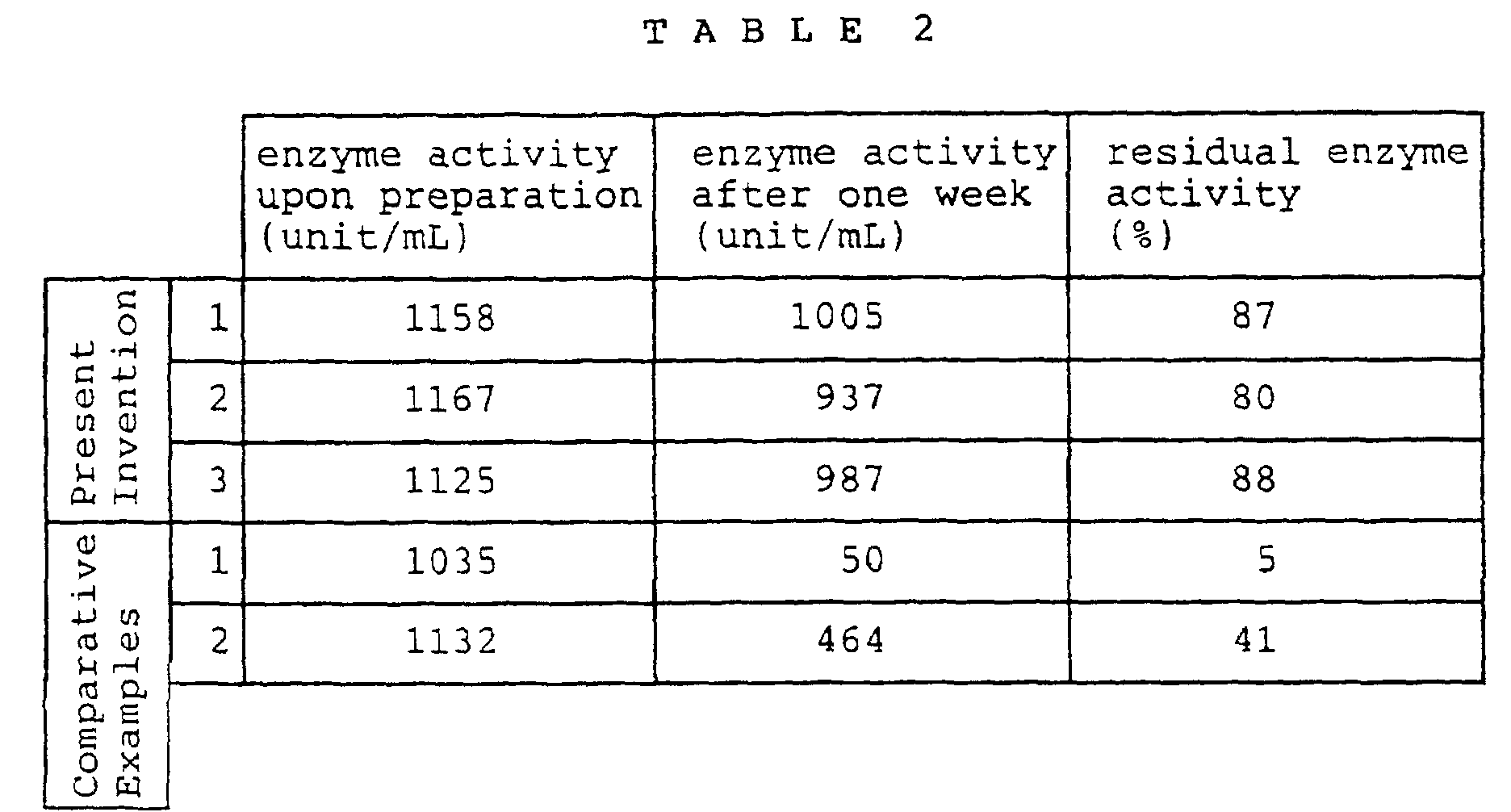
- It was confirmed from the results of TABLE 2 that the cleaning and disinfecting solution for the contact lens according to the present invention exhibited excellent enzyme stability. In contrast, it was recognized that the cleaning and disinfecting solution according to the comparative examples did not exhibit sufficient enzyme stability.
- The inhibitory effect on development of bacteria or fungi of the contact lens cleaning and disinfecting solution according to the present invention was examined to confirm the disinfecting effect.
- Initially, the specimens Nos. 1-3 of the cleaning and disinfecting solution according to the present invention as used in the Example 1 were prepared. Further, there were prepared specimens Nos. 3 through 7 of the cleaning and disinfecting solution as comparative examples, so that the specimens Nos. 3-7 have the respective compositions as indicated in TABLE 3.

- As in Example 1, in these specimens Nos. 3-7 of the comparative examples, the proteolytic enzyme derived from Bacillus: SP-614 (available from Novo Industry, Japan) was used while polyoxyethylene-polyoxypropylene block copolymer (Pluronic™ L-64) was used as the nonionic surface active agent. In the cleaning and disinfecting solution of the specimen No. 7, 0.5g of potassium sorbate was added as the antiseptic agent, in addition to the components as indicated in TABLE 3.
- Next, 28.5g of Glucose Peptone Agar for the sterility test (available from EIKEN CHEMICAL CO., LTD., Japan) and 15g of agar powder for bacteria medium (available from Wako Junyaku Kogyo Kabushiki Kaisha, Japan) were dissolved in 1000mL of distilled water. This mixture was subjected to steam sterilization under high pressure at 121°C for 20 minutes, thereby Glucose Peptone agar medium was prepared. In the meantime, 40.0g of Tryptone Soya Agar (available from EIKEN CHEMICAL CO., LTD., Japan) was dissolved in 1000mL of distilled water. This mixture was subjected to steam sterilization under high pressure at 121°C for 20 minutes, thereby Tryptone Soya Agar medium was prepared.
- 10mL of the specimens Nos. 1-3 of the cleaning and disinfecting solution according to the present invention and the specimens Nos. 3-7 of the cleaning and disinfecting solution according to the comparative examples were poured into the respective test tubes. To each of the test tubes, was added 0.01mL of fungi liquid comprising Candida albicans ATCC 10231 in an amount of 106CFU/mL-109CFU/mL. The mixture was stirred, and adjusted so as to contain the Candida albicans ATCC 10231 in an amount of 106 CFU/mL-107 CFU/mL. Thereafter, the mixture was left at room temperature for five minutes. (Hereinafter, this mixture is referred to as "fungi suspension"). Then, 1mL of the fungi suspension was taken out from each of the test tubes, and was diluted every 10 times with a physiological salt solution, so as to provide samples having different quantities of fungi. Each of the thus obtained samples was cultured using 20mL of the Glucose Peptone agar medium. The viable cell count per 1mL was measured by plate dilution method. On the basis of the obtained value, the viable cell count per 1mL of each fungi suspension was calculated. The results are indicated in TABLE 4. The viable cell count was measured by the plate dilution method, using the samples wherein colonies were suitably dispersed on the plate after culture, and the development of the fungi was not inhibited.
- In the same manner as described above, bacteria suspensions comprising Staphylococcus aureus ATCC 6538P were prepared, and the viable cell count was measured for each of the bacteria suspensions. The results of the measurement are also indicated in TABLE 4. For cultivation of samples, 17mL of Tryptone Soya agar medium was employed in place of 20mL of Glucose Peptone agar medium as used above.
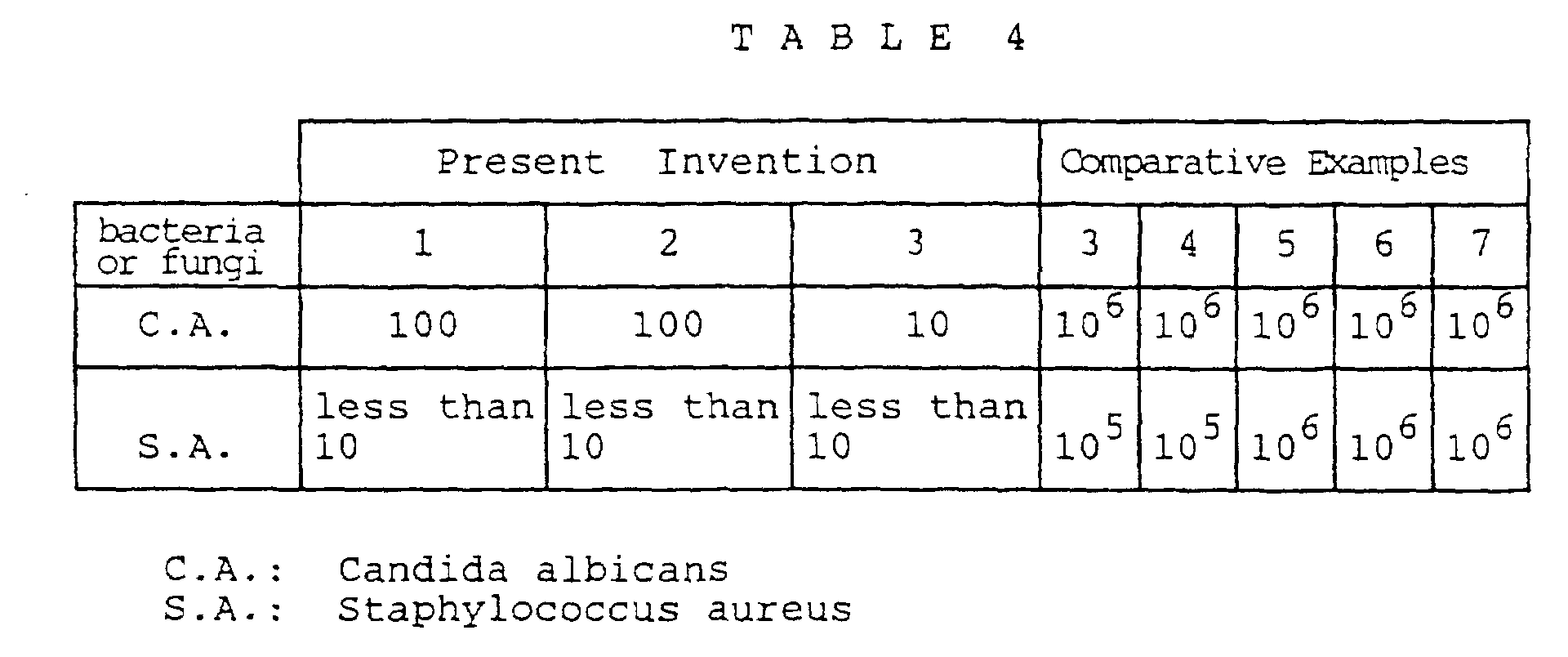
- It was confirmed from the results of TABLE 4 that the cleaning and disinfecting solution for the contact lens according to the present invention exhibited excellent disinfecting effect. The conventional cleaning and disinfecting solution (the specimen No. 6 of the comparative examples) did not show sufficient disinfecting effect, even though the solution employed, in addition to the antiseptic agent, a combination of glycerine and diethylene glycol which was considered effective for stabilizing the enzyme.
- In the above EXAMPLE 2, the disinfecting effect of the cleaning and disinfecting solution was confirmed by reacting the solution with the suspension of microorganisms. In this EXAMPLE 3, the disinfecting effect of the cleaning and disinfecting solution was examined using contact lenses.
- Two soft contact lenses ("MENICON SOFT™ 72" available from Menicon Co., Ltd, Japan), contact lens holders for receiving the respective contact lenses and containers for accommodating the respective holders and rinsing liquid were prepared.
- Next, a fungi solution was prepared which included a kind of mold, i.e., Aspergillus fumigatus ATCC 10894, in an amount of 108 CEU/mL-109 CFU/mL. The surfaces of the contact lenses were uniformly coated with 0.02mL of the thus prepared fungi solution, and the contact lenses were kept at room temperature for 10 minutes, so that the fungi adhered to the lens surfaces. To one of the contact lenses, 10 droplets of the cleaning and disinfecting solution of the specimen No.1 according to the present invention were applied with the contact lens being put on a palm, and the contact lens was cleaned by finger-rubbing for 30 seconds. To the other contact lens, 10 droplets of a sterile physiological salt solution were applied with the contact lens being put on a palm. This contact lens was also cleaned by finger-rubbing for 30 seconds.
- After the contact lenses were fully rinsed with a physiological salt solution, they were put into the respective lens holders, and were immersed in 7mL of a physiological salt solution (immersing liquid) in the respective containers. After 2 minutes, each contact lens and the whole amount of each immersing liquid were cultured in Glucose Peptone medium. The culture was effected at the temperature of 23°C for 14 days. After the culture, each medium was observed for the presence of turbidity which is caused by proliferation of the fungi. The result showed that the fungi were not found in the medium wherein the contact lens treated by the cleaning and disinfecting solution of the specimen No. 1 of the present invention and its immersing liquid were cultured. On the contrary, the proliferation of the fungi was confirmed in the medium wherein the contact lens treated by the axenic physiological salt solution and its immersing liquid were cultured. It will be apparent from the results that the cleaning and disinfecting solution for the contact lens according to the present invention is capable of exhibiting excellent disinfecting effect when used in cleaning and disinfecting the contact lenses.
- The influence on the size of the contact lens of present cleaning and disinfecting solution was examined. Initially, 3mL of the specimens Nos. 1-3 of the cleaning and disinfecting solution of the present invention were prepared. In the meantime, there were prepared three soft contact lenses ("MENICON SOFT™ 72" available from Menicon CO., Ltd, Japan). The diameter of each of the three contact lenses was measured in a physiological salt solution whose temperature was kept at 20°C. The three contact lenses were respectively immersed in the above-prepared specimens Nos. 1-3 of the cleaning and disinfecting solution, and kept at room temperature for 6 hours. After the contact lenses were fully rinsed with the physiological salt solution, they were immersed in 10mL of the physiological salt solution for more than 5 minutes. Then, the diameter of each of the contact lenses was measured in the physiological salt solution of 20°C. The change in the diameter of each contact lens was calculated on the basis of the measured diameter value and the diameter value measured before the immersion in the cleaning and disinfecting solution. The results are indicated in the following TABLE 5.
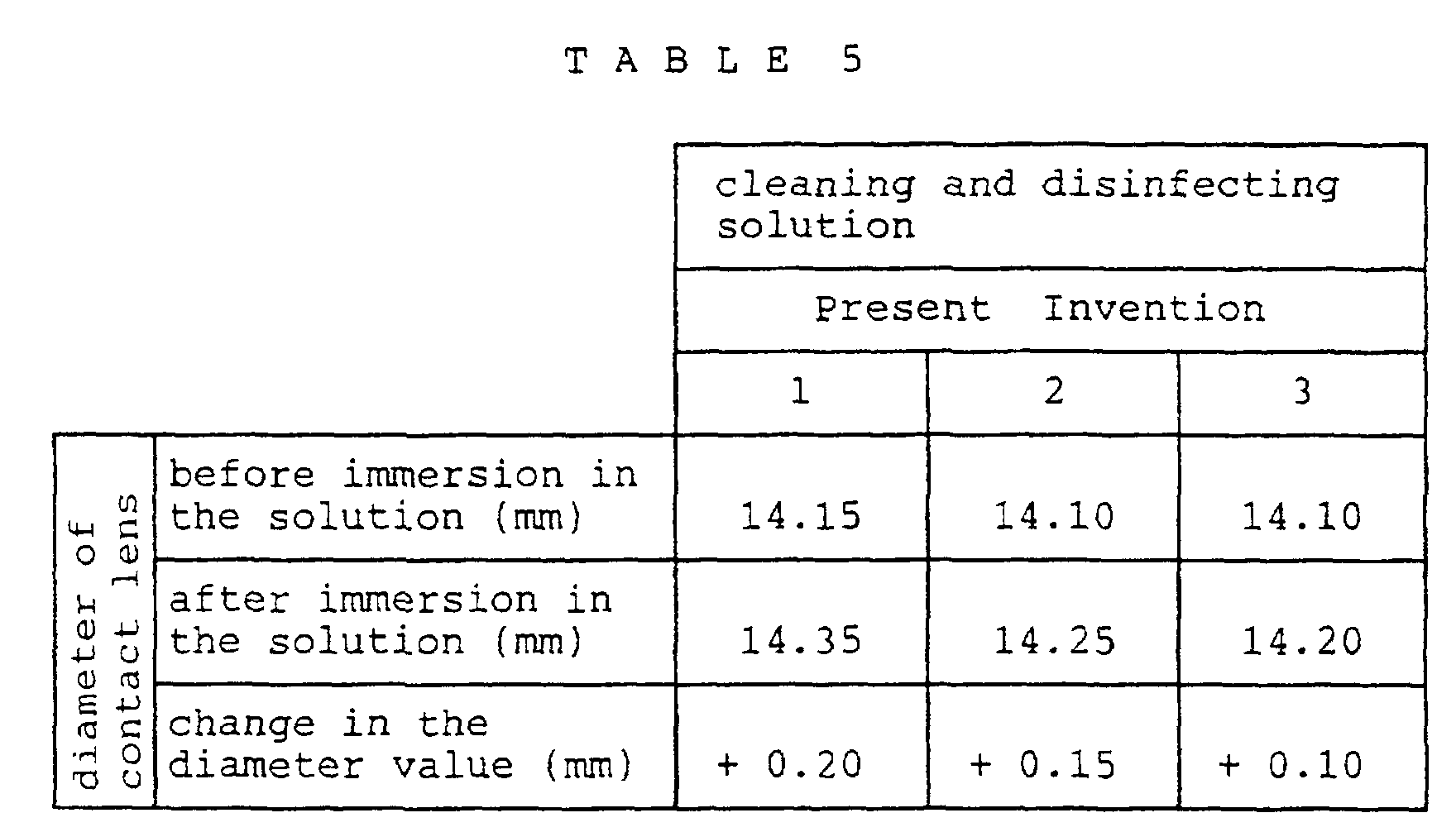
- As is apparent from the results of TABLE 5, the diameter values of the contact lenses did not substantially change even under a severe condition of 6-hour immersion in the cleaning and disinfecting solution. In other words, it was confirmed that the cleaning and disinfecting solution for the contact lens according to the present invention did not give substantial influence on the size of the contact lens.
- An artificial lipid deposit composition was prepared as specified in ISO/TC 172/SC 7/WG 5 N 35, This composition includes: 6g of Arlacel™ 80; 16g of castor oil, 35g of lanolin; 5g of oleic acid; 4g of SPAN™ 85; 2g of cetyl alcohol; 2g of cholesterol; and 30g of cholesterol acetate. These reagents are all available from Wako Junyaku Kogyo Kabushiki Kaisha, Japan.
- Next, there were prepared four soft contact lenses ("MENICON SOFT™ 72" available from Menicon CO., Ltd, Japan). Each of the four contact lenses was uniformly coated with 0.1g of the artificial lipid deposit composition prepared as described above.
- One of the four contact lenses was put on a palm, and the cleaning and disinfecting solution of the specimen No. 1 according to the present invention was dropped on the contact lens. The contact lens was cleaned and disinfected by finger-rubbing for 30 seconds. After the cleaning and disinfecting treatment, the contact lens was rinsed with the physiological salt solution. Then, the contact lens was observed for its appearance, and it was confirmed that the artificial lipid deposit adhering to the contact lens was completely removed.
- The cleaning and disinfecting solutions of the specimens Nos. 2 and 3 according to the present invention were examined for the lipid-deposit cleaning effect using two contact lenses, in the same manner as described above. It was confirmed that the artificial lipid deposit was completely removed from both of the contact lenses.
- The last one of the four contact lenses was cleaned and disinfected in the same manner as described above, except that the physiological salt solution was used in place of the specimen No. 1 of the cleaning and disinfecting solution of the present invention. The contact lens was observed for its appearance, and it was found that the artificial lipid deposit adhering to the contact lens remained on the lens surfaces without being completely removed.
- A protein-contaminated liquid in the form of artificial tear fluid (pH 7.4), including: 0.388g of albumin; 0.161g of γ-globulin; 0.120g of lysozyme; 0.900g of sodium chloride; 0.015g of calcium chloride (dihydrates); 0.104g of sodium dihydrogenphosphate (dihydrates); 5mL of 1N aqueous solution of sodium hydroxide; and 100mL of purified water was prepared. Among these reagents, γ-globulin was available from SIGMA, Japan while the others were available from Wako Junyaku Kogyo Kabushiki Kaisha, Japan.
- Four soft contact lenses ("MENICON SOFT™ MA" available from Menicon Co., Ltd, Japan) were prepared. These contact lenses were boiled in 1.5mL of the artificial tear fluid for 30 minutes, and immersed in cool water for 30 minutes. This operation was repeated five times. After the treatment, the contact lenses were observed in the physiological salt solution by a dark-field microscope of 20× magnification, and it was confirmed that the entire surfaces of all of the contact lenses were soiled with white protein deposit.
- One of the four contact lenses soiled with the protein deposit was put on a palm, and 0.5mL of the specimen No. 1 of the cleaning and disinfecting solution according to the present invention was dropped on the contact lens. After the contact lens was lightly cleaned by rubbing between a thumb and a forefinger for 30 seconds, it was rinsed with the physiological salt solution, and immersed in 7mL of the physiological salt solution for 2 minutes. This operation was repeated 30 times. Thereafter, the contact lens was observed in 20× magnification, and it was confirmed that the protein deposit was completely removed from the contact lens.
- The specimens Nos. 2 and 3 of the cleaning and disinfecting solution according to the present invention were examined for the protein-deposit cleaning effect using two contact lenses, in the same manner as described above. It was confirmed that the protein deposit was completely removed from both of the contact lenses.
- The last one of the four contact lenses was treated in the same manner as described above, except that a commercially available cleaning solution ("MENICLEAN™ available from Menicon CO., Ltd, Japan) was employed in place of the cleaning and disinfecting solution of the present invention. The contact lens was observed in 20× magnification, and it was found that the white protein deposit adhering to the entire surfaces of the contact lens remained without being completely removed from the lens surfaces.
- Four hard contact lenses having a high degree of oxygen permeability ("MENICON SUPER EX™" available from Menicon Co., Ltd, Japan) were prepared. These contact lenses were boiled for 30 minutes in 1.5mL of the artificial tear fluid prepared in EXAMPLE 6, and immersed in cool water for 30 minutes. Thereafter, the contact lenses were observed by the dark-field microscope of 20× magnification, and it was confirmed that the entire surfaces of all of the contact lenses were soiled with white protein deposit.
- One of the four contact lenses soiled with the protein deposit was put on a palm, and 0.5mL of the specimen No. 1 of the cleaning and disinfecting solution according to the present invention was dropped on the contact lens. Then, the contact lens was lightly cleaned by rubbing between a thumb and a forefinger for 30 seconds. Thereafter, the contact lens was observed in 20× magnification, and it was confirmed that the protein deposit was completely removed from the contact lens.
- The protein-deposit cleaning effect of the specimens Nos. 2 and 3 of the cleaning and disinfecting solution according to the present invention was examined using two contact lenses, in the same manner as described above. It was confirmed that the protein deposit was completely removed from both of the contact lenses.
- The last one of the four contact lenses was treated in the same manner as described above, except that a commercially available cleaning solution ("O2 CARE" available from Menicon CO., Ltd, Japan) was employed in place of the cleaning and disinfecting solution according to the present invention. The contact lens was observed in 20× magnification, and it was found that the white protein deposit adhering to the entire surfaces of the contact lens remained without being completely removed from the lens surfaces.
- As is apparent from the results of Examples 5-7, the cleaning and disinfecting solution for the contact lens according to the present invention exhibited, in a relatively short period of time, an excellent cleaning effect with respect to the lipid deposit and protein deposit which may adhere to the contact lenses.
- It will be understood from the above description that the present invention provides the cleaning and disinfecting solution for the contact lens which permits easy and efficient cleaning and disinfecting of the contact lens. The present invention also provides the method of cleaning and disinfecting the contact lens wherein the contact lens is simultaneously cleaned and disinfected by using the above-described cleaning and disinfecting solution.
Claims (15)
- A cleaning and disinfecting solution for a contact lens which is characterized by comprising an effective amount of a proteolytic enzyme, 60-80w/v% of propylene glycol, 10-35w/v% of glycerine, and water, a total content of said propylene glycol and said glycerine being in a range of 70-95w/v%.
- A cleaning and disinfecting solution for a contact lens according to claim 1, wherein said proteolytic enzyme is included in said cleaning and disinfecting solution in an amount of 0.1-10w/v%.
- A cleaning and disinfecting solution according to claim 1 or 2, wherein said propylene glycol is included in an amount of 65-75w/v% and said glycerine is included in an amount of 20-30w/v%, said total content of said propylene glycol and said glycerine being in a range of 85-95w/v%.
- A cleaning and disinfecting solution according to any one of claims 1-3, wherein pH of said cleaning and disinfecting solution is adjusted in a range of 5.0-9.5.
- A cleaning and disinfecting solution according to any one of claims 1-4, a surface active agent is further included in an amount of 0.1-20w/v%.
- A cleaning and disinfecting solution according to any one of claims 1-5, wherein said proteolytic enzyme is serine protease, and calcium ion is further included in a concentration of 5-250mM.
- A method of cleaning and disinfecting a contact lens characterized by simultaneously cleaning and disinfecting said contact lens, comprising: contacting a cleaning and disinfecting solution for a contact lens which comprises an effective amount of proteolytic enzyme, 60-80w/v% of propylene glycol, 10-35w/v% of glycerine, and water, a total content of said propylene glycol and said glycerine being in a range of 70-95 w/v% with the contact lens for a short period of time of no more than five minutes.
- A method of cleaning and disinfecting a contact lens according to claim 7, wherein said proteolytic enzyme is included in said cleaning and disinfecting solution in an amount of 0.1-10w/v%.
- A method of cleaning and disinfecting a contact lens according to claim 7 or 8, wherein said propylene glycol is included in an amount of 65-75w/v% and said glycerine is included in an amount of 20-30w/v%, said total content of said propylene glycol and said glycerine being in a range of 85-95w/v%.
- A method of cleaning and disinfecting a contact lens according to any one of claims 7-9, wherein pH of said cleaning and disinfecting solution is adjusted in a range of 5.0-9.5.
- A method of cleaning and disinfecting a contact lens according to any one of claims 7-10, wherein said cleaning and disinfecting solution further comprises a surface active agent in an amount of 0.1-20w/v%.
- A method of cleaning and disinfecting a contact lens according to any one of claims 7-11, wherein said cleaning and disinfecting solution includes serine protease as said proteolytic enzyme, and calcium ion in a concentration of 5-250mM.
- A method of cleaning and disinfecting a contact lens according to any one of claims 7-12, further comprising: rinsing said contact lens with a physiological isotonic solution after said contact lens was contacted with said cleaning and disinfecting solution; and immersing said contact lens in a fresh physiological isotonic solution.
- A method of cleaning and disinfecting a contact lens according to any one of claims 7-13, said contacting said contact lens with said cleaning and disinfecting solution for said short period of time is effected by rubbing said contact lens with said cleaning and disinfecting solution.
- A method of cleaning and disinfecting a contact lens according to any one of claims 7-14, wherein said contact lens is a soft contact lens.
Applications Claiming Priority (4)
| Application Number | Priority Date | Filing Date | Title |
|---|---|---|---|
| JP32648/95 | 1995-02-21 | ||
| JP7032648A JPH08224288A (en) | 1995-02-21 | 1995-02-21 | Contact lens cleaning / disinfecting agent and contact lens cleaning / disinfecting method using the same |
| JP3264895 | 1995-02-21 | ||
| PCT/JP1996/000359 WO1996025957A1 (en) | 1995-02-21 | 1996-02-19 | Cleaning and disinfecting agent for contact lens and method for cleaning and disinfecting contact lens using the same |
Publications (3)
| Publication Number | Publication Date |
|---|---|
| EP0756874A1 EP0756874A1 (en) | 1997-02-05 |
| EP0756874A4 EP0756874A4 (en) | 2000-06-21 |
| EP0756874B1 true EP0756874B1 (en) | 2001-12-12 |
Family
ID=12364686
Family Applications (1)
| Application Number | Title | Priority Date | Filing Date |
|---|---|---|---|
| EP96902472A Expired - Lifetime EP0756874B1 (en) | 1995-02-21 | 1996-02-19 | Cleaning and disinfecting agent for contact lens and method for cleaning and disinfecting contact lens using the same |
Country Status (5)
| Country | Link |
|---|---|
| US (1) | US5785767A (en) |
| EP (1) | EP0756874B1 (en) |
| JP (1) | JPH08224288A (en) |
| DE (1) | DE69617824D1 (en) |
| WO (1) | WO1996025957A1 (en) |
Families Citing this family (12)
| Publication number | Priority date | Publication date | Assignee | Title |
|---|---|---|---|---|
| US6184189B1 (en) * | 1995-06-07 | 2001-02-06 | Alcon Laboratories, Inc. | Liquid enzyme compositions and methods of use in contact lens cleaning and disinfecting systems |
| JP3697294B2 (en) * | 1995-08-02 | 2005-09-21 | 株式会社トーメー | Cleaning and disinfecting contact lenses |
| JP3698832B2 (en) * | 1996-10-08 | 2005-09-21 | 株式会社メニコン | Contact lens solution |
| US6228323B1 (en) | 1996-12-13 | 2001-05-08 | Alcon Laboratories, Inc. | Multi-purpose compositions containing an alkyl-trypsin and methods of use in contact lens cleaning and disinfecting |
| US6214596B1 (en) | 1996-12-18 | 2001-04-10 | Alcon Laboratories, Inc. | Liquid enzyme compositions and methods of use in contact lens cleaning and disinfecting systems |
| WO1998043683A1 (en) * | 1997-04-03 | 1998-10-08 | Ophtecs Corporation | One-pack preparation for disinfection, neutralization and cleaning of contact lenses and method of disinfection, neutralization and cleaning |
| AU4955199A (en) * | 1998-09-01 | 2000-03-21 | Alcon Laboratories, Inc. | Liquid enzyme compositions for cleaning and disinfecting contact lenses |
| US6280530B1 (en) | 2000-01-28 | 2001-08-28 | Isoclear, Inc. | Contact lens treatment apparatus and method |
| US6867172B2 (en) * | 2000-12-07 | 2005-03-15 | Johnson & Johnson Vision Care, Inc. | Methods of inhibiting the adherence of lenses to their packaging |
| US6531432B2 (en) | 2000-12-07 | 2003-03-11 | Johnson & Johnson Vision Care, Inc. | Contact lens packaging solutions |
| JP7049083B2 (en) * | 2016-08-26 | 2022-04-06 | ロート製薬株式会社 | Ophthalmic composition |
| WO2025132258A1 (en) * | 2023-12-20 | 2025-06-26 | Basf Se | Stabilized enzyme composition comprising a protease |
Family Cites Families (14)
| Publication number | Priority date | Publication date | Assignee | Title |
|---|---|---|---|---|
| US3910296A (en) * | 1973-04-20 | 1975-10-07 | Allergan Pharma | Method of removing proteinaceous deposits from contact lenses |
| US4614549A (en) * | 1983-10-24 | 1986-09-30 | Bausch & Lomb Incorporated | Method for enzymatic cleaning and disinfecting contact lenses |
| JPH01180515A (en) * | 1988-01-13 | 1989-07-18 | Tome Sangyo Kk | Cleaning liquid and cleaning method for contact lens |
| US5298182A (en) * | 1989-01-31 | 1994-03-29 | Ciba-Geigy Corporation | Rapid ophthalmic glycol/lower alkanol cleaning and disinfecting solution and method |
| CA2009118C (en) * | 1989-02-21 | 1996-02-27 | Mary F. Mowrey-Mckee | Method and composition for cleaning and disinfecting contact lenses |
| US5238843A (en) * | 1989-10-27 | 1993-08-24 | Genencor International, Inc. | Method for cleaning a surface on which is bound a glycoside-containing substance |
| EP0425016B1 (en) * | 1989-10-27 | 1995-12-20 | The Procter & Gamble Company | Antimicrobial method and formulation employing type II endoglycosidase and antimicrobial agent |
| CA2072001C (en) * | 1990-10-22 | 1998-11-03 | Nimai C. De | Method and composition for cleaning contact lenses |
| JPH04370197A (en) * | 1991-06-17 | 1992-12-22 | Seiko Epson Corp | enzyme liquid cleaning agent |
| US5238543A (en) * | 1992-05-08 | 1993-08-24 | Industrial Technology Research Institute | Recovery of silver from photographic film and photographic development waste solution |
| JP3226347B2 (en) * | 1992-09-10 | 2001-11-05 | トーメー産業株式会社 | How to clean contact lenses |
| US5604190A (en) * | 1995-06-07 | 1997-02-18 | Alcon Laboratories, Inc. | Stable liquid enzyme compositions and methods of use in contact lens cleaning and disinfecting systems |
| US5576278A (en) * | 1995-06-07 | 1996-11-19 | Alcon Laboratories, Inc. | Stable liquid enzyme compositions and methods of use |
| US5605661A (en) * | 1995-08-18 | 1997-02-25 | Alcon Laboratories, Inc. | Methods of using liquid enzyme compositions containing mixed polyols |
-
1995
- 1995-02-21 JP JP7032648A patent/JPH08224288A/en active Pending
-
1996
- 1996-02-19 DE DE69617824T patent/DE69617824D1/en not_active Expired - Lifetime
- 1996-02-19 EP EP96902472A patent/EP0756874B1/en not_active Expired - Lifetime
- 1996-02-19 US US08/722,033 patent/US5785767A/en not_active Expired - Fee Related
- 1996-02-19 WO PCT/JP1996/000359 patent/WO1996025957A1/en not_active Ceased
Also Published As
| Publication number | Publication date |
|---|---|
| US5785767A (en) | 1998-07-28 |
| EP0756874A4 (en) | 2000-06-21 |
| JPH08224288A (en) | 1996-09-03 |
| EP0756874A1 (en) | 1997-02-05 |
| DE69617824D1 (en) | 2002-01-24 |
| WO1996025957A1 (en) | 1996-08-29 |
Similar Documents
| Publication | Publication Date | Title |
|---|---|---|
| KR100246904B1 (en) | Preservation system for ophthalmic and contact lens solutions and methods for cleaning, sterilizing and storing contact lenses | |
| AU764906B2 (en) | Contact lens and ophthalmic solutions | |
| US4820352A (en) | Cleaning and conditioning solutions for contact lenses and methods of use | |
| JP2730865B2 (en) | Preparation for cleaning and disinfecting contact lenses | |
| EP0757095B1 (en) | Method of cleaning and disinfecting contact lens | |
| JPH02289255A (en) | Washing and disinfecting method for contact lens and composition thereof | |
| US5322667A (en) | Preservative system for ophthalmic and contact lens solutions and method for cleaning disinfecting and storing contact lenses | |
| AU651009B2 (en) | Method for cleaning a contact lens | |
| US5785767A (en) | Cleaning and disinfecting solution for contact lens and method of cleaning and disinfecting contact lens using the solution | |
| EP0591956B1 (en) | Method for cleaning, preserving and disinfecting contact lenses | |
| TW200304834A (en) | Composition for treating contact lenses | |
| JPH07508523A (en) | Ophthalmic compositions and methods of storing and using them | |
| EP0819968A1 (en) | Disinfecting/washing composition for contact lenses and method for disinfecting and washing contact lenses by using the same | |
| EP0888780B1 (en) | Treatment composition for contact lenses and method for treating contact lenses with the same | |
| JP2839953B2 (en) | Preservative system for ophthalmic solutions and contact lens solutions and methods for cleaning, disinfecting and storing contact lenses | |
| US5977035A (en) | Liquid agent for contact lens containing carboxylated amine as a preservative or sterilizing component | |
| JP2004077902A (en) | Liquid formulation for contact lens | |
| WO1985003247A1 (en) | Method for cleaning contact lenses | |
| JP2005070591A (en) | Enzyme liquid for contact lens,nd method for cleaning/disinfecting contact lens by using same | |
| JP2003277205A (en) | Contact lens disinfecting composition and disinfecting method using the same | |
| JP2000084052A (en) | Liquid for contact lens | |
| CA1183423A (en) | Contact lens disinfecting and preserving solution | |
| JP3706216B2 (en) | Contact lens agent | |
| JP4431752B2 (en) | Liquid for contact lens and method for preventing contamination of contact lens using the same | |
| JP2003329985A (en) | Liquid for contact lens |
Legal Events
| Date | Code | Title | Description |
|---|---|---|---|
| PUAI | Public reference made under article 153(3) epc to a published international application that has entered the european phase |
Free format text: ORIGINAL CODE: 0009012 |
|
| 17P | Request for examination filed |
Effective date: 19961111 |
|
| AK | Designated contracting states |
Kind code of ref document: A1 Designated state(s): DE FR GB |
|
| A4 | Supplementary search report drawn up and despatched |
Effective date: 20000510 |
|
| AK | Designated contracting states |
Kind code of ref document: A4 Designated state(s): DE FR GB |
|
| GRAG | Despatch of communication of intention to grant |
Free format text: ORIGINAL CODE: EPIDOS AGRA |
|
| 17Q | First examination report despatched |
Effective date: 20010313 |
|
| RIC1 | Information provided on ipc code assigned before grant |
Free format text: 7A 61L 12/08 A |
|
| GRAG | Despatch of communication of intention to grant |
Free format text: ORIGINAL CODE: EPIDOS AGRA |
|
| GRAH | Despatch of communication of intention to grant a patent |
Free format text: ORIGINAL CODE: EPIDOS IGRA |
|
| GRAH | Despatch of communication of intention to grant a patent |
Free format text: ORIGINAL CODE: EPIDOS IGRA |
|
| GRAA | (expected) grant |
Free format text: ORIGINAL CODE: 0009210 |
|
| AK | Designated contracting states |
Kind code of ref document: B1 Designated state(s): DE FR GB |
|
| PG25 | Lapsed in a contracting state [announced via postgrant information from national office to epo] |
Ref country code: FR Free format text: LAPSE BECAUSE OF FAILURE TO SUBMIT A TRANSLATION OF THE DESCRIPTION OR TO PAY THE FEE WITHIN THE PRESCRIBED TIME-LIMIT Effective date: 20011212 |
|
| RIC1 | Information provided on ipc code assigned before grant |
Free format text: 7A 61L 2/18 A |
|
| RIN1 | Information on inventor provided before grant (corrected) |
Inventor name: NAKAGAWA, AKIRA TOMEY TECHNOLOGY CORPORATION Inventor name: KIMURA, NORIO TOMEY TECHNOLOGY CORPORATION |
|
| REG | Reference to a national code |
Ref country code: GB Ref legal event code: IF02 |
|
| REF | Corresponds to: |
Ref document number: 69617824 Country of ref document: DE Date of ref document: 20020124 |
|
| PG25 | Lapsed in a contracting state [announced via postgrant information from national office to epo] |
Ref country code: GB Free format text: LAPSE BECAUSE OF NON-PAYMENT OF DUE FEES Effective date: 20020312 |
|
| PG25 | Lapsed in a contracting state [announced via postgrant information from national office to epo] |
Ref country code: DE Free format text: LAPSE BECAUSE OF FAILURE TO SUBMIT A TRANSLATION OF THE DESCRIPTION OR TO PAY THE FEE WITHIN THE PRESCRIBED TIME-LIMIT Effective date: 20020313 |
|
| EN | Fr: translation not filed | ||
| PLBE | No opposition filed within time limit |
Free format text: ORIGINAL CODE: 0009261 |
|
| STAA | Information on the status of an ep patent application or granted ep patent |
Free format text: STATUS: NO OPPOSITION FILED WITHIN TIME LIMIT |
|
| GBPC | Gb: european patent ceased through non-payment of renewal fee |
Effective date: 20020312 |
|
| 26N | No opposition filed |