EP0756400B1 - Method for discovering a printer of a printer type in a network - Google Patents
Method for discovering a printer of a printer type in a network Download PDFInfo
- Publication number
- EP0756400B1 EP0756400B1 EP96111395A EP96111395A EP0756400B1 EP 0756400 B1 EP0756400 B1 EP 0756400B1 EP 96111395 A EP96111395 A EP 96111395A EP 96111395 A EP96111395 A EP 96111395A EP 0756400 B1 EP0756400 B1 EP 0756400B1
- Authority
- EP
- European Patent Office
- Prior art keywords
- printer
- information
- socket
- network
- data
- Prior art date
- Legal status (The legal status is an assumption and is not a legal conclusion. Google has not performed a legal analysis and makes no representation as to the accuracy of the status listed.)
- Expired - Lifetime
Links
Images


Classifications
-
- H—ELECTRICITY
- H04—ELECTRIC COMMUNICATION TECHNIQUE
- H04L—TRANSMISSION OF DIGITAL INFORMATION, e.g. TELEGRAPHIC COMMUNICATION
- H04L41/00—Arrangements for maintenance, administration or management of data switching networks, e.g. of packet switching networks
Definitions
- the present invention relates to locating or "discovering" a printer of a printer type on a network
- the printer For a printer device or printer to be discovered in a computer network environment, the printer must advertise or broadcast its existence. Typically, a service advertising protocol (SAP) is employed in such a broadcast, and a network server running on the network gathers the SAP broadcast and captures the SAP into a network database. Network applications can then peruse the network database when necessary to retrieve the existence of such printer.
- the network database can also provide information such as the network addressing which is used to directly communicate with the printer. Once the printer is known to the application, the application may retrieve extensive information about the printer.
- management protocols may be used in a computer network environment to read and write variables which define a network device such as a printer.
- One type of management protocol is the Simple Network Management Protocol (SNMP), which uses the Management Information Base (MIB) to define the variables of a device which can be read or written.
- MIB Management Information Base
- an application may bi-directionally communicate with a network device such as a printer.
- Messages are streams of data which are packetized in such a way that the message ends up at the right destination task and each end of the socket can decipher the information or data which is trying to be communicated.
- the packetized information contains identifiers and indexes which may change the state of the communication channel.
- object-oriented analysis and design is an approach for classifying and describing interactions between object components, and then encapsulating and modeling such object components.
- Classifications are defined by generalizing object components.
- Object components are identified by recognizing characterizations and functions which behave as individual entities and have unique behavior and descriptive attributes.
- a set of classifications, object components, and interactions between object components are defined.
- the OOA&D for the present invention may be fully described though the use of classification and object component diagrams.
- TOOLS.H++ has classifications for objects such as strings, multi-byte strings, localized time and date, hash sets, binary trees, dictionaries, sorted lists, linked lists, etc.
- the model-view-controller (MVC) architecture is a useful architectures used by OOA&D applications.
- the MVC is essentially a trinity of objects and classifications which facilitates the physical data collection (model), the expression or composition of the data presentation (view), and the interaction or interface between the presentation and the user or outside influence (controller).
- Models are the physical data collection or content of the physical devices and the behavior or the devices as described by the system make up the objects. Each model keeps track of the raw data which may or may not be understandable to the user or outside influence. Views are the objects which interact directly with the models and whose primary purpose is to shape or present the model raw data. Each model may contain several view instances and each view may only exist for one model.
- Each view instance may present the model in different ways or may only present sections or subsections or information about the model.
- the view can also write information into the model as raw data.
- raw information is periodically collected by the model if at least one view exists for such model.
- a reference is registered with a model for every view created for the model. When a view is destroyed, the respective reference is released by the respective model.
- controller objects also referred to as user interface objects.
- the controller objects cause methods of a view to be invoked which in turn may cause reactions in a related model. Accordingly, controller objects tend to cause the MVC architecture to be highly event-driven. Therefore, event-driven operating systems such as the MICROSOFT WINDOWS operating system from MICROSOFT Corporation allow for a clean existence of an MVC architecture.
- a method to discover the existence of a printer and the status of the printer with a minimum amount of steps and network traffic utilizes a network broadcast message over a dedicated socket.
- the dedicated socket is either registered with the network community or is acquired from the network operating system as a temporarily assigned socket which does not conflict with any existing sockets.
- the protocol used in the broadcast response contains the printer status information.
- the printer status information is maintained in a component object which models the actual printer device.
- a device model is used in the present invention to encapsulate the task to task communication state information and to provide a virtual communication channel between the application and device.
- the European patent application EP-A-0 602 786 entitled “method and apparatus for managing access to a networked peripheral” discloses a method for discovering a printer in a network, comprising the steps of: establishing a socket having a socket identifier associated with the printer; the network communicating with the printer through the socket, the socket having a poll mode and a listen mode; the socket when in the poll mode awaiting and obtaining outgoing data from the network tagged with the socket ID and sending the obtained outgoing data to the printer; the socket when in the listen mode awaiting and obtaining incoming data from the printer and sending the obtained incoming data to the network; establishing a printer information object for storing printer information associated with the printer once the printer is discovered.
- the present invention relates to discovering a printer having a particular printer type in a network.
- a socket having a socket identifier (ID) associated with the printer type is established by a network, and the network communicates with the printer through the socket.
- the socket has a poll mode and a listen mode. In the poll mode, the socket awaits and obtains outgoing data from the'network tagged with the socket ID, and sends the obtained outgoing data to the printer. In the listen mode, the socket awaits and obtains incoming data from the printer and sends the obtained incoming data to the network.
- the network establishes a printer information object for storing printer information associated with the printer once the printer is discovered.
- the network maintains and updates the printer information with the printer information object. Additionally, the network establishes a timer that provides a periodic timing signal TICK.
- the printer is periodically polled once every N TICKs. Each poll includes placing the socket in the poll mode, sending polling data tagged with the socket ID to the socket for receipt by the printer, placing the socket in the listen mode, and waiting to determine whether the socket has obtained printer data from the printer.
- the network determines from the printer information object whether the printer has been previously discovered based on whether the printer information object has stored printer information for the printer. If the printer has not been previously discovered, printer information for the printer is created and stored in the printer information object.
- the preferred embodiment of the present invention is generated in a computer network environment to configure and control network printing devices.
- the preferred embodiment is described in terms of classifications that are discovered. For many of the classifications, a description of the responsibilities and collaborations is provided. Methods needed for descriptive purposes are listed where necessary for understanding the classification. Not all classifications which make up the final implementation of the preferred embodiment are described here, since some exist from outside class libraries, such as the RogueWave TOOLS.H++ class library, and some exist as instantiated classifications or parameterized classes which behavior is self evident.
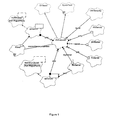
- Fig. 1 a network classification scheme in accordance with a preferred embodiment of the present invention.
- OOA&D Grady Booch Object-Oriented Analysis and Design
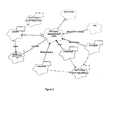
- Fig. 2 outlines the socket implementation implemented by the preferred embodiment of the present invention.
- NWSocket - As was discussed above, this class encapsulates the socket communication between a client workstation and a network device.
- the socketNumber provides the unique identification needed to create the object.
- the taskId is the identification provided by IPXService to give an application a hook into the NetWare socket interface.
- NWSocket provides a TICK function which polls the API interface for received data packet buffers and re-sends data packet buffers which fail.
- IPXService As was discussed above, this class is a single instance object which maintains the IPX status with a client workstation. IPXService maintains a list of all existing sockets so that cleanup can occur in a safe manner.
- sockets - This is the instantiated class list of NWSocket contained by IPXService. The sockets class is derived from a parameterized class which behaves like a singly-linked list.
- ecb As was discussed above, this is the classification form of the ECB structure. The ecb class is responsible for the manipulation of ECB data members and the creation and destruction of the physical transmit and receive data buffers.
- SendEcbs - This is the instantiated class list of ecb objects which have been sent.
- SendEcbs is derived from a parameterized class which behaves like a singly-linked list.
- ListenEcbs This is the instantiated class list of ecb objects which are awaiting the arrival of new data packets from the network. Each listen ecb is checked for received data during TICK. If data is received, the listen ecb is sent to the RecvEcbs list (discussed below) and a new ecb is created to take its place in the ListenEcbs list.
- ListenEcbs is derived from a parameterized class which behaves like a singly-linked list.
- OVNetwork polls RecvEcbs during TICK and acts upon the data received.
- RecvEcbs is derived from a parameterized class which behaves like a singly-linked list.
- Fig. 3 shows the interaction among objects for finding information and updating the printer status. This occurs during the OVNetwork TICK period.
- the 'network' object is the instantiation of the OVNetwork.
- the Timer object 'sysTimer' invokes the OVNetwork TICK method.
- the 'network' object attempts to uncover new printers and update the current printer information.
- the 'Prt' object is an instantiation of a Printer class which has local visibility and exists only during the TICK period. As shown in connection with Fig. 1, the list of printers is kept by the OVNetwork 'plist'. Each printer is retrieved one at a time from the 'plist' and stored temporarily into 'Prt'. Each newly arrived data packet is given to the 'Printer' object using 'updatePrinter'. It is the responsibility of the 'Printer' object to determine whether the newly arrived data is destined for itself. If not, the data packet is rejected and OVNetwork proceeds to the next Printer object found in 'plist'.
- the class static method 'newPrinter' is invoked.
- the 'Printer' object determines whether 'newPrinter' originated from a printer which just appeared on the network. If so, OVNetwork creates a new 'Printer' object for the new printer and places the new 'Printer' object into the 'plist'.
- OVNetwork Ascertains whether a corresponding 'Printer' object contains data that is no longer valid. That is 'network' retrieves each 'Printer' object from the 'plist' and the method 'expired' is called. The 'Printer' object has the responsibility to determine whether the Printer data has expired. If so, 'network' destroys the Printer object.
- Fig. 4 shows the interaction among objects for maintaining the communication channels through the network sockets.
- the object 'socket' is the instantiation of NWSocket.
- the Timer object 'sysTimer' invokes the NWSocket TICK method.
- the 'socket' object then checks each ecb entry found in the ListenEcbs object 'Lring'. As should be understood, each ecb entry in 'Lring' is waiting for a new message from the network.
- the 'socket' then creates an ecb object 'pecb' which has local visibility to 'socket' and holds each probed ecb object found in 'Lring'. If 'pecb' has received new information off the network, the relevant ecb object is added to the RecvEcbs object 'RecvQueue'. It is the responsibility of the OVNetwork object 'network' to retrieve the ecb objects from the 'RecvQueue' when the network is ready to access the new network information. The application accesses new data through the NWSocket method 'receive'.
- 'socket' checks for any ecb objects which exist in the SendEcbs object 'SendQueue'.
- the ecb object is created by an application and then submitted to 'SendQueue' through the NWSocket method 'send'.
- the ecb object is stored locally in pecb. If the ecb object is to be sent, the appropriate API calls are made. If the ecb object shows that is has been sent but is currently in an error state, an error condition is stored and the ecb object is destroyed.
- Fig. 5 outlines the classification implementation used for Timer and SynchTask in the preferred embodiment of the present invention and shows how the Timer object keeps a list of SynchTask type objects. As explained, these tasks are responsible for the synchronous behavior of the MVC.
- Timer - As was discussed above, this class describes an object with the ability to wake up periodically. This class contains a list of objects of type SynchTask. The Timer interfaces with the operating system and provides a means for callback into a Timer method. This callback traverses the list of SynchTask objects and invokes the TICK method of each. A SynchTask object is registered with the Timer, i.e.
- SynchTask As was discussed above, this class describes a task which is capable of periodically waking up and performing a single function called TICK. Any class which inherits this capability provides the TICK function.
- timedItems - This is the instantiated class list of SynchTask objects which provide a TICK process for the Timer to invoke during a wake-up period. This class is derived from a parameterized class which behaves like a singly-linked list.
- a printer having a particular printer type in a network is discovered in the following manner.
- a socket having a socket identifier (ID) associated with the printer type is established by a network, and the network communicates with the printer through the socket.
- the socket has a poll mode and a listen mode.
- the poll mode the socket awaits and obtains outgoing data from the network tagged with the socket ID, and sends the obtained outgoing data to the printer.
- the socket awaits and obtains incoming data from the printer and sends the obtained incoming data to the network.
- the network also establishes a printer information object for storing printer information associated with the printer once the printer is discovered. As should now be understood, the network maintains and updates the printer information with the printer information object. Additionally, the network establishes a timer that provides a periodic timing signal TICK.
- the printer is then periodically polled once every N TICKs.
- Each poll includes placing the socket in the poll mode, sending polling data tagged with the socket ID to the socket for receipt by the printer, placing the socket in the listen mode, and waiting to determine whether the socket has obtained printer data from the printer.
- the network determines from the printer information object whether the printer has been previously discovered based on whether the printer information object has stored printer information for the printer. If the printer has not been previously discovered, printer information for the printer is created and stored in the printer information object.
- the creation of the printer information includes the creation of a printer model object for the printer, the creation of actual printer information relevant to the printer, and the storage of the created printer information in the printer model object.
- the actual printer information in the printer model object includes an aging counter which is incremented during each poll if the socket has not obtained printer data from the printer. However, if the socket has obtained printer data from the printer, the aging counter is zeroed. Accordingly, it may be determined whether the aging counter has reached a predetermined level, and the printer model object for the printer can be destroyed if the aging counter has reached the predetermined level. As should be understood, such determination may occur at an interval of once each poll or at longer intervals.
- the printer information in the printer information object includes stored printer status information relating to a stored status of the printer, and the printer data from the printer includes current printer status information relating to a current status of the printer.
- the stored printer status information may be compared with the current printer status information to determine whether the current status of the printer differs from the stored status of the printer, and if the current status differs from the stored status, the stored printer status information in the printer information object may be replaced with the current printer status information. More preferably, if the current status differs from the stored status, an application viewing the printer model object is notified that the current status has changed.
- network printers may be monitored and controlled in an object-oriented manner. It will be appreciated by those skilled in the art that changes could be made to the embodiments described above without departing from the broad inventive concepts thereof. It is understood, therefore, that this invention is not limited to the particular embodiment disclosed, but it is intended to cover modifications within the scope of the present invention.
Landscapes
- Engineering & Computer Science (AREA)
- Computer Networks & Wireless Communication (AREA)
- Signal Processing (AREA)
- Computer And Data Communications (AREA)
- Data Exchanges In Wide-Area Networks (AREA)
- Accessory Devices And Overall Control Thereof (AREA)
Applications Claiming Priority (8)
| Application Number | Priority Date | Filing Date | Title |
|---|---|---|---|
| US120795P | 1995-07-14 | 1995-07-14 | |
| US117095P | 1995-07-14 | 1995-07-14 | |
| US1170 | 1995-07-14 | ||
| US1207 | 1995-07-14 | ||
| US665627 | 1996-06-18 | ||
| US08/665,627 US5852744A (en) | 1995-07-14 | 1996-06-18 | Method for discovering a network printer by assigning dedicated sockets to different printer types and polling the dedicated sockets to learn the corresponding state |
| US08/666,706 US6249821B1 (en) | 1995-07-14 | 1996-06-18 | Network object frameworks |
| US666706 | 1996-06-18 |
Publications (3)
| Publication Number | Publication Date |
|---|---|
| EP0756400A2 EP0756400A2 (en) | 1997-01-29 |
| EP0756400A3 EP0756400A3 (en) | 1999-06-09 |
| EP0756400B1 true EP0756400B1 (en) | 2002-08-21 |
Family
ID=27485067
Family Applications (1)
| Application Number | Title | Priority Date | Filing Date |
|---|---|---|---|
| EP96111395A Expired - Lifetime EP0756400B1 (en) | 1995-07-14 | 1996-07-15 | Method for discovering a printer of a printer type in a network |
Country Status (3)
| Country | Link |
|---|---|
| EP (1) | EP0756400B1 (enExample) |
| JP (1) | JP3666619B2 (enExample) |
| DE (1) | DE69623084T2 (enExample) |
Families Citing this family (4)
| Publication number | Priority date | Publication date | Assignee | Title |
|---|---|---|---|---|
| EP0872792A3 (en) * | 1997-04-17 | 2000-04-26 | Adobe Systems, Inc. | Network communication with printing systems |
| EP0918412A3 (en) * | 1997-11-21 | 1999-06-02 | Hewlett-Packard Company | Automatic discovery of networked devices |
| US6839755B1 (en) * | 1998-09-30 | 2005-01-04 | Hewlett-Packard Development Company, L.P. | Network peripheral server discovery method |
| US20130311386A1 (en) | 2012-05-18 | 2013-11-21 | Mehdi Tehranchi | System and method for creating and managing encapsulated workflow packages |
Family Cites Families (4)
| Publication number | Priority date | Publication date | Assignee | Title |
|---|---|---|---|---|
| US5237693A (en) * | 1990-04-04 | 1993-08-17 | Sharp Kabushiki Kaisha | System for accessing peripheral devices connected in network |
| US5185853A (en) * | 1991-01-03 | 1993-02-09 | Acer Incorporated | Expandable printer buffer system |
| US5647056A (en) * | 1992-11-18 | 1997-07-08 | Canon Information Systems, Inc. | Method and apparatus for managing access to a networked peripheral |
| ES2170085T3 (es) * | 1993-12-09 | 2002-08-01 | Canon Kk | Impresora con funcion de ahorro de energia. |
-
1996
- 1996-07-15 EP EP96111395A patent/EP0756400B1/en not_active Expired - Lifetime
- 1996-07-15 DE DE69623084T patent/DE69623084T2/de not_active Expired - Lifetime
- 1996-07-15 JP JP18489996A patent/JP3666619B2/ja not_active Expired - Lifetime
Also Published As
| Publication number | Publication date |
|---|---|
| EP0756400A2 (en) | 1997-01-29 |
| JPH09270795A (ja) | 1997-10-14 |
| EP0756400A3 (en) | 1999-06-09 |
| DE69623084T2 (de) | 2003-04-24 |
| DE69623084D1 (de) | 2002-09-26 |
| JP3666619B2 (ja) | 2005-06-29 |
Similar Documents
| Publication | Publication Date | Title |
|---|---|---|
| US5852744A (en) | Method for discovering a network printer by assigning dedicated sockets to different printer types and polling the dedicated sockets to learn the corresponding state | |
| US5845081A (en) | Using objects to discover network information about a remote network having a different network protocol | |
| US6349333B1 (en) | Platform independent alarm service for manipulating managed objects in a distributed network management system | |
| US20210357276A1 (en) | System, method and computer program product for sharing information in a distributed framework | |
| EP0585082B1 (en) | Computer management system and associated management information base | |
| US5991806A (en) | Dynamic system control via messaging in a network management system | |
| US7694312B2 (en) | Methods and apparatus for enabling bus connectivity over a data network | |
| US6189038B1 (en) | Generic notifications framework system and method for enhancing operation of a management station on a network | |
| US6654782B1 (en) | Modular framework for dynamically processing network events using action sets in a distributed computing environment | |
| US6522654B1 (en) | Method for hosting the internet protocol suite on the IEEE-1394 high speed serial bus | |
| EP0751656B1 (en) | Protocol independent and adaptive network interface | |
| US5724516A (en) | System for dynamically creating and retrieving formatted dump data by setting value in dump object indicating that the dump agent is to generate formatted dump data | |
| US7296292B2 (en) | Method and apparatus in an application framework system for providing a port and network hardware resource firewall for distributed applications | |
| US6249821B1 (en) | Network object frameworks | |
| EP1838035A2 (en) | Network device managing apparatus and method | |
| US20030028828A1 (en) | Load test execution apparatus, load test execution system, method thereof and program thereof | |
| CA2319303A1 (en) | Carrier-grade snmp interface for fault monitoring | |
| US6718377B1 (en) | Telecommunications network management system interface | |
| EP0751649B1 (en) | Method and device for transmitting a message to a LAN administrator | |
| EP0756400A2 (en) | Method for discovering and aging a printer in a network | |
| JP3505412B2 (ja) | ソケット管理装置およびソケット管理方法 | |
| JP4127478B2 (ja) | ネットワーク管理システム、その管理方法 | |
| JPH11296467A (ja) | ネットワークデバイス制御方法及び装置、記録媒体 | |
| JP2000066980A (ja) | 異種プロトコル対応通信網管理システム | |
| JP2002140242A (ja) | ネットワーク管理装置およびネットワーク管理方法および記憶媒体 |
Legal Events
| Date | Code | Title | Description |
|---|---|---|---|
| PUAI | Public reference made under article 153(3) epc to a published international application that has entered the european phase |
Free format text: ORIGINAL CODE: 0009012 |
|
| AK | Designated contracting states |
Kind code of ref document: A2 Designated state(s): DE FR GB |
|
| RIN1 | Information on inventor provided before grant (corrected) |
Inventor name: HOPKINS, JON Inventor name: ORZOL, ROMAN Inventor name: ARUMUGAM, PONNA Inventor name: DEPPA, TIM Inventor name: AGATONE, KEVIN |
|
| PUAL | Search report despatched |
Free format text: ORIGINAL CODE: 0009013 |
|
| AK | Designated contracting states |
Kind code of ref document: A3 Designated state(s): DE FR GB |
|
| 17P | Request for examination filed |
Effective date: 19991105 |
|
| 17Q | First examination report despatched |
Effective date: 20010605 |
|
| GRAG | Despatch of communication of intention to grant |
Free format text: ORIGINAL CODE: EPIDOS AGRA |
|
| RTI1 | Title (correction) |
Free format text: METHOD FOR DISCOVERING A PRINTER OF A PRINTER TYPE IN A NETWORK |
|
| GRAG | Despatch of communication of intention to grant |
Free format text: ORIGINAL CODE: EPIDOS AGRA |
|
| GRAH | Despatch of communication of intention to grant a patent |
Free format text: ORIGINAL CODE: EPIDOS IGRA |
|
| GRAH | Despatch of communication of intention to grant a patent |
Free format text: ORIGINAL CODE: EPIDOS IGRA |
|
| GRAA | (expected) grant |
Free format text: ORIGINAL CODE: 0009210 |
|
| AK | Designated contracting states |
Kind code of ref document: B1 Designated state(s): DE FR GB |
|
| REG | Reference to a national code |
Ref country code: GB Ref legal event code: FG4D |
|
| REF | Corresponds to: |
Ref document number: 69623084 Country of ref document: DE Date of ref document: 20020926 |
|
| RAP2 | Party data changed (patent owner data changed or rights of a patent transferred) |
Owner name: OKI DATA AMERICAS, INC. |
|
| ET | Fr: translation filed | ||
| REG | Reference to a national code |
Ref country code: FR Ref legal event code: TP |
|
| PLBE | No opposition filed within time limit |
Free format text: ORIGINAL CODE: 0009261 |
|
| STAA | Information on the status of an ep patent application or granted ep patent |
Free format text: STATUS: NO OPPOSITION FILED WITHIN TIME LIMIT |
|
| REG | Reference to a national code |
Ref country code: GB Ref legal event code: 732E |
|
| 26N | No opposition filed |
Effective date: 20030522 |
|
| REG | Reference to a national code |
Ref country code: FR Ref legal event code: PLFP Year of fee payment: 20 |
|
| PGFP | Annual fee paid to national office [announced via postgrant information from national office to epo] |
Ref country code: DE Payment date: 20150729 Year of fee payment: 20 Ref country code: GB Payment date: 20150727 Year of fee payment: 20 |
|
| PGFP | Annual fee paid to national office [announced via postgrant information from national office to epo] |
Ref country code: FR Payment date: 20150717 Year of fee payment: 20 |
|
| REG | Reference to a national code |
Ref country code: DE Ref legal event code: R071 Ref document number: 69623084 Country of ref document: DE |
|
| REG | Reference to a national code |
Ref country code: GB Ref legal event code: PE20 Expiry date: 20160714 |
|
| PG25 | Lapsed in a contracting state [announced via postgrant information from national office to epo] |
Ref country code: GB Free format text: LAPSE BECAUSE OF EXPIRATION OF PROTECTION Effective date: 20160714 |