EP0755912B1 - Verfahren zur Herstellung von 2-substituierten Cyclopentanonen - Google Patents
Verfahren zur Herstellung von 2-substituierten Cyclopentanonen Download PDFInfo
- Publication number
- EP0755912B1 EP0755912B1 EP96109678A EP96109678A EP0755912B1 EP 0755912 B1 EP0755912 B1 EP 0755912B1 EP 96109678 A EP96109678 A EP 96109678A EP 96109678 A EP96109678 A EP 96109678A EP 0755912 B1 EP0755912 B1 EP 0755912B1
- Authority
- EP
- European Patent Office
- Prior art keywords
- formula
- alkyl
- substituted
- process according
- optionally
- Prior art date
- Legal status (The legal status is an assumption and is not a legal conclusion. Google has not performed a legal analysis and makes no representation as to the accuracy of the status listed.)
- Expired - Lifetime
Links
- -1 2-substituted cyclopentanones Chemical class 0.000 title claims description 26
- 238000000034 method Methods 0.000 title claims description 26
- 238000002360 preparation method Methods 0.000 title claims description 7
- 238000006243 chemical reaction Methods 0.000 claims description 23
- 239000002253 acid Substances 0.000 claims description 18
- 239000002904 solvent Substances 0.000 claims description 15
- 238000005804 alkylation reaction Methods 0.000 claims description 14
- 239000002168 alkylating agent Substances 0.000 claims description 13
- 229940100198 alkylating agent Drugs 0.000 claims description 13
- 230000029936 alkylation Effects 0.000 claims description 13
- BGTOWKSIORTVQH-UHFFFAOYSA-N cyclopentanone Chemical class O=C1CCCC1 BGTOWKSIORTVQH-UHFFFAOYSA-N 0.000 claims description 12
- 229910052736 halogen Inorganic materials 0.000 claims description 12
- 150000002367 halogens Chemical class 0.000 claims description 12
- QAOWNCQODCNURD-UHFFFAOYSA-N Sulfuric acid Chemical compound OS(O)(=O)=O QAOWNCQODCNURD-UHFFFAOYSA-N 0.000 claims description 11
- 125000004169 (C1-C6) alkyl group Chemical group 0.000 claims description 10
- LFQSCWFLJHTTHZ-UHFFFAOYSA-N Ethanol Chemical compound CCO LFQSCWFLJHTTHZ-UHFFFAOYSA-N 0.000 claims description 8
- 150000007513 acids Chemical class 0.000 claims description 8
- 238000002955 isolation Methods 0.000 claims description 8
- 125000001424 substituent group Chemical group 0.000 claims description 8
- 229910052784 alkaline earth metal Inorganic materials 0.000 claims description 7
- 239000000010 aprotic solvent Substances 0.000 claims description 7
- 150000002148 esters Chemical class 0.000 claims description 7
- 239000012442 inert solvent Substances 0.000 claims description 7
- 125000004178 (C1-C4) alkyl group Chemical group 0.000 claims description 6
- 125000001797 benzyl group Chemical group [H]C1=C([H])C([H])=C(C([H])=C1[H])C([H])([H])* 0.000 claims description 6
- 239000000203 mixture Chemical group 0.000 claims description 6
- 125000000449 nitro group Chemical group [O-][N+](*)=O 0.000 claims description 6
- DGAQECJNVWCQMB-PUAWFVPOSA-M Ilexoside XXIX Chemical group C[C@@H]1CC[C@@]2(CC[C@@]3(C(=CC[C@H]4[C@]3(CC[C@@H]5[C@@]4(CC[C@@H](C5(C)C)OS(=O)(=O)[O-])C)C)[C@@H]2[C@]1(C)O)C)C(=O)O[C@H]6[C@@H]([C@H]([C@@H]([C@H](O6)CO)O)O)O.[Na+] DGAQECJNVWCQMB-PUAWFVPOSA-M 0.000 claims description 5
- 150000001342 alkaline earth metals Chemical class 0.000 claims description 5
- 239000000460 chlorine Substances 0.000 claims description 5
- 229910052801 chlorine Inorganic materials 0.000 claims description 5
- 229910052708 sodium Inorganic materials 0.000 claims description 5
- 239000011734 sodium Substances 0.000 claims description 5
- 239000000243 solution Substances 0.000 claims description 5
- 125000000008 (C1-C10) alkyl group Chemical group 0.000 claims description 4
- 125000004191 (C1-C6) alkoxy group Chemical group 0.000 claims description 4
- ZLMJMSJWJFRBEC-UHFFFAOYSA-N Potassium Chemical group [K] ZLMJMSJWJFRBEC-UHFFFAOYSA-N 0.000 claims description 4
- 150000004945 aromatic hydrocarbons Chemical class 0.000 claims description 4
- 229910052700 potassium Inorganic materials 0.000 claims description 4
- 239000011591 potassium Chemical group 0.000 claims description 4
- 150000003839 salts Chemical class 0.000 claims description 4
- 125000006283 4-chlorobenzyl group Chemical group [H]C1=C([H])C(=C([H])C([H])=C1Cl)C([H])([H])* 0.000 claims description 3
- WKBOTKDWSSQWDR-UHFFFAOYSA-N Bromine atom Chemical group [Br] WKBOTKDWSSQWDR-UHFFFAOYSA-N 0.000 claims description 3
- OYPRJOBELJOOCE-UHFFFAOYSA-N Calcium Chemical group [Ca] OYPRJOBELJOOCE-UHFFFAOYSA-N 0.000 claims description 3
- 229910052783 alkali metal Inorganic materials 0.000 claims description 3
- 150000001340 alkali metals Chemical class 0.000 claims description 3
- 239000007864 aqueous solution Substances 0.000 claims description 3
- 238000010533 azeotropic distillation Methods 0.000 claims description 3
- 238000009835 boiling Methods 0.000 claims description 3
- GDTBXPJZTBHREO-UHFFFAOYSA-N bromine Chemical group BrBr GDTBXPJZTBHREO-UHFFFAOYSA-N 0.000 claims description 3
- 229910052794 bromium Inorganic materials 0.000 claims description 3
- 239000011575 calcium Chemical group 0.000 claims description 3
- 229910052791 calcium Inorganic materials 0.000 claims description 3
- 125000001309 chloro group Chemical group Cl* 0.000 claims description 3
- 125000001495 ethyl group Chemical group [H]C([H])([H])C([H])([H])* 0.000 claims description 3
- 125000001449 isopropyl group Chemical group [H]C([H])([H])C([H])(*)C([H])([H])[H] 0.000 claims description 3
- 125000002496 methyl group Chemical group [H]C([H])([H])* 0.000 claims description 3
- BMYNFMYTOJXKLE-UHFFFAOYSA-N 3-azaniumyl-2-hydroxypropanoate Chemical compound NCC(O)C(O)=O BMYNFMYTOJXKLE-UHFFFAOYSA-N 0.000 claims description 2
- 125000004176 4-fluorobenzyl group Chemical group [H]C1=C([H])C(=C([H])C([H])=C1F)C([H])([H])* 0.000 claims description 2
- 125000000041 C6-C10 aryl group Chemical group 0.000 claims description 2
- WHXSMMKQMYFTQS-UHFFFAOYSA-N Lithium Chemical group [Li] WHXSMMKQMYFTQS-UHFFFAOYSA-N 0.000 claims description 2
- FYYHWMGAXLPEAU-UHFFFAOYSA-N Magnesium Chemical group [Mg] FYYHWMGAXLPEAU-UHFFFAOYSA-N 0.000 claims description 2
- 150000001338 aliphatic hydrocarbons Chemical class 0.000 claims description 2
- 125000005843 halogen group Chemical group 0.000 claims description 2
- 238000010438 heat treatment Methods 0.000 claims description 2
- 229910052744 lithium Inorganic materials 0.000 claims description 2
- 229910052749 magnesium Chemical group 0.000 claims description 2
- 239000011777 magnesium Chemical group 0.000 claims description 2
- 125000004123 n-propyl group Chemical group [H]C([H])([H])C([H])([H])C([H])([H])* 0.000 claims description 2
- 125000001997 phenyl group Chemical group [H]C1=C([H])C([H])=C(*)C([H])=C1[H] 0.000 claims description 2
- JOXIMZWYDAKGHI-UHFFFAOYSA-N toluene-4-sulfonic acid Chemical group CC1=CC=C(S(O)(=O)=O)C=C1 JOXIMZWYDAKGHI-UHFFFAOYSA-N 0.000 claims description 2
- 150000004703 alkoxides Chemical class 0.000 claims 4
- 125000000229 (C1-C4)alkoxy group Chemical group 0.000 claims 1
- 238000010306 acid treatment Methods 0.000 claims 1
- 235000011149 sulphuric acid Nutrition 0.000 claims 1
- 239000001117 sulphuric acid Substances 0.000 claims 1
- WNLRTRBMVRJNCN-UHFFFAOYSA-N adipic acid Chemical class OC(=O)CCCCC(O)=O WNLRTRBMVRJNCN-UHFFFAOYSA-N 0.000 description 19
- YXFVVABEGXRONW-UHFFFAOYSA-N Toluene Chemical compound CC1=CC=CC=C1 YXFVVABEGXRONW-UHFFFAOYSA-N 0.000 description 18
- 239000001361 adipic acid Substances 0.000 description 17
- 235000011037 adipic acid Nutrition 0.000 description 17
- ZIXLDMFVRPABBX-UHFFFAOYSA-N 2-methylcyclopentan-1-one Chemical compound CC1CCCC1=O ZIXLDMFVRPABBX-UHFFFAOYSA-N 0.000 description 10
- OKKJLVBELUTLKV-UHFFFAOYSA-N Methanol Chemical compound OC OKKJLVBELUTLKV-UHFFFAOYSA-N 0.000 description 9
- 239000011541 reaction mixture Substances 0.000 description 8
- UHOVQNZJYSORNB-UHFFFAOYSA-N Benzene Chemical compound C1=CC=CC=C1 UHOVQNZJYSORNB-UHFFFAOYSA-N 0.000 description 6
- IAZDPXIOMUYVGZ-UHFFFAOYSA-N Dimethylsulphoxide Chemical compound CS(C)=O IAZDPXIOMUYVGZ-UHFFFAOYSA-N 0.000 description 6
- NEHMKBQYUWJMIP-UHFFFAOYSA-N chloromethane Chemical compound ClC NEHMKBQYUWJMIP-UHFFFAOYSA-N 0.000 description 6
- 239000000047 product Substances 0.000 description 6
- 238000007127 saponification reaction Methods 0.000 description 6
- XLYOFNOQVPJJNP-UHFFFAOYSA-N water Substances O XLYOFNOQVPJJNP-UHFFFAOYSA-N 0.000 description 6
- QTBSBXVTEAMEQO-UHFFFAOYSA-N Acetic acid Chemical compound CC(O)=O QTBSBXVTEAMEQO-UHFFFAOYSA-N 0.000 description 5
- 230000015572 biosynthetic process Effects 0.000 description 5
- 238000004821 distillation Methods 0.000 description 5
- FXBPINRBSNMESY-UHFFFAOYSA-N 2-oxocyclopentane-1-carboxylic acid Chemical class OC(=O)C1CCCC1=O FXBPINRBSNMESY-UHFFFAOYSA-N 0.000 description 4
- 150000001278 adipic acid derivatives Chemical class 0.000 description 4
- 239000003513 alkali Substances 0.000 description 4
- 238000006114 decarboxylation reaction Methods 0.000 description 4
- 238000007363 ring formation reaction Methods 0.000 description 4
- UDSFAEKRVUSQDD-UHFFFAOYSA-N Dimethyl adipate Chemical compound COC(=O)CCCCC(=O)OC UDSFAEKRVUSQDD-UHFFFAOYSA-N 0.000 description 3
- 238000010934 O-alkylation reaction Methods 0.000 description 3
- 125000003710 aryl alkyl group Chemical group 0.000 description 3
- 238000003776 cleavage reaction Methods 0.000 description 3
- 238000000605 extraction Methods 0.000 description 3
- 229940050176 methyl chloride Drugs 0.000 description 3
- 230000007017 scission Effects 0.000 description 3
- 238000000926 separation method Methods 0.000 description 3
- 238000003786 synthesis reaction Methods 0.000 description 3
- CSCPPACGZOOCGX-UHFFFAOYSA-N Acetone Chemical compound CC(C)=O CSCPPACGZOOCGX-UHFFFAOYSA-N 0.000 description 2
- ZAMOUSCENKQFHK-UHFFFAOYSA-N Chlorine atom Chemical compound [Cl] ZAMOUSCENKQFHK-UHFFFAOYSA-N 0.000 description 2
- RTZKZFJDLAIYFH-UHFFFAOYSA-N Diethyl ether Chemical compound CCOCC RTZKZFJDLAIYFH-UHFFFAOYSA-N 0.000 description 2
- VEXZGXHMUGYJMC-UHFFFAOYSA-N Hydrochloric acid Chemical compound Cl VEXZGXHMUGYJMC-UHFFFAOYSA-N 0.000 description 2
- IMNFDUFMRHMDMM-UHFFFAOYSA-N N-Heptane Chemical class CCCCCCC IMNFDUFMRHMDMM-UHFFFAOYSA-N 0.000 description 2
- WQDUMFSSJAZKTM-UHFFFAOYSA-N Sodium methoxide Chemical compound [Na+].[O-]C WQDUMFSSJAZKTM-UHFFFAOYSA-N 0.000 description 2
- 230000002378 acidificating effect Effects 0.000 description 2
- 150000001347 alkyl bromides Chemical class 0.000 description 2
- 150000001348 alkyl chlorides Chemical class 0.000 description 2
- 125000000217 alkyl group Chemical group 0.000 description 2
- 150000001351 alkyl iodides Chemical class 0.000 description 2
- RDOXTESZEPMUJZ-UHFFFAOYSA-N anisole Chemical compound COC1=CC=CC=C1 RDOXTESZEPMUJZ-UHFFFAOYSA-N 0.000 description 2
- 239000002585 base Substances 0.000 description 2
- GZUXJHMPEANEGY-UHFFFAOYSA-N bromomethane Chemical compound BrC GZUXJHMPEANEGY-UHFFFAOYSA-N 0.000 description 2
- MVPPADPHJFYWMZ-UHFFFAOYSA-N chlorobenzene Chemical compound ClC1=CC=CC=C1 MVPPADPHJFYWMZ-UHFFFAOYSA-N 0.000 description 2
- 150000001875 compounds Chemical class 0.000 description 2
- 125000000753 cycloalkyl group Chemical group 0.000 description 2
- 239000000284 extract Substances 0.000 description 2
- 238000004519 manufacturing process Methods 0.000 description 2
- 239000012454 non-polar solvent Substances 0.000 description 2
- VLTRZXGMWDSKGL-UHFFFAOYSA-N perchloric acid Chemical compound OCl(=O)(=O)=O VLTRZXGMWDSKGL-UHFFFAOYSA-N 0.000 description 2
- 239000007787 solid Substances 0.000 description 2
- 239000000725 suspension Substances 0.000 description 2
- RELMFMZEBKVZJC-UHFFFAOYSA-N 1,2,3-trichlorobenzene Chemical class ClC1=CC=CC(Cl)=C1Cl RELMFMZEBKVZJC-UHFFFAOYSA-N 0.000 description 1
- KOFSFYBXUYHNJL-UHFFFAOYSA-N 1-(cyclopenten-1-yl)pyrrolidine Chemical compound C1CCCN1C1=CCCC1 KOFSFYBXUYHNJL-UHFFFAOYSA-N 0.000 description 1
- MPPPKRYCTPRNTB-UHFFFAOYSA-N 1-bromobutane Chemical compound CCCCBr MPPPKRYCTPRNTB-UHFFFAOYSA-N 0.000 description 1
- XMDQJXIEKHMDMG-UHFFFAOYSA-N 1-methyl-6-oxabicyclo[3.1.0]hexane Chemical compound C1CCC2OC21C XMDQJXIEKHMDMG-UHFFFAOYSA-N 0.000 description 1
- AVFZQHWFGFKQIG-UHFFFAOYSA-N 2,2,3-trimethylcyclopentan-1-one Chemical class CC1CCC(=O)C1(C)C AVFZQHWFGFKQIG-UHFFFAOYSA-N 0.000 description 1
- JZUMVFMLJGSMRF-UHFFFAOYSA-N 2-Methyladipic acid Chemical compound OC(=O)C(C)CCCC(O)=O JZUMVFMLJGSMRF-UHFFFAOYSA-N 0.000 description 1
- SDTMFDGELKWGFT-UHFFFAOYSA-N 2-methylpropan-2-olate Chemical compound CC(C)(C)[O-] SDTMFDGELKWGFT-UHFFFAOYSA-N 0.000 description 1
- GTJOHISYCKPIMT-UHFFFAOYSA-N 2-methylundecane Chemical class CCCCCCCCCC(C)C GTJOHISYCKPIMT-UHFFFAOYSA-N 0.000 description 1
- LJGHYPLBDBRCRZ-UHFFFAOYSA-N 3-(3-aminophenyl)sulfonylaniline Chemical compound NC1=CC=CC(S(=O)(=O)C=2C=C(N)C=CC=2)=C1 LJGHYPLBDBRCRZ-UHFFFAOYSA-N 0.000 description 1
- CPELXLSAUQHCOX-UHFFFAOYSA-M Bromide Chemical compound [Br-] CPELXLSAUQHCOX-UHFFFAOYSA-M 0.000 description 1
- VIZORQUEIQEFRT-UHFFFAOYSA-N Diethyl adipate Chemical compound CCOC(=O)CCCCC(=O)OCC VIZORQUEIQEFRT-UHFFFAOYSA-N 0.000 description 1
- KEAYESYHFKHZAL-UHFFFAOYSA-N Sodium Chemical compound [Na] KEAYESYHFKHZAL-UHFFFAOYSA-N 0.000 description 1
- WNLRTRBMVRJNCN-UHFFFAOYSA-L adipate(2-) Chemical compound [O-]C(=O)CCCCC([O-])=O WNLRTRBMVRJNCN-UHFFFAOYSA-L 0.000 description 1
- 230000001476 alcoholic effect Effects 0.000 description 1
- 150000001350 alkyl halides Chemical class 0.000 description 1
- 150000008051 alkyl sulfates Chemical class 0.000 description 1
- 150000008064 anhydrides Chemical class 0.000 description 1
- 239000008346 aqueous phase Substances 0.000 description 1
- 125000003118 aryl group Chemical group 0.000 description 1
- 125000005228 aryl sulfonate group Chemical group 0.000 description 1
- 159000000007 calcium salts Chemical class 0.000 description 1
- 239000007795 chemical reaction product Substances 0.000 description 1
- 239000003153 chemical reaction reagent Substances 0.000 description 1
- NEHMKBQYUWJMIP-NJFSPNSNSA-N chloro(114C)methane Chemical compound [14CH3]Cl NEHMKBQYUWJMIP-NJFSPNSNSA-N 0.000 description 1
- SKYSRIRYMSLOIN-UHFFFAOYSA-N cyclopentolate Chemical compound C1CCCC1(O)C(C(=O)OCCN(C)C)C1=CC=CC=C1 SKYSRIRYMSLOIN-UHFFFAOYSA-N 0.000 description 1
- 229960001815 cyclopentolate Drugs 0.000 description 1
- 150000004816 dichlorobenzenes Chemical class 0.000 description 1
- QSVAYRBPFFOQMK-UHFFFAOYSA-N ditert-butyl hexanedioate Chemical compound CC(C)(C)OC(=O)CCCCC(=O)OC(C)(C)C QSVAYRBPFFOQMK-UHFFFAOYSA-N 0.000 description 1
- GUVUOGQBMYCBQP-UHFFFAOYSA-N dmpu Chemical compound CN1CCCN(C)C1=O GUVUOGQBMYCBQP-UHFFFAOYSA-N 0.000 description 1
- 238000001035 drying Methods 0.000 description 1
- 230000000694 effects Effects 0.000 description 1
- XLFFXKLZARZSBR-UHFFFAOYSA-N ethyl 1-butyl-2-oxocyclopentane-1-carboxylate Chemical class CCCCC1(C(=O)OCC)CCCC1=O XLFFXKLZARZSBR-UHFFFAOYSA-N 0.000 description 1
- 125000004494 ethyl ester group Chemical group 0.000 description 1
- 230000002349 favourable effect Effects 0.000 description 1
- 239000003205 fragrance Substances 0.000 description 1
- 239000000417 fungicide Substances 0.000 description 1
- FUZZWVXGSFPDMH-UHFFFAOYSA-N hexanoic acid Chemical compound CCCCCC(O)=O FUZZWVXGSFPDMH-UHFFFAOYSA-N 0.000 description 1
- 229930195733 hydrocarbon Natural products 0.000 description 1
- 150000002430 hydrocarbons Chemical class 0.000 description 1
- 239000000543 intermediate Substances 0.000 description 1
- 239000013067 intermediate product Substances 0.000 description 1
- 150000002500 ions Chemical class 0.000 description 1
- CRGZYKWWYNQGEC-UHFFFAOYSA-N magnesium;methanolate Chemical compound [Mg+2].[O-]C.[O-]C CRGZYKWWYNQGEC-UHFFFAOYSA-N 0.000 description 1
- UZKWTJUDCOPSNM-UHFFFAOYSA-N methoxybenzene Substances CCCCOC=C UZKWTJUDCOPSNM-UHFFFAOYSA-N 0.000 description 1
- 229940102396 methyl bromide Drugs 0.000 description 1
- 150000004702 methyl esters Chemical class 0.000 description 1
- 150000007522 mineralic acids Chemical class 0.000 description 1
- 238000006386 neutralization reaction Methods 0.000 description 1
- 150000007524 organic acids Chemical class 0.000 description 1
- TWNQGVIAIRXVLR-UHFFFAOYSA-N oxo(oxoalumanyloxy)alumane Chemical compound O=[Al]O[Al]=O TWNQGVIAIRXVLR-UHFFFAOYSA-N 0.000 description 1
- 239000000575 pesticide Substances 0.000 description 1
- DLRJIFUOBPOJNS-UHFFFAOYSA-N phenetole Chemical compound CCOC1=CC=CC=C1 DLRJIFUOBPOJNS-UHFFFAOYSA-N 0.000 description 1
- BITYAPCSNKJESK-UHFFFAOYSA-N potassiosodium Chemical compound [Na].[K] BITYAPCSNKJESK-UHFFFAOYSA-N 0.000 description 1
- BDAWXSQJJCIFIK-UHFFFAOYSA-N potassium methoxide Chemical compound [K+].[O-]C BDAWXSQJJCIFIK-UHFFFAOYSA-N 0.000 description 1
- 159000000001 potassium salts Chemical class 0.000 description 1
- ZYNMJJNWXVKJJV-UHFFFAOYSA-N propan-2-yloxybenzene Chemical compound CC(C)OC1=CC=CC=C1 ZYNMJJNWXVKJJV-UHFFFAOYSA-N 0.000 description 1
- 230000035484 reaction time Effects 0.000 description 1
- 238000011084 recovery Methods 0.000 description 1
- 238000010992 reflux Methods 0.000 description 1
- 230000002441 reversible effect Effects 0.000 description 1
- 238000007142 ring opening reaction Methods 0.000 description 1
- 238000007086 side reaction Methods 0.000 description 1
- ODZPKZBBUMBTMG-UHFFFAOYSA-N sodium amide Chemical compound [NH2-].[Na+] ODZPKZBBUMBTMG-UHFFFAOYSA-N 0.000 description 1
- 229910000104 sodium hydride Inorganic materials 0.000 description 1
- 239000012312 sodium hydride Substances 0.000 description 1
- 229910001220 stainless steel Inorganic materials 0.000 description 1
- 239000010935 stainless steel Substances 0.000 description 1
- 239000007858 starting material Substances 0.000 description 1
- 239000000126 substance Substances 0.000 description 1
- HXJUTPCZVOIRIF-UHFFFAOYSA-N sulfolane Chemical compound O=S1(=O)CCCC1 HXJUTPCZVOIRIF-UHFFFAOYSA-N 0.000 description 1
- OGIKPUCMXHEUMK-UHFFFAOYSA-N tert-butyl 2-oxocyclopentane-1-carboxylate Chemical compound CC(C)(C)OC(=O)C1CCCC1=O OGIKPUCMXHEUMK-UHFFFAOYSA-N 0.000 description 1
- 238000005979 thermal decomposition reaction Methods 0.000 description 1
- 239000002351 wastewater Substances 0.000 description 1
- 238000010626 work up procedure Methods 0.000 description 1
- 239000008096 xylene Substances 0.000 description 1
- 150000003738 xylenes Chemical class 0.000 description 1
Classifications
-
- C—CHEMISTRY; METALLURGY
- C07—ORGANIC CHEMISTRY
- C07C—ACYCLIC OR CARBOCYCLIC COMPOUNDS
- C07C67/00—Preparation of carboxylic acid esters
- C07C67/28—Preparation of carboxylic acid esters by modifying the hydroxylic moiety of the ester, such modification not being an introduction of an ester group
-
- C—CHEMISTRY; METALLURGY
- C07—ORGANIC CHEMISTRY
- C07C—ACYCLIC OR CARBOCYCLIC COMPOUNDS
- C07C45/00—Preparation of compounds having >C = O groups bound only to carbon or hydrogen atoms; Preparation of chelates of such compounds
- C07C45/61—Preparation of compounds having >C = O groups bound only to carbon or hydrogen atoms; Preparation of chelates of such compounds by reactions not involving the formation of >C = O groups
- C07C45/67—Preparation of compounds having >C = O groups bound only to carbon or hydrogen atoms; Preparation of chelates of such compounds by reactions not involving the formation of >C = O groups by isomerisation; by change of size of the carbon skeleton
- C07C45/673—Preparation of compounds having >C = O groups bound only to carbon or hydrogen atoms; Preparation of chelates of such compounds by reactions not involving the formation of >C = O groups by isomerisation; by change of size of the carbon skeleton by change of size of the carbon skeleton
-
- C—CHEMISTRY; METALLURGY
- C07—ORGANIC CHEMISTRY
- C07C—ACYCLIC OR CARBOCYCLIC COMPOUNDS
- C07C45/00—Preparation of compounds having >C = O groups bound only to carbon or hydrogen atoms; Preparation of chelates of such compounds
- C07C45/61—Preparation of compounds having >C = O groups bound only to carbon or hydrogen atoms; Preparation of chelates of such compounds by reactions not involving the formation of >C = O groups
- C07C45/67—Preparation of compounds having >C = O groups bound only to carbon or hydrogen atoms; Preparation of chelates of such compounds by reactions not involving the formation of >C = O groups by isomerisation; by change of size of the carbon skeleton
- C07C45/673—Preparation of compounds having >C = O groups bound only to carbon or hydrogen atoms; Preparation of chelates of such compounds by reactions not involving the formation of >C = O groups by isomerisation; by change of size of the carbon skeleton by change of size of the carbon skeleton
- C07C45/676—Preparation of compounds having >C = O groups bound only to carbon or hydrogen atoms; Preparation of chelates of such compounds by reactions not involving the formation of >C = O groups by isomerisation; by change of size of the carbon skeleton by change of size of the carbon skeleton by elimination of carboxyl groups
-
- C—CHEMISTRY; METALLURGY
- C07—ORGANIC CHEMISTRY
- C07C—ACYCLIC OR CARBOCYCLIC COMPOUNDS
- C07C67/00—Preparation of carboxylic acid esters
- C07C67/30—Preparation of carboxylic acid esters by modifying the acid moiety of the ester, such modification not being an introduction of an ester group
- C07C67/333—Preparation of carboxylic acid esters by modifying the acid moiety of the ester, such modification not being an introduction of an ester group by isomerisation; by change of size of the carbon skeleton
- C07C67/343—Preparation of carboxylic acid esters by modifying the acid moiety of the ester, such modification not being an introduction of an ester group by isomerisation; by change of size of the carbon skeleton by increase in the number of carbon atoms
Definitions
- the present invention relates to a process for the preparation of 2-substituted Cyclopentanones, especially of 2-methylcyclopentanone from dialkyl adipates.
- the subsequent alkylation for example with methyl bromide to give 2-methylcyclopentanone-2-carboxylic acid methyl ester, is achieved in about 70% of theory, the subsequent saponification and decarboxylation in about 80% of theory, so that a yield of at most 42% of theory based on dialkyl adipate used (see Chem. Ber 80 , 202 (1974)).
- the reason for the low yield is the reversibility of the cyclization in the first step and the cleavage taking place for the same reasons by the auxiliary base alcoholate during the formation of the carbanion in the alkylation step.
- the reversible cleavage produces ⁇ -alkyladipic acid ester, which in turn cyclizes to 5-alkyl-cyclopentanone-2-carboxylic acid ester (see J. Org. Chem. 29 , 2782 (1964)).
- the yield is further reduced by O-alkylation of the mesomer Enolations, which differ greatly in their extent from the alkali counterion, the Solvent and the nature of the alkylating agent depends. So just lead the inexpensive, frequently used alkyl chlorides and the alkyl sulfates to increased Formation of O-alkyl derivatives in the case of vigorous acid saponification and subsequent Decarboxylation result in cyclopentanone, so that in the isolation, which is usually done by distillation, an increased separation effort is necessary. This is why the alkylation reaction usually results in expensive, occupational hygiene complex alkyl bromides and alkyl iodides used.
- the noticeable water solubility also has a disadvantage in these processes of the end products, which is particularly pronounced in 2-methylcyclopentanone. This leads to the fact that the products are cumbersome due to multiple extraction isolated the aqueous reaction mixture and dried the organic extracts and have to be distilled. The remaining aqueous phase is organic Substances are contaminated and require special processing and disposal.
- dipolar aprotic solvents such as dimethyl sulfoxide (J. Org. Chem. 32 , 4064 (1967)) and acetone (SYNTHESIS 1973 , 316) are described in the literature as advantageous because in the otherwise common nonpolar solvents such as benzene or toluene have higher molecular aggregates of the ion pairs, which contain considerably less free enolation and thus react much more poorly (see J. Am. Chem. Soc. 82 , 2895 (1960)).
- alkyl iodides or alkyl bromides must be used, with the O-alkylation fraction bromide is significantly higher.
- O-alkylation is to be expected, which makes the process even more unprofitable makes.
- a specific reaction with potassium salts of Cyclopentanone carboxylic acid ester described which has the consequence that the cyclization with the much more expensive potassium alcoholates would have to stay with the one-step variant. Otherwise, the necessary Solvent change the two-step process even more uneconomical.
- the Working in the dipolar, aprotic solvents usually closes the following processing variant: After the reaction, the alkylation batch diluted with water and the product by extraction with a extracted non-polar solvents such as ether or hydrocarbons.
- a extracted non-polar solvents such as ether or hydrocarbons.
- 2-alkylcyclopentanones can be obtained, for example, by treatment with Grignard compounds (see Soc. Chim. Belg. 37 , 151), with performic acid / sulfuric acid (see Am. Soc. 70 , 4139 (1948)) or by Passing the steam over aluminum oxide at 300 ° C.
- 2-Chloro-1-methyl-cyclopentanol- (1) can also be reacted with Grignard compounds (see Cr 209 , 449 (1939)) or treated with alkali (see Am. Soc. 96 , 2783 (1934)).
- FR-A 2 341 591 describe the preparation of 2-n-butyl-2-carbethoxycyclopentanones by reacting adipic acid ester with sodium in Presence of toluene to 2-sodium-2-carbethoxycyclopentanone, which dried and then reacted with butyl bromide in the presence of dimethyl sulfoxide and Synthesis 1983, 996-997 the reaction of di-t-butyl adipate with Sodium hydride, neutralization of the reaction mixture with acetic acid and a complicated work-up for the preparation of 2-t-butoxycarbonylcyclopentanone and its conversion, after isolation, to 2-substituted cyclopentanones.
- Halogen is preferably chlorine or bromine, especially chlorine.
- adipic acid esters of the formula (II) preference is given to those in which the two R 2 radicals are identical and for straight-chain or branched C 1 -C 6 alkyl, optionally by up to two substituents from the group consisting of halogen atoms and C 1 -C 4 alkyl groups substituted benzyl or phenyl optionally substituted by up to two substituents from the group of the C 1 -C 4 alkyl groups and the nitro group.
- Adipic acid esters of the formula (II) in which the two R 2 radicals are the same and stand for straight-chain C 1 -C 4 alkyl are particularly preferred. Particularly preferred are dimethyl adipate and diethyl adipate.
- Preferred alcoholates of the formula (III) are those in which M is sodium, potassium, lithium, calcium or magnesium and R 3 is straight-chain or branched C 1 -C 6 -alkyl, C 3 -C 7 -cycloalkyl or benzyl .
- Sodium and potassium methylate, ethylate, i-propylate and t-butoxide are particularly preferred.
- Suitable inert solvents for the reaction of the adipic acid ester with the alcoholate are, for example, aliphatic and aromatic hydrocarbons with boiling points of at least 80 ° C. (at normal pressure). Examples include: heptanes, octanes, nonanes, decanes, isododecanes, benzene, toluene, cumoles, xylenes, di- and triisopropylbenzenes and aromatic hydrocarbons substituted by halogen and / or C 1 -C 4 alkoxy such as chlorobenzene, dichlorobenzenes, trichlorobenzenes, anisole , Phenetol and phenyl isopropyl ether. Any mixtures of these solvents can also be used.
- Dipolar, aprotic solvents can optionally be added to the solvents described above, for example dimethyl sulfoxide, tetramethylene sulfone, di-C 1 -C 6 - (cyclo) -alkylformamides, NC 1 -C 6 -alkylpyrrolidones, -piperidones and / or -caprolactams, tetra- C 1 -C 6 alkylureas and N, N'-dimethylethylene and N, N'-dimethylpropyleneurea.
- the proportion of dipolar, aprotic solvents in the total solvents used can be, for example, 0 to 50% by weight. This proportion is preferably 0 to 20% by weight, very particularly preferably no dipolar aprotic solvent is present or its proportion is 0.01 to 10% by weight.
- adipic acid ester of formula (II) Based on 1 mol of adipic acid ester of formula (II), e.g. 500 to Use 5000 ml of solvent. This amount is preferably from 800 to 3000 ml, especially 1000 to 2000 ml.
- Alcoholate of formula (III) e.g. as a dry, preferably finely powdered solid or as a solution in the alcohol on which the respective alcoholate is based deploy.
- the procedure is preferably such that the alcoholate is dissolved in solution uses the alcohol on which the respective alcoholate is based and the Alcohol is distilled off before the reaction with the adipic acid ester of the formula (II) to a significant extent.
- This creates a finely divided Suspension of the alcoholate in the reaction mixture, which is particularly good Results. So is the handling of dust-forming and hygroscopic solid alcoholates avoided because of this and because of their corrosive effects would require special occupational hygiene measures.
- adipic acid ester of the formula (II) for example 0.1 use up to 10 equivalents of an alcoholate of the formula (III).
- M an alkali metal Equivalent
- M an alkaline earth metal two equivalents.
- the reaction of the adipic acid ester can e.g. at temperatures in the range Carry out 80 to 200 ° C. Temperatures in the range from 100 to are preferred 150 ° C. It is particularly preferred to work at the temperature at which this occurs inert solvent used boils. It is advantageous in the implementation continuously distill off the adipic acid ester with the alcohol formed.
- Preferred alkylating agents of the formula (V) are those in which R 1 is methyl, ethyl, n-propyl, i-propyl, benzyl, 4-chlorobenzyl or 4-fluorobenzyl and X is chlorine, bromine or p-tolylsulfonate.
- R 1 particularly preferably represents methyl, ethyl, i-propyl or 4-chlorobenzyl and X represents chlorine.
- methyl chloride is used.
- the alkylation can be carried out in the same reaction vessel, in which was the reaction of the adipic acid ester with the alcoholate. If one uses volatile alkylating agents of formula (V), it is advantageous to Pressure or to work in a closed vessel. You can then use the salt of the Mixture containing cyclopentanone-2-carboxylic acid ester of the formula (IV), if appropriate in a reaction vessel suitable for working under pressure convict.
- adipic acid ester of the formula (II) originally used can you e.g. Use 1 to 20 mol of an alkylating agent of the formula (V). This amount is preferably 1 to 10 mol, in particular 1 to 5 mol.
- the reaction temperature for the alkylation can range, for example, from 0 to 250 ° C. It is preferably in the range from 20 to 200 ° C., in particular in the Range 50 to 160 ° C. Which temperature is optimal for which alkylating agent can be easily determined by routine series tests if desired become.
- 2-alkyl-cyclopentanone-2-carboxylic acid ester of the formula (VI) for the treatment of the 2-alkyl-cyclopentanone-2-carboxylic acid ester of the formula (VI) with an acid are, for example, strong organic and inorganic acids suitable. Hydrobromic acid, sulfuric acid, alkylsulfonic acids are preferred and arylsulfonic acids. Sulfuric acid is particularly preferred.
- the acids are advantageously used in the form of aqueous solutions e.g. as 5 to 99 wt .-% aqueous solutions.
- the concentration is preferably of the acids between 10 and 80 wt .-%, in particular between 20 and 50% by weight.
- adipic acid ester of the formula (II) originally used For example, 1 to 10, preferably 1 to 5, equivalents of acid can be used.
- the saponification and decarboxylation can e.g. at temperatures in the range of 50 up to 150 ° C. It is preferable to work at the boiling point of the aqueous reaction mixture.
- the prepared, substituted in the 2-position can be prepared from the reaction mixture 2-cyclopentanone of formula (I) e.g. can be isolated by azeotropic distillation.
- a preferred embodiment of the method according to the invention is as carried out as follows:
- the process according to the invention allows the production of 2-substituted Cyclopentanones of formula (I) from adipic acid esters of formula (II) without isolation of the intermediate products, without drying steps, without multiple separation of solvents, without changing the solvent and without complex separation operations.
- the yield is very high, generally over 80% of theory.
- the method according to the invention is therefore energy-saving and particularly economical.
- 2-Substituted cyclopentanones of the formula (I) are valuable intermediates for Manufacture of pesticides, especially fungicides (see e.g. EP-A 329 397, EP-A 378 953 and EP-A 537 909). You can also as such or can be used as fragrance or flavoring after further conversion.
- the mixture was cooled and placed in a 3 l four-necked flask stirrer With Transferred distillation head. Most of the toluene was at normal pressure, Residues distilled off at 33 mbar up to a bottom temperature of 90 ° C. The remaining suspension was mixed with 981 g of 20% by weight sulfuric acid and refluxed for 7 hours. Then the product was over azeotropically distilled off a water separator (head temperature at normal pressure: 92 to 100 ° C). There were 212.5 g of a water-clear product with a content of 77.7% by weight of 2-methylcyclopentanone and 22% by weight of water. The Yield was 84.2% based on dimethyl adipate used.
Landscapes
- Chemical & Material Sciences (AREA)
- Organic Chemistry (AREA)
- Chemical Kinetics & Catalysis (AREA)
- Organic Low-Molecular-Weight Compounds And Preparation Thereof (AREA)
Description

- R1
- für geradkettiges oder verzweigtes C1-C6-Alkyl, C3-C7-Cycloalkyl oder gegebenenfalls durch Halogen substituiertes C7-C12-Aralkyl steht, gefunden,

die beiden R2 gleich oder verschieden sind und jeweils für geradkettiges oder verzweigtes C1-C10-Alkyl, für gegebenenfalls mit bis zu 3 gleichen oder verschiedenen Substituenten aus der Gruppe der Halogene und der C1-C6-Alkyl-, C1-C6-Alkoxy- und Nitrogruppen substituiertes C7-C12-Aralkyl oder für gegebenenfalls mit bis zu 3 gleichen oder verschiedenen Substituenten aus der Gruppe der Halogene und der C1-C6-Alkyl-, C1-C6-Alkoxy- und Nitrogruppen substituiertes C6-C10-Aryl stehen,
in Gegenwart eines inerten Lösungsmittels mit einem Alkoholat der Formel (III) umsetzt
- M
- für ein Alkali- oder Erdalkalimetall,
- R3
- für C1-C10-Alkyl, C3-C10-Cycloalkyl oder C7-C12-Aralkyl und
- n
- je nach der Wertigkeit von M für 1 oder 2 stehen, so ein Salz des Cyclopentanon-2-carbonsäureesters der Formel (IV) erhält

- R2
- die bei Formel (II) angegebene Bedeutung hat, und
- M
- für ein Äquivalent eines Alkali- oder Erdalkalimetalls steht,
- R1
- die bei Formel (I) angegebene Bedeutung hat und
- X
- für Halogen, C1-C6-Alkylsulfonat oder gegebenenfalls mit bis zu zwei C1-C4-Alkylgruppen substituiertes C6-C10-Arylsulfonat steht,
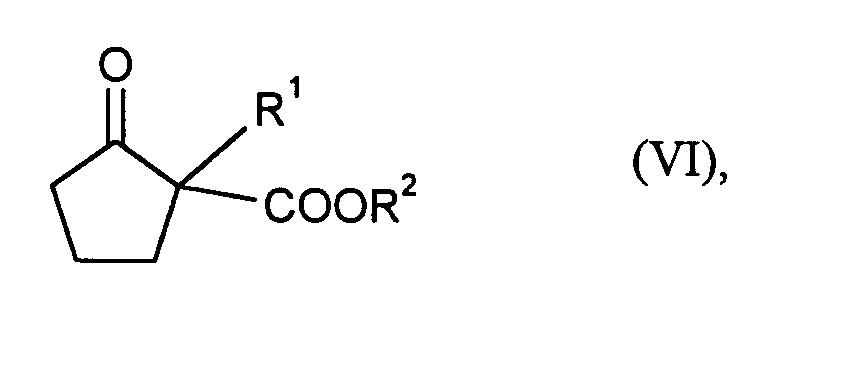
- R2
- die bei Formel (II) und
- R1
- die bei Formel (I) angegebene Bedeutung haben,
Claims (9)
- Verfahren zur Herstellung von in 2-Stellung substituierten Cyclopentanonen der Formelin der

- R1
- für geradkettiges oder verzweigtes C1-C6-Alkyl, C3-C7-Cycloalkyl oder gegebenenfalls durch Halogen substituiertes C7-C12-Aralkyl steht,
in der
die beiden R2 gleich oder verschieden sind und jeweils für geradkettiges oder verzweigtes C1-C10-Alkyl, für gegebenenfalls mit bis zu 3 gleichen oder verschiedenen Substituenten aus der Gruppe der Halogene und der C1-C6-Alkyl-, C1-C6-Alkoxy- und Nitrogruppen substituiertes C7-C12-Aralkyl oder für gegebenenfalls mit bis zu 3 gleichen oder verschiedenen Substituenten aus der Gruppe der Halogene und der C1-C6-Alkyl-, C1-C6-Alkoxy- und Nitrogruppen substituiertes C6-C10-Aryl stehen,
in Gegenwart eines inerten Lösungsmittels mit einem Alkoholat der Formel (III) umsetzt- M
- für ein Alkali- oder Erdalkalimetall,
- R3
- für C1-C10-Alkyl, C3-C10-Cycloalkyl oder C7-C12-Aralkyl und
- n
- je nach der Wertigkeit von M für 1 oder 2 stehen,
in der
- R2
- die bei Formel (II) angegebene Bedeutung hat und
- M
- für ein Äquivalent eines Alkali- oder Erdalkalimetalls steht,
- R1
- die bei Formel (I) angegebene Bedeutung hat und
- X
- für Halogen, C1-C6-Alkylsulfonat oder gegebenenfalls mit bis zu zwei C1-C4-Alkylgruppen substituiertes C6-C10-Arylsulfonat steht,
in der
- R2
- die bei Formel (II) und
- R1
- die bei Formel (I) angegebene Bedeutung haben,
- Verfahren nach Anspruch 1, dadurch gekennzeichnet, daß bei Formel (II) beide R2-Reste gleich sind und für geradkettiges oder verzweigtes C1-C6-Alkyl, gegebenenfalls durch bis zu zwei Substituenten aus der Gruppe der Halogenatome und der C1-C4-Alkylgruppen substituiertes Benzyl oder gegebenenfalls durch bis zu zwei Substituenten aus der Gruppe der C1-C4-Alkylgruppen und der Nitrogruppe substituiertes Phenyl stehen, in Formel (III) M für Natrium, Kalium, Lithium, Calcium oder Magnesium und R3 für geradkettiges oder verzweigtes C1-C6-Alkyl, C3-C7-Cycloalkyl oder Benzyl stehen, als Lösungsmittel aliphatische oder aromatische Kohlenwasserstoffe mit Siedepunkten von mindestens 80°C (bei Normaldruck) oder durch Halogen und/oder C1-C4-Alkoxy substituierte aromatische Kohlenwasserstoffe oder Gemische dieser Lösungsmittel eingesetzt werden und das Alkoholat der Formel (III) als Lösung in den dem jeweiligen Alkoholat zugrundeliegenden Alkohol einsetzt und den Alkohol abdestilliert bevor die Reaktion mit dem Adipinsäureester der Formel (II) in nennenswertem Umfang einsetzt.
- Verfahren nach Ansprüchen 1 und 2, dadurch gekennzeichnet, daß man dem Lösungsmittel zusätzlich dipolare aprotische Lösungsmittel hinzufügt.
- Verfahren nach Ansprüchen 1 bis 3, dadurch gekennzeichnet, daß man pro Mol Adipinsäureester der Formel (II) 0,1 bis 10 Äquivalente eines Alkoholats der Formel (III) einsetzt und die Umsetzung bei Temperaturen im Bereich 80 bis 200°C durchführt.
- Verfahren nach Ansprüchen 1 bis 4, dadurch gekennzeichnet, daß man als Alkylierungsmittel der Formel (V) solche einsetzt, bei denen R1 für Methyl, Ethyl, n-Propyl, i-Propyl, Benzyl, 4-Chlorbenzyl oder 4-Fluorbenzyl und X für Chlor, Brom oder p-Tolylsulfonat stehen.
- Verfahren nach Ansprüchen 1 bis 5, dadurch gekennzeichnet, daß man auf 1 Mol Adipinsäureester der Formel (II) 1 bis 20 Mol eines Alkylierungsmittels der Formel (V) einsetzt, die Alkylierung bei Temperaturen im Bereich 0 bis 250°C durchführt und nach der Alkylierung die Lösungsmittel und eventuell vorhandenes überschüssiges Alkylierungsmittel entfernt.
- Verfahren nach Ansprüchen 1 bis 6, dadurch gekennzeichnet, daß man die Behandlung mit einer Säure mit Bromwasserstoffsäure, Schwefelsäure, Alkylsulfonsäuren oder Arylsulfonsäuren durchführt und die Säuren in Form wäßriger Lösungen einsetzt.
- Verfahren nach Ansprüchen 1 bis 7, dadurch gekennzeichnet, daß man auf 1 Mol Adipinsäureester der Formel (II) 1 bis 10 Äquivalente Säure einsetzt.
- Verfahren nach Ansprüchen 1 bis 8, dadurch gekennzeichnet, daß man das hergestellte, in 2-Stellung substituierte 2-Cyclopentanon der Formel (I) durch azeotrope Destillation isoliert.
Applications Claiming Priority (2)
| Application Number | Priority Date | Filing Date | Title |
|---|---|---|---|
| DE19523448A DE19523448A1 (de) | 1995-06-28 | 1995-06-28 | Verfahren zur Herstellung von 2-substituierten Cyclopentanonen |
| DE19523448 | 1995-06-28 |
Publications (3)
| Publication Number | Publication Date |
|---|---|
| EP0755912A2 EP0755912A2 (de) | 1997-01-29 |
| EP0755912A3 EP0755912A3 (de) | 1997-04-16 |
| EP0755912B1 true EP0755912B1 (de) | 1999-09-08 |
Family
ID=7765434
Family Applications (1)
| Application Number | Title | Priority Date | Filing Date |
|---|---|---|---|
| EP96109678A Expired - Lifetime EP0755912B1 (de) | 1995-06-28 | 1996-06-17 | Verfahren zur Herstellung von 2-substituierten Cyclopentanonen |
Country Status (5)
| Country | Link |
|---|---|
| US (1) | US5672763A (de) |
| EP (1) | EP0755912B1 (de) |
| JP (1) | JPH0920712A (de) |
| DE (2) | DE19523448A1 (de) |
| IL (1) | IL118730A (de) |
Families Citing this family (3)
| Publication number | Priority date | Publication date | Assignee | Title |
|---|---|---|---|---|
| KR20010025244A (ko) * | 2000-11-15 | 2001-04-06 | 신홍현 | 2-알콕시카르보닐 시클로펜타논 유도체의 제조 방법 |
| CA2652397A1 (en) * | 2006-05-18 | 2007-11-29 | Boehringer Ingelheim International Gmbh | Method of preparing chiral cyclic .beta.-aminocarboxamides |
| US8899352B2 (en) * | 2007-08-15 | 2014-12-02 | Schlumberger Technology Corporation | System and method for drilling |
Family Cites Families (1)
| Publication number | Priority date | Publication date | Assignee | Title |
|---|---|---|---|---|
| FR2341591A1 (fr) * | 1976-02-23 | 1977-09-16 | Roussel Uclaf | Nouveaux derives organophosphores comportant un cycle thiazole, procede de preparation et application comme pesticides |
-
1995
- 1995-06-28 DE DE19523448A patent/DE19523448A1/de not_active Withdrawn
-
1996
- 1996-06-17 DE DE59602992T patent/DE59602992D1/de not_active Expired - Lifetime
- 1996-06-17 EP EP96109678A patent/EP0755912B1/de not_active Expired - Lifetime
- 1996-06-21 US US08/668,959 patent/US5672763A/en not_active Expired - Lifetime
- 1996-06-21 JP JP8179835A patent/JPH0920712A/ja active Pending
- 1996-06-25 IL IL11873096A patent/IL118730A/xx not_active IP Right Cessation
Non-Patent Citations (1)
| Title |
|---|
| POND, D.M. & CARGILL, R.L.: "Alkylation of 2-Carbethoxycyclopentanone in Dimethyl Sulfoxide", JOURNAL OF ORGANIC CHEMISTRY, vol. 32, pages 4064 - 4065 * |
Also Published As
| Publication number | Publication date |
|---|---|
| DE19523448A1 (de) | 1997-01-02 |
| JPH0920712A (ja) | 1997-01-21 |
| EP0755912A2 (de) | 1997-01-29 |
| IL118730A (en) | 2000-06-29 |
| US5672763A (en) | 1997-09-30 |
| EP0755912A3 (de) | 1997-04-16 |
| DE59602992D1 (de) | 1999-10-14 |
| IL118730A0 (en) | 1996-10-16 |
Similar Documents
| Publication | Publication Date | Title |
|---|---|---|
| DE60021258T2 (de) | Verfahren zur herstellung von sevofluran und eines zwischenproduktes davon | |
| DE3719014C2 (de) | ||
| EP0760367A2 (de) | Verfahren zur Herstellung von 4-Acylamino-2,2,6,6-tetramethylpiperidinen | |
| DE4301247A1 (de) | Verfahren zur Herstellung mehrfach halogenierter Benzotrichloride und Benzoylchloride sowie neue Trihalogenbenzotrichloride und -benzoylchloride | |
| EP0755912B1 (de) | Verfahren zur Herstellung von 2-substituierten Cyclopentanonen | |
| DE3836175A1 (de) | Fluor enthaltende phenole | |
| EP0011208B1 (de) | Verfahren zur Herstellung von 3-Phenoxy-benzaldehyden | |
| EP0251041B1 (de) | Verfahren zur Herstellung von 2,3,5,6-Tetrafluorbenzoesäure und die Verbindungen 2,3,5,6-Tetrachlor-4-trifluormethyl-benzoylchlorid und 2,3,5,6-Tetrafluor-4-trifluormethyl-benzoylfluorid | |
| DE2924789A1 (de) | Verfahren zur herstellung eines gemischs von 3-chloranthranilsaeurealkylester und 6-chloranthranilsaeurealkylester | |
| EP0302331B1 (de) | Ester von Arylbisperfluoralkylcarbinolen, Verfahren zur Herstellung dieser Verbindungen und der zugrundeliegenden Arylbisperfluoralkylcarbinole | |
| EP0608714B1 (de) | Verfahren zur Herstellung chlorierter 4,5-Difluorbenzoesäuren, -benzoesäurederivate und -benzaldehyde | |
| EP0457725B1 (de) | Verfahren zur Herstellung von 2,3-Dibrompropionylchlorid | |
| EP0061629B1 (de) | Verfahren zur Herstellung von substituierter alpha-Halogenpropionsäure und ihren Derivaten; substituiertes Vinylidenchlorid | |
| EP0417543B1 (de) | Verfahren zur Herstellung von 3-Methylchinolin-8-carbonsäure | |
| EP0818435B1 (de) | Verfahren zur Decarboxylierung halogenierter aromatischer Carbonsäuren | |
| EP0385062A2 (de) | Verfahren zur Herstellung von Cytosinen | |
| EP0045430A1 (de) | Verfahren zur alpha-Bromierung von gegebenenfalls substituierten Fluortoluolen und Gemische von in alpha-Stellung verschieden hoch bromierten, gegebenenfalls substituierten Fluortoluolen | |
| EP0025883A1 (de) | Elektrochemisches Verfahren zur Herstellung von 4-tert.-Butoxybenzaldehyddialkylacetalen, ihre Verwendung und 4-tert.-Butoxybenzaldehyddimethylacetal | |
| EP0317883A2 (de) | Teilfluorierte Diphenylether, Verfahren zu ihrer Herstellung und ihre Verwendung | |
| WO1995029886A1 (de) | Verfahren zur herstellung brom enthaltender aromatischer verbindungen, neue brom enthaltende verbindungen und ihre verwendung als zwischenprodukte bei der synthese von wirkstoffen | |
| DE1593302C (de) | Verfahren zur Herstellung von Cycloalkanonen mit 8 bis 15 Kohlenstoffatomen | |
| DE2619321C2 (de) | Oxalsäurederivate, ihre Herstellung und ihre Verwendung | |
| EP0694519B1 (de) | Verfahren zur Herstellung von 2,4-Difluoracetophenon | |
| DD251258A3 (de) | Verfahren zur herstellung von 3,4-dimethoxy-benzaldehyd nach der sommelet-reaktion | |
| DE2236364A1 (de) | Hochbromierte 4,4'-difluor-diphenyle und verfahren zu deren herstellung |
Legal Events
| Date | Code | Title | Description |
|---|---|---|---|
| PUAI | Public reference made under article 153(3) epc to a published international application that has entered the european phase |
Free format text: ORIGINAL CODE: 0009012 |
|
| AK | Designated contracting states |
Kind code of ref document: A2 Designated state(s): CH DE FR GB IT LI NL |
|
| PUAL | Search report despatched |
Free format text: ORIGINAL CODE: 0009013 |
|
| AK | Designated contracting states |
Kind code of ref document: A3 Designated state(s): CH DE FR GB IT LI NL |
|
| 17P | Request for examination filed |
Effective date: 19971016 |
|
| 17Q | First examination report despatched |
Effective date: 19980724 |
|
| GRAG | Despatch of communication of intention to grant |
Free format text: ORIGINAL CODE: EPIDOS AGRA |
|
| GRAG | Despatch of communication of intention to grant |
Free format text: ORIGINAL CODE: EPIDOS AGRA |
|
| GRAH | Despatch of communication of intention to grant a patent |
Free format text: ORIGINAL CODE: EPIDOS IGRA |
|
| GRAH | Despatch of communication of intention to grant a patent |
Free format text: ORIGINAL CODE: EPIDOS IGRA |
|
| GRAA | (expected) grant |
Free format text: ORIGINAL CODE: 0009210 |
|
| AK | Designated contracting states |
Kind code of ref document: B1 Designated state(s): CH DE FR GB IT LI NL |
|
| REG | Reference to a national code |
Ref country code: CH Ref legal event code: NV Representative=s name: E. BLUM & CO. PATENTANWAELTE Ref country code: CH Ref legal event code: EP |
|
| GBT | Gb: translation of ep patent filed (gb section 77(6)(a)/1977) |
Effective date: 19990916 |
|
| REF | Corresponds to: |
Ref document number: 59602992 Country of ref document: DE Date of ref document: 19991014 |
|
| ITF | It: translation for a ep patent filed | ||
| ET | Fr: translation filed | ||
| PLBE | No opposition filed within time limit |
Free format text: ORIGINAL CODE: 0009261 |
|
| STAA | Information on the status of an ep patent application or granted ep patent |
Free format text: STATUS: NO OPPOSITION FILED WITHIN TIME LIMIT |
|
| 26N | No opposition filed | ||
| REG | Reference to a national code |
Ref country code: GB Ref legal event code: IF02 |
|
| PGFP | Annual fee paid to national office [announced via postgrant information from national office to epo] |
Ref country code: CH Payment date: 20020528 Year of fee payment: 7 |
|
| PGFP | Annual fee paid to national office [announced via postgrant information from national office to epo] |
Ref country code: GB Payment date: 20020612 Year of fee payment: 7 |
|
| PGFP | Annual fee paid to national office [announced via postgrant information from national office to epo] |
Ref country code: NL Payment date: 20020628 Year of fee payment: 7 |
|
| PG25 | Lapsed in a contracting state [announced via postgrant information from national office to epo] |
Ref country code: GB Free format text: LAPSE BECAUSE OF NON-PAYMENT OF DUE FEES Effective date: 20030617 |
|
| PG25 | Lapsed in a contracting state [announced via postgrant information from national office to epo] |
Ref country code: LI Free format text: LAPSE BECAUSE OF NON-PAYMENT OF DUE FEES Effective date: 20030630 Ref country code: CH Free format text: LAPSE BECAUSE OF NON-PAYMENT OF DUE FEES Effective date: 20030630 |
|
| PG25 | Lapsed in a contracting state [announced via postgrant information from national office to epo] |
Ref country code: NL Free format text: LAPSE BECAUSE OF NON-PAYMENT OF DUE FEES Effective date: 20040101 |
|
| GBPC | Gb: european patent ceased through non-payment of renewal fee |
Effective date: 20030617 |
|
| REG | Reference to a national code |
Ref country code: CH Ref legal event code: PL |
|
| NLV4 | Nl: lapsed or anulled due to non-payment of the annual fee |
Effective date: 20040101 |
|
| PG25 | Lapsed in a contracting state [announced via postgrant information from national office to epo] |
Ref country code: IT Free format text: LAPSE BECAUSE OF NON-PAYMENT OF DUE FEES;WARNING: LAPSES OF ITALIAN PATENTS WITH EFFECTIVE DATE BEFORE 2007 MAY HAVE OCCURRED AT ANY TIME BEFORE 2007. THE CORRECT EFFECTIVE DATE MAY BE DIFFERENT FROM THE ONE RECORDED. Effective date: 20050617 |
|
| REG | Reference to a national code |
Ref country code: FR Ref legal event code: TP |
|
| PGFP | Annual fee paid to national office [announced via postgrant information from national office to epo] |
Ref country code: FR Payment date: 20080617 Year of fee payment: 13 |
|
| REG | Reference to a national code |
Ref country code: FR Ref legal event code: ST Effective date: 20100226 |
|
| PG25 | Lapsed in a contracting state [announced via postgrant information from national office to epo] |
Ref country code: FR Free format text: LAPSE BECAUSE OF NON-PAYMENT OF DUE FEES Effective date: 20090630 |
|
| PGFP | Annual fee paid to national office [announced via postgrant information from national office to epo] |
Ref country code: DE Payment date: 20120613 Year of fee payment: 17 |
|
| REG | Reference to a national code |
Ref country code: DE Ref legal event code: R119 Ref document number: 59602992 Country of ref document: DE Effective date: 20140101 |
|
| PG25 | Lapsed in a contracting state [announced via postgrant information from national office to epo] |
Ref country code: DE Free format text: LAPSE BECAUSE OF NON-PAYMENT OF DUE FEES Effective date: 20140101 |