EP0753896A2 - Process involving metal hydrides - Google Patents
Process involving metal hydrides Download PDFInfo
- Publication number
- EP0753896A2 EP0753896A2 EP96305143A EP96305143A EP0753896A2 EP 0753896 A2 EP0753896 A2 EP 0753896A2 EP 96305143 A EP96305143 A EP 96305143A EP 96305143 A EP96305143 A EP 96305143A EP 0753896 A2 EP0753896 A2 EP 0753896A2
- Authority
- EP
- European Patent Office
- Prior art keywords
- metal
- hydrogen
- plating
- metal hydride
- hydride
- Prior art date
- Legal status (The legal status is an assumption and is not a legal conclusion. Google has not performed a legal analysis and makes no representation as to the accuracy of the status listed.)
- Granted
Links
Images
Classifications
-
- C—CHEMISTRY; METALLURGY
- C23—COATING METALLIC MATERIAL; COATING MATERIAL WITH METALLIC MATERIAL; CHEMICAL SURFACE TREATMENT; DIFFUSION TREATMENT OF METALLIC MATERIAL; COATING BY VACUUM EVAPORATION, BY SPUTTERING, BY ION IMPLANTATION OR BY CHEMICAL VAPOUR DEPOSITION, IN GENERAL; INHIBITING CORROSION OF METALLIC MATERIAL OR INCRUSTATION IN GENERAL
- C23C—COATING METALLIC MATERIAL; COATING MATERIAL WITH METALLIC MATERIAL; SURFACE TREATMENT OF METALLIC MATERIAL BY DIFFUSION INTO THE SURFACE, BY CHEMICAL CONVERSION OR SUBSTITUTION; COATING BY VACUUM EVAPORATION, BY SPUTTERING, BY ION IMPLANTATION OR BY CHEMICAL VAPOUR DEPOSITION, IN GENERAL
- C23C18/00—Chemical coating by decomposition of either liquid compounds or solutions of the coating forming compounds, without leaving reaction products of surface material in the coating; Contact plating
- C23C18/16—Chemical coating by decomposition of either liquid compounds or solutions of the coating forming compounds, without leaving reaction products of surface material in the coating; Contact plating by reduction or substitution, e.g. electroless plating
- C23C18/1601—Process or apparatus
- C23C18/1633—Process of electroless plating
- C23C18/1635—Composition of the substrate
- C23C18/1637—Composition of the substrate metallic substrate
-
- C—CHEMISTRY; METALLURGY
- C23—COATING METALLIC MATERIAL; COATING MATERIAL WITH METALLIC MATERIAL; CHEMICAL SURFACE TREATMENT; DIFFUSION TREATMENT OF METALLIC MATERIAL; COATING BY VACUUM EVAPORATION, BY SPUTTERING, BY ION IMPLANTATION OR BY CHEMICAL VAPOUR DEPOSITION, IN GENERAL; INHIBITING CORROSION OF METALLIC MATERIAL OR INCRUSTATION IN GENERAL
- C23C—COATING METALLIC MATERIAL; COATING MATERIAL WITH METALLIC MATERIAL; SURFACE TREATMENT OF METALLIC MATERIAL BY DIFFUSION INTO THE SURFACE, BY CHEMICAL CONVERSION OR SUBSTITUTION; COATING BY VACUUM EVAPORATION, BY SPUTTERING, BY ION IMPLANTATION OR BY CHEMICAL VAPOUR DEPOSITION, IN GENERAL
- C23C18/00—Chemical coating by decomposition of either liquid compounds or solutions of the coating forming compounds, without leaving reaction products of surface material in the coating; Contact plating
- C23C18/54—Contact plating, i.e. electroless electrochemical plating
-
- H—ELECTRICITY
- H01—ELECTRIC ELEMENTS
- H01M—PROCESSES OR MEANS, e.g. BATTERIES, FOR THE DIRECT CONVERSION OF CHEMICAL ENERGY INTO ELECTRICAL ENERGY
- H01M4/00—Electrodes
- H01M4/02—Electrodes composed of, or comprising, active material
- H01M4/04—Processes of manufacture in general
- H01M4/0438—Processes of manufacture in general by electrochemical processing
- H01M4/044—Activating, forming or electrochemical attack of the supporting material
-
- H—ELECTRICITY
- H01—ELECTRIC ELEMENTS
- H01M—PROCESSES OR MEANS, e.g. BATTERIES, FOR THE DIRECT CONVERSION OF CHEMICAL ENERGY INTO ELECTRICAL ENERGY
- H01M4/00—Electrodes
- H01M4/02—Electrodes composed of, or comprising, active material
- H01M4/24—Electrodes for alkaline accumulators
- H01M4/242—Hydrogen storage electrodes
-
- H—ELECTRICITY
- H01—ELECTRIC ELEMENTS
- H01M—PROCESSES OR MEANS, e.g. BATTERIES, FOR THE DIRECT CONVERSION OF CHEMICAL ENERGY INTO ELECTRICAL ENERGY
- H01M4/00—Electrodes
- H01M4/02—Electrodes composed of, or comprising, active material
- H01M4/36—Selection of substances as active materials, active masses, active liquids
- H01M4/38—Selection of substances as active materials, active masses, active liquids of elements or alloys
- H01M4/383—Hydrogen absorbing alloys
-
- H—ELECTRICITY
- H01—ELECTRIC ELEMENTS
- H01M—PROCESSES OR MEANS, e.g. BATTERIES, FOR THE DIRECT CONVERSION OF CHEMICAL ENERGY INTO ELECTRICAL ENERGY
- H01M4/00—Electrodes
- H01M4/02—Electrodes composed of, or comprising, active material
- H01M4/36—Selection of substances as active materials, active masses, active liquids
- H01M4/38—Selection of substances as active materials, active masses, active liquids of elements or alloys
- H01M4/383—Hydrogen absorbing alloys
- H01M4/385—Hydrogen absorbing alloys of the type LaNi5
-
- H—ELECTRICITY
- H01—ELECTRIC ELEMENTS
- H01M—PROCESSES OR MEANS, e.g. BATTERIES, FOR THE DIRECT CONVERSION OF CHEMICAL ENERGY INTO ELECTRICAL ENERGY
- H01M4/00—Electrodes
- H01M4/02—Electrodes composed of, or comprising, active material
- H01M4/04—Processes of manufacture in general
- H01M4/0438—Processes of manufacture in general by electrochemical processing
-
- Y—GENERAL TAGGING OF NEW TECHNOLOGICAL DEVELOPMENTS; GENERAL TAGGING OF CROSS-SECTIONAL TECHNOLOGIES SPANNING OVER SEVERAL SECTIONS OF THE IPC; TECHNICAL SUBJECTS COVERED BY FORMER USPC CROSS-REFERENCE ART COLLECTIONS [XRACs] AND DIGESTS
- Y02—TECHNOLOGIES OR APPLICATIONS FOR MITIGATION OR ADAPTATION AGAINST CLIMATE CHANGE
- Y02E—REDUCTION OF GREENHOUSE GAS [GHG] EMISSIONS, RELATED TO ENERGY GENERATION, TRANSMISSION OR DISTRIBUTION
- Y02E60/00—Enabling technologies; Technologies with a potential or indirect contribution to GHG emissions mitigation
- Y02E60/10—Energy storage using batteries
Definitions
- This invention relates to metal hydrides, and in particular, to processes involving such hydrides.
- Metal hydrides are used in a variety of industrial applications. Although there are many such applications, possibly the most prominent is the use of metal hydrides in batteries. For example, secondary nickel-metal hydride batteries employ lauthanum nickel hydride (or alloy modifications) or other intermetallic hydrides in the negative electrode. A variety of other uses involving energy storage and transfer have been described. Irrespective of the application, a crucial step in preparation is activation of the intermetallic. Activation is achieved, for example, by repeatedly reducing the metal such as LaNi 5 to the corresponding hydride with H 2 gas at high pressure and/or temperature followed by removal of hydrogen at lower pressures.
- This cyclic process is believed to serve a number of purposes.
- Each reduction to the hydride 1) removes reducible surface oxides which tend to interfere with the functioning of the material in the ultimate desired application, 2) induces a reduction in particle size resulting from an increase in volume that causes fracture of the metal particles, and 3) changes the structure and/or composition of the material and/or surface of the metal. Any one or a combination of these three effects is generafly employable to increase the rate of reversible hydrogen reaction and, thus, enhance the operation of the material for applications such as batteries or hydrogen storage.
- Methods of activation include 1) hydriding with hydrogen gas at high temperatures and pressure; 2) hydriding with chemical hydriding agents; 3) etching with hot hydrofluoric acid or KOH; 4) pulsing the material between hydriding and dehydriding potentials in electrochemical cells; and 5) conventional battery cycling of metal hydride electrodes.
- activation of hydrides has most widely been performed by the first process, i.e., activation, at relatively high pressures (up to 1000 psi) and temperatures as high as 450°C, by subjecting the metal directly to hydrogen gas.
- relatively high pressures up to 1000 psi
- temperatures as high as 450°C
- metal hydrides as they are used in batteries such as nickel/metal hydride batteries, have been observed to undergo serious corrosion.
- This corrosion substantially reduces the lifetime of such batteries. It has been reported (see T. Sakai supra ), that plating the metal hydride with a metal such as copper, allows the hydride to function as an electrode within the battery and yet prevents or substantially reduces the objectionable corrosion.
- a metal coating also acts as an oxygen barrier protecting the hydride alloy surface from oxidation and as a microcurrent collector for the charge transfer reaction occurring on the surface.
- a metal coating aids in heat removal, improves electrical conduction, and improves the mechanical stability of the electrode.
- consistently producing a uniform coating of metal on the hydride is difficult to accomplish. Therefore, a highly activated metal hydride uniformly plated with a metal such as copper would be quite desirable.
- Activated metal hydrides having a substantial level of absorbed hydrogen are employed in an extremaly advantageous manner.
- Metal in this context includes elemental metals, alloys based on elemental metals with the presence of other constituents being acceptable, and intermetallic compounds.
- plating occurs through interaction of the metal complexes or ions in solution with the absorbed hydrogen.
- this process provides a more uniform coating and hence abetter protective layer.
- the conventional plating such as electroless plating, the metal complex and the reducing agent are brought together at the surface. In areas where the reducing agent is not accessible, the plating does not proceed.
- the absorbed hydrogen as the reducing agent, it is only necessary to bring the metal complex to the surface. Not only all the alloy surface is plated but the electroless plating with hydragen produces a uniform coating since the supply of the hydrogen is self regulating. That is, as hydrogen diffuses from the metal hydride through the coating the diffusion rate is faster on surface defects and thinner coating areas. The higher supply of hydrogen results in higher plating rate and, thus, substantially evens coating thickness variations.
- An advantageous method of producing hydrides with absorbed hydrogen is through the activation of metals, e.g, intermetallics such as LaNi 5 , using an electrochemical technique.
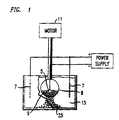
- a metal to be activated is positioned at the cathode of an electrochemical cell such as shown at 9 in FIG. 1.
- An aqueous-based electrolyte is employed so that upon passing a current at a suitable voltage between cathodes and anodes through the electrolyte, electrolysis of the water present produces hydrogen.
- the resulting hydrogen interacts with the metal producing the hydride, and additionally, causes fracture of the metal into significantly smaller particles. If the cathode 5 in FIG. 1 is surrounded by a cage 8 of suitable mesh, this fracture continues until the particles are sufficiently small to fall through the mesh into the underlying anode compartment Excessive hydrogen can be oxidized to reduce the hydrogen content of the hydride powder.
- Metals capable of forming stable metal hydrides are converted into their corresponding hydride, are activated, and are reduced to relatively small particles through an electrochemical process that in one embodiment, produces an advantageous level of absorbed hydrogen.
- Typical metals including elements, alloys, and intermetallic materials are employable in such electrochemical processes. Examples of such metals include Pd, LaNi 5 , MmNi 3.5 Al 0.8 Co 0.7 (Mm, mischmetal is a mixture or alloy of rare earth metals as described in Metals Handbook , 8th ed,, ASM, pg. 25, 1961), Ti 2 Ni, Zr 0.5 Ti 0.5 V 0.69 Ni 1.22 Cr 0.22 , and ZrCrNi.
- a metal should be capable of forming a hydride and should have the properties of absorbing hydrogen (more than 0.05% by wt.) inside the metal matrix.
- a particularly advantageous subset of such materials include metals corresponding to hydrides that produce an electromotive force when employed in a metal hydride battery.
- the hydrides are formed by reaction with hydrogen generated by electrolysis of an aqueous-based electrolyte, is in FIG. 1.
- a useful electrolyte is formed by dissolving a suitable salt in water.
- Typical salts employed for such formation of electrolyte include potassium hydroxide and sodium hydroxide.
- salt concentrations in the range 0.5% to 50% by weight are employed. Concentrations greater than 50% are undesirable because of salt precipitation, while concentrations less than 0.5% lead to insufficient conductivity.
- the electrolytes should be aqueous based, presence of nonaqueous materials such as ethanol is not precluded. However, generally, concentrations of such nonaqueous materials should be limited to less than 10 volume %.
- the current is passed through the electrolyte, 15, to induce electrolysis of water.
- a voltage of 1.23 volt or greater is required to induce such electrolysis.
- voltages in the range 2 volt to 20 volt are useful.
- the rate of generation of hydrogen depends on the current.
- currents in the range 5 A to 15 A are usefully employed.
- Currents below 0.1 A, although not precluded, unduly prolong the process, while currents greater than 20 A induce excessive hydrogen evolution.
- typical metal loads are in the range 100 to 500 gms.
- the resulting hydrogen interacts with the metal 9 and induces activation of the corresponding hydride including fracture of the metal hydride into smaller particles.
- the cylinder 8 in FIG. 1 be made of mesh so that this fracture process continues until a desired particle size is reached resulting in particles, 25, falling through the mesh (which advantageously is rotated by motor, 11) and out of the reaction region.
- Particle fracture does not continue indefinitely once the particle falls through the barrel, and typically, mean fracture size is limited to a range between 6 ⁇ m and 200 ⁇ m. Such particle size is nevertheless advantageous for most uses including for applications in batteries.
- the composition of the electrodes is not critical. Typically, electrodes such as nickel and stainless seal are employed where the geometry of the anode, 7, is typically a mesh type and the cathode, 5, is a spherical dangler. Additionally, the size of the cell is also not critical, and typically, configurations such as a cylindrical barrel are employed.
- the activated metal hydride is allowed after it passes through the mesh to contact an anode, any excess. absorbed hydrogen present is oxidized to form water. In this manner, any excessive accumulation of hydrogen is avoided, and thus, the activated material can be bandled in air.
- the activated hydride particles from the inventive electrochemical process have a substantial level of absorbed hydrogen.
- the level of hydrogen in some exemplary metals is shown in Table 1.
- Table 1 Hydrogen Storage Capacities of Metal Hydrides Metal Hydride Hydrogen Density (H/mL ⁇ 10 -22 ) Capacity (mAh/g) LaNi 5 H 6 7.4 372 CaNi 5 H 6 6.6 480 FeTiH 2 5.6 490 Mg 2 NiH 4 5.9 990 H 2 liquid 4.2
- the concentration of hydrogen in liquid hydrogen is given as a comparison.
- the concentration of hydrogen in the activated metal hydrides is relatively high.
- This hydrogen is advantageously used as a reducing agent for the plating, such as electroless plating, of the metal hydrides.
- the method of producing particles with absorbed hydrogen for subsequent plating is not critical.
- the previously defined activation process is useful alone or in combination with a plating process for providing absorbed hydrogen.
- the use of absorbed hydrogen for plating is useful irrespective of the method used to produce such absorption.
- Such plating is advantageous to prevent, for example, corrosion of the hydrides when employed in batteries.
- the composition of the plating solution is not critical.
- Typical plating solutions are alkaline solutions containing metal complexes.
- a complex in this context is, for example, ethylenediaminetetraacetate (EDTA) for copper plating.
- Exemplary materials for plating include copper, nickel, cobalt silver, palladium and their alloy.
- electroless plating solutions be employed in the substantial absence of a reducing agent other than the hydrogen present By this expedient, a quite uniform plating of metal onto the metal hydride is accomplished. However, if a thicker metal layer is inquired, the standard electroless plating solutions are useful.
- a substantial presence of reducing agent is a concentration above 0.1 wt.
- the activated metal hydrides arc plated by simply immersing such hydrides in the plating solution.
- such plating is self terminating, and typically, obtained thicknesses are in the range 0.1 to 5 ⁇ m and are achieved during time periods in the range 1 to 60 mins.
- the described hydrogen electroless plating process allows the possibility of developing a close loop process.
- the by-product of the plating is only H + ions, which makes it possible to replenish the solution by adding a source of metal ions such as metal oxide.
- the LaNi 5 powder was separated from the KOH solution and placed into a copper solution (0.016M CuSO 4 , 0.032M ethylenediaminetetraacetic acid) for 15 minutes.
- the solution pH remained unchanged at 12.7.
- the temperature was held in the range of 52 to 62°C.
- the powder was coated with copper.
- the copper content was estimated to be 4.5 wt. %.
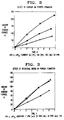
- FIG. 2 shows the amount of powder formed as a function of the current passed. The rate of powder formation was higher at higher current: 12.5 g/hr, 21 g/hr, and 35 g/hr at 5A, 10A, and 15A respectively with a rotational speed of 20 rpm.
- FIG. 3 shows the amount of powder formed as a function of the rotational speed of the plating barrel while passing a current of 10 amperes. At 20 rpm or higher, the rate of powder formation was about 20 g/hr. At 7 rpm, the rate dropped to 13 g/hr.
- Pd wires (1 mm diameter) were charged with hydrogen by electrolysis in 1 M KOH for about 18 hours at a current density of approximately 20 mA/cm 2 . After a quick rinse in de-ionized water, the Pd hydride wires were immersed for about 15 min. into the plating solution held at 50°C. The thickness of the metal coating was measured by X-ray fluorescence and cross-section microscopy. The plating solutions used and the thickness of the metal coating are listed in Table 2.
- Nickel and Cu were plated on representative intermetallic alloys that can be hydrided, such as LaNi 5 , Ti 2 Ni, Ti 2 Ni 0.8 Mn 0.2 and ZrCrNi.
- a 1 gram ingot of LaNi 5 was converted to hydride in 1M KOH for approximately 4 hours at a current density of 20mA/cm 2 .
- After a quick rinse in de-ionized water it was immersed in an alkaline ammoniacal solution (0.2M NiSO 4 , approximately 1.2M NH 4 OH to pH 12) at room temperature for 15 min.
- Another LaNi 5 sample plus ingots of Ti 2 Ni and Ti 2 Ni 0.8 Mn 0.2 were charged and washed as described above and then immersed for 15 min.
Landscapes
- Chemical & Material Sciences (AREA)
- Chemical Kinetics & Catalysis (AREA)
- General Chemical & Material Sciences (AREA)
- Electrochemistry (AREA)
- Engineering & Computer Science (AREA)
- Materials Engineering (AREA)
- Mechanical Engineering (AREA)
- Metallurgy (AREA)
- Organic Chemistry (AREA)
- Manufacturing & Machinery (AREA)
- Chemically Coating (AREA)
- Battery Electrode And Active Subsutance (AREA)
Abstract
Description
- This invention relates to metal hydrides, and in particular, to processes involving such hydrides.
- Metal hydrides are used in a variety of industrial applications. Although there are many such applications, possibly the most prominent is the use of metal hydrides in batteries. For example, secondary nickel-metal hydride batteries employ lauthanum nickel hydride (or alloy modifications) or other intermetallic hydrides in the negative electrode. A variety of other uses involving energy storage and transfer have been described. Irrespective of the application, a crucial step in preparation is activation of the intermetallic. Activation is achieved, for example, by repeatedly reducing the metal such as LaNi5 to the corresponding hydride with H2 gas at high pressure and/or temperature followed by removal of hydrogen at lower pressures.
- This cyclic process, generally denominated activation, is believed to serve a number of purposes. Each reduction to the hydride 1) removes reducible surface oxides which tend to interfere with the functioning of the material in the ultimate desired application, 2) induces a reduction in particle size resulting from an increase in volume that causes fracture of the metal particles, and 3) changes the structure and/or composition of the material and/or surface of the metal. Any one or a combination of these three effects is generafly employable to increase the rate of reversible hydrogen reaction and, thus, enhance the operation of the material for applications such as batteries or hydrogen storage.
- Methods of activation include 1) hydriding with hydrogen gas at high temperatures and pressure; 2) hydriding with chemical hydriding agents; 3) etching with hot hydrofluoric acid or KOH; 4) pulsing the material between hydriding and dehydriding potentials in electrochemical cells; and 5) conventional battery cycling of metal hydride electrodes. However, activation of hydrides has most widely been performed by the first process, i.e., activation, at relatively high pressures (up to 1000 psi) and temperatures as high as 450°C, by subjecting the metal directly to hydrogen gas. Clearly, although such conditions are not prohibitive to commercial use, they require relatively large expenditures for suitable equipment. Thus, an alternative to high pressure reaction of hydrogen gas with the corresponding metal would be quite desirable.
- Additionally, metal hydrides, as they are used in batteries such as nickel/metal hydride batteries, have been observed to undergo serious corrosion. (See T. Sakai et al., Journal of the Electrochemical Society, 134, p. 558 (1987).) This corrosion substantially reduces the lifetime of such batteries. It has been reported (see T. Sakai supra), that plating the metal hydride with a metal such as copper, allows the hydride to function as an electrode within the battery and yet prevents or substantially reduces the objectionable corrosion. A metal coating also acts as an oxygen barrier protecting the hydride alloy surface from oxidation and as a microcurrent collector for the charge transfer reaction occurring on the surface. Additionally, a metal coating aids in heat removal, improves electrical conduction, and improves the mechanical stability of the electrode. However, consistently producing a uniform coating of metal on the hydride is difficult to accomplish. Therefore, a highly activated metal hydride uniformly plated with a metal such as copper would be quite desirable.
- Activated metal hydrides having a substantial level of absorbed hydrogen are employed in an extremaly advantageous manner. (Metal in this context includes elemental metals, alloys based on elemental metals with the presence of other constituents being acceptable, and intermetallic compounds.) In particular, if the metal hydrides are contacted with an aqueous solution containing metal ions and/or their metallic complexes, plating occurs through interaction of the metal complexes or ions in solution with the absorbed hydrogen. In contrast to standard electroless plating, this process provides a more uniform coating and hence abetter protective layer. With the conventional plating, such as electroless plating, the metal complex and the reducing agent are brought together at the surface. In areas where the reducing agent is not accessible, the plating does not proceed. Using the absorbed hydrogen as the reducing agent, it is only necessary to bring the metal complex to the surface. Not only all the alloy surface is plated but the electroless plating with hydragen produces a uniform coating since the supply of the hydrogen is self regulating. That is, as hydrogen diffuses from the metal hydride through the coating the diffusion rate is faster on surface defects and thinner coating areas. The higher supply of hydrogen results in higher plating rate and, thus, substantially evens coating thickness variations.
- An advantageous method of producing hydrides with absorbed hydrogen is through the activation of metals, e.g, intermetallics such as LaNi5, using an electrochemical technique. In this technique, a metal to be activated is positioned at the cathode of an electrochemical cell such as shown at 9 in FIG. 1. An aqueous-based electrolyte is employed so that upon passing a current at a suitable voltage between cathodes and anodes through the electrolyte, electrolysis of the water present produces hydrogen. The resulting hydrogen interacts with the metal producing the hydride, and additionally, causes fracture of the metal into significantly smaller particles. If the
cathode 5 in FIG. 1 is surrounded by acage 8 of suitable mesh, this fracture continues until the particles are sufficiently small to fall through the mesh into the underlying anode compartment Excessive hydrogen can be oxidized to reduce the hydrogen content of the hydride powder. -
- FIG. 1 is illustrative of equipment useful in one aspect of the invention, and
- FIGS. 2 and 3 are illustrative of results relating to the invention.
- Metals capable of forming stable metal hydrides are converted into their corresponding hydride, are activated, and are reduced to relatively small particles through an electrochemical process that in one embodiment, produces an advantageous level of absorbed hydrogen. Typical metals including elements, alloys, and intermetallic materials are employable in such electrochemical processes. Examples of such metals include Pd, LaNi5, MmNi3.5 Al0.8 Co0.7 (Mm, mischmetal is a mixture or alloy of rare earth metals as described in Metals Handbook, 8th ed,, ASM, pg. 25, 1961), Ti2Ni, Zr0.5Ti0.5 V0.69Ni1.22Cr0.22, and ZrCrNi. Basically, for the inventive procedure, a metal should be capable of forming a hydride and should have the properties of absorbing hydrogen (more than 0.05% by wt.) inside the metal matrix. A particularly advantageous subset of such materials include metals corresponding to hydrides that produce an electromotive force when employed in a metal hydride battery.
- The hydrides are formed by reaction with hydrogen generated by electrolysis of an aqueous-based electrolyte, is in FIG. 1. For example, a useful electrolyte is formed by dissolving a suitable salt in water. Typical salts employed for such formation of electrolyte include potassium hydroxide and sodium hydroxide. Generally, salt concentrations in the range 0.5% to 50% by weight are employed. Concentrations greater than 50% are undesirable because of salt precipitation, while concentrations less than 0.5% lead to insufficient conductivity. Although the electrolytes should be aqueous based, presence of nonaqueous materials such as ethanol is not precluded. However, generally, concentrations of such nonaqueous materials should be limited to less than 10 volume %.
- As previously discussed, the current is passed through the electrolyte, 15, to induce electrolysis of water. Generally, a voltage of 1.23 volt or greater is required to induce such electrolysis. For typical metal compounds, voltages in the
range 2 volt to 20 volt are useful. The rate of generation of hydrogen depends on the current. Typically, for a 2.5" inside dia and 4" long cylindrical barrel with a 200 micron size mesh screen wall, currents in the range 5 A to 15 A are usefully employed. Currents below 0.1 A, although not precluded, unduly prolong the process, while currents greater than 20 A induce excessive hydrogen evolution. For such exemplary conditions, typical metal loads are in therange 100 to 500 gms. - The resulting hydrogen interacts with the
metal 9 and induces activation of the corresponding hydride including fracture of the metal hydride into smaller particles. It is advantageous to have thecylinder 8 in FIG. 1 be made of mesh so that this fracture process continues until a desired particle size is reached resulting in particles, 25, falling through the mesh (which advantageously is rotated by motor, 11) and out of the reaction region. Particle fracture does not continue indefinitely once the particle falls through the barrel, and typically, mean fracture size is limited to a range between 6 µm and 200 µm. Such particle size is nevertheless advantageous for most uses including for applications in batteries. - The composition of the electrodes is not critical. Typically, electrodes such as nickel and stainless seal are employed where the geometry of the anode, 7, is typically a mesh type and the cathode, 5, is a spherical dangler. Additionally, the size of the cell is also not critical, and typically, configurations such as a cylindrical barrel are employed.
- In the case where the metal hydride does not need to be coated by plating or where absorbed hydrogen is not used for such plating, the activated metal hydride is allowed after it passes through the mesh to contact an anode, any excess. absorbed hydrogen present is oxidized to form water. In this manner, any excessive accumulation of hydrogen is avoided, and thus, the activated material can be bandled in air.
- The activated hydride particles from the inventive electrochemical process have a substantial level of absorbed hydrogen. The level of hydrogen in some exemplary metals is shown in Table 1.
TABLE 1 Hydrogen Storage Capacities of Metal Hydrides Metal Hydride Hydrogen Density (H/mL × 10 -22 ) Capacity (mAh/g) LaNi5H6 7.4 372 CaNi5H6 6.6 480 FeTiH2 5.6 490 Mg2NiH4 5.9 990 H2 liquid 4.2 - The concentration of hydrogen in liquid hydrogen is given as a comparison. As can be seen, the concentration of hydrogen in the activated metal hydrides is relatively high. This hydrogen is advantageously used as a reducing agent for the plating, such as electroless plating, of the metal hydrides. (However, as to this aspect of the invention, the method of producing particles with absorbed hydrogen for subsequent plating is not critical. Clearly, the previously defined activation process is useful alone or in combination with a plating process for providing absorbed hydrogen. Additionally, the use of absorbed hydrogen for plating is useful irrespective of the method used to produce such absorption.) Such plating is advantageous to prevent, for example, corrosion of the hydrides when employed in batteries. The composition of the plating solution is not critical. Typical plating solutions are alkaline solutions containing metal complexes. (A complex in this context is, for example, ethylenediaminetetraacetate (EDTA) for copper plating.) Exemplary materials for plating include copper, nickel, cobalt silver, palladium and their alloy. However, it is advantageous that them electroless plating solutions be employed in the substantial absence of a reducing agent other than the hydrogen present By this expedient, a quite uniform plating of metal onto the metal hydride is accomplished. However, if a thicker metal layer is inquired, the standard electroless plating solutions are useful. (A substantial presence of reducing agent is a concentration above 0.1 wt. %.) In practice; the activated metal hydrides arc plated by simply immersing such hydrides in the plating solution. Generally, such plating is self terminating, and typically, obtained thicknesses are in the range 0.1 to 5 µm and are achieved during time periods in the
range 1 to 60 mins. - The described hydrogen electroless plating process allows the possibility of developing a close loop process. The by-product of the plating is only H+ ions, which makes it possible to replenish the solution by adding a source of metal ions such as metal oxide, In the case of plating copper on metal hydride alloys using hydrogen as the reducing agent, the complete reaction is:
CuO + 2MH = Cup + 2M + H2O
where M is the metal, alloy or intermetallics compound, MH is the metal hydride, and Cup is the Cu plated on the metal. - The following examples are illustrative of the ivention.
- About 400 grams of chunks of LaNi5 (1-3 cm size) were placed into a barrel plater (Model 24, Stirling Systems Sales Corp., St. Charles, IL). The barrel had a 200 micron size mesh made of polypropylene materials. The propylene tank (8" × 8" × 8") contained about 7 liters of 30 wt. % KOH aqueous solution. There were two vertical nickel anodes (3" × 4") placed about 0.25" away from the barrel. The cathodic current was passed through the chunks of LaNi5 by using a spherical dangler inside the barrel. The rotational speed was set to about 5 rpm. The current was set at 10 amperes and the cell voltage was about 7 volts. After 8.5 hours, 82 grams of LaNi5 were reduced to sizes below 200 µm and fell through the barrel to the bottom of the tank. During the next 10 hours, additional 110 grams of LaNi5 fell through the barrel.
- The LaNi5 powder was separated from the KOH solution and placed into a copper solution (0.016M CuSO4, 0.032M ethylenediaminetetraacetic acid) for 15 minutes. The solution pH remained unchanged at 12.7. The temperature was held in the range of 52 to 62°C. The powder was coated with copper. The copper content was estimated to be 4.5 wt. %.
- Additional experiments were carried out to determine the dependence of powder formation on the electrolytic current passed and the rotational speed of the plating barrel. FIG. 2 shows the amount of powder formed as a function of the current passed. The rate of powder formation was higher at higher current: 12.5 g/hr, 21 g/hr, and 35 g/hr at 5A, 10A, and 15A respectively with a rotational speed of 20 rpm. FIG. 3 shows the amount of powder formed as a function of the rotational speed of the plating barrel while passing a current of 10 amperes. At 20 rpm or higher, the rate of powder formation was about 20 g/hr. At 7 rpm, the rate dropped to 13 g/hr.
- Pd wires (1 mm diameter) were charged with hydrogen by electrolysis in 1 M KOH for about 18 hours at a current density of approximately 20 mA/cm2. After a quick rinse in de-ionized water, the Pd hydride wires were immersed for about 15 min. into the plating solution held at 50°C. The thickness of the metal coating was measured by X-ray fluorescence and cross-section microscopy. The plating solutions used and the thickness of the metal coating are listed in Table 2.
TABLE 2 Metal Hydride Plated Metal Plating Solution Average Thickness (microns) PdHx Cu 0.1M CuSO4, 0.05M H2SO4 2.0 PdHx Cu 0.02M CuSO4, 0.065M triisopropanolamine 0.5 PdHx Ag 0.01M AgCN, 0.1MKCN, O.1M KOH 3.6 Pd(no H2) Ag 0.01M AgCN, 0.1MKCN, O.1M KOH 0.1 - Nickel and Cu were plated on representative intermetallic alloys that can be hydrided, such as LaNi5, Ti2Ni, Ti2Ni0.8Mn0.2 and ZrCrNi. A 1 gram ingot of LaNi5 was converted to hydride in 1M KOH for approximately 4 hours at a current density of 20mA/cm2. After a quick rinse in de-ionized water it was immersed in an alkaline ammoniacal solution (0.2M NiSO4, approximately 1.2M NH4 OH to pH 12) at room temperature for 15 min. Another LaNi5 sample plus ingots of Ti2Ni and Ti2 Ni0.8 Mn0.2 were charged and washed as described above and then immersed for 15 min. in an alkaline copper plating solution (0.02M CUSO4, 0.065M triisopropanolamine, 0.2M NaOH, pH 12) at 50°C. A ZrCrNi sample was treated in a similar fashion but no Cu plating was realized. The sample was pulse activated prior to immersion in the Cu plating solution and a coating of about 2.5 microns was obtained. The average thickness of all the coatings is listed in Table 3.
TABLE 3 Metal Hydride Plated Metal Average Thickness (microns) LaNi5 Ni 0.5 LaNi5 Cu 3.0 Ti2Ni Cu 3.0 Ti2Ni0.8Mn0.2 Cu 2.0 ZrCrNi Cu 2.5
Claims (10)
- A process for producing a continuous plated layer on a hydrided metal material comprising the steps of bringing said hydrided metal material in contact with a solution containing entities to be plated characterized in that said hydrided metal material has sufficient absorbed hydrogen so that said hydrogen reduces entities in said solution to induce formation of said continuous plated layer.
- The process of claim 1 wherein said metallic material has been activated.
- The process of claim 2 wherein said metallic material comprises a number chosen from the group consisting of Pd, LaNi5, MmNi3.5Al0.8Co0.7, Ti2Ni, Zr0.5Ti0.5 V0.69Ni1.22Cr0.22, and ZrCrNi.
- The process of claim 1 wherein said metallic material comprises a metal chosen from the group consisting of Pd, LaNi5, MmNi3.5Al0.8Co0.7, Ti2Ni, Zr0.5Ti0.5 V0.69 Ni1.22Cr0.22 and ZrCrNi.
- The process of claim I wherein said absorbed hydrogen constitutes at least 0.05 wt. % of said metallic material.
- The of claim 1 wherein said plated layer comprises copper, nickel, cobalt, silver palladium, or their alloys.
- A process for activating a metal, said process comprising the steps of contacting said metal to an aqueous electrolyte in the region of a cathode, passing a current between said cathode and an anode through said aqueous electrolyte, thus electrolyzing a portion of said electrolyte and activating said metal.
- The process of claim 7 wherein said metal is fractured as a result of said process and passes through a mesh.
- The process of claim 7 wherein said metal comprises a material chosen from the group consisting of Pd, LaNi5, MmNi3.5 Al0.8 Co0.7, Ti2Ni, Zr0.5Ti0.5V0.69Ni1.22Cr0.22, and ZrCrNi.
- The process of claim 7 wherein said aqueous electrolyte comprises an aqueous solution of a hydroxide salt.
Priority Applications (1)
| Application Number | Priority Date | Filing Date | Title |
|---|---|---|---|
| EP00109328A EP1043788A3 (en) | 1995-07-14 | 1996-07-12 | Process involving metal hydrides |
Applications Claiming Priority (2)
| Application Number | Priority Date | Filing Date | Title |
|---|---|---|---|
| US502504 | 1995-07-14 | ||
| US08/502,504 US5630933A (en) | 1995-07-14 | 1995-07-14 | Processes involving metal hydrides |
Related Child Applications (1)
| Application Number | Title | Priority Date | Filing Date |
|---|---|---|---|
| EP00109328A Division EP1043788A3 (en) | 1995-07-14 | 1996-07-12 | Process involving metal hydrides |
Publications (3)
| Publication Number | Publication Date |
|---|---|
| EP0753896A2 true EP0753896A2 (en) | 1997-01-15 |
| EP0753896A3 EP0753896A3 (en) | 1997-03-12 |
| EP0753896B1 EP0753896B1 (en) | 2002-05-22 |
Family
ID=23998141
Family Applications (2)
| Application Number | Title | Priority Date | Filing Date |
|---|---|---|---|
| EP96305143A Expired - Lifetime EP0753896B1 (en) | 1995-07-14 | 1996-07-12 | Process involving metal hydrides |
| EP00109328A Withdrawn EP1043788A3 (en) | 1995-07-14 | 1996-07-12 | Process involving metal hydrides |
Family Applications After (1)
| Application Number | Title | Priority Date | Filing Date |
|---|---|---|---|
| EP00109328A Withdrawn EP1043788A3 (en) | 1995-07-14 | 1996-07-12 | Process involving metal hydrides |
Country Status (4)
| Country | Link |
|---|---|
| US (2) | US5630933A (en) |
| EP (2) | EP0753896B1 (en) |
| JP (1) | JP3400250B2 (en) |
| DE (1) | DE69621288T2 (en) |
Cited By (2)
| Publication number | Priority date | Publication date | Assignee | Title |
|---|---|---|---|---|
| EP0864389A1 (en) * | 1997-03-11 | 1998-09-16 | Katayama Special Industries, Ltd. | Method for manufacturing porous sheet, porous metal sheet manufactured by this method, and electrode for battery |
| EP0867248A1 (en) * | 1997-03-24 | 1998-09-30 | Katayama Special Industries, Ltd. | Method of manufacturing porous metal sheet and metal sheet manufactured by this method |
Families Citing this family (6)
| Publication number | Priority date | Publication date | Assignee | Title |
|---|---|---|---|---|
| US8021536B2 (en) | 2006-04-13 | 2011-09-20 | Air Products And Chemical, Inc. | Method and apparatus for achieving maximum yield in the electrolytic preparation of group IV and V hydrides |
| WO2009066263A1 (en) * | 2007-11-21 | 2009-05-28 | Eskom Holdings Ltd | Method of surface modification of metallic hydride forming materials |
| US7914846B2 (en) * | 2008-04-17 | 2011-03-29 | Toyota Motor Engineering & Manufacturing North America, Inc. | Method for encapsulating reactive metal hydrides |
| KR101256599B1 (en) * | 2011-03-14 | 2013-04-19 | 한국표준과학연구원 | standard reference for hydrogen quantative analysis using hydride and method for manufacturing the standard reference |
| US10386121B2 (en) * | 2013-10-21 | 2019-08-20 | Advanced Cooling Technologies, Inc. | Open-loop thermal management process and system |
| MX2018007021A (en) | 2015-12-11 | 2018-11-09 | Ndc Corp | Tool for recording number of hits in ball game. |
Family Cites Families (17)
| Publication number | Priority date | Publication date | Assignee | Title |
|---|---|---|---|---|
| US4127709A (en) * | 1977-08-24 | 1978-11-28 | Samuel Ruben | Process for electro-plating nickel on titanium |
| US4304593A (en) * | 1979-11-14 | 1981-12-08 | Allied Chemical Corporation | Embrittling of glass alloys by hydrogen charging |
| US4450187A (en) * | 1982-04-09 | 1984-05-22 | Diamond Shamrock Corporation | Immersion deposited cathodes |
| DE3234671C1 (en) * | 1982-09-18 | 1983-06-01 | Dornier System Gmbh, 7990 Friedrichshafen | Process for coating hydrogen storage material with palladium |
| JPS613802A (en) * | 1984-06-19 | 1986-01-09 | Nissan Chem Ind Ltd | Manufacture of silver coated copper powder |
| JPS61104053A (en) * | 1984-10-27 | 1986-05-22 | Nippon Yakin Kogyo Co Ltd | Zirconium-based hydrogen storage alloy |
| KR920010422B1 (en) * | 1987-05-15 | 1992-11-27 | 마쯔시다덴기산교 가부시기가이샤 | Hydrogen Absorption Storage Electrode and Manufacturing Method Thereof |
| US4893756A (en) * | 1988-09-22 | 1990-01-16 | Energy Conversion Devices, Inc. | Hydride reactor apparatus for hydrogen comminution of metal hydride hydrogen storage material |
| JP2980328B2 (en) * | 1989-09-29 | 1999-11-22 | 株式会社東芝 | Hydrogen storage alloy for battery, method for producing the same, and nickel-metal hydride secondary battery |
| US5149420A (en) * | 1990-07-16 | 1992-09-22 | Board Of Trustees, Operating Michigan State University | Method for plating palladium |
| KR930003821B1 (en) * | 1991-06-15 | 1993-05-13 | 박충년 | Electroless Copper Plating of Rare Earth-Nickel Hydrogen Storage Alloy Powders |
| KR940005745B1 (en) * | 1992-08-31 | 1994-06-23 | 금성전선 주식회사 | Method for manufacturing rare earth-nickel metal hydride electrode |
| US5298037A (en) * | 1992-09-30 | 1994-03-29 | At&T Bell Laboratories | Metal hydrides |
| KR950009220B1 (en) * | 1993-09-13 | 1995-08-18 | 한국과학기술원 | Zirconium-Based Hydrogen Storage Alloys for Secondary Battery Electrodes |
| JPH07157879A (en) * | 1993-12-02 | 1995-06-20 | Tanaka Kikinzoku Kogyo Kk | Plating method |
| JP3438941B2 (en) * | 1994-03-25 | 2003-08-18 | 三洋電機株式会社 | Manufacturing method of hydrogen storage alloy electrode |
| US5560752A (en) * | 1994-08-17 | 1996-10-01 | Lucent Technologies Inc. | Process for activation of metal hydrides |
-
1995
- 1995-07-14 US US08/502,504 patent/US5630933A/en not_active Expired - Lifetime
-
1996
- 1996-07-12 DE DE69621288T patent/DE69621288T2/en not_active Expired - Lifetime
- 1996-07-12 EP EP96305143A patent/EP0753896B1/en not_active Expired - Lifetime
- 1996-07-12 EP EP00109328A patent/EP1043788A3/en not_active Withdrawn
- 1996-07-15 JP JP18484796A patent/JP3400250B2/en not_active Expired - Fee Related
-
1997
- 1997-07-18 US US08/896,571 patent/US5766688A/en not_active Expired - Lifetime
Cited By (2)
| Publication number | Priority date | Publication date | Assignee | Title |
|---|---|---|---|---|
| EP0864389A1 (en) * | 1997-03-11 | 1998-09-16 | Katayama Special Industries, Ltd. | Method for manufacturing porous sheet, porous metal sheet manufactured by this method, and electrode for battery |
| EP0867248A1 (en) * | 1997-03-24 | 1998-09-30 | Katayama Special Industries, Ltd. | Method of manufacturing porous metal sheet and metal sheet manufactured by this method |
Also Published As
| Publication number | Publication date |
|---|---|
| EP0753896A3 (en) | 1997-03-12 |
| US5766688A (en) | 1998-06-16 |
| EP1043788A3 (en) | 2001-02-07 |
| EP1043788A2 (en) | 2000-10-11 |
| JPH0931661A (en) | 1997-02-04 |
| JP3400250B2 (en) | 2003-04-28 |
| EP0753896B1 (en) | 2002-05-22 |
| US5630933A (en) | 1997-05-20 |
| DE69621288D1 (en) | 2002-06-27 |
| DE69621288T2 (en) | 2002-11-21 |
Similar Documents
| Publication | Publication Date | Title |
|---|---|---|
| US4923770A (en) | Amorphous metal alloy compositions for reversible hydrogen storage and electrodes made therefrom | |
| Sakai et al. | Nickel-metal hydride battery using microencapsulated alloys | |
| KR100539273B1 (en) | Hydrogen storage materials | |
| Yang et al. | Effects of electroless composite plating Ni–Cu–P on the electrochemical properties of La–Mg–Ni-based hydrogen storage alloy | |
| US5766688A (en) | Processes involving metal hydrides | |
| Lee et al. | Self-discharge behaviour of sealed Ni-MH batteries using MmNi3. 3+ xCo0. 7Al1. 0− x anodes | |
| EP0607806B1 (en) | Alkaline storage battery and method for producing the same | |
| US4938780A (en) | Paste type cadmium anode and method for making same | |
| Law et al. | A novel plating process for microencapsulating metal hydrides | |
| US3753779A (en) | Method of making zinc electrodes | |
| US5547784A (en) | Alkaline storage battery and method for producing the same | |
| KR940007634B1 (en) | Amorphous metal alloy electrodes and energy storage devices for use in alkaline atmospheres | |
| US6824667B2 (en) | Metal hydride composite materials | |
| KR100472928B1 (en) | Electrolyte for Nickel-Metal Hydride Secondary Battery and Nickel-Metal Hydride Secondary Battery Having the Electrolyte | |
| Jenq et al. | Discharge performance of Ti0. 35Zr0. 65Ni1. 2V0. 6Mn0. 2 alloy electrode modified by electroless nickel plating | |
| JP3547920B2 (en) | Method for producing hydrogen storage alloy electrode | |
| JP3261410B2 (en) | Method for producing hydrogen storage electrode | |
| US5944977A (en) | Hydrogen-occluding alloy pretreatment method, pretreated hydrogen-occluding alloy, and nickel-hydrogen secondary battery employing the same as an anode | |
| JPH1150263A (en) | Production of stabilized hydrogen storage alloy | |
| JP3542501B2 (en) | Hydrogen storage electrode | |
| JP2000077064A (en) | Hydrogen storage electrode and its manufacture | |
| CN1067490C (en) | Surface treatment method for rare-earth-nickel-base hydrogen-storage alloy powder | |
| ENTRY | Anand Durairajan, Bala S. Haran, Ralph E. White and Branko Popov Center of Electrochemical Engineering | |
| JP2000090918A (en) | Hydrogen storage electrode | |
| JP4552238B2 (en) | Method for producing hydrogen storage alloy electrode |
Legal Events
| Date | Code | Title | Description |
|---|---|---|---|
| PUAI | Public reference made under article 153(3) epc to a published international application that has entered the european phase |
Free format text: ORIGINAL CODE: 0009012 |
|
| AK | Designated contracting states |
Kind code of ref document: A2 Designated state(s): DE FR GB |
|
| PUAL | Search report despatched |
Free format text: ORIGINAL CODE: 0009013 |
|
| AK | Designated contracting states |
Kind code of ref document: A3 Designated state(s): DE FR GB |
|
| 17P | Request for examination filed |
Effective date: 19970829 |
|
| 17Q | First examination report despatched |
Effective date: 19990917 |
|
| GRAG | Despatch of communication of intention to grant |
Free format text: ORIGINAL CODE: EPIDOS AGRA |
|
| GRAG | Despatch of communication of intention to grant |
Free format text: ORIGINAL CODE: EPIDOS AGRA |
|
| GRAH | Despatch of communication of intention to grant a patent |
Free format text: ORIGINAL CODE: EPIDOS IGRA |
|
| GRAH | Despatch of communication of intention to grant a patent |
Free format text: ORIGINAL CODE: EPIDOS IGRA |
|
| GRAA | (expected) grant |
Free format text: ORIGINAL CODE: 0009210 |
|
| REG | Reference to a national code |
Ref country code: GB Ref legal event code: FG4D |
|
| REF | Corresponds to: |
Ref document number: 69621288 Country of ref document: DE Date of ref document: 20020627 |
|
| ET | Fr: translation filed | ||
| PLBE | No opposition filed within time limit |
Free format text: ORIGINAL CODE: 0009261 |
|
| STAA | Information on the status of an ep patent application or granted ep patent |
Free format text: STATUS: NO OPPOSITION FILED WITHIN TIME LIMIT |
|
| 26N | No opposition filed |
Effective date: 20030225 |
|
| REG | Reference to a national code |
Ref country code: FR Ref legal event code: TP Owner name: ALCATEL LUCENT USA INC., US Effective date: 20130704 Ref country code: FR Ref legal event code: CD Owner name: ALCATEL LUCENT USA INC., US Effective date: 20130704 |
|
| REG | Reference to a national code |
Ref country code: GB Ref legal event code: 732E Free format text: REGISTERED BETWEEN 20130822 AND 20130828 |
|
| REG | Reference to a national code |
Ref country code: FR Ref legal event code: GC Effective date: 20131126 |
|
| PGFP | Annual fee paid to national office [announced via postgrant information from national office to epo] |
Ref country code: DE Payment date: 20140721 Year of fee payment: 19 |
|
| REG | Reference to a national code |
Ref country code: FR Ref legal event code: RG Effective date: 20141015 |
|
| PGFP | Annual fee paid to national office [announced via postgrant information from national office to epo] |
Ref country code: FR Payment date: 20140721 Year of fee payment: 19 Ref country code: GB Payment date: 20140721 Year of fee payment: 19 |
|
| REG | Reference to a national code |
Ref country code: DE Ref legal event code: R119 Ref document number: 69621288 Country of ref document: DE |
|
| GBPC | Gb: european patent ceased through non-payment of renewal fee |
Effective date: 20150712 |
|
| PG25 | Lapsed in a contracting state [announced via postgrant information from national office to epo] |
Ref country code: DE Free format text: LAPSE BECAUSE OF NON-PAYMENT OF DUE FEES Effective date: 20160202 Ref country code: GB Free format text: LAPSE BECAUSE OF NON-PAYMENT OF DUE FEES Effective date: 20150712 |
|
| REG | Reference to a national code |
Ref country code: FR Ref legal event code: ST Effective date: 20160331 |
|
| PG25 | Lapsed in a contracting state [announced via postgrant information from national office to epo] |
Ref country code: FR Free format text: LAPSE BECAUSE OF NON-PAYMENT OF DUE FEES Effective date: 20150731 |